<?xml version="1.0" encoding="ISO-8859-1"?><article xmlns:mml="http://www.w3.org/1998/Math/MathML" xmlns:xlink="http://www.w3.org/1999/xlink" xmlns:xsi="http://www.w3.org/2001/XMLSchema-instance">
<front>
<journal-meta>
<journal-id>1027-2852</journal-id>
<journal-title><![CDATA[Biotecnología Aplicada]]></journal-title>
<abbrev-journal-title><![CDATA[Biotecnol Apl]]></abbrev-journal-title>
<issn>1027-2852</issn>
<publisher>
<publisher-name><![CDATA[Editorial Elfos Scientiae]]></publisher-name>
</publisher>
</journal-meta>
<article-meta>
<article-id>S1027-28522010000200005</article-id>
<title-group>
<article-title xml:lang="en"><![CDATA[Treatment and recovery of Wagner 5 diabetic foot with Heberprot-P]]></article-title>
<article-title xml:lang="es"><![CDATA[Tratamiento y recuperación del pie diabético grado 5 de la clasificación de Wagner tras aplicar el Heberprot-P]]></article-title>
</title-group>
<contrib-group>
<contrib contrib-type="author">
<name>
<surname><![CDATA[Fernández Montequin]]></surname>
<given-names><![CDATA[José]]></given-names>
</name>
<xref ref-type="aff" rid="A01"/>
</contrib>
<contrib contrib-type="author">
<name>
<surname><![CDATA[Mena]]></surname>
<given-names><![CDATA[Gabriela]]></given-names>
</name>
<xref ref-type="aff" rid="A02"/>
</contrib>
<contrib contrib-type="author">
<name>
<surname><![CDATA[Santiesteban]]></surname>
<given-names><![CDATA[Llipsy]]></given-names>
</name>
<xref ref-type="aff" rid="A03"/>
</contrib>
</contrib-group>
<aff id="A02">
<institution><![CDATA[,Hospital Militar Carlos Arvelo  ]]></institution>
<addr-line><![CDATA[Caracas ]]></addr-line>
<country>Venezuela</country>
</aff>
<aff id="A03">
<institution><![CDATA[,Hospital Hermanos Ameijeiras  ]]></institution>
<addr-line><![CDATA[Ciudad de La Habana ]]></addr-line>
<country>Cuba</country>
</aff>
<aff id="A01">
<institution><![CDATA[,Instituto de Angiología y Cirugía Vascular  ]]></institution>
<addr-line><![CDATA[Ciudad de La Habana ]]></addr-line>
<country>Cuba</country>
</aff>
<pub-date pub-type="pub">
<day>00</day>
<month>06</month>
<year>2010</year>
</pub-date>
<pub-date pub-type="epub">
<day>00</day>
<month>06</month>
<year>2010</year>
</pub-date>
<volume>27</volume>
<numero>2</numero>
<fpage>113</fpage>
<lpage>115</lpage>
<copyright-statement/>
<copyright-year/>
<self-uri xlink:href="http://scielo.sld.cu/scielo.php?script=sci_arttext&amp;pid=S1027-28522010000200005&amp;lng=en&amp;nrm=iso"></self-uri><self-uri xlink:href="http://scielo.sld.cu/scielo.php?script=sci_abstract&amp;pid=S1027-28522010000200005&amp;lng=en&amp;nrm=iso"></self-uri><self-uri xlink:href="http://scielo.sld.cu/scielo.php?script=sci_pdf&amp;pid=S1027-28522010000200005&amp;lng=en&amp;nrm=iso"></self-uri><abstract abstract-type="short" xml:lang="en"><p><![CDATA[To improve the quality of life of diabetic patients suffering from diabetic foot ulcers, and trying to diminish or avoid major amputations among them, we tested the use of Heberprot-P® (epidermal growth factor) in seventy of those patients having Wagner’s grade 5 diabetic foot. The product was administered by intralesional injection, three times a week. Twelve patients (17.1%) were amputated and seven (9%) abandoned the treatment. Otherwise, twenty eight patients (40%) saved their legs, and 23(32.8%) are currently being administered with 75 µg of Heberprot-P (EGF), with good results. Until this moment, Heberprot-P constitutes an answer for diabetic patients having diabetic foot grade 5 in the Wagner scale.]]></p></abstract>
<abstract abstract-type="short" xml:lang="es"><p><![CDATA[Para mejorar la calidad de vida de los pacientes diabéticos que presentan pie diabético, y con ello disminuir o eliminar amputaciones mayores en las piernas de estos pacientes, se ensayó el uso del Heberprot-P® (factor de crecimiento epidérmico) en 70 pacientes con pie diabético clasificado como grado 5 según la escala de Wagner. Se administró el producto por vía intralesional, tres veces a la semana. De los pacientes, 12 (17.1%) fueron amputados, 7 (10%) decidieron no recibir el tratamiento, 28 (40%) salvaron sus piernas al ser tratados, y en este momento hay 23 pacientes (32.8%) recibiendo el tratamiento con Heberprot-P de 75 µg con buenos pronósticos de salvar la extremidad. Hasta este momento, el Heberprot-P constituye una respuesta eficaz para los pacientes con pie diabético de grado 5 según la escala de Wagner.]]></p></abstract>
<kwd-group>
<kwd lng="en"><![CDATA[Ischemic diabetic foot]]></kwd>
<kwd lng="en"><![CDATA[human recombinant epidermal growth factor]]></kwd>
<kwd lng="en"><![CDATA[diabetic foot Wagner 5]]></kwd>
<kwd lng="en"><![CDATA[Wagner classification]]></kwd>
<kwd lng="es"><![CDATA[Pie diabético isquémico]]></kwd>
<kwd lng="es"><![CDATA[factor de crecimiento epidermoide humano recombinante]]></kwd>
<kwd lng="es"><![CDATA[pie diabético grado 5]]></kwd>
<kwd lng="es"><![CDATA[clasificación de Wagner]]></kwd>
</kwd-group>
</article-meta>
</front><body><![CDATA[ <DIV class="Sect"   >        <P align="right"   ><font size="2" color="#000000" face="Verdana, Arial, Helvetica, sans-serif"><b>REVIEW</b></font></P >       <P align="right"   >&nbsp;</P >   <FONT size="+1" color="#000000">        <P   ><font size="2" face="Verdana, Arial, Helvetica, sans-serif"><B><font size="4">Treatment      and recovery of Wagner 5 diabetic foot with Heberprot-P</font></b></font></P >       <P   >&nbsp;</P >   <FONT size="+1">        <P   ><font size="2" face="Verdana, Arial, Helvetica, sans-serif"><B><font size="3">Tratamiento      y recuperaci&oacute;n del pie diab&eacute;tico grado 5 de la clasificaci&oacute;n      de Wagner tras aplicar el Heberprot-P</font></b></font></P >       <P   >&nbsp;</P >       <P   >&nbsp;</P >   <FONT size="+1">        <P   ><font size="2" face="Verdana, Arial, Helvetica, sans-serif"><b>Jos&eacute; Fern&aacute;ndez      Montequin<sup>1</sup>, Gabriela Mena<sup>2</sup>, Llipsy Santiesteban<sup>3,      1</sup></b> </font></P >   <FONT size="+1"><FONT size="+1"><FONT size="+1"><FONT size="+1"><FONT size="+1"><FONT size="+1"><FONT size="+1">        <P   ><font size="2" face="Verdana, Arial, Helvetica, sans-serif">1 Instituto de Angiolog&iacute;a      y Cirug&iacute;a Vascular Calzada del Cerro # 1551, CP 12 000, Cerro, Ciudad      de La Habana, Cuba<FONT color="#0000FF"><FONT color="#000000">    ]]></body>
<body><![CDATA[<br>     2 Hospital Militar Carlos Arvelo Caracas, Venezuela     <br>     3 Hospital Hermanos Ameijeiras Ciudad de La Habana, Cuba </font></font></font></P >       <P   >&nbsp;</P >   </font></font></font></font></font></font></font></font></font></font>   <hr>   <FONT size="+1" color="#000000"><FONT size="+1"><FONT size="+1"><FONT size="+1"><FONT size="+1"><FONT size="+1"><FONT size="+1"><FONT size="+1"><FONT size="+1"><FONT size="+1"><FONT size="+1"><FONT color="#0000FF"><FONT color="#000000"><FONT size="+1"><FONT size="+1"><FONT size="+1"><FONT size="+1">        <P   ><font size="2" face="Verdana, Arial, Helvetica, sans-serif"><B>ABSTRACT<I> </I></b></font></P >       <P   ><font size="2" face="Verdana, Arial, Helvetica, sans-serif">To improve the quality      of life of diabetic patients suffering from diabetic foot ulcers, and trying      to diminish or avoid major amputations among them, we tested the use of Heberprot-P&reg;      (epidermal growth factor) in seventy of those patients having Wagner&rsquo;s      grade 5 diabetic foot. The product was administered by intralesional injection,      three times a week. Twelve patients (17.1%) were amputated and seven (9%)      abandoned the treatment. Otherwise, twenty eight patients (40%) saved their      legs, and 23(32.8%) are currently being administered with 75 &micro;g of Heberprot-P      (EGF), with good results. Until this moment, Heberprot-P constitutes an answer      for diabetic patients having diabetic foot grade 5 in the Wagner scale. </font></P >   <FONT size="+1"><FONT size="+1">        <P   ><font size="2" face="Verdana, Arial, Helvetica, sans-serif"><b>Keywords</b>:      Ischemic diabetic foot, human recombinant epidermal growth factor, diabetic      foot Wagner 5, Wagner classification </font></P >   </font></font></font></font></font></font></font></font></font></font></font></font></font></font></font></font></font></font></font>   <hr>   <FONT size="+1" color="#000000"><FONT size="+1"><FONT size="+1"><FONT size="+1"><FONT size="+1"><FONT size="+1"><FONT size="+1"><FONT size="+1"><FONT size="+1"><FONT size="+1"><FONT size="+1"><FONT color="#0000FF"><FONT color="#000000"><FONT size="+1"><FONT size="+1"><FONT size="+1"><FONT size="+1"><FONT size="+1"><FONT size="+1">       <P   ><font size="2" face="Verdana, Arial, Helvetica, sans-serif"><B>RESUMEN<I> </I></b></font></P >       <P   ><font size="2" face="Verdana, Arial, Helvetica, sans-serif">Para mejorar la calidad      de vida de los pacientes diab&eacute;ticos que presentan pie diab&eacute;tico,      y con ello disminuir o eliminar amputaciones mayores en las piernas de estos      pacientes, se ensay&oacute; el uso del Heberprot-P&reg; (factor de crecimiento      epid&eacute;rmico) en 70 pacientes con pie diab&eacute;tico clasificado como      grado 5 seg&uacute;n la escala de Wagner. Se administr&oacute; el producto      por v&iacute;a intralesional, tres veces a la semana. De los pacientes, 12      (17.1%) fueron amputados, 7 (10%) decidieron no recibir el tratamiento, 28      (40%) salvaron sus piernas al ser tratados, y en este momento hay 23 pacientes      (32.8%) recibiendo el tratamiento con Heberprot-P de 75 &micro;g con buenos      pron&oacute;sticos de salvar la extremidad. Hasta este momento, el Heberprot-P      constituye una respuesta eficaz para los pacientes con pie diab&eacute;tico      de grado 5 seg&uacute;n la escala de Wagner. </font></P >   <FONT size="+1"><FONT size="+1">        <P   ><font size="2" face="Verdana, Arial, Helvetica, sans-serif"><b>Palabras clave</b>:      Pie diab&eacute;tico isqu&eacute;mico, factor de crecimiento epidermoide humano      recombinante, pie diab&eacute;tico grado 5, clasificaci&oacute;n de Wagner</font></P >   </font></font></font></font></font></font></font></font></font></font></font></font></font></font></font></font></font></font></font></font></font>    <hr>   <FONT size="+1" color="#000000"><FONT size="+1"><FONT size="+1"><FONT size="+1"><FONT size="+1"><FONT size="+1"><FONT size="+1"><FONT size="+1"><FONT size="+1"><FONT size="+1"><FONT size="+1"><FONT color="#0000FF"><FONT color="#000000"><FONT size="+1"><FONT size="+1"><FONT size="+1"><FONT size="+1"><FONT size="+1"><FONT size="+1"><FONT size="+1"><FONT size="+1">        <P   >&nbsp;</P >       ]]></body>
<body><![CDATA[<P   ><font size="2" face="Verdana, Arial, Helvetica, sans-serif"><B><I> </I></b></font></P >   <FONT size="+1">        <P   ><font size="2" face="Verdana, Arial, Helvetica, sans-serif"><b><font size="3">INTRODUCTION</font></b>      </font></P >   <FONT size="+1">        <P   ><font size="2" face="Verdana, Arial, Helvetica, sans-serif">The discovery of      growth factors opened a new era in the field of medicine for treatment of      peripheral vascular diseases worldwide (1). In fact, this finding has benefited      the outcome of diabetic foot, an entity responsible for 60% of major amputations      being carried out among the population having peripheral vascular disorders      (2). In this scenario, Heberprot-P (human recombinant Epidermal Growth Factor)      irrupted in the international market in 1999 as a unique product to treat      both neuropathic and ischemic diabetic foot ulcers (3). There are statistical      reports on the appearance of up to 85% of total granulation in patients carrying      severe grades of the disease (grade 1 to 4 of Wagner classification) (4, 5).      </font></P >   <FONT size="+1">        <P   ><font size="2" face="Verdana, Arial, Helvetica, sans-serif">There are increasing      evidences in different health services from several countries on using this      growth factor. This product has proven efficacious in clinical studies for      treating lesions of varying grade of the Wagner scale and wider than 20 cm<sup>2</sup>      (6, 7), clearing the therapeutic doubts about its efficacy, which are the      common preconditioning for medicaments being tested in this pathology. Nevertheless,      there remained concerns about which would be the effect of Heberprot-P when      facing Wagner 5 diabetic foot lesions, a type of lesion so severe that most      of the vascular surgeons do not hesitate to indicate limb amputation in almost      100% of patients. </font></P >   <FONT size="+1"><FONT size="+1"><FONT size="+1">        <P   ><font size="2" face="Verdana, Arial, Helvetica, sans-serif">The Wagner classification      criteria establishes the grade 5 diabetic foot as that covered by extensive      in the entire forefoot or the calcaneus area, also indicating the amputation      of the affected limb (8). If we add ischemia to such an anatomically complex      wound, the medical situation becomes more serious for the patient and his      /her family and even more difficult the medical decision to take. </font></P >       <P   ><font size="2" face="Verdana, Arial, Helvetica, sans-serif">Even when the main      recommendations made for Heberprot-P were established for grade 1 to 4 lesions      based on efficacy, we also had the opportunity to challenge it at the Diabetic      Foot service of the Carvelo hospital in Caracas, Venezuela, in all the range      of grades. It is quite surprising the severity of the cases admitted in that      institution because of being a terminal hospital (9). </font></P >       <P   ><font size="2" face="Verdana, Arial, Helvetica, sans-serif">The purpose of this      report was to review the results obtained while applying the indicated dosage      of Heberprot-P in patients carrying very advanced grade 5 lesions in the Wagner      scale, with or without ischemia and with an amputation prognosis. </font></P >       <P   ><font size="2" face="Verdana, Arial, Helvetica, sans-serif"><B><font size="3">HEBERPROT-P      ALLOWED TO SAVE WAGNER GRADE DIABETIC FOOT PATIENTS FROM AMPUTATION</font></B>      </font></P >   <FONT size="+1">        <P   ><font size="2" face="Verdana, Arial, Helvetica, sans-serif">From August 2008      to November 2009, up to 760 patients were admitted at the Program for Integral      Attention of Diabetic Foot Patients (10), at the diabetic foot service in      the Carlos Arvelo Military hospital in Caracas, Venezuela. Lesions were classified      as ischemic or neuropathic after clinical and radiological examination, Doppler      and angiographic tests (as required). All the patients showed some degree      of local infection, as demonstrated by cultures and antibiograms, in serial      analyses mostly. Following these, they were classified from grades 1 to 5      according to the Wagner scale for follow up. </font></P >   <FONT size="+1">        <P   ><font size="2" face="Verdana, Arial, Helvetica, sans-serif">The patients were      assisted daily or in alternate days, as required by the lesion. Patients were      admitted when needing antibiotic treatment and the established medical-surgical      procedures were provided following the service&rsquo;s procedures. </font></P >       ]]></body>
<body><![CDATA[<P   ><font size="2" face="Verdana, Arial, Helvetica, sans-serif">All the clinical      inspections were done by an angiologist-vascular surgeon specialist, together      with surgery interns, endocrinologists and nursing specialists. All the patients      were subjected to sanitary-dietarydrug and metabolic control procedures as      established for the Program, prior to administering Heberprot-P. The growth      factor was injected in 75 &micro;g doses in alternate days, until achieving      local useful granulation tissue. Patients received the appropriate dressings      with debridement when needed. </font></P >       <P   ><font size="2" face="Verdana, Arial, Helvetica, sans-serif">The dressing procedure      included cleaning the lesion area with antiseptic solutions and further Heberprot-P      application as recommended by the manufacturer (9). </font></P >       <P   ><font size="2" face="Verdana, Arial, Helvetica, sans-serif">Among the 760 patients      treated, 70 patients (9.0%) carried a lesion classified as grade 5 in the      Wagner scale. The anatomical distribution of the lesion varied, the most severe      affecting the entire forefoot or the calcaneus areas, or both in some cases.      </font></P >       <P   ><font size="2" face="Verdana, Arial, Helvetica, sans-serif">Twelve (17.1%) of      those seventy patients were amputated due to the lack of a response to treatment      as expected. Seven patients (10%) abandoned the treatment for different personal      reasons. </font></P >       <P   ><font size="2" face="Verdana, Arial, Helvetica, sans-serif">A high impact result      was achieved in 28 patients (40%) who had being indicated for amputation in      other surgical services, all these patients discharged with complete granulation      and in the epithelialization phase. </font></P >       <P   ><font size="2" face="Verdana, Arial, Helvetica, sans-serif">More significantly,      the 23 patients (32.8%) still under treatment show a viable limb, although      three of them still show signs indicative of amputation risk. </font></P >       <P   ><font size="2" face="Verdana, Arial, Helvetica, sans-serif">Considering all these      data, we can conclude that up to 51 (72.8%) among the 70 Wagner grade 5 diabetic      foot patients treated, for the best case scenario, could save their limbs      which were formerly indicated for major amputation. </font></P >       <P   ><font size="2" face="Verdana, Arial, Helvetica, sans-serif">The average number      of Heberprot-P doses was 14.5 among the 28 patients discharged. The lesion      area covered a size range from 16 to 670 cm<sup>2</sup>. Fifteen (53.5%) of      them required hospitalization for ten-day periods, with ambulatory follow      up. Only 10 (43.4%) out of the 23 patients still under treatment have required      a similar procedure. </font></P >   <FONT size="+1"><FONT size="+1">        <P   ><font size="2" face="Verdana, Arial, Helvetica, sans-serif"><b><font size="3">CONCLUSIONS</font></b>      </font></P >   <FONT size="+1">        <P   ><font size="2" face="Verdana, Arial, Helvetica, sans-serif">These are very promising      results for the specialists working in the medical-surgical care of the diabetic      foot. They indicate that there is an efficacious therapeutic alternative for      patients carrying a Wagner grade 5 diabetic foot ulcer, able to be considered      prior to indicate a major amputation. The satisfactory outcome in 40% of the      patients who were discharged completely healed sends a warning to surgeons      on how much can be done before considering such an extreme exeretic procedure      as limb amputation is. And the relative success could also increase in the      near future to near 70%. There is no available therapeutic alternative providing      such results. </font></P >   <FONT size="+1">        ]]></body>
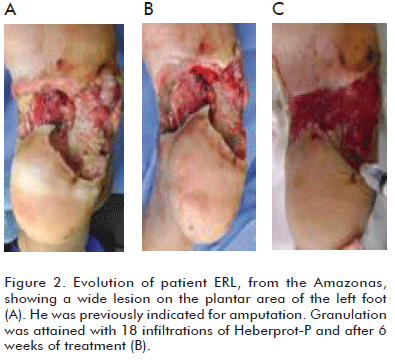
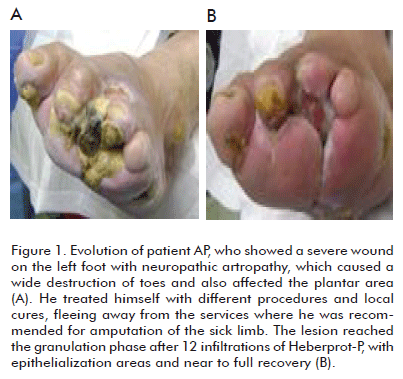
<body><![CDATA[<P   ><font size="2" face="Verdana, Arial, Helvetica, sans-serif">Can we assert that      major amputations rates can indeed be decreased in Wagner grade 5 diabetic      foot patients by administering Heberprot-P? The answer could be YES, if we      establish an individual procedure for each patient, together with multidisciplinary      teamwork and the efficient use of this product within the adequate clinical      context, for a satisfactory recovery of the patient, saving the limb from      amputation (Figures <a href="#fig1">1</a>, <a href="#fig2">2</a>, <a href="/img/revistas/bta/v27n2/f0305210.gif">3</a>,      <a href="/img/revistas/bta/v27n2/f0405210.gif">4</a>).</font></P >   </font><font size="+1" color="#000000"><font size="+1"><font size="+1"><font size="+1"><font size="+1"><font size="+1"><font size="+1"><font size="+1"><font size="+1"><font size="+1"><font size="+1"><font color="#0000FF"><font color="#000000"><font size="+1"><font size="+1"><font size="+1"><font size="+1"><font size="+1"><font size="+1"><font size="+1"><font size="+1"><font size="+1"><font size="+1"><font size="+1"><font size="+1"><font size="+1"><font size="+1"><font size="+1"><font size="+1"><font size="+1"><font size="+1"><font size="+1"><font size="+1"><a name="fig1"></a></font></font></font></font></font></font></font></font></font></font></font></font></font></font></font></font></font></font></font></font></font></font></font></font></font></font></font></font></font></font></font></font></font><FONT size="+1">       
<P align="center"   ><img src="/img/revistas/bta/v27n2/f0105210.gif" width="403" height="379"></P >   </font><font size="+1" color="#000000"><font size="+1"><font size="+1"><font size="+1"><font size="+1"><font size="+1"><font size="+1"><font size="+1"><font size="+1"><font size="+1"><font size="+1"><font color="#0000FF"><font color="#000000"><font size="+1"><font size="+1"><font size="+1"><font size="+1"><font size="+1"><font size="+1"><font size="+1"><font size="+1"><font size="+1"><font size="+1"><font size="+1"><font size="+1"><font size="+1"><font size="+1"><font size="+1"><font size="+1"><font size="+1"><font size="+1"><font size="+1"><font size="+1"><a name="fig2"></a></font></font></font></font></font></font></font></font></font></font></font></font></font></font></font></font></font></font></font></font></font></font></font></font></font></font></font></font></font></font></font></font></font><FONT size="+1">       
<P align="center"   ><img src="/img/revistas/bta/v27n2/f0205210.gif" width="395" height="364"></P >       
<P   ><font size="2" face="Verdana, Arial, Helvetica, sans-serif"><b><font size="3">REFERENCES</font></b>      </font></P >       <!-- ref --><P   ><font size="2" face="Verdana, Arial, Helvetica, sans-serif">1. Berlanga J, Moreira      E. Wound healing promotion in rats treated with EGF is dose dependent. Biotecnol      Apl 1996;13 (3);181-5. </font></P >   <FONT size="+1">        <!-- ref --><P   ><font size="2" face="Verdana, Arial, Helvetica, sans-serif">2. Sage RA, Pinzur,      M. Amputation and Rehabilitation of Diabetic Foot. The Diabetic Foot, 2nd      Edition. Edited por Logerfo &amp; Velves. </font></P >       <!-- ref --><P   ><font size="2" face="Verdana, Arial, Helvetica, sans-serif">3. Fern&aacute;ndez-Montequ&iacute;n      JI, Infante-Cristi&aacute; E, Valenzuela-Silva C, Franco-P&eacute;rez N, Savigne-Gutierrez      W, Artaza-Sanz H, <I>et al</I>. Intralesional injections of Citoprot-P (recombinant      human epidermal growth factor) in advanced diabetic foot ulcers with risk      of amputation. Int Wound J 2007;4(4):333-43. </font></P >       <!-- ref --><P   ><font size="2" face="Verdana, Arial, Helvetica, sans-serif">4. Acosta JB, Savigne      W, Valdez C, Franco N, Alba JS, del Rio A, <I>et al</I>. Epidermal growth      factor intralesional infiltrations can prevent amputation in patients with      advanced diabetic foot wounds. Int Wound J 2006;3(3):232-9. </font></P >       <!-- ref --><P   ><font size="2" face="Verdana, Arial, Helvetica, sans-serif">5. Fern&aacute;ndez-Montequ&iacute;n      JI, Valenzuela- Silva CM, D&iacute;az OG, Savigne W, Sancho- Soutelo N, Rivero-Fern&aacute;ndez      F, <I>et al</I>. Intra-lesional injections of recombinant human epidermal      growth factor promote granulation and healing in advanced diabetic foot ulcers:      multicenter, randomised, placebo-controlled, double-blind study. Int Wound      J 2009;6(6):432-43. </font></P >       <!-- ref --><P   ><font size="2" face="Verdana, Arial, Helvetica, sans-serif">6. Fern&aacute;ndez-Montequ&iacute;n      JI, Betancourt BY, Leyva-Gonzalez G, Mola EL, Gal&aacute;n-Naranjo K, Ram&iacute;rez-Navas      M, <I>et al</I>: Intralesional administration of epidermal growth factor-based      formulation (Heberprot-P) in chronic diabetic foot ulcer: treatment up to      complete wound closure. Int Wound J 2009;6(1):67-72. </font></P >       <!-- ref --><P   ><font size="2" face="Verdana, Arial, Helvetica, sans-serif">7. Fern&aacute;ndez      Montequin J, Santiesteban L. Experiencias en el uso del Heberprot-P en Venezuela.      Reportes de casos del hospital Carlos Arvelo, Caracas. En: Infiltraci&oacute;n      del Factor de Crecimiento Epid&eacute;rmico. Un tratamiento eficaz para la      &uacute;lcera del pie diab&eacute;tico. Editorial Elfos Scientiae, 2009. p.      57-72. </font></P >       <P   ><font size="2" face="Verdana, Arial, Helvetica, sans-serif">8. Frykberg RG, Zgonis      T, Armstrong DG, Driver VR, Giurini JM, Kravitz</font><font size="+1" color="#000000"><font size="+1"><font size="+1"><font size="+1"><font size="+1"><font size="+1"><font size="+1"><font size="+1"><font size="+1"><font size="+1"><font size="+1"><font size="+1"><font size="+1"><font size="+1"><font size="+1"><font size="+1"><font size="+1"><font size="+1"><font size="+1"><font size="+1"><font size="+1"><font color="#0000FF"><font color="#000000"><font size="+1"><font size="+1"><font size="+1"><font size="+1"><font size="+1"><font size="+1"><font size="+1"><font size="+1"><font size="+1"><font size="+1"><font size="+1"><font size="+1"><font face="Verdana, Arial, Helvetica, sans-serif" size="2">      SR</font></font></font></font></font></font></font></font></font></font></font></font></font></font></font></font></font></font></font></font></font></font></font></font></font></font></font></font></font></font></font></font></font></font></font></font><font size="2" face="Verdana, Arial, Helvetica, sans-serif">,      <I>et al</I>. Diabetic foot disorders: A clinical practice guidelines (2006      revision). J Foot Ankle Surg 2006:39(Suppl 5):1-66. </font></P >       <!-- ref --><P   ><font size="2" face="Verdana, Arial, Helvetica, sans-serif">9. De Valera, L.      Programa de Atenci&oacute;n Integral al Paciente portador de Pie Diab&eacute;tico.      Ministerio del Poder Popular para la Salud. Venezuela, 2009. </font></P >       <!-- ref --><P   ><font face="Verdana, Arial, Helvetica, sans-serif" size="2">10. Mena G. Resultados      de la aplicaci&oacute;n de un Programa de Atenci&oacute;n Integral al paciente      portador del PD, con inclusi&oacute;n del tratamiento con Heberprot-P. En:      Hospital Militar Carlos Arvelo, Coloquios Anuales, Abril 2008. Caracas, Venezuela.</font></P >       <P   ><font size="2" face="Verdana, Arial, Helvetica, sans-serif">Received in August,      2010. </font>    <br>     <font size="2" face="Verdana, Arial, Helvetica, sans-serif">Accepted for publication      in September, 2010</font><font size="2" face="Verdana, Arial, Helvetica, sans-serif"><I>.</I>      </font></P >   <FONT size="+1"><font size="+1" color="#000000"><font size="+1"><font size="+1"><font size="2" face="Verdana, Arial, Helvetica, sans-serif">Jos&eacute;    Fern&aacute;ndez Montequin</font></font></font></font><FONT size="+1">, </font><font size="+1" color="#000000"><font size="+1"><font size="+1"><font size="+1"><font size="+1"><font size="+1"><font size="+1"><font size="+1"><font size="+1"><font size="+1"><font size="2" face="Verdana, Arial, Helvetica, sans-serif">Instituto    de Angiolog&iacute;a y Cirug&iacute;a Vascular Calzada del Cerro # 1551, CP    12 000, Cerro, Ciudad de La Habana, Cuba. E-mail: <a href="mailto:fdez_montequin@yahoo.es">    <font color="#0000FF">fdez_montequin@yahoo.es</font></a></font></font></font></font></font></font></font></font></font></font></font></font></font></font></font></font></font></font></font></font></font></font></font></font></font></font></font></font></font></font></font></font></font></font></font></font></font></font></font></font></font></font></font></font></font></font></DIV >      ]]></body><back>
<ref-list>
<ref id="B1">
<label>1</label><nlm-citation citation-type="journal">
<person-group person-group-type="author">
<name>
<surname><![CDATA[Berlanga]]></surname>
<given-names><![CDATA[J]]></given-names>
</name>
<name>
<surname><![CDATA[Moreira]]></surname>
<given-names><![CDATA[E]]></given-names>
</name>
</person-group>
<article-title xml:lang="en"><![CDATA[Wound healing promotion in rats treated with EGF is dose dependent]]></article-title>
<source><![CDATA[Biotecnol Apl]]></source>
<year>1996</year>
<volume>13</volume>
<numero>3</numero>
<issue>3</issue>
<page-range>181-5</page-range></nlm-citation>
</ref>
<ref id="B2">
<label>2</label><nlm-citation citation-type="book">
<person-group person-group-type="author">
<name>
<surname><![CDATA[Sage]]></surname>
<given-names><![CDATA[RA]]></given-names>
</name>
<name>
<surname><![CDATA[Pinzur]]></surname>
<given-names><![CDATA[M]]></given-names>
</name>
</person-group>
<source><![CDATA[Amputation and Rehabilitation of Diabetic Foot. The Diabetic Foot]]></source>
<year></year>
<edition>2nd</edition>
<publisher-name><![CDATA[Logerfo & Velves]]></publisher-name>
</nlm-citation>
</ref>
<ref id="B3">
<label>3</label><nlm-citation citation-type="journal">
<person-group person-group-type="author">
<name>
<surname><![CDATA[Fernández-Montequín]]></surname>
<given-names><![CDATA[JI]]></given-names>
</name>
<name>
<surname><![CDATA[Infante-Cristiá]]></surname>
<given-names><![CDATA[E]]></given-names>
</name>
<name>
<surname><![CDATA[Valenzuela-Silva]]></surname>
<given-names><![CDATA[C]]></given-names>
</name>
<name>
<surname><![CDATA[Franco-Pérez]]></surname>
<given-names><![CDATA[N]]></given-names>
</name>
<name>
<surname><![CDATA[Savigne-Gutierrez]]></surname>
<given-names><![CDATA[W]]></given-names>
</name>
<name>
<surname><![CDATA[Artaza-Sanz]]></surname>
<given-names><![CDATA[H]]></given-names>
</name>
</person-group>
<article-title xml:lang="en"><![CDATA[Intralesional injections of Citoprot-P (recombinant human epidermal growth factor) in advanced diabetic foot ulcers with risk of amputation]]></article-title>
<source><![CDATA[Int Wound J]]></source>
<year>2007</year>
<volume>4</volume>
<numero>4</numero>
<issue>4</issue>
<page-range>333-43</page-range></nlm-citation>
</ref>
<ref id="B4">
<label>4</label><nlm-citation citation-type="journal">
<person-group person-group-type="author">
<name>
<surname><![CDATA[Acosta]]></surname>
<given-names><![CDATA[JB]]></given-names>
</name>
<name>
<surname><![CDATA[Savigne]]></surname>
<given-names><![CDATA[W]]></given-names>
</name>
<name>
<surname><![CDATA[Valdez]]></surname>
<given-names><![CDATA[C]]></given-names>
</name>
<name>
<surname><![CDATA[Franco]]></surname>
<given-names><![CDATA[N]]></given-names>
</name>
<name>
<surname><![CDATA[Alba]]></surname>
<given-names><![CDATA[JS]]></given-names>
</name>
<name>
<surname><![CDATA[del Rio]]></surname>
<given-names><![CDATA[A]]></given-names>
</name>
</person-group>
<article-title xml:lang="en"><![CDATA[Epidermal growth factor intralesional infiltrations can prevent amputation in patients with advanced diabetic foot wounds]]></article-title>
<source><![CDATA[Int Wound J]]></source>
<year>2006</year>
<volume>3</volume>
<numero>3</numero>
<issue>3</issue>
<page-range>232-9</page-range></nlm-citation>
</ref>
<ref id="B5">
<label>5</label><nlm-citation citation-type="journal">
<person-group person-group-type="author">
<name>
<surname><![CDATA[Fernández-Montequín]]></surname>
<given-names><![CDATA[JI]]></given-names>
</name>
<name>
<surname><![CDATA[Valenzuela-Silva]]></surname>
<given-names><![CDATA[CM]]></given-names>
</name>
<name>
<surname><![CDATA[Díaz]]></surname>
<given-names><![CDATA[OG]]></given-names>
</name>
<name>
<surname><![CDATA[Savigne]]></surname>
<given-names><![CDATA[W]]></given-names>
</name>
<name>
<surname><![CDATA[Sancho-Soutelo]]></surname>
<given-names><![CDATA[N]]></given-names>
</name>
<name>
<surname><![CDATA[Rivero-Fernández]]></surname>
<given-names><![CDATA[F]]></given-names>
</name>
</person-group>
<article-title xml:lang="en"><![CDATA[Intra-lesional injections of recombinant human epidermal growth factor promote granulation and healing in advanced diabetic foot ulcers: multicenter, randomised, placebo-controlled, double-blind study]]></article-title>
<source><![CDATA[Int Wound J]]></source>
<year>2009</year>
<volume>6</volume>
<numero>6</numero>
<issue>6</issue>
<page-range>432-43</page-range></nlm-citation>
</ref>
<ref id="B6">
<label>6</label><nlm-citation citation-type="journal">
<person-group person-group-type="author">
<name>
<surname><![CDATA[Fernández-Montequín]]></surname>
<given-names><![CDATA[JI]]></given-names>
</name>
<name>
<surname><![CDATA[Betancourt]]></surname>
<given-names><![CDATA[BY]]></given-names>
</name>
<name>
<surname><![CDATA[Leyva-Gonzalez]]></surname>
<given-names><![CDATA[G]]></given-names>
</name>
<name>
<surname><![CDATA[Mola]]></surname>
<given-names><![CDATA[EL]]></given-names>
</name>
<name>
<surname><![CDATA[Galán-Naranjo]]></surname>
<given-names><![CDATA[K]]></given-names>
</name>
<name>
<surname><![CDATA[Ramírez-Navas]]></surname>
<given-names><![CDATA[M]]></given-names>
</name>
</person-group>
<article-title xml:lang="en"><![CDATA[Intralesional administration of epidermal growth factor-based formulation (Heberprot-P) in chronic diabetic foot ulcer: treatment up to complete wound closure]]></article-title>
<source><![CDATA[Int Wound J]]></source>
<year>2009</year>
<volume>6</volume>
<numero>1</numero>
<issue>1</issue>
<page-range>67-72</page-range></nlm-citation>
</ref>
<ref id="B7">
<label>7</label><nlm-citation citation-type="book">
<person-group person-group-type="author">
<name>
<surname><![CDATA[Fernández Montequin]]></surname>
<given-names><![CDATA[J]]></given-names>
</name>
<name>
<surname><![CDATA[antiesteban]]></surname>
<given-names><![CDATA[L]]></given-names>
</name>
</person-group>
<article-title xml:lang="es"><![CDATA[Experiencias en el uso del Heberprot-P en Venezuela. Reportes de casos del hospital Carlos Arvelo, Caracas]]></article-title>
<source><![CDATA[Infiltración del Factor de Crecimiento Epidérmico. Un tratamiento eficaz para la úlcera del pie diabético]]></source>
<year>2009</year>
<page-range>57-72</page-range><publisher-name><![CDATA[Editorial Elfos Scientiae]]></publisher-name>
</nlm-citation>
</ref>
<ref id="B8">
<label>8</label><nlm-citation citation-type="journal">
<person-group person-group-type="author">
<name>
<surname><![CDATA[Frykberg]]></surname>
<given-names><![CDATA[RG]]></given-names>
</name>
<name>
<surname><![CDATA[Zgonis]]></surname>
<given-names><![CDATA[T]]></given-names>
</name>
<name>
<surname><![CDATA[Armstrong]]></surname>
<given-names><![CDATA[DG]]></given-names>
</name>
<name>
<surname><![CDATA[Driver]]></surname>
<given-names><![CDATA[VR]]></given-names>
</name>
<name>
<surname><![CDATA[Giurini]]></surname>
<given-names><![CDATA[JM]]></given-names>
</name>
<name>
<surname><![CDATA[Kravitz]]></surname>
<given-names><![CDATA[SR]]></given-names>
</name>
</person-group>
<article-title xml:lang="en"><![CDATA[Diabetic foot disorders: A clinical practice guidelines (2006 revision)]]></article-title>
<source><![CDATA[J Foot Ankle Surg]]></source>
<year>2006</year>
<volume>39</volume><volume>5</volume>
<page-range>1-66</page-range></nlm-citation>
</ref>
<ref id="B9">
<label>9</label><nlm-citation citation-type="book">
<person-group person-group-type="author">
<name>
<surname><![CDATA[De Valera]]></surname>
<given-names><![CDATA[L]]></given-names>
</name>
</person-group>
<source><![CDATA[Programa de Atención Integral al Paciente portador de Pie Diabético]]></source>
<year>2009</year>
<publisher-name><![CDATA[Ministerio del Poder Popular para la Salud]]></publisher-name>
</nlm-citation>
</ref>
<ref id="B10">
<label>10</label><nlm-citation citation-type="confpro">
<person-group person-group-type="author">
<name>
<surname><![CDATA[Mena]]></surname>
<given-names><![CDATA[G]]></given-names>
</name>
</person-group>
<source><![CDATA[Resultados de la aplicación de un Programa de Atención Integral al paciente portador del PD, con inclusión del tratamiento con Heberprot-P]]></source>
<year></year>
<conf-name><![CDATA[ Coloquios Anuales]]></conf-name>
<conf-date>Abril 2008</conf-date>
<conf-loc>Caracas </conf-loc>
</nlm-citation>
</ref>
</ref-list>
</back>
</article>