<?xml version="1.0" encoding="ISO-8859-1"?><article xmlns:mml="http://www.w3.org/1998/Math/MathML" xmlns:xlink="http://www.w3.org/1999/xlink" xmlns:xsi="http://www.w3.org/2001/XMLSchema-instance">
<front>
<journal-meta>
<journal-id>1027-2852</journal-id>
<journal-title><![CDATA[Biotecnología Aplicada]]></journal-title>
<abbrev-journal-title><![CDATA[Biotecnol Apl]]></abbrev-journal-title>
<issn>1027-2852</issn>
<publisher>
<publisher-name><![CDATA[Editorial Elfos Scientiae]]></publisher-name>
</publisher>
</journal-meta>
<article-meta>
<article-id>S1027-28522010000200008</article-id>
<title-group>
<article-title xml:lang="en"><![CDATA[Impact of epidermal growth factor on the treatment of diabetic foot ulcers]]></article-title>
<article-title xml:lang="es"><![CDATA[Impacto del Heberprot-P en el tratamiento de las úlceras del pie diabético]]></article-title>
</title-group>
<contrib-group>
<contrib contrib-type="author">
<name>
<surname><![CDATA[Velázquez]]></surname>
<given-names><![CDATA[Wilver]]></given-names>
</name>
<xref ref-type="aff" rid="A01"/>
</contrib>
<contrib contrib-type="author">
<name>
<surname><![CDATA[Valles]]></surname>
<given-names><![CDATA[Alfredo]]></given-names>
</name>
<xref ref-type="aff" rid="A01"/>
</contrib>
<contrib contrib-type="author">
<name>
<surname><![CDATA[Curbelo]]></surname>
<given-names><![CDATA[Walfrido]]></given-names>
</name>
<xref ref-type="aff" rid="A01"/>
</contrib>
</contrib-group>
<aff id="A01">
<institution><![CDATA[,Hospital General Docente Guillermo ínguez López  ]]></institution>
<addr-line><![CDATA[Las Tunas ]]></addr-line>
<country>Cuba</country>
</aff>
<pub-date pub-type="pub">
<day>00</day>
<month>06</month>
<year>2010</year>
</pub-date>
<pub-date pub-type="epub">
<day>00</day>
<month>06</month>
<year>2010</year>
</pub-date>
<volume>27</volume>
<numero>2</numero>
<fpage>136</fpage>
<lpage>141</lpage>
<copyright-statement/>
<copyright-year/>
<self-uri xlink:href="http://scielo.sld.cu/scielo.php?script=sci_arttext&amp;pid=S1027-28522010000200008&amp;lng=en&amp;nrm=iso"></self-uri><self-uri xlink:href="http://scielo.sld.cu/scielo.php?script=sci_abstract&amp;pid=S1027-28522010000200008&amp;lng=en&amp;nrm=iso"></self-uri><self-uri xlink:href="http://scielo.sld.cu/scielo.php?script=sci_pdf&amp;pid=S1027-28522010000200008&amp;lng=en&amp;nrm=iso"></self-uri><abstract abstract-type="short" xml:lang="en"><p><![CDATA[Human Epidermal Growth Factor (hEGF), obtained through recombinant DNA technology and formulated as Heberprot-P at a dosage of 75 µg, can stimulate the granulation and cicatrization of different tissues. This work is aimed mainly at the evaluation of the impact of the intralesional administration of hEGF in diabetic foot ulcers (DFU) treated with the optimized insulin scheme, in terms of whether it facilitates granulation and cicatrization or decreases the number of amputations. An evaluative, longitudinal intervention method was applied in 32 patients with a diagnosis of Diabetic Foot that complied with the inclusion criteria (Wagner grade 3 and 4 ulcers, patient older than 18 years, signed informed consent form), excluding cases where ulcer area was smaller than 1 cm2 or there were decompensated chronic diseases: diabetic coma, ischemic cardiopathy, CRI (creatinine > 200 mmol/L, oligoanuria and antecedents or suspicions of malignant disease) and applying the treatment intralesionally, thrice per week. Both granulation and cicatrization of the lesions were achieved in 90.62% of the cases in an average time of 46.5 days ± 8.9. Amputation was necessary only in 9.38% of the cases. The most frequent adverse events were pain, burning sensations, and shivering. The therapeutic scheme of intralesional administration of Heberprot-P can complete lesion closure and is a convenient and safe alternative in the treatment of advanced diabetic foot ulcers, constituting a unique therapeutic modality for a critical and incapacitating disease.]]></p></abstract>
<abstract abstract-type="short" xml:lang="es"><p><![CDATA[El factor de crecimiento epidérmico humano (FCEH) obtenido con tecnología recombinante en su formulación Heberprot-P de 75 µg puede estimular la granulación y cicatrización en distintos tejidos. El objetivo fundamental de este trabajo investigativo fue evaluar el impacto de la administración intralesional del FCEH en úlceras de pie diabético (UPD), en pacientes tratados con esquema optimizado de insulina, para comprobar si facilitaba la granulación y cicatrización; y si al mismo tiempo disminuían las amputaciones. Se utilizó un método de intervención, evaluativo, longitudinal y prospectivo en 32 pacientes con diagnóstico de pie diabético, con criterios de inclusión (úlceras de grado 3 y 4, según la clasificación de Wagner, mayor de 18 años y voluntariedad del paciente con la firma del consentimiento informado). Se excluyeron los casos con úlceras con un área menor que 1 cm2, enfermedades crónicas descompensadas: coma diabético, cardiopatía isquémica, IRCr (creatinina > 200 mmol/L, oligoanuria, y antecedentes o sospecha de enfermedades malignas. El Heberprot-P se aplicó 3 veces por semana de forma intralesional. La granulación como la cicatrización de las lesiones se lograron en el 90.62%, en un término promedio de 46.5 días ± 8.9. La amputación solo fue necesaria en el 9.38% de los casos. Los eventos adversos más frecuente fueron el dolor, ardor y tiriteo. El esquema terapéutico de la administración intralesional del Heberprot-P puede completar el cierre, ser seguro y conveniente para sanar las úlceras del pie diabético avanzado. Representa una modalidad terapéutica singular para enfermedades críticas y discapacitantes.]]></p></abstract>
<kwd-group>
<kwd lng="en"><![CDATA[diabetic foot ulcer]]></kwd>
<kwd lng="en"><![CDATA[Heberprot-P]]></kwd>
<kwd lng="en"><![CDATA[Wagner classification]]></kwd>
<kwd lng="es"><![CDATA[úlcera de pie diabético]]></kwd>
<kwd lng="es"><![CDATA[Heberprot-P]]></kwd>
<kwd lng="es"><![CDATA[clasificación de Wagner]]></kwd>
</kwd-group>
</article-meta>
</front><body><![CDATA[ <DIV class="Sect"   >        <P align="right"   ><font size="2" color="#000000" face="Verdana, Arial, Helvetica, sans-serif"><b>RESEARCH</b></font></P >       <P align="right"   >&nbsp;</P >   <FONT size="+1" color="#000000">        <P   ><font size="2" face="Verdana, Arial, Helvetica, sans-serif"><B><font size="4">Impact      of epidermal growth factor on the treatment of diabetic foot ulcers</font></b></font></P >       <P   >&nbsp;</P >   <FONT size="+1">       <P   ><b><font size="3" face="Verdana, Arial, Helvetica, sans-serif">Impacto del Heberprot-P      en el tratamiento de las &uacute;lceras del pie diab&eacute;tico</font></b></P >   <B>    <P   >&nbsp;</P >       <P   >&nbsp;</P >   </B>        <P   ><font size="2" face="Verdana, Arial, Helvetica, sans-serif"><b>Wilver Vel&aacute;zquez,      Alfredo Valles, Walfrido Curbelo</b></font></P >   <FONT size="+1"><FONT size="+1"><FONT size="+1"><FONT size="+1"><FONT size="+1"><FONT size="+1"><FONT size="+1"><FONT size="+1">        <P   ><font size="2" face="Verdana, Arial, Helvetica, sans-serif">Hospital General      Docente &quot;Guillermo Dom&iacute;nguez L&oacute;pez&quot; Puerto Padre,      Las Tunas, Cuba</font></P >       ]]></body>
<body><![CDATA[<P   >&nbsp;</P >   </font></font></font></font></font></font></font></font></font></font>   <hr>   <FONT size="+1" color="#000000"><FONT size="+1"><FONT size="+1"><FONT size="+1"><FONT size="+1"><FONT size="+1"><FONT size="+1"><FONT size="+1"><FONT size="+1"><FONT size="+1">       <P   ><font size="2" face="Verdana, Arial, Helvetica, sans-serif"> </font><font face="Verdana, Arial, Helvetica, sans-serif" size="2"><B>ABSTRACT<I>      </I></b></font></P >   <FONT size="+1">       <P   ><font face="Verdana, Arial, Helvetica, sans-serif" size="2">Human Epidermal Growth      Factor (hEGF), obtained through recombinant DNA technology and formulated      as Heberprot-P at a dosage of 75 &micro;g, can stimulate the granulation and      cicatrization of different tissues. This work is aimed mainly at the evaluation      of the impact of the intralesional administration of hEGF in diabetic foot      ulcers (DFU) treated with the optimized insulin scheme, in terms of whether      it facilitates granulation and cicatrization or decreases the number of amputations.      An evaluative, longitudinal intervention method was applied in 32 patients      with a diagnosis of Diabetic Foot that complied with the inclusion criteria      (Wagner grade 3 and 4 ulcers, patient older than 18 years, signed informed      consent form), excluding cases where ulcer area was smaller than 1 cm<sup>2</sup>      or there were decompensated chronic diseases: diabetic coma, ischemic cardiopathy,      CRI (creatinine &gt; 200 mmol/L, oligoanuria and antecedents or suspicions      of malignant disease) and applying the treatment intralesionally, thrice per      week. Both granulation and cicatrization of the lesions were achieved in 90.62%      of the cases in an average time of 46.5 days &plusmn; 8.9. Amputation was      necessary only in 9.38% of the cases. The most frequent adverse events were      pain, burning sensations, and shivering. The therapeutic scheme of intralesional      administration of Heberprot-P can complete lesion closure and is a convenient      and safe alternative in the treatment of advanced diabetic foot ulcers, constituting      a unique therapeutic modality for a critical and incapacitating disease. </font></P >   <FONT size="+1"><FONT size="+1">        <P   ><font face="Verdana, Arial, Helvetica, sans-serif" size="2"><b>Keywords</b>:      diabetic foot ulcer, Heberprot-P, Wagner classification </font></P >   </font></font></font></font></font></font></font></font></font></font></font></font></font>    <hr>   <FONT size="+1" color="#000000"><FONT size="+1"><FONT size="+1"><FONT size="+1"><FONT size="+1"><FONT size="+1"><FONT size="+1"><FONT size="+1"><FONT size="+1"><FONT size="+1"><FONT size="+1"><FONT size="+1"><FONT size="+1">       <P   ><font face="Verdana, Arial, Helvetica, sans-serif" size="2"><B>RESUMEN<I> </I></b></font></P >       <P   ><font face="Verdana, Arial, Helvetica, sans-serif" size="2">El factor de crecimiento      epid&eacute;rmico humano (FCEH) obtenido con tecnolog&iacute;a recombinante      en su formulaci&oacute;n Heberprot-P de 75 &micro;g puede estimular la granulaci&oacute;n      y cicatrizaci&oacute;n en distintos tejidos. El objetivo fundamental de este      trabajo investigativo fue evaluar el impacto de la administraci&oacute;n intralesional      del FCEH en &uacute;lceras de pie diab&eacute;tico (UPD), en pacientes tratados      con esquema optimizado de insulina, para comprobar si facilitaba la granulaci&oacute;n      y cicatrizaci&oacute;n; y si al mismo tiempo disminu&iacute;an las amputaciones.      Se utiliz&oacute; un m&eacute;todo de intervenci&oacute;n, evaluativo, longitudinal      y prospectivo en 32 pacientes con diagn&oacute;stico de pie diab&eacute;tico,      con criterios de inclusi&oacute;n (&uacute;lceras de grado 3 y 4, seg&uacute;n      la clasificaci&oacute;n de Wagner, mayor de 18 a&ntilde;os y voluntariedad      del paciente con la firma del consentimiento informado). Se excluyeron los      casos con &uacute;lceras con un &aacute;rea menor que 1 cm<sup>2</sup>, enfermedades      cr&oacute;nicas descompensadas: coma diab&eacute;tico, cardiopat&iacute;a      isqu&eacute;mica, IRCr (creatinina &gt; 200 mmol/L, oligoanuria, y antecedentes      o sospecha de enfermedades malignas. El Heberprot-P se aplic&oacute; 3 veces      por semana de forma intralesional. La granulaci&oacute;n como la cicatrizaci&oacute;n      de las lesiones se lograron en el 90.62%, en un t&eacute;rmino promedio de      46.5 d&iacute;as &plusmn; 8.9. La amputaci&oacute;n solo fue necesaria en      el 9.38% de los casos. Los eventos adversos m&aacute;s frecuente fueron el      dolor, ardor y tiriteo. El esquema terap&eacute;utico de la administraci&oacute;n      intralesional del Heberprot-P puede completar el cierre, ser seguro y conveniente      para sanar las &uacute;lceras del pie diab&eacute;tico avanzado. Representa      una modalidad terap&eacute;utica singular para enfermedades cr&iacute;ticas      y discapacitantes. </font></P >   <FONT size="+1"><FONT size="+1">        <P   ><font face="Verdana, Arial, Helvetica, sans-serif" size="2"><b>Palabras clave</b>:      &uacute;lcera de pie diab&eacute;tico, Heberprot-P, clasificaci&oacute;n de      Wagner </font></P >   </font></font></font></font></font></font></font></font></font></font></font></font></font></font></font>    <hr>   <FONT size="+1" color="#000000"><FONT size="+1"><FONT size="+1"><FONT size="+1"><FONT size="+1"><FONT size="+1"><FONT size="+1"><FONT size="+1"><FONT size="+1"><FONT size="+1"><FONT size="+1"><FONT size="+1"><FONT size="+1"><FONT size="+1"><FONT size="+1">        <P   >&nbsp;</P >       <P   >&nbsp;</P >       <P   ><font size="2" face="Verdana, Arial, Helvetica, sans-serif"><b><font size="3">INTRODUCTION</font></b>      </font></P >   <FONT size="+1">        ]]></body>
<body><![CDATA[<P   ><font size="2" face="Verdana, Arial, Helvetica, sans-serif">Diabetes is the main      non-traumatic risk factor for the amputation of lower limbs. It has been estimated      that close to 1000 such amputations take place in our country each year. Therefore,      wound cicatrization problems not only have a high clinical relevance, but      their economic cost reaches thousands of millions of dollars per year (1).      </font></P >   <FONT size="+1">        <P   ><font face="Verdana, Arial, Helvetica, sans-serif" size="2">Diabetic Foot Ulcer      (DFU) is a significant complication of <I>Diabetes Mellitus </I>(DM) with      a yearly incidence of 10% among diabetic patients, further increased by 5      to 7.5% in those suffering from peripheral neuropathies. It is estimated that      15% of diabetic patients develop ulcers at some point during their life, and      10 to 30% of these ulcers eventually progress to an amputation. The presence      of infections is an important contributing factor for this event, as according      to the literature, approximately 60% of these amputations are preceded by      the presence of infected ulcers. The mortality after 5 years in patients undergoing      a lower limb amputation is 50 to 60% (1, 2). </font></P >       <P   ><font face="Verdana, Arial, Helvetica, sans-serif" size="2">DFU is one of the      most common disorders related to the appearance of problems in the process      of cicatrization. There is a high incidence of systemic endothelial disorders      in diabetic patients, who are saddled with weakened anti-bacterial defenses      and a deteriorated machinery for tissue repair; precisely, the combination      of these factors results in a higher incidence of lower limb amputations in      this clinical population. The cornerstones of wound treatment in diabetics      are a meticulous lesion management, and the stimulation of revascularization      whenever feasible. However, these interventions are often not effective, and      an amputation becomes unavoidable (3-6). </font></P >       <P   ><font face="Verdana, Arial, Helvetica, sans-serif" size="2">Tissue repair requires      the coordinated interaction of numerous cell types in processes of inflammation;      matrix deposition and remodeling that restore the continuity and architecture      of visceral or cutaneous defects (7, 8). Precisely, the epidermal growth factors      (EGF) constitute the largest population of soluble messengers that fine-tune      and regulate the complex network of processes that take place during tissue      repair. The mechanisms whereby DM obstructs tissue repair are still under      study (9), but a set of convergent evidences suggests a deficit in the production      of different EGF, such as Keratinocyte Growth Factor (KGF), Vascular Endothelium      Growth Factor (VEGF) and Platelet-Derived Growth Factor (PDGF) as one of the      main culprits (10, 11). </font></P >       <P   ><font face="Verdana, Arial, Helvetica, sans-serif" size="2">The EGF receptor      has been identified as a target for Advanced Glycation End Products (AGEs)      such as glyoxal (GO) and methylglyoxal (MGO) in a timeand dose-dependent fashion,      resulting in the suppression of receptor self-phosphorylation and of its subsequent      activation. The formerly described deficit of EGF in Diabetes: (1) affects      fibroblast functionality, limiting the formation, maturation and remodeling      of the extracellular matrix; (2) decreases the size of myo-fibroblast populations,      leading to an insignificant contraction of the wound; (3) produces a limited      or failed angiogenic response. The convergence of these factors leads to a      phenotype of wound chronification with a significant impairment of the cicatrization      process (4, 6, 12). </font></P >       <P   ><font face="Verdana, Arial, Helvetica, sans-serif" size="2">EGF stimulates the      proliferation of fibroblasts, keratinocytes and endothelial cells in blood      vessels, which contributes to its beneficial effects on cicatrization (13).      Previous Phase I and II trials in DFU patients have demonstrated that the      intralesional administration of Heberprot-P 75 &micro;g (hEGF) stimulates      cicatrization, resulting in the formation of useful granulation tissue in      the ulcer bed that allows secondintention healing or the successful use of      skin grafts, and these effects are associated to a reduction of the risk of      amputation (4). These results support the introduction of the exogenous administration      of growth factors as an instrumental therapy for the improvement and support      of the cicatrization process in this specific patient population. Growth factor      &ldquo;replacement therapy&rdquo; has so far included the topical release      of recombinant human EGF (5). </font></P >       <P   ><font face="Verdana, Arial, Helvetica, sans-serif" size="2">The risk of a minor      or major amputation in a lower limb is greatly increased in diabetics compared      to the normal population (14). A large number of studies shows that the cumulative      incidence of amputations in the population of patients diagnosed with DM before      30 years of age and an evolution of the disease lasting more than 10 years      is higher than 5% and 7% for type-I and type-II DM, respectively (15, 16).      When a diabetic patient develops a foot ulcer, the chances of trouble-free      cicatrization are small to begin with, compounded by a higher probability      of infection, and also higher probabilities of spreading of the infection,      leading to a gangrene that finally necessitates amputation (17). </font></P >       <P   ><font face="Verdana, Arial, Helvetica, sans-serif" size="2">Although different      preventive, medical and surgical treatment models have been tried for the      management of DFU, a significant decrease of the amputation rate is yet to      be accomplished, especially in patients suffering from Wagner&rsquo;s grade      3 (deep, with abscesses and osteomyelitis) and grade 4 (delimited gangrene      of the toe or the foot) ulcers, and the quest for alternatives that come closer      to this goal is still ongoing. In this sense, the particularly severe deficit      of EGF in DM offers a window of opportunity for a therapy that can result      in a significant improvement of the quality of life of these patients (18).      </font></P >       <P   ><font face="Verdana, Arial, Helvetica, sans-serif" size="2">Heberprot-P 75 &micro;g,      a new product from Cuban biotechnology obtained in the Center for Genetic      Engineering and Biotechnology through recombinant DNA technology, is a preparation      of hEGF purified from engineered cells of <I>Saccharomyces cerevisiae </I>bearing      a copy of the human EGF gene. Its availability will facilitate the application      of doses of 75 &micro;g in three weekly sessions following the intralesional      route, until granulation or significant cicatrization is achieved, for a treatment      period of up to 8 weeks. </font></P >       <P   ><font face="Verdana, Arial, Helvetica, sans-serif" size="2">Heberprot-P 75 &micro;g      is an injectable cytoprotective agent that stimulates cicatrization, presented      as a lyophilizate in glass vials, to be administered intralesionally. This      formulation led us to propose a hypothesis. </font></P >       ]]></body>
<body><![CDATA[<P   ><font face="Verdana, Arial, Helvetica, sans-serif" size="2">Can Heberprot-P 75      &micro;g solve the existing contradiction between the EGF deficit of the diabetic      and the decrease or absence of granulation and cicatrization of Diabetic Foot      Ulcers, while also decreasing the rate of lower limb amputations at the &ldquo;Guillermo      Dom&iacute;nguez L&oacute;pez&rdquo; General Teaching Hospital at the municipality      of Puerto Padre, in the province of Las Tunas? </font></P >       <P   ><font face="Verdana, Arial, Helvetica, sans-serif" size="2">The opportunity to      use this drug in our facilities for the treatment of Wagner grade 3 and 4      ulcers will let us validate the impact of this therapy, simultaneously examining      the behavior of the variables of study (age, sex, type of diabetes, optimized      insulin treatment and Wagner grade of the ulcer), providing an account of      any adverse events suffered by the patients, and determining the efficacy      of Heberprot-P 75 &micro;g by measuring the proportion of patients achieving      complete closure and/or complete granulation of the lesion by the end of the      treatment, also evaluating whether there is a reduction in the rate of amputations.      </font></P >       <P   ><font size="2" face="Verdana, Arial, Helvetica, sans-serif"><b><font size="3">MATERIALS      AND METHODS</font></b> </font></P >   <FONT size="+1">        <P   ><font size="2" face="Verdana, Arial, Helvetica, sans-serif">To evaluate the effect      of the intralesional administration of the Heberprot-P 75 &micro;g formulation      of hEGF into Diabetic Foot Ulcers, assessing whether it stimulates the granulation      and cicatrization of DFU that comply with amputation criteria, and evaluating      whether the treatment results in the elimination of such outcome. </font></P >   <FONT size="+1">        <P   ><font face="Verdana, Arial, Helvetica, sans-serif" size="2">Sample: 32 patients      with a diagnosis of Wagner grade 3 and 4 diabetic foot ulcers. </font></P >       <P   ><font face="Verdana, Arial, Helvetica, sans-serif" size="2">Inclusion criteria:      Wagner grade 3 and 4 diabetic foot ulcers, age older than 18 years, voluntary      participation as attested by signed informed consent form. </font></P >       <P   ><font face="Verdana, Arial, Helvetica, sans-serif" size="2">Exclusion criteria:      Ulcer area &lt; 1 cm<sup>2</sup>, decompensated chronic diseases: diabetic      coma, ischemic cardiopathy, CRI (creatinine &gt; 200mmol/l, oligoanuria and      antecedents or suspicions of malignant disease). </font></P >   <FONT size="+1"><FONT size="+1">        <P   ><font face="Verdana, Arial, Helvetica, sans-serif" size="2">Posology and mode      of administration: Heberprot-P was used always in conjunction with best practices      for the management of diabetic foot ulcers, debriding the lesions whenever      necessary, relieving pressure zones, and systematically cleaning, disinfecting      and dressing the wounds. It was administered in doses of 75 &micro;g, dissolved      into 5 mL of water for injection, 3 times per week, intralesionally. The administrations      were continued until the complete granulation of the lesion, its closure via      skin grafts, or once the upper limit of the treatment period was met. The      infiltrations were performed with a 26 G x &frac12;&rdquo; needle after cleaning      the lesions, infiltrating the drug into their edges, or in the bottom in the      case of deeper lesions. The cleanest areas of the lesions were infiltrated      first, changing the needle between puncture sites to avoid spreading any existing      sepsis and covering later the lesion with gauze wetted with saline solution      so as to maintain a moist and clean environment. The evaluation took into      account the cases failing to produce useful granulation tissue covering the      complete extension of the ulcer, also evaluating the treatment and other factors      that might hamper cicatrization such as osteomyelitis, local infections and      metabolic disorder. </font></P >       <P   ><font face="Verdana, Arial, Helvetica, sans-serif" size="2">Study variables:      Age, sex, type of diabetes, optimized control with insulin, Wagner classification      of the diabetic foot, adverse events, proportion of patients achieving cicatrization      or granulation of the lesion, and amputees. </font></P >       <P   ><font face="Verdana, Arial, Helvetica, sans-serif" size="2">Statistical processing:      Medical record, personal file or form, informed consent. </font></P >       ]]></body>
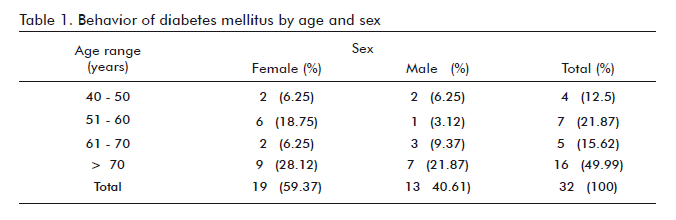
<body><![CDATA[<P   ><font face="Verdana, Arial, Helvetica, sans-serif" size="2">The statistical processing      of all collected data was performed manually with a calculator and a Pentium      III personal computer under the Windows XP operating system, performing word      and table processing with Word XP. </font></P >       <P   ><font face="Verdana, Arial, Helvetica, sans-serif" size="2">Objectives: </font></P >       <P   ><font face="Verdana, Arial, Helvetica, sans-serif" size="2">To identify control      variables in each patient: age, sex, type of diabetes, Wagner&rsquo;s diabetic      foot classification. </font></P >       <P   ><font face="Verdana, Arial, Helvetica, sans-serif" size="2">To identify and characterize      the adverse events appearing in patients treated with Heberprot-P 75 &micro;g.      </font></P >       <P   ><font face="Verdana, Arial, Helvetica, sans-serif" size="2">To determine the      efficacy of Heberprot-P 75 &micro;g by measuring the proportion of patients      achieving full closure and/or complete granulation of the lesion by the end      of the treatment period. </font></P >       <P   ><font face="Verdana, Arial, Helvetica, sans-serif" size="2">To evaluate the impact      of the treatment in the reduction of the amputation rate. </font></P >       <P   ><font size="2" face="Verdana, Arial, Helvetica, sans-serif"><b><font size="3">RESULTS      AND DISCUSSION</font></b> </font></P >   <FONT size="+1">        <P   ><font size="2" face="Verdana, Arial, Helvetica, sans-serif">In our judgment,      age is a non-vulnerable risk factor in the vascular complications of <I>Diabetes      Mellitus</I>, and it is directly proportional to the number and severity of      complications (<a href="/img/revistas/bta/v27n2/t0108210.gif">Table      1</a>). The patients older than 70 years comprised 49.99% of the sample, therefore      constituting the largest age group of the sample in agreement with the results      of other authors (1, 9, 10) uncovering a higher incidence of peripheral vascular      diseases after the 7th decade of life, with an increasing trend. In our country      the distribution per sex of the incidence of <I>Diabetes Mellitus </I>is asymmetrical,      but not so that of its complications, a phenomenon that has been discussed      by many authors (2, 3, 10). The females predominated in our sample (59.37%).      According to D&iacute;as <I>et al., </I>diabetic females in Cuba outnumber      males by approximately 2.5-fold (17.3% <I>vs. </I>7.7%). Another study on      peripheral angiopathies and diabetic foot also found larger numbers of female      patients (5). </font></P >   <FONT size="+1"><FONT size="+1"><FONT size="+1"><FONT size="+1">        
<P   ><font face="Verdana, Arial, Helvetica, sans-serif" size="2">According to the      classification of the disease, 31 out of 32 patients (96.9%) were afflicted      with type 2 diabetes (non insulin-dependant). Although the growth in medical      knowledge about the etiology of the disease has enlarged the list of diabetes      types, for clinical practice (and ignoring cases with a secondary etiology)      a two-type classification system continues to be employed. Insulin-dependent      <I>Diabetes Mellitus </I>(IDDM) usually appears before 30 years of age, with      a relatively sudden onset, tends to ketosis and quickly requires insulin,      whereas non-insulin dependant diabetes usually afflicts obese persons older      than 40 years, has an insidious onset, and can be controlled in the long-term      by diet management, not requiring the use of insulin (19). </font></P >       <P   ><font face="Verdana, Arial, Helvetica, sans-serif" size="2">The difference between      these types does not reside solely in the size of the insular deficit and      there is an authentic pathogenetic heterogeneity. Regardless, the appearance      of complications is extremely common in both types of diabetes (1, 4). </font></P >       ]]></body>
<body><![CDATA[<P   ><font face="Verdana, Arial, Helvetica, sans-serif" size="2">The basic interest      for a clinical classification of the stages of development of diabetic foot      ulcers is due, on one side, to the need for adjusting therapeutic protocols      to the degree of complication and, on the other, to their predictive value      regarding the possibilities of achieving complete cicatrization. In any case,      and using a specific and well thought treatment for each type of ulcer, it      is still necessary to improve the results regarding the rate of cicatrizations      and the number of amputations that have been avoided. The physiopathological      classification establishes a distinction between non-ischemic neuropathic      ulcer (Grade 3) and ischemic ulcer (Grade 4), with a frequent overlap between      both parameters. The most accepted classification is that of Wagner (Meggitt      / Wagner) (<a href="/img/revistas/bta/v27n2/t0208210.gif">Table 2</a>),      based on 3 parameters (depth, degree of infection and presence of gangrene)      (16). </font></P >       
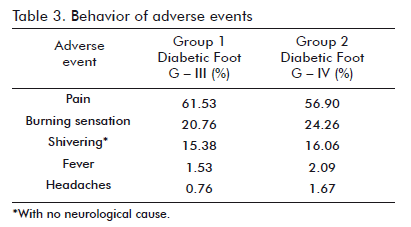
<P   ><font face="Verdana, Arial, Helvetica, sans-serif" size="2">Using this classification,      it is found that 10 patients (31.25%) had grade 3 lesions, whereas 22 patients      (68.75%) had lesions corresponding to grade 4, since these are the two clinical      presentations admitted into the study for the application of Heberprot-P at      a dose of 75 &micro;g. This last result has a lot to do with the high ischemic      component of the diabetic, which is a predictive factor for an amputation.      </font></P >       <P   ><font face="Verdana, Arial, Helvetica, sans-serif" size="2">The most frequent      adverse events found with Heberprot-P 75 &micro;g were pain, a burning sensation      in the site of injection, and shivering (<a href="#tab3">Table 3</a>), as      also described during the clinical trials of this drug and for trials involving      other topically administered growth factors, such as Beclapernin. During these      years, hEGF has also been used to stimulate the cicatrization of different      types of internal or peripheral lesions. A critical assessment of these clinical      trials and of hEGF treatments examined at different dates indicates that the      use of this growth factor in humans is safe, a conclusion supported, in addition,      by a large body of data corresponding to the stage of preclinical toxicological      testing (4). hEGF is not genotoxic or mutagenic according to internationally      validated evaluations, and does not affect cellular epigenetic stability.      Its administration might be exceptionally useful in some recalcitrant clinical      processes and/ or critical disorders, niches in which its application is appropriately      suited to the ethical and therapeutic considerations arising from a risk/benefit      analysis for each particular case (4). </font></P >   </font><font size="+1" color="#000000"><font size="+1"><font size="+1"><font size="+1"><font size="+1"><font size="+1"><font size="+1"><font size="+1"><font size="+1"><font size="+1"><font size="+1"><font size="+1"><font size="+1"><font size="+1"><font size="+1"><font size="+1"><font size="+1"><font size="+1"><font size="+1"><font size="+1"><font size="+1"><font size="+1"><font size="+1"><font size="+1"><font size="+1"><font size="+1"><a name="tab3"></a></font></font></font></font></font></font></font></font></font></font></font></font></font></font></font></font></font></font></font></font></font></font></font></font></font></font><FONT size="+1">       <P align="center"   ><img src="/img/revistas/bta/v27n2/t0308210.gif" width="411" height="227"></P >       
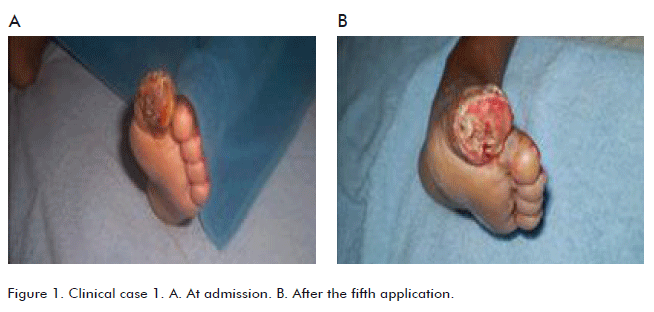
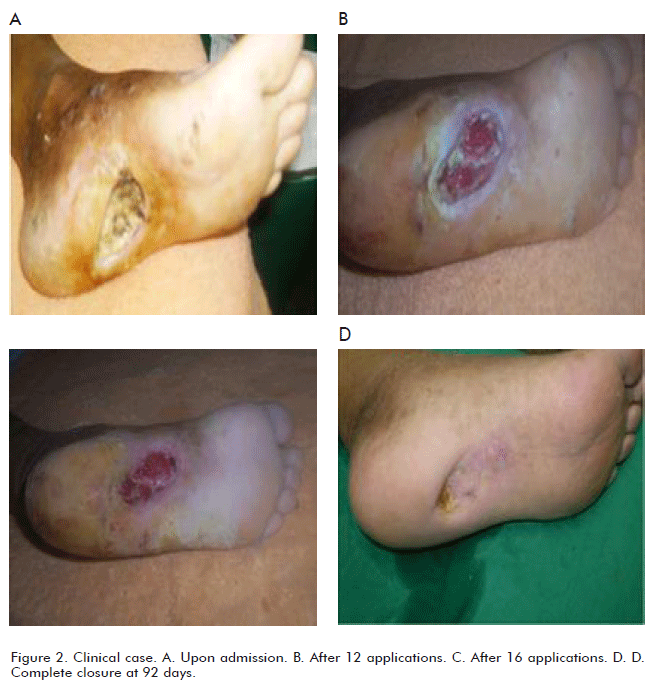
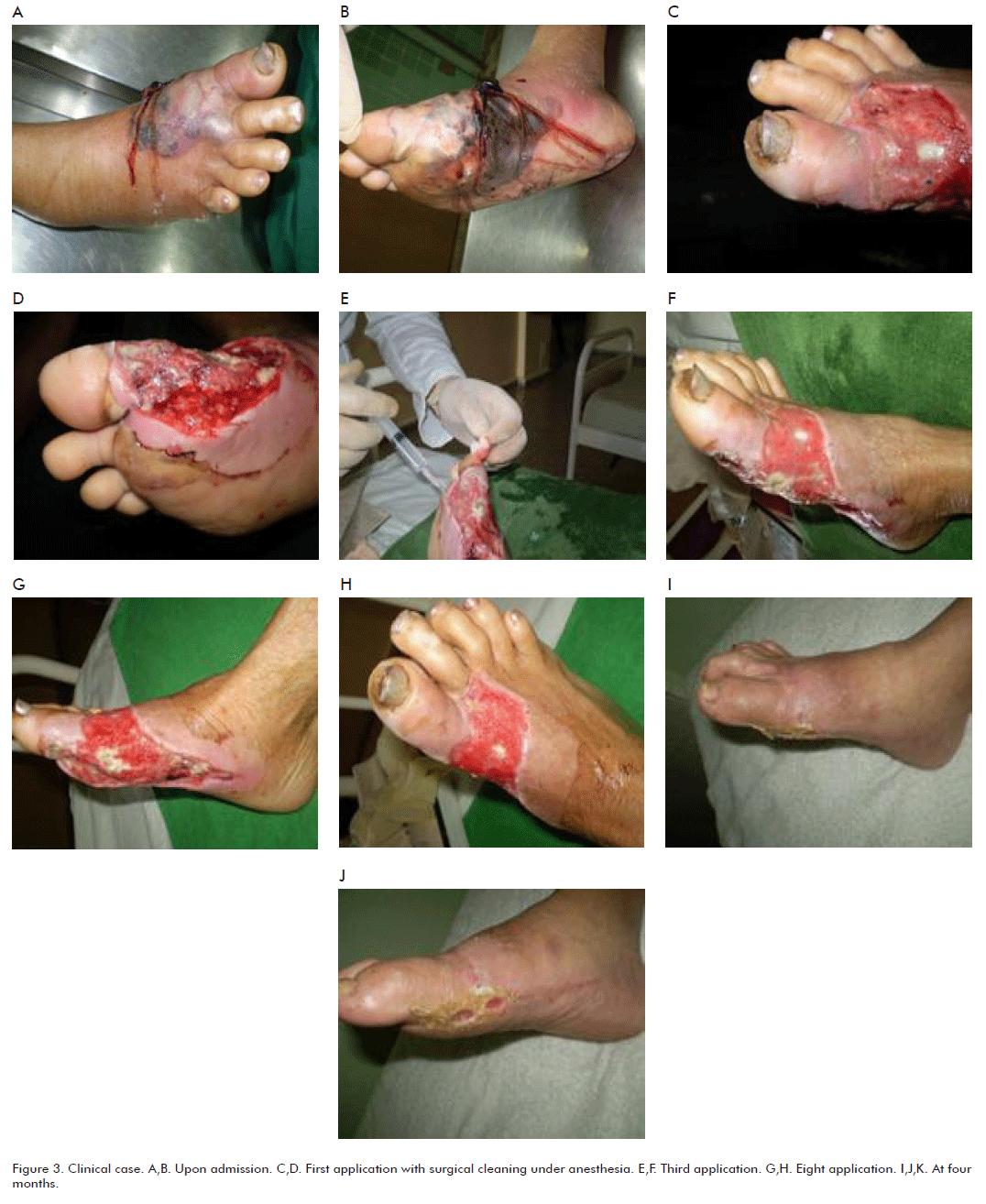
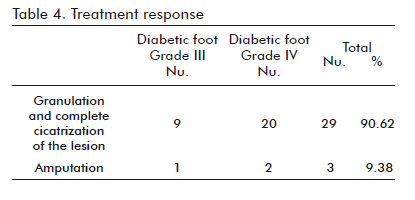
<P   ><font face="Verdana, Arial, Helvetica, sans-serif" size="2">The effect of human      Epidermal Growth Factor (hEGF) in the process of cicatrization has been widely      studied. The results of this work confirm the biological contribution of hEGF      in the field of tissue repair as well as its excellent safety profile, obtaining      usable granulation tissue in 90.6% of the patients within an average of 46.6      &plusmn; 8.9 days and decreasing the amputation percentage to 9.38% (<a href="#tab4">Table      4</a>). This result is coherent with preceding preclinical assays and clinical      trials. In the opinion of the authors, the results concerning the granulation      and cicatrization of the ulcers by treatment with Heberprot-P 75 &micro;g      were satisfactory in both groups of patients (Figures <a href="/img/revistas/bta/v27n2/f0108210.gif">1</a>,      <a href="/img/revistas/bta/v27n2/f0208210.gif">2</a>, <a href="/img/revistas/bta/v27n2/f0308210.gif">3</a>,      <a href="/img/revistas/bta/v27n2/f0408210.gif">4</a>). This investigative      report is inspired by the fact that this growth factor has been clinically      successful in the repair of peripheral and internal tissues in the face of      otherwise unfavorable prognoses for these patients. </font></P >   </font><font size="+1" color="#000000"><font size="+1"><font size="+1"><font size="+1"><font size="+1"><font size="+1"><font size="+1"><font size="+1"><font size="+1"><font size="+1"><font size="+1"><font size="+1"><font size="+1"><font size="+1"><font size="+1"><font size="+1"><font size="+1"><font size="+1"><font size="+1"><font size="+1"><font size="+1"><font size="+1"><font size="+1"><font size="+1"><font size="+1"><font size="+1"><a name="tab4"></a></font></font></font></font></font></font></font></font></font></font></font></font></font></font></font></font></font></font></font></font></font></font></font></font></font></font><FONT size="+1">       
<P align="center"   ><img src="/img/revistas/bta/v27n2/t0408210.gif" width="415" height="200"></P >       
<P   ><font size="2" face="Verdana, Arial, Helvetica, sans-serif"><b><font size="3">CONCLUSIONS</font></b>      </font></P >   <FONT size="+1">        <P   ><font size="2" face="Verdana, Arial, Helvetica, sans-serif">The intralesional      administration of Heberprot-P 75 &mu;g solves the contradiction between the      loss of EGF and the cicatrization of ulcerative lesions &ndash;complicated      with infections- on the feet of diabetic patients, allowing granulation, cicatrization,      and decreasing the number of amputations among the patients of the &ldquo;Guillermo      Dom&iacute;nguez L&oacute;pez&rdquo; hospital in Puerto Padre, at Las Tunas      province. </font></P >   <FONT size="+1">        <P   ><font face="Verdana, Arial, Helvetica, sans-serif" size="2">In all, 49.9% of      the patients treated with Heberprot- P 75 &micro;g are older than 70 years.      Females were predominant (59.37%), and type 2 diabetes was the most common      variant (96.9%). These constitute predictive factors for the appearance of      lesions in the feet of the diabetic patient. Of the ulcers, 68.25% were classified      as grade 4 (Wagner scale), as expected given the frequent ischemic component      of these patients. </font></P >       <P   ><font face="Verdana, Arial, Helvetica, sans-serif" size="2">Pain, burning sensations      and shivering were the most frequent adverse events, of the cases respectively,      without the appearance of severe complications resistant to symptomatic treatment.      </font></P >       ]]></body>
<body><![CDATA[<P   ><font face="Verdana, Arial, Helvetica, sans-serif" size="2">The efficacy of Heberprot-P      75 &micro;g was proved by a rate of granulation and complete cicatrization      of the lesion of 90.62% by the end of the treatment, in a period of 46.5 &plusmn;      8.9 days. </font></P >       <P   ><font face="Verdana, Arial, Helvetica, sans-serif" size="2">The amputation percentage      was decreased to 9.38%. </font></P >       <P   ><font size="2" face="Verdana, Arial, Helvetica, sans-serif"><b><font size="3">RECOMMENDATIONS</font></b>      </font></P >   <FONT size="+1">        <P   ><font size="2" face="Verdana, Arial, Helvetica, sans-serif">To encourage and      alert the basic health service units on the priority that Diabetic Foot constitutes.      </font></P >   <FONT size="+1">        <P   ><font face="Verdana, Arial, Helvetica, sans-serif" size="2">To systematize the      concept that diabetic foot may be an urgency or a surgical emergency, requiring      a rapid decision should amputation be necessary. It should be stressed that      it requires a multi-disciplinary approach, which has been proven to be the      most effective to treat and prevent the lesions. </font></P >       <P   ><font face="Verdana, Arial, Helvetica, sans-serif" size="2">To increment the      cases to be included in the treatment with Heberprot-P 75 &micro;g so as to      achieve an early granulation of the lesions, decreasing the number of amputations      due to Diabetic Foot. </font></P >       <P   ><font face="Verdana, Arial, Helvetica, sans-serif" size="2">To extend this technique      to every unit where the optimal conditions for its use exist, as well as to      train the personnel selected for its application. </font></P >       <P   ><font face="Verdana, Arial, Helvetica, sans-serif" size="2"><b><font size="3">REFERENCES</font></b>      </font></P >       <P   ><font face="Verdana, Arial, Helvetica, sans-serif" size="2">1. Perich AP, Gonz&aacute;lez      RM, Vald&eacute;s E, Arranz MC. Desarrollo de diabetes mellitus en pacientes      con tolerancia a la glucosa alterada: Seguimiento de 18 a&ntilde;os. Rev Cubana      Endocrinol 2002]; 13(2): Disponible en: <a href="http://scielo.sld.cu/scielo.php?script=sci_arttext&pid=S1561-29532002000200002&lng=en">http://scielo.sld.cu/scielo.php?script=sci_arttext&amp;pid=S1561-29532002000200002&amp;lng=en</a>      (Consultado: 18 de agosto de 2010).</font></P >       <!-- ref --><P   ><font face="Verdana, Arial, Helvetica, sans-serif" size="2">2. Berlanga J, Cibrian      D, Guill&eacute;n I, Freyre F, Alba JS, L&oacute;pez-Saura P, <i>et al</i>.      Methylglyoxal administration induces diabetes-like microvascular changes and      perturbs the healing process of cutaneous wounds. Clin Sci (Lond) 2005;109(1):83-95.</font></P >       <!-- ref --><P   ><font face="Verdana, Arial, Helvetica, sans-serif" size="2">3. Zaulyanov L, Kirsner      RS. A review of a bi-layered living cell treatment (Apligraf) in the treatment      of venous leg ulcers and diabetic foot ulcers. Clin Interv Aging 2007; 2(1):93-8.</font></P >       <P   ><font face="Verdana, Arial, Helvetica, sans-serif" size="2">4. Berlanga J, Prats      P, Rem&iacute;rez D, Gonz&aacute;lez R, L&oacute;pez-Saura P, Aguiar J, <i>et      al</i>. Prophylactic use of epidermal growth factor reduces ischemia/reperfusion      intestinal damage. Am J Pathology 2002 Aug; 161(2):373-9.</font></P >       <!-- ref --><P   ><font face="Verdana, Arial, Helvetica, sans-serif" size="2">5. Steed DL. Clinical      evaluation of recombinant human platelet-derived growth factor for the treatment      of lower extremity ulcers. Plast Reconstr Surg 2006;117(7 Suppl):143S-9S.</font></P >       <!-- ref --><P   ><font face="Verdana, Arial, Helvetica, sans-serif" size="2">6. Mansbridge JN,      Liu K, Pinney RE, Patch R, Ratcliffe A, Naughton GK. Growth factors secreted      by fibroblasts: role in healing diabetic foot ulcers. Diabetes Obes Metab      1999;1:265-79.</font></P >       <!-- ref --><P   ><font face="Verdana, Arial, Helvetica, sans-serif" size="2">7. Armstrong DG,      Lavery LA, Diabetic foot ulcers: prevention, diagnosis and classification.      Am Fam Phys 1998;57:1325-32, 1337-8.</font></P >       <!-- ref --><P   ><font face="Verdana, Arial, Helvetica, sans-serif" size="2">8. Boulton AJM, Betts      RP, Franks CI, Newrick PG, Ward JD, Duckworth T. Abnormalities of foot pressure      in early diabetic neuropathy. Diabet Med 1987;4:225-8.</font></P >       <!-- ref --><P   ><font face="Verdana, Arial, Helvetica, sans-serif" size="2">9. American Diabetes      Association. Standard of Medical Care for Patients with diabetes Mellitus.      Position statements. Diabetes Care 1998;21:s23-s31.</font></P >       <P   ><font face="Verdana, Arial, Helvetica, sans-serif" size="2">10. Takehara K. Growth      regulation of skin fibroblasts. J Dermatol Sci 2000;24(Suppl 1):S70-7.</font></P >       <!-- ref --><P   ><font face="Verdana, Arial, Helvetica, sans-serif" size="2">11. Mast BA, Schultz      GS. Interactions of cytokines, growth factors and proteases in acute and chronic      wounds. Wound Repair Regenerat 1996;4(4):411-20.</font></P >       <!-- ref --><P   ><font face="Verdana, Arial, Helvetica, sans-serif" size="2">12. Spencer S. Pressure      relieving interventions for preventing and treating diabetic foot ulcers.      Cochrane database Syst Rev 2005;3:CD002302.</font></P >       <!-- ref --><P   ><font face="Verdana, Arial, Helvetica, sans-serif" size="2">13. Portero-Ot&iacute;n      M, Pamplona R, Bellmunt MJ, Ruiz MC, Prat J, Salvayre R, <i>et al</i>. Advanced      glycation end product precursors impair epidermal growth factor receptor signaling.      Diabetes 2002;51:1535-42.</font></P >       <!-- ref --><P   ><font face="Verdana, Arial, Helvetica, sans-serif" size="2">14. American Diabetes      Association: Clinical Practice Recommendations 1997.</font></P >       <!-- ref --><P   ><font face="Verdana, Arial, Helvetica, sans-serif" size="2">15. Foot Care in      Patients with Diabetes Mellitus. Diabetes Care 1998;21(Supp 1).</font></P >       <!-- ref --><P   ><font face="Verdana, Arial, Helvetica, sans-serif" size="2">16. Arag&oacute;n      J, Ortiz P, Hern&aacute;ndez M. El pie diab&eacute;tico: resultados de nuestra      experiencia. Atenci&oacute;n Primaria 1998;22:360.</font></P >       <!-- ref --><P   ><font face="Verdana, Arial, Helvetica, sans-serif" size="2">17. Arag&oacute;n      FJ, Hern&aacute;ndez MJ, Daniel JM, Ortiz PP. El pie diab&eacute;tico: claves      para un diagn&oacute;stico y tratamiento adecuados. FOMECO 2000;8:10-25.</font></P >       <P   ><font face="Verdana, Arial, Helvetica, sans-serif" size="2">18. Armstrong DG,      Lavery LA, Harkless LB. A treatment-based classification system for assessment      and care of the diabetic feet. J Am Podiatr Med Assoc 1996; 86: 311-316.</font></P >       <P   ><font face="Verdana, Arial, Helvetica, sans-serif" size="2">19. Marinelo J, Vlanes      Jl, Escudero JR, Ib&aacute;&ntilde;ez V, Rodr&iacute;guez J. Tratado de Pie      diab&eacute;tico. Jarpyo Editores. Espa&ntilde;a, 2006.</font> </P >       <P   ><font size="2" face="Verdana, Arial, Helvetica, sans-serif">Received in August,      2010. </font>    <br>     <font face="Verdana, Arial, Helvetica, sans-serif" size="2">Accepted for publication      in September, 2010. </font></P >       <P   ><font face="Verdana, Arial, Helvetica, sans-serif" size="2">Wilver Vel&aacute;zquez,      Hospital General Docente &quot;Guillermo Dom&iacute;nguez L&oacute;pez&quot;      Puerto Padre, Las Tunas, Cuba E-mail: <a href="mailto:fe.tunas@infomed.sld.cu">fe.tunas@infomed.sld.cu</a></font></P >   </font></font></font></font></font></font></font></font></font></font></font></font></font></font></font></font></font></font></font></font></font></font></font></font></font></font></font></font></font></font></DIV >     ]]></body>
<body><![CDATA[ ]]></body><back>
<ref-list>
<ref id="B1">
<label>1</label><nlm-citation citation-type="journal">
<person-group person-group-type="author">
<name>
<surname><![CDATA[Perich]]></surname>
<given-names><![CDATA[AP]]></given-names>
</name>
<name>
<surname><![CDATA[González]]></surname>
<given-names><![CDATA[RM]]></given-names>
</name>
<name>
<surname><![CDATA[Valdés]]></surname>
<given-names><![CDATA[E]]></given-names>
</name>
<name>
<surname><![CDATA[Arranz]]></surname>
<given-names><![CDATA[MC]]></given-names>
</name>
</person-group>
<article-title xml:lang="es"><![CDATA[Desarrollo de diabetes mellitus en pacientes con tolerancia a la glucosa alterada: Seguimiento de 18 años]]></article-title>
<source><![CDATA[Rev Cubana Endocrinol]]></source>
<year>2002</year>
<month>18</month>
<day> d</day>
<volume>13</volume>
<numero>2</numero>
<issue>2</issue>
</nlm-citation>
</ref>
<ref id="B2">
<label>2</label><nlm-citation citation-type="journal">
<person-group person-group-type="author">
<name>
<surname><![CDATA[Berlanga]]></surname>
<given-names><![CDATA[J]]></given-names>
</name>
<name>
<surname><![CDATA[Cibrian]]></surname>
<given-names><![CDATA[D]]></given-names>
</name>
<name>
<surname><![CDATA[Guillén]]></surname>
<given-names><![CDATA[I]]></given-names>
</name>
<name>
<surname><![CDATA[Freyre]]></surname>
<given-names><![CDATA[F]]></given-names>
</name>
<name>
<surname><![CDATA[Alba]]></surname>
<given-names><![CDATA[JS]]></given-names>
</name>
<name>
<surname><![CDATA[López-Saura]]></surname>
<given-names><![CDATA[P]]></given-names>
</name>
</person-group>
<article-title xml:lang="en"><![CDATA[Methylglyoxal administration induces diabetes-like microvascular changes and perturbs the healing process of cutaneous wounds]]></article-title>
<source><![CDATA[Clin Sci (Lond)]]></source>
<year>2005</year>
<volume>109</volume>
<numero>1</numero>
<issue>1</issue>
<page-range>83-95</page-range></nlm-citation>
</ref>
<ref id="B3">
<label>3</label><nlm-citation citation-type="journal">
<person-group person-group-type="author">
<name>
<surname><![CDATA[Zaulyanov]]></surname>
<given-names><![CDATA[L]]></given-names>
</name>
<name>
<surname><![CDATA[Kirsner]]></surname>
<given-names><![CDATA[RS]]></given-names>
</name>
</person-group>
<article-title xml:lang="en"><![CDATA[A review of a bi-layered living cell treatment (Apligraf) in the treatment of venous leg ulcers and diabetic foot ulcers]]></article-title>
<source><![CDATA[Clin Interv Aging]]></source>
<year>2007</year>
<volume>2</volume>
<numero>1</numero>
<issue>1</issue>
<page-range>93-8</page-range></nlm-citation>
</ref>
<ref id="B4">
<label>4</label><nlm-citation citation-type="journal">
<person-group person-group-type="author">
<name>
<surname><![CDATA[Berlanga]]></surname>
<given-names><![CDATA[J]]></given-names>
</name>
<name>
<surname><![CDATA[Prats]]></surname>
<given-names><![CDATA[P]]></given-names>
</name>
<name>
<surname><![CDATA[Remírez]]></surname>
<given-names><![CDATA[D]]></given-names>
</name>
<name>
<surname><![CDATA[González]]></surname>
<given-names><![CDATA[R]]></given-names>
</name>
<name>
<surname><![CDATA[López-Saura]]></surname>
<given-names><![CDATA[P]]></given-names>
</name>
<name>
<surname><![CDATA[Aguiar]]></surname>
<given-names><![CDATA[J]]></given-names>
</name>
</person-group>
<article-title xml:lang="en"><![CDATA[Prophylactic use of epidermal growth factor reduces ischemia/reperfusion intestinal damage]]></article-title>
<source><![CDATA[Am J Pathology]]></source>
<year>2002</year>
<volume>161</volume>
<numero>2</numero>
<issue>2</issue>
<page-range>373-9</page-range></nlm-citation>
</ref>
<ref id="B5">
<label>5</label><nlm-citation citation-type="journal">
<person-group person-group-type="author">
<name>
<surname><![CDATA[Steed]]></surname>
<given-names><![CDATA[DL]]></given-names>
</name>
</person-group>
<article-title xml:lang="en"><![CDATA[Clinical evaluation of recombinant human platelet-derived growth factor for the treatment of lower extremity ulcers]]></article-title>
<source><![CDATA[Plast Reconstr Surg]]></source>
<year>2006</year>
<volume>117</volume>
<numero>^s7</numero>
<issue>^s7</issue>
<supplement>7</supplement>
<page-range>143S-9S</page-range></nlm-citation>
</ref>
<ref id="B6">
<label>6</label><nlm-citation citation-type="journal">
<person-group person-group-type="author">
<name>
<surname><![CDATA[Mansbridge]]></surname>
<given-names><![CDATA[JN]]></given-names>
</name>
<name>
<surname><![CDATA[Liu]]></surname>
<given-names><![CDATA[K]]></given-names>
</name>
<name>
<surname><![CDATA[Pinney]]></surname>
<given-names><![CDATA[RE]]></given-names>
</name>
<name>
<surname><![CDATA[Patch]]></surname>
<given-names><![CDATA[R]]></given-names>
</name>
<name>
<surname><![CDATA[Ratcliffe]]></surname>
<given-names><![CDATA[A]]></given-names>
</name>
<name>
<surname><![CDATA[Naughton]]></surname>
<given-names><![CDATA[GK]]></given-names>
</name>
</person-group>
<article-title xml:lang="en"><![CDATA[Growth factors secreted by fibroblasts: role in healing diabetic foot ulcers]]></article-title>
<source><![CDATA[Diabetes Obes Metab]]></source>
<year>1999</year>
<volume>1</volume>
<page-range>265-79</page-range></nlm-citation>
</ref>
<ref id="B7">
<label>7</label><nlm-citation citation-type="journal">
<person-group person-group-type="author">
<name>
<surname><![CDATA[Armstrong]]></surname>
<given-names><![CDATA[DG]]></given-names>
</name>
<name>
<surname><![CDATA[Lavery]]></surname>
<given-names><![CDATA[LA]]></given-names>
</name>
</person-group>
<article-title xml:lang="en"><![CDATA[Diabetic foot ulcers: prevention, diagnosis and classification]]></article-title>
<source><![CDATA[Am Fam Phys]]></source>
<year>1998</year>
<volume>57</volume>
<page-range>1325-32, 1337-8</page-range></nlm-citation>
</ref>
<ref id="B8">
<label>8</label><nlm-citation citation-type="journal">
<person-group person-group-type="author">
<name>
<surname><![CDATA[Boulton]]></surname>
<given-names><![CDATA[AJM]]></given-names>
</name>
<name>
<surname><![CDATA[Betts]]></surname>
<given-names><![CDATA[RP]]></given-names>
</name>
<name>
<surname><![CDATA[Franks]]></surname>
<given-names><![CDATA[CI]]></given-names>
</name>
<name>
<surname><![CDATA[Newrick]]></surname>
<given-names><![CDATA[PG]]></given-names>
</name>
<name>
<surname><![CDATA[Ward]]></surname>
<given-names><![CDATA[JD]]></given-names>
</name>
<name>
<surname><![CDATA[Duckworth]]></surname>
<given-names><![CDATA[T]]></given-names>
</name>
</person-group>
<article-title xml:lang="en"><![CDATA[Abnormalities of foot pressure in early diabetic neuropathy]]></article-title>
<source><![CDATA[Diabet Med]]></source>
<year>1987</year>
<volume>4</volume>
<page-range>225-8</page-range></nlm-citation>
</ref>
<ref id="B9">
<nlm-citation citation-type="journal">
<collab>American Diabetes Association</collab>
<article-title xml:lang="en"><![CDATA[Standard of Medical Care for Patients with diabetes Mellitus. Position statements]]></article-title>
<source><![CDATA[Diabetes Care]]></source>
<year>1998</year>
<volume>21</volume>
<page-range>s23-s31</page-range></nlm-citation>
</ref>
<ref id="B10">
<label>10</label><nlm-citation citation-type="journal">
<person-group person-group-type="author">
<name>
<surname><![CDATA[Takehara]]></surname>
<given-names><![CDATA[K]]></given-names>
</name>
</person-group>
<article-title xml:lang="en"><![CDATA[Growth regulation of skin fibroblasts]]></article-title>
<source><![CDATA[J Dermatol Sci]]></source>
<year>2000</year>
<volume>24</volume>
<page-range>S70-7</page-range></nlm-citation>
</ref>
<ref id="B11">
<label>11</label><nlm-citation citation-type="journal">
<person-group person-group-type="author">
<name>
<surname><![CDATA[Mast]]></surname>
<given-names><![CDATA[BA]]></given-names>
</name>
<name>
<surname><![CDATA[Schultz]]></surname>
<given-names><![CDATA[GS]]></given-names>
</name>
</person-group>
<article-title xml:lang="en"><![CDATA[Interactions of cytokines, growth factors and proteases in acute and chronic wounds]]></article-title>
<source><![CDATA[Wound Repair Regenerat]]></source>
<year>1996</year>
<volume>4</volume>
<numero>4</numero>
<issue>4</issue>
<page-range>411-20</page-range></nlm-citation>
</ref>
<ref id="B12">
<label>12</label><nlm-citation citation-type="journal">
<person-group person-group-type="author">
<name>
<surname><![CDATA[Spencer]]></surname>
<given-names><![CDATA[S]]></given-names>
</name>
</person-group>
<article-title xml:lang="en"><![CDATA[Pressure relieving interventions for preventing and treating diabetic foot ulcers]]></article-title>
<source><![CDATA[Cochrane database Syst Rev]]></source>
<year>2005</year>
<volume>3</volume>
<page-range>CD002302</page-range></nlm-citation>
</ref>
<ref id="B13">
<label>13</label><nlm-citation citation-type="journal">
<person-group person-group-type="author">
<name>
<surname><![CDATA[Portero-Otín]]></surname>
<given-names><![CDATA[M]]></given-names>
</name>
<name>
<surname><![CDATA[Pamplona]]></surname>
<given-names><![CDATA[R]]></given-names>
</name>
<name>
<surname><![CDATA[Bellmunt]]></surname>
<given-names><![CDATA[MJ]]></given-names>
</name>
<name>
<surname><![CDATA[Ruiz]]></surname>
<given-names><![CDATA[MC]]></given-names>
</name>
<name>
<surname><![CDATA[Prat]]></surname>
<given-names><![CDATA[J]]></given-names>
</name>
<name>
<surname><![CDATA[Salvayre]]></surname>
<given-names><![CDATA[R]]></given-names>
</name>
</person-group>
<article-title xml:lang="en"><![CDATA[Advanced glycation end product precursors impair epidermal growth factor receptor signaling]]></article-title>
<source><![CDATA[Diabetes]]></source>
<year>2002</year>
<volume>51</volume>
<page-range>1535-42</page-range></nlm-citation>
</ref>
<ref id="B14">
<label>14</label><nlm-citation citation-type="">
<collab>American Diabetes Association</collab>
<source><![CDATA[Clinical Practice Recommendations]]></source>
<year>1997</year>
</nlm-citation>
</ref>
<ref id="B15">
<label>15</label><nlm-citation citation-type="journal">
<article-title xml:lang="en"><![CDATA[Foot Care in Patients with Diabetes Mellitus]]></article-title>
<source><![CDATA[Diabetes Care]]></source>
<year>1998</year>
<volume>21</volume>
<numero>^s1</numero>
<issue>^s1</issue>
<supplement>1</supplement>
</nlm-citation>
</ref>
<ref id="B16">
<label>16</label><nlm-citation citation-type="journal">
<person-group person-group-type="author">
<name>
<surname><![CDATA[Aragón]]></surname>
<given-names><![CDATA[J]]></given-names>
</name>
<name>
<surname><![CDATA[Ortiz]]></surname>
<given-names><![CDATA[P]]></given-names>
</name>
<name>
<surname><![CDATA[Hernández]]></surname>
<given-names><![CDATA[M]]></given-names>
</name>
</person-group>
<article-title xml:lang="es"><![CDATA[El pie diabético: resultados de nuestra experiencia]]></article-title>
<source><![CDATA[Atención Primaria]]></source>
<year>1998</year>
<volume>22</volume>
<page-range>360</page-range></nlm-citation>
</ref>
<ref id="B17">
<label>17</label><nlm-citation citation-type="journal">
<person-group person-group-type="author">
<name>
<surname><![CDATA[Aragón]]></surname>
<given-names><![CDATA[FJ]]></given-names>
</name>
<name>
<surname><![CDATA[Hernández]]></surname>
<given-names><![CDATA[MJ]]></given-names>
</name>
<name>
<surname><![CDATA[Daniel]]></surname>
<given-names><![CDATA[JM]]></given-names>
</name>
<name>
<surname><![CDATA[Ortiz]]></surname>
<given-names><![CDATA[PP]]></given-names>
</name>
</person-group>
<article-title xml:lang="es"><![CDATA[El pie diabético: claves para un diagnóstico y tratamiento adecuados]]></article-title>
<source><![CDATA[FOMECO]]></source>
<year>2000</year>
<volume>8</volume>
<page-range>10-25</page-range></nlm-citation>
</ref>
<ref id="B18">
<label>18</label><nlm-citation citation-type="journal">
<person-group person-group-type="author">
<name>
<surname><![CDATA[Armstrong]]></surname>
<given-names><![CDATA[DG]]></given-names>
</name>
<name>
<surname><![CDATA[Lavery]]></surname>
<given-names><![CDATA[LA]]></given-names>
</name>
<name>
<surname><![CDATA[Harkless]]></surname>
<given-names><![CDATA[LB]]></given-names>
</name>
</person-group>
<article-title xml:lang="en"><![CDATA[A treatment-based classification system for assessment and care of the diabetic feet]]></article-title>
<source><![CDATA[J Am Podiatr Med Assoc]]></source>
<year>1996</year>
<volume>86</volume>
<page-range>311-16</page-range></nlm-citation>
</ref>
<ref id="B19">
<label>19</label><nlm-citation citation-type="book">
<person-group person-group-type="author">
<name>
<surname><![CDATA[Marinelo]]></surname>
<given-names><![CDATA[J]]></given-names>
</name>
<name>
<surname><![CDATA[Vlanes]]></surname>
<given-names><![CDATA[JI]]></given-names>
</name>
<name>
<surname><![CDATA[Escudero]]></surname>
<given-names><![CDATA[JR]]></given-names>
</name>
<name>
<surname><![CDATA[Ibáñez]]></surname>
<given-names><![CDATA[V]]></given-names>
</name>
<name>
<surname><![CDATA[Rodríguez]]></surname>
<given-names><![CDATA[J]]></given-names>
</name>
</person-group>
<source><![CDATA[Tratado de Pie diabético]]></source>
<year>2006</year>
<publisher-name><![CDATA[Jarpyo]]></publisher-name>
</nlm-citation>
</ref>
</ref-list>
</back>
</article>