<?xml version="1.0" encoding="ISO-8859-1"?><article xmlns:mml="http://www.w3.org/1998/Math/MathML" xmlns:xlink="http://www.w3.org/1999/xlink" xmlns:xsi="http://www.w3.org/2001/XMLSchema-instance">
<front>
<journal-meta>
<journal-id>1027-2852</journal-id>
<journal-title><![CDATA[Biotecnología Aplicada]]></journal-title>
<abbrev-journal-title><![CDATA[Biotecnol Apl]]></abbrev-journal-title>
<issn>1027-2852</issn>
<publisher>
<publisher-name><![CDATA[Editorial Elfos Scientiae]]></publisher-name>
</publisher>
</journal-meta>
<article-meta>
<article-id>S1027-28522010000200009</article-id>
<title-group>
<article-title xml:lang="en"><![CDATA[Experiences in the nationwide program for the integral care of the patient with diabetic foot ulcer using Heberprot-P]]></article-title>
<article-title xml:lang="es"><![CDATA[Experiencias en la extensión nacional del Programa de atención integral al paciente con úlcera del pie diabético y el empleo del Heberprot-P]]></article-title>
</title-group>
<contrib-group>
<contrib contrib-type="author">
<name>
<surname><![CDATA[Gil]]></surname>
<given-names><![CDATA[Miriela R]]></given-names>
</name>
<xref ref-type="aff" rid="A01"/>
</contrib>
<contrib contrib-type="author">
<name>
<surname><![CDATA[López-Mola]]></surname>
<given-names><![CDATA[Ernesto]]></given-names>
</name>
<xref ref-type="aff" rid="A01"/>
</contrib>
<contrib contrib-type="author">
<name>
<surname><![CDATA[Álvarez]]></surname>
<given-names><![CDATA[Héctor]]></given-names>
</name>
<xref ref-type="aff" rid="A02"/>
</contrib>
<contrib contrib-type="author">
<name>
<surname><![CDATA[Hernández]]></surname>
<given-names><![CDATA[Ariadna]]></given-names>
</name>
<xref ref-type="aff" rid="A01"/>
</contrib>
<contrib contrib-type="author">
<name>
<surname><![CDATA[Pérez]]></surname>
<given-names><![CDATA[Caridad]]></given-names>
</name>
<xref ref-type="aff" rid="A03"/>
</contrib>
<contrib contrib-type="author">
<name>
<surname><![CDATA[Yera]]></surname>
<given-names><![CDATA[Isis]]></given-names>
</name>
<xref ref-type="aff" rid="A04"/>
</contrib>
<contrib contrib-type="author">
<name>
<surname><![CDATA[Padrón]]></surname>
<given-names><![CDATA[Leoncio]]></given-names>
</name>
<xref ref-type="aff" rid="A05"/>
</contrib>
<contrib contrib-type="author">
<name>
<surname><![CDATA[Llanes]]></surname>
<given-names><![CDATA[José A]]></given-names>
</name>
<xref ref-type="aff" rid="A02"/>
</contrib>
<contrib contrib-type="author">
<name>
<surname><![CDATA[Silva]]></surname>
<given-names><![CDATA[Ricardo]]></given-names>
</name>
<xref ref-type="aff" rid="A01"/>
</contrib>
<contrib contrib-type="author">
<name>
<surname><![CDATA[Abrahantes]]></surname>
<given-names><![CDATA[María del Carmen]]></given-names>
</name>
<xref ref-type="aff" rid="A01"/>
</contrib>
<contrib contrib-type="author">
<name>
<surname><![CDATA[Baldomero]]></surname>
<given-names><![CDATA[Julio]]></given-names>
</name>
<xref ref-type="aff" rid="A01"/>
</contrib>
<contrib contrib-type="author">
<name>
<surname><![CDATA[del Río]]></surname>
<given-names><![CDATA[Amaurys]]></given-names>
</name>
<xref ref-type="aff" rid="A01"/>
</contrib>
<contrib contrib-type="author">
<name>
<surname><![CDATA[Ibargollín]]></surname>
<given-names><![CDATA[Rafael]]></given-names>
</name>
<xref ref-type="aff" rid="A06"/>
</contrib>
<contrib contrib-type="author">
<name>
<surname><![CDATA[Herrera]]></surname>
<given-names><![CDATA[Luis]]></given-names>
</name>
<xref ref-type="aff" rid="A01"/>
</contrib>
</contrib-group>
<aff id="A02">
<institution><![CDATA[,Instituto Nacional de Angiología y Cirugía Vascular  ]]></institution>
<addr-line><![CDATA[Ciudad de La Habana ]]></addr-line>
<country>Cuba</country>
</aff>
<aff id="A03">
<institution><![CDATA[,Ministerio de Salud Pública de Cuba Atención Primaria Nacional ]]></institution>
<addr-line><![CDATA[Ciudad de La Habana ]]></addr-line>
<country>Cuba</country>
</aff>
<aff id="A04">
<institution><![CDATA[,Centro para el Control de la Farmacoepidemiología  ]]></institution>
<addr-line><![CDATA[Ciudad de La Habana ]]></addr-line>
<country>Cuba</country>
</aff>
<aff id="A05">
<institution><![CDATA[,Ministerio de Salud Pública de Cuba Dirección Nacional de Hospitales ]]></institution>
<addr-line><![CDATA[Ciudad de la Habana ]]></addr-line>
<country>Cuba</country>
</aff>
<aff id="A06">
<institution><![CDATA[,Centro de Ingeniería y Biotecnología Sancti Spíritus ]]></institution>
<addr-line><![CDATA[Sancti Spíritus ]]></addr-line>
<country>Cuba</country>
</aff>
<aff id="A01">
<institution><![CDATA[,Centro de Ingeniería Genética y Biotecnología  ]]></institution>
<addr-line><![CDATA[Ciudad de La Habana ]]></addr-line>
<country>Cuba</country>
</aff>
<pub-date pub-type="pub">
<day>00</day>
<month>06</month>
<year>2010</year>
</pub-date>
<pub-date pub-type="epub">
<day>00</day>
<month>06</month>
<year>2010</year>
</pub-date>
<volume>27</volume>
<numero>2</numero>
<fpage>147</fpage>
<lpage>150</lpage>
<copyright-statement/>
<copyright-year/>
<self-uri xlink:href="http://scielo.sld.cu/scielo.php?script=sci_arttext&amp;pid=S1027-28522010000200009&amp;lng=en&amp;nrm=iso"></self-uri><self-uri xlink:href="http://scielo.sld.cu/scielo.php?script=sci_abstract&amp;pid=S1027-28522010000200009&amp;lng=en&amp;nrm=iso"></self-uri><self-uri xlink:href="http://scielo.sld.cu/scielo.php?script=sci_pdf&amp;pid=S1027-28522010000200009&amp;lng=en&amp;nrm=iso"></self-uri><abstract abstract-type="short" xml:lang="en"><p><![CDATA[Experiences in the nationwide program for the integral care of the patient with diabetic foot ulcer using Heberprot-P. The Cuban product Heberprot-P is indicated for the treatment of complex diabetic foot ulcers (DFU). After its registration in 2006, the product was included into the Cuban List of Medicines and a nationwide program for the integral care of the DFU patient began. To date Heberprot-P is available in more than 85 Cuban health institutions and more than 3 800 diabetic patients with ulcers in their feet have received the benefits of this unique product. An integral program has been established for the attention of the patient with DFU, including the advanced technology of Heberprot-P. This program relies on the closely linked and coordinated interaction between the primary and secondary levels of health, in which prevention and therapy merge each other. The Ministry of Public Health of Cuba has established impact indicators in order to control and assess the performance of the program.]]></p></abstract>
<abstract abstract-type="short" xml:lang="es"><p><![CDATA[El novedoso producto cubano Heberprot-P está indicado para el tratamiento de las úlceras complicadas del pie diabético (UPD). Una vez aprobado su registro sanitario, pasó a formar parte del Cuadro Básico de Medicamentos de Cuba, y se inició el proceso de extensión nacional. Más de 3800 pacientes diabéticos con úlceras en sus pies en Cuba han recibido las bondades de este medicamento, que se administra en más de 85 instituciones de salud del país. Se ha establecido un Programa de atención integral al paciente con úlcera del pie diabético que incluye el uso del Heberprot-P. Este programa está organizado sobre la base del trabajo coordinado del nivel primario y secundario de salud, en el que se funden el papel preventivo y terapéutico de la atención al paciente diabético. El Ministerio e Salud Pública cubano ha establecido indicadores de impacto para medir y controlar el desarrollo de este programa.]]></p></abstract>
<kwd-group>
<kwd lng="en"><![CDATA[Heberprot-P]]></kwd>
<kwd lng="en"><![CDATA[Diabetic foot ulcer]]></kwd>
<kwd lng="en"><![CDATA[Primary Health Care]]></kwd>
<kwd lng="es"><![CDATA[Heberprot-P]]></kwd>
<kwd lng="es"><![CDATA[úlcera de pie diabético]]></kwd>
<kwd lng="es"><![CDATA[Atención Primaria de Salud]]></kwd>
</kwd-group>
</article-meta>
</front><body><![CDATA[ <DIV class="Sect"   >        <P align="right"   ><font size="2" color="#000000" face="Verdana, Arial, Helvetica, sans-serif"><b>RESEARCH</b></font></P >       <P align="right"   >&nbsp;</P >   <FONT size="+1" color="#000000">        <P   ><font size="2" face="Verdana, Arial, Helvetica, sans-serif"><B><font size="4">Experiences      in the nationwide program for the integral care of the patient with diabetic      foot ulcer using Heberprot-P</font></b></font></P >       <P   >&nbsp;</P >   <FONT size="+1"><B>        <P   ><font size="3" face="Verdana, Arial, Helvetica, sans-serif">Experiencias en la      extensi&oacute;n nacional del Programa de atenci&oacute;n integral al paciente      con &uacute;lcera del pie diab&eacute;tico y el empleo del Heberprot-P</font><font size="2" face="Verdana, Arial, Helvetica, sans-serif">      </font></P >   </B></font></font>       <p>&nbsp;</p>       <p>&nbsp;</p>   <FONT size="+1" color="#000000"><FONT size="+1">        <P   ><font size="2" face="Verdana, Arial, Helvetica, sans-serif"><b>Miriela R Gil<sup>1</sup>,      Ernesto L&oacute;pez-Mola<sup>1</sup>, H&eacute;ctor &Aacute;lvarez<sup>2</sup>,      Ariadna Hern&aacute;ndez<sup>1</sup>, Caridad P&eacute;rez<sup>3</sup>, Isis      Yera<sup>4</sup>, Leoncio Padr&oacute;n<sup>5</sup>, Jos&eacute; A Llanes<sup>2</sup>,      Ricardo Silva<sup>1</sup>, Mar&iacute;a del Carmen Abrahantes<sup>1</sup>,      Julio Baldomero<sup>1</sup>, Amaurys del R&iacute;o<sup>1</sup>, Rafael Ibargoll&iacute;n<sup>6</sup>,      Luis Herrera<sup>1</sup></b> </font></P >   <FONT size="+1"><FONT size="+1"><FONT size="+1"><FONT size="+1"><FONT size="+1"><FONT size="+1"><FONT size="+1"><FONT size="+1"><FONT size="+1"><FONT size="+1"><FONT size="+1"><FONT size="+1"><FONT size="+1"><FONT size="+1"><FONT size="+1"><FONT size="+1"><FONT size="+1"><FONT size="+1"><FONT size="+1"><FONT size="+1"><FONT size="+1"><FONT size="+1"><FONT size="+1"><FONT size="+1"><FONT size="+1"><FONT size="+1"><FONT size="+1"><FONT size="+1"><FONT size="+1">        <P   ><font size="2" face="Verdana, Arial, Helvetica, sans-serif">1 Centro de Ingenier&iacute;a      Gen&eacute;tica y Biotecnolog&iacute;a, CIGB Ave. 31 entre 158 y 190, Cubanac&aacute;n,      Playa, AP 6162, CP 10 600, Ciudad de La Habana, Cuba    ]]></body>
<body><![CDATA[<br>     </font><font size="2" face="Verdana, Arial, Helvetica, sans-serif">2 Instituto      Nacional de Angiolog&iacute;a y Cirug&iacute;a Vascular, Ciudad de La Habana,      Cuba    <br>     3 Ministerio de Salud P&uacute;blica de Cuba, Atenci&oacute;n Primaria Nacional,      Ciudad de La Habana, Cuba    <br>     4 Centro para el Control de la Farmacoepidemiolog&iacute;a, Ciudad de La Habana,      Cuba    <br>     5 Ministerio de Salud P&uacute;blica de Cuba. Direcci&oacute;n Nacional de      Hospitales, Ciudad de La Habana, Cuba    <br>     6 Centro de Ingenier&iacute;a y Biotecnolog&iacute;a, Sancti Sp&iacute;ritus,      Cuba </font></P >       <P   >&nbsp;</P >   </font></font></font></font></font></font></font></font></font></font></font></font></font></font></font></font></font></font></font></font></font></font></font></font></font></font></font></font></font></font></font>    <hr>   <FONT size="+1" color="#000000"><FONT size="+1"><FONT size="+1"><FONT size="+1"><FONT size="+1"><FONT size="+1"><FONT size="+1"><FONT size="+1"><FONT size="+1"><FONT size="+1"><FONT size="+1"><FONT size="+1"><FONT size="+1"><FONT size="+1"><FONT size="+1"><FONT size="+1"><FONT size="+1"><FONT size="+1"><FONT size="+1"><FONT size="+1"><FONT size="+1"><FONT size="+1"><FONT size="+1"><FONT size="+1"><FONT size="+1"><FONT size="+1"><FONT size="+1"><FONT size="+1"><FONT size="+1"><FONT size="+1"><FONT size="+1">       <P   ><font size="2" face="Verdana, Arial, Helvetica, sans-serif"> </font><font face="Verdana, Arial, Helvetica, sans-serif" size="2"><B>ABSTRACT<I>      </I></b></font></P >   <FONT size="+1"><FONT size="+1"><FONT size="+1"><FONT size="+1"><FONT size="+1"><FONT size="+1"><FONT size="+1"><FONT size="+1"><FONT size="+1"><FONT size="+1"><FONT size="+1"><FONT size="+1"><FONT color="#0000FF"><FONT color="#000000">     <P   ><font face="Verdana, Arial, Helvetica, sans-serif" size="2">Experiences in the      nationwide program for the integral care of the patient with diabetic foot      ulcer using Heberprot-P. The Cuban product Heberprot-P is indicated for the      treatment of complex diabetic foot ulcers (DFU). After its registration in      2006, the product was included into the Cuban List of Medicines and a nationwide      program for the integral care of the DFU patient began. To date Heberprot-P      is available in more than 85 Cuban health institutions and more than 3 800      diabetic patients with ulcers in their feet have received the benefits of      this unique product. An integral program has been established for the attention      of the patient with DFU, including the advanced technology of Heberprot-P.      This program relies on the closely linked and coordinated interaction between      the primary and secondary levels of health, in which prevention and therapy      merge each other. The Ministry of Public Health of Cuba has established impact      indicators in order to control and assess the performance of the program.      </font></P >       <P   ><font face="Verdana, Arial, Helvetica, sans-serif" size="2"><b>Keywords</b>:      Heberprot-P, Diabetic foot ulcer, Primary Health Care </font></P >   </font></font></font></font></font></font></font></font></font></font></font></font></font></font></font></font></font></font></font></font></font></font></font></font></font></font></font></font></font></font></font></font></font></font></font></font></font></font></font></font></font></font></font></font></font>    <hr>   <FONT size="+1" color="#000000"><FONT size="+1"><FONT size="+1"><FONT size="+1"><FONT size="+1"><FONT size="+1"><FONT size="+1"><FONT size="+1"><FONT size="+1"><FONT size="+1"><FONT size="+1"><FONT size="+1"><FONT size="+1"><FONT size="+1"><FONT size="+1"><FONT size="+1"><FONT size="+1"><FONT size="+1"><FONT size="+1"><FONT size="+1"><FONT size="+1"><FONT size="+1"><FONT size="+1"><FONT size="+1"><FONT size="+1"><FONT size="+1"><FONT size="+1"><FONT size="+1"><FONT size="+1"><FONT size="+1"><FONT size="+1"><FONT size="+1"><FONT size="+1"><FONT size="+1"><FONT size="+1"><FONT size="+1"><FONT size="+1"><FONT size="+1"><FONT size="+1"><FONT size="+1"><FONT size="+1"><FONT size="+1"><FONT size="+1"><FONT color="#0000FF"><FONT color="#000000">       <P   ><font face="Verdana, Arial, Helvetica, sans-serif" size="2"><B>RESUMEN<I> </I></b></font></P >       ]]></body>
<body><![CDATA[<P   ><font face="Verdana, Arial, Helvetica, sans-serif" size="2">El novedoso producto      cubano Heberprot-P est&aacute; indicado para el tratamiento de las &uacute;lceras      complicadas del pie diab&eacute;tico (UPD). Una vez aprobado su registro sanitario,      pas&oacute; a formar parte del Cuadro B&aacute;sico de Medicamentos de Cuba,      y se inici&oacute; el proceso de extensi&oacute;n nacional. M&aacute;s de      3800 pacientes diab&eacute;ticos con &uacute;lceras en sus pies en Cuba han      recibido las bondades de este medicamento, que se administra en m&aacute;s      de 85 instituciones de salud del pa&iacute;s. Se ha establecido un Programa      de atenci&oacute;n integral al paciente con &uacute;lcera del pie diab&eacute;tico      que incluye el uso del Heberprot-P. Este programa est&aacute; organizado sobre      la base del trabajo coordinado del nivel primario y secundario de salud, en      el que se funden el papel preventivo y terap&eacute;utico de la atenci&oacute;n      al paciente diab&eacute;tico. El Ministerio e Salud P&uacute;blica cubano      ha establecido indicadores de impacto para medir y controlar el desarrollo      de este programa. </font></P >       <P   ><font face="Verdana, Arial, Helvetica, sans-serif" size="2"><b>Palabras clave</b>:      Heberprot-P, &uacute;lcera de pie diab&eacute;tico, Atenci&oacute;n Primaria      de Salud </font></P >   </font></font></font></font></font></font></font></font></font></font></font></font></font></font></font></font></font></font></font></font></font></font></font></font></font></font></font></font></font></font></font></font></font></font></font></font></font></font></font></font></font></font></font></font></font>    <hr>   <FONT size="+1" color="#000000"><FONT size="+1"><FONT size="+1"><FONT size="+1"><FONT size="+1"><FONT size="+1"><FONT size="+1"><FONT size="+1"><FONT size="+1"><FONT size="+1"><FONT size="+1"><FONT size="+1"><FONT size="+1"><FONT size="+1"><FONT size="+1"><FONT size="+1"><FONT size="+1"><FONT size="+1"><FONT size="+1"><FONT size="+1"><FONT size="+1"><FONT size="+1"><FONT size="+1"><FONT size="+1"><FONT size="+1"><FONT size="+1"><FONT size="+1"><FONT size="+1"><FONT size="+1"><FONT size="+1"><FONT size="+1"><FONT size="+1"><FONT size="+1"><FONT size="+1"><FONT size="+1"><FONT size="+1"><FONT size="+1"><FONT size="+1"><FONT size="+1"><FONT size="+1"><FONT size="+1"><FONT size="+1"><FONT size="+1"><FONT color="#0000FF"><FONT color="#000000">        <P   >&nbsp;</P >       <P   >&nbsp;</P >       <P   ><font size="3" face="Verdana, Arial, Helvetica, sans-serif"><b>INTRODUCTION</b></font><font size="2" face="Verdana, Arial, Helvetica, sans-serif">      </font></P >   <FONT size="+1">        <P   ><font size="2" face="Verdana, Arial, Helvetica, sans-serif">At present diabetes      mellitus is a serious health problem and within it, the diabetic foot ulcer      (DFU) is one of its major complications. Global prevalence is estimated in      285 million people and this number will increase in the incoming years (1).      In Cuba, the average rate of dispensed patients having diabetes mellitus is      40.4 per 1 000 inhabitants, representing an estimate of 450 000 diabetics      (2). </font></P >   <FONT size="+1">        <P   ><font face="Verdana, Arial, Helvetica, sans-serif" size="2">Heberprot-P was registered      in Cuba in June 2006, and was included into the Cuban List of Medicines in      April, 2007. It is a worldwide unique product of its kind, a result of the      Cuban biotechnology, developed by the Center for Genetic Engineering and Biotechnology,      together with the National Institute of Angiology and Vascular Surgery (NIAVS)      and other institutions from the Cuban Ministry of Public Health (MINSAP).      Heberprot-P is indicated, as well as other conventional therapies, for the      treatment of neuropathic and ischemic ulcers from the diabetic foot, to stimulate      a useful granulation tissue formation, so as to allow the closure by second      intention or by skin graft, as it has been demonstrated in various clinical      trials (3-5). </font></P >       <P   ><font face="Verdana, Arial, Helvetica, sans-serif" size="2">Among its properties      and advantages it stimulates granulation and accelerates re-epithelization      in DFU and reduces the time for healing of these lesions, contributing thereby      to reduce the number and extension of surgical debridements and the risk of      amputation. </font></P >       <P   ><font face="Verdana, Arial, Helvetica, sans-serif" size="2">From June 30th 2007,      a nationwide program for the integral care of the DFU patient began at the      secondary and tertiary levels of health, in particular in the Angiology Services      of hospitals and the NIAVS. In 2009 the program was extended also, as a pilot      trial, to the primary level of health (PLH) in selected Cuban polyclinics.      </font></P >   <FONT size="+1"><FONT size="+1"><FONT size="+1">        <P   ><font face="Verdana, Arial, Helvetica, sans-serif" size="2">The safety and efficacy      of Heberprot-P have been demonstrated in more than 15 000 treated patients      in Cuba and in other countries such as Venezuela, Algeria, Argentina, Libya,      and the Dominican Republic among others. </font></P >       ]]></body>
<body><![CDATA[<P   ><font face="Verdana, Arial, Helvetica, sans-serif" size="2">The experience of      its use in the Cuban health system is supported by the implementation of nationwide      program for the integral care of the DFU patient with the use of Heberprot-P,      through a methodological protocol agreed by consensus. </font></P >       <P   ><font size="3" face="Verdana, Arial, Helvetica, sans-serif"><b>RESULTS UPON THE      IMPLEMENTATION OF THE NATIONWIDE PROGRAM USING HEBERPROT-P</b></font><font size="2" face="Verdana, Arial, Helvetica, sans-serif">      </font></P >   <FONT size="+1">        <P   ><font size="2" face="Verdana, Arial, Helvetica, sans-serif">The extension process      of Heberprot-P in the Cuban public health system is developed under a post-marketing      phase IV study (intensive pharmaco-surveillance), conducted by the Center      for the Development of Pharmaco-epidemiology (6-8). </font></P >   <FONT size="+1">        <P   ><font face="Verdana, Arial, Helvetica, sans-serif" size="2">This Cuban drug is      applied in more than 85 health institutions (hospitals and polyclinics), distributed      all over the provinces of the country. At present, all Cuban hospitals having      the service of Angiology apply the therapy for the treatment of the DFU with      this novel product. </font></P >       <P   ><font face="Verdana, Arial, Helvetica, sans-serif" size="2">To date, 3 853 patients      with DFU have been included within the nationwide Program of Heberprot-P in      Cuba. This number is having a steady increase and all the Cuban DFU patients      should continuous receiving the benefits of the product. <a href="#fig1">Figure      1</a> shows the patient inclusion per year to the intensive pharmaco-surveillance      system from June 2007 to July 2010.</font></P >   </font><font size="+1" color="#000000"><font size="+1"><font size="+1"><font size="+1"><font size="+1"><font size="+1"><font size="+1"><font size="+1"><font size="+1"><font size="+1"><font size="+1"><font size="+1"><font size="+1"><font size="+1"><font size="+1"><font size="+1"><font size="+1"><font size="+1"><font size="+1"><font size="+1"><font size="+1"><font size="+1"><font size="+1"><font size="+1"><font size="+1"><font size="+1"><font size="+1"><font size="+1"><font size="+1"><font size="+1"><font size="+1"><font size="+1"><font size="+1"><font size="+1"><font size="+1"><font size="+1"><font size="+1"><font size="+1"><font size="+1"><font size="+1"><font size="+1"><font size="+1"><font size="+1"><font color="#0000FF"><font color="#000000"><font size="+1"><font size="+1"><font size="+1"><font size="+1"><font size="+1"><font size="+1"><font size="+1"><a name="fig1"></a></font></font></font></font></font></font></font></font></font></font></font></font></font></font></font></font></font></font></font></font></font></font></font></font></font></font></font></font></font></font></font></font></font></font></font></font></font></font></font></font></font></font></font></font></font></font></font></font></font></font></font></font><FONT size="+1">       <P align="center"   ><img src="/img/revistas/bta/v27n2/f0109210.gif" width="407" height="357"></P >       
<P   ><font face="Verdana, Arial, Helvetica, sans-serif" size="2">Heberprot-P has been      indicated to patients with neuro-infectious and ischemic ulcers. Most of them      having lesions with grades 3, 4 and 5 within the Wagner&rsquo;s classification      (9, 10). Results upon product administration have demonstrated its efficacy      and safety (see results of Dr. Isis Year in this number). </font></P >       <P   ><font face="Verdana, Arial, Helvetica, sans-serif" size="2">The process of Heberprot-P&rsquo;s      spread as part of the Program for the integral care of the DFU patient has      increased since June 2007, but results yet do not correspond to the amount      of patients that potentially could be treated. </font></P >       <P   ><font face="Verdana, Arial, Helvetica, sans-serif" size="2">The diabetic patient      must be treated in an integral manner considering the possible complications,      characteristic of this kind of disease; for instance, the diabetic foot ulcer.      </font></P >       <P   ><font face="Verdana, Arial, Helvetica, sans-serif" size="2">How the Program for      the integral care of the DFU patient is structured, in particular, those requiring      treatment with Heberprot-P in Cuba. </font></P >       ]]></body>
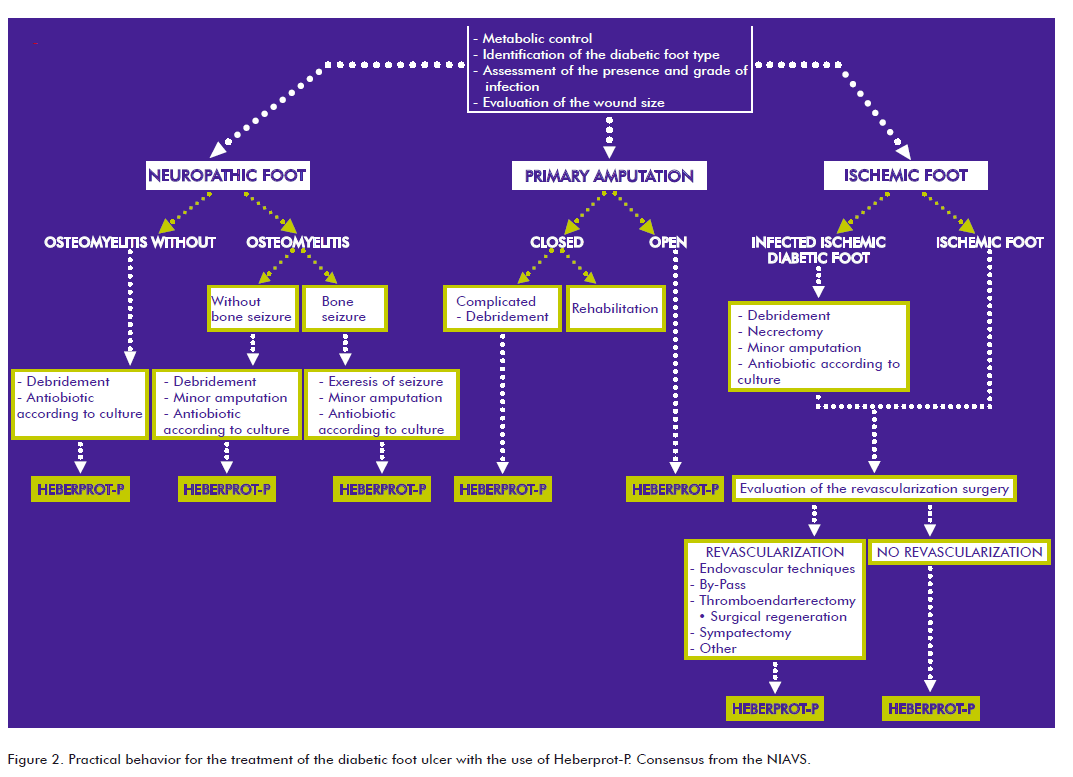
<body><![CDATA[<P   ><font size="2" face="Verdana, Arial, Helvetica, sans-serif"><b><font size="3">PROGRAM      FOR THE INTEGRAL CARE OF THE PATIENT WITH DIABETIC FOOT ULCER IN CUBA WITH      THE USE OF HEBERPROT-P </font></b> </font></P >   <FONT size="+1">        <P   ><font size="2" face="Verdana, Arial, Helvetica, sans-serif"><b>Objectives of      the Program for integral care of the DFU patient with the use of Heberprot-P</b>      </font></P >   <FONT size="+1">        <P   ><font face="Verdana, Arial, Helvetica, sans-serif" size="2">- Increase accessibility      to the treatment with Heberprot- P; that is, to the majority of patients with      DFU that require the treatment in Cuba. </font></P >       <P   ><font face="Verdana, Arial, Helvetica, sans-serif" size="2">- Supply of the product      in all health services where DFU patients may arrive. A practical behavior      agreed by consensus by the NIAVS has been established to treat the patient      with DFU in all Angiology services from hospitals, polyclinics and in all      diabetic care centers (National Health System, MINSAP; <a href="/img/revistas/bta/v27n2/f0209210.gif">Figure      2</a>). </font></P >       
<P   ><font face="Verdana, Arial, Helvetica, sans-serif" size="2">- Control of diabetic      patients and with DFU throughout medical offices, identification through surveillance      in the communities and the existence of a documented register in the medical      offices of all health areas. </font></P >       <P   ><font face="Verdana, Arial, Helvetica, sans-serif" size="2">- Implement the integral      care of the DFU patient. The patient must be treated in an integral manner      and be remitted to other specialties, according to the type of complication.      These specialties can be Ophthalmology, Nephrology, Cardiology, and Angiology,      which have specialized care in the treatment of complex and advanced ulcers      of the diabetic foot with the use of Heberprot-P. </font></P >       <P   ><font face="Verdana, Arial, Helvetica, sans-serif" size="2">- Implement the flow      of patients with DFU to be assisted and/or remitted from the primary health      care to the secondary health care (hospitals), according to the type of complication      of the lesion. </font></P >       <P   ><font face="Verdana, Arial, Helvetica, sans-serif" size="2">- Systematic training      of health personnel in charge of the integral care of the DFU patient, in      diabetes and treatment with Heberprot-P (angiologists, integral general physicians,      nurses, podiatrists, nutritionists, educators and others). </font></P >       <P   ><font face="Verdana, Arial, Helvetica, sans-serif" size="2">The integral care      of the DFU patient with the use of Heberprot-P forms part of the objectives      of the National Health System in all levels of medical care to the population,      including from the primary level (medical offices, polyclinics and diabetic      care centers) to the secondary level (Angiology services of all hospitals),      and the tertiary level of health (NIAVS). </font></P >       <P   ><font face="Verdana, Arial, Helvetica, sans-serif" size="2">The health management      of the provinces and municipalities establish an effective interaction among      all levels of health, so that the patient with DFU can reach specialized care      through any level. To avoid limitations in the proper care of this type of      patient, all Cuban health personnel involved in the activity must know where      to assist and/or remit the patients, according to the severity of their lesions      or the level of metabolic decompensation. </font></P >       ]]></body>
<body><![CDATA[<P   ><font face="Verdana, Arial, Helvetica, sans-serif" size="2">The success of this      Program depends on the coordinated interaction between the primary (medical      offices, polyclinics and diabetic care centers) and secondary levels of health      (Angiology services of all hospitals). </font></P >       <P   ><font face="Verdana, Arial, Helvetica, sans-serif" size="2"><b>Secondary health      care in Angiology services from hospitals</b> </font></P >       <P   ><font face="Verdana, Arial, Helvetica, sans-serif" size="2"><I><b>Inclusion criteria      of patients to be assisted in the Angiology services from hospitals</b> </I></font></P >       <P   ><font face="Verdana, Arial, Helvetica, sans-serif" size="2">End-stages diabetic      foot patients will be assisted in these highly specialized clinical sites:      </font></P >       <P   ><font face="Verdana, Arial, Helvetica, sans-serif" size="2">- Patients to high      risk of suffering an amputation. </font></P >       <P   ><font face="Verdana, Arial, Helvetica, sans-serif" size="2">They usually have      more complicated ulcers, grades 3, 4 and 5 of the Wagner&rsquo;s classification.      </font></P >       <P   ><font face="Verdana, Arial, Helvetica, sans-serif" size="2">- Patients with acute      local infections. </font></P >       <P   ><font face="Verdana, Arial, Helvetica, sans-serif" size="2">- Decompensate patients      with additional risk factors. </font></P >       <P   ><font face="Verdana, Arial, Helvetica, sans-serif" size="2">According to the      evaluation of the specialist the treatment to this kind of patient might or      might not include hospitalization. </font></P >       <P   ><font face="Verdana, Arial, Helvetica, sans-serif" size="2"><I><b>Behavior to      evaluate this kind of patient</b> </I></font></P >       ]]></body>
<body><![CDATA[<P   ><font face="Verdana, Arial, Helvetica, sans-serif" size="2">- It is mandatory      that the patient be evaluated by the endocrinologist or the diabetes specialist      in the hospital or the polyclinic, respectively. </font></P >       <P   ><font face="Verdana, Arial, Helvetica, sans-serif" size="2">- The patient must      be evaluated and assisted in an integral manner, not only his foot or lesion,      but also considering other complications and risk factors to be sent to other      specialties. </font></P >       <P   ><font face="Verdana, Arial, Helvetica, sans-serif" size="2">- As result of the      proper care a rapid and positive evolution in the majority of patients is      expected between the first 48 and 72 hours. </font></P >       <P   ><font face="Verdana, Arial, Helvetica, sans-serif" size="2">- The metabolic control      and the control of local infection are key elements contributing to reduce      the level of complication of the lesion. </font></P >       <P   ><font face="Verdana, Arial, Helvetica, sans-serif" size="2"><I><b>Duties of the      angiologist</b> </I></font></P >       <P   ><font face="Verdana, Arial, Helvetica, sans-serif" size="2">1. Perform the general      medical examination to the patient together with the endocrinologist. </font></P >       <P   ><font face="Verdana, Arial, Helvetica, sans-serif" size="2">2. Treat in an integral      manner the patient, taking into account all possible complications of this      kind of patient (related areas: cardiology, nephrology, stomatology, etc.).      </font></P >       <P   ><font face="Verdana, Arial, Helvetica, sans-serif" size="2">3. Define those cases      for hospital admission and those for hospital ambulatory care and ambulatory      primary health care. </font></P >       <P   ><font face="Verdana, Arial, Helvetica, sans-serif" size="2">4. Define the surgical      procedure to each patient with the use of Heberprot-P. </font></P >       <P   ><font face="Verdana, Arial, Helvetica, sans-serif" size="2">5. Conduct the treatment      with Heberprot-P following strictly the established practical behavior for      the care of patients with this complication. </font></P >       ]]></body>
<body><![CDATA[<P   ><font face="Verdana, Arial, Helvetica, sans-serif" size="2">6. Define the fulfillment      of treatment and when to discharge each patient. </font></P >       <P   ><font face="Verdana, Arial, Helvetica, sans-serif" size="2">7. Coordinate the      remission of patient once discharged from hospital to be treated in ambulatory      regime, or to be directly treated in the polyclinic, the medical office and/or      the diabetic care center. </font></P >       <P   ><font face="Verdana, Arial, Helvetica, sans-serif" size="2">8. Attend as teaching      institution in the training of specialists in general integral medicine, nursing,      podiatry and/or nurses and podiatrists. </font></P >       <P   ><font face="Verdana, Arial, Helvetica, sans-serif" size="2">9. Coordinate and      attend in the teaching of diabetic patients and relatives on the treatment      of people with diabetes. </font></P >       <P   ><font face="Verdana, Arial, Helvetica, sans-serif" size="2">10. Keep a close      interaction with all the primary health care. </font></P >       <P   ><font face="Verdana, Arial, Helvetica, sans-serif" size="2"><I><b>Duties of endocrinologist      </b></I></font></P >       <P   ><font face="Verdana, Arial, Helvetica, sans-serif" size="2">1. Establish metabolic      control of patient as part of the integral care. </font></P >       <P   ><font face="Verdana, Arial, Helvetica, sans-serif" size="2">2. Integral care      of patient taking into account all possible complications. </font></P >       <P   ><font face="Verdana, Arial, Helvetica, sans-serif" size="2">3. Diagnose all additional      complications in the patient and send him to the required specialties (cardiology,      nephrology, stomatology, among others). </font></P >       <P   ><font face="Verdana, Arial, Helvetica, sans-serif" size="2">Once the general      condition of the patient improves, with a clear positive evolution of his      lesion, with previous evaluation by the specialist and in coordination with      the primary health care, the patient could be sent to his community&rsquo;s      care area and treated in ambulatory regime. </font></P >       ]]></body>
<body><![CDATA[<P   ><font face="Verdana, Arial, Helvetica, sans-serif" size="2"><b>Primary health      care (medical offices, polyclinics and diabetic care centers)</b> </font></P >       <P   ><font face="Verdana, Arial, Helvetica, sans-serif" size="2">In this level, the      physician of the consultation area for the diabetic integral care (qualified      in diabetes and in diabetic foot), together with his team, formed by a nurse,      a dietitian and a health educator, fulfill a rectorship function. The main      objective in the primary health care is to prevent by protecting diabetic      patients from developing foot ulcers through the control and the educational      action. Despite the preventive action, within the Program it has been established      that patients having less complicated ulcers can be assisted in this level      of health. </font></P >       <P   ><font face="Verdana, Arial, Helvetica, sans-serif" size="2"><I><b>Inclusion criteria      of patients to be assisted in the primary health care </b></I></font></P >       <P   ><font face="Verdana, Arial, Helvetica, sans-serif" size="2">1. Patients with      ulcers grades 1 and 2 of the Wagner&rsquo;s classification with the previous      evaluation of the angiologist. </font></P >       <P   ><font face="Verdana, Arial, Helvetica, sans-serif" size="2">2. Patients coming      from the Angiology service that can be assisted in the primary health care      and continuous the follow-up at this level of health care. </font></P >       <P   ><font face="Verdana, Arial, Helvetica, sans-serif" size="2"><I><b>Duties in the      integral care of the patient with DFU in the primary health care </b></I></font></P >       <P   ><font face="Verdana, Arial, Helvetica, sans-serif" size="2">1. Carry out the      control of the diabetic patients&rsquo; database in their health care area      and the systematic follow-up. </font></P >       <P   ><font face="Verdana, Arial, Helvetica, sans-serif" size="2">2. Organize and perform      the active surveillance in the communities and medical offices for early detection      of diabetic patients and with DFU, who must be remitted to the consultations      for the integral care of the diabetic patient and/or specialized services.      </font></P >       <P   ><font face="Verdana, Arial, Helvetica, sans-serif" size="2">3. Perform the physical      and medical examination of patients arriving to the polyclinic or medical      office to diagnose the type of diabetes and/or DFU. </font></P >       <P   ><font face="Verdana, Arial, Helvetica, sans-serif" size="2">4. Send decompensate      patients and/or with complex DFU, requiring hospitalization and/or surgical      procedures, to the Angiology service or specialized consultation at the hospital      level. </font></P >       ]]></body>
<body><![CDATA[<P   ><font face="Verdana, Arial, Helvetica, sans-serif" size="2">5. Perform ambulatory      treatment to patients with DFU arriving to consultation or remitted from the      hospital Angiology services. </font></P >       <P   ><font face="Verdana, Arial, Helvetica, sans-serif" size="2">6. Send the patient      to the specialist if any suspicion of complication during treatment arises.      </font></P >       <P   ><font face="Verdana, Arial, Helvetica, sans-serif" size="2">7. Perform an educational      action with the diabetic patient and his relatives in the diabetic integral      care consultations and medical offices, in terms of proper diet, care of his      feet, correct shoes wear and/or suitable insoles. </font></P >       <P   ><font face="Verdana, Arial, Helvetica, sans-serif" size="2">8. Maintain the training      of health personnel in contact with patients requiring treatment in coordination      with the Angiology services. </font></P >       <P   ><font face="Verdana, Arial, Helvetica, sans-serif" size="2"><b>Impact indicators      of the Program for the integral care of the patient with DFU with the use      of Heberprot-P</b> </font></P >       <P   ><font face="Verdana, Arial, Helvetica, sans-serif" size="2">In order to quantify      the suitable functioning of the Program for the integral care of the patient      with DFU with the use of Heberprot-P, the Cuban Ministry of Health proposed      an assessment system measured through impact indicators. Figures will correspond      to the period 2010-2011. They are shown below: </font></P >       <P   ><font face="Verdana, Arial, Helvetica, sans-serif" size="2">1. Proportion of      cases with DFU treated with Heberprot- P. Measure criterion: 80% of the cases.      </font></P >       <P   ><font face="Verdana, Arial, Helvetica, sans-serif" size="2">2. Correct register,      file elaboration and follow-up by angiologists of all treated cases with Heberprot-      P. </font></P >       <P   ><font face="Verdana, Arial, Helvetica, sans-serif" size="2">3. Incorporation      of the Heberprot-P use into the surgical procedure usually followed by angiologists.      </font></P >       <P   ><font face="Verdana, Arial, Helvetica, sans-serif" size="2">4. Proportion of      consultations for the integral care of diabetic (health areas) where conditions      for the treatment with Heberprot-P were created for those patients requiring      such treatment. Measure criterion: 50%. </font></P >       ]]></body>
<body><![CDATA[<P   ><font face="Verdana, Arial, Helvetica, sans-serif" size="2">5. Amputation index      per complications of the DFU. Measure criterion: 5%. </font></P >       <P   ><font face="Verdana, Arial, Helvetica, sans-serif" size="2">6. Control with insulin      100% of DFU patients treated with Heberprot-P. </font></P >       <P   ><font size="2" face="Verdana, Arial, Helvetica, sans-serif"><b><font size="3">CONCLUSIONS</font></b>      </font></P >   <FONT size="+1">        <P   ><font size="2" face="Verdana, Arial, Helvetica, sans-serif">The introduction      of Heberprot-P into the Cuban health system has contributed to solve an unmet      medical need as the healing of advanced diabetic foot ulcers. This Cuban product      has become a novel technology for the treatment of this severe disorder that      in many patients ends in amputation of their low-extremities. </font></P >   <FONT size="+1">        <P   ><font face="Verdana, Arial, Helvetica, sans-serif" size="2">The use of this drug      is part of the Program for the integral care of the patient with DFU, established      by the Ministry of Public Health of Cuba. The success of this Program relies      on the closely linked and coordinated interaction between the primary and      secondary levels of health. </font></P >       <P   ><font face="Verdana, Arial, Helvetica, sans-serif" size="2"><b><font size="3">REFERENCES</font></b>      </font></P >       <!-- ref --><P   ><font face="Verdana, Arial, Helvetica, sans-serif" size="2">1. International      Diabetes Federation (IDF Diabetes Atlas). Disponible en: <a href="http://www.diabetesatlas.org/es/content">http://www.diabetesatlas.org/es/content</a>      (Consultado, 27 de agosto del 2010). </font></P >       <!-- ref --><P   ><font face="Verdana, Arial, Helvetica, sans-serif" size="2">2. Ministerio de      Salud P&uacute;blica. Anuario estad&iacute;stico de salud de Cuba 2009. </font></P >       <!-- ref --><P   ><font face="Verdana, Arial, Helvetica, sans-serif" size="2">3. Berlanga J, Savigne      W, Vald&eacute;z C, Franco N, Alba JS, del R&iacute;o A, <I>et al</I>. Epidermal      Growth Factor intra-lesional infiltrations can prevent amputation in diabetic      patients with advanced foot wounds. Int Wound J 2006;3(3):232-9. </font></P >       <!-- ref --><P   ><font face="Verdana, Arial, Helvetica, sans-serif" size="2">4. Fern&aacute;ndez-Montequ&iacute;n      JI, Infante-Cristi&aacute; E, Valenzuela-Silva C, Franco-P&eacute;rez N, Savigne-Guti&eacute;rrez      W, Artaza-Sanz H, <I>et al</I>. Intralesional injections of Citoprot P&reg;      (Recombinant Human Epidermal Growth Factor) in advanced diabetic foot ulcers      with risk of amputation. Int Wound J 2007;4(4):333-43. </font></P >       <!-- ref --><P   ><font face="Verdana, Arial, Helvetica, sans-serif" size="2">5. Fern&aacute;ndez-Montequ&iacute;n      JI, Valenzuela-Silva CM, D&iacute;az OG, Savigne W, Sancho-Soutelo N, Rivero-Fern&aacute;ndez      F, <I>et al</I>. Intralesional injections of recombinant human epidermal growth      factor promote granulation and healing in advanced diabetic foot ulcers: multicenter,      randomised, placebo-controlled. double-blind study. Int Wound J 2009;6(6):432-43.      </font></P >       <!-- ref --><P   ><font face="Verdana, Arial, Helvetica, sans-serif" size="2">6. Arnau de Bol&oacute;s      JM, Brotons Cuixart C. La continuidad entre investigaci&oacute;n cl&iacute;nica      y pr&aacute;ctica en atenci&oacute;n primaria. En: Diog&eacute;ne E. Gu&iacute;a      de investigaci&oacute;n cl&iacute;nica para atenci&oacute;n primaria. Madrid.      Ediciones Mayo, 2005:57-9. </font></P >       <!-- ref --><P   ><font face="Verdana, Arial, Helvetica, sans-serif" size="2">7. Rodr&iacute;guez      D, Pujol J, Vallano A. Describir los resultados de las intervenciones en la      pr&aacute;ctica cl&iacute;nica. En: Diog&eacute;ne E. Gu&iacute;a de investigaci&oacute;n      cl&iacute;nica para atenci&oacute;n primaria. Madrid. Ediciones Mayo, 2005:83-5.      </font></P >       <!-- ref --><P   ><font face="Verdana, Arial, Helvetica, sans-serif" size="2">8. P&eacute;rez Pe&ntilde;a      J. Logros de la farmacoepidemiolog&iacute;a en el Sistema Nacional de Salud.      En: Modelo cubano de la red nacional de farmacoepidemiolog&iacute;a. La Habana.      Editorial Academia, 2008:170-1. </font></P >       <!-- ref --><P   ><font face="Verdana, Arial, Helvetica, sans-serif" size="2">9. Wagner FW. A classification      and treatment program for diabetic, neuropathic, and disvacular foot problems.      Am Acad Orthop Surg Instrutional Course Lect 1979; 28:143-65. </font></P >       <!-- ref --><P   ><font face="Verdana, Arial, Helvetica, sans-serif" size="2">10. Pittet D, Wyssa      B, Herter-Clavel C, Kursteiner K, Vaucher J, Lew PD. Outcome of diabetic foot      infections treated conservatively. A retrospective cohort study with long-term      follow-up. Arch Int Med 1999;159:851-6.</font></P >       <P   ><font size="2" face="Verdana, Arial, Helvetica, sans-serif">Received in August,      2010. </font>    <br>     <font face="Verdana, Arial, Helvetica, sans-serif" size="2">Accepted for publication      in September, 2010.</font></P >       <P   ><font face="Verdana, Arial, Helvetica, sans-serif" size="2">Miriela R Gil, Centro      de Ingenier&iacute;a Gen&eacute;tica y Biotecnolog&iacute;a, CIGB Ave. 31      entre 158 y 190, Cubanac&aacute;n, Playa, AP 6162, CP 10 600, Ciudad de La      Habana, Cuba E-mail: <a href="mailto:miriela.gil@cigb.edu.cu">miriela.gil@cigb.edu.cu</a></font></P >   </font></font></font></font></font></font></font></font></font></font></font></font></font></font></font></font></font></font></font></font></font></font></font></font></font></font></font></font></font></font></font></font></font></font></font></font></font></font></font></font></font></font></font></font></font></font></font></font></font></font></font></font></font></font></font></font></DIV >      ]]></body><back>
<ref-list>
<ref id="B1">
<label>1</label><nlm-citation citation-type="">
<source><![CDATA[International Diabetes Federation (IDF Diabetes Atlas)]]></source>
<year>27 d</year>
<month>e </month>
<day>ag</day>
</nlm-citation>
</ref>
<ref id="B2">
<label>2</label><nlm-citation citation-type="">
<collab>Ministerio de Salud Pública</collab>
<source><![CDATA[Anuario estadístico de salud de Cuba]]></source>
<year>2009</year>
</nlm-citation>
</ref>
<ref id="B3">
<label>3</label><nlm-citation citation-type="journal">
<person-group person-group-type="author">
<name>
<surname><![CDATA[Berlanga]]></surname>
<given-names><![CDATA[J]]></given-names>
</name>
<name>
<surname><![CDATA[Savigne]]></surname>
<given-names><![CDATA[W]]></given-names>
</name>
<name>
<surname><![CDATA[Valdéz]]></surname>
<given-names><![CDATA[C]]></given-names>
</name>
<name>
<surname><![CDATA[Franco]]></surname>
<given-names><![CDATA[N]]></given-names>
</name>
<name>
<surname><![CDATA[Alba]]></surname>
<given-names><![CDATA[JS]]></given-names>
</name>
<name>
<surname><![CDATA[del Río]]></surname>
<given-names><![CDATA[A]]></given-names>
</name>
</person-group>
<article-title xml:lang="en"><![CDATA[Epidermal Growth Factor intra-lesional infiltrations can prevent amputation in diabetic patients with advanced foot wounds]]></article-title>
<source><![CDATA[Int Wound J]]></source>
<year>2006</year>
<volume>3</volume>
<numero>3</numero>
<issue>3</issue>
<page-range>232-9</page-range></nlm-citation>
</ref>
<ref id="B4">
<label>4</label><nlm-citation citation-type="journal">
<person-group person-group-type="author">
<name>
<surname><![CDATA[Fernández-Montequín]]></surname>
<given-names><![CDATA[JI]]></given-names>
</name>
<name>
<surname><![CDATA[Infante-Cristiá]]></surname>
<given-names><![CDATA[E]]></given-names>
</name>
<name>
<surname><![CDATA[Valenzuela-Silva]]></surname>
<given-names><![CDATA[C]]></given-names>
</name>
<name>
<surname><![CDATA[Franco-Pérez]]></surname>
<given-names><![CDATA[N]]></given-names>
</name>
<name>
<surname><![CDATA[Savigne-Gutiérrez]]></surname>
<given-names><![CDATA[W]]></given-names>
</name>
<name>
<surname><![CDATA[Artaza-Sanz]]></surname>
<given-names><![CDATA[H]]></given-names>
</name>
</person-group>
<article-title xml:lang="en"><![CDATA[Intralesional injections of Citoprot P® (Recombinant Human Epidermal Growth Factor) in advanced diabetic foot ulcers with risk of amputation]]></article-title>
<source><![CDATA[Int Wound J]]></source>
<year>2007</year>
<volume>4</volume>
<numero>4</numero>
<issue>4</issue>
<page-range>333-43</page-range></nlm-citation>
</ref>
<ref id="B5">
<label>5</label><nlm-citation citation-type="journal">
<person-group person-group-type="author">
<name>
<surname><![CDATA[Fernández-Montequín]]></surname>
<given-names><![CDATA[JI]]></given-names>
</name>
<name>
<surname><![CDATA[Valenzuela-Silva]]></surname>
<given-names><![CDATA[CM]]></given-names>
</name>
<name>
<surname><![CDATA[Díaz]]></surname>
<given-names><![CDATA[OG]]></given-names>
</name>
<name>
<surname><![CDATA[Savigne]]></surname>
<given-names><![CDATA[W]]></given-names>
</name>
<name>
<surname><![CDATA[Sancho- Soutelo]]></surname>
<given-names><![CDATA[N]]></given-names>
</name>
<name>
<surname><![CDATA[Rivero-Fernández]]></surname>
<given-names><![CDATA[F]]></given-names>
</name>
</person-group>
<article-title xml:lang="en"><![CDATA[Intralesional injections of recombinant human epidermal growth factor promote granulation and healing in advanced diabetic foot ulcers: multicenter, randomised, placebo-controlled, double-blind study]]></article-title>
<source><![CDATA[Int Wound J]]></source>
<year>2009</year>
<volume>6</volume>
<numero>6</numero>
<issue>6</issue>
<page-range>432-43</page-range></nlm-citation>
</ref>
<ref id="B6">
<label>6</label><nlm-citation citation-type="book">
<person-group person-group-type="author">
<name>
<surname><![CDATA[Arnau de Bolós]]></surname>
<given-names><![CDATA[JM]]></given-names>
</name>
<name>
<surname><![CDATA[Brotons Cuixart]]></surname>
<given-names><![CDATA[C]]></given-names>
</name>
</person-group>
<article-title xml:lang="es"><![CDATA[La continuidad entre investigación clínica y práctica en atención primaria]]></article-title>
<person-group person-group-type="editor">
<name>
<surname><![CDATA[Diogéne]]></surname>
<given-names><![CDATA[E]]></given-names>
</name>
</person-group>
<source><![CDATA[Guía de investigación clínica para atención primaria]]></source>
<year>2005</year>
<page-range>57-9</page-range><publisher-loc><![CDATA[Madrid ]]></publisher-loc>
<publisher-name><![CDATA[Ediciones Mayo]]></publisher-name>
</nlm-citation>
</ref>
<ref id="B7">
<label>7</label><nlm-citation citation-type="book">
<person-group person-group-type="author">
<name>
<surname><![CDATA[Rodríguez]]></surname>
<given-names><![CDATA[D]]></given-names>
</name>
<name>
<surname><![CDATA[Pujol]]></surname>
<given-names><![CDATA[J]]></given-names>
</name>
<name>
<surname><![CDATA[Vallano]]></surname>
<given-names><![CDATA[A]]></given-names>
</name>
</person-group>
<article-title xml:lang="es"><![CDATA[Describir los resultados de las intervenciones en la práctica clínica]]></article-title>
<person-group person-group-type="editor">
<name>
<surname><![CDATA[Diogéne]]></surname>
<given-names><![CDATA[E]]></given-names>
</name>
</person-group>
<source><![CDATA[Guía de investigación clínica para atención primaria]]></source>
<year>2005</year>
<page-range>83-5</page-range><publisher-loc><![CDATA[Madrid ]]></publisher-loc>
<publisher-name><![CDATA[Ediciones Mayo]]></publisher-name>
</nlm-citation>
</ref>
<ref id="B8">
<label>8</label><nlm-citation citation-type="book">
<person-group person-group-type="author">
<name>
<surname><![CDATA[Pérez Peña]]></surname>
<given-names><![CDATA[J]]></given-names>
</name>
</person-group>
<article-title xml:lang="es"><![CDATA[Logros de la farmacoepidemiología en el Sistema Nacional de Salud]]></article-title>
<source><![CDATA[Modelo cubano de la red nacional de farmacoepidemiología]]></source>
<year>2008</year>
<page-range>170-1</page-range><publisher-loc><![CDATA[La Habana ]]></publisher-loc>
<publisher-name><![CDATA[Editorial Academia]]></publisher-name>
</nlm-citation>
</ref>
<ref id="B9">
<label>9</label><nlm-citation citation-type="journal">
<person-group person-group-type="author">
<name>
<surname><![CDATA[Wagner]]></surname>
<given-names><![CDATA[FW]]></given-names>
</name>
</person-group>
<article-title xml:lang="en"><![CDATA[A classification and treatment program for diabetic, neuropathic, and disvacular foot problems]]></article-title>
<source><![CDATA[Am Acad Orthop Surg Instrutional Course Lect]]></source>
<year>1979</year>
<volume>28</volume>
<page-range>143-65</page-range></nlm-citation>
</ref>
<ref id="B10">
<label>10</label><nlm-citation citation-type="journal">
<person-group person-group-type="author">
<name>
<surname><![CDATA[Pittet]]></surname>
<given-names><![CDATA[D]]></given-names>
</name>
<name>
<surname><![CDATA[Wyssa]]></surname>
<given-names><![CDATA[B]]></given-names>
</name>
<name>
<surname><![CDATA[Herter-Clavel]]></surname>
<given-names><![CDATA[C]]></given-names>
</name>
<name>
<surname><![CDATA[Kursteiner]]></surname>
<given-names><![CDATA[K]]></given-names>
</name>
<name>
<surname><![CDATA[Vaucher]]></surname>
<given-names><![CDATA[J]]></given-names>
</name>
<name>
<surname><![CDATA[Lew]]></surname>
<given-names><![CDATA[PD]]></given-names>
</name>
</person-group>
<article-title xml:lang="en"><![CDATA[Outcome of diabetic foot infections treated conservatively: A retrospective cohort study with long-term follow-up]]></article-title>
<source><![CDATA[Arch Int Med]]></source>
<year>1999</year>
<volume>159</volume>
<page-range>851-6</page-range></nlm-citation>
</ref>
</ref-list>
</back>
</article>