<?xml version="1.0" encoding="ISO-8859-1"?><article xmlns:mml="http://www.w3.org/1998/Math/MathML" xmlns:xlink="http://www.w3.org/1999/xlink" xmlns:xsi="http://www.w3.org/2001/XMLSchema-instance">
<front>
<journal-meta>
<journal-id>1027-2852</journal-id>
<journal-title><![CDATA[Biotecnología Aplicada]]></journal-title>
<abbrev-journal-title><![CDATA[Biotecnol Apl]]></abbrev-journal-title>
<issn>1027-2852</issn>
<publisher>
<publisher-name><![CDATA[Editorial Elfos Scientiae]]></publisher-name>
</publisher>
</journal-meta>
<article-meta>
<article-id>S1027-28522010000200011</article-id>
<title-group>
<article-title xml:lang="en"><![CDATA[Can Heberprot-P change the surgical concepts on treating diabetic foot?]]></article-title>
<article-title xml:lang="es"><![CDATA[¿Puede el Heberprot-P cambiar conceptos quirúrgicos en el pie diabético?]]></article-title>
</title-group>
<contrib-group>
<contrib contrib-type="author">
<name>
<surname><![CDATA[Fernández-Montequín]]></surname>
<given-names><![CDATA[José I]]></given-names>
</name>
<xref ref-type="aff" rid="A01"/>
</contrib>
<contrib contrib-type="author">
<name>
<surname><![CDATA[Santiesteban]]></surname>
<given-names><![CDATA[Llipsy]]></given-names>
</name>
<xref ref-type="aff" rid="A02"/>
</contrib>
</contrib-group>
<aff id="A02">
<institution><![CDATA[,Hospital Hermanos Ameijeiras  ]]></institution>
<addr-line><![CDATA[Ciudad de La Habana ]]></addr-line>
<country>Cuba</country>
</aff>
<aff id="A01">
<institution><![CDATA[,Instituto de Angiología y cirugía vascular  ]]></institution>
<addr-line><![CDATA[Ciudad de La Habana ]]></addr-line>
<country>Cuba</country>
</aff>
<pub-date pub-type="pub">
<day>00</day>
<month>06</month>
<year>2010</year>
</pub-date>
<pub-date pub-type="epub">
<day>00</day>
<month>06</month>
<year>2010</year>
</pub-date>
<volume>27</volume>
<numero>2</numero>
<fpage>165</fpage>
<lpage>170</lpage>
<copyright-statement/>
<copyright-year/>
<self-uri xlink:href="http://scielo.sld.cu/scielo.php?script=sci_arttext&amp;pid=S1027-28522010000200011&amp;lng=en&amp;nrm=iso"></self-uri><self-uri xlink:href="http://scielo.sld.cu/scielo.php?script=sci_abstract&amp;pid=S1027-28522010000200011&amp;lng=en&amp;nrm=iso"></self-uri><self-uri xlink:href="http://scielo.sld.cu/scielo.php?script=sci_pdf&amp;pid=S1027-28522010000200011&amp;lng=en&amp;nrm=iso"></self-uri><abstract abstract-type="short" xml:lang="en"><p><![CDATA[Fourteen patients having diabetic foot ulcers on their limbs and who received amputation criteria at certain degree were included in this study, giving their consent to be treated. They were subjected to traditional medical-dietary and hygienic medical care, together with injections of Heberprot-P of 75 µg per vial being administered intralesionally in alternate days. A useful granulation tissue was developed in all the cases. All the patients preserved their limbs, regardless of the previous amputation criteria, following the ambulatory treatment.]]></p></abstract>
<abstract abstract-type="short" xml:lang="es"><p><![CDATA[El estudio incluyó catorce pacientes que presentaban úlceras de pie diabético, con criterio de amputación de cierto grado, quienes dieron su consentimiento para ser tratados. Se les aplicó los cuidados médico-dietéticos e higiénicos tradicionales, de conjunto con la administración de Heberprot-P de vial de 75 µg mediante inyección intralesional en días alternos. En los casos se pudo inducir tejido de granulación útil. Todos los pacientes preservaron sus extremidades, independientemente del criterio de amputación previo al tratamiento.]]></p></abstract>
<kwd-group>
<kwd lng="en"><![CDATA[Heberprot-P]]></kwd>
<kwd lng="en"><![CDATA[diabetic foot ulcer]]></kwd>
<kwd lng="en"><![CDATA[surgical concept]]></kwd>
<kwd lng="en"><![CDATA[Wagner classification]]></kwd>
<kwd lng="es"><![CDATA[Heberprot-P]]></kwd>
<kwd lng="es"><![CDATA[úlcera de pie diabético]]></kwd>
<kwd lng="es"><![CDATA[concepto quirúrgico]]></kwd>
<kwd lng="es"><![CDATA[Clasificación de Wagner]]></kwd>
</kwd-group>
</article-meta>
</front><body><![CDATA[ <DIV class="Sect"   >        <P align="right"   ><font size="2" color="#000000" face="Verdana, Arial, Helvetica, sans-serif"><b>RESEARCH</b></font></P >       <P align="right"   >&nbsp;</P >   <FONT size="+1" color="#000000">        <P   ><font size="2" face="Verdana, Arial, Helvetica, sans-serif"><B><font size="4">Can      Heberprot-P change the surgical concepts on treating diabetic foot? </font></b></font></P >       <P   >&nbsp;</P >   <FONT size="+1"><B>        <P   ><font size="3" face="Verdana, Arial, Helvetica, sans-serif">&iquest;Puede el      Heberprot-P cambiar conceptos quir&uacute;rgicos en el pie diab&eacute;tico?</font></P >       <P   >&nbsp;</P >       <P   >&nbsp;</P >   </B>        <P   ><font size="2" face="Verdana, Arial, Helvetica, sans-serif"><b>Jos&eacute; I      Fern&aacute;ndez-Montequ&iacute;n<sup>1</sup> and Llipsy Santiesteban<sup>2</sup></b>      </font></P >   <FONT size="+1"><FONT size="+1"><FONT size="+1"><FONT size="+1"><FONT size="+1"><FONT size="+1">        <P   ><font size="2" face="Verdana, Arial, Helvetica, sans-serif">1 Instituto de Angiolog&iacute;a      y cirug&iacute;a vascular Calzada del Cerro # 1551, CP 12 000, Cerro, Ciudad      de La Habana, Cuba</font><FONT size="+1"><FONT size="+1"></font></font>    ]]></body>
<body><![CDATA[<br>     <font size="2" face="Verdana, Arial, Helvetica, sans-serif">2 Hospital Hermanos      Ameijeiras, Ciudad de La Habana, Cuba</font></P >   </font></font></font></font></font></font></font></font>       <p>&nbsp;</p><hr>   <FONT size="+1" color="#000000"><FONT size="+1"><FONT size="+1"><FONT size="+1"><FONT size="+1"><FONT size="+1"><FONT size="+1"><FONT size="+1">        <P   ><FONT size="+1"><FONT size="+1"><FONT size="+1"><FONT size="+1"><FONT color="#0000FF"><FONT color="#000000"></font></font></font></font></font></font><font face="Verdana, Arial, Helvetica, sans-serif" size="2"><B>ABSTRACT<I>      </I></b></font></P >   <FONT size="+1"><FONT size="+1"><FONT size="+1"><FONT size="+1"><FONT color="#0000FF"><FONT color="#000000">        <P   ><font face="Verdana, Arial, Helvetica, sans-serif" size="2">Fourteen patients      having diabetic foot ulcers on their limbs and who received amputation criteria      at certain degree were included in this study, giving their consent to be      treated. They were subjected to traditional medical-dietary and hygienic medical      care, together with injections of Heberprot-P of 75 &micro;g per vial being      administered intralesionally in alternate days. A useful granulation tissue      was developed in all the cases. All the patients preserved their limbs, regardless      of the previous amputation criteria, following the ambulatory treatment. </font></P >       <P   ><font face="Verdana, Arial, Helvetica, sans-serif" size="2"><b>Keyword</b>: Heberprot-P,      diabetic foot ulcer, surgical concept, Wagner classification </font></P >   </font></font></font></font></font></font></font></font></font></font></font></font></font></font>   <hr>   <FONT size="+1" color="#000000"><FONT size="+1"><FONT size="+1"><FONT size="+1"><FONT size="+1"><FONT size="+1"><FONT size="+1"><FONT size="+1"><FONT size="+1"><FONT size="+1"><FONT size="+1"><FONT size="+1"><FONT color="#0000FF"><FONT color="#000000">        <P   ><font face="Verdana, Arial, Helvetica, sans-serif" size="2"><B>RESUMEN<I> </I></b></font></P >       <P   ><font face="Verdana, Arial, Helvetica, sans-serif" size="2">El estudio incluy&oacute;      catorce pacientes que presentaban &uacute;lceras de pie diab&eacute;tico,      con criterio de amputaci&oacute;n de cierto grado, quienes dieron su consentimiento      para ser tratados. Se les aplic&oacute; los cuidados m&eacute;dico-diet&eacute;ticos      e higi&eacute;nicos tradicionales, de conjunto con la administraci&oacute;n      de Heberprot-P de vial de 75 &micro;g mediante inyecci&oacute;n intralesional      en d&iacute;as alternos. En los casos se pudo inducir tejido de granulaci&oacute;n      &uacute;til. Todos los pacientes preservaron sus extremidades, independientemente      del criterio de amputaci&oacute;n previo al tratamiento. </font></P >       <P   ><font face="Verdana, Arial, Helvetica, sans-serif" size="2"><b>Palabras clave</b>:      Heberprot-P, &uacute;lcera de pie diab&eacute;tico, concepto quir&uacute;rgico,      Clasificaci&oacute;n de Wagner </font></P >   </font></font></font></font></font></font></font></font></font></font></font></font></font></font>   <hr>   <FONT size="+1" color="#000000"><FONT size="+1"><FONT size="+1"><FONT size="+1"><FONT size="+1"><FONT size="+1"><FONT size="+1"><FONT size="+1"><FONT size="+1"><FONT size="+1"><FONT size="+1"><FONT size="+1"><FONT color="#0000FF"><FONT color="#000000">        <P   >&nbsp;</P >       <P   >&nbsp;</P >       ]]></body>
<body><![CDATA[<P   ><font size="2" face="Verdana, Arial, Helvetica, sans-serif"><b><font size="3">INTRODUCTION</font></b>      </font></P >   <FONT size="+1">        <P   ><font size="2" face="Verdana, Arial, Helvetica, sans-serif" color="#000000">Diabetic      foot is currently recognized as a significant incapacitating illness among      diabetic patients (1). Therefore, it has been declared as a relevant health      problem by sanitary systems throughout the world. Considering that 60% of      major amputations are applied to patients suffering from a vascular disease,      and at the same time 60% of them are diabetic, then we have a tremendously      important data in our hands. All these give us a warning on the risk for physical      disability in those patients and their related irreversible depressing processes,      which ultimately consolidate a new problem on their families and communities.      </font></P >   <FONT size="+1">        <P   ><font face="Verdana, Arial, Helvetica, sans-serif" size="2" color="#000000">Surgical      measures according to the anatomical damage of the foot are the response of      the surgeon to these eventual complications (2), in a diabetic patient showing      a lesion on his foot which is classified attending to the risk for the anatomy      of that limb. Minor amputations are applied to necrotic and infected ulcers      or bone damage, and major amputations to osteomyelitic ulcers of the calcaneous      bone or when having tendon exposure. These procedures are presented to patients      and their relatives who accept them with resignation in most of the cases,      considering this apparently inevitable. </font></P >       <P   ><font face="Verdana, Arial, Helvetica, sans-serif" size="2" color="#000000">The      search continues for medical solutions to treat the diverse lesions detected      in the feet of diabetic patients. That led us to challenge the possibility      of searching for cautious measures, to find optimistic and efficacious answers      which would provide happiness to our patients. </font></P >       <P   ><font face="Verdana, Arial, Helvetica, sans-serif" size="2" color="#000000">How      much is it possible to modify minor and major amputation ancestral criteria,      established as medical practice, when deciding the treatment for an exposed      bone, tendon, bone capsule, or a finger with a fistula affecting down into      the bone? </font></P >       <P   ><font face="Verdana, Arial, Helvetica, sans-serif" size="2" color="#000000">Since      1999, the Center for Genetic Engineering and Biotechnology of Havana has created      a new product based on Nepidermine. There has been also acquired a vast experience      on using it to treat the diabetic foot, what was demonstrated through four      research phases in more than 1000 cases from different countries. The product,      commercially known as Heberprot-P&reg; (3), has shown statistically significant      scores with up to 85% of efficacy among the groups of diabetic foot patients      to whom it was administered. There are no reports on the availability of any      other product to treat this entity with such an amount of positive results.      </font></P >   <FONT size="+1"><FONT size="+1">        <P   ><font face="Verdana, Arial, Helvetica, sans-serif" size="2" color="#000000">Heberprot-P      is a white lyophilized, sterile product, free from preservatives and designed      for parenteral administration. It contains EGF at a dose of 75 &micro;g per      vial. </font></P >       <P   ><font face="Verdana, Arial, Helvetica, sans-serif" size="2" color="#000000">Its      relevant pharmacological properties, according to previous clinical trials,      are: 1) It makes it possible to establish and consolidate a useful and productive      granulation tissue in diabetic patients with difficult cicatrization, including      angiogenesis at the wound; 2) it stimulates the secretory phase within granulation,      particularly in neuropathic patients whose granulation tissue is usually sloughed;      and 3) it stimulates wound contraction and remodeling; these processes are      normally absent, in part or completely, with diabetic complications. </font></P >       <P   ><font face="Verdana, Arial, Helvetica, sans-serif" size="2" color="#000000">The      product was applied by the intralesional and perilesional routes. After diluting      in 5 mL of injection water, 0.5 to 1.0 mL were infiltrated into the lesion      with an appropriately thin needle at a depth of 0.1 cm. Antiseptic procedures      were always followed when applying the drug. A phase of maximal clinical infection      was avoided. </font></P >       <P   ><font face="Verdana, Arial, Helvetica, sans-serif" size="2" color="#000000">Therefore,      our goal was to evaluate whether or not Heberprot-P would be able to avoid      minor or major amputation of toes or the whole limb when administered to a      group of diabetic foot patients, even in the presence of severe bone or tendon      lesions. </font></P >       ]]></body>
<body><![CDATA[<P   ><font size="2" face="Verdana, Arial, Helvetica, sans-serif" color="#000000"><b><font size="3">MATERIALS      AND METHODS </font></b></font></P >   <FONT size="+1">        <P   ><font size="2" face="Verdana, Arial, Helvetica, sans-serif" color="#000000">The      trials included 14 diabetic patients with lesions on their limbs, who had      been informed of the need for limb amputation or partial exeresis due to the      severity of their wounds. They received the traditional medical-dietary and      hygienic medical care, and were treated at the diabetic foot service of the      &ldquo;Carlos Arvelo&rdquo; Hospital in Caracas, Venezuela, every day or every      two days, according to their clinical condition. </font></P >   <FONT size="+1">        <P   ><font face="Verdana, Arial, Helvetica, sans-serif" size="2" color="#000000">Treatment      was given in an ambulatory manner. The studies and normal investigations used      for this type of therapy were practiced for each patient; they always gave      their consent before applying the product. </font></P >       <P   ><font face="Verdana, Arial, Helvetica, sans-serif" size="2" color="#000000">The      lesions were: </font></P >       <P   ><font face="Verdana, Arial, Helvetica, sans-serif" size="2" color="#000000">-      Ulcerative lesions of over 190 cm<sup>2</sup> affecting the dorsal and plantar      parts of the foot. </font></P >   <FONT color="#FF0000"><FONT size="+1"><FONT size="+1" color="#000000"><FONT size="+1">        <P   ><font face="Verdana, Arial, Helvetica, sans-serif" size="2" color="#000000">-      Lesions with tendon and bone exposure. </font></P >       <P   ><font face="Verdana, Arial, Helvetica, sans-serif" size="2" color="#000000">-      Ischemic calcaneous bone ulcers. </font></P >       <P   ><font face="Verdana, Arial, Helvetica, sans-serif" size="2" color="#000000">-      Residual lesions at the post-surgical beds of the extraction of the internal      saphenous vein for myocardial revascularization. </font></P >       <P   ><font face="Verdana, Arial, Helvetica, sans-serif" size="2" color="#000000">-      Reconstruction of toes with bone lesions. </font></P >       <P   ><font face="Verdana, Arial, Helvetica, sans-serif" size="2" color="#000000">-      Ulcerative-necrotic lesions of over 170 cm<sup>2</sup> at the plantar area      and at the calcaneus bone. </font></P >   <FONT color="#FF0000"><FONT size="+1"><FONT size="+1" color="#000000"><FONT size="+1">        ]]></body>
<body><![CDATA[<P   ><font face="Verdana, Arial, Helvetica, sans-serif" size="2" color="#000000">-      Osteomyelitic calcaneus bones. </font></P >       <P   ><font face="Verdana, Arial, Helvetica, sans-serif" size="2" color="#000000">-      Plantar perforating ulcer with bone fracture. </font></P >       <P   ><font face="Verdana, Arial, Helvetica, sans-serif" size="2" color="#000000">All      patients were photographed before and after the treatment. </font></P >       <P   ><font size="2" face="Verdana, Arial, Helvetica, sans-serif" color="#000000"><b><font size="3">RESULTS</font></b>      </font></P >   <FONT size="+1">        <P   ><font size="2" face="Verdana, Arial, Helvetica, sans-serif" color="#000000"><b>Ulcerative      lesions of over 190 cm<sup>2</sup> affecting the dorsal and plantar parts      of the foot</b> </font></P >   <FONT size="+1"><FONT color="#FF0000"><FONT size="+1"><FONT size="+1" color="#000000"><FONT size="+1">        <P   ><font face="Verdana, Arial, Helvetica, sans-serif" size="2" color="#000000">Patient      APA, a 57 year old male (<a href="/img/revistas/bta/v27n2/f0111210.gif">Figure      1</a>), insulindependent diabetic, classified as having an ischemic component      since there was an absence of pedial pulses and a posterior tibial pulse at      that limb. He had a large lesion affecting the plantar and dorsal parts of      the foot. Dressings were carried out on alternate days. Necrotic and sloughed      tissue was removed with a scalpel and forceps, without using any substance      other than the locally applied physiological saline. He received up to 18      applications of Heberprot-P, having completed the treatment in 51 days. The      doctor had proposed a supracondylar amputation of his limb before starting      the treatment. Such indication was in agreement with international standards,      since it was impossible to anatomically reconstruct the foot. The lesion healed      completely and the patient was able to return to his work and social activities.      </font></P >       
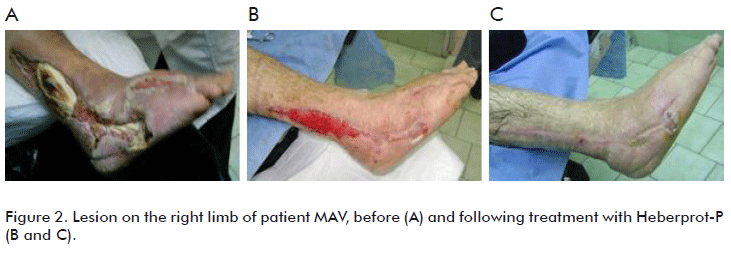
<P   ><font face="Verdana, Arial, Helvetica, sans-serif" size="2" color="#000000"><b>Two      patients having lesions with bone and tendon exposure on the leg and foot</b>      </font></P >       <P   ><font face="Verdana, Arial, Helvetica, sans-serif" size="2" color="#000000">Patient      MAV, a 49 year old male, with a perforating plantar ulcer as the gate of entrance      of a Gram-negative bacterium producing abscesses at the dorsal part of the      right foot, tendinous necrosis of tissues with the exposure at the external      border of the astragalus bone and part of the calcaneus bone. The flexor tendon      and muscles were exposed at the external area of the leg. It was classified      as a Wagner grade 4 in spite of its neuroinfectious diabetic foot classification,      due to the destruction of tissues and bone and tendon exposure (<a href="/img/revistas/bta/v27n2/f0211210.gif">Figure      2</a>). </font></P >       
<P   ><font face="Verdana, Arial, Helvetica, sans-serif" size="2" color="#000000">Surgical      treatments were applied under anesthesia and after hospitalization. Once the      infection was controlled, the patient was sent to the diabetic foot service      at the military hospital in an attempt to recover the limb. Local cures with      surgical debridement were carried out in all the exposed areas, and an adequate      hygienic-dietary and drug treatment was followed for all background diseases,      including nephropathy. </font></P >       <P   ><font face="Verdana, Arial, Helvetica, sans-serif" size="2" color="#000000">The      patient was informed on a possible recovery after eighteen months, although      considered of poor prognosis due to the numerous exposed anatomical areas.      </font></P >       ]]></body>
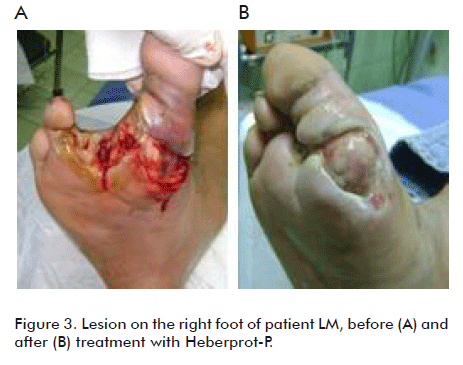
<body><![CDATA[<P   ><font face="Verdana, Arial, Helvetica, sans-serif" size="2" color="#000000">In      addition to the local cures indicated, local infiltrations of 75 &micro;g      Heberprot were applied at the bottom and the edges of the lesion to induce      granulation in order to cover the exposed tendon and bone. The required granulation      was achieved after 28 applications of Heberprot-P, covering the tendon area      in 4 weeks. The patient was under treatment for 52 days and notably decreased      blood creatinine during that time. Noteworthy, this product has also being      reported as having cytoprotective properties. </font></P >       <P   ><font face="Verdana, Arial, Helvetica, sans-serif" size="2" color="#000000">Patient      LM, 39 year old male, an insulin-dependent diabetic, who entered the Surgery      service with a completely abscessed lesion on his toes, for which reason several      toes were amputated. Considering that limb amputation was imminent, the patient      was taken as a last alternative to the diabetic foot service of the hospital,      where an ambulatory treatment was started. A great deal of necrotic tissue      was found with bone and tendon exposure at the base of his first toe. The      posterior tibial pulse was absent, thereby evaluating the patient as ischemic.      The patient was classified as having a Wagner grade 4 lesion because of the      tissue damage present on the entire forefoot. </font></P >       <P   ><font face="Verdana, Arial, Helvetica, sans-serif" size="2" color="#000000">The      dressings were very intensive with constant debridement of the lesion. Other      physicians had indicated amputation following the surgical guidelines for      bone and tendon exposure, a decision very discouraging for the patient. Very      patiently, the bone capsule of the first toe and the flexor tendon were completely      covered by useful granulation tissue after 30 applications of Heberprot-P.      The treatment lasted 60 days (<a href="#fig3">Figure 3</a>). </font></P >       <P align="center"   ><img src="/img/revistas/bta/v27n2/f0311210.gif" width="463" height="365"><a name="fig3"></a></P >       
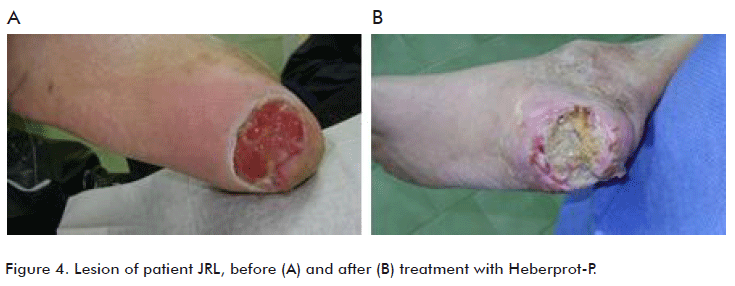
<P   ><font face="Verdana, Arial, Helvetica, sans-serif" size="2" color="#000000">In      addition to the diabetes mellitus, this patient was a drug addict, but this      was not a restriction for the application of the product. </font></P >       <P   ><font face="Verdana, Arial, Helvetica, sans-serif" size="2" color="#000000"><b>Patient      with an ischemic ulcer at the calcaneus bone</b> </font></P >       <P   ><font face="Verdana, Arial, Helvetica, sans-serif" size="2" color="#000000">Patient      JRL, a 66 year old male, insulin-dependent diabetic; he had had a stroke two      years before and presented arterial hypertension. While under rehabilitation      he presented an ischemic ulcer at the calcaneus bone (<a href="/img/revistas/bta/v27n2/f0411210.gif">Figure      4</a>). During the surgical treatment he underwent two surgical dressings      under anesthesia to resect sloughed and ischemic tissue at the calcaneus area.      The calcaneous bone was exposed and therefore limb amputation was indicated.      The patient did not accept amputation and was taken to the Hospital, where      he underwent the ambulatory treatment. He was classified as having ischemic      Wagner grade 3 diabetic foot. </font></P >       
<P   ><font face="Verdana, Arial, Helvetica, sans-serif" size="2" color="#000000">The      local resection of the persistent sloughed and necrotic tissue was accompanied      by 75 &micro;g of Heberprot- P applied every two days to induce the production      of granulation tissue. Hygienic-dietary and drug treatments were maintained      for his original disease. </font></P >       <P   ><font face="Verdana, Arial, Helvetica, sans-serif" size="2" color="#000000">The      patient received 18 applications until a useful granulation was achieved.      He is currently under rehabilitation for the hemiplegia. Treatment was ambulatory.      </font></P >       <P   ><font face="Verdana, Arial, Helvetica, sans-serif" size="2" color="#000000"><b>Two      patients with residual lesions at the post-surgical beds from the extraction      of the internal saphenous vein for myocardial revascularization</b></font></P >       ]]></body>
<body><![CDATA[<P   ><font face="Verdana, Arial, Helvetica, sans-serif" size="2" color="#000000">Patient      MQM, 64 year old female, with diabetes type 1, having a successful myocardial      revascularization by a coronary bypass with the internal safenous vein. However,      since she had no peripheral pulses compromising the popliteal artery, the      patient has developed a large 104 cm<sup>2</sup> lesion at the inner face      of the right leg, from where the safenous vein was extracted for the revascularization      (<a href="/img/revistas/bta/v27n2/f0511210.gif">Figure 5</a>). Limb      amputation was indicated, and the patient was then referred to the hospital.      </font></P >   <FONT color="#FF0000"><FONT size="+1"><FONT size="+1" color="#000000"><FONT size="+1">        
<P   ><font face="Verdana, Arial, Helvetica, sans-serif" size="2" color="#000000">Treatment      was started by infiltrating the bottom and edges of the lesion with 75 &micro;g      of Heberprot-P on alternate days, together with surgical debridement under      local anesthesia. Granulation tissue and epithelialization on the edges of      the lesion were obtained after 76 days with 36 applications through an ambulatory      treatment. </font></P >       <P   ><font face="Verdana, Arial, Helvetica, sans-serif" size="2" color="#000000">Significantly,      Heberprot-P is compatible for application in patients suffering from several      conditions, since in this case, the patient is blind due to diabetic retinopathy,      and also has a severe ischemic cardiopathy. No complications were observed      during the treatment with the epidermal growth factor. </font></P >       <P   ><font face="Verdana, Arial, Helvetica, sans-serif" size="2" color="#000000">Patient      JD, 77 year old male with type 2 diabetes who was subjected to myocardial      revascularization to treat an ischemic cardiopathy, which left as a sequel      a residual ulcer with a severe ischemic component at the inner face of the      right leg (<a href="/img/revistas/bta/v27n2/f0611210.gif">Figure 6</a>).      Limb amputation was indicated because no cure was possible, then his relatives      brought him to the diabetic foot service at our clinic. The lesion was classified      as being ischemic based on the absence of posterior tibial pulses and because      it was classified as a Wagner grade 4. </font></P >       
<P   ><font face="Verdana, Arial, Helvetica, sans-serif" size="2" color="#000000">Physical      examination showed a long ulcer that was wide in the middle with an exposure      of the tibia, which measured about 70 cm<sup>2</sup>. The treatment was started      with local cures and continuous debridement. Twenty-five doses of Heberprot-P      of 75 &micro;g per vial were administered until granulation was obtained;      the infiltrations were made at the bottom and the edges of the lesion. </font></P >   <FONT color="#FF0000"><FONT size="+1"><FONT size="+1" color="#000000">        <P   ><font face="Verdana, Arial, Helvetica, sans-serif" size="2" color="#000000">This      indication can be considered very novel within the Heberprot-P application      guidelines. </font></P >       <P   ><font face="Verdana, Arial, Helvetica, sans-serif" size="2" color="#000000"><b>Reconstruction      of toes with bone lesions in three patients</b> </font></P >       <P   ><font face="Verdana, Arial, Helvetica, sans-serif" size="2" color="#000000">Patient      PA, 70 year old male, with type 2 diabetes showing a severe ischemic lesion      resulting from trauma that became necrotic and gangrenous and was located      at the distal portion of the middle toe. The lesion was classified as Wagner      grade 3 (<a href="/img/revistas/bta/v27n2/f0711210.gif">Figure 7</a>).      After a 30 day evolution toe amputation was indicated. After the routine tests      were made, the physicians decided to apply 8 infiltrations of Heberprot-P.      The procedure consisted of infiltrations made beneath the necrotic area of      the toe, to delimit and raise the entire necrotic plaque. A final granulation      area was established, which was used for the surgical reconstruction of the      distal part of the toe. When the patient was discharged he was completely      healed and very grateful because his toe remained with its original anatomy.      </font></P >       
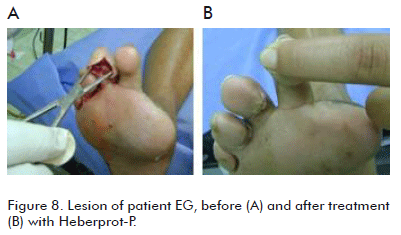
<P   ><font face="Verdana, Arial, Helvetica, sans-serif" size="2" color="#000000">Patient      EG, 53 year old female, having DM type 2; with a neuroinfectious Wagner grade      2 diabetic foot and having an abscess for ten day on her middle toe. After      examining the lesion it was found that it covered up to the corresponding      metatarsal bone with an osteoporotic lesion and an osteolytic area at one      border as shown by the X-rays (<a href="#fig8">Figure 8</a>). Wound depth      was verified by introducing a Kelly forceps. Local dressings were made on      the toe, which was at risk of amputation. Heberprot-P was applied seven times      within the lesion that was measured with the forceps, so as to generate a      useful granulation tissue covering the bone area. The granulation tissue formed      covered the bone and the toe was reconstructed, for the pleasure and well-being      of the patient. The patient was finally discharged, completely healed.</font></P >   <font size="+1"><font size="+1"><font size="+1"><font size="+1"><font size="+1"><font size="+1"><font size="+1"><font size="+1"><font size="+1"><font size="+1"><font size="+1"><font color="#0000FF"><font color="#000000"><font size="+1"><font size="+1"><font size="+1"><font size="+1"><font size="+1"><font size="+1"><font color="#FF0000"><font size="+1"><font size="+1" color="#000000"><font size="+1"><font color="#FF0000"><font size="+1"><font size="+1" color="#000000"><font size="+1"><font size="+1"><font size="+1"><font color="#FF0000"><font size="+1"><font size="+1" color="#000000"><font size="+1"><font color="#FF0000"><font size="+1"><font size="+1" color="#000000"><font size="+1"><font color="#FF0000"><font size="+1"><font size="+1" color="#000000"><a name="fig8"></a></font></font></font></font></font></font></font></font></font></font></font></font></font></font></font></font></font></font></font></font></font></font></font></font></font></font></font></font></font></font></font></font></font></font></font></font></font></font></font></font>       <P align="center"   ><img src="/img/revistas/bta/v27n2/f0811210.gif" width="401" height="235"></P >       
]]></body>
<body><![CDATA[<P   ><font face="Verdana, Arial, Helvetica, sans-serif" size="2" color="#000000">Patient      YB, 51 year old female, and having type 2 DM for 10 years. She had a diabetic      foot with an ischemic component because of the absence of posterior tibial      pulse. The lesion consisted of an ulcer on the first toe of her right foot      affecting the metatarsal bone, with a 90 day evolution and classified as Wagner      grade 3 diabetic foot (<a href="/img/revistas/bta/v27n2/f0911210.gif">Figure      9</a>). The exposed area was infiltrated at the edges and the bottom with      Heberprot-P. After 12 infiltrations the exposed bone area was covered with      granulation tissue and the toe was preserved. </font></P >       
<P   ><font face="Verdana, Arial, Helvetica, sans-serif" size="2" color="#000000"><b>Ulcerative-necrotic      lesions in the plantar and calcaneus areas and larger than 170 cm<sup>2</sup></b>      </font></P >   <FONT color="#FF0000"><FONT size="+1"><FONT size="+1" color="#000000">        <P   ><font size="2" face="Verdana, Arial, Helvetica, sans-serif" color="#000000">Patient      CO, 60 year old female, with type 2 diabetes mellitus for two years. She had      a clinical record of a lesion with abscesses in the plantar area with an evolution      of 180 days (<a href="/img/revistas/bta/v27n2/f1011210.gif">Figure 10</a>).      After debridement, limb amputation was indicated but the patient refused and      began to dress the lesion herself at home, disinfecting it. Upon arrival at      the service, she presented a lesion of 172 cm<sup>2</sup> that was classified      as neuroinfectious Wagner grade 3 diabetic foot. The lesion affected the plantar      and calcaneus areas, with a complete separation between the tissue and the      heel bone. Surgical debridement was carried out and 24 infiltrations of injectable      Heberprot-P were applied, achieving a useful granulation and successful attachment      of the tissue to the heel bone. The patient also recovered from a lesion at      the border of the foot. This represented another possible recovery for an      anatomically highly compromised foot. </font></P >   <FONT size="+1"><FONT color="#FF0000"><FONT size="+1"><FONT size="+1" color="#000000"><FONT size="+1">        
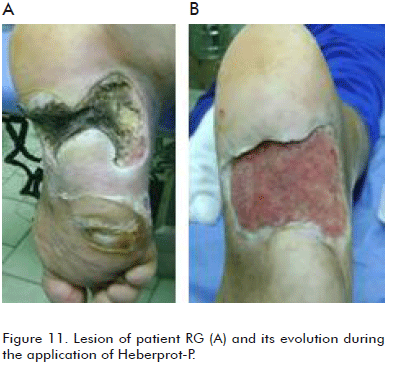
<P   ><font face="Verdana, Arial, Helvetica, sans-serif" size="2" color="#000000">Patient      RG, a 29 year old female, with known type 1 diabetes mellitus for six years.      She had a huge abscess at the plantar area, plenty of necrotic tissue and      an aggressive Pseudomonas aeruginosa infection in that area, infiltrating      the calcaneus bone. The plantar zone was compromised not only because of the      pus it was draining, but also because of the anatomical separation of the      bottom and edges (<a href="#fig11">Figure 11</a>). The case was classified      as Wagner grade 4 neuroinfectious diabetic foot. Repetitive surgical scrubs      at the outpatient service were required, with intravenous antibiotic treatment.      After having improved clinically from the local infection, Heberprot-P was      infiltrated to obtain local granulation. The lesion was of 420 cm<sup>2</sup>;      it was completely covered by the granulation tissue, and above all, through      serial infiltrations in the two laminae of the tissue of the calcaneus area,      we were able to attach both parts thereby covering the entire bone area. Therefore,      the patient preserved her limb from the two major amputations previously indicated.      </font></P >   </font><font size="+1" color="#000000"><font size="+1"><font size="+1"><font size="+1"><font size="+1"><font size="+1"><font size="+1"><font size="+1"><font size="+1"><font size="+1"><font size="+1"><font size="+1"><font color="#0000FF"><font color="#000000"><font size="+1"><font size="+1"><font size="+1"><font size="+1"><font size="+1"><font size="+1"><font color="#FF0000"><font size="+1"><font size="+1" color="#000000"><font size="+1"><font color="#FF0000"><font size="+1"><font size="+1" color="#000000"><font size="+1"><font size="+1"><font size="+1"><font color="#FF0000"><font size="+1"><font size="+1" color="#000000"><font size="+1"><font color="#FF0000"><font size="+1"><font size="+1" color="#000000"><font size="+1"><font color="#FF0000"><font size="+1"><font size="+1" color="#000000"><font color="#FF0000"><font size="+1"><font size="+1" color="#000000"><font size="+1"><font color="#FF0000"><font size="+1"><font size="+1" color="#000000"><font size="+1"><a name="fig11"></a></font></font></font></font></font></font></font></font></font></font></font></font></font></font></font></font></font></font></font></font></font></font></font></font></font></font></font></font></font></font></font></font></font></font></font></font></font></font></font></font></font></font></font></font></font></font></font></font></font><FONT size="+1">       <P align="center"   ><img src="/img/revistas/bta/v27n2/f1111210.gif" width="396" height="370"></P >   <FONT color="#FF0000"><FONT size="+1"><FONT size="+1" color="#000000">        
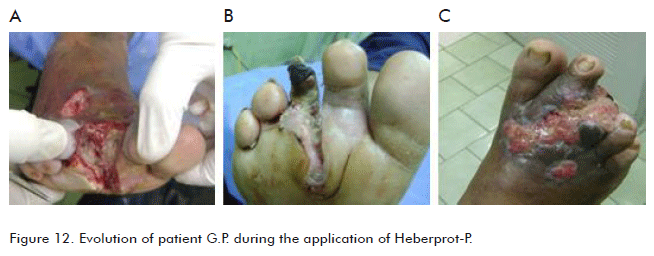
<P   ><font face="Verdana, Arial, Helvetica, sans-serif" size="2" color="#000000">Patient      GP, 50 year old male, with known type 2 diabetes mellitus for more than 10      years. He had a lesion with abscess at the plantar aspect and forefoot with      an evolution of 120 days. It was classified as a neuroinfectious very large      Wagner grade 4 diabetic foot. Surgical scrubs were applied and the lesion      was infiltrated with 19 applications of Heberprot-P, producing a reduction      of the area of up to 18 cm<sup>2</sup>. The patient developed a hypergranulation      response which was treated with silver nitrate to favor epithelialization      (<a href="/img/revistas/bta/v27n2/f1211210.gif">Figure 12</a>). </font></P >   <FONT color="#FF0000"><FONT size="+1"><FONT size="+1" color="#000000">        
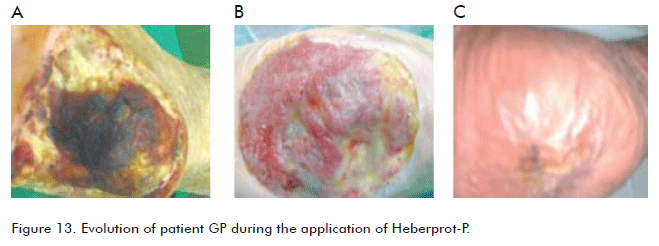
<P   ><font face="Verdana, Arial, Helvetica, sans-serif" size="2" color="#000000"><b>Osteonecrotic      calcaneus bone</b> </font></P >       <P   ><font face="Verdana, Arial, Helvetica, sans-serif" size="2">Patient GB, 77 year      old male with type 2 diabetes mellitus, who was very careless; had a lesion      at the heel of the right foot, with an exposure of the calcaneus bone due      to loss of the surrounding tissue. In addition to the medical control, hygiene      and dietetic measures, local surgical dressings were applied and all the osteonecrotic      area was resected with a gouge down to near the marrow. Thirty two Heberprot-P      infiltrations were made around the calcaneus bone, so that the tissue would      cover all the resected area. A useful granulation tissue was induced. This      patient was treated abroad, and returned home 60 days after ending the treatment.      Only local dressings were applied on the ulcer with physiological saline,      which was completely healed 45 days after he was discharged (<a href="/img/revistas/bta/v27n2/f1311210.gif">Figure      13</a>). </font></P >       
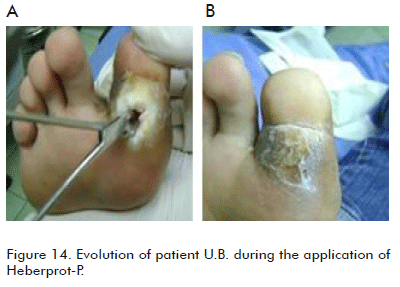
<P   ><font face="Verdana, Arial, Helvetica, sans-serif" size="2"><b>Plantar perforating      ulcer with added bone fracture</b> </font></P >       <P   ><font face="Verdana, Arial, Helvetica, sans-serif" size="2">Patient UB, a 28      year old female and with type 1 diabetes mellitus for 18 years. She had a      plantar perforating ulcer for 60 days at the base of her first toe, which      penetrated into the bone. (<a href="#fig14">Figure 14</a>). Through X-rays      we found that the wounded toe had a distal fracture of that phalange. Local      surgical cures were applied and five doses of Heberprot-P were infiltrated      into the walls of the ulcer to favor the granulation covering the bone fracture,      which was achieved after 15 days. The patient then returned to her normal      life. </font></P >   <font size="+1"><font size="+1"><font size="+1"><font size="+1"><font size="+1"><font size="+1"><font size="+1"><font size="+1"><font size="+1"><font size="+1"><font size="+1"><font color="#0000FF"><font color="#000000"><font size="+1"><font size="+1"><font size="+1"><font size="+1"><font size="+1"><font size="+1"><font color="#FF0000"><font size="+1"><font size="+1" color="#000000"><font size="+1"><font color="#FF0000"><font size="+1"><font size="+1" color="#000000"><font size="+1"><font size="+1"><font size="+1"><font color="#FF0000"><font size="+1"><font size="+1" color="#000000"><font size="+1"><font color="#FF0000"><font size="+1"><font size="+1" color="#000000"><font size="+1"><font color="#FF0000"><font size="+1"><font size="+1" color="#000000"><font color="#FF0000"><font size="+1"><font size="+1" color="#000000"><font size="+1"><font color="#FF0000"><font size="+1"><font size="+1" color="#000000"><font size="+1"><font color="#FF0000"><font size="+1"><font size="+1" color="#000000"><font color="#FF0000"><font size="+1"><font size="+1" color="#000000"><a name="fig14"></a></font></font></font></font></font></font></font></font></font></font></font></font></font></font></font></font></font></font></font></font></font></font></font></font></font></font></font></font></font></font></font></font></font></font></font></font></font></font></font></font></font></font></font></font></font></font></font></font></font></font></font></font></font></font>       ]]></body>
<body><![CDATA[<P align="center"   ><img src="/img/revistas/bta/v27n2/f1411210.gif" width="400" height="287"></P >       
<P   ><font size="2" face="Verdana, Arial, Helvetica, sans-serif"><b><font size="3">DISCUSSION</font></b>      </font></P >   <FONT size="+1">        <P   ><font size="2" face="Verdana, Arial, Helvetica, sans-serif">All the fourteen      cases presented here had been previously submitted for amputation, either      minor or major, of the affected limb. Major amputations have been commonly      associated to the diabetic foot diagnosis, with some authors reporting up      to a 60% probability for applying such procedures to the affected population.      </font></P >   <FONT size="+1">        <P   ><font face="Verdana, Arial, Helvetica, sans-serif" size="2">The use of a proper      technique to deal with a diabetic foot while having a product like Heberprot-P      available, which is able to consistently induce the growth of productive granulation      tissue after the first six doses, replaces the amputation criteria as first      choice to manage this type of lesions. </font></P >       <P   ><font size="3" face="Verdana, Arial, Helvetica, sans-serif"><b>CONCLUSIONS</b></font><font size="2" face="Verdana, Arial, Helvetica, sans-serif">      </font></P >   <FONT size="+1">        <P   ><font size="2" face="Verdana, Arial, Helvetica, sans-serif">The surgical experience      carried out on these fourteen patients was presented, and the responses for      the different types of lesions were shown. These were lesions that may be      found in the limbs of diabetic patients and that may be treatment variants      to normal surgery, in spite of the reports in the literature. The Cuban product      Heberprot-P offers many therapeutic possibilities for these patients. </font></P >   <FONT size="+1">        <P   > </P >       <P   ><font face="Verdana, Arial, Helvetica, sans-serif" size="3"><b>REFERENCES</b></font><font face="Verdana, Arial, Helvetica, sans-serif" size="2">      </font></P >       <!-- ref --><P   ><font face="Verdana, Arial, Helvetica, sans-serif" size="2">1. Wild S, Roglic      G, Green A, Sicree R, King H. Global prevalence of diabetes: estimates for      the year 2000, and projections for 2030. Diabetes Care. 2004; 27(5):1047-53.      </font></P >       <!-- ref --><P   ><font face="Verdana, Arial, Helvetica, sans-serif" size="2">2. Boulton AJ, Vileikyte      L, Ragnarson-Tennvall G, Apelqvist J. The global burden of diabetic foot disease.      Lancet 2005; 366(9498):1719-24. </font></P >       <!-- ref --><P   ><font face="Verdana, Arial, Helvetica, sans-serif" size="2">3. Heberprot-P -      Atenci&oacute;n integral al paciente con pie diab&eacute;tico + Heberprot-P      (p&aacute;gina web). Disponible en:<a href="http://heberprot-p.cigb.edu.cu/">      http://heberprot-p.cigb.edu.cu/</a> (Consultado: 24 de agosto de 2010). </font></P >       <P   > </P >       <P   ><font face="Verdana, Arial, Helvetica, sans-serif" size="2">Received in August,      2010.    <br>     </font><font face="Verdana, Arial, Helvetica, sans-serif" size="2">Accepted      for publication in September, 2010.</font></P >       <P   ><font face="Verdana, Arial, Helvetica, sans-serif" size="2">Jos&eacute; I Fern&aacute;ndez-Montequ&iacute;n,      Instituto de Angiolog&iacute;a y cirug&iacute;a vascular Calzada del Cerro      # 1551, CP 12 000, Cerro, Ciudad de La Habana, Cuba. E-mail: <a href="mailto:fdez_montequin@yahoo.es">fdez_montequin@yahoo.es</a></font></P >   </font></font></font></font></font></font></font></font></font></font></font></font></font></font></font></font></font></font></font></font></font></font></font></font></font></font></font></font></font></font></font></font></font></font></font></font></font></font></font></font></font></font></font></font></font></font></font></font></font></font></font></font></font></font></font></font></font></font></font></DIV >      ]]></body><back>
<ref-list>
<ref id="B1">
<label>1</label><nlm-citation citation-type="journal">
<person-group person-group-type="author">
<name>
<surname><![CDATA[Wild]]></surname>
<given-names><![CDATA[S]]></given-names>
</name>
<name>
<surname><![CDATA[Roglic]]></surname>
<given-names><![CDATA[G]]></given-names>
</name>
<name>
<surname><![CDATA[Green]]></surname>
<given-names><![CDATA[A]]></given-names>
</name>
<name>
<surname><![CDATA[Sicree]]></surname>
<given-names><![CDATA[R]]></given-names>
</name>
<name>
<surname><![CDATA[King]]></surname>
<given-names><![CDATA[H]]></given-names>
</name>
</person-group>
<article-title xml:lang="en"><![CDATA[Global prevalence of diabetes: estimates for the year 2000, and projections for 2030]]></article-title>
<source><![CDATA[Diabetes Care]]></source>
<year>2004</year>
<volume>27</volume>
<numero>5</numero>
<issue>5</issue>
<page-range>1047-53</page-range></nlm-citation>
</ref>
<ref id="B2">
<label>2</label><nlm-citation citation-type="journal">
<person-group person-group-type="author">
<name>
<surname><![CDATA[Boulton]]></surname>
<given-names><![CDATA[AJ]]></given-names>
</name>
<name>
<surname><![CDATA[Vileikyte]]></surname>
<given-names><![CDATA[L]]></given-names>
</name>
<name>
<surname><![CDATA[Ragnarson- Tennvall]]></surname>
<given-names><![CDATA[G]]></given-names>
</name>
<name>
<surname><![CDATA[Apelqvist]]></surname>
<given-names><![CDATA[J]]></given-names>
</name>
</person-group>
<article-title xml:lang="en"><![CDATA[The global burden of diabetic foot disease]]></article-title>
<source><![CDATA[Lancet]]></source>
<year>2005</year>
<volume>366</volume>
<numero>9498</numero>
<issue>9498</issue>
<page-range>1719-24</page-range></nlm-citation>
</ref>
<ref id="B3">
<label>3</label><nlm-citation citation-type="">
<source><![CDATA[Heberprot-P: Atención integral al paciente con pie diabético + Heberprot-P]]></source>
<year></year>
</nlm-citation>
</ref>
</ref-list>
</back>
</article>