<?xml version="1.0" encoding="ISO-8859-1"?><article xmlns:mml="http://www.w3.org/1998/Math/MathML" xmlns:xlink="http://www.w3.org/1999/xlink" xmlns:xsi="http://www.w3.org/2001/XMLSchema-instance">
<front>
<journal-meta>
<journal-id>1027-2852</journal-id>
<journal-title><![CDATA[Biotecnología Aplicada]]></journal-title>
<abbrev-journal-title><![CDATA[Biotecnol Apl]]></abbrev-journal-title>
<issn>1027-2852</issn>
<publisher>
<publisher-name><![CDATA[Editorial Elfos Scientiae]]></publisher-name>
</publisher>
</journal-meta>
<article-meta>
<article-id>S1027-28522010000300004</article-id>
<title-group>
<article-title xml:lang="en"><![CDATA[A pH shift-based procedure to screen fructoligosaccharides fermenting yeast or bacterial Straits]]></article-title>
<article-title xml:lang="es"><![CDATA[Procedimiento para la pesquisa de levaduras y bacterias fermentadoras de fructoligosacáridos basado en cambios de pH del medio]]></article-title>
</title-group>
<contrib-group>
<contrib contrib-type="author">
<name>
<surname><![CDATA[Pérez]]></surname>
<given-names><![CDATA[Enrique R]]></given-names>
</name>
<xref ref-type="aff" rid="A01"/>
</contrib>
<contrib contrib-type="author">
<name>
<surname><![CDATA[Trujillo]]></surname>
<given-names><![CDATA[Luis E]]></given-names>
</name>
<xref ref-type="aff" rid="A02"/>
</contrib>
<contrib contrib-type="author">
<name>
<surname><![CDATA[Arrieta]]></surname>
<given-names><![CDATA[Juan G]]></given-names>
</name>
<xref ref-type="aff" rid="A02"/>
</contrib>
<contrib contrib-type="author">
<name>
<surname><![CDATA[Pérez]]></surname>
<given-names><![CDATA[Heidy]]></given-names>
</name>
<xref ref-type="aff" rid="A03"/>
</contrib>
<contrib contrib-type="author">
<name>
<surname><![CDATA[Brizuela]]></surname>
<given-names><![CDATA[María A]]></given-names>
</name>
<xref ref-type="aff" rid="A03"/>
</contrib>
<contrib contrib-type="author">
<name>
<surname><![CDATA[Trujillo]]></surname>
<given-names><![CDATA[Gisselle]]></given-names>
</name>
<xref ref-type="aff" rid="A03"/>
</contrib>
<contrib contrib-type="author">
<name>
<surname><![CDATA[Hernández]]></surname>
<given-names><![CDATA[Lázaro]]></given-names>
</name>
<xref ref-type="aff" rid="A02"/>
</contrib>
</contrib-group>
<aff id="A01">
<institution><![CDATA[,Center for Genetic Engineering and Biotechnology Sancti Spíritus ]]></institution>
<addr-line><![CDATA[Sancti Spíritus ]]></addr-line>
<country>Cuba</country>
</aff>
<aff id="A03">
<institution><![CDATA[,Cuban Research Institute for sugarcane derivates, ICIDCA  ]]></institution>
<addr-line><![CDATA[Havana ]]></addr-line>
<country>Cuba</country>
</aff>
<aff id="A02">
<institution><![CDATA[,Center for Genetic Engineering and Biotechnology, CIGB  ]]></institution>
<addr-line><![CDATA[Havana ]]></addr-line>
<country>Cuba</country>
</aff>
<pub-date pub-type="pub">
<day>00</day>
<month>09</month>
<year>2010</year>
</pub-date>
<pub-date pub-type="epub">
<day>00</day>
<month>09</month>
<year>2010</year>
</pub-date>
<volume>27</volume>
<numero>3</numero>
<fpage>216</fpage>
<lpage>220</lpage>
<copyright-statement/>
<copyright-year/>
<self-uri xlink:href="http://scielo.sld.cu/scielo.php?script=sci_arttext&amp;pid=S1027-28522010000300004&amp;lng=en&amp;nrm=iso"></self-uri><self-uri xlink:href="http://scielo.sld.cu/scielo.php?script=sci_abstract&amp;pid=S1027-28522010000300004&amp;lng=en&amp;nrm=iso"></self-uri><self-uri xlink:href="http://scielo.sld.cu/scielo.php?script=sci_pdf&amp;pid=S1027-28522010000300004&amp;lng=en&amp;nrm=iso"></self-uri><abstract abstract-type="short" xml:lang="en"><p><![CDATA[Symbiotic, a combination of short chains-carbohydrates with prebiotic properties e.g. fructooligosaccharides (FOS) and biotherapeutical microorganisms, provides positive health effects and well-being in humans and animals. However; the lack of accurate screening methods hampers the possibility to get new fructo-oligosaccharides (FOS)-fermenting yeast or bacterial strains to design potential symbiotic combinations useful for health and food industries. A valuable screening procedure to visually evaluate pure cultures of bacterial and yeast strains able to ferment FOS in liquid or solid rich media supplemented with a pH indicator is described. Using this procedure, 15 FOS-consuming strains isolated from different sources were successfully assayed using this method. This screening procedure is a useful tool in rapid large-scale detection of potential FOS fermenting-strains.]]></p></abstract>
<abstract abstract-type="short" xml:lang="es"><p><![CDATA[Los simbióticos, combinación de carbohidratos de cadenas cortas con propiedades prebióticas e.g. fructooligosacáridos (FOS) con microorganismos bioterapéuticos, proporcionan efectos positivos a la salud de humanos y animales. Sin embargo, la carencia de métodos de pesquisa obstaculiza la detección de nuevas cepas de levadura y bacterias capaces de fermentar FOS para el diseño de nuevos simbióticos con aplicación en la salud animal y humana así como en la industria alimenticia. En este trabajo se describe un valioso procedimiento de pesquisa de cultivos puros de cepas de levaduras y bacterias capaces de fermentar FOS utilizando medios ricos sólidos o líquidos suplementados con un indicador de pH. Utilizando el método propuesto se evaluó satisfactoriamente la capacidad de fermentar FOS de 15 cepas aisladas de diferentes fuentes. Este procedimiento de pesquisa resulta una importante herramienta en la detección rápida de cepas con capacidad potencial para fermentar FOS.]]></p></abstract>
<kwd-group>
<kwd lng="en"><![CDATA[Bromothymol blue]]></kwd>
<kwd lng="en"><![CDATA[fructoligosaccharides]]></kwd>
<kwd lng="en"><![CDATA[fructoligosaccharides fermenting microorganisms]]></kwd>
<kwd lng="en"><![CDATA[prebiotics]]></kwd>
<kwd lng="en"><![CDATA[probiotics]]></kwd>
<kwd lng="en"><![CDATA[screening]]></kwd>
<kwd lng="en"><![CDATA[symbiotic]]></kwd>
<kwd lng="es"><![CDATA[Bromotimol azul]]></kwd>
<kwd lng="es"><![CDATA[fructoligosacáridos]]></kwd>
<kwd lng="es"><![CDATA[microorganismos fermentadores de fructoligosacáridos]]></kwd>
<kwd lng="es"><![CDATA[prebióticos]]></kwd>
<kwd lng="es"><![CDATA[pesquisa]]></kwd>
<kwd lng="es"><![CDATA[simbiótico]]></kwd>
</kwd-group>
</article-meta>
</front><body><![CDATA[ <DIV class="Sect"   >        <P   align="right" ><font size="2" color="#000000" face="Verdana, Arial, Helvetica, sans-serif"><b>RESEARCH</b>      </font></P >   <FONT size="+1" color="#000000">        <P   align="left" >&nbsp;</P >       <P   align="left" ><font size="2" face="Verdana, Arial, Helvetica, sans-serif"><B><font size="4">A      pH shift-based procedure to screen fructoligosaccharides fermenting yeast      or bacterial Straits </font> </b></font></P >   <FONT size="+1"><B>        <P   align="left" >&nbsp;</P >       <P   align="left" ><font size="3" face="Verdana, Arial, Helvetica, sans-serif">Procedimiento para      la pesquisa de levaduras y bacterias fermentadoras de fructoligosac&aacute;ridos      basado en cambios de pH del medio</font></P >   </B>        <P   align="left" >&nbsp;</P >       <P   align="left" >&nbsp;</P >       <P   align="left" ><font size="2" face="Verdana, Arial, Helvetica, sans-serif"><b>Enrique R P&eacute;rez<sup>1</sup>,      Luis E Trujillo<sup>2</sup>, Juan G Arrieta<sup>2</sup>, Heidy P&eacute;rez<sup>3</sup>,      Mar&iacute;a A Brizuela<sup>3</sup>, Gisselle Trujillo<sup>3</sup>, L&aacute;zaro      Hern&aacute;ndez<sup>2</sup></b> </font></P >   <FONT size="+1"><FONT size="+1"><FONT size="+1"><FONT size="+1"><FONT size="+1"><FONT size="+1"><FONT size="+1"><FONT size="+1"><FONT size="+1"><FONT size="+1"><FONT size="+1"><FONT size="+1"><FONT size="+1"><FONT size="+1"><FONT size="+1">        <P   align="left" ><font size="2" face="Verdana, Arial, Helvetica, sans-serif">1 Center for Genetic      Engineering and Biotechnology, CIGB Sancti Sp&iacute;ritus, Cuba     ]]></body>
<body><![CDATA[<br>     2 Center for Genetic Engineering and Biotechnology, CIGB Ave. 31 /158 and      190, Cubanac&aacute;n, Playa, PO Box 6162, Havana, Cuba     <br>     3 Cuban Research Institute for sugarcane derivates, ICIDCA, Havana, Cuba</font></P >   </font></font></font></font></font></font></font></font></font></font></font></font></font></font></font></font></font>       <p>&nbsp;</p><hr>   <FONT size="+1" color="#000000"><FONT size="+1"><FONT size="+1"><FONT size="+1"><FONT size="+1"><FONT size="+1"><FONT size="+1"><FONT size="+1"><FONT size="+1"><FONT size="+1"><FONT size="+1"><FONT size="+1"><FONT size="+1"><FONT size="+1"><FONT size="+1"><FONT size="+1"><FONT size="+1"><FONT size="+1"><FONT size="+1"><FONT size="+1"><FONT size="+1"><FONT size="+1"><FONT size="+1"><FONT color="#0000FF"><FONT color="#000000">        <P   align="left" > </P >       <P   align="left" ><font face="Verdana, Arial, Helvetica, sans-serif" size="2"><B>ABSTRACT<I> </I></b></font></P >       <P   align="left" ><font face="Verdana, Arial, Helvetica, sans-serif" size="2">Symbiotic, a combination      of short chains-carbohydrates with prebiotic properties e.g. fructooligosaccharides      (FOS) and biotherapeutical microorganisms, provides positive health effects      and well-being in humans and animals. However; the lack of accurate screening      methods hampers the possibility to get new fructo-oligosaccharides (FOS)-fermenting      yeast or bacterial strains to design potential symbiotic combinations useful      for health and food industries. A valuable screening procedure to visually      evaluate pure cultures of bacterial and yeast strains able to ferment FOS      in liquid or solid rich media supplemented with a pH indicator is described.      Using this procedure, 15 FOS-consuming strains isolated from different sources      were successfully assayed using this method. This screening procedure is a      useful tool in rapid large-scale detection of potential FOS fermenting-strains.      </font></P >       <P   align="left" ><font face="Verdana, Arial, Helvetica, sans-serif" size="2"><b>Keywords</b>:      Bromothymol blue, fructoligosaccharides, fructoligosaccharides fermenting      microorganisms, prebiotics, probiotics, screening, symbiotic </font></P >   </font></font></font></font></font></font></font></font></font></font></font></font></font></font></font></font></font></font></font></font></font></font></font></font></font>    <hr>   <FONT size="+1" color="#000000"><FONT size="+1"><FONT size="+1"><FONT size="+1"><FONT size="+1"><FONT size="+1"><FONT size="+1"><FONT size="+1"><FONT size="+1"><FONT size="+1"><FONT size="+1"><FONT size="+1"><FONT size="+1"><FONT size="+1"><FONT size="+1"><FONT size="+1"><FONT size="+1"><FONT size="+1"><FONT size="+1"><FONT size="+1"><FONT size="+1"><FONT size="+1"><FONT size="+1"><FONT color="#0000FF"><FONT color="#000000">       <P   align="left" > </P >       <P   align="left" ><font face="Verdana, Arial, Helvetica, sans-serif" size="2"><B>RESUMEN<I> </I></b></font></P >       <P   align="left" ><font face="Verdana, Arial, Helvetica, sans-serif" size="2">Los simbi&oacute;ticos,      combinaci&oacute;n de carbohidratos de cadenas cortas con propiedades prebi&oacute;ticas      e.g. fructooligosac&aacute;ridos (FOS) con microorganismos bioterap&eacute;uticos,      proporcionan efectos positivos a la salud de humanos y animales. Sin embargo,      la carencia de m&eacute;todos de pesquisa obstaculiza la detecci&oacute;n      de nuevas cepas de levadura y bacterias capaces de fermentar FOS para el dise&ntilde;o      de nuevos simbi&oacute;ticos con aplicaci&oacute;n en la salud animal y humana      as&iacute; como en la industria alimenticia. En este trabajo se describe un      valioso procedimiento de pesquisa de cultivos puros de cepas de levaduras      y bacterias capaces de fermentar FOS utilizando medios ricos s&oacute;lidos      o l&iacute;quidos suplementados con un indicador de pH. Utilizando el m&eacute;todo      propuesto se evalu&oacute; satisfactoriamente la capacidad de fermentar FOS      de 15 cepas aisladas de diferentes fuentes. Este procedimiento de pesquisa      resulta una importante herramienta en la detecci&oacute;n r&aacute;pida de      cepas con capacidad potencial para fermentar FOS.<B><I> </I></b></font></P >       ]]></body>
<body><![CDATA[<P   align="left" ><font face="Verdana, Arial, Helvetica, sans-serif" size="2"><b>Palabras clave</b>:      Bromotimol azul, fructoligosac&aacute;ridos, microorganismos fermentadores      de fructoligosac&aacute;ridos, prebi&oacute;ticos, prebi&oacute;ticos, pesquisa,      simbi&oacute;tico</font></P >   </font></font></font></font></font></font></font></font></font></font></font></font></font></font></font></font></font></font></font></font></font></font></font></font></font>    <hr>   <FONT size="+1" color="#000000"><FONT size="+1"><FONT size="+1"><FONT size="+1"><FONT size="+1"><FONT size="+1"><FONT size="+1"><FONT size="+1"><FONT size="+1"><FONT size="+1"><FONT size="+1"><FONT size="+1"><FONT size="+1"><FONT size="+1"><FONT size="+1"><FONT size="+1"><FONT size="+1"><FONT size="+1"><FONT size="+1"><FONT size="+1"><FONT size="+1"><FONT size="+1"><FONT size="+1"><FONT color="#0000FF"><FONT color="#000000">       <P   align="left" >&nbsp;</P >       <P   align="left" ><font face="Verdana, Arial, Helvetica, sans-serif" size="2"> </font></P >       <P   align="left" > </P >       <P   align="left" ><font size="3" face="Verdana, Arial, Helvetica, sans-serif"><b>INTRODUCTION</b></font><font size="2" face="Verdana, Arial, Helvetica, sans-serif">      </font></P >   <FONT size="+1">        <P   align="left" ><font size="2" face="Verdana, Arial, Helvetica, sans-serif">Symbiotic provides      positive desirable clinical effects in humans and animals (1-3). For this      reason the selection of bacterial or yeast strains able to efficiently ferment      short chains- carbohydrates with prebiotic properties e.g. fructooligosaccharides      (FOS), is a subject of permanent interest for health and food industries.      </font></P >   <FONT size="+1">        <P   align="left" ><font face="Verdana, Arial, Helvetica, sans-serif" size="2">However; the lack      of simple and cost-effective direct screening methods hampers the rapid identification      of such important microorganisms. Main targets for FOS consume in the colon      are Bifidobacteria and Lactobacilli (1). These intestinal bacteria have shown      several positive effects upon human or animals wellbeing (4, 5). Also some      yeast strains used for medical therapy consume prebiotics (6). </font></P >       <P   align="left" ><font face="Verdana, Arial, Helvetica, sans-serif" size="2">According to that      explained above, if certain carbohydrates, such as fructoligosaccharides,      are fermented by only specific beneficial microbial strains, then a liquid      or solid growth medium containing these &ldquo;prebiotic&rdquo; substrates      as unique carbon sources Could efficiently and directly select for those useful      FOSfermenters microbial strains. </font></P >       <P   align="left" ><font face="Verdana, Arial, Helvetica, sans-serif" size="2">However, two main      drawbacks make it difficult to establish an accurate screening procedure based      on FOS consumption. Firstly, FOS commercial preparations in general, may have      different polymerization degrees and/or contain contaminants glucose, fructose,      sucrose, or other fermentable sugars being rather difficult to establish if      microbial growth in FOS-containing medium is really due to FOS metabolism.      </font></P >       <P   align="left" ><font face="Verdana, Arial, Helvetica, sans-serif" size="2">This fact makes necessary      the use of additional time-consuming confirmatory analytical techniques such      as thin layer chromatography (TLC) or High Pressure Liquid Chromatography      (HPLC). Secondly, the selection of FOS-fermenter strains by using continuous      culture in rich media such as De Man, Rogosa and Sharpe (MRS) (7) to evaluate      FOS consumption by bacteria or yeast undoubtedly could mask the final results.      To overcome this problem, instead of a rich media like MRS or any similar,      the use of minimal medium might be the best choice to evaluate FOS fermentation,      but another problem arises. </font></P >       ]]></body>
<body><![CDATA[<P   align="left" ><font face="Verdana, Arial, Helvetica, sans-serif" size="2">Contrary to yeasts<I>,      Lactobacillus </I>and <I>Bifidobacterium </I>strains for example, need elevated      nutritional requirements in the media, and their growth in minimal medium      is almost null. </font></P >       <P   align="left" ><font face="Verdana, Arial, Helvetica, sans-serif" size="2">Following this line      we developed a new feasible and simple pH shift-based procedure for rapid      screening of pure cultures of FOS-fermenting yeast and bacterial strains growing      in rich media. As the principle, FOS fermentation by bacteria and yeast provokes      acidification of the culture medium (pH below 6) due to production of organic      acids. By contrast, microbes unable to metabolize FOS, for example enteric      bacteria like <I>Escherichia coli </I>or <I>Salmonella </I>sp., use the nitrogen-containing      components in yeast extract or peptone causing alkalinization (pH above 7)      due to ammonia release. </font></P >       <P   align="left" ><font face="Verdana, Arial, Helvetica, sans-serif" size="2">The slightly pH switches      from acidic to basic conditions can be detected by the addition of the innocuous      pH indicator Bromthymol blue (transition interval pH 6.0-7.6; yellow-blue,      Sigma Co., USA). </font></P >       <P   align="left" ><font face="Verdana, Arial, Helvetica, sans-serif" size="2">At this stage, a      simple visual inspection is enough to detect color change in liquid or solid      media allowing a rapid and accurate screening and detection for those microorganisms      able to metabolize FOS. </font></P >       <P   align="left" ><font face="Verdana, Arial, Helvetica, sans-serif" size="2">The screening of      several potential FOS-consuming strains can be carried out in covered multiwell      plastic dishes with 12 or 24 wells (Linbro, Flow Laboratories Inc. USA or      Costar, Corning Inc. USA) containing low quantities of the adequate growth      medium. </font></P >       <P   align="left" > </P >       <P   align="left" ><font size="3"><b><font face="Verdana, Arial, Helvetica, sans-serif">MATERIAL      AND METHODS</font></b></font><font size="2" face="Verdana, Arial, Helvetica, sans-serif">      </font></P >   <FONT size="+1">        <P   align="left" > </P >   <FONT size="+1">        <P   align="left" ><font face="Verdana, Arial, Helvetica, sans-serif" size="2"><B>Microorganisms      </b></font></P >       <P   align="left" ><font face="Verdana, Arial, Helvetica, sans-serif" size="2"><I>Bifidobacterium      bifidum </I>15696, <I>Bifidobacterium dentium </I>27678 were obtained from      the American Type Culture Collection (ATCC) and <I>Escherichia coli </I>TOP10F<I>,      Pichia pastoris </I>GS115<I>, Pichia pastoris </I>X33 were purchased from      Invitrogen SA. </font></P >       ]]></body>
<body><![CDATA[<P   align="left" ><font face="Verdana, Arial, Helvetica, sans-serif" size="2">Other bacterial and      yeast strains such as: <I>Saccharomyces boulardii </I>L/25/4/96<I>, Saccharomyces      cerevisiae </I>L/25-7-82<I>, Saccharomyces cerevisiae </I>L/25-7-76<I>, Kluyveromyces      fragilis </I>L/12-8-1 <I>Kluyveromyces fragilis </I>L/12-8-6, <I>Lactobacillus      acidophilus </I>B/103-5, <I>Lactobacillus rhamnosus </I>B/103-1-5, <I>Lactobacillus      reuteri B/108-1, Lactobacillus fermentum </I>B/103-11-3, <I>Lactobacillus      casei </I>B/103-11-6, <I>Lactobacillus paracasei </I>B/103-11-7, <I>Lactobacillus      bulgaricus </I>B/103- 12-6, <I>Streptococcus thermophilus </I>B/103-12-7<I>,      </I>used in this research were isolated from different sources and belongs      to the microorganism collection of the Cuban Research Institute for Sugarcane      Derivates (ICIDCA) Havana, Cuba. </font></P >       <P   align="left" > </P >       <P   align="left" ><font face="Verdana, Arial, Helvetica, sans-serif" size="2"><B>Culture media      </b></font></P >   <B>        <P   align="left" > </P >   </B>        <P   align="left" ><font face="Verdana, Arial, Helvetica, sans-serif" size="2">The commonly used      minimal Yeast Nitrogen base <B>(</B>YNB) and rich media YP and LB (Luria bertani)      for yeast and bacterial grow respectively, were prepared according to the      <I>Pichia </I>expression vectors for constitutive expression and purification      of recombinant proteins Catalog nos. V200-20 and V205-20, Invitrogen SA (USA).      Minimal M9 media was purchased from Sigma Co., (USA) catalog number: M6030      and prepared according to the manufactures instructions. Solid media was prepared      similar that liquid media but including 20 g of agar per liter. For the pH      shift assays using any of the solid or liquid media mentioned above, 0.0025%      of Bromothymol blue (transition interval pH 6.0-7.6: yellow-blue, Sigma Co.,      USA Catalog number: 34656), filter-sterilized solutions of glucose, fructose      and sucrose (BDH) added at 2% final concentration or FOS solution obtained      in this work 2 and 3% final concentration were incorporated to the adequate      culture media according to the different experiments requirements. Final pH      in the different media was adjusted to 6.5. </font></P >       <P   align="left" > </P >       <P   align="left" ><font face="Verdana, Arial, Helvetica, sans-serif" size="2"><B>Microbial growth      under anaerobic conditions </b></font></P >   <B>        <P   align="left" ></P >   </B>        <P   align="left" ><font face="Verdana, Arial, Helvetica, sans-serif" size="2">COY Chambers (COY      Laboratory Products Inc.)<B> </B>were used to create and maintain anaerobic      conditions as needed during growth of some of the microorganisms mentioned      above in the different experiments. </font></P >       <P   align="left" > </P >       ]]></body>
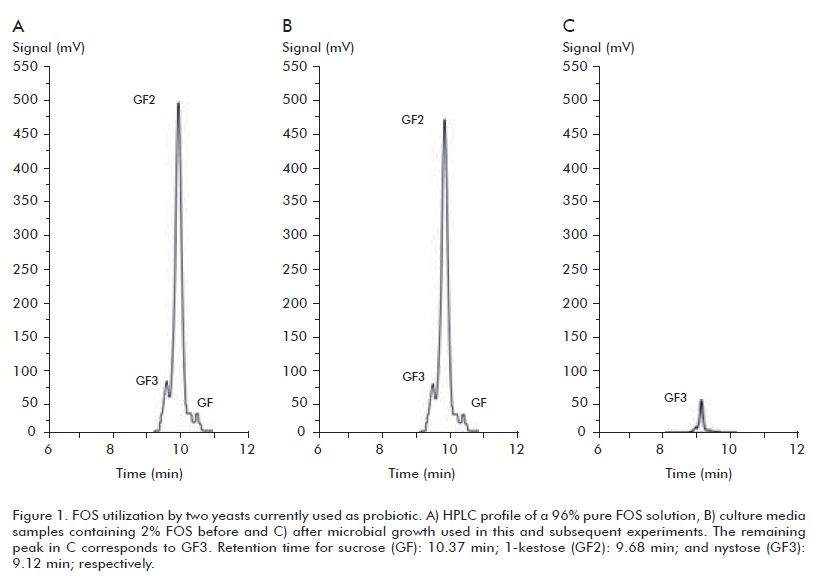
<body><![CDATA[<P   align="left" ><font face="Verdana, Arial, Helvetica, sans-serif" size="2"><B>Sugars separation      by High Performance Liquid Chromatogrphy (HPLC) </b></font></P >   <B>        <P   align="left" ></P >   </B>        <P   align="left" ><font face="Verdana, Arial, Helvetica, sans-serif" size="2">Sugar composition      in the enriched FOS solution used in this research were separated in an Aminex      HPX- 42C column (0.78 by 30 cm; Bio-Rad Laboratories, Hercules, Calif.) and      detected with a RI-410 (Waters) detector. The column temperature during the      analysis was kept constant at 85 &ordm;C, and water was used as the mobile      phase at a flow rate of 0.6 mL/min. </font></P >       <P   align="left" > </P >       <P   align="left" ><b><font size="3" face="Verdana, Arial, Helvetica, sans-serif">RESULTS AND DISCUSSION      </font></b></P >   <FONT size="+1">        <P   align="left" > </P >       <P   align="left" ><font size="2" face="Verdana, Arial, Helvetica, sans-serif">As the first step      of this research we found that unlike yeasts, some lactobacilli and bifidobacteria      strains were not able to grow in minimal media supplemented with FOS. </font></P >   <FONT size="+1">        <P   align="left" ><font face="Verdana, Arial, Helvetica, sans-serif" size="2">Previously, syrup      composed of 4.6% nystose (GF3), 56% 1-kestose (GF2), 21% sucrose (GF), 17%      glucose (G), and 1.4% fructose (F) was produced during sucrose transformation      by recombinant <I>P. pastoris </I>cells entrapped in Ca-alginate beads. After      sugars separation, an enriched FOS solution containing 1-kestose (96%), nystose      (3%) and sucrose (1%) was obtained, as judged by HPLC analysis (<a href="/img/revistas/bta/v27n3/f0104310.gif">Figure      1A</a>). </font></P >       
<P   align="left" ><font face="Verdana, Arial, Helvetica, sans-serif" size="2">To evaluate microbial      FOS fermentation, the use of minimal media appears to be ideal because of      the lack of carbohydrates or proteins as alternative energy sources for cell      growth. On this basis, the enriched filter-sterilized FOS solution was incorporated      to a final concentration of 2 and 3% into solid or liquid minimal Yeast Nitrogen      Base (YNB, Invitrogen Co., USA) or minimal M9 (Sigma Co., USA) medium supplemented      with 0.05% L-cysteine. Two yeasts (<I>S. boulardii </I>and <I>K. fragilis</I>)      and 2 bacterial strains (<I>B. bifidum </I>and <I>B. dentium</I>) were streaked      on YNBFOS or M9-FOS plates and incubated 48 h at 30 &ordm;C or 37 &ordm;C      respectively, under anaerobic conditions. The assayed yeasts were able to      grow in solid or liquid YNB-FOS demonstrating that FOS was equally as good      substrate as glucose (BDH), fructose (BDH) and sucrose (BDH) in supporting      growth (<a href="/img/revistas/bta/v27n3/f0104310.gif">Figure 1B</a>).      Additionally, HPLC analysis confirmed the complete depletion of the FOS fraction      after microbial growth (<a href="/img/revistas/bta/v27n3/f0104310.gif">Figure      1C</a>). Unlike yeasts, the two <I>Bifidobacteria </I>and two additional FOS-consumers      <I>Lactobacillus </I>strains used as controls of this experiment, failed to      grow in solid or liquid M9-FOS (results not shown). Likely their limited growth      on minimal media may not guarantee the initial production of enzymes for FOS      hydrolysis and transport inside the cell. The <I>fosABCDXE </I>genes encoding      for a repressor, a transporter system and a &#61538;-fructosidases are organized      as an operon co-transcribed as a single mRNA in several Lactobacillus and      Streptoccocus strains for FOS utilization (8, 9). </font></P >       
<P   align="left" ><font face="Verdana, Arial, Helvetica, sans-serif" size="2">Lactobacilli and      Bifidobacteria, organisms that are generally considered to be desirable members      of the colonic microbiota, release mainly lactic and acetic acids during FOS      catabolism under anaerobic conditions (1) so, provoking acidification of the      culture medium reaching pH values below 5. As shown above, these bacteria      are unable to grow in minimal media due to their high nutritional requirements.      These characteristics prompted us to test whether the addition of an adequate      pH indicator as Bromothymol blue (transition interval pH 6.0-7.6: yellow-blue)      to the LB media supplemented with 2% FOS could produce visible changes in      the medium depending on the bacterium ability to consume FOS. </font></P >       ]]></body>
<body><![CDATA[<P   align="left" ><font face="Verdana, Arial, Helvetica, sans-serif" size="2">As shown in <a href="/img/revistas/bta/v27n3/t0104310.gif">table      1</a> or <a href="/img/revistas/bta/v27n3/f0204310.gif">figures 2A and      B</a>, the growth of 15 of the screened bacterial strains, in solid and liquid      LB media turned the medium color from initial green (pH 6.5) to yellow indicating      acidifiation, pH below 6, due to FOS consumption (<a href="/img/revistas/bta/v27n3/t0104310.gif">Table      1</a>). On the other hand, when FOS was not added, the medium color turned      to blue revealing alkalinization due to ammonia release from utilization of      the nitrogen-containing carbon sources in yeast extract and peptone so, pH      values raised up from initial 6.5 to 8 (<a href="/img/revistas/bta/v27n3/t0104310.gif">Table      1</a>). The same results were obtained when five yeast strains were assayed      (<a href="/img/revistas/bta/v27n3/f0304310.gif">Figures 3A and B</a>).      Additionally, the use of YNB-FOS minimal medium supplemented with Bromothimol      blue revealed also, by simple visual inspection, the capacity to consume these      short chain carbohydrates by these yeasts (results not shown). </font></P >       
<P   align="left" ><font face="Verdana, Arial, Helvetica, sans-serif" size="2">As expected, the      enteric bacterium <I>E. coli </I>and the methylotrophic yeast <I>P. pastoris,      </I>which are unable to use FOS, turned the medium color to blue raising the      pH values about 8 (<a href="/img/revistas/bta/v27n3/t0104310.gif">Table      1</a>) due to also utilization of the nitrogen-containing carbon sources in      yeast extract and peptone. </font></P >       
<P   align="left" ><font face="Verdana, Arial, Helvetica, sans-serif" size="2">FOS depletion was      further verified by HPLC analysis demonstrating that the assayed bacteria      and yeasts consumed totally the GF2 (1-kestose) and GF3 (nystose) fractions      (results not shown). In addition, no accumulation of other monosaccharide      was seen which suggest that they were also degraded by the microorganisms.      These results agree with previous reports dealing with efficient consume of      GF2, GF3 together with mono and disaccharide fractions (10). </font></P >       <P   align="left" ><font face="Verdana, Arial, Helvetica, sans-serif" size="2">It has been established      that the diet, host phylogeny and gut morphology influence the microbial ecology      of the gastrointestinal tract (11,12) The beneficial potential of lactic acid      bacteria and yeast has been shown to be enhanced by the introduction of prebiotic      carbohydrates mainly of fructo- and galactooligosaccharidic nature (6). In      recent studies other authors concluded that prebiotics selectively enhance      lactobacilli and bifidobacteria populations and reduce colonization by pathogenic      bacteria (13-15). </font></P >       <P   align="left" ><font face="Verdana, Arial, Helvetica, sans-serif" size="2">However, there are      not reports regarding to rapid and accurate qualitative detection methods      to get new potential fructoligosaccharides-fermenting yeast or bacterial strains      based on consume of these short chain carbohydrates widely used as prebiotics.      Previous studies have been aimed to apply <I>in vitro </I>methods for selection      of suitable bacterial and yeast strains for human or animal health improvement      (16, 17). In this particular report the addition of an innocuous pH indicator      like Bromothymol blue (transition interval pH 6.0-7.6: yellow-blue) to any      of the used media supplemented with 2% FOS produced rapid and visible changes      in the medium color depending on the bacterium or yeast ability to consume      or not FOS as unique carbon source. This pH indicator has not previously been      used for this purpose. On the other hand the enriched 96% FOS preparation      used in this work composed mainly by GF2 (1-kestose) and GF3 (nystose) is      useful as a carbon source since guarantee that microbial growth is mainly      due to FOS consume as unique carbon source. </font></P >       <P   align="left" ><font face="Verdana, Arial, Helvetica, sans-serif" size="2"><b><font size="3">CONCLUSION</font></b>      </font></P >   <FONT size="+1">        <P   align="left" ><font size="2" face="Verdana, Arial, Helvetica, sans-serif">According to the      results described above, the proposed screening method is a valuable tool      in large-scale detection of pure cultures of potential FOS fermenters- yeast      or bacterial strains for further symbiotic designs. </font></P >   <FONT size="+1">        <P   align="left" ><font face="Verdana, Arial, Helvetica, sans-serif" size="2"><b><font size="3">ACKNOWLEDGMENTS</font></b>      </font></P >   <FONT size="+1">        <P   align="left" ><font size="2" face="Verdana, Arial, Helvetica, sans-serif">This research was      partially funding by the research project 3031254 of the Center for Genetic      Engineering and Biotechnology, Havana, Cuba. </font></P >   <FONT size="+1">        <P   align="left" > </P >       ]]></body>
<body><![CDATA[<P   align="left" ><font face="Verdana, Arial, Helvetica, sans-serif" size="3"><b>REFERENCES</b></font><font face="Verdana, Arial, Helvetica, sans-serif" size="2">      </font></P >       <!-- ref --><P   align="left" ><font size="2" face="Verdana, Arial, Helvetica, sans-serif">1. Collins MD, Gibson      GR. Probiotics, prebiotics, and symbiotic: approaches for modulating the microbial      ecology of the gut. Am J Clin Nutr 1999;69:1052S-7S. </font></P >   <FONT size="+1">        <!-- ref --><P   align="left" ><font face="Verdana, Arial, Helvetica, sans-serif" size="2">2. Kohler H, McCormick      BA, Walker WA. Bacterial-enterocyte crosstalk: cellular mechanisms in health      and disease. J Pediatr Gastr Nutr 2003;36:175-85. </font></P >       <!-- ref --><P   align="left" ><font face="Verdana, Arial, Helvetica, sans-serif" size="2">3. Patterson JA.      Prebiotic Feed Additives: Rationale and Use in Pigs. Adv Pork Prod 2005;16:149-58.      </font></P >       <!-- ref --><P   align="left" ><font face="Verdana, Arial, Helvetica, sans-serif" size="2">4. Kaplan H, Hutkins      RW. Metabolism of fructooligosaccharides by Lactobacillus paracasei 1195.      Appl Environ Microb 2003;69:2217-22. </font></P >       <P   align="left" ><font face="Verdana, Arial, Helvetica, sans-serif" size="2">5. Gagg&igrave;a      F, Mattarelli P, Biavati B. Probiotics and prebiotics in animal feeding for      safe food production. Int J Food Microbiol 2010; 141 Suppl 1: s15-s28. </font></P >       <!-- ref --><P   align="left" ><font face="Verdana, Arial, Helvetica, sans-serif" size="2">6. Mitterdorfer G,      Kneifel W, Viernstein H. Utilization of prebiotic carbohydrates by yeasts      of therapeutic relevance. Lett Appl Microbiol. 2001;33:251-55. </font></P >       <!-- ref --><P   align="left" ><font face="Verdana, Arial, Helvetica, sans-serif" size="2">7. Sghir A, Chow      JM, Mackie RI. Continuous culture selection of Bifidobacteria and lactobacilli      from human faecal samples using fructooligosaccharide as selective substrate.      J Appl Microbiol 1998; 85:769-77. </font></P >       <!-- ref --><P   align="left" ><font face="Verdana, Arial, Helvetica, sans-serif" size="2">8. Goh YJ, Zhang      C, Benson AK, Schlegel V, Lee JH, Hutkins RW. Identification of a putative      operon involved in fructooligosaccharide utilization by <I>Lactobacillus paracasei</I>.      Appl Environ Microbiol 2006;72 (12):7518-30. </font></P >       <!-- ref --><P   align="left" ><font face="Verdana, Arial, Helvetica, sans-serif" size="2">9. Goh YJ, Lee JH,      Hutkins RW. Functional analysis of the fructooligosaccharide utilization operon      in <I>Lactobacillus paracasei </I>1195. Appl Environ Microbiol 2007; 73(18):5716-24.      </font></P >       <!-- ref --><P   align="left" ><font face="Verdana, Arial, Helvetica, sans-serif" size="2">10. Saulnier DM,      Molenaar D, de Vos WM, Gibson GR, Kolida S. Identification of prebiotic fructooligosaccharide      metabolism in <I>Lactobacillus plantarum</I>. Appl Environ Microbiol 2007;73:1753-65.      </font></P >       <!-- ref --><P   align="left" ><font face="Verdana, Arial, Helvetica, sans-serif" size="2">11. Ley RE, Hamady      M, Lozupone C, Turnbaugh PJ, Ramey RR, Bircher JS, <I>et al</I>. Evolution      of mammals and their gut microbes. Science 2008;320:1647-51. </font></P >       <!-- ref --><P   align="left" ><font face="Verdana, Arial, Helvetica, sans-serif" size="2">12. Ley RE, Lozupone      CA, Hamady M, Knight R, Gordon JI. Worlds within worlds: evolution of the      vertebrate gut microbiota. Nat Rev Microbial 2009;6:776-88. </font></P >       <!-- ref --><P   align="left" ><font face="Verdana, Arial, Helvetica, sans-serif" size="2">13. Biggs P, Parsons      CM. The effects of grobiotic- P on growth performance, nutrient digestibilities,      and cecal microbial populations in young chicks. Poult Sci 2008; 87:1796-803.      </font></P >       <P   align="left" ><font face="Verdana, Arial, Helvetica, sans-serif" size="2">14. Baurhoo B, Letellier      A, Zhao X, Ruiz- Feria CA. Cecal populations of Lactobacilli and Bifidobacteria      and <I>Escherichia coli </I>after <I>in vivo Escherichia coli </I>challenge      in birds fed diets with purified lignin or mannanoligo-saccharides. Int J      Poult Scie 2007;86:2509-16. </font></P >       <!-- ref --><P   align="left" ><font face="Verdana, Arial, Helvetica, sans-serif" size="2">15. Baurhoo B, Goldflus      F, Zhao X. Purified cell wall of Saccharomyces cerevisiae increases protection      against intestinal pathogens in broiler chickens. Poult Sci 2009;8:133-7.      </font></P >       <!-- ref --><P   align="left" ><font face="Verdana, Arial, Helvetica, sans-serif" size="2">16. Ten LN, Im WT,      Aslam Z, Larina L, Lee ST. Novel insoluble dye-labeled substrates for screening      inulin-degrading microorganisms. J Microbiol Methods 2007; 69(2):353-7. </font></P >       <!-- ref --><P   align="left" ><font face="Verdana, Arial, Helvetica, sans-serif" size="2">17. Modesto M, D'Aimmo      MR, Stefanini I, Trevisi P, De Filippi S, Casini L , <I>et al</I>. A novel      strategy to select Bifidobacterium strains and prebiotics as naturalgrowth      promoters in newly weaned pigs. Livestock Sci 2009;122:248-58. </font></P >       <P   align="left" > </P >       <P   align="left" ><font size="2" face="Verdana, Arial, Helvetica, sans-serif">Received in March,      2010.     ]]></body>
<body><![CDATA[<br>     Accepted for publication in June, 2010. </font></P >       <P   align="left" ><font size="+1" color="#000000"><font size="+1"><font size="2" face="Verdana, Arial, Helvetica, sans-serif">Luis      E Trujillo, </font><font size="+1" color="#000000"><font size="+1"><font size="+1"><font size="+1"><font size="+1"><font size="+1"><font size="+1"><font size="+1"><font size="+1"><font size="+1"><font size="+1"><font size="+1"><font size="+1"><font size="+1"><font size="+1"><font size="+1"><font size="+1"><font size="2" face="Verdana, Arial, Helvetica, sans-serif">Center      for Genetic Engineering and Biotechnology, CIGB Ave. 31 /158 and 190, Cubanac&aacute;n,      Playa, PO Box 6162, Havana, Cuba</font></font></font></font></font></font></font></font></font></font></font></font></font></font></font></font></font></font>.      </font><font size="+1" color="#000000"><font size="+1"><font size="+1"><font size="+1"><font size="+1"><font size="+1"><font size="+1"><font size="+1"><font size="+1"><font size="+1"><font size="+1"><font size="+1"><font size="+1"><font size="+1"><font size="+1"><font size="+1"><font size="+1"><font size="2" face="Verdana, Arial, Helvetica, sans-serif">E-mail:      <a href="mailto:luis.trujillo@cigb.edu.cu"> <font color="#0000FF">luis.trujillo@cigb.edu.cu</font></a></font></font></font></font></font></font></font></font></font></font></font></font></font></font></font></font></font></font><font size="+1">      </font></font></P >   </font></font></font></font></font></font></font></font></font></font></font></font></font></font></font></font></font></font></font></font></font></font></font></font></font></font></font></font></font></font></font></font></font></font></font></font></DIV >      ]]></body><back>
<ref-list>
<ref id="B1">
<label>1</label><nlm-citation citation-type="journal">
<person-group person-group-type="author">
<name>
<surname><![CDATA[Collins]]></surname>
<given-names><![CDATA[MD]]></given-names>
</name>
<name>
<surname><![CDATA[Gibson]]></surname>
<given-names><![CDATA[GR]]></given-names>
</name>
</person-group>
<article-title xml:lang="en"><![CDATA[Probiotics, prebiotics, and symbiotic: approaches for modulating the microbial ecology of the gut]]></article-title>
<source><![CDATA[Am J Clin Nutr]]></source>
<year>1999</year>
<volume>69</volume>
<page-range>1052S-7S</page-range></nlm-citation>
</ref>
<ref id="B2">
<label>2</label><nlm-citation citation-type="journal">
<person-group person-group-type="author">
<name>
<surname><![CDATA[Kohler]]></surname>
<given-names><![CDATA[H]]></given-names>
</name>
<name>
<surname><![CDATA[McCormick]]></surname>
<given-names><![CDATA[BA]]></given-names>
</name>
<name>
<surname><![CDATA[Walker]]></surname>
<given-names><![CDATA[WA]]></given-names>
</name>
</person-group>
<article-title xml:lang="en"><![CDATA[Bacterial-enterocyte crosstalk: cellular mechanisms in health and disease]]></article-title>
<source><![CDATA[J Pediatr Gastr Nutr]]></source>
<year>2003</year>
<volume>36</volume>
<page-range>175-85</page-range></nlm-citation>
</ref>
<ref id="B3">
<label>3</label><nlm-citation citation-type="journal">
<person-group person-group-type="author">
<name>
<surname><![CDATA[Patterson]]></surname>
<given-names><![CDATA[JA]]></given-names>
</name>
</person-group>
<article-title xml:lang="en"><![CDATA[Prebiotic Feed Additives: Rationale and Use in Pigs]]></article-title>
<source><![CDATA[Adv Pork Prod]]></source>
<year>2005</year>
<volume>16</volume>
<page-range>149-58</page-range></nlm-citation>
</ref>
<ref id="B4">
<label>4</label><nlm-citation citation-type="journal">
<person-group person-group-type="author">
<name>
<surname><![CDATA[Kaplan]]></surname>
<given-names><![CDATA[H]]></given-names>
</name>
<name>
<surname><![CDATA[Hutkins]]></surname>
<given-names><![CDATA[RW]]></given-names>
</name>
</person-group>
<article-title xml:lang="en"><![CDATA[Metabolism of fructooligosaccharides by Lactobacillus paracasei 1195]]></article-title>
<source><![CDATA[Appl Environ Microb]]></source>
<year>2003</year>
<volume>69</volume>
<page-range>2217-22</page-range></nlm-citation>
</ref>
<ref id="B5">
<label>5</label><nlm-citation citation-type="journal">
<person-group person-group-type="author">
<name>
<surname><![CDATA[Gaggìa]]></surname>
<given-names><![CDATA[F]]></given-names>
</name>
<name>
<surname><![CDATA[Mattarelli]]></surname>
<given-names><![CDATA[P]]></given-names>
</name>
<name>
<surname><![CDATA[Biavati]]></surname>
<given-names><![CDATA[B]]></given-names>
</name>
</person-group>
<article-title xml:lang="en"><![CDATA[Probiotics and prebiotics in animal feeding for safe food production]]></article-title>
<source><![CDATA[Int J Food Microbiol]]></source>
<year>2010</year>
<volume>141</volume>
<page-range>s15-s28</page-range></nlm-citation>
</ref>
<ref id="B6">
<label>6</label><nlm-citation citation-type="journal">
<person-group person-group-type="author">
<name>
<surname><![CDATA[Mitterdorfer]]></surname>
<given-names><![CDATA[G]]></given-names>
</name>
<name>
<surname><![CDATA[Kneifel]]></surname>
<given-names><![CDATA[W]]></given-names>
</name>
<name>
<surname><![CDATA[Viernstein]]></surname>
<given-names><![CDATA[H]]></given-names>
</name>
</person-group>
<article-title xml:lang="en"><![CDATA[Utilization of prebiotic carbohydrates by yeasts of therapeutic relevance]]></article-title>
<source><![CDATA[Lett Appl Microbiol]]></source>
<year>2001</year>
<volume>33</volume>
<page-range>251-55</page-range></nlm-citation>
</ref>
<ref id="B7">
<label>7</label><nlm-citation citation-type="journal">
<person-group person-group-type="author">
<name>
<surname><![CDATA[Sghir]]></surname>
<given-names><![CDATA[A]]></given-names>
</name>
<name>
<surname><![CDATA[Chow]]></surname>
<given-names><![CDATA[JM]]></given-names>
</name>
<name>
<surname><![CDATA[Mackie]]></surname>
<given-names><![CDATA[RI]]></given-names>
</name>
</person-group>
<article-title xml:lang="en"><![CDATA[Continuous culture selection of Bifidobacteria and lactobacilli from human faecal samples using fructooligosaccharide as selective substrate]]></article-title>
<source><![CDATA[J Appl Microbiol]]></source>
<year>1998</year>
<volume>85</volume>
<page-range>769-77</page-range></nlm-citation>
</ref>
<ref id="B8">
<label>8</label><nlm-citation citation-type="journal">
<person-group person-group-type="author">
<name>
<surname><![CDATA[Goh]]></surname>
<given-names><![CDATA[YJ]]></given-names>
</name>
<name>
<surname><![CDATA[Zhang]]></surname>
<given-names><![CDATA[C]]></given-names>
</name>
<name>
<surname><![CDATA[Benson]]></surname>
<given-names><![CDATA[AK]]></given-names>
</name>
<name>
<surname><![CDATA[Schlegel]]></surname>
<given-names><![CDATA[V]]></given-names>
</name>
<name>
<surname><![CDATA[Lee]]></surname>
<given-names><![CDATA[JH]]></given-names>
</name>
<name>
<surname><![CDATA[Hutkins]]></surname>
<given-names><![CDATA[RW]]></given-names>
</name>
</person-group>
<article-title xml:lang="en"><![CDATA[Identification of a putative operon involved in fructooligosaccharide utilization by Lactobacillus paracasei]]></article-title>
<source><![CDATA[Appl Environ Microbiol]]></source>
<year>2006</year>
<volume>72</volume>
<numero>12</numero>
<issue>12</issue>
<page-range>7518-30</page-range></nlm-citation>
</ref>
<ref id="B9">
<label>9</label><nlm-citation citation-type="journal">
<person-group person-group-type="author">
<name>
<surname><![CDATA[Goh]]></surname>
<given-names><![CDATA[YJ]]></given-names>
</name>
<name>
<surname><![CDATA[Lee]]></surname>
<given-names><![CDATA[JH]]></given-names>
</name>
<name>
<surname><![CDATA[Hutkins]]></surname>
<given-names><![CDATA[RW]]></given-names>
</name>
</person-group>
<article-title xml:lang="en"><![CDATA[Functional analysis of the fructooligosaccharide utilization operon in Lactobacillus paracasei 1195]]></article-title>
<source><![CDATA[Appl Environ Microbiol]]></source>
<year>2007</year>
<volume>73</volume>
<numero>18</numero>
<issue>18</issue>
<page-range>5716-24</page-range></nlm-citation>
</ref>
<ref id="B10">
<label>10</label><nlm-citation citation-type="journal">
<person-group person-group-type="author">
<name>
<surname><![CDATA[Saulnier]]></surname>
<given-names><![CDATA[DM]]></given-names>
</name>
<name>
<surname><![CDATA[Molenaar]]></surname>
<given-names><![CDATA[D]]></given-names>
</name>
<name>
<surname><![CDATA[de Vos]]></surname>
<given-names><![CDATA[WM]]></given-names>
</name>
<name>
<surname><![CDATA[Gibson]]></surname>
<given-names><![CDATA[GR]]></given-names>
</name>
<name>
<surname><![CDATA[Kolida]]></surname>
<given-names><![CDATA[S]]></given-names>
</name>
</person-group>
<article-title xml:lang="en"><![CDATA[Identification of prebiotic fructooligosaccharide metabolism in Lactobacillus plantarum]]></article-title>
<source><![CDATA[Appl Environ Microbiol]]></source>
<year>2007</year>
<volume>73</volume>
<page-range>1753-65</page-range></nlm-citation>
</ref>
<ref id="B11">
<label>11</label><nlm-citation citation-type="journal">
<person-group person-group-type="author">
<name>
<surname><![CDATA[Ley]]></surname>
<given-names><![CDATA[RE]]></given-names>
</name>
<name>
<surname><![CDATA[Hamady]]></surname>
<given-names><![CDATA[M]]></given-names>
</name>
<name>
<surname><![CDATA[Lozupone]]></surname>
<given-names><![CDATA[C]]></given-names>
</name>
<name>
<surname><![CDATA[Turnbaugh]]></surname>
<given-names><![CDATA[PJ]]></given-names>
</name>
<name>
<surname><![CDATA[Ramey]]></surname>
<given-names><![CDATA[RR]]></given-names>
</name>
<name>
<surname><![CDATA[Bircher]]></surname>
<given-names><![CDATA[JS]]></given-names>
</name>
</person-group>
<article-title xml:lang="en"><![CDATA[Evolution of mammals and their gut microbes]]></article-title>
<source><![CDATA[Science]]></source>
<year>2008</year>
<volume>320</volume>
<page-range>1647-51</page-range></nlm-citation>
</ref>
<ref id="B12">
<label>12</label><nlm-citation citation-type="journal">
<person-group person-group-type="author">
<name>
<surname><![CDATA[Ley]]></surname>
<given-names><![CDATA[RE]]></given-names>
</name>
<name>
<surname><![CDATA[Lozupone]]></surname>
<given-names><![CDATA[CA]]></given-names>
</name>
<name>
<surname><![CDATA[Hamady]]></surname>
<given-names><![CDATA[M]]></given-names>
</name>
<name>
<surname><![CDATA[Knight]]></surname>
<given-names><![CDATA[R]]></given-names>
</name>
<name>
<surname><![CDATA[Gordon]]></surname>
<given-names><![CDATA[JI]]></given-names>
</name>
</person-group>
<article-title xml:lang="en"><![CDATA[Worlds within worlds: evolution of the vertebrate gut microbiota]]></article-title>
<source><![CDATA[Nat Rev Microbial]]></source>
<year>2009</year>
<volume>6</volume>
<page-range>776-88</page-range></nlm-citation>
</ref>
<ref id="B13">
<label>13</label><nlm-citation citation-type="journal">
<person-group person-group-type="author">
<name>
<surname><![CDATA[Biggs]]></surname>
<given-names><![CDATA[P]]></given-names>
</name>
<name>
<surname><![CDATA[Parsons]]></surname>
<given-names><![CDATA[CM]]></given-names>
</name>
</person-group>
<article-title xml:lang="en"><![CDATA[The effects of grobiotic- P on growth performance, nutrient digestibilities, and cecal microbial populations in young chicks]]></article-title>
<source><![CDATA[Poult Sci]]></source>
<year>2008</year>
<volume>87</volume>
<page-range>1796-803</page-range></nlm-citation>
</ref>
<ref id="B14">
<label>14</label><nlm-citation citation-type="journal">
<person-group person-group-type="author">
<name>
<surname><![CDATA[Baurhoo]]></surname>
<given-names><![CDATA[B]]></given-names>
</name>
<name>
<surname><![CDATA[Letellier]]></surname>
<given-names><![CDATA[A]]></given-names>
</name>
<name>
<surname><![CDATA[Zhao]]></surname>
<given-names><![CDATA[X]]></given-names>
</name>
<name>
<surname><![CDATA[Ruiz- Feria]]></surname>
<given-names><![CDATA[CA]]></given-names>
</name>
</person-group>
<article-title xml:lang="en"><![CDATA[Cecal populations of Lactobacilli and Bifidobacteria and Escherichia coli after in vivo Escherichia coli challenge in birds fed diets with purified lignin or mannanoligo-saccharides]]></article-title>
<source><![CDATA[Int J Poult Sci]]></source>
<year>2007</year>
<volume>86</volume>
<page-range>2509-16</page-range></nlm-citation>
</ref>
<ref id="B15">
<label>15</label><nlm-citation citation-type="journal">
<person-group person-group-type="author">
<name>
<surname><![CDATA[Baurhoo]]></surname>
<given-names><![CDATA[B]]></given-names>
</name>
<name>
<surname><![CDATA[Goldflus]]></surname>
<given-names><![CDATA[F]]></given-names>
</name>
<name>
<surname><![CDATA[Zhao]]></surname>
<given-names><![CDATA[X]]></given-names>
</name>
</person-group>
<article-title xml:lang="en"><![CDATA[Purified cell wall of Saccharomyces cerevisiae increases protection against intestinal pathogens in broiler chickens]]></article-title>
<source><![CDATA[Poult Sci]]></source>
<year>2009</year>
<volume>8</volume>
<page-range>133-7</page-range></nlm-citation>
</ref>
<ref id="B16">
<label>16</label><nlm-citation citation-type="journal">
<person-group person-group-type="author">
<name>
<surname><![CDATA[Ten]]></surname>
<given-names><![CDATA[LN]]></given-names>
</name>
<name>
<surname><![CDATA[Im]]></surname>
<given-names><![CDATA[WT]]></given-names>
</name>
<name>
<surname><![CDATA[Aslam]]></surname>
<given-names><![CDATA[Z]]></given-names>
</name>
<name>
<surname><![CDATA[Larina]]></surname>
<given-names><![CDATA[L]]></given-names>
</name>
<name>
<surname><![CDATA[Lee]]></surname>
<given-names><![CDATA[ST]]></given-names>
</name>
</person-group>
<article-title xml:lang="en"><![CDATA[Novel insoluble dye-labeled substrates for screening inulin-degrading microorganisms]]></article-title>
<source><![CDATA[J Microbiol Methods]]></source>
<year>2007</year>
<volume>69</volume>
<numero>2</numero>
<issue>2</issue>
<page-range>353-7</page-range></nlm-citation>
</ref>
<ref id="B17">
<label>17</label><nlm-citation citation-type="journal">
<person-group person-group-type="author">
<name>
<surname><![CDATA[Modesto]]></surname>
<given-names><![CDATA[M]]></given-names>
</name>
<name>
<surname><![CDATA[D'Aimmo]]></surname>
<given-names><![CDATA[MR]]></given-names>
</name>
<name>
<surname><![CDATA[Stefanini]]></surname>
<given-names><![CDATA[I]]></given-names>
</name>
<name>
<surname><![CDATA[Trevisi]]></surname>
<given-names><![CDATA[P]]></given-names>
</name>
<name>
<surname><![CDATA[De Filippi]]></surname>
<given-names><![CDATA[S]]></given-names>
</name>
<name>
<surname><![CDATA[Casini]]></surname>
<given-names><![CDATA[L]]></given-names>
</name>
</person-group>
<article-title xml:lang="en"><![CDATA[A novel strategy to select Bifidobacterium strains and prebiotics as naturalgrowth promoters in newly weaned pigs]]></article-title>
<source><![CDATA[Livestock Sci]]></source>
<year>2009</year>
<volume>122</volume>
<page-range>248-58</page-range></nlm-citation>
</ref>
</ref-list>
</back>
</article>