<?xml version="1.0" encoding="ISO-8859-1"?><article xmlns:mml="http://www.w3.org/1998/Math/MathML" xmlns:xlink="http://www.w3.org/1999/xlink" xmlns:xsi="http://www.w3.org/2001/XMLSchema-instance">
<front>
<journal-meta>
<journal-id>1027-2852</journal-id>
<journal-title><![CDATA[Biotecnología Aplicada]]></journal-title>
<abbrev-journal-title><![CDATA[Biotecnol Apl]]></abbrev-journal-title>
<issn>1027-2852</issn>
<publisher>
<publisher-name><![CDATA[Editorial Elfos Scientiae]]></publisher-name>
</publisher>
</journal-meta>
<article-meta>
<article-id>S1027-28522010000300008</article-id>
<title-group>
<article-title xml:lang="en"><![CDATA[Demonstration by RNA interference of a new molecular mechanism for resistance to an oomycete in tobacco plants]]></article-title>
</title-group>
<contrib-group>
<contrib contrib-type="author">
<name>
<surname><![CDATA[Hernández]]></surname>
<given-names><![CDATA[Ingrid]]></given-names>
</name>
<xref ref-type="aff" rid="A01"/>
</contrib>
<contrib contrib-type="author">
<name>
<surname><![CDATA[Borrás]]></surname>
<given-names><![CDATA[Orlando]]></given-names>
</name>
<xref ref-type="aff" rid="A01"/>
</contrib>
<contrib contrib-type="author">
<name>
<surname><![CDATA[Chacón]]></surname>
<given-names><![CDATA[Osmani]]></given-names>
</name>
<xref ref-type="aff" rid="A02"/>
</contrib>
<contrib contrib-type="author">
<name>
<surname><![CDATA[Pujol]]></surname>
<given-names><![CDATA[Merardo]]></given-names>
</name>
<xref ref-type="aff" rid="A01"/>
</contrib>
<contrib contrib-type="author">
<name>
<surname><![CDATA[López]]></surname>
<given-names><![CDATA[Yunior]]></given-names>
</name>
<xref ref-type="aff" rid="A01"/>
</contrib>
<contrib contrib-type="author">
<name>
<surname><![CDATA[Rodrígues]]></surname>
<given-names><![CDATA[Raisa]]></given-names>
</name>
<xref ref-type="aff" rid="A01"/>
</contrib>
<contrib contrib-type="author">
<name>
<surname><![CDATA[Portieles]]></surname>
<given-names><![CDATA[Roxana]]></given-names>
</name>
<xref ref-type="aff" rid="A01"/>
</contrib>
</contrib-group>
<aff id="A02">
<institution><![CDATA[,Institute for Investigations on Tobacco, IIT  ]]></institution>
<addr-line><![CDATA[ ]]></addr-line>
</aff>
<aff id="A01">
<institution><![CDATA[,Center for Genetic Engineering and Biotechnology, CIGB Plant Division Laboratory of Vegetal Functional Genomics]]></institution>
<addr-line><![CDATA[Havana ]]></addr-line>
<country>Cuba</country>
</aff>
<pub-date pub-type="pub">
<day>00</day>
<month>09</month>
<year>2010</year>
</pub-date>
<pub-date pub-type="epub">
<day>00</day>
<month>09</month>
<year>2010</year>
</pub-date>
<volume>27</volume>
<numero>3</numero>
<fpage>242</fpage>
<lpage>244</lpage>
<copyright-statement/>
<copyright-year/>
<self-uri xlink:href="http://scielo.sld.cu/scielo.php?script=sci_arttext&amp;pid=S1027-28522010000300008&amp;lng=en&amp;nrm=iso"></self-uri><self-uri xlink:href="http://scielo.sld.cu/scielo.php?script=sci_abstract&amp;pid=S1027-28522010000300008&amp;lng=en&amp;nrm=iso"></self-uri><self-uri xlink:href="http://scielo.sld.cu/scielo.php?script=sci_pdf&amp;pid=S1027-28522010000300008&amp;lng=en&amp;nrm=iso"></self-uri><abstract abstract-type="short" xml:lang="en"><p><![CDATA[Oomycetes constitute an important agricultural pathogen for plants of the Solanaceae family. Black shank, caused by Phytophthora parasitica var. nicotianae, is one of the most important diseases affecting tobacco plantations in Cuba and worldwide, constituting an occasional cause of major economic losses. We have constructed a subtractive library with the aim of identifying tobacco genes involved in the resistance to this oomycete. The analysis by realtime PCR confirmed, for the first time, the patterns of differential expression between resistance and susceptibility reactions for the identified genes. This constitutes the first report demonstrating the pattern of expression of the glutathione-S-transferase (GST) gene in varieties and species independently of the degree of resistance or susceptibility to the pathogen. The gene was cloned in a plant transformation vector for gene silencing, and transgenic N. tabacum plants with silenced GST were obtained. They significantly displayed increased resistance to the disease, in highly susceptible plants, in comparison to control plants. This work constitutes the first report on the role of GST as a negative regulator of the defensive response to oomycetes, as well as the first instance where RNA interference technology has ever been used to obtain resistance to diseases produced by Oomycetes.]]></p></abstract>
</article-meta>
</front><body><![CDATA[ <DIV class="Sect"   >        <P   align="right" ><font size="2" color="#000000" face="Verdana, Arial, Helvetica, sans-serif"><b>REPORT</b>      </font></P >   <FONT size="+1" color="#000000">        <P   align="left" >&nbsp;</P >       <P   align="left" ><font size="2" face="Verdana, Arial, Helvetica, sans-serif"><B><font size="4">Demonstration      by RNA interference of a new molecular mechanism for resistance to an oomycete      in tobacco plants</font><I> </I></b></font></P >   <FONT size="+1">        <P   align="left" >&nbsp;</P >       <P   align="left" >&nbsp;</P >       <P   align="left" ><font face="Verdana, Arial, Helvetica, sans-serif" size="2"><b>Ingrid Hern&aacute;ndez<sup>1</sup>,      Orlando Borr&aacute;s<sup>1</sup>, Osmani Chac&oacute;n<sup>2</sup>, Merardo      Pujol<sup>1</sup>, Yunior L&oacute;pez<sup>1</sup>, Raisa Rodr&iacute;gues<sup>1</sup>,      Roxana Portieles<sup>1</sup></b> </font></P >   <FONT size="+1"><FONT size="+1"><FONT size="+1"><FONT size="+1"><FONT size="+1"><FONT size="+1"><FONT size="+1"><FONT size="+1"><FONT size="+1"><FONT size="+1"><FONT size="+1"><FONT size="+1"><FONT size="+1"><FONT size="+1">        <P   align="left" ><font size="2" face="Verdana, Arial, Helvetica, sans-serif">1 Plant Division,      Laboratory of Vegetal Functional Genomics, Center for Genetic Engineering      and Biotechnology, CIGB Ave. 31 / 158 and 190, Cubanac&aacute;n, Playa, PO      Box 6162, Havana, Cuba     <br>     2 Institute for Investigations on Tobacco, IIT </font></P >       <P   align="left" >&nbsp;</P >   </font></font></font></font></font></font></font></font></font></font></font></font></font></font></font></font>   <hr>   <FONT size="+1" color="#000000"><FONT size="+1"><FONT size="+1"><FONT size="+1"><FONT size="+1"><FONT size="+1"><FONT size="+1"><FONT size="+1"><FONT size="+1"><FONT size="+1"><FONT size="+1"><FONT size="+1"><FONT size="+1"><FONT size="+1"><FONT size="+1"><FONT size="+1"><FONT size="+1"><FONT size="+1"><FONT size="+1"><FONT size="+1"><FONT color="#0000FF"><FONT color="#000000">        ]]></body>
<body><![CDATA[<P   align="left" ><font face="Verdana, Arial, Helvetica, sans-serif" size="2"><B>ABSTRACT<I> </I></b></font></P >       <P   align="left" ><font face="Verdana, Arial, Helvetica, sans-serif" size="2">Oomycetes constitute      an important agricultural pathogen for plants of the <I>Solanaceae </I>family.      Black shank, caused by <I>Phytophthora parasitica </I>var. <I>nicotianae</I>,      is one of the most important diseases affecting tobacco plantations in Cuba      and worldwide, constituting an occasional cause of major economic losses.      We have constructed a subtractive library with the aim of identifying tobacco      genes involved in the resistance to this oomycete. The analysis by realtime      PCR confirmed, for the first time, the patterns of differential expression      between resistance and susceptibility reactions for the identified genes.      This constitutes the first report demonstrating the pattern of expression      of the glutathione-S-transferase (GST) gene in varieties and species independently      of the degree of resistance or susceptibility to the pathogen. The gene was      cloned in a plant transformation vector for gene silencing, and transgenic      <I>N. tabacum </I>plants with silenced GST were obtained. They significantly      displayed increased resistance to the disease, in highly susceptible plants,      in comparison to control plants. This work constitutes the first report on      the role of GST as a negative regulator of the defensive response to oomycetes,      as well as the first instance where RNA interference technology has ever been      used to obtain resistance to diseases produced by Oomycetes. </font></P >   </font></font></font></font></font></font></font></font></font></font></font></font></font></font></font></font></font></font></font></font></font></font>   <hr>   <FONT size="+1" color="#000000"><FONT size="+1"><FONT size="+1"><FONT size="+1"><FONT size="+1"><FONT size="+1"><FONT size="+1"><FONT size="+1"><FONT size="+1"><FONT size="+1"><FONT size="+1"><FONT size="+1"><FONT size="+1"><FONT size="+1"><FONT size="+1"><FONT size="+1"><FONT size="+1"><FONT size="+1"><FONT size="+1"><FONT size="+1"><FONT color="#0000FF"><FONT color="#000000">       <P   align="left" >&nbsp;</P >       <P   align="left" >&nbsp;</P >       <P   align="left" ><font size="3" face="Verdana, Arial, Helvetica, sans-serif"><b>INTRODUCTION</b></font><font size="2" face="Verdana, Arial, Helvetica, sans-serif">      </font></P >   <FONT size="+1">        <P   align="left" ><font size="2" face="Verdana, Arial, Helvetica, sans-serif">Black shank, caused      by <I>Phytophthora parasitica </I>var. <I>nicotianae</I>, is one of the most      important agricultural pathogens for tobacco (<I>Nicotiana tabacum</I>) worldwide      (1). This pathogen attacks the roots, stem and leaves in all developmental      stages, producing root necrosis, withering and shriveling, chlorosis, stem      lesions, atrophy and, ultimately, death. The disease progresses rapidly under      conditions of high humidity and temperature (2). Annually, agricultural losses      due to this mold are significant, resulting in important financial costs (1).      </font></P >   <FONT size="+1">        <P   align="left" ><font face="Verdana, Arial, Helvetica, sans-serif" size="2">The disease is usually      managed with an integrated approach that includes specific cultural practices,      the application of fungicides and the use of resistant cultivars. However,      the use of resistant cultivars constitutes by far the most effective measure      (3). Both <I>N. longiflora </I>and <I>N. plumbaginifolia </I>have been shown      to be resistant to race 0 of <I>P. parasitica </I>var. <I>nicotianae </I>(4),      and cultivars inheriting this resistance are immune (<I>i.e. </I>no growth      or reproduction of the pathogen takes place). </font></P >       <P   align="left" ><font face="Verdana, Arial, Helvetica, sans-serif" size="2"><I>Nicotiana megalosiphon      </I>is a wild tobacco species commonly used in genetic improvement programs      for tobacco (5). <I>N. megalosiphon </I>is highly resistant to oomycetes <I>Phytophthora      parasitica </I>var. <I>nicotianae </I>and <I>Peronospora hyoscyami </I>f.      sp. <I>tabacina </I>(6). However, this species is highly susceptible to viral      pathogens such as virus A of potato and TMTV (7). </font></P >       <P   align="left" ><font face="Verdana, Arial, Helvetica, sans-serif" size="2">Several studies have      approached the tobacco - <I>P. parasitica </I>var. <I>nicotianae </I>interaction      from a molecular perspective<I>. </I>The activity of lipoxygenase (LOX) and      the expression of the <I>lox </I>gene upon infection with <I>P. parasitica      </I>var. <I>nicotianae</I>, for instance, have been studied in intact tobacco      plants, observing a rapid and temporary accumulation of LOX after the inoculation      with <I>P. parasitica </I>var. <I>nicotianae </I>zoospores. This result suggests      an important role for the <I>lox </I>gene in mediating resistance to the pathogen      and establishing a defensive state in the host plant (8). The defensive state      against <I>P. parasitica </I>var. <I>nicotianae </I>has also been associated      with an extracellular cytotoxic activity originated from the accumulation      of salicylic aciddependant PR-1 proteins in the apoplasm, as well as a salicylic      acid-independent cytotoxic activity which has not been detected in leaves      in which a systemic acquired resistance has been induced (9). </font></P >       <P   align="left" ><font face="Verdana, Arial, Helvetica, sans-serif" size="2">On the other hand,      the transition from the vegetative to the reproductive state also produces      a transition from susceptibility to resistance to the causal agent of black      shank. This resistance manifests as it decreases in infection efficiency and      hyphal expansion, and has also been found to be associated to the accumulation      of an extracellular cytotoxic activity. Microarray analyses and ribonucleic      acid hybridization revealed that during late developmental stages, leaves      are characterized by a coordinated regulation of genes involved in the acquired      systemic response and the induction of structural proteins of oxidation in      the cell wall (10). </font></P >       ]]></body>
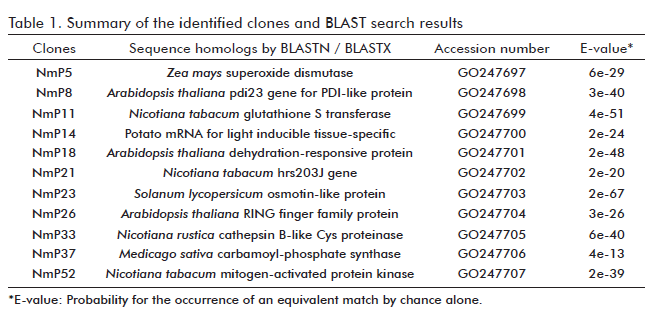
<body><![CDATA[<P   align="left" ><font face="Verdana, Arial, Helvetica, sans-serif" size="2">Additionally, the      infection of plant cells by a pathogen usually elicits a battery of disease      response genes, which can result in the production of several toxic products      that include reactive oxygen species (11). One of such responses observed      in plants after infection is the increased expression of genes coding for      glutathione-S-transferase (GST) (12). </font></P >       <P   align="left" ><font face="Verdana, Arial, Helvetica, sans-serif" size="2">Although the involvement      of GST of <I>N. tabacum </I>on the response to cold, salt stress and aluminuminduced      toxicity is established (13), little is known about its role during pathogenic      infection. Using binding primers to preserved regions of <I>N. tabacum </I>GST,      four different genes for this enzyme were amplified from cDNA of <I>Nicotiana      benthamiana </I>leaves infected with <I>Colletotrichum destructivum </I>(14).      After cloning each of these genes on the PVX vector for virus-induced gene      silencing and obtaining the corresponding transgenic plants, a significant      increase in susceptibility to the infection was observed only in individuals      bearing a silenced <I>NbGSTU1 </I>gene. These plants showed a larger number      of lesions (130%) and more extensive <I>C. orbiculare </I>colonization (67%)      than the controls (14), proving that the different GST variants differently      respond to fungal infections, and demonstrating the involvement of at least      one of them in the development of the disease (14). </font></P >       <P   align="left" ><font face="Verdana, Arial, Helvetica, sans-serif" size="2">Taking into account      the importance of dissecting the molecular components in <I>Nicotiana tabacum      </I>responsible for establishing a state of resistance or susceptibility to      <I>P. parasitica </I>var. <I>nicotianae</I>, as well as the need for exploring      new strategies for harnessing disease resistance, the objectives of the present      work were: To obtain a cDNA library formed by transcripts derived from genes      induced during the resistance interaction with <I>P. parasitica </I>var. <I>nicotianae</I>;      to characterize by realtime PCR the expression of genes involved in resistance      to the disease; to evaluate the role of resistance- or susceptibility-related      genes by using RNA interference technology, and to characterize the expression      of a set of defense genes in the tobacco with RNA interference, using realtime      PCR. </font></P >       <P   align="left" ><font size="3" face="Verdana, Arial, Helvetica, sans-serif"><b>RESULTS AND DISCUSSION</b></font><font size="2" face="Verdana, Arial, Helvetica, sans-serif">      </font></P >   <FONT size="+1">        <P   align="left" ><font size="2" face="Verdana, Arial, Helvetica, sans-serif"><B>Obtention of a      cDNA library formed by transcripts derived from genes induced during the resistance      interaction with <I>P. parasitica </I>var. <I>nicotianae </I></b></font></P >   <FONT size="+1">        <P   align="left" ><font face="Verdana, Arial, Helvetica, sans-serif" size="2">This work identified      a set of genes involved in the response against <I>P. parasitica </I>var.      <I>nicotianae </I>in <I>N. </I></font></P >       <P   align="left" ><font face="Verdana, Arial, Helvetica, sans-serif" size="2"><I>tabacum </I>which      had not been previously shown to participate in this phenomenon. Although      the functional assignments for these genes were made based only on sequence      homologies to known orthologs -and therefore demand a stricter experimental      verification-, this step offers, however, a clue about the genetic diversity      of this response. </font></P >       <P   align="left" ><font face="Verdana, Arial, Helvetica, sans-serif" size="2">A total of 65 clones      were obtained, of which 48 were sequenced. For nearly 40% of the clones no      known orthologs were found; these were classified, therefore, as having an      unknown function. The genes that did have significant sequence homologies      to known orthologs fell into six primary functional categories. Most of these      genes (15%) were defense-related, followed by those others involved in signal      transduction, metabolism and protein synthesis (10%). Genes involved in energy      constituted 8% of the cDNA collection, and those involved with transport constituted      7% of the sequences (15). </font></P >       <P   align="left" ><font face="Verdana, Arial, Helvetica, sans-serif" size="2"><B>Characterization      by realtime PCR of the expression of genes involved in resistance to the disease      </b></font></P >       <P   align="left" ><font face="Verdana, Arial, Helvetica, sans-serif" size="2">Based on the homologies      detected in public sequence databases, 11 genes with a significant E-value      in BLAST searches were selected for further analysis of their expression patterns      (<a href="/img/revistas/bta/v27n3/t0108310.gif">Table 1</a><FONT color="#9ACC00"><FONT color="#000000">).      Quantitative PCR assays were performed on RNA extracted from resistant (<I>N.      megalosiphon</I>) or susceptible (<I>N. tabacum </I>var. Sumatra) plants at      0, 3, 7 and 10 days post-inoculation with <I>P. parasitica </I>var. <I>nicotianae</I>.      This analysis indicated that the levels of expression of the transcripts from      all 11 genes were generally higher during the resistance interaction and lower      during the susceptible interaction (15). </font></font></font></P >   <FONT color="#9ACC00"><FONT color="#000000">        
]]></body>
<body><![CDATA[<P   align="left" ><font face="Verdana, Arial, Helvetica, sans-serif" size="2">Gene <I>hrs203J </I>and      the one coding for the RING fi nger protein displayed a rapid and intense      induction during the resistance interaction, but were undetectable during      susceptibility interaction. This indicates that they might be important candidates      for the evaluation of disease-resistant genotypes within the framework of      crop improvement programs (<a href="/img/revistas/bta/v27n3/t0208310.gif">Table      2</a><FONT color="#9ACC00"><FONT color="#000000">). Significantly, a clone      homologous to <I>GST </I>showed the highest induction during the resistance      and susceptibility interaction in all evaluated time points, generating a      hypothesis about its possible involvement in resistance and susceptibility      that was later tested through a functional analysis examining its potential      role as negative resistance regulator. </font></font></font></P >   <FONT color="#9ACC00"><FONT color="#000000">        
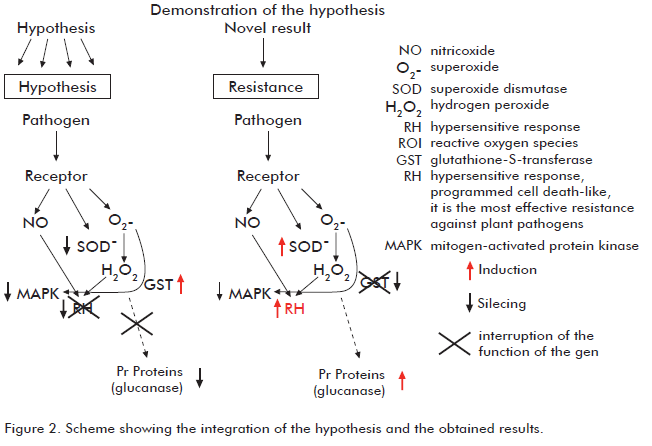
<P   align="left" ><font face="Verdana, Arial, Helvetica, sans-serif" size="2"><B>Evaluation of      the role of genes implicated in resistance and susceptibility by using RNA      interference technology </b></font></P >       <P   align="left" ><font face="Verdana, Arial, Helvetica, sans-serif" size="2">This study analyzed      the biological relevance of the GST gene during the susceptibility interaction      between <I>P. parasitica </I>var. <I>nicotianae </I>- tobacco by silencing      this gene in transgenic tobacco plants. Surprisingly, the plants with silenced      GST displayed higher levels of resistance to the pathogen, with decreased      withering of the stem (<a href="/img/revistas/bta/v27n3/f0108310.gif">Figure      1</a><FONT color="#9ACC00"><FONT color="#000000">). One of the possible reasons      for this result is that the expression of GST during the susceptibility interaction      might be limiting the hypersensitive response (HR), according to the expression      of some genes involved in this type os response such as SOD and Hsr203J (18).      </font></font></font></P >   <FONT color="#9ACC00"><FONT color="#000000">        
<P   align="left" ><font face="Verdana, Arial, Helvetica, sans-serif" size="2">A number of studies      on the HR in a variety of experimental systems have demonstrated the involvement      of reactive oxygen species such as the superoxide anion (O<sub>2</sub> -)      and hydrogen peroxide (H<sub>2</sub>O<sub>2</sub>) as important signals or      effectors of programmed cell death. O<sub>2</sub><sup>-</sup> can promote      the HR through the production of H<sub>2</sub>O<sub>2</sub> or repress it      through the elimination of nitric oxide or the induction of antioxidants.      In this scheme, SOD is an important mediator to compensate these functions.      </font></P >   <FONT color="#FF0000"><FONT size="+1" color="#000000"><FONT size="+1"><FONT color="#FF0000"><FONT color="#000000"><FONT color="#FF0000"><FONT color="#000000"><FONT color="#FF0000"><FONT color="#0000FF"><FONT color="#000000"><FONT color="#FF0000"><FONT color="#000000"><FONT color="#FF0000"><FONT size="+1" color="#000000"><FONT size="+1">        <P   align="left" ><font face="Verdana, Arial, Helvetica, sans-serif" size="2"><B>Characterization      of the expression of a set of defense genes in tobacco plants with RNA interference      using realtime PCR </b></font></P >       <P   align="left" ><font face="Verdana, Arial, Helvetica, sans-serif" size="2">Relative expression      levels of several genes associated to disease resistance in plants were evaluated      in transgenic tobacco plants where <I>GST </I>had been silenced. The genes      coding for beta-1,3-glucanase, superoxide dismutase (SOD), mitogen-activated      protein kinase (MAPK) and the cell-death associated protein from <I>N. tabacum      </I>(Hsr203J) displayed a higher level of expression in the plants bearing      RNAi construction compared to the control plants, where their expression was      lower or delayed in time. On the other hand, the expression of the gene for      phenylalanine-ammonia lyase (PAL) was repressed in the RNAi-transformed lines,      but induced in the controls. Results showed that silencing the <I>GST </I>gene      contributes to the disease-resistant phenotype as negative regulator of innate      immunity to black shank in susceptible plants (18). </font></P >       <P   align="left" ><font face="Verdana, Arial, Helvetica, sans-serif" size="2">Silencing <I>GST      </I>led to reduced expression of the <I>PAL </I>gene, which codes for a key      enzyme in the phytoalexin and salicylic acid synthesis pathways (18). Also,      as mentioned above, the plants with silenced <I>GST </I>displayed increased      expression not only of the genes coding for Hsr203J, SOD and MAPK, but also      for beta- 1,3-glucanase, a well-known gene coding for a protein involved in      pathogenesis. Possibly, the resistant phenotype observed in this study as      a result of <I>GST </I>silencing is actually the outcome from the combined      action of several gene products under direct or indirect control by <I>GST      </I>(17). </font></P >       <P   align="left" ><font face="Verdana, Arial, Helvetica, sans-serif" size="2">Finally, it should      be pointed out that during the compatible (susceptible) interaction the pathogen      induces what is known as a hypersensitive response in the host plant through      the production of reactive oxygen species and nitric oxide. However, there      is a strong activation of GST, which is a key enzyme in the synthesis of glutathione,      a strong antioxidant. GST participates in the detoxification of reactive oxygen      species in order to avoid cell death induced by free radicals produced during      the hypersensitive response of the susceptibility interaction (18), explaining      the successful invasion of the pathogen into the cells of the host. In plants      where <I>GST </I>is silenced, however, hypersensitivity response is active      throughout the entire range of evaluated time points; and as a result, the      plants display a strong resistance to the pathogen (<a href="/img/revistas/bta/v27n3/f0208310.gif">Figure      2</a><FONT color="#9ACC00"><FONT color="#000000">). </font></font></font></P >   <FONT color="#9ACC00"><FONT color="#000000">        
<P   align="left" ><font face="Verdana, Arial, Helvetica, sans-serif" size="2">The dissection of      new molecular mechanisms for pest resistance will allow the modification of      highly susceptible plants into disease-resistant cultivars, taking advantage      of the activation of more efficient resistance mechanisms. It will, additionally,      provide genes that can be used as molecular markers within ongoing genetic      crop improvement programs. </font></P >       <P   align="left" ><font face="Verdana, Arial, Helvetica, sans-serif" size="3"><b>REFERENCES</b></font><font face="Verdana, Arial, Helvetica, sans-serif" size="2">      </font></P >       ]]></body>
<body><![CDATA[<!-- ref --><P   align="left" ><font size="2" face="Verdana, Arial, Helvetica, sans-serif">1. Melton TA, Broadwell      A, Wilson J. Disease management. In: Flue-Cured Tobacco Information. N. C.      Coop. Ext. Serv. Bull, North Carolina State University, Raleigh, 2005, pp.      150-1. </font></P >   <FONT size="+1">        <!-- ref --><P   align="left" ><font face="Verdana, Arial, Helvetica, sans-serif" size="2">2. Lucas G. B., Diseases      of Tobacco, in: Biological Consulting Associates, Raleigh, NC, 1975. </font></P >       <!-- ref --><P   align="left" ><font face="Verdana, Arial, Helvetica, sans-serif" size="2">3. Sullivan JM, Melton      TA, Shew HD. Fitness of races 0 and 1 of <I>Phytophthora parasitica </I>var.      <I>nicotianae</I>. Plant Dis 2005; 89:1220-8. </font></P >       <!-- ref --><P   align="left" ><font face="Verdana, Arial, Helvetica, sans-serif" size="2">4. Todd FA. Flue      Cured Tobacco- Producing a Healthy Crop, Tobacco Consultants, Wendell, NC,      1981. </font></P >       <!-- ref --><P   align="left" ><font face="Verdana, Arial, Helvetica, sans-serif" size="2">5. Espino E, Rey      X. Nuevas variedades de tabaco negro para cultivo bajo tela resistentes al      moho azul (<I>Peronospora tabacina</I>). Agrotecnia Cuba 1987;19:247-60. </font></P >       <!-- ref --><P   align="left" ><font face="Verdana, Arial, Helvetica, sans-serif" size="2">6. Borr&aacute;s-Hidalgo      O, Thomma BPHJ, Collazo C, Chac&oacute;n O, Borroto CJ, Ayra C, <I>et al</I>.      EIL2 transcription factor and glutathione synthetase are required for defense      of tobacco against tobacco blue mold. Mol Plant Microbe Interact 2006; 19:399-406.      </font></P >       <!-- ref --><P   align="left" ><font face="Verdana, Arial, Helvetica, sans-serif" size="2">7. Collazo C, Ramos      PL, Chac&oacute;n O, Borroto CJ, L&oacute;pez Y, <I>et al</I>. Phenotypical      and molecular characterization of the TMTV - <I>Nicotiana megalosiphon </I>interaction.      Physiol Mol Plant Pathol 2006; 67:231-6. </font></P >       <!-- ref --><P   align="left" ><font face="Verdana, Arial, Helvetica, sans-serif" size="2">8. Race R, Fournier      J, Esquerre-Tugaye MT. The incompatible interaction between <I>Phytophthora      parasitica </I>var. <I>nicotianae </I>race 0 and tobacco is suppressed in      transgenic plants expressing antisense lipoxygenase sequences. Proc Natl Acad      Sci USA 1998; 95:6554-9. </font></P >       <!-- ref --><P   align="left" ><font face="Verdana, Arial, Helvetica, sans-serif" size="2">9. Hugot K, Aime      S, Conrod S, Poupet A, Galiana E. Developmental regulated mechanisms affect      the ability of a fungal pathogen to infect and colonize tobacco leaves. Plant      J 1999;20:163-70. </font></P >       <!-- ref --><P   align="left" ><font face="Verdana, Arial, Helvetica, sans-serif" size="2">10. Hugot K, MP Riviere,      Moreilhon C, Dayem MA, Cozzitorto J, Arbiol G, Barbry P, Weiss C, Galiana      E. Coordinated Regulation of Genes for Secretion in Tobacco at Late Developmental      Stages: Association with Resistance against Oomycetes. Plant Physiol 2004:134;858-70.      </font></P >       <!-- ref --><P   align="left" ><font face="Verdana, Arial, Helvetica, sans-serif" size="2">11. Lamb C, Dixon      RA. The oxidative burst in plant disease resistance. Annu Rev Plant Physiol      Plant Mol Biol 1997:48;251-75. </font></P >       <!-- ref --><P   align="left" ><font face="Verdana, Arial, Helvetica, sans-serif" size="2">12. Sappl PG, Carroll      AJ, Clifton R, Lister R, Whelan J, Millar AH, <I>et al</I>. The Arabidopsis      glutathione transferase gene family displays complex stress regulation and      cosilencing multiple genes results in altered metabolic sensitivity to oxidative      stress. Plant J 2009;58:53-68. </font></P >       <!-- ref --><P   align="left" ><font face="Verdana, Arial, Helvetica, sans-serif" size="2">13. Ezaki B, Katsuhara      M, Kawamura M, Matsumoto H. Different mechanisms of four aluminum (Al)-resistant      transgenes for Al toxicity in <I>Arabidopsis</I>. Plant Physiol 2001;127:918-27.      </font></P >       <!-- ref --><P   align="left" ><font face="Verdana, Arial, Helvetica, sans-serif" size="2">14. Dean JD, Goodwin      PH, Hsiang T. Induction of glutathione S-transferase genes of <I>Nicotiana      benthamiana </I>following infection by <I>Colletotrichum destructivum </I>and      <I>C. orbiculare </I>and involvement of one in resistance. J Exp Bot 2005;56:1525-33.      </font></P >       <!-- ref --><P   align="left" ><font face="Verdana, Arial, Helvetica, sans-serif" size="2">15. Chac&oacute;n      O, Hern&aacute;ndez I, Portieles R, L&oacute;pez Y, Pujol M, Borr&aacute;s-Hidalgo      O. Identification of defense-related genes in tobacco responding to black      shank disease. Plant Sci 2009;177:175-80. </font></P >       <!-- ref --><P   align="left" ><font face="Verdana, Arial, Helvetica, sans-serif" size="2">16. Li BC, Bass WT,      Cornelius PL. Resistance to Tobacco Black Shank in Nicotiana Species. Crop      Sci 2006;46:554-60. </font></P >       <!-- ref --><P   align="left" ><font face="Verdana, Arial, Helvetica, sans-serif" size="2">17. Csinos AS. Relationship      of isolate origin to pathogenicity of race 0 and 1 of <I>Phytophthora parasitica      </I>var. <I>nicotianae </I>on tobacco cultivars. Plant Dis 2005:89 332-7.      </font></P >       <!-- ref --><P   align="left" ><font face="Verdana, Arial, Helvetica, sans-serif" size="2">18. Hern&aacute;ndez      I, Chac&oacute;n O, Rodr&iacute;guez R, Portieles R, L&oacute;pez Y, Pujol      M, Borr&aacute;s- Hidalgo O. Black shank resistant tobacco by silencing of      glutathione S-transferase. Biochem Biophys Res Commun 2009:387; 300-4. </font></P >       <P   align="left" ><font face="Verdana, Arial, Helvetica, sans-serif" size="2">Orlando Borr&aacute;s,      Plant Division, Laboratory of Vegetal Functional Genomics, Center for Genetic      Engineering and Biotechnology, CIGB Ave. 31 / 158 and 190, Cubanac&aacute;n,      Playa, PO Box 6162, Havana, Cuba. E-mail: <a href="mailto:orlando.borras@cigb.edu.cu">orlando.borras@cigb.edu.cu</a>      </font></P >   </font></font></font></font></font></font></font></font></font></font></font></font></font></font></font></font></font></font></font></font></font></font></font></font></font></font></font></font></font></font></font></font></font></font></font></font></font></font></font></font></font></font></font></font></font></font></font></font></font></font></DIV >      ]]></body><back>
<ref-list>
<ref id="B1">
<label>1</label><nlm-citation citation-type="">
<person-group person-group-type="author">
<name>
<surname><![CDATA[Melton]]></surname>
<given-names><![CDATA[TA]]></given-names>
</name>
<name>
<surname><![CDATA[Broadwell]]></surname>
<given-names><![CDATA[A]]></given-names>
</name>
<name>
<surname><![CDATA[Wilson]]></surname>
<given-names><![CDATA[J]]></given-names>
</name>
</person-group>
<article-title xml:lang="en"><![CDATA[Disease management]]></article-title>
<source><![CDATA[Flue-Cured Tobacco Information]]></source>
<year>2005</year>
<page-range>150-1</page-range><publisher-loc><![CDATA[Raleigh ]]></publisher-loc>
</nlm-citation>
</ref>
<ref id="B2">
<label>2</label><nlm-citation citation-type="book">
<person-group person-group-type="author">
<name>
<surname><![CDATA[Lucas]]></surname>
<given-names><![CDATA[G. B.]]></given-names>
</name>
</person-group>
<source><![CDATA[Diseases of Tobacco]]></source>
<year>1975</year>
<publisher-loc><![CDATA[Raleigh ]]></publisher-loc>
<publisher-name><![CDATA[Biological Consulting Associates]]></publisher-name>
</nlm-citation>
</ref>
<ref id="B3">
<label>3</label><nlm-citation citation-type="journal">
<person-group person-group-type="author">
<name>
<surname><![CDATA[Sullivan]]></surname>
<given-names><![CDATA[JM]]></given-names>
</name>
<name>
<surname><![CDATA[Melton]]></surname>
<given-names><![CDATA[TA]]></given-names>
</name>
<name>
<surname><![CDATA[Shew]]></surname>
<given-names><![CDATA[HD]]></given-names>
</name>
</person-group>
<article-title xml:lang="en"><![CDATA[Fitness of races 0 and 1 of Phytophthora parasitica var. nicotianae]]></article-title>
<source><![CDATA[Plant Dis]]></source>
<year>2005</year>
<volume>89</volume>
<page-range>1220-8</page-range></nlm-citation>
</ref>
<ref id="B4">
<label>4</label><nlm-citation citation-type="book">
<person-group person-group-type="author">
<name>
<surname><![CDATA[Todd]]></surname>
<given-names><![CDATA[FA]]></given-names>
</name>
</person-group>
<source><![CDATA[Flue Cured Tobacco: Producing a Healthy Crop]]></source>
<year>1981</year>
<publisher-loc><![CDATA[Wendell ]]></publisher-loc>
<publisher-name><![CDATA[Tobacco Consultants]]></publisher-name>
</nlm-citation>
</ref>
<ref id="B5">
<label>5</label><nlm-citation citation-type="journal">
<person-group person-group-type="author">
<name>
<surname><![CDATA[Espino]]></surname>
<given-names><![CDATA[E]]></given-names>
</name>
<name>
<surname><![CDATA[Rey]]></surname>
<given-names><![CDATA[X]]></given-names>
</name>
</person-group>
<article-title xml:lang="es"><![CDATA[Nuevas variedades de tabaco negro para cultivo bajo tela resistentes al moho azul (Peronospora tabacina)]]></article-title>
<source><![CDATA[Agrotecnia Cuba]]></source>
<year>1987</year>
<volume>19</volume>
<page-range>247-60</page-range></nlm-citation>
</ref>
<ref id="B6">
<label>6</label><nlm-citation citation-type="journal">
<person-group person-group-type="author">
<name>
<surname><![CDATA[Borrás-Hidalgo]]></surname>
<given-names><![CDATA[O]]></given-names>
</name>
<name>
<surname><![CDATA[Thomma]]></surname>
<given-names><![CDATA[BPHJ]]></given-names>
</name>
<name>
<surname><![CDATA[Collazo]]></surname>
<given-names><![CDATA[C]]></given-names>
</name>
<name>
<surname><![CDATA[Chacón]]></surname>
<given-names><![CDATA[O]]></given-names>
</name>
<name>
<surname><![CDATA[Borroto]]></surname>
<given-names><![CDATA[CJ]]></given-names>
</name>
<name>
<surname><![CDATA[Ayra]]></surname>
<given-names><![CDATA[C]]></given-names>
</name>
</person-group>
<article-title xml:lang="en"><![CDATA[EIL2 transcription factor and glutathione synthetase are required for defense of tobacco against tobacco blue mold]]></article-title>
<source><![CDATA[Mol Plant Microbe Interact]]></source>
<year>2006</year>
<volume>19</volume>
<page-range>399-406</page-range></nlm-citation>
</ref>
<ref id="B7">
<label>7</label><nlm-citation citation-type="journal">
<person-group person-group-type="author">
<name>
<surname><![CDATA[Collazo]]></surname>
<given-names><![CDATA[C]]></given-names>
</name>
<name>
<surname><![CDATA[Ramos]]></surname>
<given-names><![CDATA[PL]]></given-names>
</name>
<name>
<surname><![CDATA[Chacón]]></surname>
<given-names><![CDATA[O]]></given-names>
</name>
<name>
<surname><![CDATA[Borroto]]></surname>
<given-names><![CDATA[CJ]]></given-names>
</name>
<name>
<surname><![CDATA[López]]></surname>
<given-names><![CDATA[Y]]></given-names>
</name>
</person-group>
<article-title xml:lang="en"><![CDATA[Phenotypical and molecular characterization of the TMTV - Nicotiana megalosiphon interaction]]></article-title>
<source><![CDATA[Physiol Mol Plant Pathol]]></source>
<year>2006</year>
<volume>67</volume>
<page-range>231-6</page-range></nlm-citation>
</ref>
<ref id="B8">
<label>8</label><nlm-citation citation-type="journal">
<person-group person-group-type="author">
<name>
<surname><![CDATA[Race]]></surname>
<given-names><![CDATA[R]]></given-names>
</name>
<name>
<surname><![CDATA[Fournier]]></surname>
<given-names><![CDATA[J]]></given-names>
</name>
<name>
<surname><![CDATA[Esquerre-Tugaye]]></surname>
<given-names><![CDATA[MT]]></given-names>
</name>
</person-group>
<article-title xml:lang="en"><![CDATA[The incompatible interaction between Phytophthora parasitica var. nicotianae race 0 and tobacco is suppressed in transgenic plants expressing antisense lipoxygenase sequences]]></article-title>
<source><![CDATA[Proc Natl Acad Sci USA]]></source>
<year>1998</year>
<volume>95</volume>
<page-range>6554-9</page-range></nlm-citation>
</ref>
<ref id="B9">
<label>9</label><nlm-citation citation-type="journal">
<person-group person-group-type="author">
<name>
<surname><![CDATA[Hugot]]></surname>
<given-names><![CDATA[K]]></given-names>
</name>
<name>
<surname><![CDATA[Aime]]></surname>
<given-names><![CDATA[S]]></given-names>
</name>
<name>
<surname><![CDATA[Conrod]]></surname>
<given-names><![CDATA[S]]></given-names>
</name>
<name>
<surname><![CDATA[Poupet]]></surname>
<given-names><![CDATA[A]]></given-names>
</name>
<name>
<surname><![CDATA[Galiana]]></surname>
<given-names><![CDATA[E]]></given-names>
</name>
</person-group>
<article-title xml:lang="en"><![CDATA[Developmental regulated mechanisms affect the ability of a fungal pathogen to infect and colonize tobacco leaves]]></article-title>
<source><![CDATA[Plant J]]></source>
<year>1999</year>
<volume>20</volume>
<page-range>163-70</page-range></nlm-citation>
</ref>
<ref id="B10">
<label>10</label><nlm-citation citation-type="journal">
<person-group person-group-type="author">
<name>
<surname><![CDATA[Hugot]]></surname>
<given-names><![CDATA[K]]></given-names>
</name>
<name>
<surname><![CDATA[MP]]></surname>
<given-names><![CDATA[Riviere]]></given-names>
</name>
<name>
<surname><![CDATA[Moreilhon]]></surname>
<given-names><![CDATA[C]]></given-names>
</name>
<name>
<surname><![CDATA[Dayem]]></surname>
<given-names><![CDATA[MA]]></given-names>
</name>
<name>
<surname><![CDATA[Cozzitorto]]></surname>
<given-names><![CDATA[J]]></given-names>
</name>
<name>
<surname><![CDATA[Arbiol]]></surname>
<given-names><![CDATA[G]]></given-names>
</name>
<name>
<surname><![CDATA[Barbry]]></surname>
<given-names><![CDATA[P]]></given-names>
</name>
<name>
<surname><![CDATA[Weiss]]></surname>
<given-names><![CDATA[C]]></given-names>
</name>
<name>
<surname><![CDATA[Galiana]]></surname>
<given-names><![CDATA[E]]></given-names>
</name>
</person-group>
<article-title xml:lang="en"><![CDATA[Coordinated Regulation of Genes for Secretion in Tobacco at Late Developmental Stages: Association with Resistance against Oomycetes]]></article-title>
<source><![CDATA[Plant Physiol]]></source>
<year>2004</year>
<volume>134</volume>
<page-range>858-70</page-range></nlm-citation>
</ref>
<ref id="B11">
<label>11</label><nlm-citation citation-type="journal">
<person-group person-group-type="author">
<name>
<surname><![CDATA[Lamb]]></surname>
<given-names><![CDATA[C]]></given-names>
</name>
<name>
<surname><![CDATA[Dixon]]></surname>
<given-names><![CDATA[RA]]></given-names>
</name>
</person-group>
<article-title xml:lang="en"><![CDATA[The oxidative burst in plant disease resistance]]></article-title>
<source><![CDATA[Annu Rev Plant Physiol Plant Mol Biol]]></source>
<year>1997</year>
<volume>48</volume>
<page-range>251-75</page-range></nlm-citation>
</ref>
<ref id="B12">
<label>12</label><nlm-citation citation-type="journal">
<person-group person-group-type="author">
<name>
<surname><![CDATA[Sappl]]></surname>
<given-names><![CDATA[PG]]></given-names>
</name>
<name>
<surname><![CDATA[Carroll]]></surname>
<given-names><![CDATA[AJ]]></given-names>
</name>
<name>
<surname><![CDATA[Clifton]]></surname>
<given-names><![CDATA[R]]></given-names>
</name>
<name>
<surname><![CDATA[Lister]]></surname>
<given-names><![CDATA[R]]></given-names>
</name>
<name>
<surname><![CDATA[Whelan]]></surname>
<given-names><![CDATA[J]]></given-names>
</name>
<name>
<surname><![CDATA[Millar]]></surname>
<given-names><![CDATA[AH]]></given-names>
</name>
</person-group>
<article-title xml:lang="en"><![CDATA[The Arabidopsis glutathione transferase gene family displays complex stress regulation and cosilencing multiple genes results in altered metabolic sensitivity to oxidative stress]]></article-title>
<source><![CDATA[Plant J]]></source>
<year>2009</year>
<volume>58</volume>
<page-range>53-68</page-range></nlm-citation>
</ref>
<ref id="B13">
<label>13</label><nlm-citation citation-type="journal">
<person-group person-group-type="author">
<name>
<surname><![CDATA[Ezaki]]></surname>
<given-names><![CDATA[B]]></given-names>
</name>
<name>
<surname><![CDATA[Katsuhara]]></surname>
<given-names><![CDATA[M]]></given-names>
</name>
<name>
<surname><![CDATA[Kawamura]]></surname>
<given-names><![CDATA[M]]></given-names>
</name>
<name>
<surname><![CDATA[Matsumoto]]></surname>
<given-names><![CDATA[H]]></given-names>
</name>
</person-group>
<article-title xml:lang="en"><![CDATA[Different mechanisms of four aluminum (Al)-resistant transgenes for Al toxicity in Arabidopsis]]></article-title>
<source><![CDATA[Plant Physiol]]></source>
<year>2001</year>
<volume>127</volume>
<page-range>918-27</page-range></nlm-citation>
</ref>
<ref id="B14">
<label>14</label><nlm-citation citation-type="journal">
<person-group person-group-type="author">
<name>
<surname><![CDATA[Dean]]></surname>
<given-names><![CDATA[JD]]></given-names>
</name>
<name>
<surname><![CDATA[Goodwin]]></surname>
<given-names><![CDATA[PH]]></given-names>
</name>
<name>
<surname><![CDATA[Hsiang]]></surname>
<given-names><![CDATA[T]]></given-names>
</name>
</person-group>
<article-title xml:lang="en"><![CDATA[Induction of glutathione S-transferase genes of Nicotiana benthamiana following infection by Colletotrichum destructivum and C. orbiculare and involvement of one in resistance]]></article-title>
<source><![CDATA[J Exp Bot]]></source>
<year>2005</year>
<volume>56</volume>
<page-range>1525-33</page-range></nlm-citation>
</ref>
<ref id="B15">
<label>15</label><nlm-citation citation-type="journal">
<person-group person-group-type="author">
<name>
<surname><![CDATA[Chacón]]></surname>
<given-names><![CDATA[O]]></given-names>
</name>
<name>
<surname><![CDATA[Hernández]]></surname>
<given-names><![CDATA[I]]></given-names>
</name>
<name>
<surname><![CDATA[Portieles]]></surname>
<given-names><![CDATA[R]]></given-names>
</name>
<name>
<surname><![CDATA[López]]></surname>
<given-names><![CDATA[Y]]></given-names>
</name>
<name>
<surname><![CDATA[Pujol]]></surname>
<given-names><![CDATA[M]]></given-names>
</name>
<name>
<surname><![CDATA[Borrás-Hidalgo]]></surname>
<given-names><![CDATA[O]]></given-names>
</name>
</person-group>
<article-title xml:lang="en"><![CDATA[Identification of defense-related genes in tobacco responding to black shank disease]]></article-title>
<source><![CDATA[Plant Sci]]></source>
<year>2009</year>
<volume>177</volume>
<page-range>175-80</page-range></nlm-citation>
</ref>
<ref id="B16">
<label>16</label><nlm-citation citation-type="journal">
<person-group person-group-type="author">
<name>
<surname><![CDATA[Li]]></surname>
<given-names><![CDATA[BC]]></given-names>
</name>
<name>
<surname><![CDATA[Bass]]></surname>
<given-names><![CDATA[WT]]></given-names>
</name>
<name>
<surname><![CDATA[Cornelius]]></surname>
<given-names><![CDATA[PL]]></given-names>
</name>
</person-group>
<article-title xml:lang="en"><![CDATA[Resistance to Tobacco Black Shank in Nicotiana Species]]></article-title>
<source><![CDATA[Crop Sci]]></source>
<year>2006</year>
<volume>46</volume>
<page-range>554-60</page-range></nlm-citation>
</ref>
<ref id="B17">
<label>17</label><nlm-citation citation-type="journal">
<person-group person-group-type="author">
<name>
<surname><![CDATA[Csinos]]></surname>
<given-names><![CDATA[AS]]></given-names>
</name>
</person-group>
<article-title xml:lang="en"><![CDATA[Relationship of isolate origin to pathogenicity of race 0 and 1 of Phytophthora parasitica var. nicotianae on tobacco cultivars]]></article-title>
<source><![CDATA[Plant Dis]]></source>
<year>2005</year>
<volume>89</volume>
<page-range>332-7</page-range></nlm-citation>
</ref>
<ref id="B18">
<label>18</label><nlm-citation citation-type="journal">
<person-group person-group-type="author">
<name>
<surname><![CDATA[Hernández]]></surname>
<given-names><![CDATA[I]]></given-names>
</name>
<name>
<surname><![CDATA[Chacón]]></surname>
<given-names><![CDATA[O]]></given-names>
</name>
<name>
<surname><![CDATA[Rodríguez]]></surname>
<given-names><![CDATA[R]]></given-names>
</name>
<name>
<surname><![CDATA[Portieles]]></surname>
<given-names><![CDATA[R]]></given-names>
</name>
<name>
<surname><![CDATA[López]]></surname>
<given-names><![CDATA[Y]]></given-names>
</name>
<name>
<surname><![CDATA[Pujol]]></surname>
<given-names><![CDATA[M]]></given-names>
</name>
<name>
<surname><![CDATA[Borrás-Hidalgo]]></surname>
<given-names><![CDATA[O]]></given-names>
</name>
</person-group>
<article-title xml:lang="en"><![CDATA[Black shank resistant tobacco by silencing of glutathione S-transferase]]></article-title>
<source><![CDATA[Biochem Biophys Res Commun]]></source>
<year>2009</year>
<volume>387</volume>
<page-range>300-4</page-range></nlm-citation>
</ref>
</ref-list>
</back>
</article>