<?xml version="1.0" encoding="ISO-8859-1"?><article xmlns:mml="http://www.w3.org/1998/Math/MathML" xmlns:xlink="http://www.w3.org/1999/xlink" xmlns:xsi="http://www.w3.org/2001/XMLSchema-instance">
<front>
<journal-meta>
<journal-id>1027-2852</journal-id>
<journal-title><![CDATA[Biotecnología Aplicada]]></journal-title>
<abbrev-journal-title><![CDATA[Biotecnol Apl]]></abbrev-journal-title>
<issn>1027-2852</issn>
<publisher>
<publisher-name><![CDATA[Editorial Elfos Scientiae]]></publisher-name>
</publisher>
</journal-meta>
<article-meta>
<article-id>S1027-28522010000400003</article-id>
<title-group>
<article-title xml:lang="en"><![CDATA[Initial evidence of safety and clinical effect of recombinant streptokinase suppository in acute hemorrhoidal disease. Open, proof-of-concept, pilot trial]]></article-title>
<article-title xml:lang="es"><![CDATA[Evidencia inicial de la seguridad y el efecto clínico del supositorio de estreptoquinasa recombinante en la enfermedad hemorroidal aguda. Estudio piloto, abierto, de prueba de concepto]]></article-title>
</title-group>
<contrib-group>
<contrib contrib-type="author">
<name>
<surname><![CDATA[Quintero]]></surname>
<given-names><![CDATA[Liván]]></given-names>
</name>
<xref ref-type="aff" rid="A01"/>
</contrib>
<contrib contrib-type="author">
<name>
<surname><![CDATA[Hernández]]></surname>
<given-names><![CDATA[Francisco]]></given-names>
</name>
<xref ref-type="aff" rid="A02"/>
</contrib>
<contrib contrib-type="author">
<name>
<surname><![CDATA[Acelia]]></surname>
<given-names><![CDATA[Maria]]></given-names>
</name>
<xref ref-type="aff" rid="A03"/>
</contrib>
<contrib contrib-type="author">
<name>
<surname><![CDATA[María]]></surname>
<given-names><![CDATA[Carmen]]></given-names>
</name>
<xref ref-type="aff" rid="A02"/>
</contrib>
<contrib contrib-type="author">
<name>
<surname><![CDATA[López]]></surname>
<given-names><![CDATA[Manuel]]></given-names>
</name>
<xref ref-type="aff" rid="A01"/>
</contrib>
<contrib contrib-type="author">
<name>
<surname><![CDATA[Barcelona]]></surname>
<given-names><![CDATA[Silvia]]></given-names>
</name>
<xref ref-type="aff" rid="A02"/>
</contrib>
<contrib contrib-type="author">
<name>
<surname><![CDATA[Ibargollín]]></surname>
<given-names><![CDATA[Rafael]]></given-names>
</name>
<xref ref-type="aff" rid="A04"/>
</contrib>
<contrib contrib-type="author">
<name>
<surname><![CDATA[Bobillo]]></surname>
<given-names><![CDATA[Hailen]]></given-names>
</name>
<xref ref-type="aff" rid="A05"/>
</contrib>
<contrib contrib-type="author">
<name>
<surname><![CDATA[Aguilera]]></surname>
<given-names><![CDATA[Ana]]></given-names>
</name>
<xref ref-type="aff" rid="A05"/>
</contrib>
<contrib contrib-type="author">
<name>
<surname><![CDATA[Bermúdez]]></surname>
<given-names><![CDATA[Yilian]]></given-names>
</name>
<xref ref-type="aff" rid="A05"/>
</contrib>
<contrib contrib-type="author">
<name>
<surname><![CDATA[Páez]]></surname>
<given-names><![CDATA[Rolando]]></given-names>
</name>
<xref ref-type="aff" rid="A05"/>
</contrib>
<contrib contrib-type="author">
<name>
<surname><![CDATA[Martínez]]></surname>
<given-names><![CDATA[Eduardo]]></given-names>
</name>
<xref ref-type="aff" rid="A05"/>
</contrib>
<contrib contrib-type="author">
<name>
<surname><![CDATA[Rodríguez]]></surname>
<given-names><![CDATA[Herminia]]></given-names>
</name>
<xref ref-type="aff" rid="A01"/>
</contrib>
<contrib contrib-type="author">
<name>
<surname><![CDATA[Aguiar]]></surname>
<given-names><![CDATA[Armando]]></given-names>
</name>
<xref ref-type="aff" rid="A06"/>
</contrib>
<contrib contrib-type="author">
<name>
<surname><![CDATA[Ramírez]]></surname>
<given-names><![CDATA[Ramón]]></given-names>
</name>
<xref ref-type="aff" rid="A06"/>
</contrib>
<contrib contrib-type="author">
<name>
<surname><![CDATA[López]]></surname>
<given-names><![CDATA[Pedro]]></given-names>
</name>
<xref ref-type="aff" rid="A02"/>
</contrib>
</contrib-group>
<aff id="A01">
<institution><![CDATA[,Camilo Cienfuegos University Hospital Bartolomé Massó  ]]></institution>
<addr-line><![CDATA[Sancti Spíritus ]]></addr-line>
</aff>
<aff id="A03">
<institution><![CDATA[,National Center for the Coordination of Clinical Trials  ]]></institution>
<addr-line><![CDATA[Havana ]]></addr-line>
<country>Cuba</country>
</aff>
<aff id="A04">
<institution><![CDATA[,Center for Genetic Engineering and Biotechology, CIGB  ]]></institution>
<addr-line><![CDATA[Sancti Spíritus ]]></addr-line>
</aff>
<aff id="A05">
<institution><![CDATA[,Center for Genetic Engineering and Biotechnology Development Direction ]]></institution>
<addr-line><![CDATA[Havana ]]></addr-line>
<country>Cuba</country>
</aff>
<aff id="A06">
<institution><![CDATA[,Enrique Cabrera University Hospital  ]]></institution>
<addr-line><![CDATA[Havana ]]></addr-line>
<country>Cuba</country>
</aff>
<aff id="A02">
<institution><![CDATA[,Center for Biological Research Clinical Trials Division ]]></institution>
<addr-line><![CDATA[Havana ]]></addr-line>
<country>Cuba</country>
</aff>
<pub-date pub-type="pub">
<day>00</day>
<month>12</month>
<year>2010</year>
</pub-date>
<pub-date pub-type="epub">
<day>00</day>
<month>12</month>
<year>2010</year>
</pub-date>
<volume>27</volume>
<numero>4</numero>
<fpage>277</fpage>
<lpage>280</lpage>
<copyright-statement/>
<copyright-year/>
<self-uri xlink:href="http://scielo.sld.cu/scielo.php?script=sci_arttext&amp;pid=S1027-28522010000400003&amp;lng=en&amp;nrm=iso"></self-uri><self-uri xlink:href="http://scielo.sld.cu/scielo.php?script=sci_abstract&amp;pid=S1027-28522010000400003&amp;lng=en&amp;nrm=iso"></self-uri><self-uri xlink:href="http://scielo.sld.cu/scielo.php?script=sci_pdf&amp;pid=S1027-28522010000400003&amp;lng=en&amp;nrm=iso"></self-uri><abstract abstract-type="short" xml:lang="en"><p><![CDATA[A proof-of-concept, pilot clinical trial was carried out in 2 hospitals, to evaluate the safety of recombinant streptokinase (rSK) administered by the rectal route in patients with acute hemorrhoidal disease (AHD). Suppositories containing 200 000 IU rSK were given every 6 hours, up to 4 applications. The patients, after discharge, were seen daily in follow-up visits up to 10 days. Symptoms, lesion size, edema and inflammation were evaluated. Ten patients were included. The rSK suppository was safe and tolerable. The adverse events reported were minimal (only ardor and anal itching in only one patient), both with minor intensity which did not require treatment, and with low causality relationship of the product since they could be explained by the underlying disease as well. Symptoms disappeared at 24 hours in 7 patients. Complete recovery was achieved in most of the patients (90%) in 5 days. Only one patient needed surgical thrombectomy. rSK suppositories are safe and showed initial efficacy data. It could become a new therapeutic option for hemorrhoidal crisis if results are confirmed in further and controlled studies.]]></p></abstract>
<abstract abstract-type="short" xml:lang="es"><p><![CDATA[Se realizó un ensayo clínico piloto, prueba de concepto en 2 hospitales, con el objetivo primario de evaluar la seguridad de la estreptoquinasa recombinante administrada por vía rectal en pacientes con enfermedad hemorroidal aguda. Se administraron 4 supositorios de 200 000 IU de rSK distribuidos cada 6 horas. Los pacientes, tras el alta, fueron vistos a diario (en las visitas de seguimiento) hasta 10 días. Se evaluaron los síntomas, el tamaño de la lesión, el edema y la inflamación. Diez pacientes fueron incluidos. El supositorio de rSK fue seguro y tolerable. Fueron mínimos los eventos adversos reportados (sólo ardor y prurito anal en un solo paciente), ambos de intensidad leve, que cedieron espontáneamente y con baja relación de causalidad con el producto objeto de estudio. Los síntomas desaparecieron a las 24 horas en 7 pacientes. Se obtuvo respuesta completa en la mayoría de los pacientes (90%) a los 5 días. Sólo un paciente requirió trombectomía. Los supositorios de rSK son seguros y muestran datos iniciales de eficacia. Podría convertirse en una nueva opción terapéutica para la crisis hemorroidal si los resultados se confirman en sucesivos estudios, controlados, en un mayor número de pacientes.]]></p></abstract>
<kwd-group>
<kwd lng="en"><![CDATA[streptokinase]]></kwd>
<kwd lng="en"><![CDATA[thrombolysis]]></kwd>
<kwd lng="en"><![CDATA[suppository]]></kwd>
<kwd lng="en"><![CDATA[hemorrhoidal crisis]]></kwd>
<kwd lng="es"><![CDATA[estreptoquinasa]]></kwd>
<kwd lng="es"><![CDATA[trombolisis]]></kwd>
<kwd lng="es"><![CDATA[supositorio]]></kwd>
<kwd lng="es"><![CDATA[crisis hemorroidal]]></kwd>
</kwd-group>
</article-meta>
</front><body><![CDATA[ <DIV class="Sect"   >        <P   align="right" ><font size="2" color="#000000" face="Verdana, Arial, Helvetica, sans-serif"><b>RESEARCH</b>      </font></P >   <FONT size="+1" color="#000000">        <P   align="left" >&nbsp;</P >       <P   align="left" ><font size="2" face="Verdana, Arial, Helvetica, sans-serif" color="#000000"><B><font size="4">Initial      evidence of safety and clinical effect of recombinant streptokinase suppository      in acute hemorrhoidal disease. Open, proof-of-concept, pilot trial</font></b></font></P >       <P   align="left" ><font face="Verdana, Arial, Helvetica, sans-serif"><b><font size="3">Evidencia      inicial de la seguridad y el efecto cl&iacute;nico del supositorio de estreptoquinasa      recombinante en la enfermedad hemorroidal aguda. Estudio piloto, abierto,      de prueba de concepto</font></b></font><FONT size="+1"> </font></P >   <FONT size="+1">        <P   align="left" >&nbsp;</P >       <P   align="left" >&nbsp;</P >       <P   align="left" ><font face="Verdana, Arial, Helvetica, sans-serif" color="#000000" size="2"><b>Liv&aacute;n      Quintero<sup>1</sup>, Francisco Hern&aacute;ndez<sup>2</sup>, Maria Acelia<sup>3</sup>,      Carmen Mar&iacute;a<sup>2</sup>, Manuel L&oacute;pez<sup>1</sup>, Silvia Barcelona<sup>2</sup>,      Rafael Ibargoll&iacute;n<sup>4</sup>, Hailen Bobillo<sup>5</sup>, Ana Aguilera<sup>5</sup>,      Yilian Berm&uacute;dez<sup>5</sup>, Rolando P&aacute;ez<sup>5</sup>, Eduardo      Mart&iacute;nez<sup>5</sup>, Herminia Rodr&iacute;guez<sup>1</sup>, Armando      Aguiar<sup>6</sup>, Ram&oacute;n Ram&iacute;rez<sup>6</sup>, Pedro L&oacute;pez<sup>2</sup>,      P2 for the THERESA (Treatment of Hemorrhoids with Recombinant Streptokinase      Application ) Researchers Group</b> </font></P >   <FONT size="+1"><FONT size="+1"><FONT size="+1"><FONT size="+1"><FONT size="+1"><FONT size="+1"><FONT size="+1"><FONT size="+1"><FONT size="+1"><FONT size="+1"><FONT size="+1"><FONT size="+1"><FONT size="+1"><FONT size="+1"><FONT size="+1"><FONT size="+1"><FONT size="+1"><FONT size="+1"><FONT size="+1"><FONT size="+1"><FONT size="+1"><FONT size="+1"><FONT size="+1"><FONT size="+1"><FONT size="+1"><FONT size="+1"><FONT size="+1"><FONT size="+1"><FONT size="+1"><FONT size="+1"><FONT size="+1"><FONT size="+1"><FONT size="+1">        <P   align="left" ><font size="2" face="Verdana, Arial, Helvetica, sans-serif" color="#000000">1      Camilo Cienfuegos University Hospital Bartolom&eacute; Mass&oacute;, Sancti      Sp&iacute;ritus     <br>     2 Clinical Trials Division, Center for Biological Research, Havana Street      134 / 23 and 25, Playa, PO Box 6332, Havana, Cuba     ]]></body>
<body><![CDATA[<br>     3 National Center for the Coordination of Clinical Trials Street 200 / 19      and 21, Allotment Atabey, Playa, CP 11600, Havana, Cuba     <br>     4 Center for Genetic Engineering and Biotechology, CIGB Circunvalante norte      s/n, Facultad de Ciencias M&eacute;dicas, Sancti Sp&iacute;ritus     <br>     5 Development Direction, Center for Genetic Engineering and Biotechnology,      CIGB Ave. 31 / 158 and 190, Cubanac&aacute;n, Playa, PO Box 6162, Havana,      Cuba     <br>     6 Enrique Cabrera University Hospital Calzada de Aldab&oacute; y Calle E,      No. 11117, CP 10800, Havana, Cuba </font></P >       <P   align="left" >&nbsp;</P >   </font></font></font></font></font></font></font></font></font></font></font></font></font></font></font></font></font></font></font></font></font></font></font></font></font></font></font></font></font></font></font></font></font></font></font>    <hr>   <FONT size="+1" color="#000000"><FONT size="+1"><FONT size="+1"><FONT size="+1"><FONT size="+1"><FONT size="+1"><FONT size="+1"><FONT size="+1"><FONT size="+1"><FONT size="+1"><FONT size="+1"><FONT size="+1"><FONT size="+1"><FONT size="+1"><FONT size="+1"><FONT size="+1"><FONT size="+1"><FONT size="+1"><FONT size="+1"><FONT size="+1"><FONT size="+1"><FONT size="+1"><FONT size="+1"><FONT size="+1"><FONT size="+1"><FONT size="+1"><FONT size="+1"><FONT size="+1"><FONT size="+1"><FONT size="+1"><FONT size="+1"><FONT size="+1"><FONT size="+1"><FONT size="+1"><FONT size="+1"><FONT size="+1"><FONT size="+1"><FONT size="+1"><FONT size="+1"><FONT size="+1"><FONT size="+1"><FONT size="+1"><FONT size="+1"><FONT size="+1"><FONT size="+1"><FONT size="+1"><FONT size="+1"><FONT color="#0000FF"><FONT color="#000000">        <P   align="left" ><font face="Verdana, Arial, Helvetica, sans-serif" color="#000000" size="2"><B>ABSTRACT<I>      </I></b></font></P >       <P   align="left" ><font face="Verdana, Arial, Helvetica, sans-serif" color="#000000" size="2">A      proof-of-concept, pilot clinical trial was carried out in 2 hospitals, to      evaluate the safety of recombinant streptokinase (rSK) administered by the      rectal route in patients with acute hemorrhoidal disease (AHD). Suppositories      containing 200 000 IU rSK were given every 6 hours, up to 4 applications.      The patients, after discharge, were seen daily in follow-up visits up to 10      days. Symptoms, lesion size, edema and inflammation were evaluated. Ten patients      were included. The rSK suppository was safe and tolerable. The adverse events      reported were minimal (only ardor and anal itching in only one patient), both      with minor intensity which did not require treatment, and with low causality      relationship of the product since they could be explained by the underlying      disease as well. Symptoms disappeared at 24 hours in 7 patients. Complete      recovery was achieved in most of the patients (90%) in 5 days. Only one patient      needed surgical thrombectomy. rSK suppositories are safe and showed initial      efficacy data. It could become a new therapeutic option for hemorrhoidal crisis      if results are confirmed in further and controlled studies. </font></P >       <P   align="left" ><font face="Verdana, Arial, Helvetica, sans-serif" color="#000000" size="2"><b>Keywords</b>:      streptokinase, thrombolysis, suppository, hemorrhoidal crisis. </font></P >   </font></font></font></font></font></font></font></font></font></font></font></font></font></font></font></font></font></font></font></font></font></font></font></font></font></font></font></font></font></font></font></font></font></font></font></font></font></font></font></font></font></font></font></font></font></font></font></font></font>   <hr>   <FONT size="+1" color="#000000"><FONT size="+1"><FONT size="+1"><FONT size="+1"><FONT size="+1"><FONT size="+1"><FONT size="+1"><FONT size="+1"><FONT size="+1"><FONT size="+1"><FONT size="+1"><FONT size="+1"><FONT size="+1"><FONT size="+1"><FONT size="+1"><FONT size="+1"><FONT size="+1"><FONT size="+1"><FONT size="+1"><FONT size="+1"><FONT size="+1"><FONT size="+1"><FONT size="+1"><FONT size="+1"><FONT size="+1"><FONT size="+1"><FONT size="+1"><FONT size="+1"><FONT size="+1"><FONT size="+1"><FONT size="+1"><FONT size="+1"><FONT size="+1"><FONT size="+1"><FONT size="+1"><FONT size="+1"><FONT size="+1"><FONT size="+1"><FONT size="+1"><FONT size="+1"><FONT size="+1"><FONT size="+1"><FONT size="+1"><FONT size="+1"><FONT size="+1"><FONT size="+1"><FONT size="+1"><FONT color="#0000FF"><FONT color="#000000">        <P   align="left" ><font face="Verdana, Arial, Helvetica, sans-serif" color="#000000" size="2"><B>RESUMEN<I>      </I></b></font></P >       <P   align="left" ><font face="Verdana, Arial, Helvetica, sans-serif" color="#000000" size="2">Se      realiz&oacute; un ensayo cl&iacute;nico piloto, prueba de concepto en 2 hospitales,      con el objetivo primario de evaluar la seguridad de la estreptoquinasa recombinante      administrada por v&iacute;a rectal en pacientes con enfermedad hemorroidal      aguda. Se administraron 4 supositorios de 200 000 IU de rSK distribuidos cada      6 horas. Los pacientes, tras el alta, fueron vistos a diario (en las visitas      de seguimiento) hasta 10 d&iacute;as. Se evaluaron los s&iacute;ntomas, el      tama&ntilde;o de la lesi&oacute;n, el edema y la inflamaci&oacute;n. Diez      pacientes fueron incluidos. El supositorio de rSK fue seguro y tolerable.      Fueron m&iacute;nimos los eventos adversos reportados (s&oacute;lo ardor y      prurito anal en un solo paciente), ambos de intensidad leve, que cedieron      espont&aacute;neamente y con baja relaci&oacute;n de causalidad con el producto      objeto de estudio. Los s&iacute;ntomas desaparecieron a las 24 horas en 7      pacientes. Se obtuvo respuesta completa en la mayor&iacute;a de los pacientes      (90%) a los 5 d&iacute;as. S&oacute;lo un paciente requiri&oacute; trombectom&iacute;a.      Los supositorios de rSK son seguros y muestran datos iniciales de eficacia.      Podr&iacute;a convertirse en una nueva opci&oacute;n terap&eacute;utica para      la crisis hemorroidal si los resultados se confirman en sucesivos estudios,      controlados, en un mayor n&uacute;mero de pacientes. </font></P >       ]]></body>
<body><![CDATA[<P   align="left" ><font face="Verdana, Arial, Helvetica, sans-serif" color="#000000" size="2"><b>Palabras      clave</b>:<I> </I>estreptoquinasa, trombolisis, supositorio, crisis hemorroidal.      </font></P >   </font></font></font></font></font></font></font></font></font></font></font></font></font></font></font></font></font></font></font></font></font></font></font></font></font></font></font></font></font></font></font></font></font></font></font></font></font></font></font></font></font></font></font></font></font></font></font></font></font>   <hr>       <p>&nbsp;</p>       <p>&nbsp;</p>       <p><FONT size="+1" color="#000000"><FONT size="+1"><FONT size="+1"><FONT size="+1"><FONT size="+1"><FONT size="+1"><FONT size="+1"><FONT size="+1"><FONT size="+1"><FONT size="+1"><FONT size="+1"><FONT size="+1"><FONT size="+1"><FONT size="+1"><FONT size="+1"><FONT size="+1"><FONT size="+1"><FONT size="+1"><FONT size="+1"><FONT size="+1"><FONT size="+1"><FONT size="+1"><FONT size="+1"><FONT size="+1"><FONT size="+1"><FONT size="+1"><FONT size="+1"><FONT size="+1"><FONT size="+1"><FONT size="+1"><FONT size="+1"><FONT size="+1"><FONT size="+1"><FONT size="+1"><FONT size="+1"><FONT size="+1"><FONT size="+1"><FONT size="+1"><FONT size="+1"><FONT size="+1"><FONT size="+1"><FONT size="+1"><FONT size="+1"><FONT size="+1"><FONT size="+1"><FONT size="+1"><FONT size="+1"><FONT color="#0000FF"><FONT color="#000000">      <font size="3" face="Verdana, Arial, Helvetica, sans-serif" color="#000000"><b>INTRODUCTION</b></font><font size="2" face="Verdana, Arial, Helvetica, sans-serif" color="#000000">      </font></font></font></font></font></font></font></font></font></font></font></font></font></font></font></font></font></font></font></font></font></font></font></font></font></font></font></font></font></font></font></font></font></font></font></font></font></font></font></font></font></font></font></font></font></font></font></font></font></font></p>   <FONT size="+1" color="#000000"><FONT size="+1"><FONT size="+1"><FONT size="+1"><FONT size="+1"><FONT size="+1"><FONT size="+1"><FONT size="+1"><FONT size="+1"><FONT size="+1"><FONT size="+1"><FONT size="+1"><FONT size="+1"><FONT size="+1"><FONT size="+1"><FONT size="+1"><FONT size="+1"><FONT size="+1"><FONT size="+1"><FONT size="+1"><FONT size="+1"><FONT size="+1"><FONT size="+1"><FONT size="+1"><FONT size="+1"><FONT size="+1"><FONT size="+1"><FONT size="+1"><FONT size="+1"><FONT size="+1"><FONT size="+1"><FONT size="+1"><FONT size="+1"><FONT size="+1"><FONT size="+1"><FONT size="+1"><FONT size="+1"><FONT size="+1"><FONT size="+1"><FONT size="+1"><FONT size="+1"><FONT size="+1"><FONT size="+1"><FONT size="+1"><FONT size="+1"><FONT size="+1"><FONT size="+1"><FONT color="#0000FF"><FONT color="#000000"><FONT size="+1">        <P   align="left" ><font size="2" face="Verdana, Arial, Helvetica, sans-serif" color="#000000">Although      the exact incidence of hemorrhoidal disease is unknown, 10% to 25% of the      adult population is thought to be affected. Symptoms seem to be more common      in older individuals, with a prevalence peak at 45 to 65 years (1). Studies      evaluating the epidemiology of hemorrhoids showed that 10 million people in      the United States reported hemorrhoids, for a prevalence of 4.4%. In both      genders, a peak is noted between 45 and 65 years of age; development of hemorrhoids      before the age of 20 is unusual, and Caucasians are affected more frequently      than African-Americans (2, 3). </font></P >   <FONT size="+1">        <P   align="left" ><font face="Verdana, Arial, Helvetica, sans-serif" color="#000000" size="2">The      initial treatment of the hemorrhoidal illness consists of general conservative      measures (hygienic- dietetic, life style changes, symptomatic treatment) directed      mainly to restore the intestinal habit and to diminish the local symptoms.      Although several medicines have been tested for the specific treatment, significant      benefits have not been obtained to control this condition (4-8). Therefore,      in an important group of patients, the surgical procedure becomes the final      solution (9). Management of the hemorrhoidal crisis depends on the intensity      of the signs and symptoms and can change in patients with thrombosis, important      prolapse or profuse hemorrhage. In such cases, the surgical solution is indicated      (hemorrhoidectomy, thrombectomy, ligation, sclerotherapy, infrared photoclotting,      cryo and laser therapy) (9-11). </font></P >       <P   align="left" ><font face="Verdana, Arial, Helvetica, sans-serif" color="#000000" size="2">Streptokinase      (SK) is an indirect fibrinolytic drug that interacts with plasminogen, forming      an active complex with protease action that activates plasminogen into plasmin.      The efficacy of SK to reduce the mortality in the acute myocardial infarction      has been demonstrated in large clinical trials (12-15) and is currently used      for that purpose (16, 17) as well as, other thrombotic diseases (18, 19).      </font></P >       <P   align="left" ><font face="Verdana, Arial, Helvetica, sans-serif" color="#000000" size="2">Venous      thrombosis have been also treated successfully with thrombolytics (20-23).      At the same time, an anti-inflammatory action has been reported for SK, based      on lysis of microthrombi, present at the inflammation site. Therefore, the      local application of SK on acute hemorrhoid episodes, where inflammation and      eventually thrombosis are present, seemed rational. The concept was first      tested, in an experimental model for hemorrhoidal disease in rabbits, where      illness resolution was evidenced and no SK could be detected in the general      circulation (unpublished results). The purpose of this work was to evaluate      the safety of this procedure in patients with acute hemorrhoidal disease.      The first evidences of efficacy are also reported. </font></P >       <P   align="left" ><font size="3" face="Verdana, Arial, Helvetica, sans-serif" color="#000000"><b>MATERIALS      AND METHODS</b></font><font size="2" face="Verdana, Arial, Helvetica, sans-serif" color="#000000">      </font></P >   <FONT size="+1">        <P   align="left" ><font size="2" face="Verdana, Arial, Helvetica, sans-serif" color="#000000">A      pilot clinical trial was carried out in 2 hospitals. Patients older than 18      years-old presenting with acute hemorrhoidal illness, who gave their written      informed consent to participate were eligible. Exclusion criteria were SK      administration in the previous 6 months, antecedents of intracranial hemorrhage,      allergy to SK or salicylates, stroke, intracranial surgery or skull trauma      less than 3 months before and any other condition where there is risk of bleeding      or it would be difficult to handle because of its location. Patients with      hemorrhoidal disease caused by portal hypertension, with septic or active      hemorrhagic complications or associated with abscesses, fistula or cancer,      were also excluded. The protocol followed the Declaration of Helsinki guidelines      and was approved by the Ethics Committees of the participating hospitals and      by the Cuban Regulatory Authority. </font></P >   <FONT size="+1">        ]]></body>
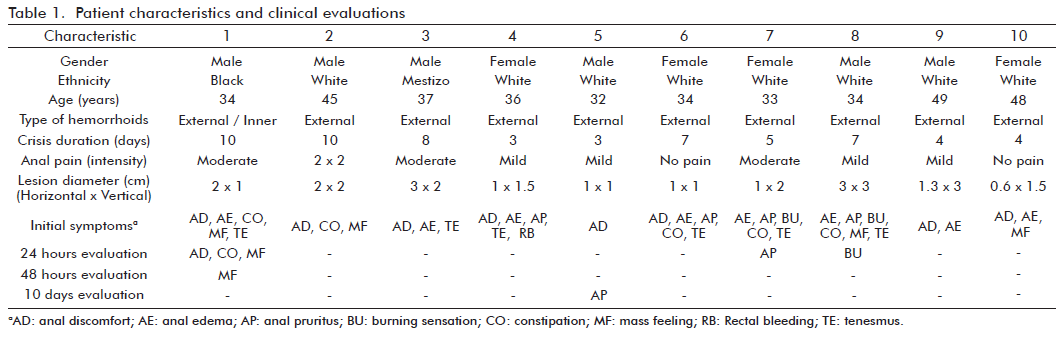
<body><![CDATA[<P   align="left" ><font face="Verdana, Arial, Helvetica, sans-serif" color="#000000" size="2">Recombinant      streptokinase was produced in <I>Escherichia coli </I>at the Center for Genetic      Engineering and Biotechnology, Havana (24). Suppositories were prepared containing      200 000 IU of rSK, thimerosal, sorbitan monostearate (Span 60), sodium salicylate,      and hard fat (Witepsol W25). All patients received them by the rectal route,      one every 6 hours up to 4 suppositories. The patients were hospitalized during      the first 24 hours and were evaluated 48 hours after discharge and at 10 days      follow-up. Concomitant treatment included high-fiber diet, abundant liquid      ingestion, rest in <I>decubitus </I>position; local hygiene, sits bath with      warm water 3 times per day, and oral analgesics if pain. </font></P >       <P   align="left" ><font face="Verdana, Arial, Helvetica, sans-serif" color="#000000" size="2">The      aim of the trial was to evaluate the safety of the product, since it was the      first-in-man use, so the type, duration, severity, outcome, and causality      relationship of the adverse events were carefully registered. A qualitative      assessment was used to classify the causal relationship as definite, probable,      possible or doubtful (25). The severity of the adverse events was classified      upon three levels: (a) mild, if no therapy was necessary, (b) moderate, if      specific treatment was needed, and (c) severe, when hospitalization or its      prolongation was required, and if the reaction was life-threatening or contributed      to patient&acute;s death. </font></P >       <P   align="left" ><font face="Verdana, Arial, Helvetica, sans-serif" color="#000000" size="2">For      this purpose, patients were evaluated through interview and physical examination,      both general and local, upon arrival, at 24, 48 hours and 10 days post-discharge      and at any other moment when adverse events appeared. Adverse reactions known      for SK (fever, shakes, tremors, nausea, vomiting, low blood pressure, hemorrhages      and allergy), were specially searched. Hemostasis (thrombin time, fibrinogen,      and fibrinogen degradation products (FDP)) was checked at 0, 24 and 48 h.      The presence of anti-streptokinase antibodies was determined at the beginning      and 10 days after discharge using a sandwich type ELISA method previously      described (26). </font></P >       <P   align="left" ><font face="Verdana, Arial, Helvetica, sans-serif" color="#000000" size="2">Clinical      effect on the illness was evaluated according to pain intensity (measured      with a 10-level analogue visual scale), edema (presence or not), and lesion      size (larger and smaller diameters). The clinical response was assessed at      48 hours according to the following criteria: a) Complete response: disappearance      of pain and edema, and lesion size reduction; b) Partial response: two-level      reduction of pain intensity or disappearance of edema, or lesion size reduction;      c) No response: if no changes or any worsening occurred. Healing was considered      during the 10-day follow-up. A therapeutic failure was given by no response,      treatment interruptions, need for any surgical procedure, or not healing at      10 days post-release. The confidence intervals and the probabilities of cure      and complete response were estimated using a Bayesian logistic model for fixed      effects in WinBUGS14 package. </font></P >       <P   align="left" ><font size="3" face="Verdana, Arial, Helvetica, sans-serif" color="#000000"><b>RESULTS</b></font><font size="2" face="Verdana, Arial, Helvetica, sans-serif" color="#000000">      </font></P >   <FONT size="+1">        <P   align="left" ><font size="2" face="Verdana, Arial, Helvetica, sans-serif" color="#000000">Ten      patients were included, all completed the treatment schedule and 10-day follow-up.      <a href="/img/revistas/bta/v27n4/t0103410.gif">Table 1</a> shows the      characteristics of the patients. Most were male (80%), white (80%), 32 to      49 years old, from 1 to 11 days ill. All patients had external hemorrhoids      (in one also internal, grade III); 8 of them had anal pain (4 moderate); 8      anal edema; lesion diameters ranged between 0.6 and 3.0 cm. Only 2 patients      referred the use of analgesics. </font></P >   <FONT size="+1"><FONT color="#FF00FF"><FONT color="#000000">        
<P   align="left" ><font face="Verdana, Arial, Helvetica, sans-serif" color="#000000" size="2">The      product was well tolerated. Severe or unexpected adverse events were not reported      and there were no withdrawals for this cause. Only 2 adverse events were registered      in the same patient. Those were ardor (24 and 48 hours after the treatment)      and anal pruritus (10 days after the hospital release), both mild. Their causal      relationship with the product under evaluation was doubtful, since both symptoms      could be also explained by the underlying illness. There were no alterations      of the hemostasis parameters (thrombin time, fibrinogen, and FDP) measured.      Anti-SK antibodies titers did not increase significantly with respect to basal      values, 10 days after treatment (results not shown). </font></P >       <P   align="left" ><font face="Verdana, Arial, Helvetica, sans-serif" color="#000000" size="2">Clinical      evolution is also shown in <a href="/img/revistas/bta/v27n4/t0103410.gif">Table      1</a>. The main initial signs and symptoms were anal discomfort (80%), tenesmus      (60%), constipation (50%), anal pruritus (40%), and mass feeling (40%). Ardor      and bleeding were present in two and one patient, respectively. At 24 hours      after treatment onset, most symptoms had already disappeared. All patients      had achieved a response at 48 hours after the beginning of treatment (6 complete),      and 9 had healed at the 10-days follow-up. Only one patient (No. 1), who had      partial response needed thrombectomy. The estimated probability of complete      response at 48 hours was 0.58 &plusmn; 0.14 and the probability of healing      was 0.83 &plusmn; 0.10. Median time to healing was 5 days. </font></P >   <FONT color="#FF00FF"><FONT color="#000000"><FONT color="#FF00FF"><FONT color="#000000"><FONT color="#FF00FF"><FONT color="#000000">        
<P   align="left" ><font size="3" face="Verdana, Arial, Helvetica, sans-serif" color="#000000"><b>DISCUSSION</b></font><font size="2" face="Verdana, Arial, Helvetica, sans-serif" color="#000000">      </font></P >   <FONT size="+1">        <P   align="left" ><font size="2" face="Verdana, Arial, Helvetica, sans-serif" color="#000000">The      study treatment (streptokinase suppository) was administered in all cases      during the first 24 hours (1 suppository every 6 hours). In terms of safety,      which was the main purpose of the trial, the results indicated that the recombinant      streptokinase suppository is safe and tolerable. The adverse events reported      were minimal (only ardor and anal itching in only one patient), both mild,      resolved spontaneously and with low causality relation with the product. Hemostasis      was not altered either, probably due to scarce systemic absorption of SK since      the fibrinolytic action could be exerted after local activation in the hemorrhoidal      plexus, directly on the thrombi. The total SK dose administered (800 000 IU)      at 24 hours is much less hemostasis disturbing than the one used for other      indications such as acute myocardial infarction (1 500 000 IU intravenously      in one hour) were significant alterations of coagulation parameters have been      reported (27). Therefore, hemorrhagic adverse events are less likely to be      expected with this product. The low systemic exposure can also explain the      fact that anti-SK antibody titers did not increase with treatment, contrary      to the larger dose, intravenous administration (26)<B>. </b></font></P >   <FONT size="+1">        ]]></body>
<body><![CDATA[<P   align="left" ><font face="Verdana, Arial, Helvetica, sans-serif" color="#000000" size="2">Twenty      hours of treatment were sufficient to achieve, in most of the patients, a      complete and sustained improvement of all the main signs and symptoms of the      illness. Ninety percent of the patients healed their hemorrhoidal crisis in      approximately 5 days (pain relief before 48 hours). Other studies have reported      longer healing periods with control standard treatments and other agents such      as nifedipine or surgery (28- 34). The patients of this study faced inflammation,      pain and an irreducible mass as the most important symptoms, also indicated      by some authors (35). The thrombolytic effect of the SK suppository on the      local capillary structure could improve permeability and its action on the      lymphatic local system could diminish the inflammation, exudates, and local      edema and its action on blood viscosity, determines a rapid improvement in      the first 24 hours after the product is applied (31). In this study, although      the sample was very small, typical complications of the disease such as anal      abscess, vulvoperineal cellulitis, perianal fistula, among others, were not      reported. Further, controlled trials are needed to confirm this initial efficacy      data. Other doses and schedules should be explored as well. </font></P >       <P   align="left" ><font face="Verdana, Arial, Helvetica, sans-serif" color="#000000" size="2">The      treatment of the hemorrhoidal crisis depends on the intensity of the signs      and symptoms and can change in patients with thrombosis, important prolapse      or profuse hemorrhage. In such cases, the surgical solution should be evaluated      (hemorrhoidectomy, thrombectomy, ligature, sclerotherapy, infrared photoclotting,      cryotherapy, therapy with laser). However, few randomized controlled trials      have been performed to evaluate these procedures (6, 9-11). </font></P >       <P   align="left" ><font face="Verdana, Arial, Helvetica, sans-serif" color="#000000" size="2">In      this work, only one patient did not improve his condition and needed thrombectomy.      This patient presented hemorrhoidal thrombosis as first diagnosis, which improved      without the need for analgesics. From the point of view of the clinical trial      evaluation, he was considered a therapeutic failure due to the thrombus persistence.      The surgical treatment of the hemorrhoids is indicated in grades III-IV, symptomatic,      that have not responded to the conservative treatment to an associate illness      (fissure, fistula, big skin flaps) and in the hemorrhoidal thrombosis (9,      35). </font></P >       <P   align="left" ><font face="Verdana, Arial, Helvetica, sans-serif" color="#000000" size="2">This      is the first report in human of the recombinant streptokinase use in a rectal      formulation (suppository). The results indicate that it is unlikely that any      systemic action of the thrombolytic agent (SKr), and thus adverse events on      other organs or systems can appear. This will have to be confirmed in further      studies. </font></P >       <P   align="left" ><font size="2" face="Verdana, Arial, Helvetica, sans-serif" color="#000000"><B><font size="3">ACKNOWLEDGEMENTS</font></B>      </font></P >   <FONT size="+1">        <P   align="left" ><font size="2" face="Verdana, Arial, Helvetica, sans-serif" color="#000000">Authors:      FHB, CV, SB and PLS are employees of the Center for Biological Research, which      is part of the Center for Genetic Engineering and Biotechnology, Havana Network,      where rSK is produced and the new formulation was developed. HB, AA, YB, RP      and EM belong to the latter organization. The other authors have no conflict      of interests. The study was financed by Heber Biotec, Havana (products, reagents)      and the Ministry of Public Health of Cuba (hospital facilities and general      medical care of the patients). The authors wish to thank Dr. Iraldo Bello      Rivero, Olga Pantale&oacute;n Bernal, technicians Dunia G&oacute;mez Ch&aacute;vez,      Maria de la C Hern&aacute;ndez, Teresa &Aacute;lvarez Padr&oacute;n, Maria      Isabel Nu&ntilde;ez and BSc, Magalys Cabro Cruz for their participation in      the laboratory work. They also give thanks to the Dr. Luis Villasana Rold&oacute;s      for his advice. </font></P >   <FONT size="+1">        <P   align="left" > </P >       <P   align="left" ><font face="Verdana, Arial, Helvetica, sans-serif" color="#000000" size="2"><b><font size="3">REFERENCES</font></b>      </font></P >       <!-- ref --><P   align="left" ><font face="Verdana, Arial, Helvetica, sans-serif" size="2">1. Nelson RL, Abcarian      H, Davis FG, Persky V. Prevalence of benign anorectal disease in a randomly      selected population. Dis Colon Rectum 1995;38:341. </font></P >   </font></font></font></font></font></font></font></font></font></font></font></font></font></font></font></font></font></font></font></font></font></font></font></font></font></font></font></font></font></font></font></font></font></font></font></font></font></font></font></font></font></font></font></font></font></font></font></font></font></font></font></font></font></font></font></font></font></font></font></font></font></font></font></font></font></font></font>        <!-- ref --><p><font face="Verdana, Arial, Helvetica, sans-serif" size="2">2. Hulme-Moir      M, Bartolo DC. Hemorrhoids. Gastroenterol Clin North Am 2001; 30:183-97. </font><!-- ref --><p><font face="Verdana, Arial, Helvetica, sans-serif" size="2">3. Johanson JF,      Sonnenberg A. The prevalence of hemorrhoids and chronic constipation. An epidemiologic      study. Gastroenterology 1990;98:380-6. </font><!-- ref --><p><font face="Verdana, Arial, Helvetica, sans-serif" size="2">4. Alonso-Coello      P, Castillejo MM. Office evaluation and treatment of hemorrhoids. J Fam Pract      2003;52(5):366-74. </font><!-- ref --><p><font face="Verdana, Arial, Helvetica, sans-serif" size="2">5. Godeberge      P. Daflon 500 mg in the treatment of hemorrhoidal disease: a demonstrated      efficacy in comparison with placebo. Angiology 1994;45:574-8. </font><!-- ref --><p><font face="Verdana, Arial, Helvetica, sans-serif" size="2">6. Cospite M.      Double-bind, placebo controlled evaluation of shemical activity and Safety      of Daflon 500 rng in the treatment of acute hemorrhoids. Angiology 1994; 45(2):566-73.      </font><!-- ref --><p><font face="Verdana, Arial, Helvetica, sans-serif" size="2">7. Misra MC,      Parshad R. Randomized clinical trial of micronized flavonoids in the early      control of bleeding from acute internal haemorrhoids. Br J Surg 2000; 87:868-72.      </font><!-- ref --><p><font face="Verdana, Arial, Helvetica, sans-serif" size="2">8. Mentes BB,      Gorgul A, Tatlicioglu E, Ayoglu F, Unal S. Efficacy of calcium dobesilate      in treating acute attacks of hemorrhoidal disease. Dis Colon Rectum 2001;      44:1489-95. </font><!-- ref --><p><font face="Verdana, Arial, Helvetica, sans-serif" size="2">9. De Miguel      M, Oteiza F, Ciga MA, Ortiz H. Tratamiento quir&uacute;rgico de las hemorroides.      Cir Esp 2005;78 Suppl 3:15-23. </font><!-- ref --><p><font face="Verdana, Arial, Helvetica, sans-serif" size="2">10. Hull T. Examination      and Diseases of the Anorectum. In: Feldman M, Tschumy WO, Friedman LS, Sleisenger      MH, editores. Sleisenger &amp; Fordtran&#146;s Gastrointestinal and Liver      Disease, 7th ed. Saunders: Philadelphia, 2002, p. 2277-93. </font><!-- ref --><p><font face="Verdana, Arial, Helvetica, sans-serif" size="2">11. Martinessi      VM. Patolog&iacute;a hemorroidal. Enfoque terap&eacute;utico integral: lugar      de la cirug&iacute;a ambulatoria. Trabajo de tesis; Universidad Nacional de      C&oacute;rdoba. Facultad de Ciencias M&eacute;dicas, Argentina, 2006. </font><!-- ref --><p><font face="Verdana, Arial, Helvetica, sans-serif" size="2">12. Gruppo Italiano      per lo Studio della Streptochinasi nell&#146;Infarto Miocardico (GISSI). Effectiveness      of intravenous thrombolytic treatment in acute myocardial infarction. Lancet      1986;1:397-401. </font><!-- ref --><p><font face="Verdana, Arial, Helvetica, sans-serif" size="2">13. The GUSTO      Investigators. An International randomized trial comparing four thrombolytic      strategies for acute myocardial infarction. N Engl J Med 1993;329: 673-82.      </font><!-- ref --><p><font face="Verdana, Arial, Helvetica, sans-serif" size="2">14. Gruppo Italiano      per lo Studio della Soppravvivenza nell&#146; Infarto Miocardico (GISSI-2).      A factorial randomised trial of Alteplase vs. Streptokinase and heparin versus      no heparin among 12490 patients with acute myocardial infarction. Lancet 1990;336:65-71.      </font><!-- ref --><p><font face="Verdana, Arial, Helvetica, sans-serif" size="2">15. ISIS-3 (Third      International Study of Infarct Survival). Collaborative Group. ISIS-3: A randomized      comparison of streptokinase vs tissue plasminogen activator vs anistreplase      and of aspirin plus heparin vs aspirin alone among 41299 cases of suspected      acute myocardial infarction. Lancet 1992;339:753-70. </font><!-- ref --><p><font face="Verdana, Arial, Helvetica, sans-serif" size="2">16. The TERIMA      Group of Investigator. TERIMA-2: national extension of thrombolytic treatment      with recombinant streptokinase in acute myocardial infarct in Cuba. Thromb      Haemost 2000;84(6):949-54. </font><p><font face="Verdana, Arial, Helvetica, sans-serif" size="2">17. Betancourt      BY, Marrero MA, Jim&eacute;nez G, Valenzuela C, Garc&iacute;a E, Hernandez-Bernal      F, <i>et al</i>. Pharmacovigilance program to monitor adverse reactions of      recombinant streptokinase in acute myocardial infarction. BMC Clin Pharmacol      2005;5(1):5. </font></p>       <!-- ref --><p><font face="Verdana, Arial, Helvetica, sans-serif" size="2">18. C&aacute;ceres      FM, P&eacute;rez H, Morlans K, Facundo H, Santos J, Valiente J, <i>et al</i>.      Thrombolysis as first choice therapy in prosthetic heart valve thrombosis.      A study of 68 patients. J Thromb Thrombolysis 2006; 21(2):185-90. </font><!-- ref --><p><font face="Verdana, Arial, Helvetica, sans-serif" size="2">19. L&oacute;pez      HP, C&aacute;ceres FM, Hern&aacute;ndez KM, S&aacute;nchez HF, Gonz&aacute;lez      N, Marrero MA, <i>et al</i>. Thrombolytic therapy with recombinant streptokinase      for prosthetic valve thrombosis. J Card Surg 2002;17:387-93. </font><!-- ref --><p><font face="Verdana, Arial, Helvetica, sans-serif" size="2">20. L&oacute;pez-Saura      P. Thrombolysis with recombinant streptokinase in Cuba. British Med J 2003;326(7386):448.      </font><!-- ref --><p><font face="Verdana, Arial, Helvetica, sans-serif" size="2">21. Francis CW,      Marder VJ. Fibrinolytic therapy for venous thrombosis. Prog Cardiovasc Dis      1999;34(3):193-204. </font><!-- ref --><p><font face="Verdana, Arial, Helvetica, sans-serif" size="2">22. Haas SK.      Treatment of deep venous thrombosis and pulmonary embolism: Current recommendations.      Med Clin North Am 1998;82(3):495-510. </font><!-- ref --><p><font face="Verdana, Arial, Helvetica, sans-serif" size="2">23. Ansari A.      Rapid lysis of deep vein thrombosis by low molecular weight heparin. Tex Heart      Inst J 2000;27(1):74-5. </font><!-- ref --><p><font face="Verdana, Arial, Helvetica, sans-serif" size="2">24. Estrada M,      Hern&aacute;ndez L, P&eacute;rez A, Rodr&iacute;guez P, Serrano R, Rubiera      R, <i>et al</i>. High level expression of streptokinase in <i>Escherichia      coli</i>. Biotechnology 1992; 10:1138-42. </font><!-- ref --><p><font face="Verdana, Arial, Helvetica, sans-serif" size="2">25. Naranjo CA,      Shear NH, Busto U. Adverse drug reactions, in: Kalant H, Roschlau WHE (eds)      Principles of medical pharmacology, 6ta ed., Oxford University Press, New      York, 1998; p. 791-800. </font><!-- ref --><p><font face="Verdana, Arial, Helvetica, sans-serif" size="2">26. Mainet D,      del Rosario M, Toruncha A, Prats P, Valenzuela C, L&oacute;pez-Saura P. Similar,      more than 6-months persisted, antibody and neutralizing activity responses      in patients with acute myocardial infarction treated with recombinant or natural      streptokinase. Fibrinolysis Proteol 1998;12:301-9. </font><!-- ref --><p><font face="Verdana, Arial, Helvetica, sans-serif" size="2">27. The TERIMA      Group Investigators. Multicenter, randomised, comparative study of recombinant      vs. natural streptokinases in acute myocardial infarct. Thromb Haemost 1999;82(6):1605-9.      </font><!-- ref --><p><font face="Verdana, Arial, Helvetica, sans-serif" size="2">28. Perrotti      P, Antropoli C, Molino D, De Stefano G, Antropoli M. Conservative treatment      of acute thrombosed external hemorrhoids with topical nifedipine. Dis Colon      Rectum 2001;44:405-9. </font><!-- ref --><p><font face="Verdana, Arial, Helvetica, sans-serif" size="2">29. De Paredes      B, Demarez JP, Cauquil J. Analyse comparative des activit&eacute;s th&eacute;rapeutiques      de Cyclo 3 Fort et diosmine 450 mg associ&eacute; &agrave; l&#146;hesperidine      50 mg dans l&#146;insuffisance veineuse des membres inf&eacute;rieurs. &Eacute;tude      en double insu aupr&egrave;s de 60 patients. Vie M&eacute;dic 1990;6:226-32.      </font><!-- ref --><p><font face="Verdana, Arial, Helvetica, sans-serif" size="2">30. Lozes A,      Boccalon H. Double-blind study of ruscus extract: venous plethysmographic      results. Int Angiol 1984;3:99-102. </font><!-- ref --><p><font face="Verdana, Arial, Helvetica, sans-serif" size="2">31. Cospite M,      Cospite V. Treatment of hemorrhoids with Daflon 500 mg. Phlebology 1992;7      Suppl 2:53-6. </font><!-- ref --><p><font face="Verdana, Arial, Helvetica, sans-serif" size="2">32. Gupta PJ.      Suppositories in anal disorders: a review. Eur Rev Med Pharmacol Sci 2007;11:165-70.      </font><!-- ref --><p><font face="Verdana, Arial, Helvetica, sans-serif" size="2">33. Granados      J, Ch&aacute;vez C, L&oacute;pez A, Rodr&iacute;guez M, Yamamoto K. Eficacia      de Fabroven en el tratamiento de la enfermedad hemorroidal aguda. Rev Mex      Angiol 2005;33(2):62-6. </font><!-- ref --><p><font face="Verdana, Arial, Helvetica, sans-serif" size="2">34. Giordano      M. Randomized clinical trial on the use of a new molecule, formulated in suppositories,      in the treatment of acute hemorrhoidal disease. Gazzetta Medica Italiana Archivio      per le Scienze Mediche 2007; 166(4):121-6 35. Balasubramanian S, Kaiser AM.      Management options for symptomatic hemorrhoids. Curr Gastroenterol Rep 2003;      5(5):431- 7. </font>    <!-- ref -->    <br>   </p>   <FONT size="+1" color="#000000"><FONT size="+1"><FONT size="+1"><FONT size="+1"><FONT size="+1"><FONT size="+1"><FONT size="+1"><FONT size="+1"><FONT size="+1"><FONT size="+1"><FONT size="+1"><FONT size="+1"><FONT size="+1"><FONT size="+1"><FONT size="+1"><FONT size="+1"><FONT size="+1"><FONT size="+1"><FONT size="+1"><FONT size="+1"><FONT size="+1"><FONT size="+1"><FONT size="+1"><FONT size="+1"><FONT size="+1"><FONT size="+1"><FONT size="+1"><FONT size="+1"><FONT size="+1"><FONT size="+1"><FONT size="+1"><FONT size="+1"><FONT size="+1"><FONT size="+1"><FONT size="+1"><FONT size="+1"><FONT size="+1"><FONT size="+1"><FONT size="+1"><FONT size="+1"><FONT size="+1"><FONT size="+1"><FONT size="+1"><FONT size="+1"><FONT size="+1"><FONT size="+1"><FONT size="+1"><FONT color="#0000FF"><FONT color="#000000"><FONT size="+1"><FONT size="+1"><FONT size="+1"><FONT size="+1"><FONT size="+1"><FONT size="+1"><FONT color="#FF00FF"><FONT color="#000000"><FONT color="#FF00FF"><FONT color="#000000"><FONT color="#FF00FF"><FONT color="#000000"><FONT color="#FF00FF"><FONT color="#000000"><FONT size="+1"><FONT size="+1"><FONT size="+1"><FONT size="+1">       <P   align="left" ><font face="Verdana, Arial, Helvetica, sans-serif" color="#000000" size="2">35.      Balasubramanian S, Kaiser AM. Management options for symptomatic hemorrhoids.      Curr Gastroenterol Rep 2003; 5(5):431- 7. </font></P >   <FONT size="+1">     <P   align="left" ><font size="2" face="Verdana, Arial, Helvetica, sans-serif" color="#000000">Received      in April, 2010.     <br>     Accepted for publication in September, 2010. </font></P >   <FONT size="+1">        <P   align="left" ><font face="Verdana, Arial, Helvetica, sans-serif" color="#000000" size="2">Francisco      Hern&aacute;ndez, Clinical Trials Division, Center for Biological Research,      Havana Street 134 / 23 and 25, Playa, PO Box 6332, Havana, Cuba. E-mail: <a href="mailto:hernandez.bernal@cigb.edu.cu">hernandez.bernal@cigb.edu.cu</a></font><FONT size="+1"></font></P >   </font></font></font></font></font></font></font></font></font></font></font></font></font></font></font></font></font></font></font></font></font></font></font></font></font></font></font></font></font></font></font></font></font></font></font></font></font></font></font></font></font></font></font></font></font></font></font></font></font></font></font></font></font></font></font></font></font></font></font></font></font></font></font></font></font></font></font></font></font></DIV >      ]]></body><back>
<ref-list>
<ref id="B1">
<label>1</label><nlm-citation citation-type="journal">
<person-group person-group-type="author">
<name>
<surname><![CDATA[Nelson]]></surname>
<given-names><![CDATA[RL]]></given-names>
</name>
<name>
<surname><![CDATA[Abcarian]]></surname>
<given-names><![CDATA[H]]></given-names>
</name>
<name>
<surname><![CDATA[Davis]]></surname>
<given-names><![CDATA[FG]]></given-names>
</name>
<name>
<surname><![CDATA[Persky]]></surname>
<given-names><![CDATA[V]]></given-names>
</name>
</person-group>
<article-title xml:lang="en"><![CDATA[Prevalence of benign anorectal disease in a randomly selected population]]></article-title>
<source><![CDATA[Dis Colon Rectum]]></source>
<year>1995</year>
<volume>38</volume>
<page-range>341</page-range></nlm-citation>
</ref>
<ref id="B2">
<label>2</label><nlm-citation citation-type="journal">
<person-group person-group-type="author">
<name>
<surname><![CDATA[Hulme-Moir]]></surname>
<given-names><![CDATA[M]]></given-names>
</name>
<name>
<surname><![CDATA[Bartolo]]></surname>
<given-names><![CDATA[DC]]></given-names>
</name>
</person-group>
<article-title xml:lang="en"><![CDATA[Hemorrhoids]]></article-title>
<source><![CDATA[Gastroenterol Clin North Am]]></source>
<year>2001</year>
<volume>30</volume>
<page-range>183-97</page-range></nlm-citation>
</ref>
<ref id="B3">
<label>3</label><nlm-citation citation-type="journal">
<person-group person-group-type="author">
<name>
<surname><![CDATA[Johanson]]></surname>
<given-names><![CDATA[JF]]></given-names>
</name>
<name>
<surname><![CDATA[Sonnenberg]]></surname>
<given-names><![CDATA[A]]></given-names>
</name>
</person-group>
<article-title xml:lang="en"><![CDATA[The prevalence of hemorrhoids and chronic constipation: An epidemiologic study]]></article-title>
<source><![CDATA[Gastroenterology]]></source>
<year>1990</year>
<volume>98</volume>
<page-range>380-6</page-range></nlm-citation>
</ref>
<ref id="B4">
<label>4</label><nlm-citation citation-type="journal">
<person-group person-group-type="author">
<name>
<surname><![CDATA[Alonso-Coello]]></surname>
<given-names><![CDATA[P]]></given-names>
</name>
<name>
<surname><![CDATA[Castillejo]]></surname>
<given-names><![CDATA[MM]]></given-names>
</name>
</person-group>
<article-title xml:lang="en"><![CDATA[Office evaluation and treatment of hemorrhoids]]></article-title>
<source><![CDATA[J Fam Pract]]></source>
<year>2003</year>
<volume>52</volume>
<numero>5</numero>
<issue>5</issue>
<page-range>366-74</page-range></nlm-citation>
</ref>
<ref id="B5">
<label>5</label><nlm-citation citation-type="journal">
<person-group person-group-type="author">
<name>
<surname><![CDATA[Godeberge]]></surname>
<given-names><![CDATA[P]]></given-names>
</name>
</person-group>
<article-title xml:lang="en"><![CDATA[Daflon 500 mg in the treatment of hemorrhoidal disease: a demonstrated efficacy in comparison with placebo]]></article-title>
<source><![CDATA[Angiology]]></source>
<year>1994</year>
<volume>45</volume>
<page-range>574-8</page-range></nlm-citation>
</ref>
<ref id="B6">
<label>6</label><nlm-citation citation-type="journal">
<person-group person-group-type="author">
<name>
<surname><![CDATA[Cospite]]></surname>
<given-names><![CDATA[M]]></given-names>
</name>
</person-group>
<article-title xml:lang="en"><![CDATA[Double-bind, placebo controlled evaluation of shemical activity and Safety of Daflon 500 rng in the treatment of acute hemorrhoids]]></article-title>
<source><![CDATA[Angiology]]></source>
<year>1994</year>
<volume>45</volume>
<numero>2</numero>
<issue>2</issue>
<page-range>566-73</page-range></nlm-citation>
</ref>
<ref id="B7">
<label>7</label><nlm-citation citation-type="journal">
<person-group person-group-type="author">
<name>
<surname><![CDATA[Misra]]></surname>
<given-names><![CDATA[MC]]></given-names>
</name>
<name>
<surname><![CDATA[Parshad]]></surname>
<given-names><![CDATA[R]]></given-names>
</name>
</person-group>
<article-title xml:lang="en"><![CDATA[Randomized clinical trial of micronized flavonoids in the early control of bleeding from acute internal haemorrhoids]]></article-title>
<source><![CDATA[Br J Surg]]></source>
<year>2000</year>
<volume>87</volume>
<page-range>868-72</page-range></nlm-citation>
</ref>
<ref id="B8">
<label>8</label><nlm-citation citation-type="journal">
<person-group person-group-type="author">
<name>
<surname><![CDATA[Mentes]]></surname>
<given-names><![CDATA[BB]]></given-names>
</name>
<name>
<surname><![CDATA[Gorgul]]></surname>
<given-names><![CDATA[A]]></given-names>
</name>
<name>
<surname><![CDATA[Tatlicioglu]]></surname>
<given-names><![CDATA[E]]></given-names>
</name>
<name>
<surname><![CDATA[Ayoglu]]></surname>
<given-names><![CDATA[F]]></given-names>
</name>
<name>
<surname><![CDATA[Unal]]></surname>
<given-names><![CDATA[S]]></given-names>
</name>
</person-group>
<article-title xml:lang="en"><![CDATA[Efficacy of calcium dobesilate in treating acute attacks of hemorrhoidal disease]]></article-title>
<source><![CDATA[Dis Colon Rectum]]></source>
<year>2001</year>
<volume>44</volume>
<page-range>1489-95</page-range></nlm-citation>
</ref>
<ref id="B9">
<label>9</label><nlm-citation citation-type="journal">
<person-group person-group-type="author">
<name>
<surname><![CDATA[De Miguel]]></surname>
<given-names><![CDATA[M]]></given-names>
</name>
<name>
<surname><![CDATA[Oteiza]]></surname>
<given-names><![CDATA[F]]></given-names>
</name>
<name>
<surname><![CDATA[Ciga]]></surname>
<given-names><![CDATA[MA]]></given-names>
</name>
<name>
<surname><![CDATA[Ortiz]]></surname>
<given-names><![CDATA[H]]></given-names>
</name>
</person-group>
<article-title xml:lang="es"><![CDATA[Tratamiento quirúrgico de las hemorroides]]></article-title>
<source><![CDATA[Cir Esp]]></source>
<year>2005</year>
<volume>78</volume>
<numero>^s3</numero>
<issue>^s3</issue>
<supplement>3</supplement>
<page-range>15-23</page-range></nlm-citation>
</ref>
<ref id="B10">
<label>10</label><nlm-citation citation-type="book">
<person-group person-group-type="author">
<name>
<surname><![CDATA[Hull]]></surname>
<given-names><![CDATA[T]]></given-names>
</name>
</person-group>
<article-title xml:lang="en"><![CDATA[Examination and diseases of the Anorectum]]></article-title>
<person-group person-group-type="editor">
<name>
<surname><![CDATA[Feldman]]></surname>
<given-names><![CDATA[M]]></given-names>
</name>
<name>
<surname><![CDATA[Tschumy]]></surname>
<given-names><![CDATA[WO]]></given-names>
</name>
<name>
<surname><![CDATA[Friedman]]></surname>
<given-names><![CDATA[LS]]></given-names>
</name>
<name>
<surname><![CDATA[Sleisenger]]></surname>
<given-names><![CDATA[MH]]></given-names>
</name>
</person-group>
<source><![CDATA[Sleisenger & Fordtran’s Gastrointestinal and Liver Disease]]></source>
<year>2002</year>
<edition>7</edition>
<page-range>2277-93</page-range><publisher-loc><![CDATA[Philadelphia ]]></publisher-loc>
<publisher-name><![CDATA[Saunders]]></publisher-name>
</nlm-citation>
</ref>
<ref id="B11">
<label>11</label><nlm-citation citation-type="">
<person-group person-group-type="author">
<name>
<surname><![CDATA[Martinessi]]></surname>
<given-names><![CDATA[VM]]></given-names>
</name>
</person-group>
<source><![CDATA[Patología hemorroidal: Enfoque terapéutico integral: lugar de la cirugía ambulatoria]]></source>
<year></year>
</nlm-citation>
</ref>
<ref id="B12">
<label>12</label><nlm-citation citation-type="journal">
<collab>Gruppo Italiano per lo Studio della Streptochinasi nell’Infarto Miocardico (GISSI)</collab>
<article-title xml:lang="en"><![CDATA[Effectiveness of intravenous thrombolytic treatment in acute myocardial infarction]]></article-title>
<source><![CDATA[Lancet]]></source>
<year>1986</year>
<volume>1</volume>
<page-range>397-401</page-range></nlm-citation>
</ref>
<ref id="B13">
<label>13</label><nlm-citation citation-type="journal">
<collab>The GUSTO Investigators</collab>
<article-title xml:lang="en"><![CDATA[An International randomized trial comparing four thrombolytic strategies for acute myocardial infarction]]></article-title>
<source><![CDATA[N Engl J Med]]></source>
<year>1993</year>
<volume>329</volume>
<page-range>673-82</page-range></nlm-citation>
</ref>
<ref id="B14">
<label>14</label><nlm-citation citation-type="journal">
<collab>Gruppo Italiano per lo Studio della Soppravvivenza nell’ Infarto Miocardico (GISSI-2)</collab>
<article-title xml:lang="en"><![CDATA[A factorial randomised trial of Alteplase vs. Streptokinase and heparin versus no heparin among 12490 patients with acute myocardial infarction]]></article-title>
<source><![CDATA[Lancet]]></source>
<year>1990</year>
<volume>336</volume>
<page-range>65-71</page-range></nlm-citation>
</ref>
<ref id="B15">
<label>15</label><nlm-citation citation-type="journal">
<collab>ISIS-3 (Third International Study of Infarct Survival). Collaborative Group</collab>
<article-title xml:lang="en"><![CDATA[ISIS-3: A randomized comparison of streptokinase vs tissue plasminogen activator vs anistreplase and of aspirin plus heparin vs aspirin alone among 41299 cases of suspected acute myocardial infarction]]></article-title>
<source><![CDATA[Lancet]]></source>
<year>1992</year>
<volume>339</volume>
<page-range>753-70</page-range></nlm-citation>
</ref>
<ref id="B16">
<label>16</label><nlm-citation citation-type="journal">
<collab>The TERIMA Group of Investigator</collab>
<article-title xml:lang="en"><![CDATA[TERIMA-2: national extension of thrombolytic treatment with recombinant streptokinase in acute myocardial infarct in Cuba]]></article-title>
<source><![CDATA[Thromb Haemost]]></source>
<year>2000</year>
<volume>84</volume>
<numero>6</numero>
<issue>6</issue>
<page-range>949-54</page-range></nlm-citation>
</ref>
<ref id="B17">
<label>18</label><nlm-citation citation-type="journal">
<person-group person-group-type="author">
<name>
<surname><![CDATA[Cáceres]]></surname>
<given-names><![CDATA[FM]]></given-names>
</name>
<name>
<surname><![CDATA[Pérez]]></surname>
<given-names><![CDATA[H]]></given-names>
</name>
<name>
<surname><![CDATA[Morlans]]></surname>
<given-names><![CDATA[K]]></given-names>
</name>
<name>
<surname><![CDATA[Facundo]]></surname>
<given-names><![CDATA[H]]></given-names>
</name>
<name>
<surname><![CDATA[Santos]]></surname>
<given-names><![CDATA[J]]></given-names>
</name>
<name>
<surname><![CDATA[Valiente]]></surname>
<given-names><![CDATA[J]]></given-names>
</name>
</person-group>
<article-title xml:lang="en"><![CDATA[Thrombolysis as first choice therapy in prosthetic heart valve thrombosis: A study of 68 patients]]></article-title>
<source><![CDATA[J Thromb Thrombolysis]]></source>
<year>2006</year>
<volume>21</volume>
<numero>2</numero>
<issue>2</issue>
<page-range>185-90</page-range></nlm-citation>
</ref>
<ref id="B18">
<label>19</label><nlm-citation citation-type="journal">
<person-group person-group-type="author">
<name>
<surname><![CDATA[López]]></surname>
<given-names><![CDATA[HP]]></given-names>
</name>
<name>
<surname><![CDATA[Cáceres]]></surname>
<given-names><![CDATA[FM]]></given-names>
</name>
<name>
<surname><![CDATA[Hernández]]></surname>
<given-names><![CDATA[KM]]></given-names>
</name>
<name>
<surname><![CDATA[Sánchez]]></surname>
<given-names><![CDATA[HF]]></given-names>
</name>
<name>
<surname><![CDATA[González]]></surname>
<given-names><![CDATA[N]]></given-names>
</name>
<name>
<surname><![CDATA[Marrero]]></surname>
<given-names><![CDATA[MA]]></given-names>
</name>
</person-group>
<article-title xml:lang="en"><![CDATA[Thrombolytic therapy with recombinant streptokinase for prosthetic valve thrombosis]]></article-title>
<source><![CDATA[J Card Surg]]></source>
<year>2002</year>
<volume>17</volume>
<page-range>387-93</page-range></nlm-citation>
</ref>
<ref id="B19">
<label>20</label><nlm-citation citation-type="journal">
<person-group person-group-type="author">
<name>
<surname><![CDATA[López-Saura]]></surname>
<given-names><![CDATA[P]]></given-names>
</name>
</person-group>
<article-title xml:lang="en"><![CDATA[Thrombolysis with recombinant streptokinase in Cuba]]></article-title>
<source><![CDATA[British Med J]]></source>
<year>2003</year>
<volume>326</volume>
<numero>7386</numero>
<issue>7386</issue>
<page-range>448</page-range></nlm-citation>
</ref>
<ref id="B20">
<label>21</label><nlm-citation citation-type="journal">
<person-group person-group-type="author">
<name>
<surname><![CDATA[Francis]]></surname>
<given-names><![CDATA[CW]]></given-names>
</name>
<name>
<surname><![CDATA[Marder]]></surname>
<given-names><![CDATA[VJ]]></given-names>
</name>
</person-group>
<article-title xml:lang="en"><![CDATA[Fibrinolytic therapy for venous thrombosis]]></article-title>
<source><![CDATA[Prog Cardiovasc Dis]]></source>
<year>1999</year>
<volume>34</volume>
<numero>3</numero>
<issue>3</issue>
<page-range>193-204</page-range></nlm-citation>
</ref>
<ref id="B21">
<label>22</label><nlm-citation citation-type="journal">
<person-group person-group-type="author">
<name>
<surname><![CDATA[Haas]]></surname>
<given-names><![CDATA[SK]]></given-names>
</name>
</person-group>
<article-title xml:lang="en"><![CDATA[Treatment of deep venous thrombosis and pulmonary embolism: Current recommendations]]></article-title>
<source><![CDATA[Med Clin North Am]]></source>
<year>1998</year>
<volume>82</volume>
<numero>3</numero>
<issue>3</issue>
<page-range>495-510</page-range></nlm-citation>
</ref>
<ref id="B22">
<label>23</label><nlm-citation citation-type="journal">
<person-group person-group-type="author">
<name>
<surname><![CDATA[Ansari]]></surname>
<given-names><![CDATA[A]]></given-names>
</name>
</person-group>
<article-title xml:lang="en"><![CDATA[Rapid lysis of deep vein thrombosis by low molecular weight heparin]]></article-title>
<source><![CDATA[Tex Heart Inst J]]></source>
<year>2000</year>
<volume>27</volume>
<numero>1</numero>
<issue>1</issue>
<page-range>74-5</page-range></nlm-citation>
</ref>
<ref id="B23">
<label>24</label><nlm-citation citation-type="journal">
<person-group person-group-type="author">
<name>
<surname><![CDATA[Estrada]]></surname>
<given-names><![CDATA[M]]></given-names>
</name>
<name>
<surname><![CDATA[Hernández]]></surname>
<given-names><![CDATA[L]]></given-names>
</name>
<name>
<surname><![CDATA[Pérez]]></surname>
<given-names><![CDATA[A]]></given-names>
</name>
<name>
<surname><![CDATA[Rodríguez]]></surname>
<given-names><![CDATA[P]]></given-names>
</name>
<name>
<surname><![CDATA[Serrano]]></surname>
<given-names><![CDATA[R]]></given-names>
</name>
<name>
<surname><![CDATA[Rubiera]]></surname>
<given-names><![CDATA[R]]></given-names>
</name>
</person-group>
<article-title xml:lang="en"><![CDATA[High level expression of streptokinase in Escherichia coli]]></article-title>
<source><![CDATA[Biotechnology]]></source>
<year>1992</year>
<volume>10</volume>
<page-range>1138-42</page-range></nlm-citation>
</ref>
<ref id="B24">
<label>25</label><nlm-citation citation-type="book">
<person-group person-group-type="author">
<name>
<surname><![CDATA[Naranjo]]></surname>
<given-names><![CDATA[CA]]></given-names>
</name>
<name>
<surname><![CDATA[Shear]]></surname>
<given-names><![CDATA[NH]]></given-names>
</name>
<name>
<surname><![CDATA[Busto]]></surname>
<given-names><![CDATA[U]]></given-names>
</name>
</person-group>
<article-title xml:lang="en"><![CDATA[Adverse drug reactions]]></article-title>
<person-group person-group-type="editor">
<name>
<surname><![CDATA[Kalant]]></surname>
<given-names><![CDATA[H]]></given-names>
</name>
<name>
<surname><![CDATA[Roschlau]]></surname>
<given-names><![CDATA[WHE]]></given-names>
</name>
</person-group>
<source><![CDATA[Principles of medical pharmacology]]></source>
<year>1998</year>
<edition>6</edition>
<page-range>791-800</page-range><publisher-loc><![CDATA[New York ]]></publisher-loc>
<publisher-name><![CDATA[Oxford University Press]]></publisher-name>
</nlm-citation>
</ref>
<ref id="B25">
<label>26</label><nlm-citation citation-type="journal">
<person-group person-group-type="author">
<name>
<surname><![CDATA[Mainet]]></surname>
<given-names><![CDATA[D]]></given-names>
</name>
<name>
<surname><![CDATA[del Rosario]]></surname>
<given-names><![CDATA[M]]></given-names>
</name>
<name>
<surname><![CDATA[Toruncha]]></surname>
<given-names><![CDATA[A]]></given-names>
</name>
<name>
<surname><![CDATA[Prats]]></surname>
<given-names><![CDATA[P]]></given-names>
</name>
<name>
<surname><![CDATA[Valenzuela]]></surname>
<given-names><![CDATA[C]]></given-names>
</name>
<name>
<surname><![CDATA[López-Saura]]></surname>
<given-names><![CDATA[P]]></given-names>
</name>
</person-group>
<article-title xml:lang="en"><![CDATA[Similar, more than 6-months persisted, antibody and neutralizing activity responses in patients with acute myocardial infarction treated with recombinant or natural streptokinase]]></article-title>
<source><![CDATA[Fibrinolysis Proteol]]></source>
<year>1998</year>
<volume>12</volume>
<page-range>301-9</page-range></nlm-citation>
</ref>
<ref id="B26">
<label>27</label><nlm-citation citation-type="journal">
<collab>The TERIMA Group Investigators</collab>
<article-title xml:lang="en"><![CDATA[Multicenter, randomised, comparative study of recombinant vs. natural streptokinases in acute myocardial infarct]]></article-title>
<source><![CDATA[Thromb Haemost]]></source>
<year>1999</year>
<volume>82</volume>
<numero>6</numero>
<issue>6</issue>
<page-range>1605-9</page-range></nlm-citation>
</ref>
<ref id="B27">
<label>28</label><nlm-citation citation-type="journal">
<person-group person-group-type="author">
<name>
<surname><![CDATA[Perrotti]]></surname>
<given-names><![CDATA[P]]></given-names>
</name>
<name>
<surname><![CDATA[Antropoli]]></surname>
<given-names><![CDATA[C]]></given-names>
</name>
<name>
<surname><![CDATA[Molino]]></surname>
<given-names><![CDATA[D]]></given-names>
</name>
<name>
<surname><![CDATA[De Stefano]]></surname>
<given-names><![CDATA[G]]></given-names>
</name>
<name>
<surname><![CDATA[Antropoli]]></surname>
<given-names><![CDATA[M]]></given-names>
</name>
</person-group>
<article-title xml:lang="en"><![CDATA[Conservative treatment of acute thrombosed external hemorrhoids with topical nifedipine]]></article-title>
<source><![CDATA[Dis Colon Rectum]]></source>
<year>2001</year>
<volume>44</volume>
<page-range>405-9</page-range></nlm-citation>
</ref>
<ref id="B28">
<label>29</label><nlm-citation citation-type="journal">
<person-group person-group-type="author">
<name>
<surname><![CDATA[De Paredes]]></surname>
<given-names><![CDATA[B]]></given-names>
</name>
<name>
<surname><![CDATA[Demarez]]></surname>
<given-names><![CDATA[JP]]></given-names>
</name>
<name>
<surname><![CDATA[Cauquil]]></surname>
<given-names><![CDATA[J]]></given-names>
</name>
</person-group>
<article-title xml:lang="fr"><![CDATA[Analyse comparative des activités thérapeutiques de Cyclo 3 Fort et diosmine 450 mg associé à l’hesperidine 50 mg dans l’insuffisance veineuse des membres inférieurs: Étude en double insu auprès de 60 patients]]></article-title>
<source><![CDATA[Vie Médic]]></source>
<year>1990</year>
<volume>6</volume>
<page-range>226-32</page-range></nlm-citation>
</ref>
<ref id="B29">
<label>30</label><nlm-citation citation-type="journal">
<person-group person-group-type="author">
<name>
<surname><![CDATA[Lozes]]></surname>
<given-names><![CDATA[A]]></given-names>
</name>
<name>
<surname><![CDATA[Boccalon]]></surname>
<given-names><![CDATA[H]]></given-names>
</name>
</person-group>
<article-title xml:lang="en"><![CDATA[Double-blind study of ruscus extract: venous plethysmographic results]]></article-title>
<source><![CDATA[Int Angiol]]></source>
<year>1984</year>
<volume>3</volume>
<page-range>99-102</page-range></nlm-citation>
</ref>
<ref id="B30">
<label>31</label><nlm-citation citation-type="journal">
<person-group person-group-type="author">
<name>
<surname><![CDATA[Cospite]]></surname>
<given-names><![CDATA[M]]></given-names>
</name>
<name>
<surname><![CDATA[Cospite]]></surname>
<given-names><![CDATA[V]]></given-names>
</name>
</person-group>
<article-title xml:lang="en"><![CDATA[Treatment of hemorrhoids with Daflon 500 mg]]></article-title>
<source><![CDATA[Phlebology]]></source>
<year>1992</year>
<volume>7</volume>
<numero>^s2</numero>
<issue>^s2</issue>
<supplement>2</supplement>
<page-range>53-6</page-range></nlm-citation>
</ref>
<ref id="B31">
<label>32</label><nlm-citation citation-type="journal">
<person-group person-group-type="author">
<name>
<surname><![CDATA[Gupta]]></surname>
<given-names><![CDATA[PJ]]></given-names>
</name>
</person-group>
<article-title xml:lang="en"><![CDATA[Suppositories in anal disorders: a review]]></article-title>
<source><![CDATA[Eur Rev Med Pharmacol Sci]]></source>
<year>2007</year>
<volume>11</volume>
<page-range>165-70</page-range></nlm-citation>
</ref>
<ref id="B32">
<label>33</label><nlm-citation citation-type="journal">
<person-group person-group-type="author">
<name>
<surname><![CDATA[Granados]]></surname>
<given-names><![CDATA[J]]></given-names>
</name>
<name>
<surname><![CDATA[Chávez]]></surname>
<given-names><![CDATA[C]]></given-names>
</name>
<name>
<surname><![CDATA[López]]></surname>
<given-names><![CDATA[A]]></given-names>
</name>
<name>
<surname><![CDATA[Rodríguez]]></surname>
<given-names><![CDATA[M]]></given-names>
</name>
<name>
<surname><![CDATA[Yamamoto]]></surname>
<given-names><![CDATA[K]]></given-names>
</name>
</person-group>
<article-title xml:lang="es"><![CDATA[Eficacia de Fabroven en el tratamiento de la enfermedad hemorroidal aguda]]></article-title>
<source><![CDATA[Rev Mex Angiol]]></source>
<year>2005</year>
<volume>33</volume>
<numero>2</numero>
<issue>2</issue>
<page-range>62-6</page-range></nlm-citation>
</ref>
<ref id="B33">
<label>34</label><nlm-citation citation-type="journal">
<person-group person-group-type="author">
<name>
<surname><![CDATA[Giordano]]></surname>
<given-names><![CDATA[M]]></given-names>
</name>
</person-group>
<article-title xml:lang="en"><![CDATA[Randomized clinical trial on the use of a new molecule, formulated in suppositories, in the treatment of acute hemorrhoidal disease]]></article-title>
<source><![CDATA[Gazzetta Medica Italiana Archivio per le Scienze Mediche]]></source>
<year>2007</year>
<volume>166</volume>
<numero>4</numero>
<issue>4</issue>
<page-range>121-6</page-range></nlm-citation>
</ref>
<ref id="B34">
<label>35</label><nlm-citation citation-type="journal">
<person-group person-group-type="author">
<name>
<surname><![CDATA[Balasubramanian]]></surname>
<given-names><![CDATA[S]]></given-names>
</name>
<name>
<surname><![CDATA[Kaiser]]></surname>
<given-names><![CDATA[AM]]></given-names>
</name>
</person-group>
<article-title xml:lang="en"><![CDATA[Management options for symptomatic hemorrhoids]]></article-title>
<source><![CDATA[Curr Gastroenterol Rep]]></source>
<year>2003</year>
<volume>5</volume>
<numero>5</numero>
<issue>5</issue>
<page-range>431-7</page-range></nlm-citation>
</ref>
</ref-list>
</back>
</article>