<?xml version="1.0" encoding="ISO-8859-1"?><article xmlns:mml="http://www.w3.org/1998/Math/MathML" xmlns:xlink="http://www.w3.org/1999/xlink" xmlns:xsi="http://www.w3.org/2001/XMLSchema-instance">
<front>
<journal-meta>
<journal-id>1027-2852</journal-id>
<journal-title><![CDATA[Biotecnología Aplicada]]></journal-title>
<abbrev-journal-title><![CDATA[Biotecnol Apl]]></abbrev-journal-title>
<issn>1027-2852</issn>
<publisher>
<publisher-name><![CDATA[Editorial Elfos Scientiae]]></publisher-name>
</publisher>
</journal-meta>
<article-meta>
<article-id>S1027-28522010000400006</article-id>
<title-group>
<article-title xml:lang="en"><![CDATA[Screening for celiac disease in a healthy Cuban children cohort from Pinar del Río province]]></article-title>
<article-title xml:lang="es"><![CDATA[Pesquisaje de la enfermedad celiaca en un grupo de niños cubanos sanos de la provincia de Pinar del Río]]></article-title>
</title-group>
<contrib-group>
<contrib contrib-type="author">
<name>
<surname><![CDATA[Galván]]></surname>
<given-names><![CDATA[José A]]></given-names>
</name>
<xref ref-type="aff" rid="A01"/>
</contrib>
<contrib contrib-type="author">
<name>
<surname><![CDATA[Castañeda]]></surname>
<given-names><![CDATA[Carlos]]></given-names>
</name>
<xref ref-type="aff" rid="A02"/>
</contrib>
<contrib contrib-type="author">
<name>
<surname><![CDATA[Rodríguez]]></surname>
<given-names><![CDATA[Emilio A]]></given-names>
</name>
<xref ref-type="aff" rid="A03"/>
</contrib>
<contrib contrib-type="author">
<name>
<surname><![CDATA[Alvarez]]></surname>
<given-names><![CDATA[Roberto]]></given-names>
</name>
<xref ref-type="aff" rid="A04"/>
</contrib>
<contrib contrib-type="author">
<name>
<surname><![CDATA[Turcaz]]></surname>
<given-names><![CDATA[Norma]]></given-names>
</name>
<xref ref-type="aff" rid="A02"/>
</contrib>
<contrib contrib-type="author">
<name>
<surname><![CDATA[Novoa]]></surname>
<given-names><![CDATA[Lidia I]]></given-names>
</name>
<xref ref-type="aff" rid="A01"/>
</contrib>
<contrib contrib-type="author">
<name>
<surname><![CDATA[Palenzuela]]></surname>
<given-names><![CDATA[Daniel O]]></given-names>
</name>
<xref ref-type="aff" rid="A01"/>
</contrib>
</contrib-group>
<aff id="A02">
<institution><![CDATA[,, National Institute of Gastroenterology Section of Pediatric Gastroenterology ]]></institution>
<addr-line><![CDATA[Havana ]]></addr-line>
<country>Cuba</country>
</aff>
<aff id="A03">
<institution><![CDATA[,Provincial Pediatric Hospital Fernando Portilla Section of Pediatric Gastroenterology ]]></institution>
<addr-line><![CDATA[Pinar del Río ]]></addr-line>
<country>Cuba</country>
</aff>
<aff id="A04">
<institution><![CDATA[,Ministry of Public Health Mother-Child Department ]]></institution>
<addr-line><![CDATA[ ]]></addr-line>
<country>Cuba</country>
</aff>
<aff id="A01">
<institution><![CDATA[,Center for Genetic Engineering and Biotechnology, CIGB , Immunodiagnostics and Genomics Division ]]></institution>
<addr-line><![CDATA[Havana ]]></addr-line>
<country>Cuba</country>
</aff>
<pub-date pub-type="pub">
<day>00</day>
<month>12</month>
<year>2010</year>
</pub-date>
<pub-date pub-type="epub">
<day>00</day>
<month>12</month>
<year>2010</year>
</pub-date>
<volume>27</volume>
<numero>4</numero>
<fpage>291</fpage>
<lpage>293</lpage>
<copyright-statement/>
<copyright-year/>
<self-uri xlink:href="http://scielo.sld.cu/scielo.php?script=sci_arttext&amp;pid=S1027-28522010000400006&amp;lng=en&amp;nrm=iso"></self-uri><self-uri xlink:href="http://scielo.sld.cu/scielo.php?script=sci_abstract&amp;pid=S1027-28522010000400006&amp;lng=en&amp;nrm=iso"></self-uri><self-uri xlink:href="http://scielo.sld.cu/scielo.php?script=sci_pdf&amp;pid=S1027-28522010000400006&amp;lng=en&amp;nrm=iso"></self-uri><abstract abstract-type="short" xml:lang="en"><p><![CDATA[Recent studies suggest that celiac disease is common in many developing countries. Taking into account the disease may be underdiagnosed in Cuba, the main objectives of this study were to assess the presence of celiac disease related to antibodies in a cohort of apparently healthy children from Pinar del Río province and to evaluate a new rapid test for detecting celiac disease antibody in blood, serum and plasma samples. A total of 595 apparently healthy children with no record of first degree relatives suffering from celiac disease, were screened for Tissue transglutaminase antibodies by one-step immunochromatographic. The results were compared with commercials ELISA kits. In the study seven subjects (1.18%) were identified as positive by immunochomatographic assay and by Celikey IgG Antibody Assay with a 100% of concordance and only five subjects (0.84%) by Celikey IgA Antibody Assay. The achievement of the intestinal biopsy was offered to all positive individuals. This study demonstrates that one-step immunochromatographic assay is an appropriate tool to detect celiac disease-associated to antibodies and provides further evidence of the prevalence of possible undiagnosed celiac disease among healthy children in Cuba.]]></p></abstract>
<abstract abstract-type="short" xml:lang="es"><p><![CDATA[Estudios recientes sugieren que la enfermedad celíaca es común en muchos países en desarrollo. Debido a que en Cuba existe un subregistro en el diagnóstico de esta enfermedad, el principal objetivo de este estudio fue determinar la presencia de anticuerpos asociados a la enfermedad celiaca en un grupo de niños aparentemente sanos de la provincia de Pinar del Río y además evaluar una nueva prueba de diagnóstico rápido para la detección de anticuerpos anti-transglutaminasa en sangre suero y plasma. Se estudiaron un total de 595 niños aparentemente sanos que no tenían antecedentes de familiares de primer gado con enfermedad celiaca, a todos se les realizó determinación de anticuerpos anti-transglutaminasa con un ensayo inmunocromatográfico de un solo paso. Los resultados se compararon con sistemas comerciales tipo ELISA. En el estudio 7 individuos (1.18%) fueron identificados como positivos tanto por el ensayo inmunocromatográfico como por el ensayo ELISA Celikey de detección de anticuerpos IgG para un 100% de concordancia y solo 5 sujetos (0.84%) resultaron positivos para el ELISA Celikey de detección de anticuerpos IgA. A todos los individuos que resultaron positivos por cualquiera de los tres ensayos, se les ofreció la realización de la biopsia intestinal. Este estudio demuestra el valor del ensayo inmunocromatográfico de un solo paso como una herramienta útil para la detección de anticuerpos asociados a la enfermedad celiaca y nos proporciona una prueba más de la posible prevalencia de enfermedad celiaca no diagnosticada en niños sanos en Cuba.]]></p></abstract>
<kwd-group>
<kwd lng="en"><![CDATA[Celiac disease]]></kwd>
<kwd lng="en"><![CDATA[anti-tissue transglutaminase antibodies]]></kwd>
<kwd lng="en"><![CDATA[immunochromatographic]]></kwd>
<kwd lng="en"><![CDATA[prevalence]]></kwd>
<kwd lng="en"><![CDATA[biopsy]]></kwd>
<kwd lng="en"><![CDATA[Cuba]]></kwd>
<kwd lng="es"><![CDATA[enfermedad celiaca]]></kwd>
<kwd lng="es"><![CDATA[anticuerpos anti-transglutaminasa]]></kwd>
<kwd lng="es"><![CDATA[inmunocromatográfico]]></kwd>
<kwd lng="es"><![CDATA[prevalencia]]></kwd>
<kwd lng="es"><![CDATA[biopsia]]></kwd>
<kwd lng="es"><![CDATA[Cuba]]></kwd>
</kwd-group>
</article-meta>
</front><body><![CDATA[ <DIV class="Sect"   >        <P   align="right" ><font size="2" color="#000000" face="Verdana, Arial, Helvetica, sans-serif"><b>RESEARCH</b>      </font></P >   <FONT size="+1" color="#000000">        <P   align="left" ><font size="2" face="Verdana, Arial, Helvetica, sans-serif" color="#000000"><B><font size="4">Screening      for celiac disease in a healthy Cuban children cohort from Pinar del R&iacute;o      province</font><I> </I></b></font></P >       <P   align="left" >&nbsp;</P >       <P   align="left" ><b><font size="3" face="Verdana, Arial, Helvetica, sans-serif" color="#000000">Pesquisaje      de la enfermedad celiaca en un grupo de ni&ntilde;os cubanos sanos de la provincia      de Pinar del R&iacute;o</font><font size="2" face="Verdana, Arial, Helvetica, sans-serif" color="#000000"><I>      </I></font></b></P >   <FONT size="+1"><B></B>        <P   align="left" >&nbsp;</P >       <P   align="left" >&nbsp;</P >       <P   align="left" ><font size="2" face="Verdana, Arial, Helvetica, sans-serif" color="#000000"><b>Jos&eacute;      A Galv&aacute;n<sup>1</sup>, Carlos Casta&ntilde;eda<sup>2</sup>, Emilio A      Rodr&iacute;guez<sup>3</sup>, Roberto Alvarez<sup>4</sup>, Norma Turcaz<sup>2</sup>,      Lidia I Novoa<sup>1</sup>, Daniel O Palenzuela<sup>1</sup></b> </font></P >   <FONT size="+1"><FONT size="+1"><FONT size="+1"><FONT size="+1"><FONT size="+1"><FONT size="+1"><FONT size="+1"><FONT size="+1"><FONT size="+1"><FONT size="+1"><FONT size="+1"><FONT size="+1"><FONT size="+1"><FONT size="+1"><FONT size="+1"><FONT size="+1">        <P   align="left" ><font size="2" face="Verdana, Arial, Helvetica, sans-serif" color="#000000">1      Immunodiagnostics and Genomics Division, Center for Genetic Engineering and      Biotechnology, CIGB Ave. 31 / 158 and 190, PO Box 6162, Havana, Cuba </font><font size="2" color="#000000">    <br>     <font face="Verdana, Arial, Helvetica, sans-serif">2 Section of Pediatric      Gastroenterology, National Institute of Gastroenterology Street 25 / H and      I, Vedado, Havana, Cuba </font>    ]]></body>
<body><![CDATA[<br>     <font face="Verdana, Arial, Helvetica, sans-serif">3 Section of Pediatric      Gastroenterology, Provincial Pediatric Hospital Fernando Portilla No. 71,      CP 20100, Pinar del R&iacute;o, Cuba     <br>4 Mother-Child Department, Ministry of      Public Health, Cuba</font></font></P >       <P   align="left" >&nbsp;</P >   </font></font></font></font></font></font></font></font></font></font></font></font></font></font></font></font></font></font>   <hr>   <FONT size="+1" color="#000000"><FONT size="+1"><FONT size="+1"><FONT size="+1"><FONT size="+1"><FONT size="+1"><FONT size="+1"><FONT size="+1"><FONT size="+1"><FONT size="+1"><FONT size="+1"><FONT size="+1"><FONT size="+1"><FONT size="+1"><FONT size="+1"><FONT size="+1"><FONT size="+1"><FONT size="+1"><FONT size="+1"><FONT size="+1"><FONT size="+1"><FONT size="+1"><FONT size="+1"><FONT size="+1"><FONT size="+1"><FONT size="+1"><FONT color="#0000FF"><FONT color="#000000">        <P   align="left" ><font face="Verdana, Arial, Helvetica, sans-serif" size="2" color="#000000"><B>ABSTRACT<I>      </I></b></font></P >       <P   align="left" ><font face="Verdana, Arial, Helvetica, sans-serif" size="2" color="#000000">Recent      studies suggest that celiac disease is common in many developing countries.      Taking into account the disease may be underdiagnosed in Cuba, the main objectives      of this study were to assess the presence of celiac disease related to antibodies      in a cohort of apparently healthy children from Pinar del R&iacute;o province      and to evaluate a new rapid test for detecting celiac disease antibody in      blood, serum and plasma samples. A total of 595 apparently healthy children      with no record of first degree relatives suffering from celiac disease, were      screened for Tissue transglutaminase antibodies by one-step immunochromatographic.      The results were compared with commercials ELISA kits. In the study seven      subjects (1.18%) were identified as positive by immunochomatographic assay      and by Celikey IgG Antibody Assay with a 100% of concordance and only five      subjects (0.84%) by Celikey IgA Antibody Assay. The achievement of the intestinal      biopsy was offered to all positive individuals. This study demonstrates that      one-step immunochromatographic assay is an appropriate tool to detect celiac      disease-associated to antibodies and provides further evidence of the prevalence      of possible undiagnosed celiac disease among healthy children in Cuba. </font></P >       <P   align="left" ><font face="Verdana, Arial, Helvetica, sans-serif" size="2" color="#000000"><b>Keywords</b>:      Celiac disease, anti-tissue transglutaminase antibodies, immunochromatographic,      prevalence, biopsy, Cuba. </font></P >   </font></font></font></font></font></font></font></font></font></font></font></font></font></font></font></font></font></font></font></font></font></font></font></font></font></font></font></font>   <hr>   <FONT size="+1" color="#000000"><FONT size="+1"><FONT size="+1"><FONT size="+1"><FONT size="+1"><FONT size="+1"><FONT size="+1"><FONT size="+1"><FONT size="+1"><FONT size="+1"><FONT size="+1"><FONT size="+1"><FONT size="+1"><FONT size="+1"><FONT size="+1"><FONT size="+1"><FONT size="+1"><FONT size="+1"><FONT size="+1"><FONT size="+1"><FONT size="+1"><FONT size="+1"><FONT size="+1"><FONT size="+1"><FONT size="+1"><FONT size="+1"><FONT color="#0000FF"><FONT color="#000000">        <P   align="left" ><font size="2" face="Verdana, Arial, Helvetica, sans-serif" color="#000000"><b>RESUMEN</b>      </font></P >   <FONT size="+1">        <P   align="left" ><font size="2" face="Verdana, Arial, Helvetica, sans-serif" color="#000000">Estudios      recientes sugieren que la enfermedad cel&iacute;aca es com&uacute;n en muchos      pa&iacute;ses en desarrollo. Debido a que en Cuba existe un subregistro en      el diagn&oacute;stico de esta enfermedad, el principal objetivo de este estudio      fue determinar la presencia de anticuerpos asociados a la enfermedad celiaca      en un grupo de ni&ntilde;os aparentemente sanos de la provincia de Pinar del      R&iacute;o y adem&aacute;s evaluar una nueva prueba de diagn&oacute;stico      r&aacute;pido para la detecci&oacute;n de anticuerpos anti-transglutaminasa      en sangre suero y plasma. Se estudiaron un total de 595 ni&ntilde;os aparentemente      sanos que no ten&iacute;an antecedentes de familiares de primer gado con enfermedad      celiaca, a todos se les realiz&oacute; determinaci&oacute;n de anticuerpos      anti-transglutaminasa con un ensayo inmunocromatogr&aacute;fico de un solo      paso. Los resultados se compararon con sistemas comerciales tipo ELISA. En      el estudio 7 individuos (1.18%) fueron identificados como positivos tanto      por el ensayo inmunocromatogr&aacute;fico como por el ensayo ELISA Celikey      de detecci&oacute;n de anticuerpos IgG para un 100% de concordancia y solo      5 sujetos (0.84%) resultaron positivos para el ELISA Celikey de detecci&oacute;n      de anticuerpos IgA. A todos los individuos que resultaron positivos por cualquiera      de los tres ensayos, se les ofreci&oacute; la realizaci&oacute;n de la biopsia      intestinal. Este estudio demuestra el valor del ensayo inmunocromatogr&aacute;fico      de un solo paso como una herramienta &uacute;til para la detecci&oacute;n      de anticuerpos asociados a la enfermedad celiaca y nos proporciona una prueba      m&aacute;s de la posible prevalencia de enfermedad celiaca no diagnosticada      en ni&ntilde;os sanos en Cuba. </font></P >   <FONT size="+1">        <P   align="left" ><font face="Verdana, Arial, Helvetica, sans-serif" size="2" color="#000000"><b>Palabras      clave</b>: enfermedad celiaca, anticuerpos anti-transglutaminasa, inmunocromatogr&aacute;fico,      prevalencia, biopsia, Cuba. </font></P >   </font></font></font></font></font></font></font></font></font></font></font></font></font></font></font></font></font></font></font></font></font></font></font></font></font></font></font></font></font></font>   <hr>   <FONT size="+1" color="#000000"><FONT size="+1"><FONT size="+1"><FONT size="+1"><FONT size="+1"><FONT size="+1"><FONT size="+1"><FONT size="+1"><FONT size="+1"><FONT size="+1"><FONT size="+1"><FONT size="+1"><FONT size="+1"><FONT size="+1"><FONT size="+1"><FONT size="+1"><FONT size="+1"><FONT size="+1"><FONT size="+1"><FONT size="+1"><FONT size="+1"><FONT size="+1"><FONT size="+1"><FONT size="+1"><FONT size="+1"><FONT size="+1"><FONT color="#0000FF"><FONT color="#000000"><FONT size="+1"><FONT size="+1">        <P   align="left" > </P >       ]]></body>
<body><![CDATA[<P   align="left" >&nbsp;</P >       <P   align="left" >&nbsp;</P >       <P   align="left" ><font size="3" face="Verdana, Arial, Helvetica, sans-serif" color="#000000"><b>INTRODUCTION</b></font><font size="2" face="Verdana, Arial, Helvetica, sans-serif" color="#000000">      </font></P >   <FONT size="+1">        <P   align="left" ><font size="2" face="Verdana, Arial, Helvetica, sans-serif" color="#000000">Celiac      disease (CD) is the most common severe food intolerance in the Western world      and is due to gluten ingestion in genetically susceptible children and adults.      The conclusive diagnosis of CD is carried out by intestinal biopsy, which      evidences the histological changes, a characteristic of this disease. However,      serological screening methods, such as those detecting anti-tissular transglutaminase      antibodies (tTGA), have gained attention being cheaper and less invasive (1,      2). </font></P >   <FONT size="+1">        <P   align="left" ><font face="Verdana, Arial, Helvetica, sans-serif" size="2" color="#000000">CD      is now considered a public health problem worldwide. CD affects as much as      0.5% to 1.0% of European or European ancestry populations, but most cases      remain undiagnosed (2). Other studies carried out in Brazil (1:681) and Argentina      (1:167) brought about that CD is also frequent in Latin American countries      (3, 4). New epidemiological studies have demonstrated that this disorder is      also common in many developing countries , the highest CD prevalence in the      world (5.6%) occurs in African population originally from western Sahara (2,      5). </font></P >       <P   align="left" ><font face="Verdana, Arial, Helvetica, sans-serif" size="2" color="#000000">An      early and precise diagnosis by intestinal biopsy is required (6). In order      to reduce the number of biopsies needed for a precise CD diagnosis, the Federation      of International Societies of Pediatric Gastroenterology (FISPGHAN) recommends      the use of serological tests to evaluate the levels of antigliadin antibodies      (AGA), antiendomysium antibodies (EMA) or antitransglutaminase antibodies      (tTGA) in the sera of patients (2). </font></P >       <P   align="left" ><font face="Verdana, Arial, Helvetica, sans-serif" size="2" color="#000000">In      Cuba, CD has been investigated since the early 80&acute;s by clinical inspection      and intestinal biopsy (7). The diagnosis is currently carried out by clinical      inspection and testing AGA, results that are confirmed by biopsy if positive.      However, due to the low specificity of the AGA test, biopsies were unnecessarily      carried out in a high number of patients (1, 8). Recently, a visual detection      immunoassay was developed to evaluate tTGA, with current capacities for a      massive screening of CD among risk groups and in the general population (1,      9-15). The aims of the study were to demonstrate the presence of possible      CD in apparently healthy individuals and explore the feasibility of screening      for celiac disease by means of a rapid test specially designed for the detection      of antibodies in blood, serum and plasma. </font></P >       <P   align="left" ><font size="3" face="Verdana, Arial, Helvetica, sans-serif" color="#000000"><b>MATERIALS      AND METHODS</b></font><font size="2" face="Verdana, Arial, Helvetica, sans-serif" color="#000000">      </font></P >   <FONT size="+1">        <P   align="left" ><font size="2" face="Verdana, Arial, Helvetica, sans-serif" color="#000000"><B>Subjects      </b></font></P >   <FONT size="+1">        <P   align="left" ><font face="Verdana, Arial, Helvetica, sans-serif" size="2" color="#000000">We      determine the presence of tTGA in 595 children who were 3 years old (born      in the 12-month period from April 2003 to March 2004), and who lived in three      municipalities of Pinar del R&iacute;o province, from January 2007 to March      2007. The study group was comprised of 280 males and 315 females in an age      range from 3 years to 3 years, 11 months and 29 days. Blood and serum samples      were obtained from all children. The blood samples were tested immediately      and sera were stored at -20&ordm;C until testing. All the children included      in the study were asymptomatic with no history of first degree relatives suffering      from CD and their parents agreed previously with the terms of the informed      consent. </font></P >   <FONT color="#FF00FF"><FONT color="#000000">        ]]></body>
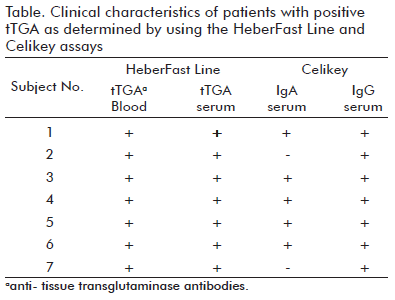
<body><![CDATA[<P   align="left" ><font face="Verdana, Arial, Helvetica, sans-serif" size="2" color="#000000"><B>Anti-tissue      transglutaminase antibodies </b></font></P >       <P   align="left" ><font face="Verdana, Arial, Helvetica, sans-serif" size="2" color="#000000">The      anti-tissue transglutaminase whole antibody response was tested in the blood      for all subjects included in the study using a fast one-step immunochromatographic      assay following the manufacturer instructions (HeberFast Line<sup>&reg;</sup>      anti-transglutaminase, Heber Biotec S.A., Havana, Cuba) (9, 10). Briefly,      HeberFast Line<sup>&reg;</sup> anti-transglutaminase assay nitrocellulose      strips placed into a plastic cassette were filled with 100 <font face="Symbol">m</font>L      either direct blood obtained by finger puncture or serum or plasma. After      20 min, positive samples were detected as two colored lines on the strips,      one in the reactive zone and the other in the control zone. A negative assay      should show only a single line in the control zone of the strip. Additionally,      IgA and IgG antitransglutaminase antibodies were determined in serum by using      the Celikey IgA and Celikey IgG Antibody Assay (Celikey Pharmacia &amp; Upjohn,      Freiburg, Germany). IgA and IgG antitransglutaminase antibodies were also      determined in parallel as a whole antibody response with the one-step immunochromatographic      assay. </font></P >   <FONT color="#FF00FF"><FONT color="#000000"><FONT color="#FF00FF"><FONT size="+1" color="#000000"><FONT size="+1"><FONT color="#FF00FF"><FONT color="#000000">        <P   align="left" ><font size="3" face="Verdana, Arial, Helvetica, sans-serif" color="#000000"><b>RESULTS</b></font><font size="2" face="Verdana, Arial, Helvetica, sans-serif" color="#000000">      </font></P >   <FONT size="+1">        <P   align="left" ><font size="2" face="Verdana, Arial, Helvetica, sans-serif" color="#000000">In      this study, for the first time in Cuba and to our knowledge in the Caribbean      region, we attempted to evaluate the prevalence of CD related antibodies among      595 (280 male/315 female) apparently healthy children, who ranged 3 years      old. Only seven children (3 male and 4 female) were positive for tTGA as determined      in blood by using the immunochromatographic assay. This result was further      confirmed by both serum immunochromatography and Celikey Tissue Transglutaminase      IgG Antibody Assay, accounting for a 1.18% seroprevalence. Among them, only      five children were positive by Celikey Tissue Transglutaminase IgA Antibody      Assay (see <a href="#tab1">table</a>). All the rest were consistently negative      in all assays. For all tTGApositive children, a biopsy was indicated but their      parents refused its achievement. </font></P >       <P   align="center" ><img src="/img/revistas/bta/v27n4/t0106410.gif"><a name="tab1"></a></P >   <FONT size="+1"><FONT color="#FF00FF"><FONT color="#000000">        
<P   align="left" ><font size="3" face="Verdana, Arial, Helvetica, sans-serif" color="#000000"><b>DISCUSSION</b></font><font size="2" face="Verdana, Arial, Helvetica, sans-serif" color="#000000">      </font></P >   <FONT size="+1">        <P   align="left" ><font size="2" face="Verdana, Arial, Helvetica, sans-serif" color="#000000">Several      studies have demonstrated that CD is common in many developing countries (2-5).      The presence of CD is largely established in many South American countries      (3, 4) and some African countries have reported a high CD prevalence (2, 5).      In the Caribbean, CD is underestimated for several reasons, for instance,      the belief that this disease does not exist and the scarce diagnostic facilities.      In Cuba, CD has been traditionally investigated by clinical and histological      studies (7), and more recently by serological methods (1, 8-15). In previous      studies, we reported the prevalence of CD in Cuba among risk groups, such      as: diabetes mellitus type 1 (2.8%) (1, 14), Down&acute;s syndrome (2.0%)      (1, 13) patient with clinical symptoms (8.95%) (1) also in the &quot;not at      risk&quot; healthy adult&acute;s population (0.5%) (15). </font></P >   <FONT size="+1">        <P   align="left" ><font face="Verdana, Arial, Helvetica, sans-serif" size="2" color="#000000">In      this work, we suspected the diagnosis of possible CD by sequentially determining      tTGA using the immunochromatographic HeberFast Line<sup>&reg;</sup> anti-transglutaminase      assay (Heber Biotec SA, Havana, Cuba), and anti-IgA and anti-IgG antibodies      with Celikey assays, respectively. Among the 595 subjects studied, seven (1.18%)      were suspected of asymptomatic CD. Biopsy histological examination of distal      duodenum or small intestine specimens remained the gold standard for a definitive      diagnosis (2). Hence, CD diagnosis in tTGA- positive children should be confirmed      by biopsy to establish the real prevalence of this disease. </font></P >   <FONT color="#FF00FF"><FONT size="+1"><FONT size="+1" color="#000000">        <P   align="left" ><font face="Verdana, Arial, Helvetica, sans-serif" size="2" color="#000000">It      has been hypothesized that most children with CD are symptomatic early in      life because of the high gluten content of infant diets (16). However, our      fin ding of 1.18% seroprevalence of possible asymptomatic CD confirms reports      from other authors who suggest that CD usually occurs without symptoms and      in most cases remains undiagnosed (2, 17). </font></P >       <P   align="left" ><font face="Verdana, Arial, Helvetica, sans-serif" size="2" color="#000000">Additionally,      we found a complete agreement between tTGA results obtained either by the      immunochromatographic assay or Celikey Transglutaminase IgG, however, we did      not fi nd a full consistency between tTGA results obtained with Celikey Transglutaminase      IgA Antibody Assays. In fact, two patients who were negative by the Celikey      Transglutaminase IgA antibody assay but positive for the HeberFast Line<sup>&reg;</sup>      and Celikey IgG antibody assay (see <a href="#tab1">table</a>). Perhaps, they      could have a selective IgA deficiency because false negative results can arise      due to IgA deficiency, a concomitant condition among CD patients (2, 18).      On the other hand, the HeberFast Line<sup>&reg;</sup> assay can detect both      IgA and IgG antibodies in up to 20 minutes by a very simple procedure and      starting from the direct samples (blood, serum or plasma) (9, 10). It has      been proven as highly sensitive for CD positive samples as non-treated patients      (1, 8-11). These patients must be confirmed by histological examination of      biopsy specimens taken from the distal duodenum or the small intestine for      definitive diagnosis (2). </font></P >   <FONT color="#FF00FF"><FONT size="+1"><FONT size="+1" color="#000000"><FONT color="#FF00FF"><FONT color="#000000"><FONT color="#FF00FF"><FONT size="+1"><FONT size="+1" color="#000000">        ]]></body>
<body><![CDATA[<P   align="left" ><font face="Verdana, Arial, Helvetica, sans-serif" size="2" color="#000000">In      summary, this study demonstrates the presence of CD markers in a sample of      apparently healthy Cuban children, from Pinar del R&iacute;o Province. Our      results highlight the relevance of screening for CD among the general population,      also demonstrates the suitability of the HeberFast Line<sup>&reg;</sup> anti-transglutaminase      assay (Heber Biotec S.A., Havana, Cuba) as an appropriate tool for this purpose.      The non invasive nature of this assay supports its application to mass screening      for CD, in order to prevent medical complications in asymptomatic children.      </font></P >   <FONT color="#FF00FF"><FONT color="#000000">        <P   align="left" > </P >       <P   align="left" ><font face="Verdana, Arial, Helvetica, sans-serif" size="3" color="#000000"><b>REFERENCES</b></font><font face="Verdana, Arial, Helvetica, sans-serif" size="2" color="#000000">      </font></P >       <!-- ref --><P   align="left" ><font face="Verdana, Arial, Helvetica, sans-serif" size="2">1. Sorell L, Galván      JA, Acevedo B. Screening of celiac disease in Cuba. In: Catassi C, Fasano      A, Corazza GR (eds.): The global village of coeliac disease. Perspectives      on Coeliac Disease, vol. II. AIC Press 2005, p. 131-5.</font></P >   <FONT size="+1">       <!-- ref --><P   align="left" ><font face="Verdana, Arial, Helvetica, sans-serif" size="2" color="#000000">2.      Fasano A, Araya M, Bhatnagar S, Cameron D, Catassi C, Dirks M, <I>et al</I>.      Celiac Disease Working Group. Federation of International Societies of Pediatric      Gastroenterology, Hepatology, and Nutrition Consensus report on celiac disease.      J Pediatr Gastroenterol Nutr 2008;47:214-9. </font></P >       <!-- ref --><P   align="left" ><font face="Verdana, Arial, Helvetica, sans-serif" size="2" color="#000000">3.      Gandolfi L, Pratesi R, Cordoba JC, Tauil PL, Gasparin M, Catassi C. Prevalence      of celiac disease among blood donors in Brazil. Am J Gastroenterol 2000;95:689-92.      </font></P >       <!-- ref --><P   align="left" ><font face="Verdana, Arial, Helvetica, sans-serif" size="2" color="#000000">4.      Gomez JC, Selvaggio GS, Viola M, Pizarro B, la Motta G, de Barrio S, <I>et      al</I>. Prevalence of celiac disease in Argentina: screening of an adult population      in the La Plata area. Am J Gastroenterol 2001;96:2700-4. </font></P >       <!-- ref --><P   align="left" ><font face="Verdana, Arial, Helvetica, sans-serif" size="2" color="#000000">5.      Catassi C, Doloretta Macis M, R&auml;tsch IM, De Virgiliis S, Cucca F. The      distribution of DQ genes in the Saharawi population provides only a partial      explanation for the high celiac disease prevalence. Tissue Antigens 2001;58:402-6.      </font></P >       <!-- ref --><P   align="left" ><font face="Verdana, Arial, Helvetica, sans-serif" size="2">6. Rostom A, Murray      JA, Kagnoff MF. American Gastroenterological Association (AGA) institute technical      review on the diagnosis and management of celiac disease. Gastroenterology      2006;131:1981-2002.</font></P >       <!-- ref --><P   align="left" ><font face="Verdana, Arial, Helvetica, sans-serif" size="2" color="#000000">7.      Rabassa EB, Sagar&oacute; E, Fragoso T, Casta&ntilde;eda C, Gra B. Celiac      disease in Cuban children. Arch Dis Child 1981;56:128-31. </font></P >       <!-- ref --><P   align="left" ><font face="Verdana, Arial, Helvetica, sans-serif" size="2" color="#000000">8.      Sorell L, Garrote JA, Galvan JA, Velazco C, Edrosa CR, Arranz E. Celiac Disease      diagnosis in patients with giardiasis: High value of antitransglutaminase      antibodies. Am J Gastroenterol 2004;99:1330-2. </font></P >       <!-- ref --><P   align="left" ><font face="Verdana, Arial, Helvetica, sans-serif" size="2" color="#000000">9.      Sorell L, Garrote JA, Acevedo B, Arranz E. One-step immunochromatographic      assay for screening of coeliac disease. Lancet 2002; 359:945-6. </font></P >       <!-- ref --><P   align="left" ><font face="Verdana, Arial, Helvetica, sans-serif" size="2" color="#000000">10.      Galv&aacute;n JA, Acevedo B, Novoa LI, Palenzuela DO, Rub&iacute; JA, Torres      E, <I>et al</I>. Development, validation and registration of the HeberFast      Line<sup>&reg;</sup> anti-transglutaminase system. Contribution to the diagnosis      of celiac disease in Cuba. Biotecnol Apl 2008;25:66-9. </font></P >   <FONT color="#FF00FF"><FONT color="#000000">       <!-- ref --><P   align="left" ><font face="Verdana, Arial, Helvetica, sans-serif" size="2">11. Cintado A, Sorell      L, Galv&aacute;n JA, Mart&iacute;nez L, Casta&ntilde;eda C, Fragoso T, <i>et      al</i>. HLA DQA1*0501 and DQB1*02 in Cuban celiac patients. Hum Immunol 2006;67:639-42.</font></P >       <!-- ref --><P   align="left" ><font face="Verdana, Arial, Helvetica, sans-serif" size="2" color="#000000">12.      S&aacute;nchez JC, Cabrera-Rode E, Sorell L, Galvan JA, Hernandez A, Molina      G, <I>et al</I>. Celiac disease associated antibodies in persons with latent      autoimmune diabetes of adult and type 2 diabetes. Autoimmunity 2007;40:103-7.      </font></P >       <!-- ref --><P   align="left" ><font face="Verdana, Arial, Helvetica, sans-serif" size="2" color="#000000">13.      Castaneda C, Alvarez-Fumero R, Sorell L, Galvan JA, Carvajal F. Screening      for celiac disease in risk groups in Cuba. J Pediatr Gastroenterol Nutr 2004;39:S211-2.      </font></P >       <!-- ref --><P   align="left" ><font face="Verdana, Arial, Helvetica, sans-serif" size="2" color="#000000">14.      Galv&aacute;n JA, Cabrera-Rode E, Molina G, D&iacute;az-Horta O, Palenzuela      DO, Novoa LI, <I>et al</I>. Celiac disease-associated antibodies in type 1      diabetes patients in Cuba. Biotecnol Apl 2008;25:47-50. </font></P >       <!-- ref --><P   align="left" ><font face="Verdana, Arial, Helvetica, sans-serif" size="2" color="#000000">15.Galv&aacute;n      JA, Lemos G, Fern&aacute;ndez de Cossio ME, Ruenes C, Mart&iacute;nez Y, Tejeda      Y, <I>et al</I>. Silent celiac disease in a cohort of healthy adults. Autoimmunity.      2009;42:705-8. </font></P >       <!-- ref --><P   align="left" ><font face="Verdana, Arial, Helvetica, sans-serif" size="2" color="#000000">16.      Ascher H, Holm K, Kristiansson B, M&auml;ki M. Different features of celiac      disease in two neighboring countries. Arch Dis Child 1993; 69:375-80. </font></P >       <!-- ref --><P   align="left" ><font face="Verdana, Arial, Helvetica, sans-serif" size="2" color="#000000">17.      Fasano A. Clinical presentation of celiac disease in the pediatric population.      Gastroenterology 2005;128:S68-S73. </font></P >       <!-- ref --><P   align="left" ><font face="Verdana, Arial, Helvetica, sans-serif" size="2" color="#000000">18.      Cataldo F, Marino V, Ventura A, Bottaro G, Corazza GR. Prevalence and clinical      features of selective immunoglobulin A deficiency in coeliac disease: an Italian      multicentre study. Italian Society of Paediatric Gastroenterology and Hepatology      (SIGEP) and &quot;Club del Tenue&quot; Working Groups on Coeliac Disease.      Gut 1998;42:362-5. </font></P >       <P   align="left" > </P >       <P   align="left" ><font size="2" face="Verdana, Arial, Helvetica, sans-serif" color="#000000">Received      in November, 2009. </font><font size="2" color="#000000">    <br>     <font face="Verdana, Arial, Helvetica, sans-serif">Accepted for publication      in August, 2010. </font></font></P >   <font size="2" face="Verdana, Arial, Helvetica, sans-serif" color="#000000">Jos&eacute;    A Galv&aacute;n, Immunodiagnostics and Genomics Division, Center for Genetic    Engineering and Biotechnology, CIGB Ave. 31 / 158 and 190, PO Box 6162, Havana,    Cuba. E-mail: <a href="mailto:armando.galvan@cigb.edu.cu">armando.galvan@cigb.edu.cu</a>    </font></font></font></font></font></font></font></font></font></font></font></font></font></font></font></font></font></font></font></font></font></font></font></font></font></font></font></font></font></font></font></font></font></font></font></font></font></font></font></font></font></font></font></font></font></font></font></font></font></font></font></font></font></font></font></font></font></font></font></font></font></font></font></font></font></font></DIV >      ]]></body><back>
<ref-list>
<ref id="B1">
<label>1</label><nlm-citation citation-type="book">
<person-group person-group-type="author">
<name>
<surname><![CDATA[Sorell]]></surname>
<given-names><![CDATA[L]]></given-names>
</name>
<name>
<surname><![CDATA[Galván]]></surname>
<given-names><![CDATA[JA]]></given-names>
</name>
<name>
<surname><![CDATA[Acevedo]]></surname>
<given-names><![CDATA[B]]></given-names>
</name>
</person-group>
<article-title xml:lang="en"><![CDATA[Screening of celiac disease in Cuba]]></article-title>
<person-group person-group-type="editor">
<name>
<surname><![CDATA[Catassi]]></surname>
<given-names><![CDATA[C]]></given-names>
</name>
<name>
<surname><![CDATA[Fasano]]></surname>
<given-names><![CDATA[A]]></given-names>
</name>
<name>
<surname><![CDATA[Corazza]]></surname>
<given-names><![CDATA[GR]]></given-names>
</name>
</person-group>
<source><![CDATA[The global village of coeliac disease: Perspectives on Coeliac Disease]]></source>
<year>2005</year>
<page-range>131-5</page-range><publisher-name><![CDATA[AIC Press]]></publisher-name>
</nlm-citation>
</ref>
<ref id="B2">
<label>2</label><nlm-citation citation-type="journal">
<person-group person-group-type="author">
<name>
<surname><![CDATA[Fasano]]></surname>
<given-names><![CDATA[A]]></given-names>
</name>
<name>
<surname><![CDATA[Araya]]></surname>
<given-names><![CDATA[M]]></given-names>
</name>
<name>
<surname><![CDATA[Bhatnagar]]></surname>
<given-names><![CDATA[S]]></given-names>
</name>
<name>
<surname><![CDATA[Cameron]]></surname>
<given-names><![CDATA[D]]></given-names>
</name>
<name>
<surname><![CDATA[Catassi]]></surname>
<given-names><![CDATA[C]]></given-names>
</name>
<name>
<surname><![CDATA[Dirks]]></surname>
<given-names><![CDATA[M]]></given-names>
</name>
</person-group>
<article-title xml:lang="en"><![CDATA[Celiac Disease Working Group: Federation of International Societies of Pediatric Gastroenterology, Hepatology, and Nutrition Consensus report on celiac disease]]></article-title>
<source><![CDATA[J Pediatr Gastroenterol Nutr]]></source>
<year>2008</year>
<volume>47</volume>
<page-range>214-9</page-range></nlm-citation>
</ref>
<ref id="B3">
<label>3</label><nlm-citation citation-type="journal">
<person-group person-group-type="author">
<name>
<surname><![CDATA[Gandolfi]]></surname>
<given-names><![CDATA[L]]></given-names>
</name>
<name>
<surname><![CDATA[Pratesi]]></surname>
<given-names><![CDATA[R]]></given-names>
</name>
<name>
<surname><![CDATA[Cordoba]]></surname>
<given-names><![CDATA[JC]]></given-names>
</name>
<name>
<surname><![CDATA[Tauil]]></surname>
<given-names><![CDATA[PL]]></given-names>
</name>
<name>
<surname><![CDATA[Gasparin]]></surname>
<given-names><![CDATA[M]]></given-names>
</name>
<name>
<surname><![CDATA[Catassi]]></surname>
<given-names><![CDATA[C]]></given-names>
</name>
</person-group>
<article-title xml:lang="en"><![CDATA[Prevalence of celiac disease among blood donors in Brazil]]></article-title>
<source><![CDATA[Am J Gastroenterol]]></source>
<year>2000</year>
<volume>95</volume>
<page-range>689-92</page-range></nlm-citation>
</ref>
<ref id="B4">
<label>4</label><nlm-citation citation-type="journal">
<person-group person-group-type="author">
<name>
<surname><![CDATA[Gomez]]></surname>
<given-names><![CDATA[JC]]></given-names>
</name>
<name>
<surname><![CDATA[Selvaggio]]></surname>
<given-names><![CDATA[GS]]></given-names>
</name>
<name>
<surname><![CDATA[Viola]]></surname>
<given-names><![CDATA[M]]></given-names>
</name>
<name>
<surname><![CDATA[Pizarro]]></surname>
<given-names><![CDATA[B]]></given-names>
</name>
<name>
<surname><![CDATA[la Motta]]></surname>
<given-names><![CDATA[G]]></given-names>
</name>
<name>
<surname><![CDATA[de Barrio]]></surname>
<given-names><![CDATA[S]]></given-names>
</name>
</person-group>
<article-title xml:lang="en"><![CDATA[Prevalence of celiac disease in Argentina: screening of an adult population in the La Plata area]]></article-title>
<source><![CDATA[Am J Gastroenterol]]></source>
<year>2001</year>
<volume>96</volume>
<page-range>2700-4</page-range></nlm-citation>
</ref>
<ref id="B5">
<label>5</label><nlm-citation citation-type="journal">
<person-group person-group-type="author">
<name>
<surname><![CDATA[Catassi]]></surname>
<given-names><![CDATA[C]]></given-names>
</name>
<name>
<surname><![CDATA[Doloretta Macis]]></surname>
<given-names><![CDATA[M]]></given-names>
</name>
<name>
<surname><![CDATA[Rätsch]]></surname>
<given-names><![CDATA[IM]]></given-names>
</name>
<name>
<surname><![CDATA[De Virgiliis]]></surname>
<given-names><![CDATA[S]]></given-names>
</name>
<name>
<surname><![CDATA[Cucca]]></surname>
<given-names><![CDATA[F]]></given-names>
</name>
</person-group>
<article-title xml:lang="en"><![CDATA[The distribution of DQ genes in the Saharawi population provides only a partial explanation for the high celiac disease prevalence]]></article-title>
<source><![CDATA[Tissue Antigens]]></source>
<year>2001</year>
<volume>58</volume>
<page-range>402-6</page-range></nlm-citation>
</ref>
<ref id="B6">
<label>6</label><nlm-citation citation-type="journal">
<person-group person-group-type="author">
<name>
<surname><![CDATA[Rostom]]></surname>
<given-names><![CDATA[A]]></given-names>
</name>
<name>
<surname><![CDATA[Murray]]></surname>
<given-names><![CDATA[JA]]></given-names>
</name>
<name>
<surname><![CDATA[Kagnoff]]></surname>
<given-names><![CDATA[MF]]></given-names>
</name>
</person-group>
<article-title xml:lang="en"><![CDATA[American Gastroenterological Association (AGA) institute technical review on the diagnosis and management of celiac disease]]></article-title>
<source><![CDATA[Gastroenterology]]></source>
<year>2006</year>
<volume>131</volume>
<page-range>1981-2002</page-range></nlm-citation>
</ref>
<ref id="B7">
<label>7</label><nlm-citation citation-type="journal">
<person-group person-group-type="author">
<name>
<surname><![CDATA[Rabassa]]></surname>
<given-names><![CDATA[EB]]></given-names>
</name>
<name>
<surname><![CDATA[Sagaró]]></surname>
<given-names><![CDATA[E]]></given-names>
</name>
<name>
<surname><![CDATA[Fragoso]]></surname>
<given-names><![CDATA[T]]></given-names>
</name>
<name>
<surname><![CDATA[Castañeda]]></surname>
<given-names><![CDATA[C]]></given-names>
</name>
<name>
<surname><![CDATA[Gra]]></surname>
<given-names><![CDATA[B]]></given-names>
</name>
</person-group>
<article-title xml:lang="en"><![CDATA[Celiac disease in Cuban children]]></article-title>
<source><![CDATA[Arch Dis Child]]></source>
<year>1981</year>
<volume>56</volume>
<page-range>128-31</page-range></nlm-citation>
</ref>
<ref id="B8">
<label>8</label><nlm-citation citation-type="journal">
<person-group person-group-type="author">
<name>
<surname><![CDATA[Sorell]]></surname>
<given-names><![CDATA[L]]></given-names>
</name>
<name>
<surname><![CDATA[Garrote]]></surname>
<given-names><![CDATA[JA]]></given-names>
</name>
<name>
<surname><![CDATA[Galvan]]></surname>
<given-names><![CDATA[JA]]></given-names>
</name>
<name>
<surname><![CDATA[Velazco]]></surname>
<given-names><![CDATA[C]]></given-names>
</name>
<name>
<surname><![CDATA[Edrosa]]></surname>
<given-names><![CDATA[CR]]></given-names>
</name>
<name>
<surname><![CDATA[Arranz]]></surname>
<given-names><![CDATA[E]]></given-names>
</name>
</person-group>
<article-title xml:lang="en"><![CDATA[Celiac Disease diagnosis in patients with giardiasis: High value of antitransglutaminase antibodies]]></article-title>
<source><![CDATA[Am J Gastroenterol]]></source>
<year>2004</year>
<volume>99</volume>
<page-range>1330-2</page-range></nlm-citation>
</ref>
<ref id="B9">
<label>9</label><nlm-citation citation-type="journal">
<person-group person-group-type="author">
<name>
<surname><![CDATA[Sorell]]></surname>
<given-names><![CDATA[L]]></given-names>
</name>
<name>
<surname><![CDATA[Garrote]]></surname>
<given-names><![CDATA[JA]]></given-names>
</name>
<name>
<surname><![CDATA[Acevedo]]></surname>
<given-names><![CDATA[B]]></given-names>
</name>
<name>
<surname><![CDATA[Arranz]]></surname>
<given-names><![CDATA[E]]></given-names>
</name>
</person-group>
<article-title xml:lang="en"><![CDATA[One-step immunochromatographic assay for screening of coeliac disease]]></article-title>
<source><![CDATA[Lancet]]></source>
<year>2002</year>
<volume>359</volume>
<page-range>945-6</page-range></nlm-citation>
</ref>
<ref id="B10">
<label>10</label><nlm-citation citation-type="journal">
<person-group person-group-type="author">
<name>
<surname><![CDATA[Galván]]></surname>
<given-names><![CDATA[JA]]></given-names>
</name>
<name>
<surname><![CDATA[Acevedo]]></surname>
<given-names><![CDATA[B]]></given-names>
</name>
<name>
<surname><![CDATA[Novoa]]></surname>
<given-names><![CDATA[LI]]></given-names>
</name>
<name>
<surname><![CDATA[Palenzuela]]></surname>
<given-names><![CDATA[DO]]></given-names>
</name>
<name>
<surname><![CDATA[Rubí]]></surname>
<given-names><![CDATA[JA]]></given-names>
</name>
<name>
<surname><![CDATA[Torres]]></surname>
<given-names><![CDATA[E]]></given-names>
</name>
</person-group>
<article-title xml:lang="en"><![CDATA[Development, validation and registration of the HeberFast Line®anti-transglutaminase system: Contribution to the diagnosis of celiac disease in Cuba]]></article-title>
<source><![CDATA[Biotecnol Apl]]></source>
<year>2008</year>
<volume>25</volume>
<page-range>66-9</page-range></nlm-citation>
</ref>
<ref id="B11">
<label>11</label><nlm-citation citation-type="journal">
<person-group person-group-type="author">
<name>
<surname><![CDATA[Cintado]]></surname>
<given-names><![CDATA[A]]></given-names>
</name>
<name>
<surname><![CDATA[Sorell]]></surname>
<given-names><![CDATA[L]]></given-names>
</name>
<name>
<surname><![CDATA[Galván]]></surname>
<given-names><![CDATA[JA]]></given-names>
</name>
<name>
<surname><![CDATA[Martínez]]></surname>
<given-names><![CDATA[L]]></given-names>
</name>
<name>
<surname><![CDATA[Castañeda]]></surname>
<given-names><![CDATA[C]]></given-names>
</name>
<name>
<surname><![CDATA[Fragoso]]></surname>
<given-names><![CDATA[T]]></given-names>
</name>
</person-group>
<article-title xml:lang="en"><![CDATA[HLA DQA1*0501 and DQB1*02 in Cuban celiac patients]]></article-title>
<source><![CDATA[Hum Immunol]]></source>
<year>2006</year>
<volume>67</volume>
<page-range>639-42</page-range></nlm-citation>
</ref>
<ref id="B12">
<label>12</label><nlm-citation citation-type="journal">
<person-group person-group-type="author">
<name>
<surname><![CDATA[Sánchez]]></surname>
<given-names><![CDATA[JC]]></given-names>
</name>
<name>
<surname><![CDATA[Cabrera-Rode]]></surname>
<given-names><![CDATA[E]]></given-names>
</name>
<name>
<surname><![CDATA[Sorell]]></surname>
<given-names><![CDATA[L]]></given-names>
</name>
<name>
<surname><![CDATA[Galvan]]></surname>
<given-names><![CDATA[JA]]></given-names>
</name>
<name>
<surname><![CDATA[Hernandez]]></surname>
<given-names><![CDATA[A]]></given-names>
</name>
<name>
<surname><![CDATA[Molina]]></surname>
<given-names><![CDATA[G]]></given-names>
</name>
</person-group>
<article-title xml:lang="en"><![CDATA[Celiac disease associated antibodies in persons with latent autoimmune diabetes of adult and type 2 diabetes]]></article-title>
<source><![CDATA[Autoimmunity]]></source>
<year>2007</year>
<volume>40</volume>
<page-range>103-7</page-range></nlm-citation>
</ref>
<ref id="B13">
<label>13</label><nlm-citation citation-type="journal">
<person-group person-group-type="author">
<name>
<surname><![CDATA[Castaneda]]></surname>
<given-names><![CDATA[C]]></given-names>
</name>
<name>
<surname><![CDATA[Alvarez-Fumero]]></surname>
<given-names><![CDATA[R]]></given-names>
</name>
<name>
<surname><![CDATA[Sorell]]></surname>
<given-names><![CDATA[L]]></given-names>
</name>
<name>
<surname><![CDATA[Galvan]]></surname>
<given-names><![CDATA[JA]]></given-names>
</name>
<name>
<surname><![CDATA[Carvajal]]></surname>
<given-names><![CDATA[F]]></given-names>
</name>
</person-group>
<article-title xml:lang="en"><![CDATA[Screening for celiac disease in risk groups in Cuba]]></article-title>
<source><![CDATA[J Pediatr Gastroenterol Nutr]]></source>
<year>2004</year>
<volume>39</volume>
<page-range>S211-2</page-range></nlm-citation>
</ref>
<ref id="B14">
<label>14</label><nlm-citation citation-type="journal">
<person-group person-group-type="author">
<name>
<surname><![CDATA[Galván]]></surname>
<given-names><![CDATA[JA]]></given-names>
</name>
<name>
<surname><![CDATA[Cabrera-Rode]]></surname>
<given-names><![CDATA[E]]></given-names>
</name>
<name>
<surname><![CDATA[Molina]]></surname>
<given-names><![CDATA[G]]></given-names>
</name>
<name>
<surname><![CDATA[Díaz-Horta]]></surname>
<given-names><![CDATA[O]]></given-names>
</name>
<name>
<surname><![CDATA[Palenzuela]]></surname>
<given-names><![CDATA[DO]]></given-names>
</name>
<name>
<surname><![CDATA[Novoa]]></surname>
<given-names><![CDATA[LI]]></given-names>
</name>
</person-group>
<article-title xml:lang="en"><![CDATA[Celiac disease-associated antibodies in type 1 diabetes patients in Cuba]]></article-title>
<source><![CDATA[Biotecnol Apl]]></source>
<year>2008</year>
<volume>25</volume>
<page-range>47-50</page-range></nlm-citation>
</ref>
<ref id="B15">
<label>15</label><nlm-citation citation-type="journal">
<person-group person-group-type="author">
<name>
<surname><![CDATA[Galván]]></surname>
<given-names><![CDATA[JA]]></given-names>
</name>
<name>
<surname><![CDATA[Lemos]]></surname>
<given-names><![CDATA[G]]></given-names>
</name>
<name>
<surname><![CDATA[Fernández de Cossio]]></surname>
<given-names><![CDATA[ME]]></given-names>
</name>
<name>
<surname><![CDATA[Ruenes]]></surname>
<given-names><![CDATA[C]]></given-names>
</name>
<name>
<surname><![CDATA[Martínez]]></surname>
<given-names><![CDATA[Y]]></given-names>
</name>
<name>
<surname><![CDATA[Tejeda]]></surname>
<given-names><![CDATA[Y]]></given-names>
</name>
</person-group>
<article-title xml:lang="en"><![CDATA[Silent celiac disease in a cohort of healthy adults]]></article-title>
<source><![CDATA[Autoimmunity]]></source>
<year>2009</year>
<volume>42</volume>
<page-range>705-8</page-range></nlm-citation>
</ref>
<ref id="B16">
<label>16</label><nlm-citation citation-type="journal">
<person-group person-group-type="author">
<name>
<surname><![CDATA[Ascher]]></surname>
<given-names><![CDATA[H]]></given-names>
</name>
<name>
<surname><![CDATA[Holm]]></surname>
<given-names><![CDATA[K]]></given-names>
</name>
<name>
<surname><![CDATA[Kristiansson]]></surname>
<given-names><![CDATA[B]]></given-names>
</name>
<name>
<surname><![CDATA[Mäki]]></surname>
<given-names><![CDATA[M]]></given-names>
</name>
</person-group>
<article-title xml:lang="en"><![CDATA[Different features of celiac disease in two neighboring countries]]></article-title>
<source><![CDATA[Arch Dis Child]]></source>
<year>1993</year>
<volume>69</volume>
<page-range>375-80</page-range></nlm-citation>
</ref>
<ref id="B17">
<label>17</label><nlm-citation citation-type="journal">
<person-group person-group-type="author">
<name>
<surname><![CDATA[Fasano]]></surname>
<given-names><![CDATA[A]]></given-names>
</name>
</person-group>
<article-title xml:lang="en"><![CDATA[Clinical presentation of celiac disease in the pediatric population]]></article-title>
<source><![CDATA[Gastroenterology]]></source>
<year>2005</year>
<volume>128</volume>
<page-range>S68-S73</page-range></nlm-citation>
</ref>
<ref id="B18">
<label>18</label><nlm-citation citation-type="journal">
<person-group person-group-type="author">
<name>
<surname><![CDATA[Cataldo]]></surname>
<given-names><![CDATA[F]]></given-names>
</name>
<name>
<surname><![CDATA[Marino]]></surname>
<given-names><![CDATA[V]]></given-names>
</name>
<name>
<surname><![CDATA[Ventura]]></surname>
<given-names><![CDATA[A]]></given-names>
</name>
<name>
<surname><![CDATA[Bottaro]]></surname>
<given-names><![CDATA[G]]></given-names>
</name>
<name>
<surname><![CDATA[Corazza]]></surname>
<given-names><![CDATA[GR]]></given-names>
</name>
</person-group>
<article-title xml:lang="en"><![CDATA[Prevalence and clinical features of selective immunoglobulin A deficiency in coeliac disease: an Italian multicentre study. Italian Society of Paediatric Gastroenterology and Hepatology (SIGEP) and “Club del Tenue” Working Groups on Coeliac Disease]]></article-title>
<source><![CDATA[Gut]]></source>
<year>1998</year>
<volume>42</volume>
<page-range>362-5</page-range></nlm-citation>
</ref>
</ref-list>
</back>
</article>
