<?xml version="1.0" encoding="ISO-8859-1"?><article xmlns:mml="http://www.w3.org/1998/Math/MathML" xmlns:xlink="http://www.w3.org/1999/xlink" xmlns:xsi="http://www.w3.org/2001/XMLSchema-instance">
<front>
<journal-meta>
<journal-id>1027-2852</journal-id>
<journal-title><![CDATA[Biotecnología Aplicada]]></journal-title>
<abbrev-journal-title><![CDATA[Biotecnol Apl]]></abbrev-journal-title>
<issn>1027-2852</issn>
<publisher>
<publisher-name><![CDATA[Editorial Elfos Scientiae]]></publisher-name>
</publisher>
</journal-meta>
<article-meta>
<article-id>S1027-28522010000400010</article-id>
<title-group>
<article-title xml:lang="en"><![CDATA[Contribution to the phytochemical study and biological activity of plants of Cuban flora]]></article-title>
</title-group>
<contrib-group>
<contrib contrib-type="author">
<name>
<surname><![CDATA[Nogueiras]]></surname>
<given-names><![CDATA[Clara]]></given-names>
</name>
<xref ref-type="aff" rid="A01"/>
</contrib>
<contrib contrib-type="author">
<name>
<surname><![CDATA[Spengler]]></surname>
<given-names><![CDATA[Iraida]]></given-names>
</name>
<xref ref-type="aff" rid="A01"/>
</contrib>
<contrib contrib-type="author">
<name>
<surname><![CDATA[Guerra]]></surname>
<given-names><![CDATA[José O]]></given-names>
</name>
<xref ref-type="aff" rid="A03"/>
</contrib>
<contrib contrib-type="author">
<name>
<surname><![CDATA[Ortiz]]></surname>
<given-names><![CDATA[Yarelys]]></given-names>
</name>
<xref ref-type="aff" rid="A02"/>
</contrib>
<contrib contrib-type="author">
<name>
<surname><![CDATA[Torres]]></surname>
<given-names><![CDATA[Susana]]></given-names>
</name>
<xref ref-type="aff" rid="A01"/>
</contrib>
<contrib contrib-type="author">
<name>
<surname><![CDATA[García]]></surname>
<given-names><![CDATA[Trina H]]></given-names>
</name>
<xref ref-type="aff" rid="A01"/>
</contrib>
<contrib contrib-type="author">
<name>
<surname><![CDATA[Romeu]]></surname>
<given-names><![CDATA[Carlos R]]></given-names>
</name>
<xref ref-type="aff" rid="A04"/>
</contrib>
<contrib contrib-type="author">
<name>
<surname><![CDATA[Regalado]]></surname>
<given-names><![CDATA[Erik L]]></given-names>
</name>
<xref ref-type="aff" rid="A05"/>
</contrib>
<contrib contrib-type="author">
<name>
<surname><![CDATA[González]]></surname>
<given-names><![CDATA[Telce A]]></given-names>
</name>
<xref ref-type="aff" rid="A06"/>
</contrib>
<contrib contrib-type="author">
<name>
<surname><![CDATA[Perera]]></surname>
<given-names><![CDATA[Wilmer H]]></given-names>
</name>
<xref ref-type="aff" rid="A07"/>
</contrib>
<contrib contrib-type="author">
<name>
<surname><![CDATA[Lacret]]></surname>
<given-names><![CDATA[Rodney]]></given-names>
</name>
<xref ref-type="aff" rid="A01"/>
</contrib>
</contrib-group>
<aff id="A02">
<institution><![CDATA[,Instituto de Investigaciones Fundamentales de la Agricultura Tropical, INIFAT  ]]></institution>
<addr-line><![CDATA[ ]]></addr-line>
</aff>
<aff id="A03">
<institution><![CDATA[,Universidad Central de Las Villas Martha Abreu  ]]></institution>
<addr-line><![CDATA[Villa Clara ]]></addr-line>
<country>Cuba</country>
</aff>
<aff id="A04">
<institution><![CDATA[,Instituto de Sanidad Vegetal, INISAV  ]]></institution>
<addr-line><![CDATA[ ]]></addr-line>
</aff>
<aff id="A05">
<institution><![CDATA[,Centro de Bioproductos Marinos, CEBIMAR  ]]></institution>
<addr-line><![CDATA[ ]]></addr-line>
</aff>
<aff id="A06">
<institution><![CDATA[,Instituto de Investigaciones del Arroz  ]]></institution>
<addr-line><![CDATA[ ]]></addr-line>
</aff>
<aff id="A07">
<institution><![CDATA[,CITMA Instituto de Ecología y Sistemática de las Plantas ]]></institution>
<addr-line><![CDATA[Ciudad de La Habana ]]></addr-line>
<country>Cuba</country>
</aff>
<aff id="A01">
<institution><![CDATA[,Universidad de La Habana Facultad de Química Centro de Estudios de Productos Naturales]]></institution>
<addr-line><![CDATA[Ciudad de La Habana ]]></addr-line>
<country>Cuba</country>
</aff>
<pub-date pub-type="pub">
<day>00</day>
<month>12</month>
<year>2010</year>
</pub-date>
<pub-date pub-type="epub">
<day>00</day>
<month>12</month>
<year>2010</year>
</pub-date>
<volume>27</volume>
<numero>4</numero>
<fpage>314</fpage>
<lpage>318</lpage>
<copyright-statement/>
<copyright-year/>
<self-uri xlink:href="http://scielo.sld.cu/scielo.php?script=sci_arttext&amp;pid=S1027-28522010000400010&amp;lng=en&amp;nrm=iso"></self-uri><self-uri xlink:href="http://scielo.sld.cu/scielo.php?script=sci_abstract&amp;pid=S1027-28522010000400010&amp;lng=en&amp;nrm=iso"></self-uri><self-uri xlink:href="http://scielo.sld.cu/scielo.php?script=sci_pdf&amp;pid=S1027-28522010000400010&amp;lng=en&amp;nrm=iso"></self-uri><abstract abstract-type="short" xml:lang="en"><p><![CDATA[Interest in natural products as a source for innovation in drug discovery and agrochemicals is still growing worldwide. Natural products, whose immense diversity has been appreciated for many years, may become in a rich source of novel chemical structures. Our country is a rich source of both biological and chemical diversity which may be useful as a source of novel chemical structures. Even when natural products have been used as medicinal agents for many years in Cuba, their use as agrochemicals are still limited. Thus, the present review focuses on recent advances in the studies on natural products performed by the "Centro de Estudios de Productos Naturales, CEPN" during the past ten years, highlighting on those with potential use as biomedical and agrochemicals. 15 plant species were studied; Agave brittoniana Trel. Subsp. brachypus A Álvarez de Zayas (Agavaceae); Juniperus barbadensis L. var. Lucayana (Britt.) RP Adams (Cupressaceae); Melia azedarach Linn. (Meliaceae); Tectona grandis Linn. f. (Lamiaceae); Lantana camara Linn. (Verbenaceae); Lantana trifolia Cham. (Verbenaceae); Citrus sinensis (Linn.) Osbeck cv Valencia (Rutaceae); Maytenus buxifolia (A Rich) Griseb (Celastraceae); Maytenus elaeodendroides Griseb (Celastraceae); Maytenus urquiolae B Mory (Celastraceae); Solanum americanum W. Mill (Solanaceae); Thalassia testudinum Kon. (Hydrocharitaceae); Sesbania rostrata Bremek & Oberm (Fabaceae); Pluchea carolinensis G Don (Asteraceae) and Ageratina havanensis (HB & K) RM King & Robinson (Asteraceae). By means of a bio-guided fractionation, isolated structures as well as semi-purified fractions were assayed as antioxidant, antiparasitic, antibiotic, insecticides, antifungal, and skin regenerating and healing effects. The strategy employed allows us to discover novel secondary metabolites with potential for industrial development as pharmaceuticals and/or agrochemicals. Besides, in addition to the goal of discovering new bioactive agents, the presence of unique bioactive compounds notably contribute to increase the knowledge of plant species in Cuba.]]></p></abstract>
<kwd-group>
<kwd lng="en"><![CDATA[bioactivity of Cuban plants]]></kwd>
<kwd lng="en"><![CDATA[flavonoids]]></kwd>
<kwd lng="en"><![CDATA[saponins and steroidal sapogenins]]></kwd>
<kwd lng="en"><![CDATA[terpenoids and triterpenoids]]></kwd>
<kwd lng="en"><![CDATA[quinones and phenolic compounds]]></kwd>
</kwd-group>
</article-meta>
</front><body><![CDATA[ <DIV class="Sect"   >        <P   align="right" ><font size="2" color="#000000" face="Verdana, Arial, Helvetica, sans-serif"><b>REPORT</b>      </font></P >   <FONT size="+1" color="#000000">        <P   align="left" >&nbsp;</P >       <P   align="left" ><font size="2" face="Verdana, Arial, Helvetica, sans-serif" color="#000000"><B><font size="4">Contribution      to the phytochemical study and biological activity of plants of Cuban flora      </font> </b></font></P >   <FONT size="+1">        <P   align="left" >&nbsp;</P >       <P   align="left" >&nbsp;</P >       <P   align="left" ><font face="Verdana, Arial, Helvetica, sans-serif" color="#000000" size="2"><b>Clara      Nogueiras<sup>1</sup>, Iraida Spengler<sup>1</sup>, Jos&eacute; O Guerra<sup>3</sup>,      Yarelys Ortiz<sup>2</sup>, Susana Torres<sup>1</sup>, Trina H Garc&iacute;a<sup>1</sup>,      Carlos R Romeu<sup>4</sup>, Erik L Regalado<sup>5</sup>, Telce A Gonz&aacute;lez<sup>6</sup>,      Wilmer H Perera<sup>7</sup>, Rodney Lacret<sup>1 </sup></b></font></P >   <FONT size="+1"><FONT size="+1"><FONT size="+1"><FONT size="+1"><FONT size="+1"><FONT size="+1"><FONT size="+1"><FONT size="+1"><FONT size="+1"><FONT size="+1"><FONT size="+1"><FONT size="+1"><FONT size="+1"><FONT size="+1"><FONT size="+1"><FONT size="+1"><FONT size="+1"><FONT size="+1"><FONT size="+1"><FONT size="+1"><FONT size="+1"><FONT size="+1">        <P   align="left" ><font size="2" face="Verdana, Arial, Helvetica, sans-serif" color="#000000">1      Centro de Estudios de Productos Naturales, Facultad de Qu&iacute;mica, Universidad      de La Habana, UH Zapata y G s/n, CP 10 300, Ciudad de La Habana, Cuba </font><font color="#000000" size="2">    <br>     <font face="Verdana, Arial, Helvetica, sans-serif">2 Instituto de Investigaciones      Fundamentales de la Agricultura Tropical, INIFAT </font>    <br>     <font face="Verdana, Arial, Helvetica, sans-serif">3 Universidad Central de      Las Villas &quot;Martha Abreu&quot; Villa Clara, Cuba </font>    ]]></body>
<body><![CDATA[<br>     <font face="Verdana, Arial, Helvetica, sans-serif">4 Instituto de Sanidad      Vegetal, INISAV </font>    <br>     <font face="Verdana, Arial, Helvetica, sans-serif">5 Centro de Bioproductos      Marinos, CEBIMAR </font>    <br>     <font face="Verdana, Arial, Helvetica, sans-serif">6 Instituto de Investigaciones      del Arroz </font>    <br>     <font face="Verdana, Arial, Helvetica, sans-serif">7 Instituto de Ecolog&iacute;a      y Sistem&aacute;tica de las Plantas, CITMA Ciudad de La Habana, Cuba </font></font></P >       <P   align="left" >&nbsp;</P >   </font></font></font></font></font></font></font></font></font></font></font></font></font></font></font></font></font></font></font></font></font></font></font></font>   <hr>   <FONT size="+1" color="#000000"><FONT size="+1"><FONT size="+1"><FONT size="+1"><FONT size="+1"><FONT size="+1"><FONT size="+1"><FONT size="+1"><FONT size="+1"><FONT size="+1"><FONT size="+1"><FONT size="+1"><FONT size="+1"><FONT size="+1"><FONT size="+1"><FONT size="+1"><FONT size="+1"><FONT size="+1"><FONT size="+1"><FONT size="+1"><FONT size="+1"><FONT size="+1"><FONT size="+1"><FONT size="+1">        <P   align="left" ><font face="Verdana, Arial, Helvetica, sans-serif" color="#000000" size="2"><B>ABSTRACT<I>      </I></b></font></P >   <FONT size="+1"><FONT size="+1"><FONT size="+1"><FONT size="+1"><FONT size="+1"><FONT size="+1"><FONT size="+1"><FONT size="+1"><FONT size="+1"><FONT size="+1"><FONT size="+1"><FONT size="+1"><FONT size="+1"><FONT size="+1"><FONT color="#0000FF"><FONT color="#000000">        <P   align="left" ><font face="Verdana, Arial, Helvetica, sans-serif" color="#000000" size="2">Interest      in natural products as a source for innovation in drug discovery and agrochemicals      is still growing worldwide. Natural products, whose immense diversity has      been appreciated for many years, may become in a rich source of novel chemical      structures. Our country is a rich source of both biological and chemical diversity      which may be useful as a source of novel chemical structures. Even when natural      products have been used as medicinal agents for many years in Cuba, their      use as agrochemicals are still limited. Thus, the present review focuses on      recent advances in the studies on natural products performed by the &quot;Centro      de Estudios de Productos Naturales, CEPN&quot; during the past ten years,      highlighting on those with potential use as biomedical and agrochemicals.      15 plant species were studied; <I>Agave brittoniana </I>Trel. Subsp. brachypus      A &Aacute;lvarez de Zayas (<I>Agavaceae</I>); <I>Juniperus barbadensis </I>L.      var. <I>Lucayana </I>(Britt.) RP Adams (<I>Cupressaceae</I>); Melia azedarach      Linn. (<I>Meliaceae</I>); <I>Tectona grandis </I>Linn. f. (<I>Lamiaceae</I>);      <I>Lantana camara </I>Linn. (Verbenaceae); Lantana trifolia Cham. (Verbenaceae);      <I>Citrus sinensis </I>(Linn.) Osbeck cv Valencia (Rutaceae); <I>Maytenus      buxifolia </I>(A Rich) <I>Griseb </I>(<I>Celastraceae</I>); <I>Maytenus elaeodendroides      </I>Griseb (<I>Celastraceae</I>); <I>Maytenus urquiolae </I>B Mory (<I>Celastraceae</I>);      <I>Solanum americanum </I>W. Mill (<I>Solanaceae</I>); <I>Thalassia testudinum      </I>Kon. (<I>Hydrocharitaceae</I>); <I>Sesbania rostrata </I>Bremek &amp;      Oberm (<I>Fabaceae</I>); <I>Pluchea carolinensis </I>G Don (<I>Asteraceae</I>)      and <I>Ageratina havanensis </I>(HB &amp; K) RM King &amp; Robinson (<I>Asteraceae</I>).      By means of a bio-guided fractionation, isolated structures as well as semi-purified      fractions were assayed as antioxidant, antiparasitic, antibiotic, insecticides,      antifungal, and skin regenerating and healing effects. The strategy employed      allows us to discover novel secondary metabolites with potential for industrial      development as pharmaceuticals and/or agrochemicals. Besides, in addition      to the goal of discovering new bioactive agents, the presence of unique bioactive      compounds notably contribute to increase the knowledge of plant species in      Cuba. </font></P >       <P   align="left" ><font face="Verdana, Arial, Helvetica, sans-serif" color="#000000" size="2"><b>Keywords</b>:      bioactivity of Cuban plants, flavonoids, saponins and steroidal sapogenins,      terpenoids and triterpenoids, quinones and phenolic compounds. </font></P >   </font></font></font></font></font></font></font></font></font></font></font></font></font></font></font></font></font></font></font></font></font></font></font></font></font></font></font></font></font></font></font></font></font></font></font></font></font></font></font></font>   <hr>   <FONT size="+1" color="#000000"><FONT size="+1"><FONT size="+1"><FONT size="+1"><FONT size="+1"><FONT size="+1"><FONT size="+1"><FONT size="+1"><FONT size="+1"><FONT size="+1"><FONT size="+1"><FONT size="+1"><FONT size="+1"><FONT size="+1"><FONT size="+1"><FONT size="+1"><FONT size="+1"><FONT size="+1"><FONT size="+1"><FONT size="+1"><FONT size="+1"><FONT size="+1"><FONT size="+1"><FONT size="+1"><FONT size="+1"><FONT size="+1"><FONT size="+1"><FONT size="+1"><FONT size="+1"><FONT size="+1"><FONT size="+1"><FONT size="+1"><FONT size="+1"><FONT size="+1"><FONT size="+1"><FONT size="+1"><FONT size="+1"><FONT size="+1"><FONT color="#0000FF"><FONT color="#000000">        <P   align="left" >&nbsp;</P >       <P   align="left" >&nbsp;</P >       ]]></body>
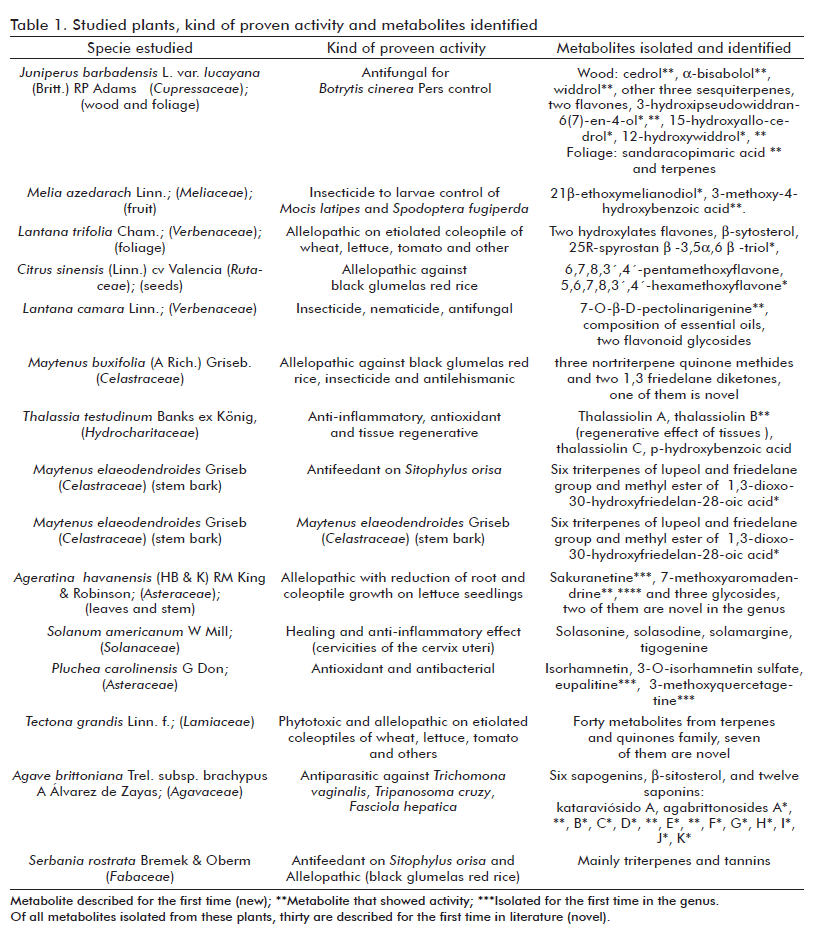
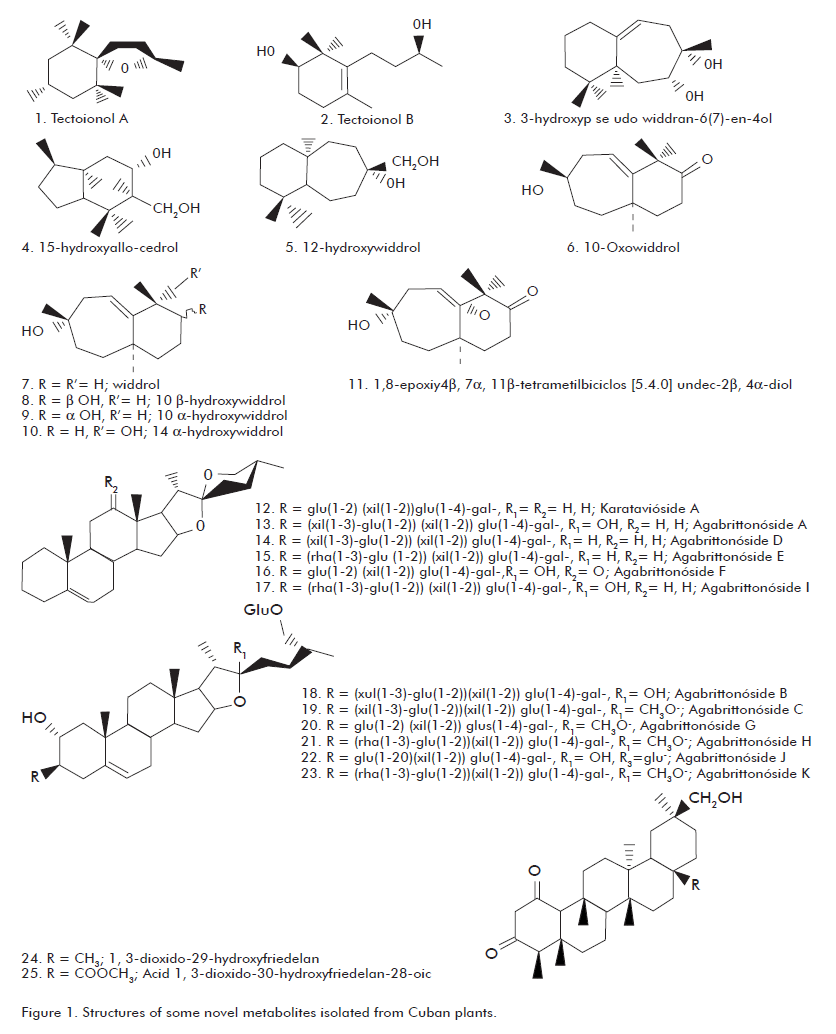
<body><![CDATA[<P   align="left" ><font size="3" face="Verdana, Arial, Helvetica, sans-serif" color="#000000"><b>INTRODUCTION</b></font><font size="2" face="Verdana, Arial, Helvetica, sans-serif" color="#000000">      </font></P >   <FONT size="+1">        <P   align="left" ><font size="2" face="Verdana, Arial, Helvetica, sans-serif" color="#000000">Natural      products from plants continue as a source for innovation in drug discovery.      Scientists are still exploring terrestrial and marine organisms for potentially      valuable medical products since they have developed biochemical and physiological      mechanisms that include the production of bioactive compounds for their protection.      Many of these metabolites may play a general cellular role and thus they can      be useful for their pharmacological action. In many cases, natural products      have provided compounds as clinical/ marketed drugs, or as biochemical tools      that demonstrate the role of specific pathways in disease and the potential      of finding drugs. </font></P >   <FONT size="+1">        <P   align="left" ><font face="Verdana, Arial, Helvetica, sans-serif" color="#000000" size="2">Several      investigations have described many molecules from natural sources that due      to their relative low side effects and high efficacy, in comparison with those      obtained from chemical synthesis, can be useful in the treatment of several      human diseases [1, 2]. During 2001 and 2005 about 23 compounds useful to improve      the therapy in cancer, diabetes, and atypical dermatitis and neurodegenerative      diseases have been obtained by pharmacology research in the discovery and      development of novel natural compounds. Also, they have been studied to expand      the treatment of bacterial, fungal and immunosuppressive therapy [3, 4]. However,      natural product compounds not only serve as drugs or templates for drugs directly,      but in many cases they can be useful as bioplaguicides [5, 6]. </font></P >       <P   align="left" ><font face="Verdana, Arial, Helvetica, sans-serif" color="#000000" size="2">Our      country is a rich source of both biological and chemical diversity. This diversity      may be useful as a source of unique chemical compounds with the potential      for industrial development as pharmaceuticals, cosmetics, nutritional supplements,      molecular probes and agrochemicals. Despite this, researches in the use of      natural products as pharmaceutical agents are still limited. While our large      biodiversity offers a wide resource for novel compounds, it also represents      a great challenge for researches that requires inputs from various scientific      areas to bring this chemical diversity up to its therapeutic use. Accordingly,      one of the major aims of the team of phytochemistry from the Centro de Estudios      de Productos Naturales (CEPN), Faculty of Chemistry, University of Havana,      has been to develop scientific projects focused on the identification of new      compounds with potential for industrial development as pharmaceuticals and/or      agrochemicals. </font></P >       <P   align="left" ><font face="Verdana, Arial, Helvetica, sans-serif" color="#000000" size="2">The      purpose of this review is to highlight some of the principal findings obtained      during the past ten years by our group, with special reference to the biomedical      and agrochemical potential of new structures as well as semipurified fractions.      With this aim, antioxidant, antiparasitic, insecticides, antifungal and skin      regenerating effects were studied in 15 plant species that in some cases had      not been previously explored. </font></P >       <P   align="left" ><font size="3" face="Verdana, Arial, Helvetica, sans-serif" color="#000000"><b>RESULTS      AND DISCUSSION</b></font><font size="2" face="Verdana, Arial, Helvetica, sans-serif" color="#000000">      </font></P >   <FONT size="+1">        <P   align="left" ><font size="2" face="Verdana, Arial, Helvetica, sans-serif" color="#000000">The      most important results are shown in <a href="/img/revistas/bta/v27n4/t0110410.gif">table      1</a> and <a href="/img/revistas/bta/v27n4/f0110410.gif">figure 1</a>.      <a href="/img/revistas/bta/v27n4/t0110410.gif">Table 1</a> shows the      plants under study, the biological activity as well as the isolated metabolites      from each plant species. The plants were selected according to chemotaxonomic,      ethno-botanic and availability criteria. <a href="/img/revistas/bta/v27n4/f0110410.gif">Figure      1</a> shows 25 novel metabolites isolated from some of these plants. Besides,      metabolites produced by the fungi <I>Botrytis cinerea </I>Pers. and <I>Colletotrichum      gloeosporioides </I>(Penz.) Penz. &amp; Sacc., are also shown. </font></P >   <FONT size="+1"><FONT color="#FF00FF"><FONT color="#000000"><FONT color="#FF00FF"><FONT color="#000000"><FONT color="#FF00FF"><FONT color="#000000"><FONT color="#FF00FF"><FONT color="#000000">        
<P   align="left" ><font face="Verdana, Arial, Helvetica, sans-serif" color="#000000" size="2"><B>Isolation      and characterization of flavonoids </b></font></P >       <P   align="left" ><font face="Verdana, Arial, Helvetica, sans-serif" color="#000000" size="2">Flavonoids      are a family of metabolites widely distributed in nature. They are commonly      found in plants, fruits, grains, among others. Flavonoids exhibit an extensive      variety of beneficial biological activities in mammals, including its potent      antioxidant capacity. We have isolated several flavonoids from different plant      species such as: <I>Thalassia testudinum </I>Kon., <I>Pluchea carolinensis      </I>(Jacq.) G Don, <I>Citrus sinensis </I>(Linn.) Osbeck c. v. Valencia, <I>Lantana      camara </I>Linn., <I>Lantana trifolia </I>Cham, <I>Juniperus barbadensis </I>L.      var. <I>Lucayana </I>(Britt.) RP Adams and <I>Ageratina havanensis </I>(H      B &amp; K) RM King &amp; Robinson. </font></P >       <P   align="left" ><font face="Verdana, Arial, Helvetica, sans-serif" color="#000000" size="2">The      ethanolic extract from <I>Thalassia testudinum </I>has been found to exhibit      strong skin regenerating effect when applied topically. Bioassay-guided fractionation      of the plant extract resulted in the isolation of thalassiolin B, a sulphated      flavone glycoside that markedly reduces skin UVB-induced damage and exhibits      radical scavenging activity on DPPH. This suggests that thalassiolin B is      responsible for the skin regenerating effects of the crude extract of <I>T.      testudinum </I>[7]. Antibacterial and antioxidant effects were observed in      crude extract from leaves of <I>Pluchea carolinensis </I>(Jacq.) G Don, from      which four flavonoids were isolated. When assayed, the isolated metabolites      also exhibited antioxidant effects which suggest that these compounds are      involved at least partially, in the pharmacological action of the extract      [8, 9]. </font></P >       ]]></body>
<body><![CDATA[<P   align="left" ><font face="Verdana, Arial, Helvetica, sans-serif" color="#000000" size="2">The      seed extract from the species <I>Citrus sinensis </I>(Linn.) Osbeck c. v.      Valencia was also investigated. A new flavone and another one previously described      were isolated from the n-butanol extract. This extract was found to exhibit      allelophatic activity against black glumelas red rice [10]. The species <I>Lantana      camara </I>Linn widely distributed in our country was also selected due to      its previously reported allelophatic effects. In this study, the composition      of its essential oil was determined as well as its insecticide effects [11].      In addition, a flavonoid was isolated from the leaves extract of this plant      that showed a powerful antifungal activity against the fungus <I>C. cassicola</I>,      similar to those found for the commercially available product LOGRAM [12].      Previous reports have shown allelophatic activity of the species <I>Lantana      trifolia </I>Cham. Thus, in order to investigate such effect, several kinds      of extracts from the leaves were studied. Two flavones were isolated and characterized      from the most active extract [13].The allelopathic effects of the species      <I>Ageratina havanensis </I>(HB &amp; K),was also under study, bearing in      mind our previous results as well as the high content of flavonoids and glycosides.      In this study, several extracts were used and two flavones and three flavones      glycosides were identified, being two of them novel metabolites. In this study      one of the isolated flavone showed allelophatic activity [14]. </font></P >       <P   align="left" ><font face="Verdana, Arial, Helvetica, sans-serif" color="#000000" size="2"><B>Saponins      and steroidal sapogenins </b></font></P >       <P   align="left" ><font face="Verdana, Arial, Helvetica, sans-serif" color="#000000" size="2">Saponins      are also widely distributed in nature, occurring primarily in the plant kingdom.      Steroidal saponins consist in one or more monosaccharide moieties bonded to      a non polar aglycone, which in this case is of steroidal nature. Steroidal      saponins are present in different families of plants, such as <I>Solanaceae      </I>and <I>Agavaceae</I>. These types of compounds have diverse range of biological      properties. </font></P >       <P   align="left" ><font face="Verdana, Arial, Helvetica, sans-serif" color="#000000" size="2"><I>Agavaceae      </I>sp are known to contain a high content of saponins and sapogenins. Thus,      12 saponins were identifi ed and characterized from the plant <I>Agave brittoniana      </I>Trel. subsp. Brachypus, an endemic species commonly found in the central      region of Cuba. Their complex structures were elucidated by extensive spectroscopic      techniques of NMR and MS, such as: 1D TOCSY and 1D ROESY, g-HSQC, g-HMBC,      g-HQC-TOCSY and ESI-MS). The structural elucidation of these metabolites is      considered an important contribution for the structural determination of saponins.      In this study, a new method useful to identify the total content of saponins      in crude extract and semipurified fractions was established and successfully      used [15]. Several saponins were evaluated as antiparasitic agents against      <I>Fasciola hepatica</I>, <I>Trichomonas vaginalis </I>and <I>Tripanosoma      cruzy</I>. The results demonstrated that spirostanic saponins showed the strongest      activity when compared with the furostanics [16]. The best results were observed      when they were assayed against miracidies. </font></P >       <P   align="left" ><font face="Verdana, Arial, Helvetica, sans-serif" color="#000000" size="2">The      antibacterial and healing activity of the plant <I>Solanum americanum </I>W.      Mill was also investigated bearing in mind its traditional used in folk medicine.      Two glycoalkaloids, solanine and solamargine, and a new steroidal glycoside      were isolated from this species. The healing activity was found for semipurified      fractions as well as for solanine. Our results suggest the potential use of      this glycoalkaloid in the treatment of uterus lesions [17]. </font></P >       <P   align="left" ><font face="Verdana, Arial, Helvetica, sans-serif" color="#000000" size="2">An      esteroidal sapogenin was isolated from <I>Lantana trifolia </I>Cham for the      first time, and it was also the first report from natural source [13]. This      sapogenin was isolated from a fraction with strong allelophatic effects and      recently synthesized by the CPEN group, which demonstrated its capacity for      inhibiting vegetable growth. Moreover, a novel protolimonoid, identified as      21<font face="Symbol">b</font>-etoxymelianodiol and the 3-methoxy-4 -hydroxybenzene      acid were isolated from the fruit extract of <I>Melia azedarach </I>Linn,      the second metabolite feeding deterrent activity when assayed against <I>Mocis      latipe and Spodoptera fungiperda </I>[18, 19]. </font></P >   <FONT color="#FF00FF"><FONT color="#000000">        <P   align="left" ><font face="Verdana, Arial, Helvetica, sans-serif" color="#000000" size="2"><B>Terpenoids      </b></font></P >       <P   align="left" ><font face="Verdana, Arial, Helvetica, sans-serif" color="#000000" size="2">Terpenes      are widespread in nature, mainly in plants as constituents of essential oils.      Their building block is the hydrocarbon isoprene, CH<sub>2</sub> = C(CH<sub>3</sub>)      - CH = CH<sub>2</sub>. Terpene hydrocarbons therefore have molecular formula      (C<sub>5</sub>H<sub>8</sub>) n and they are classified according to the number      of isoprene units. This metabolite group is well known to exhibit a broad      range of biological properties. </font></P >   <FONT color="#FF0000"><FONT color="#000000"><FONT color="#FF0000"><FONT color="#000000"><FONT color="#FF0000"><FONT color="#000000"><FONT color="#FF0000"><FONT color="#000000"><FONT color="#FF0000"><FONT color="#000000">        <P   align="left" ><font face="Verdana, Arial, Helvetica, sans-serif" color="#000000" size="2">A      bioassay-guided fractionation of the wood and leaves extract of <I>Juniperus      barbadensis </I>L. var. Lucayana (Britt.) RP resulted in the isolation of      two flavonoids and nine sesquiterpenes. Four of them showed antifungal activity      against <I>Botritis cinerea</I>, including three novel metabolites [20]. A      compound with antifungal activity produced by the fungi <I>Botritis cinerea      </I>and <I>Colletroticum gloesporoides, </I>and four new metabolites were      isolated and characterized when the mechanism of widdrol detoxification was      studied. None of them preserve the antifungal activity, which suggest that      12 and 4 positions of the molecule are essential for this activity, indicating      the possibility to obtain bioactive analogous by synthetic transformations      [21]. This hypothesis was further confirmed when nitrogen functions were bonded      to these positions [22]. Furthermore, the crude n-hexane extract of the leaves      of <I>Lantana trifolia </I>Cham showed allelophatic activity and a phytosterol      and diterpene were isolated [23]. </font></P >       <P   align="left" ><font face="Verdana, Arial, Helvetica, sans-serif" color="#000000" size="2">Several      terpenoid compounds such as: one monoterpene, 7 bisnor-sesquiterpenes, one      derivative by degradation of carotene, 4 sesquiterpenes and 8 diterpenes were      isolated and characterized from the dry leaves of <I>Tectona grandis </I>Linn.      Furthermore, seven apocarotenoids were obtained from a bioactive fraction      from <I>Tectona grandis </I>Linn .f. two of them had not been previously reported      as natural products (tectoionol A and B). Their complex structures were elucidated      by interpretation of 1D and 2D NMR, whereas the absolute configuration of      sectional A was determined by means of the modified methodology of Mosher      [24, 25]. </font></P >       ]]></body>
<body><![CDATA[<P   align="left" ><font face="Verdana, Arial, Helvetica, sans-serif" color="#000000" size="2"><B>Triterpenoids      </b></font></P >       <P   align="left" ><font face="Verdana, Arial, Helvetica, sans-serif" color="#000000" size="2">Triterpenoids      were found in the species <I>Maytenus buxifolia </I>(A. Rich.) Griseb. <I>Maytenus      elaeodendroides </I>Griseb and <I>Tectona grandis </I>Linn.f. Three friedelan      triterpenes were isolated from the back root of <I>M. buxifolia</I>, two of      them with similar structure of metilen- quinones, which are chemotaxonomic      markers in this genus. One of these structures had not been described before.      Besides, two dimeric sesquiterpenetriterpenes were also isolated and they      showed allelophatic activity [26]. </font></P >       <P   align="left" ><font face="Verdana, Arial, Helvetica, sans-serif" color="#000000" size="2">Six      metabolites from lupeol type, and three friedelan triterpenes as well as a      diketone as novel triterpenes were isolated from the stem back extract of      endemic species <I>Maytenus elaeodendroides </I>Griseb. This diketone showed      feeding deterrent activity on <I>Sitophylus oriza</I>, a plague that causes      significant damage to rice growing [27, 28]. </font></P >       <P   align="left" ><font face="Verdana, Arial, Helvetica, sans-serif" color="#000000" size="2">On      the other hand, seven triterpenes (four pentacyclic triterpenes of the lupane      serie: lupeol, betulin, betulinic aldehyde and betulinic acid) [25] were isolated      from the leaves extract of <I>Tectona grandis </I>Linn. F. </font></P >       <P   align="left" ><font face="Verdana, Arial, Helvetica, sans-serif" color="#000000" size="2"><B>Quinones      and phenolic compounds </b></font></P >       <P   align="left" ><font face="Verdana, Arial, Helvetica, sans-serif" color="#000000" size="2">The      natural quinones are diketones, whose reduction product turns into a polyphenol.      They are classified in benzoquinones, naftoquinones and quinone isoprenoids.      In general, this compounds exhibit significant antioxidant capacities. </font></P >       <P   align="left" ><font face="Verdana, Arial, Helvetica, sans-serif" color="#000000" size="2">Two      quinones and two phenolic compounds were isolated from <I>Tectona grandis      </I>Linn. f., which included a novel quinone, named naftotectone A. This compound      exerted the highest phytotoxicity of all isolated metabolites. The high pharmacological      potential as well as the high concentration in the extract may account for      the phytotoxic effect of this compound. Furthermore, seven apocarotenoids      were obtained from a bioactive fraction of <I>Tectona grandis </I>Linn.f.,      two of them isolated for the first time from a natural source (Tectoionol      A and B). On the other hand, Naftotectone A, 2-oxokovalenic acid, 19-hidroxyferruginol      and the bisnor-sesquiterpene 3<font face="Symbol">b</font>, 9-dihidroxy-7,8-dihydro-      <font face="Symbol">b</font>-ionol were isolated from this plant exhibiting      the strongest phytotoxic activity [29]. </font></P >   <FONT color="#FF00FF"><FONT color="#000000"><FONT color="#FF00FF"><FONT color="#000000">        <P   align="left" ><font face="Verdana, Arial, Helvetica, sans-serif" color="#000000" size="2">The      novel phenolic compounds (10-oxowiddrol, 10<font face="Symbol">a</font>-hydroxywiddrol,      10<font face="Symbol">b</font>-hydroxywiddrol y 14 <font face="Symbol">a</font>-hydroxywiddrol),      were isolated from wood and leaf extracts of <I>Juniperus barbadensis L. </I>var.      <I>Lucayana </I>(Britt.) R. P. Adams, by bio-guided fractionation against      the fungus <I>Botrytis cinerea </I>Pers., as well as studying the biotransformation      of widdrol by the fungi <I>Botrytis cinerea </I>Pers. and <I>Colletotrichum      gloeosporioides </I>(Penz.) Penz. &amp; Sacc. Besides, in order to improve      the antifungal activity, two other compounds were synthesized by chemical      modification of 12- hydroxywiddrol. </font></P >   <FONT color="#FF00FF"><FONT color="#000000"><FONT color="#FF00FF"><FONT color="#000000"><FONT color="#FF00FF"><FONT color="#000000">        <P   align="left" ><font size="3" face="Verdana, Arial, Helvetica, sans-serif" color="#000000"><b>CONCLUSIONS</b></font><font size="2" face="Verdana, Arial, Helvetica, sans-serif" color="#000000">      </font></P >   <FONT size="+1">        <P   align="left" ><font size="2" face="Verdana, Arial, Helvetica, sans-serif" color="#000000">A      systematic work has been developed by the CEPN in the recent 10 past years      regarding the phytochemical characterization of several Cuban plants, which      are broadly distributed in Cuba. In this work, 15 species of plants were used.      By means of bio-guided purification procedures, more than 30 novel compounds      were isolated, purified and characterized. Flavonoids, steroidal saponins,      sapogenins, terpenes and quinones have been found as the major metabolites      in these plants, which were identified by a combination of advanced spectroscopic      methods. Among the identified compounds, several showed vigorous antioxidant,      antiparasitic, antibacterial, skin regenerating as well as healing activities      with potential use as pharmaceuticals. Also, antifungal, insecticide and allelophatic      effects have been found in some of the new structures that may be useful for      agrochemicals. In addition to the goal of discovering new bioactive agents,      the project not only has contributed to collect data that will allow others      to further study of the potential of several plant species living in Cuba,      but also from the academic point of view, it has notably increased the scientific      knowledge of the scientists and students engaged in the project. Currently,      the project has given the opportunity to several graduated, eleven Masters      in Science students and three doctoral students to conclude their Thesis.      </font></P >   <FONT size="+1">        ]]></body>
<body><![CDATA[<P   align="left" ><font size="3" face="Verdana, Arial, Helvetica, sans-serif" color="#000000"><b>ACKNOWLEDGMENTS</b></font><font size="2" face="Verdana, Arial, Helvetica, sans-serif" color="#000000">      </font></P >   <FONT size="+1">        <P   align="left" ><font size="2" face="Verdana, Arial, Helvetica, sans-serif" color="#000000">To      C&aacute;diz University, Spain, for the financial support and research fellowships      in the development of this program. </font></P >   <FONT size="+1">        <P   align="left" > </P >       <P   align="left" ><font face="Verdana, Arial, Helvetica, sans-serif" color="#000000" size="3"><b>REFERENCES</b></font><font face="Verdana, Arial, Helvetica, sans-serif" color="#000000" size="2">      </font></P >       <!-- ref --><P   align="left" ><font face="Verdana, Arial, Helvetica, sans-serif" size="2">1. McChesney JD,      Venkataraman SK, Henri JT, Plant natural products: Back to the future or into      extinction? Phytochemistry 2007; 68:2015-22. </font></P >   </font></font></font></font></font></font></font></font></font></font></font></font></font></font></font></font></font></font></font></font></font></font></font></font></font></font></font></font></font></font></font></font></font></font></font></font></font></font></font></font></font></font></font></font></font></font></font></font></font></font></font></font></font></font></font></font></font></font></font></font></font></font></font></font></font></font></font></font></font></font></font></font></font></font></font></font></font></font>        <!-- ref --><p><font face="Verdana, Arial, Helvetica, sans-serif" size="2">2. Gilbert RM.      Natural Products as a robust source of new drugs and drug leads: Past successes      and present day issues. Am J Cardiol 2008;101(10A):44D-49D. </font><!-- ref --><p><font face="Verdana, Arial, Helvetica, sans-serif" size="2">3. Butler M.      Natural products to drugs: natural product derived compounds in clinical trial.      Nat Prod Rep 2005;22:162-95. </font><!-- ref --><p><font face="Verdana, Arial, Helvetica, sans-serif" size="2">4. Butler M.      The role of natural product chemistry in drug discovery. J Nat Prod 2004;67:2141-53.      </font><!-- ref --><p><font face="Verdana, Arial, Helvetica, sans-serif" size="2">5. Estrada J,      L&oacute;pez MT. Los bioplaguicidas en la agricultura sostenible cubana. Agroecolog&iacute;a      Desarro 1997:(11/12). Available in: <a href="http://www.clades.cl/revistas/1112/rev11agro4.htm">http://www.clades.cl/revistas/      1112/rev11agro4.htm</a> [Accessed Sep 12, 2010]. </font><!-- ref --><p><font face="Verdana, Arial, Helvetica, sans-serif" size="2">6. Shyur LF,      Yang NS. Metabolomics for phytomedicine research and drug development. Curr      Op Chem Biol 2008; 12:66-7. </font><!-- ref --><p><font face="Verdana, Arial, Helvetica, sans-serif" size="2">7. Regalado E,      Rodr&iacute;guez M, Men&eacute;ndez R, Concepci&oacute;n A, Nogueiras C, Laguna      A, <i>et al</i>. Repair of UVB-damaged skin by the antioxidant sulphated flavone      glycoside Thalassiolin B isolated from the marine plant thalassia testudinum      Banks ex K&ouml;nig. Mar Biotechnol (NY) 2009;11(1):74-80. </font><!-- ref --><p><font face="Verdana, Arial, Helvetica, sans-serif" size="2">8. Perera W,      Nogueiras C, Payo A, Delgado G, Quiroz B, Sarduy R, Oquendo M, Flavonols from      Leaves of <i>Pluchea carolinensis</i> (Jacq.) G. Don (<i>Asteraceae</i>).      Rev Latinoam Quim 2007;35(3):68-73. </font><!-- ref --><p><font face="Verdana, Arial, Helvetica, sans-serif" size="2">9. Perera WH,      Gonz&aacute;lez L, Payo AL, Nogueiras C, Delgado G, Oquendo M, <i>et al</i>.      Antimicrobial activity of crude extracts and flavonoids from leaves of <i>Pluchea      carolinensis</i> (Jacq.) G. Don. Pharmacology online 2006;3:757-61. </font><!-- ref --><p><font face="Verdana, Arial, Helvetica, sans-serif" size="2">10. Torres S      T Contribuci&oacute;n al estudio fitoqu&iacute;mico y de actividad de dos      especies forestales cubanas Maytenus urqueolae y Citrus sinensis. Tesis de      Maestr&iacute;a. Facultad de Qu&iacute;mica. Universidad de La Habana, 2007.      </font><!-- ref --><p><font face="Verdana, Arial, Helvetica, sans-serif" size="2">11. Pino J, Marbot      R, Rosado A, Romeu C, Mart&iacute; M. Chemical composition of the essential      oil of <i>Lantana camara</i> Linn. from Cuba, J. Essent Oil Res 2004;16:216-8.      </font><!-- ref --><p><font face="Verdana, Arial, Helvetica, sans-serif" size="2">12. Romeu CR.      Estudio qu&iacute;mico y de bioactividad de <i>Lantana camara</i> L. para      el control de plagas. Tesis de Maestr&iacute;a, Facultad de Qu&iacute;mica,      Universidad de La Habana, 2005. </font><!-- ref --><p><font face="Verdana, Arial, Helvetica, sans-serif" size="2">13. Spengler      I, Garc&iacute;a TH, Calder&oacute;n JS. Flavonoides aislados de <i>Ageratina      havanensis</i>. Rev Cubana Quim 2005;17(3):245. </font><!-- ref --><p><font face="Verdana, Arial, Helvetica, sans-serif" size="2">14. Garc&iacute;a      TH. Estudio fitoqu&iacute;mico y de actividad alelop&aacute;tica de <i>Ageratina      havanensis</i> (H. B. K). Tesis de Maestr&iacute;a, Facultad de Qu&iacute;mica,      Universidad de La Habana, 2006. </font><!-- ref --><p><font face="Verdana, Arial, Helvetica, sans-serif" size="2">15. Guerra JO,      Simonet AM, Macias FA, Nogueiras C. Spectral Assignments and Referente data.      Characterization of the fraction components using 1D TOCSY and 1D ROESY experiments.      Four new spirostane saponins from <i>Agave brittoniana</i> Trel. Spp. Brachyp.      Magn Reson Chem 2007;45:615-20. </font><!-- ref --><p><font face="Verdana, Arial, Helvetica, sans-serif" size="2">16. Guerra JO,      Meneses A, Simonet AM, Macias FA, Nogueiras C, G&oacute;mez A, <i>et al</i>.      Saponinas esteroidales de la planta <i>Agave brittoniana</i> (<i>Agavaceae</i>)      con actividad contra el par&aacute;sito <i>Trichomona vaginalis</i>. Int J      Trop Biol 2008;56(4):1645-52. </font><!-- ref --><p><font face="Verdana, Arial, Helvetica, sans-serif" size="2">17. Vidal M,      Nogueiras C. Aislamiento y caracterizaci&oacute;n de un glic&oacute;sido a      partir de extractos fluidos del <i>Solanum americanum</i> Mill. Afinidad 1999;56(484):393-6.      </font><p><font face="Verdana, Arial, Helvetica, sans-serif" size="2">18. Ortiz Y,      Spengler I, Aviles R, P&eacute;rez C. 21<font face="Symbol">b</font>-etoximelianodiol,      un protolimonoide aislado de Melia azedarach L. Afinidad. 2003;60(508):531-54.      </font></p>       <!-- ref --><p><font face="Verdana, Arial, Helvetica, sans-serif" size="2">19. Ortiz Y,      Avilez R, Spengler I, Rodr&iacute;guez Y. Efecto antialimentario de Melia      azedarach L. en dos especies de insectos fit&oacute;fagos (lepidoctera: noctuidae).      Fitosanidad 2008; 12 (2):89-93. </font><!-- ref --><p><font face="Verdana, Arial, Helvetica, sans-serif" size="2">20. Ortiz Y,      Spengler I, Gonz&aacute;lez I, Hern&aacute;ndez R. Sesquiterpenes from the      wood Juniperus lucayana. Phytochemistry 2007; 68:2409-14. </font><!-- ref --><p><font face="Verdana, Arial, Helvetica, sans-serif" size="2">21. Nu&ntilde;ez      YO, Salabarria IS, Collado IG, Hernandez-Galan R. The antifungal activity      of widdrol and its biotransformation by Colletotrichum gloeosporioides (penz.)      Penz. &amp; Sacc. and Botrytis cinerea Pers.: Fr. J Agric Food Chem 2006;54:7517-21.      </font><!-- ref --><p><font face="Verdana, Arial, Helvetica, sans-serif" size="2">22. Ortiz Y,      Spengler I, Gonz&aacute;lez I, Hern&aacute;ndez R. Screening study of potential      lead compounds for natural product bases fungicides from Juniperus lucayana.      Nat Prod Commun 2008;3:469-73. </font><!-- ref --><p><font face="Verdana, Arial, Helvetica, sans-serif" size="2">23. Spengler      I, Valerino A, Gonz&aacute;lez T, Gamiotea D, Garc&iacute;a TH. Estudio fitoqu&iacute;mico      y de actividad alelop&aacute;tica del extracto de n-hexano del follaje de      Lantana trifolia Cham. Rev CENIC Cienc Qu&iacute;m 2009; 40(1):33-37. </font><!-- ref --><p><font face="Verdana, Arial, Helvetica, sans-serif" size="2">24. Mac&iacute;as      F, Lacret R, Varela RM, Nogueiras C, Molinillo JMG. Isolation and phytotoxicity      of terpenes from Tectona grandis. J Chem Ecol 2010;36(4):396-404. </font><!-- ref --><p><font face="Verdana, Arial, Helvetica, sans-serif" size="2">25. Mac&iacute;as      F, Lacret R, Simonet R, Nogueiras C. New diterpenes from leaves of Tectona      grandis. Phytochemistry 2008; 55 (4):126-134. </font><p><font face="Verdana, Arial, Helvetica, sans-serif" size="2">26. Nogueiras      C, Spengler I,. Ravelo A G, Jim&eacute;nez I A, Triterpenes from the roots      of Maytenus buxifolia. Rev Latinoam Qu&iacute;mica 2001;29(1):32-39. </font></p>       ]]></body>
<body><![CDATA[<!-- ref --><p><font face="Verdana, Arial, Helvetica, sans-serif" size="2">27. Spengler      I, Nogueiras C, Guti&eacute;rrez A, Jim&eacute;nez I, Romeu A. Triterpenos      de la corteza de tallos del Maytenus elaeodendroides (Griseb). Afinidad 2002;59(49):237-41.      </font><!-- ref --><p><font face="Verdana, Arial, Helvetica, sans-serif" size="2">28. Spengler      I, Nogueiras C, Guti&eacute;rrez A, Jim&eacute;nez I. Isolation and characterization      of 1,3-keto friedelanes from Maytenus elaeodendroides. Rev Latinoam Quim 2004;32(2):51-55.      </font><!-- ref --><p><font face="Verdana, Arial, Helvetica, sans-serif" size="2">29. Lacret R.      Aislamiento y caracterizaci&oacute;n de metab&oacute;litos con actividad alelop&aacute;tica      de la especie Tectona grandis. Tesis Doctoral, Facultad de Qu&iacute;mica-Universidad      de C&aacute;diz, Espa&ntilde;a, 2006.</font>    <br>   </p>   <FONT size="+1" color="#000000"><FONT size="+1"><FONT size="+1"><FONT size="+1"><FONT size="+1"><FONT size="+1"><FONT size="+1"><FONT size="+1"><FONT size="+1"><FONT size="+1"><FONT size="+1"><FONT size="+1"><FONT size="+1"><FONT size="+1"><FONT size="+1"><FONT size="+1"><FONT size="+1"><FONT size="+1"><FONT size="+1"><FONT size="+1"><FONT size="+1"><FONT size="+1"><FONT size="+1"><FONT size="+1"><FONT size="+1"><FONT size="+1"><FONT size="+1"><FONT size="+1"><FONT size="+1"><FONT size="+1"><FONT size="+1"><FONT size="+1"><FONT size="+1"><FONT size="+1"><FONT size="+1"><FONT size="+1"><FONT size="+1"><FONT size="+1"><FONT color="#0000FF"><FONT color="#000000"><FONT size="+1"><FONT size="+1"><FONT size="+1"><FONT size="+1"><FONT color="#FF00FF"><FONT color="#000000"><FONT color="#FF00FF"><FONT color="#000000"><FONT color="#FF00FF"><FONT color="#000000"><FONT color="#FF00FF"><FONT color="#000000"><FONT color="#FF00FF"><FONT color="#000000"><FONT color="#FF0000"><FONT color="#000000"><FONT color="#FF0000"><FONT color="#000000"><FONT color="#FF0000"><FONT color="#000000"><FONT color="#FF0000"><FONT color="#000000"><FONT color="#FF0000"><FONT color="#000000"><FONT color="#FF00FF"><FONT color="#000000"><FONT color="#FF00FF"><FONT color="#000000"><FONT color="#FF00FF"><FONT color="#000000"><FONT color="#FF00FF"><FONT color="#000000"><FONT color="#FF00FF"><FONT color="#000000"><FONT size="+1"><FONT size="+1"><FONT size="+1"><FONT size="+1"><FONT size="+1"><FONT color="#FF00FF"><FONT color="#000000">       <P   align="left" ><font face="Verdana, Arial, Helvetica, sans-serif" color="#000000" size="2">Clara      Nogueiras, Centro de Estudios de Productos Naturales, Facultad de Qu&iacute;mica,      Universidad de La Habana, UH Zapata y G s/n, CP 10 300, Ciudad de La Habana,      Cuba. E-mail: <a href="mailto:clara@fq.uh.cu">clara@fq.uh.cu</a></font></P >       <P   align="left" > </P >   </font></font></font></font></font></font></font></font></font></font></font></font></font></font></font></font></font></font></font></font></font></font></font></font></font></font></font></font></font></font></font></font></font></font></font></font></font></font></font></font></font></font></font></font></font></font></font></font></font></font></font></font></font></font></font></font></font></font></font></font></font></font></font></font></font></font></font></font></font></font></font></font></font></font></font></font></font></font></font></font></font></DIV >      ]]></body><back>
<ref-list>
<ref id="B1">
<label>1</label><nlm-citation citation-type="journal">
<person-group person-group-type="author">
<name>
<surname><![CDATA[McChesney]]></surname>
<given-names><![CDATA[JD]]></given-names>
</name>
<name>
<surname><![CDATA[Venkataraman]]></surname>
<given-names><![CDATA[SK]]></given-names>
</name>
<name>
<surname><![CDATA[Henri]]></surname>
<given-names><![CDATA[JT]]></given-names>
</name>
</person-group>
<article-title xml:lang="en"><![CDATA[Plant natural products: Back to the future or into extinction?]]></article-title>
<source><![CDATA[Phytochemistry]]></source>
<year>2007</year>
<volume>68</volume>
<page-range>2015-22</page-range></nlm-citation>
</ref>
<ref id="B2">
<label>2</label><nlm-citation citation-type="journal">
<person-group person-group-type="author">
<name>
<surname><![CDATA[Gilbert]]></surname>
<given-names><![CDATA[RM]]></given-names>
</name>
</person-group>
<article-title xml:lang="en"><![CDATA[Natural Products as a robust source of new drugs and drug leads: Past successes and present day issues]]></article-title>
<source><![CDATA[Am J Cardiol]]></source>
<year>2008</year>
<volume>101</volume>
<numero>10A</numero>
<issue>10A</issue>
<page-range>44D-49D</page-range></nlm-citation>
</ref>
<ref id="B3">
<label>3</label><nlm-citation citation-type="journal">
<person-group person-group-type="author">
<name>
<surname><![CDATA[Butler]]></surname>
<given-names><![CDATA[M]]></given-names>
</name>
</person-group>
<article-title xml:lang="en"><![CDATA[Natural products to drugs: natural product derived compounds in clinical trial]]></article-title>
<source><![CDATA[Nat Prod Rep]]></source>
<year>2005</year>
<volume>22</volume>
<page-range>162-95</page-range></nlm-citation>
</ref>
<ref id="B4">
<label>4</label><nlm-citation citation-type="journal">
<person-group person-group-type="author">
<name>
<surname><![CDATA[Butler]]></surname>
<given-names><![CDATA[M]]></given-names>
</name>
</person-group>
<article-title xml:lang="en"><![CDATA[The role of natural product chemistry in drug discovery]]></article-title>
<source><![CDATA[J Nat Prod]]></source>
<year>2004</year>
<volume>67</volume>
<page-range>2141-53</page-range></nlm-citation>
</ref>
<ref id="B5">
<label>5</label><nlm-citation citation-type="journal">
<person-group person-group-type="author">
<name>
<surname><![CDATA[Estrada]]></surname>
<given-names><![CDATA[J]]></given-names>
</name>
<name>
<surname><![CDATA[López]]></surname>
<given-names><![CDATA[MT]]></given-names>
</name>
</person-group>
<article-title xml:lang="es"><![CDATA[Los bioplaguicidas en la agricultura sostenible cubana]]></article-title>
<source><![CDATA[Agroecología Desarro]]></source>
<year>1997</year>
<numero>11/12</numero>
<issue>11/12</issue>
</nlm-citation>
</ref>
<ref id="B6">
<label>6</label><nlm-citation citation-type="journal">
<person-group person-group-type="author">
<name>
<surname><![CDATA[Shyur]]></surname>
<given-names><![CDATA[LF]]></given-names>
</name>
<name>
<surname><![CDATA[Yang]]></surname>
<given-names><![CDATA[NS]]></given-names>
</name>
</person-group>
<article-title xml:lang="en"><![CDATA[Metabolomics for phytomedicine research and drug development]]></article-title>
<source><![CDATA[Curr Op Chem Biol]]></source>
<year>2008</year>
<volume>12</volume>
<page-range>66-7</page-range></nlm-citation>
</ref>
<ref id="B7">
<label>7</label><nlm-citation citation-type="journal">
<person-group person-group-type="author">
<name>
<surname><![CDATA[Regalado]]></surname>
<given-names><![CDATA[E]]></given-names>
</name>
<name>
<surname><![CDATA[Rodríguez]]></surname>
<given-names><![CDATA[M]]></given-names>
</name>
<name>
<surname><![CDATA[Menéndez]]></surname>
<given-names><![CDATA[R]]></given-names>
</name>
<name>
<surname><![CDATA[Concepción]]></surname>
<given-names><![CDATA[A]]></given-names>
</name>
<name>
<surname><![CDATA[Nogueiras]]></surname>
<given-names><![CDATA[C]]></given-names>
</name>
<name>
<surname><![CDATA[Laguna]]></surname>
<given-names><![CDATA[A]]></given-names>
</name>
</person-group>
<article-title xml:lang="en"><![CDATA[Repair of UVB-damaged skin by the antioxidant sulphated flavone glycoside Thalassiolin B isolated from the marine plant thalassia testudinum Banks ex König]]></article-title>
<source><![CDATA[Mar Biotechnol (NY)]]></source>
<year>2009</year>
<volume>11</volume>
<numero>1</numero>
<issue>1</issue>
<page-range>74-80</page-range></nlm-citation>
</ref>
<ref id="B8">
<label>8</label><nlm-citation citation-type="journal">
<person-group person-group-type="author">
<name>
<surname><![CDATA[Perera]]></surname>
<given-names><![CDATA[W]]></given-names>
</name>
<name>
<surname><![CDATA[Nogueiras]]></surname>
<given-names><![CDATA[C]]></given-names>
</name>
<name>
<surname><![CDATA[Payo]]></surname>
<given-names><![CDATA[A]]></given-names>
</name>
<name>
<surname><![CDATA[Delgado]]></surname>
<given-names><![CDATA[G]]></given-names>
</name>
<name>
<surname><![CDATA[Quiroz]]></surname>
<given-names><![CDATA[B]]></given-names>
</name>
<name>
<surname><![CDATA[Sarduy]]></surname>
<given-names><![CDATA[R]]></given-names>
</name>
<name>
<surname><![CDATA[Oquendo]]></surname>
<given-names><![CDATA[M]]></given-names>
</name>
</person-group>
<article-title xml:lang="en"><![CDATA[Flavonols from Leaves of Pluchea carolinensis (Jacq.) G. Don (Asteraceae)]]></article-title>
<source><![CDATA[Rev Latinoam Quim]]></source>
<year>2007</year>
<volume>35</volume>
<numero>3</numero>
<issue>3</issue>
<page-range>68-73</page-range></nlm-citation>
</ref>
<ref id="B9">
<label>9</label><nlm-citation citation-type="journal">
<person-group person-group-type="author">
<name>
<surname><![CDATA[Perera]]></surname>
<given-names><![CDATA[WH]]></given-names>
</name>
<name>
<surname><![CDATA[González]]></surname>
<given-names><![CDATA[L]]></given-names>
</name>
<name>
<surname><![CDATA[Payo]]></surname>
<given-names><![CDATA[AL]]></given-names>
</name>
<name>
<surname><![CDATA[Nogueiras]]></surname>
<given-names><![CDATA[C]]></given-names>
</name>
<name>
<surname><![CDATA[Delgado]]></surname>
<given-names><![CDATA[G]]></given-names>
</name>
<name>
<surname><![CDATA[Oquendo]]></surname>
<given-names><![CDATA[M]]></given-names>
</name>
</person-group>
<article-title xml:lang="en"><![CDATA[Antimicrobial activity of crude extracts and flavonoids from leaves of Pluchea carolinensis (Jacq.) G. Don]]></article-title>
<source><![CDATA[Pharmacology online]]></source>
<year>2006</year>
<volume>3</volume>
<page-range>757-61</page-range></nlm-citation>
</ref>
<ref id="B10">
<label>10</label><nlm-citation citation-type="">
<person-group person-group-type="author">
<name>
<surname><![CDATA[Torres]]></surname>
<given-names><![CDATA[ST]]></given-names>
</name>
</person-group>
<source><![CDATA[Contribución al estudio fitoquímico y de actividad de dos especies forestales cubanas Maytenus urqueolae y Citrus sinensis]]></source>
<year></year>
</nlm-citation>
</ref>
<ref id="B11">
<label>11</label><nlm-citation citation-type="journal">
<person-group person-group-type="author">
<name>
<surname><![CDATA[Pino]]></surname>
<given-names><![CDATA[J]]></given-names>
</name>
<name>
<surname><![CDATA[Marbot]]></surname>
<given-names><![CDATA[R]]></given-names>
</name>
<name>
<surname><![CDATA[Rosado]]></surname>
<given-names><![CDATA[A]]></given-names>
</name>
<name>
<surname><![CDATA[Romeu]]></surname>
<given-names><![CDATA[C]]></given-names>
</name>
<name>
<surname><![CDATA[Martí]]></surname>
<given-names><![CDATA[M]]></given-names>
</name>
</person-group>
<article-title xml:lang="en"><![CDATA[Chemical composition of the essential oil of Lantana camara Linn. from Cuba]]></article-title>
<source><![CDATA[J Essent Oil Res]]></source>
<year>2004</year>
<volume>16</volume>
<page-range>216-8</page-range></nlm-citation>
</ref>
<ref id="B12">
<label>12</label><nlm-citation citation-type="">
<person-group person-group-type="author">
<name>
<surname><![CDATA[Romeu]]></surname>
<given-names><![CDATA[CR]]></given-names>
</name>
</person-group>
<source><![CDATA[Estudio químico y de bioactividad de Lantana camara L. para el control de plagas]]></source>
<year></year>
</nlm-citation>
</ref>
<ref id="B13">
<label>13</label><nlm-citation citation-type="journal">
<person-group person-group-type="author">
<name>
<surname><![CDATA[Spengler]]></surname>
<given-names><![CDATA[I]]></given-names>
</name>
<name>
<surname><![CDATA[García]]></surname>
<given-names><![CDATA[TH]]></given-names>
</name>
<name>
<surname><![CDATA[Calderón]]></surname>
<given-names><![CDATA[JS]]></given-names>
</name>
</person-group>
<article-title xml:lang="es"><![CDATA[Flavonoides aislados de Ageratina havanensis]]></article-title>
<source><![CDATA[Rev Cubana Quim]]></source>
<year>2005</year>
<volume>17</volume>
<numero>3</numero>
<issue>3</issue>
<page-range>245</page-range></nlm-citation>
</ref>
<ref id="B14">
<label>14</label><nlm-citation citation-type="">
<person-group person-group-type="author">
<name>
<surname><![CDATA[García]]></surname>
<given-names><![CDATA[TH]]></given-names>
</name>
</person-group>
<source><![CDATA[Estudio fitoquímico y de actividad alelopática de Ageratina havanensis (H. B. K)]]></source>
<year></year>
</nlm-citation>
</ref>
<ref id="B15">
<label>15</label><nlm-citation citation-type="journal">
<person-group person-group-type="author">
<name>
<surname><![CDATA[Guerra]]></surname>
<given-names><![CDATA[JO]]></given-names>
</name>
<name>
<surname><![CDATA[Simonet]]></surname>
<given-names><![CDATA[AM]]></given-names>
</name>
<name>
<surname><![CDATA[Macias]]></surname>
<given-names><![CDATA[FA]]></given-names>
</name>
<name>
<surname><![CDATA[Nogueiras]]></surname>
<given-names><![CDATA[C]]></given-names>
</name>
</person-group>
<article-title xml:lang="en"><![CDATA[Spectral Assignments and Referente data: Characterization of the fraction components using 1D TOCSY and 1D ROESY experiments. Four new spirostane saponins from Agave brittoniana Trel. Spp. Brachyp]]></article-title>
<source><![CDATA[Magn Reson Chem]]></source>
<year>2007</year>
<volume>45</volume>
<page-range>615-20</page-range></nlm-citation>
</ref>
<ref id="B16">
<label>16</label><nlm-citation citation-type="journal">
<person-group person-group-type="author">
<name>
<surname><![CDATA[Guerra]]></surname>
<given-names><![CDATA[JO]]></given-names>
</name>
<name>
<surname><![CDATA[Meneses]]></surname>
<given-names><![CDATA[A]]></given-names>
</name>
<name>
<surname><![CDATA[Simonet]]></surname>
<given-names><![CDATA[AM]]></given-names>
</name>
<name>
<surname><![CDATA[Macias]]></surname>
<given-names><![CDATA[FA]]></given-names>
</name>
<name>
<surname><![CDATA[Nogueiras]]></surname>
<given-names><![CDATA[C]]></given-names>
</name>
<name>
<surname><![CDATA[Gómez]]></surname>
<given-names><![CDATA[A]]></given-names>
</name>
</person-group>
<article-title xml:lang="es"><![CDATA[Saponinas esteroidales de la planta Agave brittoniana (Agavaceae) con actividad contra el parásito Trichomona vaginalis]]></article-title>
<source><![CDATA[Int J Trop Biol]]></source>
<year>2008</year>
<volume>56</volume>
<numero>4</numero>
<issue>4</issue>
<page-range>1645-52</page-range></nlm-citation>
</ref>
<ref id="B17">
<label>17</label><nlm-citation citation-type="journal">
<person-group person-group-type="author">
<name>
<surname><![CDATA[Vidal]]></surname>
<given-names><![CDATA[M]]></given-names>
</name>
<name>
<surname><![CDATA[Nogueiras]]></surname>
<given-names><![CDATA[C]]></given-names>
</name>
</person-group>
<article-title xml:lang="es"><![CDATA[Aislamiento y caracterización de un glicósido a partir de extractos fluidos del Solanum americanum Mill]]></article-title>
<source><![CDATA[Afinidad]]></source>
<year>1999</year>
<volume>56</volume>
<numero>484</numero>
<issue>484</issue>
<page-range>393-6</page-range></nlm-citation>
</ref>
<ref id="B18">
<label>18</label><nlm-citation citation-type="journal">
<person-group person-group-type="author">
<name>
<surname><![CDATA[Ortiz]]></surname>
<given-names><![CDATA[Y]]></given-names>
</name>
<name>
<surname><![CDATA[Spengler]]></surname>
<given-names><![CDATA[I]]></given-names>
</name>
<name>
<surname><![CDATA[Aviles]]></surname>
<given-names><![CDATA[R]]></given-names>
</name>
<name>
<surname><![CDATA[Pérez]]></surname>
<given-names><![CDATA[C]]></given-names>
</name>
</person-group>
<article-title xml:lang="es"><![CDATA[21b-etoximelianodiol, un protolimonoide aislado de Melia azedarach L]]></article-title>
<source><![CDATA[Afinidad]]></source>
<year>2003</year>
<volume>60</volume>
<numero>508</numero>
<issue>508</issue>
<page-range>531-54</page-range></nlm-citation>
</ref>
<ref id="B19">
<label>19</label><nlm-citation citation-type="journal">
<person-group person-group-type="author">
<name>
<surname><![CDATA[Ortiz]]></surname>
<given-names><![CDATA[Y]]></given-names>
</name>
<name>
<surname><![CDATA[Avilez]]></surname>
<given-names><![CDATA[R]]></given-names>
</name>
<name>
<surname><![CDATA[Spengler]]></surname>
<given-names><![CDATA[I]]></given-names>
</name>
<name>
<surname><![CDATA[Rodríguez]]></surname>
<given-names><![CDATA[Y]]></given-names>
</name>
</person-group>
<article-title xml:lang="es"><![CDATA[Efecto antialimentario de Melia azedarach L. en dos especies de insectos fitófagos (lepidoctera: noctuidae)]]></article-title>
<source><![CDATA[Fitosanidad]]></source>
<year>2008</year>
<volume>12</volume>
<numero>2</numero>
<issue>2</issue>
<page-range>89-93</page-range></nlm-citation>
</ref>
<ref id="B20">
<label>20</label><nlm-citation citation-type="journal">
<person-group person-group-type="author">
<name>
<surname><![CDATA[Ortiz]]></surname>
<given-names><![CDATA[Y]]></given-names>
</name>
<name>
<surname><![CDATA[Spengler]]></surname>
<given-names><![CDATA[I]]></given-names>
</name>
<name>
<surname><![CDATA[González]]></surname>
<given-names><![CDATA[I]]></given-names>
</name>
<name>
<surname><![CDATA[Hernández]]></surname>
<given-names><![CDATA[R]]></given-names>
</name>
</person-group>
<article-title xml:lang="en"><![CDATA[Sesquiterpenes from the wood Juniperus lucayana]]></article-title>
<source><![CDATA[Phytochemistry]]></source>
<year>2007</year>
<volume>68</volume>
<page-range>2409-14</page-range></nlm-citation>
</ref>
<ref id="B21">
<label>21</label><nlm-citation citation-type="journal">
<person-group person-group-type="author">
<name>
<surname><![CDATA[Nuñez]]></surname>
<given-names><![CDATA[YO]]></given-names>
</name>
<name>
<surname><![CDATA[Salabarria]]></surname>
<given-names><![CDATA[IS]]></given-names>
</name>
<name>
<surname><![CDATA[Collado]]></surname>
<given-names><![CDATA[IG]]></given-names>
</name>
<name>
<surname><![CDATA[Hernandez-Galan]]></surname>
<given-names><![CDATA[R]]></given-names>
</name>
</person-group>
<article-title xml:lang="en"><![CDATA[The antifungal activity of widdrol and its biotransformation by Colletotrichum gloeosporioides (penz.) Penz. & Sacc. and Botrytis cinerea Pers.:Fr]]></article-title>
<source><![CDATA[J Agric Food Chem]]></source>
<year>2006</year>
<volume>54</volume>
<page-range>7517-21</page-range></nlm-citation>
</ref>
<ref id="B22">
<label>22</label><nlm-citation citation-type="journal">
<person-group person-group-type="author">
<name>
<surname><![CDATA[Ortiz]]></surname>
<given-names><![CDATA[Y]]></given-names>
</name>
<name>
<surname><![CDATA[Spengler]]></surname>
<given-names><![CDATA[I]]></given-names>
</name>
<name>
<surname><![CDATA[González]]></surname>
<given-names><![CDATA[I]]></given-names>
</name>
<name>
<surname><![CDATA[Hernández]]></surname>
<given-names><![CDATA[R]]></given-names>
</name>
</person-group>
<article-title xml:lang="en"><![CDATA[Screening study of potential lead compounds for natural product bases fungicides from Juniperus lucayana]]></article-title>
<source><![CDATA[Nat Prod Commun]]></source>
<year>2008</year>
<volume>3</volume>
<page-range>469-73</page-range></nlm-citation>
</ref>
<ref id="B23">
<label>23</label><nlm-citation citation-type="journal">
<person-group person-group-type="author">
<name>
<surname><![CDATA[Spengler]]></surname>
<given-names><![CDATA[I]]></given-names>
</name>
<name>
<surname><![CDATA[Valerino]]></surname>
<given-names><![CDATA[A]]></given-names>
</name>
<name>
<surname><![CDATA[González]]></surname>
<given-names><![CDATA[T]]></given-names>
</name>
<name>
<surname><![CDATA[Gamiotea]]></surname>
<given-names><![CDATA[D]]></given-names>
</name>
<name>
<surname><![CDATA[García]]></surname>
<given-names><![CDATA[TH]]></given-names>
</name>
</person-group>
<article-title xml:lang="es"><![CDATA[Estudio fitoquímico y de actividad alelopática del extracto de n-hexano del follaje de Lantana trifolia Cham]]></article-title>
<source><![CDATA[Rev CENIC Cienc Quím]]></source>
<year>2009</year>
<volume>40</volume>
<numero>1</numero>
<issue>1</issue>
<page-range>33-37</page-range></nlm-citation>
</ref>
<ref id="B24">
<label>24</label><nlm-citation citation-type="journal">
<person-group person-group-type="author">
<name>
<surname><![CDATA[Macías]]></surname>
<given-names><![CDATA[F]]></given-names>
</name>
<name>
<surname><![CDATA[Lacret]]></surname>
<given-names><![CDATA[R]]></given-names>
</name>
<name>
<surname><![CDATA[Varela]]></surname>
<given-names><![CDATA[RM]]></given-names>
</name>
<name>
<surname><![CDATA[Nogueiras]]></surname>
<given-names><![CDATA[C]]></given-names>
</name>
<name>
<surname><![CDATA[Molinillo]]></surname>
<given-names><![CDATA[JMG]]></given-names>
</name>
</person-group>
<article-title xml:lang="en"><![CDATA[Isolation and phytotoxicity of terpenes from Tectona grandis]]></article-title>
<source><![CDATA[J Chem Ecol]]></source>
<year>2010</year>
<volume>36</volume>
<numero>4</numero>
<issue>4</issue>
<page-range>396-404</page-range></nlm-citation>
</ref>
<ref id="B25">
<label>25</label><nlm-citation citation-type="journal">
<person-group person-group-type="author">
<name>
<surname><![CDATA[Macías]]></surname>
<given-names><![CDATA[F]]></given-names>
</name>
<name>
<surname><![CDATA[Lacret]]></surname>
<given-names><![CDATA[R]]></given-names>
</name>
<name>
<surname><![CDATA[Simonet]]></surname>
<given-names><![CDATA[R]]></given-names>
</name>
<name>
<surname><![CDATA[Nogueiras]]></surname>
<given-names><![CDATA[C]]></given-names>
</name>
</person-group>
<article-title xml:lang="en"><![CDATA[New diterpenes from leaves of Tectona grandis]]></article-title>
<source><![CDATA[Phytochemistry]]></source>
<year>2008</year>
<volume>55</volume>
<numero>4</numero>
<issue>4</issue>
<page-range>126-134</page-range></nlm-citation>
</ref>
<ref id="B26">
<label>26</label><nlm-citation citation-type="journal">
<person-group person-group-type="author">
<name>
<surname><![CDATA[Nogueiras]]></surname>
<given-names><![CDATA[C]]></given-names>
</name>
<name>
<surname><![CDATA[Spengler]]></surname>
<given-names><![CDATA[I]]></given-names>
</name>
<name>
<surname><![CDATA[Ravelo]]></surname>
<given-names><![CDATA[AG]]></given-names>
</name>
<name>
<surname><![CDATA[Jiménez]]></surname>
<given-names><![CDATA[IA]]></given-names>
</name>
</person-group>
<article-title xml:lang="en"><![CDATA[Triterpenes from the roots of Maytenus buxifolia]]></article-title>
<source><![CDATA[Rev Latinoam Quím]]></source>
<year>2001</year>
<volume>29</volume>
<numero>1</numero>
<issue>1</issue>
<page-range>32-39</page-range></nlm-citation>
</ref>
<ref id="B27">
<label>27</label><nlm-citation citation-type="journal">
<person-group person-group-type="author">
<name>
<surname><![CDATA[Spengler]]></surname>
<given-names><![CDATA[I]]></given-names>
</name>
<name>
<surname><![CDATA[Nogueiras]]></surname>
<given-names><![CDATA[C]]></given-names>
</name>
<name>
<surname><![CDATA[Gutiérrez]]></surname>
<given-names><![CDATA[A]]></given-names>
</name>
<name>
<surname><![CDATA[Jiménez]]></surname>
<given-names><![CDATA[I]]></given-names>
</name>
<name>
<surname><![CDATA[Romeu]]></surname>
<given-names><![CDATA[A]]></given-names>
</name>
</person-group>
<article-title xml:lang="es"><![CDATA[Triterpenos de la corteza de tallos del Maytenus elaeodendroides (Griseb)]]></article-title>
<source><![CDATA[Afinidad]]></source>
<year>2002</year>
<volume>59</volume>
<numero>49</numero>
<issue>49</issue>
<page-range>237-41</page-range></nlm-citation>
</ref>
<ref id="B28">
<label>28</label><nlm-citation citation-type="journal">
<person-group person-group-type="author">
<name>
<surname><![CDATA[Spengler]]></surname>
<given-names><![CDATA[I]]></given-names>
</name>
<name>
<surname><![CDATA[Nogueiras]]></surname>
<given-names><![CDATA[C]]></given-names>
</name>
<name>
<surname><![CDATA[Gutiérrez]]></surname>
<given-names><![CDATA[A]]></given-names>
</name>
<name>
<surname><![CDATA[Jiménez]]></surname>
<given-names><![CDATA[I]]></given-names>
</name>
</person-group>
<article-title xml:lang="en"><![CDATA[Isolation and characterization of 1,3-keto friedelanes from Maytenus elaeodendroides]]></article-title>
<source><![CDATA[Rev Latinoam Quim]]></source>
<year>2004</year>
<volume>32</volume>
<numero>2</numero>
<issue>2</issue>
<page-range>51-55</page-range></nlm-citation>
</ref>
<ref id="B29">
<label>29</label><nlm-citation citation-type="">
<person-group person-group-type="author">
<name>
<surname><![CDATA[Lacret]]></surname>
<given-names><![CDATA[R]]></given-names>
</name>
</person-group>
<source><![CDATA[Aislamiento y caracterización de metabólitos con actividad alelopática de la especie Tectona grandis]]></source>
<year></year>
</nlm-citation>
</ref>
</ref-list>
</back>
</article>