<?xml version="1.0" encoding="ISO-8859-1"?><article xmlns:mml="http://www.w3.org/1998/Math/MathML" xmlns:xlink="http://www.w3.org/1999/xlink" xmlns:xsi="http://www.w3.org/2001/XMLSchema-instance">
<front>
<journal-meta>
<journal-id>1027-2852</journal-id>
<journal-title><![CDATA[Biotecnología Aplicada]]></journal-title>
<abbrev-journal-title><![CDATA[Biotecnol Apl]]></abbrev-journal-title>
<issn>1027-2852</issn>
<publisher>
<publisher-name><![CDATA[Editorial Elfos Scientiae]]></publisher-name>
</publisher>
</journal-meta>
<article-meta>
<article-id>S1027-28522011000100001</article-id>
<title-group>
<article-title xml:lang="en"><![CDATA[Hepatitis C virus and lipid metabolism: their implications in vaccine development and treatment]]></article-title>
<article-title xml:lang="es"><![CDATA[Virus de la hepatitis C y metabolismo lipídico: implicaciones para el desarrollo de vacunas y tratamientos]]></article-title>
</title-group>
<contrib-group>
<contrib contrib-type="author">
<name>
<surname><![CDATA[Dueñas-Carrera]]></surname>
<given-names><![CDATA[Santiago]]></given-names>
</name>
<xref ref-type="aff" rid="A01"/>
</contrib>
</contrib-group>
<aff id="A01">
<institution><![CDATA[,Center for Genetic Engineering and Biotechnology, CIGB Hepatitis C Department ]]></institution>
<addr-line><![CDATA[Havana ]]></addr-line>
<country>Cuba</country>
</aff>
<pub-date pub-type="pub">
<day>00</day>
<month>03</month>
<year>2011</year>
</pub-date>
<pub-date pub-type="epub">
<day>00</day>
<month>03</month>
<year>2011</year>
</pub-date>
<volume>28</volume>
<numero>1</numero>
<fpage>1</fpage>
<lpage>5</lpage>
<copyright-statement/>
<copyright-year/>
<self-uri xlink:href="http://scielo.sld.cu/scielo.php?script=sci_arttext&amp;pid=S1027-28522011000100001&amp;lng=en&amp;nrm=iso"></self-uri><self-uri xlink:href="http://scielo.sld.cu/scielo.php?script=sci_abstract&amp;pid=S1027-28522011000100001&amp;lng=en&amp;nrm=iso"></self-uri><self-uri xlink:href="http://scielo.sld.cu/scielo.php?script=sci_pdf&amp;pid=S1027-28522011000100001&amp;lng=en&amp;nrm=iso"></self-uri><abstract abstract-type="short" xml:lang="en"><p><![CDATA[The hepatitis C virus (HCV) infects over 170 million people worldwide and is a leading cause of chronic hepatitis and severe forms of liver damage as cirrhosis and hepatocellular carcinoma. There is no vaccine available against this pathogen and the current therapeutic option, based on the combination of pegylated interferon plus Ribavirin, is expensive, produces undesirable side effects, and is effective in approximately half of the patients treated. HCV establishes a complex and not completely understood interaction with the host. In addition to its variability and interference with the immune system function, the HCV life cycle is closely associated with lipid metabolism and this relationship contributes to viral persistence. The present review analyzes the current state of the art in this association and the disturbances generated, mainly expressed as intracellular lipid accumulation in hepatocytes and increased oxidative stress with negative consequences in the immune response. Moreover, the potential impact on the development of vaccines and more effective therapeutic interventions against this virus, in the context of the disorders in lipid metabolism, is discussed. Finally, perspectives for rational intervention, taking into account the dependence of HCV to lipid metabolism, and potential targets, are evaluated.]]></p></abstract>
<abstract abstract-type="short" xml:lang="es"><p><![CDATA[El virus de la hepatitis C (VHC) infecta a más de 170 millones de personas globalmente y es la causa principal de hepatitis crónica y formas graves de daño hepático, como cirrosis y carcinoma hepatocelular. No existe vacuna disponible contra este patógeno y la terapia actual que se basa en la combinación de interferón pegilado más Rivabirina provoca efectos secundarios y solo es efectiva en aproximadamente la mitad de los pacientes tratados. El VHC establece una compleja interacción con el hospedero que aún no ha sido completamente caracterizada. El ciclo de vida del VHC se relaciona estrechamente con el metabolismo lipídico, lo que junto a su variabilidad genética e interferencia con el funcionamiento del sistema inmune contribuye a la persistencia viral. En esta revisión se analiza el estado del arte de tal interacción, así como las alteraciones que provoca, fundamentalmente la acumulación de lípidos en los hepatocitos y el incremento del estrés oxidativo, con la consiguiente afectación a la respuesta inmune. Además, se discute el impacto potencial para el desarrollo de vacunas e intervenciones terapéuticas contra el VHC en el contexto de un metabolismo lipídico alterado. También se abordan las perspectivas para una intervención racional de la infección, teniendo en cuenta la dependencia del VHC en el metabolismo lipídico y los blancos potenciales de tales procedimientos.]]></p></abstract>
<kwd-group>
<kwd lng="en"><![CDATA[HCV]]></kwd>
<kwd lng="en"><![CDATA[vaccine]]></kwd>
<kwd lng="en"><![CDATA[VLDL]]></kwd>
<kwd lng="en"><![CDATA[lipid]]></kwd>
<kwd lng="en"><![CDATA[therapy]]></kwd>
<kwd lng="es"><![CDATA[VHC]]></kwd>
<kwd lng="es"><![CDATA[vacuna]]></kwd>
<kwd lng="es"><![CDATA[VLDL]]></kwd>
<kwd lng="es"><![CDATA[lípido]]></kwd>
<kwd lng="es"><![CDATA[terapia]]></kwd>
</kwd-group>
</article-meta>
</front><body><![CDATA[ <DIV class="Sect"   >        <P   align="right" ><font size="2" color="#000000" face="Verdana, Arial, Helvetica, sans-serif"><b>REVIEW</b></font></P >       <P   align="right" ><FONT size="+1" color="#000000"></font></P >   <FONT size="+1" color="#000000">        <P   align="left" ><font size="2" face="Verdana, Arial, Helvetica, sans-serif"><B><font size="4">Hepatitis      C virus and lipid metabolism: their implications in vaccine development and      treatment</font></b></font></P >       <P   align="left" >&nbsp;</P >   <FONT size="+1"><B>        <P   align="left" ><font size="3" face="Verdana, Arial, Helvetica, sans-serif">Virus de la hepatitis      C y metabolismo lip&iacute;dico: implicaciones para el desarrollo de vacunas      y tratamientos</font></P >       <P   align="left" >&nbsp;</P >       <P   align="left" >&nbsp;</P >   </B>        <P   align="left" ><font size="2" face="Verdana, Arial, Helvetica, sans-serif"><b>Santiago Due&ntilde;as-Carrera</b>      </font></P >       <P   align="left" ><font size="2" face="Verdana, Arial, Helvetica, sans-serif">Hepatitis C Department,      Center for Genetic Engineering and Biotechnology, CIGB Ave 31 / 158 and 190,      ZP 10600, Havana, Cuba</font></P >   </font></font>       ]]></body>
<body><![CDATA[<p>&nbsp;</p><hr>   <FONT size="+1" color="#000000"><FONT size="+1">        <P   align="left" ><font face="Verdana, Arial, Helvetica, sans-serif" size="2"><B>ABSTRACT </b></font></P >   <FONT size="+1"><FONT size="+1"><FONT size="+1"><FONT size="+1">        <P   align="left" ><font face="Verdana, Arial, Helvetica, sans-serif" size="2">The hepatitis C virus      (HCV) infects over 170 million people worldwide and is a leading cause of      chronic hepatitis and severe forms of liver damage as cirrhosis and hepatocellular      carcinoma. There is no vaccine available against this pathogen and the current      therapeutic option, based on the combination of pegylated interferon plus      Ribavirin, is expensive, produces undesirable side effects, and is effective      in approximately half of the patients treated. HCV establishes a complex and      not completely understood interaction with the host. In addition to its variability      and interference with the immune system function, the HCV life cycle is closely      associated with lipid metabolism and this relationship contributes to viral      persistence. The present review analyzes the current state of the art in this      association and the disturbances generated, mainly expressed as intracellular      lipid accumulation in hepatocytes and increased oxidative stress with negative      consequences in the immune response. Moreover, the potential impact on the      development of vaccines and more effective therapeutic interventions against      this virus, in the context of the disorders in lipid metabolism, is discussed.      Finally, perspectives for rational intervention, taking into account the dependence      of HCV to lipid metabolism, and potential targets, are evaluated.<I> </I></font></P >       <P   align="left" ><font face="Verdana, Arial, Helvetica, sans-serif" size="2"><b>Keywords</b>:      HCV, vaccine, VLDL, lipid, therapy.</font></P >   </font></font></font></font></font></font>   <hr>   <FONT size="+1" color="#000000"><FONT size="+1"><FONT size="+1"><FONT size="+1"><FONT size="+1"><FONT size="+1">        <P   align="left" ><font face="Verdana, Arial, Helvetica, sans-serif" size="2"><B>RESUMEN<I> </I></b></font></P >       <P   align="left" ><font face="Verdana, Arial, Helvetica, sans-serif" size="2">El virus de la hepatitis      C (VHC) infecta a m&aacute;s de 170 millones de personas globalmente y es      la causa principal de hepatitis cr&oacute;nica y formas graves de da&ntilde;o      hep&aacute;tico, como cirrosis y carcinoma hepatocelular. No existe vacuna      disponible contra este pat&oacute;geno y la terapia actual que se basa en      la combinaci&oacute;n de interfer&oacute;n pegilado m&aacute;s Rivabirina      provoca efectos secundarios y solo es efectiva en aproximadamente la mitad      de los pacientes tratados. El VHC establece una compleja interacci&oacute;n      con el hospedero que a&uacute;n no ha sido completamente caracterizada. El      ciclo de vida del VHC se relaciona estrechamente con el metabolismo lip&iacute;dico,      lo que junto a su variabilidad gen&eacute;tica e interferencia con el funcionamiento      del sistema inmune contribuye a la persistencia viral. En esta revisi&oacute;n      se analiza el estado del arte de tal interacci&oacute;n, as&iacute; como las      alteraciones que provoca, fundamentalmente la acumulaci&oacute;n de l&iacute;pidos      en los hepatocitos y el incremento del estr&eacute;s oxidativo, con la consiguiente      afectaci&oacute;n a la respuesta inmune. Adem&aacute;s, se discute el impacto      potencial para el desarrollo de vacunas e intervenciones terap&eacute;uticas      contra el VHC en el contexto de un metabolismo lip&iacute;dico alterado. Tambi&eacute;n      se abordan las perspectivas para una intervenci&oacute;n racional de la infecci&oacute;n,      teniendo en cuenta la dependencia del VHC en el metabolismo lip&iacute;dico      y los blancos potenciales de tales procedimientos. </font></P >       <P   align="left" ><font face="Verdana, Arial, Helvetica, sans-serif" size="2"><b>Palabras clave</b>:      VHC, vacuna, VLDL, l&iacute;pido, terapia. </font></P >   </font></font></font></font></font></font>   <hr>   <FONT size="+1" color="#000000"><FONT size="+1"><FONT size="+1"><FONT size="+1"><FONT size="+1"><FONT size="+1">        <P   align="left" >&nbsp;</P >       <P   align="left" >&nbsp;</P >       <P   align="left" ><font face="Verdana, Arial, Helvetica, sans-serif" size="3"><b>INTRODUCTION</b></font><font face="Verdana, Arial, Helvetica, sans-serif" size="2">      </font></P >   <FONT size="+1">        ]]></body>
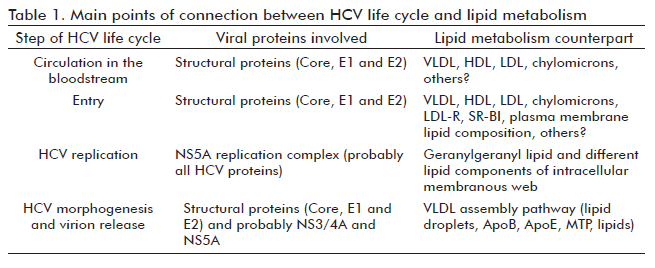
<body><![CDATA[<P   align="justify" ><font size="2" face="Verdana, Arial, Helvetica, sans-serif">Hepatitis C virus      (HCV) infection is a worldwide health problem, causing chronic hepatitis in      approximately 85% of the cases, with a frequent progress to severe forms of      liver damage like cirrhosis and hepatocellular carcinoma (1). HCV is a parenterally      transmitted pathogen that frequently induces extra-hepatic disease expressions      such as essential mixed cryoglobulinemia and membranoproliferative glomerulonephritis      (2, 3). There is no vaccine currently available against this pathogen, and      therapeutic treatments, based on pegylated interferon (PegIFN) plus ribavirin      are expensive, produce undesirable side effects and are only effective in      about one half of the patients (4). Successful response to treatment against      HCV infection seems to depend on several factors, involving both, the virus      and the host (5-7). </font></P >   <FONT size="+1">        <P   align="justify" ><font face="Verdana, Arial, Helvetica, sans-serif" size="2">HCV is a single positive      strand RNA virus belonging to the Flaviviridae family, hepacivirus genus.      The HCV genome encodes a polyprotein co- and post-translationally processed      in at least ten viral proteins with different roles in viral pathogenesis      (8). Recent advances in HCV cell culture replication have enhanced the knowledge      on the HCV life cycle, although the complete picture is yet unknown. However,      one thing is clear, the virus and host establish a very complex interaction      during infection. </font></P >       <P   align="justify" ><font face="Verdana, Arial, Helvetica, sans-serif" size="2">HCV heterogeneity      and mutability, as well as a deficient immune response to this pathogen are      perhaps the most relevant factors of viral persistence. Six main genotypes      have been described for HCV, with important differences in aspects such as      response to standard treatment (9). Individuals infected with genotype 1 have      the worst response. On the other hand, there is evidence that HCV can replicate      in, or at least enter into, cells of the immune system, in addition to the      hepatocytes (10). In fact, several immune system mechanisms, both the innate      and adaptive responses, related to the potential clearance of HCV infection,      are affected in the chronic phase with: increased resistance to interferon,      defects in the function of antigen presenting cells and natural killer cells,      specific T cell impairment and exhaustion, among others (11, 12). HCV core      and E2 proteins have been frequently associated to these effects, although      other viral proteins also seem to be involved (13). </font></P >       <P   align="justify" ><font face="Verdana, Arial, Helvetica, sans-serif" size="2">On the other hand,      although life style is sometimes underestimated, it is relevant for HCV-related      disease and treatment outcomes. In addition to alcohol and drug use, patients      should avoid the excessive intake of sugar and fat-enriched food. Particularly,      liver steatosis, defined as excessive accumulation of lipid in the cytoplasm      of hepatocytes, is a frequent histological feature in HCV chronically infected      patients (14). In vivo and in vitro studies have indicated that HCV could      alter intrahepatic lipid metabolism by affecting lipid synthesis, oxidative      stress, lipid peroxidation, insulin resistance and the assembly and secretion      of very low density lipoproteins (VLDL) (15-18). The degree of liver steatosis      and insulin resistance has been negatively associated to therapy response      (19, 20). The strong relationship of HCV and lipid metabolism seems to involve      every step of the HCV life cycle bringing up many still unanswered questions.      The present review will analyze different aspects of the relationship between      HCV and lipid metabolism, and discuss their potential implications in the      development of efficacious preventive and therapeutic interventions. </font></P >       <P   align="left" ><font size="3" face="Verdana, Arial, Helvetica, sans-serif"><b>HCV LIFE CYCLE      AND LIPIDS</b></font><font size="2" face="Verdana, Arial, Helvetica, sans-serif">      </font></P >   <FONT size="+1">        <P   align="justify" ><font size="2" face="Verdana, Arial, Helvetica, sans-serif">It is well known      that HCV circulates in the host as quasispecies, a population of genetically      related molecules differing at the nucleotide level (21). In addition, virion      particles of different sizes and density have been detected in circulation      (22). The existence of particles lacking HCV E1-E2, or completely non-enveloped,      has also been described in patients (23). The detection of HCV genomic mutants,      mostly lacking the genes encoding envelope glycoproteins, found in both the      liver and serum of patients, could be responsible for this type of particle      and introduces a further source of variability (23). However, the main cause      of differences in size, density and composition in virion particles seems      to be related to the different degrees of association (or not) to lipoproteins      (22). The role of each virion subpopulation in viral pathogenesis is not completely      defined. However, there is a general consensus that most infectious HCV are      circulating as Lipo-Viro-Particles (LVPs), lipoprotein-like structures composed      of triglyceride-rich lipoproteins bearing apolipoproteins B (ApoB) and E (ApoE),      viral nucleocapsids, and envelope glycoproteins (24, 25). </font></P >   <FONT size="+1">        <P   align="justify" ><font face="Verdana, Arial, Helvetica, sans-serif" size="2">Different pieces      of evidence (26) show that HCV exploits lipid metabolism in hepatocytes for      entry, replication, assembly and secretion (<a href="/img/revistas/bta/v28n1/t0101111.gif">Table      1</a><FONT color="#800080"><FONT color="#000000">). The low density lipoprotein      (LDL) receptor, the complement differentiation protein CD81 and the scavenger      receptor- class B type I (SR-BI) are molecules involved in early stages of      HCV entry to hepatocytes, as attachment factors or co-receptors (27). Hepatocytes      can acquire LDL&ndash;associated cholesterol in serum through LDL receptor-mediated      endocytosis (26). Cells can also acquire cholesterol through SR-BI mediated      uptake from high density lipoproteins (HDL), although in humans this pathway      is probably not very significant because of the transfer, by cholesteryl ester      transfer protein, of cholesterol from HDL to LDL or VLDL (26). HDL has been      shown to enhance HCV entry in a process that depends on the lipid transfer      function of SR-BI and the presence of apolipoprotein CI (28-30). Interestingly,      SR-BI and CD81 are localized in lipid rafts. Remarkably, the amount of CD81      expressed on the cell surface is affected by cellular cholesterol content.      The depletion of cholesterol in cells resulted in lower amounts of CD81 located      at the plasma membrane, consequently reducing HCV entry (31). Altering the      sphingomyelin/ceramide ratio of the plasma membrane can affect HCV entry by      also decreasing the cell surface expression of CD81 (32). </font></font></font></P >   <FONT color="#800080"><FONT color="#000000">        
<P   align="justify" ><font face="Verdana, Arial, Helvetica, sans-serif" size="2">Once the virus has      entered to the cells, via membrane fusion and endocytosis, the genome is released      into the cytoplasm. At this point, cholesterol synthesis in hepatocytes, through      the mevalonate pathway, is involved in HCV replication. The product of the      mevalonate pathway mainly required for HCV genome replication seems to be      geranylgeranyl lipid. It serves as a lipid substrate for protein geranylgeranylation,      a post-translational modification that covalently attaches geranylgeranyl      to several cellular proteins to facilitate their membrane association (26).      Specifically, the geranylgeranylation of the F-box and leucine-rich repeat      protein 2 determines its association to the HCV NS5A protein, an interaction      regarded as critical for HCV genome replication (26). This last occurs in      intracellular membranous webs (8). </font></P >       <P   align="justify" ><font face="Verdana, Arial, Helvetica, sans-serif" size="2">HCV core protein      accumulates in hepatocytes around lipid droplets, which are intracellular      stores of triacylglycerols and cholesteryl esters surrounded by a single layer      of phospholipids (33), which can also interact with NS3 and NS5A (34). The      HCV core&ndash;lipid droplet association seems to be essential for the HCV      morphogenesis process, since the envelope and other viral proteins are recruited      later in this context (27). Remarkably, lipid droplets are an early step in      the assembly of VLDL, the most frequent lipoproteins found in LVPs. In fact,      it has been found that the biogenesis pathway of VLDL is involved in HCV morphogenesis      with microsomal triacylglycerol transfer protein (MTP), ApoB and ApoE as essential      elements in the production of infectious HCV particles (27). Moreover, HCV      core expression, at least in transgenic mice, inhibits the activity of MTP      and the subsequent secretion of VLDLs (35). This might be a viral strategy      to accommodate the production and secretion of VLDL to the rate of HCV virion      formation. The final result is the intracellular lipid accumulation. </font></P >       <P   align="justify" ><font face="Verdana, Arial, Helvetica, sans-serif" size="2">Indeed, there is      strong evidence suggesting that some HCV proteins, particularly the core and      NS5A, can induce hepatic steatosis by interfering with intracellular lipid      metabolism (36). Two main predominant forces of steatosis have been proposed      to coexist in patients with hepatitis C. The first is a metabolic type that      is seen mainly in HCV-1 infected patients and is associated with increased      body mass index, hyperlipidemia, and insulin resistance. The second is a viral      type that may also be developed in the absence of any other steatogenic cofactors      and that seems to be directly triggered by the virus through the interference      with intracellular lipid metabolism or the induction of insulin resistance      (36). These two forces are not mutually excluding but probably synergic in      generating hepatic steatosis in hepatitis C patients. </font></P >       ]]></body>
<body><![CDATA[<P   align="left" ><font size="3" face="Verdana, Arial, Helvetica, sans-serif"><b>IMPACT ON VACCINE      DEVELOPMENT</b></font><font size="2" face="Verdana, Arial, Helvetica, sans-serif">      </font></P >   <FONT size="+1">        <P   align="justify" ><font size="2" face="Verdana, Arial, Helvetica, sans-serif">Different elements      support the rationality of generating an effective vaccine against HCV. The      most relevant fact is probably that immunity to the virus can be produced      since 20-30% of individuals exposed to the virus spontaneously clear the infection      and the immune system is critical to this outcome (28). On the other hand,      in HCV chronic infections, immune response is not only unable to clear the      virus but also seems to contribute to liver damage and extra-hepatic disease      expressions (11, 37). Therefore, strategies based on the specific immune modulation,      including vaccination strategies are truly promising. However, the generation      of vaccines against HCV has become a challenging task. </font></P >   <FONT size="+1">        <P   align="justify" ><font face="Verdana, Arial, Helvetica, sans-serif" size="2">The resolution of      HCV infection requires a complex interplay between innate and adaptative immune      responses. In the absence of suitable animal models, only chimpanzees are      consistently infected by HCV but major ethics and cost-related reasons have      limited its use. Studies using samples from individuals spontaneously eliminating      HCV infection have shed light on immunological correlations with HCV clearance.      It is generally supported that a strong, multispecific and sustained T-cell      response seems to be required for viral clearance. Strategies, generally targeting      different HCV antigens, have been evaluated for developing preventive or therapeutic      vaccines against this pathogen. In fact, several vaccine candidates have undergone      clinical evaluation (38-40). These vaccine candidates were found to be safe      and immunogenic (41-43). However, the clinical and virological impact of these      vaccine candidates must be demonstrated. </font></P >       <P   align="justify" ><font face="Verdana, Arial, Helvetica, sans-serif" size="2">The goal of vaccination      against HCV can be seen in three different scenarios: protection or complete      clearance of HCV; control of infection avoiding the development of liver damage;      the promotion of favorable conditions in the patient for a more effective      response after anti-viral treatments. The first setting is ideal but it is      undoubtedly the most difficult one to achieve. In fact, the scenario in vaccine      development has changed in the last decade, with early studies focused on      preventive vaccination and current strategies mainly addressing the therapeutic      approach. Hence, most vaccines candidates under clinical evaluation have been      designed to elicit cell-mediated immune response. Different factors have led      to a decrease in the number of ongoing preventive vaccination studies against      HCV. Scientifically, the absence of a complete definition of immunologic parameters      correlating with protection and/or the clearance of HCV, and particularly      the controversial role of neutralizing antibodies, are probably the most important      elements related to this situation. In favor of antibody response, subjects      with primary hypogammaglobulinemia showed rapid disease progression and poor      response to interferon treatment (44). Moreover, previous studies reported      the presence of antibodies specific to E2 HVR in individuals who spontaneously      resolved HCV infection (45, 46). However, there is relevant data on the null      or delayed induction of neutralizing antibodies in HCV infection (47, 48).      Additionally, since at least some neutralizing antibodies are directed towards      HVR-I, the induction of this type of response has been involved in selecting      viral diversity and a mechanism for viral escape. In other cases, neutralizing      antibodies cross-reacting with HCV isolates from different genotypes have      been found in chronically infected HCV patients, indicating a high degree      of conservation of the targeted epitope (49, 50). Nevertheless, these antibodies,      even when induced at high levels, are unable to clear chronic HCV infection      (49). </font></P >       <P   align="justify" ><font face="Verdana, Arial, Helvetica, sans-serif" size="2">The heterogeneity      and mutability of HCV are particularly important for the viral escape from      the immune system and persistence. In the light of current knowledge, the      association of HCV with lipoproteins poses an additional negative impact for      the effective induction and action of neutralizing antibodies. HCV particles      may be attached to or incorporated into VLDL during the assembly of the lipoprotein      particles and secreted together with VLDL. The nature of the association between      HCV and VLDL remains unclear. If HCV hides in the core of VLDL as suggested      (22), it makes the virus unique in that the entire virion is not exposed to      the serum during circulation. Obviously, if this is the situation, neutralizing      antibodies targeted at viral epitopes will not be effective against circulating      HCV particles. As previously explained (26), this scenario does not necessarily      contradict the observation that the entry of cell culture infectious HCV was      inhibited by antibodies targeting viral structural protein E2, since these      antibodies may also be included in endocytic vesicles containing HCV. In fact,      it has been reported that immunoglobin G can enter clathrin coated pits non-specifically      through fluid-phase endocytosis (51). Thus, these antibodies may block HCV      entry by binding to the viral structural protein after the virus is released      from the lipoprotein particles in endocytic vesicles. Nevertheless, it seems      very improbable that HCV may hide completely in VLDL because it requires a      dramatical change during viral entry to allow the escape of HCV from VLDL-derived      lipoprotein particles, so that the structural protein E2 can interact with      its cellular receptors; a step required for HCV entry to the cell. It is more      probable that HCV particles associate with VLDL in such a way that some parts      of the virion are exposed, including those required in the interaction with      cellular receptors. In this case, the HDL-enhancing effect on HCV entry that      reduces the sensitivity of HCV to neutralizing antibodies (52, 53) could occur      through an increased presence of SR-BI in the cell membrane, thereby reducing      exposure time to neutralizing antibodies. In any case, if this partial exposure      scenario is correct (according to the nature of the association between HCV      and VLDL, which is not completely understood), the viral regions exposed may      not always the same in HCV particles. This could be an additional source of      viral heterogeneity. Moreover, this might be a viral mechanism to circumstantially      disfavor the exposure of relevant immunogenic or neutralizing epitopes. </font></P >       <P   align="justify" ><font face="Verdana, Arial, Helvetica, sans-serif" size="2">According to the      state of the art on the association between HCV and VLDL, a vaccine against      this pathogen designed to generate neutralizing antibodies should target several      epitopes at the same time. Additionally, the most relevant epitopes could      be conformation-dependent and this conformation may require a lipoprotein      context. Moreover, important epitopes could even share regions of both HCV      proteins and the VLDL structure itself. In a further degree of complexity,      since the composition of VLDL is not always exactly the same, a greater variability      is thence expected. Therefore, vaccine candidates involving liposome or lipid      moieties in general may be advantageous, although thorough studies are required      since there is a risk of inducing or enhancing auto-immune disorders from      this manipulation. </font></P >       <P   align="justify" ><font face="Verdana, Arial, Helvetica, sans-serif" size="2">On the other hand,      in persons that are overweight and/or having baseline liver steatosis and      other dysfunctions of lipid metabolism, there were side effects (54, 55) related      to oxidative stress, persistent inflammation, disturbance in the signaling      cascade of interferon and down-regulation of its receptors, reduction of NKT      activity, and other immune-associated disorders, for which preventive vaccination      may be less effective. There are two reasons in favor of this: first, vaccine      could be less immunogenic in these persons, and second, after being exposed      to the virus, infection with HCV may be facilitated by the context of lipid      metabolism. Regarding the former issue, overweight and obese persons showed      a lower percentage of seroprotection after being immunized with a preventive      anti-hepatitis B vaccine (56). </font></P >       <P   align="justify" ><font face="Verdana, Arial, Helvetica, sans-serif" size="2">In the present context,      vaccine candidates specifically targeting HCV proteins mainly involving undesirable      effects in lipid metabolism like nucleocapsid and NS5A could be advantageous.      In fact, most vaccine candidates of ongoing clinical trials in HCV-infected      individuals target at least one of these antigens. Interestingly, CIGB-230      (a vaccine candidate based on a recombinant HCV core protein co-administered      with a plasmid expressing the HCV core, E1 and E2 proteins) elicited predominantly      a cell-mediated immune response against the HCV core when administered to      HCV genotype 1b patients who were unresponsive to previous treatments with      IFN plus ribavirin (38). Liver damage was also reduced in a subset of those      patients. </font></P >       <P   align="justify" ><font face="Verdana, Arial, Helvetica, sans-serif" size="2">Genetic background      has been previously correlated with protection against chronic HCV or clearance      after therapy (57). Different regions related to genes involved in immune      response such as IL-28B and HLA seem to be critical in this issue (58, 59).      HLA is particularly relevant for vaccine design and some currently evaluated      vaccine candidates are based on selected HCV epitopes for specific T lymphocytes      of relevant HLA (42, 43). Recently, an ApoE genotype has been associated with      protection against chronic hepatitis C virus infection (60). Remarkably, ApoE-containing      lipoproteins have the ability to modulate key elements of the immune response      by either inhibiting or stimulating antigen and mitogen induced T-lymphocyte      activation as well as proliferation (61). In fact, ApoE interacts with signals      from multiple mitogens including transferrin and interleukin 2 (IL-2), and      its impact on the pathology of infectious diseases like hepatitis C, has been      linked with its immunomodulatory properties (60). </font></P >       <P   align="left" ><font size="3" face="Verdana, Arial, Helvetica, sans-serif"><b>IMPLICATIONS FOR      DRUGS THERAPY</b></font><font size="2" face="Verdana, Arial, Helvetica, sans-serif">      </font></P >   <FONT size="+1">        ]]></body>
<body><![CDATA[<P   align="justify" ><font size="2" face="Verdana, Arial, Helvetica, sans-serif">Nowadays, the best      therapy is the weekly administration of PegIFN (1.5 &mu;g/kg for PegIFN-alfa-2b      or 180 &mu;g/kg for <font color="#FF00FF"><FONT color="#000000"><font color="#FF00FF"><FONT color="#000000">PegIFN-alfa-2a)      and the daily ingestion of ribavirin (1000 mg for body weight below 75 kg      and 1200 mg for body weight above 75 kg), for six months (in HCV genotypes      2 and 3), or one year (in HCV genotypes 1 and 4). Not all HCV-infected patients      are eligible for the treatment. A successful therapy is that of a sustained      virological response, established by undetectable HCV RNA levels, six months      after the end of the standard treatment. Patients who achieve such a response      usually show an improvement in liver histology and clinical outcomes (4).      </font></font></font></font></font></P >   <FONT size="+1"><FONT color="#FF00FF"><FONT color="#000000"><FONT color="#FF00FF"><FONT color="#000000">        <P   align="justify" ><font face="Verdana, Arial, Helvetica, sans-serif" size="2">As previously stated,      overweight and liver steatosis has been found to be independent factors for      non-response to therapy in patients infected with HCV after the treatment      with PegIFN plus ribavirin (19). In this case, the disturbance in the signaling      cascade of interferon and down-regulation of its receptors seems to be the      main mechanism interfering with the treatment, mainly (although not exclusively)      by increasing oxidative stress (54, 62). Interestingly, individuals infected      with genotype 3 HCV isolates respond differently (better) to PegIFN plus ribavirin      than those infected with genotype 1 isolates (4). This may be due to several      causes. Noteworthy, these genotypes, as previously stated, have been described      as differently behaving in relation to the predominant hepatic steatosis driving      forces and molecules involved in lipid metabolism, mainly due to differences      in the HCV core proteins of these genotypes (36). It has been recently demonstrated      that the management of dismetabolism, diet and exercise therapy can improve      the body mass index, liver histology and, therefore, the response to PegIFN      and Ribavirin (63). Since HCV-related alterations of lipid metabolism are      supposed to increase with years of infection, the early treatment of patients      eligible for therapy with PegIFN plus ribavirin is advised. Therefore, in      time, some undesirable co-morbidities caused or enhanced by lipid accumulation      and dysfunction, such as heart disease and hypertension, could also worsen      the results after therapy or even become contraindications to treatment. </font></P >       <P   align="justify" ><font face="Verdana, Arial, Helvetica, sans-serif" size="2">New therapeutic agents      specifically targeting essential components of the viral life cycle, such      as the HCV NS3/4A serine protease and NS5 RNA-dependent RNA polymerase, are      currently in advanced clinical development (64, 65). Interesting results concerning      increased sustained virological response, when combined with PegIFN plus ribavirin,      has been obtained in clinical practice with some of these molecules (66).      However, HCV mutant isolates resistant to these molecules have been described      and toxicity is not always low (67). Since all intracellular steps of the      HCV life cycle in hepatocytes seem to be associated to the membranous structure      and depend on the association of viral proteins with lipid droplets and lipoproteins,      molecules targeting polyprotein processing and RNA replication could be also      interfered by the lipid environment. </font></P >       <P   align="justify" ><font face="Verdana, Arial, Helvetica, sans-serif" size="2">The strong relationship      between HCV and lipid metabolism has opened new gates in the search for therapeutic      interventions since, for instance, drugs that target cholesterol metabolism      may be useful in treating HCV infection. Results show that the treatment of      cells with statins (the widely used cholesterol lowering drugs) inhibits HCV      RNA replication by depleting geranylgeranyl lipids (68). However, applying      statins to treat HCV will require very high doses and would likely cause toxicity      in the liver and other organs (26). Other types of drugs used for treating      hypercholesterolemia by blocking the assembly and secretion of VLDL, have      been found to inhibit the production of HCV particles from infected cells      (69). Some of these molecules, i.e. antisense RNA drugs targeting ApoB and      several MTP inhibitors, have already been tested in clinical trials (68).      Particularly, a long-term treatment with MTP inhibitors led to the toxic accumulation      of fat in the liver. </font></P >       <P   align="left" ><font size="3" face="Verdana, Arial, Helvetica, sans-serif"><b>CONCLUSIONS</b></font><font size="2" face="Verdana, Arial, Helvetica, sans-serif">      </font></P >   <FONT size="+1">        <P   align="justify" ><font size="2" face="Verdana, Arial, Helvetica, sans-serif">HCV life cycle and      lipid metabolism are connected. Therefore, the rational manipulation of this      relationship emerges as a potential strategy for developing preventive and      therapeutic interventions against HCV infection. Nevertheless, there must      first be a complete definition of the molecular mechanisms governing that      relationship. Knowledge on the exact HCV particle architecture and composition      is crucial for vaccine development, particularly (but not exclusively) for      those strategies designed to elicit neutralizing antibody responses. In the      therapeutic setting, the relevance of a multifactorial approach with less-toxic      anti-cholesterolemics and immunomodulators, in addition to safer anti-virals,      should play a more significant role to eliminate liver and extra-hepatic expressions      of HCV infection. Last but not the least, there are the efforts required for      population awareness on healthier life styles which, together with scientific      achievements for creating effective vaccines or medicines against HCV, will      be critical for successful interventions against this pathogen. </font></P >   <FONT size="+1">        <P   align="left" ><font size="3" face="Verdana, Arial, Helvetica, sans-serif"><b>ACKNOWLEDGEMENTS</b></font><font size="2" face="Verdana, Arial, Helvetica, sans-serif">      </font></P >   <FONT size="+1">        <P   align="justify" ><font size="2" face="Verdana, Arial, Helvetica, sans-serif">The author would      like to acknowledge M.Sc. Yalena Amador for the critical reading of the manuscript.      </font></P >   <FONT size="+1">        <P   align="left" > </P >   <FONT size="+1">        <!-- ref --><P   align="left" ><font size="3" face="Verdana, Arial, Helvetica, sans-serif"><b>REFERENCES</b></font><font size="2" face="Verdana, Arial, Helvetica, sans-serif">      </font></P >   <FONT size="+1">    <DL   >      <DT   ><font size="2" face="Verdana, Arial, Helvetica, sans-serif">1. Levrero M. Viral        hepatitis and liver cancer: the case of hepatitis C. Oncogene. 2006;25:3834-47.        </font></DT >   </DL >    <!-- ref --><p><font face="Verdana, Arial, Helvetica, sans-serif" size="2">2. Poanta L,      Albu A. Chronic hepatitis C with extrahepatic manifestations. Rom J Intern      Med. 2007;45:85-8. </font><!-- ref --><p><font face="Verdana, Arial, Helvetica, sans-serif" size="2">3. Sansonno D,      Tucci FA, Ghebrehiwet B, Lauletta G, Peerschke EI, Conteduca V, <I>et al</I>.      Role of the receptor for the globular domain of C1q protein in the pathogenesis      of hepatitis C virus-related cryoglobulin vascular damage. J Immunol. 2009;183:      6013-20. </font><!-- ref --><p><font face="Verdana, Arial, Helvetica, sans-serif" size="2">4. Ghany MG,      Strader DB, Thomas DL, Seeff LB. Diagnosis, management, and treatment of hepatitis      C: an update. Hepatology. 2009;49:1335-74.</font><!-- ref --><p><font face="Verdana, Arial, Helvetica, sans-serif" size="2">5. Aronsohn A,      Reau N. Long-term outcomes after treatment with interferon and ribavirin in      HCV patients. J Clin Gastroenterol. 2009;43:661-71.</font><!-- ref --><p><font face="Verdana, Arial, Helvetica, sans-serif" size="2">6. Reddy KR,      Messinger D, Popescu M, Hadziyannis SJ. Peginterferon alpha-2a (40 kDa) and      ribavirin: comparable rates of sustained virological response in sub-sets      of older and younger HCV genotype 1 patients. J Viral Hepat. 2009;16:724-31.      </font><!-- ref --><p><font face="Verdana, Arial, Helvetica, sans-serif" size="2">7. Maekawa S,      Enomoto N. Viral factors influencing the response to the combination therapy      of peginterferon plus ribavirin in chronic hepatitis C. J Gastroenterol. 2009;44:1009-15.      </font><!-- ref --><p><font face="Verdana, Arial, Helvetica, sans-serif" size="2">8.Brass V, Moradpour      D, Blum HE. Molecular virology of hepatitis C virus (HCV): 2006 Update. Int      J Med Sci. 2006; 3:29-34. </font><!-- ref --><p><font face="Verdana, Arial, Helvetica, sans-serif" size="2">9. Simmonds P,      Bukh J, Combet C, Del&eacute;age G, Enomoto N, Feinstone S, <I>et al</I>.      Consensus proposals for a unified system of nomenclature of hepatitis C virus      genotypes. Hepatology. 2005;42:962-73. </font><!-- ref --><p><font face="Verdana, Arial, Helvetica, sans-serif" size="2">10. Castillo      I, Rodriguez-Inigo E, Bartolome J, de Lucas S, Ortiz-Movilla N, Lopez-Alcorocho      JM, <I>et al</I>. Hepatitis C virus replicates in peripheral blood mononuclear      cells of patients with occult hepatitis C virus infection. Gut. 2005;54:682-5.      </font><!-- ref --><p><font face="Verdana, Arial, Helvetica, sans-serif" size="2">11. Grakoui A,      Shoukry NH, Woollard DJ, Han JH, Hanson HL, Ghrayeb J, <I>et al</I>. HCV persistence      and immune evasion in the absence of memory T cell help. Science. 2003;302:659-62.      </font><!-- ref --><p><font face="Verdana, Arial, Helvetica, sans-serif" size="2">12. Bode JG,      Brenndorfer ED, Haussinger D. Subversion of innate host antiviral strategies      by the hepatitis C virus. Arch Biochem Biophys. 2007;462:254-65. </font><!-- ref --><p><font face="Verdana, Arial, Helvetica, sans-serif" size="2">13. Krishnadas      DK, Ahn JS, Han J, Kumar R, Agrawal B. Immunomodulation by hepatitis C virus-derived      proteins: targeting human dendritic cells by multiple mechanisms. Int Immunol.      2010;22:491-502. </font><!-- ref --><p><font face="Verdana, Arial, Helvetica, sans-serif" size="2">14. Negro F.      Hepatitis C virus-induced steatosis: an overview. Dig Dis. 2010;28: 294-9.      </font><!-- ref --><p><font face="Verdana, Arial, Helvetica, sans-serif" size="2">15. Patel K,      Zekry A, McHutchison JG. Steatosis and chronic hepatitis C virus infection:      mechanisms and significance. Clin Liver Dis 2005;9:399-410. </font><p><font face="Verdana, Arial, Helvetica, sans-serif" size="2">16. Adinolfi      LE, Durante-Mangoni E, Zampino R, Ruggiero G. Hepatitis C virus associated      steatosis&ndash;pathogenic mechanisms and clinical implications. Aliment Pharmacol      Ther. 2005;22 Suppl 2:52-5. </font></p>       <!-- ref --><p><font face="Verdana, Arial, Helvetica, sans-serif" size="2">17. Lonardo A,      Adinolfi LE, Loria P, Carulli N, Ruggiero G, Day CP. Steatosis and hepatitis      C virus: mechanisms and significance for hepatic and extrahepatic disease.      Gastroenterology. 2004;126:586-97. </font><!-- ref --><p><font face="Verdana, Arial, Helvetica, sans-serif" size="2">18. Syed GH,      Amako Y, Siddiqui A. Hepatitis C virus hijacks host lipid metabo-lism. Trends      Endocrinol Metab. 2010;21: 33-40. </font><!-- ref --><p><font face="Verdana, Arial, Helvetica, sans-serif" size="2">19. Tarantino      G, Conca P, Sorrentino P, Ariello M. Metabolic factors involved in the therapeutic      response of patients with hepatitis C virus-related chronic hepatitis. J Gastroenterol      Hepatol. 2006;21:1266-8. </font><!-- ref --><p><font face="Verdana, Arial, Helvetica, sans-serif" size="2">20. Yaginuma      R, Ikejima K, Okumura K, Kon K, Suzuki S, Takei Y, <I>et al</I>. Hepatic steatosis      is a predictor of poor response to interferon alpha-2b and ribavirin combination      therapy in Japanese patients with chronic hepatitis C. Hepatol Res. 2006;      35:19-25. </font><!-- ref --><p><font face="Verdana, Arial, Helvetica, sans-serif" size="2">21.Kato N. Genome      of human hepatitis C virus (HCV): gene organization, sequence diversity, and      variation. Microb Comp Genomics. 2000;5:129-51. </font><!-- ref --><p><font face="Verdana, Arial, Helvetica, sans-serif" size="2">22.Andr&eacute;      P, Perlemuter G, Budkowska A, Br&eacute;chot C, Lotteau V. Hepatitis C virus      particles and lipoprotein metabolism. Sem Liver Dis. 2005;25:93-104. </font><!-- ref --><p><font face="Verdana, Arial, Helvetica, sans-serif" size="2">23. Pacini L,      Graziani R, Bartholomew L, De Francesco R, Paonessa G. Naturally occurring      hepatitis C virus subgenomic deletion mutants replicate efficiently in Huh-7      cells and are trans-packaged <I>in vitro</I> to generate infectious defective      particles. J Virol. 2009;83:9079-93. </font><!-- ref --><p><font face="Verdana, Arial, Helvetica, sans-serif" size="2">24.Nielsen SU,      Bassendine MF, Burt AD, Martin C, Pumeechockchai W, Toms GL. Association between      hepatitis C virus and very-low-density lipoprotein (VLDL)/LDL analyzed in      iodixanol density gradients. J Virol. 2006;80:2418-28. </font><!-- ref --><p><font face="Verdana, Arial, Helvetica, sans-serif" size="2">25.Andr&eacute;      P, Komurian-Pradel F, Deforges S, Perret M, Berland JL, Sodoyer M, <I>et al</I>.      Characterization of low- and very-low-density hepatitis C virus RNA-containing      particles. J Virol. 2002;76:6919-28. </font><!-- ref --><p><font face="Verdana, Arial, Helvetica, sans-serif" size="2">26.Ye J. Reliance      of host cholesterol metabolic pathways for the life cycle of hepatitis C virus.      PLoS Pathog. 2007;3(8):e108. </font><!-- ref --><p><font face="Verdana, Arial, Helvetica, sans-serif" size="2">27. Popescu C-I,      Dubuisson J. Role of lipid metabolism in hepatitis C virus assembly and entry.      Biol Cell. 2009;102:63-74. </font><!-- ref --><p><font face="Verdana, Arial, Helvetica, sans-serif" size="2">28. Zeisel MB,      Fafi-Kremer S, Fofana I, Barth H, Stoll-Keller F, Doffoel M, <I>et al</I>.      Neutralizing antibodies in hepatitis C virus infection. World J Gastroenterol.      2007;13:4824-30. </font><!-- ref --><p><font face="Verdana, Arial, Helvetica, sans-serif" size="2">29. Catanese      MT, Graziani R, von Hahn T, Moreau M, Huby T, Paonessa G, <I>et al</I>. High-avidity      monoclonal antibodies against the human scavenger class B type I receptor      efficiently block hepatitis C virus infection in the presence of high-density      lipoprotein. J Virol. 2007;81:8063-71. </font><!-- ref --><p><font face="Verdana, Arial, Helvetica, sans-serif" size="2">30. Dreux M,      Boson B, Ricard-Blum S, Molle J, Lavillette D, Bartosch B, <I>et al</I>. The      exchangeable apolipoprotein ApoC-I promotes membrane fusion of hepatitis C      virus. J Biol Chem. 2007;282:32357-69. </font><!-- ref --><p><font face="Verdana, Arial, Helvetica, sans-serif" size="2">31. Kapadia SB,      Barth H, Baumert T, McKeating JA, Chisari FV. Initiation of hepatitis C virus      infection is dependent on cholesterol and cooperativity between CD81 and scavenger      receptor B type I. J Virol. 2007;81:374-83. </font><!-- ref --><p><font face="Verdana, Arial, Helvetica, sans-serif" size="2">32. Voisset C,      Lavie M, Helle F, Op De Beeck A, Bilheu A, Bertrand-Michel J, <I>et al</I>.      Ceramide enrichment of the plasma membrane induces CD81 internalization and      inhibits hepatitis C virus entry. Cell Microbiol. 2008;10:606-17. </font><!-- ref --><p><font face="Verdana, Arial, Helvetica, sans-serif" size="2">33. Barba G,      Harper F, Harada T, Kohara M, Goulinet S, Matsuura Y, <I>et al</I>. Hepatitis      C virus core protein shows a cytoplasmic localization and associates to cellular      lipid storage droplets. Proc Natl Acad Sci USA. 1997;94:1200-5. </font><!-- ref --><p><font face="Verdana, Arial, Helvetica, sans-serif" size="2">34. Miyanari      Y, Atsuzawa K, Usuda N, Watashi K, Hishiki T, Zayas M, <I>et al</I>. The lipid      droplet is an important organelle for hepatitis C virus production. Nat Cell      Biol. 2007;9:1089-97. </font><!-- ref --><p><font face="Verdana, Arial, Helvetica, sans-serif" size="2">35. Perlemuter      G, Sabile A, Letteron P, Vona G, Topilco A, Chr&eacute;tien Y, <I>et al</I>.      Hepatitis C virus core protein inhibits microsomal triglyceride transfer protein      activity and very low density lipoprotein secretion: a model of viral-related      steatosis. FASEB J. 2002;16:185-94. </font><!-- ref --><p><font face="Verdana, Arial, Helvetica, sans-serif" size="2">36. Mirandola      S, Bowman D, Hussain MM, Alberti A. Hepatic steatosis in hepatitis C is a      storage disease due to HCV interaction with microsomal triglyceride transfer      protein (MTP). Nutr Metab (Lond). 2010;7:13. </font><!-- ref --><p><font face="Verdana, Arial, Helvetica, sans-serif" size="2">37. Chen CH,      Lee CM, Chen CH, Hu TH, Wang JH, Hung CH, <I>et al</I>. Prevalence and clinical      relevance of serum autoantibodies in patients with chronic hepatitis C. Chang      Gung Med J. 2010;33:258-65. </font><!-- ref --><p><font face="Verdana, Arial, Helvetica, sans-serif" size="2">38. Alvarez-Lajonchere      L, Shoukry NH, Gra B, Amador-Ca&ntilde;izares Y, Helle F, B&eacute;dard N,      <I>et al</I>. Immunogenicity of CIGB-230, a therapeutic DNA vaccine preparation,      in HCV-chronically infected individuals in a Phase I clinical trial. J Viral      Hepat. 2009;16:156-67. </font><!-- ref --><p><font face="Verdana, Arial, Helvetica, sans-serif" size="2">39.Wedemeyer      H, Schuller E, Schlaphoff V, Stauber RE, Wiegand J, Schiefke I, <I>et al</I>.      Therapeutic vaccine IC41 as late add-on to standard treatment in patients      with chronic hepatitis C. Vaccine. 2009;27:5142-51. </font><!-- ref --><p><font face="Verdana, Arial, Helvetica, sans-serif" size="2">40. Haller AA,      Lauer GM, King TH, Kemmler C, Fiolkoski V, Lu Y, <I>et al</I>. Whole recombinant      yeast-based immunotherapy induces potent T cell responses targeting HCV NS3      and Core proteins. Vaccine. 2007;25:1452-63. </font><!-- ref --><p><font face="Verdana, Arial, Helvetica, sans-serif" size="2">41. Castellanos      M, Cinza Z, Dorta Z, Veliz G, Vega H, Lorenzo I, <I>et al</I>. Immunization      with a DNA vaccine candidate in chronic hepatitis C patients is safe, well      tolerated and does not impair immune response induction after anti-hepatitis      B vaccination. J Gene Med. 2010;12:107-16. </font><!-- ref --><p><font face="Verdana, Arial, Helvetica, sans-serif" size="2">42. Schlaphoff      V, Klade CS, Jilma B, Jelovcan SB, Cornberg M, Tauber E, <I>et al</I>. Functional      and phenotypic characterization of peptide-vaccine-induced HCV-specific CD8+      T cells in healthy individuals and chronic hepatitis C patients. Vaccine.      2007; 25:6793-806. </font><!-- ref --><p><font face="Verdana, Arial, Helvetica, sans-serif" size="2">43. Yutani S,      Yamada A, Yoshida K, Takao Y, Tamura M, Komatsu N, <I>et al</I>. Phase I clinical      study of a personalized peptide vaccination for patients infected with hepatitis      C virus (HCV) 1b who failed to respond to interferon-based therapy. Vaccine.      2007;25:7429-35. </font><!-- ref --><p><font face="Verdana, Arial, Helvetica, sans-serif" size="2">44. Bj&oslash;ro      K, Fr&oslash;land SS, Yun Z, Samdal HH, Haaland T. Hepatitis C infection in      patients with primary hypogammaglobulinemia after treatment with contaminated      immune globulin. N Engl J Med. 1994;331: 1607-11. </font><!-- ref --><p><font face="Verdana, Arial, Helvetica, sans-serif" size="2">45. Zibert A,      Meisel H, Kraas W, Schulz A, Jung G, Roggendorf M. Early antibody response      against hypervariable region 1 is associated with acute self-limiting infections      of hepatitis C virus. Hepatology. 1997;25:1245-9. </font><!-- ref --><p><font face="Verdana, Arial, Helvetica, sans-serif" size="2">46. Dittmann      S, Roggendorf M, D&uuml;rkop J, Wiese M, Lorbeer B, Deinhardt F. Long-term      persistence of hepatitis C virus antibodies in a single source outbreak. J      Hepatol. 1991;13:323-7. </font><!-- ref --><p><font face="Verdana, Arial, Helvetica, sans-serif" size="2">47. Stamataki      Z, Grove J, Balfe P, McKeating JA. Hepatitis C virus entry and neutralization.      Clin Liver Dis. 2008;12:693-12. </font><!-- ref --><p><font face="Verdana, Arial, Helvetica, sans-serif" size="2">48. Pestka JM,      Zeisel MB, Bl&auml;ser E, Sch&uuml;rmann P, Bartosch B, Cosset FL, <I>et al</I>.      Rapid induction of virus-neutralizing antibodies and viral clearance in a      single-source outbreak of hepatitis C. Proc Natl Acad Sci USA. 2007; 104:6025-30.      </font><!-- ref --><p><font face="Verdana, Arial, Helvetica, sans-serif" size="2">49. Logvinoff      C, Major ME, Oldach D, Heyward S, Talal A, Balfe P, <I>et al</I>. Neutralizing      antibody response during acute and chronic hepatitis C virus infection. Proc      Natl Acad Sci USA 2004;101:10149-54. </font><!-- ref --><p><font face="Verdana, Arial, Helvetica, sans-serif" size="2">50. Bartosch      B, Bukh J, Meunier JC, Granier C, Engle RE, Blackwelder WC, <I>et al</I>.      <I>In vitro</I> assay for neutralizing antibody to hepatitis C virus: evidence      for broadly conserved neutralization epitopes. Proc Natl Acad Sci USA 2003;      100:14199-204. </font><!-- ref --><p><font face="Verdana, Arial, Helvetica, sans-serif" size="2">51. Pearse BM.      Coated vesicles from human placenta carry ferritin, transferrin, and immunoglobulin      G. Proc Natl Acad Sci USA 1982; 79:451-5. </font><!-- ref --><p><font face="Verdana, Arial, Helvetica, sans-serif" size="2">52. Dreux M,      Pietschmann T, Granier C, Voisset C, Ricard-Blum S, Mangeot PE, <I>et al</I>.      High density lipoprotein inhibits hepatitis C virus-neutralizing antibodies      by stimulating cell entry via activation of the scavenger receptor BI. J Biol      Chem. 2006;281:18285-95. </font><!-- ref --><p><font face="Verdana, Arial, Helvetica, sans-serif" size="2">53. Voisset C,      Op de Beeck A, Horellou P, Dreux M, Gustot T, Duverlie G, <I>et al</I>. High-density      lipoproteins reduce the neutralizing effect of hepatitis C virus (HCV)-infected      patient antibodies by promoting HCV entry. J Gen Virol. 2006;87:2577-81. </font><!-- ref --><p><font face="Verdana, Arial, Helvetica, sans-serif" size="2">54. El-Zayadi      AR. Hepatic steatosis: a benign disease or a silent killer. World J Gastroenterol.      2008;14:4120-6. </font><!-- ref --><p><font face="Verdana, Arial, Helvetica, sans-serif" size="2">55. Kremer M,      Thomas E, Milton RJ, Perry AW, van Rooijen N, Wheeler MD, <I>et al</I>. Kupffer      cell and interleukin-12-dependent loss of natural killer T cells in hepatosteatosis.      Hepatology. 2010;51:130-41. </font><!-- ref --><p><font face="Verdana, Arial, Helvetica, sans-serif" size="2">56. Est&eacute;vez      ZC, Betancourt AA, Muzio Gonz&aacute;lez V, Baile NF, Silva CV, Bernal FH,      <I>et al</I>. Immunogenicity and safety assessment of the Cuban recombinant      hepatitis B vaccine in healthy adults. Biologicals. 2007;35:115-22. </font><!-- ref --><p><font face="Verdana, Arial, Helvetica, sans-serif" size="2">57. Nattermann      J, Leifeld L, Spengler U. Host genetic factors and treatment of hepatitis      C. Curr Mol Pharmacol. 2008;1:171-80. </font><!-- ref --><p><font face="Verdana, Arial, Helvetica, sans-serif" size="2">58. Rauch A,      Kutalik Z, Descombes P, Cai T, Di Iulio J, Mueller T, <I>et al</I>. Genetic      variation in IL28B is associated with chronic hepatitis C and treatment failure:      a genome-wide association study. Gastroenterology. 2010;138:1338-45. </font><!-- ref --><p><font face="Verdana, Arial, Helvetica, sans-serif" size="2">59. Tseng KC,      Chang CK, Chou AL, Hsieh YH, Tseng CA, Lai NS. Prognostic effect of human      leukocyte antigen class I and II alleles on chronic hepatitis C patients treated      by pegylated interferon-alfa plus ribavirin in Taiwan. Hepatogastroenterology.      2010;57:456-61. </font><!-- ref --><p><font face="Verdana, Arial, Helvetica, sans-serif" size="2">60. Kuhlmann      I, Minihane AM, Huebbe P, Nebel A, Rimbach G. Apolipoprotein E genotype and      hepatitis C, HIV and herpes simplex disease risk: a literature review. Lipids      Health Dis. 2010;9:8. </font><!-- ref --><p><font face="Verdana, Arial, Helvetica, sans-serif" size="2">61. Mahley RW.      Apolipoprotein E: cholesterol transport protein with expanding role in cell      biology. Science. 1988;240:622-30. </font><!-- ref --><p><font face="Verdana, Arial, Helvetica, sans-serif" size="2">62. Di Bona D,      Cippitelli M, Fionda C, Camm&agrave; C, Licata A, Santoni A, <I>et al</I>.      Oxidative stress inhibits IFN-alpha-induced antiviral gene expression by blocking      the JAK-STAT pathway. J Hepatol. 2006;45:271-9. </font><!-- ref --><p><font face="Verdana, Arial, Helvetica, sans-serif" size="2">63. Testino G,      Sumberaz A, Ancarani AO, Borro P, Ravetti G, Ansaldi F, <I>et al</I>. Influence      of body mass index, cholesterol, triglycerides and steatosis on pegylated      interferon alfa-2a and ribavirin treatment for recurrent hepatitis C in patients      transplanted for HCV and alcoholic cirrhosis. Hepatogastroenterology. 2009;56:501-3.      </font><!-- ref --><p><font face="Verdana, Arial, Helvetica, sans-serif" size="2">64. Fowell AJ,      Nash KL. Telaprevir: a new hope in the treatment of chronic hepatitis C? Adv      Ther. 2010;27:512-22.</font><!-- ref --><p><font face="Verdana, Arial, Helvetica, sans-serif" size="2">65. Nyanguile      O, Devogelaere B, Vijgen L, Van den Broeck W, Pauwels F, Cummings MD, <I>et      al</I>. 1a/1b subtype profiling of nonnucleoside polymerase inhibitors of      hepatitis C virus. J Virol. 2010;84:2923-34. </font><!-- ref --><p><font face="Verdana, Arial, Helvetica, sans-serif" size="2">66. Sarrazin      C, Rouzier R, Wagner F, Forestier N, Larrey D, Gupta SK, <I>et al</I>. SCH      503034, a novel hepatitis C virus protease inhibitor, plus pegylated interferon      alpha-2b for genotype 1 nonresponders. Gastroenterology. 2007; 132:1270-8.      </font><!-- ref --><p><font face="Verdana, Arial, Helvetica, sans-serif" size="2">67. Curry S,      Qiu P, Tong X. Analysis of HCV resistance mutations during combination therapy      with protease inhibitor boceprevir and PEG-IFN alpha-2b using TaqMan mismatch      amplification mutation assay. J Virol Methods. 2008;153:156-62. </font><!-- ref --><p><font face="Verdana, Arial, Helvetica, sans-serif" size="2">68. Ye J, Wang      C, Sumpter R Jr, Brown MS, Goldstein JL, Gale M Jr. Disruption of hepatitis      C virus RNA replication through inhibition of host protein geranylgeranylation.      Proc Natl Acad Sci USA 2003;100:15865-70. </font><!-- ref --><p><font face="Verdana, Arial, Helvetica, sans-serif" size="2">69. Huang H,      Sun F, Owen DM, Li W, Chen Y, Gale M Jr, <I>et al</I>. Hepatitis C virus production      by human hepatocytes dependent on assembly and secretion of very low-density      lipoproteins. Proc Natl Acad Sci USA 2007;104:5848-53. </font><P   align="left" >&nbsp;</P >       <P   align="left" ><font size="2" face="Verdana, Arial, Helvetica, sans-serif">Received in August,      2010. </font>    ]]></body>
<body><![CDATA[<br>     <font face="Verdana, Arial, Helvetica, sans-serif" size="2">Accepted for publication      in February 2011. </font></P >   <FONT size="+1">        <P   align="left" > </P >       <P   align="left" ><font size="2" face="Verdana, Arial, Helvetica, sans-serif">Santiago Due&ntilde;as-Carrera,      Hepatitis C Department, Center for Genetic Engineering and Biotechnology,      CIGB Ave 31 / 158 and 190, ZP 10600, Havana, Cuba, E-mail: <A href="mailto:santiago.duenas@cigb.edu.cu">      <FONT color="#0000FF">santiago.duenas@cigb.edu.cu</font></A> </font></P >   </font></font></font></font></font></font></font></font></font></font></font></font></font></font></font></font></font></font></font></font></font></font></font></font></font></font></font></font></DIV >      ]]></body><back>
<ref-list>
<ref id="B1">
<label>1</label><nlm-citation citation-type="journal">
<person-group person-group-type="author">
<name>
<surname><![CDATA[Levrero]]></surname>
<given-names><![CDATA[M]]></given-names>
</name>
</person-group>
<article-title xml:lang="en"><![CDATA[Viral hepatitis and liver cancer: the case of hepatitis C]]></article-title>
<source><![CDATA[Oncogene]]></source>
<year>2006</year>
<volume>25</volume>
<page-range>3834-47</page-range></nlm-citation>
</ref>
<ref id="B2">
<label>2</label><nlm-citation citation-type="journal">
<person-group person-group-type="author">
<name>
<surname><![CDATA[Poanta]]></surname>
<given-names><![CDATA[L]]></given-names>
</name>
<name>
<surname><![CDATA[Albu]]></surname>
<given-names><![CDATA[A]]></given-names>
</name>
</person-group>
<article-title xml:lang="en"><![CDATA[Chronic hepatitis C with extrahepatic manifestations]]></article-title>
<source><![CDATA[Rom J Intern Med]]></source>
<year>2007</year>
<volume>45</volume>
<page-range>85-8</page-range></nlm-citation>
</ref>
<ref id="B3">
<label>3</label><nlm-citation citation-type="journal">
<person-group person-group-type="author">
<name>
<surname><![CDATA[Sansonno]]></surname>
<given-names><![CDATA[D]]></given-names>
</name>
<name>
<surname><![CDATA[Tucci]]></surname>
<given-names><![CDATA[FA]]></given-names>
</name>
<name>
<surname><![CDATA[Ghebrehiwet]]></surname>
<given-names><![CDATA[B]]></given-names>
</name>
<name>
<surname><![CDATA[Lauletta]]></surname>
<given-names><![CDATA[G]]></given-names>
</name>
<name>
<surname><![CDATA[Peerschke]]></surname>
<given-names><![CDATA[EI]]></given-names>
</name>
<name>
<surname><![CDATA[Conteduca]]></surname>
<given-names><![CDATA[V]]></given-names>
</name>
</person-group>
<article-title xml:lang="en"><![CDATA[Role of the receptor for the globular domain of C1q protein in the pathogenesis of hepatitis C virus-related cryoglobulin vascular damage]]></article-title>
<source><![CDATA[J Immunol]]></source>
<year>2009</year>
<volume>183</volume>
<page-range>6013-20</page-range></nlm-citation>
</ref>
<ref id="B4">
<label>4</label><nlm-citation citation-type="journal">
<person-group person-group-type="author">
<name>
<surname><![CDATA[Ghany]]></surname>
<given-names><![CDATA[MG]]></given-names>
</name>
<name>
<surname><![CDATA[Strader]]></surname>
<given-names><![CDATA[DB]]></given-names>
</name>
<name>
<surname><![CDATA[Thomas]]></surname>
<given-names><![CDATA[DL]]></given-names>
</name>
<name>
<surname><![CDATA[Seeff]]></surname>
<given-names><![CDATA[LB]]></given-names>
</name>
</person-group>
<article-title xml:lang="en"><![CDATA[Diagnosis, management, and treatment of hepatitis C: an update]]></article-title>
<source><![CDATA[Hepatology]]></source>
<year>2009</year>
<volume>49</volume>
<page-range>1335-74</page-range></nlm-citation>
</ref>
<ref id="B5">
<label>5</label><nlm-citation citation-type="journal">
<person-group person-group-type="author">
<name>
<surname><![CDATA[Aronsohn]]></surname>
<given-names><![CDATA[A]]></given-names>
</name>
<name>
<surname><![CDATA[Reau]]></surname>
<given-names><![CDATA[N]]></given-names>
</name>
</person-group>
<article-title xml:lang="en"><![CDATA[Long-term outcomes after treatment with interferon and ribavirin in HCV patients]]></article-title>
<source><![CDATA[J Clin Gastroenterol]]></source>
<year>2009</year>
<volume>43</volume>
<page-range>661-71</page-range></nlm-citation>
</ref>
<ref id="B6">
<label>6</label><nlm-citation citation-type="journal">
<person-group person-group-type="author">
<name>
<surname><![CDATA[Reddy]]></surname>
<given-names><![CDATA[KR]]></given-names>
</name>
<name>
<surname><![CDATA[Messinger]]></surname>
<given-names><![CDATA[D]]></given-names>
</name>
<name>
<surname><![CDATA[Popescu]]></surname>
<given-names><![CDATA[M]]></given-names>
</name>
<name>
<surname><![CDATA[Hadziyannis]]></surname>
<given-names><![CDATA[SJ]]></given-names>
</name>
</person-group>
<article-title xml:lang="en"><![CDATA[Peginterferon alpha-2a (40 kDa) and ribavirin: comparable rates of sustained virological response in sub-sets of older and younger HCV genotype 1 patients]]></article-title>
<source><![CDATA[J Viral Hepat]]></source>
<year>2009</year>
<volume>16</volume>
<page-range>724-31</page-range></nlm-citation>
</ref>
<ref id="B7">
<label>7</label><nlm-citation citation-type="journal">
<person-group person-group-type="author">
<name>
<surname><![CDATA[Maekawa]]></surname>
<given-names><![CDATA[S]]></given-names>
</name>
<name>
<surname><![CDATA[Enomoto]]></surname>
<given-names><![CDATA[N]]></given-names>
</name>
</person-group>
<article-title xml:lang="en"><![CDATA[Viral factors influencing the response to the combination therapy of peginterferon plus ribavirin in chronic hepatitis C]]></article-title>
<source><![CDATA[J Gastroenterol]]></source>
<year>2009</year>
<volume>44</volume>
<page-range>1009-15</page-range></nlm-citation>
</ref>
<ref id="B8">
<label>8</label><nlm-citation citation-type="journal">
<person-group person-group-type="author">
<name>
<surname><![CDATA[Brass]]></surname>
<given-names><![CDATA[V]]></given-names>
</name>
<name>
<surname><![CDATA[Moradpour]]></surname>
<given-names><![CDATA[D]]></given-names>
</name>
<name>
<surname><![CDATA[Blum]]></surname>
<given-names><![CDATA[HE]]></given-names>
</name>
</person-group>
<article-title xml:lang="en"><![CDATA[Molecular virology of hepatitis C virus (HCV): 2006 Update]]></article-title>
<source><![CDATA[Int J Med Sci]]></source>
<year>2006</year>
<volume>3</volume>
<page-range>29-34</page-range></nlm-citation>
</ref>
<ref id="B9">
<label>9</label><nlm-citation citation-type="journal">
<person-group person-group-type="author">
<name>
<surname><![CDATA[Simmonds]]></surname>
<given-names><![CDATA[P]]></given-names>
</name>
<name>
<surname><![CDATA[Bukh]]></surname>
<given-names><![CDATA[J]]></given-names>
</name>
<name>
<surname><![CDATA[Combet]]></surname>
<given-names><![CDATA[C]]></given-names>
</name>
<name>
<surname><![CDATA[Deléage]]></surname>
<given-names><![CDATA[G]]></given-names>
</name>
<name>
<surname><![CDATA[Enomoto]]></surname>
<given-names><![CDATA[N]]></given-names>
</name>
<name>
<surname><![CDATA[Feinstone]]></surname>
<given-names><![CDATA[S]]></given-names>
</name>
</person-group>
<article-title xml:lang="en"><![CDATA[Consensus proposals for a unified system of nomenclature of hepatitis C virus genotypes]]></article-title>
<source><![CDATA[Hepatology]]></source>
<year>2005</year>
<volume>42</volume>
<page-range>962-73</page-range></nlm-citation>
</ref>
<ref id="B10">
<label>10</label><nlm-citation citation-type="journal">
<person-group person-group-type="author">
<name>
<surname><![CDATA[Castillo]]></surname>
<given-names><![CDATA[I]]></given-names>
</name>
<name>
<surname><![CDATA[Rodriguez-Inigo]]></surname>
<given-names><![CDATA[E]]></given-names>
</name>
<name>
<surname><![CDATA[Bartolome]]></surname>
<given-names><![CDATA[J]]></given-names>
</name>
<name>
<surname><![CDATA[de Lucas]]></surname>
<given-names><![CDATA[S]]></given-names>
</name>
<name>
<surname><![CDATA[Ortiz-Movilla]]></surname>
<given-names><![CDATA[N]]></given-names>
</name>
<name>
<surname><![CDATA[Lopez-Alcorocho]]></surname>
<given-names><![CDATA[JM]]></given-names>
</name>
</person-group>
<article-title xml:lang="en"><![CDATA[Hepatitis C virus replicates in peripheral blood mononuclear cells of patients with occult hepatitis C virus infection]]></article-title>
<source><![CDATA[Gut]]></source>
<year>2005</year>
<volume>54</volume>
<page-range>682-5</page-range></nlm-citation>
</ref>
<ref id="B11">
<label>11</label><nlm-citation citation-type="journal">
<person-group person-group-type="author">
<name>
<surname><![CDATA[Grakoui]]></surname>
<given-names><![CDATA[A]]></given-names>
</name>
<name>
<surname><![CDATA[Shoukry]]></surname>
<given-names><![CDATA[NH]]></given-names>
</name>
<name>
<surname><![CDATA[Woollard]]></surname>
<given-names><![CDATA[DJ]]></given-names>
</name>
<name>
<surname><![CDATA[Han]]></surname>
<given-names><![CDATA[JH]]></given-names>
</name>
<name>
<surname><![CDATA[Hanson]]></surname>
<given-names><![CDATA[HL]]></given-names>
</name>
<name>
<surname><![CDATA[Ghrayeb]]></surname>
<given-names><![CDATA[J]]></given-names>
</name>
</person-group>
<article-title xml:lang="en"><![CDATA[HCV persistence and immune evasion in the absence of memory T cell help]]></article-title>
<source><![CDATA[Science]]></source>
<year>2003</year>
<volume>302</volume>
<page-range>659-62</page-range></nlm-citation>
</ref>
<ref id="B12">
<label>12</label><nlm-citation citation-type="journal">
<person-group person-group-type="author">
<name>
<surname><![CDATA[Bode]]></surname>
<given-names><![CDATA[JG]]></given-names>
</name>
<name>
<surname><![CDATA[Brenndorfer]]></surname>
<given-names><![CDATA[ED]]></given-names>
</name>
<name>
<surname><![CDATA[Haussinger]]></surname>
<given-names><![CDATA[D]]></given-names>
</name>
</person-group>
<article-title xml:lang="en"><![CDATA[Subversion of innate host antiviral strategies by the hepatitis C virus]]></article-title>
<source><![CDATA[Arch Biochem Biophys]]></source>
<year>2007</year>
<volume>462</volume>
<page-range>254-65</page-range></nlm-citation>
</ref>
<ref id="B13">
<label>13</label><nlm-citation citation-type="journal">
<person-group person-group-type="author">
<name>
<surname><![CDATA[Krishnadas]]></surname>
<given-names><![CDATA[DK]]></given-names>
</name>
<name>
<surname><![CDATA[Ahn]]></surname>
<given-names><![CDATA[JS]]></given-names>
</name>
<name>
<surname><![CDATA[Han]]></surname>
<given-names><![CDATA[J]]></given-names>
</name>
<name>
<surname><![CDATA[Kumar]]></surname>
<given-names><![CDATA[R]]></given-names>
</name>
<name>
<surname><![CDATA[Agrawal]]></surname>
<given-names><![CDATA[B]]></given-names>
</name>
</person-group>
<article-title xml:lang="en"><![CDATA[Immunomodulation by hepatitis C virus-derived proteins: targeting human dendritic cells by multiple mechanisms]]></article-title>
<source><![CDATA[Int Immunol]]></source>
<year>2010</year>
<volume>22</volume>
<page-range>491-502</page-range></nlm-citation>
</ref>
<ref id="B14">
<label>14</label><nlm-citation citation-type="journal">
<person-group person-group-type="author">
<name>
<surname><![CDATA[Negro]]></surname>
<given-names><![CDATA[F]]></given-names>
</name>
</person-group>
<article-title xml:lang="en"><![CDATA[Hepatitis C virus-induced steatosis: an overview]]></article-title>
<source><![CDATA[Dig Dis]]></source>
<year>2010</year>
<volume>28</volume>
<page-range>294-9</page-range></nlm-citation>
</ref>
<ref id="B15">
<label>15</label><nlm-citation citation-type="journal">
<person-group person-group-type="author">
<name>
<surname><![CDATA[Patel]]></surname>
<given-names><![CDATA[K]]></given-names>
</name>
<name>
<surname><![CDATA[Zekry]]></surname>
<given-names><![CDATA[A]]></given-names>
</name>
<name>
<surname><![CDATA[McHutchison]]></surname>
<given-names><![CDATA[JG]]></given-names>
</name>
</person-group>
<article-title xml:lang="en"><![CDATA[Steatosis and chronic hepatitis C virus infection: mechanisms and significance]]></article-title>
<source><![CDATA[Clin Liver Dis]]></source>
<year>2005</year>
<volume>9</volume>
<page-range>399-410</page-range></nlm-citation>
</ref>
<ref id="B16">
<label>16</label><nlm-citation citation-type="journal">
<person-group person-group-type="author">
<name>
<surname><![CDATA[Adinolfi]]></surname>
<given-names><![CDATA[LE]]></given-names>
</name>
<name>
<surname><![CDATA[Durante-Mangoni]]></surname>
<given-names><![CDATA[E]]></given-names>
</name>
<name>
<surname><![CDATA[Zampino]]></surname>
<given-names><![CDATA[R]]></given-names>
</name>
<name>
<surname><![CDATA[Ruggiero]]></surname>
<given-names><![CDATA[G]]></given-names>
</name>
</person-group>
<article-title xml:lang="en"><![CDATA[Hepatitis C virus associated steatosis–pathogenic mechanisms and clinical implications.]]></article-title>
<source><![CDATA[Aliment Pharmacol Ther.]]></source>
<year>2005</year>
<volume>22</volume>
<numero>^s2</numero>
<issue>^s2</issue>
<supplement>2</supplement>
<page-range>52-5</page-range></nlm-citation>
</ref>
<ref id="B17">
<label>17</label><nlm-citation citation-type="journal">
<person-group person-group-type="author">
<name>
<surname><![CDATA[Lonardo]]></surname>
<given-names><![CDATA[A]]></given-names>
</name>
<name>
<surname><![CDATA[Adinolfi]]></surname>
<given-names><![CDATA[LE]]></given-names>
</name>
<name>
<surname><![CDATA[Loria]]></surname>
<given-names><![CDATA[P]]></given-names>
</name>
<name>
<surname><![CDATA[Carulli]]></surname>
<given-names><![CDATA[N]]></given-names>
</name>
<name>
<surname><![CDATA[Ruggiero]]></surname>
<given-names><![CDATA[G]]></given-names>
</name>
<name>
<surname><![CDATA[Day]]></surname>
<given-names><![CDATA[CP]]></given-names>
</name>
</person-group>
<article-title xml:lang="en"><![CDATA[Steatosis and hepatitis C virus: mechanisms and significance for hepatic and extrahepatic disease]]></article-title>
<source><![CDATA[Gastroenterology]]></source>
<year>2004</year>
<volume>126</volume>
<page-range>586-97</page-range></nlm-citation>
</ref>
<ref id="B18">
<label>18</label><nlm-citation citation-type="journal">
<person-group person-group-type="author">
<name>
<surname><![CDATA[Syed]]></surname>
<given-names><![CDATA[GH]]></given-names>
</name>
<name>
<surname><![CDATA[Amako]]></surname>
<given-names><![CDATA[Y]]></given-names>
</name>
<name>
<surname><![CDATA[Siddiqui]]></surname>
<given-names><![CDATA[A]]></given-names>
</name>
</person-group>
<article-title xml:lang="en"><![CDATA[Hepatitis C virus hijacks host lipid metabolism]]></article-title>
<source><![CDATA[Trends Endocrinol Metab]]></source>
<year>2010</year>
<volume>21</volume>
<page-range>33-40</page-range></nlm-citation>
</ref>
<ref id="B19">
<label>19</label><nlm-citation citation-type="journal">
<person-group person-group-type="author">
<name>
<surname><![CDATA[Tarantino]]></surname>
<given-names><![CDATA[G]]></given-names>
</name>
<name>
<surname><![CDATA[Conca]]></surname>
<given-names><![CDATA[P]]></given-names>
</name>
<name>
<surname><![CDATA[Sorrentino]]></surname>
<given-names><![CDATA[P]]></given-names>
</name>
<name>
<surname><![CDATA[Ariello]]></surname>
<given-names><![CDATA[M]]></given-names>
</name>
</person-group>
<article-title xml:lang="en"><![CDATA[Metabolic factors involved in the therapeutic response of patients with hepatitis C virus-related chronic hepatitis]]></article-title>
<source><![CDATA[J Gastroenterol Hepatol]]></source>
<year>2006</year>
<volume>21</volume>
<page-range>1266-8</page-range></nlm-citation>
</ref>
<ref id="B20">
<label>20</label><nlm-citation citation-type="journal">
<person-group person-group-type="author">
<name>
<surname><![CDATA[Yaginuma]]></surname>
<given-names><![CDATA[R]]></given-names>
</name>
<name>
<surname><![CDATA[Ikejima]]></surname>
<given-names><![CDATA[K]]></given-names>
</name>
<name>
<surname><![CDATA[Okumura]]></surname>
<given-names><![CDATA[K]]></given-names>
</name>
<name>
<surname><![CDATA[Kon]]></surname>
<given-names><![CDATA[K]]></given-names>
</name>
<name>
<surname><![CDATA[Suzuki]]></surname>
<given-names><![CDATA[S]]></given-names>
</name>
<name>
<surname><![CDATA[Takei]]></surname>
<given-names><![CDATA[Y]]></given-names>
</name>
</person-group>
<article-title xml:lang="en"><![CDATA[Hepatic steatosis is a predictor of poor response to interferon alpha-2b and ribavirin combination therapy in Japanese patients with chronic hepatitis C]]></article-title>
<source><![CDATA[Hepatol Res]]></source>
<year>2006</year>
<volume>35</volume>
<page-range>19-25</page-range></nlm-citation>
</ref>
<ref id="B21">
<label>21</label><nlm-citation citation-type="journal">
<person-group person-group-type="author">
<name>
<surname><![CDATA[Kato]]></surname>
<given-names><![CDATA[N]]></given-names>
</name>
</person-group>
<article-title xml:lang="en"><![CDATA[Genome of human hepatitis C virus (HCV): gene organization, sequence diversity, and variation]]></article-title>
<source><![CDATA[Microb Comp Genomics]]></source>
<year>2000</year>
<volume>5</volume>
<page-range>129-51</page-range></nlm-citation>
</ref>
<ref id="B22">
<label>22</label><nlm-citation citation-type="journal">
<person-group person-group-type="author">
<name>
<surname><![CDATA[André]]></surname>
<given-names><![CDATA[P]]></given-names>
</name>
<name>
<surname><![CDATA[Perlemuter]]></surname>
<given-names><![CDATA[G]]></given-names>
</name>
<name>
<surname><![CDATA[Budkowska]]></surname>
<given-names><![CDATA[A]]></given-names>
</name>
<name>
<surname><![CDATA[Bréchot]]></surname>
<given-names><![CDATA[C]]></given-names>
</name>
<name>
<surname><![CDATA[Lotteau]]></surname>
<given-names><![CDATA[V]]></given-names>
</name>
</person-group>
<article-title xml:lang="en"><![CDATA[Hepatitis C virus particles and lipoprotein metabolism]]></article-title>
<source><![CDATA[Sem Liver Dis]]></source>
<year>2005</year>
<volume>25</volume>
<page-range>93-104</page-range></nlm-citation>
</ref>
<ref id="B23">
<label>23</label><nlm-citation citation-type="journal">
<person-group person-group-type="author">
<name>
<surname><![CDATA[Pacini]]></surname>
<given-names><![CDATA[L]]></given-names>
</name>
<name>
<surname><![CDATA[Graziani]]></surname>
<given-names><![CDATA[R]]></given-names>
</name>
<name>
<surname><![CDATA[Bartholomew]]></surname>
<given-names><![CDATA[L]]></given-names>
</name>
<name>
<surname><![CDATA[De Francesco]]></surname>
<given-names><![CDATA[R]]></given-names>
</name>
<name>
<surname><![CDATA[Paonessa]]></surname>
<given-names><![CDATA[G]]></given-names>
</name>
</person-group>
<article-title xml:lang="en"><![CDATA[Naturally occurring hepatitis C virus subgenomic deletion mutants replicate efficiently in Huh-7 cells and are trans-packaged in vitro to generate infectious defective particles]]></article-title>
<source><![CDATA[J Virol]]></source>
<year>2009</year>
<volume>83</volume>
<page-range>9079-93</page-range></nlm-citation>
</ref>
<ref id="B24">
<label>24</label><nlm-citation citation-type="journal">
<person-group person-group-type="author">
<name>
<surname><![CDATA[Nielsen]]></surname>
<given-names><![CDATA[SU]]></given-names>
</name>
<name>
<surname><![CDATA[Bassendine]]></surname>
<given-names><![CDATA[MF]]></given-names>
</name>
<name>
<surname><![CDATA[Burt]]></surname>
<given-names><![CDATA[AD]]></given-names>
</name>
<name>
<surname><![CDATA[Martin]]></surname>
<given-names><![CDATA[C]]></given-names>
</name>
<name>
<surname><![CDATA[Pumeechockchai]]></surname>
<given-names><![CDATA[W]]></given-names>
</name>
<name>
<surname><![CDATA[Toms]]></surname>
<given-names><![CDATA[GL]]></given-names>
</name>
</person-group>
<article-title xml:lang="en"><![CDATA[Association between hepatitis C virus and very-low-density lipoprotein (VLDL)/LDL analyzed in iodixanol density gradients]]></article-title>
<source><![CDATA[J Virol]]></source>
<year>2006</year>
<volume>80</volume>
<page-range>2418-28</page-range></nlm-citation>
</ref>
<ref id="B25">
<label>25</label><nlm-citation citation-type="journal">
<person-group person-group-type="author">
<name>
<surname><![CDATA[André]]></surname>
<given-names><![CDATA[P]]></given-names>
</name>
<name>
<surname><![CDATA[Komurian-Pradel]]></surname>
<given-names><![CDATA[F]]></given-names>
</name>
<name>
<surname><![CDATA[Deforges]]></surname>
<given-names><![CDATA[S]]></given-names>
</name>
<name>
<surname><![CDATA[Perret]]></surname>
<given-names><![CDATA[M]]></given-names>
</name>
<name>
<surname><![CDATA[Berland]]></surname>
<given-names><![CDATA[JL]]></given-names>
</name>
<name>
<surname><![CDATA[Sodoyer]]></surname>
<given-names><![CDATA[M]]></given-names>
</name>
</person-group>
<article-title xml:lang="en"><![CDATA[Characterization of low- and very-low-density hepatitis C virus RNA-containing particles]]></article-title>
<source><![CDATA[J Virol]]></source>
<year>2002</year>
<volume>76</volume>
<page-range>6919-28</page-range></nlm-citation>
</ref>
<ref id="B26">
<label>26</label><nlm-citation citation-type="journal">
<person-group person-group-type="author">
<name>
<surname><![CDATA[Ye]]></surname>
<given-names><![CDATA[J]]></given-names>
</name>
</person-group>
<article-title xml:lang="en"><![CDATA[Reliance of host cholesterol metabolic pathways for the life cycle of hepatitis C virus]]></article-title>
<source><![CDATA[PLoS Pathog]]></source>
<year>2007</year>
<volume>3</volume>
<numero>8</numero>
<issue>8</issue>
<page-range>e108</page-range></nlm-citation>
</ref>
<ref id="B27">
<label>27</label><nlm-citation citation-type="journal">
<person-group person-group-type="author">
<name>
<surname><![CDATA[Popescu]]></surname>
<given-names><![CDATA[C-I]]></given-names>
</name>
<name>
<surname><![CDATA[Dubuisson]]></surname>
<given-names><![CDATA[J]]></given-names>
</name>
</person-group>
<article-title xml:lang="en"><![CDATA[Role of lipid metabolism in hepatitis C virus assembly and entry]]></article-title>
<source><![CDATA[Biol Cell]]></source>
<year>2009</year>
<volume>102</volume>
<page-range>63-74</page-range></nlm-citation>
</ref>
<ref id="B28">
<label>28</label><nlm-citation citation-type="journal">
<person-group person-group-type="author">
<name>
<surname><![CDATA[Zeisel]]></surname>
<given-names><![CDATA[MB]]></given-names>
</name>
<name>
<surname><![CDATA[Fafi-Kremer]]></surname>
<given-names><![CDATA[S]]></given-names>
</name>
<name>
<surname><![CDATA[Fofana]]></surname>
<given-names><![CDATA[I]]></given-names>
</name>
<name>
<surname><![CDATA[Barth]]></surname>
<given-names><![CDATA[H]]></given-names>
</name>
<name>
<surname><![CDATA[Stoll-Keller]]></surname>
<given-names><![CDATA[F]]></given-names>
</name>
<name>
<surname><![CDATA[Doffoel]]></surname>
<given-names><![CDATA[M]]></given-names>
</name>
</person-group>
<article-title xml:lang="en"><![CDATA[Neutralizing antibodies in hepatitis C virus infection]]></article-title>
<source><![CDATA[World J Gastroenterol]]></source>
<year>2007</year>
<volume>13</volume>
<page-range>4824-30</page-range></nlm-citation>
</ref>
<ref id="B29">
<label>29</label><nlm-citation citation-type="journal">
<person-group person-group-type="author">
<name>
<surname><![CDATA[Catanese]]></surname>
<given-names><![CDATA[MT]]></given-names>
</name>
<name>
<surname><![CDATA[Graziani]]></surname>
<given-names><![CDATA[R]]></given-names>
</name>
<name>
<surname><![CDATA[von Hahn]]></surname>
<given-names><![CDATA[T]]></given-names>
</name>
<name>
<surname><![CDATA[Moreau]]></surname>
<given-names><![CDATA[M]]></given-names>
</name>
<name>
<surname><![CDATA[Huby]]></surname>
<given-names><![CDATA[T]]></given-names>
</name>
<name>
<surname><![CDATA[Paonessa]]></surname>
<given-names><![CDATA[G]]></given-names>
</name>
</person-group>
<article-title xml:lang="en"><![CDATA[High-avidity monoclonal antibodies against the human scavenger class B type I receptor efficiently block hepatitis C virus infection in the presence of high-density lipoprotein]]></article-title>
<source><![CDATA[J Virol]]></source>
<year>2007</year>
<volume>81</volume>
<page-range>8063-71</page-range></nlm-citation>
</ref>
<ref id="B30">
<label>30</label><nlm-citation citation-type="journal">
<person-group person-group-type="author">
<name>
<surname><![CDATA[Dreux]]></surname>
<given-names><![CDATA[M]]></given-names>
</name>
<name>
<surname><![CDATA[Boson]]></surname>
<given-names><![CDATA[B]]></given-names>
</name>
<name>
<surname><![CDATA[Ricard-Blum]]></surname>
<given-names><![CDATA[S]]></given-names>
</name>
<name>
<surname><![CDATA[Molle]]></surname>
<given-names><![CDATA[J]]></given-names>
</name>
<name>
<surname><![CDATA[Lavillette]]></surname>
<given-names><![CDATA[D]]></given-names>
</name>
<name>
<surname><![CDATA[Bartosch]]></surname>
<given-names><![CDATA[B]]></given-names>
</name>
</person-group>
<article-title xml:lang="en"><![CDATA[The exchangeable apolipoprotein ApoC-I promotes membrane fusion of hepatitis C virus]]></article-title>
<source><![CDATA[J Biol Chem]]></source>
<year>2007</year>
<volume>282</volume>
<page-range>32357-69</page-range></nlm-citation>
</ref>
<ref id="B31">
<label>31</label><nlm-citation citation-type="journal">
<person-group person-group-type="author">
<name>
<surname><![CDATA[Kapadia]]></surname>
<given-names><![CDATA[SB]]></given-names>
</name>
<name>
<surname><![CDATA[Barth]]></surname>
<given-names><![CDATA[H]]></given-names>
</name>
<name>
<surname><![CDATA[Baumert]]></surname>
<given-names><![CDATA[T]]></given-names>
</name>
<name>
<surname><![CDATA[McKeating]]></surname>
<given-names><![CDATA[JA]]></given-names>
</name>
<name>
<surname><![CDATA[Chisari]]></surname>
<given-names><![CDATA[FV]]></given-names>
</name>
</person-group>
<article-title xml:lang="en"><![CDATA[Initiation of hepatitis C virus infection is dependent on cholesterol and cooperativity between CD81 and scavenger receptor B type I]]></article-title>
<source><![CDATA[J Virol]]></source>
<year>2007</year>
<volume>81</volume>
<page-range>374-83</page-range></nlm-citation>
</ref>
<ref id="B32">
<label>32</label><nlm-citation citation-type="journal">
<person-group person-group-type="author">
<name>
<surname><![CDATA[Voisset]]></surname>
<given-names><![CDATA[C]]></given-names>
</name>
<name>
<surname><![CDATA[Lavie]]></surname>
<given-names><![CDATA[M]]></given-names>
</name>
<name>
<surname><![CDATA[Helle]]></surname>
<given-names><![CDATA[F]]></given-names>
</name>
<name>
<surname><![CDATA[Op De Beeck]]></surname>
<given-names><![CDATA[A]]></given-names>
</name>
<name>
<surname><![CDATA[Bilheu]]></surname>
<given-names><![CDATA[A]]></given-names>
</name>
<name>
<surname><![CDATA[Bertrand-Michel]]></surname>
<given-names><![CDATA[J]]></given-names>
</name>
</person-group>
<article-title xml:lang="en"><![CDATA[Ceramide enrichment of the plasma membrane induces CD81 internalization and inhibits hepatitis C virus entry]]></article-title>
<source><![CDATA[Cell Microbiol]]></source>
<year>2008</year>
<volume>10</volume>
<page-range>606-17</page-range></nlm-citation>
</ref>
<ref id="B33">
<label>33</label><nlm-citation citation-type="journal">
<person-group person-group-type="author">
<name>
<surname><![CDATA[Barba]]></surname>
<given-names><![CDATA[G]]></given-names>
</name>
<name>
<surname><![CDATA[Harper]]></surname>
<given-names><![CDATA[F]]></given-names>
</name>
<name>
<surname><![CDATA[Harada]]></surname>
<given-names><![CDATA[T]]></given-names>
</name>
<name>
<surname><![CDATA[Kohara]]></surname>
<given-names><![CDATA[M]]></given-names>
</name>
<name>
<surname><![CDATA[Goulinet]]></surname>
<given-names><![CDATA[S]]></given-names>
</name>
<name>
<surname><![CDATA[Matsuura]]></surname>
<given-names><![CDATA[Y]]></given-names>
</name>
</person-group>
<article-title xml:lang="en"><![CDATA[Hepatitis C virus core protein shows a cytoplasmic localization and associates to cellular lipid storage droplets]]></article-title>
<source><![CDATA[Proc Natl Acad Sci USA]]></source>
<year>1997</year>
<volume>94</volume>
<page-range>1200-5</page-range></nlm-citation>
</ref>
<ref id="B34">
<label>34</label><nlm-citation citation-type="journal">
<person-group person-group-type="author">
<name>
<surname><![CDATA[Miyanari]]></surname>
<given-names><![CDATA[Y]]></given-names>
</name>
<name>
<surname><![CDATA[Atsuzawa]]></surname>
<given-names><![CDATA[K]]></given-names>
</name>
<name>
<surname><![CDATA[Usuda]]></surname>
<given-names><![CDATA[N]]></given-names>
</name>
<name>
<surname><![CDATA[Watashi]]></surname>
<given-names><![CDATA[K]]></given-names>
</name>
<name>
<surname><![CDATA[Hishiki]]></surname>
<given-names><![CDATA[T]]></given-names>
</name>
<name>
<surname><![CDATA[Zayas]]></surname>
<given-names><![CDATA[M]]></given-names>
</name>
</person-group>
<article-title xml:lang="en"><![CDATA[The lipid droplet is an important organelle for hepatitis C virus production]]></article-title>
<source><![CDATA[Nat Cell Biol]]></source>
<year>2007</year>
<volume>9</volume>
<page-range>1089-97</page-range></nlm-citation>
</ref>
<ref id="B35">
<label>35</label><nlm-citation citation-type="journal">
<person-group person-group-type="author">
<name>
<surname><![CDATA[Perlemuter]]></surname>
<given-names><![CDATA[G]]></given-names>
</name>
<name>
<surname><![CDATA[Sabile]]></surname>
<given-names><![CDATA[A]]></given-names>
</name>
<name>
<surname><![CDATA[Letteron]]></surname>
<given-names><![CDATA[P]]></given-names>
</name>
<name>
<surname><![CDATA[Vona]]></surname>
<given-names><![CDATA[G]]></given-names>
</name>
<name>
<surname><![CDATA[Topilco]]></surname>
<given-names><![CDATA[A]]></given-names>
</name>
<name>
<surname><![CDATA[Chrétien]]></surname>
<given-names><![CDATA[Y]]></given-names>
</name>
</person-group>
<article-title xml:lang="en"><![CDATA[Hepatitis C virus core protein inhibits microsomal triglyceride transfer protein activity and very low density lipoprotein secretion: a model of viral-related steatosis]]></article-title>
<source><![CDATA[FASEB J]]></source>
<year>2002</year>
<volume>16</volume>
<page-range>185-94</page-range></nlm-citation>
</ref>
<ref id="B36">
<label>36</label><nlm-citation citation-type="journal">
<person-group person-group-type="author">
<name>
<surname><![CDATA[Mirandola]]></surname>
<given-names><![CDATA[S]]></given-names>
</name>
<name>
<surname><![CDATA[Bowman]]></surname>
<given-names><![CDATA[D]]></given-names>
</name>
<name>
<surname><![CDATA[Hussain]]></surname>
<given-names><![CDATA[MM]]></given-names>
</name>
<name>
<surname><![CDATA[Alberti]]></surname>
<given-names><![CDATA[A]]></given-names>
</name>
</person-group>
<article-title xml:lang="en"><![CDATA[Hepatic steatosis in hepatitis C is a storage disease due to HCV interaction with microsomal triglyceride transfer protein (MTP)]]></article-title>
<source><![CDATA[Nutr Metab (Lond)]]></source>
<year>2010</year>
<volume>7</volume>
<page-range>13</page-range></nlm-citation>
</ref>
<ref id="B37">
<label>37</label><nlm-citation citation-type="journal">
<person-group person-group-type="author">
<name>
<surname><![CDATA[Chen]]></surname>
<given-names><![CDATA[CH]]></given-names>
</name>
<name>
<surname><![CDATA[Lee]]></surname>
<given-names><![CDATA[CM]]></given-names>
</name>
<name>
<surname><![CDATA[Chen]]></surname>
<given-names><![CDATA[CH]]></given-names>
</name>
<name>
<surname><![CDATA[Hu]]></surname>
<given-names><![CDATA[TH]]></given-names>
</name>
<name>
<surname><![CDATA[Wang]]></surname>
<given-names><![CDATA[JH]]></given-names>
</name>
<name>
<surname><![CDATA[Hung]]></surname>
<given-names><![CDATA[CH]]></given-names>
</name>
</person-group>
<article-title xml:lang="en"><![CDATA[Prevalence and clinical relevance of serum autoantibodies in patients with chronic hepatitis C]]></article-title>
<source><![CDATA[Chang Gung Med J]]></source>
<year>2010</year>
<volume>33</volume>
<page-range>258-65</page-range></nlm-citation>
</ref>
<ref id="B38">
<label>38</label><nlm-citation citation-type="journal">
<person-group person-group-type="author">
<name>
<surname><![CDATA[Alvarez-Lajonchere]]></surname>
<given-names><![CDATA[L]]></given-names>
</name>
<name>
<surname><![CDATA[Shoukry]]></surname>
<given-names><![CDATA[NH]]></given-names>
</name>
<name>
<surname><![CDATA[Gra]]></surname>
<given-names><![CDATA[B]]></given-names>
</name>
<name>
<surname><![CDATA[Amador-Cañizares]]></surname>
<given-names><![CDATA[Y]]></given-names>
</name>
<name>
<surname><![CDATA[Helle]]></surname>
<given-names><![CDATA[F]]></given-names>
</name>
<name>
<surname><![CDATA[Bédard]]></surname>
<given-names><![CDATA[N]]></given-names>
</name>
</person-group>
<article-title xml:lang="en"><![CDATA[Immunogenicity of CIGB-230, a therapeutic DNA vaccine preparation, in HCV-chronically infected individuals in a Phase I clinical trial]]></article-title>
<source><![CDATA[J Viral Hepat]]></source>
<year>2009</year>
<volume>16</volume>
<page-range>156-67</page-range></nlm-citation>
</ref>
<ref id="B39">
<label>39</label><nlm-citation citation-type="journal">
<person-group person-group-type="author">
<name>
<surname><![CDATA[Wedemeyer]]></surname>
<given-names><![CDATA[H]]></given-names>
</name>
<name>
<surname><![CDATA[Schuller]]></surname>
<given-names><![CDATA[E]]></given-names>
</name>
<name>
<surname><![CDATA[Schlaphoff]]></surname>
<given-names><![CDATA[V]]></given-names>
</name>
<name>
<surname><![CDATA[Stauber]]></surname>
<given-names><![CDATA[RE]]></given-names>
</name>
<name>
<surname><![CDATA[Wiegand]]></surname>
<given-names><![CDATA[J]]></given-names>
</name>
<name>
<surname><![CDATA[Schiefke]]></surname>
<given-names><![CDATA[I]]></given-names>
</name>
</person-group>
<article-title xml:lang="en"><![CDATA[Therapeutic vaccine IC41 as late add-on to standard treatment in patients with chronic hepatitis C]]></article-title>
<source><![CDATA[Vaccine]]></source>
<year>2009</year>
<volume>27</volume>
<page-range>5142-51</page-range></nlm-citation>
</ref>
<ref id="B40">
<label>40</label><nlm-citation citation-type="journal">
<person-group person-group-type="author">
<name>
<surname><![CDATA[Haller]]></surname>
<given-names><![CDATA[AA]]></given-names>
</name>
<name>
<surname><![CDATA[Lauer]]></surname>
<given-names><![CDATA[GM]]></given-names>
</name>
<name>
<surname><![CDATA[King]]></surname>
<given-names><![CDATA[TH]]></given-names>
</name>
<name>
<surname><![CDATA[Kemmler]]></surname>
<given-names><![CDATA[C]]></given-names>
</name>
<name>
<surname><![CDATA[Fiolkoski]]></surname>
<given-names><![CDATA[V]]></given-names>
</name>
<name>
<surname><![CDATA[Lu]]></surname>
<given-names><![CDATA[Y]]></given-names>
</name>
</person-group>
<article-title xml:lang="en"><![CDATA[Whole recombinant yeast-based immunotherapy induces potent T cell responses targeting HCV NS3 and Core proteins]]></article-title>
<source><![CDATA[Vaccine]]></source>
<year>2007</year>
<volume>25</volume>
<page-range>1452-63</page-range></nlm-citation>
</ref>
<ref id="B41">
<label>41</label><nlm-citation citation-type="journal">
<person-group person-group-type="author">
<name>
<surname><![CDATA[Castellanos]]></surname>
<given-names><![CDATA[M]]></given-names>
</name>
<name>
<surname><![CDATA[Cinza]]></surname>
<given-names><![CDATA[Z]]></given-names>
</name>
<name>
<surname><![CDATA[Dorta]]></surname>
<given-names><![CDATA[Z]]></given-names>
</name>
<name>
<surname><![CDATA[Veliz]]></surname>
<given-names><![CDATA[G]]></given-names>
</name>
<name>
<surname><![CDATA[Vega]]></surname>
<given-names><![CDATA[H]]></given-names>
</name>
<name>
<surname><![CDATA[Lorenzo]]></surname>
<given-names><![CDATA[I]]></given-names>
</name>
</person-group>
<article-title xml:lang="en"><![CDATA[Immunization with a DNA vaccine candidate in chronic hepatitis C patients is safe, well tolerated and does not impair immune response induction after anti-hepatitis B vaccination]]></article-title>
<source><![CDATA[J Gene Med]]></source>
<year>2010</year>
<volume>12</volume>
<page-range>107-16</page-range></nlm-citation>
</ref>
<ref id="B42">
<label>42</label><nlm-citation citation-type="journal">
<person-group person-group-type="author">
<name>
<surname><![CDATA[Schlaphoff]]></surname>
<given-names><![CDATA[V]]></given-names>
</name>
<name>
<surname><![CDATA[Klade]]></surname>
<given-names><![CDATA[CS]]></given-names>
</name>
<name>
<surname><![CDATA[Jilma]]></surname>
<given-names><![CDATA[B]]></given-names>
</name>
<name>
<surname><![CDATA[Jelovcan]]></surname>
<given-names><![CDATA[SB]]></given-names>
</name>
<name>
<surname><![CDATA[Cornberg]]></surname>
<given-names><![CDATA[M]]></given-names>
</name>
<name>
<surname><![CDATA[Tauber]]></surname>
<given-names><![CDATA[E]]></given-names>
</name>
</person-group>
<article-title xml:lang="en"><![CDATA[Functional and phenotypic characterization of peptide-vaccine-induced HCV-specific CD8+ T cells in healthy individuals and chronic hepatitis C patients]]></article-title>
<source><![CDATA[Vaccine]]></source>
<year>2007</year>
<volume>25</volume>
<page-range>6793-806</page-range></nlm-citation>
</ref>
<ref id="B43">
<label>43</label><nlm-citation citation-type="journal">
<person-group person-group-type="author">
<name>
<surname><![CDATA[Yutani]]></surname>
<given-names><![CDATA[S]]></given-names>
</name>
<name>
<surname><![CDATA[Yamada]]></surname>
<given-names><![CDATA[A]]></given-names>
</name>
<name>
<surname><![CDATA[Yoshida]]></surname>
<given-names><![CDATA[K]]></given-names>
</name>
<name>
<surname><![CDATA[Takao]]></surname>
<given-names><![CDATA[Y]]></given-names>
</name>
<name>
<surname><![CDATA[Tamura]]></surname>
<given-names><![CDATA[M]]></given-names>
</name>
<name>
<surname><![CDATA[Komatsu]]></surname>
<given-names><![CDATA[N]]></given-names>
</name>
</person-group>
<article-title xml:lang="en"><![CDATA[Phase I clinical study of a personalized peptide vaccination for patients infected with hepatitis C virus (HCV) 1b who failed to respond to interferon-based therapy]]></article-title>
<source><![CDATA[Vaccine]]></source>
<year>2007</year>
<volume>25</volume>
<page-range>7429-35</page-range></nlm-citation>
</ref>
<ref id="B44">
<label>44</label><nlm-citation citation-type="journal">
<person-group person-group-type="author">
<name>
<surname><![CDATA[Bjøro]]></surname>
<given-names><![CDATA[K]]></given-names>
</name>
<name>
<surname><![CDATA[Frøland]]></surname>
<given-names><![CDATA[SS]]></given-names>
</name>
<name>
<surname><![CDATA[Yun]]></surname>
<given-names><![CDATA[Z]]></given-names>
</name>
<name>
<surname><![CDATA[Samdal]]></surname>
<given-names><![CDATA[HH]]></given-names>
</name>
<name>
<surname><![CDATA[Haaland]]></surname>
<given-names><![CDATA[T]]></given-names>
</name>
</person-group>
<article-title xml:lang="en"><![CDATA[Hepatitis C infection in patients with primary hypogammaglobulinemia after treatment with contaminated immune globulin]]></article-title>
<source><![CDATA[N Engl J Med]]></source>
<year>1994</year>
<volume>331</volume>
<page-range>1607-11</page-range></nlm-citation>
</ref>
<ref id="B45">
<label>45</label><nlm-citation citation-type="journal">
<person-group person-group-type="author">
<name>
<surname><![CDATA[Zibert]]></surname>
<given-names><![CDATA[A]]></given-names>
</name>
<name>
<surname><![CDATA[Meisel]]></surname>
<given-names><![CDATA[H]]></given-names>
</name>
<name>
<surname><![CDATA[Kraas]]></surname>
<given-names><![CDATA[W]]></given-names>
</name>
<name>
<surname><![CDATA[Schulz]]></surname>
<given-names><![CDATA[A]]></given-names>
</name>
<name>
<surname><![CDATA[Jung]]></surname>
<given-names><![CDATA[G]]></given-names>
</name>
<name>
<surname><![CDATA[Roggendorf]]></surname>
<given-names><![CDATA[M]]></given-names>
</name>
</person-group>
<article-title xml:lang="en"><![CDATA[Early antibody response against hypervariable region 1 is associated with acute self-limiting infections of hepatitis C virus]]></article-title>
<source><![CDATA[Hepatology]]></source>
<year>1997</year>
<volume>25</volume>
<page-range>1245-9</page-range></nlm-citation>
</ref>
<ref id="B46">
<label>46</label><nlm-citation citation-type="journal">
<person-group person-group-type="author">
<name>
<surname><![CDATA[Dittmann]]></surname>
<given-names><![CDATA[S]]></given-names>
</name>
<name>
<surname><![CDATA[Roggendorf]]></surname>
<given-names><![CDATA[M]]></given-names>
</name>
<name>
<surname><![CDATA[Dürkop]]></surname>
<given-names><![CDATA[J]]></given-names>
</name>
<name>
<surname><![CDATA[Wiese]]></surname>
<given-names><![CDATA[M]]></given-names>
</name>
<name>
<surname><![CDATA[Lorbeer]]></surname>
<given-names><![CDATA[B]]></given-names>
</name>
<name>
<surname><![CDATA[Deinhardt]]></surname>
<given-names><![CDATA[F]]></given-names>
</name>
</person-group>
<article-title xml:lang="en"><![CDATA[Long-term persistence of hepatitis C virus antibodies in a single source outbreak]]></article-title>
<source><![CDATA[J Hepatol]]></source>
<year>1991</year>
<volume>13</volume>
<page-range>323-7</page-range></nlm-citation>
</ref>
<ref id="B47">
<label>47</label><nlm-citation citation-type="journal">
<person-group person-group-type="author">
<name>
<surname><![CDATA[Stamataki]]></surname>
<given-names><![CDATA[Z]]></given-names>
</name>
<name>
<surname><![CDATA[Grove]]></surname>
<given-names><![CDATA[J]]></given-names>
</name>
<name>
<surname><![CDATA[Balfe]]></surname>
<given-names><![CDATA[P]]></given-names>
</name>
<name>
<surname><![CDATA[McKeating]]></surname>
<given-names><![CDATA[JA]]></given-names>
</name>
</person-group>
<article-title xml:lang="en"><![CDATA[Hepatitis C virus entry and neutralization]]></article-title>
<source><![CDATA[Clin Liver Dis]]></source>
<year>2008</year>
<volume>12</volume>
<page-range>693-12</page-range></nlm-citation>
</ref>
<ref id="B48">
<label>48</label><nlm-citation citation-type="journal">
<person-group person-group-type="author">
<name>
<surname><![CDATA[Pestka]]></surname>
<given-names><![CDATA[JM]]></given-names>
</name>
<name>
<surname><![CDATA[Zeisel]]></surname>
<given-names><![CDATA[MB]]></given-names>
</name>
<name>
<surname><![CDATA[Bläser]]></surname>
<given-names><![CDATA[E]]></given-names>
</name>
<name>
<surname><![CDATA[Schürmann]]></surname>
<given-names><![CDATA[P]]></given-names>
</name>
<name>
<surname><![CDATA[Bartosch]]></surname>
<given-names><![CDATA[B]]></given-names>
</name>
<name>
<surname><![CDATA[Cosset]]></surname>
<given-names><![CDATA[FL]]></given-names>
</name>
</person-group>
<article-title xml:lang="en"><![CDATA[Rapid induction of virus-neutralizing antibodies and viral clearance in a single-source outbreak of hepatitis C]]></article-title>
<source><![CDATA[Proc Natl Acad Sci USA]]></source>
<year>2007</year>
<volume>104</volume>
<page-range>6025-30</page-range></nlm-citation>
</ref>
<ref id="B49">
<label>49</label><nlm-citation citation-type="journal">
<person-group person-group-type="author">
<name>
<surname><![CDATA[Logvinoff]]></surname>
<given-names><![CDATA[C]]></given-names>
</name>
<name>
<surname><![CDATA[Major]]></surname>
<given-names><![CDATA[ME]]></given-names>
</name>
<name>
<surname><![CDATA[Oldach]]></surname>
<given-names><![CDATA[D]]></given-names>
</name>
<name>
<surname><![CDATA[Heyward]]></surname>
<given-names><![CDATA[S]]></given-names>
</name>
<name>
<surname><![CDATA[Talal]]></surname>
<given-names><![CDATA[A]]></given-names>
</name>
<name>
<surname><![CDATA[Balfe]]></surname>
<given-names><![CDATA[P]]></given-names>
</name>
</person-group>
<article-title xml:lang="en"><![CDATA[Neutralizing antibody response during acute and chronic hepatitis C virus infection]]></article-title>
<source><![CDATA[Proc Natl Acad Sci USA]]></source>
<year>2004</year>
<volume>101</volume>
<page-range>10149-54</page-range></nlm-citation>
</ref>
<ref id="B50">
<label>50</label><nlm-citation citation-type="journal">
<person-group person-group-type="author">
<name>
<surname><![CDATA[Bartosch]]></surname>
<given-names><![CDATA[B]]></given-names>
</name>
<name>
<surname><![CDATA[Bukh]]></surname>
<given-names><![CDATA[J]]></given-names>
</name>
<name>
<surname><![CDATA[Meunier]]></surname>
<given-names><![CDATA[JC]]></given-names>
</name>
<name>
<surname><![CDATA[Granier]]></surname>
<given-names><![CDATA[C]]></given-names>
</name>
<name>
<surname><![CDATA[Engle]]></surname>
<given-names><![CDATA[RE]]></given-names>
</name>
<name>
<surname><![CDATA[Blackwelder]]></surname>
<given-names><![CDATA[WC]]></given-names>
</name>
</person-group>
<article-title xml:lang="en"><![CDATA[In vitro assay for neutralizing antibody to hepatitis C virus: evidence for broadly conserved neutralization epitopes]]></article-title>
<source><![CDATA[Proc Natl Acad Sci USA]]></source>
<year>2003</year>
<volume>100</volume>
<page-range>14199-204</page-range></nlm-citation>
</ref>
<ref id="B51">
<label>51</label><nlm-citation citation-type="journal">
<person-group person-group-type="author">
<name>
<surname><![CDATA[Pearse]]></surname>
<given-names><![CDATA[BM]]></given-names>
</name>
</person-group>
<article-title xml:lang="en"><![CDATA[Coated vesicles from human placenta carry ferritin, transferrin, and immunoglobulin G]]></article-title>
<source><![CDATA[Proc Natl Acad Sci USA]]></source>
<year>1982</year>
<volume>79</volume>
<page-range>451-5</page-range></nlm-citation>
</ref>
<ref id="B52">
<label>52</label><nlm-citation citation-type="journal">
<person-group person-group-type="author">
<name>
<surname><![CDATA[Dreux]]></surname>
<given-names><![CDATA[M]]></given-names>
</name>
<name>
<surname><![CDATA[Pietschmann]]></surname>
<given-names><![CDATA[T]]></given-names>
</name>
<name>
<surname><![CDATA[Granier]]></surname>
<given-names><![CDATA[C]]></given-names>
</name>
<name>
<surname><![CDATA[Voisset]]></surname>
<given-names><![CDATA[C]]></given-names>
</name>
<name>
<surname><![CDATA[Ricard-Blum]]></surname>
<given-names><![CDATA[S]]></given-names>
</name>
<name>
<surname><![CDATA[Mangeot]]></surname>
<given-names><![CDATA[PE]]></given-names>
</name>
</person-group>
<article-title xml:lang="en"><![CDATA[High density lipoprotein inhibits hepatitis C virus-neutralizing antibodies by stimulating cell entry via activation of the scavenger receptor BI]]></article-title>
<source><![CDATA[J Biol Chem]]></source>
<year>2006</year>
<volume>281</volume>
<page-range>18285-95</page-range></nlm-citation>
</ref>
<ref id="B53">
<label>53</label><nlm-citation citation-type="journal">
<person-group person-group-type="author">
<name>
<surname><![CDATA[Voisset]]></surname>
<given-names><![CDATA[C]]></given-names>
</name>
<name>
<surname><![CDATA[Op de Beeck]]></surname>
<given-names><![CDATA[A]]></given-names>
</name>
<name>
<surname><![CDATA[Horellou]]></surname>
<given-names><![CDATA[P]]></given-names>
</name>
<name>
<surname><![CDATA[Dreux]]></surname>
<given-names><![CDATA[M]]></given-names>
</name>
<name>
<surname><![CDATA[Gustot]]></surname>
<given-names><![CDATA[T]]></given-names>
</name>
<name>
<surname><![CDATA[Duverlie]]></surname>
<given-names><![CDATA[G]]></given-names>
</name>
</person-group>
<article-title xml:lang="en"><![CDATA[High-density lipoproteins reduce the neutralizing effect of hepatitis C virus (HCV)-infected patient antibodies by promoting HCV entry]]></article-title>
<source><![CDATA[J Gen Virol]]></source>
<year>2006</year>
<volume>87</volume>
<page-range>2577-81</page-range></nlm-citation>
</ref>
<ref id="B54">
<label>54</label><nlm-citation citation-type="journal">
<person-group person-group-type="author">
<name>
<surname><![CDATA[El-Zayadi]]></surname>
<given-names><![CDATA[AR]]></given-names>
</name>
</person-group>
<article-title xml:lang="en"><![CDATA[Hepatic steatosis: a benign disease or a silent killer]]></article-title>
<source><![CDATA[World J Gastroenterol]]></source>
<year>2008</year>
<volume>14</volume>
<page-range>4120-6</page-range></nlm-citation>
</ref>
<ref id="B55">
<label>55</label><nlm-citation citation-type="journal">
<person-group person-group-type="author">
<name>
<surname><![CDATA[Kremer]]></surname>
<given-names><![CDATA[M]]></given-names>
</name>
<name>
<surname><![CDATA[Thomas]]></surname>
<given-names><![CDATA[E]]></given-names>
</name>
<name>
<surname><![CDATA[Milton]]></surname>
<given-names><![CDATA[RJ]]></given-names>
</name>
<name>
<surname><![CDATA[Perry]]></surname>
<given-names><![CDATA[AW]]></given-names>
</name>
<name>
<surname><![CDATA[van Rooijen]]></surname>
<given-names><![CDATA[N]]></given-names>
</name>
<name>
<surname><![CDATA[Wheeler]]></surname>
<given-names><![CDATA[MD]]></given-names>
</name>
</person-group>
<article-title xml:lang="en"><![CDATA[Kupffer cell and interleukin-12-dependent loss of natural killer T cells in hepatosteatosis]]></article-title>
<source><![CDATA[Hepatology]]></source>
<year>2010</year>
<volume>51</volume>
<page-range>130-41</page-range></nlm-citation>
</ref>
<ref id="B56">
<label>56</label><nlm-citation citation-type="journal">
<person-group person-group-type="author">
<name>
<surname><![CDATA[Estévez]]></surname>
<given-names><![CDATA[ZC]]></given-names>
</name>
<name>
<surname><![CDATA[Betancourt]]></surname>
<given-names><![CDATA[AA]]></given-names>
</name>
<name>
<surname><![CDATA[Muzio González]]></surname>
<given-names><![CDATA[V]]></given-names>
</name>
<name>
<surname><![CDATA[Baile]]></surname>
<given-names><![CDATA[NF]]></given-names>
</name>
<name>
<surname><![CDATA[Silva]]></surname>
<given-names><![CDATA[CV]]></given-names>
</name>
<name>
<surname><![CDATA[Bernal]]></surname>
<given-names><![CDATA[FH]]></given-names>
</name>
</person-group>
<article-title xml:lang="en"><![CDATA[Immunogenicity and safety assessment of the Cuban recombinant hepatitis B vaccine in healthy adults]]></article-title>
<source><![CDATA[Biologicals]]></source>
<year>2007</year>
<volume>35</volume>
<page-range>115-22</page-range></nlm-citation>
</ref>
<ref id="B57">
<label>57</label><nlm-citation citation-type="journal">
<person-group person-group-type="author">
<name>
<surname><![CDATA[Nattermann]]></surname>
<given-names><![CDATA[J]]></given-names>
</name>
<name>
<surname><![CDATA[Leifeld]]></surname>
<given-names><![CDATA[L]]></given-names>
</name>
<name>
<surname><![CDATA[Spengler]]></surname>
<given-names><![CDATA[U]]></given-names>
</name>
</person-group>
<article-title xml:lang="en"><![CDATA[Host genetic factors and treatment of hepatitis C]]></article-title>
<source><![CDATA[Curr Mol Pharmacol]]></source>
<year>2008</year>
<volume>1</volume>
<page-range>171-80</page-range></nlm-citation>
</ref>
<ref id="B58">
<label>58</label><nlm-citation citation-type="journal">
<person-group person-group-type="author">
<name>
<surname><![CDATA[Rauch]]></surname>
<given-names><![CDATA[A]]></given-names>
</name>
<name>
<surname><![CDATA[Kutalik]]></surname>
<given-names><![CDATA[Z]]></given-names>
</name>
<name>
<surname><![CDATA[Descombes]]></surname>
<given-names><![CDATA[P]]></given-names>
</name>
<name>
<surname><![CDATA[Cai]]></surname>
<given-names><![CDATA[T]]></given-names>
</name>
<name>
<surname><![CDATA[Di Iulio]]></surname>
<given-names><![CDATA[J]]></given-names>
</name>
<name>
<surname><![CDATA[Mueller]]></surname>
<given-names><![CDATA[T]]></given-names>
</name>
</person-group>
<article-title xml:lang="en"><![CDATA[Genetic variation in IL28B is associated with chronic hepatitis C and treatment failure: a genome-wide association study]]></article-title>
<source><![CDATA[Gastroenterology]]></source>
<year>2010</year>
<volume>138</volume>
<page-range>1338-45</page-range></nlm-citation>
</ref>
<ref id="B59">
<label>59</label><nlm-citation citation-type="journal">
<person-group person-group-type="author">
<name>
<surname><![CDATA[Tseng]]></surname>
<given-names><![CDATA[KC]]></given-names>
</name>
<name>
<surname><![CDATA[Chang]]></surname>
<given-names><![CDATA[CK]]></given-names>
</name>
<name>
<surname><![CDATA[Chou]]></surname>
<given-names><![CDATA[AL]]></given-names>
</name>
<name>
<surname><![CDATA[Hsieh]]></surname>
<given-names><![CDATA[YH]]></given-names>
</name>
<name>
<surname><![CDATA[Tseng]]></surname>
<given-names><![CDATA[CA]]></given-names>
</name>
<name>
<surname><![CDATA[Lai]]></surname>
<given-names><![CDATA[NS]]></given-names>
</name>
</person-group>
<article-title xml:lang="en"><![CDATA[Prognostic effect of human leukocyte antigen class I and II alleles on chronic hepatitis C patients treated by pegylated interferon-alfa plus ribavirin in Taiwan]]></article-title>
<source><![CDATA[Hepatogastroenterology]]></source>
<year>2010</year>
<volume>57</volume>
<page-range>456-61</page-range></nlm-citation>
</ref>
<ref id="B60">
<label>60</label><nlm-citation citation-type="journal">
<person-group person-group-type="author">
<name>
<surname><![CDATA[Kuhlmann]]></surname>
<given-names><![CDATA[I]]></given-names>
</name>
<name>
<surname><![CDATA[Minihane]]></surname>
<given-names><![CDATA[AM]]></given-names>
</name>
<name>
<surname><![CDATA[Huebbe]]></surname>
<given-names><![CDATA[P]]></given-names>
</name>
<name>
<surname><![CDATA[Nebel]]></surname>
<given-names><![CDATA[A]]></given-names>
</name>
<name>
<surname><![CDATA[Rimbach]]></surname>
<given-names><![CDATA[G]]></given-names>
</name>
</person-group>
<article-title xml:lang="en"><![CDATA[Apolipoprotein E genotype and hepatitis C, HIV and herpes simplex disease risk: a literature review]]></article-title>
<source><![CDATA[Lipids Health Dis]]></source>
<year>2010</year>
<volume>9</volume>
<page-range>8</page-range></nlm-citation>
</ref>
<ref id="B61">
<label>61</label><nlm-citation citation-type="journal">
<person-group person-group-type="author">
<name>
<surname><![CDATA[Mahley]]></surname>
<given-names><![CDATA[RW]]></given-names>
</name>
</person-group>
<article-title xml:lang="en"><![CDATA[Apolipoprotein E: cholesterol transport protein with expanding role in cell biology]]></article-title>
<source><![CDATA[Science]]></source>
<year>1988</year>
<volume>240</volume>
<page-range>622-30</page-range></nlm-citation>
</ref>
<ref id="B62">
<label>62</label><nlm-citation citation-type="journal">
<person-group person-group-type="author">
<name>
<surname><![CDATA[Di Bona]]></surname>
<given-names><![CDATA[D]]></given-names>
</name>
<name>
<surname><![CDATA[Cippitelli]]></surname>
<given-names><![CDATA[M]]></given-names>
</name>
<name>
<surname><![CDATA[Fionda]]></surname>
<given-names><![CDATA[C]]></given-names>
</name>
<name>
<surname><![CDATA[Cammà]]></surname>
<given-names><![CDATA[C]]></given-names>
</name>
<name>
<surname><![CDATA[Licata]]></surname>
<given-names><![CDATA[A]]></given-names>
</name>
<name>
<surname><![CDATA[Santoni]]></surname>
<given-names><![CDATA[A]]></given-names>
</name>
</person-group>
<article-title xml:lang="en"><![CDATA[Oxidative stress inhibits IFN-alpha-induced antiviral gene expression by blocking the JAK-STAT pathway]]></article-title>
<source><![CDATA[J Hepatol]]></source>
<year>2006</year>
<volume>45</volume>
<page-range>271-9</page-range></nlm-citation>
</ref>
<ref id="B63">
<label>63</label><nlm-citation citation-type="journal">
<person-group person-group-type="author">
<name>
<surname><![CDATA[Testino]]></surname>
<given-names><![CDATA[G]]></given-names>
</name>
<name>
<surname><![CDATA[Sumberaz]]></surname>
<given-names><![CDATA[A]]></given-names>
</name>
<name>
<surname><![CDATA[Ancarani]]></surname>
<given-names><![CDATA[AO]]></given-names>
</name>
<name>
<surname><![CDATA[Borro]]></surname>
<given-names><![CDATA[P]]></given-names>
</name>
<name>
<surname><![CDATA[Ravetti]]></surname>
<given-names><![CDATA[G]]></given-names>
</name>
<name>
<surname><![CDATA[Ansaldi]]></surname>
<given-names><![CDATA[F]]></given-names>
</name>
</person-group>
<article-title xml:lang="en"><![CDATA[Influence of body mass index, cholesterol, triglycerides and steatosis on pegylated interferon alfa-2a and ribavirin treatment for recurrent hepatitis C in patients transplanted for HCV and alcoholic cirrhosis]]></article-title>
<source><![CDATA[Hepatogastroenterology]]></source>
<year>2009</year>
<volume>56</volume>
<page-range>501-3</page-range></nlm-citation>
</ref>
<ref id="B64">
<label>64</label><nlm-citation citation-type="journal">
<person-group person-group-type="author">
<name>
<surname><![CDATA[Fowell]]></surname>
<given-names><![CDATA[AJ]]></given-names>
</name>
<name>
<surname><![CDATA[Nash]]></surname>
<given-names><![CDATA[KL]]></given-names>
</name>
</person-group>
<article-title xml:lang="en"><![CDATA[Telaprevir: a new hope in the treatment of chronic hepatitis C?]]></article-title>
<source><![CDATA[Adv Ther]]></source>
<year>2010</year>
<volume>27</volume>
<page-range>512-22</page-range></nlm-citation>
</ref>
<ref id="B65">
<label>65</label><nlm-citation citation-type="journal">
<person-group person-group-type="author">
<name>
<surname><![CDATA[Nyanguile]]></surname>
<given-names><![CDATA[O]]></given-names>
</name>
<name>
<surname><![CDATA[Devogelaere]]></surname>
<given-names><![CDATA[B]]></given-names>
</name>
<name>
<surname><![CDATA[Vijgen]]></surname>
<given-names><![CDATA[L]]></given-names>
</name>
<name>
<surname><![CDATA[Van den Broeck]]></surname>
<given-names><![CDATA[W]]></given-names>
</name>
<name>
<surname><![CDATA[Pauwels]]></surname>
<given-names><![CDATA[F]]></given-names>
</name>
<name>
<surname><![CDATA[Cummings]]></surname>
<given-names><![CDATA[MD]]></given-names>
</name>
</person-group>
<article-title xml:lang="en"><![CDATA[1a/1b subtype profiling of nonnucleoside polymerase inhibitors of hepatitis C virus]]></article-title>
<source><![CDATA[J Virol]]></source>
<year>2010</year>
<volume>84</volume>
<page-range>2923-34</page-range></nlm-citation>
</ref>
<ref id="B66">
<label>66</label><nlm-citation citation-type="journal">
<person-group person-group-type="author">
<name>
<surname><![CDATA[Sarrazin]]></surname>
<given-names><![CDATA[C]]></given-names>
</name>
<name>
<surname><![CDATA[Rouzier]]></surname>
<given-names><![CDATA[R]]></given-names>
</name>
<name>
<surname><![CDATA[Wagner]]></surname>
<given-names><![CDATA[F]]></given-names>
</name>
<name>
<surname><![CDATA[Forestier]]></surname>
<given-names><![CDATA[N]]></given-names>
</name>
<name>
<surname><![CDATA[Larrey]]></surname>
<given-names><![CDATA[D]]></given-names>
</name>
<name>
<surname><![CDATA[Gupta]]></surname>
<given-names><![CDATA[SK]]></given-names>
</name>
</person-group>
<article-title xml:lang="en"><![CDATA[SCH 503034, a novel hepatitis C virus protease inhibitor, plus pegylated interferon alpha-2b for genotype 1 nonresponders]]></article-title>
<source><![CDATA[Gastroenterology]]></source>
<year>2007</year>
<volume>132</volume>
<page-range>1270-8</page-range></nlm-citation>
</ref>
<ref id="B67">
<label>67</label><nlm-citation citation-type="journal">
<person-group person-group-type="author">
<name>
<surname><![CDATA[Curry]]></surname>
<given-names><![CDATA[S]]></given-names>
</name>
<name>
<surname><![CDATA[Qiu]]></surname>
<given-names><![CDATA[P]]></given-names>
</name>
<name>
<surname><![CDATA[Tong]]></surname>
<given-names><![CDATA[X]]></given-names>
</name>
</person-group>
<article-title xml:lang="en"><![CDATA[Analysis of HCV resistance mutations during combination therapy with protease inhibitor boceprevir and PEG-IFN alpha-2b using TaqMan mismatch amplification mutation assay]]></article-title>
<source><![CDATA[J Virol Methods]]></source>
<year>2008</year>
<volume>153</volume>
<page-range>156-62</page-range></nlm-citation>
</ref>
<ref id="B68">
<label>68</label><nlm-citation citation-type="journal">
<person-group person-group-type="author">
<name>
<surname><![CDATA[Ye]]></surname>
<given-names><![CDATA[J]]></given-names>
</name>
<name>
<surname><![CDATA[Wang]]></surname>
<given-names><![CDATA[C]]></given-names>
</name>
<name>
<surname><![CDATA[Sumpter]]></surname>
<given-names><![CDATA[R]]></given-names>
</name>
<name>
<surname><![CDATA[Brown]]></surname>
<given-names><![CDATA[MS]]></given-names>
</name>
<name>
<surname><![CDATA[Goldstein]]></surname>
<given-names><![CDATA[JL]]></given-names>
</name>
<name>
<surname><![CDATA[Gale]]></surname>
<given-names><![CDATA[M]]></given-names>
</name>
</person-group>
<article-title xml:lang="en"><![CDATA[Disruption of hepatitis C virus RNA replication through inhibition of host protein geranylgeranylation]]></article-title>
<source><![CDATA[Proc Natl Acad Sci USA]]></source>
<year>2003</year>
<volume>100</volume>
<page-range>15865-70</page-range></nlm-citation>
</ref>
<ref id="B69">
<label>69</label><nlm-citation citation-type="journal">
<person-group person-group-type="author">
<name>
<surname><![CDATA[Huang]]></surname>
<given-names><![CDATA[H]]></given-names>
</name>
<name>
<surname><![CDATA[Sun]]></surname>
<given-names><![CDATA[F]]></given-names>
</name>
<name>
<surname><![CDATA[Owen]]></surname>
<given-names><![CDATA[DM]]></given-names>
</name>
<name>
<surname><![CDATA[Li]]></surname>
<given-names><![CDATA[W]]></given-names>
</name>
<name>
<surname><![CDATA[Chen]]></surname>
<given-names><![CDATA[Y]]></given-names>
</name>
<name>
<surname><![CDATA[Gale]]></surname>
<given-names><![CDATA[M]]></given-names>
</name>
</person-group>
<article-title xml:lang="en"><![CDATA[Hepatitis C virus production by human hepatocytes dependent on assembly and secretion of very low-density lipoproteins]]></article-title>
<source><![CDATA[Proc Natl Acad Sci USA]]></source>
<year>2007</year>
<volume>104</volume>
<page-range>5848-53</page-range></nlm-citation>
</ref>
</ref-list>
</back>
</article>