<?xml version="1.0" encoding="ISO-8859-1"?><article xmlns:mml="http://www.w3.org/1998/Math/MathML" xmlns:xlink="http://www.w3.org/1999/xlink" xmlns:xsi="http://www.w3.org/2001/XMLSchema-instance">
<front>
<journal-meta>
<journal-id>1027-2852</journal-id>
<journal-title><![CDATA[Biotecnología Aplicada]]></journal-title>
<abbrev-journal-title><![CDATA[Biotecnol Apl]]></abbrev-journal-title>
<issn>1027-2852</issn>
<publisher>
<publisher-name><![CDATA[Editorial Elfos Scientiae]]></publisher-name>
</publisher>
</journal-meta>
<article-meta>
<article-id>S1027-28522011000100003</article-id>
<title-group>
<article-title xml:lang="en"><![CDATA[The Sticholysin I mutants St I E2C and St I R52C show similar binding to liposomal vesicles but differ in their permeabilizing activity]]></article-title>
<article-title xml:lang="es"><![CDATA[Mutantes St I E2C y St I R52C con similar actividad de unión en vesículas liposomales y diferencias en la permeabilización]]></article-title>
</title-group>
<contrib-group>
<contrib contrib-type="author">
<name>
<surname><![CDATA[López]]></surname>
<given-names><![CDATA[Aracelys]]></given-names>
</name>
<xref ref-type="aff" rid="A01"/>
</contrib>
<contrib contrib-type="author">
<name>
<surname><![CDATA[Valle]]></surname>
<given-names><![CDATA[Aisel]]></given-names>
</name>
<xref ref-type="aff" rid="A01"/>
</contrib>
<contrib contrib-type="author">
<name>
<surname><![CDATA[Pedrera]]></surname>
<given-names><![CDATA[Lohans]]></given-names>
</name>
<xref ref-type="aff" rid="A01"/>
</contrib>
<contrib contrib-type="author">
<name>
<surname><![CDATA[Martínez]]></surname>
<given-names><![CDATA[Diana]]></given-names>
</name>
<xref ref-type="aff" rid="A01"/>
</contrib>
<contrib contrib-type="author">
<name>
<surname><![CDATA[Fando]]></surname>
<given-names><![CDATA[Rafael]]></given-names>
</name>
<xref ref-type="aff" rid="A02"/>
</contrib>
<contrib contrib-type="author">
<name>
<surname><![CDATA[Schreier]]></surname>
<given-names><![CDATA[Shirley]]></given-names>
</name>
<xref ref-type="aff" rid="A03"/>
</contrib>
<contrib contrib-type="author">
<name>
<surname><![CDATA[Álvarez]]></surname>
<given-names><![CDATA[Carlos]]></given-names>
</name>
<xref ref-type="aff" rid="A01"/>
</contrib>
<contrib contrib-type="author">
<name>
<surname><![CDATA[Lanio]]></surname>
<given-names><![CDATA[María E]]></given-names>
</name>
<xref ref-type="aff" rid="A01"/>
</contrib>
<contrib contrib-type="author">
<name>
<surname><![CDATA[Pazos]]></surname>
<given-names><![CDATA[Fabiola]]></given-names>
</name>
<xref ref-type="aff" rid="A01"/>
</contrib>
</contrib-group>
<aff id="A02">
<institution><![CDATA[,National Center for Scientific Research, CNIC  ]]></institution>
<addr-line><![CDATA[Havana ]]></addr-line>
<country>Cuba</country>
</aff>
<aff id="A03">
<institution><![CDATA[,Chemistry Institute  ]]></institution>
<addr-line><![CDATA[ ]]></addr-line>
<country>Brazil</country>
</aff>
<aff id="A01">
<institution><![CDATA[,Center for Protein Studies  ]]></institution>
<addr-line><![CDATA[Havana ]]></addr-line>
<country>Cuba</country>
</aff>
<pub-date pub-type="pub">
<day>00</day>
<month>03</month>
<year>2011</year>
</pub-date>
<pub-date pub-type="epub">
<day>00</day>
<month>03</month>
<year>2011</year>
</pub-date>
<volume>28</volume>
<numero>1</numero>
<fpage>13</fpage>
<lpage>18</lpage>
<copyright-statement/>
<copyright-year/>
<self-uri xlink:href="http://scielo.sld.cu/scielo.php?script=sci_arttext&amp;pid=S1027-28522011000100003&amp;lng=en&amp;nrm=iso"></self-uri><self-uri xlink:href="http://scielo.sld.cu/scielo.php?script=sci_abstract&amp;pid=S1027-28522011000100003&amp;lng=en&amp;nrm=iso"></self-uri><self-uri xlink:href="http://scielo.sld.cu/scielo.php?script=sci_pdf&amp;pid=S1027-28522011000100003&amp;lng=en&amp;nrm=iso"></self-uri><abstract abstract-type="short" xml:lang="en"><p><![CDATA[The mechanism of pore formation by actinoporins is a multistep process, involving binding of water soluble monomer to membrane and subsequent oligomerization of monomers on the membrane surface, forming a functional pore. However, molecular details of membrane insertion mechanism and oligomerization are not clear. A phosphocholine-binding site and a surface cluster of aromatic rings, together with a basic region, are important to the initial interaction with membrane and the N-terminal region is relevant in the pore formation. Aiming to deepen into the structure-function relationship in sticholysins, we designed and produced two Cys mutants of recombinant sticholysin I (rSt I) in relevant functional regions for membrane interaction: St I E2C (in the N-terminal region) and St I R52C (in the membrane binding site). Conformational studies suggested that the replacement of Glu-2 and Arg-52 by a Cys residue in rSt I not noticeably changes protein conformation as assessed by fluorescence and CD spectroscopy, the first change not affecting toxin’s permeabilizing ability. The relative decrease in the pore forming capacity of St I R52C is not related with a smaller binding capacity of this mutant to membrane. In summary, St I E2C and St I R52C retain the main conformational properties of the wild type and show similar binding to liposomal vesicles while differing in their permeabilizing activity. St I E2C and St I R52C constitute good tools to study those steps of the permeabilizing mechanism of sticholysins that take place after binding to membrane, using thiol-specific probes such as fluorescent and spin labels.]]></p></abstract>
<abstract abstract-type="short" xml:lang="es"><p><![CDATA[El mecanismo de formación de poros de las actinoporinas es un proceso de varias etapas hasta la formación de un poro funcional. Se requiere un sitio de unión a fosfocolina, un grupo de anillos aromáticos y una región básica, para la interacción inicial con la membrana. La región N-terminal es relevante para la formación del poro. En este trabajo se diseñó y obtuvo dos mutantes de Sticolisina I (St I) con Cys en regiones funcionalmente relevantes para la interacción con membranas: St I E2C (en la región N-terminal) y St I R52C (en el sitio de unión a membranas). El reemplazo de los residuos Glu-2 y Arg-52 por Cys no produce cambios notables en la conformación de St I, según determinaciones de fluorescencia y espectroscopía de dicroísmo circular. El primer cambio no afectó la actividad permeabilizante. La disminución relativa en la capacidad formadora de poros en St I R52C no se vincula a su menor capacidad de asociación con la membrana. St I E2C y St I R52C conservan las principales características conformacionales de St I nativa y muestran similar capacidad de unión a vesículas liposomales, mientras que difieren en cuanto a actividad permeabilizante. Estos dos mutantes son herramientas útiles para estudiar los pasos de los mecanismos de permeabilización de las Sticholisinas, en especial los que ocurren tras su unión a las membranas, mediante el uso de sondas específicas para grupos tiol tales como indicadores fluorescentes y del momento del espín.]]></p></abstract>
<kwd-group>
<kwd lng="en"><![CDATA[pore-forming toxin]]></kwd>
<kwd lng="en"><![CDATA[actinoporin]]></kwd>
<kwd lng="en"><![CDATA[membrane-protein interaction]]></kwd>
<kwd lng="es"><![CDATA[toxina formadora de poro]]></kwd>
<kwd lng="es"><![CDATA[actinoporina]]></kwd>
<kwd lng="es"><![CDATA[interacción membrana-proteína]]></kwd>
</kwd-group>
</article-meta>
</front><body><![CDATA[ <DIV class="Sect"   >        <P   align="right" ><font size="2" color="#000000" face="Verdana, Arial, Helvetica, sans-serif"><b>RESEARCH</b></font></P >       <P   align="right" >&nbsp;</P >       <P   align="left" ><font size="2" color="#000000" face="Verdana, Arial, Helvetica, sans-serif"><B><font size="4">The      Sticholysin I mutants St I E2C and St I R52C show similar binding to liposomal      vesicles but differ in their permeabilizing activity</font></b></font></P >       <P   align="left" >&nbsp;</P >   <FONT size="+1" color="#000000"><B>        <P   align="left" ><font size="3" face="Verdana, Arial, Helvetica, sans-serif">Mutantes St I E2C      y St I R52C con similar actividad de uni&oacute;n en ves&iacute;culas liposomales      y diferencias en la permeabilizaci&oacute;n</font></P >       <P   align="left" >&nbsp;</P >       <P   align="left" >&nbsp;</P >   </B>        <P   align="left" ><font size="2" face="Verdana, Arial, Helvetica, sans-serif"><b>Aracelys L&oacute;pez<sup>1</sup>,      Aisel Valle<sup>1</sup>, Lohans Pedrera<sup>1</sup>, Diana Mart&iacute;nez<sup>1</sup>,      Rafael Fando<sup>2</sup>, Shirley Schreier<sup>3</sup>, Carlos &Aacute;lvarez<sup>1</sup>,      Mar&iacute;a E Lanio<sup>1</sup>, Fabiola Pazos<sup>1</sup> </b></font></P >   <FONT size="+1"><FONT size="+1"><FONT size="+1"><FONT size="+1"><FONT size="+1"><FONT size="+1"><FONT size="+1"><FONT size="+1"><FONT size="+1"><FONT size="+1"><FONT size="+1"><FONT size="+1"><FONT size="+1"><FONT size="+1"><FONT size="+1"><FONT size="+1"><FONT size="+1"><FONT size="+1"><FONT size="+1"><FONT size="+1">        <P   align="left" ><font size="2" face="Verdana, Arial, Helvetica, sans-serif">1 Center for Protein      Studies, Havana University Street 25 #455 / J and I, Vedado, PO Box 10 400,      Havana, Cuba     ]]></body>
<body><![CDATA[<br>     2 National Center for Scientific Research, CNIC Ave. 25 and 158 #15202, PO      Box 12100, Havana, Cuba     <br>     3 Chemistry Institute, S&atilde;o Paulo University, Brazil</font></P >   </font></font></font></font></font></font></font></font></font></font></font></font></font></font></font></font></font></font></font></font></font>       <p>&nbsp;</p><hr>   <FONT size="+1" color="#000000"><FONT size="+1"><FONT size="+1"><FONT size="+1"><FONT size="+1"><FONT size="+1"><FONT size="+1"><FONT size="+1"><FONT size="+1"><FONT size="+1"><FONT size="+1"><FONT size="+1"><FONT size="+1"><FONT size="+1"><FONT size="+1"><FONT size="+1"><FONT size="+1"><FONT size="+1"><FONT size="+1"><FONT size="+1"><FONT size="+1"><FONT size="+1"><FONT size="+1"><FONT size="+1"><FONT size="+1"><FONT size="+1"><FONT size="+1">        <P   align="left" ><font face="Verdana, Arial, Helvetica, sans-serif" size="2"><B>ABSTRACT </b></font></P >       <P   align="left" ><font face="Verdana, Arial, Helvetica, sans-serif" size="2">The mechanism of      pore formation by actinoporins is a multistep process, involving binding of      water soluble monomer to membrane and subsequent oligomerization of monomers      on the membrane surface, forming a functional pore. However, molecular details      of membrane insertion mechanism and oligomerization are not clear. A phosphocholine-binding      site and a surface cluster of aromatic rings, together with a basic region,      are important to the initial interaction with membrane and the N-terminal      region is relevant in the pore formation. Aiming to deepen into the structure-function      relationship in sticholysins, we designed and produced two Cys mutants of      recombinant sticholysin I (rSt I) in relevant functional regions for membrane      interaction: St I E2C (in the N-terminal region) and St I R52C (in the membrane      binding site). Conformational studies suggested that the replacement of Glu-2      and Arg-52 by a Cys residue in rSt I not noticeably changes protein conformation      as assessed by fluorescence and CD spectroscopy, the first change not affecting      toxin&rsquo;s permeabilizing ability. The relative decrease in the pore forming      capacity of St I R52C is not related with a smaller binding capacity of this      mutant to membrane. In summary, St I E2C and St I R52C retain the main conformational      properties of the wild type and show similar binding to liposomal vesicles      while differing in their permeabilizing activity. St I E2C and St I R52C constitute      good tools to study those steps of the permeabilizing mechanism of sticholysins      that take place after binding to membrane, using thiol-specific probes such      as fluorescent and spin labels. </font></P >       <P   align="left" ><font face="Verdana, Arial, Helvetica, sans-serif" size="2"><b>Keywords</b>:      pore-forming toxin, actinoporin, membrane-protein interaction. </font></P >   </font></font></font></font></font></font></font></font></font></font></font></font></font></font></font></font></font></font></font></font></font></font></font></font></font></font></font>   <hr>   <FONT size="+1" color="#000000"><FONT size="+1"><FONT size="+1"><FONT size="+1"><FONT size="+1"><FONT size="+1"><FONT size="+1"><FONT size="+1"><FONT size="+1"><FONT size="+1"><FONT size="+1"><FONT size="+1"><FONT size="+1"><FONT size="+1"><FONT size="+1"><FONT size="+1"><FONT size="+1"><FONT size="+1"><FONT size="+1"><FONT size="+1"><FONT size="+1"><FONT size="+1"><FONT size="+1"><FONT size="+1"><FONT size="+1"><FONT size="+1"><FONT size="+1">        <P   align="left" ><font face="Verdana, Arial, Helvetica, sans-serif" size="2"><B>RESUMEN </b></font></P >       <P   align="left" ><font face="Verdana, Arial, Helvetica, sans-serif" size="2">El mecanismo de formaci&oacute;n      de poros de las actinoporinas es un proceso de varias etapas hasta la formaci&oacute;n      de un poro funcional. Se requiere un sitio de uni&oacute;n a fosfocolina,      un grupo de anillos arom&aacute;ticos y una regi&oacute;n b&aacute;sica, para      la interacci&oacute;n inicial con la membrana. La regi&oacute;n N-terminal      es relevante para la formaci&oacute;n del poro. En este trabajo se dise&ntilde;&oacute;      y obtuvo dos mutantes de Sticolisina I (St I) con Cys en regiones funcionalmente      relevantes para la interacci&oacute;n con membranas: St I E2C (en la regi&oacute;n      N-terminal) y St I R52C (en el sitio de uni&oacute;n a membranas). El reemplazo      de los residuos Glu-2 y Arg-52 por Cys no produce cambios notables en la conformaci&oacute;n      de St I, seg&uacute;n determinaciones de fluorescencia y espectroscop&iacute;a      de dicro&iacute;smo circular. El primer cambio no afect&oacute; la actividad      permeabilizante. La disminuci&oacute;n relativa en la capacidad formadora      de poros en St I R52C no se vincula a su menor capacidad de asociaci&oacute;n      con la membrana. St I E2C y St I R52C conservan las principales caracter&iacute;sticas      conformacionales de St I nativa y muestran similar capacidad de uni&oacute;n      a ves&iacute;culas liposomales, mientras que difieren en cuanto a actividad      permeabilizante. Estos dos mutantes son herramientas &uacute;tiles para estudiar      los pasos de los mecanismos de permeabilizaci&oacute;n de las Sticholisinas,      en especial los que ocurren tras su uni&oacute;n a las membranas, mediante      el uso de sondas espec&iacute;ficas para grupos tiol tales como indicadores      fluorescentes y del momento del esp&iacute;n. </font></P >       <P   align="left" ><font face="Verdana, Arial, Helvetica, sans-serif" size="2"><b>Palabras clave</b>:      toxina formadora de poro, actinoporina, interacci&oacute;n membrana-prote&iacute;na.</font></P >   </font></font></font></font></font></font></font></font></font></font></font></font></font></font></font></font></font></font></font></font></font></font></font></font></font></font></font>   <hr>   <FONT size="+1" color="#000000"><FONT size="+1"><FONT size="+1"><FONT size="+1"><FONT size="+1"><FONT size="+1"><FONT size="+1"><FONT size="+1"><FONT size="+1"><FONT size="+1"><FONT size="+1"><FONT size="+1"><FONT size="+1"><FONT size="+1"><FONT size="+1"><FONT size="+1"><FONT size="+1"><FONT size="+1"><FONT size="+1"><FONT size="+1"><FONT size="+1"><FONT size="+1"><FONT size="+1"><FONT size="+1"><FONT size="+1"><FONT size="+1"><FONT size="+1">        <P   align="left" >&nbsp;</P >       ]]></body>
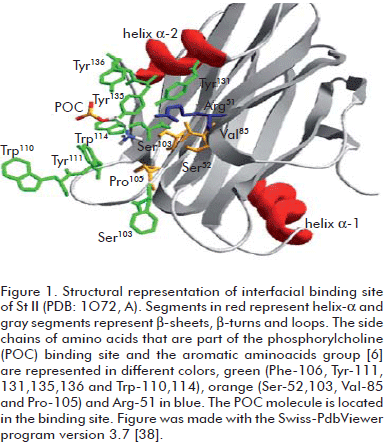
<body><![CDATA[<P   align="left" ><font face="Verdana, Arial, Helvetica, sans-serif" size="2"> </font></P >       <P   align="left" ><font size="2" face="Verdana, Arial, Helvetica, sans-serif"><B><font size="3">INTRODUCTION</font></B>      </font></P >   <FONT size="+1">        <P   align="left" ><font size="2" face="Verdana, Arial, Helvetica, sans-serif">Sticholysin I (St      I) and Sticholysin II (St II) are two isotoxins obtained from the sea anemone      <I>Stichodactyla helianthus</I> (1). Sticholysins belongs to the actinoporin      family, which is constituted by pore-forming proteins isolated from sea anemones.      St I is a cysteineless and basic protein of 20 kDa that increases ion membrane      permeability by forming a channel resulting from the association of three      or four toxin monomers (2). The three-dimensional structures of three actinoporins,      equinatoxin II (Eqt II) from <I>Actinia equina</I> (3, 4) and St I (5) and      St II (6) are now known. These toxins display a very similar <FONT size="+1" color="#000000"><FONT size="+1"><FONT size="+1"><FONT size="+1"><FONT size="+1"><FONT size="+1"><FONT size="+1"><FONT size="+1"><FONT size="+1"><FONT size="+1"><FONT size="+1"><FONT size="+1"><FONT size="+1"><FONT size="+1"><FONT size="+1"><FONT size="+1"><FONT size="+1"><FONT size="+1"><FONT size="+1"><FONT size="+1"><FONT size="+1"><FONT size="+1"><FONT size="+1"><FONT size="+1"><FONT size="+1"><FONT size="+1"><FONT size="+1"><FONT size="+1"></font></font></font></font></font></font></font></font></font></font></font></font></font></font></font></font></font></font></font></font></font></font></font></font></font></font></font></font>&beta;-sandwich      fold flanked on each side by two short &alpha;-helices. The structure of a      complex St II: phosphocholine (POC) allowed postulating a POC binding site      for the actinoporin family (6). The POC binding site is formed by side chains      of Ser-52, Val-85, Ser-103, Pro-105, Tyr-111, Tyr-131, Tyr-135 and Tyr-136      (<a href="#fig1">Figure 1</a>). These residues are almost completely conserved      within the actinoporin family, indicating that POC binding may proceed in      the same way in all actinoporins (7). </font></P >       <P   align="center" ><a name="fig1"></a><img src="/img/revistas/bta/v28n1/f0103111.gif" width="390" height="446"></P >   <FONT size="+1">        
<P   align="left" ><font face="Verdana, Arial, Helvetica, sans-serif" size="2">Actinoporins are      able to spontaneously insert themselves into model and natural membranes and      form oligomeric pores. The mechanism for pore formation involves several steps.      First, the monomer toxin is attached to the membrane by the specific recognition      of sphingomyelin (SM) using the aromatic rich region and adjacent POC binding      site (1, 3, 8, 9). Then, the N-terminal segment is transferred to the lipid-water      interface (8, 10, 11) and finally the toxin oligomerizes on the membrane surface      and &alpha;-helices of 3 or 4 monomers insert into the bilayer forming the      functional pore (2, 11-13). In the last decade, research on actinoporins has      rapidly expanded, thereby providing more profound insights into their structure,      molecular mechanisms and their probable biotechnology or biomedical applications.      For instance, they were used for the selective killing of parasites (14) and      cancer cells (15-18), with built-in biological &lsquo;triggers&rsquo; that      would activate in response to specific biological stimuli, or as biosensors      (19, 20). </font></P >       <P   align="left" ><font face="Verdana, Arial, Helvetica, sans-serif" size="2">Thus, in order to      gain new insights into the role of certain sticholysins residues during the      pore formation process, we designed and produced two Cys mutants in relevant      functional regions of recombinant sticholysin I (rSt I): St I E2C (in the      N-terminal sequence) and St I R52C (near the membrane binding site) (8, 21,      22). The overall results suggest that the replacement of Glu-2 and Arg-52      by a Cys residue in rSt I did not noticeably change protein conformation at      least from the data derived from fluorescence and CD spectroscopic studies.      Furthermore, the substitution of an amino acid by Cys, either close to the      membrane binding region (St I R52C) or in the N-terminal region (St I E2C),      did not change their ability to bind to liposomal vesicles, while producing      a decrease in St I R52C pore-forming activity. These results clarify that      Arg-52 is relatively more important for pore formation than binding in St      I. </font></P >       <P   align="left" ><font size="2" face="Verdana, Arial, Helvetica, sans-serif"><B><font size="3">MATERIALS      AND METHODS</font></B> </font></P >   <FONT size="+1">        <P   align="left" ><font size="2" face="Verdana, Arial, Helvetica, sans-serif"><B>Mutagenesis, expression      and purification of the mutants </b></font></P >   <FONT size="+1">        <P   align="left" ><font face="Verdana, Arial, Helvetica, sans-serif" size="2">Positions for mutation      were selected considering their location in the relevant protein regions for      sticholysin function (22) and exposure to the solvent of each residue in the      protein structure. Accessible surface area (ASA) of residues in the rSt I      three dimensional model (23) was calculated as ASA of amino acid (X) in the      rSt I structural model relative to a Gly-X-Gly tri-peptide in a vacuum employing      the WhatIf server (<FONT color="#0000FF"><a href="http://swift.cmbi.kun.nl/whatif/">http://swift.cmbi.kun.nl/whatif/<FONT color="#000000">)</font></a><FONT color="#000000">.      </font></font></font></P >   <FONT color="#0000FF"><FONT color="#000000">        <P   align="left" ><font face="Verdana, Arial, Helvetica, sans-serif" size="2">Mutations were introduced      by PCR using as a template vector pET3a-rSt I (23) and adequate oligonucleotides      (<a href="/img/revistas/bta/v28n1/t0103111.gif">Table 1</a>). PCR was      performed as previously described (23). The products of gene amplification      were restricted with NdeI and BamHI and cloned into pET3a, where the nucleotide      sequence of putative positive clones was verified using a T7 Sequencing TM      Kit according to Pazos <I>et al</I>. (23). Mutants and wild type proteins      were expressed in <I>Escherichia coli </I>BL21 (DE3) pLysS strain and purified      from supernatants of lysed bacteria using ion-exchange chromatography on carboxymethyl      cellulose (CM-52) (23). For mutants, an intermediate washing step with 100      mM &beta;-mercaptoethanol was included before the gradient to eliminate molecules      linked to the toxin through Cys (23). The homogeneity of proteins was verified      by sodium dodecylsulphate-polyacrylamide gel electrophoresis (SDS-PAGE) (24)      and reverse phase-high pressure liquid chromatography (RP-HPLC) on a Vydac      reversed phase column RP-C4 (23). Pro- tein concentration was determined measuring      absorbance at 280 nm using the extinction coefficient of St I (1). </font></P >       
]]></body>
<body><![CDATA[<P   align="left" ><font face="Verdana, Arial, Helvetica, sans-serif" size="2"><B>Hemolytic activity      assay </b></font></P >       <P   align="left" ><font face="Verdana, Arial, Helvetica, sans-serif" size="2">Hemolytic activity      of toxins was evaluated from the decrease in turbidity of a human red blood      cell suspension as previously described (25). The percentage of hemolysis      was estimated from the final extension of the hemolytic process until 30 minutes      after the start of the assay as follows: </font></P >       <P   align="left" ><img src="/img/revistas/bta/v28n1/fr0103111.gif" width="390" height="27"></P >       

<P   align="left" ><font face="Verdana, Arial, Helvetica, sans-serif" size="2">where: OD<sub><sub>i</sub></sub>      and OD<sub><sub>f</sub></sub> are the optical density values at the beginning      and 30 minutes after the start of the hemolytic assay, respectively; and OD<sub><sub>s</sub></sub>      represent the OD value corresponding to the total lysis of the erythrocyte      suspension provoked by an excess of toxins. </font></P >   <FONT size="+1"><FONT size="+1"><FONT size="+1"><FONT size="+1"><FONT size="+1"><FONT size="+1">        <P   align="left" ><font face="Verdana, Arial, Helvetica, sans-serif" size="2"><B>Sphingomyelin      (SM) </b></font></P >       <P   align="left" ><font face="Verdana, Arial, Helvetica, sans-serif" size="2"> Large unilamellar      vesicles (LUVs) were prepared by extruding multilamellar liposomes of palmitoyloleyl-phosphatidylcholine      (POPC) and SM from bovine brain (Avanti Polar Lipids, USA) in a molar ratio      of 85:15, prepared in the presence of 80 mM carboxyfluorescein (pH 7.0) according      to the procedure described by Tejuca <I>et al</I>. (2). Extrusion was carried      out with a two-syringe extruder (Lipo Fast Basic Unit, Canada), equipped with      100 nm polycarbonate filters (Nucleopore, USA). The non-encapsulated fluorescent      probe was removed from the vesicle suspension by a Sephadex G-50 gel filtration      column under isosmotic conditions. Small unilamellar vesicles (SUVs) were      prepared by sonication of multilamellar vesicles comprised of POPC:SM (85:15)      as described elsewhere (23). The final lipid concentration of the liposome      suspension was determined according to Rouser <I>et al</I>. (26). </font></P >       <P   align="left" ><font face="Verdana, Arial, Helvetica, sans-serif" size="2"><B>Intrinsic fluorescence      measurements </b></font></P >       <P   align="left" ><font face="Verdana, Arial, Helvetica, sans-serif" size="2">Fluorescence measurements      were recorded in a spectrofluorimeter (Shimadzu RF-540, Japan) using 1 cm      path length quartz cuvettes. Slit widths of a nominal band pass of 5 nm were      used in both excitation and emission beams. Intrinsic fluorescence emission      spectra of 1.5 &mu;M St I mutants and rSt I solutions were recorded from 300      to 450 nm after excitation at 295 nm to obtain fluorescence spectra only derived      from tryptophan residues (27). Background intensities measured in samples      without protein were always subtracted. Changes were also measured in the      intrinsic fluorescence of St I mutants and rSt I upon the addition of increasing      amounts of SUVs. </font></P >       <P   align="left" ><font face="Verdana, Arial, Helvetica, sans-serif" size="2"><B>Permeabilization      assays </b></font></P >       <P   align="left" ><font face="Verdana, Arial, Helvetica, sans-serif" size="2">Permeabilization      was studied by measuring the fluorescence of carboxyfluorescein released from      LUVs after adding different concentrations of proteins according to Tejuca      <I>et al</I>. (2). The total fraction of permeabilized vesicles was determined      as follows: </font></P >       ]]></body>
<body><![CDATA[<P   align="left" ><img src="/img/revistas/bta/v28n1/fr0203111.gif" width="360" height="31"></P >       
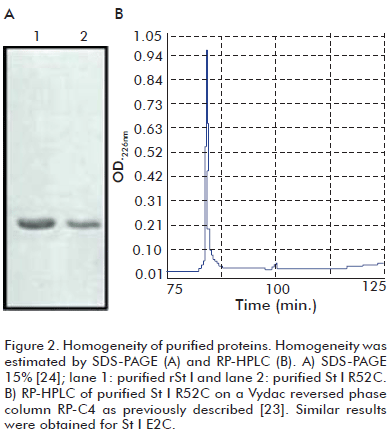
<P   align="left" ><font face="Verdana, Arial, Helvetica, sans-serif" size="2">where: F<sub>0</sub>      and F<sub><sub>f</sub></sub> represent the fluorescence values before and      10 minutes after the start of the assay and F<sub><sub>max</sub></sub> is      the fluorescence value achieved after the addition of 1 mM Triton X-100. </font></P >   <FONT size="+1"><FONT size="+1"><FONT size="+1"><FONT size="+1"><FONT size="+1"><FONT size="+1">        <P   align="left" ><font face="Verdana, Arial, Helvetica, sans-serif" size="2"><B>Circular dichroism      spectra </b></font></P >       <P   align="left" ><font face="Verdana, Arial, Helvetica, sans-serif" size="2">Far-UV and near-UV      circular dichroism (CD) spectra of the St I mutants and rSt I were recorded      on a CD6 Jobin Yvon spectropolarimeter (Longjumeau, France) coupled to a Multiscan      Computer (D&amp;D Technology) and base-line was corrected by control samples      of similarly prepared solutions devoid of protein. Spectra were obtained for      far-UV from 190 to 260 nm, and for near-UV range from 250 to 350 nm, in 1-mm      and 5-mm path length quartz cuvettes, respectively. The reported spectra are      averages from 6 and 12 scans for far-UV and near-UV, respectively. </font></P >       <P   align="left" ><font size="3" face="Verdana, Arial, Helvetica, sans-serif"><b>RESULTS AND DISCUSSION</b></font><font size="2" face="Verdana, Arial, Helvetica, sans-serif">      </font></P >   <FONT size="+1">        <P   align="left" ><font size="2" face="Verdana, Arial, Helvetica, sans-serif">For a better insight      in the pore formation mechanism and the structure-function relationship of      sticholysins, we have designed and produced two Cys mutants of rSt I, taking      advantage of the fact that these toxins are cysteine-less proteins (28). Glu-2      and Arg-52 were selected to be replaced by Cys because of the location in      the N-terminal sequence and for being near the phosphocholine-binding site,      respectively. Secondly, these residues have a relatively high exposure to      solvent (85.5% for Glu-2 ASA and 50.7% for Arg-52 ASA) (29). The introduction      of this reactive residue in the St I amino acid sequence would enable the      modification of these mutants with thiol-specific probes and to study the      location of the modified region in the protein-membrane interaction. Such      an approach is valid only if these mutants retain the wild-type conformation      and the ability to form a functional pore. </font></P >   <FONT size="+1">        <P   align="left" ><font face="Verdana, Arial, Helvetica, sans-serif" size="2">Putative positive      clones selected by restriction analysis were sequenced to confirm the presence      of the desired Cys mutations in the constructions and the integrity of the      rest of the genes. The mutants were purified by a single step of ion-exchange      chromatography. The homogeneity of toxins was higher than 95%, estimated by      SDS-PAGE (<a href="#fig2">Figure 2A</a>) and RP-HPLC (<a href="#fig2">Figure      2B</a>). Protein concentration was about 10 </font><font size="+1" color="#000000"><font size="+1"><font size="+1"><font size="+1"><font size="+1"><font size="+1"><font size="+1"><font size="+1"><font size="+1"><font size="+1"><font size="+1"><font size="+1"><font size="+1"><font size="+1"><font size="+1"><font size="+1"><font size="+1"><font size="+1"><font size="+1"><font size="+1"><font size="+1"><font size="+1"><font size="+1"><font size="+1"><font size="+1"><font size="+1"><font size="+1"><font size="+1"><font size="+1"><font size="+1"><font size="+1"><font color="#0000FF"><font color="#000000"><font size="+1"><font size="+1"><font size="+1"><font size="+1"><font size="+1"><font size="+1"><font face="Verdana, Arial, Helvetica, sans-serif" size="2">&mu;</font></font></font></font></font></font></font></font></font></font></font></font></font></font></font></font></font></font></font></font></font></font></font></font></font></font></font></font></font></font></font></font></font></font></font></font></font></font></font></font><font face="Verdana, Arial, Helvetica, sans-serif" size="2" color="#000000">M      in all e</font><font face="Verdana, Arial, Helvetica, sans-serif" size="2">xperiments.      The mutants were in a monomeric form, as demonstrated by SDS-PAGE (<a href="#fig2">Figure      2A</a>). </font></P >       <P   align="center" ><a name="fig2"></a><img src="/img/revistas/bta/v28n1/f0203111.gif" width="392" height="437"></P >       
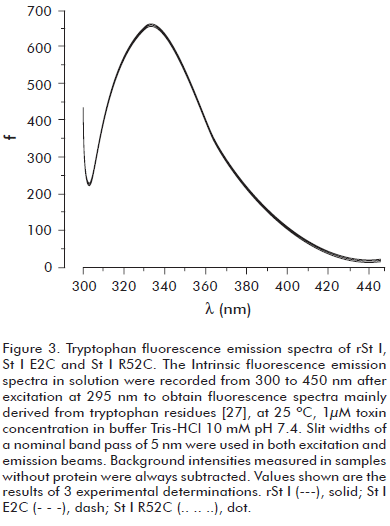
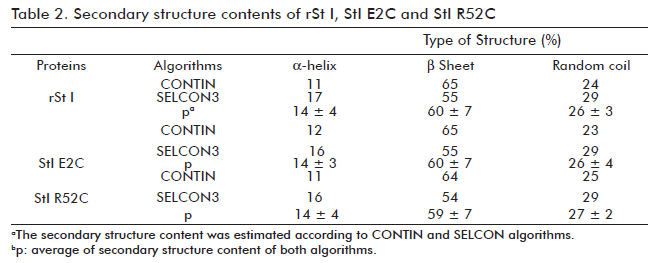
<P   align="left" ><font face="Verdana, Arial, Helvetica, sans-serif" size="2">Before evaluating      the functional activity of St I E2C and St I R52C, we verified that they conserved      the wild type conformational properties. We used fluorescence and CD spectroscopy      to rule out any significant conformational changes. The intrinsic fluorescence      spectra of mutants in solution are very similar to the wild type (<a href="#fig3">Figure      3</a>). The far-UV CD spectra of the wild type and mutants are very much alike      (<a href="/img/revistas/bta/v28n1/f0403111.gif">Figure 4A</a>), showing      a positive band centered at 195 nm and a minimum around 217 nm, which is typical      of proteins containing basically &beta;-sheet structures (30). The relative      secondary structure content of the toxins was established from their far-UV      CD spectra using CONTIN and SELCON algorithms (<a href="/img/revistas/bta/v28n1/t0203111.gif">Table      2</a>). Hence, the mutations of selected residues did not modify St I secondary      structure.</font></P >       
<P   align="center" ><a name="fig3"></a><img src="/img/revistas/bta/v28n1/f0303111.gif" width="390" height="526"></P >       
]]></body>
<body><![CDATA[<P   align="left" ><font face="Verdana, Arial, Helvetica, sans-serif" size="2">Also St I E2C, St      I R52C and rSt I showed similar near-UV spectra, with the same main band positions,      in spite of the presence of Cys in the mutant sequences, indicating that the      three dimensional conformation of rSt I was conserved after mutation (<a href="/img/revistas/bta/v28n1/f0403111.gif">Figure      4B</a>). We observed only a slight difference between the spectra of rSt I      and St I R52C. The spectrum of this mutant showed more pronounced negative      bands at 266 and 270 nm, which are in the Phe range (31). These differences      could be determined by the nearness of Phe-51 to the mutated position. </font></P >       
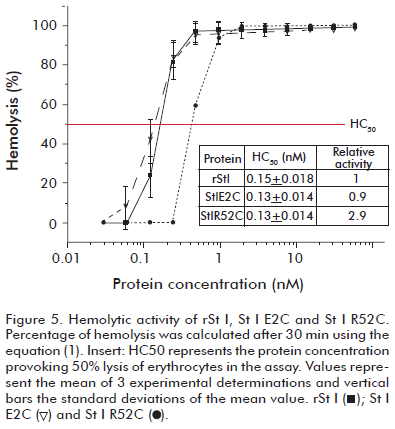
<P   align="left" ><font face="Verdana, Arial, Helvetica, sans-serif" size="2">The pore formation      ability of the mutants was measured by hemolytic activity experiments, which      is the most widely used assay for testing the functional activity of actinoporins.      rSt I and St I E2C showed similar hemolytic capacity (<a href="#fig5">Figure      5</a>). The molecular mechanism of actinoporin pore formation has been unraveled      in the last few years with particular emphasis on the role of the N-terminal      region. It was shown that it needs to be flexible (8, 32) and the region 14-23      in St II forms an amphiphatic &alpha;-helix (3), the only recognized structural      element of the final pore thus far (11). Actinoporins with a removed N-terminus      do not lyse red blood cells (33). Moreover, various tags added to the N-terminal      part of these proteins decrease toxin activity (34, 35). Considering this,      it could be possible to assume that a mutation in the second position in St      I could modify its pore-forming ability. Nevertheless, this result indicates      that the change of Glu-2 to Cys did not affect rSt I pore formation capacity      in terms of hemolytic activity.</font></P >       <P   align="center" ><a name="fig5"></a><img src="/img/revistas/bta/v28n1/f0503111.gif" width="395" height="429"></P >       
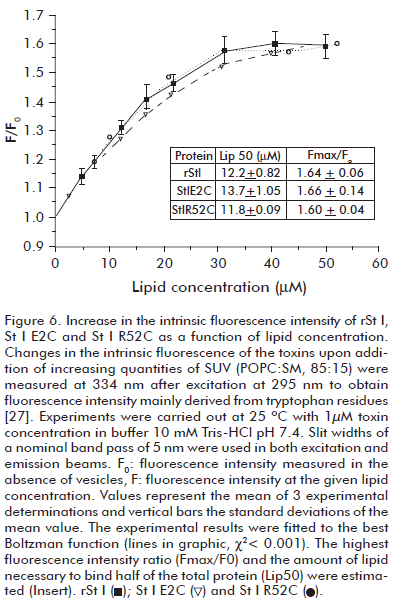
<P   align="left" ><font face="Verdana, Arial, Helvetica, sans-serif" size="2">In contrast, the      HC<sub><sub>50</sub></sub> value of St I R52C is about three times higher      than the HC<sub>50</sub> value of rSt I, meaning a lower lytic capacity (<a href="#fig5">Figure      5</a>). This result suggests an important role of the Arg-52 residue in the      functional capacity of this toxin. To further investigate the causes the lower      functional activity of St I R52C and for an insight into St I-membrane interaction      events, we used model bilayer systems to study the functional properties of      the mutants. </font></P >   <FONT size="+1"><FONT size="+1"><FONT size="+1"><FONT size="+1">        <P   align="left" ><font face="Verdana, Arial, Helvetica, sans-serif" size="2" color="#000000">We      studied the binding ability of rSt I and its mutants using SUVs of POPC:SM      (85:15). The binding step of toxins to lipid bilayers was assessed by measuring      the change of protein intrinsic fluorescence upon the addition of increasing      concentrations of SUVs. The addition of liposomes progressively increases      fluorescence intensity until reaching a plateau indicating a quantitative      association of proteins to lipid bilayers, where rSt I, St I E2C and St I      R52C display a similar binding ability to SUVs (<a href="#fig6">Figure 6</a>).      Adjusting the experimental data to the Boltzman function we obtained the value      of parameters Lip<sub>50</sub> (amount of lipid needed to bind half of the      protein present in the assay) and F<sub>max</sub>/F<sub>0</sub> (ratio of      fluorescence values in the presence of infinite lipid concentrations and in      the absence of lipids). As expected, the values of these parameters for the      toxins are very similar, indicating similar membrane binding ability (<a href="#fig6">Figure      6</a>). This result shows that mutations did not affect the binding capacity      of St I under these experimental conditions. </font></P >       <P   align="center" ><a name="fig6"></a><img src="/img/revistas/bta/v28n1/f0603111.gif" width="395" height="607"></P >   <FONT size="+1"><FONT size="+1"><FONT size="+1"><FONT size="+1"><FONT size="+1"><FONT size="+1">        
<P   align="left" ><font face="Verdana, Arial, Helvetica, sans-serif" size="2" color="#000000">It      is interesting to note that Arg-52 is located near the phosphorylcholine binding      pocket (6) (<a href="#fig1">Figure 1</a>) and a change in this position could      modify the final lodging of the toxin in the lipid bilayer. However, the experimental      assay used was not able to detect the differences in the membrane binding      ability between rSt I and its mutants. Recently, Castrillo <I>et al</I>. (36)      studied the binding of St I to dodecylphosphocholine micelles by NMR. They      did not report interaction between the micelles and Glu-2 or Arg-52 residues      in the protein. </font></P >       <P   align="left" ><font face="Verdana, Arial, Helvetica, sans-serif" size="2" color="#000000">Pore      formation by rSt I and its mutants was evaluated by their ability to release      carboxyfluorescein encapsulated in LUVs. They promoted the exit of fluorophore      entrapped in the inner pool of LUVs composed of POPC:SM (85:15). The molar      ratio of the total fraction of permeabilized vesicles (f) vs. protein-lipid      is illustrated in <a href="#fig7">figure 7</a>. The results of permeabilization      assays show a good correlation with those observed in hemolytic activity (<a href="#fig5">Figure      5</a>). We obtained very similar curves for rSt I and St I E2C. In contrast,      St I R52C showed relatively smaller permeabilization values than rSt I. </font></P >       <P   align="center" ><a name="fig7"></a><img src="/img/revistas/bta/v28n1/f0703111.gif" width="398" height="526"></P >       
<P   align="left" ><font face="Verdana, Arial, Helvetica, sans-serif" size="2" color="#000000">Arg-52      appears to be highly preserved in the sequence alignment of actinoporins (22)      suggesting an important role of this residue in toxin function. Manche&ntilde;o      <I>et al</I>. (6) described the phosphorylcho-line group binding site in the      St II three-dimensional structure as a partly hydrophilic and hydrophobic      cavity due to the hydrophilic groups of Tyr and Ser residues, the aromatic      ring of Tyr residues and the side chains of Val and Pro residues, located      in this region (<a href="#fig1">Figure 1</a>). They proposed the role of the      Arg residue arguing that its positive charge presumably contributes to the      stabilization of the binding of the phosphocholine group with the protein.      Therefore, the substitution of this residue by a Cys could change the properties      of the phosphorylcholine binding si- te, modifying the interaction of the      toxin with the membrane. </font></P >       ]]></body>
<body><![CDATA[<P   align="left" ><font face="Verdana, Arial, Helvetica, sans-serif" size="2" color="#000000">Nevertheless,      the relative decrease in pore forming capacity of St I R52C (<a href="#fig5">Figures      5</a> and <a href="#fig7">7</a>) is not related to a lower binding capacity      of this mutant to the membrane (<a href="#fig6">Figure 6</a>). Hence, this      residue could be involved in steps occurring after St I binding in the pore      formation events. Similar results were reported by Anderluh <I>et al</I>.      (37) during the functional characterization of the Eqt II S54C mutant. This      mutant showed lower hemolytic and permeabilizing activity than the wild type,      but displayed a capacity to bind LUVs that was similar to Eqt II. Ser-54 in      Eqt II is the equivalent residue to Ser-53 in St I, which is the Arg-52 adjacent      amino acid. Considering the spatial nearness of these two residues and the      similar behavior of their respective mutants, the participation of the Arg-52      residue in a step different to that of the toxin bilayer binding could be      strongly considered although this requires further experimental studies. </font></P >       <P   align="left" ><font face="Verdana, Arial, Helvetica, sans-serif" size="2" color="#000000">On      the other hand, although the mutation at position two of the St I amino acid      sequence is located in the N-terminal region, and probably involved in the      transmembrane pore formation, this mutation did not affect the pore forming      ability of the toxin. Kristan <I>et al</I>. (21) demonstrated that the most      N-terminal portion of Eqt II extends to the membrane trans side in the final      pore conformation. Moreover the Eqt II S1C mutant was able to retain the pore      forming capacity of Eqt II (37). An examination of the amino acid sequence      alignment of the actinoporin family shows that Glu-2 is not a conserved residue,      instead, there is a predominance in this position of non polar amino acids,      and also deletions (21). Consequently, Glu-2 would not have any structural      or functional relevance for these toxins. </font></P >       <P   align="left" ><font face="Verdana, Arial, Helvetica, sans-serif" size="2" color="#000000">In      summary, St I E2C and St I R52C conserve the main conformational properties      of the wild type and show similarities in binding to liposomal vesicles, whereas      they differ in their permeabilizing activity. Therefore, St I E2C and St I      R52C constitute good tools to study the steps of the permeabilizing mechanisms      of sticholysins that take place after binding to the membrane, using thiol-specific      probes such as fluorescent and spin labels. </font></P >       <P   align="left" > </P >       <P   align="left" ><font face="Verdana, Arial, Helvetica, sans-serif" size="3" color="#000000"><b>REFERENCES</b></font><font face="Verdana, Arial, Helvetica, sans-serif" size="2" color="#000000">      </font></P >       <P   align="left" > </P >       <!-- ref --><P   align="justify" ><font size="2" face="Verdana, Arial, Helvetica, sans-serif" color="#000000">1.      Lanio ME, Morera V, &Aacute;lvarez C, Tejuca M, Gomez T, Pazos F, <I>et al</I>.      Purification and characterization of two hemolysins from <I>Stichodactyla      helianthus</I>. Toxicon. 2001;39:187-94. </font></P >   <FONT size="+1">    <!-- ref --><P   align="justify" ><font face="Verdana, Arial, Helvetica, sans-serif" size="2" color="#000000">2.      Tejuca M, Serra MD, Ferreras M, Lanio ME, Menestrina G. Mechanism of membrane      permeabilization by Sticholysin I, a cytolysin isolated from the venom of      the sea anemone <I>Stichodactyla helianthus</I>. Biochemistry. 1996;35:14947-57.      </font></P >    <!-- ref --><P   align="justify" ><font face="Verdana, Arial, Helvetica, sans-serif" size="2" color="#000000">3.      Athanasiadis A, Anderluh G, Macek P, Turk D. Crystal structure of the soluble      form of equinatoxin II, a pore-forming toxin from the sea anemone Actinia      equina. Structure. 2001;9:341-6. </font></P >    <!-- ref --><P   align="justify" ><font face="Verdana, Arial, Helvetica, sans-serif" size="2" color="#000000">4.      Hinds MG, Zhang W, Anderluh G, Hansen PE, Norton RS. Solution structure of      the eukariotic pore-forming cytolisin equinatoxin II: implication for pore      formation. J Mol Biol. 2002;315:1219-29. </font></P >    <!-- ref --><P   align="justify" ><font face="Verdana, Arial, Helvetica, sans-serif" size="2" color="#000000">5.      Castrillo I, Alegre-Cebollada J, del Pozo AM, Gavilanes JG, Santoro J, Bruix      M. 1H, 13C, and 15N NMR assignments of the actinoporin Sticholysin I. Biomol      NMR Assign. 2009;3(1):5-7. </font></P >    <!-- ref --><P   align="justify" ><font face="Verdana, Arial, Helvetica, sans-serif" size="2" color="#000000">6.      Manche&ntilde;o JM, Martin-Benito J, Mart&iacute;nez-Ripoll M, Gavilanes JG,      Hermoso JA. Crystal and electron microscopy structures of Sticholysin II actinoporin      reveal insight into the mechanism of membrane pore formation. Structure. 2003;11:1319-28.      </font></P >    <!-- ref --><P   align="justify" ><font face="Verdana, Arial, Helvetica, sans-serif" size="2" color="#000000">7.      Kristan KC, Viero G, Dalla Serra M, Macek P, Anderluh G. Molecular mechanism      of pore formation by actinoporins. Toxicon. 2009;54(8):1125-34. </font></P >    <!-- ref --><P   align="justify" ><font face="Verdana, Arial, Helvetica, sans-serif" size="2" color="#000000">8.      Hong Q, Gutierrez-Aguirre I, Barlic A, Malovrh P, Kristan K, Podlesek Z, <I>et      al</I>. Two-step membrane binding by Equinatoxin II, a pore-forming toxin      from the sea anemone, involves an exposed aromatic cluster and a flexible      helix. J Biol Chem. 2002;277:41916-24. </font></P >    <P   align="justify" ><font face="Verdana, Arial, Helvetica, sans-serif" size="2" color="#000000">9.      Bacrak&#269; B, Guti&eacute;rrez-Aguirre I, Podlesek Z, Sonnen AFP, Gilbert      RJ, Macek P, <I>et al</I>. Molecular determinants of sphingomyelin specificity      of a eukaryotic pore forming toxin. J Biol Chem. 2008;283:18665-77. </font></P >       <!-- ref --><P   align="justify" ><font face="Verdana, Arial, Helvetica, sans-serif" size="2" color="#000000">10.      Guti&eacute;rrez-Aguirre I, Barlic A, Podlesek Z, Macek P, Anderluh G, Gonzalez-Ma&ntilde;as      JM. Membrane insertion of the N-terminal alpha-helix of equinatoxin II, a      sea anemone cytolytic toxin. Biochem J. 2004;384:421-8. </font></P >    <!-- ref --><P   align="justify" ><font face="Verdana, Arial, Helvetica, sans-serif" size="2" color="#000000">11.      Malovrh P, Viero G, Dalla Serra M, Podlesek Z, Lakey JH, Macek P, <I>et al</I>.      A novel mechanism of pore formation: membrane penetration by the N-terminal      amphipathic region of equinatoxin. J Biol Chem. 2003;27:22678-85. </font></P >    <!-- ref --><P   align="justify" ><font face="Verdana, Arial, Helvetica, sans-serif" size="2" color="#000000">12.      Belmonte G, Pederzolli C, Macek P, Menestrina G. Pore formation by the sea      anemone cytolysin equinatoxin II in red blood cells and model lipid membranes.      J Membr Biol. 1993;131:11-22. </font></P >    <!-- ref --><P   align="justify" ><font face="Verdana, Arial, Helvetica, sans-serif" size="2" color="#000000">13.      Alegre-Cebollada J, Mart&iacute;nez DP, Gavilanes JG, Goormaghtigh E. Infrared      spectroscopy study on the conformational changes leading to pore formation      of the toxin sticholysin II. Biophys J. 2007;93:3191-201. </font></P >    <!-- ref --><P   align="justify" ><font face="Verdana, Arial, Helvetica, sans-serif" size="2" color="#000000">14.      Tejuca M, Anderluh G, Macek P, Marcet R, Torres D, Sarracent J, <I>et al</I>.      Antiparasite activity of sea anemone cytolysins on Giardia duodenalis and      specific targeting with anti-giardia antibodies. Int J Parasitol. 1999;29:489-98.      </font></P >    <!-- ref --><P   align="justify" ><font face="Verdana, Arial, Helvetica, sans-serif" size="2" color="#000000">15.      Panchal RG, Smart ML, Bowser DN, Williams DA, Petrou S. Pore-forming proteins      and their applications in biotechnology. Curr Pharm Biotechnol. 2002;3:99-115.      </font></P >    <!-- ref --><P   align="justify" ><font face="Verdana, Arial, Helvetica, sans-serif" size="2" color="#000000">16.      Potrich C, Tomazzolli R, Dalla Serra M, Anderluh G, Malovrh P, Macek P, <I>et      al</I>. Cytotoxic activity of a tumor protease-activated pore/forming toxin.      Bioconjug Chem. 2005;16:369-76. </font></P >    <!-- ref --><P   align="justify" ><font face="Verdana, Arial, Helvetica, sans-serif" size="2" color="#000000">17.      Tejuca M, D&iacute;az I, Figueredo R, Roque L, Pazos F, Martinez D, <I>et      al</I>. Construction of an immunotoxin with the pore forming protein StI and      ior C5, a monoclonal antibody against a colon cancer cell line. Int Immunopharmacol.      2004;4:731-44. </font></P >    <!-- ref --><P   align="justify" ><font face="Verdana, Arial, Helvetica, sans-serif" size="2" color="#000000">18.      Liu S, Wang H, Currie BM, Molinolo A, Leung HJ, Moayeri M, <I>et al</I>. Matrix      metalloproteinase-activated anthrax lethal toxin demonstrates high potency      in targeting tumor vasculature. J Biol Chem. 2008;283:529-40. </font></P >    <!-- ref --><P   align="justify" ><font face="Verdana, Arial, Helvetica, sans-serif" size="2" color="#000000">19.      Braha O, Walker B, Cheley S, Kasianowicz JJ, Song L, Gouaux JE, <I>et al</I>.      Designed protein pores as components for biosensors. Chem Biol. 1997;4(7):497-505.      </font></P >    <!-- ref --><P   align="justify" ><font face="Verdana, Arial, Helvetica, sans-serif" size="2" color="#000000">20.      Astier Y, Bayley H, Howorka S. Protein components for nanodevices. Curr Opin      Chem Biol. 2005;9:576-84. </font></P >    <!-- ref --><P   align="justify" ><font face="Verdana, Arial, Helvetica, sans-serif" size="2" color="#000000">21.      Kristan K, Viero G, Macek P, Dalla Serra M, Anderluh G. The equinatoxin N-terminus      is transferred across planar lipid membranes and helps to stabilize the transmembrane      pore. FEBS J. 2007;274:539-50. </font></P >    <!-- ref --><P   align="justify" ><font face="Verdana, Arial, Helvetica, sans-serif" size="2" color="#000000">22.      &Aacute;lvarez C, Manche&ntilde;o JM, Mart&iacute;nez D, Tejuca M, Pazos F,      Lanio ME. Sticholysins, two pore-forming toxins produced by the caribbean      sea anemone <I>Stichodactyla helianthus</I>: their interaction with membranes.      Toxicon. 2009;54(8):1135-47. </font></P >    <!-- ref --><P   align="justify" ><font face="Verdana, Arial, Helvetica, sans-serif" size="2" color="#000000">23.      Pazos F, Valle A, Martinez D, Ramirez A, Calderon L, Pupo A, <I>et al</I>.      Structural and functional characterization of a recombinant sticholysin I      (rSt I) from the sea anemone <I>Stichodactyla helianthus</I>. Toxicon. 2006;48:1083-94.      </font></P >    <!-- ref --><P   align="justify" ><font face="Verdana, Arial, Helvetica, sans-serif" size="2" color="#000000">24.      Laemmli UK. Cleavage of structural protein during assembling of the head of      bacteriophage T4. Nature. 1970;227: 680-5. </font></P >    <P   align="justify" ><font face="Verdana, Arial, Helvetica, sans-serif" size="2" color="#000000">25.      Mart&iacute;nez D, Campos AM, Pazos F, Alvarez C, Lanio ME, Casallanovo F,      <I>et al</I>. Properties of St I and St II, two isotoxins isolated from <I>Stichodactyla      helianthus</I>: a comparison. Toxicon. 2001;39(10):1547-60. </font></P >       <!-- ref --><P   align="justify" ><font face="Verdana, Arial, Helvetica, sans-serif" size="2" color="#000000">26.      Rouser G, Fkeischer S, Yamamoto A. Two dimensional thin layer chromatographic      separation of polar lipids and determination of phospholipids by phosphorus      analysis of spots. Lipids. 1970; 5(5):494-6. </font></P >    <!-- ref --><P   align="justify" ><font face="Verdana, Arial, Helvetica, sans-serif" size="2" color="#000000">27.      Lakowicz, JR. Principles of Fluorescence Spectroscopy. 2nd ed. New York: Kluwer      Academic Publishers -Plenum Press; 1999. </font></P >    <!-- ref --><P   align="justify" ><font face="Verdana, Arial, Helvetica, sans-serif" size="2" color="#000000">28.      Huerta V, Morera V, Guanche Y, Chinea G, Gonz&aacute;lez LJ, Betancourt L,      <I>et al</I>. Primary structure of two cytolysin isoforms from <I>Stichodactyla      helianthus</I> differing in their hemolytic activity. Toxicon. 2001;39: 1253-6.      </font></P >    <!-- ref --><P   align="justify" ><font face="Verdana, Arial, Helvetica, sans-serif" size="2" color="#000000">29.      Gromiha MM, An J, Kono H, Oobatake M, Uedaira H, Sarai A. ProTherm: Thermodynamic      Database for Proteins and Mutants. Nucleic Acids Res. 1999;27(1): 286-8. </font></P >    <P   align="justify" ><font face="Verdana, Arial, Helvetica, sans-serif" size="2" color="#000000">30.      Venyaminov SY, Yang JT. Chapter 3: Determination of protein secondary structure.      In: Fasman GD, editor. Circular Dichroism and the Conformational Analysis      of Biomolecules. New York: Plenum Press; 1996. p. 109-82. </font></P >       <!-- ref --><P   align="justify" ><font face="Verdana, Arial, Helvetica, sans-serif" size="2" color="#000000">31.      Kelly SM, Jess TJ, Price NC. How to study proteins by circular dichroism.      Biochim Biophys Acta. 2005;1751:119-39. </font></P >    <P   align="justify" ><font face="Verdana, Arial, Helvetica, sans-serif" size="2" color="#000000">32.      Kristan K, Podlesek Z, Hojnik V, Gutierrez-Aguirre I, Gunchar G, Turk D, <I>et      al</I>. Pore formation by Equinatoxin II, a eukaryotic pore-forming toxin,      requires a flexible N-terminal and a stable b-sandwich. J Biol Chem. 2004;279:46509-17.      </font></P >       <!-- ref --><P   align="justify" ><font face="Verdana, Arial, Helvetica, sans-serif" size="2" color="#000000">33.      Anderluh G, Pungercar J, Krizaj I, Strukelj B, Gubensek F, Macek P. N-terminal      truncation mutagenesis of equinatoxin II, a pore-forming protein from the      sea anemone Actinia equina. Protein Eng. 1997;10:751-5. </font></P >    <!-- ref --><P   align="justify" ><font face="Verdana, Arial, Helvetica, sans-serif" size="2" color="#000000">34.      Wang Y, Lee Chua K, Eng Khoo H. A new cytolysin from the sea anemone, Heteractis      magnifica: isolation, cDNA cloning and functional expression. Biochim BiophysActa.      2000;1478:9-18. </font></P >    <!-- ref --><P   align="justify" ><font face="Verdana, Arial, Helvetica, sans-serif" size="2" color="#000000">35.      Pazos IF, Mart&iacute;nez D, Tejuca M, Valle A, del Pozo A, &Aacute;lvarez      C, <I>et al</I>. Comparison of pore-forming ability in membranes of a native      and a recombinant variant of Sticholysin II from <I>Stichodactyla helianthus</I>.      Toxicon. 2003;42:571-8. </font></P >    <!-- ref --><P   align="justify" ><font face="Verdana, Arial, Helvetica, sans-serif" size="2" color="#000000">36.      Castrillo I, Araujo NA, Alegre-Cebollada J, Gavilanes JG, Mart&iacute;nez-del-Pozo      A, Bruix M. Specific interactions of sticholysin I with model membranes: An      NMR study. Proteins. 2010;78:1959-70. </font></P >    <!-- ref --><P   align="justify" ><font face="Verdana, Arial, Helvetica, sans-serif" size="2" color="#000000">37.      Anderluh G, Barlic A, Podlesek Z, Macek P, Pungercar J, Zecchini ML, <I>et      al</I>. Cysteine-scanning mutagenesis of a eukariotic pore-forming toxin from      sea anemone. Eur J Biochem. 1999; 263:128-36. </font></P >    <!-- ref --><P   align="left" ><font face="Verdana, Arial, Helvetica, sans-serif" size="2" color="#000000">38.      Guex N, Peitsch MC. SWISS-MODEL and the Swiss-PdbViewer: An environment for      comparative protein modeling. Electrophoresis. 1997;18:2714-23. </font></P >   </font></font></font></font></font></font></font></font></font></font></font></font></font></font></font></font></font></font></font></font></font></font></font></font></font></font></font></font></font></font></font></font></font></font></font></font></font></font></font></font></font></font></font></font></font></font></font></font></font></font></font></font></font></font></font></font></font></font>    <p>&nbsp;</p>   <FONT size="+1" color="#000000"><FONT size="+1"><FONT size="+1"><FONT size="+1"><FONT size="+1"><FONT size="+1"><FONT size="+1"><FONT size="+1"><FONT size="+1"><FONT size="+1"><FONT size="+1"><FONT size="+1"><FONT size="+1"><FONT size="+1"><FONT size="+1"><FONT size="+1"><FONT size="+1"><FONT size="+1"><FONT size="+1"><FONT size="+1"><FONT size="+1"><FONT size="+1"><FONT size="+1"><FONT size="+1"><FONT size="+1"><FONT size="+1"><FONT size="+1"><FONT size="+1"><FONT size="+1"><FONT size="+1"><FONT size="+1"><FONT color="#0000FF"><FONT color="#000000"><FONT size="+1"><FONT size="+1"><FONT size="+1"><FONT size="+1"><FONT size="+1"><FONT size="+1"><FONT size="+1"><FONT size="+1"><FONT size="+1"><FONT size="+1"><FONT size="+1"><FONT size="+1"><FONT size="+1"><FONT size="+1"><FONT size="+1"><FONT size="+1"><FONT size="+1"><FONT size="+1"><FONT size="+1"><FONT size="+1"><FONT size="+1"><FONT size="+1"><FONT size="+1"><FONT size="+1"><FONT size="+1">       <P   align="left" ></P >       <P   align="left" ><font size="2" face="Verdana, Arial, Helvetica, sans-serif" color="#000000">Received      in May, 2010. </font><font size="2" color="#000000">    <br>     <font face="Verdana, Arial, Helvetica, sans-serif">Accepted for publication      in March, 2011. </font></font></P >   <font size="2" face="Verdana, Arial, Helvetica, sans-serif" color="#000000">Fabiola    Pazos, Center for Protein Studies, Havana University Street 25 #455 / J and    I, Vedado, PO Box 10 400, Havana, Cuba, E-mail: <a href="mailto:fpazos@fbio.uh.cu">fpazos@fbio.uh.cu</a></font></font></font></font></font></font></font></font></font></font></font></font></font></font></font></font></font></font></font></font></font></font></font></font></font></font></font></font></font></font></font></font></font></font></font></font></font></font></font></font></font></font></font></font></font></font></font></font></font></font></font></font></font></font></font></font></font></font></font></DIV >      ]]></body><back>
<ref-list>
<ref id="B1">
<label>1</label><nlm-citation citation-type="journal">
<person-group person-group-type="author">
<name>
<surname><![CDATA[Lanio]]></surname>
<given-names><![CDATA[ME]]></given-names>
</name>
<name>
<surname><![CDATA[Morera]]></surname>
<given-names><![CDATA[V]]></given-names>
</name>
<name>
<surname><![CDATA[Álvarez]]></surname>
<given-names><![CDATA[C]]></given-names>
</name>
<name>
<surname><![CDATA[Tejuca]]></surname>
<given-names><![CDATA[M]]></given-names>
</name>
<name>
<surname><![CDATA[Gomez]]></surname>
<given-names><![CDATA[T]]></given-names>
</name>
<name>
<surname><![CDATA[Pazos]]></surname>
<given-names><![CDATA[F]]></given-names>
</name>
</person-group>
<article-title xml:lang="en"><![CDATA[Purification and characterization of two hemolysins from Stichodactyla helianthus]]></article-title>
<source><![CDATA[Toxicon]]></source>
<year>2001</year>
<volume>39</volume>
<page-range>187-94</page-range></nlm-citation>
</ref>
<ref id="B2">
<label>2</label><nlm-citation citation-type="journal">
<person-group person-group-type="author">
<name>
<surname><![CDATA[Tejuca]]></surname>
<given-names><![CDATA[M]]></given-names>
</name>
<name>
<surname><![CDATA[Serra]]></surname>
<given-names><![CDATA[MD]]></given-names>
</name>
<name>
<surname><![CDATA[Ferreras]]></surname>
<given-names><![CDATA[M]]></given-names>
</name>
<name>
<surname><![CDATA[Lanio]]></surname>
<given-names><![CDATA[ME]]></given-names>
</name>
<name>
<surname><![CDATA[Menestrina]]></surname>
<given-names><![CDATA[G]]></given-names>
</name>
</person-group>
<article-title xml:lang="en"><![CDATA[Mechanism of membrane permeabilization by Sticholysin I, a cytolysin isolated from the venom of the sea anemone Stichodactyla helianthus]]></article-title>
<source><![CDATA[Biochemistry]]></source>
<year>1996</year>
<volume>35</volume>
<page-range>14947-57</page-range></nlm-citation>
</ref>
<ref id="B3">
<label>3</label><nlm-citation citation-type="journal">
<person-group person-group-type="author">
<name>
<surname><![CDATA[Athanasiadis]]></surname>
<given-names><![CDATA[A]]></given-names>
</name>
<name>
<surname><![CDATA[Anderluh]]></surname>
<given-names><![CDATA[G]]></given-names>
</name>
<name>
<surname><![CDATA[Macek]]></surname>
<given-names><![CDATA[P]]></given-names>
</name>
<name>
<surname><![CDATA[Turk]]></surname>
<given-names><![CDATA[D]]></given-names>
</name>
</person-group>
<article-title xml:lang="en"><![CDATA[Crystal structure of the soluble form of equinatoxin II, a pore-forming toxin from the sea anemone Actinia equina]]></article-title>
<source><![CDATA[Structure]]></source>
<year>2001</year>
<volume>9</volume>
<page-range>341-6</page-range></nlm-citation>
</ref>
<ref id="B4">
<label>4</label><nlm-citation citation-type="journal">
<person-group person-group-type="author">
<name>
<surname><![CDATA[Hinds]]></surname>
<given-names><![CDATA[MG]]></given-names>
</name>
<name>
<surname><![CDATA[Zhang]]></surname>
<given-names><![CDATA[W]]></given-names>
</name>
<name>
<surname><![CDATA[Anderluh]]></surname>
<given-names><![CDATA[G]]></given-names>
</name>
<name>
<surname><![CDATA[Hansen]]></surname>
<given-names><![CDATA[PE]]></given-names>
</name>
<name>
<surname><![CDATA[Norton]]></surname>
<given-names><![CDATA[RS]]></given-names>
</name>
</person-group>
<article-title xml:lang="en"><![CDATA[Solution structure of the eukariotic pore-forming cytolisin equinatoxin II: implication for pore formation]]></article-title>
<source><![CDATA[J Mol Biol]]></source>
<year>2002</year>
<volume>315</volume>
<page-range>1219-29</page-range></nlm-citation>
</ref>
<ref id="B5">
<label>5</label><nlm-citation citation-type="journal">
<person-group person-group-type="author">
<name>
<surname><![CDATA[Castrillo]]></surname>
<given-names><![CDATA[I]]></given-names>
</name>
<name>
<surname><![CDATA[Alegre-Cebollada]]></surname>
<given-names><![CDATA[J]]></given-names>
</name>
<name>
<surname><![CDATA[del Pozo]]></surname>
<given-names><![CDATA[AM]]></given-names>
</name>
<name>
<surname><![CDATA[Gavilanes]]></surname>
<given-names><![CDATA[JG]]></given-names>
</name>
<name>
<surname><![CDATA[Santoro]]></surname>
<given-names><![CDATA[J]]></given-names>
</name>
<name>
<surname><![CDATA[Bruix]]></surname>
<given-names><![CDATA[M]]></given-names>
</name>
</person-group>
<article-title xml:lang="en"><![CDATA[1H, 13C, and 15N NMR assignments of the actinoporin Sticholysin I]]></article-title>
<source><![CDATA[Biomol NMR Assign]]></source>
<year>2009</year>
<volume>3</volume>
<numero>1</numero>
<issue>1</issue>
<page-range>5-7</page-range></nlm-citation>
</ref>
<ref id="B6">
<label>6</label><nlm-citation citation-type="journal">
<person-group person-group-type="author">
<name>
<surname><![CDATA[Mancheño]]></surname>
<given-names><![CDATA[JM]]></given-names>
</name>
<name>
<surname><![CDATA[Martin-Benito]]></surname>
<given-names><![CDATA[J]]></given-names>
</name>
<name>
<surname><![CDATA[Martínez-Ripoll]]></surname>
<given-names><![CDATA[M]]></given-names>
</name>
<name>
<surname><![CDATA[Gavilanes]]></surname>
<given-names><![CDATA[JG]]></given-names>
</name>
<name>
<surname><![CDATA[Hermoso]]></surname>
<given-names><![CDATA[JA]]></given-names>
</name>
</person-group>
<article-title xml:lang="en"><![CDATA[Crystal and electron microscopy structures of Sticholysin II actinoporin reveal insight into the mechanism of membrane pore formation]]></article-title>
<source><![CDATA[Structure]]></source>
<year>2003</year>
<volume>11</volume>
<page-range>1319-28</page-range></nlm-citation>
</ref>
<ref id="B7">
<label>7</label><nlm-citation citation-type="journal">
<person-group person-group-type="author">
<name>
<surname><![CDATA[Kristan]]></surname>
<given-names><![CDATA[KC]]></given-names>
</name>
<name>
<surname><![CDATA[Viero]]></surname>
<given-names><![CDATA[G]]></given-names>
</name>
<name>
<surname><![CDATA[Dalla Serra]]></surname>
<given-names><![CDATA[M]]></given-names>
</name>
<name>
<surname><![CDATA[Macek]]></surname>
<given-names><![CDATA[P]]></given-names>
</name>
<name>
<surname><![CDATA[Anderluh]]></surname>
<given-names><![CDATA[G]]></given-names>
</name>
</person-group>
<article-title xml:lang="en"><![CDATA[Molecular mechanism of pore formation by actinoporins]]></article-title>
<source><![CDATA[Toxicon]]></source>
<year>2009</year>
<volume>54</volume>
<numero>8</numero>
<issue>8</issue>
<page-range>1125-34</page-range></nlm-citation>
</ref>
<ref id="B8">
<label>8</label><nlm-citation citation-type="journal">
<person-group person-group-type="author">
<name>
<surname><![CDATA[Hong]]></surname>
<given-names><![CDATA[Q]]></given-names>
</name>
<name>
<surname><![CDATA[Gutierrez-Aguirre]]></surname>
<given-names><![CDATA[I]]></given-names>
</name>
<name>
<surname><![CDATA[Barlic]]></surname>
<given-names><![CDATA[A]]></given-names>
</name>
<name>
<surname><![CDATA[Malovrh]]></surname>
<given-names><![CDATA[P]]></given-names>
</name>
<name>
<surname><![CDATA[Kristan]]></surname>
<given-names><![CDATA[K]]></given-names>
</name>
<name>
<surname><![CDATA[Podlesek]]></surname>
<given-names><![CDATA[Z]]></given-names>
</name>
</person-group>
<article-title xml:lang="en"><![CDATA[Two-step membrane binding by Equinatoxin II, a pore-forming toxin from the sea anemone, involves an exposed aromatic cluster and a flexible helix]]></article-title>
<source><![CDATA[J Biol Chem]]></source>
<year>2002</year>
<volume>277</volume>
<page-range>41916-24</page-range></nlm-citation>
</ref>
<ref id="B9">
<label>9</label><nlm-citation citation-type="journal">
<person-group person-group-type="author">
<name>
<surname><![CDATA[Bacrakc]]></surname>
<given-names><![CDATA[B]]></given-names>
</name>
<name>
<surname><![CDATA[Gutiérrez-Aguirre]]></surname>
<given-names><![CDATA[I]]></given-names>
</name>
<name>
<surname><![CDATA[Podlesek]]></surname>
<given-names><![CDATA[Z]]></given-names>
</name>
<name>
<surname><![CDATA[Sonnen]]></surname>
<given-names><![CDATA[AFP]]></given-names>
</name>
<name>
<surname><![CDATA[Gilbert]]></surname>
<given-names><![CDATA[RJ]]></given-names>
</name>
<name>
<surname><![CDATA[Macek]]></surname>
<given-names><![CDATA[P]]></given-names>
</name>
</person-group>
<article-title xml:lang="en"><![CDATA[Molecular determinants of sphingomyelin specificity of a eukaryotic pore forming toxin]]></article-title>
<source><![CDATA[J Biol Chem]]></source>
<year>2008</year>
<volume>283</volume>
<page-range>18665-77</page-range></nlm-citation>
</ref>
<ref id="B10">
<label>10</label><nlm-citation citation-type="journal">
<person-group person-group-type="author">
<name>
<surname><![CDATA[Gutiérrez-Aguirre]]></surname>
<given-names><![CDATA[I]]></given-names>
</name>
<name>
<surname><![CDATA[Barlic]]></surname>
<given-names><![CDATA[A]]></given-names>
</name>
<name>
<surname><![CDATA[Podlesek]]></surname>
<given-names><![CDATA[Z]]></given-names>
</name>
<name>
<surname><![CDATA[Macek]]></surname>
<given-names><![CDATA[P]]></given-names>
</name>
<name>
<surname><![CDATA[Anderluh]]></surname>
<given-names><![CDATA[G]]></given-names>
</name>
<name>
<surname><![CDATA[Gonzalez-Mañas]]></surname>
<given-names><![CDATA[JM]]></given-names>
</name>
</person-group>
<article-title xml:lang="en"><![CDATA[Membrane insertion of the N-terminal alpha-helix of equinatoxin II, a sea anemone cytolytic toxin]]></article-title>
<source><![CDATA[Biochem J]]></source>
<year>2004</year>
<volume>384</volume>
<page-range>421-8</page-range></nlm-citation>
</ref>
<ref id="B11">
<label>11</label><nlm-citation citation-type="journal">
<person-group person-group-type="author">
<name>
<surname><![CDATA[Malovrh]]></surname>
<given-names><![CDATA[P]]></given-names>
</name>
<name>
<surname><![CDATA[Viero]]></surname>
<given-names><![CDATA[G]]></given-names>
</name>
<name>
<surname><![CDATA[Dalla Serra]]></surname>
<given-names><![CDATA[M]]></given-names>
</name>
<name>
<surname><![CDATA[Podlesek]]></surname>
<given-names><![CDATA[Z]]></given-names>
</name>
<name>
<surname><![CDATA[Lakey]]></surname>
<given-names><![CDATA[JH]]></given-names>
</name>
<name>
<surname><![CDATA[Macek]]></surname>
<given-names><![CDATA[P]]></given-names>
</name>
</person-group>
<article-title xml:lang="en"><![CDATA[A novel mechanism of pore formation: membrane penetration by the N-terminal amphipathic region of equinatoxin]]></article-title>
<source><![CDATA[J Biol Chem]]></source>
<year>2003</year>
<volume>27</volume>
<page-range>22678-85</page-range></nlm-citation>
</ref>
<ref id="B12">
<label>12</label><nlm-citation citation-type="journal">
<person-group person-group-type="author">
<name>
<surname><![CDATA[Belmonte]]></surname>
<given-names><![CDATA[G]]></given-names>
</name>
<name>
<surname><![CDATA[Pederzolli]]></surname>
<given-names><![CDATA[C]]></given-names>
</name>
<name>
<surname><![CDATA[Macek]]></surname>
<given-names><![CDATA[P]]></given-names>
</name>
<name>
<surname><![CDATA[Menestrina]]></surname>
<given-names><![CDATA[G]]></given-names>
</name>
</person-group>
<article-title xml:lang="en"><![CDATA[Pore formation by the sea anemone cytolysin equinatoxin II in red blood cells and model lipid membranes]]></article-title>
<source><![CDATA[J Membr Biol]]></source>
<year>1993</year>
<volume>131</volume>
<page-range>11-22</page-range></nlm-citation>
</ref>
<ref id="B13">
<label>13</label><nlm-citation citation-type="journal">
<person-group person-group-type="author">
<name>
<surname><![CDATA[Alegre-Cebollada]]></surname>
<given-names><![CDATA[J]]></given-names>
</name>
<name>
<surname><![CDATA[Martínez]]></surname>
<given-names><![CDATA[DP]]></given-names>
</name>
<name>
<surname><![CDATA[Gavilanes]]></surname>
<given-names><![CDATA[JG]]></given-names>
</name>
<name>
<surname><![CDATA[Goormaghtigh]]></surname>
<given-names><![CDATA[E]]></given-names>
</name>
</person-group>
<article-title xml:lang="en"><![CDATA[Infrared spectroscopy study on the conformational changes leading to pore formation of the toxin sticholysin II]]></article-title>
<source><![CDATA[Biophys J]]></source>
<year>2007</year>
<volume>93</volume>
<page-range>3191-201</page-range></nlm-citation>
</ref>
<ref id="B14">
<label>14</label><nlm-citation citation-type="journal">
<person-group person-group-type="author">
<name>
<surname><![CDATA[Tejuca]]></surname>
<given-names><![CDATA[M]]></given-names>
</name>
<name>
<surname><![CDATA[Anderluh]]></surname>
<given-names><![CDATA[G]]></given-names>
</name>
<name>
<surname><![CDATA[Macek]]></surname>
<given-names><![CDATA[P]]></given-names>
</name>
<name>
<surname><![CDATA[Marcet]]></surname>
<given-names><![CDATA[R]]></given-names>
</name>
<name>
<surname><![CDATA[Torres]]></surname>
<given-names><![CDATA[D]]></given-names>
</name>
<name>
<surname><![CDATA[Sarracent]]></surname>
<given-names><![CDATA[J]]></given-names>
</name>
</person-group>
<article-title xml:lang="en"><![CDATA[Antiparasite activity of sea anemone cytolysins on Giardia duodenalis and specific targeting with anti-giardia antibodies]]></article-title>
<source><![CDATA[Int J Parasitol]]></source>
<year>1999</year>
<volume>29</volume>
<page-range>489-98</page-range></nlm-citation>
</ref>
<ref id="B15">
<label>15</label><nlm-citation citation-type="journal">
<person-group person-group-type="author">
<name>
<surname><![CDATA[Panchal]]></surname>
<given-names><![CDATA[RG]]></given-names>
</name>
<name>
<surname><![CDATA[Smart]]></surname>
<given-names><![CDATA[ML]]></given-names>
</name>
<name>
<surname><![CDATA[Bowser]]></surname>
<given-names><![CDATA[DN]]></given-names>
</name>
<name>
<surname><![CDATA[Williams]]></surname>
<given-names><![CDATA[DA]]></given-names>
</name>
<name>
<surname><![CDATA[Petrou]]></surname>
<given-names><![CDATA[S]]></given-names>
</name>
</person-group>
<article-title xml:lang="en"><![CDATA[Pore-forming proteins and their applications in biotechnology]]></article-title>
<source><![CDATA[Curr Pharm Biotechnol]]></source>
<year>2002</year>
<volume>3</volume>
<page-range>99-115</page-range></nlm-citation>
</ref>
<ref id="B16">
<label>16</label><nlm-citation citation-type="journal">
<person-group person-group-type="author">
<name>
<surname><![CDATA[Potrich]]></surname>
<given-names><![CDATA[C]]></given-names>
</name>
<name>
<surname><![CDATA[Tomazzolli]]></surname>
<given-names><![CDATA[R]]></given-names>
</name>
<name>
<surname><![CDATA[Dalla Serra]]></surname>
<given-names><![CDATA[M]]></given-names>
</name>
<name>
<surname><![CDATA[Anderluh]]></surname>
<given-names><![CDATA[G]]></given-names>
</name>
<name>
<surname><![CDATA[Malovrh]]></surname>
<given-names><![CDATA[P]]></given-names>
</name>
<name>
<surname><![CDATA[Macek]]></surname>
<given-names><![CDATA[P]]></given-names>
</name>
</person-group>
<article-title xml:lang="en"><![CDATA[Cytotoxic activity of a tumor protease-activated pore/forming toxin]]></article-title>
<source><![CDATA[Bioconjug Chem]]></source>
<year>2005</year>
<volume>16</volume>
<page-range>369-76</page-range></nlm-citation>
</ref>
<ref id="B17">
<label>17</label><nlm-citation citation-type="journal">
<person-group person-group-type="author">
<name>
<surname><![CDATA[Tejuca]]></surname>
<given-names><![CDATA[M]]></given-names>
</name>
<name>
<surname><![CDATA[Díaz]]></surname>
<given-names><![CDATA[I]]></given-names>
</name>
<name>
<surname><![CDATA[Figueredo]]></surname>
<given-names><![CDATA[R]]></given-names>
</name>
<name>
<surname><![CDATA[Roque]]></surname>
<given-names><![CDATA[L]]></given-names>
</name>
<name>
<surname><![CDATA[Pazos]]></surname>
<given-names><![CDATA[F]]></given-names>
</name>
<name>
<surname><![CDATA[Martinez]]></surname>
<given-names><![CDATA[D]]></given-names>
</name>
</person-group>
<article-title xml:lang="en"><![CDATA[Construction of an immunotoxin with the pore forming protein StI and ior C5, a monoclonal antibody against a colon cancer cell line]]></article-title>
<source><![CDATA[Int Immunopharmacol]]></source>
<year>2004</year>
<volume>4</volume>
<page-range>731-44</page-range></nlm-citation>
</ref>
<ref id="B18">
<label>18</label><nlm-citation citation-type="journal">
<person-group person-group-type="author">
<name>
<surname><![CDATA[Liu]]></surname>
<given-names><![CDATA[S]]></given-names>
</name>
<name>
<surname><![CDATA[Wang]]></surname>
<given-names><![CDATA[H]]></given-names>
</name>
<name>
<surname><![CDATA[Currie]]></surname>
<given-names><![CDATA[BM]]></given-names>
</name>
<name>
<surname><![CDATA[Molinolo]]></surname>
<given-names><![CDATA[A]]></given-names>
</name>
<name>
<surname><![CDATA[Leung]]></surname>
<given-names><![CDATA[HJ]]></given-names>
</name>
<name>
<surname><![CDATA[Moayeri]]></surname>
<given-names><![CDATA[M]]></given-names>
</name>
</person-group>
<article-title xml:lang="en"><![CDATA[Matrix metalloproteinase-activated anthrax lethal toxin demonstrates high potency in targeting tumor vasculature]]></article-title>
<source><![CDATA[J Biol Chem]]></source>
<year>2008</year>
<volume>283</volume>
<page-range>529-40</page-range></nlm-citation>
</ref>
<ref id="B19">
<label>19</label><nlm-citation citation-type="journal">
<person-group person-group-type="author">
<name>
<surname><![CDATA[Braha]]></surname>
<given-names><![CDATA[O]]></given-names>
</name>
<name>
<surname><![CDATA[Walker]]></surname>
<given-names><![CDATA[B]]></given-names>
</name>
<name>
<surname><![CDATA[Cheley]]></surname>
<given-names><![CDATA[S]]></given-names>
</name>
<name>
<surname><![CDATA[Kasianowicz]]></surname>
<given-names><![CDATA[JJ]]></given-names>
</name>
<name>
<surname><![CDATA[Song]]></surname>
<given-names><![CDATA[L]]></given-names>
</name>
<name>
<surname><![CDATA[Gouaux]]></surname>
<given-names><![CDATA[JE]]></given-names>
</name>
</person-group>
<article-title xml:lang="en"><![CDATA[Designed protein pores as components for biosensors]]></article-title>
<source><![CDATA[Chem Biol]]></source>
<year>1997</year>
<volume>4</volume>
<numero>7</numero>
<issue>7</issue>
<page-range>497-505</page-range></nlm-citation>
</ref>
<ref id="B20">
<label>20</label><nlm-citation citation-type="journal">
<person-group person-group-type="author">
<name>
<surname><![CDATA[Astier]]></surname>
<given-names><![CDATA[Y]]></given-names>
</name>
<name>
<surname><![CDATA[Bayley]]></surname>
<given-names><![CDATA[H]]></given-names>
</name>
<name>
<surname><![CDATA[Howorka]]></surname>
<given-names><![CDATA[S]]></given-names>
</name>
</person-group>
<article-title xml:lang="en"><![CDATA[Protein components for nanodevices]]></article-title>
<source><![CDATA[Curr Opin Chem Biol]]></source>
<year>2005</year>
<volume>9</volume>
<page-range>576-84</page-range></nlm-citation>
</ref>
<ref id="B21">
<label>21</label><nlm-citation citation-type="journal">
<person-group person-group-type="author">
<name>
<surname><![CDATA[Kristan]]></surname>
<given-names><![CDATA[K]]></given-names>
</name>
<name>
<surname><![CDATA[Viero]]></surname>
<given-names><![CDATA[G]]></given-names>
</name>
<name>
<surname><![CDATA[Macek]]></surname>
<given-names><![CDATA[P]]></given-names>
</name>
<name>
<surname><![CDATA[Dalla Serra]]></surname>
<given-names><![CDATA[M]]></given-names>
</name>
<name>
<surname><![CDATA[Anderluh]]></surname>
<given-names><![CDATA[G]]></given-names>
</name>
</person-group>
<article-title xml:lang="en"><![CDATA[The equinatoxin N-terminus is transferred across planar lipid membranes and helps to stabilize the transmembrane pore]]></article-title>
<source><![CDATA[FEBS J]]></source>
<year>2007</year>
<volume>274</volume>
<page-range>539-50</page-range></nlm-citation>
</ref>
<ref id="B22">
<label>22</label><nlm-citation citation-type="journal">
<person-group person-group-type="author">
<name>
<surname><![CDATA[Álvarez]]></surname>
<given-names><![CDATA[C]]></given-names>
</name>
<name>
<surname><![CDATA[Mancheño]]></surname>
<given-names><![CDATA[JM]]></given-names>
</name>
<name>
<surname><![CDATA[Martínez]]></surname>
<given-names><![CDATA[D]]></given-names>
</name>
<name>
<surname><![CDATA[Tejuca]]></surname>
<given-names><![CDATA[M]]></given-names>
</name>
<name>
<surname><![CDATA[Pazos]]></surname>
<given-names><![CDATA[F]]></given-names>
</name>
<name>
<surname><![CDATA[Lanio]]></surname>
<given-names><![CDATA[ME]]></given-names>
</name>
</person-group>
<article-title xml:lang="en"><![CDATA[Sticholysins, two pore-forming toxins produced by the caribbean sea anemone Stichodactyla helianthus: their interaction with membranes]]></article-title>
<source><![CDATA[Toxicon]]></source>
<year>2009</year>
<volume>54</volume>
<numero>8</numero>
<issue>8</issue>
<page-range>1135-47</page-range></nlm-citation>
</ref>
<ref id="B23">
<label>23</label><nlm-citation citation-type="journal">
<person-group person-group-type="author">
<name>
<surname><![CDATA[Pazos]]></surname>
<given-names><![CDATA[F]]></given-names>
</name>
<name>
<surname><![CDATA[Valle]]></surname>
<given-names><![CDATA[A]]></given-names>
</name>
<name>
<surname><![CDATA[Martinez]]></surname>
<given-names><![CDATA[D]]></given-names>
</name>
<name>
<surname><![CDATA[Ramirez]]></surname>
<given-names><![CDATA[A]]></given-names>
</name>
<name>
<surname><![CDATA[Calderon]]></surname>
<given-names><![CDATA[L]]></given-names>
</name>
<name>
<surname><![CDATA[Pupo]]></surname>
<given-names><![CDATA[A]]></given-names>
</name>
</person-group>
<article-title xml:lang="en"><![CDATA[Structural and functional characterization of a recombinant sticholysin I (rSt I) from the sea anemone Stichodactyla helianthus]]></article-title>
<source><![CDATA[Toxicon]]></source>
<year>2006</year>
<volume>48</volume>
<page-range>1083-94</page-range></nlm-citation>
</ref>
<ref id="B24">
<label>24</label><nlm-citation citation-type="journal">
<person-group person-group-type="author">
<name>
<surname><![CDATA[Laemmli]]></surname>
<given-names><![CDATA[UK]]></given-names>
</name>
</person-group>
<article-title xml:lang="en"><![CDATA[Cleavage of structural protein during assembling of the head of bacteriophage T4]]></article-title>
<source><![CDATA[Nature]]></source>
<year>1970</year>
<volume>227</volume>
<page-range>680-5</page-range></nlm-citation>
</ref>
<ref id="B25">
<label>25</label><nlm-citation citation-type="journal">
<person-group person-group-type="author">
<name>
<surname><![CDATA[Martinez]]></surname>
<given-names><![CDATA[D]]></given-names>
</name>
<name>
<surname><![CDATA[Campos]]></surname>
<given-names><![CDATA[AM]]></given-names>
</name>
<name>
<surname><![CDATA[Pazos]]></surname>
<given-names><![CDATA[F]]></given-names>
</name>
<name>
<surname><![CDATA[Alvarez]]></surname>
<given-names><![CDATA[C]]></given-names>
</name>
<name>
<surname><![CDATA[Lanio]]></surname>
<given-names><![CDATA[ME]]></given-names>
</name>
<name>
<surname><![CDATA[Casallanovo]]></surname>
<given-names><![CDATA[F]]></given-names>
</name>
</person-group>
<article-title xml:lang="en"><![CDATA[Properties of St I and St II, two isotoxins isolated from Stichodactyla helianthus: a comparison]]></article-title>
<source><![CDATA[Toxicon]]></source>
<year>2001</year>
<volume>39</volume>
<numero>10</numero>
<issue>10</issue>
<page-range>1547-60</page-range></nlm-citation>
</ref>
<ref id="B26">
<label>26</label><nlm-citation citation-type="journal">
<person-group person-group-type="author">
<name>
<surname><![CDATA[Rouser]]></surname>
<given-names><![CDATA[G]]></given-names>
</name>
<name>
<surname><![CDATA[Fkeischer]]></surname>
<given-names><![CDATA[S]]></given-names>
</name>
<name>
<surname><![CDATA[Yamamoto]]></surname>
<given-names><![CDATA[A]]></given-names>
</name>
</person-group>
<article-title xml:lang="en"><![CDATA[Two dimensional thin layer chromatographic separation of polar lipids and determination of phospholipids by phosphorus analysis of spots]]></article-title>
<source><![CDATA[Lipids]]></source>
<year>1970</year>
<volume>5</volume>
<numero>5</numero>
<issue>5</issue>
<page-range>494-6</page-range></nlm-citation>
</ref>
<ref id="B27">
<label>27</label><nlm-citation citation-type="book">
<person-group person-group-type="author">
<name>
<surname><![CDATA[Lakowicz]]></surname>
<given-names><![CDATA[JR]]></given-names>
</name>
</person-group>
<source><![CDATA[Principles of Fluorescence Spectroscopy]]></source>
<year>1999</year>
<edition>2</edition>
<publisher-loc><![CDATA[New York ]]></publisher-loc>
<publisher-name><![CDATA[Kluwer Academic Publishers-Plenum Press]]></publisher-name>
</nlm-citation>
</ref>
<ref id="B28">
<label>28</label><nlm-citation citation-type="journal">
<person-group person-group-type="author">
<name>
<surname><![CDATA[Huerta]]></surname>
<given-names><![CDATA[V]]></given-names>
</name>
<name>
<surname><![CDATA[Morera]]></surname>
<given-names><![CDATA[V]]></given-names>
</name>
<name>
<surname><![CDATA[Guanche]]></surname>
<given-names><![CDATA[Y]]></given-names>
</name>
<name>
<surname><![CDATA[Chinea]]></surname>
<given-names><![CDATA[G]]></given-names>
</name>
<name>
<surname><![CDATA[González]]></surname>
<given-names><![CDATA[LJ]]></given-names>
</name>
<name>
<surname><![CDATA[Betancourt]]></surname>
<given-names><![CDATA[L]]></given-names>
</name>
</person-group>
<article-title xml:lang="en"><![CDATA[Primary structure of two cytolysin isoforms from Stichodactyla helianthus differing in their hemolytic activity]]></article-title>
<source><![CDATA[Toxicon]]></source>
<year>2001</year>
<volume>39</volume>
<page-range>1253-6</page-range></nlm-citation>
</ref>
<ref id="B29">
<label>29</label><nlm-citation citation-type="journal">
<person-group person-group-type="author">
<name>
<surname><![CDATA[Gromiha]]></surname>
<given-names><![CDATA[MM]]></given-names>
</name>
<name>
<surname><![CDATA[An]]></surname>
<given-names><![CDATA[J]]></given-names>
</name>
<name>
<surname><![CDATA[Kono]]></surname>
<given-names><![CDATA[H]]></given-names>
</name>
<name>
<surname><![CDATA[Oobatake]]></surname>
<given-names><![CDATA[M]]></given-names>
</name>
<name>
<surname><![CDATA[Uedaira]]></surname>
<given-names><![CDATA[H]]></given-names>
</name>
<name>
<surname><![CDATA[Sarai]]></surname>
<given-names><![CDATA[A]]></given-names>
</name>
</person-group>
<article-title xml:lang="en"><![CDATA[ProTherm: Thermodynamic Database for Proteins and Mutants]]></article-title>
<source><![CDATA[Nucleic Acids Res]]></source>
<year>1999</year>
<volume>27</volume>
<numero>1</numero>
<issue>1</issue>
<page-range>286-8</page-range></nlm-citation>
</ref>
<ref id="B30">
<label>30</label><nlm-citation citation-type="book">
<person-group person-group-type="author">
<name>
<surname><![CDATA[Venyaminov]]></surname>
<given-names><![CDATA[SY]]></given-names>
</name>
<name>
<surname><![CDATA[Yang]]></surname>
<given-names><![CDATA[JT]]></given-names>
</name>
</person-group>
<article-title xml:lang="en"><![CDATA[Chapter 3: Determination of protein secondary structure]]></article-title>
<person-group person-group-type="editor">
<name>
<surname><![CDATA[Fasman]]></surname>
<given-names><![CDATA[GD]]></given-names>
</name>
</person-group>
<source><![CDATA[Circular Dichroism and the Conformational Analysis of Biomolecules]]></source>
<year>1996</year>
<page-range>109-182</page-range><publisher-loc><![CDATA[New York ]]></publisher-loc>
<publisher-name><![CDATA[Plenum Press]]></publisher-name>
</nlm-citation>
</ref>
<ref id="B31">
<label>31</label><nlm-citation citation-type="journal">
<person-group person-group-type="author">
<name>
<surname><![CDATA[Kelly]]></surname>
<given-names><![CDATA[SM]]></given-names>
</name>
<name>
<surname><![CDATA[Jess]]></surname>
<given-names><![CDATA[TJ]]></given-names>
</name>
<name>
<surname><![CDATA[Price]]></surname>
<given-names><![CDATA[NC]]></given-names>
</name>
</person-group>
<article-title xml:lang="en"><![CDATA[How to study proteins by circular dichroism]]></article-title>
<source><![CDATA[Biochim Biophys Acta]]></source>
<year>2005</year>
<volume>1751</volume>
<page-range>119-39</page-range></nlm-citation>
</ref>
<ref id="B32">
<label>32</label><nlm-citation citation-type="journal">
<person-group person-group-type="author">
<name>
<surname><![CDATA[Kristan]]></surname>
<given-names><![CDATA[K]]></given-names>
</name>
<name>
<surname><![CDATA[Podlesek]]></surname>
<given-names><![CDATA[Z]]></given-names>
</name>
<name>
<surname><![CDATA[Hojnik]]></surname>
<given-names><![CDATA[V]]></given-names>
</name>
<name>
<surname><![CDATA[Gutierrez-Aguirre]]></surname>
<given-names><![CDATA[I]]></given-names>
</name>
<name>
<surname><![CDATA[Gunchar]]></surname>
<given-names><![CDATA[G]]></given-names>
</name>
<name>
<surname><![CDATA[Turk]]></surname>
<given-names><![CDATA[D]]></given-names>
</name>
</person-group>
<article-title xml:lang="en"><![CDATA[Pore formation by Equinatoxin II, a eukaryotic pore-forming toxin, requires a flexible N-terminal and a stable &#946;-sandwich]]></article-title>
<source><![CDATA[J Biol Chem]]></source>
<year>2004</year>
<volume>279</volume>
<page-range>46509-17</page-range></nlm-citation>
</ref>
<ref id="B33">
<label>33</label><nlm-citation citation-type="journal">
<person-group person-group-type="author">
<name>
<surname><![CDATA[Anderluh]]></surname>
<given-names><![CDATA[G]]></given-names>
</name>
<name>
<surname><![CDATA[Pungercar]]></surname>
<given-names><![CDATA[J]]></given-names>
</name>
<name>
<surname><![CDATA[Krizaj]]></surname>
<given-names><![CDATA[I]]></given-names>
</name>
<name>
<surname><![CDATA[Strukelj]]></surname>
<given-names><![CDATA[B]]></given-names>
</name>
<name>
<surname><![CDATA[Gubensek]]></surname>
<given-names><![CDATA[F]]></given-names>
</name>
<name>
<surname><![CDATA[Macek]]></surname>
<given-names><![CDATA[P]]></given-names>
</name>
</person-group>
<article-title xml:lang="en"><![CDATA[N-terminal truncation mutagenesis of equinatoxin II, a pore-forming protein from the sea anemone Actinia equina]]></article-title>
<source><![CDATA[Protein Eng]]></source>
<year>1997</year>
<volume>10</volume>
<page-range>751-5</page-range></nlm-citation>
</ref>
<ref id="B34">
<label>34</label><nlm-citation citation-type="journal">
<person-group person-group-type="author">
<name>
<surname><![CDATA[Wang]]></surname>
<given-names><![CDATA[Y]]></given-names>
</name>
<name>
<surname><![CDATA[Lee Chua]]></surname>
<given-names><![CDATA[K]]></given-names>
</name>
<name>
<surname><![CDATA[Eng Khoo]]></surname>
<given-names><![CDATA[H]]></given-names>
</name>
</person-group>
<article-title xml:lang="en"><![CDATA[A new cytolysin from the sea anemone, Heteractis magnifica: isolation, cDNA cloning and functional expression]]></article-title>
<source><![CDATA[Biochim Biophys Acta]]></source>
<year>2000</year>
<volume>1478</volume>
<page-range>9-18</page-range></nlm-citation>
</ref>
<ref id="B35">
<label>35</label><nlm-citation citation-type="journal">
<person-group person-group-type="author">
<name>
<surname><![CDATA[Pazos]]></surname>
<given-names><![CDATA[IF]]></given-names>
</name>
<name>
<surname><![CDATA[Martínez]]></surname>
<given-names><![CDATA[D]]></given-names>
</name>
<name>
<surname><![CDATA[Tejuca]]></surname>
<given-names><![CDATA[M]]></given-names>
</name>
<name>
<surname><![CDATA[Valle]]></surname>
<given-names><![CDATA[A]]></given-names>
</name>
<name>
<surname><![CDATA[del Pozo]]></surname>
<given-names><![CDATA[A]]></given-names>
</name>
<name>
<surname><![CDATA[Álvarez]]></surname>
<given-names><![CDATA[C]]></given-names>
</name>
</person-group>
<article-title xml:lang="en"><![CDATA[Comparison of pore-forming ability in membranes of a native and a recombinant variant of Sticholysin II from Stichodactyla helianthus]]></article-title>
<source><![CDATA[Toxicon]]></source>
<year>2003</year>
<volume>42</volume>
<page-range>571-8</page-range></nlm-citation>
</ref>
<ref id="B36">
<label>36</label><nlm-citation citation-type="journal">
<person-group person-group-type="author">
<name>
<surname><![CDATA[Castrillo]]></surname>
<given-names><![CDATA[I]]></given-names>
</name>
<name>
<surname><![CDATA[Araujo]]></surname>
<given-names><![CDATA[NA]]></given-names>
</name>
<name>
<surname><![CDATA[Alegre-Cebollada]]></surname>
<given-names><![CDATA[J]]></given-names>
</name>
<name>
<surname><![CDATA[Gavilanes]]></surname>
<given-names><![CDATA[JG]]></given-names>
</name>
<name>
<surname><![CDATA[Martínez-del-Pozo]]></surname>
<given-names><![CDATA[A]]></given-names>
</name>
<name>
<surname><![CDATA[Bruix]]></surname>
<given-names><![CDATA[M]]></given-names>
</name>
</person-group>
<article-title xml:lang="en"><![CDATA[Specific interactions of sticholysin I with model membranes: An NMR study]]></article-title>
<source><![CDATA[Proteins]]></source>
<year>2010</year>
<volume>78</volume>
<page-range>1959-70</page-range></nlm-citation>
</ref>
<ref id="B37">
<label>37</label><nlm-citation citation-type="journal">
<person-group person-group-type="author">
<name>
<surname><![CDATA[Anderluh]]></surname>
<given-names><![CDATA[G]]></given-names>
</name>
<name>
<surname><![CDATA[Barlic]]></surname>
<given-names><![CDATA[A]]></given-names>
</name>
<name>
<surname><![CDATA[Podlesek]]></surname>
<given-names><![CDATA[Z]]></given-names>
</name>
<name>
<surname><![CDATA[Macek]]></surname>
<given-names><![CDATA[P]]></given-names>
</name>
<name>
<surname><![CDATA[Pungercar]]></surname>
<given-names><![CDATA[J]]></given-names>
</name>
<name>
<surname><![CDATA[Zecchini]]></surname>
<given-names><![CDATA[ML]]></given-names>
</name>
</person-group>
<article-title xml:lang="en"><![CDATA[Cysteine-scanning mutagenesis of a eukariotic pore-forming toxin from sea anemone]]></article-title>
<source><![CDATA[Eur J Biochem]]></source>
<year>1999</year>
<volume>263</volume>
<page-range>128-36</page-range></nlm-citation>
</ref>
<ref id="B38">
<label>38</label><nlm-citation citation-type="journal">
<person-group person-group-type="author">
<name>
<surname><![CDATA[Guex]]></surname>
<given-names><![CDATA[N]]></given-names>
</name>
<name>
<surname><![CDATA[Peitsch]]></surname>
<given-names><![CDATA[MC]]></given-names>
</name>
</person-group>
<article-title xml:lang="en"><![CDATA[SWISS-MODEL and the Swiss-PdbViewer: An environment for comparative protein modeling]]></article-title>
<source><![CDATA[Electrophoresis]]></source>
<year>1997</year>
<volume>18</volume>
<page-range>2714-23</page-range></nlm-citation>
</ref>
</ref-list>
</back>
</article>