<?xml version="1.0" encoding="ISO-8859-1"?><article xmlns:mml="http://www.w3.org/1998/Math/MathML" xmlns:xlink="http://www.w3.org/1999/xlink" xmlns:xsi="http://www.w3.org/2001/XMLSchema-instance">
<front>
<journal-meta>
<journal-id>1027-2852</journal-id>
<journal-title><![CDATA[Biotecnología Aplicada]]></journal-title>
<abbrev-journal-title><![CDATA[Biotecnol Apl]]></abbrev-journal-title>
<issn>1027-2852</issn>
<publisher>
<publisher-name><![CDATA[Editorial Elfos Scientiae]]></publisher-name>
</publisher>
</journal-meta>
<article-meta>
<article-id>S1027-28522011000100004</article-id>
<title-group>
<article-title xml:lang="en"><![CDATA[Using reibergrams to evaluate the intrathecal synthesis of C3c and C4 in children affected with Neisseria meningitidis meningoencephalitis]]></article-title>
<article-title xml:lang="es"><![CDATA[Utilización de reibergramas para evaluar la síntesis intratecal de C3c y C4 en niños con meningoencefalitis por Neisseria meningitidis]]></article-title>
</title-group>
<contrib-group>
<contrib contrib-type="author">
<name>
<surname><![CDATA[Dorta-Contreras]]></surname>
<given-names><![CDATA[Alberto J]]></given-names>
</name>
<xref ref-type="aff" rid="A01"/>
</contrib>
<contrib contrib-type="author">
<name>
<surname><![CDATA[Padilla-Docal]]></surname>
<given-names><![CDATA[Bárbara]]></given-names>
</name>
<xref ref-type="aff" rid="A01"/>
</contrib>
<contrib contrib-type="author">
<name>
<surname><![CDATA[Coifiu-Fanego]]></surname>
<given-names><![CDATA[Raisa B]]></given-names>
</name>
<xref ref-type="aff" rid="A01"/>
</contrib>
</contrib-group>
<aff id="A01">
<institution><![CDATA[,Facultad de Ciencias Médicas Dr. Miguel Enríquez Laboratorio Central de Líquido Cefalorraquídeo ]]></institution>
<addr-line><![CDATA[La Habana ]]></addr-line>
</aff>
<pub-date pub-type="pub">
<day>00</day>
<month>03</month>
<year>2011</year>
</pub-date>
<pub-date pub-type="epub">
<day>00</day>
<month>03</month>
<year>2011</year>
</pub-date>
<volume>28</volume>
<numero>1</numero>
<fpage>24</fpage>
<lpage>27</lpage>
<copyright-statement/>
<copyright-year/>
<self-uri xlink:href="http://scielo.sld.cu/scielo.php?script=sci_arttext&amp;pid=S1027-28522011000100004&amp;lng=en&amp;nrm=iso"></self-uri><self-uri xlink:href="http://scielo.sld.cu/scielo.php?script=sci_abstract&amp;pid=S1027-28522011000100004&amp;lng=en&amp;nrm=iso"></self-uri><self-uri xlink:href="http://scielo.sld.cu/scielo.php?script=sci_pdf&amp;pid=S1027-28522011000100004&amp;lng=en&amp;nrm=iso"></self-uri><abstract abstract-type="short" xml:lang="en"><p><![CDATA[Meningococcal meningoencephalitis was a serious pediatric health problem in Cuba before the successful introduction of a Cuban vaccine against Neisseria meningitidis. The present paper assesses the role of the complement system in this disease in unvaccinated sick children, using a novel methodology developed by the authors. Seven children were used, of an average of 5.8 years of age with N. meningitidis meningoencephalitis diagnosed by traditional microbiological methods. Serum and cerebrospinal fluid samples were obtained at the same time point, and used to quantify major immunoglobulins, IgG subclasses, C3c, C4 and albumin by radial immunodiffusion with commercially available plates. No C3c was found in one of the two deceased patients. Measurable intrathecal synthesis of C3c was observed in the remaining patients, however, intrathecal synthesis of C4 was found in all patients, as demonstrated with the corresponding reibergrams. The measurement of the intrathecal synthesis of these components of the complement system is useful for discriminating immunodeficiencies and to better understand the behavior of the disease.]]></p></abstract>
<abstract abstract-type="short" xml:lang="es"><p><![CDATA[La meningoencefalitis por Neisseria meningitidis afectó sensiblemente a la población infantil cubana antes de la exitosa campaña con la vacuna producida en Cuba contra esta bacteria. El objetivo del presente trabajo es evaluar, por medio de métodos novedosos desarrollados por los autores, el papel del sistema de complemento en el desarrollo de la enfermedad en niños con la enfermedad que no fueron vacunados. Siete niños con edad promedio de 5.8 años con meningoencefalitis por N. meningitidis, diagnosticados por los métodos microbiológicos tradicionales. Las muestras de suero y líquido cefalorraquídeo se obtuvieron simultáneamente y se cuantificaron las inmunoglobulinas mayores, las subclases de IgG, C3c, C4 y la albúmina por inmunodifusión radial en placas comerciales. Uno de los dos pacientes que fallecieron no poseía C3c en tales líquidos biológico s. Se observó síntesis intratecal de C3c en los otros pacientes y síntesis intratecal de C4 en todos los pacientes estudiados, lo cual se demostró a partir de los correspondientes reibergramas diseñados en Cuba para estos componentes del sistema de complemento. La determinación de la síntesis intratecal de estos componentes del sistema de complemento es útil para discriminar inmunodeficiencias y entender el comportamiento de la enfermedad.]]></p></abstract>
<kwd-group>
<kwd lng="en"><![CDATA[meningoencephalitis]]></kwd>
<kwd lng="en"><![CDATA[Neisseria meningitidis]]></kwd>
<kwd lng="en"><![CDATA[C3c]]></kwd>
<kwd lng="en"><![CDATA[C4]]></kwd>
<kwd lng="en"><![CDATA[intrathecal synthesis]]></kwd>
<kwd lng="en"><![CDATA[reibergrams]]></kwd>
<kwd lng="es"><![CDATA[meningoencefalitis]]></kwd>
<kwd lng="es"><![CDATA[Neisseria meningitidis]]></kwd>
<kwd lng="es"><![CDATA[C3c]]></kwd>
<kwd lng="es"><![CDATA[C4]]></kwd>
<kwd lng="es"><![CDATA[síntesis intratecal]]></kwd>
<kwd lng="es"><![CDATA[reibergramas]]></kwd>
</kwd-group>
</article-meta>
</front><body><![CDATA[ <DIV class="Sect"   >        <P   align="right" ><font face="Verdana, Arial, Helvetica, sans-serif" size="2"><b>RESEARCH</b></font></P >       <P   align="right" >&nbsp;</P >       <P   align="left" ><font size="2" color="#000000" face="Verdana, Arial, Helvetica, sans-serif"><B><font size="4">Using      reibergrams to evaluate the intrathecal synthesis of C3c and C4 in children      affected with Neisseria meningitidis meningoencephalitis</font> </b></font></P >       <P   align="left" >&nbsp;</P >   <FONT size="+1" color="#000000">        <P   align="left" ><b><font face="Verdana, Arial, Helvetica, sans-serif" size="3">Utilizaci&oacute;n      de reibergramas para evaluar la s&iacute;ntesis intratecal de C3c y C4 en      ni&ntilde;os con meningoencefalitis por Neisseria meningitidis</font></b></P >       <P   align="left" >&nbsp;</P >       <P   align="left" >&nbsp;</P >       <P   align="left" ><font face="Verdana, Arial, Helvetica, sans-serif" size="2"><b>Alberto J Dorta-Contreras,      B&aacute;rbara Padilla-Docal, Raisa B Coifiu-Fanego</b> </font></P >   <FONT size="+1">        <P   align="left" ><font size="2" face="Verdana, Arial, Helvetica, sans-serif">Laboratorio Central      de L&iacute;quido Cefalorraqu&iacute;deo, Facultad de Ciencias M&eacute;dicas      &ldquo;Dr. Miguel Enr&iacute;quez&rdquo; Ram&oacute;n Pint&oacute; #202, Luyan&oacute;,      10 de Octubre, CP 10 700, La Habana</font></P >   </font></font>       ]]></body>
<body><![CDATA[<p>&nbsp;</p><hr>   <FONT size="+1" color="#000000"><FONT size="+1"><FONT size="+1">        <P   align="left" ><font face="Verdana, Arial, Helvetica, sans-serif" size="2"><B>ABSTRACT<I> </I></b></font></P >       <P   align="left" ><font face="Verdana, Arial, Helvetica, sans-serif" size="2">Meningococcal meningoencephalitis      was a serious pediatric health problem in Cuba before the successful introduction      of a Cuban vaccine against <i>Neisseria meningitidis</i>. The present paper      assesses the role of the complement system in this disease in unvaccinated      sick children, using a novel methodology developed by the authors. Seven children      were used, of an average of 5.8 years of age with <i>N. meningitidis</i> meningoencephalitis      diagnosed by traditional microbiological methods. Serum and cerebrospinal      fluid samples were obtained at the same time point, and used to quantify major      immunoglobulins, IgG subclasses, C3c, C4 and albumin by radial immunodiffusion      with commercially available plates. No C3c was found in one of the two deceased      patients. Measurable intrathecal synthesis of C3c was observed in the remaining      patients, however, intrathecal synthesis of C4 was found in all patients,      as demonstrated with the corresponding reibergrams. The measurement of the      intrathecal synthesis of these components of the complement system is useful      for discriminating immunodeficiencies and to better understand the behavior      of the disease. </font></P >       <P   align="left" ><font face="Verdana, Arial, Helvetica, sans-serif" size="2"><b>Keywords</b>:      meningoencephalitis, <I>Neisseria meningitidis</I>, C3c, C4, intrathecal synthesis,      reibergrams</font>.</P >   </font></font></font>   <hr>   <FONT size="+1" color="#000000"><FONT size="+1"><FONT size="+1">        <P   align="left" ><font size="2" face="Verdana, Arial, Helvetica, sans-serif"><B>RESUMEN<I> </I></b></font></P >   <FONT size="+1"><FONT size="+1">        <P   align="left" ><font face="Verdana, Arial, Helvetica, sans-serif" size="2">La meningoencefalitis      por <I>Neisseria meningitidis</I> afect&oacute; sensiblemente a la poblaci&oacute;n      infantil cubana antes de la exitosa campa&ntilde;a con la vacuna producida      en Cuba contra esta bacteria. El objetivo del presente trabajo es evaluar,      por medio de m&eacute;todos novedosos desarrollados por los autores, el papel      del sistema de complemento en el desarrollo de la enfermedad en ni&ntilde;os      con la enfermedad que no fueron vacunados. Siete ni&ntilde;os con edad promedio      de 5.8 a&ntilde;os con meningoencefalitis por <I>N. meningitidis,</I> diagnosticados      por los m&eacute;todos microbiol&oacute;gicos tradicionales. Las muestras      de suero y l&iacute;quido cefalorraqu&iacute;deo se obtuvieron simult&aacute;neamente      y se cuantificaron las inmunoglobulinas mayores, las subclases de IgG, C3c,      C4 y la alb&uacute;mina por inmunodifusi&oacute;n radial en placas comerciales.<B>      </B>Uno de los dos pacientes que fallecieron no pose&iacute;a C3c en tales      l&iacute;quidos biol&oacute;gico s.<B> </B>Se observ&oacute; s&iacute;ntesis      intratecal de C3c en los otros pacientes y s&iacute;ntesis intratecal de C4      en todos los pacientes estudiados, lo cual se demostr&oacute; a partir de      los correspondientes reibergramas dise&ntilde;ados en Cuba para estos componentes      del sistema de complemento.<B> </B>La determinaci&oacute;n de la s&iacute;ntesis      intratecal de estos componentes del sistema de complemento es &uacute;til      para discriminar inmunodeficiencias y entender el comportamiento de la enfermedad.      </font></P >       <P   align="left" ><font face="Verdana, Arial, Helvetica, sans-serif" size="2"><b>Palabras clave</b>:      meningoencefalitis, <I>Neisseria meningitidis</I>, C3c, C4, s&iacute;ntesis      intratecal, reibergramas. </font></P >   </font></font></font></font></font>   <hr>   <FONT size="+1" color="#000000"><FONT size="+1"><FONT size="+1"><FONT size="+1"><FONT size="+1"><B>        <P   align="left" >&nbsp;</P >       <P   align="left" >&nbsp;</P >       <P   align="left" ><font size="3" face="Verdana, Arial, Helvetica, sans-serif">INTRODUCTION</font><font size="2" face="Verdana, Arial, Helvetica, sans-serif">      </font></P >   </B>        ]]></body>
<body><![CDATA[<P   align="left" ><font size="2" face="Verdana, Arial, Helvetica, sans-serif">Meningococcal meningoencephalitis      was a serious pediatric health problem in Cuba before the successful introduction      of a Cuban vaccine against <I>Neisseria meningitidis</I> (1, 2). Although      this disease no longer represents a significant problem for our country, it      still causes thousands of deaths worldwide, reaching particularly high fatality      rates in the so-called &lsquo;meningitis belt&rsquo; of Africa (3). Today,      Cuba manufactures antimeningococcal vaccines for these African countries.      </font></P >   <FONT size="+1"><FONT size="+1">       <P   align="left" ><font face="Verdana, Arial, Helvetica, sans-serif" size="2" color="#000000">The      complement system, with the help of immunoglobulins, is the most effective      defense mechanism against this bacterium. These defensive molecules bind to      the target surface for the antibody-mediated destruction of target cells or      microorganisms; a process known as opsonization that in turn makes the target      attractive to phagocytes. Also, the binding of antibodies to the surface of      the microorganism may activate the complement cascade, especially when the      antibodies belong to the IgM or IgG classes (4). </font></P >       <P   align="left" ><font face="Verdana, Arial, Helvetica, sans-serif" size="2" color="#000000">The      polyclonal production of different immunoglobulins occurs in cerebrospinal      fluid during the acute phase of meningococcal encephalitis (5, 6). The subsequent      activation of the complement system generates several products, mainly C3b      and C4b, which are deposited on cell surfaces and are recognized by macrophages      expressing receptors for these proteins (7, 8). Additionally, the cells or      microorganisms already opsonized with IgG, such as bacteria, are recognized      by the Fc receptors of phagocytes and subsequently lysed (8, 9). Therefore,      it is important to evaluate the capacity of the central nervous system in      the synthesis and activation of the complement system during infections with      bacteria such as <I>N. meningitidis, </I>especially in early age groups where      it is possible that the presence of primary immunodeficiencies may lead to      the death of the patient (9-12). </font></P >       <P   align="left" ><font face="Verdana, Arial, Helvetica, sans-serif" size="2" color="#000000">The      methods currently available to define the involvement in this disease of the      intrathecal synthesis of complement components actually introduce important      errors that may potentially lead to contradictory results, hindering the treatment      of specific cases and the possible vaccine strategies (9-13). These methods      are based on the calculation of indexes such as the quotient of the concentrations      of complement components in cerebrospinal fluid (CSF) or serum, and the albumin      quotient. Since the use of these indexes can lead to false positives, they      are not reliable for crucial diagnoses during the usually limited time course      of the treatment of infectious neurological diseases. </font></P >       <P   align="left" ><font face="Verdana, Arial, Helvetica, sans-serif" size="2" color="#000000">The      use of reibergrams is the most recent methodology for the discrimination of      intrathecal protein synthesis. They were first defined for the main immunoglobulin      classes: IgA, IgM and IgG (14), and have quickly become, with their formula      and chart, an essential element for the study of CSF as evidenced by their      inclusion in automatic equipment -such as nephelometers- supplied by the top      medical equipment manufacturers. </font></P >       <P   align="left" ><font face="Verdana, Arial, Helvetica, sans-serif" size="2" color="#000000">The      first reibergrams, however, did not include several other proteins which are      fundamental in understanding the mechanisms of the immune response in the      central nervous system. Our group has therefore designed reibergrams for IgE      (15), IgG subclasses (16) and for the intrathecal synthesis of C3c and C4      (17, 18). These methods take into account the conditions of the blood-CSF      barrier, according to the most recent concepts, eliminating the error sources      for the indexes employed by the old formulas. </font></P >       <P   align="left" ><font face="Verdana, Arial, Helvetica, sans-serif" size="2" color="#000000">The      aim of this study is to assess the function of the complement system in the      development of meningoencephalitis in a group of unvaccinated sick children,      using the new methods developed in Cuba. </font></P >       <P   align="left" ><font size="2" face="Verdana, Arial, Helvetica, sans-serif" color="#000000"><B><font size="3">MATERIALS      AND METHODS </font></b></font></P >   <FONT size="+1"><B>       <P   align="left" ><font size="2" face="Verdana, Arial, Helvetica, sans-serif" color="#000000">Patients      </font></P >   </B>        <P   align="left" ><font size="2" face="Verdana, Arial, Helvetica, sans-serif" color="#000000">Seven      children averaging 5.8 years of age (range: 3 months to 8 years) with meningoencephalitis      by <I>N. meningitidis </I>were studied. They were diagnosed by the conventional      microbiological methods, consisting of CSF culture, blood culture and Gram      staining. The patients were admitted either into the Pediatric Hospital of      San Miguel del Padr&oacute;n or into the Leonor P&eacute;rez Cabrera Pediatric      Hospital, both in the city of Havana. The identity of the infectious agent      was confirmed in all cases by sending the isolated strains to a reference      laboratory at the Provincial Hygiene and Epidemiology Laboratory of Havana.      They were also stored at the Central CSF Laboratory in the CSF strain collection      of the before the inoculation of the Cuban vaccine against this bacterium,      as each sample analyzed in this laboratory is recorded and preserved for later      analyses. The records contain all tests and assays performed on each isolate.      </font></P >   <FONT size="+1">       ]]></body>
<body><![CDATA[<P   align="left" ><font face="Verdana, Arial, Helvetica, sans-serif" size="2" color="#000000">In      all cases, the patients arrived at the emergency units of these hospitals      with fever, headaches, vomiting and photophobia. In patients less than 1 year      of age there was also bulging of the fontanels and irritability; and there      was neck stiffness in 60% of the cases. The children were transferred to the      intensive care units of their respective hospitals and had blood samples taken      during the acute phase of the disease with to identify the causal biological      agent, if any. The patients lived in suburban area in Havana municipalities      of San Miguel del Padr&oacute;n, El Cotorro and Boyeros. </font></P >       <P   align="left" ><font face="Verdana, Arial, Helvetica, sans-serif" size="2" color="#000000">This      study was approved by the Research Bioethics Committee of the Dr. Miguel Enr&iacute;quez      Medical School belonging to the Medical Sciences University of Havana. The      informed consent was requested and obtained from the parents and/or tutors      before performing diagnostic lumbar punctures. </font></P >       <P   align="left" ><font face="Verdana, Arial, Helvetica, sans-serif" size="2" color="#000000"><B>Methods      </b></font></P >       <P   align="left" ><font face="Verdana, Arial, Helvetica, sans-serif" size="2" color="#000000"><I>Serum      and cerebrospinal fluid samples </I></font></P >       <P   align="left" ><font face="Verdana, Arial, Helvetica, sans-serif" size="2" color="#000000">The      CSF samples were obtained by lumbar puncture, at the same time point used      in collecting blood samples to obtain the serum. In both cases (CSF and serum)      the cells were eliminated by centrifugation, discarding all hemolyzed samples      and storing the remaining samples at -70 &deg;C for up to 30 days. In all      cases the samples were separated into aliquots for storage to avoid the effects      on their protein content of the frost/defrost cycles. </font></P >   <FONT color="#FF00FF"><FONT color="#000000">       <P   align="left" ><font face="Verdana, Arial, Helvetica, sans-serif" size="2" color="#000000"><B>Analysis      of serum and cerebrospinal fluid </b></font></P >       <P   align="left" ><font face="Verdana, Arial, Helvetica, sans-serif" size="2" color="#000000">The      levels of IgA, IgM, IgG, C3c, C4 and albumin in the serum and cerebrospinal      fluid (CSF) were quantified by radial immunodiffusion in NOR PARTIGEN&reg;      and LC PARTIGEN&reg; plates (Behringwerke, now Siemens, Marburg, Germany)      respectively. The IgG subclasses were quantified in LL RID&reg; (The Binding      Site, Birmingham, United Kingdom) radial immunodiffusion plates in the case      of serum samples, or in NANORID&reg; (The Binding Site, Birmingham, United      Kingdom) plates in the case of CSF samples.    <br>     </font></P >   <FONT color="#FF00FF"><FONT size="+1" color="#000000"><FONT size="+1"><FONT color="#FF00FF"><FONT size="+1" color="#000000"><FONT size="+1"><FONT color="#FF00FF"><FONT size="+1" color="#000000"><FONT size="+1"><FONT color="#FF00FF"><FONT size="+1" color="#000000"><FONT size="+1">       <P   align="left" ><font face="Verdana, Arial, Helvetica, sans-serif" size="2" color="#000000"><B>C3c      and C4 reibergrams </b></font></P >       <P   align="left" ><font face="Verdana, Arial, Helvetica, sans-serif" size="2" color="#000000">When      carrying out the assays, indexes were used for the determination of the intrathecal      synthesis of complement components and immunoglobulins. There are, however,      several inconveniences in their use; these include the fact that they cannot      be employed when the CSF-blood barrier is dysfunctional, they produce variable      results depending on the volume of the CSF sample extracted, and the absence      of reports on their pediatric use. </font></P >       ]]></body>
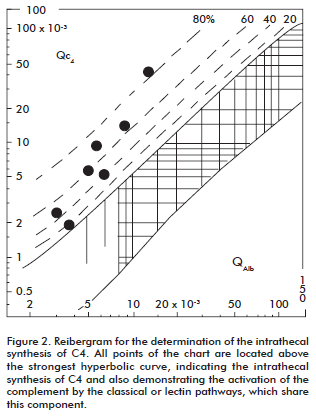
<body><![CDATA[<P   align="left" ><font face="Verdana, Arial, Helvetica, sans-serif" size="2" color="#000000">The      quotients of the concentrations in CSF and serum (CSF/serum) for each patient      were calculated for the levels of C3c, C4 and albumin. </font></P >       <P   align="left" ><font face="Verdana, Arial, Helvetica, sans-serif" size="2" color="#000000"><B>Functional      status of the blood-cerebrospinal fluid barrier </b></font></P >       <P   align="left" ><font face="Verdana, Arial, Helvetica, sans-serif" size="2" color="#000000">The      examination of the functional status of the blood-cerebrospinal fluid barrier      was performed by calculating the albumin coefficient Q: Q Albumin = CSF Albumin/Serum      Albumin. The upper limit of this parameter varies with age, and is calculated      by the formula: QAlb = (4 + age (in years)/15) x 10<sup>-3</sup>. </font></P >   <FONT color="#FF0000"><FONT color="#000000">       <P   align="left" ><font face="Verdana, Arial, Helvetica, sans-serif" size="2" color="#000000">The      albumin, C3c and C4 quotients are placed in a CSF/serum chart, also known      as a reibergram (17, 18). The darkest curve on the reibergram is a boundary      discriminating the portion of protein synthesized in blood from that synthesized      in the CSF. If the values calculated fall above this hyperbolic curve then      it can be affirmed that intrathecal synthesis has taken place. The broken      percentile lines with 20, 40, 60 and 80% represent the fraction of this protein      that has been synthesized in the CSF in relation to the total amount of the      molecule in this biological fluid. </font></P >       <P   align="left" ><font face="Verdana, Arial, Helvetica, sans-serif" size="2" color="#000000">The      darkest curve represents 0% synthesis in the CSF, indicating that all of the      specific protein in CSF was synthesized in the blood. Three vertical lines,      present in every reibergram, indicate the normal limit for 3 different ages,      for a faster interpretation of the results: Q Albumin 5.5 &times; 10<sup>-3</sup>      (up to 15 years old), Q Albumin up to 6.5 &times; 10<sup>-3</sup> (up to 40      years old) and Q Albumin up to 8 &times; 10<sup>-3</sup> (up to 60 years old)      (17, 18). </font></P >   <FONT color="#FF0000"><FONT size="+1" color="#000000"><FONT size="+1"><FONT color="#FF0000"><FONT color="#000000"><FONT color="#FF0000"><FONT size="+1" color="#000000"><FONT size="+1">       <P   align="left" ><font size="2" face="Verdana, Arial, Helvetica, sans-serif" color="#000000"><B><font size="3">RESULTS</font>      </b></font></P >   <FONT size="+1">       <P   align="left" ><font face="Verdana, Arial, Helvetica, sans-serif" size="2" color="#000000">No      immunodeficiencies due to deficits of immunoglobulins A, M or G were observed.      Likewise, there were no altered IgG subclass patterns. The concentrations      of these proteins were higher than normal, as is typically observed in patients      undergoing this clinical process. </font></P >   <FONT size="+1">       <P   align="left" ><font face="Verdana, Arial, Helvetica, sans-serif" size="2" color="#000000">Based      on the Q Albumin values, there were 5 patients with CSF-blood barrier dysfunctions      when the diagnostic lumbar punctures were performed, since their Q Albumin      was higher than 5 &times; 10<sup>-3</sup> </font><font face="Verdana, Arial, Helvetica, sans-serif" size="2"><FONT color="#FF0000"><FONT color="#000000">(<FONT color="#0000FF"><a href="#fig1">Figures      1</a> <font color="#000000">and</font> <a href="#fig2">2</a><FONT color="#000000">).      </font></font></font></font></font></P >       <P   align="center" ><a name="fig1"></a><img src="/img/revistas/bta/v28n1/f0104111.gif"></P >       
<P   align="center" ><a name="fig2"></a><img src="/img/revistas/bta/v28n1/f0204111.gif"></P >   <FONT color="#FF0000"><FONT color="#000000"><FONT color="#0000FF"><FONT color="#000000">        
]]></body>
<body><![CDATA[<P   align="left" ><font face="Verdana, Arial, Helvetica, sans-serif" size="2">The results of the      C3c and C4 proteins of the complement system revealed that one of the patients      did not have quantifiable levels of C3c in the serum or CSF. These samples      were from one of the two deceased patients, although the death of the other      patient could not be related to any immunodeficiency. There were measurable      amounts of intrathecal synthesis of C3c in the remaining patients (<FONT color="#0000FF"><a href="#fig1">Figure      1</a><FONT color="#000000">). Based on the reibergram for C4, there was intrathecal      C4 synthesis in all patients (<FONT color="#0000FF"><a href="#fig2">Figure      2</a><FONT color="#000000">). </font></font></font></font></font></P >   <FONT color="#0000FF"><FONT color="#000000"><FONT color="#0000FF"><FONT color="#000000">        <P   align="left" ><font size="2" face="Verdana, Arial, Helvetica, sans-serif"><B><font size="3">DISCUSSION</font>      </b></font></P >   <FONT size="+1">        <P   align="left" ><font face="Verdana, Arial, Helvetica, sans-serif" size="2">Immunoglobulins are      important in the resolution of infectious diseases affecting the central nervous      system (19, 20), since they are effective mediators of the lysis of encapsulated      microorganisms, such as <I>N. meningitidis</I>. </font></P >   <FONT size="+1">        <P   align="left" ><font face="Verdana, Arial, Helvetica, sans-serif" size="2">Although the prevalence      and incidence of primary immunodeficiencies is not high, some patients are      found to have selective immunodeficiencies for IgA (21) or specific IgG subclasses,      such as IgG2, which are associated to meningoencephalitis caused by microorganisms      with a polysaccharide capsule (22). The levels of major immunoglobulins and      IgG subclasses, however, remained high in both biological fluids in our patients,      thus discarding these immunodeficiencies as a causal factor. </font></P >   <FONT size="+1"><FONT size="+1">        <P   align="left" ><font face="Verdana, Arial, Helvetica, sans-serif" size="2">We were able to confirm,      in this group of patients, that the frequency of CSF-blood barrier dysfunctions      is high in this disease, since only two patients had values below the normal      upper limit. </font></P >       <P   align="left" ><font face="Verdana, Arial, Helvetica, sans-serif" size="2">The dysfunction of      the CSF-blood barrier observed in this disease facilitates the transit of      immunocompetent cells and cells involved in the inflammatory response between      both compartments. However, the host organism cannot tolerate this disequilibrium      for a long time and therefore tries to restore the vital functionality of      this barrier (23). The two deceased patients had very high immunoglobulin      levels and a marked CSF-blood barrier dysfunction. </font></P >       <P   align="left" ><font face="Verdana, Arial, Helvetica, sans-serif" size="2">Reibergrams are clinical      charts that facilitate the graphic visualization of the status of the CSF-blood      barrier and the intrathecal synthesis of the protein under study. They were      originally described for the main immunoglobulins, <I>i.e. </I>IgA, IgM and      IgG (14), and later additional reibergrams were designed in Cuba for IgG subclasses      (16), IgE (15), C3c (17) and C4 (18). These reibergrams are the latest method      used in CSF studies, outperforming earlier formulas and methods such as the      use of indexes. Reibergrams are based on the theory of molecular diffusion/flow      of CSF (24, 25). </font></P >       <P   align="left" ><font face="Verdana, Arial, Helvetica, sans-serif" size="2">The indexes assumed      that protein transport across the membrane follows a linear distribution.      However, it has been demonstrated that this distribution is actually hyperbolic,      depending on the molecular weight of the protein crossing the CSF-blood barrier.      The use of indexes, therefore, may lead to erroneous results. </font></P >       <P   align="left" ><font face="Verdana, Arial, Helvetica, sans-serif" size="2">The application of      reibergrams for C3c and C4, which is the purpose of this study, enables the      detection of the synthesis of these components of the complement system in      the central nervous system. This makes it possible to learn if these patients      are able to synthesize and activate these molecular structures in the CSF.      The role of these proteins in the appearance and development of the disease      is essential for the evaluation of the immune status of patients, and in general      for understanding the pathophysiologic mechanism underlying this disorder.      </font></P >       <P   align="left" ><font face="Verdana, Arial, Helvetica, sans-serif" size="2">We were able to verify      the existence of measurable intrathecal synthesis of C4 in all patients, which      is a marker for the start of the complement activation process via the classical      pathway through the interaction of IgM, IgG or the MBL-MASP2 complex with      the initial fragments of the pathway. This process, however, does not take      place with the same intensity in all patients due to the intrathecal fraction      synthesized that may depend on a large number of biological variables (26).      </font></P >       ]]></body>
<body><![CDATA[<P   align="left" ><font face="Verdana, Arial, Helvetica, sans-serif" size="2">Starting with the      activation of C4, a number of byproducts are generated that interact with      other components of the complement cascade (8). However, there was an immunocompromised      patient with a C3 deficiency, whose levels of C3 in either CSF or blood remained      below the detection limit. </font></P >       <P   align="left" ><font face="Verdana, Arial, Helvetica, sans-serif" size="2">C3c is a stable degradation      product of factor C3 of the complement system. It does not degrade in serum      or CSF, which makes it a consistent indicator. Two important biological inferences      can be made by following the formation of C3c: one, since this fragment is      a stable byproduct of C3 degradation, it can be used to indirectly estimate      C3 concentration; second, it indicates that all the C3c produced in the central      nervous system is the product of the biological activation of the system by      the classical, alternative, or lectin pathways. </font></P >       <P   align="left" ><font face="Verdana, Arial, Helvetica, sans-serif" size="2">The presence of intrathecal      synthesis of C3c is a revealing sign of the activation of this system, indicating      the possible presence of an immunological event associated to a type II or      cytotoxic hypersensitivity. This is essential for understanding the pathophysiological      mechanisms started by infectious or autoimmune neurological disorders (12,      27), and helps confirm the diagnoses for neurological disorders with these      characteristics. </font></P >       <P   align="left" ><font face="Verdana, Arial, Helvetica, sans-serif" size="2">Since C3 is a component      that is present in all three complement activation pathways (28), problems      in the synthesis of this molecule can lead to a serious immunodeficiency.      One such deficiency resulted in the death of one of the patients during the      first months of age, due to the child&rsquo;s ine<FONT color="#FF00FF"><FONT color="#000000">vitable      exposure to multiple infectious agents in normal life and the absence of the      complement system. This system is central for bacterial lysis, being one of      the main defense mechanism of the host against infectious agents. Therefore,      complement deficiencies of this magnitude, as in most primary immunodeficiencies,      are incompatible with life (29). The deceased patient had already suffered      a bacterial meningoencephalitis produced by <I>E. coli,</I> and the meningoencephalitis      analyzed here led to his death. </font></font></font></P >   <FONT color="#FF00FF"><FONT color="#000000">        <P   align="left" ><font face="Verdana, Arial, Helvetica, sans-serif" size="2">There have been attempts      to use the complement inhibitors of meningococci as antimeningococcal vaccines      due to the importance of complement function (30). </font></P >       <P   align="left" ><font face="Verdana, Arial, Helvetica, sans-serif" size="2">Those patients that      develop defense mechanisms, verified at the intrathecal level by this work,      had a successful recuperation. </font></P >       <P   align="left" ><font face="Verdana, Arial, Helvetica, sans-serif" size="2">The reibergrams for      C3c and C4 can be combined to improve the clinical immunological picture regarding      the complement system, enabling the evaluation of the intrathecal synthesis      of these components, the examination of the functionality of the CSF-blood      barrier and the search for intrathecal synthesis patterns characteristic of      a specific disease that may lead to the dissection of links with other disorders.      The latter can provide new possibilities for the evaluation of autoimmune      or infectious neurological diseases. </font></P >       <P   align="left" ><font face="Verdana, Arial, Helvetica, sans-serif" size="2">The use of reibergrams,      however, also has its limitations. Reibergrams assume that proteins do not      undergo structural modifications or changes in molecular weight as they cross      the CSF-blood barrier; however, this assumption does not always hold true.      Also, when using reibergrams the same analytical method must be used for serum      and CSF samples, which must be taken at the same time point, and it demands      highly sensitive analytical assays for the often low concentrations at which      these analytes are usually found in CSF. In addition, sample size in terms      of the number of patients is also low, since the mass vaccination campaigns      in Cuba against this disease have greatly reduced its incidence. This has      led to the use and study of the retained samples available and stored at our      research center. </font></P >       <P   align="left" ><font face="Verdana, Arial, Helvetica, sans-serif" size="2">Nonetheless, the      use of reibergrams has undeniable advantages, such as the fact that the results      do not change with the volume of CSF extracted, together with the possibility      of their use in lumbar, ventricular or cisternal CSF. They are therefore much      more reliable than earlier methodologies to examine the presence of intrathecal      synthesis. </font></P >       <P   align="left" ><font face="Verdana, Arial, Helvetica, sans-serif" size="2">Another advantage      of reibergrams is the fact that the CSF/serum quotients calculated do not      depend on the analytical method used for quantification, as long as they are      performed on the same analytical run and with the same method. In addition,      they can be used at any range of Q Albumin, unlike previous methodologies      which did not provide conclusive results if Q Albumin had higher values than      expected for the age of the patient. In contrast, reibergrams are applicable      regardless of the status of the CSF-blood barrier, in the presence or absence      of dysfunctions. Reibergrams are therefore a methodology that overcomes the      limitations of earlier analytical tools. </font></P >       ]]></body>
<body><![CDATA[<P   align="left" ><font size="2" face="Verdana, Arial, Helvetica, sans-serif"><B><font size="3">CONCLUSIONS</font>      </b></font></P >   <FONT size="+1">        <P   align="left" ><font face="Verdana, Arial, Helvetica, sans-serif" size="2">The use of reibergrams      to determine the intrathecal synthesis of these components of the complement      system is useful to reveal the presence of immunodeficiencies and offers a      better understanding of meningococcal meningoencephalitis as well as other      autoimmune and infectious diseases. The reibergram methodology is the most      up-to-date, novel and useful tool for the determination of C3c and C4 when      studying these complement components in the central nervous system. </font></P >   <FONT size="+1">        <P   align="left" > </P >       <P   align="left" ><font face="Verdana, Arial, Helvetica, sans-serif" size="2"><B><font size="3">REFERENCES</font>      </b></font></P >       <P   align="justify" ><font face="Verdana, Arial, Helvetica, sans-serif" size="2">1. Holst J, Martin      D, Arnold R, Huergo CC, Oster P, O&rsquo;Hallahan J, Rosenqvist E, <I>et al</I>.      Properties and clinical performance of vaccines containing outer membrane      vesicles from <I>Neisseria meningitidis</I>. Vaccine. 2009;27 Suppl 2:B3-12.      </font></P >   <FONT size="+1">        <!-- ref --><P   align="justify" ><font face="Verdana, Arial, Helvetica, sans-serif" size="2">2. Borrow R, Balmer      P, Miller E. Meningococcal surrogates of protection-serum bactericidal antibody      activity. Vaccine. 2005;23(17-18):2222-7. </font></P >    <P   align="justify" ><font face="Verdana, Arial, Helvetica, sans-serif" size="2">3. Marc LaForce F,      Ravenscroft N, Djingarey M, Viviani S. Epidemic meningitis due to Group A      <I>Neisseria meningitidis</I> in the African meningitis belt: a persistent      problem with an imminent solution. Vaccine. 2009;27 Suppl 2:B13-9. </font></P >       <!-- ref --><P   align="justify" ><font face="Verdana, Arial, Helvetica, sans-serif" size="2">4. Kang YH, Tan LA,      Carroll MV, Gentle ME, Sim RB. Target pattern recognition by complement proteins      of the classical and alternative pathways. Adv Exp Med Biol. 2009;653:117-28.      </font></P >    <!-- ref --><P   align="justify" ><font face="Verdana, Arial, Helvetica, sans-serif" size="2">5. Dorta-Contreras      AJ. Din&aacute;mica de la s&iacute;ntesis intratecal de inmunoglobulinas.      Rev Neurol. 2000;31:991-3. </font></P >    <!-- ref --><P   align="justify" ><font face="Verdana, Arial, Helvetica, sans-serif" size="2">6. Dorta-Contreras      AJ. Respuesta inmune poliespec&iacute;fica en el sistema nervioso central.      Empleo del &iacute;ndice de anticuerpo. Rev Neurol. 2000;31:1070-3. </font></P >    <!-- ref --><P   align="justify" ><font face="Verdana, Arial, Helvetica, sans-serif" size="2">7. Runza VL, Schwaeble      W, M&auml;nnel DN. Ficolins: novel pattern recognition molecules of the innate      immune response. Immunobiology. 2008;213(3-4):297-306. </font></P >    <!-- ref --><P   align="justify" ><font face="Verdana, Arial, Helvetica, sans-serif" size="2">8. Lewis LA, Ram      S, Prasad A, Gulati S, Getzlaff S, Blom AM, <I>et al</I>. Defining targets      for complement components C4b and C3b on the pathogenic Neisseriae. Infect      Immun. 2008;76:339-50. </font></P >    <!-- ref --><P   align="justify" ><font face="Verdana, Arial, Helvetica, sans-serif" size="2">9. Lo H, Tang CM,      Exley RM. Mechanisms of avoidance of host immunity by <I>Neisseria meningitidis</I>      and its effect on vaccine development. Lancet Infect Dis. 2009; 9(7):418-27.      </font></P >    <P   align="justify" ><font face="Verdana, Arial, Helvetica, sans-serif" size="2">10. Granoff DM. Relative      importance of complement-mediated bactericidal and opsonic activity for protection      against meningococcal disease. Vaccine. 2009;27 Suppl 2:B117-25. </font></P >       <!-- ref --><P   align="justify" ><font face="Verdana, Arial, Helvetica, sans-serif" size="2">11. Santos MN. <I>Neisseria</I>      infections in relation with complement deficiency: clinical presentation of      high-risk patients and treatment. VacciMonitor. 2009;18(2):44. </font></P >    <!-- ref --><P   align="justify" ><font face="Verdana, Arial, Helvetica, sans-serif" size="2">12. Dorta AJ, Padilla      B, Bu-Coifiu R. C3c intrathecal synthesis in meningoencephalitis due to <I>Neisseria      meningitidis</I>. VacciMonitor. 2009;18 (2):44. </font></P >    <!-- ref --><P   align="justify" ><font face="Verdana, Arial, Helvetica, sans-serif" size="2">13. Ram S, Ngampasutadol      J, Welsch JA, Lewis LA, Rice PA. <I>Neisseria</I>-complement interactions:      implications for pathogenesis and vaccine development. VacciMonitor. 2009;18(2):23-24.      </font></P >    <!-- ref --><P   align="justify" ><font face="Verdana, Arial, Helvetica, sans-serif" size="2">14. Reiber H. The      hyperbolic function: a mathematical solution of the protein flux/CSF flow      model for blood-CSF barrier function. A reply to the letter by S. t3hman (J      Neurol Sci, 126 (1994) 240-242). J Neurol Sci. 1994;126:243-5. </font></P >    <!-- ref --><P   align="justify" ><font face="Verdana, Arial, Helvetica, sans-serif" size="2">15. Dorta-Contreras      AJ, Noris-Garc&iacute;a E, Reiber H. Reibergrama para la evaluaci&oacute;n      de la s&iacute;ntesis intratecal de Inmunoglobulina E. Rev Neurol. 2004;39:794-5.      </font></P >    <!-- ref --><P   align="justify" ><font face="Verdana, Arial, Helvetica, sans-serif" size="2">16. Dorta-Contreras      AJ. Nuevo reibergrama para la evaluaci&oacute;n de la s&iacute;ntesis intratecal      de IgG3. Rev Neurol. 2001;33: 694-6. </font></P >    <!-- ref --><P   align="justify" ><font face="Verdana, Arial, Helvetica, sans-serif" size="2">17. Dorta-Contreras      AJ, Noris-Garc&iacute;a E, Padilla-Docal B, Rodr&iacute;guez-Rey A, Bu-Coifiu-Fanego      R, Magraner-Tarrau ME, <I>et al</I>. Reibergrama para la evaluaci&oacute;n      de la s&iacute;ntesis intratecal de C3c. Arq Neuro-Psiquiatr. 2006;64:585-8      </font></P >    <!-- ref --><P   align="justify" ><font face="Verdana, Arial, Helvetica, sans-serif" size="2">18. Padilla-Docal      B, Dorta-Contreras AJ, Bu-Coifiu-Fanego B, Rodr&iacute;guez-Rey A. CSF/serum      quotient graphs for the evaluation of intrathecal C4 synthesis. Cerebrospinal      Fluid Res. 2009;6:8. PMID: 19573230; Pubmed Central PMCID: PMC2709889 </font></P >    <!-- ref --><P   align="justify" ><font face="Verdana, Arial, Helvetica, sans-serif" size="2">19. Frasch CE, Borrow      R, Donnelly J. Bactericidal antibody is the immunologic surrogate of protection      against meningococcal disease. Vaccine. 2009;27 Suppl 2:B112-6. </font></P >    <!-- ref --><P   align="justify" ><font face="Verdana, Arial, Helvetica, sans-serif" size="2">20. Dorta-Contreras      AJ. Intrathecal synthesis of immunoglobulins in <I>Neisseria meningitidis</I>      and echovirus 6 meningoencephalitis. J Mol Neurosci. 1999;12(2):81-7. </font></P >    <!-- ref --><P   align="justify" ><font face="Verdana, Arial, Helvetica, sans-serif" size="2">21. Noris-Garc&iacute;a      E, Dorta-Contreras AJ, Noris-Garc&iacute;a JL. Evaluaci&oacute;n inmunol&oacute;gica      y tratamiento en pacientes pedi&aacute;tricos con d&eacute;ficit de IgA. Alergol      Inmunol Clin. 2002;17:180-4. </font></P >    <!-- ref --><P   align="justify" ><font face="Verdana, Arial, Helvetica, sans-serif" size="2">22. Escobar-P&eacute;rez      X, Dorta-Contreras AJ, Interi&aacute;n-Morales MT, Noris-Garc&iacute;a E,      Ferr&aacute;-Vald&eacute;s M. IgG2 immunodeficiency: Association to pediatric      patients with bacterial meningoencephalitis. Arq Neuro-Psiquiatr. 2000;58(1):141-5.      </font></P >    <!-- ref --><P   align="justify" ><font face="Verdana, Arial, Helvetica, sans-serif" size="2">23. Griffiths NJ,      Cunha CSE, Murillo I, Youseff AR, Borodina E, Hill DJ, <I>et al</I>. Dynamics      of <I>Neisseria meningitidis</I> interactions with human cellular barriers      and immune effectors. VacciMonitor. 2009;18:88-90. </font></P >    <!-- ref --><P   align="justify" ><font face="Verdana, Arial, Helvetica, sans-serif" size="2">24. Reiber H. Proteins      in cerebrospinal fluid and blood: barriers, CSF flow rate and source-related      dynamics. Restor Neurol Neurosci. 2003;21(3-4):79-96. </font></P >    <!-- ref --><P   align="justify" ><font face="Verdana, Arial, Helvetica, sans-serif" size="2">25. Dorta-Contreras      A, Reiber H. Teor&iacute;a de la difusi&oacute;n molecular/flujo del l&iacute;quido      cefalorraqu&iacute;deo. Rev Neurol. 2004;39: 564-9. </font></P >    <P   align="justify" ><font face="Verdana, Arial, Helvetica, sans-serif" size="2">26. Tatomirovi&#263;      Z, Bokun R, Bokonji&#263; D. Intrathecal synthesis of complement components      C3c and C4 in the central nervous system infections with signs of the acute      serous meningitis syndrome. Vojnosanit Pregl. 2002;59(3):265-70. </font></P >       ]]></body>
<body><![CDATA[<!-- ref --><P   align="justify" ><font face="Verdana, Arial, Helvetica, sans-serif" size="2">27. Padilla-Docal      B, Dorta-Contreras AJ, Fundora-Hern&aacute;ndez H, Noris-Garc&iacute;a E,      Bu-Coifiu-Fanego R, Gonz&aacute;lez-Hern&aacute;ndez M, <I>et al</I>. C3c      intrathecal synthesis evaluation in patients with multiple sclerosis. Arq      Neuro-Psiquiatr. 2007; 65:800-2. </font></P >    <!-- ref --><P   align="justify" ><font face="Verdana, Arial, Helvetica, sans-serif" size="2">28. Welsch JA, Ram      S. Factor H and Neisserial pathogenesis. Vaccine. 2008;26 Suppl 8:I40-5. </font></P >    <!-- ref --><P   align="justify" ><font face="Verdana, Arial, Helvetica, sans-serif" size="2">29. Kugelberg E,      Gollan B, Tang CM. Mechanisms in <I>Neisseria meningitidis</I> for resistance      against complement-mediated killing. Vaccine. 2008; 26 Suppl 8:I34-9. </font></P >    <!-- ref --><P   align="justify" ><font face="Verdana, Arial, Helvetica, sans-serif" size="2">30. Meri S, J&ouml;rdens      M, Jarva H. Microbial complement inhibitors as vaccines. Vaccine. 2008;26      Suppl 8:I113-7.</font></P >    <P   align="justify" >&nbsp;</P >       <P   align="justify" ><font face="Verdana, Arial, Helvetica, sans-serif" size="2">Received in May,      2010.    <br>     Accepted for publication in February, 2011.</font></P >       <P   align="justify" > </P >       <P   align="left" ><font size="2" face="Verdana, Arial, Helvetica, sans-serif">Alberto J Dorta-Contreras,      Laboratorio Central de L&iacute;quido Cefalorraqu&iacute;deo, Facultad de      Ciencias M&eacute;dicas &ldquo;Dr. Miguel Enr&iacute;quez&rdquo; Ram&oacute;n      Pint&oacute; #202, Luyan&oacute;, 10 de Octubre, CP 10 700, La Habana, E-mail:      <A href="mailto:adorta@infomed.sld.cu"> <U><FONT color="#0000FF">adorta@infomed.sld.cu</font></U></A>      </font></P >   </font></font></font></font></font></font></font></font></font></font></font></font></font></font></font></font></font></font></font></font></font></font></font></font></font></font></font></font></font></font></font></font></font></font></font></font></font></font></font></font></font></font></font></font></font></font></font></font></font></font></font></font></DIV >      ]]></body><back>
<ref-list>
<ref id="B1">
<label>1</label><nlm-citation citation-type="journal">
<person-group person-group-type="author">
<name>
<surname><![CDATA[Holst]]></surname>
<given-names><![CDATA[J]]></given-names>
</name>
<name>
<surname><![CDATA[Martin]]></surname>
<given-names><![CDATA[D]]></given-names>
</name>
<name>
<surname><![CDATA[Arnold]]></surname>
<given-names><![CDATA[R]]></given-names>
</name>
<name>
<surname><![CDATA[Huergo]]></surname>
<given-names><![CDATA[CC]]></given-names>
</name>
<name>
<surname><![CDATA[Oster]]></surname>
<given-names><![CDATA[P]]></given-names>
</name>
<name>
<surname><![CDATA[O´Hallahan]]></surname>
<given-names><![CDATA[J]]></given-names>
</name>
<name>
<surname><![CDATA[Rosenqvist]]></surname>
<given-names><![CDATA[E]]></given-names>
</name>
</person-group>
<article-title xml:lang="en"><![CDATA[Properties and clinical performance of vaccines containing outer membrane vesicles from Neisseria meningitidis]]></article-title>
<source><![CDATA[Vaccine]]></source>
<year>2009</year>
<volume>27</volume>
<numero>^s2</numero>
<issue>^s2</issue>
<supplement>2</supplement>
<page-range>B3-12</page-range></nlm-citation>
</ref>
<ref id="B2">
<label>2</label><nlm-citation citation-type="journal">
<person-group person-group-type="author">
<name>
<surname><![CDATA[Borrow]]></surname>
<given-names><![CDATA[R]]></given-names>
</name>
<name>
<surname><![CDATA[Balmer]]></surname>
<given-names><![CDATA[P]]></given-names>
</name>
<name>
<surname><![CDATA[Miller]]></surname>
<given-names><![CDATA[E]]></given-names>
</name>
</person-group>
<article-title xml:lang="en"><![CDATA[Meningococcal surrogates of protection--serum bactericidal antibody activity]]></article-title>
<source><![CDATA[Vaccine]]></source>
<year>2005</year>
<volume>23</volume>
<numero>17-18</numero>
<issue>17-18</issue>
<page-range>2222-7</page-range></nlm-citation>
</ref>
<ref id="B3">
<label>3</label><nlm-citation citation-type="journal">
<person-group person-group-type="author">
<name>
<surname><![CDATA[Marc LaForce]]></surname>
<given-names><![CDATA[F]]></given-names>
</name>
<name>
<surname><![CDATA[Ravenscroft]]></surname>
<given-names><![CDATA[N]]></given-names>
</name>
<name>
<surname><![CDATA[Djingarey]]></surname>
<given-names><![CDATA[M]]></given-names>
</name>
<name>
<surname><![CDATA[Viviani]]></surname>
<given-names><![CDATA[S]]></given-names>
</name>
</person-group>
<article-title xml:lang="en"><![CDATA[Epidemic meningitis due to Group A Neisseria meningitidis in the African meningitis belt: a persistent problem with an imminent solution]]></article-title>
<source><![CDATA[Vaccine]]></source>
<year>2009</year>
<volume>27</volume>
<page-range>B13-9</page-range></nlm-citation>
</ref>
<ref id="B4">
<label>4</label><nlm-citation citation-type="journal">
<person-group person-group-type="author">
<name>
<surname><![CDATA[Kang]]></surname>
<given-names><![CDATA[YH]]></given-names>
</name>
<name>
<surname><![CDATA[Tan]]></surname>
<given-names><![CDATA[LA]]></given-names>
</name>
<name>
<surname><![CDATA[Carroll]]></surname>
<given-names><![CDATA[MV]]></given-names>
</name>
<name>
<surname><![CDATA[Gentle]]></surname>
<given-names><![CDATA[ME]]></given-names>
</name>
<name>
<surname><![CDATA[Sim]]></surname>
<given-names><![CDATA[RB]]></given-names>
</name>
</person-group>
<article-title xml:lang="en"><![CDATA[Target pattern recognition by complement proteins of the classical and alternative pathways]]></article-title>
<source><![CDATA[Adv Exp Med Biol]]></source>
<year>2009</year>
<volume>653</volume>
<page-range>117-28</page-range></nlm-citation>
</ref>
<ref id="B5">
<label>5</label><nlm-citation citation-type="journal">
<person-group person-group-type="author">
<name>
<surname><![CDATA[Dorta-Contreras]]></surname>
<given-names><![CDATA[AJ]]></given-names>
</name>
</person-group>
<article-title xml:lang="es"><![CDATA[Dinámica de la síntesis intratecal de inmunoglobulinas]]></article-title>
<source><![CDATA[Rev Neurol]]></source>
<year>2000</year>
<volume>31</volume>
<page-range>991-3</page-range></nlm-citation>
</ref>
<ref id="B6">
<label>6</label><nlm-citation citation-type="journal">
<person-group person-group-type="author">
<name>
<surname><![CDATA[Dorta-Contreras]]></surname>
<given-names><![CDATA[AJ]]></given-names>
</name>
</person-group>
<article-title xml:lang="es"><![CDATA[Respuesta inmune poliespecífica en el sistema nervioso central: Empleo del índice de anticuerpo]]></article-title>
<source><![CDATA[Rev Neurol]]></source>
<year>2000</year>
<volume>31</volume>
<page-range>1070-3</page-range></nlm-citation>
</ref>
<ref id="B7">
<label>7</label><nlm-citation citation-type="journal">
<person-group person-group-type="author">
<name>
<surname><![CDATA[Runza]]></surname>
<given-names><![CDATA[VL]]></given-names>
</name>
<name>
<surname><![CDATA[Schwaeble]]></surname>
<given-names><![CDATA[W]]></given-names>
</name>
<name>
<surname><![CDATA[Männel]]></surname>
<given-names><![CDATA[DN]]></given-names>
</name>
</person-group>
<article-title xml:lang="en"><![CDATA[Ficolins: novel pattern recognition molecules of the innate immune response]]></article-title>
<source><![CDATA[Immunobiology]]></source>
<year>2008</year>
<volume>213</volume>
<numero>3-4</numero>
<issue>3-4</issue>
<page-range>297-306</page-range></nlm-citation>
</ref>
<ref id="B8">
<label>8</label><nlm-citation citation-type="journal">
<person-group person-group-type="author">
<name>
<surname><![CDATA[Lewis]]></surname>
<given-names><![CDATA[LA]]></given-names>
</name>
<name>
<surname><![CDATA[Ram]]></surname>
<given-names><![CDATA[S]]></given-names>
</name>
<name>
<surname><![CDATA[Prasad]]></surname>
<given-names><![CDATA[A]]></given-names>
</name>
<name>
<surname><![CDATA[Gulati]]></surname>
<given-names><![CDATA[S]]></given-names>
</name>
<name>
<surname><![CDATA[Getzlaff]]></surname>
<given-names><![CDATA[S]]></given-names>
</name>
<name>
<surname><![CDATA[Blom]]></surname>
<given-names><![CDATA[AM]]></given-names>
</name>
</person-group>
<article-title xml:lang="en"><![CDATA[Defining targets for complement components C4b and C3b on the pathogenic Neisseriae]]></article-title>
<source><![CDATA[Infect Immun]]></source>
<year>2008</year>
<volume>76</volume>
<page-range>339-50</page-range></nlm-citation>
</ref>
<ref id="B9">
<label>9</label><nlm-citation citation-type="journal">
<person-group person-group-type="author">
<name>
<surname><![CDATA[Lo]]></surname>
<given-names><![CDATA[H]]></given-names>
</name>
<name>
<surname><![CDATA[Tang]]></surname>
<given-names><![CDATA[CM]]></given-names>
</name>
<name>
<surname><![CDATA[Exley]]></surname>
<given-names><![CDATA[RM]]></given-names>
</name>
</person-group>
<article-title xml:lang="en"><![CDATA[Mechanisms of avoidance of host immunity by Neisseria meningitidis and its effect on vaccine development]]></article-title>
<source><![CDATA[Lancet Infect Dis]]></source>
<year>2009</year>
<volume>9</volume>
<numero>7</numero>
<issue>7</issue>
<page-range>418-27</page-range></nlm-citation>
</ref>
<ref id="B10">
<label>10</label><nlm-citation citation-type="journal">
<person-group person-group-type="author">
<name>
<surname><![CDATA[Granoff]]></surname>
<given-names><![CDATA[DM]]></given-names>
</name>
</person-group>
<article-title xml:lang="en"><![CDATA[Relative importance of complement-mediated bactericidal and opsonic activity for protection against meningococcal disease]]></article-title>
<source><![CDATA[Vaccine]]></source>
<year>2009</year>
<volume>27</volume>
<page-range>B117-25</page-range></nlm-citation>
</ref>
<ref id="B11">
<label>11</label><nlm-citation citation-type="journal">
<person-group person-group-type="author">
<name>
<surname><![CDATA[Santos]]></surname>
<given-names><![CDATA[MN]]></given-names>
</name>
</person-group>
<article-title xml:lang="en"><![CDATA[Neisseria infections in relation with complement deficiency: clinical presentation of high-risk patients and treatment]]></article-title>
<source><![CDATA[VacciMonitor]]></source>
<year>2009</year>
<volume>18</volume>
<numero>2</numero>
<issue>2</issue>
<page-range>44</page-range></nlm-citation>
</ref>
<ref id="B12">
<label>12</label><nlm-citation citation-type="journal">
<person-group person-group-type="author">
<name>
<surname><![CDATA[Dorta]]></surname>
<given-names><![CDATA[AJ]]></given-names>
</name>
<name>
<surname><![CDATA[Padilla]]></surname>
<given-names><![CDATA[B]]></given-names>
</name>
<name>
<surname><![CDATA[Bu-Coifiu]]></surname>
<given-names><![CDATA[R]]></given-names>
</name>
</person-group>
<article-title xml:lang="en"><![CDATA[C3c intrathecal synthesis in meningoencephalitis due to Neisseria meningitidis]]></article-title>
<source><![CDATA[VacciMonitor]]></source>
<year>2009</year>
<volume>18</volume>
<numero>2</numero>
<issue>2</issue>
<page-range>44</page-range></nlm-citation>
</ref>
<ref id="B13">
<label>13</label><nlm-citation citation-type="journal">
<person-group person-group-type="author">
<name>
<surname><![CDATA[Ram]]></surname>
<given-names><![CDATA[S]]></given-names>
</name>
<name>
<surname><![CDATA[Ngampasutadol]]></surname>
<given-names><![CDATA[J]]></given-names>
</name>
<name>
<surname><![CDATA[Welsch]]></surname>
<given-names><![CDATA[JA]]></given-names>
</name>
<name>
<surname><![CDATA[Lewis]]></surname>
<given-names><![CDATA[LA]]></given-names>
</name>
<name>
<surname><![CDATA[Rice]]></surname>
<given-names><![CDATA[PA]]></given-names>
</name>
</person-group>
<article-title xml:lang="en"><![CDATA[Neisseria-complement interactions: implications for pathogenesis and vaccine development]]></article-title>
<source><![CDATA[VacciMonitor]]></source>
<year>2009</year>
<volume>18</volume>
<numero>2</numero>
<issue>2</issue>
<page-range>23-24</page-range></nlm-citation>
</ref>
<ref id="B14">
<label>14</label><nlm-citation citation-type="journal">
<person-group person-group-type="author">
<name>
<surname><![CDATA[Reiber]]></surname>
<given-names><![CDATA[H]]></given-names>
</name>
</person-group>
<article-title xml:lang="en"><![CDATA[The hyperbolic function: a mathematical solution of the protein flux/CSF flow model for blood-CSF barrier function. A reply to the letter by S. t3hman (J. Neurol. Sci., 126 (1994) 240-242)]]></article-title>
<source><![CDATA[J Neurol Sci]]></source>
<year>1994</year>
<volume>126</volume>
<page-range>243-5</page-range></nlm-citation>
</ref>
<ref id="B15">
<label>15</label><nlm-citation citation-type="journal">
<person-group person-group-type="author">
<name>
<surname><![CDATA[Dorta-Contreras]]></surname>
<given-names><![CDATA[AJ]]></given-names>
</name>
<name>
<surname><![CDATA[Noris-García]]></surname>
<given-names><![CDATA[E]]></given-names>
</name>
<name>
<surname><![CDATA[Reiber]]></surname>
<given-names><![CDATA[H]]></given-names>
</name>
</person-group>
<article-title xml:lang="es"><![CDATA[Reibergrama para la evaluación de la síntesis intratecal de Inmunoglobulina E]]></article-title>
<source><![CDATA[Rev Neurol]]></source>
<year>2004</year>
<volume>39</volume>
<page-range>794-5</page-range></nlm-citation>
</ref>
<ref id="B16">
<label>16</label><nlm-citation citation-type="journal">
<person-group person-group-type="author">
<name>
<surname><![CDATA[Dorta-Contreras]]></surname>
<given-names><![CDATA[AJ]]></given-names>
</name>
</person-group>
<article-title xml:lang="es"><![CDATA[Nuevo reibergrama para la evaluación de la síntesis intratecal de IgG3]]></article-title>
<source><![CDATA[Rev Neurol]]></source>
<year>2001</year>
<volume>33</volume>
<page-range>694-6</page-range></nlm-citation>
</ref>
<ref id="B17">
<label>17</label><nlm-citation citation-type="journal">
<person-group person-group-type="author">
<name>
<surname><![CDATA[Dorta-Contreras]]></surname>
<given-names><![CDATA[AJ]]></given-names>
</name>
<name>
<surname><![CDATA[Noris-García]]></surname>
<given-names><![CDATA[E]]></given-names>
</name>
<name>
<surname><![CDATA[Padilla-Docal]]></surname>
<given-names><![CDATA[B]]></given-names>
</name>
<name>
<surname><![CDATA[Rodríguez-Rey]]></surname>
<given-names><![CDATA[A]]></given-names>
</name>
<name>
<surname><![CDATA[Bu-Coifiu-Fanego]]></surname>
<given-names><![CDATA[R]]></given-names>
</name>
<name>
<surname><![CDATA[Magraner-Tarrau]]></surname>
<given-names><![CDATA[ME]]></given-names>
</name>
</person-group>
<article-title xml:lang="es"><![CDATA[Reibergrama para la evaluación de la síntesis intratecal de C3c]]></article-title>
<source><![CDATA[Arq Neuro-Psiquiatr]]></source>
<year>2006</year>
<volume>64</volume>
<page-range>585-8</page-range></nlm-citation>
</ref>
<ref id="B18">
<label>18</label><nlm-citation citation-type="journal">
<person-group person-group-type="author">
<name>
<surname><![CDATA[Padilla-Docal]]></surname>
<given-names><![CDATA[B]]></given-names>
</name>
<name>
<surname><![CDATA[Dorta-Contreras]]></surname>
<given-names><![CDATA[AJ]]></given-names>
</name>
<name>
<surname><![CDATA[Bu-Coifiu-Fanego]]></surname>
<given-names><![CDATA[B]]></given-names>
</name>
<name>
<surname><![CDATA[Rodríguez-Rey]]></surname>
<given-names><![CDATA[A]]></given-names>
</name>
</person-group>
<article-title xml:lang="en"><![CDATA[CSF/serum quotient graphs for the evaluation of intrathecal C4 synthesis]]></article-title>
<source><![CDATA[Cerebrospinal Fluid Res]]></source>
<year>2009</year>
<volume>6</volume>
<page-range>8</page-range></nlm-citation>
</ref>
<ref id="B19">
<label>19</label><nlm-citation citation-type="journal">
<person-group person-group-type="author">
<name>
<surname><![CDATA[Frasch]]></surname>
<given-names><![CDATA[CE]]></given-names>
</name>
<name>
<surname><![CDATA[Borrow]]></surname>
<given-names><![CDATA[R]]></given-names>
</name>
<name>
<surname><![CDATA[Donnelly]]></surname>
<given-names><![CDATA[J]]></given-names>
</name>
</person-group>
<article-title xml:lang="en"><![CDATA[Bactericidal antibody is the immunologic surrogate of protection against meningococcal disease]]></article-title>
<source><![CDATA[Vaccine]]></source>
<year>2009</year>
<volume>27</volume><volume>2</volume>
<page-range>B112-6</page-range></nlm-citation>
</ref>
<ref id="B20">
<label>20</label><nlm-citation citation-type="journal">
<person-group person-group-type="author">
<name>
<surname><![CDATA[Dorta-Contreras]]></surname>
<given-names><![CDATA[AJ]]></given-names>
</name>
</person-group>
<article-title xml:lang="en"><![CDATA[Intrathecal synthesis of immunoglobulins in Neisseria meningitidis and echovirus 6 meningoencephalitis]]></article-title>
<source><![CDATA[J Mol Neurosci]]></source>
<year>1999</year>
<volume>12</volume>
<numero>2</numero>
<issue>2</issue>
<page-range>81-7</page-range></nlm-citation>
</ref>
<ref id="B21">
<label>21</label><nlm-citation citation-type="journal">
<person-group person-group-type="author">
<name>
<surname><![CDATA[Noris-García]]></surname>
<given-names><![CDATA[E]]></given-names>
</name>
<name>
<surname><![CDATA[Dorta-Contreras]]></surname>
<given-names><![CDATA[AJ]]></given-names>
</name>
<name>
<surname><![CDATA[Noris-García]]></surname>
<given-names><![CDATA[JL]]></given-names>
</name>
</person-group>
<article-title xml:lang="es"><![CDATA[Evaluación inmunológica y tratamiento en pacientes pediátricos con déficit de IgA]]></article-title>
<source><![CDATA[Alergol Inmunol Clin]]></source>
<year>2002</year>
<volume>17</volume>
<page-range>180-4</page-range></nlm-citation>
</ref>
<ref id="B22">
<label>22</label><nlm-citation citation-type="journal">
<person-group person-group-type="author">
<name>
<surname><![CDATA[Escobar-Pérez]]></surname>
<given-names><![CDATA[X]]></given-names>
</name>
<name>
<surname><![CDATA[Dorta-Contreras]]></surname>
<given-names><![CDATA[AJ]]></given-names>
</name>
<name>
<surname><![CDATA[Interián-Morales]]></surname>
<given-names><![CDATA[MT]]></given-names>
</name>
<name>
<surname><![CDATA[Noris-García]]></surname>
<given-names><![CDATA[E]]></given-names>
</name>
<name>
<surname><![CDATA[Ferrá-Valdés]]></surname>
<given-names><![CDATA[M]]></given-names>
</name>
</person-group>
<article-title xml:lang="en"><![CDATA[IgG2 immunodeficiency: Association to pediatric patients with bacterial meningoencephalitis]]></article-title>
<source><![CDATA[Arq Neuro-Psiquiatr]]></source>
<year>2000</year>
<volume>58</volume>
<numero>1</numero>
<issue>1</issue>
<page-range>141-5</page-range></nlm-citation>
</ref>
<ref id="B23">
<label>23</label><nlm-citation citation-type="journal">
<person-group person-group-type="author">
<name>
<surname><![CDATA[Griffiths]]></surname>
<given-names><![CDATA[NJ]]></given-names>
</name>
<name>
<surname><![CDATA[Cunha]]></surname>
<given-names><![CDATA[CSE]]></given-names>
</name>
<name>
<surname><![CDATA[Murillo]]></surname>
<given-names><![CDATA[I]]></given-names>
</name>
<name>
<surname><![CDATA[Youseff]]></surname>
<given-names><![CDATA[AR]]></given-names>
</name>
<name>
<surname><![CDATA[Borodina]]></surname>
<given-names><![CDATA[E]]></given-names>
</name>
<name>
<surname><![CDATA[Hill]]></surname>
<given-names><![CDATA[DJ]]></given-names>
</name>
</person-group>
<article-title xml:lang="en"><![CDATA[Dynamics of Neisseria meningitidis interactions with human cellular barriers and immune effectors]]></article-title>
<source><![CDATA[VacciMonitor]]></source>
<year>2009</year>
<volume>18</volume>
<page-range>88-90</page-range></nlm-citation>
</ref>
<ref id="B24">
<label>24</label><nlm-citation citation-type="journal">
<person-group person-group-type="author">
<name>
<surname><![CDATA[Reiber]]></surname>
<given-names><![CDATA[H]]></given-names>
</name>
</person-group>
<article-title xml:lang="en"><![CDATA[Proteins in cerebrospinal fluid and blood: barriers, CSF flow rate and source-related dynamics]]></article-title>
<source><![CDATA[Restor Neurol Neurosci]]></source>
<year>2003</year>
<volume>21</volume>
<numero>3-4</numero>
<issue>3-4</issue>
<page-range>79-96</page-range></nlm-citation>
</ref>
<ref id="B25">
<label>25</label><nlm-citation citation-type="journal">
<person-group person-group-type="author">
<name>
<surname><![CDATA[Dorta-Contreras]]></surname>
<given-names><![CDATA[A]]></given-names>
</name>
<name>
<surname><![CDATA[Reiber]]></surname>
<given-names><![CDATA[H]]></given-names>
</name>
</person-group>
<article-title xml:lang="es"><![CDATA[Teoría de la difusión molecular/flujo del líquido cefalorraquídeo]]></article-title>
<source><![CDATA[Rev Neurol]]></source>
<year>2004</year>
<volume>39</volume>
<page-range>564-9</page-range></nlm-citation>
</ref>
<ref id="B26">
<label>26</label><nlm-citation citation-type="journal">
<person-group person-group-type="author">
<name>
<surname><![CDATA[Tatomirovic]]></surname>
<given-names><![CDATA[Z]]></given-names>
</name>
<name>
<surname><![CDATA[Bokun]]></surname>
<given-names><![CDATA[R]]></given-names>
</name>
<name>
<surname><![CDATA[Bokonjic]]></surname>
<given-names><![CDATA[D]]></given-names>
</name>
</person-group>
<article-title xml:lang="en"><![CDATA[Intrathecal synthesis of complement components C3c and C4 in the central nervous system infections with signs of the acute serous meningitis syndrome]]></article-title>
<source><![CDATA[Vojnosanit Pregl]]></source>
<year>2002</year>
<volume>59</volume>
<numero>3</numero>
<issue>3</issue>
<page-range>265-70</page-range></nlm-citation>
</ref>
<ref id="B27">
<label>27</label><nlm-citation citation-type="journal">
<person-group person-group-type="author">
<name>
<surname><![CDATA[Padilla-Docal]]></surname>
<given-names><![CDATA[B]]></given-names>
</name>
<name>
<surname><![CDATA[Dorta-Contreras]]></surname>
<given-names><![CDATA[AJ]]></given-names>
</name>
<name>
<surname><![CDATA[Fundora-Hernández]]></surname>
<given-names><![CDATA[H]]></given-names>
</name>
<name>
<surname><![CDATA[Noris-García]]></surname>
<given-names><![CDATA[E]]></given-names>
</name>
<name>
<surname><![CDATA[Bu-Coifiu-Fanego]]></surname>
<given-names><![CDATA[R]]></given-names>
</name>
<name>
<surname><![CDATA[González-Hernández]]></surname>
<given-names><![CDATA[M]]></given-names>
</name>
</person-group>
<article-title xml:lang="en"><![CDATA[C3c intrathecal synthesis evaluation in patients with multiple sclerosis]]></article-title>
<source><![CDATA[Arq Neuro-Psiquiatr]]></source>
<year>2007</year>
<volume>65</volume>
<page-range>800-2</page-range></nlm-citation>
</ref>
<ref id="B28">
<label>28</label><nlm-citation citation-type="journal">
<person-group person-group-type="author">
<name>
<surname><![CDATA[Welsch]]></surname>
<given-names><![CDATA[JA]]></given-names>
</name>
<name>
<surname><![CDATA[Ram]]></surname>
<given-names><![CDATA[S]]></given-names>
</name>
</person-group>
<article-title xml:lang="en"><![CDATA[Factor H and Neisserial pathogenesis]]></article-title>
<source><![CDATA[Vaccine]]></source>
<year>2008</year>
<volume>26</volume>
<numero>^s8</numero>
<issue>^s8</issue>
<supplement>8</supplement>
<page-range>I40-5</page-range></nlm-citation>
</ref>
<ref id="B29">
<label>29</label><nlm-citation citation-type="journal">
<person-group person-group-type="author">
<name>
<surname><![CDATA[Kugelberg]]></surname>
<given-names><![CDATA[E]]></given-names>
</name>
<name>
<surname><![CDATA[Gollan]]></surname>
<given-names><![CDATA[B]]></given-names>
</name>
<name>
<surname><![CDATA[Tang]]></surname>
<given-names><![CDATA[CM]]></given-names>
</name>
</person-group>
<article-title xml:lang="en"><![CDATA[Mechanisms in Neisseria meningitidis for resistance against complement-mediated killing]]></article-title>
<source><![CDATA[Vaccine]]></source>
<year>2008</year>
<volume>26</volume>
<numero>^s8</numero>
<issue>^s8</issue>
<supplement>8</supplement>
<page-range>I34-9</page-range></nlm-citation>
</ref>
<ref id="B30">
<label>30</label><nlm-citation citation-type="journal">
<person-group person-group-type="author">
<name>
<surname><![CDATA[Meri]]></surname>
<given-names><![CDATA[S]]></given-names>
</name>
<name>
<surname><![CDATA[Jördens]]></surname>
<given-names><![CDATA[M]]></given-names>
</name>
<name>
<surname><![CDATA[Jarva]]></surname>
<given-names><![CDATA[H]]></given-names>
</name>
</person-group>
<article-title xml:lang="en"><![CDATA[Microbial complement inhibitors as vaccines]]></article-title>
<source><![CDATA[Vaccine]]></source>
<year>2008</year>
<volume>26</volume>
<numero>^s8</numero>
<issue>^s8</issue>
<supplement>8</supplement>
<page-range>I113-7</page-range></nlm-citation>
</ref>
</ref-list>
</back>
</article>