<?xml version="1.0" encoding="ISO-8859-1"?><article xmlns:mml="http://www.w3.org/1998/Math/MathML" xmlns:xlink="http://www.w3.org/1999/xlink" xmlns:xsi="http://www.w3.org/2001/XMLSchema-instance">
<front>
<journal-meta>
<journal-id>1027-2852</journal-id>
<journal-title><![CDATA[Biotecnología Aplicada]]></journal-title>
<abbrev-journal-title><![CDATA[Biotecnol Apl]]></abbrev-journal-title>
<issn>1027-2852</issn>
<publisher>
<publisher-name><![CDATA[Editorial Elfos Scientiae]]></publisher-name>
</publisher>
</journal-meta>
<article-meta>
<article-id>S1027-28522011000100005</article-id>
<title-group>
<article-title xml:lang="en"><![CDATA[Diagnostic value of alpha-fetoprotein for hepatocellular carcinoma]]></article-title>
<article-title xml:lang="es"><![CDATA[Valor diagnóstico de la alfa-fetoproteína en el carcinoma hepatocelular]]></article-title>
</title-group>
<contrib-group>
<contrib contrib-type="author">
<name>
<surname><![CDATA[Hernández]]></surname>
<given-names><![CDATA[Julio C]]></given-names>
</name>
<xref ref-type="aff" rid="A01"/>
</contrib>
<contrib contrib-type="author">
<name>
<surname><![CDATA[Samada]]></surname>
<given-names><![CDATA[Marcia]]></given-names>
</name>
<xref ref-type="aff" rid="A01"/>
</contrib>
<contrib contrib-type="author">
<name>
<surname><![CDATA[Roque]]></surname>
<given-names><![CDATA[Alejandro]]></given-names>
</name>
<xref ref-type="aff" rid="A01"/>
</contrib>
<contrib contrib-type="author">
<name>
<surname><![CDATA[Cruz]]></surname>
<given-names><![CDATA[Yolanda]]></given-names>
</name>
<xref ref-type="aff" rid="A02"/>
</contrib>
<contrib contrib-type="author">
<name>
<surname><![CDATA[Howland]]></surname>
<given-names><![CDATA[Ivón]]></given-names>
</name>
<xref ref-type="aff" rid="A02"/>
</contrib>
<contrib contrib-type="author">
<name>
<surname><![CDATA[Fernández]]></surname>
<given-names><![CDATA[Irma]]></given-names>
</name>
<xref ref-type="aff" rid="A03"/>
</contrib>
</contrib-group>
<aff id="A02">
<institution><![CDATA[,Laboratorio Clínico  ]]></institution>
<addr-line><![CDATA[ ]]></addr-line>
</aff>
<aff id="A03">
<institution><![CDATA[,Centro de Investigaciones Médico Quirúrgicas, CIMEQ Bioestadística ]]></institution>
<addr-line><![CDATA[La Habana ]]></addr-line>
<country>Cuba</country>
</aff>
<aff id="A01">
<institution><![CDATA[,Centro de Investigaciones Médico Quirúrgicas, CIMEQ Grupo de Hepatología ]]></institution>
<addr-line><![CDATA[La Habana ]]></addr-line>
<country>Cuba</country>
</aff>
<pub-date pub-type="pub">
<day>00</day>
<month>03</month>
<year>2011</year>
</pub-date>
<pub-date pub-type="epub">
<day>00</day>
<month>03</month>
<year>2011</year>
</pub-date>
<volume>28</volume>
<numero>1</numero>
<fpage>34</fpage>
<lpage>39</lpage>
<copyright-statement/>
<copyright-year/>
<self-uri xlink:href="http://scielo.sld.cu/scielo.php?script=sci_arttext&amp;pid=S1027-28522011000100005&amp;lng=en&amp;nrm=iso"></self-uri><self-uri xlink:href="http://scielo.sld.cu/scielo.php?script=sci_abstract&amp;pid=S1027-28522011000100005&amp;lng=en&amp;nrm=iso"></self-uri><self-uri xlink:href="http://scielo.sld.cu/scielo.php?script=sci_pdf&amp;pid=S1027-28522011000100005&amp;lng=en&amp;nrm=iso"></self-uri><abstract abstract-type="short" xml:lang="en"><p><![CDATA[Hepatocellular carcinoma (HCC) variously occupies the fifth or sixth position as the most frequent neoplasia worldwide. The present work used alpha-fetoprotein (AFP) determinations on the ultra-micro analytical system (SUMA®) as a tumoral marker in 189 cirrhotic patients evaluated at the Center for Medical and Surgical Research between January 1999 and September 2005. The principal factors associated to increases in AFP were HCC and viral cirrhosis. In all, 22 patients (11.64%) suffered from HCC, with viral cirrhosis caused mainly by hepatitis C virus infections as the most important etiological factor. AFP as a tumoral marker displayed a sensitivity of 68.18% and a specificity of 92.17%, which increased to 86.36 and 100% respectively when combined with abdominal sonography. It is concluded that AFP is valuable for the diagnosis of HCC.]]></p></abstract>
<abstract abstract-type="short" xml:lang="es"><p><![CDATA[El carcinoma hepatocelular (CHC) es la quinta y sexta neoplasia más frecuente en el mundo. En este trabajo se empleó la alfa-fetoproteína (AFP) por la técnica del sistema ultramicroanalítico (SUMA®), como marcador tumoral en 189 pacientes cirróticos evaluados en el Centro de Investigaciones Médico-Quirúrgicas (CIMEQ), entre enero de 1999 y septiembre de 2005. Los principales factores que se asociaron a una elevación de la AFP fueron el CHC y la cirrosis viral. Veintidós enfermos presentaron CHC (11.64%) y la causa más importante fue la cirrosis hepática viral, principalmente por el virus de la hepatitis C. Este marcador tumoral mostró una sensibilidad de 68.18% y una especificidad de 92.17%. Al combinarlo con la ecografía abdominal, se incrementó la sensibilidad a 86.36% y la especificidad a 100%. Se concluyó que la AFP tuvo valor en el diagnóstico del CHC.]]></p></abstract>
<kwd-group>
<kwd lng="en"><![CDATA[hepatocelular carcinoma]]></kwd>
<kwd lng="en"><![CDATA[cirrhosis]]></kwd>
<kwd lng="en"><![CDATA[alpha-fetoprotein]]></kwd>
<kwd lng="es"><![CDATA[carcinoma hepatocelular]]></kwd>
<kwd lng="es"><![CDATA[cirrosis]]></kwd>
<kwd lng="es"><![CDATA[alfa-fetoproteína]]></kwd>
</kwd-group>
</article-meta>
</front><body><![CDATA[ <DIV class="Sect"   >        <P   align="right" ><b><font face="Verdana, Arial, Helvetica, sans-serif" size="2">RESEARCH</font></b></P >       <P   align="right" >&nbsp;</P >       <P   align="left" ><font size="2" color="#000000" face="Verdana, Arial, Helvetica, sans-serif"><B><font size="4">Diagnostic      value of alpha-fetoprotein for hepatocellular carcinoma</font></b></font></P >       <P   align="left" >&nbsp;</P >   <FONT size="+1" color="#000000"><B>        <P   align="left" ><font size="3" face="Verdana, Arial, Helvetica, sans-serif">Valor diagn&oacute;stico      de la alfa-fetoprote&iacute;na en el carcinoma hepatocelular</font></P >       <P   align="left" >&nbsp;</P >       <P   align="left" >&nbsp;</P >   </B>        <P   align="left" ><font size="2" face="Verdana, Arial, Helvetica, sans-serif"><b>Julio C Hern&aacute;ndez<sup>1</sup>,      Marcia Samada<sup>1</sup>, Alejandro Roque<sup>1</sup>, Yolanda Cruz<sup>2</sup>,      Iv&oacute;n Howland<sup>2</sup>, Irma Fern&aacute;ndez<sup>3</sup></b> </font></P >       <P   align="left" ><font size="2" face="Verdana, Arial, Helvetica, sans-serif">1 Grupo de Hepatolog&iacute;a          ]]></body>
<body><![CDATA[<br>     2 Laboratorio Cl&iacute;nico     <br>     3 Bioestad&iacute;stica Centro de Investigaciones M&eacute;dico Quir&uacute;rgicas,      CIMEQ Calle 216 y 11B, Reparto Siboney, Playa, CP 12100, La Habana, Cuba</font></P >   </font>     <p>&nbsp;</p><hr>   <FONT size="+1" color="#000000">        <P   align="left" ><font face="Verdana, Arial, Helvetica, sans-serif" size="2"><B>ABSTRACT</B> </font></P >   <FONT size="+1"><FONT size="+1"><FONT size="+1"><FONT size="+1"><FONT size="+1"><FONT size="+1"><FONT size="+1"><FONT size="+1"><FONT size="+1"><FONT size="+1"><FONT size="+1"><FONT size="+1"><FONT size="+1"><FONT size="+1"><FONT size="+1"><FONT size="+1"><FONT size="+1"><FONT size="+1"><FONT size="+1"><FONT size="+1"><FONT size="+1">       <P   align="left" ><font face="Verdana, Arial, Helvetica, sans-serif" size="2" color="#000000">Hepatocellular      carcinoma (HCC) variously occupies the fifth or sixth position as the most      frequent neoplasia worldwide. The present work used alpha-fetoprotein (AFP)      determinations on the ultra-micro analytical system (SUMA&reg;) as a tumoral      marker in 189 cirrhotic patients evaluated at the Center for Medical and Surgical      Research between January 1999 and September 2005. The principal factors associated      to increases in AFP were HCC and viral cirrhosis. In all, 22 patients (11.64%)      suffered from HCC, with viral cirrhosis caused mainly by hepatitis C virus      infections as the most important etiological factor. AFP as a tumoral marker      displayed a sensitivity of 68.18% and a specificity of 92.17%, which increased      to 86.36 and 100% respectively when combined with abdominal sonography. It      is concluded that AFP is valuable for the diagnosis of HCC.<B><I> </I></b></font></P >   <FONT size="+1"><FONT size="+1">       <P   align="left" ><font color="#000000" face="Verdana, Arial, Helvetica, sans-serif" size="2"><b>Keywords</b>:      hepatocelular carcinoma, cirrhosis, alpha-fetoprotein.</font></P >   </font></font></font></font></font></font></font></font></font></font></font></font></font></font></font></font></font></font></font></font></font></font></font></font>    <hr>   <FONT size="+1" color="#000000"><FONT size="+1"><FONT size="+1"><FONT size="+1"><FONT size="+1"><FONT size="+1"><FONT size="+1"><FONT size="+1"><FONT size="+1"><FONT size="+1"><FONT size="+1"><FONT size="+1"><FONT size="+1"><FONT size="+1"><FONT size="+1"><FONT size="+1"><FONT size="+1"><FONT size="+1"><FONT size="+1"><FONT size="+1"><FONT size="+1"><FONT size="+1"><FONT size="+1"><FONT size="+1">       <P   align="left" ><font face="Verdana, Arial, Helvetica, sans-serif" size="2" color="#000000"><B>RESUMEN</B>      </font></P >   <FONT color="#008000"><FONT size="+1" color="#000000"><FONT size="+1"><FONT size="+1">       <P   align="left" ><font size="2" face="Verdana, Arial, Helvetica, sans-serif" color="#000000">El      carcinoma hepatocelular (CHC) es la quinta y sexta neoplasia m&aacute;s frecuente      en el mundo. En este trabajo se emple&oacute; la alfa-fetoprote&iacute;na      (AFP) por la t&eacute;cnica del sistema ultramicroanal&iacute;tico (SUMA&reg;),      como marcador tumoral en 189 pacientes cirr&oacute;ticos evaluados en el Centro      de Investigaciones M&eacute;dico-Quir&uacute;rgicas (CIMEQ), entre enero de      1999 y septiembre de 2005. Los principales factores que se asociaron a una      elevaci&oacute;n de la AFP fueron el CHC y la cirrosis viral. Veintid&oacute;s      enfermos presentaron CHC (11.64%) y la causa m&aacute;s importante fue la      cirrosis hep&aacute;tica viral, principalmente por el virus de la hepatitis      C. Este marcador tumoral mostr&oacute; una sensibilidad de 68.18% y una especificidad      de 92.17%. Al combinarlo con la ecograf&iacute;a abdominal, se increment&oacute;      la sensibilidad a 86.36% y la especificidad a 100%. Se concluy&oacute; que      la AFP tuvo valor en el diagn&oacute;stico del CHC. </font></P >   <FONT size="+1"><FONT color="#008000"><FONT size="+1" color="#000000"><FONT size="+1">       <P   align="left" ><font face="Verdana, Arial, Helvetica, sans-serif" size="2" color="#000000"><b>Palabras      clave</b>: carcinoma hepatocelular, cirrosis, alfa-fetoprote&iacute;na</font>.</P >   </font></font></font></font></font></font></font></font></font></font></font></font></font></font></font></font></font></font></font></font></font></font></font></font></font></font></font></font></font></font></font></font>    <hr>   <FONT size="+1" color="#000000"><FONT size="+1"><FONT size="+1"><FONT size="+1"><FONT size="+1"><FONT size="+1"><FONT size="+1"><FONT size="+1"><FONT size="+1"><FONT size="+1"><FONT size="+1"><FONT size="+1"><FONT size="+1"><FONT size="+1"><FONT size="+1"><FONT size="+1"><FONT size="+1"><FONT size="+1"><FONT size="+1"><FONT size="+1"><FONT size="+1"><FONT size="+1"><FONT size="+1"><FONT size="+1"><FONT color="#008000"><FONT size="+1" color="#000000"><FONT size="+1"><FONT size="+1"><FONT size="+1"><FONT color="#008000"><FONT size="+1" color="#000000"><FONT size="+1">       <P   align="left" >&nbsp;</P >       ]]></body>
<body><![CDATA[<P   align="left" >&nbsp;</P >       <P   align="left" ><font size="2" face="Verdana, Arial, Helvetica, sans-serif" color="#000000"><b><font size="3">INTRODUCTION</font></b>      </font></P >   <FONT size="+1">       <P   align="left" ><font size="2" face="Verdana, Arial, Helvetica, sans-serif" color="#000000">Hepatocellular      carcinoma (HCC) is a malignant tumor of epithelial origin derived from parenchymal      cells of the liver. According to the available statistical data, it is the      main cause of death in people with compensated hepatic cirrhosis (HC), and      variously alternates between the fifth and sixth position, according to the      country, as the most frequent neoplasia (500 000 to 700 000 new cases worldwide      per year). In addition, it has very low annual survival rates (3 to 5%), and      is considered to be the third most deadly cancer (1, 2). </font></P >   <FONT size="+1"><FONT color="#008000"><FONT color="#000000"><FONT color="#008000"><FONT color="#000000"><FONT size="+1">       <P   align="left" ><font size="2" face="Verdana, Arial, Helvetica, sans-serif" color="#000000">The      diagnosis of HCC is often based on screening and surveillance strategies whose      mainstays are the use of imagenological techniques and the measurement of      the levels of serum alpha-fetoprotein (AFP) (3-5). </font></P >   <FONT size="+1"><FONT color="#008000"><FONT color="#000000"><FONT color="#008000"><FONT color="#000000">       <P   align="left" ><font face="Verdana, Arial, Helvetica, sans-serif" size="2" color="#000000">AFP      is a 72 kDa onco-fetal glycoprotein with a size of 591 aminoacids (6). It      is normally synthesized during fetal life, first in the yolk sac and then      in fetal liver; its synthesis is normally repressed in adults (7). High levels      of AFP are observed during adulthood only under certain conditions, such as      pregnancy, the presence of some neoplasias (<I>e.g. </I>HCC, gastric carcinoma,      testicular carcinoma, lung cancer and pancreatic cancer) and some non-neoplastic      disorders such as HC and chronic hepatitis (8). </font></P >   <FONT color="#008000"><FONT color="#000000"><FONT color="#008000"><FONT color="#000000"><FONT color="#008000"><FONT color="#000000"><FONT color="#008000"><FONT color="#000000"><FONT color="#008000"><FONT color="#000000"><FONT color="#008000"><FONT color="#000000">       <P   align="left" ><font face="Verdana, Arial, Helvetica, sans-serif" size="2" color="#000000">The      association between serum AFP and HCC has been widely examined and described      by a large number of groups (9). Regardless, its sensitivity and specificity      for diagnosing HCC are variable, with Figures ranging from 39 to 73% and 65      to 96%, respectively (3, 10-29), depending on factors such as the specific      assay used, the design of the study, the characteristics of the study population,      and the designated cut-off level (20). </font></P >   <FONT color="#008000"><FONT color="#000000"><FONT color="#008000"><FONT color="#000000"><FONT color="#008000"><FONT color="#000000"><FONT color="#008000"><FONT color="#000000"><FONT color="#008000"><FONT color="#000000"><FONT color="#008000"><FONT color="#000000">       <P   align="left" ><font face="Verdana, Arial, Helvetica, sans-serif" size="2" color="#000000">A      new liver transplantation (LT) program began to be implemented and developed      at the Center for Medical and Surgical Research (CIMEQ) starting from 1998,      a necessary part of which was the evaluation of cirrhotic patients in order      to discard the presence of HCC. In order to reach this objective, a screening      and surveillance strategy was followed, based on the determination of serum      AFP with the Cuban ultra-micro analytical system SUMA&reg;. </font></P >   <FONT color="#008000"><FONT size="+1" color="#000000"><FONT size="+1">       <P   align="left" ><font face="Verdana, Arial, Helvetica, sans-serif" size="2" color="#000000">Therefore,      a study was designed aimed at the identification of the factors associated      to increased levels of serum AFP in the target population (cirrhotic patients).      The study was also designed to measure the sensitivity and specificity of      AFP for the diagnosis of HCC in HC patients. </font></P >       <P   align="left" ><font size="3" face="Verdana, Arial, Helvetica, sans-serif" color="#000000"><b>MATERIALS      AND METHODS</b></font><font size="2" face="Verdana, Arial, Helvetica, sans-serif" color="#000000">      </font></P >   <FONT size="+1">       <P   align="left" ><font size="2" face="Verdana, Arial, Helvetica, sans-serif" color="#000000">This      was a descriptive, prospective and longitudinal study that took place at CIMEQ      from January 1999 to September 2005. A total of 191 patients with HC of varying      etiologies were evaluated and treated by the group specialized in liver transplantation      (LT). The exclusion criteria were pregnancy, antecedents of other neoplasias      and refusal of the patient to enter the study. Only two prospective patients      were eliminated due to previous neoplasias. </font></P >   <FONT size="+1">       ]]></body>
<body><![CDATA[<P   align="left" ><font face="Verdana, Arial, Helvetica, sans-serif" size="2" color="#000000">The      data gathered for the investigation were obtained through the clinical evaluation      of the patients using direct interviews, physical examinations, and the results      of complementary studies contained in their medical records. A diagnosis of      HC was established by compliance with at least one of the following criteria:      histology, laparoscopy, and unequivocal clinical signs of the disease, provided      mainly by the physical exam, the imagenological elements of the sonograms      and the results of the upper GI endoscopy. </font></P >       <P   align="left" ><font face="Verdana, Arial, Helvetica, sans-serif" size="2" color="#000000">The      HCC diagnosis took into account the criteria established by the European Association      for the Study of Liver Disease (EASLD) for patients with HC and tumoral lesions      larger than 2 cm, which produce a typical pattern of hypervascularization      for imagenological techniques (11). </font></P >   <FONT size="+1"><FONT size="+1"><FONT color="#008000"><FONT color="#000000"><FONT color="#008000"><FONT color="#000000">       <P   align="left" ><font face="Verdana, Arial, Helvetica, sans-serif" size="2" color="#000000">The      reference values for serum AFP established by the Immunoassay Center using      the SUMA&reg; platform were used throughout this work. Although the laboratory      facilities at CIMEQ produce AFP results in UI/mL they were converted to ng/mL      (conversion factor: 1 UI/mL = 1.24 ng/mL) to guarantee uniformity in the discussion      of the work. A test was considered normal if AFP concentration was below 15      UI/mL (<I>i.e. </I>lower than 18.60 ng/mL). The patients were fasted prior      to the collection of the blood samples, which were processed by UMELISA&reg;AFP      (immunoenzyme assay used for the quantitative determination of alpha-fetoprotein      in human serum and amniotic fluid) at the SUMA&reg; laboratory of the Clinical      Department from CIMEQ. </font></P >   <FONT color="#008000"><FONT size="+1" color="#000000"><FONT size="+1"><FONT color="#FF00FF"><FONT color="#000000"><FONT color="#008000"><FONT size="+1" color="#000000"><FONT size="+1"><FONT color="#008000"><FONT size="+1" color="#000000"><FONT size="+1">       <P   align="left" ><font face="Verdana, Arial, Helvetica, sans-serif" size="2" color="#000000">The      AFP determinations were performed during the first evaluation visit of the      patient, and then every 6 months. The serum level of AFP related to the diagnosis,      was corresponded with the first value of this tumoral marker at the moment      of diagnosis of the disease. </font></P >       <P   align="left" ><font face="Verdana, Arial, Helvetica, sans-serif" size="2" color="#000000">The      data were processed with the statistical software package <I>Statistical Package      for the Social Sciences </I>(SPSS) version 13.0 and with Epidat version 3.1,      an informatics tool for the epidemiological analysis of tabulated data. Mean      value, standard deviation (SD) and median were computed for all quantitative      variables; using percentages instead for qualitative parameters. Sensitivity,      specificity, positive predictive values (PPV) and negative predictive values      (NPV) were also calculated and used to estimate Youden&rsquo;s index. </font></P >   <FONT color="#FF00FF"><FONT color="#000000"><FONT color="#008000"><FONT color="#000000">       <P   align="left" ><font face="Verdana, Arial, Helvetica, sans-serif" size="2" color="#000000">The      comparison of variables in categories was performed using chi-squared and      Fisher&rsquo;s exact probability tests. Mann-Whitney&rsquo;s U test or the      Kruskal Wallis test was used when comparing quantitative variables between      two or more independent groups, respectively. The Tamhane test was used for      statistically significant differences. </font></P >   <FONT color="#008000"><FONT color="#000000"><FONT color="#008000"><FONT color="#000000">       <P   align="left" ><font face="Verdana, Arial, Helvetica, sans-serif" size="2" color="#000000">The      calculation of the sensitivity and specificity reached when using different      serum AFP thresholds for the diagnosis of HCC was carried out by constructing      receiver operating characteristic (ROC) curves. The area under the ROC curve      (AUROC) was determined and compared in the different study groups. </font></P >       <P   align="left" ><font face="Verdana, Arial, Helvetica, sans-serif" size="2" color="#000000">In      all cases, p &le; 0.005 was taken as the threshold for statistical significance.      </font></P >   <FONT color="#008000"><FONT color="#000000">       <P   align="left" ><font face="Verdana, Arial, Helvetica, sans-serif" size="2" color="#000000">The      Ethics Committee and the Scientific Council from CIMEQ reviewed and approved      the protocol for this investigation before its commencement. </font></P >       <P   align="left" ><font size="3" face="Verdana, Arial, Helvetica, sans-serif" color="#000000"><b>RESULTS</b></font><font size="2" face="Verdana, Arial, Helvetica, sans-serif" color="#000000">      </font></P >   <FONT size="+1">       ]]></body>
<body><![CDATA[<P   align="left" ><font size="2" color="#000000" face="Verdana, Arial, Helvetica, sans-serif"><a href="/img/revistas/bta/v28n1/t0105111.gif">Table      1</a> shows the </font><font size="2" color="#800080" face="Verdana, Arial, Helvetica, sans-serif"><FONT color="#000000">demographic      and clinical characteristics of the 189 patients included in the study. Viral      hepatitis was the main cause of HC, with 83 cases (43.92%). Hepatitis C virus      (HCV) was the most frequent viral agent, being involved in 59 of these 83      cases; in addition, two of these patients were co infected with the hepatitis      B virus (HBV), and other seven patients had problems with alcohol consumption.      The second most common etiology was alcohol consumption, followed by cryptogenic      cirrhosis, with 36 (19.05%) and 31 (16.40%) cases, respectively. The remaining      causes (autoimmune hepatitis, primary biliary cirrhosis, primary sclerosing      cholangitis, secondary biliary cirrhosis and Wilson<FONT color="#008000">&rsquo;s<FONT color="#000000">      disease) were grouped together as &lsquo;other causes&rsquo;, with 39 patients      (20.63%). </font></font></font></font></P >   <FONT size="+1" color="#800080"><FONT color="#000000"><FONT color="#008000"><FONT color="#000000">        
<P   align="left" ><font face="Verdana, Arial, Helvetica, sans-serif" size="2">Twenty-two patients      were diagnosed with HCC (11.64%); they were predominantly male (male-female      ratio was 6.33). The main cause of HCC was viral HC, with 13 patients (59.09%),      triggered mainly by HCV infections (8 cases, one of them co-infected with      HBV). The remaining etiologies for HCC in this group were alcoholic HC and      cryptogenic cirrhosis, with four (18.18%) and five (22.73%) patients respectively.      The average age in this patient group was 55 &plusmn; 11.99 years (<a href="/img/revistas/bta/v28n1/t0105111.gif">Table 1</a>).      </font></P >   <FONT color="#008000"><FONT color="#000000"><FONT color="#800080"><FONT color="#000000">       
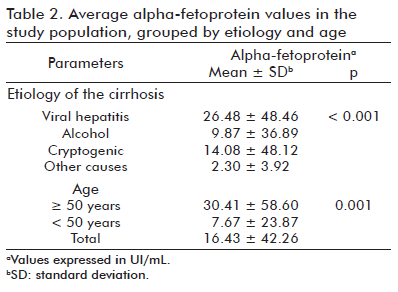
<P   align="left" ><font face="Verdana, Arial, Helvetica, sans-serif" size="2" color="#000000">A      total of 252 serum AFP determinations by the SUMA&reg; methodology were performed      during the study, yielding a mean value of 16.43 &plusmn; 42.26 UI/mL. <a href="#tab2">Table      2</a> shows the mean AFP values divided by HC etiology and age. It is evident      that the levels were markedly increased in patients with viral hepatitis (p      &lt; 0.001) and in patients with an age of 50 years or older (p = 0.001).</font></P >       <P   align="center" ><font color="#000000"><a name="tab2"></a><img src="/img/revistas/bta/v28n1/t0205111.gif"></font></P >   <FONT color="#008000"><FONT size="+1" color="#000000"><FONT size="+1"><FONT color="#008000"><FONT color="#000000"><FONT color="#800080"><FONT color="#000000"><FONT color="#008000"><FONT color="#000000">       
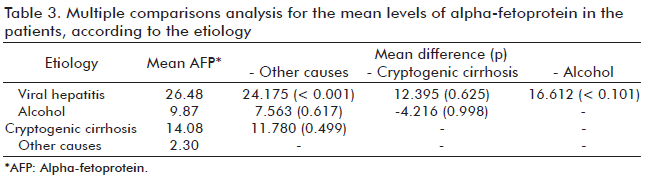
<P   align="left" ><font face="Verdana, Arial, Helvetica, sans-serif" size="2" color="#000000">The      only statistically significant difference found in the multiple comparisons      analysis (<a href="/img/revistas/bta/v28n1/t0305111.gif">Table 3</a>)      was that of the mean AFP levels of patients with viral HC compared to patients      whose etiology fell under the heading of &lsquo;other causes&rsquo; (p &lt;      0.001). </font></P >       
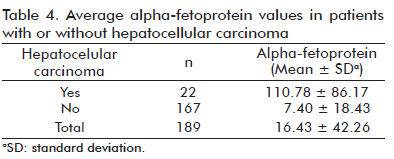
<P   align="left" ><font face="Verdana, Arial, Helvetica, sans-serif" size="2" color="#000000">The      levels of AFP in patients also suffering from HCC were higher than in the      remaining patients (110.78 UI/mL <I>vs. </I>7.40 UI/mL) (p &lt; 0.001) (<a href="#tab4">Table      4</a>). </font></P >       <P   align="center" ><font color="#000000"><a name="tab4" id="tab4"></a><img src="/img/revistas/bta/v28n1/t0405111.gif"></font></P >   <FONT color="#800080"><FONT color="#000000"><FONT color="#008000"><FONT color="#000000"><FONT color="#008000"><FONT color="#000000"><FONT color="#800080"><FONT color="#000000">       
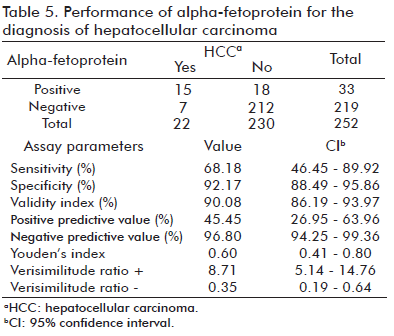
<P   align="left" ><font face="Verdana, Arial, Helvetica, sans-serif" size="2" color="#000000">The      sensitivity of AFP determinations for diagnosing HCC was 68.18%; the specificity      values obtained were 92.17%; 45.45% for the PPV; and 96.80% for the NPV. Youden&rsquo;s      index was low, at 0.60 (<a href="#tab5">Table 5</a>). </font></P >       <P   align="center" ><font color="#000000"><a name="tab5"></a><img src="/img/revistas/bta/v28n1/t0505111.gif"></font></P >   <FONT color="#008000"><FONT color="#000000"><FONT color="#800080"><FONT color="#000000">       
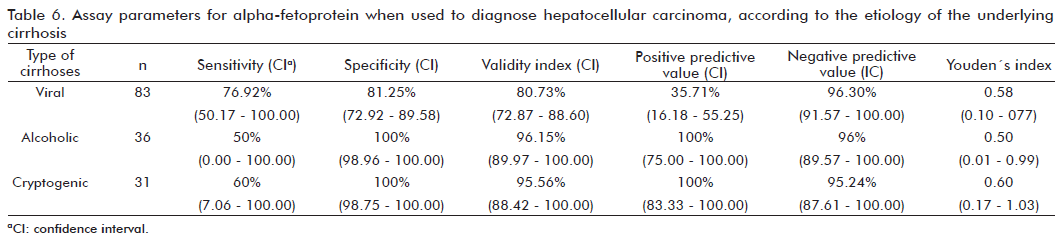
<P   align="left" ><font face="Verdana, Arial, Helvetica, sans-serif" size="2" color="#000000">The      results for the diagnostic application of AFP in the case of HC, divided by      etiology, are presented in <a href="/img/revistas/bta/v28n1/t0605111.gif">Table      6.</a> Youden&rsquo;s index was low for all patient groups, with values of      0.58, 0.50 and 0.60 for viral HC, alcoholic HC and cryptogenic HC, respectively.      </font></P >   <FONT color="#800080"><FONT color="#000000"><FONT color="#008000"><FONT color="#000000">       
]]></body>
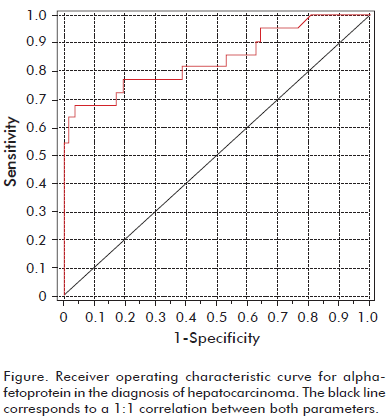
<body><![CDATA[<P   align="left" ><font face="Verdana, Arial, Helvetica, sans-serif" size="2" color="#000000">The      <a href="#fig1">Figure</a> shows the ROC curve of AFP when used to diagnose      HCC. The area under the curve amounted to 0.846 (0.74-0.95). <a href="/img/revistas/bta/v28n1/t0705111.gif">Table      7</a> presents the sensitivity, specificity, and Youden&rsquo;s index, according      to the specific diagnostic threshold chosen. Youden&rsquo;s index was also      low for each of these groups.</font></P >       
<P   align="center" ><font color="#000000"><a name="fig1"></a><img src="/img/revistas/bta/v28n1/f0105111.gif"></font></P >   <FONT color="#800080"><FONT color="#000000"><FONT color="#800080"><FONT color="#000000"><FONT color="#008000"><FONT color="#000000"><FONT color="#008000"><FONT color="#000000">       
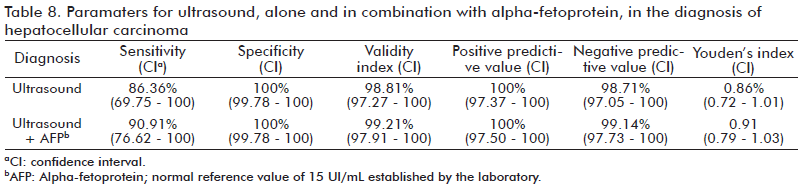
<P   align="left" ><font face="Verdana, Arial, Helvetica, sans-serif" size="2" color="#000000">All      patients underwent imagenological tests, which supported the HCC diagnosis      established with the study criteria. The sensitivity, specificity, PPV and      NPV of abdominal sonography were 86.36%, 100%, 100% and 98.71% respectively      to diagnose HCC. Youden&rsquo;s index was very good (0.86). The combination      of abdominal sonography and AFP increased sensitivity to 90.91% and NPV to      99.14%. Youden&rsquo;s index, again, was excellent, at 0.91 (<a href="/img/revistas/bta/v28n1/t0805111.gif">Table      8</a>). </font></P >   <FONT color="#008000"><FONT color="#000000"><FONT color="#008000"><FONT color="#000000"><FONT color="#800080"><FONT color="#000000">       
<P   align="left" ><font size="3" face="Verdana, Arial, Helvetica, sans-serif" color="#000000"><b>DISCUSSION</b></font><font size="2" face="Verdana, Arial, Helvetica, sans-serif" color="#000000">      </font></P >   <FONT size="+1">       <P   align="left" ><font size="2" face="Verdana, Arial, Helvetica, sans-serif" color="#000000">Solid      data on the real prevalence of HC worldwide is still lacking, and the available      statistical figures are always underestimated due to the high prevalence of      undiagnosed cirrhoses. This situation is caused mainly by the fact that patients      with compensated HC usually have no symptoms or conspicuous clinical signs      of liver insufficiency and/or portal hypertension; in addition, they may remain      so far considerable periods of time (21). </font></P >   <FONT size="+1"><FONT color="#008000"><FONT color="#000000"><FONT color="#008000"><FONT color="#000000">       <P   align="left" ><font face="Verdana, Arial, Helvetica, sans-serif" size="2" color="#000000">The      etiology of HC, on the other hand, is better known. In developed countries,      the causes of most HC cases are HCV infections and alcoholic liver disease      (22), while in other parts of the world, such as the Asian Southeast and sub-Saharan      Africa, HBV infections constitute the main etiological agent (23). </font></P >   <FONT color="#008000"><FONT color="#000000"><FONT color="#008000"><FONT color="#000000"><FONT color="#008000"><FONT color="#000000"><FONT color="#008000"><FONT color="#000000">       <P   align="left" ><font face="Verdana, Arial, Helvetica, sans-serif" size="2" color="#000000">The      results of this study are conformed to our expectations. Viral infections,      mainly by HCV, and alcohol consumption, were the first and second most important      etiologies for HC, respectively. This is the pattern typical of geographic      areas where HBV infection is not endemic (22). The growing prevalence of HCV      over HBV in Cuba constitutes the result of the sustained application of blood      donor screening programs and, most important, reflects the impact of the National      Vaccination Program against HBV, which began in 1991 with the administration      of an effective HBV vaccine manufactured in the country (Heberbiovac-HB&reg;)      to newborns from carrier mothers and was later extended in 1992 to all newborns,      together with the vaccination of the cohorts of children 8 and 14 years old      from 1994 onwards (24). </font></P >   <FONT color="#008000"><FONT color="#000000"><FONT color="#008000"><FONT color="#000000"><FONT color="#008000"><FONT size="+1" color="#000000"><FONT size="+1"><FONT color="#008000"><FONT color="#000000"><FONT color="#008000"><FONT color="#000000"><FONT size="+1">       <P   align="left" ><font size="2" face="Verdana, Arial, Helvetica, sans-serif" color="#000000">HC      has been known for a long time as the most important risk factor for the development      of HCC (25). Independently from the etiology of HC, the risk of developing      HCC in these patients is estimated to range from 3 to 5% in a year (10, 26).      </font></P >   <FONT size="+1"><FONT color="#008000"><FONT color="#000000"><FONT color="#008000"><FONT color="#000000"><FONT color="#008000"><FONT color="#000000"><FONT color="#008000"><FONT color="#000000">       <P   align="left" ><font face="Verdana, Arial, Helvetica, sans-serif" size="2" color="#000000">This      investigation demonstrated the presence of HCC in 11.64% of the patients included      in the study (<a href="#tab4">Table 4</a>). The principal causes of HCC, ordered by frequency,      were the presence of viral HC (HCV-related mainly), the presence of cryptogenic      cirrhosis, and the consumption of alcohol. These data are similar to those      reported in countries with low prevalence and incidence rates of HBV (11,      27). </font></P >   <FONT color="#800080"><FONT color="#000000"><FONT color="#008000"><FONT color="#000000"><FONT color="#008000"><FONT color="#000000">       <P   align="left" ><font face="Verdana, Arial, Helvetica, sans-serif" size="2" color="#000000">Although      serum AFP levels have been shown to increase in association with several carcinomas,      this parameter has only been employed as a tumoral marker for HCC (28, 29).      The present investigation showed that serum AFP levels, measured with SUMA&reg;      technology, were significantly higher in patients aged 50 years or older,      in patients with viral HC, and in patients with HCC. </font></P >   <FONT color="#008000"><FONT color="#000000"><FONT color="#008000"><FONT color="#000000"><FONT color="#008000"><FONT size="+1" color="#000000"><FONT size="+1">       ]]></body>
<body><![CDATA[<P   align="left" ><font face="Verdana, Arial, Helvetica, sans-serif" size="2" color="#000000">The      results coincide with previous reports investigating the influence of viral      infections on AFP concentrations. Increased levels of AFP are detected in      viral hepatitis patients with no detectable HCC. Taking into account the results      from different publications, it can be estimated that 10 to 43% of persons      with a chronic HCV infection will have increases in this serum marker (8,      30, 31). Searching for an explanation to this finding, several studies have      demonstrated a correlation between increased serum AFP levels and the degree      of inflammation observed in liver biopsies (30-32). </font></P >   <FONT color="#008000"><FONT color="#000000"><FONT color="#008000"><FONT color="#000000"><FONT color="#008000"><FONT color="#000000"><FONT color="#008000"><FONT color="#000000">       <P   align="left" ><font face="Verdana, Arial, Helvetica, sans-serif" size="2" color="#000000">The      investigations examining the usefulness of AFP as a screening and surveillance      tool have not been directly comparable: their design and the characteristics      of the studied population (type of viral infection, severity of liver disease,      demographics) have differed. This fact alone explains the wide variability      of their results, with sensitivities ranging from 41 to 69% and specificities      between 75 and 94% (3, 9, 12, 16, 17, 20, 33-37). </font></P >   <FONT color="#008000"><FONT color="#000000"><FONT color="#008000"><FONT color="#000000">       <P   align="left" ><font face="Verdana, Arial, Helvetica, sans-serif" size="2" color="#000000">A      publication by Trevisiani <I>et al. </I>(3) has proposed that the best diagnostic      threshold level for AFP ranges from 16 to 20 ng/mL. Using a threshold of 20      ng/mL, specificity was indeed high (89.4%), but sensitivity was only 60%;      this would produce such a significant number of false negative diagnoses for      a disease with the implications of HCC that the marker would not be useful      for this purpose. Lowering the threshold identifies a larger number of cases,      improving sensitivity at the price of an increased false positive rate. In      other words, the higher the threshold, the lower the number of detected cases      obtained (sensitivity decreases). A different study by Gambarin-Gelman <I>et      al. </I>(12) also used an AFP diagnostic threshold of 20 ng/mL, and obtained      a sensitivity of 58% and a specificity of 91%. In exchange, PPV increased      from 58 to 75% at higher levels of AFP (50 ng/mL), although it must be underscored      that in the latter case, sensitivity dropped from 58 to 47%. </font></P >   <FONT color="#008000"><FONT color="#000000"><FONT color="#008000"><FONT color="#000000"><FONT color="#008000"><FONT color="#000000"><FONT color="#008000"><FONT color="#000000">       <P   align="left" ><font face="Verdana, Arial, Helvetica, sans-serif" size="2" color="#000000">More      recent results from Durazo <I>et al. </I>(33) and El-Husseini <I>et al. </I>(34)      using diagnostic thresholds of 19.8 and 25 ng/mL have reached the highest      sensitivities reported so far in the literature (69 the former and 68.2% the      latter). Specificity in both studies was, however, discreetly lower. </font></P >   <FONT color="#008000"><FONT color="#000000"><FONT color="#008000"><FONT color="#000000"><FONT color="#008000"><FONT color="#000000"><FONT color="#008000"><FONT color="#000000">       <P   align="left" ><font face="Verdana, Arial, Helvetica, sans-serif" size="2" color="#000000">The      sensitivity and specificity results obtained in this investigation for serum      AFP measured with SUMA&reg; technology can be considered good when compared      to the results summarized above. Using a diagnostic threshold of 15.38 UI/mL      (equivalent to 19.07 ng/mL), sensitivity was 68.2%: a figure higher than the      average of all the mentioned reports (60%) and similar to the two most recent      ones. Specificity, for this threshold, was also high, at 90%. This value also      falls within the published range (78.3 to 94%). </font></P >   <FONT color="#008000"><FONT size="+1" color="#000000"><FONT size="+1">       <P   align="left" ><font face="Verdana, Arial, Helvetica, sans-serif" size="2" color="#000000">It      can be concluded that serum AFP levels of 91.71 UI/mL (113.72 ng/mL) or higher      had diagnostic value, with a specificity higher than 99%. In short, less than      1% of the patients without HCC had AFP levels higher than 100 ng/mL. This      is a better outcome than that reported by Nguyen <I>et al. </I>(16), who had      a lower specificity (97.3%) at the same AFP threshold of 100 ng/mL and had      to increase it to 200 ng/mL or higher to obtain a specificity of 100%. In      the report from Trevisani <I>et al. </I>(3), levels higher than 200 ng/mL      had a specificity of 99.4%. </font></P >   <FONT color="#008000"><FONT color="#000000"><FONT color="#008000"><FONT color="#000000"><FONT color="#008000"><FONT color="#000000"><FONT color="#008000"><FONT color="#000000">       <P   align="left" ><font face="Verdana, Arial, Helvetica, sans-serif" size="2" color="#000000">Reviewing      the evidence analyzed above, we support the position stated by G&oacute;mez      Senent <I>et al. </I>(38) in a recent publication, arguing that the high specificity      that can be obtained with elevated diagnostic thresholds for AFP allow its      use as a confirmatory test for HCC diagnosis. </font></P >   <FONT color="#008000"><FONT color="#000000"><FONT color="#008000"><FONT color="#000000">       <P   align="left" ><font face="Verdana, Arial, Helvetica, sans-serif" size="2" color="#000000">The      actual usefulness of sonography, as the sole diagnostic test, for the screening      and surveillance of HCC in patients with HC is being increasingly contested,      as a consequence of the absence of prospective studies and the widely varying      sensitivity (35 to 84%) displayed by the technique. This variability has been      ascribed not only to methodological differences in study populations, disease      severity and non-uniform sampling frequencies, but also to susceptibilities      to changes in tumor morphology, operator training and the quality of the measuring      instrument (15, 39). </font></P >   <FONT color="#008000"><FONT color="#000000"><FONT color="#008000"><FONT color="#000000">       <P   align="left" ><font face="Verdana, Arial, Helvetica, sans-serif" size="2" color="#000000">Regardless,      abdominal sonography for HCC diagnosis performed, in this study, at levels      of sensitivity and specificity much better than those presented in the preceding      paragraph. Although we cannot reach a definitive conclusion regarding this      result, it may be related to the characteristics of the tumoral lesions and      the long experience of the personnel operating the ultrasonographic equipment.      </font></P >       <P   align="left" ><font face="Verdana, Arial, Helvetica, sans-serif" size="2" color="#000000">The      diagnostic potential of the AFP/sonography combination has been examined before      in other countries with good results. This combination aims, mainly, at simultaneously      increasing both sensitivity and specificity for the diagnosis of HCC. Some      authors refer that with this method sensitivity can even be taken to 100%      (40). In the present study, the combination of imagenology with serum AFP      measurements by the SUMA&reg; technology at a diagnostic threshold of 15 UI/mL      managed to increase sensitivity and NPV to 90.91 and 99.14%, respectively;      also increasing Youden&rsquo;s index. The increase in sensitivity, compared      to sonography alone, is 5.7%. Values at the same order of sensitivity were      reported by Kang <I>et al. </I>(41). </font></P >   <FONT color="#008000"><FONT color="#000000"><FONT color="#008000"><FONT color="#000000"><FONT color="#008000"><FONT size="+1" color="#000000"><FONT size="+1"><FONT color="#008000"><FONT color="#000000"><FONT color="#008000"><FONT color="#000000"><FONT color="#008000"><FONT color="#000000">       ]]></body>
<body><![CDATA[<P   align="left" ><font face="Verdana, Arial, Helvetica, sans-serif" size="2" color="#000000">No      widely shared consensus has yet been reached concerning the combination of      these tests, however; mainly due to the results of studies where the increases      in false positive rates and operational costs are also taken into account      (42). Yet, we consider that this is a useful and feasible strategy aimed at      increasing the chances of obtaining a timely HCC diagnosis. The determination      of serum AFP levels by Cuban SUMA&reg; technology is less costly that the      remaining diagnostic techniques employed throughout the world, and in any      case, proper training of the medical personnel is always paramount for an      adequate interpretation of the results in each case. </font></P >   <FONT color="#008000"><FONT color="#000000"><FONT color="#008000"><FONT color="#000000"><FONT color="#008000"><FONT size="+1" color="#000000"><FONT size="+1">       <P   align="left" ><font face="Verdana, Arial, Helvetica, sans-serif" size="2" color="#000000">The      use of serum AFP determinations in the SUMA&reg; technological platform was      shown to constitute a useful tool, with adequate sensitivity and specificity,      for the diagnosis of HCC in cirrhotic patients. The combination of this assay      with abdominal sonography managed to increase the sensitivity and specificity      of HCC diagnosis. </font></P >   <FONT color="#008000"><FONT size="+1" color="#000000"><FONT size="+1">       <P   align="left" ><font size="3" face="Verdana, Arial, Helvetica, sans-serif" color="#000000"><b>ACKNOWLEDGEMENTS</b></font><font size="2" face="Verdana, Arial, Helvetica, sans-serif" color="#000000">      </font></P >   <FONT size="+1">        <P   align="left" ><font size="2" face="Verdana, Arial, Helvetica, sans-serif">We would like to      express our gratitude to the researchers from the Immunoassay Center in Havana      for their collaboration during the study. </font></P >   <FONT size="+1">        <P   align="left" > </P >   <FONT size="+1">        <P   align="left" ><font face="Verdana, Arial, Helvetica, sans-serif" size="3"><b>REFERENCES</b></font></P >       <!-- ref --><P   align="justify" ><font size="2" face="Verdana, Arial, Helvetica, sans-serif">1. Parkin DM, Bray      F, Ferlay J, Pisani P. Global cancer statistics, 2002. CA Cancer J Clin. 2005;55:74-108.      </font></P >   <FONT size="+1">    <!-- ref --><P   align="justify" ><font face="Verdana, Arial, Helvetica, sans-serif" size="2">2. El-Serag HB, Rudolph      KL. Hepatocellular carcinoma: epidemiology and molecular carcinogenesis. Gastroenterology.      2007; 132:2557-76. </font></P >    <P   align="justify" ><font face="Verdana, Arial, Helvetica, sans-serif" size="2">3. Trevisani F, D&rsquo;Intino      PE, Morselli-Labate AM, Mazzella G, Accogli E, Caraceni P, <I>et al</I>. Serum      alpha-fetoprotein for diagnosis of hepatocellular carcinoma in patients with      chronic liver disease: influence of HBsAg and anti-HCV status. J Hepatol.      2001;34:570-5. </font></P >       <!-- ref --><P   align="justify" ><font face="Verdana, Arial, Helvetica, sans-serif" size="2">4. Beale G, Chattopadhyay      D, Gray J, Stewart S, Hudson M, Day C, <I>et al</I>. AFP, PIVKAII, GP3, SCCA-1      and follisatin as surveillance biomarkers for hepatocellular cancer in non-alcoholic      and alcoholic fatty liver disease. BMC Cancer. 2008;8:200. </font></P >    <!-- ref --><P   align="justify" ><font face="Verdana, Arial, Helvetica, sans-serif" size="2">5. Bruix J, Sherman      M. Management of hepatocellular carcinoma. Hepatology. 2005;42:1208-36. </font></P >    <!-- ref --><P   align="justify" ><font face="Verdana, Arial, Helvetica, sans-serif" size="2">6. Mizejewski GJ.      Alpha-fetoprotein structure and function: relevance to isoforms, epitopes,      and conformational variants. Exp Biol Med (Maywood). 2001;226:377-408. </font></P >    <!-- ref --><P   align="justify" ><font face="Verdana, Arial, Helvetica, sans-serif" size="2">7. Ruoslahti E, Sepp&auml;l&auml;      M. Studies of carcino-fetal proteins. 3. Development of a radioimmunoassay      for alpha-fetoprotein. Demonstration of alpha-fetoprotein in serum of healthy      human adults. Int J Canc. 1971;8:374-83. </font></P >    <!-- ref --><P   align="justify" ><font face="Verdana, Arial, Helvetica, sans-serif" size="2">8. Soresi M, Magliarisi      C, Campagna P, Leto G, Bonfissuto G, Riili A, <I>et al</I>. Usefulness of      alpha-fetoprotein in the diagnosis of hepatocellular carcinoma. Anticancer      Res. 2003;23:1747-53. </font></P >    <!-- ref --><P   align="justify" ><font face="Verdana, Arial, Helvetica, sans-serif" size="2">9. Tong MJ, Blatt      LM, Kao VW. Surveillance for hepatocellular carcinoma in patients with chronic      viral hepatitis in the United States of America. J Gastroenterol Hepatol.      2001;16:553-9. </font></P >    <!-- ref --><P   align="justify" ><font face="Verdana, Arial, Helvetica, sans-serif" size="2">10. Collier J, Sherman      M. Screening for hepatocellular carcinoma. Hepatology. 1998;27:273-8. </font></P >    <!-- ref --><P   align="justify" ><font face="Verdana, Arial, Helvetica, sans-serif" size="2">11. Bruix J, Sherman      M, Llovet JM, Beaugrand M, Lencioni R, Burroughs AK, <I>et al</I>. Clinical      management of hepatocellular carcinoma. Conclusions of the Barcelona-2000      EASL conference. European Association for the Study of the Liver. J Hepatol.      2001;35:421-30. </font></P >    <!-- ref --><P   align="justify" ><font face="Verdana, Arial, Helvetica, sans-serif" size="2">12. Gambarin-Gelwan      M, Wolf DC, Shapiro R, Schwartz ME, Min AD. Sensitivity of commonly available      screening tests in detecting hepatocellular carcinoma in cirrhotic patients      undergoing liver transplantation. Am J Gastroenterol. 2000;95:1535-8. </font></P >    <!-- ref --><P   align="justify" ><font face="Verdana, Arial, Helvetica, sans-serif" size="2">13. Gad A, Tanaka      E, Matsumoto A, El-Hamid Serwah A, Attia F, Hassan A, <I>et al</I>. Ethnicity      affects the diagnostic validity of alpha-fetoprotein in hepatocellular carcinoma.      As Pac J Clin Oncol. 2005;1:64-70. </font></P >    <!-- ref --><P   align="justify" ><font face="Verdana, Arial, Helvetica, sans-serif" size="2">14. Gupta S, Bent      S, Kohlwes J. Test characteristics of alpha-fetoprotein for detecting hepatocellular      carcinoma in patients with hepatitis C. A systematic review and critical analysis.      Ann Int Med. 2003;139:46-50. </font></P >    <!-- ref --><P   align="justify" ><font face="Verdana, Arial, Helvetica, sans-serif" size="2">15. Gebo KA, Chander      G, Jenckes MW, Ghanem KG, Herlong HF, Torbenson MS, <I>et al</I>. Screening      tests for hepatocellular carcinoma in patients with chronic hepatitis C: a      systematic review. Hepatology. 2002; 36:S84-92. </font></P >    <P   align="justify" ><font face="Verdana, Arial, Helvetica, sans-serif" size="2">16. Nguyen MH, Garcia      RT, Simpson PW, Wright TL, Keeffe EB. Racial differences in effectiveness      of a-fetoprotein for diagnosis of hepatocellular carcinoma in hepatitis C      virus cirrhosis. Hepatology. 2002;36: 410-7. </font></P >       <!-- ref --><P   align="justify" ><font face="Verdana, Arial, Helvetica, sans-serif" size="2">17. Cedrone A, Covino      M, Caturelli E, Pompili M, Lorenzelli G, Villani MR, <I>et al</I>. Utility      of alpha-fetoprotein (AFP) in the screening of patients with virus-related      chronic liver disease: does different viral etiology influence AFP levels      in HCC? A study in 350 western patients. Hepatogastroenterology. 2000;47:1654-8.      </font></P >    <!-- ref --><P   align="justify" ><font face="Verdana, Arial, Helvetica, sans-serif" size="2">18. Daniele B, Bencivenga      A, Megna AS,Tinessa V. Alpha-fetoprotein and ultrasonography screening for      hepatocellular carcinoma. Gastroenterology. 2004;127 (5 Suppl 1):S108-12.      </font></P >    <!-- ref --><P   align="justify" ><font face="Verdana, Arial, Helvetica, sans-serif" size="2">19. Zinkin NT, Grall      F, Bhaskar K, Out HH, Spentzos D, Kalmowitz B, <I>et al</I>. Serum proteomics      and biomarkers in hepatocellular carcinoma and chronic liver disease. Clin      Cancer Res. 2008;14(2):470-7. </font></P >    <P   align="justify" ><font face="Verdana, Arial, Helvetica, sans-serif" size="2">20. Huo TI, Hsia      CI, Chu CJ, Huang YH, Lui WY, Wu JC, <I>et al</I>. The predictive ability      of serum a-fetoprotein for hepatocellular carcinoma is linked with the characteristics      of the target population at surveillance. J Surg Oncol. 2007;95:645-51. </font></P >       <!-- ref --><P   align="justify" ><font face="Verdana, Arial, Helvetica, sans-serif" size="2">21. Schuppan D, Afdhal      NH. Liver cirrosis. Lancet. 2008;371:838-51. </font></P >    <!-- ref --><P   align="justify" ><font face="Verdana, Arial, Helvetica, sans-serif" size="2">22. Mandayam S, Jamal      M, Morgan TR. Epidemiology of alcoholic liver disease. Sem Liver Dis. 2004;24(3):217-32.      </font></P >    <!-- ref --><P   align="justify" ><font face="Verdana, Arial, Helvetica, sans-serif" size="2">23. Marrero CR, Marrero      JA. Viral hepatitis and hepatocellular carcinoma. Arch Med Res. 2007;38(6):612-20.      </font></P >    <!-- ref --><P   align="justify" ><font face="Verdana, Arial, Helvetica, sans-serif" size="2">24. Casta&ntilde;eda      Guillot C. Hepatitis B cr&oacute;nica en la infancia. En: Hern&aacute;ndez      JC, Samada M (editores). Hepatolog&iacute;a 2006. La Habana: Editorial CIMEQ;      2006. p. 231-43. </font></P >    <!-- ref --><P   align="justify" ><font face="Verdana, Arial, Helvetica, sans-serif" size="2">25. Sherman M, Klein      A. AASLD single-topic research conference on hepatocellular carcinoma: conference      proceedings. Hepatology. 2004;40:1465-73. </font></P >    <!-- ref --><P   align="justify" ><font face="Verdana, Arial, Helvetica, sans-serif" size="2">26. Wilson JF. Liver      cancer on the rise. Ann Intern Med. 2005;142:1029-32. </font></P >    <!-- ref --><P   align="justify" ><font face="Verdana, Arial, Helvetica, sans-serif" size="2">27. Seef LB, Hoofnagle      JH. Epidemiology of hepatocellular carcinoma in areas of low hepatitis B and      hepatitis C endemicity. Oncogene. 2006;25:3771-7. </font></P >    <!-- ref --><P   align="justify" ><font face="Verdana, Arial, Helvetica, sans-serif" size="2">28. Marrero JA, Feng      Z, Wang Y, Nguyen MH, Befeler AS, Roberts LR, <I>et al</I>. Alpha-fetoprotein,      des-gamma carboxyprothrombin, and lectin-bound alpha-fetoprotein in early      hepatocellular carcinoma. Gastroenterology. 2009;137(1):110-8. </font></P >    <!-- ref --><P   align="justify" ><font face="Verdana, Arial, Helvetica, sans-serif" size="2">29. Forner A, Reig      M, Bruix J. Alpha-fetoprotein for hepatocellular carcinoma diagnosis: The      demise of a brilliant star. Gastroenterology. 2009;137(1):26-9. </font></P >    <!-- ref --><P   align="justify" ><font face="Verdana, Arial, Helvetica, sans-serif" size="2">30. Hu KQ, Kyulo      NL, Lim N, Elhazin B, Hillebrand DJ, Bock T. Clinical significance of elevated      alpha-fetoprotein (AFP) in patients with chronic hepatitis C, but not hepatocellular      carcinoma. Am J Gastroenterol. 2004;99(5):860-5. </font></P >    <!-- ref --><P   align="justify" ><font face="Verdana, Arial, Helvetica, sans-serif" size="2">31. Tai WC, Hu TH,      Wang JH, Hung CH, Lu SN, Changchien CS, <I>et al</I>. Clinical implications      of alpha-fetoprotein in chronic hepatitis C. J Formos Med Assoc. 2009;108(3):210-8.      </font></P >    <!-- ref --><P   align="justify" ><font face="Verdana, Arial, Helvetica, sans-serif" size="2">32. Bruce MG, Bruden      D, McMahon BJ, Christensen C, Homan C, Sullivan D, <I>et al</I>. Clinical      significance of elevated alpha-fetoprotein in Alaskan Native patients with      chronic hepatitis C. J Viral Hepat. 2008;15:179-87. </font></P >    <!-- ref --><P   align="justify" ><font face="Verdana, Arial, Helvetica, sans-serif" size="2">33. Durazo FA, Blatt      LM, Corey WG, Lin JH, Han S, Saab S, <I>et al</I>. Des-gamma-carboxyprothrombin,      alpha-fetoprotein and AFP-L3 in patients with chronic hepatitis, cirrhosis      and hepatocellular carcinoma. J Gastroenterol Hepatol. 2008;23(10):1541-8.      </font></P >    <!-- ref --><P   align="justify" ><font face="Verdana, Arial, Helvetica, sans-serif" size="2">34. El-Houseini ME,      Mohammed MS, Elshemey WM, Hussein TD, Desouky OS, Elsayed AA. Enhanced detection      of hepatocellular carcinoma. Cancer Control. 2005;12(4):248-53. </font></P >    <!-- ref --><P   align="justify" ><font face="Verdana, Arial, Helvetica, sans-serif" size="2">35. Ishii M, Gama      H, Chida N, Ueno Y, Shinzawa H, Takagi T, <I>et al</I>. Simultaneous measurements      of serum alpha-fetoprotein and protein induced by vitamin K absence for detecting      hepatocellular carcinoma. South Tohoku District Study Group. Am J Gastroenterol.      2000;95:1036-40. </font></P >    <!-- ref --><P   align="justify" ><font face="Verdana, Arial, Helvetica, sans-serif" size="2">36. Sherman M, Peltekian      KM, Lee C. Screening for hepatocellular carcinoma in chronic carriers of hepatitis      B virus: incidence and prevalence of hepatocellular carcinoma in a North American      urban population. Hepatology. 1995;22:432-8. </font></P >    <!-- ref --><P   align="justify" ><font face="Verdana, Arial, Helvetica, sans-serif" size="2">37. Peng YC, Chan      CS, Chen GH. The effectiveness of serum alphafetoprotein level in anti-HCV      positive patients for screening hepatocellular carcinoma. Hepatogastroenterology.      1999;46:3208-11. </font></P >    <!-- ref --><P   align="justify" ><font face="Verdana, Arial, Helvetica, sans-serif" size="2">38. G&oacute;mez      Senent S, G&oacute;mez Raposo C, Segura Cabral JM. Gu&iacute;a para el diagn&oacute;stico,      estadificaci&oacute;n y tratamiento del hepatocarcinoma. Med Clin. 2007;128:741-8.      </font></P >    <!-- ref --><P   align="justify" ><font face="Verdana, Arial, Helvetica, sans-serif" size="2">39. Peterson MS,      Baron RL. Radiologic diagnosis of hepatocellular carcinoma. Clin Liver Dis.      2001;5:123-44. </font></P >    <P   align="justify" ><font face="Verdana, Arial, Helvetica, sans-serif" size="2">40. Tremolda F, Benevegn&ugrave;      L, Drago C, Casarin C, Cechetto A, Realdi G, <I>et al</I>. Early detection      of hepatocellular carcinoma in patients with cirrhosis by a-fetoprotein, ultrasound      and fine-needle biopsy. Hepatogastroenterology. 1989;36:519-21. </font></P >       <!-- ref --><P   align="justify" ><font face="Verdana, Arial, Helvetica, sans-serif" size="2">41. Kang JY, Lee      TP, Yap I, Lun KC. Analysis of cost-effectiveness of different strategies      for hepatocellular carcinoma screening in hepatitis B virus carriers. J Gastroenterol      Hepatol. 1992;7:463-8. </font></P >    <!-- ref --><P   align="left" ><font face="Verdana, Arial, Helvetica, sans-serif" size="2">42. Debruyne EN,      Delanghe JR. Diagnosing and monitoring hepatocellular carcinoma with alpha-fetoprotein:      New aspects and applications. Clin Chim Acta. 2008;395(1-2):19-26.</font></P >    <P   align="left" >&nbsp;</P >       <P   align="left" ><font face="Verdana, Arial, Helvetica, sans-serif" size="2">Received in April,      2010.    ]]></body>
<body><![CDATA[<br>     Accepted for publication in March, 2011.</font></P >       <P   align="left" ><font face="Verdana, Arial, Helvetica, sans-serif" size="2">Julio C Hern&aacute;ndez,      Grupo de Hepatolog&iacute;a Centro de Investigaciones M&eacute;dico Quir&uacute;rgicas,      CIMEQ Calle 216 y 11B, Reparto Siboney, Playa, CP 12100, La Habana, Cuba,      E-mail: <a href="mailto:julio.hernandez@infomed.sld.cu">julio.hernandez@infomed.sld.cu</a></font></P >   </font></font></font></font></font></font></font></font></font></font></font></font></font></font></font></font></font></font></font></font></font></font></font></font></font></font></font></font></font></font></font></font></font></font></font></font></font></font></font></font></font></font></font></font></font></font></font></font></font></font></font></font></font></font></font></font></font></font></font></font></font></font></font></font></font></font></font></font></font></font></font></font></font></font></font></font></font></font></font></font></font></font></font></font></font></font></font></font></font></font></font></font></font></font></font></font></font></font></font></font></font></font></font></font></font></font></font></font></font></font></font></font></font></font></font></font></font></font></font></font></font></font></font></font></font></font></font></font></font></font></font></font></font></font></font></font></font></font></font></font></font></font></font></font></font></font></font></font></font></font></font></font></font></font></font></font></font></font></font></font></font></font></font></font></font></font></font></font></font></font></font></font></font></font></font></font></font></font></font></font></font></font></font></font></font></font></font></font></font></font></font></font></font></font></font></font></font></font></font></font></font></font></font></font></font></font></font></font></font></font></font></font></font></font></font></font></font></font></font></font></font></font></font></font></font></font></font></font></font></font></font></font></font></font></font></font></font></font></font></font></font></font></font></font></font></font></font></font></font></font></font></font></font></font></font></font></font></font></font></font></font></font></font></font></font></font></font></font></font></font></DIV >      ]]></body><back>
<ref-list>
<ref id="B1">
<label>1</label><nlm-citation citation-type="journal">
<person-group person-group-type="author">
<name>
<surname><![CDATA[Parkin]]></surname>
<given-names><![CDATA[DM]]></given-names>
</name>
<name>
<surname><![CDATA[Bray]]></surname>
<given-names><![CDATA[F]]></given-names>
</name>
<name>
<surname><![CDATA[Ferlay]]></surname>
<given-names><![CDATA[J]]></given-names>
</name>
<name>
<surname><![CDATA[Pisani]]></surname>
<given-names><![CDATA[P]]></given-names>
</name>
</person-group>
<article-title xml:lang="en"><![CDATA[Global cancer statistics, 2002]]></article-title>
<source><![CDATA[CA Cancer J Clin]]></source>
<year>2005</year>
<volume>55</volume>
<page-range>74-108</page-range></nlm-citation>
</ref>
<ref id="B2">
<label>2</label><nlm-citation citation-type="journal">
<person-group person-group-type="author">
<name>
<surname><![CDATA[El-Serag]]></surname>
<given-names><![CDATA[HB]]></given-names>
</name>
<name>
<surname><![CDATA[Rudolph]]></surname>
<given-names><![CDATA[KL]]></given-names>
</name>
</person-group>
<article-title xml:lang="en"><![CDATA[Hepatocellular carcinoma: epidemiology and molecular carcinogenesis]]></article-title>
<source><![CDATA[Gastroenterology]]></source>
<year>2007</year>
<volume>132</volume>
<page-range>2557-76</page-range></nlm-citation>
</ref>
<ref id="B3">
<label>3</label><nlm-citation citation-type="journal">
<person-group person-group-type="author">
<name>
<surname><![CDATA[Trevisani]]></surname>
<given-names><![CDATA[F]]></given-names>
</name>
<name>
<surname><![CDATA[D’Intino]]></surname>
<given-names><![CDATA[PE]]></given-names>
</name>
<name>
<surname><![CDATA[Morselli-Labate]]></surname>
<given-names><![CDATA[AM]]></given-names>
</name>
<name>
<surname><![CDATA[Mazzella]]></surname>
<given-names><![CDATA[G]]></given-names>
</name>
<name>
<surname><![CDATA[Accogli]]></surname>
<given-names><![CDATA[E]]></given-names>
</name>
<name>
<surname><![CDATA[Caraceni]]></surname>
<given-names><![CDATA[P]]></given-names>
</name>
</person-group>
<article-title xml:lang="en"><![CDATA[Serum alpha-fetoprotein for diagnosis of hepatocellular carcinoma in patients with chronic liver disease: influence of HBsAg and anti-HCV status]]></article-title>
<source><![CDATA[J Hepatol]]></source>
<year>2001</year>
<volume>34</volume>
<page-range>570-5</page-range></nlm-citation>
</ref>
<ref id="B4">
<label>4</label><nlm-citation citation-type="journal">
<person-group person-group-type="author">
<name>
<surname><![CDATA[Beale]]></surname>
<given-names><![CDATA[G]]></given-names>
</name>
<name>
<surname><![CDATA[Chattopadhyay]]></surname>
<given-names><![CDATA[D]]></given-names>
</name>
<name>
<surname><![CDATA[Gray]]></surname>
<given-names><![CDATA[J]]></given-names>
</name>
<name>
<surname><![CDATA[Stewart]]></surname>
<given-names><![CDATA[S]]></given-names>
</name>
<name>
<surname><![CDATA[Hudson]]></surname>
<given-names><![CDATA[M]]></given-names>
</name>
<name>
<surname><![CDATA[Day]]></surname>
<given-names><![CDATA[C]]></given-names>
</name>
</person-group>
<article-title xml:lang="en"><![CDATA[AFP, PIVKAII, GP3, SCCA-1 and follisatin as surveillance biomarkers for hepatocellular cancer in non-alcoholic and alcoholic fatty liver disease]]></article-title>
<source><![CDATA[BMC Cancer]]></source>
<year>2008</year>
<volume>8</volume>
<page-range>200</page-range></nlm-citation>
</ref>
<ref id="B5">
<label>5</label><nlm-citation citation-type="journal">
<person-group person-group-type="author">
<name>
<surname><![CDATA[Bruix]]></surname>
<given-names><![CDATA[J]]></given-names>
</name>
<name>
<surname><![CDATA[Sherman]]></surname>
<given-names><![CDATA[M]]></given-names>
</name>
</person-group>
<article-title xml:lang="en"><![CDATA[Management of hepatocellular carcinoma]]></article-title>
<source><![CDATA[Hepatology]]></source>
<year>2005</year>
<volume>42</volume>
<page-range>1208-36</page-range></nlm-citation>
</ref>
<ref id="B6">
<label>6</label><nlm-citation citation-type="journal">
<person-group person-group-type="author">
<name>
<surname><![CDATA[Mizejewski]]></surname>
<given-names><![CDATA[GJ]]></given-names>
</name>
</person-group>
<article-title xml:lang="en"><![CDATA[Alpha-fetoprotein structure and function: relevance to isoforms, epitopes, and conformational variants]]></article-title>
<source><![CDATA[Exp Biol Med (Maywood)]]></source>
<year>2001</year>
<volume>226</volume>
<page-range>377-408</page-range></nlm-citation>
</ref>
<ref id="B7">
<label>7</label><nlm-citation citation-type="journal">
<person-group person-group-type="author">
<name>
<surname><![CDATA[Ruoslahti]]></surname>
<given-names><![CDATA[E]]></given-names>
</name>
<name>
<surname><![CDATA[Seppälä]]></surname>
<given-names><![CDATA[M]]></given-names>
</name>
</person-group>
<article-title xml:lang="en"><![CDATA[Studies of carcino-fetal proteins: 3. Development of a radioimmunoassay for alpha-fetoprotein. Demonstration of alpha-fetoprotein in serum of healthy human adults]]></article-title>
<source><![CDATA[Int J Canc]]></source>
<year>1971</year>
<volume>8</volume>
<page-range>374-83</page-range></nlm-citation>
</ref>
<ref id="B8">
<label>8</label><nlm-citation citation-type="journal">
<person-group person-group-type="author">
<name>
<surname><![CDATA[Soresi]]></surname>
<given-names><![CDATA[M]]></given-names>
</name>
<name>
<surname><![CDATA[Magliarisi]]></surname>
<given-names><![CDATA[C]]></given-names>
</name>
<name>
<surname><![CDATA[Campagna]]></surname>
<given-names><![CDATA[P]]></given-names>
</name>
<name>
<surname><![CDATA[Leto]]></surname>
<given-names><![CDATA[G]]></given-names>
</name>
<name>
<surname><![CDATA[Bonfissuto]]></surname>
<given-names><![CDATA[G]]></given-names>
</name>
<name>
<surname><![CDATA[Riili]]></surname>
<given-names><![CDATA[A]]></given-names>
</name>
</person-group>
<article-title xml:lang="en"><![CDATA[Usefulness of alpha-fetoprotein in the diagnosis of hepatocellular carcinoma]]></article-title>
<source><![CDATA[Anticancer Res]]></source>
<year>2003</year>
<volume>23</volume>
<page-range>1747-53</page-range></nlm-citation>
</ref>
<ref id="B9">
<label>9</label><nlm-citation citation-type="journal">
<person-group person-group-type="author">
<name>
<surname><![CDATA[Tong]]></surname>
<given-names><![CDATA[MJ]]></given-names>
</name>
<name>
<surname><![CDATA[Blatt]]></surname>
<given-names><![CDATA[LM]]></given-names>
</name>
<name>
<surname><![CDATA[Kao]]></surname>
<given-names><![CDATA[VW]]></given-names>
</name>
</person-group>
<article-title xml:lang="en"><![CDATA[Surveillance for hepatocellular carcinoma in patients with chronic viral hepatitis in the United States of America]]></article-title>
<source><![CDATA[J Gastroenterol Hepatol]]></source>
<year>2001</year>
<volume>16</volume>
<page-range>553-9</page-range></nlm-citation>
</ref>
<ref id="B10">
<label>10</label><nlm-citation citation-type="journal">
<person-group person-group-type="author">
<name>
<surname><![CDATA[Collier]]></surname>
<given-names><![CDATA[J]]></given-names>
</name>
<name>
<surname><![CDATA[Sherman]]></surname>
<given-names><![CDATA[M]]></given-names>
</name>
</person-group>
<article-title xml:lang="en"><![CDATA[Screening for hepatocellular carcinoma]]></article-title>
<source><![CDATA[Hepatology]]></source>
<year>1998</year>
<volume>27</volume>
<page-range>273-8</page-range></nlm-citation>
</ref>
<ref id="B11">
<label>11</label><nlm-citation citation-type="journal">
<person-group person-group-type="author">
<name>
<surname><![CDATA[Bruix]]></surname>
<given-names><![CDATA[J]]></given-names>
</name>
<name>
<surname><![CDATA[Sherman]]></surname>
<given-names><![CDATA[M]]></given-names>
</name>
<name>
<surname><![CDATA[Llovet]]></surname>
<given-names><![CDATA[JM]]></given-names>
</name>
<name>
<surname><![CDATA[Beaugrand]]></surname>
<given-names><![CDATA[M]]></given-names>
</name>
<name>
<surname><![CDATA[Lencioni]]></surname>
<given-names><![CDATA[R]]></given-names>
</name>
<name>
<surname><![CDATA[Burroughs]]></surname>
<given-names><![CDATA[AK]]></given-names>
</name>
</person-group>
<article-title xml:lang="en"><![CDATA[Clinical management of hepatocellular carcinoma: Conclusions of the Barcelona-2000 EASL conference. European Association for the Study of the Liver]]></article-title>
<source><![CDATA[J Hepatol]]></source>
<year>2001</year>
<volume>35</volume>
<page-range>421-30</page-range></nlm-citation>
</ref>
<ref id="B12">
<label>12</label><nlm-citation citation-type="journal">
<person-group person-group-type="author">
<name>
<surname><![CDATA[Gambarin-Gelwan]]></surname>
<given-names><![CDATA[M]]></given-names>
</name>
<name>
<surname><![CDATA[Wolf]]></surname>
<given-names><![CDATA[DC]]></given-names>
</name>
<name>
<surname><![CDATA[Shapiro]]></surname>
<given-names><![CDATA[R]]></given-names>
</name>
<name>
<surname><![CDATA[Schwartz]]></surname>
<given-names><![CDATA[ME]]></given-names>
</name>
<name>
<surname><![CDATA[Min]]></surname>
<given-names><![CDATA[AD]]></given-names>
</name>
</person-group>
<article-title xml:lang="en"><![CDATA[Sensitivity of commonly available screening tests in detecting hepatocellular carcinoma in cirrhotic patients undergoing liver transplantation]]></article-title>
<source><![CDATA[Am J Gastroenterol]]></source>
<year>2000</year>
<volume>95</volume>
<page-range>1535-8</page-range></nlm-citation>
</ref>
<ref id="B13">
<label>13</label><nlm-citation citation-type="journal">
<person-group person-group-type="author">
<name>
<surname><![CDATA[Gad]]></surname>
<given-names><![CDATA[A]]></given-names>
</name>
<name>
<surname><![CDATA[Tanaka]]></surname>
<given-names><![CDATA[E]]></given-names>
</name>
<name>
<surname><![CDATA[Matsumoto]]></surname>
<given-names><![CDATA[A]]></given-names>
</name>
<name>
<surname><![CDATA[El-Hamid Serwah]]></surname>
<given-names><![CDATA[A]]></given-names>
</name>
<name>
<surname><![CDATA[Attia]]></surname>
<given-names><![CDATA[F]]></given-names>
</name>
<name>
<surname><![CDATA[Hassan]]></surname>
<given-names><![CDATA[A]]></given-names>
</name>
</person-group>
<article-title xml:lang="en"><![CDATA[Ethnicity affects the diagnostic validity of alpha-fetoprotein in hepatocellular carcinoma]]></article-title>
<source><![CDATA[As Pac J Clin Oncol]]></source>
<year>2005</year>
<volume>1</volume>
<page-range>64-70</page-range></nlm-citation>
</ref>
<ref id="B14">
<label>14</label><nlm-citation citation-type="journal">
<person-group person-group-type="author">
<name>
<surname><![CDATA[Gupta]]></surname>
<given-names><![CDATA[S]]></given-names>
</name>
<name>
<surname><![CDATA[Bent]]></surname>
<given-names><![CDATA[S]]></given-names>
</name>
<name>
<surname><![CDATA[Kohlwes]]></surname>
<given-names><![CDATA[J]]></given-names>
</name>
</person-group>
<article-title xml:lang="en"><![CDATA[Test characteristics of alpha-fetoprotein for detecting hepatocellular carcinoma in patients with hepatitis C: A systematic review and critical analysis]]></article-title>
<source><![CDATA[Ann Int Med]]></source>
<year>2003</year>
<volume>139</volume>
<page-range>46-50</page-range></nlm-citation>
</ref>
<ref id="B15">
<label>15</label><nlm-citation citation-type="journal">
<person-group person-group-type="author">
<name>
<surname><![CDATA[Gebo]]></surname>
<given-names><![CDATA[KA]]></given-names>
</name>
<name>
<surname><![CDATA[Chander]]></surname>
<given-names><![CDATA[G]]></given-names>
</name>
<name>
<surname><![CDATA[Jenckes]]></surname>
<given-names><![CDATA[MW]]></given-names>
</name>
<name>
<surname><![CDATA[Ghanem]]></surname>
<given-names><![CDATA[KG]]></given-names>
</name>
<name>
<surname><![CDATA[Herlong]]></surname>
<given-names><![CDATA[HF]]></given-names>
</name>
<name>
<surname><![CDATA[Torbenson]]></surname>
<given-names><![CDATA[MS]]></given-names>
</name>
</person-group>
<article-title xml:lang="en"><![CDATA[Screening tests for hepatocellular carcinoma in patients with chronic hepatitis C: a systematic review]]></article-title>
<source><![CDATA[Hepatology]]></source>
<year>2002</year>
<volume>36</volume>
<page-range>S84-92</page-range></nlm-citation>
</ref>
<ref id="B16">
<label>16</label><nlm-citation citation-type="journal">
<person-group person-group-type="author">
<name>
<surname><![CDATA[Nguyen]]></surname>
<given-names><![CDATA[MH]]></given-names>
</name>
<name>
<surname><![CDATA[Garcia]]></surname>
<given-names><![CDATA[RT]]></given-names>
</name>
<name>
<surname><![CDATA[Simpson]]></surname>
<given-names><![CDATA[PW]]></given-names>
</name>
<name>
<surname><![CDATA[Wright]]></surname>
<given-names><![CDATA[TL]]></given-names>
</name>
<name>
<surname><![CDATA[Keeffe]]></surname>
<given-names><![CDATA[EB]]></given-names>
</name>
</person-group>
<article-title xml:lang="en"><![CDATA[Racial differences in effectiveness of &#945;-fetoprotein for diagnosis of hepatocellular carcinoma in hepatitis C virus cirrhosis]]></article-title>
<source><![CDATA[Hepatology]]></source>
<year>2002</year>
<volume>36</volume>
<page-range>410-7</page-range></nlm-citation>
</ref>
<ref id="B17">
<label>17</label><nlm-citation citation-type="journal">
<person-group person-group-type="author">
<name>
<surname><![CDATA[Cedrone]]></surname>
<given-names><![CDATA[A]]></given-names>
</name>
<name>
<surname><![CDATA[Covino]]></surname>
<given-names><![CDATA[M]]></given-names>
</name>
<name>
<surname><![CDATA[Caturelli]]></surname>
<given-names><![CDATA[E]]></given-names>
</name>
<name>
<surname><![CDATA[Pompili]]></surname>
<given-names><![CDATA[M]]></given-names>
</name>
<name>
<surname><![CDATA[Lorenzelli]]></surname>
<given-names><![CDATA[G]]></given-names>
</name>
<name>
<surname><![CDATA[Villani]]></surname>
<given-names><![CDATA[MR]]></given-names>
</name>
</person-group>
<article-title xml:lang="en"><![CDATA[Utility of alpha-fetoprotein (AFP) in the screening of patients with virus-related chronic liver disease: does different viral etiology influence AFP levels in HCC? A study in 350 western patients]]></article-title>
<source><![CDATA[Hepatogastroenterology]]></source>
<year>2000</year>
<volume>47</volume>
<page-range>1654-8</page-range></nlm-citation>
</ref>
<ref id="B18">
<label>18</label><nlm-citation citation-type="journal">
<person-group person-group-type="author">
<name>
<surname><![CDATA[Daniele]]></surname>
<given-names><![CDATA[B]]></given-names>
</name>
<name>
<surname><![CDATA[Bencivenga]]></surname>
<given-names><![CDATA[A]]></given-names>
</name>
<name>
<surname><![CDATA[Megna]]></surname>
<given-names><![CDATA[AS]]></given-names>
</name>
<name>
<surname><![CDATA[Tinessa]]></surname>
<given-names><![CDATA[V]]></given-names>
</name>
</person-group>
<article-title xml:lang="en"><![CDATA[Alpha-fetoprotein and ultrasonography screening for hepatocellular carcinoma]]></article-title>
<source><![CDATA[Gastroenterology]]></source>
<year>2004</year>
<volume>127</volume>
<numero>5^s1</numero>
<issue>5^s1</issue>
<supplement>1</supplement>
<page-range>S108-12</page-range></nlm-citation>
</ref>
<ref id="B19">
<label>19</label><nlm-citation citation-type="journal">
<person-group person-group-type="author">
<name>
<surname><![CDATA[Zinkin]]></surname>
<given-names><![CDATA[NT]]></given-names>
</name>
<name>
<surname><![CDATA[Grall]]></surname>
<given-names><![CDATA[F]]></given-names>
</name>
<name>
<surname><![CDATA[Bhaskar]]></surname>
<given-names><![CDATA[K]]></given-names>
</name>
<name>
<surname><![CDATA[Out]]></surname>
<given-names><![CDATA[HH]]></given-names>
</name>
<name>
<surname><![CDATA[Spentzos]]></surname>
<given-names><![CDATA[D]]></given-names>
</name>
<name>
<surname><![CDATA[Kalmowitz]]></surname>
<given-names><![CDATA[B]]></given-names>
</name>
</person-group>
<article-title xml:lang="en"><![CDATA[Serum proteomics and biomarkers in hepatocellular carcinoma and chronic liver disease]]></article-title>
<source><![CDATA[Clin Cancer Res]]></source>
<year>2008</year>
<volume>14</volume>
<numero>2</numero>
<issue>2</issue>
<page-range>470-7</page-range></nlm-citation>
</ref>
<ref id="B20">
<label>20</label><nlm-citation citation-type="journal">
<person-group person-group-type="author">
<name>
<surname><![CDATA[Huo]]></surname>
<given-names><![CDATA[TI]]></given-names>
</name>
<name>
<surname><![CDATA[Hsia]]></surname>
<given-names><![CDATA[CI]]></given-names>
</name>
<name>
<surname><![CDATA[Chu]]></surname>
<given-names><![CDATA[CJ]]></given-names>
</name>
<name>
<surname><![CDATA[Huang]]></surname>
<given-names><![CDATA[YH]]></given-names>
</name>
<name>
<surname><![CDATA[Lui]]></surname>
<given-names><![CDATA[WY]]></given-names>
</name>
<name>
<surname><![CDATA[Wu]]></surname>
<given-names><![CDATA[JC]]></given-names>
</name>
</person-group>
<article-title xml:lang="en"><![CDATA[The predictive ability of serum &#945;-fetoprotein for hepatocellular carcinoma is linked with the characteristics of the target population at surveillance]]></article-title>
<source><![CDATA[J Surg Oncol]]></source>
<year>2007</year>
<volume>95</volume>
<page-range>645-51</page-range></nlm-citation>
</ref>
<ref id="B21">
<label>21</label><nlm-citation citation-type="journal">
<person-group person-group-type="author">
<name>
<surname><![CDATA[Schuppan]]></surname>
<given-names><![CDATA[D]]></given-names>
</name>
<name>
<surname><![CDATA[Afdhal]]></surname>
<given-names><![CDATA[NH]]></given-names>
</name>
</person-group>
<article-title xml:lang="en"><![CDATA[Liver cirrosis]]></article-title>
<source><![CDATA[Lancet]]></source>
<year>2008</year>
<volume>371</volume>
<page-range>838-51</page-range></nlm-citation>
</ref>
<ref id="B22">
<label>22</label><nlm-citation citation-type="journal">
<person-group person-group-type="author">
<name>
<surname><![CDATA[Mandayam]]></surname>
<given-names><![CDATA[S]]></given-names>
</name>
<name>
<surname><![CDATA[Jamal]]></surname>
<given-names><![CDATA[M]]></given-names>
</name>
<name>
<surname><![CDATA[Morgan]]></surname>
<given-names><![CDATA[TR]]></given-names>
</name>
</person-group>
<article-title xml:lang="en"><![CDATA[Epidemiology of alcoholic liver disease]]></article-title>
<source><![CDATA[Sem Liver Dis]]></source>
<year>2004</year>
<volume>24</volume>
<numero>3</numero>
<issue>3</issue>
<page-range>217-32</page-range></nlm-citation>
</ref>
<ref id="B23">
<label>23</label><nlm-citation citation-type="journal">
<person-group person-group-type="author">
<name>
<surname><![CDATA[Marrero]]></surname>
<given-names><![CDATA[CR]]></given-names>
</name>
<name>
<surname><![CDATA[Marrero]]></surname>
<given-names><![CDATA[JA]]></given-names>
</name>
</person-group>
<article-title xml:lang="en"><![CDATA[Viral hepatitis and hepatocellular carcinoma]]></article-title>
<source><![CDATA[Arch Med Res]]></source>
<year>2007</year>
<volume>38</volume>
<numero>6</numero>
<issue>6</issue>
<page-range>612-20</page-range></nlm-citation>
</ref>
<ref id="B24">
<label>24</label><nlm-citation citation-type="confpro">
<person-group person-group-type="author">
<name>
<surname><![CDATA[Castañeda Guillot]]></surname>
<given-names><![CDATA[C]]></given-names>
</name>
</person-group>
<article-title xml:lang="es"><![CDATA[Hepatitis B crónica en la infancia]]></article-title>
<person-group person-group-type="editor">
<name>
<surname><![CDATA[Hernández]]></surname>
<given-names><![CDATA[JC]]></given-names>
</name>
<name>
<surname><![CDATA[Samada]]></surname>
<given-names><![CDATA[M]]></given-names>
</name>
</person-group>
<source><![CDATA[]]></source>
<year>2006</year>
<conf-name><![CDATA[ Hepatología 2006]]></conf-name>
<conf-loc> </conf-loc>
<page-range>231-43</page-range><publisher-loc><![CDATA[La Habana ]]></publisher-loc>
<publisher-name><![CDATA[Editorial Cimeq]]></publisher-name>
</nlm-citation>
</ref>
<ref id="B25">
<label>25</label><nlm-citation citation-type="journal">
<person-group person-group-type="author">
<name>
<surname><![CDATA[Sherman]]></surname>
<given-names><![CDATA[M]]></given-names>
</name>
<name>
<surname><![CDATA[Klein]]></surname>
<given-names><![CDATA[A]]></given-names>
</name>
</person-group>
<article-title xml:lang="en"><![CDATA[AASLD single-topic research conference on hepatocellular carcinoma: conference proceedings]]></article-title>
<source><![CDATA[Hepatology]]></source>
<year>2004</year>
<volume>40</volume>
<page-range>1465-73</page-range></nlm-citation>
</ref>
<ref id="B26">
<label>26</label><nlm-citation citation-type="journal">
<person-group person-group-type="author">
<name>
<surname><![CDATA[Wilson]]></surname>
<given-names><![CDATA[JF]]></given-names>
</name>
</person-group>
<article-title xml:lang="en"><![CDATA[Liver cancer on the rise]]></article-title>
<source><![CDATA[Ann Intern Med]]></source>
<year>2005</year>
<volume>142</volume>
<page-range>1029-32</page-range></nlm-citation>
</ref>
<ref id="B27">
<label>27</label><nlm-citation citation-type="journal">
<person-group person-group-type="author">
<name>
<surname><![CDATA[Seef]]></surname>
<given-names><![CDATA[LB]]></given-names>
</name>
<name>
<surname><![CDATA[Hoofnagle]]></surname>
<given-names><![CDATA[JH]]></given-names>
</name>
</person-group>
<article-title xml:lang="en"><![CDATA[Epidemiology of hepatocellular carcinoma in areas of low hepatitis B and hepatitis C endemicity]]></article-title>
<source><![CDATA[Oncogene]]></source>
<year>2006</year>
<volume>25</volume>
<page-range>3771-7</page-range></nlm-citation>
</ref>
<ref id="B28">
<label>28</label><nlm-citation citation-type="journal">
<person-group person-group-type="author">
<name>
<surname><![CDATA[Marrero]]></surname>
<given-names><![CDATA[JA]]></given-names>
</name>
<name>
<surname><![CDATA[Feng]]></surname>
<given-names><![CDATA[Z]]></given-names>
</name>
<name>
<surname><![CDATA[Wang]]></surname>
<given-names><![CDATA[Y]]></given-names>
</name>
<name>
<surname><![CDATA[Nguyen]]></surname>
<given-names><![CDATA[MH]]></given-names>
</name>
<name>
<surname><![CDATA[Befeler]]></surname>
<given-names><![CDATA[AS]]></given-names>
</name>
<name>
<surname><![CDATA[Roberts]]></surname>
<given-names><![CDATA[LR]]></given-names>
</name>
</person-group>
<article-title xml:lang="en"><![CDATA[Alpha-fetoprotein, des-gamma carboxyprothrombin, and lectin-bound alpha-fetoprotein in early hepatocellular carcinoma]]></article-title>
<source><![CDATA[Gastroenterology]]></source>
<year>2009</year>
<volume>137</volume>
<numero>1</numero>
<issue>1</issue>
<page-range>110-8</page-range></nlm-citation>
</ref>
<ref id="B29">
<label>29</label><nlm-citation citation-type="journal">
<person-group person-group-type="author">
<name>
<surname><![CDATA[Forner]]></surname>
<given-names><![CDATA[A]]></given-names>
</name>
<name>
<surname><![CDATA[Reig]]></surname>
<given-names><![CDATA[M]]></given-names>
</name>
<name>
<surname><![CDATA[Bruix]]></surname>
<given-names><![CDATA[J]]></given-names>
</name>
</person-group>
<article-title xml:lang="en"><![CDATA[Alpha-fetoprotein for hepatocellular carcinoma diagnosis: The demise of a brilliant star]]></article-title>
<source><![CDATA[Gastroenterology]]></source>
<year>2009</year>
<volume>137</volume>
<numero>1</numero>
<issue>1</issue>
<page-range>26-9</page-range></nlm-citation>
</ref>
<ref id="B30">
<label>30</label><nlm-citation citation-type="journal">
<person-group person-group-type="author">
<name>
<surname><![CDATA[Hu]]></surname>
<given-names><![CDATA[KQ]]></given-names>
</name>
<name>
<surname><![CDATA[Kyulo]]></surname>
<given-names><![CDATA[NL]]></given-names>
</name>
<name>
<surname><![CDATA[Lim]]></surname>
<given-names><![CDATA[N]]></given-names>
</name>
<name>
<surname><![CDATA[Elhazin]]></surname>
<given-names><![CDATA[B]]></given-names>
</name>
<name>
<surname><![CDATA[Hillebrand]]></surname>
<given-names><![CDATA[DJ]]></given-names>
</name>
<name>
<surname><![CDATA[Bock]]></surname>
<given-names><![CDATA[T]]></given-names>
</name>
</person-group>
<article-title xml:lang="en"><![CDATA[Clinical significance of elevated alpha-fetoprotein (AFP) in patients with chronic hepatitis C, but not hepatocellular carcinoma]]></article-title>
<source><![CDATA[Am J Gastroenterol]]></source>
<year>2004</year>
<volume>99</volume>
<numero>5</numero>
<issue>5</issue>
<page-range>860-5</page-range></nlm-citation>
</ref>
<ref id="B31">
<label>31</label><nlm-citation citation-type="journal">
<person-group person-group-type="author">
<name>
<surname><![CDATA[Tai]]></surname>
<given-names><![CDATA[WC]]></given-names>
</name>
<name>
<surname><![CDATA[Hu]]></surname>
<given-names><![CDATA[TH]]></given-names>
</name>
<name>
<surname><![CDATA[Wang]]></surname>
<given-names><![CDATA[JH]]></given-names>
</name>
<name>
<surname><![CDATA[Hung]]></surname>
<given-names><![CDATA[CH]]></given-names>
</name>
<name>
<surname><![CDATA[Lu]]></surname>
<given-names><![CDATA[SN]]></given-names>
</name>
<name>
<surname><![CDATA[Changchien]]></surname>
<given-names><![CDATA[CS]]></given-names>
</name>
</person-group>
<article-title xml:lang="en"><![CDATA[Clinical implications of alpha-fetoprotein in chronic hepatitis C]]></article-title>
<source><![CDATA[J Formos Med Assoc]]></source>
<year>2009</year>
<volume>108</volume>
<numero>3</numero>
<issue>3</issue>
<page-range>210-8</page-range></nlm-citation>
</ref>
<ref id="B32">
<label>32</label><nlm-citation citation-type="journal">
<person-group person-group-type="author">
<name>
<surname><![CDATA[Bruce]]></surname>
<given-names><![CDATA[MG]]></given-names>
</name>
<name>
<surname><![CDATA[Bruden]]></surname>
<given-names><![CDATA[D]]></given-names>
</name>
<name>
<surname><![CDATA[McMahon]]></surname>
<given-names><![CDATA[BJ]]></given-names>
</name>
<name>
<surname><![CDATA[Christensen]]></surname>
<given-names><![CDATA[C]]></given-names>
</name>
<name>
<surname><![CDATA[Homan]]></surname>
<given-names><![CDATA[C]]></given-names>
</name>
<name>
<surname><![CDATA[Sullivan]]></surname>
<given-names><![CDATA[D]]></given-names>
</name>
</person-group>
<article-title xml:lang="en"><![CDATA[Clinical significance of elevated alpha-fetoprotein in Alaskan Native patients with chronic hepatitis C]]></article-title>
<source><![CDATA[J Viral Hepat]]></source>
<year>2008</year>
<volume>15</volume>
<page-range>179-87</page-range></nlm-citation>
</ref>
<ref id="B33">
<label>33</label><nlm-citation citation-type="journal">
<person-group person-group-type="author">
<name>
<surname><![CDATA[Durazo]]></surname>
<given-names><![CDATA[FA]]></given-names>
</name>
<name>
<surname><![CDATA[Blatt]]></surname>
<given-names><![CDATA[LM]]></given-names>
</name>
<name>
<surname><![CDATA[Corey]]></surname>
<given-names><![CDATA[WG]]></given-names>
</name>
<name>
<surname><![CDATA[Lin]]></surname>
<given-names><![CDATA[JH]]></given-names>
</name>
<name>
<surname><![CDATA[Han]]></surname>
<given-names><![CDATA[S]]></given-names>
</name>
<name>
<surname><![CDATA[Saab]]></surname>
<given-names><![CDATA[S]]></given-names>
</name>
</person-group>
<article-title xml:lang="en"><![CDATA[Des-gamma-carboxyprothrombin, alpha-fetoprotein and AFP-L3 in patients with chronic hepatitis, cirrhosis and hepatocellular carcinoma]]></article-title>
<source><![CDATA[J Gastroenterol Hepatol]]></source>
<year>2008</year>
<volume>23</volume>
<numero>10</numero>
<issue>10</issue>
<page-range>1541-8</page-range></nlm-citation>
</ref>
<ref id="B34">
<label>34</label><nlm-citation citation-type="journal">
<person-group person-group-type="author">
<name>
<surname><![CDATA[El-Houseini]]></surname>
<given-names><![CDATA[ME]]></given-names>
</name>
<name>
<surname><![CDATA[Mohammed]]></surname>
<given-names><![CDATA[MS]]></given-names>
</name>
<name>
<surname><![CDATA[Elshemey]]></surname>
<given-names><![CDATA[WM]]></given-names>
</name>
<name>
<surname><![CDATA[Hussein]]></surname>
<given-names><![CDATA[TD]]></given-names>
</name>
<name>
<surname><![CDATA[Desouky]]></surname>
<given-names><![CDATA[OS]]></given-names>
</name>
<name>
<surname><![CDATA[Elsayed]]></surname>
<given-names><![CDATA[AA]]></given-names>
</name>
</person-group>
<article-title xml:lang="en"><![CDATA[Enhanced detection of hepatocellular carcinoma]]></article-title>
<source><![CDATA[Cancer Control]]></source>
<year>2005</year>
<volume>12</volume>
<numero>4</numero>
<issue>4</issue>
<page-range>248-53</page-range></nlm-citation>
</ref>
<ref id="B35">
<label>35</label><nlm-citation citation-type="journal">
<person-group person-group-type="author">
<name>
<surname><![CDATA[Ishii]]></surname>
<given-names><![CDATA[M]]></given-names>
</name>
<name>
<surname><![CDATA[Gama]]></surname>
<given-names><![CDATA[H]]></given-names>
</name>
<name>
<surname><![CDATA[Chida]]></surname>
<given-names><![CDATA[N]]></given-names>
</name>
<name>
<surname><![CDATA[Ueno]]></surname>
<given-names><![CDATA[Y]]></given-names>
</name>
<name>
<surname><![CDATA[Shinzawa]]></surname>
<given-names><![CDATA[H]]></given-names>
</name>
<name>
<surname><![CDATA[Takagi]]></surname>
<given-names><![CDATA[T]]></given-names>
</name>
</person-group>
<article-title xml:lang="en"><![CDATA[Simultaneous measurements of serum alpha-fetoprotein and protein induced by vitamin K absence for detecting hepatocellular carcinoma: South Tohoku District Study Group]]></article-title>
<source><![CDATA[Am J Gastroenterol]]></source>
<year>2000</year>
<volume>95</volume>
<page-range>1036-40</page-range></nlm-citation>
</ref>
<ref id="B36">
<label>36</label><nlm-citation citation-type="journal">
<person-group person-group-type="author">
<name>
<surname><![CDATA[Sherman]]></surname>
<given-names><![CDATA[M]]></given-names>
</name>
<name>
<surname><![CDATA[Peltekian]]></surname>
<given-names><![CDATA[KM]]></given-names>
</name>
<name>
<surname><![CDATA[Lee]]></surname>
<given-names><![CDATA[C]]></given-names>
</name>
</person-group>
<article-title xml:lang="en"><![CDATA[Screening for hepatocellular carcinoma in chronic carriers of hepatitis B virus: incidence and prevalence of hepatocellular carcinoma in a North American urban population]]></article-title>
<source><![CDATA[Hepatology]]></source>
<year>1995</year>
<volume>22</volume>
<page-range>432-8</page-range></nlm-citation>
</ref>
<ref id="B37">
<label>37</label><nlm-citation citation-type="journal">
<person-group person-group-type="author">
<name>
<surname><![CDATA[Peng]]></surname>
<given-names><![CDATA[YC]]></given-names>
</name>
<name>
<surname><![CDATA[Chan]]></surname>
<given-names><![CDATA[CS]]></given-names>
</name>
<name>
<surname><![CDATA[Chen]]></surname>
<given-names><![CDATA[GH]]></given-names>
</name>
</person-group>
<article-title xml:lang="en"><![CDATA[The effectiveness of serum alphafetoprotein level in anti-HCV positive patients for screening hepatocellular carcinoma]]></article-title>
<source><![CDATA[Hepatogastroenterology]]></source>
<year>1999</year>
<volume>46</volume>
<page-range>3208-11</page-range></nlm-citation>
</ref>
<ref id="B38">
<label>38</label><nlm-citation citation-type="journal">
<person-group person-group-type="author">
<name>
<surname><![CDATA[Gómez Senent]]></surname>
<given-names><![CDATA[S]]></given-names>
</name>
<name>
<surname><![CDATA[Gómez Raposo]]></surname>
<given-names><![CDATA[C]]></given-names>
</name>
<name>
<surname><![CDATA[Segura Cabral]]></surname>
<given-names><![CDATA[JM]]></given-names>
</name>
</person-group>
<article-title xml:lang="es"><![CDATA[Guía para el diagnóstico, estadificación y tratamiento del hepatocarcinoma]]></article-title>
<source><![CDATA[Med Clin]]></source>
<year>2007</year>
<volume>128</volume>
<page-range>741-8</page-range></nlm-citation>
</ref>
<ref id="B39">
<label>39</label><nlm-citation citation-type="journal">
<person-group person-group-type="author">
<name>
<surname><![CDATA[Peterson]]></surname>
<given-names><![CDATA[MS]]></given-names>
</name>
<name>
<surname><![CDATA[Baron]]></surname>
<given-names><![CDATA[RL]]></given-names>
</name>
</person-group>
<article-title xml:lang="en"><![CDATA[Radiologic diagnosis of hepatocellular carcinoma]]></article-title>
<source><![CDATA[Clin Liver Dis]]></source>
<year>2001</year>
<volume>5</volume>
<page-range>123-44</page-range></nlm-citation>
</ref>
<ref id="B40">
<label>40</label><nlm-citation citation-type="journal">
<person-group person-group-type="author">
<name>
<surname><![CDATA[Tremolda]]></surname>
<given-names><![CDATA[F]]></given-names>
</name>
<name>
<surname><![CDATA[Benevegnù]]></surname>
<given-names><![CDATA[L]]></given-names>
</name>
<name>
<surname><![CDATA[Drago]]></surname>
<given-names><![CDATA[C]]></given-names>
</name>
<name>
<surname><![CDATA[Casarin]]></surname>
<given-names><![CDATA[C]]></given-names>
</name>
<name>
<surname><![CDATA[Cechetto]]></surname>
<given-names><![CDATA[A]]></given-names>
</name>
<name>
<surname><![CDATA[Realdi]]></surname>
<given-names><![CDATA[G]]></given-names>
</name>
</person-group>
<article-title xml:lang="en"><![CDATA[Early detection of hepatocellular carcinoma in patients with cirrhosis by &#945;-fetoprotein, ultrasound and fine-needle biopsy]]></article-title>
<source><![CDATA[Hepatogastroenterology]]></source>
<year>1989</year>
<volume>36</volume>
<page-range>519-21</page-range></nlm-citation>
</ref>
<ref id="B41">
<label>41</label><nlm-citation citation-type="journal">
<person-group person-group-type="author">
<name>
<surname><![CDATA[Kang]]></surname>
<given-names><![CDATA[JY]]></given-names>
</name>
<name>
<surname><![CDATA[Lee]]></surname>
<given-names><![CDATA[TP]]></given-names>
</name>
<name>
<surname><![CDATA[Yap]]></surname>
<given-names><![CDATA[I]]></given-names>
</name>
<name>
<surname><![CDATA[Lun]]></surname>
<given-names><![CDATA[KC]]></given-names>
</name>
</person-group>
<article-title xml:lang="en"><![CDATA[Analysis of cost-effectiveness of different strategies for hepatocellular carcinoma screening in hepatitis B virus carriers]]></article-title>
<source><![CDATA[J Gastroenterol Hepatol]]></source>
<year>1992</year>
<volume>7</volume>
<page-range>463-8</page-range></nlm-citation>
</ref>
<ref id="B42">
<label>42</label><nlm-citation citation-type="journal">
<person-group person-group-type="author">
<name>
<surname><![CDATA[Debruyne]]></surname>
<given-names><![CDATA[EN]]></given-names>
</name>
<name>
<surname><![CDATA[Delanghe]]></surname>
<given-names><![CDATA[JR]]></given-names>
</name>
</person-group>
<article-title xml:lang="en"><![CDATA[Diagnosing and monitoring hepatocellular carcinoma with alpha-fetoprotein: New aspects and applications]]></article-title>
<source><![CDATA[Clin Chim Acta]]></source>
<year>2008</year>
<volume>395</volume>
<numero>1-2</numero>
<issue>1-2</issue>
<page-range>19-26</page-range></nlm-citation>
</ref>
</ref-list>
</back>
</article>