<?xml version="1.0" encoding="ISO-8859-1"?><article xmlns:mml="http://www.w3.org/1998/Math/MathML" xmlns:xlink="http://www.w3.org/1999/xlink" xmlns:xsi="http://www.w3.org/2001/XMLSchema-instance">
<front>
<journal-meta>
<journal-id>1027-2852</journal-id>
<journal-title><![CDATA[Biotecnología Aplicada]]></journal-title>
<abbrev-journal-title><![CDATA[Biotecnol Apl]]></abbrev-journal-title>
<issn>1027-2852</issn>
<publisher>
<publisher-name><![CDATA[Editorial Elfos Scientiae]]></publisher-name>
</publisher>
</journal-meta>
<article-meta>
<article-id>S1027-28522011000100006</article-id>
<title-group>
<article-title xml:lang="en"><![CDATA[Comparison of three methods for DNA extraction from paraffin-embedded tissues]]></article-title>
<article-title xml:lang="es"><![CDATA[Comparación de tres métodos de extracción de ADN de tejidos embebidos en parafina]]></article-title>
</title-group>
<contrib-group>
<contrib contrib-type="author">
<name>
<surname><![CDATA[de Armas]]></surname>
<given-names><![CDATA[Yaxsier]]></given-names>
</name>
<xref ref-type="aff" rid="A01"/>
</contrib>
<contrib contrib-type="author">
<name>
<surname><![CDATA[Capó]]></surname>
<given-names><![CDATA[Virginia]]></given-names>
</name>
<xref ref-type="aff" rid="A01"/>
</contrib>
<contrib contrib-type="author">
<name>
<surname><![CDATA[López]]></surname>
<given-names><![CDATA[Ledy X]]></given-names>
</name>
<xref ref-type="aff" rid="A01"/>
</contrib>
<contrib contrib-type="author">
<name>
<surname><![CDATA[Mederos]]></surname>
<given-names><![CDATA[Lilian]]></given-names>
</name>
<xref ref-type="aff" rid="A02"/>
</contrib>
<contrib contrib-type="author">
<name>
<surname><![CDATA[Díaz]]></surname>
<given-names><![CDATA[Raúl]]></given-names>
</name>
<xref ref-type="aff" rid="A02"/>
</contrib>
</contrib-group>
<aff id="A02">
<institution><![CDATA[,Instituto de Medicina Tropical Pedro Kourí, IPK 2 Laboratorio Nacional de Referencia e Investigaciones de Tuberculosis y Micobacterias ]]></institution>
<addr-line><![CDATA[La Habana ]]></addr-line>
<country>Cuba</country>
</aff>
<aff id="A01">
<institution><![CDATA[,Instituto de Medicina Tropical Pedro Kourí, IPK Departamento de Anatomía Patológica ]]></institution>
<addr-line><![CDATA[La Habana ]]></addr-line>
<country>Cuba</country>
</aff>
<pub-date pub-type="pub">
<day>00</day>
<month>03</month>
<year>2011</year>
</pub-date>
<pub-date pub-type="epub">
<day>00</day>
<month>03</month>
<year>2011</year>
</pub-date>
<volume>28</volume>
<numero>1</numero>
<fpage>44</fpage>
<lpage>47</lpage>
<copyright-statement/>
<copyright-year/>
<self-uri xlink:href="http://scielo.sld.cu/scielo.php?script=sci_arttext&amp;pid=S1027-28522011000100006&amp;lng=en&amp;nrm=iso"></self-uri><self-uri xlink:href="http://scielo.sld.cu/scielo.php?script=sci_abstract&amp;pid=S1027-28522011000100006&amp;lng=en&amp;nrm=iso"></self-uri><self-uri xlink:href="http://scielo.sld.cu/scielo.php?script=sci_pdf&amp;pid=S1027-28522011000100006&amp;lng=en&amp;nrm=iso"></self-uri><abstract abstract-type="short" xml:lang="en"><p><![CDATA[DNA extraction from paraffin-embedded tissue (PET) is a critical step for many molecular techniques. Several protocols have been carried out for this objective according to the literature. In the present study, the performances of three DNA extraction methods from PET were compared to establish the optimal protocol for our laboratory. Ten lymph nodes from ten patients dying of AIDS were investigated. Histological and bacteriological studies were performed in lymph nodes samples. DNA was extracted using three methods: boiling for 20 minutes in distilled water (Method A); boiling for 30 minutes in 5% Chelex-100 resin solution (Method B) and a 4-hours lasting proteinase K digestion (Method C). PCR with specific sequence (IS 6110) were evaluated for the identification of Mycobacterium tuberculosis in PET. The DNA extract by the three methods was degraded. Statistical differences were observed when three DNA extraction methods were compared according to the purity of extracted DNA. Only with Methods B and C successful amplification was obtained. The last method (C) was the more time consuming of all. These results demonstrated that the Chelex-100 DNA extraction method (Method B), which uses a quelating resin, is useful as a routine method to achieve DNA extraction with good enough quality and quantity in a short period of time from PET. Method B is a good option in molecular pathology research.]]></p></abstract>
<abstract abstract-type="short" xml:lang="es"><p><![CDATA[La extracción de ADN de tejidos embebidos en parafina (TEP) es crucial en muchos estudios moleculares. Varios han sido los protocolos utilizados para conseguir tal propósito. En esta investigación se compararon tres métodos de extracción de ADN con la finalidad de seleccionar uno para el trabajo en nuestro laboratorio. Se tomaron diez ganglios linfáticos de diez fallecidos por sida, para su estudio histológico y bacteriológico. El ADN se extrajo por calentamiento a 100 °C (método A); con el empleo de resina quelante Chelex-100 (método B) y por digestión con proteinasa K (método C). Para la identificación de Mycobacterium tuberculosis se amplificó una región de la secuencia específica de inserción IS 6110, mediante la reacción en cadena de la polimerasa. El ADN de los TEP se obtuvo degradado, con diferencias significativas de pureza. Solo se logró amplificación con los métodos B y C; este último fue el más laborioso. El método que requirió resina quelante Chelex-100 (método B) fue el más útil: se obtuvo ADN con calidad y cantidad suficiente en un menor tiempo. Por tanto, este método puede ser considerado como una buena opción en patología molecular.]]></p></abstract>
<kwd-group>
<kwd lng="en"><![CDATA[DNA extraction]]></kwd>
<kwd lng="en"><![CDATA[paraffin]]></kwd>
<kwd lng="en"><![CDATA[Mycobacterium tuberculosis]]></kwd>
<kwd lng="en"><![CDATA[molecular pathology]]></kwd>
<kwd lng="es"><![CDATA[extracción de ADN]]></kwd>
<kwd lng="es"><![CDATA[parafina]]></kwd>
<kwd lng="es"><![CDATA[Mycobacterium tuberculosis]]></kwd>
<kwd lng="es"><![CDATA[patología molecular]]></kwd>
</kwd-group>
</article-meta>
</front><body><![CDATA[ <DIV class="Sect"   >        <P   align="right" ><font size="2" color="#000000" face="Verdana, Arial, Helvetica, sans-serif"><b>RESEARCH</b></font></P >       <P   align="right" >&nbsp;</P >   <FONT size="+1" color="#000000">        <P   align="left" ><font face="Verdana, Arial, Helvetica, sans-serif" size="4"><b>Comparison of      three methods for DNA extraction from paraffin-embedded tissues</b></font></P >       <P   align="left" >&nbsp;</P >       <P   align="left" ><font face="Verdana, Arial, Helvetica, sans-serif" size="2"><b><font size="3">Comparaci&oacute;n      de tres m&eacute;todos de extracci&oacute;n de ADN de tejidos embebidos en      parafina</font></b></font></P >       <P   align="left" >&nbsp;</P >       <P   align="left" >&nbsp;</P >       <P   align="left" ><font size="2" face="Verdana, Arial, Helvetica, sans-serif"><b>Yaxsier de Armas<sup>1</sup>,      Virginia Cap&oacute;<sup>1</sup>, Ledy X L&oacute;pez<sup>1</sup>, Lilian      Mederos<sup>2</sup>, Ra&uacute;l D&iacute;az<sup>2</sup></b> </font></P >   <FONT size="+1"><FONT size="+1"><FONT size="+1"><FONT size="+1"><FONT size="+1"><FONT size="+1"><FONT size="+1"><FONT size="+1"><FONT size="+1"><FONT size="+1"><FONT size="+1">        <P   align="left" ><font size="2" face="Verdana, Arial, Helvetica, sans-serif">1 Departamento de      Anatom&iacute;a Patol&oacute;gica     ]]></body>
<body><![CDATA[<br>     2 Laboratorio Nacional de Referencia e Investigaciones de Tuberculosis y Micobacterias,      Instituto de Medicina Tropical Pedro Kour&iacute;, IPK Autopista Novia del      Mediod&iacute;a, Km 6&frac12;, CP 601, Marianao 13, La Habana, Cuba </font></P >       <P   align="left" >&nbsp;</P >   </font></font></font></font></font></font></font></font></font></font></font></font>   <hr>   <FONT size="+1" color="#000000"><FONT size="+1"><FONT size="+1"><FONT size="+1"><FONT size="+1"><FONT size="+1"><FONT size="+1"><FONT size="+1"><FONT size="+1"><FONT size="+1"><FONT size="+1"><FONT size="+1"><FONT size="+1"><FONT size="+1"><FONT size="+1"><FONT size="+1">        <P   align="left" ><font face="Verdana, Arial, Helvetica, sans-serif" size="2"><B>ABSTRACT </b></font></P >       <P   align="left" ><font face="Verdana, Arial, Helvetica, sans-serif" size="2">DNA extraction from      paraffin-embedded tissue (PET) is a critical step for many molecular techniques.      Several protocols have been carried out for this objective according to the      literature. In the present study, the performances of three DNA extraction      methods from PET were compared to establish the optimal protocol for our laboratory.      Ten lymph nodes from ten patients dying of AIDS were investigated. Histological      and bacteriological studies were performed in lymph nodes samples. DNA was      extracted using three methods: boiling for 20 minutes in distilled water (Method      A); boiling for 30 minutes in 5% Chelex-100 resin solution (Method B) and      a 4-hours lasting proteinase K digestion (Method C). PCR with specific sequence      (IS 6110) were evaluated for the identification of <I>Mycobacterium tuberculosis</I>      in PET. The DNA extract by the three methods was degraded. Statistical differences      were observed when three DNA extraction methods were compared according to      the purity of extracted DNA. Only with Methods B and C successful amplification      was obtained. The last method (C) was the more time consuming of all. These      results demonstrated that the Chelex-100 DNA extraction method (Method B),      which uses a quelating resin, is useful as a routine method to achieve DNA      extraction with good enough quality and quantity in a short period of time      from PET. Method B is a good option in molecular pathology research. </font></P >       <P   align="left" ><font face="Verdana, Arial, Helvetica, sans-serif" size="2"><B>Keywords</B>:      DNA extraction, paraffin, <I>Mycobacterium tuberculosis</I>, molecular pathology</font>.</P >   </font></font></font></font></font></font></font></font></font></font></font></font></font></font></font></font>   <hr>   <FONT size="+1" color="#000000"><FONT size="+1"><FONT size="+1"><FONT size="+1"><FONT size="+1"><FONT size="+1"><FONT size="+1"><FONT size="+1"><FONT size="+1"><FONT size="+1"><FONT size="+1"><FONT size="+1"><FONT size="+1"><FONT size="+1"><FONT size="+1"><FONT size="+1">        <P   align="left" ><font face="Verdana, Arial, Helvetica, sans-serif" size="2"><b>RESUMEN</b> </font></P >   <B></B>        <P   align="left" ><font face="Verdana, Arial, Helvetica, sans-serif" size="2">La extracci&oacute;n      de ADN de tejidos embebidos en parafina (TEP) es crucial en muchos estudios      moleculares. Varios han sido los protocolos utilizados para conseguir tal      prop&oacute;sito. En esta investigaci&oacute;n se compararon tres m&eacute;todos      de extracci&oacute;n de ADN con la finalidad de seleccionar uno para el trabajo      en nuestro laboratorio. Se tomaron diez ganglios linf&aacute;ticos de diez      fallecidos por sida, para su estudio histol&oacute;gico y bacteriol&oacute;gico.      El ADN se extrajo por calentamiento a 100 &deg;C (m&eacute;todo A); con el      empleo de resina quelante Chelex-100 (m&eacute;todo B) y por digesti&oacute;n      con proteinasa K (m&eacute;todo C). Para la identificaci&oacute;n de <I>Mycobacterium      tuberculosis</I> se amplific&oacute; una regi&oacute;n de la secuencia espec&iacute;fica      de inserci&oacute;n IS <I>6110</I>, mediante la reacci&oacute;n en cadena      de la polimerasa. El ADN de los TEP se obtuvo degradado, con diferencias significativas      de pureza. Solo se logr&oacute; amplificaci&oacute;n con los m&eacute;todos      B y C; este &uacute;ltimo fue el m&aacute;s laborioso. El m&eacute;todo que      requiri&oacute; resina quelante Chelex-100 (m&eacute;todo B) fue el m&aacute;s      &uacute;til: se obtuvo ADN con calidad y cantidad suficiente en un menor tiempo.      Por tanto, este m&eacute;todo puede ser considerado como una buena opci&oacute;n      en patolog&iacute;a molecular. </font></P >       <P   align="left" ><font face="Verdana, Arial, Helvetica, sans-serif" size="2"><B>Palabras clave</B>:      extracci&oacute;n de ADN, parafina, <I>Mycobacterium tuberculosis</I>, patolog&iacute;a      molecular. </font></P >   </font></font></font></font></font></font></font></font></font></font></font></font></font></font></font></font>   <hr>   <FONT size="+1" color="#000000"><FONT size="+1"><FONT size="+1"><FONT size="+1"><FONT size="+1"><FONT size="+1"><FONT size="+1"><FONT size="+1"><FONT size="+1"><FONT size="+1"><FONT size="+1"><FONT size="+1"><FONT size="+1"><FONT size="+1"><FONT size="+1"><FONT size="+1"><B>        <P   align="left" >&nbsp;</P >       <P   align="left" >&nbsp;</P >       ]]></body>
<body><![CDATA[<P   align="left" ><font size="3" face="Verdana, Arial, Helvetica, sans-serif">INTRODUCTION</font><font size="2" face="Verdana, Arial, Helvetica, sans-serif">      </font></P >   </B>        <P   align="left" ><font size="2" face="Verdana, Arial, Helvetica, sans-serif">The massive collections      of paraffin-embedded tissue (PET) samples amassed by most Pathological Anatomy      laboratories have become a valuable source for molecular pathology studies      (1). However, although the tissue in PET samples has undergone fixation with      formaldehyde and embedment in paraffin to preserve its structure, extracting      DNA from such samples with enough quality for further molecular biology techniques      has proven troublesome (2). </font></P >   <FONT size="+1"><FONT size="+1">        <P   align="left" ><font face="Verdana, Arial, Helvetica, sans-serif" size="2" color="#000000">Several      different methods tackling this problem have been published during the last      decade. Some are based on proteolytic treatments for varying periods of time      (3), sometimes followed by the use of organic solvents such as phenol and      chloroform before precipitating the sample with ethanol (4); whereas other      methodologies heat the samples in distilled water to lyse the cells (5). A      method using Chelex-100 has been used with relative success (6), and some      protocols sonicate the sample and employ treatments with detergents (7). Even      commercial kits have been recently developed for this purpose (8). </font></P >       <P   align="left" ><font face="Verdana, Arial, Helvetica, sans-serif" size="2" color="#000000">The      present work compared three methods for the extraction of DNA from PET samples,      in order to select a single protocol based on considerations of DNA yield,      ease of manipulation and speed. The best method would be used to complement      the diagnosis of <I>Mycobacterium tuberculosis</I> in the Pathological Anatomy      department at Pedro Kour&iacute; Tropical Medicine Institute (IPK). </font></P >       <P   align="left" ><font size="2" face="Verdana, Arial, Helvetica, sans-serif" color="#000000"><B><font size="3">MATERIALS      AND METHODS</font> </b></font></P >   <FONT size="+1"><B>        <P   align="left" ><font size="2" face="Verdana, Arial, Helvetica, sans-serif" color="#000000">Sample      processing </font></P >   </B>        <P   align="left" ><font size="2" face="Verdana, Arial, Helvetica, sans-serif" color="#000000">A      lymph node was selected and extracted from each of the ten Acquired Immunodeficiency      Syndrome (AIDS) patients deceased at the hospital for the attention of AIDS/Human      Immunodeficiency Virus (HIV) patients, at IPK in Havana. The macroscopic appearance      of each lymph node was recorded and samples taken for the histological and      bacteriological study. </font></P >   <FONT size="+1">        <P   align="left" ><font face="Verdana, Arial, Helvetica, sans-serif" size="2" color="#000000">One      half from each lymph node was embedded in paraffin for the histological detection      of acid-alcohol resistant bacilli (AARB), and the other half was sent to the      National Reference Laboratory for Research on Tuberculosis and Mycobacteria      at IPK (LNRI-TB) for the isolation of mycobacteria. </font></P >       <P   align="left" ><font face="Verdana, Arial, Helvetica, sans-serif" size="2" color="#000000">Three      methods, denominated A, B and C, were selected for DNA extraction. Fifteen      10-&micro;m histological sections were then performed from each of the ten      paraffin-embedded lymph nodes. The sections were evenly distributed into three      1.5 mL microtubes (five per tube) for each individual sample. </font></P >       <P   align="left" ><font face="Verdana, Arial, Helvetica, sans-serif" size="2" color="#000000"><B>DNA      extraction </b></font></P >       ]]></body>
<body><![CDATA[<P   align="left" ><font face="Verdana, Arial, Helvetica, sans-serif" size="2" color="#000000"><I>Method      A </I></font></P >       <P   align="left" ><font face="Verdana, Arial, Helvetica, sans-serif" size="2" color="#000000">The      sample was washed once with xylene and then twice with ethanol, as described      by Lench <I>et al. </I>(5), followed by resuspension into 300 &micro;L of      sterile distilled water and and boiled for 20 min. It was then centrifuged      at 13 000 rpm for 10 min, transferring the resulting supernatant to a fresh      1.5 mL microtube. </font></P >   <FONT color="#FF9ACC"><FONT color="#000000">        <P   align="left" ><font face="Verdana, Arial, Helvetica, sans-serif" size="2" color="#000000"><I>Method      B </I></font></P >       <P   align="left" ><font face="Verdana, Arial, Helvetica, sans-serif" size="2" color="#000000">The      tissue sections were directly immersed into 300 &micro;L of a 5% Chelex-100      (Sigma, USA) suspension and heated at 100 &ordm;C for 30 min, as described      by Van den Zarden <I>et al.</I> (9). They were then centrifuged at 13 000      rpm for 10 min, transferring the resulting supernatant to a sterile 1.5 mL      microtube. Care was taken during transfer to prevent resin carryover. </font></P >   <FONT color="#FF9ACC"><FONT color="#000000"><FONT color="#FF9ACC"><FONT color="#000000">        <P   align="left" ><font face="Verdana, Arial, Helvetica, sans-serif" size="2" color="#000000"><I>Method      C </I></font></P >       <P   align="left" ><font face="Verdana, Arial, Helvetica, sans-serif" size="2" color="#000000">The      tissue sections were washed once with xylene and twice with ethanol, similarly      to method A. They were then digested by resuspension into 300 &micro;L of      TEN buffer (Tris-HCl 0.04 M, pH 8.3; NaCl 0.2 M, pH 8.0; EDTA 1 mM) containing      5 &micro;L of Proteinase K (Merck, Darmstadt, Germany, 20 mg/mL) and 5.25      &micro;L of 20% SDS as described by Ghossein <I>et al.</I> (10). After incubation      at 55 &ordm;C for 4 hours the sample was heated at 100 &ordm;C for 10 min      to inactivate Proteinase K and centrifuged at 13 000 rpm for 10 min. The resulting      supernatant was precipitated by adding two volumes of absolute ethanol in      the presence of NaCl (0.2 M final concentration), incubating at room temperature,      and centrifuging again at 13 000 rpm for 30 min. The precipitate was dissolved      in 40 &micro;L of sterile distilled H<sub>2</sub>O. </font></P >   <FONT color="#FF9ACC"><FONT color="#000000"><FONT color="#FF9ACC"><FONT color="#000000"><FONT color="#FF9ACC"><FONT color="#000000"><FONT color="#FF9ACC"><FONT color="#000000"><FONT color="#FF9ACC"><FONT color="#000000"><FONT color="#FF9ACC"><FONT color="#000000"><FONT color="#FF9ACC"><FONT color="#000000">        <P   align="left" ><font face="Verdana, Arial, Helvetica, sans-serif" size="2" color="#000000"><B>Polymerase      Chain Reaction </b></font></P >       <P   align="left" ><font face="Verdana, Arial, Helvetica, sans-serif" size="2" color="#000000">The      quality of the DNA produced by the three extraction methods was assessed through      the amplification by polymerase chain reaction (PCR) of a 245 bp fragment      from the <I>M. tuberculosis </I>IS 6110 insertion sequence (11). The reaction      mixtures (50 &micro;L) contained 10 mM Tris/HCl (pH 8.3), 50 mM KCl, 1.5 mM      MgCl<sub>2</sub>, 200 &micro;M deoxyribonucleotide tri-phosphates (dNTP),      0.4 mM each of primers INS-1 and INS-2, 2 units of Taq DNA polymerase (Bioline,      UK) and 5 &micro;L of DNA template, extracted by each of the three methods.      The amplification profile used was 96 &ordm;C for 3 min, 30 cycles of 1 min      at 96 &ordm;C, 1 min at 65 &ordm;C and 2 min at 72 &ordm;C, and a final extension      step of 6 min at 72 &ordm;C. Amplification of the &beta;-globin gene was used      as an internal experimental control to correct for the presence of PCR inhibitors      in the extracts, as described by Schewe <I>et al.</I> (12). The PCR products      were resolved on 1.2% agarose gels, visualized by ethidium bromide staining,      and photographed under UV trans-illumination with a Power Shot G6 digital      camera (Canon, Japan). </font></P >   <FONT color="#FF9ACC"><FONT color="#000000"><FONT color="#FF9ACC"><FONT color="#000000"><FONT color="#FF9ACC"><FONT color="#000000"><FONT color="#FF9ACC"><FONT color="#000000"><FONT color="#FF9ACC"><FONT color="#000000"><FONT color="#FF9ACC"><FONT color="#000000"><FONT color="#FF9ACC"><FONT color="#000000"><FONT color="#FF9ACC"><FONT color="#000000"><FONT color="#FF9ACC"><FONT color="#000000"><FONT color="#FF9ACC"><FONT color="#000000">        <P   align="left" ><font face="Verdana, Arial, Helvetica, sans-serif" size="2" color="#000000">As      a positive control, all the PCR reaction runs employed DNA extracted from      a strain of <I>M. tuberculosis </I>(H37Rv), provided by LNRI- TB. Sterile      distilled water in place of the DNA template was used as negative control.      Three PCR replicates were run per sample. </font></P >       <P   align="left" ><font face="Verdana, Arial, Helvetica, sans-serif" size="2"><B>Statistical analysis      </b></font></P >       ]]></body>
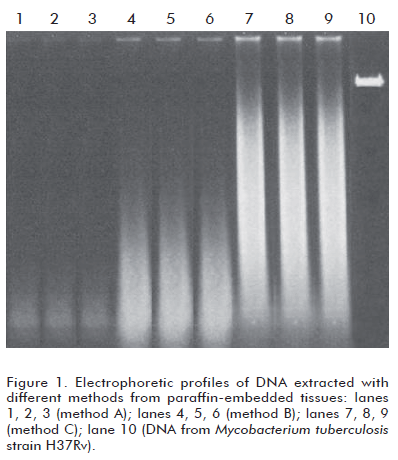
<body><![CDATA[<P   align="left" ><font face="Verdana, Arial, Helvetica, sans-serif" size="2">The data were analyzed      with the software application <I>Statistical Package for the Social Sciences      </I>(SPSS) for Windows (version 11.5). The Kruskal-Wallis test was used to      compare the means from optical density (OD) ratios at 260 and 280 nm (OD<sub>260</sub>/OD<sub>280</sub>).      Ten O<FONT color="#FF0000"><FONT color="#000000"><FONT color="#FF0000"><FONT color="#000000">D      measurements were made per DNA extraction method. </font></font></font></font></font></P >   <FONT size="+1" color="#FF0000"><FONT size="+1" color="#000000"><FONT size="+1" color="#FF0000"><FONT size="+1" color="#000000">        <P   align="left" ><font size="2" face="Verdana, Arial, Helvetica, sans-serif"><B>RESULTS </b></font></P >   <FONT size="+1">        <P   align="left" ><font face="Verdana, Arial, Helvetica, sans-serif" size="2">All three methods      produced only degraded DNA (<FONT color="#0000FF"><a href="#fig1">Figure 1</a><FONT color="#000000">),      although the extent of degradation was variable. Method A produced the largest      degradation, whereas method C produced the least degraded DNA. Method B yielded      roughly intermediate results. </font></font></font></P >       <P   align="center" ><a name="fig1"></a><img src="/img/revistas/bta/v28n1/f0106111.gif"></P >   <FONT size="+1"><FONT color="#0000FF"><FONT color="#000000">        
<P   align="left" ><font face="Verdana, Arial, Helvetica, sans-serif" size="2">The mean OD<sub>260</sub>/OD<sub>280</sub>      ra<FONT color="#FF0000"><FONT color="#000000"><FONT color="#FF0000"><FONT color="#000000">tios      were 1.33 (method A), 1.63 (method B) and 1.67 (method A). Method A resulted      in some statistical differences from methods B and C (p = 0.023), and no differences      were detectable between the latter ones (p = 0.073). </font></font></font></font></font></P >   <FONT size="+1" color="#FF0000"><FONT size="+1" color="#000000"><FONT size="+1" color="#FF0000"><FONT size="+1" color="#000000">        <P   align="left" ><font face="Verdana, Arial, Helvetica, sans-serif" size="2">In order to evaluate      the quality of the extracted DNA, we attempted to amplify the <I>M. tuberculosis      </I>IS 6110 insertion sequence<I>.</I> A successful amplification was only      possible with template obtained from methods B and C (<FONT color="#0000FF"><a href="/img/revistas/bta/v28n1/f0206111.gif">Figure      2</a><FONT color="#000000">). No inhibitors of the PCR reaction were present      in extracts prepared by any of the three methods, as the &beta;-globin gene<FONT color="#FF00FF"><FONT color="#000000">      was readily amplified in all cases. </font></font></font></font></font></P >   <FONT color="#0000FF"><FONT color="#000000"><FONT color="#FF00FF"><FONT color="#000000">        
<P   align="left" ><font face="Verdana, Arial, Helvetica, sans-serif" size="2">In terms of speed,      method B was the least laborious, requiring only 8 min for its completion.      Method C, on the other hand, requires multiple steps and a longer time (20      min) than methods A and B. Method A requires 15 min. </font></P >       <P   align="left" ><font face="Verdana, Arial, Helvetica, sans-serif" size="2">The results of the      amplification of the IS 6110 insertion sequence from the PET samples, that      is, the identity of positive and negative samples, matched those obtained      by conventional bacteriological tests at the LNRI -TB. </font></P >       <P   align="left" ><font size="2" face="Verdana, Arial, Helvetica, sans-serif"><B>DISCUSSION </b></font></P >   <FONT size="+1">        <P   align="left" ><font face="Verdana, Arial, Helvetica, sans-serif" size="2">This is the first      report on molecular detection of <I>M. tuberculosis </I>in PET samples, using      three different DNA extraction methods, in Cuba. </font></P >   <FONT size="+1">        ]]></body>
<body><![CDATA[<P   align="left" ><font face="Verdana, Arial, Helvetica, sans-serif" size="2">DNA extraction is      the first step for the application of many molecular techniques. Though apparently      straightforward, many experimental failures can be traced back to problems      in this stage that result in insufficient yields, poor DNA quality, contaminants      at unacceptable levels and partial degradations; in addition, a poor choice      of extraction method can unnecessarily lengthen a protocol (13). Trying to      obtain high quality DNA from PET samples further compounds the issue; in fact,      this has become the critical step in our own experimental runs (8). </font></P >   <FONT size="+1"><FONT size="+1">        <P   align="left" ><font face="Verdana, Arial, Helvetica, sans-serif" size="2" color="#000000">In      this study, the extent of degradation of the genetic material depended on      the extraction method. Boiling the samples (method A) seems to play a role      in obtaining extremely degraded DNA. The use of Chelex-100 (method B) blunts      the detrimental effects of extreme heat by chelating polyvalent ion metals      that would otherwise catalyze the aqueous hydrolysis of DNA at high temperatures      (14). Methods employing Proteinase K, such as method C, are the most efficient      for obtaining high molecular weight DNA. Proteinase K breaks the linkages      between nucleic acids and proteins of PET samples in a much milder manner,      thus producing DNA fragments that have, in average, much larger average lengths      (4). </font></P >       <P   align="left" ><font face="Verdana, Arial, Helvetica, sans-serif" size="2" color="#000000">OD<sub>260</sub>/OD<sub>280</sub>      ratios were used to estimate the sample purities obtained with each of the      three methods. Their inspection revealed that methods B and C (1.63 and 1.67)      produce relatively less contaminated DNA than method A (1.33). Although variations      in sample quality and quantity can definitely influence the purity of the      obtained DNA, this factor can be ruled out in this occasion, given that identical      amounts (5 x 10 &mu;m[50 &mu;m]) and type of tissue were analyzed in each      case. On the other hand, the extraction volumes, the use of reagents such      as Proteinase K, the chosen incubation times and the specific techniques employed      for concentrating DNA also influence the purity of the obtained nucleic acids      (15), and may help to explain why method C had the best OD ratio and the lowest      amount of contaminants. </font></P >   <FONT size="+1" color="#FF0000"><FONT size="+1" color="#000000"><FONT size="+1" color="#FF0000"><FONT size="+1" color="#000000"><FONT color="#FF00FF"><FONT color="#000000"><FONT color="#FF00FF"><FONT color="#000000">        <P   align="left" ><font face="Verdana, Arial, Helvetica, sans-serif" size="2" color="#000000">Failure      to amplify by PCR a desired target sequence from a specific sample can sometimes      be caused by average fragment lengths falling way below the size of the desired      amplicon; a situation that is common in extremely degraded material (12).      Such a situation arose with extracts obtained with method A, from which it      was not possible to amplify the target insertion sequence (IS 6110). Similar      results were published by Stein <I>et al.</I> when using this procedure to      detect <I>Coxiella burnetti</I> in PET samples (16). Another possibility would      be the total absence of the target sequence due to the degradation produced      by heating the tissue. Although the presence of PCR inhibitors constitutes      another possible explanation, it was possible, however, to amplify satisfactorily      an internal control (&beta;-globin gene) from these samples. DNA extracted      by methods B and C were useful to identify <I>M. tuberculosis</I> in the analyzed      tissues; both techniques have been successfully used before for this purpose      (6, 9, 10, 17). Chelex-100 has received wide use for extracting DNA from PET      samples (11, 18, 19). In a previous study, our group managed to amplify short      DNA fragments from <I>M. tuberculosis </I>using this chelating resin (6).      Method C, on the other hand, has also been successfully employed by several      German laboratories to validate PCR assays for the detection of <I>M. tuberculosis</I>      in PET (12). </font></P >   <FONT size="+1"><FONT size="+1"><FONT size="+1">        <P   align="left" ><font size="2" face="Verdana, Arial, Helvetica, sans-serif" color="#000000">Obtaining      DNA from PET samples with satisfactory yield and purity in the shortest possible      time is a critical requirement for many molecular pathology studies. Applying      slow, costly or complicated multi-step methods on large-scale studies or clinical      practice may become impractical (20), and such is precisely the main drawback      of method C. Method B, on the other hand, is fast, safe, cheap, and allowed      the amplification of the desired target sequence in every case. It produced      DNA of satisfactory quality on a single step, with the added benefit of minimizing      the chance of cross-contamination (another inconvenience of multi-step protocols      such as method C). </font></P >   <FONT size="+1">        <P   align="left" ><font face="Verdana, Arial, Helvetica, sans-serif" size="2">There is a large      demand for fast and reliable molecular methods for the detection of <I>M.      tuberculosis</I> in PET samples among molecular pathology laboratories, given      that i) the samples shipped to such facilities have generally been fixed in      formaldehyde; preventing therefore the application of methods based on culturing      the microorganism and limiting diagnostic options to the detection of AARB      and histopathological examination; ii) the tissue alterations on which histopathological      diagnosis is based are actually unspecific, as several granulomatous disorders      produce tissue morphologies similar to those of tuberculosis; iii) microscopy      techniques have a low sensitivity that becomes even lower in PET samples from      HIV/AIDS patients with extra-pulmonary tuberculosis; iv) should a histopathological      diagnosis of AARB-positive granulomatous lymphadenitis be reached, it would      not be necessary to surgically obtain another lymph node sample for microbiological      culture; and v) accurately identifying the microorganism responsible for the      infection would allow a more targeted drug regime; a necessity arising out      of the differential susceptibility to these agents exhibited by different      mycobacterial species (21). </font></P >       <P   align="left" ><font face="Verdana, Arial, Helvetica, sans-serif" size="2">The results presented      here demonstrate the usefulness of methods B and C for extracting DNA from      PET samples to diagnose the presence of <I>M. tuberculosis</I> by PCR. However,      given the working conditions and the characteristics of the patients attending      the hospital at IPK, method B is recommended as the most appropriate choice      for the Pathological Anatomy laboratory due to the satisfactory compromise      it provides between DNA quality and yields on one side and processing time      on the other. </font></P >       <P   align="left" > </P >       <P   align="left" ><font face="Verdana, Arial, Helvetica, sans-serif" size="2"><B>REFERENCES </b></font></P >   <B>        <P   align="justify" ></P >   </B> <FONT size="+1">        ]]></body>
<body><![CDATA[<!-- ref --><P   align="justify" ><font face="Verdana, Arial, Helvetica, sans-serif" size="2">1. Garc&iacute;a      P, Benavente F, Melo A, Roa I, Roa JC. Efecto de la fijaci&oacute;n en la      calidad del ADN: estudio controlado con cinco fijadores. Rev Esp Patol. 2006;39:175-9.      </font></P >    <!-- ref --><P   align="justify" ><font face="Verdana, Arial, Helvetica, sans-serif" size="2">2. Srinivasan M,      Sedmak D, Jewell S. Effect of fixatives and tissue processing on the content      and integrity nucleic acids. Am J Pathol. 2002;161:1961-71. </font></P >    <!-- ref --><P   align="justify" ><font face="Verdana, Arial, Helvetica, sans-serif" size="2">3. Jackson DP, Lewis      FA, Taylor GR, Boylston AW, Quirke P. Tissue extraction of DNA and RNA and      analysis by the polymerase chain reaction. J Clin Pathol. 1990;43:499-504.      </font></P >    <!-- ref --><P   align="justify" ><font face="Verdana, Arial, Helvetica, sans-serif" size="2">4. Wright DK, Manos      MM. Sample preparation from paraffin-embedded tissues. En: Innis MA, editor.      PCR protocols: a guide to methods and applications. San Diego: Academic Press;      1990. p. 153-6. </font></P >    <!-- ref --><P   align="justify" ><font face="Verdana, Arial, Helvetica, sans-serif" size="2">5. Lench N, Stainer      P, Williamson R. Simple non-invasive method to obtain DNA for gene analysis.      Lancet. 1988; 1(8599):1356-8. </font></P >    <!-- ref --><P   align="justify" ><font face="Verdana, Arial, Helvetica, sans-serif" size="2">6. de Armas Y, Cap&oacute;      V, Gonz&aacute;lez E, Mederos LM, D&iacute;az R. Extracci&oacute;n de ADN      de tejidos embebidos en parafina por Chelex-100. Rev Esp Patol. 2006;39:171-4.      </font></P >    <!-- ref --><P   align="justify" ><font face="Verdana, Arial, Helvetica, sans-serif" size="2">7. Heller MJ, Robinson      RA, Burgart U, TenEyck CJ, Wilke WW. DNA extraction by sonication: a comparison      of fresh, frozen, and paraffin-embedded tissues extracted for use in polymerase      chain reaction assays. Mod Pathol. 1992;5:203-6. </font></P >    <!-- ref --><P   align="justify" ><font face="Verdana, Arial, Helvetica, sans-serif" size="2">8. Hellmann A, Rohleder      U, Schmitter H, Wittig M. STR typing of human telogen hairs- a new approach.      Int J Legal Med. 2001;114:269-73. </font></P >    <!-- ref --><P   align="justify" ><font face="Verdana, Arial, Helvetica, sans-serif" size="2">9. Van der Zanden      AG, Hoentjen AH, Heilmann FG, Weltevreden EF, Schouls LM, van Embden JD. Simultaneous      detection and strain differentiation of<I> Mycobacterium tuberculosis </I>complex      in paraffin wax embedded tissues and in stained microscopic preparations.      Mol Pathol. 1998;51:209-14. </font></P >    <!-- ref --><P   align="justify" ><font face="Verdana, Arial, Helvetica, sans-serif" size="2">10. Ghossein RA,      Ross DG, Salomon RN, Rabson AR. A search for mycobacterial DNA in sarcoidosis      using the polymerase chain reaction. Am J Clin Pathol. 1994; 101:733-7. </font></P >    <!-- ref --><P   align="justify" ><font face="Verdana, Arial, Helvetica, sans-serif" size="2">11. van Embden JDA,      Cave MD, Crawford JT, Dale JW, Eisenach KD, Gicquel B, et al. Strain identification      of <I>Mycobacterium tuberculosis </I>by DNA fingerprinting: recommendations      for a standardized methodology. J Clin Microbiol. 1993;31:406-9. </font></P >    <!-- ref --><P   align="justify" ><font face="Verdana, Arial, Helvetica, sans-serif" size="2">12. Schewe C, Goldmann      T, Grosser M, Zink A, Schl&uuml;ns K, Pahl S, et al. Inter-laboratory validation      of PCR-based detection of Mycobacterium tuberculosis in formalin-fixed, paraffin-embedded      tissues. Virchows Arch. 2005;447:573-85. </font></P >    <!-- ref --><P   align="justify" ><font face="Verdana, Arial, Helvetica, sans-serif" size="2">13. De Armas Y, Rodr&iacute;guez      MM, Bisset JA, Fraga J. Modificaci&oacute;n de un m&eacute;todo de extracci&oacute;n      de ADN gen&oacute;mico de <I>Aedes aegypti</I> (<I>Diptera</I>:<I> Culicidae</I>).      Rev Colomb Entomol. 2005;31:203-6. </font></P >    <!-- ref --><P   align="justify" ><font face="Verdana, Arial, Helvetica, sans-serif" size="2">14. Singer-Sam J,      Tanguay RL, Riggs AD. Use of chelex to improve the PCR signal from small number      of cells. Amplifications. 1989;3:11. </font></P >    <P   align="justify" ><font face="Verdana, Arial, Helvetica, sans-serif" size="2">15. Bonin S, Petrera      F, Rosai J, Stanta G. DNA and RNA obtained from Bouin&rsquo;s fixed tissues.      J Clin Pathol. 2005;58:313-6. </font></P >       <P   align="justify" ><font face="Verdana, Arial, Helvetica, sans-serif" size="2">16. Stein A, Raoult.      A simple method for amplification of DNA from paraffin-embedded tissues. Nucleic      Acids Res. 1992;20:5237-8. </font></P >       <!-- ref --><P   align="justify" ><font face="Verdana, Arial, Helvetica, sans-serif" size="2">17. Popper HH, Klemen      H, Hoefler G, Winter E. Presence of mycobacterial DNA in sarcoidosis. Human      Pathol. 1997;28:796-800. </font></P >    <!-- ref --><P   align="justify" ><font face="Verdana, Arial, Helvetica, sans-serif" size="2">18. Romero RL, Juston      AC, Ballantyne J, Henry BE. The applicability of formalin-fixed and formalin      fixed paraffin embedded tissues in forensic DNA analysis. J Forensic Sci.      1997;42:708-14. </font></P >    <P   align="justify" ><font face="Verdana, Arial, Helvetica, sans-serif" size="2">19. Pak F, Pyakural      P, Kokhaei P, Kaaya E, Pourfathollah AA, Selivanova G<FONT color="#0017E4">,<FONT color="#000000">      <I>et al</I>. HHV-8/KSHV during the development of Kaposi&rsquo;s sarcoma:      evaluation by polymerase chain reaction and immunohistochemistry. J Cutan      Pathol. 2005;32:21-7. </font></font></font></P >   <FONT color="#0017E4"><FONT color="#000000">        <!-- ref --><P   align="justify" ><font face="Verdana, Arial, Helvetica, sans-serif" size="2">20. Garc&iacute;a      LA, Rodrigo JP, S&aacute;nchez P, Ramos S, Su&aacute;rez C. Extracci&oacute;n      de ADN con resina chelex en el an&aacute;lisis de la amplificaci&oacute;n      oncog&eacute;nica en carcinomas de cabeza y cuello. Acta Otorrinolaringol      Esp. 2004;55:139-44. </font></P >    <!-- ref --><P   align="justify" ><font face="Verdana, Arial, Helvetica, sans-serif" size="2">21. Krishna K, Singh      M, Muralidhar M, Kumar A, Chattopadhyaya TK, Kapila K, <I>et al</I>. Comparison      of in house polymerase chain reaction with conventional techniques for the      detection of <I>Mycobacterium tuberculosis</I> DNA in granulomatous lymphadenopathy.      J Clin Pathol. 2000; 53:355-61. </font></P >    <P   align="justify" >&nbsp;</P >       <P   align="left" ></P >          <P   align="left" ></P >       <P   align="left" ></P >       <P   align="left" ></P >       <P   align="left" ><font face="Verdana, Arial, Helvetica, sans-serif" size="2">Received in July,      2010.    <br>     </font><font face="Verdana, Arial, Helvetica, sans-serif" size="2">Accepted      for publication in April, 2011. </font></P >       <P   align="justify" ><font size="2" face="Verdana, Arial, Helvetica, sans-serif">Yaxsier de Armas,      Departamento de Anatom&iacute;a Patol&oacute;gica, Instituto de Medicina Tropical      Pedro Kour&iacute;, IPK Autopista Novia del Mediod&iacute;a, Km 6&frac12;,      CP 601, Marianao 13, La Habana, Cuba, E-mail: <A href="mailto:yaxsier@ipk.sld.cu">      <FONT color="#0000FF">yaxsier@ipk.sld.cu</font></A> </font></P >   </font></font></font></font></font></font></font></font></font></font></font></font></font></font></font></font></font></font></font></font></font></font></font></font></font></font></font></font></font></font></font></font></font></font></font></font></font></font></font></font></font></font></font></font></font></font></font></font></font></font></font></font></font></font></font></font></font></font></font></font></font></font></font></font></font></font></font></font></font></font></font></font></font></font></font></font></font></font></font></font></font></font></font></font></font></font></font></font></font></font></font></font></font></font></font></DIV >      ]]></body><back>
<ref-list>
<ref id="B1">
<label>1</label><nlm-citation citation-type="journal">
<person-group person-group-type="author">
<name>
<surname><![CDATA[García]]></surname>
<given-names><![CDATA[P]]></given-names>
</name>
<name>
<surname><![CDATA[Benavente]]></surname>
<given-names><![CDATA[F]]></given-names>
</name>
<name>
<surname><![CDATA[Melo]]></surname>
<given-names><![CDATA[A]]></given-names>
</name>
<name>
<surname><![CDATA[Roa]]></surname>
<given-names><![CDATA[I]]></given-names>
</name>
<name>
<surname><![CDATA[Roa]]></surname>
<given-names><![CDATA[JC]]></given-names>
</name>
</person-group>
<article-title xml:lang="es"><![CDATA[Efecto de la fijación en la calidad del ADN: estudio controlado con cinco fijadores]]></article-title>
<source><![CDATA[Rev Esp Patol]]></source>
<year>2006</year>
<volume>39</volume>
<page-range>175-9</page-range></nlm-citation>
</ref>
<ref id="B2">
<label>2</label><nlm-citation citation-type="journal">
<person-group person-group-type="author">
<name>
<surname><![CDATA[Srinivasan]]></surname>
<given-names><![CDATA[M]]></given-names>
</name>
<name>
<surname><![CDATA[Sedmak]]></surname>
<given-names><![CDATA[D]]></given-names>
</name>
<name>
<surname><![CDATA[Jewell]]></surname>
<given-names><![CDATA[S]]></given-names>
</name>
</person-group>
<article-title xml:lang="en"><![CDATA[Effect of fixatives and tissue processing on the content and integrity nucleic acids]]></article-title>
<source><![CDATA[Am J Pathol]]></source>
<year>2002</year>
<volume>161</volume>
<page-range>1961-71</page-range></nlm-citation>
</ref>
<ref id="B3">
<label>3</label><nlm-citation citation-type="journal">
<person-group person-group-type="author">
<name>
<surname><![CDATA[Jackson]]></surname>
<given-names><![CDATA[DP]]></given-names>
</name>
<name>
<surname><![CDATA[Lewis]]></surname>
<given-names><![CDATA[FA]]></given-names>
</name>
<name>
<surname><![CDATA[Taylor]]></surname>
<given-names><![CDATA[GR]]></given-names>
</name>
<name>
<surname><![CDATA[Boylston]]></surname>
<given-names><![CDATA[AW]]></given-names>
</name>
<name>
<surname><![CDATA[Quirke]]></surname>
<given-names><![CDATA[P]]></given-names>
</name>
</person-group>
<article-title xml:lang="en"><![CDATA[Tissue extraction of DNA and RNA and analysis by the polymerase chain reaction]]></article-title>
<source><![CDATA[J Clin Pathol]]></source>
<year>1990</year>
<volume>43</volume>
<page-range>499-504</page-range></nlm-citation>
</ref>
<ref id="B4">
<label>4</label><nlm-citation citation-type="book">
<person-group person-group-type="author">
<name>
<surname><![CDATA[Wright]]></surname>
<given-names><![CDATA[DK]]></given-names>
</name>
<name>
<surname><![CDATA[Manos]]></surname>
<given-names><![CDATA[MM]]></given-names>
</name>
</person-group>
<article-title xml:lang="en"><![CDATA[Sample preparation from paraffin-embedded tissues]]></article-title>
<person-group person-group-type="editor">
<name>
<surname><![CDATA[Innis]]></surname>
<given-names><![CDATA[MA]]></given-names>
</name>
</person-group>
<source><![CDATA[PCR protocols: a guide to methods and applications]]></source>
<year>1990</year>
<page-range>153-6</page-range><publisher-loc><![CDATA[San Diego ]]></publisher-loc>
<publisher-name><![CDATA[Academic Press]]></publisher-name>
</nlm-citation>
</ref>
<ref id="B5">
<label>5</label><nlm-citation citation-type="journal">
<person-group person-group-type="author">
<name>
<surname><![CDATA[Lench]]></surname>
<given-names><![CDATA[N]]></given-names>
</name>
<name>
<surname><![CDATA[Stainer]]></surname>
<given-names><![CDATA[P]]></given-names>
</name>
<name>
<surname><![CDATA[Williamson]]></surname>
<given-names><![CDATA[R]]></given-names>
</name>
</person-group>
<article-title xml:lang="en"><![CDATA[Simple non-invasive method to obtain DNA for gene analysis]]></article-title>
<source><![CDATA[Lancet]]></source>
<year>1988</year>
<volume>1</volume>
<numero>8599</numero>
<issue>8599</issue>
<page-range>1356-8</page-range></nlm-citation>
</ref>
<ref id="B6">
<label>6</label><nlm-citation citation-type="journal">
<person-group person-group-type="author">
<name>
<surname><![CDATA[de Armas]]></surname>
<given-names><![CDATA[Y]]></given-names>
</name>
<name>
<surname><![CDATA[Capó]]></surname>
<given-names><![CDATA[V]]></given-names>
</name>
<name>
<surname><![CDATA[González]]></surname>
<given-names><![CDATA[E]]></given-names>
</name>
<name>
<surname><![CDATA[Mederos]]></surname>
<given-names><![CDATA[LM]]></given-names>
</name>
<name>
<surname><![CDATA[Díaz]]></surname>
<given-names><![CDATA[R]]></given-names>
</name>
</person-group>
<article-title xml:lang="es"><![CDATA[Extracción de ADN de tejidos embebidos en parafina por Chelex-100]]></article-title>
<source><![CDATA[Rev Esp Patol]]></source>
<year>2006</year>
<volume>39</volume>
<page-range>171-4</page-range></nlm-citation>
</ref>
<ref id="B7">
<label>7</label><nlm-citation citation-type="journal">
<person-group person-group-type="author">
<name>
<surname><![CDATA[Heller]]></surname>
<given-names><![CDATA[MJ]]></given-names>
</name>
<name>
<surname><![CDATA[Robinson]]></surname>
<given-names><![CDATA[RA]]></given-names>
</name>
<name>
<surname><![CDATA[Burgart]]></surname>
<given-names><![CDATA[U]]></given-names>
</name>
<name>
<surname><![CDATA[TenEyck]]></surname>
<given-names><![CDATA[CJ]]></given-names>
</name>
<name>
<surname><![CDATA[Wilke]]></surname>
<given-names><![CDATA[WW]]></given-names>
</name>
</person-group>
<article-title xml:lang="en"><![CDATA[DNA extraction by sonication: a comparison of fresh, frozen, and paraffin-embedded tissues extracted for use in polymerase chain reaction assays]]></article-title>
<source><![CDATA[Mod Pathol]]></source>
<year>1992</year>
<volume>5</volume>
<page-range>203-6</page-range></nlm-citation>
</ref>
<ref id="B8">
<label>8</label><nlm-citation citation-type="journal">
<person-group person-group-type="author">
<name>
<surname><![CDATA[Hellmann]]></surname>
<given-names><![CDATA[A]]></given-names>
</name>
<name>
<surname><![CDATA[Rohleder]]></surname>
<given-names><![CDATA[U]]></given-names>
</name>
<name>
<surname><![CDATA[Schmitter]]></surname>
<given-names><![CDATA[H]]></given-names>
</name>
<name>
<surname><![CDATA[Wittig]]></surname>
<given-names><![CDATA[M]]></given-names>
</name>
</person-group>
<article-title xml:lang="en"><![CDATA[STR typing of human telogen hairs- a new approach]]></article-title>
<source><![CDATA[Int J Legal Med]]></source>
<year>2001</year>
<volume>114</volume>
<page-range>269-73</page-range></nlm-citation>
</ref>
<ref id="B9">
<label>9</label><nlm-citation citation-type="journal">
<person-group person-group-type="author">
<name>
<surname><![CDATA[Van der Zanden]]></surname>
<given-names><![CDATA[AG]]></given-names>
</name>
<name>
<surname><![CDATA[Hoentjen]]></surname>
<given-names><![CDATA[AH]]></given-names>
</name>
<name>
<surname><![CDATA[Heilmann]]></surname>
<given-names><![CDATA[FG]]></given-names>
</name>
<name>
<surname><![CDATA[Weltevreden]]></surname>
<given-names><![CDATA[EF]]></given-names>
</name>
<name>
<surname><![CDATA[Schouls]]></surname>
<given-names><![CDATA[LM]]></given-names>
</name>
<name>
<surname><![CDATA[van Embden]]></surname>
<given-names><![CDATA[JD]]></given-names>
</name>
</person-group>
<article-title xml:lang="en"><![CDATA[Simultaneous detection and strain differentiation of Mycobacterium tuberculosis complex in paraffin wax embedded tissues and in stained microscopic preparations]]></article-title>
<source><![CDATA[Mol Pathol]]></source>
<year>1998</year>
<volume>51</volume>
<page-range>209-14</page-range></nlm-citation>
</ref>
<ref id="B10">
<label>10</label><nlm-citation citation-type="journal">
<person-group person-group-type="author">
<name>
<surname><![CDATA[Ghossein]]></surname>
<given-names><![CDATA[RA]]></given-names>
</name>
<name>
<surname><![CDATA[Ross]]></surname>
<given-names><![CDATA[DG]]></given-names>
</name>
<name>
<surname><![CDATA[Salomon]]></surname>
<given-names><![CDATA[RN]]></given-names>
</name>
<name>
<surname><![CDATA[Rabson]]></surname>
<given-names><![CDATA[AR]]></given-names>
</name>
</person-group>
<article-title xml:lang="en"><![CDATA[A search for mycobacterial DNA in sarcoidosis using the polymerase chain reaction]]></article-title>
<source><![CDATA[Am J Clin Pathol]]></source>
<year>1994</year>
<volume>101</volume>
<page-range>733-7</page-range></nlm-citation>
</ref>
<ref id="B11">
<label>11</label><nlm-citation citation-type="journal">
<person-group person-group-type="author">
<name>
<surname><![CDATA[van Embden]]></surname>
<given-names><![CDATA[JDA]]></given-names>
</name>
<name>
<surname><![CDATA[Cave]]></surname>
<given-names><![CDATA[MD]]></given-names>
</name>
<name>
<surname><![CDATA[Crawford]]></surname>
<given-names><![CDATA[JT]]></given-names>
</name>
<name>
<surname><![CDATA[Dale]]></surname>
<given-names><![CDATA[JW]]></given-names>
</name>
<name>
<surname><![CDATA[Eisenach]]></surname>
<given-names><![CDATA[KD]]></given-names>
</name>
<name>
<surname><![CDATA[Gicquel]]></surname>
<given-names><![CDATA[B]]></given-names>
</name>
</person-group>
<article-title xml:lang="en"><![CDATA[Strain identification of Mycobacterium tuberculosis by DNA fingerprinting: recommendations for a standardized methodology]]></article-title>
<source><![CDATA[J Clin Microbiol]]></source>
<year>1993</year>
<volume>31</volume>
<page-range>406-9</page-range></nlm-citation>
</ref>
<ref id="B12">
<label>12</label><nlm-citation citation-type="journal">
<person-group person-group-type="author">
<name>
<surname><![CDATA[Schewe]]></surname>
<given-names><![CDATA[C]]></given-names>
</name>
<name>
<surname><![CDATA[Goldmann]]></surname>
<given-names><![CDATA[T]]></given-names>
</name>
<name>
<surname><![CDATA[Grosser]]></surname>
<given-names><![CDATA[M]]></given-names>
</name>
<name>
<surname><![CDATA[Zink]]></surname>
<given-names><![CDATA[A]]></given-names>
</name>
<name>
<surname><![CDATA[Schlüns]]></surname>
<given-names><![CDATA[K]]></given-names>
</name>
<name>
<surname><![CDATA[Pahl]]></surname>
<given-names><![CDATA[S]]></given-names>
</name>
</person-group>
<article-title xml:lang="en"><![CDATA[Inter-laboratory validation of PCR-based detection of Mycobacterium tuberculosis in formalin-fixed, paraffin-embedded tissues]]></article-title>
<source><![CDATA[Virchows Arch]]></source>
<year>2005</year>
<volume>447</volume>
<page-range>573-85</page-range></nlm-citation>
</ref>
<ref id="B13">
<label>13</label><nlm-citation citation-type="journal">
<person-group person-group-type="author">
<name>
<surname><![CDATA[De Armas]]></surname>
<given-names><![CDATA[Y]]></given-names>
</name>
<name>
<surname><![CDATA[Rodríguez]]></surname>
<given-names><![CDATA[MM]]></given-names>
</name>
<name>
<surname><![CDATA[Bisset]]></surname>
<given-names><![CDATA[JA]]></given-names>
</name>
<name>
<surname><![CDATA[Fraga]]></surname>
<given-names><![CDATA[J]]></given-names>
</name>
</person-group>
<article-title xml:lang="es"><![CDATA[Modificación de un método de extracción de ADN genómico de Aedes aegypti (Diptera: Culicidae)]]></article-title>
<source><![CDATA[Rev Colomb Entomol]]></source>
<year>2005</year>
<volume>31</volume>
<page-range>203-6</page-range></nlm-citation>
</ref>
<ref id="B14">
<label>14</label><nlm-citation citation-type="journal">
<person-group person-group-type="author">
<name>
<surname><![CDATA[Singer-Sam]]></surname>
<given-names><![CDATA[J]]></given-names>
</name>
<name>
<surname><![CDATA[Tanguay]]></surname>
<given-names><![CDATA[RL]]></given-names>
</name>
<name>
<surname><![CDATA[Riggs]]></surname>
<given-names><![CDATA[AD]]></given-names>
</name>
</person-group>
<article-title xml:lang="en"><![CDATA[Use of chelex to improve the PCR signal from small number of cells]]></article-title>
<source><![CDATA[Amplifications]]></source>
<year>1989</year>
<volume>3</volume>
<page-range>11</page-range></nlm-citation>
</ref>
<ref id="B15">
<label>15</label><nlm-citation citation-type="journal">
<person-group person-group-type="author">
<name>
<surname><![CDATA[Bonin]]></surname>
<given-names><![CDATA[S]]></given-names>
</name>
<name>
<surname><![CDATA[Petrera]]></surname>
<given-names><![CDATA[F]]></given-names>
</name>
<name>
<surname><![CDATA[Rosai]]></surname>
<given-names><![CDATA[J]]></given-names>
</name>
<name>
<surname><![CDATA[Stanta]]></surname>
<given-names><![CDATA[G]]></given-names>
</name>
</person-group>
<article-title xml:lang="en"><![CDATA[DNA and RNA obtained from Bouin’s fixed tissues]]></article-title>
<source><![CDATA[J Clin Pathol]]></source>
<year>2005</year>
<volume>58</volume>
<page-range>313-6</page-range></nlm-citation>
</ref>
<ref id="B16">
<label>16</label><nlm-citation citation-type="journal">
<person-group person-group-type="author">
<name>
<surname><![CDATA[Stein]]></surname>
<given-names><![CDATA[A]]></given-names>
</name>
<name>
<surname><![CDATA[Raoult]]></surname>
<given-names><![CDATA[D]]></given-names>
</name>
</person-group>
<article-title xml:lang="en"><![CDATA[A simple method for amplification of DNA from paraffin-embedded tissues]]></article-title>
<source><![CDATA[Nucleic Acids Res]]></source>
<year>1992</year>
<volume>20</volume>
<page-range>5237-8</page-range></nlm-citation>
</ref>
<ref id="B17">
<label>17</label><nlm-citation citation-type="journal">
<person-group person-group-type="author">
<name>
<surname><![CDATA[Popper]]></surname>
<given-names><![CDATA[HH]]></given-names>
</name>
<name>
<surname><![CDATA[Klemen]]></surname>
<given-names><![CDATA[H]]></given-names>
</name>
<name>
<surname><![CDATA[Hoefler]]></surname>
<given-names><![CDATA[G]]></given-names>
</name>
<name>
<surname><![CDATA[Winter]]></surname>
<given-names><![CDATA[E]]></given-names>
</name>
</person-group>
<article-title xml:lang="en"><![CDATA[Presence of mycobacterial DNA in sarcoidosis]]></article-title>
<source><![CDATA[Human Pathol]]></source>
<year>1997</year>
<volume>28</volume>
<page-range>796-800</page-range></nlm-citation>
</ref>
<ref id="B18">
<label>18</label><nlm-citation citation-type="journal">
<person-group person-group-type="author">
<name>
<surname><![CDATA[Romero]]></surname>
<given-names><![CDATA[RL]]></given-names>
</name>
<name>
<surname><![CDATA[Juston]]></surname>
<given-names><![CDATA[AC]]></given-names>
</name>
<name>
<surname><![CDATA[Ballantyne]]></surname>
<given-names><![CDATA[J]]></given-names>
</name>
<name>
<surname><![CDATA[Henry]]></surname>
<given-names><![CDATA[BE]]></given-names>
</name>
</person-group>
<article-title xml:lang="en"><![CDATA[The applicability of formalin-fixed and formalin fixed paraffin embedded tissues in forensic DNA analysis]]></article-title>
<source><![CDATA[J Forensic Sci]]></source>
<year>1997</year>
<volume>42</volume>
<page-range>708-14</page-range></nlm-citation>
</ref>
<ref id="B19">
<label>19</label><nlm-citation citation-type="journal">
<person-group person-group-type="author">
<name>
<surname><![CDATA[Pak]]></surname>
<given-names><![CDATA[F]]></given-names>
</name>
<name>
<surname><![CDATA[Pyakural]]></surname>
<given-names><![CDATA[P]]></given-names>
</name>
<name>
<surname><![CDATA[Kokhaei]]></surname>
<given-names><![CDATA[P]]></given-names>
</name>
<name>
<surname><![CDATA[Kaaya]]></surname>
<given-names><![CDATA[E]]></given-names>
</name>
<name>
<surname><![CDATA[Pourfathollah]]></surname>
<given-names><![CDATA[AA]]></given-names>
</name>
<name>
<surname><![CDATA[Selivanova]]></surname>
<given-names><![CDATA[G]]></given-names>
</name>
</person-group>
<article-title xml:lang="en"><![CDATA[HHV-8/KSHV during the development of Kaposi's sarcoma: evaluation by polymerase chain reaction and immunohistochemistry]]></article-title>
<source><![CDATA[J Cutan Pathol]]></source>
<year>2005</year>
<volume>32</volume>
<page-range>21-7</page-range></nlm-citation>
</ref>
<ref id="B20">
<label>20</label><nlm-citation citation-type="journal">
<person-group person-group-type="author">
<name>
<surname><![CDATA[García]]></surname>
<given-names><![CDATA[LA]]></given-names>
</name>
<name>
<surname><![CDATA[Rodrigo]]></surname>
<given-names><![CDATA[JP]]></given-names>
</name>
<name>
<surname><![CDATA[Sánchez]]></surname>
<given-names><![CDATA[P]]></given-names>
</name>
<name>
<surname><![CDATA[Ramos]]></surname>
<given-names><![CDATA[S]]></given-names>
</name>
<name>
<surname><![CDATA[Suárez]]></surname>
<given-names><![CDATA[C]]></given-names>
</name>
</person-group>
<article-title xml:lang="es"><![CDATA[Extracción de ADN con resina chelex en el análisis de la amplificación oncogénica en carcinomas de cabeza y cuello]]></article-title>
<source><![CDATA[Acta Otorrinolaringol Esp]]></source>
<year>2004</year>
<volume>55</volume>
<page-range>139-44</page-range></nlm-citation>
</ref>
<ref id="B21">
<label>21</label><nlm-citation citation-type="journal">
<person-group person-group-type="author">
<name>
<surname><![CDATA[Krishna]]></surname>
<given-names><![CDATA[K]]></given-names>
</name>
<name>
<surname><![CDATA[Singh]]></surname>
<given-names><![CDATA[M]]></given-names>
</name>
<name>
<surname><![CDATA[Muralidhar]]></surname>
<given-names><![CDATA[M]]></given-names>
</name>
<name>
<surname><![CDATA[Kumar]]></surname>
<given-names><![CDATA[A]]></given-names>
</name>
<name>
<surname><![CDATA[Chattopadhyaya]]></surname>
<given-names><![CDATA[TK]]></given-names>
</name>
<name>
<surname><![CDATA[Kapila]]></surname>
<given-names><![CDATA[K]]></given-names>
</name>
</person-group>
<article-title xml:lang="en"><![CDATA[Comparison of in house polymerase chain reaction with conventional techniques for the detection of Mycobacterium tuberculosis DNA in granulomatous lymphadenopathy]]></article-title>
<source><![CDATA[J Clin Pathol]]></source>
<year>2000</year>
<volume>53</volume>
<page-range>355-61</page-range></nlm-citation>
</ref>
</ref-list>
</back>
</article>
