<?xml version="1.0" encoding="ISO-8859-1"?><article xmlns:mml="http://www.w3.org/1998/Math/MathML" xmlns:xlink="http://www.w3.org/1999/xlink" xmlns:xsi="http://www.w3.org/2001/XMLSchema-instance">
<front>
<journal-meta>
<journal-id>1027-2852</journal-id>
<journal-title><![CDATA[Biotecnología Aplicada]]></journal-title>
<abbrev-journal-title><![CDATA[Biotecnol Apl]]></abbrev-journal-title>
<issn>1027-2852</issn>
<publisher>
<publisher-name><![CDATA[Editorial Elfos Scientiae]]></publisher-name>
</publisher>
</journal-meta>
<article-meta>
<article-id>S1027-28522011000200003</article-id>
<title-group>
<article-title xml:lang="en"><![CDATA[Screening of protease inhibitory activity in extracts of five Ascidian species from Cuban coasts]]></article-title>
<article-title xml:lang="es"><![CDATA[Búsqueda de actividad inhibidora de proteasas en extractos de cinco especies de ascidias de las costas cubanas]]></article-title>
</title-group>
<contrib-group>
<contrib contrib-type="author">
<name>
<surname><![CDATA[Reytor]]></surname>
<given-names><![CDATA[Mey Ling]]></given-names>
</name>
<xref ref-type="aff" rid="A01"/>
</contrib>
<contrib contrib-type="author">
<name>
<surname><![CDATA[González]]></surname>
<given-names><![CDATA[Yamile]]></given-names>
</name>
<xref ref-type="aff" rid="A01"/>
</contrib>
<contrib contrib-type="author">
<name>
<surname><![CDATA[Pascual]]></surname>
<given-names><![CDATA[Isel]]></given-names>
</name>
<xref ref-type="aff" rid="A01"/>
</contrib>
<contrib contrib-type="author">
<name>
<surname><![CDATA[Hernández]]></surname>
<given-names><![CDATA[Aida]]></given-names>
</name>
<xref ref-type="aff" rid="A02"/>
</contrib>
<contrib contrib-type="author">
<name>
<surname><![CDATA[Chávez]]></surname>
<given-names><![CDATA[María Á]]></given-names>
</name>
<xref ref-type="aff" rid="A01"/>
</contrib>
<contrib contrib-type="author">
<name>
<surname><![CDATA[Alonso del Rivero]]></surname>
<given-names><![CDATA[Maday]]></given-names>
</name>
<xref ref-type="aff" rid="A01"/>
</contrib>
</contrib-group>
<aff id="A02">
<institution><![CDATA[,Instituto Nacional de Oceanología  ]]></institution>
<addr-line><![CDATA[La Habana ]]></addr-line>
<country>Cuba</country>
</aff>
<aff id="A01">
<institution><![CDATA[,Universidad de La Habana, UH Facultad de Biología Centro de Estudios de Proteínas]]></institution>
<addr-line><![CDATA[La Habana ]]></addr-line>
<country>Cuba</country>
</aff>
<pub-date pub-type="pub">
<day>00</day>
<month>06</month>
<year>2011</year>
</pub-date>
<pub-date pub-type="epub">
<day>00</day>
<month>06</month>
<year>2011</year>
</pub-date>
<volume>28</volume>
<numero>2</numero>
<fpage>77</fpage>
<lpage>82</lpage>
<copyright-statement/>
<copyright-year/>
<self-uri xlink:href="http://scielo.sld.cu/scielo.php?script=sci_arttext&amp;pid=S1027-28522011000200003&amp;lng=en&amp;nrm=iso"></self-uri><self-uri xlink:href="http://scielo.sld.cu/scielo.php?script=sci_abstract&amp;pid=S1027-28522011000200003&amp;lng=en&amp;nrm=iso"></self-uri><self-uri xlink:href="http://scielo.sld.cu/scielo.php?script=sci_pdf&amp;pid=S1027-28522011000200003&amp;lng=en&amp;nrm=iso"></self-uri><abstract abstract-type="short" xml:lang="en"><p><![CDATA[One of the most promising strategies to counteract malaria is by controlling the infectivity of Plasmodium parasites with drugs aimed against their main targets. The participation of proteases (belonging to different classes) has been demonstrated in its infection mechanism, hence these proteins have become promising targets in treating this illness. This study involved the screening of crude and clarified extracts of five Cuban ascidian species for inhibitory activity of proteases belonging to different mechanistic classes. Ascidians are invertebrates that present many bioactive molecules, but, as yet, only a few protease inhibitors had been isolated from them. In this research we reported for the first time the presence of inhibitory activity of bovine pancreatic carboxypeptidase A and B, aminopeptidase N from porcine kidney and subtilisin A from Bacillus licheniformis in some ascidian extracts tested. The most promising extracts were selected in terms of percentage of inhibition and they were characterized in terms of the behaviour of the extract concentration against residual enzymatic activity; the determination of IC50 values and Specific Inhibitory Activity (SIA), and the evaluation of their proteolytic activity through zymographic assays.]]></p></abstract>
<abstract abstract-type="short" xml:lang="es"><p><![CDATA[Una de las estrategias más promisorias para contarrestar la malaria es controlar la infectividad del parásito Plasmodium, con fármacos dirigidos hacia sus blancos principales. Se ha demostrado que proteasas (pertenecientes a diferentes clases mecanísticas) participan en el mecanismo de infección, por lo que se han convertido en blancos promisorios para el tratamiento de la enfermedad. En este trabajo se investigaron extractos crudos y clarificados de cinco especies de ascidias cubanas en busca de actividad inhibidora de proteasas pertenecientes a diferentes clases mecanísticas. Las ascidias son animales invertebrados que presentan numerosas moléculas bioactivas, aunque solo unos pocos inhibidores de proteasas han sido aislados a partir de ellas. En esta investigación se informa por primera vez la presencia de actividad inhibidora de carboxipeptidasa A y B pancreática bovina, aminopeptidasa N de riñón porcino y subtilisina A de Bacillus licheniformis en algunos de los extractos de ascidias evaluados. Los extractos más promisorios se caracterizaron con relación al comportamiento de la concentración de extracto en función de la actividad enzimática residual, la determinación de los valores de IC50 y actividad inhibidora específica (SIA), y la evaluación de su actividad proteolítica a través de ensayos zimográficos. Investigaciones actuales se encuentran dirigidas a la purificación y caracterización de estas moléculas.]]></p></abstract>
<kwd-group>
<kwd lng="en"><![CDATA[ascidians]]></kwd>
<kwd lng="en"><![CDATA[proteolytic activity]]></kwd>
<kwd lng="en"><![CDATA[inhibitors]]></kwd>
<kwd lng="en"><![CDATA[malaria]]></kwd>
<kwd lng="en"><![CDATA[proteases]]></kwd>
<kwd lng="es"><![CDATA[ascidias]]></kwd>
<kwd lng="es"><![CDATA[actividad proteolítica]]></kwd>
<kwd lng="es"><![CDATA[inhibidores]]></kwd>
<kwd lng="es"><![CDATA[malaria]]></kwd>
<kwd lng="es"><![CDATA[proteasas]]></kwd>
</kwd-group>
</article-meta>
</front><body><![CDATA[ <DIV class="Sect"   >        <P   align="right" ><font face="Verdana, Arial, Helvetica, sans-serif" size="2"><b>RESEARCH</b></font></P >       <P   align="right" >&nbsp;</P >       <P   align="left" ><font size="2" color="#000000" face="Verdana, Arial, Helvetica, sans-serif"><B><font size="4">Screening      of protease inhibitory activity in extracts of five Ascidian species from      Cuban coasts</font> </b></font></P >       <P   align="left" >&nbsp;</P >   <FONT size="+1" color="#000000"><B>        <P   align="left" ><font face="Verdana, Arial, Helvetica, sans-serif" color="#000000" size="3">B&uacute;squeda      de actividad inhibidora de proteasas en extractos de cinco especies de ascidias      de las costas cubanas</font></P >   </B></font>       <p>&nbsp;</p>       <p>&nbsp;</p>   <FONT size="+1" color="#000000">       <P   align="left" ><font face="Verdana, Arial, Helvetica, sans-serif" color="#000000" size="2"><b>Mey      Ling Reytor<sup>1</sup>, Yamile Gonz&aacute;lez<sup>1</sup>, Isel Pascual<sup>1</sup>,      Aida Hern&aacute;ndez<sup>2</sup>, Mar&iacute;a &Aacute; Ch&aacute;vez<sup>1</sup>,      Maday Alonso del Rivero<sup>1</sup></b> </font></P >   <FONT size="+1"><FONT size="+1"><FONT size="+1"><FONT size="+1"><FONT size="+1"><FONT size="+1"><FONT size="+1"><FONT size="+1"><FONT size="+1"><FONT size="+1"><FONT size="+1"><FONT size="+1">        <P   align="left" ><font size="2" face="Verdana, Arial, Helvetica, sans-serif" color="#000000"><aup>1</aup>   Centro      de Estudios de Prote&iacute;nas, Facultad de Biolog&iacute;a, Universidad      de La Habana, UH Calle 25 #455, Vedado, CP 10 400, La Habana, Cuba.     ]]></body>
<body><![CDATA[<br>     <sup> 2</sup>Instituto Nacional de Oceanolog&iacute;a Calle 1<sup>era</sup>      #18406, Playa, La Habana, Cuba</font>.</P >   </font></font></font></font></font></font></font></font></font></font></font></font></font>       <p>&nbsp;</p><hr>   <FONT size="+1" color="#000000"><FONT size="+1"><FONT size="+1"><FONT size="+1"><FONT size="+1"><FONT size="+1"><FONT size="+1"><FONT size="+1"><FONT size="+1"><FONT size="+1"><FONT size="+1"><FONT size="+1"><FONT size="+1">       <P   align="left" ><font size="2" face="Verdana, Arial, Helvetica, sans-serif" color="#000000">      </font><font face="Verdana, Arial, Helvetica, sans-serif" color="#000000" size="2"><B>ABSTRACT<I>      </I></b></font></P >   <FONT size="+1"><FONT size="+1"><FONT size="+1"><FONT size="+1"><FONT size="+1" color="#FF0000"><FONT size="+1" color="#000000">     <P   align="justify" ><font face="Verdana, Arial, Helvetica, sans-serif" color="#000000" size="2">One      of the most promising strategies to counteract malaria is by controlling the      infectivity of <i>Plasmodium</i> parasites with drugs aimed against their      main targets. The participation of proteases (belonging to different classes)      has been demonstrated in its infection mechanism, hence these proteins have      become promising targets in treating this illness. This study involved the      screening of crude and clarified extracts of five Cuban ascidian species for      inhibitory activity of proteases belonging to different mechanistic classes.      Ascidians are invertebrates that present many bioactive molecules, but, as      yet, only a few protease inhibitors had been isolated from them. In this research      we reported for the first time the presence of inhibitory activity of bovine      pancreatic carboxypeptidase A and B, aminopeptidase N from porcine kidney      and subtilisin A from <i>Bacillus licheniformis</i> in some ascidian extracts      tested. The most promising extracts were selected in terms of percentage of      inhibition and they were characterized in terms of the behaviour of the extract      concentration against residual enzymatic activity; the determination of IC<sub>50</sub>      values and Specific Inhibitory Activity (SIA), and the evaluation of their      proteolytic activity through zymographic assays. </font></P >   <FONT color="#FF00FF"><FONT color="#000000"><FONT color="#FF00FF"><FONT color="#000000">        <P   align="left" ><font size="2" color="#000000" face="Verdana, Arial, Helvetica, sans-serif"><b>Keywords</b>:      ascidians, proteolytic activity, inhibitors, malaria, proteases. </font></P >   </font></font></font></font></font></font></font></font></font></font></font></font></font></font></font></font></font></font></font></font></font></font></font>    <hr>   <FONT size="+1" color="#000000"><FONT size="+1"><FONT size="+1"><FONT size="+1"><FONT size="+1"><FONT size="+1"><FONT size="+1"><FONT size="+1"><FONT size="+1"><FONT size="+1"><FONT size="+1"><FONT size="+1"><FONT size="+1"><FONT size="+1"><FONT size="+1"><FONT size="+1"><FONT size="+1"><FONT size="+1" color="#FF0000"><FONT size="+1" color="#000000"><FONT color="#FF00FF"><FONT color="#000000"><FONT color="#FF00FF"><FONT color="#000000"><FONT size="+1" color="#3163FF"><FONT color="#000000"><FONT size="+1">        <P   align="left" ><font face="Verdana, Arial, Helvetica, sans-serif" color="#000000" size="2"><B>RESUMEN<I>      </I></b></font></P >       <P   align="justify" ><font face="Verdana, Arial, Helvetica, sans-serif" color="#000000" size="2">Una      de las estrategias m&aacute;s promisorias para contarrestar la malaria es      controlar la infectividad del par&aacute;sito <I>Plasmodium</I>, con f&aacute;rmacos      dirigidos hacia sus blancos principales. Se ha demostrado que proteasas (pertenecientes      a diferentes clases mecan&iacute;sticas) participan en el mecanismo de infecci&oacute;n,      por lo que se han convertido en blancos promisorios para el tratamiento de      la enfermedad. En este trabajo se investigaron extractos crudos y clarificados      de cinco especies de ascidias cubanas en busca de actividad inhibidora de      proteasas pertenecientes a diferentes clases mecan&iacute;sticas. Las ascidias      son animales invertebrados que presentan numerosas mol&eacute;culas bioactivas,      aunque solo unos pocos inhibidores de proteasas han sido aislados a partir      de ellas. En esta investigaci&oacute;n se informa por primera vez la presencia      de actividad inhibidora de carboxipeptidasa A y B pancre&aacute;tica bovina,      aminopeptidasa N de ri&ntilde;&oacute;n porcino y subtilisina A de <I>Bacillus      licheniformis</I> en algunos de los extractos de ascidias evaluados. Los extractos      m&aacute;s promisorios se caracterizaron con relaci&oacute;n al comportamiento      de la concentraci&oacute;n de extracto en funci&oacute;n de la actividad enzim&aacute;tica      residual, la determinaci&oacute;n de los valores de IC<subs><sub>50</sub></subs>      y actividad inhibidora espec&iacute;fica (SIA), y la evaluaci&oacute;n de      su actividad proteol&iacute;tica a trav&eacute;s de ensayos zimogr&aacute;ficos.      Investigaciones actuales se encuentran dirigidas a la purificaci&oacute;n      y caracterizaci&oacute;n de estas mol&eacute;culas. </font><font face="Verdana, Arial, Helvetica, sans-serif" size="2"><FONT color="#FF00FF"><FONT color="#000000"><FONT color="#FF00FF"><FONT color="#000000"><FONT color="#0000FF"><subs></subs></font></font></font></font></font></font><font face="Verdana, Arial, Helvetica, sans-serif"><FONT color="#FF00FF"><FONT color="#000000"><FONT color="#FF00FF"><FONT color="#000000"><FONT size="+1" color="#0000FF"><subs></subs></font></font></font></font></font></font></P >   <FONT color="#FF00FF"><FONT color="#000000"><FONT color="#FF00FF"><FONT color="#000000"><FONT size="+1" color="#0000FF"><FONT size="+1" color="#000000">        <P   align="left" ><font face="Verdana, Arial, Helvetica, sans-serif" color="#000000" size="2"><b>Palabras      clave</b><I>:</I> ascidias, actividad proteol&iacute;tica, inhibidores, malaria,      proteasas.</font></P >   </font></font></font></font></font></font></font></font></font></font></font></font></font></font></font></font></font></font></font></font></font></font></font></font></font></font></font></font></font></font></font></font>    <hr>   <FONT size="+1" color="#000000"><FONT size="+1"><FONT size="+1"><FONT size="+1"><FONT size="+1"><FONT size="+1"><FONT size="+1"><FONT size="+1"><FONT size="+1"><FONT size="+1"><FONT size="+1"><FONT size="+1"><FONT size="+1"><FONT size="+1"><FONT size="+1"><FONT size="+1"><FONT size="+1"><FONT size="+1" color="#FF0000"><FONT size="+1" color="#000000"><FONT color="#FF00FF"><FONT color="#000000"><FONT color="#FF00FF"><FONT color="#000000"><FONT size="+1" color="#3163FF"><FONT color="#000000"><FONT size="+1"><FONT color="#FF00FF"><FONT color="#000000"><FONT color="#FF00FF"><FONT color="#000000"><FONT size="+1" color="#0000FF"><FONT size="+1" color="#000000">        <P   align="left" >&nbsp;</P >       <P   align="left" ><font face="Verdana, Arial, Helvetica, sans-serif" color="#000000" size="2">      </font></P >       ]]></body>
<body><![CDATA[<P   align="left" ><font size="2" face="Verdana, Arial, Helvetica, sans-serif" color="#000000"><B><font size="3">INTRODUCTION</font>      </b></font></P >   <FONT size="+1">        <P   align="left" ><font face="Verdana, Arial, Helvetica, sans-serif" color="#000000" size="2">Malaria      is a parasitic disease present in many regions of the world and produces approximately      1.5 - 2.7 million deaths each year (1). The resistance to current antimalarial      drugs is spreading rapidly and the development of new vaccines is very difficult.      The World Health Organization (WHO) has therefore argued the urgent need to      develop new anti-malarial drugs aimed at new therapeutic targets. In this      sense, the isolation of several proteases that play important roles during      <I>Plasmodium falciparum </I>infection, the parasite that causes the most      lethal form of Malaria, has been des-cribed. In its intra-erythrocyte state,      <I>P. falciparum</I> degrades almost all of the haemoglobin for its growth      and maturation. This process is carried out by proteases belonging to different      mechanistic classes such as: aspartic proteases (plasmepsins) (2), cysteine      proteases (falcipains) (3) and metallo-amino-peptidases (4). In addition,      serine proteases (subtilases) (5) and genes encoding for metallo-carboxy-peptidases      (6) have been found in the <I>P. falciparum</I> genome, and they have been      related to its infection mechanisms. Certain inhibitors from these enzymes      have been tested in <I>in vitro</I> experiments blocking <I>P. falciparum</I>      growth and its expansion to other erythrocytes (7-10). Therefore, the search      for inhibitors from these proteases has become a new strategy for developing      new antimalarial drugs. </font></P >   <FONT size="+1"><FONT color="#FF00FF"><FONT color="#000000"><FONT color="#FF00FF"><FONT color="#000000"><FONT color="#FF00FF"><FONT color="#000000"><FONT color="#FF00FF"><FONT color="#000000"><FONT color="#FF00FF"><FONT color="#000000">        <P   align="justify" ><font face="Verdana, Arial, Helvetica, sans-serif" color="#000000" size="2">On      the other hand, marine organisms are very important sources of leader compounds      in current drug development. Among them, the ascidians (Phylum Chordata, Subphylum      Urochordata) are animals found in every ocean, which are fixed onto rocks      or shells (11). Several bioactive molecules have been isolated from ascidians,      but only a very small fraction corresponds to protease inhibitors (12-14)      and only two of them have been isolated and characterized until now. Taking      into account, the importance of ascidians as a source of bioactive compounds,      as well as the need to find active inhibitors against <I>Plasmodium</I> proteases,      we carried out this study where we screened extracts of five Cuban ascidian      species for protease inhibitors, against model proteases belonging to the      same classes as those found in the parasite, such as: bovine pancreatic carboxypeptidase      A (CPA) and B (CPB) (metallo-carboxy-peptidases), pancreatic trypsin and <I>Bacillus      licheniformis</I> subtilisin A (serine proteases), porcine pepsin (aspartic      protease), <I>Carica papaya</I> papain (cysteine protease) and porcine kidney      amino-peptidase N (APN) (metallo-amino-peptidase). This is a preliminary characterization      of the inhibitory activity shown by these ascidian extracts that are useful      for the future selection and purification of the most promissory extracts.      </font></P >   <FONT color="#FF00FF"><FONT color="#000000"><FONT color="#FF00FF"><FONT color="#000000"><FONT color="#FF00FF"><FONT color="#000000">        <P   align="left" ><font size="2" face="Verdana, Arial, Helvetica, sans-serif" color="#000000"><B><font size="3">MATERIALS      AND METHODS</font> </b></font></P >   <FONT size="+1"><B>        <P   align="left" ><font size="2" face="Verdana, Arial, Helvetica, sans-serif" color="#000000">Materials      </font></P >   </B>        <P   align="left" ><font size="2" face="Verdana, Arial, Helvetica, sans-serif" color="#000000">Enzymes:      CPA (EC 3.4.17.1), CPB (EC 3.4.17.2), trypsin from bovine pancreas type I      (EC 3.4.21.4), porcine pepsin (EC.3.4.23.1) and subtilisin A from <I>B. licheniformis</I>      (EC 3.4.21.62) were purchased from Sigma Chemical Company (EUA). Papain from      <I>C. papaya</I> (EC 3.4.22.2) was purchased from Calbiochem-Novabiochem (EUA).      APN was partially purified from porcine kidney following the procedure described      by Golich and colleagues (15). A partially purified mixture of aminopeptidases,      containing APN, aminopeptidase A (APA) and aminopeptidase B (APB) was obtained,      which was termed APN. Synthetic substrates: N-(4-Metoxiphenylazoformyl)-L-phenylalanine      (AAFP), Metoxyphenylazoformyl)-L-arginine (AAFR)-L-arginine (AAFR), Benzoyl-arginine-p-nitro-aniline-HCl      (BAPA),<B> </B>t-butyloxycarbonyl-glycyl-glycyl-leucil-p-nitroaniline (Boc-Gly-Gly-Leu-pNA),      Leucine-p-nitroaniline (Leu-pNA) and leucine-serine-nitrophenilalanine-norleucine-leucine-methyl      ester (Leu-Ser-Phe(NO<sub>2</sub>)-Nle-Ala-Leu-OMe) were purchased from the      Bachem Company (Germany). </font></P >   <FONT size="+1"><FONT color="#FF00FF"><FONT color="#000000"><FONT color="#FF00FF"><FONT color="#000000"><FONT size="+1" color="#0000FF"><FONT size="+1" color="#000000">        <P   align="left" ><font face="Verdana, Arial, Helvetica, sans-serif" color="#000000" size="2"><B>Preparation      and clarification of ascidian crude extracts </b></font></P >       <P   align="left" ><font face="Verdana, Arial, Helvetica, sans-serif" color="#000000" size="2">Five      ascidian species were studied: <I>Ascidia nigra</I>, <I>A. sydneiensis</I>,      <I>Ecteinascidia turbinata</I>, <I>Diplosoma listerianum</I> and <I>Poticlinum      constellatum</I>. The specimens were collected from the Northwestern coast      of Havana City (Cuba). To obtain the crude extract, whole animals were homogenized      in distilled water at a 1:2 proportion (w/v) at 4 <sup>o</sup>C using a blender      (10 sec for 5 repeated cycles). Then, the extracts were centrifuged at 10      000 x <I>g</I> for 30 min at 4 <sup>o</sup>C and the supernatant was filtered      on fiberglass (16). </font></P >   <FONT color="#FF00FF"><FONT color="#000000"><FONT color="#FF00FF"><FONT color="#000000"><FONT color="#FF00FF"><FONT color="#000000"><FONT color="#FF00FF"><FONT color="#000000"><FONT color="#FF00FF"><FONT color="#000000"><FONT size="+1" color="#FF0000"><FONT size="+1" color="#000000"><FONT color="#FF00FF"><FONT color="#000000"><FONT size="+1" color="#FF0000"><FONT size="+1" color="#000000">        <P   align="left" ><font face="Verdana, Arial, Helvetica, sans-serif" color="#000000" size="2">Clarified      extracts were obtained by heating or with the acid treatment of crude extracts.      Heating was done for 20 min at 60 <sup>o</sup>C followed by extract centrifugation      at 12 100 x g for 30 min at 4 <sup>o</sup>C. Alternatively, extracts were      treated with 2.5% trichloroacetic acid (TCA) and incubated for 1 h at room      temperature. Then, they were centrifuged at 17 400 x <I>g</I> for 30 min at      4 <sup>o</sup>C. The supernatant was adjusted to pH 7.0 with 1M NaOH and extensively      dialyzed against distilled water (1:100, supernatant/water) using membranes      with 500 Da of the cutoff (Spectra/Por<sup>&reg;</sup>, USA). </font></P >   <FONT size="+1" color="#FF0000"><FONT size="+1" color="#000000"><FONT size="+1" color="#FF0000"><FONT size="+1" color="#000000"><FONT color="#FF00FF"><FONT color="#000000"><FONT size="+1" color="#FF0000"><FONT size="+1" color="#000000"><FONT size="+1" color="#FF0000"><FONT size="+1" color="#000000">        <P   align="left" ><font face="Verdana, Arial, Helvetica, sans-serif" color="#000000" size="2"><B>Determination      of protein concentration </b></font></P >       ]]></body>
<body><![CDATA[<P   align="left" ><font face="Verdana, Arial, Helvetica, sans-serif" color="#000000" size="2">Protein      concentration of all extracts was determined by absorbance at 280 nm (Ultrospect      4000 spectrephotometer) assuming a <font face="Symbol">x</font><sub>280nm</sub><sup>0.1%</sup>      = 1 (17) and enzyme concentration was calculated using their extinction coefficient      (18). In the case of APN, total protein concentration was determined using      the Bradford method (19). </font></P >   <FONT color="#00FF00"><FONT size="+1" color="#0000FF"><FONT color="#FF0000"><FONT size="+1" color="#000000">        <P   align="left" ><font face="Verdana, Arial, Helvetica, sans-serif" color="#000000" size="2"><B>Inhibitory      activity of the extracts </b></font></P >       <P   align="left" ><font face="Verdana, Arial, Helvetica, sans-serif" color="#000000" size="2">The      enzymatic activity for CPA (9.0 x 10<sup>-7</sup> M) and CPB (9.0 x 10<sup>-7</sup>      M) was assayed using a specific substrate for each enzyme: AAFP (0.1 mM, 1      K<sub>M</sub> (Michaelis-Menten constant)) (20) and AAFR (0.1 mM, 1 K<sub>M</sub>)      (21), respectively. Trypsin (3.1 x 10<sup>-7</sup>M) and papain (3.0 x 10<sup>-8</sup>      M) were tested using BAPA (1 mM, 1 K<sub>M</sub>) as the substrate (22-23).      The enzymatic activity of subtilisin A (3.0 x 10<sup>-7</sup> M) was determined      using Boc-Gly-Gly-Leu-pNA (1 mM, 1 K<sub>M</sub>) (24) and for pepsin (7.1      x 10<sup>-9</sup> M) it was monitored using Leu-Ser-Phe(NO<sub>2</sub>)-Nle-Ala-Leu-OMe      (0.22 mM, 11.3 K<sub>M</sub>) as the substrate (25). APN (0.2 mg/mL) was evaluated      against Leu-pNA (0.3 mM), a specific substrate for this enzyme and not for      APA and APB (26). In all cases the enzyme and substrate concentrations are      referred to the assay. </font></P >   <FONT size="+1" color="#FF0000"><FONT size="+1" color="#000000"><FONT size="+1" color="#FF0000"><FONT size="+1" color="#000000"><FONT size="+1" color="#0000FF"><FONT size="+1" color="#000000"><FONT size="+1" color="#0000FF"><FONT size="+1" color="#000000"><FONT size="+1" color="#FF0000"><FONT size="+1" color="#000000"><FONT size="+1" color="#FF0000"><FONT size="+1" color="#000000"><FONT size="+1" color="#0000FF"><FONT size="+1" color="#000000"><FONT size="+1" color="#FF0000"><FONT size="+1" color="#000000"><FONT size="+1" color="#0000FF"><FONT size="+1" color="#000000"><FONT size="+1" color="#FF0000"><FONT size="+1" color="#000000"><FONT size="+1" color="#0000FF"><FONT size="+1" color="#000000"><FONT size="+1" color="#0000FF"><FONT size="+1" color="#000000">        <P   align="left" ><font face="Verdana, Arial, Helvetica, sans-serif" color="#000000" size="2">The      enzymatic assays were carried out in an Ultrospec 4000 spectrophotometer.      The inhibition assays included a 10 min pre-incubation of the sample with      the enzymes on the activity buffer at 25 <sup>o</sup>C or 37 <sup>o</sup>C      before the substrate was added (temperature and buffer used depended on the      enzyme). Inhibition was detected through the decrease in residual activity,      which is the ratio of v<sub>i</sub>/v<sub>o</sub>, where v<sub>i</sub> and      v<sub>o</sub> are the initial rates of the reaction in the presence and absence      of the inhibitor, respectively. The behavior of residual activity for each      extract was evaluated through the increase in extract concentration. To calculate      the IC<sub>50</sub> values (concentration of the inhibitor producing 50% inhibition),      the experimental data were adjusted to the IC<sub>50</sub> equation using      the GRAFIT program (version 3.01). </font></P >   <FONT size="+1" color="#FF0000"><FONT size="+1" color="#000000"><FONT size="+1" color="#FF0000"><FONT size="+1" color="#000000"><FONT size="+1" color="#0000FF"><FONT size="+1" color="#000000"><FONT size="+1" color="#0000FF"><FONT size="+1" color="#000000"><FONT size="+1" color="#0000FF"><FONT size="+1" color="#000000"><FONT size="+1" color="#0000FF"><FONT size="+1" color="#000000"><FONT size="+1" color="#0000FF"><FONT size="+1" color="#000000"><FONT size="+1" color="#0000FF"><FONT size="+1" color="#000000">        <P   align="left" ><font face="Verdana, Arial, Helvetica, sans-serif" color="#000000" size="2">Additionally,      in all cases, the percentage of inhibition (%I) and the initial inhibitor      ([I<sub>o</sub>]) and enzyme ([E<sub>o</sub>]) concentration ratio ([I<sub>o</sub>]/[E<sub>o</sub>])      were calculated in the assay. For these determinations we used the extract      concentration producing the highest inhibition (lower residual activity values)      and we assumed total initial protein concentration as [I<sub>o</sub>]. We      considered the extracts that could produce more than 65% inhibition with [I<sub>o</sub>]/[E<sub>o</sub>]      values lower than 50 as the positive selection criteria for a more thorough      characterization. </font></P >   <FONT size="+1" color="#0000FF"><FONT size="+1" color="#000000"><FONT size="+1" color="#0000FF"><FONT size="+1" color="#000000"><FONT size="+1" color="#0000FF"><FONT size="+1" color="#000000"><FONT size="+1" color="#0000FF"><FONT size="+1" color="#000000"><FONT size="+1" color="#0000FF"><FONT size="+1" color="#000000"><FONT size="+1" color="#0000FF"><FONT size="+1" color="#000000"><FONT size="+1" color="#0000FF"><FONT size="+1" color="#000000">        <P   align="left" ><font face="Verdana, Arial, Helvetica, sans-serif" color="#000000" size="2">Also,      the proteolytic activity of the most promissory extracts was evaluated in      order to avoid false positive inhibition due to proteolytic enzymes that could      hydrolyze the enzyme used in the inhibitory assay. Enzymatic activity against      the different chromogenic substrates (specific for each type of enzyme) was      measured under the same conditions described above for each enzyme, but without      the enzyme used as the control in the inhibitory assay. </font></P >       <P   align="left" ><font face="Verdana, Arial, Helvetica, sans-serif" color="#000000" size="2"><B>Zymography      </b></font></P >       <P   align="left" ><font face="Verdana, Arial, Helvetica, sans-serif" color="#000000" size="2">Proteolytic      activity of the extracts was also evaluated through zymographic assays using      gelatine (16%) as the substrate included in 12.5% polyacrylamide gel (27).      The crude and clarified extracts were run through the gel. Gels were washed      with Triton X100 (twice) and incubated overnight with 20 mM Tris-HCl, 0.5      M NaCl buffer, pH 8.0. Subsequently, they were stained and de-stained according      to the Lantz and Ciborowski procedure (27). </font></P >       <P   align="left" ><font size="2" face="Verdana, Arial, Helvetica, sans-serif" color="#000000"><B><font size="3">RESULTS</font>      </b></font></P >   <FONT size="+1"><B>        <P   align="left" ><font size="2" face="Verdana, Arial, Helvetica, sans-serif" color="#000000">Screening      of protease inhibitory activity </font></P >   </B>        ]]></body>
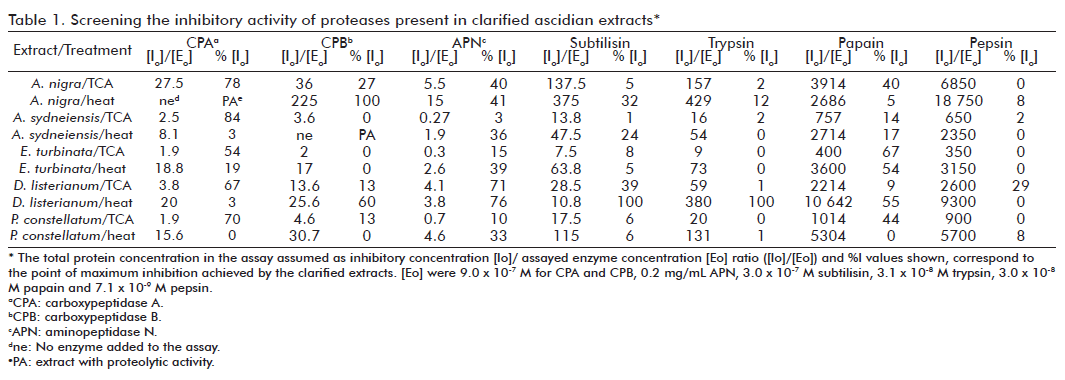
<body><![CDATA[<P   align="left" ><font size="2" face="Verdana, Arial, Helvetica, sans-serif" color="#000000">The      inhibitory activity was evaluated in the crude and clarified extracts. The      crude extracts did not show inhibitory activity against proteases tested,      with the exception of the <I>D. listerianum</I> extract, which was active      against APN, reaching 80.3% of inhibition (result not shown). Hence, we only      show the results obtained with clarified extracts because most of them were      able to inhibit some of the enzymes tested in this screening. </font></P >   <FONT size="+1"><FONT color="#FF00FF"><FONT color="#000000">        <P   align="left" ><font face="Verdana, Arial, Helvetica, sans-serif" color="#000000" size="2">Regarding      the trypsin and papain enzymes,s, only the heated extract of <I>D. listerianum      </I>inhibited<I> </I>trypsin and the TCA treated extract of <I>E. turbinata      </I>inhibited papain with the inhibitory activity percentage above 65%.However      the [I<sub>o</sub>]/[E<sub>o</sub>] ratio was very high (taking into account      our selection criteria; <a href="/img/revistas/bta/v28n2/t0102211.gif">table      1</a>). No extract showed inhibitory activity for pepsin (<a href="/img/revistas/bta/v28n2/t0102211.gif">Table      1</a>). For this reason, we did not continue working with these three enzymes      and focused only on the results related to the inhibition of the enzymes CPA,      CPB, APN and subtilisin by certain clarified extracts. </font></P >   <FONT color="#FF00FF"><FONT color="#000000"><FONT color="#FF00FF"><FONT color="#000000"><FONT color="#FF00FF"><FONT color="#000000"><FONT size="+1" color="#0000FF"><FONT size="+1" color="#000000"><FONT size="+1" color="#0000FF"><FONT size="+1" color="#000000">        
<P   align="left" ><font face="Verdana, Arial, Helvetica, sans-serif" color="#000000" size="2">In      the case of<I> A. sydneiensis</I> and <I>P. constellatum</I>, only TCA treated      extracts showed inhibition, in particular against CPA (<a href="/img/revistas/bta/v28n2/t0102211.gif">Table      1</a>). The Specific Inhibitory Activity (SIA) calculated for them was 1499      U/mg and 725 U/mg, respectively (with [I<sub>o</sub>]/[E<sub>o</sub>] ratio      of 2.5 and 1.9) and the former had the largest SIA value of all in the screening.      For these extracts, the effect of their concentration against CPA residual      activity presented a concave behaviour, which is characteristic of reversible      inhibition, with IC<sub>50</sub> values of 13 <font face="Symbol">m</font>g/mL      and 38 <font face="Symbol">m</font>g/mL, respectively (<a href="/img/revistas/bta/v28n2/f0102211.gif">Figure      1</a>). </font></P >   <FONT color="#FF00FF"><FONT color="#000000"><FONT color="#FF00FF"><FONT color="#000000"><FONT size="+1" color="#0000FF"><FONT size="+1" color="#000000"><FONT size="+1" color="#0000FF"><FONT size="+1" color="#000000"><FONT size="+1" color="#0000FF"><FONT size="+1" color="#000000"><FONT color="#00FF00"><FONT color="#000000"><FONT color="#00FF00"><FONT color="#000000">        
<P   align="left" ><font face="Verdana, Arial, Helvetica, sans-serif" color="#000000" size="2">On      the other hand, clarified extracts of<I> D. listerianum</I> showed a broad      specificity against metallo and serine proteases (<a href="/img/revistas/bta/v28n2/t0102211.gif">Table      1</a>). They were able to reach a high inhibition of CPA, CPB, APN and subtilisin      showing a concave behaviour for these enzymes (<a href="/img/revistas/bta/v28n2/f0202211.gif">Figure      2</a>). The TCA treated extract inhibited CPA and APN with IC<sub>50</sub>      values of 24 <font face="Symbol">m</font>g/mL and 340 <font face="Symbol">m</font>g/mL,      whereas the heated extract inhibited APN and CPB, showing IC<sub>50</sub>      values of 480 and 426 <font face="Symbol">m</font>g/mL, respectively. The      heated extract also inhibited subtilisin, but produced total inhibition with      an IC<sub>50</sub> value of 40 <font face="Symbol">m</font>g/mL. The SIA of      the heated extract against APN, CPB and subtilisin was 81 U/mg, 41 U/mg and      75 U/mg, respectively; while the SIA obtained for the TCA treated extract      against APN and CPA were 118 U/mg and 435 U/mg, being the latter the largest      value obtained for this ascidian specie. </font></P >   <FONT color="#FF00FF"><FONT color="#000000"><FONT size="+1" color="#0000FF"><FONT size="+1" color="#000000"><FONT color="#00FF00"><FONT color="#000000"><FONT size="+1" color="#0000FF"><FONT size="+1" color="#000000"><FONT color="#00FF00"><FONT color="#000000"><FONT size="+1" color="#0000FF"><FONT size="+1" color="#000000"><FONT color="#00FF00"><FONT color="#000000">        
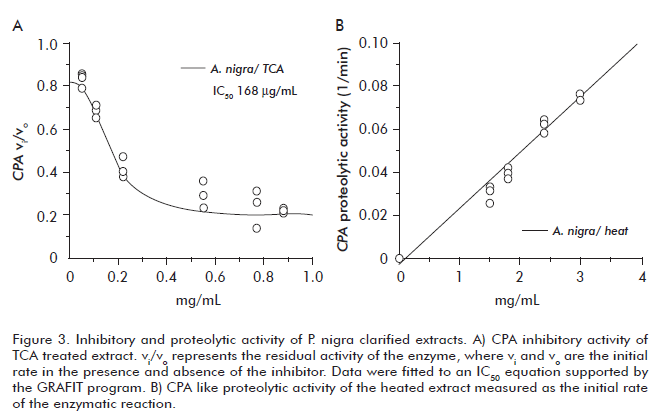
<P   align="left" ><font face="Verdana, Arial, Helvetica, sans-serif" color="#000000" size="2">On      the other hand, interesting results related to the metallo-carboxy-peptidases      tested in this screening were obtained with clarified <I>A. nigra</I> extracts.      The TCA treated extract only showed CPA inhibitory activity with a concave      behaviour when plotting extract concentration against residual activity, an      IC<sub>50</sub> value of 168 <font face="Symbol">m</font>g/mL and a SIA value      of 197 U/mg (<a href="/img/revistas/bta/v28n2/t0102211.gif">Table 1</a>;      <a href="/img/revistas/bta/v28n2/f0302211.gif">Figure 3A</a>). Nevertheless,      the heated extract was not able to inhibit CPA; in contrast, it has CPA-like      enzymatic activity, because it is able to hydrolyze AAFP, a specific substrate      for CPA. Moreover, the heated extract showed CPB inhibitory activity and was      able to reach 100% inhibition but with a [I<sub>o</sub>]/[E<sub>o</sub>] =      225 (<a href="/img/revistas/bta/v28n2/t0102211.gif">Table 1</a>). </font></P >   <FONT color="#FF00FF"><FONT color="#000000"><FONT size="+1" color="#0000FF"><FONT size="+1" color="#000000"><FONT color="#00FF00"><FONT color="#000000"><FONT size="+1" color="#0000FF"><FONT size="+1" color="#000000"><FONT size="+1" color="#0000FF"><FONT size="+1" color="#000000">        
<P   align="left" ><font face="Verdana, Arial, Helvetica, sans-serif" color="#000000" size="2"><B>Proteolytic      activity and zymography of clarified extracts </b></font></P >       <P   align="left" ><font face="Verdana, Arial, Helvetica, sans-serif" color="#000000" size="2">In      order to evaluate the presence of false positive inhibitors in the extract      mentioned above due to proteases (which could degrade the enzyme used as the      control), we evaluated the proteolytic activity of all crude and clarified      extracts through colorimetric assays and zymography described in the experimental      section. Only the specie <I>A. nigra </I>(both crude and heated extracts)      showed enzymatic activity against chromogenic substrates, in particular against      AAFP, a typical substrate for CPA. However, this activity was not found when      the extract was treated with TCA. <a href="/img/revistas/bta/v28n2/f0302211.gif">Figure      3B</a> shows the linear relationship between the initial rate of the enzymatic      reaction and extract concentration obtained for the heated extract. This reaction      was inhibited by the potato carboxypeptidase inhibitor, an inhibitor of a      metallo-carboxy-peptidase belonging to the M14A subfamily (data not shown).      </font></P >   <FONT color="#FF00FF"><FONT color="#000000">        
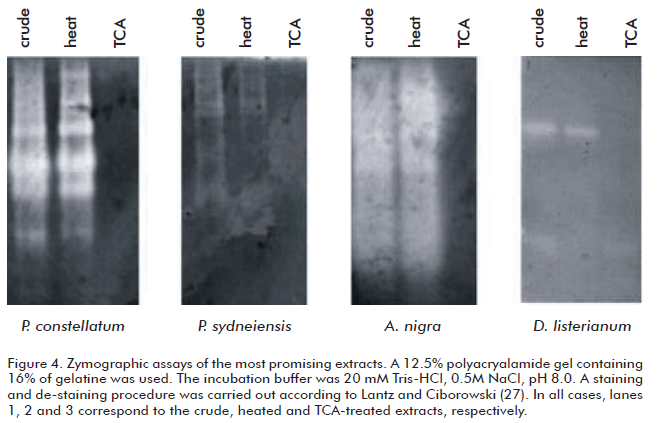
<P   align="left" ><font face="Verdana, Arial, Helvetica, sans-serif" color="#000000" size="2">On      the other hand, as a result of zymographic assays we found that crude and      heated extracts of <I>P. constellatum</I>, <I>A. sydneiensis</I> and <I>A.      nigra</I> displayed clear bands in the gels, which represent gelatine degradation      by the presence of proteolytic enzymes in the extracts. In contrast, when      the extract was treated with TCA the proteolytic activity disappeared and      no clear bands were observed (<a href="/img/revistas/bta/v28n2/f0402211.gif">Figure      4A-C</a>). In the case of the <I>D. listerianum</I> crude extract, two clear      bands were observed (with different molecular weights), and only one band      disappeared with each treatment. </font></P >   <FONT color="#FF00FF"><FONT color="#000000"><FONT color="#FF00FF"><FONT color="#000000"><FONT color="#FF00FF"><FONT color="#000000"><FONT color="#FF00FF"><FONT color="#000000">        
<P   align="left" ><font size="2" face="Verdana, Arial, Helvetica, sans-serif" color="#000000"><B><font size="3">DISCUSSION</font>      </b></font></P >   <FONT size="+1">        <P   align="left" ><font face="Verdana, Arial, Helvetica, sans-serif" color="#000000" size="2">One      of the most important strategies to counteract malaria is to design a drug      composed of natural inhibitors against the main protease parasite targets.      In this paper we used model proteases to screen ascidian extracts for new      natural inhibitors that in the future could be purified and characterized      for this purpose. </font></P >   <FONT size="+1">        ]]></body>
<body><![CDATA[<P   align="left" ><font face="Verdana, Arial, Helvetica, sans-serif" color="#000000" size="2">Ascidians      constitute a very important group of organisms for the isolation of bioactive      molecules, being the most promising of them the drug Yondelis, isolated from      <I>E. turbinata</I> and used against different types of cancer (28). However,      only a few protease inhibitors have been isolated from these organisms. The      first one was an inhibitor of trypsin (enzyme belonging to PA clan, S1 family)      isolated from the <I>Halocynthia roretzi</I> (14). The second were two inhibitors      active against trypsin and elastase, respectively, isolated from <I>Polyandrocarpa      misakiensis </I>(13). The third is an inhibitor of matrix metalloprotease      2 (MA clan, M10 family), isolated from a tunicate of the <I>Polyclinidae</I>      family (12). </font></P >   <FONT color="#FF00FF"><FONT color="#000000"><FONT color="#FF00FF"><FONT color="#000000"><FONT color="#FF00FF"><FONT color="#000000"><FONT color="#FF00FF"><FONT color="#000000">        <P   align="left" ><font face="Verdana, Arial, Helvetica, sans-serif" color="#000000" size="2">The      ability of marine invertebrates to inhibit enzymess belonging to the M1 family      of the MA clan was described by our group in the case of HcPI, an inhibitor      isolated from <I>Hermodice carunculata</I> that is able to inhibit pyroglutamyl      aminopeptidase II (29). Nevertheless, in this study we report for the first      time the inhibition of APN (MA Clan, M1 family) by extracts of <I>D. listerianum</I>.      It is important to emphasize that the molecules responsible for APN inhibition      in this species are stable under both clarification conditions used in this      work. </font></P >   <FONT color="#FF00FF"><FONT color="#000000"><FONT color="#FF00FF"><FONT color="#000000">        <P   align="left" ><font face="Verdana, Arial, Helvetica, sans-serif" color="#000000" size="2">In      <I>P. falciparum</I> a metallo-amino-peptidase (PfAM1) belonging to the same      family of APN was found, which had broad substrate specificity and was involved      in haemoglobin degradation (30). This fact suggests that PfAM1 constitutes      a crucial target for the inhibition of parasite growth and development (31).      It is possible that APN inhibitors also could be able to inhibit PfAM1, which      could be very promising in obtaining new antimalarial drugs (31). </font></P >   <FONT color="#FF00FF"><FONT color="#000000">        <P   align="left" ><font face="Verdana, Arial, Helvetica, sans-serif" color="#000000" size="2">Also      for <I>D. listerianum</I> we reported for the first time the inhibitory activity      of CPA, CPB (MC clan, M14 family) and subtilisin (SB clan, S8 family). Recently      it was reported that the<I> P. falciparum</I> genome contains a gene of a      metallo-carboxy-peptidase like enzyme belonging to the Nna1 family (6). Its      recombinant <I>Caenorhabditis elegans</I> homologous presented broad substrate      specificity and is inhibited by inhibitors of metallo enzymes (6). These authors      suggest that these types of enzymes could have tubulyn carboxypeptidase activity      and could therefore be involved in the infection mechanism of the parasite      (6). In addition, the expression of two midgut carboxypeptidase B gene (cpbAg1      and cpbAg2) in <I>Anopheles gambiae </I>has been found to be up-regulated      by <I>P. falciparum</I> infection and the addition of antibodies against CPBAg1      to a <I>P. falciparum</I>-containing blood meal, inhibited CPB activity and      blocked parasite development (32). Therefore, the inhibition of both CPA and      CPB like enzymes could result in a promissory strategy for developing drugs      and transmission-blocking vaccines against the parasite (6, 32). </font></P >   <FONT color="#FF00FF"><FONT color="#000000"><FONT color="#FF00FF"><FONT color="#000000"><FONT color="#FF00FF"><FONT color="#000000"><FONT color="#FF00FF"><FONT color="#000000"><FONT color="#FF00FF"><FONT color="#000000"><FONT color="#FF00FF"><FONT color="#000000">        <P   align="left" ><font face="Verdana, Arial, Helvetica, sans-serif" color="#000000" size="2">TCA      treated extracts of <I>A. Nigra</I>, <I>A. sydneiensis,</I> <I>P. constellatum</I>      and <I>D. listerianum</I> inhibit CPA in a reversible way, taking into account      the behaviour of the extract concentration against CPA residual activity.      For CPA, the analysis of IC<sub>50</sub> and SIA values suggests that <I>A.      sydneiensis</I> represents the most efficient extract in CPA inhibition. The      biological activity<I> </I>(inhibitory or proteolytic) of <I>A. nigra</I>      and <I>A. sydneiensis </I>extracts found in this work could be related to      the recently reported inhibition of <I>P. falciparum </I>growth by these extracts      (33). </font></P >   <FONT color="#FF00FF"><FONT color="#000000"><FONT color="#FF00FF"><FONT color="#000000"><FONT color="#FF00FF"><FONT color="#000000"><FONT color="#FF00FF"><FONT color="#000000"><FONT size="+1" color="#0000FF"><FONT size="+1" color="#000000"><FONT color="#FF00FF"><FONT color="#000000"><FONT color="#FF00FF"><FONT color="#000000"><FONT color="#FF00FF"><FONT color="#000000"><FONT color="#FF00FF"><FONT color="#000000">        <P   align="left" ><font face="Verdana, Arial, Helvetica, sans-serif" color="#000000" size="2">On      the other hand, the presence of CPA like proteolytic activity in the heated      extract of <I>A. nigra</I> (observed by colorimetric assay), general proteolytic      activity (observed by zymography), as well as CPA inhibitory activity in TCA      clarified extract, constitute an interesting result obtained in this study.      This fact could be explained in two ways. Perhaps the crude extract has both      types of activities (enzymatic and inhibitory), but proteolytic activity is      predominant and hindered the detection of inhibition. This possibility was      eliminated when the extract was treated with TCA. On the other hand, it is      known that TCA is able to dissociate the non covalent complex, such as protease-inhibitors,      allowing inhibitor detection (34). This behaviour was previously observed      with the dipeptidyl peptidase IV inhibitory activity of <I>Xetospongia muta</I>      extracts (35) and ShPI I, a proteinase inhibitor from <I>Stichodactyla helianthus      </I>(36). Nevertheless, heat treatment does not eliminate CPA proteolytic      activity as observed in <I>A. nigra</I> crude extract, suggesting the presence      in this specie of a CPA like enzyme that is stable at least at this incubation      temperature and time. In addition, in zymographic experiments we observed      that the heated extract maintains proteolytic activity, suggesting the presence      of endoproteinases in this extract, which were eliminated with TCA treatment.      Hence, it is possible to suggest that the CPB inhibitory activity observed      in <I>A. nigra</I> heated extract (results not shown considering the selection      criteria) could be explained due to the fact that the proteases found in this      extract could degrade the pancreatic CPB used in the assay causing apparent      inhibition. The presence of proteolytic enzymes that are resistant to heat      was also ob-served for the enzyme isolated from the mollusc <I>Aplysia dactylomela</I>      (37). </font></P >   <FONT color="#FF00FF"><FONT color="#000000"><FONT color="#FF00FF"><FONT color="#000000"><FONT color="#FF00FF"><FONT color="#000000"><FONT color="#FF00FF"><FONT color="#000000"><FONT color="#FF00FF"><FONT color="#000000"><FONT color="#FF00FF"><FONT color="#000000">        <P   align="left" ><font face="Verdana, Arial, Helvetica, sans-serif" color="#000000" size="2">On      the other hand, it is known that the inhibition of the subtilisin-family serine      protease PfSU B1 and the cysteine protease dipeptidyl peptidase 3 (DPAP3)      of <I>P. falciparum</I> impairs its infection mechanism (38). We used subtilisin      from <I>B. licheniformis</I> as a model enzymes and obtained total inhibition      by the heated extract of <I>D. listerianum</I> suggesting the efficiency of      this inhibitor even when it is not purified. Nevertheless, the only clear      band observed in the zymography of the <I>D. listerianum</I> heated extract,      could mean that there is a proteolytic enzyme present, which is responsible      for subtilisin degradation and hence apparent inhibition. Further experiments      are being carried out to elucidate this. </font></P >   <FONT color="#FF00FF"><FONT color="#000000"><FONT color="#FF00FF"><FONT color="#000000"><FONT color="#FF00FF"><FONT color="#000000"><FONT color="#FF00FF"><FONT color="#000000">        <P   align="left" ><font face="Verdana, Arial, Helvetica, sans-serif" color="#000000" size="2">Here,      for the first time we carried out a screening for protease inhibitors in a      group of ascidians using model proteases belonging to the same mechanistic      classes as those found in <I>P. falciparum</I> parasite. We described the      inhibitory activity of CPA, CPB, APN and subtilisin in extracts of <I>A. nigra</I>,      <I>A. sydneiensis</I>, <I>P. constellatum</I> and <I>D. listerianum</I> with      promising results; being this the first report of biological activity described      for <I>P. constellatum</I> and <I>D. listerianum </I>extracts. In addition,      this study could be the first step in the line of developing new anti-malarial      compounds from inhibitors of the main target of <I>P. falciparum</I>. Current      efforts are directed to the further purification and characterization of these      molecules. </font></P >   <FONT color="#FF00FF"><FONT color="#000000"><FONT color="#FF00FF"><FONT color="#000000"><FONT color="#FF00FF"><FONT color="#000000"><FONT color="#FF00FF"><FONT color="#000000"><FONT color="#FF00FF"><FONT color="#000000"><FONT color="#FF00FF"><FONT color="#000000"><FONT color="#FF00FF"><FONT color="#000000"><FONT color="#FF00FF"><FONT color="#000000">        <P   align="left" ><font size="2" face="Verdana, Arial, Helvetica, sans-serif" color="#000000"><B><font size="3">ACKNOWLEDGEMENTS</font>      </b></font></P >   <FONT size="+1">        <P   align="left" ><font face="Verdana, Arial, Helvetica, sans-serif" color="#000000" size="2">This      investigation was partially supported by IFS grants: F/ 3342-2, F/ 3276-2,      F/ 3276-3 and 2923-3F.The authors want to thanks MSc. Antonio C&aacute;diz      D&iacute;az and Bs Pedro Alberto Fiallo for correcting English language in      the manuscript. </font></P >   <FONT size="+1">        ]]></body>
<body><![CDATA[<P   align="left" ><font face="Verdana, Arial, Helvetica, sans-serif" color="#000000" size="2"><B><font size="3">REFERENCES</font>      </b></font></P >       <!-- ref --><P   align="justify" ><font face="Verdana, Arial, Helvetica, sans-serif" color="#000000" size="2">1.      Blackman MJ. Proteases involved in erythrocyte invasion by the malaria parasite:      function and potential as chemotherapeutic targets. Curr Drug Targets. 2000;1(1):59-83.          </font></P >   <FONT size="+1">        <!-- ref --><P   align="justify" ><font face="Verdana, Arial, Helvetica, sans-serif" color="#000000" size="2">2.      Ersmark K, Samuelsson B, Hallberg A. Plasmepsins as potential targets for      new antimalarial therapy. Med Res Rev. 2006;26(5):626-66.     </font></P >       <!-- ref --><P   align="justify" ><font face="Verdana, Arial, Helvetica, sans-serif" color="#000000" size="2">3.      Sijwali PS, Koo J, Singh N, Rosenthal PJ. Gene disruptions demonstrate independent      roles for the four falcipain cysteine proteases of Plasmodium falciparum.      Mol Biochem Parasitol. 2006;150(1):96-106.     </font></P >       <!-- ref --><P   align="justify" ><font face="Verdana, Arial, Helvetica, sans-serif" color="#000000" size="2">4.      Dalal S, Klemba M. Roles for two aminopeptidases in vacuolar hemoglobin catabolism      in Plasmodium falciparum. J Biol Chem. 2007;282(49):35978-87.     </font></P >       <!-- ref --><P   align="justify" ><font face="Verdana, Arial, Helvetica, sans-serif" color="#000000" size="2">5.      Withers-Martinez C, Jean L, Blackman MJ. Subtilisin-like proteases of the      malaria parasite. Mol Microbiol. 2004;53(1): 55-63.     </font></P >       <!-- ref --><P   align="justify" ><font face="Verdana, Arial, Helvetica, sans-serif" color="#000000" size="2">6.      Rodr&iacute;guez de la Vega M, Sevilla RG, Hermoso A, Lorenzo J, Tanco S,      Diez A, <I>et al</I>. Nna1-like proteins are active metallocarboxypeptidases      of a new and diverse M14 subfamily. FASEB J. 2007;21(3):851-65.     </font></P >       <!-- ref --><P   align="justify" ><font face="Verdana, Arial, Helvetica, sans-serif" color="#000000" size="2">7.      Cunningham E, Drag M, Kafarski P, Bell A. Chemical target validation studies      of aminopeptidase in malaria parasites using alpha-aminoalkylphosphonate and      phosphonopeptide inhibitors. Antimicrob Agents Chemother. 2008;52(9):3221-8.          </font></P >       <!-- ref --><P   align="justify" ><font face="Verdana, Arial, Helvetica, sans-serif" color="#000000" size="2">8.      Hidaka K, Kimura T, Ruben AJ, Uemura T, Kamiya M, Kiso A, <I>et al</I>. Antimalarial      activity enhancement in hydroxymethylcarbonyl (HMC) isostere-based dipeptidomimetics      targeting malarial aspartic protease plasmepsin. Bioorg Med Chem. 2008;16(23):10049-60.          </font></P >       <!-- ref --><P   align="justify" ><font face="Verdana, Arial, Helvetica, sans-serif" color="#000000" size="2">9.      Lee BJ, Singh A, Chiang P, Kemp SJ, Goldman EA, Weinhouse MI, <I>et al</I>.      Antimalarial activities of novel synthetic cysteine protease inhibitors. Antimicrob      Agents Chemother. 2003;47(12):3810-4.     </font></P >       <!-- ref --><P   align="justify" ><font face="Verdana, Arial, Helvetica, sans-serif" color="#000000" size="2">10.      Valente C, Guedes RC, Moreira R, Iley J, Gut J, Rosenthal PJ. Dipeptide vinyl      sultams: synthesis via the Wittig-Horner reaction and activity against papain,      falcipain-2 and Plasmodium falciparum. Bioorg Med Chem Lett. 2006;16(15):4115-9.          </font></P >       <!-- ref --><P   align="justify" ><font face="Verdana, Arial, Helvetica, sans-serif" color="#000000" size="2">11.      Kardong KV. Vertebrados. Anatom&iacute;a comparada, funci&oacute;n, evoluci&oacute;n.      2nd ed. Madrid: McGraw-Hill-Interamericana; 1999.     </font></P >       <!-- ref --><P   align="justify" ><font face="Verdana, Arial, Helvetica, sans-serif" color="#000000" size="2">12.      Fujita M, Nakao Y, Matsunaga S, Nishikawa T, Fusetani N. Sodium 1-(12-hydroxy)octadecanyl      sulfate, an MMP2 inhibitor, isolated from a tunicate of the family Polyclinidae.      J Nat Prod. 2002; 65(12):1936-8.     </font></P >       <!-- ref --><P   align="justify" ><font face="Verdana, Arial, Helvetica, sans-serif" color="#000000" size="2">13.      Kawamura K, Hayata D, Fujiwara S, Yubisui T. Serine protease inhibitors expressed      in the process of budding of tunicates as revealed by EST analysis. J Biochem.      1998;124(5):1004-12.     </font></P >       <!-- ref --><P   align="justify" ><font face="Verdana, Arial, Helvetica, sans-serif" color="#000000" size="2">14.      Kumazaki T, Ishii S. Disulfide bridge structure of ascidian trypsin inhibitor      I: similarity to Kazal-type inhibitors. J Biochem. 1990;107(3):414-9.     </font></P >       <!-- ref --><P   align="justify" ><font face="Verdana, Arial, Helvetica, sans-serif" color="#000000" size="2">15.      Golich FC, Han M, Crowder MW. Over-expression, purification, and characterization      of aminopeptidase N from <I>Escherichia coli</I>. Protein Expr Purif. 2006;      47(2):634-9.     </font></P >       <!-- ref --><P   align="justify" ><font face="Verdana, Arial, Helvetica, sans-serif" color="#000000" size="2">16.      Gonz&aacute;lez Y, Tanaka AS, Hirata IY, del Rivero MA, Oliva ML, Araujo MS,      <I>et al</I>. Purification and partial characterization of human neutrophil      elastase inhibitors from the marine snail <I>Cenchritis muricatus</I> (<I>Mollusca</I>).      Comp Biochem Physiol A Mol Integr Physiol. 2007;146(4):506-13.     </font></P >       <!-- ref --><P   align="justify" ><font face="Verdana, Arial, Helvetica, sans-serif" color="#000000" size="2">17.      Scopes R. Protein purification: principles and practice. 2nd ed. Berlin: Springler-Verlag;      1987.     </font></P >       <!-- ref --><P   align="justify" ><font face="Verdana, Arial, Helvetica, sans-serif" color="#000000" size="2">18.      Sober HA, Harte RA, Sober EK. Handbook of biochemistry (selected data for      molecular biology). 2nd ed. Ohio: The Chemical Rubber Co.; 1968.     </font></P >       <!-- ref --><P   align="justify" ><font face="Verdana, Arial, Helvetica, sans-serif" color="#000000" size="2">19.      Bradford MM. A rapid and sensitive method for the quantitation of microgram      quantities of protein utilizing the principle of protein-dye binding. Anal      Biochem. 1976;72:248-54.     </font></P >       <!-- ref --><P   align="justify" ><font face="Verdana, Arial, Helvetica, sans-serif" color="#000000" size="2">20.      Mock WL, Liu Y, Stanford DJ. Arazoformyl peptide surrogates as spectrophotometric      kinetic assay substrates for carboxypeptidase A. Anal Biochem. 1996; 239:218-22.          </font></P >       <!-- ref --><P   align="justify" ><font face="Verdana, Arial, Helvetica, sans-serif" color="#000000" size="2">21.      Mock WL, Xu D. Catalytic activity of carboxypeptidase B and of carboxypeptidase      Y with anisylazoformyl substrates. Bioorg Med Chem Lett. 1999;9:187-92.     </font></P >       <!-- ref --><P   align="justify" ><font face="Verdana, Arial, Helvetica, sans-serif" color="#000000" size="2">22.      Berger A, Schechter I. Mapping the active site of papain with the aid of peptide      substrates and inhibitors. Philos Trans R Soc Lond B Biol Sci. 1970;257:249-64.          </font></P >       <!-- ref --><P   align="justify" ><font face="Verdana, Arial, Helvetica, sans-serif" color="#000000" size="2">23.      Erlanger BF, Kowkowsky N, Cohen W. The preparation and properties of two new      chromogenic substrates of trypsin. Arch Biochem Biophys. 1961;95:271-8.     </font></P >       <!-- ref --><P   align="justify" ><font face="Verdana, Arial, Helvetica, sans-serif" color="#000000" size="2">24.      Estell DA, Graycar TP, Miller JV, Powers DB, Wells JA, Burnier JP, <I>et al</I>.      Probing steric and hydrophobic effects on enzyme-substrate interactions by      protein engineering. Science. 1986;233:659-63.     </font></P >       <!-- ref --><P   align="justify" ><font face="Verdana, Arial, Helvetica, sans-serif" color="#000000" size="2">25.      Martin P, Raymond MN, Bricas E, Dumas BR. Kinetic studies on the action of      <I>Mucor pusillus</I>, Mucor miehei acid pro-teases and chymosins A and B      on a synthetic chromophoric hexapeptide. Biochim Biophys Acta. 1980;612:410-20.          </font></P >       <!-- ref --><P   align="justify" ><font face="Verdana, Arial, Helvetica, sans-serif" color="#000000" size="2">26.      Tieku T, Hooper M. Inhibition of aminopeptidases N, A and W. A re-evaluation      of the actions of bestatin and inhibitors of angiotensin converting enzyme.      Biochem Pharmacol. 1992;44:1725-30.     </font></P >       <!-- ref --><P   align="justify" ><font face="Verdana, Arial, Helvetica, sans-serif" color="#000000" size="2">27.      Lantz MS, Ciborowski P. Zymographic techniques for detection and characterization      of microbial proteases. Methods Enzymol. 1994;235:563-94.     </font></P >       <!-- ref --><P   align="justify" ><font face="Verdana, Arial, Helvetica, sans-serif" color="#000000" size="2">28.      Molinski TF, Dalisay DS, Lievens SL, Saludes JP. Drug development from marine      natural products. Nat Rev Drug Discov. 2009;8(1):69-85.     </font></P >       <!-- ref --><P   align="justify" ><font face="Verdana, Arial, Helvetica, sans-serif" color="#000000" size="2">29.      Pascual I, Gil-Parrado S, Cisneros M, Joseph-Bravo P, D&iacute;az J, Possani      LD, <I>et al</I>. Purification of a specific inhibitor of py-roglutamyl aminopeptidase      II from the marine annelide <I>Hermodice carunculata</I>. <I>In vivo</I> effects      in rodent brain. Int J Biochem Cell Biol. 2004;36(1):138-52.     </font></P >       <!-- ref --><P   align="justify" ><font face="Verdana, Arial, Helvetica, sans-serif" color="#000000" size="2">30.      Allary M, Schrevel J, Florent I. Properties, stage-dependent expression and      localization of <I>Plasmodium falciparum</I> M1 family zinc-aminopeptidase.      Parasitology. 2002;125(Pt 1):1-10.     </font></P >       <!-- ref --><P   align="justify" ><font face="Verdana, Arial, Helvetica, sans-serif" color="#000000" size="2">31.      Flipo M, Beghyn T, Leroux V, Florent I, Deprez BP, Deprez-Poulain RF. Novel      selective inhibitors of the zinc plasmodial aminopeptidase PfA-M1 as potential      antimalarial agents. J Med Chem. 2007; 50(6):1322-34.     </font></P >       <!-- ref --><P   align="justify" ><font face="Verdana, Arial, Helvetica, sans-serif" color="#000000" size="2">32.      Lavazec C, Boudin C, Lacroix R, Bonnet S, Diop A, Thiberge S, <I>et al</I>.      Carboxypeptidases B of <I>Anopheles gambiae</I> as targets for a <I>Plasmodium      falciparum</I> transmission-blocking vaccine. Infect Immun. 2007;75(4):1635-42.          </font></P >       <!-- ref --><P   align="justify" ><font face="Verdana, Arial, Helvetica, sans-serif" color="#000000" size="2">33.      Mendiola J, Hern&aacute;ndez H, Sariego I, Rojas L, Otero A, Ram&iacute;rez      A, <I>et al</I>. Antimalarial activity from three ascidians: an exploration      of different marine invertebrate phyla. Trans R Soc Trop Med Hyg. 2006;100(10):909-16.          </font></P >       <!-- ref --><P   align="justify" ><font face="Verdana, Arial, Helvetica, sans-serif" color="#000000" size="2">34.      Gustafson GL, Finn DJ, Moin K. Dissociation of proteinase-inhibitor complexes      by trichloroacetate. Anal Biochem. 1988;169:185-8.     </font></P >       <P   align="justify" ><font face="Verdana, Arial, Helvetica, sans-serif" color="#000000" size="2">35.      Pascual I, L&oacute;pez A, G&oacute;mez H, Chapp&eacute; M, Saroy&aacute;n      A, Gonz&aacute;lez Y, <I>et al</I>. Screening of inhibitors of porcine dipeptidyl      peptidase IV activity in aqueous extracts from marine organism. Enzyme Microb      Tech. 2007;40:414-9. </font></P >       ]]></body>
<body><![CDATA[<!-- ref --><P   align="justify" ><font face="Verdana, Arial, Helvetica, sans-serif" color="#000000" size="2">36.      Delf&iacute;n J, Mart&iacute;nez I, Antuch W, Morera V, Gonz&aacute;lez Y,      Rodr&iacute;guez R, <I>et al</I>. Purification, characterization and immobilization      of proteinase inhibitors from <I>Stichodactyla helianthus</I>. Toxicon 1996;34:1367-76.          </font></P >       <!-- ref --><P   align="justify" ><font face="Verdana, Arial, Helvetica, sans-serif" color="#000000" size="2">37.      Gonz&aacute;lez Y, Araujo MS, Oliva MLV, Sampaio CAM, Ch&aacute;vez, MA. Purification      and preliminary characterization of a plasma kallikrein inhibitor isolated      from sea hares <I>Aplysia dactylomela</I> Rang, 1828. Toxicon 2004;43(2):219-23.          </font></P >       <!-- ref --><P   align="left" ><font face="Verdana, Arial, Helvetica, sans-serif" color="#000000" size="2">38.      Arastu-Kapur S, Ponder EL, Fonovi&#263; UP, Yeoh S, Yuan F, Fonovi&#263; M,      et al. Identification of proteases that regulate erythrocyte rupture by the      malaria parasite Plasmodium falciparum. Nat Chem Biol. 2008;4(3):203-13.     </font></P >       <P   align="left" > </P >       <P   align="left" > </P >       <P   align="left" >&nbsp;</P >       <P   align="left" ><font face="Verdana, Arial, Helvetica, sans-serif" color="#000000" size="2">Received      in July, 2010.    ]]></body>
<body><![CDATA[<br>     </font><font face="Verdana, Arial, Helvetica, sans-serif" color="#000000" size="2">Accepted      for publication in April, 2011. </font></P >       <P   align="left" ><font face="Verdana, Arial, Helvetica, sans-serif" size="2">Maday Alonso del      Rivero, Instituto Nacional de Oceanolog&iacute;a Calle 1era #18406, Playa,      La Habana, Cuba, E-mail: <a href="mailto:maday@fbio.uh.cu">maday@fbio.uh.cu</a></font></P >   </font></font></font></font></font></font></font></font></font></font></font></font></font></font></font></font></font></font></font></font></font></font></font></font></font></font></font></font></font></font></font></font></font></font></font></font></font></font></font></font></font></font></font></font></font></font></font></font></font></font></font></font></font></font></font></font></font></font></font></font></font></font></font></font></font></font></font></font></font></font></font></font></font></font></font></font></font></font></font></font></font></font></font></font></font></font></font></font></font></font></font></font></font></font></font></font></font></font></font></font></font></font></font></font></font></font></font></font></font></font></font></font></font></font></font></font></font></font></font></font></font></font></font></font></font></font></font></font></font></font></font></font></font></font></font></font></font></font></font></font></font></font></font></font></font></font></font></font></font></font></font></font></font></font></font></font></font></font></font></font></font></font></font></font></font></font></font></font></font></font></font></font></font></font></font></font></font></font></font></font></font></font></font></font></font></font></font></font></font></font></font></font></font></font></font></font></font></font></font></font></font></font></font></font></font></font></font></font></font></font></font></font></font></font></font></font></font></font></font></font></font></font></font></font></font></font></font></font></font></font></font></font></font></font></font></font></font></font></font></font></font></font></font></font></font></font></font></font></font></font></font></font></font></font></font></font></font></font></font></font></font></font></font></font></font></font></font></font></font></font></font></font></font></font></font></font></font></font></font></font></font></font></font></font></font></font></font></font></font></DIV >      ]]></body><back>
<ref-list>
<ref id="B1">
<label>1</label><nlm-citation citation-type="journal">
<person-group person-group-type="author">
<name>
<surname><![CDATA[Blackman]]></surname>
<given-names><![CDATA[MJ]]></given-names>
</name>
</person-group>
<article-title xml:lang="en"><![CDATA[Proteases involved in erythrocyte invasion by the malaria parasite: function and potential as chemotherapeutic targets]]></article-title>
<source><![CDATA[Curr Drug Targets]]></source>
<year>2000</year>
<volume>1</volume>
<numero>1</numero>
<issue>1</issue>
<page-range>59-83</page-range></nlm-citation>
</ref>
<ref id="B2">
<label>2</label><nlm-citation citation-type="journal">
<person-group person-group-type="author">
<name>
<surname><![CDATA[Ersmark]]></surname>
<given-names><![CDATA[K]]></given-names>
</name>
<name>
<surname><![CDATA[Samuelsson]]></surname>
<given-names><![CDATA[B]]></given-names>
</name>
<name>
<surname><![CDATA[Hallberg]]></surname>
<given-names><![CDATA[A]]></given-names>
</name>
</person-group>
<article-title xml:lang="en"><![CDATA[Plasmepsins as potential targets for new antimalarial therapy]]></article-title>
<source><![CDATA[Med Res Rev]]></source>
<year>2006</year>
<volume>26</volume>
<numero>5</numero>
<issue>5</issue>
<page-range>626-66</page-range></nlm-citation>
</ref>
<ref id="B3">
<label>3</label><nlm-citation citation-type="journal">
<person-group person-group-type="author">
<name>
<surname><![CDATA[Sijwali]]></surname>
<given-names><![CDATA[PS]]></given-names>
</name>
<name>
<surname><![CDATA[Koo]]></surname>
<given-names><![CDATA[J]]></given-names>
</name>
<name>
<surname><![CDATA[Singh]]></surname>
<given-names><![CDATA[N]]></given-names>
</name>
<name>
<surname><![CDATA[Rosenthal]]></surname>
<given-names><![CDATA[PJ]]></given-names>
</name>
</person-group>
<article-title xml:lang="en"><![CDATA[Gene disruptions demonstrate independent roles for the four falcipain cysteine proteases of Plasmodium falciparum]]></article-title>
<source><![CDATA[Mol Biochem Parasitol]]></source>
<year>2006</year>
<volume>150</volume>
<numero>1</numero>
<issue>1</issue>
<page-range>96-106</page-range></nlm-citation>
</ref>
<ref id="B4">
<label>4</label><nlm-citation citation-type="journal">
<person-group person-group-type="author">
<name>
<surname><![CDATA[Dalal]]></surname>
<given-names><![CDATA[S]]></given-names>
</name>
<name>
<surname><![CDATA[Klemba]]></surname>
<given-names><![CDATA[M]]></given-names>
</name>
</person-group>
<article-title xml:lang="en"><![CDATA[Roles for two aminopeptidases in vacuolar hemoglobin catabolism in Plasmodium falciparum]]></article-title>
<source><![CDATA[J Biol Chem]]></source>
<year>2007</year>
<volume>282</volume>
<numero>49</numero>
<issue>49</issue>
<page-range>35978-87</page-range></nlm-citation>
</ref>
<ref id="B5">
<label>5</label><nlm-citation citation-type="journal">
<person-group person-group-type="author">
<name>
<surname><![CDATA[Withers-Martinez]]></surname>
<given-names><![CDATA[C]]></given-names>
</name>
<name>
<surname><![CDATA[Jean]]></surname>
<given-names><![CDATA[L]]></given-names>
</name>
<name>
<surname><![CDATA[Blackman]]></surname>
<given-names><![CDATA[MJ]]></given-names>
</name>
</person-group>
<article-title xml:lang="en"><![CDATA[Subtilisin-like proteases of the malaria parasite]]></article-title>
<source><![CDATA[Mol Microbiol]]></source>
<year>2004</year>
<volume>53</volume>
<numero>1</numero>
<issue>1</issue>
<page-range>55-63</page-range></nlm-citation>
</ref>
<ref id="B6">
<label>6</label><nlm-citation citation-type="journal">
<person-group person-group-type="author">
<name>
<surname><![CDATA[Rodríguez de la Vega]]></surname>
<given-names><![CDATA[M]]></given-names>
</name>
<name>
<surname><![CDATA[Sevilla]]></surname>
<given-names><![CDATA[RG]]></given-names>
</name>
<name>
<surname><![CDATA[Hermoso]]></surname>
<given-names><![CDATA[A]]></given-names>
</name>
<name>
<surname><![CDATA[Lorenzo]]></surname>
<given-names><![CDATA[J]]></given-names>
</name>
<name>
<surname><![CDATA[Tanco]]></surname>
<given-names><![CDATA[S]]></given-names>
</name>
<name>
<surname><![CDATA[Diez]]></surname>
<given-names><![CDATA[A]]></given-names>
</name>
</person-group>
<article-title xml:lang="en"><![CDATA[Nna1-like proteins are active metallocarboxypeptidases of a new and diverse M14 subfamily]]></article-title>
<source><![CDATA[FASEB J]]></source>
<year>2007</year>
<volume>21</volume>
<numero>3</numero>
<issue>3</issue>
<page-range>851-65</page-range></nlm-citation>
</ref>
<ref id="B7">
<label>7</label><nlm-citation citation-type="journal">
<person-group person-group-type="author">
<name>
<surname><![CDATA[Cunningham]]></surname>
<given-names><![CDATA[E]]></given-names>
</name>
<name>
<surname><![CDATA[Drag]]></surname>
<given-names><![CDATA[M]]></given-names>
</name>
<name>
<surname><![CDATA[Kafarski]]></surname>
<given-names><![CDATA[P]]></given-names>
</name>
<name>
<surname><![CDATA[Bell]]></surname>
<given-names><![CDATA[A]]></given-names>
</name>
</person-group>
<article-title xml:lang="en"><![CDATA[Chemical target validation studies of aminopeptidase in malaria parasites using alpha-aminoalkylphosphonate and phosphonopeptide inhibitors]]></article-title>
<source><![CDATA[Antimicrob Agents Chemother]]></source>
<year>2008</year>
<volume>52</volume>
<numero>9</numero>
<issue>9</issue>
<page-range>3221-8</page-range></nlm-citation>
</ref>
<ref id="B8">
<label>8</label><nlm-citation citation-type="journal">
<person-group person-group-type="author">
<name>
<surname><![CDATA[Hidaka]]></surname>
<given-names><![CDATA[K]]></given-names>
</name>
<name>
<surname><![CDATA[Kimura]]></surname>
<given-names><![CDATA[T]]></given-names>
</name>
<name>
<surname><![CDATA[Ruben]]></surname>
<given-names><![CDATA[AJ]]></given-names>
</name>
<name>
<surname><![CDATA[Uemura]]></surname>
<given-names><![CDATA[T]]></given-names>
</name>
<name>
<surname><![CDATA[Kamiya]]></surname>
<given-names><![CDATA[M]]></given-names>
</name>
<name>
<surname><![CDATA[Kiso]]></surname>
<given-names><![CDATA[A]]></given-names>
</name>
</person-group>
<article-title xml:lang="en"><![CDATA[Antimalarial activity enhancement in hydroxymethylcarbonyl (HMC) isostere-based dipeptidomimetics targeting malarial aspartic protease plasmepsin]]></article-title>
<source><![CDATA[Bioorg Med Chem]]></source>
<year>2008</year>
<volume>16</volume>
<numero>23</numero>
<issue>23</issue>
<page-range>10049-60</page-range></nlm-citation>
</ref>
<ref id="B9">
<label>9</label><nlm-citation citation-type="journal">
<person-group person-group-type="author">
<name>
<surname><![CDATA[Lee]]></surname>
<given-names><![CDATA[BJ]]></given-names>
</name>
<name>
<surname><![CDATA[Singh]]></surname>
<given-names><![CDATA[A]]></given-names>
</name>
<name>
<surname><![CDATA[Chiang]]></surname>
<given-names><![CDATA[P]]></given-names>
</name>
<name>
<surname><![CDATA[Kemp]]></surname>
<given-names><![CDATA[SJ]]></given-names>
</name>
<name>
<surname><![CDATA[Goldman]]></surname>
<given-names><![CDATA[EA]]></given-names>
</name>
<name>
<surname><![CDATA[Weinhouse]]></surname>
<given-names><![CDATA[MI]]></given-names>
</name>
</person-group>
<article-title xml:lang="en"><![CDATA[Antimalarial activities of novel synthetic cysteine protease inhibitors]]></article-title>
<source><![CDATA[Antimicrob Agents Chemother]]></source>
<year>2003</year>
<volume>47</volume>
<numero>12</numero>
<issue>12</issue>
<page-range>3810-4</page-range></nlm-citation>
</ref>
<ref id="B10">
<label>10</label><nlm-citation citation-type="journal">
<person-group person-group-type="author">
<name>
<surname><![CDATA[Valente]]></surname>
<given-names><![CDATA[C]]></given-names>
</name>
<name>
<surname><![CDATA[Guedes]]></surname>
<given-names><![CDATA[RC]]></given-names>
</name>
<name>
<surname><![CDATA[Moreira]]></surname>
<given-names><![CDATA[R]]></given-names>
</name>
<name>
<surname><![CDATA[Iley]]></surname>
<given-names><![CDATA[J]]></given-names>
</name>
<name>
<surname><![CDATA[Gut]]></surname>
<given-names><![CDATA[J]]></given-names>
</name>
<name>
<surname><![CDATA[Rosenthal]]></surname>
<given-names><![CDATA[PJ]]></given-names>
</name>
</person-group>
<article-title xml:lang="en"><![CDATA[Dipeptide vinyl sultams: synthesis via the Wittig-Horner reaction and activity against papain, falcipain-2 and Plasmodium falciparum]]></article-title>
<source><![CDATA[Bioorg Med Chem Lett]]></source>
<year>2006</year>
<volume>16</volume>
<numero>15</numero>
<issue>15</issue>
<page-range>4115-9</page-range></nlm-citation>
</ref>
<ref id="B11">
<label>11</label><nlm-citation citation-type="book">
<person-group person-group-type="author">
<name>
<surname><![CDATA[Kardong]]></surname>
<given-names><![CDATA[KV]]></given-names>
</name>
</person-group>
<source><![CDATA[Vertebrados: Anatomía comparada, función, evolución]]></source>
<year>1999</year>
<edition>2</edition>
<publisher-loc><![CDATA[Madrid ]]></publisher-loc>
<publisher-name><![CDATA[McGraw-Hill-Interamericana]]></publisher-name>
</nlm-citation>
</ref>
<ref id="B12">
<label>12</label><nlm-citation citation-type="journal">
<person-group person-group-type="author">
<name>
<surname><![CDATA[Fujita]]></surname>
<given-names><![CDATA[M]]></given-names>
</name>
<name>
<surname><![CDATA[Nakao]]></surname>
<given-names><![CDATA[Y]]></given-names>
</name>
<name>
<surname><![CDATA[Matsunaga]]></surname>
<given-names><![CDATA[S]]></given-names>
</name>
<name>
<surname><![CDATA[Nishikawa]]></surname>
<given-names><![CDATA[T]]></given-names>
</name>
<name>
<surname><![CDATA[Fusetani]]></surname>
<given-names><![CDATA[N]]></given-names>
</name>
</person-group>
<article-title xml:lang="en"><![CDATA[Sodium 1-(12-hydroxy)octadecanyl sulfate, an MMP2 inhibitor, isolated from a tunicate of the family Polyclinidae]]></article-title>
<source><![CDATA[J Nat Prod]]></source>
<year>2002</year>
<volume>65</volume>
<numero>12</numero>
<issue>12</issue>
<page-range>1936-8</page-range></nlm-citation>
</ref>
<ref id="B13">
<label>13</label><nlm-citation citation-type="journal">
<person-group person-group-type="author">
<name>
<surname><![CDATA[Kawamura]]></surname>
<given-names><![CDATA[K]]></given-names>
</name>
<name>
<surname><![CDATA[Hayata]]></surname>
<given-names><![CDATA[D]]></given-names>
</name>
<name>
<surname><![CDATA[Fujiwara]]></surname>
<given-names><![CDATA[S]]></given-names>
</name>
<name>
<surname><![CDATA[Yubisui]]></surname>
<given-names><![CDATA[T]]></given-names>
</name>
</person-group>
<article-title xml:lang="en"><![CDATA[Serine protease inhibitors expressed in the process of budding of tunicates as revealed by EST analysis]]></article-title>
<source><![CDATA[J Biochem]]></source>
<year>1998</year>
<volume>124</volume>
<numero>5</numero>
<issue>5</issue>
<page-range>1004-12</page-range></nlm-citation>
</ref>
<ref id="B14">
<label>14</label><nlm-citation citation-type="journal">
<person-group person-group-type="author">
<name>
<surname><![CDATA[Kumazaki]]></surname>
<given-names><![CDATA[T]]></given-names>
</name>
<name>
<surname><![CDATA[Ishii]]></surname>
<given-names><![CDATA[S]]></given-names>
</name>
</person-group>
<article-title xml:lang="en"><![CDATA[Disulfide bridge structure of ascidian trypsin inhibitor I: similarity to Kazal-type inhibitors]]></article-title>
<source><![CDATA[J Biochem]]></source>
<year>1990</year>
<volume>107</volume>
<numero>3</numero>
<issue>3</issue>
<page-range>414-9</page-range></nlm-citation>
</ref>
<ref id="B15">
<label>15</label><nlm-citation citation-type="journal">
<person-group person-group-type="author">
<name>
<surname><![CDATA[Golich]]></surname>
<given-names><![CDATA[FC]]></given-names>
</name>
<name>
<surname><![CDATA[Han]]></surname>
<given-names><![CDATA[M]]></given-names>
</name>
<name>
<surname><![CDATA[Crowder]]></surname>
<given-names><![CDATA[MW]]></given-names>
</name>
</person-group>
<article-title xml:lang="en"><![CDATA[Over-expression, purification, and characterization of aminopeptidase N from Escherichia coli]]></article-title>
<source><![CDATA[Protein Expr Purif]]></source>
<year>2006</year>
<volume>47</volume>
<numero>2</numero>
<issue>2</issue>
<page-range>634-9</page-range></nlm-citation>
</ref>
<ref id="B16">
<label>16</label><nlm-citation citation-type="journal">
<person-group person-group-type="author">
<name>
<surname><![CDATA[González]]></surname>
<given-names><![CDATA[Y]]></given-names>
</name>
<name>
<surname><![CDATA[Tanaka]]></surname>
<given-names><![CDATA[AS]]></given-names>
</name>
<name>
<surname><![CDATA[Hirata]]></surname>
<given-names><![CDATA[IY]]></given-names>
</name>
<name>
<surname><![CDATA[del Rivero]]></surname>
<given-names><![CDATA[MA]]></given-names>
</name>
<name>
<surname><![CDATA[Oliva]]></surname>
<given-names><![CDATA[ML]]></given-names>
</name>
<name>
<surname><![CDATA[Araujo]]></surname>
<given-names><![CDATA[MS]]></given-names>
</name>
</person-group>
<article-title xml:lang="en"><![CDATA[Purification and partial characterization of human neutrophil elastase inhibitors from the marine snail Cenchritis muricatus (Mollusca)]]></article-title>
<source><![CDATA[Comp Biochem Physiol A Mol Integr Physiol]]></source>
<year>2007</year>
<volume>146</volume>
<numero>4</numero>
<issue>4</issue>
<page-range>506-13</page-range></nlm-citation>
</ref>
<ref id="B17">
<label>17</label><nlm-citation citation-type="book">
<person-group person-group-type="author">
<name>
<surname><![CDATA[Scopes]]></surname>
<given-names><![CDATA[R]]></given-names>
</name>
</person-group>
<source><![CDATA[Protein purification: principles and practice]]></source>
<year>1987</year>
<page-range>2</page-range><publisher-loc><![CDATA[Berlin ]]></publisher-loc>
<publisher-name><![CDATA[Springler-Verlag]]></publisher-name>
</nlm-citation>
</ref>
<ref id="B18">
<label>18</label><nlm-citation citation-type="book">
<person-group person-group-type="author">
<name>
<surname><![CDATA[Sober]]></surname>
<given-names><![CDATA[HA]]></given-names>
</name>
<name>
<surname><![CDATA[Harte]]></surname>
<given-names><![CDATA[RA]]></given-names>
</name>
<name>
<surname><![CDATA[Sober]]></surname>
<given-names><![CDATA[EK]]></given-names>
</name>
</person-group>
<source><![CDATA[Handbook of biochemistry: (selected data for molecular biology)]]></source>
<year>1968</year>
<edition>2</edition>
<publisher-loc><![CDATA[Ohio ]]></publisher-loc>
<publisher-name><![CDATA[The Chemical Rubber Co.]]></publisher-name>
</nlm-citation>
</ref>
<ref id="B19">
<label>19</label><nlm-citation citation-type="journal">
<person-group person-group-type="author">
<name>
<surname><![CDATA[Bradford]]></surname>
<given-names><![CDATA[MM]]></given-names>
</name>
</person-group>
<article-title xml:lang="en"><![CDATA[A rapid and sensitive method for the quantitation of microgram quantities of protein utilizing the principle of protein-dye binding]]></article-title>
<source><![CDATA[Anal Biochem]]></source>
<year>1976</year>
<volume>72</volume>
<page-range>248-54</page-range></nlm-citation>
</ref>
<ref id="B20">
<label>20</label><nlm-citation citation-type="journal">
<person-group person-group-type="author">
<name>
<surname><![CDATA[Mock]]></surname>
<given-names><![CDATA[WL]]></given-names>
</name>
<name>
<surname><![CDATA[Liu]]></surname>
<given-names><![CDATA[Y]]></given-names>
</name>
<name>
<surname><![CDATA[Stanford]]></surname>
<given-names><![CDATA[DJ]]></given-names>
</name>
</person-group>
<article-title xml:lang="en"><![CDATA[Arazoformyl peptide surrogates as spectrophotometric kinetic assay substrates for carboxypeptidase A]]></article-title>
<source><![CDATA[Anal Biochem]]></source>
<year>1996</year>
<volume>239</volume>
<page-range>218-22</page-range></nlm-citation>
</ref>
<ref id="B21">
<label>21</label><nlm-citation citation-type="journal">
<person-group person-group-type="author">
<name>
<surname><![CDATA[Mock]]></surname>
<given-names><![CDATA[WL]]></given-names>
</name>
<name>
<surname><![CDATA[Xu]]></surname>
<given-names><![CDATA[D]]></given-names>
</name>
</person-group>
<article-title xml:lang="en"><![CDATA[Catalytic activity of carboxypeptidase B and of carboxypeptidase Y with anisylazoformyl substrates]]></article-title>
<source><![CDATA[Bioorg Med Chem Lett]]></source>
<year>1999</year>
<volume>9</volume>
<page-range>187-92</page-range></nlm-citation>
</ref>
<ref id="B22">
<label>22</label><nlm-citation citation-type="journal">
<person-group person-group-type="author">
<name>
<surname><![CDATA[Berger]]></surname>
<given-names><![CDATA[A]]></given-names>
</name>
<name>
<surname><![CDATA[Schechter]]></surname>
<given-names><![CDATA[I]]></given-names>
</name>
</person-group>
<article-title xml:lang="en"><![CDATA[Mapping the active site of papain with the aid of peptide substrates and inhibitors]]></article-title>
<source><![CDATA[Philos Trans R Soc Lond B Biol Sci]]></source>
<year>1970</year>
<volume>257</volume>
<page-range>249-64</page-range></nlm-citation>
</ref>
<ref id="B23">
<label>23</label><nlm-citation citation-type="journal">
<person-group person-group-type="author">
<name>
<surname><![CDATA[Erlanger]]></surname>
<given-names><![CDATA[BF]]></given-names>
</name>
<name>
<surname><![CDATA[Kowkowsky]]></surname>
<given-names><![CDATA[N]]></given-names>
</name>
<name>
<surname><![CDATA[Cohen]]></surname>
<given-names><![CDATA[W]]></given-names>
</name>
</person-group>
<article-title xml:lang="en"><![CDATA[The preparation and properties of two new chromogenic substrates of trypsin]]></article-title>
<source><![CDATA[Arch Biochem Biophys]]></source>
<year>1961</year>
<volume>95</volume>
<page-range>271-8</page-range></nlm-citation>
</ref>
<ref id="B24">
<label>24</label><nlm-citation citation-type="journal">
<person-group person-group-type="author">
<name>
<surname><![CDATA[Estell]]></surname>
<given-names><![CDATA[DA]]></given-names>
</name>
<name>
<surname><![CDATA[Graycar]]></surname>
<given-names><![CDATA[TP]]></given-names>
</name>
<name>
<surname><![CDATA[Miller]]></surname>
<given-names><![CDATA[JV]]></given-names>
</name>
<name>
<surname><![CDATA[Powers]]></surname>
<given-names><![CDATA[DB]]></given-names>
</name>
<name>
<surname><![CDATA[Wells]]></surname>
<given-names><![CDATA[JA]]></given-names>
</name>
<name>
<surname><![CDATA[Burnier]]></surname>
<given-names><![CDATA[JP]]></given-names>
</name>
</person-group>
<article-title xml:lang="en"><![CDATA[Probing steric and hydrophobic effects on enzyme-substrate interactions by protein engineering]]></article-title>
<source><![CDATA[Science]]></source>
<year>1986</year>
<volume>233</volume>
<page-range>659-63</page-range></nlm-citation>
</ref>
<ref id="B25">
<label>25</label><nlm-citation citation-type="journal">
<person-group person-group-type="author">
<name>
<surname><![CDATA[Martin]]></surname>
<given-names><![CDATA[P]]></given-names>
</name>
<name>
<surname><![CDATA[Raymond]]></surname>
<given-names><![CDATA[MN]]></given-names>
</name>
<name>
<surname><![CDATA[Bricas]]></surname>
<given-names><![CDATA[E]]></given-names>
</name>
<name>
<surname><![CDATA[Dumas]]></surname>
<given-names><![CDATA[BR]]></given-names>
</name>
</person-group>
<article-title xml:lang="en"><![CDATA[Kinetic studies on the action of Mucor pusillus, Mucor miehei acid proteases and chymosins A and B on a synthetic chromophoric hexapeptide]]></article-title>
<source><![CDATA[Biochim Biophys Acta]]></source>
<year>1980</year>
<volume>612</volume>
<page-range>410-20</page-range></nlm-citation>
</ref>
<ref id="B26">
<label>26</label><nlm-citation citation-type="journal">
<person-group person-group-type="author">
<name>
<surname><![CDATA[Tieku]]></surname>
<given-names><![CDATA[T]]></given-names>
</name>
<name>
<surname><![CDATA[Hooper]]></surname>
<given-names><![CDATA[M]]></given-names>
</name>
</person-group>
<article-title xml:lang="en"><![CDATA[Inhibition of aminopeptidases N, A and W: A re-evaluation of the actions of bestatin and inhibitors of angiotensin converting enzyme]]></article-title>
<source><![CDATA[Biochem Pharmacol]]></source>
<year>1992</year>
<volume>44</volume>
<page-range>1725-30</page-range></nlm-citation>
</ref>
<ref id="B27">
<label>27</label><nlm-citation citation-type="journal">
<person-group person-group-type="author">
<name>
<surname><![CDATA[Lantz]]></surname>
<given-names><![CDATA[MS]]></given-names>
</name>
<name>
<surname><![CDATA[Ciborowski]]></surname>
<given-names><![CDATA[P]]></given-names>
</name>
</person-group>
<article-title xml:lang="en"><![CDATA[Zymographic techniques for detection and characterization of microbial proteases]]></article-title>
<source><![CDATA[Methods Enzymol]]></source>
<year>1994</year>
<volume>235</volume>
<page-range>563-94</page-range></nlm-citation>
</ref>
<ref id="B28">
<label>28</label><nlm-citation citation-type="journal">
<person-group person-group-type="author">
<name>
<surname><![CDATA[Molinski]]></surname>
<given-names><![CDATA[TF]]></given-names>
</name>
<name>
<surname><![CDATA[Dalisay]]></surname>
<given-names><![CDATA[DS]]></given-names>
</name>
<name>
<surname><![CDATA[Lievens]]></surname>
<given-names><![CDATA[SL]]></given-names>
</name>
<name>
<surname><![CDATA[Saludes]]></surname>
<given-names><![CDATA[JP]]></given-names>
</name>
</person-group>
<article-title xml:lang="en"><![CDATA[Drug development from marine natural products]]></article-title>
<source><![CDATA[Nat Rev Drug Discov]]></source>
<year>2009</year>
<volume>8</volume>
<numero>1</numero>
<issue>1</issue>
<page-range>69-85</page-range></nlm-citation>
</ref>
<ref id="B29">
<label>29</label><nlm-citation citation-type="journal">
<person-group person-group-type="author">
<name>
<surname><![CDATA[Pascual]]></surname>
<given-names><![CDATA[I]]></given-names>
</name>
<name>
<surname><![CDATA[Gil-Parrado]]></surname>
<given-names><![CDATA[S]]></given-names>
</name>
<name>
<surname><![CDATA[Cisneros]]></surname>
<given-names><![CDATA[M]]></given-names>
</name>
<name>
<surname><![CDATA[Joseph-Bravo]]></surname>
<given-names><![CDATA[P]]></given-names>
</name>
<name>
<surname><![CDATA[Díaz]]></surname>
<given-names><![CDATA[J]]></given-names>
</name>
<name>
<surname><![CDATA[Possani]]></surname>
<given-names><![CDATA[LD]]></given-names>
</name>
</person-group>
<article-title xml:lang="en"><![CDATA[Purification of a specific inhibitor of pyroglutamyl aminopeptidase II from the marine annelide Hermodice carunculata: in vivo effects in rodent brain]]></article-title>
<source><![CDATA[Int J Biochem Cell Biol]]></source>
<year>2004</year>
<volume>36</volume>
<numero>1</numero>
<issue>1</issue>
<page-range>138-52</page-range></nlm-citation>
</ref>
<ref id="B30">
<label>30</label><nlm-citation citation-type="journal">
<person-group person-group-type="author">
<name>
<surname><![CDATA[Allary]]></surname>
<given-names><![CDATA[M]]></given-names>
</name>
<name>
<surname><![CDATA[Schrevel]]></surname>
<given-names><![CDATA[J]]></given-names>
</name>
<name>
<surname><![CDATA[Florent]]></surname>
<given-names><![CDATA[I]]></given-names>
</name>
</person-group>
<article-title xml:lang="en"><![CDATA[Properties, stage-dependent expression and localization of Plasmodium falciparum M1 family zinc-aminopeptidase]]></article-title>
<source><![CDATA[Parasitology]]></source>
<year>2002</year>
<volume>125</volume>
<numero>1</numero>
<issue>1</issue>
<page-range>1-10</page-range></nlm-citation>
</ref>
<ref id="B31">
<label>31</label><nlm-citation citation-type="journal">
<person-group person-group-type="author">
<name>
<surname><![CDATA[Flipo]]></surname>
<given-names><![CDATA[M]]></given-names>
</name>
<name>
<surname><![CDATA[Beghyn]]></surname>
<given-names><![CDATA[T]]></given-names>
</name>
<name>
<surname><![CDATA[Leroux]]></surname>
<given-names><![CDATA[V]]></given-names>
</name>
<name>
<surname><![CDATA[Florent]]></surname>
<given-names><![CDATA[I]]></given-names>
</name>
<name>
<surname><![CDATA[Deprez]]></surname>
<given-names><![CDATA[BP]]></given-names>
</name>
<name>
<surname><![CDATA[Deprez-Poulain]]></surname>
<given-names><![CDATA[RF]]></given-names>
</name>
</person-group>
<article-title xml:lang="en"><![CDATA[Novel selective inhibitors of the zinc plasmodial aminopeptidase PfA-M1 as potential antimalarial agents]]></article-title>
<source><![CDATA[J Med Chem]]></source>
<year>2007</year>
<volume>50</volume>
<numero>6</numero>
<issue>6</issue>
<page-range>1322-34</page-range></nlm-citation>
</ref>
<ref id="B32">
<label>32</label><nlm-citation citation-type="journal">
<person-group person-group-type="author">
<name>
<surname><![CDATA[Lavazec]]></surname>
<given-names><![CDATA[C]]></given-names>
</name>
<name>
<surname><![CDATA[Boudin]]></surname>
<given-names><![CDATA[C]]></given-names>
</name>
<name>
<surname><![CDATA[Lacroix]]></surname>
<given-names><![CDATA[R]]></given-names>
</name>
<name>
<surname><![CDATA[Bonnet]]></surname>
<given-names><![CDATA[S]]></given-names>
</name>
<name>
<surname><![CDATA[Diop]]></surname>
<given-names><![CDATA[A]]></given-names>
</name>
<name>
<surname><![CDATA[Thiberge]]></surname>
<given-names><![CDATA[S]]></given-names>
</name>
</person-group>
<article-title xml:lang="en"><![CDATA[Carboxypeptidases B of Anopheles gambiae as targets for a Plasmodium falciparum transmission-blocking vaccine]]></article-title>
<source><![CDATA[Infect Immun]]></source>
<year>2007</year>
<volume>75</volume>
<numero>4</numero>
<issue>4</issue>
<page-range>1635-42</page-range></nlm-citation>
</ref>
<ref id="B33">
<label>33</label><nlm-citation citation-type="journal">
<person-group person-group-type="author">
<name>
<surname><![CDATA[Mendiola]]></surname>
<given-names><![CDATA[J]]></given-names>
</name>
<name>
<surname><![CDATA[Hernández]]></surname>
<given-names><![CDATA[H]]></given-names>
</name>
<name>
<surname><![CDATA[Sariego]]></surname>
<given-names><![CDATA[I]]></given-names>
</name>
<name>
<surname><![CDATA[Rojas]]></surname>
<given-names><![CDATA[L]]></given-names>
</name>
<name>
<surname><![CDATA[Otero]]></surname>
<given-names><![CDATA[A]]></given-names>
</name>
<name>
<surname><![CDATA[Ramírez]]></surname>
<given-names><![CDATA[A]]></given-names>
</name>
</person-group>
<article-title xml:lang="en"><![CDATA[Antimalarial activity from three ascidians: an exploration of different marine invertebrate phyla]]></article-title>
<source><![CDATA[Trans R Soc Trop Med Hyg]]></source>
<year>2006</year>
<volume>100</volume>
<numero>10</numero>
<issue>10</issue>
<page-range>909-16</page-range></nlm-citation>
</ref>
<ref id="B34">
<label>34</label><nlm-citation citation-type="journal">
<person-group person-group-type="author">
<name>
<surname><![CDATA[Gustafson]]></surname>
<given-names><![CDATA[GL]]></given-names>
</name>
<name>
<surname><![CDATA[Finn]]></surname>
<given-names><![CDATA[DJ]]></given-names>
</name>
<name>
<surname><![CDATA[Moin]]></surname>
<given-names><![CDATA[K]]></given-names>
</name>
</person-group>
<article-title xml:lang="en"><![CDATA[Dissociation of proteinase-inhibitor complexes by trichloroacetate]]></article-title>
<source><![CDATA[Anal Biochem]]></source>
<year>1988</year>
<volume>169</volume>
<page-range>185-8</page-range></nlm-citation>
</ref>
<ref id="B35">
<label>35</label><nlm-citation citation-type="journal">
<person-group person-group-type="author">
<name>
<surname><![CDATA[Pascual]]></surname>
<given-names><![CDATA[I]]></given-names>
</name>
<name>
<surname><![CDATA[López]]></surname>
<given-names><![CDATA[A]]></given-names>
</name>
<name>
<surname><![CDATA[Gómez]]></surname>
<given-names><![CDATA[H]]></given-names>
</name>
<name>
<surname><![CDATA[Chappé]]></surname>
<given-names><![CDATA[M]]></given-names>
</name>
<name>
<surname><![CDATA[Saroyán]]></surname>
<given-names><![CDATA[A]]></given-names>
</name>
<name>
<surname><![CDATA[González]]></surname>
<given-names><![CDATA[Y]]></given-names>
</name>
</person-group>
<article-title xml:lang="en"><![CDATA[Screening of inhibitors of swine dipeptidyl peptidase IV activity in aqueous extracts from marine organism]]></article-title>
<source><![CDATA[Enzyme Microb Tech]]></source>
<year>2007</year>
<volume>40</volume>
<page-range>414-9</page-range></nlm-citation>
</ref>
<ref id="B36">
<label>36</label><nlm-citation citation-type="journal">
<person-group person-group-type="author">
<name>
<surname><![CDATA[Delfín]]></surname>
<given-names><![CDATA[J]]></given-names>
</name>
<name>
<surname><![CDATA[Martínez]]></surname>
<given-names><![CDATA[I]]></given-names>
</name>
<name>
<surname><![CDATA[Antuch]]></surname>
<given-names><![CDATA[W]]></given-names>
</name>
<name>
<surname><![CDATA[Morera]]></surname>
<given-names><![CDATA[V]]></given-names>
</name>
<name>
<surname><![CDATA[González]]></surname>
<given-names><![CDATA[Y]]></given-names>
</name>
<name>
<surname><![CDATA[Rodríguez]]></surname>
<given-names><![CDATA[R]]></given-names>
</name>
</person-group>
<article-title xml:lang="en"><![CDATA[Purification, characterization and immobilization of proteinase inhibitors from Stichodactyla helianthus]]></article-title>
<source><![CDATA[Toxicon]]></source>
<year>1996</year>
<volume>34</volume>
<page-range>1367-76</page-range></nlm-citation>
</ref>
<ref id="B37">
<label>37</label><nlm-citation citation-type="journal">
<person-group person-group-type="author">
<name>
<surname><![CDATA[González]]></surname>
<given-names><![CDATA[Y]]></given-names>
</name>
<name>
<surname><![CDATA[Araujo]]></surname>
<given-names><![CDATA[MS]]></given-names>
</name>
<name>
<surname><![CDATA[Oliva]]></surname>
<given-names><![CDATA[MLV]]></given-names>
</name>
<name>
<surname><![CDATA[Sampaio]]></surname>
<given-names><![CDATA[CAM]]></given-names>
</name>
<name>
<surname><![CDATA[Chávez]]></surname>
<given-names><![CDATA[MA]]></given-names>
</name>
</person-group>
<article-title xml:lang="en"><![CDATA[Purification and preliminary characterization of a plasma kallikrein inhibitor isolated from sea hares Aplysia dactylomela Rang, 1828]]></article-title>
<source><![CDATA[Toxicon]]></source>
<year>2004</year>
<volume>43</volume>
<numero>2</numero>
<issue>2</issue>
<page-range>219-23</page-range></nlm-citation>
</ref>
<ref id="B38">
<label>38</label><nlm-citation citation-type="journal">
<person-group person-group-type="author">
<name>
<surname><![CDATA[Arastu-Kapur]]></surname>
<given-names><![CDATA[S]]></given-names>
</name>
<name>
<surname><![CDATA[Ponder]]></surname>
<given-names><![CDATA[EL]]></given-names>
</name>
<name>
<surname><![CDATA[Fonovi&#263;]]></surname>
<given-names><![CDATA[UP]]></given-names>
</name>
<name>
<surname><![CDATA[Yeoh]]></surname>
<given-names><![CDATA[S]]></given-names>
</name>
<name>
<surname><![CDATA[Yuan]]></surname>
<given-names><![CDATA[F]]></given-names>
</name>
<name>
<surname><![CDATA[Fonovi&#263;]]></surname>
<given-names><![CDATA[M]]></given-names>
</name>
</person-group>
<article-title xml:lang="en"><![CDATA[Identification of proteases that regulate erythrocyte rupture by the malaria parasite Plasmodium falciparum]]></article-title>
<source><![CDATA[Nat Chem Biol]]></source>
<year>2008</year>
<volume>4</volume>
<numero>3</numero>
<issue>3</issue>
<page-range>203-13</page-range></nlm-citation>
</ref>
</ref-list>
</back>
</article>