<?xml version="1.0" encoding="ISO-8859-1"?><article xmlns:mml="http://www.w3.org/1998/Math/MathML" xmlns:xlink="http://www.w3.org/1999/xlink" xmlns:xsi="http://www.w3.org/2001/XMLSchema-instance">
<front>
<journal-meta>
<journal-id>1027-2852</journal-id>
<journal-title><![CDATA[Biotecnología Aplicada]]></journal-title>
<abbrev-journal-title><![CDATA[Biotecnol Apl]]></abbrev-journal-title>
<issn>1027-2852</issn>
<publisher>
<publisher-name><![CDATA[Editorial Elfos Scientiae]]></publisher-name>
</publisher>
</journal-meta>
<article-meta>
<article-id>S1027-28522011000200004</article-id>
<title-group>
<article-title xml:lang="en"><![CDATA[Detection of conformational shifts and mutations in exon 8 from the atp7b gene in Cuban Wilson&#8217;s disease patients]]></article-title>
<article-title xml:lang="es"><![CDATA[Detección de cambios conformacionales y mutaciones en el exón 8 del gen atp7b en pacientes cubanos con la enfermedad de Wilson]]></article-title>
</title-group>
<contrib-group>
<contrib contrib-type="author">
<name>
<surname><![CDATA[Clark]]></surname>
<given-names><![CDATA[Yulia]]></given-names>
</name>
<xref ref-type="aff" rid="A01"/>
</contrib>
<contrib contrib-type="author">
<name>
<surname><![CDATA[Collazo]]></surname>
<given-names><![CDATA[Teresa]]></given-names>
</name>
<xref ref-type="aff" rid="A01"/>
</contrib>
<contrib contrib-type="author">
<name>
<surname><![CDATA[Ruenes]]></surname>
<given-names><![CDATA[Caridad]]></given-names>
</name>
<xref ref-type="aff" rid="A02"/>
</contrib>
<contrib contrib-type="author">
<name>
<surname><![CDATA[García]]></surname>
<given-names><![CDATA[Elsa]]></given-names>
</name>
<xref ref-type="aff" rid="A02"/>
</contrib>
<contrib contrib-type="author">
<name>
<surname><![CDATA[Robaina]]></surname>
<given-names><![CDATA[Zoe]]></given-names>
</name>
<xref ref-type="aff" rid="A01"/>
</contrib>
<contrib contrib-type="author">
<name>
<surname><![CDATA[Fragoso]]></surname>
<given-names><![CDATA[Trini]]></given-names>
</name>
<xref ref-type="aff" rid="A03"/>
</contrib>
<contrib contrib-type="author">
<name>
<surname><![CDATA[Rodríguez]]></surname>
<given-names><![CDATA[Gabriel]]></given-names>
</name>
<xref ref-type="aff" rid="A03"/>
</contrib>
<contrib contrib-type="author">
<name>
<surname><![CDATA[Piloto]]></surname>
<given-names><![CDATA[Yaixa]]></given-names>
</name>
<xref ref-type="aff" rid="A01"/>
</contrib>
<contrib contrib-type="author">
<name>
<surname><![CDATA[Espinosa]]></surname>
<given-names><![CDATA[Georgina]]></given-names>
</name>
<xref ref-type="aff" rid="A04"/>
</contrib>
<contrib contrib-type="author">
<name>
<surname><![CDATA[Maragoto]]></surname>
<given-names><![CDATA[Carlos]]></given-names>
</name>
<xref ref-type="aff" rid="A05"/>
</contrib>
<contrib contrib-type="author">
<name>
<surname><![CDATA[Vera]]></surname>
<given-names><![CDATA[Héctor]]></given-names>
</name>
<xref ref-type="aff" rid="A05"/>
</contrib>
<contrib contrib-type="author">
<name>
<surname><![CDATA[García]]></surname>
<given-names><![CDATA[Idalmis]]></given-names>
</name>
<xref ref-type="aff" rid="A02"/>
</contrib>
<contrib contrib-type="author">
<name>
<surname><![CDATA[Reyes]]></surname>
<given-names><![CDATA[Lídice]]></given-names>
</name>
<xref ref-type="aff" rid="A01"/>
</contrib>
<contrib contrib-type="author">
<name>
<surname><![CDATA[Castañeda]]></surname>
<given-names><![CDATA[Carlos]]></given-names>
</name>
<xref ref-type="aff" rid="A02"/>
</contrib>
</contrib-group>
<aff id="A02">
<institution><![CDATA[,Instituto Nacional de Gastroenterología  ]]></institution>
<addr-line><![CDATA[La Habana ]]></addr-line>
<country>Cuba</country>
</aff>
<aff id="A03">
<institution><![CDATA[,Hospital Pediátrico Universitario Pedro Borrás  ]]></institution>
<addr-line><![CDATA[La Habana ]]></addr-line>
<country>Cuba</country>
</aff>
<aff id="A04">
<institution><![CDATA[,Universidad de la Habana, UH Facultad de Biología Departamento Biología Molecular]]></institution>
<addr-line><![CDATA[La Habana ]]></addr-line>
<country>Cuba</country>
</aff>
<aff id="A05">
<institution><![CDATA[,Centro Internacional de Restauración Neurológica, CIREN  ]]></institution>
<addr-line><![CDATA[La Habana ]]></addr-line>
<country>Cuba</country>
</aff>
<aff id="A01">
<institution><![CDATA[,Centro Nacional de Genética Médica Laboratorio de Biología Molecular ]]></institution>
<addr-line><![CDATA[La Habana ]]></addr-line>
<country>Cuba</country>
</aff>
<pub-date pub-type="pub">
<day>00</day>
<month>06</month>
<year>2011</year>
</pub-date>
<pub-date pub-type="epub">
<day>00</day>
<month>06</month>
<year>2011</year>
</pub-date>
<volume>28</volume>
<numero>2</numero>
<fpage>87</fpage>
<lpage>90</lpage>
<copyright-statement/>
<copyright-year/>
<self-uri xlink:href="http://scielo.sld.cu/scielo.php?script=sci_arttext&amp;pid=S1027-28522011000200004&amp;lng=en&amp;nrm=iso"></self-uri><self-uri xlink:href="http://scielo.sld.cu/scielo.php?script=sci_abstract&amp;pid=S1027-28522011000200004&amp;lng=en&amp;nrm=iso"></self-uri><self-uri xlink:href="http://scielo.sld.cu/scielo.php?script=sci_pdf&amp;pid=S1027-28522011000200004&amp;lng=en&amp;nrm=iso"></self-uri><abstract abstract-type="short" xml:lang="en"><p><![CDATA[Wilson&#8217;s disease is a hereditary disorder of autosomal recessive inheritance that can cause irreversible, potentially lethal lesions to liver and brain. Its molecular cause is the appearance of mutations in the atp7b gene. A total of 379 different disease-producing mutations are currently known, turning the molecular diagnosis of this disorder into a formidable challenge. The present study used single-strand conformational polymorphism for the detection of conformational changes in exon 8 of this gene. Two shifts distinct from the normal allele, denominated b and c, were detected and mapped to mutations L708P and 2304DupC in heterozygosis. Allelic frequencies for these mutations in 72 Cuban Wilson&#8217;s disease patients were 2 and 0.7%, respectively.]]></p></abstract>
<abstract abstract-type="short" xml:lang="es"><p><![CDATA[La enfermedad de Wilson es un trastorno hereditario que se transmite con un patrón de herencia autosómico recesivo. Puede provocar lesiones irreversibles en el hígado y el cerebro, que pueden llevar a la muerte. Su causa molecular son las mutaciones en el gen atp7b con 379 variantes promotoras de la enfermedad. El diagnóstico molecular es complejo. En este estudio se empleó la técnica de polimorfismo conformacional de simple cadena para la determinación de cambios conformacionales en el exón 8 de ese gen. Se detectaron dos cambios distintos de la variante normal, denominados: b y c, los cuales correspondieron a las mutaciones L708P y 2304DupC en estado heterocigótico, respectivamente. Las frecuencias alélicas de tales mutaciones en 72 pacientes cubanos con la enfermedad de Wilson son de 2 y 0.7%, respectivamente.]]></p></abstract>
<kwd-group>
<kwd lng="en"><![CDATA[Wilson&#8217;s disease]]></kwd>
<kwd lng="en"><![CDATA[mutation L708P]]></kwd>
<kwd lng="en"><![CDATA[SSCP]]></kwd>
<kwd lng="es"><![CDATA[enfermedad de Wilson]]></kwd>
<kwd lng="es"><![CDATA[mutación L708P]]></kwd>
<kwd lng="es"><![CDATA[SSCP]]></kwd>
</kwd-group>
</article-meta>
</front><body><![CDATA[ <DIV class="Sect"   >        <P   align="right" ><font face="Verdana, Arial, Helvetica, sans-serif"><b><font size="2">RESEARCH</font></b></font></P >       <P   align="right" >&nbsp;</P >       <P   align="left" ><font size="2" color="#000000" face="Verdana, Arial, Helvetica, sans-serif"><B><font size="4">Detection      of conformational shifts and mutations in exon 8 from the atp7b gene in Cuban      Wilson&rsquo;s disease patients</font> </b></font></P >       <P   align="left" >&nbsp;</P >   <FONT size="+1" color="#000000">        <P   align="left" ><font face="Verdana, Arial, Helvetica, sans-serif" color="#000000" size="2"><B><font size="3">Detecci&oacute;n      de cambios conformacionales y mutaciones en el ex&oacute;n 8 del gen <I>atp7b</I>      en pacientes cubanos con la enfermedad de Wilson</font></b></font></P >       <P   align="left" >&nbsp;</P >       <P   align="left" >&nbsp;</P >       <P   align="left" ><font face="Verdana, Arial, Helvetica, sans-serif" color="#000000" size="2"><b>Yulia      Clark<sup>1</sup>, Teresa Collazo<sup>1</sup>, Caridad Ruenes<sup>2</sup>,      Elsa Garc&iacute;a<sup>2</sup>, Zoe Robaina<sup>1</sup>, Trini Fragoso<sup>3</sup>,      Gabriel Rodr&iacute;guez<sup>3</sup>, Yaixa Piloto<sup>1</sup>, Georgina Espinosa<sup>4</sup>,      Carlos Maragoto<sup>5</sup>, H&eacute;ctor Vera<sup>5</sup>, Idalmis Garc&iacute;a<sup>2</sup>,      L&iacute;dice Reyes<sup>1</sup>, Carlos Casta&ntilde;eda<sup>2</sup></b> </font></P >   <FONT size="+1"><FONT size="+1"><FONT size="+1"><FONT size="+1"><FONT size="+1"><FONT size="+1"><FONT size="+1"><FONT size="+1"><FONT size="+1"><FONT size="+1"><FONT size="+1"><FONT size="+1"><FONT size="+1"><FONT size="+1"><FONT size="+1"><FONT size="+1"><FONT size="+1"><FONT size="+1"><FONT size="+1"><FONT size="+1"><FONT size="+1"><FONT size="+1"><FONT size="+1"><FONT size="+1"><FONT size="+1"><FONT size="+1"><FONT size="+1"><FONT size="+1">        <P   align="left" ><font size="2" face="Verdana, Arial, Helvetica, sans-serif" color="#000000"><sup>1</sup>Laboratorio      de Biolog&iacute;a Molecular, Centro Nacional de Gen&eacute;tica M&eacute;dica      Ave. 31, esquina 146, Cubanacan, Playa, La Habana, Cuba.    ]]></body>
<body><![CDATA[<br>     </font><font size="2" face="Verdana, Arial, Helvetica, sans-serif" color="#000000"><sup>2</sup>Instituto      Nacional de Gastroenterolog&iacute;a Calle 25 e/ H e I, Vedado, La Habana,      Cuba.    <br>     </font><font size="2" face="Verdana, Arial, Helvetica, sans-serif" color="#000000"><sup>      3</sup>Hospital Pedi&aacute;trico Universitario Pedro Borr&aacute;s Calzada      de Aldabo y E #11117, Alta Habana, Boyeros, La Habana, Cuba.    <br>     </font><font size="2" face="Verdana, Arial, Helvetica, sans-serif" color="#000000"><sup>4</sup>Departamento      Biolog&iacute;a Molecular, Facultad de Biolog&iacute;a, Universidad de la      Habana, UH Calle 25 e/ I y J, Plaza de la Revoluci&oacute;n, La Habana, Cuba.    <br>     </font><font size="2" face="Verdana, Arial, Helvetica, sans-serif" color="#000000"><sup>5</sup>Centro      Internacional de Restauraci&oacute;n Neurol&oacute;gica, CIREN Ave. 25 #15805      e/ 158 y 160, CP 11300, Cubanacan, Playa, La Habana, Cuba.</font></P >   </font></font></font></font></font></font></font></font></font></font></font></font></font></font></font></font></font></font></font></font></font></font></font></font></font></font></font></font></font>        <p>&nbsp;</p><hr>   <FONT size="+1" color="#000000"><FONT size="+1"><FONT size="+1"><FONT size="+1"><FONT size="+1"><FONT size="+1"><FONT size="+1"><FONT size="+1"><FONT size="+1"><FONT size="+1"><FONT size="+1"><FONT size="+1"><FONT size="+1"><FONT size="+1"><FONT size="+1"><FONT size="+1"><FONT size="+1"><FONT size="+1"><FONT size="+1"><FONT size="+1"><FONT size="+1"><FONT size="+1"><FONT size="+1"><FONT size="+1"><FONT size="+1"><FONT size="+1"><FONT size="+1"><FONT size="+1"><FONT size="+1">       <P   align="left" ><font size="2" face="Verdana, Arial, Helvetica, sans-serif" color="#000000">      </font><font face="Verdana, Arial, Helvetica, sans-serif" color="#000000" size="2"><B>ABSTRACT<I>      </I></b></font></P >   <FONT size="+1"><FONT size="+1"><FONT size="+1"><FONT size="+1"><FONT size="+1"><FONT size="+1"><FONT size="+1"><FONT size="+1"><FONT size="+1"><FONT size="+1">     <P   align="justify" ><font face="Verdana, Arial, Helvetica, sans-serif" color="#000000" size="2">Wilson&rsquo;s      disease is a hereditary disorder of autosomal recessive inheritance that can      cause irreversible, potentially lethal lesions to liver and brain. Its molecular      cause is the appearance of mutations in the <i>atp7b</i> gene. A total of      379 different disease-producing mutations are currently known, turning the      molecular diagnosis of this disorder into a formidable challenge. The present      study used single-strand conformational polymorphism for the detection of      conformational changes in exon 8 of this gene. Two shifts distinct from the      normal allele, denominated b and c, were detected and mapped to mutations      L708P and 2304DupC in heterozygosis. Allelic frequencies for these mutations      in 72 Cuban Wilson&rsquo;s disease patients were 2 and 0.7%, respectively.      </font></P >   <FONT color="#FF00FF"><FONT color="#000000">        <P   align="left" ><font face="Verdana, Arial, Helvetica, sans-serif" color="#000000" size="2"><b>Keywords</b>:      Wilson&rsquo;s disease, mutation L708P, SSCP.</font></P >   </font></font></font></font></font></font></font></font></font></font></font></font></font></font></font></font></font></font></font></font></font></font></font></font></font></font></font></font></font></font></font></font></font></font></font></font></font></font></font></font></font>    <hr>   <FONT size="+1" color="#000000"><FONT size="+1"><FONT size="+1"><FONT size="+1"><FONT size="+1"><FONT size="+1"><FONT size="+1"><FONT size="+1"><FONT size="+1"><FONT size="+1"><FONT size="+1"><FONT size="+1"><FONT size="+1"><FONT size="+1"><FONT size="+1"><FONT size="+1"><FONT size="+1"><FONT size="+1"><FONT size="+1"><FONT size="+1"><FONT size="+1"><FONT size="+1"><FONT size="+1"><FONT size="+1"><FONT size="+1"><FONT size="+1"><FONT size="+1"><FONT size="+1"><FONT size="+1"><FONT size="+1"><FONT size="+1"><FONT size="+1"><FONT size="+1"><FONT size="+1"><FONT size="+1"><FONT size="+1"><FONT size="+1"><FONT size="+1"><FONT size="+1"><FONT color="#FF00FF"><FONT color="#000000">       <P   align="left" ><font face="Verdana, Arial, Helvetica, sans-serif" color="#000000" size="2"><B>RESUMEN<I>      </I></b></font></P >       <P   align="justify" ><font face="Verdana, Arial, Helvetica, sans-serif" color="#000000" size="2">La      enfermedad de Wilson es un trastorno hereditario que se transmite con un patr&oacute;n      de herencia autos&oacute;mico recesivo. Puede provocar lesiones irreversibles      en el h&iacute;gado y el cerebro, que pueden llevar a la muerte. Su causa      molecular son las mutaciones en el gen <I>atp7b</I> con 379 variantes promotoras      de la enfermedad. El diagn&oacute;stico molecular es complejo. En este estudio      se emple&oacute; la t&eacute;cnica de polimorfismo conformacional de simple      cadena para la determinaci&oacute;n de cambios conformacionales en el ex&oacute;n      8 de ese gen. Se detectaron dos cambios distintos de la variante normal, denominados:      b y c, los cuales correspondieron a las mutaciones L708P y 2304DupC en estado      heterocig&oacute;tico, respectivamente. Las frecuencias al&eacute;licas de      tales mutaciones en 72 pacientes cubanos con la enfermedad de Wilson son de      2 y 0.7%, respectivamente. </font></P >   <FONT color="#FF00FF"><FONT color="#000000">        ]]></body>
<body><![CDATA[<P   align="left" ><font face="Verdana, Arial, Helvetica, sans-serif" color="#000000" size="2"><b>Palabras      clave</b>: enfermedad de Wilson, mutaci&oacute;n L708P, SSCP.</font></P >   </font></font></font></font></font></font></font></font></font></font></font></font></font></font></font></font></font></font></font></font></font></font></font></font></font></font></font></font></font></font></font></font></font></font></font></font></font></font></font></font></font></font></font>    <hr>   <FONT size="+1" color="#000000"><FONT size="+1"><FONT size="+1"><FONT size="+1"><FONT size="+1"><FONT size="+1"><FONT size="+1"><FONT size="+1"><FONT size="+1"><FONT size="+1"><FONT size="+1"><FONT size="+1"><FONT size="+1"><FONT size="+1"><FONT size="+1"><FONT size="+1"><FONT size="+1"><FONT size="+1"><FONT size="+1"><FONT size="+1"><FONT size="+1"><FONT size="+1"><FONT size="+1"><FONT size="+1"><FONT size="+1"><FONT size="+1"><FONT size="+1"><FONT size="+1"><FONT size="+1"><FONT size="+1"><FONT size="+1"><FONT size="+1"><FONT size="+1"><FONT size="+1"><FONT size="+1"><FONT size="+1"><FONT size="+1"><FONT size="+1"><FONT size="+1"><FONT color="#FF00FF"><FONT color="#000000"><FONT color="#FF00FF"><FONT color="#000000">        <P   align="left" >&nbsp;</P >       <P   align="left" >&nbsp;</P >       <P   align="left" ><font size="2" face="Verdana, Arial, Helvetica, sans-serif" color="#000000"><B><font size="3">INTRODUCTION</font>      </b></font></P >   <FONT size="+1">        <P   align="justify" ><font face="Verdana, Arial, Helvetica, sans-serif" color="#000000" size="2">Wilson&rsquo;s      disease (EW, MIM 27790) is a hereditary disorder transmitted in an autosomal      recessive pattern. It constitutes a global health problem with a challenging      clinical diagnosis. The disorder is characterized by liver damage, ranging      from minimal alterations in serum transaminase levels to decompensated cirrhosis      and even fulminant hepatitis; in addition, the affected patients often sustain      neurological injuries resulting in memory loss, motor impairment, tremors      and loss of language skills, among others (1, 2). </font></P >   <FONT size="+1">        <P   align="justify" ><font face="Verdana, Arial, Helvetica, sans-serif" color="#000000" size="2">Clinical      diagnosis of Wilson&rsquo;s disease is based on the integrated interpretation      of a number of clinical and biochemical tests, such as assays for copper in      24-hour urine, copper in serum, ceruloplasmin (although 5 to 15% of patients      have normal ceruloplasmin levels), hepatic biopsies (marred by false positives,      such as cholestatic syndromes, and false negatives arising from irregular      copper distribution) and the presence of Kayser-Fleischer rings, among others      (1). The hepatic symptomatology of the disorder may lead to confusion with      type 1 hemochromatosis and &alpha;-1 antitrypsin. </font></P >       <P   align="justify" ><font face="Verdana, Arial, Helvetica, sans-serif" color="#000000" size="2">The      estimated worldwide prevalence of Wilson&rsquo;s disease is 1/30 000. However,      prevalence in Cuba has never been measured. <I>atp7b gene</I> (MIM 606882)      is found in chromosome 13 at the q14.3-q21 region; in all, 518 variants of      this gene have been described, of which 379 are disease-causing mutations      (3). More than half of these are nonsense mutations within the transmembrane      domains of protein ATP7B and the ATP-binding loop (4-8). Some of the described      mutations are also found at splice sites (9). </font></P >   <FONT color="#FF00FF"><FONT color="#000000">        <P   align="justify" ><font face="Verdana, Arial, Helvetica, sans-serif" color="#000000" size="2">Large      mutational heterogeneity combined with the fact that most molecularly diagnosed      patients are compound heterozygotes makes it largely impossible to derive      genotype-phenotype correlations for this disease (4-6). In addition, there      are reports of individuals homozygotic for mutation H1069Q with differences      regarding their clinical symptoms, suggesting the involvement of additional      genetic (ATOX1, Apo E) and environmental (including nutritional variability)      factors (10). </font></P >       <P   align="justify" ><font face="Verdana, Arial, Helvetica, sans-serif" color="#000000" size="2">The      molecular diagnosis of Wilson&rsquo;s disease is a formidable task. Not only      there are 21 exons in the <I>atp7b</I> gene, but the number of high frequency      mutations is low; varying in number and incidence with the ethnical background      and geographical location of every population. Exon 8 is polymorphic; more      than 50 disease-causing mutations have been mapped there (3). Mutation L708P      affects copper transport and has a frequency of 60% in the Canaries, 16.7%      in Brazil, and less than 1% in the United States (11-13); mutation 2304DupC,      on the other hand, produces a frameshift and has a frequency of 2.6% in North      America, (13). Both have been mapped to exon 8 of the <I>atp7b </I>gene. </font></P >   <FONT color="#FF00FF"><FONT color="#000000"><FONT color="#FF00FF"><FONT color="#000000">        <P   align="justify" ><font face="Verdana, Arial, Helvetica, sans-serif" color="#000000" size="2">Despite      its complexities, the molecular diagnosis of this disorder would not only      help in the identification of its genetic cause, but serve as confirmation      to clinical diagnosis. In addition, it could be used to screen carriers and      aid in the identification of anticipatory symptoms, in order to provide early      treatment and improve the quality of life of the patient. </font></P >       ]]></body>
<body><![CDATA[<P   align="justify" ><font face="Verdana, Arial, Helvetica, sans-serif" color="#000000" size="2">The      determination of the mutational spectrum of atp7b<I> gene</I> requires an      adequate screening technology (4, 14). The detection of single-strand conformational      polymorphisms (SSCP) is a technique well-suited for this purpose. </font></P >   <FONT color="#FF00FF"><FONT color="#000000">        <P   align="justify" ><font face="Verdana, Arial, Helvetica, sans-serif" color="#000000" size="2">Taking      into account that Wilson&rsquo;s disease has never been molecularly diagnosed      in Cuba, the present work is aimed at the search for conformational and mutational      changes in exon 8 (polymorphic exon) of the <I>atp7b</I> gene in Cuban patients      with this clinical diagnosis. </font></P >   <FONT color="#FF00FF"><FONT color="#000000">        <P   align="left" ><font size="2" face="Verdana, Arial, Helvetica, sans-serif" color="#000000"><B><font size="3">MATERIALS      AND METHODS</font> </b></font></P >   <FONT size="+1">        <P   align="justify" ><font face="Verdana, Arial, Helvetica, sans-serif" color="#000000" size="2">The      present was a descriptive study, recruiting 72 non-related patients clinically      diagnosed with Wilson&rsquo;s disease. The evaluation was performed by a multidisciplinary      team (one geneticist, four gastroenterologists, two neurologists and a biochemist),      following inclusion criteria for the diagnosis. Written informed consent by      means of a consent form was obtained from each volunteer before inclusion      in the study, following the ethical guidelines of the Helsinki declaration.      Consent from underage patients, as well as authorization for the selection      of this sample, was obtained through their legal tutors. The study posed no      risk for the patients, benefitting them instead through genetic counseling.      The patients were also briefed on the confidential nature of the research.      The study was reviewed and approved by the Ethics Committee of the National      Center for Medical Genetics. </font></P >   <FONT size="+1">        <P   align="justify" ><font face="Verdana, Arial, Helvetica, sans-serif" color="#000000" size="2">Exon      8 from the <I>atp7b </I>gene was selected for the study, due to the number      and frequency of Wilson&rsquo;s disease mutations mapped to this locus for      other populations (3). </font></P >   <FONT color="#FF00FF"><FONT color="#000000">        <P   align="justify" ><font face="Verdana, Arial, Helvetica, sans-serif" color="#000000" size="2">DNA      was extracted by saline precipitation (15) from samples consisting of 10 mL      of peripheral blood with EDTA (56 mg/mL) as anticoagulant. </font></P >       <P   align="left" ><font face="Verdana, Arial, Helvetica, sans-serif" color="#000000" size="2"><B>Polymerase      chain reaction </b></font></P >       <P   align="left" ><font face="Verdana, Arial, Helvetica, sans-serif" color="#000000" size="2">The      conditions for the amplification of exon 8 by polymerase chain reaction (PCR)      were: 100 ng of DNA, 10 pmole/<font face="Symbol">m</font>L each of the oligonucleotides      reported by Loudianos <I>et al.</I>: E8 1: 5&acute; CTA CTT CTT GGC AGC CTT      CAC TG 3&acute;, E8 2: 5&acute; GGA GCA GCT CTT TTC TGA ACC TG 3&acute; (16),      dNTPs at 1 mM (Boehringer), PCR buffer 10X, MgCl<sub>2</sub> 15 mM, 1 u Taq      polymerase (Invitrogen); all in a final volume of 25 <font face="Symbol">m</font>L.      The reactions were incubated in an MJ Research thermocycler, following a thermal      profile consisting on an initial denaturation of DNA for 4 min at 94 &deg;C,      and 35 cycles of denaturation/annealing/extension: 20 s at 94 &deg;C, 30 s      at 62 &deg;C, 25 s at 72 &deg;C, respectively. </font></P >   <FONT color="#00FF00"><FONT color="#000000"><FONT color="#FF00FF"><FONT color="#000000"><FONT size="+1" color="#3163FF"><FONT size="+1" color="#000000"><FONT color="#00FF00"><FONT color="#000000"><FONT color="#00FF00"><FONT color="#000000"><FONT color="#00FF00"><FONT color="#000000"><FONT color="#00FF00"><FONT color="#000000">        <P   align="left" ><font face="Verdana, Arial, Helvetica, sans-serif" color="#000000" size="2"><B>Single-strand      conformational polymorphism (SSCP) </b></font></P >       <P   align="justify" ><font face="Verdana, Arial, Helvetica, sans-serif" color="#000000" size="2">This      technique is based on the denaturation of double-stranded DNA products, which      are then separated by polyacrylamide gel electrophoresis under non-denaturing      conditions. Fragment size, for SSCP to be effective, must be 150 to 300 bp.      The power of SSCP resides on the intricate relationship between electrophoretic      migration and conformational structure exhibited by single-stranded DNA. </font></P >       ]]></body>
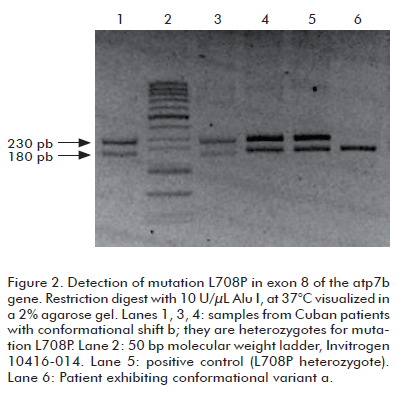
<body><![CDATA[<P   align="justify" ><font face="Verdana, Arial, Helvetica, sans-serif" color="#000000" size="2">In      order to characterize the samples by SSCP, the success of PCR amplification      was first verified and then 3.5 &micro;L of a bromophenol blue stop solution      (0.05% BPB, 10 mM NaOH, 95% formamide, 20 mM EDTA) were mixed with 1 &micro;L      of the amplified product in a final volume of 7 &micro;L, heating the mixture      for 5 min at 96 &deg;C and quickly quenching it on ice. The sample was analyzed      in a commercially available ready-made acrylamide gel (GeneGel Excel 12.5/24      Kit), run in a Genephor unit at 500 V, 15 W, 15 &deg;C for 2 h. The obtained      banding pattern was visualized by silver staining, using the Plus One DNA      Silver Staining kit (Amersham Biosciences, 2002). The runs included positive      controls for the mutations L708P and 2304DupC. </font></P >   <FONT color="#00FF00"><FONT color="#000000"><FONT color="#00FF00"><FONT color="#000000"><FONT color="#00FF00"><FONT color="#000000"><FONT color="#00FF00"><FONT color="#000000">        <P   align="left" ><font face="Verdana, Arial, Helvetica, sans-serif" color="#000000" size="2"><B>Detection      of mutation L708P </b></font></P >       <P   align="justify" ><font face="Verdana, Arial, Helvetica, sans-serif" color="#000000" size="2">Once      the conformational changes of exon 8 were detected, we proceeded to verify      the presence of mutation L708P in the patients whose electrophoretic motilities      matched that of the L708P positive control. Fifteen microliters of the PCR      product were digested with 15 U of <I>Alu </I>I restriction enzyme at 37 &deg;C      for 3 h, visualizing the results by electrophoresis in 2% agarose gels at      constant voltage (250 V). </font></P >   <FONT color="#FF00FF"><FONT color="#000000"><FONT color="#00FF00"><FONT color="#000000">        <P   align="left" ><font face="Verdana, Arial, Helvetica, sans-serif" color="#000000" size="2"><B>Detection      of mutation 2304DupC </b></font></P >       <P   align="justify" ><font face="Verdana, Arial, Helvetica, sans-serif" color="#000000" size="2">The      presence of the 2304DupC mutation was verified by fluorescent DNA sequencing      in an ALF-Express II unit from Amersham Pharmacia Biotech. PCR products were      purified with the QIAquick Kit (Qiagen) following instructions from the manufacturer;      and the resulting electrophoregrams were analyzed with the ALFwin Sequence      Analyser 2.11 and Blast (sequence alignment) software applications. </font></P >       <P   align="left" ><font size="2" face="Verdana, Arial, Helvetica, sans-serif" color="#000000"><B><font size="3">RESULTS      AND DISCUSSION </font></b></font></P >   <FONT size="+1">        <P   align="justify" ><font face="Verdana, Arial, Helvetica, sans-serif" color="#000000" size="2">Studies      in Cuba for the detection of mutations of the <I>atp7b </I>gene in local Wilson&rsquo;s      disease patients started in 2008, making an inventory of conformational variants      before moving on to the examination of their molecular basis. </font></P >   <FONT size="+1"><FONT color="#FF00FF"><FONT color="#000000">        <P   align="justify" ><font face="Verdana, Arial, Helvetica, sans-serif" color="#000000" size="2">The      present work detected 3 conformational variants in exon 8 of <I>atp7b </I>through      the examination of 72 Cuban patients clinically diagnosed with Wilson&rsquo;s      disease. The identified variants were denominated as a, b and c. </font></P >   <FONT color="#FF00FF"><FONT color="#000000">        <P   align="justify" ><font face="Verdana, Arial, Helvetica, sans-serif" color="#000000" size="2"><a href="#fig1">Figure      1</a> depicts the results of the analysis by 12.5% polyacrylamide gel electrophoresis      of exon 8 from 23 out of the 72 patients, together with a positive control.      Conformational shifts a, corresponding to the wild type, and conformational      shift b, corresponding to mutation L708P in heterozygosis from a control sample,      can be observed in the <a href="#fig1">figure 1</a>. Conformer b was detected      in 3 out of the 72 clinically diagnosed, non-related patients. SSCP is based      on the detection of changes, caused by the appearance of a mutation, on the      tridimensional conformation adopted by a single-stranded molecule of DNA,      which are reflected in its electrophoretic mobility. Mutation L708P in exon      8 produces, therefore, a conformational change in the DNA strand detectable      by electrophoresis, as shown in <a href="#fig1">figure 1</a>. </font></P >       <P   align="center" ><font size="2"><a name="fig1"></a><img src="/img/revistas/bta/v28n2/f0103211.gif" width="668" height="348"></font></P >       
]]></body>
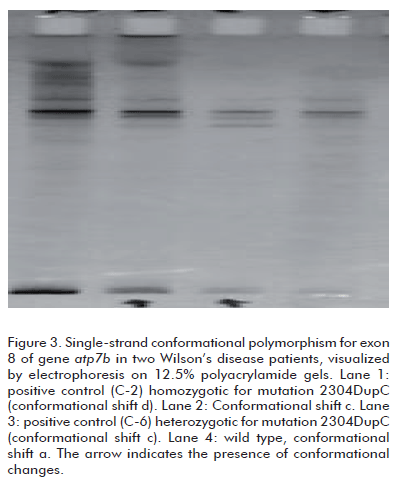
<body><![CDATA[<P   align="justify" ><font face="Verdana, Arial, Helvetica, sans-serif" color="#000000" size="2">In      the samples with conformational change b, the presence of the L708P mutation      was confirmed by digestion with the <I>Alu </I>I restriction endonuclease,      as the mutation eliminates a recognition site for this enzyme. Patients homozygotic      for this mutation produce a single 230 bp band upon digestion, whereas heterozygotes      yield 230, 180 and 50 bp bands. <a href="#fig2">Figure 2</a> demonstrates      the presence of L708P in three heterozygotic patients.</font></P >       <P   align="center" ><font size="2"><a name="fig2"></a><img src="/img/revistas/bta/v28n2/f0203211.gif" width="399" height="395"></font></P >   <FONT color="#FF00FF"><FONT color="#000000">        
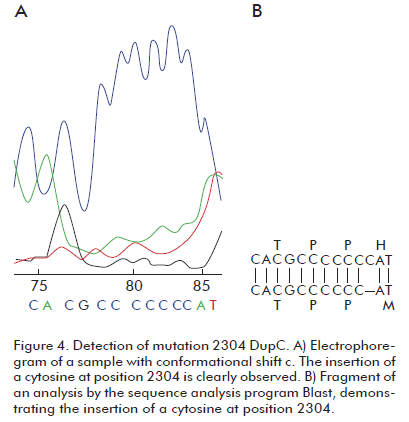
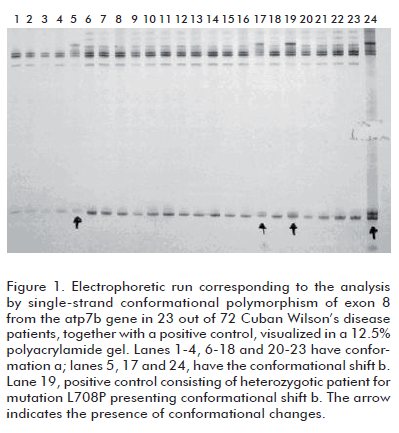
<P   align="justify" ><font face="Verdana, Arial, Helvetica, sans-serif" color="#000000" size="2">This      mutation arises from a thymine to cytosine substitution in position 2123 of      the <I>atp7b</I> gene, resulting in a substitution of leucine by proline at      residue number 708 in the ATP7B polypeptide. It has been detected in 60% of      the cases in the Canaries, making it the most frequent mutation in 24 studied      patients (11). However, L708P has not been detected during studies targeting      other Spanish populations (4, 17). In Brazil it appears in 16.7% of the cases,      being the second most frequent variant in a sample of 60 patients (12); and      appearing in less than 1% of 109 patients from 13 states of the USA and Puerto      Rico (13). The frequency of this mutation among the 72 analyzed Cuban patients      was 2%. </font></P >   <FONT color="#FF00FF"><FONT color="#000000">        <P   align="justify" ><font face="Verdana, Arial, Helvetica, sans-serif" color="#000000" size="2">In      order to completely characterize the molecular basis of the disorder in the      three patients heterozygotic for the L708P mutation, however, it would be      necessary to find and catalog the other mutation that, together with the first,      produces the symptomatology. Studies are therefore underway to analyze the      remaining exons of atp7b<I> gene</I>. </font></P >   <FONT color="#FF00FF"><FONT color="#000000">        <P   align="justify" ><font face="Verdana, Arial, Helvetica, sans-serif" color="#000000" size="2">Our      work, in any case, provides the country with a fast technology for the molecular      diagnosis and determination of mutation L708P in clinically diagnosed patients.      </font></P >       <P   align="justify" ><font face="Verdana, Arial, Helvetica, sans-serif" color="#000000" size="2">One      of the 72 studied samples exhibited conformer C, with the same relative electrophoretic      migration as the positive control for mutation 2304DupC in heterozygosis <a href="#fig3">Figure      3</a>. This mutation results from the insertion of a cytosine at position      2304 of atp7b<I> gene, </I>resulting in a frameshift. The presence of this      mutation produces a conformational change detectable by SSCP (<a href="#fig3">Figure      3</a>), confirmed by DNA sequencing (<a href="#fig4">Figure 4</a>). This variant      was detected at a frequency of 3.3% in the Brazilian sample of 60 patients      mentioned above (12) and at 2.6% in the US (13). The frequency in our sample      of 72 patients was 0.7%. </font></P >       <P   align="center" ><font size="2"><a name="fig3"></a><img src="/img/revistas/bta/v28n2/f0303211.gif" width="400" height="485"></font></P >       
<P   align="center" ><font size="2"><a name="fig4"></a><img src="/img/revistas/bta/v28n2/f0403211.gif" width="409" height="422"></font></P >   <FONT color="#FF00FF"><FONT color="#000000">        
<P   align="justify" ><font face="Verdana, Arial, Helvetica, sans-serif" color="#000000" size="2">The      present is the first study reporting the allelic frequencies for Cuban patients      of two mutations in atp7b<I> gene, </I>obtained from the analysis of 72 cases      clinically diagnosed with Wilson&rsquo;s disease. A total of three conformational      changes were identified. Sixty-seven of the patients had the normal variant;      three had conformer b, corresponding a mutation L708P in heterozygosis, and      one had conformational c, corresponding to mutation 2304 DupC. </font></P >   <FONT color="#FF00FF"><FONT color="#000000">        <P   align="justify" ><font face="Verdana, Arial, Helvetica, sans-serif" color="#000000" size="2">As      mentioned above, the conclusion of the molecular diagnosis of the patients      will require identifying mutations and polymorphisms in the remaining exons      of atp7b<I> gene</I>, especially those most frequently identified during studies      on other populations. </font></P >   <FONT color="#FF00FF"><FONT color="#000000">        ]]></body>
<body><![CDATA[<P   align="left" ><font size="2" face="Verdana, Arial, Helvetica, sans-serif" color="#000000"><B><font size="3">ACKNOWLEDGEMENTS</font>      </b></font></P >   <FONT size="+1">        <P   align="justify" ><font face="Verdana, Arial, Helvetica, sans-serif" color="#000000" size="2">We      thank the patients and their families for agreeing to participate in this      study. Theothor Todorov and Georgios Loudianos kindly provided the positive      controls and plenty of theoretical discussion; and Antonio Tugores volunteered      his expertise in the detection of mutation L708P. We also thank the Cuban      Ministry of Public Health. </font></P >   <FONT size="+1">        <P   align="left" > </P >   <FONT size="+1">        <P   align="left" ><font face="Verdana, Arial, Helvetica, sans-serif" color="#000000" size="2"><B><font size="3">REFERENCES</font>      </b></font></P >       <!-- ref --><P   align="justify" ><font face="Verdana, Arial, Helvetica, sans-serif" color="#000000" size="2">1.      Roberts EA, Schilsky ML; American Association for Study of Liver Diseases      (AASLD). Diagnosis and treatment of Wilson disease: an update. Hepatology.      2008;47(6):2089-111.     </font></P >   <FONT size="+1">        <P   align="justify" ><font face="Verdana, Arial, Helvetica, sans-serif" color="#000000" size="2">2.      Durand F. Wilson&rsquo;s disease: an old disease keeps its old secrets. Eur      J Gastroenterol Hepatol. 2007;19(2):97-9. </font></P >       <!-- ref --><P   align="justify" ><font face="Verdana, Arial, Helvetica, sans-serif" color="#000000" size="2">3.      Kenney SM, Cox DW. Sequence variation database for the Wilson disease copper      transporter, ATP7B. Hum Mutat. 2007; 28(12):1171-7.     </font></P >       <!-- ref --><P   align="justify" ><font face="Verdana, Arial, Helvetica, sans-serif" color="#000000" size="2">4.      Margarit E, Bach V, G&oacute;mez D, Bruguera M, Jara P, Queralt R, <I>et al</I>.      Mutation analysis of Wilson disease in the Spanish population identification      of a prevalent substitution and eight novel mutations in the ATP7B gene. Clin      Genet. 2005;68(1):61-8.     </font></P >       <!-- ref --><P   align="justify" ><font face="Verdana, Arial, Helvetica, sans-serif" color="#000000" size="2">5.      Davies LP, Macintyre G, Cox DW. New mutations in the Wilson disease gene,      ATP7B: implications for molecular testing. Genet Test. 2008;12(1):139-45.          </font></P >       <!-- ref --><P   align="justify" ><font face="Verdana, Arial, Helvetica, sans-serif" color="#000000" size="2">6.      Abdelghaffar TY, Elsayed SM, Elsobky E, Bochow B, B&uuml;ttner J, Schmidt      H. Mutational analysis of ATP7B gene in Egyptian children with Wilson disease:      12 novel mutations. J Hum Genet. 2008;53(8):681-7.     </font></P >       <P   align="justify" ><font face="Verdana, Arial, Helvetica, sans-serif" color="#000000" size="2">7.      Gromadzka G, Schmidt HH, Genschel J, Bochow B, Rodo M, Tarnacka B, <I>et al</I>.      Frameshift and nonsense mutations in the gene for ATPase7B are associated      with severe impairment of copper metabolism and with an early clinical manifestation      of Wilson&rsquo;s disease. Clin Genet. 2005;68(6):524-32. </font></P >       <!-- ref --><P   align="justify" ><font face="Verdana, Arial, Helvetica, sans-serif" color="#000000" size="2">8.      Khaliq A, Majeed A, Asifa S. Spectrum of ATP7B gene mutations in Pakistani      Wilson disease patients: A novel mutation is associated with severe hepatic      and neurological complication. Int J Biol. 2010; 2(1):117-22.     </font></P >       <!-- ref --><P   align="justify" ><font face="Verdana, Arial, Helvetica, sans-serif" color="#000000" size="2">9.      Lovicu M, Lepori MB, Incollu S, Dess&igrave; V, Zappu A, Iorio R, <I>et al</I>.      RNA analysis of consensus sequence splicing mutations: implications for the      diagnosis of Wilson disease. Genet Test Mol Biomarkers. 2009; 13(2):185-91.          </font></P >       ]]></body>
<body><![CDATA[<P   align="justify" ><font face="Verdana, Arial, Helvetica, sans-serif" color="#000000" size="2">10.      Das SK, Ray K. Wilson&rsquo;s disease: an update. Nat Clin Pract Neurol. 2006;2(9):      482-93. </font></P >       <!-- ref --><P   align="justify" ><font face="Verdana, Arial, Helvetica, sans-serif" color="#000000" size="2">11.      Garc&iacute;a-Villarreal L, Daniels S, Shaw SH, Cotton D, Galvin M, Geskes      J, <I>et al</I>. High prevalence of the very rare Wilson disease gene mutation      Leu708Pro in the Island of Gran Canaria (Canary Islands, Spain): a genetic      and clinical study. Hepatology. 2000;32(6):1329-36.     </font></P >       <!-- ref --><P   align="justify" ><font face="Verdana, Arial, Helvetica, sans-serif" color="#000000" size="2">12.      Deguti MM, Genschel J, Cancado EL, Barbosa ER, Bochow B, Mucenic M, <I>et      al</I>. Wilson disease: novel mutations in the ATP7B gene and clinical correlation      in Brazilian patients. Hum Mutat. 2004; 23(4):398.     </font></P >       <!-- ref --><P   align="justify" ><font face="Verdana, Arial, Helvetica, sans-serif" color="#000000" size="2">13.      Shah AB, Chernov I, Zhang HT, Ross BM, Das K, Lutsenko S, <I>et al</I>. Identification      and analysis of mutations in the Wilson disease gene (ATP7B): population frequencies,      genotype-phenotype correlation, and functional analyses. Am J Hum Genet. 1997;61:317-28.          </font></P >       <!-- ref --><P   align="justify" ><font face="Verdana, Arial, Helvetica, sans-serif" color="#000000" size="2">14.      Lepori MB, Lovicu M, Dessi V, Zappu A, Incollu S, Zancan L, <I>et al</I>.      Twenty-four novel mutations in Wilson disease patients of predominantly Italian      origin. Genet Test. 2007;11(3):328-32.     </font></P >       <!-- ref --><P   align="justify" ><font face="Verdana, Arial, Helvetica, sans-serif" color="#000000" size="2">15.      Miller SA, Dykes DD, Polesky HF. A simple salting out procedure for extracting      DNA from human nucleated cells. Nucleic Acids Res. 1988;16(3):1215.     </font></P >       <!-- ref --><P   align="justify" ><font face="Verdana, Arial, Helvetica, sans-serif" color="#000000" size="2">16.      Loudianos G, Dess&igrave; V, Lovicu M, Angius A, Nurchi A, Sturniolo GC, <I>et      al</I>. Further delineation of the molecular pathology of Wilson disease in      the Mediterranean population. Hum Mutat. 1998;12(2):89-94.     </font></P >       <!-- ref --><P   align="justify" ><font face="Verdana, Arial, Helvetica, sans-serif" color="#000000" size="2">17.      Brage A, Tom&eacute; S, Garc&iacute;a A, Carracedo A, Salas A. Clinical and      molecular characterization of Wilson disease in Spanish patients. Hepatol      Res. 2007;37(1):18-26.    </font></P >       <P   align="justify" >&nbsp;</P >       <P   align="justify" ><font size="2" face="Verdana, Arial, Helvetica, sans-serif" color="#000000">Received      in January, 2010. </font>    <br>     <font face="Verdana, Arial, Helvetica, sans-serif" color="#000000" size="2">Accepted      for publication in April, 2011. </font></P >       <P   align="justify" ><font face="Verdana, Arial, Helvetica, sans-serif" size="2">Yulia Clark, Laboratorio      de Biolog&iacute;a Molecular, Centro Nacional de Gen&eacute;tica M&eacute;dica      Ave. 31, esquina 146, Cubanacan, Playa, La Habana, Cuba, E-mail: <a href="mailto:yulia.clark@cngen.sld.cu">yulia.clark@cngen.sld.cu</a></font></P >   </font></font></font></font></font></font></font></font></font></font></font></font></font></font></font></font></font></font></font></font></font></font></font></font></font></font></font></font></font></font></font></font></font></font></font></font></font></font></font></font></font></font></font></font></font></font></font></font></font></font></font></font></font></font></font></font></font></font></font></font></font></font></font></font></font></font></font></font></font></font></font></font></font></font></font></font></font></font></font></font></font></font></font></font></font></font></font></font></font></font></font></font></font></font></font></font></font></font></font></font></font></font></font></font></font></font></font></DIV >      ]]></body><back>
<ref-list>
<ref id="B1">
<label>1</label><nlm-citation citation-type="journal">
<person-group person-group-type="author">
<name>
<surname><![CDATA[Roberts]]></surname>
<given-names><![CDATA[EA]]></given-names>
</name>
<name>
<surname><![CDATA[Schilsky]]></surname>
<given-names><![CDATA[ML]]></given-names>
</name>
</person-group>
<collab>American Association for Study of Liver Diseases (AASLD)</collab>
<article-title xml:lang="en"><![CDATA[Diagnosis and treatment of Wilson disease: an update]]></article-title>
<source><![CDATA[Hepatology]]></source>
<year>2008</year>
<volume>47</volume>
<numero>6</numero>
<issue>6</issue>
<page-range>2089-111</page-range></nlm-citation>
</ref>
<ref id="B2">
<label>2</label><nlm-citation citation-type="journal">
<person-group person-group-type="author">
<name>
<surname><![CDATA[Durand]]></surname>
<given-names><![CDATA[F]]></given-names>
</name>
</person-group>
<article-title xml:lang="en"><![CDATA[Wilson's disease: an old disease keeps its old secrets]]></article-title>
<source><![CDATA[Eur J Gastroenterol Hepatol]]></source>
<year>2007</year>
<volume>19</volume>
<numero>2</numero>
<issue>2</issue>
<page-range>97-9</page-range></nlm-citation>
</ref>
<ref id="B3">
<label>3</label><nlm-citation citation-type="journal">
<person-group person-group-type="author">
<name>
<surname><![CDATA[Kenney]]></surname>
<given-names><![CDATA[SM]]></given-names>
</name>
<name>
<surname><![CDATA[Cox]]></surname>
<given-names><![CDATA[DW]]></given-names>
</name>
</person-group>
<article-title xml:lang="en"><![CDATA[Sequence variation database for the Wilson disease copper transporter, ATP7B]]></article-title>
<source><![CDATA[Hum Mutat]]></source>
<year>2007</year>
<volume>28</volume>
<numero>12</numero>
<issue>12</issue>
<page-range>1171-7</page-range></nlm-citation>
</ref>
<ref id="B4">
<label>4</label><nlm-citation citation-type="journal">
<person-group person-group-type="author">
<name>
<surname><![CDATA[Margarit]]></surname>
<given-names><![CDATA[E]]></given-names>
</name>
<name>
<surname><![CDATA[Bach]]></surname>
<given-names><![CDATA[V]]></given-names>
</name>
<name>
<surname><![CDATA[Gómez]]></surname>
<given-names><![CDATA[D]]></given-names>
</name>
<name>
<surname><![CDATA[Bruguera]]></surname>
<given-names><![CDATA[M]]></given-names>
</name>
<name>
<surname><![CDATA[Jara]]></surname>
<given-names><![CDATA[P]]></given-names>
</name>
<name>
<surname><![CDATA[Queralt]]></surname>
<given-names><![CDATA[R]]></given-names>
</name>
</person-group>
<article-title xml:lang="en"><![CDATA[Mutation analysis of Wilson disease in the Spanish population: identification of a prevalent substitution and eight novel mutations in the ATP7B gene]]></article-title>
<source><![CDATA[Clin Genet]]></source>
<year>2005</year>
<volume>68</volume>
<numero>1</numero>
<issue>1</issue>
<page-range>61-8</page-range></nlm-citation>
</ref>
<ref id="B5">
<label>5</label><nlm-citation citation-type="journal">
<person-group person-group-type="author">
<name>
<surname><![CDATA[Davies]]></surname>
<given-names><![CDATA[LP]]></given-names>
</name>
<name>
<surname><![CDATA[Macintyre]]></surname>
<given-names><![CDATA[G]]></given-names>
</name>
<name>
<surname><![CDATA[Cox]]></surname>
<given-names><![CDATA[DW]]></given-names>
</name>
</person-group>
<article-title xml:lang="en"><![CDATA[New mutations in the Wilson disease gene, ATP7B: implications for molecular testing]]></article-title>
<source><![CDATA[Genet Test]]></source>
<year>2008</year>
<volume>12</volume>
<numero>1</numero>
<issue>1</issue>
<page-range>139-45</page-range></nlm-citation>
</ref>
<ref id="B6">
<label>6</label><nlm-citation citation-type="journal">
<person-group person-group-type="author">
<name>
<surname><![CDATA[Abdelghaffar]]></surname>
<given-names><![CDATA[TY]]></given-names>
</name>
<name>
<surname><![CDATA[Elsayed]]></surname>
<given-names><![CDATA[SM]]></given-names>
</name>
<name>
<surname><![CDATA[Elsobky]]></surname>
<given-names><![CDATA[E]]></given-names>
</name>
<name>
<surname><![CDATA[Bochow]]></surname>
<given-names><![CDATA[B]]></given-names>
</name>
<name>
<surname><![CDATA[Büttner]]></surname>
<given-names><![CDATA[J]]></given-names>
</name>
<name>
<surname><![CDATA[Schmidt]]></surname>
<given-names><![CDATA[H]]></given-names>
</name>
</person-group>
<article-title xml:lang="en"><![CDATA[Mutational analysis of ATP7B gene in Egyptian children with Wilson disease: 12 novel mutations]]></article-title>
<source><![CDATA[J Hum Genet]]></source>
<year>2008</year>
<volume>53</volume>
<numero>8</numero>
<issue>8</issue>
<page-range>681-7</page-range></nlm-citation>
</ref>
<ref id="B7">
<label>7</label><nlm-citation citation-type="journal">
<person-group person-group-type="author">
<name>
<surname><![CDATA[Gromadzka]]></surname>
<given-names><![CDATA[G]]></given-names>
</name>
<name>
<surname><![CDATA[Schmidt]]></surname>
<given-names><![CDATA[HH]]></given-names>
</name>
<name>
<surname><![CDATA[Genschel]]></surname>
<given-names><![CDATA[J]]></given-names>
</name>
<name>
<surname><![CDATA[Bochow]]></surname>
<given-names><![CDATA[B]]></given-names>
</name>
<name>
<surname><![CDATA[Rodo]]></surname>
<given-names><![CDATA[M]]></given-names>
</name>
<name>
<surname><![CDATA[Tarnacka]]></surname>
<given-names><![CDATA[B]]></given-names>
</name>
</person-group>
<article-title xml:lang="en"><![CDATA[Frameshift and nonsense mutations in the gene for ATPase7B are associated with severe impairment of copper metabolism and with an early clinical manifestation of Wilson's disease]]></article-title>
<source><![CDATA[Clin Genet]]></source>
<year>2005</year>
<volume>68</volume>
<numero>6</numero>
<issue>6</issue>
<page-range>524-32</page-range></nlm-citation>
</ref>
<ref id="B8">
<label>8</label><nlm-citation citation-type="journal">
<person-group person-group-type="author">
<name>
<surname><![CDATA[Khaliq]]></surname>
<given-names><![CDATA[A]]></given-names>
</name>
<name>
<surname><![CDATA[Majeed]]></surname>
<given-names><![CDATA[A]]></given-names>
</name>
<name>
<surname><![CDATA[Asifa]]></surname>
<given-names><![CDATA[S]]></given-names>
</name>
</person-group>
<article-title xml:lang="en"><![CDATA[Spectrum of ATP7B gene mutations in Pakistani Wilson disease patients: A novel mutation is associated with severe hepatic and neurological complication]]></article-title>
<source><![CDATA[Int J Biol]]></source>
<year>2010</year>
<volume>2</volume>
<numero>1</numero>
<issue>1</issue>
<page-range>117-22</page-range></nlm-citation>
</ref>
<ref id="B9">
<label>9</label><nlm-citation citation-type="journal">
<person-group person-group-type="author">
<name>
<surname><![CDATA[Lovicu]]></surname>
<given-names><![CDATA[M]]></given-names>
</name>
<name>
<surname><![CDATA[Lepori]]></surname>
<given-names><![CDATA[MB]]></given-names>
</name>
<name>
<surname><![CDATA[Incollu]]></surname>
<given-names><![CDATA[S]]></given-names>
</name>
<name>
<surname><![CDATA[Dessì]]></surname>
<given-names><![CDATA[V]]></given-names>
</name>
<name>
<surname><![CDATA[Zappu]]></surname>
<given-names><![CDATA[A]]></given-names>
</name>
<name>
<surname><![CDATA[Iorio]]></surname>
<given-names><![CDATA[R]]></given-names>
</name>
</person-group>
<article-title xml:lang="en"><![CDATA[RNA analysis of consensus sequence splicing mutations: implications for the diagnosis of Wilson disease]]></article-title>
<source><![CDATA[Genet Test Mol Biomarkers]]></source>
<year>2009</year>
<volume>13</volume>
<numero>2</numero>
<issue>2</issue>
<page-range>185-91</page-range></nlm-citation>
</ref>
<ref id="B10">
<label>10</label><nlm-citation citation-type="journal">
<person-group person-group-type="author">
<name>
<surname><![CDATA[Das]]></surname>
<given-names><![CDATA[SK]]></given-names>
</name>
<name>
<surname><![CDATA[Ray]]></surname>
<given-names><![CDATA[K]]></given-names>
</name>
</person-group>
<article-title xml:lang="en"><![CDATA[Wilson&#8217;s disease: an update]]></article-title>
<source><![CDATA[Nat Clin Pract Neurol]]></source>
<year>2006</year>
<volume>2</volume>
<numero>9</numero>
<issue>9</issue>
<page-range>482-93</page-range></nlm-citation>
</ref>
<ref id="B11">
<label>11</label><nlm-citation citation-type="journal">
<person-group person-group-type="author">
<name>
<surname><![CDATA[García-Villarreal]]></surname>
<given-names><![CDATA[L]]></given-names>
</name>
<name>
<surname><![CDATA[Daniels]]></surname>
<given-names><![CDATA[S]]></given-names>
</name>
<name>
<surname><![CDATA[Shaw]]></surname>
<given-names><![CDATA[SH]]></given-names>
</name>
<name>
<surname><![CDATA[Cotton]]></surname>
<given-names><![CDATA[D]]></given-names>
</name>
<name>
<surname><![CDATA[Galvin]]></surname>
<given-names><![CDATA[M]]></given-names>
</name>
<name>
<surname><![CDATA[Geskes]]></surname>
<given-names><![CDATA[J]]></given-names>
</name>
</person-group>
<article-title xml:lang="en"><![CDATA[High prevalence of the very rare Wilson disease gene mutation Leu708Pro in the Island of Gran Canaria (Canary Islands, Spain): a genetic and clinical study]]></article-title>
<source><![CDATA[Hepatology]]></source>
<year>2000</year>
<volume>32</volume>
<numero>6</numero>
<issue>6</issue>
<page-range>1329-36</page-range></nlm-citation>
</ref>
<ref id="B12">
<label>12</label><nlm-citation citation-type="journal">
<person-group person-group-type="author">
<name>
<surname><![CDATA[Deguti]]></surname>
<given-names><![CDATA[MM]]></given-names>
</name>
<name>
<surname><![CDATA[Genschel]]></surname>
<given-names><![CDATA[J]]></given-names>
</name>
<name>
<surname><![CDATA[Cancado]]></surname>
<given-names><![CDATA[EL]]></given-names>
</name>
<name>
<surname><![CDATA[Barbosa]]></surname>
<given-names><![CDATA[ER]]></given-names>
</name>
<name>
<surname><![CDATA[Bochow]]></surname>
<given-names><![CDATA[B]]></given-names>
</name>
<name>
<surname><![CDATA[Mucenic]]></surname>
<given-names><![CDATA[M]]></given-names>
</name>
</person-group>
<article-title xml:lang="en"><![CDATA[Wilson disease: novel mutations in the ATP7B gene and clinical correlation in Brazilian patients]]></article-title>
<source><![CDATA[Hum Mutat]]></source>
<year>2004</year>
<volume>23</volume>
<numero>4</numero>
<issue>4</issue>
<page-range>398</page-range></nlm-citation>
</ref>
<ref id="B13">
<label>13</label><nlm-citation citation-type="journal">
<person-group person-group-type="author">
<name>
<surname><![CDATA[Shah]]></surname>
<given-names><![CDATA[AB]]></given-names>
</name>
<name>
<surname><![CDATA[Chernov]]></surname>
<given-names><![CDATA[I]]></given-names>
</name>
<name>
<surname><![CDATA[Zhang]]></surname>
<given-names><![CDATA[HT]]></given-names>
</name>
<name>
<surname><![CDATA[Ross]]></surname>
<given-names><![CDATA[BM]]></given-names>
</name>
<name>
<surname><![CDATA[Das]]></surname>
<given-names><![CDATA[K]]></given-names>
</name>
<name>
<surname><![CDATA[Lutsenko]]></surname>
<given-names><![CDATA[S]]></given-names>
</name>
</person-group>
<article-title xml:lang="en"><![CDATA[Identification and analysis of mutations in the Wilson disease gene (ATP7B): population frequencies, genotype-phenotype correlation, and functional analyses]]></article-title>
<source><![CDATA[Am J Hum Genet]]></source>
<year>1997</year>
<volume>61</volume>
<page-range>317-28</page-range></nlm-citation>
</ref>
<ref id="B14">
<label>14</label><nlm-citation citation-type="journal">
<person-group person-group-type="author">
<name>
<surname><![CDATA[Lepori]]></surname>
<given-names><![CDATA[MB]]></given-names>
</name>
<name>
<surname><![CDATA[Lovicu]]></surname>
<given-names><![CDATA[M]]></given-names>
</name>
<name>
<surname><![CDATA[Dessi]]></surname>
<given-names><![CDATA[V]]></given-names>
</name>
<name>
<surname><![CDATA[Zappu]]></surname>
<given-names><![CDATA[A]]></given-names>
</name>
<name>
<surname><![CDATA[Incollu]]></surname>
<given-names><![CDATA[S]]></given-names>
</name>
<name>
<surname><![CDATA[Zancan]]></surname>
<given-names><![CDATA[L]]></given-names>
</name>
</person-group>
<article-title xml:lang="en"><![CDATA[Twenty-four novel mutations in Wilson disease patients of predominantly Italian origin]]></article-title>
<source><![CDATA[Genet Test]]></source>
<year>2007</year>
<volume>11</volume>
<numero>3</numero>
<issue>3</issue>
<page-range>328-32</page-range></nlm-citation>
</ref>
<ref id="B15">
<label>15</label><nlm-citation citation-type="journal">
<person-group person-group-type="author">
<name>
<surname><![CDATA[Miller]]></surname>
<given-names><![CDATA[SA]]></given-names>
</name>
<name>
<surname><![CDATA[Dykes]]></surname>
<given-names><![CDATA[DD]]></given-names>
</name>
<name>
<surname><![CDATA[Polesky]]></surname>
<given-names><![CDATA[HF]]></given-names>
</name>
</person-group>
<article-title xml:lang="en"><![CDATA[A simple salting out procedure for extracting DNA from human nucleated cells]]></article-title>
<source><![CDATA[Nucleic Acids Res]]></source>
<year>1988</year>
<volume>16</volume>
<numero>3</numero>
<issue>3</issue>
<page-range>1215</page-range></nlm-citation>
</ref>
<ref id="B16">
<label>16</label><nlm-citation citation-type="journal">
<person-group person-group-type="author">
<name>
<surname><![CDATA[Loudianos]]></surname>
<given-names><![CDATA[G]]></given-names>
</name>
<name>
<surname><![CDATA[Dessì]]></surname>
<given-names><![CDATA[V]]></given-names>
</name>
<name>
<surname><![CDATA[Lovicu]]></surname>
<given-names><![CDATA[M]]></given-names>
</name>
<name>
<surname><![CDATA[Angius]]></surname>
<given-names><![CDATA[A]]></given-names>
</name>
<name>
<surname><![CDATA[Nurchi]]></surname>
<given-names><![CDATA[A]]></given-names>
</name>
<name>
<surname><![CDATA[Sturniolo]]></surname>
<given-names><![CDATA[GC]]></given-names>
</name>
</person-group>
<article-title xml:lang="en"><![CDATA[Further delineation of the molecular pathology of Wilson disease in the Mediterranean population]]></article-title>
<source><![CDATA[Hum Mutat]]></source>
<year>1998</year>
<volume>12</volume>
<numero>2</numero>
<issue>2</issue>
<page-range>89-94</page-range></nlm-citation>
</ref>
<ref id="B17">
<label>17</label><nlm-citation citation-type="journal">
<person-group person-group-type="author">
<name>
<surname><![CDATA[Brage]]></surname>
<given-names><![CDATA[A]]></given-names>
</name>
<name>
<surname><![CDATA[Tomé]]></surname>
<given-names><![CDATA[S]]></given-names>
</name>
<name>
<surname><![CDATA[García]]></surname>
<given-names><![CDATA[A]]></given-names>
</name>
<name>
<surname><![CDATA[Carracedo]]></surname>
<given-names><![CDATA[A]]></given-names>
</name>
<name>
<surname><![CDATA[Salas]]></surname>
<given-names><![CDATA[A]]></given-names>
</name>
</person-group>
<article-title xml:lang="en"><![CDATA[Clinical and molecular characterization of Wilson disease in Spanish patients]]></article-title>
<source><![CDATA[Hepatol Res]]></source>
<year>2007</year>
<volume>37</volume>
<numero>1</numero>
<issue>1</issue>
<page-range>18-26</page-range></nlm-citation>
</ref>
</ref-list>
</back>
</article>