<?xml version="1.0" encoding="ISO-8859-1"?><article xmlns:mml="http://www.w3.org/1998/Math/MathML" xmlns:xlink="http://www.w3.org/1999/xlink" xmlns:xsi="http://www.w3.org/2001/XMLSchema-instance">
<front>
<journal-meta>
<journal-id>1027-2852</journal-id>
<journal-title><![CDATA[Biotecnología Aplicada]]></journal-title>
<abbrev-journal-title><![CDATA[Biotecnol Apl]]></abbrev-journal-title>
<issn>1027-2852</issn>
<publisher>
<publisher-name><![CDATA[Editorial Elfos Scientiae]]></publisher-name>
</publisher>
</journal-meta>
<article-meta>
<article-id>S1027-28522011000200006</article-id>
<title-group>
<article-title xml:lang="en"><![CDATA[Assessment of basal and induced DNA damage on lymphocytes from three mouse lines by means of the alkaline comet assay]]></article-title>
<article-title xml:lang="es"><![CDATA[Evaluación del daño basal e inducido en el ADN de linfocitos de tres líneas de ratones, mediante el ensayo cometa alcalino]]></article-title>
</title-group>
<contrib-group>
<contrib contrib-type="author">
<name>
<surname><![CDATA[Arencibia]]></surname>
<given-names><![CDATA[Daniel F]]></given-names>
</name>
<xref ref-type="aff" rid="A01"/>
</contrib>
<contrib contrib-type="author">
<name>
<surname><![CDATA[Rosario]]></surname>
<given-names><![CDATA[Luis A]]></given-names>
</name>
<xref ref-type="aff" rid="A02"/>
</contrib>
<contrib contrib-type="author">
<name>
<surname><![CDATA[Rodríguez]]></surname>
<given-names><![CDATA[Yanet]]></given-names>
</name>
<xref ref-type="aff" rid="A02"/>
</contrib>
</contrib-group>
<aff id="A02">
<institution><![CDATA[,Universidad de La Habana, UH Instituto de Farmacia y Alimentos ]]></institution>
<addr-line><![CDATA[La Habana ]]></addr-line>
<country>Cuba</country>
</aff>
<aff id="A01">
<institution><![CDATA[,Instituto Finlay Daniel F Arencibia, Vicepresidencia de Investigaciones ]]></institution>
<addr-line><![CDATA[La Habana ]]></addr-line>
<country>Cuba</country>
</aff>
<pub-date pub-type="pub">
<day>00</day>
<month>06</month>
<year>2011</year>
</pub-date>
<pub-date pub-type="epub">
<day>00</day>
<month>06</month>
<year>2011</year>
</pub-date>
<volume>28</volume>
<numero>2</numero>
<fpage>101</fpage>
<lpage>105</lpage>
<copyright-statement/>
<copyright-year/>
<self-uri xlink:href="http://scielo.sld.cu/scielo.php?script=sci_arttext&amp;pid=S1027-28522011000200006&amp;lng=en&amp;nrm=iso"></self-uri><self-uri xlink:href="http://scielo.sld.cu/scielo.php?script=sci_abstract&amp;pid=S1027-28522011000200006&amp;lng=en&amp;nrm=iso"></self-uri><self-uri xlink:href="http://scielo.sld.cu/scielo.php?script=sci_pdf&amp;pid=S1027-28522011000200006&amp;lng=en&amp;nrm=iso"></self-uri><abstract abstract-type="short" xml:lang="en"><p><![CDATA[The formation of single-strand breaks and alkali-labile sites on DNA has been extensively used for genotoxicity testing, given its involvement in degenerative disorders, cancer and oxidative stress. An alkaline variation of the single-cell electrophoresis (comet) assay used for the detection of DNA damage was developed during the eighties, providing data on this phenomenon at the level of individual cells for the first time. The present work employs the alkaline comet assay to compare three mouse lines regarding the basal and cyclophosphamide-induced frequency of single-strand breaks and the appearance of alkali-labile sites in DNA from peripheral blood lymphocytes. A total of 10 mice/sex/group of the Balb/c, OF-1 and NMRI lines were treated for 14 days, distributed into an untreated negative control group, two groups receiving excipients and a positive control group receiving intraperitoneal cyclophosphamide at 50 mg/kg. After 14 days, single cells from peripheral blood leukocytes were analyzed by alkaline electrophoresis to estimate DNA damage. It was concluded that the best choice for this type of studies is represented by the Balb/c line, due to its low basal frequency for the analyzed variables. This result indicates that Balb/c may be the best biomodel for preclinical testing of drugs, vaccines and other products.]]></p></abstract>
<abstract abstract-type="short" xml:lang="es"><p><![CDATA[Las rupturas de simple cadena y la formación de sitios lábiles al álcali en el ADN, son parámetros ampliamente utilizados para la detección de genotoxicidad. Se ha demostrado su implicación en enfermedades degenerativas, en el cáncer, y recientemente, su vínculo con el estrés oxidativo. En la década de 1980 se desarrolló la variante alcalina de la electroforesis de células individuales (ensayo cometa), para la detección de daño en el ADN. Por primera vez se proporcionaron datos en células individuales. Este artículo tuvo como objetivo la comparación de la frecuencia basal e inducida con ciclofosfamida, de las rupturas de simple cadena y la formación sitios lábiles al álcali en el ADN de leucocitos de sangre periférica, mediante el ensayo cometa alcalino, en tres líneas de ratones. Se utilizaron 10 ratones de los dos sexos, de las líneas Balb/c, OF-1 y NMRI. Se formó un grupo control negativo (al que no se no le administró ninguna sustancia), dos grupos controles, a los que se administraron sustancias vehículo, y un grupo control positivo al que se administraron 50 mg/kg de ciclofosfamida por vía intraperitoneal. Pasados 14 días, se realizó la electroforesis alcalina de células individuales en gel de leucocitos de sangre periférica, para demostrar el posible daño en el ADN. Se concluyó que la línea más adecuada para estos estudios es la Balb/c, por la baja frecuencia basal que presentan las variables analizadas. Este resultado indica que puede ser el mejor biomodelo para la evaluación preclínica de drogas, vacunas y otros productos.]]></p></abstract>
<kwd-group>
<kwd lng="en"><![CDATA[Comet assay]]></kwd>
<kwd lng="en"><![CDATA[damage]]></kwd>
<kwd lng="en"><![CDATA[DNA]]></kwd>
<kwd lng="en"><![CDATA[mice]]></kwd>
<kwd lng="en"><![CDATA[cyclophosphamide]]></kwd>
<kwd lng="es"><![CDATA[ensayo cometa]]></kwd>
<kwd lng="es"><![CDATA[daño]]></kwd>
<kwd lng="es"><![CDATA[ADN]]></kwd>
<kwd lng="es"><![CDATA[ratones]]></kwd>
<kwd lng="es"><![CDATA[ciclofosfamida]]></kwd>
</kwd-group>
</article-meta>
</front><body><![CDATA[ <DIV class="Sect"   >        <P   align="right" ><font face="Verdana, Arial, Helvetica, sans-serif" size="2"><b>RESEARCH</b></font></P >       <P   align="right" >&nbsp;</P >       <P   align="left" ><font size="2" color="#000000" face="Verdana, Arial, Helvetica, sans-serif"><B><font size="4">Assessment      of basal and induced DNA damage on lymphocytes from three mouse lines by means      of the alkaline comet assay</font> </b></font></P >       <P   align="left" >&nbsp;</P >   <FONT size="+1" color="#000000">        <P   align="left" ><font face="Verdana, Arial, Helvetica, sans-serif" color="#000000" size="2"><B><font size="3">Evaluaci&oacute;n      del da&ntilde;o basal e inducido en el ADN de linfocitos de tres l&iacute;neas      de ratones, mediante el ensayo cometa alcalino</font></b></font></P >       <P   align="left" >&nbsp;</P >       <P   align="left" >&nbsp;</P >       <P   align="left" ><font face="Verdana, Arial, Helvetica, sans-serif" color="#000000" size="2"><b>Daniel      F Arencibia<sup>1</sup>, Luis A Rosario<sup>2</sup>, Yanet Rodr&iacute;guez<sup>2</sup></b>      </font></P >   <FONT size="+1"><FONT size="+1"><FONT size="+1"><FONT size="+1"><FONT size="+1"><FONT size="+1">        <P   align="left" ><font size="2" face="Verdana, Arial, Helvetica, sans-serif" color="#000000"><sup>1</sup>Vicepresidencia      de Investigaciones, Instituto Finlay Calle 17 e/ 198 y 200, Atabey, Municipio      Playa, AP 16017, La Habana, Cuba.     ]]></body>
<body><![CDATA[<br>     <sup> 2</sup>Instituto de Farmacia y Alimentos, Universidad de La Habana,      UH Calle 222 e/ 25 y 27, La Coronela, Playa, La Habana, Cuba. </font></P >       <P   align="left" >&nbsp;</P >   </font></font></font></font></font></font></font>   <hr>   <FONT size="+1" color="#000000"><FONT size="+1"><FONT size="+1"><FONT size="+1"><FONT size="+1"><FONT size="+1"><FONT size="+1">       <P   align="left" ><font size="2" face="Verdana, Arial, Helvetica, sans-serif" color="#000000">      </font><font face="Verdana, Arial, Helvetica, sans-serif" color="#000000" size="2"><B>ABSTRACT<I>      </I></b></font></P >   <FONT size="+1"><FONT size="+1"><FONT size="+1"><FONT size="+1">     <P   align="justify" ><font face="Verdana, Arial, Helvetica, sans-serif" color="#000000" size="2">The      formation of single-strand breaks and alkali-labile sites on DNA has been      extensively used for genotoxicity testing, given its involvement in degenerative      disorders, cancer and oxidative stress. An alkaline variation of the single-cell      electrophoresis (comet) assay used for the detection of DNA damage was developed      during the eighties, providing data on this phenomenon at the level of individual      cells for the first time. The present work employs the alkaline comet assay      to compare three mouse lines regarding the basal and cyclophosphamide-induced      frequency of single-strand breaks and the appearance of alkali-labile sites      in DNA from peripheral blood lymphocytes. A total of 10 mice/sex/group of      the Balb/c, OF-1 and NMRI lines were treated for 14 days, distributed into      an untreated negative control group, two groups receiving excipients and a      positive control group receiving intraperitoneal cyclophosphamide at 50 mg/kg.      After 14 days, single cells from peripheral blood leukocytes were analyzed      by alkaline electrophoresis to estimate DNA damage. It was concluded that      the best choice for this type of studies is represented by the Balb/c line,      due to its low basal frequency for the analyzed variables. This result indicates      that Balb/c may be the best biomodel for preclinical testing of drugs, vaccines      and other products. </font></P >       <P   align="left" ><font face="Verdana, Arial, Helvetica, sans-serif" color="#000000" size="2"><b>Keywords</b>:      Comet assay, damage, DNA, mice, cyclophosphamide.</font></P >   </font></font></font></font></font></font></font></font></font></font></font>    <hr>   <FONT size="+1" color="#000000"><FONT size="+1"><FONT size="+1"><FONT size="+1"><FONT size="+1"><FONT size="+1"><FONT size="+1"><FONT size="+1"><FONT size="+1"><FONT size="+1"><FONT size="+1">       <P   align="left" ><font face="Verdana, Arial, Helvetica, sans-serif" color="#000000" size="2"><B>RESUMEN<I>      </I></b></font></P >       <P   align="justify" ><font face="Verdana, Arial, Helvetica, sans-serif" color="#000000" size="2">Las      rupturas de simple cadena y la formaci&oacute;n de sitios l&aacute;biles al      &aacute;lcali en el ADN, son par&aacute;metros ampliamente utilizados para      la detecci&oacute;n de genotoxicidad. Se ha demostrado su implicaci&oacute;n      en enfermedades degenerativas, en el c&aacute;ncer, y recientemente, su v&iacute;nculo      con el estr&eacute;s oxidativo. En la d&eacute;cada de 1980 se desarroll&oacute;      la variante alcalina de la electroforesis de c&eacute;lulas individuales (ensayo      cometa), para la detecci&oacute;n de da&ntilde;o en el ADN. Por primera vez      se proporcionaron datos en c&eacute;lulas individuales. Este art&iacute;culo      tuvo como objetivo la comparaci&oacute;n de la frecuencia basal e inducida      con ciclofosfamida, de las rupturas de simple cadena y la formaci&oacute;n      sitios l&aacute;biles al &aacute;lcali en el ADN de leucocitos de sangre perif&eacute;rica,      mediante el ensayo cometa alcalino, en tres l&iacute;neas de ratones. Se utilizaron      10 ratones de los dos sexos, de las l&iacute;neas Balb/c, OF-1 y NMRI. Se      form&oacute; un grupo control negativo (al que no se no le administr&oacute;      ninguna sustancia), dos grupos controles, a los que se administraron sustancias      veh&iacute;culo, y un grupo control positivo al que se administraron 50 mg/kg      de ciclofosfamida por v&iacute;a intraperitoneal. Pasados 14 d&iacute;as,      se realiz&oacute; la electroforesis alcalina de c&eacute;lulas individuales      en gel de leucocitos de sangre perif&eacute;rica, para demostrar el posible      da&ntilde;o en el ADN. Se concluy&oacute; que la l&iacute;nea m&aacute;s adecuada      para estos estudios es la Balb/c, por la baja frecuencia basal que presentan      las variables analizadas. Este resultado indica que puede ser el mejor biomodelo      para la evaluaci&oacute;n precl&iacute;nica de drogas, vacunas y otros productos.      </font></P >   <FONT size="+1"><FONT size="+1">        <P   align="left" ><font face="Verdana, Arial, Helvetica, sans-serif" color="#000000" size="2"><b>Palabras      clave</b>: ensayo cometa, da&ntilde;o, ADN, ratones, ciclofosfamida</font>.</P >   </font></font></font></font></font></font></font></font></font></font></font></font></font>    <hr>   <FONT size="+1" color="#000000"><FONT size="+1"><FONT size="+1"><FONT size="+1"><FONT size="+1"><FONT size="+1"><FONT size="+1"><FONT size="+1"><FONT size="+1"><FONT size="+1"><FONT size="+1"><FONT size="+1"><FONT size="+1">        <P   align="left" >&nbsp;</P >       <P   align="left" >&nbsp;</P >       ]]></body>
<body><![CDATA[<P   align="left" ><font size="3" face="Verdana, Arial, Helvetica, sans-serif" color="#000000"><b>INTRODUCTION</b></font><font size="2" face="Verdana, Arial, Helvetica, sans-serif" color="#000000">      </font></P >   <B></B>        <P   align="justify" ><font size="2" face="Verdana, Arial, Helvetica, sans-serif" color="#000000">The      large numbers of commercially available pharmaceuticals that characterize      modern life have become a double-edged sword. While, on one hand, they have      undoubtedly increased our quality of life, many of them pose a significant      risk due to their high toxicity (1, 2). Current legislation requires all prospective      drugs to be evaluated for safety long before their registration or marketing,      so as to minimize or eliminate their use the risk/benefit ratio should be      considered unacceptable to society (2). </font></P >   <FONT size="+1"><FONT size="+1">        <P   align="justify" ><font face="Verdana, Arial, Helvetica, sans-serif" color="#000000" size="2">The      formation of single strand breaks and alkali-labile sites on DNA is widely      used for the detection of genotoxicities. These phenomena, and DNA damage      in general, have been shown to be involved in degenerative disorders, cancer      and, more recently, oxidative stress (3, 4). One of the available assays for      the detection of DNA damage is the alkaline variant of single-cell electrophoresis,      developed during the eighties and also known as the comet assay. This was      the first DNA damage assay providing single-cell data, and since then it has      become a cornerstone of the evaluation of drugs, fertilizers and pesticides      (5). </font></P >   <FONT size="+1"><FONT size="+1"><FONT size="+1"><FONT size="+1">        <P   align="justify" ><font face="Verdana, Arial, Helvetica, sans-serif" color="#000000" size="2">In      order to perform the comet assay, single cells are resuspended into low melting      point agarose to form a microgel. Once immobilized in this fashion, they are      lysed <I>in situ </I>to remove cellular proteins and cell DNA is forced to      unwound (6) by breaking the hydrogen bonds holding both strands together,      using alkaline/neutral conditions. At pH higher than 13, alkali-labile sites      (ALS), such as apurinic sites, quickly transform into single-strand breaks      (7); therefore, using this pH allows estimating the number of ALS by quantifying      such breakages (8). Unwound DNA is subjected to electrophoresis in an alkaline      buffer (6, 9); and staining the DNA at the end of the run produces a visual      pattern much like that of a comet (10). </font></P >   <FONT color="#FF00FF"><FONT color="#000000"><FONT size="+1"><FONT size="+1"><FONT size="+1"><FONT size="+1">        <P   align="justify" ><font face="Verdana, Arial, Helvetica, sans-serif" color="#000000" size="2">Cell      that have sustained DNA damage exhibit increased migration in this assay (8,      11). Control cells, with a small number of DNA breaks, have level 0 comets,      following the standard classification for DNA damage. DNA migrates slowly      in this case; the &ldquo;tail&rdquo; of the comet contains only 10% of the      total DNA. In order to detect and quantify DNA damage, the gel can be stained      with different agents including <I>e.g. </I>silver nitrate, although intercalating      fluorescent dyes represent the most common choice. In the end, selecting one      or the other depends on the specific needs of the investigation (12). </font></P >   <FONT color="#FF00FF"><FONT color="#000000">        <P   align="justify" ><font face="Verdana, Arial, Helvetica, sans-serif" color="#000000" size="2">Genotoxicity      evaluations are usually performed with DNA from peripheral blood leukocytes,      extracted from animals treated with the compound under examination. Therefore,      the availability of experimental biomodels with a low basal frequency for      the appearance of single-strand breaks and ALS in their peripheral leukocyte      DNA, with a high sensitivity to mutagenic and genotoxic substances, and yielding      measurements with the smallest margin of error, is clearly critical. </font></P >       <P   align="justify" ><font color="#000000" face="Verdana, Arial, Helvetica, sans-serif" size="2"><I>In      vivo </I>genotoxicity studies use positive controls consisting of mutagenic      substances. One of the mutagens most often used for this purpose is cyclophosphamide      (CF), an alkylating agent forming mono-adducts and inter-strand crosslinks      whenever a break appears due to the action of cellular DNA repair processes.      Although CF is a very effective antineoplastic agent, its performance in the      <I>in vivo </I>alkaline comet assay is not well described, as bleomycin is      almost always used as a positive control for this technique. CF, however,      is much cheaper and easier to handle, is less hazardous to the personnel and      poses simpler decontamination demands (9). Therefore, we have decided to use      CF as positive control in this genotoxicity assay. </font></P >   <FONT color="#FF00FF"><FONT color="#000000"><FONT color="#FF00FF"><FONT color="#000000">        <P   align="justify" ><font face="Verdana, Arial, Helvetica, sans-serif" color="#000000" size="2">The      present work compares the basal and induced frequency of single-strand breaks      and ALS in DNA from peripheral leukocytes of Balb/c, OF-1 and NMRI mice of      both sexes treated with CF; evaluated with the comet assay. The results will      serve the identification of the best experimental biomodel for the study of      other drugs or agents whose genotoxic effects need to be tested. </font></P >       <P   align="left" ><font size="2" face="Verdana, Arial, Helvetica, sans-serif" color="#000000"><B><font size="3">MATERIALS      AND METHODS</font> </b></font></P >   <FONT size="+1"><B>        <P   align="left" ><font size="2" face="Verdana, Arial, Helvetica, sans-serif" color="#000000">Animals      </font></P >   </B>        ]]></body>
<body><![CDATA[<P   align="justify" ><font size="2" face="Verdana, Arial, Helvetica, sans-serif" color="#000000">The      present study used young adults (8-9 weeks) of both sexes from the mouse lines      Balb/c, OF-1 and NMRI, with a bodyweight at the end of the quarantine period      of 26-30 g. They were kept at a temperature of 25 &plusmn; 2 &ordm;C, a relative      humidity of 60 &plusmn; 10%, and a 12-hour photoperiod, with water and food      <I>ad libitum</I>. Their alimentation consisted on EMO1002 all-purpose autoclavable      rodent chow (requiring no dietary supplementation) with batch number 1181102,      supplied by the Center for the Production of Laboratory Animals (CENPALAB).      The same conditions were used for all the groups of the study. The experimentation      abided by established ethical guidelines for research with laboratory animals      (13). </font></P >   <FONT size="+1"><FONT color="#00FF00"><FONT color="#000000"><FONT color="#00FF00"><FONT color="#000000"><FONT color="#00FF00"><FONT color="#000000"><FONT color="#FF00FF"><FONT color="#000000">        <P   align="left" ><font face="Verdana, Arial, Helvetica, sans-serif" color="#000000" size="2"><B>Administration      and dosage </b></font></P >   <B>        <P   align="left" ><font color="#000000" face="Verdana, Arial, Helvetica, sans-serif" size="2"><I>Experimental      groups </I></font></P >   </B>        <P   align="justify" ><font color="#000000" face="Verdana, Arial, Helvetica, sans-serif" size="2"><a href="/img/revistas/bta/v28n2/t0105211.gif">Table      1</a> summarizes the experimental groups used in the single-cell alkaline      comet assay for peripheral blood leukocytes from the three mouse lines of      both sexes; as well as the administered substances, administration routes      (oral or intraperitoneal) and maximum administration volume, for two replicates.      </font></P >   <FONT color="#FF00FF"><FONT color="#000000">        
<P   align="justify" ><font face="Verdana, Arial, Helvetica, sans-serif" color="#000000" size="2">The      test compounds were administered between 10:30 and 11:30 a.m., and the concentrations      were adjusted weekly to match the changing bodyweight of the animals. The      animals were randomly assigned to the treatment groups, using 10 mice per      group, per sex, and per line. Only two replicates per experimental point were      used in this study, out of economical considerations arising from the price      of the reagents consumed by the assay. </font></P >       <P   align="justify" ><font face="Verdana, Arial, Helvetica, sans-serif" color="#000000" size="2">Group      1 used untreated animals as negative control. These animals, however, did      undergo mock gastric intubations for 14 days so that they could be directly      compared to the other groups. </font></P >       <P   align="justify" ><font face="Verdana, Arial, Helvetica, sans-serif" color="#000000" size="2">Group      2 used 2% Tween 65 as test compound, orally administered for 14 days and freshly      prepared 2 hours before administration. This excipient is a surfactant present      in most oil-based formulations (14-16). </font></P >       <P   align="justify" ><font face="Verdana, Arial, Helvetica, sans-serif" color="#000000" size="2">Group      3 used 0.9% NaCl as test compound, orally administered for 14 days and freshly      prepared 2 hours before administration. This solution is used to dissolve      most hydrophilic drugs (17, 18). </font></P >       <P   align="justify" ><font face="Verdana, Arial, Helvetica, sans-serif" color="#000000" size="2">Group      4 constituted the positive control, administered intraperitoneally with CF      at 50 mg/kg bodyweight. CF (n,n-bis-(-ethyl chloride)-n&rsquo;), o-esther      diamide of propynel phosphoric acid (C<sub>17</sub>H<sub>15</sub>C<sub>l2</sub>N<sub>2</sub>O<sub>5</sub>P),      purchased from the Mexican manufacturer Lemri S.A., under the trademark Ledoxina.      It was dissolved in saline solution (0.9% NaCl) (19) and administered to the      animals right after its preparation, at 48 hours, and then 24 hours before      the scheduled date for euthanasia (9, 20). </font></P >   <FONT size="+1" color="#3163FF"><FONT size="+1" color="#000000"><FONT size="+1" color="#3163FF"><FONT size="+1" color="#000000"><FONT size="+1" color="#3163FF"><FONT size="+1" color="#000000"><FONT size="+1" color="#3163FF"><FONT size="+1" color="#000000"><FONT size="+1" color="#3163FF"><FONT size="+1" color="#000000">        <P   align="left" ><font face="Verdana, Arial, Helvetica, sans-serif" color="#000000" size="2"><B>Clinical      observations </b></font></P >       ]]></body>
<body><![CDATA[<P   align="justify" ><font size="2" face="Verdana, Arial, Helvetica, sans-serif" color="#000000">Two      daily observations were performed; one in the morning from 8:30 to10:30 a.m.      and one in the afternoon, from 3:00 to 4:30 p.m. The parameters to be monitored      in each observation were the general health status of the animals, including      palpation and detection of lesions, and any possible alterations of the respiratory,      nervous, cardiovascular and gastrointestinal systems, as well as the appearance      of coat, eyes and mucosal coloration. </font></P >   <FONT size="+1"><FONT size="+1">        <P   align="left" ><font face="Verdana, Arial, Helvetica, sans-serif" color="#000000" size="2"><B>Euthanasia      </b></font></P >       <P   align="justify" ><font face="Verdana, Arial, Helvetica, sans-serif" color="#000000" size="2">The      animals were anesthetized under an ether atmosphere until all reflexes were      lost, and were sacrificed by cervical dislocation after drawing blood samples.      Groups 1, 2 and 3 were euthanized 24 hours after the last administration at      day 14. Group 4, treated with CF, was euthanized 24 hours after the second      administration of the mutagen, scheduled to coincide with the sacrifice date      for the remaining animals. </font></P >       <P   align="left" ><font face="Verdana, Arial, Helvetica, sans-serif" color="#000000" size="2"><B>Tests      </b></font></P >   <B>        <P   align="left" ><font color="#000000" face="Verdana, Arial, Helvetica, sans-serif" size="2"><I>Blood      sample collection </I></font></P >   </B>        <P   align="justify" ><font color="#000000" face="Verdana, Arial, Helvetica, sans-serif" size="2">Once      all reflexes were lost, a drop of blood (equivalent to 15-20 &micro;L) was      extracted from the tail of each animal and placed into a vial containing 10      </font><font size="2" color="#000000"><font color="#FF00FF"><font color="#FF00FF"><font color="#FF00FF"><font color="#FF00FF"><font color="#00FF00"><font color="#00FF00"><font color="#00FF00"><font color="#FF00FF"><font color="#FF00FF"><font color="#3163FF"><font color="#3163FF"><font color="#3163FF"><font color="#3163FF"><font color="#3163FF"><font face="Verdana, Arial, Helvetica, sans-serif">&micro;</font></font></font></font></font></font></font></font></font></font></font></font></font></font></font></font><font color="#000000" face="Verdana, Arial, Helvetica, sans-serif" size="2">L      of sodium heparin, supplied by LIORAD Laboratories at 5000 IU/mL. The samples      were handled at 4&deg;C under dimmed light to avoid subjecting the DNA to      additional damage, thus decreasing the false positive rate and minimizing      the influence of experimental manipulation on the results (21). </font></P >   <FONT color="#FF00FF"><FONT color="#000000"><FONT color="#00FF00"><FONT color="#000000"><FONT color="#00FF00"><FONT color="#000000"><FONT color="#00FF00"><FONT color="#000000">        <P   align="left" ><font color="#000000" face="Verdana, Arial, Helvetica, sans-serif" size="2"><B><I>Single-cell      alkaline electrophoresis assay in peripheral blood leukocytes (alkaline comet      assay) </I></b></font></P >   <FONT color="#FF00FF">        <P   align="justify" ><font face="Verdana, Arial, Helvetica, sans-serif" color="#000000" size="2">Blood      samples (15-20 &mu;L) were resuspended in 140 &mu;L of 0.5% low melting point      agarose. Then, previously prepared agarose slides were added. They were submerged      in lysis solution (2.5 M NaCl, 100 mM EDTA and 10 mM Tris, 1% Triton, 10%      DMSO, pH 10) for 1.5 h at 4 &ordm;C and denatured for 20 min in electrophoresis      buffer (3% NaOH 10 N, 0.5% 200 mM EDTA, pH &gt; 13). Electrophoresis was performed      at 300 mA and 1 V/cm for 18-20 min. The slides were washed with neutralization      buffer (0.4 M Tris, pH 7.5), rinsed with distilled water, and stained with      0.05% silver nitrate. The stained nucleoids were evaluated under a transmission      optical microscope by three independent observers, and the obtained readings      were then averaged (6, 7). </font></P >   <FONT color="#000000"><FONT color="#00FF00"><FONT color="#000000"><FONT color="#00FF00"><FONT color="#000000"><FONT color="#00FF00"><FONT color="#000000">        <P   align="left" ><font color="#000000" face="Verdana, Arial, Helvetica, sans-serif" size="2"><B><I>Visual      analysis </I></b></font></P >   <FONT color="#FF00FF">        <P   align="justify" ><font face="Verdana, Arial, Helvetica, sans-serif" color="#000000" size="2">Two-hundred      leukocytes were analyzed per animal, quantifying one-hundred comets from the      center of each gel. Each comet was classified into a DNA damage category from      0 to 4 (6, 22). The extent of damage was expressed in arbitrary units (AU),      as described by Collins in 2004 (6), using a range of values from 0 to 400      (23, 24). </font></P >   <FONT color="#000000">        ]]></body>
<body><![CDATA[<P   align="justify" ><font face="Verdana, Arial, Helvetica, sans-serif" color="#000000" size="2">The      following <a href="#fr1">formula</a> was used to calculate AU:</font></P >       <P   align="center" ><font size="2"><a name="fr1"></a><img src="/img/revistas/bta/v28n2/fr0105211.gif" width="348" height="47"></font></P >       
<P   align="left" ><font face="Verdana, Arial, Helvetica, sans-serif" color="#000000" size="2">TCG0      = Total number of grade 0 cells (undamaged cells). </font></P >       <P   align="left" ><font face="Verdana, Arial, Helvetica, sans-serif" color="#000000" size="2">TCG1      = Total number of grade 1 cells (minimal DNA damage). </font></P >       <P   align="left" ><font face="Verdana, Arial, Helvetica, sans-serif" color="#000000" size="2">TCG2      = Total number of grade 2 cells (low DNA damage). </font></P >       <P   align="left" ><font face="Verdana, Arial, Helvetica, sans-serif" color="#000000" size="2">TCG3      = Total number of grade 3 cells (considerable DNA damage). </font></P >       <P   align="left" ><font face="Verdana, Arial, Helvetica, sans-serif" color="#000000" size="2">TCG4      = Total number of grade 4 cells (completely damaged cells). </font></P >       <P   align="left" ><font color="#000000" face="Verdana, Arial, Helvetica, sans-serif" size="2"><B><I>Statistical      analysis </I></b></font></P >   <FONT color="#FF00FF">        <P   align="justify" ><font face="Verdana, Arial, Helvetica, sans-serif" color="#000000" size="2">Mann-Whitney&rsquo;s      U-test was used for comparisons between groups and mice lines regarding the      parameters of the comet assay (AU and different damage levels). A cutoff of      &alpha; = 0.05 was chosen <I>a priori </I>for statistical signification. All      statistical tests were performed with the statistical software package Statistica      (Statsoft, Inc. 2003, version 6). </font></P >   <FONT color="#000000"><FONT color="#00FF00"><FONT color="#000000"><FONT color="#FF00FF"><FONT color="#000000">        <P   align="left" ><font size="2" face="Verdana, Arial, Helvetica, sans-serif" color="#000000"><B><font size="3">RESULTS      AND DISCUSSION </font></b></font></P >   <FONT size="+1">        ]]></body>
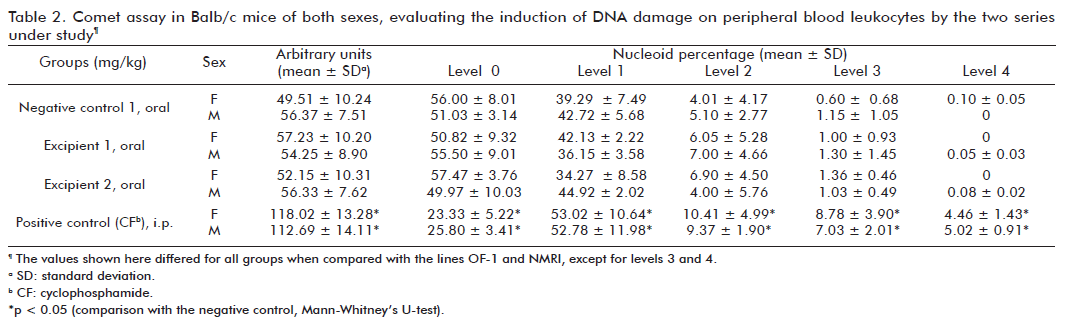
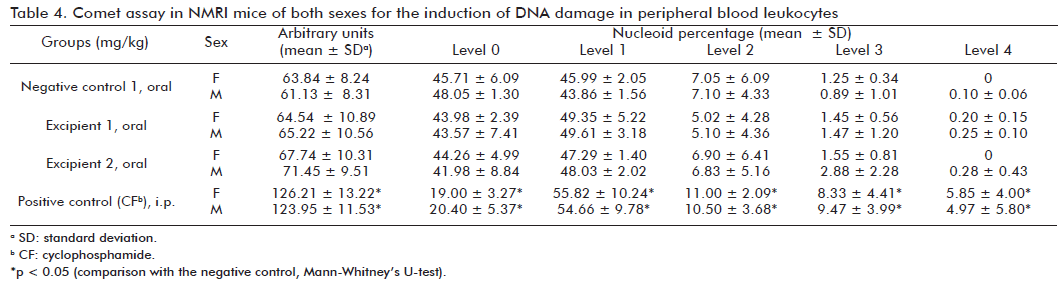
<body><![CDATA[<P   align="justify" ><font face="Verdana, Arial, Helvetica, sans-serif" color="#000000" size="2">No      signs of toxicity were detected in the animals during the 14 days of the study.      </font></P >   <FONT size="+1">        <P   align="justify" ><font face="Verdana, Arial, Helvetica, sans-serif" color="#000000" size="2">Single-      and double-strand DNA breaks can originate due to the formation of OH radicals.      These are highly toxic species for which a cellular anti-oxidant mechanism      doesn&rsquo;t exist. OH radicals, in addition, can generate DNA-DNA and DNA-protein      crosslinks (25, 26). </font></P >       <P   align="justify" ><font face="Verdana, Arial, Helvetica, sans-serif" color="#000000" size="2">There      were no significant differences between the results of the negative control      group and those treated with excipients 1 and 2, expressed either in arbitrary      units or percentage of nucleoids, at each of the analyzed levels, for any      of the studied mouse lines (<a href="/img/revistas/bta/v28n2/t0205211.gif">Tables      2</a>, <a href="/img/revistas/bta/v28n2/t0305211.gif">3</a> and <a href="/img/revistas/bta/v28n2/t0405211.gif">4</a>).      There were no significant differences between sexes either. </font></P >       
<P   align="justify" ><font face="Verdana, Arial, Helvetica, sans-serif" color="#000000" size="2">However,      the comparison of the group treated with CF (the mutagen used as positive      control in this study) with the negative control or excipients 1 and 2 did      detect statistically significant differences for each of the analyzed variables.      The number of AU induced by CF doubled that induced by the other substances.      In addition, the main effect of this mutagen was a considerable increase in      the percentage of level 3 and 4 nucleoids. These types of nucleoids are precisely      those associated with the highest degrees of DNA damage and degradation. </font></P >       <P   align="justify" ><font face="Verdana, Arial, Helvetica, sans-serif" color="#000000" size="2">Single-strand      breaks are repaired through nucleotide and base excisions. One of the most      frequent base modifications is 8-oxo-2&acute;deoxiguanosine (23, 27). This      is a complex process that eliminates a segment of at least 29 oligonucleotides      and can produce DNA migration, later corrected through the experimental calculation      of AU (8, 24). </font></P >       <P   align="justify" ><font face="Verdana, Arial, Helvetica, sans-serif" color="#000000" size="2">Using      the AU as an indicator of cyto- and genotoxicity, the data show that the Balb/c      line had a smaller interval of basal AU, from 49.51 to 57.23. Based on these      criteria, the Balb/c line is therefore the best choice among the mouse lines      evaluated in this study, as it exhibits the highest endogenous rate of level      0 (undamaged) nucleoids. This result agrees with previous measurements of      the frequency of chromosomal aberrations, which is also lowest in Balb/c mice      (28). The AU ranges for the other lines are 56.27-62.55 in OF-1 and 61.13-71.45      AU in NMRI; agreeing with results obtained in control animals by Cancino <I>et      al</I>., 2001 (19). Taking into account the percentage of grade 0 nucleoids,      the NMRI line exhibits the lowest values and the Balb/c the highest as expected,      given that NMRI mice had the highest AU values. </font></P >   <FONT color="#FF00FF"><FONT color="#000000">        <P   align="justify" ><font face="Verdana, Arial, Helvetica, sans-serif" color="#000000" size="2">When      analyzing damage levels 1 and 2, the NMRI line presented, again, the highest      values and the Balb/c line the lowest. Levels 3 and 4 tend to behave similarly      on all three lines. These results also agree with previous findings by our      group in a genotoxicity study performed with the micronucleus test and morphological      analyses of spermatozoid heads, where the Balb/c line obtained the lowest      basal results for both assays (29); and with the findings of Rodr&iacute;guez      <I>et al</I>. for control animals of the Balb/c line used in a comet assay      for tinidazole (30). </font></P >   <FONT color="#FF00FF"><FONT color="#000000">        <P   align="justify" ><font face="Verdana, Arial, Helvetica, sans-serif" color="#000000" size="2">The      highest AU and nucleoid percentages induced by CF at damage levels 1 to 4      were observed in the most susceptible line: NMRI (<a href="/img/revistas/bta/v28n2/t0205211.gif">Tables      2</a>, <a href="/img/revistas/bta/v28n2/t0305211.gif">3</a> and <a href="/img/revistas/bta/v28n2/t0405211.gif">4</a>).      Maxima of 126.21 AU were observed, with a standard deviation of 13.22. An      analysis of damage level results reveals up to 55.82% of nucleoids with damage      level 1 and 5.85% of nucleoids with damage level 4. Balb/c was more resistant      to CF-induced damage (30) than the NMRI line (5, 26). </font></P >       
<P   align="justify" ><font face="Verdana, Arial, Helvetica, sans-serif" color="#000000" size="2">The      high nucleoid induction percentage from levels 1 to 4 observed in these three      mice lines when using CF as positive control demonstrates the usefulness of      this chemical clastogen for the induction of genotoxicity, evaluated with      this methodology. Its advantages, exposed above, would help to implement the      utilization of this mutagen as positive control; which would decrease the      hazards derived from the exposure to these chemicals for the personnel performing      <I>in vivo </I>genotoxicity and anti-genotoxicity assays. </font></P >   <FONT color="#FF00FF"><FONT color="#000000">        <P   align="justify" ><font face="Verdana, Arial, Helvetica, sans-serif" color="#000000" size="2">The      low basal levels of the Balb/c line in the micronucleus assay, in tests for      chromosomal abnormalities, in morphological analyses of spermatozoid heads      and now in the alkaline comet assay demonstrate that this line is genetically      more stable and resistant to damage (28, 29, 31-33). This, in turn, is coherent      with the results obtained for both control and CF-treated animals by Cancino      <I>et al</I>. (19), corroborating that the Balb/c mouse line is the best experimental      biomodel for <I>in vivo </I>assays of potential genotoxicity and anti-genotoxicity.      </font></P >   <FONT color="#FF00FF"><FONT color="#000000"><FONT color="#FF00FF"><FONT color="#000000">        ]]></body>
<body><![CDATA[<P   align="left" ><font size="2" face="Verdana, Arial, Helvetica, sans-serif" color="#000000"><B><font size="3">CONCLUSIONS</font>      </b></font></P >   <FONT size="+1">        <P   align="justify" ><font face="Verdana, Arial, Helvetica, sans-serif" color="#000000" size="2">Under      our experimental conditions, Balb/c is the most suitable of the three mouse      lines evaluated, independently from the sex of the experimentation animals.      The low basal frequency exhibited by this line for the analyzed variables      demonstrate that it is the best experimental biomodel for this type of assay.      These results will, therefore, increase the efficiency of the preclinical      evaluation of drugs, vaccines and other products. </font></P >   <FONT size="+1">        <P   align="left" > </P >   <FONT size="+1">        <P   align="left" ><font face="Verdana, Arial, Helvetica, sans-serif" color="#000000" size="2"><B><font size="3">REFERENCES</font>      </b></font></P >       <!-- ref --><P   align="justify" ><font face="Verdana, Arial, Helvetica, sans-serif" color="#000000" size="2">1.      Mortelmans K, Rupa DS. Current issues in genetic toxicology testing for microbiologists.      Adv Appl Microbiol. 2004;56: 379-401.     </font></P >   <FONT size="+1">        <!-- ref --><P   align="left" ><font face="Verdana, Arial, Helvetica, sans-serif" color="#000000" size="2">2.      Paz M, Magdaleno A, Tornello C, Balbis N, Moretton J. Genotoxicidad y determinaci&oacute;n      de compuestos t&oacute;xicos en un residuo l&iacute;quido hospitalario de      Buenos Aires, Argentina. Rev Int Contam Ambient. 2008;(24):79-87.     </font></P >       <!-- ref --><P   align="justify" ><font face="Verdana, Arial, Helvetica, sans-serif" color="#000000" size="2">3.      Nadin SB, Vargas-Roig LM, Ciocca DR. A silver staining method for single-cell      gel assay. J Histochem Cytochem. 2001; 49(9):1183-6.     </font></P >       ]]></body>
<body><![CDATA[<!-- ref --><P   align="justify" ><font face="Verdana, Arial, Helvetica, sans-serif" color="#000000" size="2">4.      Puchades Montesa MJ, Gonz&aacute;lez Rico MA, Sol&iacute;s Salguero MA, Torregrosa      Maicas I, Tormos Mu&ntilde;oz MC, Saez Tormo G, <I>et al</I>. Study of oxidative      stress in advanced kidney disease. Nefrologia. 2009;29(5):464-73.     Spanish.      </font></P >   <FONT color="#FF00FF"><FONT color="#000000">        <!-- ref --><P   align="justify" ><font face="Verdana, Arial, Helvetica, sans-serif" color="#000000" size="2">5.      Yiqiang L, Mengmeng Q, Liwei S, Yulin W, Yuangao CH, Haigang CH, <I>et al</I>.      Genotoxicity study of phenol and o-cresol using the micronucleus test and      the comet assay. Toxicol Environ Chem. 2005;87(3):365-72.     </font></P >   <FONT color="#FF00FF"><FONT color="#000000">        <!-- ref --><P   align="justify" ><font face="Verdana, Arial, Helvetica, sans-serif" color="#000000" size="2">6.      Collins AR. The comet assay for DNA damage and repair: principles, applications,      and limitations. Mol Biotechnol. 2004;26(3):249-61.     </font></P >       <!-- ref --><P   align="justify" ><font face="Verdana, Arial, Helvetica, sans-serif" color="#000000" size="2">7.      Lee RF, Steinert S. Use of the single cell gel electrophoresis/comet assay      for detecting DNA damage in aquatic (marine and freshwater) animals. Mutat      Res. 2003 Sep;544(1):43-64.     </font></P >       <!-- ref --><P   align="justify" ><font face="Verdana, Arial, Helvetica, sans-serif" color="#000000" size="2">8.      Tice RR, Agurell E, Anderson D, Burlinson B, Hartmann A, Kobayashi H, <I>et      al</I>. Single cell gel/comet assay: guidelines for in vitro and in vivo genetic      toxicology testing. Environ Mol Mutagen. 2000;35(3):206-21.     </font></P >   <FONT color="#FF00FF"><FONT color="#000000">        ]]></body>
<body><![CDATA[<!-- ref --><P   align="justify" ><font face="Verdana, Arial, Helvetica, sans-serif" color="#000000" size="2">9.      Tripathi DN, Jena GB. Astaxanthin intervention ameliorates cyclophosphamide-induced      oxidative stress, DNA damage and early hepatocarcinogenesis in rat: Role of      Nrf2, p53, p38 and phase-II enzymes. Mutat Res. 2010;696(1):69-80.     </font></P >       <!-- ref --><P   align="justify" ><font face="Verdana, Arial, Helvetica, sans-serif" color="#000000" size="2">10.      Duez P, Dehon G, Kumps A, Dubois J. Statistics of the Comet assay: a key to      discriminate between genotoxic effects. Mutagenesis. 2003;18(2):159-66.     </font></P >       <!-- ref --><P   align="justify" ><font face="Verdana, Arial, Helvetica, sans-serif" color="#000000" size="2">11.      Frieauff W, Hartmann A, Suter W. Automatic analysis of slides processed in      the Comet assay. Mutagenesis. 2001;16(2):133-7.     </font></P >       <!-- ref --><P   align="justify" ><font face="Verdana, Arial, Helvetica, sans-serif" color="#000000" size="2">12.      Hartmann A, Agurell E, Beevers C, Brendler-Schwaab S, Burlinson B, Clay P,      <I>et al</I>. Recommendations for conducting the <I>in vivo</I> alkaline Comet      assay. Mutagenesis. 2003;18(1):45-51.     </font></P >   <FONT color="#FF00FF"><FONT color="#000000"><FONT color="#FF00FF"><FONT color="#000000">        <!-- ref --><P   align="justify" ><font face="Verdana, Arial, Helvetica, sans-serif" color="#000000" size="2">13.      Chapter XIII: The use of animals in Psychology. In: Olfert ED, Cross BM, McWilliam      AA, editors. Guide to the care and use of experimental animals, 2nd edition,      Vol. 1. Ottawa: Canadian Council on Animal Care; 1993. p. 155-62.     </font></P >       ]]></body>
<body><![CDATA[<!-- ref --><P   align="justify" ><font face="Verdana, Arial, Helvetica, sans-serif" color="#000000" size="2">14.      Arruzazabala ML, Carbajal D, Mas R, Molina V, Rodr&iacute;guez E, Gonz&aacute;lez      V. Preventive effects of D-004, a lipid extract from Cuban royal palm (<I>Rostoynea      regia</I>) fruits, on prostate hyperplasia induced with testosterone on intact      and castrated rodents. Drugs Exp Clin Res. 2004;(30):227-34.     </font></P >   <FONT color="#FF00FF"><FONT color="#000000">        <!-- ref --><P   align="justify" ><font face="Verdana, Arial, Helvetica, sans-serif" color="#000000" size="2">15.      Arruzazabala ML, M&aacute;s R, Molina V, Noa M, Carbajal D, Mendoza N. Effect      of D-004, a lipid extract from the Cuban royal palm fruit, on atypical prostate      hyperplasia induced by phenylephrine in rats. Drugs R D. 2006;7(4):233-41.          </font></P >       <!-- ref --><P   align="justify" ><font face="Verdana, Arial, Helvetica, sans-serif" color="#000000" size="2">16.      Carbajal D, Molina V, Mas R, Arruzazabala ML. Therapeutic effect of D-004,      a lipid extract from <I>Roystonea regia</I> fruits, on prostate hyperplasia      induced in rats. Drugs Exp Clin Res. 2005;31(5-6):193-7.     </font></P >   <FONT color="#FF00FF"><FONT color="#000000">        <!-- ref --><P   align="justify" ><font face="Verdana, Arial, Helvetica, sans-serif" color="#000000" size="2">17.      Hipler U, Gorning M, Hipler B, Romer W. Stimulation and scabestrogedn-inducent      inhibition of reactive oxygen species generated by rat sertoli cells. Arch      Andrology. 2000;44:147-54.     </font></P >       <P   align="justify" ><font face="Verdana, Arial, Helvetica, sans-serif" color="#000000" size="2">18.      Gad SC. The mouse. Toxicology. In: Gad SC, editor. Animal Models in Toxicology,      Second Edition (Drug and Chemical Toxicology). Boca Rat&oacute;n: Taylor &amp;      Francis Group, LLC.; 2002. p.24-71. </font></P >       <!-- ref --><P   align="left" ><font face="Verdana, Arial, Helvetica, sans-serif" color="#000000" size="2">19.      Cancino L, Leiva A, Garrido G, Coss&iacute;o M, Prieto E. VIMANG: los efectos      antigenot&oacute;xico y modulador de las enzimas glutati&oacute;n peroxidasa      y glutati&oacute;n- S-transferasa. Rev Cubana Invest Biomed. 2001;20(1):48-53.          </font></P >       <!-- ref --><P   align="justify" ><font face="Verdana, Arial, Helvetica, sans-serif" color="#000000" size="2">20.      Rodr&iacute;guez I, Vald&eacute;s YC, Proveyer S. Citost&aacute;ticos: medicamentos      riesgosos. Rev Cubana Med. 2004;43(2-3):15-9.     </font></P >       <!-- ref --><P   align="justify" ><font face="Verdana, Arial, Helvetica, sans-serif" color="#000000" size="2">21.      Speit G, Vasquez M, Hartmann A. The comet assay as an indicator test for germ      cell genotoxicity. Mutat Res. 2009; 681(1):3-12.     </font></P >       <!-- ref --><P   align="justify" ><font face="Verdana, Arial, Helvetica, sans-serif" color="#000000" size="2">22.      da Costa Lopes L, Albano F, Augusto Travassos Laranja G, Marques Alves L,      Fernando Martins e Silva L, Poubel de Souza G, et al. Toxicological evaluation      by in vitro and in vivo assays of an aqueous extract prepared from Echinodorus      macrophyllus leaves. Toxicol Lett. 2000;116(3):189-98.     </font></P >       <!-- ref --><P   align="justify" ><font face="Verdana, Arial, Helvetica, sans-serif" color="#000000" size="2">23.      Garc&iacute;a O, Mandina T. DNA damage evaluated by the comet assay in lymphocytes      of children with 137Cs internal contamination caused by the Chernobyl accident.      Mutat Res. 2005;565(2):191-7.     </font></P >       <P   align="justify" ><font face="Verdana, Arial, Helvetica, sans-serif" color="#000000" size="2">24.      Smith CC, Adkins DJ, Martin EA, O&rsquo;Donovan MR. Recommendations for design      of the rat comet assay. Mutagenesis. 2008;23(3):233-40. </font></P >       ]]></body>
<body><![CDATA[<!-- ref --><P   align="justify" ><font face="Verdana, Arial, Helvetica, sans-serif" color="#000000" size="2">25.      Srujana K, Begum SS, Rao KN, Devi GS, Jyothy A, Prasad MH. Application of      the comet assay for assessment of oxidative DNA damage in circulating lymphocytes      of Tetralogy of Fallot patients. Mutat Res. 2010;688(1-2):62-5.     </font></P >       <!-- ref --><P   align="justify" ><font face="Verdana, Arial, Helvetica, sans-serif" color="#000000" size="2">26.      Gocke E, B&uuml;rgin H, M&uuml;ller L, Pfister T. Literature review on the      genotoxicity, reproductive toxicity, and carcinogenicity of ethyl methanesulfonate.      Toxicol Lett. 2009;190(3):254-65.     </font></P >       <!-- ref --><P   align="justify" ><font face="Verdana, Arial, Helvetica, sans-serif" color="#000000" size="2">27.      Doak SH, Jenkins GJ, Johnson GE, Quick E, Parry EM, Parry JM. Mechanistic      influences for mutation induction curves after exposure to DNA-reactive carcinogens.      Cancer Res. 2007;67(8):3904-11.     </font></P >       <!-- ref --><P   align="justify" ><font face="Verdana, Arial, Helvetica, sans-serif" color="#000000" size="2">28.      Arencibia DF, Rosario LA, Rodr&iacute;guez Y, L&oacute;pez Y, D&iacute;az      D. Frecuencia espont&aacute;nea e inducida de aberraciones cromos&oacute;micas      en m&eacute;dula &oacute;sea de ratones NMRI y Balb/c de ambos sexos. Rev      Toxicol L&iacute;nea. 2009;23(2):8-22.     </font></P >       <!-- ref --><P   align="justify" ><font face="Verdana, Arial, Helvetica, sans-serif" color="#000000" size="2">29.      Arencibia DF, Rosario LA, Rodr&iacute;guez Y, Mart&iacute;n Y, D&iacute;az      D. Frecuencia espont&aacute;nea e inducida de anomal&iacute;as en la morfolog&iacute;a      de la cabeza del espermatozoide y micron&uacute;cleos en m&eacute;dula &oacute;sea      de ratones Balb/c y OF-1. Rev Toxicol L&iacute;nea. 2009;24:7-29.     </font></P >       ]]></body>
<body><![CDATA[<!-- ref --><P   align="justify" ><font face="Verdana, Arial, Helvetica, sans-serif" color="#000000" size="2">30.      Rodr&iacute;guez G, Cancino L, Prieto EA, Espinosa J. El Tinidazol induce      roturas de simple cadena en leucocitos de rat&oacute;n. Anu Toxicol. 2001;1(1):57-64.          </font></P >       <!-- ref --><P   align="justify" ><font face="Verdana, Arial, Helvetica, sans-serif" color="#000000" size="2">31.      G&aacute;mez R, Fern&aacute;ndez I, Acosta PC, Alem&aacute;n C, Rodeiro G,      Rodr&iacute;guez M. Frecuencia espont&aacute;nea e inducida de micron&uacute;cleos      en m&eacute;dula &oacute;sea y mutaciones letales dominantes en ratones NMRI.      Rev CENIC Cienc Biol. 2000;31(3):211-6.     </font></P >       <!-- ref --><P   align="justify" ><font face="Verdana, Arial, Helvetica, sans-serif" color="#000000" size="2">32.      Arencibia DF, Rosario LA, Curveco D. Frecuencia espont&aacute;nea e inducida      de anomal&iacute;as en la morfolog&iacute;a de la cabeza del espermatozoide      en ratones NMRI. Rev Toxicol L&iacute;nea. 2009;20:2-14.     </font></P >       <!-- ref --><P   align="left" ><font face="Verdana, Arial, Helvetica, sans-serif" color="#000000" size="2">33.      Arencibia DF, Rosario LA, Hern&aacute;ndez Y. Comparaci&oacute;n en la frecuencia      espont&aacute;nea e inducida de aberraciones cromos&oacute;micas en m&eacute;dula      &oacute;sea de ratones OF-1 y C57BL/6/cenp. Rev Cubana Farm. 2010;44(4):503-11.    </font></P >       <P   align="left" >&nbsp;</P >       <P   align="left" ><font face="Verdana, Arial, Helvetica, sans-serif" color="#000000" size="2">Received      in December 2009.    ]]></body>
<body><![CDATA[<br>     </font><font face="Verdana, Arial, Helvetica, sans-serif" color="#000000" size="2">Accepted      for publication in May 2011. </font></P >       <P   align="left" ><font face="Verdana, Arial, Helvetica, sans-serif" size="2">Daniel F Arencibia,      Vicepresidencia de Investigaciones, Instituto Finlay Calle 17 e/ 198 y 200,      Atabey, Municipio Playa, AP 16017, La Habana, Cuba, E-mail: <a href="mailto:darencibia@finlay.edu.cu">darencibia@finlay.edu.cu</a></font></P >   </font></font></font></font></font></font></font></font></font></font></font></font></font></font></font></font></font></font></font></font></font></font></font></font></font></font></font></font></font></font></font></font></font></font></font></font></font></font></font></font></font></font></font></font></font></font></font></font></font></font></font></font></font></font></font></font></font></font></font></font></font></font></font></font></font></font></font></font></font></font></font></font></font></font></font></font></font></font></font></font></font></font></font></font></font></font></font></font></font></font></font></font></font></font></font></font></font></font></font></font></font></font></font></font></font></font></font></font></font></DIV >      ]]></body><back>
<ref-list>
<ref id="B1">
<label>1</label><nlm-citation citation-type="journal">
<person-group person-group-type="author">
<name>
<surname><![CDATA[Mortelmans]]></surname>
<given-names><![CDATA[K]]></given-names>
</name>
<name>
<surname><![CDATA[Rupa]]></surname>
<given-names><![CDATA[DS]]></given-names>
</name>
</person-group>
<article-title xml:lang="en"><![CDATA[Current issues in genetic toxicology testing for microbiologists]]></article-title>
<source><![CDATA[Adv Appl Microbiol]]></source>
<year>2004</year>
<volume>56</volume>
<page-range>379-401</page-range></nlm-citation>
</ref>
<ref id="B2">
<label>2</label><nlm-citation citation-type="journal">
<person-group person-group-type="author">
<name>
<surname><![CDATA[Paz]]></surname>
<given-names><![CDATA[M]]></given-names>
</name>
<name>
<surname><![CDATA[Magdaleno]]></surname>
<given-names><![CDATA[A]]></given-names>
</name>
<name>
<surname><![CDATA[Tornello]]></surname>
<given-names><![CDATA[C]]></given-names>
</name>
<name>
<surname><![CDATA[Balbis]]></surname>
<given-names><![CDATA[N]]></given-names>
</name>
<name>
<surname><![CDATA[Moretton]]></surname>
<given-names><![CDATA[J]]></given-names>
</name>
</person-group>
<article-title xml:lang="es"><![CDATA[Genotoxicidad y determinación de compuestos tóxicos en un residuo líquido hospitalario de Buenos Aires, Argentina]]></article-title>
<source><![CDATA[Rev Int Contam Ambient]]></source>
<year>2008</year>
<volume>24</volume>
<page-range>79-87</page-range></nlm-citation>
</ref>
<ref id="B3">
<label>3</label><nlm-citation citation-type="journal">
<person-group person-group-type="author">
<name>
<surname><![CDATA[Nadin]]></surname>
<given-names><![CDATA[SB]]></given-names>
</name>
<name>
<surname><![CDATA[Vargas-Roig]]></surname>
<given-names><![CDATA[LM]]></given-names>
</name>
<name>
<surname><![CDATA[Ciocca]]></surname>
<given-names><![CDATA[DR]]></given-names>
</name>
</person-group>
<article-title xml:lang="en"><![CDATA[A silver staining method for single-cell gel assay]]></article-title>
<source><![CDATA[J Histochem Cytochem]]></source>
<year>2001</year>
<volume>49</volume>
<numero>9</numero>
<issue>9</issue>
<page-range>1183-6</page-range></nlm-citation>
</ref>
<ref id="B4">
<label>4</label><nlm-citation citation-type="journal">
<person-group person-group-type="author">
<name>
<surname><![CDATA[Puchades Montesa]]></surname>
<given-names><![CDATA[MJ]]></given-names>
</name>
<name>
<surname><![CDATA[González Rico]]></surname>
<given-names><![CDATA[MA]]></given-names>
</name>
<name>
<surname><![CDATA[Solís Salguero]]></surname>
<given-names><![CDATA[MA]]></given-names>
</name>
<name>
<surname><![CDATA[Torregrosa Maicas]]></surname>
<given-names><![CDATA[I]]></given-names>
</name>
<name>
<surname><![CDATA[Tormos Muñoz]]></surname>
<given-names><![CDATA[MC]]></given-names>
</name>
<name>
<surname><![CDATA[Saez Tormo]]></surname>
<given-names><![CDATA[G]]></given-names>
</name>
</person-group>
<article-title xml:lang="en"><![CDATA[Study of oxidative stress in advanced kidney disease]]></article-title>
<source><![CDATA[Nefrologia]]></source>
<year>2009</year>
<volume>29</volume>
<numero>5</numero>
<issue>5</issue>
<page-range>464-73</page-range></nlm-citation>
</ref>
<ref id="B5">
<label>5</label><nlm-citation citation-type="journal">
<person-group person-group-type="author">
<name>
<surname><![CDATA[Yiqiang]]></surname>
<given-names><![CDATA[L]]></given-names>
</name>
<name>
<surname><![CDATA[Mengmeng]]></surname>
<given-names><![CDATA[Q]]></given-names>
</name>
<name>
<surname><![CDATA[Liwei]]></surname>
<given-names><![CDATA[S]]></given-names>
</name>
<name>
<surname><![CDATA[Yulin]]></surname>
<given-names><![CDATA[W]]></given-names>
</name>
<name>
<surname><![CDATA[Yuangao]]></surname>
<given-names><![CDATA[CH]]></given-names>
</name>
<name>
<surname><![CDATA[Haigang]]></surname>
<given-names><![CDATA[CH]]></given-names>
</name>
</person-group>
<article-title xml:lang="en"><![CDATA[Genotoxicity study of phenol and o -cresol using the micronucleus test and the comet assay]]></article-title>
<source><![CDATA[Toxicol Environ Chem]]></source>
<year>2005</year>
<volume>87</volume>
<numero>3</numero>
<issue>3</issue>
<page-range>365-72</page-range></nlm-citation>
</ref>
<ref id="B6">
<label>6</label><nlm-citation citation-type="journal">
<person-group person-group-type="author">
<name>
<surname><![CDATA[Collins]]></surname>
<given-names><![CDATA[AR]]></given-names>
</name>
</person-group>
<article-title xml:lang="en"><![CDATA[The comet assay for DNA damage and repair: principles, applications, and limitations]]></article-title>
<source><![CDATA[Mol Biotechnol]]></source>
<year>2004</year>
<volume>26</volume>
<numero>3</numero>
<issue>3</issue>
<page-range>249-61</page-range></nlm-citation>
</ref>
<ref id="B7">
<label>7</label><nlm-citation citation-type="journal">
<person-group person-group-type="author">
<name>
<surname><![CDATA[Lee]]></surname>
<given-names><![CDATA[RF]]></given-names>
</name>
<name>
<surname><![CDATA[Steinert]]></surname>
<given-names><![CDATA[S]]></given-names>
</name>
</person-group>
<article-title xml:lang="en"><![CDATA[Use of the single cell gel electrophoresis/comet assay for detecting DNA damage in aquatic (marine and freshwater) animals]]></article-title>
<source><![CDATA[Mutat Res. 20]]></source>
<year>Sep</year>
<volume>544</volume>
<numero>1</numero>
<issue>1</issue>
<page-range>43-64</page-range></nlm-citation>
</ref>
<ref id="B8">
<label>8</label><nlm-citation citation-type="journal">
<person-group person-group-type="author">
<name>
<surname><![CDATA[Tice]]></surname>
<given-names><![CDATA[RR]]></given-names>
</name>
<name>
<surname><![CDATA[Agurell]]></surname>
<given-names><![CDATA[E]]></given-names>
</name>
<name>
<surname><![CDATA[Anderson]]></surname>
<given-names><![CDATA[D]]></given-names>
</name>
<name>
<surname><![CDATA[Burlinson]]></surname>
<given-names><![CDATA[B]]></given-names>
</name>
<name>
<surname><![CDATA[Hartmann]]></surname>
<given-names><![CDATA[A]]></given-names>
</name>
<name>
<surname><![CDATA[Kobayashi]]></surname>
<given-names><![CDATA[H]]></given-names>
</name>
</person-group>
<article-title xml:lang="en"><![CDATA[Single cell gel/comet assay: guidelines for in vitro and in vivo genetic toxicology testing]]></article-title>
<source><![CDATA[Environ Mol Mutagen]]></source>
<year>2000</year>
<volume>35</volume>
<numero>3</numero>
<issue>3</issue>
<page-range>206-21</page-range></nlm-citation>
</ref>
<ref id="B9">
<label>9</label><nlm-citation citation-type="journal">
<person-group person-group-type="author">
<name>
<surname><![CDATA[Tripathi]]></surname>
<given-names><![CDATA[DN]]></given-names>
</name>
<name>
<surname><![CDATA[Jena]]></surname>
<given-names><![CDATA[GB]]></given-names>
</name>
</person-group>
<article-title xml:lang="en"><![CDATA[Astaxanthin intervention ameliorates cyclophosphamide-induced oxidative stress, DNA damage and early hepatocarcinogenesis in rat: Role of Nrf2, p53, p38 and phase-II enzymes]]></article-title>
<source><![CDATA[Mutat Res]]></source>
<year>2010</year>
<volume>696</volume>
<numero>1</numero>
<issue>1</issue>
<page-range>69-80</page-range></nlm-citation>
</ref>
<ref id="B10">
<label>10</label><nlm-citation citation-type="journal">
<person-group person-group-type="author">
<name>
<surname><![CDATA[Duez]]></surname>
<given-names><![CDATA[P]]></given-names>
</name>
<name>
<surname><![CDATA[Dehon]]></surname>
<given-names><![CDATA[G]]></given-names>
</name>
<name>
<surname><![CDATA[Kumps]]></surname>
<given-names><![CDATA[A]]></given-names>
</name>
<name>
<surname><![CDATA[Dubois]]></surname>
<given-names><![CDATA[J]]></given-names>
</name>
</person-group>
<article-title xml:lang="en"><![CDATA[Statistics of the Comet assay: a key to discriminate between genotoxic effects]]></article-title>
<source><![CDATA[Mutagenesis]]></source>
<year>2003</year>
<volume>18</volume>
<numero>2</numero>
<issue>2</issue>
<page-range>159-66</page-range></nlm-citation>
</ref>
<ref id="B11">
<label>11</label><nlm-citation citation-type="journal">
<person-group person-group-type="author">
<name>
<surname><![CDATA[Frieauff]]></surname>
<given-names><![CDATA[W]]></given-names>
</name>
<name>
<surname><![CDATA[Hartmann]]></surname>
<given-names><![CDATA[A]]></given-names>
</name>
<name>
<surname><![CDATA[Suter]]></surname>
<given-names><![CDATA[W]]></given-names>
</name>
</person-group>
<article-title xml:lang="en"><![CDATA[Automatic analysis of slides processed in the Comet assay]]></article-title>
<source><![CDATA[Mutagenesis]]></source>
<year>2001</year>
<volume>16</volume>
<numero>2</numero>
<issue>2</issue>
<page-range>133-7</page-range></nlm-citation>
</ref>
<ref id="B12">
<label>12</label><nlm-citation citation-type="journal">
<person-group person-group-type="author">
<name>
<surname><![CDATA[Hartmann]]></surname>
<given-names><![CDATA[A]]></given-names>
</name>
<name>
<surname><![CDATA[Agurell]]></surname>
<given-names><![CDATA[E]]></given-names>
</name>
<name>
<surname><![CDATA[Beevers]]></surname>
<given-names><![CDATA[C]]></given-names>
</name>
<name>
<surname><![CDATA[Brendler-Schwaab]]></surname>
<given-names><![CDATA[S]]></given-names>
</name>
<name>
<surname><![CDATA[Burlinson]]></surname>
<given-names><![CDATA[B]]></given-names>
</name>
<name>
<surname><![CDATA[Clay]]></surname>
<given-names><![CDATA[P]]></given-names>
</name>
</person-group>
<article-title xml:lang="en"><![CDATA[Recommendations for conducting the in vivo alkaline Comet assay]]></article-title>
<source><![CDATA[Mutagenesis]]></source>
<year>2003</year>
<volume>18</volume>
<numero>1</numero>
<issue>1</issue>
<page-range>45-51</page-range></nlm-citation>
</ref>
<ref id="B13">
<label>13</label><nlm-citation citation-type="book">
<article-title xml:lang="en"><![CDATA[Chapter XIII: The use of animals in Psychology]]></article-title>
<person-group person-group-type="author">
<name>
<surname><![CDATA[Olfert]]></surname>
<given-names><![CDATA[ED]]></given-names>
</name>
<name>
<surname><![CDATA[Cross]]></surname>
<given-names><![CDATA[BM]]></given-names>
</name>
<name>
<surname><![CDATA[McWilliam]]></surname>
<given-names><![CDATA[AA]]></given-names>
</name>
</person-group>
<source><![CDATA[Guide to the care and use of experimental animals]]></source>
<year>1993</year>
<edition>2</edition>
<page-range>155-62</page-range><publisher-loc><![CDATA[Ottawa ]]></publisher-loc>
<publisher-name><![CDATA[Canadian Council on Animal Care]]></publisher-name>
</nlm-citation>
</ref>
<ref id="B14">
<label>14</label><nlm-citation citation-type="journal">
<person-group person-group-type="author">
<name>
<surname><![CDATA[Arruzazabala]]></surname>
<given-names><![CDATA[ML]]></given-names>
</name>
<name>
<surname><![CDATA[Carbajal]]></surname>
<given-names><![CDATA[D]]></given-names>
</name>
<name>
<surname><![CDATA[Mas]]></surname>
<given-names><![CDATA[R]]></given-names>
</name>
<name>
<surname><![CDATA[Molina]]></surname>
<given-names><![CDATA[V]]></given-names>
</name>
<name>
<surname><![CDATA[Rodríguez]]></surname>
<given-names><![CDATA[E]]></given-names>
</name>
<name>
<surname><![CDATA[González]]></surname>
<given-names><![CDATA[V]]></given-names>
</name>
</person-group>
<article-title xml:lang="en"><![CDATA[Preventive effects of D-004, a lipid extract from Cuban royal palm (Rostoynea regia) fruits, on prostate hyperplasia induced with testosterone on intact and castrated rodents]]></article-title>
<source><![CDATA[Drugs Exp Clin Res]]></source>
<year>2004</year>
<volume>30</volume>
<page-range>227-34</page-range></nlm-citation>
</ref>
<ref id="B15">
<label>15</label><nlm-citation citation-type="journal">
<person-group person-group-type="author">
<name>
<surname><![CDATA[Arruzazabala]]></surname>
<given-names><![CDATA[ML]]></given-names>
</name>
<name>
<surname><![CDATA[Más]]></surname>
<given-names><![CDATA[R]]></given-names>
</name>
<name>
<surname><![CDATA[Molina]]></surname>
<given-names><![CDATA[V]]></given-names>
</name>
<name>
<surname><![CDATA[Noa]]></surname>
<given-names><![CDATA[M]]></given-names>
</name>
<name>
<surname><![CDATA[Carbajal]]></surname>
<given-names><![CDATA[D]]></given-names>
</name>
<name>
<surname><![CDATA[Mendoza]]></surname>
<given-names><![CDATA[N]]></given-names>
</name>
</person-group>
<article-title xml:lang="en"><![CDATA[Effect of D-004, a lipid extract from the Cuban royal palm fruit, on atypical prostate hyperplasia induced by phenylephrine in rats]]></article-title>
<source><![CDATA[Drugs R D]]></source>
<year>2006</year>
<volume>7</volume>
<numero>4</numero>
<issue>4</issue>
<page-range>233-41</page-range></nlm-citation>
</ref>
<ref id="B16">
<label>16</label><nlm-citation citation-type="journal">
<person-group person-group-type="author">
<name>
<surname><![CDATA[Carbajal]]></surname>
<given-names><![CDATA[D]]></given-names>
</name>
<name>
<surname><![CDATA[Molina]]></surname>
<given-names><![CDATA[V]]></given-names>
</name>
<name>
<surname><![CDATA[Mas]]></surname>
<given-names><![CDATA[R]]></given-names>
</name>
<name>
<surname><![CDATA[Arruzazabala]]></surname>
<given-names><![CDATA[ML]]></given-names>
</name>
</person-group>
<article-title xml:lang="en"><![CDATA[Therapeutic effect of D-004, a lipid extract from Roystonea regia fruits, on prostate hyperplasia induced in rats]]></article-title>
<source><![CDATA[Drugs Exp Clin Res]]></source>
<year>2005</year>
<volume>31</volume>
<numero>5-6</numero>
<issue>5-6</issue>
<page-range>193-7</page-range></nlm-citation>
</ref>
<ref id="B17">
<label>17</label><nlm-citation citation-type="journal">
<person-group person-group-type="author">
<name>
<surname><![CDATA[Hipler]]></surname>
<given-names><![CDATA[U]]></given-names>
</name>
<name>
<surname><![CDATA[Gorning]]></surname>
<given-names><![CDATA[M]]></given-names>
</name>
<name>
<surname><![CDATA[Hipler]]></surname>
<given-names><![CDATA[B]]></given-names>
</name>
<name>
<surname><![CDATA[Romer]]></surname>
<given-names><![CDATA[W]]></given-names>
</name>
</person-group>
<article-title xml:lang="en"><![CDATA[Stimulation and scabestrogedn-inducent inhibition of reactive oxygen species generated by rat sertoli cells]]></article-title>
<source><![CDATA[Arch Andrology]]></source>
<year>2000</year>
<volume>44</volume>
<page-range>147-54</page-range></nlm-citation>
</ref>
<ref id="B18">
<label>18</label><nlm-citation citation-type="book">
<person-group person-group-type="author">
<name>
<surname><![CDATA[Gad]]></surname>
<given-names><![CDATA[SC]]></given-names>
</name>
</person-group>
<article-title xml:lang="en"><![CDATA[The mouse: Toxicology]]></article-title>
<person-group person-group-type="editor">
<name>
<surname><![CDATA[Gad]]></surname>
<given-names><![CDATA[SC]]></given-names>
</name>
</person-group>
<source><![CDATA[Animal Models in Toxicology: Drug and Chemical Toxicology]]></source>
<year>2002</year>
<edition>2</edition>
<page-range>24-71</page-range><publisher-loc><![CDATA[Boca Ratón ]]></publisher-loc>
<publisher-name><![CDATA[Taylor & Francis Group, LLC.]]></publisher-name>
</nlm-citation>
</ref>
<ref id="B19">
<label>19</label><nlm-citation citation-type="journal">
<person-group person-group-type="author">
<name>
<surname><![CDATA[Cancino]]></surname>
<given-names><![CDATA[L]]></given-names>
</name>
<name>
<surname><![CDATA[Leiva]]></surname>
<given-names><![CDATA[A]]></given-names>
</name>
<name>
<surname><![CDATA[Garrido]]></surname>
<given-names><![CDATA[G]]></given-names>
</name>
<name>
<surname><![CDATA[Cossío]]></surname>
<given-names><![CDATA[M]]></given-names>
</name>
<name>
<surname><![CDATA[Prieto]]></surname>
<given-names><![CDATA[E]]></given-names>
</name>
</person-group>
<article-title xml:lang="es"><![CDATA[VIMANG: los efectos antigenotóxico y modulador de las enzimas glutatión peroxidasa y glutatión-S-transferasa]]></article-title>
<source><![CDATA[Rev Cubana Invest Biomed]]></source>
<year>2001</year>
<volume>20</volume>
<numero>1</numero>
<issue>1</issue>
<page-range>48-53</page-range></nlm-citation>
</ref>
<ref id="B20">
<label>20</label><nlm-citation citation-type="journal">
<person-group person-group-type="author">
<name>
<surname><![CDATA[Rodríguez]]></surname>
<given-names><![CDATA[I]]></given-names>
</name>
<name>
<surname><![CDATA[Valdés]]></surname>
<given-names><![CDATA[YC]]></given-names>
</name>
<name>
<surname><![CDATA[Proveyer]]></surname>
<given-names><![CDATA[S]]></given-names>
</name>
</person-group>
<article-title xml:lang="es"><![CDATA[Citostáticos: medicamentos riesgosos]]></article-title>
<source><![CDATA[Rev Cubana Med]]></source>
<year>2004</year>
<volume>43</volume>
<numero>2-3</numero>
<issue>2-3</issue>
<page-range>15-9</page-range></nlm-citation>
</ref>
<ref id="B21">
<label>21</label><nlm-citation citation-type="journal">
<person-group person-group-type="author">
<name>
<surname><![CDATA[Speit]]></surname>
<given-names><![CDATA[G]]></given-names>
</name>
<name>
<surname><![CDATA[Vasquez]]></surname>
<given-names><![CDATA[M]]></given-names>
</name>
<name>
<surname><![CDATA[Hartmann]]></surname>
<given-names><![CDATA[A]]></given-names>
</name>
</person-group>
<article-title xml:lang="en"><![CDATA[The comet assay as an indicator test for germ cell genotoxicity]]></article-title>
<source><![CDATA[Mutat Res]]></source>
<year>2009</year>
<volume>681</volume>
<numero>1</numero>
<issue>1</issue>
<page-range>3-12</page-range></nlm-citation>
</ref>
<ref id="B22">
<label>22</label><nlm-citation citation-type="journal">
<person-group person-group-type="author">
<name>
<surname><![CDATA[da Costa Lopes]]></surname>
<given-names><![CDATA[L]]></given-names>
</name>
<name>
<surname><![CDATA[Albano]]></surname>
<given-names><![CDATA[F]]></given-names>
</name>
<name>
<surname><![CDATA[Augusto Travassos Laranja]]></surname>
<given-names><![CDATA[G]]></given-names>
</name>
<name>
<surname><![CDATA[Marques Alves]]></surname>
<given-names><![CDATA[L]]></given-names>
</name>
<name>
<surname><![CDATA[Fernando Martins e Silva]]></surname>
<given-names><![CDATA[L]]></given-names>
</name>
<name>
<surname><![CDATA[Poubel de Souza]]></surname>
<given-names><![CDATA[G]]></given-names>
</name>
</person-group>
<article-title xml:lang="en"><![CDATA[Toxicological evaluation by in vitro and in vivo assays of an aqueous extract prepared from Echinodorus macrophyllus leaves]]></article-title>
<source><![CDATA[Toxicol Lett]]></source>
<year>2000</year>
<volume>116</volume>
<numero>3</numero>
<issue>3</issue>
<page-range>189-98</page-range></nlm-citation>
</ref>
<ref id="B23">
<label>23</label><nlm-citation citation-type="journal">
<person-group person-group-type="author">
<name>
<surname><![CDATA[García]]></surname>
<given-names><![CDATA[O]]></given-names>
</name>
<name>
<surname><![CDATA[Mandina]]></surname>
<given-names><![CDATA[T]]></given-names>
</name>
</person-group>
<article-title xml:lang="en"><![CDATA[DNA damage evaluated by the comet assay in lymphocytes of children with 137Cs internal contamination caused by the Chernobyl accident]]></article-title>
<source><![CDATA[Mutat Res]]></source>
<year>2005</year>
<volume>565</volume>
<numero>2</numero>
<issue>2</issue>
<page-range>191-7</page-range></nlm-citation>
</ref>
<ref id="B24">
<label>24</label><nlm-citation citation-type="journal">
<person-group person-group-type="author">
<name>
<surname><![CDATA[Smith]]></surname>
<given-names><![CDATA[CC]]></given-names>
</name>
<name>
<surname><![CDATA[Adkins]]></surname>
<given-names><![CDATA[DJ]]></given-names>
</name>
<name>
<surname><![CDATA[Martin]]></surname>
<given-names><![CDATA[EA]]></given-names>
</name>
<name>
<surname><![CDATA[O'Donovan]]></surname>
<given-names><![CDATA[MR]]></given-names>
</name>
</person-group>
<article-title xml:lang="en"><![CDATA[Recommendations for design of the rat comet assay]]></article-title>
<source><![CDATA[Mutagenesis]]></source>
<year>2008</year>
<volume>23</volume>
<numero>3</numero>
<issue>3</issue>
<page-range>233-40</page-range></nlm-citation>
</ref>
<ref id="B25">
<label>25</label><nlm-citation citation-type="journal">
<person-group person-group-type="author">
<name>
<surname><![CDATA[Srujana]]></surname>
<given-names><![CDATA[K]]></given-names>
</name>
<name>
<surname><![CDATA[Begum]]></surname>
<given-names><![CDATA[SS]]></given-names>
</name>
<name>
<surname><![CDATA[Rao]]></surname>
<given-names><![CDATA[KN]]></given-names>
</name>
<name>
<surname><![CDATA[Devi]]></surname>
<given-names><![CDATA[GS]]></given-names>
</name>
<name>
<surname><![CDATA[Jyothy]]></surname>
<given-names><![CDATA[A]]></given-names>
</name>
<name>
<surname><![CDATA[Prasad]]></surname>
<given-names><![CDATA[MH]]></given-names>
</name>
</person-group>
<article-title xml:lang="en"><![CDATA[Application of the comet assay for assessment of oxidative DNA damage in circulating lymphocytes of Tetralogy of Fallot patients]]></article-title>
<source><![CDATA[Mutat Res]]></source>
<year>2010</year>
<volume>688</volume>
<numero>1-2</numero>
<issue>1-2</issue>
<page-range>62-5</page-range></nlm-citation>
</ref>
<ref id="B26">
<label>26</label><nlm-citation citation-type="journal">
<person-group person-group-type="author">
<name>
<surname><![CDATA[Gocke]]></surname>
<given-names><![CDATA[E]]></given-names>
</name>
<name>
<surname><![CDATA[Bürgin]]></surname>
<given-names><![CDATA[H]]></given-names>
</name>
<name>
<surname><![CDATA[Müller]]></surname>
<given-names><![CDATA[L]]></given-names>
</name>
<name>
<surname><![CDATA[Pfister]]></surname>
<given-names><![CDATA[T]]></given-names>
</name>
</person-group>
<article-title xml:lang="en"><![CDATA[Literature review on the genotoxicity, reproductive toxicity, and carcinogenicity of ethyl methanesulfonate]]></article-title>
<source><![CDATA[Toxicol Lett]]></source>
<year>2009</year>
<volume>190</volume>
<numero>3</numero>
<issue>3</issue>
<page-range>254-65</page-range></nlm-citation>
</ref>
<ref id="B27">
<label>27</label><nlm-citation citation-type="journal">
<person-group person-group-type="author">
<name>
<surname><![CDATA[Doak]]></surname>
<given-names><![CDATA[SH]]></given-names>
</name>
<name>
<surname><![CDATA[Jenkins]]></surname>
<given-names><![CDATA[GJ]]></given-names>
</name>
<name>
<surname><![CDATA[Johnson]]></surname>
<given-names><![CDATA[GE]]></given-names>
</name>
<name>
<surname><![CDATA[Quick]]></surname>
<given-names><![CDATA[E]]></given-names>
</name>
<name>
<surname><![CDATA[Parry]]></surname>
<given-names><![CDATA[EM]]></given-names>
</name>
<name>
<surname><![CDATA[Parry]]></surname>
<given-names><![CDATA[JM]]></given-names>
</name>
</person-group>
<article-title xml:lang="en"><![CDATA[Mechanistic influences for mutation induction curves after exposure to DNA-reactive carcinogens]]></article-title>
<source><![CDATA[Cancer Res]]></source>
<year>2007</year>
<volume>67</volume>
<numero>8</numero>
<issue>8</issue>
<page-range>3904-11</page-range></nlm-citation>
</ref>
<ref id="B28">
<label>28</label><nlm-citation citation-type="journal">
<person-group person-group-type="author">
<name>
<surname><![CDATA[Arencibia]]></surname>
<given-names><![CDATA[DF]]></given-names>
</name>
<name>
<surname><![CDATA[Rosario]]></surname>
<given-names><![CDATA[LA]]></given-names>
</name>
<name>
<surname><![CDATA[Rodríguez]]></surname>
<given-names><![CDATA[Y]]></given-names>
</name>
<name>
<surname><![CDATA[López]]></surname>
<given-names><![CDATA[Y]]></given-names>
</name>
<name>
<surname><![CDATA[Díaz]]></surname>
<given-names><![CDATA[D]]></given-names>
</name>
</person-group>
<article-title xml:lang="es"><![CDATA[Frecuencia espontánea e inducida de aberraciones cromosómicas en médula ósea de ratones NMRI y Balb/c de ambos sexos]]></article-title>
<source><![CDATA[Rev Toxicol Línea]]></source>
<year>2009</year>
<volume>23</volume>
<numero>2</numero>
<issue>2</issue>
<page-range>8-22</page-range></nlm-citation>
</ref>
<ref id="B29">
<label>29</label><nlm-citation citation-type="journal">
<person-group person-group-type="author">
<name>
<surname><![CDATA[Arencibia]]></surname>
<given-names><![CDATA[DF]]></given-names>
</name>
<name>
<surname><![CDATA[Rosario]]></surname>
<given-names><![CDATA[LA]]></given-names>
</name>
<name>
<surname><![CDATA[Rodríguez]]></surname>
<given-names><![CDATA[Y]]></given-names>
</name>
<name>
<surname><![CDATA[Martín]]></surname>
<given-names><![CDATA[Y]]></given-names>
</name>
<name>
<surname><![CDATA[Díaz]]></surname>
<given-names><![CDATA[D]]></given-names>
</name>
</person-group>
<article-title xml:lang="es"><![CDATA[Frecuencia espontánea e inducida de anomalías en la morfología de la cabeza del espermatozoide y micronúcleos en médula ósea de ratones Balb/c y OF-1]]></article-title>
<source><![CDATA[Rev Toxicol Línea]]></source>
<year>2009</year>
<volume>24</volume>
<page-range>7-29</page-range></nlm-citation>
</ref>
<ref id="B30">
<label>30</label><nlm-citation citation-type="journal">
<person-group person-group-type="author">
<name>
<surname><![CDATA[Rodríguez]]></surname>
<given-names><![CDATA[G]]></given-names>
</name>
<name>
<surname><![CDATA[Cancino]]></surname>
<given-names><![CDATA[L]]></given-names>
</name>
<name>
<surname><![CDATA[Prieto]]></surname>
<given-names><![CDATA[EA]]></given-names>
</name>
<name>
<surname><![CDATA[Espinosa]]></surname>
<given-names><![CDATA[J]]></given-names>
</name>
</person-group>
<article-title xml:lang="es"><![CDATA[El Tinidazol induce roturas de simple cadena en leucocitos de ratón]]></article-title>
<source><![CDATA[Anu Toxicol]]></source>
<year>2001</year>
<volume>1</volume>
<numero>1</numero>
<issue>1</issue>
<page-range>57-64</page-range></nlm-citation>
</ref>
<ref id="B31">
<label>31</label><nlm-citation citation-type="journal">
<person-group person-group-type="author">
<name>
<surname><![CDATA[Gámez]]></surname>
<given-names><![CDATA[R]]></given-names>
</name>
<name>
<surname><![CDATA[Fernández]]></surname>
<given-names><![CDATA[I]]></given-names>
</name>
<name>
<surname><![CDATA[Acosta]]></surname>
<given-names><![CDATA[PC]]></given-names>
</name>
<name>
<surname><![CDATA[Alemán]]></surname>
<given-names><![CDATA[C]]></given-names>
</name>
<name>
<surname><![CDATA[Rodeiro]]></surname>
<given-names><![CDATA[G]]></given-names>
</name>
<name>
<surname><![CDATA[Rodríguez]]></surname>
<given-names><![CDATA[M]]></given-names>
</name>
</person-group>
<article-title xml:lang="es"><![CDATA[Frecuencia espontánea e inducida de micronúcleos en médula ósea y mutaciones letales dominantes en ratones NMRI]]></article-title>
<source><![CDATA[Rev CENIC Cienc Biol]]></source>
<year>2000</year>
<volume>31</volume>
<numero>3</numero>
<issue>3</issue>
<page-range>211-6</page-range></nlm-citation>
</ref>
<ref id="B32">
<label>32</label><nlm-citation citation-type="journal">
<person-group person-group-type="author">
<name>
<surname><![CDATA[Arencibia]]></surname>
<given-names><![CDATA[DF]]></given-names>
</name>
<name>
<surname><![CDATA[Rosario]]></surname>
<given-names><![CDATA[LA]]></given-names>
</name>
<name>
<surname><![CDATA[Curveco]]></surname>
<given-names><![CDATA[D]]></given-names>
</name>
</person-group>
<article-title xml:lang="es"><![CDATA[Frecuencia espontánea e inducida de anomalías en la morfología de la cabeza del espermatozoide en ratones NMRI]]></article-title>
<source><![CDATA[Rev Toxicol Línea]]></source>
<year>2009</year>
<volume>20</volume>
<page-range>2-14</page-range></nlm-citation>
</ref>
<ref id="B33">
<label>33</label><nlm-citation citation-type="journal">
<person-group person-group-type="author">
<name>
<surname><![CDATA[Arencibia]]></surname>
<given-names><![CDATA[DF]]></given-names>
</name>
<name>
<surname><![CDATA[Rosario]]></surname>
<given-names><![CDATA[LA]]></given-names>
</name>
<name>
<surname><![CDATA[Hernández]]></surname>
<given-names><![CDATA[Y]]></given-names>
</name>
</person-group>
<article-title xml:lang="es"><![CDATA[Comparación en la frecuencia espontánea e inducida de aberraciones cromosómicas en médula ósea de ratones OF-1 y C57BL/6/cenp]]></article-title>
<source><![CDATA[Rev Cubana Farm]]></source>
<year>2010</year>
<volume>44</volume>
<numero>4</numero>
<issue>4</issue>
<page-range>503-11</page-range></nlm-citation>
</ref>
</ref-list>
</back>
</article>