<?xml version="1.0" encoding="ISO-8859-1"?><article xmlns:mml="http://www.w3.org/1998/Math/MathML" xmlns:xlink="http://www.w3.org/1999/xlink" xmlns:xsi="http://www.w3.org/2001/XMLSchema-instance">
<front>
<journal-meta>
<journal-id>1027-2852</journal-id>
<journal-title><![CDATA[Biotecnología Aplicada]]></journal-title>
<abbrev-journal-title><![CDATA[Biotecnol Apl]]></abbrev-journal-title>
<issn>1027-2852</issn>
<publisher>
<publisher-name><![CDATA[Editorial Elfos Scientiae]]></publisher-name>
</publisher>
</journal-meta>
<article-meta>
<article-id>S1027-28522011000300001</article-id>
<title-group>
<article-title xml:lang="en"><![CDATA[Interferon-based treatment as adjuvant therapy for hepatitis C virus vaccine candidates against chronic infection]]></article-title>
<article-title xml:lang="es"><![CDATA[El tratamiento basado en interferón como terapia adyuvante para los candidatos vacunales contra la infección crónica por el virus de la hepatitis C]]></article-title>
</title-group>
<contrib-group>
<contrib contrib-type="author">
<name>
<surname><![CDATA[Amador-Cañizares]]></surname>
<given-names><![CDATA[Yalena]]></given-names>
</name>
<xref ref-type="aff" rid="A01"/>
</contrib>
</contrib-group>
<aff id="A01">
<institution><![CDATA[,Center for Genetic Engineering and Biotechnology Vaccine Division HCV Department]]></institution>
<addr-line><![CDATA[Havana ]]></addr-line>
<country>Cuba</country>
</aff>
<pub-date pub-type="pub">
<day>00</day>
<month>09</month>
<year>2011</year>
</pub-date>
<pub-date pub-type="epub">
<day>00</day>
<month>09</month>
<year>2011</year>
</pub-date>
<volume>28</volume>
<numero>3</numero>
<fpage>123</fpage>
<lpage>129</lpage>
<copyright-statement/>
<copyright-year/>
<self-uri xlink:href="http://scielo.sld.cu/scielo.php?script=sci_arttext&amp;pid=S1027-28522011000300001&amp;lng=en&amp;nrm=iso"></self-uri><self-uri xlink:href="http://scielo.sld.cu/scielo.php?script=sci_abstract&amp;pid=S1027-28522011000300001&amp;lng=en&amp;nrm=iso"></self-uri><self-uri xlink:href="http://scielo.sld.cu/scielo.php?script=sci_pdf&amp;pid=S1027-28522011000300001&amp;lng=en&amp;nrm=iso"></self-uri><abstract abstract-type="short" xml:lang="en"><p><![CDATA[Therapeutic vaccine candidates against hepatitis C virus infection have demonstrated immunogenicity, but none of them have been able to induce complete viral elimination. Reviewed evidence shows hepatitis C virus-specific T cell exhaustion as a major obstacle for the immune containment of the virus. The possibility that hepatitis C virus-specific T cells may be rescued from exhaustion by interferon-based treatment makes this therapy a promising candidate to combine with hepatitis C virus-specific therapeutic vaccine interventions. This review summarizes the main effects of interferon-based therapy on hepatitis C virus-specific cellular immune response in chronic patients and, focuses on its potential to favorably impact the performance of therapeutic vaccine approaches for sustained viral clarification.]]></p></abstract>
<abstract abstract-type="short" xml:lang="es"><p><![CDATA[Los candidatos vacunales terapéuticos contra el virus de la hepatitis C han demostrado ser inmunogénicos, pero no han sido capaces de inducir la eliminación viral completa. Las evidencias experimentales acumuladas indican que el agotamiento de las células T específicas contra este virus es un obstáculo fundamental, que debe ser salvado si se persigue el control de la infección por parte del sistema inmune. El potencial mostrado por los tratamientos basados en interferón para rescatar la funcionalidad de dichas células, convierte a esta terapia en un candidato promisorio para ser combinado con las estrategias vacunales contra el virus de la hepatitis C. La presente revisión se centra en los principales efectos que tienen las terapias basadas en interferón sobre la respuesta celular específica contra el virus de la hepatitis C, en los pacientes crónicos. Particularmente, se hace énfasis en su potencial para modificar favorablemente la eficacia de los enfoques vacunales terapéuticos para alcanzar una eliminación viral sostenida.]]></p></abstract>
<kwd-group>
<kwd lng="en"><![CDATA[Interferon]]></kwd>
<kwd lng="en"><![CDATA[hepatitis C virus]]></kwd>
<kwd lng="en"><![CDATA[vaccine candidates]]></kwd>
<kwd lng="en"><![CDATA[therapy]]></kwd>
<kwd lng="es"><![CDATA[Interferón]]></kwd>
<kwd lng="es"><![CDATA[virus de la hepatitis C]]></kwd>
<kwd lng="es"><![CDATA[candidatos vacunales]]></kwd>
<kwd lng="es"><![CDATA[terapia]]></kwd>
</kwd-group>
</article-meta>
</front><body><![CDATA[ <DIV class="Sect"   >       <P   align="right" ><font size="2" color="#000000" face="Verdana, Arial, Helvetica, sans-serif"><b>REVIEW      </b></font></P >       <P   align="right" >&nbsp;</P >   <FONT size="+1" color="#000000">        <P   align="right" > </P >       <P   ><b><font face="Verdana, Arial, Helvetica, sans-serif" size="4">Interferon-based      treatment as adjuvant therapy for hepatitis C virus vaccine candidates against      chronic infection</font></b></P >       <P   >&nbsp;</P >       <P   > </P >       <P   ><b><font face="Verdana, Arial, Helvetica, sans-serif" size="3">El tratamiento      basado en interfer&oacute;n como terapia adyuvante para los candidatos vacunales      contra la infecci&oacute;n cr&oacute;nica por el virus de la hepatitis C</font></b></P >       <P   >&nbsp;</P >       <P   >&nbsp;</P >       ]]></body>
<body><![CDATA[<P   > </P >       <P   > </P >       <P   ><b><font face="Verdana, Arial, Helvetica, sans-serif" size="2">Yalena Amador-Ca&ntilde;izares</font></b><font face="Verdana, Arial, Helvetica, sans-serif" size="2">      </font></P >       <P   ><font face="Verdana, Arial, Helvetica, sans-serif" size="2">HCV Department, Vaccine      Division, Center for Genetic Engineering and Biotechnology, CIGB. Ave. 31      / 158 and 190, Playa, PO Box 6162, Havana, Cuba.</font></P >       <P   >&nbsp;</P >   </font>   <hr>   <FONT size="+1" color="#000000">        <P   ><font face="Verdana, Arial, Helvetica, sans-serif" size="2"><b>ABSTRACT </b></font></P >       <P   ><font face="Verdana, Arial, Helvetica, sans-serif" size="2">Therapeutic vaccine      candidates against hepatitis C virus infection have demonstrated immunogenicity,      but none of them have been able to induce complete viral elimination. Reviewed      evidence shows hepatitis C virus-specific T cell exhaustion as a major obstacle      for the immune containment of the virus. The possibility that hepatitis C      virus-specific T cells may be rescued from exhaustion by interferon-based      treatment makes this therapy a promising candidate to combine with hepatitis      C virus-specific therapeutic vaccine interventions. This review summarizes      the main effects of interferon-based therapy on hepatitis C virus-specific      cellular immune response in chronic patients and, focuses on its potential      to favorably impact the performance of therapeutic vaccine approaches for      sustained viral clarification. </font></P >       <P   ><font face="Verdana, Arial, Helvetica, sans-serif" size="2"><b>Keywords:</b>      Interferon, hepatitis C virus, vaccine candidates, therapy </font></P >       <P   > </P >   </font>   <hr>   <FONT size="+1" color="#000000">        <P   ><font face="Verdana, Arial, Helvetica, sans-serif" size="2"><b>RESUMEN </b></font></P >       ]]></body>
<body><![CDATA[<P   ><font face="Verdana, Arial, Helvetica, sans-serif" size="2">Los candidatos vacunales      terap&eacute;uticos contra el virus de la hepatitis C han demostrado ser inmunog&eacute;nicos,      pero no han sido capaces de inducir la eliminaci&oacute;n viral completa.      Las evidencias experimentales acumuladas indican que el agotamiento de las      c&eacute;lulas T espec&iacute;ficas contra este virus es un obst&aacute;culo      fundamental, que debe ser salvado si se persigue el control de la infecci&oacute;n      por parte del sistema inmune. El potencial mostrado por los tratamientos basados      en interfer&oacute;n para rescatar la funcionalidad de dichas c&eacute;lulas,      convierte a esta terapia en un candidato promisorio para ser combinado con      las estrategias vacunales contra el virus de la hepatitis C. La presente revisi&oacute;n      se centra en los principales efectos que tienen las terapias basadas en interfer&oacute;n      sobre la respuesta celular espec&iacute;fica contra el virus de la hepatitis      C, en los pacientes cr&oacute;nicos. Particularmente, se hace &eacute;nfasis      en su potencial para modificar favorablemente la eficacia de los enfoques      vacunales terap&eacute;uticos para alcanzar una eliminaci&oacute;n viral sostenida.</font></P >       <P   ><font face="Verdana, Arial, Helvetica, sans-serif" size="2"><b>Palabras clave:</b>      Interfer&oacute;n, virus de la hepatitis C, candidatos vacunales, terapia</font></P >   </font>   <hr>   <FONT size="+1" color="#000000">        <P   >&nbsp;</P >       <P   >&nbsp;</P >       <P   > </P >       <P   > </P >       <P   ><font size="3"><b><font face="Verdana, Arial, Helvetica, sans-serif">INTRODUCTION      </font></b></font></P >       <P   align="justify" ><font size="2" face="Verdana, Arial, Helvetica, sans-serif">Hepatitis C virus      (HCV) infects about 170 million people worldwide [1]. No preventive or therapeutic      vaccines are available against this virus, which establishes chronic infection      in most cases and becomes the leading cause of liver transplant in Western      countries [2]. </font></P >   <FONT size="+1">        <P   align="justify" ><font face="Verdana, Arial, Helvetica, sans-serif" size="2">Correlates of immune      protection have not been entirely established for HCV infection. Evidence      of a significant role of antibody responses in viral clearance during the      chronic phase of the infection, seems conflicting [3, 4]. In contrast, the      importance of sustained multispecific CD4<Sup>+</Sup>, as well as CD8<Sup>+</Sup>      T cell responses, targeting numerous epitopes, has been highlighted [5, 6].      </font></P >   <FONT size="+1"><FONT size="+1"><FONT size="+1"><FONT size="+1">        <P   align="justify" ><font face="Verdana, Arial, Helvetica, sans-serif" size="2">In persistently infected      patients CD4<Sup>+</Sup> and CD8<Sup>+</Sup> T cells are typically found at      low frequencies in peripheral blood, but they seem to be enriched in the liver      [7]. Impaired production of interferon (IFN)-gamma and interleukin- (IL) 2,      as well as the inability to proliferate <I>in vitro</I>, have been demonstrated      for CD4<Sup>+</Sup> T cells of chronically infected patients [8, 9]. Similarly,      CD8<Sup>+</Sup> T cells of persistently infected subjects fail to produce      IFN-gamma and tumor necrosis factor (TNF)-alpha in functional assays [10,      11]. </font></P >   <FONT size="+1"><FONT size="+1"><FONT size="+1"><FONT size="+1"><FONT size="+1"><FONT size="+1"><FONT size="+1"><FONT size="+1">        ]]></body>
<body><![CDATA[<P   align="justify" ><font face="Verdana, Arial, Helvetica, sans-serif" size="2">The inability to      clearly define correlates of protection against HCV has hampered the development      of efficient vaccine strategies. So far, vaccine candidates reaching clinical      stages have demonstrated immunogenicity [12, 13], but none of them have been      able to induce significant reductions or complete elimination of viral load.      There is much evidence showing HCV-specific T cell exhaustion as a major obstacle      for immune containment or elimination of the virus. Unfortunately, the causes      of T cell failure to control HCV infection are not completely established.      In this respect, studies have found significant correlations between high      viral load and HCV-specific T cell hampered functionality [14]. Nevertheless,      there is no generally accepted consensus of whether the demonstrated T cell      impairment is a cause or a consequence of the high viral load. In any case,      immune restoration seems more achievable with a moderate, instead of a high      viral load. In fact, there is evidence that HCV-specific T cell dysfunction      can be reversed by viral clearance [15]. </font></P >       <P   ><font size="2" face="Verdana, Arial, Helvetica, sans-serif">Thus, if the idea      that high viral load is a pivotal determinant of T cell exhaustion is correct,      IFN-based treatment could be taken into consideration as an appealing adjuvant      therapy for HCV vaccines, given its capacity to reduce viral load, as well      as its immune modulatory properties [16, 17]. The present review summarizes      the main effects of IFN-based therapy on HCV-specific cellular immune response      in chronic patients and, thus, focuses on its potential to favorably impact      the performance of therapeutic vaccine approaches to achieve sustained viral      clarification. </font></P >       <P   >&nbsp;</P >   <FONT size="+1">        <P   ><font face="Verdana, Arial, Helvetica, sans-serif" size="3"><b>CELLULAR IMMUNE      RESPONSE IS IMPAIRED IN CHRONICALLY INFECTED HCV PATIENTS</b></font><font face="Verdana, Arial, Helvetica, sans-serif" size="2">      </font></P >       <P   align="justify" ><font size="2" face="Verdana, Arial, Helvetica, sans-serif">Early studies performed      in acutely HCV-infected patients showed that vigorous, multi-specific and      sustained CD4<Sup>+</Sup> T cell responses are associated to a self-limited      course of the infection [18]. Similarly, the multi-functional capacity of      these cells, in terms of their ability to proliferate and secrete IFN-gamma,      has been recognized as an important factor for viral control [19, 20]. </font></P >   <FONT size="+1"><FONT size="+1"><FONT size="+1">        <P   align="justify" ><font face="Verdana, Arial, Helvetica, sans-serif" size="2">Likewise, CD8<Sup>+</Sup>      T cell responses are vigorous and directed against several epitopes in acute,      self-limited infections [21, 22] and these responses, when long-lasting, contribute      to viral elimination [23]. </font></P >   <FONT size="+1"><FONT size="+1">        <P   align="justify" ><font face="Verdana, Arial, Helvetica, sans-serif" size="2">Thus, it has been      demonstrated that in most HCV-infected subjects a detectable cell mediated      immune response is generated at the onset of acute infection, but this response      progressively disappears in those evolving toward persistent viral infection      [9]. </font></P >       <P   align="justify" ><font face="Verdana, Arial, Helvetica, sans-serif" size="2">Several mechanisms      have been proposed to explain T cell response failure. Primary failure to      induce a T cell response and the exhaustion of an initially vigorous response      are identified as important factors predicting viral persistence [24]. In      fact, various studies demonstrate that patients developing a chronic infection      typically show weak and oligospecific CD4<Sup>+</Sup> and CD8<Sup>+</Sup>      T cell responses during both acute and chronic phases of the infection [24].      Additionally, direct loss, by exhaustion of CD4<Sup>+</Sup> and CD8<Sup>+</Sup>      T cell responses during acute hepatitis, in patients transiently controlling      the infection and subsequently progressing to viral persistence, has been      documented [25]. Mechanisms responsible for the primary failure or T cell      exhaustion are not yet clear. It has been suggested that antigen presentation      by dendritic cells and macrophages may be affected in HCV infection [26],      resulting in ineffective T cell priming or memory maintenance. Another explanation      for T cell exhaustion is the elimination of virus specific cells, when there      is high viral load, according to that found for lymphocytic choriomeningitis      virus infection in adult mice [27] or by rapid activation-induced death in      the liver [28]. </font></P >   <FONT size="+1"><FONT size="+1"><FONT size="+1"><FONT size="+1"><FONT size="+1"><FONT size="+1"><FONT size="+1"><FONT size="+1">        <P   align="justify" ><font face="Verdana, Arial, Helvetica, sans-serif" size="2">A functional anergy      of virus-specific T cells against viral antigens is also frequently described      in HCV-infected patients. Various studies have demonstrated that the dysfunction      of CD8<Sup>+</Sup> T cells occurs in the acute and chronic phases [25, 29].      According to this, a CD8<Sup>+</Sup> T cell phenotype known as &lsquo;stunned&rsquo;,      characterized by impaired proliferative, cytotoxic and TNF-alpha and IFN-gamma      secreting capacity, has been described [30]. </font></P >   <FONT size="+1"><FONT size="+1"><FONT size="+1"><FONT size="+1">        <P   align="justify" ><font face="Verdana, Arial, Helvetica, sans-serif" size="2">In many cases, regardless      of viral outcome, a T cell dysfunction has been described in the early course      of infection. However, in patients with a self-limited infection, recuperation      of CD8<Sup>+</Sup> T cell functionality is associated with viral load reduction      and resolution of disease [25, 29]. In contrast, the functionality of these      cells remains suppressed in patients progressing toward chronic infection      [31]. CD8<Sup>+</Sup> T cell dysfunction is also associated to an immature      phenotype, mainly CD28<Sup>+</Sup> and/or CD27<Sup>+</Sup>, indicating an      early differentiation state [32]. In fact, it has also been documented that      in chronic HCV patients most of the intrahepatic HCV-specific T lymphocytes,      are not able to behave as fully differentiated cytotoxic lymphocytes, despite      a high expression of perforine [33]. </font></P >   <FONT size="+1"><FONT size="+1"><FONT size="+1"><FONT size="+1"><FONT size="+1"><FONT size="+1"><FONT size="+1"><FONT size="+1">        ]]></body>
<body><![CDATA[<P   align="justify" ><font face="Verdana, Arial, Helvetica, sans-serif" size="2">On the other hand,      it is speculated that the different mechanisms of CD8<Sup>+</Sup> T cell failure      are a direct result of CD4<Sup>+</Sup> T cell dysfunction, which is common      in HCV persistent infection [8, 34]. The development of IL-10-secreting CD8<Sup>+</Sup>      T cells, that are specific against HCV antigens, has also been described [35].      Data suggest that these cells are induced as a compensatory mechanism that      limits the inflammation and the immunopathology, resulting in suppression      of CD4<Sup>+</Sup> cells, an increase in viremia, and the evolution to chronicity.      Despite being antigen specific in their induction phase, in the effector phase      the suppression they exert is antigen non-specific, mediated by IL-10 production      [33]. </font></P >   <FONT size="+1"><FONT size="+1"><FONT size="+1"><FONT size="+1"><FONT size="+1"><FONT size="+1"><FONT size="+1"><FONT size="+1">        <P   align="justify" ><font face="Verdana, Arial, Helvetica, sans-serif" size="2">Additionally, the      existence of CD4<Sup>+</Sup>CD25<Sup>+</Sup> T cell subpopulations, which      are specifically activated via the T cell receptor has been described in chronic      patients with normal alanine aminotransferase (ALT) levels and minimum hepatic      damage [36]. It is postulated that in chronic patients these regulatory cells      may be preferentially distributed to the liver, where they exert a low level      and sustained inflammation, which is critical for the survival of the patient      and the pathogen [36]. More evidence shows that CD4<Sup>+</Sup>CD25<Sup>+</Sup>      T cells play a pivotal role in the suppression of HCV-specific CD8<Sup>+</Sup>      T cells. They were found to be enriched in chronic individuals compared to      patients clarifying the infection and healthy controls, and are able to suppress      IFN-gamma production in response to peptide stimulation, as well as CD8<Sup>+</Sup>      T cell proliferation [37, 38]. </font></P >   <FONT size="+1"><FONT size="+1"><FONT size="+1"><FONT size="+1"><FONT size="+1"><FONT size="+1"><FONT size="+1"><FONT size="+1"><FONT size="+1"><FONT size="+1"><FONT size="+1"><FONT size="+1">        <P   align="justify" ><font face="Verdana, Arial, Helvetica, sans-serif" size="2">In patients evolving      to chronicity, the <I>in vivo</I> selection for epitope variants, which are      less efficiently recognized by CTL than wild type sequences, is also regarded      as an important element contributing to T cell failure to control viremia      [22, 39]. It is also known that human leukocyte antigen (HLA) alleles affect      the capacity of spontaneous and therapy-induced viral control [40-42]. </font></P >       <P   align="justify" ><font face="Verdana, Arial, Helvetica, sans-serif" size="2">The cells of the      innate arm of the immune system are also considered important effectors in      viral clearance. It has not been defined which one of the functions of the      natural killer (NK) cells, namely cytotoxicity or cytokine secretion, is more      relevant for virus control [43]. In this sense, it has been observed that      while the <I>ex vivo</I> cytotoxicity of NK cells does not seem to be compromised      in chronic patients; a reduction in the number of these cells has been detected      in their peripheral blood [44]. It has also been demonstrated that the ability      of NK cells to activate dendritic cells is hampered in HCV infected individuals,      due to the enhanced expression of CD94-NK2A receptor and the production of      cytokines such as IL-10 and tumor growth factor (TGF)-beta [45]. Additionally,      it has been detected that HCV E2 protein is able to inhibit NK cells&rsquo;      cytotoxicity and cytokine secretion, by cross linking of CD81 [43]. </font></P >       <P   align="justify" ><font face="Verdana, Arial, Helvetica, sans-serif" size="2">Particularly, impaired      antigen presentation and reduced cytokine secretion by antigen presenting      cells [46-48] may negatively affect T cell functions. Some authors report      normal functional capacity of both myeloid and plasmacytoid dendritic cells      in chronic HCV infection [49]. However, certain studies have demonstrated      that in persistent infection both cell subsets are numerically and functionally      impaired [50, 51]. Furthermore, attenuation of toll-like receptor (TLR) innate      sensing, dependent on the HCV RNA density associated to myeloid dendritic      cells, has been demonstrated [52]. </font></P >       <P   > </P >   <FONT size="+1">        <P   ><font size="3"><b><font face="Verdana, Arial, Helvetica, sans-serif">ACHIEVEMENTS      AND DRAWBACKS OF THERAPEUTIC VACCINATION AGAINST HCV IN CLINICAL PRACTICE      </font></b></font></P >       <P   align="justify" ><font size="2" face="Verdana, Arial, Helvetica, sans-serif">Until now, there      is no preventive or therapeutic vaccine available against HCV. There are many      approaches, focusing on vaccines composed of one or several antigens or representative      epitopes, either as recombinant proteins, synthetic peptides or vectors. Basically,      these approaches aim at the induction of B-cell and/or T-cell mediated immunity,      in addition to the modulation of the immune response already established in      infected individuals. The rationale behind these approaches is based on evidence      provided by studies showing significant associations between neutralizing      antibodies and T cell responses and the resolution of infection [20, 22, 53].      </font></P >   <FONT size="+1">        <P   align="justify" ><font face="Verdana, Arial, Helvetica, sans-serif" size="2">Various HCV therapeutic      vaccine candidates have been tested in healthy individuals as proof of concept,      demonstrating their immunogenic properties [54-56]. Nevertheless, the analysis      of their immunogenicity in healthy volunteers is out of the scope of this      review, which focuses on the capacity of vaccine interventions to impact the      already established HCV-specific immune response in infected individuals.      </font></P >       <P   align="justify" ><font face="Verdana, Arial, Helvetica, sans-serif" size="2">A vaccine candidate      based on a recombinant truncated variant of HCV E1 protein, formulated in      aluminum hydroxide [57] demonstrated its ability to induce humoral and proliferative      responses, including IFN-gamma secretion in chronic patients [57]. In immunized      individuals a decrease in ALT levels was observed, and at the end of the study,      the total Ishak score indicated improved or stabilized hepatic histology in      most of them. Nevertheless, further results evidenced its inability to sustainably      reduce liver damage and to decrease circulating viral RNA levels [57]. </font></P >       ]]></body>
<body><![CDATA[<P   align="justify" ><font face="Verdana, Arial, Helvetica, sans-serif" size="2">The first trial to      prove the synthetic peptide immunization concept against HCV in humans was      carried out with IC41 vaccine candidate, comprising five HCV-derived cytotoxic      T lymphocyte epitopes, restricted by HLA-A2, and three highly promiscuous      CD4<Sup>+</Sup> T cell epitopes formulated in poly-L-arginine [56]. This candidate      demonstrated its ability to induce CD4<Sup>+</Sup> T cell proliferation and      IFN-gamma secretion by CD4<Sup>+</Sup>, as well as CD8<Sup>+</Sup> T cells      in chronically infected patients, who are non-responders to the antiviral      therapy [12]. Nevertheless, a transient viral load reduction greater than      1 log10 was observed in only three out of twenty four individuals, and this      was positively associated with vigorous IFN-gamma secretion [12]. </font></P >   <FONT size="+1"><FONT size="+1"><FONT size="+1"><FONT size="+1"><FONT size="+1"><FONT size="+1"><FONT size="+1"><FONT size="+1">        <P   align="justify" ><font face="Verdana, Arial, Helvetica, sans-serif" size="2">A further phenotypic      characterization of vaccine-induced CD8<Sup>+</Sup> T cells in chronic patients,      who are non responders to therapy, revealed the ability of IC41 to induce      a clear shift in the phenotype of memory cells in single individuals [58].      T central and effector memory cells increased, while T effector memory RA<Sup>+</Sup>      cells declined, during vaccination in patients in which CD8<Sup>+</Sup> T      cell frequency increased [58]. This was an encouraging result since it demonstrated      that the phenotype of HCV-specific T cell may be changed by vaccination in      chronic HCV patients. Nevertheless, no significant changes in IFN-gamma production      were observed, nor was there an obvious correlation of HCV-RNA levels and      HCV phenotype with IFN-gamma/tetramer<Sup>+</Sup> ratios. Moreover, during      follow-up, HCV-specific cells showed a backshift in memory phenotype, with      the loss of T effector memory and the increase of T effector memory RA<Sup>+</Sup>      [58]. The impossibility to enhance CD8<Sup>+</Sup> T cell functionality, as      well as being unable to induce a sustained phenotypic change would explain      the lack of a significant anti-viral effect in these patients. </font></P >   <FONT size="+1"><FONT size="+1"><FONT size="+1"><FONT size="+1"><FONT size="+1"><FONT size="+1"><FONT size="+1"><FONT size="+1"><FONT size="+1"><FONT size="+1"><FONT size="+1"><FONT size="+1">        <P   align="justify" ><font face="Verdana, Arial, Helvetica, sans-serif" size="2">Other peptide-based      vaccine candidates tested in HCV genotype 1b chronically infected patients,      who are non responders to IFN-based therapy, have been able to induce humoral      and cellular immune responses in a number of patients, and have a tendency      to a positive correlation between cellular responses, while a favorable clinical      course has been observed [13, 59]. None of these studies offered results on      histological evaluation and none of the patients cleared circulating viral      RNA [13, 59]. </font></P >       <P   align="justify" ><font face="Verdana, Arial, Helvetica, sans-serif" size="2">A vaccine candidate,      CIGB-230, based on the combination of a plasmid DNA encoding the structural      region of HCV genotype 1 and a truncated variant of HCV core protein [60],      was the first to test the DNA vaccination concept in HCV chronically infected      individuals. The immune response elicited by CIGB-230 was characterized in      a Phase I clinical trial in IFN-alpha and ribavirin non responders [61]. Remarkably,      individuals immunized with CIGB-230 significantly modified their neutralizing      antibody response during the treatment, with <I>de novo</I> generation of      these immunoglobulins in 40% of immunized patients. In addition, after the      treatment with CIGB-230, a significant number of individuals developed <I>de      novo </I>proliferative responses, particularly against HCV core, and the stabilization      or improvement (reduction) in liver fibrosis correlated with cellular immune      response directed against more than one HCV antigen at the end of treatment,      even when viral clarification was not achieved [61]. </font></P >       <P   align="justify" ><font face="Verdana, Arial, Helvetica, sans-serif" size="2">In general, all vaccine      candidates tested against HCV in humans, thus far, have demonstrated that      it is possible to stimulate HCV specific immune response in chronically infected      patients; nevertheless, the ultimate objective, complete viral eradication,      has not been accomplished. Effects on viral load have generally been null      or only transient reductions have been observed. A main obstacle in this sense      is the ignorance of the optimal quality and magnitude of the immune response      required to clear the infection. On the other hand, most studies have not      focused on a detailed evaluation of the impact of these interventions on key      issues such as the phenotype and function of vaccine-induced effector T cells.      Additionally, the influence of these candidates on specific antigen presenting      cells, and other arms of the innate immune system, remains mostly unexplored      and must be optimized to improve vaccine performance. An important objective      would be to enhance anti-viral functionality of existing T cells with the      generation of long lived memory T cells. It seems reasonable to consider that      any therapeutic intervention should be conceived on the basis of repeated      inoculations, incorporating novel adjuvants and combining various strategies,      concomitantly or sequentially. </font></P >       <P   > </P >   <FONT size="+1">        <P   ><b><font face="Verdana, Arial, Helvetica, sans-serif" size="3">IFN-BASED TREATMENT      AS A MODIFIER OF HCV-SPECIFIC T CELL RESPONSE IN CHRONIC PATIENTS </font></b></P >       <P   align="justify" ><font size="2" face="Verdana, Arial, Helvetica, sans-serif">The best antiviral      treatment available today against HCV infection is based on the combination      of pegylated interferon (PEG-IFN) and ribavirin. Diverse mechanisms have been      proposed to explain how IFN exerts its antiviral action against HCV. It seems      that this activity is exerted through the direct interaction with IFN-stimulated      response elements on DNA, leading to the translation of proteins that interfere      with HCV replication (not directly related to the virus or replication complex),      while having immune modulation actions on innate and adaptive immune systems      [62]. Pegylation has improved IFN pharmacokinetics, making it possible to      reduce the administration frequency to only once a week. Two types of PEG-IFN      are available in the market: PEG-IFNalpha-2b (PEG-Intron; Schering-Plough,      Kenilworth, EEUU) and PEG-IFNalpha-2a (PEGASYS; Roche). Both PEG-IFN have      different pharmacokinetics; however, differences have not been found in sustained      virological response (SVR) rates when combined with ribavirin [63]. </font></P >   <FONT size="+1">        <P   align="justify" ><font face="Verdana, Arial, Helvetica, sans-serif" size="2"><I>In vitro </I>studies      suggest possible mechanisms of action for ribavirin. As a nucleoside analogue,      its incorporation into the viral genome may increase mutagenesis rate [63-65].      It could also directly inhibit HCV non-structural 5B polymerase, as well as      the activity of the inosine monophosphate dehydrogenase cell enzyme, affecting      GTP availability, thus inhibiting viral replication [63, 65]. Immune modulatory      properties have also been described for ribavirin [64]. Remarkably, ribavirin      alone has been shown to have very little antiviral activity <I>in vivo</I>,      but when combined with PEG-IFN it improves SVR rates [65]. </font></P >       <P   align="justify" ><font face="Verdana, Arial, Helvetica, sans-serif" size="2">An early study showed      that the addition of ribavirin to IFN-alpha in a combined treatment did not      alter CD4<Sup>+</Sup> T cell proliferation to HCV antigens, compared with      IFN monotherapy, but it modulated cytokine balance in favor of a T helper      1 (Th1) response, with the suppression of IL-10 production [66]. Unfortunately,      the combination of IFN-alpha and ribavirin produced many adverse effects,      requiring dose adjustments, treatment interruption or contraindications in      certain patients [63]. The mechanisms of action of both compounds are not      completely understood. Thus, it is hard to define the causes for therapy failure,      whether it is due to suboptimal potency, or because the effects are not sustained.      </font></P >   <FONT size="+1"><FONT size="+1">        ]]></body>
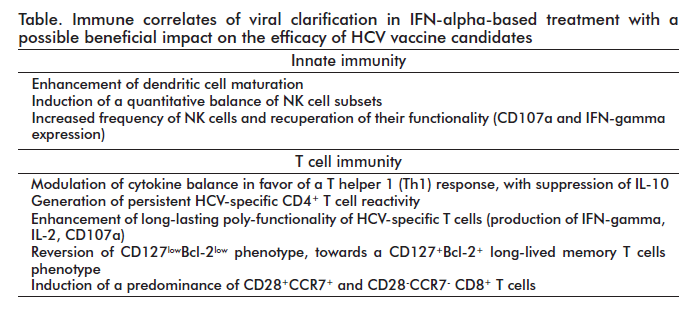
<body><![CDATA[<P   align="justify" ><font face="Verdana, Arial, Helvetica, sans-serif" size="2">Early viral RNA kinetics      may predict treatment success. Specifically, it is considered that genotype-1      infected patients, not showing a reduction of more than 2 log10 in circulating      RNA, or having an RNA concentration of 30 000 IU/mL after a twelve week treatment      are not likely to attain a SVR [67]. For these patients a halt of the treatment      is recommended. It has been observed that patients infected by genotype 2      and 3 may be cured in over 75% of the cases, while only 40-50% of genotype-1      infected patients achieve a SVR [63, 68, 69]. Additionally, host genetic factors      have been shown to influence response to therapy [70]. </font></P >       <P   align="justify" ><font face="Verdana, Arial, Helvetica, sans-serif" size="2">Investigations performed      in patients under IFN-alpha and ribavirin treatment suggest that a favorable      clinical course may be associated to the stimulation of CD8<Sup>+</Sup> T      cell activity and the secretion of Th1 cytokines [71]. In transplant settings      a successful antiviral treatment is also related to significant enhancement      of multi-specific and sustained CD8<Sup>+</Sup> T cell responses, while an      unsuccessful treatment is not [23]. In addition, enhancement of memory T-cell      proliferation and prevention of T-cell apoptosis by Type 1 IFNs have been      reported [72]. </font></P >   <FONT size="+1"><FONT size="+1"><FONT size="+1"><FONT size="+1">        <P   align="justify" ><font face="Verdana, Arial, Helvetica, sans-serif" size="2">Studies show that      before therapy, either alone or combined with ribavirin, HCV-specific T cell      reactivity was hardly detected in the majority of chronic patients [66, 73].      Nevertheless, IFN-based treatment increased the number of patients with T      cell reactivity to one or more HCV antigens [66]. Moreover, the induction      of persistent HCV-specific CD4<Sup>+</Sup> T cell reactivity was found to      be associated with treatment response, and the magnitude of this response      against the core was directly associated to SVR [66]. During treatment the      functional response was induced and maintained in SVR patients, while a patient      not responding to IFN-alpha monotherapy lost the response after therapy withdrawal      [73]. These results suggest that HCV-specific IFN-gamma production persists      after therapy in patients achieving an SVR, while it disappears in non responders.      </font></P >   <FONT size="+1"><FONT size="+1">        <P   align="justify" ><font face="Verdana, Arial, Helvetica, sans-serif" size="2">At the same time,      seemingly contradictory evidence has also been found regarding the enhancing      effect of IFN-based therapy on HCV-specific cellular immune response. A study      involving persons with acute infection, who did not rapidly control viremia      indicated that virus-specific CD4<Sup>+</Sup> and CD8<Sup>+</Sup> T-cell responses      uniformly decrease with successful treatment and increase transiently, with      recrudescence of viremia in those failing to achieve an SVR [74]. Hence these      data show that when treatment is successful, it is not associated with persistent      augmentation, but with a sustained decline of the immune response [74]. Other      reports have found no significant effect of this treatment on T cell functionality      or frequency, either in SVR or non-SVR [14]. </font></P >   <FONT size="+1"><FONT size="+1"><FONT size="+1"><FONT size="+1">        <P   align="justify" ><font face="Verdana, Arial, Helvetica, sans-serif" size="2">Many factors may      contribute to the discrepancy between studies: the heterogeneity of the cohorts      of patients and of the treatment regimes applied make comparisons impossible;      most of the studies are biased due to the reduced number of epitopes tested,      which lead to underestimation of responses. In addition, different time points      and diverse immune correlates, either involving frequencies or functionality,      are evaluated in different trials. Such heterogeneity makes it impossible      to find consensus regarding the net effects of IFN-based therapies on HCV-specific      T cell response. </font></P >       <P   align="justify" ><font face="Verdana, Arial, Helvetica, sans-serif" size="2">Nevertheless, Badr      et al. showed that even when HCV-specific T cells do decline in frequency      over time, they remain detectable and polyfunctional up to 1 year following      discontinuation of therapy in all SVR [20]. In contrast, while the polyfunctionality      of HCV-specific T cells, in terms of production of IFN-gamma, IL-2, and CD107a,      could be enhanced by IFN monotherapy in a relapsing patient, their proportion      declined and were undetectable after viral rebound, consistent with their      inability to up-regulate CD127 and Bcl-2 expression, common characteristics      of long-lived memory T cells [20]. </font></P >       <P   align="justify" ><font face="Verdana, Arial, Helvetica, sans-serif" size="2">In fact, comprehensive      studies on the impact of IFN-based therapy on HCV-specific T cells have shed      light on important possible correlates of treatment induced viral clarification.      In treatment-na&iuml;ve and early chronic individuals, T cells predominantly      express a CD127<Sup>low</Sup>Bcl-2<Sup>low</Sup> phenotype, which can be rapidly      reverted by successful IFN monotherapy upon virus elimination [20]. CD127<Sup>+</Sup>      Bcl-2<Sup>+</Sup> HCV-specific populations, which are selected for during      therapy in SVR, were shown to be long-lived after discontinuation of therapy      [20]. In agreement with other studies [74], T cell proliferation was not found      to be a predictor of the outcome of HCV infection [20]. In contrast, a marked      increase in IFN-gamma secretion, restoration in all functions, and generation      of polyfunctional T cells were observed in patients following the initiation      of therapy and coincided with virus elimination [20]. Badr and colleagues      further demonstrated that CD127 expression distinguished a unique subset of      HCV-specific memory T cells bearing the phenotypic signature of T effector      memory cells (CCR7<Sup>-</Sup> CD45RA<Sup>-</Sup>) and yet bearing the functional      features of both T central memory (rapid proliferation and high IL-2 production)      and T effector memory (high IFN-gamma production and cytotoxic potential)      [20]. Another study linking HCV-specific T cell phenotype and response to      PEG-IFN-alpha and ribavirin demonstrated that treatment was able to induce      a predominance of early and late differentiation phenotypes (based on CD28      and CCR7 expression) in SVR, while non-SVR showed a predominance of pre-terminally      differentiated, not fully functional T cells, that could not be reversed by      therapy [75]. This could be interpreted in the sense that a predominance of      early and late differentiation phenotypes is advantageous because the former      is a source of effectors, while fully differentiated cells are ready-to-act      effectors that can control viral replication. However, the sustained predominance      of pre-terminally differentiated cells, that do not reach a fully mature state,      results in the inability to clear infection. </font></P >   <FONT size="+1"><FONT size="+1"><FONT size="+1"><FONT size="+1"><FONT size="+1"><FONT size="+1"><FONT size="+1"><FONT size="+1"><FONT size="+1"><FONT size="+1"><FONT size="+1"><FONT size="+1">        <P   align="justify" ><font face="Verdana, Arial, Helvetica, sans-serif" size="2">The importance of      persistent HCV T cell responses to reach a SVR has been highlighted, not only      in the context of HCV monoinfection [66, 73], but in HCV-HIV co-infection      as well [76]. </font></P >       <P   align="justify" ><font face="Verdana, Arial, Helvetica, sans-serif" size="2">Combined IFN-alpha      and ribavirin therapy not only impacts the adaptive arm, but also the innate      arm of the immune system (<a href="/img/revistas/bta/v28n3/t0101311.gif">Table</a>).      While a significant reduction in NK cell frequency and a quantitative imbalance      of NK cell subsets may be observed in HCV-infected patients, it has been demonstrated      that antiviral treatment is able to reverse this situation [77, 78]. Additionally,      the expression of NK cell receptors, and function of NK cells (CD107a and      IFN-gamma expression) returned to normal levels in SVR, in contrast to relapsing      patients [78]. Also an enhancer effect of dendritic cell maturation has been      described for IFN-alpha [72]. </font></P >       
<P   align="justify" ><font face="Verdana, Arial, Helvetica, sans-serif" size="2">The reasons for the      decline in HCV-specific T cells during therapy are not completely understood.      Some authors consider that the decline of HCV-specific CD8<Sup>+</Sup> T-cell      responses during therapy is possibly due to the withdrawal of the antigen,      and argue against treatment-induced immunological containment of ongoing viral      replication; an alternative explanation proposed is that T cells redistribute      to the liver during therapy, and therefore decline in frequency in peripheral      blood mononuclear cells [79]. Nevertheless, an important distinction between      those who control the virus and those who do not is that responses tend to      be stronger and broader in the long term, in the absence of viremia. This      fact strongly highlights that virus-specific immune response may actually      contribute to viral containment and that the withdrawal of the antigen does      not necessarily imply that long-lived functional cells may not be generated      and maintained in the absence of antigenic stimulation. In fact, there is      evidence in favor of an important role for HCV-specific T cells in viral control      during therapy. The findings that the maximal induction of virus-specific      T-cell reactivity occurs at about weeks 4-8 of the treatment, with clear differences      in cytokine profiles between treatment responders and non responders, suggest      that this may be an important effector mechanism of viral elimination [66].      However, whether the enhancement in HCV-specific Th reactivity seen with antiviral      treatments results from the induction of new T-cell clones or if it is the      result of restoration of preexisting T-cell reactivity, is unknown. It has      also been proposed that the restoration of virus-specific T-cell reactivity      during IFN-alpha and ribavirin treatment could result from the observed inhibition      of IL-10 production, which would reduce the immunosuppressive effects of this      cytokine [66, 80]. Others favor the hypothesis that the reconstitution of      a polyfunctional immune response is a consequence of virus elimination and      prevention of continued T-cell exhaustion, similar to acute resolving HCV      [20, 81]. In this sense, when more and more evidence highlight the pervasive      effect of high viral load on HCV-specific cellular immune responses [19, 29,      72], IFN-alpha and ribavirin therapies could be considered effective adjuvant      therapies to be used with HCV-specific vaccines. Thus, several hypotheses      support the idea of IFN-based treatment as a modifier of HCV-specific immune      response in chronic patients, of which the favorable impact responds to its      ability to improve quality, instead of quantity, of the immune response. </font></P >   <FONT size="+1"><FONT size="+1">        ]]></body>
<body><![CDATA[<P   align="justify" ><font face="Verdana, Arial, Helvetica, sans-serif" size="2">An important finding      from a recent study by Abdel-Hakeem and colleagues [81] demonstrated that      functionality of HCV-specific T cell, both of CD4<Sup>+</Sup> and CD8<Sup>+</Sup>,      is more effectively rescued when treatment is started early after HCV infection.      However, studies evaluating the efficacy to attain viral clarification of      </font><font face="Verdana, Arial, Helvetica, sans-serif" size="2">the combination      of IFN-based treatments with HCV-specific vaccine candidates are still scarce.      </font></P >   <FONT size="+1"><FONT size="+1"><FONT size="+1"><FONT size="+1">        <P   align="justify" ><font face="Verdana, Arial, Helvetica, sans-serif" size="2">The first study published      in this sense was that of Wedemeyer and colleagues [82]. In that study, peptide      vaccine candidate IC41 was tested as a late add-on to standard PEG-IFN and      ribavirin treatment, in chronic treatment-na&iuml;ve patients. The main objective      was to determine if IC41 could reduce relapse rate when administered from      28 to 48 weeks after the start of the standard treatment, but the observed      relapse rate was inconclusive, so that proof of therapeutic benefit could      not be demonstrated [80]. IC41 did not delay viral relapse either; nevertheless,      vaccine-specific T cell responses were exclusively detected in SVR and not      in relapse patients, offering more evidence that HCV-specific T cell responses      can contribute to the long-term control of the virus [80]. One important limitation      of this study was that it was uncontrolled, a fact that made a true comparison      with unvaccinated, but treated patients, impossible. </font></P >       <P   align="justify" ><font face="Verdana, Arial, Helvetica, sans-serif" size="2">Preliminary results      of the inclusion of GI-5005, a yeast vector vaccine expressing an NS3-core      fusion protein, in a phase II trial evaluating a triple therapy combined with      PEG-IFN-alpha and ribavirin regime, compared with the antiviral regime alone,      showed improved early virological responses in all treatment-na&iuml;ve patients      [83]. Nevertheless, end-of-trial results, including data of SVR, have not      yet been published. </font></P >       <P   > </P >   <FONT size="+1">        <P   ><b><font face="Verdana, Arial, Helvetica, sans-serif" size="3">CONCLUSIONS </font></b></P >       <P   align="justify" ><font size="2" face="Verdana, Arial, Helvetica, sans-serif">Data reviewed seems      to point to the quality of the immune response, rather than its quantity (number      of effectors) as the key factor associated to effective HCV elimination. Nevertheless,      the probability that a threshold may be reached cannot be ruled out. The generation      of multifunctional long-lived T effector cells is regarded as an advantage      of paramount importance that would lead to the attainment of a protective      state, in which the probability of viral relapse or reinfection is reduced.      HCV therapeutic vaccine candidates, based on an array of important epitopes      may contribute to the diversification of these responses. On the other hand,      the possibility that HCV-specific T cells may be rescued from exhaustion by      IFN-based treatment make this therapy a promising candidate that is to be      combined with HCV-specific therapeutic vaccine interventions. So far, IFN-alpha      based therapy has shown a potential to induce such changes, through its capacity      to reduce viral load, which is a pivotal impact. However, the optimal treatment      schedule, for the combination with novel T cell stimulating vaccine candidates,      must be defined. In fact, results indicate that the effects are actually modest      and still insufficient. Future studies should consider longer IFN-alpha courses,      the inclusion of more potent vaccine adjuvants and novel antiviral compounds,      as part of multi-therapy approaches. Hence, this type of therapy would help      reduce viral load and lead to the recovery of functional immune responses      that would contribute to a sustained viral clarification in chronic HCV patients.      </font></P >   <FONT size="+1">        <P   > </P >   <FONT size="+1">        <P   ><font size="3"><b><font face="Verdana, Arial, Helvetica, sans-serif">ACKNOWLEDGEMENTS</font></b></font><font face="Verdana, Arial, Helvetica, sans-serif" size="2">      </font></P >       <P   align="justify" ><font size="2" face="Verdana, Arial, Helvetica, sans-serif">The author is grateful      to Santiago Due&ntilde;as-Carrera, PhD, for critical reading of the manuscript      and for useful recommendations. </font></P >   <FONT size="+1">        <P   > </P >   <FONT size="+1">        ]]></body>
<body><![CDATA[<P   ><b><font face="Verdana, Arial, Helvetica, sans-serif" size="3">REFERENCES </font></b></P >       <!-- ref --><P   ><font size="2" face="Verdana, Arial, Helvetica, sans-serif">1. Williams R. Global      challenges in liver disease. Hepatology. 2006;44(3):521-6.     </font></P >   <FONT size="+1">        <!-- ref --><P   ><font face="Verdana, Arial, Helvetica, sans-serif" size="2">2. Hoofnagle JH.      Course and outcome of hepatitis C. Hepatology. 2002;36(5 Suppl 1):S21-9.     </font></P >       <!-- ref --><P   ><font face="Verdana, Arial, Helvetica, sans-serif" size="2">3. Chapel HM, Christie      JM, Peach V, Chapman RW. Five-year follow-up of patients with primary antibody      deficiencies following an outbreak of acute hepatitis C. Clin Immunol. 2001;99(3):320-4.          </font></P >       <!-- ref --><P   ><font face="Verdana, Arial, Helvetica, sans-serif" size="2">4. Meunier JC, Engle      RE, Faulk K, Zhao M, Bartosch B, Alter H, et al. Evidence for cross-genotype      neutralization of hepatitis C virus pseudo-particles and enhancement of infectivity      by apolipoprotein C1. Proc Natl Acad Sci USA. 2005;102(12):4560-5.     </font></P >       <!-- ref --><P   ><font face="Verdana, Arial, Helvetica, sans-serif" size="2">5. Thimme R, Bukh      J, Spangenberg HC, Wieland S, Pemberton J, Steiger C, et al. Viral and immunological      determinants of hepatitis C virus clearance, persistence, and disease. Proc      Natl Acad Sci USA. 2002;99(24):15661-8.     </font></P >       <!-- ref --><P   ><font face="Verdana, Arial, Helvetica, sans-serif" size="2">6. Cox AL, Mosbruger      T, Lauer GM, Pardoll D, Thomas DL, Ray SC. Comprehensive analyses of CD8+      T cell responses during longitudinal study of acute human hepatitis C. Hepatology.      2005;42(1):104-12.     </font></P >       <!-- ref --><P   ><font face="Verdana, Arial, Helvetica, sans-serif" size="2">7. Grabowska AM,      Lechner F, Klenerman P, Tighe PJ, Ryder S, Ball JK, et al. Direct ex vivo      comparison of the breadth and specificity of the T cells in the liver and      peripheral blood of patients with chronic HCV infection. Eur J Immunol. 2001;31(8):2388-94.          </font></P >       <!-- ref --><P   ><font face="Verdana, Arial, Helvetica, sans-serif" size="2">8. Semmo N, Day CL,      Ward SM, Lucas M, Harcourt G, Loughry A, et al. Preferential loss of IL-2-secreting      CD4+ T helper cells in chronic HCV infection. Hepatology. 2005;41(5):1019-28.          </font></P >       <!-- ref --><P   ><font face="Verdana, Arial, Helvetica, sans-serif" size="2">9. Folgori A, Spada      E, Pezzanera M, Ruggeri L, Mele A, Garbuglia AR, et al. Early impairment of      hepatitis C virus specific T cell proliferation during acute infection leads      to failure of viral clearance. Gut 2006;55:1012-9.     </font></P >       <!-- ref --><P   ><font face="Verdana, Arial, Helvetica, sans-serif" size="2">10. Wedemeyer H,      He XS, Nascimbeni M, Davis AR, Greenberg HB, Hoofnagle JH, et al. Impaired      effector function of hepatitis C virus-specific CD8+ T cells in chronic hepatitis      C virus infection. J Immunol. 2002;169(6):3447-58.     </font></P >       <!-- ref --><P   ><font face="Verdana, Arial, Helvetica, sans-serif" size="2">11. Spangenberg HC,      Viazov S, Kersting N, Neumann-Haefelin C, McKinney D, Roggendorf M, et al.      Intrahepatic CD8+ T-cell failure during chronic hepatitis C virus infection.      Hepatology. 2005;42(4):828-37.     </font></P >       <!-- ref --><P   ><font face="Verdana, Arial, Helvetica, sans-serif" size="2">12. Klade CS, Wedemeyer      H, Berg T, Hinrichsen H, Cholewinska G, Zeuzem S, et al. Therapeutic vaccination      of chronic hepatitis C nonresponder patients with the peptide vaccine IC41.      Gastroenterology. 2008;134(5):1385-95.     </font></P >       <!-- ref --><P   ><font face="Verdana, Arial, Helvetica, sans-serif" size="2">13. Yutani S, Komatsu      N, Shichijo S, Yoshida K, Takedatsu H, Itou M, et al. Phase I clinical study      of a peptide vaccination for hepatitis C virus-infected patients with different      human leukocyte antigen-class I-A alleles. Cancer Sci. 2009; 100(10):1935-42.          </font></P >       <!-- ref --><P   ><font face="Verdana, Arial, Helvetica, sans-serif" size="2">14. Pilli M, Zerbini      A, Penna A, Orlandini A, Lukasiewicz E, Pawlotsky JM, et al. HCV-specific      T-cell response in relation to viral kinetics and treatment outcome (DITTO-HCV      project). Gastroenterology. 2007;133(4):1132-43.     </font></P >       <!-- ref --><P   ><font face="Verdana, Arial, Helvetica, sans-serif" size="2">15. Nakamoto N, Kaplan      DE, Coleclough J, Li Y, Valiga ME, Kaminski M et al. Functional restoration      of HCV-specific CD8 T cells by PD-1 blockade is defined by PD-1 expression      and compartmentalization. Gastroenterology. 2008;134(7):1927-37,    1937.e1-2.      </font></P >       <!-- ref --><P   ><font face="Verdana, Arial, Helvetica, sans-serif" size="2">16. Ji X, Cheung      R, Cooper S, Li Q, Greenberg HB, He XS. Interferon alfa regulated gene expression      in patients initiating interferon treatment for chronic hepatitis C. Hepatology.      2003;37(3):610-21.     </font></P >       <!-- ref --><P   ><font face="Verdana, Arial, Helvetica, sans-serif" size="2">17. Tamir A, Jordan      WJ, Ritter M, Habib N, Lechler RI, Foster GR, et al. Interferon-alpha2a is      sufficient for promoting dendritic cell immunogenicity. Clin Exp Immunol.      2005;142(3):471-80.     </font></P >       <!-- ref --><P   ><font face="Verdana, Arial, Helvetica, sans-serif" size="2">18. Gerlach JT, Diepolder      HM, Jung MC, Gruener NH, Schraut WW, Zachoval R, et al. Recurrence of hepatitis      C virus after loss of virus-specific CD4(+) T-cell response in acute hepatitis      C. Gastroenterology. 1999;117(4):933-41.     </font></P >       <P   ><font face="Verdana, Arial, Helvetica, sans-serif" size="2">19. Kaplan DE, Sugimoto      K, Newton K, Valiga ME, Ikeda F, Aytaman A, et al. Discordant role of CD4      T-cell response relative to neutralizing antibody and CD8 T-cell responses      in acute hepatitis C. Gastroenterology. 2007;132(2):654-66. </font></P >       <!-- ref --><P   ><font face="Verdana, Arial, Helvetica, sans-serif" size="2">20. Badr G, B&eacute;dard      N, Abdel-Hakeem MS, Trautmann L, Willems B, Villeneuve JP, et al. Early interferon      therapy for hepatitis C virus infection rescues polyfunctional, long-lived      CD8+ memory T cells. J Virol. 2008;82(20):10017-31.     </font></P >       ]]></body>
<body><![CDATA[<!-- ref --><P   ><font face="Verdana, Arial, Helvetica, sans-serif" size="2">21. Gr&uuml;ner NH,      Gerlach TJ, Jung MC, Diepolder HM, Schirren CA, Schraut WW, et al. Association      of hepatitis C virus-specific CD8+ T cells with viral clearance in acute hepatitis      C. J Infect Dis. 2000;181(5):1528-36.     </font></P >       <!-- ref --><P   ><font face="Verdana, Arial, Helvetica, sans-serif" size="2">22. Guglietta S,      Garbuglia AR, Salichos L, Ruggeri L, Folgori A, Perrone MP, et al. Impact      of viral selected mutations on T cell mediated immunity in chronically evolving      and self limiting acute HCV infection. Virology. 2009;386(2):398-406.     </font></P >       <!-- ref --><P   ><font face="Verdana, Arial, Helvetica, sans-serif" size="2">23. Gruener NH, Jung      MC, Ulsenheimer A, Gerlach JT, Zachoval R, Diepolder HM, et al. Analysis of      a successful HCV-specific CD8+ T cell response in patients with recurrent      HCV-infection after orthotopic liver transplantation. Liver Transpl. 2004;10(12):1487-96.          </font></P >       <!-- ref --><P   ><font face="Verdana, Arial, Helvetica, sans-serif" size="2">24. Neumann-Haefelin      C, Blum HE, Chisari FV, Thimme R. T cell response in hepatitis C virus infection.      J Clin Virol. 2005;32(2):75-85.     </font></P >       <!-- ref --><P   ><font face="Verdana, Arial, Helvetica, sans-serif" size="2">25. Lechner F, Gruener      NH, Urbani S, Uggeri J, Santantonio T, Kammer AR, et al. CD8+ T lymphocyte      responses are induced during acute hepatitis C virus infection but are not      sustained. Eur J Immunol. 2000;30(9):2479-87.     </font></P >       ]]></body>
<body><![CDATA[<!-- ref --><P   ><font face="Verdana, Arial, Helvetica, sans-serif" size="2">26. Sarobe P, Lasarte      JJ, Casares N, L&oacute;pez-D&iacute;az de Cerio A, Baixeras E, Labarga P,      et al. Abnormal priming of CD4(+) T cells by dendritic cells expressing hepatitis      C virus core and E1 proteins. J Virol. 2002; 76(10):5062-70.     </font></P >       <!-- ref --><P   ><font face="Verdana, Arial, Helvetica, sans-serif" size="2">27. Moskophidis D,      Lechner F, Pircher H, Zinkernagel RM. Virus persistence in acutely infected      immunocompetent mice by exhaustion of antiviral cytotoxic effector T cells.      Nature. 1993;362(6422):758-61.     </font></P >       <!-- ref --><P   ><font face="Verdana, Arial, Helvetica, sans-serif" size="2">28. Nuti S, Rosa      D, Valiante NM, Saletti G, Caratozzolo M, Dellabona P, et al. Dynamics of      intra-hepatic lymphocytes in chronic hepatitis C: enrichment for Valpha24+      T cells and rapid elimination of effector cells by apoptosis. Eur J Immunol.      1998;28(11):3448-55.     </font></P >       <!-- ref --><P   ><font face="Verdana, Arial, Helvetica, sans-serif" size="2">29. Thimme R, Oldach      D, Chang KM, Steiger C, Ray SC, Chisari FV. Determinants of viral clearance      and persistence during acute hepatitis C virus infection. J Exp Med. 2001;194(10):1395-406.          </font></P >       <!-- ref --><P   ><font face="Verdana, Arial, Helvetica, sans-serif" size="2">30. Thimme R, Lohmann      V, Weber F. A target on the move: innate and adaptive immune escape strategies      of hepatitis C virus. Antiviral Res. 2006;69(3):129-41.     </font></P >       ]]></body>
<body><![CDATA[<!-- ref --><P   ><font face="Verdana, Arial, Helvetica, sans-serif" size="2">31. Urbani S, Boni      C, Missale G, Elia G, Cavallo C, Massari M, et al. Virus-specific CD8+ lymphocytes      share the same effector-memory phenotype but exhibit functional differences      in acute hepatitis B and C. J Virol. 2002;76(24):12423-34.     </font></P >       <!-- ref --><P   ><font face="Verdana, Arial, Helvetica, sans-serif" size="2">32. Appay V, Dunbar      PR, Callan M, Klenerman P, Gillespie GM, Papagno L, et al. Memory CD8+ T cells      vary in differentiation phenotype in different persistent virus infections.      Nat Med. 2002;8(4):379-85.     </font></P >       <!-- ref --><P   ><font face="Verdana, Arial, Helvetica, sans-serif" size="2">33. Accapezzato D,      Francavilla V, Paroli M, Casciaro M, Chircu LV, Cividini A, et al. Hepatic      expansion of a virus-specific regulatory CD8(+) T cell population in chronic      hepatitis C virus infection. J Clin Invest. 2004;113(7):963-72.     </font></P >       <!-- ref --><P   ><font face="Verdana, Arial, Helvetica, sans-serif" size="2">34. Day CL, Seth      NP, Lucas M, Appel H, Gauthier L, Lauer GM, et al. Ex vivo analysis of human      memory CD4 T cells specific for hepatitis C virus using MHC class II tetramers.      J Clin Invest. 2003;112(6):831-42.     </font></P >       <!-- ref --><P   ><font face="Verdana, Arial, Helvetica, sans-serif" size="2">35. Kaplan DE, Ikeda      F, Li Y, Nakamoto N, Ganesan S, Valiga ME, et al. Peripheral virus-specific      T-cell interleukin-10 responses develop early in acute hepatitis C infection      and become dominant in chronic hepatitis. J Hepatol. 2008;48(6):903-13.     </font></P >       ]]></body>
<body><![CDATA[<!-- ref --><P   ><font face="Verdana, Arial, Helvetica, sans-serif" size="2">36. Bolacchi F, Sinistro      A, Ciaprini C, Demin F, Capozzi M, Carducci FC, et al. Increased hepatitis      C virus (HCV)-specific CD4+CD25+ regulatory T lymphocytes and reduced HCV-specific      CD4+ T cell response in HCV-infected patients with normal versus abnormal      alanine aminotransferase levels. Clin Exp Immunol. 2006;144(2):188-96.     </font></P >       <!-- ref --><P   ><font face="Verdana, Arial, Helvetica, sans-serif" size="2">37. Cabrera R, Tu      Z, Xu Y, Firpi RJ, Rosen HR, Liu C, et al. An immunomodulatory role for CD4(+)CD25(+)      regulatory T lymphocytes in hepatitis C virus infection. Hepatology. 2004;40(5):1062-71.          </font></P >       <!-- ref --><P   ><font face="Verdana, Arial, Helvetica, sans-serif" size="2">38. Boettler T, Spangenberg      HC, Neumann-Haefelin C, Panther E, Urbani S, Ferrari C, et al. T cells with      a CD4+CD25+ regulatory phenotype suppress in vitro proliferation of virus-specific      CD8+ T cells during chronic hepatitis C virus infection. J Virol. 2005;79(12):7860-7.          </font></P >       <!-- ref --><P   ><font face="Verdana, Arial, Helvetica, sans-serif" size="2">39. Guglietta S,      Garbuglia AR, Pacciani V, Scott&agrave; C, Perrone MP, Laurenti L, et al.      Positive selection of cytotoxic T lymphocyte escape variants during acute      hepatitis C virus infection. Eur J Immunol. 2005;35(9):2627-37.     </font></P >       <!-- ref --><P   ><font face="Verdana, Arial, Helvetica, sans-serif" size="2">40. Kim AY, Kuntzen      T, Timm J, Nolan BE, Baca MA, Reyor LL, et al. Spontaneous control of HCV      is associated with expression of HLA-B 57 and preservation of targeted epitopes.      Gastroenterology. 2011;140(2):686-696.e1.     </font></P >       ]]></body>
<body><![CDATA[<!-- ref --><P   ><font face="Verdana, Arial, Helvetica, sans-serif" size="2">41. Lange CM, Roomp      K, Dragan A, Nattermann J, Michalk M, Spengler U, et al. HLA class I allele      associations with HCV genetic variants in patients with chronic HCV genotypes      1a or 1b infection. J Hepatol. 2010;53(6):1022-8.     </font></P >       <!-- ref --><P   ><font face="Verdana, Arial, Helvetica, sans-serif" size="2">42. Tseng KC, Chang      CK, Chou AL, Hsieh YH, Tseng CA, Lai NS. Prognostic effect of human leukocyte      antigen class I and II alleles on chronic hepatitis C patients treated by      pegylated interferon-alfa plus ribavirin in Taiwan. Hepatogastroenterology.      2010;57(99-100):456-61.     </font></P >       <!-- ref --><P   ><font face="Verdana, Arial, Helvetica, sans-serif" size="2">43. Koziel MJ. NK      cells: natural born killers in the conflict between humans and HCV. Hepatology.      2006;43(3):395-7.     </font></P >       <!-- ref --><P   ><font face="Verdana, Arial, Helvetica, sans-serif" size="2">44. Morishima C,      Paschal DM, Wang CC, Yoshihara CS, Wood BL, Yeo AE, et al. Decreased NK cell      frequency in chronic hepatitis C does not affect ex vivo cytolytic killing.      Hepatology. 2006;43(3):573-80.     </font></P >       <!-- ref --><P   ><font face="Verdana, Arial, Helvetica, sans-serif" size="2">45. Jinushi M, Takehara      T, Tatsumi T, Kanto T, Miyagi T, Suzuki T, et al. Negative regulation of NK      cell activities by inhibitory receptor CD94/NKG2A leads to altered NK cell-induced      modulation of dendritic cell functions in chronic hepatitis C virus infection.      J Immunol. 2004;173(10):6072-81.     </font></P >       ]]></body>
<body><![CDATA[<!-- ref --><P   ><font face="Verdana, Arial, Helvetica, sans-serif" size="2">46. Bain C, Inchauspe      G. Dendritic cells and hepatitis C virus. Pathol Biol (Paris) 2001;49:464-5.      French.     </font></P >       <!-- ref --><P   ><font face="Verdana, Arial, Helvetica, sans-serif" size="2">47. Lee CH, Choi      YH, Yang SH, Lee CW, Ha SJ, Sung YC. Hepatitis C virus core protein inhibits      interleukin 12 and nitric oxide production from activated macrophages. Virology.      2001;279(1):271-9.     </font></P >       <!-- ref --><P   ><font face="Verdana, Arial, Helvetica, sans-serif" size="2">48. Anthony DD, Yonkers      NL, Post AB, Asaad R, Heinzel FP, Lederman MM, et al. Selective impairments      in dendritic cell-associated function distinguish hepatitis C virus and HIV      infection. J Immunol. 2004;172(8):4907-16.     </font></P >       <!-- ref --><P   ><font face="Verdana, Arial, Helvetica, sans-serif" size="2">49. Longman RS, Talal      AH, Jacobson IM, Rice CM, Albert ML. Normal functional capacity in circulating      myeloid and plasmacytoid dendritic cells in patients with chronic hepatitis      C. J Infect Dis. 2005;192(3):497-503.     </font></P >       <!-- ref --><P   ><font face="Verdana, Arial, Helvetica, sans-serif" size="2">50. Kanto T, Inoue      M, Miyatake H, Sato A, Sakakibara M, Yakushijin T, et al. Reduced numbers      and impaired ability of myeloid and plasmacytoid dendritic cells to polarize      T helper cells in chronic hepatitis C virus infection. J Infect Dis. 2004;190(11):1919-26.          </font></P >       ]]></body>
<body><![CDATA[<!-- ref --><P   ><font face="Verdana, Arial, Helvetica, sans-serif" size="2">51. Szabo G, Dolganiuc      A. Subversion of plasmacytoid and myeloid dendritic cell functions in chronic      HCV infection. Immunobiology. 2005;210(2-4):237-47.     </font></P >       <!-- ref --><P   ><font face="Verdana, Arial, Helvetica, sans-serif" size="2">52. Rodrigue-Gervais      IG, Jouan L, Beaul&eacute; G, Sauv&eacute; D, Bruneau J, Willems B, et al.      Poly(I:C) and lipopolysaccharide innate sensing functions of circulating human      myeloid dendritic cells are affected in vivo in hepatitis C virus-infected      patients. J Virol. 2007;81(11):5537-46.     </font></P >       <!-- ref --><P   ><font face="Verdana, Arial, Helvetica, sans-serif" size="2">53. Zeisel MB, Fafi-Kremer      S, Fofana I, Barth H, Stoll-Keller F, Doffoel M, et al. Neutralizing antibodies      in hepatitis C virus infection. World J Gastroenterol. 2007;13(36):4824-30.          </font></P >       <!-- ref --><P   ><font face="Verdana, Arial, Helvetica, sans-serif" size="2">54. Leroux-Roels      G, Depla E, Hulstaert F, Tobback L, Dincq S, Desmet J, et al. A candidate      vaccine based on the hepatitis C E1 protein: tolerability and immunogenicity      in healthy volunteers. Vaccine. 2004;22(23-24):3080-6.     </font></P >       <!-- ref --><P   ><font face="Verdana, Arial, Helvetica, sans-serif" size="2">55. Frey SE, Houghton      M, Coates S, Abrignani S, Chien D, Rosa D, et al. Safety and immunogenicity      of HCV E1E2 vaccine adjuvanted with MF59 administered to healthy adults. Vaccine.      2010;28(38):6367-73.     </font></P >       ]]></body>
<body><![CDATA[<!-- ref --><P   ><font face="Verdana, Arial, Helvetica, sans-serif" size="2">56. Firbas C, Jilma      B, Tauber E, Buerger V, Jelovcan S, Lingnau K, et al. Immunogenicity and safety      of a novel therapeutic hepatitis C virus (HCV) peptide vaccine: a randomized,      placebo controlled trial for dose optimization in 128 healthy subjects. Vaccine.      2006;24(20):4343-53.     </font></P >       <!-- ref --><P   ><font face="Verdana, Arial, Helvetica, sans-serif" size="2">57. Nevens F, Roskams      T, Van Vlierberghe H, Horsmans Y, Sprengers D, Elewaut A, et al. A pilot study      of therapeutic vaccination with envelope protein E1 in 35 patients with chronic      hepatitis C. Hepatology. 2003;38(5):1289-96.     </font></P >       <!-- ref --><P   ><font face="Verdana, Arial, Helvetica, sans-serif" size="2">58. Schlaphoff V,      Klade CS, Jilma B, Jelovcan SB, Cornberg M, Tauber E, et al. Functional and      phenotypic characterization of peptide-vaccine-induced HCV-specific CD8+ T      cells in healthy individuals and chronic hepatitis C patients. Vaccine. 2007;25(37-38):6793-806.          </font></P >       <!-- ref --><P   ><font face="Verdana, Arial, Helvetica, sans-serif" size="2">59. Yutani S, Yamada      A, Yoshida K, Takao Y, Tamura M, Komatsu N, et al. Phase I clinical study      of a personalized peptide vaccination for patients infected with hepatitis      C virus (HCV) 1b who failed to respond to interferon-based therapy. Vaccine.      2007;25(42):7429-35.     </font></P >       <!-- ref --><P   ><font face="Verdana, Arial, Helvetica, sans-serif" size="2">60. Alvarez-Lajonchere      L, Gonz&aacute;lez M, Alvarez-Obreg&oacute;n JC, Guerra I, Vi&ntilde;a A,      Acosta-Rivero N, et al. Hepatitis C virus (HCV) core protein enhances the      immunogenicity of a co-delivered DNA vaccine encoding HCV structural antigens      in mice. Biotechnol Appl Biochem. 2006;44(Pt 1):9-17.     </font></P >       ]]></body>
<body><![CDATA[<!-- ref --><P   ><font face="Verdana, Arial, Helvetica, sans-serif" size="2">61. Alvarez-Lajonchere      L, Shoukry NH, Gr&aacute; B, Amador-Ca&ntilde;izares Y, Helle F, B&eacute;dard      N, et al. Immunogenicity of CIGB-230, a therapeutic DNA vaccine preparation,      in HCV-chronically infected individuals in a Phase I clinical trial. J Viral      Hepat. 2009;16(3):156-67.     </font></P >       <!-- ref --><P   ><font face="Verdana, Arial, Helvetica, sans-serif" size="2">62. Hoofnagle JH,      Seeff LB. Peginterferon and ribavirin for chronic hepatitis C. N Engl J Med.      2006;355(23):2444-51.     </font></P >       <!-- ref --><P   ><font face="Verdana, Arial, Helvetica, sans-serif" size="2">63. Manns MP, Wedemeyer      H, Cornberg M. Treating viral hepatitis C: efficacy, side effects, and complications.      Gut. 2006;55(9):1350-9.     </font></P >       <!-- ref --><P   ><font face="Verdana, Arial, Helvetica, sans-serif" size="2">64. Crotty S, Maag      D, Arnold JJ, Zhong W, Lau JY, Hong Z, et al. The broad-spectrum antiviral      ribonucleoside ribavirin is an RNA virus mutagen. Nat Med. 2000;6(12):1375-9.          </font></P >       <!-- ref --><P   ><font face="Verdana, Arial, Helvetica, sans-serif" size="2">65. Jain MK, Zoellner      C. Role of ribavirin in HCV treatment response: now and in the future. Expert      Opin Pharmacother. 2010;11(4):673-83.     </font></P >       ]]></body>
<body><![CDATA[<!-- ref --><P   ><font face="Verdana, Arial, Helvetica, sans-serif" size="2">66. Cramp ME, Rossol      S, Chokshi S, Carucci P, Williams R, Naoumov NV. Hepatitis C virus-specific      T-cell reactivity during interferon and ribavirin treatment in chronic hepatitis      C. Gastroenterology. 2000;118(2):346-55.     </font></P >       <!-- ref --><P   ><font face="Verdana, Arial, Helvetica, sans-serif" size="2">67. Ghany MG, Strader      DB, Thomas DL, Seeff LB; American Association for the Study of Liver Diseases.      Diagnosis, management, and treatment of hepatitis C: an update. Hepatology.      2009;49(4):1335-74.     </font></P >       <!-- ref --><P   ><font face="Verdana, Arial, Helvetica, sans-serif" size="2">68. Fried MW, Shiffman      ML, Reddy KR, Smith C, Marinos G, Gon&ccedil;ales FL Jr, et al. Peginterferon      alfa-2a plus ribavirin for chronic hepatitis C virus infection. N Engl J Med.      2002;347(13):975-82.     </font></P >       <P   ><font face="Verdana, Arial, Helvetica, sans-serif" size="2">69. Kmieciak D, Kruszyna      &#321;, Migdalski P, &#321;acinski M, Juszczyk J, Trzeciak WH. Mutations within      protein kinase R-binding domain of NS5A protein of hepatitis C virus (HCV)      and specificity of HCV antibodies in pretreatment sera of HCV-chronically      infected patients and their effect on the result of treatment. Jpn J Infect      Dis. 2006;59(2):92-9. </font></P >       <!-- ref --><P   ><font face="Verdana, Arial, Helvetica, sans-serif" size="2">70. Fukuhara T, Taketomi      A, Motomura T, Okano S, Ninomiya A, Abe T, et al. Variants in IL28B in liver      recipients and donors correlate with response to peg-interferon and ribavirin      therapy for recurrent hepatitis C. Gastroenterology. 2010;139(5):1577-85,1585.e1-3.          </font></P >       <!-- ref --><P   ><font face="Verdana, Arial, Helvetica, sans-serif" size="2">71. Kamal SM, Ismail      A, Graham CS, He Q, Rasenack JW, Peters T, et al. Pegylated interferon alpha      therapy in acute hepatitis C: relation to hepatitis C virus-specific T cell      response kinetics. Hepatology. 2004;39(6):1721-31.     </font></P >       <!-- ref --><P   ><font face="Verdana, Arial, Helvetica, sans-serif" size="2">72. Lechner F, Wong      DK, Dunbar PR, Chapman R, Chung RT, Dohrenwend P, et al. Analysis of successful      immune responses in persons infected with hepatitis C virus. J Exp Med. 2000;191(9):1499-512.          </font></P >       <!-- ref --><P   ><font face="Verdana, Arial, Helvetica, sans-serif" size="2">73. Kobayashi K,      Ishii M, Shiina M, Ueno Y, Kondo Y, Kanno A, et al. Interferon-gamma is produced      by CD8 T cells in response to HLA-A24-restricted hepatitis C virus epitopes      after sustained virus loss. Clin Exp Immunol. 2005;141(1):81-8.     </font></P >       <!-- ref --><P   ><font face="Verdana, Arial, Helvetica, sans-serif" size="2">74. Lauer GM, Lucas      M, Timm J, Ouchi K, Kim AY, Day CL, et al. Full-breadth analysis of CD8+ T-cell      responses in acute hepatitis C virus infection and early therapy. J Virol.      2005;79(20):12979-88.     </font></P >       <!-- ref --><P   ><font face="Verdana, Arial, Helvetica, sans-serif" size="2">75. Caetano J, Martinho      A, Paiva A, Pais B, Valente C, Luxo C. Differences in hepatitis C virus (HCV)-specific      CD8 T-cell phenotype during pegylated alpha interferon and ribavirin treatment      are related to response to antiviral therapy in patients chronically infected      with HCV. J Virol. 2008;82(15):7567-77.     </font></P >       <!-- ref --><P   ><font face="Verdana, Arial, Helvetica, sans-serif" size="2">76. Legrand E, Neau      D, Galperine T, Trimoulet P, Moreau JF, Pitard V, et al. CD4 T lymphocyte      proliferative responses to hepatitis C virus (HCV) antigens in patients coinfected      with HCV and human immunodeficiency virus who responded to anti-HCV treatment.      J Infect Dis. 2002;186(3):302-11.     </font></P >       <!-- ref --><P   ><font face="Verdana, Arial, Helvetica, sans-serif" size="2">77. Gonzalez VD,      Falconer K, Micha&euml;lsson J, Moll M, Reichard O, Alaeus A, et al. Expansion      of CD56- NK cells in chronic HCV/HIV-1 co-infection: reversion by antiviral      treatment with pegylated IFNalpha and ribavirin. Clin Immunol. 2008;128(1):46-56.          </font></P >       <!-- ref --><P   ><font face="Verdana, Arial, Helvetica, sans-serif" size="2">78. Dessouki O, Kamiya      Y, Nagahama H, Tanaka M, Suzu S, Sasaki Y, et al. Chronic hepatitis C viral      infection reduces NK cell frequency and suppresses cytokine secretion: Reversion      by anti-viral treatment. Biochem Biophys Res Commun. 2010;393(2):331-7.     </font></P >       <!-- ref --><P   ><font face="Verdana, Arial, Helvetica, sans-serif" size="2">79. Lauer GM, Barnes      E, Lucas M, Timm J, Ouchi K, Kim AY, et al. High resolution analysis of cellular      immune responses in resolved and persistent hepatitis C virus infection. Gastroenterology.      2004;127(3):924-36.     </font></P >       <!-- ref --><P   ><font face="Verdana, Arial, Helvetica, sans-serif" size="2">80. Graham CS, Wells      A, Liu T, Sherman KE, Peters M, Chung RT, et al. Relationships between cellular      immune responses and treatment outcomes with interferon and ribavirin in HIV/hepatitis      C virus co-infection. AIDS. 2006;20(3):345-51.     </font></P >       <!-- ref --><P   ><font face="Verdana, Arial, Helvetica, sans-serif" size="2">81. Abdel-Hakeem      MS, B&eacute;dard N, Badr G, Ostrowski M, S&eacute;kaly RP, Bruneau J, et      al. Comparison of immune restoration in early versus late alpha interferon      therapy against hepatitis C virus. J Virol. 2010;84(19):10429-35.     </font></P >       <!-- ref --><P   ><font face="Verdana, Arial, Helvetica, sans-serif" size="2">82. Wedemeyer H,      Schuller E, Schlaphoff V, Stauber RE, Wiegand J, Schiefke I, et al. Therapeutic      vaccine IC41 as late add-on to standard treatment in patients with chronic      hepatitis C. Vaccine. 2009;27(37):5142-51.     </font></P >       <!-- ref --><P   ><font face="Verdana, Arial, Helvetica, sans-serif" size="2">83. Habersetzer F,      Baumert TF, Stoll-Keller F. GI-5005, a yeast vector vaccine expressing an      NS3-core fusion protein for chronic HCV infection. Curr Opin Mol Ther. 2009;11(4):456-62.          </font></P >       <P   > </P >   <FONT size="+1">        <P   ><font face="Verdana, Arial, Helvetica, sans-serif" size="2">Received in December,      2010.     <br>     Accepted for publication in August, 2011. </font></P >       <P   > </P >       <P   ><font face="Verdana, Arial, Helvetica, sans-serif" size="2">Yalena Amador-Ca&ntilde;izares.      HCV Department, Vaccine Division, Center for Genetic Engineering and Biotechnology,      CIGB. Ave. 31 / 158 and 190, Playa, PO Box 6162, Havana, Cuba. E-mail: <a href="mailto:yalena.amador@cigb.edu.cu">yalena.amador@cigb.edu.cu</a>.      </font></P >       ]]></body>
<body><![CDATA[<P   > </P >   </font></font></font></font></font></font></font></font></font></font></font></font></font></font></font></font></font></font></font></font></font></font></font></font></font></font></font></font></font></font></font></font></font></font></font></font></font></font></font></font></font></font></font></font></font></font></font></font></font></font></font></font></font></font></font></font></font></font></font></font></font></font></font></font></font></font></font></font></font></font></font></font></font></font></font></font></font></font></font></font></font></font></font></font></font></font></font></font></font></font></font></font></font></font></font></font></font></font></font></font></font></font></font></font></font></font></font></font></font></font></font></font></font></font></font></font></font></font></font></font></font></DIV >      ]]></body><back>
<ref-list>
<ref id="B1">
<label>1</label><nlm-citation citation-type="journal">
<person-group person-group-type="author">
<name>
<surname><![CDATA[Williams]]></surname>
<given-names><![CDATA[R]]></given-names>
</name>
</person-group>
<article-title xml:lang="en"><![CDATA[Global challenges in liver disease]]></article-title>
<source><![CDATA[Hepatology]]></source>
<year>2006</year>
<volume>44</volume>
<numero>3</numero>
<issue>3</issue>
<page-range>521-6</page-range></nlm-citation>
</ref>
<ref id="B2">
<label>2</label><nlm-citation citation-type="journal">
<person-group person-group-type="author">
<name>
<surname><![CDATA[Hoofnagle]]></surname>
<given-names><![CDATA[JH]]></given-names>
</name>
</person-group>
<article-title xml:lang="en"><![CDATA[Course and outcome of hepatitis C]]></article-title>
<source><![CDATA[Hepatology]]></source>
<year>2002</year>
<volume>36</volume>
<numero>5^s1</numero>
<issue>5^s1</issue>
<supplement>1</supplement>
<page-range>S21-9</page-range></nlm-citation>
</ref>
<ref id="B3">
<label>3</label><nlm-citation citation-type="journal">
<person-group person-group-type="author">
<name>
<surname><![CDATA[Chapel]]></surname>
<given-names><![CDATA[HM]]></given-names>
</name>
<name>
<surname><![CDATA[Christie]]></surname>
<given-names><![CDATA[JM]]></given-names>
</name>
<name>
<surname><![CDATA[Peach]]></surname>
<given-names><![CDATA[V]]></given-names>
</name>
<name>
<surname><![CDATA[Chapman]]></surname>
<given-names><![CDATA[RW]]></given-names>
</name>
</person-group>
<article-title xml:lang="en"><![CDATA[Five-year follow-up of patients with primary antibody deficiencies following an outbreak of acute hepatitis C]]></article-title>
<source><![CDATA[Clin Immunol]]></source>
<year>2001</year>
<volume>99</volume>
<numero>3</numero>
<issue>3</issue>
<page-range>320-4</page-range></nlm-citation>
</ref>
<ref id="B4">
<label>4</label><nlm-citation citation-type="journal">
<person-group person-group-type="author">
<name>
<surname><![CDATA[Meunier]]></surname>
<given-names><![CDATA[JC]]></given-names>
</name>
<name>
<surname><![CDATA[Engle]]></surname>
<given-names><![CDATA[RE]]></given-names>
</name>
<name>
<surname><![CDATA[Faulk]]></surname>
<given-names><![CDATA[K]]></given-names>
</name>
<name>
<surname><![CDATA[Zhao]]></surname>
<given-names><![CDATA[M]]></given-names>
</name>
<name>
<surname><![CDATA[Bartosch]]></surname>
<given-names><![CDATA[B]]></given-names>
</name>
<name>
<surname><![CDATA[Alter]]></surname>
<given-names><![CDATA[H]]></given-names>
</name>
</person-group>
<article-title xml:lang="en"><![CDATA[Evidence for cross-genotype neutralization of hepatitis C virus pseudo-particles and enhancement of infectivity by apolipoprotein C1]]></article-title>
<source><![CDATA[Proc Natl Acad Sci USA]]></source>
<year>2005</year>
<volume>102</volume>
<numero>12</numero>
<issue>12</issue>
<page-range>4560-5</page-range></nlm-citation>
</ref>
<ref id="B5">
<label>5</label><nlm-citation citation-type="journal">
<person-group person-group-type="author">
<name>
<surname><![CDATA[Thimme]]></surname>
<given-names><![CDATA[R]]></given-names>
</name>
<name>
<surname><![CDATA[Bukh]]></surname>
<given-names><![CDATA[J]]></given-names>
</name>
<name>
<surname><![CDATA[Spangenberg]]></surname>
<given-names><![CDATA[HC]]></given-names>
</name>
<name>
<surname><![CDATA[Wieland]]></surname>
<given-names><![CDATA[S]]></given-names>
</name>
<name>
<surname><![CDATA[Pemberton]]></surname>
<given-names><![CDATA[J]]></given-names>
</name>
<name>
<surname><![CDATA[Steiger]]></surname>
<given-names><![CDATA[C]]></given-names>
</name>
</person-group>
<article-title xml:lang="en"><![CDATA[Viral and immunological determinants of hepatitis C virus clearance, persistence, and disease]]></article-title>
<source><![CDATA[Proc Natl Acad Sci USA]]></source>
<year>2002</year>
<volume>99</volume>
<numero>24</numero>
<issue>24</issue>
<page-range>15661-8</page-range></nlm-citation>
</ref>
<ref id="B6">
<label>6</label><nlm-citation citation-type="journal">
<person-group person-group-type="author">
<name>
<surname><![CDATA[Cox]]></surname>
<given-names><![CDATA[AL]]></given-names>
</name>
<name>
<surname><![CDATA[Mosbruger]]></surname>
<given-names><![CDATA[T]]></given-names>
</name>
<name>
<surname><![CDATA[Lauer]]></surname>
<given-names><![CDATA[GM]]></given-names>
</name>
<name>
<surname><![CDATA[Pardoll]]></surname>
<given-names><![CDATA[D]]></given-names>
</name>
<name>
<surname><![CDATA[Thomas]]></surname>
<given-names><![CDATA[DL]]></given-names>
</name>
<name>
<surname><![CDATA[Ray]]></surname>
<given-names><![CDATA[SC]]></given-names>
</name>
</person-group>
<article-title xml:lang="en"><![CDATA[Comprehensive analyses of CD8+ T cell responses during longitudinal study of acute human hepatitis C]]></article-title>
<source><![CDATA[Hepatology]]></source>
<year>2005</year>
<volume>42</volume>
<numero>1</numero>
<issue>1</issue>
<page-range>104-12</page-range></nlm-citation>
</ref>
<ref id="B7">
<label>7</label><nlm-citation citation-type="journal">
<person-group person-group-type="author">
<name>
<surname><![CDATA[Grabowska]]></surname>
<given-names><![CDATA[AM]]></given-names>
</name>
<name>
<surname><![CDATA[Lechner]]></surname>
<given-names><![CDATA[F]]></given-names>
</name>
<name>
<surname><![CDATA[Klenerman]]></surname>
<given-names><![CDATA[P]]></given-names>
</name>
<name>
<surname><![CDATA[Tighe]]></surname>
<given-names><![CDATA[PJ]]></given-names>
</name>
<name>
<surname><![CDATA[Ryder]]></surname>
<given-names><![CDATA[S]]></given-names>
</name>
<name>
<surname><![CDATA[Ball]]></surname>
<given-names><![CDATA[JK]]></given-names>
</name>
</person-group>
<article-title xml:lang="en"><![CDATA[Direct ex vivo comparison of the breadth and specificity of the T cells in the liver and peripheral blood of patients with chronic HCV infection]]></article-title>
<source><![CDATA[Eur J Immunol]]></source>
<year>2001</year>
<volume>31</volume>
<numero>8</numero>
<issue>8</issue>
<page-range>2388-94</page-range></nlm-citation>
</ref>
<ref id="B8">
<label>8</label><nlm-citation citation-type="journal">
<person-group person-group-type="author">
<name>
<surname><![CDATA[Semmo]]></surname>
<given-names><![CDATA[N]]></given-names>
</name>
<name>
<surname><![CDATA[Day]]></surname>
<given-names><![CDATA[CL]]></given-names>
</name>
<name>
<surname><![CDATA[Ward]]></surname>
<given-names><![CDATA[SM]]></given-names>
</name>
<name>
<surname><![CDATA[Lucas]]></surname>
<given-names><![CDATA[M]]></given-names>
</name>
<name>
<surname><![CDATA[Harcourt]]></surname>
<given-names><![CDATA[G]]></given-names>
</name>
<name>
<surname><![CDATA[Loughry]]></surname>
<given-names><![CDATA[A]]></given-names>
</name>
</person-group>
<article-title xml:lang="en"><![CDATA[Preferential loss of IL-2-secreting CD4+ T helper cells in chronic HCV infection]]></article-title>
<source><![CDATA[Hepatology]]></source>
<year>2005</year>
<volume>41</volume>
<numero>5</numero>
<issue>5</issue>
<page-range>1019-28</page-range></nlm-citation>
</ref>
<ref id="B9">
<label>9</label><nlm-citation citation-type="journal">
<person-group person-group-type="author">
<name>
<surname><![CDATA[Folgori]]></surname>
<given-names><![CDATA[A]]></given-names>
</name>
<name>
<surname><![CDATA[Spada]]></surname>
<given-names><![CDATA[E]]></given-names>
</name>
<name>
<surname><![CDATA[Pezzanera]]></surname>
<given-names><![CDATA[M]]></given-names>
</name>
<name>
<surname><![CDATA[Ruggeri]]></surname>
<given-names><![CDATA[L]]></given-names>
</name>
<name>
<surname><![CDATA[Mele]]></surname>
<given-names><![CDATA[A]]></given-names>
</name>
<name>
<surname><![CDATA[Garbuglia]]></surname>
<given-names><![CDATA[AR]]></given-names>
</name>
</person-group>
<article-title xml:lang="en"><![CDATA[Early impairment of hepatitis C virus specific T cell proliferation during acute infection leads to failure of viral clearance]]></article-title>
<source><![CDATA[Gut]]></source>
<year>2006</year>
<volume>55</volume>
<page-range>1012-9</page-range></nlm-citation>
</ref>
<ref id="B10">
<label>10</label><nlm-citation citation-type="journal">
<person-group person-group-type="author">
<name>
<surname><![CDATA[Wedemeyer]]></surname>
<given-names><![CDATA[H]]></given-names>
</name>
<name>
<surname><![CDATA[He]]></surname>
<given-names><![CDATA[XS]]></given-names>
</name>
<name>
<surname><![CDATA[Nascimbeni]]></surname>
<given-names><![CDATA[M]]></given-names>
</name>
<name>
<surname><![CDATA[Davis]]></surname>
<given-names><![CDATA[AR]]></given-names>
</name>
<name>
<surname><![CDATA[Greenberg]]></surname>
<given-names><![CDATA[HB]]></given-names>
</name>
<name>
<surname><![CDATA[Hoofnagle]]></surname>
<given-names><![CDATA[JH]]></given-names>
</name>
</person-group>
<article-title xml:lang="en"><![CDATA[Impaired effector function of hepatitis C virus-specific CD8+ T cells in chronic hepatitis C virus infection]]></article-title>
<source><![CDATA[J Immunol]]></source>
<year>2002</year>
<volume>169</volume>
<numero>6</numero>
<issue>6</issue>
<page-range>3447-58</page-range></nlm-citation>
</ref>
<ref id="B11">
<label>11</label><nlm-citation citation-type="journal">
<person-group person-group-type="author">
<name>
<surname><![CDATA[Spangenberg]]></surname>
<given-names><![CDATA[HC]]></given-names>
</name>
<name>
<surname><![CDATA[Viazov]]></surname>
<given-names><![CDATA[S]]></given-names>
</name>
<name>
<surname><![CDATA[Kersting]]></surname>
<given-names><![CDATA[N]]></given-names>
</name>
<name>
<surname><![CDATA[Neumann-Haefelin]]></surname>
<given-names><![CDATA[C]]></given-names>
</name>
<name>
<surname><![CDATA[McKinney]]></surname>
<given-names><![CDATA[D]]></given-names>
</name>
<name>
<surname><![CDATA[Roggendorf]]></surname>
<given-names><![CDATA[M]]></given-names>
</name>
</person-group>
<article-title xml:lang="en"><![CDATA[Intrahepatic CD8+ T-cell failure during chronic hepatitis C virus infection]]></article-title>
<source><![CDATA[Hepatology]]></source>
<year>2005</year>
<volume>42</volume>
<numero>4</numero>
<issue>4</issue>
<page-range>828-37</page-range></nlm-citation>
</ref>
<ref id="B12">
<label>12</label><nlm-citation citation-type="journal">
<person-group person-group-type="author">
<name>
<surname><![CDATA[Klade]]></surname>
<given-names><![CDATA[CS]]></given-names>
</name>
<name>
<surname><![CDATA[Wedemeyer]]></surname>
<given-names><![CDATA[H]]></given-names>
</name>
<name>
<surname><![CDATA[Berg]]></surname>
<given-names><![CDATA[T]]></given-names>
</name>
<name>
<surname><![CDATA[Hinrichsen]]></surname>
<given-names><![CDATA[H]]></given-names>
</name>
<name>
<surname><![CDATA[Cholewinska]]></surname>
<given-names><![CDATA[G]]></given-names>
</name>
<name>
<surname><![CDATA[Zeuzem]]></surname>
<given-names><![CDATA[S]]></given-names>
</name>
</person-group>
<article-title xml:lang="en"><![CDATA[Therapeutic vaccination of chronic hepatitis C nonresponder patients with the peptide vaccine IC41]]></article-title>
<source><![CDATA[Gastroenterology]]></source>
<year>2008</year>
<volume>134</volume>
<numero>5</numero>
<issue>5</issue>
<page-range>1385-95</page-range></nlm-citation>
</ref>
<ref id="B13">
<label>13</label><nlm-citation citation-type="journal">
<person-group person-group-type="author">
<name>
<surname><![CDATA[Yutani]]></surname>
<given-names><![CDATA[S]]></given-names>
</name>
<name>
<surname><![CDATA[Komatsu]]></surname>
<given-names><![CDATA[N]]></given-names>
</name>
<name>
<surname><![CDATA[Shichijo]]></surname>
<given-names><![CDATA[S]]></given-names>
</name>
<name>
<surname><![CDATA[Yoshida]]></surname>
<given-names><![CDATA[K]]></given-names>
</name>
<name>
<surname><![CDATA[Takedatsu]]></surname>
<given-names><![CDATA[H]]></given-names>
</name>
<name>
<surname><![CDATA[Itou]]></surname>
<given-names><![CDATA[M]]></given-names>
</name>
</person-group>
<article-title xml:lang="en"><![CDATA[Phase I clinical study of a peptide vaccination for hepatitis C virus-infected patients with different human leukocyte antigen-class I-A alleles]]></article-title>
<source><![CDATA[Cancer Sci]]></source>
<year>2009</year>
<volume>100</volume>
<numero>10</numero>
<issue>10</issue>
<page-range>1935-42</page-range></nlm-citation>
</ref>
<ref id="B14">
<label>14</label><nlm-citation citation-type="journal">
<person-group person-group-type="author">
<name>
<surname><![CDATA[Pilli]]></surname>
<given-names><![CDATA[M]]></given-names>
</name>
<name>
<surname><![CDATA[Zerbini]]></surname>
<given-names><![CDATA[A]]></given-names>
</name>
<name>
<surname><![CDATA[Penna]]></surname>
<given-names><![CDATA[A]]></given-names>
</name>
<name>
<surname><![CDATA[Orlandini]]></surname>
<given-names><![CDATA[A]]></given-names>
</name>
<name>
<surname><![CDATA[Lukasiewicz]]></surname>
<given-names><![CDATA[E]]></given-names>
</name>
<name>
<surname><![CDATA[Pawlotsky]]></surname>
<given-names><![CDATA[JM]]></given-names>
</name>
</person-group>
<article-title xml:lang="en"><![CDATA[HCV-specific T-cell response in relation to viral kinetics and treatment outcome (DITTO-HCV project)]]></article-title>
<source><![CDATA[Gastroenterology]]></source>
<year>2007</year>
<volume>133</volume>
<numero>4</numero>
<issue>4</issue>
<page-range>1132-43</page-range></nlm-citation>
</ref>
<ref id="B15">
<label>15</label><nlm-citation citation-type="journal">
<person-group person-group-type="author">
<name>
<surname><![CDATA[Nakamoto]]></surname>
<given-names><![CDATA[N]]></given-names>
</name>
<name>
<surname><![CDATA[Kaplan]]></surname>
<given-names><![CDATA[DE]]></given-names>
</name>
<name>
<surname><![CDATA[Coleclough]]></surname>
<given-names><![CDATA[J]]></given-names>
</name>
<name>
<surname><![CDATA[Li]]></surname>
<given-names><![CDATA[Y]]></given-names>
</name>
<name>
<surname><![CDATA[Valiga]]></surname>
<given-names><![CDATA[ME]]></given-names>
</name>
<name>
<surname><![CDATA[Kaminski]]></surname>
<given-names><![CDATA[M]]></given-names>
</name>
</person-group>
<article-title xml:lang="en"><![CDATA[Functional restoration of HCV-specific CD8 T cells by PD-1 blockade is defined by PD-1 expression and compartmentalization]]></article-title>
<source><![CDATA[Gastroenterology]]></source>
<year>2008</year>
<volume>134</volume>
<numero>7</numero>
<issue>7</issue>
<page-range>1927-37</page-range></nlm-citation>
</ref>
<ref id="B16">
<label>16</label><nlm-citation citation-type="journal">
<person-group person-group-type="author">
<name>
<surname><![CDATA[Ji]]></surname>
<given-names><![CDATA[X]]></given-names>
</name>
<name>
<surname><![CDATA[Cheung]]></surname>
<given-names><![CDATA[R]]></given-names>
</name>
<name>
<surname><![CDATA[Cooper]]></surname>
<given-names><![CDATA[S]]></given-names>
</name>
<name>
<surname><![CDATA[Li]]></surname>
<given-names><![CDATA[Q]]></given-names>
</name>
<name>
<surname><![CDATA[Greenberg]]></surname>
<given-names><![CDATA[HB]]></given-names>
</name>
<name>
<surname><![CDATA[He]]></surname>
<given-names><![CDATA[XS]]></given-names>
</name>
</person-group>
<article-title xml:lang="en"><![CDATA[Interferon alfa regulated gene expression in patients initiating interferon treatment for chronic hepatitis C]]></article-title>
<source><![CDATA[Hepatology]]></source>
<year>2003</year>
<volume>37</volume>
<numero>3</numero>
<issue>3</issue>
<page-range>610-21</page-range></nlm-citation>
</ref>
<ref id="B17">
<label>17</label><nlm-citation citation-type="journal">
<person-group person-group-type="author">
<name>
<surname><![CDATA[Tamir]]></surname>
<given-names><![CDATA[A]]></given-names>
</name>
<name>
<surname><![CDATA[Jordan]]></surname>
<given-names><![CDATA[WJ]]></given-names>
</name>
<name>
<surname><![CDATA[Ritter]]></surname>
<given-names><![CDATA[M]]></given-names>
</name>
<name>
<surname><![CDATA[Habib]]></surname>
<given-names><![CDATA[N]]></given-names>
</name>
<name>
<surname><![CDATA[Lechler]]></surname>
<given-names><![CDATA[RI]]></given-names>
</name>
<name>
<surname><![CDATA[Foster]]></surname>
<given-names><![CDATA[GR]]></given-names>
</name>
</person-group>
<article-title xml:lang="en"><![CDATA[Interferon-alpha2a is sufficient for promoting dendritic cell immunogenicity]]></article-title>
<source><![CDATA[Clin Exp Immunol]]></source>
<year>2005</year>
<volume>142</volume>
<numero>3</numero>
<issue>3</issue>
<page-range>471-80</page-range></nlm-citation>
</ref>
<ref id="B18">
<label>18</label><nlm-citation citation-type="journal">
<person-group person-group-type="author">
<name>
<surname><![CDATA[Gerlach]]></surname>
<given-names><![CDATA[JT]]></given-names>
</name>
<name>
<surname><![CDATA[Diepolder]]></surname>
<given-names><![CDATA[HM]]></given-names>
</name>
<name>
<surname><![CDATA[Jung]]></surname>
<given-names><![CDATA[MC]]></given-names>
</name>
<name>
<surname><![CDATA[Gruener]]></surname>
<given-names><![CDATA[NH]]></given-names>
</name>
<name>
<surname><![CDATA[Schraut]]></surname>
<given-names><![CDATA[WW]]></given-names>
</name>
<name>
<surname><![CDATA[Zachoval]]></surname>
<given-names><![CDATA[R]]></given-names>
</name>
</person-group>
<article-title xml:lang="en"><![CDATA[Recurrence of hepatitis C virus after loss of virus-specific CD4(+) T-cell response in acute hepatitis C]]></article-title>
<source><![CDATA[Gastroenterology]]></source>
<year>1999</year>
<volume>117</volume>
<numero>4</numero>
<issue>4</issue>
<page-range>933-41</page-range></nlm-citation>
</ref>
<ref id="B19">
<label>19</label><nlm-citation citation-type="journal">
<person-group person-group-type="author">
<name>
<surname><![CDATA[Kaplan]]></surname>
<given-names><![CDATA[DE]]></given-names>
</name>
<name>
<surname><![CDATA[Sugimoto]]></surname>
<given-names><![CDATA[K]]></given-names>
</name>
<name>
<surname><![CDATA[Newton]]></surname>
<given-names><![CDATA[K]]></given-names>
</name>
<name>
<surname><![CDATA[Valiga]]></surname>
<given-names><![CDATA[ME]]></given-names>
</name>
<name>
<surname><![CDATA[Ikeda]]></surname>
<given-names><![CDATA[F]]></given-names>
</name>
<name>
<surname><![CDATA[Aytaman]]></surname>
<given-names><![CDATA[A]]></given-names>
</name>
</person-group>
<source><![CDATA[Gastroenterology]]></source>
<year>2007</year>
<volume>132</volume>
<numero>2</numero>
<issue>2</issue>
<page-range>654-66</page-range></nlm-citation>
</ref>
<ref id="B20">
<label>20</label><nlm-citation citation-type="journal">
<person-group person-group-type="author">
<name>
<surname><![CDATA[Badr]]></surname>
<given-names><![CDATA[G]]></given-names>
</name>
<name>
<surname><![CDATA[Bédard]]></surname>
<given-names><![CDATA[N]]></given-names>
</name>
<name>
<surname><![CDATA[Abdel-Hakeem]]></surname>
<given-names><![CDATA[MS]]></given-names>
</name>
<name>
<surname><![CDATA[Trautmann]]></surname>
<given-names><![CDATA[L]]></given-names>
</name>
<name>
<surname><![CDATA[Willems]]></surname>
<given-names><![CDATA[B]]></given-names>
</name>
<name>
<surname><![CDATA[Villeneuve]]></surname>
<given-names><![CDATA[JP]]></given-names>
</name>
</person-group>
<article-title xml:lang="en"><![CDATA[Early interferon therapy for hepatitis C virus infection rescues polyfunctional, long-lived CD8+ memory T cells]]></article-title>
<source><![CDATA[J Virol]]></source>
<year>2008</year>
<volume>82</volume>
<numero>20</numero>
<issue>20</issue>
<page-range>10017-31</page-range></nlm-citation>
</ref>
<ref id="B21">
<label>21</label><nlm-citation citation-type="journal">
<person-group person-group-type="author">
<name>
<surname><![CDATA[Grüner]]></surname>
<given-names><![CDATA[NH]]></given-names>
</name>
<name>
<surname><![CDATA[Gerlach]]></surname>
<given-names><![CDATA[TJ]]></given-names>
</name>
<name>
<surname><![CDATA[Jung]]></surname>
<given-names><![CDATA[MC]]></given-names>
</name>
<name>
<surname><![CDATA[Diepolder]]></surname>
<given-names><![CDATA[HM]]></given-names>
</name>
<name>
<surname><![CDATA[Schirren]]></surname>
<given-names><![CDATA[CA]]></given-names>
</name>
<name>
<surname><![CDATA[Schraut]]></surname>
<given-names><![CDATA[WW]]></given-names>
</name>
</person-group>
<article-title xml:lang="en"><![CDATA[Association of hepatitis C virus-specific CD8+ T cells with viral clearance in acute hepatitis C]]></article-title>
<source><![CDATA[J Infect Dis]]></source>
<year>2000</year>
<volume>181</volume>
<numero>5</numero>
<issue>5</issue>
<page-range>1528-36</page-range></nlm-citation>
</ref>
<ref id="B22">
<label>22</label><nlm-citation citation-type="journal">
<person-group person-group-type="author">
<name>
<surname><![CDATA[Guglietta]]></surname>
<given-names><![CDATA[S]]></given-names>
</name>
<name>
<surname><![CDATA[Garbuglia]]></surname>
<given-names><![CDATA[AR]]></given-names>
</name>
<name>
<surname><![CDATA[Salichos]]></surname>
<given-names><![CDATA[L]]></given-names>
</name>
<name>
<surname><![CDATA[Ruggeri]]></surname>
<given-names><![CDATA[L]]></given-names>
</name>
<name>
<surname><![CDATA[Folgori]]></surname>
<given-names><![CDATA[A]]></given-names>
</name>
<name>
<surname><![CDATA[Perrone]]></surname>
<given-names><![CDATA[MP]]></given-names>
</name>
</person-group>
<article-title xml:lang="en"><![CDATA[Impact of viral selected mutations on T cell mediated immunity in chronically evolving and self limiting acute HCV infection]]></article-title>
<source><![CDATA[Virology]]></source>
<year>2009</year>
<volume>386</volume>
<numero>2</numero>
<issue>2</issue>
<page-range>398-406</page-range></nlm-citation>
</ref>
<ref id="B23">
<label>23</label><nlm-citation citation-type="journal">
<person-group person-group-type="author">
<name>
<surname><![CDATA[Gruener]]></surname>
<given-names><![CDATA[NH]]></given-names>
</name>
<name>
<surname><![CDATA[Jung]]></surname>
<given-names><![CDATA[MC]]></given-names>
</name>
<name>
<surname><![CDATA[Ulsenheimer]]></surname>
<given-names><![CDATA[A]]></given-names>
</name>
<name>
<surname><![CDATA[Gerlach]]></surname>
<given-names><![CDATA[JT]]></given-names>
</name>
<name>
<surname><![CDATA[Zachoval]]></surname>
<given-names><![CDATA[R]]></given-names>
</name>
<name>
<surname><![CDATA[Diepolder]]></surname>
<given-names><![CDATA[HM]]></given-names>
</name>
</person-group>
<article-title xml:lang="en"><![CDATA[Analysis of a successful HCV-specific CD8+ T cell response in patients with recurrent HCV-infection after orthotopic liver transplantation]]></article-title>
<source><![CDATA[Liver Transpl]]></source>
<year>2004</year>
<volume>10</volume>
<numero>12</numero>
<issue>12</issue>
<page-range>1487-96</page-range></nlm-citation>
</ref>
<ref id="B24">
<label>24</label><nlm-citation citation-type="journal">
<person-group person-group-type="author">
<name>
<surname><![CDATA[Neumann-Haefelin]]></surname>
<given-names><![CDATA[C]]></given-names>
</name>
<name>
<surname><![CDATA[Blum]]></surname>
<given-names><![CDATA[HE]]></given-names>
</name>
<name>
<surname><![CDATA[Chisari]]></surname>
<given-names><![CDATA[FV]]></given-names>
</name>
<name>
<surname><![CDATA[Thimme]]></surname>
<given-names><![CDATA[R]]></given-names>
</name>
</person-group>
<article-title xml:lang="en"><![CDATA[T cell response in hepatitis C virus infection]]></article-title>
<source><![CDATA[J Clin Virol]]></source>
<year>2005</year>
<volume>32</volume>
<numero>2</numero>
<issue>2</issue>
<page-range>75-85</page-range></nlm-citation>
</ref>
<ref id="B25">
<label>25</label><nlm-citation citation-type="journal">
<person-group person-group-type="author">
<name>
<surname><![CDATA[Lechner]]></surname>
<given-names><![CDATA[F]]></given-names>
</name>
<name>
<surname><![CDATA[Gruener]]></surname>
<given-names><![CDATA[NH]]></given-names>
</name>
<name>
<surname><![CDATA[Urbani]]></surname>
<given-names><![CDATA[S]]></given-names>
</name>
<name>
<surname><![CDATA[Uggeri]]></surname>
<given-names><![CDATA[J]]></given-names>
</name>
<name>
<surname><![CDATA[Santantonio]]></surname>
<given-names><![CDATA[T]]></given-names>
</name>
<name>
<surname><![CDATA[Kammer]]></surname>
<given-names><![CDATA[AR]]></given-names>
</name>
</person-group>
<article-title xml:lang="en"><![CDATA[CD8+ T lymphocyte responses are induced during acute hepatitis C virus infection but are not sustained]]></article-title>
<source><![CDATA[Eur J Immunol]]></source>
<year>2000</year>
<volume>30</volume>
<numero>9</numero>
<issue>9</issue>
<page-range>2479-87</page-range></nlm-citation>
</ref>
<ref id="B26">
<label>26</label><nlm-citation citation-type="journal">
<person-group person-group-type="author">
<name>
<surname><![CDATA[Sarobe]]></surname>
<given-names><![CDATA[P]]></given-names>
</name>
<name>
<surname><![CDATA[Lasarte]]></surname>
<given-names><![CDATA[JJ]]></given-names>
</name>
<name>
<surname><![CDATA[Casares]]></surname>
<given-names><![CDATA[N]]></given-names>
</name>
<name>
<surname><![CDATA[López-Díaz de Cerio]]></surname>
<given-names><![CDATA[A]]></given-names>
</name>
<name>
<surname><![CDATA[Baixeras]]></surname>
<given-names><![CDATA[E]]></given-names>
</name>
<name>
<surname><![CDATA[Labarga]]></surname>
<given-names><![CDATA[P]]></given-names>
</name>
</person-group>
<article-title xml:lang="en"><![CDATA[Abnormal priming of CD4(+) T cells by dendritic cells expressing hepatitis C virus core and E1 proteins]]></article-title>
<source><![CDATA[J Virol]]></source>
<year>2002</year>
<volume>76</volume>
<numero>10</numero>
<issue>10</issue>
<page-range>5062-70</page-range></nlm-citation>
</ref>
<ref id="B27">
<label>27</label><nlm-citation citation-type="journal">
<person-group person-group-type="author">
<name>
<surname><![CDATA[Moskophidis]]></surname>
<given-names><![CDATA[D]]></given-names>
</name>
<name>
<surname><![CDATA[Lechner]]></surname>
<given-names><![CDATA[F]]></given-names>
</name>
<name>
<surname><![CDATA[Pircher]]></surname>
<given-names><![CDATA[H]]></given-names>
</name>
<name>
<surname><![CDATA[Zinkernagel]]></surname>
<given-names><![CDATA[RM]]></given-names>
</name>
</person-group>
<article-title xml:lang="en"><![CDATA[Virus persistence in acutely infected immunocompetent mice by exhaustion of antiviral cytotoxic effector T cells]]></article-title>
<source><![CDATA[Nature]]></source>
<year>1993</year>
<volume>362</volume>
<numero>6422</numero>
<issue>6422</issue>
<page-range>758-61</page-range></nlm-citation>
</ref>
<ref id="B28">
<label>28</label><nlm-citation citation-type="journal">
<person-group person-group-type="author">
<name>
<surname><![CDATA[Nuti]]></surname>
<given-names><![CDATA[S]]></given-names>
</name>
<name>
<surname><![CDATA[Rosa]]></surname>
<given-names><![CDATA[D]]></given-names>
</name>
<name>
<surname><![CDATA[Valiante]]></surname>
<given-names><![CDATA[NM]]></given-names>
</name>
<name>
<surname><![CDATA[Saletti]]></surname>
<given-names><![CDATA[G]]></given-names>
</name>
<name>
<surname><![CDATA[Caratozzolo]]></surname>
<given-names><![CDATA[M]]></given-names>
</name>
<name>
<surname><![CDATA[Dellabona]]></surname>
<given-names><![CDATA[P]]></given-names>
</name>
</person-group>
<article-title xml:lang="en"><![CDATA[Dynamics of intra-hepatic lymphocytes in chronic hepatitis C: enrichment for Valpha24+ T cells and rapid elimination of effector cells by apoptosis]]></article-title>
<source><![CDATA[Eur J Immunol]]></source>
<year>1998</year>
<volume>28</volume>
<numero>11</numero>
<issue>11</issue>
<page-range>3448-55</page-range></nlm-citation>
</ref>
<ref id="B29">
<label>29</label><nlm-citation citation-type="journal">
<person-group person-group-type="author">
<name>
<surname><![CDATA[Thimme]]></surname>
<given-names><![CDATA[R]]></given-names>
</name>
<name>
<surname><![CDATA[Oldach]]></surname>
<given-names><![CDATA[D]]></given-names>
</name>
<name>
<surname><![CDATA[Chang]]></surname>
<given-names><![CDATA[KM]]></given-names>
</name>
<name>
<surname><![CDATA[Steiger]]></surname>
<given-names><![CDATA[C]]></given-names>
</name>
<name>
<surname><![CDATA[Ray]]></surname>
<given-names><![CDATA[SC]]></given-names>
</name>
<name>
<surname><![CDATA[Chisari]]></surname>
<given-names><![CDATA[FV]]></given-names>
</name>
</person-group>
<article-title xml:lang="en"><![CDATA[Determinants of viral clearance and persistence during acute hepatitis C virus infection]]></article-title>
<source><![CDATA[J Exp Med]]></source>
<year>2001</year>
<volume>194</volume>
<numero>10</numero>
<issue>10</issue>
<page-range>1395-406</page-range></nlm-citation>
</ref>
<ref id="B30">
<label>30</label><nlm-citation citation-type="journal">
<person-group person-group-type="author">
<name>
<surname><![CDATA[Thimme]]></surname>
<given-names><![CDATA[R]]></given-names>
</name>
<name>
<surname><![CDATA[Lohmann]]></surname>
<given-names><![CDATA[V]]></given-names>
</name>
<name>
<surname><![CDATA[Weber]]></surname>
<given-names><![CDATA[F]]></given-names>
</name>
</person-group>
<article-title xml:lang="en"><![CDATA[A target on the move: innate and adaptive immune escape strategies of hepatitis C virus]]></article-title>
<source><![CDATA[Antiviral Res]]></source>
<year>2006</year>
<volume>69</volume>
<numero>3</numero>
<issue>3</issue>
<page-range>129-41</page-range></nlm-citation>
</ref>
<ref id="B31">
<label>31</label><nlm-citation citation-type="journal">
<person-group person-group-type="author">
<name>
<surname><![CDATA[Urbani]]></surname>
<given-names><![CDATA[S]]></given-names>
</name>
<name>
<surname><![CDATA[Boni]]></surname>
<given-names><![CDATA[C]]></given-names>
</name>
<name>
<surname><![CDATA[Missale]]></surname>
<given-names><![CDATA[G]]></given-names>
</name>
<name>
<surname><![CDATA[Elia]]></surname>
<given-names><![CDATA[G]]></given-names>
</name>
<name>
<surname><![CDATA[Cavallo]]></surname>
<given-names><![CDATA[C]]></given-names>
</name>
<name>
<surname><![CDATA[Massari]]></surname>
<given-names><![CDATA[M]]></given-names>
</name>
</person-group>
<article-title xml:lang="en"><![CDATA[Virus-specific CD8+ lymphocytes share the same effector-memory phenotype but exhibit functional differences in acute hepatitis B and C]]></article-title>
<source><![CDATA[J Virol]]></source>
<year>2002</year>
<volume>76</volume>
<numero>24</numero>
<issue>24</issue>
<page-range>12423-34</page-range></nlm-citation>
</ref>
<ref id="B32">
<label>32</label><nlm-citation citation-type="journal">
<person-group person-group-type="author">
<name>
<surname><![CDATA[Appay]]></surname>
<given-names><![CDATA[V]]></given-names>
</name>
<name>
<surname><![CDATA[Dunbar]]></surname>
<given-names><![CDATA[PR]]></given-names>
</name>
<name>
<surname><![CDATA[Callan]]></surname>
<given-names><![CDATA[M]]></given-names>
</name>
<name>
<surname><![CDATA[Klenerman]]></surname>
<given-names><![CDATA[P]]></given-names>
</name>
<name>
<surname><![CDATA[Gillespie]]></surname>
<given-names><![CDATA[GM]]></given-names>
</name>
<name>
<surname><![CDATA[Papagno]]></surname>
<given-names><![CDATA[L]]></given-names>
</name>
</person-group>
<article-title xml:lang="en"><![CDATA[Memory CD8+ T cells vary in differentiation phenotype in different persistent virus infections]]></article-title>
<source><![CDATA[Nat Med]]></source>
<year>2002</year>
<volume>8</volume>
<numero>4</numero>
<issue>4</issue>
<page-range>379-85</page-range></nlm-citation>
</ref>
<ref id="B33">
<label>33</label><nlm-citation citation-type="journal">
<person-group person-group-type="author">
<name>
<surname><![CDATA[Accapezzato]]></surname>
<given-names><![CDATA[D]]></given-names>
</name>
<name>
<surname><![CDATA[Francavilla]]></surname>
<given-names><![CDATA[V]]></given-names>
</name>
<name>
<surname><![CDATA[Paroli]]></surname>
<given-names><![CDATA[M]]></given-names>
</name>
<name>
<surname><![CDATA[Casciaro]]></surname>
<given-names><![CDATA[M]]></given-names>
</name>
<name>
<surname><![CDATA[Chircu]]></surname>
<given-names><![CDATA[LV]]></given-names>
</name>
<name>
<surname><![CDATA[Cividini]]></surname>
<given-names><![CDATA[A]]></given-names>
</name>
</person-group>
<article-title xml:lang="en"><![CDATA[Hepatic expansion of a virus-specific regulatory CD8(+) T cell population in chronic hepatitis C virus infection]]></article-title>
<source><![CDATA[J Clin Invest]]></source>
<year>2004</year>
<volume>113</volume>
<numero>7</numero>
<issue>7</issue>
<page-range>963-72</page-range></nlm-citation>
</ref>
<ref id="B34">
<label>34</label><nlm-citation citation-type="journal">
<person-group person-group-type="author">
<name>
<surname><![CDATA[Day]]></surname>
<given-names><![CDATA[CL]]></given-names>
</name>
<name>
<surname><![CDATA[Seth]]></surname>
<given-names><![CDATA[NP]]></given-names>
</name>
<name>
<surname><![CDATA[Lucas]]></surname>
<given-names><![CDATA[M]]></given-names>
</name>
<name>
<surname><![CDATA[Appel]]></surname>
<given-names><![CDATA[H]]></given-names>
</name>
<name>
<surname><![CDATA[Gauthier]]></surname>
<given-names><![CDATA[L]]></given-names>
</name>
<name>
<surname><![CDATA[Lauer]]></surname>
<given-names><![CDATA[GM]]></given-names>
</name>
</person-group>
<article-title xml:lang="en"><![CDATA[Ex vivo analysis of human memory CD4 T cells specific for hepatitis C virus using MHC class II tetramers]]></article-title>
<source><![CDATA[J Clin Invest]]></source>
<year>2003</year>
<volume>112</volume>
<numero>6</numero>
<issue>6</issue>
<page-range>831-42</page-range></nlm-citation>
</ref>
<ref id="B35">
<label>35</label><nlm-citation citation-type="journal">
<person-group person-group-type="author">
<name>
<surname><![CDATA[Kaplan]]></surname>
<given-names><![CDATA[DE]]></given-names>
</name>
<name>
<surname><![CDATA[Ikeda]]></surname>
<given-names><![CDATA[F]]></given-names>
</name>
<name>
<surname><![CDATA[Li]]></surname>
<given-names><![CDATA[Y]]></given-names>
</name>
<name>
<surname><![CDATA[Nakamoto]]></surname>
<given-names><![CDATA[N]]></given-names>
</name>
<name>
<surname><![CDATA[Ganesan]]></surname>
<given-names><![CDATA[S]]></given-names>
</name>
<name>
<surname><![CDATA[Valiga]]></surname>
<given-names><![CDATA[ME]]></given-names>
</name>
</person-group>
<article-title xml:lang="en"><![CDATA[Peripheral virus-specific T-cell interleukin-10 responses develop early in acute hepatitis C infection and become dominant in chronic hepatitis]]></article-title>
<source><![CDATA[J Hepatol]]></source>
<year>2008</year>
<volume>48</volume>
<numero>6</numero>
<issue>6</issue>
<page-range>903-13</page-range></nlm-citation>
</ref>
<ref id="B36">
<label>36</label><nlm-citation citation-type="journal">
<person-group person-group-type="author">
<name>
<surname><![CDATA[Bolacchi]]></surname>
<given-names><![CDATA[F]]></given-names>
</name>
<name>
<surname><![CDATA[Sinistro]]></surname>
<given-names><![CDATA[A]]></given-names>
</name>
<name>
<surname><![CDATA[Ciaprini]]></surname>
<given-names><![CDATA[C]]></given-names>
</name>
<name>
<surname><![CDATA[Demin]]></surname>
<given-names><![CDATA[F]]></given-names>
</name>
<name>
<surname><![CDATA[Capozzi]]></surname>
<given-names><![CDATA[M]]></given-names>
</name>
<name>
<surname><![CDATA[Carducci]]></surname>
<given-names><![CDATA[FC]]></given-names>
</name>
</person-group>
<article-title xml:lang="en"><![CDATA[Increased hepatitis C virus (HCV)-specific CD4+CD25+ regulatory T lymphocytes and reduced HCV-specific CD4+ T cell response in HCV-infected patients with normal versus abnormal alanine aminotransferase levels]]></article-title>
<source><![CDATA[Clin Exp Immunol]]></source>
<year>2006</year>
<volume>144</volume>
<numero>2</numero>
<issue>2</issue>
<page-range>188-96</page-range></nlm-citation>
</ref>
<ref id="B37">
<label>37</label><nlm-citation citation-type="journal">
<person-group person-group-type="author">
<name>
<surname><![CDATA[Cabrera]]></surname>
<given-names><![CDATA[R]]></given-names>
</name>
<name>
<surname><![CDATA[Tu]]></surname>
<given-names><![CDATA[Z]]></given-names>
</name>
<name>
<surname><![CDATA[Xu]]></surname>
<given-names><![CDATA[Y]]></given-names>
</name>
<name>
<surname><![CDATA[Firpi]]></surname>
<given-names><![CDATA[RJ]]></given-names>
</name>
<name>
<surname><![CDATA[Rosen]]></surname>
<given-names><![CDATA[HR]]></given-names>
</name>
<name>
<surname><![CDATA[Liu]]></surname>
<given-names><![CDATA[C]]></given-names>
</name>
</person-group>
<article-title xml:lang="en"><![CDATA[An immunomodulatory role for CD4(+)CD25(+) regulatory T lymphocytes in hepatitis C virus infection]]></article-title>
<source><![CDATA[Hepatology]]></source>
<year>2004</year>
<volume>40</volume>
<numero>5</numero>
<issue>5</issue>
<page-range>1062-71</page-range></nlm-citation>
</ref>
<ref id="B38">
<label>38</label><nlm-citation citation-type="journal">
<person-group person-group-type="author">
<name>
<surname><![CDATA[Boettler]]></surname>
<given-names><![CDATA[T]]></given-names>
</name>
<name>
<surname><![CDATA[Spangenberg]]></surname>
<given-names><![CDATA[HC]]></given-names>
</name>
<name>
<surname><![CDATA[Neumann-Haefelin]]></surname>
<given-names><![CDATA[C]]></given-names>
</name>
<name>
<surname><![CDATA[Panther]]></surname>
<given-names><![CDATA[E]]></given-names>
</name>
<name>
<surname><![CDATA[Urbani]]></surname>
<given-names><![CDATA[S]]></given-names>
</name>
<name>
<surname><![CDATA[Ferrari]]></surname>
<given-names><![CDATA[C]]></given-names>
</name>
</person-group>
<article-title xml:lang="en"><![CDATA[T cells with a CD4+CD25+ regulatory phenotype suppress in vitro proliferation of virus-specific CD8+ T cells during chronic hepatitis C virus infection]]></article-title>
<source><![CDATA[J Virol]]></source>
<year>2005</year>
<volume>79</volume>
<numero>12</numero>
<issue>12</issue>
<page-range>7860-7</page-range></nlm-citation>
</ref>
<ref id="B39">
<label>39</label><nlm-citation citation-type="journal">
<person-group person-group-type="author">
<name>
<surname><![CDATA[Guglietta]]></surname>
<given-names><![CDATA[S]]></given-names>
</name>
<name>
<surname><![CDATA[Garbuglia]]></surname>
<given-names><![CDATA[AR]]></given-names>
</name>
<name>
<surname><![CDATA[Pacciani]]></surname>
<given-names><![CDATA[V]]></given-names>
</name>
<name>
<surname><![CDATA[Scottà]]></surname>
<given-names><![CDATA[C]]></given-names>
</name>
<name>
<surname><![CDATA[Perrone]]></surname>
<given-names><![CDATA[MP]]></given-names>
</name>
<name>
<surname><![CDATA[Laurenti]]></surname>
<given-names><![CDATA[L]]></given-names>
</name>
</person-group>
<article-title xml:lang="en"><![CDATA[Positive selection of cytotoxic T lymphocyte escape variants during acute hepatitis C virus infection]]></article-title>
<source><![CDATA[Eur J Immunol]]></source>
<year>2005</year>
<volume>35</volume>
<numero>9</numero>
<issue>9</issue>
<page-range>2627-37</page-range></nlm-citation>
</ref>
<ref id="B40">
<label>40</label><nlm-citation citation-type="journal">
<person-group person-group-type="author">
<name>
<surname><![CDATA[Kim]]></surname>
<given-names><![CDATA[AY]]></given-names>
</name>
<name>
<surname><![CDATA[Kuntzen]]></surname>
<given-names><![CDATA[T]]></given-names>
</name>
<name>
<surname><![CDATA[Timm]]></surname>
<given-names><![CDATA[J]]></given-names>
</name>
<name>
<surname><![CDATA[Nolan]]></surname>
<given-names><![CDATA[BE]]></given-names>
</name>
<name>
<surname><![CDATA[Baca]]></surname>
<given-names><![CDATA[MA]]></given-names>
</name>
<name>
<surname><![CDATA[Reyor]]></surname>
<given-names><![CDATA[LL]]></given-names>
</name>
</person-group>
<article-title xml:lang="en"><![CDATA[Spontaneous control of HCV is associated with expression of HLA-B 57 and preservation of targeted epitopes]]></article-title>
<source><![CDATA[Gastroenterology]]></source>
<year>2011</year>
<volume>140</volume>
<numero>2</numero>
<issue>2</issue>
<page-range>686-696.e1</page-range></nlm-citation>
</ref>
<ref id="B41">
<label>41</label><nlm-citation citation-type="journal">
<person-group person-group-type="author">
<name>
<surname><![CDATA[Lange]]></surname>
<given-names><![CDATA[CM]]></given-names>
</name>
<name>
<surname><![CDATA[Roomp]]></surname>
<given-names><![CDATA[K]]></given-names>
</name>
<name>
<surname><![CDATA[Dragan]]></surname>
<given-names><![CDATA[A]]></given-names>
</name>
<name>
<surname><![CDATA[Nattermann]]></surname>
<given-names><![CDATA[J]]></given-names>
</name>
<name>
<surname><![CDATA[Michalk]]></surname>
<given-names><![CDATA[M]]></given-names>
</name>
<name>
<surname><![CDATA[Spengler]]></surname>
<given-names><![CDATA[U]]></given-names>
</name>
</person-group>
<article-title xml:lang="en"><![CDATA[HLA class I allele associations with HCV genetic variants in patients with chronic HCV genotypes 1a or 1b infection]]></article-title>
<source><![CDATA[J Hepatol]]></source>
<year>2010</year>
<volume>53</volume>
<numero>6</numero>
<issue>6</issue>
<page-range>1022-8</page-range></nlm-citation>
</ref>
<ref id="B42">
<label>42</label><nlm-citation citation-type="journal">
<person-group person-group-type="author">
<name>
<surname><![CDATA[Tseng]]></surname>
<given-names><![CDATA[KC]]></given-names>
</name>
<name>
<surname><![CDATA[Chang]]></surname>
<given-names><![CDATA[CK]]></given-names>
</name>
<name>
<surname><![CDATA[Chou]]></surname>
<given-names><![CDATA[AL]]></given-names>
</name>
<name>
<surname><![CDATA[Hsieh]]></surname>
<given-names><![CDATA[YH]]></given-names>
</name>
<name>
<surname><![CDATA[Tseng]]></surname>
<given-names><![CDATA[CA]]></given-names>
</name>
<name>
<surname><![CDATA[Lai]]></surname>
<given-names><![CDATA[NS]]></given-names>
</name>
</person-group>
<article-title xml:lang="en"><![CDATA[Prognostic effect of human leukocyte antigen class I and II alleles on chronic hepatitis C patients treated by pegylated interferon-alfa plus ribavirin in Taiwan]]></article-title>
<source><![CDATA[Hepatogastroenterology]]></source>
<year>2010</year>
<volume>57</volume>
<numero>99-100</numero>
<issue>99-100</issue>
<page-range>456-61</page-range></nlm-citation>
</ref>
<ref id="B43">
<label>43</label><nlm-citation citation-type="journal">
<person-group person-group-type="author">
<name>
<surname><![CDATA[Koziel]]></surname>
<given-names><![CDATA[MJ]]></given-names>
</name>
</person-group>
<article-title xml:lang="en"><![CDATA[NK cells: natural born killers in the conflict between humans and HCV]]></article-title>
<source><![CDATA[Hepatology]]></source>
<year>2006</year>
<volume>43</volume>
<numero>3</numero>
<issue>3</issue>
<page-range>395-7</page-range></nlm-citation>
</ref>
<ref id="B44">
<label>44</label><nlm-citation citation-type="journal">
<person-group person-group-type="author">
<name>
<surname><![CDATA[Morishima]]></surname>
<given-names><![CDATA[C]]></given-names>
</name>
<name>
<surname><![CDATA[Paschal]]></surname>
<given-names><![CDATA[DM]]></given-names>
</name>
<name>
<surname><![CDATA[Wang]]></surname>
<given-names><![CDATA[CC]]></given-names>
</name>
<name>
<surname><![CDATA[Yoshihara]]></surname>
<given-names><![CDATA[CS]]></given-names>
</name>
<name>
<surname><![CDATA[Wood]]></surname>
<given-names><![CDATA[BL]]></given-names>
</name>
<name>
<surname><![CDATA[Yeo]]></surname>
<given-names><![CDATA[AE]]></given-names>
</name>
</person-group>
<article-title xml:lang="en"><![CDATA[Decreased NK cell frequency in chronic hepatitis C does not affect ex vivo cytolytic killing]]></article-title>
<source><![CDATA[Hepatology]]></source>
<year>2006</year>
<volume>43</volume>
<numero>3</numero>
<issue>3</issue>
<page-range>573-80</page-range></nlm-citation>
</ref>
<ref id="B45">
<label>45</label><nlm-citation citation-type="journal">
<person-group person-group-type="author">
<name>
<surname><![CDATA[Jinushi]]></surname>
<given-names><![CDATA[M]]></given-names>
</name>
<name>
<surname><![CDATA[Takehara]]></surname>
<given-names><![CDATA[T]]></given-names>
</name>
<name>
<surname><![CDATA[Tatsumi]]></surname>
<given-names><![CDATA[T]]></given-names>
</name>
<name>
<surname><![CDATA[Kanto]]></surname>
<given-names><![CDATA[T]]></given-names>
</name>
<name>
<surname><![CDATA[Miyagi]]></surname>
<given-names><![CDATA[T]]></given-names>
</name>
<name>
<surname><![CDATA[Suzuki]]></surname>
<given-names><![CDATA[T]]></given-names>
</name>
</person-group>
<article-title xml:lang="en"><![CDATA[Negative regulation of NK cell activities by inhibitory receptor CD94/NKG2A leads to altered NK cell-induced modulation of dendritic cell functions in chronic hepatitis C virus infection]]></article-title>
<source><![CDATA[J Immunol]]></source>
<year>2004</year>
<volume>173</volume>
<numero>10</numero>
<issue>10</issue>
<page-range>6072-81</page-range></nlm-citation>
</ref>
<ref id="B46">
<label>46</label><nlm-citation citation-type="journal">
<person-group person-group-type="author">
<name>
<surname><![CDATA[Bain]]></surname>
<given-names><![CDATA[C]]></given-names>
</name>
<name>
<surname><![CDATA[Inchauspe]]></surname>
<given-names><![CDATA[G]]></given-names>
</name>
</person-group>
<article-title xml:lang="fr"><![CDATA[Dendritic cells and hepatitis C virus]]></article-title>
<source><![CDATA[Pathol Biol (Paris)]]></source>
<year>2001</year>
<volume>49</volume>
<page-range>464-5</page-range></nlm-citation>
</ref>
<ref id="B47">
<label>47</label><nlm-citation citation-type="journal">
<person-group person-group-type="author">
<name>
<surname><![CDATA[Lee]]></surname>
<given-names><![CDATA[CH]]></given-names>
</name>
<name>
<surname><![CDATA[Choi]]></surname>
<given-names><![CDATA[YH]]></given-names>
</name>
<name>
<surname><![CDATA[Yang]]></surname>
<given-names><![CDATA[SH]]></given-names>
</name>
<name>
<surname><![CDATA[Lee]]></surname>
<given-names><![CDATA[CW]]></given-names>
</name>
<name>
<surname><![CDATA[Ha]]></surname>
<given-names><![CDATA[SJ]]></given-names>
</name>
<name>
<surname><![CDATA[Sung]]></surname>
<given-names><![CDATA[YC]]></given-names>
</name>
</person-group>
<article-title xml:lang="en"><![CDATA[Hepatitis C virus core protein inhibits interleukin 12 and nitric oxide production from activated macrophages]]></article-title>
<source><![CDATA[Virology]]></source>
<year>2001</year>
<volume>279</volume>
<numero>1</numero>
<issue>1</issue>
<page-range>271-9</page-range></nlm-citation>
</ref>
<ref id="B48">
<label>48</label><nlm-citation citation-type="journal">
<person-group person-group-type="author">
<name>
<surname><![CDATA[Anthony]]></surname>
<given-names><![CDATA[DD]]></given-names>
</name>
<name>
<surname><![CDATA[Yonkers]]></surname>
<given-names><![CDATA[NL]]></given-names>
</name>
<name>
<surname><![CDATA[Post]]></surname>
<given-names><![CDATA[AB]]></given-names>
</name>
<name>
<surname><![CDATA[Asaad]]></surname>
<given-names><![CDATA[R]]></given-names>
</name>
<name>
<surname><![CDATA[Heinzel]]></surname>
<given-names><![CDATA[FP]]></given-names>
</name>
<name>
<surname><![CDATA[Lederman]]></surname>
<given-names><![CDATA[MM]]></given-names>
</name>
</person-group>
<article-title xml:lang="en"><![CDATA[Selective impairments in dendritic cell-associated function distinguish hepatitis C virus and HIV infection]]></article-title>
<source><![CDATA[J Immunol]]></source>
<year>2004</year>
<volume>172</volume>
<numero>8</numero>
<issue>8</issue>
<page-range>4907-16</page-range></nlm-citation>
</ref>
<ref id="B49">
<label>49</label><nlm-citation citation-type="journal">
<person-group person-group-type="author">
<name>
<surname><![CDATA[Longman]]></surname>
<given-names><![CDATA[RS]]></given-names>
</name>
<name>
<surname><![CDATA[Talal]]></surname>
<given-names><![CDATA[AH]]></given-names>
</name>
<name>
<surname><![CDATA[Jacobson]]></surname>
<given-names><![CDATA[IM]]></given-names>
</name>
<name>
<surname><![CDATA[Rice]]></surname>
<given-names><![CDATA[CM]]></given-names>
</name>
<name>
<surname><![CDATA[Albert]]></surname>
<given-names><![CDATA[ML]]></given-names>
</name>
</person-group>
<article-title xml:lang="en"><![CDATA[Normal functional capacity in circulating myeloid and plasmacytoid dendritic cells in patients with chronic hepatitis C]]></article-title>
<source><![CDATA[J Infect Dis]]></source>
<year>2005</year>
<volume>192</volume>
<numero>3</numero>
<issue>3</issue>
<page-range>497-503</page-range></nlm-citation>
</ref>
<ref id="B50">
<label>50</label><nlm-citation citation-type="journal">
<person-group person-group-type="author">
<name>
<surname><![CDATA[Kanto]]></surname>
<given-names><![CDATA[T]]></given-names>
</name>
<name>
<surname><![CDATA[Inoue]]></surname>
<given-names><![CDATA[M]]></given-names>
</name>
<name>
<surname><![CDATA[Miyatake]]></surname>
<given-names><![CDATA[H]]></given-names>
</name>
<name>
<surname><![CDATA[Sato]]></surname>
<given-names><![CDATA[A]]></given-names>
</name>
<name>
<surname><![CDATA[Sakakibara]]></surname>
<given-names><![CDATA[M]]></given-names>
</name>
<name>
<surname><![CDATA[Yakushijin]]></surname>
<given-names><![CDATA[T]]></given-names>
</name>
</person-group>
<article-title xml:lang="en"><![CDATA[Reduced numbers and impaired ability of myeloid and plasmacytoid dendritic cells to polarize T helper cells in chronic hepatitis C virus infection]]></article-title>
<source><![CDATA[J Infect Dis]]></source>
<year>2004</year>
<volume>190</volume>
<numero>11</numero>
<issue>11</issue>
<page-range>1919-26</page-range></nlm-citation>
</ref>
<ref id="B51">
<label>51</label><nlm-citation citation-type="journal">
<person-group person-group-type="author">
<name>
<surname><![CDATA[Szabo]]></surname>
<given-names><![CDATA[G]]></given-names>
</name>
<name>
<surname><![CDATA[Dolganiuc]]></surname>
<given-names><![CDATA[A]]></given-names>
</name>
</person-group>
<article-title xml:lang="en"><![CDATA[Subversion of plasmacytoid and myeloid dendritic cell functions in chronic HCV infection]]></article-title>
<source><![CDATA[Immunobiology]]></source>
<year>2005</year>
<volume>210</volume>
<numero>2-4</numero>
<issue>2-4</issue>
<page-range>237-47</page-range></nlm-citation>
</ref>
<ref id="B52">
<label>52</label><nlm-citation citation-type="journal">
<person-group person-group-type="author">
<name>
<surname><![CDATA[Rodrigue-Gervais]]></surname>
<given-names><![CDATA[IG]]></given-names>
</name>
<name>
<surname><![CDATA[Jouan]]></surname>
<given-names><![CDATA[L]]></given-names>
</name>
<name>
<surname><![CDATA[Beaulé]]></surname>
<given-names><![CDATA[G]]></given-names>
</name>
<name>
<surname><![CDATA[Sauvé]]></surname>
<given-names><![CDATA[D]]></given-names>
</name>
<name>
<surname><![CDATA[Bruneau]]></surname>
<given-names><![CDATA[J]]></given-names>
</name>
<name>
<surname><![CDATA[Willems]]></surname>
<given-names><![CDATA[B]]></given-names>
</name>
</person-group>
<article-title xml:lang="en"><![CDATA[Poly(I:C) and lipopolysaccharide innate sensing functions of circulating human myeloid dendritic cells are affected in vivo in hepatitis C virus-infected patients]]></article-title>
<source><![CDATA[J Virol]]></source>
<year>2007</year>
<volume>81</volume>
<numero>11</numero>
<issue>11</issue>
<page-range>5537-46</page-range></nlm-citation>
</ref>
<ref id="B53">
<label>53</label><nlm-citation citation-type="journal">
<person-group person-group-type="author">
<name>
<surname><![CDATA[Zeisel]]></surname>
<given-names><![CDATA[MB]]></given-names>
</name>
<name>
<surname><![CDATA[Fafi-Kremer]]></surname>
<given-names><![CDATA[S]]></given-names>
</name>
<name>
<surname><![CDATA[Fofana]]></surname>
<given-names><![CDATA[I]]></given-names>
</name>
<name>
<surname><![CDATA[Barth]]></surname>
<given-names><![CDATA[H]]></given-names>
</name>
<name>
<surname><![CDATA[Stoll-Keller]]></surname>
<given-names><![CDATA[F]]></given-names>
</name>
<name>
<surname><![CDATA[Doffoel]]></surname>
<given-names><![CDATA[M]]></given-names>
</name>
</person-group>
<article-title xml:lang="en"><![CDATA[Neutralizing antibodies in hepatitis C virus infection]]></article-title>
<source><![CDATA[World J Gastroenterol]]></source>
<year>2007</year>
<volume>13</volume>
<numero>36</numero>
<issue>36</issue>
<page-range>4824-30</page-range></nlm-citation>
</ref>
<ref id="B54">
<label>54</label><nlm-citation citation-type="journal">
<person-group person-group-type="author">
<name>
<surname><![CDATA[Leroux-Roels]]></surname>
<given-names><![CDATA[G]]></given-names>
</name>
<name>
<surname><![CDATA[Depla]]></surname>
<given-names><![CDATA[E]]></given-names>
</name>
<name>
<surname><![CDATA[Hulstaert]]></surname>
<given-names><![CDATA[F]]></given-names>
</name>
<name>
<surname><![CDATA[Tobback]]></surname>
<given-names><![CDATA[L]]></given-names>
</name>
<name>
<surname><![CDATA[Dincq]]></surname>
<given-names><![CDATA[S]]></given-names>
</name>
<name>
<surname><![CDATA[Desmet]]></surname>
<given-names><![CDATA[J]]></given-names>
</name>
</person-group>
<article-title xml:lang="en"><![CDATA[A candidate vaccine based on the hepatitis C E1 protein: tolerability and immunogenicity in healthy volunteers]]></article-title>
<source><![CDATA[Vaccine]]></source>
<year>2004</year>
<volume>22</volume>
<numero>23-24</numero>
<issue>23-24</issue>
<page-range>3080-6</page-range></nlm-citation>
</ref>
<ref id="B55">
<label>55</label><nlm-citation citation-type="journal">
<person-group person-group-type="author">
<name>
<surname><![CDATA[Frey]]></surname>
<given-names><![CDATA[SE]]></given-names>
</name>
<name>
<surname><![CDATA[Houghton]]></surname>
<given-names><![CDATA[M]]></given-names>
</name>
<name>
<surname><![CDATA[Coates]]></surname>
<given-names><![CDATA[S]]></given-names>
</name>
<name>
<surname><![CDATA[Abrignani]]></surname>
<given-names><![CDATA[S]]></given-names>
</name>
<name>
<surname><![CDATA[Chien]]></surname>
<given-names><![CDATA[D]]></given-names>
</name>
<name>
<surname><![CDATA[Rosa]]></surname>
<given-names><![CDATA[D]]></given-names>
</name>
</person-group>
<article-title xml:lang="en"><![CDATA[Safety and immunogenicity of HCV E1E2 vaccine adjuvanted with MF59 administered to healthy adults]]></article-title>
<source><![CDATA[Vaccine]]></source>
<year>2010</year>
<volume>28</volume>
<numero>38</numero>
<issue>38</issue>
<page-range>6367-73</page-range></nlm-citation>
</ref>
<ref id="B56">
<label>56</label><nlm-citation citation-type="journal">
<person-group person-group-type="author">
<name>
<surname><![CDATA[Firbas]]></surname>
<given-names><![CDATA[C]]></given-names>
</name>
<name>
<surname><![CDATA[Jilma]]></surname>
<given-names><![CDATA[B]]></given-names>
</name>
<name>
<surname><![CDATA[Tauber]]></surname>
<given-names><![CDATA[E]]></given-names>
</name>
<name>
<surname><![CDATA[Buerger]]></surname>
<given-names><![CDATA[V]]></given-names>
</name>
<name>
<surname><![CDATA[Jelovcan]]></surname>
<given-names><![CDATA[S]]></given-names>
</name>
<name>
<surname><![CDATA[Lingnau]]></surname>
<given-names><![CDATA[K]]></given-names>
</name>
</person-group>
<article-title xml:lang="en"><![CDATA[Immunogenicity and safety of a novel therapeutic hepatitis C virus (HCV) peptide vaccine: a randomized, placebo controlled trial for dose optimization in 128 healthy subjects]]></article-title>
<source><![CDATA[Vaccine]]></source>
<year>2006</year>
<volume>24</volume>
<numero>20</numero>
<issue>20</issue>
<page-range>4343-53</page-range></nlm-citation>
</ref>
<ref id="B57">
<label>57</label><nlm-citation citation-type="journal">
<person-group person-group-type="author">
<name>
<surname><![CDATA[Nevens]]></surname>
<given-names><![CDATA[F]]></given-names>
</name>
<name>
<surname><![CDATA[Roskams]]></surname>
<given-names><![CDATA[T]]></given-names>
</name>
<name>
<surname><![CDATA[Van Vlierberghe]]></surname>
<given-names><![CDATA[H]]></given-names>
</name>
<name>
<surname><![CDATA[Horsmans]]></surname>
<given-names><![CDATA[Y]]></given-names>
</name>
<name>
<surname><![CDATA[Sprengers]]></surname>
<given-names><![CDATA[D]]></given-names>
</name>
<name>
<surname><![CDATA[Elewaut]]></surname>
<given-names><![CDATA[A]]></given-names>
</name>
</person-group>
<article-title xml:lang="en"><![CDATA[A pilot study of therapeutic vaccination with envelope protein E1 in 35 patients with chronic hepatitis C]]></article-title>
<source><![CDATA[Hepatology]]></source>
<year>2003</year>
<volume>38</volume>
<numero>5</numero>
<issue>5</issue>
<page-range>1289-96</page-range></nlm-citation>
</ref>
<ref id="B58">
<label>58</label><nlm-citation citation-type="journal">
<person-group person-group-type="author">
<name>
<surname><![CDATA[Schlaphoff]]></surname>
<given-names><![CDATA[V]]></given-names>
</name>
<name>
<surname><![CDATA[Klade]]></surname>
<given-names><![CDATA[CS]]></given-names>
</name>
<name>
<surname><![CDATA[Jilma]]></surname>
<given-names><![CDATA[B]]></given-names>
</name>
<name>
<surname><![CDATA[Jelovcan]]></surname>
<given-names><![CDATA[SB]]></given-names>
</name>
<name>
<surname><![CDATA[Cornberg]]></surname>
<given-names><![CDATA[M]]></given-names>
</name>
<name>
<surname><![CDATA[Tauber]]></surname>
<given-names><![CDATA[E]]></given-names>
</name>
</person-group>
<article-title xml:lang="en"><![CDATA[Functional and phenotypic characterization of peptide-vaccine-induced HCV-specific CD8+ T cells in healthy individuals and chronic hepatitis C patients]]></article-title>
<source><![CDATA[Vaccine]]></source>
<year>2007</year>
<volume>25</volume>
<numero>37-38</numero>
<issue>37-38</issue>
<page-range>6793-806</page-range></nlm-citation>
</ref>
<ref id="B59">
<label>59</label><nlm-citation citation-type="journal">
<person-group person-group-type="author">
<name>
<surname><![CDATA[Yutani]]></surname>
<given-names><![CDATA[S]]></given-names>
</name>
<name>
<surname><![CDATA[Yamada]]></surname>
<given-names><![CDATA[A]]></given-names>
</name>
<name>
<surname><![CDATA[Yoshida]]></surname>
<given-names><![CDATA[K]]></given-names>
</name>
<name>
<surname><![CDATA[Takao]]></surname>
<given-names><![CDATA[Y]]></given-names>
</name>
<name>
<surname><![CDATA[Tamura]]></surname>
<given-names><![CDATA[M]]></given-names>
</name>
<name>
<surname><![CDATA[Komatsu]]></surname>
<given-names><![CDATA[N]]></given-names>
</name>
</person-group>
<article-title xml:lang="en"><![CDATA[Phase I clinical study of a personalized peptide vaccination for patients infected with hepatitis C virus (HCV) 1b who failed to respond to interferon-based therapy]]></article-title>
<source><![CDATA[Vaccine]]></source>
<year>2007</year>
<volume>25</volume>
<numero>42</numero>
<issue>42</issue>
<page-range>7429-35</page-range></nlm-citation>
</ref>
<ref id="B60">
<label>60</label><nlm-citation citation-type="journal">
<person-group person-group-type="author">
<name>
<surname><![CDATA[Alvarez-Lajonchere]]></surname>
<given-names><![CDATA[L]]></given-names>
</name>
<name>
<surname><![CDATA[González]]></surname>
<given-names><![CDATA[M]]></given-names>
</name>
<name>
<surname><![CDATA[Alvarez-Obregón]]></surname>
<given-names><![CDATA[JC]]></given-names>
</name>
<name>
<surname><![CDATA[Guerra]]></surname>
<given-names><![CDATA[I]]></given-names>
</name>
<name>
<surname><![CDATA[Viña]]></surname>
<given-names><![CDATA[A]]></given-names>
</name>
<name>
<surname><![CDATA[Acosta-Rivero]]></surname>
<given-names><![CDATA[N]]></given-names>
</name>
</person-group>
<article-title xml:lang="en"><![CDATA[Hepatitis C virus (HCV) core protein enhances the immunogenicity of a co-delivered DNA vaccine encoding HCV structural antigens in mice]]></article-title>
<source><![CDATA[Biotechnol Appl Biochem]]></source>
<year>2006</year>
<volume>44</volume>
<numero>1</numero>
<issue>1</issue>
<page-range>9-17</page-range></nlm-citation>
</ref>
<ref id="B61">
<label>61</label><nlm-citation citation-type="journal">
<person-group person-group-type="author">
<name>
<surname><![CDATA[Alvarez-Lajonchere]]></surname>
<given-names><![CDATA[L]]></given-names>
</name>
<name>
<surname><![CDATA[Shoukry]]></surname>
<given-names><![CDATA[NH]]></given-names>
</name>
<name>
<surname><![CDATA[Grá]]></surname>
<given-names><![CDATA[B]]></given-names>
</name>
<name>
<surname><![CDATA[Amador-Cañizares]]></surname>
<given-names><![CDATA[Y]]></given-names>
</name>
<name>
<surname><![CDATA[Helle]]></surname>
<given-names><![CDATA[F]]></given-names>
</name>
<name>
<surname><![CDATA[Bédard]]></surname>
<given-names><![CDATA[N]]></given-names>
</name>
</person-group>
<article-title xml:lang="en"><![CDATA[Immunogenicity of CIGB-230, a therapeutic DNA vaccine preparation, in HCV-chronically infected individuals in a Phase I clinical trial]]></article-title>
<source><![CDATA[J Viral Hepat]]></source>
<year>2009</year>
<volume>16</volume>
<numero>3</numero>
<issue>3</issue>
<page-range>156-67</page-range></nlm-citation>
</ref>
<ref id="B62">
<label>62</label><nlm-citation citation-type="journal">
<person-group person-group-type="author">
<name>
<surname><![CDATA[Hoofnagle]]></surname>
<given-names><![CDATA[JH]]></given-names>
</name>
<name>
<surname><![CDATA[Seeff]]></surname>
<given-names><![CDATA[LB]]></given-names>
</name>
</person-group>
<article-title xml:lang="en"><![CDATA[Peginterferon and ribavirin for chronic hepatitis C]]></article-title>
<source><![CDATA[N Engl J Med]]></source>
<year>2006</year>
<volume>355</volume>
<numero>23</numero>
<issue>23</issue>
<page-range>2444-51</page-range></nlm-citation>
</ref>
<ref id="B63">
<label>63</label><nlm-citation citation-type="journal">
<person-group person-group-type="author">
<name>
<surname><![CDATA[Manns]]></surname>
<given-names><![CDATA[MP]]></given-names>
</name>
<name>
<surname><![CDATA[Wedemeyer]]></surname>
<given-names><![CDATA[H]]></given-names>
</name>
<name>
<surname><![CDATA[Cornberg]]></surname>
<given-names><![CDATA[M]]></given-names>
</name>
</person-group>
<article-title xml:lang="en"><![CDATA[Treating viral hepatitis C: efficacy, side effects, and complications]]></article-title>
<source><![CDATA[Gut]]></source>
<year>2006</year>
<volume>55</volume>
<numero>9</numero>
<issue>9</issue>
<page-range>1350-9</page-range></nlm-citation>
</ref>
<ref id="B64">
<label>64</label><nlm-citation citation-type="journal">
<person-group person-group-type="author">
<name>
<surname><![CDATA[Crotty]]></surname>
<given-names><![CDATA[S]]></given-names>
</name>
<name>
<surname><![CDATA[Maag]]></surname>
<given-names><![CDATA[D]]></given-names>
</name>
<name>
<surname><![CDATA[Arnold]]></surname>
<given-names><![CDATA[JJ]]></given-names>
</name>
<name>
<surname><![CDATA[Zhong]]></surname>
<given-names><![CDATA[W]]></given-names>
</name>
<name>
<surname><![CDATA[Lau]]></surname>
<given-names><![CDATA[JY]]></given-names>
</name>
<name>
<surname><![CDATA[Hong]]></surname>
<given-names><![CDATA[Z]]></given-names>
</name>
</person-group>
<article-title xml:lang="en"><![CDATA[The broad-spectrum antiviral ribonucleoside ribavirin is an RNA virus mutagen]]></article-title>
<source><![CDATA[Nat Med]]></source>
<year>2000</year>
<volume>6</volume>
<numero>12</numero>
<issue>12</issue>
<page-range>1375-9</page-range></nlm-citation>
</ref>
<ref id="B65">
<label>65</label><nlm-citation citation-type="journal">
<person-group person-group-type="author">
<name>
<surname><![CDATA[Jain]]></surname>
<given-names><![CDATA[MK]]></given-names>
</name>
<name>
<surname><![CDATA[Zoellner]]></surname>
<given-names><![CDATA[C]]></given-names>
</name>
</person-group>
<article-title xml:lang="en"><![CDATA[Role of ribavirin in HCV treatment response: now and in the future]]></article-title>
<source><![CDATA[Expert Opin Pharmacother]]></source>
<year>2010</year>
<volume>11</volume>
<numero>4</numero>
<issue>4</issue>
<page-range>673-83</page-range></nlm-citation>
</ref>
<ref id="B66">
<label>66</label><nlm-citation citation-type="journal">
<person-group person-group-type="author">
<name>
<surname><![CDATA[Cramp]]></surname>
<given-names><![CDATA[ME]]></given-names>
</name>
<name>
<surname><![CDATA[Rossol]]></surname>
<given-names><![CDATA[S]]></given-names>
</name>
<name>
<surname><![CDATA[Chokshi]]></surname>
<given-names><![CDATA[S]]></given-names>
</name>
<name>
<surname><![CDATA[Carucci]]></surname>
<given-names><![CDATA[P]]></given-names>
</name>
<name>
<surname><![CDATA[Williams]]></surname>
<given-names><![CDATA[R]]></given-names>
</name>
<name>
<surname><![CDATA[Naoumov]]></surname>
<given-names><![CDATA[NV]]></given-names>
</name>
</person-group>
<article-title xml:lang="en"><![CDATA[Hepatitis C virus-specific T-cell reactivity during interferon and ribavirin treatment in chronic hepatitis C]]></article-title>
<source><![CDATA[Gastroenterology]]></source>
<year>2000</year>
<volume>118</volume>
<numero>2</numero>
<issue>2</issue>
<page-range>346-55</page-range></nlm-citation>
</ref>
<ref id="B67">
<label>67</label><nlm-citation citation-type="journal">
<person-group person-group-type="author">
<name>
<surname><![CDATA[Ghany]]></surname>
<given-names><![CDATA[MG]]></given-names>
</name>
<name>
<surname><![CDATA[Strader]]></surname>
<given-names><![CDATA[DB]]></given-names>
</name>
<name>
<surname><![CDATA[Thomas]]></surname>
<given-names><![CDATA[DL]]></given-names>
</name>
<name>
<surname><![CDATA[Seeff]]></surname>
<given-names><![CDATA[LB]]></given-names>
</name>
</person-group>
<collab>American Association for the Study of Liver Diseases</collab>
<article-title xml:lang="en"><![CDATA[Diagnosis, management, and treatment of hepatitis C: an update]]></article-title>
<source><![CDATA[Hepatology]]></source>
<year>2009</year>
<volume>49</volume>
<numero>4</numero>
<issue>4</issue>
<page-range>1335-74</page-range></nlm-citation>
</ref>
<ref id="B68">
<label>68</label><nlm-citation citation-type="journal">
<person-group person-group-type="author">
<name>
<surname><![CDATA[Fried]]></surname>
<given-names><![CDATA[MW]]></given-names>
</name>
<name>
<surname><![CDATA[Shiffman]]></surname>
<given-names><![CDATA[ML]]></given-names>
</name>
<name>
<surname><![CDATA[Reddy]]></surname>
<given-names><![CDATA[KR]]></given-names>
</name>
<name>
<surname><![CDATA[Smith]]></surname>
<given-names><![CDATA[C]]></given-names>
</name>
<name>
<surname><![CDATA[Marinos]]></surname>
<given-names><![CDATA[G]]></given-names>
</name>
<name>
<surname><![CDATA[Gonçales]]></surname>
<given-names><![CDATA[FL]]></given-names>
</name>
</person-group>
<article-title xml:lang="en"><![CDATA[Peginterferon alfa-2a plus ribavirin for chronic hepatitis C virus infection]]></article-title>
<source><![CDATA[N Engl J Med]]></source>
<year>2002</year>
<volume>347</volume>
<numero>13</numero>
<issue>13</issue>
<page-range>975-82</page-range></nlm-citation>
</ref>
<ref id="B69">
<label>69</label><nlm-citation citation-type="journal">
<person-group person-group-type="author">
<name>
<surname><![CDATA[Kmieciak]]></surname>
<given-names><![CDATA[D]]></given-names>
</name>
<name>
<surname><![CDATA[Kruszyna]]></surname>
<given-names><![CDATA[L]]></given-names>
</name>
<name>
<surname><![CDATA[Migdalski]]></surname>
<given-names><![CDATA[P]]></given-names>
</name>
<name>
<surname><![CDATA[Lacinski]]></surname>
<given-names><![CDATA[M]]></given-names>
</name>
<name>
<surname><![CDATA[Juszczyk]]></surname>
<given-names><![CDATA[J]]></given-names>
</name>
<name>
<surname><![CDATA[Trzeciak]]></surname>
<given-names><![CDATA[WH]]></given-names>
</name>
</person-group>
<article-title xml:lang="en"><![CDATA[Mutations within protein kinase R-binding domain of NS5A protein of hepatitis C virus (HCV) and specificity of HCV antibodies in pretreatment sera of HCV-chronically infected patients and their effect on the result of treatment]]></article-title>
<source><![CDATA[Jpn J Infect Dis]]></source>
<year>2006</year>
<volume>59</volume>
<numero>2</numero>
<issue>2</issue>
<page-range>92-9</page-range></nlm-citation>
</ref>
<ref id="B70">
<label>70</label><nlm-citation citation-type="journal">
<person-group person-group-type="author">
<name>
<surname><![CDATA[Fukuhara]]></surname>
<given-names><![CDATA[T]]></given-names>
</name>
<name>
<surname><![CDATA[Taketomi]]></surname>
<given-names><![CDATA[A]]></given-names>
</name>
<name>
<surname><![CDATA[Motomura]]></surname>
<given-names><![CDATA[T]]></given-names>
</name>
<name>
<surname><![CDATA[Okano]]></surname>
<given-names><![CDATA[S]]></given-names>
</name>
<name>
<surname><![CDATA[Ninomiya]]></surname>
<given-names><![CDATA[A]]></given-names>
</name>
<name>
<surname><![CDATA[Abe]]></surname>
<given-names><![CDATA[T]]></given-names>
</name>
</person-group>
<article-title xml:lang="en"><![CDATA[Variants in IL28B in liver recipients and donors correlate with response to peg-interferon and ribavirin therapy for recurrent hepatitis C]]></article-title>
<source><![CDATA[Gastroenterology]]></source>
<year>2010</year>
<volume>139</volume>
<numero>5</numero>
<issue>5</issue>
<page-range>1577-85, 1585.e1-3</page-range></nlm-citation>
</ref>
<ref id="B71">
<label>71</label><nlm-citation citation-type="journal">
<person-group person-group-type="author">
<name>
<surname><![CDATA[Kamal]]></surname>
<given-names><![CDATA[SM]]></given-names>
</name>
<name>
<surname><![CDATA[Ismail]]></surname>
<given-names><![CDATA[A]]></given-names>
</name>
<name>
<surname><![CDATA[Graham]]></surname>
<given-names><![CDATA[CS]]></given-names>
</name>
<name>
<surname><![CDATA[He]]></surname>
<given-names><![CDATA[Q]]></given-names>
</name>
<name>
<surname><![CDATA[Rasenack]]></surname>
<given-names><![CDATA[JW]]></given-names>
</name>
<name>
<surname><![CDATA[Peters]]></surname>
<given-names><![CDATA[T]]></given-names>
</name>
</person-group>
<article-title xml:lang="en"><![CDATA[Pegylated interferon alpha therapy in acute hepatitis C: relation to hepatitis C: virus-specific T cell response kinetics]]></article-title>
<source><![CDATA[Hepatology]]></source>
<year>2004</year>
<volume>39</volume>
<numero>6</numero>
<issue>6</issue>
<page-range>1721-31</page-range></nlm-citation>
</ref>
<ref id="B72">
<label>72</label><nlm-citation citation-type="journal">
<person-group person-group-type="author">
<name>
<surname><![CDATA[Lechner]]></surname>
<given-names><![CDATA[F]]></given-names>
</name>
<name>
<surname><![CDATA[Wong]]></surname>
<given-names><![CDATA[DK]]></given-names>
</name>
<name>
<surname><![CDATA[Dunbar]]></surname>
<given-names><![CDATA[PR]]></given-names>
</name>
<name>
<surname><![CDATA[Chapman]]></surname>
<given-names><![CDATA[R]]></given-names>
</name>
<name>
<surname><![CDATA[Chung]]></surname>
<given-names><![CDATA[RT]]></given-names>
</name>
<name>
<surname><![CDATA[Dohrenwend]]></surname>
<given-names><![CDATA[P]]></given-names>
</name>
</person-group>
<article-title xml:lang="en"><![CDATA[Analysis of successful immune responses in persons infected with hepatitis C virus]]></article-title>
<source><![CDATA[J Exp Med]]></source>
<year>2000</year>
<volume>191</volume>
<numero>9</numero>
<issue>9</issue>
<page-range>1499-512</page-range></nlm-citation>
</ref>
<ref id="B73">
<label>73</label><nlm-citation citation-type="journal">
<person-group person-group-type="author">
<name>
<surname><![CDATA[Kobayashi]]></surname>
<given-names><![CDATA[K]]></given-names>
</name>
<name>
<surname><![CDATA[Ishii]]></surname>
<given-names><![CDATA[M]]></given-names>
</name>
<name>
<surname><![CDATA[Shiina]]></surname>
<given-names><![CDATA[M]]></given-names>
</name>
<name>
<surname><![CDATA[Ueno]]></surname>
<given-names><![CDATA[Y]]></given-names>
</name>
<name>
<surname><![CDATA[Kondo]]></surname>
<given-names><![CDATA[Y]]></given-names>
</name>
<name>
<surname><![CDATA[Kanno]]></surname>
<given-names><![CDATA[A]]></given-names>
</name>
</person-group>
<article-title xml:lang="en"><![CDATA[Interferon-gamma is produced by CD8 T cells in response to HLA-A24-restricted hepatitis C virus epitopes after sustained virus loss]]></article-title>
<source><![CDATA[Clin Exp Immunol]]></source>
<year>2005</year>
<volume>141</volume>
<numero>1</numero>
<issue>1</issue>
<page-range>81-8</page-range></nlm-citation>
</ref>
<ref id="B74">
<label>74</label><nlm-citation citation-type="journal">
<person-group person-group-type="author">
<name>
<surname><![CDATA[Lauer]]></surname>
<given-names><![CDATA[GM]]></given-names>
</name>
<name>
<surname><![CDATA[Lucas]]></surname>
<given-names><![CDATA[M]]></given-names>
</name>
<name>
<surname><![CDATA[Timm]]></surname>
<given-names><![CDATA[J]]></given-names>
</name>
<name>
<surname><![CDATA[Ouchi]]></surname>
<given-names><![CDATA[K]]></given-names>
</name>
<name>
<surname><![CDATA[Kim]]></surname>
<given-names><![CDATA[AY]]></given-names>
</name>
<name>
<surname><![CDATA[Day]]></surname>
<given-names><![CDATA[CL]]></given-names>
</name>
</person-group>
<article-title xml:lang="en"><![CDATA[Full-breadth analysis of CD8+ T-cell responses in acute hepatitis C virus infection and early therapy]]></article-title>
<source><![CDATA[J Virol]]></source>
<year>2005</year>
<volume>79</volume>
<numero>20</numero>
<issue>20</issue>
<page-range>12979-88</page-range></nlm-citation>
</ref>
<ref id="B75">
<label>75</label><nlm-citation citation-type="journal">
<person-group person-group-type="author">
<name>
<surname><![CDATA[Caetano]]></surname>
<given-names><![CDATA[J]]></given-names>
</name>
<name>
<surname><![CDATA[Martinho]]></surname>
<given-names><![CDATA[A]]></given-names>
</name>
<name>
<surname><![CDATA[Paiva]]></surname>
<given-names><![CDATA[A]]></given-names>
</name>
<name>
<surname><![CDATA[Pais]]></surname>
<given-names><![CDATA[B]]></given-names>
</name>
<name>
<surname><![CDATA[Valente]]></surname>
<given-names><![CDATA[C]]></given-names>
</name>
<name>
<surname><![CDATA[Luxo]]></surname>
<given-names><![CDATA[C]]></given-names>
</name>
</person-group>
<article-title xml:lang="en"><![CDATA[Differences in hepatitis C virus (HCV)-specific CD8 T-cell phenotype during pegylated alpha interferon and ribavirin treatment are related to response to antiviral therapy in patients chronically infected with HCV]]></article-title>
<source><![CDATA[J Virol]]></source>
<year>2008</year>
<volume>82</volume>
<numero>15</numero>
<issue>15</issue>
<page-range>7567-77</page-range></nlm-citation>
</ref>
<ref id="B76">
<label>76</label><nlm-citation citation-type="journal">
<person-group person-group-type="author">
<name>
<surname><![CDATA[Legrand]]></surname>
<given-names><![CDATA[E]]></given-names>
</name>
<name>
<surname><![CDATA[Neau]]></surname>
<given-names><![CDATA[D]]></given-names>
</name>
<name>
<surname><![CDATA[Galperine]]></surname>
<given-names><![CDATA[T]]></given-names>
</name>
<name>
<surname><![CDATA[Trimoulet]]></surname>
<given-names><![CDATA[P]]></given-names>
</name>
<name>
<surname><![CDATA[Moreau]]></surname>
<given-names><![CDATA[JF]]></given-names>
</name>
<name>
<surname><![CDATA[Pitard]]></surname>
<given-names><![CDATA[V]]></given-names>
</name>
</person-group>
<article-title xml:lang="en"><![CDATA[CD4 T lymphocyte proliferative responses to hepatitis C virus (HCV) antigens in patients coinfected with HCV and human immunodeficiency virus who responded to anti-HCV treatment]]></article-title>
<source><![CDATA[J Infect Dis]]></source>
<year>2002</year>
<volume>186</volume>
<numero>3</numero>
<issue>3</issue>
<page-range>302-11</page-range></nlm-citation>
</ref>
<ref id="B77">
<label>77</label><nlm-citation citation-type="journal">
<person-group person-group-type="author">
<name>
<surname><![CDATA[Gonzalez]]></surname>
<given-names><![CDATA[VD]]></given-names>
</name>
<name>
<surname><![CDATA[Falconer]]></surname>
<given-names><![CDATA[K]]></given-names>
</name>
<name>
<surname><![CDATA[Michaëlsson]]></surname>
<given-names><![CDATA[J]]></given-names>
</name>
<name>
<surname><![CDATA[Moll]]></surname>
<given-names><![CDATA[M]]></given-names>
</name>
<name>
<surname><![CDATA[Reichard]]></surname>
<given-names><![CDATA[O]]></given-names>
</name>
<name>
<surname><![CDATA[Alaeus]]></surname>
<given-names><![CDATA[A]]></given-names>
</name>
</person-group>
<article-title xml:lang="en"><![CDATA[Expansion of CD56- NK cells in chronic HCV/HIV-1 co-infection: reversion by antiviral treatment with pegylated IFNalpha and ribavirin]]></article-title>
<source><![CDATA[Clin Immunol]]></source>
<year>2008</year>
<volume>128</volume>
<numero>1</numero>
<issue>1</issue>
<page-range>46-56</page-range></nlm-citation>
</ref>
<ref id="B78">
<label>78</label><nlm-citation citation-type="journal">
<person-group person-group-type="author">
<name>
<surname><![CDATA[Dessouki]]></surname>
<given-names><![CDATA[O]]></given-names>
</name>
<name>
<surname><![CDATA[Kamiya]]></surname>
<given-names><![CDATA[Y]]></given-names>
</name>
<name>
<surname><![CDATA[Nagahama]]></surname>
<given-names><![CDATA[H]]></given-names>
</name>
<name>
<surname><![CDATA[Tanaka]]></surname>
<given-names><![CDATA[M]]></given-names>
</name>
<name>
<surname><![CDATA[Suzu]]></surname>
<given-names><![CDATA[S]]></given-names>
</name>
<name>
<surname><![CDATA[Sasaki]]></surname>
<given-names><![CDATA[Y]]></given-names>
</name>
</person-group>
<article-title xml:lang="en"><![CDATA[Chronic hepatitis C viral infection reduces NK cell frequency and suppresses cytokine secretion: Reversion by anti-viral treatment]]></article-title>
<source><![CDATA[Biochem Biophys Res Commun]]></source>
<year>2010</year>
<volume>393</volume>
<numero>2</numero>
<issue>2</issue>
<page-range>331-7</page-range></nlm-citation>
</ref>
<ref id="B79">
<label>79</label><nlm-citation citation-type="journal">
<person-group person-group-type="author">
<name>
<surname><![CDATA[Lauer]]></surname>
<given-names><![CDATA[GM]]></given-names>
</name>
<name>
<surname><![CDATA[Barnes]]></surname>
<given-names><![CDATA[E]]></given-names>
</name>
<name>
<surname><![CDATA[Lucas]]></surname>
<given-names><![CDATA[M]]></given-names>
</name>
<name>
<surname><![CDATA[Timm]]></surname>
<given-names><![CDATA[J]]></given-names>
</name>
<name>
<surname><![CDATA[Ouchi]]></surname>
<given-names><![CDATA[K]]></given-names>
</name>
<name>
<surname><![CDATA[Kim]]></surname>
<given-names><![CDATA[AY]]></given-names>
</name>
</person-group>
<article-title xml:lang="en"><![CDATA[High resolution analysis of cellular immune responses in resolved and persistent hepatitis C virus infection]]></article-title>
<source><![CDATA[Gastroenterology]]></source>
<year>2004</year>
<volume>127</volume>
<numero>3</numero>
<issue>3</issue>
<page-range>924-36</page-range></nlm-citation>
</ref>
<ref id="B80">
<label>80</label><nlm-citation citation-type="journal">
<person-group person-group-type="author">
<name>
<surname><![CDATA[Graham]]></surname>
<given-names><![CDATA[CS]]></given-names>
</name>
<name>
<surname><![CDATA[Wells]]></surname>
<given-names><![CDATA[A]]></given-names>
</name>
<name>
<surname><![CDATA[Liu]]></surname>
<given-names><![CDATA[T]]></given-names>
</name>
<name>
<surname><![CDATA[Sherman]]></surname>
<given-names><![CDATA[KE]]></given-names>
</name>
<name>
<surname><![CDATA[Peters]]></surname>
<given-names><![CDATA[M]]></given-names>
</name>
<name>
<surname><![CDATA[Chung]]></surname>
<given-names><![CDATA[RT]]></given-names>
</name>
</person-group>
<article-title xml:lang="en"><![CDATA[Relationships between cellular immune responses and treatment outcomes with interferon and ribavirin in HIV/hepatitis C virus co-infection]]></article-title>
<source><![CDATA[AIDS]]></source>
<year>2006</year>
<volume>20</volume>
<numero>3</numero>
<issue>3</issue>
<page-range>345-51</page-range></nlm-citation>
</ref>
<ref id="B81">
<label>81</label><nlm-citation citation-type="journal">
<person-group person-group-type="author">
<name>
<surname><![CDATA[Abdel-Hakeem]]></surname>
<given-names><![CDATA[MS]]></given-names>
</name>
<name>
<surname><![CDATA[Bédard]]></surname>
<given-names><![CDATA[N]]></given-names>
</name>
<name>
<surname><![CDATA[Badr]]></surname>
<given-names><![CDATA[G]]></given-names>
</name>
<name>
<surname><![CDATA[Ostrowski]]></surname>
<given-names><![CDATA[M]]></given-names>
</name>
<name>
<surname><![CDATA[Sékaly]]></surname>
<given-names><![CDATA[RP]]></given-names>
</name>
<name>
<surname><![CDATA[Bruneau]]></surname>
<given-names><![CDATA[J]]></given-names>
</name>
</person-group>
<article-title xml:lang="en"><![CDATA[Comparison of immune restoration in early versus late alpha interferon therapy against hepatitis C virus]]></article-title>
<source><![CDATA[J Virol]]></source>
<year>2010</year>
<volume>84</volume>
<numero>19</numero>
<issue>19</issue>
<page-range>10429-35</page-range></nlm-citation>
</ref>
<ref id="B82">
<label>82</label><nlm-citation citation-type="journal">
<person-group person-group-type="author">
<name>
<surname><![CDATA[Wedemeyer]]></surname>
<given-names><![CDATA[H]]></given-names>
</name>
<name>
<surname><![CDATA[Schuller]]></surname>
<given-names><![CDATA[E]]></given-names>
</name>
<name>
<surname><![CDATA[Schlaphoff]]></surname>
<given-names><![CDATA[V]]></given-names>
</name>
<name>
<surname><![CDATA[Stauber]]></surname>
<given-names><![CDATA[RE]]></given-names>
</name>
<name>
<surname><![CDATA[Wiegand]]></surname>
<given-names><![CDATA[J]]></given-names>
</name>
<name>
<surname><![CDATA[Schiefke]]></surname>
<given-names><![CDATA[I]]></given-names>
</name>
</person-group>
<article-title xml:lang="en"><![CDATA[Therapeutic vaccine IC41 as late add-on to standard treatment in patients with chronic hepatitis C]]></article-title>
<source><![CDATA[Vaccine]]></source>
<year>2009</year>
<volume>27</volume>
<numero>37</numero>
<issue>37</issue>
<page-range>5142-51</page-range></nlm-citation>
</ref>
<ref id="B83">
<label>83</label><nlm-citation citation-type="journal">
<person-group person-group-type="author">
<name>
<surname><![CDATA[Habersetzer]]></surname>
<given-names><![CDATA[F]]></given-names>
</name>
<name>
<surname><![CDATA[Baumert]]></surname>
<given-names><![CDATA[TF]]></given-names>
</name>
<name>
<surname><![CDATA[Stoll-Keller]]></surname>
<given-names><![CDATA[F]]></given-names>
</name>
</person-group>
<article-title xml:lang="en"><![CDATA[GI-5005, a yeast vector vaccine expressing an NS3-core fusion protein for chronic HCV infection]]></article-title>
<source><![CDATA[Curr Opin Mol Ther]]></source>
<year>2009</year>
<volume>11</volume>
<numero>4</numero>
<issue>4</issue>
<page-range>456-62</page-range></nlm-citation>
</ref>
</ref-list>
</back>
</article>