<?xml version="1.0" encoding="ISO-8859-1"?><article xmlns:mml="http://www.w3.org/1998/Math/MathML" xmlns:xlink="http://www.w3.org/1999/xlink" xmlns:xsi="http://www.w3.org/2001/XMLSchema-instance">
<front>
<journal-meta>
<journal-id>1027-2852</journal-id>
<journal-title><![CDATA[Biotecnología Aplicada]]></journal-title>
<abbrev-journal-title><![CDATA[Biotecnol Apl]]></abbrev-journal-title>
<issn>1027-2852</issn>
<publisher>
<publisher-name><![CDATA[Editorial Elfos Scientiae]]></publisher-name>
</publisher>
</journal-meta>
<article-meta>
<article-id>S1027-28522011000300003</article-id>
<title-group>
<article-title xml:lang="en"><![CDATA[Low genetic variability in the fifth introduction of Litopenaeus vannamei in Cuba, as estimated with microsatellite markers]]></article-title>
<article-title xml:lang="es"><![CDATA[Limitada variabilidad genética de la quinta introducción en Cuba de Litopenaeus vannamei estimada con el uso de marcadores microsatélites]]></article-title>
</title-group>
<contrib-group>
<contrib contrib-type="author">
<name>
<surname><![CDATA[Artiles]]></surname>
<given-names><![CDATA[Adriana]]></given-names>
</name>
<xref ref-type="aff" rid="A01"/>
</contrib>
<contrib contrib-type="author">
<name>
<surname><![CDATA[Rodríguez]]></surname>
<given-names><![CDATA[Ivón]]></given-names>
</name>
<xref ref-type="aff" rid="A01"/>
</contrib>
<contrib contrib-type="author">
<name>
<surname><![CDATA[Pérez]]></surname>
<given-names><![CDATA[Anna]]></given-names>
</name>
<xref ref-type="aff" rid="A02"/>
</contrib>
<contrib contrib-type="author">
<name>
<surname><![CDATA[Pérez]]></surname>
<given-names><![CDATA[Lourdes]]></given-names>
</name>
<xref ref-type="aff" rid="A01"/>
</contrib>
<contrib contrib-type="author">
<name>
<surname><![CDATA[Espinosa]]></surname>
<given-names><![CDATA[Georgina]]></given-names>
</name>
<xref ref-type="aff" rid="A02"/>
</contrib>
</contrib-group>
<aff id="A01">
<institution><![CDATA[,Centro de Investigaciones Pesqueras  ]]></institution>
<addr-line><![CDATA[La Habana ]]></addr-line>
<country>Cuba</country>
</aff>
<aff id="A02">
<institution><![CDATA[,Universidad de La Habana, UH Facultad de Biología ]]></institution>
<addr-line><![CDATA[La Habana ]]></addr-line>
<country>Cuba</country>
</aff>
<pub-date pub-type="pub">
<day>00</day>
<month>09</month>
<year>2011</year>
</pub-date>
<pub-date pub-type="epub">
<day>00</day>
<month>09</month>
<year>2011</year>
</pub-date>
<volume>28</volume>
<numero>3</numero>
<fpage>147</fpage>
<lpage>150</lpage>
<copyright-statement/>
<copyright-year/>
<self-uri xlink:href="http://scielo.sld.cu/scielo.php?script=sci_arttext&amp;pid=S1027-28522011000300003&amp;lng=en&amp;nrm=iso"></self-uri><self-uri xlink:href="http://scielo.sld.cu/scielo.php?script=sci_abstract&amp;pid=S1027-28522011000300003&amp;lng=en&amp;nrm=iso"></self-uri><self-uri xlink:href="http://scielo.sld.cu/scielo.php?script=sci_pdf&amp;pid=S1027-28522011000300003&amp;lng=en&amp;nrm=iso"></self-uri><abstract abstract-type="short" xml:lang="en"><p><![CDATA[The present work estimated the genetic variability and relatedness index of the fifth stock of Pacific white shrimp, Litopenaeus vannamei, imported into Cuba for farming purposes from the US Shrimp Improvement System (SIS). Genetic variability was estimated by genotyping 33 samples for four microsatellite loci: M1, Pvan 1815, Pvan 0040 and Pvan 1758. This stock had average expected and observed heterozygosities of 0.37 and 0.27 respectively; the lowest of all stocks previously introduced in Cuba. The above, together with the low amount of allelic variants detected for each microsatellite, was suggestive of low genetic variability. In addition, pairwise relatedness coefficients clustered around unity, indicating a high degree of consanguinity. Taken as a whole, the data suggests that this breeding stock should be crossed first with other individuals from a different source or with higher genetic variability.]]></p></abstract>
<abstract abstract-type="short" xml:lang="es"><p><![CDATA[Se estimó la variabilidad genética y el índice de parentesco entre lotes de camarón blanco del Pacífico, Litopenaeus vannamei, introducidos por quinta ocasión en Cuba, procedentes del Centro de mejora del camarón, de Estados Unidos (Shrimp Improving System: SIS), para su cultivo. La variabilidad genética se estimó mediante el genotipo de 33 muestras con cuatro loci microsatélites: M1, Pvan 1815, Pvan 0040 y Pvan 1758. El quinto lote de Litopenaeus vannamei tuvo los valores promedios de heterocigosidad esperada y observada, más bajos de todos los introducidos en Cuba: 0.37 y 0.27, respectivamente. Esto, unido a la poca cantidad de variantes alélicas para cada región microsatélite, indica una escasa variabilidad genética. Los valores del coeficiente de parentesco alrededor de la unidad expresan una alta consanguinidad. Todo ello sugiere el cruce de los individuos de esta introducción con otros de diferente origen o más variables genéticamente.]]></p></abstract>
<kwd-group>
<kwd lng="en"><![CDATA[genetic variability]]></kwd>
<kwd lng="en"><![CDATA[Litopenaeus vannamei]]></kwd>
<kwd lng="en"><![CDATA[microsatellites]]></kwd>
<kwd lng="en"><![CDATA[shrimp]]></kwd>
<kwd lng="es"><![CDATA[variabilidad genética]]></kwd>
<kwd lng="es"><![CDATA[Litopenaeus vannamei]]></kwd>
<kwd lng="es"><![CDATA[microsatélites]]></kwd>
<kwd lng="es"><![CDATA[camarón]]></kwd>
</kwd-group>
</article-meta>
</front><body><![CDATA[ <DIV class="Sect"   >        <P   align="right" ><font size="2" color="#000000" face="Verdana, Arial, Helvetica, sans-serif"><b>RESEARCH</b></font></P >       <P   align="right" >&nbsp;</P >   <FONT size="+1" color="#000000">        <P   > </P >       <P   ><b><font size="4" face="Verdana, Arial, Helvetica, sans-serif">Low genetic variability      in the fifth introduction of <I>Litopenaeus vannamei</I> in Cuba, as estimated      with microsatellite markers</font></b></P >       <P   >&nbsp;</P >       <P   > </P >       <P   ><b><font size="3" face="Verdana, Arial, Helvetica, sans-serif">Limitada variabilidad      gen&eacute;tica de la quinta introducci&oacute;n en Cuba de <I>Litopenaeus      vannamei</I> estimada con el uso de marcadores microsat&eacute;lites</font></b></P >       <P   >&nbsp;</P >       <P   >&nbsp;</P >       ]]></body>
<body><![CDATA[<P   > </P >       <P   > </P >       <P   ><b><font size="2" face="Verdana, Arial, Helvetica, sans-serif">Adriana Artiles<Sup>1</Sup>,      Iv&oacute;n Rodr&iacute;guez<Sup>1</Sup>, Anna P&eacute;rez<Sup>2</Sup>, Lourdes      P&eacute;rez<Sup>1</Sup>, Georgina Espinosa<Sup>2</Sup></font></b></P >   <FONT size="+1"><FONT size="+1"><FONT size="+1"><FONT size="+1"><FONT size="+1"><FONT size="+1"><FONT size="+1"><FONT size="+1"><FONT size="+1"><FONT size="+1">        <P   ><font size="2" face="Verdana, Arial, Helvetica, sans-serif"><Sup>1</Sup> Centro      de Investigaciones Pesqueras. 5ta y 246, Barlovento, Santa F&eacute;, Playa,      La Habana, Cuba.    <br>     </font><font size="2" face="Verdana, Arial, Helvetica, sans-serif"><Sup>2</Sup>      Facultad de Biolog&iacute;a, Universidad de La Habana, UH. Calle 25 #455 e/      J y H, Vedado, Plaza, La Habana, Cuba. </font></P >       <P   >&nbsp;</P >   <FONT size="+1"><FONT size="+1"></font></font></font></font></font></font></font></font></font></font></font></font></font>    <hr>   <FONT size="+1" color="#000000"><FONT size="+1"><FONT size="+1"><FONT size="+1"><FONT size="+1"><FONT size="+1"><FONT size="+1"><FONT size="+1"><FONT size="+1"><FONT size="+1"><FONT size="+1"><FONT size="+1"><FONT size="+1">        <P   ><b><font size="2" face="Verdana, Arial, Helvetica, sans-serif">ABSTRACT </font></b></P >   <FONT size="+1"><FONT size="+1">        <P   ><font size="2" face="Verdana, Arial, Helvetica, sans-serif">The present work      estimated the genetic variability and relatedness index of the fifth stock      of Pacific white shrimp, <I>Litopenaeus vannamei</I>, imported into Cuba for      farming purposes from the US Shrimp Improvement System (SIS). Genetic variability      was estimated by genotyping 33 samples for four microsatellite loci: <I>M1</I>,      <I>Pvan 1815</I>, <I>Pvan 0040</I> and <I>Pvan 1758</I>. This stock had average      expected and observed heterozygosities of 0.37 and 0.27 respectively; the      lowest of all stocks previously introduced in Cuba. The above, together with      the low amount of allelic variants detected for each microsatellite, was suggestive      of low genetic variability. In addition, pairwise relatedness coefficients      clustered around unity, indicating a high degree of consanguinity. Taken as      a whole, the data suggests that this breeding stock should be crossed first      with other individuals from a different source or with higher genetic variability.      </font></P >       <P   ><font size="2" face="Verdana, Arial, Helvetica, sans-serif"><b>Keywords:</b>      genetic variability, Litopenaeus vannamei, microsatellites, shrimp.</font></P >   </font></font></font></font></font></font></font></font></font></font></font></font></font></font></font>   <hr>   <FONT size="+1" color="#000000"><FONT size="+1"><FONT size="+1"><FONT size="+1"><FONT size="+1"><FONT size="+1"><FONT size="+1"><FONT size="+1"><FONT size="+1"><FONT size="+1"><FONT size="+1"><FONT size="+1"><FONT size="+1"><FONT size="+1"><FONT size="+1">        <P   ><b><font size="2" face="Verdana, Arial, Helvetica, sans-serif">RESUMEN </font></b></P >       ]]></body>
<body><![CDATA[<P   ><font size="2" face="Verdana, Arial, Helvetica, sans-serif">Se estim&oacute;      la variabilidad gen&eacute;tica y el &iacute;ndice de parentesco entre lotes      de camar&oacute;n blanco del Pac&iacute;fico, <I>Litopenaeus vannamei</I>,      introducidos por quinta ocasi&oacute;n en Cuba, procedentes del Centro de      mejora del camar&oacute;n, de Estados Unidos (<I>Shrimp Improving System</I>:      SIS), para su cultivo. La variabilidad gen&eacute;tica se estim&oacute; mediante      el genotipo de 33 muestras con cuatro loci microsat&eacute;lites: <I>M1</I>,      <I>Pvan 1815</I>, <I>Pvan 0040</I> y <I>Pvan 1758</I>. El quinto lote de Litopenaeus      vannamei tuvo los valores promedios de heterocigosidad esperada y observada,      m&aacute;s bajos de todos los introducidos en Cuba: 0.37 y 0.27, respectivamente.      Esto, unido a la poca cantidad de variantes al&eacute;licas para cada regi&oacute;n      microsat&eacute;lite, indica una escasa variabilidad gen&eacute;tica. Los      valores del coeficiente de parentesco alrededor de la unidad expresan una      alta consanguinidad. Todo ello sugiere el cruce de los individuos de esta      introducci&oacute;n con otros de diferente origen o m&aacute;s variables gen&eacute;ticamente.      </font></P >       <P   ><font size="2" face="Verdana, Arial, Helvetica, sans-serif"><b>Palabras clave:</b>      variabilidad gen&eacute;tica, Litopenaeus vannamei, microsat&eacute;lites,      camar&oacute;n.</font></P >   </font></font></font></font></font></font></font></font></font></font></font></font></font></font></font>   <hr>   <FONT size="+1" color="#000000"><FONT size="+1"><FONT size="+1"><FONT size="+1"><FONT size="+1"><FONT size="+1"><FONT size="+1"><FONT size="+1"><FONT size="+1"><FONT size="+1"><FONT size="+1"><FONT size="+1"><FONT size="+1"><FONT size="+1"><FONT size="+1">        <P   >&nbsp;</P >       <P   >&nbsp;</P >       <P   > </P >       <P   > </P >       <P   ><font size="3"><b><font face="Verdana, Arial, Helvetica, sans-serif">INTRODUCTION      </font></b></font></P >       <P   align="justify" ><font size="2" face="Verdana, Arial, Helvetica, sans-serif">Shrimp, as many other      fishing resources, has received the impact of overfishing and environmental      deterioration. Natural populations have shrunk, turning shrimp farming into      a useful alternative for the obtention of this important protein source. </font></P >   <FONT size="+1">        <P   align="justify" ><font size="2" face="Verdana, Arial, Helvetica, sans-serif">During the year 2003,      two stocks of Pacific white shrimp (<I>Litopenaeus vannamei</I>) from the      US Shrimp Improvement System (SIS), denominated here as scotcks 1 and 2, were      introduced for the first time in Cuba [1], followed by the gradual implementation      of techniques for the handling, health, nutrition and assessment of the genetic      variability of this species in hatcheries and farms previously involved with      <I>Litopenaeus schmitti, </I>an autochthonous shrimp. Two additional stocks      were introduced during successive years (denominated here as stocks 3 and      4), all characterized using microsatellite markers [2, 3]. </font></P >       <P   align="justify" ><font size="2" face="Verdana, Arial, Helvetica, sans-serif">A fifth stock of      this species, obtained from the same source, was introduced in October 2008.      Its genetic composition and allele polymorphism are yet to be exa- mined,      however. Although their consanguinity was low, the genetic variability of      stocks 1 and 2 was already smaller than in natural populations [2]; stocks      3 and 4, likewise, exhibited a decreased genetic variability [3]. </font></P >       ]]></body>
<body><![CDATA[<P   align="justify" ><font size="2" face="Verdana, Arial, Helvetica, sans-serif">Using allozymes or      microsatellites and a number of different shrimp species, it has been demonstrated      that loss of genetic variability correlates with significant decreases in      productivity (as for instance in <I>Marsupenaeus japonicus</I> [4], <I>Litopenaeus      stylirostris</I> [5], <I>P. monodon</I> [6] and <I>L. vannamei</I> [7, 8]).      The use of microsatellite markers, however, is better suited for the follow-up      and assessment of genetic variability in farmed populations, due to its higher      resolution and sensitivity [2, 9]. </font></P >       <P   align="justify" ><font size="2" face="Verdana, Arial, Helvetica, sans-serif">The objectives of      the present work, therefore, are to determine genetic variability and relatedness      indexes in a sample from the fifth stock of <I>L. vannamei </I>introduced      in Cuba, employing four microsatellite loci and comparing them with all of      the previously introduced stocks. </font></P >       <P   ><font size="3" face="Verdana, Arial, Helvetica, sans-serif"><b>MATERIALS AND      METHODS </b> </font></P >   <FONT size="+1">        <P   ><font size="2" face="Verdana, Arial, Helvetica, sans-serif"><b>Sampling </b></font></P >   <FONT size="+1">        <P   align="justify" ><font size="2" face="Verdana, Arial, Helvetica, sans-serif">Pleopod samples were      taken from the fourth pair, between the exopodito and the endopodito, of 40      randomly chosen individuals evenly split between males and females. The sampling      procedure was performed on previously acclimatized shrimp from the hatcheries      of the Shrimp Genetic Center in Mariel, Cuba. </font></P >       <P   ><font size="2" face="Verdana, Arial, Helvetica, sans-serif"><b>Genotyping of      microsatellite loci </b></font></P >       <P   align="justify" ><font size="2" face="Verdana, Arial, Helvetica, sans-serif">DNA extraction procedures,      microsatellite loci selected for analysis (<I>M1</I>, obtained by Wolfus <I>et      al. </I>[8], <I>Pvan 1758</I>, <I>Pvan 1815</I> and <I>Pvan 0040</I>, isolated      by Cruz <I>et al.</I>[10]), amplification programs and electrophoresis conditions      for genotyping runs have all been described in Borrell <I>et al.</I> [2].      </font></P >       <P   align="justify" ><font size="2" face="Verdana, Arial, Helvetica, sans-serif">DNA was extracted      with 5% Chelex resin, and the amplified fragments were separated under a running      voltage of 2000 mV in 6% bis-acrylamide/acrylamide gels which were later stained      with 0.1% silver nitrate-0.05% formaldehyde, fixed with 10% acetic acid and      developed with 3% sodium carbonate/0.05% formaldehyde and 20 &micro;g/mL sodium      thiosulfate. Samples previously genotyped by these authors [2] were used as      controls for each microsatellite locus, with sizes ranging from 206 to 240      for <I>M1</I>, 140 to 146 for <I>Pvan</I> <I>0040</I>, 110 to 136 for <I>Pvan</I>      <I>1815</I> and 174 to 188 for <I>Pvan</I> <I>1758. </I>PGEM<Sup>&reg;</Sup>      was also included as a conventional size marker. </font></P >   <FONT size="+1"><FONT size="+1">        <P   ><font size="2" face="Verdana, Arial, Helvetica, sans-serif"><b>Statistical processing      </b> </font></P >       <P   align="justify" ><font size="2" face="Verdana, Arial, Helvetica, sans-serif">Determining the number      of alleles per <I>locus</I>, the frequency of each allele and the values for      observed (Ho) and expected (He, according to Nei [11]) heterozygosity for      each <I>locus, </I>as well as whether the populations were in Hardy-Weinberg      equilibrium, was performed with the GeneAlEx (version 6.1) software application      [12]. Any locus with at least two alleles where the frequency of the most      common allele did not exceed 95% was considered polymorphic [13]. </font></P >       ]]></body>
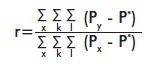
<body><![CDATA[<P   align="justify" ><font size="2" face="Verdana, Arial, Helvetica, sans-serif">Deviations from equilibrium      were corroborated by calculating F<Sub><I>IS</I></Sub> [14], following the      formula F<Sub><Sub><I>IS</I> </Sub></Sub>= 1 - (Ho/He), with the FSTAT software      application (version 2.9.3) [15]. Although it depends on population size,      it is unaffected by the presence of multiple alleles per locus, the number      of individuals per population or the number of populations. </font></P >   <FONT size="+1"><FONT size="+1"><FONT size="+1"><FONT size="+1">        <P   align="justify" ><font size="2" face="Verdana, Arial, Helvetica, sans-serif"> The genetic relatedness      coefficient (r) [16] for a single pair of individuals was also calculated      with GeneAlEx ver. 6.1 [12]. This coefficient is calculated for codominant      markers, using the following formula: </font></P >       <P   align="center" ><img src="/img/revistas/bta/v28n3/fr0103311.gif" width="151" height="75"></P >       
<P   align="justify" ></P >       <P   align="justify" > </P >       <P   align="justify" ><font size="2" face="Verdana, Arial, Helvetica, sans-serif">where: <I>x</I> stands      for the individuals; <I>k</I> for the loci; <I>l</I> for allelic positions      (two for diploids and one for haploids), <I>Px</I> is the frequency of individual      &ldquo;<I>x</I>&rdquo; for locus <I>k</I> and allelic position <I>l</I>, <I>Py</I>      is the frequency of allele &ldquo;<I>y</I>&rdquo; in the group or individual      compared to <I>x</I>; and <I>P*</I> is the total frequency of the allele in      the population. The genetic relatedness coefficient must be r &le; 0 for non-related      individuals; r = 0.25 for half brothers and r &ge; 0.5 for brothers [16].      </font></P >       <P   align="justify" >&nbsp;</P >       <P   ><font size="2" face="Verdana, Arial, Helvetica, sans-serif"><B><font size="3">RESULTS      AND DISCUSSION </font> </B></font></P >   <FONT size="+1">        <P   ><font size="2" face="Verdana, Arial, Helvetica, sans-serif"><b>Genetic variability      of the fifth stock of <I>L. vannamei</I> compared to previous stocks </b></font></P >   <FONT size="+1">        <P   align="justify" ><font size="2" face="Verdana, Arial, Helvetica, sans-serif">The present work      analyzed the genetic variability of the fifth stock of <I>L. vannamei</I>      introduced in Cuba for shrimp farming, using four microsatellite loci: <I>M1</I>,      isolated from <I>L. vannamei </I>[8], and <I>Pvan 0040, Pvan 1758 </I>and      <I>Pvan 1815</I>, isolated from the same species<I> </I>[10]. </font></P >       ]]></body>
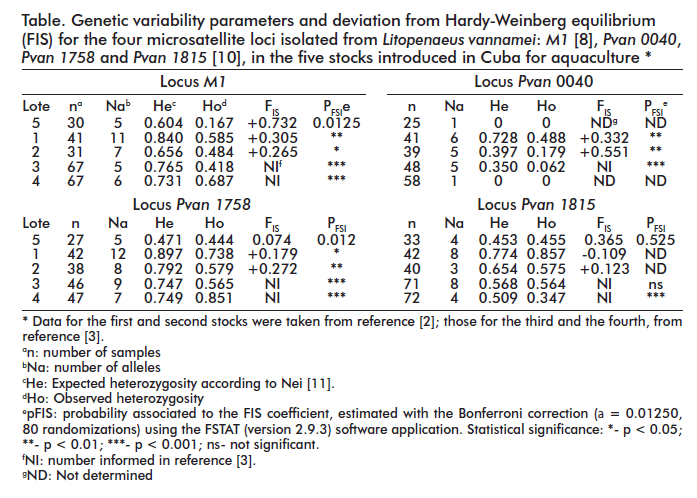
<body><![CDATA[<P   align="justify" ><font size="2" face="Verdana, Arial, Helvetica, sans-serif">The <a href="/img/revistas/bta/v28n3/t0103311.gif">table</a>      contains the main calculated parameters: number of alleles (Na), observed      and expected heterozygosity (Ho and He) and deviations from Hardy-Weinberg      equilibrium (F<Sub><I>IS</I></Sub>), together with the values estimated during      previous studies. According to the results of the analysis of linkage disequilibrium      with FSTAT (version 2.9.3), these loci are not genetically linked in <I>L.      vannamei</I> [2, 9, 17]. </font></P >   <FONT size="+1"><FONT size="+1">        
<P   ><font size="2" face="Verdana, Arial, Helvetica, sans-serif"><b>Expected and observed      heterozygosity </b></font></P >       <P   align="justify" ><font size="2" face="Verdana, Arial, Helvetica, sans-serif">Average observed      heterozygosity for the fifth stock of <I>L. vannamei</I> introduced in Cuba      yielded a value of 0.271; the lowest figure compared to previous introduced      stocks (<a href="/img/revistas/bta/v28n3/f0103311.gif">Figure 1</a>). In addition, this value is below      all previous intervals reported by other researchers employing microsatellites      to study peneaid shrimps. </font></P >       
<P   align="justify" ><font size="2" face="Verdana, Arial, Helvetica, sans-serif">A now classic review      [9] on the use of microsatellite loci for natural populations from four different      species described observed heterozygosities that ranged from 0.425 to 0.964,      yielding a mean of 0.666 which fell below the expected average (0.927). The      same author observed heterozygosities ranging from 0.45 to 1.00 for three      species of farmed peneaids, yielding a mean of 0.594, just below the mean      for expected heterozygosity (0.674). </font></P >       <P   align="justify" ><font size="2" face="Verdana, Arial, Helvetica, sans-serif">However, studies      on <I>P. stylirostris</I> cultured for 22 and 24 generations [5] have produced      much smaller values: Ho = 0.32 to 0.48; He = 0.46 to 0.61. Still, the values      from the fifth stock introduced in Cuba (Ho = 0.271; He = 0.367) are below      these figures (<a href="/img/revistas/bta/v28n3/f0103311.gif">Figure 1</a>), even though heterozygosity      for all previous introductions of <I>L. vannamei</I> is within the above intervals.      However, we agree that heterozygosity is an imperfect measure for variability,      as it can yield high values with just two alleles, and, therefore, their quality      also matters [17-19]. </font></P >       
<P   ><font size="2" face="Verdana, Arial, Helvetica, sans-serif"><b>Allele frequencies      and deviations from Hardy-Weinberg equilibrium </b></font></P >       <P   align="justify" ><font size="2" face="Verdana, Arial, Helvetica, sans-serif">One single locus,      <I>Pvan 0040, </I>is responsible to a large extent for the decrease in heterozygosity      of the fifth stock, as it appears to be monomorphic in this case (as it did      for the fourth <I>Litopenaeus vannamei </I>introduction). The other remaining      three loci are still polymorphic, with five alleles each for <I>M1</I> and      <I>Pvan 1758</I> and four alleles for <I>Pvan 1815</I>. </font></P >       <P   align="justify" ><font size="2" face="Verdana, Arial, Helvetica, sans-serif">Allele frequencies      for the loci of the fifth stock are shown in <a href="/img/revistas/bta/v28n3/f0203311.gif">figure      2</a>. Molecular weights for the observed alleles coincide within the intervals      published by other authors, including those who first isolated them from a      genomic library [10] and others who have later used them to characterize populations      of this species [2, 3, 8, 17-19]. </font></P >       
<P   align="justify" ><font size="2" face="Verdana, Arial, Helvetica, sans-serif">In the present work      there were five <I>M1 </I>alleles ranging from 206 to 240 bp; the most frequent      were those of 240 bp (0.61) and 210 bp (0.28). This microsatellite has previously      been used in isolation to estimate genetic variability for different populations      [8], obtaining allele numbers ranging from 4 to 23. This underscores the usefulness      of this locus for population genetics studies in this species. <I>M1 </I>was      also used for the genetic characterization of all previous introductions of      <I>L. vannamei</I> into Cuba [2, 3]. </font></P >       <P   align="justify" ><font size="2" face="Verdana, Arial, Helvetica, sans-serif">The number of alleles      per locus is also high for <I>Pvan 1815</I> and <I>Pvan 1758, </I>both in      natural populations and in farming environments subject to genetic improvement      programs [10, 17-19]. Still, allelic variants are often lost in the latter,      due to factors such as the consanguinity that typically appears in farmed      populations and, probably, experimental artifacts such as the appearance of      null alleles due to misinterpretation of polymerase slippages or the Wahlund      effect, caused by the mixing of populations. </font></P >       ]]></body>
<body><![CDATA[<P   align="justify" ><font size="2" face="Verdana, Arial, Helvetica, sans-serif">When these microsatellites      were first obtained in 2002 [10] from a small sample, the observed numbers      of alleles per locus were 12 and 14 for <I>Pvan 1815</I> and <I>Pvan 1758      </I>respectively, suggesting they represented excellent markers. Later studies      employing these microsatellites for studies of other <I>L. vannamei </I>populations      have found similar allele numbers [17-19]. Their allele number in the present      study, however, is lower (4 for <I>Pvan 1815</I> and 5 for <I>Pvan 1758</I>)      (<a href="/img/revistas/bta/v28n3/f0203311.gif">Figure 2</a> and <a href="/img/revistas/bta/v28n3/t0103311.gif">Table</a>).      </font></P >       
<P   align="justify" ><font size="2" face="Verdana, Arial, Helvetica, sans-serif">A retrospective look      to previous stocks confirms that allele number has progressively decreased      from earlier to later introductions for these and the other two loci. Finding      out which specific alleles have been lost and determining the importance of      these losses for future crossings or molecular marker-assisted selections      would necessarily require, however, that all data be compared as a whole.      As for locus <I>Pvan 0040, </I>which reappears here as a monomorphic allele      and is one of the markers with the smallest number of allele variants. Although      six alleles were found when it was first described [10], this study was only      an initial report, based on a small sample. A later study from the same group      where different populations were compared with the use of five microsatellite      markers found 5 to 11 alleles for <I>Pvan 0040</I> [17]. By the year 2009,      however, this group had already stopped using this locus [19], employing <I>Pvan      1758</I>, <I>Pvan 1815</I> and four new markers (<I>Lvan 05</I> [20] and <I>TUMXLv9.3</I>,      <I>TUMXLv10.312</I> and <I>TUMXLv8.256</I> [21]). </font></P >       <P   align="justify" ><font size="2" face="Verdana, Arial, Helvetica, sans-serif">Using <I>Pvan 0040      </I>to characterize the two first stocks introduced in Cuba yielded 6 and      5 allele variants for stocks 1 and 2 [2], 5 alleles for the third, and, for      the first time, only 1 allele for the fourth [3]. </font></P >       <P   align="justify" ><font size="2" face="Verdana, Arial, Helvetica, sans-serif">The results from      the present work indicate that there is also a fixed <I>Pvan 0040 </I>allele      for the fifth introduction of <I>Litopenaeus vannamei </I>in Cuba. Allele      sizes in bp coincide between the fourth and the fifth introduction, despite      the presence of disparities regarding sample sizes, methodologies for estimating      genetic variability, reference molecular weight markers and positive controls.      Future use of this marker for characterizing other stocks should, therefore,      be reconsidered. </font></P >       <P   align="justify" ><font size="2" face="Verdana, Arial, Helvetica, sans-serif">Although strict compliance      with all conditions for reaching Hardy-Weinberg equilibrium is hard to come      by in farmed populations, loci <I>Pvan 1758</I> and <I>Pvan 1815</I> do appear      to be at equilibrium. <I>M1</I> deviates from genetic equilibrium, however,      mainly due to an excess of homozygotes as evidenced by the high value of F<Sub><I>IS      </I></Sub>(<a href="/img/revistas/bta/v28n3/t0103311.gif">Table</a>). Previous studies [2, 3] of the      introductions of <I>L. vannamei</I> in Cuba have evidenced significant deviations      from genetic equilibrium, which in the presentwork take place only for <I>M1</I>.      This phenomenon may be caused by a smaller sample size than that of other      authors [2, 3], which would increase the probability of type I statistical      errors; <I>i.e. </I>rejecting the null hypothesis when it is true. </font></P >   <FONT size="+1"><FONT size="+1">        
<P   ><font size="2" face="Verdana, Arial, Helvetica, sans-serif"><b>Relatedness among      the individuals of the fifth introduction of shrimps in Cuba </b></font></P >       <P   align="justify" ><font size="2" face="Verdana, Arial, Helvetica, sans-serif">The analysis of the      fifth introduction of <I>L. vannamei </I>shrimp in Cuba produced an anomalous      curve with two maxima, corresponding to the region of highly related individuals      (<a href="/img/revistas/bta/v28n3/f0303311.gif">Figure 3</a>). Note that the highest maximum corresponds      to 1, that is, the highest possible degree of relatedness; the other maximum      is at <I>r </I>= 0.15, close to that established by Queller and Goodnight      [16] for half-brothers (r = 0.25). There is another peak to the left, although      much smaller than the two others. Globally, average consanguinity yields a      value of +0.037, implying that related individuals predominate in the sample.      </font></P >       
<P   align="justify" ><font size="2" face="Verdana, Arial, Helvetica, sans-serif">The efficacy of the      use of microsatellites and relatedness indexes to determine pedigrees was      first shown while studying farmed turbot stocks with known consanguinities      [22]. These authors obtained independent charts for related and non-related      individuals, which implies that the frequency distribution of the relatedness      indexes among individuals of the fifth introduction might actually correspond      to the superimposition of these ideal curves. Most probably, the fifth introduced      stock of <I>L. vannamei </I>actually constitutes a mixture. </font></P >       <P   align="justify" ><font size="2" face="Verdana, Arial, Helvetica, sans-serif">Previous studies      found genetic variability had decreased in stocks 3 and 4 of <I>L. vannamei</I>      introduced in Cuba [3], but did not estimate genetic relatedness. However,      since the first introductions, it became evident that the design of crossings      using individuals from stock 2 (mean r = +0.1515) should not be undertaken      without a methodology for following inter-individual genetic relatedness coefficients,      which provide information on endogamy levels [2]. As mentioned above, average      genetic relatedness in the present work is even higher, implying that these      individuals should not be used as a breeding stock without an available technique      for following up successive crossings. </font></P >       <P   align="justify" ><font size="2" face="Verdana, Arial, Helvetica, sans-serif">Given the obstacles      for the incorporation of individuals obtained from their natural environment      into shrimp farming, the only available alternative for decreasing endogamy      and raising genetic variability in <I>L. vannamei </I>stocks would be to measure      these genetic parameters in the existing breeding stocks in Cuba, selecting      the best according to all data. </font></P >       ]]></body>
<body><![CDATA[<P   ><font size="3" face="Verdana, Arial, Helvetica, sans-serif"><b>CONCLUSIONS </b></font></P >   <FONT size="+1">        <P   align="justify" ><font size="2" face="Verdana, Arial, Helvetica, sans-serif">Average expected      and observed heterozygosity (0.37 and 0.27, respectively) of the fifth <I>L.      vannamei</I> stock introduced in Cuba for shrimp farming were lower than those      of previously imported stocks. This, together with the relatively small number      of allele variants for each microsatellite region, indicates that its genetic      variability is low. In addition, the fact that the genetic relatedness coefficient      was close to unity indicates that its genetic consanguinity is high. According      to the values obtained from the genetic parameters estimated in this work,      it would therefore be necessary to cross this stock with others from the same      source, in order to improve future production yields. </font></P >   <FONT size="+1">        <P   align="justify" > </P >       <P   align="justify" ><font size="3"><b><font face="Verdana, Arial, Helvetica, sans-serif">REFERENCES      </font></b></font></P >       <P   align="justify" > </P >       <!-- ref --><P   align="justify" ><font size="2" face="Verdana, Arial, Helvetica, sans-serif">1. Tizol R, Jaime      B, Laria R, P&eacute;rez L, Machado R, Silveira R. Introducci&oacute;n en      Cuba del camar&oacute;n blanco del pacifico <I>L. vannamei</I>. Etapa I Cuarentena.      Repositorio digital Ocean Docs; 2004 [cited 2010 Nov 16]. Available from:      <A href="http://hdl.handle.net/1834/3588" target="_blank"> <U><U><FONT color="#0000FF">http://hdl.handle.net/1834/3588</font></U></U></A><FONT color="#0000FF">      .     </font></font></P >   <FONT size="+1"><FONT color="#0000FF"><FONT color="#000000">        <!-- ref --><P   align="justify" ><font size="2" face="Verdana, Arial, Helvetica, sans-serif">2. Borrell YJ, Espinosa      G, Vazquez E, S&aacute;nchez JA, Blanco G. Variabilidad gen&eacute;tica de      loci microsat&eacute;lites en los primeros lotes de <I>Litopenaeus vannamei</I>      introducidos en Cuba para la acuicultura. Rev Invest Mar. 2006;27(3):237-44.          </font></P >       <!-- ref --><P   align="justify" ><font size="2" face="Verdana, Arial, Helvetica, sans-serif">3. Machado TR. Assessment      of genetic variability in two lots of white shrimp, <I>Litopenaeus vannamei</I>      (Boone, 1931) introduced to Cuba. International Fischeries Management [Master      dissertation]. Department of Aquatic Biosciences. Norwegian College of Fishery      Science: University of Tronso, Norway; 2006.     </font></P >       <!-- ref --><P   align="justify" ><font size="2" face="Verdana, Arial, Helvetica, sans-serif">4. Sbordoni V, de      Matthaeis M, Cobolli Sbordoni M, La Rosa G, Mattoccia M. Bottleneck effects      and the depression of genetic variability in hatchery stocks of <I>Litopenaeus      japonicus</I> (Crustacea, Decapoda). Aquaculture. 1986;57:239-51.     </font></P >       <!-- ref --><P   align="justify" ><font size="2" face="Verdana, Arial, Helvetica, sans-serif">5. Bierne N, Beuzart      I, Vonau V, Bonhomme F, Bedier E. Microsatellite-associated heterosis in hatchery-propagated      stocks of the shrimp <I>Peneaus stylirostris</I>. Aquaculture. 2000;184:203-19.          </font></P >       <!-- ref --><P   align="justify" ><font size="2" face="Verdana, Arial, Helvetica, sans-serif">6. Xu Z, Primavera      JH, de la Pena LD, Pettit P, Belak J, Alcivar-Warren A. Genetic diversity      of wild and cultured Black Tiger Shrimp (<I>Penaeus monodon</I>) in the Philippines      using microsatellites. Aquaculture 2001;199:13-40.     </font></P >       <!-- ref --><P   align="justify" ><font size="2" face="Verdana, Arial, Helvetica, sans-serif">7. Garcia DK, Faggart      MA, Rhoades L, Alcivar-Warren AA, Wyban JA, Carr WH, <I>et al</I>. Genetic      diversity of cultured <I>Penaeus vannamei</I> shrimp using three molecular      genetic techniques. Mol Mar Biol Biotech. 1994;3:270-80.     </font></P >       <!-- ref --><P   align="justify" ><font size="2" face="Verdana, Arial, Helvetica, sans-serif">8. Wolfus GM, Garc&iacute;a      GK, Alcivar-Warren A. Application of the microsatellite technique for analyzing      genetic diversity in shrimp breeding programs. Aquaculture. 1997;152:35-47.          </font></P >       <!-- ref --><P   align="justify" ><font size="2" face="Verdana, Arial, Helvetica, sans-serif">9. Benzie JAH. Population      genetics structure in peneaid prawns. Aquaculture Res. 2000;31:95-119.     </font></P >       <!-- ref --><P   align="justify" ><font size="2" face="Verdana, Arial, Helvetica, sans-serif">10. Cruz P, Mej&iacute;a-Ruiz      CH, P&eacute;rez-Enriquez R, Ibarra AM. Isolation and characterization of      microsatellites in Pacific white shrimp Peneaus (<I>Litopenaeus vannamei</I>).      Mol Ecol Notes. 2002;2:239-41.     </font></P >       <!-- ref --><P   align="justify" ><font size="2" face="Verdana, Arial, Helvetica, sans-serif">11. Nei M. Estimation      of average heterozygosity and genetic distance from a small number of individuals.      Genetics 1978;89:583-90.     </font></P >       <!-- ref --><P   align="justify" ><font size="2" face="Verdana, Arial, Helvetica, sans-serif">12. Peakall R, Smouse      PE. GENALEX 6: genetic analysis in Excel. Population genetic software for      teaching and research. Mol Ecol Notes. 2006;6:288-95.     </font></P >       <P   align="justify" ><font size="2" face="Verdana, Arial, Helvetica, sans-serif">13. Graur D, W-H      Li. Fundamentals of Molecular Evolution. 2nd ed. Sunderland (MA): Sinauer      Asociates; 2000. </font></P >       ]]></body>
<body><![CDATA[<!-- ref --><P   align="justify" ><font size="2" face="Verdana, Arial, Helvetica, sans-serif">14. Wright S. The      interpretation of population structure by F-statistics with special regards      to systems of mating. Evolution. 1965;19:395-420.     </font></P >       <!-- ref --><P   align="justify" ><font size="2" face="Verdana, Arial, Helvetica, sans-serif">15. Goudet J. FSTAT      software (version 2.9.3.2). Lausanne: University of Lausanne; 2002 [updated      2005 Aug 23, cited 2010 Oct 14]. Available from: <A href="http://www.unil.ch/popgen/softwares/fstat.htm" target="_blank">      <U><U><FONT color="#0000FF">http://www.unil.ch/popgen/softwares/fstat.htm</font></U></U></A><FONT color="#0000FF">      .     </font></font></P >   <FONT color="#0000FF"><FONT color="#000000">        <!-- ref --><P   align="justify" ><font size="2" face="Verdana, Arial, Helvetica, sans-serif">16. Queller DC, Goodnight      KF. Estimating relatedness using genetic markers. Evolution. 1989;43(2):258-75.          </font></P >       <!-- ref --><P   align="justify" ><font size="2" face="Verdana, Arial, Helvetica, sans-serif">17. Cruz P, Ibarra      AM, Mejia-Ruiz H, Gaffney PM, Perez-Enr&iacute;quez R. Genetic variability      assessed by microsatellites in a breeding program of Pacific White Shrimp      (<I>Litopenaeus vannamei</I>). Mar Biotechnol. 2004;6:157-64.     </font></P >       <!-- ref --><P   align="justify" ><font size="2" face="Verdana, Arial, Helvetica, sans-serif">18. Valles-Jimenez      R, Cruz P, Perez-Enriquez R. Population genetic structure of Pacific white      shrimp (Litopenaeus vannamei) from Mexico to Panama: microsatellite DNA variation.      Mar Biotechnol (NY). 2004;6(5):475-84.     </font></P >       ]]></body>
<body><![CDATA[<!-- ref --><P   align="justify" ><font size="2" face="Verdana, Arial, Helvetica, sans-serif">19. P&eacute;rez-Enr&iacute;quez      R, Hern&aacute;ndez-Mart&iacute;nez F, Cruz P. Genetic diversity status of      White shrimp Penaeus (<I>Litopenaeus vannamei</I>) broodstock in Mexico. Aquaculture.      2009; 297:44-50.     </font></P >       <!-- ref --><P   align="justify" ><font size="2" face="Verdana, Arial, Helvetica, sans-serif">20. Freitas PD, Jes&uacute;s      CM, Galleti PM Jr. Isolation and characterization of new microsatellite loci      in the Pacific white shrimp <I>Litopenaeus vannamei</I> and cross-species      amplification in other penaeid species. Mol Ecol Notes. 2007;7(2):324-6.     </font></P >       <!-- ref --><P   align="justify" ><font size="2" face="Verdana, Arial, Helvetica, sans-serif">21. Meehan D, Xu      Z, Zuniga G, Alcivar-Warren A. High frequency and large number of polymorphic      microsatellites in cultured shrimp, Penaeus (<I>Litopenaeus vannamei</I>)      [Crustacea:Decapoda]. Mar Biotechnol (NY). 2003;5(4):311-30.     </font></P >       <!-- ref --><P   align="justify" ><font size="2" face="Verdana, Arial, Helvetica, sans-serif">22. Borrell YJ, &Aacute;lvarez      J, V&aacute;zquez E, Fern&aacute;ndez Pato C, Mart&iacute;nez Tapia C, S&aacute;nchez      JA, <I>et al</I>. Applying microsatellites to the management of farmed turbot      stocks (<I>Scophthalmus maximus</I> L.) in hatcheries. Aquaculture. 2004;241:133-50.          </font></P >       <P   align="justify" > </P >       <P   ><font size="2" face="Verdana, Arial, Helvetica, sans-serif">Received in Decembre,      2010.     ]]></body>
<body><![CDATA[<br>     Accepted for publication in July, 2011. </font></P >       <P   ><font size="2" face="Verdana, Arial, Helvetica, sans-serif">Georgina Espinosa.      Facultad de Biolog&iacute;a, Universidad de La Habana, UH. Calle 25 #455 e/      J y H, Vedado, Plaza, La Habana, Cuba. E-mail: <A href="mailto:georgina@fbio.uh.cu">      <U><U><FONT color="#0000FF">georgina@fbio.uh.cu</font></U></U></A><FONT color="#0000FF">      <FONT color="#000000">. </font></font></font>      ]]></body><back>
<ref-list>
<ref id="B1">
<label>1</label><nlm-citation citation-type="">
<person-group person-group-type="author">
<name>
<surname><![CDATA[Tizol]]></surname>
<given-names><![CDATA[R]]></given-names>
</name>
<name>
<surname><![CDATA[Jaime]]></surname>
<given-names><![CDATA[B]]></given-names>
</name>
<name>
<surname><![CDATA[Laria]]></surname>
<given-names><![CDATA[R]]></given-names>
</name>
<name>
<surname><![CDATA[Pérez]]></surname>
<given-names><![CDATA[L]]></given-names>
</name>
<name>
<surname><![CDATA[Machado]]></surname>
<given-names><![CDATA[R]]></given-names>
</name>
<name>
<surname><![CDATA[Silveira]]></surname>
<given-names><![CDATA[R]]></given-names>
</name>
</person-group>
<source><![CDATA[Introducción en Cuba del camarón blanco del pacifico L. vannamei: Etapa I Cuarentena]]></source>
<year>2004</year>
</nlm-citation>
</ref>
<ref id="B2">
<label>2</label><nlm-citation citation-type="journal">
<person-group person-group-type="author">
<name>
<surname><![CDATA[Borrell]]></surname>
<given-names><![CDATA[YJ]]></given-names>
</name>
<name>
<surname><![CDATA[Espinosa]]></surname>
<given-names><![CDATA[G]]></given-names>
</name>
<name>
<surname><![CDATA[Vazquez]]></surname>
<given-names><![CDATA[E]]></given-names>
</name>
<name>
<surname><![CDATA[Sánchez]]></surname>
<given-names><![CDATA[JA]]></given-names>
</name>
<name>
<surname><![CDATA[Blanco]]></surname>
<given-names><![CDATA[G]]></given-names>
</name>
</person-group>
<article-title xml:lang="es"><![CDATA[Variabilidad genética de loci microsatélites en los primeros lotes de Litopenaeus vannamei introducidos en Cuba para la acuicultura]]></article-title>
<source><![CDATA[Rev Invest Mar]]></source>
<year>2006</year>
<volume>27</volume>
<numero>3</numero>
<issue>3</issue>
<page-range>237-44</page-range></nlm-citation>
</ref>
<ref id="B3">
<label>3</label><nlm-citation citation-type="">
<person-group person-group-type="author">
<name>
<surname><![CDATA[Machado]]></surname>
<given-names><![CDATA[TR]]></given-names>
</name>
</person-group>
<source><![CDATA[Assessment of genetic variability in two lots of white shrimp, Litopenaeus vannamei (Boone, 1931) introduced to Cuba: International Fischeries Management]]></source>
<year></year>
</nlm-citation>
</ref>
<ref id="B4">
<label>4</label><nlm-citation citation-type="journal">
<person-group person-group-type="author">
<name>
<surname><![CDATA[Sbordoni]]></surname>
<given-names><![CDATA[V]]></given-names>
</name>
<name>
<surname><![CDATA[de Matthaeis]]></surname>
<given-names><![CDATA[M]]></given-names>
</name>
<name>
<surname><![CDATA[Cobolli Sbordoni]]></surname>
<given-names><![CDATA[M]]></given-names>
</name>
<name>
<surname><![CDATA[La Rosa]]></surname>
<given-names><![CDATA[G]]></given-names>
</name>
<name>
<surname><![CDATA[Mattoccia]]></surname>
<given-names><![CDATA[M]]></given-names>
</name>
</person-group>
<article-title xml:lang="en"><![CDATA[Bottleneck effects and the depression of genetic variability in hatchery stocks of Litopenaeus japonicus (Crustacea, Decapoda)]]></article-title>
<source><![CDATA[Aquaculture]]></source>
<year>1986</year>
<volume>57</volume>
<page-range>239-51</page-range></nlm-citation>
</ref>
<ref id="B5">
<label>5</label><nlm-citation citation-type="journal">
<person-group person-group-type="author">
<name>
<surname><![CDATA[Bierne]]></surname>
<given-names><![CDATA[N]]></given-names>
</name>
<name>
<surname><![CDATA[Beuzart]]></surname>
<given-names><![CDATA[I]]></given-names>
</name>
<name>
<surname><![CDATA[Vonau]]></surname>
<given-names><![CDATA[V]]></given-names>
</name>
<name>
<surname><![CDATA[Bonhomme]]></surname>
<given-names><![CDATA[F]]></given-names>
</name>
<name>
<surname><![CDATA[Bedier]]></surname>
<given-names><![CDATA[E]]></given-names>
</name>
</person-group>
<article-title xml:lang="en"><![CDATA[Microsatellite-associated heterosis in hatchery-propagated stocks of the shrimp Peneaus stylirostris]]></article-title>
<source><![CDATA[Aquaculture]]></source>
<year>2000</year>
<volume>184</volume>
<page-range>203-19</page-range></nlm-citation>
</ref>
<ref id="B6">
<label>6</label><nlm-citation citation-type="journal">
<person-group person-group-type="author">
<name>
<surname><![CDATA[Xu]]></surname>
<given-names><![CDATA[Z]]></given-names>
</name>
<name>
<surname><![CDATA[Primavera]]></surname>
<given-names><![CDATA[JH]]></given-names>
</name>
<name>
<surname><![CDATA[de la Pena]]></surname>
<given-names><![CDATA[LD]]></given-names>
</name>
<name>
<surname><![CDATA[Pettit]]></surname>
<given-names><![CDATA[P]]></given-names>
</name>
<name>
<surname><![CDATA[Belak]]></surname>
<given-names><![CDATA[J]]></given-names>
</name>
<name>
<surname><![CDATA[Alcivar-Warren]]></surname>
<given-names><![CDATA[A]]></given-names>
</name>
</person-group>
<article-title xml:lang="en"><![CDATA[Genetic diversity of wild and cultured Black Tiger Shrimp (Penaeus monodon) in the Philippines using microsatellites]]></article-title>
<source><![CDATA[Aquaculture]]></source>
<year>2001</year>
<volume>199</volume>
<page-range>13-40</page-range></nlm-citation>
</ref>
<ref id="B7">
<label>7</label><nlm-citation citation-type="journal">
<person-group person-group-type="author">
<name>
<surname><![CDATA[Garcia]]></surname>
<given-names><![CDATA[DK]]></given-names>
</name>
<name>
<surname><![CDATA[Faggart]]></surname>
<given-names><![CDATA[MA]]></given-names>
</name>
<name>
<surname><![CDATA[Rhoades]]></surname>
<given-names><![CDATA[L]]></given-names>
</name>
<name>
<surname><![CDATA[Alcivar-Warren]]></surname>
<given-names><![CDATA[AA]]></given-names>
</name>
<name>
<surname><![CDATA[Wyban]]></surname>
<given-names><![CDATA[JA]]></given-names>
</name>
<name>
<surname><![CDATA[Carr]]></surname>
<given-names><![CDATA[WH]]></given-names>
</name>
</person-group>
<article-title xml:lang="en"><![CDATA[Genetic diversity of cultured Penaeus vannamei shrimp using three molecular genetic techniques]]></article-title>
<source><![CDATA[Mol Mar Biol Biotech]]></source>
<year>1994</year>
<volume>3</volume>
<page-range>270-80</page-range></nlm-citation>
</ref>
<ref id="B8">
<label>8</label><nlm-citation citation-type="journal">
<person-group person-group-type="author">
<name>
<surname><![CDATA[Wolfus]]></surname>
<given-names><![CDATA[GM]]></given-names>
</name>
<name>
<surname><![CDATA[García]]></surname>
<given-names><![CDATA[GK]]></given-names>
</name>
<name>
<surname><![CDATA[Alcivar-Warren]]></surname>
<given-names><![CDATA[A]]></given-names>
</name>
</person-group>
<article-title xml:lang="en"><![CDATA[Application of the microsatellite technique for analyzing genetic diversity in shrimp breeding programs]]></article-title>
<source><![CDATA[Aquaculture]]></source>
<year>1997</year>
<volume>152</volume>
<page-range>35-47</page-range></nlm-citation>
</ref>
<ref id="B9">
<label>9</label><nlm-citation citation-type="journal">
<person-group person-group-type="author">
<name>
<surname><![CDATA[Benzie]]></surname>
<given-names><![CDATA[JAH]]></given-names>
</name>
</person-group>
<article-title xml:lang="en"><![CDATA[Population genetics structure in peneaid prawns]]></article-title>
<source><![CDATA[Aquaculture Res]]></source>
<year>2000</year>
<volume>31</volume>
<page-range>95-119</page-range></nlm-citation>
</ref>
<ref id="B10">
<label>10</label><nlm-citation citation-type="journal">
<person-group person-group-type="author">
<name>
<surname><![CDATA[Cruz]]></surname>
<given-names><![CDATA[P]]></given-names>
</name>
<name>
<surname><![CDATA[Mejía-Ruiz]]></surname>
<given-names><![CDATA[CH]]></given-names>
</name>
<name>
<surname><![CDATA[Pérez-Enriquez]]></surname>
<given-names><![CDATA[R]]></given-names>
</name>
<name>
<surname><![CDATA[Ibarra]]></surname>
<given-names><![CDATA[AM]]></given-names>
</name>
</person-group>
<article-title xml:lang="en"><![CDATA[Isolation and characterization of microsatellites in Pacific white shrimp Peneaus (Litopenaeus) vannamei]]></article-title>
<source><![CDATA[Mol Ecol Notes]]></source>
<year>2002</year>
<volume>2</volume>
<page-range>239-41</page-range></nlm-citation>
</ref>
<ref id="B11">
<label>11</label><nlm-citation citation-type="journal">
<person-group person-group-type="author">
<name>
<surname><![CDATA[Nei]]></surname>
<given-names><![CDATA[M]]></given-names>
</name>
</person-group>
<article-title xml:lang="en"><![CDATA[Estimation of average heterozygosity and genetic distance from a small number of individuals]]></article-title>
<source><![CDATA[Genetics]]></source>
<year>1978</year>
<page-range>89</page-range></nlm-citation>
</ref>
<ref id="B12">
<label>12</label><nlm-citation citation-type="journal">
<person-group person-group-type="author">
<name>
<surname><![CDATA[Peakall]]></surname>
<given-names><![CDATA[R]]></given-names>
</name>
<name>
<surname><![CDATA[Smouse]]></surname>
<given-names><![CDATA[PE]]></given-names>
</name>
</person-group>
<article-title xml:lang="en"><![CDATA[GENALEX 6: genetic analysis in Excel. Population genetic software for teaching and research]]></article-title>
<source><![CDATA[Mol Ecol Notes]]></source>
<year>2006</year>
<volume>6</volume>
<page-range>288-95</page-range></nlm-citation>
</ref>
<ref id="B13">
<label>13</label><nlm-citation citation-type="book">
<person-group person-group-type="author">
<name>
<surname><![CDATA[Graur]]></surname>
<given-names><![CDATA[D]]></given-names>
</name>
<name>
<surname><![CDATA[Li]]></surname>
<given-names><![CDATA[W-H]]></given-names>
</name>
</person-group>
<source><![CDATA[Fundamentals of Molecular Evolution]]></source>
<year>2000</year>
<edition>2</edition>
<publisher-loc><![CDATA[Sunderland (MA) ]]></publisher-loc>
<publisher-name><![CDATA[Sinauer Asociates]]></publisher-name>
</nlm-citation>
</ref>
<ref id="B14">
<label>14</label><nlm-citation citation-type="journal">
<person-group person-group-type="author">
<name>
<surname><![CDATA[Wright]]></surname>
<given-names><![CDATA[S]]></given-names>
</name>
</person-group>
<article-title xml:lang="en"><![CDATA[The interpretation of population structure by F-statistics with special regards to systems of mating]]></article-title>
<source><![CDATA[Evolution]]></source>
<year>1965</year>
<volume>19</volume>
<page-range>395-420</page-range></nlm-citation>
</ref>
<ref id="B15">
<label>15</label><nlm-citation citation-type="book">
<person-group person-group-type="author">
<name>
<surname><![CDATA[Goudet]]></surname>
<given-names><![CDATA[J]]></given-names>
</name>
</person-group>
<source><![CDATA[FSTAT software (version 2.9.3.2)]]></source>
<year>2002</year>
<month>20</month>
<day>10</day>
<publisher-loc><![CDATA[Lausanne ]]></publisher-loc>
<publisher-name><![CDATA[University of Lausanne]]></publisher-name>
</nlm-citation>
</ref>
<ref id="B16">
<label>16</label><nlm-citation citation-type="journal">
<person-group person-group-type="author">
<name>
<surname><![CDATA[Queller]]></surname>
<given-names><![CDATA[DC]]></given-names>
</name>
<name>
<surname><![CDATA[Goodnight]]></surname>
<given-names><![CDATA[KF]]></given-names>
</name>
</person-group>
<article-title xml:lang="en"><![CDATA[Estimating relatedness using genetic markers]]></article-title>
<source><![CDATA[Evolution]]></source>
<year>1989</year>
<volume>43</volume>
<numero>2</numero>
<issue>2</issue>
<page-range>258-75</page-range></nlm-citation>
</ref>
<ref id="B17">
<label>17</label><nlm-citation citation-type="journal">
<person-group person-group-type="author">
<name>
<surname><![CDATA[Cruz]]></surname>
<given-names><![CDATA[P]]></given-names>
</name>
<name>
<surname><![CDATA[Ibarra]]></surname>
<given-names><![CDATA[AM]]></given-names>
</name>
<name>
<surname><![CDATA[Mejia-Ruiz]]></surname>
<given-names><![CDATA[H]]></given-names>
</name>
<name>
<surname><![CDATA[Gaffney]]></surname>
<given-names><![CDATA[PM]]></given-names>
</name>
<name>
<surname><![CDATA[Perez-Enríquez]]></surname>
<given-names><![CDATA[R]]></given-names>
</name>
</person-group>
<article-title xml:lang="en"><![CDATA[Genetic variability assessed by microsatellites in a breeding program of Pacific White Shrimp (Litopenaeus vannamei)]]></article-title>
<source><![CDATA[Mar Biotechnol]]></source>
<year>2004</year>
<volume>6</volume>
<page-range>157-64</page-range></nlm-citation>
</ref>
<ref id="B18">
<label>18</label><nlm-citation citation-type="journal">
<person-group person-group-type="author">
<name>
<surname><![CDATA[Valles-Jimenez]]></surname>
<given-names><![CDATA[R]]></given-names>
</name>
<name>
<surname><![CDATA[Cruz]]></surname>
<given-names><![CDATA[P]]></given-names>
</name>
<name>
<surname><![CDATA[Perez-Enriquez]]></surname>
<given-names><![CDATA[R]]></given-names>
</name>
</person-group>
<article-title xml:lang="en"><![CDATA[Population genetic structure of Pacific white shrimp (Litopenaeus vannamei) from Mexico to Panama: microsatellite DNA variation]]></article-title>
<source><![CDATA[Mar Biotechnol (NY)]]></source>
<year>2004</year>
<volume>6</volume>
<numero>5</numero>
<issue>5</issue>
<page-range>475-84</page-range></nlm-citation>
</ref>
<ref id="B19">
<label>19</label><nlm-citation citation-type="journal">
<person-group person-group-type="author">
<name>
<surname><![CDATA[Pérez-Enríquez]]></surname>
<given-names><![CDATA[R]]></given-names>
</name>
<name>
<surname><![CDATA[Hernández-Martínez]]></surname>
<given-names><![CDATA[F]]></given-names>
</name>
<name>
<surname><![CDATA[Cruz]]></surname>
<given-names><![CDATA[P]]></given-names>
</name>
</person-group>
<article-title xml:lang="en"><![CDATA[Genetic diversity status of White shrimp Penaeus (Litopenaeus) vannamei broodstock in Mexico]]></article-title>
<source><![CDATA[Aquaculture]]></source>
<year>2009</year>
<volume>297</volume>
<page-range>44-50</page-range></nlm-citation>
</ref>
<ref id="B20">
<label>20</label><nlm-citation citation-type="journal">
<person-group person-group-type="author">
<name>
<surname><![CDATA[Freitas]]></surname>
<given-names><![CDATA[PD]]></given-names>
</name>
<name>
<surname><![CDATA[Jesús]]></surname>
<given-names><![CDATA[CM]]></given-names>
</name>
<name>
<surname><![CDATA[Galleti]]></surname>
<given-names><![CDATA[PM Jr]]></given-names>
</name>
</person-group>
<article-title xml:lang="en"><![CDATA[Isolation and characterization of new microsatellite loci in the Pacific white shrimp Litopenaeus vannamei and cross-species amplification in other penaeid species]]></article-title>
<source><![CDATA[Mol Ecol Notes]]></source>
<year>2007</year>
<volume>7</volume>
<numero>2</numero>
<issue>2</issue>
<page-range>324-6</page-range></nlm-citation>
</ref>
<ref id="B21">
<label>21</label><nlm-citation citation-type="journal">
<person-group person-group-type="author">
<name>
<surname><![CDATA[Meehan]]></surname>
<given-names><![CDATA[D]]></given-names>
</name>
<name>
<surname><![CDATA[Xu]]></surname>
<given-names><![CDATA[Z]]></given-names>
</name>
<name>
<surname><![CDATA[Zuniga]]></surname>
<given-names><![CDATA[G]]></given-names>
</name>
<name>
<surname><![CDATA[Alcivar-Warren]]></surname>
<given-names><![CDATA[A]]></given-names>
</name>
</person-group>
<article-title xml:lang="en"><![CDATA[High frequency and large number of polymorphic microsatellites in cultured shrimp, Penaeus (Litopenaeus) vannamei &#91;Crustacea:Decapoda&#93;]]></article-title>
<source><![CDATA[Mar Biotechnol (NY)]]></source>
<year>2003</year>
<volume>5</volume>
<numero>4</numero>
<issue>4</issue>
<page-range>311-30</page-range></nlm-citation>
</ref>
<ref id="B22">
<label>22</label><nlm-citation citation-type="journal">
<person-group person-group-type="author">
<name>
<surname><![CDATA[Borrell]]></surname>
<given-names><![CDATA[YJ]]></given-names>
</name>
<name>
<surname><![CDATA[Álvarez]]></surname>
<given-names><![CDATA[J]]></given-names>
</name>
<name>
<surname><![CDATA[Vázquez]]></surname>
<given-names><![CDATA[E]]></given-names>
</name>
<name>
<surname><![CDATA[Fernández Pato]]></surname>
<given-names><![CDATA[C]]></given-names>
</name>
<name>
<surname><![CDATA[Martínez Tapia]]></surname>
<given-names><![CDATA[C]]></given-names>
</name>
<name>
<surname><![CDATA[Sánchez]]></surname>
<given-names><![CDATA[JA]]></given-names>
</name>
</person-group>
<article-title xml:lang="en"><![CDATA[Applying microsatellites to the management of farmed turbot stocks (Scophthalmus maximus L.) in hatcheries]]></article-title>
<source><![CDATA[Aquaculture]]></source>
<year>2004</year>
<volume>241</volume>
<page-range>133-50</page-range></nlm-citation>
</ref>
</ref-list>
</back>
</article>