<?xml version="1.0" encoding="ISO-8859-1"?><article xmlns:mml="http://www.w3.org/1998/Math/MathML" xmlns:xlink="http://www.w3.org/1999/xlink" xmlns:xsi="http://www.w3.org/2001/XMLSchema-instance">
<front>
<journal-meta>
<journal-id>1027-2852</journal-id>
<journal-title><![CDATA[Biotecnología Aplicada]]></journal-title>
<abbrev-journal-title><![CDATA[Biotecnol Apl]]></abbrev-journal-title>
<issn>1027-2852</issn>
<publisher>
<publisher-name><![CDATA[Editorial Elfos Scientiae]]></publisher-name>
</publisher>
</journal-meta>
<article-meta>
<article-id>S1027-28522011000300006</article-id>
<title-group>
<article-title xml:lang="en"><![CDATA[Quick transfer of Open Reading Frames between Yeast two hybrids and Protein fragment complementation assay vectors by homologous recombination cloning in bacteria]]></article-title>
<article-title xml:lang="es"><![CDATA[Transferencia rápida de los marcos abiertos de lectura entre vectores del sistema de dos híbridos de levadura y vectores de ensayo de complementación de proteínas mediante clonaje por recombinación homóloga en bacterias]]></article-title>
</title-group>
<contrib-group>
<contrib contrib-type="author">
<name>
<surname><![CDATA[Tejeda]]></surname>
<given-names><![CDATA[Yelaine]]></given-names>
</name>
<xref ref-type="aff" rid="A01"/>
</contrib>
<contrib contrib-type="author">
<name>
<surname><![CDATA[Fernandez]]></surname>
<given-names><![CDATA[Julio Raúl]]></given-names>
</name>
<xref ref-type="aff" rid="A01"/>
</contrib>
<contrib contrib-type="author">
<name>
<surname><![CDATA[Colarte]]></surname>
<given-names><![CDATA[Amanda B]]></given-names>
</name>
<xref ref-type="aff" rid="A01"/>
</contrib>
<contrib contrib-type="author">
<name>
<surname><![CDATA[Taylor]]></surname>
<given-names><![CDATA[Clara Y]]></given-names>
</name>
<xref ref-type="aff" rid="A01"/>
</contrib>
</contrib-group>
<aff id="A01">
<institution><![CDATA[,Centro de Ingeniería Genética y Biotecnología, CIGB División de Inmunodiagnóstico y Genómica ]]></institution>
<addr-line><![CDATA[La Habana ]]></addr-line>
<country>Cuba</country>
</aff>
<pub-date pub-type="pub">
<day>00</day>
<month>09</month>
<year>2011</year>
</pub-date>
<pub-date pub-type="epub">
<day>00</day>
<month>09</month>
<year>2011</year>
</pub-date>
<volume>28</volume>
<numero>3</numero>
<fpage>164</fpage>
<lpage>167</lpage>
<copyright-statement/>
<copyright-year/>
<self-uri xlink:href="http://scielo.sld.cu/scielo.php?script=sci_arttext&amp;pid=S1027-28522011000300006&amp;lng=en&amp;nrm=iso"></self-uri><self-uri xlink:href="http://scielo.sld.cu/scielo.php?script=sci_abstract&amp;pid=S1027-28522011000300006&amp;lng=en&amp;nrm=iso"></self-uri><self-uri xlink:href="http://scielo.sld.cu/scielo.php?script=sci_pdf&amp;pid=S1027-28522011000300006&amp;lng=en&amp;nrm=iso"></self-uri><abstract abstract-type="short" xml:lang="en"><p><![CDATA[A common rate-limiting step in many high throughput proteome scale analyses is the cloning of predicted open reading frames (ORFs) into technique-specific vectors. For example, methodologies for the detection of protein interactions such as Yeast-two-hybrid (Y2H) assay require validation using alternative methods as Protein Fragment Complementation Assays (PCA) or pulldown experiments. Various experimental alternatives for rapid homologous recombination gene transfer in vivo between the Y2H and PCA vectors were evaluated. Two sets of universal primers sharing an overlap of 31 b homology between inserts and acceptor vectors were designed and PCR performance conditions were tested. Cotransformation of PCR products with the digested acceptor vector in E. coli strain allowed homologous recombination cloning. The method was proved to be effective for cloning 5 ORFs with sizes ranging from 0.294 to 1.2 kb. The proposed method allows the quick transfer of any open reading frames between the Y2H and PCA assay vector systems by using a universal set of primers. It doesn't depend on the presence of specific restriction sites in the acceptor vector or causes changes in the open reading frame. This system will be useful for routine validation of protein interactions. We also report here the feasibility of DH10B strain for homologous recombination cloning.]]></p></abstract>
<abstract abstract-type="short" xml:lang="es"><p><![CDATA[Un paso limitante en muchos análisis del proteoma a alto flujo es la clonación de losmarcos abiertos de lectura (ORF) en los vectores específicos para cada técnica. Por ejemplo, las metodologías para la detección de interacciones entre proteínas tales como el ensayo de dos híbridos de levadura (Y2H) requieren una validación utilizando métodos alternativos, como por ejemplo los ensayos de complementación de fragmentos de la proteína (PCA) o experimentos de precipitación de proteinas. Diversas alternativas experimentales para una rápida transferencia mediante la recombinación homóloga de genes in vivo entre los vectores Y2H y PCA fueron evaluadas. Dos juegos de cebadores universales con una superposición de homología entre 31 b de los insertos y los vectores aceptadores fueron diseñados y las condiciones de amplificación de la reacción de PCR fueron evaluadas. Los productos de PCR fueron cotransformados con el vector aceptor en cepas de E. coli que permiten la clonación mediante recombinación homóloga. El método demostró ser eficaz para la clonación de cinco ORFs con tamaños que oscilan entre 0.294 a 1.2 kb. El método propuesto permite la rápida transferencia de los marcos abiertos de lectura entre los vectores de los sistemas de Y2H y PCA mediante el uso de un conjunto universal de los cebadores. El método de clonaje no depende de la presencia de determinadas sitios de restricción en el vector aceptor y no provoca cambios en el marco abierto de lectura. Este sistema será útil para la validación de rutina de las interacciones de proteínas. También mostramos la viabilidad de la cepa DH10B para la clonación por recombinación homóloga.]]></p></abstract>
<kwd-group>
<kwd lng="en"><![CDATA[Homologous recombination cloning]]></kwd>
<kwd lng="en"><![CDATA[DH10B]]></kwd>
<kwd lng="en"><![CDATA[high throughput]]></kwd>
<kwd lng="en"><![CDATA[Protein fragments complementation assay]]></kwd>
<kwd lng="en"><![CDATA[yeast-two-hybrid assay]]></kwd>
<kwd lng="es"><![CDATA[Clonaje por recombinación homóloga]]></kwd>
<kwd lng="es"><![CDATA[DH10B]]></kwd>
<kwd lng="es"><![CDATA[alto flujo]]></kwd>
<kwd lng="es"><![CDATA[ensayo de complementación de fragmentos de proteínas]]></kwd>
<kwd lng="es"><![CDATA[ensayo de dos híbridos de levadura]]></kwd>
</kwd-group>
</article-meta>
</front><body><![CDATA[ <DIV class="Sect"   >        <P   align="right" ><font size="2" color="#000000" face="Verdana, Arial, Helvetica, sans-serif"><b>TECHNIQUE</b></font></P >       <P   align="right" >&nbsp;</P >   <FONT size="+1" color="#000000">        <P   align="right" > </P >       <P   ><font size="4"><b><font face="Verdana, Arial, Helvetica, sans-serif">Quick transfer      of Open Reading Frames between Yeast two hybrids and Protein fragment complementation      assay vectors by homologous recombination cloning in bacteria </font></b></font></P >       <P   >&nbsp;</P >       <P   ><font size="3"><b><font face="Verdana, Arial, Helvetica, sans-serif">Transferencia      r&aacute;pida de los marcos abiertos de lectura entre vectores del sistema      de dos h&iacute;bridos de levadura y vectores de ensayo de complementaci&oacute;n      de prote&iacute;nas mediante clonaje por recombinaci&oacute;n hom&oacute;loga      en bacterias </font></b></font></P >       <P   >&nbsp;</P >       <P   >&nbsp;</P >       <P   > </P >       ]]></body>
<body><![CDATA[<P   > </P >       <P   ><b><font size="2" face="Verdana, Arial, Helvetica, sans-serif">Yelaine Tejeda,      Julio Ra&uacute;l Fernandez, Amanda B Colarte, Clara Y Taylor </font></b></P >       <P   ><font size="2" face="Verdana, Arial, Helvetica, sans-serif">Divisi&oacute;n de      Inmunodiagn&oacute;stico y Gen&oacute;mica, Centro de Ingenier&iacute;a Gen&eacute;tica      y Biotecnolog&iacute;a, CIGB. Ave. 31 e/ 158 y 190, PO Box 6162, CP 10600,      Playa, La Habana, Cuba.</font></P >   </font>       <p>&nbsp;</p><hr>   <FONT size="+1" color="#000000">        <P   ><font size="2" face="Verdana, Arial, Helvetica, sans-serif"><b>ABSTRACT</b> </font></P >       <P   ><font size="2" face="Verdana, Arial, Helvetica, sans-serif">A common rate-limiting      step in many high throughput proteome scale analyses is the cloning of predicted      open reading frames (ORFs) into technique-specific vectors. For example, methodologies      for the detection of protein interactions such as Yeast-two-hybrid (Y2H) assay      require validation using alternative methods as Protein Fragment Complementation      Assays (PCA) or pulldown experiments. Various experimental alternatives for      rapid homologous recombination gene transfer in vivo between the Y2H and PCA      vectors were evaluated. Two sets of universal primers sharing an overlap of      31 b homology between inserts and acceptor vectors were designed and PCR performance      conditions were tested. Cotransformation of PCR products with the digested      acceptor vector in <I>E. coli</I> strain allowed homologous recombination      cloning. The method was proved to be effective for cloning 5 ORFs with sizes      ranging from 0.294 to 1.2 kb. The proposed method allows the quick transfer      of any open reading frames between the Y2H and PCA assay vector systems by      using a universal set of primers. It doesn&rsquo;t depend on the presence      of specific restriction sites in the acceptor vector or causes changes in      the open reading frame. This system will be useful for routine validation      of protein interactions. We also report here the feasibility of DH10B strain      for homologous recombination cloning. </font></P >       <P   ><font size="2" face="Verdana, Arial, Helvetica, sans-serif"><b>Keywords:</b>      Homologous recombination cloning, DH10B, high throughput, Protein fragments      complementation assay, yeast-two-hybrid assay. </font></P >   </font>   <hr>   <FONT size="+1" color="#000000">        <P   ><b><font size="2" face="Verdana, Arial, Helvetica, sans-serif">RESUMEN </font></b></P >       <P   ><font size="2" face="Verdana, Arial, Helvetica, sans-serif">Un paso limitante      en muchos an&aacute;lisis del proteoma a alto flujo es la clonaci&oacute;n      de losmarcos abiertos de lectura (ORF) en los vectores espec&iacute;ficos      para cada t&eacute;cnica. Por ejemplo, las metodolog&iacute;as para la detecci&oacute;n      de interacciones entre prote&iacute;nas tales como el ensayo de dos h&iacute;bridos      de levadura (Y2H) requieren una validaci&oacute;n utilizando m&eacute;todos      alternativos, como por ejemplo los ensayos de complementaci&oacute;n de fragmentos      de la prote&iacute;na (PCA) o experimentos de precipitaci&oacute;n de proteinas.      Diversas alternativas experimentales para una r&aacute;pida transferencia      mediante la recombinaci&oacute;n hom&oacute;loga de genes in vivo entre los      vectores Y2H y PCA fueron evaluadas. Dos juegos de cebadores universales con      una superposici&oacute;n de homolog&iacute;a entre 31 b de los insertos y      los vectores aceptadores fueron dise&ntilde;ados y las condiciones de amplificaci&oacute;n      de la reacci&oacute;n de PCR fueron evaluadas. Los productos de PCR fueron      cotransformados con el vector aceptor en cepas de <I>E. coli</I> que permiten      la clonaci&oacute;n mediante recombinaci&oacute;n hom&oacute;loga. El m&eacute;todo      demostr&oacute; ser eficaz para la clonaci&oacute;n de cinco ORFs con tama&ntilde;os      que oscilan entre 0.294 a 1.2 kb. El m&eacute;todo propuesto permite la r&aacute;pida      transferencia de los marcos abiertos de lectura entre los vectores de los      sistemas de Y2H y PCA mediante el uso de un conjunto universal de los cebadores.      El m&eacute;todo de clonaje no depende de la presencia de determinadas sitios      de restricci&oacute;n en el vector aceptor y no provoca cambios en el marco      abierto de lectura. Este sistema ser&aacute; &uacute;til para la validaci&oacute;n      de rutina de las interacciones de prote&iacute;nas. Tambi&eacute;n mostramos      la viabilidad de la cepa DH10B para la clonaci&oacute;n por recombinaci&oacute;n      hom&oacute;loga. </font></P >       <P   ><font size="2" face="Verdana, Arial, Helvetica, sans-serif"><b>Palabras clave:</b>      Clonaje por recombinaci&oacute;n hom&oacute;loga, DH10B, alto flujo, ensayo      de complementaci&oacute;n de fragmentos de prote&iacute;nas, ensayo de dos      h&iacute;bridos de levadura. </font></P >   </font>   <hr>   <FONT size="+1" color="#000000">        ]]></body>
<body><![CDATA[<P   ></P >       <P   ></P >       <P   ></P >       <P   > </P >       <P   > </P >       <P   >&nbsp;</P >       <P   >&nbsp;</P >       <P   ><font size="2" face="Verdana, Arial, Helvetica, sans-serif"><b><font size="3">INTRODUCTION      </font></b></font></P >       <P   align="justify" ><font size="2" face="Verdana, Arial, Helvetica, sans-serif">The analysis of protein-protein      interactions is an invaluable resource for better comprehension of cell-ular      functions and in the present is the central axe of many biomedical investigations.      This allows the identification of proteins of therapeutic interest and increases      the amount and quality of information related to potencial drugs [1]. Some      methodologies such as pull down techniques, Yeast-two-hybrids (Y2H) assay      and Protein fragment complementation assay (PCA) have been developed for the      evaluation of protein-protein interactions. Each of them has potentialities      and disadvantages, so using at least two different assays is highly recommended.      The Y2H provides a mean to answer questions regarding protein-protein interactions,      but has limitations which restrict its use to certain interaction networks;      furthermore they provide little information regarding interaction localization      at the subcellular level. The development of PCA employing a fluorescent reporter      such as a member of the green fluorescent protein (GFP) family has led to      a new method of interaction with the advantages of a very low background signal      coupled with rapid detection of protein-protein interactions <I>in vivo</I>,      while also providing information regarding interaction compartmentalization,      but with a limited throughput. </font></P >   <FONT size="+1">        <P   align="justify" ><font size="2" face="Verdana, Arial, Helvetica, sans-serif">Sometimes the number      of interactions to be evaluated demands high throughput cloning of open reading      frames (ORFs) which can not be acomplished by traditional restriction enzyme      dependent cloning methods. To face this challenge, several high throughput      cloning methodologies have been stablished. They are quick and efficient;      do not depend on the presence of specific restriction sites or T4 DNA ligase      and which is the most important feature, allowing gene transfer among vectors      from different expression systems [2]. Several high throughput commercial      cloning systems are available but they are too expensive for many working      groups. Nevertheless, Parrish and co-workers reported in 2004 the high throughput      cloning of <I>Campylobacter jejuni </I>ORFs using <I>in vivo</I> homologous      recombination in <I>Escherichia coli </I>[3]. This methodology is based in      the recombinant possibilities of <I>RecA</I><Sup>+ </Sup>strains. It just      requires PCR amplification of inserts with oligonucleotides containing sequences      complementary to the regions of donor vector flanking the ORF to be transferred      and also a region homologous to the 5&rsquo; and 3&rsquo; ends of the linearized      acceptor vector. PCR products and the acceptor vector are then co-transformed      in a <I>RecA</I><Sup>+</Sup> <I>E. coli</I> strain for the <I>in vivo</I>      production of recombinant clones. </font></P >   <FONT size="+1"><FONT size="+1"><FONT size="+1"><FONT size="+1">        ]]></body>
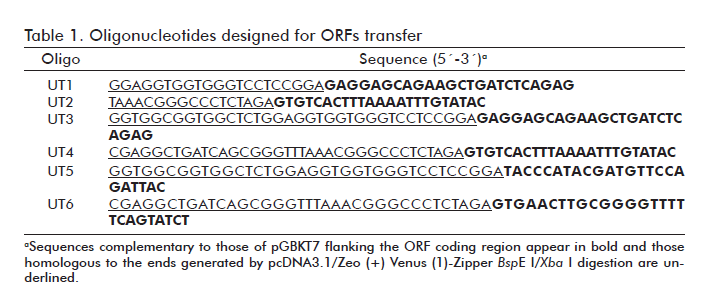
<body><![CDATA[<P   align="justify" ><font size="2" face="Verdana, Arial, Helvetica, sans-serif">With the aim of creating      a ORFs transferring system among Y2H assay vectors and PCA mammalian vectors      for routine protein-protein interactions validation, various experimental      alternatives using restriction enzyme independent <I>in vivo</I> cloning were      designed. </font></P >       <P   align="justify" >&nbsp;</P >       <P   ><font size="3" face="Verdana, Arial, Helvetica, sans-serif"><b>MATERIALS AND      METHODS </b> </font></P >   <FONT size="+1">        <P   ><font size="2" face="Verdana, Arial, Helvetica, sans-serif"><b>Microbial strains      and plasmids </b></font></P >   <FONT size="+1">        <P   align="justify" ><font size="2" face="Verdana, Arial, Helvetica, sans-serif">The <I>E. coli</I>      strain used were DH10B (F- mcrA, D (mrr-hsdRMS-mcrBC) f 80, lacZ DM15, D lacX74,      deoR, recA1, araD39, D (ara-leu) 7697, galK, galU, rpsL, endA1, nupG) and      BJ5183 (<I>F - , endA, sbcB, recBC, galK, met, str R, thi-1, bioT, hsdR, l      -</I>). Competent cells of both strains, were obtained using polyethylene      glycol and dimethyl sulfoxide PEG-DMSO [4] or CaCl<Sub>2</Sub> [5] methods.      </font></P >   <FONT size="+1"><FONT size="+1">        <P   align="justify" ><font size="2" face="Verdana, Arial, Helvetica, sans-serif">Plasmids pGBKT7,      pGADT7 and pACT2 (Clontech, Palo Alto) from the Yeast two hybrids system were      utilized as donor vectors whereas pcDNA3.1/Zeo (+) Venus (1)-Zipper and pcDNA3.1/Zeo      (+) Venus (2)-Zipper [6] were used as acceptor vectors. </font></P >       <P   align="justify" >&nbsp;</P >       <P   ><font size="2" face="Verdana, Arial, Helvetica, sans-serif"><b>PCR amplification</b>      </font></P >       <P   align="justify" ><font size="2" face="Verdana, Arial, Helvetica, sans-serif">Two sets of primers      with different homology regions between donor and acceptor vectors were tested.      The inserts from pGBKT7 were amplified using UT1 and UT2 oligonucleotides      (<a href="/img/revistas/bta/v28n3/t0106311.gif">Table 1</a>). These oligonucleotides are complementary      to the sequences of pGBKT7 flanking the ORF coding region and at the same      time contain sequences homologous to the ends generated by pcDNA3.1/Zeo (+)      Venus (1)-Zipper <I>Bsp</I>E I/<I>Xba</I> I digestion. The PCR generated products      have a 16 b sequence homologous to the acceptor vector in its 5&rsquo; end      as well as a 12 b homology sequence in the 3&rsquo; end. A second set of primers      UT3 and UT4 was used to amplify the ORF sequence in order to increase the      homology region to the acceptor vector up to 31 bp in both ends (<a href="/img/revistas/bta/v28n3/t0106311.gif">Table      1</a>). </font></P >       
<P   align="justify" ><font size="2" face="Verdana, Arial, Helvetica, sans-serif">The sequences from      pGADT7 or pACT2 were amplified using UT5 and UT6 oligonucleotides (<a href="/img/revistas/bta/v28n3/t0106311.gif">Table      1</a>). These oligonucleotides are 31 bp complementary to the sequences of      donor vectors flanking the ORF coding region and at the same time the oligonucleotides      contain a 31 bp sequence homologous to the ends generated by pcDNA3.1/Zeo      (+) Venus (2)-Zipper <I>Bsp</I>E I/<I>Xba</I> I digestion. </font></P >       
]]></body>
<body><![CDATA[<P   align="justify" ><font size="2" face="Verdana, Arial, Helvetica, sans-serif">PCR amplifications      from plasmid templates, containing 1 ng of plasmid and 300 nM of each PCR      primer (94 &ordm;C for 30 s, 60&ordm;C for 30 s, and 72 &ordm;C for 1:30 min      for 30 cycles), were conducted using PCR master mix from Promega, according      to the manufacturers&rsquo; instructions. All PCR products were purified with      a QIAquick PCR Purification Kit from Qiagen. The size and purity of the expected      products were verified by agarose electrophoresis. </font></P >       <P   align="justify" >&nbsp;</P >       <P   ><font size="2" face="Verdana, Arial, Helvetica, sans-serif"><I><b>In vivo</b></I><b>      cloning by homologous recombination</b> </font></P >       <P   align="justify" ><font size="2" face="Verdana, Arial, Helvetica, sans-serif">The linearized vector      and the PCR amplified products were mixed in 50 &micro;L of KCM (0.1 M KCl,      30 mM CaCl<Sub>2</Sub>, 50 mM MgCl<Sub>2</Sub>) and transformed in 50 &micro;L      of PEG-DMSO competent cells [4]. The following ng insert/ng vector ratios      were assayed: 80:60, 50:20, 150:20, and 50:50. The mix was incubated for 10      min. LB medium (200 &micro;L) was added, mixed, and incubated for 1 h at 37      &deg;C. The complete transformation mix was plated on LB ampicillin culture      plates. The plates were then incubated overnight at 37 &deg;C. </font></P >   <FONT size="+1"><FONT size="+1"><FONT size="+1"><FONT size="+1">        <P   align="justify" ><font size="2" face="Verdana, Arial, Helvetica, sans-serif">Alternatively, thermal      shock transformation was employed. To accomplish these goal fifty nanograms      of acceptor vector and fifty nanograms of insert in 50 &micro;L water were      added to 50 &micro;L CaCl<Sub>2</Sub> quimiocompetent cells. The complete      transformation mix was plated on LB ampicillin culture plates. The plates      were then incubated overnight at 37 &deg;C. </font></P >       <P   align="justify" >&nbsp;</P >   <FONT size="+1"><FONT size="+1">        <P   ><font size="2" face="Verdana, Arial, Helvetica, sans-serif"><b>Analysis of recombinant      clones</b> </font></P >       <P   align="justify" ><font size="2" face="Verdana, Arial, Helvetica, sans-serif">Single colonies from      each construction were picked into 5 mL of LB ampicillin and incubated overnight      at 37 &deg;C. The DNA from clones was isolated using a QIAprep Miniprep Kits.      The analysis of recombinant clones from pcDNA3.1 /Zeo (+) Venus 1 was performed      by enzymatic digestion with <I>Not</I> I (Promega, Madison, WI) according      to the manufacturer and also by PCR amplification with UT3 and UT4 oligonucleotides      using PCR Master Mix (Promega, Madison, WI). In the case of pcDNA3.1 /Zeo      (+) Venus 2 recombinant clones, DNA with a larger size that a vector on agarose      gels were selected as positive. From each construction a representative clone      was used for PCR confirmation using the UT5/UT6 oligonucleotide pair. DNA      agarose gel electrophoresis (0.8%) was performed for the analysis of DNA digestions      and PCR amplification. </font></P >       <P   align="justify" >&nbsp;</P >       <P   ><font size="2" face="Verdana, Arial, Helvetica, sans-serif"><b><font size="3">RESULTS      </font></b></font></P >   <FONT size="+1">        ]]></body>
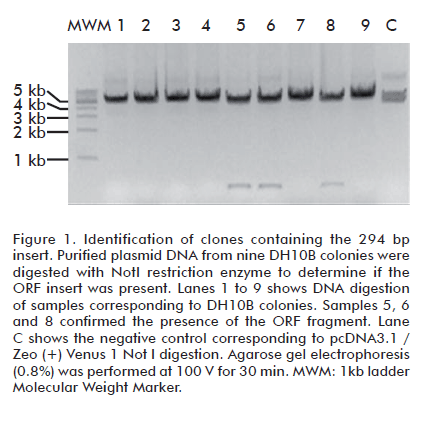
<body><![CDATA[<P   align="justify" ><font size="2" face="Verdana, Arial, Helvetica, sans-serif">Cells transformed      with PCR products containing 12 bp and 16 bp homology tags did not yield colony      growth in DH10B or BJ5183 using any of the transformation protocols. To enlarge      the region of homology between the PCR and the acceptor vector, a second round      of amplification using the oligonulceotides UT3 and UT4 was performed. Cloning      of DNA fragments from pGBKT7 with 31 homology bases to pcDNA3.1/Zeo (+) Venus      (1)-Zipper BspEI/XbaI produced the growth of 9 colonies in DH10B<B> </B>PEG-DMSO      competent cells<B> </B>after<B> </B>transformation<Sub>. </Sub>No digestion      analysis confirmed the obtention of 3 recombinant clones producing the expected      electrophoretic pattern: a 294 bp fragment corresponding to the insert and      a 5166 kb fragment corresponding to the acceptor vector&rsquo;s size (<a href="#fig1">Figure      1</a>). The cloning efficiency was 33.3%. In all three cases the fragment      insertion was confirmed by PCR using UT3 and UT4 oligonucleotides (<a href="#fig2">Figure      2</a>). The highest cloning efficiency was obtained using a 50:50 ng insert/ng      vector ratio.</font></P >       <P   align="center" ><img src="/img/revistas/bta/v28n3/f0106311.gif" width="434" height="425"><a name="fig1"></a></P >       
<P   align="center" ><img src="/img/revistas/bta/v28n3/f0206311.gif" width="432" height="577"><a name="fig2"></a></P >   <FONT size="+1"><FONT size="+1"><FONT size="+1">        
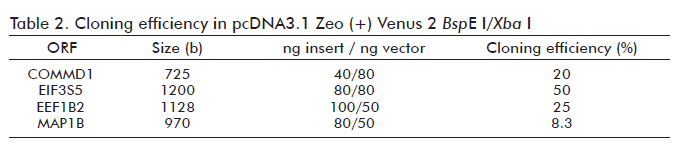
<P   align="justify" ><font size="2" face="Verdana, Arial, Helvetica, sans-serif">CaCl<Sub>2</Sub>      transformation did not yield any colony growth in DH10B. In addition, neither      transformation protocols produce any colony when BJ5183 strain was used. This      result was also obtained for ORFs transferred from pGADT7 or pACT2 to pcDNA3.1      Zeo (+) Venus 2. <a href="/img/revistas/bta/v28n3/t0206311.gif">Table 2</a> shows the best ng insert/ng      vector ratio for cloning purposes. A random selected positive clone from each      construction was tested by PCR using oligonuclotides UT5 and UT6. The amplified      product from tested clones showed the spected sizes of 0.725 kb for COMMD1,      0.970 kb for MAP1B, 1.128 kb for EEF1B2 and 1.2 kb for EIF3S5 (<a href="#fig3">Figure      3</a>). The results shown in <a href="/img/revistas/bta/v28n3/t0206311.gif">Table 2</a> indicate that      the <I>in vivo </I>recombination procedure succeeded, as all co-transformations      led to the production of recombinant plasmids.</font></P >       
<P   align="center" ><img src="/img/revistas/bta/v28n3/f0306311.gif" width="426" height="495"><a name="fig3"></a></P >   <FONT size="+1"><FONT size="+1">        
<P   >&nbsp;</P >       <P   ><font size="2" face="Verdana, Arial, Helvetica, sans-serif"><b><font size="3">DISCUSSION    </font></b></font></P >   <FONT size="+1">        <P   align="justify" ><font size="2" face="Verdana, Arial, Helvetica, sans-serif">To make <I>in vivo</I>      recombination cloning a feasible practice for a large number of ORF, the length      of the identical sequences for recombination must be minimized to reduce the      expense of generating primers for a large number of ORFs. A key problem to      achieve this goal is that the efficiency of cloning has been shown to decrease      as the length of homology between the vector and insert is decreased [7].      Otherwise, Bubeck, Winkler and Bautsch reported that about 10 bp overlap represented      a practical minimum length to obtain sufficiently high numbers of transformants      in DH5&alpha; [8]. In our conditions, we could not reproduce the results of      Bubeck, Winkler and Bautsch. Co-transforming <I>E. coli</I> strains with the      PCR products containing 16 bases 5&rsquo; recombination tag and 12 bases 3&rsquo;      recombination tag did not yield positive clones. An increase in the region      of homology up to 31 b results in a range of 8.3% to 50% efficiency of cloning      by <I>in vivo</I> recombination. This confirms the findings of Parrish&rsquo;s      that points out the requirement of minimal 21 bp homology regions shared by      vector and insert [3]. On the other hand our results are also in accordance      with Oliner [7] who reported a recombination efficiency of 20% when the residues      shared between vector and the PCR product is 30 bp in each end. </font></P >   <FONT size="+1">        <P   align="justify" ><font size="2" face="Verdana, Arial, Helvetica, sans-serif">According to Parrish      and co-workers there is variability in cloning efficiency among <I>E. coli</I>      strains. They strongly recommend KC8 strain which allowed a 75% cloning efficiency,      and also BUN10 (<I>recB21 recC22 sbcA23</I>), V324 (<I>recD1009</I>), MG1655      or DH5&alpha; (<I>RecA1</I>), in this order. Besides, Kong, Yang and Geller      [10] used BJ5183 <I>E. coli</I> strain for routine manipulation of relatively      large DNAs such as the five cosmids that comprise helper virus-free HSV-1      packaging system. In this system, recombination cloning required overlap sizes      from 251 bp to 18 kb with 500 bp to 5 kb preferred. </font></P >       <P   align="justify" ><font size="2" face="Verdana, Arial, Helvetica, sans-serif">Two <I>E. coli</I>      strains have been routinely used in our laboratory: BJ5183 and DH10B. The      use of DH10B has not been described previously in this context. Both strains      are succesfully employed for production of recombinant adenovirus and DNA      purification respectively. The oligonucleotides described in the present work      have smaller overlaps which might cause the lack of BJ5183 recombinants. On      the other hand, homologous recombination cloning by means of co-transformation      of the digested acceptor vector and inserts in DH10B strain proved to be effective      in the cloning of 5 ORFs with sizes ranging from 0.294 to 1.2 kb. Although      cloning efficiency for DH10B strain was lower than those reported in Parrish      work, it has an advantage over KC8 strain as suitability for extended storage      [3]. </font></P >       ]]></body>
<body><![CDATA[<P   align="justify" ><font size="2" face="Verdana, Arial, Helvetica, sans-serif">Finally, we have      found that the PEG-DMSO method for preparation and transformation of competent      cells was superior that the CaCl<Sub>2</Sub> method. This superiority is independent      from the transformation efficiency as we used competent cells with similar      transformation efficiency. Other authors relied on CaCl<Sub>2</Sub> transformation      for DH5&alpha;, and were able to replicate the successful cloning in this      strain, but until efficiency 25-fold lower than that obtained using electroporated      JC867 strain [7]. On the other side, Parrish recommends the use of the PEG-DMSO      as a particular effective way for high throughput cloning by transformation      in 96-well plates [3]. </font></P >   <FONT size="+1"><FONT size="+1"><FONT size="+1"><FONT size="+1">        <P   align="justify" ><font size="2" face="Verdana, Arial, Helvetica, sans-serif">As illustrated in      this study, the presented <I>in vivo </I>homologous recombination cloning      methodology is quick, efficient and cheap. The method requires no <I>in vitro</I>      enzymatic steps except the PCR amplification using pairs of universal oligonucleotides      that allows gene transfer between two different expression systems. This will      allow the evaluation and confirmation by PCA of those protein-protein interactions      detected by Yeast two hybrids assay regardless the ORF fragments to be transferred.      We also described the feasibility of DH10B strain for homologous recombination      cloning. The present method was further validated in our lab by the direct      cloning of ORFs amplified from human cDNAs into the pACT2 vector. </font></P >       <P   align="justify" >&nbsp;</P >       <P   ><font size="2" face="Verdana, Arial, Helvetica, sans-serif"><b><font size="3">ACKNOWLEDGEMENTS      </font> </b> </font></P >   <FONT size="+1">        <P   align="justify" ><font size="2" face="Verdana, Arial, Helvetica, sans-serif">Authors wish to thank      the generous colaboration of Dr. Stephen W. Michnick from the Biochemistry      Department of Montreal University who gently donated the pcDNA3.1 Zeo (+)      Venus-Zipper PCA vector system. </font></P >   <FONT size="+1">        <P   align="justify" > </P >       <P   align="justify" ><font size="3"><b><font face="Verdana, Arial, Helvetica, sans-serif">REFERENCES      </font></b></font></P >       <!-- ref --><P   align="justify" ><font size="2" face="Verdana, Arial, Helvetica, sans-serif">1. Michnick SW, Ear      PH, Manderson EN, Remy I, Stefan E. Universal strategies in research and drug      discovery based on protein-fragment complementation assays. Nat Rev Drug Discov.      2007;6(7):569-82.     </font></P >   <FONT size="+1">        <!-- ref --><P   align="justify" ><font size="2" face="Verdana, Arial, Helvetica, sans-serif">2. Marsischky G,      LaBaer J. Many paths to many clones: a comparative look at high-throughput      cloning methods. Genome Res. 2004;14(10B):2020-8.     </font></P >       <!-- ref --><P   align="justify" ><font size="2" face="Verdana, Arial, Helvetica, sans-serif">3. Parrish JR, Limjindaporn      T, Hines JA, Liu J, Liu G, Finley RL Jr. High-throughput cloning of Campylobacter      jejuni ORfs by in vivo recombination in Escherichia coli. J Proteome Res.      2004;3(3):582-6.     </font></P >       <!-- ref --><P   align="justify" ><font size="2" face="Verdana, Arial, Helvetica, sans-serif">4. Walhout AJ, Temple      GF, Brasch MA, Hartley JL, Lorson MA, van den Heuvel S, et al. GATEWAY recombinational      cloning: application to the cloning of large numbers of open reading frames      or ORFeomes. Methods Enzymol. 2000;328:575-92.     </font></P >       <!-- ref --><P   align="justify" ><font size="2" face="Verdana, Arial, Helvetica, sans-serif">5. Hanahan D. Studies      on transformation of Escherichia coli with plasmids. J Mol Biol. 1983;166(4):557-80.          </font></P >       <!-- ref --><P   align="justify" ><font size="2" face="Verdana, Arial, Helvetica, sans-serif">6. Remy I, Montmarquette      A, Michnick SW. PKB/Akt modulates TGF-beta signalling through a direct interaction      with Smad3. Nat Cell Biol. 2004;6(4):358-65.     </font></P >       <!-- ref --><P   align="justify" ><font size="2" face="Verdana, Arial, Helvetica, sans-serif">7. Oliner JD, Kinzler      KW, Vogelstein B. In vivo cloning of PCR products in E. coli. Nucl Acids Res.      1993;21(22):5192-7.     </font></P >       <!-- ref --><P   align="justify" ><font size="2" face="Verdana, Arial, Helvetica, sans-serif">8. Bubeck P, Winkler      M, Bautsch W. Rapid cloning by homologous recombination in vivo. Nucl Acids      Res. 1993;21(15):3601-2.     </font></P >       <!-- ref --><P   align="justify" ><font size="2" face="Verdana, Arial, Helvetica, sans-serif">9. Takahashi N, Yoshikura      H, Kobayashi I. An Escherichia coli strain, BJ5183, that shows highly efficient      conservative (two-progeny) DNA double-strand break repair of restriction breaks.      Gene. 2003;303:89-97.     </font></P >       <!-- ref --><P   align="justify" ><font size="2" face="Verdana, Arial, Helvetica, sans-serif">10. Kong Y, Yang      T, Geller AI. An efficient in vivo recombination cloning procedure for modifying      and combining HSV-1 cosmids. J Virol Methods. 1999;80(2):129-36.     </font></P >       <P   align="justify" > </P >       <P   ><font size="2" face="Verdana, Arial, Helvetica, sans-serif">Received in November      2010.     <br>     Accepted for publication in August 2011. </font></P >   <FONT size="+1">        ]]></body>
<body><![CDATA[<P   ><font size="2" face="Verdana, Arial, Helvetica, sans-serif">Yelaine Tejeda. Divisi&oacute;n      de Inmunodiagn&oacute;stico y Gen&oacute;mica, Centro de Ingenier&iacute;a      Gen&eacute;tica y Biotecnolog&iacute;a, CIGB. Ave. 31 e/ 158 y 190, PO Box      6162, CP 10600, Playa, La Habana, Cuba. E-mail: <A href="mailto:yelaine.tejeda@cigb.edu.cu">      <U><U><FONT color="#0000FF">yelaine.tejeda@cigb.edu.cu</font></U></U></A><FONT color="#0000FF">      <FONT color="#000000">. </font></font></font></P >   <FONT size="+1"><FONT color="#0000FF"><FONT color="#000000">        <P   > </P >   </font></font></font></font></font></font></font></font></font></font></font></font></font></font></font></font></font></font></font></font></font></font></font></font></font></font></font></font></font></font></font></font></font></font></font></DIV >      ]]></body><back>
<ref-list>
<ref id="B1">
<label>1</label><nlm-citation citation-type="journal">
<person-group person-group-type="author">
<name>
<surname><![CDATA[Michnick]]></surname>
<given-names><![CDATA[SW]]></given-names>
</name>
<name>
<surname><![CDATA[Ear]]></surname>
<given-names><![CDATA[PH]]></given-names>
</name>
<name>
<surname><![CDATA[Manderson]]></surname>
<given-names><![CDATA[EN]]></given-names>
</name>
<name>
<surname><![CDATA[Remy]]></surname>
<given-names><![CDATA[I]]></given-names>
</name>
<name>
<surname><![CDATA[Stefan]]></surname>
<given-names><![CDATA[E]]></given-names>
</name>
</person-group>
<article-title xml:lang="en"><![CDATA[Universal strategies in research and drug discovery based on protein-fragment complementation assays]]></article-title>
<source><![CDATA[Nat Rev Drug Discov]]></source>
<year>2007</year>
<volume>6</volume>
<numero>7</numero>
<issue>7</issue>
<page-range>569-82</page-range></nlm-citation>
</ref>
<ref id="B2">
<label>2</label><nlm-citation citation-type="journal">
<person-group person-group-type="author">
<name>
<surname><![CDATA[Marsischky]]></surname>
<given-names><![CDATA[G]]></given-names>
</name>
<name>
<surname><![CDATA[LaBaer]]></surname>
<given-names><![CDATA[J]]></given-names>
</name>
</person-group>
<article-title xml:lang="en"><![CDATA[Many paths to many clones: a comparative look at high-throughput cloning methods]]></article-title>
<source><![CDATA[Genome Res]]></source>
<year>2004</year>
<volume>14</volume>
<numero>10B</numero>
<issue>10B</issue>
<page-range>2020-8</page-range></nlm-citation>
</ref>
<ref id="B3">
<label>3</label><nlm-citation citation-type="journal">
<person-group person-group-type="author">
<name>
<surname><![CDATA[Parrish]]></surname>
<given-names><![CDATA[JR]]></given-names>
</name>
<name>
<surname><![CDATA[Limjindaporn]]></surname>
<given-names><![CDATA[T]]></given-names>
</name>
<name>
<surname><![CDATA[Hines]]></surname>
<given-names><![CDATA[JA]]></given-names>
</name>
<name>
<surname><![CDATA[Liu]]></surname>
<given-names><![CDATA[J]]></given-names>
</name>
<name>
<surname><![CDATA[Liu]]></surname>
<given-names><![CDATA[G]]></given-names>
</name>
<name>
<surname><![CDATA[Finley]]></surname>
<given-names><![CDATA[RL]]></given-names>
</name>
</person-group>
<article-title xml:lang="en"><![CDATA[High-throughput cloning of Campylobacter jejuni ORfs by in vivo recombination in Escherichia coli]]></article-title>
<source><![CDATA[J Proteome Res]]></source>
<year>2004</year>
<volume>3</volume>
<numero>3</numero>
<issue>3</issue>
<page-range>582-6</page-range></nlm-citation>
</ref>
<ref id="B4">
<label>4</label><nlm-citation citation-type="journal">
<person-group person-group-type="author">
<name>
<surname><![CDATA[Walhout]]></surname>
<given-names><![CDATA[AJ]]></given-names>
</name>
<name>
<surname><![CDATA[Temple]]></surname>
<given-names><![CDATA[GF]]></given-names>
</name>
<name>
<surname><![CDATA[Brasch]]></surname>
<given-names><![CDATA[MA]]></given-names>
</name>
<name>
<surname><![CDATA[Hartley]]></surname>
<given-names><![CDATA[JL]]></given-names>
</name>
<name>
<surname><![CDATA[Lorson]]></surname>
<given-names><![CDATA[MA]]></given-names>
</name>
<name>
<surname><![CDATA[van den Heuvel]]></surname>
<given-names><![CDATA[S]]></given-names>
</name>
</person-group>
<article-title xml:lang="en"><![CDATA[GATEWAY recombinational cloning: application to the cloning of large numbers of open reading frames or ORFeomes]]></article-title>
<source><![CDATA[Methods Enzymol]]></source>
<year>2000</year>
<volume>328</volume>
<page-range>575-92</page-range></nlm-citation>
</ref>
<ref id="B5">
<label>5</label><nlm-citation citation-type="journal">
<person-group person-group-type="author">
<name>
<surname><![CDATA[Hanahan]]></surname>
<given-names><![CDATA[D]]></given-names>
</name>
</person-group>
<article-title xml:lang="en"><![CDATA[Studies on transformation of Escherichia coli with plasmids]]></article-title>
<source><![CDATA[J Mol Biol]]></source>
<year>1983</year>
<volume>166</volume>
<numero>4</numero>
<issue>4</issue>
<page-range>557-80</page-range></nlm-citation>
</ref>
<ref id="B6">
<label>6</label><nlm-citation citation-type="journal">
<person-group person-group-type="author">
<name>
<surname><![CDATA[Remy]]></surname>
<given-names><![CDATA[I]]></given-names>
</name>
<name>
<surname><![CDATA[Montmarquette]]></surname>
<given-names><![CDATA[A]]></given-names>
</name>
<name>
<surname><![CDATA[Michnick]]></surname>
<given-names><![CDATA[SW]]></given-names>
</name>
</person-group>
<article-title xml:lang="en"><![CDATA[PKB/Akt modulates TGF-beta signalling through a direct interaction with Smad3]]></article-title>
<source><![CDATA[Nat Cell Biol]]></source>
<year>2004</year>
<volume>6</volume>
<numero>4</numero>
<issue>4</issue>
<page-range>358-65</page-range></nlm-citation>
</ref>
<ref id="B7">
<label>7</label><nlm-citation citation-type="journal">
<person-group person-group-type="author">
<name>
<surname><![CDATA[Oliner]]></surname>
<given-names><![CDATA[JD]]></given-names>
</name>
<name>
<surname><![CDATA[Kinzler]]></surname>
<given-names><![CDATA[KW]]></given-names>
</name>
<name>
<surname><![CDATA[Vogelstein]]></surname>
<given-names><![CDATA[B]]></given-names>
</name>
</person-group>
<article-title xml:lang="en"><![CDATA[In vivo cloning of PCR products in E. coli]]></article-title>
<source><![CDATA[Nucl Acids Res]]></source>
<year>1993</year>
<volume>21</volume>
<numero>22</numero>
<issue>22</issue>
<page-range>5192-7</page-range></nlm-citation>
</ref>
<ref id="B8">
<label>8</label><nlm-citation citation-type="journal">
<person-group person-group-type="author">
<name>
<surname><![CDATA[Bubeck]]></surname>
<given-names><![CDATA[P]]></given-names>
</name>
<name>
<surname><![CDATA[Winkler]]></surname>
<given-names><![CDATA[M]]></given-names>
</name>
<name>
<surname><![CDATA[Bautsch]]></surname>
<given-names><![CDATA[W]]></given-names>
</name>
</person-group>
<article-title xml:lang="en"><![CDATA[Rapid cloning by homologous recombination in vivo]]></article-title>
<source><![CDATA[Nucl Acids Res]]></source>
<year>1993</year>
<volume>21</volume>
<numero>15</numero>
<issue>15</issue>
<page-range>3601-2</page-range></nlm-citation>
</ref>
<ref id="B9">
<label>9</label><nlm-citation citation-type="journal">
<person-group person-group-type="author">
<name>
<surname><![CDATA[Takahashi]]></surname>
<given-names><![CDATA[N]]></given-names>
</name>
<name>
<surname><![CDATA[Yoshikura]]></surname>
<given-names><![CDATA[H]]></given-names>
</name>
<name>
<surname><![CDATA[Kobayashi]]></surname>
<given-names><![CDATA[I]]></given-names>
</name>
</person-group>
<article-title xml:lang="en"><![CDATA[An Escherichia coli strain, BJ5183, that shows highly efficient conservative (two-progeny) DNA double-strand break repair of restriction breaks]]></article-title>
<source><![CDATA[Gene]]></source>
<year>2003</year>
<volume>303</volume>
<page-range>89-97</page-range></nlm-citation>
</ref>
<ref id="B10">
<label>10</label><nlm-citation citation-type="journal">
<person-group person-group-type="author">
<name>
<surname><![CDATA[Kong]]></surname>
<given-names><![CDATA[Y]]></given-names>
</name>
<name>
<surname><![CDATA[Yang]]></surname>
<given-names><![CDATA[T]]></given-names>
</name>
<name>
<surname><![CDATA[Geller]]></surname>
<given-names><![CDATA[AI]]></given-names>
</name>
</person-group>
<article-title xml:lang="en"><![CDATA[An efficient in vivo recombination cloning procedure for modifying and combining HSV-1 cosmids]]></article-title>
<source><![CDATA[J Virol Methods]]></source>
<year>1999</year>
<volume>80</volume>
<numero>2</numero>
<issue>2</issue>
<page-range>129-36</page-range></nlm-citation>
</ref>
</ref-list>
</back>
</article>