<?xml version="1.0" encoding="ISO-8859-1"?><article xmlns:mml="http://www.w3.org/1998/Math/MathML" xmlns:xlink="http://www.w3.org/1999/xlink" xmlns:xsi="http://www.w3.org/2001/XMLSchema-instance">
<front>
<journal-meta>
<journal-id>1027-2852</journal-id>
<journal-title><![CDATA[Biotecnología Aplicada]]></journal-title>
<abbrev-journal-title><![CDATA[Biotecnol Apl]]></abbrev-journal-title>
<issn>1027-2852</issn>
<publisher>
<publisher-name><![CDATA[Editorial Elfos Scientiae]]></publisher-name>
</publisher>
</journal-meta>
<article-meta>
<article-id>S1027-28522011000300008</article-id>
<title-group>
<article-title xml:lang="en"><![CDATA[Development of Amblyseius largoensis as biological control agent of the broad mites (Polyphagotarsonemus latus)]]></article-title>
<article-title xml:lang="es"><![CDATA[Desarrollo de Ambliseius largoensis como agente de control biológico del ácaro blanco (Polyphagotarsenonemus latus)]]></article-title>
</title-group>
<contrib-group>
<contrib contrib-type="author">
<name>
<surname><![CDATA[Rodríguez]]></surname>
<given-names><![CDATA[Héctor]]></given-names>
</name>
<xref ref-type="aff" rid="A01"/>
</contrib>
<contrib contrib-type="author">
<name>
<surname><![CDATA[Ramos]]></surname>
<given-names><![CDATA[Mayra]]></given-names>
</name>
<xref ref-type="aff" rid="A03"/>
</contrib>
<contrib contrib-type="author">
<name>
<surname><![CDATA[Montoya]]></surname>
<given-names><![CDATA[Adrián]]></given-names>
</name>
<xref ref-type="aff" rid="A04"/>
</contrib>
<contrib contrib-type="author">
<name>
<surname><![CDATA[Rodríguez]]></surname>
<given-names><![CDATA[Yaritza]]></given-names>
</name>
<xref ref-type="aff" rid="A05"/>
</contrib>
<contrib contrib-type="author">
<name>
<surname><![CDATA[Chico]]></surname>
<given-names><![CDATA[Reynaldo]]></given-names>
</name>
<xref ref-type="aff" rid="A01"/>
</contrib>
<contrib contrib-type="author">
<name>
<surname><![CDATA[Miranda]]></surname>
<given-names><![CDATA[Ileana]]></given-names>
</name>
<xref ref-type="aff" rid="A01"/>
</contrib>
<contrib contrib-type="author">
<name>
<surname><![CDATA[Depestre]]></surname>
<given-names><![CDATA[Tomás L]]></given-names>
</name>
<xref ref-type="aff" rid="A05"/>
</contrib>
</contrib-group>
<aff id="A02">
<institution><![CDATA[,Universidad Agraria de La Habana, UNAH Facultad de Agronomía Departamento Biología-Sanidad Vegetal]]></institution>
<addr-line><![CDATA[San José de las Lajas ]]></addr-line>
<country>Cuba</country>
</aff>
<aff id="A03">
<institution><![CDATA[,Instituto Superior de Tecnologías y Ciencias Aplicadas, InSTEC Facultad de Gestión de la Ciencia, la Tecnología y el Medio Ambiente Departamento de Medio Ambiente]]></institution>
<addr-line><![CDATA[La Habana ]]></addr-line>
<country>Cuba</country>
</aff>
<aff id="A04">
<institution><![CDATA[,Centro Universitario de Guantánamo, CUG Facultad Agroforestal de Montaña, FAM ]]></institution>
<addr-line><![CDATA[El Salvador ]]></addr-line>
<country>Cuba</country>
</aff>
<aff id="A05">
<institution><![CDATA[,Instituto de Investigaciones Hortícolas Liliana Dimitrova  ]]></institution>
<addr-line><![CDATA[Quivicán ]]></addr-line>
<country>Cuba</country>
</aff>
<aff id="A01">
<institution><![CDATA[,Centro Nacional de Sanidad Agropecuaria, CENSA  ]]></institution>
<addr-line><![CDATA[San José de las Lajas ]]></addr-line>
<country>Cuba</country>
</aff>
<pub-date pub-type="pub">
<day>00</day>
<month>09</month>
<year>2011</year>
</pub-date>
<pub-date pub-type="epub">
<day>00</day>
<month>09</month>
<year>2011</year>
</pub-date>
<volume>28</volume>
<numero>3</numero>
<fpage>171</fpage>
<lpage>175</lpage>
<copyright-statement/>
<copyright-year/>
<self-uri xlink:href="http://scielo.sld.cu/scielo.php?script=sci_arttext&amp;pid=S1027-28522011000300008&amp;lng=en&amp;nrm=iso"></self-uri><self-uri xlink:href="http://scielo.sld.cu/scielo.php?script=sci_abstract&amp;pid=S1027-28522011000300008&amp;lng=en&amp;nrm=iso"></self-uri><self-uri xlink:href="http://scielo.sld.cu/scielo.php?script=sci_pdf&amp;pid=S1027-28522011000300008&amp;lng=en&amp;nrm=iso"></self-uri><abstract abstract-type="short" xml:lang="en"><p><![CDATA[The broad mites, Polyphagotarsonemus latus (Banks) (Acari: Tarsonemidae) is a cosmopolitan pest of many important crops as potatoes, beans, peppers, and citrus which lives in tropical, subtropical regions and greenhouses worldwide. Acording to its biological and ethological characteristics its control is complex by traditional methods of plant protection. For this reason, the use of the predatory mites of the Phytoseiidae family is an adequate and efficient management alternative. The present paper comprises the characterization of the potentiality of Amblyseius largoensis (Muma)(Acari: Phtyoseiidae) as biological control agent of P. latus integrating, for the first time, the predator's biological characteristics; feeding behavior and the numeric and functional responses; development of methodologies for mass rearing of the biological agent and parameters for quality control processes; the study of pest behavior in the protected production of Cuban hybrids of pepper, adapting the sampling methodology and determining the thresholds to estimate the population levels in these conditions. The compatibility of this predator with the principal chemicals and biological products used in the protected production and their effectiveness as biological control agent of P. latus in different conditions were evaluated. The results obtained demonstrated that A. largoensis is a new biological alternative for the management of broad mite populations in the protected production of peppers, which could be used in other agroecosystems; those that P. latus constitutes a problem, prior validation.]]></p></abstract>
<kwd-group>
<kwd lng="en"><![CDATA[Polyphagotarsonemus latus]]></kwd>
<kwd lng="en"><![CDATA[Amblyseius largoensis]]></kwd>
<kwd lng="en"><![CDATA[Capsicum annuum]]></kwd>
<kwd lng="en"><![CDATA[biological control]]></kwd>
</kwd-group>
</article-meta>
</front><body><![CDATA[ <DIV class="Sect"   >        <P   align="right" ><font size="2" color="#000000" face="Verdana, Arial, Helvetica, sans-serif"><b>REPORT</b></font></P >       <P   align="right" >&nbsp;</P >   <FONT size="+1" color="#000000">        <P   > </P >       <P   ><font size="4"><b><font face="Verdana, Arial, Helvetica, sans-serif">Development      of <I>Amblyseius largoensis</I> as biological control agent of the broad mites      (<I>Polyphagotarsonemus latus</I>) </font></b></font></P >       <P   >&nbsp;</P >       <P   ><font size="3" face="Verdana, Arial, Helvetica, sans-serif"><b>Desarrollo de      <i>Ambliseius largoensis</i> como agente de control biol&oacute;gico del &aacute;caro      blanco (<i>Polyphagotarsenonemus latus</i>)</b></font></P >       <P   >&nbsp;</P >       <P   >&nbsp;</P >       <P   > </P >       ]]></body>
<body><![CDATA[<P   > </P >       <P   ><b><font size="2" face="Verdana, Arial, Helvetica, sans-serif">H&eacute;ctor      Rodr&iacute;guez<Sup>1,2</Sup>, Mayra Ramos<Sup>3</Sup>, Adri&aacute;n Montoya<Sup>4</Sup>,      Yaritza Rodr&iacute;guez<Sup>5</Sup>, Reynaldo Chico<Sup>1</Sup>, Ileana Miranda<Sup>1</Sup>,      Tom&aacute;s L Depestre<Sup>5 </Sup></font></b><font size="2" face="Verdana, Arial, Helvetica, sans-serif"><Sup>      </Sup></font></P >       <P   ><font size="2" face="Verdana, Arial, Helvetica, sans-serif"><Sup>1</Sup> Centro      Nacional de Sanidad Agropecuaria, CENSA. Carretera de Jamaica y Autopista      Nacional, Apdo. 10, CP 32 700, San Jos&eacute; de las Lajas, Mayabeque, Cuba.      <Sup>    <br>     2</Sup> Departamento Biolog&iacute;a-Sanidad Vegetal, Facultad de Agronom&iacute;a,      Universidad Agraria de La Habana, UNAH. Carretera de Tapaste, CP 32 700, San      Jos&eacute; de las Lajas, Mayabeque, Cuba. <Sup>    <br>     3</Sup> Departamento de Medio Ambiente, Facultad de Gesti&oacute;n de la Ciencia,      la Tecnolog&iacute;a y el Medio Ambiente, Instituto Superior de Tecnolog&iacute;as      y Ciencias Aplicadas, InSTEC Carlos III y Luaces, Plaza de la Revoluci&oacute;n,      La Habana, Cuba. <Sup>    <br>     4</Sup> Facultad Agroforestal de Monta&ntilde;a, FAM. Centro Universitario      de Guant&aacute;namo, CUG, El Salvador, Guant&aacute;namo, Cuba. <Sup>5</Sup>      Instituto de Investigaciones Hort&iacute;colas Liliana Dimitrova, Quivic&aacute;n,      Mayabeque, Cuba. </font></P >       <P   >&nbsp;</P >   </font>    <hr>   <FONT size="+1" color="#000000">        <P   ><b><font size="2" face="Verdana, Arial, Helvetica, sans-serif">ABSTRACT </font></b></P >   <FONT size="+1"><FONT size="+1"><FONT size="+1"><FONT size="+1"><FONT size="+1"><FONT size="+1"><FONT size="+1"><FONT size="+1"><FONT size="+1"><FONT size="+1"><FONT size="+1"><FONT size="+1"><FONT size="+1"><FONT size="+1"><FONT size="+1"><FONT size="+1"><FONT size="+1"><FONT size="+1"><FONT size="+1"><FONT size="+1"><FONT size="+1"><FONT size="+1"><FONT size="+1"><FONT size="+1">        <P   ><font size="2" face="Verdana, Arial, Helvetica, sans-serif">The broad mites,      <I>Polyphagotarsonemus latus</I> (Banks) (Acari: Tarsonemidae) is a cosmopolitan      pest of many important crops as potatoes, beans, peppers, and citrus which      lives in tropical, subtropical regions and greenhouses worldwide. Acording      to its biological and ethological characteristics its control is complex by      traditional methods of plant protection. For this reason, the use of the predatory      mites of the Phytoseiidae family is an adequate and efficient management alternative.      The present paper comprises the characterization of the potentiality of <I>Amblyseius      largoensis</I> (Muma)(Acari: Phtyoseiidae) as biological control agent of      <I>P. latus</I> integrating, for the first time, the predator&rsquo;s biological      characteristics; feeding behavior and the numeric and functional responses;      development of methodologies for mass rearing of the biological agent and      parameters for quality control processes; the study of pest behavior in the      protected production of Cuban hybrids of pepper, adapting the sampling methodology      and determining the thresholds to estimate the population levels in these      conditions. The compatibility of this predator with the principal chemicals      and biological products used in the protected production and their effectiveness      as biological control agent of <I>P. latus</I> in different conditions were      evaluated. The results obtained demonstrated that <I>A. largoensis</I> is      a new biological alternative for the management of broad mite populations      in the protected production of peppers, which could be used in other agroecosystems;      those that <I>P. latus</I> constitutes a problem, prior validation. </font></P >       <P   ><font size="2" face="Verdana, Arial, Helvetica, sans-serif"><b>Keywords:</b>      Polyphagotarsonemus latus, Amblyseius largoensis, Capsicum annuum, biological      control. </font></P >   </font></font></font></font></font></font></font></font></font></font></font></font></font></font></font></font></font></font></font></font></font></font></font></font></font>   <hr>   <FONT size="+1" color="#000000"><FONT size="+1"><FONT size="+1"><FONT size="+1"><FONT size="+1"><FONT size="+1"><FONT size="+1"><FONT size="+1"><FONT size="+1"><FONT size="+1"><FONT size="+1"><FONT size="+1"><FONT size="+1"><FONT size="+1"><FONT size="+1"><FONT size="+1"><FONT size="+1"><FONT size="+1"><FONT size="+1"><FONT size="+1"><FONT size="+1"><FONT size="+1"><FONT size="+1"><FONT size="+1"><FONT size="+1">       ]]></body>
<body><![CDATA[<P   >&nbsp;</P >       <P   >&nbsp;</P >       <P   ><b><font face="Verdana, Arial, Helvetica, sans-serif" size="3">INTRODUCTION</font></b></P >   <FONT size="+1">        <P   align="justify" ><font size="2" face="Verdana, Arial, Helvetica, sans-serif">The broad mites,      <I>Polyphagotarsonemus latus </I>(Banks) (Acari: Tarsonemidae) is a serious      cosmopolitan pest in tropical and subtropical regions and in greenhouses worldwide      [1]. In Cuba, it is considered as one of the most harmful pest mite, due to      their polyphagy and the negative impact in crops of economical interest as:      citrus, beans, pepper and potato [2]. In the protected production systems      of recent development in the country, it provokes serious affectation in pepper,      tomato, cucumber and other horticultural crops [3]. With few exceptions, <I>P</I>.      <I>latus </I>is controlled exclusively with chemicals acaricides [4]. In Cuba,      the strain LBt-13 of <I>Bacillus thuringiensis </I>Berliner has been used      with favorable results for several years. However, the expected results are      not always achieved, because this mite develops on the undersides of leaf      surfaces, that is, it goes unnoticed in crops, confusing their symptoms with      diseases. This means that applications are not being carried out in an adequate      moment. </font></P >   <FONT size="+1">        <P   align="justify" ><font size="2" face="Verdana, Arial, Helvetica, sans-serif">The use of the biological      control, through the phytoseiid mites, constitutes a new form for managing      the populations of <I>P. latus</I>, which have the advantages of achieving      an efficient control in any site of the leaf; further reducing the import      of chemicals products and protecting the natural enemies present in the agroecosystem,      contributing to the preservation of the environment [5, 6]. </font></P >       <P   align="justify" ><font size="2" face="Verdana, Arial, Helvetica, sans-serif">To develop an efficient      strategy, the development of a group of researches is required in order to      demonstrate the feasibility of using these organisms, which is achieved only      carrying out the basic and applied studies, and determining their potentiality      as biological control agents. </font></P >       <P   align="justify" ><font size="2" face="Verdana, Arial, Helvetica, sans-serif">In answer to the      necessity of finding new management strategies of broad mite populations,      the present paper aims at determining the most important biological parameters      of <I>Amblyseius largoensis</I> (Muma) (Acari: Phytoseiidae), characterizing      their feeding behavior, establishing a mass rearing method, describing the      populational behavior of <I>P. latus</I> in the protected production of pepper      and estimating the effectiveness of <I>A. largoensis</I> as a biological control      agent of <I>P. latus. </I></font></P >       <P   align="justify" >&nbsp;</P >       <P   ><font size="2" face="Verdana, Arial, Helvetica, sans-serif"><b><font size="3">RESULTS      AND DISCUSSION</font></b> </font></P >   <FONT size="+1">        <P   ><font size="2" face="Verdana, Arial, Helvetica, sans-serif"><b>Basic biological      studies </b></font></P >   <FONT size="+1">        ]]></body>
<body><![CDATA[<P   align="justify" ><font size="2" face="Verdana, Arial, Helvetica, sans-serif">An integral study      of the most important biological aspects of <I>A. largoensis</I> was carried      out; the morphological and behavioral characteristics of the predator were      described. The duration of the development for both sex and total was determined,      the reproductive parameters, including the rate of realease, the fertility      and daily oviposition rate on <I>P. latus </I>when feeding on potato, pepper      and citrus were determined [7, 8]. In most of the cases, the biological parameters      of <I>A. largoensis</I> on broad mite, obtained in this study, are similar      or higher than the observed for this species when were fed on other prey or      pollen [9] and in some other cases are comparable and more favorable, to those      reported for phytoseiid mites, that are considered as good biocontrols of      this pest, therefore evidences their potential present in the <I>A. largoensis</I>      in order to control <I>P. latus</I>. </font></P >       <P   ><font size="2" face="Verdana, Arial, Helvetica, sans-serif"><b>Predator-prey      interaction </b> </font></P >       <P   align="justify" ><font size="2" face="Verdana, Arial, Helvetica, sans-serif">The study on the      basis of feeding behavior and numeric and functional responses of <I>A. largoensis</I>      on broad mites allowed increasing the knowledge of predator- prey interaction.      <I>A. largoensis</I> consumed all stages of prey. However, the predator showed      preference for consuming immature stages, mainly eggs and active larvae that      represent 73% of all consumed. </font></P >       <P   align="justify" ><font size="2" face="Verdana, Arial, Helvetica, sans-serif">In addition,the time      spent feeding or to consume a prey time is increased while the different development      phases of the prey are occuring; as well the <I>A. largoensis </I>dedicates      the highest proportion of time in active components(search and feeding on      the prey) [8, 10]. These results demonstrated the marked ability of <I>A.      largoensis</I> to find, capture and consume all the stages of prey, very important      aspect considering its biological and ethological characteristics of <I>P.      latus</I>. These elements are useful in order to define the optimal rate to      design the future management strategy of <I>P. latus</I> with this mite. The      knowledge of feeding behavior, the ratio of successful attacks and feeding      preferences on several life stages, are studies carried out for the first      time in Cuba in order to evaluate the predatory capacity of a natural enemy.      From the methodological point of view, they have a great importance since      they could serve as a benchmark for similar testings with other biocontrols      with the purpose of predicting their potentialities as biological control      agents. </font></P >       <P   align="justify" > <font size="2" face="Verdana, Arial, Helvetica, sans-serif"><I>A. largoensis      </I>showed a type II functional response to prey [11]. The average number      of <I>P. latus </I>attacked by <I>A. largoensis </I>increased with prey density,      until reaching a maximum, in which remained stable over time or came to the      commonly known stage of &lsquo;plateau&rsquo;. The Holling&acute;s model was      the best to estimate attack coefficients and handling times. Theoretically,      <I>A. largoensis </I>could consume one <I>P. latus </I>in 5.9 min; an adult      female could consume a maximum of 243 broad mites per day. </font></P >       <P   align="justify" ><font size="2" face="Verdana, Arial, Helvetica, sans-serif">Starting from the      relationship between functional and numerical responses of <I>A. largoensis,</I>      the predator searching efficiency and the potential of an individual <I>A.      largoensis </I>female to suppress <I>P. latus</I> was calculated at different      densities. This value allowed to know that the predatory mites maintain a      satisfactory efficiency until a density of approximately 60 mites. This would      suggest that the rate of release could coincide with this density [12]. This      result confirms that <I>A. largoensis</I> has a marked ability to regulate      the <I>P. latus</I> population and could affirm that it possesses all the      biological characteristics to be selected as an effective biocontrol of this      tarsonemid mite. </font></P >       <P   align="justify" ><font size="2" face="Verdana, Arial, Helvetica, sans-serif">The results obtained      in the experiments of biology, feeding behavior and numeric and functional      responses demonstrated that this procedure is adequate and allows to determine      the potentiality of <I>A. largoensis</I> as biological control agent of broad      mites and becomes a methodology that could be used, with similar success,      in order to evaluate other natural enemies. This information also offered      the scientific indispensable support for a second experimental phase comprising      the tests of control in greenhouses and field. </font></P >       <P   ><font size="2" face="Verdana, Arial, Helvetica, sans-serif"><b>Evaluation of      mass rearing methods </b></font></P >       <P   align="justify" ><font size="2" face="Verdana, Arial, Helvetica, sans-serif">All the methods evaluated      for mass rearing permitted the increase population of <I>A. largoensis</I>.      In all the cases the initial population was multiplied several times, which      demonstrated that the rear methods used, as the offered food, have had a favorable      interaction in the production of the predator. The method of the trays offered      the best results in general. Based on these results and the simplicity of      the technique, it was the method selected for the massive reproduction of      the predator [13]. It is also important that an alternative method for the      maintenance of the mother culture was proposed, with a rigorous system of      evaluation of the quality and that the pollen of corn could be a supplementary      food when the prey are insufficient [14]. </font></P >       <P   align="justify" ><font size="2" face="Verdana, Arial, Helvetica, sans-serif">With these results      a productive system was designed considering two basic subsystems closely      related: the maintenance of the mother culture of <I>A. largoensis</I>, which      will serve to recycle the system and to start the massive production and the      massive reproduction properly. The studied systems can be transferred to the      Entomophagous and Entomopathogen Reproductive Centers (CREE) of the country,      because of the essential equipment to carry out this production is available.      It is important to consider that this is the most complete study achieved      in the country for the evaluation of mass rearing methods of predatory mites      and the first with a generalist species. It contributes to accelerate the      introduction of these predators to the productive practice. </font></P >       ]]></body>
<body><![CDATA[<P   align="justify" ><font size="2" face="Verdana, Arial, Helvetica, sans-serif">This result allowed      to provide the necessary individuals to evaluate the compatibility of <I>A.      largoensis</I> with the principal chemical and biological products used in      the protected production, determining that the predator is compatible with      the acaricides Dicofol and the strain LBt-13 of <I>B. thuringiensis</I>, the      insecticide Confidor and the fungicides sulfur, Ridomil and Mesuram; while      the insecticides Polo and Corsario were highly toxics to the predator (<a href="/img/revistas/bta/v28n3/t0108311.gif">Table</a>).      </font></P >       
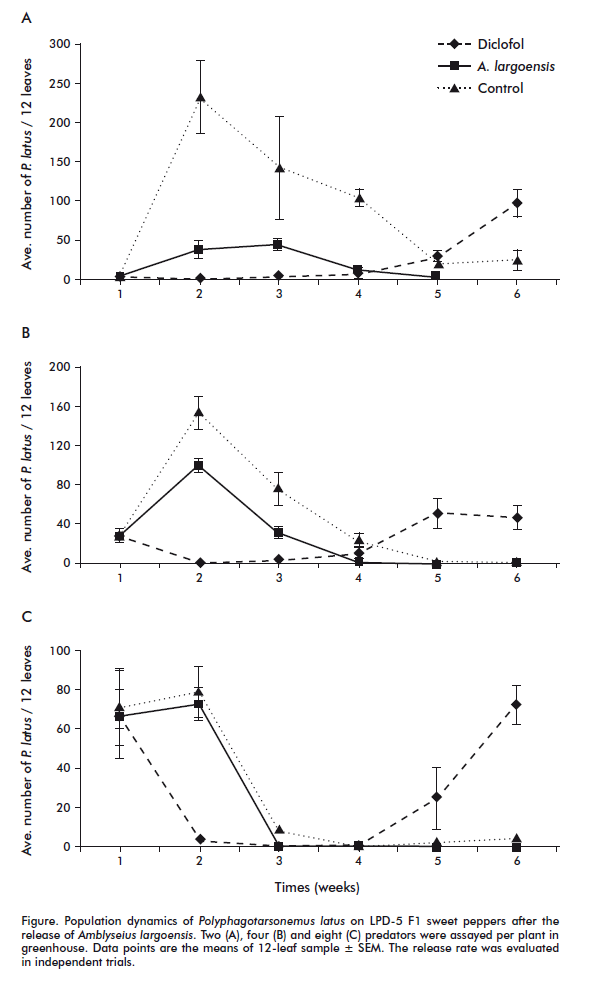
<P   align="justify" ><font size="2" face="Verdana, Arial, Helvetica, sans-serif">This result has a      great applicability because it provides to design intervention strategies      in order to combine the use of a biological control agent, to regulate the      populations of <I>P. latu</I>s, with the chemical control, in case of being      necessary for other pests. </font></P >       <P   ><font size="2" face="Verdana, Arial, Helvetica, sans-serif"><b>Incidence of the      broad mite on peppers hybrids </b></font></P >       <P   align="justify" ><font size="2" face="Verdana, Arial, Helvetica, sans-serif">The population behavior      of <I>P. latus</I> was studied on pepper in protected systems during two years,      which allowed evidencing the ineffectiveness of the chemical acaricides to      maintain the populations of the broad mites below the threshold of economic      damage [15]. These results may be considered as possible modification of the      methodology pest monitoring in systems protected, with relationship to the      form of take out the sample in the house of cultivation, the quantity of leave      to extract, which could be reduced in a 35%, as well as the possibility of      the use of a presence-absence sampling, on the base of a 16% of leave infested      with at less a female of <I>P. latus</I>. These results simplify the process      of sampling, without lossing their efficacy with a significant reduction of      time and resource during the process. </font></P >       <P   align="justify" ><font size="2" face="Verdana, Arial, Helvetica, sans-serif">The study of the      influence of the phenological phases on the damages produced by <I>P. latus</I>      on two Cuban pepper hybrids allow to know that the vegetative growth and blossoming      are the most vulnerable phase in presence of the pest . Therefore, this would      be one of the phases that must be protected with greater emphasis to avoid      the negative impact of the broad mites damage in the yields. This knowledge      will allow a higher production of pepper hybrid seed, which will facilitate      the reduction of cost by this concept. These results are the first ones about      broad mites-pepper interaction in protected systems and are also indispensable      to the design of more effective management strategies of this important pest.      </font></P >       <P   ><font size="2" face="Verdana, Arial, Helvetica, sans-serif"><b>Effectiveness      of <I>A. largoensis</I> to control <I>P. latus</I> in pepper </b></font></P >       <P   align="justify" ><font size="2" face="Verdana, Arial, Helvetica, sans-serif">The study showed      the validity of the basic studies carried out indicating that <I>A. largoensis</I>      had the biological potential to be an effective biological control agent of      broad mites. The results of the release of <I>A. largoensis</I> for controlling      broad mites on peppers in greenhouses are shown in the <a href="/img/revistas/bta/v28n3/f0108311.gif">figure</a>.      The Dicofol treatment always caused a rapid decline in broad mite population,      but it tended to increase again at the end of the trials. The treatment in      which <I>A. largoensis</I> was released at two predatory mites per plant (<a href="/img/revistas/bta/v28n3/f0108311.gif">Figure      A</a>), the number of broad mite continued increasing for two weeks and by      the third sampling after the release, there was a reduction in the number      of broad mites. This trend continued until the end of the trial. Nevertheless,      from the second sampling, the treatment with <I>A. largoensis</I> reduced      the broad mite density significantly to the end of the trial (p &lt; 0.001,<I>      </I>F = 29.55, df = 2) when compared with the no-predator control. The density      of broad mites in the control treatment peaked in the second sampling and      it gradually declined thereafter, because the damage of the broad mite feeding      effect the vegetative grown and not permit the presence of new leaves. </font></P >       
<P   align="justify" ><font size="2" face="Verdana, Arial, Helvetica, sans-serif">When four predatory      mites were released (<a href="/img/revistas/bta/v28n3/f0108311.gif">Figure B</a>), the broad mite      density continued increasing for one more week and, thereafter, it started      to decline until the end of the trial. Seven days after the predator had released,      the treatment with <I>A. largoensis</I> reduced the broad mite density significantly      (p &lt; 0.0001, F = 133.7, df<B> </B>= 2) to the fourth sampling when compared      with the no-predator control. In the sampling five and sixth no significant      difference between broad mite density in <I>A. largoensis</I> treatment and      the control was observed. The density of broad mites in the control had a      similar behavior to the observed in the previous trial. </font></P >       
<P   align="justify" ><font size="2" face="Verdana, Arial, Helvetica, sans-serif">When eight predatory      mites per plant were released (<a href="/img/revistas/bta/v28n3/f0108311.gif">Figure C</a>), the broad      mite density showed a similar behavior to that observed in the second trial,      but the reduction of the broad mite density by <I>A. largoensis</I> compared      with the control treatment was not significant, except to sampling third (p      &lt; 0.002, F = 7.80, df<B> </B>= 2) and sixth (p &lt; 0.0001, F = 181.14,      df<B> </B>= 2). </font></P >       
<P   align="justify" ><font size="2" face="Verdana, Arial, Helvetica, sans-serif">The most favorable      result was obtained when eight <I>A. largoensis</I>/plant were released, regardless      of the extremely high density of the broad mite. This is logical because it      was the highest release rate. With 2 and 4 predatory mites/plant, the control      effect was observed a week later, but the result was the same at the end of      the trial. It is important to consider that the release rate used in this      study was much lower than the commonly used for other phytoseiid mites [5,      6]. </font></P >       ]]></body>
<body><![CDATA[<P   align="justify" ><font size="2" face="Verdana, Arial, Helvetica, sans-serif">This was in agreement      with previous studies on the biological characteristics of <I>A. largoensis</I>      that showed this mite as a highly effective predator of the broad mite [8,      12]. </font></P >       <P   align="justify" ><font size="2" face="Verdana, Arial, Helvetica, sans-serif">Similar results were      found when <I>A. largoensis in </I>release was evaluated in pepper plants,      covered microplots and tunnels. In both opportunities, the predator mites      were found primarily on leaves located at the middle of the pepper plants.      This behavior has also been informed for <I>Neoseiulus californicus</I> (Oudemans)      in release carried out in order to control <I>P. latus</I> pepper [5]. </font></P >       <P   align="justify" ><font size="2" face="Verdana, Arial, Helvetica, sans-serif">These are the first      results that demonstrate the effectiveness of a predatory mite as biocontrol      agent of the broad mites for Cuba. <I>A. largoensis</I> represents a new perspective      for the management of this important pest in the country; particularly in      protected systems that need management alternatives for the organisms noxious      friendlier with the environment. It is assuredthat people could be benefitted      of a healthier product and higher quality. </font></P >       <P   align="justify" ><font size="2" face="Verdana, Arial, Helvetica, sans-serif">It is evident the      great effectiveness of this predator on their preys, allowing to reach control      indexes comparable with other predators that are commonly marked internationally,      with much lower release rate [5, 6]. </font></P >       <P   align="justify" ><font size="2" face="Verdana, Arial, Helvetica, sans-serif">Taking into account      the costs generated by the protection of a hectare of protected pepper with      acaricides chemicals and the costs of the predatory release for a similar      surface, it provides to save between 13.73 to 40.37 CUC. </font></P >       <P   align="justify" ><font size="2" face="Verdana, Arial, Helvetica, sans-serif">These results demonstrate      the existence of a new biological alternative for the management of the populations      of broad mites in the protected production of pepper. The introduction of      <I>A. largoensis</I> in the agricultural practice will help to reduce the      populations of broad mites without the need of applications of chemicals acaricides      and consequently an economical and ecological benefit is obtained. </font></P >       <P   ><font size="2" face="Verdana, Arial, Helvetica, sans-serif"><b>Relevance of the      study </b></font></P >       <P   align="justify" ><font size="2" face="Verdana, Arial, Helvetica, sans-serif">The aspects relative      to the <I>A. largoensis </I>biology on <I>P. latus</I>, constitute a contribution      to the knowledge of this predatory mites, because this interaction has not      been studied before, in Cuba neither worldwide. </font></P >       <P   align="justify" ><font size="2" face="Verdana, Arial, Helvetica, sans-serif">The data obtained      on feeding behavior of <I>A. largoensis</I> as predator of <I>P. latus</I>      constitute a completely novel result for Cuba and for the world. </font></P >       <P   align="justify" ><font size="2" face="Verdana, Arial, Helvetica, sans-serif">The mathematical      models in order to estimate the functional responses of a predator are applied      for the first time in the country. </font></P >       ]]></body>
<body><![CDATA[<P   align="justify" ><font size="2" face="Verdana, Arial, Helvetica, sans-serif">The method used to      evaluate the potentiality of <I>A. largoensis</I> as a biological control      agent of <I>P. latus</I>, based on basic study of biology, the feeding behavior      and the numeric and functional responses, possesses a high methodology value,      because it could be adapted for similar studies in other groups of naturals      predators. </font></P >       <P   align="justify" ><font size="2" face="Verdana, Arial, Helvetica, sans-serif">The system for mass      rearing of the <I>A. largoensis</I> was designed based on the predador&acute;s      biological knowledge, with several alternatives of food and methodologies      of rearing, as well as with a rigorous system of quality for the maintenance      of mother culture, being the most complete study carried out in the country.      </font></P >       <P   align="justify" ><font size="2" face="Verdana, Arial, Helvetica, sans-serif">The compatibility      of <I>A. largoensis</I> with other pesticides of frequent use in protected      production was demostrated, providing alternatives for the management strategy      of this important pest. </font></P >       <P   align="justify" ><font size="2" face="Verdana, Arial, Helvetica, sans-serif">The status update      of <I>P. latus </I>as pest in protected production, the damage and the population      fluctuation on pepper hybrid of national production and methodology of monitoring      are elements of vital importance on taking decisions for the management of      this pest. A new biological alternative for the management of broad mite populations      for protected production of pepper is offered, that could be useful in other      agroecosystems where <I>P. latus</I> is a problem; thus it would provide to      diminish broad mite populations without the need of acaricides chemical applications,      highly contaminant and expensive, therefore and consequently an economical      and ecological benefit is obtained. </font></P >       <P   align="justify" ><font size="2" face="Verdana, Arial, Helvetica, sans-serif"><I>A. largoensis</I>      constitutes a new line of production for the CREEs of the country, which will      contribute to the economic rentability of these institutions and offer new      opportunities of employment, mainly to women. </font></P >       <P   align="justify" >&nbsp;</P >       <P   ><font size="2" face="Verdana, Arial, Helvetica, sans-serif"><B><font size="3">CONCLUSIONS</font></B></font></P >   <FONT size="+1">        <P   align="justify" ><font size="2" face="Verdana, Arial, Helvetica, sans-serif">The results demonstrated      that <I>A. largoensis</I> has the biological potential to be an efficient      predator of <I>P. latus</I>. This affirmation is based on their biological      </font></P >   <FONT size="+1">        <P   align="justify" ><font size="2" face="Verdana, Arial, Helvetica, sans-serif">parameters, the marked      ability to find, capture and consume all the stages of <I>P. latus</I> and      the functional responses type II. There were also evidences of their mass      rearing viability are also very important; and the tray method was the most      promissory. </font></P >       <P   align="justify" ><font size="2" face="Verdana, Arial, Helvetica, sans-serif">On the other hand,      the importance of broad mites in the protected production of pepper as pests      was corroborated , as well as the unawareness of the phytosanitary personnel      on the methodology, monitoring and control of <I>P. latus</I>, which suggests      the need of preparation in order to apply the established measurements appropriately.      The poor efficiency of the chemical control was evidenced to maintain the      population levels of <I>P.</I> <I>latus</I> below the thresholds of application.      This permitted to adjust the methodology of sampling, monitoring and control      of <I>P. latus</I> for the protected production of pepper, with a reduction      of the size of the sample in a 30% and was settled that the sign for the release      of <I>A. largoensis</I> as a biological control agent of 0.5 broad mites by      leaf. </font></P >       ]]></body>
<body><![CDATA[<P   align="justify" ><font size="2" face="Verdana, Arial, Helvetica, sans-serif">Other important element      was demonstrated that <I>P. latus</I> produced the highest injuries in pepper      hybrids HIRAM F<Sub>1</Sub> and LPD-5 F<Sub>1</Sub>, in vegetative growth      and blossoming stages, reducing height, the leaf area of the plants and the      number and weight of the fruits. </font></P >   <FONT size="+1"><FONT size="+1"><FONT size="+1"><FONT size="+1">        <P   align="justify" ><font size="2" face="Verdana, Arial, Helvetica, sans-serif"><I>Amblyseius largoensis</I>      is compatible with the acaricides Dicofol, Sulfur and the strain LBt-13 of      <I>B. thuringiensis</I>, the insecticide Confidor and the fungicide Ridomil      and Mensuram. The insecticides Polo and Corsario were highly toxics to the      predator. </font></P >       <P   align="justify" ><font size="2" face="Verdana, Arial, Helvetica, sans-serif">The releases of the      <I>Amblyseius largoensis</I> controlled efficiently the broad mites in greenhouses,      covered microplots and tunnel of protected production of pepper, with a release      rate between 4-8 predators by plant. These results allowed to confirm that      <I>A. largoensis</I> is an effective biological control agent of <I>P. latus</I>,      with a positive economic and environmental repercussion. </font></P >       <P   align="justify" >&nbsp;</P >       <P   ><font size="2" face="Verdana, Arial, Helvetica, sans-serif"><B><font size="3">ACKNOWLEDGEMENTS</font></B></font></P >   <FONT size="+1">        <P   align="justify" ><font size="2" face="Verdana, Arial, Helvetica, sans-serif">A especial acknowledgement      of the authors&rsquo; to people that in a generosity way contributed to the      make the present work, acceding to the search of technical solutions with      multiple difficulties that are presented in an investigation of this extent.      Our gratitude to Maria de los &Aacute;ngeles Mart&iacute;nez PhD, Oriela Pino      PhD, Moraima Suris PhD, Juan A Mart&iacute;nez PhD and to the technicians      Jos&eacute; M Zambrana and Adayakni S&aacute;nchez, all collaborators of this      work. </font></P >   <FONT size="+1">        <P   align="justify" ><font size="2" face="Verdana, Arial, Helvetica, sans-serif">We thank to Eduardo      Sistach PhD by their invaluable help in the translation to English language      of the articles sent to international magazines, to Roberto Sardinas, by being      attentive to capture the more minimums details of the investigation with their      photographic camera and to Yanebis Perez BSc, by their contribution in the      last step of the research. </font></P >       <P   align="justify" ><font size="2" face="Verdana, Arial, Helvetica, sans-serif">Serve this space      to thank the Centro Nacional de Sanidad Agropecuaria (CENSA) by the financial      support offered for the execution of the investigations contained in this      Academy of Sciences Award. </font></P >       <P   > </P >   <FONT size="+1">        <P   ><font size="3"><b><font face="Verdana, Arial, Helvetica, sans-serif">REFERENCES      </font></b></font></P >       ]]></body>
<body><![CDATA[<!-- ref --><P   ><font size="2" face="Verdana, Arial, Helvetica, sans-serif">1. Gerson U. Biology      and control of the broad mite, Polyphagotarsonemus latus (Banks) (Acari: Tarsonemidae).      Exp Appl Acarol. 1992;13:163-78.     </font></P >   <FONT size="+1">        <!-- ref --><P   ><font size="2" face="Verdana, Arial, Helvetica, sans-serif">2. Almaguel L. &Aacute;caros      de importancia econ&oacute;mica en Cuba. Bol T&eacute;c INISAV. 1996;(2):1-43.          </font></P >       <!-- ref --><P   ><font size="2" face="Verdana, Arial, Helvetica, sans-serif">3. Casanova AS, G&oacute;mez      O, Hern&aacute;ndez M, Chailloux M, Depestre T, Pupo FR, et al. Manual para      la producci&oacute;n protegida de hortalizas. 2nd ed. La Habana: Editorial      Liliana; 2007.     </font></P >       <!-- ref --><P   ><font size="2" face="Verdana, Arial, Helvetica, sans-serif">4. Pena JE. Chemical      control of broad mites (Acarina: Tarsonemidae) in limes (Citrus latifolia).      Proc Fla State Hort Soc. 1988;101:247-9.     </font></P >       <!-- ref --><P   ><font size="2" face="Verdana, Arial, Helvetica, sans-serif">5. Weintraub PG,      Kleitman S, Mori R, Shapira N, Palevsky E. Control of the broad mite (Polyphagotarsonemus      latus (Banks)) on organic greenhouse sweet peppers (Capsicum annuum L.) with      the predatory mite, Neoseiulus cucumeris (Oudemans). Biol Control. 2003;27:300-9.          </font></P >       ]]></body>
<body><![CDATA[<!-- ref --><P   ><font size="2" face="Verdana, Arial, Helvetica, sans-serif">6. Tal C, Coll M,Weintraub      PG. Biological control of Polyphagotarsonemus latus (Acari: Tarsonemidae)      by the predaceous mite Amblyseius swirskii (Acari: Phytoseiidae). IOBC/WPRS      Bull. 2007;30(5): 111-115.     </font></P >       <!-- ref --><P   ><font size="2" face="Verdana, Arial, Helvetica, sans-serif">7. Rodr&iacute;guez      H, Ramos M. Biolog&iacute;a de Amblyseius largoensis (Muma) (Acari: Phytoseiidae)      sobre Polyphagotarsonemus latus (Banks)(Acari: Tarsonemidae) criado sobre      diferentes sustratos. Rev Protecci&oacute;n Veg. 2003;18(1):58-61.     </font></P >       <!-- ref --><P   ><font size="2" face="Verdana, Arial, Helvetica, sans-serif">8. Rodr&iacute;guez      H, Ramos M. Biology and feeding behavior of Amblyseius largoensis (Muma) on      Polyphagotarsonemus latus (Banks) (Acari: Tarsonemidae). Rev Protecci&oacute;n      Veg. 2004;19(2):73-9.     </font></P >       <!-- ref --><P   ><font size="2" face="Verdana, Arial, Helvetica, sans-serif">9. Galv&atilde;o      AS, Gondim MGC, de Moraes GJ, de Oliveira JV. Biology of Amblyseius largoensis      (Muma) (Acari: Phytoseiidae), a potential predator of Aceria guerreronis Keifer      (Acari: Eriophyidae) on coconut trees. Neotrop Entomol. 2007;36(3):465-70.          Portuguese. </font></P >       <!-- ref --><P   ><font size="2" face="Verdana, Arial, Helvetica, sans-serif">10. Rodr&iacute;guez      H, Ramos M. Feeding behavior of Amblyseius largoensis (Muma) and Phytoseiulus      macropilis (Banks) (Acari: Phytoseiidae) on Panonychus citri (McGregor) (Acari:      Tetranychidae). Rev Protecci&oacute;n Veg. 2006;21(2):114-8.     </font></P >       ]]></body>
<body><![CDATA[<!-- ref --><P   ><font size="2" face="Verdana, Arial, Helvetica, sans-serif">11. Van Alphen JJM,      Jervis MA. Foraging behaviour. In: Jervis M, Kidd N, editors. Insect natural      enemies: practical approaches to their study and evaluation. London: Chapman      and Hall; 1996.     </font></P >       <!-- ref --><P   ><font size="2" face="Verdana, Arial, Helvetica, sans-serif">12. Rodr&iacute;guez      H, Miranda I, Ramos M, Badii MH. Functional and numerical responses of Amblyseius      largoensis (Muma) (Acari: Phytoseiidae) on Polyphagotarsonemus latus (Banks)      (Acari: Tarsonemidae) in Cuba. Internat J Acarol. 2010;36:371-6.     </font></P >       <!-- ref --><P   ><font size="2" face="Verdana, Arial, Helvetica, sans-serif">13. Montoya A, Miranda      I, Ramos M, Rodr&iacute;guez H. Cr&iacute;a de Amblyseius largoensis (Muma)      sobre Tetranychus tumidus (Banks) utilizando el m&eacute;todo de las bandejas.      Rev Protecci&oacute;n Veg. 2009;24(3):191-4.     </font></P >       <!-- ref --><P   ><font size="2" face="Verdana, Arial, Helvetica, sans-serif">14. Rodr&iacute;guez      H, Ramos M. Evaluaci&oacute;n de m&eacute;todos de cr&iacute;a del &aacute;caro      Amblyseius largoensis. Manejo Integrado de Plagas y Agroecolog&iacute;a. 2003;70:55-64.          </font></P >       <!-- ref --><P   ><font size="2" face="Verdana, Arial, Helvetica, sans-serif">15. Rodr&iacute;guez      H, Miranda I, Montoya A, Rodr&iacute;guez Y, Ramos M. Comportamiento poblacional      de Polyphagotarsonemus latus (Banks) en pimiento (Capsicum annuum L.) en cultivo      protegido. Fitosanidad. 2008;12(4):215-20.     </font></P >       ]]></body>
<body><![CDATA[<P   > </P >       <P   ><font size="2" face="Verdana, Arial, Helvetica, sans-serif">H&eacute;ctor Rodr&iacute;guez.      Centro Nacional de Sanidad Agropecuaria, CENSA. Carretera de Jamaica y Autopista      Nacional, Apdo. 10, CP 32 700, San Jos&eacute; de las Lajas, Mayabeque, Cuba.      E-mail: <A href="mailto:morell_66@isch.edu.cu"> <U><U><FONT color="#0000FF">morell_66@isch.edu.cu</font></U></U></A><FONT color="#0000FF">      <FONT color="#000000">. </font></font></font></P >   </font></font></font></font></font></font></font></font></font></font></font></font></font></font></font></font></font></font></font></font></font></font></font></font></font></font></font></font></font></font></font></font></font></font></font></font></font></font></font></DIV >      ]]></body><back>
<ref-list>
<ref id="B1">
<label>1</label><nlm-citation citation-type="journal">
<person-group person-group-type="author">
<name>
<surname><![CDATA[Gerson]]></surname>
<given-names><![CDATA[U]]></given-names>
</name>
</person-group>
<article-title xml:lang="en"><![CDATA[Biology and control of the broad mite, Polyphagotarsonemus latus (Banks) (Acari: Tarsonemidae)]]></article-title>
<source><![CDATA[Exp Appl Acarol]]></source>
<year>1992</year>
<volume>13</volume>
<page-range>163-78</page-range></nlm-citation>
</ref>
<ref id="B2">
<label>2</label><nlm-citation citation-type="journal">
<person-group person-group-type="author">
<name>
<surname><![CDATA[Almaguel]]></surname>
<given-names><![CDATA[L]]></given-names>
</name>
</person-group>
<article-title xml:lang="es"><![CDATA[Ácaros de importancia económica en Cuba]]></article-title>
<source><![CDATA[Bol Téc INISAV]]></source>
<year>1996</year>
<numero>2</numero>
<issue>2</issue>
<page-range>1-43</page-range></nlm-citation>
</ref>
<ref id="B3">
<label>3</label><nlm-citation citation-type="book">
<person-group person-group-type="author">
<name>
<surname><![CDATA[Casanova]]></surname>
<given-names><![CDATA[AS]]></given-names>
</name>
<name>
<surname><![CDATA[Gómez]]></surname>
<given-names><![CDATA[O]]></given-names>
</name>
<name>
<surname><![CDATA[Hernández]]></surname>
<given-names><![CDATA[M]]></given-names>
</name>
<name>
<surname><![CDATA[Chailloux]]></surname>
<given-names><![CDATA[M]]></given-names>
</name>
<name>
<surname><![CDATA[Depestre]]></surname>
<given-names><![CDATA[T]]></given-names>
</name>
<name>
<surname><![CDATA[Pupo]]></surname>
<given-names><![CDATA[FR]]></given-names>
</name>
</person-group>
<source><![CDATA[Manual para la producción protegida de hortalizas]]></source>
<year>2007</year>
<edition>2</edition>
<publisher-loc><![CDATA[La Habana ]]></publisher-loc>
<publisher-name><![CDATA[Editorial Liliana]]></publisher-name>
</nlm-citation>
</ref>
<ref id="B4">
<label>4</label><nlm-citation citation-type="journal">
<person-group person-group-type="author">
<name>
<surname><![CDATA[Pena]]></surname>
<given-names><![CDATA[JE]]></given-names>
</name>
</person-group>
<article-title xml:lang="en"><![CDATA[Chemical control of broad mites (Acarina: Tarsonemidae) in limes (Citrus latifolia)]]></article-title>
<source><![CDATA[Proc Fla State Hort Soc]]></source>
<year>1988</year>
<volume>101</volume>
<page-range>247-9</page-range></nlm-citation>
</ref>
<ref id="B5">
<label>5</label><nlm-citation citation-type="journal">
<person-group person-group-type="author">
<name>
<surname><![CDATA[Weintraub]]></surname>
<given-names><![CDATA[PG]]></given-names>
</name>
<name>
<surname><![CDATA[Kleitman]]></surname>
<given-names><![CDATA[S]]></given-names>
</name>
<name>
<surname><![CDATA[Mori]]></surname>
<given-names><![CDATA[R]]></given-names>
</name>
<name>
<surname><![CDATA[Shapira]]></surname>
<given-names><![CDATA[N]]></given-names>
</name>
<name>
<surname><![CDATA[Palevsky]]></surname>
<given-names><![CDATA[E]]></given-names>
</name>
</person-group>
<article-title xml:lang="en"><![CDATA[Control of the broad mite (Polyphagotarsonemus latus (Banks)) on organic greenhouse sweet peppers (Capsicum annuum L.) with the predatory mite, Neoseiulus cucumeris (Oudemans)]]></article-title>
<source><![CDATA[Biol Control]]></source>
<year>2003</year>
<volume>27</volume>
<page-range>300-9</page-range></nlm-citation>
</ref>
<ref id="B6">
<label>6</label><nlm-citation citation-type="journal">
<person-group person-group-type="author">
<name>
<surname><![CDATA[Tal]]></surname>
<given-names><![CDATA[C]]></given-names>
</name>
<name>
<surname><![CDATA[Coll]]></surname>
<given-names><![CDATA[M]]></given-names>
</name>
<name>
<surname><![CDATA[Weintraub]]></surname>
<given-names><![CDATA[PG]]></given-names>
</name>
</person-group>
<article-title xml:lang="en"><![CDATA[Biological control of Polyphagotarsonemus latus (Acari: Tarsonemidae) by the predaceous mite Amblyseius swirskii (Acari: Phytoseiidae)]]></article-title>
<source><![CDATA[IOBC/WPRS Bull]]></source>
<year>2007</year>
<volume>30</volume>
<numero>5</numero>
<issue>5</issue>
<page-range>111-115</page-range></nlm-citation>
</ref>
<ref id="B7">
<label>7</label><nlm-citation citation-type="journal">
<person-group person-group-type="author">
<name>
<surname><![CDATA[Rodríguez]]></surname>
<given-names><![CDATA[H]]></given-names>
</name>
<name>
<surname><![CDATA[Ramos]]></surname>
<given-names><![CDATA[M]]></given-names>
</name>
</person-group>
<article-title xml:lang="es"><![CDATA[Biología de Amblyseius largoensis (Muma) (Acari: Phytoseiidae) sobre Polyphagotarsonemus latus (Banks)(Acari: Tarsonemidae) criado sobre diferentes sustratos]]></article-title>
<source><![CDATA[Rev Protección Veg]]></source>
<year>2003</year>
<volume>18</volume>
<numero>1</numero>
<issue>1</issue>
<page-range>58-61</page-range></nlm-citation>
</ref>
<ref id="B8">
<label>8</label><nlm-citation citation-type="journal">
<person-group person-group-type="author">
<name>
<surname><![CDATA[Rodríguez]]></surname>
<given-names><![CDATA[H]]></given-names>
</name>
<name>
<surname><![CDATA[Ramos]]></surname>
<given-names><![CDATA[M]]></given-names>
</name>
</person-group>
<article-title xml:lang="en"><![CDATA[Biology and feeding behavior of Amblyseius largoensis (Muma) on Polyphagotarsonemus latus (Banks) (Acari: Tarsonemidae)]]></article-title>
<source><![CDATA[Rev Protección Veg]]></source>
<year>2004</year>
<volume>19</volume>
<numero>2</numero>
<issue>2</issue>
<page-range>73-9</page-range></nlm-citation>
</ref>
<ref id="B9">
<label>9</label><nlm-citation citation-type="journal">
<person-group person-group-type="author">
<name>
<surname><![CDATA[Galvão]]></surname>
<given-names><![CDATA[AS]]></given-names>
</name>
<name>
<surname><![CDATA[Gondim]]></surname>
<given-names><![CDATA[MGC]]></given-names>
</name>
<name>
<surname><![CDATA[de Moraes]]></surname>
<given-names><![CDATA[GJ]]></given-names>
</name>
<name>
<surname><![CDATA[de Oliveira]]></surname>
<given-names><![CDATA[JV]]></given-names>
</name>
</person-group>
<article-title xml:lang="pt"><![CDATA[Biology of Amblyseius largoensis (Muma) (Acari: Phytoseiidae), a potential predator of Aceria guerreronis Keifer (Acari: Eriophyidae) on coconut trees]]></article-title>
<source><![CDATA[Neotrop Entomol]]></source>
<year>2007</year>
<volume>36</volume>
<numero>3</numero>
<issue>3</issue>
<page-range>465-70</page-range></nlm-citation>
</ref>
<ref id="B10">
<label>10</label><nlm-citation citation-type="journal">
<person-group person-group-type="author">
<name>
<surname><![CDATA[Rodríguez]]></surname>
<given-names><![CDATA[H]]></given-names>
</name>
<name>
<surname><![CDATA[Ramos]]></surname>
<given-names><![CDATA[M]]></given-names>
</name>
</person-group>
<article-title xml:lang="en"><![CDATA[Feeding behavior of Amblyseius largoensis (Muma) and Phytoseiulus macropilis (Banks) (Acari: Phytoseiidae) on Panonychus citri (McGregor) (Acari: Tetranychidae)]]></article-title>
<source><![CDATA[Rev Protección Veg]]></source>
<year>2006</year>
<volume>21</volume>
<numero>2</numero>
<issue>2</issue>
<page-range>114-8</page-range></nlm-citation>
</ref>
<ref id="B11">
<label>11</label><nlm-citation citation-type="book">
<person-group person-group-type="author">
<name>
<surname><![CDATA[Van Alphen]]></surname>
<given-names><![CDATA[JJM]]></given-names>
</name>
<name>
<surname><![CDATA[Jervis]]></surname>
<given-names><![CDATA[MA]]></given-names>
</name>
</person-group>
<article-title xml:lang="en"><![CDATA[Foraging behaviour]]></article-title>
<person-group person-group-type="editor">
<name>
<surname><![CDATA[Jervis]]></surname>
<given-names><![CDATA[M]]></given-names>
</name>
<name>
<surname><![CDATA[Kidd]]></surname>
<given-names><![CDATA[N]]></given-names>
</name>
</person-group>
<source><![CDATA[Insect natural enemies: practical approaches to their study and evaluation]]></source>
<year>1996</year>
<publisher-loc><![CDATA[London ]]></publisher-loc>
<publisher-name><![CDATA[Chapman and Hall]]></publisher-name>
</nlm-citation>
</ref>
<ref id="B12">
<label>12</label><nlm-citation citation-type="journal">
<person-group person-group-type="author">
<name>
<surname><![CDATA[Rodríguez]]></surname>
<given-names><![CDATA[H]]></given-names>
</name>
<name>
<surname><![CDATA[Miranda]]></surname>
<given-names><![CDATA[I]]></given-names>
</name>
<name>
<surname><![CDATA[Ramos]]></surname>
<given-names><![CDATA[M]]></given-names>
</name>
<name>
<surname><![CDATA[Badii]]></surname>
<given-names><![CDATA[MH]]></given-names>
</name>
</person-group>
<article-title xml:lang="en"><![CDATA[Functional and numerical responses of Amblyseius largoensis (Muma) (Acari: Phytoseiidae) on Polyphagotarsonemus latus (Banks) (Acari: Tarsonemidae) in Cuba]]></article-title>
<source><![CDATA[Internat J Acarol]]></source>
<year>2010</year>
<volume>36</volume>
<page-range>371-6</page-range></nlm-citation>
</ref>
<ref id="B13">
<label>13</label><nlm-citation citation-type="journal">
<person-group person-group-type="author">
<name>
<surname><![CDATA[Montoya]]></surname>
<given-names><![CDATA[A]]></given-names>
</name>
<name>
<surname><![CDATA[Miranda]]></surname>
<given-names><![CDATA[I]]></given-names>
</name>
<name>
<surname><![CDATA[Ramos]]></surname>
<given-names><![CDATA[M]]></given-names>
</name>
<name>
<surname><![CDATA[Rodríguez]]></surname>
<given-names><![CDATA[H]]></given-names>
</name>
</person-group>
<article-title xml:lang="es"><![CDATA[Cría de Amblyseius largoensis (Muma) sobre Tetranychus tumidus (Banks) utilizando el método de las bandejas]]></article-title>
<source><![CDATA[Rev Protección Veg]]></source>
<year>2009</year>
<volume>24</volume>
<numero>3</numero>
<issue>3</issue>
<page-range>191-4</page-range></nlm-citation>
</ref>
<ref id="B14">
<label>14</label><nlm-citation citation-type="journal">
<person-group person-group-type="author">
<name>
<surname><![CDATA[Rodríguez]]></surname>
<given-names><![CDATA[H]]></given-names>
</name>
<name>
<surname><![CDATA[Ramos]]></surname>
<given-names><![CDATA[M]]></given-names>
</name>
</person-group>
<article-title xml:lang="es"><![CDATA[Evaluación de métodos de cría del ácaro Amblyseius largoensis]]></article-title>
<source><![CDATA[Manejo Integrado de Plagas y Agroecología]]></source>
<year>2003</year>
<volume>70</volume>
<page-range>55-64</page-range></nlm-citation>
</ref>
<ref id="B15">
<label>15</label><nlm-citation citation-type="journal">
<person-group person-group-type="author">
<name>
<surname><![CDATA[Rodríguez]]></surname>
<given-names><![CDATA[H]]></given-names>
</name>
<name>
<surname><![CDATA[Miranda]]></surname>
<given-names><![CDATA[I]]></given-names>
</name>
<name>
<surname><![CDATA[Montoya]]></surname>
<given-names><![CDATA[A]]></given-names>
</name>
<name>
<surname><![CDATA[Rodríguez]]></surname>
<given-names><![CDATA[Y]]></given-names>
</name>
<name>
<surname><![CDATA[Ramos]]></surname>
<given-names><![CDATA[M]]></given-names>
</name>
</person-group>
<article-title xml:lang="es"><![CDATA[Comportamiento poblacional de Polyphagotarsonemus latus (Banks) en pimiento (Capsicum annuum L.) en cultivo protegido]]></article-title>
<source><![CDATA[Fitosanidad]]></source>
<year>2008</year>
<volume>12</volume>
<numero>4</numero>
<issue>4</issue>
<page-range>215-20</page-range></nlm-citation>
</ref>
</ref-list>
</back>
</article>