<?xml version="1.0" encoding="ISO-8859-1"?><article xmlns:mml="http://www.w3.org/1998/Math/MathML" xmlns:xlink="http://www.w3.org/1999/xlink" xmlns:xsi="http://www.w3.org/2001/XMLSchema-instance">
<front>
<journal-meta>
<journal-id>1027-2852</journal-id>
<journal-title><![CDATA[Biotecnología Aplicada]]></journal-title>
<abbrev-journal-title><![CDATA[Biotecnol Apl]]></abbrev-journal-title>
<issn>1027-2852</issn>
<publisher>
<publisher-name><![CDATA[Editorial Elfos Scientiae]]></publisher-name>
</publisher>
</journal-meta>
<article-meta>
<article-id>S1027-28522011000300010</article-id>
<title-group>
<article-title xml:lang="en"><![CDATA[Novel knowledge about the influence of hepatitis C virus structural proteins ratio in vaccine preparations to induce a protective immune response in a challenge model with a surrogate virus]]></article-title>
<article-title xml:lang="es"><![CDATA[Conocimientos novedosos sobre la influencia de la proporción entre las proteínas estructurales del virus de la hepatitis C para la inducción de una respuesta inmune protectora en un modelo de reto con virus sustituto]]></article-title>
</title-group>
<contrib-group>
<contrib contrib-type="author">
<name>
<surname><![CDATA[Musacchio]]></surname>
<given-names><![CDATA[Alexis]]></given-names>
</name>
<xref ref-type="aff" rid="A01"/>
</contrib>
<contrib contrib-type="author">
<name>
<surname><![CDATA[Martínez]]></surname>
<given-names><![CDATA[Gillian]]></given-names>
</name>
<xref ref-type="aff" rid="A01"/>
</contrib>
<contrib contrib-type="author">
<name>
<surname><![CDATA[Alvarez-Lajonchere]]></surname>
<given-names><![CDATA[Liz]]></given-names>
</name>
<xref ref-type="aff" rid="A01"/>
</contrib>
<contrib contrib-type="author">
<name>
<surname><![CDATA[Guerra]]></surname>
<given-names><![CDATA[Ivis]]></given-names>
</name>
<xref ref-type="aff" rid="A01"/>
</contrib>
<contrib contrib-type="author">
<name>
<surname><![CDATA[Acosta]]></surname>
<given-names><![CDATA[Nelson]]></given-names>
</name>
<xref ref-type="aff" rid="A01"/>
</contrib>
<contrib contrib-type="author">
<name>
<surname><![CDATA[Amador]]></surname>
<given-names><![CDATA[Yalena]]></given-names>
</name>
<xref ref-type="aff" rid="A01"/>
</contrib>
<contrib contrib-type="author">
<name>
<surname><![CDATA[Pérez]]></surname>
<given-names><![CDATA[Angel]]></given-names>
</name>
<xref ref-type="aff" rid="A01"/>
</contrib>
<contrib contrib-type="author">
<name>
<surname><![CDATA[Soria]]></surname>
<given-names><![CDATA[Yordanka]]></given-names>
</name>
<xref ref-type="aff" rid="A01"/>
</contrib>
<contrib contrib-type="author">
<name>
<surname><![CDATA[Puentes]]></surname>
<given-names><![CDATA[Pedro]]></given-names>
</name>
<xref ref-type="aff" rid="A01"/>
</contrib>
<contrib contrib-type="author">
<name>
<surname><![CDATA[Dueñas]]></surname>
<given-names><![CDATA[Santiago]]></given-names>
</name>
<xref ref-type="aff" rid="A01"/>
</contrib>
</contrib-group>
<aff id="A01">
<institution><![CDATA[,Centro de Ingeniería Genética y Biotecnología, CIGB  ]]></institution>
<addr-line><![CDATA[La Habana ]]></addr-line>
<country>Cuba</country>
</aff>
<pub-date pub-type="pub">
<day>00</day>
<month>09</month>
<year>2011</year>
</pub-date>
<pub-date pub-type="epub">
<day>00</day>
<month>09</month>
<year>2011</year>
</pub-date>
<volume>28</volume>
<numero>3</numero>
<fpage>180</fpage>
<lpage>182</lpage>
<copyright-statement/>
<copyright-year/>
<self-uri xlink:href="http://scielo.sld.cu/scielo.php?script=sci_arttext&amp;pid=S1027-28522011000300010&amp;lng=en&amp;nrm=iso"></self-uri><self-uri xlink:href="http://scielo.sld.cu/scielo.php?script=sci_abstract&amp;pid=S1027-28522011000300010&amp;lng=en&amp;nrm=iso"></self-uri><self-uri xlink:href="http://scielo.sld.cu/scielo.php?script=sci_pdf&amp;pid=S1027-28522011000300010&amp;lng=en&amp;nrm=iso"></self-uri><abstract abstract-type="short" xml:lang="en"><p><![CDATA[The incomplete definition of immunologic parameters that correlates with the protection against HCV infection has limited the development of a vaccine against this pathogen. Several studies advocate for the induction of strong cellular immune response against viral antigens, as well as neutralizing antibodies against HCV E2 envelope protein, as a success criteria. However, the influence of several antigens against each others in a protein preparation and the impact on the immunogenicity, have not been explored yet. In the present study a factorial design was used to generate several HCV vaccine preparations with the structural core, E1 and E2 proteins as antigens. An optimal antigen composition was chosen based on the lymphoproliferative response against HCV as well as protection against challenge with a surrogate virus in BALBC/c mice. The protein ratio (1:160:160), with 0.1 µg of Co.120-16.7 µg of E1.340-16.7 µg E2.680 (Co-E1-E2) was selected as the optimal composition to induce a functional immune response in mice. Additionally, strong humoral immune response against the 412-438 amino acid region from HCV E2 protein was detected when African green monkeys were immunized with Co-E1-E2. This region includes a conserved epitope, involved in T cell lymphoproliferative response against Co.120 and E2.680 proteins as well as in HCV neutralization. The results evidenced the relevance of proportion between HCV structural antigens in vaccine preparations for eliciting successful immune response.]]></p></abstract>
<kwd-group>
<kwd lng="en"><![CDATA[protective immune response]]></kwd>
<kwd lng="en"><![CDATA[Hepatitis C]]></kwd>
<kwd lng="en"><![CDATA[structural antigens]]></kwd>
</kwd-group>
</article-meta>
</front><body><![CDATA[ <DIV class="Sect"   >        <P   align="right" ><font size="2" color="#000000" face="Verdana, Arial, Helvetica, sans-serif"><b>REPORT</b></font></P >       <P   align="right" >&nbsp;</P >   <FONT size="+1" color="#000000">        <P   > </P >       <P   ><b><font size="4" face="Verdana, Arial, Helvetica, sans-serif">Novel knowledge      about the influence of hepatitis C virus structural proteins ratio in vaccine      preparations to induce a protective immune response in a challenge model with      a surrogate virus </font></b></P >       <P   >&nbsp;</P >   </font><font size="3" face="Verdana, Arial, Helvetica, sans-serif"><b>Conocimientos    novedosos sobre la influencia de la proporci&oacute;n entre las prote&iacute;nas    estructurales del virus de la hepatitis C para la inducci&oacute;n de una respuesta    inmune protectora en un modelo de reto con virus sustituto<span style="FONT-SIZE: 13.5pt; mso-ansi-language: EN-US"  lang=EN-US><o:p></o:p><o:p></o:p></span></b><span style="FONT-SIZE: 13.5pt; mso-ansi-language: EN-US"  lang=EN-US><o:p></o:p></span></font><font size="3"><span style="FONT-SIZE: 13.5pt; mso-ansi-language: EN-US"  lang=EN-US><o:p></o:p></span></font><span style="FONT-SIZE: 13.5pt; mso-ansi-language: EN-US"  lang=EN-US><o:p></o:p></span>       <p>&nbsp;</p>       <p><FONT size="+1" color="#000000"> </font></p>   <FONT size="+1" color="#000000">    <P   > </P >       <P   > </P >       ]]></body>
<body><![CDATA[<P   ><b><font size="2" face="Verdana, Arial, Helvetica, sans-serif">Alexis Musacchio,      Gillian Mart&iacute;nez, Liz Alvarez, Ivis Guerra, Nelson Acosta, Yalena Amador,      Angel P&eacute;rez, Yordanka Soria, Pedro Puentes, Santiago Due&ntilde;as      </font></b></P >       <P   ><font size="2" face="Verdana, Arial, Helvetica, sans-serif">Centro de Ingenier&iacute;a      Gen&eacute;tica y Biotecnolog&iacute;a, CIGB. Ave. 31 e/ 158 y 190, Cubanac&aacute;n,      Playa, La Habana, Cuba. </font></P >       <P   >&nbsp;</P >   </font>    <hr>   <FONT size="+1" color="#000000">        <P   ><b><font size="2" face="Verdana, Arial, Helvetica, sans-serif">ABSTRACT </font></b></P >       <P   ><font size="2" face="Verdana, Arial, Helvetica, sans-serif">The incomplete definition      of immunologic parameters that correlates with the protection against HCV      infection has limited the development of a vaccine against this pathogen.      Several studies advocate for the induction of strong cellular immune response      against viral antigens, as well as neutralizing antibodies against HCV E2      envelope protein, as a success criteria. However, the influence of several      antigens against each others in a protein preparation and the impact on the      immunogenicity, have not been explored yet. In the present study a factorial      design was used to generate several HCV vaccine preparations with the structural      core, E1 and E2 proteins as antigens. An optimal antigen composition was chosen      based on the lymphoproliferative response against HCV as well as protection      against challenge with a surrogate virus in BALBC/c mice. The protein ratio      (1:160:160), with 0.1 &micro;g of Co.120-16.7 &micro;g of E1.340-16.7 &micro;g      E2.680 (Co-E1-E2) was selected as the optimal composition to induce a functional      immune response in mice. Additionally, strong humoral immune response against      the 412-438 amino acid region from HCV E2 protein was detected when African      green monkeys were immunized with Co-E1-E2. This region includes a conserved      epitope, involved in T cell lymphoproliferative response against Co.120 and      E2.680 proteins as well as in HCV neutralization. The results evidenced the      relevance of proportion between HCV structural antigens in vaccine preparations      for eliciting successful immune response. </font></P >       <P   ><font size="2" face="Verdana, Arial, Helvetica, sans-serif"><b>Keywords:</b>      protective immune response, Hepatitis C, structural antigens. </font></P >   </font>   <hr>   <FONT size="+1" color="#000000">        <P   >&nbsp;</P >       <P   >&nbsp;</P >       <P   > </P >       <P   > </P >       ]]></body>
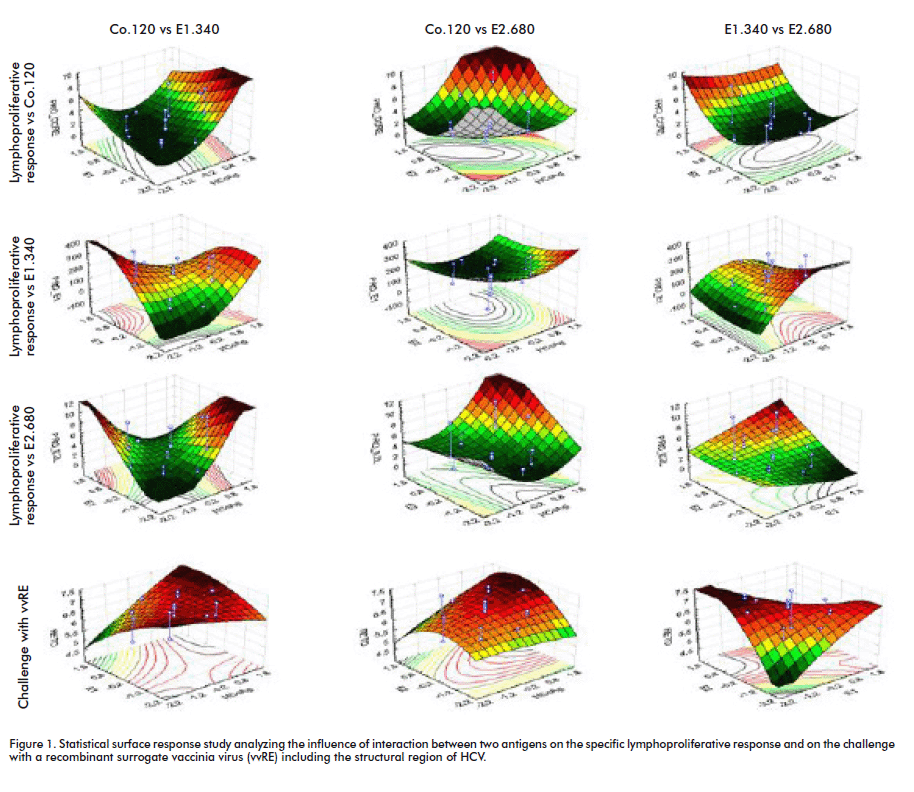
<body><![CDATA[<P   ><b><font size="3" face="Verdana, Arial, Helvetica, sans-serif">INTRODUCTION </font></b></P >       <P   align="justify" ><font size="2" face="Verdana, Arial, Helvetica, sans-serif">Hepatitis C is an      infectious disease, caused by the hepatitis C virus. An estimated 270-300      million people worldwide are infected with hepatitis C. This virus causes      chronic (long-term) infection in more than 85 percent of infected people,      often leading to chronic liver disease. Pegylated interferon (PEG-IFN) combined      with Ribavirin is the best currently available therapy for HCV infection.      This treatment is effective only in 50% of cases, and associated side effects      have been reported [1]. So, the generation of a vaccine against this pathogen      would have a significant impact on control HCV infection. So far, the immunological      parameters that correlate with protection from HCV infection have not been      established. Studies in humans and chimpanzees suggest that a strong specific      T cell response against HCV proteins is associated with spontaneous resolution      of the disease [2, 3]. Evidence from human and animal models also suggest      that CD4+ T cells play a critical role in controlling acute HCV infection,      yet the mechanism(s) behind their failure to control chronic HCV replication      are unknown [4]. On the other hand, chimpanzees immunized with HCV E1E2 proteins      developed high titers of antibodies against E2, modifying the natural course      of HCV infection and were protected against challenge with the homologous      virus [5]. Previously, the immunogenicity of different HCV based proteins      preparations have been described, however, the induction of both humoral and      cellular protective immune response has not been demonstrated [6, 7]. In this      work, the amount and HCV structural protein antigenic proportions, as a key      factor for the induction of a protective immune response <I>in vivo</I> using      a model of challenge with a recombinant vaccinia virus including the structural      region of HCV, is reported for the first time. </font></P >   <FONT size="+1">        <P   ><font size="3" face="Verdana, Arial, Helvetica, sans-serif"><b>RESULTS AND DISCUSSION</b></font><font size="2" face="Verdana, Arial, Helvetica, sans-serif">      </font></P >   <FONT size="+1">        <P   align="justify" ><font size="2" face="Verdana, Arial, Helvetica, sans-serif">HCV structural proteins      (Co.120, E1.340 and E2.680) obtained from recombinant microorganisms [8];      have demonstrated individually to induce a potent immune response in animal      models [9]. Taking into account results from immunogenicity studies using      individual proteins and the importance to induce an immune response towards      several viral antigens led us to study how to combine several antigens, in      term of amount and proportions, on a vaccine preparation. HCV structural proteins      were combined in several ratios according to a designed factorial study (using      STATGRAPHICS Plus Quality and Design software v. 5.1), and the induction of      specific immune response after BALB/c mice immunization was studied. Statistical      surface response analysis with data from specific cellular lymphoproliferative      responses against structural HCV proteins, as well as from the challenge with      a surrogate vaccinia virus comprising HCV structural region suggested that      the protein ratio (1:160:160), with 0.1 &micro;g of Co.120-16.7 &micro;g of      E1.340-16.7 &micro;g E2.680 (Co-E1-E2) was the optimal composition to induce      a functional immune response in mice (<a href="/img/revistas/bta/v28n3/f0110311.gif">Figure 1</a>).      [10]. </font></P >   <FONT size="+1">        
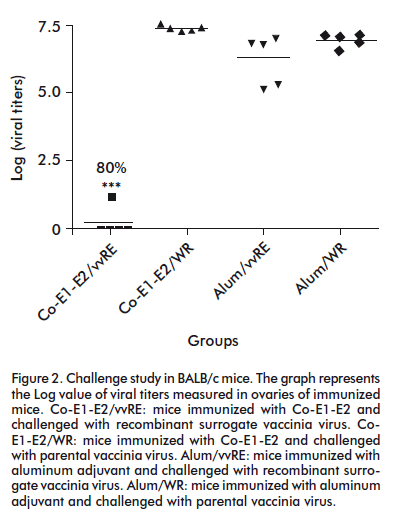
<P   align="justify" ><font size="2" face="Verdana, Arial, Helvetica, sans-serif">It is important to      highlight the presence of HCV core protein in a lesser extent with respect      to E1 and E2 envelope proteins, which enhances the immune response against      E1 and E2. At the same time, this may decrease the undesirable effects related      to the capsid protein <I>in vitro</I> demonstrated to affect cell-mediated      immunity [11]. The five dose BALB/c mice immunization induced a strong specific      T cell response against HCV structural proteins and 80% protection of immunized      mice when challenged with recombinant surrogate vaccinia virus (<a href="#fig2">Figure      2</a>) [12]. </font></P >       <P   align="center" ><img src="/img/revistas/bta/v28n3/f0210311.gif" width="400" height="528"><a name="fig2"></a></P >       
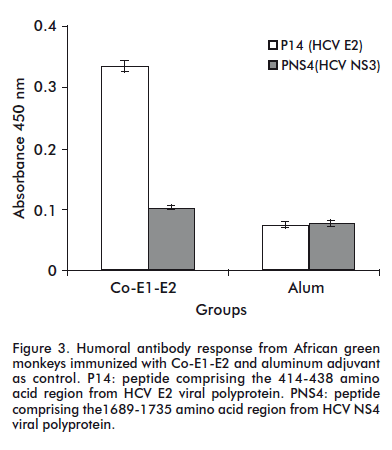
<P   align="justify" ><font size="2" face="Verdana, Arial, Helvetica, sans-serif">The protection against      challenge with recombinant vaccinia virus has been associated with induction      of T cell specific immune response against HCV antigens, involving mainly      CD4+ T cells as inducers and CD8+ T cells as effectors for virus clearance      [13]. The development of CD4 + and CD8 + cellular immune responses is often      correlated with a benign course of hepatitis C, or with its resolution. Additionally,      strong humoral immune response against the 412-438 amino acid region from      HCV E2 protein was detected when African green monkeys were immunized with      Co-E1-E2. This region includes a conserved epitope, involved in T cell lymphoproliferative      response against Co.120 and E2.680 proteins as well as in HCV neutralization      (<a href="#fig3">Figure 3</a>) [12].</font></P >       <P   align="center" ><img src="/img/revistas/bta/v28n3/f0310311.gif" width="392" height="450"><a name="fig3"></a></P >       
<P   align="justify" ><font size="2" face="Verdana, Arial, Helvetica, sans-serif">The induction in      chimpanzees of high antibody titers against HCV E2 protein has been shown      to modify the natural course of infection and at the same time to protect      against challenge with homologous virus. However, it is highly desirable to      induce also neutralizing antibodies directed to relatively conserved region,      making more difficult the appearance of escape mutants, frequently found due      to changes mainly observed in the hypervariable region I (HVR-I). The region      comprising aa 412-419, located immediately downstream of the HVR-I is a target      for neutralizing antibodies and is more conserved because is critical for      CD81 binding [14]. Interestingly, strong humoral immune response against the      412-438 amino acid region from HCV E2 protein was detected when African green      monkeys were immunized with Co-E1-E2 (<a href="#fig3">Figure 3</a>). This      response might be additionally supported by the presence of some conserved      epitopes, involved in T cell lymphoproliferative response against Co.120 and      E2.680 proteins in this protein preparation [12]. </font></P >       <P   align="justify" ><font size="2" face="Verdana, Arial, Helvetica, sans-serif">The presence of particulate      and aggregate antigens (Co.120 and E2.680) in the Co-E1-E2 formulation is      expected to provide an important contribution in terms of capture, processing      and presentation by antigen-presenting cells in order to effectively activate      an immune response against HCV structural antigens [12]. In this scenario,      antigen to-antigen ratio in the preparation is logically critical for accurate      interaction between recombinant HCV structural proteins and should have implications      on the immunogenicity. </font></P >       ]]></body>
<body><![CDATA[<P   align="justify" ><font size="2" face="Verdana, Arial, Helvetica, sans-serif">These results demonstrate      for the first time that the ratio of HCV proteins is a key factor to induce      an effective immune response, indicating an immunogenic hierarchy among these      antigens, and therefore constitute an important element to consider for the      design of recombinant vaccines against HCV. </font></P >       <P   align="justify" > </P >       <P   align="justify" ><b><font size="2" face="Verdana, Arial, Helvetica, sans-serif">REFERENCES</font></b><font size="2" face="Verdana, Arial, Helvetica, sans-serif">      </font></P >       <P   align="justify" > </P >       <!-- ref --><P   align="justify" ><font size="2" face="Verdana, Arial, Helvetica, sans-serif">1. Caruntu FA, Benea      L. Acute hepatitis C virus infection: Diagnosis, pathogenesis, treatment.      J Gastrointestin Liver Dis. 2006; 15:249-56.     </font></P >   <FONT size="+1">        <!-- ref --><P   align="justify" ><font size="2" face="Verdana, Arial, Helvetica, sans-serif">2. Veldt BJ, Saracco      G, Boyer N, Camm&agrave; C, Bellobuono A, Hopf U, <I>et al</I>. Long term      clinical outcome of chronic hepatitis C patients with sustained virological      response to interferon monotherapy. Gut. 2004; 53:1504-8.     </font></P >       <!-- ref --><P   align="justify" ><font size="2" face="Verdana, Arial, Helvetica, sans-serif">3. Houghton M, Abrignani      S. Prospects for a vaccine against the hepatitis C virus. Nature. 2005;436:961-6.          </font></P >       ]]></body>
<body><![CDATA[<!-- ref --><P   align="justify" ><font size="2" face="Verdana, Arial, Helvetica, sans-serif">4. Gerlach JT, Diepolder      HM, Jung MC, Gruener NH, Schraut WW, Zachoval R, <I>et al</I>. Recurrence      of hepatitis C virus after loss of virus-specific CD4(+) T-cell response in      acute hepatitis C. Gastroenterology. 1999; 117:933-41.     </font></P >       <!-- ref --><P   align="justify" ><font size="2" face="Verdana, Arial, Helvetica, sans-serif">5. Houghton M, Choo      QL, Chien D, Kuo G, Weiner A, Coates S, <I>et al</I>. Development of an HCV      vaccine. In: Rizzetto M, Purcell RH, Gerin JL, Verme G, editors. Viral hepatitis      and liver diseases. Tur&iacute;n: Minerva Medica; 1997. p. 656-9.     </font></P >       <!-- ref --><P   align="justify" ><font size="2" face="Verdana, Arial, Helvetica, sans-serif">6. Li P, Wan Q, Feng      Y, Liu M, Wu J, Chen X, <I>et al</I>. Engineering of N-glycosylation of hepatitis      C virus envelope protein E2 enhances T cell responses for DNA immunization.      Vaccine. 2007;25:1544-51.     </font></P >       <!-- ref --><P   align="justify" ><font size="2" face="Verdana, Arial, Helvetica, sans-serif">7. Puig M, Major      ME, Mihalik K, Feinstone SM. Immunization of chimpanzees with an envelope      protein-based vaccine enhances specific humoral and cellular immune responses      that delay hepatitis C virus infection. Vaccine. 2004;22:991-1000.     </font></P >       <!-- ref --><P   align="justify" ><font size="2" face="Verdana, Arial, Helvetica, sans-serif">8. Martinez-Donato      G, Acosta-Rivero N, Morales-Grillo J, Musacchio A, Vina A, Alvarez C, <I>et      al</I>. Expression and processing of hepatitis C virus structural proteins      in Pichia pastoris yeast. Biochem Biophys Res Commun. 2006;342:625-31.     </font></P >       ]]></body>
<body><![CDATA[<!-- ref --><P   align="justify" ><font size="2" face="Verdana, Arial, Helvetica, sans-serif">9. Acosta-Rivero      N, Poutou J, Alvarez-Lajonchere L, Guerra I, Aguilera Y, Musacchio A, <I>et      al</I>. Recombinant <I>in vitro </I>assembled hepatitis C virus core particles      induce strong specific immunity enhanced by formulation with an oil-based      adjuvant. Biol Res. 2009;42:41-56.     </font></P >       <P   align="justify" ><font size="2" face="Verdana, Arial, Helvetica, sans-serif">10. Musacchio A,      Duenas-Carrera S, Alvarez-Lajonchere L, Acosta-Rivero N, Martinez-Donato G,      Guirola M, <I>et al</I>., inventors; Center for Genetic Engineering and Biotechnology,      asignee. Vaccine composition against hepatitis c virus. International patent      WO2006024240. 2006 Mar 9. </font></P >       <!-- ref --><P   align="justify" ><font size="2" face="Verdana, Arial, Helvetica, sans-serif">11. Krishnadas DK,      Ahn JS, Han J, Kumar R, Agrawal B. Immunomodulation by hepatitis C virus-derived      proteins: targeting human dendritic cells by multiple mechanisms. Int Immunol.      2010;22:491-502.     </font></P >       <!-- ref --><P   align="justify" ><font size="2" face="Verdana, Arial, Helvetica, sans-serif">12. Mart&iacute;nez-Donato      G, Musacchio A, Alvarez-Lajonchere L, Acosta-Rivero N, Amador Y, Guerra I,      <I>et al</I>. Ratio of HCV structural antigens in protein-based vaccine formulations      is critical for functional immune response induction. Biotechnol Appl Biochem.      2010;56:111-8.     </font></P >       <P   align="justify" ><font size="2" face="Verdana, Arial, Helvetica, sans-serif">13. Murata K, Lechmann      M, Qiao M, Gunji T, Alter HJ and Liang TJ. Immunization with hepatitis C virus-like      particles protects mice from recombinant hepatitis C virus-vaccinia infection.      Proc Natl Acad Sci USA. 2003;100:6753-8. </font></P >       <!-- ref --><P   align="justify" ><font size="2" face="Verdana, Arial, Helvetica, sans-serif">14. Zhang P, Wu CG,      Mihalik K, Virata-Theimer ML, Yu MY, Alter HJ, et al. Hepatitis C virus epitope-specific      neutralizing antibodies in Igs prepared from human plasma. Proc Natl Acad      Sci USA. 2007;104:8449-54.     </font></P >       ]]></body>
<body><![CDATA[<P   align="justify" > </P >       <P   ><font size="2" face="Verdana, Arial, Helvetica, sans-serif">Alexis Musacchio.      Centro de Ingenier&iacute;a Gen&eacute;tica y Biotecnolog&iacute;a, CIGB.      Ave. 31 e/ 158 y 190, Cubanac&aacute;n, Playa, La Habana, Cuba. E-mail: <A href="mailto:alexis.musacchio@cigb.edu.cu">      <U><U><FONT color="#0000FF">alexis.musacchio@cigb.edu.cu</font></U></U></A><FONT color="#0000FF">      <FONT color="#000000">. </font></font></font></P >   </font></font></font></font></font></DIV >      ]]></body><back>
<ref-list>
<ref id="B1">
<label>1</label><nlm-citation citation-type="journal">
<person-group person-group-type="author">
<name>
<surname><![CDATA[Caruntu]]></surname>
<given-names><![CDATA[FA]]></given-names>
</name>
<name>
<surname><![CDATA[Benea]]></surname>
<given-names><![CDATA[L]]></given-names>
</name>
</person-group>
<article-title xml:lang="en"><![CDATA[Acute hepatitis C virus infection: Diagnosis, pathogenesis, treatment]]></article-title>
<source><![CDATA[J Gastrointestin Liver Dis]]></source>
<year>2006</year>
<volume>15</volume>
<page-range>249-56</page-range></nlm-citation>
</ref>
<ref id="B2">
<label>2</label><nlm-citation citation-type="journal">
<person-group person-group-type="author">
<name>
<surname><![CDATA[Veldt]]></surname>
<given-names><![CDATA[BJ]]></given-names>
</name>
<name>
<surname><![CDATA[Saracco]]></surname>
<given-names><![CDATA[G]]></given-names>
</name>
<name>
<surname><![CDATA[Boyer]]></surname>
<given-names><![CDATA[N]]></given-names>
</name>
<name>
<surname><![CDATA[Cammà]]></surname>
<given-names><![CDATA[C]]></given-names>
</name>
<name>
<surname><![CDATA[Bellobuono]]></surname>
<given-names><![CDATA[A]]></given-names>
</name>
<name>
<surname><![CDATA[Hopf]]></surname>
<given-names><![CDATA[U]]></given-names>
</name>
</person-group>
<article-title xml:lang="en"><![CDATA[Long term clinical outcome of chronic hepatitis C patients with sustained virological response to interferon monotherapy]]></article-title>
<source><![CDATA[Gut]]></source>
<year>2004</year>
<volume>53</volume>
<page-range>1504-8</page-range></nlm-citation>
</ref>
<ref id="B3">
<label>3</label><nlm-citation citation-type="journal">
<person-group person-group-type="author">
<name>
<surname><![CDATA[Houghton]]></surname>
<given-names><![CDATA[M]]></given-names>
</name>
<name>
<surname><![CDATA[Abrignani]]></surname>
<given-names><![CDATA[S]]></given-names>
</name>
</person-group>
<article-title xml:lang="en"><![CDATA[Prospects for a vaccine against the hepatitis C virus]]></article-title>
<source><![CDATA[Nature]]></source>
<year>2005</year>
<volume>436</volume>
<page-range>961-6</page-range></nlm-citation>
</ref>
<ref id="B4">
<label>4</label><nlm-citation citation-type="journal">
<person-group person-group-type="author">
<name>
<surname><![CDATA[Gerlach]]></surname>
<given-names><![CDATA[JT]]></given-names>
</name>
<name>
<surname><![CDATA[Diepolder]]></surname>
<given-names><![CDATA[HM]]></given-names>
</name>
<name>
<surname><![CDATA[Jung]]></surname>
<given-names><![CDATA[MC]]></given-names>
</name>
<name>
<surname><![CDATA[Gruener]]></surname>
<given-names><![CDATA[NH]]></given-names>
</name>
<name>
<surname><![CDATA[Schraut]]></surname>
<given-names><![CDATA[WW]]></given-names>
</name>
<name>
<surname><![CDATA[Zachoval]]></surname>
<given-names><![CDATA[R]]></given-names>
</name>
</person-group>
<article-title xml:lang="en"><![CDATA[Recurrence of hepatitis C virus after loss of virus-specific CD4(+) T-cell response in acute hepatitis C]]></article-title>
<source><![CDATA[Gastroenterology]]></source>
<year>1999</year>
<volume>117</volume>
<page-range>933-41</page-range></nlm-citation>
</ref>
<ref id="B5">
<label>5</label><nlm-citation citation-type="book">
<person-group person-group-type="author">
<name>
<surname><![CDATA[Houghton]]></surname>
<given-names><![CDATA[M]]></given-names>
</name>
<name>
<surname><![CDATA[Choo]]></surname>
<given-names><![CDATA[QL]]></given-names>
</name>
<name>
<surname><![CDATA[Chien]]></surname>
<given-names><![CDATA[D]]></given-names>
</name>
<name>
<surname><![CDATA[Kuo]]></surname>
<given-names><![CDATA[G]]></given-names>
</name>
<name>
<surname><![CDATA[Weiner]]></surname>
<given-names><![CDATA[A]]></given-names>
</name>
<name>
<surname><![CDATA[Coates]]></surname>
<given-names><![CDATA[S]]></given-names>
</name>
</person-group>
<article-title xml:lang="en"><![CDATA[Development of an HCV vaccine]]></article-title>
<person-group person-group-type="editor">
<name>
<surname><![CDATA[Rizzetto]]></surname>
<given-names><![CDATA[M]]></given-names>
</name>
<name>
<surname><![CDATA[Purcell]]></surname>
<given-names><![CDATA[RH]]></given-names>
</name>
<name>
<surname><![CDATA[Gerin]]></surname>
<given-names><![CDATA[JL]]></given-names>
</name>
<name>
<surname><![CDATA[Verme]]></surname>
<given-names><![CDATA[G]]></given-names>
</name>
</person-group>
<source><![CDATA[Viral hepatitis and liver diseases]]></source>
<year>1997</year>
<page-range>656-9</page-range><publisher-loc><![CDATA[Turín ]]></publisher-loc>
<publisher-name><![CDATA[Minerva Medica]]></publisher-name>
</nlm-citation>
</ref>
<ref id="B6">
<label>6</label><nlm-citation citation-type="journal">
<person-group person-group-type="author">
<name>
<surname><![CDATA[Li]]></surname>
<given-names><![CDATA[P]]></given-names>
</name>
<name>
<surname><![CDATA[Wan]]></surname>
<given-names><![CDATA[Q]]></given-names>
</name>
<name>
<surname><![CDATA[Feng]]></surname>
<given-names><![CDATA[Y]]></given-names>
</name>
<name>
<surname><![CDATA[Liu]]></surname>
<given-names><![CDATA[M]]></given-names>
</name>
<name>
<surname><![CDATA[Wu]]></surname>
<given-names><![CDATA[J]]></given-names>
</name>
<name>
<surname><![CDATA[Chen]]></surname>
<given-names><![CDATA[X]]></given-names>
</name>
</person-group>
<article-title xml:lang="en"><![CDATA[Engineering of N-glycosylation of hepatitis C virus envelope protein E2 enhances T cell responses for DNA immunization]]></article-title>
<source><![CDATA[Vaccine]]></source>
<year>2007</year>
<volume>25</volume>
<page-range>1544-51</page-range></nlm-citation>
</ref>
<ref id="B7">
<label>7</label><nlm-citation citation-type="journal">
<person-group person-group-type="author">
<name>
<surname><![CDATA[Puig]]></surname>
<given-names><![CDATA[M]]></given-names>
</name>
<name>
<surname><![CDATA[Major]]></surname>
<given-names><![CDATA[ME]]></given-names>
</name>
<name>
<surname><![CDATA[Mihalik]]></surname>
<given-names><![CDATA[K]]></given-names>
</name>
<name>
<surname><![CDATA[Feinstone]]></surname>
<given-names><![CDATA[SM]]></given-names>
</name>
</person-group>
<article-title xml:lang="en"><![CDATA[Immunization of chimpanzees with an envelope protein-based vaccine enhances specific humoral and cellular immune responses that delay hepatitis C virus infection]]></article-title>
<source><![CDATA[Vaccine]]></source>
<year>2004</year>
<volume>22</volume>
<page-range>991-1000</page-range></nlm-citation>
</ref>
<ref id="B8">
<label>8</label><nlm-citation citation-type="journal">
<person-group person-group-type="author">
<name>
<surname><![CDATA[Martinez-Donato]]></surname>
<given-names><![CDATA[G]]></given-names>
</name>
<name>
<surname><![CDATA[Acosta-Rivero]]></surname>
<given-names><![CDATA[N]]></given-names>
</name>
<name>
<surname><![CDATA[Morales-Grillo]]></surname>
<given-names><![CDATA[J]]></given-names>
</name>
<name>
<surname><![CDATA[Musacchio]]></surname>
<given-names><![CDATA[A]]></given-names>
</name>
<name>
<surname><![CDATA[Vina]]></surname>
<given-names><![CDATA[A]]></given-names>
</name>
<name>
<surname><![CDATA[Alvarez]]></surname>
<given-names><![CDATA[C]]></given-names>
</name>
</person-group>
<article-title xml:lang="en"><![CDATA[Expression and processing of hepatitis C virus structural proteins in Pichia pastoris yeast]]></article-title>
<source><![CDATA[Biochem Biophys Res Commun]]></source>
<year>2006</year>
<volume>342</volume>
<page-range>625-31</page-range></nlm-citation>
</ref>
<ref id="B9">
<label>9</label><nlm-citation citation-type="journal">
<person-group person-group-type="author">
<name>
<surname><![CDATA[Acosta-Rivero]]></surname>
<given-names><![CDATA[N]]></given-names>
</name>
<name>
<surname><![CDATA[Poutou]]></surname>
<given-names><![CDATA[J]]></given-names>
</name>
<name>
<surname><![CDATA[Alvarez-Lajonchere]]></surname>
<given-names><![CDATA[L]]></given-names>
</name>
<name>
<surname><![CDATA[Guerra]]></surname>
<given-names><![CDATA[I]]></given-names>
</name>
<name>
<surname><![CDATA[Aguilera]]></surname>
<given-names><![CDATA[Y]]></given-names>
</name>
<name>
<surname><![CDATA[Musacchio]]></surname>
<given-names><![CDATA[A]]></given-names>
</name>
</person-group>
<article-title xml:lang="en"><![CDATA[Recombinant in vitro assembled hepatitis C virus core particles induce strong specific immunity enhanced by formulation with an oil-based adjuvant]]></article-title>
<source><![CDATA[Biol Res]]></source>
<year>2009</year>
<volume>42</volume>
<page-range>41-56</page-range></nlm-citation>
</ref>
<ref id="B10">
<label>10</label><nlm-citation citation-type="book">
<person-group person-group-type="author">
<name>
<surname><![CDATA[Musacchio]]></surname>
<given-names><![CDATA[A]]></given-names>
</name>
<name>
<surname><![CDATA[Duenas-Carrera]]></surname>
<given-names><![CDATA[S]]></given-names>
</name>
<name>
<surname><![CDATA[Alvarez-Lajonchere]]></surname>
<given-names><![CDATA[L]]></given-names>
</name>
<name>
<surname><![CDATA[Acosta-Rivero]]></surname>
<given-names><![CDATA[N]]></given-names>
</name>
<name>
<surname><![CDATA[Martinez-Donato]]></surname>
<given-names><![CDATA[G]]></given-names>
</name>
<name>
<surname><![CDATA[Guirola]]></surname>
<given-names><![CDATA[M]]></given-names>
</name>
</person-group>
<source><![CDATA[Vaccine composition against hepatitis c virus]]></source>
<year></year>
<publisher-name><![CDATA[Center for Genetic Engineering and Biotechnology]]></publisher-name>
</nlm-citation>
</ref>
<ref id="B11">
<label>11</label><nlm-citation citation-type="journal">
<person-group person-group-type="author">
<name>
<surname><![CDATA[Krishnadas]]></surname>
<given-names><![CDATA[DK]]></given-names>
</name>
<name>
<surname><![CDATA[Ahn]]></surname>
<given-names><![CDATA[JS]]></given-names>
</name>
<name>
<surname><![CDATA[Han]]></surname>
<given-names><![CDATA[J]]></given-names>
</name>
<name>
<surname><![CDATA[Kumar]]></surname>
<given-names><![CDATA[R]]></given-names>
</name>
<name>
<surname><![CDATA[Agrawal]]></surname>
<given-names><![CDATA[B]]></given-names>
</name>
</person-group>
<article-title xml:lang="en"><![CDATA[Immunomodulation by hepatitis C virus-derived proteins: targeting human dendritic cells by multiple mechanisms]]></article-title>
<source><![CDATA[Int Immunol]]></source>
<year>2010</year>
<volume>22</volume>
<page-range>491-502</page-range></nlm-citation>
</ref>
<ref id="B12">
<label>12</label><nlm-citation citation-type="journal">
<person-group person-group-type="author">
<name>
<surname><![CDATA[Martínez-Donato]]></surname>
<given-names><![CDATA[G]]></given-names>
</name>
<name>
<surname><![CDATA[Musacchio]]></surname>
<given-names><![CDATA[A]]></given-names>
</name>
<name>
<surname><![CDATA[Alvarez-Lajonchere]]></surname>
<given-names><![CDATA[L]]></given-names>
</name>
<name>
<surname><![CDATA[Acosta-Rivero]]></surname>
<given-names><![CDATA[N]]></given-names>
</name>
<name>
<surname><![CDATA[Amador]]></surname>
<given-names><![CDATA[Y]]></given-names>
</name>
<name>
<surname><![CDATA[Guerra]]></surname>
<given-names><![CDATA[I]]></given-names>
</name>
</person-group>
<article-title xml:lang="en"><![CDATA[Ratio of HCV structural antigens in protein-based vaccine formulations is critical for functional immune response induction]]></article-title>
<source><![CDATA[Biotechnol Appl Biochem]]></source>
<year>2010</year>
<volume>56</volume>
<page-range>111-8</page-range></nlm-citation>
</ref>
<ref id="B13">
<label>13</label><nlm-citation citation-type="journal">
<person-group person-group-type="author">
<name>
<surname><![CDATA[Murata]]></surname>
<given-names><![CDATA[K]]></given-names>
</name>
<name>
<surname><![CDATA[Lechmann]]></surname>
<given-names><![CDATA[M]]></given-names>
</name>
<name>
<surname><![CDATA[Qiao]]></surname>
<given-names><![CDATA[M]]></given-names>
</name>
<name>
<surname><![CDATA[Gunji]]></surname>
<given-names><![CDATA[T]]></given-names>
</name>
<name>
<surname><![CDATA[Alter]]></surname>
<given-names><![CDATA[HJ]]></given-names>
</name>
<name>
<surname><![CDATA[Liang]]></surname>
<given-names><![CDATA[TJ]]></given-names>
</name>
</person-group>
<article-title xml:lang="en"><![CDATA[Immunization with hepatitis C virus-like particles protects mice from recombinant hepatitis C virus-vaccinia infection]]></article-title>
<source><![CDATA[Proc Natl Acad Sci USA]]></source>
<year>2003</year>
<volume>100</volume>
<page-range>6753-8</page-range></nlm-citation>
</ref>
<ref id="B14">
<label>14</label><nlm-citation citation-type="journal">
<person-group person-group-type="author">
<name>
<surname><![CDATA[Zhang]]></surname>
<given-names><![CDATA[P]]></given-names>
</name>
<name>
<surname><![CDATA[Wu]]></surname>
<given-names><![CDATA[CG]]></given-names>
</name>
<name>
<surname><![CDATA[Mihalik]]></surname>
<given-names><![CDATA[K]]></given-names>
</name>
<name>
<surname><![CDATA[Virata-Theimer]]></surname>
<given-names><![CDATA[ML]]></given-names>
</name>
<name>
<surname><![CDATA[Yu]]></surname>
<given-names><![CDATA[MY]]></given-names>
</name>
<name>
<surname><![CDATA[Alter]]></surname>
<given-names><![CDATA[HJ]]></given-names>
</name>
</person-group>
<article-title xml:lang="en"><![CDATA[Hepatitis C virus epitope-specific neutralizing antibodies in Igs prepared from human plasma]]></article-title>
<source><![CDATA[Proc Natl Acad Sci USA]]></source>
<year>2007</year>
<volume>104</volume>
<page-range>8449-54</page-range></nlm-citation>
</ref>
</ref-list>
</back>
</article>