<?xml version="1.0" encoding="ISO-8859-1"?><article xmlns:mml="http://www.w3.org/1998/Math/MathML" xmlns:xlink="http://www.w3.org/1999/xlink" xmlns:xsi="http://www.w3.org/2001/XMLSchema-instance">
<front>
<journal-meta>
<journal-id>1027-2852</journal-id>
<journal-title><![CDATA[Biotecnología Aplicada]]></journal-title>
<abbrev-journal-title><![CDATA[Biotecnol Apl]]></abbrev-journal-title>
<issn>1027-2852</issn>
<publisher>
<publisher-name><![CDATA[Editorial Elfos Scientiae]]></publisher-name>
</publisher>
</journal-meta>
<article-meta>
<article-id>S1027-28522011000300011</article-id>
<title-group>
<article-title xml:lang="en"><![CDATA[Development of a technological framework for using virus-like particles as adjuvants in prophylactic and therapeutic vaccines: demonstration of effect in animal models and humans]]></article-title>
<article-title xml:lang="es"><![CDATA[Desarrollo de plataforma de adyuvación para vacunas preventivas y terapeúticas basada en partículas semejantes a virus: demostración de efecto en modelos animales y humanos]]></article-title>
</title-group>
<contrib-group>
<contrib contrib-type="author">
<name>
<surname><![CDATA[Guillén]]></surname>
<given-names><![CDATA[Gerardo]]></given-names>
</name>
<xref ref-type="aff" rid="A01"/>
</contrib>
<contrib contrib-type="author">
<name>
<surname><![CDATA[Aguilar]]></surname>
<given-names><![CDATA[Julio C]]></given-names>
</name>
<xref ref-type="aff" rid="A01"/>
</contrib>
<contrib contrib-type="author">
<name>
<surname><![CDATA[Dueñas]]></surname>
<given-names><![CDATA[Santiago]]></given-names>
</name>
<xref ref-type="aff" rid="A01"/>
</contrib>
<contrib contrib-type="author">
<name>
<surname><![CDATA[Hermida]]></surname>
<given-names><![CDATA[Lisset]]></given-names>
</name>
<xref ref-type="aff" rid="A01"/>
</contrib>
<contrib contrib-type="author">
<name>
<surname><![CDATA[Iglesias]]></surname>
<given-names><![CDATA[Enrique]]></given-names>
</name>
<xref ref-type="aff" rid="A01"/>
</contrib>
<contrib contrib-type="author">
<name>
<surname><![CDATA[Muzio]]></surname>
<given-names><![CDATA[Verena]]></given-names>
</name>
<xref ref-type="aff" rid="A01"/>
</contrib>
<contrib contrib-type="author">
<name>
<surname><![CDATA[Pentón]]></surname>
<given-names><![CDATA[Eduardo]]></given-names>
</name>
<xref ref-type="aff" rid="A01"/>
</contrib>
<contrib contrib-type="author">
<name>
<surname><![CDATA[Mussacchio]]></surname>
<given-names><![CDATA[Alexis]]></given-names>
</name>
<xref ref-type="aff" rid="A01"/>
</contrib>
<contrib contrib-type="author">
<name>
<surname><![CDATA[González]]></surname>
<given-names><![CDATA[Luis J]]></given-names>
</name>
<xref ref-type="aff" rid="A01"/>
</contrib>
<contrib contrib-type="author">
<name>
<surname><![CDATA[Guzmán]]></surname>
<given-names><![CDATA[Guadalupe]]></given-names>
</name>
<xref ref-type="aff" rid="A02"/>
</contrib>
<contrib contrib-type="author">
<name>
<surname><![CDATA[Lobaina]]></surname>
<given-names><![CDATA[Yadira]]></given-names>
</name>
<xref ref-type="aff" rid="A01"/>
</contrib>
<contrib contrib-type="author">
<name>
<surname><![CDATA[Amador]]></surname>
<given-names><![CDATA[Yalena]]></given-names>
</name>
<xref ref-type="aff" rid="A01"/>
</contrib>
<contrib contrib-type="author">
<name>
<surname><![CDATA[Reyes]]></surname>
<given-names><![CDATA[Osvaldo]]></given-names>
</name>
<xref ref-type="aff" rid="A01"/>
</contrib>
<contrib contrib-type="author">
<name>
<surname><![CDATA[Lazo]]></surname>
<given-names><![CDATA[Laura]]></given-names>
</name>
<xref ref-type="aff" rid="A01"/>
</contrib>
<contrib contrib-type="author">
<name>
<surname><![CDATA[Aguilar]]></surname>
<given-names><![CDATA[Arístides]]></given-names>
</name>
<xref ref-type="aff" rid="A01"/>
</contrib>
<contrib contrib-type="author">
<name>
<surname><![CDATA[Palenzuela]]></surname>
<given-names><![CDATA[Daniel]]></given-names>
</name>
<xref ref-type="aff" rid="A01"/>
</contrib>
<contrib contrib-type="author">
<name>
<surname><![CDATA[Cabrales]]></surname>
<given-names><![CDATA[Ania]]></given-names>
</name>
<xref ref-type="aff" rid="A01"/>
</contrib>
<contrib contrib-type="author">
<name>
<surname><![CDATA[Gil]]></surname>
<given-names><![CDATA[Lázaro]]></given-names>
</name>
<xref ref-type="aff" rid="A01"/>
</contrib>
<contrib contrib-type="author">
<name>
<surname><![CDATA[Pichardo]]></surname>
<given-names><![CDATA[Dagmara]]></given-names>
</name>
<xref ref-type="aff" rid="A01"/>
</contrib>
<contrib contrib-type="author">
<name>
<surname><![CDATA[Valdés]]></surname>
<given-names><![CDATA[Iris]]></given-names>
</name>
<xref ref-type="aff" rid="A01"/>
</contrib>
<contrib contrib-type="author">
<name>
<surname><![CDATA[Marcos]]></surname>
<given-names><![CDATA[Ernesto]]></given-names>
</name>
<xref ref-type="aff" rid="A01"/>
</contrib>
<contrib contrib-type="author">
<name>
<surname><![CDATA[Cosme]]></surname>
<given-names><![CDATA[Karelia]]></given-names>
</name>
<xref ref-type="aff" rid="A01"/>
</contrib>
<contrib contrib-type="author">
<name>
<surname><![CDATA[Herrera]]></surname>
<given-names><![CDATA[Luis]]></given-names>
</name>
<xref ref-type="aff" rid="A01"/>
</contrib>
</contrib-group>
<aff id="A02">
<institution><![CDATA[,Instituto de Medicina Tropical. Pedro Kourí, IPK Dpto. de Virología ]]></institution>
<addr-line><![CDATA[La Habana ]]></addr-line>
<country>Cuba</country>
</aff>
<aff id="A01">
<institution><![CDATA[,Centro de Ingeniería Genética y Biotecnología, CIGB  ]]></institution>
<addr-line><![CDATA[La Habana ]]></addr-line>
<country>Cuba</country>
</aff>
<pub-date pub-type="pub">
<day>00</day>
<month>09</month>
<year>2011</year>
</pub-date>
<pub-date pub-type="epub">
<day>00</day>
<month>09</month>
<year>2011</year>
</pub-date>
<volume>28</volume>
<numero>3</numero>
<fpage>183</fpage>
<lpage>185</lpage>
<copyright-statement/>
<copyright-year/>
<self-uri xlink:href="http://scielo.sld.cu/scielo.php?script=sci_arttext&amp;pid=S1027-28522011000300011&amp;lng=en&amp;nrm=iso"></self-uri><self-uri xlink:href="http://scielo.sld.cu/scielo.php?script=sci_abstract&amp;pid=S1027-28522011000300011&amp;lng=en&amp;nrm=iso"></self-uri><self-uri xlink:href="http://scielo.sld.cu/scielo.php?script=sci_pdf&amp;pid=S1027-28522011000300011&amp;lng=en&amp;nrm=iso"></self-uri><abstract abstract-type="short" xml:lang="en"><p><![CDATA[Developing an effective vaccine entails: 1) proper antigenic presentation to the immune system, inducing a response of adequate intensity 2) a long duration for said response 3) the ability to steer this response towards the immune system pattern most suited for the elimination of the pathogen. Among the current crop of adjuvants, only aluminum-based gels and some oil emulsions are compliant with established regulatory and safety requirements and, not surprisingly, have received extensive use. The present work describes the development of a technological framework for the inclusion of virus-like particles (VLP) as adjuvants in vaccine preparations, allowing the induction of a functional immune response in humans that achieves seroconversion and protective antibody levels without the need for additional adjuvants. This technological framework comprises both the production and formulation of antigens as virus-like particles and the use of these VLP as adjuvants for soluble antigens, obtaining high levels of induction of the Th1 cell response which, in combination with the humoral response, have been shown to confer a fully functional immunoprotective status in animal models. Some of the novel aspects of the present work are the development of a common methodology for the obtention and formulation of different VLP; the demonstration that VLP-containing formulations are able to bias response towards a Th1 pattern; the finding that VLP can be used as adjuvants stimulating a fully functional response in humans to soluble antigens; the safety of VLP-adjuvanted formulations and, lastly, the induction of a functional, protective response in animal models and humans.]]></p></abstract>
<kwd-group>
<kwd lng="en"><![CDATA[adjuvant]]></kwd>
<kwd lng="en"><![CDATA[preventive vaccine]]></kwd>
<kwd lng="en"><![CDATA[therapeutic vaccine]]></kwd>
<kwd lng="en"><![CDATA[virus-like particles]]></kwd>
<kwd lng="en"><![CDATA[animals]]></kwd>
<kwd lng="en"><![CDATA[humans]]></kwd>
<kwd lng="en"><![CDATA[vaccine formulation]]></kwd>
</kwd-group>
</article-meta>
</front><body><![CDATA[ <DIV class="Sect"   >        <P   align="right" ><font size="2" color="#000000" face="Verdana, Arial, Helvetica, sans-serif"><b>REPORT</b></font></P >       <P   align="right" >&nbsp;</P >   <FONT size="+1" color="#000000">        <P   > </P >       <P   ><font size="4"><b><font face="Verdana, Arial, Helvetica, sans-serif">Development      of a technological framework for using virus-like particles as adjuvants in      prophylactic and therapeutic vaccines: demonstration of effect in animal models      and humans </font></b></font></P >       <P   >&nbsp;</P >       <P   ><font size="3" face="Verdana, Arial, Helvetica, sans-serif"><b>Desarrollo de      plataforma de adyuvaci&oacute;n para vacunas preventivas y terape&uacute;ticas      basada en part&iacute;culas semejantes a virus: demostraci&oacute;n de efecto      en modelos animales y humanos</b></font></P >       <P   >&nbsp;</P >       <P   >&nbsp;</P >       <P   > </P >       ]]></body>
<body><![CDATA[<P   > </P >       <P   ><b><font size="2" face="Verdana, Arial, Helvetica, sans-serif">Gerardo Guill&eacute;n<SUP>1</sup>,      Julio C Aguilar<SUP>1</sup>, Santiago Due&ntilde;as<SUP>1</sup>, Lisset Hermida<SUP>1</sup>,      Enrique Iglesias<SUP>1</sup>, Verena Muzio<SUP>1</sup>, Eduardo Pent&oacute;n<SUP>1</sup>,      Alexis Mussacchio<SUP>1</sup>, Luis J Gonz&aacute;lez<SUP>1</sup>, Guadalupe      Guzm&aacute;n<SUP>2</sup>, Yadira Lobaina<SUP>1</sup>, Yalena Amador<SUP>1</sup>,      Osvaldo Reyes<SUP>1</sup>, Laura Lazo<SUP>1</sup>, Ar&iacute;stides Aguilar<SUP>1</sup>,      Daniel Palenzuela<SUP>1</sup>, Ania Cabrales<SUP>1</sup>, L&aacute;zaro Gil<SUP>1</sup>,      Dagmara Pichardo<SUP>1</sup>, Iris Vald&eacute;s<SUP>1</sup>, Ernesto Marcos<SUP>1</sup>,      Karelia Cosme<SUP>1</sup>, Luis Herrera<SUP>1</sup></font></b></P >       <P   ><font size="2" face="Verdana, Arial, Helvetica, sans-serif"><SUP>1</sup> Centro      de Ingenier&iacute;a Gen&eacute;tica y Biotecnolog&iacute;a, CIGB. Ave. 31      e/ 158 y 190, PO Box 6162, Cubanac&aacute;n, Playa, La Habana, Cuba.    <br>     <SUP>2</sup> Dpto. de Virolog&iacute;a, Instituto de Medicina Tropical. Pedro      Kour&iacute;, IPK, La Habana, Cuba.</font></P >       <P   >&nbsp;</P >   </font>    <hr>   <FONT size="+1" color="#000000">        <P   ><font size="2" face="Verdana, Arial, Helvetica, sans-serif"><b>ABSTRACT </b></font></P >       <P   ><font size="2" face="Verdana, Arial, Helvetica, sans-serif">Developing an effective      vaccine entails: 1) proper antigenic presentation to the immune system, inducing      a response of adequate intensity 2) a long duration for said response 3) the      ability to steer this response towards the immune system pattern most suited      for the elimination of the pathogen. Among the current crop of adjuvants,      only aluminum-based gels and some oil emulsions are compliant with established      regulatory and safety requirements and, not surprisingly, have received extensive      use. The present work describes the development of a technological framework      for the inclusion of virus-like particles (VLP) as adjuvants in vaccine preparations,      allowing the induction of a functional immune response in humans that achieves      seroconversion and protective antibody levels without the need for additional      adjuvants. This technological framework comprises both the production and      formulation of antigens as virus-like particles and the use of these VLP as      adjuvants for soluble antigens, obtaining high levels of induction of the      Th1 cell response which, in combination with the humoral response, have been      shown to confer a fully functional immunoprotective status in animal models.      Some of the novel aspects of the present work are the development of a common      methodology for the obtention and formulation of different VLP; the demonstration      that VLP-containing formulations are able to bias response towards a Th1 pattern;      the finding that VLP can be used as adjuvants stimulating a fully functional      response in humans to soluble antigens; the safety of VLP-adjuvanted formulations      and, lastly, the induction of a functional, protective response in animal      models and humans. </font></P >       <P   ><font size="2" face="Verdana, Arial, Helvetica, sans-serif"><b>Keywords:</b>      adjuvant, preventive vaccine, therapeutic vaccine, virus-like particles, animals,      humans, vaccine formulation.</font></P >   </font>   <hr>   <FONT size="+1" color="#000000">        <P   >&nbsp;</P >       <P   >&nbsp;</P >       ]]></body>
<body><![CDATA[<P   > </P >       <P   > </P >       <P   ><b><font size="3" face="Verdana, Arial, Helvetica, sans-serif">INTRODUCTION </font></b></P >       <P   align="justify" ><font size="2" face="Verdana, Arial, Helvetica, sans-serif">Vaccine development,      even with <I>a priori </I>knowledge of the antigens required to induce a protective      or therapeutic response, is limited by the availability of formulations providing:      1) proper antigenic presentation to the immune system, inducing a response      of adequate intensity, 2) a long-lasting response and 3) the ability to steer      the immune system towards the Th pattern most suited for the elimination of      the pathogen. In addition, in the case of therapeutic vaccines for chronic      diseases, the formulation must be able to break down immunological tolerance.      Despite the large number of adjuvants and antigen presentation systems described      in the literature, only aluminum-based gels and some oil emulsions have complied      with all regulatory parameters and safet y requirements and have therefore      been extensively used. </font></P >   <FONT size="+1">        <P   align="justify" ><font size="2" face="Verdana, Arial, Helvetica, sans-serif">Developing a therapeutic      vaccine against chronic hepatitis B (HBV) infections constitutes an attractive      strategy. Such a product would fill the niche opened by the 400 million chronic      HBV carriers that currently exist throughout the world, for whom the available      treatments show little or no efficacy together with undesirable side effects      further limiting their use [1-3]. </font></P >       <P   align="justify" ><font size="2" face="Verdana, Arial, Helvetica, sans-serif">A prophylactic and/or      therapeutic vaccine against type 1 Human Immunodeficiency Virus HIV-1), in      addition, would have a massive impact. Worldwide estimates for the number      of HIV-infected persons hover above 33 million, with an average of 2.7 million      new infections taking place per year and over 2 million yearly deaths. According      to UNAIDS, antiretroviral therapy reached a coverage of 42% by the end of      2008. This achievement, however, is marred by the growing dissemination of      isolates resistant to first-line antiretroviral drugs which, together with      the current world economic crisis, threaten to minimize these successes and      revert this situation [4]. An anti-HIV vaccine, therefore, still represents      the best alternative in the long term, according to the experts. </font></P >       <P   align="justify" ><font size="2" face="Verdana, Arial, Helvetica, sans-serif">Hepatitis C (HCV)      infections continue to represent a significant public health problem; approximately      3% of the world population is infected with this virus, which often results      in the appearance of cirrhosis and liver cancer. No vaccine is available and      current therapies, in addition to being costly and producing a number of adverse      events, have a success rate lower than 50% [5]. It then follows that the obtention      of a therapeutic vaccine against this pathogen would be significant for Cuba      from both economic and social standpoints. </font></P >       <P   align="justify" ><font size="2" face="Verdana, Arial, Helvetica, sans-serif">Dengue Fever and      Dengue Hemorrhagic Fever are increasingly recognized as an emergent health      problem. From 50 to 100 million cases of Dengue Fever and 250 000 to 500 000      cases of the hemorrhagic form of the disease are reported each year in the      world[6]. Four well-defined epidemics have taken place in Cuba, of which the      most important are those of 1981 and 1997. In spite of the large effort undertaken      to curb transmission by controlling the mosquito vector, an effective vaccine      would constitute a total solution with a large social and economic impact.      No vaccines are commercially available, and the most advanced vaccine candidates      along the development pipeline in institutions around the world are based      on the use of attenuated viral strains. Such an approach, however, presents      a number of risks, the main of which is the possibility of a reversion; in      addition to the high reactogenicity of these candidates according to actual      data already obtained in clinical trials. Hence, a Dengue vaccine formulation      based on recombinant proteins constitutes an attractive alternative. </font></P >       <P   align="justify" ><font size="2" face="Verdana, Arial, Helvetica, sans-serif">In order to contribute      to the development of new vaccine candidates against diseases which represent      very complex targets due to the type of immune response that has to be generated,      we have developed a methodology for the obtention and formulation of different      virus-like particles. It addition, the capacity of formulations containing      these VLP to steer the immune response towards the most adequate immune pattern      for a specific pathogen has been examined. </font></P >       <P   align="justify" >&nbsp;</P >       ]]></body>
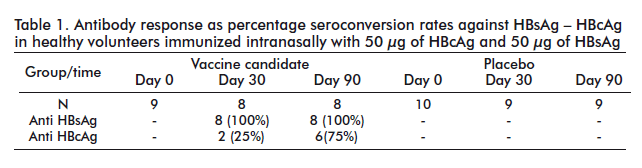
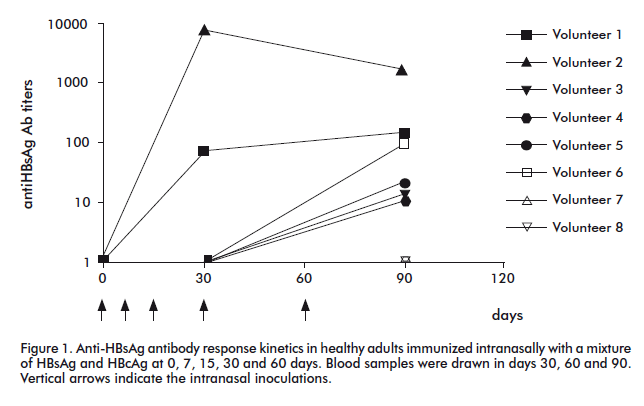
<body><![CDATA[<P   ><font face="Verdana, Arial, Helvetica, sans-serif" size="3"><b>RESULTS AND DISCUSSION</b></font></P >   <FONT size="+1">        <P   align="justify" ><font size="2" face="Verdana, Arial, Helvetica, sans-serif">First, we demonstrated      the adjuvant effect of VLP on the immune response to co-administered soluble      antigens, allowing the induction of a functional response in humans. Then,      the safety profile of formulations adjuvanted with VLP was examined, followed      by the study of the induction of protective and functional responses in animal      models and humans. </font></P >   <FONT size="+1">        <P   ><font size="2" face="Verdana, Arial, Helvetica, sans-serif"><b>Anti-HBsAg seroconversion      to protective antibody levels with a formulation containing HBsAg and HBcAg      virus-like particles without additional adjuvants </b></font></P >       <P   align="justify" ><font size="2" face="Verdana, Arial, Helvetica, sans-serif">The nasal immunization      route represents an ideal choice for the induction of mucosal immune responses,      which represent the best alternative to protect against sexually transmitted      or infectious respiratory diseases. The use of this route, however, has been      hampered by the lack of adequate adjuvants. Most attempts have employed the      B subunit of cholera toxin or <I>Escherichia coli </I>enterotoxin which, while      being potent mucosal adjuvants, also display marked neurotoxicities when administered      by this route. Our group has demonstrated that VLP formed solely by HBV surface      and core antigens (HBsAg and HBcAg, respectively) can induce a seroprotective      response without additional adjuvants (<a href="/img/revistas/bta/v28n3/t0111311.gif">Table</a>) [7].      As shown in <a href="/img/revistas/bta/v28n3/f0111311.gif">figure 1</a>, most of the immunized volunteers      generated protective antibody levels (anti-HBsAg titers larger than 10 mIU/mL).      </font></P >       
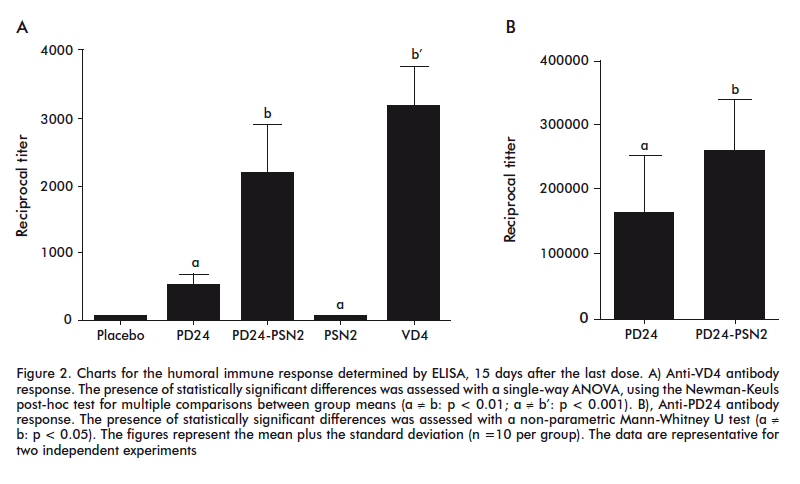
<P   ><font size="2" face="Verdana, Arial, Helvetica, sans-serif"><b>Development of      the production and formulation of antigens as virus-like particles. Their      use as adjuvants for soluble antigens. </b></font></P >       <P   align="justify" ><font size="2" face="Verdana, Arial, Helvetica, sans-serif">A truncated variant      of the core protein of HCV was produced in a recombinant <I>E. coli </I>strain      and self-assembled <I>in vitro </I>into spherical VLP. The process took place      in the absence of nucleic acids, according to chromatographic and electron      microscopy studies. The particles, with a mean diameter of 30 nm, had a homogeneous      size distribution and morphology, similar to that of particles detected in      serum and hepatocytes of HCV-infected patients [8]. The particles were included      into a formulation together with a DNA immunization plasmid expressing the      structural proteins of HCV to increase the immunogenicity of the latter. This      formulation, codenamed CIGB-230, has displayed very low reactogenicity during      pre-clinical toxicological testing [9]. </font></P >       <P   align="justify" ><font size="2" face="Verdana, Arial, Helvetica, sans-serif">An outside group      has evaluated in clinical trials a V3 loop-based multi-antigen peptide (MAP)      as a prophylactic vaccine candidate against HIV-1. This candidate was well      tolerated, and although most of the volunteers immunized with the 500 &micro;g      dose elicited neutralizing antibodies against the homologous strain, they      failed to neutralize heterologous isolates. The solution the authors proposed      to this problem, the use of MAP cocktails, is impractical, as the total peptide      mass required to elicit neutralizing antibodies to a reasonable number of      strains would be too large for inoculation into humans (once again illustrating      the obstacle to vaccine development posed by the variability of HIV-1). In      the context of this situation, we developed a method for conjugating MAP (also      using V3 loop-based MAPs for the proof-of-concept) to HBsAg VLP carriers,      thus managing to significantly increase the cross-reactivity of the obtained      sera above that of their unconjugated counterparts [4, 10, 11]. </font></P >       <P   align="justify" ><font size="2" face="Verdana, Arial, Helvetica, sans-serif">Virus-like particles      based on the capsid protein of Dengue-2 Virus (PSN2) were mixed with a soluble      fusion antigen formed by the P64k protein from <I>Neisseria meningitidis </I>and      domain III of the envelope protein from Dengue-4 Virus (PD24). BALB/c mice      were then immunized with the PD24-PSN2 mixture, using animals immunized solely      with either PSN2 or PD24 as controls, together with a placebo group receiving      P64k and a positive control group inoculated with infectiousVD4. The appearance      of VD4-reactive antibodies was evaluated by ELISA (<a href="/img/revistas/bta/v28n3/f0211311.gif">Figure      2</a>). There were no detectable antiviral titers in mice immunized with P64k      alone or PSN2. However, the antiviral titers in animals receiving the PD24-PSN2      mixture were higher than in those immunized only with PD24 (<I>p</I>&lt;0.01,      one-way ANOVA and Newman-Keuls multiple comparisons test), and similar to      those of the positive control group (<a href="/img/revistas/bta/v28n3/f0211311.gif">Figure 2</a>).      </font></P >       
<P   ><font size="2" face="Verdana, Arial, Helvetica, sans-serif"><b>Strong induction      of a Th1 cellular response on top of the humoral response </b></font></P >       <P   align="justify" ><font size="2" face="Verdana, Arial, Helvetica, sans-serif">The preparation based      on HCV capsid particles with the DNA immunization plasmid expressing structural      antigens from HCV was shown to induce both humoral and cell-based specific      immune responses, which were particularly strong against the capsid antigen.      This evidences how the particulate nature of the antigen represents a major      determinant for its immunogenicity [9]. </font></P >       ]]></body>
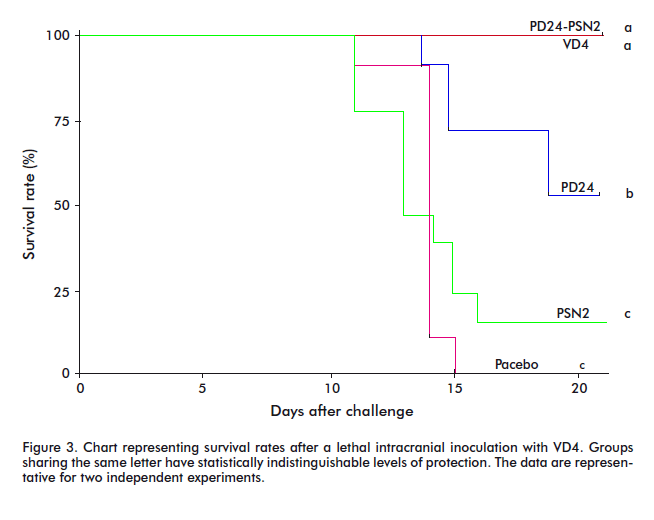
<body><![CDATA[<P   align="justify" ><font size="2" face="Verdana, Arial, Helvetica, sans-serif">One month after the      last dose of the immunization scheme described above for Dengue Virus antigens,      splenocytes from 6 mice per group were stimulated <I>in vitro </I>with infective      VD4. Culture supernatants were then analyzed by ELISA to determine the concentration      of IFN-&gamma;. The levels of secretion of this cytokine in the splenocytes      from the mouse group immunized with the PD24-PSN2 preparation (10165.17 &plusmn;      2250.68 pg/mL) was similar to that of splenocytes from the positive control      group (12525.15 &plusmn; 4465.56 pg/mL) and higher than in the group immunized      with PD24 alone (6084.71 &plusmn; 1365.37 pg/mL) [6]. </font></P >       <P   ><font size="2" face="Verdana, Arial, Helvetica, sans-serif"><b>Demonstration      in animal models and humans of the induction of a functional and protective      response </b> </font></P >       <P   align="justify" ><font size="2" face="Verdana, Arial, Helvetica, sans-serif">The administration      of a preparation based on particles of the HCV capsid protein and the DNA      immunization plasmid expressing structural antigens from HCV has been shown      to protect mice in a model of challenge with a surrogate virus expressing      HCV antigens [12]. </font></P >       <P   align="justify" ><font size="2" face="Verdana, Arial, Helvetica, sans-serif">In the case of Dengue      antigens, after the immunization with the vaccine candidates described above,      the mice were challenged with a preparation of infectious Dengue 4 virus (DV4).      All animals immunized with the PD24-PSN2 vaccine preparation survived, whereas      only 50% of mice survived in the group immunized with PD24. This evidences      the capacity of PSN2 to enhance and potentiate the protective capacity of      PD24 (<a href="/img/revistas/bta/v28n3/f0311311.gif">Figure 3</a>). </font></P >       
<P   align="justify" ><font size="2" face="Verdana, Arial, Helvetica, sans-serif">The data lead us      to conclude that it is possible to take advantage of the attractive characteristics      of VLP as immunogens and immunomodulators to develop a technological framework      consisting on antigens with adjuvant properties that can be further used in      the development of attractive vaccine candidates for pathogens whose transmission      is difficult to prevent, such as HIV, HCV or Dengue, or causing diseases with      a difficult therapy, such as HBV, HCV and HIV. </font></P >       <P   > </P >   <FONT size="+1">        <P   ><font size="3"><b><font face="Verdana, Arial, Helvetica, sans-serif">REFERENCES      </font></b></font></P >       <!-- ref --><P   align="justify" ><font size="2" face="Verdana, Arial, Helvetica, sans-serif">1. Aguilar JC, Lobaina      Y, Muzio V, Garc&iacute;a D, Pent&oacute;n E, Iglesias E, <I>et al</I>. Development      of a nasal vaccine for chronic hepatitis B infection that uses the ability      of hepatitis B core antigen to stimulate a strong Th1 response against hepatitis      B surface antigen. Immunol Cell Biol. 2004; 82: 539-546.     </font></P >   <FONT size="+1">        <!-- ref --><P   align="justify" ><font size="2" face="Verdana, Arial, Helvetica, sans-serif">2. Lobaina Y, Palenzuela      D, Pichardo D, Muzio V, Guill&eacute;n G, Aguilar JC. Immunological characterization      of two hepatitis B core antigen variants and their immunoenhancing effect      on co-delivered hepatitis B surface antigen. Mol Immunol. 2005; 42(3):289-94.          </font></P >       <!-- ref --><P   align="justify" ><font size="2" face="Verdana, Arial, Helvetica, sans-serif">3. Guill&eacute;n      G, Aguilar JC, Due&ntilde;as S, Hermida L, Guzm&aacute;n MG, Pent&oacute;n      E, <I>et al</I>. Virus-Like Particles as vaccine antigens and adjuvants: application      to chronic disease, cancer immunotherapy and infectious disease preventive      strategies. Procedia Vaccinol. 2010;2(2):128-33.     </font></P >       <!-- ref --><P   align="justify" ><font size="2" face="Verdana, Arial, Helvetica, sans-serif">4. Iglesias E, Aguilar      JC, Cruz LJ, Reyes O. Broader cross-reactivity after conjugation of V3 based      multiple antigen peptides to HBsAg. Mol Immunol. 2005;42(1):99-104.     </font></P >       <!-- ref --><P   align="justify" ><font size="2" face="Verdana, Arial, Helvetica, sans-serif">5. Ghany MG, Strader      DB, Thomas DL, Seeff LB; American Association for the Study of Liver Diseases.      Diagnosis, management, and treatment of hepatitis C: an update. Hepatology.      2009;49(4):1335-74.     </font></P >       <!-- ref --><P   align="justify" ><font size="2" face="Verdana, Arial, Helvetica, sans-serif">6. Lazo L, Gil L,      Lopez C, Valdes I, Marcos E, Alvarez M, <I>et al</I>. Nucleocapsid-like particles      of dengue-2 virus enhance the immune response against a recombinant protein      of dengue-4 virus. Arch Virol. 2010;155(10):1587-95.     </font></P >       <!-- ref --><P   align="justify" ><font size="2" face="Verdana, Arial, Helvetica, sans-serif">7. Aguilar A, Gonz&aacute;lez      CA, Cinza Z, Cabrera J, V&eacute;liz G, Moreno SR, <I>et al</I>. Phase I clinical      trial in healthy adults of a nasal vaccine candidate containing recombinant      hepatitis B surface and core antigens. Int J Infect Dis. 2007;11(5):394-401.          </font></P >       <!-- ref --><P   align="justify" ><font size="2" face="Verdana, Arial, Helvetica, sans-serif">8. Acosta-Rivero      N, Rodriguez A, Mussachio A, Poutou J, Falcon V, Torres D, <I>et al</I>. A      C-terminal truncated hepatitis C virus core protein variant assembles <I>in      vitro</I> into virus-like particles in the absence of structured nucleic acids.      Biochem Biophys Res Commun. 2005;334(3):901-6.     </font></P >       <!-- ref --><P   align="justify" ><font size="2" face="Verdana, Arial, Helvetica, sans-serif">9. Bacard&iacute;      D, Amador-Ca&ntilde;izares Y, Cosme K, Urquiza D, Su&aacute;rez J, Marante      J, <I>et al</I>. Toxicology and biodistribution study of CIGB-230, a DNA vaccine      against hepatitis C virus. Hum Exp Toxicol. 2009;28(8): 479-91.     </font></P >       <!-- ref --><P   align="justify" ><font size="2" face="Verdana, Arial, Helvetica, sans-serif">10. Cruz LJ, Iglesias      E, Aguilar JC, Gonz&aacute;lez LJ, Reyes O, Albericio F, <I>et al</I>. A comparative      study of different presentation strategies for an HIV peptide immunogen. Bioconjug      Chem. 2004;15(1):112-20.     </font></P >       <!-- ref --><P   align="justify" ><font size="2" face="Verdana, Arial, Helvetica, sans-serif">11. Cruz LJ, Cabrales      A, Iglesias E, Aguilar JC, Gonz&aacute;lez LJ, Reyes O. Enhanced immunogenicity      and cross-reactivity of HIV-1 V3-peptide and multiple antigen peptides conjugated      to distinct carrier proteins. Int Immunol. 2009;9(12):1452-9.     </font></P >       <!-- ref --><P   align="justify" ><font size="2" face="Verdana, Arial, Helvetica, sans-serif">12. Alvarez-Lajonchere      L, Gonz&aacute;lez M, Alvarez-Obreg&oacute;n JC, Guerra I, Vi&ntilde;a A,      Acosta-Rivero N, <I>et al</I>. Hepatitis C virus (HCV) core protein enhances      the immunogenicity of a co-delivered DNA vaccine encoding HCV structural antigens      in mice. Biotechnol Appl Biochem. 2006;44(Pt 1): 9-17.     </font></P >       <P   > </P >   <FONT size="+1">        <P   ><font size="2" face="Verdana, Arial, Helvetica, sans-serif">Gerardo Guill&eacute;n.      Centro de Ingenier&iacute;a Gen&eacute;tica y Biotecnolog&iacute;a, CIGB.      Ave. 31 e/ 158 y 190, PO Box 6162, Cubanac&aacute;n, Playa, La Habana, Cuba.      E-mail: <A href="mailto:gerardo.guillen@cigb.edu.cu"> <U><U><FONT color="#0000FF">gerardo.guillen@cigb.edu.cu</font></U></U></A><FONT color="#0000FF">      <FONT color="#000000">. </font></font></font></P >   </font></font></font></font></font></font></font></DIV >      ]]></body><back>
<ref-list>
<ref id="B1">
<label>1</label><nlm-citation citation-type="journal">
<person-group person-group-type="author">
<name>
<surname><![CDATA[Aguilar]]></surname>
<given-names><![CDATA[JC]]></given-names>
</name>
<name>
<surname><![CDATA[Lobaina]]></surname>
<given-names><![CDATA[Y]]></given-names>
</name>
<name>
<surname><![CDATA[Muzio]]></surname>
<given-names><![CDATA[V]]></given-names>
</name>
<name>
<surname><![CDATA[García]]></surname>
<given-names><![CDATA[D]]></given-names>
</name>
<name>
<surname><![CDATA[Pentón]]></surname>
<given-names><![CDATA[E]]></given-names>
</name>
<name>
<surname><![CDATA[Iglesias]]></surname>
<given-names><![CDATA[E]]></given-names>
</name>
</person-group>
<article-title xml:lang="en"><![CDATA[Development of a nasal vaccine for chronic hepatitis B infection that uses the ability of hepatitis B core antigen to stimulate a strong Th1 response against hepatitis B surface antigen]]></article-title>
<source><![CDATA[Immunol Cell Biol]]></source>
<year>2004</year>
<volume>82</volume>
<page-range>539-546</page-range></nlm-citation>
</ref>
<ref id="B2">
<label>2</label><nlm-citation citation-type="journal">
<person-group person-group-type="author">
<name>
<surname><![CDATA[Lobaina]]></surname>
<given-names><![CDATA[Y]]></given-names>
</name>
<name>
<surname><![CDATA[Palenzuela]]></surname>
<given-names><![CDATA[D]]></given-names>
</name>
<name>
<surname><![CDATA[Pichardo]]></surname>
<given-names><![CDATA[D]]></given-names>
</name>
<name>
<surname><![CDATA[Muzio]]></surname>
<given-names><![CDATA[V]]></given-names>
</name>
<name>
<surname><![CDATA[Guillén]]></surname>
<given-names><![CDATA[G]]></given-names>
</name>
<name>
<surname><![CDATA[Aguilar]]></surname>
<given-names><![CDATA[JC]]></given-names>
</name>
</person-group>
<article-title xml:lang="en"><![CDATA[Immunological characterization of two hepatitis B core antigen variants and their immunoenhancing effect on co-delivered hepatitis B surface antigen]]></article-title>
<source><![CDATA[Mol Immunol]]></source>
<year>2005</year>
<volume>42</volume>
<numero>3</numero>
<issue>3</issue>
<page-range>289-94</page-range></nlm-citation>
</ref>
<ref id="B3">
<label>3</label><nlm-citation citation-type="journal">
<person-group person-group-type="author">
<name>
<surname><![CDATA[Guillén]]></surname>
<given-names><![CDATA[G]]></given-names>
</name>
<name>
<surname><![CDATA[Aguilar]]></surname>
<given-names><![CDATA[JC]]></given-names>
</name>
<name>
<surname><![CDATA[Dueñas]]></surname>
<given-names><![CDATA[S]]></given-names>
</name>
<name>
<surname><![CDATA[Hermida]]></surname>
<given-names><![CDATA[L]]></given-names>
</name>
<name>
<surname><![CDATA[Guzmán]]></surname>
<given-names><![CDATA[MG]]></given-names>
</name>
<name>
<surname><![CDATA[Pentón]]></surname>
<given-names><![CDATA[E]]></given-names>
</name>
</person-group>
<article-title xml:lang="en"><![CDATA[Virus-Like Particles as vaccine antigens and adjuvants: application to chronic disease, cancer immunotherapy and infectious disease preventive strategies]]></article-title>
<source><![CDATA[Procedia Vaccinol]]></source>
<year>2010</year>
<volume>2</volume>
<numero>2</numero>
<issue>2</issue>
<page-range>128-33</page-range></nlm-citation>
</ref>
<ref id="B4">
<label>4</label><nlm-citation citation-type="journal">
<person-group person-group-type="author">
<name>
<surname><![CDATA[Iglesias]]></surname>
<given-names><![CDATA[E]]></given-names>
</name>
<name>
<surname><![CDATA[Aguilar]]></surname>
<given-names><![CDATA[JC]]></given-names>
</name>
<name>
<surname><![CDATA[Cruz]]></surname>
<given-names><![CDATA[LJ]]></given-names>
</name>
<name>
<surname><![CDATA[Reyes]]></surname>
<given-names><![CDATA[O]]></given-names>
</name>
</person-group>
<article-title xml:lang="en"><![CDATA[Broader cross-reactivity after conjugation of V3 based multiple antigen peptides to HBsAg]]></article-title>
<source><![CDATA[Mol Immunol]]></source>
<year>2005</year>
<volume>42</volume>
<numero>1</numero>
<issue>1</issue>
<page-range>99-104</page-range></nlm-citation>
</ref>
<ref id="B5">
<label>5</label><nlm-citation citation-type="journal">
<person-group person-group-type="author">
<name>
<surname><![CDATA[Ghany]]></surname>
<given-names><![CDATA[MG]]></given-names>
</name>
<name>
<surname><![CDATA[Strader]]></surname>
<given-names><![CDATA[DB]]></given-names>
</name>
<name>
<surname><![CDATA[Thomas]]></surname>
<given-names><![CDATA[DL]]></given-names>
</name>
<name>
<surname><![CDATA[Seeff]]></surname>
<given-names><![CDATA[LB]]></given-names>
</name>
</person-group>
<collab>American Association for the Study of Liver Diseases</collab>
<article-title xml:lang="en"><![CDATA[Diagnosis, management, and treatment of hepatitis C: an update]]></article-title>
<source><![CDATA[Hepatology]]></source>
<year>2009</year>
<volume>49</volume>
<numero>4</numero>
<issue>4</issue>
<page-range>1335-74</page-range></nlm-citation>
</ref>
<ref id="B6">
<label>6</label><nlm-citation citation-type="journal">
<person-group person-group-type="author">
<name>
<surname><![CDATA[Lazo]]></surname>
<given-names><![CDATA[L]]></given-names>
</name>
<name>
<surname><![CDATA[Gil]]></surname>
<given-names><![CDATA[L]]></given-names>
</name>
<name>
<surname><![CDATA[Lopez]]></surname>
<given-names><![CDATA[C]]></given-names>
</name>
<name>
<surname><![CDATA[Valdes]]></surname>
<given-names><![CDATA[I]]></given-names>
</name>
<name>
<surname><![CDATA[Marcos]]></surname>
<given-names><![CDATA[E]]></given-names>
</name>
<name>
<surname><![CDATA[Alvarez]]></surname>
<given-names><![CDATA[M]]></given-names>
</name>
</person-group>
<article-title xml:lang="en"><![CDATA[Nucleocapsid-like particles of dengue-2 virus enhance the immune response against a recombinant protein of dengue-4 virus]]></article-title>
<source><![CDATA[Arch Virol]]></source>
<year>2010</year>
<volume>155</volume>
<numero>10</numero>
<issue>10</issue>
<page-range>1587-95</page-range></nlm-citation>
</ref>
<ref id="B7">
<label>7</label><nlm-citation citation-type="journal">
<person-group person-group-type="author">
<name>
<surname><![CDATA[Aguilar]]></surname>
<given-names><![CDATA[A]]></given-names>
</name>
<name>
<surname><![CDATA[González]]></surname>
<given-names><![CDATA[CA]]></given-names>
</name>
<name>
<surname><![CDATA[Cinza]]></surname>
<given-names><![CDATA[Z]]></given-names>
</name>
<name>
<surname><![CDATA[Cabrera]]></surname>
<given-names><![CDATA[J]]></given-names>
</name>
<name>
<surname><![CDATA[Véliz]]></surname>
<given-names><![CDATA[G]]></given-names>
</name>
<name>
<surname><![CDATA[Moreno]]></surname>
<given-names><![CDATA[SR]]></given-names>
</name>
</person-group>
<article-title xml:lang="en"><![CDATA[Phase I clinical trial in healthy adults of a nasal vaccine candidate containing recombinant hepatitis B surface and core antigens]]></article-title>
<source><![CDATA[Int J Infect Dis]]></source>
<year>2007</year>
<volume>11</volume>
<numero>5</numero>
<issue>5</issue>
<page-range>394-401</page-range></nlm-citation>
</ref>
<ref id="B8">
<label>8</label><nlm-citation citation-type="journal">
<person-group person-group-type="author">
<name>
<surname><![CDATA[Acosta-Rivero]]></surname>
<given-names><![CDATA[N]]></given-names>
</name>
<name>
<surname><![CDATA[Rodriguez]]></surname>
<given-names><![CDATA[A]]></given-names>
</name>
<name>
<surname><![CDATA[Mussachio]]></surname>
<given-names><![CDATA[A]]></given-names>
</name>
<name>
<surname><![CDATA[Poutou]]></surname>
<given-names><![CDATA[J]]></given-names>
</name>
<name>
<surname><![CDATA[Falcon]]></surname>
<given-names><![CDATA[V]]></given-names>
</name>
<name>
<surname><![CDATA[Torres]]></surname>
<given-names><![CDATA[D]]></given-names>
</name>
</person-group>
<article-title xml:lang="en"><![CDATA[A C-terminal truncated hepatitis C virus core protein variant assembles in vitro into virus-like particles in the absence of structured nucleic acids]]></article-title>
<source><![CDATA[Biochem Biophys Res Commun]]></source>
<year>2005</year>
<volume>334</volume>
<numero>3</numero>
<issue>3</issue>
<page-range>901-6</page-range></nlm-citation>
</ref>
<ref id="B9">
<label>9</label><nlm-citation citation-type="journal">
<person-group person-group-type="author">
<name>
<surname><![CDATA[Bacardí]]></surname>
<given-names><![CDATA[D]]></given-names>
</name>
<name>
<surname><![CDATA[Amador-Cañizares]]></surname>
<given-names><![CDATA[Y]]></given-names>
</name>
<name>
<surname><![CDATA[Cosme]]></surname>
<given-names><![CDATA[K]]></given-names>
</name>
<name>
<surname><![CDATA[Urquiza]]></surname>
<given-names><![CDATA[D]]></given-names>
</name>
<name>
<surname><![CDATA[Suárez]]></surname>
<given-names><![CDATA[J]]></given-names>
</name>
<name>
<surname><![CDATA[Marante]]></surname>
<given-names><![CDATA[J]]></given-names>
</name>
</person-group>
<article-title xml:lang="en"><![CDATA[Toxicology and biodistribution study of CIGB-230, a DNA vaccine against hepatitis C virus]]></article-title>
<source><![CDATA[Hum Exp Toxicol]]></source>
<year>2009</year>
<volume>28</volume>
<numero>8</numero>
<issue>8</issue>
<page-range>479-91</page-range></nlm-citation>
</ref>
<ref id="B10">
<label>10</label><nlm-citation citation-type="journal">
<person-group person-group-type="author">
<name>
<surname><![CDATA[Cruz]]></surname>
<given-names><![CDATA[LJ]]></given-names>
</name>
<name>
<surname><![CDATA[Iglesias]]></surname>
<given-names><![CDATA[E]]></given-names>
</name>
<name>
<surname><![CDATA[Aguilar]]></surname>
<given-names><![CDATA[JC]]></given-names>
</name>
<name>
<surname><![CDATA[González]]></surname>
<given-names><![CDATA[LJ]]></given-names>
</name>
<name>
<surname><![CDATA[Reyes]]></surname>
<given-names><![CDATA[O]]></given-names>
</name>
<name>
<surname><![CDATA[Albericio]]></surname>
<given-names><![CDATA[F]]></given-names>
</name>
</person-group>
<article-title xml:lang="en"><![CDATA[A comparative study of different presentation strategies for an HIV peptide immunogen]]></article-title>
<source><![CDATA[Bioconjug Chem]]></source>
<year>2004</year>
<volume>15</volume>
<numero>1</numero>
<issue>1</issue>
<page-range>112-20</page-range></nlm-citation>
</ref>
<ref id="B11">
<label>11</label><nlm-citation citation-type="journal">
<person-group person-group-type="author">
<name>
<surname><![CDATA[Cruz]]></surname>
<given-names><![CDATA[LJ]]></given-names>
</name>
<name>
<surname><![CDATA[Cabrales]]></surname>
<given-names><![CDATA[A]]></given-names>
</name>
<name>
<surname><![CDATA[Iglesias]]></surname>
<given-names><![CDATA[E]]></given-names>
</name>
<name>
<surname><![CDATA[Aguilar]]></surname>
<given-names><![CDATA[JC]]></given-names>
</name>
<name>
<surname><![CDATA[González]]></surname>
<given-names><![CDATA[LJ]]></given-names>
</name>
<name>
<surname><![CDATA[Reyes]]></surname>
<given-names><![CDATA[O]]></given-names>
</name>
</person-group>
<article-title xml:lang="en"><![CDATA[Enhanced immunogenicity and cross-reactivity of HIV-1 V3-peptide and multiple antigen peptides conjugated to distinct carrier proteins]]></article-title>
<source><![CDATA[Int Immunol]]></source>
<year>2009</year>
<volume>9</volume>
<numero>12</numero>
<issue>12</issue>
<page-range>1452-9</page-range></nlm-citation>
</ref>
<ref id="B12">
<label>12</label><nlm-citation citation-type="journal">
<person-group person-group-type="author">
<name>
<surname><![CDATA[Alvarez-Lajonchere]]></surname>
<given-names><![CDATA[L]]></given-names>
</name>
<name>
<surname><![CDATA[González]]></surname>
<given-names><![CDATA[M]]></given-names>
</name>
<name>
<surname><![CDATA[Alvarez-Obregón]]></surname>
<given-names><![CDATA[JC]]></given-names>
</name>
<name>
<surname><![CDATA[Guerra]]></surname>
<given-names><![CDATA[I]]></given-names>
</name>
<name>
<surname><![CDATA[Viña]]></surname>
<given-names><![CDATA[A]]></given-names>
</name>
<name>
<surname><![CDATA[Acosta-Rivero]]></surname>
<given-names><![CDATA[N]]></given-names>
</name>
</person-group>
<article-title xml:lang="en"><![CDATA[Hepatitis C virus (HCV) core protein enhances the immunogenicity of a co-delivered DNA vaccine encoding HCV structural antigens in mice]]></article-title>
<source><![CDATA[Biotechnol Appl Biochem]]></source>
<year>2006</year>
<volume>44</volume>
<numero>1</numero>
<issue>1</issue>
<page-range>9-17</page-range></nlm-citation>
</ref>
</ref-list>
</back>
</article>