<?xml version="1.0" encoding="ISO-8859-1"?><article xmlns:mml="http://www.w3.org/1998/Math/MathML" xmlns:xlink="http://www.w3.org/1999/xlink" xmlns:xsi="http://www.w3.org/2001/XMLSchema-instance">
<front>
<journal-meta>
<journal-id>1027-2852</journal-id>
<journal-title><![CDATA[Biotecnología Aplicada]]></journal-title>
<abbrev-journal-title><![CDATA[Biotecnol Apl]]></abbrev-journal-title>
<issn>1027-2852</issn>
<publisher>
<publisher-name><![CDATA[Editorial Elfos Scientiae]]></publisher-name>
</publisher>
</journal-meta>
<article-meta>
<article-id>S1027-28522011000400001</article-id>
<title-group>
<article-title xml:lang="en"><![CDATA[Plant cell wall degrading and remodeling proteins: current perspectives]]></article-title>
<article-title xml:lang="es"><![CDATA[Proteínas que remodelan y degradan la pared celular vegetal: perspectivas actuales]]></article-title>
</title-group>
<contrib-group>
<contrib contrib-type="author">
<name>
<surname><![CDATA[Quiroz-Castañeda]]></surname>
<given-names><![CDATA[Rosa E]]></given-names>
</name>
<xref ref-type="aff" rid="A01"/>
</contrib>
<contrib contrib-type="author">
<name>
<surname><![CDATA[Folch-Mallol]]></surname>
<given-names><![CDATA[Jorge L]]></given-names>
</name>
<xref ref-type="aff" rid="A01"/>
</contrib>
</contrib-group>
<aff id="A01">
<institution><![CDATA[,Universidad Autónoma del Estado de Morelos Centro de Investigación en Biotecnología Laboratorio de Biología Molecular de Hongos]]></institution>
<addr-line><![CDATA[Cuernavaca ]]></addr-line>
<country>México</country>
</aff>
<pub-date pub-type="pub">
<day>00</day>
<month>12</month>
<year>2011</year>
</pub-date>
<pub-date pub-type="epub">
<day>00</day>
<month>12</month>
<year>2011</year>
</pub-date>
<volume>28</volume>
<numero>4</numero>
<fpage>205</fpage>
<lpage>215</lpage>
<copyright-statement/>
<copyright-year/>
<self-uri xlink:href="http://scielo.sld.cu/scielo.php?script=sci_arttext&amp;pid=S1027-28522011000400001&amp;lng=en&amp;nrm=iso"></self-uri><self-uri xlink:href="http://scielo.sld.cu/scielo.php?script=sci_abstract&amp;pid=S1027-28522011000400001&amp;lng=en&amp;nrm=iso"></self-uri><self-uri xlink:href="http://scielo.sld.cu/scielo.php?script=sci_pdf&amp;pid=S1027-28522011000400001&amp;lng=en&amp;nrm=iso"></self-uri><abstract abstract-type="short" xml:lang="en"><p><![CDATA[Lignocellulose constitutes a raw material with considerable potential for the production of fermentable sugars and the generation of biofuels. In nature, lignocellulosic waste from forestry, agriculture and gardening acts as the preferred carbon source of a number of bacteria and fungi endowed with the required ligninolytic machinery. These hydrolytic activities could potentially be complemented with those from other proteins that remodel the structure of cell walls, such as expansins, a group of proteins originally identified in plants that have the capacity of relaxing cell wall tension to allow cell growth. Expansins participate in processes where remodeling of the plant cell wall is required: organogenesis, fruit ripening, and growth of the pollen tube, among others. Expansins and expansin-like proteins have been proposed to act by disrupting the hydrogen bonds binding together cellulose fibrils and cellulose and other polysaccharides through a non-enzymatic process, enhancing subsequent degradation. In this manuscript, a review on plant cell wall composition and ligninolytic enzymes from cell wall-degrading bacteria and fungi is presented. Proteins with expansin-like activity, their properties and their potential application to enhance sugar release from lignocellulosic material are also reviewed.]]></p></abstract>
<abstract abstract-type="short" xml:lang="es"><p><![CDATA[El material lignocelulósico constituye una materia prima potencial para la obtención de azúcares fermentables y biocombustibles. Algunas bacterias y hongos con cualidades ligninolíticas, pueden utilizar los desechos lignocelulósicos de la naturaleza (forestales, agrícolas y de jardín) como fuente de carbono. Tal actividad de degradación podría complementarse con la actividad de las proteínas que remodelan la pared celular, como las expansinas, identificadas en plantas. Estas proteínas pueden relajar los componentes de la pared celular y promover el crecimiento. Participan en procesos de desarrollo como la organogénesis, la abscisión, la maduración de los frutos, el crecimiento del tubo polínico, entre otros, donde ocurren modificaciones de la pared celular. Se ha planteado que las proteínas del tipo expansinas rompen los puentes de hidrógeno que unen los filamentos de celulosa y la celulosa con otros polisacáridos, mediante un proceso no enzimático, que favorece la posterior degradación de la pared celular. En este trabajo se hace una revisión bibliográfica acerca de las características de la pared celular vegetal y su composición, así como de las enzimas ligninolíticas de bacterias y hongos que la degradan, las propiedades y el potencial que tienen las proteínas con actividad tipo expansina para hacer más eficiente la liberación de azúcares reductores del material lignocelulósico.]]></p></abstract>
<kwd-group>
<kwd lng="en"><![CDATA[lignocellulose]]></kwd>
<kwd lng="en"><![CDATA[cellulases]]></kwd>
<kwd lng="en"><![CDATA[expansins]]></kwd>
<kwd lng="en"><![CDATA[fungi]]></kwd>
<kwd lng="en"><![CDATA[biofuels]]></kwd>
<kwd lng="es"><![CDATA[lignocelulosa]]></kwd>
<kwd lng="es"><![CDATA[celulasas]]></kwd>
<kwd lng="es"><![CDATA[expansinas]]></kwd>
<kwd lng="es"><![CDATA[hongos]]></kwd>
<kwd lng="es"><![CDATA[biocombustibles]]></kwd>
</kwd-group>
</article-meta>
</front><body><![CDATA[ <DIV class="Sect"   >       <P align="right"   ><font size="2" color="#000000" face="Verdana, Arial, Helvetica, sans-serif"><b>REVIEW</b></font></P >       <P align="right"   >&nbsp;</P >   <FONT size="+1" color="#000000">        <P   > </P >       <P   ><b><font face="Verdana, Arial, Helvetica, sans-serif" size="4">Plant cell wall      degrading and remodeling proteins: current perspectives</font></b></P >       <P   >&nbsp;</P >       <P   ><font face="Verdana, Arial, Helvetica, sans-serif" size="3"><b>Prote&iacute;nas      que remodelan y degradan la pared celular vegetal: perspectivas actuales</b></font></P >       <P   >&nbsp;</P >       <P   >&nbsp;</P >       <P   > </P >       ]]></body>
<body><![CDATA[<P   ><b><font face="Verdana, Arial, Helvetica, sans-serif" size="2">Rosa E Quiroz-Casta&ntilde;eda,      Jorge L Folch-Mallol</font></b></P >       <P   ><font face="Verdana, Arial, Helvetica, sans-serif" size="2">Laboratorio de Biolog&iacute;a      Molecular de Hongos, Centro de Investigaci&oacute;n en Biotecnolog&iacute;a,      Universidad Aut&oacute;noma del Estado de Morelos. Ave. Universidad 1001 Col.      Chamilpa, Cuernavaca 62209, Morelos, M&eacute;xico.</font></P >       <P   >&nbsp;</P >   </font>   <hr>   <FONT size="+1" color="#000000"> <b><font face="Verdana, Arial, Helvetica, sans-serif" size="2">ABSTRACT    </font></b>        <P   ><font face="Verdana, Arial, Helvetica, sans-serif" size="2">Lignocellulose constitutes      a raw material with considerable potential for the production of fermentable      sugars and the generation of biofuels. In nature, lignocellulosic waste from      forestry, agriculture and gardening acts as the preferred carbon source of      a number of bacteria and fungi endowed with the required ligninolytic machinery.      These hydrolytic activities could potentially be complemented with those from      other proteins that remodel the structure of cell walls, such as expansins,      a group of proteins originally identified in plants that have the capacity      of relaxing cell wall tension to allow cell growth. Expansins participate      in processes where remodeling of the plant cell wall is required: organogenesis,      fruit ripening, and growth of the pollen tube, among others. Expansins and      expansin-like proteins have been proposed to act by disrupting the hydrogen      bonds binding together cellulose fibrils and cellulose and other polysaccharides      through a non-enzymatic process, enhancing subsequent degradation. In this      manuscript, a review on plant cell wall composition and ligninolytic enzymes      from cell wall-degrading bacteria and fungi is presented. Proteins with expansin-like      activity, their properties and their potential application to enhance sugar      release from lignocellulosic material are also reviewed. </font></P >       <P   ><font size="2" face="Verdana, Arial, Helvetica, sans-serif"><b>Keywords:</b>      lignocellulose, cellulases, expansins, fungi, biofuels.</font></P >   </font>   <hr>   <FONT size="+1" color="#000000">        <P   ><b><font size="2" face="Verdana, Arial, Helvetica, sans-serif">RESUMEN </font></b></P >   <FONT size="+1"><FONT size="+1">        <P   ><font face="Verdana, Arial, Helvetica, sans-serif" size="2">El material lignocelul&oacute;sico      constituye una materia prima potencial para la obtenci&oacute;n de az&uacute;cares      fermentables y biocombustibles. Algunas bacterias y hongos con cualidades      ligninol&iacute;ticas, pueden utilizar los desechos lignocelul&oacute;sicos      de la naturaleza (forestales, agr&iacute;colas y de jard&iacute;n) como fuente      de carbono. Tal actividad de degradaci&oacute;n podr&iacute;a complementarse      con la actividad de las prote&iacute;nas que remodelan la pared celular, como      las expansinas, identificadas en plantas. Estas prote&iacute;nas pueden relajar      los componentes de la pared celular y promover el crecimiento. Participan      en procesos de desarrollo como la organog&eacute;nesis, la abscisi&oacute;n,      la maduraci&oacute;n de los frutos, el crecimiento del tubo pol&iacute;nico,      entre otros, donde ocurren modificaciones de la pared celular. Se ha planteado      que las prote&iacute;nas del tipo expansinas rompen los puentes de hidr&oacute;geno      que unen los filamentos de celulosa y la celulosa con otros polisac&aacute;ridos,      mediante un proceso no enzim&aacute;tico, que favorece la posterior degradaci&oacute;n      de la pared celular. En este trabajo se hace una revisi&oacute;n bibliogr&aacute;fica      acerca de las caracter&iacute;sticas de la pared celular vegetal y su composici&oacute;n,      as&iacute; como de las enzimas ligninol&iacute;ticas de bacterias y hongos      que la degradan, las propiedades y el potencial que tienen las prote&iacute;nas      con actividad tipo expansina para hacer m&aacute;s eficiente la liberaci&oacute;n      de az&uacute;cares reductores del material lignocelul&oacute;sico. </font></P >       <P   ><font face="Verdana, Arial, Helvetica, sans-serif" size="2"><b>Palabras clave:</b>      lignocelulosa, celulasas, expansinas, hongos, biocombustibles.</font></P >   </font></font></font>   <hr>   <FONT size="+1" color="#000000"><FONT size="+1"><FONT size="+1">        <P   >&nbsp;</P >       <P   >&nbsp;</P >       ]]></body>
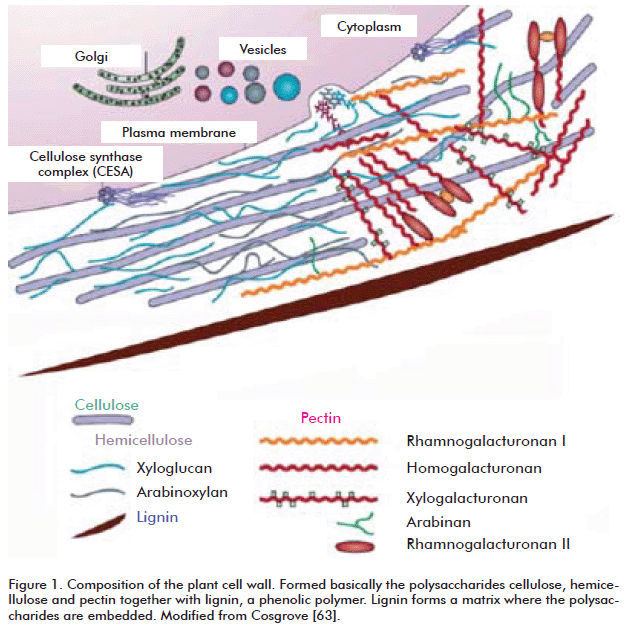
<body><![CDATA[<P   ><font size="3"><b><font face="Verdana, Arial, Helvetica, sans-serif">INTRODUCTION      </font></b></font></P >       <P   align="justify" ><font size="2" face="Verdana, Arial, Helvetica, sans-serif">Lignocellulose, the      principal and most abundant component of the renewable biomass produced by      photosynthesis, is synthesized at an estimated rate of some 200 billion tons      per year [1-2]. This biopolymer is formed principally by cellulose, hemicelluloses      and lignin [1], in addition to small amounts of pectin, ash and proteins [2].      Cellulose is the most abundant polymer of our planet. In nature, it is found      mainly as a structural component of plant and algal cell walls, although cellulose      is also produced by some animals, such as tunicates, and several bacteria      [3]. It does not accumulate in the environment, due to the existence of cellulolytic      fungi and bacteria degrading some of the components of plant cell walls; a      process that, while extremely slow, plays a major role in carbon recycling      within the biosphere [4]. Obviously, the existence of formidable reserves      of lignocellulose that are continuously renewed represents an excellent opportunity      for the development of biofuels, as a sustainable alternative to the fossil      fuels currently in use [5]. </font></P >   <FONT size="+1">        <P   align="justify" ><font face="Verdana, Arial, Helvetica, sans-serif" size="2">Exploitation of cellulosic      biomass is, however, currently limited by the absence of low-cost technologies      for its processing. A promising strategy for this purpose is the use of cell      wall remodeling and degrading enzymes from ligninolytic organisms [3]. </font></P >       <P   ><font size="3" face="Verdana, Arial, Helvetica, sans-serif"><b>STRUCTURE OF THE      CELL WALL AND COMPOSITION OF LIGNOCELLULOSE </b></font></P >   <FONT size="+1">        <P   align="justify" ><font size="2" face="Verdana, Arial, Helvetica, sans-serif">The cell wall is      a highly ordered structure formed, mainly, by cellulose, hemicelluloses and      lignin, a phenolic polymer (<a href="/img/revistas/bta/v28n4/f0101411.gif">Figure 1</a>) [6]. Exact      identity and relative abundances of each of these polymers vary even within      the same plant, depending on age, tissue and growth stage [1]. Cell walls      are structured so as to enable them to play a wide array of disparate, sometimes      opposing roles. They provide resistance to mechanical stress, shape the cell      and protect it against many pathogens; at the same time, they must be reasonably      flexible to withstand shear forces, and permeable enough to allow the passage      of signaling molecules into the cell [7]. </font></P >   <FONT size="+1">        
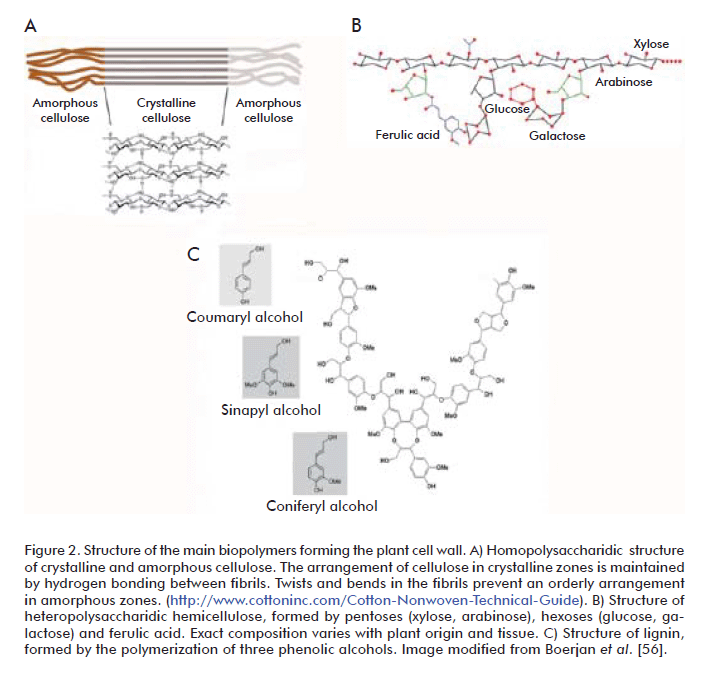
<P   ><font size="3" face="Verdana, Arial, Helvetica, sans-serif"><b>CELLULOSE </b></font></P >   <FONT size="+1">        <P   align="justify" ><font size="2" face="Verdana, Arial, Helvetica, sans-serif">Cellulose, the most      abundant natural polymer, is highly stable and insoluble in water. It constitutes      the principal component of plant cell walls, accounting for 50% of the dry      weight of wood. Its degree of polymerization varies according to its origin,      and may range from 2000 to 25,000 monomers [7-8]. Cellulose is formed by D-glucose      monomers condensed together through &beta;-1,4 glycosidic bonds, forming cellobiose      molecules (&beta;-1,4-linked glucose dimer) that are, in turn, linked together      into straight, non-branched chains [9]. In nature cellulose is seldom found      as single, isolated chains; forming filaments instead from the very moment      it is synthesized. These filaments, denominated microfibrils, may contain      from 36 to over 1200 cellulose chains, and have diameters of 5 to 15 nm [7].      Cellulose chains are held together in the microfibril through hydrogen bonds      and Van der Waals forces, forming a crystalline, organized structure that      is refractory to hydrolysis in certain areas of the microfibril (<a href="/img/revistas/bta/v28n4/f0201411.gif">Figure      2A</a>) [9]. Highly ordered, crystalline regions are interspersed with regions      containing disorganized or amorphous cellulose, which constitute 5 to 20%      of the microfibril. Amorphous regions are more susceptible to enzymatic degradation      [10-11]. Cellulose is a highly resistant substrate that is, in turn, tightly      associated with hemicelluloses and lignin, forming a structure that is very      resistant to degradation. Degrading lignin, therefore, is a feat accomplished      only by a few cellulolytic organisms [8]. </font></P >   <FONT size="+1">        
<P   ><font size="3" face="Verdana, Arial, Helvetica, sans-serif"><b>HEMICELLULOSE      </b></font></P >   <FONT size="+1">        <P   align="justify" ><font size="2" face="Verdana, Arial, Helvetica, sans-serif">Hemicellulose constitutes      from 25 to 30% of wood by dry weight. It is a complex heteropolysaccharide      composed mainly of pentoses (D-xylose and L-arabinose) and hexoses (D-glucose,      D-mannose and D-galactose), usually acetylated and forming branched chains,      in addition to 4-O-methylglucuronic, D-galacturonic and D-glucuronic acids,      condensed through &beta;-1,4 and, occasionally, &beta;-1,3 glycosidic linkages      [9]. These short lateral branches, formed by different sugars, make hemicellulose      less refractory to a number of treatments (<a href="/img/revistas/bta/v28n4/f0201411.gif">Figure 2B</a>)      [9, 12]. The components of hemicellulose are also classified as xylans, xyloglucans,      mannans, glucomannans and glucans, bonded together through &beta;-1,3 or &beta;-1,4      linkages. Xylans are the most abundant component of hemicellulose (over 70%      by weight). They are formed by D-xylose units condensed through &beta;-1,4      linkages, and may carry different substitutions, originating arabinoxylans      (if substituted with arabinose), such as those found in grasses, or glucuronoxylans      and glucuronoarabinoxylans (if substituted with glucose or glucose-arabinose,      respectively), which represent the main constituents of the secondary wall      of dicotyledonous plants. In addition to xylose, xylans may contain arabinose,      glucuronic acid or 4-O-methyl ether-glucuronic acid, and acetic, ferulic or      p-coumaric acids. Exact composition and branching frequency depend on the      origin of hemicellulose [13]. In hard woods from deciduous trees such as poplar,      birch and elm, hemicellulose is formed mainly by xylans where 60 to 70% of      residues are acetylated, whereas the soft woods of conifers such as pine and      cedar sport hemicelluloses composed mainly of glucomannans [14]. </font></P >   <FONT size="+1">        
<P   align="justify" ><font face="Verdana, Arial, Helvetica, sans-serif" size="2">The mannans and galactomannans      of hemicellulose have a core structure of &beta;-1,4-linked mannose residues,      which is randomly branched with mannose and glucose residues in glucomannans.      There are structural differences between hemicelluloses from different species      and even different cell types in the same individuals [14-15]. The most important      role of hemicellulose is to bond together lignin and cellulose fibers, thus      providing rigidity to the cellulose-hemicellulose-lignin mesh. Lignin and      hemicellulose are linked together mainly by ester bonds between arabinose      residues in hemicellulose and hydroxyl groups in lignin residues, whereas      cellulose binds to hemicellulose through hydrogen bonds [16]. </font></P >       ]]></body>
<body><![CDATA[<P   ><font size="3" face="Verdana, Arial, Helvetica, sans-serif"><b>LIGNIN </b></font></P >   <FONT size="+1">        <P   align="justify" ><font size="2" face="Verdana, Arial, Helvetica, sans-serif">Lignin is one of      the most abundant polymers in nature after cellulose and hemicellulose. It      is highly resistant to chemical or biological degradation, providing structural      support to the cell wall, decreasing its permeability and conferring resistance      to the attack of microorganisms. Together, lignin and hemicellulose form an      amorphous matrix imbibing cellulose fibers to protect them from degradation      [17]. </font></P >   <FONT size="+1">        <P   align="justify" ><font face="Verdana, Arial, Helvetica, sans-serif" size="2">Structurally, lignin      is a water-insoluble, irregular, branched heteropolymer formed through the      polymerization of three phenylpropane-type aromatic alcohols (coumaryl, coniferyl      and sinapyl alcohols) through C-C bonds and esters involving the aromatic      rings. This polymer, with constitutes 20 to 30% of wood by weight, protects      and confers rigidity to the structural polysaccharides (cellulose and hemicellulose)      (<a href="/img/revistas/bta/v28n4/f0201411.gif">Figure 2C</a>) [4, 18, 19]. The main constituent of      lignin in soft woods is coniferyl alcohol; in hard woods, this place is occupied      by coumaric and sinapinic acids instead [12]. Lignin is the component of lignocellulosic      material exhibiting the highest resistance to degradation, which limits its      application and that of the polysaccharides it protects. The number of microorganisms      able to mineralize this substance is really small [18]. </font></P >       
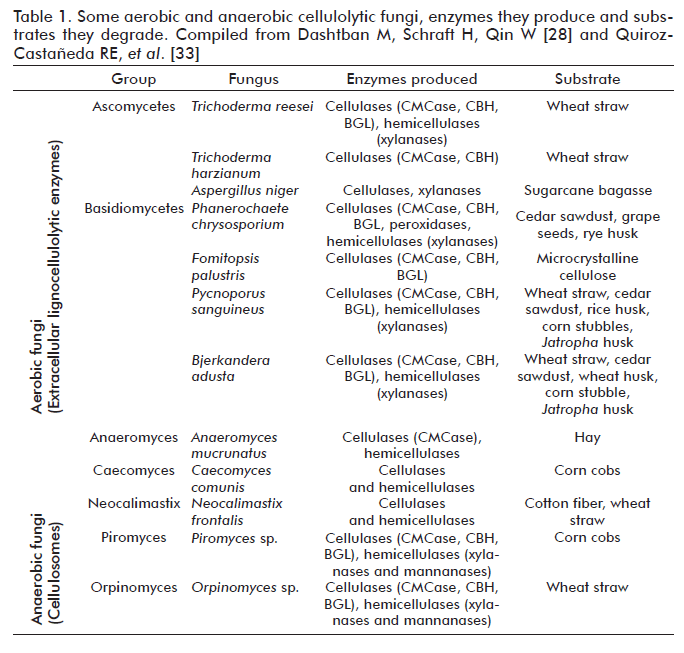
<P   ><font size="3" face="Verdana, Arial, Helvetica, sans-serif"><b>LIGNOCELLULOSE-DEGRADING      MICROORGANISMS </b></font></P >   <FONT size="+1">        <P   align="justify" ><font size="2" face="Verdana, Arial, Helvetica, sans-serif">There are natural      organisms that can degrade lignocellulose. Some of these are aerobic cellulolytic      bacteria of the <I>Actinomycetales</I> order (Phylum <I>Actinobacteria</I>)      living in soils, water, humus, agricultural waste such as sugarcane bagasse      and decaying leaves [20]. Enzyme systems composed of cellulases and xylanases      capable of degrading cell wall components have been described in aerobic bacteria      such as <I>Pseudomonas fluorescens subsp. cellulosa, Streptomyces lividans      </I>and <I>Cellulomonas fimi</I> [21-23]. Anaerobic bacteria of the <I>Clostridiales      </I>order (Phylum<I> Firmicutes</I>) generally found in soils, decaying plant      waste, the rumen of ruminant animals, termite guts, compost, waste water and      wood processing plants, also contain cellulolytic enzyme complexes denominated      cellulosomes [20]. Some cellulolytic anaerobic bacteria, such as <I>Butyrivibrio      fibrisolvens, Fibrobacter succinogenes, Ruminococcus flavefaciens, Clostridium      cellulovorans, C. cellulolyticum </I>y <I>C. thermocellum </I>are also endowed      with cellulases and xylanases [24-26]. </font></P >   <FONT size="+1">        <P   align="justify" ><font face="Verdana, Arial, Helvetica, sans-serif" size="2">Extreme environments      also host a number of cellulolytic microorganisms, such as the Antarctic bacterium      <I>Pseudoalteromonas haloplanktis </I>[27]. </font></P >       <P   align="justify" ><font face="Verdana, Arial, Helvetica, sans-serif" size="2">Among fungi, the      most efficient at using wood as substrate are the basidiomycetes, considered      the principal taxonomic group involved in the degradation of wood with all      its components [3, 17, 28]. However, the ability to utilize lignocellulosic      material is widely distributed among fungi, from chytri-diomycetes to basidiomycetes.      The chytridiomycetes include a number of anaerobic species living in the gastrointestinal      tract of ruminants [29]. <I>Anaeromyces, Caecomyces, Neocallimastix, Orpinomyces      </I>and <I>Piromyces</I> constitute the five most studied genera of anaerobic      fungi [30]. Unlike aerobic fungi, their anaerobic counterparts are often endowed      with large multienzyme complexes of cellulases and hemicellulases similar      to those of bacterial cellulosomes [31-32] (<a href="/img/revistas/bta/v28n4/t0101411.gif">Table 1</a>).      Examining the taxonomic composition of cellulolytic fungi inhabiting the decaying      leaves and rotting woods of forest soils, zygomycetes are represented by a      single genus, <I>Mucor, </I>while ascomycetes and basidiomycetes are represented      by genera such as <I>Chaetomium, Trichoderma, Aspergillus, Fusarium, Coriolus,      Phanerochaete, Schizophyllum, Volvariella, Pycnoporus</I> and <I>Bjerkandera</I>      [3, 33-35]<I>. </I>Two of the most studied fungi, due to their industrial      relevance, are <I>Trichoderma reesei </I>and <I>Phanerochaete chrysosporium      </I>[20]. </font></P >       
<P   ><font size="3" face="Verdana, Arial, Helvetica, sans-serif"><b>ENZYMES INVOLVED      IN THE HYDROLYSIS OF LIGNOCELLULOSE </b></font></P >   <FONT size="+1">        <P   align="justify" ><font size="2" face="Verdana, Arial, Helvetica, sans-serif">Cellulases are O-glucoside      hydrolases (GH) hydrolyzing the &beta;-1,4 linkages of cellulose. They are      predominantly found among prokaryotes and fungi [8]. More than a dozen fungal      species producing cellulases have been described, including <I>Trichoderma      viride, T. harzianum, T. atroviride</I>, <I>T. reesei, Fusarium solani,</I>      <I>Aspergillus niger, A. terreus, </I>and <I>P. chrysosporium, </I>well known      for their cellulolytic abilities<I> </I>[18]. Cellulase genes have also been      identified in the marine yeast <I>Aureobasidium pullulans </I>[36]. Curiously,      a cellulase gene family (GH45), perhaps acquired through horizontal gene transfer,      has been found in <I>Bursaphelenchus xylophilus, </I>a nematode infecting      pine wood, [37]. GH are classified into cellulase families on the basis of      aminoacid sequence similarity [38]. Out of the currently existing 122 families,      14 correspond to cellulases. Most cellulases, together with other glucoside      hydrolases, have a structure comprised of a catalytic module, a highly O-glycosylated      linker, and a cellulose-binding module (CBM) [3]. This last domain facilitates      cellulose hydrolysis by holding the catalytic module in close proximity to      its substrate [39]. Cellulases are classified, depending on their enzymatic      activity, in three major groups: exoglucanases, endoglucanases and &beta;-glucosidases;      some of which have been crystallized, enabling the determination of their      tri-dimensional structure [40]. </font></P >   <FONT size="+1">        <P   align="justify" ><font face="Verdana, Arial, Helvetica, sans-serif" size="2">Exoglucanases or      cellobiohydrolases (CBH) (EC 3.2.1.74; 1,4-&beta;-D-glucan-glucanhydrolase      and EC 3.2.1.91; 1,4-&beta;-D-glucan-cellobiohydrolase) catalyze the successive      hydrolysis of residues from the reducing and non-reducing ends of the cellulose      polysaccharide, releasing cellobiose molecules as main product of the reaction      [4]. These enzymes account for 40 to 70% of the total component of the cellulase      system, and are able to hydrolyze crystalline cellulose (<a href="/img/revistas/bta/v28n4/f0301411.gif">Figure      3A</a>). They are monomeric proteins with a molecular weight ranging from      50 to 65 kDa, although there are smaller variants (41.5 kDa) in some fungi,      such as <I>Sclerotium rolfsii </I>[41]. Exoglucanases have low levels of glycosylation      (from 12% to none at all), their optimum pH is 4 to 5, and their optimum temperature      varies from 37 to 60 &deg;C, depending on the specific enzyme-substrate combination      [42-43]. Exoglucanases form part of the cellulolytic arsenal of the fungi      causing white and soft rot and the plant pathogen <I>S. rolfsii, </I>but are      found only in some of the basidiomycetes causing the brown rot, such as <I>Fomitopsis      palustris </I>[44]. </font></P >       
]]></body>
<body><![CDATA[<P   align="justify" ><font face="Verdana, Arial, Helvetica, sans-serif" size="2">Endoglucanases (EG)      (EC 3.2.1.4; 1,4-&beta;-D-glucan-4-glucanhydrolase) randomly cleave internal      linkages in amorphous cellulose filaments, generating randomly sized oligosaccharides      and creating new chain ends that can in turn be attacked by exoglucanases      [4]. Available evidence indicates that these are the enzymes that initiate      the cellulolytic process, randomly cleaving internal linkages at amorphous      regions of the cellulose fiber and creating new reducing and non-reducing      ends that are susceptible to the action of cellobiohydrolases [45]. Endoglucanases      are monomeric enzymes with a molecular weight that ranges from 22 to 45 kDa,      although some fungi such as <I>S. rolfsii </I>and <I>Gloeophyllum sepiarium</I>      have endoglucanases twice this size [46]. In general, endoglucanases are not      glycosylated; however, they sometimes may have relatively low amounts of carbohydrate      (from 1 to 12%) [42]. Optimum pH is usually 4 to 5; the only known endoglucanase      with a neutral pH optimum is that from the basidiomycete <I>Volvariella volvacea,      </I>expressed in recombinant yeast [47]. Their optimum temperature ranges      from 50 to 70 &deg;C [48]. Endoglucanases have been successfully isolated      from the basidiomycetes causing white and brown rot, from the plant pathogen      <I>S. rolfsii,</I> from the yeast <I>Rhodotorula glutinis</I> and from the      termite symbiont <I>Termitomyces sp. </I>[42]. </font></P >       <P   align="justify" ><font face="Verdana, Arial, Helvetica, sans-serif" size="2">Exhaustively hydrolyzing      cellulose also requires the action of &beta;-glucosidases (BGL) (EC 3.2.1.21),      which hydrolyze cellobiose, releasing two molecules of glucose and thereby      provide a carbon source that is easy to metabolize [4]. Fungi causing white      and brown rot, mycorrhizal fungi, plant pathogens and yeast all produce these      enzymes [42]. &beta;-glucosidases have molecular weights ranging from 35 to      640 kDa; they can be monomeric, reaching molecular weights of approximately      100 kDa, or exist as homo-oligomers, as is the case in the yeast <I>Rhodotorula      minuta </I>[49]. Most &beta;-glucosidases are glycosylated; in some cases,      as that of the 300 kDa BGL from <I>Trametes versicolor</I>, glycosylation      may be superior to 90%. Their optimum pH ranges from 3.5 to 5.5, and their      optimum temperature ranges from 45 to 75 &deg;C [28]. The activity of cellulase      enzyme systems is much higher than the sum of the activity of its individual      subunits; a phenomenon known as synergism [3]. Cellulase systems are not just      simply a conglomerate of enzymes with components from all three cellulase      types, but act coordinately to efficiently hydrolyze cellulose fibers [3].      </font></P >       <P   align="justify" ><font face="Verdana, Arial, Helvetica, sans-serif" size="2">Hemicellulose is      degraded into monosaccharides and acetic acid. Xylans, the main carbohydrate      of hemicellulose, require the coordinated action of several hydrolytic enzymes,      such as xylanases and accessory proteins, for their degradation [9]. Most      hemicellulases are glycoside hydrolases, although some of them are carbohydrate      esterases hydrolyzing the ester bonds linking acetate or ferulic acid with      branched sugars. </font></P >       <P   align="justify" ><font face="Verdana, Arial, Helvetica, sans-serif" size="2">Xylanases are the      main enzymes participating in the degradation of hemicellulose. This group      includes the endoxylanases (EC 3.2.1.8; endo-1,4-&beta;-D-xylanases) which      act on the main carbohydrate chain, hydrolyzing the linkages between xylan      units and releasing oligosaccharides. </font></P >       <P   align="justify" ><font face="Verdana, Arial, Helvetica, sans-serif" size="2">&beta;-xylosidases      (EC 3.2.1.37; xylan 1,4-&beta;-xylosidase) release xylose by cleaving the      bonds of xylan oligosaccharides [4, 9]. Degrading hemicellulose also requires      accessory enzymes such as xylan esterases, ferulic and coumaric esterases,      &alpha;-arabinofuranosidases and &alpha;-4-methyl glucuronosidases, among      others, which act in a synergic fashion to hydrolyze hemicellulose efficiently      (<a href="/img/revistas/bta/v28n4/f0301411.gif">Figure 3B</a>) [17]. Like cellulases, xylanases also      have a modular structure with catalytic and substrate-binding domains, where      the first determines specificity and reactivity towards the substrate, while      the second facilitates binding of the enzyme to the substrate [9]. Genes coding      for endoxylanases and &beta;-xylosidases have been cloned from different <I>Aspergillus      </I>species, as well as from <I>Penicillium, Agaricus bisporus</I> and <I>Magnaporthe      grisea</I> [50-51]. </font></P >       
<P   align="justify" ><font face="Verdana, Arial, Helvetica, sans-serif" size="2">Hydrolases also comprise      carbohydrate esterases, which catalyze the O- and N-deacetylation of substrates      such as xylan, chitin and some peptidoglycans. There is a carbohydrate esterase      in <I>Aspergillus</I> sp., denominated feruloyl esterase, which increases      the release of sugars from lignocellulose by removing the ferulic acid residues      cross-linking hemicellulose fibers, thus destabilizing the structure and making      it more susceptible to the action of hydrolytic enzymes [52-53]. It has also      been described that the levels of acetyl xylan esterase of the fungus <I>Volvariella      volvacea</I> increase when it is grown in the presence of oat xylan, chitin,      cellulose, cellobiose, lactose or galactose as carbon source [54]. Selig <I>et      al</I>. [55] demonstrated that both esterase and xylanase activities are capable      of improving the efficacy of a cellobiohydrolase, acting in synergism to degrade      lignocellulosic material. </font></P >       <P   align="justify" ><font face="Verdana, Arial, Helvetica, sans-serif" size="2">Lignin depolymerization      involves extracellular oxidative enzymes that release highly unstable products      that later undergo oxidation reactions [56]. White rot-causing fungi are the      most efficient organisms regarding lignin degradation. They are endowed with      peroxidases and laccases that participate in ligninolysis<B> </B>[9]. Two      groups of peroxidases have been characterized: lignin peroxidase (LiP; EC      1.11.1.14) and manganese-dependent peroxidase (MnP; EC 1.11.1.13); both are      oxidoreductases catalyzing hydrogen peroxide-dependent oxidative reactions      that involve phenolic and non-phenolic compounds and are essential for lignin      degradation [9]. </font></P >       <P   align="justify" ><font face="Verdana, Arial, Helvetica, sans-serif" size="2">Lignin peroxidase      is a glycoprotein with a heme group on its active center. It is the most effective      peroxidase, and can oxidize phenolic and non-phenolic lignin compounds, amines,      aromatic ethers and aromatic polycyclic compounds [17]. </font></P >       <P   align="justify" ><font face="Verdana, Arial, Helvetica, sans-serif" size="2">Manganese-dependent      peroxidase is also a glycoprotein. It uses manganese as substrate, oxidizing      it from Mn<Sup>2+</Sup> to Mn<Sup>3+</Sup>. The latter is in turn a strong      oxidant that reacts with phenolic lignin compounds [57]. Biochemical and molecular      studies have found a third type of peroxidase, originally described for the      first time in the basidiomycete <I>Pleurotus eryngii</I> [58]. This enzyme      has received the name of versatile peroxidase (VP), as it combines the activities      of manganese-dependent peroxidases and lignin peroxidases. A PV was found      in the fungus <I>Bjerkandera adusta </I>strain UAMH 8258,<I> </I>where its      synthesis is stimulated by exogenously administered organic acids such as      glycolate, glyoxalate and oxalate [59]. This enzyme efficiently oxidizes Mn<Sup>2+</Sup>      to Mn<Sup>3+</Sup><I> </I>and<I> </I>can oxidize a number of substrates in      the absence of Mn, such as 2,6-dimetoxyphenol, guaiacol, ABTS, 3- hydroxyanthranilic      acid, o-anisin and p-anisidine. Its affinity for veratryl alcohol is comparable      to that of LiP from other fungi [60]. </font></P >   <FONT size="+1"><FONT size="+1"><FONT size="+1"><FONT size="+1"><FONT size="+1"><FONT size="+1"><FONT size="+1"><FONT size="+1">        <P   align="justify" ><font face="Verdana, Arial, Helvetica, sans-serif" size="2">Laccases (EC 1.10.3.1;      p-diphenol dioxygen oxidoreductase) are polyphenol oxidases bearing four copper      ions in their active center that catalyze the oxidation of many phenolic and      non-phenolic compounds in the presence of mediators, coupling the reduction      of molecular oxygen to water [4]. These enzymes oxidize lignin and generate      highly unstable aromatic radicals that favor its depolymerization through      breakage of C4 ether bonds, breakage of aromatic rings and demethoxylation      [17] (<a href="/img/revistas/bta/v28n4/f0301411.gif">Figure 3C</a>). They have been found in basidiomycetes      such as <I>P. chrysosporium, Pleurotus ostreatus, T. versicolor </I>and <I>Pycnoporus      sanguineus </I>[61]. </font></P >       
]]></body>
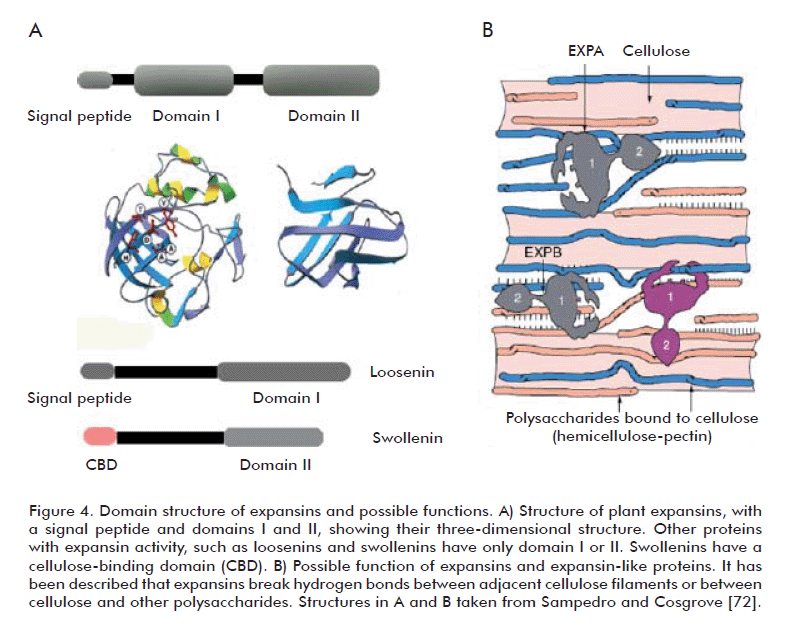
<body><![CDATA[<P   ><font size="2" face="Verdana, Arial, Helvetica, sans-serif"><b><font size="3">EXPANSINS:      PLANT CELL WALL-REMODELING PROTEINS </font></b></font></P >   <FONT size="+1">        <P   align="justify" ><font size="2" face="Verdana, Arial, Helvetica, sans-serif">In addition to lignocellulose-degrading      enzymes, there are also enzymes involved in remodeling the cell wall, denominated      expansins, which facilitate its later degradation. Expansins increase the      extensibility and relax the tension of plant cell walls. They were first identified      through studies of the mechanism involved in pH-dependent extension of plant      cell walls (&lsquo;acid growth&rsquo;) [62]. Plant cell wall pH is usually      determined by the activity of an H<Sup>+</Sup> ATPase localized to the plasma      membrane, which pumps protons onto the cell wall; it ranges from 5.5 to 4.5.      Low extracellular pH (lower than 5.5) causes the cell wall to relax, due mainly      to the action of expansins, whose optimum pH is acid [63]. McQueen-Mason <I>et      al</I>. [62] isolated two proteins from the cell walls of cucumber hypocotyls      that induced the extension of previously heat-inactivated cell walls. Cloning      and sequencing of expansin genes [64] revealed, after sequence homology searches      in genomic and expressed sequence tags (EST) databases, that expansins are      coded by large multigene families present from bryophytes to angiosperms [65].      Expansins are also present in monocotyledonous plants (rice, maize), dicotyledonous      plants (<I>Arabidopsis</I>), ferns and mosses [66]. </font></P >   <FONT size="+1"><FONT size="+1"><FONT size="+1">        <P   align="justify" ><font face="Verdana, Arial, Helvetica, sans-serif" size="2">After the discovery      of expansins, Cosgrove <I>et al</I>.[67] found that group I allergens from      grass pollen have regions of significant similarity with the aminoacid sequence      of expansins, and demonstrated that maize pollen extracts exhibited expansin      activity when applied <I>in vitro </I>to plant cell walls; a finding that      was later corroborated for group I allergens from pollen of other grasses.      These proteins with expansin activity secreted by pollen have been proposed      to participate in softening of the stigma and tissues of the style to facilitate      the penetration of pollen through the pollen tube [68]. Expansins have no      hydrolytic activity (glucosidase) and therefore, the bonds they break, if      any, are most likely non-covalent [69]. In fact, expansins have been suggested      to work by breaking hydrogen bonds between cellulose fibers or between cellulose      and other polysaccharides (xyloglucans), using a non-enzymatic mechanism [70-71]      (<a href="/img/revistas/bta/v28n4/f0401411.gif">Figure 4B</a>). Expansins have molecular weights ranging      from 25 to 28 kDa and, like cellulases, have a two-domain modular structure      and an approximately 20 aminoacids-long amino-terminal signal peptide [63].      Sequence identity among members of the expansin family is only 20 to 40%,      although the degree of sequence conservation is higher in domain I [71]. </font></P >       
<P   align="justify" ><font face="Verdana, Arial, Helvetica, sans-serif" size="2">Domain I occupies      the amino-terminal part of the protein, and adopts a DPBB (Double Psi Beta      Barrel) structure. It is homologous to the catalytic domain of members of      glucoside hydrolase family 45 (GH45), which includes mainly &beta;-1,4-endoglucanases      of fungal origin. The DPBB domain of members of this family adopts a six-stranded      beta barrel structure forming a substrate-binding groove [72]. There are a      number of cysteines residues in this domain that are conserved among members      of the GH45 family, and are involved in disulfide bonding in the case of fungal      enzymes. Despite the presence of the GH45 catalytic domain in expansins, no      hydrolytic activity has been detected for the latter [72]. Domain II, at the      C-terminal end, is homologous to group II pollen allergens from grasses. Some      authors have speculated that this might be a polysaccharide-binding domain,      due to the presence of aromatic and polar aminoacids on the protein surface,      where two tryptophans and one tyrosine would form a planar platform of aromatic      residues favoring such binding [63, 73]. Domain II folds as a &beta;-sandwich      formed by two sheets of four anti-parallel &beta; strands each (<a href="/img/revistas/bta/v28n4/f0401411.gif">Figure      4A</a>). In fact, a &beta;-sandwich formed by 3 to 6 &beta; strands per sheet      is the most common fold in carbohydrate-binding modules of proteins binding      substrates such as crystalline cellulose or chitin [74]. Whitney <I>et al</I>.      [75] incubated a compound of cellulose and xyloglucans of bacterial origin      with a cucumber expansin and detected a rapid relaxation of the structure      of said compound. This result, obtained through the use of &ldquo;artificial      cell walls&rdquo;, suggests that expansins modulate the binding between cellulose      fibers and xyloglucans, relaxing or breaking the bonds keeping them together.      Recently, Wei <I>et al</I>. [71] reported that a cucumber &alpha;-expansin      synergizes with a pectin lyase by breaking the hydrogen bonds between pectin      and xyloglucans. </font></P >       
<P   align="justify" ><font face="Verdana, Arial, Helvetica, sans-serif" size="2">A total of four families      are included in the expansin superfamily: &alpha; expansins (EXPA), &beta;      expansins (EXPB), &alpha;-expansin like-proteins (EXLA) and &beta;-expansin      like-proteins (EXLB) [72]. The EXPA family<B> </B>includes proteins participating      in the relaxation and extension of plant cell walls through a pH-dependent      mechanism. These proteins would participate in developmental processes such      as organogenesis [76], the degradation of cell walls during the ripening of      fruits [77-79] and other processes where extending the cell wall is crucial      [66, 80-81]. The EXPB<B> </B>family<B> </B>includes<B> </B>group I pollen      allergens from grasses. These proteins are secreted by pollen and have been      suggested to soften the tissues of the stigma and style to facilitate the      penetration of the pollen tube [67]. EXPB proteins, unlike EXPA members, relax      specifically the cell walls of grass cells, probably reflecting differences      regarding the organization of cell walls between grasses and dicotyledonous      plants [67]. An HFD motif has been found in domain I of EXPA and EXPB family      members that is known to form part of the active site of endoglucanases. EXLA      and EXLB do not have this sequence motif, which suggests that their mode of      action differs to that of the other expansins [72]. </font></P >       <P   align="justify" ><font face="Verdana, Arial, Helvetica, sans-serif" size="2">The EXLA and EXLB      families are comprised of proteins identified by sequence analysis which,      despite possessing the two-domain organization typical of expansins, have      a number of divergent sequence features that separate them from the EXPA and      EXPB families [82]. EXLA family members have a conserved CDRC motif towards      the N-terminal end of domain I, and an approximately 17 aminoacid long extension      towards the C-terminal end of domain II that is not found among the remaining      expansin families [72]. A recent report by Dermatsev<I> et al</I>. [83] ascribed      an important role to a tomato EXLB protein during early stages of the interaction      with the mycorrhizal fungus <I>Glomus intraradices</I>, based on the fact      that transiently silencing the transcription of the ELXB protein caused a      reduction in spore formation and arbuscular expansion. Another group included      in the superfamily is the X-like expansin family (EXLX), comprised of proteins      exhibiting weak sequence homology with the domains of EXPA and EXP members,      and identified in organisms other than plants [82], such as the mucilaginous      fungus <I>Dictyostelium </I>[84] and the bacteria <I>Bacillus subtilis, Clavibacter      michiganensis </I>and <I>Hahella chejuensis</I> [85-87] . </font></P >       <P   align="justify" ><font face="Verdana, Arial, Helvetica, sans-serif" size="2">The denomination      of expansin or expansin-like is reserved for proteins exhibiting both domain      I and domain II. Proteins with only one of these domains are not classified      as expansins [82]. </font></P >       <P   ><font size="2" face="Verdana, Arial, Helvetica, sans-serif"><b><font size="3">BIOLOGICAL      ROLE OF EXPANSINS</font></b> </font></P >   <FONT size="+1">        <P   align="justify" ><font size="2" face="Verdana, Arial, Helvetica, sans-serif">The role of expansins      has been studied using a diverse array of experimental approaches, ranging      from immunohistochemistry, gene expression analysis and ectopic expression      of expansin genes to gene silencing with antisense technology and transgenic      plants. </font></P >   <FONT size="+1">        <P   ><font face="Verdana, Arial, Helvetica, sans-serif" size="2"><b>Expansin immunohistochemistry      </b> </font></P >       ]]></body>
<body><![CDATA[<P   align="justify" ><font face="Verdana, Arial, Helvetica, sans-serif" size="2">Immunohistochemistry      has been used to locate expansins to meristems and growth zones of plant roots      and stems, as well as to forming leaf primordia in apical meristems and epidermal      cell walls of forming roots [76, 88]. Expansins have been found to be distributed      evenly along the cell wall, and are not restricted to specific sites or the      cell wall-cytoplasmic membrane interface. In some occasions, Golgi vesicles      are also labeled with expansin antibodies, indicating that expansins travel      to the cell wall via the secretory route [72]. </font></P >       <P   align="justify" ><font face="Verdana, Arial, Helvetica, sans-serif" size="2">Immunofluorescence      studies in fine roots from maize have shown expansins to accumulate at the      cytoplasm and cell wall of emerging primordia [89]. Expansins of the EXPB      family are quite abundant in pollen from prairie plants, and have been found      both on pollen surface and intracellularly [90]. </font></P >       <P   ><font face="Verdana, Arial, Helvetica, sans-serif" size="2"><b>Gene expression      analysis </b> </font></P >       <P   align="justify" ><font face="Verdana, Arial, Helvetica, sans-serif" size="2">Expansin gene expression      studies by Northern blot and <I>in situ </I>hybridization have shown these      genes to be subject to differential regulation depending on organ, tissue      and cell type under study, responding differently to plant hormone treatments,      light and pollination. These studies have revealed that expansins are involved      in a number of events, going from germination, fruit ripening and pollination      to growth responses under flood conditions. For instance, Reinhardt <I>et      al</I>. (88) found that gene <I>LeExp18, </I>coding for a tomato &alpha;-expansin,      was expressed during the formation of visible leaf primordia in the apical      meristems of tomato plants [88]. Another &alpha;-expansin is differentially      up-regulated during fruit ripening in tomato and strawberry [78-79]. Similarly,      transcripts from an &alpha;-expansin accumulate in the endosperm during the      germination of tomato seeds, possibly to remodel the cell wall and facilitate      the appearance of the radicle [91]. In maize, five genes coding for &alpha;      and &beta; expansins exhibited differential regulation patterns between seedlings      and adult plants for different organs. In rice internodes, gibberellin (GA)      induces the expression of five &beta;-expansin genes, whose levels correlate      positively with growth rate [92-93]. </font></P >       <P   ><font face="Verdana, Arial, Helvetica, sans-serif" size="2"><b>Ectopic expression      of expansin genes </b></font></P >       <P   align="justify" ><font face="Verdana, Arial, Helvetica, sans-serif" size="2">Pien <I>et al</I>.      [94] induced the local expression of the cucumber expansin gene <I>CsEx29</I>      in incipient leaf primordia of the apical meristems of tobacco leaves. The      results showed that the expansin induced early growth of leaf primordia with      a change in phylotaxis (arrangement of leaves along the shoot) for the apical      meristem. </font></P >       <P   align="justify" ><font face="Verdana, Arial, Helvetica, sans-serif" size="2">Applying expansins      to tomato leaf primordia forced their growth, resulting in deformed leaves,      as described by Fleming <I>et al</I>. [95]. The exogenous delivery of expansins      to <I>Arabidopsis </I>hypocotyls stimulates their expansion to a degree comparable      to that achieved when applying auxin at 1 &micro;M [81]. </font></P >       <P   ><font face="Verdana, Arial, Helvetica, sans-serif" size="2"><b>Use of antisense      sequences and expansin transgenic plants </b></font></P >       <P   align="justify" ><font face="Verdana, Arial, Helvetica, sans-serif" size="2">Although the multigene      nature of expansin families has hindered the task of determining the biological      role of individual genes, there are some results worth discussing in this      area. Cho and Cosgrove [96], for instance, used antisense sequences for an      <I>Arabidopsis </I>&alpha; expansin, observing that reductions in its steady      state levels were accompanied by significant reductions in growth rate<I>.</I>      Also, suppressing the expression of the tomato gene <I>LeEXPA1</I> during      ripening results in firmer fruits that can be stored for longer periods [97].      In most cases, silencing expansin genes leads to growth inhibition, whereas      excessive ectopic expression leads to abnormal growth. </font></P >       <P   align="justify" ><font face="Verdana, Arial, Helvetica, sans-serif" size="2">Expansins have been      identified as an important player in developmental processes requiring a decrease      of cell wall tension, such as fruit ripening [77, 97], the formation of xylem      [98], abscission during the development of parasite plants [99], seed germination      [91], the penetration of the pollen tube through the stigma [67, 100], association      with mycorrhizal fungi [83], the development of nitrogen-fixing nodules in      legumes [101], the development of parasite plants [102], and rehydration of      the resurrection plant, <I>Craterostigma plantagineum,</I> which coils when      dry and extends when hydrated [103]. </font></P >       ]]></body>
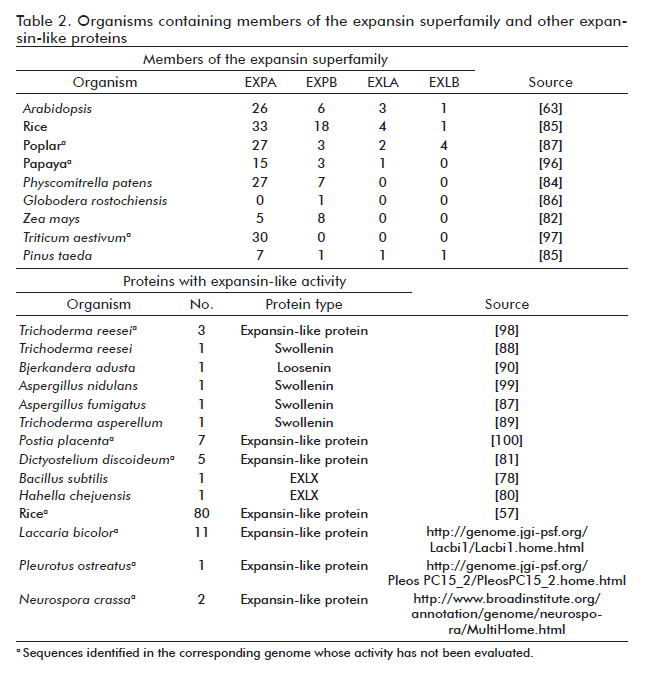
<body><![CDATA[<P   align="justify" ><font face="Verdana, Arial, Helvetica, sans-serif" size="2">Some plants adapted      to aquatic environments elongate markedly when flooded, which correlates with      the activation of expansin genes [69, 104]. Rice, for instance, when flooded      and subjected to hypoxia, increases the expression of an &alpha; expansin,      and increases growth of the coleoptile. Similarly, there was a positive correlation      between growth of cotton fibers and the expression of &alpha; expansin genes      during the early stage of elongation [105-106]. </font></P >       <P   align="justify" ><font face="Verdana, Arial, Helvetica, sans-serif" size="2">Expansin genes are      also induced under drought; for instance, leaf shoots of the temperature-tolerant      grass <I>Agrostis scabra </I>induce the <I>AsEXP1</I> gene, coding for an      expansin-like protein, after a 1 hour exposure to heat stress [107]. In the      resurrection plant, <I>C. plantagineum, </I>there is a correlation between      the extension of leaves during dehydration and increased levels of &alpha;-expansin      transcripts in the cell walls of leaves, suggesting a role for these proteins      in the regulation of leaf growth during dehydration. The involvement of expansins      in drought and dehydration-related processes must, however, be investigated      further [103]. </font></P >       <P   ><font size="3" face="Verdana, Arial, Helvetica, sans-serif"><b>TAXONOMIC DIVERSITY      OF EXPANSINS </b></font></P >   <FONT size="+1">        <P   align="justify" ><font size="2" face="Verdana, Arial, Helvetica, sans-serif">Expansins and expansin-like      proteins have been detected in angiosperms such as <I>Arabidopsis thaliana,      Oryza sativa, Zea mays </I>and <I>Triticum aestivum</I> [65, 93, 108-109],      gymnosperms such as pine and poplar, ferns such as <I>Regnellidium diphyllum      </I>and <I>Marsilea quadrifolia </I>and the moss <I>Physcomitrella patens.      </I>Some members of the expansin superfamily have been found even in a potato-infecting      nematode, <I>Globodera rostochiensis</I>, where they are hypothesized to favor      the infection process [108, 110-112] (<a href="/img/revistas/bta/v28n4/t0201411.gif">Table 2</a>).      Active EXLX members have been also described in <I>Dictyostelium discoideum</I>,      the bacteria <I>B. subtilis, Xylella fastidiosa</I> and <I>C. michiganensis,      </I>and the marine bacterium <I>H. chejuensis</I> [84-87, 108]. </font></P >   <FONT size="+1">        
<P   ><font size="3" face="Verdana, Arial, Helvetica, sans-serif"><b>OTHER PROTEINS      WITH EXPANSIN-LIKE ACTIVITY </b></font></P >   <FONT size="+1">        <P   align="justify" ><font size="2" face="Verdana, Arial, Helvetica, sans-serif">The expansin-like      proteins described for fungi such as <I>T. reesei, </I>which utilizes plant      material, may obviously participate in the degradation of cellulose. In other      words, fungal expansins and expansin-like proteins may be involved in plant      pathogenesis or in the degradation of cell walls, aimed at using its components      as carbon source [108]. Proteins with expansin-like activity denominated swollenins      have been identified in ascomycete fungi such as <I>Trichoderma </I>and <I>Aspergillus</I>      [113-115] (<a href="/img/revistas/bta/v28n4/t0201411.gif">Table 2</a>). Saloheimo<I> et al</I>.<I>      </I>[114] cloned and expressed in <I>S. cerevisiae </I>a swollenin gene from      <I>T. reesei </I>denominated <I>swo1,</I> coding for a protein that modifies      the structure of cellulose in swollen regions of cotton fibers (hence the      name) without releasing reducing sugars. Swo1 is a fungal expansin-like protein,      containing a pollen allergen domain and a cellulose-binding domain. </font></P >   <FONT size="+1">        
<P   align="justify" ><font face="Verdana, Arial, Helvetica, sans-serif" size="2">Other fungal swollenins      include the one described for <I>Trichoderma asperellum</I> [115]. This protein      has been ascribed an important role in the process of colonization of cucumber      roots, since its overexpression increases the colonization success rate. </font></P >       <P   align="justify" ><font face="Verdana, Arial, Helvetica, sans-serif" size="2">Proteins with expansin      activity could be used to improve the efficiency of cellulose bioconversion      processes. For example, a swollenin purified from <I>Aspergillus fumigates      </I>has been used in combination with cellulases to facilitate the saccharification      of microcrystalline cellulose (Avicel) [113]. Kim <I>et al</I>. [85] also      described the synergism of an EXLX from <I>B. subtilis</I> in the enzymatic      hydrolysis of cellulose. Recently, Quiroz-Casta&ntilde;eda <I>et al</I>. [116]      cloned and characterized a new protein with expansin activity from the basidiomycete      fungus <I>Bjerkandera adusta, </I>denominated loosenin (LOOS1). This protein      only contains a DPBB domain, and is able to relax the structure of cotton,      enhancing up to 7.5-fold the rate of release of reducing sugars from agave      (<I>Agave tequilana</I>) fiber. Given the optimum pH of LOOS1 (pH 5), it could      be applied to processes of saccharification from natural substrates, facilitating      the release of reducing sugars together with cellulases and expansin-like      proteins. For example, it might be used as an additive to obtain fermentable      sugars from lignocellulose. The idea of using plant expansins in saccharification      processes has, in fact, been patented [117]. </font></P >       <P   ><font size="3" face="Verdana, Arial, Helvetica, sans-serif"><b>BIOTECHNOLOGICAL      POTENTIAL OF LIGNOCELLULOSE </b></font></P >   <FONT size="+1">        <P   align="justify" ><font size="2" face="Verdana, Arial, Helvetica, sans-serif">Using lignocellulose      materials means, in the first place, gaining access to the hemicellulose and      cellulose embedded within the lignin matrix. The timber and wood industries,      as well as gardening activities and agriculture, generate huge amounts of      lignocellulosic leftovers every year [28] that can be potentially put to use      in the preparation of animal fodder or the generation of biofuels. In 2008      alone, two countries, the United States and Brazil, accounted for 90% approximately      (out of a total of 12.3 billion gallons) of the global production of ethanol.      Brazil produces ethanol from sugarcane juice, employing a total of 344 production      plants, whereas the United States obtains ethanol from cornstarch, employing      217 production plants [17]. </font></P >   <FONT size="+1">        ]]></body>
<body><![CDATA[<P   align="justify" ><font face="Verdana, Arial, Helvetica, sans-serif" size="2">The use of sugarcane      juice or cornstarch for producing ethanol has turned out to be highly controversial      though, as it competes with the production of food and is relatively expensive,      making ethanol less cost-efficient than currently used fossil fuels. </font></P >       <P   align="justify" ><font face="Verdana, Arial, Helvetica, sans-serif" size="2">These problems have      prompted a search for alternative raw materials to produce biofuels, among      which lignocellulosic materials occupy a relevant position. One illustration      of the potential of lignocellulosic materials for the production of biofuels      is provided by a plant run in Canada by Iogen Corporation, which produces      over 3 million liters of ethanol from 30 tons of wheat, oat and rye straw      per day [118, 119]. As mentioned above, the degradation of lignocellulosic      biomass depends on the accessibility of cellulose and hemicellulose contained      therein and the subsequent hydrolysis of these polysaccharides into 5- and      6-carbon sugars, which are then turned into ethanol by fermentation. Inbicon,      a Danish company, has built a proof-of-concept plant for producing ethanol      from plant biomass with an annual capacity of 1.4 million gallons, and Japan-owned      Nippon Oil has built plants for the production of biofuels from cellulose      that are slated to produce some 67 billion gallons by 2014 [118]. In Europe,      the production of bioethanol from lignocellulosic waste has increased with      the participation of Finnish companies such as SEKAB, with expertise in the      use of sugarcane bagasse and sawdust for this purpose. Recently, in India,      Praj Industries has built two plants processing up to 2 tons per day of corn      stubbles, cobs and bagasse as well as agricultural waste and sawdust, producing      ethanol from processes based on pre-treatments that efficiently remove and      separate lignin from its accompanying polysaccharides [118]. </font></P >       <P   align="justify" ><font face="Verdana, Arial, Helvetica, sans-serif" size="2">The current option      for obtaining biofuels in Latin America is the use of non-cellulosic compounds.      This production has seen its volume increase in the last years, and biofuels      are currently produced from sugarcane and wheat by countries such as Brazil,      Colombia, Paraguay and Costa Rica. In Mexico, the production of ethanol as      biofuels is limited to two plants with an annual output of 2 million liters,      obtained from sugarcane. In Argentina ethanol is produced from molasses and      sorghum. In Central American countries like El Salvador, Nicaragua and Guatemala,      the production of bioethanol is not significant and the necessary infrastructure      is still under construction; however, there is government support for developing      this industry [120]. The main challenge posed by the conversion of biomass      into ethanol is to increase yields to the point that it becomes competitive,      from a cost perspective, with currently used fossil fuels [28]. Yields, however,      are limited by the lignin matrix protecting cellulose and hemicellulose from      degradation, in addition to the presence of crystalline regions in cellulose      hindering its hydrolysis. These barriers are currently dealt with using chemical      and physical pretreatments that constitute, therefore, a necessary prerequisite      for its degradation. Such pretreatments employ high temperatures and extreme      pH; a costly and often inefficient option. In addition, they often generate      compounds that inhibit later fermentative stages, such as furans and phenolic      derivatives [121]. </font></P >       <P   align="justify" ><font face="Verdana, Arial, Helvetica, sans-serif" size="2">Expansins constitute      a potentially useful tool in the utilization of lignocellulosic biomass with      biotechnological purposes, as they would optimize the degradation of cellulosic      material by relaxing the tension of cell walls under slightly acid conditions      (pH &le; 5.0), similar to those optimal for the action of most cellulases.      The pH normally employed in current saccharification and fermentation processes      for the production of biofuels falls precisely within this range (4.8 to 5),      and therefore expansins might be used as additives to enhance the efficiency      of enzymatic saccharification [122]. </font></P >       <P   ><font size="3" face="Verdana, Arial, Helvetica, sans-serif"><b>CONCLUSIONS </b></font></P >   <FONT size="+1">        <P   align="justify" ><font size="2" face="Verdana, Arial, Helvetica, sans-serif">There are advantages      to using lignocellulosic material over sugar (sugarcane or starch) as starting      material for the production of bioethanol, including, but not limited to,      its availability and low cost. One of its fundamental limitations, however,      is the need to degrade lignocellulose; a material that, owing to its composition      and structure, is refractory to degradation by most organisms and is therefore      seldom used as carbon source in nature. It is possible to release fermentable      sugars from plant biomass with the use of cellulolytic and xylanolytic enzymes.      Recently, it has been described that proteins with expansin activity from      fungi, bacteria and plants can be used to remodel plant cell walls, making      them more amenable to enzymatic degradation and increasing considerably the      efficiency of their release. Applying these new proteins and increasing the      efficiency of these processes would enable the production of larger amounts      of sugars from lignocellulosic waste, which would then become a very attractive      starting material for obtaining biofuels. </font></P >   <FONT size="+1">        <P   align="justify" > </P >       <P   align="justify" ><b><font face="Verdana, Arial, Helvetica, sans-serif" size="3">REFERENCES </font></b></P >       <P   align="justify" > </P >       <!-- ref --><P   align="justify" ><font size="2" face="Verdana, Arial, Helvetica, sans-serif">1. Zhang YH, Lynd      LR. Toward an aggregated understanding of enzymatic hydrolysis of cellulose:      noncomplexed cellulase systems. Biotechnol Bioeng. 2004; 88(7):797-824.     </font></P >   <FONT size="+1">        <!-- ref --><P   align="justify" ><font face="Verdana, Arial, Helvetica, sans-serif" size="2">2. Zhong R, Ye ZH.      Regulation of cell wall biosynthesis. Curr Opin Plant Biol. 2007; 10(6):564-72.          </font></P >       <!-- ref --><P   align="justify" ><font face="Verdana, Arial, Helvetica, sans-serif" size="2">3. Lynd LR, Weimer      PJ, van Zyl WH, Pretorius IS. Microbial cellulose utilization: fundamentals      and biotechnology. Microbiol Mol Biol Rev. 2002;66(3):506-77.     </font></P >       <!-- ref --><P   align="justify" ><font face="Verdana, Arial, Helvetica, sans-serif" size="2">4. Aro N, Pakula      T, Penttil&auml; M. Transcriptional regulation of plant cell wall degradation      by filamentous fungi. FEMS Microbiol Rev. 2005;29(4):719-39.     </font></P >       <!-- ref --><P   align="justify" ><font face="Verdana, Arial, Helvetica, sans-serif" size="2">5. Gray KA, Zhao      L, Emptage M. Bioethanol. Curr Opin Chem Biol. 2006;10(2): 141-6.     </font></P >       <!-- ref --><P   align="justify" ><font face="Verdana, Arial, Helvetica, sans-serif" size="2">6. Fry SC. Plant      Cell Walls. In: Encyclopedia of Life Sciences [Internet]. Chichester: John      Wiley &amp; Sons Ltd: 2001 Apr [cited 2011 May 17]. Available in: <a href="http://www.els.net/WileyCDA/ElsArticle/refId-a0001682.html" target="_blank">http://www.els.net/WileyCDA/ElsArticle/refId-a0001682.html</a>      </font></P >       <!-- ref --><P   align="justify" ><font face="Verdana, Arial, Helvetica, sans-serif" size="2">7. Levy I, Shani      Z, Shoseyov O. Modification of polysaccharides and plant cell wall by endo-1,4-beta-glucanase      and cellulose-binding domains. Biomol Eng. 2002;19(1):17-30.     </font></P >       <!-- ref --><P   align="justify" ><font face="Verdana, Arial, Helvetica, sans-serif" size="2">8. Hild&eacute;n      L, Johansson G. Recent developments on cellulases and carbohydrate-binding      modules with cellulose affinity. Biotechnol Lett. 2004;26(22):1683-93.     </font></P >       <!-- ref --><P   align="justify" ><font face="Verdana, Arial, Helvetica, sans-serif" size="2">9. P&eacute;rez J,      Mu&ntilde;oz-Dorado J, de la Rubia T, Mart&iacute;nez J. Biodegradation and      biological treatments of cellulose, hemicellulose and lignin: an overview.      Int Microbiol. 2002; 5(2):53-63.     </font></P >       <!-- ref --><P   align="justify" ><font face="Verdana, Arial, Helvetica, sans-serif" size="2">10. Atalla R. The      Structures of Native Celluloses. 10th international symposium on wood and      pulping chemistry. TAPPI Press. 1993;1:608-14.     </font></P >       <!-- ref --><P   align="justify" ><font face="Verdana, Arial, Helvetica, sans-serif" size="2">11. B&eacute;guin      P, Aubert JP. The biological degradation of cellulose. FEMS Microbiol Rev.      1994;13(1):25-58.     </font></P >       ]]></body>
<body><![CDATA[<!-- ref --><P   align="justify" ><font face="Verdana, Arial, Helvetica, sans-serif" size="2">12. Mart&iacute;nez      AT, Speranza M, Ruiz-Due&ntilde;as FJ, Ferreira P, Camarero S, Guill&eacute;n      F, et al. Biodegradation of lignocellulosics: microbial, chemical, and enzymatic      aspects of the fungal attack of lignin. Int Microbiol. 2005;8(3):195-204.          </font></P >       <!-- ref --><P   align="justify" ><font face="Verdana, Arial, Helvetica, sans-serif" size="2">13. Saha BC. Hemicellulose      bioconversion. J Ind Microbiol Biotechnol. 2003;30(5): 279-91.     </font></P >       <!-- ref --><P   align="justify" ><font face="Verdana, Arial, Helvetica, sans-serif" size="2">14. Kumar R, Singh      S, Singh OV. Bioconversion of lignocellulosic biomass: biochemical and molecular      perspectives. J Ind Microbiol Biotechnol. 2008;35(5):377-91.     </font></P >       <!-- ref --><P   align="justify" ><font face="Verdana, Arial, Helvetica, sans-serif" size="2">15. Scheller H, Ulvskov      P. Hemicelluloses. Annu Rev Plant Biol. 2010;61:263-89.     </font></P >       <!-- ref --><P   align="justify" ><font face="Verdana, Arial, Helvetica, sans-serif" size="2">16. Laureano-Perez      L, Teymouri F, Alizadeh H, Dale BE. Understanding factors that limit enzymatic      hydrolysis of biomass: characterization of pretreated corn stover. Appl Biochem      Biotechnol. 2005;121-124: 1081-99.     </font></P >       ]]></body>
<body><![CDATA[<!-- ref --><P   align="justify" ><font face="Verdana, Arial, Helvetica, sans-serif" size="2">17. S&aacute;nchez      C. Lignocellulosic residues: biodegradation and bioconversion by fungi. Biotechnol      Adv. 2009;27(2):185-94.     </font></P >       <!-- ref --><P   align="justify" ><font face="Verdana, Arial, Helvetica, sans-serif" size="2">18. Cunningham RE,      L&oacute;pez GD. Etanol de lignocelul&oacute;sicos: Tecnolog&iacute;a y perspectivas.      Santa Fe: Universidad de Santiago de Compostela, Servicio de Publicaciones      e Intercambio Cient&iacute;fico; 1994.     </font></P >       <!-- ref --><P   align="justify" ><font face="Verdana, Arial, Helvetica, sans-serif" size="2">19. Hammel KA. Extracellular      free radical biochemistry of ligninolytic fungi. New J Chem. 1996;20:195-8.          </font></P >       <!-- ref --><P   align="justify" ><font face="Verdana, Arial, Helvetica, sans-serif" size="2">20. Doi RH. Cellulases      of mesophilic microorganisms: cellulosome and noncellulosome producers. Ann      New York Acad Sci. 2008;1125:267-79.     </font></P >       <!-- ref --><P   align="justify" ><font face="Verdana, Arial, Helvetica, sans-serif" size="2">21. Khanna S, Gauri.      Regulation, purification, and properties of xylanase from Cellulomonas fimi.      Enzyme Microbial Technol. 1993;15(11):990-5.     </font></P >       ]]></body>
<body><![CDATA[<!-- ref --><P   align="justify" ><font face="Verdana, Arial, Helvetica, sans-serif" size="2">22. Braithwaite KL,      Black GW, Hazlewood GP, Ali BR, Gilbert HJ. A non-modular endo-beta-1,4-mannanase      from Pseudomonas fluorescens subspecies cellulosa. Biochem J. 1995;305(Pt      3):1005-10.     </font></P >       <!-- ref --><P   align="justify" ><font face="Verdana, Arial, Helvetica, sans-serif" size="2">23. Arcand N, Kluepfel      D, Paradis FW, Morosoli R, Shareck F. Beta-mannanase of Streptomyces lividans      66: cloning and DNA sequence of the manA gene and characterization of the      enzyme. Biochem J. 1993;290(Pt 3):857-63.     </font></P >       <!-- ref --><P   align="justify" ><font face="Verdana, Arial, Helvetica, sans-serif" size="2">24. Murty MV, Chandra      TS. Purification and properties of an extra cellular xylanase enzyme of Clostridium      strain SAIV. Antonie van Leeuwenhoek. 1992;61(1):35-41.     </font></P >       <!-- ref --><P   align="justify" ><font face="Verdana, Arial, Helvetica, sans-serif" size="2">25. Lin LL, Thomson      JA. An analysis of the extracellular xylanases and cellulases of Butyrivibrio      fibrisolvens H17c. FEMS Microbiology Letters. 1991;84(2):197-204.     </font></P >       <!-- ref --><P   align="justify" ><font face="Verdana, Arial, Helvetica, sans-serif" size="2">26. Tomme P, Warren      RA, Gilkes NR. Cellulose hydrolysis by bacteria and fungi. Adv Microb Physiol.      1995;37:1-81.     </font></P >       ]]></body>
<body><![CDATA[<!-- ref --><P   align="justify" ><font face="Verdana, Arial, Helvetica, sans-serif" size="2">27. Sonan GK, Receveur-Brechot      V, Duez C, Aghajari N, Czjzek M, Haser R, et al. The linker region plays a      key role in the adaptation to cold of the cellulase from an Antarctic bacterium.      Biochem J. 2007; 407(2):293-302.     </font></P >       <!-- ref --><P   align="justify" ><font face="Verdana, Arial, Helvetica, sans-serif" size="2">28. Dashtban M, Schraft      H, Qin W. Fungal bioconversion of lignocellulosic residues; opportunities      &amp; perspectives. Int J Biol Sci. 2009;5(6):578-95.     </font></P >       <!-- ref --><P   align="justify" ><font face="Verdana, Arial, Helvetica, sans-serif" size="2">29. Lee SS, Ha JK,      Kang HS, Mcallister TA, Cheng KJ. Overview of energy metabolism, substrate      utilization and fermentation characteristics of ruminal anaerobic fungi. Korean      J Anim Nutr Feedstuffs. 1997; 21(4):295-314.     </font></P >       <!-- ref --><P   align="justify" ><font face="Verdana, Arial, Helvetica, sans-serif" size="2">30. Nicholson MJ,      Theodorou MK, Brookman JL. Molecular analysis of the anaerobic rumen fungus      Orpinomyces - insights into an AT-rich genome. Microbiology. 2005;151(Pt 1):121-33.          </font></P >       <!-- ref --><P   align="justify" ><font face="Verdana, Arial, Helvetica, sans-serif" size="2">31. Eberhardt RY,      Gilbert HJ, Hazlewood GP. Primary sequence and enzymic properties of two modular      endoglucanases, Cel5A and Cel45A, from the anaerobic fungus Piromyces equi.      Microbiology. 2000;146(Pt 8):1999-2008.     </font></P >       ]]></body>
<body><![CDATA[<!-- ref --><P   align="justify" ><font face="Verdana, Arial, Helvetica, sans-serif" size="2">32. Steenbakkers      PJM, Li XL, Ximenes EA, Arts JG, Chen H, Ljungdahl LG, et al. Noncatalytic      docking Domains of cellulosomes of anaerobic fungi. J Bacteriol. 2001 Sep;183(18):5325-33.          </font></P >       <!-- ref --><P   align="justify" ><font face="Verdana, Arial, Helvetica, sans-serif" size="2">33. Quiroz-Casta&ntilde;eda      RE, Balc&aacute;zar-L&oacute;pez E, Dant&aacute;n-Gonz&aacute;lez E, Martinez      A, Folch-Mallol J, Mart&iacute;nez C. Characterization of cellulolytic activities      of Bjerkandera adusta and Pycnoporus sanguineus on solid wheat straw medium.      Electr J Biotechnol. 2009 Oct 15 [cited 2011 May 17];12(4)[about 13 p.]. Available      from: <a href="http://www.ejbiotechnology.cl/content/vol12/issue4/full/3/index.html" target="_blank">http://www.ejbiotechnology.cl/content/vol12/issue4/full/3/index.html</a>.          </font></P >       <!-- ref --><P   align="justify" ><font face="Verdana, Arial, Helvetica, sans-serif" size="2">34. Ding S, Ge W,      Buswell JA. Cloning of multiple cellulase cDNAs from Volvariella volvacea      and their differential expression during substrate colonization and fruiting.      FEMS Microbiol Lett. 2006;263(2):207-13.     </font></P >       <!-- ref --><P   align="justify" ><font face="Verdana, Arial, Helvetica, sans-serif" size="2">35. Koseki T, Mese      Y, Fushinobu S, Masaki K, Fujii T, Ito K, et al. Biochemical characterization      of a glycoside hydrolase family 61 endoglucanase from Aspergillus kawachii.      Appl Microbiol Biotechnol. 2008;77(6):1279-85.     </font></P >       <!-- ref --><P   align="justify" ><font face="Verdana, Arial, Helvetica, sans-serif" size="2">36. Chi Z, Chi Z,      Zhang T, Liu G, Li J, Wang X. Production, characterization and gene cloning      of the extracellular enzymes from the marine-derived yeasts and their potential      applications. Biotechnol Adv. 2009;27(3):236-55.     </font></P >       ]]></body>
<body><![CDATA[<!-- ref --><P   align="justify" ><font face="Verdana, Arial, Helvetica, sans-serif" size="2">37. Kikuchi T, Jones      JT, Aikawa T, Kosaka H, Ogura N. A family of glycosyl hydrolase family 45      cellulases from the pine wood nematode Bursaphelenchus xylophilus. FEBS Lett.      2004;572(1-3):201-5.     </font></P >       <P   align="justify" ><font face="Verdana, Arial, Helvetica, sans-serif" size="2">38. CAZy. Carbohydrate-Active      Enzymes. Glycoside Hydrolase family classification [Internet]. Marseille:      AFMB - CNRS - Universit&eacute;s Aix-Marseille I &amp; II. c1998-2011 &ndash;      [updated 2011 Nov 18, cited 2011 Nov 21]. Available from: <a href="http://www.cazy.org/Glycoside-Hydrolases.html" target="_blank">http://www.cazy.org/Glycoside-Hydrolases.html</a>.      </font></P >       <!-- ref --><P   align="justify" ><font face="Verdana, Arial, Helvetica, sans-serif" size="2">39. Divne C, St&aring;hlberg      J, Teeri TT, Jones TA. High-resolution crystal structures reveal how a cellulose      chain is bound in the 50 A long tunnel of cellobiohydrolase I from Trichoderma      reesei. J Mol Biol. 1998; 275(2):309-25.     </font></P >       <P   align="justify" ><font face="Verdana, Arial, Helvetica, sans-serif" size="2">40. Stone B. Cellulose:      Biogenesis and Biodegradation. In: Encyclopedia of Life Sciences [Internet].      Chichester: John Wiley &amp; Sons Ltd: 2005 Sep [cited 2011 May 17]. [cited      2011 May 17]. Available in: <a href="http://www.els.net/WileyCDA/ElsArticle/refId-a0003297.html" target="_blank">http://www.els.net/WileyCDA/ElsArticle/refId-a0003297.html</a>.      </font></P >       <!-- ref --><P   align="justify" ><font face="Verdana, Arial, Helvetica, sans-serif" size="2">41. Sadana JC, Patil      RV. 1,4-beta-D-glucan cellobiohydrolase from Sclerotium rolfsii. Methods Enzymol.      1988;160:307-14.     </font></P >       <!-- ref --><P   align="justify" ><font face="Verdana, Arial, Helvetica, sans-serif" size="2">42. Baldrian P, Val&aacute;skov&aacute;      V. Degradation of cellulose by basidiomycetous fungi. FEMS Microbiol Rev.      2008;32(3):501-21.     </font></P >       ]]></body>
<body><![CDATA[<!-- ref --><P   align="justify" ><font face="Verdana, Arial, Helvetica, sans-serif" size="2">43. Hamada N, Ishikawa      K, Fuse N, Kodaira R, Shimosaka M, Amano Y, et al. Purification, characterization      and gene analysis of exo-cellulase II (Ex-2) from the white rot basidiomycete      Irpex lacteus. J Biosci Bioeng. 1999;87(4):442-51.     </font></P >       <!-- ref --><P   align="justify" ><font face="Verdana, Arial, Helvetica, sans-serif" size="2">44. Yoon JJ, Kim      YK. Degradation of crystalline cellulose by the brown-rot basidiomycete Fomitopsis      palustris. J Microbiol. 2005;43(6):487-92.     </font></P >       <!-- ref --><P   align="justify" ><font face="Verdana, Arial, Helvetica, sans-serif" size="2">45. Lynd LR, Cushman      JH, Nichols RJ, Wyman CE. Fuel ethanol from cellulosic biomass. Science. 1991;251(4999):1318-23.          </font></P >       <!-- ref --><P   align="justify" ><font face="Verdana, Arial, Helvetica, sans-serif" size="2">46. Sadana JC, Lachke      AH, Patil RV. Endo-(1-4)-beta-D-glucanases from Sclerotium rolfsii -purification,      substrate specificity, and mode of action. Carbohydr Res. 1984; 133:297-312.          </font></P >       <!-- ref --><P   align="justify" ><font face="Verdana, Arial, Helvetica, sans-serif" size="2">47. Ding SJ, Ge W,      Buswell J. Secretion, purification and characterisation of a recombinant Volvariella      volvacea endoglucanase expressed in the yeast Pichia pastoris. Enzyme Microbial      Technol. 2002; 31:621-6.     </font></P >       ]]></body>
<body><![CDATA[<!-- ref --><P   align="justify" ><font face="Verdana, Arial, Helvetica, sans-serif" size="2">48. Val&aacute;skov&aacute;      V, Baldrian P. Degradation of cellulose and hemicelluloses by the brown rot      fungus Piptoporus betulinus - production of extracellular enzymes and characterization      of the major cellulases. Microbiology. 2006;152:3613-22.     </font></P >       <!-- ref --><P   align="justify" ><font face="Verdana, Arial, Helvetica, sans-serif" size="2">49. Onishi N, Tanaka      T. Purification and properties of a galacto- and gluco-oligosaccharide-producing      betaglycosidase from Rhodotorula minuta IFO879. J Ferment Bioeng. 1996;82(5):439-43.          </font></P >       <!-- ref --><P   align="justify" ><font face="Verdana, Arial, Helvetica, sans-serif" size="2">50. Polizeli ML,      Rizzatti AC, Monti R, Terenzi HF, Jorge JA, Amorim DS. Xylanases from fungi:      properties and industrial applications. Appl Microbiol Biotechnol. 2005; 67(5):577-91.          </font></P >       <!-- ref --><P   align="justify" ><font face="Verdana, Arial, Helvetica, sans-serif" size="2">51. Kimura I, Sasahara      H, Tajima S. Purification and characterization of two xylanases and an arabinofuranosidase      from Aspergillus sojae. J Ferment Bioeng. 1995;80(4):334-9.     </font></P >       <!-- ref --><P   align="justify" ><font face="Verdana, Arial, Helvetica, sans-serif" size="2">52. Hermoso JA, Sanz-Aparicio      J, Molina R, Juge N, Gonz&aacute;lez R, Faulds CB. The crystal structure of      feruloyl esterase A from Aspergillus niger suggests evolutive functional convergence      in feruloyl esterase family. J Mol Biol. 2004;338(3):495-506.     </font></P >       ]]></body>
<body><![CDATA[<!-- ref --><P   align="justify" ><font face="Verdana, Arial, Helvetica, sans-serif" size="2">53. Ram&iacute;rez      L, Arrizon J, Sandoval G, Cardador A, Bello-Mendoza R, Lappe P, et al. A new      microplate screening method for the simultaneous activity quantification of      feruloyl esterases, tannases, and chlorogenate esterases. Appl Biochem Biotechnol.      2008;151(2-3):711-23.     </font></P >       <!-- ref --><P   align="justify" ><font face="Verdana, Arial, Helvetica, sans-serif" size="2">54. Liu X, Ding S.      Molecular characterization of a new acetyl xylan esterase (AXEII) from edible      straw mushroom Volvariella volvacea with both de-O-acetylation and de-N-acetylation      activity. FEMS Microbiol Lett. 2009;295(1):50-6.     </font></P >       <!-- ref --><P   align="justify" ><font face="Verdana, Arial, Helvetica, sans-serif" size="2">55. Selig MJ, Knoshaug      EP, Adney WS, Himmel ME, Decker SR. Synergistic enhancement of cellobiohydrolase      performance on pretreated corn stover by addition of xylanase and esterase      activities. Bioresour Technol. 2008;99(11):4997-5005.     </font></P >       <!-- ref --><P   align="justify" ><font face="Verdana, Arial, Helvetica, sans-serif" size="2">56. Boerjan W, Ralph      J, Baucher M. Lignin biosynthesis. Annu Rev Plant Biol. 2003; 54:519-46.     </font></P >       <!-- ref --><P   align="justify" ><font face="Verdana, Arial, Helvetica, sans-serif" size="2">57. Ikehata K, Buchanan      I, Smith D. Recent developments in the production of extracellular fungal      peroxidases and laccases for waste treatment. J Environ Eng Science. 2004;3(19):1-19.          </font></P >       ]]></body>
<body><![CDATA[<!-- ref --><P   align="justify" ><font face="Verdana, Arial, Helvetica, sans-serif" size="2">58. Camarero S, Sarkar      S, Ruiz-Due&ntilde;as FJ, Mart&iacute;nez MJ, Mart&iacute;nez AT. Description      of a versatile peroxidase involved in the natural degradation of lignin that      has both manganese peroxidase and lignin peroxidase substrate interaction      sites. J Biol Chem. 1999;274(15):10324-30.     </font></P >       <!-- ref --><P   align="justify" ><font face="Verdana, Arial, Helvetica, sans-serif" size="2">59. Wang Y, Vazquez-Duhalt      R, Pickard MA. Manganese-lignin peroxidase hybrid from Bjerkandera adusta      oxidizes polycyclic aromatic hydrocarbons more actively in the absence of      manganese. Can J Microbiol. 2003;49(11):675-82.     </font></P >       <!-- ref --><P   align="justify" ><font face="Verdana, Arial, Helvetica, sans-serif" size="2">60. Mester T, Field      JA. Characterization of a novel manganese peroxidase-lignin peroxidase hybrid      isozyme produced by Bjerkandera species strain BOS55 in the absence of manganese.      J Biol Chem. 1998;273(25):15412-7.     </font></P >       <!-- ref --><P   align="justify" ><font face="Verdana, Arial, Helvetica, sans-serif" size="2">61. Dant&aacute;n-Gonz&aacute;lez      E, Vite-Vallejo O, Mart&iacute;nez-Anaya C, M&eacute;ndez-S&aacute;nchez M,      Gonz&aacute;lez MC, Palomares LA, et al. Production of two novel laccase isoforms      by a thermotolerant strain of Pycnoporus sanguineus isolated from an oil-polluted      tropical habitat. Int Microbiol. 2008 Sep;11(3):163-9.     </font></P >       <!-- ref --><P   align="justify" ><font face="Verdana, Arial, Helvetica, sans-serif" size="2">62. McQueen-Mason      S, Durachko DM, Cosgrove DJ. Two endogenous proteins that induce cell wall      extension in plants. Plant Cell. 1992;4(11):1425-33.     </font></P >       ]]></body>
<body><![CDATA[<!-- ref --><P   align="justify" ><font face="Verdana, Arial, Helvetica, sans-serif" size="2">63. Cosgrove DJ.      Loosening of plant cell walls by expansins. Nature. 2000; 407(6802):321-6.          </font></P >       <!-- ref --><P   align="justify" ><font face="Verdana, Arial, Helvetica, sans-serif" size="2">64. Shcherban TY,      Shi J, Durachko DM, Guiltinan MJ, McQueen-Mason SJ, Shieh M, et al. Molecular      cloning and sequence analysis of expansins-a highly conserved, multigene family      of proteins that mediate cell wall extension in plants. Proc Natl Acad Sci      USA. 1995; 92(20):9245-9.     </font></P >       <!-- ref --><P   align="justify" ><font face="Verdana, Arial, Helvetica, sans-serif" size="2">65. Li Y, Jones L,      McQueen-Mason S. Expansins and cell growth. Curr Opin Plant Biol. 2003;6(6):603-10      </font></P >       <!-- ref --><P   align="justify" ><font face="Verdana, Arial, Helvetica, sans-serif" size="2">66. Lee Y, Choi D,      Kende H. Expansins: ever-expanding numbers and functions. Curr Opin Plant      Biol. 2001;4(6):527-32.     </font></P >       <!-- ref --><P   align="justify" ><font face="Verdana, Arial, Helvetica, sans-serif" size="2">67. Cosgrove DJ,      Bedinger P, Durachko DM. Group I allergens of grass pollen as cell wall-loosening      agents. Proc Natl Acad Sci USA. 1997;94(12):6559-64.     </font></P >       <!-- ref --><P   align="justify" ><font face="Verdana, Arial, Helvetica, sans-serif" size="2">68. Li LC, Cosgrove      DJ. Grass group I pollen allergens (b-expansins) lack proteinase activity      and do not cause wall loosening via proteolysis. Eur J Biochem. 1999; 263(1):33-40.          </font></P >       <!-- ref --><P   align="justify" ><font face="Verdana, Arial, Helvetica, sans-serif" size="2">69. Cho HT, Kende      H. Expression of Expansin Genes Is Correlated with Growth in Deepwater Rice.      Plant Cell. 1997;9(9): 1661-71.     </font></P >       <!-- ref --><P   align="justify" ><font face="Verdana, Arial, Helvetica, sans-serif" size="2">70. McQueen-Mason      S, Cosgrove DJ. Disruption of hydrogen bonding between plant cell wall polymers      by proteins that induce wall extension. Proc Natl Acad Sci USA. 1994;91(14):6574-8.          </font></P >       <!-- ref --><P   align="justify" ><font face="Verdana, Arial, Helvetica, sans-serif" size="2">71. Wei W, Yang C,      Luo J, Lu C, Wu Y, Yuan S. Synergism between cucumber alpha-expansin, fungal      endoglucanase and pectin lyase. J Plant Physiol. 2010; 167(14):1204-10.     </font></P >       <!-- ref --><P   align="justify" ><font face="Verdana, Arial, Helvetica, sans-serif" size="2">72. Sampedro J, Cosgrove      DJ. The expansin superfamily. Genome Biol. 2005; 6(12):242.     </font></P >       <!-- ref --><P   align="justify" ><font face="Verdana, Arial, Helvetica, sans-serif" size="2">73. Cosgrove DJ.      Relaxation in a high-stress environment: the molecular bases of extensible      cell walls and cell enlargement. Plant Cell. 1997;9(7):1031-41.     </font></P >       <!-- ref --><P   align="justify" ><font face="Verdana, Arial, Helvetica, sans-serif" size="2">74. Kerff F, Amoroso      A, Herman R, Sauvage E, Petrella S, Fil&eacute;e P, et al. Crystal structure      and activity of Bacillus subtilis YoaJ (EXLX1), a bacterial expansin that      promotes root colonization. Proc Natl Acad Sci USA. 2008;105(44):16876-81.          </font></P >       <!-- ref --><P   align="justify" ><font face="Verdana, Arial, Helvetica, sans-serif" size="2">75. Whitney SE, Gidley      MJ, McQueen-Mason SJ. Probing expansin action using cellulose/hemicellulose      composites. Plant J. 2000;22(4):327-34.     </font></P >       <!-- ref --><P   align="justify" ><font face="Verdana, Arial, Helvetica, sans-serif" size="2">76. Cho HT, Cosgrove      DJ. Regulation of root hair initiation and expansin gene expression in Arabidopsis.      Plant Cell. 2002; 14(12):3237-53.     </font></P >       <!-- ref --><P   align="justify" ><font face="Verdana, Arial, Helvetica, sans-serif" size="2">77. Rose JKC, Lee      HH, Bennett AB. Expression of a divergent expansin gene is fruit-specific      and ripening-regulated. Proc Natl Acad Sci USA. 1997;94(11):5955&ndash;    60.      </font></P >       <!-- ref --><P   align="justify" ><font face="Verdana, Arial, Helvetica, sans-serif" size="2">78. Rose JK, Cosgrove      DJ, Albersheim P, Darvill AG, Bennett AB. Detection of expansin proteins and      activity during tomato fruit ontogeny. Plant Physiol. 2000; 123(4):1583-92.          </font></P >       <!-- ref --><P   align="justify" ><font face="Verdana, Arial, Helvetica, sans-serif" size="2">79. Civello PM, Powell      AL, Sabehat A, Bennett AB. An expansin gene expressed in ripening strawberry      fruit. Plant Physiol. 1999;121(4):1273-80.     </font></P >       <!-- ref --><P   align="justify" ><font face="Verdana, Arial, Helvetica, sans-serif" size="2">80. Li LC, Bedinger      PA, Volk C, Jones AD, Cosgrove DJ. Purification and characterization of four      beta-expansins (Zea m 1 isoforms) from maize pollen. Plant Physiol. 2003;132(4):2073-85.          </font></P >       <!-- ref --><P   align="justify" ><font face="Verdana, Arial, Helvetica, sans-serif" size="2">81. Cosgrove DJ,      Li LC, Cho HT, Hoffmann-Benning S, Moore RC, Blecker D. The growing world      of expansins. Plant Cell Physiol. 2002;43(12):1436-44.     </font></P >       <!-- ref --><P   align="justify" ><font face="Verdana, Arial, Helvetica, sans-serif" size="2">82. Kende H, Bradford      K, Brummell D, Cho HT, Cosgrove D, Fleming A, et al. Nomenclature for members      of the expansin superfamily of genes and proteins. Plant Mol Biol. 2004; 55(3):311-4.          </font></P >       <!-- ref --><P   align="justify" ><font face="Verdana, Arial, Helvetica, sans-serif" size="2">83. Dermatsev V,      Weingarten-Baror C, Resnick N, Gadkar V, Wininger S, Kolotilin I, et al. Microarray      analysis and functional tests suggest the involvement of expansins in the      early stages of symbiosis of the arbuscular mycorrhizal fungus Glomus intraradices      on tomato (Solanum lycopersicum). Mol Plant Pathol. 2010;11(1):121-35.     </font></P >       <!-- ref --><P   align="justify" ><font face="Verdana, Arial, Helvetica, sans-serif" size="2">84. Darley CP, Li      Y, Schaap P, McQueen-Mason SJ. Expression of a family of expansin-like proteins      during the development of Dictyostelium discoideum. FEBS Lett. 2003;546(2-3):416-8.          </font></P >       <!-- ref --><P   align="justify" ><font face="Verdana, Arial, Helvetica, sans-serif" size="2">85. Kim ES, Lee HJ,      Bang WG, Choi IG, Kim KH. Functional characterization of a bacterial expansin      from Bacillus subtilis for enhanced enzymatic hydrolysis of cellulose. Biotechnol      Bioeng. 2009;102(5):1342-53.     </font></P >       <!-- ref --><P   align="justify" ><font face="Verdana, Arial, Helvetica, sans-serif" size="2">86. Laine MJ, Haapalainen      M, Wahlroos T, Kankare K, Nissinen R, Kassuwi S, et al. The cellulase encoded      by the native plasmid of Clavibacter michiganensis ssp. sepedonicus plays      a role in virulence and contains an expansin-like domain. Physiol Mol Plant      Pathol. 2000;57(5):221-33.     </font></P >       <!-- ref --><P   align="justify" ><font face="Verdana, Arial, Helvetica, sans-serif" size="2">87. Lee HJ, Lee S,      Ko HJ, Kim KH, Choi IG. An expansin-like protein from Hahella chejuensis binds      cellulose and enhances cellulase activity. Mol Cells. 2010; 29(4):379-85.          </font></P >       <!-- ref --><P   align="justify" ><font face="Verdana, Arial, Helvetica, sans-serif" size="2">88. Reinhardt D,      Wittwer F, Mandel T, Kuhlemeier C. Localized upregulation of a new expansin      gene predicts the site of leaf formation in the tomato meristem. Plant Cell.      1998;10(9):1427-37.     </font></P >       <!-- ref --><P   align="justify" ><font face="Verdana, Arial, Helvetica, sans-serif" size="2">89. Baluska F, Salaj      J, Mathur J, Braun M, Jasper F, Samaj J, et al. Root hair formation: F-actin-dependent      tip growth is initiated by local assembly of profilin-supported F-actin meshworks      accumulated within expansin-enriched bulges. Dev Biol. 2000;227(2):618-32.          </font></P >       <!-- ref --><P   align="justify" ><font face="Verdana, Arial, Helvetica, sans-serif" size="2">90. Staff IA, Taylor      PE, Smith P, Singh MB, Knox RB. Cellular localization of water soluble, allergenic      proteins in rye-grass (Lolium perenne) pollen using monoclonal and specific      IgE antibodies with immunogold probes. Histochem J. 1990;22(5):276-90.     </font></P >       <!-- ref --><P   align="justify" ><font face="Verdana, Arial, Helvetica, sans-serif" size="2">91. Chen F, Bradford      KJ. Expression of an expansin is associated with endosperm weakening during      tomato seed germination. Plant Physiol. 2000;124(3):1265-74.     </font></P >       <P   align="justify" ><font face="Verdana, Arial, Helvetica, sans-serif" size="2">92. Lee Y, Kende      H. Expression of &beta;-expansins is correlated with elongation of internodes      in deepwater rice. Plant Physiol. 2001;127(2): 985-97. </font></P >       <P   align="justify" ><font face="Verdana, Arial, Helvetica, sans-serif" size="2">93. Wu Y, Meeley      RB, Cosgrove DJ. Analysis and expression of the &alpha;-expansin and &beta;-expansin      gene families in maize. Plant Physiol. 2001;126(1):222-32. </font></P >       <P   align="justify" ><font face="Verdana, Arial, Helvetica, sans-serif" size="2">94. Pien S, Wyrzykowska      J, McQueen-Mason S, Smart C, Fleming A. Local expression of expansin induces      the entire process of leaf development and modifies leaf shape. Proc Natl      Acad Sci USA. 2001 Sep 25;98(20): 11812-7. </font></P >       ]]></body>
<body><![CDATA[<!-- ref --><P   align="justify" ><font face="Verdana, Arial, Helvetica, sans-serif" size="2">95. Fleming AJ, McQueen-Mason      S, Mandel T, Kuhlemeier C. Induction of leaf primordia by the cell wall protein      expansin. Science. 1997; 276(5317):1415-8.     </font></P >       <!-- ref --><P   align="justify" ><font face="Verdana, Arial, Helvetica, sans-serif" size="2">96. Cho HT, Cosgrove      DJ. Altered expression of expansin modulates leaf growth and pedicel abscission      in Arabidopsis thaliana. Proc Natl Acad Sci USA. 2000;97(17):9783-8.     </font></P >       <!-- ref --><P   align="justify" ><font face="Verdana, Arial, Helvetica, sans-serif" size="2">97. Brummell DA,      Harpster MH, Civello PM, Palys JM, Bennett AB, Dunsmuir P. Modification of      expansin protein abundance in tomato fruit alters softening and cell wall      polymer metabolism during ripening. Plant Cell. 1999; 11(11):2203-16.     </font></P >       <!-- ref --><P   align="justify" ><font face="Verdana, Arial, Helvetica, sans-serif" size="2">98. Gray-Mitsumune      M, Mellerowicz EJ, Abe H, Schrader J, Winz&eacute;ll A, Sterky F, et al. Expansins      abundant in secondary xylem belong to subgroup A of the alpha-expansin gene      family. Plant Physiol. 2004;135(3):1552-64.     </font></P >       <!-- ref --><P   align="justify" ><font face="Verdana, Arial, Helvetica, sans-serif" size="2">99. Belfield EJ,      Ruperti B, Roberts JA, McQueen-Mason S. Changes in expansin activity and gene      expression during ethylene-promoted leaflet abscission in Sambucus nigra.      J Exp Bot. 2005;56(413):817-23.     </font></P >       ]]></body>
<body><![CDATA[<!-- ref --><P   align="justify" ><font face="Verdana, Arial, Helvetica, sans-serif" size="2">100. Pezzotti M,      Feron R, Mariani C. Pollination modulates expression of the PPAL gene, a pistil-specific      beta-expansin. Plant Mol Biol. 2002;49(2):187-97.     </font></P >       <!-- ref --><P   align="justify" ><font face="Verdana, Arial, Helvetica, sans-serif" size="2">101. Giordano W,      Hirsch AM. The expression of MaEXP1, a Melilotus alba expansin gene, is upregulated      during the sweetclover-Sinorhizobium meliloti interaction. Mol Plant Microbe      Interact. 2004;17(6):613-22.     </font></P >       <P   align="justify" ><font face="Verdana, Arial, Helvetica, sans-serif" size="2">102. O&rsquo;Malley      RC, Lynn DG. Expansin message regulation in parasitic angiosperms: marking      time in development. Plant Cell. 2000; 12(8):1455-65. </font></P >       <!-- ref --><P   align="justify" ><font face="Verdana, Arial, Helvetica, sans-serif" size="2">103. Jones L, McQueen-Mason      S. A role for expansins in dehydration and rehydration of the resurrection      plant Craterostigma plantagineum. FEBS Lett. 2004;559(1-3):61-5.     </font></P >       <!-- ref --><P   align="justify" ><font face="Verdana, Arial, Helvetica, sans-serif" size="2">104. Colmer TD, Peeters      AJ, Wagemaker CA, Vriezen WH, Ammerlaan A, Voesenek LA. Expression of alpha-expansin      genes during root acclimations to O2 deficiency in Rumex palustris. Plant      Mol Biol. 2004;56(3):423-37.     </font></P >       <!-- ref --><P   align="justify" ><font face="Verdana, Arial, Helvetica, sans-serif" size="2">105. Huang J, Takano      T, Akita S. Expression of alpha-expansin genes in young seedlings of rice      (Oryza sativa L.). Planta. 2000;211(4): 467-73.     </font></P >       <!-- ref --><P   align="justify" ><font face="Verdana, Arial, Helvetica, sans-serif" size="2">106. Ruan YL, Llewellyn      DJ, Furbank RT. The control of single-celled cotton fiber elongation by developmentally      reversible gating of plasmodesmata and coordinated expression of sucrose and      K+ transporters and expansin. Plant Cell. 2001;13(1):47-60.     </font></P >       <!-- ref --><P   align="justify" ><font face="Verdana, Arial, Helvetica, sans-serif" size="2">107. Xu J, Tian J,      Belanger FC, Huang B. Identification and characterization of an expansin gene      AsEXP1 associated with heat tolerance in C3 Agrostis grass species. J Exp      Bot. 2007;58(13):3789-96.     </font></P >       <!-- ref --><P   align="justify" ><font face="Verdana, Arial, Helvetica, sans-serif" size="2">108. Li Y, Darley      CP, Ongaro V, Fleming A, Schipper O, Baldauf SL, et al. Plant expansins are      a complex multigene family with an ancient evolutionary origin. Plant Physiol.      2002; 128(3):854-64.     </font></P >       <!-- ref --><P   align="justify" ><font face="Verdana, Arial, Helvetica, sans-serif" size="2">109. Lin Z, Ni Z,      Zhang Y, Yao Y, Wu H, Sun Q. Isolation and characterization of 18 genes encoding      alpha- and beta-expansins in wheat (Triticum aestivum L.). Mol Genet Genomics.      2005;274(5):548-56.     </font></P >       <!-- ref --><P   align="justify" ><font face="Verdana, Arial, Helvetica, sans-serif" size="2">110. Carey RE, Cosgrove      DJ. Portrait of the expansin superfamily in Physcomitrella patens: comparisons      with angiosperm expansins. Ann Bot. 2007;99(6):1131-41.     </font></P >       <!-- ref --><P   align="justify" ><font face="Verdana, Arial, Helvetica, sans-serif" size="2">111. Sampedro J,      Carey R, Cosgrove D. Genome histories clarify evolution of the expansin superfamily:      new insights from the poplar genome and pine ESTs. J Plant Res. 2006;119(1):11-21.          </font></P >       <!-- ref --><P   align="justify" ><font face="Verdana, Arial, Helvetica, sans-serif" size="2">112. Kudla U, Qin      L, Milac A, Kielak A, Maissen C, Overmars H, et al. Origin, distribution and      3D-modeling of Gr-EXPB1, an expansin from the potato cyst nematode Globodera      rostochiensis. FEBS Lett. 2005;579(11):2451-7.     </font></P >       <!-- ref --><P   align="justify" ><font face="Verdana, Arial, Helvetica, sans-serif" size="2">113. Chen XA, Ishida      N, Todaka N, Nakamura R, Maruyama J, Takahashi H, et al. Promotion of efficient      Saccharification of crystalline cellulose by Aspergillus fumigatus Swo1. Appl      Environ Microbiol. 2010;76(8):2556-61.     </font></P >       <!-- ref --><P   align="justify" ><font face="Verdana, Arial, Helvetica, sans-serif" size="2">114. Saloheimo M,      Paloheimo M, Hakola S, Pere J, Swanson B, Nyyss&ouml;nen E, et al. Swollenin,      a Trichoderma reesei protein with sequence similarity to the plant expansins,      exhibits disruption activity on cellulosic materials. Eur J Biochem. 2002;269(17):4202-11.          </font></P >       <!-- ref --><P   align="justify" ><font face="Verdana, Arial, Helvetica, sans-serif" size="2">115. Brotman Y, Briff      E, Viterbo A, Chet I. Role of swollenin, an expansin-like protein from Trichoderma,      in plant root colonization. Plant Physiol. 2008;147(2):779-89.     </font></P >       <!-- ref --><P   align="justify" ><font face="Verdana, Arial, Helvetica, sans-serif" size="2">116. Quiroz-Casta&ntilde;eda      RE, Mart&iacute;nez-Anaya C, Cuervo-Soto LI, Segovia L, Folch-Mallol JL. Loosenin,      a novel protein with cellulose-disrupting activity from Bjerkandera adusta.      Microb Cell Fact. 2011;10:8.     </font></P >       <P   align="justify" ><font face="Verdana, Arial, Helvetica, sans-serif" size="2">117. Cosgrove DJ,      inventor; The Penn State Research Foundation, assignee. Enhancement of accessibility      of cellulose by expansions. United States Patent US 6326470. 2001 Dec 4. </font></P >       <!-- ref --><P   align="justify" ><font face="Verdana, Arial, Helvetica, sans-serif" size="2">118. Banerjee S,      Mudliar S, Sen R, Giri B, Satpute D, Chakrabarti T, et al. Commercializing      lignocellulosic bioethanol: technology bottlenecks and possible remedies.      Biofuel Bioprod Bior. 2010;4(1):77-93.     </font></P >       <!-- ref --><P   align="justify" ><font face="Verdana, Arial, Helvetica, sans-serif" size="2">119. Hahn-H&auml;gerdal      B, Galbe M, Gorwa-Grauslund MF, Lid&eacute;n G, Zacchi G. Bio-ethanol the      fuel of tomorrow from the residues of today. Trends Biotechnol. 2006;24(12):549-56.          </font></P >       <!-- ref --><P   align="justify" ><font face="Verdana, Arial, Helvetica, sans-serif" size="2">120. Ballesteros      M, Manzanares P. Overview of existing biomass conversion technologies in Latin      America [internet]. Madrid: Centro de Investigaciones Energ&eacute;ticas,      Medioambien-tales y Tecnol&oacute;gicas; 2009 [cited 2011 May 17]. Available      in: <a href="http://www.top-biofuel.org/images/stories/pr-reports-website/ANNEX-1-5_WP2_D2-2_Existing-conv-tech.pdf" target="_blank">http://www.top-biofuel.org/images/stories/pr-reports-website/ANNEX-1-5_WP2_D2-2_Existing-conv-tech.pdf</a>.          </font></P >       ]]></body>
<body><![CDATA[<!-- ref --><P   align="justify" ><font face="Verdana, Arial, Helvetica, sans-serif" size="2">121. Rubin EM. Genomics      of cellulosic biofuels. Nature. 2008;454(7206):841-5.     </font></P >       <!-- ref --><P   align="justify" ><font face="Verdana, Arial, Helvetica, sans-serif" size="2">122. Baker JO, King      MR, Adney WS, Decker SR, Vinzant TB, Lantz SE, et al. Investigation of the      cell-wall loosening protein expansin as a possible additive in the enzymatic      saccharification of lignocellulosic biomass. Appl Biochem Biotechnol. 2000;84-86:217-23.          </font></P >       <P   align="justify" >&nbsp;</P >       <P   align="justify" > </P >   <FONT size="+1">        <P   align="justify" ><font face="Verdana, Arial, Helvetica, sans-serif" size="2">Received in June,      2011.    <br>     </font><font face="Verdana, Arial, Helvetica, sans-serif" size="2">Accepted      for publication in September, 2011. </font></P >       <P   align="justify" >&nbsp;</P >       <P   align="justify" > </P >       ]]></body>
<body><![CDATA[<P   ><font size="2" face="Verdana, Arial, Helvetica, sans-serif">Jorge L Folch-Mallol.      Laboratorio de Biolog&iacute;a Molecular de Hongos, Centro de Investigaci&oacute;n      en Biotecnolog&iacute;a, Universidad Aut&oacute;noma del Estado de Morelos.      Ave. Universidad 1001 Col. Chamilpa, Cuernavaca 62209, Morelos, M&eacute;xico.      E-mail: <a href="mailto:jordi@uaem.mx"> <U><U><FONT color="#0000FF">jordi@uaem.mx</font></U></U></A><FONT color="#0000FF"><FONT color="#000000">.      </font></font></font></P >   </font></font></font></font></font></font></font></font></font></font></font></font></font></font></font></font></font></font></font></font></font></font></font></font></font></font></font></font></font></font></font></font></font></font></font></font></font></font></font></font></DIV >      ]]></body><back>
<ref-list>
<ref id="B1">
<label>1</label><nlm-citation citation-type="journal">
<person-group person-group-type="author">
<name>
<surname><![CDATA[Zhang]]></surname>
<given-names><![CDATA[YH]]></given-names>
</name>
<name>
<surname><![CDATA[Lynd]]></surname>
<given-names><![CDATA[LR]]></given-names>
</name>
</person-group>
<article-title xml:lang="en"><![CDATA[Toward an aggregated understanding of enzymatic hydrolysis of cellulose: noncomplexed cellulase systems]]></article-title>
<source><![CDATA[Biotechnol Bioeng]]></source>
<year>2004</year>
<volume>88</volume>
<numero>7</numero>
<issue>7</issue>
<page-range>797-824</page-range></nlm-citation>
</ref>
<ref id="B2">
<label>2</label><nlm-citation citation-type="journal">
<person-group person-group-type="author">
<name>
<surname><![CDATA[Zhong]]></surname>
<given-names><![CDATA[R]]></given-names>
</name>
<name>
<surname><![CDATA[Ye]]></surname>
<given-names><![CDATA[ZH]]></given-names>
</name>
</person-group>
<article-title xml:lang="en"><![CDATA[Regulation of cell wall biosynthesis]]></article-title>
<source><![CDATA[Curr Opin Plant Biol]]></source>
<year>2007</year>
<volume>10</volume>
<numero>6</numero>
<issue>6</issue>
<page-range>564-72</page-range></nlm-citation>
</ref>
<ref id="B3">
<label>3</label><nlm-citation citation-type="journal">
<person-group person-group-type="author">
<name>
<surname><![CDATA[Lynd]]></surname>
<given-names><![CDATA[LR]]></given-names>
</name>
<name>
<surname><![CDATA[Weimer]]></surname>
<given-names><![CDATA[PJ]]></given-names>
</name>
<name>
<surname><![CDATA[van Zyl]]></surname>
<given-names><![CDATA[WH]]></given-names>
</name>
<name>
<surname><![CDATA[Pretorius]]></surname>
<given-names><![CDATA[IS]]></given-names>
</name>
</person-group>
<article-title xml:lang="en"><![CDATA[Microbial cellulose utilization: fundamentals and biotechnology]]></article-title>
<source><![CDATA[Microbiol Mol Biol Rev]]></source>
<year>2002</year>
<volume>66</volume>
<numero>3</numero>
<issue>3</issue>
<page-range>506-77</page-range></nlm-citation>
</ref>
<ref id="B4">
<label>4</label><nlm-citation citation-type="journal">
<person-group person-group-type="author">
<name>
<surname><![CDATA[Aro]]></surname>
<given-names><![CDATA[N]]></given-names>
</name>
<name>
<surname><![CDATA[Pakula]]></surname>
<given-names><![CDATA[T]]></given-names>
</name>
<name>
<surname><![CDATA[Penttilä]]></surname>
<given-names><![CDATA[M]]></given-names>
</name>
</person-group>
<article-title xml:lang="en"><![CDATA[Transcriptional regulation of plant cell wall degradation by filamentous fungi]]></article-title>
<source><![CDATA[FEMS Microbiol Rev]]></source>
<year>2005</year>
<volume>29</volume>
<numero>4</numero>
<issue>4</issue>
<page-range>719-39</page-range></nlm-citation>
</ref>
<ref id="B5">
<label>5</label><nlm-citation citation-type="journal">
<person-group person-group-type="author">
<name>
<surname><![CDATA[Gray]]></surname>
<given-names><![CDATA[KA]]></given-names>
</name>
<name>
<surname><![CDATA[Zhao]]></surname>
<given-names><![CDATA[L]]></given-names>
</name>
<name>
<surname><![CDATA[Emptage]]></surname>
<given-names><![CDATA[M]]></given-names>
</name>
</person-group>
<article-title xml:lang="en"><![CDATA[Bioethanol]]></article-title>
<source><![CDATA[Curr Opin Chem Biol]]></source>
<year>2006</year>
<volume>10</volume>
<numero>2</numero>
<issue>2</issue>
<page-range>141-6</page-range></nlm-citation>
</ref>
<ref id="B6">
<label>6</label><nlm-citation citation-type="book">
<person-group person-group-type="author">
<name>
<surname><![CDATA[Fry]]></surname>
<given-names><![CDATA[SC]]></given-names>
</name>
</person-group>
<article-title xml:lang="en"><![CDATA[Plant Cell Walls]]></article-title>
<source><![CDATA[Encyclopedia of Life Sciences]]></source>
<year>2001</year>
<month> A</month>
<day>pr</day>
<publisher-loc><![CDATA[Chichester ]]></publisher-loc>
<publisher-name><![CDATA[John Wiley & Sons Ltd]]></publisher-name>
</nlm-citation>
</ref>
<ref id="B7">
<label>7</label><nlm-citation citation-type="journal">
<person-group person-group-type="author">
<name>
<surname><![CDATA[Levy]]></surname>
<given-names><![CDATA[I]]></given-names>
</name>
<name>
<surname><![CDATA[Shani]]></surname>
<given-names><![CDATA[Z]]></given-names>
</name>
<name>
<surname><![CDATA[Shoseyov]]></surname>
<given-names><![CDATA[O]]></given-names>
</name>
</person-group>
<article-title xml:lang="en"><![CDATA[Modification of polysaccharides and plant cell wall by endo-1,4-beta-glucanase and cellulose-binding domains]]></article-title>
<source><![CDATA[Biomol Eng]]></source>
<year>2002</year>
<volume>19</volume>
<numero>1</numero>
<issue>1</issue>
<page-range>17-30</page-range></nlm-citation>
</ref>
<ref id="B8">
<label>8</label><nlm-citation citation-type="journal">
<person-group person-group-type="author">
<name>
<surname><![CDATA[Hildén]]></surname>
<given-names><![CDATA[L]]></given-names>
</name>
<name>
<surname><![CDATA[Johansson]]></surname>
<given-names><![CDATA[G]]></given-names>
</name>
</person-group>
<article-title xml:lang="en"><![CDATA[Recent developments on cellulases and carbohydrate-binding modules with cellulose affinity]]></article-title>
<source><![CDATA[Biotechnol Lett]]></source>
<year>2004</year>
<volume>26</volume>
<numero>22</numero>
<issue>22</issue>
<page-range>1683-93</page-range></nlm-citation>
</ref>
<ref id="B9">
<label>9</label><nlm-citation citation-type="journal">
<person-group person-group-type="author">
<name>
<surname><![CDATA[Pérez]]></surname>
<given-names><![CDATA[J]]></given-names>
</name>
<name>
<surname><![CDATA[Muñoz-Dorado]]></surname>
<given-names><![CDATA[J]]></given-names>
</name>
<name>
<surname><![CDATA[de la Rubia]]></surname>
<given-names><![CDATA[T]]></given-names>
</name>
<name>
<surname><![CDATA[Martínez]]></surname>
<given-names><![CDATA[J]]></given-names>
</name>
</person-group>
<article-title xml:lang="en"><![CDATA[Biodegradation and biological treatments of cellulose, hemicellulose and lignin: an overview]]></article-title>
<source><![CDATA[Int Microbiol]]></source>
<year>2002</year>
<volume>5</volume>
<numero>2</numero>
<issue>2</issue>
<page-range>53-63</page-range></nlm-citation>
</ref>
<ref id="B10">
<label>10</label><nlm-citation citation-type="journal">
<person-group person-group-type="author">
<name>
<surname><![CDATA[Atalla]]></surname>
<given-names><![CDATA[R]]></given-names>
</name>
</person-group>
<article-title xml:lang="en"><![CDATA[The Structures of Native Celluloses: 10th international symposium on wood and pulping chemistry]]></article-title>
<source><![CDATA[TAPPI Press]]></source>
<year>1993</year>
<volume>1</volume>
<page-range>608-14</page-range></nlm-citation>
</ref>
<ref id="B11">
<label>11</label><nlm-citation citation-type="journal">
<person-group person-group-type="author">
<name>
<surname><![CDATA[Béguin]]></surname>
<given-names><![CDATA[P]]></given-names>
</name>
<name>
<surname><![CDATA[Aubert]]></surname>
<given-names><![CDATA[JP]]></given-names>
</name>
</person-group>
<article-title xml:lang="en"><![CDATA[The biological degradation of cellulose]]></article-title>
<source><![CDATA[FEMS Microbiol Rev]]></source>
<year>1994</year>
<volume>13</volume>
<numero>1</numero>
<issue>1</issue>
<page-range>25-58</page-range></nlm-citation>
</ref>
<ref id="B12">
<label>12</label><nlm-citation citation-type="journal">
<person-group person-group-type="author">
<name>
<surname><![CDATA[Martínez]]></surname>
<given-names><![CDATA[AT]]></given-names>
</name>
<name>
<surname><![CDATA[Speranza]]></surname>
<given-names><![CDATA[M]]></given-names>
</name>
<name>
<surname><![CDATA[Ruiz-Dueñas]]></surname>
<given-names><![CDATA[FJ]]></given-names>
</name>
<name>
<surname><![CDATA[Ferreira]]></surname>
<given-names><![CDATA[P]]></given-names>
</name>
<name>
<surname><![CDATA[Camarero]]></surname>
<given-names><![CDATA[S]]></given-names>
</name>
<name>
<surname><![CDATA[Guillén]]></surname>
<given-names><![CDATA[F]]></given-names>
</name>
</person-group>
<article-title xml:lang="en"><![CDATA[Biodegradation of lignocellulosics: microbial, chemical, and enzymatic aspects of the fungal attack of lignin]]></article-title>
<source><![CDATA[Int Microbiol]]></source>
<year>2005</year>
<volume>8</volume>
<numero>3</numero>
<issue>3</issue>
<page-range>195-204</page-range></nlm-citation>
</ref>
<ref id="B13">
<label>13</label><nlm-citation citation-type="journal">
<person-group person-group-type="author">
<name>
<surname><![CDATA[Saha]]></surname>
<given-names><![CDATA[BC]]></given-names>
</name>
</person-group>
<article-title xml:lang="en"><![CDATA[Hemicellulose bioconversion]]></article-title>
<source><![CDATA[J Ind Microbiol Biotechnol]]></source>
<year>2003</year>
<volume>30</volume>
<numero>5</numero>
<issue>5</issue>
<page-range>279-91</page-range></nlm-citation>
</ref>
<ref id="B14">
<label>14</label><nlm-citation citation-type="journal">
<person-group person-group-type="author">
<name>
<surname><![CDATA[Kumar]]></surname>
<given-names><![CDATA[R]]></given-names>
</name>
<name>
<surname><![CDATA[Singh]]></surname>
<given-names><![CDATA[S]]></given-names>
</name>
<name>
<surname><![CDATA[Singh]]></surname>
<given-names><![CDATA[OV]]></given-names>
</name>
</person-group>
<article-title xml:lang="en"><![CDATA[Bioconversion of lignocellulosic biomass: biochemical and molecular perspectives]]></article-title>
<source><![CDATA[J Ind Microbiol Biotechnol]]></source>
<year>2008</year>
<volume>35</volume>
<numero>5</numero>
<issue>5</issue>
<page-range>377-91</page-range></nlm-citation>
</ref>
<ref id="B15">
<label>15</label><nlm-citation citation-type="journal">
<person-group person-group-type="author">
<name>
<surname><![CDATA[Scheller]]></surname>
<given-names><![CDATA[H]]></given-names>
</name>
<name>
<surname><![CDATA[Ulvskov]]></surname>
<given-names><![CDATA[P]]></given-names>
</name>
</person-group>
<article-title xml:lang="en"><![CDATA[Hemicelluloses]]></article-title>
<source><![CDATA[Annu Rev Plant Biol]]></source>
<year>2010</year>
<volume>61</volume>
<page-range>263-89</page-range></nlm-citation>
</ref>
<ref id="B16">
<label>16</label><nlm-citation citation-type="journal">
<person-group person-group-type="author">
<name>
<surname><![CDATA[Laureano-Perez]]></surname>
<given-names><![CDATA[L]]></given-names>
</name>
<name>
<surname><![CDATA[Teymouri]]></surname>
<given-names><![CDATA[F]]></given-names>
</name>
<name>
<surname><![CDATA[Alizadeh]]></surname>
<given-names><![CDATA[H]]></given-names>
</name>
<name>
<surname><![CDATA[Dale]]></surname>
<given-names><![CDATA[BE]]></given-names>
</name>
</person-group>
<article-title xml:lang="en"><![CDATA[Understanding factors that limit enzymatic hydrolysis of biomass: characterization of pretreated corn stover]]></article-title>
<source><![CDATA[Appl Biochem Biotechnol]]></source>
<year>2005</year>
<volume>121-124</volume>
<page-range>1081-99</page-range></nlm-citation>
</ref>
<ref id="B17">
<label>17</label><nlm-citation citation-type="journal">
<person-group person-group-type="author">
<name>
<surname><![CDATA[Sánchez]]></surname>
<given-names><![CDATA[C]]></given-names>
</name>
</person-group>
<article-title xml:lang="en"><![CDATA[Lignocellulosic residues: biodegradation and bioconversion by fungi]]></article-title>
<source><![CDATA[Biotechnol Adv]]></source>
<year>2009</year>
<volume>27</volume>
<numero>2</numero>
<issue>2</issue>
<page-range>185-94</page-range></nlm-citation>
</ref>
<ref id="B18">
<label>18</label><nlm-citation citation-type="book">
<person-group person-group-type="author">
<name>
<surname><![CDATA[Cunningham]]></surname>
<given-names><![CDATA[RE]]></given-names>
</name>
<name>
<surname><![CDATA[López]]></surname>
<given-names><![CDATA[GD]]></given-names>
</name>
</person-group>
<source><![CDATA[Etanol de lignocelulósicos: Tecnología y perspectivas]]></source>
<year>1994</year>
<publisher-loc><![CDATA[Santa Fe ]]></publisher-loc>
<publisher-name><![CDATA[Universidad de Santiago de Compostela, Servicio de Publicaciones e Intercambio Científico]]></publisher-name>
</nlm-citation>
</ref>
<ref id="B19">
<label>19</label><nlm-citation citation-type="journal">
<person-group person-group-type="author">
<name>
<surname><![CDATA[Hammel]]></surname>
<given-names><![CDATA[KA]]></given-names>
</name>
</person-group>
<article-title xml:lang="en"><![CDATA[Extracellular free radical biochemistry of ligninolytic fungi]]></article-title>
<source><![CDATA[New J Chem]]></source>
<year>1996</year>
<volume>20</volume>
<page-range>195-8</page-range></nlm-citation>
</ref>
<ref id="B20">
<label>20</label><nlm-citation citation-type="journal">
<person-group person-group-type="author">
<name>
<surname><![CDATA[Doi]]></surname>
<given-names><![CDATA[RH]]></given-names>
</name>
</person-group>
<article-title xml:lang="en"><![CDATA[Cellulases of mesophilic microorganisms: cellulosome and noncellulosome producers]]></article-title>
<source><![CDATA[Ann New York Acad Sci]]></source>
<year>2008</year>
<volume>1125</volume>
<page-range>267-79</page-range></nlm-citation>
</ref>
<ref id="B21">
<label>21</label><nlm-citation citation-type="journal">
<person-group person-group-type="author">
<name>
<surname><![CDATA[Khanna]]></surname>
<given-names><![CDATA[S]]></given-names>
</name>
<name>
<surname><![CDATA[Gauri]]></surname>
</name>
</person-group>
<article-title xml:lang="en"><![CDATA[Regulation, purification, and properties of xylanase from Cellulomonas fimi]]></article-title>
<source><![CDATA[Enzyme Microbial Technol]]></source>
<year>1993</year>
<volume>15</volume>
<numero>11</numero>
<issue>11</issue>
<page-range>990-5</page-range></nlm-citation>
</ref>
<ref id="B22">
<label>22</label><nlm-citation citation-type="journal">
<person-group person-group-type="author">
<name>
<surname><![CDATA[Braithwaite]]></surname>
<given-names><![CDATA[KL]]></given-names>
</name>
<name>
<surname><![CDATA[Black]]></surname>
<given-names><![CDATA[GW]]></given-names>
</name>
<name>
<surname><![CDATA[Hazlewood]]></surname>
<given-names><![CDATA[GP]]></given-names>
</name>
<name>
<surname><![CDATA[Ali]]></surname>
<given-names><![CDATA[BR]]></given-names>
</name>
<name>
<surname><![CDATA[Gilbert]]></surname>
<given-names><![CDATA[HJ]]></given-names>
</name>
</person-group>
<article-title xml:lang="en"><![CDATA[A non-modular endo-beta-1,4-mannanase from Pseudomonas fluorescens subspecies cellulosa]]></article-title>
<source><![CDATA[Biochem J]]></source>
<year>1995</year>
<volume>305</volume>
<numero>3</numero>
<issue>3</issue>
<page-range>1005-10</page-range></nlm-citation>
</ref>
<ref id="B23">
<label>23</label><nlm-citation citation-type="journal">
<person-group person-group-type="author">
<name>
<surname><![CDATA[Arcand]]></surname>
<given-names><![CDATA[N]]></given-names>
</name>
<name>
<surname><![CDATA[Kluepfel]]></surname>
<given-names><![CDATA[D]]></given-names>
</name>
<name>
<surname><![CDATA[Paradis]]></surname>
<given-names><![CDATA[FW]]></given-names>
</name>
<name>
<surname><![CDATA[Morosoli]]></surname>
<given-names><![CDATA[R]]></given-names>
</name>
<name>
<surname><![CDATA[Shareck]]></surname>
<given-names><![CDATA[F]]></given-names>
</name>
</person-group>
<article-title xml:lang="en"><![CDATA[Beta-mannanase of Streptomyces lividans 66: cloning and DNA sequence of the manA gene and characterization of the enzyme]]></article-title>
<source><![CDATA[Biochem J]]></source>
<year>1993</year>
<volume>290</volume>
<numero>3</numero>
<issue>3</issue>
<page-range>857-63</page-range></nlm-citation>
</ref>
<ref id="B24">
<label>24</label><nlm-citation citation-type="journal">
<person-group person-group-type="author">
<name>
<surname><![CDATA[Murty]]></surname>
<given-names><![CDATA[MV]]></given-names>
</name>
<name>
<surname><![CDATA[Chandra]]></surname>
<given-names><![CDATA[TS]]></given-names>
</name>
</person-group>
<article-title xml:lang="en"><![CDATA[Purification and properties of an extra cellular xylanase enzyme of Clostridium strain SAIV]]></article-title>
<source><![CDATA[Antonie van Leeuwenhoek]]></source>
<year>1992</year>
<volume>61</volume>
<numero>1</numero>
<issue>1</issue>
<page-range>35-41</page-range></nlm-citation>
</ref>
<ref id="B25">
<label>25</label><nlm-citation citation-type="journal">
<person-group person-group-type="author">
<name>
<surname><![CDATA[Lin]]></surname>
<given-names><![CDATA[LL]]></given-names>
</name>
<name>
<surname><![CDATA[Thomson]]></surname>
<given-names><![CDATA[JA]]></given-names>
</name>
</person-group>
<article-title xml:lang="en"><![CDATA[An analysis of the extracellular xylanases and cellulases of Butyrivibrio fibrisolvens H17c]]></article-title>
<source><![CDATA[FEMS Microbiology Letters]]></source>
<year>1991</year>
<volume>84</volume>
<numero>2</numero>
<issue>2</issue>
<page-range>197-204</page-range></nlm-citation>
</ref>
<ref id="B26">
<label>26</label><nlm-citation citation-type="journal">
<person-group person-group-type="author">
<name>
<surname><![CDATA[Tomme]]></surname>
<given-names><![CDATA[P]]></given-names>
</name>
<name>
<surname><![CDATA[Warren]]></surname>
<given-names><![CDATA[RA]]></given-names>
</name>
<name>
<surname><![CDATA[Gilkes]]></surname>
<given-names><![CDATA[NR]]></given-names>
</name>
</person-group>
<article-title xml:lang="en"><![CDATA[Cellulose hydrolysis by bacteria and fungi]]></article-title>
<source><![CDATA[Adv Microb Physiol]]></source>
<year>1995</year>
<volume>37</volume>
<page-range>1-81</page-range></nlm-citation>
</ref>
<ref id="B27">
<label>27</label><nlm-citation citation-type="journal">
<person-group person-group-type="author">
<name>
<surname><![CDATA[Sonan]]></surname>
<given-names><![CDATA[GK]]></given-names>
</name>
<name>
<surname><![CDATA[Receveur-Brechot]]></surname>
<given-names><![CDATA[V]]></given-names>
</name>
<name>
<surname><![CDATA[Duez]]></surname>
<given-names><![CDATA[C]]></given-names>
</name>
<name>
<surname><![CDATA[Aghajari]]></surname>
<given-names><![CDATA[N]]></given-names>
</name>
<name>
<surname><![CDATA[Czjzek]]></surname>
<given-names><![CDATA[M]]></given-names>
</name>
<name>
<surname><![CDATA[Haser]]></surname>
<given-names><![CDATA[R]]></given-names>
</name>
</person-group>
<article-title xml:lang="en"><![CDATA[The linker region plays a key role in the adaptation to cold of the cellulase from an Antarctic bacterium]]></article-title>
<source><![CDATA[Biochem J]]></source>
<year>2007</year>
<volume>407</volume>
<numero>2</numero>
<issue>2</issue>
<page-range>293-302</page-range></nlm-citation>
</ref>
<ref id="B28">
<label>28</label><nlm-citation citation-type="journal">
<person-group person-group-type="author">
<name>
<surname><![CDATA[Dashtban]]></surname>
<given-names><![CDATA[M]]></given-names>
</name>
<name>
<surname><![CDATA[Schraft]]></surname>
<given-names><![CDATA[H]]></given-names>
</name>
<name>
<surname><![CDATA[Qin]]></surname>
<given-names><![CDATA[W]]></given-names>
</name>
</person-group>
<article-title xml:lang="en"><![CDATA[Fungal bioconversion of lignocellulosic residues: opportunities & perspectives]]></article-title>
<source><![CDATA[Int J Biol Sci]]></source>
<year>2009</year>
<volume>5</volume>
<numero>6</numero>
<issue>6</issue>
<page-range>578-95</page-range></nlm-citation>
</ref>
<ref id="B29">
<label>29</label><nlm-citation citation-type="journal">
<person-group person-group-type="author">
<name>
<surname><![CDATA[Lee]]></surname>
<given-names><![CDATA[SS]]></given-names>
</name>
<name>
<surname><![CDATA[Ha]]></surname>
<given-names><![CDATA[JK]]></given-names>
</name>
<name>
<surname><![CDATA[Kang]]></surname>
<given-names><![CDATA[HS]]></given-names>
</name>
<name>
<surname><![CDATA[Mcallister]]></surname>
<given-names><![CDATA[TA]]></given-names>
</name>
<name>
<surname><![CDATA[Cheng]]></surname>
<given-names><![CDATA[KJ]]></given-names>
</name>
</person-group>
<article-title xml:lang="en"><![CDATA[Overview of energy metabolism, substrate utilization and fermentation characteristics of ruminal anaerobic fungi]]></article-title>
<source><![CDATA[Korean J Anim Nutr Feedstuffs]]></source>
<year>1997</year>
<volume>21</volume>
<numero>4</numero>
<issue>4</issue>
<page-range>295-314</page-range></nlm-citation>
</ref>
<ref id="B30">
<label>30</label><nlm-citation citation-type="journal">
<person-group person-group-type="author">
<name>
<surname><![CDATA[Nicholson]]></surname>
<given-names><![CDATA[MJ]]></given-names>
</name>
<name>
<surname><![CDATA[Theodorou]]></surname>
<given-names><![CDATA[MK]]></given-names>
</name>
<name>
<surname><![CDATA[Brookman]]></surname>
<given-names><![CDATA[JL]]></given-names>
</name>
</person-group>
<article-title xml:lang="en"><![CDATA[Molecular analysis of the anaerobic rumen fungus Orpinomyces: insights into an AT-rich genome]]></article-title>
<source><![CDATA[Microbiology]]></source>
<year>2005</year>
<volume>151</volume>
<numero>1</numero>
<issue>1</issue>
<page-range>121-33</page-range></nlm-citation>
</ref>
<ref id="B31">
<label>31</label><nlm-citation citation-type="journal">
<person-group person-group-type="author">
<name>
<surname><![CDATA[Eberhardt]]></surname>
<given-names><![CDATA[RY]]></given-names>
</name>
<name>
<surname><![CDATA[Gilbert]]></surname>
<given-names><![CDATA[HJ]]></given-names>
</name>
<name>
<surname><![CDATA[Hazlewood]]></surname>
<given-names><![CDATA[GP]]></given-names>
</name>
</person-group>
<article-title xml:lang="en"><![CDATA[Primary sequence and enzymic properties of two modular endoglucanases, Cel5A and Cel45A, from the anaerobic fungus Piromyces equi]]></article-title>
<source><![CDATA[Microbiology]]></source>
<year>2000</year>
<volume>146</volume>
<numero>8</numero>
<issue>8</issue>
<page-range>1999-2008</page-range></nlm-citation>
</ref>
<ref id="B32">
<label>32</label><nlm-citation citation-type="journal">
<person-group person-group-type="author">
<name>
<surname><![CDATA[Steenbakkers]]></surname>
<given-names><![CDATA[PJM]]></given-names>
</name>
<name>
<surname><![CDATA[Li]]></surname>
<given-names><![CDATA[XL]]></given-names>
</name>
<name>
<surname><![CDATA[Ximenes]]></surname>
<given-names><![CDATA[EA]]></given-names>
</name>
<name>
<surname><![CDATA[Arts]]></surname>
<given-names><![CDATA[JG]]></given-names>
</name>
<name>
<surname><![CDATA[Chen]]></surname>
<given-names><![CDATA[H]]></given-names>
</name>
<name>
<surname><![CDATA[Ljungdahl]]></surname>
<given-names><![CDATA[LG]]></given-names>
</name>
</person-group>
<article-title xml:lang="en"><![CDATA[Noncatalytic docking Domains of cellulosomes of anaerobic fungi]]></article-title>
<source><![CDATA[J Bacteriol]]></source>
<year>2001</year>
<month> S</month>
<day>ep</day>
<volume>183</volume>
<numero>18</numero>
<issue>18</issue>
<page-range>5325-33</page-range></nlm-citation>
</ref>
<ref id="B33">
<label>33</label><nlm-citation citation-type="journal">
<person-group person-group-type="author">
<name>
<surname><![CDATA[Quiroz-Castañeda]]></surname>
<given-names><![CDATA[RE]]></given-names>
</name>
<name>
<surname><![CDATA[Balcázar-López]]></surname>
<given-names><![CDATA[E]]></given-names>
</name>
<name>
<surname><![CDATA[Dantán-González]]></surname>
<given-names><![CDATA[E]]></given-names>
</name>
<name>
<surname><![CDATA[Martinez]]></surname>
<given-names><![CDATA[A]]></given-names>
</name>
<name>
<surname><![CDATA[Folch-Mallol]]></surname>
<given-names><![CDATA[J]]></given-names>
</name>
<name>
<surname><![CDATA[Martínez]]></surname>
<given-names><![CDATA[C]]></given-names>
</name>
</person-group>
<article-title xml:lang="en"><![CDATA[Characterization of cellulolytic activities of Bjerkandera adusta and Pycnoporus sanguineus on solid wheat straw medium]]></article-title>
<source><![CDATA[Electr J Biotechnol]]></source>
<year>2009</year>
<month> O</month>
<day>ct</day>
<volume>12</volume>
<numero>4</numero>
<issue>4</issue>
</nlm-citation>
</ref>
<ref id="B34">
<label>34</label><nlm-citation citation-type="journal">
<person-group person-group-type="author">
<name>
<surname><![CDATA[Ding]]></surname>
<given-names><![CDATA[S]]></given-names>
</name>
<name>
<surname><![CDATA[Ge]]></surname>
<given-names><![CDATA[W]]></given-names>
</name>
<name>
<surname><![CDATA[Buswell]]></surname>
<given-names><![CDATA[JA]]></given-names>
</name>
</person-group>
<article-title xml:lang="en"><![CDATA[Cloning of multiple cellulase cDNAs from Volvariella volvacea and their differential expression during substrate colonization and fruiting]]></article-title>
<source><![CDATA[FEMS Microbiol Lett]]></source>
<year>2006</year>
<volume>263</volume>
<numero>2</numero>
<issue>2</issue>
<page-range>207-13</page-range></nlm-citation>
</ref>
<ref id="B35">
<label>35</label><nlm-citation citation-type="journal">
<person-group person-group-type="author">
<name>
<surname><![CDATA[Koseki]]></surname>
<given-names><![CDATA[T]]></given-names>
</name>
<name>
<surname><![CDATA[Mese]]></surname>
<given-names><![CDATA[Y]]></given-names>
</name>
<name>
<surname><![CDATA[Fushinobu]]></surname>
<given-names><![CDATA[S]]></given-names>
</name>
<name>
<surname><![CDATA[Masaki]]></surname>
<given-names><![CDATA[K]]></given-names>
</name>
<name>
<surname><![CDATA[Fujii]]></surname>
<given-names><![CDATA[T]]></given-names>
</name>
<name>
<surname><![CDATA[Ito]]></surname>
<given-names><![CDATA[K]]></given-names>
</name>
</person-group>
<article-title xml:lang="en"><![CDATA[Biochemical characterization of a glycoside hydrolase family 61 endoglucanase from Aspergillus kawachii]]></article-title>
<source><![CDATA[Appl Microbiol Biotechnol]]></source>
<year>2008</year>
<volume>77</volume>
<numero>6</numero>
<issue>6</issue>
<page-range>1279-85</page-range></nlm-citation>
</ref>
<ref id="B36">
<label>36</label><nlm-citation citation-type="journal">
<person-group person-group-type="author">
<name>
<surname><![CDATA[Chi]]></surname>
<given-names><![CDATA[Z]]></given-names>
</name>
<name>
<surname><![CDATA[Chi]]></surname>
<given-names><![CDATA[Z]]></given-names>
</name>
<name>
<surname><![CDATA[Zhang]]></surname>
<given-names><![CDATA[T]]></given-names>
</name>
<name>
<surname><![CDATA[Liu]]></surname>
<given-names><![CDATA[G]]></given-names>
</name>
<name>
<surname><![CDATA[Li]]></surname>
<given-names><![CDATA[J]]></given-names>
</name>
<name>
<surname><![CDATA[Wang]]></surname>
<given-names><![CDATA[X]]></given-names>
</name>
</person-group>
<article-title xml:lang="en"><![CDATA[Production, characterization and gene cloning of the extracellular enzymes from the marine-derived yeasts and their potential applications]]></article-title>
<source><![CDATA[Biotechnol Adv]]></source>
<year>2009</year>
<volume>27</volume>
<numero>3</numero>
<issue>3</issue>
<page-range>236-55</page-range></nlm-citation>
</ref>
<ref id="B37">
<label>37</label><nlm-citation citation-type="journal">
<person-group person-group-type="author">
<name>
<surname><![CDATA[Kikuchi]]></surname>
<given-names><![CDATA[T]]></given-names>
</name>
<name>
<surname><![CDATA[Jones]]></surname>
<given-names><![CDATA[JT]]></given-names>
</name>
<name>
<surname><![CDATA[Aikawa]]></surname>
<given-names><![CDATA[T]]></given-names>
</name>
<name>
<surname><![CDATA[Kosaka]]></surname>
<given-names><![CDATA[H]]></given-names>
</name>
<name>
<surname><![CDATA[Ogura]]></surname>
<given-names><![CDATA[N]]></given-names>
</name>
</person-group>
<article-title xml:lang="en"><![CDATA[A family of glycosyl hydrolase family 45 cellulases from the pine wood nematode Bursaphelenchus xylophilus]]></article-title>
<source><![CDATA[FEBS Lett]]></source>
<year>2004</year>
<volume>572</volume>
<numero>1-3</numero>
<issue>1-3</issue>
<page-range>201-5</page-range></nlm-citation>
</ref>
<ref id="B38">
<label>38</label><nlm-citation citation-type="book">
<source><![CDATA[CAZy: Carbohydrate-Active Enzymes. Glycoside Hydrolase family classification]]></source>
<year>1998</year>
<publisher-loc><![CDATA[Marseille ]]></publisher-loc>
<publisher-name><![CDATA[AFMB - CNRS - Universités Aix-Marseille I & II]]></publisher-name>
</nlm-citation>
</ref>
<ref id="B39">
<label>39</label><nlm-citation citation-type="journal">
<person-group person-group-type="author">
<name>
<surname><![CDATA[Divne]]></surname>
<given-names><![CDATA[C]]></given-names>
</name>
<name>
<surname><![CDATA[Ståhlberg]]></surname>
<given-names><![CDATA[J]]></given-names>
</name>
<name>
<surname><![CDATA[Teeri]]></surname>
<given-names><![CDATA[TT]]></given-names>
</name>
<name>
<surname><![CDATA[Jones]]></surname>
<given-names><![CDATA[TA]]></given-names>
</name>
</person-group>
<article-title xml:lang="en"><![CDATA[High-resolution crystal structures reveal how a cellulose chain is bound in the 50 A long tunnel of cellobiohydrolase I from Trichoderma reesei]]></article-title>
<source><![CDATA[J Mol Biol]]></source>
<year>1998</year>
<volume>275</volume>
<numero>2</numero>
<issue>2</issue>
<page-range>309-25</page-range></nlm-citation>
</ref>
<ref id="B40">
<label>40</label><nlm-citation citation-type="book">
<person-group person-group-type="author">
<name>
<surname><![CDATA[Stone]]></surname>
<given-names><![CDATA[B]]></given-names>
</name>
</person-group>
<article-title xml:lang="en"><![CDATA[Cellulose: Biogenesis and Biodegradation]]></article-title>
<source><![CDATA[Encyclopedia of Life Sciences]]></source>
<year>2005</year>
<month> S</month>
<day>ep</day>
<publisher-loc><![CDATA[Chichester ]]></publisher-loc>
<publisher-name><![CDATA[John Wiley & Sons Ltd]]></publisher-name>
</nlm-citation>
</ref>
<ref id="B41">
<label>41</label><nlm-citation citation-type="journal">
<person-group person-group-type="author">
<name>
<surname><![CDATA[Sadana]]></surname>
<given-names><![CDATA[JC]]></given-names>
</name>
<name>
<surname><![CDATA[Patil]]></surname>
<given-names><![CDATA[RV]]></given-names>
</name>
</person-group>
<article-title xml:lang="en"><![CDATA[1,4-beta-D-glucan cellobiohydrolase from Sclerotium rolfsii]]></article-title>
<source><![CDATA[Methods Enzymol]]></source>
<year>1988</year>
<volume>160</volume>
<page-range>307-14</page-range></nlm-citation>
</ref>
<ref id="B42">
<label>42</label><nlm-citation citation-type="journal">
<person-group person-group-type="author">
<name>
<surname><![CDATA[Baldrian]]></surname>
<given-names><![CDATA[P]]></given-names>
</name>
<name>
<surname><![CDATA[Valásková]]></surname>
<given-names><![CDATA[V]]></given-names>
</name>
</person-group>
<article-title xml:lang="en"><![CDATA[Degradation of cellulose by basidiomycetous fungi]]></article-title>
<source><![CDATA[FEMS Microbiol Rev]]></source>
<year>2008</year>
<volume>32</volume>
<numero>3</numero>
<issue>3</issue>
<page-range>501-21</page-range></nlm-citation>
</ref>
<ref id="B43">
<label>43</label><nlm-citation citation-type="journal">
<person-group person-group-type="author">
<name>
<surname><![CDATA[Hamada]]></surname>
<given-names><![CDATA[N]]></given-names>
</name>
<name>
<surname><![CDATA[Ishikawa]]></surname>
<given-names><![CDATA[K]]></given-names>
</name>
<name>
<surname><![CDATA[Fuse]]></surname>
<given-names><![CDATA[N]]></given-names>
</name>
<name>
<surname><![CDATA[Kodaira]]></surname>
<given-names><![CDATA[R]]></given-names>
</name>
<name>
<surname><![CDATA[Shimosaka]]></surname>
<given-names><![CDATA[M]]></given-names>
</name>
<name>
<surname><![CDATA[Amano]]></surname>
<given-names><![CDATA[Y]]></given-names>
</name>
</person-group>
<article-title xml:lang="en"><![CDATA[Purification, characterization and gene analysis of exo-cellulase II (Ex-2) from the white rot basidiomycete Irpex lacteus]]></article-title>
<source><![CDATA[J Biosci Bioeng]]></source>
<year>1999</year>
<volume>87</volume>
<numero>4</numero>
<issue>4</issue>
<page-range>442-51</page-range></nlm-citation>
</ref>
<ref id="B44">
<label>44</label><nlm-citation citation-type="journal">
<person-group person-group-type="author">
<name>
<surname><![CDATA[Yoon]]></surname>
<given-names><![CDATA[JJ]]></given-names>
</name>
<name>
<surname><![CDATA[Kim]]></surname>
<given-names><![CDATA[YK]]></given-names>
</name>
</person-group>
<article-title xml:lang="en"><![CDATA[Degradation of crystalline cellulose by the brown-rot basidiomycete Fomitopsis palustris]]></article-title>
<source><![CDATA[J Microbiol]]></source>
<year>2005</year>
<volume>43</volume>
<numero>6</numero>
<issue>6</issue>
<page-range>487-92</page-range></nlm-citation>
</ref>
<ref id="B45">
<label>45</label><nlm-citation citation-type="journal">
<person-group person-group-type="author">
<name>
<surname><![CDATA[Lynd]]></surname>
<given-names><![CDATA[LR]]></given-names>
</name>
<name>
<surname><![CDATA[Cushman]]></surname>
<given-names><![CDATA[JH]]></given-names>
</name>
<name>
<surname><![CDATA[Nichols]]></surname>
<given-names><![CDATA[RJ]]></given-names>
</name>
<name>
<surname><![CDATA[Wyman]]></surname>
<given-names><![CDATA[CE]]></given-names>
</name>
</person-group>
<article-title xml:lang="en"><![CDATA[Fuel ethanol from cellulosic biomass]]></article-title>
<source><![CDATA[Science]]></source>
<year>1991</year>
<volume>251</volume>
<numero>4999</numero>
<issue>4999</issue>
<page-range>1318-23</page-range></nlm-citation>
</ref>
<ref id="B46">
<label>46</label><nlm-citation citation-type="journal">
<person-group person-group-type="author">
<name>
<surname><![CDATA[Sadana]]></surname>
<given-names><![CDATA[JC]]></given-names>
</name>
<name>
<surname><![CDATA[Lachke]]></surname>
<given-names><![CDATA[AH]]></given-names>
</name>
<name>
<surname><![CDATA[Patil]]></surname>
<given-names><![CDATA[RV]]></given-names>
</name>
</person-group>
<article-title xml:lang="en"><![CDATA[Endo-(1-4)-beta-D-glucanases from Sclerotium rolfsii -purification, substrate specificity, and mode of action]]></article-title>
<source><![CDATA[Carbohydr Res]]></source>
<year>1984</year>
<volume>133</volume>
<page-range>297-312</page-range></nlm-citation>
</ref>
<ref id="B47">
<label>47</label><nlm-citation citation-type="journal">
<person-group person-group-type="author">
<name>
<surname><![CDATA[Ding]]></surname>
<given-names><![CDATA[SJ]]></given-names>
</name>
<name>
<surname><![CDATA[Ge]]></surname>
<given-names><![CDATA[W]]></given-names>
</name>
<name>
<surname><![CDATA[Buswell]]></surname>
<given-names><![CDATA[J]]></given-names>
</name>
</person-group>
<article-title xml:lang="en"><![CDATA[Secretion, purification and characterisation of a recombinant Volvariella volvacea endoglucanase expressed in the yeast Pichia pastoris]]></article-title>
<source><![CDATA[Enzyme Microbial Technol]]></source>
<year>2002</year>
<volume>31</volume>
<page-range>621-6</page-range></nlm-citation>
</ref>
<ref id="B48">
<label>48</label><nlm-citation citation-type="journal">
<person-group person-group-type="author">
<name>
<surname><![CDATA[Valásková]]></surname>
<given-names><![CDATA[V]]></given-names>
</name>
<name>
<surname><![CDATA[Baldrian]]></surname>
<given-names><![CDATA[P]]></given-names>
</name>
</person-group>
<article-title xml:lang="en"><![CDATA[Degradation of cellulose and hemicelluloses by the brown rot fungus Piptoporus betulinus: production of extracellular enzymes and characterization of the major cellulases]]></article-title>
<source><![CDATA[Microbiology]]></source>
<year>2006</year>
<volume>152</volume>
<page-range>3613-22</page-range></nlm-citation>
</ref>
<ref id="B49">
<label>49</label><nlm-citation citation-type="journal">
<person-group person-group-type="author">
<name>
<surname><![CDATA[Onishi]]></surname>
<given-names><![CDATA[N]]></given-names>
</name>
<name>
<surname><![CDATA[Tanaka]]></surname>
<given-names><![CDATA[T]]></given-names>
</name>
</person-group>
<article-title xml:lang="en"><![CDATA[Purification and properties of a galacto- and gluco-oligosaccharide-producing betaglycosidase from Rhodotorula minuta IFO879]]></article-title>
<source><![CDATA[J Ferment Bioeng]]></source>
<year>1996</year>
<volume>82</volume>
<numero>5</numero>
<issue>5</issue>
<page-range>439-43</page-range></nlm-citation>
</ref>
<ref id="B50">
<label>50</label><nlm-citation citation-type="journal">
<person-group person-group-type="author">
<name>
<surname><![CDATA[Polizeli]]></surname>
<given-names><![CDATA[ML]]></given-names>
</name>
<name>
<surname><![CDATA[Rizzatti]]></surname>
<given-names><![CDATA[AC]]></given-names>
</name>
<name>
<surname><![CDATA[Monti]]></surname>
<given-names><![CDATA[R]]></given-names>
</name>
<name>
<surname><![CDATA[Terenzi]]></surname>
<given-names><![CDATA[HF]]></given-names>
</name>
<name>
<surname><![CDATA[Jorge]]></surname>
<given-names><![CDATA[JA]]></given-names>
</name>
<name>
<surname><![CDATA[Amorim]]></surname>
<given-names><![CDATA[DS]]></given-names>
</name>
</person-group>
<article-title xml:lang="en"><![CDATA[Xylanases from fungi: properties and industrial applications]]></article-title>
<source><![CDATA[Appl Microbiol Biotechnol]]></source>
<year>2005</year>
<volume>67</volume>
<numero>5</numero>
<issue>5</issue>
<page-range>577-91</page-range></nlm-citation>
</ref>
<ref id="B51">
<label>51</label><nlm-citation citation-type="journal">
<person-group person-group-type="author">
<name>
<surname><![CDATA[Kimura]]></surname>
<given-names><![CDATA[I]]></given-names>
</name>
<name>
<surname><![CDATA[Sasahara]]></surname>
<given-names><![CDATA[H]]></given-names>
</name>
<name>
<surname><![CDATA[Tajima]]></surname>
<given-names><![CDATA[S]]></given-names>
</name>
</person-group>
<article-title xml:lang="en"><![CDATA[Purification and characterization of two xylanases and an arabinofuranosidase from Aspergillus sojae]]></article-title>
<source><![CDATA[J Ferment Bioeng]]></source>
<year>1995</year>
<volume>80</volume>
<numero>4</numero>
<issue>4</issue>
<page-range>334-9</page-range></nlm-citation>
</ref>
<ref id="B52">
<label>52</label><nlm-citation citation-type="journal">
<person-group person-group-type="author">
<name>
<surname><![CDATA[Hermoso]]></surname>
<given-names><![CDATA[JA]]></given-names>
</name>
<name>
<surname><![CDATA[Sanz-Aparicio]]></surname>
<given-names><![CDATA[J]]></given-names>
</name>
<name>
<surname><![CDATA[Molina]]></surname>
<given-names><![CDATA[R]]></given-names>
</name>
<name>
<surname><![CDATA[Juge]]></surname>
<given-names><![CDATA[N]]></given-names>
</name>
<name>
<surname><![CDATA[González]]></surname>
<given-names><![CDATA[R]]></given-names>
</name>
<name>
<surname><![CDATA[Faulds]]></surname>
<given-names><![CDATA[CB]]></given-names>
</name>
</person-group>
<article-title xml:lang="en"><![CDATA[The crystal structure of feruloyl esterase A from Aspergillus niger suggests evolutive functional convergence in feruloyl esterase family]]></article-title>
<source><![CDATA[J Mol Biol]]></source>
<year>2004</year>
<volume>338</volume>
<numero>3</numero>
<issue>3</issue>
<page-range>495-506</page-range></nlm-citation>
</ref>
<ref id="B53">
<label>53</label><nlm-citation citation-type="journal">
<person-group person-group-type="author">
<name>
<surname><![CDATA[Ramírez]]></surname>
<given-names><![CDATA[L]]></given-names>
</name>
<name>
<surname><![CDATA[Arrizon]]></surname>
<given-names><![CDATA[J]]></given-names>
</name>
<name>
<surname><![CDATA[Sandoval]]></surname>
<given-names><![CDATA[G]]></given-names>
</name>
<name>
<surname><![CDATA[Cardador]]></surname>
<given-names><![CDATA[A]]></given-names>
</name>
<name>
<surname><![CDATA[Bello-Mendoza]]></surname>
<given-names><![CDATA[R]]></given-names>
</name>
<name>
<surname><![CDATA[Lappe]]></surname>
<given-names><![CDATA[P]]></given-names>
</name>
</person-group>
<article-title xml:lang="en"><![CDATA[A new microplate screening method for the simultaneous activity quantification of feruloyl esterases, tannases, and chlorogenate esterases]]></article-title>
<source><![CDATA[Appl Biochem Biotechnol]]></source>
<year>2008</year>
<volume>151</volume>
<numero>2-3</numero>
<issue>2-3</issue>
<page-range>711-23</page-range></nlm-citation>
</ref>
<ref id="B54">
<label>54</label><nlm-citation citation-type="journal">
<person-group person-group-type="author">
<name>
<surname><![CDATA[Liu]]></surname>
<given-names><![CDATA[X]]></given-names>
</name>
<name>
<surname><![CDATA[Ding]]></surname>
<given-names><![CDATA[S]]></given-names>
</name>
</person-group>
<article-title xml:lang="en"><![CDATA[Molecular characterization of a new acetyl xylan esterase (AXEII) from edible straw mushroom Volvariella volvacea with both de-O-acetylation and de-N-acetylation activity]]></article-title>
<source><![CDATA[FEMS Microbiol Lett]]></source>
<year>2009</year>
<volume>295</volume>
<numero>1</numero>
<issue>1</issue>
<page-range>50-6</page-range></nlm-citation>
</ref>
<ref id="B55">
<label>55</label><nlm-citation citation-type="journal">
<person-group person-group-type="author">
<name>
<surname><![CDATA[Selig]]></surname>
<given-names><![CDATA[MJ]]></given-names>
</name>
<name>
<surname><![CDATA[Knoshaug]]></surname>
<given-names><![CDATA[EP]]></given-names>
</name>
<name>
<surname><![CDATA[Adney]]></surname>
<given-names><![CDATA[WS]]></given-names>
</name>
<name>
<surname><![CDATA[Himmel]]></surname>
<given-names><![CDATA[ME]]></given-names>
</name>
<name>
<surname><![CDATA[Decker]]></surname>
<given-names><![CDATA[SR]]></given-names>
</name>
</person-group>
<article-title xml:lang="en"><![CDATA[Synergistic enhancement of cellobiohydrolase performance on pretreated corn stover by addition of xylanase and esterase activities]]></article-title>
<source><![CDATA[Bioresour Technol]]></source>
<year>2008</year>
<volume>99</volume>
<numero>11</numero>
<issue>11</issue>
<page-range>4997-5005</page-range></nlm-citation>
</ref>
<ref id="B56">
<label>56</label><nlm-citation citation-type="journal">
<person-group person-group-type="author">
<name>
<surname><![CDATA[Boerjan]]></surname>
<given-names><![CDATA[W]]></given-names>
</name>
<name>
<surname><![CDATA[Ralph]]></surname>
<given-names><![CDATA[J]]></given-names>
</name>
<name>
<surname><![CDATA[Baucher]]></surname>
<given-names><![CDATA[M]]></given-names>
</name>
</person-group>
<article-title xml:lang="en"><![CDATA[Lignin biosynthesis]]></article-title>
<source><![CDATA[Annu Rev Plant Biol]]></source>
<year>2003</year>
<volume>54</volume>
<page-range>519-46</page-range></nlm-citation>
</ref>
<ref id="B57">
<label>57</label><nlm-citation citation-type="journal">
<person-group person-group-type="author">
<name>
<surname><![CDATA[Ikehata]]></surname>
<given-names><![CDATA[K]]></given-names>
</name>
<name>
<surname><![CDATA[Buchanan]]></surname>
<given-names><![CDATA[I]]></given-names>
</name>
<name>
<surname><![CDATA[Smith]]></surname>
<given-names><![CDATA[D]]></given-names>
</name>
</person-group>
<article-title xml:lang="en"><![CDATA[Recent developments in the production of extracellular fungal peroxidases and laccases for waste treatment]]></article-title>
<source><![CDATA[J Environ Eng Science]]></source>
<year>2004</year>
<volume>3</volume>
<numero>19</numero>
<issue>19</issue>
<page-range>1-19</page-range></nlm-citation>
</ref>
<ref id="B58">
<label>58</label><nlm-citation citation-type="journal">
<person-group person-group-type="author">
<name>
<surname><![CDATA[Camarero]]></surname>
<given-names><![CDATA[S]]></given-names>
</name>
<name>
<surname><![CDATA[Sarkar]]></surname>
<given-names><![CDATA[S]]></given-names>
</name>
<name>
<surname><![CDATA[Ruiz-Dueñas]]></surname>
<given-names><![CDATA[FJ]]></given-names>
</name>
<name>
<surname><![CDATA[Martínez]]></surname>
<given-names><![CDATA[MJ]]></given-names>
</name>
<name>
<surname><![CDATA[Martínez]]></surname>
<given-names><![CDATA[AT]]></given-names>
</name>
</person-group>
<article-title xml:lang="en"><![CDATA[Description of a versatile peroxidase involved in the natural degradation of lignin that has both manganese peroxidase and lignin peroxidase substrate interaction sites]]></article-title>
<source><![CDATA[J Biol Chem]]></source>
<year>1999</year>
<volume>274</volume>
<numero>15</numero>
<issue>15</issue>
<page-range>10324-30</page-range></nlm-citation>
</ref>
<ref id="B59">
<label>59</label><nlm-citation citation-type="journal">
<person-group person-group-type="author">
<name>
<surname><![CDATA[Wang]]></surname>
<given-names><![CDATA[Y]]></given-names>
</name>
<name>
<surname><![CDATA[Vazquez-Duhalt]]></surname>
<given-names><![CDATA[R]]></given-names>
</name>
<name>
<surname><![CDATA[Pickard]]></surname>
<given-names><![CDATA[MA]]></given-names>
</name>
</person-group>
<article-title xml:lang="en"><![CDATA[Manganese-lignin peroxidase hybrid from Bjerkandera adusta oxidizes polycyclic aromatic hydrocarbons more actively in the absence of manganese]]></article-title>
<source><![CDATA[Can J Microbiol]]></source>
<year>2003</year>
<volume>49</volume>
<numero>11</numero>
<issue>11</issue>
<page-range>675-82</page-range></nlm-citation>
</ref>
<ref id="B60">
<label>60</label><nlm-citation citation-type="journal">
<person-group person-group-type="author">
<name>
<surname><![CDATA[Mester]]></surname>
<given-names><![CDATA[T]]></given-names>
</name>
<name>
<surname><![CDATA[Field]]></surname>
<given-names><![CDATA[JA]]></given-names>
</name>
</person-group>
<article-title xml:lang="en"><![CDATA[Characterization of a novel manganese peroxidase-lignin peroxidase hybrid isozyme produced by Bjerkandera species strain BOS55 in the absence of manganese]]></article-title>
<source><![CDATA[J Biol Chem]]></source>
<year>1998</year>
<volume>273</volume>
<numero>25</numero>
<issue>25</issue>
<page-range>15412-7</page-range></nlm-citation>
</ref>
<ref id="B61">
<label>61</label><nlm-citation citation-type="journal">
<person-group person-group-type="author">
<name>
<surname><![CDATA[Dantán-González]]></surname>
<given-names><![CDATA[E]]></given-names>
</name>
<name>
<surname><![CDATA[Vite-Vallejo]]></surname>
<given-names><![CDATA[O]]></given-names>
</name>
<name>
<surname><![CDATA[Martínez-Anaya]]></surname>
<given-names><![CDATA[C]]></given-names>
</name>
<name>
<surname><![CDATA[Méndez-Sánchez]]></surname>
<given-names><![CDATA[M]]></given-names>
</name>
<name>
<surname><![CDATA[González]]></surname>
<given-names><![CDATA[MC]]></given-names>
</name>
<name>
<surname><![CDATA[Palomares]]></surname>
<given-names><![CDATA[LA]]></given-names>
</name>
</person-group>
<article-title xml:lang="en"><![CDATA[Production of two novel laccase isoforms by a thermotolerant strain of Pycnoporus sanguineus isolated from an oil-polluted tropical habitat]]></article-title>
<source><![CDATA[Int Microbiol]]></source>
<year>2008</year>
<month> S</month>
<day>ep</day>
<volume>11</volume>
<numero>3</numero>
<issue>3</issue>
<page-range>163-9</page-range></nlm-citation>
</ref>
<ref id="B62">
<label>62</label><nlm-citation citation-type="journal">
<person-group person-group-type="author">
<name>
<surname><![CDATA[McQueen-Mason]]></surname>
<given-names><![CDATA[S]]></given-names>
</name>
<name>
<surname><![CDATA[Durachko]]></surname>
<given-names><![CDATA[DM]]></given-names>
</name>
<name>
<surname><![CDATA[Cosgrove]]></surname>
<given-names><![CDATA[DJ]]></given-names>
</name>
</person-group>
<article-title xml:lang="en"><![CDATA[Two endogenous proteins that induce cell wall extension in plants]]></article-title>
<source><![CDATA[Plant Cell]]></source>
<year>1992</year>
<volume>4</volume>
<numero>11</numero>
<issue>11</issue>
<page-range>1425-33</page-range></nlm-citation>
</ref>
<ref id="B63">
<label>63</label><nlm-citation citation-type="journal">
<person-group person-group-type="author">
<name>
<surname><![CDATA[Cosgrove]]></surname>
<given-names><![CDATA[DJ]]></given-names>
</name>
</person-group>
<article-title xml:lang="en"><![CDATA[Loosening of plant cell walls by expansins]]></article-title>
<source><![CDATA[Nature]]></source>
<year>2000</year>
<volume>407</volume>
<numero>6802</numero>
<issue>6802</issue>
<page-range>321-6</page-range></nlm-citation>
</ref>
<ref id="B64">
<label>64</label><nlm-citation citation-type="journal">
<person-group person-group-type="author">
<name>
<surname><![CDATA[Shcherban]]></surname>
<given-names><![CDATA[TY]]></given-names>
</name>
<name>
<surname><![CDATA[Shi]]></surname>
<given-names><![CDATA[J]]></given-names>
</name>
<name>
<surname><![CDATA[Durachko]]></surname>
<given-names><![CDATA[DM]]></given-names>
</name>
<name>
<surname><![CDATA[Guiltinan]]></surname>
<given-names><![CDATA[MJ]]></given-names>
</name>
<name>
<surname><![CDATA[McQueen-Mason]]></surname>
<given-names><![CDATA[SJ]]></given-names>
</name>
<name>
<surname><![CDATA[Shieh]]></surname>
<given-names><![CDATA[M]]></given-names>
</name>
</person-group>
<article-title xml:lang="en"><![CDATA[Molecular cloning and sequence analysis of expansins: a highly conserved, multigene family of proteins that mediate cell wall extension in plants]]></article-title>
<source><![CDATA[Proc Natl Acad Sci USA]]></source>
<year>1995</year>
<volume>92</volume>
<numero>20</numero>
<issue>20</issue>
<page-range>9245-9</page-range></nlm-citation>
</ref>
<ref id="B65">
<label>65</label><nlm-citation citation-type="journal">
<person-group person-group-type="author">
<name>
<surname><![CDATA[Li]]></surname>
<given-names><![CDATA[Y]]></given-names>
</name>
<name>
<surname><![CDATA[Jones]]></surname>
<given-names><![CDATA[L]]></given-names>
</name>
<name>
<surname><![CDATA[McQueen-Mason]]></surname>
<given-names><![CDATA[S]]></given-names>
</name>
</person-group>
<article-title xml:lang="en"><![CDATA[Expansins and cell growth]]></article-title>
<source><![CDATA[Curr Opin Plant Biol]]></source>
<year>2003</year>
<volume>6</volume>
<numero>6</numero>
<issue>6</issue>
<page-range>603-10</page-range></nlm-citation>
</ref>
<ref id="B66">
<label>66</label><nlm-citation citation-type="journal">
<person-group person-group-type="author">
<name>
<surname><![CDATA[Lee]]></surname>
<given-names><![CDATA[Y]]></given-names>
</name>
<name>
<surname><![CDATA[Choi]]></surname>
<given-names><![CDATA[D]]></given-names>
</name>
<name>
<surname><![CDATA[Kende]]></surname>
<given-names><![CDATA[H]]></given-names>
</name>
</person-group>
<article-title xml:lang="en"><![CDATA[Expansins: ever-expanding numbers and functions]]></article-title>
<source><![CDATA[Curr Opin Plant Biol]]></source>
<year>2001</year>
<volume>4</volume>
<numero>6</numero>
<issue>6</issue>
<page-range>527-32</page-range></nlm-citation>
</ref>
<ref id="B67">
<label>67</label><nlm-citation citation-type="journal">
<person-group person-group-type="author">
<name>
<surname><![CDATA[Cosgrove]]></surname>
<given-names><![CDATA[DJ]]></given-names>
</name>
<name>
<surname><![CDATA[Bedinger]]></surname>
<given-names><![CDATA[P]]></given-names>
</name>
<name>
<surname><![CDATA[Durachko]]></surname>
<given-names><![CDATA[DM]]></given-names>
</name>
</person-group>
<article-title xml:lang="en"><![CDATA[Group I allergens of grass pollen as cell wall-loosening agents]]></article-title>
<source><![CDATA[Proc Natl Acad Sci U S A]]></source>
<year>1997</year>
<volume>94</volume>
<numero>12</numero>
<issue>12</issue>
<page-range>6559-64</page-range></nlm-citation>
</ref>
<ref id="B68">
<label>68</label><nlm-citation citation-type="journal">
<person-group person-group-type="author">
<name>
<surname><![CDATA[Li]]></surname>
<given-names><![CDATA[LC]]></given-names>
</name>
<name>
<surname><![CDATA[Cosgrove]]></surname>
<given-names><![CDATA[DJ]]></given-names>
</name>
</person-group>
<article-title xml:lang="en"><![CDATA[Grass group I pollen allergens (b-expansins) lack proteinase activity and do not cause wall loosening via proteolysis]]></article-title>
<source><![CDATA[Eur J Biochem]]></source>
<year>1999</year>
<volume>263</volume>
<numero>1</numero>
<issue>1</issue>
<page-range>33-40</page-range></nlm-citation>
</ref>
<ref id="B69">
<label>69</label><nlm-citation citation-type="journal">
<person-group person-group-type="author">
<name>
<surname><![CDATA[Cho]]></surname>
<given-names><![CDATA[HT]]></given-names>
</name>
<name>
<surname><![CDATA[Kende]]></surname>
<given-names><![CDATA[H]]></given-names>
</name>
</person-group>
<article-title xml:lang="en"><![CDATA[Expression of Expansin Genes Is Correlated with Growth in Deepwater Rice]]></article-title>
<source><![CDATA[Plant Cell]]></source>
<year>1997</year>
<volume>9</volume>
<numero>9</numero>
<issue>9</issue>
<page-range>1661-71</page-range></nlm-citation>
</ref>
<ref id="B70">
<label>70</label><nlm-citation citation-type="journal">
<person-group person-group-type="author">
<name>
<surname><![CDATA[McQueen-Mason]]></surname>
<given-names><![CDATA[S]]></given-names>
</name>
<name>
<surname><![CDATA[Cosgrove]]></surname>
<given-names><![CDATA[DJ]]></given-names>
</name>
</person-group>
<article-title xml:lang="en"><![CDATA[Disruption of hydrogen bonding between plant cell wall polymers by proteins that induce wall extension]]></article-title>
<source><![CDATA[Proc Natl Acad Sci USA]]></source>
<year>1994</year>
<volume>91</volume>
<numero>14</numero>
<issue>14</issue>
<page-range>6574-8</page-range></nlm-citation>
</ref>
<ref id="B71">
<label>71</label><nlm-citation citation-type="journal">
<person-group person-group-type="author">
<name>
<surname><![CDATA[Wei]]></surname>
<given-names><![CDATA[W]]></given-names>
</name>
<name>
<surname><![CDATA[Yang]]></surname>
<given-names><![CDATA[C]]></given-names>
</name>
<name>
<surname><![CDATA[Luo]]></surname>
<given-names><![CDATA[J]]></given-names>
</name>
<name>
<surname><![CDATA[Lu]]></surname>
<given-names><![CDATA[C]]></given-names>
</name>
<name>
<surname><![CDATA[Wu]]></surname>
<given-names><![CDATA[Y]]></given-names>
</name>
<name>
<surname><![CDATA[Yuan]]></surname>
<given-names><![CDATA[S]]></given-names>
</name>
</person-group>
<article-title xml:lang="en"><![CDATA[Synergism between cucumber alpha-expansin, fungal endoglucanase and pectin lyase]]></article-title>
<source><![CDATA[J Plant Physiol]]></source>
<year>2010</year>
<volume>167</volume>
<numero>14</numero>
<issue>14</issue>
<page-range>1204-10</page-range></nlm-citation>
</ref>
<ref id="B72">
<label>72</label><nlm-citation citation-type="journal">
<person-group person-group-type="author">
<name>
<surname><![CDATA[Sampedro]]></surname>
<given-names><![CDATA[J]]></given-names>
</name>
<name>
<surname><![CDATA[Cosgrove]]></surname>
<given-names><![CDATA[DJ]]></given-names>
</name>
</person-group>
<article-title xml:lang="en"><![CDATA[The expansin superfamily]]></article-title>
<source><![CDATA[Genome Biol]]></source>
<year>2005</year>
<volume>6</volume>
<numero>12</numero>
<issue>12</issue>
<page-range>242</page-range></nlm-citation>
</ref>
<ref id="B73">
<label>73</label><nlm-citation citation-type="journal">
<person-group person-group-type="author">
<name>
<surname><![CDATA[Cosgrove]]></surname>
<given-names><![CDATA[DJ]]></given-names>
</name>
</person-group>
<article-title xml:lang="en"><![CDATA[Relaxation in a high-stress environment: the molecular bases of extensible cell walls and cell enlargement]]></article-title>
<source><![CDATA[Plant Cell]]></source>
<year>1997</year>
<volume>9</volume>
<numero>7</numero>
<issue>7</issue>
<page-range>1031-41</page-range></nlm-citation>
</ref>
<ref id="B74">
<label>74</label><nlm-citation citation-type="journal">
<person-group person-group-type="author">
<name>
<surname><![CDATA[Kerff]]></surname>
<given-names><![CDATA[F]]></given-names>
</name>
<name>
<surname><![CDATA[Amoroso]]></surname>
<given-names><![CDATA[A]]></given-names>
</name>
<name>
<surname><![CDATA[Herman]]></surname>
<given-names><![CDATA[R]]></given-names>
</name>
<name>
<surname><![CDATA[Sauvage]]></surname>
<given-names><![CDATA[E]]></given-names>
</name>
<name>
<surname><![CDATA[Petrella]]></surname>
<given-names><![CDATA[S]]></given-names>
</name>
<name>
<surname><![CDATA[Filée]]></surname>
<given-names><![CDATA[P]]></given-names>
</name>
</person-group>
<article-title xml:lang="en"><![CDATA[Crystal structure and activity of Bacillus subtilis YoaJ (EXLX1), a bacterial expansin that promotes root colonization]]></article-title>
<source><![CDATA[Proc Natl Acad Sci U S A]]></source>
<year>2008</year>
<volume>105</volume>
<numero>44</numero>
<issue>44</issue>
<page-range>16876-81</page-range></nlm-citation>
</ref>
<ref id="B75">
<label>75</label><nlm-citation citation-type="journal">
<person-group person-group-type="author">
<name>
<surname><![CDATA[Whitney]]></surname>
<given-names><![CDATA[SE]]></given-names>
</name>
<name>
<surname><![CDATA[Gidley]]></surname>
<given-names><![CDATA[MJ]]></given-names>
</name>
<name>
<surname><![CDATA[McQueen-Mason]]></surname>
<given-names><![CDATA[SJ]]></given-names>
</name>
</person-group>
<article-title xml:lang="en"><![CDATA[Probing expansin action using cellulose/hemicellulose composites]]></article-title>
<source><![CDATA[Plant J]]></source>
<year>2000</year>
<volume>22</volume>
<numero>4</numero>
<issue>4</issue>
<page-range>327-34</page-range></nlm-citation>
</ref>
<ref id="B76">
<label>76</label><nlm-citation citation-type="journal">
<person-group person-group-type="author">
<name>
<surname><![CDATA[Cho]]></surname>
<given-names><![CDATA[HT]]></given-names>
</name>
<name>
<surname><![CDATA[Cosgrove]]></surname>
<given-names><![CDATA[DJ]]></given-names>
</name>
</person-group>
<article-title xml:lang="en"><![CDATA[Regulation of root hair initiation and expansin gene expression in Arabidopsis]]></article-title>
<source><![CDATA[Plant Cell]]></source>
<year>2002</year>
<volume>14</volume>
<numero>12</numero>
<issue>12</issue>
<page-range>3237-53</page-range></nlm-citation>
</ref>
<ref id="B77">
<label>77</label><nlm-citation citation-type="journal">
<person-group person-group-type="author">
<name>
<surname><![CDATA[Rose]]></surname>
<given-names><![CDATA[JKC]]></given-names>
</name>
<name>
<surname><![CDATA[Lee]]></surname>
<given-names><![CDATA[HH]]></given-names>
</name>
<name>
<surname><![CDATA[Bennett]]></surname>
<given-names><![CDATA[AB]]></given-names>
</name>
</person-group>
<article-title xml:lang="en"><![CDATA[Expression of a divergent expansin gene is fruit-specific and ripening-regulated]]></article-title>
<source><![CDATA[Proc Natl Acad Sci USA]]></source>
<year>1997</year>
<volume>94</volume>
<numero>11</numero>
<issue>11</issue>
<page-range>5955</page-range></nlm-citation>
</ref>
<ref id="B78">
<label>78</label><nlm-citation citation-type="journal">
<person-group person-group-type="author">
<name>
<surname><![CDATA[Rose]]></surname>
<given-names><![CDATA[JK]]></given-names>
</name>
<name>
<surname><![CDATA[Cosgrove]]></surname>
<given-names><![CDATA[DJ]]></given-names>
</name>
<name>
<surname><![CDATA[Albersheim]]></surname>
<given-names><![CDATA[P]]></given-names>
</name>
<name>
<surname><![CDATA[Darvill]]></surname>
<given-names><![CDATA[AG]]></given-names>
</name>
<name>
<surname><![CDATA[Bennett]]></surname>
<given-names><![CDATA[AB]]></given-names>
</name>
</person-group>
<article-title xml:lang="en"><![CDATA[Detection of expansin proteins and activity during tomato fruit ontogeny]]></article-title>
<source><![CDATA[Plant Physiol]]></source>
<year>2000</year>
<volume>123</volume>
<numero>4</numero>
<issue>4</issue>
<page-range>1583-92</page-range></nlm-citation>
</ref>
<ref id="B79">
<label>79</label><nlm-citation citation-type="journal">
<person-group person-group-type="author">
<name>
<surname><![CDATA[Civello]]></surname>
<given-names><![CDATA[PM]]></given-names>
</name>
<name>
<surname><![CDATA[Powell]]></surname>
<given-names><![CDATA[AL]]></given-names>
</name>
<name>
<surname><![CDATA[Sabehat]]></surname>
<given-names><![CDATA[A]]></given-names>
</name>
<name>
<surname><![CDATA[Bennett]]></surname>
<given-names><![CDATA[AB]]></given-names>
</name>
</person-group>
<article-title xml:lang="en"><![CDATA[An expansin gene expressed in ripening strawberry fruit]]></article-title>
<source><![CDATA[Plant Physiol]]></source>
<year>1999</year>
<volume>121</volume>
<numero>4</numero>
<issue>4</issue>
<page-range>1273-80</page-range></nlm-citation>
</ref>
<ref id="B80">
<label>80</label><nlm-citation citation-type="journal">
<person-group person-group-type="author">
<name>
<surname><![CDATA[Li]]></surname>
<given-names><![CDATA[LC]]></given-names>
</name>
<name>
<surname><![CDATA[Bedinger]]></surname>
<given-names><![CDATA[PA]]></given-names>
</name>
<name>
<surname><![CDATA[Volk]]></surname>
<given-names><![CDATA[C]]></given-names>
</name>
<name>
<surname><![CDATA[Jones]]></surname>
<given-names><![CDATA[AD]]></given-names>
</name>
<name>
<surname><![CDATA[Cosgrove]]></surname>
<given-names><![CDATA[DJ]]></given-names>
</name>
</person-group>
<article-title xml:lang="en"><![CDATA[Purification and characterization of four beta-expansins (Zea m 1 isoforms) from maize pollen]]></article-title>
<source><![CDATA[Plant Physiol]]></source>
<year>2003</year>
<volume>132</volume>
<numero>4</numero>
<issue>4</issue>
<page-range>2073-85</page-range></nlm-citation>
</ref>
<ref id="B81">
<label>81</label><nlm-citation citation-type="journal">
<person-group person-group-type="author">
<name>
<surname><![CDATA[Cosgrove]]></surname>
<given-names><![CDATA[DJ]]></given-names>
</name>
<name>
<surname><![CDATA[Li]]></surname>
<given-names><![CDATA[LC]]></given-names>
</name>
<name>
<surname><![CDATA[Cho]]></surname>
<given-names><![CDATA[HT]]></given-names>
</name>
<name>
<surname><![CDATA[Hoffmann-Benning]]></surname>
<given-names><![CDATA[S]]></given-names>
</name>
<name>
<surname><![CDATA[Moore]]></surname>
<given-names><![CDATA[RC]]></given-names>
</name>
<name>
<surname><![CDATA[Blecker]]></surname>
<given-names><![CDATA[D]]></given-names>
</name>
</person-group>
<article-title xml:lang="en"><![CDATA[The growing world of expansins]]></article-title>
<source><![CDATA[Plant Cell Physiol]]></source>
<year>2002</year>
<volume>43</volume>
<numero>12</numero>
<issue>12</issue>
<page-range>1436-44</page-range></nlm-citation>
</ref>
<ref id="B82">
<label>82</label><nlm-citation citation-type="journal">
<person-group person-group-type="author">
<name>
<surname><![CDATA[Kende]]></surname>
<given-names><![CDATA[H]]></given-names>
</name>
<name>
<surname><![CDATA[Bradford]]></surname>
<given-names><![CDATA[K]]></given-names>
</name>
<name>
<surname><![CDATA[Brummell]]></surname>
<given-names><![CDATA[D]]></given-names>
</name>
<name>
<surname><![CDATA[Cho]]></surname>
<given-names><![CDATA[HT]]></given-names>
</name>
<name>
<surname><![CDATA[Cosgrove]]></surname>
<given-names><![CDATA[D]]></given-names>
</name>
<name>
<surname><![CDATA[Fleming]]></surname>
<given-names><![CDATA[A]]></given-names>
</name>
</person-group>
<article-title xml:lang="en"><![CDATA[Nomenclature for members of the expansin superfamily of genes and proteins]]></article-title>
<source><![CDATA[Plant Mol Biol]]></source>
<year>2004</year>
<volume>55</volume>
<numero>3</numero>
<issue>3</issue>
<page-range>311-4</page-range></nlm-citation>
</ref>
<ref id="B83">
<label>83</label><nlm-citation citation-type="journal">
<person-group person-group-type="author">
<name>
<surname><![CDATA[Dermatsev]]></surname>
<given-names><![CDATA[V]]></given-names>
</name>
<name>
<surname><![CDATA[Weingarten-Baror]]></surname>
<given-names><![CDATA[C]]></given-names>
</name>
<name>
<surname><![CDATA[Resnick]]></surname>
<given-names><![CDATA[N]]></given-names>
</name>
<name>
<surname><![CDATA[Gadkar]]></surname>
<given-names><![CDATA[V]]></given-names>
</name>
<name>
<surname><![CDATA[Wininger]]></surname>
<given-names><![CDATA[S]]></given-names>
</name>
<name>
<surname><![CDATA[Kolotilin]]></surname>
<given-names><![CDATA[I]]></given-names>
</name>
</person-group>
<article-title xml:lang="en"><![CDATA[Microarray analysis and functional tests suggest the involvement of expansins in the early stages of symbiosis of the arbuscular mycorrhizal fungus Glomus intraradices on tomato (Solanum lycopersicum)]]></article-title>
<source><![CDATA[Mol Plant Pathol]]></source>
<year>2010</year>
<volume>11</volume>
<numero>1</numero>
<issue>1</issue>
<page-range>121-35</page-range></nlm-citation>
</ref>
<ref id="B84">
<label>84</label><nlm-citation citation-type="journal">
<person-group person-group-type="author">
<name>
<surname><![CDATA[Darley]]></surname>
<given-names><![CDATA[CP]]></given-names>
</name>
<name>
<surname><![CDATA[Li]]></surname>
<given-names><![CDATA[Y]]></given-names>
</name>
<name>
<surname><![CDATA[Schaap]]></surname>
<given-names><![CDATA[P]]></given-names>
</name>
<name>
<surname><![CDATA[McQueen-Mason]]></surname>
<given-names><![CDATA[SJ]]></given-names>
</name>
</person-group>
<article-title xml:lang="en"><![CDATA[Expression of a family of expansin-like proteins during the development of Dictyostelium discoideum]]></article-title>
<source><![CDATA[FEBS Lett]]></source>
<year>2003</year>
<volume>546</volume>
<numero>2-3</numero>
<issue>2-3</issue>
<page-range>416-8</page-range></nlm-citation>
</ref>
<ref id="B85">
<label>85</label><nlm-citation citation-type="journal">
<person-group person-group-type="author">
<name>
<surname><![CDATA[Kim]]></surname>
<given-names><![CDATA[ES]]></given-names>
</name>
<name>
<surname><![CDATA[Lee]]></surname>
<given-names><![CDATA[HJ]]></given-names>
</name>
<name>
<surname><![CDATA[Bang]]></surname>
<given-names><![CDATA[WG]]></given-names>
</name>
<name>
<surname><![CDATA[Choi]]></surname>
<given-names><![CDATA[IG]]></given-names>
</name>
<name>
<surname><![CDATA[Kim]]></surname>
<given-names><![CDATA[KH]]></given-names>
</name>
</person-group>
<article-title xml:lang="en"><![CDATA[Functional characterization of a bacterial expansin from Bacillus subtilis for enhanced enzymatic hydrolysis of cellulose]]></article-title>
<source><![CDATA[Biotechnol Bioeng]]></source>
<year>2009</year>
<volume>102</volume>
<numero>5</numero>
<issue>5</issue>
<page-range>1342-53</page-range></nlm-citation>
</ref>
<ref id="B86">
<label>86</label><nlm-citation citation-type="journal">
<person-group person-group-type="author">
<name>
<surname><![CDATA[Laine]]></surname>
<given-names><![CDATA[MJ]]></given-names>
</name>
<name>
<surname><![CDATA[Haapalainen]]></surname>
<given-names><![CDATA[M]]></given-names>
</name>
<name>
<surname><![CDATA[Wahlroos]]></surname>
<given-names><![CDATA[T]]></given-names>
</name>
<name>
<surname><![CDATA[Kankare]]></surname>
<given-names><![CDATA[K]]></given-names>
</name>
<name>
<surname><![CDATA[Nissinen]]></surname>
<given-names><![CDATA[R]]></given-names>
</name>
<name>
<surname><![CDATA[Kassuwi]]></surname>
<given-names><![CDATA[S]]></given-names>
</name>
</person-group>
<article-title xml:lang="en"><![CDATA[The cellulase encoded by the native plasmid of Clavibacter michiganensis ssp. sepedonicus plays a role in virulence and contains an expansin-like domain]]></article-title>
<source><![CDATA[Physiol Mol Plant Pathol]]></source>
<year>2000</year>
<volume>57</volume>
<numero>5</numero>
<issue>5</issue>
<page-range>221-33</page-range></nlm-citation>
</ref>
<ref id="B87">
<label>87</label><nlm-citation citation-type="journal">
<person-group person-group-type="author">
<name>
<surname><![CDATA[Lee]]></surname>
<given-names><![CDATA[HJ]]></given-names>
</name>
<name>
<surname><![CDATA[Lee]]></surname>
<given-names><![CDATA[S]]></given-names>
</name>
<name>
<surname><![CDATA[Ko]]></surname>
<given-names><![CDATA[HJ]]></given-names>
</name>
<name>
<surname><![CDATA[Kim]]></surname>
<given-names><![CDATA[KH]]></given-names>
</name>
<name>
<surname><![CDATA[Choi]]></surname>
<given-names><![CDATA[IG]]></given-names>
</name>
</person-group>
<article-title xml:lang="en"><![CDATA[An expansin-like protein from Hahella chejuensis binds cellulose and enhances cellulase activity]]></article-title>
<source><![CDATA[Mol Cells]]></source>
<year>2010</year>
<volume>29</volume>
<numero>4</numero>
<issue>4</issue>
<page-range>379-85</page-range></nlm-citation>
</ref>
<ref id="B88">
<label>88</label><nlm-citation citation-type="journal">
<person-group person-group-type="author">
<name>
<surname><![CDATA[Reinhardt]]></surname>
<given-names><![CDATA[D]]></given-names>
</name>
<name>
<surname><![CDATA[Wittwer]]></surname>
<given-names><![CDATA[F]]></given-names>
</name>
<name>
<surname><![CDATA[Mandel]]></surname>
<given-names><![CDATA[T]]></given-names>
</name>
<name>
<surname><![CDATA[Kuhlemeier]]></surname>
<given-names><![CDATA[C]]></given-names>
</name>
</person-group>
<article-title xml:lang="en"><![CDATA[Localized upregulation of a new expansin gene predicts the site of leaf formation in the tomato meristem]]></article-title>
<source><![CDATA[Plant Cell]]></source>
<year>1998</year>
<volume>10</volume>
<numero>9</numero>
<issue>9</issue>
<page-range>1427-37</page-range></nlm-citation>
</ref>
<ref id="B89">
<label>89</label><nlm-citation citation-type="journal">
<person-group person-group-type="author">
<name>
<surname><![CDATA[Baluska]]></surname>
<given-names><![CDATA[F]]></given-names>
</name>
<name>
<surname><![CDATA[Salaj]]></surname>
<given-names><![CDATA[J]]></given-names>
</name>
<name>
<surname><![CDATA[Mathur]]></surname>
<given-names><![CDATA[J]]></given-names>
</name>
<name>
<surname><![CDATA[Braun]]></surname>
<given-names><![CDATA[M]]></given-names>
</name>
<name>
<surname><![CDATA[Jasper]]></surname>
<given-names><![CDATA[F]]></given-names>
</name>
<name>
<surname><![CDATA[Samaj]]></surname>
<given-names><![CDATA[J]]></given-names>
</name>
</person-group>
<article-title xml:lang="en"><![CDATA[Root hair formation: F-actin-dependent tip growth is initiated by local assembly of profilin-supported F-actin meshworks accumulated within expansin-enriched bulges]]></article-title>
<source><![CDATA[Dev Biol]]></source>
<year>2000</year>
<volume>227</volume>
<numero>2</numero>
<issue>2</issue>
<page-range>618-32</page-range></nlm-citation>
</ref>
<ref id="B90">
<label>90</label><nlm-citation citation-type="journal">
<person-group person-group-type="author">
<name>
<surname><![CDATA[Staff]]></surname>
<given-names><![CDATA[IA]]></given-names>
</name>
<name>
<surname><![CDATA[Taylor]]></surname>
<given-names><![CDATA[PE]]></given-names>
</name>
<name>
<surname><![CDATA[Smith]]></surname>
<given-names><![CDATA[P]]></given-names>
</name>
<name>
<surname><![CDATA[Singh]]></surname>
<given-names><![CDATA[MB]]></given-names>
</name>
<name>
<surname><![CDATA[Knox]]></surname>
<given-names><![CDATA[RB]]></given-names>
</name>
</person-group>
<article-title xml:lang="en"><![CDATA[Cellular localization of water soluble, allergenic proteins in rye-grass (Lolium perenne) pollen using monoclonal and specific IgE antibodies with immunogold probes]]></article-title>
<source><![CDATA[Histochem J]]></source>
<year>1990</year>
<volume>22</volume>
<numero>5</numero>
<issue>5</issue>
<page-range>276-90</page-range></nlm-citation>
</ref>
<ref id="B91">
<label>91</label><nlm-citation citation-type="journal">
<person-group person-group-type="author">
<name>
<surname><![CDATA[Chen]]></surname>
<given-names><![CDATA[F]]></given-names>
</name>
<name>
<surname><![CDATA[Bradford]]></surname>
<given-names><![CDATA[KJ]]></given-names>
</name>
</person-group>
<article-title xml:lang="en"><![CDATA[Expression of an expansin is associated with endosperm weakening during tomato seed germination]]></article-title>
<source><![CDATA[Plant Physiol]]></source>
<year>2000</year>
<volume>124</volume>
<numero>3</numero>
<issue>3</issue>
<page-range>1265-74</page-range></nlm-citation>
</ref>
<ref id="B92">
<label>92</label><nlm-citation citation-type="journal">
<person-group person-group-type="author">
<name>
<surname><![CDATA[Lee]]></surname>
<given-names><![CDATA[Y]]></given-names>
</name>
<name>
<surname><![CDATA[Kende]]></surname>
<given-names><![CDATA[H]]></given-names>
</name>
</person-group>
<article-title xml:lang="en"><![CDATA[Expression of ß-expansins is correlated with elongation of internodes in deepwater rice]]></article-title>
<source><![CDATA[Plant Physiol]]></source>
<year>2001</year>
<volume>127</volume>
<numero>2</numero>
<issue>2</issue>
<page-range>985-97</page-range></nlm-citation>
</ref>
<ref id="B93">
<label>93</label><nlm-citation citation-type="journal">
<person-group person-group-type="author">
<name>
<surname><![CDATA[Wu]]></surname>
<given-names><![CDATA[Y]]></given-names>
</name>
<name>
<surname><![CDATA[Meeley]]></surname>
<given-names><![CDATA[RB]]></given-names>
</name>
<name>
<surname><![CDATA[Cosgrove]]></surname>
<given-names><![CDATA[DJ]]></given-names>
</name>
</person-group>
<article-title xml:lang="en"><![CDATA[Analysis and expression of the a-expansin and ß-expansin gene families in maize]]></article-title>
<source><![CDATA[Plant Physiol]]></source>
<year>2001</year>
<volume>126</volume>
<numero>1</numero>
<issue>1</issue>
<page-range>222-32</page-range></nlm-citation>
</ref>
<ref id="B94">
<label>94</label><nlm-citation citation-type="journal">
<person-group person-group-type="author">
<name>
<surname><![CDATA[Pien]]></surname>
<given-names><![CDATA[S]]></given-names>
</name>
<name>
<surname><![CDATA[Wyrzykowska]]></surname>
<given-names><![CDATA[J]]></given-names>
</name>
<name>
<surname><![CDATA[McQueen-Mason]]></surname>
<given-names><![CDATA[S]]></given-names>
</name>
<name>
<surname><![CDATA[Smart]]></surname>
<given-names><![CDATA[C]]></given-names>
</name>
<name>
<surname><![CDATA[Fleming]]></surname>
<given-names><![CDATA[A]]></given-names>
</name>
</person-group>
<article-title xml:lang="en"><![CDATA[Local expression of expansin induces the entire process of leaf development and modifies leaf shape]]></article-title>
<source><![CDATA[Proc Natl Acad Sci U S A]]></source>
<year>2001</year>
<month> S</month>
<day>ep</day>
<numero>20</numero>
<issue>20</issue>
<page-range>98</page-range></nlm-citation>
</ref>
<ref id="B95">
<label>95</label><nlm-citation citation-type="journal">
<person-group person-group-type="author">
<name>
<surname><![CDATA[Fleming]]></surname>
<given-names><![CDATA[AJ]]></given-names>
</name>
<name>
<surname><![CDATA[McQueen-Mason]]></surname>
<given-names><![CDATA[S]]></given-names>
</name>
<name>
<surname><![CDATA[Mandel]]></surname>
<given-names><![CDATA[T]]></given-names>
</name>
<name>
<surname><![CDATA[Kuhlemeier]]></surname>
<given-names><![CDATA[C]]></given-names>
</name>
</person-group>
<article-title xml:lang="en"><![CDATA[Induction of leaf primordia by the cell wall protein expansin]]></article-title>
<source><![CDATA[Science]]></source>
<year>1997</year>
<volume>276</volume>
<numero>5317</numero>
<issue>5317</issue>
<page-range>1415-8</page-range></nlm-citation>
</ref>
<ref id="B96">
<label>96</label><nlm-citation citation-type="journal">
<person-group person-group-type="author">
<name>
<surname><![CDATA[Cho]]></surname>
<given-names><![CDATA[HT]]></given-names>
</name>
<name>
<surname><![CDATA[Cosgrove]]></surname>
<given-names><![CDATA[DJ]]></given-names>
</name>
</person-group>
<article-title xml:lang="en"><![CDATA[Altered expression of expansin modulates leaf growth and pedicel abscission in Arabidopsis thaliana]]></article-title>
<source><![CDATA[Proc Natl Acad Sci U S A]]></source>
<year>2000</year>
<volume>97</volume>
<numero>17</numero>
<issue>17</issue>
<page-range>9783-8</page-range></nlm-citation>
</ref>
<ref id="B97">
<label>97</label><nlm-citation citation-type="journal">
<person-group person-group-type="author">
<name>
<surname><![CDATA[Brummell]]></surname>
<given-names><![CDATA[DA]]></given-names>
</name>
<name>
<surname><![CDATA[Harpster]]></surname>
<given-names><![CDATA[MH]]></given-names>
</name>
<name>
<surname><![CDATA[Civello]]></surname>
<given-names><![CDATA[PM]]></given-names>
</name>
<name>
<surname><![CDATA[Palys]]></surname>
<given-names><![CDATA[JM]]></given-names>
</name>
<name>
<surname><![CDATA[Bennett]]></surname>
<given-names><![CDATA[AB]]></given-names>
</name>
<name>
<surname><![CDATA[Dunsmuir]]></surname>
<given-names><![CDATA[P]]></given-names>
</name>
</person-group>
<article-title xml:lang="en"><![CDATA[Modification of expansin protein abundance in tomato fruit alters softening and cell wall polymer metabolism during ripening]]></article-title>
<source><![CDATA[Plant Cell]]></source>
<year>1999</year>
<volume>11</volume>
<numero>11</numero>
<issue>11</issue>
<page-range>2203-16</page-range></nlm-citation>
</ref>
<ref id="B98">
<label>98</label><nlm-citation citation-type="journal">
<person-group person-group-type="author">
<name>
<surname><![CDATA[Gray-Mitsumune]]></surname>
<given-names><![CDATA[M]]></given-names>
</name>
<name>
<surname><![CDATA[Mellerowicz]]></surname>
<given-names><![CDATA[EJ]]></given-names>
</name>
<name>
<surname><![CDATA[Abe]]></surname>
<given-names><![CDATA[H]]></given-names>
</name>
<name>
<surname><![CDATA[Schrader]]></surname>
<given-names><![CDATA[J]]></given-names>
</name>
<name>
<surname><![CDATA[Winzéll]]></surname>
<given-names><![CDATA[A]]></given-names>
</name>
<name>
<surname><![CDATA[Sterky]]></surname>
<given-names><![CDATA[F]]></given-names>
</name>
</person-group>
<article-title xml:lang="en"><![CDATA[Expansins abundant in secondary xylem belong to subgroup A of the alpha-expansin gene family]]></article-title>
<source><![CDATA[Plant Physiol]]></source>
<year>2004</year>
<volume>135</volume>
<numero>3</numero>
<issue>3</issue>
<page-range>1552-64</page-range></nlm-citation>
</ref>
<ref id="B99">
<label>99</label><nlm-citation citation-type="journal">
<person-group person-group-type="author">
<name>
<surname><![CDATA[Belfield]]></surname>
<given-names><![CDATA[EJ]]></given-names>
</name>
<name>
<surname><![CDATA[Ruperti]]></surname>
<given-names><![CDATA[B]]></given-names>
</name>
<name>
<surname><![CDATA[Roberts]]></surname>
<given-names><![CDATA[JA]]></given-names>
</name>
<name>
<surname><![CDATA[McQueen-Mason]]></surname>
<given-names><![CDATA[S]]></given-names>
</name>
</person-group>
<article-title xml:lang="en"><![CDATA[Changes in expansin activity and gene expression during ethylene-promoted leaflet abscission in Sambucus nigra]]></article-title>
<source><![CDATA[J Exp Bot]]></source>
<year>2005</year>
<volume>56</volume>
<numero>413</numero>
<issue>413</issue>
<page-range>817-23</page-range></nlm-citation>
</ref>
<ref id="B100">
<label>100</label><nlm-citation citation-type="journal">
<person-group person-group-type="author">
<name>
<surname><![CDATA[Pezzotti]]></surname>
<given-names><![CDATA[M]]></given-names>
</name>
<name>
<surname><![CDATA[Feron]]></surname>
<given-names><![CDATA[R]]></given-names>
</name>
<name>
<surname><![CDATA[Mariani]]></surname>
<given-names><![CDATA[C]]></given-names>
</name>
</person-group>
<article-title xml:lang="en"><![CDATA[Pollination modulates expression of the PPAL gene, a pistil-specific beta-expansin]]></article-title>
<source><![CDATA[Plant Mol Biol]]></source>
<year>2002</year>
<volume>49</volume>
<numero>2</numero>
<issue>2</issue>
<page-range>187-97</page-range></nlm-citation>
</ref>
<ref id="B101">
<label>101</label><nlm-citation citation-type="journal">
<person-group person-group-type="author">
<name>
<surname><![CDATA[Giordano]]></surname>
<given-names><![CDATA[W]]></given-names>
</name>
<name>
<surname><![CDATA[Hirsch]]></surname>
<given-names><![CDATA[AM]]></given-names>
</name>
</person-group>
<article-title xml:lang="en"><![CDATA[The expression of MaEXP1, a Melilotus alba expansin gene, is upregulated during the sweetclover-Sinorhizobium meliloti interaction]]></article-title>
<source><![CDATA[Mol Plant Microbe Interact]]></source>
<year>2004</year>
<volume>17</volume>
<numero>6</numero>
<issue>6</issue>
<page-range>613-22</page-range></nlm-citation>
</ref>
<ref id="B102">
<label>102</label><nlm-citation citation-type="journal">
<person-group person-group-type="author">
<name>
<surname><![CDATA[O'Malley]]></surname>
<given-names><![CDATA[RC]]></given-names>
</name>
<name>
<surname><![CDATA[Lynn]]></surname>
<given-names><![CDATA[DG]]></given-names>
</name>
</person-group>
<article-title xml:lang="en"><![CDATA[Expansin message regulation in parasitic angiosperms: marking time in development]]></article-title>
<source><![CDATA[Plant Cell]]></source>
<year>2000</year>
<volume>12</volume>
<numero>8</numero>
<issue>8</issue>
<page-range>1455-65</page-range></nlm-citation>
</ref>
<ref id="B103">
<label>103</label><nlm-citation citation-type="journal">
<person-group person-group-type="author">
<name>
<surname><![CDATA[Jones]]></surname>
<given-names><![CDATA[L]]></given-names>
</name>
<name>
<surname><![CDATA[McQueen-Mason]]></surname>
<given-names><![CDATA[S]]></given-names>
</name>
</person-group>
<article-title xml:lang="en"><![CDATA[A role for expansins in dehydration and rehydration of the resurrection plant Craterostigma plantagineum]]></article-title>
<source><![CDATA[FEBS Lett]]></source>
<year>2004</year>
<volume>559</volume>
<numero>1-3</numero>
<issue>1-3</issue>
<page-range>61-5</page-range></nlm-citation>
</ref>
<ref id="B104">
<label>104</label><nlm-citation citation-type="journal">
<person-group person-group-type="author">
<name>
<surname><![CDATA[Colmer]]></surname>
<given-names><![CDATA[TD]]></given-names>
</name>
<name>
<surname><![CDATA[Peeters]]></surname>
<given-names><![CDATA[AJ]]></given-names>
</name>
<name>
<surname><![CDATA[Wagemaker]]></surname>
<given-names><![CDATA[CA]]></given-names>
</name>
<name>
<surname><![CDATA[Vriezen]]></surname>
<given-names><![CDATA[WH]]></given-names>
</name>
<name>
<surname><![CDATA[Ammerlaan]]></surname>
<given-names><![CDATA[A]]></given-names>
</name>
<name>
<surname><![CDATA[Voesenek]]></surname>
<given-names><![CDATA[LA]]></given-names>
</name>
</person-group>
<article-title xml:lang="en"><![CDATA[Expression of alpha-expansin genes during root acclimations to O2 deficiency in Rumex palustris]]></article-title>
<source><![CDATA[Plant Mol Biol]]></source>
<year>2004</year>
<volume>56</volume>
<numero>3</numero>
<issue>3</issue>
<page-range>423-37</page-range></nlm-citation>
</ref>
<ref id="B105">
<label>105</label><nlm-citation citation-type="journal">
<person-group person-group-type="author">
<name>
<surname><![CDATA[Huang]]></surname>
<given-names><![CDATA[J]]></given-names>
</name>
<name>
<surname><![CDATA[Takano]]></surname>
<given-names><![CDATA[T]]></given-names>
</name>
<name>
<surname><![CDATA[Akita]]></surname>
<given-names><![CDATA[S]]></given-names>
</name>
</person-group>
<article-title xml:lang="en"><![CDATA[Expression of alpha-expansin genes in young seedlings of rice (Oryza sativa L.)]]></article-title>
<source><![CDATA[Planta]]></source>
<year>2000</year>
<volume>211</volume>
<numero>4</numero>
<issue>4</issue>
<page-range>467-73</page-range></nlm-citation>
</ref>
<ref id="B106">
<label>106</label><nlm-citation citation-type="journal">
<person-group person-group-type="author">
<name>
<surname><![CDATA[Ruan]]></surname>
<given-names><![CDATA[YL]]></given-names>
</name>
<name>
<surname><![CDATA[Llewellyn]]></surname>
<given-names><![CDATA[DJ]]></given-names>
</name>
<name>
<surname><![CDATA[Furbank]]></surname>
<given-names><![CDATA[RT]]></given-names>
</name>
</person-group>
<article-title xml:lang="en"><![CDATA[The control of single-celled cotton fiber elongation by developmentally reversible gating of plasmodesmata and coordinated expression of sucrose and K+ transporters and expansin]]></article-title>
<source><![CDATA[Plant Cell]]></source>
<year>2001</year>
<volume>13</volume>
<numero>1</numero>
<issue>1</issue>
<page-range>47-60</page-range></nlm-citation>
</ref>
<ref id="B107">
<label>107</label><nlm-citation citation-type="journal">
<person-group person-group-type="author">
<name>
<surname><![CDATA[Xu]]></surname>
<given-names><![CDATA[J]]></given-names>
</name>
<name>
<surname><![CDATA[Tian]]></surname>
<given-names><![CDATA[J]]></given-names>
</name>
<name>
<surname><![CDATA[Belanger]]></surname>
<given-names><![CDATA[FC]]></given-names>
</name>
<name>
<surname><![CDATA[Huang]]></surname>
<given-names><![CDATA[B]]></given-names>
</name>
</person-group>
<article-title xml:lang="en"><![CDATA[Identification and characterization of an expansin gene AsEXP1 associated with heat tolerance in C3 Agrostis grass species]]></article-title>
<source><![CDATA[J Exp Bot]]></source>
<year>2007</year>
<volume>58</volume>
<numero>13</numero>
<issue>13</issue>
<page-range>3789-96</page-range></nlm-citation>
</ref>
<ref id="B108">
<label>108</label><nlm-citation citation-type="journal">
<person-group person-group-type="author">
<name>
<surname><![CDATA[Li]]></surname>
<given-names><![CDATA[Y]]></given-names>
</name>
<name>
<surname><![CDATA[Darley]]></surname>
<given-names><![CDATA[CP]]></given-names>
</name>
<name>
<surname><![CDATA[Ongaro]]></surname>
<given-names><![CDATA[V]]></given-names>
</name>
<name>
<surname><![CDATA[Fleming]]></surname>
<given-names><![CDATA[A]]></given-names>
</name>
<name>
<surname><![CDATA[Schipper]]></surname>
<given-names><![CDATA[O]]></given-names>
</name>
<name>
<surname><![CDATA[Baldauf]]></surname>
<given-names><![CDATA[SL]]></given-names>
</name>
</person-group>
<article-title xml:lang="en"><![CDATA[Plant expansins are a complex multigene family with an ancient evolutionary origin]]></article-title>
<source><![CDATA[Plant Physiol]]></source>
<year>2002</year>
<volume>128</volume>
<numero>3</numero>
<issue>3</issue>
<page-range>854-64</page-range></nlm-citation>
</ref>
<ref id="B109">
<label>109</label><nlm-citation citation-type="journal">
<person-group person-group-type="author">
<name>
<surname><![CDATA[Lin]]></surname>
<given-names><![CDATA[Z]]></given-names>
</name>
<name>
<surname><![CDATA[Ni]]></surname>
<given-names><![CDATA[Z]]></given-names>
</name>
<name>
<surname><![CDATA[Zhang]]></surname>
<given-names><![CDATA[Y]]></given-names>
</name>
<name>
<surname><![CDATA[Yao]]></surname>
<given-names><![CDATA[Y]]></given-names>
</name>
<name>
<surname><![CDATA[Wu]]></surname>
<given-names><![CDATA[H]]></given-names>
</name>
<name>
<surname><![CDATA[Sun]]></surname>
<given-names><![CDATA[Q]]></given-names>
</name>
</person-group>
<article-title xml:lang="en"><![CDATA[Isolation and characterization of 18 genes encoding alpha- and beta-expansins in wheat (Triticum aestivum L.)]]></article-title>
<source><![CDATA[Mol Genet Genomics]]></source>
<year>2005</year>
<volume>274</volume>
<numero>5</numero>
<issue>5</issue>
<page-range>548-56</page-range></nlm-citation>
</ref>
<ref id="B110">
<label>110</label><nlm-citation citation-type="journal">
<person-group person-group-type="author">
<name>
<surname><![CDATA[Carey]]></surname>
<given-names><![CDATA[RE]]></given-names>
</name>
<name>
<surname><![CDATA[Cosgrove]]></surname>
<given-names><![CDATA[DJ]]></given-names>
</name>
</person-group>
<article-title xml:lang="en"><![CDATA[Portrait of the expansin superfamily in Physcomitrella patens: comparisons with angiosperm expansins]]></article-title>
<source><![CDATA[Ann Bot]]></source>
<year>2007</year>
<volume>99</volume>
<numero>6</numero>
<issue>6</issue>
<page-range>1131-41</page-range></nlm-citation>
</ref>
<ref id="B111">
<label>111</label><nlm-citation citation-type="journal">
<person-group person-group-type="author">
<name>
<surname><![CDATA[Sampedro]]></surname>
<given-names><![CDATA[J]]></given-names>
</name>
<name>
<surname><![CDATA[Carey]]></surname>
<given-names><![CDATA[R]]></given-names>
</name>
<name>
<surname><![CDATA[Cosgrove]]></surname>
<given-names><![CDATA[D]]></given-names>
</name>
</person-group>
<article-title xml:lang="en"><![CDATA[Genome histories clarify evolution of the expansin superfamily: new insights from the poplar genome and pine ESTs]]></article-title>
<source><![CDATA[J Plant Res]]></source>
<year>2006</year>
<volume>119</volume>
<numero>1</numero>
<issue>1</issue>
<page-range>11-21</page-range></nlm-citation>
</ref>
<ref id="B112">
<label>112</label><nlm-citation citation-type="journal">
<person-group person-group-type="author">
<name>
<surname><![CDATA[Kudla]]></surname>
<given-names><![CDATA[U]]></given-names>
</name>
<name>
<surname><![CDATA[Qin]]></surname>
<given-names><![CDATA[L]]></given-names>
</name>
<name>
<surname><![CDATA[Milac]]></surname>
<given-names><![CDATA[A]]></given-names>
</name>
<name>
<surname><![CDATA[Kielak]]></surname>
<given-names><![CDATA[A]]></given-names>
</name>
<name>
<surname><![CDATA[Maissen]]></surname>
<given-names><![CDATA[C]]></given-names>
</name>
<name>
<surname><![CDATA[Overmars]]></surname>
<given-names><![CDATA[H]]></given-names>
</name>
</person-group>
<article-title xml:lang="en"><![CDATA[Origin, distribution and 3D-modeling of Gr-EXPB1, an expansin from the potato cyst nematode Globodera rostochiensis]]></article-title>
<source><![CDATA[FEBS Lett]]></source>
<year>2005</year>
<volume>579</volume>
<numero>11</numero>
<issue>11</issue>
<page-range>2451-7</page-range></nlm-citation>
</ref>
<ref id="B113">
<label>113</label><nlm-citation citation-type="journal">
<person-group person-group-type="author">
<name>
<surname><![CDATA[Chen]]></surname>
<given-names><![CDATA[XA]]></given-names>
</name>
<name>
<surname><![CDATA[Ishida]]></surname>
<given-names><![CDATA[N]]></given-names>
</name>
<name>
<surname><![CDATA[Todaka]]></surname>
<given-names><![CDATA[N]]></given-names>
</name>
<name>
<surname><![CDATA[Nakamura]]></surname>
<given-names><![CDATA[R]]></given-names>
</name>
<name>
<surname><![CDATA[Maruyama]]></surname>
<given-names><![CDATA[J]]></given-names>
</name>
<name>
<surname><![CDATA[Takahashi]]></surname>
<given-names><![CDATA[H]]></given-names>
</name>
</person-group>
<article-title xml:lang="en"><![CDATA[Promotion of efficient Saccharification of crystalline cellulose by Aspergillus fumigatus Swo1]]></article-title>
<source><![CDATA[Appl Environ Microbiol]]></source>
<year>2010</year>
<volume>76</volume>
<numero>8</numero>
<issue>8</issue>
<page-range>2556-61</page-range></nlm-citation>
</ref>
<ref id="B114">
<label>114</label><nlm-citation citation-type="journal">
<person-group person-group-type="author">
<name>
<surname><![CDATA[Saloheimo]]></surname>
<given-names><![CDATA[M]]></given-names>
</name>
<name>
<surname><![CDATA[Paloheimo]]></surname>
<given-names><![CDATA[M]]></given-names>
</name>
<name>
<surname><![CDATA[Hakola]]></surname>
<given-names><![CDATA[S]]></given-names>
</name>
<name>
<surname><![CDATA[Pere]]></surname>
<given-names><![CDATA[J]]></given-names>
</name>
<name>
<surname><![CDATA[Swanson]]></surname>
<given-names><![CDATA[B]]></given-names>
</name>
<name>
<surname><![CDATA[Nyyssönen]]></surname>
<given-names><![CDATA[E]]></given-names>
</name>
</person-group>
<article-title xml:lang="en"><![CDATA[Swollenin, a Trichoderma reesei protein with sequence similarity to the plant expansins, exhibits disruption activity on cellulosic materials]]></article-title>
<source><![CDATA[Eur J Biochem]]></source>
<year>2002</year>
<volume>269</volume>
<numero>17</numero>
<issue>17</issue>
<page-range>4202-11</page-range></nlm-citation>
</ref>
<ref id="B115">
<label>115</label><nlm-citation citation-type="journal">
<person-group person-group-type="author">
<name>
<surname><![CDATA[Brotman]]></surname>
<given-names><![CDATA[Y]]></given-names>
</name>
<name>
<surname><![CDATA[Briff]]></surname>
<given-names><![CDATA[E]]></given-names>
</name>
<name>
<surname><![CDATA[Viterbo]]></surname>
<given-names><![CDATA[A]]></given-names>
</name>
<name>
<surname><![CDATA[Chet]]></surname>
<given-names><![CDATA[I]]></given-names>
</name>
</person-group>
<article-title xml:lang="en"><![CDATA[Role of swollenin, an expansin-like protein from Trichoderma, in plant root colonization]]></article-title>
<source><![CDATA[Plant Physiol]]></source>
<year>2008</year>
<volume>147</volume>
<numero>2</numero>
<issue>2</issue>
<page-range>779-89</page-range></nlm-citation>
</ref>
<ref id="B116">
<label>116</label><nlm-citation citation-type="journal">
<person-group person-group-type="author">
<name>
<surname><![CDATA[Quiroz-Castañeda]]></surname>
<given-names><![CDATA[RE]]></given-names>
</name>
<name>
<surname><![CDATA[Martínez-Anaya]]></surname>
<given-names><![CDATA[C]]></given-names>
</name>
<name>
<surname><![CDATA[Cuervo-Soto]]></surname>
<given-names><![CDATA[LI]]></given-names>
</name>
<name>
<surname><![CDATA[Segovia]]></surname>
<given-names><![CDATA[L]]></given-names>
</name>
<name>
<surname><![CDATA[Folch-Mallol]]></surname>
<given-names><![CDATA[JL]]></given-names>
</name>
</person-group>
<article-title xml:lang="en"><![CDATA[Loosenin, a novel protein with cellulose-disrupting activity from Bjerkandera adusta]]></article-title>
<source><![CDATA[Microb Cell Fact]]></source>
<year>2011</year>
<volume>10</volume>
<page-range>8</page-range></nlm-citation>
</ref>
<ref id="B117">
<label>117</label><nlm-citation citation-type="">
<person-group person-group-type="author">
<name>
<surname><![CDATA[Cosgrove]]></surname>
<given-names><![CDATA[DJ]]></given-names>
</name>
</person-group>
<source><![CDATA[Enhancement of accessibility of cellulose by expansions]]></source>
<year></year>
</nlm-citation>
</ref>
<ref id="B118">
<label>118</label><nlm-citation citation-type="journal">
<person-group person-group-type="author">
<name>
<surname><![CDATA[Banerjee]]></surname>
<given-names><![CDATA[S]]></given-names>
</name>
<name>
<surname><![CDATA[Mudliar]]></surname>
<given-names><![CDATA[S]]></given-names>
</name>
<name>
<surname><![CDATA[Sen]]></surname>
<given-names><![CDATA[R]]></given-names>
</name>
<name>
<surname><![CDATA[Giri]]></surname>
<given-names><![CDATA[B]]></given-names>
</name>
<name>
<surname><![CDATA[Satpute]]></surname>
<given-names><![CDATA[D]]></given-names>
</name>
<name>
<surname><![CDATA[Chakrabarti]]></surname>
<given-names><![CDATA[T]]></given-names>
</name>
</person-group>
<article-title xml:lang="en"><![CDATA[Commercializing lignocellulosic bioethanol: technology bottlenecks and possible remedies]]></article-title>
<source><![CDATA[Biofuel Bioprod Bior]]></source>
<year>2010</year>
<volume>4</volume>
<numero>1</numero>
<issue>1</issue>
<page-range>77-93</page-range></nlm-citation>
</ref>
<ref id="B119">
<label>119</label><nlm-citation citation-type="journal">
<person-group person-group-type="author">
<name>
<surname><![CDATA[Hahn-Hägerdal]]></surname>
<given-names><![CDATA[B]]></given-names>
</name>
<name>
<surname><![CDATA[Galbe]]></surname>
<given-names><![CDATA[M]]></given-names>
</name>
<name>
<surname><![CDATA[Gorwa-Grauslund]]></surname>
<given-names><![CDATA[MF]]></given-names>
</name>
<name>
<surname><![CDATA[Lidén]]></surname>
<given-names><![CDATA[G]]></given-names>
</name>
<name>
<surname><![CDATA[Zacchi]]></surname>
<given-names><![CDATA[G]]></given-names>
</name>
</person-group>
<article-title xml:lang="en"><![CDATA[Bio-ethanol: the fuel of tomorrow from the residues of today]]></article-title>
<source><![CDATA[Trends Biotechnol]]></source>
<year>2006</year>
<volume>24</volume>
<numero>12</numero>
<issue>12</issue>
<page-range>549-56</page-range></nlm-citation>
</ref>
<ref id="B120">
<label>120</label><nlm-citation citation-type="book">
<person-group person-group-type="author">
<name>
<surname><![CDATA[Ballesteros]]></surname>
<given-names><![CDATA[M]]></given-names>
</name>
<name>
<surname><![CDATA[Manzanares]]></surname>
<given-names><![CDATA[P]]></given-names>
</name>
</person-group>
<source><![CDATA[Overview of existing biomass conversion technologies in Latin America]]></source>
<year>2009</year>
<publisher-loc><![CDATA[Madrid ]]></publisher-loc>
<publisher-name><![CDATA[Centro de Investigaciones Energéticas, Medioambientales y Tecnológicas]]></publisher-name>
</nlm-citation>
</ref>
<ref id="B121">
<label>121</label><nlm-citation citation-type="journal">
<person-group person-group-type="author">
<name>
<surname><![CDATA[Rubin]]></surname>
<given-names><![CDATA[EM]]></given-names>
</name>
</person-group>
<article-title xml:lang="en"><![CDATA[Genomics of cellulosic biofuels]]></article-title>
<source><![CDATA[Nature]]></source>
<year>2008</year>
<volume>454</volume>
<numero>7206</numero>
<issue>7206</issue>
<page-range>841-5</page-range></nlm-citation>
</ref>
<ref id="B122">
<label>122</label><nlm-citation citation-type="journal">
<person-group person-group-type="author">
<name>
<surname><![CDATA[Baker]]></surname>
<given-names><![CDATA[JO]]></given-names>
</name>
<name>
<surname><![CDATA[King]]></surname>
<given-names><![CDATA[MR]]></given-names>
</name>
<name>
<surname><![CDATA[Adney]]></surname>
<given-names><![CDATA[WS]]></given-names>
</name>
<name>
<surname><![CDATA[Decker]]></surname>
<given-names><![CDATA[SR]]></given-names>
</name>
<name>
<surname><![CDATA[Vinzant]]></surname>
<given-names><![CDATA[TB]]></given-names>
</name>
<name>
<surname><![CDATA[Lantz]]></surname>
<given-names><![CDATA[SE]]></given-names>
</name>
</person-group>
<article-title xml:lang="en"><![CDATA[Investigation of the cell-wall loosening protein expansin as a possible additive in the enzymatic saccharification of lignocellulosic biomass]]></article-title>
<source><![CDATA[Appl Biochem Biotechnol]]></source>
<year>2000</year>
<volume>84-86</volume>
<page-range>217-23</page-range></nlm-citation>
</ref>
</ref-list>
</back>
</article>