<?xml version="1.0" encoding="ISO-8859-1"?><article xmlns:mml="http://www.w3.org/1998/Math/MathML" xmlns:xlink="http://www.w3.org/1999/xlink" xmlns:xsi="http://www.w3.org/2001/XMLSchema-instance">
<front>
<journal-meta>
<journal-id>1027-2852</journal-id>
<journal-title><![CDATA[Biotecnología Aplicada]]></journal-title>
<abbrev-journal-title><![CDATA[Biotecnol Apl]]></abbrev-journal-title>
<issn>1027-2852</issn>
<publisher>
<publisher-name><![CDATA[Editorial Elfos Scientiae]]></publisher-name>
</publisher>
</journal-meta>
<article-meta>
<article-id>S1027-28522011000400003</article-id>
<title-group>
<article-title xml:lang="en"><![CDATA[Development, validation and application of a new ELISA for process control of the production of recombinant Hepatitis B surface antigen]]></article-title>
<article-title xml:lang="es"><![CDATA[Desarrollo, validación y aplicación de un nuevo ELISA para el control del proceso del antígeno de superficie el virus de la hepatitis B recombinante]]></article-title>
</title-group>
<contrib-group>
<contrib contrib-type="author">
<name>
<surname><![CDATA[Leyva]]></surname>
<given-names><![CDATA[Alberto]]></given-names>
</name>
<xref ref-type="aff" rid="A01"/>
</contrib>
<contrib contrib-type="author">
<name>
<surname><![CDATA[Sánchez]]></surname>
<given-names><![CDATA[Julio C]]></given-names>
</name>
<xref ref-type="aff" rid="A01"/>
</contrib>
<contrib contrib-type="author">
<name>
<surname><![CDATA[López]]></surname>
<given-names><![CDATA[Lissette]]></given-names>
</name>
<xref ref-type="aff" rid="A01"/>
</contrib>
<contrib contrib-type="author">
<name>
<surname><![CDATA[Font]]></surname>
<given-names><![CDATA[Milagros]]></given-names>
</name>
<xref ref-type="aff" rid="A01"/>
</contrib>
<contrib contrib-type="author">
<name>
<surname><![CDATA[González]]></surname>
<given-names><![CDATA[Tatiana]]></given-names>
</name>
<xref ref-type="aff" rid="A01"/>
</contrib>
<contrib contrib-type="author">
<name>
<surname><![CDATA[Pérez]]></surname>
<given-names><![CDATA[Bárbara]]></given-names>
</name>
<xref ref-type="aff" rid="A01"/>
</contrib>
<contrib contrib-type="author">
<name>
<surname><![CDATA[Hernández]]></surname>
<given-names><![CDATA[Neyda]]></given-names>
</name>
<xref ref-type="aff" rid="A01"/>
</contrib>
<contrib contrib-type="author">
<name>
<surname><![CDATA[Martínez]]></surname>
<given-names><![CDATA[Yamila]]></given-names>
</name>
<xref ref-type="aff" rid="A01"/>
</contrib>
<contrib contrib-type="author">
<name>
<surname><![CDATA[Pereira]]></surname>
<given-names><![CDATA[Annette]]></given-names>
</name>
<xref ref-type="aff" rid="A01"/>
</contrib>
<contrib contrib-type="author">
<name>
<surname><![CDATA[Rodríguez]]></surname>
<given-names><![CDATA[Ivonne]]></given-names>
</name>
<xref ref-type="aff" rid="A01"/>
</contrib>
</contrib-group>
<aff id="A01">
<institution><![CDATA[,Centro de Ingeniería Genética y Biotecnología  ]]></institution>
<addr-line><![CDATA[La Habana ]]></addr-line>
<country>Cuba</country>
</aff>
<pub-date pub-type="pub">
<day>00</day>
<month>12</month>
<year>2011</year>
</pub-date>
<pub-date pub-type="epub">
<day>00</day>
<month>12</month>
<year>2011</year>
</pub-date>
<volume>28</volume>
<numero>4</numero>
<fpage>228</fpage>
<lpage>234</lpage>
<copyright-statement/>
<copyright-year/>
<self-uri xlink:href="http://scielo.sld.cu/scielo.php?script=sci_arttext&amp;pid=S1027-28522011000400003&amp;lng=en&amp;nrm=iso"></self-uri><self-uri xlink:href="http://scielo.sld.cu/scielo.php?script=sci_abstract&amp;pid=S1027-28522011000400003&amp;lng=en&amp;nrm=iso"></self-uri><self-uri xlink:href="http://scielo.sld.cu/scielo.php?script=sci_pdf&amp;pid=S1027-28522011000400003&amp;lng=en&amp;nrm=iso"></self-uri><abstract abstract-type="short" xml:lang="en"><p><![CDATA[The present work describes the development and validation of a sandwich-type enzyme-linked immunosorbent assay (ELISA) for quantifying the surface antigen of hepatitis B virus (HBsAg), obtained from a recombinant strain of the methylotrophic yeast Pichia pastoris. It is based on monoclonal antibody CB.Hep-1, normally employed as a ligand for the purification of HBsAg. Validation followed the guidelines of ICH Q2 and CECMED regulation No. 41 from 2007. Parameters such as linear working range, specificity, precision and accuracy were analyzed. The assay has a lower quantification limit of 11.9 ng/mL. Monoclonal antibody CB.Hep-1, used both for coating and as a conjugate during the ELISA, specifically bound recombinant HBsAg with excellent accuracy. An analysis of variance for the interference study yielded a probability, for each process control sample type/buffer combination, higher than 0.1, for a confidence level of 99%. Intra-assay variability ranged from 0.77 to 7.47%, and inter-assay variability ranged from 1.19 to 19.41%, always staying, for each sample, below 10 and 20% respectively. Recovery ranged from 98.18 to 100.31%, with a variation coefficient under 20%. The ELISA is specific for this monoclonal antibody within the range of studied concentrations, and has a linear response for antigen concentrations from 191.7 to 11.9 ng/mL. Given its precision, specificity and accuracy, this ELISA is a powerful tool for process control during the production of the recombinant vaccine against HBV.]]></p></abstract>
<abstract abstract-type="short" xml:lang="es"><p><![CDATA[Se desarrolló y validó un ensayo inmunoenzimático en fase sólida (ELISA) de tipo sándwich para la cuantificación del antígeno de superficie del virus de la hepatitis B (VHB), obtenido por vía recombinante de la levadura metilotrófica de Pichia pastoris. La cuantificación se efectuó con el anticuerpo monoclonal (AcM) CB.Hep-1, utilizado como inmunoligando para su purificación. Los estudios de validación siguieron la guía ICH Q2 (R1) y la regulación No. 41, de 2007 del Cecmed. Se cuantificaron hasta 11.9 ng/mL, y se analizaron los parámetros de linealidad, especificidad, precisión y exactitud. El AcM CB.Hep-1, usado como recubrimiento y conjugado en el ELISA, fue específico en el reconocimiento del antígeno de superficie del VHB (AgsHB) recombinante, por lo que la cuantificación fue exacta. En el análisis de varianza para el ensayo de interferencia, el valor de probabilidad para cada tampón de las muestras del proceso de producción fue mayor que 0.1, para un nivel de confianza de 99%. La variabilidad intraensayo fue entre 0.77 y 7.47%, e interensayo fue entre 1.19 y 19.41%. Para cada muestra fue menor del 10 y el 20%, respectivamente. Se obtuvo un recobrado entre 98.18 y 100.31%, con un coeficiente de variación por debajo del 20%. El ELISA es específico para este anticuerpo monoclonal en el rango de concentraciones estudiadas. La curva de calibración es lineal entre 191.7 y 11.9 ng/mL. Por su precisión, especificidad y exactitud, este ELISA se convierte en una poderosa herramienta en el control del proceso de la vacuna recombinante contra el VHB.]]></p></abstract>
<kwd-group>
<kwd lng="en"><![CDATA[HBsAg]]></kwd>
<kwd lng="en"><![CDATA[validation]]></kwd>
<kwd lng="en"><![CDATA[Process control]]></kwd>
<kwd lng="en"><![CDATA[ELISA]]></kwd>
<kwd lng="es"><![CDATA[AgsHB]]></kwd>
<kwd lng="es"><![CDATA[validación]]></kwd>
<kwd lng="es"><![CDATA[control de procesos]]></kwd>
<kwd lng="es"><![CDATA[ELISA]]></kwd>
</kwd-group>
</article-meta>
</front><body><![CDATA[ <DIV class="Sect"   >        <P align="right"   ><font size="2" color="#000000" face="Verdana, Arial, Helvetica, sans-serif"><b>RESEARCH      </b> </font></P >   <FONT size="+1" color="#000000">        <P   >&nbsp;</P >       <P   ><font face="Verdana, Arial, Helvetica, sans-serif" size="4"><b>Development, validation      and application of a new ELISA for process control of the production of recombinant      Hepatitis B surface antigen </b></font></P >       <P   >&nbsp;</P >       <P   ><font face="Verdana, Arial, Helvetica, sans-serif" size="3"><b>Desarrollo, validaci&oacute;n      y aplicaci&oacute;n de un nuevo ELISA para el control del proceso del ant&iacute;geno      de superficie el virus de la hepatitis B recombinante</b></font></P >       <P   >&nbsp;</P >       <P   >&nbsp;</P >       <P   ><font face="Verdana, Arial, Helvetica, sans-serif" size="2"><b>Alberto Leyva,      Julio C S&aacute;nchez, Lissette L&oacute;pez, Milagros Font, Tatiana Gonz&aacute;lez,      B&aacute;rbara P&eacute;rez, Neyda Hern&aacute;ndez, Yamila Mart&iacute;nez,      Annette Pereira, Ivonne Rodr&iacute;guez </b></font></P >       <P   ><font face="Verdana, Arial, Helvetica, sans-serif" size="2">Centro de Ingenier&iacute;a      Gen&eacute;tica y Biotecnolog&iacute;a, CIGB. Ave. 31 entre 158 y 190, Cubanac&aacute;n,      Playa, CP 10 600, La Habana, Cuba.</font></P >       ]]></body>
<body><![CDATA[<P   >&nbsp;</P >       <P   > </P >   </font>   <hr>   <FONT size="+1" color="#000000">        <P   ><font face="Verdana, Arial, Helvetica, sans-serif" size="2"><b>ABSTRACT </b></font></P >       <P   align="justify" ><font size="2" face="Verdana, Arial, Helvetica, sans-serif">The present work      describes the development and validation of a sandwich-type enzyme-linked      immunosorbent assay (ELISA) for quantifying the surface antigen of hepatitis      B virus (HBsAg), obtained from a recombinant strain of the methylotrophic      yeast <I>Pichia pastoris</I>. It is based on monoclonal antibody CB.Hep-1,      normally employed as a ligand for the purification of HBsAg. Validation followed      the guidelines of ICH Q2 and CECMED regulation No. 41 from 2007. Parameters      such as linear working range, specificity, precision and accuracy were analyzed.      The assay has a lower quantification limit of 11.9 ng/mL. Monoclonal antibody      CB.Hep-1, used both for coating and as a conjugate during the ELISA, specifically      bound recombinant HBsAg with excellent accuracy. An analysis of variance for      the interference study yielded a probability, for each process control sample      type/buffer combination, higher than 0.1, for a confidence level of 99%. Intra-assay      variability ranged from 0.77 to 7.47%, and inter-assay variability ranged      from 1.19 to 19.41%, always staying, for each sample, below 10 and 20% respectively.      Recovery ranged from 98.18 to 100.31%, with a variation coefficient under      20%. The ELISA is specific for this monoclonal antibody within the range of      studied concentrations, and has a linear response for antigen concentrations      from 191.7 to 11.9 ng/mL. Given its precision, specificity and accuracy, this      ELISA is a powerful tool for process control during the production of the      recombinant vaccine against HBV. </font></P >   <FONT size="+1">        <P   ><font face="Verdana, Arial, Helvetica, sans-serif" size="2"><b>Keywords:</b>      HBsAg, validation, Process control, ELISA.</font></P >   </font></font>   <hr>   <FONT size="+1" color="#000000"><FONT size="+1">        <P   ><font size="2" face="Verdana, Arial, Helvetica, sans-serif"><b>RESUMEN </b></font></P >   <FONT size="+1">        <P   align="justify" ><font size="2" face="Verdana, Arial, Helvetica, sans-serif">Se desarroll&oacute;      y valid&oacute; un ensayo inmunoenzim&aacute;tico en fase s&oacute;lida (ELISA)      de tipo s&aacute;ndwich para la cuantificaci&oacute;n del ant&iacute;geno      de superficie del virus de la hepatitis B (VHB), obtenido por v&iacute;a recombinante      de la levadura metilotr&oacute;fica de <I>Pichia pastoris</I>. La cuantificaci&oacute;n      se efectu&oacute; con el anticuerpo monoclonal (AcM) CB.Hep-1, utilizado como      inmunoligando para su purificaci&oacute;n. Los estudios de validaci&oacute;n      siguieron la gu&iacute;a ICH Q2 (R1) y la regulaci&oacute;n No. 41, de 2007      del Cecmed. Se cuantificaron hasta 11.9 ng/mL, y se analizaron los par&aacute;metros      de linealidad, especificidad, precisi&oacute;n y exactitud. El AcM CB.Hep-1,      usado como recubrimiento y conjugado en el ELISA, fue espec&iacute;fico en      el reconocimiento del ant&iacute;geno de superficie del VHB (AgsHB) recombinante,      por lo que la cuantificaci&oacute;n fue exacta. En el an&aacute;lisis de varianza      para el ensayo de interferencia, el valor de probabilidad para cada tamp&oacute;n      de las muestras del proceso de producci&oacute;n fue mayor que 0.1, para un      nivel de confianza de 99%. La variabilidad intraensayo fue entre 0.77 y 7.47%,      e interensayo fue entre 1.19 y 19.41%. Para cada muestra fue menor del 10      y el 20%, respectivamente. Se obtuvo un recobrado entre 98.18 y 100.31%, con      un coeficiente de variaci&oacute;n por debajo del 20%. El ELISA es espec&iacute;fico      para este anticuerpo monoclonal en el rango de concentraciones estudiadas.      La curva de calibraci&oacute;n es lineal entre 191.7 y 11.9 ng/mL. Por su      precisi&oacute;n, especificidad y exactitud, este ELISA se convierte en una      poderosa herramienta en el control del proceso de la vacuna recombinante contra      el VHB. </font></P >   <FONT size="+1">        <P   > </P >   <FONT size="+1">        <P   ><b><font size="2" face="Verdana, Arial, Helvetica, sans-serif">Palabras clave:</font></b><font size="2" face="Verdana, Arial, Helvetica, sans-serif">      AgsHB, validaci&oacute;n, control de procesos, ELISA.</font></P >   </font></font></font></font></font>   <hr>   <FONT size="+1" color="#000000"><FONT size="+1"><FONT size="+1"><FONT size="+1"><FONT size="+1">        <P   >&nbsp;</P >       ]]></body>
<body><![CDATA[<P   >&nbsp;</P >   <FONT size="+1">        <P   > </P >   <FONT size="+1">        <P   ><b><font face="Verdana, Arial, Helvetica, sans-serif" size="3">INTRODUCTION </font></b></P >       <P   align="justify" ><font size="2" face="Verdana, Arial, Helvetica, sans-serif">Hepatitis B still      remains a worldwide health problem. According to current estimates, there      are approximately 350 million carriers of the hepatitis B virus (HBV), which      in addition causes, directly or indirectly, over half million deaths per year      [1]. The use of recombinant DNA techniques has made possible the expression      of the S gene for the surface antigen of the virus (HBsAg) in bacteria [2],      yeast [3, 4], mammalian cells [5, 6], insect cells [7] and plant cells [8],      allowing the large-scale obtention of this molecule for the production of      an efficient vaccine against this pathogen. </font></P >   <FONT size="+1">        <P   align="justify" ><font face="Verdana, Arial, Helvetica, sans-serif" size="2">HBsAg is a well characterized      protein forming part of the HBV envelope. It self-assembles into very stable      24 nm subviral particles composed of one hundred or more monomers, held together      by multiple intra- and inter-molecular disulfide bonds. </font></P >       <P   align="justify" ><font face="Verdana, Arial, Helvetica, sans-serif" size="2">Since 1990, the Center      for Genetic Engineering and Biotechnology (CIGB) at Havana has been producing      HBsAg<I> </I>to be employed as the active pharmaceutical ingredient (API)      of a vaccine against HBV, using an expression system based on the methylotrophic      yeast <I>Pichia pastoris</I>. This vaccine is marketed un der the name <I>Heberbiovac      HB</I> by the Cuban company Heberbiotec S. A. [9]. </font></P >       <P   align="justify" ><font face="Verdana, Arial, Helvetica, sans-serif" size="2">The process used      to purify HBsAg at CIGB includes several steps, of which the most important      is an immunoaffinity chromatography based on the interaction of HBsAg with      the mouse monoclonal antibody (mAb) CB.Hep-1 [10-12]. This step removes most      contaminating proteins with remarkable selectivity, yield and purity while      also concentrating the sample significantly [13]. </font></P >       <P   align="justify" ><font face="Verdana, Arial, Helvetica, sans-serif" size="2">CB.Hep-1 binds an      aminoacid sequence located at antigenic determinant &lsquo;a&rsquo; of HBsAg      [14]. This interaction, together with the multimeric nature of the viral particle,      was exploited to develop and standardize a sandwich Enzyme-linked Immunosorbent      Assay (ELISA) using solely this antibody both for capture and detection. The      resulting assay is employed for quantifying HBsAg during its manufacturing      process, from the stage of cell rupture to the obtention of the final purified      API. However, this is an assay for content and potency [15, 16], which must      therefore be validated according to requirements put in place in the biopharmaceutical      industry to guarantee data reliability. </font></P >       <P   align="justify" ><font face="Verdana, Arial, Helvetica, sans-serif" size="2">The present work      describes the development, validation and application of a sandwich ELISA      with mAb CB.Hep-1 for process control testing of the production of HBsAg.      This assay allowed monitoring the yield of every purification stage based      on the HBsAg concentration of the samples, with the accuracy and precision      required by current international regulations. </font></P >       <P   ><font size="3" face="Verdana, Arial, Helvetica, sans-serif"><b>MATERIALS AND      METHODS </b> </font></P >   <FONT size="+1">        ]]></body>
<body><![CDATA[<P   ><font size="2" face="Verdana, Arial, Helvetica, sans-serif"><b>Enzymes and chemicals      </b> </font></P >   <FONT size="+1">        <P   align="justify" ><font face="Verdana, Arial, Helvetica, sans-serif" size="2">All reagents and      materials were purchased from Sigma (US), including the type VI-A horseradish      peroxidase used for conjugation. They were employed following specifications      from the manufacturers. </font></P >       <P   ><font face="Verdana, Arial, Helvetica, sans-serif" size="2"><b>Biologicals </b></font></P >       <P   align="justify" ><font face="Verdana, Arial, Helvetica, sans-serif" size="2">HBsAg (code: 11-03069),      prepared by the Group of Stability and Reference Materials of the Quality      Control Unit at CIGB, was employed as reference material. Monoclonal antibody      CB.Hep-1 (code: 1AF0418), prepared and provided by the Monoclonal Antibodies      Production Department at CIGB, was used as coating antibody. Peroxidase-linked      CB.Hep-1 (code: Hep-1-4001) was obtained by the per-iodate method of Nakane      and Kawaoi [17]. </font></P >       <P   ><font face="Verdana, Arial, Helvetica, sans-serif" size="2"><b>Samples and buffers      from the production process </b></font></P >       <P   align="justify" ><font face="Verdana, Arial, Helvetica, sans-serif" size="2">The samples used      in the experiments were obtained from the production process for HBsAg. They      were representative samples from each stage of the process: rupture supernatant      (Rupt), supernatant from acid precipitation (SH), filtered Celite concentrate      (CCT), non-bound fraction from the adjusted negative ion exchange (ION), immunoaffinity      eluate (EIAF), eluate from 400 mM positive ion exchange (IIP) and active pharmaceutical      ingredient (API). The buffers corresponding to each of these stages were:      Rupt (20 mM Tris, 5 mM EDTA (w/v), 3 M KSCN, 0.3 M NaCl; pH 7), SH (20 mM      Tris, 5 mM EDTA (w/v), 3 M KSCN, 0.3 M NaCl; pH 8), CCT (20 mM Tris, 3 mM      EDTA, 250 mM NaCl), ION (20 mM Tris, 3 mM EDTA, 1 M NaCl), EIAF (20 mM Tris,      3 mM EDTA, 3 M KSCN, 1 M NaCl), IIP (20 mM Tris, 3 mM EDTA, 0.4 M NaCl; pH      7.2) and API (8 mM Na<Sub>2</Sub>HPO<Sub>4 </Sub>, 8 mM NaH<Sub>2</Sub>PO<Sub>4</Sub>      &middot; H<Sub>2</Sub>O , 0.14 M NaCl; pH 6.7). </font></P >   <FONT size="+1"><FONT size="+1"><FONT size="+1"><FONT size="+1"><FONT size="+1"><FONT size="+1"><FONT size="+1"><FONT size="+1"><FONT size="+1"><FONT size="+1">        <P   ><font face="Verdana, Arial, Helvetica, sans-serif" size="2"><b>ELISA </b></font></P >       <P   align="justify" ><font face="Verdana, Arial, Helvetica, sans-serif" size="2">One-hundred microliters      of the CB.Hep-1 monoclonal antibody at 10 &micro;g/mL in 0.05 M carbonate-bicarbonate      coating buffer, pH 9.6 were used to coat each well of a MaxiSorp (Nunc) 96-well      polystyrene plate for 20 min at 50 &deg;C. A standard curve was prepared with      serial dilutions of the reference material in the assay buffer (PBS 1X, 0.2%BSA,      Tween 20 diluted &frac14; 0.05%), and the control, together with the samples,      were prepared at their working dilutions using the same buffer. They were      added to the coated plate and incubated for 1 h at 37 &deg;C. The plates were      washed afterward, followed by the addition of 100 &micro;L of the same antibody      linked to horseradish peroxidase, diluted 1/20 000, leaving the mixture to      react for 1 h a 37 &deg;C on a water-saturated atmosphere. The reaction was      developed using ortho-phenylenediamine (OPD) as substrate and 0.015% H<Sub>2</Sub>O<Sub>2</Sub>      in citrate buffer at pH 5.5. After 10 min color development was stopped by      adding 50 &micro;L of 2 M H<Sub>2</Sub>SO<Sub>4</Sub>, immediately reading      the absorbance at 492 nm on a plate reader (Labsystem, Helsinki, Finland).      </font></P >   <FONT size="+1"><FONT size="+1"><FONT size="+1"><FONT size="+1"><FONT size="+1"><FONT size="+1"><FONT size="+1"><FONT size="+1">        <P   ><font face="Verdana, Arial, Helvetica, sans-serif" size="2"><b>Determination      of total protein concentration </b></font></P >       <P   align="justify" ><font face="Verdana, Arial, Helvetica, sans-serif" size="2">The concentration      of total proteins in process control samples from the production of HBsAg      was determined by the Bradford method, using the modifications described by      Zor and Selinger [18]. Samples, prepared at their established dilutions, were      added into 96-well plates and immediately mixed with Coomassie reagent. After      a 10 min incubation at room temperature, absorbance at 620/450 nm was determined      on a plate reader (Labsystem, Helsinki, Finland). Total protein concentration      was then determined by comparison against a standard curve of bovine serum      albumin. The regression coefficient (r<Sup>2</Sup>) of the fitted standard      curve had to be higher than 0.99 for the assay to be considered valid. </font></P >   <FONT size="+1"><FONT size="+1">        ]]></body>
<body><![CDATA[<P   ><font face="Verdana, Arial, Helvetica, sans-serif" size="2"><b>Experimental design      </b> </font></P >       <P   align="justify" ><font face="Verdana, Arial, Helvetica, sans-serif" size="2">A response surface      experimental design was used to optimize the concentration of mAb CB.Hep-1,      time and incubation temperature for the coating step of the sandwich ELISA.      The assayed values were transformed and codified as -1, 0 and 1 for statistical      calculations. In this particular study the experimental design contains three      treatments, including a central point and four replicates for each one. Data      were fitted to a second order polynomial model, using the STATGRAPHICS centurion      XV.1 (1994-2000) statistical software application. The assayed values were:      1, 5 and 10 &micro;g/mL for CB.Hep-1 concentration, and 4 &deg;C/14 hours,      37 &deg;C/1 hour and 50 &deg;C/20 minutes for incubation temperature/time.      </font></P >       <P   ><font face="Verdana, Arial, Helvetica, sans-serif" size="2"><b>Validation of      the method </b></font></P >       <P   ><font face="Verdana, Arial, Helvetica, sans-serif" size="2"><I><b>Linearity and      working range </b></I></font></P >       <P   align="justify" ><font face="Verdana, Arial, Helvetica, sans-serif" size="2">CB.Hep-1 concentrations      ranging from 1.50 to 1500 ng/mL were used to evaluate assay performance with      the reference material. The linear range of the curve was estimated using      the least squares method, analyzing the regression coefficient (r<Sup>2</Sup>),      the slope and the intercept of each curve. </font></P >   <FONT size="+1"><FONT size="+1">        <P   align="justify" ><font face="Verdana, Arial, Helvetica, sans-serif" size="2">Curve parameters      (relationship between analyte concentration and the response, expressed as      the absorbance at 492 nm) were determined with a standard curve prepared with      the reference material at concentrations of 11.9, 23.9, 47.9, 95.8 and 191.7      ng/mL, with two replicates per point, and running a minimum of five independent      assays. The working range was established as the widest range at which precision      stayed beneath 20% and accuracy (recovery) stayed between 80-120%. </font></P >       <P   ><font face="Verdana, Arial, Helvetica, sans-serif" size="2"><I><b>Specificity      </b></I></font></P >       <P   align="justify" ><font face="Verdana, Arial, Helvetica, sans-serif" size="2">Standard curves were      prepared by dilution of the reference material either into assay buffer (PBS      1X, 0.2% BSA, 0.05% Tween 20) or into the different buffers forming part of      process control samples from different purification stages, with the addition      of the contaminants corresponding to each stage obtained from an HBsAg-negative      control yeast strain. Care was taken to ensure that the concentration of buffers      and contaminants corresponded to that produced by the usual working dilution      of their corresponding sample. The obtained curves were compared using analysis      of variance (ANOVA) with regard to their slope and intercept, also examining      their regression coefficient (r<Sup>2</Sup>), the absorbance produced by blank      samples and the concentration they yielded for the quantification of a positive      control sample. </font></P >   <FONT size="+1"><FONT size="+1">        <P   ><font face="Verdana, Arial, Helvetica, sans-serif" size="2"><I><b>Accuracy </b></I></font></P >       <P   align="justify" ><font face="Verdana, Arial, Helvetica, sans-serif" size="2">Accuracy was estimated      by calculating recovery for each process control sample at three different      concentrations of the reference material (95.8, 47.9 and 23.9 ng/mL), calculating      Student&rsquo;s t with a confidence of 95% for each sample. In addition, confidence      intervals were estimated for the expected value. </font></P >       ]]></body>
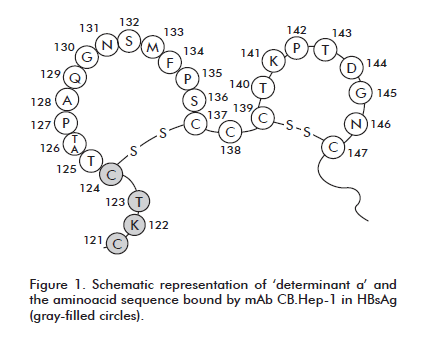
<body><![CDATA[<P   ><font face="Verdana, Arial, Helvetica, sans-serif" size="2"><I><b>Precision</b>      </I></font></P >       <P   align="justify" ><font face="Verdana, Arial, Helvetica, sans-serif" size="2">The precision of      the assay was estimated by comparing the results of independent determinations      of the same samples from the production process. The coefficient of variation      (CV) was calculated for three replicates of a single assay (repeatability),      also examining the variability across three different days and three different      analysts (intermediate precision). Reproducibility was studied by correlating      an ELISA from the Quality Control (QC) unit with the validated assay from      the Process Control (PC) laboratory, employing 15 determinations from different      API batches for this purpose, and using, as acceptance criteria, a correlation      coefficient (r) higher than 0.90. </font></P >       <P   ><font size="3" face="Verdana, Arial, Helvetica, sans-serif"><b>RESULTS </b></font></P >   <FONT size="+1">        <P   ><font size="2" face="Verdana, Arial, Helvetica, sans-serif"><b>Optimization of      the assay </b></font></P >   <FONT size="+1">        <P   align="justify" ><font face="Verdana, Arial, Helvetica, sans-serif" size="2">A sandwich-type ELISA      was developed that is based on monoclonal antibody CB.Hep-1, used as an immunoligand      in the purification of the hepatitis B surface antigen produced at the CIGB      of Havana. This antibody binds the epitope known as &lsquo;determinant a&rsquo;,      an immunodominant and protective region on the surface of the HBV virion (<a href="#fig1">Figure      1</a>). </font></P >       <P   align="center" ><img src="/img/revistas/bta/v28n4/f0103411.gif" width="433" height="351"><a name="fig1"></a></P >       
<P   align="justify" ><font face="Verdana, Arial, Helvetica, sans-serif" size="2">The assay uses CB.Hep-1      for both capturing and detecting the antigen. A response surface-type experimental      design was used for its optimization, in an effort to minimize the experimental      work required for this purpose [19]. Tested variables included coating concentration      and coating time and temperature, measuring their effect by following the      final absorbance readings of the assay and evaluating their influence with      a probability value. The ANOVA yielded a probability value higher than 0.05,      indicating their effect was significant for a confidence level of 95%. According      to the available data, the best results were obtained with a coating concentration      of 10 &micro;g/mL and an incubation of 20 minutes at 50&deg;C. The equation      for the model best fitting the data was: </font></P >       <P   align="center" ><img src="/img/revistas/bta/v28n4/fr0103411.gif" width="612" height="71"></P >       
<P   align="justify" > </P >       <P   ><b><font face="Verdana, Arial, Helvetica, sans-serif" size="2"> Validation </font></b></P >       ]]></body>
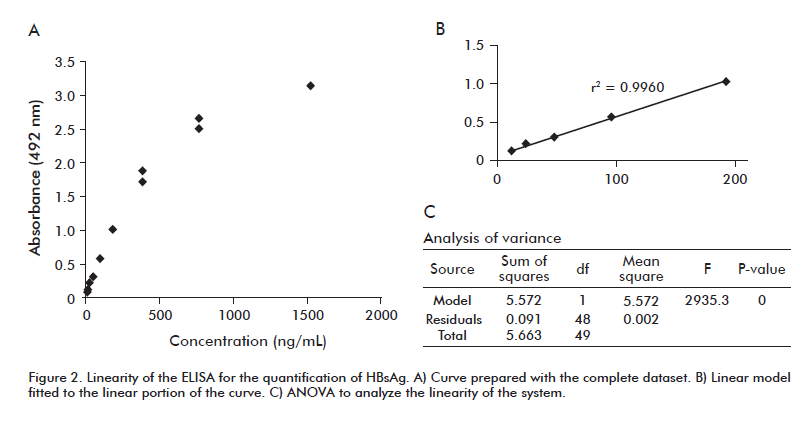
<body><![CDATA[<P   ><font face="Verdana, Arial, Helvetica, sans-serif" size="2"><I><b>Linearity and      working range </b></I></font></P >       <P   align="justify" ><font face="Verdana, Arial, Helvetica, sans-serif" size="2">The absorbances produced      by a wide range of concentrations of the reference material (1.45 to 1550      ng/mL) were examined, using least squares fitting to examine their linearity      (<a href="/img/revistas/bta/v28n4/f0203411.gif">Figure 2A</a>). <a href="/img/revistas/bta/v28n4/f0203411.gif">Figure 2B</a>      shows the average of five independent standard curves, each prepared with      the concentrations of the reference material spanning the linear range of      the assay (191.7, 95.8, 43.5, 23.5 and 11.9 ng/mL). An ANOVA was used to analyze      the results, which yielded an associated probability value lower than 0.01.      This indicates a statistically significant relationship between concentration      and absorbance for a 95% confidence level (<a href="/img/revistas/bta/v28n4/f0203411.gif">Figure 2C</a>).      The regression coefficient (r<Sup>2</Sup>) indicates that a linear model,      within this range, accounts for 98.39% of the variability of absorbance values.      In all cases, blank samples yielded absorbances lower than 0.05, and the quantification      limit was set at 11.9 ng/mL for a coefficient of variation of 8.6% (precision)      and a recovery of 94% (accuracy). </font></P >   <FONT size="+1"><FONT size="+1">        
<P   ><font face="Verdana, Arial, Helvetica, sans-serif" size="2"><I><b>Specificity      </b></I></font></P >       <P   align="justify" ><font face="Verdana, Arial, Helvetica, sans-serif" size="2">An ANOVA was used      to compare the slopes and intercepts of standard curves of the reference material      prepared either in assay buffer or in the buffer in which the different process      control samples are received, with the addition of the yeast contaminants      from the corres-ponding stage of the purification process, obtained from an      HBsAg-negative recombinant yeast strain. Care was taken to ensure that the      concentration of these buffers and contaminants matched that produced by the      normal working dilution of the corresponding process control sample. The calculated      probability according to the ANOVA was higher than 0.1 with a confidence of      99% (<a href="/img/revistas/bta/v28n4/t0103411.gif">Table 1</a>), and the parameters of each standard      curve remained within the calculated limits, without statistically significant      differences with the specifications established for this type of assay. The      results demonstrate that the matrix in which the analyte is contained in process      control samples does not interfere with its quantification by the CB.Hep-1-based      ELISA. </font></P >       
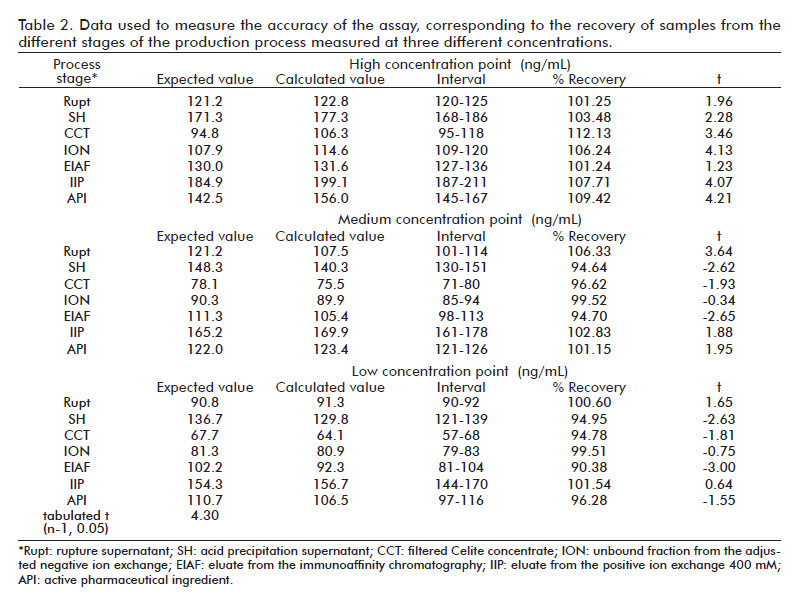
<P   ><font face="Verdana, Arial, Helvetica, sans-serif" size="2"><I><b>Accuracy </b></I></font></P >       <P   align="justify" ><font face="Verdana, Arial, Helvetica, sans-serif" size="2">Accuracy was estimated      by calculating recovery at three different concentrations, according to CECMED      regulation No. 41 from 2007 about the validation of analytical methods and      regulation ICH Q2 (R1) from 2005 [15, 16]. In all cases recovery stayed within      the established range of 80 to 120%, without statistically significant differences      according to Student&rsquo;s t-test. These results demonstrate that the assay      is accurate, as the obtained values remained within the confidence interval      calculated for each sample (<a href="/img/revistas/bta/v28n4/t0203411.gif">Table 2</a>). </font></P >       
<P   ><font face="Verdana, Arial, Helvetica, sans-serif" size="2"><I><b>Precision </b></I></font></P >       <P   align="justify" ><font face="Verdana, Arial, Helvetica, sans-serif" size="2">Precision was determined      with all process control samples employed in the validation of the assay.      According to the repeatability study, the method has a variability lower than      10%. The results of the study of intermediate precision, per analyst and between      analysts per sample type, are summarized in <a href="/img/revistas/bta/v28n4/t0303411.gif">table 3</a>.      CV was lower than 20%. </font></P >       
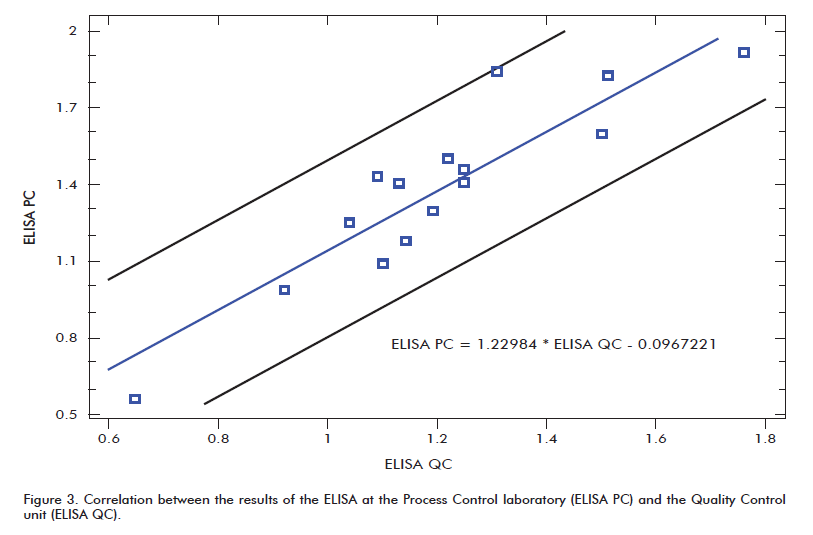
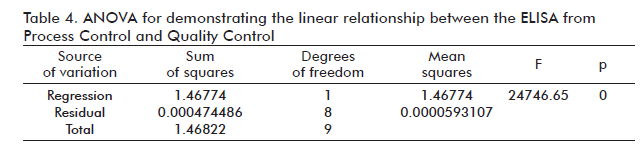
<P   align="justify" ><font face="Verdana, Arial, Helvetica, sans-serif" size="2">The validation was      completed with a joint reproducibility study involving the Quality Control      unit of CIGB. It entailed the quantification of different API batches by the      QC and PC laboratories, correlating the obtained results. <a href="/img/revistas/bta/v28n4/f0303411.gif">Figure      3</a> plots the relationship between the QC and PC datasets corresponding      to the CB.Hep-1 ELISA, and <a href="/img/revistas/bta/v28n4/t0403411.gif">table 4</a> summarizes the      results describing the relationship between both methods and setting the lineal      model as control. The equation for the model was: </font></P >       
<P   align="justify" ><font face="Verdana, Arial, Helvetica, sans-serif" size="2">Given that the probability      associated to F is lower than 0.01 for a 99% confidence, it is concluded that      there is a statistically significant relationship between both methods. </font></P >       ]]></body>
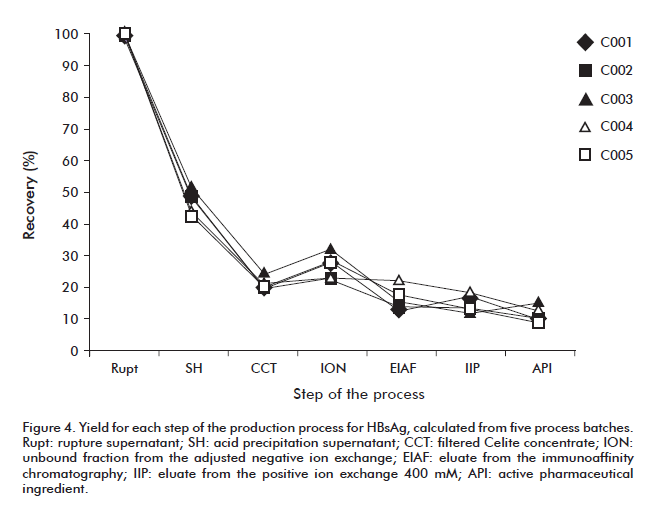
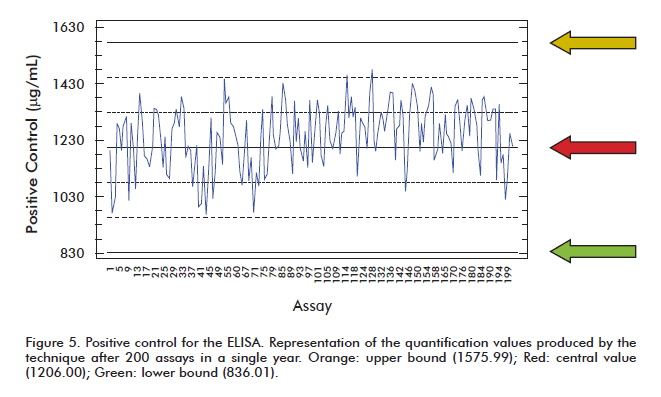
<body><![CDATA[<P   align="justify" ><font face="Verdana, Arial, Helvetica, sans-serif" size="2">The regression coefficient      indicates that the chosen model accounts for the variability of the ELISA      from the Process Control laboratory with respect to that of the Quality Control      unit. The correlation coefficient was 0.9146, indicating a relatively strong      relation between the examined variables. The standard error of the estimate      exhibits a standard deviation for the residuals of 0.147; a value that can      be used to build the limits for future observations. According to the results,      there are no statistically significant differences pertaining the quantification      of the API between both laboratories. </font></P >       <P   ><font face="Verdana, Arial, Helvetica, sans-serif" size="2"><I><b>Application      of the ELISA to the analysis of yields during the production process. Control      chart </b></I></font></P >       <P   align="justify" ><font face="Verdana, Arial, Helvetica, sans-serif" size="2">The performance and      utility of the ELISA in real life conditions were evaluated by implementing      it as part of the process control tests of the production of HBsAg.The analysis      of yields of the process using this ELISA in combination with total protein      determinations by the modified Bradford method [18] is shown in <a href="/img/revistas/bta/v28n4/f0403411.gif">figure      4</a>. This analysis was based on the data from five process batches, determining      the coefficient of variation between yields of the same step for different      batches; this CV was always lower than 25%, demonstrating the consistency      of the process and the usefulness of the assay for adequately determining      HBsAg concentrations in process control samples. In addition the assay was      followed up uninterruptedly for a whole year, implementing a statistical control      by means of a control chart used to evaluate the quantification of the positive      control of the assay. A total of 200 determinations were performed; all of      them fell within the established control limits, and the CV for all values      was 8.84% (<a href="/img/revistas/bta/v28n4/f0503411.gif">Figure 5</a>). Only two values were separated      from the central value by more than two standard deviations, representing      1% of the determinations. As a whole, the results demonstrate that both the      control and the ELISA perform stably, and their quality is guaranteed on the      long term. </font></P >       
<P   ><font size="3" face="Verdana, Arial, Helvetica, sans-serif"><b>DISCUSSION </b></font></P >   <FONT size="+1">        <P   align="justify" ><font size="2" face="Verdana, Arial, Helvetica, sans-serif">The present work      describes the development and validation of a new sandwich ELISA for the quantification      of HBsAg in process control samples. Unlike similar reported assays [20],      this one uses a single antibody. After optimization using a response surface      methodology, an optimum was found at a coating concentration of 10 &micro;g/mL      and a coating time and temperature of 20 min at 50 &ordm;C. The relatively      high temperatures might favor the interaction of the antibody with the plastic      surface, thus facilitating the capture of larger numbers of antigen molecules,      as described by Leyva <I>et al</I>. [21]. </font></P >   <FONT size="+1">        <P   align="justify" ><font face="Verdana, Arial, Helvetica, sans-serif" size="2">Immunochemical techniques      usually employ a standard curve to derive the value of unknown samples by      interpolation [22]. In this study the standard curve was freshly prepared      by serial dilutions of an HBsAg reference for each assay. The ELISA behaved      linearly at antigen concentrations ranging from 191.7 to 11.9 ng/mL. This      linear range is similar to that of similar ELISA, as that described by Karaku&#351;      <I>et al</I>. [23]. An important parameter to be examined during the validation      of analytical methods, and especially so in immunoassays [22], is specificity,      that is, their ability to unequivocally detect the analyte in the presence      of the other components that will be present in the test mixture during real      life use [15, 16]. In this case, the results of the interference tests demonstrated      that the assay correctly measures the levels of HBsAg in the presence of all      possible sample contaminants. </font></P >       <P   align="justify" ><font face="Verdana, Arial, Helvetica, sans-serif" size="2">In order to determine      whether the assay accurately quantifies the concentration of HBsAg in process      control samples, samples of known concentration were assayed, then comparing      the obtained and expected values. These experiments were done, for each sample      type, at three different concentrations. In every case recovery varied from      98.18 to 100.31%, with an average of 100%. The results suggest, therefore,      that the CB.Hep-1-based ELISA is appropriate for the quantification of HBsAg      in biological samples. </font></P >       <P   align="justify" ><font face="Verdana, Arial, Helvetica, sans-serif" size="2">Precision was evaluated      by determining CV for two parameters: repeatability and intermediate precision,      obtaining values lower than 10 and 20%, respectively. These values meet the      acceptance criteria described in CECMED regulation No. 41 from 2007 and in      IHC Q2 (R1) [15, 16], and do not reach the rejection threshold of 25% proposed      by Findlay <I>et al. </I>for immunoenzyme assays [22], based on the fact that      these techniques are less accurate than chromatographic methods and require      larger number of experimental points to increase data reliability. The joint      study between two laboratories demonstrated the reproducibility of the assay,      with a correlation coefficient higher than 0.90 for the determinations performed      in the submitted samples. This result coincides with those of Wapenaar <I>et      al</I>. [24], who also obtained correlation coefficients with a value of 0.9      for a competition ELISA. </font></P >       <P   align="justify" ><font face="Verdana, Arial, Helvetica, sans-serif" size="2">After validating      an analytical method it is important to follow up and monitor its performance      in actual op erating conditions. There are statistical techniques for the      process control of recombinant proteins and the interpretation of results      that constitute excellent tools for this purpose [25]. Control charts, in      specific, represent the behavior of a specific parameter through time, making      it easy to spot emerging trends and to assess the control, consistency and      reliability of the underlying assay. The use of this technique with the present      ELISA demonstrated the stability of the results, and its application to the      analysis of process yields evidenced the consistency of the latter. </font></P >       <P   ><font size="2" face="Verdana, Arial, Helvetica, sans-serif"><B><font size="3">CONCLUSIONS      </font></B> </font></P >   <FONT size="+1">        ]]></body>
<body><![CDATA[<P   align="justify" ><font size="2" face="Verdana, Arial, Helvetica, sans-serif">The validation of      the ELISA for the quantification of HBsAg in process control samples indicates      that the assay provides a linear response in the range of 191.7 to 11.9 &mu;g/mL,      with a regression coefficient higher than 0.98. The method was shown to be      accurate, as there were no statistically significant differences between the      known concentration of test samples and that determined with the assay; precision      was acceptable, with a variability lower than 10% for the repeatability study,      and lower than 20% for the study of intermediate precision. There is a strong      correlation between the concentrations determined at the Quality Control and      Process Control laboratories, performed during the reproducibility study.      The method is adequate and provides reliable data on the behavior of the purification      process for HBsAg. After comparing the data with established acceptance criteria,      it is concluded that the validation is satisfactory and, therefore, the assay      can be used for process control of the production of HBsAg. </font></P >   <FONT size="+1">        <P   align="justify" > </P >       <P   align="justify" ><b><font face="Verdana, Arial, Helvetica, sans-serif" size="3">REFERENCES </font></b></P >       <!-- ref --><P   align="justify" ><font size="2" face="Verdana, Arial, Helvetica, sans-serif">1. Centers for Disease      Control and Prevention. Achievements in public health: hepatitis B vaccination.      United States, 1982-2002. MMWR Morb Mortal Wkly Rep. 2002;51(2):529-52.     </font></P >   <FONT size="+1">        <!-- ref --><P   align="justify" ><font face="Verdana, Arial, Helvetica, sans-serif" size="2">2. Burrell CJ, Mackay      P, Greenaway PJ, Hofschneider PH, Murray K. Expression in Escherichia coli      of hepatitis B virus DNA sequences cloned in plasmid pBR322. Nature. 1979;279(5708):43-7.          </font></P >       <!-- ref --><P   align="justify" ><font face="Verdana, Arial, Helvetica, sans-serif" size="2">3. Miyanohara A,      Toh-e A, Nozaki C, Hamada F, Ohtomo N, Matsubara K. Expression of hepatitis      B surface antigen gene in yeast. Proc Natl Acad Sci USA. 1983;80(1):1-5.     </font></P >       <!-- ref --><P   align="justify" ><font face="Verdana, Arial, Helvetica, sans-serif" size="2">4. Gellissen G, Janowicz      ZA, Weydemann U, Melber K, Strasser AW, Hollenberg CP. High-level expression      of foreign genes in Hansenula polymorpha. Biotechnol Adv. 1992;10(2):179-89.          </font></P >       <!-- ref --><P   align="justify" ><font face="Verdana, Arial, Helvetica, sans-serif" size="2">5. Hsiung N, Fitts      R, Wilson S, Milne A, Hamer D. Efficient production of hepatitis B surface      antigen using a bovine papilloma virus-metallothionein vector. J Mol Appl      Genet. 1984;2(5):497-506.     </font></P >       <!-- ref --><P   align="justify" ><font face="Verdana, Arial, Helvetica, sans-serif" size="2">6. Holzer GW, Mayrhofer      J, Leitner J, Blum M, Webersinke G, Heuritsch S, et al. Overexpression of      hepatitis B virus surface antigens including the preS1 region in a serum-free      Chinese hamster ovary cell line. Protein Expr Purif. 2003;29(1):58-69.     </font></P >       <!-- ref --><P   align="justify" ><font face="Verdana, Arial, Helvetica, sans-serif" size="2">7. Kang CY, Bishop      DH, Seo JS, Matsuura Y, Choe M. Secretion of particles of hepatitis B surface      antigen from insect cells using a baculovirus vector. J Gen Virol. 1987;68(Pt      10):2607-13.     </font></P >       <!-- ref --><P   align="justify" ><font face="Verdana, Arial, Helvetica, sans-serif" size="2">8. Mason HS, Ball      JM, Shi JJ, Jiang X, Estes MK, Arntzen CJ. Expression of Norwalk virus capsid      protein in transgenic tobacco and potato and its oral immunogenicity in mice.      Proc Natl Acad Sci USA. 1996;93(11):5335-40.     </font></P >       <P   align="justify" ><font face="Verdana, Arial, Helvetica, sans-serif" size="2">9. Muzio VL, Pent&oacute;n      E, Palou M, Fontirrochi G, Naz&aacute;bal M, Gonz&aacute;lez MJ, et al, inventors;      Centro de Ingenier&iacute;a Gen&eacute;tica y Biotecnolog&iacute;a, assignee.      Method for obtaining recombinant surface antigen of hepatitis B virus (HEP      B) of higher immunogenic capacity and use thereof in a vaccine preparation.      European Patent EP480525. 1992 Apr 15. </font></P >       ]]></body>
<body><![CDATA[<!-- ref --><P   align="justify" ><font face="Verdana, Arial, Helvetica, sans-serif" size="2">10. Agraz A, Duarte      CA, Costa L, P&eacute;rez L, P&aacute;ez R, Pujol V, et al. Immunoaffinity      purification of recombinant hepatitis B surface antigen from yeast using a      monoclonal antibody. J Chromatogr A. 1994;672(1-2):25-33.     </font></P >       <P   align="justify" ><font face="Verdana, Arial, Helvetica, sans-serif" size="2">11. P&aacute;ez R,      Agraz A, Herrera L. The recovery of the hepatitis B virus surface antigen      (AgsHB) from a recombinant P. pastoris strain, disruption and precipitation      studies. Acta Biotechnol. 1993;13:117-22. </font></P >       <!-- ref --><P   align="justify" ><font face="Verdana, Arial, Helvetica, sans-serif" size="2">12. P&eacute;rez      L, L&oacute;pez S, Beldarra&iacute;n A, Arenal D, Pent&oacute;n E. Purification      of recombinant hepatitis B surface antigen (rec-HBsAg) from P. pastoris: a      process development study. In: Galindo E, Ram&iacute;rez OT, editors. Advances      in Bioprocess Engineering. Dordrecht: Kluwer Academic Publishers; 1994. p.      527-34.     </font></P >       <!-- ref --><P   align="justify" ><font face="Verdana, Arial, Helvetica, sans-serif" size="2">13. Hardy E, Mart&iacute;nez      E, Diago D, D&iacute;az R, Gonz&aacute;lez D, Herrera L. Large-scale production      of recombinant hepatitis B surface antigen from Pichia pastoris. Biotechnol.      2000;77(2-3):157-67.     </font></P >       <!-- ref --><P   ><font face="Verdana, Arial, Helvetica, sans-serif" size="2">14. Fern&aacute;ndez      de Coss&iacute;o ME, D&iacute;az T, Galv&aacute;n A, Vald&eacute;z R, Gonz&aacute;lez      E, Ayala M, et al. Antigen recognition characteristics and comparative performance      in immunoaffinity purification of two monoclonal antibodies specific for the      hepatitis B virus surface antigen. J Biotechnol. 1997;56(2):69-80.     </font></P >       <!-- ref --><P   align="justify" ><font face="Verdana, Arial, Helvetica, sans-serif" size="2">15. Centro para el      Control Estatal de la Calidad de los Medicamentos (CECMED). Regulaci&oacute;n      No. 41-2007: Validaci&oacute;n de M&eacute;todos Anal&iacute;ticos. &Aacute;mbito      Regulador. 2007 Mar 3;(53):1-14.     </font></P >       <!-- ref --><P   align="justify" ><font face="Verdana, Arial, Helvetica, sans-serif" size="2">16. International      Conference on Harmonisation of Technical Requirements for Registration of      Pharmaceuticals for Human Use. Validation of Analytical Procedures: Text and      Methodology Q2(R1). ICH; 2005 Nov.     </font></P >       <!-- ref --><P   align="justify" ><font face="Verdana, Arial, Helvetica, sans-serif" size="2">17. Nakane PK, Kawaoi      A. Peroxidase-labeled antibody. A new method of conjugation. J Histochem Cytochem.      1974;22(12):1084-91.     </font></P >       <!-- ref --><P   align="justify" ><font face="Verdana, Arial, Helvetica, sans-serif" size="2">18. Zor T, Selinger      Z. Linearization of the Bradford protein assay increases its sensitivity:      theoretical and experimental studies. Anal Biochem. 1996;236(2):302-8.     </font></P >       <!-- ref --><P   align="justify" ><font face="Verdana, Arial, Helvetica, sans-serif" size="2">19. Myers RH, Montomery      DC. Response surface methodology: process and process optimization using designed      experiments. 2nd ed. NewYork: John Wiley &amp; Sons; 2002.     </font></P >       <!-- ref --><P   align="justify" ><font face="Verdana, Arial, Helvetica, sans-serif" size="2">20. van Roosmalen      MH, de Jong JJ, Haenen W, Jacobs T, Couwenberg F, Ahlers-de Boer GJCM, et      al. A new HBsAg screening assay designed for sensitive detection of HBsAg      subtypes and variants. Intervirology. 2006;49:127-32.     </font></P >       <!-- ref --><P   align="justify" ><font face="Verdana, Arial, Helvetica, sans-serif" size="2">21. Leyva A, Franco      A, Gonz&aacute;lez T, S&aacute;nchez JC, L&oacute;pez I, Geada D, et al. A      rapid and sensitive ELISA to quantify an HBsAg specific monoclonal antibody      and a plant-derived antibody during their downstream purification process.      Biologicals. 2007;35(1):19-25.    <!-- ref --> 22. Findlay JW, Smith WC, Lee JW, Nordblom      GD, Das I, DeSilva BS, et al. Validation of immunoassays for bioanalysis:      a pharmaceutical industry perspective. J Pharm Biomed Anal. 2000;21(6):1249-73.          </font></P >       <P   align="justify" ><font face="Verdana, Arial, Helvetica, sans-serif" size="2">23. Karaku&#351;      R, Aral LA, Ba&#351;t&uuml;rk B, Aybay C. Development of a highly sensitive      ELISA for quantification of hepatitis B virus (HBV) surface antigen (HBsAg).      Turk J Med Sci. 2007;37(2):87-92. </font></P >       <P   align="justify" ><font face="Verdana, Arial, Helvetica, sans-serif" size="2">24. Wapenaar W, Barkema      HW, Vanleeuwen JA, McClure JT, O&rsquo;Handley RM, Kwok OC, et al. Comparison      of serological methods for the diagnosis of Neospora caninum infection in      cattle. Vet Parasitol. 2007;143(2):166-73. </font></P >       <!-- ref --><P   align="justify" ><font face="Verdana, Arial, Helvetica, sans-serif" size="2">25. Fuge J. FDA CONFERENCE      Report: Validation Considerations When Preparing For FDA Inspections. J Validat      Technol. 2005;11(3):253-6.     </font></P >       <P   align="justify" >&nbsp;</P >       <P   align="justify" > </P >       ]]></body>
<body><![CDATA[<P   align="justify" ><font size="2" face="Verdana, Arial, Helvetica, sans-serif">Received in December,      2010.    <br>     </font><font face="Verdana, Arial, Helvetica, sans-serif" size="2">Accepted      for publication in September 2011. </font></P >       <P   align="justify" >&nbsp;</P >   <FONT size="+1">        <P   align="justify" > </P >       <P   ><font size="2" face="Verdana, Arial, Helvetica, sans-serif">Alberto Leyva. Centro      de Ingenier&iacute;a Gen&eacute;tica y Biotecnolog&iacute;a, CIGB. Ave. 31      entre 158 y 190, Cubanac&aacute;n, Playa, CP 10 600, La Habana, Cuba. E-mail:      <a href="mailto:alberto.leyva@cigb.edu.cu">alberto.leyva@cigb.edu.cu</a>.      </font></P >   </font></font></font></font></font></font></font></font></font></font></font></font></font></font></font></font></font></font></font></font></font></font></font></font></font></font></font></font></font></font></font></font></font></font></font></font></font></font></font></font></font></font></font></font></DIV >      ]]></body><back>
<ref-list>
<ref id="B1">
<label>1</label><nlm-citation citation-type="journal">
<collab>Centers for Disease Control and Prevention</collab>
<article-title xml:lang="en"><![CDATA[Achievements in public health: hepatitis B vaccination. United States, 1982-2002]]></article-title>
<source><![CDATA[MMWR Morb Mortal Wkly Rep]]></source>
<year>2002</year>
<volume>51</volume>
<numero>2</numero>
<issue>2</issue>
<page-range>529-52</page-range></nlm-citation>
</ref>
<ref id="B2">
<label>2</label><nlm-citation citation-type="journal">
<person-group person-group-type="author">
<name>
<surname><![CDATA[Burrell]]></surname>
<given-names><![CDATA[CJ]]></given-names>
</name>
<name>
<surname><![CDATA[Mackay]]></surname>
<given-names><![CDATA[P]]></given-names>
</name>
<name>
<surname><![CDATA[Greenaway]]></surname>
<given-names><![CDATA[PJ]]></given-names>
</name>
<name>
<surname><![CDATA[Hofschneider]]></surname>
<given-names><![CDATA[PH]]></given-names>
</name>
<name>
<surname><![CDATA[Murray]]></surname>
<given-names><![CDATA[K]]></given-names>
</name>
</person-group>
<article-title xml:lang="en"><![CDATA[Expression in Escherichia coli of hepatitis B virus DNA sequences cloned in plasmid pBR322]]></article-title>
<source><![CDATA[Nature]]></source>
<year>1979</year>
<volume>279</volume>
<numero>5708</numero>
<issue>5708</issue>
<page-range>43-7</page-range></nlm-citation>
</ref>
<ref id="B3">
<label>3</label><nlm-citation citation-type="journal">
<person-group person-group-type="author">
<name>
<surname><![CDATA[Miyanohara]]></surname>
<given-names><![CDATA[A]]></given-names>
</name>
<name>
<surname><![CDATA[Toh-e]]></surname>
<given-names><![CDATA[A]]></given-names>
</name>
<name>
<surname><![CDATA[Nozaki]]></surname>
<given-names><![CDATA[C]]></given-names>
</name>
<name>
<surname><![CDATA[Hamada]]></surname>
<given-names><![CDATA[F]]></given-names>
</name>
<name>
<surname><![CDATA[Ohtomo]]></surname>
<given-names><![CDATA[N]]></given-names>
</name>
<name>
<surname><![CDATA[Matsubara]]></surname>
<given-names><![CDATA[K]]></given-names>
</name>
</person-group>
<article-title xml:lang="en"><![CDATA[Expression of hepatitis B surface antigen gene in yeast]]></article-title>
<source><![CDATA[Proc Natl Acad Sci USA]]></source>
<year>1983</year>
<volume>80</volume>
<numero>1</numero>
<issue>1</issue>
<page-range>1-5</page-range></nlm-citation>
</ref>
<ref id="B4">
<label>4</label><nlm-citation citation-type="journal">
<person-group person-group-type="author">
<name>
<surname><![CDATA[Gellissen]]></surname>
<given-names><![CDATA[G]]></given-names>
</name>
<name>
<surname><![CDATA[Janowicz]]></surname>
<given-names><![CDATA[ZA]]></given-names>
</name>
<name>
<surname><![CDATA[Weydemann]]></surname>
<given-names><![CDATA[U]]></given-names>
</name>
<name>
<surname><![CDATA[Melber]]></surname>
<given-names><![CDATA[K]]></given-names>
</name>
<name>
<surname><![CDATA[Strasser]]></surname>
<given-names><![CDATA[AW]]></given-names>
</name>
<name>
<surname><![CDATA[Hollenberg]]></surname>
<given-names><![CDATA[CP]]></given-names>
</name>
</person-group>
<article-title xml:lang="en"><![CDATA[High-level expression of foreign genes in Hansenula polymorpha]]></article-title>
<source><![CDATA[Biotechnol Adv]]></source>
<year>1992</year>
<volume>10</volume>
<numero>2</numero>
<issue>2</issue>
<page-range>179-89</page-range></nlm-citation>
</ref>
<ref id="B5">
<label>5</label><nlm-citation citation-type="journal">
<person-group person-group-type="author">
<name>
<surname><![CDATA[Hsiung]]></surname>
<given-names><![CDATA[N]]></given-names>
</name>
<name>
<surname><![CDATA[Fitts]]></surname>
<given-names><![CDATA[R]]></given-names>
</name>
<name>
<surname><![CDATA[Wilson]]></surname>
<given-names><![CDATA[S]]></given-names>
</name>
<name>
<surname><![CDATA[Milne]]></surname>
<given-names><![CDATA[A]]></given-names>
</name>
<name>
<surname><![CDATA[Hamer]]></surname>
<given-names><![CDATA[D]]></given-names>
</name>
</person-group>
<article-title xml:lang="en"><![CDATA[Efficient production of hepatitis B surface antigen using a bovine papilloma virus-metallothionein vector]]></article-title>
<source><![CDATA[J Mol Appl Genet]]></source>
<year>1984</year>
<volume>2</volume>
<numero>5</numero>
<issue>5</issue>
<page-range>497-506</page-range></nlm-citation>
</ref>
<ref id="B6">
<label>6</label><nlm-citation citation-type="journal">
<person-group person-group-type="author">
<name>
<surname><![CDATA[Holzer]]></surname>
<given-names><![CDATA[GW]]></given-names>
</name>
<name>
<surname><![CDATA[Mayrhofer]]></surname>
<given-names><![CDATA[J]]></given-names>
</name>
<name>
<surname><![CDATA[Leitner]]></surname>
<given-names><![CDATA[J]]></given-names>
</name>
<name>
<surname><![CDATA[Blum]]></surname>
<given-names><![CDATA[M]]></given-names>
</name>
<name>
<surname><![CDATA[Webersinke]]></surname>
<given-names><![CDATA[G]]></given-names>
</name>
<name>
<surname><![CDATA[Heuritsch]]></surname>
<given-names><![CDATA[S]]></given-names>
</name>
</person-group>
<article-title xml:lang="en"><![CDATA[Overexpression of hepatitis B virus surface antigens including the preS1 region in a serum-free Chinese hamster ovary cell line]]></article-title>
<source><![CDATA[Protein Expr Purif]]></source>
<year>2003</year>
<volume>29</volume>
<numero>1</numero>
<issue>1</issue>
<page-range>58-69</page-range></nlm-citation>
</ref>
<ref id="B7">
<label>7</label><nlm-citation citation-type="journal">
<person-group person-group-type="author">
<name>
<surname><![CDATA[Kang]]></surname>
<given-names><![CDATA[CY]]></given-names>
</name>
<name>
<surname><![CDATA[Bishop]]></surname>
<given-names><![CDATA[DH]]></given-names>
</name>
<name>
<surname><![CDATA[Seo]]></surname>
<given-names><![CDATA[JS]]></given-names>
</name>
<name>
<surname><![CDATA[Matsuura]]></surname>
<given-names><![CDATA[Y]]></given-names>
</name>
<name>
<surname><![CDATA[Choe]]></surname>
<given-names><![CDATA[M]]></given-names>
</name>
</person-group>
<article-title xml:lang="en"><![CDATA[Secretion of particles of hepatitis B surface antigen from insect cells using a baculovirus vector]]></article-title>
<source><![CDATA[J Gen Virol]]></source>
<year>1987</year>
<volume>68</volume>
<numero>10</numero>
<issue>10</issue>
<page-range>2607-13</page-range></nlm-citation>
</ref>
<ref id="B8">
<label>8</label><nlm-citation citation-type="journal">
<person-group person-group-type="author">
<name>
<surname><![CDATA[Mason]]></surname>
<given-names><![CDATA[HS]]></given-names>
</name>
<name>
<surname><![CDATA[Ball]]></surname>
<given-names><![CDATA[JM]]></given-names>
</name>
<name>
<surname><![CDATA[Shi]]></surname>
<given-names><![CDATA[JJ]]></given-names>
</name>
<name>
<surname><![CDATA[Jiang]]></surname>
<given-names><![CDATA[X]]></given-names>
</name>
<name>
<surname><![CDATA[Estes]]></surname>
<given-names><![CDATA[MK]]></given-names>
</name>
<name>
<surname><![CDATA[Arntzen]]></surname>
<given-names><![CDATA[CJ]]></given-names>
</name>
</person-group>
<article-title xml:lang="en"><![CDATA[Expression of Norwalk virus capsid protein in transgenic tobacco and potato and its oral immunogenicity in mice]]></article-title>
<source><![CDATA[Proc Natl Acad Sci USA]]></source>
<year>1996</year>
<volume>93</volume>
<numero>11</numero>
<issue>11</issue>
<page-range>5335-40</page-range></nlm-citation>
</ref>
<ref id="B9">
<label>9</label><nlm-citation citation-type="">
<person-group person-group-type="author">
<name>
<surname><![CDATA[Muzio]]></surname>
<given-names><![CDATA[VL]]></given-names>
</name>
<name>
<surname><![CDATA[Pentón]]></surname>
<given-names><![CDATA[E]]></given-names>
</name>
<name>
<surname><![CDATA[Palou]]></surname>
<given-names><![CDATA[M]]></given-names>
</name>
<name>
<surname><![CDATA[Fontirrochi]]></surname>
<given-names><![CDATA[G]]></given-names>
</name>
<name>
<surname><![CDATA[Nazábal]]></surname>
<given-names><![CDATA[M]]></given-names>
</name>
<name>
<surname><![CDATA[González]]></surname>
<given-names><![CDATA[MJ]]></given-names>
</name>
</person-group>
<source><![CDATA[Method for obtaining recombinant surface antigen of hepatitis B virus (HEP B) of higher immunogenic capacity and use thereof in a vaccine preparation]]></source>
<year></year>
</nlm-citation>
</ref>
<ref id="B10">
<label>10</label><nlm-citation citation-type="journal">
<person-group person-group-type="author">
<name>
<surname><![CDATA[Agraz]]></surname>
<given-names><![CDATA[A]]></given-names>
</name>
<name>
<surname><![CDATA[Duarte]]></surname>
<given-names><![CDATA[CA]]></given-names>
</name>
<name>
<surname><![CDATA[Costa]]></surname>
<given-names><![CDATA[L]]></given-names>
</name>
<name>
<surname><![CDATA[Pérez]]></surname>
<given-names><![CDATA[L]]></given-names>
</name>
<name>
<surname><![CDATA[Páez]]></surname>
<given-names><![CDATA[R]]></given-names>
</name>
<name>
<surname><![CDATA[Pujol]]></surname>
<given-names><![CDATA[V]]></given-names>
</name>
</person-group>
<article-title xml:lang="en"><![CDATA[Immunoaffinity purification of recombinant hepatitis B surface antigen from yeast using a monoclonal antibody]]></article-title>
<source><![CDATA[J Chromatogr A]]></source>
<year>1994</year>
<volume>672</volume>
<numero>1-2</numero>
<issue>1-2</issue>
<page-range>25-33</page-range></nlm-citation>
</ref>
<ref id="B11">
<label>11</label><nlm-citation citation-type="journal">
<person-group person-group-type="author">
<name>
<surname><![CDATA[Páez]]></surname>
<given-names><![CDATA[R]]></given-names>
</name>
<name>
<surname><![CDATA[Agraz]]></surname>
<given-names><![CDATA[A]]></given-names>
</name>
<name>
<surname><![CDATA[Herrera]]></surname>
<given-names><![CDATA[L]]></given-names>
</name>
</person-group>
<article-title xml:lang="en"><![CDATA[The recovery of the hepatitis B virus surface antigen (HBsAg) from a recombinant P. pastoris strain, disruption and precipitation studies]]></article-title>
<source><![CDATA[Acta Biotechnol]]></source>
<year>1993</year>
<volume>13</volume>
<page-range>117-22</page-range></nlm-citation>
</ref>
<ref id="B12">
<label>12</label><nlm-citation citation-type="book">
<person-group person-group-type="author">
<name>
<surname><![CDATA[Pérez]]></surname>
<given-names><![CDATA[L]]></given-names>
</name>
<name>
<surname><![CDATA[López]]></surname>
<given-names><![CDATA[S]]></given-names>
</name>
<name>
<surname><![CDATA[Beldarraín]]></surname>
<given-names><![CDATA[A]]></given-names>
</name>
<name>
<surname><![CDATA[Arenal]]></surname>
<given-names><![CDATA[D]]></given-names>
</name>
<name>
<surname><![CDATA[Pentón]]></surname>
<given-names><![CDATA[E]]></given-names>
</name>
</person-group>
<article-title xml:lang="en"><![CDATA[Purification of recombinant hepatitis B surface antigen (rec-HBsAg) from P. pastoris: a process development study]]></article-title>
<person-group person-group-type="editor">
<name>
<surname><![CDATA[Galindo]]></surname>
<given-names><![CDATA[E]]></given-names>
</name>
<name>
<surname><![CDATA[Ramírez]]></surname>
<given-names><![CDATA[OT]]></given-names>
</name>
</person-group>
<source><![CDATA[Advances in Bioprocess Engineering]]></source>
<year>1994</year>
<page-range>527-34</page-range><publisher-loc><![CDATA[Dordrecht ]]></publisher-loc>
<publisher-name><![CDATA[Kluwer Academic Publishers]]></publisher-name>
</nlm-citation>
</ref>
<ref id="B13">
<label>13</label><nlm-citation citation-type="journal">
<person-group person-group-type="author">
<name>
<surname><![CDATA[Hardy]]></surname>
<given-names><![CDATA[E]]></given-names>
</name>
<name>
<surname><![CDATA[Martínez]]></surname>
<given-names><![CDATA[E]]></given-names>
</name>
<name>
<surname><![CDATA[Diago]]></surname>
<given-names><![CDATA[D]]></given-names>
</name>
<name>
<surname><![CDATA[Díaz]]></surname>
<given-names><![CDATA[R]]></given-names>
</name>
<name>
<surname><![CDATA[González]]></surname>
<given-names><![CDATA[D]]></given-names>
</name>
<name>
<surname><![CDATA[Herrera]]></surname>
<given-names><![CDATA[L]]></given-names>
</name>
</person-group>
<article-title xml:lang="en"><![CDATA[Large-scale production of recombinant hepatitis B surface antigen from Pichia pastoris]]></article-title>
<source><![CDATA[Biotechnol]]></source>
<year>2000</year>
<volume>77</volume>
<numero>2-3</numero>
<issue>2-3</issue>
<page-range>157-67</page-range></nlm-citation>
</ref>
<ref id="B14">
<label>14</label><nlm-citation citation-type="journal">
<person-group person-group-type="author">
<name>
<surname><![CDATA[Fernández de Cossío]]></surname>
<given-names><![CDATA[ME]]></given-names>
</name>
<name>
<surname><![CDATA[Díaz]]></surname>
<given-names><![CDATA[T]]></given-names>
</name>
<name>
<surname><![CDATA[Galván]]></surname>
<given-names><![CDATA[A]]></given-names>
</name>
<name>
<surname><![CDATA[Valdéz]]></surname>
<given-names><![CDATA[R]]></given-names>
</name>
<name>
<surname><![CDATA[González]]></surname>
<given-names><![CDATA[E]]></given-names>
</name>
<name>
<surname><![CDATA[Ayala]]></surname>
<given-names><![CDATA[M]]></given-names>
</name>
</person-group>
<article-title xml:lang="en"><![CDATA[Antigen recognition characteristics and comparative performance in immunoaffinity purification of two monoclonal antibodies specific for the hepatitis B virus surface antigen]]></article-title>
<source><![CDATA[J Biotechnol]]></source>
<year>1997</year>
<volume>56</volume>
<numero>2</numero>
<issue>2</issue>
<page-range>69-80</page-range></nlm-citation>
</ref>
<ref id="B15">
<label>15</label><nlm-citation citation-type="journal">
<collab>Centro para el Control Estatal de la Calidad de los Medicamentos (CECMED)</collab>
<article-title xml:lang="es"><![CDATA[Regulación No. 41-2007: Validación de Métodos Analíticos]]></article-title>
<source><![CDATA[Ámbito Regulador]]></source>
<year>2007</year>
<month> M</month>
<day>ar</day>
<numero>53</numero>
<issue>53</issue>
<page-range>1-14</page-range></nlm-citation>
</ref>
<ref id="B16">
<label>16</label><nlm-citation citation-type="book">
<collab>International Conference on Harmonisation of Technical Requirements for Registration of Pharmaceuticals for Human Use</collab>
<source><![CDATA[Validation of Analytical Procedures: Text and Methodology Q2(R1)]]></source>
<year>2005</year>
<month> N</month>
<day>ov</day>
<publisher-name><![CDATA[ICH]]></publisher-name>
</nlm-citation>
</ref>
<ref id="B17">
<label>17</label><nlm-citation citation-type="journal">
<person-group person-group-type="author">
<name>
<surname><![CDATA[Nakane]]></surname>
<given-names><![CDATA[PK]]></given-names>
</name>
<name>
<surname><![CDATA[Kawaoi]]></surname>
<given-names><![CDATA[A]]></given-names>
</name>
</person-group>
<article-title xml:lang="en"><![CDATA[Peroxidase-labeled antibody: A new method of conjugation]]></article-title>
<source><![CDATA[J Histochem Cytochem]]></source>
<year>1974</year>
<volume>22</volume>
<numero>12</numero>
<issue>12</issue>
<page-range>1084-91</page-range></nlm-citation>
</ref>
<ref id="B18">
<label>18</label><nlm-citation citation-type="journal">
<person-group person-group-type="author">
<name>
<surname><![CDATA[Zor]]></surname>
<given-names><![CDATA[T]]></given-names>
</name>
<name>
<surname><![CDATA[Selinger]]></surname>
<given-names><![CDATA[Z]]></given-names>
</name>
</person-group>
<article-title xml:lang="en"><![CDATA[Linearization of the Bradford protein assay increases its sensitivity: theoretical and experimental studies]]></article-title>
<source><![CDATA[Anal Biochem]]></source>
<year>1996</year>
<volume>236</volume>
<numero>2</numero>
<issue>2</issue>
<page-range>302-8</page-range></nlm-citation>
</ref>
<ref id="B19">
<label>19</label><nlm-citation citation-type="book">
<person-group person-group-type="author">
<name>
<surname><![CDATA[Myers]]></surname>
<given-names><![CDATA[RH]]></given-names>
</name>
<name>
<surname><![CDATA[Montomery]]></surname>
<given-names><![CDATA[DC]]></given-names>
</name>
</person-group>
<source><![CDATA[Response surface methodology: process and process optimization using designed experiments]]></source>
<year>2002</year>
<edition>2</edition>
<publisher-loc><![CDATA[NewYork ]]></publisher-loc>
<publisher-name><![CDATA[John Wiley & Sons]]></publisher-name>
</nlm-citation>
</ref>
<ref id="B20">
<label>20</label><nlm-citation citation-type="journal">
<person-group person-group-type="author">
<name>
<surname><![CDATA[van Roosmalen]]></surname>
<given-names><![CDATA[MH]]></given-names>
</name>
<name>
<surname><![CDATA[de Jong]]></surname>
<given-names><![CDATA[JJ]]></given-names>
</name>
<name>
<surname><![CDATA[Haenen]]></surname>
<given-names><![CDATA[W]]></given-names>
</name>
<name>
<surname><![CDATA[Jacobs]]></surname>
<given-names><![CDATA[T]]></given-names>
</name>
<name>
<surname><![CDATA[Couwenberg]]></surname>
<given-names><![CDATA[F]]></given-names>
</name>
<name>
<surname><![CDATA[Ahlers-de Boer]]></surname>
<given-names><![CDATA[GJCM]]></given-names>
</name>
</person-group>
<article-title xml:lang="en"><![CDATA[A new HBsAg screening assay designed for sensitive detection of HBsAg subtypes and variants]]></article-title>
<source><![CDATA[Intervirology]]></source>
<year>2006</year>
<volume>49</volume>
<page-range>127-32</page-range></nlm-citation>
</ref>
<ref id="B21">
<label>21</label><nlm-citation citation-type="journal">
<person-group person-group-type="author">
<name>
<surname><![CDATA[Leyva]]></surname>
<given-names><![CDATA[A]]></given-names>
</name>
<name>
<surname><![CDATA[Franco]]></surname>
<given-names><![CDATA[A]]></given-names>
</name>
<name>
<surname><![CDATA[González]]></surname>
<given-names><![CDATA[T]]></given-names>
</name>
<name>
<surname><![CDATA[Sánchez]]></surname>
<given-names><![CDATA[JC]]></given-names>
</name>
<name>
<surname><![CDATA[López]]></surname>
<given-names><![CDATA[I]]></given-names>
</name>
<name>
<surname><![CDATA[Geada]]></surname>
<given-names><![CDATA[D]]></given-names>
</name>
</person-group>
<article-title xml:lang="en"><![CDATA[A rapid and sensitive ELISA to quantify an HBsAg specific monoclonal antibody and a plant-derived antibody during their downstream purification process]]></article-title>
<source><![CDATA[Biologicals]]></source>
<year>2007</year>
<volume>35</volume>
<numero>1</numero>
<issue>1</issue>
<page-range>19-25</page-range></nlm-citation>
</ref>
<ref id="B22">
<label>22</label><nlm-citation citation-type="journal">
<person-group person-group-type="author">
<name>
<surname><![CDATA[Findlay]]></surname>
<given-names><![CDATA[JW]]></given-names>
</name>
<name>
<surname><![CDATA[Smith]]></surname>
<given-names><![CDATA[WC]]></given-names>
</name>
<name>
<surname><![CDATA[Lee]]></surname>
<given-names><![CDATA[JW]]></given-names>
</name>
<name>
<surname><![CDATA[Nordblom]]></surname>
<given-names><![CDATA[GD]]></given-names>
</name>
<name>
<surname><![CDATA[Das]]></surname>
<given-names><![CDATA[I]]></given-names>
</name>
<name>
<surname><![CDATA[DeSilva]]></surname>
<given-names><![CDATA[BS]]></given-names>
</name>
</person-group>
<article-title xml:lang="en"><![CDATA[Validation of immunoassays for bioanalysis: a pharmaceutical industry perspective]]></article-title>
<source><![CDATA[J Pharm Biomed Anal]]></source>
<year>2000</year>
<volume>21</volume>
<numero>6</numero>
<issue>6</issue>
<page-range>1249-73</page-range></nlm-citation>
</ref>
<ref id="B23">
<label>23</label><nlm-citation citation-type="journal">
<person-group person-group-type="author">
<name>
<surname><![CDATA[Karakus]]></surname>
<given-names><![CDATA[R]]></given-names>
</name>
<name>
<surname><![CDATA[Aral]]></surname>
<given-names><![CDATA[LA]]></given-names>
</name>
<name>
<surname><![CDATA[Bastürk]]></surname>
<given-names><![CDATA[B]]></given-names>
</name>
<name>
<surname><![CDATA[Aybay]]></surname>
<given-names><![CDATA[C]]></given-names>
</name>
</person-group>
<article-title xml:lang="en"><![CDATA[Development of a highly sensitive ELISA for quantification of hepatitis B virus (HBV) surface antigen (HBsAg)]]></article-title>
<source><![CDATA[Turk J Med Sci]]></source>
<year>2007</year>
<volume>37</volume>
<numero>2</numero>
<issue>2</issue>
<page-range>87-92</page-range></nlm-citation>
</ref>
<ref id="B24">
<label>24</label><nlm-citation citation-type="journal">
<person-group person-group-type="author">
<name>
<surname><![CDATA[Wapenaar]]></surname>
<given-names><![CDATA[W]]></given-names>
</name>
<name>
<surname><![CDATA[Barkema]]></surname>
<given-names><![CDATA[HW]]></given-names>
</name>
<name>
<surname><![CDATA[Vanleeuwen]]></surname>
<given-names><![CDATA[JA]]></given-names>
</name>
<name>
<surname><![CDATA[McClure]]></surname>
<given-names><![CDATA[JT]]></given-names>
</name>
<name>
<surname><![CDATA[O'Handley]]></surname>
<given-names><![CDATA[RM]]></given-names>
</name>
<name>
<surname><![CDATA[Kwok]]></surname>
<given-names><![CDATA[OC]]></given-names>
</name>
</person-group>
<article-title xml:lang="en"><![CDATA[Comparison of serological methods for the diagnosis of Neospora caninum infection in cattle]]></article-title>
<source><![CDATA[Vet Parasitol]]></source>
<year>2007</year>
<volume>143</volume>
<numero>2</numero>
<issue>2</issue>
<page-range>166-73</page-range></nlm-citation>
</ref>
<ref id="B25">
<label>25</label><nlm-citation citation-type="journal">
<person-group person-group-type="author">
<name>
<surname><![CDATA[Fuge]]></surname>
<given-names><![CDATA[J]]></given-names>
</name>
</person-group>
<article-title xml:lang="en"><![CDATA[FDA CONFERENCE Report: Validation Considerations When Preparing For FDA Inspections]]></article-title>
<source><![CDATA[J Validat Technol]]></source>
<year>2005</year>
<volume>11</volume>
<numero>3</numero>
<issue>3</issue>
<page-range>253-6</page-range></nlm-citation>
</ref>
</ref-list>
</back>
</article>