<?xml version="1.0" encoding="ISO-8859-1"?><article xmlns:mml="http://www.w3.org/1998/Math/MathML" xmlns:xlink="http://www.w3.org/1999/xlink" xmlns:xsi="http://www.w3.org/2001/XMLSchema-instance">
<front>
<journal-meta>
<journal-id>1027-2852</journal-id>
<journal-title><![CDATA[Biotecnología Aplicada]]></journal-title>
<abbrev-journal-title><![CDATA[Biotecnol Apl]]></abbrev-journal-title>
<issn>1027-2852</issn>
<publisher>
<publisher-name><![CDATA[Editorial Elfos Scientiae]]></publisher-name>
</publisher>
</journal-meta>
<article-meta>
<article-id>S1027-28522011000400004</article-id>
<title-group>
<article-title xml:lang="en"><![CDATA[Biochemical and virological response of patients with Hepatitis C virus-caused cirrhosis to treatment with interferon and ribavirin]]></article-title>
<article-title xml:lang="es"><![CDATA[Respuesta bioquímica y virológica de pacientes cirróticos por virus de la hepatitis C tratados con interferón y ribavirina]]></article-title>
</title-group>
<contrib-group>
<contrib contrib-type="author">
<name>
<surname><![CDATA[Dorta]]></surname>
<given-names><![CDATA[Zaily]]></given-names>
</name>
<xref ref-type="aff" rid="A01"/>
</contrib>
<contrib contrib-type="author">
<name>
<surname><![CDATA[Castellanos]]></surname>
<given-names><![CDATA[Marlen]]></given-names>
</name>
<xref ref-type="aff" rid="A01"/>
</contrib>
<contrib contrib-type="author">
<name>
<surname><![CDATA[Nodarse]]></surname>
<given-names><![CDATA[Hugo]]></given-names>
</name>
<xref ref-type="aff" rid="A02"/>
</contrib>
<contrib contrib-type="author">
<name>
<surname><![CDATA[Arús]]></surname>
<given-names><![CDATA[Enrique]]></given-names>
</name>
<xref ref-type="aff" rid="A01"/>
</contrib>
<contrib contrib-type="author">
<name>
<surname><![CDATA[Pérez]]></surname>
<given-names><![CDATA[Frank]]></given-names>
</name>
<xref ref-type="aff" rid="A01"/>
</contrib>
<contrib contrib-type="author">
<name>
<surname><![CDATA[González]]></surname>
<given-names><![CDATA[Licet]]></given-names>
</name>
<xref ref-type="aff" rid="A01"/>
</contrib>
</contrib-group>
<aff id="A02">
<institution><![CDATA[,Centro de Ingeniería Genética y Biotecnología  ]]></institution>
<addr-line><![CDATA[La Habana ]]></addr-line>
<country>Cuba</country>
</aff>
<aff id="A01">
<institution><![CDATA[,Instituto de Gastroenterología  ]]></institution>
<addr-line><![CDATA[La Habana ]]></addr-line>
<country>Cuba</country>
</aff>
<pub-date pub-type="pub">
<day>00</day>
<month>12</month>
<year>2011</year>
</pub-date>
<pub-date pub-type="epub">
<day>00</day>
<month>12</month>
<year>2011</year>
</pub-date>
<volume>28</volume>
<numero>4</numero>
<fpage>240</fpage>
<lpage>244</lpage>
<copyright-statement/>
<copyright-year/>
<self-uri xlink:href="http://scielo.sld.cu/scielo.php?script=sci_arttext&amp;pid=S1027-28522011000400004&amp;lng=en&amp;nrm=iso"></self-uri><self-uri xlink:href="http://scielo.sld.cu/scielo.php?script=sci_abstract&amp;pid=S1027-28522011000400004&amp;lng=en&amp;nrm=iso"></self-uri><self-uri xlink:href="http://scielo.sld.cu/scielo.php?script=sci_pdf&amp;pid=S1027-28522011000400004&amp;lng=en&amp;nrm=iso"></self-uri><abstract abstract-type="short" xml:lang="en"><p><![CDATA[Combination antiviral therapies have previously been used with success in patients suffering from hepatic cirrhosis caused by the hepatitis C virus (HCV). We present here the results of a multi-center clinical trial sponsored by the Institute of Gastroenterology, which included a total of 36 patients diagnosed with hepatic cirrhosis due to HCV, at class A stage in the Child scoring scheme. The patients were treated with interferon alfa 2b plus ribavirin during 48 weeks, estimating the efficacy of this combination through qualitative determinations of serum HCV RNA and the biochemical behavior of the hepatic enzyme alanine aminotransferase (ALAT). A sustained virological response was obtained in 25% of the patients, and 50% of the patients controlled their ALAT levels in a sustained manner. The results show that this treatment has a positive effect on cirrhotic patients. There are only a few studies in Cuba describing the results of this therapeutic combination in cirrhotic patients.]]></p></abstract>
<abstract abstract-type="short" xml:lang="es"><p><![CDATA[La terapia combinada antiviral se ha usado con éxito en pacientes con cirrosis hepática causada por el virus de la hepatitis C (VHC). Este artículo presenta los resultados de ensayos clínicos multicéntricos dirigidos por el Instituto de Gastroenterología de Cuba, para los cuales se seleccionó un grupo de 36 pacientes con cirrosis hepática por el VHC en estadio de Child A, tratados con interferón alfa 2b más ribavirina durante 48 semanas. Se evaluó la eficacia de la combinación terapéutica, mediante la determinación cualitativa del ARN del VHC y el comportamiento bioquímico de la enzima hepática alaninoaminotransferasa (ALAT). En el 25% de los pacientes hubo una respuesta viral sostenida, y en más del 50% de ellos, hubo una estabilidad de los parámetros normales de la ALAT. Los resultados mostraron el efecto positivo de este tratamiento en los pacientes cirróticos. Pocos estudios en Cuba describen los resultados de esta combinación terapéutica en pacientes cirróticos.]]></p></abstract>
<kwd-group>
<kwd lng="en"><![CDATA[HCV]]></kwd>
<kwd lng="en"><![CDATA[hepatic cirrhosis]]></kwd>
<kwd lng="en"><![CDATA[treatment]]></kwd>
<kwd lng="en"><![CDATA[interferon]]></kwd>
<kwd lng="en"><![CDATA[ribavirin]]></kwd>
<kwd lng="es"><![CDATA[VHC]]></kwd>
<kwd lng="es"><![CDATA[cirrosis hepática]]></kwd>
<kwd lng="es"><![CDATA[tratamiento]]></kwd>
<kwd lng="es"><![CDATA[interferón]]></kwd>
<kwd lng="es"><![CDATA[ribavirina]]></kwd>
</kwd-group>
</article-meta>
</front><body><![CDATA[ <DIV class="Sect"   >        <P align="right"   ><font size="2" color="#000000" face="Verdana, Arial, Helvetica, sans-serif"><b>RESEARCH      </b> </font></P >       <P align="right"   >&nbsp;</P >   <FONT size="+1" color="#000000">        <P   ><font size="4" face="Verdana, Arial, Helvetica, sans-serif"><b>Biochemical and      virological response of patients with Hepatitis C virus-caused cirrhosis to      treatment with interferon and ribavirin </b></font></P >       <P   >&nbsp;</P >       <P   ><font size="3" face="Verdana, Arial, Helvetica, sans-serif"><b>Respuesta bioqu&iacute;mica      y virol&oacute;gica de pacientes cirr&oacute;ticos por virus de la hepatitis      C tratados con interfer&oacute;n y ribavirina</b></font></P >       <P   >&nbsp;</P >       <P   >&nbsp;</P >       <P   > </P >       <P   ><b><font size="2" face="Verdana, Arial, Helvetica, sans-serif">Zaily Dorta<Sup>1</Sup>,      Marlen Castellanos<Sup>1</Sup>, Hugo Nodarse<Sup>2</Sup>, Enrique Ar&uacute;s<Sup>1</Sup>,      Frank P&eacute;rez<Sup>1</Sup>, Licet Gonz&aacute;lez<Sup>1</Sup></font></b></P >   <FONT size="+1"><FONT size="+1"><FONT size="+1"><FONT size="+1"><FONT size="+1"><FONT size="+1"><FONT size="+1"><FONT size="+1"><FONT size="+1"><FONT size="+1"><FONT size="+1"><FONT size="+1">        ]]></body>
<body><![CDATA[<P   ><font size="2" face="Verdana, Arial, Helvetica, sans-serif"><Sup>1</Sup>Instituto      de Gastroenterolog&iacute;a. Calle 25 e/ H e I, Vedado, La Habana, Cuba.    <br>     </font><font size="2" face="Verdana, Arial, Helvetica, sans-serif"><Sup>2</Sup>Centro      de Ingenier&iacute;a Gen&eacute;tica y Biotecnolog&iacute;a, CIGB. Ave. 31      e/158 y 190, Cubanac&aacute;n, Playa, PO Box 6162, La Habana, Cuba.</font></P >       <P   >&nbsp;</P >   </font></font></font></font></font></font></font></font></font></font></font></font></font>    <hr>   <FONT size="+1" color="#000000"><FONT size="+1"><FONT size="+1"><FONT size="+1"><FONT size="+1"><FONT size="+1"><FONT size="+1"><FONT size="+1"><FONT size="+1"><FONT size="+1"><FONT size="+1"><FONT size="+1"><FONT size="+1">        <P   ><b><font size="2" face="Verdana, Arial, Helvetica, sans-serif">ABSTRACT </font></b></P >   <FONT size="+1"><FONT size="+1"><FONT size="+1"><FONT size="+1">        <P   align="justify" ><font size="2" face="Verdana, Arial, Helvetica, sans-serif">Combination antiviral      therapies have previously been used with success in patients suffering from      hepatic cirrhosis caused by the hepatitis C virus (HCV). We present here the      results of a multi-center clinical trial sponsored by the Institute of Gastroenterology,      which included a total of 36 patients diagnosed with hepatic cirrhosis due      to HCV, at class A stage in the Child scoring scheme. The patients were treated      with interferon alfa 2b plus ribavirin during 48 weeks, estimating the efficacy      of this combination through qualitative determinations of serum HCV RNA and      the biochemical behavior of the hepatic enzyme alanine aminotransferase (ALAT).      A sustained virological response was obtained in 25% of the patients, and      50% of the patients controlled their ALAT levels in a sustained manner. The      results show that this treatment has a positive effect on cirrhotic patients.      There are only a few studies in Cuba describing the results of this therapeutic      combination in cirrhotic patients. </font></P >   <FONT size="+1">        <P   align="justify" > </P >       <P   ><b><font size="2" face="Verdana, Arial, Helvetica, sans-serif">Keywords:</font></b><font size="2" face="Verdana, Arial, Helvetica, sans-serif">      HCV, hepatic cirrhosis, treatment, interferon, ribavirin. </font></P >   </font></font></font></font></font></font></font></font></font></font></font></font></font></font></font></font></font></font>    <hr>   <FONT size="+1" color="#000000"><FONT size="+1"><FONT size="+1"><FONT size="+1"><FONT size="+1"><FONT size="+1"><FONT size="+1"><FONT size="+1"><FONT size="+1"><FONT size="+1"><FONT size="+1"><FONT size="+1"><FONT size="+1"><FONT size="+1"><FONT size="+1"><FONT size="+1"><FONT size="+1"><FONT size="+1">    <FONT size="+1">        <P   ><b><font size="2" face="Verdana, Arial, Helvetica, sans-serif">RESUMEN </font></b></P >       <P   align="justify" ><font size="2" face="Verdana, Arial, Helvetica, sans-serif">La terapia combinada      antiviral se ha usado con &eacute;xito en pacientes con cirrosis hep&aacute;tica      causada por el virus de la hepatitis C (VHC). Este art&iacute;culo presenta      los resultados de ensayos cl&iacute;nicos multic&eacute;ntricos dirigidos      por el Instituto de Gastroenterolog&iacute;a de Cuba, para los cuales se seleccion&oacute;      un grupo de 36 pacientes con cirrosis hep&aacute;tica por el VHC en estadio      de Child A, tratados con interfer&oacute;n alfa 2b m&aacute;s ribavirina durante      48 semanas. Se evalu&oacute; la eficacia de la combinaci&oacute;n terap&eacute;utica,      mediante la determinaci&oacute;n cualitativa del ARN del VHC y el comportamiento      bioqu&iacute;mico de la enzima hep&aacute;tica alaninoaminotransferasa (ALAT).      En el 25% de los pacientes hubo una respuesta viral sostenida, y en m&aacute;s      del 50% de ellos, hubo una estabilidad de los par&aacute;metros normales de      la ALAT. Los resultados mostraron el efecto positivo de este tratamiento en      los pacientes cirr&oacute;ticos. Pocos estudios en Cuba describen los resultados      de esta combinaci&oacute;n terap&eacute;utica en pacientes cirr&oacute;ticos.      </font></P >   <FONT size="+1">        <P   align="justify" > </P >       ]]></body>
<body><![CDATA[<P   ><b><font size="2" face="Verdana, Arial, Helvetica, sans-serif">Palabras clave:</font></b><font size="2" face="Verdana, Arial, Helvetica, sans-serif">      VHC, cirrosis hep&aacute;tica, tratamiento, interfer&oacute;n, ribavirina.      </font></P >   </font></font></font></font></font></font></font></font></font></font></font></font></font></font></font></font></font></font></font></font>    <hr>   <FONT size="+1" color="#000000"><FONT size="+1"><FONT size="+1"><FONT size="+1"><FONT size="+1"><FONT size="+1"><FONT size="+1"><FONT size="+1"><FONT size="+1"><FONT size="+1"><FONT size="+1"><FONT size="+1"><FONT size="+1"><FONT size="+1"><FONT size="+1"><FONT size="+1"><FONT size="+1"><FONT size="+1"><FONT size="+1"><FONT size="+1">        <P   >&nbsp;</P >       <P   ><font size="2" face="Verdana, Arial, Helvetica, sans-serif"> </font></P >       <P   align="justify" > </P >       <P   > </P >   <FONT size="+1">        <P   ><b><font size="3" face="Verdana, Arial, Helvetica, sans-serif">INTRODUCTION </font></b></P >       <P   align="justify" ><font size="2" face="Verdana, Arial, Helvetica, sans-serif">Hepatitis C remains      a significant health problem on a global scale. For example, estimates for      2009 alone set the number of persons infected with its causative agent, the      Hepatitis C Virus (HCV), at 170 million cases [1]. In 80% of these patients      hepatitis evolves to chronicity, and 20 to 30% eventually suffer cirrhosis      after 10 to 20 years of disease evolution. In the latter case, the disease      evolves further to hepatocellular carcinoma in 5 to 10% of the patients. Cirrhosis      and hepatocellular carcinoma constitute, together, the main causes of liver      transplant [1-3]. </font></P >   <FONT size="+1">        <P   align="justify" ><font size="2" face="Verdana, Arial, Helvetica, sans-serif">Hepatic cirrhosis      (HC) is the appearance of fibrotic scarring in the liver, to the point that      the normal architecture of the liver is disrupted and replaced by nodules      distributed diffusedly. HCV infection constitutes one of the most common causes      of cirrhosis [4]. </font></P >       <P   align="justify" ><font size="2" face="Verdana, Arial, Helvetica, sans-serif">The therapy of cirrhotic      patients during early stages of the disease is aimed mainly at stopping disease      progression. Such an outcome requires acting on the causative agent and controlling      fibrogenesis, using antifibrotic agents that interfere with collagen synthesis      and facilitate its degradation. It has been shown that interferon alfa (IFN      &alpha;) can stop the progression of fibrosis in HCV-infected patients, in      addition to exhibiting antiviral and anti-necroinflammatory activities [5,      6]. Currently interferon-based treatments use mainly a combination of PEGylated      IFN and ribavirin. The latter, in addition to its antiviral activity, has      immunomodulatory effects that synergize with the antiviral properties of IFN      [7, 8]. </font></P >       <P   align="justify" ><font size="2" face="Verdana, Arial, Helvetica, sans-serif">There are only a      few studies reporting the use of IFN &alpha; to treat cirrhotic patients in      Cuba [9, 10]; none of which combines it with ribavirin. </font></P >       ]]></body>
<body><![CDATA[<P   align="justify" ><font size="2" face="Verdana, Arial, Helvetica, sans-serif">HCV-caused HC is      not only hard to treat, but constitutes one of the main causes of death in      Cuba. The present study, therefore, examines the viral response and alanine      aminotransferase levels of patients with HCV-caused HC treated with IFN and      ribavirin [11, 12]. </font></P >       <P   ><font size="2" face="Verdana, Arial, Helvetica, sans-serif"><b><font size="3">MATERIALS      AND METHODS </font></b> </font></P >   <FONT size="+1">        <P   ><font size="2" face="Verdana, Arial, Helvetica, sans-serif"><b>Study design </b></font></P >   <FONT size="+1">        <P   align="justify" ><font size="2" face="Verdana, Arial, Helvetica, sans-serif">The present was a      descriptive study that included 36 patients affected with HCV-caused HC, recruited      for a multi-center clinical trial sponsored by the Gastroenterology Institute      that took place in Havana, from January 2002 to June 2005. Post-treatment      patient follow-up lasted from February to December, 2005. Fifteen of the patients      belonged to the National Gastroenterology Institute, seven to the <I>Dr. Luis      D&iacute;az Soto </I>Military Medicine Institute, four to the <I>Hermanos      Ameijeiras </I>Clinical-Surgical Hospital, two to the <I>Carlos J. Finlay      </I>Military Hospital, two to the <I>Calixto Garc&iacute;a </I>Clinical-Surgical      Hospital, one to the Medical-Surgical Research Center, and one to the <I>Miguel      Enr&iacute;quez Cabrera </I>Hospital (all from Havana), three to the <I>Mario      Mu&ntilde;oz Monroy </I>Military Hospital (Matanzas), and one from the <I>Gustavo      Alderegu&iacute;a Lima </I>Provincial Clinical-Surgical Teaching Hospital      (Cienfuegos). </font></P >       <P   ><font size="2" face="Verdana, Arial, Helvetica, sans-serif"><b>Patient characteristics      </b> </font></P >       <P   align="justify" ><font size="2" face="Verdana, Arial, Helvetica, sans-serif">The study included      patients with HCV-caused cirrhosis having detectable anti-HCV antibody and      viral RNA in serum, and exhibiting the liver damage patterns typical of cirrhosis,      as determined by laparoscopy and liver biopsy. </font></P >       <P   align="justify" ><font size="2" face="Verdana, Arial, Helvetica, sans-serif">Other inclusion criteria      were a minimum age of 18 years, class A cirrhosis in the Child-Pugh scoring      scheme, and the availability of signed informed consent. Exclusion criteria      were: having been subjected to previous antiviral treatments, previous use      of hormonal contraception in the case of fertile women, pregnancy, breast-feeding,      presence of hemoglobinopathies, hemoglobin levels below 12 and 12 g/dL for      women and men respectively, and a clinical history of hypersensitivity to      IFN or ribavirin. </font></P >       <P   align="justify" ><font size="2" face="Verdana, Arial, Helvetica, sans-serif">Cirrhotic patients      were classified as A, B, or C according to the severity of hepatic dysfunction,      following the Child-Pugh scoring scheme. This scheme uses five scoring variables:      bilirubin, serum albumin, presence of ascites, degree of liver encephalopathy,      and prothrombin time. Liver dysfunction is estimated with these variables      [13, 14]. </font></P >       <P   align="justify" ><font size="2" face="Verdana, Arial, Helvetica, sans-serif">Child A cirrhotic      patients receive the maximum score (5 points); these patients exhibit no clinical      signs and do not have symptoms of ascites or hepatic encephalopathy. In addition,      their complementary tests yield normal values: bilirubin stays below 2 mg/dL,      serum albumin stays above 3.5 g/dL, and prothrombin time stays below 4 seconds.      </font></P >       <P   align="justify" ><font size="2" face="Verdana, Arial, Helvetica, sans-serif">The patients were      also classified as treatment virgin (with no previous history of antiviral      treatment) or recidivist (having been treated with antiviral vaccines at some      point during the year preceding their inclusion). </font></P >       ]]></body>
<body><![CDATA[<P   ><font size="2" face="Verdana, Arial, Helvetica, sans-serif"><b>Treatment </b></font></P >   <FONT color="#FF00FF">        <P   align="justify" ><font color="#000000" size="2" face="Verdana, Arial, Helvetica, sans-serif">The      contents of one vial containing 3 x 10<Sup>6</Sup> U of recombinant IFN &alpha;-2b      (Heber&oacute;n alfa R, Heber Biotec, produced at the Center for Genetic Engineering      and Biotechnology, Havana) were administered subcutaneously every other day,      three times per week. Ribavirin (1-&beta; -D-ribofuranosyl-1H-1, 2,4-triazole-3-carboxamide;      produced at the Center for Drug Research and Development (CIDEM) and presented      in 200 mg capsules) was administered at a daily dose of 1000 mg for patients      weighing less than 75 kg and 1200 mg for patients weighing 75 kg or more.      This treatment was administered for a period of 48 weeks. Clinical follow-up      after treatment concluded lasted for 24 weeks. </font></P >   <FONT color="#000000"><FONT size="+1"><FONT size="+1">        <P   ><font size="2" face="Verdana, Arial, Helvetica, sans-serif"><b>Variables </b></font></P >       <P   ><font size="2" face="Verdana, Arial, Helvetica, sans-serif"><I><b>Determination      of hepatic enzymes </b></I></font></P >       <P   align="justify" ><font size="2" face="Verdana, Arial, Helvetica, sans-serif">Levels of alanine      aminotransferase (ALAT) were determined in the available chemical autoanalyzers      of clinical laboratories at the participating institutions, using commercially      available diagnostic kits. Values two-fold higher than the norm (up to 49      U/L) were considered abnormal. ALAT levels were measured before starting the      treatment and at weeks 24, 48 and 72. </font></P >       <P   align="justify" ><font size="2" face="Verdana, Arial, Helvetica, sans-serif">At week 24, the patients      were classified as: </font></P >   </font></font></font></font></font></font></font></font></font></font></font></font></font></font></font></font></font></font></font></font></font></font></font></font></font></font></font></font>  </DIV >     <blockquote>        <blockquote>         <DIV class="Sect"   >            <p><font size="2" face="Verdana, Arial, Helvetica, sans-serif" color="#000000">	         a) Early responders: Patients whose ALAT values have returned to normal          levels.    ]]></body>
<body><![CDATA[<br>         </font><font size="2" face="Verdana, Arial, Helvetica, sans-serif" color="#000000">b)          Early partial responders: Patients whose ALAT values decreased to at least          50% of the initial value, without reaching normal levels.    <br>         </font><font size="2" face="Verdana, Arial, Helvetica, sans-serif" color="#000000">c)          Non responders: Patients whose ALAT levels did not decrease or increased.          </font></p>       </DIV >   </blockquote> </blockquote>     <DIV class="Sect"   ><FONT size="+1" color="#000000"><FONT size="+1"><FONT size="+1"><FONT size="+1"><FONT size="+1"><FONT size="+1"><FONT size="+1"><FONT size="+1"><FONT size="+1"><FONT size="+1"><FONT size="+1"><FONT size="+1"><FONT size="+1"><FONT size="+1"><FONT size="+1"><FONT size="+1"><FONT size="+1"><FONT size="+1"><FONT size="+1"><FONT size="+1"><FONT size="+1"><FONT size="+1"><FONT size="+1"><FONT size="+1"><FONT color="#FF00FF"><FONT color="#000000"><FONT size="+1"><FONT size="+1">        <P   align="justify" ><font size="2" face="Verdana, Arial, Helvetica, sans-serif">At week 48 (end of      the treatment), the patients were classified as: </font></P >   </font></font></font></font></font></font></font></font></font></font></font></font></font></font></font></font></font></font></font></font></font></font></font></font></font></font></font></font></DIV >     <blockquote>        <blockquote>          <DIV class="Sect"   >            <p><FONT size="+1" color="#000000"><FONT size="+1"><FONT size="+1"><FONT size="+1"><FONT size="+1"><FONT size="+1"><FONT size="+1"><FONT size="+1"><FONT size="+1"><FONT size="+1"><FONT size="+1"><FONT size="+1"><FONT size="+1"><FONT size="+1"><FONT size="+1"><FONT size="+1"><FONT size="+1"><FONT size="+1"><FONT size="+1"><FONT size="+1"><FONT size="+1"><FONT size="+1"><FONT size="+1"><FONT size="+1"><FONT color="#FF00FF"><FONT color="#000000"><FONT size="+1"><FONT size="+1"><font size="2" face="Verdana, Arial, Helvetica, sans-serif">          a) Responders: Patients whose ALAT values have returned to normal levels.    <br>         b) Partial responders: Patients whose ALAT values decreased, but did not          reach normal levels.    <br>         c) Non responders: Patients whose ALAT levels did not decrease or increased.</font></font></font></font></font></font></font></font></font></font></font></font></font></font></font></font></font></font></font></font></font></font></font></font></font></font></font></font></font></p>     </DIV >   </blockquote> </blockquote>     ]]></body>
<body><![CDATA[<DIV class="Sect"   ><font size="2" face="Verdana, Arial, Helvetica, sans-serif">At week 72 (end of    follow-up) the patients were classified as:</font></DIV >     <blockquote>        <blockquote>          <DIV class="Sect"   >            <p><FONT size="+1" color="#000000"><FONT size="+1"><FONT size="+1"><FONT size="+1"><FONT size="+1"><FONT size="+1"><FONT size="+1"><FONT size="+1"><FONT size="+1"><FONT size="+1"><FONT size="+1"><FONT size="+1"><FONT size="+1"><FONT size="+1"><FONT size="+1"><FONT size="+1"><FONT size="+1"><FONT size="+1"><FONT size="+1"><FONT size="+1"><FONT size="+1"><FONT size="+1"><FONT size="+1"><FONT size="+1"><FONT color="#FF00FF"><FONT color="#000000"><FONT size="+1"><FONT size="+1"><font size="2" face="Verdana, Arial, Helvetica, sans-serif">          a) Sustained response:<B> </B>Patients whose ALAT values remained normal.    <br>         </font></font></font></font></font></font></font></font></font></font></font></font></font></font></font></font></font></font></font></font></font></font></font></font></font></font></font></font></font><FONT size="+1" color="#000000"><FONT size="+1"><FONT size="+1"><FONT size="+1"><FONT size="+1"><FONT size="+1"><FONT size="+1"><FONT size="+1"><FONT size="+1"><FONT size="+1"><FONT size="+1"><FONT size="+1"><FONT size="+1"><FONT size="+1"><FONT size="+1"><FONT size="+1"><FONT size="+1"><FONT size="+1"><FONT size="+1"><FONT size="+1"><FONT size="+1"><FONT size="+1"><FONT size="+1"><FONT size="+1"><FONT color="#FF00FF"><FONT color="#000000"><FONT size="+1"><FONT size="+1"><font size="2" face="Verdana, Arial, Helvetica, sans-serif">b)          Relapse:<B> </B>Responders whose ALAT values increased.    <br>         </font></font></font></font></font></font></font></font></font></font></font></font></font></font></font></font></font></font></font></font></font></font></font></font></font></font></font></font></font><font size="2" face="Verdana, Arial, Helvetica, sans-serif">c)          Non responders: Patients whose ALAT values remained above the norm, without          reductions compared to their initial value. </font></p>       </DIV >   </blockquote> </blockquote>     <DIV class="Sect"   ><FONT size="+1" color="#000000"><FONT size="+1"><FONT size="+1"><FONT size="+1"><FONT size="+1"><FONT size="+1"><FONT size="+1"><FONT size="+1"><FONT size="+1"><FONT size="+1"><FONT size="+1"><FONT size="+1"><FONT size="+1"><FONT size="+1"><FONT size="+1"><FONT size="+1"><FONT size="+1"><FONT size="+1"><FONT size="+1"><FONT size="+1"><FONT size="+1"><FONT size="+1"><FONT size="+1"><FONT size="+1"><FONT color="#FF00FF"><FONT color="#000000"><FONT size="+1"><FONT size="+1">        <P   ><font size="2" face="Verdana, Arial, Helvetica, sans-serif"><I><b>Virological      response </b> </I></font></P >       <P   align="justify" ><font size="2" face="Verdana, Arial, Helvetica, sans-serif">Virological response      was evaluated with a qualitative HCV-specific Polymerase Chain Reaction (PCR)      using UMELOSA HCV kits from the Immunoassay Center (Havana, Cuba). This technique      can detect down to 50 copies/mL. </font></P >       ]]></body>
<body><![CDATA[<P   align="justify" ><font size="2" face="Verdana, Arial, Helvetica, sans-serif">At week 24, the patients      were classified, according to their viral RNA levels, as: </font></P >   </font></font></font></font></font></font></font></font></font></font></font></font></font></font></font></font></font></font></font></font></font></font></font></font></font></font></font></font></DIV >     <blockquote>        <blockquote>          <DIV class="Sect"   >            <p><FONT size="+1" color="#000000"><FONT size="+1"><FONT size="+1"><FONT size="+1"><FONT size="+1"><FONT size="+1"><FONT size="+1"><FONT size="+1"><FONT size="+1"><FONT size="+1"><FONT size="+1"><FONT size="+1"><FONT size="+1"><FONT size="+1"><FONT size="+1"><FONT size="+1"><FONT size="+1"><FONT size="+1"><FONT size="+1"><FONT size="+1"><FONT size="+1"><FONT size="+1"><FONT size="+1"><FONT size="+1"><FONT color="#FF00FF"><FONT color="#000000"><FONT size="+1"><FONT size="+1"><font size="2" face="Verdana, Arial, Helvetica, sans-serif">          a) Early responders: Patients with undetectable levels of HCV RNA.    <br>         </font></font></font></font></font></font></font></font></font></font></font></font></font></font></font></font></font></font></font></font></font></font></font></font></font></font></font></font></font><font size="2" face="Verdana, Arial, Helvetica, sans-serif">b)          Non-responders: Patients where HCV RNA remained above the detection limit.          </font></p>       </DIV >   </blockquote> </blockquote>     <DIV class="Sect"   ><FONT size="+1" color="#000000"><FONT size="+1"><FONT size="+1"><FONT size="+1"><FONT size="+1"><FONT size="+1"><FONT size="+1"><FONT size="+1"><FONT size="+1"><FONT size="+1"><FONT size="+1"><FONT size="+1"><FONT size="+1"><FONT size="+1"><FONT size="+1"><FONT size="+1"><FONT size="+1"><FONT size="+1"><FONT size="+1"><FONT size="+1"><FONT size="+1"><FONT size="+1"><FONT size="+1"><FONT size="+1"><FONT color="#FF00FF"><FONT color="#000000"><FONT size="+1"><FONT size="+1">        <P   align="justify" ><font size="2" face="Verdana, Arial, Helvetica, sans-serif">At week 48 (end of      treatment) the patients were classified, according to their viral RNA levels,      as: </font></P >   </font></font></font></font></font></font></font></font></font></font></font></font></font></font></font></font></font></font></font></font></font></font></font></font></font></font></font></font></DIV >     <blockquote>        <blockquote>          ]]></body>
<body><![CDATA[<DIV class="Sect"   >            <p><FONT size="+1" color="#000000"><FONT size="+1"><FONT size="+1"><FONT size="+1"><FONT size="+1"><FONT size="+1"><FONT size="+1"><FONT size="+1"><FONT size="+1"><FONT size="+1"><FONT size="+1"><FONT size="+1"><FONT size="+1"><FONT size="+1"><FONT size="+1"><FONT size="+1"><FONT size="+1"><FONT size="+1"><FONT size="+1"><FONT size="+1"><FONT size="+1"><FONT size="+1"><FONT size="+1"><FONT size="+1"><FONT color="#FF00FF"><FONT color="#000000"><FONT size="+1"><FONT size="+1"><font size="2" face="Verdana, Arial, Helvetica, sans-serif">          a) Responders: Patients with undetectable levels of HCV RNA.    <br>         </font></font></font></font></font></font></font></font></font></font></font></font></font></font></font></font></font></font></font></font></font></font></font></font></font></font></font></font></font><font size="2" face="Verdana, Arial, Helvetica, sans-serif">b)          Non responders: Patients where HCV RNA remained above the detection limit.          </font></p>       </DIV >   </blockquote> </blockquote>     <DIV class="Sect"   ><FONT size="+1" color="#000000"><FONT size="+1"><FONT size="+1"><FONT size="+1"><FONT size="+1"><FONT size="+1"><FONT size="+1"><FONT size="+1"><FONT size="+1"><FONT size="+1"><FONT size="+1"><FONT size="+1"><FONT size="+1"><FONT size="+1"><FONT size="+1"><FONT size="+1"><FONT size="+1"><FONT size="+1"><FONT size="+1"><FONT size="+1"><FONT size="+1"><FONT size="+1"><FONT size="+1"><FONT size="+1"><FONT color="#FF00FF"><FONT color="#000000"><FONT size="+1"><FONT size="+1">        <P   align="justify" ><font size="2" face="Verdana, Arial, Helvetica, sans-serif">At week 72 (end of      follow-up), responders were classified as having a: </font></P >   </font></font></font></font></font></font></font></font></font></font></font></font></font></font></font></font></font></font></font></font></font></font></font></font></font></font></font></font></DIV >     <blockquote>        <blockquote>         <DIV class="Sect"   >            <p><FONT size="+1" color="#000000"><FONT size="+1"><FONT size="+1"><FONT size="+1"><FONT size="+1"><FONT size="+1"><FONT size="+1"><FONT size="+1"><FONT size="+1"><FONT size="+1"><FONT size="+1"><FONT size="+1"><FONT size="+1"><FONT size="+1"><FONT size="+1"><FONT size="+1"><FONT size="+1"><FONT size="+1"><FONT size="+1"><FONT size="+1"><FONT size="+1"><FONT size="+1"><FONT size="+1"><FONT size="+1"><FONT color="#FF00FF"><FONT color="#000000"><FONT size="+1"><FONT size="+1"><font size="2" face="Verdana, Arial, Helvetica, sans-serif">          a) Sustained virological response (SVR):<B> </B>Responders whose HCV RNA          levels remained below the detection limit.    <br>         </font></font></font></font></font></font></font></font></font></font></font></font></font></font></font></font></font></font></font></font></font></font></font></font></font></font></font></font></font><font size="2" face="Verdana, Arial, Helvetica, sans-serif">b)          Relapse:<B> </B>Responders who became positive again for HCV RNA. </font></p>       </DIV >   </blockquote> </blockquote>     ]]></body>
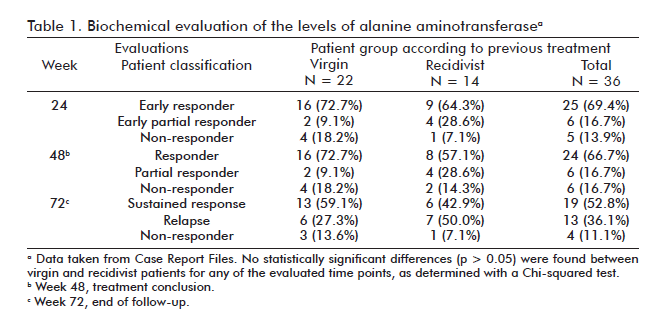
<body><![CDATA[<DIV class="Sect"   ><FONT size="+1" color="#000000"><FONT size="+1"><FONT size="+1"><FONT size="+1"><FONT size="+1"><FONT size="+1"><FONT size="+1"><FONT size="+1"><FONT size="+1"><FONT size="+1"><FONT size="+1"><FONT size="+1"><FONT size="+1"><FONT size="+1"><FONT size="+1"><FONT size="+1"><FONT size="+1"><FONT size="+1"><FONT size="+1"><FONT size="+1"><FONT size="+1"><FONT size="+1"><FONT size="+1"><FONT size="+1"><FONT color="#FF00FF"><FONT color="#000000"><FONT size="+1"><FONT size="+1">       <P   ><font size="2" face="Verdana, Arial, Helvetica, sans-serif"><b>Statistical analysis      </b> </font></P >       <P   align="justify" ><font size="2" face="Verdana, Arial, Helvetica, sans-serif">A descriptive analysis      of the data was performed, calculating absolute and relative frequencies for      adverse clinical and hematological events in treatment-virgin or recidivist      HC patients. Chi-squared tests were run to examine the presence of statistically      significant (p &lt; 0.05) differences between these groups for each of the      biochemical and hematological assays performed. The SPSS version 14.0 statistical      software package was used throughout. </font></P >       <P   ><font size="2" face="Verdana, Arial, Helvetica, sans-serif"><b>Ethical issues      </b></font></P >       <P   align="justify" ><font size="2" face="Verdana, Arial, Helvetica, sans-serif">Signed informed consent      was requested and obtained from each patient by the principal investigator      before their inclusion in the study, as a proof of voluntary participation.      Each volunteer received a copy of this document. The study was performed under      compliance with the principles of the Helsinki Declaration. </font></P >       <P   ><font size="2" face="Verdana, Arial, Helvetica, sans-serif"><b><font size="3">RESULTS      </font></b></font></P >   <FONT size="+1">        <P   align="justify" ><font size="2" face="Verdana, Arial, Helvetica, sans-serif">There were no statistically      significant differences regarding the epidemiological characteristics of the      two patient groups studied (data not shown). Whites predominated, and there      was a slight predominance of females among treatment-virgin and recidivist      patients (p &gt; 0.05). Average age among treatment-virgin patients was 52.9      &plusmn; 7.8 years, and 50.1 &plusmn; 9.6 years among recidivists (p &gt;      0.05). </font></P >   <FONT size="+1">        <P   align="justify" ><font size="2" face="Verdana, Arial, Helvetica, sans-serif">ALAT values remained      at normal levels, especially in the treatment-virgin group (<a href="/img/revistas/bta/v28n4/t0104411.gif">Table      1</a>). For 72.7% of the individuals of this group, ALAT values stayed at      normal levels for 24 weeks. This percentage, however, decreased 24 weeks after      treatment conclusion (week 72). The recidivist group exhibited the lowest      percentages of biochemical response for each and every period, although it      should be stressed that differences with the treatment-virgin group were never      statistically significant (p &gt; 0.05). A general analysis of these evaluations      revealed a biochemical response rate of 65% during treatment (weeks 24 and      48) that was not, however, maintained 24 weeks after treatment conclusion      (week 72). </font></P >       
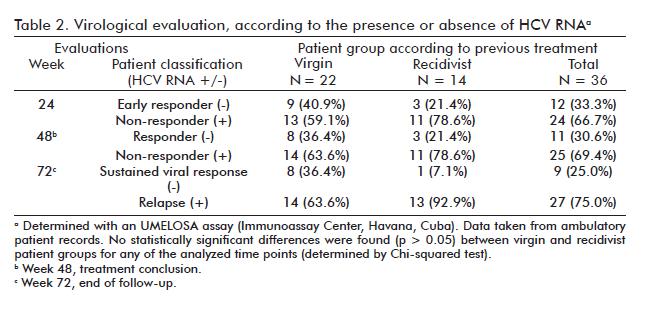
<P   align="justify" ><font size="2" face="Verdana, Arial, Helvetica, sans-serif"><a href="/img/revistas/bta/v28n4/t0204411.gif">Table      2</a> contains the virological evaluation data. No statistically significant      differences were detected at any of the analyzed time points. A comparison      of the evaluations at different time points reveals a higher virological response      in treatment-virgin patients. This difference was sustained from treatment      conclusion (week 48) to the end of the follow-up period (week 72). The two      patients who did not exhibit a SVR belonged to the non-responder group before      treatment. Nine patients (25%) exhibited an SVR for all evaluated time points.      </font></P >       
<P   ><font size="2" face="Verdana, Arial, Helvetica, sans-serif"><b><font size="3">DISCUSSION      </font></b></font></P >   <FONT size="+1">        ]]></body>
<body><![CDATA[<P   align="justify" ><font size="2" face="Verdana, Arial, Helvetica, sans-serif">The only commercially      available drugs against HCV exhibiting higher-than-marginal efficacy are IFN      (standard or PEGylated) and ribavirin. They, however, have a number of side      effects and are poorly tolerated [15, 16], representing therefore a viable      alternative only for those patients able to tolerate the treatment, although      hepatic dysfunction in the latter group is usually smaller. </font></P >   <FONT size="+1">        <P   align="justify" ><font size="2" face="Verdana, Arial, Helvetica, sans-serif">IFN produces neutropenia,      thrombocytopenia and anemia through medullary suppression. Ribavirin produces      anemia, also through medullary suppression and, in addition, hemolysis. The      induction and/or worsening of pre-existing cytopenias in cirrhotic patients      can have serious consequences, such as infections and hemorrhages; for this      reason, these drugs are usually administered only to compensated patients      [17, 18]. Child&rsquo;s scoring scheme is often used to evaluate the degree      of liver dysfunction, in order to select patients for further antiviral treatment      [19, 20]. </font></P >       <P   align="justify" ><font size="2" face="Verdana, Arial, Helvetica, sans-serif">A number of studies      published during the last decade have demonstrated that the smallest rates      of response to antiviral treatment are found among patients infected with      genotype 1 of HCV. Treatment is most successful in genotype 2-infected patients,      followed by those infected with genotype 3 and 4, in that order [21]. </font></P >       <P   align="justify" ><font size="2" face="Verdana, Arial, Helvetica, sans-serif">Although the present      study did not determine viral genotype, previous studies have demonstrated      that genotype 1 predominates among Cuban HCV-infected patients [22]. </font></P >       <P   align="justify" ><font size="2" face="Verdana, Arial, Helvetica, sans-serif">There are only a      few studies a ddressing specifically the efficacy of antiviral treatment in      cirrhotic patients where the viral genotype has been determined. In the study      by Hadziyannis <I>et al</I>. [23], the SVR rate in patients with bridged fibrosis      or HC (most of which were infected with genotype 1) was 41% after treatment      with PEGylated IFN &alpha;-2a (180 &mu;g/week) and ribavirin (1000-1200 mg/day)      for 48 weeks. The present study cannot be directly compared to that of Hadziyannis      <I>et al. </I>[23], as no genotyping was performed in the present case, and      only standard IFN was used. </font></P >       <P   align="justify" ><font size="2" face="Verdana, Arial, Helvetica, sans-serif">The predominance      of whites in the sample is odd. Skin color data were taken from ID documents;      however, classification into race based on skin color is notoriously unreliable,      and it is not uncommon to find mulattoes classified as white. Our data cannot,      therefore, be compared with that of other peer-reviewed studies describing,      at evidence level IV, that Afro-Americans predominate over Caucasians among      patients afflicted with this disease, without evident differences of race      among Latino patients [24, 25]. Statistically speaking, the results of our      study cannot be compared to those of research based on studies of ethnicity      rather than skin color. </font></P >       <P   align="justify" ><font size="2" face="Verdana, Arial, Helvetica, sans-serif">Ages ranged from      50 to 58 years, which corresponds with data previously published by other      authors [26]. </font></P >       <P   align="justify" ><font size="2" face="Verdana, Arial, Helvetica, sans-serif">Biochemical response      rates were higher than virological response rates for all evaluated time points.      This result indicates that normalization of ALAT levels and serum clearance      of viral particles take place independently [27, 28]. A decrease in necroinflammatory      activity, as evaluated biochemically through the levels of the cytolytic enzyme      ALAT, without an accompanying decrease in viremia, has also been described      by other authors in comparable studies [29-31]. In some patients who have      been treated fundamentally with IFN, HCV RNA levels remain unaffected, while      ALAT stays only slightly elevated [32]. </font></P >       <P   align="justify" ><font size="2" face="Verdana, Arial, Helvetica, sans-serif">The results of the      virological evaluation resemble those described by other studies [33, 34].      For instance, the study published by Poynard, Marcellin and Lee [35] reported      an SVR rate of 24% in 41 patients with compensated HC, quite close to the      25% rate we obtained with 36 patients. </font></P >       <P   align="justify" ><font size="2" face="Verdana, Arial, Helvetica, sans-serif">The behavior of the      studied variables in non-responders also corresponded with results published      by other studies, where combined antiviral treatments with IFN &alpha; and      ribavirin in patients who had previously received IFN &alpha; monotherapy      produced SVR rates of 15 to 20% [23, 36]. </font></P >       ]]></body>
<body><![CDATA[<P   align="justify" ><font size="2" face="Verdana, Arial, Helvetica, sans-serif">Despite the appearance      of adverse events in 77.8% of the patients, the treatment was well tolerated.      Most of these events were of low intensity, and treatment discontinuation,      temporal or definitive, was not necessary in any case. However, 40% of the      patients had to decrease the ribavirin dose at some point of the treatment      due to hemoglobin levels falling below 10 g/L [37]. </font></P >       <P   align="justify" ><font size="2" face="Verdana, Arial, Helvetica, sans-serif">We suggest that the      treatment can be used in compensated cirrhotic patients, taking into account      that multi-center studies performed in hospitals from Italy, Japan and Argentina      have provided evidence suggesting that IFN decreases the risk of hepatocarcinoma      by twofold. This effect is thought to be mediated by its antiproliferative      activity and the suppression of viral replication, which eliminates in turn      the carcinogenic effect of the accumulation of viral proteins in the hepatocytes.      These proteins may lead to the proliferation and malignant transformation      of this cell type [38]. </font></P >       <P   align="justify" ><font size="2" face="Verdana, Arial, Helvetica, sans-serif">One of the limitations      of the present work was the use of standard IFN. Hadziyannis <I>et al</I>.      [23] obtained an SVR of 41% after treating the patients with PEGylated IFN      &alpha;-2a (180 &mu;g/week) and ribavirin (1000-1200 mg/day) for 48 weeks.      This response rate was similar to that obtained by Fried <I>et al</I>. [36],      and also by Manns <I>et al. </I>[39], who obtained an SVR rate of 55% with      44 patients in advanced stages of the disease that received a daily dose of      ribavirin equal to or higher than 10.6 mg/kg of body weight [39]. </font></P >       <P   align="justify" ><font size="2" face="Verdana, Arial, Helvetica, sans-serif">The treatment of      HCV infection with IFN &alpha; in combination with ribavirin produced levels      of sustained virological and biochemical response equal to those obtained      in patients with a diagnosis of HC [36]. </font></P >       <P   align="justify" ><font size="2" face="Verdana, Arial, Helvetica, sans-serif">We recommend the      application of antiviral treatment in patients with cirrhosis caused by HCV,      due to its significant impact in viral clearance and the delay it produces,      according to the evidence, in disease progression and the appearance of complications,      guaranteeing that the patient is better prepared for an eventual liver transplant      [40]. </font></P >       <P   align="justify" > </P >       <P   align="justify" ><font size="3"><b><font face="Verdana, Arial, Helvetica, sans-serif">REFERENCES      </font></b></font></P >       <!-- ref --><P   align="justify" ><font size="2" face="Verdana, Arial, Helvetica, sans-serif">1. Mindikoglu AL,      Miller RR. Hepatitis C in the elderly: epidemiology, natural history, and      treatment. Clin Gastroenterol Hepatol. 2009;7(2):128-34.     </font></P >   <FONT size="+1">        <P   ><font size="2" face="Verdana, Arial, Helvetica, sans-serif">2. Andrade LJ, D&rsquo;Oliveira      A, Melo RC, De Souza EC, Silva CA, Parana R. Association between hepatitis      C and hepatocellular carcinoma. J Glob Infect Dis. 2009;1(1):33-7. </font></P >       ]]></body>
<body><![CDATA[<!-- ref --><P   ><font size="2" face="Verdana, Arial, Helvetica, sans-serif">3. Gane EJ. The natural      history of recurrent hepatitis C and what influences this. Liver Transpl.      2008;14 Suppl 2:S36-44.     </font></P >       <!-- ref --><P   ><font size="2" face="Verdana, Arial, Helvetica, sans-serif">4. Manzia TM, Di      Paolo D, Sforza D, Toti L, Angelico R, Brega A, et al. Liver transplantation      for hepatitis B and C virus-related cirrhosis: mid-term results. Transplant      Proc. 2010;42(4):1200-3.     </font></P >       <!-- ref --><P   ><font size="2" face="Verdana, Arial, Helvetica, sans-serif">5. Wang JH, Changchien      CS, Hung CH, Tung WC, Kee KM, Chen CH, et al. Liver stiffness decrease after      effective antiviral therapy in patients with chronic hepatitis C: Longitudinal      study using FibroScan. J Gastroenterol Hepatol. 2010;25(5):964-9.    </font></P >       <!-- ref --><P   ><font size="2" face="Verdana, Arial, Helvetica, sans-serif">6. S&aacute;nchez      Rodr&iacute;guez YA, Ar&uacute;s Soler E. Evoluci&oacute;n hist&oacute;rica      de las terapias antivirales en hepatitis cr&oacute;nica C. Rev Cubana Med.      2010;49(1):65-77.     </font></P >       <!-- ref --><P   ><font size="2" face="Verdana, Arial, Helvetica, sans-serif">7. McHutchison JG,      Gordon SC, Schiff ER, Shiffman ML, Lee WM, Rustgi VK, et al. Interferon alfa-2b      alone or in combination with ribavirin as initial treatment for chronic hepatitis      C. Hepatitis Interventional Therapy Group. N Engl J Med. 1998;339(21):1485-92.          </font></P >       ]]></body>
<body><![CDATA[<!-- ref --><P   ><font size="2" face="Verdana, Arial, Helvetica, sans-serif">8. McHutchison JG,      Lawitz EJ, Shiffman ML, Muir AJ, Galler GW, McCone J, et al. Peginterferon      alfa-2b or alfa-2a with ribavirin for treatment of hepatitis C infection.      N Engl J Med. 2009;361(6):580-93.     </font></P >       <P   ><font size="2" face="Verdana, Arial, Helvetica, sans-serif">9. Ar&uacute;s Soler      E, P&eacute;rez Brioso NA, Parrilla Delgado M, Dom&iacute;nguez &Aacute;lvarez      C. Efecto antifibr&oacute;tico del interfer&oacute;n alfa 2b recombinante      en la cirrosis hep&aacute;tica por virus B o C. Rev Cubana Med. 2005 Ago [citado      2012 Ene 03];44(3-4):[about 1 p.]. Available from: Disponible en: <a href="http://scielo.sld.cu/scielo.php?script=sci_arttext&pid=S0034-75232005000400008&lng=es" target="_blank">http://scielo.sld.cu/scielo.php?script=sci_arttext&amp;pid=S0034-75232005000400008&amp;lng=es</a>      </font></P >       <!-- ref --><P   ><font size="2" face="Verdana, Arial, Helvetica, sans-serif">10. Infante Vel&aacute;zquez      M, Franco Estrada S, P&eacute;rez Lorenzo M, Winograd Lay R, Ar&uacute;s Soler      E. Interfer&oacute;n alfa en el tratamiento de la Cirrosis Hep&aacute;tica      por Virus C. Presentaci&oacute;n de 2 casos. Rev Cubana Med Mil. 2000 Aug      [cited 2012 Jan 04];29(2):140-4. Available from: <a href="http://scielo.sld.cu/scielo.php?script=sci_arttext&pid=S0138-65572000000200011&lng=en" target="_blank">http://scielo.sld.cu/scielo.php?script=sci_arttext&amp;pid=S0138-65572000000200011&amp;lng=en</a>      </font></P >       <!-- ref --><P   ><font size="2" face="Verdana, Arial, Helvetica, sans-serif">11. Ministerio de      Salud P&uacute;blica. Direcci&oacute;n Nacional de Registros M&eacute;dicos      y Estad&iacute;sticas de Salud. Anuario estad&iacute;stico de salud 2008.      La Habana: Ministerio de Salud P&uacute;blica; 2009.     </font></P >       <!-- ref --><P   ><font size="2" face="Verdana, Arial, Helvetica, sans-serif">12. Ministerio de      Salud P&uacute;blica. Direcci&oacute;n Nacional de Registros M&eacute;dicos      y Estad&iacute;sticas de Salud. Diez primeras causas de muerte por grupos      de edad y sexo en el adulto mayor. La Habana: Ministerio de Salud P&uacute;blica;      2009.     </font></P >       <P   ><font size="2" face="Verdana, Arial, Helvetica, sans-serif">13. Davern TJ, Scharschmidt      BF. Biochemical liver tests. In: Feldman M, Friedman LS, Sleisenger MH, editors.      Sleisenger and Fordtran&rsquo;s Gastrointestinal and Liver Disease: Pathophysiology/Diagnosis/Management.      7th ed. Philadelphia. Pa.: Saunders; 2002. p. 1236. </font></P >       <!-- ref --><P   ><font size="2" face="Verdana, Arial, Helvetica, sans-serif">14. Murray-Lyon IM,      Pugh RN, Nunnerley HB, Laws JW, Dawson JL, Williams R. Treatment of bleeding      oesophageal varices by infusion of vasopressin into the superior mesenteric      artery. Gut. 1973;14(1):59-63.     </font></P >       <!-- ref --><P   ><font size="2" face="Verdana, Arial, Helvetica, sans-serif">15. Weiss K. Safety      profile of interferon-alpha therapy. Semin Oncol. 1998;25(1 Suppl 1):9-13.          </font></P >       <!-- ref --><P   ><font size="2" face="Verdana, Arial, Helvetica, sans-serif">16. Davis GL, Balart      LA, Schiff ER, Lindsay K, Bodenheimer HC, Jr., Perrillo RP, et al. Treatment      of chronic hepatitis C with recombinant interferon alfa. A multicenter randomized,      controlled trial. Hepatitis Interventional Therapy Group. N Engl J Med. 1989;321(22):1501-6.    .      </font></P >       <!-- ref --><P   ><font size="2" face="Verdana, Arial, Helvetica, sans-serif">17. Saab S, Hunt      DR, Stone MA, McClune A, Tong MJ. Timing of hepatitis C antiviral therapy      in patients with advanced liver disease: a decision analysis model. Liver      Transpl. 2010;16(6):748-59.     </font></P >       <!-- ref --><P   ><font size="2" face="Verdana, Arial, Helvetica, sans-serif">18. Iacobellis A,      Andriulli A. Antiviral therapy in compensated and decompensated cirrhotic      patients with chronic HCV infection. Expert Opin Pharmacother. 2009;10(12):1929-38.          </font></P >       <P   ><font size="2" face="Verdana, Arial, Helvetica, sans-serif">19. Massard J, Ratziu      V, Thabut D, Moussalli J, Lebray P, Benhamou Y, et al. Natural history and      predictors of disease severity in chronic hepatitis C. J Hepatol. 2006;44(1      Suppl):S19-24. </font></P >       ]]></body>
<body><![CDATA[<P   ><font size="2" face="Verdana, Arial, Helvetica, sans-serif">20. Chlabicz S, Flisiak      R, Kowalczuk O, Grzeszczuk A, Pytel-Krolczuk B, Prokopowicz, et al. Changing      HCV genotypes distribution in Poland&mdash;Relation to source and time of      infection. J Clin Virol. 2008;42(2):156-9. </font></P >       <!-- ref --><P   ><font size="2" face="Verdana, Arial, Helvetica, sans-serif">21. Zeuzem S, Pawlotsky      JM, Lukasiewicz E, von Wagner M, Goulis I, Lurie Y, et al. International,      multicenter, randomized, controlled study comparing dynamically individualized      versus standard treatment in patients with chronic hepatitis C. J Hepatol.      2005;43(2):250-7.     </font></P >       <!-- ref --><P   ><font size="2" face="Verdana, Arial, Helvetica, sans-serif">22. Roca J, Ahmad      M, Kumar Panda S, Padr&oacute;n G, Jameel S. Hepatitis C Virus genotyping      in developing countries: Results from Cuba, India and Turkey. Biotecnol Apl.      1999;16(2):88-92.     </font></P >       <!-- ref --><P   ><font size="2" face="Verdana, Arial, Helvetica, sans-serif">23. Hadziyannis SJ,      Sette H, Jr., Morgan TR, Balan V, Diago M, Marcellin P, et al. Peginterferon-alpha2a      and ribavirin combination therapy in chronic hepatitis C: a randomized study      of treatment duration and ribavirin dose. Ann Intern Med. 2004;140(5):346-55.          </font></P >       <!-- ref --><P   ><font size="2" face="Verdana, Arial, Helvetica, sans-serif">24. Sheikh MY, Bashir      MH, Afaq AA, Sadiq H, Choudhury J. Severity of Liver Disease in Chronic Hepatitis      C Patients: Latino versus Caucasian [Abstract]. Hepatology. 2008;48(Suppl      1):764A-765A.     </font></P >       <!-- ref --><P   ><font size="2" face="Verdana, Arial, Helvetica, sans-serif">25. National Institutes      of Health Consensus Development Conference Statement: Management of hepatitis      C: 2002-June 10-12, 2002. Hepatology. 2002;36(5 Suppl 1):S3-20.     </font></P >       <P   ><font size="2" face="Verdana, Arial, Helvetica, sans-serif">26. Serra MA. Historia      natural de la infecci&oacute;n por virus C. Gastroenterol Hepatol. 2006; 29(Supl      2):101-6. </font></P >       <!-- ref --><P   ><font size="2" face="Verdana, Arial, Helvetica, sans-serif">27. Kim WR, Poterucha      JJ, Benson JT, Therneau TM. The impact of competing risks on the observed      rate of chronic hepatitis C progression. Gastroenterology. 2004;127(3):749-55.          </font></P >       <!-- ref --><P   ><font size="2" face="Verdana, Arial, Helvetica, sans-serif">28. Zeuzem S, Buti      M, Ferenci P, Sperl J, Horsmans Y, Cianciara J, et al. Efficacy of 24 weeks      treatment with peginterferon alfa-2b plus ribavirin in patients with chronic      hepatitis C infected with genotype 1 and low pretreatment viremia. J Hepatol.      2006;44(1):97-103.     </font></P >       <!-- ref --><P   ><font size="2" face="Verdana, Arial, Helvetica, sans-serif">29. Cheng SJ, Bonis      PA, Lau J, Pham NQ, Wong JB. Interferon and ribavirin for patients with chronic      hepatitis C who did not respond to previous interferon therapy: a meta-analysis      of controlled and uncontrolled trials. Hepatology. 2001;33(1):231-40.     </font></P >       <!-- ref --><P   ><font size="2" face="Verdana, Arial, Helvetica, sans-serif">30. San Miguel R,      Guillen F, Cabases JM, Buti M. Meta-analysis: combination therapy with interferon-alpha      2a/2b and ribavirin for patients with chronic hepatitis C previously non-responsive      to interferon. Aliment Pharmacol Ther. 2002;16(9):1611-21.     </font></P >       ]]></body>
<body><![CDATA[<!-- ref --><P   ><font size="2" face="Verdana, Arial, Helvetica, sans-serif">31. Papatheodoridis      GV, Cholongitas E. Chronic hepatitis C and no response to antiviral therapy:      potential current and future therapeutic options. J Viral Hepat. 2004;11(4):287-96.          </font></P >       <!-- ref --><P   ><font size="2" face="Verdana, Arial, Helvetica, sans-serif">32. Camma C, Di Bona      D, Schepis F, Heathcote EJ, Zeuzem S, Pockros PJ, et al. Effect of peginterferon      alfa-2a on liver histology in chronic hepatitis C: a meta-analysis of individual      patient data. Hepatology. 2004;39(2):333-42.     </font></P >       <!-- ref --><P   ><font size="2" face="Verdana, Arial, Helvetica, sans-serif">33. Cross TJ, Antoniades      CG, Harrison PM. Current and future management of chronic hepatitis C infection.      Postgrad Med J. 2008; 84(990):172-6.     </font></P >       <!-- ref --><P   ><font size="2" face="Verdana, Arial, Helvetica, sans-serif">34. Marcellin P,      Jensen D, Hadziyannis SJ, Ferenci P. Differentiation of early virologic response      (EVR) into RVR, complete EVR (cEVR) and partial EVR (pEVR) allows for a more      precise prediction of SVR in HCV genotype 1 patients treated with peginterferon      alfa-2a (40 KD) (PEGASYS) and ribavirin (COPEGUS)[Abstract]. Hepatology. 2007;46(Suppl      1):818A-819A.     </font></P >       <!-- ref --><P   ><font size="2" face="Verdana, Arial, Helvetica, sans-serif">35. Poynard T, Marcellin      P, Lee SS, Niederau C, Minuk GS, Ideo G, et al. Randomised trial of interferon      alpha2b plus ribavirin for 48 weeks or for 24 weeks versus interferon alpha2b      plus placebo for 48 weeks for treatment of chronic infection with hepatitis      C virus. International Hepatitis Interventional Therapy Group (IHIT). Lancet.      1998;352(9138):1426-32.     </font></P >       ]]></body>
<body><![CDATA[<!-- ref --><P   ><font size="2" face="Verdana, Arial, Helvetica, sans-serif">36. Fried MW, Shiffman      ML, Reddy KR, Smith C, Marinos G, Goncales FL, Jr., et al. Peginterferon alfa-2a      plus ribavirin for chronic hepatitis C virus infection. N Engl J Med. 2002;      347(13):975-82.     </font></P >       <!-- ref --><P   ><font size="2" face="Verdana, Arial, Helvetica, sans-serif">37. Dorta Guridi      Z, Castellanos Fern&aacute;ndez M, Nodarse Cun&iacute; H, Ar&uacute;s Soler      E, P&eacute;rez Triana F, Gonz&aacute;lez Fabi&aacute;n L, et al. Tolerancia      del tratamiento con interfer&oacute;n est&aacute;ndar y ribavirina en pacientes      cirr&oacute;ticos por virus de la hepatitis C. Rev Cubana Med. 2010 June [cited      2012 Jan 04];49(2): Available from: <a href="http://scielo.sld.cu/scielo.php?script=sci_arttext&pid=S0034-75232010000200001&lng=en&nrm=iso&tlng=es" target="_blank">http://scielo.sld.cu/scielo.php?script=sci_arttext&amp;pid=S0034-75232010000200001&amp;lng=en&amp;nrm=iso&amp;tlng=es</a>      </font></P >       <!-- ref --><P   ><font size="2" face="Verdana, Arial, Helvetica, sans-serif">38. Iacobellis A,      Siciliano M, Perri F, Annicchiarico BE, Leandro G, Caruso N, et al. Peginterferon      alfa-2b and ribavirin in patients with hepatitis C virus and uncompensated      cirrhosis: A controlled study. J Hepatol. 2007; 46(2):206-12.     </font></P >       <!-- ref --><P   ><font size="2" face="Verdana, Arial, Helvetica, sans-serif">39. Manns MP, McHutchison      JG, Gordon SC, Rutsgi VK, Shiffman M, Reindollar R, et al. Peginterferon alfa-2b      plus ribavirina compared with interferon alfa-2b plus ribavirin for initial      treatment of chronic hepatitis C: a randomised trial. Lancet. 2001;358(9286):958-65.          </font></P >       <!-- ref --><P   ><font size="2" face="Verdana, Arial, Helvetica, sans-serif">40. Bruno S, Stroffolini      T, Colombo M, Bollani S, Benvegnu L, Mazzella G, et al. Sustained virological      response to interferon-alpha is associated with improved outcome in HCV-related      cirrhosis: a retrospective study. Hepatology. 2007;45(3):579-87.     </font></P >       <P   >&nbsp;</P >       ]]></body>
<body><![CDATA[<P   ><font size="2" face="Verdana, Arial, Helvetica, sans-serif">Received in January,      2010.    <br>     </font><font size="2" face="Verdana, Arial, Helvetica, sans-serif">Accepted      for publication in December, 2011. </font></P >   <FONT size="+1">        <P   ><font size="2" face="Verdana, Arial, Helvetica, sans-serif">Zaily Dorta. Instituto      de Gastroenterolog&iacute;a. Calle 25 e/ H e I, Vedado, La Habana, Cuba. E-mail:      <a href="mailto:zaily.dorta@infomed.sld.cu">zaily.dorta@infomed.sld.cu</a>.      </font></P >   </font></font></font></font></font></font></font></font></font></font></font></font></font></font></font></font></font></font></font></font></font></font></font></font></font></font></font></font></font></font></font></font></font></font></DIV >      ]]></body><back>
<ref-list>
<ref id="B1">
<label>1</label><nlm-citation citation-type="journal">
<person-group person-group-type="author">
<name>
<surname><![CDATA[Mindikoglu]]></surname>
<given-names><![CDATA[AL]]></given-names>
</name>
<name>
<surname><![CDATA[Miller]]></surname>
<given-names><![CDATA[RR]]></given-names>
</name>
</person-group>
<article-title xml:lang="en"><![CDATA[Hepatitis C in the elderly: epidemiology, natural history, and treatment]]></article-title>
<source><![CDATA[Clin Gastroenterol Hepatol]]></source>
<year>2009</year>
<volume>7</volume>
<numero>2</numero>
<issue>2</issue>
<page-range>128-34</page-range></nlm-citation>
</ref>
<ref id="B2">
<label>2</label><nlm-citation citation-type="journal">
<person-group person-group-type="author">
<name>
<surname><![CDATA[Andrade]]></surname>
<given-names><![CDATA[LJ]]></given-names>
</name>
<name>
<surname><![CDATA[D'Oliveira]]></surname>
<given-names><![CDATA[A]]></given-names>
</name>
<name>
<surname><![CDATA[Melo]]></surname>
<given-names><![CDATA[RC]]></given-names>
</name>
<name>
<surname><![CDATA[De Souza]]></surname>
<given-names><![CDATA[EC]]></given-names>
</name>
<name>
<surname><![CDATA[Silva]]></surname>
<given-names><![CDATA[CA]]></given-names>
</name>
<name>
<surname><![CDATA[Parana]]></surname>
<given-names><![CDATA[R]]></given-names>
</name>
</person-group>
<article-title xml:lang="en"><![CDATA[Association between hepatitis C and hepatocellular carcinoma]]></article-title>
<source><![CDATA[J Glob Infect Dis]]></source>
<year>2009</year>
<volume>1</volume>
<numero>1</numero>
<issue>1</issue>
<page-range>33-7</page-range></nlm-citation>
</ref>
<ref id="B3">
<label>3</label><nlm-citation citation-type="journal">
<person-group person-group-type="author">
<name>
<surname><![CDATA[Gane]]></surname>
<given-names><![CDATA[EJ]]></given-names>
</name>
</person-group>
<article-title xml:lang="en"><![CDATA[The natural history of recurrent hepatitis C and what influences this]]></article-title>
<source><![CDATA[Liver Transpl]]></source>
<year>2008</year>
<volume>14</volume>
<numero>^s2</numero>
<issue>^s2</issue>
<supplement>2</supplement>
<page-range>S36-44</page-range></nlm-citation>
</ref>
<ref id="B4">
<label>4</label><nlm-citation citation-type="journal">
<person-group person-group-type="author">
<name>
<surname><![CDATA[Manzia]]></surname>
<given-names><![CDATA[TM]]></given-names>
</name>
<name>
<surname><![CDATA[Di Paolo]]></surname>
<given-names><![CDATA[D]]></given-names>
</name>
<name>
<surname><![CDATA[Sforza]]></surname>
<given-names><![CDATA[D]]></given-names>
</name>
<name>
<surname><![CDATA[Toti]]></surname>
<given-names><![CDATA[L]]></given-names>
</name>
<name>
<surname><![CDATA[Angelico]]></surname>
<given-names><![CDATA[R]]></given-names>
</name>
<name>
<surname><![CDATA[Brega]]></surname>
<given-names><![CDATA[A]]></given-names>
</name>
</person-group>
<article-title xml:lang="en"><![CDATA[Liver transplantation for hepatitis B and C virus-related cirrhosis: mid-term results]]></article-title>
<source><![CDATA[Transplant Proc]]></source>
<year>2010</year>
<volume>42</volume>
<numero>4</numero>
<issue>4</issue>
<page-range>1200-3</page-range></nlm-citation>
</ref>
<ref id="B5">
<label>5</label><nlm-citation citation-type="journal">
<person-group person-group-type="author">
<name>
<surname><![CDATA[Wang]]></surname>
<given-names><![CDATA[JH]]></given-names>
</name>
<name>
<surname><![CDATA[Changchien]]></surname>
<given-names><![CDATA[CS]]></given-names>
</name>
<name>
<surname><![CDATA[Hung]]></surname>
<given-names><![CDATA[CH]]></given-names>
</name>
<name>
<surname><![CDATA[Tung]]></surname>
<given-names><![CDATA[WC]]></given-names>
</name>
<name>
<surname><![CDATA[Kee]]></surname>
<given-names><![CDATA[KM]]></given-names>
</name>
<name>
<surname><![CDATA[Chen]]></surname>
<given-names><![CDATA[CH]]></given-names>
</name>
</person-group>
<article-title xml:lang="en"><![CDATA[Liver stiffness decrease after effective antiviral therapy in patients with chronic hepatitis C: Longitudinal study using FibroScan]]></article-title>
<source><![CDATA[J Gastroenterol Hepatol]]></source>
<year>2010</year>
<volume>25</volume>
<numero>5</numero>
<issue>5</issue>
<page-range>964-9</page-range></nlm-citation>
</ref>
<ref id="B6">
<label>6</label><nlm-citation citation-type="journal">
<person-group person-group-type="author">
<name>
<surname><![CDATA[Sánchez Rodríguez]]></surname>
<given-names><![CDATA[YA]]></given-names>
</name>
<name>
<surname><![CDATA[Arús Soler]]></surname>
<given-names><![CDATA[E]]></given-names>
</name>
</person-group>
<article-title xml:lang="es"><![CDATA[Evolución histórica de las terapias antivirales en hepatitis crónica C]]></article-title>
<source><![CDATA[Rev Cubana Med]]></source>
<year>2010</year>
<volume>49</volume>
<numero>1</numero>
<issue>1</issue>
<page-range>65-77</page-range></nlm-citation>
</ref>
<ref id="B7">
<label>7</label><nlm-citation citation-type="journal">
<person-group person-group-type="author">
<name>
<surname><![CDATA[McHutchison]]></surname>
<given-names><![CDATA[JG]]></given-names>
</name>
<name>
<surname><![CDATA[Gordon]]></surname>
<given-names><![CDATA[SC]]></given-names>
</name>
<name>
<surname><![CDATA[Schiff]]></surname>
<given-names><![CDATA[ER]]></given-names>
</name>
<name>
<surname><![CDATA[Shiffman]]></surname>
<given-names><![CDATA[ML]]></given-names>
</name>
<name>
<surname><![CDATA[Lee]]></surname>
<given-names><![CDATA[WM]]></given-names>
</name>
<name>
<surname><![CDATA[Rustgi]]></surname>
<given-names><![CDATA[VK]]></given-names>
</name>
</person-group>
<article-title xml:lang="en"><![CDATA[Interferon alfa-2b alone or in combination with ribavirin as initial treatment for chronic hepatitis C]]></article-title>
<source><![CDATA[Hepatitis Interventional Therapy Group N Engl J Med]]></source>
<year>1998</year>
<volume>339</volume>
<numero>21</numero>
<issue>21</issue>
<page-range>1485-92</page-range></nlm-citation>
</ref>
<ref id="B8">
<label>8</label><nlm-citation citation-type="journal">
<person-group person-group-type="author">
<name>
<surname><![CDATA[McHutchison]]></surname>
<given-names><![CDATA[JG]]></given-names>
</name>
<name>
<surname><![CDATA[Lawitz]]></surname>
<given-names><![CDATA[EJ]]></given-names>
</name>
<name>
<surname><![CDATA[Shiffman]]></surname>
<given-names><![CDATA[ML]]></given-names>
</name>
<name>
<surname><![CDATA[Muir]]></surname>
<given-names><![CDATA[AJ]]></given-names>
</name>
<name>
<surname><![CDATA[Galler]]></surname>
<given-names><![CDATA[GW]]></given-names>
</name>
<name>
<surname><![CDATA[McCone]]></surname>
<given-names><![CDATA[J]]></given-names>
</name>
</person-group>
<article-title xml:lang="en"><![CDATA[Peginterferon alfa-2b or alfa-2a with ribavirin for treatment of hepatitis C infection]]></article-title>
<source><![CDATA[N Engl J Med]]></source>
<year>2009</year>
<volume>361</volume>
<numero>6</numero>
<issue>6</issue>
<page-range>580-93</page-range></nlm-citation>
</ref>
<ref id="B9">
<label>9</label><nlm-citation citation-type="journal">
<person-group person-group-type="author">
<name>
<surname><![CDATA[Arús Soler]]></surname>
<given-names><![CDATA[E]]></given-names>
</name>
<name>
<surname><![CDATA[Pérez Brioso]]></surname>
<given-names><![CDATA[NA]]></given-names>
</name>
<name>
<surname><![CDATA[Parrilla Delgado]]></surname>
<given-names><![CDATA[M]]></given-names>
</name>
<name>
<surname><![CDATA[Domínguez Álvarez]]></surname>
<given-names><![CDATA[C]]></given-names>
</name>
</person-group>
<article-title xml:lang="es"><![CDATA[Efecto antifibrótico del interferón alfa 2b recombinante en la cirrosis hepática por virus B o C]]></article-title>
<source><![CDATA[Rev Cubana Med]]></source>
<year>2005</year>
<month> A</month>
<day>go</day>
<volume>44</volume>
<numero>3-4</numero>
<issue>3-4</issue>
</nlm-citation>
</ref>
<ref id="B10">
<label>10</label><nlm-citation citation-type="journal">
<person-group person-group-type="author">
<name>
<surname><![CDATA[Infante Velázquez]]></surname>
<given-names><![CDATA[M]]></given-names>
</name>
<name>
<surname><![CDATA[Franco Estrada]]></surname>
<given-names><![CDATA[S]]></given-names>
</name>
<name>
<surname><![CDATA[Pérez Lorenzo]]></surname>
<given-names><![CDATA[M]]></given-names>
</name>
<name>
<surname><![CDATA[Winograd Lay]]></surname>
<given-names><![CDATA[R]]></given-names>
</name>
<name>
<surname><![CDATA[Arús Soler]]></surname>
<given-names><![CDATA[E]]></given-names>
</name>
</person-group>
<article-title xml:lang="es"><![CDATA[Interferón alfa en el tratamiento de la Cirrosis Hepática por Virus C: Presentación de 2 casos]]></article-title>
<source><![CDATA[Rev Cubana Med Mil]]></source>
<year>2000</year>
<month> A</month>
<day>ug</day>
<volume>29</volume>
<numero>2</numero>
<issue>2</issue>
<page-range>140-4</page-range></nlm-citation>
</ref>
<ref id="B11">
<label>11</label><nlm-citation citation-type="book">
<collab>Ministerio de Salud Pública. Dirección Nacional de Registros Médicos y Estadísticas de Salud</collab>
<source><![CDATA[Anuario estadístico de salud 2008]]></source>
<year>2009</year>
<publisher-loc><![CDATA[La Habana ]]></publisher-loc>
<publisher-name><![CDATA[Ministerio de Salud Pública]]></publisher-name>
</nlm-citation>
</ref>
<ref id="B12">
<label>12</label><nlm-citation citation-type="book">
<collab>Ministerio de Salud Pública. Dirección Nacional de Registros Médicos y Estadísticas de Salud</collab>
<source><![CDATA[Diez primeras causas de muerte por grupos de edad y sexo en el adulto mayor]]></source>
<year>2009</year>
<publisher-loc><![CDATA[La Habana ]]></publisher-loc>
<publisher-name><![CDATA[Ministerio de Salud Pública]]></publisher-name>
</nlm-citation>
</ref>
<ref id="B13">
<label>13</label><nlm-citation citation-type="book">
<person-group person-group-type="author">
<name>
<surname><![CDATA[Davern]]></surname>
<given-names><![CDATA[TJ]]></given-names>
</name>
<name>
<surname><![CDATA[Scharschmidt]]></surname>
<given-names><![CDATA[BF]]></given-names>
</name>
</person-group>
<article-title xml:lang="en"><![CDATA[Biochemical liver tests]]></article-title>
<person-group person-group-type="editor">
<name>
<surname><![CDATA[Feldman]]></surname>
<given-names><![CDATA[M]]></given-names>
</name>
<name>
<surname><![CDATA[Friedman]]></surname>
<given-names><![CDATA[LS]]></given-names>
</name>
<name>
<surname><![CDATA[Sleisenger]]></surname>
<given-names><![CDATA[MH]]></given-names>
</name>
</person-group>
<source><![CDATA[Sleisenger and Fordtran's Gastrointestinal and Liver Disease: Pathophysiology/Diagnosis/Management]]></source>
<year>2002</year>
<edition>7</edition>
<page-range>1236</page-range><publisher-loc><![CDATA[Philadelphia. Pa. ]]></publisher-loc>
<publisher-name><![CDATA[Saunders]]></publisher-name>
</nlm-citation>
</ref>
<ref id="B14">
<label>14</label><nlm-citation citation-type="journal">
<person-group person-group-type="author">
<name>
<surname><![CDATA[Murray-Lyon]]></surname>
<given-names><![CDATA[IM]]></given-names>
</name>
<name>
<surname><![CDATA[Pugh]]></surname>
<given-names><![CDATA[RN]]></given-names>
</name>
<name>
<surname><![CDATA[Nunnerley]]></surname>
<given-names><![CDATA[HB]]></given-names>
</name>
<name>
<surname><![CDATA[Laws]]></surname>
<given-names><![CDATA[JW]]></given-names>
</name>
<name>
<surname><![CDATA[Dawson]]></surname>
<given-names><![CDATA[JL]]></given-names>
</name>
<name>
<surname><![CDATA[Williams]]></surname>
<given-names><![CDATA[R]]></given-names>
</name>
</person-group>
<article-title xml:lang="en"><![CDATA[Treatment of bleeding oesophageal varices by infusion of vasopressin into the superior mesenteric artery]]></article-title>
<source><![CDATA[Gut]]></source>
<year>1973</year>
<volume>14</volume>
<numero>1</numero>
<issue>1</issue>
<page-range>59-63</page-range></nlm-citation>
</ref>
<ref id="B15">
<label>15</label><nlm-citation citation-type="journal">
<person-group person-group-type="author">
<name>
<surname><![CDATA[Weiss]]></surname>
<given-names><![CDATA[K]]></given-names>
</name>
</person-group>
<article-title xml:lang="en"><![CDATA[Safety profile of interferon-alpha therapy]]></article-title>
<source><![CDATA[Semin Oncol]]></source>
<year>1998</year>
<volume>25</volume>
<numero>1^s1</numero>
<issue>1^s1</issue>
<supplement>1</supplement>
<page-range>9-13</page-range></nlm-citation>
</ref>
<ref id="B16">
<label>16</label><nlm-citation citation-type="journal">
<person-group person-group-type="author">
<name>
<surname><![CDATA[Davis]]></surname>
<given-names><![CDATA[GL]]></given-names>
</name>
<name>
<surname><![CDATA[Balart]]></surname>
<given-names><![CDATA[LA]]></given-names>
</name>
<name>
<surname><![CDATA[Schiff]]></surname>
<given-names><![CDATA[ER]]></given-names>
</name>
<name>
<surname><![CDATA[Lindsay]]></surname>
<given-names><![CDATA[K]]></given-names>
</name>
<name>
<surname><![CDATA[Bodenheimer]]></surname>
<given-names><![CDATA[HC Jr]]></given-names>
</name>
<name>
<surname><![CDATA[Perrillo]]></surname>
<given-names><![CDATA[RP]]></given-names>
</name>
</person-group>
<article-title xml:lang="en"><![CDATA[Treatment of chronic hepatitis C with recombinant interferon alfa: A multicenter randomized, controlled trial. Hepatitis Interventional Therapy Group]]></article-title>
<source><![CDATA[N Engl J Med]]></source>
<year>1989</year>
<volume>321</volume>
<numero>22</numero>
<issue>22</issue>
<page-range>1501-6</page-range></nlm-citation>
</ref>
<ref id="B17">
<label>17</label><nlm-citation citation-type="journal">
<person-group person-group-type="author">
<name>
<surname><![CDATA[Saab]]></surname>
<given-names><![CDATA[S]]></given-names>
</name>
<name>
<surname><![CDATA[Hunt]]></surname>
<given-names><![CDATA[DR]]></given-names>
</name>
<name>
<surname><![CDATA[Stone]]></surname>
<given-names><![CDATA[MA]]></given-names>
</name>
<name>
<surname><![CDATA[McClune]]></surname>
<given-names><![CDATA[A]]></given-names>
</name>
<name>
<surname><![CDATA[Tong]]></surname>
<given-names><![CDATA[MJ]]></given-names>
</name>
</person-group>
<article-title xml:lang="en"><![CDATA[Timing of hepatitis C antiviral therapy in patients with advanced liver disease: a decision analysis model]]></article-title>
<source><![CDATA[Liver Transpl]]></source>
<year>2010</year>
<volume>16</volume>
<numero>6</numero>
<issue>6</issue>
<page-range>748-59</page-range></nlm-citation>
</ref>
<ref id="B18">
<label>17</label><nlm-citation citation-type="journal">
<person-group person-group-type="author">
<name>
<surname><![CDATA[Saab]]></surname>
<given-names><![CDATA[S]]></given-names>
</name>
<name>
<surname><![CDATA[Hunt]]></surname>
<given-names><![CDATA[DR]]></given-names>
</name>
<name>
<surname><![CDATA[Stone]]></surname>
<given-names><![CDATA[MA]]></given-names>
</name>
<name>
<surname><![CDATA[McClune]]></surname>
<given-names><![CDATA[A]]></given-names>
</name>
<name>
<surname><![CDATA[Tong]]></surname>
<given-names><![CDATA[MJ]]></given-names>
</name>
</person-group>
<article-title xml:lang="en"><![CDATA[Timing of hepatitis C antiviral therapy in patients with advanced liver disease: a decision analysis model]]></article-title>
<source><![CDATA[Liver Transpl]]></source>
<year>2010</year>
<volume>16</volume>
<numero>6</numero>
<issue>6</issue>
<page-range>748-59</page-range></nlm-citation>
</ref>
<ref id="B19">
<label>18</label><nlm-citation citation-type="journal">
<person-group person-group-type="author">
<name>
<surname><![CDATA[Iacobellis]]></surname>
<given-names><![CDATA[A]]></given-names>
</name>
<name>
<surname><![CDATA[Andriulli]]></surname>
<given-names><![CDATA[A]]></given-names>
</name>
</person-group>
<article-title xml:lang="en"><![CDATA[Antiviral therapy in compensated and decompensated cirrhotic patients with chronic HCV infection]]></article-title>
<source><![CDATA[Expert Opin Pharmacother]]></source>
<year>2009</year>
<volume>10</volume>
<numero>12</numero>
<issue>12</issue>
<page-range>1929-38</page-range></nlm-citation>
</ref>
<ref id="B20">
<label>19</label><nlm-citation citation-type="journal">
<person-group person-group-type="author">
<name>
<surname><![CDATA[Massard]]></surname>
<given-names><![CDATA[J]]></given-names>
</name>
<name>
<surname><![CDATA[Ratziu]]></surname>
<given-names><![CDATA[V]]></given-names>
</name>
<name>
<surname><![CDATA[Thabut]]></surname>
<given-names><![CDATA[D]]></given-names>
</name>
<name>
<surname><![CDATA[Moussalli]]></surname>
<given-names><![CDATA[J]]></given-names>
</name>
<name>
<surname><![CDATA[Lebray]]></surname>
<given-names><![CDATA[P]]></given-names>
</name>
<name>
<surname><![CDATA[Benhamou]]></surname>
<given-names><![CDATA[Y]]></given-names>
</name>
</person-group>
<article-title xml:lang="en"><![CDATA[Natural history and predictors of disease severity in chronic hepatitis C]]></article-title>
<source><![CDATA[J Hepatol]]></source>
<year>2006</year>
<volume>44</volume>
<numero>^s1</numero>
<issue>^s1</issue>
<supplement>1</supplement>
<page-range>S19-24</page-range></nlm-citation>
</ref>
<ref id="B21">
<label>20</label><nlm-citation citation-type="journal">
<person-group person-group-type="author">
<name>
<surname><![CDATA[Chlabicz]]></surname>
<given-names><![CDATA[S]]></given-names>
</name>
<name>
<surname><![CDATA[Flisiak]]></surname>
<given-names><![CDATA[R]]></given-names>
</name>
<name>
<surname><![CDATA[Kowalczuk]]></surname>
<given-names><![CDATA[O]]></given-names>
</name>
<name>
<surname><![CDATA[Grzeszczuk]]></surname>
<given-names><![CDATA[A]]></given-names>
</name>
<name>
<surname><![CDATA[Pytel-Krolczuk]]></surname>
<given-names><![CDATA[B]]></given-names>
</name>
<name>
<surname><![CDATA[Prokopowicz]]></surname>
<given-names><![CDATA[D]]></given-names>
</name>
</person-group>
<article-title xml:lang="en"><![CDATA[Changing HCV genotypes distribution in Poland: relation to source and time of infection]]></article-title>
<source><![CDATA[J Clin Virol]]></source>
<year>2008</year>
<volume>42</volume>
<numero>2</numero>
<issue>2</issue>
<page-range>156-9</page-range></nlm-citation>
</ref>
<ref id="B22">
<label>21</label><nlm-citation citation-type="journal">
<person-group person-group-type="author">
<name>
<surname><![CDATA[Zeuzem]]></surname>
<given-names><![CDATA[S]]></given-names>
</name>
<name>
<surname><![CDATA[Pawlotsky]]></surname>
<given-names><![CDATA[JM]]></given-names>
</name>
<name>
<surname><![CDATA[Lukasiewicz]]></surname>
<given-names><![CDATA[E]]></given-names>
</name>
<name>
<surname><![CDATA[von Wagner]]></surname>
<given-names><![CDATA[M]]></given-names>
</name>
<name>
<surname><![CDATA[Goulis]]></surname>
<given-names><![CDATA[I]]></given-names>
</name>
<name>
<surname><![CDATA[Lurie]]></surname>
<given-names><![CDATA[Y]]></given-names>
</name>
</person-group>
<article-title xml:lang="en"><![CDATA[International, multicenter, randomized, controlled study comparing dynamically individualized versus standard treatment in patients with chronic hepatitis C]]></article-title>
<source><![CDATA[J Hepatol]]></source>
<year>2005</year>
<volume>43</volume>
<numero>2</numero>
<issue>2</issue>
<page-range>250-7</page-range></nlm-citation>
</ref>
<ref id="B23">
<label>22</label><nlm-citation citation-type="journal">
<person-group person-group-type="author">
<name>
<surname><![CDATA[Roca]]></surname>
<given-names><![CDATA[J]]></given-names>
</name>
<name>
<surname><![CDATA[Ahmad]]></surname>
<given-names><![CDATA[M]]></given-names>
</name>
<name>
<surname><![CDATA[Kumar Panda]]></surname>
<given-names><![CDATA[S]]></given-names>
</name>
<name>
<surname><![CDATA[Padrón]]></surname>
<given-names><![CDATA[G]]></given-names>
</name>
<name>
<surname><![CDATA[Jameel]]></surname>
<given-names><![CDATA[S]]></given-names>
</name>
</person-group>
<article-title xml:lang="en"><![CDATA[Hepatitis C Virus genotyping in developing countries: Results from Cuba, India and Turkey]]></article-title>
<source><![CDATA[Biotecnol Apl]]></source>
<year>1999</year>
<volume>16</volume>
<numero>2</numero>
<issue>2</issue>
<page-range>88-92</page-range></nlm-citation>
</ref>
<ref id="B24">
<label>23</label><nlm-citation citation-type="journal">
<person-group person-group-type="author">
<name>
<surname><![CDATA[Hadziyannis]]></surname>
<given-names><![CDATA[SJ]]></given-names>
</name>
<name>
<surname><![CDATA[Sette]]></surname>
<given-names><![CDATA[H Jr]]></given-names>
</name>
<name>
<surname><![CDATA[Morgan]]></surname>
<given-names><![CDATA[TR]]></given-names>
</name>
<name>
<surname><![CDATA[Balan]]></surname>
<given-names><![CDATA[V]]></given-names>
</name>
<name>
<surname><![CDATA[Diago]]></surname>
<given-names><![CDATA[M]]></given-names>
</name>
<name>
<surname><![CDATA[Marcellin]]></surname>
<given-names><![CDATA[P]]></given-names>
</name>
</person-group>
<article-title xml:lang="en"><![CDATA[Peginterferon-alpha2a and ribavirin combination therapy in chronic hepatitis C: a randomized study of treatment duration and ribavirin dose]]></article-title>
<source><![CDATA[Ann Intern Med]]></source>
<year>2004</year>
<volume>140</volume>
<numero>5</numero>
<issue>5</issue>
<page-range>346-55</page-range></nlm-citation>
</ref>
<ref id="B25">
<label>24</label><nlm-citation citation-type="journal">
<person-group person-group-type="author">
<name>
<surname><![CDATA[Sheikh]]></surname>
<given-names><![CDATA[MY]]></given-names>
</name>
<name>
<surname><![CDATA[Bashir]]></surname>
<given-names><![CDATA[MH]]></given-names>
</name>
<name>
<surname><![CDATA[Afaq]]></surname>
<given-names><![CDATA[AA]]></given-names>
</name>
<name>
<surname><![CDATA[Sadiq]]></surname>
<given-names><![CDATA[H]]></given-names>
</name>
<name>
<surname><![CDATA[Choudhury]]></surname>
<given-names><![CDATA[J]]></given-names>
</name>
</person-group>
<article-title xml:lang="en"><![CDATA[Severity of Liver Disease in Chronic Hepatitis C Patients: Latino versus Caucasian (Abstract)]]></article-title>
<source><![CDATA[Hepatology]]></source>
<year>2008</year>
<volume>48</volume>
<numero>^s1</numero>
<issue>^s1</issue>
<supplement>1</supplement>
<page-range>764A-765A</page-range></nlm-citation>
</ref>
<ref id="B26">
<label>25</label><nlm-citation citation-type="journal">
<person-group person-group-type="author">
<name>
</name>
</person-group>
<article-title xml:lang="en"><![CDATA[National Institutes of Health Consensus Development Conference Statement: Management of hepatitis C: 2002-June 10-12, 2002]]></article-title>
<source><![CDATA[Hepatology]]></source>
<year>2002</year>
<volume>36</volume>
<numero>5^s1</numero>
<issue>5^s1</issue>
<supplement>1</supplement>
<page-range>S3-20</page-range></nlm-citation>
</ref>
<ref id="B27">
<label>27</label><nlm-citation citation-type="journal">
<person-group person-group-type="author">
<name>
<surname><![CDATA[Kim]]></surname>
<given-names><![CDATA[WR]]></given-names>
</name>
<name>
<surname><![CDATA[Poterucha]]></surname>
<given-names><![CDATA[JJ]]></given-names>
</name>
<name>
<surname><![CDATA[Benson]]></surname>
<given-names><![CDATA[JT]]></given-names>
</name>
<name>
<surname><![CDATA[Therneau]]></surname>
<given-names><![CDATA[TM]]></given-names>
</name>
</person-group>
<article-title xml:lang="en"><![CDATA[The impact of competing risks on the observed rate of chronic hepatitis C progression]]></article-title>
<source><![CDATA[Gastroenterology]]></source>
<year>2004</year>
<volume>127</volume>
<numero>3</numero>
<issue>3</issue>
<page-range>749-55</page-range></nlm-citation>
</ref>
<ref id="B28">
<label>28</label><nlm-citation citation-type="journal">
<person-group person-group-type="author">
<name>
<surname><![CDATA[Zeuzem]]></surname>
<given-names><![CDATA[S]]></given-names>
</name>
<name>
<surname><![CDATA[Buti]]></surname>
<given-names><![CDATA[M]]></given-names>
</name>
<name>
<surname><![CDATA[Ferenci]]></surname>
<given-names><![CDATA[P]]></given-names>
</name>
<name>
<surname><![CDATA[Sperl]]></surname>
<given-names><![CDATA[J]]></given-names>
</name>
<name>
<surname><![CDATA[Horsmans]]></surname>
<given-names><![CDATA[Y]]></given-names>
</name>
<name>
<surname><![CDATA[Cianciara]]></surname>
<given-names><![CDATA[J]]></given-names>
</name>
</person-group>
<article-title xml:lang="en"><![CDATA[Efficacy of 24 weeks treatment with peginterferon alfa-2b plus ribavirin in patients with chronic hepatitis C infected with genotype 1 and low pretreatment viremia]]></article-title>
<source><![CDATA[J Hepatol]]></source>
<year>2006</year>
<volume>44</volume>
<numero>1</numero>
<issue>1</issue>
<page-range>97-103</page-range></nlm-citation>
</ref>
<ref id="B29">
<label>29</label><nlm-citation citation-type="journal">
<person-group person-group-type="author">
<name>
<surname><![CDATA[Cheng]]></surname>
<given-names><![CDATA[SJ]]></given-names>
</name>
<name>
<surname><![CDATA[Bonis]]></surname>
<given-names><![CDATA[PA]]></given-names>
</name>
<name>
<surname><![CDATA[Lau]]></surname>
<given-names><![CDATA[J]]></given-names>
</name>
<name>
<surname><![CDATA[Pham]]></surname>
<given-names><![CDATA[NQ]]></given-names>
</name>
<name>
<surname><![CDATA[Wong]]></surname>
<given-names><![CDATA[JB]]></given-names>
</name>
</person-group>
<article-title xml:lang="en"><![CDATA[Interferon and ribavirin for patients with chronic hepatitis C who did not respond to previous interferon therapy: a meta-analysis of controlled and uncontrolled trials]]></article-title>
<source><![CDATA[Hepatology]]></source>
<year>2001</year>
<volume>33</volume>
<numero>1</numero>
<issue>1</issue>
<page-range>231-40</page-range></nlm-citation>
</ref>
<ref id="B30">
<label>30</label><nlm-citation citation-type="journal">
<person-group person-group-type="author">
<name>
<surname><![CDATA[San Miguel]]></surname>
<given-names><![CDATA[R]]></given-names>
</name>
<name>
<surname><![CDATA[Guillen]]></surname>
<given-names><![CDATA[F]]></given-names>
</name>
<name>
<surname><![CDATA[Cabases]]></surname>
<given-names><![CDATA[JM]]></given-names>
</name>
<name>
<surname><![CDATA[Buti]]></surname>
<given-names><![CDATA[M]]></given-names>
</name>
</person-group>
<article-title xml:lang="en"><![CDATA[Meta-analysis: combination therapy with interferon-alpha 2a/2b and ribavirin for patients with chronic hepatitis C previously non-responsive to interferon]]></article-title>
<source><![CDATA[Aliment Pharmacol Ther]]></source>
<year>2002</year>
<volume>16</volume>
<numero>9</numero>
<issue>9</issue>
<page-range>1611-21</page-range></nlm-citation>
</ref>
<ref id="B31">
<label>31</label><nlm-citation citation-type="journal">
<person-group person-group-type="author">
<name>
<surname><![CDATA[Papatheodoridis]]></surname>
<given-names><![CDATA[GV]]></given-names>
</name>
<name>
<surname><![CDATA[Cholongitas]]></surname>
<given-names><![CDATA[E]]></given-names>
</name>
</person-group>
<article-title xml:lang="en"><![CDATA[Chronic hepatitis C and no response to antiviral therapy: potential current and future therapeutic options]]></article-title>
<source><![CDATA[J Viral Hepat]]></source>
<year>2004</year>
<volume>11</volume>
<numero>4</numero>
<issue>4</issue>
<page-range>287-96</page-range></nlm-citation>
</ref>
<ref id="B32">
<label>32</label><nlm-citation citation-type="journal">
<person-group person-group-type="author">
<name>
<surname><![CDATA[Camma]]></surname>
<given-names><![CDATA[C]]></given-names>
</name>
<name>
<surname><![CDATA[Di Bona]]></surname>
<given-names><![CDATA[D]]></given-names>
</name>
<name>
<surname><![CDATA[Schepis]]></surname>
<given-names><![CDATA[F]]></given-names>
</name>
<name>
<surname><![CDATA[Heathcote]]></surname>
<given-names><![CDATA[EJ]]></given-names>
</name>
<name>
<surname><![CDATA[Zeuzem]]></surname>
<given-names><![CDATA[S]]></given-names>
</name>
<name>
<surname><![CDATA[Pockros]]></surname>
<given-names><![CDATA[PJ]]></given-names>
</name>
</person-group>
<article-title xml:lang="en"><![CDATA[Effect of peginterferon alfa-2a on liver histology in chronic hepatitis C: a meta-analysis of individual patient data]]></article-title>
<source><![CDATA[Hepatology]]></source>
<year>2004</year>
<volume>39</volume>
<numero>2</numero>
<issue>2</issue>
<page-range>333-42</page-range></nlm-citation>
</ref>
<ref id="B33">
<label>33</label><nlm-citation citation-type="journal">
<person-group person-group-type="author">
<name>
<surname><![CDATA[Cross]]></surname>
<given-names><![CDATA[TJ]]></given-names>
</name>
<name>
<surname><![CDATA[Antoniades]]></surname>
<given-names><![CDATA[CG]]></given-names>
</name>
<name>
<surname><![CDATA[Harrison]]></surname>
<given-names><![CDATA[PM]]></given-names>
</name>
</person-group>
<article-title xml:lang="en"><![CDATA[Current and future management of chronic hepatitis C infection]]></article-title>
<source><![CDATA[Postgrad Med J]]></source>
<year>2008</year>
<volume>84</volume>
<numero>990</numero>
<issue>990</issue>
<page-range>172-6</page-range></nlm-citation>
</ref>
<ref id="B34">
<label>34</label><nlm-citation citation-type="journal">
<person-group person-group-type="author">
<name>
<surname><![CDATA[Marcellin]]></surname>
<given-names><![CDATA[P]]></given-names>
</name>
<name>
<surname><![CDATA[Jensen]]></surname>
<given-names><![CDATA[D]]></given-names>
</name>
<name>
<surname><![CDATA[Hadziyannis]]></surname>
<given-names><![CDATA[SJ]]></given-names>
</name>
<name>
<surname><![CDATA[Ferenci]]></surname>
<given-names><![CDATA[P]]></given-names>
</name>
</person-group>
<article-title xml:lang="en"><![CDATA[Differentiation of early virologic response (EVR) into RVR, complete EVR (cEVR) and partial EVR (pEVR) allows for a more precise prediction of SVR in HCV genotype 1 patients treated with peginterferon alfa-2a (40 KD) (PEGASYS) and ribavirin (COPEGUS)(Abstract)]]></article-title>
<source><![CDATA[Hepatology]]></source>
<year>2007</year>
<volume>46</volume>
<numero>^s1</numero>
<issue>^s1</issue>
<supplement>1</supplement>
<page-range>818A-819A</page-range></nlm-citation>
</ref>
<ref id="B35">
<label>35</label><nlm-citation citation-type="journal">
<person-group person-group-type="author">
<name>
<surname><![CDATA[Poynard]]></surname>
<given-names><![CDATA[T]]></given-names>
</name>
<name>
<surname><![CDATA[Marcellin]]></surname>
<given-names><![CDATA[P]]></given-names>
</name>
<name>
<surname><![CDATA[Lee]]></surname>
<given-names><![CDATA[SS]]></given-names>
</name>
<name>
<surname><![CDATA[Niederau]]></surname>
<given-names><![CDATA[C]]></given-names>
</name>
<name>
<surname><![CDATA[Minuk]]></surname>
<given-names><![CDATA[GS]]></given-names>
</name>
<name>
<surname><![CDATA[Ideo]]></surname>
<given-names><![CDATA[G]]></given-names>
</name>
</person-group>
<article-title xml:lang="en"><![CDATA[Randomised trial of interferon alpha2b plus ribavirin for 48 weeks or for 24 weeks versus interferon alpha2b plus placebo for 48 weeks for treatment of chronic infection with hepatitis C virus: International Hepatitis Interventional Therapy Group (IHIT)]]></article-title>
<source><![CDATA[Lancet]]></source>
<year>1998</year>
<volume>352</volume>
<numero>9138</numero>
<issue>9138</issue>
<page-range>1426-32</page-range></nlm-citation>
</ref>
<ref id="B36">
<label>36</label><nlm-citation citation-type="journal">
<person-group person-group-type="author">
<name>
<surname><![CDATA[Fried]]></surname>
<given-names><![CDATA[MW]]></given-names>
</name>
<name>
<surname><![CDATA[Shiffman]]></surname>
<given-names><![CDATA[ML]]></given-names>
</name>
<name>
<surname><![CDATA[Reddy]]></surname>
<given-names><![CDATA[KR]]></given-names>
</name>
<name>
<surname><![CDATA[Smith]]></surname>
<given-names><![CDATA[C]]></given-names>
</name>
<name>
<surname><![CDATA[Marinos]]></surname>
<given-names><![CDATA[G]]></given-names>
</name>
<name>
<surname><![CDATA[Goncales]]></surname>
<given-names><![CDATA[FL Jr]]></given-names>
</name>
</person-group>
<article-title xml:lang="en"><![CDATA[Peginterferon alfa-2a plus ribavirin for chronic hepatitis C virus infection]]></article-title>
<source><![CDATA[N Engl J Med]]></source>
<year>2002</year>
<volume>347</volume>
<numero>13</numero>
<issue>13</issue>
<page-range>975-82</page-range></nlm-citation>
</ref>
<ref id="B37">
<label>37</label><nlm-citation citation-type="journal">
<person-group person-group-type="author">
<name>
<surname><![CDATA[Dorta Guridi]]></surname>
<given-names><![CDATA[Z]]></given-names>
</name>
<name>
<surname><![CDATA[Castellanos Fernández]]></surname>
<given-names><![CDATA[M]]></given-names>
</name>
<name>
<surname><![CDATA[Nodarse Cuní]]></surname>
<given-names><![CDATA[H]]></given-names>
</name>
<name>
<surname><![CDATA[Arús Soler]]></surname>
<given-names><![CDATA[E]]></given-names>
</name>
<name>
<surname><![CDATA[Pérez Triana]]></surname>
<given-names><![CDATA[F]]></given-names>
</name>
<name>
<surname><![CDATA[González Fabián]]></surname>
<given-names><![CDATA[L]]></given-names>
</name>
</person-group>
<article-title xml:lang="es"><![CDATA[Tolerancia del tratamiento con interferón estándar y ribavirina en pacientes cirróticos por virus de la hepatitis C]]></article-title>
<source><![CDATA[Rev Cubana Med]]></source>
<year>2010</year>
<month> J</month>
<day>un</day>
<volume>49</volume>
<numero>2</numero>
<issue>2</issue>
</nlm-citation>
</ref>
<ref id="B38">
<label>38</label><nlm-citation citation-type="journal">
<person-group person-group-type="author">
<name>
<surname><![CDATA[Iacobellis]]></surname>
<given-names><![CDATA[A]]></given-names>
</name>
<name>
<surname><![CDATA[Siciliano]]></surname>
<given-names><![CDATA[M]]></given-names>
</name>
<name>
<surname><![CDATA[Perri]]></surname>
<given-names><![CDATA[F]]></given-names>
</name>
<name>
<surname><![CDATA[Annicchiarico]]></surname>
<given-names><![CDATA[BE]]></given-names>
</name>
<name>
<surname><![CDATA[Leandro]]></surname>
<given-names><![CDATA[G]]></given-names>
</name>
<name>
<surname><![CDATA[Caruso]]></surname>
<given-names><![CDATA[N]]></given-names>
</name>
</person-group>
<article-title xml:lang="en"><![CDATA[Peginterferon alfa-2b and ribavirin in patients with hepatitis C virus and uncompensated cirrhosis: A controlled study]]></article-title>
<source><![CDATA[J Hepatol]]></source>
<year>2007</year>
<volume>46</volume>
<numero>2</numero>
<issue>2</issue>
<page-range>206-12</page-range></nlm-citation>
</ref>
<ref id="B39">
<label>39</label><nlm-citation citation-type="journal">
<person-group person-group-type="author">
<name>
<surname><![CDATA[Manns]]></surname>
<given-names><![CDATA[MP]]></given-names>
</name>
<name>
<surname><![CDATA[McHutchison]]></surname>
<given-names><![CDATA[JG]]></given-names>
</name>
<name>
<surname><![CDATA[Gordon]]></surname>
<given-names><![CDATA[SC]]></given-names>
</name>
<name>
<surname><![CDATA[Rutsgi]]></surname>
<given-names><![CDATA[VK]]></given-names>
</name>
<name>
<surname><![CDATA[Shiffman]]></surname>
<given-names><![CDATA[M]]></given-names>
</name>
<name>
<surname><![CDATA[Reindollar]]></surname>
<given-names><![CDATA[R]]></given-names>
</name>
</person-group>
<article-title xml:lang="en"><![CDATA[Peginterferon alfa-2b plus ribavirina compared with interferon alfa-2b plus ribavirin for initial treatment of chronic hepatitis C: a randomised trial]]></article-title>
<source><![CDATA[Lancet]]></source>
<year>2001</year>
<volume>358</volume>
<numero>9286</numero>
<issue>9286</issue>
<page-range>958-65</page-range></nlm-citation>
</ref>
<ref id="B40">
<label>40</label><nlm-citation citation-type="journal">
<person-group person-group-type="author">
<name>
<surname><![CDATA[Bruno]]></surname>
<given-names><![CDATA[S]]></given-names>
</name>
<name>
<surname><![CDATA[Stroffolini]]></surname>
<given-names><![CDATA[T]]></given-names>
</name>
<name>
<surname><![CDATA[Colombo]]></surname>
<given-names><![CDATA[M]]></given-names>
</name>
<name>
<surname><![CDATA[Bollani]]></surname>
<given-names><![CDATA[S]]></given-names>
</name>
<name>
<surname><![CDATA[Benvegnu]]></surname>
<given-names><![CDATA[L]]></given-names>
</name>
<name>
<surname><![CDATA[Mazzella]]></surname>
<given-names><![CDATA[G]]></given-names>
</name>
</person-group>
<article-title xml:lang="en"><![CDATA[Sustained virological response to interferon-alpha is associated with improved outcome in HCV-rel ated cirrhosis: a retrospective study]]></article-title>
<source><![CDATA[Hepatology]]></source>
<year>2007</year>
<volume>45</volume>
<numero>3</numero>
<issue>3</issue>
<page-range>579-87</page-range></nlm-citation>
</ref>
</ref-list>
</back>
</article>