<?xml version="1.0" encoding="ISO-8859-1"?><article xmlns:mml="http://www.w3.org/1998/Math/MathML" xmlns:xlink="http://www.w3.org/1999/xlink" xmlns:xsi="http://www.w3.org/2001/XMLSchema-instance">
<front>
<journal-meta>
<journal-id>1027-2852</journal-id>
<journal-title><![CDATA[Biotecnología Aplicada]]></journal-title>
<abbrev-journal-title><![CDATA[Biotecnol Apl]]></abbrev-journal-title>
<issn>1027-2852</issn>
<publisher>
<publisher-name><![CDATA[Editorial Elfos Scientiae]]></publisher-name>
</publisher>
</journal-meta>
<article-meta>
<article-id>S1027-28522011000400007</article-id>
<title-group>
<article-title xml:lang="en"><![CDATA[High level resistance to phytopathogenic fungi and oomycetes conferred by the use of a novel anti-microbial peptide]]></article-title>
<article-title xml:lang="es"><![CDATA[Inducción de alto nivel de resistencia a hongos fitopatógenos y oomicetos mediante el uso de un novedoso péptido antimicrobiano]]></article-title>
</title-group>
<contrib-group>
<contrib contrib-type="author">
<name>
<surname><![CDATA[Portieles]]></surname>
<given-names><![CDATA[Roxana]]></given-names>
</name>
<xref ref-type="aff" rid="A01"/>
</contrib>
<contrib contrib-type="author">
<name>
<surname><![CDATA[Borrás]]></surname>
<given-names><![CDATA[Orlando]]></given-names>
</name>
<xref ref-type="aff" rid="A01"/>
</contrib>
<contrib contrib-type="author">
<name>
<surname><![CDATA[Ayra]]></surname>
<given-names><![CDATA[Camilo]]></given-names>
</name>
<xref ref-type="aff" rid="A01"/>
</contrib>
<contrib contrib-type="author">
<name>
<surname><![CDATA[González]]></surname>
<given-names><![CDATA[Ernesto M]]></given-names>
</name>
<xref ref-type="aff" rid="A01"/>
</contrib>
<contrib contrib-type="author">
<name>
<surname><![CDATA[Castillo]]></surname>
<given-names><![CDATA[Juan]]></given-names>
</name>
<xref ref-type="aff" rid="A02"/>
</contrib>
<contrib contrib-type="author">
<name>
<surname><![CDATA[Trujillo]]></surname>
<given-names><![CDATA[Luis E]]></given-names>
</name>
<xref ref-type="aff" rid="A01"/>
</contrib>
<contrib contrib-type="author">
<name>
<surname><![CDATA[Chacón]]></surname>
<given-names><![CDATA[Osmani]]></given-names>
</name>
<xref ref-type="aff" rid="A03"/>
</contrib>
<contrib contrib-type="author">
<name>
<surname><![CDATA[Rodríguez]]></surname>
<given-names><![CDATA[Mayra]]></given-names>
</name>
<xref ref-type="aff" rid="A01"/>
</contrib>
<contrib contrib-type="author">
<name>
<surname><![CDATA[López]]></surname>
<given-names><![CDATA[Yunior]]></given-names>
</name>
<xref ref-type="aff" rid="A01"/>
</contrib>
<contrib contrib-type="author">
<name>
<surname><![CDATA[Rodrígues]]></surname>
<given-names><![CDATA[Raisa]]></given-names>
</name>
<xref ref-type="aff" rid="A01"/>
</contrib>
<contrib contrib-type="author">
<name>
<surname><![CDATA[Gallo]]></surname>
<given-names><![CDATA[Araiz]]></given-names>
</name>
<xref ref-type="aff" rid="A01"/>
</contrib>
<contrib contrib-type="author">
<name>
<surname><![CDATA[Pujol]]></surname>
<given-names><![CDATA[Merardo]]></given-names>
</name>
<xref ref-type="aff" rid="A01"/>
</contrib>
<contrib contrib-type="author">
<name>
<surname><![CDATA[Enríquez]]></surname>
<given-names><![CDATA[Gil]]></given-names>
</name>
<xref ref-type="aff" rid="A01"/>
</contrib>
<contrib contrib-type="author">
<name>
<surname><![CDATA[Borroto]]></surname>
<given-names><![CDATA[Carlos]]></given-names>
</name>
<xref ref-type="aff" rid="A01"/>
</contrib>
<contrib contrib-type="author">
<name>
<surname><![CDATA[Oliva]]></surname>
<given-names><![CDATA[Osvaldo]]></given-names>
</name>
<xref ref-type="aff" rid="A01"/>
</contrib>
<contrib contrib-type="author">
<name>
<surname><![CDATA[Simón]]></surname>
<given-names><![CDATA[Margarita]]></given-names>
</name>
<xref ref-type="aff" rid="A01"/>
</contrib>
</contrib-group>
<aff id="A02">
<institution><![CDATA[,Instituto Nacional de Ciencias Agrícolas  ]]></institution>
<addr-line><![CDATA[ ]]></addr-line>
<country>Cuba</country>
</aff>
<aff id="A03">
<institution><![CDATA[,Instituto de Investigaciones del Tabaco  ]]></institution>
<addr-line><![CDATA[ ]]></addr-line>
<country>Cuba</country>
</aff>
<aff id="A01">
<institution><![CDATA[,Centro de Ingeniería Genética y Biotecnología División de Plantas ]]></institution>
<addr-line><![CDATA[La Habana ]]></addr-line>
<country>Cuba</country>
</aff>
<pub-date pub-type="pub">
<day>00</day>
<month>12</month>
<year>2011</year>
</pub-date>
<pub-date pub-type="epub">
<day>00</day>
<month>12</month>
<year>2011</year>
</pub-date>
<volume>28</volume>
<numero>4</numero>
<fpage>262</fpage>
<lpage>264</lpage>
<copyright-statement/>
<copyright-year/>
<self-uri xlink:href="http://scielo.sld.cu/scielo.php?script=sci_arttext&amp;pid=S1027-28522011000400007&amp;lng=en&amp;nrm=iso"></self-uri><self-uri xlink:href="http://scielo.sld.cu/scielo.php?script=sci_abstract&amp;pid=S1027-28522011000400007&amp;lng=en&amp;nrm=iso"></self-uri><self-uri xlink:href="http://scielo.sld.cu/scielo.php?script=sci_pdf&amp;pid=S1027-28522011000400007&amp;lng=en&amp;nrm=iso"></self-uri><abstract abstract-type="short" xml:lang="en"><p><![CDATA[Fungi and oomycete-borne plant disease constitute the largest limiting factor for crop productivity and yields both in Cuba and worldwide. Vast amounts of fungicidal chemicals have to be spent every year for their control, despite considerable environmental damage and the risk such chemicals pose for human health. Searching for biotechnological disease control alternatives is, therefore, a priority of current research on this subject. Plant defensins are small cysteine-rich peptides forming part of the defense mechanisms of plants that inhibit the growth of a wide range of phytopathogenic microorganisms. The present work describes a new cDNA coding for a defensin, isolated by looking at genes induced by the inoculation of Nicotiana megalosiphon with Peronospora hyoscyami f. sp. tabacina, the causative pathogen of tobacco blue mould. NmDef02, the isolated gene, was expressed in the yeast Pichia pastoris, and the purified recombinant protein exhibited a strong anti-microbial activity to major fungal and oomycetal plant pathogens. In addition, the constitutive expression of the NmDef02 gene in transgenic tobacco and potato plants increased their resistance to economically important diseases.]]></p></abstract>
<abstract abstract-type="short" xml:lang="es"><p><![CDATA[Las enfermedades en las plantas causadas por hongos y oomicetos son el factor de mayor incidencia que limita la productividad de las cosechas en el mundo. Enormes cantidades de fungicidas químicos se emplean cada año para controlar estos agentes patógenos, a pesar del daño al medio ambiente y el riesgo para la salud humana. Por ello, la búsqueda de alternativas biotecnológicas para controlar esas enfermedades es una prioridad. Una de las estrategias consiste en el uso de las defensinas: pequeños péptidos, ricos en cisteína, que forman parte del sistema de defensa de las plantas e inhiben el crecimiento de una amplia variedad de microorganismos fitopatógenos. En este trabajo se describe un nuevo ADN codificante para una defensina, aislado mediante pesquisa de genes inducidos por inoculación de Nicotiana megalosiphon con Peronospora hyoscyami f. sp. tabacina (el agente causal del moho azul del tabaco). El gen aislado, denominado NmDef02, se expresó en la levadura Pichia pastoris y su correspondiente proteína recombinante, que una vez purificada, mostró una potente actividad contra los principales agentes patógenos fúngicos y oomicetos. Además, la expresión constitutiva del gen NmDef02 en plantas transgénicas de tabaco y papa incrementó su resistencia a enfermedades vegetales de importancia económica.]]></p></abstract>
<kwd-group>
<kwd lng="en"><![CDATA[Phytopathogenic fungi]]></kwd>
<kwd lng="en"><![CDATA[oomycetes]]></kwd>
<kwd lng="en"><![CDATA[anti-microbial peptide]]></kwd>
<kwd lng="en"><![CDATA[plant defensin]]></kwd>
<kwd lng="en"><![CDATA[transgenic tobacco]]></kwd>
<kwd lng="en"><![CDATA[transgenic potato]]></kwd>
<kwd lng="es"><![CDATA[Hongos fitopatógenos]]></kwd>
<kwd lng="es"><![CDATA[oomicetos]]></kwd>
<kwd lng="es"><![CDATA[pétido antimicrobiano]]></kwd>
<kwd lng="es"><![CDATA[defensina de plantas]]></kwd>
<kwd lng="es"><![CDATA[tabaco transgénico]]></kwd>
<kwd lng="es"><![CDATA[papa transgénica]]></kwd>
</kwd-group>
</article-meta>
</front><body><![CDATA[ <DIV class="Sect"   >        <P align="right"   ><font size="2" color="#000000" face="Verdana, Arial, Helvetica, sans-serif"><b>REPORT      </b></font></P >       <P align="right"   >&nbsp;</P >   <FONT size="+1" color="#000000">        <P   > </P >       <P   ><b><font face="Verdana, Arial, Helvetica, sans-serif" size="4">High level resistance      to phytopathogenic fungi and oomycetes conferred by the use of a novel anti-microbial      peptide </font></b></P >       <P   >&nbsp;</P >       <P   ><font face="Verdana, Arial, Helvetica, sans-serif" size="3"><b>Inducci&oacute;n      de alto nivel de resistencia a hongos fitopat&oacute;genos y oomicetos mediante      el uso de un novedoso p&eacute;ptido antimicrobiano </b></font></P >       <P   >&nbsp;</P >       <P   >&nbsp;</P >       <P   > </P >       ]]></body>
<body><![CDATA[<P   ><b><font face="Verdana, Arial, Helvetica, sans-serif" size="2">Roxana Portieles<Sup>1</Sup>,      Orlando Borr&aacute;s<Sup>1</Sup>, Camilo Ayra<Sup>1</Sup>, Ernesto M Gonz&aacute;lez<Sup>1</Sup>,      Juan Castillo<Sup>2</Sup>, Luis E Trujillo<Sup>1</Sup>, Osmani Chac&oacute;n<Sup>3</Sup>,      Mayra Rodr&iacute;guez<Sup>1</Sup>, Yunior L&oacute;pez<Sup>1</Sup>, Raisa      Rodr&iacute;gues<Sup>1</Sup>, Araiz Gallo<Sup>1</Sup>, Merardo Pujol<Sup>1</Sup>,      Gil Enr&iacute;quez<Sup>1</Sup>, Carlos Borroto<Sup>1</Sup>, Osvaldo Oliva<Sup>1</Sup>,      Margarita Sim&oacute;n<Sup>1</Sup></font></b></P >   <FONT size="+1"><FONT size="+1"><FONT size="+1"><FONT size="+1"><FONT size="+1"><FONT size="+1"><FONT size="+1"><FONT size="+1"><FONT size="+1"><FONT size="+1"><FONT size="+1"><FONT size="+1"><FONT size="+1"><FONT size="+1"><FONT size="+1"><FONT size="+1"><FONT size="+1"><FONT size="+1"><FONT size="+1"><FONT size="+1"><FONT size="+1"><FONT size="+1"><FONT size="+1"><FONT size="+1"><FONT size="+1"><FONT size="+1"><FONT size="+1"><FONT size="+1"><FONT size="+1"><FONT size="+1"><FONT size="+1"><FONT size="+1">        <P   > </P >       <P   ><font face="Verdana, Arial, Helvetica, sans-serif" size="2"><Sup>1</Sup>Divisi&oacute;n      de Plantas, Centro de Ingenier&iacute;a Gen&eacute;tica y Biotecnolog&iacute;a,      CIGB. La Habana, Cuba.    <br>     </font><font face="Verdana, Arial, Helvetica, sans-serif" size="2"><Sup>2</Sup>Instituto      Nacional de Ciencias Agr&iacute;colas, INCA. Cuba.    <br>     </font><font face="Verdana, Arial, Helvetica, sans-serif" size="2"><Sup>3</Sup>Instituto      de Investigaciones del Tabaco, IIT. Cuba.</font></P >       <P   >&nbsp;</P >   <FONT size="+1"><FONT size="+1"><FONT size="+1"><FONT size="+1"><FONT size="+1"><FONT size="+1">    </font></font></font></font></font></font></font></font></font></font></font></font></font></font></font></font></font></font></font></font></font></font></font></font></font></font></font></font></font></font></font></font></font></font></font></font></font></font></font>   <hr>   <FONT size="+1" color="#000000"><FONT size="+1"><FONT size="+1"><FONT size="+1"><FONT size="+1"><FONT size="+1"><FONT size="+1"><FONT size="+1"><FONT size="+1"><FONT size="+1"><FONT size="+1"><FONT size="+1"><FONT size="+1"><FONT size="+1"><FONT size="+1"><FONT size="+1"><FONT size="+1"><FONT size="+1"><FONT size="+1"><FONT size="+1"><FONT size="+1"><FONT size="+1"><FONT size="+1"><FONT size="+1"><FONT size="+1"><FONT size="+1"><FONT size="+1"><FONT size="+1"><FONT size="+1"><FONT size="+1"><FONT size="+1"><FONT size="+1"><FONT size="+1"><FONT size="+1"><FONT size="+1"><FONT size="+1"><FONT size="+1"><FONT size="+1"><FONT size="+1">        <P   > </P >       <P   ><b><font face="Verdana, Arial, Helvetica, sans-serif" size="2">ABSTRACT </font></b></P >       <P   ><font size="2" face="Verdana, Arial, Helvetica, sans-serif">Fungi and oomycete-borne      plant disease constitute the largest limiting factor for crop productivity      and yields both in Cuba and worldwide. Vast amounts of fungicidal chemicals      have to be spent every year for their control, despite considerable environmental      damage and the risk such chemicals pose for human health. Searching for biotechnological      disease control alternatives is, therefore, a priority of current research      on this subject. Plant defensins are small cysteine-rich peptides forming      part of the defense mechanisms of plants that inhibit the growth of a wide      range of phytopathogenic microorganisms. The present work describes a new      cDNA coding for a defensin, isolated by looking at genes induced by the inoculation      of <I>Nicotiana megalosiphon</I> with <I>Peronospora hyoscyami</I> f. sp.      <I>tabacina</I>, the causative pathogen of tobacco blue mould. <I>NmDef02</I>,      the isolated gene, was expressed in the yeast <I>Pichia pastoris</I>, and      the purified recombinant protein exhibited a strong anti-microbial activity      to major fungal and oomycetal plant pathogens. In addition, the constitutive      expression of the <I>NmDef02</I> gene in transgenic tobacco and potato plants      increased their resistance to economically important diseases. </font></P >       <P   ><font face="Verdana, Arial, Helvetica, sans-serif" size="2"><b>Keywords: </b>phytopathogenic      fungi, oomycetes, anti-microbial peptide, plant defensin, transgenic tobacco,      transgenic potato.</font></P >   <FONT size="+1">        ]]></body>
<body><![CDATA[<P   > </P >   <FONT size="+1"> </font></font></font></font></font></font></font></font></font></font></font></font></font></font></font></font></font></font></font></font></font></font></font></font></font></font></font></font></font></font></font></font></font></font></font></font></font></font></font></font></font>    <hr>   <FONT size="+1" color="#000000"><FONT size="+1"><FONT size="+1"><FONT size="+1"><FONT size="+1"><FONT size="+1"><FONT size="+1"><FONT size="+1"><FONT size="+1"><FONT size="+1"><FONT size="+1"><FONT size="+1"><FONT size="+1"><FONT size="+1"><FONT size="+1"><FONT size="+1"><FONT size="+1"><FONT size="+1"><FONT size="+1"><FONT size="+1"><FONT size="+1"><FONT size="+1"><FONT size="+1"><FONT size="+1"><FONT size="+1"><FONT size="+1"><FONT size="+1"><FONT size="+1"><FONT size="+1"><FONT size="+1"><FONT size="+1"><FONT size="+1"><FONT size="+1"><FONT size="+1"><FONT size="+1"><FONT size="+1"><FONT size="+1"><FONT size="+1"><FONT size="+1"><FONT size="+1"><FONT size="+1">        <P   ><font face="Verdana, Arial, Helvetica, sans-serif" size="2"><b>RESUMEN </b></font></P >       <P   ><font size="2" face="Verdana, Arial, Helvetica, sans-serif">Las enfermedades      en las plantas causadas por hongos y oomicetos son el factor de mayor incidencia      que limita la productividad de las cosechas en el mundo. Enormes cantidades      de fungicidas qu&iacute;micos se emplean cada a&ntilde;o para controlar estos      agentes pat&oacute;genos, a pesar del da&ntilde;o al medio ambiente y el riesgo      para la salud humana. Por ello, la b&uacute;squeda de alternativas biotecnol&oacute;gicas      para controlar esas enfermedades es una prioridad. Una de las estrategias      consiste en el uso de las defensinas: peque&ntilde;os p&eacute;ptidos, ricos      en ciste&iacute;na, que forman parte del sistema de defensa de las plantas      e inhiben el crecimiento de una amplia variedad de microorganismos fitopat&oacute;genos.      En este trabajo se describe un nuevo ADN codificante para una defensina, aislado      mediante pesquisa de genes inducidos por inoculaci&oacute;n de <i>Nicotiana      megalosiphon</i> con <i>Peronospora hyoscyami</i> f. sp. <i>tabacina</i> (el      agente causal del moho azul del tabaco). El gen aislado, denominado <i>NmDef02</i>,      se expres&oacute; en la levadura <i>Pichia pastoris</i> y su correspondiente      prote&iacute;na recombinante, que una vez purificada, mostr&oacute; una potente      actividad contra los principales agentes pat&oacute;genos f&uacute;ngicos      y oomicetos. Adem&aacute;s, la expresi&oacute;n constitutiva del gen <i>NmDef02</i>      en plantas transg&eacute;nicas de tabaco y papa increment&oacute; su resistencia      a enfermedades vegetales de importancia econ&oacute;mica.</font></P >       <P   ><font face="Verdana, Arial, Helvetica, sans-serif" size="2"><b>Palabras clave</b>:      hongos fitopat&oacute;genos, oomicetos, p&eacute;tido antimicrobiano, defensina      de plantas, tabaco transg&eacute;nico, papa transg&eacute;nica.</font></P >       <P   > </P >   </font></font></font></font></font></font></font></font></font></font></font></font></font></font></font></font></font></font></font></font></font></font></font></font></font></font></font></font></font></font></font></font></font></font></font></font></font></font></font></font></font>    <hr>   <FONT size="+1" color="#000000"><FONT size="+1"><FONT size="+1"><FONT size="+1"><FONT size="+1"><FONT size="+1"><FONT size="+1"><FONT size="+1"><FONT size="+1"><FONT size="+1"><FONT size="+1"><FONT size="+1"><FONT size="+1"><FONT size="+1"><FONT size="+1"><FONT size="+1"><FONT size="+1"><FONT size="+1"><FONT size="+1"><FONT size="+1"><FONT size="+1"><FONT size="+1"><FONT size="+1"><FONT size="+1"><FONT size="+1"><FONT size="+1"><FONT size="+1"><FONT size="+1"><FONT size="+1"><FONT size="+1"><FONT size="+1"><FONT size="+1"><FONT size="+1"><FONT size="+1"><FONT size="+1"><FONT size="+1"><FONT size="+1"><FONT size="+1"><FONT size="+1"><FONT size="+1"><FONT size="+1">        <P   >&nbsp;</P >       <P   >&nbsp;</P >       <P   ><font face="Verdana, Arial, Helvetica, sans-serif" size="2"><b><font size="3">INTRODUCTION      </font></b></font></P >       <P   align="justify" ><font size="2" face="Verdana, Arial, Helvetica, sans-serif">Plant defensins are      a family of small, basic, highly stable cysteine-rich peptides typically 45      to 54 aminoacids long, distributed throughout the plant kingdom. These peptides      are major players of the natural defense systems of vegetables, where they      inhibit the growth of a disparate range of pathogenic microorganisms [1].      </font></P >   <FONT size="+1">        <P   align="justify" ><font face="Verdana, Arial, Helvetica, sans-serif" size="2">The present work      describes the isolation of gene <I>NmDef02</I>, coding for a new defensin      from the wild, non-cultured tobacco species <I>Nicotiana megalosiphon</I>.      This gene was obtained following a strategy aimed at the obtention of an anti-microbial      peptide able to confer high levels of protection against plant pathogens,      comprised of two stages: 1) Expression in recombinant yeast, purification      and <I>in vitro </I>evaluation of the anti-microbial activity of defensin      NmDef02; and 2) Evaluation of the efficacy of the expression of this gene      into transgenic tobacco and potato plants within the context of agricultural      disease control [2]. </font></P >       ]]></body>
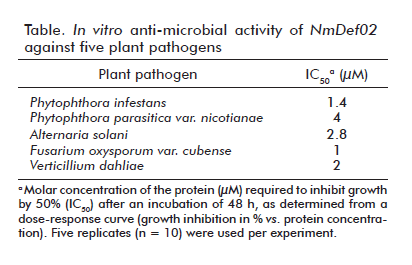
<body><![CDATA[<P   > </P >   <FONT size="+1">        <P   ><font size="3"><b><font face="Verdana, Arial, Helvetica, sans-serif">RESULTS</font></b></font><font face="Verdana, Arial, Helvetica, sans-serif" size="2">      </font></P >       <P   ><font size="2" face="Verdana, Arial, Helvetica, sans-serif"><b>Expression in      recombinant yeast, purification and in vitro evaluation of anti-microbial      activity of defensin <I>NmDef02</I> </b></font></P >   <FONT size="+1">        <P   align="justify" ><font face="Verdana, Arial, Helvetica, sans-serif" size="2">A suppression subtractive      hybridization cDNA library from leaves of <I>N. megalosiphon</I> inoculated      with <I>Peronospora hyoscyami </I>f. sp<I>. tabacina </I>was used to isolate      a clone bearing a 219 sequence denominated <I>NmDef02, </I>exhibiting sequence      homology with a plant defensin. The sequence would code for a polypeptide      with a length of 73 aminoacids, including a 27 aminoacid leader peptide. By      means of alignments with plant defensin sequences from public databases and      publications, it was possible to determine that the leader peptide cleavage      site is conserved among all 74 studied polypeptides. There is strict conservation      for eight cysteine residues thought to be involved in disulphide bonding,      an aromatic residue at position 11 and glycines in positions 13 and 14 (ordinates      are relative to those of defensin Rs-AFP2). A highly conserved serine at position      8 is not, however, present in <I>NmDef02</I>. Even though <I>NmDef02 </I>clusters      with this group of 74 plant defensins (62% bootstrap support), it is likely      to belong to a new defensin subgroup because only a poor bootstrap support      (19%) links this sequence to its closest homolog from <I>Triticum aestivum</I>.      </font></P >       <P   align="justify" ><font face="Verdana, Arial, Helvetica, sans-serif" size="2">The cDNA sequence      coding for the mature portion of <I>NmDef02 </I>was also fused in-frame with      a modified &alpha;-factor leader peptide devoid of its last four aminoacids      and transformed into the yeast <I>Pichia pastoris</I>. After inducing the      expression of <I>NmDef02 </I>through the addition of methanol for 72 hours      into shake flask cultures, it was possible to detect, by SDS-PAGE of culture      supernatants, a protein species with an approximate molecular weight of 5.1      kDa, matching that of processed <I>NmDef02 </I>(<a href="#fig1">Figure 1</a>).      </font></P >       <P   align="center" ><img src="/img/revistas/bta/v28n4/f0107411.gif" width="423" height="856"><a name="fig1"></a></P >       
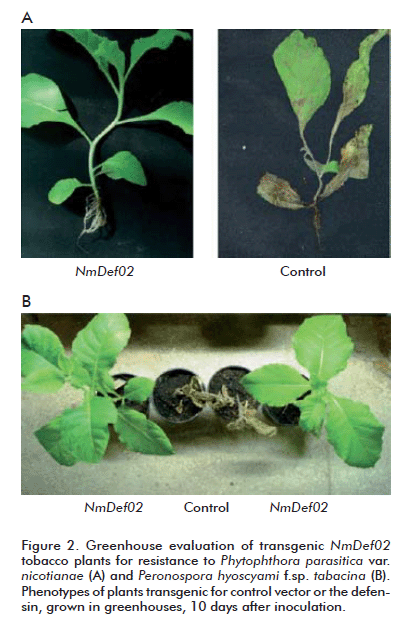
<P   align="justify" ><font face="Verdana, Arial, Helvetica, sans-serif" size="2">This recombinant      species constitutes approximately 30% of all protein in culture supernatants,      as estimated by densitometric analysis. It was not possible to detect this      peptide in recombinant yeast transformed with the empty pPIC9 vector, used      as negative control for the study. Recombinant <I>NmDef02</I> was purified      from culture supernatants, and the purified fraction was shown to be constituted      by a single protein species of the expected size by mass spectrometry (MALDI-TOF).      </font></P >       <P   align="justify" ><font face="Verdana, Arial, Helvetica, sans-serif" size="2">The anti-microbial      activity of recombinant <I>NmDef02 </I>was evaluated <I>in vitro</I> on different      plant pathogens. As shown in <a href="#tab">table</a>, the recombinant molecule      exhibits varying median growth inhibitory concentrations (IC<Sub>50</Sub>),      ranging from 1 &micro;M for <I>Fusarium oxysporum var. cubense</I> to 2.8      &micro;M for <I>A. solani</I> after 48 hoursof incubation.</font></P >       <P   align="center" ><img src="/img/revistas/bta/v28n4/t0107411.gif" width="412" height="265"><a name="tab"></a></P >   <FONT size="+1"><FONT size="+1">        
<P   align="justify" ><font face="Verdana, Arial, Helvetica, sans-serif" size="2">In the particular      case of <I>Phytophthora parasitica </I>var.<I> Nicotianae</I>, recombinant      <I>NmDef02,</I> at a concentration of 4 &micro;M, was sufficient to inhibit      hyphal growth after 48 hours of incubation. These experiments confirmed the      efficacy and width of the <I>in vitro </I>anti-microbial activity of recombinant      <I>NmDef02, </I>as it is able to inhibit the growth of both fungi and oomycetes.      </font></P >       ]]></body>
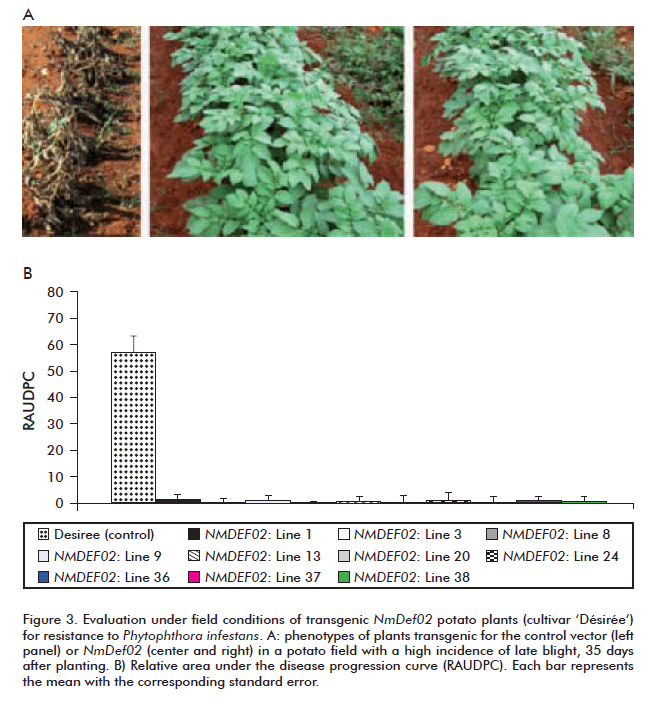
<body><![CDATA[<P   ><font face="Verdana, Arial, Helvetica, sans-serif" size="2"><b>Efficacy of the      introduction of the defensin gene in transgenic tobacco and potato plants      for the control of agriculturally significant diseases </b></font></P >       <P   align="justify" ><font face="Verdana, Arial, Helvetica, sans-serif" size="2">Given that recombinant      <I>NmDef02</I> obtained from yeast exhibited anti-microbial activity <I>in      vitro </I>against all five assayed plant pathogens, it was decided to generate      transgenic tobacco and potato plants to determine whether expressing the 35S::<I>NmDef02</I>      transgene confers resistance against plant pathogens <I>in vivo. </I>Relative      expression of the <I>NmDef02 </I>mRNA was measured before inoculation, by      quantitative RT-PCR of 50 individual tobacco and potato lines homozygotic      for the transgene. This followed the objective of identifying the best expressing      clones for future research. </font></P >       <P   align="justify" ><font face="Verdana, Arial, Helvetica, sans-serif" size="2">Although obtaining      polyclonal antisera against <I>NmDef02 </I>would have allowed a more direct      estimation of the levels of this molecule than measuring its transcript by      quantitative RT-PCR, all efforts in this direction were fruitless, and therefore      the latter technique was selected for this purpose. Not all tobacco and potato      homozygotic lines, grown under greenhouse conditions, expressed the 35S::<I>NmDef02      </I>transgene at the same level, and transcript numbers were in general higher      in tobacco than in potato plants. Twenty transgenic lines from each, having      relatively high transcript levels of the <I>NmDef02 </I>cDNA, were chosen      for further experimentation on resistance to pathogens under greenhouse and      field conditions. </font></P >       <P   align="justify" ><font face="Verdana, Arial, Helvetica, sans-serif" size="2">Twenty transgenic      tobacco lines expressing the 35S::<I>NmDef02</I> transgene, as well as control      plants, were inoculated with the pathogenic oomycetes <I>P. parasitica var.      nicotianae</I> or <I>P. hyoscyami f.sp. tabacina</I> (<a href="#fig2">Figure      2</a>). Five days after inoculation there were mild disease symptoms typical      of <I>P. parasitica var. nicotianae</I> in the control plants, but the transgenic      defensin-expressing plants remained healthy. Ten days after the inoculation      there were severe disease symptoms in all control plants (stem rot and withering      of the leaves), which died 5 days later. In the case of the transgenic plants      expressing the 35S::<I>NmDef02 </I>gene, however, only 6.7% of the plants      developed mild disease symptoms, while the remainder stayed healthy. </font></P >       <P   align="center" ><img src="/img/revistas/bta/v28n4/f0207411.gif" width="407" height="631"><a name="fig2"></a></P >       
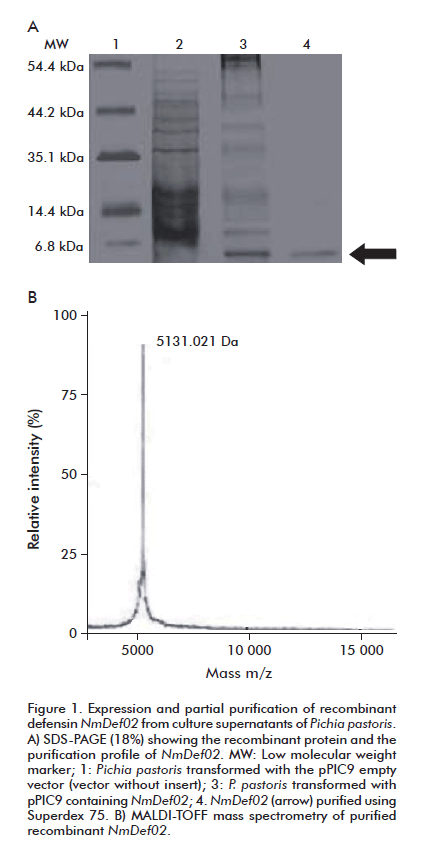
<P   align="justify" ><font face="Verdana, Arial, Helvetica, sans-serif" size="2">A similar effect      was observed in transgenic tobacco lines inoculated with <I>P. hyoscyami f.sp.      tabacina. </I>Transgenic plants expressing the defensin remained healthy 10      days after inoculation, whereas control plants died after the same period.      Interestingly, there was a high correlation between relative <I>NmDef02</I>      transcription, as determined by quantitative RT-PCR, and resistance against      <I>P. parasitica var. nicotianae</I> or <I>P. hyoscyami f.sp. tabacina</I>      in several transgenic lines (data not shown). Lines 4, 5, 8, 28 y 49, expressing      <I>NmDef02 </I>at relatively low levels, developed symptomatic infections.      </font></P >       <P   align="justify" ><font face="Verdana, Arial, Helvetica, sans-serif" size="2">There is strong evidence      suggesting <I>NmDef02</I> is involved in plant defense mechanisms, given the      increased resistance of tobacco and potato transgenics expressing this defensin      constitutively<I>. </I>The analysis of disease resistance of the transgenic      lines of tobacco and potato evidenced that they were more resistant to <I>P.      parasitica var. nicotianae</I>, <I>P. hyoscyami f.sp. tabacina</I>, <I>A.      solani</I> and <I>P. infestans</I>, respectively than their wild-type counterparts      or transformants containing solely the empty vector. Ours is the first report      of high-level resistance of tobacco plants expressing <I>NmDef02</I> to <I>P.      infestans</I>, both under greenhouse and field conditions (<a href="/img/revistas/bta/v28n4/f0307411.gif">Figure      3</a>). </font></P >       
<P   ><font face="Verdana, Arial, Helvetica, sans-serif" size="2">Both tobacco and      potato transgenic plants remained healthy, without morphological changes or      abnormalities even in cases where the accumulation of <I>NmDef02 </I>was high<I>.      </I>The anti-microbial activity provided by the expression of this defensin      was reached, therefore, without toxic effects on its plant hosts. Finally,      it should be stressed that the present investigation further corroborates      the efficacy of defensins in mediating resistance to agricultural disease,      and points to these molecules as strong candidates for further work in the      area of crop improvement. </font></P >       <P   ><font face="Verdana, Arial, Helvetica, sans-serif" size="2"><b><font size="3">REFERENCES      </font></b></font></P >   <FONT size="+1">        <P   ><font size="2" face="Verdana, Arial, Helvetica, sans-serif">1. Portieles R, Ayra      C, Borr&aacute;s O. Basic insight on plant defensins. Biotecnol Apl. 2006;23:75-8.      </font></P >   <FONT size="+1">        ]]></body>
<body><![CDATA[<P   ><font face="Verdana, Arial, Helvetica, sans-serif" size="2">2. Portieles R, Ayra      C, Gonzalez E, Gallo A, Rodr&iacute;guez R, Chacon O, et al. NmDef02, a novel      antimicrobial gene isolated from Nicotiana megalosiphon confers high-level      pathogen resistance under greenhouse and field conditions. Plant Biotechnol      J. 2010;8(6):678-90. </font></P >       <P   >&nbsp;</P >   <FONT size="+1">        <P   ><font face="Verdana, Arial, Helvetica, sans-serif" size="2">Orlando Borr&aacute;s.      Divisi&oacute;n de Plantas, Centro de Ingenier&iacute;a Gen&eacute;tica y      Biotecnolog&iacute;a, CIGB. La Habana, Cuba. E-mail: <a href="mailto:orlando.borras@cigb.edu.cu">orlando.borras@cigb.edu.cu</a>.      </font></P >   </font></font></font></font></font></font></font></font></font></font></font></font></font></font></font></font></font></font></font></font></font></font></font></font></font></font></font></font></font></font></font></font></font></font></font></font></font></font></font></font></font></font></font></font></font></font></font></font></font></DIV >      ]]></body><back>
<ref-list>
<ref id="B1">
<label>1</label><nlm-citation citation-type="journal">
<person-group person-group-type="author">
<name>
<surname><![CDATA[Portieles]]></surname>
<given-names><![CDATA[R]]></given-names>
</name>
<name>
<surname><![CDATA[Ayra]]></surname>
<given-names><![CDATA[C]]></given-names>
</name>
<name>
<surname><![CDATA[Borrás]]></surname>
<given-names><![CDATA[O]]></given-names>
</name>
</person-group>
<article-title xml:lang="en"><![CDATA[Basic insight on plant defensins]]></article-title>
<source><![CDATA[Biotecnol Apl]]></source>
<year>2006</year>
<volume>23</volume>
<page-range>75-78</page-range></nlm-citation>
</ref>
<ref id="B2">
<label>2</label><nlm-citation citation-type="journal">
<person-group person-group-type="author">
<name>
<surname><![CDATA[Portieles]]></surname>
<given-names><![CDATA[R]]></given-names>
</name>
<name>
<surname><![CDATA[Ayra]]></surname>
<given-names><![CDATA[C]]></given-names>
</name>
<name>
<surname><![CDATA[Gonzalez]]></surname>
<given-names><![CDATA[E]]></given-names>
</name>
<name>
<surname><![CDATA[Gallo]]></surname>
<given-names><![CDATA[A]]></given-names>
</name>
<name>
<surname><![CDATA[Rodriguez]]></surname>
<given-names><![CDATA[R]]></given-names>
</name>
<name>
<surname><![CDATA[Chacon]]></surname>
<given-names><![CDATA[O]]></given-names>
</name>
</person-group>
<article-title xml:lang="en"><![CDATA[NmDef02, a novel antimicrobial gene isolated from Nicotiana megalosiphon confers high-level pathogen resistance under greenhouse and field conditions]]></article-title>
<source><![CDATA[Plant Biotechnol J]]></source>
<year>2010</year>
<volume>8</volume>
<numero>6</numero>
<issue>6</issue>
<page-range>678-90</page-range></nlm-citation>
</ref>
</ref-list>
</back>
</article>