<?xml version="1.0" encoding="ISO-8859-1"?><article xmlns:mml="http://www.w3.org/1998/Math/MathML" xmlns:xlink="http://www.w3.org/1999/xlink" xmlns:xsi="http://www.w3.org/2001/XMLSchema-instance">
<front>
<journal-meta>
<journal-id>1027-2852</journal-id>
<journal-title><![CDATA[Biotecnología Aplicada]]></journal-title>
<abbrev-journal-title><![CDATA[Biotecnol Apl]]></abbrev-journal-title>
<issn>1027-2852</issn>
<publisher>
<publisher-name><![CDATA[Editorial Elfos Scientiae]]></publisher-name>
</publisher>
</journal-meta>
<article-meta>
<article-id>S1027-28522011000400008</article-id>
<title-group>
<article-title xml:lang="en"><![CDATA[Contributions to the diagnosis of pirazinamide resistance in Mycobacterium tuberculosis]]></article-title>
<article-title xml:lang="es"><![CDATA[Aportes al diagnóstico de resistencia a pirazinamida en Mycobacterium tuberculosis]]></article-title>
</title-group>
<contrib-group>
<contrib contrib-type="author">
<name>
<surname><![CDATA[Montoro]]></surname>
<given-names><![CDATA[Ernesto]]></given-names>
</name>
<xref ref-type="aff" rid="A01"/>
</contrib>
<contrib contrib-type="author">
<name>
<surname><![CDATA[Lemus]]></surname>
<given-names><![CDATA[Dihadenys]]></given-names>
</name>
<xref ref-type="aff" rid="A01"/>
</contrib>
<contrib contrib-type="author">
<name>
<surname><![CDATA[Mirabal]]></surname>
<given-names><![CDATA[Niuris]]></given-names>
</name>
<xref ref-type="aff" rid="A01"/>
</contrib>
<contrib contrib-type="author">
<name>
<surname><![CDATA[Echemendía]]></surname>
<given-names><![CDATA[Miguel]]></given-names>
</name>
<xref ref-type="aff" rid="A01"/>
</contrib>
<contrib contrib-type="author">
<name>
<surname><![CDATA[Madruga]]></surname>
<given-names><![CDATA[Mariela]]></given-names>
</name>
<xref ref-type="aff" rid="A01"/>
</contrib>
<contrib contrib-type="author">
<name>
<surname><![CDATA[Milian]]></surname>
<given-names><![CDATA[Yoslaine]]></given-names>
</name>
<xref ref-type="aff" rid="A01"/>
</contrib>
<contrib contrib-type="author">
<name>
<surname><![CDATA[Díaz]]></surname>
<given-names><![CDATA[Raúl]]></given-names>
</name>
<xref ref-type="aff" rid="A01"/>
</contrib>
<contrib contrib-type="author">
<name>
<surname><![CDATA[Takiff]]></surname>
<given-names><![CDATA[Howard]]></given-names>
</name>
<xref ref-type="aff" rid="A02"/>
</contrib>
<contrib contrib-type="author">
<name>
<surname><![CDATA[Martin]]></surname>
<given-names><![CDATA[Anandi]]></given-names>
</name>
<xref ref-type="aff" rid="A03"/>
</contrib>
<contrib contrib-type="author">
<name>
<surname><![CDATA[Van der Stuyf]]></surname>
<given-names><![CDATA[Patrick]]></given-names>
</name>
<xref ref-type="aff" rid="A04"/>
</contrib>
<contrib contrib-type="author">
<name>
<surname><![CDATA[Palomino]]></surname>
<given-names><![CDATA[Juan C]]></given-names>
</name>
<xref ref-type="aff" rid="A03"/>
</contrib>
</contrib-group>
<aff id="A02">
<institution><![CDATA[,Instituto Venezolano de Investigaciones Científicas Centro de Microbiología y Biología Celular ]]></institution>
<addr-line><![CDATA[Caracas ]]></addr-line>
<country>Venezuela</country>
</aff>
<aff id="A03">
<institution><![CDATA[,Institute of Tropical Medicine Mycobacteriology Unit ]]></institution>
<addr-line><![CDATA[Antwerp ]]></addr-line>
<country>Belgium</country>
</aff>
<aff id="A04">
<institution><![CDATA[,Institute of Tropical Medicine Department of Public Health Institute of Tropical Medicine]]></institution>
<addr-line><![CDATA[ ]]></addr-line>
</aff>
<aff id="A01">
<institution><![CDATA[,Instituto de Medicina Tropical Pedro Kourí Centro Colaborador OPS/OMS en Tuberculosis Laboratorio Nacional de Referencia e Investigaciones en Tuberculosis y Micobacterias]]></institution>
<addr-line><![CDATA[La Habana ]]></addr-line>
<country>Cuba</country>
</aff>
<pub-date pub-type="pub">
<day>00</day>
<month>12</month>
<year>2011</year>
</pub-date>
<pub-date pub-type="epub">
<day>00</day>
<month>12</month>
<year>2011</year>
</pub-date>
<volume>28</volume>
<numero>4</numero>
<fpage>265</fpage>
<lpage>267</lpage>
<copyright-statement/>
<copyright-year/>
<self-uri xlink:href="http://scielo.sld.cu/scielo.php?script=sci_arttext&amp;pid=S1027-28522011000400008&amp;lng=en&amp;nrm=iso"></self-uri><self-uri xlink:href="http://scielo.sld.cu/scielo.php?script=sci_abstract&amp;pid=S1027-28522011000400008&amp;lng=en&amp;nrm=iso"></self-uri><self-uri xlink:href="http://scielo.sld.cu/scielo.php?script=sci_pdf&amp;pid=S1027-28522011000400008&amp;lng=en&amp;nrm=iso"></self-uri><abstract abstract-type="short" xml:lang="en"><p><![CDATA[The direct detection of pyrazinamide resistance in Mycobacterium tuberculosis is not routinely performed in many laboratories in the world because the drug is active only at acid pH, which also affects the growth of M. tuberculosis. The pyrazinamidase enzyme, encoded by pncA gene, is necessary to convert prodrug pyrazinamide to its active form. Taking into account that nicotinamide, a structural analogue of pyrazinamide, converted in its active forms by the pyrazinamidase enzyme at a physiological pH does not affect bacterial growth, the aim of this research was to evaluate two colorimetric methods: Nitrate reductase and malachite green microtube assays, using nicotinamide to perform susceptibility testing in 102 M. tuberculosis strains. The results were compared with those obtained by the classic Wayne assay. Mutations in the pncA gene were identified by sequencing the pncA gene from all isolates in which pyrazinamide resistance was detected by any of the three methods. Both the nitrate reductase and malachite green microtube assays showed sensitivities of 93.75% and specificities of 97.67%. Mutations in the pncA gene were found in 14 of 16 strains (87.5%) that were pyrazinamide resistant.]]></p></abstract>
<abstract abstract-type="short" xml:lang="es"><p><![CDATA[Los estudios de susceptibilidad a PZA no se realizan de rutina debido a que el pH ácido requerido para lograr la actividad de la droga, afecta el crecimiento de Mycobacterium tuberculosis. La PZA es convertida en su forma activa por acción de la enzima pirazinamidasa (PZAasa) que es codificada por el gen pncA. Tomando en consideración que la enzima PZAasa es la responsable de convertir la nicotinamida (NIC), droga análoga de la PZA, en su forma activa sin requerir de un pH ácido, nos propusimos evaluar dos métodos colorimétricos: Método de la Nitrato Reductasa (MNR) y Microensayo Verde Malaquita (MVM) para conocer la susceptibilidad de 102 cepas de M. tuberculosis a la PZA empleando la NIC. Los resultados se compararon con el Ensayo Enzimático de Wayne (método de referencia). A las cepas resistentes y las que mostraron resultados discordantes, se les secuenció el gen pncA. Se alcanzó una sensibilidad del 93.75% y una especificidad del 97.67% para el MNR y el MVM. El 87.5% de las cepas resistentes (14/16) mostraron mutaciones en el gen pncA.]]></p></abstract>
<kwd-group>
<kwd lng="en"><![CDATA[tuberculosis]]></kwd>
<kwd lng="en"><![CDATA[resistance]]></kwd>
<kwd lng="en"><![CDATA[pyrazinamid]]></kwd>
<kwd lng="es"><![CDATA[tuberculosis]]></kwd>
<kwd lng="es"><![CDATA[resistencia]]></kwd>
<kwd lng="es"><![CDATA[pirazinamida]]></kwd>
</kwd-group>
</article-meta>
</front><body><![CDATA[ <DIV class="Sect"   >        <P align="right"   ><font size="2" color="#000000" face="Verdana, Arial, Helvetica, sans-serif"><b>REPORT      </b></font></P >       <P align="right"   >&nbsp;</P >   <FONT size="+1" color="#000000">        <P   ><font size="4" face="Verdana, Arial, Helvetica, sans-serif"><b>Contributions      to the diagnosis of pirazinamide resistance in <I>Mycobacterium tuberculosis</I></b></font></P >       <P   >&nbsp;</P >       <P   ><font size="3" face="Verdana, Arial, Helvetica, sans-serif"><b>Aportes al diagn&oacute;stico      de resistencia a pirazinamida en Mycobacterium tuberculosis </b></font></P >       <P   >&nbsp;</P >       <P   >&nbsp;</P >       <P   > </P >       <P   ><b><font size="2" face="Verdana, Arial, Helvetica, sans-serif">Ernesto Montoro<Sup>1</Sup>,      Dihadenys Lemus<Sup>1</Sup>, Niuris Mirabal<Sup>1</Sup>, Miguel Echemend&iacute;a<Sup>1</Sup>,      Mariela Madruga<Sup>1</Sup>, Yoslaine Milian<Sup>1</Sup>, Ra&uacute;l D&iacute;az<Sup>1</Sup>,      Howard Takiff<Sup>2</Sup>, Anandi Martin<Sup>3</Sup>, Patrick Van der Stuyf<Sup>4</Sup>,      Juan C Palomino<Sup>3 </Sup></font></b></P >   <FONT size="+1"><FONT size="+1"><FONT size="+1"><FONT size="+1"><FONT size="+1"><FONT size="+1"><FONT size="+1"><FONT size="+1"><FONT size="+1"><FONT size="+1"><FONT size="+1"><FONT size="+1"><FONT size="+1"><FONT size="+1"><FONT size="+1"><FONT size="+1"><FONT size="+1"><FONT size="+1"><FONT size="+1"><FONT size="+1"><FONT size="+1">        ]]></body>
<body><![CDATA[<P   > </P >   <FONT size="+1">        <P   ><font size="2" face="Verdana, Arial, Helvetica, sans-serif"><Sup>1</Sup>Laboratorio      Nacional de Referencia e Investigaciones en Tuberculosis y Micobacterias.      Centro Colaborador OPS/OMS en Tuberculosis, Instituto de Medicina Tropical      Pedro Kour&iacute;, IPK. Autopista Novia del Mediod&iacute;a Km 6&frac12;,      AP 601, Marianao 13, La Habana, Cuba.    <br>     </font><font size="2" face="Verdana, Arial, Helvetica, sans-serif"><Sup>2</Sup>Centro      de Microbiolog&iacute;a y Biolog&iacute;a Celular, CMBC. Instituto Venezolano      de Investigaciones Cient&iacute;ficas, IVIC. Km 11 Carretera Panamericana,      Caracas, 1020A, Venezuela.    <br>     </font><font size="2" face="Verdana, Arial, Helvetica, sans-serif"><Sup>3</Sup>Mycobacteriology      Unit, Institute of Tropical Medicine. Nationalestraat, 155, 2000, Antwerp,      Belgium.    <br>     </font><font size="2" face="Verdana, Arial, Helvetica, sans-serif"><Sup>4</Sup>Epidemiology      and Disease Control Unit, Department of Public Health, Institute of Tropical      Medicine. Nationalestraat, 155, 2000, Antwerp, Belgium. </font></P >       <P   >&nbsp;</P >   <FONT size="+1"><FONT size="+1"><FONT size="+1"><FONT size="+1"><FONT size="+1"><FONT size="+1"><FONT size="+1"><FONT size="+1">        <P   > </P >   </font></font></font></font></font></font></font></font></font></font></font></font></font></font></font></font></font></font></font></font></font></font></font></font></font></font></font></font></font></font></font>   <hr>   <FONT size="+1" color="#000000"><FONT size="+1"><FONT size="+1"><FONT size="+1"><FONT size="+1"><FONT size="+1"><FONT size="+1"><FONT size="+1"><FONT size="+1"><FONT size="+1"><FONT size="+1"><FONT size="+1"><FONT size="+1"><FONT size="+1"><FONT size="+1"><FONT size="+1"><FONT size="+1"><FONT size="+1"><FONT size="+1"><FONT size="+1"><FONT size="+1"><FONT size="+1"><FONT size="+1"><FONT size="+1"><FONT size="+1"><FONT size="+1"><FONT size="+1"><FONT size="+1"><FONT size="+1"><FONT size="+1"><FONT size="+1">        <P   ><font size="2" face="Verdana, Arial, Helvetica, sans-serif"><b>ABSTRACT </b></font></P >       <P   ><font size="2" face="Verdana, Arial, Helvetica, sans-serif">The direct detection      of pyrazinamide resistance in <I>Mycobacterium tuberculosis</I> is not routinely      performed in many laboratories in the world because the drug is active only      at acid pH, which also affects the growth of <I>M. tuberculosis</I>. The pyrazinamidase      enzyme, encoded by pncA gene, is necessary to convert prodrug pyrazinamide      to its active form. Taking into account that nicotinamide, a structural analogue      of pyrazinamide, converted in its active forms by the pyrazinamidase enzyme      at a physiological pH does not affect bacterial growth, the aim of this research      was to evaluate two colorimetric methods: Nitrate reductase and malachite      green microtube assays, using nicotinamide to perform susceptibility testing      in 102 <I>M. tuberculosis</I> strains. The results were compared with those      obtained by the classic Wayne assay. Mutations in the <I>pncA</I> gene were      identified by sequencing the <I>pncA</I> gene from all isolates in which pyrazinamide      resistance was detected by any of the three methods. Both the nitrate reductase      and malachite green microtube assays showed sensitivities of 93.75% and specificities      of 97.67%. Mutations in the <I>pncA</I> gene were found in 14 of 16 strains      (87.5%) that were pyrazinamide resistant. </font></P >   <FONT size="+1"><FONT size="+1">        <P   ><font size="2" face="Verdana, Arial, Helvetica, sans-serif"><b>Keywords:</b>      tuberculosis, resistance, pyrazinamide </font></P >   <FONT size="+1">        ]]></body>
<body><![CDATA[<P   > </P >   <FONT size="+1"> </font></font></font></font></font></font></font></font></font></font></font></font></font></font></font></font></font></font></font></font></font></font></font></font></font></font></font></font></font></font></font></font></font></font></font>   <hr>   <FONT size="+1" color="#000000"><FONT size="+1"><FONT size="+1"><FONT size="+1"><FONT size="+1"><FONT size="+1"><FONT size="+1"><FONT size="+1"><FONT size="+1"><FONT size="+1"><FONT size="+1"><FONT size="+1"><FONT size="+1"><FONT size="+1"><FONT size="+1"><FONT size="+1"><FONT size="+1"><FONT size="+1"><FONT size="+1"><FONT size="+1"><FONT size="+1"><FONT size="+1"><FONT size="+1"><FONT size="+1"><FONT size="+1"><FONT size="+1"><FONT size="+1"><FONT size="+1"><FONT size="+1"><FONT size="+1"><FONT size="+1"><FONT size="+1"><FONT size="+1"><FONT size="+1"><FONT size="+1">        <P   ><font size="2" face="Verdana, Arial, Helvetica, sans-serif"><b>RESUMEN</b> </font></P >       <P   align="justify" ><font size="2" face="Verdana, Arial, Helvetica, sans-serif">Los estudios de susceptibilidad      a PZA no se realizan de rutina debido a que el pH &aacute;cido requerido para      lograr la actividad de la droga, afecta el crecimiento de <I>Mycobacterium      tuberculosis</I>. La PZA es convertida en su forma activa por acci&oacute;n      de la enzima pirazinamidasa (PZAasa) que es codificada por el gen <I>pnc</I>A.      Tomando en consideraci&oacute;n que la enzima PZAasa es la responsable de      convertir la nicotinamida (NIC), droga an&aacute;loga de la PZA, en su forma      activa sin requerir de un pH &aacute;cido, nos propusimos evaluar dos m&eacute;todos      colorim&eacute;tricos: M&eacute;todo de la Nitrato Reductasa (MNR) y Microensayo      Verde Malaquita (MVM) para conocer la susceptibilidad de 102 cepas de <I>M.      tuberculosis</I> a la PZA empleando la NIC. Los resultados se compararon con      el Ensayo Enzim&aacute;tico de Wayne (m&eacute;todo de referencia). A las      cepas resistentes y las que mostraron resultados discordantes, se les secuenci&oacute;      el gen <I>pnc</I>A. Se alcanz&oacute; una sensibilidad del 93.75% y una especificidad      del 97.67% para el MNR y el MVM. El 87.5% de las cepas resistentes (14/16)      mostraron mutaciones en el gen <I>pnc</I>A. </font></P >   <FONT size="+1">        <P   > </P >   <FONT size="+1">        <P   ><b><font size="2" face="Verdana, Arial, Helvetica, sans-serif">Palabras clave:</font></b><font size="2" face="Verdana, Arial, Helvetica, sans-serif"><B>      </B>tuberculosis, resistencia, pirazinamida. </font></P >   <FONT size="+1"> </font></font></font></font></font></font></font></font></font></font></font></font></font></font></font></font></font></font></font></font></font></font></font></font></font></font></font></font></font></font></font></font></font></font></font></font></font></font>   <hr>       <p>&nbsp;</p>       <p><FONT size="+1" color="#000000"><FONT size="+1"><FONT size="+1"><FONT size="+1"><FONT size="+1"><FONT size="+1"><FONT size="+1"><FONT size="+1"><FONT size="+1"><FONT size="+1"><FONT size="+1"><FONT size="+1"><FONT size="+1"><FONT size="+1"><FONT size="+1"><FONT size="+1"><FONT size="+1"><FONT size="+1"><FONT size="+1"><FONT size="+1"><FONT size="+1"><FONT size="+1"><FONT size="+1"><FONT size="+1"><FONT size="+1"><FONT size="+1"><FONT size="+1"><FONT size="+1"><FONT size="+1"><FONT size="+1"><FONT size="+1"><FONT size="+1"><FONT size="+1"><FONT size="+1"><FONT size="+1"><FONT size="+1"><FONT size="+1"><FONT size="+1">      </font></font></font></font></font></font></font></font></font></font></font></font></font></font></font></font></font></font></font></font></font></font></font></font></font></font></font></font></font></font></font></font></font></font></font></font></font></font></p>   <FONT size="+1" color="#000000"><FONT size="+1"><FONT size="+1"><FONT size="+1"><FONT size="+1"><FONT size="+1"><FONT size="+1"><FONT size="+1"><FONT size="+1"><FONT size="+1"><FONT size="+1"><FONT size="+1"><FONT size="+1"><FONT size="+1"><FONT size="+1"><FONT size="+1"><FONT size="+1"><FONT size="+1"><FONT size="+1"><FONT size="+1"><FONT size="+1"><FONT size="+1"><FONT size="+1"><FONT size="+1"><FONT size="+1"><FONT size="+1"><FONT size="+1"><FONT size="+1"><FONT size="+1"><FONT size="+1"><FONT size="+1"><FONT size="+1"><FONT size="+1"><FONT size="+1"><FONT size="+1"><FONT size="+1"><FONT size="+1"><FONT size="+1">       <P   > </P >   <FONT size="+1">       <P   ><font size="3"><b><font face="Verdana, Arial, Helvetica, sans-serif">INTRODUCTION      </font></b></font></P >       <P   align="justify" ><font size="2" face="Verdana, Arial, Helvetica, sans-serif">Pyrazinamide (PZA)      is one of the most effect frontline drugs used in the short-course chemotherapy      of tuberculosis (TB) and also in retreatment regimens for multidrug- resistant      TB patients [1]. The direct detection of pyrazinamide resistance in <I>Mycobacterium      tuberculosis</I> is not routinely performed in many laboratories in the world      because the drug is active only at acid pH (5.5), which also affects the growth      of <I>M. tuberculosis</I> [2]. For this reason, many laboratories do not perform      PZA susceptibility testing, and therefore the true extent of global PZA resistance      is largely unknown. The radiometric Bactec 460 system (Becton Dickinson, Sparks,      MD), using a special acid liquid medium, has been considered the reference      method for detection of PZA resistance, but it requires the use of costly      and problematic radioisotopes [3]. Other commercial tests, such as the nonradiometric      Bactec MGIT 960 method (Becton Dickinson, Sparks, MD), utilize protocols adapted      for PZA susceptibility testing, but they are also expensive and impractical      for routine use in resource-poor settings [4]. </font></P >   <FONT size="+1">        ]]></body>
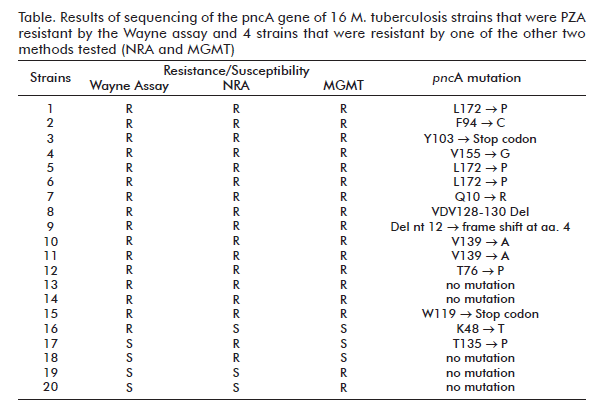
<body><![CDATA[<P   align="justify" ><font size="2" face="Verdana, Arial, Helvetica, sans-serif"><I>M. tuberculosis</I>      pyrazinamidase (PZase) enzyme is necessary to activate prodrug PZA and most      PZA-resistant strains have mutations in <I>pnc</I>A gene, the gene encoding      this enzyme, that result in the loss or reduction of PZase activity. Thus,      an indirect approach for detecting resistance is to assess PZase activity      [5]. The classic way to detect PZase activity is by means of the Wayne assay      [6], which monitors the hydrolysis of PZA to the active acid form, pyrazinoic      acid (POA), through the color change of a ferrous ammonium phosphate solution      added to the medium. Nicotinamide (NIC), a structural analogue of PZA with      some activity against <I>M. tuberculosis</I>, is also converted to its active      acid form, nicotinic acid, by the <I>M. tuberculosis</I> PZase [7]. Strains      of <I>M. tuberculosis</I> are not only resistant to PZA but also resistant      to NIC [3, 8], and the conversion of NIC into nicotinic acid by PZase occurs      at a physiological pH that does not hinder bacterial growth. </font></P >       <P   align="justify" ><font size="2" face="Verdana, Arial, Helvetica, sans-serif">In recent studies,      PZA resistance was rapidly and accurately detected with the inexpensive resazurin      microtiter assay (REMA) and nitrate reductase assay (NRA), using NIC as a      surrogate for PZA to avoid the need for acidification of the medium [3, 8].      Another alternative colorimetric method, reported by Farnia <I>et al</I>.,      uses malachite green to test for susceptibility to first- and second line      anti-TB drugs [9]. Malachite green is a triphenylmethane dye with a dark green      color that becomes colorless during <I>M. tuberculosis</I> metabolism [10].      In this study, we evaluated the use of NIC in the NRA and malachite green      microtube (MGMT) assay for the detection of PZA resistance and compared the      results with those obtained by the Wayne assay, which served as a gold standard.      We also sequenced the <I>pnc</I>A gene from strains determined to be resistant      by any of the three methods. </font></P >       <P   align="justify" ><font size="2" face="Verdana, Arial, Helvetica, sans-serif">A total of 102 <I>M.      tuberculosis</I> strains were tested by these methods and the results were      compared with those obtained by the classic Wayne assay. Mutations in the      <I>pnc</I>A<I> </I>gene were identified by sequencing the <I>pnc</I>A<I> </I>gene      from all isolates in which pyrazinamide resistance was detected by any of      the three methods. Mutations in the <I>pnc</I>A gene were identified by comparison      with the wild-type <I>M. tuberculosis</I> <I>pnc</I>A gene sequence using      BLAST (<a href="http://www.ncbi.nlm.nih.gov" target="_blank">www.ncbi.nlm.nih.gov</a>)      or MacVector 10. All identified mutations were seen in the sequences of both      strands. Statistical analysis was made using the MedCalc (Mariakerke, Belgium)      software program to calculate the sensitivity (ability to detect true resistance)      and the specificity (ability to detect true susceptibility). </font></P >       <P   ><font size="2" face="Verdana, Arial, Helvetica, sans-serif"><b><font size="3">RESULTS      AND DISCUSSION </font> </b> </font></P >   <FONT size="+1">        <P   align="justify" ><font size="2" face="Verdana, Arial, Helvetica, sans-serif">The NRA and MGMT      assay using NIC were compared on the Wayne assay for the rapid detection of      resistance to PZA in 102 <I>M. tuberculosis</I> strains. With the Wayne assay,      the results from 78% of the strains (79 strains) were obtained at 7 days and      100% of the strains were obtained after 10 days, while the NRA method brought      about the following results: 90% (91 strains) were available at day 10 and      100% at day 14. With the MGMT method, only 27% of results were available at      day 10, but 100% were available at day 14. Out of 86 strains determined to      be PZA susceptible by Wayne assay, 84 were susceptible and 2 resistant (strains      17 and 18) by the NRA. Similarly, with the MGMT assay 84 of these 86 strains      were susceptible and 2 resistant, but the 2 discordant strains (strains 19      and 20) were not the same strains found to be discordantly resistant with      the NRA (<a href="/img/revistas/bta/v28n4/t0108411.gif">Table</a>). </font></P >   <FONT size="+1">        
<P   align="justify" ><font size="2" face="Verdana, Arial, Helvetica, sans-serif">Among the 16 strains      determined to be resistant to 100 mg/liter PZA with the Wayne assay, 15 were      resistant in both the NRA and the MGMT assay using NIC at 500 mg/liter and      250 mg/liter, respectively, and one strain (no. 16) was susceptible in both      alternative assays. From 86 strains determined to be PZA susceptible with      the Wayne assay, 84 were susceptible with both the NRA and the MGMT assay.      Based on these results, the sensitivity and specificity of both the NRA and      the MGMT assay were 93.75% and 97.67%, respectively. The agreement between      both methods and the Wayne assay was 97.05%. All strains with discordant results      were retested with the NRA and MGMT assay, but the repeat susceptibility results      were unchanged. The NRA results were similar to those obtained in the study      by Martin <I>et al</I>. [8], in which the NRA, using a critical concentration      of 500 mg/liter NIC, had sensitivity and specificity of 91% and 94%, respectively.      Surprisingly, the sensitivity of the MGMT assay using NIC was superior to      that reported by Farnia <I>et al</I>. (75%) [9], perhaps due to insufficient      bacterial growth on the acidified medium required when PZA is used. </font></P >       <P   align="justify" ><font size="2" face="Verdana, Arial, Helvetica, sans-serif">The Wayne assay is      inexpensive and generally reliable, but the presence of a pink band in conventional      Dubos agar, which indicates PZase activity and thus sensitivity to PZA, can      be difficult to judge for some strains, because the band can be very faint      [3, 10]. To make the assay easier to interpret and identify strains with low      PZase activity, Singh <I>et al</I>. [10] recently recommended that for strains      that are negative at 4 and 7 days, the incubation should be extended to 10      days. Our results support this longer incubation, as we found that 23 of the      strains tested required 10 days to show PZase activity. If the final reading      had been at day 7, these strains would have been falsely reported as resistant,      and the sensitivities of the NRA and MGMT assay would have appeared to be      much lower. </font></P >       <P   align="justify" ><font size="2" face="Verdana, Arial, Helvetica, sans-serif">The results were      confirmed by sequencing the <I>pnc</I>A gene from the 16 strains found to      be PZA resistant with the Wayne assay, as well as the 4 strains determined      to be resistant only with the NRA or MGMT technique. Of the 16 strains that      were PZA resistant by the Wayne assay, 14 (87.5%) had mutations in the <I>pnc</I>A      gene, confirming that this is the principal mechanism for loss of PZase activity      <I>M. tuberculosis</I> [11]. Surprisingly, the two strains (13 and 14) without      mutations in the <I>pnc</I>A gene or the 65 bases upstream were found to be      PZA resistant in all the three methods. It is possible that these strains,      for unknown reasons, have very low PZase activity that is below the limits      of detection for the three methods [10]. Alternatively, they could have mutations      in another site, such as a transporter for PZA, or the target of POA. Strain      16 is curious because it was resistant by the Wayne assay and has a K48T <I>pnc</I>A      mutation, but it showed PZase activity on both the NRA and MGMT methods. One      possible explanation could be that these two methods are more sensitive at      detecting low PZase activity than the Wayne assay. However, this would not      explain why each of these alternative methods failed to detect PZase activity      (indicating PZA resistance) in two different strains where the Wayne assay      detected activity (indicating PZA sensitivity). This notion of increased sensitivity      is also inconsistent with the finding that strain 17 was PZA sensitive on      the Wayne assay but resistant with the NRA contained a T135P <I>pnc</I>A mutation.      If the amino acid substitution had only a minimal effect on the activity of      PZase protein, in this case the NRA was less sensitive in detecting the remaining      activity. Further studies are needed to evaluate the structure-function significance      of particular amino acid substitutions. The remaining three strains with false      resistant results (strains 18, 19, and 20), <I>i.e.</I>, strains that were      PZA sensitive by the Wayne assay but resistant with one of the other assays,      showed no mutations in their <I>pnc</I>A coding regions or in the 65 bases      upstream of the first codon. </font></P >       <P   align="justify" ><font size="2" face="Verdana, Arial, Helvetica, sans-serif">The mutations found      in our PZA-resistant strains were distributed throughout the <I>pnc</I>A gene,      confirming the high diversity and absence of mutation hot spots reported in      other studies, but the L172P substitution was present in three strains and      the V139A substitution in two. Perhaps these were multiple isolates of the      same strain from different patients. Also, similar to findings in previous      studies, the majority of the <I>pnc</I>A mutations in our PZA-resistant strains      (12/13, 92.3%) were single-base-pair substitutions, although some deletions      were also found [3, 12]. It should be pointed out that these three assays      will detect only strains that are resistant because they lack of the PZase      activity required to convert PZA to its active form, POA, and will not detect      the few strains that are resistant due to mutations in other sites, such as      in the drug target for POA [13]. </font></P >       <P   align="justify" ><font size="2" face="Verdana, Arial, Helvetica, sans-serif">The costs of the      NRA and MGMT assay have been evaluated in different studies. In Norway, Syre      <I>et al</I>. [14] have estimated the price of the NRA as $3.00 per isolate      for two drugs, compared with $21.00 for the Bactec 460 method and $23.00 for      the manual mycobacterial growth indicator tube (MGIT). In Argentina, Mengatto      <I>et al</I>. [15] compared the costs to test one isolate for two drugs and      estimated $19.52 for the manual MGIT and $0.17 for the NRA [21]. Recently,      Farnia <I>et al</I>. [9] reported for the MGMT assay a cost of $2.50, using      12 drugs per strain. Additional studies are required to establish the cost-effectiveness      of the NRA and MGMT assay compared with the conventional methods to demonstrate      the benefit of these technologies. Studies to evaluate the costs of these      two methods and their direct application with sputum samples are in progress      in our laboratory. </font></P >       ]]></body>
<body><![CDATA[<P   ><font size="2" face="Verdana, Arial, Helvetica, sans-serif"><b><font size="3">RELEVANCE      </font></b></font></P >   <FONT size="+1">        <P   align="justify" ><font size="2" face="Verdana, Arial, Helvetica, sans-serif">This study is the      first international scientific report that evaluates and demonstrates the      high reliability of two colorimetric methods using nicotinamide for pyrazinamide      resistance detection in <I>M. tuberculosis. </I>It is also the first time      that the Tuberculosis National Reference Laboratory of Cuba has obtained results      about the sequence of one gene associated to <I>M. tuberculosis </I>drug resistance.      This has confirmed the worth of the two alternative methods mentioned above      and also has contributed to the knowledge of <I>M. tuberculosis</I> drug resistance.      NRA and MGMT for PZA susceptibility testing could be implemented in low-resource      countries due to their simplicity because they do not require the use of sophisticated      equipment. The availability of reliable methods to detect resistance to pyrazinamide      will allow us to know level of resistance to this drug. Consequently, a proper      antibiotic treatment regimen could be implemented in patients with resistant      strains. Finally, a reduction of the community transmission of the resistant      pathogen could be accomplished. </font></P >   <FONT size="+1">        <P   align="justify" ><font size="2" face="Verdana, Arial, Helvetica, sans-serif">The knowledge and      experience obtained in the field of TB resistance situates our institution      as reference laboratory not only at a national level but also international      one since these methods could be implemented in other countries of the region,      where TB and MDR constitute a major health problem. </font></P >       <P   ><font size="2" face="Verdana, Arial, Helvetica, sans-serif"><b><font size="3">CONCLUSIONS      </font></b></font></P >   <FONT size="+1">        <P   align="justify" ><font size="2" face="Verdana, Arial, Helvetica, sans-serif">Determination of      PZA resistance by both the NRA and MGMT methods, using NIC as a surrogate      for PZA, showed a high level of agreement with the Wayne assay. The MGMT assay      should be easy to implement in clinical TB laboratories, and its microtube      format may pose fewer biosafety risks than colorimetric microplate methods.      Particularly, the NRA and MGMT assay with NIC are simple, rapid, accurate,      inexpensive, and robust alternatives for PZA susceptibility testing, not requiring      sophisticated equipment and able to be implemented in low-resource countries.      </font></P >   <FONT size="+1">        <P   > </P >   <FONT size="+1">       <P   ><font size="3"><b><font face="Verdana, Arial, Helvetica, sans-serif">REFERENCES      </font></b></font></P >       <!-- ref --><P   ><font size="2" face="Verdana, Arial, Helvetica, sans-serif">1. Heifets L, Lindholm-Levy      P. Pyrazinamide sterilizing activity in vitro against semidormant Mycobacterium      tuberculosis bacterial populations. Am Rev Respir Dis. 1992;145(5):1223-5.          </font></P >   <FONT size="+1">        <!-- ref --><P   ><font size="2" face="Verdana, Arial, Helvetica, sans-serif">2. Heifets L. Susceptibility      testing of Mycobacterium tuberculosis to PZA. J Med Microbiol. 2002;51(1):11-2.          </font></P >       <!-- ref --><P   ><font size="2" face="Verdana, Arial, Helvetica, sans-serif">3. Martin A, Takiff      H, Vandamme P, Swings J, Palomino JC, Portaels F. A new rapid and simple colorimetric      method to detect pyrazinamide resistance in Mycobacterium tuberculosis using      nicotinamide. J Antimicrob Chemother. 2006;58(2):327-31.     </font></P >       <!-- ref --><P   ><font size="2" face="Verdana, Arial, Helvetica, sans-serif">4. Kr&uuml;&uuml;ner      A, Yates MD, Drobniewski FA. Evaluation of MGIT 960-based antimicrobial testing      and determination of critical concentrations of first- and second-line antimicrobial      drugs with drug-resistant clinical strains of Mycobacterium tuberculosis.      J Clin Microbiol. 2006;44(3):811-8.     </font></P >       <!-- ref --><P   ><font size="2" face="Verdana, Arial, Helvetica, sans-serif">5. Hirano K, Takahashi      M, Kazumi Y, Fukasawa Y, Abe C. Mutation in pncA is a major mechanism of pyrazinamide      resistance in Mycobacterium tuberculosis. Tuber Lung Dis. 1997;78(2):117-22.          </font></P >       <!-- ref --><P   ><font size="2" face="Verdana, Arial, Helvetica, sans-serif">6. Wayne LG. Simple      pyrazinamidase and urease tests for routine identification of mycobacteria.      Am Rev Respir Dis. 1974; 109(1):147-51.     </font></P >       <!-- ref --><P   ><font size="2" face="Verdana, Arial, Helvetica, sans-serif">7. McKenzie D, Malone      L, Kushner S. The effect of nicotinic acid amide on experimental tuberculosis      of white mice. J Lab Clin Med. 1948;33(10):1249-53.     </font></P >       <!-- ref --><P   ><font size="2" face="Verdana, Arial, Helvetica, sans-serif">8. Martin A, Cubillos-Ruiz      A, Von Groll A, Del Portillo P, Portaels F, Palomino JC. Nitrate reductase      assay for the rapid detection of pyrazinamide resistance in Mycobacterium      tuberculosis using nicotinamide. J Antimicrob Chemother. 2008; 61(1):123-7.          </font></P >       <!-- ref --><P   ><font size="2" face="Verdana, Arial, Helvetica, sans-serif">9. Farnia P, Masjedi      MR, Mohammadi F, Tabarsei P, Farnia P, Mohammadzadeh AR, et al. Colorimetric      detection of multidrug-resistant or extensively drug-resistant tuberculosis      by use of malachite green indicator dye. J Clin Microbiol. 2008; 46(2):796-9.          </font></P >       <!-- ref --><P   ><font size="2" face="Verdana, Arial, Helvetica, sans-serif">10. Jones JJ, Falkinham      JO 3rd. Decolorization of malachite green and crystal violet by waterborne      pathogenic mycobacteria. Antimicrob Agents Chemother. 2003;47(7):2323-6.     </font></P >       <!-- ref --><P   ><font size="2" face="Verdana, Arial, Helvetica, sans-serif">11. Huang TS, Lee      SS, Tu HZ, Huang WK, Chen YS, Huang CK, et al. Correlation between pyrazinamide      activity and pncA mutations in Mycobacterium tuberculosis isolates in Taiwan.      Antimicrob Agents Chemother. 2003;47(11):3672-3.     </font></P >       <!-- ref --><P   ><font size="2" face="Verdana, Arial, Helvetica, sans-serif">12. Jur&eacute;en      P, Werngren J, Toro JC, Hoffner S. Pyrazinamide resistance and pncA gene mutations      in Mycobacterium tuberculosis. Antimicrob Agents Chemother. 2008; 52(5):1852-4.          </font></P >       <!-- ref --><P   ><font size="2" face="Verdana, Arial, Helvetica, sans-serif">13. Zimhony O, Vilch&egrave;ze      C, Arai M, Welch JT, Jacobs WR Jr. Pyrazinoic acid and its n-propyl ester      inhibit fatty acid synthase type I in replicating tubercle bacilli. Antimicrob      Agents Chemother. 2007;51(2):752-4.     </font></P >       <!-- ref --><P   ><font size="2" face="Verdana, Arial, Helvetica, sans-serif">14. Syre H, Phyu      S, Sandven P, Bjorvatn B, Grewal HM. Rapid colorimetric method for testing      susceptibility of Mycobacterium tuberculosis to isoniazid and rifampin in      liquid cultures. J Clin Microbiol. 2003;41(11):5173-7.     </font></P >       <!-- ref --><P   ><font size="2" face="Verdana, Arial, Helvetica, sans-serif">15. Mengatto L, Chiani      Y, Imaz MS. Evaluation of rapid alternative methods for drug susceptibility      testing in clinical isolates of Mycobacterium tuberculosis. Mem Inst Oswaldo      Cruz. 2006;101(5):535-42.     </font></P >       <P   >&nbsp;</P >       <P   > </P >   <FONT size="+1">        <P   ><font size="2" face="Verdana, Arial, Helvetica, sans-serif">Ernesto Montoro.      Laboratorio Nacional de Referencia e Investigaciones en Tuberculosis y Micobacterias.      Centro Colaborador OPS/OMS en Tuberculosis, Instituto de Medicina Tropical      Pedro Kour&iacute;, IPK. Autopista Novia del Mediod&iacute;a Km 6&frac12;,      AP 601, Marianao 13, La Habana, Cuba. E-mail: <a href="mailto:emontoro@ipk.sld.cu">      <U><U><FONT color="#0000FF">emontoro@ipk.sld.cu</font></U></U></A></font></P >   </font></font></font></font></font></font></font></font></font></font></font></font></font></font></font></font></font></font></font></font></font></font></font></font></font></font></font></font></font></font></font></font></font></font></font></font></font></font></font></font></font></font></font></font></font></font></font></font></font></DIV >     ]]></body>
<body><![CDATA[ ]]></body><back>
<ref-list>
<ref id="B1">
<label>1</label><nlm-citation citation-type="journal">
<person-group person-group-type="author">
<name>
<surname><![CDATA[Heifets]]></surname>
<given-names><![CDATA[L]]></given-names>
</name>
<name>
<surname><![CDATA[Lindholm-Levy]]></surname>
<given-names><![CDATA[P]]></given-names>
</name>
</person-group>
<article-title xml:lang="en"><![CDATA[Pyrazinamide sterilizing activity in vitro against semidormant Mycobacterium tuberculosis bacterial populations]]></article-title>
<source><![CDATA[Am Rev Respir Dis]]></source>
<year>1992</year>
<volume>145</volume>
<numero>5</numero>
<issue>5</issue>
<page-range>1223-5</page-range></nlm-citation>
</ref>
<ref id="B2">
<label>2</label><nlm-citation citation-type="journal">
<person-group person-group-type="author">
<name>
<surname><![CDATA[Heifets]]></surname>
<given-names><![CDATA[L]]></given-names>
</name>
</person-group>
<article-title xml:lang="en"><![CDATA[Susceptibility testing of Mycobacterium tuberculosis to PZA]]></article-title>
<source><![CDATA[J Med Microbiol]]></source>
<year>2002</year>
<volume>51</volume>
<numero>1</numero>
<issue>1</issue>
<page-range>11-2</page-range></nlm-citation>
</ref>
<ref id="B3">
<label>3</label><nlm-citation citation-type="journal">
<person-group person-group-type="author">
<name>
<surname><![CDATA[Martin]]></surname>
<given-names><![CDATA[A]]></given-names>
</name>
<name>
<surname><![CDATA[Takiff]]></surname>
<given-names><![CDATA[H]]></given-names>
</name>
<name>
<surname><![CDATA[Vandamme]]></surname>
<given-names><![CDATA[P]]></given-names>
</name>
<name>
<surname><![CDATA[Swings]]></surname>
<given-names><![CDATA[J]]></given-names>
</name>
<name>
<surname><![CDATA[Palomino]]></surname>
<given-names><![CDATA[JC]]></given-names>
</name>
<name>
<surname><![CDATA[Portaels]]></surname>
<given-names><![CDATA[F]]></given-names>
</name>
</person-group>
<article-title xml:lang="en"><![CDATA[A new rapid and simple colorimetric method to detect pyrazinamide resistance in Mycobacterium tuberculosis using nicotinamide]]></article-title>
<source><![CDATA[J Antimicrob Chemother]]></source>
<year>2006</year>
<volume>58</volume>
<numero>2</numero>
<issue>2</issue>
<page-range>327-31</page-range></nlm-citation>
</ref>
<ref id="B4">
<label>4</label><nlm-citation citation-type="journal">
<person-group person-group-type="author">
<name>
<surname><![CDATA[Krüüner]]></surname>
<given-names><![CDATA[A]]></given-names>
</name>
<name>
<surname><![CDATA[Yates]]></surname>
<given-names><![CDATA[MD]]></given-names>
</name>
<name>
<surname><![CDATA[Drobniewski]]></surname>
<given-names><![CDATA[FA]]></given-names>
</name>
</person-group>
<article-title xml:lang="en"><![CDATA[Evaluation of MGIT 960-based antimicrobial testing and determination of critical concentrations of first- and second-line antimicrobial drugs with drug-resistant clinical strains of Mycobacterium tuberculosis]]></article-title>
<source><![CDATA[J Clin Microbiol]]></source>
<year>2006</year>
<volume>44</volume>
<numero>3</numero>
<issue>3</issue>
<page-range>811-8</page-range></nlm-citation>
</ref>
<ref id="B5">
<label>5</label><nlm-citation citation-type="journal">
<person-group person-group-type="author">
<name>
<surname><![CDATA[Hirano]]></surname>
<given-names><![CDATA[K]]></given-names>
</name>
<name>
<surname><![CDATA[Takahashi]]></surname>
<given-names><![CDATA[M]]></given-names>
</name>
<name>
<surname><![CDATA[Kazumi]]></surname>
<given-names><![CDATA[Y]]></given-names>
</name>
<name>
<surname><![CDATA[Fukasawa]]></surname>
<given-names><![CDATA[Y]]></given-names>
</name>
<name>
<surname><![CDATA[Abe]]></surname>
<given-names><![CDATA[C]]></given-names>
</name>
</person-group>
<article-title xml:lang="en"><![CDATA[Mutation in pncA is a major mechanism of pyrazinamide resistance in Mycobacterium tuberculosis]]></article-title>
<source><![CDATA[Tuber Lung Dis]]></source>
<year>1997</year>
<volume>78</volume>
<numero>2</numero>
<issue>2</issue>
<page-range>117-22</page-range></nlm-citation>
</ref>
<ref id="B6">
<label>6</label><nlm-citation citation-type="journal">
<person-group person-group-type="author">
<name>
<surname><![CDATA[Wayne]]></surname>
<given-names><![CDATA[LG]]></given-names>
</name>
</person-group>
<article-title xml:lang="en"><![CDATA[Simple pyrazinamidase and urease tests for routine identification of mycobacteria]]></article-title>
<source><![CDATA[Am Rev Respir Dis]]></source>
<year>1974</year>
<volume>109</volume>
<numero>1</numero>
<issue>1</issue>
<page-range>147-51</page-range></nlm-citation>
</ref>
<ref id="B7">
<label>7</label><nlm-citation citation-type="journal">
<person-group person-group-type="author">
<name>
<surname><![CDATA[McKenzie]]></surname>
<given-names><![CDATA[D]]></given-names>
</name>
<name>
<surname><![CDATA[Malone]]></surname>
<given-names><![CDATA[L]]></given-names>
</name>
<name>
<surname><![CDATA[Kushner]]></surname>
<given-names><![CDATA[S]]></given-names>
</name>
</person-group>
<article-title xml:lang="en"><![CDATA[The effect of nicotinic acid amide on experimental tuberculosis of white mice]]></article-title>
<source><![CDATA[J Lab Clin Med]]></source>
<year>1948</year>
<volume>33</volume>
<numero>10</numero>
<issue>10</issue>
<page-range>1249-53</page-range></nlm-citation>
</ref>
<ref id="B8">
<label>8</label><nlm-citation citation-type="journal">
<person-group person-group-type="author">
<name>
<surname><![CDATA[Martin]]></surname>
<given-names><![CDATA[A]]></given-names>
</name>
<name>
<surname><![CDATA[Cubillos-Ruiz]]></surname>
<given-names><![CDATA[A]]></given-names>
</name>
<name>
<surname><![CDATA[Von Groll]]></surname>
<given-names><![CDATA[A]]></given-names>
</name>
<name>
<surname><![CDATA[Del Portillo]]></surname>
<given-names><![CDATA[P]]></given-names>
</name>
<name>
<surname><![CDATA[Portaels]]></surname>
<given-names><![CDATA[F]]></given-names>
</name>
<name>
<surname><![CDATA[Palomino]]></surname>
<given-names><![CDATA[JC]]></given-names>
</name>
</person-group>
<article-title xml:lang="es"><![CDATA[Nitrate reductase assay for the rapid detection of pyrazinamide resistance in Mycobacterium tuberculosis using nicotinamide]]></article-title>
<source><![CDATA[J Antimicrob Chemother]]></source>
<year>2008</year>
<volume>61</volume>
<numero>1</numero>
<issue>1</issue>
<page-range>123-7</page-range></nlm-citation>
</ref>
<ref id="B9">
<label>9</label><nlm-citation citation-type="journal">
<person-group person-group-type="author">
<name>
<surname><![CDATA[Farnia]]></surname>
<given-names><![CDATA[P]]></given-names>
</name>
<name>
<surname><![CDATA[Masjedi]]></surname>
<given-names><![CDATA[MR]]></given-names>
</name>
<name>
<surname><![CDATA[Mohammadi]]></surname>
<given-names><![CDATA[F]]></given-names>
</name>
<name>
<surname><![CDATA[Tabarsei]]></surname>
<given-names><![CDATA[P]]></given-names>
</name>
<name>
<surname><![CDATA[Farnia]]></surname>
<given-names><![CDATA[P]]></given-names>
</name>
<name>
<surname><![CDATA[Mohammadzadeh]]></surname>
<given-names><![CDATA[AR]]></given-names>
</name>
</person-group>
<article-title xml:lang="en"><![CDATA[Colorimetric detection of multidrug-resistant or extensively drug-resistant tuberculosis by use of malachite green indicator dye]]></article-title>
<source><![CDATA[J Clin Microbiol]]></source>
<year>2008</year>
<volume>46</volume>
<numero>2</numero>
<issue>2</issue>
<page-range>796-9</page-range></nlm-citation>
</ref>
<ref id="B10">
<label>10</label><nlm-citation citation-type="journal">
<person-group person-group-type="author">
<name>
<surname><![CDATA[Jones]]></surname>
<given-names><![CDATA[JJ]]></given-names>
</name>
<name>
<surname><![CDATA[Falkinham]]></surname>
<given-names><![CDATA[JO 3rd]]></given-names>
</name>
</person-group>
<article-title xml:lang="en"><![CDATA[Decolorization of malachite green and crystal violet by waterborne pathogenic mycobacteria]]></article-title>
<source><![CDATA[Antimicrob Agents Chemother]]></source>
<year>2003</year>
<volume>47</volume>
<numero>7</numero>
<issue>7</issue>
<page-range>2323-6</page-range></nlm-citation>
</ref>
<ref id="B11">
<label>11</label><nlm-citation citation-type="journal">
<person-group person-group-type="author">
<name>
<surname><![CDATA[Huang]]></surname>
<given-names><![CDATA[TS]]></given-names>
</name>
<name>
<surname><![CDATA[Lee]]></surname>
<given-names><![CDATA[SS]]></given-names>
</name>
<name>
<surname><![CDATA[Tu]]></surname>
<given-names><![CDATA[HZ]]></given-names>
</name>
<name>
<surname><![CDATA[Huang]]></surname>
<given-names><![CDATA[WK]]></given-names>
</name>
<name>
<surname><![CDATA[Chen]]></surname>
<given-names><![CDATA[YS]]></given-names>
</name>
<name>
<surname><![CDATA[Huang]]></surname>
<given-names><![CDATA[CK]]></given-names>
</name>
</person-group>
<article-title xml:lang="en"><![CDATA[Correlation between pyrazinamide activity and pncA mutations in Mycobacterium tuberculosis isolates in Taiwan]]></article-title>
<source><![CDATA[Antimicrob Agents Chemother]]></source>
<year>2003</year>
<volume>47</volume>
<numero>11</numero>
<issue>11</issue>
<page-range>3672-3</page-range></nlm-citation>
</ref>
<ref id="B12">
<label>12</label><nlm-citation citation-type="journal">
<person-group person-group-type="author">
<name>
<surname><![CDATA[Juréen]]></surname>
<given-names><![CDATA[P]]></given-names>
</name>
<name>
<surname><![CDATA[Werngren]]></surname>
<given-names><![CDATA[J]]></given-names>
</name>
<name>
<surname><![CDATA[Toro]]></surname>
<given-names><![CDATA[JC]]></given-names>
</name>
<name>
<surname><![CDATA[Hoffner]]></surname>
<given-names><![CDATA[S]]></given-names>
</name>
</person-group>
<article-title xml:lang="en"><![CDATA[Pyrazinamide resistance and pncA gene mutations in Mycobacterium tuberculosis]]></article-title>
<source><![CDATA[Antimicrob Agents Chemother]]></source>
<year>2008</year>
<volume>52</volume>
<numero>5</numero>
<issue>5</issue>
<page-range>1852-4</page-range></nlm-citation>
</ref>
<ref id="B13">
<label>13</label><nlm-citation citation-type="journal">
<person-group person-group-type="author">
<name>
<surname><![CDATA[Zimhony]]></surname>
<given-names><![CDATA[O]]></given-names>
</name>
<name>
<surname><![CDATA[Vilchèze]]></surname>
<given-names><![CDATA[C]]></given-names>
</name>
<name>
<surname><![CDATA[Arai]]></surname>
<given-names><![CDATA[M]]></given-names>
</name>
<name>
<surname><![CDATA[Welch]]></surname>
<given-names><![CDATA[JT]]></given-names>
</name>
<name>
<surname><![CDATA[Jacobs]]></surname>
<given-names><![CDATA[WR Jr]]></given-names>
</name>
</person-group>
<article-title xml:lang="en"><![CDATA[Pyrazinoic acid and its n-propyl ester inhibit fatty acid synthase type I in replicating tubercle bacilli]]></article-title>
<source><![CDATA[Antimicrob Agents Chemother]]></source>
<year>2007</year>
<volume>51</volume>
<numero>2</numero>
<issue>2</issue>
<page-range>752-4</page-range></nlm-citation>
</ref>
<ref id="B14">
<label>14</label><nlm-citation citation-type="journal">
<person-group person-group-type="author">
<name>
<surname><![CDATA[Syre]]></surname>
<given-names><![CDATA[H]]></given-names>
</name>
<name>
<surname><![CDATA[Phyu]]></surname>
<given-names><![CDATA[S]]></given-names>
</name>
<name>
<surname><![CDATA[Sandven]]></surname>
<given-names><![CDATA[P]]></given-names>
</name>
<name>
<surname><![CDATA[Bjorvatn]]></surname>
<given-names><![CDATA[B]]></given-names>
</name>
<name>
<surname><![CDATA[Grewal]]></surname>
<given-names><![CDATA[HM]]></given-names>
</name>
</person-group>
<article-title xml:lang="en"><![CDATA[Rapid colorimetric method for testing susceptibility of Mycobacterium tuberculosis to isoniazid and rifampin in liquid cultures]]></article-title>
<source><![CDATA[J Clin Microbiol]]></source>
<year>2003</year>
<volume>41</volume>
<numero>11</numero>
<issue>11</issue>
<page-range>5173-7</page-range></nlm-citation>
</ref>
<ref id="B15">
<label>15</label><nlm-citation citation-type="journal">
<person-group person-group-type="author">
<name>
<surname><![CDATA[Mengatto]]></surname>
<given-names><![CDATA[L]]></given-names>
</name>
<name>
<surname><![CDATA[Chiani]]></surname>
<given-names><![CDATA[Y]]></given-names>
</name>
<name>
<surname><![CDATA[Imaz]]></surname>
<given-names><![CDATA[MS]]></given-names>
</name>
</person-group>
<article-title xml:lang="en"><![CDATA[Evaluation of rapid alternative methods for drug susceptibility testing in clinical isolates of Mycobacterium tuberculosis]]></article-title>
<source><![CDATA[Mem Inst Oswaldo Cruz]]></source>
<year>2006</year>
<volume>101</volume>
<numero>5</numero>
<issue>5</issue>
<page-range>535-42</page-range></nlm-citation>
</ref>
</ref-list>
</back>
</article>