<?xml version="1.0" encoding="ISO-8859-1"?><article xmlns:mml="http://www.w3.org/1998/Math/MathML" xmlns:xlink="http://www.w3.org/1999/xlink" xmlns:xsi="http://www.w3.org/2001/XMLSchema-instance">
<front>
<journal-meta>
<journal-id>1027-2852</journal-id>
<journal-title><![CDATA[Biotecnología Aplicada]]></journal-title>
<abbrev-journal-title><![CDATA[Biotecnol Apl]]></abbrev-journal-title>
<issn>1027-2852</issn>
<publisher>
<publisher-name><![CDATA[Editorial Elfos Scientiae]]></publisher-name>
</publisher>
</journal-meta>
<article-meta>
<article-id>S1027-28522011000400009</article-id>
<title-group>
<article-title xml:lang="en"><![CDATA[Yam (Dioscorea alata L.) microtuber formation in Temporary Immersion System as planting material]]></article-title>
<article-title xml:lang="es"><![CDATA[Formación de microtubérculos de ñame (Discorea alata L.) en sistema de inmersión temporal como material vegetal de plantación]]></article-title>
</title-group>
<contrib-group>
<contrib contrib-type="author">
<name>
<surname><![CDATA[Cabrera]]></surname>
<given-names><![CDATA[Manuel]]></given-names>
</name>
<xref ref-type="aff" rid="A01"/>
</contrib>
<contrib contrib-type="author">
<name>
<surname><![CDATA[Gómez]]></surname>
<given-names><![CDATA[Rafael]]></given-names>
</name>
<xref ref-type="aff" rid="A02"/>
</contrib>
<contrib contrib-type="author">
<name>
<surname><![CDATA[Espinosa]]></surname>
<given-names><![CDATA[Ernesto]]></given-names>
</name>
<xref ref-type="aff" rid="A01"/>
</contrib>
<contrib contrib-type="author">
<name>
<surname><![CDATA[López]]></surname>
<given-names><![CDATA[Jorge]]></given-names>
</name>
<xref ref-type="aff" rid="A02"/>
</contrib>
<contrib contrib-type="author">
<name>
<surname><![CDATA[Medero]]></surname>
<given-names><![CDATA[Víctor]]></given-names>
</name>
<xref ref-type="aff" rid="A01"/>
</contrib>
<contrib contrib-type="author">
<name>
<surname><![CDATA[Basail]]></surname>
<given-names><![CDATA[Milagros]]></given-names>
</name>
<xref ref-type="aff" rid="A01"/>
</contrib>
<contrib contrib-type="author">
<name>
<surname><![CDATA[Santos]]></surname>
<given-names><![CDATA[Arletys]]></given-names>
</name>
<xref ref-type="aff" rid="A01"/>
</contrib>
</contrib-group>
<aff id="A02">
<institution><![CDATA[,Universidad Central Marta Abreu de Las Villas Instituto de Biotecnología de las Plantas ]]></institution>
<addr-line><![CDATA[Santa Clara ]]></addr-line>
<country>Cuba</country>
</aff>
<aff id="A01">
<institution><![CDATA[,Instituto Nacional de Investigaciones de Viandas Tropicales  ]]></institution>
<addr-line><![CDATA[Santo Domingo ]]></addr-line>
<country>Cuba</country>
</aff>
<pub-date pub-type="pub">
<day>00</day>
<month>12</month>
<year>2011</year>
</pub-date>
<pub-date pub-type="epub">
<day>00</day>
<month>12</month>
<year>2011</year>
</pub-date>
<volume>28</volume>
<numero>4</numero>
<fpage>268</fpage>
<lpage>271</lpage>
<copyright-statement/>
<copyright-year/>
<self-uri xlink:href="http://scielo.sld.cu/scielo.php?script=sci_arttext&amp;pid=S1027-28522011000400009&amp;lng=en&amp;nrm=iso"></self-uri><self-uri xlink:href="http://scielo.sld.cu/scielo.php?script=sci_abstract&amp;pid=S1027-28522011000400009&amp;lng=en&amp;nrm=iso"></self-uri><self-uri xlink:href="http://scielo.sld.cu/scielo.php?script=sci_pdf&amp;pid=S1027-28522011000400009&amp;lng=en&amp;nrm=iso"></self-uri><abstract abstract-type="short" xml:lang="en"><p><![CDATA[Yam microtuber formation was developed in two culture stages. The type of culture system was defined and culture conditions were determined for microtuber formation, besides, the response of microtubers used as planting material in field conditions was evaluated. Evaluations of morphological and physiological indicators determined to use the temporary immersion system during plant growth and microtuber formation stages. With an immersion time of 15 minutes every six hours, in 60 mL culture medium per in vitro plant and four culture medium renewals, 355 microtubers with a fresh weight equal or higher than to 0.5 g per temporary immersion system were formed. Of these microtubers, 317 showed a fresh weight higher than 1.0 g and 121 of them presented a fresh weight equal or higher than 3.0 g. Microtubers were directly planted in field conditions, although those with a fresh weight equal or superior to 3.0 g presented the highest sprouting (91.30%) and survival (96.50%) percentages. Such plants showed the best responses in quantitative characters evaluated in the field. Starting from these results, a scheme for microtuber production in temporary immersion system was proposed, as well as the use of microtubers as direct planting material in field conditions.]]></p></abstract>
<abstract abstract-type="short" xml:lang="es"><p><![CDATA[La formación de microtubérculos de ñame se desarrolló en dos etapas de cultivo. Se definió el tipo de sistema de cultivo y se determinaron las condiciones de cultivo para la formación de microtubérculos, y además se evaluó la repuesta de los microtubérculos en campo que se emplearon como material vegetal de plantación. En la etapa de crecimiento de las plantas y en la de formación de microtubérculos se definió a través de la evaluación de indicadores morfológicos y fisiológicos emplear el sistema de inmersión temporal. Con 15 minutos de inmersión cada seis horas, un volumen de 60 mL de medio de cultivo por planta in vitro y cuatro renovaciones del medio de cultivo se formaron 355 microtubérculos con una masa fresca igual o superior a 0.5 g por sistema de inmersión temporal. De estos 317 presentaron una masa fresca superior a 1.0 g y 121 de ellos presentó una masa fresca igual o superior a 3.0 g. Fue posible plantar los microtubérculos directo en campo, aunque se determinó que aquellos con una masa fresca igual o superior a 3.0 g presentaron el mejor porcentaje de brotación (91.30%) y supervivencia de las plantas (96.50%). Estas mostraron las mejores respuestas en los caracteres cuantitativos que se evaluaron en campo. A partir de estos resultados se propuso un esquema para la formación de microtubérculos en sistema de inmersión temporal y su empleo como material vegetal de plantación directo a campo.]]></p></abstract>
<kwd-group>
<kwd lng="en"><![CDATA[in vitro tuberization]]></kwd>
<kwd lng="en"><![CDATA[semiautomatic culture systems]]></kwd>
<kwd lng="en"><![CDATA[seeds]]></kwd>
<kwd lng="es"><![CDATA[tuberización in vitro]]></kwd>
<kwd lng="es"><![CDATA[sistemas semiautomáticos de cultivo]]></kwd>
<kwd lng="es"><![CDATA[semilla]]></kwd>
</kwd-group>
</article-meta>
</front><body><![CDATA[ <DIV class="Sect"   >        <P align="right"   ><font size="2" color="#000000" face="Verdana, Arial, Helvetica, sans-serif"><b>REPORT</b>      </font></P >       <P align="right"   >&nbsp;</P >   <FONT size="+1" color="#000000">        <P   ><font size="4" face="Verdana, Arial, Helvetica, sans-serif"><b>Yam (<I>Dioscorea      alata</I> L.) microtuber formation in Temporary Immersion System as planting      material</b></font></P >       <P   >&nbsp;</P >       <P   ><font size="3" face="Verdana, Arial, Helvetica, sans-serif"><b>Formaci&oacute;n      de microtub&eacute;rculos de &ntilde;ame (Discorea alata L.) en sistema de      inmersi&oacute;n temporal como material vegetal de plantaci&oacute;n </b></font></P >       <P   >&nbsp;</P >       <P   >&nbsp;</P >       <P   > </P >       <P   ><b><font size="2" face="Verdana, Arial, Helvetica, sans-serif">Manuel Cabrera<Sup>1</Sup>,      Rafael G&oacute;mez<Sup>2</Sup>, Ernesto Espinosa<Sup>1</Sup>, Jorge L&oacute;pez<Sup>2</Sup>,      V&iacute;ctor Medero<Sup>1</Sup>, Milagros Basail<Sup>1</Sup>, Arletys Santos<Sup>1</Sup>      </font></b><font size="2" face="Verdana, Arial, Helvetica, sans-serif"> </font></P >   <FONT size="+1"><FONT size="+1"><FONT size="+1"><FONT size="+1"><FONT size="+1"><FONT size="+1"><FONT size="+1"><FONT size="+1"><FONT size="+1"><FONT size="+1"><FONT size="+1"><FONT size="+1"><FONT size="+1"><FONT size="+1">        ]]></body>
<body><![CDATA[<P   ><font size="2" face="Verdana, Arial, Helvetica, sans-serif"><Sup>1</Sup>Instituto      Nacional de Investigaciones de Viandas Tropicales, INIVIT. AP 6, Santo Domingo,      CP 53 000, Villa Clara, Cuba.    <br>     </font><font size="2" face="Verdana, Arial, Helvetica, sans-serif"><Sup>2</Sup>Instituto      de Biotecnolog&iacute;a de las Plantas, Universidad Central &ldquo;Marta Abreus&rdquo;      de Las Villas. Carretera a Camajuan&iacute; Km 5, Santa Clara, Villa Clara,      Cuba. </font></P >       <P   >&nbsp;</P >   <FONT size="+1"><FONT size="+1"><FONT size="+1"><FONT size="+1"> </font></font></font></font></font></font></font></font></font></font></font></font></font></font></font></font></font></font></font>   <hr>   <FONT size="+1" color="#000000"><FONT size="+1"><FONT size="+1"><FONT size="+1"><FONT size="+1"><FONT size="+1"><FONT size="+1"><FONT size="+1"><FONT size="+1"><FONT size="+1"><FONT size="+1"><FONT size="+1"><FONT size="+1"><FONT size="+1"><FONT size="+1"><FONT size="+1"><FONT size="+1"><FONT size="+1"><FONT size="+1">        <P   > </P >       <P   ><b><font size="2" face="Verdana, Arial, Helvetica, sans-serif">ABSTRACT </font></b></P >       <P   ><font size="2" face="Verdana, Arial, Helvetica, sans-serif">Yam microtuber formation      was developed in two culture stages. The type of culture system was defined      and culture conditions were determined for microtuber formation, besides,      the response of microtubers used as planting material in field conditions      was evaluated. Evaluations of morphological and physiological indicators determined      to use the temporary immersion system during plant growth and microtuber formation      stages. With an immersion time of 15 minutes every six hours, in 60 mL culture      medium per <I>in vitro</I> plant and four culture medium renewals, 355 microtubers      with a fresh weight equal or higher than to 0.5 g per temporary immersion      system were formed. Of these microtubers, 317 showed a fresh weight higher      than 1.0 g and 121 of them presented a fresh weight equal or higher than 3.0      g. Microtubers were directly planted in field conditions, although those with      a fresh weight equal or superior to 3.0 g presented the highest sprouting      (91.30%) and survival (96.50%) percentages. Such plants showed the best responses      in quantitative characters evaluated in the field. Starting from these results,      a scheme for microtuber production in temporary immersion system was proposed,      as well as the use of microtubers as direct planting material in field conditions.      </font></P >   <FONT size="+1"><FONT size="+1">        <P   ><font size="2" face="Verdana, Arial, Helvetica, sans-serif"><b>Keywords:</b>      in vitro tuberization, semiautomatic culture systems, seeds. </font></P >   <FONT size="+1">        <P   > </P >   <FONT size="+1"> </font></font></font></font></font></font></font></font></font></font></font></font></font></font></font></font></font></font></font></font></font></font></font>   <hr>   <FONT size="+1" color="#000000"><FONT size="+1"><FONT size="+1"><FONT size="+1"><FONT size="+1"><FONT size="+1"><FONT size="+1"><FONT size="+1"><FONT size="+1"><FONT size="+1"><FONT size="+1"><FONT size="+1"><FONT size="+1"><FONT size="+1"><FONT size="+1"><FONT size="+1"><FONT size="+1"><FONT size="+1"><FONT size="+1"><FONT size="+1"><FONT size="+1"><FONT size="+1"><FONT size="+1">        <P   ><font size="2" face="Verdana, Arial, Helvetica, sans-serif"><b>RESUMEN </b></font></P >       <P   align="justify" ><font size="2" face="Verdana, Arial, Helvetica, sans-serif">La formaci&oacute;n      de microtub&eacute;rculos de &ntilde;ame se desarroll&oacute; en dos etapas      de cultivo. Se defini&oacute; el tipo de sistema de cultivo y se determinaron      las condiciones de cultivo para la formaci&oacute;n de microtub&eacute;rculos,      y adem&aacute;s se evalu&oacute; la repuesta de los microtub&eacute;rculos      en campo que se emplearon como material vegetal de plantaci&oacute;n. En la      etapa de crecimiento de las plantas y en la de formaci&oacute;n de microtub&eacute;rculos      se defini&oacute; a trav&eacute;s de la evaluaci&oacute;n de indicadores morfol&oacute;gicos      y fisiol&oacute;gicos emplear el sistema de inmersi&oacute;n temporal. Con      15 minutos de inmersi&oacute;n cada seis horas, un volumen de 60 mL de medio      de cultivo por planta <I>in vitro</I> y cuatro renovaciones del medio de cultivo      se formaron 355 microtub&eacute;rculos con una masa fresca igual o superior      a 0.5 g por sistema de inmersi&oacute;n temporal. De estos 317 presentaron      una masa fresca superior a 1.0 g y 121 de ellos present&oacute; una masa fresca      igual o superior a 3.0 g. Fue posible plantar los microtub&eacute;rculos directo      en campo, aunque se determin&oacute; que aquellos con una masa fresca igual      o superior a 3.0 g presentaron el mejor porcentaje de brotaci&oacute;n (91.30%)      y supervivencia de las plantas (96.50%). Estas mostraron las mejores respuestas      en los caracteres cuantitativos que se evaluaron en campo. A partir de estos      resultados se propuso un esquema para la formaci&oacute;n de microtub&eacute;rculos      en sistema de inmersi&oacute;n temporal y su empleo como material vegetal      de plantaci&oacute;n directo a campo. </font></P >   <FONT size="+1">        ]]></body>
<body><![CDATA[<P   > </P >   <FONT size="+1">        <P   ><b><font size="2" face="Verdana, Arial, Helvetica, sans-serif">Palabras clave:</font></b><font size="2" face="Verdana, Arial, Helvetica, sans-serif">      tuberizaci&oacute;n <I>in vitro</I>, sistemas semiautom&aacute;ticos de cultivo,      semilla.</font></P >   </font></font></font></font></font></font></font></font></font></font></font></font></font></font></font></font></font></font></font></font></font></font></font></font></font>   <hr>   <FONT size="+1" color="#000000"><FONT size="+1"><FONT size="+1"><FONT size="+1"><FONT size="+1"><FONT size="+1"><FONT size="+1"><FONT size="+1"><FONT size="+1"><FONT size="+1"><FONT size="+1"><FONT size="+1"><FONT size="+1"><FONT size="+1"><FONT size="+1"><FONT size="+1"><FONT size="+1"><FONT size="+1"><FONT size="+1"><FONT size="+1"><FONT size="+1"><FONT size="+1"><FONT size="+1"><FONT size="+1"><FONT size="+1">       <P   >&nbsp;</P >       <P   >&nbsp;</P >   <FONT size="+1">        <P   > </P >   <FONT size="+1">       <P   ><b><font size="3" face="Verdana, Arial, Helvetica, sans-serif">INTRODUCTION </font></b></P >       <P   align="justify" ><font size="2" face="Verdana, Arial, Helvetica, sans-serif">Yam (<I>Dioscorea</I>      spp.) culture has contributed to energetic and nutritional requirements of      a great part of the population in developing countries. Due to the wide range      of uses and efficiency for digestible energetic production, yam will be considered      as one of the most planted tuber for human food in the next years [1]. </font></P >   <FONT size="+1">        <P   align="justify" ><font size="2" face="Verdana, Arial, Helvetica, sans-serif">Nevertheless, their      extensive development has been limited among other causes, due to the little      availability of high quality planting material from the physiological and      sanitary point of view. It mainly occurs because tubers that constitute the      useful part of the plant for human consumption are used as planting material      [2]. </font></P >       <P   align="justify" ><font size="2" face="Verdana, Arial, Helvetica, sans-serif">The microtubers production      has a great potential as alternative for yam propagation [3, 4]. For such      a reason, the main objective is aimed producing yam microtubers in temporary      immersion system and to change culture conditions to increase the quantity      and their fresh weight which would facilitate their use as direct planting      material. </font></P >       <P   ><font size="2" face="Verdana, Arial, Helvetica, sans-serif"><b>MATERIALS AND      METHODS </b> </font></P >   <FONT size="+1">        ]]></body>
<body><![CDATA[<P   align="justify" ><font size="2" face="Verdana, Arial, Helvetica, sans-serif">The investigation      was carried out at the Research Institute of Tropical Root and Tuber Crops      (INIVIT). Yam clone &lsquo;Pacala Duclos&rsquo; (<I>Dioscorea alata</I> L.)      from the Germosplasm Bank was used. Microtuberization was developed in two      culture stages [5]. </font></P >   <FONT size="+1">        <P   ><font size="2" face="Verdana, Arial, Helvetica, sans-serif"><b>Effect of culture      system type in liquid medium on <I>in vitro</I> tuberization </b></font></P >       <P   ><font size="2" face="Verdana, Arial, Helvetica, sans-serif"><I><b>Temporary immersion      system </b></I></font></P >       <P   align="justify" ><font size="2" face="Verdana, Arial, Helvetica, sans-serif">The temporary immersion      culture system (TIS) involved two 10.0 L culture flasks (type Clearboys (Nalgene      company, USA), one was used for nodal segment growth and the other as medium      reservoir. </font></P >       <P   ><font size="2" face="Verdana, Arial, Helvetica, sans-serif"><I><b>Constant immersion      system with aeration through continuous bubbling in culture media </b></I></font></P >       <P   align="justify" ><font size="2" face="Verdana, Arial, Helvetica, sans-serif">The constant immersion      system (CIS) consisted of a 10.0 L culture flask (type Clearboys (Nalgene,      USA) where nodal segments and culture media were placed. The air for bubbling      came from a compressor. </font></P >       <P   ><font size="2" face="Verdana, Arial, Helvetica, sans-serif"><I><b>Culture flask      with static liquid culture medium with passive renewal of the internal atmosphere      </b> </I></font></P >       <P   align="justify" ><font size="2" face="Verdana, Arial, Helvetica, sans-serif">The system, denoted      as SLS, consisted of a 10.0 L culture flask (type Clearboys, Nalgene Company,      USA) where nodal segments were placed in a static liquid culture medium (Control).      </font></P >       <P   align="justify" ><font size="2" face="Verdana, Arial, Helvetica, sans-serif">One hundred nodal      segments with axillary bud and 30 mL culture medium volume per nodal segment      were placed in each culture system studied. After having concluded the plant      growth stage, a volume of 30 mL culture media tuberization per <I>in vitro</I>      plant was added. The culture medium was not renewed during 18 weeks of culture.      </font></P >       <P   align="justify" ><font size="2" face="Verdana, Arial, Helvetica, sans-serif">This experiment was      repeated seven times per each culture system, three repetitions were selected      at random to evaluate morphological and physiological indicators during plant      growth stage and the four remaining repetitions were used for the evaluations      during the microtuber formation stage. </font></P >       ]]></body>
<body><![CDATA[<P   ><font size="2" face="Verdana, Arial, Helvetica, sans-serif"><b>Evaluation of      morphological and physiological indicators in the plant growth stage</b> </font></P >       <P   align="justify" ><font size="2" face="Verdana, Arial, Helvetica, sans-serif">After plant growing      (six week culture), a total of 90 plants per culture system were selected      at random and the following variables were evaluated: total plant length (cm),      axillary bud number, fresh and dry weight (g) per plant. Besides, the total      plant number with hiperhidricity was also counted. </font></P >       <P   align="justify" ><font size="2" face="Verdana, Arial, Helvetica, sans-serif">Net photosynthesis,      stomatal conductance and total transpiration were also evaluated. A total      of 150 measures per culture system were carried out. For the determination      of the photosynthetic (chlorophyll a, b and total) pigment content, 27 determinations      per culture system were developed. Similar procedure was followed for starch      content determination. </font></P >       <P   ><font size="2" face="Verdana, Arial, Helvetica, sans-serif"><b>Evaluation of      morphological and physiologic indicators in the microtuber formation stage<I>      </I></b></font></P >       <P   align="justify" ><font size="2" face="Verdana, Arial, Helvetica, sans-serif">After concluding      the microtubers formation stage (18 weeks of culture), a total of 120 microtubers      were selected at random per culture system and the fresh weight (g), dry weight      (g) and the diameter (mm) were measured. </font></P >       <P   align="justify" ><font size="2" face="Verdana, Arial, Helvetica, sans-serif">Besides, the total      microtuber number obtained from culture system, the microtuber number with      a fresh weight equal or superior to 0.5 g and the number of hyperhydrated      microtubers were assessed. </font></P >       <P   ><font size="2" face="Verdana, Arial, Helvetica, sans-serif"><b>Determination      of sugars reducers and mineral nutrients in the culture medium of the temporary      immersion system </b></font></P >       <P   align="justify" ><font size="2" face="Verdana, Arial, Helvetica, sans-serif">With the objective      of relating the response on <I>in vitro</I> tuberization in temporary immersion      system, the concentration of sugars reducers at the end of each culture stage      was determined and at the beginning and the end of each stage, the mineral      nutrient content (N, P, K, Ca, Mg, Fe, Cu, Mn and Zn) was determined </font></P >       <P   ><font size="2" face="Verdana, Arial, Helvetica, sans-serif"><b>Effect of culture      conditions in temporary immersion systems on microtuber formation </b></font></P >       <P   align="justify" ><font size="2" face="Verdana, Arial, Helvetica, sans-serif">The effect of immersion      times of 10.0 (Control), 15.0; 20.0 and 25.0 minutes were evaluated every      three hours (eight immersions /day). </font></P >       ]]></body>
<body><![CDATA[<P   align="justify" ><font size="2" face="Verdana, Arial, Helvetica, sans-serif">The effect of the      immersion frequency each 3.0 (Control); 6.0; 12.0 and 24 hours were evaluated.      The best previously obtained immersion time was used. </font></P >       <P   align="justify" ><font size="2" face="Verdana, Arial, Helvetica, sans-serif">Effect of culture      medium volume per <I>in vitro</I> cultivated plant: 15, 30 (Control), 60 and      90 mL culture medium volumes per <I>in vitro</I> cultivated plant were evaluated.      The best previously obtained time and immersion frequency was used. </font></P >       <P   align="justify" ><font size="2" face="Verdana, Arial, Helvetica, sans-serif">Each treatment contained      100 <I>in vitro</I> plants per TIS that had experienced a previous growing      process of 6 weeks. 30 mL tuberization culture medium per <I>in vitro</I>      plant was placed (except in the experiment where a survey on culture medium      volume was carried out). </font></P >       <P   align="justify" ><font size="2" face="Verdana, Arial, Helvetica, sans-serif">After finishing the      microtuber formation stage (18 weeks of culture), the total microtuber number      formed in TIS and the microtuber number with an equal fresh weight or superior      to 0.5 g per TIS were quantified. </font></P >       <P   align="justify" ><font size="2" face="Verdana, Arial, Helvetica, sans-serif">Effect of culture      medium renewal, without renewal (Control), a culture medium renewal (nine      weeks after culture), two culture medium renewals (six and 12 weeks of culture),      three culture medium renewals (five, 10 and 15 weeks after culture), four      culture medium renewals (four, eight, 12 and 16 weeks after culture) and five      culture medium renewals (three, six, nine, 12 and 15 weeks of culture) were      evaluated. </font></P >       <P   align="justify" ><font size="2" face="Verdana, Arial, Helvetica, sans-serif">After microtuber      formation stage (18 weeks of culture), the microtuber number obtained was      classified and quantified according to fresh weight: 0.5-0.9 g; of 1.0-2.9      g; and equal and higher than 3.0 g. </font></P >       <P   ><font size="2" face="Verdana, Arial, Helvetica, sans-serif"><b>Microtuber fresh      weight influence on sprouting, survival and plant-morphoagronomical characters      </b> </font></P >       <P   align="justify" ><font size="2" face="Verdana, Arial, Helvetica, sans-serif">Microtubers with      0.5-0.9 g fresh weight, microtubers with 1.0-2.9 g fresh weight and microtubers      with a fresh weight equal or higher than 3.0 g, in vitro plants previously      acclimatized with 30 cm stem length and at least four leaves and tuber crowns      with 50 g fresh weight, conventional propagation (Control). </font></P >       <P   align="justify" ><font size="2" face="Verdana, Arial, Helvetica, sans-serif">A randomized block      design with five experimental plots per treatment was used. Experimental plots      were formed by four mound rows with ten mounds per row, for a total of 40      mounds per plot and 200 mounds per treatment. </font></P >       <P   align="justify" ><font size="2" face="Verdana, Arial, Helvetica, sans-serif">The experiment was      planted in a carbonated calcium syalitic brown soil. Planting, irrigation      and other cultural practices, as well as pest and disease control were carried      out according to the Technical Instructive for yam crop. </font></P >       ]]></body>
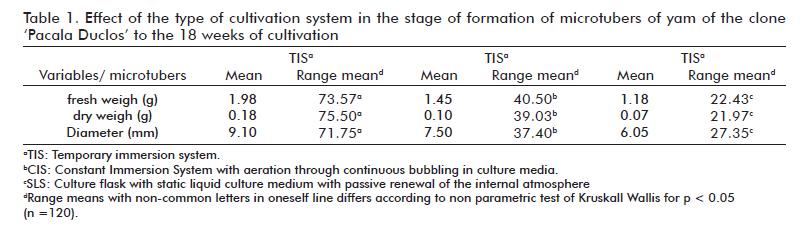
<body><![CDATA[<P   align="justify" ><font size="2" face="Verdana, Arial, Helvetica, sans-serif">Four weeks after      culture in field conditions, sprouted microtuber number per plot was quantified      and the percentage was determined. After six weeks of culture, survival percentage      was recorded. </font></P >       <P   align="justify" ><font size="2" face="Verdana, Arial, Helvetica, sans-serif">Ten plants from internal      mounds were selected and the following variables were evaluated: Stem number      per plant, stem length (m) after 24 weeks of plantation, tuber number / plant      and tuber fresh weight (kg) /plant at harvest time. </font></P >       <P   ><font size="2" face="Verdana, Arial, Helvetica, sans-serif"><b><font size="3">RESULTS      AND DISCUSSION </font> </b> </font></P >   <FONT size="+1">        <P   ><font size="2" face="Verdana, Arial, Helvetica, sans-serif"><b>Effect of liquid      culture system on <I>in vitro</I> tuberization. Evaluation of morphological      and physiological indicators during plant growth stage </b></font></P >   <FONT size="+1">        <P   align="justify" ><font size="2" face="Verdana, Arial, Helvetica, sans-serif">In culture systems      with forced renewal of the internal atmosphere in the culture flask (TIS and      CIS), higher results were obtained in total length (20.80 cm), axillary bud      number (8.60), fresh (2.10 g) and dry (0.18 g) weight per plant with significant      differences in relation to plants developed in CIS and in SLS. </font></P >       <P   align="justify" ><font size="2" face="Verdana, Arial, Helvetica, sans-serif">The best results      on photosynthetic pigment content (chlorophyll a, b, and totals), net photosynthesis,      total transpiration, and relation on net photosynthesis and total transpiration,      stomatal conductance and leaf starch content were obtained six weeks after      culture in TIS. </font></P >       <P   align="justify" ><font size="2" face="Verdana, Arial, Helvetica, sans-serif">The smallest conductance      values in the leaves from plants cultivated in TIS, indicated according to      [6], that these plants presented better integrality in the structural leaf      development making them more functional from the physiologic point of view;      so a better relation between net photosynthesis and total transpiration favored      the biggest starch accumulation in the leaves. </font></P >       <P   ><font size="2" face="Verdana, Arial, Helvetica, sans-serif"><b>Evaluation of      morphological and physiological indicators in the microtuber stage formation      </b></font></P >       <P   align="justify" ><font size="2" face="Verdana, Arial, Helvetica, sans-serif">With the employment      of TIS, microtubers of more quality reflected in the best results for the      fresh, dry mass and diameter average were formed. These morphological indicators      presented significant differences with regard to those that were formed in      CIS and in SLS (<a href="/img/revistas/bta/v28n4/t0109411.gif">Table 1</a>). </font></P >       
<P   align="justify" ><font size="2" face="Verdana, Arial, Helvetica, sans-serif">After 18 weeks of      culture, the highest total number of microtubers and microtubers with a fresh      weight equal or higher than 0.5 g (241.80) was achieved, as well as the lowest      number of hyperhidrated microtubers. In all cases, these results in TIS presented      significant differences in relation to other culture systems. Microtubers      with a fresh weight equal or higher than 0.5 g formed in TIS were distinguished      for their quality, expressed in the highest dry weight and starch percentages.      The possibility in TIS after each immersion to obtain a carbon dioxide concentration      (CO<Sub>2</Sub>) and oxygen (O<Sub>2</Sub>) near to the atmospheric concentration      and to eliminate the ethylene accumulation from the gassy space in culture      flasks [7]. These culture conditions created in TIS allowed the highest microtuber      formation in yam in comparison with those obtained in the rest of the culture      systems. </font></P >   <FONT size="+1"><FONT size="+1"><FONT size="+1"><FONT size="+1">        ]]></body>
<body><![CDATA[<P   ><font size="2" face="Verdana, Arial, Helvetica, sans-serif"><b>Determination      of sugar reducers and mineral nutrients in culture media in temporary immersion      system </b></font></P >       <P   align="justify" ><font size="2" face="Verdana, Arial, Helvetica, sans-serif">In the plant growth      stage, after six weeks of culture, sugar reducers were completed exhausted      in culture media. This result suggests that photomixotrophic nutrition could      have happened in the case of yam plants cultivated in TIS. </font></P >       <P   align="justify" ><font size="2" face="Verdana, Arial, Helvetica, sans-serif">At the end of the      microtuber formation stage (18 weeks of culture), sugar reducers had been      completely exhausted in culture media. The <I>in vitro</I> tuber formation      occurs with high sugar levels in culture media [8] and as results of molecular      genetic experiments, that sugars induce the expression of a wide gene variety      and the specific protein synthesis of tuberization [9]. Sucrose has a double      role in the microtuber development. Besides constituting a carbon source easily      assimilable by <I>in vitro</I> plants for the conversion in starch, it is      the most effective carbon source in the microtuber development. At the same      time, sucrose at concentrations from 80 to 100 g/L provides a favorable osmorality      for microtuber development [10]. </font></P >       <P   align="justify" ><font size="2" face="Verdana, Arial, Helvetica, sans-serif">When concluding the      plant growth stage, the mineral nutrients with smaller content in the culture      media regarding the initial value were: phosphorus (6.4%), nitrogen (15.8%),      magnesium (18.2%), calcium (25.3%), iron (26.7%) and manganese (48.7%), while      mineral nutrients as potassium, copper and zinc remained above 50% of the      initial content. However, in the microtuber formation stage, after 18 weeks      of culture in culture media, mineral nutrients as phosphorus were totally      exhausted; nitrogen was at 8.8%, calcium at 18.6% and the potassium at 28.0%      of the initial content in the culture media, while the mineral nutrients,      magnesium, manganese, zinc, copper and iron remained above 50% of the initial      content. </font></P >       <P   align="justify" ><font size="2" face="Verdana, Arial, Helvetica, sans-serif">It is possible to      relate the different metabolic processes and functions in plant cells, in      which mineral nutrients of smaller content in culture medium are involved      with the growth of plants cultivated in TIS; as well as in the stage of microtubers      formation with the activation of the biochemical and physiologic mechanisms      of <I>in vitro</I> tuberization. </font></P >       <P   ><font size="2" face="Verdana, Arial, Helvetica, sans-serif"><b>Effect of culture      conditions in the temporary immersion system on microtuber formation </b></font></P >       <P   align="justify" ><font size="2" face="Verdana, Arial, Helvetica, sans-serif">Effect of immersion      time: The best results were obtained with a 15 minute immersion time. After      18 weeks of culture with this immersion time, the highest total number of      microtubers per TIS (309.40) and the highest microtuber number with a fresh      weight equal or higher than 0.5 g (300.41) with significant differences in      relation to other immersion times were obtained [11]. </font></P >       <P   align="justify" ><font size="2" face="Verdana, Arial, Helvetica, sans-serif">Effect of the inmersion      frequency: The best results were shown with an immersion every six hours.      This immersion frequency resulted in the highest total number of microtubers      per SIT (339.62) and the highest microtuber number with a fresh weight equal      or higher than 0.5 g per SIT (328.81) after 18 weeks of culture. With this      frequency, a gas composition renovation should have been achieved and that      conforms the internal atmosphere of the culture flask and a nutrient availability      in function of the requirements of <I>in vitro</I> cultivated plants favorable      for <I>in vitro</I> tuberizaci&oacute;n, in comparison with immersion frequencies      each three, twelve and twenty-four hours [11]. </font></P >       <P   align="justify" ><font size="2" face="Verdana, Arial, Helvetica, sans-serif">Effect of culture      media volume for <I>in vitro</I> cultivated plant: The best results were obtained      with 60 and 90 mL culture media volume per <I>in vitro</I> plant. After 18      weeks of culture, the highest number of microtubers were achieved per TIS      (374.2 and 3710) as well as the highest microtuber number equal or higher      than 0.5 g (365.0 and 3465). With these culture media volumes per plant, a      higher number of axillary buds received the inductor stimuli of culture media      for <I>in vitro</I> tuberizaci&oacute;n [11]. </font></P >       <P   align="justify" ><font size="2" face="Verdana, Arial, Helvetica, sans-serif">Effect of culture      media renewal: Three times more microtubers with a fresh weight equal or higher      than to 3.0 g were obtained with four culture media renewals in comparison      with the treatment without renewal to culture medium. </font></P >       ]]></body>
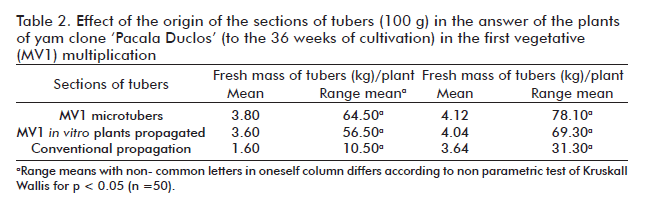
<body><![CDATA[<P   ><font size="2" face="Verdana, Arial, Helvetica, sans-serif"><b>Influences of      microtuber fresh weight on sprouting, and survival and on morphoagronomic      characters of plants derived from such microtubers </b></font></P >       <P   align="justify" ><font size="2" face="Verdana, Arial, Helvetica, sans-serif">When microtubers      with a fresh weight equal or higher than 3.0 g were planted directly in field      conditions, the highest sprouting percentage (91.30%) among microtubers, without      significant differences with the tuber crown were achieved. </font></P >       <P   align="justify" ><font size="2" face="Verdana, Arial, Helvetica, sans-serif">The best survival      percentages were obtained with plants coming from microtubers with a fresh      weight equal or higher than 3.0 g (96.50%) without significant differences      in plants coming from the tuber of the conventional propagation. </font></P >       <P   align="justify" ><font size="2" face="Verdana, Arial, Helvetica, sans-serif">Evaluation of quantitative      characters: In plants from all <I>in vitro</I> planting materials, 2.3 times      more tubers than conventional propagation of plants coming from tuber crowns      were obtained as average (<a href="/img/revistas/bta/v28n4/t0209411.gif">Table 2</a>). </font></P >       
<P   align="justify" ><font size="2" face="Verdana, Arial, Helvetica, sans-serif">This can be related      to the effect of physiological and health renewal produced by <I>in vitro</I>      culture. Microtubers have been considered as the best vegetable material to      begin high quality &ldquo;seed&rdquo; production programs [12]. The present      work for yam culture has corroborated these results, because a higher multiplication      rate can be obtained in field conditions. The highest tuber number obtained      in field conditions in plants from microtubers facilitates a planting material      production programs and reduces the multiplication number that should be given      to them in field conditions to satisfy demands of certified planting material.      </font></P >       <P   ><font size="2" face="Verdana, Arial, Helvetica, sans-serif"><b><font size="3">CONCLUSIONS      </font></b></font></P >   <FONT size="+1">        <P   align="justify" ><font size="2" face="Verdana, Arial, Helvetica, sans-serif">Microtubers were      formed in the three evaluated systems. The best results were obtained in temporary      immersion system with 15 minutes immersion time every six hours, a 60 mL culture      media volume per <I>in vitro</I> plant, and four culture media renewals. The      microtuber number and fresh weight could be increased to allow using those      with a fresh weight equal or higher than 3.0 g as planting material for direct      plantation in field conditions. </font></P >   <FONT size="+1">        <P   > </P >   <FONT size="+1">       <P   ><font size="3"><b><font face="Verdana, Arial, Helvetica, sans-serif">REFERENCES      </font></b></font></P >       <!-- ref --><P   ><font size="2" face="Verdana, Arial, Helvetica, sans-serif">1. Tamiru M, Becker      HC, Maass BL. Diversity, distribution and management of yam landraces (Dioscorea      spp.) in Southern Ethiopia. Genet Resour Crop Evol. 2008;55:115-31.     </font></P >   <FONT size="+1">        <!-- ref --><P   ><font size="2" face="Verdana, Arial, Helvetica, sans-serif">2. Cabrera M. Empleo      de m&eacute;todos biotecnol&oacute;gicos para la propagaci&oacute;n de &ntilde;ame.      Biotecnol Veg. 2009;9(4):195-209.     </font></P >       <!-- ref --><P   ><font size="2" face="Verdana, Arial, Helvetica, sans-serif">3. Balogun MO. Microtubers      in yam germplasm conservation and propagation: The status, the prospects and      the constraints. Biotechnol Mol Biol Rev. 2009;4(1):1-10.     </font></P >       <!-- ref --><P   ><font size="2" face="Verdana, Arial, Helvetica, sans-serif">4. Ovono PO, Kevers      C, Dommes J. Axillary proliferation and tuberization of Dioscorea cayenensis-D.      rotundata complex. Plant Cell Tiss Org Cult. 2007; 91:107-14.     </font></P >       <!-- ref --><P   ><font size="2" face="Verdana, Arial, Helvetica, sans-serif">5. Cabrera M, G&oacute;mez      R, Basail M, Santos P, Medero V, L&oacute;pez J, et al. Production of yam      microtubers using a temporary immersion system. Plant Cell Tiss Org Cult.      2005;83:103-7.     </font></P >       <!-- ref --><P   ><font size="2" face="Verdana, Arial, Helvetica, sans-serif">6. Afreen F. Physiological      and anatomical characteristics of in vitro photoautotrophic plants. In: Kozai      T, Afreen F, Zobayed SMA, editors. Photoautotrophic (sugar-free medium) micropropagation      as a new propagation and transplant production system.1st ed. Dordrecht: Springer;      2005. p. 61-90.     </font></P >       <!-- ref --><P   ><font size="2" face="Verdana, Arial, Helvetica, sans-serif">7. Roels S, Noceda      C, Escalona M, Sandoval J, Canal MJ, Rodriguez R, et al. The effect of headspace      renewal in a Temporary Immersion Bioreactor on plantain (Musa AAB) shoot proliferation      and quality. Plant Cell Tiss Org Cult. 2006; 84:138-46.     </font></P >       <!-- ref --><P   ><font size="2" face="Verdana, Arial, Helvetica, sans-serif">8. Claassens MM,      Vreugdenhil J. Is dormancy breaking of potato tubers the reverse of tuber      initiation? Potato Res. 2000;43:347-69.     </font></P >       <!-- ref --><P   ><font size="2" face="Verdana, Arial, Helvetica, sans-serif">9. Sarkar D. The      signal transductions pathways controlling in plant tuberizations in potato:      an emerging synthesis. Plant Cell Rep. 2008;27:1-8.     </font></P >       <!-- ref --><P   ><font size="2" face="Verdana, Arial, Helvetica, sans-serif">10. Cabrera M, G&oacute;mez      R, Rayas A, De Feria M, L&oacute;pez J, Basail M, et al. Protocolo para la      formaci&oacute;n de microtub&eacute;rculos de &ntilde;ame (Dioscorea alata      L.) en sistema de inmersi&oacute;n temporal. Rev Colomb Biotecnol. 2009;11(2):19-30.          </font></P >       <!-- ref --><P   ><font size="2" face="Verdana, Arial, Helvetica, sans-serif">11. Yu WC, Joyce      PJ, Cameron DC, McCown BH. Sucrose utilization during potato microtuber growth      in bioreactors. Plant Cell Rep. 2000;19:407-13.     </font></P >       <!-- ref --><P   ><font size="2" face="Verdana, Arial, Helvetica, sans-serif">12. Chen FQ, Fu Y,      Wang DL, Gao X, Wang L. The effect of plant growth regulators and sucrose      on the micropropagation of Dioscorea nipponica makino. J Plant Growth Regul.      2007;26:38-45.     </font></P >       <P   >&nbsp;</P >   <FONT size="+1">        <P   > </P >       <P   ><font size="2" face="Verdana, Arial, Helvetica, sans-serif">Manuel Cabrera. Instituto      Nacional de Investigaciones de Viandas Tropicales, INIVIT. AP 6, Santo Domingo,      CP 53 000, Villa Clara, Cuba. E-mail: <a href="mailto:mcabrera@inivit.cu">mcabrera@inivit.cu</a>.      </font></P >   </font></font></font></font></font></font></font></font></font></font></font></font></font></font></font></font></font></font></font></font></font></font></font></font></font></font></font></font></font></font></font></font></font></font></font></font></font></font></font></font></font></DIV >      ]]></body><back>
<ref-list>
<ref id="B1">
<label>1</label><nlm-citation citation-type="journal">
<person-group person-group-type="author">
<name>
<surname><![CDATA[Tamiru]]></surname>
<given-names><![CDATA[M]]></given-names>
</name>
<name>
<surname><![CDATA[Becker]]></surname>
<given-names><![CDATA[HC]]></given-names>
</name>
<name>
<surname><![CDATA[Maass]]></surname>
<given-names><![CDATA[BL]]></given-names>
</name>
</person-group>
<article-title xml:lang="en"><![CDATA[Diversity, distribution and management of yam landraces (Dioscorea spp.) in Southern Ethiopia]]></article-title>
<source><![CDATA[Genet Resour Crop Evol]]></source>
<year>2008</year>
<volume>55</volume>
<page-range>115-31</page-range></nlm-citation>
</ref>
<ref id="B2">
<label>2</label><nlm-citation citation-type="journal">
<person-group person-group-type="author">
<name>
<surname><![CDATA[Cabrera]]></surname>
<given-names><![CDATA[M]]></given-names>
</name>
</person-group>
<article-title xml:lang="es"><![CDATA[Empleo de métodos biotecnológicos para la propagación de ñame]]></article-title>
<source><![CDATA[Biotecnol Veg]]></source>
<year>2009</year>
<volume>9</volume>
<numero>4</numero>
<issue>4</issue>
<page-range>195-209</page-range></nlm-citation>
</ref>
<ref id="B3">
<label>3</label><nlm-citation citation-type="journal">
<person-group person-group-type="author">
<name>
<surname><![CDATA[Balogun]]></surname>
<given-names><![CDATA[MO]]></given-names>
</name>
</person-group>
<article-title xml:lang="en"><![CDATA[Microtubers in yam germplasm conservation and propagation: The status, the prospects and the constraints]]></article-title>
<source><![CDATA[Biotechnol Mol Biol Rev]]></source>
<year>2009</year>
<volume>4</volume>
<numero>1</numero>
<issue>1</issue>
<page-range>1-10</page-range></nlm-citation>
</ref>
<ref id="B4">
<label>4</label><nlm-citation citation-type="journal">
<person-group person-group-type="author">
<name>
<surname><![CDATA[Ovono]]></surname>
<given-names><![CDATA[PO]]></given-names>
</name>
<name>
<surname><![CDATA[Kevers]]></surname>
<given-names><![CDATA[C]]></given-names>
</name>
<name>
<surname><![CDATA[Dommes]]></surname>
<given-names><![CDATA[J]]></given-names>
</name>
</person-group>
<article-title xml:lang="en"><![CDATA[Axillary proliferation and tuberization of Dioscorea cayenensis-D. rotundata complex]]></article-title>
<source><![CDATA[Plant Cell Tiss Org Cult]]></source>
<year>2007</year>
<volume>91</volume>
<page-range>107-14</page-range></nlm-citation>
</ref>
<ref id="B5">
<label>5</label><nlm-citation citation-type="journal">
<person-group person-group-type="author">
<name>
<surname><![CDATA[Cabrera]]></surname>
<given-names><![CDATA[M]]></given-names>
</name>
<name>
<surname><![CDATA[Gómez]]></surname>
<given-names><![CDATA[R]]></given-names>
</name>
<name>
<surname><![CDATA[Basail]]></surname>
<given-names><![CDATA[M]]></given-names>
</name>
<name>
<surname><![CDATA[Santos]]></surname>
<given-names><![CDATA[P]]></given-names>
</name>
<name>
<surname><![CDATA[Medero]]></surname>
<given-names><![CDATA[V]]></given-names>
</name>
<name>
<surname><![CDATA[López]]></surname>
<given-names><![CDATA[J]]></given-names>
</name>
</person-group>
<article-title xml:lang="en"><![CDATA[Production of yam microtubers using a temporary immersion system]]></article-title>
<source><![CDATA[Plant Cell Tiss Org Cult]]></source>
<year>2005</year>
<volume>83</volume>
<page-range>103-7</page-range></nlm-citation>
</ref>
<ref id="B6">
<label>6</label><nlm-citation citation-type="book">
<person-group person-group-type="author">
<name>
<surname><![CDATA[Afreen]]></surname>
<given-names><![CDATA[F]]></given-names>
</name>
</person-group>
<article-title xml:lang="en"><![CDATA[Physiological and anatomical characteristics of in vitro photoautotrophic plants]]></article-title>
<person-group person-group-type="editor">
<name>
<surname><![CDATA[Kozai]]></surname>
<given-names><![CDATA[T]]></given-names>
</name>
<name>
<surname><![CDATA[Afreen]]></surname>
<given-names><![CDATA[F]]></given-names>
</name>
<name>
<surname><![CDATA[Zobayed]]></surname>
<given-names><![CDATA[SMA]]></given-names>
</name>
</person-group>
<source><![CDATA[Photoautotrophic (sugar-free medium) micropropagation as a new propagation and transplant production system]]></source>
<year>2005</year>
<page-range>61-90</page-range><publisher-loc><![CDATA[Dordrecht ]]></publisher-loc>
<publisher-name><![CDATA[Springer]]></publisher-name>
</nlm-citation>
</ref>
<ref id="B7">
<label>7</label><nlm-citation citation-type="journal">
<person-group person-group-type="author">
<name>
<surname><![CDATA[Roels]]></surname>
<given-names><![CDATA[S]]></given-names>
</name>
<name>
<surname><![CDATA[Noceda]]></surname>
<given-names><![CDATA[C]]></given-names>
</name>
<name>
<surname><![CDATA[Escalona]]></surname>
<given-names><![CDATA[M]]></given-names>
</name>
<name>
<surname><![CDATA[Sandoval]]></surname>
<given-names><![CDATA[J]]></given-names>
</name>
<name>
<surname><![CDATA[Canal]]></surname>
<given-names><![CDATA[MJ]]></given-names>
</name>
<name>
<surname><![CDATA[Rodriguez]]></surname>
<given-names><![CDATA[R]]></given-names>
</name>
</person-group>
<article-title xml:lang="en"><![CDATA[The effect of headspace renewal in a Temporary Immersion Bioreactor on plantain (Musa AAB) shoot proliferation and quality]]></article-title>
<source><![CDATA[Plant Cell Tiss Org Cult]]></source>
<year>2006</year>
<volume>84</volume>
<page-range>138-46</page-range></nlm-citation>
</ref>
<ref id="B8">
<label>8</label><nlm-citation citation-type="journal">
<person-group person-group-type="author">
<name>
<surname><![CDATA[Claassens]]></surname>
<given-names><![CDATA[MM]]></given-names>
</name>
<name>
<surname><![CDATA[Vreugdenhil]]></surname>
<given-names><![CDATA[J]]></given-names>
</name>
</person-group>
<article-title xml:lang="en"><![CDATA[Is dormancy breaking of potato tubers the reverse of tuber initiation?]]></article-title>
<source><![CDATA[Potato Res]]></source>
<year>2000</year>
<volume>43</volume>
<page-range>347-69</page-range></nlm-citation>
</ref>
<ref id="B9">
<label>9</label><nlm-citation citation-type="journal">
<person-group person-group-type="author">
<name>
<surname><![CDATA[Sarkar]]></surname>
<given-names><![CDATA[D]]></given-names>
</name>
</person-group>
<article-title xml:lang="en"><![CDATA[The signal transductions pathways controlling in plant tuberizations in potato: an emerging synthesis]]></article-title>
<source><![CDATA[Plant Cell Rep]]></source>
<year>2008</year>
<volume>27</volume>
<page-range>1-8</page-range></nlm-citation>
</ref>
<ref id="B10">
<label>10</label><nlm-citation citation-type="journal">
<person-group person-group-type="author">
<name>
<surname><![CDATA[Cabrera]]></surname>
<given-names><![CDATA[M]]></given-names>
</name>
<name>
<surname><![CDATA[Gómez]]></surname>
<given-names><![CDATA[R]]></given-names>
</name>
<name>
<surname><![CDATA[Rayas]]></surname>
<given-names><![CDATA[A]]></given-names>
</name>
<name>
<surname><![CDATA[De Feria]]></surname>
<given-names><![CDATA[M]]></given-names>
</name>
<name>
<surname><![CDATA[López]]></surname>
<given-names><![CDATA[J]]></given-names>
</name>
<name>
<surname><![CDATA[Basail]]></surname>
<given-names><![CDATA[M]]></given-names>
</name>
</person-group>
<article-title xml:lang="es"><![CDATA[Protocolo para la formación de microtubérculos de ñame (Dioscorea alata L.) en sistema de inmersión temporal]]></article-title>
<source><![CDATA[Rev Colomb Biotecnol]]></source>
<year>2009</year>
<volume>11</volume>
<numero>2</numero>
<issue>2</issue>
<page-range>19-30</page-range></nlm-citation>
</ref>
<ref id="B11">
<label>11</label><nlm-citation citation-type="journal">
<person-group person-group-type="author">
<name>
<surname><![CDATA[Yu]]></surname>
<given-names><![CDATA[WC]]></given-names>
</name>
<name>
<surname><![CDATA[Joyce]]></surname>
<given-names><![CDATA[PJ]]></given-names>
</name>
<name>
<surname><![CDATA[Cameron]]></surname>
<given-names><![CDATA[DC]]></given-names>
</name>
<name>
<surname><![CDATA[McCown]]></surname>
<given-names><![CDATA[BH]]></given-names>
</name>
</person-group>
<article-title xml:lang="en"><![CDATA[Sucrose utilization during potato microtuber growth in bioreactors]]></article-title>
<source><![CDATA[Plant Cell Rep]]></source>
<year>2000</year>
<volume>19</volume>
<page-range>407-13</page-range></nlm-citation>
</ref>
<ref id="B12">
<label>12</label><nlm-citation citation-type="journal">
<person-group person-group-type="author">
<name>
<surname><![CDATA[Chen]]></surname>
<given-names><![CDATA[FQ]]></given-names>
</name>
<name>
<surname><![CDATA[Fu]]></surname>
<given-names><![CDATA[Y]]></given-names>
</name>
<name>
<surname><![CDATA[Wang]]></surname>
<given-names><![CDATA[DL]]></given-names>
</name>
<name>
<surname><![CDATA[Gao]]></surname>
<given-names><![CDATA[X]]></given-names>
</name>
<name>
<surname><![CDATA[Wang]]></surname>
<given-names><![CDATA[L]]></given-names>
</name>
</person-group>
<article-title xml:lang="en"><![CDATA[The effect of plant growth regulators and sucrose on the micropropagation of Dioscorea nipponica makino]]></article-title>
<source><![CDATA[J Plant Growth Regul]]></source>
<year>2007</year>
<volume>26</volume>
<page-range>38-45</page-range></nlm-citation>
</ref>
</ref-list>
</back>
</article>