<?xml version="1.0" encoding="ISO-8859-1"?><article xmlns:mml="http://www.w3.org/1998/Math/MathML" xmlns:xlink="http://www.w3.org/1999/xlink" xmlns:xsi="http://www.w3.org/2001/XMLSchema-instance">
<front>
<journal-meta>
<journal-id>1027-2852</journal-id>
<journal-title><![CDATA[Biotecnología Aplicada]]></journal-title>
<abbrev-journal-title><![CDATA[Biotecnol Apl]]></abbrev-journal-title>
<issn>1027-2852</issn>
<publisher>
<publisher-name><![CDATA[Editorial Elfos Scientiae]]></publisher-name>
</publisher>
</journal-meta>
<article-meta>
<article-id>S1027-28522011000400010</article-id>
<title-group>
<article-title xml:lang="en"><![CDATA[Yeast and its derivatives as ingredients in the food industry]]></article-title>
<article-title xml:lang="es"><![CDATA[Las levaduras y sus derivados como ingredientes en la industria de alimentos]]></article-title>
</title-group>
<contrib-group>
<contrib contrib-type="author">
<name>
<surname><![CDATA[Otero]]></surname>
<given-names><![CDATA[Miguel A]]></given-names>
</name>
<xref ref-type="aff" rid="A01"/>
</contrib>
<contrib contrib-type="author">
<name>
<surname><![CDATA[Guerrero]]></surname>
<given-names><![CDATA[Isabel]]></given-names>
</name>
<xref ref-type="aff" rid="A02"/>
</contrib>
<contrib contrib-type="author">
<name>
<surname><![CDATA[Wagner]]></surname>
<given-names><![CDATA[Jorge R]]></given-names>
</name>
<xref ref-type="aff" rid="A03"/>
</contrib>
<contrib contrib-type="author">
<name>
<surname><![CDATA[Cabello]]></surname>
<given-names><![CDATA[Agustín J]]></given-names>
</name>
<xref ref-type="aff" rid="A01"/>
</contrib>
<contrib contrib-type="author">
<name>
<surname><![CDATA[Sceni]]></surname>
<given-names><![CDATA[Paula]]></given-names>
</name>
<xref ref-type="aff" rid="A03"/>
</contrib>
<contrib contrib-type="author">
<name>
<surname><![CDATA[García]]></surname>
<given-names><![CDATA[Roxana]]></given-names>
</name>
<xref ref-type="aff" rid="A01"/>
</contrib>
<contrib contrib-type="author">
<name>
<surname><![CDATA[Soriano]]></surname>
<given-names><![CDATA[Jorge]]></given-names>
</name>
<xref ref-type="aff" rid="A02"/>
</contrib>
<contrib contrib-type="author">
<name>
<surname><![CDATA[Tomasini]]></surname>
<given-names><![CDATA[Araceli]]></given-names>
</name>
<xref ref-type="aff" rid="A02"/>
</contrib>
<contrib contrib-type="author">
<name>
<surname><![CDATA[Saura]]></surname>
<given-names><![CDATA[Gustavo]]></given-names>
</name>
<xref ref-type="aff" rid="A01"/>
</contrib>
<contrib contrib-type="author">
<name>
<surname><![CDATA[Almazán]]></surname>
<given-names><![CDATA[Oscar]]></given-names>
</name>
<xref ref-type="aff" rid="A01"/>
</contrib>
</contrib-group>
<aff id="A02">
<institution><![CDATA[,Universidad Nacional de Quilmes Departamento de Ciencia y Tecnología Laboratorio de Investigación en Funcionalidad y Tecnología de Alimentos]]></institution>
<addr-line><![CDATA[Buenos Aires ]]></addr-line>
<country>Argentina</country>
</aff>
<aff id="A03">
<institution><![CDATA[,Departamento de Ciencia y Tecnología División de Ciencias Biológicas y de la Salud ]]></institution>
<addr-line><![CDATA[México DF ]]></addr-line>
<country>México</country>
</aff>
<aff id="A01">
<institution><![CDATA[,Instituto Cubano de Investigaciones de los Derivados de la Caña de Azúcar  ]]></institution>
<addr-line><![CDATA[La Habana ]]></addr-line>
<country>Cuba</country>
</aff>
<pub-date pub-type="pub">
<day>00</day>
<month>12</month>
<year>2011</year>
</pub-date>
<pub-date pub-type="epub">
<day>00</day>
<month>12</month>
<year>2011</year>
</pub-date>
<volume>28</volume>
<numero>4</numero>
<fpage>272</fpage>
<lpage>275</lpage>
<copyright-statement/>
<copyright-year/>
<self-uri xlink:href="http://scielo.sld.cu/scielo.php?script=sci_arttext&amp;pid=S1027-28522011000400010&amp;lng=en&amp;nrm=iso"></self-uri><self-uri xlink:href="http://scielo.sld.cu/scielo.php?script=sci_abstract&amp;pid=S1027-28522011000400010&amp;lng=en&amp;nrm=iso"></self-uri><self-uri xlink:href="http://scielo.sld.cu/scielo.php?script=sci_pdf&amp;pid=S1027-28522011000400010&amp;lng=en&amp;nrm=iso"></self-uri><abstract abstract-type="short" xml:lang="en"><p><![CDATA[In the last 200 years, and still today, yeast is well known for its application in brewing, alcohol fermentation and wine and bread making. They are an endless source of new food ingredients and additives with excellent functional and nutritional properties, now through the use of innovative elaboration and fractionation techniques that come mainly from biotechnology. The book reviewed here contains fourteen chapters in 246 pages that deal with yeasts employed as food ingredients and their potential as Nutraceutics. It compiles the expertise of three Latin American institutions that have given priority to the generation of basic knowledge on yeast and set the grounds for the development of new technologies based on these microorganisms. This is a sample of the alternatives offered by yeast in the fields of food science and technology.]]></p></abstract>
<abstract abstract-type="short" xml:lang="es"><p><![CDATA[En los últimos 200 años se emplean las levaduras en la vinicultura, la fermentación alcohólica y la industria panadera. Estos microorganismos son una fuente de ingredientes nutritivos y aditivos de excelentes propiedades funcionales y nutricionales. En la actualidad ha aumentado su relevancia, con el empleo de innovadoras técnicas de elaboración y fraccionamiento, principalmente aportadas por la biotecnología. El libro referido en la presente comunicación consta de 14 capítulos que abarcan 246 páginas sobre el uso de las levaduras como ingredientes alimenticios y su potencial como nutracéuticos. En él se resume la experiencia de tres instituciones latinoamericanas que dan prioridad a la generación de conocimiento básico sobre las levaduras y que sientan cátedra para el desarrollo de nuevas tecnologías en base a estos microorganismos Este es un ejemplo de las alternativas inherentes al uso de las levaduras en los campos de las ciencias y tecnologías de la alimentación.]]></p></abstract>
<kwd-group>
<kwd lng="en"><![CDATA[yeast]]></kwd>
<kwd lng="en"><![CDATA[derivatives]]></kwd>
<kwd lng="en"><![CDATA[food industry]]></kwd>
<kwd lng="en"><![CDATA[Nutraceutics]]></kwd>
<kwd lng="en"><![CDATA[book]]></kwd>
<kwd lng="es"><![CDATA[Levadura]]></kwd>
<kwd lng="es"><![CDATA[derivados]]></kwd>
<kwd lng="es"><![CDATA[industria de los alimentos]]></kwd>
<kwd lng="es"><![CDATA[nutracéuticos]]></kwd>
<kwd lng="es"><![CDATA[libro]]></kwd>
</kwd-group>
</article-meta>
</front><body><![CDATA[ <DIV class="Sect"   >        <P align="right"   ><font size="2" color="#000000" face="Verdana, Arial, Helvetica, sans-serif"><b>REPORT      </b></font></P >       <P align="right"   >&nbsp;</P >   <FONT size="+1" color="#000000">        <P   > </P >       <P   ><b><font face="Verdana, Arial, Helvetica, sans-serif" size="4">Yeast and its      derivatives as ingredients in the food industry </font></b></P >       <P   >&nbsp;</P >       <P   ><font face="Verdana, Arial, Helvetica, sans-serif" size="3"><b>Las levaduras      y sus derivados como ingredientes en la industria de alimentos</b></font></P >       <P   >&nbsp;</P >       <P   >&nbsp;</P >       <P   > </P >       ]]></body>
<body><![CDATA[<P   ><b><font face="Verdana, Arial, Helvetica, sans-serif" size="2">Miguel A Otero<Sup>1</Sup>,      Isabel Guerrero<Sup>2</Sup>, Jorge R Wagner<Sup>3</Sup>, Agust&iacute;n J      Cabello<Sup>1</Sup>, Paula Sceni<Sup>3</Sup>, Roxana Garc&iacute;a<Sup>1</Sup>,      Jorge Soriano<Sup>2</Sup>, Araceli Tomasini<Sup>2</Sup>, Gustavo Saura<Sup>1</Sup>,      Oscar Almaz&aacute;n<Sup>1</Sup></font></b></P >   <FONT size="+1"><FONT size="+1"><FONT size="+1"><FONT size="+1"><FONT size="+1"><FONT size="+1"><FONT size="+1"><FONT size="+1"><FONT size="+1"><FONT size="+1"><FONT size="+1"><FONT size="+1"><FONT size="+1"><FONT size="+1"><FONT size="+1"><FONT size="+1"><FONT size="+1"><FONT size="+1"><FONT size="+1"><FONT size="+1">        <P   ><font face="Verdana, Arial, Helvetica, sans-serif" size="2"><Sup>1</Sup>Instituto      Cubano de Investigaciones de los Derivados de la Ca&ntilde;a de Az&uacute;car,      ICIDCA. V&iacute;a Blanca 804, CP 11000, La Habana, Cuba.    <br>     </font><font face="Verdana, Arial, Helvetica, sans-serif" size="2"><Sup>2</Sup>Laboratorio      de Investigaci&oacute;n en Funcionalidad y Tecnolog&iacute;a de Alimentos,      LIFTA. Departamento de Ciencia y Tecnolog&iacute;a, Universidad Nacional de      Quilmes, Roque S&aacute;enz Pe&ntilde;a 352 Bernal - B1876BXD - Buenos Aires,      Argentina.    <br>     </font><font face="Verdana, Arial, Helvetica, sans-serif" size="2"><Sup>3</Sup>Divisi&oacute;n      de Ciencias Biol&oacute;gicas y de la Salud, Departamento de Biotecnolog&iacute;a,      San Rafael Atlixco 186, CP 09340, Col. Vicentina Iztapalapa, M&eacute;xico      DF. </font></P >       <P   >&nbsp;</P >   <FONT size="+1"><FONT size="+1"><FONT size="+1"><FONT size="+1"><FONT size="+1"><FONT size="+1">        <P   > </P >   </font></font></font></font></font></font></font></font></font></font></font></font></font></font></font></font></font></font></font></font></font></font></font></font></font></font></font>   <hr>   <FONT size="+1" color="#000000"><FONT size="+1"><FONT size="+1"><FONT size="+1"><FONT size="+1"><FONT size="+1"><FONT size="+1"><FONT size="+1"><FONT size="+1"><FONT size="+1"><FONT size="+1"><FONT size="+1"><FONT size="+1"><FONT size="+1"><FONT size="+1"><FONT size="+1"><FONT size="+1"><FONT size="+1"><FONT size="+1"><FONT size="+1"><FONT size="+1"><FONT size="+1"><FONT size="+1"><FONT size="+1"><FONT size="+1"><FONT size="+1"><FONT size="+1">        <P   ><font face="Verdana, Arial, Helvetica, sans-serif" size="2"><b>ABSTRACT </b></font></P >       <P   ><font size="2" face="Verdana, Arial, Helvetica, sans-serif">In the last 200 years,      and still today, yeast is well known for its application in brewing, alcohol      fermentation and wine and bread making. They are an endless source of new      food ingredients and additives with excellent functional and nutritional properties,      now through the use of innovative elaboration and fractionation techniques      that come mainly from biotechnology. The book reviewed here contains fourteen      chapters in 246 pages that deal with yeasts employed as food ingredients and      their potential as Nutraceutics. It compiles the expertise of three Latin      American institutions that have given priority to the generation of basic      knowledge on yeast and set the grounds for the development of new technologies      based on these microorganisms. This is a sample of the alternatives offered      by yeast in the fields of food science and technology. </font></P >   <FONT size="+1"><FONT size="+1">        <P   ><font size="2" face="Verdana, Arial, Helvetica, sans-serif"><b>Keywords: </b>yeast,      derivatives, food industry, nutraceutics, book. </font></P >   <FONT size="+1"> </font></font></font></font></font></font></font></font></font></font></font></font></font></font></font></font></font></font></font></font></font></font></font></font></font></font></font></font></font></font>   <hr>   <FONT size="+1" color="#000000"><FONT size="+1"><FONT size="+1"><FONT size="+1"><FONT size="+1"><FONT size="+1"><FONT size="+1"><FONT size="+1"><FONT size="+1"><FONT size="+1"><FONT size="+1"><FONT size="+1"><FONT size="+1"><FONT size="+1"><FONT size="+1"><FONT size="+1"><FONT size="+1"><FONT size="+1"><FONT size="+1"><FONT size="+1"><FONT size="+1"><FONT size="+1"><FONT size="+1"><FONT size="+1"><FONT size="+1"><FONT size="+1"><FONT size="+1"><FONT size="+1"><FONT size="+1"><FONT size="+1">        <P   > </P >   <FONT size="+1">        ]]></body>
<body><![CDATA[<P   ><b><font face="Verdana, Arial, Helvetica, sans-serif" size="2">RESUMEN </font></b></P >       <P   align="justify" ><font size="2" face="Verdana, Arial, Helvetica, sans-serif">En los &uacute;ltimos      200 a&ntilde;os se emplean las levaduras en la vinicultura, la fermentaci&oacute;n      alcoh&oacute;lica y la industria panadera. Estos microorganismos son una fuente      de ingredientes nutritivos y aditivos de excelentes propiedades funcionales      y nutricionales. En la actualidad ha aumentado su relevancia, con el empleo      de innovadoras t&eacute;cnicas de elaboraci&oacute;n y fraccionamiento, principalmente      aportadas por la biotecnolog&iacute;a. El libro referido en la presente comunicaci&oacute;n      consta de 14 cap&iacute;tulos que abarcan 246 p&aacute;ginas sobre el uso      de las levaduras como ingredientes alimenticios y su potencial como nutrac&eacute;uticos.      En &eacute;l se resume la experiencia de tres instituciones latinoamericanas      que dan prioridad a la generaci&oacute;n de conocimiento b&aacute;sico sobre      las levaduras y que sientan c&aacute;tedra para el desarrollo de nuevas tecnolog&iacute;as      en base a estos microorganismos Este es un ejemplo de las alternativas inherentes      al uso de las levaduras en los campos de las ciencias y tecnolog&iacute;as      de la alimentaci&oacute;n.</font></P >   <FONT size="+1">        <P   align="justify" ><font face="Verdana, Arial, Helvetica, sans-serif" size="2"><b>Palabras clave:</b>      Levadura, derivados, industria de los alimentos, nutrac&eacute;uticos, libro.      </font></P >   </font></font></font></font></font></font></font></font></font></font></font></font></font></font></font></font></font></font></font></font></font></font></font></font></font></font></font></font></font></font></font></font>    <hr>       <p>&nbsp;</p>    <p><FONT size="+1" color="#000000"><FONT size="+1"><FONT size="+1"><FONT size="+1"><FONT size="+1"><FONT size="+1"><FONT size="+1"><FONT size="+1"><FONT size="+1"><FONT size="+1"><FONT size="+1"><FONT size="+1"><FONT size="+1"><FONT size="+1"><FONT size="+1"><FONT size="+1"><FONT size="+1"><FONT size="+1"><FONT size="+1"><FONT size="+1"><FONT size="+1"><FONT size="+1"><FONT size="+1"><FONT size="+1"><FONT size="+1"><FONT size="+1"><FONT size="+1"><FONT size="+1"><FONT size="+1"><FONT size="+1"><FONT size="+1"><FONT size="+1">   </font></font></font></font></font></font></font></font></font></font></font></font></font></font></font></font></font></font></font></font></font></font></font></font></font></font></font></font></font></font></font></font></p>   <FONT size="+1" color="#000000"><FONT size="+1"><FONT size="+1"><FONT size="+1"><FONT size="+1"><FONT size="+1"><FONT size="+1"><FONT size="+1"><FONT size="+1"><FONT size="+1"><FONT size="+1"><FONT size="+1"><FONT size="+1"><FONT size="+1"><FONT size="+1"><FONT size="+1"><FONT size="+1"><FONT size="+1"><FONT size="+1"><FONT size="+1"><FONT size="+1"><FONT size="+1"><FONT size="+1"><FONT size="+1"><FONT size="+1"><FONT size="+1"><FONT size="+1"><FONT size="+1"><FONT size="+1"><FONT size="+1"><FONT size="+1"><FONT size="+1">        <P   > </P >   <FONT size="+1">        <P   ><font size="3"><b><font face="Verdana, Arial, Helvetica, sans-serif">INTRODUCTION      </font></b></font></P >       <P   align="justify" ><font size="2" face="Verdana, Arial, Helvetica, sans-serif">Yeast are found in      a variety of habitats, from deserts to the Antarctic, sometimes commonly associated      to insects, flowers, soil, plankton, etc. [1-2]. Their unlimited capacity      to metabolize simple sugars as hexoses and pentoses, organic acids, phenols,      hydrocarbons, etc., and their ability to produce alcohols, fats, heterologous      proteins, enzymes, and a myriad of other products enable them to survive the      most harsh condition in our planet [2]. </font></P >   <FONT size="+1">        <P   align="justify" ><font face="Verdana, Arial, Helvetica, sans-serif" size="2">The story of yeast      is deeply rooted in history [3]. It is the oldest and best understood microorganism,      especially the <I>Saccharomyces</I> genus. At about 6000 BC yeast was used      in beer-like beverages, wine and bread making, by the Egyptians and centuries      later by the Romans. Wine-making was confined to the Mediterranean region      where a more temperate climate favored vineyard development, while the more      shady forests in central Europe and its open fields offered evident advantages      for cereal crops, among which barley was used for beer production [4-5]. These      different forms of ethanol fermentation were spread throughout the world.      In the 17<Sup>th</Sup> century science began to unravel yeast metabolism and      the world&rsquo;s first microscopes helped van Leeuwenhoek in see creatures      he described as &lsquo;animalcules&rsquo; in 1680, which were associated 150-200      years later with the biochemical observations of fermentation of sugars to      alcohol. </font></P >   <FONT size="+1"><FONT size="+1">        <P   align="justify" ><font face="Verdana, Arial, Helvetica, sans-serif" size="2">Other scientist observed      yeast under the microscope, and described the budding process of yeast cells      when inoculated into a fresh medium containing sugars. Finally, Louis Pasteur      in 1876 consolidated the knowledge of his time describing both fermentative      &ndash; &ldquo;<I>la fermentation est la vie sans air</I>&rdquo; (i.e., fermentation      is life devoid of air) &ndash; and respiratory metabolism. </font></P >       ]]></body>
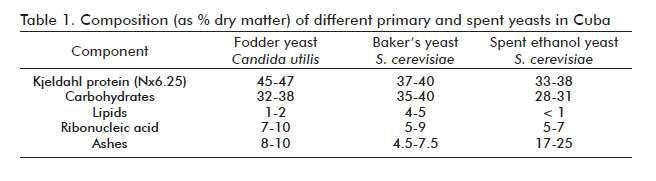
<body><![CDATA[<P   align="justify" ><font face="Verdana, Arial, Helvetica, sans-serif" size="2">Pasteur described      pure culture techniques that were improved by Hansen and used in the brewing      industry. The first &lsquo;propagators&rsquo; designed by Hansen remain to      this day. Somewhat later, Buchners made cell free extracts of yeast (yeast      zymase) by grinding yeast with diatomaceous earth. A completely new industry      soon arose, first based on amylases and proteases and their applications and      later on an ample range of applications in pharmaceutical, food and environmental      fields. The word enzyme was adopted to describe a protein isolated from cells      of different nature that would by itself catalyze a change in a substrate      to a product or products under physiological conditions. Today enzymes as      well as other microbial components are isolated from plants, animals, bacteria,      filamentous fungi and of course from yeasts. </font></P >       <P   align="justify" ><font face="Verdana, Arial, Helvetica, sans-serif" size="2">The work concerning      this paper received the Cuban Academy of Sciences Award in 2010. </font></P >       <P   ><font size="2" face="Verdana, Arial, Helvetica, sans-serif"><b><font size="3">TRADITIONAL      YEAST INDUSTRIES </font></b></font></P >   <FONT size="+1">        <P   align="justify" ><font size="2" face="Verdana, Arial, Helvetica, sans-serif"><I>Saccharomyces      cerevisiae</I> yeast is used in the food and beverage industries for several      applications [6]. In its active form yeast is used in bread making and bakery,      in alcohol fermentation and other fermentative processes it is used, for example,      in soy sauce production [5-8]. When inactivated, yeast is used in animal feeding      mainly as a protein source and in human food as extracts and autolizates [9].      </font></P >   <FONT size="+1">        <P   align="justify" ><font face="Verdana, Arial, Helvetica, sans-serif" size="2">In modern alcohol      distilleries and breweries, huge amounts of spent yeast are generated that,      whether inactivated or alive, can be used directly, or processed for obtaining      different derivatives [7]. </font></P >       <P   align="justify" ><font face="Verdana, Arial, Helvetica, sans-serif" size="2">Yeast cells, in addition      to their high protein content, are also rich in B-complex vitamins, in minerals      such as chromium and selenium, in nucleic acids and in complex carbohydrates      [10]. </font></P >       <P   align="justify" ><font face="Verdana, Arial, Helvetica, sans-serif" size="2">At the end of the      20th century in Cuba the fodder yeast industry thrived, using molasses as      the main carbon substrate, reaching an annual production of about 100 thousand      tons through continuous culture. Although now it has significantly decreased,      there is still an important production of fodder yeast using distillery slops      as carbon source. <a href="/img/revistas/bta/v28n4/t0110411.gif">Table 1</a> shows the average composition      of different primary and spent yeasts in Cuba. </font></P >       
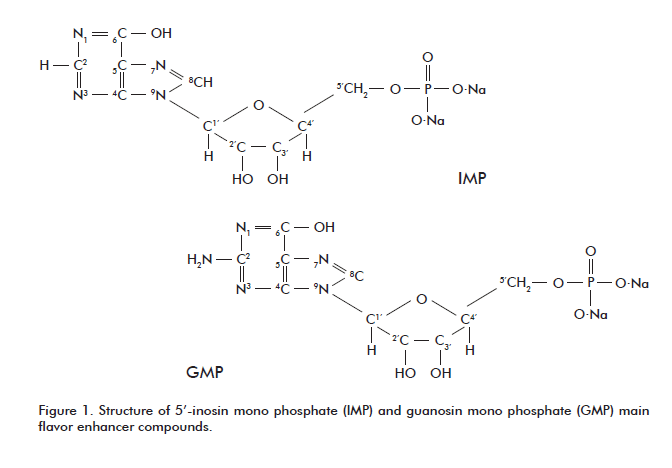
<P   ><font size="2" face="Verdana, Arial, Helvetica, sans-serif"><b><font size="3">PRODUCTION      OF FLAVOR ENHANCERS FROM YEASTS </font></b></font></P >   <FONT size="+1">        <P   align="justify" ><font size="2" face="Verdana, Arial, Helvetica, sans-serif">Although 5&rsquo;-nucleotides      can be obtained from several raw materials such as hydrolizates from plant      and animal proteins, they are usually produced from yeast biomass at a commercial      scale. Yeasts have about 10% nucleic acids, which are an excellent source      of these compounds. </font></P >   <FONT size="+1">        <P   align="justify" ><font face="Verdana, Arial, Helvetica, sans-serif" size="2">The integration of      these products to the resulting yeast biomass results in an enriched extract.      For yeast extract production both primary and spent yeasts have been used      as raw material. The cytoplasm content is released by autolysis or aided-hydrolysis      if exogenous enzymes are employed (<a href="/img/revistas/bta/v28n4/f0110411.gif">Figure 1</a>). </font></P >       
]]></body>
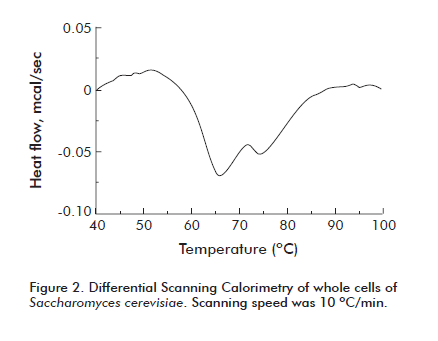
<body><![CDATA[<P   align="justify" ><font face="Verdana, Arial, Helvetica, sans-serif" size="2">Autolysis time can      be significantly reduced if cell disintegration is applied together with enzyme      activation [9, 10]. Usually, autolysis takes place at 50 &deg;C during 18-24      hours. All internal or external enzymes (when they are used), are inactivated      by heating the entire product at 70-85 &deg;C once autolysis is completed.      Finally the supernatant is separated by centrifugation (extract) and concentrated      by evaporation. Extract commonly contains bitter peptides, thus if a milder      flavor is needed, they can be eliminated with activated carbon. Obtaining      5&rsquo;-mononucleotides requires the action of 5&rsquo;-fosfodiestearase,      since with 3&rsquo;-mononucleotides the results of yeast ribonuclease action,      do not have flavor-enhancing properties. </font></P >       <P   ><font size="2" face="Verdana, Arial, Helvetica, sans-serif"><b><font size="3">YEAST      PIGMENTS </font> </b></font></P >   <FONT size="+1">        <P   align="justify" ><font size="2" face="Verdana, Arial, Helvetica, sans-serif">Certain yeast species      such as <I>Phaffia rhodozima, Rhodotorula gracilis</I>, etc., are rich in      pigments of carotene nature and they have therefore been used for their intensive      production [11, 12]. Carotenes are important since they confer an attractive      color to certain foods while also being precursors of vitamin A. On the other      hand, it has been demonstrated that carotenoids have antioxidant activity      that can prevent the action of free radicals on living cells. They enhance      the immune system, exert protection against cancer and play an important role      in the prevention of degenerative diseases. </font></P >   <FONT size="+1">        <P   ><font size="2" face="Verdana, Arial, Helvetica, sans-serif"><b><font size="3">FUNCTIONAL      AND THERMAL PROPERTIES OF YEAST PROTEINS </font></b></font></P >   <FONT size="+1">        <P   align="justify" ><font size="2" face="Verdana, Arial, Helvetica, sans-serif">Functional properties      are those physic and chemical properties that help enhance or stabilize rheological      and sensorial characteristics of a food system. These properties can be classified      as: hydration properties (water retention, water absorption, solubility),      structural (gelling, coagulation, film formation), surface (emulsion, foaming,      lipid interaction) and organoleptic (flavor, aroma, texture). </font></P >   <FONT size="+1">        <P   align="justify" ><font face="Verdana, Arial, Helvetica, sans-serif" size="2">There is much technical      literature on functional properties of several protein sources as milk, meat      and plants. In contrast, studies on functional properties of yeast proteins      are scarce. The yeast proteins more widely studied come from the genus <I>Saccharomyces</I>      and <I>Kluyveromyces</I>, as well as, the specie <I>Candida utilis, </I>since      those yeasts are generally regarded to be safe as food. Hydration and gelling      properties are brought about by cytoplasm proteins mainly nuclear proteins      whereas those showing the best surface properties come from membrane and cell      wall lipoproteins and mannoproteins [13, 14]. <a href="#fig2">Figure 2</a>      shows the thermograms of whole <I>S. cerevisiae </I>yeast cells [13]. In a      previous paper [14] thermograms were made with lyophilized biomass and a single      protein denaturation peak appeared for both yeast species. When the analysis      was carried out with active cells, an additional peak was observed in the      thermogram. The main denaturation peak did not change its temperature <I>i.e.</I>      about 65 &deg;C. Regarding denaturation enthalpy, it can be seen that this      value is higher in certain fractions formed by external proteins of cellular      structure and those appearing in complexes polysaccharides or lipids. The      fractions formed mainly by cytoplasm proteins and nuclear proteins, showed      Tp and &Delta;H values that were quite similar to those of isolated yeast      proteins reported in previous papers. In any case, this means that yeast proteins,      even when processed as whole cells, cannot be heated beyond 60-70 &deg;C if      native proteins are needed for a certain purpose. </font></P >       <P   align="center" ><img src="/img/revistas/bta/v28n4/f0210411.gif" width="438" height="341"><a name="fig2"></a></P >       
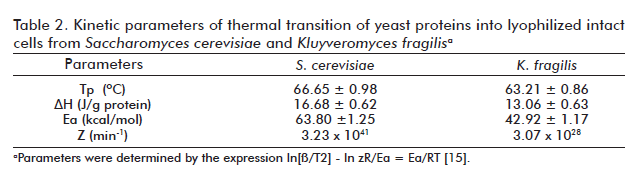
<P   align="justify" ><font face="Verdana, Arial, Helvetica, sans-serif" size="2">The thermodynamic      parameters for denaturation <I>Saccharomyces cerevisiae </I>and <I>Kluyveromyces      fragilis </I>isolated proteins and their peak temperatures are shown in <a href="/img/revistas/bta/v28n4/t0210411.gif">Table      2</a>. </font></P >       
<P   align="justify" ><font face="Verdana, Arial, Helvetica, sans-serif" size="2">When yeast proteins      were isolated from their cellular environment, a higher thermal sensitivity      is shown. <I>S. cerevisiae </I>and<I> K. fragilis </I>proteins have at 47      &deg;C the same denaturation constant as <I>K. fragilis </I>at 57 &deg;C and      <I>S. cerevisiae </I>at 63 &deg;C. It is interesting to notice that temperatures      in the range of 50-65 &deg;C are the same when applied for the activation      of nucleolytic and proteolytic enzymes during autolysis processes and they      can provoke high levels of denaturation depending on processing time, yeast      nature and the cell disruption achieved. Nevertheless, it seems that proteins      from <I>S. cerevisiae</I> were less affected by temperature changes that their      homologues from <I>K. fragilis</I>. Ea and z were calculated by linear regression      from the graph ln &szlig;/T<Sub>P</Sub> versus 1/T<Sub>P</Sub> at different      &szlig; values. </font></P >   <FONT size="+1"><FONT size="+1"><FONT size="+1"><FONT size="+1">        <P   ><font size="2" face="Verdana, Arial, Helvetica, sans-serif"><b><font size="3">YEAST      SACCHARIDES </font> </b> </font></P >   <FONT size="+1">        ]]></body>
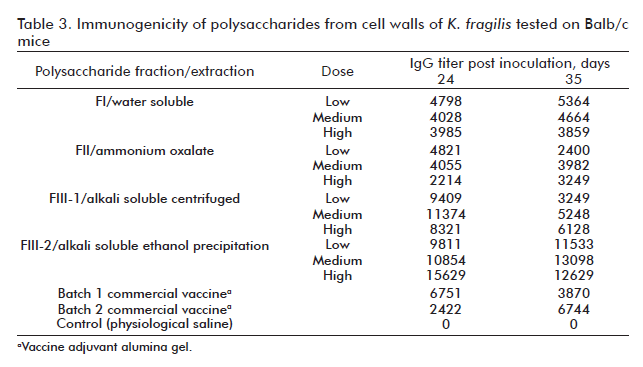
<body><![CDATA[<P   align="justify" ><font size="2" face="Verdana, Arial, Helvetica, sans-serif">Yeasts are able to      produce saccharides in a wide variety of molecular weights. Two examples are      trehalose, a disaccharide, and the oligosaccharides glucans and mannans. Trehalose      is a highly stable compound, formed by two glucose units. It is commonly found      in insects, crustacean, honey, mushrooms, and it can be produced by yeast      during fermentation. Trehalose production was highly correlated to stress,      mainly osmotolerance. It is assumed that trehalose is directly related to      viability of other living organisms, since this compound acts as a protective      agent against damage produced by cold or dryness. Due to its multifunctional      capacity, trehalose is a promising food additive. It has 45% sucrose sweetness      capacity, is able to release flavors and stabilize proteins. It also improves      texture and flavor in a wide variety of food products due to its humectant      ability, being used for breads, confectionery, soft drinks and ice cream.      However, its main characteristic is its ability to protect biological molecules      against freezing; it is therefore used as an additive in foods undergoing      freezing and drying processes. </font></P >   <FONT size="+1">        <P   align="justify" ><font face="Verdana, Arial, Helvetica, sans-serif" size="2">Yeast cells are surrounded      by special walls that are responsible for the rigidity of cell shape and the      protection of the cell membrane and other inner structures. The cell wall      may account for up to 20% of cell weight and is composed of glucan, mannan,      and smaller amounts of other compounds. Glucan is able to bind water and has      been used in the food industry as a water retention additive, thickening agent,      etc. In recent years, glucans have been especially attractive because they      improve the immunological system of animals and humans. <a href="/img/revistas/bta/v28n4/t0310411.gif">Table      3</a> shows the results obtained with <I>K. fragilis</I> glucan fractions      used as vaccine adjuvants. </font></P >       
<P   align="justify" ><font face="Verdana, Arial, Helvetica, sans-serif" size="2">Mouse serum typically      contains 8.7-10 mg/mL of IgG. Yeast polysaccharide fractions, especially alkali-extracted      fractions, induce the highest concentration of immunoglobulins in Balb/c mice.      The titers obtained in our studies were significantly higher in some fractions      than the levels mentioned above and those induced by a commercial adjuvant      traditionally used in vaccine production. </font></P >       <P   ><font size="2" face="Verdana, Arial, Helvetica, sans-serif"><b><font size="3">CONCLUSIONS</font></b>      </font></P >   <FONT size="+1">        <P   align="justify" ><font size="2" face="Verdana, Arial, Helvetica, sans-serif">The content of this      paper corresponds to a book that, with 14 chapters and 246 pages, reveals      the technological culture of the utilization of yeast biomass. It constitutes,      in itself, a work of scientific impact, but it goes beyond the mere academic      result by outlining practical applications behind the theory. This has been      materialized by gathering, in a single volume, all the experience of three      Latin American institutions working in this very specialized field of knowledge      for more than 20 years, thereby setting forth new approaches for known problems      in a different social and economic scenarios. </font></P >   <FONT size="+1">        <P   > </P >   <FONT size="+1">        <P   ><font size="3"><b><font face="Verdana, Arial, Helvetica, sans-serif">REFERENCES      </font></b></font></P >       <!-- ref --><P   ><font size="2" face="Verdana, Arial, Helvetica, sans-serif">1. Sl&aacute;vikov&aacute;      E, Vadkertiov&aacute; R. The diversity of yeasts in the agricultural soil.      J Basic Microbiol. 2003;43(5):430-6.     </font></P >   <FONT size="+1">        <!-- ref --><P   ><font face="Verdana, Arial, Helvetica, sans-serif" size="2">2. Spencer JFT, Spencer      DM, editors. Yeasts in natural and artificial habitats. Nueva York: Springer-Verlag;      1997.     </font></P >       <!-- ref --><P   ><font face="Verdana, Arial, Helvetica, sans-serif" size="2">3. Barnett JA. Beginnings      of microbiology and biochemistry: the contribution of yeast research. Microbiol.      2003;149(Pt 3):557-67.     </font></P >       <!-- ref --><P   ><font face="Verdana, Arial, Helvetica, sans-serif" size="2">4. Belcher A The      world looks to higher technology to advance fuel ethanol production into the      21st Century. Int Sugar J. 2005;103(1275):196-9.     </font></P >       <!-- ref --><P   ><font face="Verdana, Arial, Helvetica, sans-serif" size="2">5. Corran HS, editor.      A History of Brewing. Newton Abbot: Davis &amp; Charles; 1975.     </font></P >       <!-- ref --><P   ><font face="Verdana, Arial, Helvetica, sans-serif" size="2">6. Halasz A, L&aacute;sztity      R. Use of yeast biomass in food production. Boca Raton: CRC Press; 1991.     </font></P >       <!-- ref --><P   ><font face="Verdana, Arial, Helvetica, sans-serif" size="2">7. Otero MA, Cabello      AJ. Procesamiento de levadura para la obtenci&oacute;n de derivados. Diferentes      alternativas. Revista ICIDCA sobre los derivados de la ca&ntilde;a de az&uacute;car.      2007;41(1):3-12.     </font></P >       <!-- ref --><P   ><font face="Verdana, Arial, Helvetica, sans-serif" size="2">8. Otero MA, Cabello      AJ, Vasallo MC, Garcia L, Lopez JC. Preparation of an imitation soy sauce      from hydrolyzed dried yeast Candida utilis. J Food Process Preserv. 1998;22:419-32.          </font></P >       <P   ><font face="Verdana, Arial, Helvetica, sans-serif" size="2">9. Chae HJ, Joo H,      In MJ. Utilization of brewer&rsquo;s yeast cells for the production of food-grade      yeast extract. Part 1: Effects of different enzymatic treatments on solid      and protein recovery and flavor characteristics. Bioresour Technol. 2001;76(3):253-8.      </font></P >       <!-- ref --><P   ><font face="Verdana, Arial, Helvetica, sans-serif" size="2">10. Otero MA, Saura      G, Mart&iacute;nez JA. Enriquecimiento de biomasa de levadura con nutrientes      esenciales. Revista ICIDCA sobre los derivados de la ca&ntilde;a de az&uacute;car.      2008;42(1-3):60-8.     </font></P >       <!-- ref --><P   ><font face="Verdana, Arial, Helvetica, sans-serif" size="2">11. de la Fuente      JL, Rodr&iacute;guez-S&aacute;iz M, Schleissner C, D&iacute;ez B, Peiro E,      Barredo JL. High-titer production of astaxanthin by the semi-industrial fermentation      of Xanthophyllomyces dendrorhous. J Biotechnol. 2010;148(2-3):144-6.     </font></P >       <!-- ref --><P   ><font face="Verdana, Arial, Helvetica, sans-serif" size="2">12. Malisorn C, Suntornusk      W. Improved B-carotene production of Rhodotorula glutinis in fermented radish      brine by continuous cultivation. Biochem Eng J. 2009;43:27-32.     </font></P >       ]]></body>
<body><![CDATA[<!-- ref --><P   ><font face="Verdana, Arial, Helvetica, sans-serif" size="2">13. Sceni P, Palazzolo      GG, Vasallo MC, Puppo MC, Otero MA, Wagner JR. Thermal and surface behavior      of yeast protein fractions from Saccharomyces cerevisiae. LWT Food Sci Technol.      2009;42(6):1098-106.     </font></P >       <!-- ref --><P   ><font face="Verdana, Arial, Helvetica, sans-serif" size="2">14. Vasallo MC, Puppo      MC, Palazolo GG, Otero MA, Beress L, Wagner JR. Cell wall proteins of Kluyveromyces      fragilis. Surface and emulsifying properties. LWT Food Sci Technol. 2006;39(7):729-39.          </font></P >       <!-- ref --><P   ><font face="Verdana, Arial, Helvetica, sans-serif" size="2">15. Osawa T. Kinetic      analysis of derivative curves in thermal analysis. J Therm Anal. 1970;2:301-24.          </font></P >       <!-- ref --><P   ><font face="Verdana, Arial, Helvetica, sans-serif" size="2">16. Alves-Ara&uacute;jo      C, Almeida MJ, Sousa MJ, Le&atilde;o C. Freeze tolerance of the yeast Torulaspora      delbrueckii: cellular and biochemical basis. FEMS Microbiol Lett. 2004; 240(1):7-14.          </font></P >       <P   >&nbsp;</P >       <P   ><font size="2" face="Verdana, Arial, Helvetica, sans-serif">Miguel A Otero. Instituto      Cubano de Investigaciones de los Derivados de la Ca&ntilde;a de Az&uacute;car,      ICIDCA. V&iacute;a Blanca 804, CP 11000, La Habana, Cuba. E-mail: <U><U><FONT color="#0000FF"><a href="mailto:maorambla@yahoo.es">maorambla@yahoo.es</a></font></U></U><FONT color="#0000FF"><FONT color="#000000">.      </font></font></font></P >   </font></font></font></font></font></font></font></font></font></font></font></font></font></font></font></font></font></font></font></font></font></font></font></font></font></font></font></font></font></font></font></font></font></font></font></font></font></font></font></font></font></font></font></font></font></font></font></font></font></font></font></font></font></font></DIV >     ]]></body>
<body><![CDATA[ ]]></body><back>
<ref-list>
<ref id="B1">
<label>1</label><nlm-citation citation-type="journal">
<person-group person-group-type="author">
<name>
<surname><![CDATA[Sláviková]]></surname>
<given-names><![CDATA[E]]></given-names>
</name>
<name>
<surname><![CDATA[Vadkertiová]]></surname>
<given-names><![CDATA[R]]></given-names>
</name>
</person-group>
<article-title xml:lang="en"><![CDATA[The diversity of yeasts in the agricultural soil]]></article-title>
<source><![CDATA[J Basic Microbiol]]></source>
<year>2003</year>
<volume>43</volume>
<numero>5</numero>
<issue>5</issue>
<page-range>430-6</page-range></nlm-citation>
</ref>
<ref id="B2">
<label>2</label><nlm-citation citation-type="book">
<person-group person-group-type="author">
<name>
<surname><![CDATA[Spencer]]></surname>
<given-names><![CDATA[JFT]]></given-names>
</name>
<name>
<surname><![CDATA[Spencer]]></surname>
<given-names><![CDATA[DM]]></given-names>
</name>
</person-group>
<source><![CDATA[Yeasts in natural and artificial habitats]]></source>
<year>1997</year>
<publisher-loc><![CDATA[Nueva York ]]></publisher-loc>
<publisher-name><![CDATA[Springer-Verlag]]></publisher-name>
</nlm-citation>
</ref>
<ref id="B3">
<label>3</label><nlm-citation citation-type="journal">
<person-group person-group-type="author">
<name>
<surname><![CDATA[Barnett]]></surname>
<given-names><![CDATA[JA]]></given-names>
</name>
</person-group>
<article-title xml:lang="en"><![CDATA[Beginnings of microbiology and biochemistry: the contribution of yeast research]]></article-title>
<source><![CDATA[Microbiol]]></source>
<year>2003</year>
<volume>149</volume>
<numero>3</numero>
<issue>3</issue>
<page-range>557-67</page-range></nlm-citation>
</ref>
<ref id="B4">
<label>4</label><nlm-citation citation-type="journal">
<person-group person-group-type="author">
<name>
<surname><![CDATA[Belcher]]></surname>
<given-names><![CDATA[A]]></given-names>
</name>
</person-group>
<article-title xml:lang="en"><![CDATA[The world looks to higher technology to advance fuel ethanol production into the 21st Century]]></article-title>
<source><![CDATA[Int Sugar J]]></source>
<year>2005</year>
<volume>103</volume>
<numero>1275</numero>
<issue>1275</issue>
<page-range>196-9</page-range></nlm-citation>
</ref>
<ref id="B5">
<label>5</label><nlm-citation citation-type="book">
<person-group person-group-type="author">
<name>
<surname><![CDATA[Corran]]></surname>
<given-names><![CDATA[HS]]></given-names>
</name>
</person-group>
<source><![CDATA[A History of Brewing]]></source>
<year>1975</year>
<publisher-loc><![CDATA[Newton Abbot ]]></publisher-loc>
<publisher-name><![CDATA[Davis & Charles]]></publisher-name>
</nlm-citation>
</ref>
<ref id="B6">
<label>6</label><nlm-citation citation-type="book">
<person-group person-group-type="author">
<name>
<surname><![CDATA[Halasz]]></surname>
<given-names><![CDATA[A]]></given-names>
</name>
<name>
<surname><![CDATA[Lásztity]]></surname>
<given-names><![CDATA[R]]></given-names>
</name>
</person-group>
<source><![CDATA[Use of yeast biomass in food production]]></source>
<year>1991</year>
<publisher-loc><![CDATA[Boca Raton ]]></publisher-loc>
<publisher-name><![CDATA[CRC Press]]></publisher-name>
</nlm-citation>
</ref>
<ref id="B7">
<label>7</label><nlm-citation citation-type="journal">
<person-group person-group-type="author">
<name>
<surname><![CDATA[Otero]]></surname>
<given-names><![CDATA[MA]]></given-names>
</name>
<name>
<surname><![CDATA[Cabello]]></surname>
<given-names><![CDATA[AJ]]></given-names>
</name>
</person-group>
<article-title xml:lang="es"><![CDATA[Procesamiento de levadura para la obtención de derivados: Diferentes alternativas]]></article-title>
<source><![CDATA[Revista ICIDCA sobre los derivados de la caña de azúcar]]></source>
<year>2007</year>
<volume>41</volume>
<numero>1</numero>
<issue>1</issue>
<page-range>3-12</page-range></nlm-citation>
</ref>
<ref id="B8">
<label>8</label><nlm-citation citation-type="journal">
<person-group person-group-type="author">
<name>
<surname><![CDATA[Otero]]></surname>
<given-names><![CDATA[MA]]></given-names>
</name>
<name>
<surname><![CDATA[Cabello]]></surname>
<given-names><![CDATA[AJ]]></given-names>
</name>
<name>
<surname><![CDATA[Vasallo]]></surname>
<given-names><![CDATA[MC]]></given-names>
</name>
<name>
<surname><![CDATA[Garcia]]></surname>
<given-names><![CDATA[L]]></given-names>
</name>
<name>
<surname><![CDATA[Lopez]]></surname>
<given-names><![CDATA[JC]]></given-names>
</name>
</person-group>
<article-title xml:lang="en"><![CDATA[Preparation of an imitation soy sauce from hydrolyzed dried yeast Candida utilis]]></article-title>
<source><![CDATA[J Food Process Preserv]]></source>
<year>1998</year>
<volume>22</volume>
<page-range>419-32</page-range></nlm-citation>
</ref>
<ref id="B9">
<label>9</label><nlm-citation citation-type="journal">
<person-group person-group-type="author">
<name>
<surname><![CDATA[Chae]]></surname>
<given-names><![CDATA[HJ]]></given-names>
</name>
<name>
<surname><![CDATA[Joo]]></surname>
<given-names><![CDATA[H]]></given-names>
</name>
<name>
<surname><![CDATA[In]]></surname>
<given-names><![CDATA[MJ]]></given-names>
</name>
</person-group>
<article-title xml:lang="en"><![CDATA[Utilization of brewer's yeast cells for the production of food-grade yeast extract: Part 1: Effects of different enzymatic treatments on solid and protein recovery and flavor characteristics]]></article-title>
<source><![CDATA[Bioresour Technol]]></source>
<year>2001</year>
<volume>76</volume>
<numero>3</numero>
<issue>3</issue>
<page-range>253-8</page-range></nlm-citation>
</ref>
<ref id="B10">
<label>10</label><nlm-citation citation-type="journal">
<person-group person-group-type="author">
<name>
<surname><![CDATA[Otero]]></surname>
<given-names><![CDATA[MA]]></given-names>
</name>
<name>
<surname><![CDATA[Saura]]></surname>
<given-names><![CDATA[G]]></given-names>
</name>
<name>
<surname><![CDATA[Martínez]]></surname>
<given-names><![CDATA[JA]]></given-names>
</name>
</person-group>
<article-title xml:lang="es"><![CDATA[Enriquecimiento de biomasa de levadura con nutrientes esenciales]]></article-title>
<source><![CDATA[Revista ICIDCA sobre los derivados de la caña de azúcar]]></source>
<year>2008</year>
<volume>42</volume>
<numero>1-3</numero>
<issue>1-3</issue>
<page-range>60-8</page-range></nlm-citation>
</ref>
<ref id="B11">
<label>11</label><nlm-citation citation-type="journal">
<person-group person-group-type="author">
<name>
<surname><![CDATA[de la Fuente]]></surname>
<given-names><![CDATA[JL]]></given-names>
</name>
<name>
<surname><![CDATA[Rodríguez-Sáiz]]></surname>
<given-names><![CDATA[M]]></given-names>
</name>
<name>
<surname><![CDATA[Schleissner]]></surname>
<given-names><![CDATA[C]]></given-names>
</name>
<name>
<surname><![CDATA[Díez]]></surname>
<given-names><![CDATA[B]]></given-names>
</name>
<name>
<surname><![CDATA[Peiro]]></surname>
<given-names><![CDATA[E]]></given-names>
</name>
<name>
<surname><![CDATA[Barredo]]></surname>
<given-names><![CDATA[JL]]></given-names>
</name>
</person-group>
<article-title xml:lang="en"><![CDATA[High-titer production of astaxanthin by the semi-industrial fermentation of Xanthophyllomyces dendrorhous]]></article-title>
<source><![CDATA[J Biotechnol]]></source>
<year>2010</year>
<volume>148</volume>
<numero>2-3</numero>
<issue>2-3</issue>
<page-range>144-6</page-range></nlm-citation>
</ref>
<ref id="B12">
<label>12</label><nlm-citation citation-type="journal">
<person-group person-group-type="author">
<name>
<surname><![CDATA[Malisorn]]></surname>
<given-names><![CDATA[C]]></given-names>
</name>
<name>
<surname><![CDATA[Suntornusk]]></surname>
<given-names><![CDATA[W]]></given-names>
</name>
</person-group>
<article-title xml:lang="en"><![CDATA[Improved B-carotene production of Rhodotorula glutinis in fermented radish brine by continuous cultivation]]></article-title>
<source><![CDATA[Biochem Eng J]]></source>
<year>2009</year>
<volume>43</volume>
<page-range>27-32</page-range></nlm-citation>
</ref>
<ref id="B13">
<label>13</label><nlm-citation citation-type="journal">
<person-group person-group-type="author">
<name>
<surname><![CDATA[Sceni]]></surname>
<given-names><![CDATA[P]]></given-names>
</name>
<name>
<surname><![CDATA[Palazzolo]]></surname>
<given-names><![CDATA[GG]]></given-names>
</name>
<name>
<surname><![CDATA[Vasallo]]></surname>
<given-names><![CDATA[MC]]></given-names>
</name>
<name>
<surname><![CDATA[Puppo]]></surname>
<given-names><![CDATA[MC]]></given-names>
</name>
<name>
<surname><![CDATA[Otero]]></surname>
<given-names><![CDATA[MA]]></given-names>
</name>
<name>
<surname><![CDATA[Wagner]]></surname>
<given-names><![CDATA[JR]]></given-names>
</name>
</person-group>
<article-title xml:lang="en"><![CDATA[Thermal and surface behavior of yeast protein fractions from Saccharomyces cerevisiae]]></article-title>
<source><![CDATA[LWT Food Sci Technol]]></source>
<year>2009</year>
<volume>42</volume>
<numero>6</numero>
<issue>6</issue>
<page-range>1098-106</page-range></nlm-citation>
</ref>
<ref id="B14">
<label>14</label><nlm-citation citation-type="journal">
<person-group person-group-type="author">
<name>
<surname><![CDATA[Vasallo]]></surname>
<given-names><![CDATA[MC]]></given-names>
</name>
<name>
<surname><![CDATA[Puppo]]></surname>
<given-names><![CDATA[MC]]></given-names>
</name>
<name>
<surname><![CDATA[Palazolo]]></surname>
<given-names><![CDATA[GG]]></given-names>
</name>
<name>
<surname><![CDATA[Otero]]></surname>
<given-names><![CDATA[MA]]></given-names>
</name>
<name>
<surname><![CDATA[Beress]]></surname>
<given-names><![CDATA[L]]></given-names>
</name>
<name>
<surname><![CDATA[Wagner]]></surname>
<given-names><![CDATA[JR]]></given-names>
</name>
</person-group>
<article-title xml:lang="en"><![CDATA[Cell wall proteins of Kluyveromyces fragilis: Surface and emulsifying properties]]></article-title>
<source><![CDATA[LWT Food Sci Technol]]></source>
<year>2006</year>
<volume>39</volume>
<numero>7</numero>
<issue>7</issue>
<page-range>729-39</page-range></nlm-citation>
</ref>
<ref id="B15">
<label>15</label><nlm-citation citation-type="journal">
<person-group person-group-type="author">
<name>
<surname><![CDATA[Osawa]]></surname>
<given-names><![CDATA[T]]></given-names>
</name>
</person-group>
<article-title xml:lang="en"><![CDATA[Kinetic analysis of derivative curves in thermal analysis]]></article-title>
<source><![CDATA[J Therm Anal]]></source>
<year>1970</year>
<volume>2</volume>
<page-range>301-24</page-range></nlm-citation>
</ref>
<ref id="B16">
<label>16</label><nlm-citation citation-type="journal">
<person-group person-group-type="author">
<name>
<surname><![CDATA[Alves-Araújo]]></surname>
<given-names><![CDATA[C]]></given-names>
</name>
<name>
<surname><![CDATA[Almeida]]></surname>
<given-names><![CDATA[MJ]]></given-names>
</name>
<name>
<surname><![CDATA[Sousa]]></surname>
<given-names><![CDATA[MJ]]></given-names>
</name>
<name>
<surname><![CDATA[Leão]]></surname>
<given-names><![CDATA[C]]></given-names>
</name>
</person-group>
<article-title xml:lang="en"><![CDATA[Freeze tolerance of the yeast Torulaspora delbrueckii: cellular and biochemical basis]]></article-title>
<source><![CDATA[FEMS Microbiol Lett]]></source>
<year>2004</year>
<volume>240</volume>
<numero>1</numero>
<issue>1</issue>
<page-range>7-14</page-range></nlm-citation>
</ref>
</ref-list>
</back>
</article>