<?xml version="1.0" encoding="ISO-8859-1"?><article xmlns:mml="http://www.w3.org/1998/Math/MathML" xmlns:xlink="http://www.w3.org/1999/xlink" xmlns:xsi="http://www.w3.org/2001/XMLSchema-instance">
<front>
<journal-meta>
<journal-id>1027-2852</journal-id>
<journal-title><![CDATA[Biotecnología Aplicada]]></journal-title>
<abbrev-journal-title><![CDATA[Biotecnol Apl]]></abbrev-journal-title>
<issn>1027-2852</issn>
<publisher>
<publisher-name><![CDATA[Editorial Elfos Scientiae]]></publisher-name>
</publisher>
</journal-meta>
<article-meta>
<article-id>S1027-28522011000400011</article-id>
<title-group>
<article-title xml:lang="en"><![CDATA[Impact of microbial and chemical pollution in Cuban freshwater ecosystems: strategies for environmental recovery]]></article-title>
<article-title xml:lang="es"><![CDATA[Impacto de la contaminación microbiana y química en sistema dulceacuícolas cubanos: estrategias para la recuperación ambiental]]></article-title>
</title-group>
<contrib-group>
<contrib contrib-type="author">
<name>
<surname><![CDATA[Carballo]]></surname>
<given-names><![CDATA[María E]]></given-names>
</name>
<xref ref-type="aff" rid="A01"/>
</contrib>
<contrib contrib-type="author">
<name>
<surname><![CDATA[Heydrich]]></surname>
<given-names><![CDATA[Mayra]]></given-names>
</name>
<xref ref-type="aff" rid="A01"/>
</contrib>
<contrib contrib-type="author">
<name>
<surname><![CDATA[Rojas]]></surname>
<given-names><![CDATA[Nidia]]></given-names>
</name>
<xref ref-type="aff" rid="A01"/>
</contrib>
<contrib contrib-type="author">
<name>
<surname><![CDATA[Salgado]]></surname>
<given-names><![CDATA[Irina]]></given-names>
</name>
<xref ref-type="aff" rid="A01"/>
</contrib>
<contrib contrib-type="author">
<name>
<surname><![CDATA[Romeu]]></surname>
<given-names><![CDATA[Beatriz]]></given-names>
</name>
<xref ref-type="aff" rid="A01"/>
</contrib>
<contrib contrib-type="author">
<name>
<surname><![CDATA[Manzano]]></surname>
<given-names><![CDATA[Ana M]]></given-names>
</name>
<xref ref-type="aff" rid="A01"/>
</contrib>
<contrib contrib-type="author">
<name>
<surname><![CDATA[Larrea]]></surname>
<given-names><![CDATA[Jeny]]></given-names>
</name>
<xref ref-type="aff" rid="A01"/>
</contrib>
<contrib contrib-type="author">
<name>
<surname><![CDATA[Domínguez]]></surname>
<given-names><![CDATA[Osmel]]></given-names>
</name>
<xref ref-type="aff" rid="A01"/>
</contrib>
<contrib contrib-type="author">
<name>
<surname><![CDATA[Martínez]]></surname>
<given-names><![CDATA[Armando]]></given-names>
</name>
<xref ref-type="aff" rid="A01"/>
</contrib>
<contrib contrib-type="author">
<name>
<surname><![CDATA[Sánchez]]></surname>
<given-names><![CDATA[María I]]></given-names>
</name>
<xref ref-type="aff" rid="A01"/>
</contrib>
<contrib contrib-type="author">
<name>
<surname><![CDATA[Cruz]]></surname>
<given-names><![CDATA[Mario]]></given-names>
</name>
<xref ref-type="aff" rid="A01"/>
</contrib>
<contrib contrib-type="author">
<name>
<surname><![CDATA[Guerra]]></surname>
<given-names><![CDATA[Gilda]]></given-names>
</name>
<xref ref-type="aff" rid="A01"/>
</contrib>
<contrib contrib-type="author">
<name>
<surname><![CDATA[Rojas]]></surname>
<given-names><![CDATA[Marcia]]></given-names>
</name>
<xref ref-type="aff" rid="A01"/>
</contrib>
<contrib contrib-type="author">
<name>
<surname><![CDATA[Ramos]]></surname>
<given-names><![CDATA[Miguel]]></given-names>
</name>
<xref ref-type="aff" rid="A01"/>
</contrib>
</contrib-group>
<aff id="A01">
<institution><![CDATA[,Havana University Faculty of Biology Department of Microbiology and Virology]]></institution>
<addr-line><![CDATA[Havana ]]></addr-line>
<country>Cuba</country>
</aff>
<pub-date pub-type="pub">
<day>00</day>
<month>12</month>
<year>2011</year>
</pub-date>
<pub-date pub-type="epub">
<day>00</day>
<month>12</month>
<year>2011</year>
</pub-date>
<volume>28</volume>
<numero>4</numero>
<fpage>276</fpage>
<lpage>279</lpage>
<copyright-statement/>
<copyright-year/>
<self-uri xlink:href="http://scielo.sld.cu/scielo.php?script=sci_arttext&amp;pid=S1027-28522011000400011&amp;lng=en&amp;nrm=iso"></self-uri><self-uri xlink:href="http://scielo.sld.cu/scielo.php?script=sci_abstract&amp;pid=S1027-28522011000400011&amp;lng=en&amp;nrm=iso"></self-uri><self-uri xlink:href="http://scielo.sld.cu/scielo.php?script=sci_pdf&amp;pid=S1027-28522011000400011&amp;lng=en&amp;nrm=iso"></self-uri><abstract abstract-type="short" xml:lang="en"><p><![CDATA[Contamination of water resources requires of systematic environmental actions, based on integral researches which allow proposing biological process as ecological and economical alternatives in order to decrease its negative impact and to guarantee the integrity of aquatic ecosystems. The objetives of this paper were to determine the microbial and chemical water pollution in Almendares river, and to evaluate the microbial capacity for decrease or eliminate chemical contaminants present on wastewaters, natural ecosystems and industrial wastes. The microbiological and chemical pollution of the Almendares basin exceeded maximum permissible values for recreational waters according to Cuban standards, respect to total and faecal coliforms, to the presence of clinical significance multiresistant microorganisms against antimicrobial agents, and to nitrates, ammonium, phosphates and heavy metals concentrations. It was demonstrated the potential of monocultures and microbial consortiums for the elimination of heavy metals and the capacity of White Rot Fungi to degrade industrial textil colorants. The results indicate the contamination degree in freshwater systems in Cuba, a threat for biodiversity and a risk for human health. Therefore, these results permit to dispose of a microbial collection which represents potential candidates for biotechnological applications, which contribute to the protection of the environment and the preservation of waters as a valuable natural resource.]]></p></abstract>
<abstract abstract-type="short" xml:lang="es"><p><![CDATA[La contaminación de los recursos hídricos requiere una sistemática gestión ambiental, basada en investigaciones integrales que permitan proponer procesos biológicos como alternativas ecológicas y económicas para disminuir su impacto negativo y asegurar la integridad de los ecosistemas acuáticos. Los objetivos de este trabajo fueron determinar la contaminación microbiana y química de las aguas del río Almendares y evaluar la capacidad microbiana de reducir o eliminar contaminantes químicos presentes en aguas residuales, ecosistemas naturales y residuales industriales. La contaminación microbiológica y química de la cuenca Almendares excedió los valores máximos permisibles para aguas con uso recreativo según las normas cubanas, por la concentración de coliformes totales y fecales, a la presencia de microorganismos de importancia clínica con multirresistencia a agentes antimicrobianos, a las concentraciones de nitratos, amonios, fosfatos y de metales pesados. Se demostraron las potencialidades de los monocultivos y consorcios microbianos, para la eliminación de cinc y cadmio. Se comprobó la capacidad que presentan los hongos de la Podredumbre Blanca, para degradar colorantes textiles industriales. Los resultados indican el grado de contaminación en sistemas dulceacuícolas del país, lo que constituyen una amenaza para la biodiversidad y un riesgo para la salud humana. Además, se obtuvo una colección de microorganismos candidatos potenciales para aplicaciones biotecnológicas que tributen a la protección del medio ambiente y a la preservación de ese valioso recurso natural que es el agua.]]></p></abstract>
<kwd-group>
<kwd lng="en"><![CDATA[Freshwaters ecosystems]]></kwd>
<kwd lng="en"><![CDATA[microorganisms]]></kwd>
<kwd lng="en"><![CDATA[heavy metals]]></kwd>
<kwd lng="en"><![CDATA[xenobiotic compounds]]></kwd>
<kwd lng="es"><![CDATA[Ecosistemas dulceacuícolas]]></kwd>
<kwd lng="es"><![CDATA[microorganismos]]></kwd>
<kwd lng="es"><![CDATA[metales pesados]]></kwd>
<kwd lng="es"><![CDATA[compuestos xenobióticos]]></kwd>
</kwd-group>
</article-meta>
</front><body><![CDATA[ <DIV class="Sect"   >        <P align="right"   ><font size="2" color="#000000" face="Verdana, Arial, Helvetica, sans-serif"><b>REPORT      </b></font></P >       <P align="right"   >&nbsp;</P >   <FONT size="+1" color="#000000">        <P   ><font size="4" face="Verdana, Arial, Helvetica, sans-serif"><b>Impact of microbial      and chemical pollution in Cuban freshwater ecosystems: strategies for environmental      recovery </b></font></P >       <P   >&nbsp;</P >       <P   ><font size="3" face="Verdana, Arial, Helvetica, sans-serif"><b>Impacto de la      contaminaci&oacute;n microbiana y qu&iacute;mica en sistema dulceacu&iacute;colas      cubanos: estrategias para la recuperaci&oacute;n ambiental </b></font></P >       <P   >&nbsp;</P >       <P   >&nbsp;</P >       <P   > </P >       <P   ><b><font size="2" face="Verdana, Arial, Helvetica, sans-serif">Mar&iacute;a E      Carballo, Mayra Heydrich, Nidia Rojas, Irina Salgado, Beatriz Romeu, Ana M      Manzano, Jeny Larrea, Osmel Dom&iacute;nguez, Armando Mart&iacute;nez, Mar&iacute;a      I S&aacute;nchez, Mario Cruz, Gilda Guerra, Marcia Rojas, Miguel Ramos</font></b><font size="2" face="Verdana, Arial, Helvetica, sans-serif">      </font></P >       ]]></body>
<body><![CDATA[<P   ><font size="2" face="Verdana, Arial, Helvetica, sans-serif">Department of Microbiology      and Virology, Faculty of Biology, Havana University, UH. 25 e/ J e I No 455,      Vedado, Plaza de la Revoluci&oacute;n, Havana, Cuba.</font></P >       <P   >&nbsp;</P >   <FONT color="#0000FF"><FONT color="#000000">        <P   > </P >   </font></font></font>   <hr>   <FONT size="+1" color="#000000"><FONT color="#0000FF"><FONT color="#000000">        <P   ><font size="2" face="Verdana, Arial, Helvetica, sans-serif"><b>ABSTRACT </b></font></P >       <P   ><font size="2" face="Verdana, Arial, Helvetica, sans-serif">Contamination of      water resources requires of systematic environmental actions, based on integral      researches which allow proposing biological process as ecological and economical      alternatives in order to decrease its negative impact and to guarantee the      integrity of aquatic ecosystems. The objetives of this paper were to determine      the microbial and chemical water pollution in Almendares river, and to evaluate      the microbial capacity for decrease or eliminate chemical contaminants present      on wastewaters, natural ecosystems and industrial wastes. The microbiological      and chemical pollution of the Almendares basin exceeded maximum permissible      values for recreational waters according to Cuban standards, respect to total      and faecal coliforms, to the presence of clinical significance multiresistant      microorganisms against antimicrobial agents, and to nitrates, ammonium, phosphates      and heavy metals concentrations. It was demonstrated the potential of monocultures      and microbial consortiums for the elimination of heavy metals and the capacity      of White Rot Fungi to degrade industrial textil colorants. The results indicate      the contamination degree in freshwater systems in Cuba, a threat for biodiversity      and a risk for human health. Therefore, these results permit to dispose of      a microbial collection which represents potential candidates for biotechnological      applications, which contribute to the protection of the environment and the      preservation of waters as a valuable natural resource. </font></P >   <FONT size="+1"><FONT size="+1">        <P   ><font size="2" face="Verdana, Arial, Helvetica, sans-serif"><b>Keywords: </b>Freshwaters      ecosystems, microorganisms, heavy metals, xenobiotic compounds. </font></P >   <FONT size="+1">        <P   > </P >   <FONT size="+1"> </font></font></font></font></font></font></font>   <hr>   <FONT size="+1" color="#000000"><FONT color="#0000FF"><FONT color="#000000"><FONT size="+1"><FONT size="+1"><FONT size="+1"><FONT size="+1">        <P   ><font size="2" face="Verdana, Arial, Helvetica, sans-serif"><b>RESUMEN </b></font></P >       <P   align="justify" ><font size="2" face="Verdana, Arial, Helvetica, sans-serif">La contaminaci&oacute;n      de los recursos h&iacute;dricos requiere una sistem&aacute;tica gesti&oacute;n      ambiental, basada en investigaciones integrales que permitan proponer procesos      biol&oacute;gicos como alternativas ecol&oacute;gicas y econ&oacute;micas      para disminuir su impacto negativo y asegurar la integridad de los ecosistemas      acu&aacute;ticos. Los objetivos de este trabajo fueron determinar la contaminaci&oacute;n      microbiana y qu&iacute;mica de las aguas del r&iacute;o Almendares y evaluar      la capacidad microbiana de reducir o eliminar contaminantes qu&iacute;micos      presentes en aguas residuales, ecosistemas naturales y residuales industriales.      La contaminaci&oacute;n microbiol&oacute;gica y qu&iacute;mica de la cuenca      Almendares excedi&oacute; los valores m&aacute;ximos permisibles para aguas      con uso recreativo seg&uacute;n las normas cubanas, por la concentraci&oacute;n      de coliformes totales y fecales, a la presencia de microorganismos de importancia      cl&iacute;nica con multirresistencia a agentes antimicrobianos, a las concentraciones      de nitratos, amonios, fosfatos y de metales pesados. Se demostraron las potencialidades      de los monocultivos y consorcios microbianos, para la eliminaci&oacute;n de      cinc y cadmio. Se comprob&oacute; la capacidad que presentan los hongos de      la Podredumbre Blanca, para degradar colorantes textiles industriales. Los      resultados indican el grado de contaminaci&oacute;n en sistemas dulceacu&iacute;colas      del pa&iacute;s, lo que constituyen una amenaza para la biodiversidad y un      riesgo para la salud humana. Adem&aacute;s, se obtuvo una colecci&oacute;n      de microorganismos candidatos potenciales para aplicaciones biotecnol&oacute;gicas      que tributen a la protecci&oacute;n del medio ambiente y a la preservaci&oacute;n      de ese valioso recurso natural que es el agua. </font></P >   <FONT size="+1">        <P   ><font size="2" face="Verdana, Arial, Helvetica, sans-serif"><b>Palabras clave:</b>      Ecosistemas dulceacu&iacute;colas, microorganismos, metales pesados, compuestos      xenobi&oacute;ticos. </font></P >       ]]></body>
<body><![CDATA[<P   > </P >   <FONT size="+1"> </font></font></font></font></font></font></font></font></font>   <hr>   <FONT size="+1" color="#000000"><FONT color="#0000FF"><FONT color="#000000"><FONT size="+1"><FONT size="+1"><FONT size="+1"><FONT size="+1"><FONT size="+1"><FONT size="+1">        <P   >&nbsp;</P >       <P   >&nbsp;</P >       <P   ><font size="3" face="Verdana, Arial, Helvetica, sans-serif"><b>INTRODUCTION </b></font></P >       <P   align="justify" ><font size="2" face="Verdana, Arial, Helvetica, sans-serif">Nowadays the contamination      of aquatic ecosystems with not treated or insuficient treated wastewaters      constitute one of the most dangerous environmental problems. A large population      in developing countries uses surface waters for irrigation, recreational,      drinking and other domestic purposes [1]. In Cuba wastewaters treatment are      not efficient and the urban rivers recieve high load of untreated sewage,      industrial pollutans and domestic wastewaters. The pollution of natural waters      by biological agents and toxic chemical compounds decreases the self-cleaning      capacity of the recipient ecosystems, which results in the accumulation of      contaminants to high and damaging levels. The increasing deterioration of      this natural resource is a serious worldwide problem that the international      community has to face up due to the high demand of water. Havana is the most      affected Cuban province because of the industrial development and the population      density, which have lead to the contamination of different rivers. The large      urban settlings as well as the installations of public and recreative services      near the Almendares river, contributes to increase the volume of waste in      this hydrographic basin, resulting in a target for microbial and chemical      contamination. </font></P >   <FONT size="+1">        <P   align="justify" ><font size="2" face="Verdana, Arial, Helvetica, sans-serif">A solution for this      environmental problem could be the use of microorganisms with potential capacity      for bioremediation of this ecosystem as a more ecological and economic method.      Also the implementation of wastewater treatment plants for cleaning up and      recovery contaminated waters contributes to the protection of the environment      [2, 3]. </font></P >       <P   align="justify" ><font size="2" face="Verdana, Arial, Helvetica, sans-serif">This research approached      to an integral study in one of the most important aquatic ecosystem in Havana      city, with the purpose of determine the microbial and chemical contamination      and the ability of microbial biomass to decrease or eliminate efficiently      toxic chemical pollutants such as heavy metals and recalcitrants and persistent      compounds. </font></P >       <P   ><font size="3" face="Verdana, Arial, Helvetica, sans-serif"><b>RESULTS AND DISCUSSION      </b> </font></P >   <FONT size="+1">        <P   align="justify" ><font size="2" face="Verdana, Arial, Helvetica, sans-serif">The integral characterization      of Almendares river through sampling during a 4 years period in 14 stations,      showed the persistence of high concentrations of microbial contaminants (<a href="/img/revistas/bta/v28n4/f0111411.gif">Figure      1</a>). The DQO, indicator of organic matter contamination, exceeded more      than 10 times the reference values of Cuban standards [4]. This river showed      a high faecal contamination, as indicated in the <a href="/img/revistas/bta/v28n4/f0111411.gif">Figure      1B</a>; total coliforms (TC) and faecal coliforms (FC) concentrations exceed      the maximum permissible values for waters of recreational use according to      Cuban standards [5], by this reason this water can not be used for recreative      activities and crop irrigation. In this investigation were isolated different      microorganisms of clinical importance, such as: <I>Escherichia coli, Pseudomonas      aeruginosa</I>, <I>Staphylococcus lentus</I>, <I>Enterobacter</I>,<I> Citrobacter      </I>y<I> Enterococcus</I><B><I>.</I> </B>In addition, one hundred and thirteen      <I>E. coli</I> isolates were serotyped and screened for virulence determinants      (LT, ST, Stx, bfpA and eaeA genes) by PCR. HEp-2 cells adherence assays were      also performed in these strains. In this study, 42 O serogroups and 63 O:H      serotypes were determined, and 50% of these isolates belongs to one of serogroups      O1, O8, O16, O23, O25, O30, O45, O64, O75, O117, O169 and O174. PCR assays      showed that 23% of the isolates carried at least one of the virulence markers      tested. Diffuse (DA), aggregative (AA), chain-like adherence (CLA) and variants      of the AA pattern were found in 25 strains. Moreover, the 23% of pathogenic      strains showed resistance against the different antimicrobials evaluated,      mainly against ampicilline and trimetropin-sulfametoxazole. Both antimicrobials      are used in the treatment of infections caused by these microorganisms. These      results support the impossibility of the use of this water by the population.      The higher diversity and number of serogroups, serotypes, virulence factors      and adherence pattern found in <I>E. coli</I> strains isolated from Almendares      river might be related to the sources of contamination in this reservoir as      has been reported in other freshwater ecosystems [6]. </font></P >   <FONT size="+1">        
<P   align="justify" ><font size="2" face="Verdana, Arial, Helvetica, sans-serif">These results allow      to identify the major risk factors inherent to infectious agents present in      the water, with an insufficient performance (37.1%) of the established requirements      for its utilization, but the level of risk was classified as low despite deficiencies      detected. However, the results indicate that the measures that contribute      to gradual cleaning up of this river are necessary due to the biological risk      implicated in the use of this water by the population. A solution to this      microbial contamination is the remotion of coliforms bacteria in natural treatment      plants, which can constitute an alternative to this problem. Determining of      efficiency degree in samplings carried out in the Palatino and Cubeco wastewater      treatment plants, indicated a decreasing of two logarithmic units in the concentration      of coliforms, accompanied of a great decreasing in other parameters, such      as the DBO<Sub>5</Sub> and the DQO, which isn&rsquo;t sufficient for the ecosystems      protection. The establishment of new methodologies based in advanced technology,      with a multidisciplinary approach, which don&rsquo;t have been used until      now in tropical climates, allowed the evaluation of freshwater ecosystems,      which support its extension to other ecosystems of interest. </font></P >   <FONT size="+1"><FONT size="+1">        ]]></body>
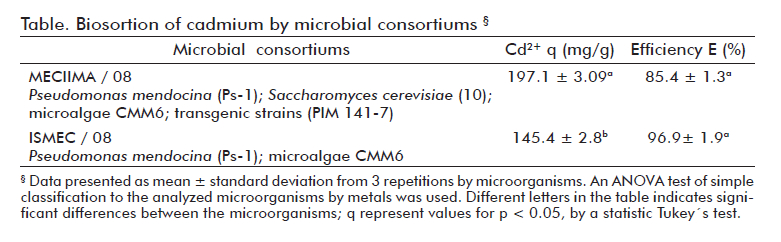
<body><![CDATA[<P   align="justify" ><font size="2" face="Verdana, Arial, Helvetica, sans-serif">The determination      of chemical contamination in the ecosystem, referred to Almendares river showed      phosphate (PO<Sub>4</Sub>) values range from 0 to 4 ppm, which exceed 0.1      ppm, the recommended maximal concentration in flowing water to discourage      excessive growth of aquatic plants. For the nutrients involved in the nitrogen      cycle, a balance between the reduced forms is observed in the river and its      tributaries. The concentrations of nitrates (NO<Sub>3</Sub>) vary between      0 and 3 ppm while ammonium (NH<Sub>4</Sub>) and nitrites (NO<Sub>2</Sub>)      concentrations vary between 1 and 12 ppm and 1 and 20 ppm, respectively. The      nutrients involved in the nitrogen cycle and the phosphates were found in      concentrations over the limits that guarantee the health of natural freshwater      systems.</font><font size="2" face="Verdana, Arial, Helvetica, sans-serif">The      presence of high ammonium concentrations indicates the presence of faecal      contamination. These results are comparable with others obtained in the case      of polluted rivers in temperate regions [7]. The concentration of heavy metals      were high for Mn<sup>2+</sup>, Zn<sup>2+</sup> (10.05-11.51 &micro;g/L), Pb<sup>2+</sup>      (2.86-73.29 &micro;g/L), Cu<sup>2+</sup> (0.05-0.49 &micro;g/L), Cr<sup>6+</sup>      (0.14-0.20 &micro;g/L), Ni<sup>2+</sup> (1.90-5.17 &micro;g/L), Co<sup>2+</sup>      (0.96-3.17 &micro;g/L) and Cd<sup>2+</sup> (0.12-0.81 &micro;g/L). Besides,      it was demonstrated the accumulation of metals in different organisms such      as fishes and plants, which bioaccumulate a higher spectrum and quantity of      heavy metals, specially in roots, so that can be used as biologic indicators.</font>    <br>   </P >   <FONT size="+1"><FONT size="+1"><FONT size="+1"><FONT size="+1"><FONT size="+1"><FONT size="+1"><FONT size="+1"><FONT size="+1">        <P   align="justify" ><font size="2" face="Verdana, Arial, Helvetica, sans-serif">In contrast with      these results, the water of tourist complex &ldquo;Las Terrazas&rdquo; didn&rsquo;t      show a high pollution degree. The FC values were slightly higher to those      established by standards, but much lower than those found in Almendares river.      However, the <I>E. coli</I> values where higher that the maximum limit established      by Cuban standards for recreational water and irrigation. There was not linear      correlation between the concentrations of these indicators of faecal contamination,      with an average value of 0.46 for the ratio <I>E. coli</I>/faecal coliform.      These results show the good microbiological water quality of Las Terrazas      and increase the information about this ecosystem located in Sierra del Rosario      (Biosphere Reserve). </font></P >       <P   align="justify" ><font size="2" face="Verdana, Arial, Helvetica, sans-serif">According to that,      it is necessary the development of new approaches and technologies to decrease      the negative environmental impact of the metals and to preserve the waters      for assure the integrity of aquatic ecosystems and to recover the metals.      The selection of collection&acute;s microorganisms <I>Pseudomonas mendocina      </I>(Ps-1), <I>Anabaena </I>sp. PCC 7120, <I>Saccharomyces cerevisiae</I>      (10),<I> Chaetoceros ceratosphorus</I> (1P) and the native isolates (bacteria      A6, CBM4 and microalgae CMM6), from sources of contaminated waters with metals,      that reached capture levels of Zn<Sup>2+ </Sup>and Cd<Sup>2+ </Sup>from aqueous      solutions between 16 and 34 mg/g, shows the diversity of physiological and      genetic answers of microorganisms, which permit them to activate mechanisms      of uptake these chemical contaminants, converting them in potential tools      for bioremediation process, as ecological, effective and economical solutions      for this environmental problem [8]. The study of factors associated to removal      of metals, permitted to define that physiological age of culture, pH of biomass-metal      suspension and the initial concentration of metal in solution, increased the      capture of Zn<Sup>2+ </Sup>and Cd<Sup>2+</Sup> for each microorganism. The      application of physical and chemical treatments to selected microbial biomass,      allowed to verify that inactivated cells by dry hot treatment increased the      biosortive capacity of ions by all the microorganisms. This treatment increased      the extracellular capture of zinc until 4.4 times and the capture of cadmium      until 8.3 times more, in relation to non-treated cells. The pretreatments      could modify the surface characteristics/groups either by removing or masking      the groups or by exposing more metal binding sites. Thus nonviable cells would      offer a larger available surface area and expose the intracellular components      and more surface binding sites because of the destruction of the cell membranes      [9]. On the other hand, nonviable cells offers the advantages of their conservation      at room temperature for long periods of time, that don&rsquo;t depend of metal      toxicity, neither requires nutrient supply and constitutes a low risk for      environment. </font></P >   <FONT size="+1"><FONT size="+1"><FONT size="+1"><FONT size="+1"><FONT size="+1"><FONT size="+1"><FONT size="+1"><FONT size="+1">        <P   align="justify" ><font size="2" face="Verdana, Arial, Helvetica, sans-serif">Molecular biotechnology      is a potent tool to construct engineered organisms with higher biosorption      capacity and selectivity for the objective metal ions. The application of      genetic engineering techniques provided the genetic modification of <I>Anabaena      </I>sp. PCC 7120. This transgenic cyanobacterium expressed <I>smtA </I>gene      which codify for metallothioneins in the citosol of <I>Synechococcus </I>sp.      PCC 7940. This result was verified by the molecular size of the 1700 bp band      corresponding to the porine-<I>smt</I>A-porine fragment, amplified with designed      oligonucleotides (291 + 315), using the 1500 bp molecular marker. By this      form it was verified the presence in the asp. PCC 7120 and permitted corroborate      the positive results of the triparental conjugation fulfilled. This clone      was identified as PIM 141-7. The application of these techniques, that might      contribute to enhance metal biosorption capacities in the microorganisms,      has been reported in other investigations about the peptides and proteins      expression with uptake capacities of metallic ions [10]. </font></P >       <P   align="justify" ><font size="2" face="Verdana, Arial, Helvetica, sans-serif">The effectivity of      this gene fusioned to a protein of external membrane in the capture of metal      was corroborated by the double biosortive capacity of cadmium ions in the      transformed strain. The transgenic <I>Anabaena</I> sp. PCC 7120 strain PIM      141-7 was able to uptake 33.76 &plusmn; 0.95 mg of cadmium per gram from the      aqueous solution. That amount was significantly higher (as evidenced by a      one-way ANOVA Test of the mean of three replicates, followed by Tukey&acute;s      test, p &lt; 0.05) than that achieved with the wild strain either untransformed      or bearing the mock plasmid pRL 277 (16.67 &plusmn; 2.1 and 15.98 &plusmn;      1.25 mg/g, respectively). From the total metal captured\ by transgenic strain      PIM 141-7, 56.3% was adsorbed to cellular surface, percentage that differs      with statistical signification from the percentage of extracellular metal      linked by the wild strain. Previous results referred the increase in metal      uptake by eukaryote metallothionein expression in <I>E. coli</I> [11]. </font></P >       <P   align="justify" ><font size="2" face="Verdana, Arial, Helvetica, sans-serif">From the different      procedures evaluated were combined the variants with best percentages of metal      remotion. The results showed that with 10 h of contact biomass-metal, the      monocultures of <I>Pseudomonas mendocina</I> (Ps-1) and <I>Saccharomyces cerevisiae</I>-10,      reached efficiency percentages in the biosortion of Zn<Sup>2+ </Sup>superior      to 97%, this result demonstrate the use of these strains in liquid waste shocked      with this metal. Two microbial consortiums increased the cadmium biosortion      efficiency to 85.4 and 96.9% (<a href="/img/revistas/bta/v28n4/t0111411.gif">Table</a>). </font></P >   <FONT size="+1"><FONT size="+1">        
<P   align="justify" ><font size="2" face="Verdana, Arial, Helvetica, sans-serif">These biosorbents      have metal-sequestering property and can be used to decrease the concentration      of heavy metal ions in solution. It can effectively sequester dissolved metal      ions out of dilute complex solutions quickly and with high efficiency which      correspond with the report for other microbial species [12]. </font></P >       <P   align="justify" ><font size="2" face="Verdana, Arial, Helvetica, sans-serif">The rhizosphere microorganisms,      in particular, have an important contribution to the removal of pollutants.      <I>From </I>58 rhizosphere bacterial isolates obtained from the rhizosphere      of the hydrophyte plant, <I>Typha dominguensis,</I> in Cuban natural wetlands      the interaction with organic matter, nitrogen, phosphorus and heavy metals      was studied. Thirteen isolates were selected by their potentialities as bioremediating      agents, the 13 isolates showed resistance to more than one metal. It was found      that some strains removed metals, 4 of them can be used in a consortium for      chromium and lead removal, from simulated effluents. The results obtained      are important, considering that metal concentrations studied (1.0, 2.0 and      3.0 mM) are above the allowed maximum concentrations regulated in water, according      to Cuban Standard [4] and other international standards. Also, the selection      of strains with resistance and remotion capacity of more than one metal is      important because in the ecosystems all the elements are in interaction. Some      authors have reported the capacity of different bacterial strains for metal      remotion [13, 3], but the majority of these results are related with remotion      of less harmful compounds. On the other hand, many strains showed remotion      of 50% of organic matter and phosphate from synthetic wastewater, which are      pollutants also present in Almendares river, some strains present remotion      of 100% and it was observed remotion of nitrogen too, but with lower values.      The remotion percentages were similar or superior to those obtained with other      microorganisms [14, 15]. These results contribute to the future application      of the bacterial isolates in water treatment technologies. </font></P >       <P   align="justify" ><font size="2" face="Verdana, Arial, Helvetica, sans-serif">Other way of biotechnological      application, especially in bioremediation, was the use of white rot fungi      (WRF) to degrade a wide range of recalcitrant organic compounds, including      pesticides, polycyclic aromatic hydrocarbons, dyes and textile effluents.      These compounds have complex structures and cause pollution problems that      seriously affect ecosystems, because are chemicals toxic, mutagenic or carcinogenic      and are often released into natural environments from industrial operations.      </font></P >       ]]></body>
<body><![CDATA[<P   align="justify" ><font size="2" face="Verdana, Arial, Helvetica, sans-serif">The high capacity      of lignin degradation by 33 WRF strains, collected from woody material present      in several ecosystems of Havana city and Sancti Sp&iacute;ritus, allowed the      biotransformation of 12 kinds of textil dyes which are toxic and chemically      diverse. From them, <I>Ganoderma</I> aff. <I> zonatum</I> (B-18) and <I>Trametes      maxima</I> (MUCL 44155) showed the higher decolorizing capacity (<a href="/img/revistas/bta/v28n4/f0211411.gif">Figure      2A</a>). These strains of HPB removed textile dyes in superior values to that      obtained with conventional treatments. The enzymatic crudes of <I>T. maxima</I>      MUCL 44155, were stable for more than 7 days to pH between 4.5 and 7.0, at      30 <Sup>o</Sup>C. This result makes its industrial use easier. A simple and      economic medium with molasse-urea and mineral salts which removed 100% of      dye at the fourth day of treatment with <I>G. </I>aff. <I>zonatum</I> (B-18)<B>      </B>was obtained. </font></P >   <FONT size="+1"><FONT size="+1">        
<P   align="justify" ><font size="2" face="Verdana, Arial, Helvetica, sans-serif">The studied strains      showed a high biodegradative capacity upon the DDT (1, 1, 1-trichloro-2,2-bis      (4- clorophenil) etane) with values of 99% and 73% respectively (<a href="/img/revistas/bta/v28n4/f0211411.gif">Figure      2B</a>). <I>T. maxima</I> MUCL 44155 presents the lacase enzyme as the only      involved in the degradation of the dye model acid blue 62. Only in the cultures      of <I>G.</I> aff.<I> zonatum</I> was detected the presence of intermediary      metabolites of degradation, so both strains can be considered adequate for      use in the biological treatment of textile effluents and in the remotion of      the pesticide DDT. The values of dyes decolorisation and DDT degradation achieved      by these strains are comparable to the results reported by others authors      using promising WRF strains [16]. </font></P >       
<P   align="justify" ><font size="2" face="Verdana, Arial, Helvetica, sans-serif">The control of microbiological      and chemical water quality is of primary importance in developing tropical      countries, as the high levels of this contamination of waters constitute a      potential risk for biodiversity and human health. By this reason the exploitation      of local biodiversity in tropical area appears as a potentially productive      approach for identifying promising microbial strains for biotechnological      use. </font></P >       <P   ><font size="3" face="Verdana, Arial, Helvetica, sans-serif"><b>CONCLUSIONS </b></font></P >   <FONT size="+1">        <P   align="justify" ><font size="2" face="Verdana, Arial, Helvetica, sans-serif">The methods used      in this study are suitable for the evaluation of microbiological and chemical      quality in the tropical environment featured and contribute to improve the      evaluation of the level of contamination in Cuban freshwater ecosystems. This      investigation demonstrated that biosorption is a useful alternative to the      conventional systems for the removal of heavy metal ions from aqueous solution.      The expression of metallotioneins in bacterial cell provides an improvement      in accumulation of metals and offers a promissory strategy for the development      of microbial biosorbents in metals bioremediation of polluted water. The use      of WRF<I> </I>presented high degradative capacity on different dyes and DDT.      These strains could be considered very promising candidates for developing      a biotechnological treatment of industrial wastewaters with xenobiotic compounds.      </font></P >   <FONT size="+1">        <P   ><font size="3" face="Verdana, Arial, Helvetica, sans-serif"><b>ACKNOWLEDGEMENTS      </b> </font></P >   <FONT size="+1">        <P   align="justify" ><font size="2" face="Verdana, Arial, Helvetica, sans-serif">The authors would      like to acknowledge the financial support from the Wallone Region in Belgium,      Commission Universitaire pour le Developpement (CUD), Universidad Aut&oacute;noma      de M&eacute;xico and Regensburg University, Germany. </font></P >   <FONT size="+1">        <P   > </P >   <FONT size="+1">       <P   ><b><font size="3" face="Verdana, Arial, Helvetica, sans-serif">REFERENCES </font></b></P >       <!-- ref --><P   ><font size="2" face="Verdana, Arial, Helvetica, sans-serif">1. Garc&iacute;a-Armisen      T, Prats J, Servais P. Comparison of culturable fecal coliforms and Escherichia      coli enumeration in freshwaters. Can J Microbiol. 2007;53(6):798-801.     </font></P >   <FONT size="+1">        <P   ><font size="2" face="Verdana, Arial, Helvetica, sans-serif">2. Majeau JA, Brar      SK, Tyagi RD. Laccases for removal of recalcitrant and emerging pollutants.      Bioresour Technol. 2010;101(7): </font></P >       <P   ><font size="2" face="Verdana, Arial, Helvetica, sans-serif">2331-50. </font></P >       <!-- ref --><P   ><font size="2" face="Verdana, Arial, Helvetica, sans-serif">3. Guo H, Luo S,      Chen L, Xiao X, Xi Q, Wei W, et al. Bioremediation of heavy metals by growing      hyperaccumulaor endophytic bacterium Bacillus sp. L14. Bioresour Technol.      2010;101(22):8599-605.     </font></P >       <P   ><font size="2" face="Verdana, Arial, Helvetica, sans-serif">4. NC 27: 1999. Vertimiento      de aguas residuales a las aguas terrestres y al alcantarillado: Especificaciones.      La Habana: Oficina Nacional de Normalizaci&oacute;n; 1999. Available in: <a href="http://biblioteca.idict.villaclara.cu/UserFiles/File/Normateca/NC-27-99%20Vertimiento.pdf" target="_blank">http://biblioteca.idict.villaclara.cu/UserFiles/File/Normateca/NC-27-99%20Vertimiento.pdf</a>      </font></P >       <P   ><font size="2" face="Verdana, Arial, Helvetica, sans-serif">5. NC 22: 1999. Lugares      de ba&ntilde;o en costas y en masas de aguas interiores. Requisitos higi&eacute;nicos      sanitarios. La Habana: Oficina Nacional de Normalizaci&oacute;n. 1999. <a href="http://biblioteca.idict.villaclara.cu/UserFiles/File/Normateca" target="_blank">http://biblioteca.idict.villaclara.cu/UserFiles/File/Normateca</a>      </font></P >       <!-- ref --><P   ><font size="2" face="Verdana, Arial, Helvetica, sans-serif">6. Ramteke PW, Tewari      S. Serogroups of Escherichia coli from drinking water. Environ Monit Assess.      2007;130(1-3):215-20.     </font></P >       <!-- ref --><P   ><font size="2" face="Verdana, Arial, Helvetica, sans-serif">7. Cheung KC, Poon      BH, Lan CY, Wong MH. Assessment of metal and nutrient concentrations in river      water and sediment collected from the cities in the Pearl River Delta, South      China. Chemosphere. 2003; 52(9):1431-40.     </font></P >       <!-- ref --><P   ><font size="2" face="Verdana, Arial, Helvetica, sans-serif">8. Wang J, Chen C.      Biosorbents for heavy metals removal and their future. Biotechnol Adv. 2009;27(2):195-226.          </font></P >       <!-- ref --><P   ><font size="2" face="Verdana, Arial, Helvetica, sans-serif">9. Vijayaraghavan      K, Yun YS. Bacterial biosorbents and biosorption. Biotechnol Adv. 2008;26(3):266-91.          </font></P >       <!-- ref --><P   ><font size="2" face="Verdana, Arial, Helvetica, sans-serif">10. Singh S, Lee      W, Dasilva NA, Mulchandani A, Chen W. Enhanced arsenic accumulation by engineered      yeast cells expressing Arabidopsis thaliana phytochelatin synthase. Biotechnol      Bioeng. 2008; 99(2):333-40.     </font></P >       <!-- ref --><P   ><font size="2" face="Verdana, Arial, Helvetica, sans-serif">11. Kostal J, Yang      R, Wu CH, Mulchandani A, Chen W. Enhanced arsenic accumulation in engineered      bacterial cells expressing ArsR. Appl Environ Microbiol. 2004; 70(8):4582-7.          </font></P >       <P   ><font size="2" face="Verdana, Arial, Helvetica, sans-serif">12. Wang JL, Chen      C. Biosorption of heavy metals by Saccharomyces cerevisiae: a review. Biotechnol      Adv. 2006 Sep-Oct; 24(5):427-51. </font></P >       ]]></body>
<body><![CDATA[<!-- ref --><P   ><font size="2" face="Verdana, Arial, Helvetica, sans-serif">13. Vullo DL, Ceretti      HM, Daniel MA, Ram&iacute;rez SA, Zalts A. Cadmium, zinc and copper biosorption      mediated by Pseudomonas veronii 2E. Bioresour Technol. 2008;99(13):5574-81.          </font></P >       <!-- ref --><P   ><font size="2" face="Verdana, Arial, Helvetica, sans-serif">14. Pessoa AK, Tauk-Tornisielo      SM, Naves R, De Franceschi D. Performance of the constructed wetland system      for the treatment of water from the Corumbata&iacute; river. Braz Arch Biol      Technol. 2008; 51(6):1279-86.     </font></P >       <!-- ref --><P   ><font size="2" face="Verdana, Arial, Helvetica, sans-serif">15. Moreno M, Naranjo      B, Koch A. Evaluaci&oacute;n de dos m&eacute;todos para la reducci&oacute;n      de nitr&oacute;geno, f&oacute;sforo y DQO de aguas residuales, mediante un      cultivo ax&eacute;nico de cianobacterias y un consorcio microbiano, inmovilizados      y en suspensi&oacute;n. Rev Ciencia. 2010;13(1):55-61.     </font></P >       <!-- ref --><P   ><font size="2" face="Verdana, Arial, Helvetica, sans-serif">16. Vanhulle S, Trovaslet      M, Enaud E, Lucas M, Sonveaux M, Decock C, et al. Cytotoxicity and genotoxicity      evolution during decolorization of dyes by White Rot Fungi. World J Microbiol      Biotechnol. 2008;24(3):337-44.     </font></P >       <P   >&nbsp;</P >   <FONT size="+1">        <P   > </P >       ]]></body>
<body><![CDATA[<P   ><font size="2" face="Verdana, Arial, Helvetica, sans-serif">Mar&iacute;a E Carballo.      Department of Microbiology and Virology, Faculty of Biology, Havana University,      UH. 25 e/ J e I No 455, Vedado, Plaza de la Revoluci&oacute;n, Havana, Cuba.      E-mail: <a href="mailto:mecarballo@fbio.uh.cu">mecarballo@fbio.uh.cu</a>.      </font></P >   </font></font></font></font></font></font></font></font></font></font></font></font></font></font></font></font></font></font></font></font></font></font></font></font></font></font></font></font></font></font></font></font></font></font></font></font></font></font></font></font></font></DIV >      ]]></body><back>
<ref-list>
<ref id="B1">
<label>1</label><nlm-citation citation-type="journal">
<person-group person-group-type="author">
<name>
<surname><![CDATA[García-Armisen]]></surname>
<given-names><![CDATA[T]]></given-names>
</name>
<name>
<surname><![CDATA[Prats]]></surname>
<given-names><![CDATA[J]]></given-names>
</name>
<name>
<surname><![CDATA[Servais]]></surname>
<given-names><![CDATA[P]]></given-names>
</name>
</person-group>
<article-title xml:lang="en"><![CDATA[Comparison of culturable fecal coliforms and Escherichia coli enumeration in freshwaters]]></article-title>
<source><![CDATA[Can J Microbiol]]></source>
<year>2007</year>
<volume>53</volume>
<numero>6</numero>
<issue>6</issue>
<page-range>798-801</page-range></nlm-citation>
</ref>
<ref id="B2">
<label>2</label><nlm-citation citation-type="journal">
<person-group person-group-type="author">
<name>
<surname><![CDATA[Majeau]]></surname>
<given-names><![CDATA[JA]]></given-names>
</name>
<name>
<surname><![CDATA[Brar]]></surname>
<given-names><![CDATA[SK]]></given-names>
</name>
<name>
<surname><![CDATA[Tyagi]]></surname>
<given-names><![CDATA[RD]]></given-names>
</name>
</person-group>
<article-title xml:lang="en"><![CDATA[Laccases for removal of recalcitrant and emerging pollutants]]></article-title>
<source><![CDATA[Bioresour Technol]]></source>
<year>2010</year>
<volume>101</volume>
<numero>7</numero>
<issue>7</issue>
<page-range>2331-50</page-range></nlm-citation>
</ref>
<ref id="B3">
<label>3</label><nlm-citation citation-type="journal">
<person-group person-group-type="author">
<name>
<surname><![CDATA[Guo]]></surname>
<given-names><![CDATA[H]]></given-names>
</name>
<name>
<surname><![CDATA[Luo]]></surname>
<given-names><![CDATA[S]]></given-names>
</name>
<name>
<surname><![CDATA[Chen]]></surname>
<given-names><![CDATA[L]]></given-names>
</name>
<name>
<surname><![CDATA[Xiao]]></surname>
<given-names><![CDATA[X]]></given-names>
</name>
<name>
<surname><![CDATA[Xi]]></surname>
<given-names><![CDATA[Q]]></given-names>
</name>
<name>
<surname><![CDATA[Wei]]></surname>
<given-names><![CDATA[W]]></given-names>
</name>
</person-group>
<article-title xml:lang="en"><![CDATA[Bioremediation of heavy metals by growing hyperaccumulaor endophytic bacterium Bacillus sp. L14]]></article-title>
<source><![CDATA[Bioresour Technol]]></source>
<year>2010</year>
<volume>101</volume>
<numero>22</numero>
<issue>22</issue>
<page-range>8599-605</page-range></nlm-citation>
</ref>
<ref id="B4">
<label>4</label><nlm-citation citation-type="book">
<source><![CDATA[NC 27: 1999: Vertimiento de aguas residuales a las aguas terrestres y al alcantarillado: Especificaciones]]></source>
<year></year>
<publisher-loc><![CDATA[La Habana ]]></publisher-loc>
<publisher-name><![CDATA[Oficina Nacional de Normalización]]></publisher-name>
</nlm-citation>
</ref>
<ref id="B5">
<label>5</label><nlm-citation citation-type="book">
<source><![CDATA[NC22: 1999: Lugares de baño en costas y en masas de aguas interiores. Requisitos higiénicos sanitarios]]></source>
<year></year>
<publisher-loc><![CDATA[La Habana ]]></publisher-loc>
<publisher-name><![CDATA[Oficina Nacional de Normalización]]></publisher-name>
</nlm-citation>
</ref>
<ref id="B6">
<label>6</label><nlm-citation citation-type="journal">
<person-group person-group-type="author">
<name>
<surname><![CDATA[Ramteke]]></surname>
<given-names><![CDATA[PW]]></given-names>
</name>
<name>
<surname><![CDATA[Tewari]]></surname>
<given-names><![CDATA[S]]></given-names>
</name>
</person-group>
<article-title xml:lang="en"><![CDATA[Serogroups of Escherichia coli from drinking water]]></article-title>
<source><![CDATA[Environ Monit Assess]]></source>
<year>2007</year>
<volume>130</volume>
<numero>1-3</numero>
<issue>1-3</issue>
<page-range>215-20</page-range></nlm-citation>
</ref>
<ref id="B7">
<label>7</label><nlm-citation citation-type="journal">
<person-group person-group-type="author">
<name>
<surname><![CDATA[Cheung]]></surname>
<given-names><![CDATA[KC]]></given-names>
</name>
<name>
<surname><![CDATA[Poon]]></surname>
<given-names><![CDATA[BH]]></given-names>
</name>
<name>
<surname><![CDATA[Lan]]></surname>
<given-names><![CDATA[CY]]></given-names>
</name>
<name>
<surname><![CDATA[Wong]]></surname>
<given-names><![CDATA[MH]]></given-names>
</name>
</person-group>
<article-title xml:lang="en"><![CDATA[Assessment of metal and nutrient concentrations in river water and sediment collected from the cities in the Pearl River Delta, South China.]]></article-title>
<source><![CDATA[Chemosphere]]></source>
<year>2003</year>
<volume>52</volume>
<numero>9</numero>
<issue>9</issue>
<page-range>1431-40</page-range></nlm-citation>
</ref>
<ref id="B8">
<label>8</label><nlm-citation citation-type="journal">
<person-group person-group-type="author">
<name>
<surname><![CDATA[Wang]]></surname>
<given-names><![CDATA[J]]></given-names>
</name>
<name>
<surname><![CDATA[Chen]]></surname>
<given-names><![CDATA[C]]></given-names>
</name>
</person-group>
<article-title xml:lang="en"><![CDATA[Biosorbents for heavy metals removal and their future]]></article-title>
<source><![CDATA[Biotechnol Adv]]></source>
<year>2009</year>
<volume>27</volume>
<numero>2</numero>
<issue>2</issue>
<page-range>195-226</page-range></nlm-citation>
</ref>
<ref id="B9">
<label>9</label><nlm-citation citation-type="journal">
<person-group person-group-type="author">
<name>
<surname><![CDATA[Vijayaraghavan]]></surname>
<given-names><![CDATA[K]]></given-names>
</name>
<name>
<surname><![CDATA[Yun]]></surname>
<given-names><![CDATA[YS]]></given-names>
</name>
</person-group>
<article-title xml:lang="en"><![CDATA[Bacterial biosorbents and biosorption]]></article-title>
<source><![CDATA[Biotechnol Adv]]></source>
<year>2008</year>
<volume>26</volume>
<numero>3</numero>
<issue>3</issue>
<page-range>266-91</page-range></nlm-citation>
</ref>
<ref id="B10">
<label>10</label><nlm-citation citation-type="journal">
<person-group person-group-type="author">
<name>
<surname><![CDATA[Singh]]></surname>
<given-names><![CDATA[S]]></given-names>
</name>
<name>
<surname><![CDATA[Lee]]></surname>
<given-names><![CDATA[W]]></given-names>
</name>
<name>
<surname><![CDATA[Dasilva]]></surname>
<given-names><![CDATA[NA]]></given-names>
</name>
<name>
<surname><![CDATA[Mulchandani]]></surname>
<given-names><![CDATA[A]]></given-names>
</name>
<name>
<surname><![CDATA[Chen]]></surname>
<given-names><![CDATA[W]]></given-names>
</name>
</person-group>
<article-title xml:lang="en"><![CDATA[Enhanced arsenic accumulation by engineered yeast cells expressing Arabidopsis thaliana phytochelatin synthase]]></article-title>
<source><![CDATA[Biotechnol Bioeng]]></source>
<year>2008</year>
<volume>99</volume>
<numero>2</numero>
<issue>2</issue>
<page-range>333-40</page-range></nlm-citation>
</ref>
<ref id="B11">
<label>11</label><nlm-citation citation-type="journal">
<person-group person-group-type="author">
<name>
<surname><![CDATA[Kostal]]></surname>
<given-names><![CDATA[J]]></given-names>
</name>
<name>
<surname><![CDATA[Yang]]></surname>
<given-names><![CDATA[R]]></given-names>
</name>
<name>
<surname><![CDATA[Wu]]></surname>
<given-names><![CDATA[CH]]></given-names>
</name>
<name>
<surname><![CDATA[Mulchandani]]></surname>
<given-names><![CDATA[A]]></given-names>
</name>
<name>
<surname><![CDATA[Chen]]></surname>
<given-names><![CDATA[W]]></given-names>
</name>
</person-group>
<article-title xml:lang="en"><![CDATA[Enhanced arsenic accumulation in engineered bacterial cells expressing ArsR]]></article-title>
<source><![CDATA[Appl Environ Microbiol]]></source>
<year>2004</year>
<volume>70</volume>
<numero>8</numero>
<issue>8</issue>
<page-range>4582-7</page-range></nlm-citation>
</ref>
<ref id="B12">
<label>12</label><nlm-citation citation-type="journal">
<person-group person-group-type="author">
<name>
<surname><![CDATA[Wang]]></surname>
<given-names><![CDATA[JL]]></given-names>
</name>
<name>
<surname><![CDATA[Chen]]></surname>
<given-names><![CDATA[C]]></given-names>
</name>
</person-group>
<article-title xml:lang="en"><![CDATA[Biosorption of heavy metals by Saccharomyces cerevisiae: a review]]></article-title>
<source><![CDATA[Biotechnol Adv]]></source>
<year>2006</year>
<month> S</month>
<day>ep</day>
<volume>24</volume>
<numero>5</numero>
<issue>5</issue>
<page-range>427-51</page-range></nlm-citation>
</ref>
<ref id="B13">
<label>13</label><nlm-citation citation-type="journal">
<person-group person-group-type="author">
<name>
<surname><![CDATA[Vullo]]></surname>
<given-names><![CDATA[DL]]></given-names>
</name>
<name>
<surname><![CDATA[Ceretti]]></surname>
<given-names><![CDATA[HM]]></given-names>
</name>
<name>
<surname><![CDATA[Daniel]]></surname>
<given-names><![CDATA[MA]]></given-names>
</name>
<name>
<surname><![CDATA[Ramírez]]></surname>
<given-names><![CDATA[SA]]></given-names>
</name>
<name>
<surname><![CDATA[Zalts]]></surname>
<given-names><![CDATA[A]]></given-names>
</name>
</person-group>
<article-title xml:lang="en"><![CDATA[Cadmium, zinc and copper biosorption mediated by Pseudomonas veronii 2E]]></article-title>
<source><![CDATA[Bioresour Technol]]></source>
<year>2008</year>
<volume>99</volume>
<numero>13</numero>
<issue>13</issue>
<page-range>5574-81</page-range></nlm-citation>
</ref>
<ref id="B14">
<label>14</label><nlm-citation citation-type="journal">
<person-group person-group-type="author">
<name>
<surname><![CDATA[Pessoa]]></surname>
<given-names><![CDATA[AK]]></given-names>
</name>
<name>
<surname><![CDATA[Tauk-Tornisielo]]></surname>
<given-names><![CDATA[SM]]></given-names>
</name>
<name>
<surname><![CDATA[Naves]]></surname>
<given-names><![CDATA[R]]></given-names>
</name>
<name>
<surname><![CDATA[De Franceschi]]></surname>
<given-names><![CDATA[D]]></given-names>
</name>
</person-group>
<article-title xml:lang="en"><![CDATA[Performance of the constructed wetland system for the treatment of water from the Corumbataí river]]></article-title>
<source><![CDATA[Braz Arch Biol Technol]]></source>
<year>2008</year>
<volume>51</volume>
<numero>6</numero>
<issue>6</issue>
<page-range>1279-86</page-range></nlm-citation>
</ref>
<ref id="B15">
<label>15</label><nlm-citation citation-type="journal">
<person-group person-group-type="author">
<name>
<surname><![CDATA[Moreno]]></surname>
<given-names><![CDATA[M]]></given-names>
</name>
<name>
<surname><![CDATA[Naranjo]]></surname>
<given-names><![CDATA[B]]></given-names>
</name>
<name>
<surname><![CDATA[Koch]]></surname>
<given-names><![CDATA[A]]></given-names>
</name>
</person-group>
<article-title xml:lang="es"><![CDATA[Evaluación de dos métodos para la reducción de nitrógeno, fósforo y DQO de aguas residuales, mediante un cultivo axénico de cianobacterias y un consorcio microbiano, inmovilizados y en suspensión]]></article-title>
<source><![CDATA[Rev Ciencia]]></source>
<year>2010</year>
<volume>13</volume>
<numero>1</numero>
<issue>1</issue>
<page-range>55-61</page-range></nlm-citation>
</ref>
<ref id="B16">
<label>16</label><nlm-citation citation-type="journal">
<person-group person-group-type="author">
<name>
<surname><![CDATA[Vanhulle]]></surname>
<given-names><![CDATA[S]]></given-names>
</name>
<name>
<surname><![CDATA[Trovaslet]]></surname>
<given-names><![CDATA[M]]></given-names>
</name>
<name>
<surname><![CDATA[Enaud]]></surname>
<given-names><![CDATA[E]]></given-names>
</name>
<name>
<surname><![CDATA[Lucas]]></surname>
<given-names><![CDATA[M]]></given-names>
</name>
<name>
<surname><![CDATA[Sonveaux]]></surname>
<given-names><![CDATA[M]]></given-names>
</name>
<name>
<surname><![CDATA[Decock]]></surname>
<given-names><![CDATA[C]]></given-names>
</name>
</person-group>
<article-title xml:lang="en"><![CDATA[Cytotoxicity and genotoxicity evolution during decolorization of dyes by White Rot Fungi]]></article-title>
<source><![CDATA[World J Microbiol Biotechnol]]></source>
<year>2008</year>
<volume>24</volume>
<numero>3</numero>
<issue>3</issue>
<page-range>337-44</page-range></nlm-citation>
</ref>
</ref-list>
</back>
</article>