<?xml version="1.0" encoding="ISO-8859-1"?><article xmlns:mml="http://www.w3.org/1998/Math/MathML" xmlns:xlink="http://www.w3.org/1999/xlink" xmlns:xsi="http://www.w3.org/2001/XMLSchema-instance">
<front>
<journal-meta>
<journal-id>1027-2852</journal-id>
<journal-title><![CDATA[Biotecnología Aplicada]]></journal-title>
<abbrev-journal-title><![CDATA[Biotecnol Apl]]></abbrev-journal-title>
<issn>1027-2852</issn>
<publisher>
<publisher-name><![CDATA[Editorial Elfos Scientiae]]></publisher-name>
</publisher>
</journal-meta>
<article-meta>
<article-id>S1027-28522012000100002</article-id>
<title-group>
<article-title xml:lang="en"><![CDATA[Induction of chitinases and glucanases in Trichoderma spp. strains intended for biological control]]></article-title>
<article-title xml:lang="es"><![CDATA[Inducción de quitinasas y glucanasas en cepas de Trichoderma spp. promisorias como agentes para el control biológico]]></article-title>
</title-group>
<contrib-group>
<contrib contrib-type="author">
<name>
<surname><![CDATA[González]]></surname>
<given-names><![CDATA[Ivonne]]></given-names>
</name>
<xref ref-type="aff" rid="A01"/>
</contrib>
<contrib contrib-type="author">
<name>
<surname><![CDATA[Infante]]></surname>
<given-names><![CDATA[Danay]]></given-names>
</name>
<xref ref-type="aff" rid="A01"/>
</contrib>
<contrib contrib-type="author">
<name>
<surname><![CDATA[Martínez]]></surname>
<given-names><![CDATA[Benedicto]]></given-names>
</name>
<xref ref-type="aff" rid="A01"/>
</contrib>
<contrib contrib-type="author">
<name>
<surname><![CDATA[Arias]]></surname>
<given-names><![CDATA[Yailén]]></given-names>
</name>
<xref ref-type="aff" rid="A01"/>
</contrib>
<contrib contrib-type="author">
<name>
<surname><![CDATA[González]]></surname>
<given-names><![CDATA[Noyma]]></given-names>
</name>
<xref ref-type="aff" rid="A01"/>
</contrib>
<contrib contrib-type="author">
<name>
<surname><![CDATA[Miranda]]></surname>
<given-names><![CDATA[Ileana]]></given-names>
</name>
<xref ref-type="aff" rid="A02"/>
</contrib>
<contrib contrib-type="author">
<name>
<surname><![CDATA[Peteira]]></surname>
<given-names><![CDATA[Belkis]]></given-names>
</name>
<xref ref-type="aff" rid="A01"/>
</contrib>
</contrib-group>
<aff id="A02">
<institution><![CDATA[,Centro Nacional de Sanidad Agropecuaria Dirección Protección de Plantas Grupo de Plagas Agrícolas]]></institution>
<addr-line><![CDATA[San José de las Lajas ]]></addr-line>
<country>Cuba</country>
</aff>
<aff id="A01">
<institution><![CDATA[,Centro Nacional de Sanidad Agropecuaria Dirección Protección de Plantas Grupo de Fitopatología]]></institution>
<addr-line><![CDATA[San José de las Lajas ]]></addr-line>
<country>Cuba</country>
</aff>
<pub-date pub-type="pub">
<day>00</day>
<month>03</month>
<year>2012</year>
</pub-date>
<pub-date pub-type="epub">
<day>00</day>
<month>03</month>
<year>2012</year>
</pub-date>
<volume>29</volume>
<numero>1</numero>
<fpage>12</fpage>
<lpage>16</lpage>
<copyright-statement/>
<copyright-year/>
<self-uri xlink:href="http://scielo.sld.cu/scielo.php?script=sci_arttext&amp;pid=S1027-28522012000100002&amp;lng=en&amp;nrm=iso"></self-uri><self-uri xlink:href="http://scielo.sld.cu/scielo.php?script=sci_abstract&amp;pid=S1027-28522012000100002&amp;lng=en&amp;nrm=iso"></self-uri><self-uri xlink:href="http://scielo.sld.cu/scielo.php?script=sci_pdf&amp;pid=S1027-28522012000100002&amp;lng=en&amp;nrm=iso"></self-uri><abstract abstract-type="short" xml:lang="en"><p><![CDATA[Use of fungi of the Trichoderma genus for the biological control of pests and diseases is based, to a large extent, on their secretion of hydrolytic enzymes. The latter include chitinases and glucanases, which degrade the cell wall of phytopathogenic fungi as well as the cuticle of insects and nematodes. The aim of this study was to assess the induction dynamics of chitinases and glucanases in ten strains of Trichoderma spp. grown in liquid media with different inducers: basal medium, basal medium supplemented with 0.5% chitin and basal medium supplemented with 0.2% gelatin. Chitinase and glucanase activity were evaluated at the first, third, fifth and seventh day of culture. The highest values of chitinase activity were obtained in basal and basal media supplemented with chitin; ß-1.3-glucanase, on the other hand, exhibited higher levels of activity in basal and basal media supplemented with gelatin.]]></p></abstract>
<abstract abstract-type="short" xml:lang="es"><p><![CDATA[La secreción de enzimas hidrolíticas es uno de los mecanismos de los hongos del género Trichoderma, para ejercer el control biológico de plagas y enfermedades. Las quitinasas y glucanasas son dos de estas enzimas que degradan la pared celular de los hongos fitopatógenos y la cutícula de insectos y nematodos. Se evaluó la dinámica de inducción de esas enzimas en diez cepas de Trichoderma spp. en tres medios líquidos con inductores diferentes: medio basal, medio basal suplementado con quitina al 0.5% y medio basal suplementado con gelatina al 0.2%. Las actividades quitinasas y glucanasas se evaluaron al primer, tercer, quinto y séptimo día del cultivo. Los mayores valores de la actividad quitinasa se alcanzaron en los medios basal y basal suplementado con quitina, mientras que los medios basal y basal suplementado con gelatina resultaron mejores inductores de las ß-1.3-glucanasas.]]></p></abstract>
<kwd-group>
<kwd lng="en"><![CDATA[Trichoderma]]></kwd>
<kwd lng="en"><![CDATA[chitinases]]></kwd>
<kwd lng="en"><![CDATA[glucanases]]></kwd>
<kwd lng="en"><![CDATA[biological control]]></kwd>
<kwd lng="es"><![CDATA[Trichoderma]]></kwd>
<kwd lng="es"><![CDATA[quitinasas]]></kwd>
<kwd lng="es"><![CDATA[glucanasas]]></kwd>
<kwd lng="es"><![CDATA[control biológico]]></kwd>
</kwd-group>
</article-meta>
</front><body><![CDATA[ <DIV class="Sect"   >        <P   align="right" ><font size="2" color="#000000" face="Verdana, Arial, Helvetica, sans-serif"><b>RESEARCH</b>      </font></P >   <FONT size="+1" color="#000000">        <P   > </P >       <P   >&nbsp;</P >       <P   ><font size="4" face="Verdana, Arial, Helvetica, sans-serif"><b>Induction of chitinases      and glucanases in Trichoderma spp. strains intended for biological control      </b> </font></P >       <P   > </P >       <P   >&nbsp;</P >       <P   ><font size="3" face="Verdana, Arial, Helvetica, sans-serif"><b>Inducci&oacute;n      de quitinasas y glucanasas en cepas de Trichoderma spp. promisorias como agentes      para el control biol&oacute;gico </b></font></P >       <P   >&nbsp;</P >       <P   >&nbsp;</P >       ]]></body>
<body><![CDATA[<P   ><b><font size="2" face="Verdana, Arial, Helvetica, sans-serif">Ivonne Gonz&aacute;lez<Sup>1</Sup>,      Danay Infante<Sup>1</Sup>, Benedicto Mart&iacute;nez<Sup>1</Sup>, Yail&eacute;n      Arias<Sup>1</Sup>, Noyma Gonz&aacute;lez<Sup>1</Sup>, Ileana Miranda<Sup>2</Sup>,      Belkis Peteira<Sup>1</Sup></font></b></P >   <FONT size="+1"><FONT size="+1"><FONT size="+1"><FONT size="+1"><FONT size="+1"><FONT size="+1"><FONT size="+1"><FONT size="+1"><FONT size="+1"><FONT size="+1"><FONT size="+1"><FONT size="+1"><FONT size="+1"><FONT size="+1"><FONT size="+1"><FONT size="+1">        <P   > </P >       <P   ><font size="2" face="Verdana, Arial, Helvetica, sans-serif"><Sup>1</Sup>Grupo      de Fitopatolog&iacute;a.    <br>     </font><font size="2" face="Verdana, Arial, Helvetica, sans-serif"><Sup>2</Sup>Grupo      de Plagas Agr&iacute;colas, Direcci&oacute;n Protecci&oacute;n de Plantas,      Centro Nacional de Sanidad Agropecuaria, CENSA. AP 10, San Jos&eacute; de      las Lajas, Mayabeque, Cuba. </font></P >       <P   >&nbsp;</P >   </font></font></font></font></font></font></font></font></font></font></font></font></font></font></font></font></font>   <hr>   <FONT size="+1" color="#000000"><FONT size="+1"><FONT size="+1"><FONT size="+1"><FONT size="+1"><FONT size="+1"><FONT size="+1"><FONT size="+1"><FONT size="+1"><FONT size="+1"><FONT size="+1"><FONT size="+1"><FONT size="+1"><FONT size="+1"><FONT size="+1"><FONT size="+1"><FONT size="+1">        <P   ><font size="2" face="Verdana, Arial, Helvetica, sans-serif"><b>ABSTRACT </b></font></P >   <FONT size="+1"><FONT size="+1"><FONT size="+1"><FONT size="+1">        <P   ><font size="2" face="Verdana, Arial, Helvetica, sans-serif">Use of fungi of the      Trichoderma genus for the biological control of pests and diseases is based,      to a large extent, on their secretion of hydrolytic enzymes. The latter include      chitinases and glucanases, which degrade the cell wall of phytopathogenic      fungi as well as the cuticle of insects and nematodes. The aim of this study      was to assess the induction dynamics of chitinases and glucanases in ten strains      of Trichoderma spp. grown in liquid media with different inducers: basal medium,      basal medium supplemented with 0.5% chitin and basal medium supplemented with      0.2% gelatin. Chitinase and glucanase activity were evaluated at the first,      third, fifth and seventh day of culture. The highest values of chitinase activity      were obtained in basal and basal media supplemented with chitin; &beta;-1.3-glucanase,      on the other hand, exhibited higher levels of activity in basal and basal      media supplemented with gelatin. </font></P >       <P   ><font size="2" face="Verdana, Arial, Helvetica, sans-serif"><b>Keywords: </b>Trichoderma,      chitinases, glucanases, biological control. </font></P >   </font></font></font></font></font></font></font></font></font></font></font></font></font></font></font></font></font></font></font></font></font>   <hr>   <FONT size="+1" color="#000000"><FONT size="+1"><FONT size="+1"><FONT size="+1"><FONT size="+1"><FONT size="+1"><FONT size="+1"><FONT size="+1"><FONT size="+1"><FONT size="+1"><FONT size="+1"><FONT size="+1"><FONT size="+1"><FONT size="+1"><FONT size="+1"><FONT size="+1"><FONT size="+1"><FONT size="+1"><FONT size="+1"><FONT size="+1"><FONT size="+1">    <b><font size="2" face="Verdana, Arial, Helvetica, sans-serif">RESUMEN </font></b>        <P   ><font size="2" face="Verdana, Arial, Helvetica, sans-serif">La secreci&oacute;n      de enzimas hidrol&iacute;ticas es uno de los mecanismos de los hongos del      g&eacute;nero Trichoderma, para ejercer el control biol&oacute;gico de plagas      y enfermedades. Las quitinasas y glucanasas son dos de estas enzimas que degradan      la pared celular de los hongos fitopat&oacute;genos y la cut&iacute;cula de      insectos y nematodos. Se evalu&oacute; la din&aacute;mica de inducci&oacute;n      de esas enzimas en diez cepas de Trichoderma spp. en tres medios l&iacute;quidos      con inductores diferentes: medio basal, medio basal suplementado con quitina      al 0.5% y medio basal suplementado con gelatina al 0.2%. Las actividades quitinasas      y glucanasas se evaluaron al primer, tercer, quinto y s&eacute;ptimo d&iacute;a      del cultivo. Los mayores valores de la actividad quitinasa se alcanzaron en      los medios basal y basal suplementado con quitina, mientras que los medios      basal y basal suplementado con gelatina resultaron mejores inductores de las      &beta;-1.3-glucanasas. </font></P >       <P   ><font size="2" face="Verdana, Arial, Helvetica, sans-serif"><b>Palabras clave:</b>      Trichoderma, quitinasas, glucanasas, control biol&oacute;gico.</font></P >   </font></font></font></font></font></font></font></font></font></font></font></font></font></font></font></font></font></font></font></font></font>   <hr>   <FONT size="+1" color="#000000"><FONT size="+1"><FONT size="+1"><FONT size="+1"><FONT size="+1"><FONT size="+1"><FONT size="+1"><FONT size="+1"><FONT size="+1"><FONT size="+1"><FONT size="+1"><FONT size="+1"><FONT size="+1"><FONT size="+1"><FONT size="+1"><FONT size="+1"><FONT size="+1"><FONT size="+1"><FONT size="+1"><FONT size="+1"><FONT size="+1">        ]]></body>
<body><![CDATA[<P   >&nbsp;</P >       <P   >&nbsp;</P >       <P   > </P >       <P   > </P >       <P   ><font size="3"><b><font face="Verdana, Arial, Helvetica, sans-serif">INTRODUCTION      </font></b></font></P >       <P   ><font size="2" face="Verdana, Arial, Helvetica, sans-serif">Fungi from the genus      <I>Trichoderma </I>have been widely used as biological control agents under      both greenhouse and open fi eld conditions, due to their ability to prey on      a diverse range of foliar and soil phytopathogens [1-3]. These fungi employ      different strategies against their targets: competition for space and nutrients,      mycoparasitism, production of inhibitory compounds, inactivation of enzymes      from the pathogenic agent, and the induction of resistances [4-6]. </font></P >       <P   ><font size="2" face="Verdana, Arial, Helvetica, sans-serif"><I>Trichoderma </I>parasitizes      the hyphae of phytopathogenic fungi using prehensile coils and hooks that      penetrate their cell walls, aided by the hydrolytic activity of chitinases      and glucanases [4]. Cell walls of phytopathogenic fungi such as <I>Sclerotium      rolfsii</I>, <I>Rhizoctonia solani </I>and <I>Pythium </I>spp. [7] are composed      mainly of &beta;-1.3-glucans and chitin, including also cellulose in some      oomycetes, such as <I>Pythium </I>spp. [8]. </font></P >       <P   ><font size="2" face="Verdana, Arial, Helvetica, sans-serif">Chitinases and glucanases      can also degrade the cuticle of insects, composed mainly of chitin [9-12].      Chitin is also present at the cuticle of nematode eggs, whose viability decreases      severely when treated with <I>Trichoderma </I>species [13, 14]. </font></P >       <P   ><font size="2" face="Verdana, Arial, Helvetica, sans-serif">Different strains      of <I>Trichoderma </I>usually exhibit different levels of expression of these      hydrolytic enzymes, leading in turn to differences in performance when used      as biological control agents. The objective of the present work, therefore,      was to study the induction dynamics of chitinases and glucanases in a set      of <I>Trichoderma </I>strains intended for biological control, employing three      liquid media with different inductors: basal medium, basal medium supplemented      with 0.5% chitin and basal medium supplemented with 0.2% gelatin. </font></P >       <P   >&nbsp;</P >       ]]></body>
<body><![CDATA[<P   ><font size="3" face="Verdana, Arial, Helvetica, sans-serif"><b>MATERIALS AND      METHODS </b> </font></P >       <P   ><font size="2" face="Verdana, Arial, Helvetica, sans-serif"><b>Strains and induction      media </b></font></P >       <P   ><font size="2" face="Verdana, Arial, Helvetica, sans-serif">This work employed      strains 1, 13, 17, 25, 75, 78, 79, 85 and 90 of <I>Trichoderma </I>sp. from      the strain collection of the Plant Mycology laboratory of the National Center      for Agricultural Health (CENSA), classified through molecular biology methods      as belonging to the species <I>Trichoderma asperellum </I>Samuels [15], and      strain TS3, from the Institute for Plant Health Research, INISAV; all selected      based on their capacity for antagonizing with known phytopathogens [16]. The      strains were stored in Malt-Agar medium (National Center for Biopreparations,      Biocen) at 4 &deg;C. In order to perform the dynamics experiment, the strains      were subcultured in potato-dextrose-water medium (PDA, Biocen) using 9 mm      Petri dishes and incubated statically for 3 days at 28 &deg;C, after which      the mycelia were harvested for further experimentation. </font></P >       <P   ><font size="2" face="Verdana, Arial, Helvetica, sans-serif"><b>Protein induction      in liquid media </b></font></P >       <P   ><font size="2" face="Verdana, Arial, Helvetica, sans-serif">The protein induction      experiment used liquid media containing different compounds, selected on the      basis of their ability to induce the synthesis of hydrolytic enzymes: liquid      basal medium containing yeast extract at 1 g/L and peptone at 4 g/L, liquid      basal medium supplemented with chitin at 5 g/L, and liquid basal medium supplemented      with gelatin at 0.2% (w/v) [17]. The first two were sterilized at 120 &deg;C      for 20 min, whereas the medium containing gelatin was sterilized at 115 &deg;C      for 15 min. </font></P >       <P   ><font size="2" face="Verdana, Arial, Helvetica, sans-serif">The media were aliquoted      in portions of 20 mL into 100 mL bottles, and were then inoculated with four      mycelial disks with a diameter of 5 mm, taken from the periphery of a pure      colony from each strain, and incubated statically at 28 &deg;C, protected      from light. Each treatment was repeated three times, using three replicates      in each occasion. Bottles were withdrawn from the incubator at day 1, 3, 5      and 7 after inoculation. Culture supernatants were filtered on Whatman paper      (3 mm CHR), and the fi nal extracts were stored at -20 &deg;C until used in      enzyme assays. </font></P >       <P   ><font size="2" face="Verdana, Arial, Helvetica, sans-serif"><b>Protein quantification</b>      </font></P >       <P   ><font size="2" face="Verdana, Arial, Helvetica, sans-serif">Total protein concentration      was determined with the method described by Bradford [18], reading the absorbance      of the protein-Coomassie Blue G-250 complex at 595 nm in a spectrophotometer      (Lasso Spec III, Lasso Biotech LTDA) and interpolating the obtained values      into the absorbances of a standard curve prepared from a 1 mg/mL stock solution      of Bovine Serum Albumin (BSA). </font></P >       <P   ><font size="2" face="Verdana, Arial, Helvetica, sans-serif"><b>Enzyme assays      </b></font></P >       <P   ><font size="2" face="Verdana, Arial, Helvetica, sans-serif">Chitinase activity      was determined by mixing 0.5 mL of the culture supernatant to be assayed with      0.2 mL of colloidal chitin at 10 mg/mL, prepared according to Boller <I>et      al</I>. [19], incubating the mixture at 37 &deg;C for 1 h and then adding      0.1 mL of 0.8 M sodium tetraborate,pH 8.8. The resulting mixture was centrifuged      at 6708 x <I>g </I>for 5 min, transferring then 500 &mu;L of the supernatant      to a glass tube and heating it to 100 &deg;C for 3 min. Afterward, 1 mL of      p-dimethyl amino benzaldehyde was added, incubating the solution at 38 &deg;C      for 20 min. A standard curve was prepared from an Nacetyl glucosamine stock      at 1 mg/mL and processed as described above for the samples. Optical density      was measured at 585 nm. Enzyme activity was calculated using the following      expression: </font></P >       ]]></body>
<body><![CDATA[<P align="center"   ><img src="/img/revistas/bta/v29n1/fr0102112.gif" width="324" height="61"></P >       
<P   ></P >       <P   ></P >       <P   ></P >       <P   ></P >       <P   > </P >       <P   ><font size="2" face="Verdana, Arial, Helvetica, sans-serif">Where <I>OD</I>:      optical density; cot: cotangent of the angle of the standard curve; Vass:      assay volume; Dil: dilution; Tincub: incubation time and Venz: enzyme volume.      Activity is expressed in &mu;mol of formed product/min&middot;mL of enzyme.      </font></P >       <P   ><font size="2" face="Verdana, Arial, Helvetica, sans-serif">Determinations of      enzyme activity for &beta;-1.3-glucanases from culture supernatants used a      method employing 96-well microtiter plates, developed by Zheng and Wozniak      [20]. </font></P >       <P   ><font size="2" face="Verdana, Arial, Helvetica, sans-serif">Specific activity      was determined using the expression: </font></P >       <P align="center"   ><img src="/img/revistas/bta/v29n1/fr0202112.gif" width="492" height="62"></P >       
]]></body>
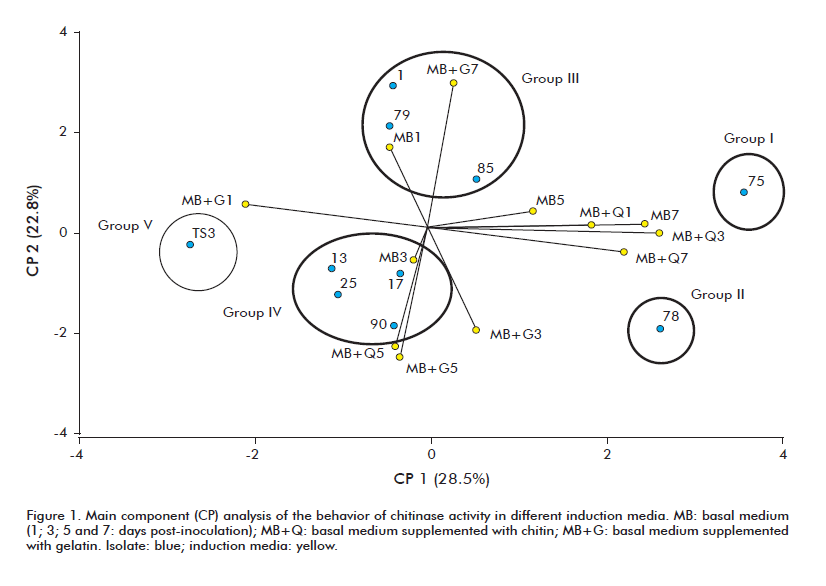
<body><![CDATA[<P   ></P >       <P   > </P >       <P   ><font size="2" face="Verdana, Arial, Helvetica, sans-serif">A one-way ANOVA was      used to determine the existence of statistically significant differences between      strains regarding the specific activity of chitinases and glucanases in each      culture medium. Means were compared with Duncan&rsquo;s multiple ranks test      in cases where there were differences (p &lt; 0.05)<I>. </I>In order to identify      culture media and culture times favoring the induction of chitinase and glucanase      activities, a main components analysis was performed with the InfoStat version      2009 statistical software package [21]. </font></P >       <P   >&nbsp;</P >       <P   ><font size="3" face="Verdana, Arial, Helvetica, sans-serif"><b>RESULTS AND DISCUSSION      </b> </font></P >   <FONT size="+1">        <P   ><font size="2" face="Verdana, Arial, Helvetica, sans-serif">Species of the <I>Trichoderma      </I>genus are frequently used as biological control agents due to their ability      to parasitize a wide variety of phytopathogenic fungi [14]. Both chitinases      and glucanases are involved in the development of this parasitic association      [22]. Although <I>T. asperellum </I>is one of the less studied species of      the genus [23], it has served however as the source from which a number of      endochitinases and &beta;-1.3-glucanases have been purifi ed; in addition,      the patterns of expression of these enzymes, depending on the carbon source      of the culture medium, have also been studied [23-25]. This research has demonstrated      that enzyme expression is infl uenced by the type of strain, culture conditions      and the substrate employed in the production of cell wall-degrading enzymes      [26, 27]. </font></P >   <FONT size="+1">        <P   ><font size="2" face="Verdana, Arial, Helvetica, sans-serif">The strains studied      in the present work were assigned, based on the level of expression of their      chitinases, to five different groups: I (75), II (78), III (1, 79, 85), IV      (13, 17, 25, 90) and V (TS3) (<a href="/img/revistas/bta/v29n1/f0102112.gif">Figure 1</a>). Strain      75 exhibited the highest chitinase activity. Liquid media maximizing this      expression were basal medium, at days 5 and 7 post-inoculation, and basal      medium supplemented with chitin, at day 1 post-inoculation. </font></P >       
<P   ><font size="2" face="Verdana, Arial, Helvetica, sans-serif">By day 7 post-inoculation,      the basal medium supplemented with chitin induced high levels of chitinase      in strain 78. Strain TS3 exhibited only low levels of chitinase activity,      which peaked at day 1 post-inoculation in basal medium supplemented with gelatin.      The strains from groups III and IV exhibited intermediate levels of chitinase      activity. Chitinase activity was favored, in the fi rst group, by basal medium      (at day 1) and basal medium supplemented with gelatin (at day 7). In the second      group, the expression of this enzyme was favored by basal medium (at day 3)      and basal medium supplemented either with chitin or gelatin (at day 5). </font></P >       <P   ><font size="2" face="Verdana, Arial, Helvetica, sans-serif">Based on observed      glucanase levels, the analyzed strains cluster into four groups (<a href="/img/revistas/bta/v29n1/f0202112.gif">Figure      2</a>). In this occasion group I was comprised of strains 1, 13, 17 and 25;      group II was comprised of strain 75; group III was comprised of strains 79,      85, 90 and TS3, and group IV included only strain 78. </font></P >       
<P   ><font size="2" face="Verdana, Arial, Helvetica, sans-serif">Basal medium alone      (at days 1 and 5) or supplemented with gelatin (at day 1) induced the highest      levels of enzyme activity in group I, whereas group II was favored by basal      medium (at day 7) and basal medium supplemented with gelatin (at day 3). The      remaining strains exhibited low enzyme activities throughout the experimental      period. </font></P >       ]]></body>
<body><![CDATA[<P   ><font size="2" face="Verdana, Arial, Helvetica, sans-serif">The medium with gelatin      induced the highest &beta;-1.3-glucanase activity in strains 1, 13, 17, 25      and 75 of <I>T. asperellum</I>. Marcello <I>et al. </I>demonstrated that <I>T.      asperellum </I>produces high levels of &beta;-1.3-glucanase when grown in      media containing starch and cell walls from <I>R. solani </I>[23]. </font></P >       <P   ><font size="2" face="Verdana, Arial, Helvetica, sans-serif">The characterization      of both enzymes (chitinases and glucanases) is a useful tool for the selection,      together with other parameters, of the best isolates for biological pest control      purposes. </font></P >       <P   ><font size="2" face="Verdana, Arial, Helvetica, sans-serif">Strain 75 of <I>T.      asperellum </I>exhibited the highest levels of chitinase and glucanase activity      (<a href="/img/revistas/bta/v29n1/f0302112.gif">Figure 3</a>), followed by strain 78 and the group      formed by strains 1, 13, 17 and 25. In all cases, strain TS3 had the lowest      levels of enzyme activity. </font></P >       
<P   ><font size="2" face="Verdana, Arial, Helvetica, sans-serif">Strains 17, 75 and      78 have previously been used with success for the biological control of <I>S.      rolfsii </I>and <I>R. solani </I>[15]. This result is consistent with the      high levels of chitinase and glucanase secretion exhibited by these strains      during the present study. </font></P >       <P   ><font size="2" face="Verdana, Arial, Helvetica, sans-serif">The levels of chitinase      and &beta;-1.3-glucanase in culture supernatants of strain TS3, a strain used      for the control of phytoparasitic nematodes of the <I>Meloidogyne </I>genus      [28], were low under all culture conditions. It should be borne in mind, however,      that mycoparasitism involves not only chitinases and &beta;-1.3-glucanases,      but also &beta;-1.6-glucanases, &alpha;-1.3-glucanases and proteases, which      have not been evaluated in the present study and might play an important role      in the antagonism of this strain towards phytopathogens [5, 29]. An example      of the latter possibility has been the development of <I>Beauveria bassiana      </I>(Balsamo) Vuillemin transformants expressing a protease-chitinase fusion      CDEP1:Bbchit1), which exhibit much faster penetration kinetics towards insect      cuticles [30]. Strain TS3 might also be simply outcompeting pathogens for      physical space and nutrients, secreting inhibitor compounds [4] or inducing      resistance [6]; these are all well-documented mechanisms by which <I>Trichoderma      </I>antagonizes phytopathogens. Dennis and Webster [31], as well as Elad and      Henis [32], have demonstrated the production of antibiotic and lytic intracellular      enzymes in a number of <I>Trichoderma </I>spp. strains, which were shown to      participate and be responsible for the antagonizing activity of the fungus.      <I>Trichoderma harzianum </I>antagonized with <I>Meloidogyne incognita </I>eggs      through the production of anti-nematode compounds that limited the penetration      of this pathogen through the roots, either affecting directly the nematodes,      or simply making the roots less attractive. </font></P >       <P   ><font size="2" face="Verdana, Arial, Helvetica, sans-serif">The basal medium      was a very effective inducer of the enzyme activities assayed in the present      work. Strains 75 and 78 showed the greatest potential for future application      as biofungicidal products. </font></P >       <P   >&nbsp;</P >       <P   ><font size="3" face="Verdana, Arial, Helvetica, sans-serif"><b>REFERENCES </b></font></P >       <!-- ref --><P   align="justify" ><font size="2" face="Verdana, Arial, Helvetica, sans-serif">1. Jayalakshmi SK,      Raju S, Usha Rani S, Benagi VI, Sreeramulu K. Trichoderma harzianum L. as      a potential source for lytic enzymes and elicitor of defense responses in      chickpea (Cicer arietinum L.) against wilt disease caused by Fusarium oxysporum      f. sp. ciceri. Aust J Crop Sci. 2009;3(1):44-52.     </font></P >   <FONT size="+1">        ]]></body>
<body><![CDATA[<!-- ref --><P   align="justify" ><font size="2" face="Verdana, Arial, Helvetica, sans-serif">2. Tondje P, Roberts      DP, Bon M, Widner T, Samuels GJ, Ismaiel AA, et al. Isolation and identification      of mycoparasitic isolates of Trichoderma asperellum with potential for suppression      of black pod disease of cacao in Cameroon. Biol Control. 2007;43:202-12.     </font></P >       <P   align="justify" ><font size="2" face="Verdana, Arial, Helvetica, sans-serif">3. K&uuml;&ccedil;&uuml;k      &Ccedil;, K&#305;van&ccedil; M. Mycoparasitism in the biological control of      Gibberella zeae and Aspergillus ustus by Trichoderma harzianum strains. J      Agric Technol. 2008; 4(2):49-55. </font></P >       <!-- ref --><P   align="justify" ><font size="2" face="Verdana, Arial, Helvetica, sans-serif">4. Zeilinger S, Omann      M. Trichoderma biocontrol: signal transduction pathways involved in host sensing      and mycoparasitism. Gene Regul Syst Bio. 2007;1:227-34.     </font></P >       <!-- ref --><P   align="justify" ><font size="2" face="Verdana, Arial, Helvetica, sans-serif">5. Verma M, Brar      SK, Tyagi RD, Surampalli RY, Val&eacute;ro JR. Antagonistic fungi, Trichoderma      spp.: Panoply of biological control. Biochem Eng J. 2007;37(1):1-20.     </font></P >       <!-- ref --><P   align="justify" ><font size="2" face="Verdana, Arial, Helvetica, sans-serif">6. Kapulnik Y, Chet      I. Induction and accumulation of PR proteins activity during early stages      of root colonization by the mycoparasite T. harzianum strain T-203. Plant      Physiol Biochem. 2000;38:863-73.     </font></P >       <!-- ref --><P   align="justify" ><font size="2" face="Verdana, Arial, Helvetica, sans-serif">7. Chet I. Trichoderma-application      and mode of action, and potential as biocontrol agent of soilborne plant pathogenic      fungi. In: Chet I, editor. Innovative approaches to plant disease control.      New York: John Wiley; 1987. p. 137-60.     </font></P >       <!-- ref --><P   align="justify" ><font size="2" face="Verdana, Arial, Helvetica, sans-serif">8. Bartnicki-Garcia      S. Fundamental aspects of hyphal morphogenesis. In: Ashworth JM, Smith JE,      editors. Microbial differentiation. Cambridge: Cambridge University Press;      1973. p. 245-68.     </font></P >       <!-- ref --><P   align="justify" ><font size="2" face="Verdana, Arial, Helvetica, sans-serif">9. Sharma P, Pandey      R. Biological control of root-knot nematode; Meloidogyne incognita in the      medicinal plant; Withania somn&iacute;fera and the effect of biocontrol agents      on plant growth. Afr J Agric Res. 2009;4(6):564-7.     </font></P >       <!-- ref --><P   align="justify" ><font size="2" face="Verdana, Arial, Helvetica, sans-serif">10. Shakeri J, Foster      HA. Proteolytic activity and antibiotic production by Trichoderma harzianum      in relation to pathogenicity to insects. Enzyme Microb Technol. 2007;40(4):961-8.          </font></P >       <!-- ref --><P   align="justify" ><font size="2" face="Verdana, Arial, Helvetica, sans-serif">11. Goswami J, Pandey      RK, Tewari JP, Goswami BK. Management of root knot nematode on tomato through      application of fungal antagonists, Acremonium strictum and Trichoderma harzianum.      J Environ Sci Health. Part B: Pestic, Food Contam, Agric Wastes. 2008;43(3):237-40.          </font></P >       <!-- ref --><P   align="justify" ><font size="2" face="Verdana, Arial, Helvetica, sans-serif">12. Bokhari F. Efficacy      of some Trichoderma species in the control of Rotylenchulus reniformis and      Meloidogyne javanica. Arch Phytopathol Plant Prot. 2009;42(4): 361-9.     </font></P >       <!-- ref --><P   align="justify" ><font size="2" face="Verdana, Arial, Helvetica, sans-serif">13. Haggag WM, Amin      AW. Efficiency of Trichoderma species in control of Fusarium-rot, root knot      and reniform nematodes disease complex on sunflower. Pakistan J Biol Sci.      2001;4(3):314-8.     </font></P >       <!-- ref --><P   align="justify" ><font size="2" face="Verdana, Arial, Helvetica, sans-serif">14. Jin RD, Suh JW,      Park RD, Kim YW, Krishnan HB, Kim KY. Effect of chitin compost and broth on      biological control of Meloidogyne incognita on tomato (Lycopersicon esculentum      Mill.). Nematology. 2005;7:125-32.     </font></P >       <!-- ref --><P   align="justify" ><font size="2" face="Verdana, Arial, Helvetica, sans-serif">15. Mart&iacute;nez      B, Infante D, Reyes Y. About to identification of some Trichoderma isolates      reported in Revista de Protecci&oacute;n Vegetal. Rev Protecci&oacute;n Veg.      2010;25(2):135.     </font></P >       <!-- ref --><P   align="justify" ><font size="2" face="Verdana, Arial, Helvetica, sans-serif">16. Mart&iacute;nez      B, Reyes Y, Infante D, Gonz&aacute;lez E, Ba&ntilde;os H, Cruz A. Selecci&oacute;n      de aislamientos de Trichoderma spp. candidatos a biofungicidas para el control      de Rhizoctonia sp. en arroz. Rev Protecci&oacute;n Veg. 2008;23(2):118-25.          </font></P >       <!-- ref --><P   align="justify" ><font size="2" face="Verdana, Arial, Helvetica, sans-serif">17. Peteira B, Est&eacute;vez      I, Montes de Oca N, Hidalgo-D&iacute;az L. Estabilidad de la cepa IMI SD 187      de Pochonia chlamydosporia var. catenulata en medio s&oacute;lido. Rev Protecci&oacute;n      Veg. 2007;22(2):124-7.     </font></P >       <!-- ref --><P   align="justify" ><font size="2" face="Verdana, Arial, Helvetica, sans-serif">18. Bradford MM.      A rapid and sensitive method for the quantitation of microgram quantities      of protein utilizing the principle of protein-dye binding. Anal Biochem. 1976;72:248-54.          </font></P >       <!-- ref --><P   align="justify" ><font size="2" face="Verdana, Arial, Helvetica, sans-serif">19. Boller T, Gehri      A, Mauch F, V&ouml;geli U. Chitinase in bean leaves: induction by ethylene,      purification, properties and possible function. Planta. 1983;157:22-31.     </font></P >       <!-- ref --><P   align="justify" ><font size="2" face="Verdana, Arial, Helvetica, sans-serif">20. Zheng Y, Wozniak      CA. Adaptation of a beta-1,3-glucanase assay to microplate format. Biotechniques.      1997;22(5):922-6.     </font></P >       <!-- ref --><P   align="justify" ><font size="2" face="Verdana, Arial, Helvetica, sans-serif">21. Di Rienzo JA,      Balzarini M, Gonzalez L, Casanoves F, Tablada M, Robledo C. InfoStat. Software      estad&iacute;stico [Internet]. Versi&oacute;n 2009. C&oacute;rdoba: Universidad      Nacional de C&oacute;rdoba, Argentina; 2009.     </font></P >       <!-- ref --><P   align="justify" ><font size="2" face="Verdana, Arial, Helvetica, sans-serif">22. Limon MC, Pintor-Toro      JA, Benitez T. Increased antifungal activity of Trichoderma harzianum transformants      that overexpress a 33-kDa chitinase. Phytopathology. 1999;89(3):254-61.     </font></P >       <!-- ref --><P   align="justify" ><font size="2" face="Verdana, Arial, Helvetica, sans-serif">23. Marcello CM,      Steindorff AS, da Silva SP, Silva Rdo N, Mendes Bataus LA, Ulhoa CJ. Expression      analysis of the exo-beta-1,3-glucanase from the mycoparasitic fungus Trichoderma      asperellum. Microbiol Res. 2010;165(1):75-81.     </font></P >       <!-- ref --><P   align="justify" ><font size="2" face="Verdana, Arial, Helvetica, sans-serif">24. Viterbo A, Montero      M, Ramot O, Friesem D, Monte E, Llobell A, et al. Expression regulation of      the endochitinase chit36 from Trichoderma asperellum (T. harzianum T-203).      Curr Genet. 2002;42(2):114-22.     </font></P >       <!-- ref --><P   align="justify" ><font size="2" face="Verdana, Arial, Helvetica, sans-serif">25. Bara MT, Lima      AL, Ulhoa CJ. Purification and characterization of an exo-beta-1,3-glucanase      produced by Trichoderma asperellum. FEMS Microbiol Lett. 2003;219(1):81-5.          </font></P >       <!-- ref --><P   align="justify" ><font size="2" face="Verdana, Arial, Helvetica, sans-serif">26. Howell CR. Mechanisms      employed by Trichoderma species in the biological control of plant diseases:      the history and evolution of current concepts. Plant Dis. 2003;87(1):4-10.          </font></P >       <!-- ref --><P   align="justify" ><font size="2" face="Verdana, Arial, Helvetica, sans-serif">27. Harman GE, Howell      CR, Viterbo A, Chet I, Lorito M. Trichoderma species--opportunistic, avirulent      plant symbionts. Nat Rev Microbiol. 2004;2(1):43-56.     </font></P >       <!-- ref --><P   align="justify" ><font size="2" face="Verdana, Arial, Helvetica, sans-serif">28. Mui&ntilde;o      BL, Botta E, P&eacute;rez E, Moreno D, Fern&aacute;ndez E. Uso de Trichoderma      como alternativa al bromuro de metilo en los cultivos protegidos, flores y      ornamentales en Cuba. Fitosanidad. 2006;10(2):179-80.     </font></P >       <!-- ref --><P   align="justify" ><font size="2" face="Verdana, Arial, Helvetica, sans-serif">29. Radjacommare      R, Venkatesan S, Samiyappan R. Biological control of phytopathogenic fungi      of vanilla through lytic action of Trichoderma species and Pseudomonas fluorescens.      Arch Phytopathol Plant Prot. 2010;43(1):1-17.     </font></P >       <!-- ref --><P   align="justify" ><font size="2" face="Verdana, Arial, Helvetica, sans-serif">30. Fang W, Feng      J, Fan Y, Zhang Y, Bidochka MJ, Leger RJ, et al. Expressing a fusion protein      with protease and chitinase activities increases the virulence of the insect      pathogen Beauveria bassiana. J Invertebr Pathol. 2009;102(2):155-9.     </font></P >       <!-- ref --><P   align="justify" ><font size="2" face="Verdana, Arial, Helvetica, sans-serif">31. Dennis C, Webster      J. Antagonistic properties of species groups of Trichoderma. II. Production      of Volatile antibiotics. Trans Br Mycol Soc. 1971;57:41-8.     </font></P >       <!-- ref --><P   ><font size="2" face="Verdana, Arial, Helvetica, sans-serif">32. Elad Y, Chet      I, Henis Y. Degradation of plant pathogenic fungi by Trichoderma harzianum.      Can J Microbiol. 1982;28(7):719-25.     </font></P >       <P   > </P >       <P   >&nbsp;</P >       <P   ><font size="2" face="Verdana, Arial, Helvetica, sans-serif">Received in June,      2011.    <br>     Accepted for publication in November, 2011.</font></P >       <P   >&nbsp;</P >       <P   ><font size="2" face="Verdana, Arial, Helvetica, sans-serif">Ivonne Gonz&aacute;lez.      Direcci&oacute;n Protecci&oacute;n de Plantas, Centro Nacional de Sanidad      Agropecuaria, CENSA. AP 10, San Jos&eacute; de las Lajas, Mayabeque, Cuba.      E-mail: <a href="mailto:marquetti@censa.edu.cu"> <U><U><FONT color="#0000FF">marquetti@censa.edu.cu</font></U></U></A><FONT color="#0000FF"><FONT color="#000000">.      </font></font></font></P >   <FONT size="+1"></font></font></font></font></font></font></font></font></font></font></font></font></font></font></font></font></font></font></font></font></font></font></font></font></font></DIV >      ]]></body><back>
<ref-list>
<ref id="B1">
<label>1</label><nlm-citation citation-type="journal">
<person-group person-group-type="author">
<name>
<surname><![CDATA[Jayalakshmi]]></surname>
<given-names><![CDATA[SK]]></given-names>
</name>
<name>
<surname><![CDATA[Raju]]></surname>
<given-names><![CDATA[S]]></given-names>
</name>
<name>
<surname><![CDATA[Usha Rani]]></surname>
<given-names><![CDATA[S]]></given-names>
</name>
<name>
<surname><![CDATA[Benagi]]></surname>
<given-names><![CDATA[VI]]></given-names>
</name>
<name>
<surname><![CDATA[Sreeramulu]]></surname>
<given-names><![CDATA[K]]></given-names>
</name>
</person-group>
<article-title xml:lang="en"><![CDATA[Trichoderma harzianum L. as a potential source for lytic enzymes and elicitor of defense responses in chickpea (Cicer arietinum L.) against wilt disease caused by Fusarium oxysporum f. sp. ciceri]]></article-title>
<source><![CDATA[Aust J Crop Sci]]></source>
<year>2009</year>
<volume>3</volume>
<numero>1</numero>
<issue>1</issue>
<page-range>44-52</page-range></nlm-citation>
</ref>
<ref id="B2">
<label>2</label><nlm-citation citation-type="journal">
<person-group person-group-type="author">
<name>
<surname><![CDATA[Tondje]]></surname>
<given-names><![CDATA[P]]></given-names>
</name>
<name>
<surname><![CDATA[Roberts]]></surname>
<given-names><![CDATA[DP]]></given-names>
</name>
<name>
<surname><![CDATA[Bon]]></surname>
<given-names><![CDATA[M]]></given-names>
</name>
<name>
<surname><![CDATA[Widner]]></surname>
<given-names><![CDATA[T]]></given-names>
</name>
<name>
<surname><![CDATA[Samuels]]></surname>
<given-names><![CDATA[GJ]]></given-names>
</name>
<name>
<surname><![CDATA[Ismaiel]]></surname>
<given-names><![CDATA[AA]]></given-names>
</name>
</person-group>
<article-title xml:lang="en"><![CDATA[Isolation and identification of mycoparasitic isolates of Trichoderma asperellum with potential for suppression of black pod disease of cacao in Cameroon]]></article-title>
<source><![CDATA[Biol Control]]></source>
<year>2007</year>
<volume>43</volume>
<page-range>202-12</page-range></nlm-citation>
</ref>
<ref id="B3">
<label>3</label><nlm-citation citation-type="journal">
<person-group person-group-type="author">
<name>
<surname><![CDATA[Küçük]]></surname>
<given-names><![CDATA[Ç]]></given-names>
</name>
<name>
<surname><![CDATA[Kivanç]]></surname>
<given-names><![CDATA[M]]></given-names>
</name>
</person-group>
<article-title xml:lang="en"><![CDATA[Mycoparasitism in the biological control of Gibberella zeae and Aspergillus ustus by Trichoderma harzianum strains]]></article-title>
<source><![CDATA[J Agric Technol]]></source>
<year>2008</year>
<volume>4</volume>
<numero>2</numero>
<issue>2</issue>
<page-range>49-55</page-range></nlm-citation>
</ref>
<ref id="B4">
<label>4</label><nlm-citation citation-type="journal">
<person-group person-group-type="author">
<name>
<surname><![CDATA[Zeilinger]]></surname>
<given-names><![CDATA[S]]></given-names>
</name>
<name>
<surname><![CDATA[Omann]]></surname>
<given-names><![CDATA[M]]></given-names>
</name>
</person-group>
<article-title xml:lang="en"><![CDATA[Trichoderma biocontrol: signal transduction pathways involved in host sensing and mycoparasitism]]></article-title>
<source><![CDATA[Gene Regul Syst Bio]]></source>
<year>2007</year>
<volume>1</volume>
<page-range>227-34</page-range></nlm-citation>
</ref>
<ref id="B5">
<label>5</label><nlm-citation citation-type="journal">
<person-group person-group-type="author">
<name>
<surname><![CDATA[Verma]]></surname>
<given-names><![CDATA[M]]></given-names>
</name>
<name>
<surname><![CDATA[Brar]]></surname>
<given-names><![CDATA[SK]]></given-names>
</name>
<name>
<surname><![CDATA[Tyagi]]></surname>
<given-names><![CDATA[RD]]></given-names>
</name>
<name>
<surname><![CDATA[Surampalli]]></surname>
<given-names><![CDATA[RY]]></given-names>
</name>
<name>
<surname><![CDATA[Valéro]]></surname>
<given-names><![CDATA[JR]]></given-names>
</name>
</person-group>
<article-title xml:lang="en"><![CDATA[Antagonistic fungi, Trichoderma spp.: Panoply of biological control]]></article-title>
<source><![CDATA[Biochem Eng J]]></source>
<year>2007</year>
<volume>37</volume>
<numero>1</numero>
<issue>1</issue>
<page-range>1-20</page-range></nlm-citation>
</ref>
<ref id="B6">
<label>6</label><nlm-citation citation-type="journal">
<person-group person-group-type="author">
<name>
<surname><![CDATA[Kapulnik]]></surname>
<given-names><![CDATA[Y]]></given-names>
</name>
<name>
<surname><![CDATA[Chet]]></surname>
<given-names><![CDATA[I]]></given-names>
</name>
</person-group>
<article-title xml:lang="en"><![CDATA[Induction and accumulation of PR proteins activity during early stages of root colonization by the mycoparasite T. harzianum strain T-203]]></article-title>
<source><![CDATA[Plant Physiol Biochem]]></source>
<year>2000</year>
<volume>38</volume>
<page-range>863-73</page-range></nlm-citation>
</ref>
<ref id="B7">
<label>7</label><nlm-citation citation-type="book">
<person-group person-group-type="author">
<name>
<surname><![CDATA[Chet]]></surname>
<given-names><![CDATA[I]]></given-names>
</name>
</person-group>
<article-title xml:lang="en"><![CDATA[Trichoderma-application and mode of action, and potential as biocontrol agent of soilborne plant pathogenic fungi]]></article-title>
<person-group person-group-type="editor">
<name>
<surname><![CDATA[Chet]]></surname>
<given-names><![CDATA[I]]></given-names>
</name>
</person-group>
<source><![CDATA[Innovative approaches to plant disease control]]></source>
<year>1987</year>
<page-range>137-60</page-range><publisher-loc><![CDATA[New York ]]></publisher-loc>
<publisher-name><![CDATA[John Wiley]]></publisher-name>
</nlm-citation>
</ref>
<ref id="B8">
<label>8</label><nlm-citation citation-type="book">
<person-group person-group-type="author">
<name>
<surname><![CDATA[Bartnicki-Garcia]]></surname>
<given-names><![CDATA[S]]></given-names>
</name>
</person-group>
<article-title xml:lang="en"><![CDATA[Fundamental aspects of hyphal morphogenesis]]></article-title>
<person-group person-group-type="editor">
<name>
<surname><![CDATA[Ashworth]]></surname>
<given-names><![CDATA[JM]]></given-names>
</name>
<name>
<surname><![CDATA[Smith]]></surname>
<given-names><![CDATA[JE]]></given-names>
</name>
</person-group>
<source><![CDATA[Microbial differentiation]]></source>
<year>1973</year>
<page-range>245-68</page-range><publisher-loc><![CDATA[Cambridge ]]></publisher-loc>
<publisher-name><![CDATA[Cambridge University Press]]></publisher-name>
</nlm-citation>
</ref>
<ref id="B9">
<label>9</label><nlm-citation citation-type="journal">
<person-group person-group-type="author">
<name>
<surname><![CDATA[Sharma]]></surname>
<given-names><![CDATA[P]]></given-names>
</name>
<name>
<surname><![CDATA[Pandey]]></surname>
<given-names><![CDATA[R]]></given-names>
</name>
</person-group>
<article-title xml:lang="en"><![CDATA[Biological control of root-knot nematode: Meloidogyne incognita in the medicinal plant; Withania somnífera and the effect of biocontrol agents on plant growth]]></article-title>
<source><![CDATA[Afr J Agric Res]]></source>
<year>2009</year>
<volume>4</volume>
<numero>6</numero>
<issue>6</issue>
<page-range>564-7</page-range></nlm-citation>
</ref>
<ref id="B10">
<label>10</label><nlm-citation citation-type="journal">
<person-group person-group-type="author">
<name>
<surname><![CDATA[Shakeri]]></surname>
<given-names><![CDATA[J]]></given-names>
</name>
<name>
<surname><![CDATA[Foster]]></surname>
<given-names><![CDATA[HA]]></given-names>
</name>
</person-group>
<article-title xml:lang="en"><![CDATA[Proteolytic activity and antibiotic production by Trichoderma harzianum in relation to pathogenicity to insects]]></article-title>
<source><![CDATA[Enzyme Microb Technol]]></source>
<year>2007</year>
<volume>40</volume>
<numero>4</numero>
<issue>4</issue>
<page-range>961-8</page-range></nlm-citation>
</ref>
<ref id="B11">
<label>11</label><nlm-citation citation-type="journal">
<person-group person-group-type="author">
<name>
<surname><![CDATA[Goswami]]></surname>
<given-names><![CDATA[J]]></given-names>
</name>
<name>
<surname><![CDATA[Pandey]]></surname>
<given-names><![CDATA[RK]]></given-names>
</name>
<name>
<surname><![CDATA[Tewari]]></surname>
<given-names><![CDATA[JP]]></given-names>
</name>
<name>
<surname><![CDATA[Goswami]]></surname>
<given-names><![CDATA[BK]]></given-names>
</name>
</person-group>
<article-title xml:lang="en"><![CDATA[Management of root knot nematode on tomato through application of fungal antagonists, Acremonium strictum and Trichoderma harzianum]]></article-title>
<source><![CDATA[J Environ Sci Health Part B: Pestic, Food Contam, Agric Wastes]]></source>
<year>2008</year>
<volume>43</volume>
<numero>3</numero>
<issue>3</issue>
<page-range>237-40</page-range></nlm-citation>
</ref>
<ref id="B12">
<label>12</label><nlm-citation citation-type="journal">
<person-group person-group-type="author">
<name>
<surname><![CDATA[Bokhari]]></surname>
<given-names><![CDATA[F]]></given-names>
</name>
</person-group>
<article-title xml:lang="en"><![CDATA[Efficacy of some Trichoderma species in the control of Rotylenchulus reniformis and Meloidogyne javanica]]></article-title>
<source><![CDATA[Arch Phytopathol Plant Prot]]></source>
<year>2009</year>
<volume>42</volume>
<numero>4</numero>
<issue>4</issue>
<page-range>361-9</page-range></nlm-citation>
</ref>
<ref id="B13">
<label>13</label><nlm-citation citation-type="journal">
<person-group person-group-type="author">
<name>
<surname><![CDATA[Haggag]]></surname>
<given-names><![CDATA[WM]]></given-names>
</name>
<name>
<surname><![CDATA[Amin]]></surname>
<given-names><![CDATA[AW]]></given-names>
</name>
</person-group>
<article-title xml:lang="en"><![CDATA[Efficiency of Trichoderma species in control of Fusarium-rot, root knot and reniform nematodes disease complex on sunflower]]></article-title>
<source><![CDATA[Pakistan J Biol Sci]]></source>
<year>2001</year>
<volume>4</volume>
<numero>3</numero>
<issue>3</issue>
<page-range>314-8</page-range></nlm-citation>
</ref>
<ref id="B14">
<label>14</label><nlm-citation citation-type="journal">
<person-group person-group-type="author">
<name>
<surname><![CDATA[Jin]]></surname>
<given-names><![CDATA[RD]]></given-names>
</name>
<name>
<surname><![CDATA[Suh]]></surname>
<given-names><![CDATA[JW]]></given-names>
</name>
<name>
<surname><![CDATA[Park]]></surname>
<given-names><![CDATA[RD]]></given-names>
</name>
<name>
<surname><![CDATA[Kim]]></surname>
<given-names><![CDATA[YW]]></given-names>
</name>
<name>
<surname><![CDATA[Krishnan]]></surname>
<given-names><![CDATA[HB]]></given-names>
</name>
<name>
<surname><![CDATA[Kim]]></surname>
<given-names><![CDATA[KY]]></given-names>
</name>
</person-group>
<article-title xml:lang="en"><![CDATA[Effect of chitin compost and broth on biological control of Meloidogyne incognita on tomato (Lycopersicon esculentum Mill.)]]></article-title>
<source><![CDATA[Nematology]]></source>
<year>2005</year>
<volume>7</volume>
<page-range>125-32</page-range></nlm-citation>
</ref>
<ref id="B15">
<label>15</label><nlm-citation citation-type="journal">
<person-group person-group-type="author">
<name>
<surname><![CDATA[Martínez]]></surname>
<given-names><![CDATA[B]]></given-names>
</name>
<name>
<surname><![CDATA[Infante]]></surname>
<given-names><![CDATA[D]]></given-names>
</name>
<name>
<surname><![CDATA[Reyes]]></surname>
<given-names><![CDATA[Y]]></given-names>
</name>
</person-group>
<article-title xml:lang="en"><![CDATA[About to identification of some Trichoderma isolates reported in Revista de Protección Vegetal]]></article-title>
<source><![CDATA[Rev Protección Veg]]></source>
<year>2010</year>
<volume>25</volume>
<numero>2</numero>
<issue>2</issue>
<page-range>135</page-range></nlm-citation>
</ref>
<ref id="B16">
<label>16</label><nlm-citation citation-type="journal">
<person-group person-group-type="author">
<name>
<surname><![CDATA[Martínez]]></surname>
<given-names><![CDATA[B]]></given-names>
</name>
<name>
<surname><![CDATA[Reyes]]></surname>
<given-names><![CDATA[Y]]></given-names>
</name>
<name>
<surname><![CDATA[Infante]]></surname>
<given-names><![CDATA[D]]></given-names>
</name>
<name>
<surname><![CDATA[González]]></surname>
<given-names><![CDATA[E]]></given-names>
</name>
<name>
<surname><![CDATA[Baños]]></surname>
<given-names><![CDATA[H]]></given-names>
</name>
<name>
<surname><![CDATA[Cruz]]></surname>
<given-names><![CDATA[A]]></given-names>
</name>
</person-group>
<article-title xml:lang="es"><![CDATA[Selección de aislamientos de Trichoderma spp. candidatos a biofungicidas para el control de Rhizoctonia sp. en arroz]]></article-title>
<source><![CDATA[Rev Protección Veg]]></source>
<year>2008</year>
<volume>23</volume>
<numero>2</numero>
<issue>2</issue>
<page-range>118-25</page-range></nlm-citation>
</ref>
<ref id="B17">
<label>17</label><nlm-citation citation-type="journal">
<person-group person-group-type="author">
<name>
<surname><![CDATA[Peteira]]></surname>
<given-names><![CDATA[B]]></given-names>
</name>
<name>
<surname><![CDATA[Estévez]]></surname>
<given-names><![CDATA[I]]></given-names>
</name>
<name>
<surname><![CDATA[Montes de Oca]]></surname>
<given-names><![CDATA[N]]></given-names>
</name>
<name>
<surname><![CDATA[Hidalgo-Díaz]]></surname>
<given-names><![CDATA[L]]></given-names>
</name>
</person-group>
<article-title xml:lang="es"><![CDATA[Estabilidad de la cepa IMI SD 187 de Pochonia chlamydosporia var. catenulata en medio sólido]]></article-title>
<source><![CDATA[Rev Protección Veg]]></source>
<year>2007</year>
<volume>22</volume>
<numero>2</numero>
<issue>2</issue>
<page-range>124-7</page-range></nlm-citation>
</ref>
<ref id="B18">
<label>18</label><nlm-citation citation-type="journal">
<person-group person-group-type="author">
<name>
<surname><![CDATA[Bradford]]></surname>
<given-names><![CDATA[MM]]></given-names>
</name>
</person-group>
<article-title xml:lang="en"><![CDATA[A rapid and sensitive method for the quantitation of microgram quantities of protein utilizing the principle of protein-dye binding]]></article-title>
<source><![CDATA[Anal Biochem]]></source>
<year>1976</year>
<volume>72</volume>
<page-range>248-54</page-range></nlm-citation>
</ref>
<ref id="B19">
<label>19</label><nlm-citation citation-type="journal">
<person-group person-group-type="author">
<name>
<surname><![CDATA[Boller]]></surname>
<given-names><![CDATA[T]]></given-names>
</name>
<name>
<surname><![CDATA[Gehri]]></surname>
<given-names><![CDATA[A]]></given-names>
</name>
<name>
<surname><![CDATA[Mauch]]></surname>
<given-names><![CDATA[F]]></given-names>
</name>
<name>
<surname><![CDATA[Vögeli]]></surname>
<given-names><![CDATA[U]]></given-names>
</name>
</person-group>
<article-title xml:lang="en"><![CDATA[Chitinase in bean leaves: induction by ethylene, purification, properties and possible function]]></article-title>
<source><![CDATA[Planta]]></source>
<year>1983</year>
<volume>157</volume>
<page-range>22-31</page-range></nlm-citation>
</ref>
<ref id="B20">
<label>20</label><nlm-citation citation-type="journal">
<person-group person-group-type="author">
<name>
<surname><![CDATA[Zheng]]></surname>
<given-names><![CDATA[Y]]></given-names>
</name>
<name>
<surname><![CDATA[Wozniak]]></surname>
<given-names><![CDATA[CA]]></given-names>
</name>
</person-group>
<article-title xml:lang="en"><![CDATA[Adaptation of a beta-1,3-glucanase assay to microplate format]]></article-title>
<source><![CDATA[Biotechniques]]></source>
<year>1997</year>
<volume>22</volume>
<numero>5</numero>
<issue>5</issue>
<page-range>922-6</page-range></nlm-citation>
</ref>
<ref id="B21">
<label>21</label><nlm-citation citation-type="book">
<person-group person-group-type="author">
<name>
<surname><![CDATA[Di Rienzo]]></surname>
<given-names><![CDATA[JA]]></given-names>
</name>
<name>
<surname><![CDATA[Balzarini]]></surname>
<given-names><![CDATA[M]]></given-names>
</name>
<name>
<surname><![CDATA[Gonzalez]]></surname>
<given-names><![CDATA[L]]></given-names>
</name>
<name>
<surname><![CDATA[Casanoves]]></surname>
<given-names><![CDATA[F]]></given-names>
</name>
<name>
<surname><![CDATA[Tablada]]></surname>
<given-names><![CDATA[M]]></given-names>
</name>
<name>
<surname><![CDATA[Robledo]]></surname>
<given-names><![CDATA[C]]></given-names>
</name>
</person-group>
<source><![CDATA[InfoStat: Software estadístico]]></source>
<year>2009</year>
<publisher-loc><![CDATA[Córdoba ]]></publisher-loc>
<publisher-name><![CDATA[Universidad Nacional de Córdoba]]></publisher-name>
</nlm-citation>
</ref>
<ref id="B22">
<label>22</label><nlm-citation citation-type="journal">
<person-group person-group-type="author">
<name>
<surname><![CDATA[Limon]]></surname>
<given-names><![CDATA[MC]]></given-names>
</name>
<name>
<surname><![CDATA[Pintor-Toro]]></surname>
<given-names><![CDATA[JA]]></given-names>
</name>
<name>
<surname><![CDATA[Benitez]]></surname>
<given-names><![CDATA[T]]></given-names>
</name>
</person-group>
<article-title xml:lang="en"><![CDATA[Increased antifungal activity of Trichoderma harzianum transformants that overexpress a 33-kDa chitinase]]></article-title>
<source><![CDATA[Phytopathology]]></source>
<year>1999</year>
<volume>89</volume>
<numero>3</numero>
<issue>3</issue>
<page-range>254-61</page-range></nlm-citation>
</ref>
<ref id="B23">
<label>23</label><nlm-citation citation-type="journal">
<person-group person-group-type="author">
<name>
<surname><![CDATA[Marcello]]></surname>
<given-names><![CDATA[CM]]></given-names>
</name>
<name>
<surname><![CDATA[Steindorff]]></surname>
<given-names><![CDATA[AS]]></given-names>
</name>
<name>
<surname><![CDATA[da Silva]]></surname>
<given-names><![CDATA[SP]]></given-names>
</name>
<name>
<surname><![CDATA[Silva Rdo]]></surname>
<given-names><![CDATA[N]]></given-names>
</name>
<name>
<surname><![CDATA[Mendes Bataus]]></surname>
<given-names><![CDATA[LA]]></given-names>
</name>
<name>
<surname><![CDATA[Ulhoa]]></surname>
<given-names><![CDATA[CJ]]></given-names>
</name>
</person-group>
<article-title xml:lang="en"><![CDATA[Expression analysis of the exo-beta-1,3-glucanase from the mycoparasitic fungus Trichoderma asperellum]]></article-title>
<source><![CDATA[Microbiol Res]]></source>
<year>2010</year>
<volume>165</volume>
<numero>1</numero>
<issue>1</issue>
<page-range>75-81</page-range></nlm-citation>
</ref>
<ref id="B24">
<label>24</label><nlm-citation citation-type="journal">
<person-group person-group-type="author">
<name>
<surname><![CDATA[Viterbo]]></surname>
<given-names><![CDATA[A]]></given-names>
</name>
<name>
<surname><![CDATA[Montero]]></surname>
<given-names><![CDATA[M]]></given-names>
</name>
<name>
<surname><![CDATA[Ramot]]></surname>
<given-names><![CDATA[O]]></given-names>
</name>
<name>
<surname><![CDATA[Friesem]]></surname>
<given-names><![CDATA[D]]></given-names>
</name>
<name>
<surname><![CDATA[Monte]]></surname>
<given-names><![CDATA[E]]></given-names>
</name>
<name>
<surname><![CDATA[Llobell]]></surname>
<given-names><![CDATA[A]]></given-names>
</name>
</person-group>
<article-title xml:lang="en"><![CDATA[Expression regulation of the endochitinase chit36 from Trichoderma asperellum (T. harzianum T-203)]]></article-title>
<source><![CDATA[Curr Genet]]></source>
<year>2002</year>
<volume>42</volume>
<numero>2</numero>
<issue>2</issue>
<page-range>114-22</page-range></nlm-citation>
</ref>
<ref id="B25">
<label>25</label><nlm-citation citation-type="journal">
<person-group person-group-type="author">
<name>
<surname><![CDATA[Bara]]></surname>
<given-names><![CDATA[MT]]></given-names>
</name>
<name>
<surname><![CDATA[Lima]]></surname>
<given-names><![CDATA[AL]]></given-names>
</name>
<name>
<surname><![CDATA[Ulhoa]]></surname>
<given-names><![CDATA[CJ]]></given-names>
</name>
</person-group>
<article-title xml:lang="en"><![CDATA[Purification and characterization of an exo-beta-1,3-glucanase produced by Trichoderma asperellum]]></article-title>
<source><![CDATA[FEMS Microbiol Lett]]></source>
<year>2003</year>
<volume>219</volume>
<numero>1</numero>
<issue>1</issue>
<page-range>81-5</page-range></nlm-citation>
</ref>
<ref id="B26">
<label>26</label><nlm-citation citation-type="journal">
<person-group person-group-type="author">
<name>
<surname><![CDATA[Howell]]></surname>
<given-names><![CDATA[CR]]></given-names>
</name>
</person-group>
<article-title xml:lang="en"><![CDATA[Mechanisms employed by Trichoderma species in the biological control of plant diseases: the history and evolution of current concepts]]></article-title>
<source><![CDATA[Plant Dis]]></source>
<year>2003</year>
<volume>87</volume>
<numero>1</numero>
<issue>1</issue>
<page-range>4-10</page-range></nlm-citation>
</ref>
<ref id="B27">
<label>27</label><nlm-citation citation-type="journal">
<person-group person-group-type="author">
<name>
<surname><![CDATA[Harman]]></surname>
<given-names><![CDATA[GE]]></given-names>
</name>
<name>
<surname><![CDATA[Howell]]></surname>
<given-names><![CDATA[CR]]></given-names>
</name>
<name>
<surname><![CDATA[Viterbo]]></surname>
<given-names><![CDATA[A]]></given-names>
</name>
<name>
<surname><![CDATA[Chet]]></surname>
<given-names><![CDATA[I]]></given-names>
</name>
<name>
<surname><![CDATA[Lorito]]></surname>
<given-names><![CDATA[M]]></given-names>
</name>
</person-group>
<article-title xml:lang="en"><![CDATA[Trichoderma species: opportunistic, avirulent plant symbionts]]></article-title>
<source><![CDATA[Nat Rev Microbiol]]></source>
<year>2004</year>
<volume>2</volume>
<numero>1</numero>
<issue>1</issue>
<page-range>43-56</page-range></nlm-citation>
</ref>
<ref id="B28">
<label>28</label><nlm-citation citation-type="journal">
<person-group person-group-type="author">
<name>
<surname><![CDATA[Muiño]]></surname>
<given-names><![CDATA[BL]]></given-names>
</name>
<name>
<surname><![CDATA[Botta]]></surname>
<given-names><![CDATA[E]]></given-names>
</name>
<name>
<surname><![CDATA[Pérez]]></surname>
<given-names><![CDATA[E]]></given-names>
</name>
<name>
<surname><![CDATA[Moreno]]></surname>
<given-names><![CDATA[D]]></given-names>
</name>
<name>
<surname><![CDATA[Fernández]]></surname>
<given-names><![CDATA[E]]></given-names>
</name>
</person-group>
<article-title xml:lang="es"><![CDATA[Uso de Trichoderma como alternativa al bromuro de metilo en los cultivos protegidos, flores y ornamentales en Cuba]]></article-title>
<source><![CDATA[Fitosanidad]]></source>
<year>2006</year>
<volume>10</volume>
<numero>2</numero>
<issue>2</issue>
<page-range>179-80</page-range></nlm-citation>
</ref>
<ref id="B29">
<label>29</label><nlm-citation citation-type="journal">
<person-group person-group-type="author">
<name>
<surname><![CDATA[Radjacommare]]></surname>
<given-names><![CDATA[R]]></given-names>
</name>
<name>
<surname><![CDATA[Venkatesan]]></surname>
<given-names><![CDATA[S]]></given-names>
</name>
<name>
<surname><![CDATA[Samiyappan]]></surname>
<given-names><![CDATA[R]]></given-names>
</name>
</person-group>
<article-title xml:lang="en"><![CDATA[Biological control of phytopathogenic fungi of vanilla through lytic action of Trichoderma species and Pseudomonas fluorescens]]></article-title>
<source><![CDATA[Arch Phytopathol Plant Prot]]></source>
<year>2010</year>
<volume>43</volume>
<numero>1</numero>
<issue>1</issue>
<page-range>1-17</page-range></nlm-citation>
</ref>
<ref id="B30">
<label>30</label><nlm-citation citation-type="journal">
<person-group person-group-type="author">
<name>
<surname><![CDATA[Fang]]></surname>
<given-names><![CDATA[W]]></given-names>
</name>
<name>
<surname><![CDATA[Feng]]></surname>
<given-names><![CDATA[J]]></given-names>
</name>
<name>
<surname><![CDATA[Fan]]></surname>
<given-names><![CDATA[Y]]></given-names>
</name>
<name>
<surname><![CDATA[Zhang]]></surname>
<given-names><![CDATA[Y]]></given-names>
</name>
<name>
<surname><![CDATA[Bidochka]]></surname>
<given-names><![CDATA[MJ]]></given-names>
</name>
<name>
<surname><![CDATA[Leger]]></surname>
<given-names><![CDATA[RJ]]></given-names>
</name>
</person-group>
<article-title xml:lang="en"><![CDATA[Expressing a fusion protein with protease and chitinase activities increases the virulence of the insect pathogen Beauveria bassiana]]></article-title>
<source><![CDATA[J Invertebr Pathol]]></source>
<year>2009</year>
<volume>102</volume>
<numero>2</numero>
<issue>2</issue>
<page-range>155-9</page-range></nlm-citation>
</ref>
<ref id="B31">
<label>31</label><nlm-citation citation-type="journal">
<person-group person-group-type="author">
<name>
<surname><![CDATA[Dennis]]></surname>
<given-names><![CDATA[C]]></given-names>
</name>
<name>
<surname><![CDATA[Webster]]></surname>
<given-names><![CDATA[J]]></given-names>
</name>
</person-group>
<article-title xml:lang="en"><![CDATA[Antagonistic properties of species groups of Trichoderma: II. Production of Volatile antibiotics]]></article-title>
<source><![CDATA[Trans Br Mycol Soc]]></source>
<year>1971</year>
<volume>57</volume>
<page-range>41-8</page-range></nlm-citation>
</ref>
<ref id="B32">
<label>32</label><nlm-citation citation-type="journal">
<person-group person-group-type="author">
<name>
<surname><![CDATA[Elad]]></surname>
<given-names><![CDATA[Y]]></given-names>
</name>
<name>
<surname><![CDATA[Chet]]></surname>
<given-names><![CDATA[I]]></given-names>
</name>
<name>
<surname><![CDATA[Henis]]></surname>
<given-names><![CDATA[Y]]></given-names>
</name>
</person-group>
<article-title xml:lang="en"><![CDATA[Degradation of plant pathogenic fungi by Trichoderma harzianum]]></article-title>
<source><![CDATA[Can J Microbiol]]></source>
<year>1982</year>
<volume>28</volume>
<numero>7</numero>
<issue>7</issue>
<page-range>719-25</page-range></nlm-citation>
</ref>
</ref-list>
</back>
</article>