<?xml version="1.0" encoding="ISO-8859-1"?><article xmlns:mml="http://www.w3.org/1998/Math/MathML" xmlns:xlink="http://www.w3.org/1999/xlink" xmlns:xsi="http://www.w3.org/2001/XMLSchema-instance">
<front>
<journal-meta>
<journal-id>1027-2852</journal-id>
<journal-title><![CDATA[Biotecnología Aplicada]]></journal-title>
<abbrev-journal-title><![CDATA[Biotecnol Apl]]></abbrev-journal-title>
<issn>1027-2852</issn>
<publisher>
<publisher-name><![CDATA[Editorial Elfos Scientiae]]></publisher-name>
</publisher>
</journal-meta>
<article-meta>
<article-id>S1027-28522012000200001</article-id>
<title-group>
<article-title xml:lang="en"><![CDATA[An update on clinical surfactant preparations and respiratory disease]]></article-title>
<article-title xml:lang="es"><![CDATA[Una actualización sobre las preparaciones clínicas de surfactantes y enfermedades respiratorias]]></article-title>
</title-group>
<contrib-group>
<contrib contrib-type="author">
<name>
<surname><![CDATA[Blanco]]></surname>
<given-names><![CDATA[Odalys]]></given-names>
</name>
<xref ref-type="aff" rid="A01"/>
</contrib>
<contrib contrib-type="author">
<name>
<surname><![CDATA[Lugones]]></surname>
<given-names><![CDATA[Yuliannis]]></given-names>
</name>
<xref ref-type="aff" rid="A01"/>
</contrib>
<contrib contrib-type="author">
<name>
<surname><![CDATA[Fernández]]></surname>
<given-names><![CDATA[Octavio]]></given-names>
</name>
<xref ref-type="aff" rid="A01"/>
</contrib>
<contrib contrib-type="author">
<name>
<surname><![CDATA[Faure]]></surname>
<given-names><![CDATA[Roberto]]></given-names>
</name>
<xref ref-type="aff" rid="A01"/>
</contrib>
</contrib-group>
<aff id="A01">
<institution><![CDATA[,Centro Nacional de Sanidad Agropecuaria, Censa Grupo de Química-Farmacología-Toxicología ]]></institution>
<addr-line><![CDATA[San José de Las Lajas ]]></addr-line>
<country>Cuba</country>
</aff>
<pub-date pub-type="pub">
<day>00</day>
<month>06</month>
<year>2012</year>
</pub-date>
<pub-date pub-type="epub">
<day>00</day>
<month>06</month>
<year>2012</year>
</pub-date>
<volume>29</volume>
<numero>2</numero>
<fpage>53</fpage>
<lpage>59</lpage>
<copyright-statement/>
<copyright-year/>
<self-uri xlink:href="http://scielo.sld.cu/scielo.php?script=sci_arttext&amp;pid=S1027-28522012000200001&amp;lng=en&amp;nrm=iso"></self-uri><self-uri xlink:href="http://scielo.sld.cu/scielo.php?script=sci_abstract&amp;pid=S1027-28522012000200001&amp;lng=en&amp;nrm=iso"></self-uri><self-uri xlink:href="http://scielo.sld.cu/scielo.php?script=sci_pdf&amp;pid=S1027-28522012000200001&amp;lng=en&amp;nrm=iso"></self-uri><abstract abstract-type="short" xml:lang="en"><p><![CDATA[The pulmonary surfactant and respiratory disease are tightly linked. Adequate surfactant activity remains critical for optimal lung function throughout life, and secondary surfactant dysfunction may contribute to the process of many lung diseases, including Acute Respiratory Distress Syndrome, asthma, cystic fibrosis and pneumonia among others. Attempts to treat these lung diseases with exogenous surfactants have been only partially successful. The objective of this article is to carry out an update on clinical surfactant preparations and immunomodulatory properties, as well as all related to clinical trials of clinical surfactant preparations and respiratory diseases in the pharmaceutical market today. The results show the potential to extent the use of the exogenous surfactant preparations to other respiratory disease different than Neonatal Respiratory Disease Syndrome. The importance of immunomodulatory functions of lung surfactant and the aim to evaluate the effectiveness of including different drugs as ingredient of a surfactant preparation represent the research's active field on surfactant topic.]]></p></abstract>
<abstract abstract-type="short" xml:lang="es"><p><![CDATA[El surfactante pulmonar y las enfermedades respiratorias están estrechamente relacionados. La actividad adecuada del surfactante es esencial para la función óptima del pulmón en los seres humanos. Una disfunción secundaria del surfactante pulmonar puede contribuir al proceso de enfermedades pulmonares como el síndrome de insuficiencia respiratoria aguda, el asma, la fibrosis cística y las neumonías, entre otras. Los intentos de tratar estas enfermedades con surfactantes exógenos han sido parcialmente exitosos. Esta es una actualización referente a las preparaciones clínicas de surfactantes y sus funciones inmunomoduladoras, y lo que acontece en el mercado en relación con los ensayos clínicos que emplean estas preparaciones para mitigar enfermedades pulmonares. Los resultados de un análisis informacional muestran el potencial para extender tales preparaciones en el tratamiento de enfermedades respiratorias diferentes al síndrome de insuficiencia respiratoria aguda del neonato. La relevancia de las funciones inmunomoduladoras del surfactante pulmonar y la evaluación de su potencial formulación de conjunto con otros medicamentos, son un campo de investigación activo.]]></p></abstract>
<kwd-group>
<kwd lng="en"><![CDATA[Pulmonary surfactant]]></kwd>
<kwd lng="en"><![CDATA[exogenous pulmonary surfactant]]></kwd>
<kwd lng="en"><![CDATA[clinical pulmonary surfactant]]></kwd>
<kwd lng="en"><![CDATA[respiratory disease]]></kwd>
<kwd lng="en"><![CDATA[inflammation]]></kwd>
<kwd lng="es"><![CDATA[Surfactante pulmonar]]></kwd>
<kwd lng="es"><![CDATA[surfactante pulmonar exógeno]]></kwd>
<kwd lng="es"><![CDATA[surfactante pulmonar clínico]]></kwd>
<kwd lng="es"><![CDATA[enfermedades respiratorias]]></kwd>
<kwd lng="es"><![CDATA[inflamación]]></kwd>
</kwd-group>
</article-meta>
</front><body><![CDATA[ <DIV class="Sect"   >        <P align="right"   ><font size="2" color="#000000" face="Verdana, Arial, Helvetica, sans-serif"><b>REVIEW      </b></font></P >   <FONT size="+1" color="#000000">        <P   > </P >       <P   >&nbsp;</P >       <P   ><font face="Verdana, Arial, Helvetica, sans-serif" size="4"><b>An update on clinical      surfactant preparations and respiratory disease </b></font></P >       <P   >&nbsp;</P >       <P   ><font face="Verdana, Arial, Helvetica, sans-serif" size="3"><b>Una actualizaci&oacute;n      sobre las preparaciones cl&iacute;nicas de surfactantes y enfermedades respiratorias</b></font><font face="Verdana, Arial, Helvetica, sans-serif" size="2">      </font></P >       <P   ></P >       <P   > </P >       <P   > </P >       ]]></body>
<body><![CDATA[<P   >&nbsp;</P >       <P   >&nbsp;</P >       <P   ><font face="Verdana, Arial, Helvetica, sans-serif" size="2"><b>Odalys Blanco,      Yuliannis Lugones, Octavio Fern&aacute;ndez, Roberto Faure </b></font></P >       <P   ><font face="Verdana, Arial, Helvetica, sans-serif" size="2">Grupo de Qu&iacute;mica-Farmacolog&iacute;a-Toxicolog&iacute;a,      Centro Nacional de Sanidad Agropecuaria, Censa. Carretera de Tapaste y Autopista      Nacional, San Jos&eacute; de Las Lajas, CP 32 700, Mayabeque, Cuba.</font></P >       <P   >&nbsp;</P >       <P   >&nbsp;</P >   </font>   <hr>       <p><b><font face="Verdana, Arial, Helvetica, sans-serif" size="2">ABSTRACT </font></b></p>   <FONT size="+1" color="#000000">     <P   ><font face="Verdana, Arial, Helvetica, sans-serif" size="2">The pulmonary surfactant      and respiratory disease are tightly linked. Adequate surfactant activity remains      critical for optimal lung function throughout life, and secondary surfactant      dysfunction may contribute to the process of many lung diseases, including      Acute Respiratory Distress Syndrome, asthma, cystic fibrosis and pneumonia      among others. Attempts to treat these lung diseases with exogenous surfactants      have been only partially successful. The objective of this article is to carry      out an update on clinical surfactant preparations and immunomodulatory properties,      as well as all related to clinical trials of clinical surfactant preparations      and respiratory diseases in the pharmaceutical market today. The results show      the potential to extent the use of the exogenous surfactant preparations to      other respiratory disease different than Neonatal Respiratory Disease Syndrome.      The importance of immunomodulatory functions of lung surfactant and the aim      to evaluate the effectiveness of including different drugs as ingredient of      a surfactant preparation represent the research&rsquo;s active field on surfactant      topic. </font></P >       <P   ><font face="Verdana, Arial, Helvetica, sans-serif" size="2"><b>Keywords:</b>      pulmonary surfactant, exogenous pulmonary surfactant, clinical pulmonary surfactant,      respiratory disease, inflammation. </font></P >   </font>    <hr>   <FONT size="+1" color="#000000">        <P   > </P >       ]]></body>
<body><![CDATA[<P   ><b><font face="Verdana, Arial, Helvetica, sans-serif" size="2">RESUMEN </font></b></P >       <P   ><font face="Verdana, Arial, Helvetica, sans-serif" size="2">El surfactante pulmonar      y las enfermedades respiratorias est&aacute;n estrechamente relacionados.      La actividad adecuada del surfactante es esencial para la funci&oacute;n &oacute;ptima      del pulm&oacute;n en los seres humanos. Una disfunci&oacute;n secundaria del      surfactante pulmonar puede contribuir al proceso de enfermedades pulmonares      como el s&iacute;ndrome de insuficiencia respiratoria aguda, el asma, la fibrosis      c&iacute;stica y las neumon&iacute;as, entre otras. Los intentos de tratar      estas enfermedades con surfactantes ex&oacute;genos han sido parcialmente      exitosos. Esta es una actualizaci&oacute;n referente a las preparaciones cl&iacute;nicas      de surfactantes y sus funciones inmunomoduladoras, y lo que acontece en el      mercado en relaci&oacute;n con los ensayos cl&iacute;nicos que emplean estas      preparaciones para mitigar enfermedades pulmonares. Los resultados de un an&aacute;lisis      informacional muestran el potencial para extender tales preparaciones en el      tratamiento de enfermedades respiratorias diferentes al s&iacute;ndrome de      insuficiencia respiratoria aguda del neonato. La relevancia de las funciones      inmunomoduladoras del surfactante pulmonar y la evaluaci&oacute;n de su potencial      formulaci&oacute;n de conjunto con otros medicamentos, son un campo de investigaci&oacute;n      activo. </font></P >       <P   ><font face="Verdana, Arial, Helvetica, sans-serif" size="2"><b>Palabras clave:</b>      surfactante pulmonar, surfactante pulmonar ex&oacute;geno, surfactante pulmonar      cl&iacute;nico, enfermedades respiratorias, inflamaci&oacute;n. </font></P >       <P   > </P >       <P   > </P >   </font>   <hr>   <FONT size="+1" color="#000000">        <P   >&nbsp;</P >       <P   >&nbsp;</P >       <P   ><font face="Verdana, Arial, Helvetica, sans-serif" size="2"><font size="3"><b>INTRODUCTION</b></font></font></P >       <P   ><font face="Verdana, Arial, Helvetica, sans-serif" size="2">The pulmonary surfactant      is a complex mixture of lipids and proteins, and is synthesized by alveolar      type II epithelial cells into space alveolar. It is composed of 90% lipids      and around 10% proteins although only 6-8% by mass are specifically surfactant-associated.      Phospholipids are about 80-85% of the lipids by weight, being around 75% phosphatidylcholine,      10-15% phosphatidylglycerol plus phosphatidylinositol and less than 5% phosphatidylserine      and sphingomyelin. Almost half the content of surfactant phosphatidylcholine      fraction is composed of dipalmitoylphosphatidylcholine (DPPC), which is the      most abundant lipid but also the main surface-active species in surfactant.      Pulmonary surfactant also presents higher proportion of anionic phospholipids      (including phosphatidylglycerol and phosphatidylinositol) than most animal      membranes. Cholesterol is the main neutral lipid in surfactant, representing      5-10% of the total lipids by mass [1, 2]. In addition to its peculiar lipid      composition, pulmonary surfactant contains four specific surfactant-associated      proteins named according to their chronological discovery as: SP-A, B, C and      D [3]. SP-A and SP-D are water-soluble proteins while SP-B and SP-C are highly      hydrophobic, strongly associated to the surfactant lipids. </font></P >   <FONT size="+1">        <P   align="justify" ><font face="Verdana, Arial, Helvetica, sans-serif" size="2">The main function      of pulmonary surfactant is to reduce the surface tension at the air-liquid      interface of the alveolus, avoiding the alveolar collapse and reducing the      work of breathing. Besides, its property to reduce the surface tension and      physically stabilize the respiratory surface, pulmonary surfactant plays also      a major role in the pulmonary defense, preventing the access of pathogens      through the large alveolar surface exposed to the environment [4]. </font></P >       ]]></body>
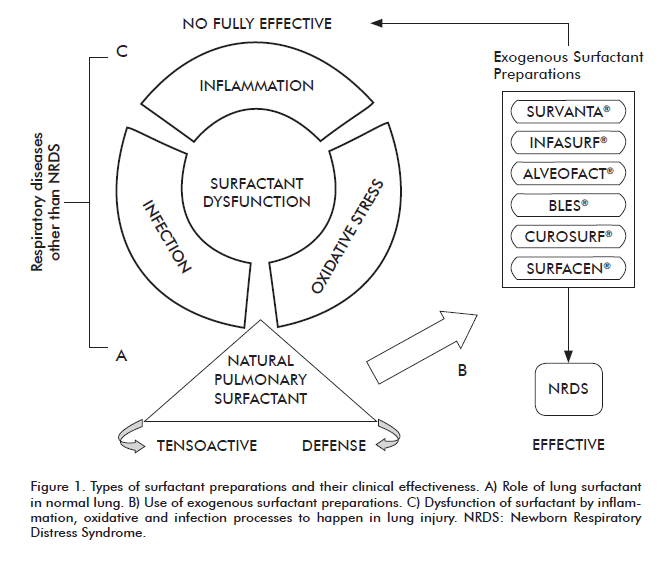
<body><![CDATA[<P   align="justify" ><font face="Verdana, Arial, Helvetica, sans-serif" size="2">The pulmonary surfactant      is very important to lung function; therefore, its absence, deficiency or      inactivation is associated with severe pulmonary diseases. The therapy with      clinical surfactant preparations address to Newborn Respiratory Distress Syndrome      (NRDS) was a hit in neonatology and is the treatment of choice in this syndrome      until today [5]. The exogenous surfactant was designed to treat a primary      inadequacy of surfactant due to lung immaturity; however, there are other      respiratory diseases of high incidence worldwide [6, 7] such as acute lung      injury, acute respiratory distress syndrome (ARDS), pneumonia, bronchopulmonary      dysplasia, meconium aspiration, asthma, cystic fibrosis (where the is seriously      damaged from the biochemical and biophysical points of view), which in turn      will disturb the defensive response in the lung. In this sense, the surfactant      preparations used in neonatology has been applied in clinical trials of these      diseases but have not been fully effective. Certainly, these pathologies are      more complex, taking place inflammatory, infectious and oxidative processes      and the reversal of surfactant inactivation being required to obtain surfactant      preparations mimicking native lung surfactant </font><font size="+1" color="#000000"><font size="+1"><font face="Verdana, Arial, Helvetica, sans-serif" size="2">(<a href="/img/revistas/bta/v29n2/f0101212.gif">Figure      1</a>)</font></font></font><font face="Verdana, Arial, Helvetica, sans-serif" size="2">.      The strategy carried out to get a surfactant preparation more resistant to      inactivation is discussed below. </font></P >       
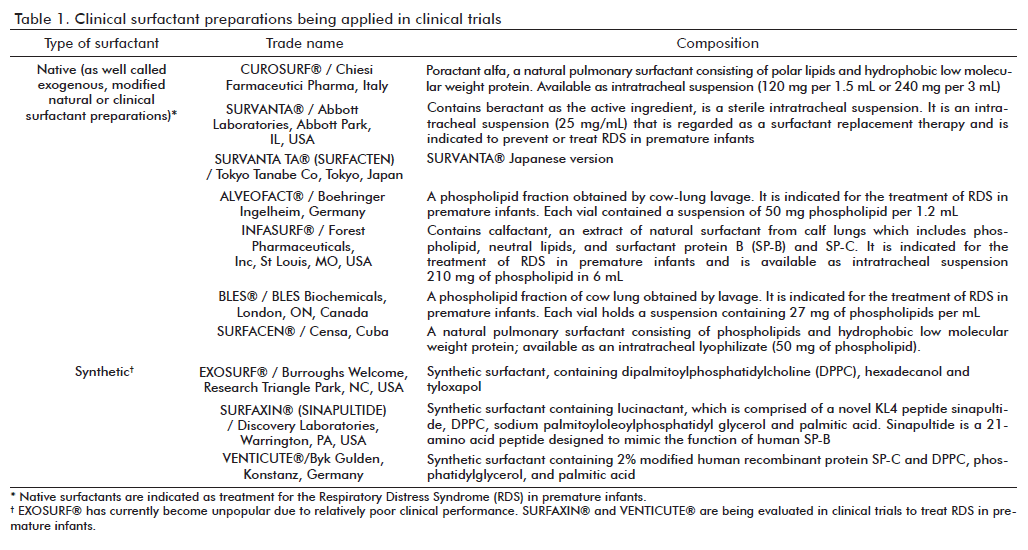
<P   align="justify" >&nbsp;</P >       <P   ><font size="3" face="Verdana, Arial, Helvetica, sans-serif"><b>CLINICAL SURFACTANT      PREPARATION</b></font></P >       <P   ><font size="2" face="Verdana, Arial, Helvetica, sans-serif">The clinical lung      surfactant preparations can be classified in two major groups: 1) modified      natural and 2) synthetic lung surfactant. The first one is obtained by bronchoalveolar      lavage or mincing of lung and extraction with organic solvents; then, depending      on the surfactant, it can be by chromatography or with active ingredients.      These surfactant preparations contain all phospholipids present in endogenous      lung surfactant; the proteins SP-B and SP-C also form part of its chemical      composition, but proteins SP-A and SP-D are not present. The second one is,      in turn, divided into a) first-generation protein-free synthetic surfactants      of phospholipids and chemical agents (detergent o lipids) for adsorption and      spreading, which have become unpopular due to their relatively poor clinical      performance and b) a new generation surfactant composed of phospholipids and      hydrophobic protein which contains synthetic phospholipids and peptide analogues      of SP-B and/or SP-Csynthesized chemically or obtained in a recombinant step      purifiedsupplementedcomposed (<a href="/img/revistas/bta/v29n2/t0101212.gif">Table      1</a>). A detailed comparison of lipid and protein compositions of the natural      surfactant preparations can be found in a review by Blanco and Perez Gil [8].      </font></P >   <FONT size="+1"><FONT size="+1">        
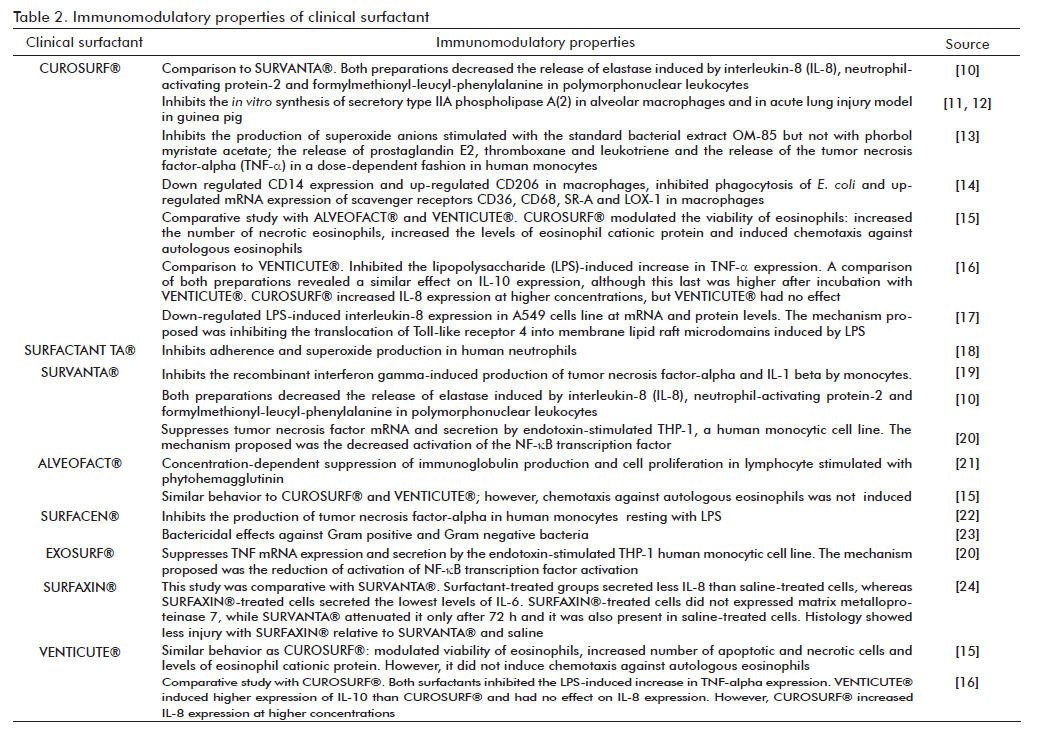
<P   >&nbsp;</P >       <P   ><font size="3" face="Verdana, Arial, Helvetica, sans-serif"><b>EXOGENOUS LUNG      SURFACTANT AND IMMUNOMODULATORY PROPERTIES <I>IN VITRO</I> </b></font></P >       <P   ><font size="2" face="Verdana, Arial, Helvetica, sans-serif">The immunomodulatory      activities from clinical lung surfactant have been studied. In <a href="/img/revistas/bta/v29n2/t0201212.gif">table      2</a>, the inmunomodulatory properties of clinical lung surfactant <I>in vitro</I>      reported until now are summarized. These results support the proposal the      clinical lung surfactant is involved in the protection of the alveolar epithelium      against the injury caused by reactive oxygen intermediates and pro-inflammatory      cytokine and in the down-regulation of inflammatory mediators&rsquo; production,      being mechanistic pathways also proposed [9]. In this sense, these preparations      have a potential to be beneficial in reducing the inflammatory reaction in      the lungs present in several respiratory disease [8]. </font></P >   <FONT size="+1"><FONT size="+1">        
<P   >&nbsp;</P >       <P   ><font size="3" face="Verdana, Arial, Helvetica, sans-serif"><b>WHAT IS RECENTLY      KNOWN ABOUT THE MARKET IN RELATION TO CLINICAL TRIALS FOR CLINICAL LUNG SURFACTANT      PREPARATIONS?</b></font></P >       <P   ><font size="2" face="Verdana, Arial, Helvetica, sans-serif">The search for clinical      trials in the Business Insights database (<a href="http://www.business-insights.com" target="_blank">www.business-insights.com</a>),      using as search strategy the match of three exogenous (CUROSURF, INFASURF      and SURVANTA) and one synthetic (SURFAXIN) surfactant preparations, combined      with &lsquo;respiratory disease&rsquo;, showed the following results: </font></P >   <FONT size="+1"><FONT size="+1">        ]]></body>
<body><![CDATA[<P   ><font face="Verdana, Arial, Helvetica, sans-serif" size="2"><b>CUROSURF&reg;      </b></font></P >       <P   align="justify" ><font face="Verdana, Arial, Helvetica, sans-serif" size="2">It has been available      in Europe since 1992, where it is the number one selling surfactant according      to IMS Health data. Commercialized by eleven<B> </B>companies, among them      <I>Ascent Pharmaceuticals Limited</I> (formerly Genepharm Australia Ltd),      from which it is available in the market. In September 2005, Douglas Pharmaceuticals      announced that a new treatment, CUROSURF&reg;, was available in Australia      under license. From <I>Chiesi Farmaceutici S.p.A</I>, it is available in the      pharmaceutical market. On May 7, 2007, data presented at the Pediatric Academic      Societies&rsquo; Annual Meeting demonstrated that premature infants with neonatal      RDS have a nearly 20% better chance of survival if they were treated with      CUROSURF&reg; instead of the two competing surfactant therapies (INFASURF&reg;      and SURVANTA&reg;). On September 25, 2006, CUROSURF&reg;, is the world leading      surfactant indicated in premature infants for the prevention and treatment      of RDS. From <I>Torrex Chiesi Pharma GmbH</I>, Since February 24, 2011, CUROSURF&reg;      is intended to be marketed in the territories of Russia and some countries      of the Commonwealth of Independent States by <I>Chiesi</I>. </font></P >       <P   ><font face="Verdana, Arial, Helvetica, sans-serif" size="2"><b>INFASURF&reg;      </b></font></P >       <P   align="justify" ><font face="Verdana, Arial, Helvetica, sans-serif" size="2">Commercialized by      four companies: <I>Recordati SpA</I>; <I>Forest Laboratories Inc.</I>; <I>Ikaria      Holdings, Inc.</I> and <I>Samaritan Pharmaceuticals Inc.</I> From<I> Recordati      SpA</I> it is currently in Phase II/III clinical trials indicated to treat      RDS. From <I>Forest Laboratories Inc</I><B>., </B>INFASURF&reg;<B> </B>is      available in USA. It was launched by <I>Forest</I>, in October 1999, as a      lung surfactant for the treatment of RDS in premature infants. In 1998, INFASURF&reg;      was approved by the FDA for preventing RDS in premature infants. From <I>Ikaria      Holdings, Inc</I>,<B> </B>it is<B> </B>available in USA indicated to RDS.      On the other hand, <I>Samaritan Pharmaceuticals Inc</I><B>.</B> used the USA      FDA approved regulatory file in preparing marketing applications for INFASURF&reg;      with regulatory authorities in Turkey, Serbia, Bosnia, Albania, Egypt and      Syria to gain the drug country marketing authorization. In January 22, 2007,      it was announced that <I>Samaritan</I> has signed an exclusive license for      the marketing and sales of the USA approved INFASURF&reg;, a specialist medication      used to treat and prevent RDS in premature infants. Under this agreement,      <I>Samaritan</I> has obtained exclusive rights to sell INFASURF&reg; in Turkey,      Serbia, Bosnia, Macedonia, Albania, Egypt and Syria. </font></P >       <P   ><font face="Verdana, Arial, Helvetica, sans-serif" size="2"><b>SURVANTA&reg;      </b></font></P >       <P   align="justify" ><font face="Verdana, Arial, Helvetica, sans-serif" size="2">Available on the      pharmaceutical market, it is commercialized by two companies: <I>Abbott India      Limited</I><B>,</B> indicated to RDS in premature infants, and <I>Abbott Laboratories</I>.      In December 12, 1993, Abbott received approval for SURVANTA&reg; from Health      Canada, and, in July 1st, 1991, from the USA FDA for SURVANTA&reg; (25 mg/mL)      intratracheal suspension. The USA FDA have granted the Orphan Drug Designation      for SURVANTA&reg; on February 5, 1986. </font></P >       <P   ><font face="Verdana, Arial, Helvetica, sans-serif" size="2"><b>SURFAXIN&reg;      </b></font></P >       <P   align="justify" ><font face="Verdana, Arial, Helvetica, sans-serif" size="2">It is currently in      the phase of development and preclinical evaluations by two companies: <I>Esteve      </I>and<I> Discovery Laboratories Inc.</I> In March 13, 2009, <I>Discovery      Laboratories, Inc</I>. announced that it will advance its ongoing Phase II      trial of SURFAXIN&reg; for children up to 2 years of age with Acute Respiratory      Failure (ARF). On July 29, 2008, <I>Discovery Laboratories</I>, <I>Inc.</I>      announced the publication in <I>Pediatric Research</I> of data from a preclinical      research study. Data showed that the KL-4 surfactant reduced the inflammatory      response and improved cell survival and function in a hyperoxic-induced lung      injury in an in-vitro cell-culture model. <I>Discovery Laboratories, Inc.</I>,      announced in January 5, 2009 the publication of results from its Phase II      clinical trial of SURFAXIN&reg; for the prevention and treatment of bronchopulmonary      dysplasia in <I>Pediatrics</I>. The SURFAXIN&reg; standard dose had a lower      incidence of death or bronchopulmonary dysplasia, a higher survival rate through      36 weeks post-menstrual age and fewer days on mechanical ventilation. On January      10, 2011, <I>Discovery Laboratories</I>, <I>Inc</I>., provided an update regarding      its efforts to file a Complete Response intended to gain FDA authorization      for marketing SURFAXIN&reg; at US to prevent RDS in premature infants. <I>Discovery      Laboratories, Inc.</I>,<B><I> </I></B>and <I>Esteve</I><B><I> </I></B>are      developing with the use of SURFAXIN&reg; a treatment for the Meconium Aspiration      Syndrome and ARDS in adults. </font></P >       <P   ><font face="Verdana, Arial, Helvetica, sans-serif" size="2"><b>SURFACEN&reg;      </b></font></P >       <P   align="justify" ><font face="Verdana, Arial, Helvetica, sans-serif" size="2">It has been available      in Cuba since 1995, indicated in NRDS. A comparative trial with SURVANTA&reg;      showed similar patterns of oxygenation and ventilation response, with a tendency      to a higher increase in initial oxygenation in the SURFACEN&reg; group [25].      Recent results, not yet published of a surveillance study showed the same      adverse effects that in previous observations [26]. Also, in an efficacy trial,      it demonstrated to improve oxygenation in adult patients with ARDS; however      mortality was not reduced. </font></P >       ]]></body>
<body><![CDATA[<P   align="justify" ><font face="Verdana, Arial, Helvetica, sans-serif" size="2">There is no doubt      about the effectiveness of the surfactant clinical preparations in the NRDS      therapeutics. After these confirmations, studies on the effectiveness of the      synthetic <I>vs</I>. natural surfactant, its side effects, days of stay in      intensive care, etc., were initiated. Several clinical trials have made comparisons      within multicenter studies, having as conclusion that the natural surfactant      is more effective and has fewer side effects. Surfactant preparations, containing      SP-B and SP-C, have shown better results in clinical trial than using the      synthetic lipid based surfactant without surfactant proteins [27]. Moreover,      although it has been found that exogenous or synthetic surfactant preparations      improve the different respiratory variables such as oxygenation, not all types      of natural or synthetic surfactant have the same effectiveness [28-30]. In      this sense, surfactant preparations containing higher concentrations of SP-B      and SP-C give better responses than those with lower concentrations. </font></P >       <P   align="justify" ><font face="Verdana, Arial, Helvetica, sans-serif" size="2">The potential use      of the exogenous surfactant beyond the neonatal period is currently under      study. Not any study found adverse effects with the use of natural surfactant      in the neonatal population. The effectiveness of the exogenous surfactant      in acute respiratory failure in pediatrics has been suggested by controlled      preliminary studies, which showed improvement in the respiratory variables,      but not in mortality. Recently, the first clinical trial reporting a positive      impact on survival has been published. These results are encouraging. </font></P >       <P   align="justify" ><font face="Verdana, Arial, Helvetica, sans-serif" size="2">Instillation of exogenous      surfactant into the lungs of pediatric patients with acute respiratory distress      syndrome (ARDS) has resulted in improved survival [31]. Despite this, intratracheal      surfactant has not proved to be beneficial for adult patients with ALI/ARDS.      Two large, randomized and controlled studies have been performed in adults      using two different synthetic surfactant preparations [32, 33]. Neither study      showed an improvement in survival. On the other hand, several small clinical      trials using natural surfactant (bovine or porcine) have shown reduced mortality      [34-36]. Nowadays, treatment with surfactant is not used routinely for the      management of ARDS. The use of exogenous surfactant therapies for the treatment      of ARDS in adults is still under debate, and probably depends critically on      the development of new clinical surfactants. </font></P >       <P   >&nbsp;</P >       <P   ><font size="2" face="Verdana, Arial, Helvetica, sans-serif"><b><font size="3">ONGOING      DEVELOPMENTS</font></b></font></P >       <P   ><FONT size="+1"></font><font size="2" face="Verdana, Arial, Helvetica, sans-serif">In      parallel with the clinical trials, there are new molecules or drugs being      used in clinical diseases. They can be combined with clinical lung preparations.      </font></P >   <FONT size="+1"><FONT size="+1">        <P   align="justify" ><font face="Verdana, Arial, Helvetica, sans-serif" size="2">The choice of an      ideal or suitable surfactant for respiratory diseases other than NRDS goes      through a rigorous basic research on structure-function relationships of the      surfactant&rsquo;s components. Research on lung surfactant topics open new      options to improve the lung surfactant preparations to be used in other lung      diseases. The major objective is to overcome the inhibition of lung surfactant      present in all lung diseases (<a href="/img/revistas/bta/v29n2/f0101212.gif">Figure      1</a>). </font></P >       
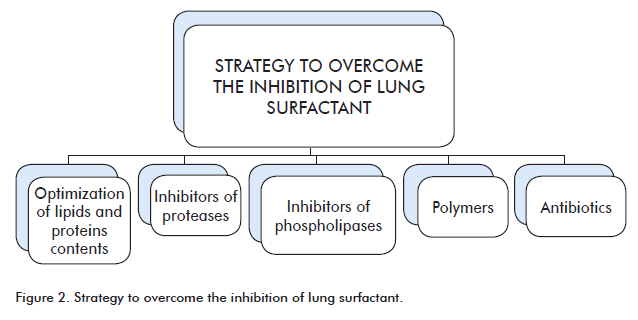
<P   align="justify" ><font face="Verdana, Arial, Helvetica, sans-serif" size="2">To achieve this goal,      the ways of researches can be grouped as follows (<a href="/img/revistas/bta/v29n2/f0201212.gif">Figure      2</a>). Briefly we comment and update the major strategies to overcome the      inhibition of lung surfactant. Optimization of lipids and proteins comprise      increasing the phospholipids concentration, since the new surfactant preparations      (SURFAXIN&reg; and VENTICUTE&reg;) have highest levels of synthetic hydrophobic      proteins compared to exogenous lung surfactant preparations. These new preparations      have been possible due to research and development in molecular biology and      chemical synthesis of the hydrophobic surfactant proteins [37, 38]. </font></P >       
<P   align="justify" ><font face="Verdana, Arial, Helvetica, sans-serif" size="2">The addition of SP-A      is essential. None of the clinical surfactant preparations has SP-A; this      protein is removed during the process to obtain these preparations. The anti-inflammatory      and antimicrobial characteristics of SP-A [39-41] make it an attractive potential      therapeutic agent. Scientists have to solve the following problems: SP-A is      a very large and complex molecule, having all the posttranscriptional events,      and, therefore, is very complicated to obtain human recombinant SP-A. On the      other hand, it is needed a more complete understanding of its mechanism of      action in the lung. Recently, Awasthi <I>et al</I>. [42] updated the clinical      trials of SP-A preparations in ClinicalTrials.gov, and no clinical trial using      SP-A was still found. </font></P >       <P   ><font face="Verdana, Arial, Helvetica, sans-serif" size="2"><b>Polymers </b></font></P >       ]]></body>
<body><![CDATA[<P   align="justify" ><font face="Verdana, Arial, Helvetica, sans-serif" size="2">The use of polymers      is a very important topic. Taeusch <I>et al</I>. [43] and Kobayashi <I>et      al</I>. [44] were the pioneers in the use of polymers as additives to clinical      pulmonary surfactant. The proposed polymers&rsquo; mechanism of action is      a polymer-induced depletion-attraction model. It means, in general terms,      that they promote surfactant aggregations and adsorption; therefore, polymers      can neutralize the surfactant inactivation due to many inhibitors substances.      The first polymers tested were dextran and polyethylene glycol, and also hyaluronic      acid has been widely used. Many <I>in vitro</I> and <I>in vivo </I>studies      [45-48] have shown polymers to improve the surface activity of surfactant      preparations overcoming surfactant inactivation. Investigations on this topic      are aimed at answering different questions: Which polymers? What molecular      weight? Ionic or non-ionic polymers? What type of interactions occurs between      clinical surfactant and polymers? What concentration? However, the use of      polymers in combination with clinical surfactant preparations is undoubtedly      an option for the development of new formulations to be used in ARDS. </font></P >       <P   ><font face="Verdana, Arial, Helvetica, sans-serif" size="2"><b>Use of protease      and phospholipase inhibitors and antibiotics in pulmonary surfactant preparations      </b> </font></P >       <P   align="justify" ><font face="Verdana, Arial, Helvetica, sans-serif" size="2">Pharmaceutical compositions      containing some low weight drugs have been delivered by pulmonary administration,      but not all low-molecular-weight drugs, however, can be efficaciously administered      through the lung. The pulmonary surfactant brings innumerable advantages,      as a carrier, due to its own properties of spreading and inherent therapeutic      potential. </font></P >       <P   align="justify" ><font face="Verdana, Arial, Helvetica, sans-serif" size="2">Therefore, it is      expected that intratracheally instilled drugs are more effective when the      distribution within the lung is optimized by using pulmonary surfactant as      a carrier [49]. </font></P >       <P   ><font face="Verdana, Arial, Helvetica, sans-serif" size="2"><b>Inhibitors of      proteases </b> </font></P >       <P   align="justify" ><font face="Verdana, Arial, Helvetica, sans-serif" size="2">Recently, in a review      about human elastase inhibitor and lung surfactant in ARDS [50], we commented      on proteases as obvious target for inhibitors-based therapies because they      are involved in the physiopathology of the inflammatory pulmonary disease.      Despite the numerous researches about the relationships between proteases,      pulmonary surfactant and the pulmonary inflammatory disease, combinations      of exogenous lung surfactant preparations with protease inhibitors are still      insufficient. Nevertheless, this year <I>Discovery Laboratory</I> has launched      a patent entitled &lsquo;Compositions for treatment and prevention of pulmonary      conditions&rsquo; [51]; the patent proves broad coverage compositions that      employ a combination of certain pulmonary surfactants with a broad array of      protease inhibitors for treating pulmonary inflammation. This patent, together      with other reports, open a new possibility to use a mixture of proteases&rsquo;      inhibitors and pulmonary surfactant in the respiratory disease. </font></P >       <P   ><font face="Verdana, Arial, Helvetica, sans-serif" size="2"><b>Phospholipase      inhibitors </b> </font></P >       <P   align="justify" ><font face="Verdana, Arial, Helvetica, sans-serif" size="2">There are several      studies confirming alterations of pulmonary surfactant by phospholipases in      ARDS. Surfactant can be readily hydrolyzed by secreted phospholipases A<Sub>2      </Sub>(sPLA<Sub>2</Sub>), especially the type-IIA sPLA<Sub>2</Sub>, and this      process can contribute to the loss of surface tension-lowering properties      of the surfactant [52]. The produced lysophospholipids and eicosanoids have      been implicated in the pathogenesis of acute lung injury. </font></P >   <FONT size="+1"><FONT size="+1"><FONT size="+1"><FONT size="+1"><FONT size="+1"><FONT size="+1">        <P   align="justify" ><font face="Verdana, Arial, Helvetica, sans-serif" size="2">Specific inhibitors      are available for sPLA2 [53] and have also been used in clinical assays of      acute lung injury/ARDS, being indole derivatives those used with the greatest      success, among them LY315920Na/S5920 [54] and LY311727. There are several      investigations dealing with the phospholipase topic, although, up to date,      there are no studies combining phospholipase inhibitors and the pulmonary      surfactant (excepting the patent mentioned above in which phospolipase inhibitors,      in addition to protease inhibitors, are also claimed). The use of surfactant      preparation in combination with inhibitors of sPLA-IIA2 can represent a promising      strategy for the treatment of ARDS.</font></P >       <P   align="justify" ><font face="Verdana, Arial, Helvetica, sans-serif" size="2">Another line of investigations      is the obtainment of phospholipids resistant to hydrolysis by PLA<Sub>2</Sub>;      Notter&rsquo;s group has developed a novel diether phosphonolipid (DEPN-8)      analog to DPPC [55]. Walther <I>et al</I>. [56] developed a fully synthetic      lung surfactant constituted by plus DEPN-8 and Mini-B (synthetic analog to      SP-B) designed by Waring <I>et al</I>. [57], which had a high surface activity      and the ability to resist degradation by phospholipase, in inflammatory lung      injury. </font></P >   <FONT size="+1"><FONT size="+1"><FONT size="+1"><FONT size="+1">        ]]></body>
<body><![CDATA[<P   ><font face="Verdana, Arial, Helvetica, sans-serif" size="2"><b>Antibiotics </b></font></P >       <P   align="justify" ><font face="Verdana, Arial, Helvetica, sans-serif" size="2">Efficient antimicrobial      therapy is considered to be dependent on appropriate antibiotic concentrations      at the site of infection. Besides, the interaction between the pulmonary surfactant      and the antimicrobial agent is very important to propose the use of an exogenous      pulmonary surfactant as a drug delivery system for antibiotics to the alveolar      compartment of the lung [49]. Especially, the combination of anti-microbial      agents and surfactant offers an alternative for critically ill patients with      pneumonia. Gram-positive bacteria like group B streptococci or <I>Staphylococcus      aureus </I>and Gram-negative microorganisms, such as <I>Escherichia coli</I>,      <I>Klebsiella pneumonia</I> or <I>Enterobacter cloacae</I>,<I> </I>are common      pathogens causing serious neonatal infections, including neonatal pneumonia      [58]. When searching Clinicaltrials.gov, no clinical trial combining pulmonary      surfactant and antibiotics was found, but there were many studies evaluating      different antibiotics in mixture with pulmonary surfactant with promissory      results. For example, Polymyxin-B (PxB)-containing pulmonary surfactant is      more resistant to inactivation by human meconium than modified natural surfactant      <I>in vitro</I>; also antimicrobial activity of PxB against <I>E. coli</I>      is maintained when PxB is added to pulmonary surfactant, and it is not significantly      different from PxB alone [59]. More recently, this group showed that animals      receiving pulmonary surfactant plus PxB had no difference in lung compliance      compared with the pulmonary surfactant or PxB-treated group. Mixtures of PxB      and pulmonary surfactant showed antimicrobial effects in neonatal rabbits      and prevent systemic spreading of <I>E. coli </I>[58]. Four cationic additives,      among them PxB, improved the surface activity of BLES&reg; in the presence      of serum [60]. </font></P >       <P   >&nbsp;</P >       <P   ><font size="2" face="Verdana, Arial, Helvetica, sans-serif"><b><font size="3">CONCLUSIONS      </font></b></font></P >   <FONT size="+1">        <P   align="justify" ><font size="2" face="Verdana, Arial, Helvetica, sans-serif">The several scientific      reports about immunomodulatory properties and clinical assays of the different      surfactant preparations available today are consistent with the importance      of pulmonary surfactant in the context of respiratory disease. In the near      future, pharmacologic therapy based on the addition of different drugs (inhibitors      of elastase and phospholipases, antibiotic or polymers) as ingredients of      a surfactant, as well as optimizations of surfactant component preparations,      could be effective in treating patients with severe respiratory disease. </font></P >   <FONT size="+1">        <P   align="justify" > </P >       <P   align="justify" >&nbsp;</P >       <P   align="justify" ><font size="3"><b><font face="Verdana, Arial, Helvetica, sans-serif">REFERENCES</font></b></font></P >       <!-- ref --><P   align="justify" ><font size="2" face="Verdana, Arial, Helvetica, sans-serif">1. Veldhuizen R,      Nag K, Orgeig S, Possmayer F. The role of lipids in pulmonary surfactant.      Biochim Biophys Acta. 1998;1408(2-3):90-108.     </font></P >   <FONT size="+1">        ]]></body>
<body><![CDATA[<!-- ref --><P   align="justify" ><font face="Verdana, Arial, Helvetica, sans-serif" size="2">2. Creuwels LA, van      Golde LM, Haagsman HP. The pulmonary surfactant system: biochemical and clinical      aspects. Lung. 1997;175(1):1-39.     </font></P >       <!-- ref --><P   align="justify" ><font face="Verdana, Arial, Helvetica, sans-serif" size="2">3. Possmayer F. A      proposed nomenclature for pulmonary surfactant-associated proteins. Am Rev      Respir Dis. 1988;138(4):990-8.     </font></P >       <!-- ref --><P   align="justify" ><font face="Verdana, Arial, Helvetica, sans-serif" size="2">4. Wright JR. Pulmonary      surfactant: a front line of lung host defense. J Clin Invest. 2003;111(10):1453-5.          </font></P >       <!-- ref --><P   align="justify" ><font face="Verdana, Arial, Helvetica, sans-serif" size="2">5. Engle WA. Surfactant-replacement      therapy for respiratory distress in the preterm and term neonate. Pediatrics.      2008;121(2):419-32.     </font></P >       <!-- ref --><P   align="justify" ><font face="Verdana, Arial, Helvetica, sans-serif" size="2">6. Baines KJ, Simpson      JL, Gibson PG. Innate immune responses are increased in chronic obstructive      pulmonary disease. PLoS One. 2011;6(3):e18426.     </font></P >       ]]></body>
<body><![CDATA[<!-- ref --><P   align="justify" ><font face="Verdana, Arial, Helvetica, sans-serif" size="2">7. Matthay MA, Zemans      RL. The acute respiratory distress syndrome: pathogenesis and treatment. Annu      Rev Pathol. 2011;6:147-63.     </font></P >       <!-- ref --><P   align="justify" ><font face="Verdana, Arial, Helvetica, sans-serif" size="2">8. Blanco O, P&eacute;rez-Gil      J. Biochemical and pharmacological differences between preparations of exogenous      natural surfactant used to treat Respiratory Distress Syndrome: Role of the      different components in an efficient pulmonary surfactant. Eur J Pharmacol.      2007;568(1-3):1-15.     </font></P >       <!-- ref --><P   align="justify" ><font face="Verdana, Arial, Helvetica, sans-serif" size="2">9. Wright JR. Immunomodulatory      functions of surfactant. Physiol Rev. 1997;77(4):931-62.     </font></P >       <!-- ref --><P   align="justify" ><font face="Verdana, Arial, Helvetica, sans-serif" size="2">10. Tegtmeyer FK,      Gortner L, Ludwig A, Brandt E. In vitro modulation of induced neutrophil activation      by different surfactant preparations. Eur Respir J. 1996;9(4):752-7.     </font></P >       <!-- ref --><P   align="justify" ><font face="Verdana, Arial, Helvetica, sans-serif" size="2">11. Hidi R, Vial      D, Havet N, Berger A, Vargaftig BB, Touqui L. Inhibition by pulmonary surfactant      Curosurf of secretory phospholipase A2 expression in guinea-pig alveolar macrophages.      Biochem Pharmacol. 1997;54(9):1055-8.     </font></P >       ]]></body>
<body><![CDATA[<!-- ref --><P   align="justify" ><font face="Verdana, Arial, Helvetica, sans-serif" size="2">12. Wu Y, Singer      M, Thouron F, Alaoui-El-Azher M, Touqui L. Effect of surfactant on pulmonary      expression of type IIA PLA(2) in an animal model of acute lung injury. Am      J Physiol Lung Cell Mol Physiol. 2002;282(4):L743-50.     </font></P >       <!-- ref --><P   align="justify" ><font face="Verdana, Arial, Helvetica, sans-serif" size="2">13. Walti H, Polla      BS, Bachelet M. Modified natural porcine surfactant inhibits superoxide anions      and proinflammatory mediators released by resting and stimulated human monocytes.      Pediatr Res. 1997;41(1):114-9.     </font></P >       <!-- ref --><P   align="justify" ><font face="Verdana, Arial, Helvetica, sans-serif" size="2">14. Gille C, Spring      B, Bernhard W, Gebhard C, Basile D, Lauber K, et al. Differential effect of      surfactant and its saturated phosphatidylcholines on human blood macrophages.      J Lipid Res. 2007;48(2):307-17.     </font></P >       <!-- ref --><P   align="justify" ><font face="Verdana, Arial, Helvetica, sans-serif" size="2">15. Erpenbeck VJ,      Fischer I, Wiese K, Schaumann F, Schmiedl A, Nassenstein C, et al. Therapeutic      surfactants modulate the viability of eosinophils and induce inflammatory      mediator release. Int Arch Allergy Immunol. 2009;149(4):333-42.     </font></P >       <!-- ref --><P   align="justify" ><font face="Verdana, Arial, Helvetica, sans-serif" size="2">16. Geiger R, Treml      B, Pinna A, Barnickel L, Prossliner H, Reinstadler H, et al. Tolerability      of inhaled N-chlorotaurine in the pig model. BMC Pulm Med. 2009;9:33.     </font></P >       ]]></body>
<body><![CDATA[<!-- ref --><P   align="justify" ><font face="Verdana, Arial, Helvetica, sans-serif" size="2">17. Abate W, Alghaithy      AA, Parton J, Jones KP, Jackson SK. Surfactant lipids regulate LPS-induced      interleukin-8 production in A549 lung epithelial cells by inhibiting translocation      of TLR4 into lipid raft domains. J Lipid Res. 2010;51(2):334-44.     </font></P >       <!-- ref --><P   align="justify" ><font face="Verdana, Arial, Helvetica, sans-serif" size="2">18. Suwabe A, Otake      K, Yakuwa N, Suzuki H, Ito M, Tomoike H, et al. Artificial surfactant (Surfactant      TA) modulates adherence and superoxide production of neutrophils. Am J Respir      Crit Care Med. 1998;158(6):1890-9.     </font></P >       <!-- ref --><P   align="justify" ><font face="Verdana, Arial, Helvetica, sans-serif" size="2">19. Geertsma MF,      Broos HR, van den Barselaar MT, Nibbering PH, van Furth R. Lung surfactant      suppresses oxygen-dependent bactericidal functions of human blood monocytes      by inhibiting the assembly of the NADPH oxidase. J Immunol. 1993;150(6):2391-400.          </font></P >       <!-- ref --><P   align="justify" ><font face="Verdana, Arial, Helvetica, sans-serif" size="2">20. Antal JM, Divis      LT, Erzurum SC, Wiedemann HP, Thomassen MJ. Surfactant suppresses NF-kappa      B activation in human monocytic cells. Am J Respir Cell Mol Biol. 1996;14(4):374-9.          </font></P >       <!-- ref --><P   align="justify" ><font face="Verdana, Arial, Helvetica, sans-serif" size="2">21. Bartmann P, Gortner      L, Pohlandt F, Jaeger H. In vitro lymphocyte functions in the presence of      bovine surfactant and its phospholipid fractions. J Perinat Med. 1992;20(3):189-96.          </font></P >       ]]></body>
<body><![CDATA[<!-- ref --><P   align="justify" ><font face="Verdana, Arial, Helvetica, sans-serif" size="2">22. Blanco O, Beltran      A, Gonzalez D, S&aacute;nchez J, Fern&aacute;ndez O, Faure R, et al. Some      anti-inflammatory properties of a natural pulmonary surfactant: Surfacen.      Appl Cardiopulmonary Pathophysiol. 2000;9:201-3.     </font></P >       <P   align="justify" ><font face="Verdana, Arial, Helvetica, sans-serif" size="2">23. Blanco O, River&oacute;n      Y, de Armas E, S&aacute;nchez J, Faure R, Fern&aacute;ndez O. SURFACEN&reg;      inhibits the growth of bacteria causing respiratory infections. Biotecnol      Apl. 2005; 22:282-4. </font></P >       <!-- ref --><P   align="justify" ><font face="Verdana, Arial, Helvetica, sans-serif" size="2">24. Zhu Y, Miller      TL, Chidekel A, Shaffer TH. KL4-surfactant (Lucinactant) protects human airway      epithelium from hyperoxia. Pediatr Res. 2008;64(2):154-8.     </font></P >       <!-- ref --><P   align="justify" ><font face="Verdana, Arial, Helvetica, sans-serif" size="2">25. Sanchez-Mendiola      M, Martinez-Natera OC, Herrera-Maldonado N, Ortega-Arroyo J. Treatment of      hyaline membrane disease in the preterm newborn with exogenous lung surfactant:      a controlled study. Gac Med Mex. 2005;141(4):267-71.     </font></P >       <!-- ref --><P   align="justify" ><font face="Verdana, Arial, Helvetica, sans-serif" size="2">26. Moreno V&aacute;zquez      O, Lee L&oacute;pez M, Dom&iacute;nguez Dieppa F, Pascual L&oacute;pez MA,      Alonso Abad A, Jim&eacute;nez Rivero G, et al. Estudio de la eficacia del      Surfacen en el distress respiratorio del reci&eacute;n nacido. Rev Cubana      Pediatr. 1999;71:60-71.     </font></P >       <P   align="justify" ><font face="Verdana, Arial, Helvetica, sans-serif" size="2">27. Taeusch HW, Lu      KW, Ramierez-Schrempp D. Improving pulmonary surfactants. Acta Pharmacol Sin.      2002;23(11 Suppl):S11-5. </font></P >       ]]></body>
<body><![CDATA[<!-- ref --><P   align="justify" ><font face="Verdana, Arial, Helvetica, sans-serif" size="2">28. Speer CP, Gefeller      O, Groneck P, Laufkotter E, Roll C, Hanssler L, et al. Randomised clinical      trial of two treatment regimens of natural surfactant preparations in neonatal      respiratory distress syndrome. Arch Dis Child Fetal Neonatal Ed. 1995;72(1):F8-13.          </font></P >       <!-- ref --><P   align="justify" ><font face="Verdana, Arial, Helvetica, sans-serif" size="2">29. Bloom BT, Kattwinkel      J, Hall RT, Delmore PM, Egan EA, Trout JR, et al. Comparison of Infasurf (calf      lung surfactant extract) to Survanta (Beractant) in the treatment and prevention      of respiratory distress syndrome. Pediatrics. 1997;100(1):31-8.     </font></P >       <!-- ref --><P   align="justify" ><font face="Verdana, Arial, Helvetica, sans-serif" size="2">30. Baroutis G, Kaleyias      J, Liarou T, Papathoma E, Hatzistamatiou Z, Costalos C. Comparison of three      treatment regimens of natural surfactant preparations in neonatal respiratory      distress syndrome. Eur J Pediatr. 2003;162(7-8):476-80.     </font></P >       <P   align="justify" ><font face="Verdana, Arial, Helvetica, sans-serif" size="2">31. Willson DF, Thomas      NJ, Markovitz BP, Bauman LA, DiCarlo JV, Pon S, et al. Effect of exogenous      surfactant (calfactant) in pediatric acute lung injury: a randomized controlled      trial. JAMA. 2005;293(4):470-6. </font></P >       <!-- ref --><P   align="justify" ><font face="Verdana, Arial, Helvetica, sans-serif" size="2">32. Anzueto A, Baughman      RP, Guntupalli KK, Weg JG, Wiedemann HP, Raventos AA, et al. Aerosolized surfactant      in adults with sepsis-induced acute respiratory distress syndrome. Exosurf      Acute Respiratory Distress Syndrome Sepsis Study Group. N Engl J Med. 1996;334(22):1417-21.          </font></P >       <!-- ref --><P   align="justify" ><font face="Verdana, Arial, Helvetica, sans-serif" size="2">33. Spragg RG, Lewis      JF, Walmrath HD, Johannigman J, Bellingan G, Laterre PF, et al. Effect of      recombinant surfactant protein C-based surfactant on the acute respiratory      distress syndrome. N Engl J Med. 2004;351(9):884-92.     </font></P >       <!-- ref --><P   align="justify" ><font face="Verdana, Arial, Helvetica, sans-serif" size="2">34. Walmrath D, Gunther      A, Ghofrani HA, Schermuly R, Schneider T, Grimminger F, et al. Bronchoscopic      surfactant administration in patients with severe adult respiratory distress      syndrome and sepsis. Am J Respir Crit Care Med. 1996;154(1):57-62.     </font></P >       <!-- ref --><P   align="justify" ><font face="Verdana, Arial, Helvetica, sans-serif" size="2">35. Walmrath D, Grimminger      F, Pappert D, Knothe C, Obertacke U, Benzing A, et al. Bronchoscopic administration      of bovine natural surfactant in ARDS and septic shock: impact on gas exchange      and haemodynamics. Eur Respir J. 2002;19(5):805-10.     </font></P >       <!-- ref --><P   align="justify" ><font face="Verdana, Arial, Helvetica, sans-serif" size="2">36. Gregory TJ, Steinberg      KP, Spragg R, Gadek JE, Hyers TM, Longmore WJ, et al. Bovine surfactant therapy      for patients with acute respiratory distress syndrome. Am J Respir Crit Care      Med. 1997;155(4):1309-15.     </font></P >       <!-- ref --><P   align="justify" ><font face="Verdana, Arial, Helvetica, sans-serif" size="2">37. Serrano AG, Ryan      M, Weaver TE, Perez-Gil J. Critical structure-function determinants within      the N-terminal region of pulmonary surfactant protein SP-B. Biophys J. 2006;      90(1):238-49.     </font></P >       <!-- ref --><P   align="justify" ><font face="Verdana, Arial, Helvetica, sans-serif" size="2">38. Lukovic D, Plasencia      I, Taberner FJ, Salgado J, Calvete JJ, Perez-Gil J, et al. Production and      characterisation of recombinant forms of human pulmonary surfactant protein      C (SP-C): Structure and surface activity. Biochim Biophys Acta. 2006;1758(4):509-18.          </font></P >       <!-- ref --><P   align="justify" ><font face="Verdana, Arial, Helvetica, sans-serif" size="2">39. Wu H, Kuzmenko      A, Wan S, Schaffer L, Weiss A, Fisher JH, et al. Surfactant proteins A and      D inhibit the growth of Gram-negative bacteria by increasing membrane permeability.      J Clin Invest. 2003;111(10):1589-602.     </font></P >       <!-- ref --><P   align="justify" ><font face="Verdana, Arial, Helvetica, sans-serif" size="2">40. Kingma PS, Whitsett      JA. In defense of the lung: surfactant protein A and surfactant protein D.      Curr Opin Pharmacol. 2006;6(3): 277-83.     </font></P >       <!-- ref --><P   align="justify" ><font face="Verdana, Arial, Helvetica, sans-serif" size="2">41. Sano H, Kuroki      Y. The lung collectins, SP-A and SP-D, modulate pulmonary innate immunity.      Mol Immunol. 2005;42(3):279-87.     </font></P >       <!-- ref --><P   align="justify" ><font face="Verdana, Arial, Helvetica, sans-serif" size="2">42. Awasthi S. Surfactant      protein (SP)-A and SP-D as antimicrobial and immunotherapeutic agents. Recent      Pat Antiinfect Drug Discov. 2010;5(2):115-23.     </font></P >       <!-- ref --><P   align="justify" ><font face="Verdana, Arial, Helvetica, sans-serif" size="2">43. William Taeusch      H, Lu KW, Goerke J, Clements JA. Nonionic polymers reverse inactivation of      surfactant by meconium and other substances. Am J Respir Crit Care Med. 1999;159(5      Pt 1):1391-5.     </font></P >       <!-- ref --><P   align="justify" ><font face="Verdana, Arial, Helvetica, sans-serif" size="2">44. Kobayashi T,      Ohta K, Tashiro K, Nishizuka K, Chen WM, Ohmura S, et al. Dextran restores      albumin-inhibited surface activity of pulmonary surfactant extract. J Appl      Physiol. 1999;86(6):1778-84.     </font></P >       <!-- ref --><P   align="justify" ><font face="Verdana, Arial, Helvetica, sans-serif" size="2">45. Calkovska A,      Mokra D, Drgova A, Zila I, Javorka K. Bronchoalveolar lavage with pulmonary      surfactant/dextran mixture improves meconium clearance and lung functions      in experimental meconium aspiration syndrome. Eur J Pediatr. 2008;167(8):851-7.          </font></P >       <!-- ref --><P   align="justify" ><font face="Verdana, Arial, Helvetica, sans-serif" size="2">46. Lu KW, Goerke      J, Clements JA, Taeusch HW. Hyaluronan reduces surfactant inhibition and improves      rat lung function after meconium injury. Pediatr Res. 2005;58(2):206-10.     </font></P >       <!-- ref --><P   align="justify" ><font face="Verdana, Arial, Helvetica, sans-serif" size="2">47. Lu KW, Robertson      B, Taeusch HW. Dextran or polyethylene glycol added to curosurf for treatment      of meconium lung injury in rats. Biol Neonate. 2005;88(1):46-53.     </font></P >       <!-- ref --><P   align="justify" ><font face="Verdana, Arial, Helvetica, sans-serif" size="2">48. Calkovska A,      Some M, Linderholm B, Curstedt T, Robertson B. Therapeutic effects of exogenous      surfactant enriched with dextran in newborn rabbits with respiratory failure      induced by airway instillation of albumin. Pulm Pharmacol Ther. 2008;21(2):393-400.          </font></P >       <!-- ref --><P   align="justify" ><font face="Verdana, Arial, Helvetica, sans-serif" size="2">49. Haitsma JJ, Lachmann      U, Lachmann B. Exogenous surfactant as a drug delivery agent. Adv Drug Deliv      Rev. 2001;47(2-3):197-207.     </font></P >       <!-- ref --><P   align="justify" ><font face="Verdana, Arial, Helvetica, sans-serif" size="2">50. Blanco O, Lugones      Y, Gil DF, Faure R, Gonz&aacute;lez Y. Human neutrophil elastase and lung      surfactant in acute respiratory distress syndrome. Biotecnol Apl. 2009;26(4):287-92.          </font></P >       <P   align="justify" ><font face="Verdana, Arial, Helvetica, sans-serif" size="2">51. Cochrane CG,      inventor; The Scripps Research Institute, asignee. Compositions for treatment      and prevention of pulmonary conditions. United States patent US 7863241 B2.      2011 Jan 4. </font></P >       <!-- ref --><P   align="justify" ><font face="Verdana, Arial, Helvetica, sans-serif" size="2">52. Arbibe L, Koumanov      K, Vial D, Rougeot C, Faure G, Havet N, et al. Generation of lyso-phospholipids      from surfactant in acute lung injury is mediated by type-II phospholipase      A2 and inhibited by a direct surfactant protein A-phospholipase A2 protein      interaction. J Clin Invest. 1998;102(6):1152-60.     </font></P >       <!-- ref --><P   align="justify" ><font face="Verdana, Arial, Helvetica, sans-serif" size="2">53. Mihelich ED,      Schevitz RW. Structure-based design of a new class of anti-inflammatory drugs:      secretory phospholipase A(2) inhibitors, SPI. Biochim Biophys Acta. 1999;1441(2-3):223-8.          </font></P >       ]]></body>
<body><![CDATA[<!-- ref --><P   align="justify" ><font face="Verdana, Arial, Helvetica, sans-serif" size="2">54. Abraham E, Naum      C, Bandi V, Gervich D, Lowry SF, Wunderink R, et al. Efficacy and safety of      LY315920Na/S-5920, a selective inhibitor of 14-kDa group IIA secretory phospholipase      A2, in patients with suspected sepsis and organ failure. Crit Care Med. 2003;31(3):718-28.          </font></P >       <!-- ref --><P   align="justify" ><font face="Verdana, Arial, Helvetica, sans-serif" size="2">55. Turcotte JG,      Lin WH, Motola NC, Pivarnik PE, Bhongle NN, Heyman HR, et al. Chemical synthesis      and surface activity of lung surfactant phospholipid analogs. III. Chiral      N-substituted ether-amide phosphonolipids. Chem Phys Lipids. 1991;58(1-2):81-95.          </font></P >       <!-- ref --><P   align="justify" ><font face="Verdana, Arial, Helvetica, sans-serif" size="2">56. Walther FJ, Waring      AJ, Hernandez-Juviel JM, Gordon LM, Schwan AL, Jung CL, et al. Dynamic surface      activity of a fully synthetic phospholipase-resistant lipid/peptide lung surfactant.      PLoS One. 2007;2(10):e1039.     </font></P >       <!-- ref --><P   align="justify" ><font face="Verdana, Arial, Helvetica, sans-serif" size="2">57. Waring AJ, Walther      FJ, Gordon LM, Hernandez-Juviel JM, Hong T, Sherman MA, et al. The role of      charged amphipathic helices in the structure and function of surfactant protein      B. J Pept Res. 2005;66(6):364-74.     </font></P >       <!-- ref --><P   align="justify" ><font face="Verdana, Arial, Helvetica, sans-serif" size="2">58. Stichtenoth G,      Linderholm B, Bjorkman MH, Walter G, Curstedt T, Herting E. Prophylactic intratracheal      polymyxin B/surfactant prevents bacterial growth in neonatal Escherichia coli      pneumonia of rabbits. Pediatr Res. 2010;67(4):369-74.     </font></P >       ]]></body>
<body><![CDATA[<!-- ref --><P   align="justify" ><font face="Verdana, Arial, Helvetica, sans-serif" size="2">59. Stichtenoth G,      Jung P, Walter G, Johansson J, Robertson B, Curstedt T, et al. Polymyxin B/pulmonary      surfactant mixtures have increased resistance to inactivation by meconium      and reduce growth of gram-negative bacteria in vitro. Pediatr Res. 2006;59(3):407-11.          </font></P >       <!-- ref --><P   align="justify" ><font face="Verdana, Arial, Helvetica, sans-serif" size="2">60. Acosta EJ, Policova      Z, Lee S, Dang A, Hair ML, Neumann AW. Restoring the activity of serum-inhibited      bovine lung extract surfactant (BLES) using cationic additives. Biochim Biophys      Acta. 2010;1798(3):489-97.     </font></P >       <P   align="justify" > </P >   <FONT size="+1">        <P   align="justify" >&nbsp;</P >       <P   align="justify" ><font face="Verdana, Arial, Helvetica, sans-serif" size="2">Received in September,      2011.    <br>     Accepted for publication in March, 2012 </font></P >       <P   align="justify" > </P >       <P   >&nbsp;</P >       ]]></body>
<body><![CDATA[<P   ><font size="2" face="Verdana, Arial, Helvetica, sans-serif"><i>Odalys Blanco</i>.      Grupo de Qu&iacute;mica-Farmacolog&iacute;a-Toxicolog&iacute;a, Centro Nacional      de Sanidad Agropecuaria, Censa. Carretera de Tapaste y Autopista Nacional,      San Jos&eacute; de Las Lajas, CP 32 700, Mayabeque, Cuba. E-mail: <A href="mailto:oblanco@censa.edu.cu">      <U><U><FONT color="#0000FF">oblanco@censa.edu.cu</font></U></U></A><FONT color="#0000FF"><FONT color="#000000">,      <A href="mailto:odalysbh@infomed.sld.cu"> <U><U><FONT color="#0000FF">odalysbh@infomed.sld.cu</font></U></U></A><FONT color="#0000FF"><FONT color="#000000">.</font></font></font></font></font></P >   </font></font></font></font></font></font></font></font></font></font></font></font></font></font></font></font></font></font></font></font></font></font></font></font></DIV >      ]]></body><back>
<ref-list>
<ref id="B1">
<label>1</label><nlm-citation citation-type="journal">
<person-group person-group-type="author">
<name>
<surname><![CDATA[Veldhuizen]]></surname>
<given-names><![CDATA[R]]></given-names>
</name>
<name>
<surname><![CDATA[Nag]]></surname>
<given-names><![CDATA[K]]></given-names>
</name>
<name>
<surname><![CDATA[Orgeig]]></surname>
<given-names><![CDATA[S]]></given-names>
</name>
<name>
<surname><![CDATA[Possmayer]]></surname>
<given-names><![CDATA[F]]></given-names>
</name>
</person-group>
<article-title xml:lang="en"><![CDATA[The role of lipids in pulmonary surfactant]]></article-title>
<source><![CDATA[Biochim Biophys Acta]]></source>
<year>1998</year>
<volume>1408</volume>
<numero>2-3</numero>
<issue>2-3</issue>
<page-range>90-108</page-range></nlm-citation>
</ref>
<ref id="B2">
<label>2</label><nlm-citation citation-type="journal">
<person-group person-group-type="author">
<name>
<surname><![CDATA[Creuwels]]></surname>
<given-names><![CDATA[LA]]></given-names>
</name>
<name>
<surname><![CDATA[van Golde]]></surname>
<given-names><![CDATA[LM]]></given-names>
</name>
<name>
<surname><![CDATA[Haagsman]]></surname>
<given-names><![CDATA[HP]]></given-names>
</name>
</person-group>
<article-title xml:lang="en"><![CDATA[The pulmonary surfactant system: biochemical and clinical aspects]]></article-title>
<source><![CDATA[Lung]]></source>
<year>1997</year>
<volume>175</volume>
<numero>1</numero>
<issue>1</issue>
<page-range>1-39</page-range></nlm-citation>
</ref>
<ref id="B3">
<label>3</label><nlm-citation citation-type="journal">
<person-group person-group-type="author">
<name>
<surname><![CDATA[Possmayer]]></surname>
<given-names><![CDATA[F]]></given-names>
</name>
</person-group>
<article-title xml:lang="en"><![CDATA[A proposed nomenclature for pulmonary surfactant-associated proteins]]></article-title>
<source><![CDATA[Am Rev Respir Dis]]></source>
<year>1988</year>
<volume>138</volume>
<numero>4</numero>
<issue>4</issue>
<page-range>990-8</page-range></nlm-citation>
</ref>
<ref id="B4">
<label>4</label><nlm-citation citation-type="journal">
<person-group person-group-type="author">
<name>
<surname><![CDATA[Wright]]></surname>
<given-names><![CDATA[JR]]></given-names>
</name>
</person-group>
<article-title xml:lang="en"><![CDATA[Pulmonary surfactant: a front line of lung host defense]]></article-title>
<source><![CDATA[J Clin Invest]]></source>
<year>2003</year>
<volume>111</volume>
<numero>10</numero>
<issue>10</issue>
<page-range>1453-5</page-range></nlm-citation>
</ref>
<ref id="B5">
<label>5</label><nlm-citation citation-type="journal">
<person-group person-group-type="author">
<name>
<surname><![CDATA[Engle]]></surname>
<given-names><![CDATA[WA]]></given-names>
</name>
</person-group>
<article-title xml:lang="en"><![CDATA[Surfactant-replacement therapy for respiratory distress in the preterm and term neonate]]></article-title>
<source><![CDATA[Pediatrics]]></source>
<year>2008</year>
<volume>121</volume>
<numero>2</numero>
<issue>2</issue>
<page-range>419-32</page-range></nlm-citation>
</ref>
<ref id="B6">
<label>6</label><nlm-citation citation-type="journal">
<person-group person-group-type="author">
<name>
<surname><![CDATA[Baines]]></surname>
<given-names><![CDATA[KJ]]></given-names>
</name>
<name>
<surname><![CDATA[Simpson]]></surname>
<given-names><![CDATA[JL]]></given-names>
</name>
<name>
<surname><![CDATA[Gibson]]></surname>
<given-names><![CDATA[PG]]></given-names>
</name>
</person-group>
<article-title xml:lang="en"><![CDATA[Innate immune responses are increased in chronic obstructive pulmonary disease]]></article-title>
<source><![CDATA[PLoS One]]></source>
<year>2011</year>
<volume>6</volume>
<numero>3</numero>
<issue>3</issue>
<page-range>e18426</page-range></nlm-citation>
</ref>
<ref id="B7">
<label>7</label><nlm-citation citation-type="journal">
<person-group person-group-type="author">
<name>
<surname><![CDATA[Matthay]]></surname>
<given-names><![CDATA[MA]]></given-names>
</name>
<name>
<surname><![CDATA[Zemans]]></surname>
<given-names><![CDATA[RL]]></given-names>
</name>
</person-group>
<article-title xml:lang="en"><![CDATA[The acute respiratory distress syndrome: pathogenesis and treatment]]></article-title>
<source><![CDATA[Annu Rev Pathol]]></source>
<year>2011</year>
<volume>6</volume>
<page-range>147-63</page-range></nlm-citation>
</ref>
<ref id="B8">
<label>8</label><nlm-citation citation-type="journal">
<person-group person-group-type="author">
<name>
<surname><![CDATA[Blanco]]></surname>
<given-names><![CDATA[O]]></given-names>
</name>
<name>
<surname><![CDATA[Pérez-Gil]]></surname>
<given-names><![CDATA[J]]></given-names>
</name>
</person-group>
<article-title xml:lang="en"><![CDATA[Biochemical and pharmacological differences between preparations of exogenous natural surfactant used to treat Respiratory Distress Syndrome: Role of the different components in an efficient pulmonary surfactant]]></article-title>
<source><![CDATA[Eur J Pharmacol]]></source>
<year>2007</year>
<volume>568</volume>
<numero>1-3</numero>
<issue>1-3</issue>
<page-range>1-15</page-range></nlm-citation>
</ref>
<ref id="B9">
<label>9</label><nlm-citation citation-type="journal">
<person-group person-group-type="author">
<name>
<surname><![CDATA[Wright]]></surname>
<given-names><![CDATA[JR]]></given-names>
</name>
</person-group>
<article-title xml:lang="en"><![CDATA[Immunomodulatory functions of surfactant]]></article-title>
<source><![CDATA[Physiol Rev]]></source>
<year>1997</year>
<volume>77</volume>
<numero>4</numero>
<issue>4</issue>
<page-range>931-62</page-range></nlm-citation>
</ref>
<ref id="B10">
<label>10</label><nlm-citation citation-type="journal">
<person-group person-group-type="author">
<name>
<surname><![CDATA[Tegtmeyer]]></surname>
<given-names><![CDATA[FK]]></given-names>
</name>
<name>
<surname><![CDATA[Gortner]]></surname>
<given-names><![CDATA[L]]></given-names>
</name>
<name>
<surname><![CDATA[Ludwig]]></surname>
<given-names><![CDATA[A]]></given-names>
</name>
<name>
<surname><![CDATA[Brandt]]></surname>
<given-names><![CDATA[E]]></given-names>
</name>
</person-group>
<article-title xml:lang="en"><![CDATA[In vitro modulation of induced neutrophil activation by different surfactant preparations]]></article-title>
<source><![CDATA[Eur Respir J]]></source>
<year>1996</year>
<volume>9</volume>
<numero>4</numero>
<issue>4</issue>
<page-range>752-7</page-range></nlm-citation>
</ref>
<ref id="B11">
<label>11</label><nlm-citation citation-type="journal">
<person-group person-group-type="author">
<name>
<surname><![CDATA[Hidi]]></surname>
<given-names><![CDATA[R]]></given-names>
</name>
<name>
<surname><![CDATA[Vial]]></surname>
<given-names><![CDATA[D]]></given-names>
</name>
<name>
<surname><![CDATA[Havet]]></surname>
<given-names><![CDATA[N]]></given-names>
</name>
<name>
<surname><![CDATA[Berger]]></surname>
<given-names><![CDATA[A]]></given-names>
</name>
<name>
<surname><![CDATA[Vargaftig]]></surname>
<given-names><![CDATA[BB]]></given-names>
</name>
<name>
<surname><![CDATA[Touqui]]></surname>
<given-names><![CDATA[L]]></given-names>
</name>
</person-group>
<article-title xml:lang="en"><![CDATA[Inhibition by pulmonary surfactant Curosurf of secretory phospholipase A2 expression in guinea-pig alveolar macrophages]]></article-title>
<source><![CDATA[Biochem Pharmacol]]></source>
<year>1997</year>
<volume>54</volume>
<numero>9</numero>
<issue>9</issue>
<page-range>1055-8</page-range></nlm-citation>
</ref>
<ref id="B12">
<label>12</label><nlm-citation citation-type="journal">
<person-group person-group-type="author">
<name>
<surname><![CDATA[Wu]]></surname>
<given-names><![CDATA[Y]]></given-names>
</name>
<name>
<surname><![CDATA[Singer]]></surname>
<given-names><![CDATA[M]]></given-names>
</name>
<name>
<surname><![CDATA[Thouron]]></surname>
<given-names><![CDATA[F]]></given-names>
</name>
<name>
<surname><![CDATA[Alaoui-El-Azher]]></surname>
<given-names><![CDATA[M]]></given-names>
</name>
<name>
<surname><![CDATA[Touqui]]></surname>
<given-names><![CDATA[L]]></given-names>
</name>
</person-group>
<article-title xml:lang="en"><![CDATA[Effect of surfactant on pulmonary expression of type IIA PLA(2) in an animal model of acute lung injury]]></article-title>
<source><![CDATA[Am J Physiol Lung Cell Mol Physiol]]></source>
<year>2002</year>
<volume>282</volume>
<numero>4</numero>
<issue>4</issue>
<page-range>L743-50</page-range></nlm-citation>
</ref>
<ref id="B13">
<label>13</label><nlm-citation citation-type="journal">
<person-group person-group-type="author">
<name>
<surname><![CDATA[Walti]]></surname>
<given-names><![CDATA[H]]></given-names>
</name>
<name>
<surname><![CDATA[Polla]]></surname>
<given-names><![CDATA[BS]]></given-names>
</name>
<name>
<surname><![CDATA[Bachelet]]></surname>
<given-names><![CDATA[M]]></given-names>
</name>
</person-group>
<article-title xml:lang="en"><![CDATA[Modified natural porcine surfactant inhibits superoxide anions and proinflammatory mediators released by resting and stimulated human monocytes]]></article-title>
<source><![CDATA[Pediatr Res]]></source>
<year>1997</year>
<volume>41</volume>
<numero>1</numero>
<issue>1</issue>
<page-range>114-9</page-range></nlm-citation>
</ref>
<ref id="B14">
<label>14</label><nlm-citation citation-type="journal">
<person-group person-group-type="author">
<name>
<surname><![CDATA[Gille]]></surname>
<given-names><![CDATA[C]]></given-names>
</name>
<name>
<surname><![CDATA[Spring]]></surname>
<given-names><![CDATA[B]]></given-names>
</name>
<name>
<surname><![CDATA[Bernhard]]></surname>
<given-names><![CDATA[W]]></given-names>
</name>
<name>
<surname><![CDATA[Gebhard]]></surname>
<given-names><![CDATA[C]]></given-names>
</name>
<name>
<surname><![CDATA[Basile]]></surname>
<given-names><![CDATA[D]]></given-names>
</name>
<name>
<surname><![CDATA[Lauber]]></surname>
<given-names><![CDATA[K]]></given-names>
</name>
</person-group>
<article-title xml:lang="en"><![CDATA[Differential effect of surfactant and its saturated phosphatidylcholines on human blood macrophages]]></article-title>
<source><![CDATA[J Lipid Res]]></source>
<year>2007</year>
<volume>48</volume>
<numero>2</numero>
<issue>2</issue>
<page-range>307-17</page-range></nlm-citation>
</ref>
<ref id="B15">
<label>15</label><nlm-citation citation-type="journal">
<person-group person-group-type="author">
<name>
<surname><![CDATA[Erpenbeck]]></surname>
<given-names><![CDATA[VJ]]></given-names>
</name>
<name>
<surname><![CDATA[Fischer]]></surname>
<given-names><![CDATA[I]]></given-names>
</name>
<name>
<surname><![CDATA[Wiese]]></surname>
<given-names><![CDATA[K]]></given-names>
</name>
<name>
<surname><![CDATA[Schaumann]]></surname>
<given-names><![CDATA[F]]></given-names>
</name>
<name>
<surname><![CDATA[Schmiedl]]></surname>
<given-names><![CDATA[A]]></given-names>
</name>
<name>
<surname><![CDATA[Nassenstein]]></surname>
<given-names><![CDATA[C]]></given-names>
</name>
</person-group>
<article-title xml:lang="en"><![CDATA[Therapeutic surfactants modulate the viability of eosinophils and induce inflammatory mediator release]]></article-title>
<source><![CDATA[Int Arch Allergy Immunol]]></source>
<year>2009</year>
<volume>149</volume>
<numero>4</numero>
<issue>4</issue>
<page-range>333-42</page-range></nlm-citation>
</ref>
<ref id="B16">
<label>16</label><nlm-citation citation-type="journal">
<person-group person-group-type="author">
<name>
<surname><![CDATA[Geiger]]></surname>
<given-names><![CDATA[R]]></given-names>
</name>
<name>
<surname><![CDATA[Treml]]></surname>
<given-names><![CDATA[B]]></given-names>
</name>
<name>
<surname><![CDATA[Pinna]]></surname>
<given-names><![CDATA[A]]></given-names>
</name>
<name>
<surname><![CDATA[Barnickel]]></surname>
<given-names><![CDATA[L]]></given-names>
</name>
<name>
<surname><![CDATA[Prossliner]]></surname>
<given-names><![CDATA[H]]></given-names>
</name>
<name>
<surname><![CDATA[Reinstadler]]></surname>
<given-names><![CDATA[H]]></given-names>
</name>
</person-group>
<article-title xml:lang="en"><![CDATA[Tolerability of inhaled N-chlorotaurine in the pig model]]></article-title>
<source><![CDATA[BMC Pulm Med]]></source>
<year>2009</year>
<volume>9</volume>
<page-range>33</page-range></nlm-citation>
</ref>
<ref id="B17">
<label>17</label><nlm-citation citation-type="journal">
<person-group person-group-type="author">
<name>
<surname><![CDATA[Abate]]></surname>
<given-names><![CDATA[W]]></given-names>
</name>
<name>
<surname><![CDATA[Alghaithy]]></surname>
<given-names><![CDATA[AA]]></given-names>
</name>
<name>
<surname><![CDATA[Parton]]></surname>
<given-names><![CDATA[J]]></given-names>
</name>
<name>
<surname><![CDATA[Jones]]></surname>
<given-names><![CDATA[KP]]></given-names>
</name>
<name>
<surname><![CDATA[Jackson]]></surname>
<given-names><![CDATA[SK]]></given-names>
</name>
</person-group>
<article-title xml:lang="en"><![CDATA[Surfactant lipids regulate LPS-induced interleukin-8 production in A549 lung epithelial cells by inhibiting translocation of TLR4 into lipid raft domains]]></article-title>
<source><![CDATA[J Lipid Res]]></source>
<year>2010</year>
<volume>51</volume>
<numero>2</numero>
<issue>2</issue>
<page-range>334-44</page-range></nlm-citation>
</ref>
<ref id="B18">
<label>18</label><nlm-citation citation-type="journal">
<person-group person-group-type="author">
<name>
<surname><![CDATA[Suwabe]]></surname>
<given-names><![CDATA[A]]></given-names>
</name>
<name>
<surname><![CDATA[Otake]]></surname>
<given-names><![CDATA[K]]></given-names>
</name>
<name>
<surname><![CDATA[Yakuwa]]></surname>
<given-names><![CDATA[N]]></given-names>
</name>
<name>
<surname><![CDATA[Suzuki]]></surname>
<given-names><![CDATA[H]]></given-names>
</name>
<name>
<surname><![CDATA[Ito]]></surname>
<given-names><![CDATA[M]]></given-names>
</name>
<name>
<surname><![CDATA[Tomoike]]></surname>
<given-names><![CDATA[H]]></given-names>
</name>
</person-group>
<article-title xml:lang="en"><![CDATA[Artificial surfactant (Surfactant TA) modulates adherence and superoxide production of neutrophils]]></article-title>
<source><![CDATA[Am J Respir Crit Care Med]]></source>
<year>1998</year>
<volume>158</volume>
<numero>6</numero>
<issue>6</issue>
<page-range>1890-9</page-range></nlm-citation>
</ref>
<ref id="B19">
<label>19</label><nlm-citation citation-type="journal">
<person-group person-group-type="author">
<name>
<surname><![CDATA[Geertsma]]></surname>
<given-names><![CDATA[MF]]></given-names>
</name>
<name>
<surname><![CDATA[Broos]]></surname>
<given-names><![CDATA[HR]]></given-names>
</name>
<name>
<surname><![CDATA[van den Barselaar]]></surname>
<given-names><![CDATA[MT]]></given-names>
</name>
<name>
<surname><![CDATA[Nibbering]]></surname>
<given-names><![CDATA[PH]]></given-names>
</name>
<name>
<surname><![CDATA[van Furth]]></surname>
<given-names><![CDATA[R]]></given-names>
</name>
</person-group>
<article-title xml:lang="en"><![CDATA[Lung surfactant suppresses oxygen-dependent bactericidal functions of human blood monocytes by inhibiting the assembly of the NADPH oxidase]]></article-title>
<source><![CDATA[J Immunol]]></source>
<year>1993</year>
<volume>150</volume>
<numero>6</numero>
<issue>6</issue>
<page-range>2391-400</page-range></nlm-citation>
</ref>
<ref id="B20">
<label>20</label><nlm-citation citation-type="journal">
<person-group person-group-type="author">
<name>
<surname><![CDATA[Antal]]></surname>
<given-names><![CDATA[JM]]></given-names>
</name>
<name>
<surname><![CDATA[Divis]]></surname>
<given-names><![CDATA[LT]]></given-names>
</name>
<name>
<surname><![CDATA[Erzurum]]></surname>
<given-names><![CDATA[SC]]></given-names>
</name>
<name>
<surname><![CDATA[Wiedemann]]></surname>
<given-names><![CDATA[HP]]></given-names>
</name>
<name>
<surname><![CDATA[Thomassen]]></surname>
<given-names><![CDATA[MJ]]></given-names>
</name>
</person-group>
<article-title xml:lang="en"><![CDATA[Surfactant suppresses NF-kappa B activation in human monocytic cells]]></article-title>
<source><![CDATA[Am J Respir Cell Mol Biol]]></source>
<year>1996</year>
<volume>14</volume>
<numero>4</numero>
<issue>4</issue>
<page-range>374-9</page-range></nlm-citation>
</ref>
<ref id="B21">
<label>21</label><nlm-citation citation-type="journal">
<person-group person-group-type="author">
<name>
<surname><![CDATA[Bartmann]]></surname>
<given-names><![CDATA[P]]></given-names>
</name>
<name>
<surname><![CDATA[Gortner]]></surname>
<given-names><![CDATA[L]]></given-names>
</name>
<name>
<surname><![CDATA[Pohlandt]]></surname>
<given-names><![CDATA[F]]></given-names>
</name>
<name>
<surname><![CDATA[Jaeger]]></surname>
<given-names><![CDATA[H]]></given-names>
</name>
</person-group>
<article-title xml:lang="en"><![CDATA[In vitro lymphocyte functions in the presence of bovine surfactant and its phospholipid fractions]]></article-title>
<source><![CDATA[J Perinat Med]]></source>
<year>1992</year>
<volume>20</volume>
<numero>3</numero>
<issue>3</issue>
<page-range>189-96</page-range></nlm-citation>
</ref>
<ref id="B22">
<label>22</label><nlm-citation citation-type="journal">
<person-group person-group-type="author">
<name>
<surname><![CDATA[Blanco]]></surname>
<given-names><![CDATA[O]]></given-names>
</name>
<name>
<surname><![CDATA[Beltran]]></surname>
<given-names><![CDATA[A]]></given-names>
</name>
<name>
<surname><![CDATA[Gonzalez]]></surname>
<given-names><![CDATA[D]]></given-names>
</name>
<name>
<surname><![CDATA[Sánchez]]></surname>
<given-names><![CDATA[J]]></given-names>
</name>
<name>
<surname><![CDATA[Fernández]]></surname>
<given-names><![CDATA[O]]></given-names>
</name>
<name>
<surname><![CDATA[Faure]]></surname>
<given-names><![CDATA[R]]></given-names>
</name>
</person-group>
<article-title xml:lang="en"><![CDATA[Some anti-inflammatory properties of a natural pulmonary surfactant: Surfacen]]></article-title>
<source><![CDATA[Appl Cardiopulmonary Pathophysiol]]></source>
<year>2000</year>
<volume>9</volume>
<page-range>201-3</page-range></nlm-citation>
</ref>
<ref id="B23">
<label>23</label><nlm-citation citation-type="journal">
<person-group person-group-type="author">
<name>
<surname><![CDATA[Blanco]]></surname>
<given-names><![CDATA[O]]></given-names>
</name>
<name>
<surname><![CDATA[Riverón]]></surname>
<given-names><![CDATA[Y]]></given-names>
</name>
<name>
<surname><![CDATA[de Armas]]></surname>
<given-names><![CDATA[E]]></given-names>
</name>
<name>
<surname><![CDATA[Sánchez]]></surname>
<given-names><![CDATA[J]]></given-names>
</name>
<name>
<surname><![CDATA[Faure]]></surname>
<given-names><![CDATA[R]]></given-names>
</name>
<name>
<surname><![CDATA[Fernández]]></surname>
<given-names><![CDATA[O]]></given-names>
</name>
</person-group>
<article-title xml:lang="en"><![CDATA[SURFACEN(r) inhibits the growth of bacteria causing respiratory infections]]></article-title>
<source><![CDATA[Biotecnol Apl]]></source>
<year>2005</year>
<volume>22</volume>
<page-range>282-4</page-range></nlm-citation>
</ref>
<ref id="B24">
<label>24</label><nlm-citation citation-type="journal">
<person-group person-group-type="author">
<name>
<surname><![CDATA[Zhu]]></surname>
<given-names><![CDATA[Y]]></given-names>
</name>
<name>
<surname><![CDATA[Miller]]></surname>
<given-names><![CDATA[TL]]></given-names>
</name>
<name>
<surname><![CDATA[Chidekel]]></surname>
<given-names><![CDATA[A]]></given-names>
</name>
<name>
<surname><![CDATA[Shaffer]]></surname>
<given-names><![CDATA[TH]]></given-names>
</name>
</person-group>
<article-title xml:lang="en"><![CDATA[KL4-surfactant (Lucinactant) protects human airway epithelium from hyperoxia]]></article-title>
<source><![CDATA[Pediatr Res]]></source>
<year>2008</year>
<volume>64</volume>
<numero>2</numero>
<issue>2</issue>
<page-range>154-8</page-range></nlm-citation>
</ref>
<ref id="B25">
<label>25</label><nlm-citation citation-type="journal">
<person-group person-group-type="author">
<name>
<surname><![CDATA[Sanchez-Mendiola]]></surname>
<given-names><![CDATA[M]]></given-names>
</name>
<name>
<surname><![CDATA[Martinez-Natera]]></surname>
<given-names><![CDATA[OC]]></given-names>
</name>
<name>
<surname><![CDATA[Herrera-Maldonado]]></surname>
<given-names><![CDATA[N]]></given-names>
</name>
<name>
<surname><![CDATA[Ortega-Arroyo]]></surname>
<given-names><![CDATA[J]]></given-names>
</name>
</person-group>
<article-title xml:lang="es"><![CDATA[Treatment of hyaline membrane disease in the preterm newborn with exogenous lung surfactant: a controlled study]]></article-title>
<source><![CDATA[Gac Med Mex]]></source>
<year>2005</year>
<volume>141</volume>
<numero>4</numero>
<issue>4</issue>
<page-range>267-71</page-range></nlm-citation>
</ref>
<ref id="B26">
<label>26</label><nlm-citation citation-type="journal">
<person-group person-group-type="author">
<name>
<surname><![CDATA[Moreno Vázquez]]></surname>
<given-names><![CDATA[O]]></given-names>
</name>
<name>
<surname><![CDATA[Lee López]]></surname>
<given-names><![CDATA[M]]></given-names>
</name>
<name>
<surname><![CDATA[Domínguez Dieppa]]></surname>
<given-names><![CDATA[F]]></given-names>
</name>
<name>
<surname><![CDATA[Pascual López]]></surname>
<given-names><![CDATA[MA]]></given-names>
</name>
<name>
<surname><![CDATA[Alonso Abad]]></surname>
<given-names><![CDATA[A]]></given-names>
</name>
<name>
<surname><![CDATA[Jiménez Rivero]]></surname>
<given-names><![CDATA[G]]></given-names>
</name>
</person-group>
<article-title xml:lang="es"><![CDATA[Estudio de la eficacia del Surfacen en el distress respiratorio del recién nacido]]></article-title>
<source><![CDATA[Rev Cubana Pediatr]]></source>
<year>1999</year>
<volume>71</volume>
<page-range>60-71</page-range></nlm-citation>
</ref>
<ref id="B27">
<label>27</label><nlm-citation citation-type="journal">
<person-group person-group-type="author">
<name>
<surname><![CDATA[Taeusch]]></surname>
<given-names><![CDATA[HW]]></given-names>
</name>
<name>
<surname><![CDATA[Lu]]></surname>
<given-names><![CDATA[KW]]></given-names>
</name>
<name>
<surname><![CDATA[Ramierez-Schrempp]]></surname>
<given-names><![CDATA[D]]></given-names>
</name>
</person-group>
<article-title xml:lang="en"><![CDATA[Improving pulmonary surfactants]]></article-title>
<source><![CDATA[Acta Pharmacol Sin]]></source>
<year>2002</year>
<volume>23</volume>
<numero>11^s1</numero>
<issue>11^s1</issue>
<supplement>1</supplement>
<page-range>S11-5</page-range></nlm-citation>
</ref>
<ref id="B28">
<label>28</label><nlm-citation citation-type="journal">
<person-group person-group-type="author">
<name>
<surname><![CDATA[Speer]]></surname>
<given-names><![CDATA[CP]]></given-names>
</name>
<name>
<surname><![CDATA[Gefeller]]></surname>
<given-names><![CDATA[O]]></given-names>
</name>
<name>
<surname><![CDATA[Groneck]]></surname>
<given-names><![CDATA[P]]></given-names>
</name>
<name>
<surname><![CDATA[Laufkotter]]></surname>
<given-names><![CDATA[E]]></given-names>
</name>
<name>
<surname><![CDATA[Roll]]></surname>
<given-names><![CDATA[C]]></given-names>
</name>
<name>
<surname><![CDATA[Hanssler]]></surname>
<given-names><![CDATA[L]]></given-names>
</name>
</person-group>
<article-title xml:lang="en"><![CDATA[Randomised clinical trial of two treatment regimens of natural surfactant preparations in neonatal respiratory distress syndrome]]></article-title>
<source><![CDATA[Arch Dis Child Fetal Neonatal Ed]]></source>
<year>1995</year>
<volume>72</volume>
<numero>1</numero>
<issue>1</issue>
<page-range>F8-13</page-range></nlm-citation>
</ref>
<ref id="B29">
<label>29</label><nlm-citation citation-type="journal">
<person-group person-group-type="author">
<name>
<surname><![CDATA[Bloom]]></surname>
<given-names><![CDATA[BT]]></given-names>
</name>
<name>
<surname><![CDATA[Kattwinkel]]></surname>
<given-names><![CDATA[J]]></given-names>
</name>
<name>
<surname><![CDATA[Hall]]></surname>
<given-names><![CDATA[RT]]></given-names>
</name>
<name>
<surname><![CDATA[Delmore]]></surname>
<given-names><![CDATA[PM]]></given-names>
</name>
<name>
<surname><![CDATA[Egan]]></surname>
<given-names><![CDATA[EA]]></given-names>
</name>
<name>
<surname><![CDATA[Trout]]></surname>
<given-names><![CDATA[JR]]></given-names>
</name>
</person-group>
<article-title xml:lang="en"><![CDATA[Comparison of Infasurf (calf lung surfactant extract) to Survanta (Beractant) in the treatment and prevention of respiratory distress syndrome]]></article-title>
<source><![CDATA[Pediatrics]]></source>
<year>1997</year>
<volume>100</volume>
<numero>1</numero>
<issue>1</issue>
<page-range>31-8</page-range></nlm-citation>
</ref>
<ref id="B30">
<label>30</label><nlm-citation citation-type="journal">
<person-group person-group-type="author">
<name>
<surname><![CDATA[Baroutis]]></surname>
<given-names><![CDATA[G]]></given-names>
</name>
<name>
<surname><![CDATA[Kaleyias]]></surname>
<given-names><![CDATA[J]]></given-names>
</name>
<name>
<surname><![CDATA[Liarou]]></surname>
<given-names><![CDATA[T]]></given-names>
</name>
<name>
<surname><![CDATA[Papathoma]]></surname>
<given-names><![CDATA[E]]></given-names>
</name>
<name>
<surname><![CDATA[Hatzistamatiou]]></surname>
<given-names><![CDATA[Z]]></given-names>
</name>
<name>
<surname><![CDATA[Costalos]]></surname>
<given-names><![CDATA[C]]></given-names>
</name>
</person-group>
<article-title xml:lang="en"><![CDATA[Comparison of three treatment regimens of natural surfactant preparations in neonatal respiratory distress syndrome]]></article-title>
<source><![CDATA[Eur J Pediatr]]></source>
<year>2003</year>
<volume>162</volume>
<numero>7-8</numero>
<issue>7-8</issue>
<page-range>476-80</page-range></nlm-citation>
</ref>
<ref id="B31">
<label>31</label><nlm-citation citation-type="journal">
<person-group person-group-type="author">
<name>
<surname><![CDATA[Willson]]></surname>
<given-names><![CDATA[DF]]></given-names>
</name>
<name>
<surname><![CDATA[Thomas]]></surname>
<given-names><![CDATA[NJ]]></given-names>
</name>
<name>
<surname><![CDATA[Markovitz]]></surname>
<given-names><![CDATA[BP]]></given-names>
</name>
<name>
<surname><![CDATA[Bauman]]></surname>
<given-names><![CDATA[LA]]></given-names>
</name>
<name>
<surname><![CDATA[DiCarlo]]></surname>
<given-names><![CDATA[JV]]></given-names>
</name>
<name>
<surname><![CDATA[Pon]]></surname>
<given-names><![CDATA[S]]></given-names>
</name>
</person-group>
<article-title xml:lang="en"><![CDATA[Effect of exogenous surfactant (calfactant) in pediatric acute lung injury: ffect of exogenous surfactant (calfactant) in pediatric acute lung injury: a randomized controlled trial]]></article-title>
<source><![CDATA[JAMA]]></source>
<year>2005</year>
<volume>293</volume>
<numero>4</numero>
<issue>4</issue>
<page-range>470-6</page-range></nlm-citation>
</ref>
<ref id="B32">
<label>32</label><nlm-citation citation-type="journal">
<person-group person-group-type="author">
<name>
<surname><![CDATA[Anzueto]]></surname>
<given-names><![CDATA[A]]></given-names>
</name>
<name>
<surname><![CDATA[Baughman]]></surname>
<given-names><![CDATA[RP]]></given-names>
</name>
<name>
<surname><![CDATA[Guntupalli]]></surname>
<given-names><![CDATA[KK]]></given-names>
</name>
<name>
<surname><![CDATA[Weg]]></surname>
<given-names><![CDATA[JG]]></given-names>
</name>
<name>
<surname><![CDATA[Wiedemann]]></surname>
<given-names><![CDATA[HP]]></given-names>
</name>
<name>
<surname><![CDATA[Raventos]]></surname>
<given-names><![CDATA[AA]]></given-names>
</name>
</person-group>
<article-title xml:lang="en"><![CDATA[Aerosolized surfactant in adults with sepsis-induced acute respiratory distress syndrome: Exosurf Acute Respiratory Distress Syndrome Sepsis Study Group]]></article-title>
<source><![CDATA[N Engl J Med]]></source>
<year>1996</year>
<volume>334</volume>
<numero>22</numero>
<issue>22</issue>
<page-range>1417-21</page-range></nlm-citation>
</ref>
<ref id="B33">
<label>33</label><nlm-citation citation-type="journal">
<person-group person-group-type="author">
<name>
<surname><![CDATA[Spragg]]></surname>
<given-names><![CDATA[RG]]></given-names>
</name>
<name>
<surname><![CDATA[Lewis]]></surname>
<given-names><![CDATA[JF]]></given-names>
</name>
<name>
<surname><![CDATA[Walmrath]]></surname>
<given-names><![CDATA[HD]]></given-names>
</name>
<name>
<surname><![CDATA[Johannigman]]></surname>
<given-names><![CDATA[J]]></given-names>
</name>
<name>
<surname><![CDATA[Bellingan]]></surname>
<given-names><![CDATA[G]]></given-names>
</name>
<name>
<surname><![CDATA[Laterre]]></surname>
<given-names><![CDATA[PF]]></given-names>
</name>
</person-group>
<article-title xml:lang="en"><![CDATA[Effect of recombinant surfactant protein C-based surfactant on the acute respiratory distress syndrome]]></article-title>
<source><![CDATA[N Engl J Med]]></source>
<year>2004</year>
<volume>351</volume>
<numero>9</numero>
<issue>9</issue>
<page-range>884-92</page-range></nlm-citation>
</ref>
<ref id="B34">
<label>34</label><nlm-citation citation-type="journal">
<person-group person-group-type="author">
<name>
<surname><![CDATA[Walmrath]]></surname>
<given-names><![CDATA[D]]></given-names>
</name>
<name>
<surname><![CDATA[Gunther]]></surname>
<given-names><![CDATA[A]]></given-names>
</name>
<name>
<surname><![CDATA[Ghofrani]]></surname>
<given-names><![CDATA[HA]]></given-names>
</name>
<name>
<surname><![CDATA[Schermuly]]></surname>
<given-names><![CDATA[R]]></given-names>
</name>
<name>
<surname><![CDATA[Schneider]]></surname>
<given-names><![CDATA[T]]></given-names>
</name>
<name>
<surname><![CDATA[Grimminger]]></surname>
<given-names><![CDATA[F]]></given-names>
</name>
</person-group>
<article-title xml:lang="en"><![CDATA[Bronchoscopic surfactant administration in patients with severe adult respiratory distress syndrome and sepsis]]></article-title>
<source><![CDATA[Am J Respir Crit Care Med]]></source>
<year>1996</year>
<volume>154</volume>
<numero>1</numero>
<issue>1</issue>
<page-range>57-62</page-range></nlm-citation>
</ref>
<ref id="B35">
<label>35</label><nlm-citation citation-type="journal">
<person-group person-group-type="author">
<name>
<surname><![CDATA[Walmrath]]></surname>
<given-names><![CDATA[D]]></given-names>
</name>
<name>
<surname><![CDATA[Grimminger]]></surname>
<given-names><![CDATA[F]]></given-names>
</name>
<name>
<surname><![CDATA[Pappert]]></surname>
<given-names><![CDATA[D]]></given-names>
</name>
<name>
<surname><![CDATA[Knothe]]></surname>
<given-names><![CDATA[C]]></given-names>
</name>
<name>
<surname><![CDATA[Obertacke]]></surname>
<given-names><![CDATA[U]]></given-names>
</name>
<name>
<surname><![CDATA[Benzing]]></surname>
<given-names><![CDATA[A]]></given-names>
</name>
</person-group>
<article-title xml:lang="en"><![CDATA[Bronchoscopic administration of bovine natural surfactant in ARDS and septic shock: impact on gas exchange and haemodynamics]]></article-title>
<source><![CDATA[Eur Respir J]]></source>
<year>2002</year>
<volume>19</volume>
<numero>5</numero>
<issue>5</issue>
<page-range>805-10</page-range></nlm-citation>
</ref>
<ref id="B36">
<label>36</label><nlm-citation citation-type="journal">
<person-group person-group-type="author">
<name>
<surname><![CDATA[Gregory]]></surname>
<given-names><![CDATA[TJ]]></given-names>
</name>
<name>
<surname><![CDATA[Steinberg]]></surname>
<given-names><![CDATA[KP]]></given-names>
</name>
<name>
<surname><![CDATA[Spragg]]></surname>
<given-names><![CDATA[R]]></given-names>
</name>
<name>
<surname><![CDATA[Gadek]]></surname>
<given-names><![CDATA[JE]]></given-names>
</name>
<name>
<surname><![CDATA[Hyers]]></surname>
<given-names><![CDATA[TM]]></given-names>
</name>
<name>
<surname><![CDATA[Longmore]]></surname>
<given-names><![CDATA[WJ]]></given-names>
</name>
</person-group>
<article-title xml:lang="en"><![CDATA[Bovine surfactant therapy for patients with acute respiratory distress syndrome]]></article-title>
<source><![CDATA[Am J Respir Crit Care Med]]></source>
<year>1997</year>
<volume>155</volume>
<numero>4</numero>
<issue>4</issue>
<page-range>1309-15</page-range></nlm-citation>
</ref>
<ref id="B37">
<label>37</label><nlm-citation citation-type="journal">
<person-group person-group-type="author">
<name>
<surname><![CDATA[Serrano]]></surname>
<given-names><![CDATA[AG]]></given-names>
</name>
<name>
<surname><![CDATA[Ryan]]></surname>
<given-names><![CDATA[M]]></given-names>
</name>
<name>
<surname><![CDATA[Weaver]]></surname>
<given-names><![CDATA[TE]]></given-names>
</name>
<name>
<surname><![CDATA[Perez-Gil]]></surname>
<given-names><![CDATA[J]]></given-names>
</name>
</person-group>
<article-title xml:lang="en"><![CDATA[Critical structure-function determinants within the N-terminal region of pulmonary surfactant protein SP-B]]></article-title>
<source><![CDATA[Biophys J]]></source>
<year>2006</year>
<volume>90</volume>
<numero>1</numero>
<issue>1</issue>
<page-range>238-49</page-range></nlm-citation>
</ref>
<ref id="B38">
<label>38</label><nlm-citation citation-type="journal">
<person-group person-group-type="author">
<name>
<surname><![CDATA[Lukovic]]></surname>
<given-names><![CDATA[D]]></given-names>
</name>
<name>
<surname><![CDATA[Plasencia]]></surname>
<given-names><![CDATA[I]]></given-names>
</name>
<name>
<surname><![CDATA[Taberner]]></surname>
<given-names><![CDATA[FJ]]></given-names>
</name>
<name>
<surname><![CDATA[Salgado]]></surname>
<given-names><![CDATA[J]]></given-names>
</name>
<name>
<surname><![CDATA[Calvete]]></surname>
<given-names><![CDATA[JJ]]></given-names>
</name>
<name>
<surname><![CDATA[Perez-Gil]]></surname>
<given-names><![CDATA[J]]></given-names>
</name>
</person-group>
<article-title xml:lang="en"><![CDATA[Production and characterisation of recombinant forms of human pulmonary surfactant protein C (SP-C): Structure and surface activity]]></article-title>
<source><![CDATA[Biochim Biophys Acta]]></source>
<year>2006</year>
<volume>1758</volume>
<numero>4</numero>
<issue>4</issue>
<page-range>509-18</page-range></nlm-citation>
</ref>
<ref id="B39">
<label>39</label><nlm-citation citation-type="journal">
<person-group person-group-type="author">
<name>
<surname><![CDATA[Wu]]></surname>
<given-names><![CDATA[H]]></given-names>
</name>
<name>
<surname><![CDATA[Kuzmenko]]></surname>
<given-names><![CDATA[A]]></given-names>
</name>
<name>
<surname><![CDATA[Wan]]></surname>
<given-names><![CDATA[S]]></given-names>
</name>
<name>
<surname><![CDATA[Schaffer]]></surname>
<given-names><![CDATA[L]]></given-names>
</name>
<name>
<surname><![CDATA[Weiss]]></surname>
<given-names><![CDATA[A]]></given-names>
</name>
<name>
<surname><![CDATA[Fisher]]></surname>
<given-names><![CDATA[JH]]></given-names>
</name>
</person-group>
<article-title xml:lang="en"><![CDATA[Surfactant proteins A and D inhibit the growth of Gram-negative bacteria by increasing membrane permeability]]></article-title>
<source><![CDATA[J Clin Invest]]></source>
<year>2003</year>
<volume>111</volume>
<numero>10</numero>
<issue>10</issue>
<page-range>1589-602</page-range></nlm-citation>
</ref>
<ref id="B40">
<label>40</label><nlm-citation citation-type="journal">
<person-group person-group-type="author">
<name>
<surname><![CDATA[Kingma]]></surname>
<given-names><![CDATA[PS]]></given-names>
</name>
<name>
<surname><![CDATA[Whitsett]]></surname>
<given-names><![CDATA[JA]]></given-names>
</name>
</person-group>
<article-title xml:lang="en"><![CDATA[In defense of the lung: surfactant protein A and surfactant protein D]]></article-title>
<source><![CDATA[Curr Opin Pharmacol]]></source>
<year>2006</year>
<volume>6</volume>
<numero>3</numero>
<issue>3</issue>
<page-range>277-83</page-range></nlm-citation>
</ref>
<ref id="B41">
<label>41</label><nlm-citation citation-type="journal">
<person-group person-group-type="author">
<name>
<surname><![CDATA[Sano]]></surname>
<given-names><![CDATA[H]]></given-names>
</name>
<name>
<surname><![CDATA[Kuroki]]></surname>
<given-names><![CDATA[Y]]></given-names>
</name>
</person-group>
<article-title xml:lang="en"><![CDATA[The lung collectins, SP-A and SP-D, modulate pulmonary innate immunity]]></article-title>
<source><![CDATA[Mol Immunol]]></source>
<year>2005</year>
<volume>42</volume>
<numero>3</numero>
<issue>3</issue>
<page-range>279-87</page-range></nlm-citation>
</ref>
<ref id="B42">
<label>42</label><nlm-citation citation-type="journal">
<person-group person-group-type="author">
<name>
<surname><![CDATA[Awasthi]]></surname>
<given-names><![CDATA[S]]></given-names>
</name>
</person-group>
<article-title xml:lang="en"><![CDATA[Surfactant protein (SP)-A and SP-D as antimicrobial and immunotherapeutic agents]]></article-title>
<source><![CDATA[Recent Pat Antiinfect Drug Discov]]></source>
<year>2010</year>
<volume>5</volume>
<numero>2</numero>
<issue>2</issue>
<page-range>115-23</page-range></nlm-citation>
</ref>
<ref id="B43">
<label>43</label><nlm-citation citation-type="journal">
<person-group person-group-type="author">
<name>
<surname><![CDATA[William Taeusch]]></surname>
<given-names><![CDATA[H]]></given-names>
</name>
<name>
<surname><![CDATA[Lu]]></surname>
<given-names><![CDATA[KW]]></given-names>
</name>
<name>
<surname><![CDATA[Goerke]]></surname>
<given-names><![CDATA[J]]></given-names>
</name>
<name>
<surname><![CDATA[Clements]]></surname>
<given-names><![CDATA[JA]]></given-names>
</name>
</person-group>
<article-title xml:lang="en"><![CDATA[Nonionic polymers reverse inactivation of surfactant by meconium and other substances]]></article-title>
<source><![CDATA[Am J Respir Crit Care Med]]></source>
<year>1999</year>
<volume>159</volume>
<numero>5 Pt 1</numero>
<issue>5 Pt 1</issue>
<page-range>1391-5</page-range></nlm-citation>
</ref>
<ref id="B44">
<label>44</label><nlm-citation citation-type="journal">
<person-group person-group-type="author">
<name>
<surname><![CDATA[Kobayashi]]></surname>
<given-names><![CDATA[T]]></given-names>
</name>
<name>
<surname><![CDATA[Ohta]]></surname>
<given-names><![CDATA[K]]></given-names>
</name>
<name>
<surname><![CDATA[Tashiro]]></surname>
<given-names><![CDATA[K]]></given-names>
</name>
<name>
<surname><![CDATA[Nishizuka]]></surname>
<given-names><![CDATA[K]]></given-names>
</name>
<name>
<surname><![CDATA[Chen]]></surname>
<given-names><![CDATA[WM]]></given-names>
</name>
<name>
<surname><![CDATA[Ohmura]]></surname>
<given-names><![CDATA[S]]></given-names>
</name>
</person-group>
<article-title xml:lang="en"><![CDATA[Dextran restores albumin-inhibited surface activity of pulmonary surfactant extract]]></article-title>
<source><![CDATA[J Appl Physiol]]></source>
<year>1999</year>
<volume>86</volume>
<numero>6</numero>
<issue>6</issue>
<page-range>1778-84</page-range></nlm-citation>
</ref>
<ref id="B45">
<label>45</label><nlm-citation citation-type="journal">
<person-group person-group-type="author">
<name>
<surname><![CDATA[Calkovska]]></surname>
<given-names><![CDATA[A]]></given-names>
</name>
<name>
<surname><![CDATA[Mokra]]></surname>
<given-names><![CDATA[D]]></given-names>
</name>
<name>
<surname><![CDATA[Drgova]]></surname>
<given-names><![CDATA[A]]></given-names>
</name>
<name>
<surname><![CDATA[Zila]]></surname>
<given-names><![CDATA[I]]></given-names>
</name>
<name>
<surname><![CDATA[Javorka]]></surname>
<given-names><![CDATA[K]]></given-names>
</name>
</person-group>
<article-title xml:lang="en"><![CDATA[Bronchoalveolar lavage with pulmonary surfactant/dextran mixture improves meconium clearance and lung functions in experimental meconium aspiration syndrome]]></article-title>
<source><![CDATA[Eur J Pediatr]]></source>
<year>2008</year>
<volume>167</volume>
<numero>8</numero>
<issue>8</issue>
<page-range>851-7</page-range></nlm-citation>
</ref>
<ref id="B46">
<label>46</label><nlm-citation citation-type="journal">
<person-group person-group-type="author">
<name>
<surname><![CDATA[Lu]]></surname>
<given-names><![CDATA[KW]]></given-names>
</name>
<name>
<surname><![CDATA[Goerke]]></surname>
<given-names><![CDATA[J]]></given-names>
</name>
<name>
<surname><![CDATA[Clements]]></surname>
<given-names><![CDATA[JA]]></given-names>
</name>
<name>
<surname><![CDATA[Taeusch]]></surname>
<given-names><![CDATA[HW]]></given-names>
</name>
</person-group>
<article-title xml:lang="en"><![CDATA[Hyaluronan reduces surfactant inhibition and improves rat lung function after meconium injury]]></article-title>
<source><![CDATA[Pediatr Res]]></source>
<year>2005</year>
<volume>58</volume>
<numero>2</numero>
<issue>2</issue>
<page-range>206-10</page-range></nlm-citation>
</ref>
<ref id="B47">
<label>47</label><nlm-citation citation-type="journal">
<person-group person-group-type="author">
<name>
<surname><![CDATA[Lu]]></surname>
<given-names><![CDATA[KW]]></given-names>
</name>
<name>
<surname><![CDATA[Robertson]]></surname>
<given-names><![CDATA[B]]></given-names>
</name>
<name>
<surname><![CDATA[Taeusch]]></surname>
<given-names><![CDATA[HW]]></given-names>
</name>
</person-group>
<article-title xml:lang="en"><![CDATA[Dextran or polyethylene glycol added to curosurf for treatment of meconium lung injury in rats]]></article-title>
<source><![CDATA[Biol Neonate]]></source>
<year>2005</year>
<volume>88</volume>
<numero>1</numero>
<issue>1</issue>
<page-range>46-53</page-range></nlm-citation>
</ref>
<ref id="B48">
<label>48</label><nlm-citation citation-type="journal">
<person-group person-group-type="author">
<name>
<surname><![CDATA[Calkovska]]></surname>
<given-names><![CDATA[A]]></given-names>
</name>
<name>
<surname><![CDATA[Some]]></surname>
<given-names><![CDATA[M]]></given-names>
</name>
<name>
<surname><![CDATA[Linderholm]]></surname>
<given-names><![CDATA[B]]></given-names>
</name>
<name>
<surname><![CDATA[Curstedt]]></surname>
<given-names><![CDATA[T]]></given-names>
</name>
<name>
<surname><![CDATA[Robertson]]></surname>
<given-names><![CDATA[B]]></given-names>
</name>
</person-group>
<article-title xml:lang="en"><![CDATA[Therapeutic effects of exogenous surfactant enriched with dextran in newborn rabbits with respiratory failure induced by airway instillation of albumin]]></article-title>
<source><![CDATA[Pulm Pharmacol Ther]]></source>
<year>2008</year>
<volume>21</volume>
<numero>2</numero>
<issue>2</issue>
<page-range>393-400</page-range></nlm-citation>
</ref>
<ref id="B49">
<label>49</label><nlm-citation citation-type="journal">
<person-group person-group-type="author">
<name>
<surname><![CDATA[Haitsma]]></surname>
<given-names><![CDATA[JJ]]></given-names>
</name>
<name>
<surname><![CDATA[Lachmann]]></surname>
<given-names><![CDATA[U]]></given-names>
</name>
<name>
<surname><![CDATA[Lachmann]]></surname>
<given-names><![CDATA[B]]></given-names>
</name>
</person-group>
<article-title xml:lang="en"><![CDATA[Exogenous surfactant as a drug delivery agent]]></article-title>
<source><![CDATA[Adv Drug Deliv Rev]]></source>
<year>2001</year>
<volume>47</volume>
<numero>2-3</numero>
<issue>2-3</issue>
<page-range>197-207</page-range></nlm-citation>
</ref>
<ref id="B50">
<label>50</label><nlm-citation citation-type="journal">
<person-group person-group-type="author">
<name>
<surname><![CDATA[Blanco]]></surname>
<given-names><![CDATA[O]]></given-names>
</name>
<name>
<surname><![CDATA[Lugones]]></surname>
<given-names><![CDATA[Y]]></given-names>
</name>
<name>
<surname><![CDATA[Gil]]></surname>
<given-names><![CDATA[DF]]></given-names>
</name>
<name>
<surname><![CDATA[Faure]]></surname>
<given-names><![CDATA[R]]></given-names>
</name>
<name>
<surname><![CDATA[González]]></surname>
<given-names><![CDATA[Y]]></given-names>
</name>
</person-group>
<article-title xml:lang="en"><![CDATA[Human neutrophil elastase and lung surfactant in acute respiratory distress syndrome]]></article-title>
<source><![CDATA[Biotecnol Apl]]></source>
<year>2009</year>
<volume>26</volume>
<numero>4</numero>
<issue>4</issue>
<page-range>287-92</page-range></nlm-citation>
</ref>
<ref id="B51">
<label>51</label><nlm-citation citation-type="">
<person-group person-group-type="author">
<name>
<surname><![CDATA[Cochrane]]></surname>
<given-names><![CDATA[CG]]></given-names>
</name>
</person-group>
<source><![CDATA[Compositions for treatment and prevention of pulmonary conditions]]></source>
<year></year>
</nlm-citation>
</ref>
<ref id="B52">
<label>52</label><nlm-citation citation-type="journal">
<person-group person-group-type="author">
<name>
<surname><![CDATA[Arbibe]]></surname>
<given-names><![CDATA[L]]></given-names>
</name>
<name>
<surname><![CDATA[Koumanov]]></surname>
<given-names><![CDATA[K]]></given-names>
</name>
<name>
<surname><![CDATA[Vial]]></surname>
<given-names><![CDATA[D]]></given-names>
</name>
<name>
<surname><![CDATA[Rougeot]]></surname>
<given-names><![CDATA[C]]></given-names>
</name>
<name>
<surname><![CDATA[Faure]]></surname>
<given-names><![CDATA[G]]></given-names>
</name>
<name>
<surname><![CDATA[Havet]]></surname>
<given-names><![CDATA[N]]></given-names>
</name>
</person-group>
<article-title xml:lang="en"><![CDATA[Generation of lyso-phospholipids from surfactant in acute lung injury is mediated by type-II phospholipase A2 and inhibited by a direct surfactant protein A-phospholipase A2 protein interaction]]></article-title>
<source><![CDATA[J Clin Invest]]></source>
<year>1998</year>
<volume>102</volume>
<numero>6</numero>
<issue>6</issue>
<page-range>1152-60</page-range></nlm-citation>
</ref>
<ref id="B53">
<label>53</label><nlm-citation citation-type="journal">
<person-group person-group-type="author">
<name>
<surname><![CDATA[Mihelich]]></surname>
<given-names><![CDATA[ED]]></given-names>
</name>
<name>
<surname><![CDATA[Schevitz]]></surname>
<given-names><![CDATA[RW]]></given-names>
</name>
</person-group>
<article-title xml:lang="en"><![CDATA[Structure-based design of a new class of anti-inflammatory drugs: secretory phospholipase A(2) inhibitors, SPI]]></article-title>
<source><![CDATA[Biochim Biophys Acta]]></source>
<year>1999</year>
<volume>1441</volume>
<numero>2-3</numero>
<issue>2-3</issue>
<page-range>223-8</page-range></nlm-citation>
</ref>
<ref id="B54">
<label>54</label><nlm-citation citation-type="journal">
<person-group person-group-type="author">
<name>
<surname><![CDATA[Abraham]]></surname>
<given-names><![CDATA[E]]></given-names>
</name>
<name>
<surname><![CDATA[Naum]]></surname>
<given-names><![CDATA[C]]></given-names>
</name>
<name>
<surname><![CDATA[Bandi]]></surname>
<given-names><![CDATA[V]]></given-names>
</name>
<name>
<surname><![CDATA[Gervich]]></surname>
<given-names><![CDATA[D]]></given-names>
</name>
<name>
<surname><![CDATA[Lowry]]></surname>
<given-names><![CDATA[SF]]></given-names>
</name>
<name>
<surname><![CDATA[Wunderink]]></surname>
<given-names><![CDATA[R]]></given-names>
</name>
</person-group>
<article-title xml:lang="en"><![CDATA[Efficacy and safety of LY315920Na/S-5920, a selective inhibitor of 14-kDa group IIA secretory phospholipase A2, in patients with suspected sepsis and organ failure]]></article-title>
<source><![CDATA[Crit Care Med]]></source>
<year>2003</year>
<volume>31</volume>
<numero>3</numero>
<issue>3</issue>
<page-range>718-28</page-range></nlm-citation>
</ref>
<ref id="B55">
<label>55</label><nlm-citation citation-type="journal">
<person-group person-group-type="author">
<name>
<surname><![CDATA[Turcotte]]></surname>
<given-names><![CDATA[JG]]></given-names>
</name>
<name>
<surname><![CDATA[Lin]]></surname>
<given-names><![CDATA[WH]]></given-names>
</name>
<name>
<surname><![CDATA[Motola]]></surname>
<given-names><![CDATA[NC]]></given-names>
</name>
<name>
<surname><![CDATA[Pivarnik]]></surname>
<given-names><![CDATA[PE]]></given-names>
</name>
<name>
<surname><![CDATA[Bhongle]]></surname>
<given-names><![CDATA[NN]]></given-names>
</name>
<name>
<surname><![CDATA[Heyman]]></surname>
<given-names><![CDATA[HR]]></given-names>
</name>
</person-group>
<article-title xml:lang="en"><![CDATA[Chemical synthesis and surface activity of lung surfactant phospholipid analogs: III. Chiral N-substituted ether-amide phosphonolipids]]></article-title>
<source><![CDATA[Chem Phys Lipids]]></source>
<year>1991</year>
<volume>58</volume>
<numero>1-2</numero>
<issue>1-2</issue>
<page-range>81-95</page-range></nlm-citation>
</ref>
<ref id="B56">
<label>56</label><nlm-citation citation-type="journal">
<person-group person-group-type="author">
<name>
<surname><![CDATA[Walther]]></surname>
<given-names><![CDATA[FJ]]></given-names>
</name>
<name>
<surname><![CDATA[Waring]]></surname>
<given-names><![CDATA[AJ]]></given-names>
</name>
<name>
<surname><![CDATA[Hernandez-Juviel]]></surname>
<given-names><![CDATA[JM]]></given-names>
</name>
<name>
<surname><![CDATA[Gordon]]></surname>
<given-names><![CDATA[LM]]></given-names>
</name>
<name>
<surname><![CDATA[Schwan]]></surname>
<given-names><![CDATA[AL]]></given-names>
</name>
<name>
<surname><![CDATA[Jung]]></surname>
<given-names><![CDATA[CL]]></given-names>
</name>
</person-group>
<article-title xml:lang="en"><![CDATA[Dynamic surface activity of a fully synthetic phospholipase-resistant lipid/peptide lung surfactant]]></article-title>
<source><![CDATA[PLoS One]]></source>
<year>2007</year>
<volume>2</volume>
<numero>10</numero>
<issue>10</issue>
<page-range>e1039</page-range></nlm-citation>
</ref>
<ref id="B57">
<label>57</label><nlm-citation citation-type="journal">
<person-group person-group-type="author">
<name>
<surname><![CDATA[Waring]]></surname>
<given-names><![CDATA[AJ]]></given-names>
</name>
<name>
<surname><![CDATA[Walther]]></surname>
<given-names><![CDATA[FJ]]></given-names>
</name>
<name>
<surname><![CDATA[Gordon]]></surname>
<given-names><![CDATA[LM]]></given-names>
</name>
<name>
<surname><![CDATA[Hernandez-Juviel]]></surname>
<given-names><![CDATA[JM]]></given-names>
</name>
<name>
<surname><![CDATA[Hong]]></surname>
<given-names><![CDATA[T]]></given-names>
</name>
<name>
<surname><![CDATA[Sherman]]></surname>
<given-names><![CDATA[MA]]></given-names>
</name>
</person-group>
<article-title xml:lang="en"><![CDATA[The role of charged amphipathic helices in the structure and function of surfactant protein B]]></article-title>
<source><![CDATA[J Pept Res]]></source>
<year>2005</year>
<volume>66</volume>
<numero>6</numero>
<issue>6</issue>
<page-range>364-74</page-range></nlm-citation>
</ref>
<ref id="B58">
<label>58</label><nlm-citation citation-type="journal">
<person-group person-group-type="author">
<name>
<surname><![CDATA[Stichtenoth]]></surname>
<given-names><![CDATA[G]]></given-names>
</name>
<name>
<surname><![CDATA[Linderholm]]></surname>
<given-names><![CDATA[B]]></given-names>
</name>
<name>
<surname><![CDATA[Bjorkman]]></surname>
<given-names><![CDATA[MH]]></given-names>
</name>
<name>
<surname><![CDATA[Walter]]></surname>
<given-names><![CDATA[G]]></given-names>
</name>
<name>
<surname><![CDATA[Curstedt]]></surname>
<given-names><![CDATA[T]]></given-names>
</name>
<name>
<surname><![CDATA[Herting]]></surname>
<given-names><![CDATA[E]]></given-names>
</name>
</person-group>
<article-title xml:lang="en"><![CDATA[Prophylactic intratracheal polymyxin B/surfactant prevents bacterial growth in neonatal Escherichia coli pneumonia of rabbits]]></article-title>
<source><![CDATA[Pediatr Res]]></source>
<year>2010</year>
<volume>67</volume>
<numero>4</numero>
<issue>4</issue>
<page-range>369-74</page-range></nlm-citation>
</ref>
<ref id="B59">
<label>59</label><nlm-citation citation-type="journal">
<person-group person-group-type="author">
<name>
<surname><![CDATA[Stichtenoth]]></surname>
<given-names><![CDATA[G]]></given-names>
</name>
<name>
<surname><![CDATA[Jung]]></surname>
<given-names><![CDATA[P]]></given-names>
</name>
<name>
<surname><![CDATA[Walter]]></surname>
<given-names><![CDATA[G]]></given-names>
</name>
<name>
<surname><![CDATA[Johansson]]></surname>
<given-names><![CDATA[J]]></given-names>
</name>
<name>
<surname><![CDATA[Robertson]]></surname>
<given-names><![CDATA[B]]></given-names>
</name>
<name>
<surname><![CDATA[Curstedt]]></surname>
<given-names><![CDATA[T]]></given-names>
</name>
</person-group>
<article-title xml:lang="en"><![CDATA[Polymyxin B/pulmonary surfactant mixtures have increased resistance to inactivation by meconium and reduce growth of gram-negative bacteria in vitro]]></article-title>
<source><![CDATA[Pediatr Res]]></source>
<year>2006</year>
<volume>59</volume>
<numero>3</numero>
<issue>3</issue>
<page-range>407-11</page-range></nlm-citation>
</ref>
<ref id="B60">
<label>60</label><nlm-citation citation-type="journal">
<person-group person-group-type="author">
<name>
<surname><![CDATA[Acosta]]></surname>
<given-names><![CDATA[EJ]]></given-names>
</name>
<name>
<surname><![CDATA[Policova]]></surname>
<given-names><![CDATA[Z]]></given-names>
</name>
<name>
<surname><![CDATA[Lee]]></surname>
<given-names><![CDATA[S]]></given-names>
</name>
<name>
<surname><![CDATA[Dang]]></surname>
<given-names><![CDATA[A]]></given-names>
</name>
<name>
<surname><![CDATA[Hair]]></surname>
<given-names><![CDATA[ML]]></given-names>
</name>
<name>
<surname><![CDATA[Neumann]]></surname>
<given-names><![CDATA[AW]]></given-names>
</name>
</person-group>
<article-title xml:lang="en"><![CDATA[Restoring the activity of serum-inhibited bovine lung extract surfactant (BLES) using cationic additives]]></article-title>
<source><![CDATA[Biochim Biophys Acta]]></source>
<year>2010</year>
<volume>1798</volume>
<numero>3</numero>
<issue>3</issue>
<page-range>489-97</page-range></nlm-citation>
</ref>
</ref-list>
</back>
</article>