<?xml version="1.0" encoding="ISO-8859-1"?><article xmlns:mml="http://www.w3.org/1998/Math/MathML" xmlns:xlink="http://www.w3.org/1999/xlink" xmlns:xsi="http://www.w3.org/2001/XMLSchema-instance">
<front>
<journal-meta>
<journal-id>1027-2852</journal-id>
<journal-title><![CDATA[Biotecnología Aplicada]]></journal-title>
<abbrev-journal-title><![CDATA[Biotecnol Apl]]></abbrev-journal-title>
<issn>1027-2852</issn>
<publisher>
<publisher-name><![CDATA[Editorial Elfos Scientiae]]></publisher-name>
</publisher>
</journal-meta>
<article-meta>
<article-id>S1027-28522012000200003</article-id>
<title-group>
<article-title xml:lang="en"><![CDATA[Study and isolation of aerobic hydrocarbon-degrading bacteria from Cuban shorelines]]></article-title>
<article-title xml:lang="es"><![CDATA[Estudio y selección de bacterias aerobias degradadoras de hidrocarburos del petróleo aisladas de costas de Cuba]]></article-title>
</title-group>
<contrib-group>
<contrib contrib-type="author">
<name>
<surname><![CDATA[Barrios-San Martín]]></surname>
<given-names><![CDATA[Yaima]]></given-names>
</name>
<xref ref-type="aff" rid="A01"/>
</contrib>
<contrib contrib-type="author">
<name>
<surname><![CDATA[Acosta]]></surname>
<given-names><![CDATA[Silvia]]></given-names>
</name>
<xref ref-type="aff" rid="A01"/>
</contrib>
<contrib contrib-type="author">
<name>
<surname><![CDATA[Sánchez]]></surname>
<given-names><![CDATA[Ayixon]]></given-names>
</name>
<xref ref-type="aff" rid="A01"/>
</contrib>
<contrib contrib-type="author">
<name>
<surname><![CDATA[Toledo]]></surname>
<given-names><![CDATA[Antonio]]></given-names>
</name>
<xref ref-type="aff" rid="A01"/>
</contrib>
<contrib contrib-type="author">
<name>
<surname><![CDATA[González]]></surname>
<given-names><![CDATA[Francisca]]></given-names>
</name>
<xref ref-type="aff" rid="A01"/>
</contrib>
<contrib contrib-type="author">
<name>
<surname><![CDATA[García]]></surname>
<given-names><![CDATA[Regla M]]></given-names>
</name>
<xref ref-type="aff" rid="A01"/>
</contrib>
</contrib-group>
<aff id="A01">
<institution><![CDATA[,Centro de Investigaciones del Petróleo, Ceinpet Laboratorio de Química y Biotecnología ]]></institution>
<addr-line><![CDATA[La Habana ]]></addr-line>
<country>Cuba</country>
</aff>
<pub-date pub-type="pub">
<day>00</day>
<month>06</month>
<year>2012</year>
</pub-date>
<pub-date pub-type="epub">
<day>00</day>
<month>06</month>
<year>2012</year>
</pub-date>
<volume>29</volume>
<numero>2</numero>
<fpage>80</fpage>
<lpage>86</lpage>
<copyright-statement/>
<copyright-year/>
<self-uri xlink:href="http://scielo.sld.cu/scielo.php?script=sci_arttext&amp;pid=S1027-28522012000200003&amp;lng=en&amp;nrm=iso"></self-uri><self-uri xlink:href="http://scielo.sld.cu/scielo.php?script=sci_abstract&amp;pid=S1027-28522012000200003&amp;lng=en&amp;nrm=iso"></self-uri><self-uri xlink:href="http://scielo.sld.cu/scielo.php?script=sci_pdf&amp;pid=S1027-28522012000200003&amp;lng=en&amp;nrm=iso"></self-uri><abstract abstract-type="short" xml:lang="en"><p><![CDATA[The isolation of aerobic marine bacteria able to degrade hydrocarbons represents a promising alternative for the decontamination of oceanic and coastal environments. In the present work, twelve water and sediment samples from the Felton coastline in the Province of Holguín were collected and screened with Bushnell-Haas medium supplemented with light crude oil or with seawater supplemented with yeast extract and crude oil as a carbon source, obtaining twenty seven and six bacterial isolates respectively that were able to grow in these media. The obtained isolates were then subjected to selection in Bushnell-Haas medium supplemented with a heavy crude oil, selecting three strains able to degrade this hydrocarbon mixture within a period of seven days. Pure cultures of these strains were further used in crude oil biodegradability assays. Total petroleum hydrocarbon (TPH) degradation was evaluated through SARA analysis, employing gas chromatography with an FID detector and infrared spectroscopy to analyze the aliphatic and aromatic hydrocarbon fractions, respectively. All three stains removed more than 60% of the TPH and one of them showed the best degradation potential with figures above 65% for the entire hydrocarbon fraction, except resins. Two of the strains were also able to decrease C17:Pr and C18:Ph ratios to less than 50% in comparison to the abiotic control. Two of these strains were phenotypically identified as sp., and the remaining one as sp. The degradation potential exhibited by these new isolates warrants further studies on their possible application to decontaminate coastal environments affected by oil spills.]]></p></abstract>
<abstract abstract-type="short" xml:lang="es"><p><![CDATA[El aislamiento de bacterias marinas aerobias como posibles degradadoras de hidrocarburos, es una variante muy prometedora para la descontaminación de mares y costas. Se recogieron doce muestras de agua y de agua con sedimentos de las costas de Felton (Holguín, Cuba). Se empleó el medio Bushnell-Haas con petróleo crudo ligero y, alternativamente, agua de mar suplementada con extracto de levadura y petróleo crudo, como fuentes de carbono. Se obtuvieron 33 cepas bacterianas, que se sometieron a un proceso de selección en el medio Bushnell-Haas suplementado con crudo pesado, de las que se seleccionaron tres porque degradaban los hidrocarburos en siete días. Su capacidad de degradación se evaluó a escala de laboratorio. La remoción de los hidrocarburos totales del petróleo (HTP) se determinó mediante el análisis de los saturados, los aromáticos, las resinas y los asfáltenos. Los análisis de las fracciones saturadas y las aromáticas fueron mediante cromatografía de gases con detector de ionización de llama y espectroscopia infrarroja, respectivamente. Las tres cepas seleccionadas removieron más del 60% de los HTP. Una de ellas mostró valores de remoción superiores al 65% en todas las fracciones, excepto en las resinas; mientras que dos de ellas disminuyeron las tasas de C17/pristano y C18/fitano a menos del 50% con respecto al control abiótico. Dos de las cepas se identificaron fenotípicamente como del género , y otra como del género . Las potencialidades biodegradadoras de estos microorganismos en la limpieza de costas marinas han generado nuevos estudios.]]></p></abstract>
<kwd-group>
<kwd lng="en"><![CDATA[Marine bacteria]]></kwd>
<kwd lng="en"><![CDATA[biodegradation of hydrocarbons]]></kwd>
<kwd lng="en"><![CDATA[Felton]]></kwd>
<kwd lng="es"><![CDATA[Bacterias marinas]]></kwd>
<kwd lng="es"><![CDATA[biodegradación de hidrocarburos]]></kwd>
<kwd lng="es"><![CDATA[Felton]]></kwd>
</kwd-group>
</article-meta>
</front><body><![CDATA[ <DIV class="Sect"   >        <P align="right"   ><font size="2" color="#000000" face="Verdana, Arial, Helvetica, sans-serif"><b>RESEARCH      </b></font></P >       <P align="right"   >&nbsp;</P >   <FONT size="+1" color="#000000">        <P   ><font size="2" face="Verdana, Arial, Helvetica, sans-serif"><b><font size="4">Study      and isolation of aerobic hydrocarbon-degrading bacteria from Cuban shorelines      </font></b></font></P >       <P   >&nbsp;</P >       <P   ><font size="3" face="Verdana, Arial, Helvetica, sans-serif"><b>Estudio y selecci&oacute;n      de bacterias aerobias degradadoras de hidrocarburos del petr&oacute;leo aisladas      de costas de Cuba</b></font><font size="2" face="Verdana, Arial, Helvetica, sans-serif">      </font></P >       <P   > </P >       <P   >&nbsp;</P >       <P   >&nbsp;</P >       <P   ><font size="2" face="Verdana, Arial, Helvetica, sans-serif"><b>Yaima Barrios-San      Mart&iacute;n, Silvia Acosta, Ayixon S&aacute;nchez, Antonio Toledo, Francisca      Gonz&aacute;lez, Regla M Garc&iacute;a</b> </font></P >       ]]></body>
<body><![CDATA[<P   ><font size="2" face="Verdana, Arial, Helvetica, sans-serif">Laboratorio de Qu&iacute;mica      y Biotecnolog&iacute;a, Centro de Investigaciones del Petr&oacute;leo, Ceinpet.      Churruca #481, Cerro, CP 12 600, La Habana, Cuba. </font></P >       <P   > </P >       <P   >&nbsp;</P >       <P   >&nbsp;</P >   </font>   <hr>   <FONT size="+1" color="#000000">       <P   ><font size="2" face="Verdana, Arial, Helvetica, sans-serif"><b>ABSTRACT</b></font></P >       <P   ><font size="2" face="Verdana, Arial, Helvetica, sans-serif">The isolation of      aerobic marine bacteria able to degrade hydrocarbons represents a promising      alternative for the decontamination of oceanic and coastal environments. In      the present work, twelve water and sediment samples from the Felton coastline      in the Province of Holgu&iacute;n were collected and screened with Bushnell-Haas      medium supplemented with light crude oil or with seawater supplemented with      yeast extract and crude oil as a carbon source, obtaining twenty seven and      six bacterial isolates respectively that were able to grow in these media.      The obtained isolates were then subjected to selection in Bushnell-Haas medium      supplemented with a heavy crude oil, selecting three strains able to degrade      this hydrocarbon mixture within a period of seven days. Pure cultures of these      strains were further used in crude oil biodegradability assays. Total petroleum      hydrocarbon (TPH) degradation was evaluated through SARA analysis, employing      gas chromatography with an FID detector and infrared spectroscopy to analyze      the aliphatic and aromatic hydrocarbon fractions, respectively. All three      stains removed more than 60% of the TPH and one of them showed the best degradation      potential with figures above 65% for the entire hydrocarbon fraction, except      resins. Two of the strains were also able to decrease C17:Pr and C18:Ph ratios      to less than 50% in comparison to the abiotic control. Two of these strains      were phenotypically identified as sp., and the remaining one as sp. The degradation      potential exhibited by these new isolates warrants further studies on their      possible application to decontaminate coastal environments affected by oil      spills. </font></P >       <P   ><font size="2" face="Verdana, Arial, Helvetica, sans-serif"><b>Keywords:</b>      marine bacteria, biodegradation of hydrocarbons, Felton.</font></P >   </font>    <hr>   <FONT size="+1" color="#000000"> <b><font size="2" face="Verdana, Arial, Helvetica, sans-serif">RESUMEN</font></b><font size="2" face="Verdana, Arial, Helvetica, sans-serif">    </font>        <P   ><font size="2" face="Verdana, Arial, Helvetica, sans-serif">El aislamiento de      bacterias marinas aerobias como posibles degradadoras de hidrocarburos, es      una variante muy prometedora para la descontaminaci&oacute;n de mares y costas.      Se recogieron doce muestras de agua y de agua con sedimentos de las costas      de Felton (Holgu&iacute;n, Cuba). Se emple&oacute; el medio Bushnell-Haas      con petr&oacute;leo crudo ligero y, alternativamente, agua de mar suplementada      con extracto de levadura y petr&oacute;leo crudo, como fuentes de carbono.      Se obtuvieron 33 cepas bacterianas, que se sometieron a un proceso de selecci&oacute;n      en el medio Bushnell-Haas suplementado con crudo pesado, de las que se seleccionaron      tres porque degradaban los hidrocarburos en siete d&iacute;as. Su capacidad      de degradaci&oacute;n se evalu&oacute; a escala de laboratorio. La remoci&oacute;n      de los hidrocarburos totales del petr&oacute;leo (HTP) se determin&oacute;      mediante el an&aacute;lisis de los saturados, los arom&aacute;ticos, las resinas      y los asf&aacute;ltenos. Los an&aacute;lisis de las fracciones saturadas y      las arom&aacute;ticas fueron mediante cromatograf&iacute;a de gases con detector      de ionizaci&oacute;n de llama y espectroscopia infrarroja, respectivamente.      Las tres cepas seleccionadas removieron m&aacute;s del 60% de los HTP. Una      de ellas mostr&oacute; valores de remoci&oacute;n superiores al 65% en todas      las fracciones, excepto en las resinas; mientras que dos de ellas disminuyeron      las tasas de C17/pristano y C18/fitano a menos del 50% con respecto al control      abi&oacute;tico. Dos de las cepas se identificaron fenot&iacute;picamente      como del g&eacute;nero , y otra como del g&eacute;nero . Las potencialidades      biodegradadoras de estos microorganismos en la limpieza de costas marinas      han generado nuevos estudios. </font></P >       <P   ><font size="2" face="Verdana, Arial, Helvetica, sans-serif"><b>Palabras clave:</b>      bacterias marinas, biodegradaci&oacute;n de hidrocarburos, Felton. </font></P >       <P   > </P >   </font>   <hr>   <FONT size="+1" color="#000000">        ]]></body>
<body><![CDATA[<P   >&nbsp;</P >       <P   >&nbsp;</P >       <P   ><font size="3"><b><font face="Verdana, Arial, Helvetica, sans-serif">INTRODUCTION      </font></b></font></P >       <P   align="justify" ><font size="2" face="Verdana, Arial, Helvetica, sans-serif">Many natural microorganisms,      both aerobic and anaerobic, are able to thrive on hydrocarbons as sole carbon      source. Usually found at low concentrations in non-contaminated areas, their      populations bloom in chronically contaminated environments [1]. Anaerobic      microorganisms, however, are less versatile regarding their growth substrate      and often display increased sensitivity toward heavy metals, hence playing      a smaller role in biodegradation [2]. Most research on bioremediation technology      has focused therefore on aerobic heterotrophic bacteria, due not only to the      taxonomic diversity of hydrocarbon-degrading representatives from this group,      but to their ability to use xenobiotic compounds as carbon source in pure      cultures [3]. Taxonomic and metabolic variety notwithstanding, individual      species seldom have the complete enzymatic toolset required to completely      degrade the main organic compounds contaminating the ecosystem at any given      time, and thus biodegradation usually proceeds through the concerted action      of mixed populations or microbial consortia. Viewed as a whole, the latter      possess the necessary genetic information to produce all the enzymes required      to completely degrade complex hydrocarbon mixtures in damaged areas [4, 5].      </font></P >   <FONT size="+1">        <P   align="justify" ><font size="2" face="Verdana, Arial, Helvetica, sans-serif">Environmental biotechnology      techniques have been readily used to remediate ecological disasters caused      by large oil spills, such as those caused by the collision of tanker <I>Exxon      Valdez</I> with Bligh Reef at Prince William Sound, spilling some 50 000 tons      of crude oil in March 1989 [6], and the sinking of <I>Prestige</I>, which      spilled 63 000 tons of crude and ended up affecting 1 900 km of French and      Spanish coastlines in November 2002 [7]. </font></P >       <P   align="justify" ><font size="2" face="Verdana, Arial, Helvetica, sans-serif">Measures taken after      the <I>Exxon Valdez </I>spill included the addition of nutrients in the form      of fertilizers (Inipol EAP 22 and Custombler), which increased the rate of      oil removal by three-fold [6]. Laboratory studies prompted by the <I>Prestige      </I>spill that examined oil biodegradability in Sorrizo beach (Coru&ntilde;a,      Spain) in order to use biostimulation and bioaugmentation techniques demonstrated      that these methods could produce total petroleum hydrocarbon (TPH) degradation      rates of 6 to 45% after a seven day period. In addition, enriched cultures      containing indigenous microorganisms and crude oil from the <I>Prestige </I>as      sole carbon and energy source degraded close to 90% of the TPH in two weeks      [7]. These and other successes have prompted us to undertake an effort to      isolate, select and identify aerobic bacteria from the coast of Felton (Holgu&iacute;n,      Cuba), which has been impacted by oil spills, characterizing the hydrocarbon-degrading      potential of the isolated strains. </font></P >       <P   >&nbsp;</P >       <P   ><font size="2" face="Verdana, Arial, Helvetica, sans-serif"><b><font size="3">MATERIALS      AND METHODS </font></b> </font></P >   <FONT size="+1">        <P   ><font size="2" face="Verdana, Arial, Helvetica, sans-serif"><b>Sampling </b></font></P >   <FONT size="+1">        <P   align="justify" ><font size="2" face="Verdana, Arial, Helvetica, sans-serif">The marine ecosystem      at Felton is currently contaminated by oil spills (<a href="/img/revistas/bta/v29n2/f0103212.gif">Figure      1</a>). Twelve samples (four from water, eight from water with silt) were      manually collected from this environment, bottled into sterile 1 L flasks,      and stored at 4 &deg;C. They arrived to the laboratory for further processing      within the first 24 h after their collection. </font></P >       
]]></body>
<body><![CDATA[<P   ><font size="2" face="Verdana, Arial, Helvetica, sans-serif"><b>Strain isolation      </b> </font></P >       <P   align="justify" ><font size="2" face="Verdana, Arial, Helvetica, sans-serif">The primary selection      process employed two different discrimination protocols, denominated here      protocol A (modified from [8]) and B (modified from [9]). In protocol A the      samples were stirred at 350 rpm for 5 min, taking a 1 mL aliquot from each      one afterwards and seeding it into 9 mL of Bushnell-Haas medium [10] with      1% Mesa 30 crude (water and silt at 0.5% v/v, total sulfur 0.90% m/m, density      at 15 &deg;C of 0.8735 g/cm<Sup>3</Sup>, density 30&deg; API) as sole carbon      source. Five replicates were used per sample. After static incubation for      21 days at 26 to 28 &deg;C, 0.1 mL of the resulting cultures were spread with      a Drigalsky spatula onto the surface of marine bacteria isolation medium plates      (10.0 g glucose, 0.5 g peptone, 1.0 g yeast extract, 15.0 g agar, 750 mL seawater,      250 mL distilled water), using three replicates per sample, and the plates      were incubated at 26 to 28 &deg;C for seven days. In protocol B the samples      were stirred at 350 rpm for 5 min, bottling 100 mL from each one afterwards      into a sterile 250 mL threaded cap bottle, to which 6 mL of Mesa 30 crude      and 0.1 g of yeast extract were then added. The bottles were incubated for      seven days at 130 rpm and 30 &deg;C, after which 10 mL from each resulting      culture were inoculated into 100 mL of sterile seawater containing 6 mL of      Mesa 30 crude and 0.1 g of yeast extract. These cultures were then further      incubated for seven days under the same conditions, at the end of which the      subculturing cycle was repeated once more. After concluding the three subculture      cycles, 0.1 mL from each final subculture were spread with a Drigalsky spatula      onto the surface of marine bacteria isolation plates, employing three replicates      per sample. The plates were incubated at 26 to 28 &deg;C for seven days. </font></P >   <FONT size="+1"><FONT size="+1">        <P   align="justify" ><font size="2" face="Verdana, Arial, Helvetica, sans-serif">In both protocols      the marine bacteria isolation plates were periodically examined after 24 h      of growth under a stereoscope, streaking onto separate plates all the colonies      appearing during the seven day incubation period. Pure stocks were obtained      from colonies isolated by streaking, verifying their homogeneity by Gram staining      and through the examination of culture characteristics. </font></P >       <P   ><font size="2" face="Verdana, Arial, Helvetica, sans-serif"><b>Phenotypic characterization      of the strains</b> </font></P >       <P   align="justify" ><font size="2" face="Verdana, Arial, Helvetica, sans-serif">The strains were      characterized phenotypically using previously described morphological, physiological      and biochemical tests [11-14], using previously defined criteria to describe      culture characteristics [13].<I> </I>Morphological descriptions were based      on bacterial shape, motility and pigmentation. </font></P >       <P   align="justify" ><font size="2" face="Verdana, Arial, Helvetica, sans-serif">Responses to temperature      were evaluated by growing the strains under examination, plated on marine      bacteria isolation medium, at 4, 22, 30 and 46 &deg;C for 7 days. Salt tolerance      was estimated by seeding the test strains in marine bacteria isolation medium      where seawater was replaced by distilled water and sodium chloride (NaCl)      concentration was set at 0, 0.5, 1, 3, 5, 7 and 10%, growing the cultures      at 22 &deg;C for 48 h and then scoring them daily for bacterial growth. The      cultures were discarded after 15 days. </font></P >       <P   align="justify" ><font size="2" face="Verdana, Arial, Helvetica, sans-serif">Biochemical characterization      of the strains comprised tests for the fermentation of glucose, lactose, sucrose      and mannitol, as well as for the production of indole, gas and hydrogen sulfide.      It also involved assays for catalase, oxidase, urease, gelatinase, amylase      and hemolysin activity, and growth tests in Simmons&rsquo; citrate, Mc Conkey,      CromoCen<Sup>&reg;</Sup> CC and CromoCen<Sup>&reg;</Sup> AGN base media (Center      for Biopreparations, Biocen, Cuba). NaCl was added to specific growth media      at a final concentration of 2%. </font></P >   <FONT size="+1"><FONT size="+1"><FONT size="+1"><FONT size="+1">        <P   ><font size="2" face="Verdana, Arial, Helvetica, sans-serif"><b>Selection</b>      </font></P >       <P   align="justify" ><font size="2" face="Verdana, Arial, Helvetica, sans-serif">The strains were      grouped according to matching morphological, physiological and biochemical      criteria, preparing inocula from each selected strain by diluting a loopful      from a young culture into 5 mL of sterile seawater to an approximate concentration      of 1 x 10<Sup>6</Sup> cfu/mL, according to the McFarland scale. One-hundred      microliters of these inocula were added to Bushnell-Haas agar medium containing      1% Mesa 30 crude as sole carbon source and tetrazolium triphenyl chloride      (TTC) as growth indicator, incubating the resulting culture for 21 days at      room temperature and environmental relative humidity. Three replicates were      seeded per strain. The cultures were examined every 24 h, selecting all strains      exhibiting vigorous growth within a seven day period for further study. </font></P >   <FONT size="+1"><FONT size="+1">        <P   ><font size="2" face="Verdana, Arial, Helvetica, sans-serif"><b>Hydrocarbon degradation      capacity </b></font></P >       ]]></body>
<body><![CDATA[<P   ><font size="2" face="Verdana, Arial, Helvetica, sans-serif"><I><b>Inoculum preparation      </b></I></font></P >       <P   align="justify" ><font size="2" face="Verdana, Arial, Helvetica, sans-serif">The selected strains      were transferred to tryptone-soy agar medium (TSA) plates supplemented with      2% NaCl and incubated at 30 &deg;C for 24 h. Loopfuls from each of the resulting      bacterial lawns were transferred to 15 mL of sterile seawater and homogenized      by vortexing to a concentration of 10<Sup>6 </Sup>cfu/mL, according to the      McFarland scale; verifying the obtained bacterial concentration by plating      serial dilutions using the method of Track Dilution. The obtained bacterial      suspensions constituted the inocula. </font></P >   <FONT size="+1"><FONT size="+1">        <P   ><font size="2" face="Verdana, Arial, Helvetica, sans-serif"><I><b>Culture conditions      </b> </I></font></P >       <P   align="justify" ><font size="2" face="Verdana, Arial, Helvetica, sans-serif">The inocula, diluted      at 10% (v/v), were added onto 88% (v/v) Bushnel-Haas media containing 2% (v/v)      Mesa 30 crude as sole carbon source, for a final volume of 150 mL. These cultures      were incubated at 30 &deg;C for 45 days, employing a non-inoculated culture      medium supplemented with crude as abiotic control. Each strain was assayed      in triplicate. </font></P >       <P   ><font size="2" face="Verdana, Arial, Helvetica, sans-serif"><I><b>Hydrocarbon      determinations </b> </I></font></P >       <P   align="justify" ><font size="2" face="Verdana, Arial, Helvetica, sans-serif">Hydrocarbon determinations      were performed at day 45. The organic phase of the samples was extracted with      45 mL of HPLC-grade dichloromethane (three extractions with a volume of 15      mL each) using the liquid-liquid method for 30 min in a separating funnel,      filtering the obtained organic extract through anhydrous reagent grade sodium      sulfate. Saturated, aromatics, resins and asphaltenes (SARA) were analyzed      following the ASTM D2007 and ASTM D2549 standards. Asphaltenes were precipitated      with n-pentane. </font></P >       <P   align="justify" ><font size="2" face="Verdana, Arial, Helvetica, sans-serif">The saturated hydrocarbon      fraction, dissolved in n-hexane, was analyzed in a Philips PU 4400 gas chromatographer      (Philips Scientific, United Kingdom) with a flame ionization detector (FID)      and a capillary 30 m x 25 mm CP SIL 5CB column, using the following parameters:      injector temperature, 300 &deg;C; detector temperature, 320 &deg;C; column      gradient, 60 to 300 &deg;C (6 &deg;C/min). </font></P >       <P   align="justify" ><font size="2" face="Verdana, Arial, Helvetica, sans-serif">Mono-aromatic and      poly-aromatic hydrocarbon fractions were analyzed by FTIR spectroscopy in      a Mattson spectrophotometer (PYE UNICAM, United Kingdom), using the NaCl window      film method. All spectra were processed using the Omnic v5.2A software application.</font></P >       <P   align="justify" >&nbsp;</P >       <P   ><font size="2" face="Verdana, Arial, Helvetica, sans-serif"><b><font size="3">RESULTS      AND DISCUSSION </font> </b> </font></P >   <FONT size="+1">        ]]></body>
<body><![CDATA[<P   ><font size="2" face="Verdana, Arial, Helvetica, sans-serif"><b>Strain isolation      </b> </font></P >   <FONT size="+1">        <P   align="justify" ><font size="2" face="Verdana, Arial, Helvetica, sans-serif">Sampling sites in      Felton were selected so as to ensure that the isolated biota were in the presence      of hydrocarbons in their natural environment. This probably explains the high      number of hydrocarbon-degrading microorganisms identified through isolation      protocols A and B, which totaled 33 strains. Culturing these strains in the      presence of hydrocarbons (Mesa 30 crude) favored the expression of enzyme      systems involved in their degradation and the preferential isolation of hydrocarbon-tolerant      clones. </font></P >       <P   ><font size="2" face="Verdana, Arial, Helvetica, sans-serif"><b>Phenotypic characterization      of the isolated strains </b></font></P >       <P   align="justify" ><font size="2" face="Verdana, Arial, Helvetica, sans-serif">Based on physiological      and biochemical tests, 28 out of 33 strains (85%) could be successfully assigned      to a genus. Finer taxonomic classification to the level of species was not      pursued since, despite the existence of taxonomic identification schemes for      microorganisms from marine ecosystems [12, 15], successfully identifying recently      described genera and species of marine bacteria requires the application of      molecular methods [16]. </font></P >       <P   align="justify" ><font size="2" face="Verdana, Arial, Helvetica, sans-serif">Two genera of Gram-positive      bacilli were identified (<I>Bacillus</I> and <I>Kurthia</I>), as well as five      genera of Gram-negative bacilli (<I>Alcaligenes, Acinetobacter, Marinomonas,      Pseudomonas </I>and <I>Azotobacter</I>)<I>.</I> Five strains belonging to      the latter group could not be identified with the biochemical tests employed      in this study. </font></P >       <P   align="justify" ><font size="2" face="Verdana, Arial, Helvetica, sans-serif"><I>Bacillus </I>was      the most abundant genus (14 out of 33 isolates, 42%)<I>.</I> Many <I>Bacillus      </I>species have been shown to be able to degrade hydrocarbons [17-19], both      in terrestrial [17-20] and marine or aquatic environments [21-26]. <I>B. thermoleovorans      </I>is able to degrade naphthalene [18], and there is a <I>Bacillus </I>sp<I>.      </I>strain that degrades toluene<I> </I>[20, 26]. A microbiological survey      of the western Cuban continental shelf found this species in both northern      and southern locations [27]. BIOIL-FC, a bioproduct from the Center of Marine      Bioproducts (Cebimar) of the Cuban Ministry of Science, Technology and the      Environment, is based on a strain of <I>Bacillus licheniformis </I>[23]. </font></P >       <P   align="justify" ><font size="2" face="Verdana, Arial, Helvetica, sans-serif">Five of the 33 strains      (15%) belonged to the <I>Alcaligenes </I>genus. Some species of this genus      have been isolated from marine environments contaminated with hydrocarbons      [5, 17, 28]. Colores <I>et al.</I> observed that the addition of surfactants      to hydrocarbon-contaminated soils resulted in a compositional shift of the      local bacterial population from <I>Alcaligenes </I>sp. to <I>Rhodococcus</I>      and <I>Nocardia</I> [29]. It has been shown that strain WW1 of <I>Alcaligenes      denitrificans</I> can degrade four-ring polyaromatic hydrocarbons [30]. These      microorganisms can be found not only in soil and water samples, but in clinical      specimens, occasionally. </font></P >       <P   align="justify" ><font size="2" face="Verdana, Arial, Helvetica, sans-serif">Two of the isolated      strains belonged to the <I>Pseudomonas </I>genus. Publications reporting the      presence of this genus in hydrocarbon-contaminated ecosystems and describing      its hydrocarbon-degrading abilities have appeared in the literature from the      early nineties [17], although its numbers have increased as of late [19, 24,      25, 31, 32]. <I>Pseudomonas </I>sp. strains have been shown to degrade polycyclic      aromatic hydrocarbons both in terrestrial [28, 33-35] and aquatic [36, 37]      environments, and they are widely distributed among the most dissimilar ecosystems      [17, 23, 25, 26, 28, 31-40]. Published reports indicate that they can also      degrade phenanthrene in soils [38] as well as anthracene, phenol [41] and      methyl methylbromide in marine environments [40]. </font></P >       <P   align="justify" ><font size="2" face="Verdana, Arial, Helvetica, sans-serif">Another two strains      belonged to the genera <I>Acinetobacter</I> and <I>Marinomonas</I>, respectively.      Recent studies on the degradation of hydrocarbons in water bodies have made      reference to the former [26, 36, 37]; this genus has, in addition, been found      in not only in terrestrial and marine environments, but in sewage as well.      Representatives of the <I>Marinomonas </I>genus were isolated for the first      time from sediments contaminated with polycyclic aromatic hydrocarbons in      2001 [42]. Some authors place some species of this genus into <I>Alteromonas      </I>instead [17]. In any case, they live exclusively in coastal and oceanic      marine environments, therefore requiring seawater for their culture <I>in      vitro</I> and growing optimally at temperatures ranging from 20 to 40 &deg;C.      </font></P >       <P   align="justify" ><font size="2" face="Verdana, Arial, Helvetica, sans-serif">Lastly, the genera      <I>Kurthia </I>and <I>Azotobacter </I>were represented each by a single strain<I>.</I>      We were unable to find previous mentions in the literature of the presence      of these microorganisms in hydrocarbon-contaminated environments. <I>Kurthia      </I>is a genus of Gram-positive bacilli described as environmental bacteria,      whereas <I>Azotobacter </I>is a typical inhabitant of water bodies and soils.      Optimum growth temperatures for both species fall within the 20-30 &deg;C      range. </font></P >       ]]></body>
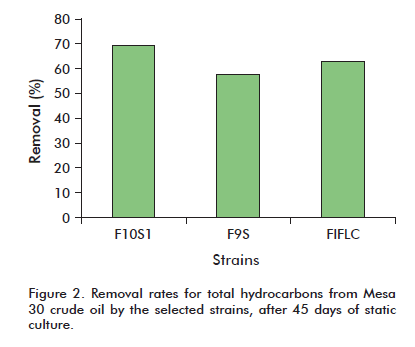
<body><![CDATA[<P   ><font size="2" face="Verdana, Arial, Helvetica, sans-serif"><b>Strain selection      </b> </font></P >       <P   align="justify" ><font size="2" face="Verdana, Arial, Helvetica, sans-serif">All 33 isolated strains      were grouped according to culture, morphological, physiological and biochemical      parameters. At the end, 18 strains representing each unique combination of      these parameters were chosen to be subjected to the selection process. </font></P >       <P   align="justify" ><font size="2" face="Verdana, Arial, Helvetica, sans-serif">From day 3 onwards,      strain F1FLC of <I>Bacillus </I>sp. exhibited vigorous growth. Visible growth      was also detected for strains F10S1 and F9S of <I>Alcaligenes </I>sp. and      <I>Bacillus </I>sp. respectively from day 4 onwards. </font></P >       <P   align="justify" ><font size="2" face="Verdana, Arial, Helvetica, sans-serif">The bacteria growing      in Varadero Venta heavy crudes have probably developed mechanisms to maintain      membrane integrity in the presence of excessive hydrocarbon flow, increasing      for instance membrane rigidity by decreasing its unsaturated fatty acids content      and modulating the cis/trans conformational ratio of its phospholipids, and      inducing the synthesis of membrane complexes that pump out hydrocarbons, in      a manner homologous to that of many antibiotic-resistance bacteria [43, 44].      Hydrocarbons are lipophilic compounds that inhibit growth when present at      high concentrations [45], inducing the bacterial stress response and a series      of changes at the membrane, enzyme and protein levels [44, 46]. </font></P >       <P   ><font size="2" face="Verdana, Arial, Helvetica, sans-serif"><b>Characterization      of the hydrocarbon degradation capacity of the selected strains </b></font></P >       <P   align="justify" ><font size="2" face="Verdana, Arial, Helvetica, sans-serif">The ability to degrade      hydrocarbons from crude oil (Mesa 30 crude) was determined after 45 days of      static culture. Three of the strains under examination (F10S1, F9S and F1FLC)      were able to remove over 50% of the starting hydrocarbon. Strain F10S1 degraded      69.26% of the crude (<a href="#fig2">Figure 2</a>).</font></P >       <P   align="center" ><img src="/img/revistas/bta/v29n2/f0203212.gif" width="415" height="347"><a name="fig2"></a></P >       
<P   align="justify" ><font size="2" face="Verdana, Arial, Helvetica, sans-serif">The treatments (strains)      exhibited statistically significant differences, both between them and in      comparison with the control (p &lt; 0.05). Although there were no significant      inter-treatment differences regarding the concentration of aromatic hydrocarbon      fraction I, the treatments did exhibit statistically significant differences      when compared to the control (p &lt; 0.05). No statistically significant differences      were detected regarding the concentration of aromatic hydrocarbon fraction      II or that of resins when comparing the treatments or even when these were      compared to the control (p &lt; 0.05). Asphaltene concentration, on the other      hand, did exhibit statistically significant differences between treatments,      as well as between these and the control (p &lt; 0.05; <a href="/img/revistas/bta/v29n2/t0103212.gif">Table      1</a>). </font></P >       
<P   align="justify" ><font size="2" face="Verdana, Arial, Helvetica, sans-serif"><a href="/img/revistas/bta/v29n2/f0303212.gif">Figure      3</a> shows the chromatographic profile of the saturated hydrocarbon fraction,      in a signal intensity (pico-amperes) versus time chart for strains F9S, F10S1      and F1FLC. Each of the images shown in the <a href="/img/revistas/bta/v29n2/f0303212.gif">figure</a>      contains the profiles of the abiotic control and that of the strain under      examination, for a number of different carbon chain lengths. Those of strains      F9S and F10S1 exhibit a higher decrease of maxima and of the non-resolved      hydrocarbon background in comparison with strain F1FLC. </font></P >       
<P   align="justify" ><font size="2" face="Verdana, Arial, Helvetica, sans-serif">Chromatographic analysis      was used to calculate C17/pristane and C18/phytane ratios for the different      treatments and the control sample (<a href="/img/revistas/bta/v29n2/t0203212.gif">Table 2</a>). </font></P >       
]]></body>
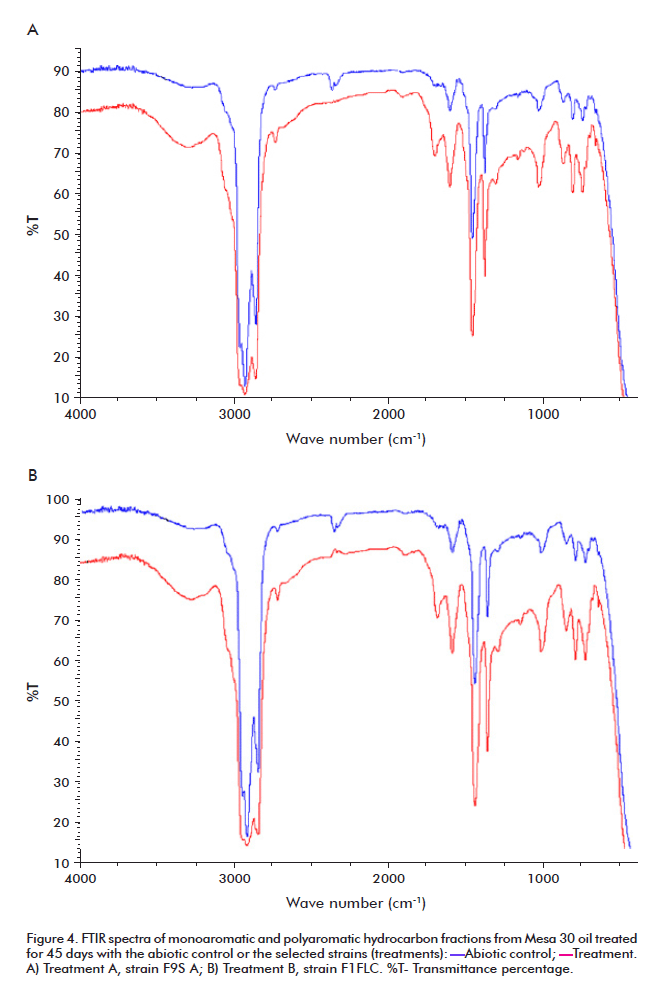
<body><![CDATA[<P   align="justify" ><font size="2" face="Verdana, Arial, Helvetica, sans-serif">Monocyclic and polycyclic      aromatic hydrocarbon fractions were analyzed by FTIR spectroscopy, as described      in Materials and Methods. The transmittance (%) vs. wave number (cm<Sup>-1</Sup>)      charts of strains F9S and F1FLC are shown in <a href="/img/revistas/bta/v29n2/f0403212.gif">Figure      4</a>; strain F10S1 exhibits a profile very similar to that of strain F9S      (data not shown). Each chart depicts both the profile of the strain under      examination and that of the standard sample. The concentration of associated      hydroxyl groups (OH<Sup>-</Sup>, 3290-3300 cm<Sup>-1</Sup>) increased for      all treatments, as did that of carboxylic groups (1680 cm<Sup>-1</Sup>). </font></P >   <FONT size="+1"><FONT size="+1"><FONT size="+1"><FONT size="+1"><FONT size="+1"><FONT size="+1"><FONT size="+1"><FONT size="+1">        
<P   align="justify" ><font size="2" face="Verdana, Arial, Helvetica, sans-serif">The present study      has demonstrated that the bacterial strains selected are able to use hydrocarbons      as sole carbon source when grown in pure cultures. Since hydrocarbon determinations      were performed solely at the end of the study (day 45), no data are available      to evaluate the biodegradation process in earlier time points. Based on our      results, however, together with the existing literature, it is possible to      make some inferences. </font></P >       <P   align="justify" ><font size="2" face="Verdana, Arial, Helvetica, sans-serif">In general, biodegradation      is expected to be more extensive in aliphatic hydrocarbons, which are far      more amenable to this process than their aromatic counterparts [35, 47, 48].      The latter, in turn, are more susceptible to biodegradation than resins and      asphaltenes [47, 48]. However, and despite the higher propensity of n-alkanes      for oxidation [35, 49], no differences in biodegradation percentages were      detected between saturated hydrocarbons, asphaltenes and monocyclic aromatic      hydrocarbons after 45 days. </font></P >       <P   align="justify" ><font size="2" face="Verdana, Arial, Helvetica, sans-serif">Aliphatic hydrocarbons      decreased in comparison with those of the abiotic control regarding the non-resolved      background (cycloalkanes, resins and asphaltenes). When C17/pristane and C18/phytane      ratios of the strains under study were compared to those of the biological      control, it was possible to detect a notable decrease for these values in      strains F10S1 and F9S (50% approximately). This decrease in isoprenoids is      a telltale sign of effective biodegradation; whereas strain F1FLC exhibits      values above those of the abiotic control. </font></P >       <P   align="justify" ><font size="2" face="Verdana, Arial, Helvetica, sans-serif">The spectra in <a href="/img/revistas/bta/v29n2/f0403212.gif">figure      4</a> reveal the presence of aromatic compounds in the crudes treated with      bacterial strains. No statistically significant differences were found for      this parameter among the examined strains, although the increased proportion      of carboxyl and hydroxyl groups demonstrates the presence of biological oxidation      processes. The increased levels of phenols and phenoxides may be directly      related to the accumulation of end compounds produced by the degradation of      resins and asphaltenes. </font></P >       
<P   align="justify" ><font size="2" face="Verdana, Arial, Helvetica, sans-serif">All three strains      under examination produced a notable decrease in the concentration of asphaltenes,      compared to the control. This phenomenon was more pronounced for strains F10S      and F9S, which did not exhibit statistically significant differences when      compared in this regard, but did so when compared to strain F1FLC. The drop      in asphaltene levels observed in the crude treated with strain F9S may have      played a direct role in the increased amount of resins observed in this sample,      although the removal rates of saturated and aromatic monocyclic hydrocarbons      reached figures above 50%, and that of polycyclic aromatic hydrocarbons hovered      around 40%. Strain F10S1 lowered the concentration of all fractions in comparison      with the control. Samples treated with this strain exhibited the lowest concentration      of polycyclic aromatic hydrocarbons, the second lowest concentration of asphaltenes      and the third lowest of resins, and had removal rates over 65% for saturated      and aromatic monocyclic hydrocarbons. </font></P >       <P   align="justify" ><font size="2" face="Verdana, Arial, Helvetica, sans-serif">No alkanes with backbones      shorter than 12 carbon atoms were detected in these samples. Narv&aacute;ez-Flores      <I>et al</I>. made a similar observation while studying the hydrocarbon degradation      capacity of bacteria isolated from marine sediments [44]. Several authors      have pointed out that short chain aliphatic hydrocarbons usually volatilize      during the first hours after a spill. Since their physico-chemical properties      make them toxic compounds for the growth of most bacteria [44, 50], it is      assumed that the degradation of aromatic compounds does not start until saturated      hydrocarbons have been used up. However, direct experimental observation has      revealed that low molecular weight aromatic compounds may start to be degraded      much earlier, sooner, in fact, than many aliphatic molecules [51]. </font></P >       <P   align="justify" ><font size="2" face="Verdana, Arial, Helvetica, sans-serif">An analysis of these      results leads us to suppose that linear chains up to 30 carbon atoms long      and some low molecular weight aromatic compounds were degraded during the      first 10 to 15 days. Had hydrocarbon composition been determined at that point,      we would have most likely found practically identical levels of asphaltenes      and resins in crudes treated with the strains under examination and in their      controls, significantly decreased levels of saturated hydrocarbons in the      former, and only a small drop in the concentration of aromatic hydrocarbons,      since the bulk of their degradation takes place after 21 days. Ruberto <I>et      al</I>., for example, were able to find statistically significant differences      regarding the degradation of aromatic hydrocarbons between experimental treatments      and their control only 20 days after the start of their bioaugmentation and      biostimulation study [52]. The data published by Narv&aacute;ez-Florez <I>et      al</I>., who failed to find statistically significant differences between      hydrocarbon degradation rates in the abiotic control (3.6%) and the experimental      treatment with bacteria (3.5%) [44] are also coherent with such a result.      </font></P >       <P   align="justify" ><font size="2" face="Verdana, Arial, Helvetica, sans-serif">When comparing the      degradation of asphaltenes with that of saturated and aromatic hydrocarbons      regarding the time point at which they first become detectable as well as      their kinetics, it is useful to take into account the environmental characteristics      of the habitat from which the microorganisms under examination have been isolated;      that is, their environmental adaptations. In addition, it must be noted that      synthesis of the enzyme complexes required to degrade the heavier fractions      is not induced until lighter fractions have been exhausted, following the      principle of maximum cellular economy (metabolic regulation). Regardless,      Joseph <I>et al</I>. found that microorganisms isolated from the C&aacute;rdenas      Bay in Matanzas (Cuba) degraded better heavy oils (such as the Varadero crude)      than lighter ones (such as the Pina crude) [49]. These authors attributed      such a phenomenon to adaptations of these microorganisms to the chronic contamination      of their original habitats. Varadero crude is higher in asphaltenes, whereas      the main constituents of Pina crude are saturated hydrocarbons with chain      lengths smaller than 18 carbon atoms. Asphaltene degradation not only takes      place through the classical, more efficient mechanisms of oxidation, but also      through &alpha;- and &omega;-oxidation processes where intermediate products      are bulkier, thereby lengthening the time required for biodegradation [23].      In addition, other authors have shown that the biotransformation of asphaltenes      and resins leads to the accumulation of simpler saturated and aromatic derivates,      increasing the concentration of these fractions [53, 54]. </font></P >       <P   align="justify" ><font size="2" face="Verdana, Arial, Helvetica, sans-serif">Bacterial metabolism      is readjusted as culture ages and less complex substrates (saturated linear      alkanes and low molecular weight aromatic compounds) are exhausted, shifting      towards the synthesis of enzyme complexes geared towards the degradation of      more complex molecules. These compounds did not mineralize completely, accumulating      instead as intermediary metabolites consisting of linear chains and aromatic      compounds. The host enzyme machinery must, therefore, have adapted to fluctuations      in the levels of these different compounds. </font></P >       ]]></body>
<body><![CDATA[<P   >&nbsp;</P >       <P   ><font size="3" face="Verdana, Arial, Helvetica, sans-serif"><b>CONCLUSIONS</b></font><font size="2" face="Verdana, Arial, Helvetica, sans-serif">      </font></P >   <FONT size="+1">        <P   align="justify" ><font size="2" face="Verdana, Arial, Helvetica, sans-serif">A total of 33 hydrocarbonoclastic      strains were isolated from coastal environments at Felton (Holgu&iacute;n,      Cuba). They were taxonomically identified as members of the <I>Bacillus, Alcaligenes,      Pseudomonas, Acinetobacter, Marinomonas, Kurthia </I>and <I>Azotobacter </I>genera.      </font></P >   <FONT size="+1">        <P   align="justify" ><font size="2" face="Verdana, Arial, Helvetica, sans-serif">The strains <I>Alcaligenes      sp.</I> F10S1; <I>Bacillus sp.</I> F9S and <I>Bacillus sp. </I>F1FLC removed      55 to 80% of the total hydrocarbon added to the culture after 45 days. Asphaltenes,      monocyclic aromatic compounds and saturated hydrocarbons were the fractions      undergoing degradation to the largest extent. Strains <I>Alcaligenes sp.</I>      F10S1 and <I>Bacillus sp. </I>F9S exhibited the best results regarding the      degradation of asphaltenes.</font></P >       <P   align="justify" >&nbsp;</P >       <P   align="justify" ></P >       <P   align="justify" ></P >       <P   align="justify" > </P >       <P   align="justify" ><b><font size="3" face="Verdana, Arial, Helvetica, sans-serif">REFERENCES </font></b></P >       <P   align="justify" > </P >       ]]></body>
<body><![CDATA[<!-- ref --><P   ><font size="2" face="Verdana, Arial, Helvetica, sans-serif">1. Madigan M, Martinko      J, Parker J. Brock, biolog&iacute;a de los microorganismos. 10 ed. Revised.      Madrid: Prentice Hall, Iberia; 2004.     </font></P >   <FONT size="+1">        <!-- ref --><P   ><font size="2" face="Verdana, Arial, Helvetica, sans-serif">2. Pollard SJT, Hrudey      SE, Fedorak PM. Bioremediation of petroleum-and creosote-contaminated soils:      a review of constraints. Waste Manage Res. 1994; 12(2):173-94.     </font></P >       <!-- ref --><P   ><font size="2" face="Verdana, Arial, Helvetica, sans-serif">3. Abalos A, Vinas      M, Sabate J, Manresa MA, Solanas AM. Enhanced biodegradation of Casablanca      crude oil by a microbial consortium in presence of a rhamnolipid produced      by Pseudomonas aeruginosa AT10. Biodegradation. 2004;15(4):249-60.     </font></P >       <!-- ref --><P   ><font size="2" face="Verdana, Arial, Helvetica, sans-serif">4. N&aacute;poles      J. Ensayos de tratabilidad en suelos contaminados con petr&oacute;leo [dissertation].      Santiago de Cuba: Universidad de Oriente; 2005.     </font></P >       <!-- ref --><P   ><font size="2" face="Verdana, Arial, Helvetica, sans-serif">5. Vinas M, Sabate      J, Espuny MJ, Solanas AM. Bacterial community dynamics and polycyclic aromatic      hydrocarbon degradation during bioremediation of heavily creosote-contaminated      soil. Appl Environ Microbiol. 2005;71(11):7008-18.     </font></P >       ]]></body>
<body><![CDATA[<!-- ref --><P   ><font size="2" face="Verdana, Arial, Helvetica, sans-serif">6. Swannell RP, Lee      K, McDonagh M. Field evaluations of marine oil spill bioremediation. Microbiol      Rev. 1996;60(2):342-65.     </font></P >       <!-- ref --><P   ><font size="2" face="Verdana, Arial, Helvetica, sans-serif">7. Fernandez-Alvarez      P, Vila J, Garrido-Fernandez JM, Grifoll M, Lema JM. Trials of bioremediation      on a beach affected by the heavy oil spill of the Prestige. J Hazard Mater.      2006;137(3):1523-31.     </font></P >       <!-- ref --><P   ><font size="2" face="Verdana, Arial, Helvetica, sans-serif">8. Bushnell LD, Haas      HF. The Utilization of Certain Hydrocarbons by Microorganisms. J Bacteriol.      1941;41(5):653-73.     </font></P >       <!-- ref --><P   ><font size="2" face="Verdana, Arial, Helvetica, sans-serif">9. Baumann L, Baumann      P, Mandel M, Allen RD. Taxonomy of aerobic marine eubacteria. J Bacteriol.      1972;110(1):402-29.     </font></P >       <!-- ref --><P   ><font size="2" face="Verdana, Arial, Helvetica, sans-serif">10. Rivera-Cruz MC,      Ferrera-Cerrato R, Volke V, Rodr&iacute;guez R, Fern&aacute;ndez L. Adaptaci&oacute;n      y selecci&oacute;n de microorganismos aut&oacute;ctonos en medios de cultivo      enriquecidos con petr&oacute;leo crudo. Terra Latinoam. 2002;20(4):423-34.          </font></P >       ]]></body>
<body><![CDATA[<!-- ref --><P   ><font size="2" face="Verdana, Arial, Helvetica, sans-serif">11. Chabl&eacute;      de la Cruz G, Garc&iacute;a F, Madrigal EO. Evaluaci&oacute;n de la respuesta      de los microorganismos presentes en un derrame de hidrocarburos [Internet].      2004 [cited 2009 Oct 29]. Available from <a href="http://www.biologia-en-internet.com" target="_blank">http://www.biologia-en-internet.com</a>      </font></P >       <!-- ref --><P   ><font size="2" face="Verdana, Arial, Helvetica, sans-serif">12. Oliver J. Taxonomic      scheme for the identification of marine bacteria. Deep-sea Res. 1982;29(6):795-8.          </font></P >       <!-- ref --><P   ><font size="2" face="Verdana, Arial, Helvetica, sans-serif">13. Mart&iacute;nez      J, Romay Z, Rojas T, Guerra G. Manual pr&aacute;ctico de Microbiolog&iacute;a.      La Habana: Pueblo y Educaci&oacute;n; 1985.     </font></P >       <P   ><font size="2" face="Verdana, Arial, Helvetica, sans-serif">14. Pell&oacute;n      F, Orozco R, Le&oacute;n J. Bacterias marinas con capacidad antimicrobiana      aisladas de moluscos bivalvos en cultivos. Rev Per Biol. 2001 [cited 2010      Apr 14];8(2):[about 10 p.]. Available from: <a href="http://www.brenda-enzymes.org" target="_blank">http://sisbib.unmsm.edu.pe/BVRevistas/biologia/v08_n2/bacte_marinas.htm</a>      </font></P >       <!-- ref --><P   ><font size="2" face="Verdana, Arial, Helvetica, sans-serif">15. Holt JG, Krieg      NR, Sneath PHA, Staley JT, Williams ST. Bergey&acute;s Manual of Determinative      Bacteriology. 9 ed. Baltimore: Williams &amp; Wilkins; 1994.     </font></P >       <P   ><font size="2" face="Verdana, Arial, Helvetica, sans-serif">16. Gallardo AA,      Risso S, Fajardo MA, Estevao S. Caracterizaci&oacute;n de polaciones microbianas      presentes en la macroalga comestible Monostroma undulatum, Wittrock. Arch      Latinoam Nutr. 54(3):337-45. </font></P >       <!-- ref --><P   ><font size="2" face="Verdana, Arial, Helvetica, sans-serif">17. Leahy JG, Colwell      RR. Microbial degradation of hydrocarbons in the environment. Microbiol Rev.      1990;54(3):305-15.     </font></P >       <!-- ref --><P   ><font size="2" face="Verdana, Arial, Helvetica, sans-serif">18. Annweiler E,      Richnow HH, Antranikian G, Hebenbrock S, Garms C, Franke S, et al. Naphthalene      degradation and incorporation of naphthalene-derived carbon into biomass by      the thermophile Bacillus thermoleovorans. Appl Environ Microbiol. 2000;66(2):518-23.          </font></P >       <!-- ref --><P   ><font size="2" face="Verdana, Arial, Helvetica, sans-serif">19. Roling WF, Milner      MG, Jones DM, Lee K, Daniel F, Swannell RJ, et al. Robust hydrocarbon degradation      and dynamics of bacterial communities during nutrient-enhanced oil spill bioremediation.      Appl Environ Microbiol. 2002;68(11):5537-48.     </font></P >       <!-- ref --><P   ><font size="2" face="Verdana, Arial, Helvetica, sans-serif">20. Ficker M, Krastel      K, Orlicky S, Edwards E. Molecular characterization of a toluene-degrading      methanogenic consortium. Appl Environ Microbiol. 1999; 65(12):5576-85.     </font></P >       <!-- ref --><P   ><font size="2" face="Verdana, Arial, Helvetica, sans-serif">21. Dojka MA, Hugenholtz      P, Haack SK, Pace NR. Microbial diversity in a hydrocarbon- and chlorinated-solvent-contaminated      aquifer undergoing intrinsic bioremediation. Appl Environ Microbiol 1998;64(10):3869-77.          </font></P >       <P   ><font size="2" face="Verdana, Arial, Helvetica, sans-serif">22. Olivera NL, Commendatore      MG, Moran AC, Esteves JL. Biosurfactant-enhanced degradation of residual hydrocarbons      from slip bilge wastes. J Ind Microbiol Biot. 2000;25(2):70-3. </font></P >       ]]></body>
<body><![CDATA[<!-- ref --><P   ><font size="2" face="Verdana, Arial, Helvetica, sans-serif">23. N&uacute;&ntilde;ez      R. Obtenci&oacute;n, caracterizaci&oacute;n y aplicaci&oacute;n de un bioproducto      bacteriano para la biorremediaci&oacute;n de derrames de hidrocarburos [dissertation],      La Habana: Universidad de La Habana; 2004.     </font></P >       <!-- ref --><P   ><font size="2" face="Verdana, Arial, Helvetica, sans-serif">24. Ara-Rojas SL,      Massol-Dey&aacute; A. Diversidad bacteriana en un biorreactor de lecho fluidificado      durante el tratamiento de agua contaminada con nafta. Rev Argent Microbiol.      2007;39(4):243-51.     </font></P >       <!-- ref --><P   ><font size="2" face="Verdana, Arial, Helvetica, sans-serif">25. Kim JS, Crowley      DE. Microbial diversity in natural asphalts of the Rancho La Brea Tar Pits.      Appl Environ Microbiol. 2007;73(14):4579-91.     </font></P >       <!-- ref --><P   ><font size="2" face="Verdana, Arial, Helvetica, sans-serif">26. Winderl C, Anneser      B, Griebler C, Meckenstock RU, Lueders T. Depth-resolved quantification of      anaerobic toluene degraders and aquifer microbial community patterns in distinct      redox zones of a tar oil contaminant plume. Appl Environ Microbiol. 2008;74(3):792-801.          </font></P >       <!-- ref --><P   ><font size="2" face="Verdana, Arial, Helvetica, sans-serif">27. Daane LL, Harjono      I, Zylstra GJ, Haggblom MM. Isolation and characterization of polycyclic aromatic      hydrocarbon-degrading bacteria associated with the rhizosphere of salt marsh      plants. Appl Environ Microbiol. 2001;67(6):2683-91.     </font></P >       ]]></body>
<body><![CDATA[<!-- ref --><P   ><font size="2" face="Verdana, Arial, Helvetica, sans-serif">28. Colores GM, Macur      RE, Ward DM, Inskeep WP. Molecular analysis of surfactant-driven microbial      population shifts in hydrocarbon-contaminated soil. Appl Environ Microbiol.      2000;66(7):2959-64.     </font></P >       <!-- ref --><P   ><font size="2" face="Verdana, Arial, Helvetica, sans-serif">29. Kanaly RA, Bartha      R, Watanabe K, Harayama S. Rapid mineralization of benzo[a]pyrene by a microbial      consortium growing on diesel fuel. Appl Environ Microbiol. 2000;66(10):4205-11.          </font></P >       <!-- ref --><P   ><font size="2" face="Verdana, Arial, Helvetica, sans-serif">30. Roling WF, Milner      MG, Jones DM, Fratepietro F, Swannell RP, Daniel F, et al. Bacterial community      dynamics and hydrocarbon degradation during a field-scale evaluation of bioremediation      on a mudflat beach contaminated with buried oil. Appl Environ Microbiol. 2004;70(5):2603-13.          </font></P >       <!-- ref --><P   ><font size="2" face="Verdana, Arial, Helvetica, sans-serif">31. Bordenave S,      Goni-Urriza MS, Caumette P, Duran R. Effects of heavy fuel oil on the bacterial      community structure of a pristine microbial mat. Appl Environ Microbiol. 2007;73(19):6089-97.          </font></P >       <!-- ref --><P   ><font size="2" face="Verdana, Arial, Helvetica, sans-serif">32. Miravet ME. Estudio      de bacterias heter&oacute;trofas en el Golfo de Bataban&oacute; [dissertation].      La Habana: Universidad de La Habana; 1996.     </font></P >       ]]></body>
<body><![CDATA[<!-- ref --><P   ><font size="2" face="Verdana, Arial, Helvetica, sans-serif">33. Cerniglia CE.      Biodegradation of Polycyclic Aromatic Hydrocarbons. Biodegradation. 1992;(2-3):351-68.          </font></P >       <!-- ref --><P   ><font size="2" face="Verdana, Arial, Helvetica, sans-serif">34. Dagher F, Deziel      E, Lirette P, Paquette G, Bisaillon JG, Villemur R. Comparative study of five      polycyclic aromatic hydrocarbon degrading bacterial strains isolated from      contaminated soils. Can J Microbiol. 1997;43(4):368-77.     </font></P >       <!-- ref --><P   ><font size="2" face="Verdana, Arial, Helvetica, sans-serif">35. Whyte LG, Bourbonniere      L, Greer CW. Biodegradation of petroleum hydrocarbons by psychrotrophic Pseudomonas      strains possessing both alkane (alk) and naphthalene (nah) catabolic pathways.      Appl Environ Microbiol 1997;63(9):3719-23.     </font></P >       <!-- ref --><P   ><font size="2" face="Verdana, Arial, Helvetica, sans-serif">36. Hilyard EJ, Jones-Meehan      JM, Spargo BJ, Hill RT. Enrichment, isolation, and phylogenetic identification      of polycyclic aromatic hydrocarbon-degrading bacteria from Elizabeth River      sediments. Appl Environ Microbiol. 2008;74(4):1176-82.     </font></P >       <!-- ref --><P   ><font size="2" face="Verdana, Arial, Helvetica, sans-serif">37. Mukred AM, Hamid      AA, Hamzah A, Wan Yusoff WM. Development of Three Bacteria Consortium for      the Bioremediation of Crude Petroleum-oil in Contaminated Water. Online J      Biol Sci. 2008; 8(4):73-9.     </font></P >       ]]></body>
<body><![CDATA[<!-- ref --><P   ><font size="2" face="Verdana, Arial, Helvetica, sans-serif">38. Stringfellow      WT, Aitken MD. Comparative physiology of phenanthrene degradation by two dissimilar      pseudomonads isolated from a creosote-contaminated soil. Can J Microbiol.      1994;40(6):432-8.     </font></P >       <!-- ref --><P   ><font size="2" face="Verdana, Arial, Helvetica, sans-serif">39. Noordman W, Bruseau      M, Jassen D. Effects of rhamnolipid biosurfactants on removal of phenanthrene      from soil. Environ Sci Technol. 1998;32(12):1806-12.     </font></P >       <!-- ref --><P   ><font size="2" face="Verdana, Arial, Helvetica, sans-serif">40. Goodwin KD, Tokarczyk      R, Stephens FC, Saltzman ES. Description of toluene inhibition of methyl bromide      biodegradation in seawater and isolation of a marine toluene oxidizer that      degrades methyl bromide. Appl Environ Microbiol. 2005;71(7):3495-503.     </font></P >       <!-- ref --><P   ><font size="2" face="Verdana, Arial, Helvetica, sans-serif">41. Neumann G, Teras      R, Monson L, Kivisaar M, Schauer F, Heipieper HJ. Simultaneous degradation      of atrazine and phenol by Pseudomonas sp. strain ADP: effects of toxicity      and adaptation. Appl Environ Microbiol. 2004;70(4):1907-12.     </font></P >       <!-- ref --><P   ><font size="2" face="Verdana, Arial, Helvetica, sans-serif">42. Melcher RJ, Apitz      SE, Hemmingsen BB. Impact of irradiation and polycyclic aromatic hydrocarbon      spiking on microbial populations in marine sediment for future aging and biodegradability      studies. Appl Environ Microbiol. 2002;68(6):2858-68.     </font></P >       ]]></body>
<body><![CDATA[<!-- ref --><P   ><font size="2" face="Verdana, Arial, Helvetica, sans-serif">43. Ramos JL, Duque      E, Rodriguez-Herva JJ, Godoy P, Haidour A, Reyes F, et al. Mechanisms for      solvent tolerance in bacteria. J Biol Chem. 1997;272(7):3887-90.     </font></P >       <!-- ref --><P   ><font size="2" face="Verdana, Arial, Helvetica, sans-serif">44. Narv&aacute;ez-Florez      S, G&oacute;mez ML, Mart&iacute;nez MM. Selecci&oacute;n de bacterias con      capacidad degradadora de hidrocarburos aisladas a partir de sedimentos del      Caribe colombiano. Bol Invemar. 2008; 37(1):61-75.     </font></P >       <!-- ref --><P   ><font size="2" face="Verdana, Arial, Helvetica, sans-serif">45. LaGrega MD, Buckingham      PL, Evans JC, Environmental Resources Management group. Hazardous waste management.      2nd ed. Boston: McGraw-Hill; 2001. p. 7-23.     </font></P >       <!-- ref --><P   ><font size="2" face="Verdana, Arial, Helvetica, sans-serif">46. Van Hamme JD,      Singh A, Ward OP. Recent advances in petroleum microbiology. Microbiol Mol      Biol Rev. 2003;67(4):503-49.     </font></P >       <!-- ref --><P   ><font size="2" face="Verdana, Arial, Helvetica, sans-serif">47. Song HG, Wang      X, Bartha R. Bioremediation potential of terrestrial fuel spills. Appl Environ      Microbiol. 1990;56(3): 652-6.     </font></P >       ]]></body>
<body><![CDATA[<!-- ref --><P   ><font size="2" face="Verdana, Arial, Helvetica, sans-serif">48. Le&oacute;n N,      Infante C, Arias M, Marquez M, Gorr&iacute;n A. Biodegradability of Venezuela      crude oils. SPE International conference on health, safety, and environment      in oil and gas exploration and production, 1998 June 7-10, Caracas, Venezuela.          </font></P >       <!-- ref --><P   ><font size="2" face="Verdana, Arial, Helvetica, sans-serif">49. Joseph IN, Capo      MC, Bellota M, Ramos Y, Ramos I, Fuentes M. Aislamiento y selecci&oacute;n      de microorganismos degradadores de hidrocarburos en la plataforma cubana.      Ciencias Biol&oacute;gicas. 1994;27:137-48.     </font></P >       <!-- ref --><P   ><font size="2" face="Verdana, Arial, Helvetica, sans-serif">50. Solano-Serena      F, Marchal R, Casaregola S, Vasnier C, Lebeault JM, Vandecasteele JP. A Mycobacterium      strain with extended capacities for degradation of gasoline hydrocarbons.      Appl Environ Microbiol. 2000;66(6):2392-9.     </font></P >       <!-- ref --><P   ><font size="2" face="Verdana, Arial, Helvetica, sans-serif">51. Venosa A, Zhu      X. Biodegradation of crude oil contaminating marine shorelines and freshwater      wetlands. Spill Sci technol Bull. 2003;8:163-78.     </font></P >       <P   ><font size="2" face="Verdana, Arial, Helvetica, sans-serif">52. Ruberto L, V&ntilde;azquez      S, y Mac Cormack W. Effectiveness of the natural bacterial flora, bioestimulation      and bioaumentation on the bioremediation of a hydrocarbon contaminated Antartic      soil. Int Biodeter Biodegr. 2003;52(2):115-25. </font></P >       <!-- ref --><P   ><font size="2" face="Verdana, Arial, Helvetica, sans-serif">53. Young LY, Cerniglia      CE, editors. Microbial Transformation and degradation of toxic organic chemicals.      Nueva York: Willy-Liss; 1995.     </font></P >       <!-- ref --><P   ><font size="2" face="Verdana, Arial, Helvetica, sans-serif">54. Araujo I, G&oacute;mez      A, Barrera M, Angulo N, Morillo G, C&aacute;rdenas C, et al. Surfactantes      biol&oacute;gicos en la biorremediaci&oacute;n de aguas contaminadas con crudo      liviano. Interciencia. 2008; 33(4):245-50.    </font></P >       <P   ><FONT size="+1"> </font></P >   <FONT size="+1">       <P   > </P >       <P   ><font size="2" face="Verdana, Arial, Helvetica, sans-serif">Received in October,      2010.     <br>     Accepted for publication in January, 2012.</font></P >       <P   >&nbsp;</P >       <P   > </P >       <P   ><i><font size="2" face="Verdana, Arial, Helvetica, sans-serif">Yaima Barrios-San      Mart&iacute;n</font></i><font size="2" face="Verdana, Arial, Helvetica, sans-serif">.      Laboratorio de Qu&iacute;mica y Biotecnolog&iacute;a, Centro de Investigaciones      del Petr&oacute;leo, Ceinpet. Churruca #481, Cerro, CP 12 600, La Habana,      Cuba. E-mail: <A href="mailto:yy@ceinpet.cupet.cu"> <U><U><FONT color="#0000FF">yy@ceinpet.cupet.cu</font></U></U></A><FONT color="#0000FF"></font></font></P >   </font></font></font></font></font></font></font></font></font></font></font></font></font></font></font></font></font></font></font></font></font></font></font></font></font></font></font></font></DIV >     ]]></body>
<body><![CDATA[ ]]></body><back>
<ref-list>
<ref id="B1">
<label>1</label><nlm-citation citation-type="book">
<person-group person-group-type="author">
<name>
<surname><![CDATA[Madigan]]></surname>
<given-names><![CDATA[M]]></given-names>
</name>
<name>
<surname><![CDATA[Martinko]]></surname>
<given-names><![CDATA[J]]></given-names>
</name>
<name>
<surname><![CDATA[Parker]]></surname>
<given-names><![CDATA[J]]></given-names>
</name>
</person-group>
<source><![CDATA[Brock, biología de los microorganismos]]></source>
<year>2004</year>
<edition>10</edition>
<publisher-loc><![CDATA[Madrid ]]></publisher-loc>
<publisher-name><![CDATA[Prentice Hall, Iberia]]></publisher-name>
</nlm-citation>
</ref>
<ref id="B2">
<label>2</label><nlm-citation citation-type="journal">
<person-group person-group-type="author">
<name>
<surname><![CDATA[Pollard]]></surname>
<given-names><![CDATA[SJT]]></given-names>
</name>
<name>
<surname><![CDATA[Hrudey]]></surname>
<given-names><![CDATA[SE]]></given-names>
</name>
<name>
<surname><![CDATA[Fedorak]]></surname>
<given-names><![CDATA[PM]]></given-names>
</name>
</person-group>
<article-title xml:lang="en"><![CDATA[Bioremediation of petroleum-and creosote-contaminated soils: a review of constraints]]></article-title>
<source><![CDATA[Waste Manage Res]]></source>
<year>1994</year>
<volume>12</volume>
<numero>2</numero>
<issue>2</issue>
<page-range>173-94</page-range></nlm-citation>
</ref>
<ref id="B3">
<label>3</label><nlm-citation citation-type="journal">
<person-group person-group-type="author">
<name>
<surname><![CDATA[Abalos]]></surname>
<given-names><![CDATA[A]]></given-names>
</name>
<name>
<surname><![CDATA[Vinas]]></surname>
<given-names><![CDATA[M]]></given-names>
</name>
<name>
<surname><![CDATA[Sabate]]></surname>
<given-names><![CDATA[J]]></given-names>
</name>
<name>
<surname><![CDATA[Manresa]]></surname>
<given-names><![CDATA[MA]]></given-names>
</name>
<name>
<surname><![CDATA[Solanas]]></surname>
<given-names><![CDATA[AM]]></given-names>
</name>
</person-group>
<article-title xml:lang="en"><![CDATA[Enhanced biodegradation of Casablanca crude oil by a microbial consortium in presence of a rhamnolipid produced by Pseudomonas aeruginosa AT10]]></article-title>
<source><![CDATA[Biodegradation]]></source>
<year>2004</year>
<volume>15</volume>
<numero>4</numero>
<issue>4</issue>
<page-range>249-60</page-range></nlm-citation>
</ref>
<ref id="B4">
<label>4</label><nlm-citation citation-type="book">
<person-group person-group-type="author">
<name>
<surname><![CDATA[Nápoles]]></surname>
<given-names><![CDATA[J]]></given-names>
</name>
</person-group>
<source><![CDATA[Ensayos de tratabilidad en suelos contaminados con petróleo]]></source>
<year>2005</year>
<publisher-loc><![CDATA[Santiago de Cuba ]]></publisher-loc>
<publisher-name><![CDATA[Universidad de Oriente]]></publisher-name>
</nlm-citation>
</ref>
<ref id="B5">
<label>5</label><nlm-citation citation-type="journal">
<person-group person-group-type="author">
<name>
<surname><![CDATA[Vinas]]></surname>
<given-names><![CDATA[M]]></given-names>
</name>
<name>
<surname><![CDATA[Sabate]]></surname>
<given-names><![CDATA[J]]></given-names>
</name>
<name>
<surname><![CDATA[Espuny]]></surname>
<given-names><![CDATA[MJ]]></given-names>
</name>
<name>
<surname><![CDATA[Solanas]]></surname>
<given-names><![CDATA[AM]]></given-names>
</name>
</person-group>
<article-title xml:lang="en"><![CDATA[Bacterial community dynamics and polycyclic aromatic hydrocarbon degradation during bioremediation of heavily creosote-contaminated soil]]></article-title>
<source><![CDATA[Appl Environ Microbiol]]></source>
<year>2005</year>
<volume>71</volume>
<numero>11</numero>
<issue>11</issue>
<page-range>7008-18</page-range></nlm-citation>
</ref>
<ref id="B6">
<label>6</label><nlm-citation citation-type="journal">
<person-group person-group-type="author">
<name>
<surname><![CDATA[Swannell]]></surname>
<given-names><![CDATA[RP]]></given-names>
</name>
<name>
<surname><![CDATA[Lee]]></surname>
<given-names><![CDATA[K]]></given-names>
</name>
<name>
<surname><![CDATA[McDonagh]]></surname>
<given-names><![CDATA[M]]></given-names>
</name>
</person-group>
<article-title xml:lang="en"><![CDATA[Field evaluations of marine oil spill bioremediation]]></article-title>
<source><![CDATA[Microbiol Rev]]></source>
<year>1996</year>
<volume>60</volume>
<numero>2</numero>
<issue>2</issue>
<page-range>342-65</page-range></nlm-citation>
</ref>
<ref id="B7">
<label>7</label><nlm-citation citation-type="journal">
<person-group person-group-type="author">
<name>
<surname><![CDATA[Fernandez-Alvarez]]></surname>
<given-names><![CDATA[P]]></given-names>
</name>
<name>
<surname><![CDATA[Vila]]></surname>
<given-names><![CDATA[J]]></given-names>
</name>
<name>
<surname><![CDATA[Garrido-Fernandez]]></surname>
<given-names><![CDATA[JM]]></given-names>
</name>
<name>
<surname><![CDATA[Grifoll]]></surname>
<given-names><![CDATA[M]]></given-names>
</name>
<name>
<surname><![CDATA[Lema]]></surname>
<given-names><![CDATA[JM]]></given-names>
</name>
</person-group>
<article-title xml:lang="en"><![CDATA[Trials of bioremediation on a beach affected by the heavy oil spill of the Prestige]]></article-title>
<source><![CDATA[J Hazard Mater]]></source>
<year>2006</year>
<volume>137</volume>
<numero>3</numero>
<issue>3</issue>
<page-range>1523-31</page-range></nlm-citation>
</ref>
<ref id="B8">
<label>8</label><nlm-citation citation-type="journal">
<person-group person-group-type="author">
<name>
<surname><![CDATA[Bushnell]]></surname>
<given-names><![CDATA[LD]]></given-names>
</name>
<name>
<surname><![CDATA[Haas]]></surname>
<given-names><![CDATA[HF]]></given-names>
</name>
</person-group>
<article-title xml:lang="en"><![CDATA[The Utilization of Certain Hydrocarbons by Microorganisms]]></article-title>
<source><![CDATA[J Bacteriol]]></source>
<year>1941</year>
<volume>41</volume>
<numero>5</numero>
<issue>5</issue>
<page-range>653-73</page-range></nlm-citation>
</ref>
<ref id="B9">
<label>9</label><nlm-citation citation-type="journal">
<person-group person-group-type="author">
<name>
<surname><![CDATA[Baumann]]></surname>
<given-names><![CDATA[L]]></given-names>
</name>
<name>
<surname><![CDATA[Baumann]]></surname>
<given-names><![CDATA[P]]></given-names>
</name>
<name>
<surname><![CDATA[Mandel]]></surname>
<given-names><![CDATA[M]]></given-names>
</name>
<name>
<surname><![CDATA[Allen]]></surname>
<given-names><![CDATA[RD]]></given-names>
</name>
</person-group>
<article-title xml:lang="en"><![CDATA[Taxonomy of aerobic marine eubacteria]]></article-title>
<source><![CDATA[J Bacteriol]]></source>
<year>1972</year>
<volume>110</volume>
<numero>1</numero>
<issue>1</issue>
<page-range>402-29</page-range></nlm-citation>
</ref>
<ref id="B10">
<label>10</label><nlm-citation citation-type="journal">
<person-group person-group-type="author">
<name>
<surname><![CDATA[Rivera-Cruz]]></surname>
<given-names><![CDATA[MC]]></given-names>
</name>
<name>
<surname><![CDATA[Ferrera-Cerrato]]></surname>
<given-names><![CDATA[R]]></given-names>
</name>
<name>
<surname><![CDATA[Volke]]></surname>
<given-names><![CDATA[V]]></given-names>
</name>
<name>
<surname><![CDATA[Rodríguez]]></surname>
<given-names><![CDATA[R]]></given-names>
</name>
<name>
<surname><![CDATA[Fernández]]></surname>
<given-names><![CDATA[L]]></given-names>
</name>
</person-group>
<article-title xml:lang="es"><![CDATA[Adaptación y selección de microorganismos autóctonos en medios de cultivo enriquecidos con petróleo crudo]]></article-title>
<source><![CDATA[Terra Latinoam]]></source>
<year>2002</year>
<volume>20</volume>
<numero>4</numero>
<issue>4</issue>
<page-range>423-34</page-range></nlm-citation>
</ref>
<ref id="B11">
<label>11</label><nlm-citation citation-type="">
<person-group person-group-type="author">
<name>
<surname><![CDATA[Chablé de la Cruz]]></surname>
<given-names><![CDATA[G]]></given-names>
</name>
<name>
<surname><![CDATA[García]]></surname>
<given-names><![CDATA[F]]></given-names>
</name>
<name>
<surname><![CDATA[Madrigal]]></surname>
<given-names><![CDATA[EO]]></given-names>
</name>
</person-group>
<source><![CDATA[Evaluación de la respuesta de los microorganismos presentes en un derrame de hidrocarburos]]></source>
<year>2004</year>
</nlm-citation>
</ref>
<ref id="B12">
<label>12</label><nlm-citation citation-type="journal">
<person-group person-group-type="author">
<name>
<surname><![CDATA[Oliver]]></surname>
<given-names><![CDATA[J]]></given-names>
</name>
</person-group>
<article-title xml:lang="en"><![CDATA[Taxonomic scheme for the identification of marine bacteria]]></article-title>
<source><![CDATA[Deep-sea Res]]></source>
<year>1982</year>
<volume>29</volume>
<numero>6</numero>
<issue>6</issue>
<page-range>795-8</page-range></nlm-citation>
</ref>
<ref id="B13">
<label>13</label><nlm-citation citation-type="book">
<person-group person-group-type="author">
<name>
<surname><![CDATA[Martínez]]></surname>
<given-names><![CDATA[J]]></given-names>
</name>
<name>
<surname><![CDATA[Romay]]></surname>
<given-names><![CDATA[Z]]></given-names>
</name>
<name>
<surname><![CDATA[Rojas]]></surname>
<given-names><![CDATA[T]]></given-names>
</name>
<name>
<surname><![CDATA[Guerra]]></surname>
<given-names><![CDATA[G]]></given-names>
</name>
</person-group>
<source><![CDATA[Manual práctico de Microbiología]]></source>
<year>1985</year>
<publisher-loc><![CDATA[La Habana ]]></publisher-loc>
<publisher-name><![CDATA[Pueblo y Educación]]></publisher-name>
</nlm-citation>
</ref>
<ref id="B14">
<label>14</label><nlm-citation citation-type="journal">
<person-group person-group-type="author">
<name>
<surname><![CDATA[Pellón]]></surname>
<given-names><![CDATA[F]]></given-names>
</name>
<name>
<surname><![CDATA[Orozco]]></surname>
<given-names><![CDATA[R]]></given-names>
</name>
<name>
<surname><![CDATA[León]]></surname>
<given-names><![CDATA[J]]></given-names>
</name>
</person-group>
<article-title xml:lang="es"><![CDATA[Bacterias marinas con capacidad antimicrobiana aisladas de moluscos bivalvos en cultivos]]></article-title>
<source><![CDATA[Rev Per Biol]]></source>
<year>2001</year>
<volume>8</volume>
<numero>2</numero>
<issue>2</issue>
</nlm-citation>
</ref>
<ref id="B15">
<label>15</label><nlm-citation citation-type="book">
<person-group person-group-type="author">
<name>
<surname><![CDATA[Holt]]></surname>
<given-names><![CDATA[JG]]></given-names>
</name>
<name>
<surname><![CDATA[Krieg]]></surname>
<given-names><![CDATA[NR]]></given-names>
</name>
<name>
<surname><![CDATA[Sneath]]></surname>
<given-names><![CDATA[PHA]]></given-names>
</name>
<name>
<surname><![CDATA[Staley]]></surname>
<given-names><![CDATA[JT]]></given-names>
</name>
<name>
<surname><![CDATA[Williams]]></surname>
<given-names><![CDATA[ST]]></given-names>
</name>
</person-group>
<source><![CDATA[Bergey´s Manual of Determinative Bacteriology]]></source>
<year>1994</year>
<edition>9</edition>
<publisher-loc><![CDATA[Baltimore ]]></publisher-loc>
<publisher-name><![CDATA[Williams & Wilkins]]></publisher-name>
</nlm-citation>
</ref>
<ref id="B16">
<label>16</label><nlm-citation citation-type="journal">
<person-group person-group-type="author">
<name>
<surname><![CDATA[Gallardo]]></surname>
<given-names><![CDATA[AA]]></given-names>
</name>
<name>
<surname><![CDATA[Risso]]></surname>
<given-names><![CDATA[S]]></given-names>
</name>
<name>
<surname><![CDATA[Fajardo]]></surname>
<given-names><![CDATA[MA]]></given-names>
</name>
<name>
<surname><![CDATA[Estevao]]></surname>
<given-names><![CDATA[S]]></given-names>
</name>
</person-group>
<article-title xml:lang="es"><![CDATA[Caracterización de polaciones microbianas presentes en la macroalga comestible Monostroma undulatum, Wittrock]]></article-title>
<source><![CDATA[Arch Latinoam Nutr]]></source>
<year>2004</year>
<volume>54</volume>
<numero>3</numero>
<issue>3</issue>
<page-range>337-45</page-range></nlm-citation>
</ref>
<ref id="B17">
<label>17</label><nlm-citation citation-type="journal">
<person-group person-group-type="author">
<name>
<surname><![CDATA[Leahy]]></surname>
<given-names><![CDATA[JG]]></given-names>
</name>
<name>
<surname><![CDATA[Colwell]]></surname>
<given-names><![CDATA[RR]]></given-names>
</name>
</person-group>
<article-title xml:lang="en"><![CDATA[Microbial degradation of hydrocarbons in the environment]]></article-title>
<source><![CDATA[Microbiol Rev]]></source>
<year>1990</year>
<volume>54</volume>
<numero>3</numero>
<issue>3</issue>
<page-range>305-15</page-range></nlm-citation>
</ref>
<ref id="B18">
<label>18</label><nlm-citation citation-type="journal">
<person-group person-group-type="author">
<name>
<surname><![CDATA[Annweiler]]></surname>
<given-names><![CDATA[E]]></given-names>
</name>
<name>
<surname><![CDATA[Richnow]]></surname>
<given-names><![CDATA[HH]]></given-names>
</name>
<name>
<surname><![CDATA[Antranikian]]></surname>
<given-names><![CDATA[G]]></given-names>
</name>
<name>
<surname><![CDATA[Hebenbrock]]></surname>
<given-names><![CDATA[S]]></given-names>
</name>
<name>
<surname><![CDATA[Garms]]></surname>
<given-names><![CDATA[C]]></given-names>
</name>
<name>
<surname><![CDATA[Franke]]></surname>
<given-names><![CDATA[S]]></given-names>
</name>
</person-group>
<article-title xml:lang="en"><![CDATA[Naphthalene degradation and incorporation of naphthalene-derived carbon into biomass by the thermophile Bacillus thermoleovorans]]></article-title>
<source><![CDATA[Appl Environ Microbiol]]></source>
<year>2000</year>
<volume>66</volume>
<numero>2</numero>
<issue>2</issue>
<page-range>518-23</page-range></nlm-citation>
</ref>
<ref id="B19">
<label>19</label><nlm-citation citation-type="journal">
<person-group person-group-type="author">
<name>
<surname><![CDATA[Roling]]></surname>
<given-names><![CDATA[WF]]></given-names>
</name>
<name>
<surname><![CDATA[Milner]]></surname>
<given-names><![CDATA[MG]]></given-names>
</name>
<name>
<surname><![CDATA[Jones]]></surname>
<given-names><![CDATA[DM]]></given-names>
</name>
<name>
<surname><![CDATA[Lee]]></surname>
<given-names><![CDATA[K]]></given-names>
</name>
<name>
<surname><![CDATA[Daniel]]></surname>
<given-names><![CDATA[F]]></given-names>
</name>
<name>
<surname><![CDATA[Swannell]]></surname>
<given-names><![CDATA[RJ]]></given-names>
</name>
</person-group>
<article-title xml:lang="en"><![CDATA[Robust hydrocarbon degradation and dynamics of bacterial communities during nutrient-enhanced oil spill bioremediation]]></article-title>
<source><![CDATA[Appl Environ Microbiol]]></source>
<year>2002</year>
<volume>68</volume>
<numero>11</numero>
<issue>11</issue>
<page-range>5537-48</page-range></nlm-citation>
</ref>
<ref id="B20">
<label>20</label><nlm-citation citation-type="journal">
<person-group person-group-type="author">
<name>
<surname><![CDATA[Ficker]]></surname>
<given-names><![CDATA[M]]></given-names>
</name>
<name>
<surname><![CDATA[Krastel]]></surname>
<given-names><![CDATA[K]]></given-names>
</name>
<name>
<surname><![CDATA[Orlicky]]></surname>
<given-names><![CDATA[S]]></given-names>
</name>
<name>
<surname><![CDATA[Edwards]]></surname>
<given-names><![CDATA[E]]></given-names>
</name>
</person-group>
<article-title xml:lang="en"><![CDATA[Molecular characterization of a toluene-degrading methanogenic consortium]]></article-title>
<source><![CDATA[Appl Environ Microbiol]]></source>
<year>1999</year>
<volume>65</volume>
<numero>12</numero>
<issue>12</issue>
<page-range>5576-85</page-range></nlm-citation>
</ref>
<ref id="B21">
<label>21</label><nlm-citation citation-type="journal">
<person-group person-group-type="author">
<name>
<surname><![CDATA[Dojka]]></surname>
<given-names><![CDATA[MA]]></given-names>
</name>
<name>
<surname><![CDATA[Hugenholtz]]></surname>
<given-names><![CDATA[P]]></given-names>
</name>
<name>
<surname><![CDATA[Haack]]></surname>
<given-names><![CDATA[SK]]></given-names>
</name>
<name>
<surname><![CDATA[Pace]]></surname>
<given-names><![CDATA[NR]]></given-names>
</name>
</person-group>
<article-title xml:lang="en"><![CDATA[Microbial diversity in a hydrocarbon- and chlorinated-solvent-contaminated aquifer undergoing intrinsic bioremediation]]></article-title>
<source><![CDATA[Appl Environ Microbiol]]></source>
<year>1998</year>
<volume>64</volume>
<numero>10</numero>
<issue>10</issue>
<page-range>3869-77</page-range></nlm-citation>
</ref>
<ref id="B22">
<label>22</label><nlm-citation citation-type="journal">
<person-group person-group-type="author">
<name>
<surname><![CDATA[Olivera]]></surname>
<given-names><![CDATA[NL]]></given-names>
</name>
<name>
<surname><![CDATA[Commendatore]]></surname>
<given-names><![CDATA[MG]]></given-names>
</name>
<name>
<surname><![CDATA[Moran]]></surname>
<given-names><![CDATA[AC]]></given-names>
</name>
<name>
<surname><![CDATA[Esteves]]></surname>
<given-names><![CDATA[JL]]></given-names>
</name>
</person-group>
<article-title xml:lang="en"><![CDATA[Biosurfactant-enhanced degradation of residual hydrocarbons from slip bilge wastes]]></article-title>
<source><![CDATA[J Ind Microbiol Biotechnol]]></source>
<year>2000</year>
<volume>25</volume>
<numero>2</numero>
<issue>2</issue>
<page-range>70-3</page-range></nlm-citation>
</ref>
<ref id="B23">
<label>23</label><nlm-citation citation-type="book">
<person-group person-group-type="author">
<name>
<surname><![CDATA[Núñez]]></surname>
<given-names><![CDATA[R]]></given-names>
</name>
</person-group>
<source><![CDATA[Obtención, caracterización y aplicación de un bioproducto bacteriano para la biorremediación de derrames de hidrocarburos]]></source>
<year>2004</year>
<publisher-loc><![CDATA[La Habana ]]></publisher-loc>
<publisher-name><![CDATA[Universidad de La Habana]]></publisher-name>
</nlm-citation>
</ref>
<ref id="B24">
<label>24</label><nlm-citation citation-type="journal">
<person-group person-group-type="author">
<name>
<surname><![CDATA[Ara-Rojas]]></surname>
<given-names><![CDATA[SL]]></given-names>
</name>
<name>
<surname><![CDATA[Massol-Deyá]]></surname>
<given-names><![CDATA[A]]></given-names>
</name>
</person-group>
<article-title xml:lang="es"><![CDATA[Diversidad bacteriana en un biorreactor de lecho fluidificado durante el tratamiento de agua contaminada con nafta]]></article-title>
<source><![CDATA[Rev Argent Microbiol]]></source>
<year>2007</year>
<volume>39</volume>
<numero>4</numero>
<issue>4</issue>
<page-range>243-51</page-range></nlm-citation>
</ref>
<ref id="B25">
<label>25</label><nlm-citation citation-type="journal">
<person-group person-group-type="author">
<name>
<surname><![CDATA[Kim]]></surname>
<given-names><![CDATA[JS]]></given-names>
</name>
<name>
<surname><![CDATA[Crowley]]></surname>
<given-names><![CDATA[DE]]></given-names>
</name>
</person-group>
<article-title xml:lang="en"><![CDATA[Microbial diversity in natural asphalts of the Rancho La Brea Tar Pits]]></article-title>
<source><![CDATA[Appl Environ Microbiol]]></source>
<year>2007</year>
<volume>73</volume>
<numero>14</numero>
<issue>14</issue>
<page-range>4579-91</page-range></nlm-citation>
</ref>
<ref id="B26">
<label>26</label><nlm-citation citation-type="journal">
<person-group person-group-type="author">
<name>
<surname><![CDATA[Winderl]]></surname>
<given-names><![CDATA[C]]></given-names>
</name>
<name>
<surname><![CDATA[Anneser]]></surname>
<given-names><![CDATA[B]]></given-names>
</name>
<name>
<surname><![CDATA[Griebler]]></surname>
<given-names><![CDATA[C]]></given-names>
</name>
<name>
<surname><![CDATA[Meckenstock]]></surname>
<given-names><![CDATA[RU]]></given-names>
</name>
<name>
<surname><![CDATA[Lueders]]></surname>
<given-names><![CDATA[T]]></given-names>
</name>
</person-group>
<article-title xml:lang="en"><![CDATA[Depth-resolved quantification of anaerobic toluene degraders and aquifer microbial community patterns in distinct redox zones of a tar oil contaminant plume]]></article-title>
<source><![CDATA[Appl Environ Microbiol]]></source>
<year>2008</year>
<volume>74</volume>
<numero>3</numero>
<issue>3</issue>
<page-range>792-801</page-range></nlm-citation>
</ref>
<ref id="B27">
<label>27</label><nlm-citation citation-type="journal">
<person-group person-group-type="author">
<name>
<surname><![CDATA[Daane]]></surname>
<given-names><![CDATA[LL]]></given-names>
</name>
<name>
<surname><![CDATA[Harjono]]></surname>
<given-names><![CDATA[I]]></given-names>
</name>
<name>
<surname><![CDATA[Zylstra]]></surname>
<given-names><![CDATA[GJ]]></given-names>
</name>
<name>
<surname><![CDATA[Haggblom]]></surname>
<given-names><![CDATA[MM]]></given-names>
</name>
</person-group>
<article-title xml:lang="en"><![CDATA[Isolation and characterization of polycyclic aromatic hydrocarbon-degrading bacteria associated with the rhizosphere of salt marsh plants]]></article-title>
<source><![CDATA[Appl Environ Microbiol]]></source>
<year>2001</year>
<volume>67</volume>
<numero>6</numero>
<issue>6</issue>
<page-range>2683-91</page-range></nlm-citation>
</ref>
<ref id="B28">
<label>28</label><nlm-citation citation-type="journal">
<person-group person-group-type="author">
<name>
<surname><![CDATA[Colores]]></surname>
<given-names><![CDATA[GM]]></given-names>
</name>
<name>
<surname><![CDATA[Macur]]></surname>
<given-names><![CDATA[RE]]></given-names>
</name>
<name>
<surname><![CDATA[Ward]]></surname>
<given-names><![CDATA[DM]]></given-names>
</name>
<name>
<surname><![CDATA[Inskeep]]></surname>
<given-names><![CDATA[WP]]></given-names>
</name>
</person-group>
<article-title xml:lang="en"><![CDATA[Molecular analysis of surfactant-driven microbial population shifts in hydrocarbon-contaminated soil]]></article-title>
<source><![CDATA[Appl Environ Microbiol]]></source>
<year>2000</year>
<volume>66</volume>
<numero>7</numero>
<issue>7</issue>
<page-range>2959-64</page-range></nlm-citation>
</ref>
<ref id="B29">
<label>29</label><nlm-citation citation-type="journal">
<person-group person-group-type="author">
<name>
<surname><![CDATA[Kanaly]]></surname>
<given-names><![CDATA[RA]]></given-names>
</name>
<name>
<surname><![CDATA[Bartha]]></surname>
<given-names><![CDATA[R]]></given-names>
</name>
<name>
<surname><![CDATA[Watanabe]]></surname>
<given-names><![CDATA[K]]></given-names>
</name>
<name>
<surname><![CDATA[Harayama]]></surname>
<given-names><![CDATA[S]]></given-names>
</name>
</person-group>
<article-title xml:lang="en"><![CDATA[Rapid mineralization of benzo(a)pyrene by a microbial consortium growing on diesel fuel]]></article-title>
<source><![CDATA[Appl Environ Microbiol]]></source>
<year>2000</year>
<volume>66</volume>
<numero>10</numero>
<issue>10</issue>
<page-range>4205-11</page-range></nlm-citation>
</ref>
<ref id="B30">
<label>30</label><nlm-citation citation-type="journal">
<person-group person-group-type="author">
<name>
<surname><![CDATA[Roling]]></surname>
<given-names><![CDATA[WF]]></given-names>
</name>
<name>
<surname><![CDATA[Milner]]></surname>
<given-names><![CDATA[MG]]></given-names>
</name>
<name>
<surname><![CDATA[Jones]]></surname>
<given-names><![CDATA[DM]]></given-names>
</name>
<name>
<surname><![CDATA[Fratepietro]]></surname>
<given-names><![CDATA[F]]></given-names>
</name>
<name>
<surname><![CDATA[Swannell]]></surname>
<given-names><![CDATA[RP]]></given-names>
</name>
<name>
<surname><![CDATA[Daniel]]></surname>
<given-names><![CDATA[F]]></given-names>
</name>
</person-group>
<article-title xml:lang="en"><![CDATA[Bacterial community dynamics and hydrocarbon degradation during a field-scale evaluation of bioremediation on a mudflat beach contaminated with buried oil]]></article-title>
<source><![CDATA[Appl Environ Microbiol]]></source>
<year>2004</year>
<volume>70</volume>
<numero>5</numero>
<issue>5</issue>
<page-range>2603-13</page-range></nlm-citation>
</ref>
<ref id="B31">
<label>31</label><nlm-citation citation-type="journal">
<person-group person-group-type="author">
<name>
<surname><![CDATA[Bordenave]]></surname>
<given-names><![CDATA[S]]></given-names>
</name>
<name>
<surname><![CDATA[Goni-Urriza]]></surname>
<given-names><![CDATA[MS]]></given-names>
</name>
<name>
<surname><![CDATA[Caumette]]></surname>
<given-names><![CDATA[P]]></given-names>
</name>
<name>
<surname><![CDATA[Duran]]></surname>
<given-names><![CDATA[R]]></given-names>
</name>
</person-group>
<article-title xml:lang="en"><![CDATA[Effects of heavy fuel oil on the bacterial community structure of a pristine microbial mat]]></article-title>
<source><![CDATA[Appl Environ Microbiol]]></source>
<year>2007</year>
<volume>73</volume>
<numero>19</numero>
<issue>19</issue>
<page-range>6089-97</page-range></nlm-citation>
</ref>
<ref id="B32">
<label>32</label><nlm-citation citation-type="book">
<person-group person-group-type="author">
<name>
<surname><![CDATA[Miravet]]></surname>
<given-names><![CDATA[ME]]></given-names>
</name>
</person-group>
<source><![CDATA[Estudio de bacterias heterótrofas en el Golfo de Batabanó]]></source>
<year>1996</year>
<publisher-loc><![CDATA[La Habana ]]></publisher-loc>
<publisher-name><![CDATA[Universidad de la Habana]]></publisher-name>
</nlm-citation>
</ref>
<ref id="B33">
<label>33</label><nlm-citation citation-type="journal">
<person-group person-group-type="author">
<name>
<surname><![CDATA[Cerniglia]]></surname>
<given-names><![CDATA[CE]]></given-names>
</name>
</person-group>
<article-title xml:lang="en"><![CDATA[Biodegradation of Polycyclic Aromatic Hydrocarbons]]></article-title>
<source><![CDATA[Biodegradation]]></source>
<year>1992</year>
<numero>2-3</numero>
<issue>2-3</issue>
<page-range>351-68</page-range></nlm-citation>
</ref>
<ref id="B34">
<label>34</label><nlm-citation citation-type="journal">
<person-group person-group-type="author">
<name>
<surname><![CDATA[Dagher]]></surname>
<given-names><![CDATA[F]]></given-names>
</name>
<name>
<surname><![CDATA[Deziel]]></surname>
<given-names><![CDATA[E]]></given-names>
</name>
<name>
<surname><![CDATA[Lirette]]></surname>
<given-names><![CDATA[P]]></given-names>
</name>
<name>
<surname><![CDATA[Paquette]]></surname>
<given-names><![CDATA[G]]></given-names>
</name>
<name>
<surname><![CDATA[Bisaillon]]></surname>
<given-names><![CDATA[JG]]></given-names>
</name>
<name>
<surname><![CDATA[Villemur]]></surname>
<given-names><![CDATA[R]]></given-names>
</name>
</person-group>
<article-title xml:lang="en"><![CDATA[Comparative study of five polycyclic aromatic hydrocarbon degrading bacterial strains isolated from contaminated soils]]></article-title>
<source><![CDATA[Can J Microbiol]]></source>
<year>1997</year>
<volume>43</volume>
<numero>4</numero>
<issue>4</issue>
<page-range>368-77</page-range></nlm-citation>
</ref>
<ref id="B35">
<label>35</label><nlm-citation citation-type="journal">
<person-group person-group-type="author">
<name>
<surname><![CDATA[Whyte]]></surname>
<given-names><![CDATA[LG]]></given-names>
</name>
<name>
<surname><![CDATA[Bourbonniere]]></surname>
<given-names><![CDATA[L]]></given-names>
</name>
<name>
<surname><![CDATA[Greer]]></surname>
<given-names><![CDATA[CW]]></given-names>
</name>
</person-group>
<article-title xml:lang="en"><![CDATA[Biodegradation of petroleum hydrocarbons by psychrotrophic Pseudomonas strains possessing both alkane (alk) and naphthalene (nah) catabolic pathways]]></article-title>
<source><![CDATA[Appl Environ Microbiol]]></source>
<year>1997</year>
<volume>63</volume>
<numero>9</numero>
<issue>9</issue>
<page-range>3719-23</page-range></nlm-citation>
</ref>
<ref id="B36">
<label>36</label><nlm-citation citation-type="journal">
<person-group person-group-type="author">
<name>
<surname><![CDATA[Hilyard]]></surname>
<given-names><![CDATA[EJ]]></given-names>
</name>
<name>
<surname><![CDATA[Jones-Meehan]]></surname>
<given-names><![CDATA[JM]]></given-names>
</name>
<name>
<surname><![CDATA[Spargo]]></surname>
<given-names><![CDATA[BJ]]></given-names>
</name>
<name>
<surname><![CDATA[Hill]]></surname>
<given-names><![CDATA[RT]]></given-names>
</name>
</person-group>
<article-title xml:lang="en"><![CDATA[Enrichment, isolation, and phylogenetic identification of polycyclic aromatic hydrocarbon-degrading bacteria from Elizabeth River sediments]]></article-title>
<source><![CDATA[Appl Environ Microbiol]]></source>
<year>2008</year>
<volume>74</volume>
<numero>4</numero>
<issue>4</issue>
<page-range>1176-82</page-range></nlm-citation>
</ref>
<ref id="B37">
<label>37</label><nlm-citation citation-type="journal">
<person-group person-group-type="author">
<name>
<surname><![CDATA[Mukred]]></surname>
<given-names><![CDATA[AM]]></given-names>
</name>
<name>
<surname><![CDATA[Hamid]]></surname>
<given-names><![CDATA[AA]]></given-names>
</name>
<name>
<surname><![CDATA[Hamzah]]></surname>
<given-names><![CDATA[A]]></given-names>
</name>
<name>
<surname><![CDATA[Wan Yusoff]]></surname>
<given-names><![CDATA[WM]]></given-names>
</name>
</person-group>
<article-title xml:lang="en"><![CDATA[Development of Three Bacteria Consortium for the Bioremediation of Crude Petroleum-oil in Contaminated Water]]></article-title>
<source><![CDATA[Online J Biol Sci]]></source>
<year>2008</year>
<volume>8</volume>
<numero>4</numero>
<issue>4</issue>
<page-range>73-9</page-range></nlm-citation>
</ref>
<ref id="B38">
<label>38</label><nlm-citation citation-type="journal">
<person-group person-group-type="author">
<name>
<surname><![CDATA[Stringfellow]]></surname>
<given-names><![CDATA[WT]]></given-names>
</name>
<name>
<surname><![CDATA[Aitken]]></surname>
<given-names><![CDATA[MD]]></given-names>
</name>
</person-group>
<article-title xml:lang="en"><![CDATA[Comparative physiology of phenanthrene degradation by two dissimilar pseudomonads isolated from a creosote-contaminated soil]]></article-title>
<source><![CDATA[Can J Microbiol]]></source>
<year>1994</year>
<volume>40</volume>
<numero>6</numero>
<issue>6</issue>
<page-range>432-8</page-range></nlm-citation>
</ref>
<ref id="B39">
<label>39</label><nlm-citation citation-type="journal">
<person-group person-group-type="author">
<name>
<surname><![CDATA[Noordman]]></surname>
<given-names><![CDATA[W]]></given-names>
</name>
<name>
<surname><![CDATA[Bruseau]]></surname>
<given-names><![CDATA[M]]></given-names>
</name>
<name>
<surname><![CDATA[Jassen]]></surname>
<given-names><![CDATA[D]]></given-names>
</name>
</person-group>
<article-title xml:lang="en"><![CDATA[Effects of rhamnolipid biosurfactants on removal of phenanthrene from soil]]></article-title>
<source><![CDATA[Environ Sci Technol]]></source>
<year>1998</year>
<volume>32</volume>
<numero>12</numero>
<issue>12</issue>
<page-range>1806-12</page-range></nlm-citation>
</ref>
<ref id="B40">
<label>40</label><nlm-citation citation-type="journal">
<person-group person-group-type="author">
<name>
<surname><![CDATA[Goodwin]]></surname>
<given-names><![CDATA[KD]]></given-names>
</name>
<name>
<surname><![CDATA[Tokarczyk]]></surname>
<given-names><![CDATA[R]]></given-names>
</name>
<name>
<surname><![CDATA[Stephens]]></surname>
<given-names><![CDATA[FC]]></given-names>
</name>
<name>
<surname><![CDATA[Saltzman]]></surname>
<given-names><![CDATA[ES]]></given-names>
</name>
</person-group>
<article-title xml:lang="en"><![CDATA[Description of toluene inhibition of methyl bromide biodegradation in seawater and isolation of a marine toluene oxidizer that degrades methyl bromide]]></article-title>
<source><![CDATA[Appl Environ Microbiol]]></source>
<year>2005</year>
<volume>71</volume>
<numero>7</numero>
<issue>7</issue>
<page-range>3495-503</page-range></nlm-citation>
</ref>
<ref id="B41">
<label>41</label><nlm-citation citation-type="journal">
<person-group person-group-type="author">
<name>
<surname><![CDATA[Neumann]]></surname>
<given-names><![CDATA[G]]></given-names>
</name>
<name>
<surname><![CDATA[Teras]]></surname>
<given-names><![CDATA[R]]></given-names>
</name>
<name>
<surname><![CDATA[Monson]]></surname>
<given-names><![CDATA[L]]></given-names>
</name>
<name>
<surname><![CDATA[Kivisaar]]></surname>
<given-names><![CDATA[M]]></given-names>
</name>
<name>
<surname><![CDATA[Schauer]]></surname>
<given-names><![CDATA[F]]></given-names>
</name>
<name>
<surname><![CDATA[Heipieper]]></surname>
<given-names><![CDATA[HJ]]></given-names>
</name>
</person-group>
<article-title xml:lang="en"><![CDATA[Simultaneous degradation of atrazine and phenol by Pseudomonas sp. strain ADP: effects of toxicity and adaptation]]></article-title>
<source><![CDATA[Appl Environ Microbiol]]></source>
<year>2004</year>
<volume>70</volume>
<numero>4</numero>
<issue>4</issue>
<page-range>1907-12</page-range></nlm-citation>
</ref>
<ref id="B42">
<label>42</label><nlm-citation citation-type="journal">
<person-group person-group-type="author">
<name>
<surname><![CDATA[Melcher]]></surname>
<given-names><![CDATA[RJ]]></given-names>
</name>
<name>
<surname><![CDATA[Apitz]]></surname>
<given-names><![CDATA[SE]]></given-names>
</name>
<name>
<surname><![CDATA[Hemmingsen]]></surname>
<given-names><![CDATA[BB]]></given-names>
</name>
</person-group>
<article-title xml:lang="en"><![CDATA[Impact of irradiation and polycyclic aromatic hydrocarbon spiking on microbial populations in marine sediment for future aging and biodegradability studies]]></article-title>
<source><![CDATA[Appl Environ Microbiol]]></source>
<year>2002</year>
<volume>68</volume>
<numero>6</numero>
<issue>6</issue>
<page-range>2858-68</page-range></nlm-citation>
</ref>
<ref id="B43">
<label>43</label><nlm-citation citation-type="journal">
<person-group person-group-type="author">
<name>
<surname><![CDATA[Ramos]]></surname>
<given-names><![CDATA[JL]]></given-names>
</name>
<name>
<surname><![CDATA[Duque]]></surname>
<given-names><![CDATA[E]]></given-names>
</name>
<name>
<surname><![CDATA[Rodriguez-Herva]]></surname>
<given-names><![CDATA[JJ]]></given-names>
</name>
<name>
<surname><![CDATA[Godoy]]></surname>
<given-names><![CDATA[P]]></given-names>
</name>
<name>
<surname><![CDATA[Haidour]]></surname>
<given-names><![CDATA[A]]></given-names>
</name>
<name>
<surname><![CDATA[Reyes]]></surname>
<given-names><![CDATA[F]]></given-names>
</name>
</person-group>
<article-title xml:lang="en"><![CDATA[Mechanisms for solvent tolerance in bacteria]]></article-title>
<source><![CDATA[J Biol Chem]]></source>
<year>1997</year>
<volume>272</volume>
<numero>7</numero>
<issue>7</issue>
<page-range>3887-90</page-range></nlm-citation>
</ref>
<ref id="B44">
<label>44</label><nlm-citation citation-type="journal">
<person-group person-group-type="author">
<name>
<surname><![CDATA[Narváez-Florez]]></surname>
<given-names><![CDATA[S]]></given-names>
</name>
<name>
<surname><![CDATA[Gómez]]></surname>
<given-names><![CDATA[ML]]></given-names>
</name>
<name>
<surname><![CDATA[Martínez]]></surname>
<given-names><![CDATA[MM]]></given-names>
</name>
</person-group>
<article-title xml:lang="es"><![CDATA[Selección de bacterias con capacidad degradadora de hidrocarburos aisladas a partir de sedimentos del Caribe colombiano]]></article-title>
<source><![CDATA[Bol Invemar]]></source>
<year>2008</year>
<volume>37</volume>
<numero>1</numero>
<issue>1</issue>
<page-range>61-75</page-range></nlm-citation>
</ref>
<ref id="B45">
<label>45</label><nlm-citation citation-type="book">
<person-group person-group-type="author">
<name>
<surname><![CDATA[LaGrega]]></surname>
<given-names><![CDATA[MD]]></given-names>
</name>
<name>
<surname><![CDATA[Buckingham]]></surname>
<given-names><![CDATA[PL]]></given-names>
</name>
<name>
<surname><![CDATA[Evans]]></surname>
<given-names><![CDATA[JC]]></given-names>
</name>
</person-group>
<collab>Environmental Resources Management group</collab>
<source><![CDATA[Hazardous waste management]]></source>
<year>2001</year>
<edition>2</edition>
<page-range>7-23</page-range><publisher-loc><![CDATA[Boston ]]></publisher-loc>
<publisher-name><![CDATA[McGraw-Hill]]></publisher-name>
</nlm-citation>
</ref>
<ref id="B46">
<label>46</label><nlm-citation citation-type="journal">
<person-group person-group-type="author">
<name>
<surname><![CDATA[Van Hamme]]></surname>
<given-names><![CDATA[JD]]></given-names>
</name>
<name>
<surname><![CDATA[Singh]]></surname>
<given-names><![CDATA[A]]></given-names>
</name>
<name>
<surname><![CDATA[Ward]]></surname>
<given-names><![CDATA[OP]]></given-names>
</name>
</person-group>
<article-title xml:lang="en"><![CDATA[Recent advances in petroleum microbiology]]></article-title>
<source><![CDATA[Microbiol Mol Biol Rev]]></source>
<year>2003</year>
<volume>67</volume>
<numero>4</numero>
<issue>4</issue>
<page-range>503-49</page-range></nlm-citation>
</ref>
<ref id="B47">
<label>47</label><nlm-citation citation-type="journal">
<person-group person-group-type="author">
<name>
<surname><![CDATA[Song]]></surname>
<given-names><![CDATA[HG]]></given-names>
</name>
<name>
<surname><![CDATA[Wang]]></surname>
<given-names><![CDATA[X]]></given-names>
</name>
<name>
<surname><![CDATA[Bartha]]></surname>
<given-names><![CDATA[R]]></given-names>
</name>
</person-group>
<article-title xml:lang="en"><![CDATA[Bioremediation potential of terrestrial fuel spills]]></article-title>
<source><![CDATA[Appl Environ Microbiol]]></source>
<year>1990</year>
<volume>56</volume>
<numero>3</numero>
<issue>3</issue>
<page-range>652-6</page-range></nlm-citation>
</ref>
<ref id="B48">
<label>48</label><nlm-citation citation-type="">
<person-group person-group-type="author">
<name>
<surname><![CDATA[León]]></surname>
<given-names><![CDATA[N]]></given-names>
</name>
<name>
<surname><![CDATA[Infante]]></surname>
<given-names><![CDATA[C]]></given-names>
</name>
<name>
<surname><![CDATA[Arias]]></surname>
<given-names><![CDATA[M]]></given-names>
</name>
<name>
<surname><![CDATA[Marquez]]></surname>
<given-names><![CDATA[M]]></given-names>
</name>
<name>
<surname><![CDATA[Gorrín]]></surname>
<given-names><![CDATA[A]]></given-names>
</name>
</person-group>
<source><![CDATA[Biodegradability of Venezuela crude oils: SPE International conference on health, safety, and environment in oil and gas exploration and production, 1998 June 7-10]]></source>
<year></year>
</nlm-citation>
</ref>
<ref id="B49">
<label>49</label><nlm-citation citation-type="journal">
<person-group person-group-type="author">
<name>
<surname><![CDATA[Joseph]]></surname>
<given-names><![CDATA[IN]]></given-names>
</name>
<name>
<surname><![CDATA[Capo]]></surname>
<given-names><![CDATA[MC]]></given-names>
</name>
<name>
<surname><![CDATA[Bellota]]></surname>
<given-names><![CDATA[M]]></given-names>
</name>
<name>
<surname><![CDATA[Ramos]]></surname>
<given-names><![CDATA[Y]]></given-names>
</name>
<name>
<surname><![CDATA[Ramos]]></surname>
<given-names><![CDATA[I]]></given-names>
</name>
<name>
<surname><![CDATA[Fuentes]]></surname>
<given-names><![CDATA[M]]></given-names>
</name>
</person-group>
<article-title xml:lang="es"><![CDATA[Aislamiento y selección de microorganismos degradadores de hidrocarburos en la plataforma cubana]]></article-title>
<source><![CDATA[Ciencias Biológicas]]></source>
<year>1994</year>
<volume>27</volume>
<page-range>137-48</page-range></nlm-citation>
</ref>
<ref id="B50">
<label>50</label><nlm-citation citation-type="journal">
<person-group person-group-type="author">
<name>
<surname><![CDATA[Solano-Serena]]></surname>
<given-names><![CDATA[F]]></given-names>
</name>
<name>
<surname><![CDATA[Marchal]]></surname>
<given-names><![CDATA[R]]></given-names>
</name>
<name>
<surname><![CDATA[Casaregola]]></surname>
<given-names><![CDATA[S]]></given-names>
</name>
<name>
<surname><![CDATA[Vasnier]]></surname>
<given-names><![CDATA[C]]></given-names>
</name>
<name>
<surname><![CDATA[Lebeault]]></surname>
<given-names><![CDATA[JM]]></given-names>
</name>
<name>
<surname><![CDATA[Vandecasteele]]></surname>
<given-names><![CDATA[JP]]></given-names>
</name>
</person-group>
<article-title xml:lang="en"><![CDATA[A Mycobacterium strain with extended capacities for degradation of gasoline hydrocarbons]]></article-title>
<source><![CDATA[Appl Environ Microbiol]]></source>
<year>2000</year>
<volume>66</volume>
<numero>6</numero>
<issue>6</issue>
<page-range>2392-9</page-range></nlm-citation>
</ref>
<ref id="B51">
<label>51</label><nlm-citation citation-type="journal">
<person-group person-group-type="author">
<name>
<surname><![CDATA[Venosa]]></surname>
<given-names><![CDATA[A]]></given-names>
</name>
<name>
<surname><![CDATA[Zhu]]></surname>
<given-names><![CDATA[X]]></given-names>
</name>
</person-group>
<article-title xml:lang="en"><![CDATA[Biodegradation of crude oil contaminating marine shorelines and freshwater wetlands]]></article-title>
<source><![CDATA[Spill Sci technol Bull]]></source>
<year>2003</year>
<volume>8</volume>
<page-range>163-78</page-range></nlm-citation>
</ref>
<ref id="B52">
<label>52</label><nlm-citation citation-type="journal">
<person-group person-group-type="author">
<name>
<surname><![CDATA[Ruberto]]></surname>
<given-names><![CDATA[L]]></given-names>
</name>
<name>
<surname><![CDATA[Vázquez]]></surname>
<given-names><![CDATA[S]]></given-names>
</name>
<name>
<surname><![CDATA[Mac Cormack]]></surname>
<given-names><![CDATA[W]]></given-names>
</name>
</person-group>
<article-title xml:lang="en"><![CDATA[Effectiveness of the natural bacterial flora, bioestimulation and bioaumentation on the bioremediation of a hydrocarbon contaminated Antartic soil]]></article-title>
<source><![CDATA[Int Biodeter Biodegr]]></source>
<year>2003</year>
<volume>52</volume>
<numero>2</numero>
<issue>2</issue>
<page-range>115-25</page-range></nlm-citation>
</ref>
<ref id="B53">
<label>53</label><nlm-citation citation-type="book">
<person-group person-group-type="author">
<name>
<surname><![CDATA[Young]]></surname>
<given-names><![CDATA[LY]]></given-names>
</name>
<name>
<surname><![CDATA[Cerniglia]]></surname>
<given-names><![CDATA[CE]]></given-names>
</name>
</person-group>
<source><![CDATA[Microbial Transformation and degradation of toxic organic chemicals]]></source>
<year>1995</year>
<publisher-loc><![CDATA[Nueva York ]]></publisher-loc>
<publisher-name><![CDATA[Willy-Liss]]></publisher-name>
</nlm-citation>
</ref>
<ref id="B54">
<label>54</label><nlm-citation citation-type="journal">
<person-group person-group-type="author">
<name>
<surname><![CDATA[Araujo]]></surname>
<given-names><![CDATA[I]]></given-names>
</name>
<name>
<surname><![CDATA[Gómez]]></surname>
<given-names><![CDATA[A]]></given-names>
</name>
<name>
<surname><![CDATA[Barrera]]></surname>
<given-names><![CDATA[M]]></given-names>
</name>
<name>
<surname><![CDATA[Angulo]]></surname>
<given-names><![CDATA[N]]></given-names>
</name>
<name>
<surname><![CDATA[Morillo]]></surname>
<given-names><![CDATA[G]]></given-names>
</name>
<name>
<surname><![CDATA[Cárdenas]]></surname>
<given-names><![CDATA[C]]></given-names>
</name>
</person-group>
<article-title xml:lang="es"><![CDATA[Surfactantes biológicos en la biorremediación de aguas contaminadas con crudo liviano]]></article-title>
<source><![CDATA[Interciencia]]></source>
<year>2008</year>
<volume>33</volume>
<numero>4</numero>
<issue>4</issue>
<page-range>245-50</page-range></nlm-citation>
</ref>
</ref-list>
</back>
</article>