<?xml version="1.0" encoding="ISO-8859-1"?><article xmlns:mml="http://www.w3.org/1998/Math/MathML" xmlns:xlink="http://www.w3.org/1999/xlink" xmlns:xsi="http://www.w3.org/2001/XMLSchema-instance">
<front>
<journal-meta>
<journal-id>1027-2852</journal-id>
<journal-title><![CDATA[Biotecnología Aplicada]]></journal-title>
<abbrev-journal-title><![CDATA[Biotecnol Apl]]></abbrev-journal-title>
<issn>1027-2852</issn>
<publisher>
<publisher-name><![CDATA[Editorial Elfos Scientiae]]></publisher-name>
</publisher>
</journal-meta>
<article-meta>
<article-id>S1027-28522012000200005</article-id>
<title-group>
<article-title xml:lang="en"><![CDATA[Generation of two polyclonal antibodies for western blot detection of hepatitis A virus in plants]]></article-title>
<article-title xml:lang="es"><![CDATA[Generación de dos anticuerpos policlonales para la detección mediante western blot de virus de la hepatitis A en plantas]]></article-title>
</title-group>
<contrib-group>
<contrib contrib-type="author">
<name>
<surname><![CDATA[Hernández]]></surname>
<given-names><![CDATA[Abel]]></given-names>
</name>
<xref ref-type="aff" rid="A01"/>
</contrib>
<contrib contrib-type="author">
<name>
<surname><![CDATA[González]]></surname>
<given-names><![CDATA[Annabel]]></given-names>
</name>
<xref ref-type="aff" rid="A02"/>
</contrib>
<contrib contrib-type="author">
<name>
<surname><![CDATA[López]]></surname>
<given-names><![CDATA[Alina]]></given-names>
</name>
<xref ref-type="aff" rid="A01"/>
</contrib>
<contrib contrib-type="author">
<name>
<surname><![CDATA[Rosabal]]></surname>
<given-names><![CDATA[Yamilka]]></given-names>
</name>
<xref ref-type="aff" rid="A01"/>
</contrib>
<contrib contrib-type="author">
<name>
<surname><![CDATA[Ceballo]]></surname>
<given-names><![CDATA[Yanaysi]]></given-names>
</name>
<xref ref-type="aff" rid="A01"/>
</contrib>
<contrib contrib-type="author">
<name>
<surname><![CDATA[Soto]]></surname>
<given-names><![CDATA[Jeny]]></given-names>
</name>
<xref ref-type="aff" rid="A01"/>
</contrib>
<contrib contrib-type="author">
<name>
<surname><![CDATA[Enríquez]]></surname>
<given-names><![CDATA[Gil]]></given-names>
</name>
<xref ref-type="aff" rid="A01"/>
</contrib>
</contrib-group>
<aff id="A02">
<institution><![CDATA[,Biological Pharmaceutical Laboratories, LABIOFAM Virology Department ]]></institution>
<addr-line><![CDATA[Havana ]]></addr-line>
<country>Cuba</country>
</aff>
<aff id="A01">
<institution><![CDATA[,Center for Genetic Engineering and Biotechnology Plant Department Bioreactors Laboratory]]></institution>
<addr-line><![CDATA[Havana ]]></addr-line>
<country>Cuba</country>
</aff>
<pub-date pub-type="pub">
<day>00</day>
<month>06</month>
<year>2012</year>
</pub-date>
<pub-date pub-type="epub">
<day>00</day>
<month>06</month>
<year>2012</year>
</pub-date>
<volume>29</volume>
<numero>2</numero>
<fpage>102</fpage>
<lpage>107</lpage>
<copyright-statement/>
<copyright-year/>
<self-uri xlink:href="http://scielo.sld.cu/scielo.php?script=sci_arttext&amp;pid=S1027-28522012000200005&amp;lng=en&amp;nrm=iso"></self-uri><self-uri xlink:href="http://scielo.sld.cu/scielo.php?script=sci_abstract&amp;pid=S1027-28522012000200005&amp;lng=en&amp;nrm=iso"></self-uri><self-uri xlink:href="http://scielo.sld.cu/scielo.php?script=sci_pdf&amp;pid=S1027-28522012000200005&amp;lng=en&amp;nrm=iso"></self-uri><abstract abstract-type="short" xml:lang="en"><p><![CDATA[In recombinant systems, the availability of good quality antibodies is required to detect Hepatitis A virus (HAV) proteins. Following this line, the cDNA sequences coding for two hepatitis A virus structural proteins, VP2 and VP3, were cloned into the bacterial expression vector pTrcHis yielding plasmids pTrcVP2 and pTrcVP3. Recombinant Escherichia coli XL1-blue strains harboring these two constructs were grown in liquid media and after IPTG gene induction, both fused recombinants molecules were detected by SDS-PAGE as 34 kDa and 24 kDa bands respectively. Recombinant VP2 and VP3 proteins containing N-terminal hexa-histidine tags were purified under denaturing conditions by immobilized metal affinity chromatography yielding 8 mg and 10 mg of refolded protein per 300 mL of bacterial culture respectively. Immunization of rabbits against purified recombinant proteins allowed the production of high titer polyclonal sera with immunological reactivity detecting hepatitis A virus proteins using western-blot analysis. According to our results, these two polyclonal sera constitute a valuable tool to follow the production of HAV proteins in transgenic plants, where a putative expression of HAV proteins higher than 0.25% of the total soluble protein could be detected with the use of these sera by western blot assay.]]></p></abstract>
<abstract abstract-type="short" xml:lang="es"><p><![CDATA[Para detectar las proteínas del virus de la hepatitis A en sistemas recombinantes se requiere de anticuerpos de calidad. Siguiendo estos objetivos la secuencia de ADNc que codifica para dos proteínas estructurales del virus de la hepatitis A, VP2 y VP3 se clonaron en el vector de expresión en Escherichia coli pTrc His resultando los plásmidos pTrcHisVP2 y pTrcHisVP3. Las células recombinantes portadoras de ambas construcciones fueron crecidas en medio líquido y después de la inducción con IPTG se detectaron ambas proteínas de 34 kDa y 24 kDa mediante SDS-PAGE. Las proteínas recombinantes VP2 y VP3 que contenían el tallo de histidina fueron purificadas en condiciones desnaturalizantes mediante cromatografía de afinidad a iones metálicos rindiendo 8 y 10 mg por 300 mL de cultivo respectivamente. La inmunización de conejos con las proteínas purificadas permitió la obtención de anticuerpos policlonales que permitieron la detección de las proteínas estructurales del virus de la hepatitis A en ensayos de western blot. De acuerdo a estos resultados los antisueros obtenidos pudieran ser útiles en el seguimiento en la producción de proteínas del virus de la hepatitis A en plantas transgénicas, donde una posible expresión de las proteínas del VHA superiores al 0.25% de las proteínas totales solubles podrían ser detectadas con estos sueros policlonales mediante ensayos de western blot.]]></p></abstract>
<kwd-group>
<kwd lng="en"><![CDATA[Hepatitis A virus]]></kwd>
<kwd lng="en"><![CDATA[structural protein]]></kwd>
<kwd lng="en"><![CDATA[polyclonal sera]]></kwd>
<kwd lng="es"><![CDATA[Virus de la hepatitis A]]></kwd>
<kwd lng="es"><![CDATA[proteína de estructura]]></kwd>
<kwd lng="es"><![CDATA[sueros policlonales]]></kwd>
</kwd-group>
</article-meta>
</front><body><![CDATA[ <DIV class="Sect"   >        <P align="right"   ><font size="2" color="#000000" face="Verdana, Arial, Helvetica, sans-serif"><b>RESEARCH</b>      </font></P >       <P align="right"   >&nbsp;</P >   <FONT size="+1" color="#000000">        <P   > </P >       <P   ><font size="4"><b><font face="Verdana, Arial, Helvetica, sans-serif">Generation      of two polyclonal antibodies for western blot detection of hepatitis A virus      in plants </font></b></font></P >       <P   >&nbsp;</P >       <P   ><font face="Verdana, Arial, Helvetica, sans-serif" size="2"><b><font size="3">Generaci&oacute;n      de dos anticuerpos policlonales para la detecci&oacute;n mediante western      blot de virus de la hepatitis A en plantas </font></b></font></P >       <P   >&nbsp;</P >       <P   >&nbsp;</P >       <P   > </P >   <FONT size="+1">       ]]></body>
<body><![CDATA[<P   ><b><font size="2" face="Verdana, Arial, Helvetica, sans-serif">Abel Hern&aacute;ndez<Sup>1</Sup>,      Annabel Gonz&aacute;lez<Sup>2</Sup>, Alina L&oacute;pez<Sup>1</Sup>, Yamilka      Rosabal<Sup>1</Sup>, Yanaysi Ceballo<Sup>1</Sup>, Jeny Soto<Sup>1</Sup>, Gil      Enr&iacute;quez<Sup>1</Sup></font></b></P >   <FONT size="+1"><FONT size="+1"><FONT size="+1"><FONT size="+1"><FONT size="+1"><FONT size="+1"><FONT size="+1"><FONT size="+1"><FONT size="+1"><FONT size="+1"><FONT size="+1"><FONT size="+1"><FONT size="+1"><FONT size="+1"><FONT size="+1">        <P   ><font face="Verdana, Arial, Helvetica, sans-serif" size="2"><Sup>1</Sup> Bioreactors      Laboratory, Plant Department, Center for Genetic Engineering and Biotechnology,      CIGB PO Box 6162, Cubanac&aacute;n, Havana, Cuba.</font><FONT size="+1"><FONT size="+1"></font></font>    <br>     <font face="Verdana, Arial, Helvetica, sans-serif" size="2"><Sup>2</Sup> Virology      Department, Biological Pharmaceutical Laboratories, LABIOFAM, Havana, Cuba.</font></P >       <P   >&nbsp;</P >       <P   >&nbsp;</P >   </font></font></font></font></font></font></font></font></font></font></font></font></font></font></font></font></font>   <hr>   <FONT size="+1" color="#000000"><FONT size="+1"><FONT size="+1"><FONT size="+1"><FONT size="+1"><FONT size="+1"><FONT size="+1"><FONT size="+1"><FONT size="+1"><FONT size="+1"><FONT size="+1"><FONT size="+1"><FONT size="+1"><FONT size="+1"><FONT size="+1"><FONT size="+1"><FONT size="+1">        <P   ><font face="Verdana, Arial, Helvetica, sans-serif" size="2"><b>ABSTRACT</b> </font></P >   <FONT size="+1"><FONT size="+1"><FONT size="+1"><FONT size="+1">        <P   ><font face="Verdana, Arial, Helvetica, sans-serif" size="2">In recombinant systems,      the availability of good quality antibodies is required to detect Hepatitis      A virus (HAV) proteins. Following this line, the cDNA sequences coding for      two hepatitis A virus structural proteins, VP2 and VP3, were cloned into the      bacterial expression vector pTrcHis yielding plasmids pTrcVP2 and pTrcVP3.      Recombinant <I>Escherichia coli</I> XL1-blue strains harboring these two constructs      were grown in liquid media and after IPTG gene induction, both fused recombinants      molecules were detected by SDS-PAGE as 34 kDa and 24 kDa bands respectively.      Recombinant VP2 and VP3 proteins containing N-terminal hexa-histidine tags      were purified under denaturing conditions by immobilized metal affinity chromatography      yielding 8 mg and 10 mg of refolded protein per 300 mL of bacterial culture      respectively. Immunization of rabbits against purified recombinant proteins      allowed the production of high titer polyclonal sera with immunological reactivity      detecting hepatitis A virus proteins using western-blot analysis. According      to our results, these two polyclonal sera constitute a valuable tool to follow      the production of HAV proteins in transgenic plants, where a putative expression      of HAV proteins higher than 0.25% of the total soluble protein could be detected      with the use of these sera by western blot assay. </font></P >       <P   ><font face="Verdana, Arial, Helvetica, sans-serif" size="2"><b>Keywords:</b>      Hepatitis A virus, structural protein, polyclonal sera.</font></P >   </font></font></font></font></font></font></font></font></font></font></font></font></font></font></font></font></font></font></font></font></font>   <hr>   <FONT size="+1" color="#000000"><FONT size="+1"><FONT size="+1"><FONT size="+1"><FONT size="+1"><FONT size="+1"><FONT size="+1"><FONT size="+1"><FONT size="+1"><FONT size="+1"><FONT size="+1"><FONT size="+1"><FONT size="+1"><FONT size="+1"><FONT size="+1"><FONT size="+1"><FONT size="+1"><FONT size="+1"><FONT size="+1"><FONT size="+1"><FONT size="+1">        <P   ><b><font face="Verdana, Arial, Helvetica, sans-serif" size="2">RESUMEN </font></b></P >       <P   ><font face="Verdana, Arial, Helvetica, sans-serif" size="2">Para detectar las      prote&iacute;nas del virus de la hepatitis A en sistemas recombinantes se      requiere de anticuerpos de calidad. Siguiendo estos objetivos la secuencia      de ADNc que codifica para dos prote&iacute;nas estructurales del virus de      la hepatitis A, VP2 y VP3 se clonaron en el vector de expresi&oacute;n en      <I>Escherichia coli</I> pTrc His resultando los pl&aacute;smidos pTrcHisVP2      y pTrcHisVP3. Las c&eacute;lulas recombinantes portadoras de ambas construcciones      fueron crecidas en medio l&iacute;quido y despu&eacute;s de la inducci&oacute;n      con IPTG se detectaron ambas prote&iacute;nas de 34 kDa y 24 kDa mediante      SDS-PAGE. Las prote&iacute;nas recombinantes VP2 y VP3 que conten&iacute;an      el tallo de histidina fueron purificadas en condiciones desnaturalizantes      mediante cromatograf&iacute;a de afinidad a iones met&aacute;licos rindiendo      8 y 10 mg por 300 mL de cultivo respectivamente. La inmunizaci&oacute;n de      conejos con las prote&iacute;nas purificadas permiti&oacute; la obtenci&oacute;n      de anticuerpos policlonales que permitieron la detecci&oacute;n de las prote&iacute;nas      estructurales del virus de la hepatitis A en ensayos de western blot. De acuerdo      a estos resultados los antisueros obtenidos pudieran ser &uacute;tiles en      el seguimiento en la producci&oacute;n de prote&iacute;nas del virus de la      hepatitis A en plantas transg&eacute;nicas, donde una posible expresi&oacute;n      de las prote&iacute;nas del VHA superiores al 0.25% de las prote&iacute;nas      totales solubles podr&iacute;an ser detectadas con estos sueros policlonales      mediante ensayos de western blot. </font></P >       ]]></body>
<body><![CDATA[<P   ><font face="Verdana, Arial, Helvetica, sans-serif" size="2"><b>Palabras clave:</b>      Virus de la hepatitis A, prote&iacute;na de estructura, sueros policlonales.</font></P >   </font></font></font></font></font></font></font></font></font></font></font></font></font></font></font></font></font></font></font></font></font>   <hr>   <FONT size="+1" color="#000000"><FONT size="+1"><FONT size="+1"><FONT size="+1"><FONT size="+1"><FONT size="+1"><FONT size="+1"><FONT size="+1"><FONT size="+1"><FONT size="+1"><FONT size="+1"><FONT size="+1"><FONT size="+1"><FONT size="+1"><FONT size="+1"><FONT size="+1"><FONT size="+1"><FONT size="+1"><FONT size="+1"><FONT size="+1"><FONT size="+1">        <P   >&nbsp;</P >       <P   >&nbsp;</P >       <P   ></P >       <P   > </P >       <P   > </P >       <P   ><b><font face="Verdana, Arial, Helvetica, sans-serif" size="3">INTRODUCTION </font></b></P >       <P   align="justify" ><font size="2" face="Verdana, Arial, Helvetica, sans-serif">Hepatitis A virus      (HAV) is a sole member of the family <I>Picornaviridae</I> and the causative      agent of hepatitis A [1]. The HAV long open reading frame (ORF) encodes a      polyprotein of approximately 250 kDa that undergoes co- and post-translational      processing into smaller structural (VP4, VP2, VP3, and VP1-2A) and non-structural      (2B, 2C, 3A, 3B, 3C, and 3D) proteins [2]. </font></P >   <FONT size="+1">        <P   align="justify" ><font face="Verdana, Arial, Helvetica, sans-serif" size="2">In spite of inactivated      and attenuated vaccine against HAV are available, still there persist strategies      that look for the recombinant antigen. The obtainment of HAV particles in      recombinant system is a complex process because it requires processing large      polyproteins and assembling subviral particles. Anti HAV antibodies are important      and useful tools to characterize HAV antigen produced in a number of expression      systems, including insect cells infected by recombinant baculoviruses [3],      vaccinia viruses [4] and plant cells [5, 6]. </font></P >       <P   align="justify" ><font face="Verdana, Arial, Helvetica, sans-serif" size="2">In this study, the      recombinant VP2 (rVP2) and VP3 (rVP3) proteins of HAV were expressed in <I>Escherichia      coli</I> based on the cDNA sequences previously cloned in our laboratory [5].      They were purified by a zinc-charged chromatography column and used to produce      rabbit polyclonal sera against both proteins. Here we report the production      of a high-titer polyclonal sera specific against the rVP2 and rVP3, and its      usefulness in the detection of HAV proteins in a western blot assay. The potential      use of these sera to characterize HAV expression in plants was shown through      immunoblotting analysis of tobacco extracts containing HAV particles. </font></P >       ]]></body>
<body><![CDATA[<P   >&nbsp;</P >       <P   ><font size="2" face="Verdana, Arial, Helvetica, sans-serif"><b><font size="3">MATERIALS      AND METHODS </font></b> </font></P >   <FONT size="+1">        <P   ><font size="2" face="Verdana, Arial, Helvetica, sans-serif"><b>Plasmid constructs      </b> </font></P >   <FONT size="+1">        <P   align="justify" ><font face="Verdana, Arial, Helvetica, sans-serif" size="2">The coding region      of structural proteins VP2, VP3, VP1, 2A and nonstructural region 3ABC of      HAV polyprotein were previously cloned yielding plasmid p&Delta;MALm [5].      From this construct, two additional DNA plasmids were generated using the      expression vector pTrcHisC (Invitrogen, USA), a pBR322-derived vector designed      for efficient recombinant protein expression and purification in <I>E. coli</I>.      Standard cloning procedures were followed: Plasmid pTrcVP2 was generated by      cleaving p&Delta;MALm from the <I>Sma </I>I site in the pBScript backbone      vector to the <I>Sca </I>I site in the HAV genome. The resulting 700 bp fragment      containing the complete ORF of the VP2 protein and the coding regions of the      first nine aminoacids of VP3 protein was blunt-end ligated into pTrcHisC vector      previously digested with <I>Bam</I>H I and further blunt-ended. A second construct      named pTrcVP3 was created by cloning the 575 bp fragment from plasmid p&Delta;MALm      containing 75% of the VP3 protein coding regions from the <I>Sca </I>I to      the <I>Hin</I>d III site of the ORF into the <I>Bam</I>H I blunt-ended and      <I>Hin</I>d III sites of pTrcHisC vector. Competent <I>E. coli</I> XL1-blue      cells were transformed with the constructs described above and correctly oriented      clones were selected by restriction analysis with adequate enzymes. </font></P >       <P   ><font face="Verdana, Arial, Helvetica, sans-serif" size="2"><b>Expression of      rVP2 and rVP3 proteins in <I>E. coli </I></b></font></P >       <P   align="justify" ><font face="Verdana, Arial, Helvetica, sans-serif" size="2">Single colonies of      <I>E. coli </I>strain XL1-blue containing the expression plasmid pTrcVP2 and      pTrcVP3 were used to inoculate 50 mL of the Luria-Bertani (LB) medium containing      100 &mu;g/mL ampicillin and 1% glucose. After 16 h of growth at 37 &ordm;C,      20 mL, samples were inoculated into fresh 300 mL LB containing 100 &mu;g/mL      ampicillin. The bacterial cultures were incubated in a rotating orbital shaker      at 37 &ordm;C until reaching a 0.5 to 0.6 optical density at 600 nm. Expression      of rVP2 and rVP3 was induced by addition of isopropyl-&beta;,D-thiogalactopyranoside      (IPTG; Applichem, Germany) at a final concentration of 1 mM. The bacterial      cultures were incubated for an additional 5 h to allow suitable protein expression      levels. Then, cultures were harvested by centrifugation at 1500 x <I>g</I>      for 15 min at 4 &ordm;C. </font></P >       <P   ><font face="Verdana, Arial, Helvetica, sans-serif" size="2"><b>Purification of      recombinant proteins </b></font></P >       <P   align="justify" ><font face="Verdana, Arial, Helvetica, sans-serif" size="2">Thirty grams of bacterial      pellets were resuspended in 30 mL 10 mM Tris, pH 8.0 (lysis buffer) and the      cells were disrupted in French Press (Othake, Japan) at 1500 kgf/cm<Sup>2</Sup>,      with two passes at 4 &ordm;C. The cell lysates were separated into the soluble      and insoluble fractions by centrifugation at 15 000 x <I>g</I> for 20 min      at 4 &ordm;C, and 10 &micro;L were analyzed by SDS-PAGE under denaturing conditions.      Both insoluble fractions resulting from rVP2 and rVP3 cell extracts were exposed      to similar processes. Pellets were washed twice with 30 mL lysis buffer. Pellets      were solubilized in 30 mL of 6 M Urea, made up in buffer lysis. The extraction      was performed by gentle agitation during 1 h at 4 &ordm;C and the supernatants      were collected after centrifugation at 15 000 x <I>g</I> for 20 min at 4 &ordm;C.      </font></P >   <FONT size="+1"><FONT size="+1">        <P   align="justify" ><font face="Verdana, Arial, Helvetica, sans-serif" size="2">Subsequent purification      of the rVP2 and rVP3 were performed on an immobilized metal affinity column      (IMAC) using Chelating Sepharose Fast Flow resin (Amersham Pharmacia, Sweden)      under denaturing conditions in similar form. It was loaded with 100 mM ZnSO<Sub>4</Sub>,      washed with 10 mM Tris, 200 mM NaCl, 6 M Urea and 250 mM Imidazole, pH 8.0      (elution buffer), to elute weakly bound metal ions, also it was equilibrated      with 10 mM Tris, 200 mM NaCl, 6 M Urea, pH 8.0 (equilibration buffer). Recombinant      proteins solubilized in urea were applied to the IMAC column in both cases.      The column was washed with 10 mM Tris, 200 mM NaCl, 6 M Urea and 50 mM Imidazole,      pH 8.0, to eliminate contaminants. Recombinant proteins were eluted using      the elution buffer. For all IMAC runs, the amount of protein loaded per volume      of gel was 1 mg/mL. The yield of the recombinant protein was quantified using      a BCA protein assay kit (Biorad, USA), using bovine serum albumin as standard.      Proteins were renatured by sequential dialysis against decrescent urea concentration      in phosphate saline buffer (PBS). </font></P >   <FONT size="+1"><FONT size="+1">        <P   ><font face="Verdana, Arial, Helvetica, sans-serif" size="2"><b>Production of      sera against rVP2 and rVP3 </b></font></P >       ]]></body>
<body><![CDATA[<P   align="justify" ><font face="Verdana, Arial, Helvetica, sans-serif" size="2">Both recombinant      proteins were used to produce polyclonal sera by repeated immunization of      two female New Zealand White rabbits (CENPALAB, Cuba) around 3 kg, for each      of the proteins tested. Three injections were performed on days 0, 21, 42      before the final bled on day 63. The first injection consisted of 0.5 mL of      recombinant proteins (500 &mu;g) in saline emulsified with 0.5 mL of complete      Freund&acute;s adjuvant (Sigma, USA). Subsequent injections used 200 &mu;g      of recombinant protein (0.5 mL) emulsified with 0.5 mL of incomplete Freund&acute;s      adjuvant (Sigma, USA). Injections were performed at multiple subcutaneous      sites on the animals. All rabbits were maintained according to the Guide for      the Care and Use of Laboratory Animals [7]. </font></P >       <P   ><font face="Verdana, Arial, Helvetica, sans-serif" size="2"><b>Immunoenzymatic      assay </b> </font></P >       <P   align="justify" ><font face="Verdana, Arial, Helvetica, sans-serif" size="2">The recombinant proteins      were diluted with a carbonate-bicarbonate buffer (15 mM Na<Sub>2</Sub>CO<Sub>3</Sub>,      30 mM NaHCO<Sub>3</Sub>, pH 9.6) containing 0.02% sodium azide, to a final      concentration of 10 ng/mL. The plate was recovered with 1 ng of recombinant      proteins during 1 h at 37 &ordm;C. Subsequently, wells were incubated with      rabbit sera (dilution in the range from 1/1000 to 1/640 000) followed by goat      anti-rabbit IgG alka-line phosphatase conjugate (Sigma, USA) diluted 1/10      000. The reaction was revealed with the addition of each well of 100 &mu;L      of 4-Nitrophenyl disodium orthophosphate (BDH, England) prepared at a concentration      of 1 mg/mL. The plate was incubated for 15 min and the reaction was stopped      with 100 mM EDTA pH 8.0. The optical density was determined at 405 nm in a      microtiter plate reader (Tecnosuma, Cuba). </font></P >   <FONT size="+1"><FONT size="+1"><FONT size="+1"><FONT size="+1"><FONT size="+1"><FONT size="+1">        <P   align="justify" ><font face="Verdana, Arial, Helvetica, sans-serif" size="2">The competition assay      was carried out with a commercial kit (Mediagnost, Alemania) according to      the manufacturer instructions and containing the standard sera, dilution buffer,      diluted conjugate, substrate, washing and stop solutions. Briefly, sample,      positive and negative standard sera were diluted 1/10 with dilution buffer.      One hundred microliters were added to the wells of a microtiter plate, which      have been previously coated with inactivated HAV antigen, and incubated for      2 hours at 37 &deg;C. Subsequently, 50 &mu;L of the diluted conjugate (peroxidase      labeled anti-HAV IgG) were added and plates incubated again for 1 h at 37      &deg;C. The excess conjugate was washed off and 100 &micro;L of the substrate      solution were added. Then, plates were incubated for 30 min at room temperature.      The reaction was terminated by adding the stop solution. The optical density      (OD) of the colored reaction product was measured on a microtiter plate reader      (Tecnosuma, Cuba) at 450 nm. </font></P >       <P   align="justify" ><font face="Verdana, Arial, Helvetica, sans-serif" size="2">To determine the      neutralizing nature of antibodies obtained in rabbits against both structural      proteins, neutralization limit (NL) was determined as follows: </font></P >       <P   align="justify" > </P >       <P   align="center" ><img src="/img/revistas/bta/v29n2/fr0105212.gif" width="471" height="36"></P >       
<P   align="justify" ><font face="Verdana, Arial, Helvetica, sans-serif" size="2">Sera with OD values      above and below the NL were considered as lacking neutralization capacity      and neutralizing, respectively. Preimmune serum from rabbit 2 was used as      negative control and the positive control was taken from the kit. </font></P >       <P   ><font face="Verdana, Arial, Helvetica, sans-serif" size="2"><b>SDS-PAGE and Western      blot analysis</b> </font></P >       <P   align="justify" ><font face="Verdana, Arial, Helvetica, sans-serif" size="2">To confirm the rVP2      and rVP3 expression, 100 &micro;L of cell culture after 5 h post induction      with IPTG were centrifuged a 5 000 x <I>g</I>. The pellet was resolubized      and boiled for 30 min, separated in 12.5% SDS-PAGE followed by a Coomassie      staining and a transfer to PVDF membrane (Whatman, USA). Blots were blocked      in 5% skim milk in PBS before incubation with a dilution 1/10 000 of horseradish      peroxidase labeled monoclonal anti-His tag (Sigma, USA). Membrane incubations      were performed at 37 &ordm;C during 1 h. Detection of recombinant protein      was confirmed using diaminobenzidine (Sigma, USA) as substrate. Expression      levels were determined by gel densitometry from a Coomassie-stained acrylamide      gel. </font></P >       ]]></body>
<body><![CDATA[<P   align="justify" ><font face="Verdana, Arial, Helvetica, sans-serif" size="2">One microgram of      purified recombinant protein and 20 &micro;L (200 ng) of HAVAC vaccine (Shenzhen      Mellow Hope, China), were separated in 12.5% SDS-PAGE and transferred onto      PVDF membrane. Detection of proteins was performed with sera against recombinant      proteins diluted 1/200 in PBS and subsequent incubation of blots with goat      anti-rabbit IgG-alkaline phosphatase conjugate diluted 1/10 000 (Sigma, USA).      Membrane incubations were performed at 37 &ordm;C for 1 h. The reaction was      revealed with NBT/BCIP solution (Promega, USA) as substrate for this enzyme.      </font></P >       <P   ><font face="Verdana, Arial, Helvetica, sans-serif" size="2"><b>Functional assay      and detection limits of the generated antibodies in Western blot assays </b></font></P >       <P   align="justify" ><font face="Verdana, Arial, Helvetica, sans-serif" size="2"><I>Nicotiana tabacum      </I>leaves were ground with mortar and mixed 1/1 (w/v) with PBS supplied with      0.1% Tween 20 (Merck, Germany). The total soluble proteins (TSP) extracted      from tobacco leaves were mixed with concentrations of HAV proteins ranging      from 0.03 to 2% of expression of TSP. The resulting mixture was separated      in 12.5% SDS-PAGE. After the electrophoretic separation, proteins were transferred      to a PVDF membrane. Detection of HAV proteins with sera against rVP2 and rVP3      was performed according to the description above.</font></P >       <P   align="justify" >&nbsp;</P >       <P   ><font size="2" face="Verdana, Arial, Helvetica, sans-serif"><b><font size="3">RESULTS      </font></b></font></P >   <FONT size="+1">        <P   ><font size="2" face="Verdana, Arial, Helvetica, sans-serif"><b>Cloning and expression      of VP2 and VP3 fragments </b></font></P >   <FONT size="+1">        <P   align="justify" ><font face="Verdana, Arial, Helvetica, sans-serif" size="2">DNA fragments encoding      VP2 and VP3 proteins were isolated from plasmid p&Delta;MALm and cloned into      the pTrcHisC vector for expression in<I> E. coli</I> as described in Materials      and methods. DNA inserts are positioned in frame with a sequence that encodes      an N-terminal fusion peptide that includes six histidine residues in series      which function as a metal-binding domain in the translated protein. The resulting      plasmids were named pTrcHisC-VP2 and pTrcHisC-VP3 (<a href="/img/revistas/bta/v29n2/f0105212.gif">Figure      1A</a>). Positive clones were selected by restriction analysis. </font></P >       
<P   align="justify" ><font face="Verdana, Arial, Helvetica, sans-serif" size="2">IPTG induction of      <I>E. coli</I> transformed with empty pTrcHisC vector did not express the      recombinant proteins while induced cultures of the recombinant strains resulted      in the expression of two proteins of 34 kDa (rVP2) and 24 kDa (rVP3) respectively.      Gel densitometry analysis revealed expression levels around 8% and 11% for      both recombinant proteins (<a href="/img/revistas/bta/v29n2/f0105212.gif">Figure 1B</a>) with respect      to TSP. An immunoblot a-nalysis was performed to confirm the identity of the      proteins. The same bands previously described were detected by specific anti-hexahistidine      tag antibody, although some lower bands were also evident which, we hypothesize,      are degradation products (<a href="/img/revistas/bta/v29n2/f0105212.gif">Figure 1C</a>). </font></P >       
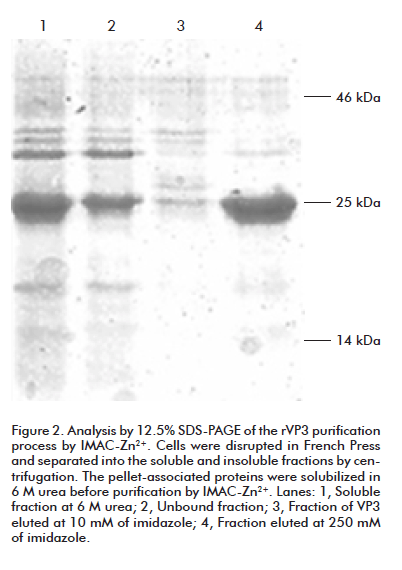
<P   ><font face="Verdana, Arial, Helvetica, sans-serif" size="2"><b>rVP2 and rVP3      extraction and purification </b></font></P >       <P   align="justify" ><font face="Verdana, Arial, Helvetica, sans-serif" size="2">Fractionation of      the bacterial lysates by high speed centrifugation into supernatant and pellet      fractions revealed that the majority of both recombinant proteins were located      in the pellet, presumably as inclusion bodies. Both proteins were capable      to be soluble in the presence of 6 M urea. After purification through Chelating      Sepharose Fast Flow resin, previously coupled with Zn<Sup>2+</Sup> ion, rVP3      was obtained with 91% purity as estimated by gel densitometry analysis (<a href="#fig2">Figure      2</a>). Similarly, rVP2 was purified and its purity was estimated as 88% by      the same method (data not shown). Since both purification procedures were      under denaturing conditions, the proteins were renatured by sequential dialysis      against lower urea concentrations, yielding 8 mg and 10 mg of refolded protein      per 300 mL of culture respectively.</font></P >       ]]></body>
<body><![CDATA[<P   align="center" ><img src="/img/revistas/bta/v29n2/f0205212.gif" width="402" height="570"><a name="fig2"></a></P >   <FONT size="+1"><FONT size="+1">        
<P   ><font face="Verdana, Arial, Helvetica, sans-serif" size="2"><b>Rabbit immunization      with rVP2 and rVP3 </b></font></P >       <P   align="justify" ><font face="Verdana, Arial, Helvetica, sans-serif" size="2">Recombinant proteins      were used to immunize two rabbits for each case, by a three-dosage scheme.      Polyclonal sera were evaluated by ELISA using 1 ng of recombinant protein      to coat the microplate. Sera was serially diluted to determine the sera highest      dilution which ELISA value was 3 times the value of preimmune serum. For both      proteins, the highest serum dilution was 1/80 000 (<a href="/img/revistas/bta/v29n2/f0305212.gif">Figure      3</a>). For further analyses, rabbit serum 2 (against rVP2) and rabbit serum      4 (against rVP3) were selected. </font></P >       
<P   align="justify" ><font face="Verdana, Arial, Helvetica, sans-serif" size="2">A competition assay      using a kit for the detection of antibodies against the HAV was carried out.      This ELISA would detect antibodies able to recognize the neutralizing sites      of the HAV and in this way, to block them prior to later incubation with antibodies      whose neutralizing capacity is known. According to this, NL was determined      as described in Materials and methods, based on the OD values shown in <a href="#fig4">figure      4</a>, for a final value of 1.75.</font></P >       <P   align="center" ><img src="/img/revistas/bta/v29n2/f0405212.gif" width="396" height="426"><a name="fig4"></a></P >       
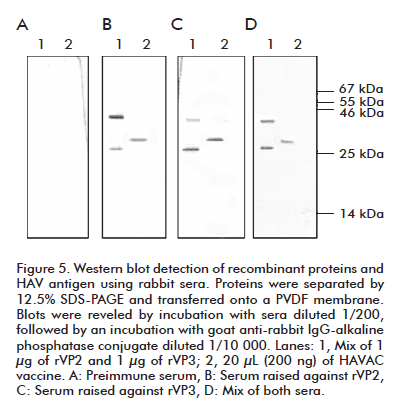
<P   align="justify" ><font face="Verdana, Arial, Helvetica, sans-serif" size="2">According these results,      we can conclude that these sera do not recognize neutralizing epitopes of      HAV. </font></P >       <P   align="justify" ><font face="Verdana, Arial, Helvetica, sans-serif" size="2">We evaluated the      recognition capacity of immune sera to HAV structural proteins by western      blotting (<a href="#fig5">Figure 5</a>). The Chinese vaccine HAVAC, prepared      from an attenuated viral formulation, was used as positive control. The estimated      molecular weights for rVP2 and rVP3 protein are 24.8 and 27.8 kDa respectively,      according to their amino acid sequence. Immune serum raised against rVP2 recognized      a protein of 29 kDa in a viral sample, a slightly higher size compared to      the theoretical estimated size (<a href="#fig5">Figure 5B</a>, line 2). This      serum recognized the rVP2 protein at a size of 34 kDa according the expected      size and showed slight recognition of rVP3 applied in a same lane (<a href="#fig5">Figure      5B</a>, lane 1).</font></P >       <P   align="center" ><img src="/img/revistas/bta/v29n2/f0505212.gif" width="402" height="420"><a name="fig5"></a></P >       
<P   align="justify" ><font face="Verdana, Arial, Helvetica, sans-serif" size="2">The serum raised      against the rVP3 protein recognized in a viral preparation a protein of similar      size to that observed during the incubation with rVP2 serum (<a href="#fig5">Figure      5C</a>, lane 2) and with the expected size. Recombinant VP3 polyclonal serum      also slightly recognized rVP2, in a similar way to that described previously      for the serum raised against rVP2 (<a href="#fig5">Figure 5C</a>, line 1).      When incubating the PVDF membrane with a mix of both sera, only one band of      29 kDa was detected in the viral sample (<a href="#fig5">Figure 5D</a>, lane      2) while both recombinant proteins were observed in their expected size (<a href="#fig5">Figure      5D</a>, lane 2). No recognition of recombinant or viral proteins was observed      when blots were incubated with preimmune sera (<a href="#fig5">Figure 5A</a>).      </font></P >       <P   ><font face="Verdana, Arial, Helvetica, sans-serif" size="2"><b>Functional assay      and detection limits of the generated antibodies </b></font></P >       ]]></body>
<body><![CDATA[<P   align="justify" ><font face="Verdana, Arial, Helvetica, sans-serif" size="2">To evaluate the ability      of the generated antibodies to recognize structural proteins in HAV particles,      extracts from wild-type <I>N. tabacum</I> leaves were mixed with concentrations      of HAV proteins ranging from 0.03 to 2% of expression of TSP. The resulting      mixture was separated in 12% SDS- PAGE, and western blotting assay with rVP2      and rVP3 anti-sera to know the putative expression levels that could be detected      by using these antibodies was done (<a href="/img/revistas/bta/v29n2/f0605212.gif">Figure 6</a>).      Expression levels higher than 0.25% of TSP could be detected in the working      dilutions used. Sensitivity could be increased given the lack of recognition      of endogenous plant proteins with these antibodies at the region in which      HAV proteins migrate in SDS-PAGE. </font></P >       
<P   >&nbsp;</P >       <P   ><font size="3" face="Verdana, Arial, Helvetica, sans-serif"><b>DISCUSSION </b></font></P >   <FONT size="+1">        <P   align="justify" ><font size="2" face="Verdana, Arial, Helvetica, sans-serif">The main goal of      this work was the obtainment of polyclonal antibodies (PAbs) that could be      useful for analyzing HAV expression in plants. For this purpose, fragments      of two structural proteins of the virus were cloned and expressed in <I>E.      coli.</I> After purification, rabbit sera were produced against rVP2 and rVP3,      and further evaluated under denaturing and non-denaturing conditions for specificity      against the recombinant proteins and native HAV antigen. Despite of monoclonal      antibodies against HAV have been produced and largely characterized [8, 9],      polyclonal sera against HAV and structural proteins are suitable for laboratory      use and epidemiological studies of HAV infection. PAbs can be generated by      procedures faster, less expensive and technically simpler than required to      produce monoclonal antibodies [10]. In general, the generation of PAbs is      based on immunizing animals with proteins isolated from natural sources or      produced by recombinant techniques. The latter route has been extensively      used and PAbs obtained are common tools for diagnostics [11] or protein expression      profile analysis [12]. Furthermore, the ability of polyclonal reagents to      recognize a multiplicity of epitopes is significant in some immunological      assays, where the detection of a molecule could be compromised by recognizing      a single epitope. This is especially important in transgenic plants, where      the accumulation of heterologous protein is fundamental. Besides, the production      of rVP2 and rVP3 in <I>E. coli</I> would facilitate to obtain monoclonal antibodies      by immunizing mice with these antigens, if necessary. </font></P >   <FONT size="+1">        <P   align="justify" ><font face="Verdana, Arial, Helvetica, sans-serif" size="2">To express rVP2,      a segment of 700 bp was selected from plasmid p&Delta;MALm[5], coding for      the complete amino acid sequence of the structural VP2 protein and the first      9 amino acids of the VP3 coding sequence. This nucleotide sequence generated      a 304-amino acid polypeptide that included on its N-terminus 36 amino acids      corresponding to the histidines tag, XPress epitope and the cleavage site      for enterokinase. This fusion protein has a theoretical molecular weight of      approximately 34 kDa, unlike the native VP2 protein. </font></P >       <P   align="justify" ><font face="Verdana, Arial, Helvetica, sans-serif" size="2">In the case of rVP3,      a 575-bp segment was selected coding for 75% of the native VP3 amino acid      sequence, generating a 201-amino acids polypeptide with a theoretical molecular      weight of 27 kDa and including the N-terminal sequences of the expression      vector. This segment conserved the majority of lineal epitopes present in      the native VP3. Both proteins used in our study were obtained in insoluble      form, presumably at inclusion bodies, since the cytoplasmic high-level expression      of these proteins in <I>E. coli</I> frequently generates inclusion bodies.      Strategies to solubilize an inclusion body and refold the protein into its      native structure have been recently reviewed [13]. Here, we resuspended the      recombinant proteins in 6 M urea and further purified them by IMAC under denaturing      conditions based on the fused N-terminal His tag, finally refolding them by      sequential dialysis at decreasing urea concentrations. Both proteins were      properly folded by this process, since they remained soluble at the final      dialysis step. In spite of being time-consuming, this refolding method renders      high yields [14, 15]. The 88% and 91% of purity for rVP2 and rVP3 were respectively      enough to produce high-titer polyclonal sera in rabbits. </font></P >       <P   align="justify" ><font face="Verdana, Arial, Helvetica, sans-serif" size="2">Sera specificity      was demonstrated by western blotting analysis. A slight cross-reactivity between      rVP2 and rVP3 was seen. Keeping in mind that VP2 and VP3 don&rsquo;t share      common sequences in the HAV, this slight cross-reactivity could be explained      by the domain shared by both recombinant proteins on their N-terminus by the      His tag, the XPress epitope and the marginal recognition of the 9 amino acids      of VP3 at the C terminus of the rVP2 (not detrimental cross-recognition for      the purpose of antigen detection). </font></P >       <P   align="justify" ><font face="Verdana, Arial, Helvetica, sans-serif" size="2">Sera against rVP2      and rVP3 didn&rsquo;t recognize the major conformational epitope of HAV in      a competition immunoenzymatic assay using the neutralizing antibody 7E7. However,      we observed in this assay a slight blockade of the neutralization epitope      when incubating with sera against rVP2 and rVP3, presumably due to the interaction      with lineal sites present in viral particles. A similar effect of poor neutralization      capacity of sera obtained from the injection of HAV recombinant proteins has      been previously demonstrated [16, 17], even for the virus major structural      protein VP1. This is the main cause of the search for the expression of HAV      subviral structures to be used as vaccine candidates. </font></P >       <P   align="justify" ><font face="Verdana, Arial, Helvetica, sans-serif" size="2">Anti-rVP2 and rVP3      sera recognized the structural proteins of HAV in a western blot analysis.      When we incubated membrane with an anti-serum against rVP2, a band was detected      corresponding to 29 kDa in a lane of viral preparation, in spite of the 24.8      kDa theoretical molecular weight for VP2. Previous studies have associated      this delay in the migration of VP2 in polyacrylamide gels under normal conditions      with this protein possibly being the VP2 precursor, the VP0 protein, which      proteolytic processing constitutes the final step of the hepatitis A virion      maturation [18]. The rVP2 protein was detected at a size of 35 kDa, in agreement      with the addition of 36 amino acids from the expression vector. </font></P >       <P   align="justify" ><font face="Verdana, Arial, Helvetica, sans-serif" size="2">Serum raised after      immunization with rVP3 detected a protein band at the expected relative size      corresponding to the predicted molecular weight. VP3 was also detected when      the membrane was incubated with this serum. The theoretical molecular weight      of VP3 is 27.8 kDa, similar to the size at which the VP2 protein was detected      in the viral lane. As mentioned above, both proteins do not share common sequences      in the HAV; however, they have similar migration patterns under SDS-PAGE without      adding urea. This was corroborated by incubating the viral lane with a mix      of sera against both recombinant proteins, while rVP2 and rVP3 were clearly      detected as different protein bands. Ross and Anderson resolved this co-migration      of VP0 and VP3 by adding urea to SDS-PAGE [19]. </font></P >       ]]></body>
<body><![CDATA[<P   align="justify" ><font face="Verdana, Arial, Helvetica, sans-serif" size="2">The obtainment of      HAV particles in recombinant systems is a reliable way to develop an effective      vaccine against this virus. Plants are emerging as a promising system to express      and manufacture a wide range of functionally active proteins of high value      for the health industry [20]. High-level protein expression is essential to      develop economically competitive plant-based processes for cultivation of      transgenic varieties within confined fields and under controlled environmental      and biosafety contained conditions. We have previously obtained HAV particles      in tobacco cells yielding expression levels in the range of 0.0015% of TSP      [5] and we are developing strategies to increase those expression levels.      The sera obtained in this study will be useful in the screening of transgenic      plants expressing HAV proteins by western blotting. </font></P >       <P   align="justify" > </P >       <P   align="justify" >&nbsp;</P >       <P   align="justify" ><font face="Verdana, Arial, Helvetica, sans-serif" size="2"><b><font size="3">REFERENCES      </font></b></font></P >       <P   align="justify" > </P >       <!-- ref --><P   align="justify" ><font size="2" face="Verdana, Arial, Helvetica, sans-serif">1. Gust ID, Coulepis      AG, Feinstone SM, Locarnini SA, Moritsugu Y, Najera R, et al. Taxonomic classification      of hepatitis A virus. Intervirology. 1983;20(1):1-7.     </font></P >   <FONT size="+1">        <!-- ref --><P   align="justify" ><font face="Verdana, Arial, Helvetica, sans-serif" size="2">2. Harmon SA, Updike      W, Jia XY, Summers DF, Ehrenfeld E. Polyprotein processing in cis and in trans      by hepatitis A virus 3C protease cloned and expressed in Escherichia coli.      J Virol. 1992;66(9):5242-7.     </font></P >       <!-- ref --><P   align="justify" ><font face="Verdana, Arial, Helvetica, sans-serif" size="2">3. Dzagurov GK, Kusov      I, Gauss-Mueller V. Expression of hepatitis A virus procapsids in the insect      cells infected by recombinant baculovirus. Vopr Virusol 2003;48(3): 36-40.          </font></P >       <!-- ref --><P   align="justify" ><font face="Verdana, Arial, Helvetica, sans-serif" size="2">4. Yao GFLC, Jiming      RLZ. Expression of Hepatitis A virus proteins by recombinant vaccinia virus      [J]. Chinese J Virol. 1989;4. Available from: <a href="http://en.cnki.com.cn/Article_en/CJFDTOTAL-BDXB198904000.htm" target="_blank">http://en.cnki.com.cn/Article_en/CJFDTOTAL-BDXB198904000.htm</a>      </font></P >       <P   align="justify" ><font face="Verdana, Arial, Helvetica, sans-serif" size="2">5. L&oacute;pez A,      Rosabal Y, Hern&aacute;ndez A, Gonz&aacute;lez B, R&iacute;os J, P&eacute;rez      M, et al. Expression of the Hepatitis A virus empty capsids in suspension      cells and transgenic tobacco plants (Nicotiana tabacum L.). Biotecnol Apl      2008;25(1):42-6. </font></P >       <!-- ref --><P   align="justify" ><font face="Verdana, Arial, Helvetica, sans-serif" size="2">6. National Research      Council. Guide for the Care and Use of Laboratory Animals. 8th Edition. Washington,      DC: The National Academies Press; 2011.     </font></P >       <!-- ref --><P   align="justify" ><font face="Verdana, Arial, Helvetica, sans-serif" size="2">7. Chung HY, Lee      HH, Kim KI, Chung HY, Hwang-Bo J, Park JH, et al. Expression of a recombinant      chimeric protein of hepatitis A virus VP1-Fc using a replicating vector based      on Beet curly top virus in tobacco leaves and its immunogenicity in mice.      Plant Cell Rep. 2011; 30(8):1513-21.     </font></P >       <!-- ref --><P   align="justify" ><font face="Verdana, Arial, Helvetica, sans-serif" size="2">8. Dawson GJ, Decker      RH, Norton DK, Bryce WH, Whittington RO, Tribby, II, et al. Monoclonal antibodies      to hepatitis A virus. J Med Virol 1984;14(1):1-8.     </font></P >       <!-- ref --><P   align="justify" ><font face="Verdana, Arial, Helvetica, sans-serif" size="2">9. Schofield DJ,      Emerson SU, Purcell RH. Four chimpanzee monoclonal antibodies that neutralize      hepatitis A virus. Drugs Fut 2003;28(2):137-42.     </font></P >       <!-- ref --><P   align="justify" ><font face="Verdana, Arial, Helvetica, sans-serif" size="2">10. Lipman NS, Jackson      LR, Trudel LJ, Weis-Garcia F. Monoclonal versus polyclonal antibodies: distinguishing      characteristics, applications, and information resources. ILAR J. 2005;46(3):258-68.          </font></P >       <!-- ref --><P   align="justify" ><font face="Verdana, Arial, Helvetica, sans-serif" size="2">11. Lu L, Cheng A,      Wang M, Jiang J, Zhu D, Jia R, et al. Polyclonal antibody against the DPV      UL46M protein can be a diagnostic candidate. Virol J 2010;7:83.     </font></P >       <!-- ref --><P   align="justify" ><font face="Verdana, Arial, Helvetica, sans-serif" size="2">12. Grifantini R,      Pagani M, Pierleoni A, Grandi A, Parri M, Campagnoli S, et al. A novel polyclonal      antibody library for expression profiling of poorly characterized, membrane      and secreted human proteins. J Proteomics. 2011;75(2):532-47.     </font></P >       <!-- ref --><P   align="justify" ><font face="Verdana, Arial, Helvetica, sans-serif" size="2">13. Burgess RR. Refolding      solubilized inclusion body proteins. Methods Enzymol. 2009;463:259-82.     </font></P >       <!-- ref --><P   align="justify" ><font face="Verdana, Arial, Helvetica, sans-serif" size="2">14. Jang TH, Park      HH. Generalized semi-refolding methods for purification of the functional      death domain superfamily. J Biotechnol. 2011;151(4):335-42.     </font></P >       <!-- ref --><P   align="justify" ><font face="Verdana, Arial, Helvetica, sans-serif" size="2">15. Zhang Y, Ma Y,      Yang M, Min S, Yao J, Zhu L. Expression, purification, and refolding of a      recombinant human bone morphogenetic protein 2 in vitro. Protein Expr Purif.      2011;75(2):155-60.     </font></P >       <!-- ref --><P   align="justify" ><font face="Verdana, Arial, Helvetica, sans-serif" size="2">16. Johnston JM,      Harmon SA, Binn LN, Richards OC, Ehrenfeld E, Summers DF. Antigenic and immunogenic      properties of a hepatitis A virus capsid protein expressed in Escherichia      coli. J Infect Dis. 1988; 157(6):1203-11.     </font></P >       <!-- ref --><P   align="justify" ><font face="Verdana, Arial, Helvetica, sans-serif" size="2">17. Gauss-Muller      V, Zhou MQ, von der Helm K, Deinhardt F. Recombinant proteins VP1 and VP3      of hepatitis A virus prime for neutralizing response. J Med Virol. 1990; 31(4):277-83.          </font></P >       <!-- ref --><P   align="justify" ><font face="Verdana, Arial, Helvetica, sans-serif" size="2">18. Gauss-Muller      V, Lottspeich F, Deinhardt F. Characterization of hepatitis A virus structural      proteins. Virology 1986; 155(2):732-6.     </font></P >       <!-- ref --><P   align="justify" ><font face="Verdana, Arial, Helvetica, sans-serif" size="2">19. Ross BC, Anderson      DA. Characterization of hepatitis A virus capsid proteins with antisera raised      to recombinant antigens. J Virol Methods. 1991;32(2-3):213-20.     </font></P >       <P   align="justify" ><font face="Verdana, Arial, Helvetica, sans-serif" size="2">20. Tiwari S, Verma      PC, Singh PK, Tuli R. Plants as bioreactors for the production of vaccine      antigens. Biotechnology Advances. 2009;27(4):449-67.</font></P >       <P   align="justify" ><FONT size="+1"> </font></P >   <FONT size="+1">       <P   align="justify" > </P >       <P   align="justify" ><font face="Verdana, Arial, Helvetica, sans-serif" size="2">Received in June,      2011.    <br>     Accepted for publication in May, 2012.</font></P >       <P   align="justify" >&nbsp;</P >       <P   align="justify" >&nbsp;</P >       <P   align="justify" > </P >       <P   ><i><font size="2" face="Verdana, Arial, Helvetica, sans-serif">Abel Hern&aacute;ndez</font></i><font size="2" face="Verdana, Arial, Helvetica, sans-serif">.      Bioreactors Laboratory, Plant Department, Center for Genetic Engineering and      Biotechnology, CIGB PO Box 6162, Cubanac&aacute;n, Havana, Cuba. E-mail: <A href="mailto:abel.hernandez@cigb.edu.cu">      <U><U><FONT color="#0000FF">abel.hernandez@cigb.edu.cu</font></U></U></A><FONT color="#0000FF"><FONT color="#000000">.</font></font></font></P >   </font></font></font></font></font></font></font></font></font></font></font></font></font></font></font></font></font></font></font></font></font></font></font></font></font></font></font></font></font></font></font></font></font></font></font></font></font></font></font></font></font></font></DIV >     ]]></body>
<body><![CDATA[ ]]></body><back>
<ref-list>
<ref id="B1">
<label>1</label><nlm-citation citation-type="journal">
<person-group person-group-type="author">
<name>
<surname><![CDATA[Gust]]></surname>
<given-names><![CDATA[ID]]></given-names>
</name>
<name>
<surname><![CDATA[Coulepis]]></surname>
<given-names><![CDATA[AG]]></given-names>
</name>
<name>
<surname><![CDATA[Feinstone]]></surname>
<given-names><![CDATA[SM]]></given-names>
</name>
<name>
<surname><![CDATA[Locarnini]]></surname>
<given-names><![CDATA[SA]]></given-names>
</name>
<name>
<surname><![CDATA[Moritsugu]]></surname>
<given-names><![CDATA[Y]]></given-names>
</name>
<name>
<surname><![CDATA[Najera]]></surname>
<given-names><![CDATA[R]]></given-names>
</name>
</person-group>
<article-title xml:lang="en"><![CDATA[Taxonomic classification of hepatitis A virus]]></article-title>
<source><![CDATA[Intervirology]]></source>
<year>1983</year>
<volume>20</volume>
<numero>1</numero>
<issue>1</issue>
<page-range>1-7</page-range></nlm-citation>
</ref>
<ref id="B2">
<label>2</label><nlm-citation citation-type="journal">
<person-group person-group-type="author">
<name>
<surname><![CDATA[Harmon]]></surname>
<given-names><![CDATA[SA]]></given-names>
</name>
<name>
<surname><![CDATA[Updike]]></surname>
<given-names><![CDATA[W]]></given-names>
</name>
<name>
<surname><![CDATA[Jia]]></surname>
<given-names><![CDATA[XY]]></given-names>
</name>
<name>
<surname><![CDATA[Summers]]></surname>
<given-names><![CDATA[DF]]></given-names>
</name>
<name>
<surname><![CDATA[Ehrenfeld]]></surname>
<given-names><![CDATA[E]]></given-names>
</name>
</person-group>
<article-title xml:lang="en"><![CDATA[Polyprotein processing in cis and in trans by hepatitis A virus 3C protease cloned and expressed in Escherichia coli]]></article-title>
<source><![CDATA[J Virol]]></source>
<year>1992</year>
<volume>66</volume>
<numero>9</numero>
<issue>9</issue>
<page-range>5242-7</page-range></nlm-citation>
</ref>
<ref id="B3">
<label>3</label><nlm-citation citation-type="journal">
<person-group person-group-type="author">
<name>
<surname><![CDATA[Dzagurov]]></surname>
<given-names><![CDATA[GK]]></given-names>
</name>
<name>
<surname><![CDATA[Kusov]]></surname>
<given-names><![CDATA[I]]></given-names>
</name>
<name>
<surname><![CDATA[Gauss-Mueller]]></surname>
<given-names><![CDATA[V]]></given-names>
</name>
</person-group>
<article-title xml:lang="en"><![CDATA[Expression of hepatitis A virus procapsids in the insect cells infected by recombinant baculovirus]]></article-title>
<source><![CDATA[Vopr Virusol]]></source>
<year>2003</year>
<volume>48</volume>
<numero>3</numero>
<issue>3</issue>
<page-range>36-40</page-range></nlm-citation>
</ref>
<ref id="B4">
<label>4</label><nlm-citation citation-type="journal">
<person-group person-group-type="author">
<name>
<surname><![CDATA[Yao]]></surname>
<given-names><![CDATA[GFLC]]></given-names>
</name>
<name>
<surname><![CDATA[Jiming]]></surname>
<given-names><![CDATA[RLZ]]></given-names>
</name>
</person-group>
<article-title xml:lang="en"><![CDATA[Expression of Hepatitis A virus proteins by recombinant vaccinia virus (J)]]></article-title>
<source><![CDATA[Chinese J Virol]]></source>
<year>1989</year>
<volume>4</volume>
</nlm-citation>
</ref>
<ref id="B5">
<label>5</label><nlm-citation citation-type="journal">
<person-group person-group-type="author">
<name>
<surname><![CDATA[Lopez]]></surname>
<given-names><![CDATA[A]]></given-names>
</name>
<name>
<surname><![CDATA[Rosabal]]></surname>
<given-names><![CDATA[Y]]></given-names>
</name>
<name>
<surname><![CDATA[Hernandez]]></surname>
<given-names><![CDATA[A]]></given-names>
</name>
<name>
<surname><![CDATA[Gonzalez]]></surname>
<given-names><![CDATA[B]]></given-names>
</name>
<name>
<surname><![CDATA[Rios]]></surname>
<given-names><![CDATA[J]]></given-names>
</name>
<name>
<surname><![CDATA[Perez]]></surname>
<given-names><![CDATA[M]]></given-names>
</name>
</person-group>
<article-title xml:lang="en"><![CDATA[Expression of the Hepatitis A virus empty capsids in suspension cells and transgenic tobacco plants (Nicotiana tabacum L.)]]></article-title>
<source><![CDATA[Biotecnol Apl]]></source>
<year>2008</year>
<volume>25</volume>
<numero>1</numero>
<issue>1</issue>
<page-range>42-6</page-range></nlm-citation>
</ref>
<ref id="B6">
<label>6</label><nlm-citation citation-type="book">
<collab>National Research Council</collab>
<source><![CDATA[Guide for the Care and Use of Laboratory Animals]]></source>
<year>2011</year>
<edition>8</edition>
<publisher-loc><![CDATA[Washington, DC ]]></publisher-loc>
<publisher-name><![CDATA[The National Academies Press]]></publisher-name>
</nlm-citation>
</ref>
<ref id="B7">
<label>7</label><nlm-citation citation-type="journal">
<person-group person-group-type="author">
<name>
<surname><![CDATA[Chung]]></surname>
<given-names><![CDATA[HY]]></given-names>
</name>
<name>
<surname><![CDATA[Lee]]></surname>
<given-names><![CDATA[HH]]></given-names>
</name>
<name>
<surname><![CDATA[Kim]]></surname>
<given-names><![CDATA[KI]]></given-names>
</name>
<name>
<surname><![CDATA[Chung]]></surname>
<given-names><![CDATA[HY]]></given-names>
</name>
<name>
<surname><![CDATA[Hwang-Bo]]></surname>
<given-names><![CDATA[J]]></given-names>
</name>
<name>
<surname><![CDATA[Park]]></surname>
<given-names><![CDATA[JH]]></given-names>
</name>
</person-group>
<article-title xml:lang="en"><![CDATA[Expression of a recombinant chimeric protein of hepatitis A virus VP1-Fc using a replicating vector based on Beet curly top virus in tobacco leaves and its immunogenicity in mice]]></article-title>
<source><![CDATA[Plant Cell Rep]]></source>
<year>2011</year>
<volume>30</volume>
<numero>8</numero>
<issue>8</issue>
<page-range>1513-21</page-range></nlm-citation>
</ref>
<ref id="B8">
<label>8</label><nlm-citation citation-type="journal">
<person-group person-group-type="author">
<name>
<surname><![CDATA[Dawson]]></surname>
<given-names><![CDATA[GJ]]></given-names>
</name>
<name>
<surname><![CDATA[Decker]]></surname>
<given-names><![CDATA[RH]]></given-names>
</name>
<name>
<surname><![CDATA[Norton]]></surname>
<given-names><![CDATA[DK]]></given-names>
</name>
<name>
<surname><![CDATA[Bryce]]></surname>
<given-names><![CDATA[WH]]></given-names>
</name>
<name>
<surname><![CDATA[Whittington]]></surname>
<given-names><![CDATA[RO]]></given-names>
</name>
<name>
<surname><![CDATA[Tribby]]></surname>
<given-names><![CDATA[II]]></given-names>
</name>
</person-group>
<article-title xml:lang="en"><![CDATA[Monoclonal antibodies to hepatitis A virus]]></article-title>
<source><![CDATA[J Med Virol]]></source>
<year>1984</year>
<volume>14</volume>
<numero>1</numero>
<issue>1</issue>
<page-range>1-8</page-range></nlm-citation>
</ref>
<ref id="B9">
<label>9</label><nlm-citation citation-type="journal">
<person-group person-group-type="author">
<name>
<surname><![CDATA[Schofield]]></surname>
<given-names><![CDATA[DJ]]></given-names>
</name>
<name>
<surname><![CDATA[Emerson]]></surname>
<given-names><![CDATA[SU]]></given-names>
</name>
<name>
<surname><![CDATA[Purcell]]></surname>
<given-names><![CDATA[RH]]></given-names>
</name>
</person-group>
<article-title xml:lang="en"><![CDATA[Four chimpanzee monoclonal antibodies that neutralize hepatitis A virus]]></article-title>
<source><![CDATA[Drugs Fut]]></source>
<year>2003</year>
<volume>28</volume>
<numero>2</numero>
<issue>2</issue>
<page-range>137-42</page-range></nlm-citation>
</ref>
<ref id="B10">
<label>10</label><nlm-citation citation-type="journal">
<person-group person-group-type="author">
<name>
<surname><![CDATA[Lipman]]></surname>
<given-names><![CDATA[NS]]></given-names>
</name>
<name>
<surname><![CDATA[Jackson]]></surname>
<given-names><![CDATA[LR]]></given-names>
</name>
<name>
<surname><![CDATA[Trudel]]></surname>
<given-names><![CDATA[LJ]]></given-names>
</name>
<name>
<surname><![CDATA[Weis-Garcia]]></surname>
<given-names><![CDATA[F]]></given-names>
</name>
</person-group>
<article-title xml:lang="en"><![CDATA[Monoclonal versus polyclonal antibodies: distinguishing characteristics, applications, and information resources]]></article-title>
<source><![CDATA[ILAR J]]></source>
<year>2005</year>
<volume>46</volume>
<numero>3</numero>
<issue>3</issue>
<page-range>258-68</page-range></nlm-citation>
</ref>
<ref id="B11">
<label>11</label><nlm-citation citation-type="journal">
<person-group person-group-type="author">
<name>
<surname><![CDATA[Lu]]></surname>
<given-names><![CDATA[L]]></given-names>
</name>
<name>
<surname><![CDATA[Cheng]]></surname>
<given-names><![CDATA[A]]></given-names>
</name>
<name>
<surname><![CDATA[Wang]]></surname>
<given-names><![CDATA[M]]></given-names>
</name>
<name>
<surname><![CDATA[Jiang]]></surname>
<given-names><![CDATA[J]]></given-names>
</name>
<name>
<surname><![CDATA[Zhu]]></surname>
<given-names><![CDATA[D]]></given-names>
</name>
<name>
<surname><![CDATA[Jia]]></surname>
<given-names><![CDATA[R]]></given-names>
</name>
</person-group>
<article-title xml:lang="en"><![CDATA[Polyclonal antibody against the DPV UL46M protein can be a diagnostic candidate]]></article-title>
<source><![CDATA[Virol J]]></source>
<year>2010</year>
<volume>7</volume>
<page-range>83</page-range></nlm-citation>
</ref>
<ref id="B12">
<label>12</label><nlm-citation citation-type="journal">
<person-group person-group-type="author">
<name>
<surname><![CDATA[Grifantini]]></surname>
<given-names><![CDATA[R]]></given-names>
</name>
<name>
<surname><![CDATA[Pagani]]></surname>
<given-names><![CDATA[M]]></given-names>
</name>
<name>
<surname><![CDATA[Pierleoni]]></surname>
<given-names><![CDATA[A]]></given-names>
</name>
<name>
<surname><![CDATA[Grandi]]></surname>
<given-names><![CDATA[A]]></given-names>
</name>
<name>
<surname><![CDATA[Parri]]></surname>
<given-names><![CDATA[M]]></given-names>
</name>
<name>
<surname><![CDATA[Campagnoli]]></surname>
<given-names><![CDATA[S]]></given-names>
</name>
</person-group>
<article-title xml:lang="en"><![CDATA[A novel polyclonal antibody library for expression profiling of poorly characterized, membrane and secreted human proteins]]></article-title>
<source><![CDATA[J Proteomics]]></source>
<year>2011</year>
<volume>75</volume>
<numero>2</numero>
<issue>2</issue>
<page-range>532-47</page-range></nlm-citation>
</ref>
<ref id="B13">
<label>13</label><nlm-citation citation-type="journal">
<person-group person-group-type="author">
<name>
<surname><![CDATA[Burgess]]></surname>
<given-names><![CDATA[RR]]></given-names>
</name>
</person-group>
<article-title xml:lang="en"><![CDATA[Refolding solubilized inclusion body proteins]]></article-title>
<source><![CDATA[Methods Enzymol]]></source>
<year>2009</year>
<volume>463</volume>
<page-range>259-82</page-range></nlm-citation>
</ref>
<ref id="B14">
<label>14</label><nlm-citation citation-type="journal">
<person-group person-group-type="author">
<name>
<surname><![CDATA[Jang]]></surname>
<given-names><![CDATA[TH]]></given-names>
</name>
<name>
<surname><![CDATA[Park]]></surname>
<given-names><![CDATA[HH]]></given-names>
</name>
</person-group>
<article-title xml:lang="en"><![CDATA[Generalized semi-refolding methods for purification of the functional death domain superfamily]]></article-title>
<source><![CDATA[J Biotechnol]]></source>
<year>2011</year>
<volume>151</volume>
<numero>4</numero>
<issue>4</issue>
<page-range>335-42</page-range></nlm-citation>
</ref>
<ref id="B15">
<label>15</label><nlm-citation citation-type="journal">
<person-group person-group-type="author">
<name>
<surname><![CDATA[Zhang]]></surname>
<given-names><![CDATA[Y]]></given-names>
</name>
<name>
<surname><![CDATA[Ma]]></surname>
<given-names><![CDATA[Y]]></given-names>
</name>
<name>
<surname><![CDATA[Yang]]></surname>
<given-names><![CDATA[M]]></given-names>
</name>
<name>
<surname><![CDATA[Min]]></surname>
<given-names><![CDATA[S]]></given-names>
</name>
<name>
<surname><![CDATA[Yao]]></surname>
<given-names><![CDATA[J]]></given-names>
</name>
<name>
<surname><![CDATA[Zhu]]></surname>
<given-names><![CDATA[L]]></given-names>
</name>
</person-group>
<article-title xml:lang="en"><![CDATA[Expression, purification, and refolding of a recombinant human bone morphogenetic protein 2 in vitro]]></article-title>
<source><![CDATA[Protein Expr Purif]]></source>
<year>2011</year>
<volume>75</volume>
<numero>2</numero>
<issue>2</issue>
<page-range>155-60</page-range></nlm-citation>
</ref>
<ref id="B16">
<label>16</label><nlm-citation citation-type="journal">
<person-group person-group-type="author">
<name>
<surname><![CDATA[Johnston]]></surname>
<given-names><![CDATA[JM]]></given-names>
</name>
<name>
<surname><![CDATA[Harmon]]></surname>
<given-names><![CDATA[SA]]></given-names>
</name>
<name>
<surname><![CDATA[Binn]]></surname>
<given-names><![CDATA[LN]]></given-names>
</name>
<name>
<surname><![CDATA[Richards]]></surname>
<given-names><![CDATA[OC]]></given-names>
</name>
<name>
<surname><![CDATA[Ehrenfeld]]></surname>
<given-names><![CDATA[E]]></given-names>
</name>
<name>
<surname><![CDATA[Summers]]></surname>
<given-names><![CDATA[DF]]></given-names>
</name>
</person-group>
<article-title xml:lang="en"><![CDATA[Antigenic and immunogenic properties of a hepatitis A virus capsid protein expressed in Escherichia coli]]></article-title>
<source><![CDATA[J Infect Dis]]></source>
<year>1988</year>
<volume>157</volume>
<numero>6</numero>
<issue>6</issue>
<page-range>1203-11</page-range></nlm-citation>
</ref>
<ref id="B17">
<label>17</label><nlm-citation citation-type="journal">
<person-group person-group-type="author">
<name>
<surname><![CDATA[Gauss-Muller]]></surname>
<given-names><![CDATA[V]]></given-names>
</name>
<name>
<surname><![CDATA[Zhou]]></surname>
<given-names><![CDATA[MQ]]></given-names>
</name>
<name>
<surname><![CDATA[von der Helm]]></surname>
<given-names><![CDATA[K]]></given-names>
</name>
<name>
<surname><![CDATA[Deinhardt]]></surname>
<given-names><![CDATA[F]]></given-names>
</name>
</person-group>
<article-title xml:lang="en"><![CDATA[Recombinant proteins VP1 and VP3 of hepatitis A virus prime for neutralizing response]]></article-title>
<source><![CDATA[J Med Virol]]></source>
<year>1990</year>
<volume>31</volume>
<numero>4</numero>
<issue>4</issue>
<page-range>277-83</page-range></nlm-citation>
</ref>
<ref id="B18">
<label>18</label><nlm-citation citation-type="journal">
<person-group person-group-type="author">
<name>
<surname><![CDATA[Gauss-Muller]]></surname>
<given-names><![CDATA[V]]></given-names>
</name>
<name>
<surname><![CDATA[Lottspeich]]></surname>
<given-names><![CDATA[F]]></given-names>
</name>
<name>
<surname><![CDATA[Deinhardt]]></surname>
<given-names><![CDATA[F]]></given-names>
</name>
</person-group>
<article-title xml:lang="en"><![CDATA[Characterization of hepatitis A virus structural proteins]]></article-title>
<source><![CDATA[Virology]]></source>
<year>1986</year>
<volume>155</volume>
<numero>2</numero>
<issue>2</issue>
<page-range>732-6</page-range></nlm-citation>
</ref>
<ref id="B19">
<label>19</label><nlm-citation citation-type="journal">
<person-group person-group-type="author">
<name>
<surname><![CDATA[Ross]]></surname>
<given-names><![CDATA[BC]]></given-names>
</name>
<name>
<surname><![CDATA[Anderson]]></surname>
<given-names><![CDATA[DA]]></given-names>
</name>
</person-group>
<article-title xml:lang="en"><![CDATA[Characterization of hepatitis A virus capsid proteins with antisera raised to recombinant antigens]]></article-title>
<source><![CDATA[J Virol Methods]]></source>
<year>1991</year>
<volume>32</volume>
<numero>2-3</numero>
<issue>2-3</issue>
<page-range>213-20</page-range></nlm-citation>
</ref>
<ref id="B20">
<label>20</label><nlm-citation citation-type="journal">
<person-group person-group-type="author">
<name>
<surname><![CDATA[Tiwari]]></surname>
<given-names><![CDATA[S]]></given-names>
</name>
<name>
<surname><![CDATA[Verma]]></surname>
<given-names><![CDATA[PC]]></given-names>
</name>
<name>
<surname><![CDATA[Singh]]></surname>
<given-names><![CDATA[PK]]></given-names>
</name>
<name>
<surname><![CDATA[Tuli]]></surname>
<given-names><![CDATA[R]]></given-names>
</name>
</person-group>
<article-title xml:lang="en"><![CDATA[Plants as bioreactors for the production of vaccine antigens]]></article-title>
<source><![CDATA[Biotechnol Adv]]></source>
<year>2009</year>
<volume>27</volume>
<numero>4</numero>
<issue>4</issue>
<page-range>449-67</page-range></nlm-citation>
</ref>
</ref-list>
</back>
</article>