<?xml version="1.0" encoding="ISO-8859-1"?><article xmlns:mml="http://www.w3.org/1998/Math/MathML" xmlns:xlink="http://www.w3.org/1999/xlink" xmlns:xsi="http://www.w3.org/2001/XMLSchema-instance">
<front>
<journal-meta>
<journal-id>1027-2852</journal-id>
<journal-title><![CDATA[Biotecnología Aplicada]]></journal-title>
<abbrev-journal-title><![CDATA[Biotecnol Apl]]></abbrev-journal-title>
<issn>1027-2852</issn>
<publisher>
<publisher-name><![CDATA[Editorial Elfos Scientiae]]></publisher-name>
</publisher>
</journal-meta>
<article-meta>
<article-id>S1027-28522012000200006</article-id>
<title-group>
<article-title xml:lang="en"><![CDATA[A microanalytical variant of the SOS Chromotest for genotoxicological evaluation of natural and synthetic products]]></article-title>
<article-title xml:lang="es"><![CDATA[Una variante microanalítica del SOS Chromotest para la evaluación genotóxica de productos naturales y sintéticos]]></article-title>
</title-group>
<contrib-group>
<contrib contrib-type="author">
<name>
<surname><![CDATA[Cuétara]]></surname>
<given-names><![CDATA[Elizabeth B]]></given-names>
</name>
<xref ref-type="aff" rid="A01"/>
</contrib>
<contrib contrib-type="author">
<name>
<surname><![CDATA[Álvarez]]></surname>
<given-names><![CDATA[Alba]]></given-names>
</name>
<xref ref-type="aff" rid="A02"/>
</contrib>
<contrib contrib-type="author">
<name>
<surname><![CDATA[Alonso]]></surname>
<given-names><![CDATA[Alena]]></given-names>
</name>
<xref ref-type="aff" rid="A02"/>
</contrib>
<contrib contrib-type="author">
<name>
<surname><![CDATA[Vernhe]]></surname>
<given-names><![CDATA[Mariolys]]></given-names>
</name>
<xref ref-type="aff" rid="A02"/>
</contrib>
<contrib contrib-type="author">
<name>
<surname><![CDATA[Sánchez-Lamar]]></surname>
<given-names><![CDATA[Angel]]></given-names>
</name>
<xref ref-type="aff" rid="A03"/>
</contrib>
<contrib contrib-type="author">
<name>
<surname><![CDATA[Festary]]></surname>
<given-names><![CDATA[Tatiana]]></given-names>
</name>
<xref ref-type="aff" rid="A01"/>
</contrib>
<contrib contrib-type="author">
<name>
<surname><![CDATA[Rico]]></surname>
<given-names><![CDATA[Jeannete]]></given-names>
</name>
<xref ref-type="aff" rid="A01"/>
</contrib>
</contrib-group>
<aff id="A02">
<institution><![CDATA[,Centro de Aplicaciones Tecnológicas y Desarrollo Nuclear, CEADEN  ]]></institution>
<addr-line><![CDATA[La Habana ]]></addr-line>
<country>Cuba</country>
</aff>
<aff id="A03">
<institution><![CDATA[,Universidad de La Habana Facultad de Biología ]]></institution>
<addr-line><![CDATA[La Habana ]]></addr-line>
<country>Cuba</country>
</aff>
<aff id="A01">
<institution><![CDATA[,Instituto Nacional de Oncología y Radiobiología  ]]></institution>
<addr-line><![CDATA[La Habana ]]></addr-line>
<country>Cuba</country>
</aff>
<pub-date pub-type="pub">
<day>00</day>
<month>06</month>
<year>2012</year>
</pub-date>
<pub-date pub-type="epub">
<day>00</day>
<month>06</month>
<year>2012</year>
</pub-date>
<volume>29</volume>
<numero>2</numero>
<fpage>108</fpage>
<lpage>112</lpage>
<copyright-statement/>
<copyright-year/>
<self-uri xlink:href="http://scielo.sld.cu/scielo.php?script=sci_arttext&amp;pid=S1027-28522012000200006&amp;lng=en&amp;nrm=iso"></self-uri><self-uri xlink:href="http://scielo.sld.cu/scielo.php?script=sci_abstract&amp;pid=S1027-28522012000200006&amp;lng=en&amp;nrm=iso"></self-uri><self-uri xlink:href="http://scielo.sld.cu/scielo.php?script=sci_pdf&amp;pid=S1027-28522012000200006&amp;lng=en&amp;nrm=iso"></self-uri><abstract abstract-type="short" xml:lang="en"><p><![CDATA[Agents that can damage the DNA in vivo have potential adverse effects on human health. They may induce transmissible mutations and cancer. SOS Chromotest is a SOS transcriptional-fusion based assay, ß-galactosidase gene was located after a SOS promoter, thus its enzymatic activity indicates the level of induction of SOS response and the DNA damage produced by chemical and physical mutagens, can be estimated. We presented and evaluated a microanalytical variant of the original SOS Chromotest for detecting genotoxicity of pigmented samples. We introduced two main modifications: we changed the colorimetric substrates for fluorescent ones and we worked at micro-analytical scale. The optimal ß-galactosidase substrate concentration used was 1.8 mM and 40 minutes as time reaction. This variant detected efficiently the genotoxicity of known mutagen and the natural pigmented extracts. The results are discussed in relation to the advantages to work at micronalytical scale, costs reduction, automatization of reading and its usefulness for the screening of a large variety of samples.]]></p></abstract>
<abstract abstract-type="short" xml:lang="es"><p><![CDATA[Una variante microanalítica del SOS Chromotest para la evaluación genotóxica de productos naturales y sintéticos. Los agentes que pueden dañar al ADN in vivo tienen la potencialidad de tener efectos adversos sobre la salud humana. Los mismos pueden inducir mutaciones transmisibles y cáncer. El ensayo SOS Chromotest es un ensayo basado en una fusión transcripcional de un gen SOS, sfi A y el gen de la ß-galactosidasa, así la actividad enzimática indica el nivel de inducción de la respuesta SOS response y puede estimarse el daño al ADN producido por mutágenos físicos y químicos. Nosotros presentamos y evaluamos en este trabajo una variante microanalítica del ensayo SOS Chromotest original para la detección de la genotoxicidad de muestras pigmentadas. Introdujimos dos modificaciones principales: cambiamos sustratos que desarrollan color por otros que desarrollan fluorescencia y trabajamos a escala micro-analítica. La concentración óptima de sustrato para la ß-galactosidasa utilizada fue de 1.8 mM y el tiempo de reacción fue de 40 minutos. Esta variante detectó eficientemente la genotoxicidad de mutágenos conocidos y de extractos naturales pigmentados. Los resultados son discutidos en relación a las ventajas que ofrece trabajar a escala microanalítica, reducción de costos, automatización de las lecturas y su utilidad para tamizar una larga variedad de muestras.]]></p></abstract>
<kwd-group>
<kwd lng="en"><![CDATA[SOS Chromotest]]></kwd>
<kwd lng="en"><![CDATA[pigmented samples]]></kwd>
<kwd lng="en"><![CDATA[fluorescent substrate]]></kwd>
<kwd lng="es"><![CDATA[SOS Chromotest]]></kwd>
<kwd lng="es"><![CDATA[muestras pigmentadas]]></kwd>
<kwd lng="es"><![CDATA[sustratos fluorescentes]]></kwd>
</kwd-group>
</article-meta>
</front><body><![CDATA[ <DIV class="Sect"   >        <P align="right"   ><font size="2" color="#000000" face="Verdana, Arial, Helvetica, sans-serif"><b>TECHNIQUE      </b> </font></P >   <FONT size="+1" color="#000000">        <P   > </P >       <P   >&nbsp;</P >       <P   ><font size="2" face="Verdana, Arial, Helvetica, sans-serif"><b><font size="4">A      microanalytical variant of the SOS Chromotest for genotoxicological evaluation      of natural and synthetic products</font></b></font></P >       <P   >&nbsp;</P >       <P   ><font size="2" face="Verdana, Arial, Helvetica, sans-serif"><b><font size="3">Una      variante microanal&iacute;tica del SOS Chromotest para la evaluaci&oacute;n      genot&oacute;xica de productos naturales y sint&eacute;ticos </font></b></font></P >       <P   > </P >       <P   >&nbsp;</P >       <P   >&nbsp;</P >       ]]></body>
<body><![CDATA[<P   ><font size="2" face="Verdana, Arial, Helvetica, sans-serif"><b>Elizabeth B Cu&eacute;tara<Sup>1</Sup>,      Alba &Aacute;lvarez<Sup>2</Sup>, Alena Alonso<Sup>2</Sup>, Mariolys Vernhe<Sup>2</Sup>,      Angel S&aacute;nchez-Lamar<Sup>3</Sup>, Tatiana Festary<Sup>1</Sup>, Jeannete      Rico<Sup>1</Sup></b></font></P >   <FONT size="+1"><FONT size="+1"><FONT size="+1"><FONT size="+1"><FONT size="+1"><FONT size="+1"><FONT size="+1"><FONT size="+1"><FONT size="+1"><FONT size="+1"><FONT size="+1"><FONT size="+1"><FONT size="+1"><FONT size="+1">        <P   > </P >       <P   ><font size="2" face="Verdana, Arial, Helvetica, sans-serif"><Sup>1</Sup> Instituto      Nacional de Oncolog&iacute;a y Radiobiolog&iacute;a. Esquina 29 y F, Vedado,      Plaza, La Habana, Cuba.    <br>     </font><font size="2" face="Verdana, Arial, Helvetica, sans-serif"><Sup>2</Sup>      Centro de Aplicaciones Tecnol&oacute;gicas y Desarrollo Nuclear, CEADEN. Calle      30 #502 e/ 5ta y 7ma, Miramar, Playa, AP 6122, La Habana, Cuba.    <br>     </font><font size="2" face="Verdana, Arial, Helvetica, sans-serif"><Sup>3</Sup>      Facultad de Biolog&iacute;a, Universidad de La Habana, UH. Calle 25 e/ I y      J, Vedado, La Habana, Cuba.</font></P >   <FONT size="+1"><FONT size="+1"><FONT size="+1"><FONT size="+1">        <P   >&nbsp;</P >       <P   >&nbsp;</P >   <FONT size="+1"><FONT size="+1">        <P   > </P >   </font></font></font></font></font></font></font></font></font></font></font></font></font></font></font></font></font></font></font></font></font>    <hr>   <FONT size="+1" color="#000000"><FONT size="+1"><FONT size="+1"><FONT size="+1"><FONT size="+1"><FONT size="+1"><FONT size="+1"><FONT size="+1"><FONT size="+1"><FONT size="+1"><FONT size="+1"><FONT size="+1"><FONT size="+1"><FONT size="+1"><FONT size="+1"><FONT size="+1"><FONT size="+1"><FONT size="+1"><FONT size="+1"><FONT size="+1"><FONT size="+1">       <P   ><b><font size="2" face="Verdana, Arial, Helvetica, sans-serif">ABSTRACT </font></b></P >       <P   ><font size="2" face="Verdana, Arial, Helvetica, sans-serif">Agents that can damage      the DNA in vivo have potential adverse effects on human health. They may induce      transmissible mutations and cancer. SOS Chromotest is a SOS transcriptional-fusion      based assay, &beta;-galactosidase gene was located after a SOS promoter, thus      its enzymatic activity indicates the level of induction of SOS response and      the DNA damage produced by chemical and physical mutagens, can be estimated.      We presented and evaluated a microanalytical variant of the original SOS Chromotest      for detecting genotoxicity of pigmented samples. We introduced two main modifications:      we changed the colorimetric substrates for fluorescent ones and we worked      at micro-analytical scale. The optimal &beta;-galactosidase substrate concentration      used was 1.8 mM and 40 minutes as time reaction. This variant detected efficiently      the genotoxicity of known mutagen and the natural pigmented extracts. The      results are discussed in relation to the advantages to work at micronalytical      scale, costs reduction, automatization of reading and its usefulness for the      screening of a large variety of samples. </font></P >       ]]></body>
<body><![CDATA[<P   ><font size="2" face="Verdana, Arial, Helvetica, sans-serif"><b>Keywords:</b>      SOS Chromotest, pigmented samples, fluorescent substrate. </font></P >   </font></font></font></font></font></font></font></font></font></font></font></font></font></font></font></font></font></font></font></font></font>    <hr>   <FONT size="+1" color="#000000"><FONT size="+1"><FONT size="+1"><FONT size="+1"><FONT size="+1"><FONT size="+1"><FONT size="+1"><FONT size="+1"><FONT size="+1"><FONT size="+1"><FONT size="+1"><FONT size="+1"><FONT size="+1"><FONT size="+1"><FONT size="+1"><FONT size="+1"><FONT size="+1"><FONT size="+1"><FONT size="+1"><FONT size="+1"><FONT size="+1">    <b><font size="2" face="Verdana, Arial, Helvetica, sans-serif">RESUMEN </font></b>     <P   ><font size="2" face="Verdana, Arial, Helvetica, sans-serif">Una variante microanal&iacute;tica      del SOS Chromotest para la evaluaci&oacute;n genot&oacute;xica de productos      naturales y sint&eacute;ticos. Los agentes que pueden da&ntilde;ar al ADN      in vivo tienen la potencialidad de tener efectos adversos sobre la salud humana.      Los mismos pueden inducir mutaciones transmisibles y c&aacute;ncer. El ensayo      SOS Chromotest es un ensayo basado en una fusi&oacute;n transcripcional de      un gen SOS, <I>sfi A</I> y el gen de la &beta;-galactosidasa, as&iacute; la      actividad enzim&aacute;tica indica el nivel de inducci&oacute;n de la respuesta      SOS response y puede estimarse el da&ntilde;o al ADN producido por mut&aacute;genos      f&iacute;sicos y qu&iacute;micos. Nosotros presentamos y evaluamos en este      trabajo una variante microanal&iacute;tica del ensayo SOS Chromotest original      para la detecci&oacute;n de la genotoxicidad de muestras pigmentadas. Introdujimos      dos modificaciones principales: cambiamos sustratos que desarrollan color      por otros que desarrollan fluorescencia y trabajamos a escala micro-anal&iacute;tica.      La concentraci&oacute;n &oacute;ptima de sustrato para la &beta;-galactosidasa      utilizada fue de 1.8 mM y el tiempo de reacci&oacute;n fue de 40 minutos.      Esta variante detect&oacute; eficientemente la genotoxicidad de mut&aacute;genos      conocidos y de extractos naturales pigmentados. Los resultados son discutidos      en relaci&oacute;n a las ventajas que ofrece trabajar a escala microanal&iacute;tica,      reducci&oacute;n de costos, automatizaci&oacute;n de las lecturas y su utilidad      para tamizar una larga variedad de muestras. </font></P >       <P   ><font size="2" face="Verdana, Arial, Helvetica, sans-serif"><b>Palabras clave:</b>      SOS Chromotest, muestras pigmentadas, sustratos fluorescentes. </font></P >   </font></font></font></font></font></font></font></font></font></font></font></font></font></font></font></font></font></font></font></font></font>    <hr>       <p>&nbsp;</p>       <p>&nbsp;</p>       <p><font size="3"><b><font face="Verdana, Arial, Helvetica, sans-serif">INTRODUCTION      </font></b></font></p>   <FONT size="+1" color="#000000"><FONT size="+1"><FONT size="+1"><FONT size="+1"><FONT size="+1"><FONT size="+1"><FONT size="+1"><FONT size="+1"><FONT size="+1"><FONT size="+1"><FONT size="+1"><FONT size="+1"><FONT size="+1"><FONT size="+1"><FONT size="+1"><FONT size="+1"><FONT size="+1"><FONT size="+1"><FONT size="+1"><FONT size="+1"><FONT size="+1">        <P   align="justify" ><font size="2" face="Verdana, Arial, Helvetica, sans-serif">Environmental pollutants,      drugs, pesticides, and natural products can damage DNA, resulting in cancers      due to accumulated genetic mutations. Sensitive and simple assays have been      developed for the screening and monitoring of the potential genotoxic activity      of a wide range of environmental pollutants, natural and synthetic compounds.      To date, the Ames test, based on the sensitivity of <I>Salmonella</I> strains      to carcinogenic chemicals has been extensively used although certain compounds      producing Ames-negative responses can in fact be carcinogenic to animals [1].      </font></P >   <FONT size="+1">        <P   align="justify" ><font size="2" face="Verdana, Arial, Helvetica, sans-serif">Likewise, the SOS      Chromotest is a SOS transcriptional-fusion based assay capable to estimate      the DNA damage produced by chemical and physical mutagens [2]. It measures      the expression of a reporter gene (&beta;-galactosidase). The &beta;-galactosidase      enzyme processes ortho-nitro-phenil galactopyranoside (ONPG) to develop a      yellow compound detected at 420 nm [3]. Then, &beta;-galactosidase induction      is normalized by alkaline phosphatase activity, an enzyme expressed constitutively      by <I>Escherichia coli</I>. The SOS Chromotest has been also widely used for      genotoxicological studies [4-8]. However, this colorimetric assay has limitations      when pigmented samples (e.g., phytochemical extracts) are tested, as these      compounds can produce biases during the absorbance reading. Although this      problem can be solved using multiple controls, it is a very laborious and      time consuming procedure that introduces variability in the results. </font></P >       <P   align="justify" ><font size="2" face="Verdana, Arial, Helvetica, sans-serif">Similar systems that      solve the inconvenience of using pigmented samples have been developed for      eukaryotes: a test based<B> </B>on yeast containing an <I>E. coli</I> lacZ      or green fluorescent protein (GFP) reporter gene linked to the DNA damage-inducible      promoter of the RAD54, RNR2 or RNR3 gene was developed [9]. In 2006, a 96-well      assay system was also described based on a recombinant yeast strain containing      both: a sensor and a reporter plasmid, which detects the induction of &beta;-galactosidase      activity by genotoxic compounds [10]. They also introduced three mutants defective      in DNA repair and cell wall integrity in order to increase the sensitivity      of the system. Podg&oacute;rska <I>et al</I>., [11] developed a version of      the <I>Vibrio harveyi</I> mutagenicity assay employing dark and dim mutants<I>.      V. harveyi </I>is<I> </I>a naturally luminescent organism, and the test establishes      that mutagen-induced reversion or pseudoreversion should cause a rescue of      the ability of bacteria to emit light, a measurable characteristic. This assay      was based on detection of colonies of neomycin-resistant mutants appearing      frequently after a contact with mutagens being equal or higher than Ames test,      depending on the nature of the tested mutagen. </font></P >   <FONT size="+1"><FONT size="+1">        <P   align="justify" ><font size="2" face="Verdana, Arial, Helvetica, sans-serif">In this work, we      have developed a modification of the SOS Chromotest original protocol that      uses fluorescent substrates, works at a microanalytical scale, and automates      readings. This work was conducted: i) to define the experimental conditions      of the modified assay, ii) to evaluate the sensibility of the suggested procedure      and iii) to demonstrate its usefulness in the genotoxicological analysis of      phytochemical extracts. </font></P >       ]]></body>
<body><![CDATA[<P   align="justify" >&nbsp;</P >       <P   ><font size="2" face="Verdana, Arial, Helvetica, sans-serif"><b><font size="3">MATERIALS      AND METHODS </font></b> </font></P >   <FONT size="+1">        <P   ><font size="2" face="Verdana, Arial, Helvetica, sans-serif"><b>Chemicals </b></font></P >   <FONT size="+1">        <P   align="justify" ><font size="2" face="Verdana, Arial, Helvetica, sans-serif">The reference carcinogens      (positive controls) bleomycin, cysplatin, 2-acethyl-aminofluorene (2-AAF),      mitomycin C, carboplatin, doxorubycin were acquired from Nipon Kayaki, Lemery,      (M&eacute;xico), Fluka (Germany), Bioprofarma (Argentina), Korea D&acute;New      Pharmacy, and Center for Drug Research and Development (CIDEM, Cuba), respectively.      Culture media were used as negative controls. </font></P >       <P   align="justify" ><font size="2" face="Verdana, Arial, Helvetica, sans-serif">The fluorescent substrates      for the &beta;<I>-</I>galactosidase<I> </I>(4-methylumbelliferyl-&beta;-D-galactopyranoside)      and alkaline phosphatase (4-methylumbelliferyl-phosphate) assays<I> </I>were      purchased from Sigma-Aldrich (Germany). </font></P >       <P   ><font size="2" face="Verdana, Arial, Helvetica, sans-serif"><b>Bacterial strains      and culture </b></font></P >       <P   align="justify" ><font size="2" face="Verdana, Arial, Helvetica, sans-serif"><I>E. coli</I> PQ-37      strain (F<Sup>-</Sup> <I>thr leu his-4 pyrD thi galE galK or galT lac </I>&#8710;<I>U169      srl300::Tn10 rpoB rpsL uvrA rfa trp::</I>Muc<Sup>+</Sup> <I>sfiA</I>::Mud(Ap,      <I>lac</I>)cts) was used, as recommended for the SOS Chromotest assay [2].      Cells were grown at 37 &ordm;C and shaken at 100 rpm in Luria-Bertani (LB)      medium supplied with 50 &micro;g/mL ampicillin, until reaching an OD<Sub>600      nm</Sub>= 0.4 measured in a spectrophotometer ULTROSPEC II (LKB). </font></P >   <FONT size="+1"><FONT size="+1"><FONT size="+1"><FONT size="+1"><FONT size="+1"><FONT size="+1">        <P   ><font size="2" face="Verdana, Arial, Helvetica, sans-serif"><b>Cells irradiation      </b> </font></P >       <P   align="justify" ><font size="2" face="Verdana, Arial, Helvetica, sans-serif">In all the experiments,      &gamma;-rays (150 Gy) were used as a SOS response inducer, i.e. positive control      [12-14]. Irradiation was carried out using a <Sup>60</Sup>Co PX-&gamma;-30M      Russian irradiator with a temperature at 2 &plusmn; 0.5 &ordm;C. A dose rate      value of approximately 37 Gy/min was calculated using the Fricke's dosimeter      [15]. </font></P >   <FONT size="+1"><FONT size="+1">        <P   align="justify" > </P >       ]]></body>
<body><![CDATA[<P   ><b><font size="2" face="Verdana, Arial, Helvetica, sans-serif">Plant extracts</font></b><font size="2" face="Verdana, Arial, Helvetica, sans-serif">      </font></P >       <P   align="justify" ><font size="2" face="Verdana, Arial, Helvetica, sans-serif">Aqueous extracts      from the medicinal plants <I>Phyllanthus orbicularis</I> HBK, <I>Pinus caribaea</I>      Morelet and <I>Cymbopogon citratus</I> Staff were prepared, lyophilized and      conserved [15]. </font></P >       <P   ><font size="2" face="Verdana, Arial, Helvetica, sans-serif"><b>Modification of      the original SOS Chromotest procedure </b></font></P >       <P   align="justify" ><font size="2" face="Verdana, Arial, Helvetica, sans-serif">To modify the original      procedure [2] the stability of the fluorescent substrate for &beta;-galactosidase,      its optimal concentration and the optimal reaction time were hereby determined.      Otherwise, the alkaline phosphatase substrate (4-methylumbellipheryl-phosphate)      was used at 0.43 mM dissolved in diethanolamine, as previously reported for      the determination of <I>ior</I>T3 monoclonal antibody in UltramicroELISA [16].      </font></P >       <P   align="justify" ><font size="2" face="Verdana, Arial, Helvetica, sans-serif">First, the stability      of the &beta;-galactosidase substrate at 25 <Sup>o</Sup>C was tested during      an hour, every 10 minutes, by measurement of the fluorescent units. Then,      five &beta;-galactosidase substrate concentrations (0.4, 0.8, 1.2, 1.8 and      2.4 mM) were tested taking as reference the original colorimetric assay [2].      Finally, the temporal course of the enzymatic activities for &beta;-galactosidase      and phosphatase alkaline were monitored every 10 minutes until one hour. All      the enzymatics reactions were performed as described below. </font></P >   <FONT size="+1"><FONT size="+1">        <P   align="justify" > </P >       <P   ><b><font size="2" face="Verdana, Arial, Helvetica, sans-serif">Enzimatic reactions      at microanalytical scale </font></b></P >       <P   align="justify" ><font size="2" face="Verdana, Arial, Helvetica, sans-serif">Ninety-six-well microplates      were used to perform the assay at microanalytical scale, so the final volume      was set at 150 &micro;L. For &beta;<I>-</I>galactosidase activity detection,      13 &micro;L of PQ-37 control and treated cells, incubated during 2 h at 37<Sup>      o</Sup>C, were added to 110 &micro;L of Buffer Z (60 mM Na<Sub>2</Sub>HPO<Sub>4</Sub>,      40mM, Na<Sub>2</Sub>PO<Sub>4</Sub>, 10 mM KCl, 1 mMMgSO<Sub>4</Sub>, 0.1%      SDS, 40 mM &beta;&minus;mercapto-ethanol; pH 7.0) and incubated for 20 min      at 25 <Sup>o</Sup>C for lysis. Later, the five substrate concentrations to      be tested were prepared in Buffer T (1 M Tris adjusted to pH 8.8 with HCl)      and 26 &micro;L from each one were added per well. The mixture was homogenized      and allowed to react at 25 <Sup>o</Sup>C in darkness [2]. For alkaline phosphatase      activity detection, cell lysis occurred in Buffer T and substrate was resuspended      in Diethanolamine Buffer (diethanolamine 89 mM, magnesium chloride 0.13 mM,      pH 9.8). In both assays, fluorescence was measured in arbitrary units (AU)      using a SUMA PR-531 fluorometer (TECNOSUMA International, SA). The wavelength      for substrate excitation was 365 nm and fluorescence was detected between      420 and 500 nm. Such fluorescent units were used to calculate the SOS induction      factor (SOSIF) as was indicated in the original procedure [2]. </font></P >   <FONT size="+1"><FONT size="+1"><FONT size="+1"><FONT size="+1"><FONT size="+1"><FONT size="+1"><FONT size="+1"><FONT size="+1"><FONT size="+1"><FONT size="+1"><FONT size="+1"><FONT size="+1"><FONT size="+1"><FONT size="+1"><FONT size="+1"><FONT size="+1">        <P   align="justify" > </P >       <P   align="center" ><img src="/img/revistas/bta/v29n2/fr0106212.gif" width="547" height="90"></P >       
]]></body>
<body><![CDATA[<P   align="justify" > </P >       <P   align="justify" ><font size="2" face="Verdana, Arial, Helvetica, sans-serif">For kinetical characterization      of &beta;<I>-</I>galactosidase reaction, the apparent parameters maximal velocity      (Vmax) and affinity constant (Km) were obtained from Lineweaver-Burk plots      by using the Origin-PC package (Microcal Software. Inc). </font></P >       <P   ><font size="2" face="Verdana, Arial, Helvetica, sans-serif"><b>Genotoxicity assays      </b> </font></P >       <P   align="justify" ><font size="2" face="Verdana, Arial, Helvetica, sans-serif">Briefly, exponential      phase cultures (OD<Sub>600 nm </Sub>= 0.4) were ten-fold diluted in fresh      LB medium (2X) supplemented with ampicillin 25 &micro;g/mL and dispensed in      1.5 mL tubes containing the compound to be tested. For each compound, the      concentration range to be evaluated was set according to previous citotoxicity      assays. Metabolic activation mixtures (0.4 % v/v) were used when required,      to simulate the effect of hepatic enzymes in mammalians organisms. In experiments      without metabolic activation the rat-liver S9 fraction was substituted by      sterile distilled water. The cells were exposed to mutagens, plants extracts      for 30 min at 4 <Sup>o</Sup>C. Later, cells were incubated for 2 hours at      37 <Sup>o</Sup>C and the enzymatic reactions were conducted as described above      using the concentration and reaction time determined in 2.5.1. </font></P >   <FONT size="+1"><FONT size="+1"><FONT size="+1"><FONT size="+1"><FONT size="+1"><FONT size="+1">        <P   align="justify" ><font size="2" face="Verdana, Arial, Helvetica, sans-serif">A compound was classified      as &lsquo;not genotoxic&rsquo; if the SOSIF value remains under 1.5; as &lsquo;not      conclusive&rsquo; between 1.5 and 2.0, and as &lsquo;genotoxic&rsquo; if it      exceeds 2.0 and shows a dose-dependent correlation [17]. </font></P >       <P   ><font size="2" face="Verdana, Arial, Helvetica, sans-serif"><b>Statistical analysis      </b> </font></P >       <P   align="justify" ><font size="2" face="Verdana, Arial, Helvetica, sans-serif">Data was obtained      from three independent experiments, four replicas of each enzymatic activity.      Mean SOSIF values, the corresponding standard deviations and normality fitness      were determined for each treatment using the Kolmogorov-Smirnov test. Variance      homogeneity and ANOVA tests were also conducted. SOSIF values for different      treatments were compared with the control using a Dunnett test (<I>p </I>&lt;      0.05) and among them using a Duncan test. For those analyses the Statistic      6.0 Software were used. For kinetical parameters determining, data fit analyses      were computed in the Origin-PC package (Microcal Software. Inc).</font></P >       <P   align="justify" >&nbsp;</P >       <P   ><font size="2" face="Verdana, Arial, Helvetica, sans-serif"><b><font size="3">RESULTS      </font></b></font></P >   <FONT size="+1">        <P   ><font size="2" face="Verdana, Arial, Helvetica, sans-serif"><b>Modified procedure      </b> </font></P >   <FONT size="+1">        ]]></body>
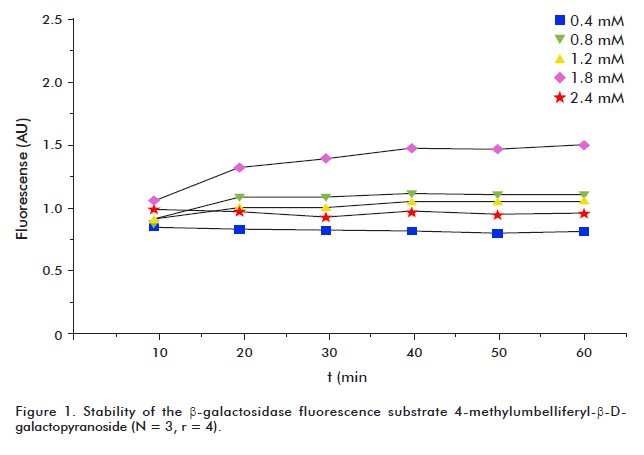
<body><![CDATA[<P   align="justify" ><font size="2" face="Verdana, Arial, Helvetica, sans-serif">For the determination      of the optimal &beta;-galactosidase substrate concentration and reaction time,      a physical mutagen (150 Gy of &gamma;-rays) was used as inducer of the SOS      response [14]. In the alkaline phosphatase assay, we used the buffer conditions      and substrate concentration described by Salvo <I>et al. </I>[16]. This substrate      concentration for phosphatase alkaline was tested in our conditions (data      not shown). </font></P >       <P   align="justify" ><font size="2" face="Verdana, Arial, Helvetica, sans-serif">The &beta;-galactosidase      substrate was stable during one hour at 25 &deg;C (<a href="/img/revistas/bta/v29n2/f0106212.gif">Figure      1</a>). This stability corroborated the fact that the observed fluorescence      increment during the assay, is due to &beta;-galactosidase activity but not      to substrate degradation. Also, 4-methylumbelliferone production depended      on the reaction time (<a href="/img/revistas/bta/v29n2/f0206212.gif">Figure 2A</a>). Although maximum      fluorescence values were reached using the substrate at a concentration of      2.4 mM, we selected 1.8 mM as the optimal concentration, since no significant      increase in SOSIF values was observed when the higher substrate concentration      was used (p &lt;0.05; <a href="/img/revistas/bta/v29n2/f0206212.gif">Figure 2B</a>). </font></P >       
<P   align="justify" ><font size="2" face="Verdana, Arial, Helvetica, sans-serif">In order to determine      an adequate reaction time for our assay, we performed readings every 10 minutes      for an hour. Our intention was to reduce the original time proposed by Quillardet,      but umbelliferone production was very poor in the first 30 minutes of the      enzymatic reaction and started to be relevant from 40 minutes. However, by      increasing reaction time in a 33% (40 to 60 min) only slightly increasing      of SOSIF values (11%) was achieved. Besides, at 40 min the fluorescent signal      was 35-fold and SOSIF was eight-fold the value of negative control, which      is good enough for genotoxicological and antigenotoxicological studies (<a href="/img/revistas/bta/v29n2/f0206212.gif">Figure      2B</a>). Thus, we selected 40 min as the enzymatic reaction time, which is      in accordance with that set by Quillardet in the original procedure. </font></P >       
<P   align="justify" ><font size="2" face="Verdana, Arial, Helvetica, sans-serif">The apparent Vmax      and Km values were then obtained from Lineweaver-Burk plots in order to compare      the affinity of the enzyme for the fluorescent substrate in the present assay      with other enzymatic assays reported for &beta;-galactosidase. The apparent      Km value found was 1.9 mM for &beta;-galactosidase in the presence of the      fluorescent substrate 4-methylumbelliferyl galactopyranoside (<a href="/img/revistas/bta/v29n2/f0206212.gif">Figure      2C</a>). </font></P >       
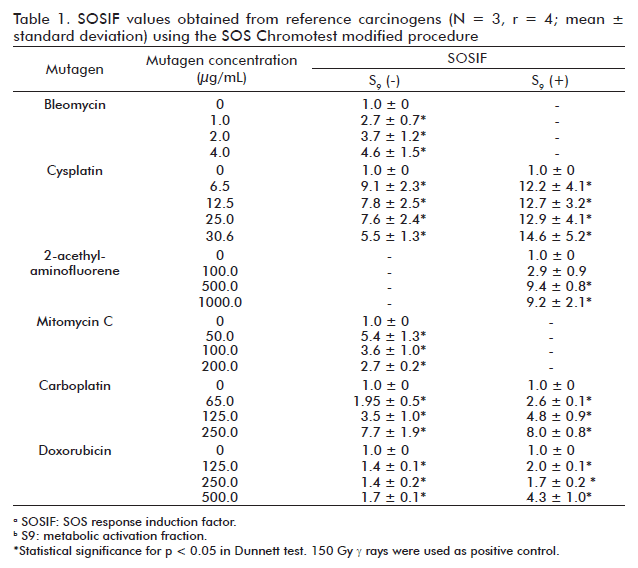
<P   ><font size="2" face="Verdana, Arial, Helvetica, sans-serif"><b>Genotoxicity assays      </b> </font></P >       <P   align="justify" ><font size="2" face="Verdana, Arial, Helvetica, sans-serif">To evaluate the sensibility      of the modified protocol in the detection of genotoxic activity different      mutagens and plant extracts were tested. </font></P >       <P   align="justify" ><font size="2" face="Verdana, Arial, Helvetica, sans-serif">As expected, all      the reference mutagens evaluated resulted genotoxic (<a href="/img/revistas/bta/v29n2/t0106212.gif">Table      1</a>). Cysplatin, 2-AAF, doxorubicin and carboplatin significantly increased      SOSIF values with respect to control (untreated cells) in the presence of      S<Sub>9</Sub>-mix thus indicating an indirect genotoxic effect of these compounds.      However, cysplatin and carboplatin also significantly increased SOSIF values      in the absence of exogenous S<Sub>9</Sub>-mix. Except for the case of cysplatin,      the increasing in SOSIF values in <I>E. coli</I> PQ-37 cells treated with      these mutagens was directly related with the increase of their concentration.      In the absence of S<Sub>9</Sub>-mix metabolic activation, the lower concentration      of cysplatin yielded the highest SOSIF value probably due to its cytotoxic      effect at higher concentrations. </font></P >   <FONT size="+1"><FONT size="+1"><FONT size="+1"><FONT size="+1"><FONT size="+1"><FONT size="+1">        
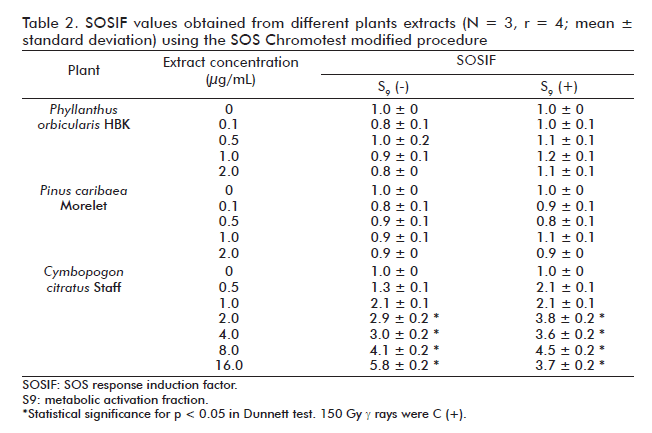
<P   align="justify" ><font size="2" face="Verdana, Arial, Helvetica, sans-serif">On the other hand,      the extracts of <I>P</I>.<I> orbicularis</I> and <I>P</I>. <I>caribaea</I>      did not increase the SOSIF values. There wasn&rsquo;t a correlation (<I>r</I><Sup><I>2      </I></Sup>= 0.23<I>; r</I><Sup><I>2 </I></Sup>= 0.01 respectively, p &lt;      0.05) between the extract concentrations and SOSIF values obtained, indicating      that these plants extracts were not genotoxic to <I>E. coli</I> PQ-37 cells.      In contrast, the <I>C. citratus</I> aqueous extract was genotoxic in <I>E.      coli</I> PQ-37 cells starting from the concentrations of 2 mg/mL (<I>r</I><Sup><I>2      </I></Sup>= 0.95 p &lt; 0.05). This behavior was observed in both the presence      and the absence of exogenous S<Sub>9</Sub>-mix (<a href="/img/revistas/bta/v29n2/t0206212.gif">Table      2</a>). </font></P >   <FONT size="+1"><FONT size="+1"><FONT size="+1"><FONT size="+1"><FONT size="+1"><FONT size="+1"><FONT size="+1"><FONT size="+1">        
<P   >&nbsp;</P >       <P   ><font size="2" face="Verdana, Arial, Helvetica, sans-serif"><b><font size="3">DISCUSSION      </font></b></font></P >   <FONT size="+1">        ]]></body>
<body><![CDATA[<P   align="justify" ><font size="2" face="Verdana, Arial, Helvetica, sans-serif">The modifications      to the original SOS Chromotest procedure [2] were addressed to switch from      colorimetric to fluorescent substrates to facilitate the analysis of pigmented      samples. Furthermore, the work was aimed at adapting the assay to a microanalytical      scale, thus reducing the final assay volume and automatizing readings. We      evaluated the &beta;-galactosidase activity and its substrate concentration      in the assay by using a physical mutagen (&gamma; rays) as inducer of DNA      damage and triggerer of the SOS response [12-14]. The SOSIF values obtained      using the selected substrate concentration and reaction time resulted quite      similar to those obtained with the use of the colorimetric variant [2]. However,      this substrate concentration was 10 times lower than that of the ONPG concentration      used in the original assay along with the fact that the total reaction volume      was 20-fold reduced in the modified protocol, which reduces reagents costs      in 17%. Also, semiautomatic readings allow for reducing data acquisition time      from one hour to approximately 5 minutes. Such advantages are relevant with      regard to the rapid evaluation of a higher number of small-volume samples      and to potential costs reduction of the test. </font></P >   <FONT size="+1">        <P   align="justify" ><font size="2" face="Verdana, Arial, Helvetica, sans-serif">Additionally, a characterization      of the modified procedure presented here was performed by calculation of kinetical      parameters. On this matter, it is worth to mention that this is an &lsquo;ex      vivo&rsquo; assay that uses small volumes of cell lysates, which impossible      to determine the active enzyme concentration and therefore, kcat calculation.      For this reason, we decided to determine an apparent Vmax and Km from Lineweaver-Burk      plots in order to compare it with the Km reported for other &beta;-galactosidase      assays. The Km obtained (1.9 mM) in the presence of 4-methylumbelliferyl galactopyranoside      was similar to the lower values reported in other microorganisms using the      ONPG colorimetric substrate from the unmodified SOS Chromotest. Km values      of 1.5, 1.8 and 2.6 mM were found for <I>Kluyveromyces lactis</I>, <I>Penicillium      chrysogenum</I>, <I>Bifidobacterium infantis</I> and <I>Bacillus </I>sp.,      respectively [18]. </font></P >       <P   align="justify" ><font size="2" face="Verdana, Arial, Helvetica, sans-serif">The modified protocol      used in the present study was effective to detect genotoxicity of several      known mutagens. Mutagen selection was performed taken into account the criteria      to include DNA damage inducers that follow different mechanisms. For instance,      bleomycin induce simple and double strand breaks, cysplatin and carboplatin      cause DNA crosslinks, 2-acethyl-aminofluorene (2-AAF) forms DNA adducts, while      mitomycin C is an alquil agent and doxorubycin is an intercalant agent [19].      These mutagens induced SOS response, because they directly or indirectly (by      damage processing) were able to generate single strand breaks, which is the      proposed signal to trigger emergency response. They were previously reported      as SOS inducers [20-22]. </font></P >       <P   align="justify" ><font size="2" face="Verdana, Arial, Helvetica, sans-serif">The usefulness of      the proposed procedure was also proved through the evaluation of pigmented      natural extracts. The three plants extracts were selected because of their      properties and prospective use in human health related issues. <I>P. orbicularis</I>      extract has antiviral properties, <I>P. caribaea</I> has antioxidant activity      [23] and <I>C. citratus</I> is one of the natural extracts most used by the      Cuban population due to some of its pharmacological properties [24]. </font></P >       <P   align="justify" ><font size="2" face="Verdana, Arial, Helvetica, sans-serif">The results of the      genotoxicological evaluation of <I>P. orbicularis</I> extracts obtained in      our fluorescent SOS test version are in agreement with those reported previously      in 2002, using the Umutest and Ames test. Conversely, it has been also reported      that this extract could be genotoxic in other biological models although this      positive genotoxicity was associated to its cytotoxicity <I>in vitro</I> and      <I>in vivo</I>. In addition, the <I>P. caribaea</I> extract did not induce      primary DNA damage in <I>E. coli </I>PQ-37 cells. Negative toxicity of <I>P.      caribaea</I> aqueous extract as well as of condensed tannins, the principal      component of this extract, was already observed using SOS Chromotest models,      respectively [15]. However, there is some evidence showing that tannins and      other polyphenols compounds can be mutagenic. The mutagenicity of tannins      greatly depends on their structural characteristics. For example, structure-function      studies on compounds related to tannic and galic acids showed the latter as      more mutagenic due to the presence of structural digaloil and free hydroxyl      groups [15]. In contrast to the results obtained using <I>P. orbicularis</I>      and <I>P. caribaea</I> extracts, the <I>C. citratus</I> aqueous extract induced      primary DNA damage starting from the 2 mg/mL concentration, indicating its      genotoxicity in the model studied. We have also observed on agarose gel electrophoresis      (data not shown) that this plant extract induces single and double DNA strand      breaks on pUC18 plasmid, perhaps generating an oxidative-based mechanism.      Studies related to <I>C. citratus</I> genotoxicity are contradictory [14].      </font></P >       <P   align="justify" ><font size="2" face="Verdana, Arial, Helvetica, sans-serif">In conclusion, the      modified version proposed here was sensible to known chemical and physical      mutagens. SOSIF values obtained were high enough to be useful as positive      controls in anti-genotoxicological studies. It was also advantageous to evaluate      the genotoxicity of pigmented samples, like the plants extracts and mutagens      such as mitomicin c and doxorubicin. It was less laborious than the use of      blanks for each concentration, and allowed the analysis of very small volumes.      To work at micronalytical scale is rapid, economic and represents a valid      alternative for the screening of a large variety of samples. </font></P >       <P   >&nbsp;</P >       <P   ><font size="3" face="Verdana, Arial, Helvetica, sans-serif"><b>ACKNOWLEDGMENTS      </b></font></P >   <FONT size="+1">        <P   align="justify" ><font size="2" face="Verdana, Arial, Helvetica, sans-serif">The authors wish      to thank Gisela Barrera, Mercedes Guerra and Sonia Altan&eacute;s for technical      assistance during irradiation of cells. This work was supported by the PRN/7-1/3-2002      project of the Nuclear Agency of the Cuban Ministry of Science, Technology      and Environment (CITMA).</font></P >       <P   align="justify" >&nbsp;</P >   <FONT size="+1">        ]]></body>
<body><![CDATA[<P   align="justify" ></P >       <P   align="justify" > </P >       <P   align="justify" ><font size="3"><b><font face="Verdana, Arial, Helvetica, sans-serif">REFERENCES      </font></b></font></P >       <!-- ref --><P   align="justify" ><font size="2" face="Verdana, Arial, Helvetica, sans-serif">1. Ames BN, Durston      WE, Yamasaki E, Lee FD. Carcinogens are mutagens: a simple test system combining      liver homogenates for activation and bacteria for detection. Proc Natl Acad      Sci USA. 1973; 70(8):2281-5.     </font></P >   <FONT size="+1">        <P   align="justify" ><font size="2" face="Verdana, Arial, Helvetica, sans-serif">2. Quillardet P,      Huisman O, D&rsquo;Ari R, Hofnung M. SOS chromotest, a direct assay of induction      of an SOS function in Escherichia coli K-12 to measure genotoxicity. Proc      Natl Acad Sci USA. 1982;79(19):5971-5. </font></P >       <!-- ref --><P   align="justify" ><font size="2" face="Verdana, Arial, Helvetica, sans-serif">3. Quillardet P,      Hofnung M. The SOS chromotest: a review. Mutat Res. 1993; 297(3):235-79.     </font></P >       <!-- ref --><P   align="justify" ><font size="2" face="Verdana, Arial, Helvetica, sans-serif">4. Zounkova R, Odraska      P, Dolezalova L, Hilscherova K, Marsalek B, Blaha L. Ecotoxicity and genotoxicity      assessment of cytostatic pharmaceuticals. Environ Toxicol Chem. 2007;26(10):2208-14.          </font></P >       ]]></body>
<body><![CDATA[<!-- ref --><P   align="justify" ><font size="2" face="Verdana, Arial, Helvetica, sans-serif">5. Leet JE, Liu X,      Drexler DM, Cantone JL, Huang S, Mamber SW, et al. Cytotoxic xanthones from      Psorospermum molluscum from the Madagascar rain forest. J Nat Prod. 2008;71(3):460-3.          </font></P >       <!-- ref --><P   align="justify" ><font size="2" face="Verdana, Arial, Helvetica, sans-serif">6. Westerink WM,      Stevenson JC, Lauwers A, Griffioen G, Horbach GJ, Schoonen WG. Evaluation      of the Vitotox and RadarScreen assays for the rapid assessment of genotoxicity      in the early research phase of drug development. Mutat Res. 2009;676(1-2):113-30.          </font></P >       <!-- ref --><P   align="justify" ><font size="2" face="Verdana, Arial, Helvetica, sans-serif">7. Vidal LS, Alves      AM, Kuster RM, Lage C, Leitao AC. Genotoxicity and mutagenicity of Echinodorus      macrophyllus (chapeu-de-couro) extracts. Genet Mol Biol. 2010;33(3):549-57.          </font></P >       <!-- ref --><P   align="justify" ><font size="2" face="Verdana, Arial, Helvetica, sans-serif">8. Vicu&ntilde;a      GC, Stashenko EE, Fuentes JL. Chemical composition of the Lippia origanoides      essential oils and their antigenotoxicity against bleomycin-induced DNA damage.      Fitoterapia. 2010;81(5):343-49.     </font></P >       <!-- ref --><P   align="justify" ><font size="2" face="Verdana, Arial, Helvetica, sans-serif">9. Afanassiev V,      Sefton M, Anantachaiyong T, Barker G, Walmsley R, Wolfl S. Application of      yeast cells transformed with GFP expression constructs containing the RAD54      or RNR2 promoter as a test for the genotoxic potential of chemical substances.      Mutat Res. 2000;464(2):297-308.     </font></P >       ]]></body>
<body><![CDATA[<!-- ref --><P   align="justify" ><font size="2" face="Verdana, Arial, Helvetica, sans-serif">10. Ichikawa K, Eki      T. A novel yeast-based reporter assay system for the sensitive detection of      genotoxic agents mediated by a DNA damage-inducible LexA-GAL4 protein. J Biochem.      2006;139(1):105-12.     </font></P >       <!-- ref --><P   align="justify" ><font size="2" face="Verdana, Arial, Helvetica, sans-serif">11. Podgorska B,      Wegrzyn G. A modified Vibrio harveyi mutagenicity assay based on bioluminescence      induction. Lett Appl Microbiol. 2006;42(6):578-82.     </font></P >       <!-- ref --><P   align="justify" ><font size="2" face="Verdana, Arial, Helvetica, sans-serif">12. Quillardet P,      Frelat G, Nguyen VD, Hofnung M. Detection of ionizing radiations with the      SOS Chromotest, a bacterial short-term test for genotoxic agents. Mutat Res.      1989;216(5):251-7.     </font></P >       <!-- ref --><P   align="justify" ><font size="2" face="Verdana, Arial, Helvetica, sans-serif">13. Kozubek S, Ogievetskaya      MM, Krasavin EA, Drasil V, Soska J. Investigation of the SOS response of Escherichia      coli after gamma-irradiation by means of the SOS chromotest. Mutat Res. 1990;230(1):1-7.          </font></P >       <!-- ref --><P   align="justify" ><font size="2" face="Verdana, Arial, Helvetica, sans-serif">14. Fuentes JL, Alonso      A, Cuetara E, Vernhe M, Alvarez N, Sanchez-Lamar A, et al. Usefulness of the      SOS Chromotest in the study of medicinal plants as radioprotectors. Int J      Radiat Biol. 2006;82(5):323-9.     </font></P >       ]]></body>
<body><![CDATA[<!-- ref --><P   align="justify" ><font size="2" face="Verdana, Arial, Helvetica, sans-serif">15. Prieto E, Ca&ntilde;et      F. Aspectos a considerar en el dos&iacute;metro Fricke. Tecnol Qu&iacute;m.      1990;2:19-20.     </font></P >       <!-- ref --><P   align="justify" ><font size="2" face="Verdana, Arial, Helvetica, sans-serif">16. Salvo NJ, Castillo      A, Fern&aacute;ndez A, Bouz&oacute; L, Torres K, Gonz&aacute;lez F. Optimizaci&oacute;n      de la producci&oacute;n del anticuerpo monoclonal iorT3 en biorreactores de      fibra hueca. Biotecnol Apl.1994;11(2):160-4.     </font></P >       <!-- ref --><P   align="justify" ><font size="2" face="Verdana, Arial, Helvetica, sans-serif">17. Kevekordes S,      Mersch-Sundermann V, Burghaus CM, Spielberger J, SchmeiserHH, Arlt VM, et      al. SOS induction of selected naturally occurring substances in Escherichia      coli (SOS chromotest). Mutat Res. 1999;445(1):81-91.     </font></P >       <!-- ref --><P   align="justify" ><font size="2" face="Verdana, Arial, Helvetica, sans-serif">18. BRENDA. BRaunschweig      ENzyme DAtabase. Braunschweig: Institute of Biochemistry and Bioinformatics      at the Technical University of Braunschweig. c2011 - [cited 2011 Dec 15].      Available from: <a href="http://www.brenda-enzymes.org" target="_blank">http://www.brenda-enzymes.org</a>      </font></P >       <!-- ref --><P   align="justify" ><font size="2" face="Verdana, Arial, Helvetica, sans-serif">19. Takimoto CH,      Ng CM. Pharmacokinetics and Pharmacodynamics. In: DeVita VT, Lawrence TS,      Rosenberg SA. Cancer: Principles and Practice of Oncology. 8th edition. Philadelphia:      Lippincott, Williams &amp; Wilkins; 2008. p. 392-401.     </font></P >       <!-- ref --><P   align="justify" ><font size="2" face="Verdana, Arial, Helvetica, sans-serif">20. Ohta T, Nakamura      N, Moriya M, Shirasu Y, Kada T. The SOS-function-inducing activity of chemical      mutagens in Escherichia coli. Mutat Res. 1984;131(3-4):101-9.     </font></P >       <!-- ref --><P   align="justify" ><font size="2" face="Verdana, Arial, Helvetica, sans-serif">21. Quillardet P,      de Bellecombe C, HofnungM. The SOS Chromotest, a colorimetric bacterial assay      for genotoxins: validation study with 83 compounds. Mutat Res. 1985;147(3):79-95.          </font></P >       <!-- ref --><P   align="justify" ><font size="2" face="Verdana, Arial, Helvetica, sans-serif">22. Overbeck TL,      Knight JM, Beck DJ. A comparison of the genotoxic effects of carboplatin and      cisplatin in Escherichia coli. Mutat Res. 1996;362(3):249-59.     </font></P >       <P   align="justify" ><font size="2" face="Verdana, Arial, Helvetica, sans-serif">23. Fuentes JL, Vernhe      M, Cuetara EB, S&aacute;nchez-Lamar A, Santana JL, Llagostera M. Tannins from      barks of Pinus caribaea protect Escherichia coli cells against DNA damage      induced by </font><font size="+1" color="#000000"><font size="+1"><font size="+1"><font size="+1"><font size="+1"><font size="+1"><font size="+1"><font size="+1"><font size="+1"><font size="+1"><font size="+1"><font size="+1"><font size="+1"><font size="+1"><font size="+1"><font size="+1"><font size="+1"><font size="+1"><font size="+1"><font size="+1"><font size="+1"><font size="2" face="Verdana, Arial, Helvetica, sans-serif">&gamma;</font></font></font></font></font></font></font></font></font></font></font></font></font></font></font></font></font></font></font></font></font></font><font size="2" face="Verdana, Arial, Helvetica, sans-serif">-rays.      Fitoterapia. 2006;77(2):116-20. </font></P >       <!-- ref --><P   align="justify" ><font size="2" face="Verdana, Arial, Helvetica, sans-serif">24. Alonso Mart&iacute;n      A, Almeida Varela E. Las plantas como radioprotectores potenciales frente      a la radiaci&oacute;n ionizante. Nucleus. 2008;(44):3-7.    </font></P >       <P   align="justify" ><FONT size="+1"> </font></P >   <FONT size="+1">       <P   align="justify" > </P >       ]]></body>
<body><![CDATA[<P   ><font size="2" face="Verdana, Arial, Helvetica, sans-serif">Received in September,      2011.    <br>     Accepted for publication in February, 2012.</font></P >       <P   >&nbsp;</P >       <P   align="justify" ></P >       <P   align="justify" > </P >       <P   ><i><font size="2" face="Verdana, Arial, Helvetica, sans-serif">Elizabeth B Cu&eacute;tara</font></i><font size="2" face="Verdana, Arial, Helvetica, sans-serif">.      Instituto Nacional de Oncolog&iacute;a y Radiobiolog&iacute;a. Esquina 29      y F, Vedado, Plaza, La Habana, Cuba. E-mail: <A href="mailto:ecuetara@infomed.sld.cu">      <U><U><FONT color="#0000FF">ecuetara@infomed.sld.cu</font></U></U></A><FONT color="#0000FF"><FONT color="#000000">.</font></font></font></P >   </font></font></font></font></font></font></font></font></font></font></font></font></font></font></font></font></font></font></font></font></font></font></font></font></font></font></font></font></font></font></font></font></font></font></font></font></font></font></font></font></font></font></font></font></font></font></font></font></font></font></font></font></font></font></font></font></font></font></font></font></font></font></font></font></font></font></font></font></font></font></font></font></font></font></font></font></font></font></font></font></DIV >      ]]></body><back>
<ref-list>
<ref id="B1">
<label>1</label><nlm-citation citation-type="journal">
<person-group person-group-type="author">
<name>
<surname><![CDATA[Ames]]></surname>
<given-names><![CDATA[BN]]></given-names>
</name>
<name>
<surname><![CDATA[Durston]]></surname>
<given-names><![CDATA[WE]]></given-names>
</name>
<name>
<surname><![CDATA[Yamasaki]]></surname>
<given-names><![CDATA[E]]></given-names>
</name>
<name>
<surname><![CDATA[Lee]]></surname>
<given-names><![CDATA[FD]]></given-names>
</name>
</person-group>
<article-title xml:lang="en"><![CDATA[Carcinogens are mutagens: a simple test system combining liver homogenates for activation and bacteria for detection]]></article-title>
<source><![CDATA[Proc Natl Acad Sci USA]]></source>
<year>1973</year>
<volume>70</volume>
<numero>8</numero>
<issue>8</issue>
<page-range>2281-5</page-range></nlm-citation>
</ref>
<ref id="B2">
<label>2</label><nlm-citation citation-type="journal">
<person-group person-group-type="author">
<name>
<surname><![CDATA[Quillardet]]></surname>
<given-names><![CDATA[P]]></given-names>
</name>
<name>
<surname><![CDATA[Huisman]]></surname>
<given-names><![CDATA[O]]></given-names>
</name>
<name>
<surname><![CDATA[D'Ari]]></surname>
<given-names><![CDATA[R]]></given-names>
</name>
<name>
<surname><![CDATA[Hofnung]]></surname>
<given-names><![CDATA[M]]></given-names>
</name>
</person-group>
<article-title xml:lang="en"><![CDATA[SOS chromotest, a direct assay of induction of an SOS function in Escherichia coli K-12 to measure genotoxicity]]></article-title>
<source><![CDATA[Proc Natl Acad Sci USA]]></source>
<year>1982</year>
<volume>79</volume>
<numero>19</numero>
<issue>19</issue>
<page-range>5971-5</page-range></nlm-citation>
</ref>
<ref id="B3">
<label>3</label><nlm-citation citation-type="journal">
<person-group person-group-type="author">
<name>
<surname><![CDATA[Quillardet]]></surname>
<given-names><![CDATA[P]]></given-names>
</name>
<name>
<surname><![CDATA[Hofnung]]></surname>
<given-names><![CDATA[M]]></given-names>
</name>
</person-group>
<article-title xml:lang="en"><![CDATA[The SOS chromotest: a review]]></article-title>
<source><![CDATA[Mutat Res]]></source>
<year>1993</year>
<volume>297</volume>
<numero>3</numero>
<issue>3</issue>
<page-range>235-79</page-range></nlm-citation>
</ref>
<ref id="B4">
<label>4</label><nlm-citation citation-type="journal">
<person-group person-group-type="author">
<name>
<surname><![CDATA[Zounkova]]></surname>
<given-names><![CDATA[R]]></given-names>
</name>
<name>
<surname><![CDATA[Odraska]]></surname>
<given-names><![CDATA[P]]></given-names>
</name>
<name>
<surname><![CDATA[Dolezalova]]></surname>
<given-names><![CDATA[L]]></given-names>
</name>
<name>
<surname><![CDATA[Hilscherova]]></surname>
<given-names><![CDATA[K]]></given-names>
</name>
<name>
<surname><![CDATA[Marsalek]]></surname>
<given-names><![CDATA[B]]></given-names>
</name>
<name>
<surname><![CDATA[Blaha]]></surname>
<given-names><![CDATA[L]]></given-names>
</name>
</person-group>
<article-title xml:lang="en"><![CDATA[Ecotoxicity and genotoxicity assessment of cytostatic pharmaceuticals]]></article-title>
<source><![CDATA[Environ Toxicol Chem]]></source>
<year>2007</year>
<volume>26</volume>
<numero>10</numero>
<issue>10</issue>
<page-range>2208-14</page-range></nlm-citation>
</ref>
<ref id="B5">
<label>5</label><nlm-citation citation-type="journal">
<person-group person-group-type="author">
<name>
<surname><![CDATA[Leet]]></surname>
<given-names><![CDATA[JE]]></given-names>
</name>
<name>
<surname><![CDATA[Liu]]></surname>
<given-names><![CDATA[X]]></given-names>
</name>
<name>
<surname><![CDATA[Drexler]]></surname>
<given-names><![CDATA[DM]]></given-names>
</name>
<name>
<surname><![CDATA[Cantone]]></surname>
<given-names><![CDATA[JL]]></given-names>
</name>
<name>
<surname><![CDATA[Huang]]></surname>
<given-names><![CDATA[S]]></given-names>
</name>
<name>
<surname><![CDATA[Mamber]]></surname>
<given-names><![CDATA[SW]]></given-names>
</name>
</person-group>
<article-title xml:lang="en"><![CDATA[Cytotoxic xanthones from Psorospermum molluscum from the Madagascar rain forest]]></article-title>
<source><![CDATA[J Nat Prod]]></source>
<year>2008</year>
<volume>71</volume>
<numero>3</numero>
<issue>3</issue>
<page-range>460-3</page-range></nlm-citation>
</ref>
<ref id="B6">
<label>6</label><nlm-citation citation-type="journal">
<person-group person-group-type="author">
<name>
<surname><![CDATA[Westerink]]></surname>
<given-names><![CDATA[WM]]></given-names>
</name>
<name>
<surname><![CDATA[Stevenson]]></surname>
<given-names><![CDATA[JC]]></given-names>
</name>
<name>
<surname><![CDATA[Lauwers]]></surname>
<given-names><![CDATA[A]]></given-names>
</name>
<name>
<surname><![CDATA[Griffioen]]></surname>
<given-names><![CDATA[G]]></given-names>
</name>
<name>
<surname><![CDATA[Horbach]]></surname>
<given-names><![CDATA[GJ]]></given-names>
</name>
<name>
<surname><![CDATA[Schoonen]]></surname>
<given-names><![CDATA[WG]]></given-names>
</name>
</person-group>
<article-title xml:lang="en"><![CDATA[Evaluation of the Vitotox and RadarScreen assays for the rapid assessment of genotoxicity in the early research phase of drug development]]></article-title>
<source><![CDATA[Mutat Res]]></source>
<year>2009</year>
<volume>676</volume>
<numero>1-2</numero>
<issue>1-2</issue>
<page-range>113-30</page-range></nlm-citation>
</ref>
<ref id="B7">
<label>7</label><nlm-citation citation-type="journal">
<person-group person-group-type="author">
<name>
<surname><![CDATA[Vidal]]></surname>
<given-names><![CDATA[LS]]></given-names>
</name>
<name>
<surname><![CDATA[Alves]]></surname>
<given-names><![CDATA[AM]]></given-names>
</name>
<name>
<surname><![CDATA[Kuster]]></surname>
<given-names><![CDATA[RM]]></given-names>
</name>
<name>
<surname><![CDATA[Lage]]></surname>
<given-names><![CDATA[C]]></given-names>
</name>
<name>
<surname><![CDATA[Leitao]]></surname>
<given-names><![CDATA[AC]]></given-names>
</name>
</person-group>
<article-title xml:lang="en"><![CDATA[Genotoxicity and mutagenicity of Echinodorus macrophyllus (chapeu-de-couro) extracts]]></article-title>
<source><![CDATA[Genet Mol Biol]]></source>
<year>2010</year>
<volume>33</volume>
<numero>3</numero>
<issue>3</issue>
<page-range>549-57</page-range></nlm-citation>
</ref>
<ref id="B8">
<label>8</label><nlm-citation citation-type="journal">
<person-group person-group-type="author">
<name>
<surname><![CDATA[Vicuña]]></surname>
<given-names><![CDATA[GC]]></given-names>
</name>
<name>
<surname><![CDATA[Stashenko]]></surname>
<given-names><![CDATA[EE]]></given-names>
</name>
<name>
<surname><![CDATA[Fuentes]]></surname>
<given-names><![CDATA[JL]]></given-names>
</name>
</person-group>
<article-title xml:lang="en"><![CDATA[Chemical composition of the Lippia origanoides essential oils and their antigenotoxicity against bleomycin-induced DNA damage]]></article-title>
<source><![CDATA[Fitoterapia]]></source>
<year>2010</year>
<volume>81</volume>
<numero>5</numero>
<issue>5</issue>
<page-range>343-49</page-range></nlm-citation>
</ref>
<ref id="B9">
<label>9</label><nlm-citation citation-type="journal">
<person-group person-group-type="author">
<name>
<surname><![CDATA[Afanassiev]]></surname>
<given-names><![CDATA[V]]></given-names>
</name>
<name>
<surname><![CDATA[Sefton]]></surname>
<given-names><![CDATA[M]]></given-names>
</name>
<name>
<surname><![CDATA[Anantachaiyong]]></surname>
<given-names><![CDATA[T]]></given-names>
</name>
<name>
<surname><![CDATA[Barker]]></surname>
<given-names><![CDATA[G]]></given-names>
</name>
<name>
<surname><![CDATA[Walmsley]]></surname>
<given-names><![CDATA[R]]></given-names>
</name>
<name>
<surname><![CDATA[Wolfl]]></surname>
<given-names><![CDATA[S]]></given-names>
</name>
</person-group>
<article-title xml:lang="en"><![CDATA[Application of yeast cells transformed with GFP expression constructs containing the RAD54 or RNR2 promoter as a test for the genotoxic potential of chemical substances]]></article-title>
<source><![CDATA[Mutat Res]]></source>
<year>2000</year>
<volume>464</volume>
<numero>2</numero>
<issue>2</issue>
<page-range>297-308</page-range></nlm-citation>
</ref>
<ref id="B10">
<label>10</label><nlm-citation citation-type="journal">
<person-group person-group-type="author">
<name>
<surname><![CDATA[Ichikawa]]></surname>
<given-names><![CDATA[K]]></given-names>
</name>
<name>
<surname><![CDATA[Eki]]></surname>
<given-names><![CDATA[T]]></given-names>
</name>
</person-group>
<article-title xml:lang="en"><![CDATA[A novel yeast-based reporter assay system for the sensitive detection of genotoxic agents mediated by a DNA damage-inducible LexA-GAL4 protein]]></article-title>
<source><![CDATA[J Biochem]]></source>
<year>2006</year>
<volume>139</volume>
<numero>1</numero>
<issue>1</issue>
<page-range>105-12</page-range></nlm-citation>
</ref>
<ref id="B11">
<label>11</label><nlm-citation citation-type="journal">
<person-group person-group-type="author">
<name>
<surname><![CDATA[Podgorska]]></surname>
<given-names><![CDATA[B]]></given-names>
</name>
<name>
<surname><![CDATA[Wegrzyn]]></surname>
<given-names><![CDATA[G]]></given-names>
</name>
</person-group>
<article-title xml:lang="en"><![CDATA[A modified Vibrio harveyi mutagenicity assay based on bioluminescence induction]]></article-title>
<source><![CDATA[Lett Appl Microbiol]]></source>
<year>2006</year>
<volume>42</volume>
<numero>6</numero>
<issue>6</issue>
<page-range>578-82</page-range></nlm-citation>
</ref>
<ref id="B12">
<label>12</label><nlm-citation citation-type="journal">
<person-group person-group-type="author">
<name>
<surname><![CDATA[Quillardet]]></surname>
<given-names><![CDATA[P]]></given-names>
</name>
<name>
<surname><![CDATA[Frelat]]></surname>
<given-names><![CDATA[G]]></given-names>
</name>
<name>
<surname><![CDATA[Nguyen]]></surname>
<given-names><![CDATA[VD]]></given-names>
</name>
<name>
<surname><![CDATA[Hofnung]]></surname>
<given-names><![CDATA[M]]></given-names>
</name>
</person-group>
<article-title xml:lang="en"><![CDATA[Detection of ionizing radiations with the SOS Chromotest, a bacterial short-term test for genotoxic agents]]></article-title>
<source><![CDATA[Mutat Res]]></source>
<year>1989</year>
<volume>216</volume>
<numero>5</numero>
<issue>5</issue>
<page-range>251-7</page-range></nlm-citation>
</ref>
<ref id="B13">
<label>13</label><nlm-citation citation-type="journal">
<person-group person-group-type="author">
<name>
<surname><![CDATA[Kozubek]]></surname>
<given-names><![CDATA[S]]></given-names>
</name>
<name>
<surname><![CDATA[Ogievetskaya]]></surname>
<given-names><![CDATA[MM]]></given-names>
</name>
<name>
<surname><![CDATA[Krasavin]]></surname>
<given-names><![CDATA[EA]]></given-names>
</name>
<name>
<surname><![CDATA[Drasil]]></surname>
<given-names><![CDATA[V]]></given-names>
</name>
<name>
<surname><![CDATA[Soska]]></surname>
<given-names><![CDATA[J]]></given-names>
</name>
</person-group>
<article-title xml:lang="en"><![CDATA[Investigation of the SOS response of Escherichia coli after gamma-irradiation by means of the SOS chromotest]]></article-title>
<source><![CDATA[Mutat Res]]></source>
<year>1990</year>
<volume>230</volume>
<numero>1</numero>
<issue>1</issue>
<page-range>1-7</page-range></nlm-citation>
</ref>
<ref id="B14">
<label>14</label><nlm-citation citation-type="journal">
<person-group person-group-type="author">
<name>
<surname><![CDATA[Fuentes]]></surname>
<given-names><![CDATA[JL]]></given-names>
</name>
<name>
<surname><![CDATA[Alonso]]></surname>
<given-names><![CDATA[A]]></given-names>
</name>
<name>
<surname><![CDATA[Cuetara]]></surname>
<given-names><![CDATA[E]]></given-names>
</name>
<name>
<surname><![CDATA[Vernhe]]></surname>
<given-names><![CDATA[M]]></given-names>
</name>
<name>
<surname><![CDATA[Alvarez]]></surname>
<given-names><![CDATA[N]]></given-names>
</name>
<name>
<surname><![CDATA[Sanchez-Lamar]]></surname>
<given-names><![CDATA[A]]></given-names>
</name>
</person-group>
<article-title xml:lang="en"><![CDATA[Usefulness of the SOS Chromotest in the study of medicinal plants as radioprotectors]]></article-title>
<source><![CDATA[Int J Radiat Biol]]></source>
<year>2006</year>
<volume>82</volume>
<numero>5</numero>
<issue>5</issue>
<page-range>323-9</page-range></nlm-citation>
</ref>
<ref id="B15">
<label>15</label><nlm-citation citation-type="journal">
<person-group person-group-type="author">
<name>
<surname><![CDATA[Prieto]]></surname>
<given-names><![CDATA[E]]></given-names>
</name>
<name>
<surname><![CDATA[Cañet]]></surname>
<given-names><![CDATA[F]]></given-names>
</name>
</person-group>
<article-title xml:lang="es"><![CDATA[Aspectos a considerar en el dosímetro Fricke]]></article-title>
<source><![CDATA[Tecnol Quím]]></source>
<year>1990</year>
<volume>2</volume>
<page-range>19-20</page-range></nlm-citation>
</ref>
<ref id="B16">
<label>16</label><nlm-citation citation-type="journal">
<person-group person-group-type="author">
<name>
<surname><![CDATA[Salvo]]></surname>
<given-names><![CDATA[NJ]]></given-names>
</name>
<name>
<surname><![CDATA[Castillo]]></surname>
<given-names><![CDATA[A]]></given-names>
</name>
<name>
<surname><![CDATA[Fernández]]></surname>
<given-names><![CDATA[A]]></given-names>
</name>
<name>
<surname><![CDATA[Bouzó]]></surname>
<given-names><![CDATA[L]]></given-names>
</name>
<name>
<surname><![CDATA[Torres]]></surname>
<given-names><![CDATA[K]]></given-names>
</name>
<name>
<surname><![CDATA[González]]></surname>
<given-names><![CDATA[F]]></given-names>
</name>
</person-group>
<article-title xml:lang="es"><![CDATA[Optimización de la producción del anticuerpo monoclonal iorT3 en biorreactores de fibra hueca]]></article-title>
<source><![CDATA[Biotecnol Apl]]></source>
<year>1994</year>
<volume>11</volume>
<numero>2</numero>
<issue>2</issue>
<page-range>160-4</page-range></nlm-citation>
</ref>
<ref id="B17">
<label>17</label><nlm-citation citation-type="journal">
<person-group person-group-type="author">
<name>
<surname><![CDATA[Kevekordes]]></surname>
<given-names><![CDATA[S]]></given-names>
</name>
<name>
<surname><![CDATA[Mersch-Sundermann]]></surname>
<given-names><![CDATA[V]]></given-names>
</name>
<name>
<surname><![CDATA[Burghaus]]></surname>
<given-names><![CDATA[CM]]></given-names>
</name>
<name>
<surname><![CDATA[Spielberger]]></surname>
<given-names><![CDATA[J]]></given-names>
</name>
<name>
<surname><![CDATA[Schmeiser]]></surname>
<given-names><![CDATA[HH]]></given-names>
</name>
<name>
<surname><![CDATA[Arlt]]></surname>
<given-names><![CDATA[VM]]></given-names>
</name>
</person-group>
<article-title xml:lang="en"><![CDATA[SOS induction of selected naturally occurring substances in Escherichia coli (SOS chromotest)]]></article-title>
<source><![CDATA[Mutat Res]]></source>
<year>1999</year>
<volume>445</volume>
<numero>1</numero>
<issue>1</issue>
<page-range>81-91</page-range></nlm-citation>
</ref>
<ref id="B18">
<label>18</label><nlm-citation citation-type="">
<source><![CDATA[BRENDA: BRaunschweig ENzyme DAtabase. Braunschweig: Institute of Biochemistry and Bioinformatics at the Technical University of Braunschweig]]></source>
<year>2011</year>
</nlm-citation>
</ref>
<ref id="B19">
<label>19</label><nlm-citation citation-type="book">
<person-group person-group-type="author">
<name>
<surname><![CDATA[Takimoto]]></surname>
<given-names><![CDATA[CH]]></given-names>
</name>
<name>
<surname><![CDATA[Ng]]></surname>
<given-names><![CDATA[CM]]></given-names>
</name>
</person-group>
<article-title xml:lang="en"><![CDATA[Pharmacokinetics and Pharmacodynamics]]></article-title>
<person-group person-group-type="editor">
<name>
<surname><![CDATA[DeVita]]></surname>
<given-names><![CDATA[VT]]></given-names>
</name>
<name>
<surname><![CDATA[Lawrence]]></surname>
<given-names><![CDATA[TS]]></given-names>
</name>
<name>
<surname><![CDATA[Rosenberg]]></surname>
<given-names><![CDATA[SA]]></given-names>
</name>
</person-group>
<source><![CDATA[Cancer: Principles and Practice of Oncology]]></source>
<year>2008</year>
<edition>8</edition>
<page-range>392-401</page-range><publisher-loc><![CDATA[Philadelphia ]]></publisher-loc>
<publisher-name><![CDATA[Lippincott, Williams & Wilkins]]></publisher-name>
</nlm-citation>
</ref>
<ref id="B20">
<label>20</label><nlm-citation citation-type="journal">
<person-group person-group-type="author">
<name>
<surname><![CDATA[Ohta]]></surname>
<given-names><![CDATA[T]]></given-names>
</name>
<name>
<surname><![CDATA[Nakamura]]></surname>
<given-names><![CDATA[N]]></given-names>
</name>
<name>
<surname><![CDATA[Moriya]]></surname>
<given-names><![CDATA[M]]></given-names>
</name>
<name>
<surname><![CDATA[Shirasu]]></surname>
<given-names><![CDATA[Y]]></given-names>
</name>
<name>
<surname><![CDATA[Kada]]></surname>
<given-names><![CDATA[T]]></given-names>
</name>
</person-group>
<article-title xml:lang="en"><![CDATA[The SOS-function-inducing activity of chemical mutagens in Escherichia coli]]></article-title>
<source><![CDATA[Mutat Res]]></source>
<year>1984</year>
<volume>131</volume>
<numero>3-4</numero>
<issue>3-4</issue>
<page-range>101-9</page-range></nlm-citation>
</ref>
<ref id="B21">
<label>21</label><nlm-citation citation-type="journal">
<person-group person-group-type="author">
<name>
<surname><![CDATA[Quillardet]]></surname>
<given-names><![CDATA[P]]></given-names>
</name>
<name>
<surname><![CDATA[de Bellecombe]]></surname>
<given-names><![CDATA[C]]></given-names>
</name>
<name>
<surname><![CDATA[Hofnung]]></surname>
<given-names><![CDATA[M]]></given-names>
</name>
</person-group>
<article-title xml:lang="en"><![CDATA[The SOS Chromotest, a colorimetric bacterial assay for genotoxins: validation study with 83 compounds]]></article-title>
<source><![CDATA[Mutat Res]]></source>
<year>1985</year>
<volume>147</volume>
<numero>3</numero>
<issue>3</issue>
<page-range>79-95</page-range></nlm-citation>
</ref>
<ref id="B22">
<label>22</label><nlm-citation citation-type="journal">
<person-group person-group-type="author">
<name>
<surname><![CDATA[Overbeck]]></surname>
<given-names><![CDATA[TL]]></given-names>
</name>
<name>
<surname><![CDATA[Knight]]></surname>
<given-names><![CDATA[JM]]></given-names>
</name>
<name>
<surname><![CDATA[Beck]]></surname>
<given-names><![CDATA[DJ]]></given-names>
</name>
</person-group>
<article-title xml:lang="en"><![CDATA[A comparison of the genotoxic effects of carboplatin and cisplatin in Escherichia coli]]></article-title>
<source><![CDATA[Mutat Res]]></source>
<year>1996</year>
<volume>362</volume>
<numero>3</numero>
<issue>3</issue>
<page-range>249-59</page-range></nlm-citation>
</ref>
<ref id="B23">
<label>23</label><nlm-citation citation-type="journal">
<person-group person-group-type="author">
<name>
<surname><![CDATA[Fuentes]]></surname>
<given-names><![CDATA[JL]]></given-names>
</name>
<name>
<surname><![CDATA[Vernhe]]></surname>
<given-names><![CDATA[M]]></given-names>
</name>
<name>
<surname><![CDATA[Cuetara]]></surname>
<given-names><![CDATA[EB]]></given-names>
</name>
<name>
<surname><![CDATA[Sánchez-Lamar]]></surname>
<given-names><![CDATA[A]]></given-names>
</name>
<name>
<surname><![CDATA[Santana]]></surname>
<given-names><![CDATA[JL]]></given-names>
</name>
<name>
<surname><![CDATA[Llagostera]]></surname>
<given-names><![CDATA[M]]></given-names>
</name>
</person-group>
<article-title xml:lang="en"><![CDATA[Tannins from barks of Pinus caribaea protect Escherichia coli cells against DNA damage induced by ?-rays]]></article-title>
<source><![CDATA[Fitoterapia]]></source>
<year>2006</year>
<volume>77</volume>
<numero>2</numero>
<issue>2</issue>
<page-range>116-20</page-range></nlm-citation>
</ref>
<ref id="B24">
<label>24</label><nlm-citation citation-type="journal">
<person-group person-group-type="author">
<name>
<surname><![CDATA[Alonso Martín]]></surname>
<given-names><![CDATA[A]]></given-names>
</name>
<name>
<surname><![CDATA[Almeida Varela]]></surname>
<given-names><![CDATA[E]]></given-names>
</name>
</person-group>
<article-title xml:lang="en"><![CDATA[Las plantas como radioprotectores potenciales frente a la radiación ionizante]]></article-title>
<source><![CDATA[Nucleus]]></source>
<year>2008</year>
<numero>44</numero>
<issue>44</issue>
<page-range>3-7</page-range></nlm-citation>
</ref>
</ref-list>
</back>
</article>