<?xml version="1.0" encoding="ISO-8859-1"?><article xmlns:mml="http://www.w3.org/1998/Math/MathML" xmlns:xlink="http://www.w3.org/1999/xlink" xmlns:xsi="http://www.w3.org/2001/XMLSchema-instance">
<front>
<journal-meta>
<journal-id>1027-2852</journal-id>
<journal-title><![CDATA[Biotecnología Aplicada]]></journal-title>
<abbrev-journal-title><![CDATA[Biotecnol Apl]]></abbrev-journal-title>
<issn>1027-2852</issn>
<publisher>
<publisher-name><![CDATA[Editorial Elfos Scientiae]]></publisher-name>
</publisher>
</journal-meta>
<article-meta>
<article-id>S1027-28522012000200009</article-id>
<title-group>
<article-title xml:lang="en"><![CDATA[Production of highly polymerized bacterial levan in two eukaryotic hosts of biotechnological interest]]></article-title>
<article-title xml:lang="es"><![CDATA[Producción de levana bacteriana altamente polimerizada en dos hospederos eucariontes de interés biotecnológico]]></article-title>
</title-group>
<contrib-group>
<contrib contrib-type="author">
<name>
<surname><![CDATA[Banguela]]></surname>
<given-names><![CDATA[Alexander]]></given-names>
</name>
<xref ref-type="aff" rid="A01"/>
</contrib>
<contrib contrib-type="author">
<name>
<surname><![CDATA[Trujillo]]></surname>
<given-names><![CDATA[Luis E]]></given-names>
</name>
<xref ref-type="aff" rid="A01"/>
</contrib>
<contrib contrib-type="author">
<name>
<surname><![CDATA[Arrieta]]></surname>
<given-names><![CDATA[Juan G]]></given-names>
</name>
<xref ref-type="aff" rid="A01"/>
</contrib>
<contrib contrib-type="author">
<name>
<surname><![CDATA[Rodríguez]]></surname>
<given-names><![CDATA[Raisa]]></given-names>
</name>
<xref ref-type="aff" rid="A01"/>
</contrib>
<contrib contrib-type="author">
<name>
<surname><![CDATA[Pérez]]></surname>
<given-names><![CDATA[Enrique]]></given-names>
</name>
<xref ref-type="aff" rid="A02"/>
</contrib>
<contrib contrib-type="author">
<name>
<surname><![CDATA[Menéndez]]></surname>
<given-names><![CDATA[Carmen]]></given-names>
</name>
<xref ref-type="aff" rid="A01"/>
</contrib>
<contrib contrib-type="author">
<name>
<surname><![CDATA[Ramírez]]></surname>
<given-names><![CDATA[Ricardo]]></given-names>
</name>
<xref ref-type="aff" rid="A01"/>
</contrib>
<contrib contrib-type="author">
<name>
<surname><![CDATA[Pujol]]></surname>
<given-names><![CDATA[Merardo]]></given-names>
</name>
<xref ref-type="aff" rid="A01"/>
</contrib>
<contrib contrib-type="author">
<name>
<surname><![CDATA[Borroto]]></surname>
<given-names><![CDATA[Carlos]]></given-names>
</name>
<xref ref-type="aff" rid="A01"/>
</contrib>
<contrib contrib-type="author">
<name>
<surname><![CDATA[Hernández]]></surname>
<given-names><![CDATA[Lázaro]]></given-names>
</name>
<xref ref-type="aff" rid="A01"/>
</contrib>
</contrib-group>
<aff id="A02">
<institution><![CDATA[,Centro de Ingeniería Genética y Biotecnología de Sancti Spíritus  ]]></institution>
<addr-line><![CDATA[ ]]></addr-line>
<country>Cuba</country>
</aff>
<aff id="A01">
<institution><![CDATA[,Centro de Ingeniería Genética y Biotecnología, CIGB División de Plantas ]]></institution>
<addr-line><![CDATA[La Habana ]]></addr-line>
<country>Cuba</country>
</aff>
<pub-date pub-type="pub">
<day>00</day>
<month>06</month>
<year>2012</year>
</pub-date>
<pub-date pub-type="epub">
<day>00</day>
<month>06</month>
<year>2012</year>
</pub-date>
<volume>29</volume>
<numero>2</numero>
<fpage>122</fpage>
<lpage>126</lpage>
<copyright-statement/>
<copyright-year/>
<self-uri xlink:href="http://scielo.sld.cu/scielo.php?script=sci_arttext&amp;pid=S1027-28522012000200009&amp;lng=en&amp;nrm=iso"></self-uri><self-uri xlink:href="http://scielo.sld.cu/scielo.php?script=sci_abstract&amp;pid=S1027-28522012000200009&amp;lng=en&amp;nrm=iso"></self-uri><self-uri xlink:href="http://scielo.sld.cu/scielo.php?script=sci_pdf&amp;pid=S1027-28522012000200009&amp;lng=en&amp;nrm=iso"></self-uri><abstract abstract-type="short" xml:lang="en"><p><![CDATA[Bacterial levan (ß(2,6)-linked polyfructan) has potential applications in the food, bio-energetic, medical, pharmaceutical, and other industries. The lack of technically and economically feasible large-scale production systems limits the commercial exploitation of levan. Gluconacetobacter diazotrophicus secretes a levansucrase (LsdA, EC 2.4.1.10) that synthesizes high levels of levan and fructooligosaccharides from sucrose. This bacterium is not attractive for the cost-effective production of LsdA. In this research, we used Pichia pastoris and Nicotiana tabacum as hosts for LsdA production and direct levan synthesis, respectively. The recombinant yeast constitutively expressing the lsdA gene acquired saccharolytic capacity and secreted LsdA to a yield 9-fold higher than the value reported for the natural host. The occurrence of N-glycosylation in the yeast-produced LsdA did not affect the catalytic efficiency, substrate specificity, or product profile compared to the native non-glycosylated enzyme. This finding prompted us to express the lsdA gene in vacuoles, the most physiologically appropriate compartment to direct levan formation within the plant cell. Constitutive expression of LsdA fused to the vacuolar targeting signal of an onion fructosyltransferase allowed the accumulation of highly polymerized levan (above 104 fructose residues) in mature tobacco leaves where the polymer represented between 10 and 70% (w/w) of total dry weight. The latter value is the highest reported in the literature for a levan-producing transgenic plant grown in soil. No drastic physiological changes were observed in tobacco plants with levan yields up to 30% (w/w) in leaves. The polymer production remained stable in the plant progenies pointing for potential application in biotechnology.]]></p></abstract>
<abstract abstract-type="short" xml:lang="es"><p><![CDATA[Levana bacteriana es un homopolímero ß (2,6) soluble de unidades de fructosa, con aplicación en las industrias alimentaria, médico-farmacéutica, bioenergética y otras. La carencia de un sistema productivo factible, técnica y económicamente, impide la explotación comercial de levana a gran escala. La bacteria Gluconacetobacter diazotrophicus secreta una levanasacarasa (LsdA, EC 2.4.1.10) que sintetiza altos niveles de levana y fructooligosacaridos a partir de la sacarosa. Por ser el hospedero nativo poco atractivo para la producción masiva de LsdA, se investigaron la levadura Pichia pastoris y la planta Nicotiana tabacum como nuevas fuentes. La levadura P. pastoris recombinante expresó constitutivamente LsdA y adquirió actividad sacarolítica, e incrementó el rendimiento de LsdA en 8 a 9 veces con respecto a G. diazotrophicus. La N-glicosilación de LsdA en un hospedero eucarionte no afectó la eficiencia catalítica ni el rendimiento de fructanos en comparación con la enzima nativa. Ello permite la obtención de LsdA glicosilada activa en las vacuolas de las plantas, compartimento celular más apropiado para esos fines. La expresión constitutiva de LsdA fusionada con la señal de localización vacuolar de la fructosiltransferasa de cebolla permitió la acumulación de levana altamente polimerizada (más de 104 residuos de fructosa) en hojas de tabaco, entre 10 y 70% del peso seco total. Este último es el máximo valor descrito para una planta transgénica crecida en suelo, productora de levana. La ausencia de alteraciones fisiológicas drásticas en clones que acumularon hasta 30% de levana, y la producción estable del polisacárido en sus progenies, remarcan su potencial agronómico.]]></p></abstract>
<kwd-group>
<kwd lng="en"><![CDATA[Levan]]></kwd>
<kwd lng="en"><![CDATA[transgenic tobacco]]></kwd>
<kwd lng="en"><![CDATA[Pichia pastoris]]></kwd>
<kwd lng="en"><![CDATA[levansucrase]]></kwd>
<kwd lng="en"><![CDATA[N-glycosilation]]></kwd>
<kwd lng="en"><![CDATA[catalytical properties]]></kwd>
<kwd lng="en"><![CDATA[Gluconacetobacter diazotrophicus]]></kwd>
<kwd lng="en"><![CDATA[fructan]]></kwd>
<kwd lng="es"><![CDATA[Levana]]></kwd>
<kwd lng="es"><![CDATA[tabaco transgénico]]></kwd>
<kwd lng="es"><![CDATA[Pichia pastoris]]></kwd>
<kwd lng="es"><![CDATA[levanasacarasa]]></kwd>
<kwd lng="es"><![CDATA[N-glycosilación]]></kwd>
<kwd lng="es"><![CDATA[propiedades catalíticas]]></kwd>
<kwd lng="es"><![CDATA[Gluconacetobacter diazotrophicus]]></kwd>
<kwd lng="es"><![CDATA[fructano]]></kwd>
</kwd-group>
</article-meta>
</front><body><![CDATA[ <DIV class="Sect"   >        <P align="right"   ><font size="2" color="#000000" face="Verdana, Arial, Helvetica, sans-serif"><b>REPORT      </b> </font></P >   <FONT size="+1" color="#000000">        <P   > </P >       <P   >&nbsp;</P >       <P   ><font face="Verdana, Arial, Helvetica, sans-serif" size="2"><b><font size="4">Production      of highly polymerized bacterial levan in two eukaryotic hosts of biotechnological      interest </font></b> </font></P >       <P   >&nbsp;</P >       <P   ><font face="Verdana, Arial, Helvetica, sans-serif" size="3"><b>Producci&oacute;n      de levana bacteriana altamente polimerizada en dos hospederos eucariontes      de inter&eacute;s biotecnol&oacute;gico </b></font></P >       <P   > </P >       <P   >&nbsp;</P >       <P   >&nbsp;</P >       ]]></body>
<body><![CDATA[<P   ><font face="Verdana, Arial, Helvetica, sans-serif" size="2"><b>Alexander Banguela<sup>1</sup>,      Luis E Trujillo</b></font><font size="+1" color="#000000"><font face="Verdana, Arial, Helvetica, sans-serif" size="2"><b><sup>1</sup></b></font></font><font face="Verdana, Arial, Helvetica, sans-serif" size="2"><b>,      Juan G Arrieta, Raisa Rodr&iacute;guez</b></font><font size="+1" color="#000000"><font face="Verdana, Arial, Helvetica, sans-serif" size="2"><b><sup>1</sup></b></font></font><font face="Verdana, Arial, Helvetica, sans-serif" size="2"><b>,      Enrique P&eacute;rez</b></font><font size="+1" color="#000000"><font face="Verdana, Arial, Helvetica, sans-serif" size="2"><b><sup>2</sup></b></font></font><font face="Verdana, Arial, Helvetica, sans-serif" size="2"><b>,      Carmen Men&eacute;ndez</b></font><font size="+1" color="#000000"><font face="Verdana, Arial, Helvetica, sans-serif" size="2"><b><sup>1</sup></b></font></font><font face="Verdana, Arial, Helvetica, sans-serif" size="2"><b>,      Ricardo Ram&iacute;rez</b></font><font size="+1" color="#000000"><font face="Verdana, Arial, Helvetica, sans-serif" size="2"><b><sup>1</sup></b></font></font><font face="Verdana, Arial, Helvetica, sans-serif" size="2"><b>,      Merardo Pujol</b></font><font size="+1" color="#000000"><font face="Verdana, Arial, Helvetica, sans-serif" size="2"><b><sup>1</sup></b></font></font><font face="Verdana, Arial, Helvetica, sans-serif" size="2"><b>,      Carlos Borroto</b></font><font size="+1" color="#000000"><font face="Verdana, Arial, Helvetica, sans-serif" size="2"><b><sup>1</sup></b></font></font><font face="Verdana, Arial, Helvetica, sans-serif" size="2"><b>,      L&aacute;zaro Hern&aacute;ndez</b></font><font size="+1" color="#000000"><font face="Verdana, Arial, Helvetica, sans-serif" size="2"><b><sup>1</sup></b></font></font><font face="Verdana, Arial, Helvetica, sans-serif" size="2"><b>      </b></font></P >       <P   ><font size="+1" color="#000000"><font face="Verdana, Arial, Helvetica, sans-serif" size="2"><sup>1</sup></font></font><font face="Verdana, Arial, Helvetica, sans-serif" size="2">Divisi&oacute;n      de Plantas, Centro de Ingenier&iacute;a Gen&eacute;tica y Biotecnolog&iacute;a,      CIGB. Ave. 31 e/ 158 y 190, Cubanac&aacute;n, PO Box 6162, Playa, CP 10600,      La Habana, Cuba.    <br>     </font><font size="+1" color="#000000"><font face="Verdana, Arial, Helvetica, sans-serif" size="2"><sup>2</sup></font><font size="+1" color="#000000"><font face="Verdana, Arial, Helvetica, sans-serif" size="2">Centro      de Ingenier&iacute;a Gen&eacute;tica y Biotecnolog&iacute;a de Sancti Sp&iacute;ritus,      Cuba. </font></font></font></P >       <P   >&nbsp;</P >       <P   >&nbsp;</P >   </font>    <hr>   <FONT size="+1" color="#000000">       <P   > </P >       <P   ><b><font face="Verdana, Arial, Helvetica, sans-serif" size="2">ABSTRACT</font></b><font face="Verdana, Arial, Helvetica, sans-serif" size="2">      </font></P >       <P   ><font face="Verdana, Arial, Helvetica, sans-serif" size="2">Bacterial levan [&beta;(2,6)&ndash;linked      polyfructan] has potential applications in the food, bio-energetic, medical,      pharmaceutical, and other industries. The lack of technically and economically      feasible large-scale production systems limits the commercial exploitation      of levan. <I>Gluconacetobacter diazotrophicus</I> secretes a levansucrase      (LsdA, EC 2.4.1.10) that synthesizes high levels of levan and fructooligosaccharides      from sucrose. This bacterium is not attractive for the cost-effective production      of LsdA. In this research, we used <I>Pichia pastoris</I> and <I>Nicotiana      tabacum</I> as hosts for LsdA production and direct levan synthesis, respectively.      The recombinant yeast constitutively expressing the <I>lsdA</I> gene acquired      saccharolytic capacity and secreted LsdA to a yield 9-fold higher than the      value reported for the natural host. The occurrence of N-glycosylation in      the yeast-produced LsdA did not affect the catalytic efficiency, substrate      specificity, or product profile compared to the native non-glycosylated enzyme.      This finding prompted us to express the <I>lsdA</I> gene in vacuoles, the      most physiologically appropriate compartment to direct levan formation within      the plant cell. Constitutive expression of LsdA fused to the vacuolar targeting      signal of an onion fructosyltransferase allowed the accumulation of highly      polymerized levan (above 10<Sup>4</Sup> fructose residues) in mature tobacco      leaves where the polymer represented between 10 and 70% (w/w) of total dry      weight. The latter value is the highest reported in the literature for a levan-producing      transgenic plant grown in soil. No drastic physiological changes were observed      in tobacco plants with levan yields up to 30% (w/w) in leaves. The polymer      production remained stable in the plant progenies pointing for potential application      in biotechnology. </font></P >   <FONT size="+1"><FONT size="+1">        <P   ><font face="Verdana, Arial, Helvetica, sans-serif" size="2"><b>Keywords:</b>      Levan, transgenic tobacco, Pichia pastoris, levansucrase, N-glycosilation,      catalytical properties, Gluconacetobacter diazotrophicus, fructan.</font></P >   </font></font></font>    <hr>   <FONT size="+1" color="#000000"><FONT size="+1"><FONT size="+1"> <b><font face="Verdana, Arial, Helvetica, sans-serif" size="2">RESUMEN    </font></b>       <P   ><font face="Verdana, Arial, Helvetica, sans-serif" size="2">Levana bacteriana      es un homopol&iacute;mero &beta; (2,6) soluble de unidades de fructosa, con      aplicaci&oacute;n en las industrias alimentaria, m&eacute;dico-farmac&eacute;utica,      bioenerg&eacute;tica y otras. La carencia de un sistema productivo factible,      t&eacute;cnica y econ&oacute;micamente, impide la explotaci&oacute;n comercial      de levana a gran escala. La bacteria <I>Gluconacetobacter diazotrophicus</I>      secreta una levanasacarasa (LsdA, EC 2.4.1.10) que sintetiza altos niveles      de levana y fructooligosacaridos a partir de la sacarosa. Por ser el hospedero      nativo poco atractivo para la producci&oacute;n masiva de LsdA, se investigaron      la levadura <I>Pichia pastoris</I> y la planta <I>Nicotiana tabacum</I> como      nuevas fuentes. La levadura <I>P. pastoris</I> recombinante expres&oacute;      constitutivamente LsdA y adquiri&oacute; actividad sacarol&iacute;tica, e      increment&oacute; el rendimiento de LsdA en 8 a 9 veces con respecto a <I>G.      diazotrophicus</I>. La N-glicosilaci&oacute;n de LsdA en un hospedero eucarionte      no afect&oacute; la eficiencia catal&iacute;tica ni el rendimiento de fructanos      en comparaci&oacute;n con la enzima nativa. Ello permite la obtenci&oacute;n      de LsdA glicosilada activa en las vacuolas de las plantas, compartimento celular      m&aacute;s apropiado para esos fines. La expresi&oacute;n constitutiva de      LsdA fusionada con la se&ntilde;al de localizaci&oacute;n vacuolar de la fructosiltransferasa      de cebolla permiti&oacute; la acumulaci&oacute;n de levana altamente polimerizada      (m&aacute;s de 10<Sup>4</Sup> residuos de fructosa) en hojas de tabaco, entre      10 y 70% del peso seco total. Este &uacute;ltimo es el m&aacute;ximo valor      descrito para una planta transg&eacute;nica crecida en suelo, productora de      levana. La ausencia de alteraciones fisiol&oacute;gicas dr&aacute;sticas en      clones que acumularon hasta 30% de levana, y la producci&oacute;n estable      del polisac&aacute;rido en sus progenies, remarcan su potencial agron&oacute;mico.      </font></P >   <FONT size="+1"><FONT size="+1">        ]]></body>
<body><![CDATA[<P   ><font face="Verdana, Arial, Helvetica, sans-serif" size="2"><b>Palabras clave:      </b>Levana, tabaco transg&eacute;nico, Pichia pastoris, levanasacarasa, N-glycosilaci&oacute;n,      propiedades catal&iacute;ticas, Gluconacetobacter diazotrophicus, fructano.      </font></P >       <P   > </P >   </font></font></font></font></font>    <hr>   <FONT size="+1" color="#000000"><FONT size="+1"><FONT size="+1"><FONT size="+1"><FONT size="+1">        <P   >&nbsp;</P >       <P   >&nbsp;</P >       <P   ><font face="Verdana, Arial, Helvetica, sans-serif" size="3"><b>INTRODUCTION </b></font></P >       <P   align="justify" ><font face="Verdana, Arial, Helvetica, sans-serif" size="2">Bacterial levan is      a sucrose-derived polysaccharide consisting of above 10 000 fructose residues      connected predominantly by &beta;(2,6) linkages. This polyfructan finds applications      in the food, medical, pharmaceutical, bioenergetic, and other industries [1].      The acid or exo-type enzymatic hydrolysis of levan results in highly pure      fructose syrups of high demand as sweeteners, while the intact polymer is      a low-calorie fiber with prebiotic effect demonstrated in humans. Levan as      a fructose source is also a preferred feedstock for the production of dimethylfuran      for liquid fuels. This polyfructan is attractive as a blood plasma volume      extender and it was recently reported to have antitumor and antiviral effect      [2]. Due to its high degree of polymerization and good solubility in water,      bacterial levan is appropriate for industrial use as an emulsifying and encapsulant      agent in glues, textile coatings, cosmetics and detergents. Currently, there      is not a commercial technology for levan production by either natural or recombinant      way. </font></P >   <FONT size="+1">        <P   align="justify" ><font face="Verdana, Arial, Helvetica, sans-serif" size="2">The endophytic bacterium      <I>Gluconacetobacter diazotrophicus</I> secretes a constitutively-expressed      levansucrase (LsdA, EC 2.4.1.10) that converts sucrose into fructooligosaccharides      (FOS) and levan [3]. The low expression levels of the <I>lsdA </I>gene in      <I>G. diazotrophicus</I>, the limited cell density in bioreactors, and the      technological constraints derived from the polysaccharides causing high dense      culture supernatants, make the native bacterium inadequate for the cost-effective      production of LsdA. As alternative approaches, we have studied here the expression      of the <I>lsdA</I> gene in two model eukaryotic hosts of biotechnological      interest: the non-saccharolytic yeast <I>Pichia pastoris</I> and tobacco (<I>Nicotiana      tabacum</I>), a plant that does not synthesize fructans naturally. </font></P >       <P   align="justify" ><font face="Verdana, Arial, Helvetica, sans-serif" size="2">The main objectives      of this research were: 1) production and secretion of N-glycosylated LsdA      in <I>P. pastoris</I> and evaluation of the enzyme yield and catalytic performance;      2) direct synthesis of levan by recombinant LsdA into cellular vacuoles of      tobacco leaves and evaluation of its influence in plant physiology; 3) the      development of useful genetic constructs, methodologies, and tools to use      yeast and plants as bioreactors for the production of transgenic levan and      other fructans of commercial interest. </font></P >       <P   align="justify" ><font face="Verdana, Arial, Helvetica, sans-serif" size="2">The working strategy      included the following steps: 1) expressing the <I>lsdA</I> gene in <I>P.      pastoris</I> fused to a secretion signal peptide under the control of the      methanol-inducible AOX1 promoter or the constitutive GAP promoter; 2) characterizing      biochemically the LsdA secreted by the transgenic yeast; 3) comparing the      recombinant glycosylated LsdA and the native unglycosylated enzyme in terms      of catalytic efficiency, substrate specificity and product profile; 4) expressing      the <I>lsdA</I> gene fused to the vacuolar localization signal peptide of      an onion fructosyltransferase under the control of the constitutive CaMV35S      promoter in transgenic tobacco plants; 5) quantifying the fructan levels in      leaves, stems, roots, flowers and seeds of different transgenic lines; 6)      isolating and determining the composition, size and structure of fructans      from mature leaves; 7) elucidating the physiological influence of levan accumulation      during the growth and development of transgenic plants; 8) determining the      transgene stability and levan yield in T1 and T2 progenies. </font></P >       <P   >&nbsp;</P >       ]]></body>
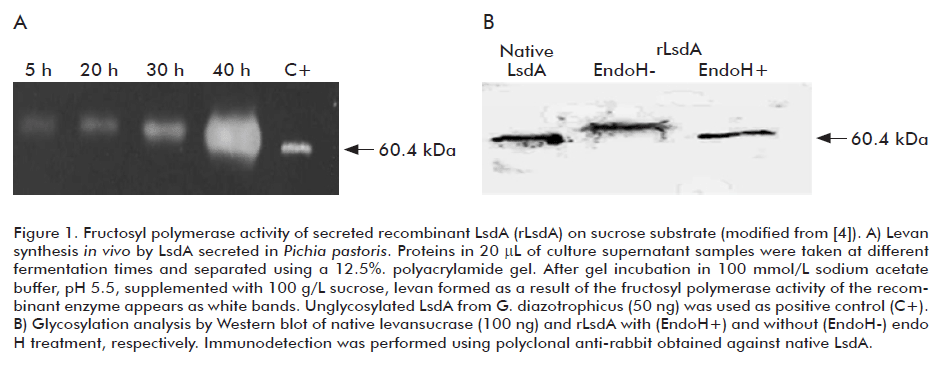
<body><![CDATA[<P   ><font size="3" face="Verdana, Arial, Helvetica, sans-serif"><b>RESULTS AND DISCUSSION      </b> </font></P >   <FONT size="+1">        <P   ><font size="2" face="Verdana, Arial, Helvetica, sans-serif"><b>Constitutive and      methanol-inducible expression of the<I> lsdA </I>gene in<I> P. pastoris </I></b></font></P >   <FONT size="+1">        <P   align="justify" ><font face="Verdana, Arial, Helvetica, sans-serif" size="2"><I>P. pastoris</I>      lacks endogenous saccharolytic activity; therefore, it is an ideal host to      study heterologous expression of fructosyltransferases. In this sense, the      <I>lsdA</I> gene fused to either the alpha-factor signal peptide or the acid      phosphatase signal peptide, both from <I>Saccharomyces cerevisiae</I>, was      expressed in <I>P. pastoris</I> under the control of either the methanol-inducible      AOX1 promoter or the constitutive GAP promoter. The two expression systems      allowed the secretion of active LsdA although efficiency differed [4-6]. In      the induced (AOX1) system, 81% of the total levansucrase activity was localized      into the periplasmic space and the rest in the culture medium. In the constitutive      (pGAP) system, the recombinant enzyme was totally released to the culture      medium. </font></P >       <P   align="justify" ><font face="Verdana, Arial, Helvetica, sans-serif" size="2">The final LsdA yield      of 100 mg/L achieved in the culture supernatant of one constitutive clone      was 8-9 times higher that the value of 12 mg/L reported for the natural host      <I>G. diazotrophicus </I>[7]. The enzyme productivity of the constitutive      expression system (2.2 mg/h&middot;L) duplicated that of the induced system      (1.1 mg/h&middot;L). </font></P >       <P   ><font face="Verdana, Arial, Helvetica, sans-serif" size="2"><b>LsdA secreted      in <I>P. pastoris</I> is a glycoprotein with unaltered catalytic performance      </b> </font></P >       <P   align="justify" ><font face="Verdana, Arial, Helvetica, sans-serif" size="2"><a href="/img/revistas/bta/v29n2/f0109212.gif">Figure      1A</a> shows that LsdA secreted into the culture medium synthesized levan      <I>in vitro</I> as a result of its fructosyl polymerase activity over the      substrate sucrose. The migration of recombinant LsdA in SDS-PAGE corresponded      to a protein of molecular weight above the theoretical mass of 58 kDa. Three      potential N-glycosylation sites were identified on the mature LsdA sequence.      Digestion with endoglycosidase H resulted in higher electrophoretic mobility      of the recombinant enzyme in relation to the undigested control (<a href="/img/revistas/bta/v29n2/f0109212.gif">Figure      1B</a>), confirming the incorporation of N-linked oligosaccharides during      the enzyme passage through the yeast secretory pathway [4]. Contrary to this      result, the <I>Bacillus subtilis</I> levansucrase under its own signal peptide      or fused to the <I>S. cerevisiae</I> acid phosphatase signal sequence was      unable to enter the endoplasmic reticulum of the yeast and the enzyme accumulated      inactive in its precursor form in the cytoplasmic membrane [8]. </font></P >       
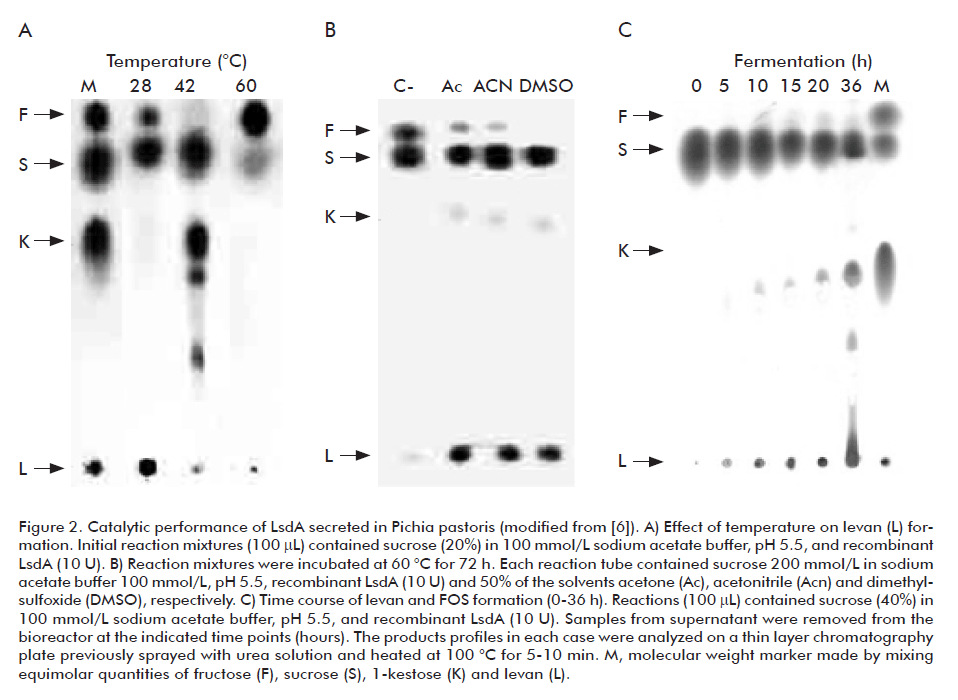
<P   align="justify" ><font face="Verdana, Arial, Helvetica, sans-serif" size="2">There are multiple      reports of variations in the kinetic properties and substrate specificity      of bacterial enzymes expressed in yeast due to the occurrence N-glycosylation,      a posttranslational modification most commonly absent in prokaryotic proteins.      For this reason, we studied in detail the biochemical properties of the glyco-LsdA      produced in <I>P. pastoris</I>. The kinetic parameters V<Sub>max</Sub> (1.67      mM/min), K<Sub>M</Sub> (6.63 mM), k<Sub>cat</Sub> (57.1 x 10<Sup>3</Sup> min<Sup>-1</Sup>)      and k<Sub>cat</Sub>/K<Sub>M</Sub> (8.6 x 10<Sup>3</Sup> mM<Sup>-1</Sup> min<Sup>-1</Sup>)      determined for the sucrose hydrolysis reaction of recombinant LsdA showed      no significant differences with the corresponding values of the native enzyme      [6]. Similarly, the N-linked mannose chains had no influence on the substrate      specificity of the enzyme and its behavior towards pH and temperature. The      levan yield (polymerization reaction) reached the maximal value at 28 &deg;C      (<a href="/img/revistas/bta/v29n2/f0209212.gif">Figure 2A</a>), while      the release of free fructose from sucrose (hydrolysis reaction) became the      predominant reaction when the incubation temperature was raised to 60 &deg;C.      By contrast, the reaction at 60 &deg;C in a water-deficient environment (<a href="/img/revistas/bta/v29n2/f0209212.gif">Figure      2B</a>) favored the formation of levan with high polymerization degree [6].      Glycosylated LsdA showed a slight increase in thermostability [4]. This fact      could be of relevance for the industrial operation of the recombinant enzyme.      </font></P >   <FONT size="+1"><FONT size="+1"><FONT size="+1"><FONT size="+1"><FONT size="+1"><FONT size="+1"><FONT size="+1"><FONT size="+1"><FONT size="+1"><FONT size="+1"><FONT size="+1"><FONT size="+1"><FONT size="+1"><FONT size="+1"><FONT size="+1"><FONT size="+1"><FONT size="+1"><FONT size="+1"><FONT size="+1"><FONT size="+1">        
<P   align="justify" ><font face="Verdana, Arial, Helvetica, sans-serif" size="2">The use of cane sugar      (50-100 g/L) as carbon source to grow the P. pastoris clones constitutively      expressing lsdA did not cause cell toxicity [5]. A time-course analysis of      the carbohydrate composition in culture supernatant samples revealed the maximum      fructan content of 59% (w/w) at the end of the fermentation</font><font size="+1" color="#000000"><font size="+1"><font size="+1"><font size="+1"><font size="+1"><font size="+1"><font size="+1"><font size="+1"><font size="+1"><font size="+1"><font size="+1"><font size="+1"><font size="+1"><font size="+1"><font size="+1"><font size="+1"><font size="+1"><font size="+1"><font size="+1"><font size="+1"><font size="+1"><font size="+1"><font size="+1"><font size="+1"><font size="+1"><font size="+1"><font size="+1"><font size="+1"><font size="+1" color="#000000"><font size="+1"><font size="+1"><font size="+1"><font size="+1"><font size="+1"><font size="+1"><font size="+1"><font size="+1"><font size="+1"><font size="+1"><font size="+1"><font size="+1"><font size="+1"><font size="+1"><font size="+1"><font size="+1"><font size="+1"><font size="+1"><font size="+1"><font size="+1"><font size="+1"><font size="+1"><font size="+1"><font size="+1"><font size="+1"><font size="+1"><font size="+1"><font face="Verdana, Arial, Helvetica, sans-serif" size="2">      (<a href="/img/revistas/bta/v29n2/f0209212.gif">Figure 2C</a>)</font></font></font></font></font></font></font></font></font></font></font></font></font></font></font></font></font></font></font></font></font></font></font></font></font></font></font></font></font><font face="Verdana, Arial, Helvetica, sans-serif" size="2"></font></font></font></font></font></font></font></font></font></font></font></font></font></font></font></font></font></font></font></font></font></font></font></font></font></font></font></font></font><font face="Verdana, Arial, Helvetica, sans-serif" size="2">      when levan counted for 35% (w/w) of the total sugars</font><font face="Verdana, Arial, Helvetica, sans-serif" size="2">.      The glucose released from sucrose was consumed by the yeast during growth      and it was hardly represented in the total sugar composition. </font></P >       
<P   ><font face="Verdana, Arial, Helvetica, sans-serif" size="2"><b>Constitutive expression      of the <I>lsdA</I> gene and vacuolar localization of the enzyme in transgenic      tobacco plants </b></font></P >       <P   align="justify" ><font face="Verdana, Arial, Helvetica, sans-serif" size="2">Tobacco is a model      plant widely used as a bioreactor for the production of foreign proteins,      including enzymes of industrial interest. This is a naturally non-fructan      crop with constant availability of sucrose in vacuoles, the cell compartment      recommended for the production and accumulation of bacterial levan In vacuoles,      the synthesized polyfructan would remain sequestered, minimizing its potential      disruptive effects [9]. LsdA is expected to become a glycoprotein during transit      to the vacuole in the tobacco cells. Since N-glycosylation did not alter the      catalytic properties of LsdA secreted by <I>P. pastoris</I>, this modification      should not compromise the enzyme folding and activity in plants either. </font></P >       ]]></body>
<body><![CDATA[<P   align="justify" ><font face="Verdana, Arial, Helvetica, sans-serif" size="2">In this study, the      <I>lsdA</I> gene was fused to the vacuolar targeting signal of the onion sucrose:sucrose      1-fructosyltransferase (1-SST) and expressed in tobacco plants under the control      of CaMV35S constitutive promoter. Unlike the non-transformed tobacco (NT),      the high-molecular fructan was detected in leaves of three transgenic clones      (<a href="/img/revistas/bta/v29n2/f0309212.gif">Figure 3A</a>). This      polyfructan was also present in extracts of roots, stems and flowers, but      not in seeds (results not shown). Northern blot analysis revealed vast amounts      of<I> lsdA</I> transcripts in tobacco leaves of the clone with higher levan      yield (<a href="/img/revistas/bta/v29n2/f0309212.gif">Figure 3B</a>).      The recombinant polymer extracted from leaves contains more than 10<Sup>4</Sup>      fructose residues as determined by acid hydrolysis (<a href="/img/revistas/bta/v29n2/f0309212.gif">Figure      3C</a>). Incubation of clarified leaf extracts from transgenic plants with      sucrose produced FOS (1-kestose) and levan (<a href="/img/revistas/bta/v29n2/f0309212.gif">Figure      3D</a>). This result indicates that the recombinant LsdA in the cell vacuoles      maintained the same product profile of the native enzyme, despite the fact      that FOS were not detected in the <I>in-vivo</I> tests assayed on different      plant organs, including mature leaves [10]. </font></P >   <FONT size="+1"><FONT size="+1">        
<P   ><font face="Verdana, Arial, Helvetica, sans-serif" size="2"><b>Levan accumulation      is proportional to the leaf age and the occurrence of phenotypic alterations      in the transgenic plant </b></font></P >       <P   align="justify" ><font face="Verdana, Arial, Helvetica, sans-serif" size="2">As shown in <a href="/img/revistas/bta/v29n2/f0409212.gif">Figure      4A</a>, levan content increased in the leaves of the transgenic clones with      plant growth. In older leaves, levan contents of 10 &plusmn; 1, 30 &plusmn;      1.5, and 70 &plusmn; 2.5 mg/g fresh weight (10, 30 and 70% dry weight) were      reached for clones 2, 6 and 3, respectively. This latter value is the largest      reported for fructan production in leaves of transgenic tobacco plants and      it is only surpassed by the so called fructan beet, a transgenic sugar beet      plant expressing the <I>Helianthus tuberosus</I> 1-SST that accumulated fructans      up to 90% (w/w, dry weight) in the storage root [11]. The transgenic tobacco      plants did not show any visible phenotypic alteration during growth in greenhouse      for the first 30 days. From this point, older levan-accumulating leaves bleached      gradually from the tip toward the base and became rigid to the touch due to      excessive turgor (<a href="/img/revistas/bta/v29n2/f0409212.gif">Figure      4</a>). The changes in leaf texture and color intensified during the flowering      process. The germination percent of seeds was 97, 0, and 84% for clones 2,      3, and 6, respectively. Levan production remained stable in the second generation      of clones 2 and 6. </font></P >       
<P   >&nbsp;</P >       <P   ><font size="2" face="Verdana, Arial, Helvetica, sans-serif"><b><font size="3">RELEVANCE      AND PRACTICAL APPLICATION OF THE RESEARCH </font></b></font></P >   <FONT size="+1">        <P   align="justify" ><font size="2" face="Verdana, Arial, Helvetica, sans-serif">Due to its high degree      of polymerization, good solubility in water, demonstrated prebiotic effect,      non-immunogenic, antitumor and antiviral capacity, bacterial levan has wide      potential applications. However, the lack of an industrial production system      technically and economically feasible limits the commercial exploitation of      this polyfructan at a large-scale level. In this paper, <I>P. pastoris</I>      and <I>N. tabacum</I> were transformed into novel sources for massive levansucrase      production and direct levan synthesis from plant sucrose, respectively. </font></P >   <FONT size="+1">        <P   align="justify" ><font face="Verdana, Arial, Helvetica, sans-serif" size="2">This research constitutes      the first report of constitutive expression and secretion of a bacterial fructosyltransferase      in yeast, as well as the production of transgenic levan in a plant expressing      the <I>G. diazotrophicus </I>levansucrase gene (<I>lsdA</I>). We demonstrated      that N-glycosylation produced by eukaryotic hosts does compromise LsdA folding      and activity. Levan accumulation in tobacco leaves reached up to 70% (w/w)      of dry weight, which is the maximum reported value reported in the literature      for a transgenic plant grown in soil. The lack of aberrant phenotypes in the      progenies (T1 and T2) of plants with levan content in mature leaves ranging      10-30% (w/w, dry weight) is of physiological relevance and it could be exploited      for biotechnological purposes. Our results also demonstrated the feasibility      of using a plant fructosyltransferase pre-propeptide sequence to direct a      bacterial protein to vacuoles in transgenic plants. In conclusion, our work      provides knowledge, methodologies, tools, and experimental results pointing      in favor to the use of transgenic yeast and plants as alternative hosts for      the cost-effective production of bacterial fructosyltransferases and fructans      with commercial application.</font></P >       <P   align="justify" >&nbsp;</P >       <P   align="justify" > </P >       <P   align="justify" ><font size="3"><b><font face="Verdana, Arial, Helvetica, sans-serif">REFERENCES      </font></b></font></P >       ]]></body>
<body><![CDATA[<P   align="justify" > </P >       <!-- ref --><P   align="justify" ><font size="2" face="Verdana, Arial, Helvetica, sans-serif">1. Kang SA, Jang      KH, Seo JW, Kim KH, Kim YH, Rairakhwada D, et al. Levan: applications and      perspectives. In: Rehm BHA, editor. Microbial Production of Biopolymers and      Polymer Precursors. Norfolk: Caister Academic Press; 2009. p. 145-63.     </font></P >   <FONT size="+1">        <!-- ref --><P   align="justify" ><font face="Verdana, Arial, Helvetica, sans-serif" size="2">2. Esawy MA, Ahmed      EF, Helmy WA, Mansour NM, El-Senousy WM, El-Safty MM. Production of levansucrase      from novel honey Bacillus subtilis isolates capable of producing antiviral      levans. Carbohyd Polym. 2011;86(2):823-30.     </font></P >       <!-- ref --><P   align="justify" ><font face="Verdana, Arial, Helvetica, sans-serif" size="2">3. T&aacute;mbara      Y, Hormaza JV, P&eacute;rez C, Le&oacute;n A, Arrieta J, Hern&aacute;ndez      L. Structural analysis and optimised production of fructo-oligosaccharides      by levansucrase from Acetobacter diazotrophicus SRT4. Biotechnol Lett. 1999;21(2):117-21.          </font></P >       <!-- ref --><P   align="justify" ><font face="Verdana, Arial, Helvetica, sans-serif" size="2">4. Trujillo LE, Arrieta      JG, Dafhnis F, Garcia J, Valdes J, Tambara Y, et al. Fructo-oligosaccharides      production by the Gluconacetobacter diazotrophicus levansucrase expressed      in the methylotrophic yeast Pichia pastoris. Enzyme Microb Technol. 2001;28(2-3):139-44.          </font></P >       <!-- ref --><P   align="justify" ><font face="Verdana, Arial, Helvetica, sans-serif" size="2">5. Trujillo LE, Banguela      A, Pa&iacute;s J, Tambara Y, Arrieta JG, Sotolongo M, et al. Constitutive      expression of enzymatically active Gluconacetobacter diazotrophicus levansucrase      in the methylothrophic yeast Pichia pastoris. Afinidad. 2002;59(500):365-70.          </font></P >       <!-- ref --><P   align="justify" ><font face="Verdana, Arial, Helvetica, sans-serif" size="2">6. Trujillo Toledo      LE, G&oacute;mez Riera R, Banguela Castillo A, Soto Romero M, Arrieta Sosa      JG, Hern&aacute;ndez Garc&iacute;a L. Catalytical properties of N-glycosylated      Gluconacetobacter diazotrophicus levansucrase produced in yeast. Electron      J Biotechnol. 2004;7(2):115-23.     </font></P >       <!-- ref --><P   align="justify" ><font face="Verdana, Arial, Helvetica, sans-serif" size="2">7. Hernandez L, Arrieta      J, Menendez C, Vazquez R, Coego A, Suarez V, et al. Isolation and enzymic      properties of levansucrase secreted by Acetobacter diazotrophicus SRT4, a      bacterium associated with sugar cane. Biochem J. 1995;309(Pt 1):113-8.     </font></P >       <!-- ref --><P   align="justify" ><font face="Verdana, Arial, Helvetica, sans-serif" size="2">8. Scotti PA, Praestegaard      M, Chambert R, Petit-Glatron MF. The targeting of Bacillus subtilis levansucrase      in yeast is correlated to both the hydrophobicity of the signal peptide and      the net charge of the N-terminus mature part. Yeast. 1996; 12(10):953-63.          </font></P >       <!-- ref --><P   align="justify" ><font face="Verdana, Arial, Helvetica, sans-serif" size="2">9. Banguela A, Hern&aacute;ndez      L. Fructans: from natural sources to transgenic plants. Biotecnol Apl. 2006;23(3):202-10.          </font></P >       <!-- ref --><P   align="justify" ><font face="Verdana, Arial, Helvetica, sans-serif" size="2">10. Banguela A, Arrieta      JG, Rodriguez R, Trujillo LE, Menendez C, Hernandez L. High levan accumulation      in transgenic tobacco plants expressing the Gluconaceto-bacter diazotrophicus      levansucrase gene. J Biotechnol. 2011;154(1):93-8.     </font></P >       <!-- ref --><P   align="justify" ><font face="Verdana, Arial, Helvetica, sans-serif" size="2">11. Sevenier R, Hall      RD, van der Meer IM, Hakkert HJ, van Tunen AJ, Koops AJ. High level fructan      accumulation in a transgenic sugar beet. Nat Biotechnol. 1998;16(9):843-6.    </font></P >       <P   align="justify" >&nbsp;</P >       <P   align="justify" >&nbsp;</P >       <P   align="justify" > </P >   <FONT size="+1" color="#D70000">        <P   ><font size="2" color="#000000" face="Verdana, Arial, Helvetica, sans-serif"><i>Luis      E Trujillo</i>. Divisi&oacute;n de Plantas, Centro de Ingenier&iacute;a Gen&eacute;tica      y Biotecnolog&iacute;a, CIGB. Ave. 31 e/ 158 y 190, Cubanac&aacute;n, PO Box      6162, Playa, CP 10600, La Habana, Cuba. E-mail: <A href="mailto:luis.trujillo@cigb.edu.cu">      <U><U><FONT color="#0000FF">luis.trujillo@cigb.edu.cu</font></U></U></A><FONT color="#0000FF">.</font></font></P >   </font></font></font></font></font></font></font></font></font></font></font></font></font></font></font></font></font></font></font></font></font></font></font></font></font></font></font></font></font></font></font></font></font></font></DIV >      ]]></body><back>
<ref-list>
<ref id="B1">
<label>1</label><nlm-citation citation-type="book">
<person-group person-group-type="author">
<name>
<surname><![CDATA[Kang]]></surname>
<given-names><![CDATA[SA]]></given-names>
</name>
<name>
<surname><![CDATA[Jang]]></surname>
<given-names><![CDATA[KH]]></given-names>
</name>
<name>
<surname><![CDATA[Seo]]></surname>
<given-names><![CDATA[JW]]></given-names>
</name>
<name>
<surname><![CDATA[Kim]]></surname>
<given-names><![CDATA[KH]]></given-names>
</name>
<name>
<surname><![CDATA[Kim]]></surname>
<given-names><![CDATA[YH]]></given-names>
</name>
<name>
<surname><![CDATA[Rairakhwada]]></surname>
<given-names><![CDATA[D]]></given-names>
</name>
</person-group>
<article-title xml:lang="en"><![CDATA[Levan: applications and perspectives]]></article-title>
<person-group person-group-type="editor">
<name>
<surname><![CDATA[Rehm]]></surname>
<given-names><![CDATA[BHA]]></given-names>
</name>
</person-group>
<source><![CDATA[Microbial Production of Biopolymers and Polymer Precursors]]></source>
<year>2009</year>
<page-range>145-63</page-range><publisher-loc><![CDATA[Norfolk ]]></publisher-loc>
<publisher-name><![CDATA[Caister Academic Press]]></publisher-name>
</nlm-citation>
</ref>
<ref id="B2">
<label>2</label><nlm-citation citation-type="journal">
<person-group person-group-type="author">
<name>
<surname><![CDATA[Esawy]]></surname>
<given-names><![CDATA[MA]]></given-names>
</name>
<name>
<surname><![CDATA[Ahmed]]></surname>
<given-names><![CDATA[EF]]></given-names>
</name>
<name>
<surname><![CDATA[Helmy]]></surname>
<given-names><![CDATA[WA]]></given-names>
</name>
<name>
<surname><![CDATA[Mansour]]></surname>
<given-names><![CDATA[NM]]></given-names>
</name>
<name>
<surname><![CDATA[El-Senousy]]></surname>
<given-names><![CDATA[WM]]></given-names>
</name>
<name>
<surname><![CDATA[El-Safty]]></surname>
<given-names><![CDATA[MM]]></given-names>
</name>
</person-group>
<article-title xml:lang="en"><![CDATA[Production of levansucrase from novel honey Bacillus subtilis isolates capable of producing antiviral levans]]></article-title>
<source><![CDATA[Carbohyd Polym]]></source>
<year>2011</year>
<volume>86</volume>
<numero>2</numero>
<issue>2</issue>
<page-range>823-30</page-range></nlm-citation>
</ref>
<ref id="B3">
<label>3</label><nlm-citation citation-type="journal">
<person-group person-group-type="author">
<name>
<surname><![CDATA[Támbara]]></surname>
<given-names><![CDATA[Y]]></given-names>
</name>
<name>
<surname><![CDATA[Hormaza]]></surname>
<given-names><![CDATA[JV]]></given-names>
</name>
<name>
<surname><![CDATA[Pérez]]></surname>
<given-names><![CDATA[C]]></given-names>
</name>
<name>
<surname><![CDATA[León]]></surname>
<given-names><![CDATA[A]]></given-names>
</name>
<name>
<surname><![CDATA[Arrieta]]></surname>
<given-names><![CDATA[J]]></given-names>
</name>
<name>
<surname><![CDATA[Hernández]]></surname>
<given-names><![CDATA[L]]></given-names>
</name>
</person-group>
<article-title xml:lang="en"><![CDATA[Structural analysis and optimised production of fructo-oligosaccharides by levansucrase from Acetobacter diazotrophicus SRT4]]></article-title>
<source><![CDATA[Biotechnol Lett]]></source>
<year>1999</year>
<volume>21</volume>
<numero>2</numero>
<issue>2</issue>
<page-range>117-21</page-range></nlm-citation>
</ref>
<ref id="B4">
<label>4</label><nlm-citation citation-type="journal">
<person-group person-group-type="author">
<name>
<surname><![CDATA[Trujillo]]></surname>
<given-names><![CDATA[LE]]></given-names>
</name>
<name>
<surname><![CDATA[Arrieta]]></surname>
<given-names><![CDATA[JG]]></given-names>
</name>
<name>
<surname><![CDATA[Dafhnis]]></surname>
<given-names><![CDATA[F]]></given-names>
</name>
<name>
<surname><![CDATA[Garcia]]></surname>
<given-names><![CDATA[J]]></given-names>
</name>
<name>
<surname><![CDATA[Valdes]]></surname>
<given-names><![CDATA[J]]></given-names>
</name>
<name>
<surname><![CDATA[Tambara]]></surname>
<given-names><![CDATA[Y]]></given-names>
</name>
</person-group>
<article-title xml:lang="en"><![CDATA[Fructo-oligosaccharides production by the Gluconacetobacter diazotrophicus levansucrase expressed in the methylotrophic yeast Pichia pastoris]]></article-title>
<source><![CDATA[Enzyme Microb Technol]]></source>
<year>2001</year>
<volume>28</volume>
<numero>2-3</numero>
<issue>2-3</issue>
<page-range>139-44</page-range></nlm-citation>
</ref>
<ref id="B5">
<label>5</label><nlm-citation citation-type="journal">
<person-group person-group-type="author">
<name>
<surname><![CDATA[Trujillo]]></surname>
<given-names><![CDATA[LE]]></given-names>
</name>
<name>
<surname><![CDATA[Banguela]]></surname>
<given-names><![CDATA[A]]></given-names>
</name>
<name>
<surname><![CDATA[País]]></surname>
<given-names><![CDATA[J]]></given-names>
</name>
<name>
<surname><![CDATA[Tambara]]></surname>
<given-names><![CDATA[Y]]></given-names>
</name>
<name>
<surname><![CDATA[Arrieta]]></surname>
<given-names><![CDATA[JG]]></given-names>
</name>
<name>
<surname><![CDATA[Sotolongo]]></surname>
<given-names><![CDATA[M]]></given-names>
</name>
</person-group>
<article-title xml:lang="en"><![CDATA[Constitutive expression of enzymatically active Gluconacetobacter diazotrophicus levansucrase in the methylothrophic yeast Pichia pastoris]]></article-title>
<source><![CDATA[Afinidad]]></source>
<year>2002</year>
<volume>59</volume>
<numero>500</numero>
<issue>500</issue>
<page-range>365-70</page-range></nlm-citation>
</ref>
<ref id="B6">
<label>6</label><nlm-citation citation-type="journal">
<person-group person-group-type="author">
<name>
<surname><![CDATA[Trujillo Toledo]]></surname>
<given-names><![CDATA[LE]]></given-names>
</name>
<name>
<surname><![CDATA[Gómez Riera]]></surname>
<given-names><![CDATA[R]]></given-names>
</name>
<name>
<surname><![CDATA[Banguela Castillo]]></surname>
<given-names><![CDATA[A]]></given-names>
</name>
<name>
<surname><![CDATA[Soto Romero]]></surname>
<given-names><![CDATA[M]]></given-names>
</name>
<name>
<surname><![CDATA[Arrieta Sosa]]></surname>
<given-names><![CDATA[JG]]></given-names>
</name>
<name>
<surname><![CDATA[Hernández García]]></surname>
<given-names><![CDATA[L]]></given-names>
</name>
</person-group>
<article-title xml:lang="en"><![CDATA[Catalytical properties of N-glycosylated Gluconacetobacter diazotrophicus levansucrase produced in yeast]]></article-title>
<source><![CDATA[Electron J Biotechnol]]></source>
<year>2004</year>
<volume>7</volume>
<numero>2</numero>
<issue>2</issue>
<page-range>115-23</page-range></nlm-citation>
</ref>
<ref id="B7">
<label>7</label><nlm-citation citation-type="journal">
<person-group person-group-type="author">
<name>
<surname><![CDATA[Hernandez]]></surname>
<given-names><![CDATA[L]]></given-names>
</name>
<name>
<surname><![CDATA[Arrieta]]></surname>
<given-names><![CDATA[J]]></given-names>
</name>
<name>
<surname><![CDATA[Menendez]]></surname>
<given-names><![CDATA[C]]></given-names>
</name>
<name>
<surname><![CDATA[Vazquez]]></surname>
<given-names><![CDATA[R]]></given-names>
</name>
<name>
<surname><![CDATA[Coego]]></surname>
<given-names><![CDATA[A]]></given-names>
</name>
<name>
<surname><![CDATA[Suarez]]></surname>
<given-names><![CDATA[V]]></given-names>
</name>
</person-group>
<article-title xml:lang="en"><![CDATA[Isolation and enzymic properties of levansucrase secreted by Acetobacter diazotrophicus SRT4, a bacterium associated with sugar cane]]></article-title>
<source><![CDATA[Biochem J]]></source>
<year>1995</year>
<volume>309</volume>
<numero>1</numero>
<issue>1</issue>
<page-range>113-8</page-range></nlm-citation>
</ref>
<ref id="B8">
<label>8</label><nlm-citation citation-type="journal">
<person-group person-group-type="author">
<name>
<surname><![CDATA[Scotti]]></surname>
<given-names><![CDATA[PA]]></given-names>
</name>
<name>
<surname><![CDATA[Praestegaard]]></surname>
<given-names><![CDATA[M]]></given-names>
</name>
<name>
<surname><![CDATA[Chambert]]></surname>
<given-names><![CDATA[R]]></given-names>
</name>
<name>
<surname><![CDATA[Petit-Glatron]]></surname>
<given-names><![CDATA[MF]]></given-names>
</name>
</person-group>
<article-title xml:lang="en"><![CDATA[The targeting of Bacillus subtilis levansucrase in yeast is correlated to both the hydrophobicity of the signal peptide and the net charge of the N-terminus mature part]]></article-title>
<source><![CDATA[Yeast]]></source>
<year>1996</year>
<volume>12</volume>
<numero>10</numero>
<issue>10</issue>
<page-range>953-63</page-range></nlm-citation>
</ref>
<ref id="B9">
<label>9</label><nlm-citation citation-type="journal">
<person-group person-group-type="author">
<name>
<surname><![CDATA[Banguela]]></surname>
<given-names><![CDATA[A]]></given-names>
</name>
<name>
<surname><![CDATA[Hernández]]></surname>
<given-names><![CDATA[L]]></given-names>
</name>
</person-group>
<article-title xml:lang="en"><![CDATA[Fructans: from natural sources to transgenic plants]]></article-title>
<source><![CDATA[Biotecnol Apl]]></source>
<year>2006</year>
<volume>23</volume>
<numero>3</numero>
<issue>3</issue>
<page-range>202-10</page-range></nlm-citation>
</ref>
<ref id="B10">
<label>10</label><nlm-citation citation-type="journal">
<person-group person-group-type="author">
<name>
<surname><![CDATA[Banguela]]></surname>
<given-names><![CDATA[A]]></given-names>
</name>
<name>
<surname><![CDATA[Arrieta]]></surname>
<given-names><![CDATA[JG]]></given-names>
</name>
<name>
<surname><![CDATA[Rodriguez]]></surname>
<given-names><![CDATA[R]]></given-names>
</name>
<name>
<surname><![CDATA[Trujillo]]></surname>
<given-names><![CDATA[LE]]></given-names>
</name>
<name>
<surname><![CDATA[Menendez]]></surname>
<given-names><![CDATA[C]]></given-names>
</name>
<name>
<surname><![CDATA[Hernandez]]></surname>
<given-names><![CDATA[L]]></given-names>
</name>
</person-group>
<article-title xml:lang="en"><![CDATA[High levan accumulation in transgenic tobacco plants expressing the Gluconacetobacter diazotrophicus levansucrase gene]]></article-title>
<source><![CDATA[J Biotechnol]]></source>
<year>2011</year>
<volume>154</volume>
<numero>1</numero>
<issue>1</issue>
<page-range>93-8</page-range></nlm-citation>
</ref>
<ref id="B11">
<label>11</label><nlm-citation citation-type="journal">
<person-group person-group-type="author">
<name>
<surname><![CDATA[Sevenier]]></surname>
<given-names><![CDATA[R]]></given-names>
</name>
<name>
<surname><![CDATA[Hall]]></surname>
<given-names><![CDATA[RD]]></given-names>
</name>
<name>
<surname><![CDATA[van der Meer]]></surname>
<given-names><![CDATA[IM]]></given-names>
</name>
<name>
<surname><![CDATA[Hakkert]]></surname>
<given-names><![CDATA[HJ]]></given-names>
</name>
<name>
<surname><![CDATA[van Tunen]]></surname>
<given-names><![CDATA[AJ]]></given-names>
</name>
<name>
<surname><![CDATA[Koops]]></surname>
<given-names><![CDATA[AJ]]></given-names>
</name>
</person-group>
<article-title xml:lang="en"><![CDATA[High level fructan accumulation in a transgenic sugar beet]]></article-title>
<source><![CDATA[Nat Biotechnol]]></source>
<year>1998</year>
<volume>16</volume>
<numero>9</numero>
<issue>9</issue>
<page-range>843-6</page-range></nlm-citation>
</ref>
</ref-list>
</back>
</article>