<?xml version="1.0" encoding="ISO-8859-1"?><article xmlns:mml="http://www.w3.org/1998/Math/MathML" xmlns:xlink="http://www.w3.org/1999/xlink" xmlns:xsi="http://www.w3.org/2001/XMLSchema-instance">
<front>
<journal-meta>
<journal-id>1027-2852</journal-id>
<journal-title><![CDATA[Biotecnología Aplicada]]></journal-title>
<abbrev-journal-title><![CDATA[Biotecnol Apl]]></abbrev-journal-title>
<issn>1027-2852</issn>
<publisher>
<publisher-name><![CDATA[Editorial Elfos Scientiae]]></publisher-name>
</publisher>
</journal-meta>
<article-meta>
<article-id>S1027-28522012000300001</article-id>
<title-group>
<article-title xml:lang="en"><![CDATA[Current treatment of rheumatoid arthritis. Perspectives for the development of antigen-specific therapies]]></article-title>
<article-title xml:lang="es"><![CDATA[Tratamiento actual de la artritis reumatoide. Perspectivas para el desarrollo de las terapias antígeno-específicas]]></article-title>
</title-group>
<contrib-group>
<contrib contrib-type="author">
<name>
<surname><![CDATA[Barberá]]></surname>
<given-names><![CDATA[Ariana]]></given-names>
</name>
<xref ref-type="aff" rid="A01"/>
</contrib>
<contrib contrib-type="author">
<name>
<surname><![CDATA[Lorenzo]]></surname>
<given-names><![CDATA[Noraylis]]></given-names>
</name>
<xref ref-type="aff" rid="A01"/>
</contrib>
<contrib contrib-type="author">
<name>
<surname><![CDATA[Domínguez]]></surname>
<given-names><![CDATA[María del Carmen]]></given-names>
</name>
<xref ref-type="aff" rid="A01"/>
</contrib>
</contrib-group>
<aff id="A01">
<institution><![CDATA[,Centro de Ingeniería Genética y Biotecnología Dirección de Investigaciones Biomédicas División de Química Física]]></institution>
<addr-line><![CDATA[La Habana ]]></addr-line>
<country>Cuba</country>
</aff>
<pub-date pub-type="pub">
<day>00</day>
<month>09</month>
<year>2012</year>
</pub-date>
<pub-date pub-type="epub">
<day>00</day>
<month>09</month>
<year>2012</year>
</pub-date>
<volume>29</volume>
<numero>3</numero>
<fpage>146</fpage>
<lpage>154</lpage>
<copyright-statement/>
<copyright-year/>
<self-uri xlink:href="http://scielo.sld.cu/scielo.php?script=sci_arttext&amp;pid=S1027-28522012000300001&amp;lng=en&amp;nrm=iso"></self-uri><self-uri xlink:href="http://scielo.sld.cu/scielo.php?script=sci_abstract&amp;pid=S1027-28522012000300001&amp;lng=en&amp;nrm=iso"></self-uri><self-uri xlink:href="http://scielo.sld.cu/scielo.php?script=sci_pdf&amp;pid=S1027-28522012000300001&amp;lng=en&amp;nrm=iso"></self-uri><abstract abstract-type="short" xml:lang="en"><p><![CDATA[Rheumatoid arthritis is a degenerative disease characterized by chronic inflammation of peripheral joints. The first line of treatment involves the use of potent anti-inflammatory and immunosuppressive drugs, leading to an overall suppression of the immune system. However, these drugs do not induce sustained remission and their use can cause immunosuppression that leads to severe complications. Thus, there is a need for developing new therapeutic alternatives for the treatment of this disease. Antigen-specific therapies allow the elimination of pathogenic cells without affecting the immune system's ability to respond to infections. Within this approach heat stress proteins are promising candidates. Although progress has been made in the development of efficient antigen-specific therapies, the excellent results obtained in animal models have been difficult to translate to humans. The combined use of antigen-specific therapy with current drugs can be an attractive strategy in the near future to achieve the complete remission of the disease. Some of these combinations have already begun to be evaluated in animal models and in rheumatoid arthritis patients.]]></p></abstract>
<abstract abstract-type="short" xml:lang="es"><p><![CDATA[La artritis reumatoide es una enfermedad degenerativa caracterizada por la inflamación crónica de las articulaciones periféricas. La primera línea de tratamiento de esta enfermedad implica el uso de potentes antinflamatorios y drogas que provocan una supresión global del sistema inmune. Sin embargo, estos fármacos no inducen una remisión sostenida, y su uso puede causar una inmunosupresión importante que puede conducir a complicaciones. Por ello es necesario el desarrollo de nuevas modalidades terapéuticas para esta enfermedad. Las terapias antígeno-específicas suprimen las células patogénicas, sin afectar la propiedad del sistema inmune de responder ante las infecciones. Las proteínas de estrés térmico son candidatas promisorias en esta modalidad de tratamiento. Aunque se ha avanzado en el desarrollo de terapias antígeno-específicas eficientes en modelos animales con excelentes resultados, ha sido difícil trasladarlas a los seres humanos. El uso combinado de las terapias antígeno-específicas con los fármacos actuales puede ser una estrategia muy atractiva en el futuro cercano para lograr la remisión completa de la enfermedad. Algunas de estas combinaciones de tratamiento ya han comenzado a evaluarse en modelos animales y en pacientes con artritis reumatoide.]]></p></abstract>
<kwd-group>
<kwd lng="en"><![CDATA[rheumatoid arthritis]]></kwd>
<kwd lng="en"><![CDATA[regulatory T cells]]></kwd>
<kwd lng="en"><![CDATA[biological therapy]]></kwd>
<kwd lng="en"><![CDATA[pro-inflammatory cytokine]]></kwd>
<kwd lng="en"><![CDATA[combination therapy]]></kwd>
<kwd lng="es"><![CDATA[artritis reumatoide]]></kwd>
<kwd lng="es"><![CDATA[células T reguladoras]]></kwd>
<kwd lng="es"><![CDATA[terapia biológica]]></kwd>
<kwd lng="es"><![CDATA[citocina proinflamatoria]]></kwd>
<kwd lng="es"><![CDATA[terapia combinada]]></kwd>
</kwd-group>
</article-meta>
</front><body><![CDATA[ <DIV class="Sect"   >        <P   align="right" ><font size="2" color="#000000" face="Verdana, Arial, Helvetica, sans-serif"><b>REVIEW</b></font></P >       <P   align="right" >&nbsp;</P >   <FONT size="+1" color="#000000">        <P   > </P >       <P   ><b><font size="4" face="Verdana, Arial, Helvetica, sans-serif">Current treatment      of rheumatoid arthritis. Perspectives for the development of antigen-specific      therapies </font></b></P >   <FONT size="+1">        <P   >&nbsp;</P >       <P   ><font size="3" face="Verdana, Arial, Helvetica, sans-serif"><b>Tratamiento actual      de la artritis reumatoide. Perspectivas para el desarrollo de las terapias      ant&iacute;geno-espec&iacute;ficas </b></font></P >       <P   > </P >       <P   >&nbsp;</P >       <P   >&nbsp;</P >       ]]></body>
<body><![CDATA[<P   ><font size="2" face="Verdana, Arial, Helvetica, sans-serif"><b>Ariana Barber&aacute;,      Noraylis Lorenzo, Mar&iacute;a del Carmen Dom&iacute;nguez </b></font></P >       <P   ><font size="2" face="Verdana, Arial, Helvetica, sans-serif">Divisi&oacute;n de      Qu&iacute;mica F&iacute;sica, Direcci&oacute;n de Investigaciones Biom&eacute;dicas,      Centro de Ingenier&iacute;a Gen&eacute;tica y Biotecnolog&iacute;a, CIGB.      Ave 31 e/158 y 190. Cubanac&aacute;n, Playa. PO Box 6162. La Habana, CP 10      600, Cuba.</font></P >       <P   >&nbsp;</P >       <P   >&nbsp;</P >   </font></font>   <hr>   <FONT size="+1" color="#000000"><FONT size="+1"> <FONT size="+1">        <P   align="justify" ><font size="2" face="Verdana, Arial, Helvetica, sans-serif"><B>ABSTRACT </b></font></P >   <FONT size="+1">        <P   align="justify" ><font size="2" face="Verdana, Arial, Helvetica, sans-serif">Rheumatoid arthritis      is a degenerative disease characterized by chronic inflammation of peripheral      joints. The first line of treatment involves the use of potent anti-inflammatory      and immunosuppressive drugs, leading to an overall suppression of the immune      system. However, these drugs do not induce sustained remission and their use      can cause immunosuppression that leads to severe complications. Thus, there      is a need for developing new therapeutic alternatives for the treatment of      this disease. Antigen-specific therapies allow the elimination of pathogenic      cells without affecting the immune system's ability to respond to infections.      Within this approach heat stress proteins are promising candidates. Although      progress has been made in the development of efficient antigen-specific therapies,      the excellent results obtained in animal models have been difficult to translate      to humans. The combined use of antigen-specific therapy with current drugs      can be an attractive strategy in the near future to achieve the complete remission      of the disease. Some of these combinations have already begun to be evaluated      in animal models and in rheumatoid arthritis patients. </font></P >       <P   align="justify" ><font size="2" face="Verdana, Arial, Helvetica, sans-serif"><B>Keywords:</B>      rheumatoid arthritis, regulatory T cells, biological therapy, pro-inflammatory      cytokine, combination therapy. </font></P >   </font></font></font></font>   <hr>   <FONT size="+1" color="#000000"><FONT size="+1"><FONT size="+1"><FONT size="+1">        <P   > </P >       <P   align="justify" ><font size="2" face="Verdana, Arial, Helvetica, sans-serif"><B>RESUMEN </b></font></P >       <P   align="justify" ><font size="2" face="Verdana, Arial, Helvetica, sans-serif">La artritis reumatoide      es una enfermedad degenerativa caracterizada por la inflamaci&oacute;n cr&oacute;nica      de las articulaciones perif&eacute;ricas. La primera l&iacute;nea de tratamiento      de esta enfermedad implica el uso de potentes antinflamatorios y drogas que      provocan una supresi&oacute;n global del sistema inmune. Sin embargo, estos      f&aacute;rmacos no inducen una remisi&oacute;n sostenida, y su uso puede causar      una inmunosupresi&oacute;n importante que puede conducir a complicaciones.      Por ello es necesario el desarrollo de nuevas modalidades terap&eacute;uticas      para esta enfermedad. Las terapias ant&iacute;geno-espec&iacute;ficas suprimen      las c&eacute;lulas patog&eacute;nicas, sin afectar la propiedad del sistema      inmune de responder ante las infecciones. Las prote&iacute;nas de estr&eacute;s      t&eacute;rmico son candidatas promisorias en esta modalidad de tratamiento.      Aunque se ha avanzado en el desarrollo de terapias ant&iacute;geno-espec&iacute;ficas      eficientes en modelos animales con excelentes resultados, ha sido dif&iacute;cil      trasladarlas a los seres humanos. El uso combinado de las terapias ant&iacute;geno-espec&iacute;ficas      con los f&aacute;rmacos actuales puede ser una estrategia muy atractiva en      el futuro cercano para lograr la remisi&oacute;n completa de la enfermedad.      Algunas de estas combinaciones de tratamiento ya han comenzado a evaluarse      en modelos animales y en pacientes con artritis reumatoide. </font></P >       ]]></body>
<body><![CDATA[<P   align="justify" > </P >       <P   align="justify" ><font size="2" face="Verdana, Arial, Helvetica, sans-serif"><B>Palabras clave</b>:      artritis reumatoide, c&eacute;lulas T reguladoras, terapia biol&oacute;gica,      citocina proinflamatoria, terapia combinada. </font></P >   </font></font></font></font>   <hr>   <FONT size="+1" color="#000000"><FONT size="+1"><FONT size="+1"><FONT size="+1">        <P   > </P >       <P   align="justify" > </P >       <P   align="justify" >&nbsp;</P >       <P   align="justify" >&nbsp;</P >       <P   align="justify" ><font size="2" face="Verdana, Arial, Helvetica, sans-serif"><B><font size="3">INTRODUCTION      </font></b></font></P >       <P   align="justify" ><font size="2" face="Verdana, Arial, Helvetica, sans-serif">Rheumatoid arthritis      (RA), a systemic autoimmune disease most prevalent among adults between the      fourth and fifth decade of life, currently affects 1% of the world population.      Its primary clinical manifestation is the inflammation of peripheral joints,      usually following a symmetrical pattern and exhibiting a chronic and progressive      evolution that is characterized by periods of activity and remissions [1].      This disease produces a considerable deterioration of the quality of life      of affected patients, owing in no small part to its chronic nature and the      tendency to cause irreversible damage in cartilaginous and bony structures      of the joints. </font></P >       <P   align="justify" ><font size="2" face="Verdana, Arial, Helvetica, sans-serif">Currently, most RA      therapies approved by the Food and Drug Administration (FDA) work by indiscriminately      inhibiting all inflammatory activity in the patient. However, it is widely      acknowledged that disease prognosis can be significantly improved by early      treatment with disease-modifying anti-rheumatic drugs (DMARDs) [2, 3]. These      otherwise unrelated compounds are neither painkillers nor anti-inflammatory      drugs, but their use reduces, in the long term, the activity and severity      of the disorder. Some well-known examples are methotrexate (MTX), leflunomide,      antimalarial drugs such as chloroquine and hydroxychloroquine, gold salts,      D-penicillamine, sulfasalazine and cyclosporin A. </font></P >       <P   align="justify" ><font size="2" face="Verdana, Arial, Helvetica, sans-serif">During the nineties,      MTX became first-line therapy for RA, propelled by therapeutic successes when      combined with other drugs and an acceptable toxicity profile at the dosages      used for this indication [4, 5]. MTX, however, is not exactly a wonder drug,      as complete remission is achieved in only a fraction of RA cases [6]. In addition,      it should be pointed out that the non-selective inhibition of the immune response      places the patient at increased risk from infectious diseases and cancer.      </font></P >       ]]></body>
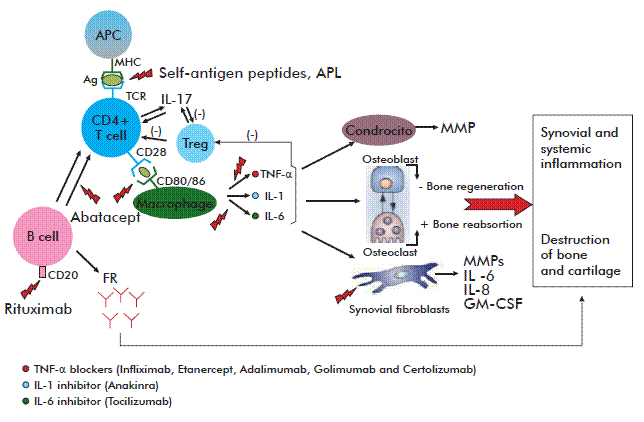
<body><![CDATA[<P   align="justify" ><font size="2" face="Verdana, Arial, Helvetica, sans-serif">Biological therapy,      an alternative for patients not responding to MTX or other DMARDs, constitutes      the most recent addition to the anti-rheumatic arsenal. Using biologicals      to treat this disorder affords the possibility of targeting, in a more specific      fashion, only those components playing an important role in the pathogenesis      of RA [7, 8]. </font></P >       <P   align="justify" >&nbsp;</P >       <P   align="justify" > </P >   <B>        <P   align="justify" ><font size="3" face="Verdana, Arial, Helvetica, sans-serif">MODULATION OF THE      IMMUNE RESPONSE BY BLOCKING THE ACTION OF MOLECULES INVOLVED IN THE PATHOGENESIS      OF RA</font></P >   </B>        <P   align="justify" ><font size="2" face="Verdana, Arial, Helvetica, sans-serif">The last years have      witnessed significant advances in the study and understanding of the mechanisms      underlying the RA pathogenesis. It is known that the chronic joint inflammation      produced by this disorder is induced by activated T cells infiltrating the      synovial membrane. According to the most widely accepted hypothesis, damage      is mediated through the recognition, by these cells, of a viral or bacterial      molecule (or even a self-antigen). The recognition of this hypothetic antigen      by CD49], triggers the differentiation of these lymphocytes into Th1 and Th17      phenotypes [10, 11]. Th1 and Th17 lymphocytes in turn secrete pro-inflammatory      cytokines <Sup>+</Sup> T-cells, coupled with the stimulation of different      cytokines [that then activate B and further T lymphocytes, macrophages and      synovial cells, resulting in even higher levels of secreted cytokines, up-regulated      adhesion molecules on cell surfaces and the migration of other inflammatory      cells into the affected joint. Interleukin 1 (IL-1) and Tumor Necrosis Factor-alpha      (TNF-&alpha;) are among the molecules whose secretion is up-regulated in the      inflammatory environment produced by the activation of synovial cells and      macrophages, and constitute the principal mediators of joint damage during      the disease. These cytokines inhibit osteoblast-driven bone regeneration and      stimulate reabsorption by osteoclasts, thereby contributing to the degeneration      of bone tissue [9]. Fibroblasts attracted to the synovial membrane by TNF-&alpha;      and IL-1 secrete, in turn, an array of molecules such as metalloproteases,      prostaglandins, IL-6 and IL-8 which, acting in concert, increase the severity      of joint damage. For example, metalloproteases play a role in the degeneration      of the bone matrix; prostaglandins are pro-inflammatory molecules and IL-8      facilitates neutrophil chemotaxis and angiogenesis. The latter is especially      important, in light of the hypoxic state and increased number of cells characterizing      the articular space during this disorder. Activated synovial fibroblasts also      produce the pro-inflammatory chemokines CCL5 and CXCL1, which actively recruit      T and B lymphocytes as well as neutrophils into the synovial tissue. Likewise,      they secrete IL-6, thus stimulating the production of acute phase reactants      that worsen the inflammatory response. The resulting chronic inflammatory      process leads to the proliferation of synovial tissue and the growth of a      granular tissue denominated pannus<I>, </I>which exhibits the characteristics      of a local multi-center tumor and eventually leads to the erosion of cartilage      and bone [12].</font></P >   <FONT size="+1"><FONT size="+1">        <P   align="justify" ><font size="2" face="Verdana, Arial, Helvetica, sans-serif">As implied above,      the term &lsquo;biological agents&rsquo; or &lsquo;biological therapy&rsquo;      denotes complex protein molecules that can target in a very specific manner      separate components of the pathogenic cascade leading to RA. These targets      may range from cell surface molecules to cytokines or their receptors, also      including adhesion or co-stimulation molecules involved in activation or effector      mechanisms of the immune system. The <a href="/img/revistas/bta/v29n3/f0101312.gif">figure</a>      represents the pathogenic mechanism of RA and the main points targeted by      biological therapy. </font></P >       
<P   align="justify" ><font size="2" face="Verdana, Arial, Helvetica, sans-serif">There are a number      of FDA-approved biologicals that can be used to block the main pro-inflammatory      cytokines involved in the pathogenesis of RA. </font></P >       <P   align="justify" >&nbsp;</P >       <P   align="justify" > </P >       <P   align="justify" ><font size="3" face="Verdana, Arial, Helvetica, sans-serif"><B>TNF-</b>&alpha;<B>      INHIBITORS </b></font></P >       ]]></body>
<body><![CDATA[<P   align="justify" ><font size="2" face="Verdana, Arial, Helvetica, sans-serif">TNF-&alpha; is a      cytokine that plays a crucial role in the pathogenesis of RA. This molecule,      which binds specific receptors in the surface of cells from most human tissues,      is found at high concentrations at the synovial membranes of RA patients.      Initial reports described that blocking TNF-&alpha; in cultures of synovial      tissue from inflamed joints resulted in reductions of the level of many pro-inflammatory      mediators, such as IL-1, IL-6, IL-8 and granulocyte-macrophage colony stimulating      factor [13]. Although reducing the level of pro-inflammatory molecules is      essential for the efficacy of anti-TNF-&alpha; drugs, it goes without saying      that pro-inflammatory cytokines are also essential for an effective immune      response against microorganisms, and their reduction is the underlying cause      of the severe adverse events sometimes associated with the use of these agents.      </font></P >       <P   align="justify" ><font size="2" face="Verdana, Arial, Helvetica, sans-serif">There are five commercially      available TNF-&alpha; blockers approved for the treatment of RA: Etanercept&reg;      (fusion protein containing the soluble TNF-&alpha; receptor), Infliximab&reg;      (chimeric anti-TNF-&alpha; antibody), Adalimumab&reg; (recombinant human anti-TNF-&alpha;      antibody), Golimumab (humanized anti-TNF-&alpha; monoclonal antibody, mAb)      and Certolizumab (PEGylated Fab fragment derived from a humanized mAb). </font></P >       <P   align="justify" ><font size="2" face="Verdana, Arial, Helvetica, sans-serif">Currently, anti-TNF-&alpha;      therapy constitutes the most successful treatment course for RA patients.      The systemic suppression of TNF-&alpha; in this population has been associated,      however, with increased susceptibility to infectious diseases, including in      particular the reactivation of latent infections such as tuberculosis [14,      15], and a higher incidence of lymphomas, especially when anti-TNF-&alpha;      drugs are administered in combination with MTX or corticosteroids [15, 16].      Paradoxically, despite the reduced severity of the signs and symptoms of RA      offered by this treatment, it seems like blocking TNF-&alpha; for a prolonged      period may increase the incidence of other autoimmune disorders such as multiple      sclerosis and systemic lupus erythematosus [17, 18]. In addition, this therapy      is effective only in 50% of RA cases [19]. </font></P >       <P   align="justify" >&nbsp;</P >       <P   align="justify" ><font size="2" face="Verdana, Arial, Helvetica, sans-serif"><B><font size="3">IL-1      INHIBITOR </font> </b></font></P >       <P   align="justify" ><font size="2" face="Verdana, Arial, Helvetica, sans-serif">A single IL-1 inhibitor      has been approved by the FDA for the treatment of RA: Anakinra&reg;, an antagonist      of the IL-1 receptor indicated for patients where the administration of anti-TNF-&alpha;      agents has failed to produce a clinically meaningful improvement. </font></P >       <P   align="justify" ><font size="2" face="Verdana, Arial, Helvetica, sans-serif">The efficacy of this      drug, as estimated from early clinical trials, is not as high as that exhibited      by TNF-&alpha; blockers. Lower efficacy, combined with the need for daily      administration, explains why Anakinra&reg; is less frequently used than TNF-&alpha;      blockers in clinical practice [20]. </font></P >       <P   align="justify" > </P >   <B>        <P   align="justify" >&nbsp;</P >       <P   align="justify" ><font size="3" face="Verdana, Arial, Helvetica, sans-serif">IL-6 INHIBITOR </font></P >   </B>        ]]></body>
<body><![CDATA[<P   align="justify" ><font size="2" face="Verdana, Arial, Helvetica, sans-serif">Tocilizumab&reg;      is a humanized mAb against the IL-6 receptor that has been shown to reduce      the serum levels of vascular endothelial growth factor and protein C in RA      patients, decreasing the severity of the signs and symptoms of the disease      [21, 22]. The clinical efficacy and side effects associated with this inhibitor      are comparable to those of anti-TNF-&alpha; drugs. </font></P >       <P   align="justify" ><font size="2" face="Verdana, Arial, Helvetica, sans-serif">The efficacy in medical      practice of biological agents that block pro-inflammatory cytokines is substantiated      by a large number of clinical trials in patients suffering from RA and other      autoimmune diseases [7, 8]. Unfortunately, none of these agents is able to      achieve a complete remission of the disease. Such an outcome would require      treatment for long periods, an unrealistic option in light of the severity      of the side effects of these drugs. </font></P >       <P   align="justify" ><font size="2" face="Verdana, Arial, Helvetica, sans-serif">Other therapeutic      strategies have focused on modulating different elements of the adaptive immune      response, ranging from antibodies blocking adhesion molecules that play an      important role in lymphocyte traffic towards articular tissues to the depletion      of T or B cells. Examples of the latter include attempts to delete only pathogenic      cell populations (cells expressing OX-40) [23] or to deplete the antigens      involved in T-cell signaling, such as the co-stimulatory molecules CD28, CD80      and CTLA-4 [24]. Some of these strategies have been shown to be effective      in clinical trials, and have consequently been approved by the FDA for the      treatment of RA. </font></P >       <P   align="justify" >&nbsp;</P >       <P   align="justify" ></P >       <P   align="justify" ></P >       <P   align="justify" > </P >       <P   align="justify" ><font size="3" face="Verdana, Arial, Helvetica, sans-serif"><B>INHIBITION OF      CO-STIMULATION </b></font></P >       <P   align="justify" ><font size="2" face="Verdana, Arial, Helvetica, sans-serif">Abatacept&reg; is      a fusion protein composed of the CTLA-4 molecule linked to the constant region      of human IgG1. It represents the first example of the class of therapeutic      drugs known as selective modulators of co-stimulation. This protein interacts      with the CD80 and CD86 antigens at the surface of antigen-presenting cells      (APCs), blocking their co-stimulatory interaction with CD28 and inhibiting,      consequently, the activation of T lymphocytes. The efficacy of this approach      was demonstrated in several clinical trials recruiting RA patients for which      previous treatment with MTX had not been effective [25, 26].</font></P >       <P   align="justify" >&nbsp;</P >       ]]></body>
<body><![CDATA[<P   align="justify" ><font size="2" face="Verdana, Arial, Helvetica, sans-serif"><B><font size="3">B-LYMPHOCYTE      DEPLETION </font> </b></font></P >       <P   align="justify" ><font size="2" face="Verdana, Arial, Helvetica, sans-serif">Depleting the B-lymphocyte      population as a means to reduce or eliminate the cells producing pathogenic      autoantibodies is an approach that has been previously tried for a wide range      of autoimmune disorders. Rituximab&reg;, a chimeric anti-CD20 mAb, is used      in the context of RA. CD20 is a pan-B antigen whose expression is restricted      to pre-B and mature B cells. It is absent in pluripotent stem cells, and is      lost once B lymphocytes differentiate into plasma cells [27]. A number of      clinical trials have shown Rituximab&reg; to be an effective alternative for      treating RA patients [28-30]. </font></P >       <P   align="justify" ><font size="2" face="Verdana, Arial, Helvetica, sans-serif">In general, the use      of immunotherapy against this group of molecules represents a conceptual step      forward, as it is aimed at modulating elements of the adaptive immune response      rather than blocking an individual pathway (a cytokine, for instance). It      must be noted, however, that this therapy also fails to produce a complete      remission. </font></P >       <P   align="justify" >&nbsp;</P >       <P   align="justify" > </P >   <B>        <P   align="justify" ><font size="3" face="Verdana, Arial, Helvetica, sans-serif">MODULATION OF THE      ACTIVITY OF SYNOVIAL FIBROBLASTS </font></P >   </B>        <P   align="justify" ><font size="2" face="Verdana, Arial, Helvetica, sans-serif">Different studies      have revealed that synovial fibroblasts play an important role in the maintenance      and persistence of inflammatory conditions at the articular microenvironment      [12]. A number of recently developed therapeutic strategies target exactly      this cell population, in addition to others that attempt to modulate fibroblast      activation &ndash;TNF-&alpha; blockers, for instance&ndash; or to block its      main products, using <I>e.g. </I>IL-6 inhibitors. There have also been attempts      to target the cellular signaling pathways involved in the activation of these      cells; Imatinib, for instance, is an inhibitor specific for a small family      of tyrosine kinases that was first shown to modulate the proliferation of      synovial fibroblasts in animal RA models [12]. This drug, approved by the      FDA for the treatment of chronic myeloid leukemia and gastrointestinal tumors,      inhibits several kinases involved in the pathogenesis of RA, such as the receptor      for platelet-derived growth factor, which mediates fibroblast proliferation,      the <I>c-fms </I>proto-oncogene, which participates in the activation and      production of TNF-&alpha; in macrophages, and <I>c-kit, </I>which mediates      secretion of TNF-&alpha; and IL-6. Imatinib was successful in an open study      that recruited three patients with severe RA, recalcitrant to earlier treatments      [31], and is currently under evaluation for other autoimmune and chronic infl      ammatory disorders [32]. Work is also underway for developing treatments targeting      phenotypic markers specifically associated with this cell population, or designed      to modulate the epigenetic changes these cells undergo at the rheumatoid synovium      [12].</font></P >       <P   align="justify" ><font size="2" face="Verdana, Arial, Helvetica, sans-serif">A considerable number      of studies have addressed the simultaneous use of DMARDs with biological drugs,      as the clinical efficacy of this combination generally exceeds that of monotherapy.      MTX with anti-TNF-&alpha; drugs constitutes the most successful and frequently      employed combination, as it affords the patients a faster recovery of functional      capacity and a slower radiologic progression [33-35]. </font></P >       <P   align="justify" ><font size="2" face="Verdana, Arial, Helvetica, sans-serif">In spite of their      successes, the therapies mentioned above have failed to adequately address      the challenge of restoring immune function to the point that the immune system      can take over and maintain homeostasis after treatment discontinuation. The      current situation, where DMARDs and biological drugs provide acceptable clinical      control for most patients, has allowed the research community to shift its      focus to strategies aimed at maintaining this disease-free state, and although      the tools to achieve such a feat are not yet available, the general consensus      points at the induction of immunological tolerance through the generation      of antigen-specific regulatory T cells (Treg) as a possible solution [36].      </font></P >       <P   align="justify" >&nbsp;</P >       ]]></body>
<body><![CDATA[<P   align="justify" > </P >   <B>        <P   align="justify" ><font size="3" face="Verdana, Arial, Helvetica, sans-serif">PHENOTYPIC AND FUNCTIONAL      CHARACTERISTICS OF REGULATORY T CELLS </font></P >   </B>        <P   align="justify" ><font size="2" face="Verdana, Arial, Helvetica, sans-serif">The term &lsquo;regulatory&rsquo;      is currently employed to describe different populations of T cells that act      over other cells of the immune system in an immunosuppressive fashion, both      <I>in vitro </I>and <I>in vivo</I>. These populations play an important role      in the maintenance of peripheral tolerance, the control of inflammatory responses      against microorganisms, the control of intestinal homeostasis and the suppression      of antitumoral immune responses [37, 38]. </font></P >       <P   align="justify" ><font size="2" face="Verdana, Arial, Helvetica, sans-serif">Regulatory T cells      (Treg) can be traced back to two different populations, depending on their      origin: natural Tregs and adaptive Tregs [39]. </font></P >       <P   align="justify" ><font size="2" face="Verdana, Arial, Helvetica, sans-serif">Natural Tregs are      generated in the thymus, as a consequence of high-affinity interactions between      their T-cell receptor (TCR) and major histocompatibility complex (MHC) molecules      on the surface of stromal cells. Their TCR repertoire is every bit as diverse      as that of conventional T cells [40]. Natural Tregs, which are released into      peripheral compartments with an already stable and completely functional suppressor      phenotype [41], account for close to 5% of the total number of CD4+ T lymphocytes      [39]. Although they express constitutively the &alpha; chain of the IL-2 receptor      (CD25), synthesis of this cytokine is barely detectable in Tregs, which therefore      depend on exogenous IL-2 for their survival [42]. Other typical phenotypic      markers of Tregs include CTLA-4 and the glucocorticoid-induced TNF receptor-related      protein<I>, </I>although the one most frequently used for their identification      is Foxp3, a transcription factor acting as the master switch of Treg ontogeny      and maintenance. Despite recent studies demonstrating that this marker is      transiently overexpressed in activated effector T lymphocytes and cannot,      therefore, be considered exclusive for Tregs, Foxp3 is still used as an exclusive      Treg marker for mouse cells [43]. </font></P >       <P   align="justify" ><font size="2" face="Verdana, Arial, Helvetica, sans-serif">Tregs exert their      immunosuppressive effect through different mechanisms. Some depend on cell-cell      contact and the action of granzymes A and B or perforins, which induce apoptosis      in targeted effector T lymphocytes and other cell types such as monocytes      and B lymphocytes [44, 45], or on direct contact with dendritic cells, affecting      their maturation and functional capacity [46, 47]. Another immunosuppressive      mechanism of Tregs is the secretion of soluble factors, including cytokines      such as TGF-&beta; [48], IL-10 [49] and IL-35 [50], as well as recently described      immunosuppressive molecules such as carbon monoxide and galectin [51, 52].      </font></P >       <P   align="justify" ><font size="2" face="Verdana, Arial, Helvetica, sans-serif">In addition, and      closely related to the addiction for exogenous IL-2 exhibited by peripheral      Tregs, a mechanism has been described whereby these cells induce apoptosis      on peripheral effector T-lymphocytes by depriving them of this cytokine [53].      </font></P >       <P   align="justify" ><font size="2" face="Verdana, Arial, Helvetica, sans-serif">Adaptive Tregs are      generated at peripheral compartments from mature T cell populations, under      very specific conditions of antigen exposure. Just like their natural counterparts,      they have immunosuppressive properties and fulfill their function through      mechanisms involving the secretion of cytokines and cell-cell contact [54].      Based on both genotypic and functional criteria, it has been possible to discern      the existence of different subpopulations of adaptive Tregs: type 1 cells,      which secrete IL-10, and Th3 cells, producing TGF-b. These cells are essential      for maintaining homeostasis at the gastrointestinal tract [55, 56].</font></P >       <P   align="justify" > </P >       <P   align="justify" >&nbsp;</P >       ]]></body>
<body><![CDATA[<P   align="justify" ><font size="2" face="Verdana, Arial, Helvetica, sans-serif"><B><font size="3">Treg      CELLS AND RA </font></b></font></P >       <P   align="justify" ><font size="2" face="Verdana, Arial, Helvetica, sans-serif">Treg cells are known      to play a fundamental role in preventing the appearance of autoimmune disorders      [57, 58]. A number of groups have therefore studied whether alterations in      the number or activity of Tregs can contribute to the development of autoimmune      diseases. In the specific case of RA, there are reports showing a higher frequency      of T cells with a regulatory phenotype in synovial fluid [59-61]. Other studies      have determined that RA patients exhibit higher frequencies of Treg cells      in synovial fluid than in peripheral compartments, and have demonstrated that      these patients have lower numbers of peripheral CD4+ CD25+ Tregs than healthy      volunteers [62]. The higher numbers of Treg cells in the inflamed joint do      not appear to be associated with disease severity or treatment efficacy [63],      despite evidence linking the development of RA with increased frequencies      of Treg cells at the synovium [64]. However, it has been demonstrated that      the Treg cells of RA patients have suffered functional deterioration, since      they are unable to inhibit the secretion of pro-inflammatory cytokines such      as interferon gamma and TNF-&alpha; even though they are perfectly competent      at suppressing the proliferation of autologous CD4+ CD25- T cells [65, 66].      This phenomenon might be caused by inhibitory effects mediated by some of      the components of the environment of inflamed synovia, including cytokines      such as TNF-&alpha;, IL-7, IL-15 and IL-6, whose concentration increases in      RA patients [67, 68]. </font></P >       <P   align="justify" >&nbsp;</P >       <P   align="justify" > </P >   <B>        <P   align="justify" ><font size="3" face="Verdana, Arial, Helvetica, sans-serif">INDUCTION OF ANTIGEN-SPECIFIC      Treg CELLS THROUGH THE MUCOSAL INDUCTION OF TOLERANCE USING SELF-ANTIGENS      </font></P >       <P   align="justify" ></P >   </B>        <P   align="justify" ><font size="2" face="Verdana, Arial, Helvetica, sans-serif">Antigen-specific      therapies for RA are aimed at eliminating only those T-cell clones that have      escaped the control mechanisms of peripheral tolerance, contributing consequently      to disease pathogenesis [69]. In theory, these therapies represent the best      approach for manipulating the immune response in RA patients, as they spare      the remaining cell populations of the immune system and must, therefore, be      free of the side effects typically associated with general immunosuppression      [70].</font></P >       <P   align="justify" ><font size="2" face="Verdana, Arial, Helvetica, sans-serif">Antigen-specific      tolerance can be induced by using the mucosal route to administer antigens      typically found at the site of inflammation<B> </B>[71]. In many experimental      models of autoimmune disease, the nasal or oral administration of a pathogenic      self-antigen leads to considerable reductions of the severity of symptoms      [72-75]. This phenomenon is mediated not only by the neutralization of antigen-specific      T cells, but also by the induction of Tregs suppressing the effector functions      of self-reactive T cells. The activation of Treg cells through the mucosal      route is related to the presence of specialized APCs with tolerogenic properties      at the gastrointestinal tract [76]. Antigen presentation at the gut takes      place in the absence of co-stimulatory signals or accompanied by the expression      of co-inhibitory signals in these APCs [77, 78]. Several studies, for instance,      have shown that the ingestion of an antigen triggers the induction of TGF-&beta;-secreting      Th3 cells. Other groups have reported the induction of oral tolerance mediated      by IL-10-secreting CD4+ CD25+ Treg cells [79-81]. </font></P >       <P   align="justify" ><font size="2" face="Verdana, Arial, Helvetica, sans-serif">There is experimental      evidence suggesting that once activated, the suppressive activity of Tregs      is not antigen-specific, targeting not only T cells stimulated by the same      antigen but also activated CD4+ or CD8+ T-cell bystanders of unrelated specificities      [82], probably through the secretion of inhibitory cytokines such as IL-10      and TGF-&beta;. The fact that the induction of antigen-specific tolerance      using Tregs was not restricted to a single antigenic specificity raised hopes      concerning the efficacy of this alternative, which was expected to deliver      a convincing performance in clinical settings [36]. </font></P >       <P   align="justify" ><font size="2" face="Verdana, Arial, Helvetica, sans-serif">However, despite      the promising results obtained in animal models, so far this strategy has      failed in clinical trials. According to available data, the oral administration      of these antigens has been safe [83-87], but its clinical efficacy has been      poor [83, 84] or restricted to small groups of patients [86]. It is known      that the dose, frequency of administration and nature of the antigen itself      are important variables that bear a tremendous influence in the outcome of      mucosal tolerization. For instance, it has been shown that frequent administrations,      as well as high doses, are not optimal for regulating the immune response      in the intended manner [88]. Unfortunately, devising a clinical dose regime      equivalent to those previously used with success in animal models is far from      straightforward, and so far the use of suboptimal dosing schemes has made      it impossible to realize the full potential of this approach. </font></P >       ]]></body>
<body><![CDATA[<P   align="justify" ><font size="2" face="Verdana, Arial, Helvetica, sans-serif">It is also important      to point out that in humans, the trigger antigens ultimately responsible for      the appearance of RA are not as well defined as in animal models. The list      of candidates spans both exogenous and autologous antigens, and there may      be variations concerning the identity of trigger antigens from one individual      to the next. To further compound matters, it is known that by the time the      disorder becomes clinically evident, the autoimmune response has cascaded      beyond the original triggers, affecting additional self-antigens in a phenomenon      now known as epitope propagation [89]. Through this mechanism, the disorder      may fall into a self-perpetuating cycle where the identity of the original      trigger is ultimately irrelevant for clinical practice; another possible explanation      as to why therapies aimed at inducing tolerance to chicken or bovine type      II collagen, human cartilage glycoprotein-39, or the major constituents of      articular cartilage, have failed to produce convincing results [90-92]. In      order to break the cycle, therapy has to focus instead in the antigens currently      fueling the amplification process, which must be overexpressed <I>in situ      </I>and be recognized by the immune system. It must also be borne in mind      that the molecular propagation mechanism mentioned above dictates that the      selected antigen must also activate T cells regulating the pathogenic response      to additional antigens involved in disease development at the inflammation      site. </font></P >       <P   align="justify" ><font size="2" face="Verdana, Arial, Helvetica, sans-serif">Heat shock proteins      (HSPs) fulfill all of the above requirements. They are phylogenetically conserved,      are highly immunogenic, and their expression is known to be ramped up during      processes inducing cellular stress, such as inflammation [93]. HSPs are abundantly      expressed at the inflammation site during RA [94, 95], where they &ndash;and      derived peptides&ndash; are recognized as danger signals that can therefore      trigger a strong pro-inflammatory response [94, 96, 97]. Although this type      of response normally contributes to the elimination of nearby pathogens, the      droves of endogenous HSP-derived peptides now present at the site thanks to      cellular stress mechanisms may also become a new target for the immune system,      thereby triggering a self-perpetuating inflammation cycle and amplifying the      autoimmune process. One important property of these proteins, however, is      that some HSP-derived self-peptides are able to induce regulatory T-cells      [98], perhaps due to earlier contacts with exogenous HSPs throughout the life      of the individual caused by previous immunizations or during interactions      with food antigens [99]. </font></P >       <P   align="justify" ><font size="2" face="Verdana, Arial, Helvetica, sans-serif">In many ways, therefore,      HSPs constitute ideal candidates for the induction of tolerance during autoimmune      diseases, as they are able to stimulate a regulatory T-cell response and are      abundantly represented at inflammation sites. Studies with cells isolated      from patients affected with juvenile idiopathic arthritis, for example, have      suggested that HSPs normally participate in the control of inflammation, where      they are tasked with the induction of a regulatory response [100-103]. </font></P >       <P   align="justify" >&nbsp;</P >       <P   align="justify" > </P >       <P   align="justify" ><font size="3" face="Verdana, Arial, Helvetica, sans-serif"><B>ANTIGEN-SPECIFIC      IMMUNOMODULATION WITH HSP PEPTIDES </b></font></P >       <P   align="justify" ><font size="2" face="Verdana, Arial, Helvetica, sans-serif">A protective role      in experimental arthritis models has been demonstrated for numerous members      of the HSP family [74, 104], some of which have even been evaluated in clinical      trials. The first evidences suggesting that the 60 kDa HSP (HSP60) might be      effective in the treatment of human arthritis were obtained during a study      with OM-89, an <I>Escherichia coli </I>extract. Placebo-controlled multi-center      clinical trials demonstrated that the extract was able to decrease the severity      of the symptoms with few adverse events [105, 106]. The composition of OM-89      was characterized in later studies, which revealed the presence of HSP [107]      inducing a specific T-cell response upon oral administration in animal models      [108]. HSPs are currently considered responsible for the therapeutic effect      of OM-89 in RA, a concept that was proven by later trials such as that of      Prakken <I>et al</I>., who induced tolerance in RA patients by oral immunization      with peptide dnaJP1 from the <I>E. coli </I>HSP40 [109]. This peptide is similar      to the corresponding peptide of the human HSP40 homologue [94], and contains      a QKRAA motif that has been associated with RA. A pilot Phase I trial with      this peptide, recruiting 15 RA patients for a 6-month long treatment, found      that it was able to shift the pro-inflammatory phenotype of peptide-specific      T-cells to a regulatory phenotype, increasing the production of anti-inflammatory      cytokines such as IL-4 and IL-10 while decreasing the levels of TNF-&alpha;      and interferon gamma (INF-&gamma;). Later placebo-controlled Phase II trials      involving 160 patients with active RA showed that treatment with peptide dnaJP1      was safe, well tolerated, and reduced the levels of TNF-&alpha; production      upon further stimulation with the peptide. In addition, the trial detected      a statistically significant difference between the treated and placebo arms      regarding the American College of Rheumatology 20 and 50% improvement criteria      (ACR20 and ACR50, respectively), suggesting that the treatment produced a      clinically significant outcome [110]</font></P >       <P   align="justify" ><font size="2" face="Verdana, Arial, Helvetica, sans-serif">A recent Phase II      clinical trial recruiting type 1 diabetes mellitus patients provided evidence      of immunological efficacy for a different peptide derived from HSP60, denominated      DiaPep277<Sup>TM</Sup>. It was later demonstrated that DiaPep277<Sup>TM</Sup>.      The treatment was well tolerated, preserved the function of pancreatic &beta;      cells and decreased the demand for exogenous insulin when compared to the      placebo group [111]. It was later demonstrated that DiaPep277TM activates      human CD4+ CD25+ Tregs [98].</font></P >   <FONT size="+1"><FONT size="+1"><FONT size="+1"><FONT size="+1">        <P   align="justify" ><font size="2" face="Verdana, Arial, Helvetica, sans-serif">Summarizing, the      results from clinical trials performed with RA and type 1 diabetes mellitus      patients evidence that HSP-derived peptides can be used to produce a phenotypic      pro-inflammatory to tolerogenic shift in pathogenic T-cell clones, providing      clinically relevant benefits to the patient without the need for general immunosuppression.      </font></P >       <P   align="justify" ><font size="2" face="Verdana, Arial, Helvetica, sans-serif">In addition to peptides      containing self-antigen epitopes for the induction of peripheral tolerance,      this therapeutic concept has also been evaluated in experimental models for      numerous autoimmune disorders using altered peptide ligands (APLs). </font></P >       ]]></body>
<body><![CDATA[<P   align="justify" >&nbsp;</P >       <P   align="justify" > </P >   <B>        <P   align="justify" ><font size="3" face="Verdana, Arial, Helvetica, sans-serif">ANTIGEN-SPECIFIC      IMMUNOMODULATION USING APLs </font></P >       <P   align="justify" ></P >   </B>        <P   align="justify" ><font size="2" face="Verdana, Arial, Helvetica, sans-serif">APLs are analogues      of the immunogenic peptides from which they are derived. They usually bear      one or several substitutions at positions essential for their interaction      with TCR or MHC molecules, thereby interfering or modifying the intracellular      signaling cascade that leads to the activation of T cells [112]. </font></P >       <P   align="justify" ><font size="2" face="Verdana, Arial, Helvetica, sans-serif">Conceptually, it      is possible to design APLs with similar properties to the original immunogenic      peptide (agonists) that provide stronger T-cell responses to specific antigens.      Such an effect would be advantageous in pathological settings such as those      of infectious or neoplastic diseases. On the other hand, it is also possible      to design peptides that antagonize the original immunogenic peptide (antagonists      or partial agonists), which may be useful in the context of an autoimmune      disorder. APLs classified as null are those that can be presented by the APCs,      but cause no effect on T lymphocytes [112]. </font></P >       <P   align="justify" ><font size="2" face="Verdana, Arial, Helvetica, sans-serif">Efforts to dissect      the mechanism of action of APLs have centered on the biochemical events of      T-cell activation. Binding of an agonist ligand to the TCR usually leads to      the recruitment of kinases and the complete phosphorylation of immunoreceptor      tyrosine-based activation motifs (ITAMs) in all CD3 chains, activating the      effector functions of the T cell. In certain circumstances, however, binding      of the MHC-APL complex to the target TCR may produce altered phosphorylation      patterns and modulate tyrosine kinase activity, thus generating changes in      the response of these cells [113]. </font></P >       <P   align="justify" ><font size="2" face="Verdana, Arial, Helvetica, sans-serif">There is ample published      evidence on the capacity of APLs to modulate the immune response in experimental      models of autoimmune disorders. It has been shown that these peptides can      induce anergy or apoptosis in activated T lymphocytes through the expression      of FasL and TNF-&alpha; [114, 115]. Also, it has been proposed that APLs can      act <I>in vivo </I>as mediators of active suppression through the induction      of Tregs secreting suppressive cytokines [116, 117]. In addition, there are      examples evidencing that APLs may have beneficial effects through a combination      of tolerogenic mechanisms [118]. </font></P >       <P   align="justify" ><font size="2" face="Verdana, Arial, Helvetica, sans-serif">One prominent example      is that of Copaxone&reg;, classified as an APL for its mechanism of action,      which has been successfully used since the last decade for the treatment of      multiple sclerosis. Copaxone&reg; is a random sequence polymer synthesized      from the aminoacids L-Ala, L-Tyr, L-Lys and L-Glu, which can be presented      by numerous MHC class II molecules and acts as an antagonist of the immunodominant      epitope of myelin basic protein. Binding of this compound to the TCR of autoreactive      T cells specific for this immunodominant epitope induces tolerogenic effects      in the latter [119]. In addition, it has been shown that the compound changes      cytokine profi les from proinflammatory to regulatory, an effect involved      in the mechanism of Treg-mediated active suppression that may explain the      therapeutic effi cacy of this drug [120, 121].</font></P >   <FONT size="+1"><FONT size="+1"><FONT size="+1"><FONT size="+1">        <P   align="justify" ><font size="2" face="Verdana, Arial, Helvetica, sans-serif">As mentioned above,      HSPs are prime candidates for the induction of antigen-specific tolerance      in autoimmune disorders. Some research groups have designed APLs for different      HSP60 epitopes, intended to expand Treg clones involved in active suppression.      Currently, these APLs are still undergoing preclinical research. </font></P >       ]]></body>
<body><![CDATA[<P   align="justify" ><font size="2" face="Verdana, Arial, Helvetica, sans-serif">One example is that      of the immunodominant epitope of human HSP60 (180-188), used by Prakken <I>et      al. </I>to design an APL that produced, upon intranasal administration, a      prophylactic and therapeutic effect vastly superior to that of the native      peptide in a model of adjuvant-induced arthritis. The designed APL bound the      MHC of rats (RT1B1) with higher affinity, inducing IL-10-secreting Tregs that      controlled disease progression [73]. </font></P >       <P   align="justify" ><font size="2" face="Verdana, Arial, Helvetica, sans-serif">Dom&iacute;nguez      <I>et al</I>. used bioinformatics tools to select a T-cell epitope-rich region      of HSP60 [122]. The selected peptide was modified at one of its predicted      anchor residues for class II MHC molecules, a change that enabled its presentation      in the context of several of the class II MHC molecules included in the study.      Unlike its wild-type counterpart, the APL was able to expand CD4+ T-cell clones      with a regulatory phenotype in Balb/C mice and in <I>ex vivo</I> assays using      mononuclear cells isolated from RA patients. The peptide, in addition, exhibited      a potent clinical and histopathological effect in two animal models of RA,      which correlated with decreased levels of TNF-&alpha; [123]. </font></P >       <P   align="justify" ><font size="2" face="Verdana, Arial, Helvetica, sans-serif">This APL induces      the apoptosis of peripheral blood lymphocytes with a memory phenotype in RA      patients (unpublished observations). It is worth noting that this lymphocyte      population has repeatedly been shown to be involved in the perpetuation of      autoimmune inflammatory processes [124]. The biological effects of this APL,      therefore, may arise from a combination of tolerogenic mechanisms that can      be useful for the treatment of early-onset RA cases. </font></P >       <P   align="justify" ><font size="2" face="Verdana, Arial, Helvetica, sans-serif">APLs, in general,      have outperformed their originating peptides during testing in animal models.      The first clinical trials of this concept, unfortunately, have told a different      story. Two trials were held in 2000 for multiple sclerosis patients, who received      two APLs derived from a T-cell epitope of myelin basic protein (residues 83-99),      bearing substitution at positions heavily involved in peptide-TCR contacts.      Both studies had to be interrupted after the appearance of systemic hypersensitivity      reactions and the worsening of disease symptoms in three patients [125, 126];      effects that correlated with the expansion of antigen-specific Th1 cells during      treatment. The researchers conducting the trial concluded that these effects      were caused by the immunization protocol selected for both trials, which contemplated      large (50 mg) subcutaneous doses favoring the expansion of T-cell clones with      a Th1 phenotype; a conclusion further supported by the fact that the treatment      was better tolerated by volunteers receiving the lowest dose (5 mg) in both      studies. As a matter of fact, decreases in the number and volume of the lesions      were detected in the immunized volunteers 4 months after treatment interruption.      </font></P >       <P   align="justify" ><font size="2" face="Verdana, Arial, Helvetica, sans-serif">These two failures      prompted a deeper analysis of the molecular mechanisms that can be leveraged      to induce a state of tolerance through the use of APL. Tentative courses of      action examined included further modifications to APL design, dosing schemes      and administration routes, in an effort to minimize the potential risk of      activating pathogenic T-cell clones. One of the recommendations arising from      this analysis was to administer APLs at the lowest dosage still producing      a meaningful biological effect, so as to facilitate the expansion of APL-specific      T cells with a regulatory phenotype while minimizing the chances of cross-activating      pathogenic T-cell clones [112]. Another recommendation was to apply antigen-specific      therapies only to patients where the onset of autoimmune disorder is relatively      recent, in an attempt to intervene while the inflammatory process has not      yet entered a self-perpetuating cycle and, therefore, reactivity to self-antigens      has not become widespread yet. </font></P >       <P   align="justify" ><font size="2" face="Verdana, Arial, Helvetica, sans-serif">In year 2006 the      results of a clinical trial evaluating an APL derived from human insulin that      recruited recent-onset type 1 diabetes mellitus patients was published. The      trial employed subcutaneous doses of 0.1, 1 and 5 mg. It showed that the treatment      was safe and well tolerated, and demonstrated a shift of the pathogenic Th1      phenotype to a regulatory phenotype [127]. </font></P >       <P   align="justify" ><font size="2" face="Verdana, Arial, Helvetica, sans-serif">Effi cacy considerations      aside, it is unrealistic to expect that a single immunotherapeutic APL can      be used for every individual. For an APL to work, it must be bound by some      of the MHC molecules of the patient; otherwise, it cannot be presented by      APCs and will not, therefore, be able to modulate the activity of Tcells.      For example, some researchers have designed APLs derived from HCgp39 and peptide      256-276 of type II collagen with a high affi nity for allele MHCDR4 (DRB1*0401),      which is overrepresented among RA patients [128, 129]. Regardless, there will      inevitably be a group of patients where this particular class II MHC allele      is absent, thereby limiting the immunotherapeutic usefulness of this particular      peptide. The heterogeneity of TCR/MHC/peptide interactions is another factor      that must be accounted for, as a single APL will not always trigger an immunosuppressive      event when presented in the context of different TCR/MHC combinations, and      some T cells specific for its cognate antigen will therefore escape suppression.      It is therefore important for the APL to induce Tregs that not only suppress      the response against their cognate self-antigen, but also against other relevant      self-antigens present at the site of infl ammation. In the particular case      of autoimmune disorders such as RA, where the identity of the pathogenic antigen      is unknown, inducing Treg cells with these characteristics would be essential,      and using for this purpose Hsp-derived peptides that not only participate      in the pathogenic process, but &#150;unlike type II collagen or HCgp39&#150;      constitute natural regulators of the immune response, can make the difference      between success and failure [130].</font></P >       <P   align="justify" ><font size="2" face="Verdana, Arial, Helvetica, sans-serif">It must be underscored,      though, that the etiology and pathology of RA are complex, and achieving remission      for this disorder will inevitably require the application of several complementing      strategies. The previous or concomitant inclusion of antigen-specific therapies      within established treatments using drugs already approved for this disease      is currently being examined, with promising results. </font></P >       <P   align="justify" >&nbsp;</P >       <P   align="justify" > </P >       ]]></body>
<body><![CDATA[<P   align="justify" ><font size="3" face="Verdana, Arial, Helvetica, sans-serif"><B>ANTIGEN-SPECIFIC      TOLERIZATION AS A COMPLEMENT FOR COMBINATION THERAPY </b></font></P >       <P   align="justify" ><font size="2" face="Verdana, Arial, Helvetica, sans-serif">As discussed above,      a pro-inflammatory environment is one of the hallmarks of active RA. Most      studies indicate that Tregs in RA patients are not deficient, but rather that      their functionality has been compromised by this environment [131]. It then      follows that it must be possible to increase the efficiency of antigen-specific      tolerization by simply inhibiting inflammation. An initial anti-inflammatory      therapy would help to neutralize the action of pro-inflammatory cytokines      and/or T cells at the inflammation site, clearing the field for subsequent      antigenic tolerization strategies. According to previous reports, TNF-&alpha;      blockers may serve this purpose, as they have been shown to restore the number      and function of Tregs in RA patients [132] and may contribute to a shift towards      a regulatory cytokine profile in monocytes and T-cells of RA patients [133].      </font></P >       <P   align="justify" ><font size="2" face="Verdana, Arial, Helvetica, sans-serif">Such was the rationale      of a study combining the induction of antigen-specific Tregs with anti-TNF-&alpha;      drugs in a rat model of adjuvant-induced arthritis. While the administration      to separate groups of an thritogenic HSP60 peptide (p180-188) through the      nasal route or a single-dose course of Etanercept&reg; failed to produce a      signifi cant reduction of the clinical signs of the disease, a combined schedule      consisting on the administration of a single dose of Etanercept&reg; before      the induction of mucosal tolerance with the HSP60 peptide did produce a signifi      cant clinical and histopathological improvement as well as a shift in the      cytokine profile towards a regulatory phenotype [134]. Importantly, the results      of the therapeutic combination were similar to those of a full three-dose      course of Etanercept&reg;, implying that one possible benefit of the combination      would be a signifi cant reduction in the number of doses of anti-cytokine      therapy, together with its associated side effects.</font></P >       <P   align="justify" ><font size="2" face="Verdana, Arial, Helvetica, sans-serif">There is also evidence      suggesting that clinical efficacy improves when the induction of Tregs is      combined with anti-inflammatory treatments. In the clinical trial described      earlier where the dnaJP1 peptide was administered to RA patients, the clinical      effect was more noticeable in the group that also received hydroxychloroquine      [110]. The latter drug decreases the levels of TNF-&alpha; and IL-6, in addition      to blocking protein processing at the APC [135, 136], creating a situation      where antigen presentation is diminished and therefore amplifying the impact      of peptide dnaJP1, which does not need to be degraded in order to exert its      effect on the regulation of the immune system. Taken as a whole, the available      data suggest that combining the induction of Tregs with anti-inflammatory      treatments may provide considerable clinical benefit during RA therapy. </font></P >       <P   align="justify" >&nbsp;</P >   <B>        <P   align="justify" > </P >       <P   align="justify" ><font size="3" face="Verdana, Arial, Helvetica, sans-serif">CONCLUSIONS </font></P >   </B>        <P   align="justify" ><font size="2" face="Verdana, Arial, Helvetica, sans-serif">RA is a severe disorder      that considerably degrades the quality of life of affected patients and shortens      their lifespan. Current available therapeutic alternatives are unsatisfactory,      as they center predominantly on managing pain, reducing inflammation and delaying      the progressive deterioration of the joints that characterizes this disease.      Recognizing early-onset RA as a medical emergency has decreased the time at      which treatment starts, enabling physicians to deal with the disorder from      earlier stages with disease-modifying anti-rheumatic drugs and biologicals.      Despite excellent results in the patient group that does respond to these      therapies, these drugs cause generalized immunosuppression and, therefore,      severe adverse events; in addition, they are unable to provide a sustained      state of remission and must therefore be administered uninterruptedly. These      obstacles may, in theory, be surmounted by manipulating the immune system      in a more specific manner; a therapeutic modality for which the Heat Shock      Proteins (HSP) are excellent candidates. These proteins are able to induce      Treg cells specific for antigens of the inflammation site, thus avoiding the      generalized immunosuppression of more traditional therapies. HSP treatment      has been shown in clinical trials to be safe and capable of providing significant      clinical improvement. Moreover, given that most studies indicate that Treg      cells in RA patients are not deficient, but functionally compromised by the      pro-inflammatory environment of the arthritic joint, the efficacy of HSP-based      therapies can be enhanced simply by inhibiting inflammation with currently      available drugs, an application for which the latter can be administered at      dosages much lower than those used in purely anti-inflammatory treatments.      This combination would therefore improve considerably the quality of life      of affected patients, as it would significantly moderate the side effects      associated with anti-inflammatory drugs and reduce treatment costs. In a best-case      scenario, antigen-specific therapy might become the only long-term treatment      required for maintaining the disorder under control. Inducing antigen-specific      Tregs would, therefore, provide a huge boost to the safety and efficacy of      therapies currently in use for RA patients. </font></P >       <P   > </P >       <P   >&nbsp;</P >       ]]></body>
<body><![CDATA[<P   ><font size="2" face="Verdana, Arial, Helvetica, sans-serif"><b><font size="3">REFERENCES      </font></b></font></P >       <!-- ref --><P   ><font size="2" face="Verdana, Arial, Helvetica, sans-serif">1. Pratt AG, Isaacs      JD, Mattey DL. Current concepts in the pathogenesis of early rheumatoid arthritis.      Best Pract Res Clin Rheumatol. 2009;23(1):37-48.     </font></P >       <!-- ref --><P   ><font size="2" face="Verdana, Arial, Helvetica, sans-serif">2. Anderson JJ, Wells      G, Verhoeven AC, Felson DT. Factors predicting response to treatment in rheumatoid      arthritis: the importance of disease duration. Arthritis Rheum. 2000;43(1):22-9.          </font></P >       <!-- ref --><P   ><font size="2" face="Verdana, Arial, Helvetica, sans-serif">3. Nell VP, Machold      KP, Eberl G, Stamm TA, Uffmann M, Smolen JS. Benefit of very early referral      and very early therapy with disease-modifying anti-rheumatic drugs in patients      with early rheumatoid arthritis. Rheumatology (Oxford). 2004;43(7):906-14.          </font></P >       <!-- ref --><P   ><font size="2" face="Verdana, Arial, Helvetica, sans-serif">4. Kinder AJ, Hassell      AB, Brand J, Brownfield A, Grove M, Shadforth MF. The treatment of inflammatory      arthritis with methotrexate in clinical practice: treatment duration and incidence      of adverse drug reactions. Rheumatology (Oxford). 2005;44(1):61-6.     </font></P >       <!-- ref --><P   ><font size="2" face="Verdana, Arial, Helvetica, sans-serif">5. Klareskog L, van      der Heijde D, de Jager JP, Gough A, Kalden J, Malaise M, et al. Therapeutic      effect of the combination of etanercept and methotrexate compared with each      treatment alone in patients with rheumatoid arthritis: double-blind randomised      controlled trial. Lancet. 2004;363(9410):675-81.     </font></P >       <!-- ref --><P   ><font size="2" face="Verdana, Arial, Helvetica, sans-serif">6. van Vollenhoven      RF. Treatment of rheumatoid arthritis: state of the art 2009. Nat Rev Rheumatol.      2009;5(10):531-41.     </font></P >       <!-- ref --><P   ><font size="2" face="Verdana, Arial, Helvetica, sans-serif">7. Goldblatt F, Isenberg      DA. New therapies for rheumatoid arthritis. Clin Exp Immunol. 2005;140(2):195-204.          </font></P >       <!-- ref --><P   ><font size="2" face="Verdana, Arial, Helvetica, sans-serif">8. Castro-Rueda H,      Kavanaugh A. Biologic therapy for early rheumatoid arthritis: the latest evidence.      Curr Opin Rheumatol. 2008;20(3):314-9.     </font></P >       <!-- ref --><P   ><font size="2" face="Verdana, Arial, Helvetica, sans-serif">9. Hoffmann M, Hayer      S, Steiner G. Immmunopathogenesis of rheumatoid arthritis; induction of arthritogenic      autoimmune responses by proinflammatory stimuli. Ann N Y Acad Sci. 2009;1173:391-400.          </font></P >       <!-- ref --><P   ><font size="2" face="Verdana, Arial, Helvetica, sans-serif">10. Boissier MC,      Assier E, Falgarone G, Bessis N. Shifting the imbalance from Th1/Th2 to Th17/treg:      the changing rheumatoid arthritis paradigm. Joint Bone Spine. 2008;75(4):373-5.          </font></P >       <!-- ref --><P   ><font size="2" face="Verdana, Arial, Helvetica, sans-serif">11. Gaffen SL. The      role of interleukin-17 in the pathogenesis of rheumatoid arthritis. Curr Rheumatol      Rep. 2009;11(5):365-70.     </font></P >       <!-- ref --><P   ><font size="2" face="Verdana, Arial, Helvetica, sans-serif">12. Juarez M, Filer      A, Buckley C. Fibroblasts as therapeutic targets in rheumatoid arthritis and      cancer. Swiss Med Wkly. 2012;142:50.     </font></P >       <!-- ref --><P   ><font size="2" face="Verdana, Arial, Helvetica, sans-serif">13. Feldmann M. Development      of anti-TNF therapy for rheumatoid arthritis. Nat Rev Immunol. 2002;2(5):364-71.          </font></P >       <!-- ref --><P   ><font size="2" face="Verdana, Arial, Helvetica, sans-serif">14. Caspi RR. Immunotherapy      of autoimmunity and cancer: the penalty for success. Nat Rev Immunol. 2008;8(12):970-6.          </font></P >       <!-- ref --><P   ><font size="2" face="Verdana, Arial, Helvetica, sans-serif">15. Bongartz T, Sutton      AJ, Sweeting MJ, Buchan I, Matteson EL, Montori V. Anti-TNF antibody therapy      in rheumatoid arthritis and the risk of serious infections and malignancies:      systematic review and meta-analysis of rare harmful effects in randomized      controlled trials. JAMA. 2006;295(19):2275-85.     </font></P >       <!-- ref --><P   ><font size="2" face="Verdana, Arial, Helvetica, sans-serif">16. Feldmann M, Steinman      L. Design of effective immunotherapy for human autoimmunity. Nature. 2005;435(7042):612-9.          </font></P >       <!-- ref --><P   ><font size="2" face="Verdana, Arial, Helvetica, sans-serif">17. De Bandt M. Lessons      for lupus from tumour necrosis factor blockade. Lupus. 2006;15(11):762-7.          </font></P >       <!-- ref --><P   ><font size="2" face="Verdana, Arial, Helvetica, sans-serif">18. Lin J, Ziring      D, Desai S, Kim S, Wong M, Korin Y, et al. TNFalpha blockade in human diseases:      an overview of efficacy and safety. Clin Immunol. 2008;126(1):13-30.     </font></P >       <!-- ref --><P   ><font size="2" face="Verdana, Arial, Helvetica, sans-serif">19. Welsing PM, Severens      JL, Hartman M, van Riel PL, Laan RF. Modeling the 5-year cost effectiveness      of treatment strategies including tumor necrosis factor-blocking agents and      leflunomide for treating rheumatoid arthritis in the Netherlands. Arthritis      Rheum. 2004;51(6):964-73.     </font></P >       <!-- ref --><P   ><font size="2" face="Verdana, Arial, Helvetica, sans-serif">20. Jiang Y, Genant      HK, Watt I, Cobby M, Bresnihan B, Aitchison R, et al. A multicenter, double-blind,      dose-ranging, randomized, placebo-controlled study of recombinant human interleukin-1      receptor antagonist in patients with rheumatoid arthritis: radiologic progression      and correlation of Genant and Larsen scores. Arthritis Rheum. 2000;43(5):1001-9.          </font></P >       <!-- ref --><P   ><font size="2" face="Verdana, Arial, Helvetica, sans-serif">21. Emery P, Keystone      E, Tony HP, Cantagrel A, van Vollenhoven R, Sanchez A, et al. IL-6 receptor      inhibition with tocilizumab improves treatment outcomes in patients with rheumatoid      arthritis refractory to anti-tumour necrosis factor biologicals: results from      a 24-week multicentre randomised placebo-controlled trial. Ann Rheum Dis.      2008;67(11):1516-23.     </font></P >       <!-- ref --><P   ><font size="2" face="Verdana, Arial, Helvetica, sans-serif">22. Maini RN, Taylor      PC, Szechinski J, Pavelka K, Broll J, Balint G, et al. Double-blind randomized      controlled clinical trial of the interleukin-6 receptor antagonist, tocilizumab,      in European patients with rheumatoid arthritis who had an incomplete response      to methotrexate. Arthritis Rheum. 2006;54(9):2817-29.     </font></P >       <!-- ref --><P   ><font size="2" face="Verdana, Arial, Helvetica, sans-serif">23. Sugamura K, Ishii      N, Weinberg AD. Therapeutic targeting of the effector T-cell co-stimulatory      molecule OX40. Nat Rev Immunol. 2004;4(6):420-31.     </font></P >       <!-- ref --><P   ><font size="2" face="Verdana, Arial, Helvetica, sans-serif">24. Buch MH, Vital      EM, Emery P. Abatacept in the treatment of rheumatoid arthritis. Arthritis      Res Ther. 2008;10 Suppl 1:S5.     </font></P >       <!-- ref --><P   ><font size="2" face="Verdana, Arial, Helvetica, sans-serif">25. Genovese MC,      Becker JC, Schiff M, Luggen M, Sherrer Y, Kremer J, et al. Abatacept for rheumatoid      arthritis refractory to tumor necrosis factor alpha inhibition. N Engl J Med.      2005;353(11):1114-23.     </font></P >       <!-- ref --><P   ><font size="2" face="Verdana, Arial, Helvetica, sans-serif">26. Schiff M, Keiserman      M, Codding C, Songcharoen S, Berman A, Nayiager S, et al. Efficacy and safety      of abatacept or infliximab vs placebo in ATTEST: a phase III, multi-centre,      randomised, double-blind, placebo-controlled study in patients with rheumatoid      arthritis and an inadequate response to methotrexate. Ann Rheum Dis. 2008;67(8):1096-103.          </font></P >       <!-- ref --><P   ><font size="2" face="Verdana, Arial, Helvetica, sans-serif">27. Edwards JC, Leandro      MJ, Cambridge G. B-lymphocyte depletion therapy in rheumatoid arthritis and      other autoimmune disorders. Biochem Soc Trans. 2002;30(4):824-8.     </font></P >       <!-- ref --><P   ><font size="2" face="Verdana, Arial, Helvetica, sans-serif">28. Cohen SB, Emery      P, Greenwald MW, Dougados M, Furie RA, Genovese MC, et al. Rituximab for rheumatoid      arthritis refractory to anti-tumor necrosis factor therapy: Results of a multicenter,      randomized, double-blind, placebo-controlled, phase III trial evaluating primary      efficacy and safety at twenty-four weeks. Arthritis Rheum. 2006;54(9):2793-806.          </font></P >       <!-- ref --><P   ><font size="2" face="Verdana, Arial, Helvetica, sans-serif">29. Emery P, Fleischmann      R, Filipowicz-Sosnowska A, Schechtman J, Szczepanski L, Kavanaugh A, et al.      The efficacy and safety of rituximab in patients with active rheumatoid arthritis      despite methotrexate treatment: results of a phase IIB randomized, double-blind,      placebo-controlled, dose-ranging trial. Arthritis Rheum. 2006;54(5):1390-400.          </font></P >       <!-- ref --><P   ><font size="2" face="Verdana, Arial, Helvetica, sans-serif">30. Keystone E, Fleischmann      R, Emery P, Furst DE, van Vollenhoven R, Bathon J, et al. Safety and efficacy      of additional courses of rituximab in patients with active rheumatoid arthritis:      an open-label extension analysis. Arthritis Rheum. 2007;56(12):3896-908.     </font></P >       <!-- ref --><P   ><font size="2" face="Verdana, Arial, Helvetica, sans-serif">31. Eklund KK, Joensuu      H. Treatment of rheumatoid arthritis with imatinib mesylate: clinical improvement      in three refractory cases. Ann Med. 2003;35(5):362-7.     </font></P >       <!-- ref --><P   ><font size="2" face="Verdana, Arial, Helvetica, sans-serif">32. Paniagua RT,      Robinson WH. Imatinib for the treatment of rheumatic diseases. Nat Clin Pract      Rheumatol. 2007;3(4):190-1.     </font></P >       <!-- ref --><P   ><font size="2" face="Verdana, Arial, Helvetica, sans-serif">33. Breedveld FC,      Weisman MH, Kavanaugh AF, Cohen SB, Pavelka K, van Vollenhoven R, et al. The      PREMIER study: A multicenter, randomized, double-blind clinical trial of combination      therapy with adalimumab plus methotrexate versus methotrexate alone or adalimumab      alone in patients with early, aggressive rheumatoid arthritis who had not      had previous methotrexate treatment. Arthritis Rheum. 2006;54(1):26-37.     </font></P >       <!-- ref --><P   ><font size="2" face="Verdana, Arial, Helvetica, sans-serif">34. St Clair EW,      van der Heijde DM, Smolen JS, Maini RN, Bathon JM, Emery P, et al. Combination      of infliximab and methotrexate therapy for early rheumatoid arthritis: a randomized,      controlled trial. Arthritis Rheum. 2004;50(11):3432-43.     </font></P >       <!-- ref --><P   ><font size="2" face="Verdana, Arial, Helvetica, sans-serif">35. van der Heijde      D, Klareskog L, Rodriguez-Valverde V, Codreanu C, Bolosiu H, Melo-Gomes J,      et al. Comparison of etanercept and methotrexate, alone and combined, in the      treatment of rheumatoid arthritis: two-year clinical and radiographic results      from the TEMPO study, a double-blind, randomized trial. Arthritis Rheum. 2006;54(4):1063-74.          </font></P >       <!-- ref --><P   ><font size="2" face="Verdana, Arial, Helvetica, sans-serif">36. van de Ven A,      Prakken B, Albani S. Immunological tolerance in the therapy of rheumatoid      arthritis. Discov Med. 2007;7(37):46-50.     </font></P >       <!-- ref --><P   ><font size="2" face="Verdana, Arial, Helvetica, sans-serif">37. Sakaguchi S,      Yamaguchi T, Nomura T, Ono M. Regulatory T cells and immune tolerance. Cell.      2008;133(5):775-87.     </font></P >       <!-- ref --><P   ><font size="2" face="Verdana, Arial, Helvetica, sans-serif">38. Wraith DC, Nicolson      KS, Whitley NT. Regulatory CD4+ T cells and the control of autoimmune disease.      Curr Opin Immunol. 2004;16(6):695-701.     </font></P >       <!-- ref --><P   ><font size="2" face="Verdana, Arial, Helvetica, sans-serif">39. Sakaguchi S,      Miyara M, Costantino CM, Hafler DA. FOXP3+ regulatory T cells in the human      immune system. Nat Rev Immunol. 2010;10(7):490-500.     </font></P >       <!-- ref --><P   ><font size="2" face="Verdana, Arial, Helvetica, sans-serif">40. Pacholczyk R,      Ignatowicz H, Kraj P, Ignatowicz L. Origin and T cell receptor diversity of      Foxp3+CD4+CD25+ T cells. Immunity. 2006;25(2):249-59.     </font></P >       <!-- ref --><P   ><font size="2" face="Verdana, Arial, Helvetica, sans-serif">41. Picca CC, Larkin      J, 3rd, Boesteanu A, Lerman MA, Rankin AL, Caton AJ. Role of TCR specificity      in CD4+ CD25+ regulatory T-cell selection. Immunol Rev. 2006;212:74-85.     </font></P >       <!-- ref --><P   ><font size="2" face="Verdana, Arial, Helvetica, sans-serif">42. Malek TR, Bayer      AL. Tolerance, not immunity, crucially depends on IL-2. Nat Rev Immunol. 2004;4(9):665-74.          </font></P >       <!-- ref --><P   ><font size="2" face="Verdana, Arial, Helvetica, sans-serif">43. Allan SE, Crome      SQ, Crellin NK, Passerini L, Steiner TS, Bacchetta R, et al. Activation-induced      FOXP3 in human T effector cells does not suppress proliferation or cytokine      production. Int Immunol. 2007;19(4):345-54.     </font></P >       <!-- ref --><P   ><font size="2" face="Verdana, Arial, Helvetica, sans-serif">44. Cao X, Cai SF,      Fehniger TA, Song J, Collins LI, Piwnica-Worms DR, et al. Granzyme B and perforin      are important for regulatory T cell-mediated suppression of tumor clearance.      Immunity. 2007;27(4):635-46.     </font></P >       <!-- ref --><P   ><font size="2" face="Verdana, Arial, Helvetica, sans-serif">45. Gondek DC, Lu      LF, Quezada SA, Sakaguchi S, Noelle RJ. Cutting edge: contact-mediated suppression      by CD4+CD25+ regulatory cells involves a granzyme B-dependent, perforin-independent      mechanism. J Immunol. 2005;174(4):1783-6.     </font></P >       <!-- ref --><P   ><font size="2" face="Verdana, Arial, Helvetica, sans-serif">46. Oderup C, Cederbom      L, Makowska A, Cilio CM, Ivars F. Cytotoxic T lymphocyte antigen-4-dependent      down-modulation of costimulatory molecules on dendritic cells in CD4+ CD25+      regulatory T-cell-mediated suppression. Immunology. 2006;118(2):240-9.     </font></P >       <!-- ref --><P   ><font size="2" face="Verdana, Arial, Helvetica, sans-serif">47. von Boehmer H.      Mechanisms of suppression by suppressor T cells. Nat Immunol. 2005;6(4):338-44.          </font></P >       <!-- ref --><P   ><font size="2" face="Verdana, Arial, Helvetica, sans-serif">48. Marie JC, Letterio      JJ, Gavin M, Rudensky AY. TGF-beta1 maintains suppressor function and Foxp3      expression in CD4+CD25+ regulatory T cells. J Exp Med. 2005;201(7):1061-7.          </font></P >       <!-- ref --><P   ><font size="2" face="Verdana, Arial, Helvetica, sans-serif">49. Suri-Payer E,      Cantor H. Differential cytokine requirements for regulation of autoimmune      gastritis and colitis by CD4(+)CD25(+) T cells. J Autoimmun. 2001;16(2):115-23.          </font></P >       <!-- ref --><P   ><font size="2" face="Verdana, Arial, Helvetica, sans-serif">50. Collison LW,      Workman CJ, Kuo TT, Boyd K, Wang Y, Vignali KM, et al. The inhibitory cytokine      IL-35 contributes to regulatory T-cell function. Nature. 2007;450(7169):566-9.          </font></P >       <!-- ref --><P   ><font size="2" face="Verdana, Arial, Helvetica, sans-serif">51. Garin MI, Chu      CC, Golshayan D, Cernuda-Morollon E, Wait R, Lechler RI. Galectin-1: a key      effector of regulation mediated by CD4+CD25+ T cells. Blood. 2007;109(5):2058-65.          </font></P >       <!-- ref --><P   ><font size="2" face="Verdana, Arial, Helvetica, sans-serif">52. Lee SS, Gao W,      Mazzola S, Thomas MN, Csizmadia E, Otterbein LE, et al. Heme oxygenase-1,      carbon monoxide, and bilirubin induce tolerance in recipients toward islet      allografts by modulating T regulatory cells. FASEB J. 2007;21(13):3450-7.          </font></P >       <!-- ref --><P   ><font size="2" face="Verdana, Arial, Helvetica, sans-serif">53. Pandiyan P, Zheng      L, Ishihara S, Reed J, Lenardo MJ. CD4+CD25+Foxp3+ regulatory T cells induce      cytokine deprivation-mediated apoptosis of effector CD4+ T cells. Nat Immunol.      2007;8(12):1353-62.     </font></P >       <!-- ref --><P   ><font size="2" face="Verdana, Arial, Helvetica, sans-serif">54. Verbsky JW. Therapeutic      use of T regulatory cells. Curr Opin Rheumatol. 2007;19(3):252-8.     </font></P >       <!-- ref --><P   ><font size="2" face="Verdana, Arial, Helvetica, sans-serif">55. Curotto de Lafaille      MA, Lafaille JJ. Natural and adaptive foxp3+ regulatory T cells: more of the      same or a division of labor? Immunity. 2009;30(5):626-35.     </font></P >       <!-- ref --><P   ><font size="2" face="Verdana, Arial, Helvetica, sans-serif">56. Levings MK, Roncarolo      MG. Phenotypic and functional differences between human CD4+CD25+ and type      1 regulatory T cells. Curr Top Microbiol Immunol. 2005;293:303-26.     </font></P >       <!-- ref --><P   ><font size="2" face="Verdana, Arial, Helvetica, sans-serif">57. Oh S, Rankin      AL, Caton AJ. CD4+CD25+ regulatory T cells in autoimmune arthritis. Immunol      Rev. 2010;233(1):97-111.     </font></P >       <!-- ref --><P   ><font size="2" face="Verdana, Arial, Helvetica, sans-serif">58. Roncarolo MG,      Battaglia M. Regulatory T-cell immunotherapy for tolerance to self antigens      and alloantigens in humans. Nat Rev Immunol. 2007;7(8):585-98.     </font></P >       <!-- ref --><P   ><font size="2" face="Verdana, Arial, Helvetica, sans-serif">59. Cao D, Borjesson      O, Larsson P, Rudin A, Gunnarsson I, Klareskog L, et al. FOXP3 identifies      regulatory CD25bright CD4+ T cells in rheumatic joints. Scand J Immunol. 2006;63(6):444-52.          </font></P >       <!-- ref --><P   ><font size="2" face="Verdana, Arial, Helvetica, sans-serif">60. Mottonen M, Heikkinen      J, Mustonen L, Isomaki P, Luukkainen R, Lassila O. CD4+ CD25+ T cells with      the phenotypic and functional characteristics of regulatory T cells are enriched      in the synovial fluid of patients with rheumatoid arthritis. Clin Exp Immunol.      2005;140(2):360-7.     </font></P >       <!-- ref --><P   ><font size="2" face="Verdana, Arial, Helvetica, sans-serif">61. Ruprecht CR,      Gattorno M, Ferlito F, Gregorio A, Martini A, Lanzavecchia A, et al. Coexpression      of CD25 and CD27 identifies FoxP3+ regulatory T cells in inflamed synovia.      J Exp Med. 2005;201(11):1793-803.     </font></P >       <P   ><font size="2" face="Verdana, Arial, Helvetica, sans-serif">62. van Amelsfort      JM, Jacobs KM, Bijlsma JW, Lafeber FP, Taams LS. CD4(+)CD25(+) regulatory      T cells in rheumatoid arthritis: differences in the presence, phenotype, and      function between peripheral blood and synovial fluid. Arthritis Rheum. 2004;50(9):2775-85.      </font></P >       <!-- ref --><P   ><font size="2" face="Verdana, Arial, Helvetica, sans-serif">63. Cao D, van Vollenhoven      R, Klareskog L, Trollmo C, Malmstrom V. CD25brightCD4+ regulatory T cells      are enriched in inflamed joints of patients with chronic rheumatic disease.      Arthritis Res Ther. 2004;6(4):R335-46.     </font></P >       <!-- ref --><P   ><font size="2" face="Verdana, Arial, Helvetica, sans-serif">64. Nanki T, Hayashida      K, El-Gabalawy HS, Suson S, Shi K, Girschick HJ, et al. Stromal cell-derived      factor-1-CXC chemokine receptor 4 interactions play a central role in CD4+      T cell accumulation in rheumatoid arthritis synovium. J Immunol. 2000;165(11):6590-8.          </font></P >       <!-- ref --><P   ><font size="2" face="Verdana, Arial, Helvetica, sans-serif">65. Cao D, Malmstrom      V, Baecher-Allan C, Hafler D, Klareskog L, Trollmo C. Isolation and functional      characterization of regulatory CD25brightCD4+ T cells from the target organ      of patients with rheumatoid arthritis. Eur J Immunol. 2003;33(1):215-23.     </font></P >       ]]></body>
<body><![CDATA[<!-- ref --><P   ><font size="2" face="Verdana, Arial, Helvetica, sans-serif">66. Ehrenstein MR,      Evans JG, Singh A, Moore S, Warnes G, Isenberg DA, et al. Compromised function      of regulatory T cells in rheumatoid arthritis and reversal by anti-TNFalpha      therapy. J Exp Med. 2004;200(3):277-85.     </font></P >       <!-- ref --><P   ><font size="2" face="Verdana, Arial, Helvetica, sans-serif">67. Pasare C, Medzhitov      R. Toll pathway-dependent blockade of CD4+CD25+ T cell-mediated suppression      by dendritic cells. Science. 2003;299(5609):1033-6.     </font></P >       <!-- ref --><P   ><font size="2" face="Verdana, Arial, Helvetica, sans-serif">68. Valencia X, Stephens      G, Goldbach-Mansky R, Wilson M, Shevach EM, Lipsky PE. TNF downmodulates the      function of human CD4+CD25hi T-regulatory cells. Blood. 2006;108(1):253-61.          </font></P >       <!-- ref --><P   ><font size="2" face="Verdana, Arial, Helvetica, sans-serif">69. Chatenoud L.      Immune therapies of autoimmune diseases: are we approaching a real cure? Curr      Opin Immunol. 2006;18(6):710-7.     </font></P >       <!-- ref --><P   ><font size="2" face="Verdana, Arial, Helvetica, sans-serif">70. Wehrens EJ, van      Wijk F, Roord ST, Albani S, Prakken BJ. Treating arthritis by immunomodulation:      is there a role for regulatory T cells? Rheumatology (Oxford). 2010;49(9):1632-44.          </font></P >       ]]></body>
<body><![CDATA[<!-- ref --><P   ><font size="2" face="Verdana, Arial, Helvetica, sans-serif">71. Wauben MH. Immunological      mechanisms involved in experimental peptide immunotherapy of T-cell-mediated      diseases. Crit Rev Immunol. 2000;20(6):451-69.     </font></P >       <!-- ref --><P   ><font size="2" face="Verdana, Arial, Helvetica, sans-serif">72. Garcia G, Komagata      Y, Slavin AJ, Maron R, Weiner HL. Suppression of collagen-induced arthritis      by oral or nasal administration of type II collagen. J Autoimmun. 1999;13(3):315-24.          </font></P >       <!-- ref --><P   ><font size="2" face="Verdana, Arial, Helvetica, sans-serif">73. Prakken BJ, Roord      S, van Kooten PJ, Wagenaar JP, van Eden W, Albani S, et al. Inhibition of      adjuvant-induced arthritis by interleukin-10-driven regulatory cells induced      via nasal administration of a peptide analog of an arthritis-related heat-shock      protein 60 T cell epitope. Arthritis Rheum. 2002;46(7):1937-46.     </font></P >       <!-- ref --><P   ><font size="2" face="Verdana, Arial, Helvetica, sans-serif">74. Zonneveld-Huijssoon      E, Roord ST, de Jager W, Klein M, Albani S, Anderton SM, et al. Bystander      suppression of experimental arthritis by nasal administration of a heat shock      protein peptide. Ann Rheum Dis. 2011;70(12):2199-206.     </font></P >       <!-- ref --><P   ><font size="2" face="Verdana, Arial, Helvetica, sans-serif">75. Pop SM, Wong      CP, He Q, Wang Y, Wallet MA, Goudy KS, et al. The type and frequency of immunoregulatory      CD4+ T-cells govern the efficacy of antigen-specific immunotherapy in nonobese      diabetic mice. Diabetes. 2007;56(5):1395-402.     </font></P >       ]]></body>
<body><![CDATA[<!-- ref --><P   ><font size="2" face="Verdana, Arial, Helvetica, sans-serif">76. Min SY, Park      KS, Cho ML, Kang JW, Cho YG, Hwang SY, et al. Antigen-induced, tolerogenic      CD11c+,CD11b+ dendritic cells are abundant in Peyer's patches during the induction      of oral tolerance to type II collagen and suppress experimental collagen-induced      arthritis. Arthritis Rheum. 2006;54(3):887-98.     </font></P >       <!-- ref --><P   ><font size="2" face="Verdana, Arial, Helvetica, sans-serif">77. Mason KL, Huffnagle      GB, Noverr MC, Kao JY. Overview of gut immunology. Adv Exp Med Biol. 2008;635:1-14.          </font></P >       <!-- ref --><P   ><font size="2" face="Verdana, Arial, Helvetica, sans-serif">78. Zhang Y, Chung      Y, Bishop C, Daugherty B, Chute H, Holst P, et al. Regulation of T cell activation      and tolerance by PDL2. Proc Natl Acad Sci USA. 2006;103(31):11695-700.     </font></P >       <!-- ref --><P   ><font size="2" face="Verdana, Arial, Helvetica, sans-serif">79. Hultkrantz S,      Ostman S, Telemo E. Induction of antigen-specific regulatory T cells in the      liver-draining celiac lymph node following oral antigen administration. Immunology.      2005;116(3):362-72.     </font></P >       <!-- ref --><P   ><font size="2" face="Verdana, Arial, Helvetica, sans-serif">80. Mizrahi M, Ilan      Y. The gut mucosa as a site for induction of regulatory T-cells. Curr Pharm      Des. 2009;15(11):1191-202.     </font></P >       ]]></body>
<body><![CDATA[<!-- ref --><P   ><font size="2" face="Verdana, Arial, Helvetica, sans-serif">81. Battaglia M,      Gianfrani C, Gregori S, Roncarolo MG. IL-10-producing T regulatory type 1      cells and oral tolerance. Ann N Y Acad Sci. 2004;1029:142-53.     </font></P >       <!-- ref --><P   ><font size="2" face="Verdana, Arial, Helvetica, sans-serif">82. Weiner HL. Oral      tolerance: immune mechanisms and the generation of Th3-type TGF-beta-secreting      regulatory cells. Microbes Infect. 2001;3(11):947-54.     </font></P >       <!-- ref --><P   ><font size="2" face="Verdana, Arial, Helvetica, sans-serif">83. Barnett ML, Kremer      JM, St Clair EW, Clegg DO, Furst D, Weisman M, et al. Treatment of rheumatoid      arthritis with oral type II collagen. Results of a multicenter, double-blind,      placebo-controlled trial. Arthritis Rheum. 1998;41(2):290-7.     </font></P >       <!-- ref --><P   ><font size="2" face="Verdana, Arial, Helvetica, sans-serif">84. Choy EH, Scott      DL, Kingsley GH, Thomas S, Murphy AG, Staines N, et al. Control of rheumatoid      arthritis by oral tolerance. Arthritis Rheum. 2001;44(9):1993-7.     </font></P >       <!-- ref --><P   ><font size="2" face="Verdana, Arial, Helvetica, sans-serif">85. Myers LK, Higgins      GC, Finkel TH, Reed AM, Thompson JW, Walton RC, et al. Juvenile arthritis      and autoimmunity to type II collagen. Arthritis Rheum. 2001;44(8):1775-81.          </font></P >       ]]></body>
<body><![CDATA[<!-- ref --><P   ><font size="2" face="Verdana, Arial, Helvetica, sans-serif">86. Sieper J, Kary      S, Sorensen H, Alten R, Eggens U, Huge W, et al. Oral type II collagen treatment      in early rheumatoid arthritis. A double-blind, placebo-controlled, randomized      trial. Arthritis Rheum. 1996;39(1):41-51.     </font></P >       <!-- ref --><P   ><font size="2" face="Verdana, Arial, Helvetica, sans-serif">87. Trentham DE,      Dynesius-Trentham RA, Orav EJ, Combitchi D, Lorenzo C, Sewell KL, et al. Effects      of oral administration of type II collagen on rheumatoid arthritis. Science.      1993;261(5129):1727-30.     </font></P >       <!-- ref --><P   ><font size="2" face="Verdana, Arial, Helvetica, sans-serif">88. Peakman M, von      Herrath M. Antigen-specific immunotherapy for type 1 diabetes: maximizing      the potential. Diabetes. 2010;59(9):2087-93.     </font></P >       <!-- ref --><P   ><font size="2" face="Verdana, Arial, Helvetica, sans-serif">89. Vanderlugt CL,      Miller SD. Epitope spreading in immune-mediated diseases: implications for      immunotherapy. Nat Rev Immunol. 2002;2(2):85-95.     </font></P >       <!-- ref --><P   ><font size="2" face="Verdana, Arial, Helvetica, sans-serif">90. Keystone EC.      Abandoned therapies and unpublished trials in rheumatoid arthritis. Curr Opin      Rheumatol. 2003;15(3):253-8.     </font></P >       ]]></body>
<body><![CDATA[<!-- ref --><P   ><font size="2" face="Verdana, Arial, Helvetica, sans-serif">91. Landewe RB, Houbiers      JG, Van den Bosch F, in't Hout J, Verschueren PC, Meijerink JH, et al. Intranasal      administration of recombinant human cartilage glycoprotein-39 as a treatment      for rheumatoid arthritis: a phase II, multicentre, double-blind, randomised,      placebo-controlled, parallel-group, dose-finding trial. Ann Rheum Dis. 2010;69(9):1655-9.          </font></P >       <!-- ref --><P   ><font size="2" face="Verdana, Arial, Helvetica, sans-serif">92. McKown KM, Carbone      LD, Kaplan SB, Aelion JA, Lohr KM, Cremer MA, et al. Lack of efficacy of oral      bovine type II collagen added to existing therapy in rheumatoid arthritis.      Arthritis Rheum. 1999;42(6):1204-8.     </font></P >       <!-- ref --><P   ><font size="2" face="Verdana, Arial, Helvetica, sans-serif">93. van Eden W, van      der Zee R, Prakken B. Heat-shock proteins induce T-cell regulation of chronic      inflammation. Nat Rev Immunol. 2005;5(4):318-30.     </font></P >       <!-- ref --><P   ><font size="2" face="Verdana, Arial, Helvetica, sans-serif">94. Albani S, Keystone      EC, Nelson JL, Ollier WE, La Cava A, Montemayor AC, et al. Positive selection      in autoimmunity: abnormal immune responses to a bacterial dnaJ antigenic determinant      in patients with early rheumatoid arthritis. Nat Med. 1995;1(5):448-52.     </font></P >       <!-- ref --><P   ><font size="2" face="Verdana, Arial, Helvetica, sans-serif">95. Boog CJ, de Graeff-Meeder      ER, Lucassen MA, van der Zee R, Voorhorst-Ogink MM, van Kooten PJ, et al.      Two monoclonal antibodies generated against human hsp60 show reactivity with      synovial membranes of patients with juvenile chronic arthritis. J Exp Med.      1992;175(6):1805-10.     </font></P >       ]]></body>
<body><![CDATA[<!-- ref --><P   ><font size="2" face="Verdana, Arial, Helvetica, sans-serif">96. Albani S. Infection      and molecular mimicry in autoimmune diseases of childhood. Clin Exp Rheumatol.      1994;12 Suppl 10:S35-41.     </font></P >       <!-- ref --><P   ><font size="2" face="Verdana, Arial, Helvetica, sans-serif">97. Albani S, Ravelli      A, Massa M, De Benedetti F, Andree G, Roudier J, et al. Immune responses to      the Escherichia coli dnaJ heat shock protein in juvenile rheumatoid arthritis      and their correlation with disease activity. J Pediatr. 1994;124(4):561-5.          </font></P >       <!-- ref --><P   ><font size="2" face="Verdana, Arial, Helvetica, sans-serif">98. Zanin-Zhorov      A, Cahalon L, Tal G, Margalit R, Lider O, Cohen IR. Heat shock protein 60      enhances CD4+ CD25+ regulatory T cell function via innate TLR2 signaling.      J Clin Invest. 2006;116(7):2022-32.     </font></P >       <!-- ref --><P   ><font size="2" face="Verdana, Arial, Helvetica, sans-serif">99. van Eden W, van      der Zee R, Paul AG, Prakken BJ, Wendling U, Anderton SM, et al. Do heat shock      proteins control the balance of T-cell regulation in inflammatory diseases?      Immunol Today. 1998;19:303-7.     </font></P >       <!-- ref --><P   ><font size="2" face="Verdana, Arial, Helvetica, sans-serif">100. de Kleer IM,      Kamphuis SM, Rijkers GT, Scholtens L, Gordon G, De Jager W, et al. The spontaneous      remission of juvenile idiopathic arthritis is characterized by CD30+ T cells      directed to human heat-shock protein 60 capable of producing the regulatory      cytokine interleukin-10. Arthritis Rheum. 2003;48(7):2001-10.     </font></P >       ]]></body>
<body><![CDATA[<!-- ref --><P   ><font size="2" face="Verdana, Arial, Helvetica, sans-serif">101. Kamphuis S,      Kuis W, de Jager W, Teklenburg G, Massa M, Gordon G, et al. Tolerogenic immune      responses to novel T-cell epitopes from heat-shock protein 60 in juvenile      idiopathic arthritis. Lancet. 2005;366(9479):50-6.     </font></P >       <!-- ref --><P   ><font size="2" face="Verdana, Arial, Helvetica, sans-serif">102. Massa M, Passalia      M, Manzoni SM, Campanelli R, Ciardelli L, Yung GP, et al. Differential recognition      of heat-shock protein dnaJ-derived epitopes by effector and Treg cells leads      to modulation of inflammation in juvenile idiopathic arthritis. Arthritis      Rheum. 2007;56(5):1648-57.     </font></P >       <!-- ref --><P   ><font size="2" face="Verdana, Arial, Helvetica, sans-serif">103. de Graeff-Meeder      ER, van Eden W, Rijkers GT, Prakken BJ, Kuis W, Voorhorst-Ogink MM, et al.      Juvenile chronic arthritis: T cell reactivity to human HSP60 in patients with      a favorable course of arthritis. J Clin Invest. 1995;95(3):934-40.     </font></P >       <!-- ref --><P   ><font size="2" face="Verdana, Arial, Helvetica, sans-serif">104. Cobelens PM,      Heijnen CJ, Nieuwenhuis EE, Kramer PP, van der Zee R, van Eden W, et al. Treatment      of adjuvant-induced arthritis by oral administration of mycobacterial Hsp65      during disease. Arthritis Rheum. 2000;43(12):2694-702.     </font></P >       <!-- ref --><P   ><font size="2" face="Verdana, Arial, Helvetica, sans-serif">105. Rosenthal M,      Bahous I, Ambrosini G. Longterm treatment of rheumatoid arthritis with OM-8980.      A retrospective study. J Rheumatol. 1991;18(12):1790-3.     </font></P >       ]]></body>
<body><![CDATA[<!-- ref --><P   ><font size="2" face="Verdana, Arial, Helvetica, sans-serif">106. Vischer TL.      Follow-up with OM-8980 after a double-blind study of OM-8980 and auranofin      in rheumatoid arthritis. Clin Rheumatol. 1990;9(3):356-61.     </font></P >       <!-- ref --><P   ><font size="2" face="Verdana, Arial, Helvetica, sans-serif">107. Polla BS, Baladi      S, Fuller K, Rook G. Presence of hsp65 in bacterial extracts (OM-89): a possible      mediator of orally-induced tolerance? Experientia. 1995;51(8):775-9.     </font></P >       <!-- ref --><P   ><font size="2" face="Verdana, Arial, Helvetica, sans-serif">108. Bloemendal A,      Van der Zee R, Rutten VP, van Kooten PJ, Farine JC, van Eden W. Experimental      immunization with anti-rheumatic bacterial extract OM-89 induces T cell responses      to heat shock protein (hsp)60 and hsp70; modulation of peripheral immunological      tolerance as its possible mode of action in the treatment of rheumatoid arthritis      (RA). Clin Exp Immunol. 1997;110(1):72-8.     </font></P >       <!-- ref --><P   ><font size="2" face="Verdana, Arial, Helvetica, sans-serif">109. Prakken BJ,      Samodal R, Le TD, Giannoni F, Yung GP, Scavulli J, et al. Epitope-specific      immunotherapy induces immune deviation of proinflammatory T cells in rheumatoid      arthritis. Proc Natl Acad Sci USA. 2004;101(12):4228-33.     </font></P >       <!-- ref --><P   ><font size="2" face="Verdana, Arial, Helvetica, sans-serif">110. Koffeman EC,      Genovese M, Amox D, Keogh E, Santana E, Matteson EL, et al. Epitope-specific      immunotherapy of rheumatoid arthritis: clinical responsiveness occurs with      immune deviation and relies on the expression of a cluster of molecules associated      with T cell tolerance in a double-blind, placebo-controlled, pilot phase II      trial. Arthritis Rheum. 2009;60(11):3207-16.     </font></P >       ]]></body>
<body><![CDATA[<!-- ref --><P   ><font size="2" face="Verdana, Arial, Helvetica, sans-serif">111. Raz I, Elias      D, Avron A, Tamir M, Metzger M, Cohen IR. Beta-cell function in new-onset      type 1 diabetes and immunomodulation with a heat-shock protein peptide (DiaPep277):      a randomised, double-blind, phase II trial. Lancet. 2001;358(9295):1749-53.          </font></P >       <!-- ref --><P   ><font size="2" face="Verdana, Arial, Helvetica, sans-serif">112. Bielekova B,      Martin R. Antigen-specific immunomodulation via altered peptide ligands. J      Mol Med (Berl). 2001;79(10):552-65.     </font></P >       <!-- ref --><P   ><font size="2" face="Verdana, Arial, Helvetica, sans-serif">113. Madrenas J,      Wange RL, Wang JL, Isakov N, Samelson LE, Germain RN. Zeta phosphorylation      without ZAP-70 activation induced by TCR antagonists or partial agonists.      Science. 1995;267(5197):515-8.     </font></P >       <!-- ref --><P   ><font size="2" face="Verdana, Arial, Helvetica, sans-serif">114. Ben-David H,      Sela M, Mozes E. Down-regulation of myasthenogenic T cell responses by a dual      altered peptide ligand via CD4+CD25+-regulated events leading to apoptosis.      Proc Natl Acad Sci USA. 2005;102(6):2028-33.     </font></P >       <!-- ref --><P   ><font size="2" face="Verdana, Arial, Helvetica, sans-serif">115. Katsara M, Deraos      G, Tselios T, Matsoukas J, Apostolopoulos V. Design of novel cyclic altered      peptide ligands of myelin basic protein MBP83-99 that modulate immune responses      in SJL/J mice. J Med Chem. 2008;51(13):3971-8.     </font></P >       ]]></body>
<body><![CDATA[<!-- ref --><P   ><font size="2" face="Verdana, Arial, Helvetica, sans-serif">116. Ben-David H,      Venkata Aruna B, Sela M, Mozes E. A dual altered peptide ligand inhibits myasthenia      gravis associated responses by inducing phosphorylated extracellular-regulated      kinase 1,2 that upregulates CD4+CD25+Foxp3+ cells. Scand J Immunol. 2007;65(6):567-76.          </font></P >       <!-- ref --><P   ><font size="2" face="Verdana, Arial, Helvetica, sans-serif">117. Zhao J, Li R,      He J, Shi J, Long L, Li Z. Mucosal administration of an altered CII263-272      peptide inhibits collagen-induced arthritis by suppression of Th1/Th17 cells      and expansion of regulatory T cells. Rheumatol Int. 2008;29(1):9-16.     </font></P >       <!-- ref --><P   ><font size="2" face="Verdana, Arial, Helvetica, sans-serif">118. Anderton SM.      Peptide-based immunotherapy of autoimmunity: a path of puzzles, paradoxes      and possibilities. Immunology. 2001;104(4):367-76.     </font></P >       <!-- ref --><P   ><font size="2" face="Verdana, Arial, Helvetica, sans-serif">119. Aharoni R, Teitelbaum      D, Arnon R, Sela M. Copolymer 1 acts against the immunodominant epitope 82-100      of myelin basic protein by T cell receptor antagonism in addition to major      histocompatibility complex blocking. Proc Natl Acad Sci USA. 1999;96(2):634-9.          </font></P >       <!-- ref --><P   ><font size="2" face="Verdana, Arial, Helvetica, sans-serif">120. Duda PW, Schmied      MC, Cook SL, Krieger JI, Hafler DA. Glatiramer acetate (Copaxone) induces      degenerate, Th2-polarized immune responses in patients with multiple sclerosis.      J Clin Invest. 2000;105(7):967-76.     </font></P >       ]]></body>
<body><![CDATA[<!-- ref --><P   ><font size="2" face="Verdana, Arial, Helvetica, sans-serif">121. Neuhaus O, Farina      C, Yassouridis A, Wiendl H, Then Bergh F, Dose T, et al. Multiple sclerosis:      comparison of copolymer-1- reactive T cell lines from treated and untreated      subjects reveals cytokine shift from T helper 1 to T helper 2 cells. Proc      Natl Acad Sci USA. 2000;97(13):7452-7.     </font></P >       <!-- ref --><P   ><font size="2" face="Verdana, Arial, Helvetica, sans-serif">122. Singh H, Raghava      GP. ProPred: prediction of HLA-DR binding sites. Bioinformatics. 2001;17(12):1236-7.          </font></P >       <!-- ref --><P   ><font size="2" face="Verdana, Arial, Helvetica, sans-serif">123. Dominguez M      del C, Lorenzo N, Barbera A, Darrasse-Jeze G, Hernandez MV, Torres A, et al.      An altered peptide ligand corresponding to a novel epitope from heat-shock      protein 60 induces regulatory T cells and suppresses pathogenic response in      an animal model of adjuvant-induced arthritis. Autoimmunity. 2011;44(6):471-82.          </font></P >       <!-- ref --><P   ><font size="2" face="Verdana, Arial, Helvetica, sans-serif">124. Szodoray P,      Jellestad S, Nakken B, Brun JG, Jonsson R. Programmed cell death in rheumatoid      arthritis peripheral blood T-cell subpopulations determined by laser scanning      cytometry. Lab Invest. 2003;83(12):1839-48.     </font></P >       <!-- ref --><P   ><font size="2" face="Verdana, Arial, Helvetica, sans-serif">125. Bielekova B,      Goodwin B, Richert N, Cortese I, Kondo T, Afshar G, et al. Encephalitogenic      potential of the myelin basic protein peptide (amino acids 83-99) in multiple      sclerosis: results of a phase II clinical trial with an altered peptide ligand.      Nat Med. 2000;6(10):1167-75.     </font></P >       ]]></body>
<body><![CDATA[<!-- ref --><P   ><font size="2" face="Verdana, Arial, Helvetica, sans-serif">126. Kappos L, Comi      G, Panitch H, Oger J, Antel J, Conlon P, et al. Induction of a non-encephalitogenic      type 2 T helper-cell autoimmune response in multiple sclerosis after administration      of an altered peptide ligand in a placebo-controlled, randomized phase II      trial. The Altered Peptide Ligand in Relapsing MS Study Group. Nat Med. 2000;6(10):1176-82.          </font></P >       <!-- ref --><P   ><font size="2" face="Verdana, Arial, Helvetica, sans-serif">127. Alleva DG, Maki      RA, Putnam AL, Robinson JM, Kipnes MS, Dandona P, et al. Immunomodulation      in type 1 diabetes by NBI-6024, an altered peptide ligand of the insulin B      epitope. Scand J Immunol. 2006;63(1):59-69.     </font></P >       <!-- ref --><P   ><font size="2" face="Verdana, Arial, Helvetica, sans-serif">128. Boots AM, Hubers      H, Kouwijzer M, den Hoed-van Zandbrink L, Westrek-Esselink BM, van Doorn C,      et al. Identification of an altered peptide ligand based on the endogenously      presented, rheumatoid arthritis-associated, human cartilage glycoprotein-39(263-275)      epitope: an MHC anchor variant peptide for immune modulation. Arthritis Res      Ther. 2007;9(4):R71.     </font></P >       <!-- ref --><P   ><font size="2" face="Verdana, Arial, Helvetica, sans-serif">129. Sakurai Y, Brand      DD, Tang B, Rosloniec EF, Stuart JM, Kang AH, et al. Analog peptides of type      II collagen can suppress arthritis in HLA-DR4 (DRB1*0401) transgenic mice.      Arthritis Res Ther. 2006;8(5):R150.     </font></P >       <!-- ref --><P   ><font size="2" face="Verdana, Arial, Helvetica, sans-serif">130. Quintana FJ,      Cohen IR. The HSP60 immune system network. Trends Immunol. 2011;32(2):89-95.          </font></P >       ]]></body>
<body><![CDATA[<!-- ref --><P   ><font size="2" face="Verdana, Arial, Helvetica, sans-serif">131. Flores-Borja      F, Jury EC, Mauri C, Ehrenstein MR. Defects in CTLA-4 are associated with      abnormal regulatory T cell function in rheumatoid arthritis. Proc Natl Acad      Sci USA. 2008;105(49):19396-401.     </font></P >       <!-- ref --><P   ><font size="2" face="Verdana, Arial, Helvetica, sans-serif">132. Toubi E, Kessel      A, Mahmudov Z, Hallas K, Rozenbaum M, Rosner I. Increased spontaneous apoptosis      of CD4+CD25+ T cells in patients with active rheumatoid arthritis is reduced      by infliximab. Ann N Y Acad Sci. 2005;1051:506-14.     </font></P >       <!-- ref --><P   ><font size="2" face="Verdana, Arial, Helvetica, sans-serif">133. Schuerwegh AJ,      Van Offel JF, Stevens WJ, Bridts CH, De Clerck LS. Influence of therapy with      chimeric monoclonal tumour necrosis factor-alpha antibodies on intracellular      cytokine profiles of T lymphocytes and monocytes in rheumatoid arthritis patients.      Rheumatology (Oxford). 2003;42(4):541-8.     </font></P >       <!-- ref --><P   ><font size="2" face="Verdana, Arial, Helvetica, sans-serif">134. Roord ST, Zonneveld-Huijssoon      E, Le T, Yung GP, Koffeman E, Ronaghy A, et al. Modulation of T cell function      by combination of epitope specific and low dose anticytokine therapy controls      autoimmune arthritis. PLoS One. 2006;1:e87.     </font></P >       <!-- ref --><P   ><font size="2" face="Verdana, Arial, Helvetica, sans-serif">135. Savarino A,      Boelaert JR, Cassone A, Majori G, Cauda R. Effects of chloroquine on viral      infections: an old drug against today's diseases? Lancet Infect Dis. 2003;3(11):722-7.          </font></P >       ]]></body>
<body><![CDATA[<!-- ref --><P   ><font size="2" face="Verdana, Arial, Helvetica, sans-serif">136. van den Borne      BE, Dijkmans BA, de Rooij HH, le Cessie S, Verweij CL. Chloroquine and hydroxychloroquine      equally affect tumor necrosis factor-alpha, interleukin 6, and interferon-gamma      production by peripheral blood mononuclear cells. J Rheumatol. 1997;24(1):55-60.    </font></P >       <P   >&nbsp;</P >       <P   >&nbsp;</P >       <P   > </P >       <P   ><font size="2" face="Verdana, Arial, Helvetica, sans-serif">Received in December,      2011.     <br>     Accepted for publication in March, 2012. </font></P >       <P   >&nbsp;</P >       <P   >&nbsp;</P >   <FONT size="+1"><FONT size="+1">        <P   > </P >   <FONT size="+1">        ]]></body>
<body><![CDATA[<P   ><i><font size="2" face="Verdana, Arial, Helvetica, sans-serif">Ariana Barber&aacute;</font></i><font size="2" face="Verdana, Arial, Helvetica, sans-serif">.      Divisi&oacute;n de Qu&iacute;mica F&iacute;sica, Direcci&oacute;n de Investigaciones      Biom&eacute;dicas, Centro de Ingenier&iacute;a Gen&eacute;tica y Biotecnolog&iacute;a,      CIGB. Ave. 31 e/ 158 y 190, Cubanac&aacute;n, Playa, Habana 16, C.P. 11600,      La Habana, Cuba. E-mail: <A href="mailto:ariana.barbera@cigb.edu.cu"> ariana.barbera@cigb.edu.cu</A>.      </font></P >   </font></font></font></font></font></font></font></font></font></font></font></font></font></font></font></font></font></DIV >      ]]></body><back>
<ref-list>
<ref id="B1">
<label>1</label><nlm-citation citation-type="journal">
<person-group person-group-type="author">
<name>
<surname><![CDATA[Pratt]]></surname>
<given-names><![CDATA[AG]]></given-names>
</name>
<name>
<surname><![CDATA[Isaacs]]></surname>
<given-names><![CDATA[JD]]></given-names>
</name>
<name>
<surname><![CDATA[Mattey]]></surname>
<given-names><![CDATA[DL]]></given-names>
</name>
</person-group>
<article-title xml:lang="en"><![CDATA[Current concepts in the pathogenesis of early rheumatoid arthritis]]></article-title>
<source><![CDATA[Best Pract Res Clin Rheumatol]]></source>
<year>2009</year>
<volume>23</volume>
<numero>1</numero>
<issue>1</issue>
<page-range>37-48</page-range></nlm-citation>
</ref>
<ref id="B2">
<label>2</label><nlm-citation citation-type="journal">
<person-group person-group-type="author">
<name>
<surname><![CDATA[Anderson]]></surname>
<given-names><![CDATA[JJ]]></given-names>
</name>
<name>
<surname><![CDATA[Wells]]></surname>
<given-names><![CDATA[G]]></given-names>
</name>
<name>
<surname><![CDATA[Verhoeven]]></surname>
<given-names><![CDATA[AC]]></given-names>
</name>
<name>
<surname><![CDATA[Felson]]></surname>
<given-names><![CDATA[DT]]></given-names>
</name>
</person-group>
<article-title xml:lang="en"><![CDATA[Factors predicting response to treatment in rheumatoid arthritis: the importance of disease duration]]></article-title>
<source><![CDATA[Arthritis Rheum]]></source>
<year>2000</year>
<volume>43</volume>
<numero>1</numero>
<issue>1</issue>
<page-range>22-9</page-range></nlm-citation>
</ref>
<ref id="B3">
<label>3</label><nlm-citation citation-type="journal">
<person-group person-group-type="author">
<name>
<surname><![CDATA[Nell]]></surname>
<given-names><![CDATA[VP]]></given-names>
</name>
<name>
<surname><![CDATA[Machold]]></surname>
<given-names><![CDATA[KP]]></given-names>
</name>
<name>
<surname><![CDATA[Eberl]]></surname>
<given-names><![CDATA[G]]></given-names>
</name>
<name>
<surname><![CDATA[Stamm]]></surname>
<given-names><![CDATA[TA]]></given-names>
</name>
<name>
<surname><![CDATA[Uffmann]]></surname>
<given-names><![CDATA[M]]></given-names>
</name>
<name>
<surname><![CDATA[Smolen]]></surname>
<given-names><![CDATA[JS]]></given-names>
</name>
</person-group>
<article-title xml:lang="en"><![CDATA[Benefit of very early referral and very early therapy with disease-modifying anti-rheumatic drugs in patients with early rheumatoid arthritis]]></article-title>
<source><![CDATA[Rheumatology (Oxford)]]></source>
<year>2004</year>
<volume>43</volume>
<numero>7</numero>
<issue>7</issue>
<page-range>906-14</page-range></nlm-citation>
</ref>
<ref id="B4">
<label>4</label><nlm-citation citation-type="journal">
<person-group person-group-type="author">
<name>
<surname><![CDATA[Kinder]]></surname>
<given-names><![CDATA[AJ]]></given-names>
</name>
<name>
<surname><![CDATA[Hassell]]></surname>
<given-names><![CDATA[AB]]></given-names>
</name>
<name>
<surname><![CDATA[Brand]]></surname>
<given-names><![CDATA[J]]></given-names>
</name>
<name>
<surname><![CDATA[Brownfield]]></surname>
<given-names><![CDATA[A]]></given-names>
</name>
<name>
<surname><![CDATA[Grove]]></surname>
<given-names><![CDATA[M]]></given-names>
</name>
<name>
<surname><![CDATA[Shadforth]]></surname>
<given-names><![CDATA[MF]]></given-names>
</name>
</person-group>
<article-title xml:lang="en"><![CDATA[The treatment of inflammatory arthritis with methotrexate in clinical practice: treatment duration and incidence of adverse drug reactions]]></article-title>
<source><![CDATA[Rheumatology (Oxford)]]></source>
<year>2005</year>
<volume>44</volume>
<numero>1</numero>
<issue>1</issue>
<page-range>61-6</page-range></nlm-citation>
</ref>
<ref id="B5">
<label>5</label><nlm-citation citation-type="journal">
<person-group person-group-type="author">
<name>
<surname><![CDATA[Klareskog]]></surname>
<given-names><![CDATA[L]]></given-names>
</name>
<name>
<surname><![CDATA[van der Heijde]]></surname>
<given-names><![CDATA[D]]></given-names>
</name>
<name>
<surname><![CDATA[de Jager]]></surname>
<given-names><![CDATA[JP]]></given-names>
</name>
<name>
<surname><![CDATA[Gough]]></surname>
<given-names><![CDATA[A]]></given-names>
</name>
<name>
<surname><![CDATA[Kalden]]></surname>
<given-names><![CDATA[J]]></given-names>
</name>
<name>
<surname><![CDATA[Malaise]]></surname>
<given-names><![CDATA[M]]></given-names>
</name>
</person-group>
<article-title xml:lang="en"><![CDATA[Therapeutic effect of the combination of etanercept and methotrexate compared with each treatment alone in patients with rheumatoid arthritis: double-blind randomised controlled trial]]></article-title>
<source><![CDATA[Lancet]]></source>
<year>2004</year>
<volume>363</volume>
<numero>9410</numero>
<issue>9410</issue>
<page-range>675-81</page-range></nlm-citation>
</ref>
<ref id="B6">
<label>6</label><nlm-citation citation-type="journal">
<person-group person-group-type="author">
<name>
<surname><![CDATA[van Vollenhoven]]></surname>
<given-names><![CDATA[RF]]></given-names>
</name>
</person-group>
<article-title xml:lang="en"><![CDATA[Treatment of rheumatoid arthritis: state of the art 2009]]></article-title>
<source><![CDATA[Nat Rev Rheumatol]]></source>
<year>2009</year>
<volume>5</volume>
<numero>10</numero>
<issue>10</issue>
<page-range>531-41</page-range></nlm-citation>
</ref>
<ref id="B7">
<label>7</label><nlm-citation citation-type="journal">
<person-group person-group-type="author">
<name>
<surname><![CDATA[Goldblatt]]></surname>
<given-names><![CDATA[F]]></given-names>
</name>
<name>
<surname><![CDATA[Isenberg]]></surname>
<given-names><![CDATA[DA]]></given-names>
</name>
</person-group>
<article-title xml:lang="en"><![CDATA[New therapies for rheumatoid arthritis]]></article-title>
<source><![CDATA[Clin Exp Immunol]]></source>
<year>2005</year>
<volume>140</volume>
<numero>2</numero>
<issue>2</issue>
<page-range>195-204</page-range></nlm-citation>
</ref>
<ref id="B8">
<label>8</label><nlm-citation citation-type="journal">
<person-group person-group-type="author">
<name>
<surname><![CDATA[Castro-Rueda]]></surname>
<given-names><![CDATA[H]]></given-names>
</name>
<name>
<surname><![CDATA[Kavanaugh]]></surname>
<given-names><![CDATA[A]]></given-names>
</name>
</person-group>
<article-title xml:lang="en"><![CDATA[Biologic therapy for early rheumatoid arthritis: the latest evidence]]></article-title>
<source><![CDATA[Curr Opin Rheumatol]]></source>
<year>2008</year>
<volume>20</volume>
<numero>3</numero>
<issue>3</issue>
<page-range>314-9</page-range></nlm-citation>
</ref>
<ref id="B9">
<label>9</label><nlm-citation citation-type="journal">
<person-group person-group-type="author">
<name>
<surname><![CDATA[Hoffmann]]></surname>
<given-names><![CDATA[M]]></given-names>
</name>
<name>
<surname><![CDATA[Hayer]]></surname>
<given-names><![CDATA[S]]></given-names>
</name>
<name>
<surname><![CDATA[Steiner]]></surname>
<given-names><![CDATA[G]]></given-names>
</name>
</person-group>
<article-title xml:lang="en"><![CDATA[Immmunopathogenesis of rheumatoid arthritis: induction of arthritogenic autoimmune responses by proinflammatory stimuli]]></article-title>
<source><![CDATA[Ann N Y Acad Sci]]></source>
<year>2009</year>
<volume>1173</volume>
<page-range>391-400</page-range></nlm-citation>
</ref>
<ref id="B10">
<label>10</label><nlm-citation citation-type="journal">
<person-group person-group-type="author">
<name>
<surname><![CDATA[Boissier]]></surname>
<given-names><![CDATA[MC]]></given-names>
</name>
<name>
<surname><![CDATA[Assier]]></surname>
<given-names><![CDATA[E]]></given-names>
</name>
<name>
<surname><![CDATA[Falgarone]]></surname>
<given-names><![CDATA[G]]></given-names>
</name>
<name>
<surname><![CDATA[Bessis]]></surname>
<given-names><![CDATA[N]]></given-names>
</name>
</person-group>
<article-title xml:lang="en"><![CDATA[Shifting the imbalance from Th1/Th2 to Th17/treg: the changing rheumatoid arthritis paradigm]]></article-title>
<source><![CDATA[Joint Bone Spine]]></source>
<year>2008</year>
<volume>75</volume>
<numero>4</numero>
<issue>4</issue>
<page-range>373-5</page-range></nlm-citation>
</ref>
<ref id="B11">
<label>11</label><nlm-citation citation-type="journal">
<person-group person-group-type="author">
<name>
<surname><![CDATA[Gaffen]]></surname>
<given-names><![CDATA[SL]]></given-names>
</name>
</person-group>
<article-title xml:lang="en"><![CDATA[The role of interleukin-17 in the pathogenesis of rheumatoid arthritis]]></article-title>
<source><![CDATA[Curr Rheumatol Rep]]></source>
<year>2009</year>
<volume>11</volume>
<numero>5</numero>
<issue>5</issue>
<page-range>365-70</page-range></nlm-citation>
</ref>
<ref id="B12">
<label>12</label><nlm-citation citation-type="journal">
<person-group person-group-type="author">
<name>
<surname><![CDATA[Juarez]]></surname>
<given-names><![CDATA[M]]></given-names>
</name>
<name>
<surname><![CDATA[Filer]]></surname>
<given-names><![CDATA[A]]></given-names>
</name>
<name>
<surname><![CDATA[Buckley]]></surname>
<given-names><![CDATA[C]]></given-names>
</name>
</person-group>
<article-title xml:lang="en"><![CDATA[Fibroblasts as therapeutic targets in rheumatoid arthritis and cancer]]></article-title>
<source><![CDATA[Swiss Med Wkly]]></source>
<year>2012</year>
<volume>142</volume>
<page-range>50</page-range></nlm-citation>
</ref>
<ref id="B13">
<label>13</label><nlm-citation citation-type="journal">
<person-group person-group-type="author">
<name>
<surname><![CDATA[Feldmann]]></surname>
<given-names><![CDATA[M]]></given-names>
</name>
</person-group>
<article-title xml:lang="en"><![CDATA[Development of anti-TNF therapy for rheumatoid arthritis]]></article-title>
<source><![CDATA[Nat Rev Immunol]]></source>
<year>2002</year>
<volume>2</volume>
<numero>5</numero>
<issue>5</issue>
<page-range>364-71</page-range></nlm-citation>
</ref>
<ref id="B14">
<label>14</label><nlm-citation citation-type="journal">
<person-group person-group-type="author">
<name>
<surname><![CDATA[Caspi]]></surname>
<given-names><![CDATA[RR]]></given-names>
</name>
</person-group>
<article-title xml:lang="en"><![CDATA[Immunotherapy of autoimmunity and cancer: the penalty for success]]></article-title>
<source><![CDATA[Nat Rev Immunol]]></source>
<year>2008</year>
<volume>8</volume>
<numero>12</numero>
<issue>12</issue>
<page-range>970-6</page-range></nlm-citation>
</ref>
<ref id="B15">
<label>15</label><nlm-citation citation-type="journal">
<person-group person-group-type="author">
<name>
<surname><![CDATA[Bongartz]]></surname>
<given-names><![CDATA[T]]></given-names>
</name>
<name>
<surname><![CDATA[Sutton]]></surname>
<given-names><![CDATA[AJ]]></given-names>
</name>
<name>
<surname><![CDATA[Sweeting]]></surname>
<given-names><![CDATA[MJ]]></given-names>
</name>
<name>
<surname><![CDATA[Buchan]]></surname>
<given-names><![CDATA[I]]></given-names>
</name>
<name>
<surname><![CDATA[Matteson]]></surname>
<given-names><![CDATA[EL]]></given-names>
</name>
<name>
<surname><![CDATA[Montori]]></surname>
<given-names><![CDATA[V]]></given-names>
</name>
</person-group>
<article-title xml:lang="en"><![CDATA[Anti-TNF antibody therapy in rheumatoid arthritis and the risk of serious infections and malignancies: systematic review and meta-analysis of rare harmful effects in randomized controlled trials]]></article-title>
<source><![CDATA[JAMA]]></source>
<year>2006</year>
<volume>295</volume>
<numero>19</numero>
<issue>19</issue>
<page-range>2275-85</page-range></nlm-citation>
</ref>
<ref id="B16">
<label>16</label><nlm-citation citation-type="journal">
<person-group person-group-type="author">
<name>
<surname><![CDATA[Feldmann]]></surname>
<given-names><![CDATA[M]]></given-names>
</name>
<name>
<surname><![CDATA[Steinman]]></surname>
<given-names><![CDATA[L]]></given-names>
</name>
</person-group>
<article-title xml:lang="en"><![CDATA[Design of effective immunotherapy for human autoimmunity]]></article-title>
<source><![CDATA[Nature]]></source>
<year>2005</year>
<volume>435</volume>
<numero>7042</numero>
<issue>7042</issue>
<page-range>612-9</page-range></nlm-citation>
</ref>
<ref id="B17">
<label>17</label><nlm-citation citation-type="journal">
<person-group person-group-type="author">
<name>
<surname><![CDATA[De Bandt]]></surname>
<given-names><![CDATA[M]]></given-names>
</name>
</person-group>
<article-title xml:lang="en"><![CDATA[Lessons for lupus from tumour necrosis factor blockade]]></article-title>
<source><![CDATA[Lupus]]></source>
<year>2006</year>
<volume>15</volume>
<numero>11</numero>
<issue>11</issue>
<page-range>762-7</page-range></nlm-citation>
</ref>
<ref id="B18">
<label>18</label><nlm-citation citation-type="journal">
<person-group person-group-type="author">
<name>
<surname><![CDATA[Lin]]></surname>
<given-names><![CDATA[J]]></given-names>
</name>
<name>
<surname><![CDATA[Ziring]]></surname>
<given-names><![CDATA[D]]></given-names>
</name>
<name>
<surname><![CDATA[Desai]]></surname>
<given-names><![CDATA[S]]></given-names>
</name>
<name>
<surname><![CDATA[Kim]]></surname>
<given-names><![CDATA[S]]></given-names>
</name>
<name>
<surname><![CDATA[Wong]]></surname>
<given-names><![CDATA[M]]></given-names>
</name>
<name>
<surname><![CDATA[Korin]]></surname>
<given-names><![CDATA[Y]]></given-names>
</name>
</person-group>
<article-title xml:lang="en"><![CDATA[TNFalpha blockade in human diseases: an overview of efficacy and safety]]></article-title>
<source><![CDATA[Clin Immunol]]></source>
<year>2008</year>
<volume>126</volume>
<numero>1</numero>
<issue>1</issue>
<page-range>13-30</page-range></nlm-citation>
</ref>
<ref id="B19">
<label>19</label><nlm-citation citation-type="journal">
<person-group person-group-type="author">
<name>
<surname><![CDATA[Welsing]]></surname>
<given-names><![CDATA[PM]]></given-names>
</name>
<name>
<surname><![CDATA[Severens]]></surname>
<given-names><![CDATA[JL]]></given-names>
</name>
<name>
<surname><![CDATA[Hartman]]></surname>
<given-names><![CDATA[M]]></given-names>
</name>
<name>
<surname><![CDATA[van Riel]]></surname>
<given-names><![CDATA[PL]]></given-names>
</name>
<name>
<surname><![CDATA[Laan]]></surname>
<given-names><![CDATA[RF]]></given-names>
</name>
</person-group>
<article-title xml:lang="en"><![CDATA[Modeling the 5-year cost effectiveness of treatment strategies including tumor necrosis factor-blocking agents and leflunomide for treating rheumatoid arthritis in the Netherlands]]></article-title>
<source><![CDATA[Arthritis Rheum]]></source>
<year>2004</year>
<volume>51</volume>
<numero>6</numero>
<issue>6</issue>
<page-range>964-73</page-range></nlm-citation>
</ref>
<ref id="B20">
<label>20</label><nlm-citation citation-type="journal">
<person-group person-group-type="author">
<name>
<surname><![CDATA[Jiang]]></surname>
<given-names><![CDATA[Y]]></given-names>
</name>
<name>
<surname><![CDATA[Genant]]></surname>
<given-names><![CDATA[HK]]></given-names>
</name>
<name>
<surname><![CDATA[Watt]]></surname>
<given-names><![CDATA[I]]></given-names>
</name>
<name>
<surname><![CDATA[Cobby]]></surname>
<given-names><![CDATA[M]]></given-names>
</name>
<name>
<surname><![CDATA[Bresnihan]]></surname>
<given-names><![CDATA[B]]></given-names>
</name>
<name>
<surname><![CDATA[Aitchison]]></surname>
<given-names><![CDATA[R]]></given-names>
</name>
</person-group>
<article-title xml:lang="en"><![CDATA[A multicenter, double-blind, dose-ranging, randomized, placebo-controlled study of recombinant human interleukin-1 receptor antagonist in patients with rheumatoid arthritis: radiologic progression and correlation of Genant and Larsen scores]]></article-title>
<source><![CDATA[Arthritis Rheum]]></source>
<year>2000</year>
<volume>43</volume>
<numero>5</numero>
<issue>5</issue>
<page-range>1001-9</page-range></nlm-citation>
</ref>
<ref id="B21">
<label>21</label><nlm-citation citation-type="journal">
<person-group person-group-type="author">
<name>
<surname><![CDATA[Emery]]></surname>
<given-names><![CDATA[P]]></given-names>
</name>
<name>
<surname><![CDATA[Keystone]]></surname>
<given-names><![CDATA[E]]></given-names>
</name>
<name>
<surname><![CDATA[Tony]]></surname>
<given-names><![CDATA[HP]]></given-names>
</name>
<name>
<surname><![CDATA[Cantagrel]]></surname>
<given-names><![CDATA[A]]></given-names>
</name>
<name>
<surname><![CDATA[van Vollenhoven]]></surname>
<given-names><![CDATA[R]]></given-names>
</name>
<name>
<surname><![CDATA[Sanchez]]></surname>
<given-names><![CDATA[A]]></given-names>
</name>
</person-group>
<article-title xml:lang="en"><![CDATA[IL-6 receptor inhibition with tocilizumab improves treatment outcomes in patients with rheumatoid arthritis refractory to anti-tumour necrosis factor biologicals: results from a 24-week multicentre randomised placebo-controlled trial]]></article-title>
<source><![CDATA[Ann Rheum Dis]]></source>
<year>2008</year>
<volume>67</volume>
<numero>11</numero>
<issue>11</issue>
<page-range>1516-23</page-range></nlm-citation>
</ref>
<ref id="B22">
<label>22</label><nlm-citation citation-type="journal">
<person-group person-group-type="author">
<name>
<surname><![CDATA[Maini]]></surname>
<given-names><![CDATA[RN]]></given-names>
</name>
<name>
<surname><![CDATA[Taylor]]></surname>
<given-names><![CDATA[PC]]></given-names>
</name>
<name>
<surname><![CDATA[Szechinski]]></surname>
<given-names><![CDATA[J]]></given-names>
</name>
<name>
<surname><![CDATA[Pavelka]]></surname>
<given-names><![CDATA[K]]></given-names>
</name>
<name>
<surname><![CDATA[Broll]]></surname>
<given-names><![CDATA[J]]></given-names>
</name>
<name>
<surname><![CDATA[Balint]]></surname>
<given-names><![CDATA[G]]></given-names>
</name>
</person-group>
<article-title xml:lang="en"><![CDATA[Double-blind randomized controlled clinical trial of the interleukin-6 receptor antagonist, tocilizumab, in European patients with rheumatoid arthritis who had an incomplete response to methotrexate]]></article-title>
<source><![CDATA[Arthritis Rheum]]></source>
<year>2006</year>
<volume>54</volume>
<numero>9</numero>
<issue>9</issue>
<page-range>2817-29</page-range></nlm-citation>
</ref>
<ref id="B23">
<label>23</label><nlm-citation citation-type="journal">
<person-group person-group-type="author">
<name>
<surname><![CDATA[Sugamura]]></surname>
<given-names><![CDATA[K]]></given-names>
</name>
<name>
<surname><![CDATA[Ishii]]></surname>
<given-names><![CDATA[N]]></given-names>
</name>
<name>
<surname><![CDATA[Weinberg]]></surname>
<given-names><![CDATA[AD]]></given-names>
</name>
</person-group>
<article-title xml:lang="en"><![CDATA[Therapeutic targeting of the effector T-cell co-stimulatory molecule OX40]]></article-title>
<source><![CDATA[Nat Rev Immunol]]></source>
<year>2004</year>
<volume>4</volume>
<numero>6</numero>
<issue>6</issue>
<page-range>420-31</page-range></nlm-citation>
</ref>
<ref id="B24">
<label>24</label><nlm-citation citation-type="journal">
<person-group person-group-type="author">
<name>
<surname><![CDATA[Buch]]></surname>
<given-names><![CDATA[MH]]></given-names>
</name>
<name>
<surname><![CDATA[Vital]]></surname>
<given-names><![CDATA[EM]]></given-names>
</name>
<name>
<surname><![CDATA[Emery]]></surname>
<given-names><![CDATA[P]]></given-names>
</name>
</person-group>
<article-title xml:lang="en"><![CDATA[Abatacept in the treatment of rheumatoid arthritis]]></article-title>
<source><![CDATA[Arthritis Res Ther]]></source>
<year>2008</year>
<volume>10</volume>
<numero>^s1</numero>
<issue>^s1</issue>
<supplement>1</supplement>
<page-range>S5</page-range></nlm-citation>
</ref>
<ref id="B25">
<label>25</label><nlm-citation citation-type="journal">
<person-group person-group-type="author">
<name>
<surname><![CDATA[Genovese]]></surname>
<given-names><![CDATA[MC]]></given-names>
</name>
<name>
<surname><![CDATA[Becker]]></surname>
<given-names><![CDATA[JC]]></given-names>
</name>
<name>
<surname><![CDATA[Schiff]]></surname>
<given-names><![CDATA[M]]></given-names>
</name>
<name>
<surname><![CDATA[Luggen]]></surname>
<given-names><![CDATA[M]]></given-names>
</name>
<name>
<surname><![CDATA[Sherrer]]></surname>
<given-names><![CDATA[Y]]></given-names>
</name>
<name>
<surname><![CDATA[Kremer]]></surname>
<given-names><![CDATA[J]]></given-names>
</name>
</person-group>
<article-title xml:lang="en"><![CDATA[Abatacept for rheumatoid arthritis refractory to tumor necrosis factor alpha inhibition]]></article-title>
<source><![CDATA[N Engl J Med]]></source>
<year>2005</year>
<volume>353</volume>
<numero>11</numero>
<issue>11</issue>
<page-range>1114-23</page-range></nlm-citation>
</ref>
<ref id="B26">
<label>26</label><nlm-citation citation-type="journal">
<person-group person-group-type="author">
<name>
<surname><![CDATA[Schiff]]></surname>
<given-names><![CDATA[M]]></given-names>
</name>
<name>
<surname><![CDATA[Keiserman]]></surname>
<given-names><![CDATA[M]]></given-names>
</name>
<name>
<surname><![CDATA[Codding]]></surname>
<given-names><![CDATA[C]]></given-names>
</name>
<name>
<surname><![CDATA[Songcharoen]]></surname>
<given-names><![CDATA[S]]></given-names>
</name>
<name>
<surname><![CDATA[Berman]]></surname>
<given-names><![CDATA[A]]></given-names>
</name>
<name>
<surname><![CDATA[Nayiager]]></surname>
<given-names><![CDATA[S]]></given-names>
</name>
</person-group>
<article-title xml:lang="en"><![CDATA[Efficacy and safety of abatacept or infliximab vs placebo in ATTEST: a phase III, multi-centre, randomised, double-blind, placebo-controlled study in patients with rheumatoid arthritis and an inadequate response to methotrexate]]></article-title>
<source><![CDATA[Ann Rheum Dis]]></source>
<year>2008</year>
<volume>67</volume>
<numero>8</numero>
<issue>8</issue>
<page-range>1096-103</page-range></nlm-citation>
</ref>
<ref id="B27">
<label>27</label><nlm-citation citation-type="journal">
<person-group person-group-type="author">
<name>
<surname><![CDATA[Edwards]]></surname>
<given-names><![CDATA[JC]]></given-names>
</name>
<name>
<surname><![CDATA[Leandro]]></surname>
<given-names><![CDATA[MJ]]></given-names>
</name>
<name>
<surname><![CDATA[Cambridge]]></surname>
<given-names><![CDATA[G]]></given-names>
</name>
</person-group>
<article-title xml:lang="en"><![CDATA[B-lymphocyte depletion therapy in rheumatoid arthritis and other autoimmune disorders]]></article-title>
<source><![CDATA[Biochem Soc Trans]]></source>
<year>2002</year>
<volume>30</volume>
<numero>4</numero>
<issue>4</issue>
<page-range>824-8</page-range></nlm-citation>
</ref>
<ref id="B28">
<label>28</label><nlm-citation citation-type="journal">
<person-group person-group-type="author">
<name>
<surname><![CDATA[Cohen]]></surname>
<given-names><![CDATA[SB]]></given-names>
</name>
<name>
<surname><![CDATA[Emery]]></surname>
<given-names><![CDATA[P]]></given-names>
</name>
<name>
<surname><![CDATA[Greenwald]]></surname>
<given-names><![CDATA[MW]]></given-names>
</name>
<name>
<surname><![CDATA[Dougados]]></surname>
<given-names><![CDATA[M]]></given-names>
</name>
<name>
<surname><![CDATA[Furie]]></surname>
<given-names><![CDATA[RA]]></given-names>
</name>
<name>
<surname><![CDATA[Genovese]]></surname>
<given-names><![CDATA[MC]]></given-names>
</name>
</person-group>
<article-title xml:lang="en"><![CDATA[Rituximab for rheumatoid arthritis refractory to anti-tumor necrosis factor therapy: Results of a multicenter, randomized, double-blind, placebo-controlled, phase III trial evaluating primary efficacy and safety at twenty-four weeks]]></article-title>
<source><![CDATA[Arthritis Rheum]]></source>
<year>2006</year>
<volume>54</volume>
<numero>9</numero>
<issue>9</issue>
<page-range>2793-806</page-range></nlm-citation>
</ref>
<ref id="B29">
<label>29</label><nlm-citation citation-type="journal">
<person-group person-group-type="author">
<name>
<surname><![CDATA[Emery]]></surname>
<given-names><![CDATA[P]]></given-names>
</name>
<name>
<surname><![CDATA[Fleischmann]]></surname>
<given-names><![CDATA[R]]></given-names>
</name>
<name>
<surname><![CDATA[Filipowicz-Sosnowska]]></surname>
<given-names><![CDATA[A]]></given-names>
</name>
<name>
<surname><![CDATA[Schechtman]]></surname>
<given-names><![CDATA[J]]></given-names>
</name>
<name>
<surname><![CDATA[Szczepanski]]></surname>
<given-names><![CDATA[L]]></given-names>
</name>
<name>
<surname><![CDATA[Kavanaugh]]></surname>
<given-names><![CDATA[A]]></given-names>
</name>
</person-group>
<article-title xml:lang="en"><![CDATA[The efficacy and safety of rituximab in patients with active rheumatoid arthritis despite methotrexate treatment: results of a phase IIB randomized, double-blind, placebo-controlled, dose-ranging trial]]></article-title>
<source><![CDATA[Arthritis Rheum]]></source>
<year>2006</year>
<volume>54</volume>
<numero>5</numero>
<issue>5</issue>
<page-range>1390-400</page-range></nlm-citation>
</ref>
<ref id="B30">
<label>30</label><nlm-citation citation-type="journal">
<person-group person-group-type="author">
<name>
<surname><![CDATA[Keystone]]></surname>
<given-names><![CDATA[E]]></given-names>
</name>
<name>
<surname><![CDATA[Fleischmann]]></surname>
<given-names><![CDATA[R]]></given-names>
</name>
<name>
<surname><![CDATA[Emery]]></surname>
<given-names><![CDATA[P]]></given-names>
</name>
<name>
<surname><![CDATA[Furst]]></surname>
<given-names><![CDATA[DE]]></given-names>
</name>
<name>
<surname><![CDATA[van Vollenhoven]]></surname>
<given-names><![CDATA[R]]></given-names>
</name>
<name>
<surname><![CDATA[Bathon]]></surname>
<given-names><![CDATA[J]]></given-names>
</name>
</person-group>
<article-title xml:lang="en"><![CDATA[Safety and efficacy of additional courses of rituximab in patients with active rheumatoid arthritis: an open-label extension analysis]]></article-title>
<source><![CDATA[Arthritis Rheum]]></source>
<year>2007</year>
<volume>56</volume>
<numero>12</numero>
<issue>12</issue>
<page-range>3896-908</page-range></nlm-citation>
</ref>
<ref id="B31">
<label>31</label><nlm-citation citation-type="journal">
<person-group person-group-type="author">
<name>
<surname><![CDATA[Eklund]]></surname>
<given-names><![CDATA[KK]]></given-names>
</name>
<name>
<surname><![CDATA[Joensuu]]></surname>
<given-names><![CDATA[H]]></given-names>
</name>
</person-group>
<article-title xml:lang="en"><![CDATA[Treatment of rheumatoid arthritis with imatinib mesylate: clinical improvement in three refractory cases]]></article-title>
<source><![CDATA[Ann Med]]></source>
<year>2003</year>
<volume>35</volume>
<numero>5</numero>
<issue>5</issue>
<page-range>362-7</page-range></nlm-citation>
</ref>
<ref id="B32">
<label>32</label><nlm-citation citation-type="journal">
<person-group person-group-type="author">
<name>
<surname><![CDATA[Paniagua]]></surname>
<given-names><![CDATA[RT]]></given-names>
</name>
<name>
<surname><![CDATA[Robinson]]></surname>
<given-names><![CDATA[WH]]></given-names>
</name>
</person-group>
<article-title xml:lang="en"><![CDATA[Imatinib for the treatment of rheumatic diseases]]></article-title>
<source><![CDATA[Nat Clin Pract Rheumatol]]></source>
<year>2007</year>
<volume>3</volume>
<numero>4</numero>
<issue>4</issue>
<page-range>190-1</page-range></nlm-citation>
</ref>
<ref id="B33">
<label>33</label><nlm-citation citation-type="journal">
<person-group person-group-type="author">
<name>
<surname><![CDATA[Breedveld]]></surname>
<given-names><![CDATA[FC]]></given-names>
</name>
<name>
<surname><![CDATA[Weisman]]></surname>
<given-names><![CDATA[MH]]></given-names>
</name>
<name>
<surname><![CDATA[Kavanaugh]]></surname>
<given-names><![CDATA[AF]]></given-names>
</name>
<name>
<surname><![CDATA[Cohen]]></surname>
<given-names><![CDATA[SB]]></given-names>
</name>
<name>
<surname><![CDATA[Pavelka]]></surname>
<given-names><![CDATA[K]]></given-names>
</name>
<name>
<surname><![CDATA[van Vollenhoven]]></surname>
<given-names><![CDATA[R]]></given-names>
</name>
</person-group>
<article-title xml:lang="en"><![CDATA[The PREMIER study: A multicenter, randomized, double-blind clinical trial of combination therapy with adalimumab plus methotrexate versus methotrexate alone or adalimumab alone in patients with early, aggressive rheumatoid arthritis who had not had previous methotrexate treatment]]></article-title>
<source><![CDATA[Arthritis Rheum]]></source>
<year>2006</year>
<volume>54</volume>
<numero>1</numero>
<issue>1</issue>
<page-range>26-37</page-range></nlm-citation>
</ref>
<ref id="B34">
<label>34</label><nlm-citation citation-type="journal">
<person-group person-group-type="author">
<name>
<surname><![CDATA[St Clair]]></surname>
<given-names><![CDATA[EW]]></given-names>
</name>
<name>
<surname><![CDATA[van der Heijde]]></surname>
<given-names><![CDATA[DM]]></given-names>
</name>
<name>
<surname><![CDATA[Smolen]]></surname>
<given-names><![CDATA[JS]]></given-names>
</name>
<name>
<surname><![CDATA[Maini]]></surname>
<given-names><![CDATA[RN]]></given-names>
</name>
<name>
<surname><![CDATA[Bathon]]></surname>
<given-names><![CDATA[JM]]></given-names>
</name>
<name>
<surname><![CDATA[Emery]]></surname>
<given-names><![CDATA[P]]></given-names>
</name>
</person-group>
<article-title xml:lang="en"><![CDATA[Combination of infliximab and methotrexate therapy for early rheumatoid arthritis: a randomized, controlled trial]]></article-title>
<source><![CDATA[Arthritis Rheum]]></source>
<year>2004</year>
<volume>50</volume>
<numero>11</numero>
<issue>11</issue>
<page-range>3432-43</page-range></nlm-citation>
</ref>
<ref id="B35">
<label>35</label><nlm-citation citation-type="journal">
<person-group person-group-type="author">
<name>
<surname><![CDATA[van der Heijde]]></surname>
<given-names><![CDATA[D]]></given-names>
</name>
<name>
<surname><![CDATA[Klareskog]]></surname>
<given-names><![CDATA[L]]></given-names>
</name>
<name>
<surname><![CDATA[Rodriguez-Valverde]]></surname>
<given-names><![CDATA[V]]></given-names>
</name>
<name>
<surname><![CDATA[Codreanu]]></surname>
<given-names><![CDATA[C]]></given-names>
</name>
<name>
<surname><![CDATA[Bolosiu]]></surname>
<given-names><![CDATA[H]]></given-names>
</name>
<name>
<surname><![CDATA[Melo-Gomes]]></surname>
<given-names><![CDATA[J]]></given-names>
</name>
</person-group>
<article-title xml:lang="en"><![CDATA[Comparison of etanercept and methotrexate, alone and combined, in the treatment of rheumatoid arthritis: two-year clinical and radiographic results from the TEMPO study, a double-blind, randomized trial]]></article-title>
<source><![CDATA[Arthritis Rheum]]></source>
<year>2006</year>
<volume>54</volume>
<numero>4</numero>
<issue>4</issue>
<page-range>1063-74</page-range></nlm-citation>
</ref>
<ref id="B36">
<label>36</label><nlm-citation citation-type="journal">
<person-group person-group-type="author">
<name>
<surname><![CDATA[van de Ven]]></surname>
<given-names><![CDATA[A]]></given-names>
</name>
<name>
<surname><![CDATA[Prakken]]></surname>
<given-names><![CDATA[B]]></given-names>
</name>
<name>
<surname><![CDATA[Albani]]></surname>
<given-names><![CDATA[S]]></given-names>
</name>
</person-group>
<article-title xml:lang="en"><![CDATA[Immunological tolerance in the therapy of rheumatoid arthritis]]></article-title>
<source><![CDATA[Discov Med]]></source>
<year>2007</year>
<volume>7</volume>
<numero>37</numero>
<issue>37</issue>
<page-range>46-50</page-range></nlm-citation>
</ref>
<ref id="B37">
<label>37</label><nlm-citation citation-type="journal">
<person-group person-group-type="author">
<name>
<surname><![CDATA[Sakaguchi]]></surname>
<given-names><![CDATA[S]]></given-names>
</name>
<name>
<surname><![CDATA[Yamaguchi]]></surname>
<given-names><![CDATA[T]]></given-names>
</name>
<name>
<surname><![CDATA[Nomura]]></surname>
<given-names><![CDATA[T]]></given-names>
</name>
<name>
<surname><![CDATA[Ono]]></surname>
<given-names><![CDATA[M]]></given-names>
</name>
</person-group>
<article-title xml:lang="en"><![CDATA[Regulatory T cells and immune tolerance]]></article-title>
<source><![CDATA[Cell]]></source>
<year>2008</year>
<volume>133</volume>
<numero>5</numero>
<issue>5</issue>
<page-range>775-87</page-range></nlm-citation>
</ref>
<ref id="B38">
<label>38</label><nlm-citation citation-type="journal">
<person-group person-group-type="author">
<name>
<surname><![CDATA[Wraith]]></surname>
<given-names><![CDATA[DC]]></given-names>
</name>
<name>
<surname><![CDATA[Nicolson]]></surname>
<given-names><![CDATA[KS]]></given-names>
</name>
<name>
<surname><![CDATA[Whitley]]></surname>
<given-names><![CDATA[NT]]></given-names>
</name>
</person-group>
<article-title xml:lang="en"><![CDATA[Regulatory CD4+ T cells and the control of autoimmune disease]]></article-title>
<source><![CDATA[Curr Opin Immunol]]></source>
<year>2004</year>
<volume>16</volume>
<numero>6</numero>
<issue>6</issue>
<page-range>695-701</page-range></nlm-citation>
</ref>
<ref id="B39">
<label>39</label><nlm-citation citation-type="journal">
<person-group person-group-type="author">
<name>
<surname><![CDATA[Sakaguchi]]></surname>
<given-names><![CDATA[S]]></given-names>
</name>
<name>
<surname><![CDATA[Miyara]]></surname>
<given-names><![CDATA[M]]></given-names>
</name>
<name>
<surname><![CDATA[Costantino]]></surname>
<given-names><![CDATA[CM]]></given-names>
</name>
<name>
<surname><![CDATA[Hafler]]></surname>
<given-names><![CDATA[DA]]></given-names>
</name>
</person-group>
<article-title xml:lang="en"><![CDATA[FOXP3+ regulatory T cells in the human immune system]]></article-title>
<source><![CDATA[Nat Rev Immunol]]></source>
<year>2010</year>
<volume>10</volume>
<numero>7</numero>
<issue>7</issue>
<page-range>490-500</page-range></nlm-citation>
</ref>
<ref id="B40">
<label>40</label><nlm-citation citation-type="journal">
<person-group person-group-type="author">
<name>
<surname><![CDATA[Pacholczyk]]></surname>
<given-names><![CDATA[R]]></given-names>
</name>
<name>
<surname><![CDATA[Ignatowicz]]></surname>
<given-names><![CDATA[H]]></given-names>
</name>
<name>
<surname><![CDATA[Kraj]]></surname>
<given-names><![CDATA[P]]></given-names>
</name>
<name>
<surname><![CDATA[Ignatowicz]]></surname>
<given-names><![CDATA[L]]></given-names>
</name>
</person-group>
<article-title xml:lang="en"><![CDATA[Origin and T cell receptor diversity of Foxp3+CD4+CD25+ T cells]]></article-title>
<source><![CDATA[Immunity]]></source>
<year>2006</year>
<volume>25</volume>
<numero>2</numero>
<issue>2</issue>
<page-range>249-59</page-range></nlm-citation>
</ref>
<ref id="B41">
<label>41</label><nlm-citation citation-type="journal">
<person-group person-group-type="author">
<name>
<surname><![CDATA[Picca]]></surname>
<given-names><![CDATA[CC]]></given-names>
</name>
<name>
<surname><![CDATA[Larkin]]></surname>
<given-names><![CDATA[J 3rd]]></given-names>
</name>
<name>
<surname><![CDATA[Boesteanu]]></surname>
<given-names><![CDATA[A]]></given-names>
</name>
<name>
<surname><![CDATA[Lerman]]></surname>
<given-names><![CDATA[MA]]></given-names>
</name>
<name>
<surname><![CDATA[Rankin]]></surname>
<given-names><![CDATA[AL]]></given-names>
</name>
<name>
<surname><![CDATA[Caton]]></surname>
<given-names><![CDATA[AJ]]></given-names>
</name>
</person-group>
<article-title xml:lang="en"><![CDATA[Role of TCR specificity in CD4+ CD25+ regulatory T-cell selection]]></article-title>
<source><![CDATA[Immunol Rev]]></source>
<year>2006</year>
<volume>212</volume>
<page-range>74-85</page-range></nlm-citation>
</ref>
<ref id="B42">
<label>42</label><nlm-citation citation-type="journal">
<person-group person-group-type="author">
<name>
<surname><![CDATA[Malek]]></surname>
<given-names><![CDATA[TR]]></given-names>
</name>
<name>
<surname><![CDATA[Bayer]]></surname>
<given-names><![CDATA[AL]]></given-names>
</name>
</person-group>
<article-title xml:lang="en"><![CDATA[Tolerance, not immunity, crucially depends on IL-2]]></article-title>
<source><![CDATA[Nat Rev Immunol]]></source>
<year>2004</year>
<volume>4</volume>
<numero>9</numero>
<issue>9</issue>
<page-range>665-74</page-range></nlm-citation>
</ref>
<ref id="B43">
<label>43</label><nlm-citation citation-type="journal">
<person-group person-group-type="author">
<name>
<surname><![CDATA[Allan]]></surname>
<given-names><![CDATA[SE]]></given-names>
</name>
<name>
<surname><![CDATA[Crome]]></surname>
<given-names><![CDATA[SQ]]></given-names>
</name>
<name>
<surname><![CDATA[Crellin]]></surname>
<given-names><![CDATA[NK]]></given-names>
</name>
<name>
<surname><![CDATA[Passerini]]></surname>
<given-names><![CDATA[L]]></given-names>
</name>
<name>
<surname><![CDATA[Steiner]]></surname>
<given-names><![CDATA[TS]]></given-names>
</name>
<name>
<surname><![CDATA[Bacchetta]]></surname>
<given-names><![CDATA[R]]></given-names>
</name>
</person-group>
<article-title xml:lang="en"><![CDATA[Activation-induced FOXP3 in human T effector cells does not suppress proliferation or cytokine production]]></article-title>
<source><![CDATA[Int Immunol]]></source>
<year>2007</year>
<volume>19</volume>
<numero>4</numero>
<issue>4</issue>
<page-range>345-54</page-range></nlm-citation>
</ref>
<ref id="B44">
<label>44</label><nlm-citation citation-type="journal">
<person-group person-group-type="author">
<name>
<surname><![CDATA[Cao]]></surname>
<given-names><![CDATA[X]]></given-names>
</name>
<name>
<surname><![CDATA[Cai]]></surname>
<given-names><![CDATA[SF]]></given-names>
</name>
<name>
<surname><![CDATA[Fehniger]]></surname>
<given-names><![CDATA[TA]]></given-names>
</name>
<name>
<surname><![CDATA[Song]]></surname>
<given-names><![CDATA[J]]></given-names>
</name>
<name>
<surname><![CDATA[Collins]]></surname>
<given-names><![CDATA[LI]]></given-names>
</name>
<name>
<surname><![CDATA[Piwnica-Worms]]></surname>
<given-names><![CDATA[DR]]></given-names>
</name>
</person-group>
<article-title xml:lang="en"><![CDATA[Granzyme B and perforin are important for regulatory T cell-mediated suppression of tumor clearance]]></article-title>
<source><![CDATA[Immunity]]></source>
<year>2007</year>
<volume>27</volume>
<numero>4</numero>
<issue>4</issue>
<page-range>635-46</page-range></nlm-citation>
</ref>
<ref id="B45">
<label>45</label><nlm-citation citation-type="journal">
<person-group person-group-type="author">
<name>
<surname><![CDATA[Gondek]]></surname>
<given-names><![CDATA[DC]]></given-names>
</name>
<name>
<surname><![CDATA[Lu]]></surname>
<given-names><![CDATA[LF]]></given-names>
</name>
<name>
<surname><![CDATA[Quezada]]></surname>
<given-names><![CDATA[SA]]></given-names>
</name>
<name>
<surname><![CDATA[Sakaguchi]]></surname>
<given-names><![CDATA[S]]></given-names>
</name>
<name>
<surname><![CDATA[Noelle]]></surname>
<given-names><![CDATA[RJ]]></given-names>
</name>
</person-group>
<article-title xml:lang="en"><![CDATA[Cutting edge: contact-mediated suppression by CD4+CD25+ regulatory cells involves a granzyme B-dependent, perforin-independent mechanism]]></article-title>
<source><![CDATA[J Immunol]]></source>
<year>2005</year>
<volume>174</volume>
<numero>4</numero>
<issue>4</issue>
<page-range>1783-6</page-range></nlm-citation>
</ref>
<ref id="B46">
<label>46</label><nlm-citation citation-type="journal">
<person-group person-group-type="author">
<name>
<surname><![CDATA[Oderup]]></surname>
<given-names><![CDATA[C]]></given-names>
</name>
<name>
<surname><![CDATA[Cederbom]]></surname>
<given-names><![CDATA[L]]></given-names>
</name>
<name>
<surname><![CDATA[Makowska]]></surname>
<given-names><![CDATA[A]]></given-names>
</name>
<name>
<surname><![CDATA[Cilio]]></surname>
<given-names><![CDATA[CM]]></given-names>
</name>
<name>
<surname><![CDATA[Ivars]]></surname>
<given-names><![CDATA[F]]></given-names>
</name>
</person-group>
<article-title xml:lang="en"><![CDATA[Cytotoxic T lymphocyte antigen-4-dependent down-modulation of costimulatory molecules on dendritic cells in CD4+ CD25+ regulatory T-cell-mediated suppression]]></article-title>
<source><![CDATA[Immunology]]></source>
<year>2006</year>
<volume>118</volume>
<numero>2</numero>
<issue>2</issue>
<page-range>240-9</page-range></nlm-citation>
</ref>
<ref id="B47">
<label>47</label><nlm-citation citation-type="journal">
<person-group person-group-type="author">
<name>
<surname><![CDATA[von Boehmer]]></surname>
<given-names><![CDATA[H]]></given-names>
</name>
</person-group>
<article-title xml:lang="en"><![CDATA[Mechanisms of suppression by suppressor T cells]]></article-title>
<source><![CDATA[Nat Immunol]]></source>
<year>2005</year>
<volume>6</volume>
<numero>4</numero>
<issue>4</issue>
<page-range>338-44</page-range></nlm-citation>
</ref>
<ref id="B48">
<label>48</label><nlm-citation citation-type="journal">
<person-group person-group-type="author">
<name>
<surname><![CDATA[Marie]]></surname>
<given-names><![CDATA[JC]]></given-names>
</name>
<name>
<surname><![CDATA[Letterio]]></surname>
<given-names><![CDATA[JJ]]></given-names>
</name>
<name>
<surname><![CDATA[Gavin]]></surname>
<given-names><![CDATA[M]]></given-names>
</name>
<name>
<surname><![CDATA[Rudensky]]></surname>
<given-names><![CDATA[AY]]></given-names>
</name>
</person-group>
<article-title xml:lang="en"><![CDATA[TGF-beta1 maintains suppressor function and Foxp3 expression in CD4+CD25+ regulatory T cells]]></article-title>
<source><![CDATA[J Exp Med]]></source>
<year>2005</year>
<volume>201</volume>
<numero>7</numero>
<issue>7</issue>
<page-range>1061-7</page-range></nlm-citation>
</ref>
<ref id="B49">
<label>49</label><nlm-citation citation-type="journal">
<person-group person-group-type="author">
<name>
<surname><![CDATA[Suri-Payer]]></surname>
<given-names><![CDATA[E]]></given-names>
</name>
<name>
<surname><![CDATA[Cantor]]></surname>
<given-names><![CDATA[H]]></given-names>
</name>
</person-group>
<article-title xml:lang="en"><![CDATA[Differential cytokine requirements for regulation of autoimmune gastritis and colitis by CD4(+)CD25(+) T cells]]></article-title>
<source><![CDATA[J Autoimmun]]></source>
<year>2001</year>
<volume>16</volume>
<numero>2</numero>
<issue>2</issue>
<page-range>115-23</page-range></nlm-citation>
</ref>
<ref id="B50">
<label>50</label><nlm-citation citation-type="journal">
<person-group person-group-type="author">
<name>
<surname><![CDATA[Collison]]></surname>
<given-names><![CDATA[LW]]></given-names>
</name>
<name>
<surname><![CDATA[Workman]]></surname>
<given-names><![CDATA[CJ]]></given-names>
</name>
<name>
<surname><![CDATA[Kuo]]></surname>
<given-names><![CDATA[TT]]></given-names>
</name>
<name>
<surname><![CDATA[Boyd]]></surname>
<given-names><![CDATA[K]]></given-names>
</name>
<name>
<surname><![CDATA[Wang]]></surname>
<given-names><![CDATA[Y]]></given-names>
</name>
<name>
<surname><![CDATA[Vignali]]></surname>
<given-names><![CDATA[KM]]></given-names>
</name>
</person-group>
<article-title xml:lang="en"><![CDATA[The inhibitory cytokine IL-35 contributes to regulatory T-cell function]]></article-title>
<source><![CDATA[Nature]]></source>
<year>2007</year>
<volume>450</volume>
<numero>7169</numero>
<issue>7169</issue>
<page-range>566-9</page-range></nlm-citation>
</ref>
<ref id="B51">
<label>51</label><nlm-citation citation-type="journal">
<person-group person-group-type="author">
<name>
<surname><![CDATA[Garin]]></surname>
<given-names><![CDATA[MI]]></given-names>
</name>
<name>
<surname><![CDATA[Chu]]></surname>
<given-names><![CDATA[CC]]></given-names>
</name>
<name>
<surname><![CDATA[Golshayan]]></surname>
<given-names><![CDATA[D]]></given-names>
</name>
<name>
<surname><![CDATA[Cernuda-Morollon]]></surname>
<given-names><![CDATA[E]]></given-names>
</name>
<name>
<surname><![CDATA[Wait]]></surname>
<given-names><![CDATA[R]]></given-names>
</name>
<name>
<surname><![CDATA[Lechler]]></surname>
<given-names><![CDATA[RI]]></given-names>
</name>
</person-group>
<article-title xml:lang="en"><![CDATA[Galectin-1: a key effector of regulation mediated by CD4+CD25+ T cells]]></article-title>
<source><![CDATA[Blood]]></source>
<year>2007</year>
<volume>109</volume>
<numero>5</numero>
<issue>5</issue>
<page-range>2058-65</page-range></nlm-citation>
</ref>
<ref id="B52">
<label>52</label><nlm-citation citation-type="journal">
<person-group person-group-type="author">
<name>
<surname><![CDATA[Lee]]></surname>
<given-names><![CDATA[SS]]></given-names>
</name>
<name>
<surname><![CDATA[Gao]]></surname>
<given-names><![CDATA[W]]></given-names>
</name>
<name>
<surname><![CDATA[Mazzola]]></surname>
<given-names><![CDATA[S]]></given-names>
</name>
<name>
<surname><![CDATA[Thomas]]></surname>
<given-names><![CDATA[MN]]></given-names>
</name>
<name>
<surname><![CDATA[Csizmadia]]></surname>
<given-names><![CDATA[E]]></given-names>
</name>
<name>
<surname><![CDATA[Otterbein]]></surname>
<given-names><![CDATA[LE]]></given-names>
</name>
</person-group>
<article-title xml:lang="en"><![CDATA[Heme oxygenase-1, carbon monoxide, and bilirubin induce tolerance in recipients toward islet allografts by modulating T regulatory cells]]></article-title>
<source><![CDATA[FASEB J]]></source>
<year>2007</year>
<volume>21</volume>
<numero>13</numero>
<issue>13</issue>
<page-range>3450-7</page-range></nlm-citation>
</ref>
<ref id="B53">
<label>53</label><nlm-citation citation-type="journal">
<person-group person-group-type="author">
<name>
<surname><![CDATA[Pandiyan]]></surname>
<given-names><![CDATA[P]]></given-names>
</name>
<name>
<surname><![CDATA[Zheng]]></surname>
<given-names><![CDATA[L]]></given-names>
</name>
<name>
<surname><![CDATA[Ishihara]]></surname>
<given-names><![CDATA[S]]></given-names>
</name>
<name>
<surname><![CDATA[Reed]]></surname>
<given-names><![CDATA[J]]></given-names>
</name>
<name>
<surname><![CDATA[Lenardo]]></surname>
<given-names><![CDATA[MJ]]></given-names>
</name>
</person-group>
<article-title xml:lang="en"><![CDATA[CD4+CD25+Foxp3+ regulatory T cells induce cytokine deprivation-mediated apoptosis of effector CD4+ T cells]]></article-title>
<source><![CDATA[Nat Immunol]]></source>
<year>2007</year>
<volume>8</volume>
<numero>12</numero>
<issue>12</issue>
<page-range>1353-62</page-range></nlm-citation>
</ref>
<ref id="B54">
<label>54</label><nlm-citation citation-type="journal">
<person-group person-group-type="author">
<name>
<surname><![CDATA[Verbsky]]></surname>
<given-names><![CDATA[JW]]></given-names>
</name>
</person-group>
<article-title xml:lang="en"><![CDATA[Therapeutic use of T regulatory cells]]></article-title>
<source><![CDATA[Curr Opin Rheumatol]]></source>
<year>2007</year>
<volume>19</volume>
<numero>3</numero>
<issue>3</issue>
<page-range>252-8</page-range></nlm-citation>
</ref>
<ref id="B55">
<label>55</label><nlm-citation citation-type="journal">
<person-group person-group-type="author">
<name>
<surname><![CDATA[Curotto de Lafaille]]></surname>
<given-names><![CDATA[MA]]></given-names>
</name>
<name>
<surname><![CDATA[Lafaille]]></surname>
<given-names><![CDATA[JJ]]></given-names>
</name>
</person-group>
<article-title xml:lang="en"><![CDATA[Natural and adaptive foxp3+ regulatory T cells: more of the same or a division of labor?]]></article-title>
<source><![CDATA[Immunity]]></source>
<year>2009</year>
<volume>30</volume>
<numero>5</numero>
<issue>5</issue>
<page-range>626-35</page-range></nlm-citation>
</ref>
<ref id="B56">
<label>56</label><nlm-citation citation-type="journal">
<person-group person-group-type="author">
<name>
<surname><![CDATA[Levings]]></surname>
<given-names><![CDATA[MK]]></given-names>
</name>
<name>
<surname><![CDATA[Roncarolo]]></surname>
<given-names><![CDATA[MG]]></given-names>
</name>
</person-group>
<article-title xml:lang="en"><![CDATA[Phenotypic and functional differences between human CD4+CD25+ and type 1 regulatory T cells]]></article-title>
<source><![CDATA[Curr Top Microbiol Immunol]]></source>
<year>2005</year>
<volume>293</volume>
<page-range>303-26</page-range></nlm-citation>
</ref>
<ref id="B57">
<label>57</label><nlm-citation citation-type="journal">
<person-group person-group-type="author">
<name>
<surname><![CDATA[Oh]]></surname>
<given-names><![CDATA[S]]></given-names>
</name>
<name>
<surname><![CDATA[Rankin]]></surname>
<given-names><![CDATA[AL]]></given-names>
</name>
<name>
<surname><![CDATA[Caton]]></surname>
<given-names><![CDATA[AJ]]></given-names>
</name>
</person-group>
<article-title xml:lang="en"><![CDATA[CD4+CD25+ regulatory T cells in autoimmune arthritis]]></article-title>
<source><![CDATA[Immunol Rev]]></source>
<year>2010</year>
<volume>233</volume>
<numero>1</numero>
<issue>1</issue>
<page-range>97-111</page-range></nlm-citation>
</ref>
<ref id="B58">
<label>58</label><nlm-citation citation-type="journal">
<person-group person-group-type="author">
<name>
<surname><![CDATA[Roncarolo]]></surname>
<given-names><![CDATA[MG]]></given-names>
</name>
<name>
<surname><![CDATA[Battaglia]]></surname>
<given-names><![CDATA[M]]></given-names>
</name>
</person-group>
<article-title xml:lang="en"><![CDATA[Regulatory T-cell immunotherapy for tolerance to self antigens and alloantigens in humans]]></article-title>
<source><![CDATA[Nat Rev Immunol]]></source>
<year>2007</year>
<volume>7</volume>
<numero>8</numero>
<issue>8</issue>
<page-range>585-98</page-range></nlm-citation>
</ref>
<ref id="B59">
<label>59</label><nlm-citation citation-type="journal">
<person-group person-group-type="author">
<name>
<surname><![CDATA[Cao]]></surname>
<given-names><![CDATA[D]]></given-names>
</name>
<name>
<surname><![CDATA[Borjesson]]></surname>
<given-names><![CDATA[O]]></given-names>
</name>
<name>
<surname><![CDATA[Larsson]]></surname>
<given-names><![CDATA[P]]></given-names>
</name>
<name>
<surname><![CDATA[Rudin]]></surname>
<given-names><![CDATA[A]]></given-names>
</name>
<name>
<surname><![CDATA[Gunnarsson]]></surname>
<given-names><![CDATA[I]]></given-names>
</name>
<name>
<surname><![CDATA[Klareskog]]></surname>
<given-names><![CDATA[L]]></given-names>
</name>
</person-group>
<article-title xml:lang="en"><![CDATA[FOXP3 identifies regulatory CD25bright CD4+ T cells in rheumatic joints]]></article-title>
<source><![CDATA[Scand J Immunol]]></source>
<year>2006</year>
<volume>63</volume>
<numero>6</numero>
<issue>6</issue>
<page-range>444-52</page-range></nlm-citation>
</ref>
<ref id="B60">
<label>60</label><nlm-citation citation-type="journal">
<person-group person-group-type="author">
<name>
<surname><![CDATA[Mottonen]]></surname>
<given-names><![CDATA[M]]></given-names>
</name>
<name>
<surname><![CDATA[Heikkinen]]></surname>
<given-names><![CDATA[J]]></given-names>
</name>
<name>
<surname><![CDATA[Mustonen]]></surname>
<given-names><![CDATA[L]]></given-names>
</name>
<name>
<surname><![CDATA[Isomaki]]></surname>
<given-names><![CDATA[P]]></given-names>
</name>
<name>
<surname><![CDATA[Luukkainen]]></surname>
<given-names><![CDATA[R]]></given-names>
</name>
<name>
<surname><![CDATA[Lassila]]></surname>
<given-names><![CDATA[O]]></given-names>
</name>
</person-group>
<article-title xml:lang="en"><![CDATA[CD4+ CD25+ T cells with the phenotypic and functional characteristics of regulatory T cells are enriched in the synovial fluid of patients with rheumatoid arthritis]]></article-title>
<source><![CDATA[Clin Exp Immunol]]></source>
<year>2005</year>
<volume>140</volume>
<numero>2</numero>
<issue>2</issue>
<page-range>360-7</page-range></nlm-citation>
</ref>
<ref id="B61">
<label>61</label><nlm-citation citation-type="journal">
<person-group person-group-type="author">
<name>
<surname><![CDATA[Ruprecht]]></surname>
<given-names><![CDATA[CR]]></given-names>
</name>
<name>
<surname><![CDATA[Gattorno]]></surname>
<given-names><![CDATA[M]]></given-names>
</name>
<name>
<surname><![CDATA[Ferlito]]></surname>
<given-names><![CDATA[F]]></given-names>
</name>
<name>
<surname><![CDATA[Gregorio]]></surname>
<given-names><![CDATA[A]]></given-names>
</name>
<name>
<surname><![CDATA[Martini]]></surname>
<given-names><![CDATA[A]]></given-names>
</name>
<name>
<surname><![CDATA[Lanzavecchia]]></surname>
<given-names><![CDATA[A]]></given-names>
</name>
</person-group>
<article-title xml:lang="en"><![CDATA[Coexpression of CD25 and CD27 identifies FoxP3+ regulatory T cells in inflamed synovia]]></article-title>
<source><![CDATA[J Exp Med]]></source>
<year>2005</year>
<volume>201</volume>
<numero>11</numero>
<issue>11</issue>
<page-range>1793-803</page-range></nlm-citation>
</ref>
<ref id="B62">
<label>62</label><nlm-citation citation-type="journal">
<person-group person-group-type="author">
<name>
<surname><![CDATA[van Amelsfort]]></surname>
<given-names><![CDATA[JM]]></given-names>
</name>
<name>
<surname><![CDATA[Jacobs]]></surname>
<given-names><![CDATA[KM]]></given-names>
</name>
<name>
<surname><![CDATA[Bijlsma]]></surname>
<given-names><![CDATA[JW]]></given-names>
</name>
<name>
<surname><![CDATA[Lafeber]]></surname>
<given-names><![CDATA[FP]]></given-names>
</name>
<name>
<surname><![CDATA[Taams]]></surname>
<given-names><![CDATA[LS]]></given-names>
</name>
</person-group>
<article-title xml:lang="en"><![CDATA[CD4(+)CD25(+) regulatory T cells in rheumatoid arthritis: D4(+)CD25(+) regulatory T cells in rheumatoid arthritis: differences in the presence, phenotype, and function between peripheral blood and synovial fluid]]></article-title>
<source><![CDATA[Arthritis Rheum]]></source>
<year>2004</year>
<volume>50</volume>
<numero>9</numero>
<issue>9</issue>
<page-range>2775-85</page-range></nlm-citation>
</ref>
<ref id="B63">
<label>63</label><nlm-citation citation-type="journal">
<person-group person-group-type="author">
<name>
<surname><![CDATA[Cao]]></surname>
<given-names><![CDATA[D]]></given-names>
</name>
<name>
<surname><![CDATA[van Vollenhoven]]></surname>
<given-names><![CDATA[R]]></given-names>
</name>
<name>
<surname><![CDATA[Klareskog]]></surname>
<given-names><![CDATA[L]]></given-names>
</name>
<name>
<surname><![CDATA[Trollmo]]></surname>
<given-names><![CDATA[C]]></given-names>
</name>
<name>
<surname><![CDATA[Malmstrom]]></surname>
<given-names><![CDATA[V]]></given-names>
</name>
</person-group>
<article-title xml:lang="en"><![CDATA[CD25brightCD4+ regulatory T cells are enriched in inflamed joints of patients with chronic rheumatic disease]]></article-title>
<source><![CDATA[Arthritis Res Ther]]></source>
<year>2004</year>
<volume>6</volume>
<numero>4</numero>
<issue>4</issue>
<page-range>R335-46</page-range></nlm-citation>
</ref>
<ref id="B64">
<label>64</label><nlm-citation citation-type="journal">
<person-group person-group-type="author">
<name>
<surname><![CDATA[Nanki]]></surname>
<given-names><![CDATA[T]]></given-names>
</name>
<name>
<surname><![CDATA[Hayashida]]></surname>
<given-names><![CDATA[K]]></given-names>
</name>
<name>
<surname><![CDATA[El-Gabalawy]]></surname>
<given-names><![CDATA[HS]]></given-names>
</name>
<name>
<surname><![CDATA[Suson]]></surname>
<given-names><![CDATA[S]]></given-names>
</name>
<name>
<surname><![CDATA[Shi]]></surname>
<given-names><![CDATA[K]]></given-names>
</name>
<name>
<surname><![CDATA[Girschick]]></surname>
<given-names><![CDATA[HJ]]></given-names>
</name>
</person-group>
<article-title xml:lang="en"><![CDATA[Stromal cell-derived factor-1-CXC chemokine receptor 4 interactions play a central role in CD4+ T cell accumulation in rheumatoid arthritis synovium]]></article-title>
<source><![CDATA[J Immunol]]></source>
<year>2000</year>
<volume>165</volume>
<numero>11</numero>
<issue>11</issue>
<page-range>6590-8</page-range></nlm-citation>
</ref>
<ref id="B65">
<label>65</label><nlm-citation citation-type="journal">
<person-group person-group-type="author">
<name>
<surname><![CDATA[Cao]]></surname>
<given-names><![CDATA[D]]></given-names>
</name>
<name>
<surname><![CDATA[Malmstrom]]></surname>
<given-names><![CDATA[V]]></given-names>
</name>
<name>
<surname><![CDATA[Baecher-Allan]]></surname>
<given-names><![CDATA[C]]></given-names>
</name>
<name>
<surname><![CDATA[Hafler]]></surname>
<given-names><![CDATA[D]]></given-names>
</name>
<name>
<surname><![CDATA[Klareskog]]></surname>
<given-names><![CDATA[L]]></given-names>
</name>
<name>
<surname><![CDATA[Trollmo]]></surname>
<given-names><![CDATA[C]]></given-names>
</name>
</person-group>
<article-title xml:lang="en"><![CDATA[Isolation and functional characterization of regulatory CD25brightCD4+ T cells from the target organ of patients with rheumatoid arthritis]]></article-title>
<source><![CDATA[Eur J Immunol]]></source>
<year>2003</year>
<volume>33</volume>
<numero>1</numero>
<issue>1</issue>
<page-range>215-23</page-range></nlm-citation>
</ref>
<ref id="B66">
<label>66</label><nlm-citation citation-type="journal">
<person-group person-group-type="author">
<name>
<surname><![CDATA[Ehrenstein]]></surname>
<given-names><![CDATA[MR]]></given-names>
</name>
<name>
<surname><![CDATA[Evans]]></surname>
<given-names><![CDATA[JG]]></given-names>
</name>
<name>
<surname><![CDATA[Singh]]></surname>
<given-names><![CDATA[A]]></given-names>
</name>
<name>
<surname><![CDATA[Moore]]></surname>
<given-names><![CDATA[S]]></given-names>
</name>
<name>
<surname><![CDATA[Warnes]]></surname>
<given-names><![CDATA[G]]></given-names>
</name>
<name>
<surname><![CDATA[Isenberg]]></surname>
<given-names><![CDATA[DA]]></given-names>
</name>
</person-group>
<article-title xml:lang="en"><![CDATA[Compromised function of regulatory T cells in rheumatoid arthritis and reversal by anti-TNFalpha therapy]]></article-title>
<source><![CDATA[J Exp Med]]></source>
<year>2004</year>
<volume>200</volume>
<numero>3</numero>
<issue>3</issue>
<page-range>277-85</page-range></nlm-citation>
</ref>
<ref id="B67">
<label>67</label><nlm-citation citation-type="journal">
<person-group person-group-type="author">
<name>
<surname><![CDATA[Pasare]]></surname>
<given-names><![CDATA[C]]></given-names>
</name>
<name>
<surname><![CDATA[Medzhitov]]></surname>
<given-names><![CDATA[R]]></given-names>
</name>
</person-group>
<article-title xml:lang="en"><![CDATA[Toll pathway-dependent blockade of CD4+CD25+ T cell-mediated suppression by dendritic cells]]></article-title>
<source><![CDATA[Science]]></source>
<year>2003</year>
<volume>299</volume>
<numero>5609</numero>
<issue>5609</issue>
<page-range>1033-6</page-range></nlm-citation>
</ref>
<ref id="B68">
<label>68</label><nlm-citation citation-type="journal">
<person-group person-group-type="author">
<name>
<surname><![CDATA[Valencia]]></surname>
<given-names><![CDATA[X]]></given-names>
</name>
<name>
<surname><![CDATA[Stephens]]></surname>
<given-names><![CDATA[G]]></given-names>
</name>
<name>
<surname><![CDATA[Goldbach-Mansky]]></surname>
<given-names><![CDATA[R]]></given-names>
</name>
<name>
<surname><![CDATA[Wilson]]></surname>
<given-names><![CDATA[M]]></given-names>
</name>
<name>
<surname><![CDATA[Shevach]]></surname>
<given-names><![CDATA[EM]]></given-names>
</name>
<name>
<surname><![CDATA[Lipsky]]></surname>
<given-names><![CDATA[PE]]></given-names>
</name>
</person-group>
<article-title xml:lang="en"><![CDATA[TNF downmodulates the function of human CD4+CD25hi T-regulatory cells]]></article-title>
<source><![CDATA[Blood]]></source>
<year>2006</year>
<volume>108</volume>
<numero>1</numero>
<issue>1</issue>
<page-range>253-61</page-range></nlm-citation>
</ref>
<ref id="B69">
<label>69</label><nlm-citation citation-type="journal">
<person-group person-group-type="author">
<name>
<surname><![CDATA[Chatenoud]]></surname>
<given-names><![CDATA[L]]></given-names>
</name>
</person-group>
<article-title xml:lang="en"><![CDATA[Immune therapies of autoimmune diseases: are we approaching a real cure?]]></article-title>
<source><![CDATA[Curr Opin Immunol]]></source>
<year>2006</year>
<volume>18</volume>
<numero>6</numero>
<issue>6</issue>
<page-range>710-7</page-range></nlm-citation>
</ref>
<ref id="B70">
<label>70</label><nlm-citation citation-type="journal">
<person-group person-group-type="author">
<name>
<surname><![CDATA[Wehrens]]></surname>
<given-names><![CDATA[EJ]]></given-names>
</name>
<name>
<surname><![CDATA[van Wijk]]></surname>
<given-names><![CDATA[F]]></given-names>
</name>
<name>
<surname><![CDATA[Roord]]></surname>
<given-names><![CDATA[ST]]></given-names>
</name>
<name>
<surname><![CDATA[Albani]]></surname>
<given-names><![CDATA[S]]></given-names>
</name>
<name>
<surname><![CDATA[Prakken]]></surname>
<given-names><![CDATA[BJ]]></given-names>
</name>
</person-group>
<article-title xml:lang="en"><![CDATA[Treating arthritis by immunomodulation: is there a role for regulatory T cells?]]></article-title>
<source><![CDATA[Rheumatology (Oxford)]]></source>
<year>2010</year>
<volume>49</volume>
<numero>9</numero>
<issue>9</issue>
<page-range>1632-44</page-range></nlm-citation>
</ref>
<ref id="B71">
<label>71</label><nlm-citation citation-type="journal">
<person-group person-group-type="author">
<name>
<surname><![CDATA[Wauben]]></surname>
<given-names><![CDATA[MH]]></given-names>
</name>
</person-group>
<article-title xml:lang="en"><![CDATA[Immunological mechanisms involved in experimental peptide immunotherapy of T-cell-mediated diseases]]></article-title>
<source><![CDATA[Crit Rev Immunol]]></source>
<year>2000</year>
<volume>20</volume>
<numero>6</numero>
<issue>6</issue>
<page-range>451-69</page-range></nlm-citation>
</ref>
<ref id="B72">
<label>72</label><nlm-citation citation-type="journal">
<person-group person-group-type="author">
<name>
<surname><![CDATA[Garcia]]></surname>
<given-names><![CDATA[G]]></given-names>
</name>
<name>
<surname><![CDATA[Komagata]]></surname>
<given-names><![CDATA[Y]]></given-names>
</name>
<name>
<surname><![CDATA[Slavin]]></surname>
<given-names><![CDATA[AJ]]></given-names>
</name>
<name>
<surname><![CDATA[Maron]]></surname>
<given-names><![CDATA[R]]></given-names>
</name>
<name>
<surname><![CDATA[Weiner]]></surname>
<given-names><![CDATA[HL]]></given-names>
</name>
</person-group>
<article-title xml:lang="en"><![CDATA[Suppression of collagen-induced arthritis by oral or nasal administration of type II collagen]]></article-title>
<source><![CDATA[J Autoimmun]]></source>
<year>1999</year>
<volume>13</volume>
<numero>3</numero>
<issue>3</issue>
<page-range>315-24</page-range></nlm-citation>
</ref>
<ref id="B73">
<label>73</label><nlm-citation citation-type="journal">
<person-group person-group-type="author">
<name>
<surname><![CDATA[Prakken]]></surname>
<given-names><![CDATA[BJ]]></given-names>
</name>
<name>
<surname><![CDATA[Roord]]></surname>
<given-names><![CDATA[S]]></given-names>
</name>
<name>
<surname><![CDATA[van Kooten]]></surname>
<given-names><![CDATA[PJ]]></given-names>
</name>
<name>
<surname><![CDATA[Wagenaar]]></surname>
<given-names><![CDATA[JP]]></given-names>
</name>
<name>
<surname><![CDATA[van Eden]]></surname>
<given-names><![CDATA[W]]></given-names>
</name>
<name>
<surname><![CDATA[Albani]]></surname>
<given-names><![CDATA[S]]></given-names>
</name>
</person-group>
<article-title xml:lang="en"><![CDATA[Inhibition of adjuvant-induced arthritis by interleukin-10-driven regulatory cells induced via nasal administration of a peptide analog of an arthritis-related heat-shock protein 60 T cell epitope]]></article-title>
<source><![CDATA[Arthritis Rheum]]></source>
<year>2002</year>
<volume>46</volume>
<numero>7</numero>
<issue>7</issue>
<page-range>1937-46</page-range></nlm-citation>
</ref>
<ref id="B74">
<label>74</label><nlm-citation citation-type="journal">
<person-group person-group-type="author">
<name>
<surname><![CDATA[Zonneveld-Huijssoon]]></surname>
<given-names><![CDATA[E]]></given-names>
</name>
<name>
<surname><![CDATA[Roord]]></surname>
<given-names><![CDATA[ST]]></given-names>
</name>
<name>
<surname><![CDATA[de Jager]]></surname>
<given-names><![CDATA[W]]></given-names>
</name>
<name>
<surname><![CDATA[Klein]]></surname>
<given-names><![CDATA[M]]></given-names>
</name>
<name>
<surname><![CDATA[Albani]]></surname>
<given-names><![CDATA[S]]></given-names>
</name>
<name>
<surname><![CDATA[Anderton]]></surname>
<given-names><![CDATA[SM]]></given-names>
</name>
</person-group>
<article-title xml:lang="en"><![CDATA[Bystander suppression of experimental arthritis by nasal administration of a heat shock protein peptide]]></article-title>
<source><![CDATA[Ann Rheum Dis]]></source>
<year>2011</year>
<volume>70</volume>
<numero>12</numero>
<issue>12</issue>
<page-range>2199-206</page-range></nlm-citation>
</ref>
<ref id="B75">
<label>75</label><nlm-citation citation-type="journal">
<person-group person-group-type="author">
<name>
<surname><![CDATA[Pop]]></surname>
<given-names><![CDATA[SM]]></given-names>
</name>
<name>
<surname><![CDATA[Wong]]></surname>
<given-names><![CDATA[CP]]></given-names>
</name>
<name>
<surname><![CDATA[He]]></surname>
<given-names><![CDATA[Q]]></given-names>
</name>
<name>
<surname><![CDATA[Wang]]></surname>
<given-names><![CDATA[Y]]></given-names>
</name>
<name>
<surname><![CDATA[Wallet]]></surname>
<given-names><![CDATA[MA]]></given-names>
</name>
<name>
<surname><![CDATA[Goudy]]></surname>
<given-names><![CDATA[KS]]></given-names>
</name>
</person-group>
<article-title xml:lang="en"><![CDATA[The type and frequency of immunoregulatory CD4+ T-cells govern the efficacy of antigen-specific immunotherapy in nonobese diabetic mice]]></article-title>
<source><![CDATA[Diabetes]]></source>
<year>2007</year>
<volume>56</volume>
<numero>5</numero>
<issue>5</issue>
<page-range>1395-402</page-range></nlm-citation>
</ref>
<ref id="B76">
<label>76</label><nlm-citation citation-type="journal">
<person-group person-group-type="author">
<name>
<surname><![CDATA[Min]]></surname>
<given-names><![CDATA[SY]]></given-names>
</name>
<name>
<surname><![CDATA[Park]]></surname>
<given-names><![CDATA[KS]]></given-names>
</name>
<name>
<surname><![CDATA[Cho]]></surname>
<given-names><![CDATA[ML]]></given-names>
</name>
<name>
<surname><![CDATA[Kang]]></surname>
<given-names><![CDATA[JW]]></given-names>
</name>
<name>
<surname><![CDATA[Cho]]></surname>
<given-names><![CDATA[YG]]></given-names>
</name>
<name>
<surname><![CDATA[Hwang]]></surname>
<given-names><![CDATA[SY]]></given-names>
</name>
</person-group>
<article-title xml:lang="en"><![CDATA[Antigen-induced, tolerogenic CD11c+,CD11b+ dendritic cells are abundant in Peyer's patches during the induction of oral tolerance to type II collagen and suppress experimental collagen-induced arthritis]]></article-title>
<source><![CDATA[Arthritis Rheum]]></source>
<year>2006</year>
<volume>54</volume>
<numero>3</numero>
<issue>3</issue>
<page-range>887-98</page-range></nlm-citation>
</ref>
<ref id="B77">
<label>77</label><nlm-citation citation-type="journal">
<person-group person-group-type="author">
<name>
<surname><![CDATA[Mason]]></surname>
<given-names><![CDATA[KL]]></given-names>
</name>
<name>
<surname><![CDATA[Huffnagle]]></surname>
<given-names><![CDATA[GB]]></given-names>
</name>
<name>
<surname><![CDATA[Noverr]]></surname>
<given-names><![CDATA[MC]]></given-names>
</name>
<name>
<surname><![CDATA[Kao]]></surname>
<given-names><![CDATA[JY]]></given-names>
</name>
</person-group>
<article-title xml:lang="en"><![CDATA[Overview of gut immunology]]></article-title>
<source><![CDATA[Adv Exp Med Biol]]></source>
<year>2008</year>
<volume>635</volume>
<page-range>1-14</page-range></nlm-citation>
</ref>
<ref id="B78">
<label>78</label><nlm-citation citation-type="journal">
<person-group person-group-type="author">
<name>
<surname><![CDATA[Zhang]]></surname>
<given-names><![CDATA[Y]]></given-names>
</name>
<name>
<surname><![CDATA[Chung]]></surname>
<given-names><![CDATA[Y]]></given-names>
</name>
<name>
<surname><![CDATA[Bishop]]></surname>
<given-names><![CDATA[C]]></given-names>
</name>
<name>
<surname><![CDATA[Daugherty]]></surname>
<given-names><![CDATA[B]]></given-names>
</name>
<name>
<surname><![CDATA[Chute]]></surname>
<given-names><![CDATA[H]]></given-names>
</name>
<name>
<surname><![CDATA[Holst]]></surname>
<given-names><![CDATA[P]]></given-names>
</name>
</person-group>
<article-title xml:lang="en"><![CDATA[Regulation of T cell activation and tolerance by PDL2]]></article-title>
<source><![CDATA[Proc Natl Acad Sci USA]]></source>
<year>2006</year>
<volume>103</volume>
<numero>31</numero>
<issue>31</issue>
<page-range>11695-700</page-range></nlm-citation>
</ref>
<ref id="B79">
<label>79</label><nlm-citation citation-type="journal">
<person-group person-group-type="author">
<name>
<surname><![CDATA[Hultkrantz]]></surname>
<given-names><![CDATA[S]]></given-names>
</name>
<name>
<surname><![CDATA[Ostman]]></surname>
<given-names><![CDATA[S]]></given-names>
</name>
<name>
<surname><![CDATA[Telemo]]></surname>
<given-names><![CDATA[E]]></given-names>
</name>
</person-group>
<article-title xml:lang="en"><![CDATA[Induction of antigen-specific regulatory T cells in the liver-draining celiac lymph node following oral antigen administration]]></article-title>
<source><![CDATA[Immunology]]></source>
<year>2005</year>
<volume>116</volume>
<numero>3</numero>
<issue>3</issue>
<page-range>362-72</page-range></nlm-citation>
</ref>
<ref id="B80">
<label>80</label><nlm-citation citation-type="journal">
<person-group person-group-type="author">
<name>
<surname><![CDATA[Mizrahi]]></surname>
<given-names><![CDATA[M]]></given-names>
</name>
<name>
<surname><![CDATA[Ilan]]></surname>
<given-names><![CDATA[Y]]></given-names>
</name>
</person-group>
<article-title xml:lang="en"><![CDATA[The gut mucosa as a site for induction of regulatory T-cells]]></article-title>
<source><![CDATA[Curr Pharm Des]]></source>
<year>2009</year>
<volume>15</volume>
<numero>11</numero>
<issue>11</issue>
<page-range>1191-202</page-range></nlm-citation>
</ref>
<ref id="B81">
<label>81</label><nlm-citation citation-type="journal">
<person-group person-group-type="author">
<name>
<surname><![CDATA[Battaglia]]></surname>
<given-names><![CDATA[M]]></given-names>
</name>
<name>
<surname><![CDATA[Gianfrani]]></surname>
<given-names><![CDATA[C]]></given-names>
</name>
<name>
<surname><![CDATA[Gregori]]></surname>
<given-names><![CDATA[S]]></given-names>
</name>
<name>
<surname><![CDATA[Roncarolo]]></surname>
<given-names><![CDATA[MG]]></given-names>
</name>
</person-group>
<article-title xml:lang="en"><![CDATA[IL-10-producing T regulatory type 1 cells and oral tolerance]]></article-title>
<source><![CDATA[Ann N Y Acad Sci]]></source>
<year>2004</year>
<volume>1029</volume>
<page-range>142-53</page-range></nlm-citation>
</ref>
<ref id="B82">
<label>82</label><nlm-citation citation-type="journal">
<person-group person-group-type="author">
<name>
<surname><![CDATA[Weiner]]></surname>
<given-names><![CDATA[HL]]></given-names>
</name>
</person-group>
<article-title xml:lang="en"><![CDATA[Oral tolerance: immune mechanisms and the generation of Th3-type TGF-beta-secreting regulatory cells]]></article-title>
<source><![CDATA[Microbes Infect]]></source>
<year>2001</year>
<volume>3</volume>
<numero>11</numero>
<issue>11</issue>
<page-range>947-54</page-range></nlm-citation>
</ref>
<ref id="B83">
<label>83</label><nlm-citation citation-type="journal">
<person-group person-group-type="author">
<name>
<surname><![CDATA[Barnett]]></surname>
<given-names><![CDATA[ML]]></given-names>
</name>
<name>
<surname><![CDATA[Kremer]]></surname>
<given-names><![CDATA[JM]]></given-names>
</name>
<name>
<surname><![CDATA[St Clair]]></surname>
<given-names><![CDATA[EW]]></given-names>
</name>
<name>
<surname><![CDATA[Clegg]]></surname>
<given-names><![CDATA[DO]]></given-names>
</name>
<name>
<surname><![CDATA[Furst]]></surname>
<given-names><![CDATA[D]]></given-names>
</name>
<name>
<surname><![CDATA[Weisman]]></surname>
<given-names><![CDATA[M]]></given-names>
</name>
</person-group>
<article-title xml:lang="en"><![CDATA[Treatment of rheumatoid arthritis with oral type II collagen: Results of a multicenter, double-blind, placebo-controlled trial]]></article-title>
<source><![CDATA[Arthritis Rheum]]></source>
<year>1998</year>
<volume>41</volume>
<numero>2</numero>
<issue>2</issue>
<page-range>290-7</page-range></nlm-citation>
</ref>
<ref id="B84">
<label>84</label><nlm-citation citation-type="journal">
<person-group person-group-type="author">
<name>
<surname><![CDATA[Choy]]></surname>
<given-names><![CDATA[EH]]></given-names>
</name>
<name>
<surname><![CDATA[Scott]]></surname>
<given-names><![CDATA[DL]]></given-names>
</name>
<name>
<surname><![CDATA[Kingsley]]></surname>
<given-names><![CDATA[GH]]></given-names>
</name>
<name>
<surname><![CDATA[Thomas]]></surname>
<given-names><![CDATA[S]]></given-names>
</name>
<name>
<surname><![CDATA[Murphy]]></surname>
<given-names><![CDATA[AG]]></given-names>
</name>
<name>
<surname><![CDATA[Staines]]></surname>
<given-names><![CDATA[N]]></given-names>
</name>
</person-group>
<article-title xml:lang="en"><![CDATA[Control of rheumatoid arthritis by oral tolerance]]></article-title>
<source><![CDATA[Arthritis Rheum]]></source>
<year>2001</year>
<volume>44</volume>
<numero>9</numero>
<issue>9</issue>
<page-range>1993-7</page-range></nlm-citation>
</ref>
<ref id="B85">
<label>85</label><nlm-citation citation-type="journal">
<person-group person-group-type="author">
<name>
<surname><![CDATA[Myers]]></surname>
<given-names><![CDATA[LK]]></given-names>
</name>
<name>
<surname><![CDATA[Higgins]]></surname>
<given-names><![CDATA[GC]]></given-names>
</name>
<name>
<surname><![CDATA[Finkel]]></surname>
<given-names><![CDATA[TH]]></given-names>
</name>
<name>
<surname><![CDATA[Reed]]></surname>
<given-names><![CDATA[AM]]></given-names>
</name>
<name>
<surname><![CDATA[Thompson]]></surname>
<given-names><![CDATA[JW]]></given-names>
</name>
<name>
<surname><![CDATA[Walton]]></surname>
<given-names><![CDATA[RC]]></given-names>
</name>
</person-group>
<article-title xml:lang="en"><![CDATA[Juvenile arthritis and autoimmunity to type II collagen]]></article-title>
<source><![CDATA[Arthritis Rheum]]></source>
<year>2001</year>
<volume>44</volume>
<numero>8</numero>
<issue>8</issue>
<page-range>1775-81</page-range></nlm-citation>
</ref>
<ref id="B86">
<label>86</label><nlm-citation citation-type="journal">
<person-group person-group-type="author">
<name>
<surname><![CDATA[Sieper]]></surname>
<given-names><![CDATA[J]]></given-names>
</name>
<name>
<surname><![CDATA[Kary]]></surname>
<given-names><![CDATA[S]]></given-names>
</name>
<name>
<surname><![CDATA[Sorensen]]></surname>
<given-names><![CDATA[H]]></given-names>
</name>
<name>
<surname><![CDATA[Alten]]></surname>
<given-names><![CDATA[R]]></given-names>
</name>
<name>
<surname><![CDATA[Eggens]]></surname>
<given-names><![CDATA[U]]></given-names>
</name>
<name>
<surname><![CDATA[Huge]]></surname>
<given-names><![CDATA[W]]></given-names>
</name>
</person-group>
<article-title xml:lang="en"><![CDATA[Oral type II collagen treatment in early rheumatoid arthritis: A double-blind, placebo-controlled, randomized trial]]></article-title>
<source><![CDATA[Arthritis Rheum]]></source>
<year>1996</year>
<volume>39</volume>
<numero>1</numero>
<issue>1</issue>
<page-range>41-51</page-range></nlm-citation>
</ref>
<ref id="B87">
<label>87</label><nlm-citation citation-type="journal">
<person-group person-group-type="author">
<name>
<surname><![CDATA[Trentham]]></surname>
<given-names><![CDATA[DE]]></given-names>
</name>
<name>
<surname><![CDATA[Dynesius-Trentham]]></surname>
<given-names><![CDATA[RA]]></given-names>
</name>
<name>
<surname><![CDATA[Orav]]></surname>
<given-names><![CDATA[EJ]]></given-names>
</name>
<name>
<surname><![CDATA[Combitchi]]></surname>
<given-names><![CDATA[D]]></given-names>
</name>
<name>
<surname><![CDATA[Lorenzo]]></surname>
<given-names><![CDATA[C]]></given-names>
</name>
<name>
<surname><![CDATA[Sewell]]></surname>
<given-names><![CDATA[KL]]></given-names>
</name>
</person-group>
<article-title xml:lang="en"><![CDATA[Effects of oral administration of type II collagen on rheumatoid arthritis]]></article-title>
<source><![CDATA[Science]]></source>
<year>1993</year>
<volume>261</volume>
<numero>5129</numero>
<issue>5129</issue>
<page-range>1727-30</page-range></nlm-citation>
</ref>
<ref id="B88">
<label>88</label><nlm-citation citation-type="journal">
<person-group person-group-type="author">
<name>
<surname><![CDATA[Peakman]]></surname>
<given-names><![CDATA[M]]></given-names>
</name>
<name>
<surname><![CDATA[von Herrath]]></surname>
<given-names><![CDATA[M]]></given-names>
</name>
</person-group>
<article-title xml:lang="en"><![CDATA[Antigen-specific immunotherapy for type 1 diabetes: maximizing the potential]]></article-title>
<source><![CDATA[Diabetes]]></source>
<year>2010</year>
<volume>59</volume>
<numero>9</numero>
<issue>9</issue>
<page-range>2087-93</page-range></nlm-citation>
</ref>
<ref id="B89">
<label>89</label><nlm-citation citation-type="journal">
<person-group person-group-type="author">
<name>
<surname><![CDATA[Vanderlugt]]></surname>
<given-names><![CDATA[CL]]></given-names>
</name>
<name>
<surname><![CDATA[Miller]]></surname>
<given-names><![CDATA[SD]]></given-names>
</name>
</person-group>
<article-title xml:lang="en"><![CDATA[Epitope spreading in immune-mediated diseases: implications for immunotherapy]]></article-title>
<source><![CDATA[Nat Rev Immunol]]></source>
<year>2002</year>
<volume>2</volume>
<numero>2</numero>
<issue>2</issue>
<page-range>85-95</page-range></nlm-citation>
</ref>
<ref id="B90">
<label>90</label><nlm-citation citation-type="journal">
<person-group person-group-type="author">
<name>
<surname><![CDATA[Keystone]]></surname>
<given-names><![CDATA[EC]]></given-names>
</name>
</person-group>
<article-title xml:lang="en"><![CDATA[Abandoned therapies and unpublished trials in rheumatoid arthritis]]></article-title>
<source><![CDATA[Curr Opin Rheumatol]]></source>
<year>2003</year>
<volume>15</volume>
<numero>3</numero>
<issue>3</issue>
<page-range>253-8</page-range></nlm-citation>
</ref>
<ref id="B91">
<label>91</label><nlm-citation citation-type="journal">
<person-group person-group-type="author">
<name>
<surname><![CDATA[Landewe]]></surname>
<given-names><![CDATA[RB]]></given-names>
</name>
<name>
<surname><![CDATA[Houbiers]]></surname>
<given-names><![CDATA[JG]]></given-names>
</name>
<name>
<surname><![CDATA[Van den Bosch]]></surname>
<given-names><![CDATA[F]]></given-names>
</name>
<name>
<surname><![CDATA[in't Hout]]></surname>
<given-names><![CDATA[J]]></given-names>
</name>
<name>
<surname><![CDATA[Verschueren]]></surname>
<given-names><![CDATA[PC]]></given-names>
</name>
<name>
<surname><![CDATA[Meijerink]]></surname>
<given-names><![CDATA[JH]]></given-names>
</name>
</person-group>
<article-title xml:lang="en"><![CDATA[Intranasal administration of recombinant human cartilage glycoprotein-39 as a treatment for rheumatoid arthritis: a phase II, multicentre, double-blind, randomised, placebo-controlled, parallel-group, dose-finding trial]]></article-title>
<source><![CDATA[Ann Rheum Dis]]></source>
<year>2010</year>
<volume>69</volume>
<numero>9</numero>
<issue>9</issue>
<page-range>1655-9</page-range></nlm-citation>
</ref>
<ref id="B92">
<label>92</label><nlm-citation citation-type="journal">
<person-group person-group-type="author">
<name>
<surname><![CDATA[McKown]]></surname>
<given-names><![CDATA[KM]]></given-names>
</name>
<name>
<surname><![CDATA[Carbone]]></surname>
<given-names><![CDATA[LD]]></given-names>
</name>
<name>
<surname><![CDATA[Kaplan]]></surname>
<given-names><![CDATA[SB]]></given-names>
</name>
<name>
<surname><![CDATA[Aelion]]></surname>
<given-names><![CDATA[JA]]></given-names>
</name>
<name>
<surname><![CDATA[Lohr]]></surname>
<given-names><![CDATA[KM]]></given-names>
</name>
<name>
<surname><![CDATA[Cremer]]></surname>
<given-names><![CDATA[MA]]></given-names>
</name>
</person-group>
<article-title xml:lang="en"><![CDATA[Lack of efficacy of oral bovine type II collagen added to existing therapy in rheumatoid arthritis]]></article-title>
<source><![CDATA[Arthritis Rheum]]></source>
<year>1999</year>
<volume>42</volume>
<numero>6</numero>
<issue>6</issue>
<page-range>1204-8</page-range></nlm-citation>
</ref>
<ref id="B93">
<label>93</label><nlm-citation citation-type="journal">
<person-group person-group-type="author">
<name>
<surname><![CDATA[van Eden]]></surname>
<given-names><![CDATA[W]]></given-names>
</name>
<name>
<surname><![CDATA[van der Zee]]></surname>
<given-names><![CDATA[R]]></given-names>
</name>
<name>
<surname><![CDATA[Prakken]]></surname>
<given-names><![CDATA[B]]></given-names>
</name>
</person-group>
<article-title xml:lang="en"><![CDATA[Heat-shock proteins induce T-cell regulation of chronic inflammation]]></article-title>
<source><![CDATA[Nat Rev Immunol]]></source>
<year>2005</year>
<volume>5</volume>
<numero>4</numero>
<issue>4</issue>
<page-range>318-30</page-range></nlm-citation>
</ref>
<ref id="B94">
<label>94</label><nlm-citation citation-type="journal">
<person-group person-group-type="author">
<name>
<surname><![CDATA[Albani]]></surname>
<given-names><![CDATA[S]]></given-names>
</name>
<name>
<surname><![CDATA[Keystone]]></surname>
<given-names><![CDATA[EC]]></given-names>
</name>
<name>
<surname><![CDATA[Nelson]]></surname>
<given-names><![CDATA[JL]]></given-names>
</name>
<name>
<surname><![CDATA[Ollier]]></surname>
<given-names><![CDATA[WE]]></given-names>
</name>
<name>
<surname><![CDATA[La Cava]]></surname>
<given-names><![CDATA[A]]></given-names>
</name>
<name>
<surname><![CDATA[Montemayor]]></surname>
<given-names><![CDATA[AC]]></given-names>
</name>
</person-group>
<article-title xml:lang="en"><![CDATA[Positive selection in autoimmunity: abnormal immune responses to a bacterial dnaJ antigenic determinant in patients with early rheumatoid arthritis]]></article-title>
<source><![CDATA[Nat Med]]></source>
<year>1995</year>
<volume>1</volume>
<numero>5</numero>
<issue>5</issue>
<page-range>448-52</page-range></nlm-citation>
</ref>
<ref id="B95">
<label>95</label><nlm-citation citation-type="journal">
<person-group person-group-type="author">
<name>
<surname><![CDATA[Boog]]></surname>
<given-names><![CDATA[CJ]]></given-names>
</name>
<name>
<surname><![CDATA[de Graeff-Meeder]]></surname>
<given-names><![CDATA[ER]]></given-names>
</name>
<name>
<surname><![CDATA[Lucassen]]></surname>
<given-names><![CDATA[MA]]></given-names>
</name>
<name>
<surname><![CDATA[van der Zee]]></surname>
<given-names><![CDATA[R]]></given-names>
</name>
<name>
<surname><![CDATA[Voorhorst-Ogink]]></surname>
<given-names><![CDATA[MM]]></given-names>
</name>
<name>
<surname><![CDATA[van Kooten]]></surname>
<given-names><![CDATA[PJ]]></given-names>
</name>
</person-group>
<article-title xml:lang="en"><![CDATA[Two monoclonal antibodies generated against human hsp60 show reactivity with synovial membranes of patients with juvenile chronic arthritis]]></article-title>
<source><![CDATA[J Exp Med]]></source>
<year>1992</year>
<volume>175</volume>
<numero>6</numero>
<issue>6</issue>
<page-range>1805-10</page-range></nlm-citation>
</ref>
<ref id="B96">
<label>96</label><nlm-citation citation-type="journal">
<person-group person-group-type="author">
<name>
<surname><![CDATA[Albani]]></surname>
<given-names><![CDATA[S]]></given-names>
</name>
</person-group>
<article-title xml:lang="en"><![CDATA[Infection and molecular mimicry in autoimmune diseases of childhood]]></article-title>
<source><![CDATA[Clin Exp Rheumatol]]></source>
<year>1994</year>
<volume>12</volume>
<numero>^s10</numero>
<issue>^s10</issue>
<supplement>10</supplement>
<page-range>S35-41</page-range></nlm-citation>
</ref>
<ref id="B97">
<label>97</label><nlm-citation citation-type="journal">
<person-group person-group-type="author">
<name>
<surname><![CDATA[Albani]]></surname>
<given-names><![CDATA[S]]></given-names>
</name>
<name>
<surname><![CDATA[Ravelli]]></surname>
<given-names><![CDATA[A]]></given-names>
</name>
<name>
<surname><![CDATA[Massa]]></surname>
<given-names><![CDATA[M]]></given-names>
</name>
<name>
<surname><![CDATA[De Benedetti]]></surname>
<given-names><![CDATA[F]]></given-names>
</name>
<name>
<surname><![CDATA[Andree]]></surname>
<given-names><![CDATA[G]]></given-names>
</name>
<name>
<surname><![CDATA[Roudier]]></surname>
<given-names><![CDATA[J]]></given-names>
</name>
</person-group>
<article-title xml:lang="en"><![CDATA[Immune responses to the Escherichia coli dnaJ heat shock protein in juvenile rheumatoid arthritis and their correlation with disease activity]]></article-title>
<source><![CDATA[J Pediatr]]></source>
<year>1994</year>
<volume>124</volume>
<numero>4</numero>
<issue>4</issue>
<page-range>561-5</page-range></nlm-citation>
</ref>
<ref id="B98">
<label>98</label><nlm-citation citation-type="journal">
<person-group person-group-type="author">
<name>
<surname><![CDATA[Zanin-Zhorov]]></surname>
<given-names><![CDATA[A]]></given-names>
</name>
<name>
<surname><![CDATA[Cahalon]]></surname>
<given-names><![CDATA[L]]></given-names>
</name>
<name>
<surname><![CDATA[Tal]]></surname>
<given-names><![CDATA[G]]></given-names>
</name>
<name>
<surname><![CDATA[Margalit]]></surname>
<given-names><![CDATA[R]]></given-names>
</name>
<name>
<surname><![CDATA[Lider]]></surname>
<given-names><![CDATA[O]]></given-names>
</name>
<name>
<surname><![CDATA[Cohen]]></surname>
<given-names><![CDATA[IR]]></given-names>
</name>
</person-group>
<article-title xml:lang="en"><![CDATA[Heat shock protein 60 enhances CD4+ CD25+ regulatory T cell function via innate TLR2 signaling]]></article-title>
<source><![CDATA[J Clin Invest]]></source>
<year>2006</year>
<volume>116</volume>
<numero>7</numero>
<issue>7</issue>
<page-range>2022-32</page-range></nlm-citation>
</ref>
<ref id="B99">
<label>99</label><nlm-citation citation-type="journal">
<person-group person-group-type="author">
<name>
<surname><![CDATA[van Eden]]></surname>
<given-names><![CDATA[W]]></given-names>
</name>
<name>
<surname><![CDATA[van der Zee]]></surname>
<given-names><![CDATA[R]]></given-names>
</name>
<name>
<surname><![CDATA[Paul]]></surname>
<given-names><![CDATA[AG]]></given-names>
</name>
<name>
<surname><![CDATA[Prakken]]></surname>
<given-names><![CDATA[BJ]]></given-names>
</name>
<name>
<surname><![CDATA[Wendling]]></surname>
<given-names><![CDATA[U]]></given-names>
</name>
<name>
<surname><![CDATA[Anderton]]></surname>
<given-names><![CDATA[SM]]></given-names>
</name>
</person-group>
<article-title xml:lang="en"><![CDATA[Do heat shock proteins control the balance of T-cell regulation in inflammatory diseases?]]></article-title>
<source><![CDATA[Immunol Today]]></source>
<year>1998</year>
<volume>19</volume>
<page-range>303-7</page-range></nlm-citation>
</ref>
<ref id="B100">
<label>100</label><nlm-citation citation-type="journal">
<person-group person-group-type="author">
<name>
<surname><![CDATA[de Kleer]]></surname>
<given-names><![CDATA[IM]]></given-names>
</name>
<name>
<surname><![CDATA[Kamphuis]]></surname>
<given-names><![CDATA[SM]]></given-names>
</name>
<name>
<surname><![CDATA[Rijkers]]></surname>
<given-names><![CDATA[GT]]></given-names>
</name>
<name>
<surname><![CDATA[Scholtens]]></surname>
<given-names><![CDATA[L]]></given-names>
</name>
<name>
<surname><![CDATA[Gordon]]></surname>
<given-names><![CDATA[G]]></given-names>
</name>
<name>
<surname><![CDATA[De Jager]]></surname>
<given-names><![CDATA[W]]></given-names>
</name>
</person-group>
<article-title xml:lang="en"><![CDATA[The spontaneous remission of juvenile idiopathic arthritis is characterized by CD30+ T cells directed to human heat-shock protein 60 capable of producing the regulatory cytokine interleukin-10]]></article-title>
<source><![CDATA[Arthritis Rheum]]></source>
<year>2003</year>
<volume>48</volume>
<numero>7</numero>
<issue>7</issue>
<page-range>2001-10</page-range></nlm-citation>
</ref>
<ref id="B101">
<label>101</label><nlm-citation citation-type="journal">
<person-group person-group-type="author">
<name>
<surname><![CDATA[Kamphuis]]></surname>
<given-names><![CDATA[S]]></given-names>
</name>
<name>
<surname><![CDATA[Kuis]]></surname>
<given-names><![CDATA[W]]></given-names>
</name>
<name>
<surname><![CDATA[de Jager]]></surname>
<given-names><![CDATA[W]]></given-names>
</name>
<name>
<surname><![CDATA[Teklenburg]]></surname>
<given-names><![CDATA[G]]></given-names>
</name>
<name>
<surname><![CDATA[Massa]]></surname>
<given-names><![CDATA[M]]></given-names>
</name>
<name>
<surname><![CDATA[Gordon]]></surname>
<given-names><![CDATA[G]]></given-names>
</name>
</person-group>
<article-title xml:lang="en"><![CDATA[Tolerogenic immune responses to novel T-cell epitopes from heat-shock protein 60 in juvenile idiopathic arthritis]]></article-title>
<source><![CDATA[Lancet]]></source>
<year>2005</year>
<volume>366</volume>
<numero>9479</numero>
<issue>9479</issue>
<page-range>50-6</page-range></nlm-citation>
</ref>
<ref id="B102">
<label>102</label><nlm-citation citation-type="journal">
<person-group person-group-type="author">
<name>
<surname><![CDATA[Massa]]></surname>
<given-names><![CDATA[M]]></given-names>
</name>
<name>
<surname><![CDATA[Passalia]]></surname>
<given-names><![CDATA[M]]></given-names>
</name>
<name>
<surname><![CDATA[Manzoni]]></surname>
<given-names><![CDATA[SM]]></given-names>
</name>
<name>
<surname><![CDATA[Campanelli]]></surname>
<given-names><![CDATA[R]]></given-names>
</name>
<name>
<surname><![CDATA[Ciardelli]]></surname>
<given-names><![CDATA[L]]></given-names>
</name>
<name>
<surname><![CDATA[Yung]]></surname>
<given-names><![CDATA[GP]]></given-names>
</name>
</person-group>
<article-title xml:lang="en"><![CDATA[Differential recognition of heat-shock protein dnaJ-derived epitopes by effector and Treg cells leads to modulation of inflammation in juvenile idiopathic arthritis]]></article-title>
<source><![CDATA[Arthritis Rheum]]></source>
<year>2007</year>
<volume>56</volume>
<numero>5</numero>
<issue>5</issue>
<page-range>1648-57</page-range></nlm-citation>
</ref>
<ref id="B103">
<label>103</label><nlm-citation citation-type="journal">
<person-group person-group-type="author">
<name>
<surname><![CDATA[de Graeff-Meeder]]></surname>
<given-names><![CDATA[ER]]></given-names>
</name>
<name>
<surname><![CDATA[van Eden]]></surname>
<given-names><![CDATA[W]]></given-names>
</name>
<name>
<surname><![CDATA[Rijkers]]></surname>
<given-names><![CDATA[GT]]></given-names>
</name>
<name>
<surname><![CDATA[Prakken]]></surname>
<given-names><![CDATA[BJ]]></given-names>
</name>
<name>
<surname><![CDATA[Kuis]]></surname>
<given-names><![CDATA[W]]></given-names>
</name>
<name>
<surname><![CDATA[Voorhorst-Ogink]]></surname>
<given-names><![CDATA[MM]]></given-names>
</name>
</person-group>
<article-title xml:lang="en"><![CDATA[Juvenile chronic arthritis: T cell reactivity to human HSP60 in patients with a favorable course of arthritis]]></article-title>
<source><![CDATA[J Clin Invest]]></source>
<year>1995</year>
<volume>95</volume>
<numero>3</numero>
<issue>3</issue>
<page-range>934-40</page-range></nlm-citation>
</ref>
<ref id="B104">
<label>104</label><nlm-citation citation-type="journal">
<person-group person-group-type="author">
<name>
<surname><![CDATA[Cobelens]]></surname>
<given-names><![CDATA[PM]]></given-names>
</name>
<name>
<surname><![CDATA[Heijnen]]></surname>
<given-names><![CDATA[CJ]]></given-names>
</name>
<name>
<surname><![CDATA[Nieuwenhuis]]></surname>
<given-names><![CDATA[EE]]></given-names>
</name>
<name>
<surname><![CDATA[Kramer]]></surname>
<given-names><![CDATA[PP]]></given-names>
</name>
<name>
<surname><![CDATA[van der Zee]]></surname>
<given-names><![CDATA[R]]></given-names>
</name>
<name>
<surname><![CDATA[van Eden]]></surname>
<given-names><![CDATA[W]]></given-names>
</name>
</person-group>
<article-title xml:lang="en"><![CDATA[Treatment of adjuvant-induced arthritis by oral administration of mycobacterial Hsp65 during disease]]></article-title>
<source><![CDATA[Arthritis Rheum]]></source>
<year>2000</year>
<volume>43</volume>
<numero>12</numero>
<issue>12</issue>
<page-range>2694-702</page-range></nlm-citation>
</ref>
<ref id="B105">
<label>105</label><nlm-citation citation-type="journal">
<person-group person-group-type="author">
<name>
<surname><![CDATA[Rosenthal]]></surname>
<given-names><![CDATA[M]]></given-names>
</name>
<name>
<surname><![CDATA[Bahous]]></surname>
<given-names><![CDATA[I]]></given-names>
</name>
<name>
<surname><![CDATA[Ambrosini]]></surname>
<given-names><![CDATA[G]]></given-names>
</name>
</person-group>
<article-title xml:lang="en"><![CDATA[Longterm treatment of rheumatoid arthritis with OM-8980: A retrospective study.]]></article-title>
<source><![CDATA[J Rheumatol]]></source>
<year>1991</year>
<volume>18</volume>
<numero>12</numero>
<issue>12</issue>
<page-range>1790-3</page-range></nlm-citation>
</ref>
<ref id="B106">
<label>106</label><nlm-citation citation-type="journal">
<person-group person-group-type="author">
<name>
<surname><![CDATA[Vischer]]></surname>
<given-names><![CDATA[TL]]></given-names>
</name>
</person-group>
<article-title xml:lang="en"><![CDATA[Follow-up with OM-8980 after a double-blind study of OM-8980 and auranofin in rheumatoid arthritis]]></article-title>
<source><![CDATA[Clin Rheumatol]]></source>
<year>1990</year>
<volume>9</volume>
<numero>3</numero>
<issue>3</issue>
<page-range>356-61</page-range></nlm-citation>
</ref>
<ref id="B107">
<label>107</label><nlm-citation citation-type="journal">
<person-group person-group-type="author">
<name>
<surname><![CDATA[Polla]]></surname>
<given-names><![CDATA[BS]]></given-names>
</name>
<name>
<surname><![CDATA[Baladi]]></surname>
<given-names><![CDATA[S]]></given-names>
</name>
<name>
<surname><![CDATA[Fuller]]></surname>
<given-names><![CDATA[K]]></given-names>
</name>
<name>
<surname><![CDATA[Rook]]></surname>
<given-names><![CDATA[G]]></given-names>
</name>
</person-group>
<article-title xml:lang="en"><![CDATA[Presence of hsp65 in bacterial extracts (OM-89): a possible mediator of orally-induced tolerance?]]></article-title>
<source><![CDATA[Experientia]]></source>
<year>1995</year>
<volume>51</volume>
<numero>8</numero>
<issue>8</issue>
<page-range>775-9</page-range></nlm-citation>
</ref>
<ref id="B108">
<label>108</label><nlm-citation citation-type="journal">
<person-group person-group-type="author">
<name>
<surname><![CDATA[Bloemendal]]></surname>
<given-names><![CDATA[A]]></given-names>
</name>
<name>
<surname><![CDATA[Van der Zee]]></surname>
<given-names><![CDATA[R]]></given-names>
</name>
<name>
<surname><![CDATA[Rutten]]></surname>
<given-names><![CDATA[VP]]></given-names>
</name>
<name>
<surname><![CDATA[van Kooten]]></surname>
<given-names><![CDATA[PJ]]></given-names>
</name>
<name>
<surname><![CDATA[Farine]]></surname>
<given-names><![CDATA[JC]]></given-names>
</name>
<name>
<surname><![CDATA[van Eden]]></surname>
<given-names><![CDATA[W]]></given-names>
</name>
</person-group>
<article-title xml:lang="en"><![CDATA[Experimental immunization with anti-rheumatic bacterial extract OM-89 induces T cell responses to heat shock protein (hsp)60 and hsp70; modulation of peripheral immunological tolerance as its possible mode of action in the treatment of rheumatoid arthritis (RA)]]></article-title>
<source><![CDATA[Clin Exp Immunol]]></source>
<year>1997</year>
<volume>110</volume>
<numero>1</numero>
<issue>1</issue>
<page-range>72-8</page-range></nlm-citation>
</ref>
<ref id="B109">
<label>109</label><nlm-citation citation-type="journal">
<person-group person-group-type="author">
<name>
<surname><![CDATA[Prakken]]></surname>
<given-names><![CDATA[BJ]]></given-names>
</name>
<name>
<surname><![CDATA[Samodal]]></surname>
<given-names><![CDATA[R]]></given-names>
</name>
<name>
<surname><![CDATA[Le]]></surname>
<given-names><![CDATA[TD]]></given-names>
</name>
<name>
<surname><![CDATA[Giannoni]]></surname>
<given-names><![CDATA[F]]></given-names>
</name>
<name>
<surname><![CDATA[Yung]]></surname>
<given-names><![CDATA[GP]]></given-names>
</name>
<name>
<surname><![CDATA[Scavulli]]></surname>
<given-names><![CDATA[J]]></given-names>
</name>
</person-group>
<article-title xml:lang="en"><![CDATA[Epitope-specific immunotherapy induces immune deviation of proinflammatory T cells in rheumatoid arthritis]]></article-title>
<source><![CDATA[Proc Natl Acad Sci USA]]></source>
<year>2004</year>
<volume>101</volume>
<numero>12</numero>
<issue>12</issue>
<page-range>4228-33</page-range></nlm-citation>
</ref>
<ref id="B110">
<label>110</label><nlm-citation citation-type="journal">
<person-group person-group-type="author">
<name>
<surname><![CDATA[Koffeman]]></surname>
<given-names><![CDATA[EC]]></given-names>
</name>
<name>
<surname><![CDATA[Genovese]]></surname>
<given-names><![CDATA[M]]></given-names>
</name>
<name>
<surname><![CDATA[Amox]]></surname>
<given-names><![CDATA[D]]></given-names>
</name>
<name>
<surname><![CDATA[Keogh]]></surname>
<given-names><![CDATA[E]]></given-names>
</name>
<name>
<surname><![CDATA[Santana]]></surname>
<given-names><![CDATA[E]]></given-names>
</name>
<name>
<surname><![CDATA[Matteson]]></surname>
<given-names><![CDATA[EL]]></given-names>
</name>
</person-group>
<article-title xml:lang="en"><![CDATA[Epitope-specific immunotherapy of rheumatoid arthritis: clinical responsiveness occurs with immune deviation and relies on the expression of a cluster of molecules associated with T cell tolerance in a double-blind, placebo-controlled, pilot phase II trial]]></article-title>
<source><![CDATA[Arthritis Rheum]]></source>
<year>2009</year>
<volume>60</volume>
<numero>11</numero>
<issue>11</issue>
<page-range>3207-16</page-range></nlm-citation>
</ref>
<ref id="B111">
<label>111</label><nlm-citation citation-type="journal">
<person-group person-group-type="author">
<name>
<surname><![CDATA[Raz]]></surname>
<given-names><![CDATA[I]]></given-names>
</name>
<name>
<surname><![CDATA[Elias]]></surname>
<given-names><![CDATA[D]]></given-names>
</name>
<name>
<surname><![CDATA[Avron]]></surname>
<given-names><![CDATA[A]]></given-names>
</name>
<name>
<surname><![CDATA[Tamir]]></surname>
<given-names><![CDATA[M]]></given-names>
</name>
<name>
<surname><![CDATA[Metzger]]></surname>
<given-names><![CDATA[M]]></given-names>
</name>
<name>
<surname><![CDATA[Cohen]]></surname>
<given-names><![CDATA[IR]]></given-names>
</name>
</person-group>
<article-title xml:lang="en"><![CDATA[Beta-cell function in new-onset type 1 diabetes and immunomodulation with a heat-shock protein peptide (DiaPep277): a randomised, double-blind, phase II trial]]></article-title>
<source><![CDATA[Lancet]]></source>
<year>2001</year>
<volume>358</volume>
<numero>9295</numero>
<issue>9295</issue>
<page-range>1749-53</page-range></nlm-citation>
</ref>
<ref id="B112">
<label>112</label><nlm-citation citation-type="journal">
<person-group person-group-type="author">
<name>
<surname><![CDATA[Bielekova]]></surname>
<given-names><![CDATA[B]]></given-names>
</name>
<name>
<surname><![CDATA[Martin]]></surname>
<given-names><![CDATA[R]]></given-names>
</name>
</person-group>
<article-title xml:lang="en"><![CDATA[Antigen-specific immunomodulation via altered peptide ligands]]></article-title>
<source><![CDATA[J Mol Med (Berl)]]></source>
<year>2001</year>
<volume>79</volume>
<numero>10</numero>
<issue>10</issue>
<page-range>552-65</page-range></nlm-citation>
</ref>
<ref id="B113">
<label>113</label><nlm-citation citation-type="journal">
<person-group person-group-type="author">
<name>
<surname><![CDATA[Madrenas]]></surname>
<given-names><![CDATA[J]]></given-names>
</name>
<name>
<surname><![CDATA[Wange]]></surname>
<given-names><![CDATA[RL]]></given-names>
</name>
<name>
<surname><![CDATA[Wang]]></surname>
<given-names><![CDATA[JL]]></given-names>
</name>
<name>
<surname><![CDATA[Isakov]]></surname>
<given-names><![CDATA[N]]></given-names>
</name>
<name>
<surname><![CDATA[Samelson]]></surname>
<given-names><![CDATA[LE]]></given-names>
</name>
<name>
<surname><![CDATA[Germain]]></surname>
<given-names><![CDATA[RN]]></given-names>
</name>
</person-group>
<article-title xml:lang="en"><![CDATA[Zeta phosphorylation without ZAP-70 activation induced by TCR antagonists or partial agonists]]></article-title>
<source><![CDATA[Science]]></source>
<year>1995</year>
<volume>267</volume>
<numero>5197</numero>
<issue>5197</issue>
<page-range>515-8</page-range></nlm-citation>
</ref>
<ref id="B114">
<label>114</label><nlm-citation citation-type="journal">
<person-group person-group-type="author">
<name>
<surname><![CDATA[Ben-David]]></surname>
<given-names><![CDATA[H]]></given-names>
</name>
<name>
<surname><![CDATA[Sela]]></surname>
<given-names><![CDATA[M]]></given-names>
</name>
<name>
<surname><![CDATA[Mozes]]></surname>
<given-names><![CDATA[E]]></given-names>
</name>
</person-group>
<article-title xml:lang="en"><![CDATA[Down-regulation of myasthenogenic T cell responses by a dual altered peptide ligand via CD4+CD25+-regulated events leading to apoptosis]]></article-title>
<source><![CDATA[Proc Natl Acad Sci USA]]></source>
<year>2005</year>
<volume>102</volume>
<numero>6</numero>
<issue>6</issue>
<page-range>2028-33</page-range></nlm-citation>
</ref>
<ref id="B115">
<label>115</label><nlm-citation citation-type="journal">
<person-group person-group-type="author">
<name>
<surname><![CDATA[Katsara]]></surname>
<given-names><![CDATA[M]]></given-names>
</name>
<name>
<surname><![CDATA[Deraos]]></surname>
<given-names><![CDATA[G]]></given-names>
</name>
<name>
<surname><![CDATA[Tselios]]></surname>
<given-names><![CDATA[T]]></given-names>
</name>
<name>
<surname><![CDATA[Matsoukas]]></surname>
<given-names><![CDATA[J]]></given-names>
</name>
<name>
<surname><![CDATA[Apostolopoulos]]></surname>
<given-names><![CDATA[V]]></given-names>
</name>
</person-group>
<article-title xml:lang="en"><![CDATA[Design of novel cyclic altered peptide ligands of myelin basic protein MBP83-99 that modulate immune responses in SJL/J mice]]></article-title>
<source><![CDATA[J Med Chem]]></source>
<year>2008</year>
<volume>51</volume>
<numero>13</numero>
<issue>13</issue>
<page-range>3971-8</page-range></nlm-citation>
</ref>
<ref id="B116">
<label>116</label><nlm-citation citation-type="journal">
<person-group person-group-type="author">
<name>
<surname><![CDATA[Ben-David]]></surname>
<given-names><![CDATA[H]]></given-names>
</name>
<name>
<surname><![CDATA[Venkata Aruna]]></surname>
<given-names><![CDATA[B]]></given-names>
</name>
<name>
<surname><![CDATA[Sela]]></surname>
<given-names><![CDATA[M]]></given-names>
</name>
<name>
<surname><![CDATA[Mozes]]></surname>
<given-names><![CDATA[E]]></given-names>
</name>
</person-group>
<article-title xml:lang="en"><![CDATA[A dual altered peptide ligand inhibits myasthenia gravis associated responses by inducing phosphorylated extracellular-regulated kinase 1,2 that upregulates CD4+CD25+Foxp3+ cells]]></article-title>
<source><![CDATA[Scand J Immunol]]></source>
<year>2007</year>
<volume>65</volume>
<numero>6</numero>
<issue>6</issue>
<page-range>567-76</page-range></nlm-citation>
</ref>
<ref id="B117">
<label>117</label><nlm-citation citation-type="journal">
<person-group person-group-type="author">
<name>
<surname><![CDATA[Zhao]]></surname>
<given-names><![CDATA[J]]></given-names>
</name>
<name>
<surname><![CDATA[Li]]></surname>
<given-names><![CDATA[R]]></given-names>
</name>
<name>
<surname><![CDATA[He]]></surname>
<given-names><![CDATA[J]]></given-names>
</name>
<name>
<surname><![CDATA[Shi]]></surname>
<given-names><![CDATA[J]]></given-names>
</name>
<name>
<surname><![CDATA[Long]]></surname>
<given-names><![CDATA[L]]></given-names>
</name>
<name>
<surname><![CDATA[Li]]></surname>
<given-names><![CDATA[Z]]></given-names>
</name>
</person-group>
<article-title xml:lang="en"><![CDATA[Mucosal administration of an altered CII263-272 peptide inhibits collagen-induced arthritis by suppression of Th1/Th17 cells and expansion of regulatory T cells]]></article-title>
<source><![CDATA[Rheumatol Int]]></source>
<year>2008</year>
<volume>29</volume>
<numero>1</numero>
<issue>1</issue>
<page-range>9-16</page-range></nlm-citation>
</ref>
<ref id="B118">
<label>118</label><nlm-citation citation-type="journal">
<person-group person-group-type="author">
<name>
<surname><![CDATA[Anderton]]></surname>
<given-names><![CDATA[SM]]></given-names>
</name>
</person-group>
<article-title xml:lang="en"><![CDATA[Peptide-based immunotherapy of autoimmunity: a path of puzzles, paradoxes and possibilities]]></article-title>
<source><![CDATA[Immunology]]></source>
<year>2001</year>
<volume>104</volume>
<numero>4</numero>
<issue>4</issue>
<page-range>367-76</page-range></nlm-citation>
</ref>
<ref id="B119">
<label>119</label><nlm-citation citation-type="journal">
<person-group person-group-type="author">
<name>
<surname><![CDATA[Aharoni]]></surname>
<given-names><![CDATA[R]]></given-names>
</name>
<name>
<surname><![CDATA[Teitelbaum]]></surname>
<given-names><![CDATA[D]]></given-names>
</name>
<name>
<surname><![CDATA[Arnon]]></surname>
<given-names><![CDATA[R]]></given-names>
</name>
<name>
<surname><![CDATA[Sela]]></surname>
<given-names><![CDATA[M]]></given-names>
</name>
</person-group>
<article-title xml:lang="en"><![CDATA[Copolymer 1 acts against the immunodominant epitope 82-100 of myelin basic protein by T cell receptor antagonism in addition to major histocompatibility complex blocking]]></article-title>
<source><![CDATA[Proc Natl Acad Sci USA]]></source>
<year>1999</year>
<volume>96</volume>
<numero>2</numero>
<issue>2</issue>
<page-range>634-9</page-range></nlm-citation>
</ref>
<ref id="B120">
<label>120</label><nlm-citation citation-type="journal">
<person-group person-group-type="author">
<name>
<surname><![CDATA[Duda]]></surname>
<given-names><![CDATA[PW]]></given-names>
</name>
<name>
<surname><![CDATA[Schmied]]></surname>
<given-names><![CDATA[MC]]></given-names>
</name>
<name>
<surname><![CDATA[Cook]]></surname>
<given-names><![CDATA[SL]]></given-names>
</name>
<name>
<surname><![CDATA[Krieger]]></surname>
<given-names><![CDATA[JI]]></given-names>
</name>
<name>
<surname><![CDATA[Hafler]]></surname>
<given-names><![CDATA[DA]]></given-names>
</name>
</person-group>
<article-title xml:lang="en"><![CDATA[Glatiramer acetate (Copaxone) induces degenerate, Th2-polarized immune responses in patients with multiple sclerosis]]></article-title>
<source><![CDATA[J Clin Invest]]></source>
<year>2000</year>
<volume>105</volume>
<numero>7</numero>
<issue>7</issue>
<page-range>967-76</page-range></nlm-citation>
</ref>
<ref id="B121">
<label>121</label><nlm-citation citation-type="journal">
<person-group person-group-type="author">
<name>
<surname><![CDATA[Neuhaus]]></surname>
<given-names><![CDATA[O]]></given-names>
</name>
<name>
<surname><![CDATA[Farina]]></surname>
<given-names><![CDATA[C]]></given-names>
</name>
<name>
<surname><![CDATA[Yassouridis]]></surname>
<given-names><![CDATA[A]]></given-names>
</name>
<name>
<surname><![CDATA[Wiendl]]></surname>
<given-names><![CDATA[H]]></given-names>
</name>
<name>
<surname><![CDATA[Then Bergh]]></surname>
<given-names><![CDATA[F]]></given-names>
</name>
<name>
<surname><![CDATA[Dose]]></surname>
<given-names><![CDATA[T]]></given-names>
</name>
</person-group>
<article-title xml:lang="en"><![CDATA[Multiple sclerosis: comparison of copolymer-1- reactive T cell lines from treated and untreated subjects reveals cytokine shift from T helper 1 to T helper 2 cells]]></article-title>
<source><![CDATA[Proc Natl Acad Sci USA]]></source>
<year>2000</year>
<volume>97</volume>
<numero>13</numero>
<issue>13</issue>
<page-range>7452-7</page-range></nlm-citation>
</ref>
<ref id="B122">
<label>122</label><nlm-citation citation-type="journal">
<person-group person-group-type="author">
<name>
<surname><![CDATA[Singh]]></surname>
<given-names><![CDATA[H]]></given-names>
</name>
<name>
<surname><![CDATA[Raghava]]></surname>
<given-names><![CDATA[GP]]></given-names>
</name>
</person-group>
<article-title xml:lang="en"><![CDATA[ProPred: prediction of HLA-DR binding sites]]></article-title>
<source><![CDATA[Bioinformatics]]></source>
<year>2001</year>
<volume>17</volume>
<numero>12</numero>
<issue>12</issue>
<page-range>1236-7</page-range></nlm-citation>
</ref>
<ref id="B123">
<label>123</label><nlm-citation citation-type="journal">
<person-group person-group-type="author">
<name>
<surname><![CDATA[Dominguez]]></surname>
<given-names><![CDATA[M del C]]></given-names>
</name>
<name>
<surname><![CDATA[Lorenzo]]></surname>
<given-names><![CDATA[N]]></given-names>
</name>
<name>
<surname><![CDATA[Barbera]]></surname>
<given-names><![CDATA[A]]></given-names>
</name>
<name>
<surname><![CDATA[Darrasse-Jeze]]></surname>
<given-names><![CDATA[G]]></given-names>
</name>
<name>
<surname><![CDATA[Hernandez]]></surname>
<given-names><![CDATA[MV]]></given-names>
</name>
<name>
<surname><![CDATA[Torres]]></surname>
<given-names><![CDATA[A]]></given-names>
</name>
</person-group>
<article-title xml:lang="en"><![CDATA[An altered peptide ligand corresponding to a novel epitope from heat-shock protein 60 induces regulatory T cells and suppresses pathogenic response in an animal model of adjuvant-induced arthritis]]></article-title>
<source><![CDATA[Autoimmunity]]></source>
<year>2011</year>
<volume>44</volume>
<numero>6</numero>
<issue>6</issue>
<page-range>471-82</page-range></nlm-citation>
</ref>
<ref id="B124">
<label>124</label><nlm-citation citation-type="journal">
<person-group person-group-type="author">
<name>
<surname><![CDATA[Szodoray]]></surname>
<given-names><![CDATA[P]]></given-names>
</name>
<name>
<surname><![CDATA[Jellestad]]></surname>
<given-names><![CDATA[S]]></given-names>
</name>
<name>
<surname><![CDATA[Nakken]]></surname>
<given-names><![CDATA[B]]></given-names>
</name>
<name>
<surname><![CDATA[Brun]]></surname>
<given-names><![CDATA[JG]]></given-names>
</name>
<name>
<surname><![CDATA[Jonsson]]></surname>
<given-names><![CDATA[R]]></given-names>
</name>
</person-group>
<article-title xml:lang="en"><![CDATA[Programmed cell death in rheumatoid arthritis peripheral blood T-cell subpopulations determined by laser scanning cytometry]]></article-title>
<source><![CDATA[Lab Invest]]></source>
<year>2003</year>
<volume>83</volume>
<numero>12</numero>
<issue>12</issue>
<page-range>1839-48</page-range></nlm-citation>
</ref>
<ref id="B125">
<label>125</label><nlm-citation citation-type="journal">
<person-group person-group-type="author">
<name>
<surname><![CDATA[Bielekova]]></surname>
<given-names><![CDATA[B]]></given-names>
</name>
<name>
<surname><![CDATA[Goodwin]]></surname>
<given-names><![CDATA[B]]></given-names>
</name>
<name>
<surname><![CDATA[Richert]]></surname>
<given-names><![CDATA[N]]></given-names>
</name>
<name>
<surname><![CDATA[Cortese]]></surname>
<given-names><![CDATA[I]]></given-names>
</name>
<name>
<surname><![CDATA[Kondo]]></surname>
<given-names><![CDATA[T]]></given-names>
</name>
<name>
<surname><![CDATA[Afshar]]></surname>
<given-names><![CDATA[G]]></given-names>
</name>
</person-group>
<article-title xml:lang="en"><![CDATA[Encephalitogenic potential of the myelin basic protein peptide (amino acids 83-99) in multiple sclerosis: results of a phase II clinical trial with an altered peptide ligand]]></article-title>
<source><![CDATA[Nat Med]]></source>
<year>2000</year>
<volume>6</volume>
<numero>10</numero>
<issue>10</issue>
<page-range>1167-75</page-range></nlm-citation>
</ref>
<ref id="B126">
<label>126</label><nlm-citation citation-type="journal">
<person-group person-group-type="author">
<name>
<surname><![CDATA[Kappos]]></surname>
<given-names><![CDATA[L]]></given-names>
</name>
<name>
<surname><![CDATA[Comi]]></surname>
<given-names><![CDATA[G]]></given-names>
</name>
<name>
<surname><![CDATA[Panitch]]></surname>
<given-names><![CDATA[H]]></given-names>
</name>
<name>
<surname><![CDATA[Oger]]></surname>
<given-names><![CDATA[J]]></given-names>
</name>
<name>
<surname><![CDATA[Antel]]></surname>
<given-names><![CDATA[J]]></given-names>
</name>
<name>
<surname><![CDATA[Conlon]]></surname>
<given-names><![CDATA[P]]></given-names>
</name>
</person-group>
<article-title xml:lang="en"><![CDATA[Induction of a non-encephalitogenic type 2 T helper-cell autoimmune response in multiple sclerosis after administration of an altered peptide ligand in a placebo-controlled, randomized phase II trial]]></article-title>
<source><![CDATA[The Altered Peptide Ligand in Relapsing MS Study Group Nat Med]]></source>
<year>2000</year>
<volume>6</volume>
<numero>10</numero>
<issue>10</issue>
<page-range>1176-82</page-range></nlm-citation>
</ref>
<ref id="B127">
<label>127</label><nlm-citation citation-type="journal">
<person-group person-group-type="author">
<name>
<surname><![CDATA[Alleva]]></surname>
<given-names><![CDATA[DG]]></given-names>
</name>
<name>
<surname><![CDATA[Maki]]></surname>
<given-names><![CDATA[RA]]></given-names>
</name>
<name>
<surname><![CDATA[Putnam]]></surname>
<given-names><![CDATA[AL]]></given-names>
</name>
<name>
<surname><![CDATA[Robinson]]></surname>
<given-names><![CDATA[JM]]></given-names>
</name>
<name>
<surname><![CDATA[Kipnes]]></surname>
<given-names><![CDATA[MS]]></given-names>
</name>
<name>
<surname><![CDATA[Dandona]]></surname>
<given-names><![CDATA[P]]></given-names>
</name>
</person-group>
<article-title xml:lang="en"><![CDATA[Immunomodulation in type 1 diabetes by NBI-6024, an altered peptide ligand of the insulin B epitope]]></article-title>
<source><![CDATA[Scand J Immunol]]></source>
<year>2006</year>
<volume>63</volume>
<numero>1</numero>
<issue>1</issue>
<page-range>59-69</page-range></nlm-citation>
</ref>
<ref id="B128">
<label>128</label><nlm-citation citation-type="journal">
<person-group person-group-type="author">
<name>
<surname><![CDATA[Boots]]></surname>
<given-names><![CDATA[AM]]></given-names>
</name>
<name>
<surname><![CDATA[Hubers]]></surname>
<given-names><![CDATA[H]]></given-names>
</name>
<name>
<surname><![CDATA[Kouwijzer]]></surname>
<given-names><![CDATA[M]]></given-names>
</name>
<name>
<surname><![CDATA[den Hoed-van Zandbrink]]></surname>
<given-names><![CDATA[L]]></given-names>
</name>
<name>
<surname><![CDATA[Westrek-Esselink]]></surname>
<given-names><![CDATA[BM]]></given-names>
</name>
<name>
<surname><![CDATA[van Doorn]]></surname>
<given-names><![CDATA[C]]></given-names>
</name>
</person-group>
<article-title xml:lang="en"><![CDATA[Identification of an altered peptide ligand based on the endogenously presented, rheumatoid arthritis-associated, human cartilage glycoprotein-39(263-275) epitope: an MHC anchor variant peptide for immune modulation]]></article-title>
<source><![CDATA[Arthritis Res Ther]]></source>
<year>2007</year>
<volume>9</volume>
<numero>4</numero>
<issue>4</issue>
<page-range>R71</page-range></nlm-citation>
</ref>
<ref id="B129">
<label>129</label><nlm-citation citation-type="journal">
<person-group person-group-type="author">
<name>
<surname><![CDATA[Sakurai]]></surname>
<given-names><![CDATA[Y]]></given-names>
</name>
<name>
<surname><![CDATA[Brand]]></surname>
<given-names><![CDATA[DD]]></given-names>
</name>
<name>
<surname><![CDATA[Tang]]></surname>
<given-names><![CDATA[B]]></given-names>
</name>
<name>
<surname><![CDATA[Rosloniec]]></surname>
<given-names><![CDATA[EF]]></given-names>
</name>
<name>
<surname><![CDATA[Stuart]]></surname>
<given-names><![CDATA[JM]]></given-names>
</name>
<name>
<surname><![CDATA[Kang]]></surname>
<given-names><![CDATA[AH]]></given-names>
</name>
</person-group>
<article-title xml:lang="en"><![CDATA[Analog peptides of type II collagen can suppress arthritis in HLA-DR4 (DRB1*0401) transgenic mice]]></article-title>
<source><![CDATA[Arthritis Res Ther]]></source>
<year>2006</year>
<volume>8</volume>
<numero>5</numero>
<issue>5</issue>
<page-range>R150</page-range></nlm-citation>
</ref>
<ref id="B130">
<label>130</label><nlm-citation citation-type="journal">
<person-group person-group-type="author">
<name>
<surname><![CDATA[Quintana]]></surname>
<given-names><![CDATA[FJ]]></given-names>
</name>
<name>
<surname><![CDATA[Cohen]]></surname>
<given-names><![CDATA[IR]]></given-names>
</name>
</person-group>
<article-title xml:lang="en"><![CDATA[The HSP60 immune system network]]></article-title>
<source><![CDATA[Trends Immunol]]></source>
<year>2011</year>
<volume>32</volume>
<numero>2</numero>
<issue>2</issue>
<page-range>89-95</page-range></nlm-citation>
</ref>
<ref id="B131">
<label>131</label><nlm-citation citation-type="journal">
<person-group person-group-type="author">
<name>
<surname><![CDATA[Flores-Borja]]></surname>
<given-names><![CDATA[F]]></given-names>
</name>
<name>
<surname><![CDATA[Jury]]></surname>
<given-names><![CDATA[EC]]></given-names>
</name>
<name>
<surname><![CDATA[Mauri]]></surname>
<given-names><![CDATA[C]]></given-names>
</name>
<name>
<surname><![CDATA[Ehrenstein]]></surname>
<given-names><![CDATA[MR]]></given-names>
</name>
</person-group>
<article-title xml:lang="en"><![CDATA[Defects in CTLA-4 are associated with abnormal regulatory T cell function in rheumatoid arthritis]]></article-title>
<source><![CDATA[Proc Natl Acad Sci USA]]></source>
<year>2008</year>
<volume>105</volume>
<numero>49</numero>
<issue>49</issue>
<page-range>19396-401</page-range></nlm-citation>
</ref>
<ref id="B132">
<label>132</label><nlm-citation citation-type="journal">
<person-group person-group-type="author">
<name>
<surname><![CDATA[Toubi]]></surname>
<given-names><![CDATA[E]]></given-names>
</name>
<name>
<surname><![CDATA[Kessel]]></surname>
<given-names><![CDATA[A]]></given-names>
</name>
<name>
<surname><![CDATA[Mahmudov]]></surname>
<given-names><![CDATA[Z]]></given-names>
</name>
<name>
<surname><![CDATA[Hallas]]></surname>
<given-names><![CDATA[K]]></given-names>
</name>
<name>
<surname><![CDATA[Rozenbaum]]></surname>
<given-names><![CDATA[M]]></given-names>
</name>
<name>
<surname><![CDATA[Rosner]]></surname>
<given-names><![CDATA[I]]></given-names>
</name>
</person-group>
<article-title xml:lang="en"><![CDATA[Increased spontaneous apoptosis of CD4+CD25+ T cells in patients with active rheumatoid arthritis is reduced by infliximab]]></article-title>
<source><![CDATA[Ann N Y Acad Sci]]></source>
<year>2005</year>
<volume>1051</volume>
<page-range>506-14</page-range></nlm-citation>
</ref>
<ref id="B133">
<label>133</label><nlm-citation citation-type="journal">
<person-group person-group-type="author">
<name>
<surname><![CDATA[Schuerwegh]]></surname>
<given-names><![CDATA[AJ]]></given-names>
</name>
<name>
<surname><![CDATA[Van Offel]]></surname>
<given-names><![CDATA[JF]]></given-names>
</name>
<name>
<surname><![CDATA[Stevens]]></surname>
<given-names><![CDATA[WJ]]></given-names>
</name>
<name>
<surname><![CDATA[Bridts]]></surname>
<given-names><![CDATA[CH]]></given-names>
</name>
<name>
<surname><![CDATA[De Clerck]]></surname>
<given-names><![CDATA[LS]]></given-names>
</name>
</person-group>
<article-title xml:lang="en"><![CDATA[Influence of therapy with chimeric monoclonal tumour necrosis factor-alpha antibodies on intracellular cytokine profiles of T lymphocytes and monocytes in rheumatoid arthritis patients]]></article-title>
<source><![CDATA[Rheumatology (Oxford)]]></source>
<year>2003</year>
<volume>42</volume>
<numero>4</numero>
<issue>4</issue>
<page-range>541-8</page-range></nlm-citation>
</ref>
<ref id="B134">
<label>134</label><nlm-citation citation-type="journal">
<person-group person-group-type="author">
<name>
<surname><![CDATA[Roord]]></surname>
<given-names><![CDATA[ST]]></given-names>
</name>
<name>
<surname><![CDATA[Zonneveld-Huijssoon]]></surname>
<given-names><![CDATA[E]]></given-names>
</name>
<name>
<surname><![CDATA[Le]]></surname>
<given-names><![CDATA[T]]></given-names>
</name>
<name>
<surname><![CDATA[Yung]]></surname>
<given-names><![CDATA[GP]]></given-names>
</name>
<name>
<surname><![CDATA[Koffeman]]></surname>
<given-names><![CDATA[E]]></given-names>
</name>
<name>
<surname><![CDATA[Ronaghy]]></surname>
<given-names><![CDATA[A]]></given-names>
</name>
</person-group>
<article-title xml:lang="en"><![CDATA[Modulation of T cell function by combination of epitope specific and low dose anticytokine therapy controls autoimmune arthritis]]></article-title>
<source><![CDATA[PLoS One]]></source>
<year>2006</year>
<volume>1</volume>
<page-range>e87</page-range></nlm-citation>
</ref>
<ref id="B135">
<label>135</label><nlm-citation citation-type="journal">
<person-group person-group-type="author">
<name>
<surname><![CDATA[Savarino]]></surname>
<given-names><![CDATA[A]]></given-names>
</name>
<name>
<surname><![CDATA[Boelaert]]></surname>
<given-names><![CDATA[JR]]></given-names>
</name>
<name>
<surname><![CDATA[Cassone]]></surname>
<given-names><![CDATA[A]]></given-names>
</name>
<name>
<surname><![CDATA[Majori]]></surname>
<given-names><![CDATA[G]]></given-names>
</name>
<name>
<surname><![CDATA[Cauda]]></surname>
<given-names><![CDATA[R]]></given-names>
</name>
</person-group>
<article-title xml:lang="en"><![CDATA[Effects of chloroquine on viral infections: an old drug against today's diseases?]]></article-title>
<source><![CDATA[Lancet Infect Dis]]></source>
<year>2003</year>
<volume>3</volume>
<numero>11</numero>
<issue>11</issue>
<page-range>722-7</page-range></nlm-citation>
</ref>
<ref id="B136">
<label>136</label><nlm-citation citation-type="journal">
<person-group person-group-type="author">
<name>
<surname><![CDATA[van den Borne]]></surname>
<given-names><![CDATA[BE]]></given-names>
</name>
<name>
<surname><![CDATA[Dijkmans]]></surname>
<given-names><![CDATA[BA]]></given-names>
</name>
<name>
<surname><![CDATA[de Rooij]]></surname>
<given-names><![CDATA[HH]]></given-names>
</name>
<name>
<surname><![CDATA[le Cessie]]></surname>
<given-names><![CDATA[S]]></given-names>
</name>
<name>
<surname><![CDATA[Verweij]]></surname>
<given-names><![CDATA[CL]]></given-names>
</name>
</person-group>
<article-title xml:lang="en"><![CDATA[Chloroquine and hydroxychloroquine equally affect tumor necrosis factor-alpha, interleukin 6, and interferon-gamma production by peripheral blood mononuclear cells]]></article-title>
<source><![CDATA[J Rheumatol]]></source>
<year>1997</year>
<volume>24</volume>
<numero>1</numero>
<issue>1</issue>
<page-range>55-60</page-range></nlm-citation>
</ref>
</ref-list>
</back>
</article>