<?xml version="1.0" encoding="ISO-8859-1"?><article xmlns:mml="http://www.w3.org/1998/Math/MathML" xmlns:xlink="http://www.w3.org/1999/xlink" xmlns:xsi="http://www.w3.org/2001/XMLSchema-instance">
<front>
<journal-meta>
<journal-id>1027-2852</journal-id>
<journal-title><![CDATA[Biotecnología Aplicada]]></journal-title>
<abbrev-journal-title><![CDATA[Biotecnol Apl]]></abbrev-journal-title>
<issn>1027-2852</issn>
<publisher>
<publisher-name><![CDATA[Editorial Elfos Scientiae]]></publisher-name>
</publisher>
</journal-meta>
<article-meta>
<article-id>S1027-28522012000400001</article-id>
<title-group>
<article-title xml:lang="en"><![CDATA[Detrimental impact of acute and chronic glucose burden in wound-healing cells: fibroblasts, myofibroblasts and vascular precursor cells]]></article-title>
<article-title xml:lang="es"><![CDATA[Impacto perjudicial del exceso agudo y crónico de glucosa en células involucradas en la cicatrización: fibroblastos, miofibroblastos y células precursoras vasculares]]></article-title>
</title-group>
<contrib-group>
<contrib contrib-type="author">
<name>
<surname><![CDATA[Berlanga-Acosta]]></surname>
<given-names><![CDATA[Jorge]]></given-names>
</name>
<xref ref-type="aff" rid="A01"/>
</contrib>
<contrib contrib-type="author">
<name>
<surname><![CDATA[López-Mola]]></surname>
<given-names><![CDATA[Ernesto]]></given-names>
</name>
<xref ref-type="aff" rid="A01"/>
</contrib>
<contrib contrib-type="author">
<name>
<surname><![CDATA[Garcia-Siverio]]></surname>
<given-names><![CDATA[Marianela]]></given-names>
</name>
<xref ref-type="aff" rid="A01"/>
</contrib>
<contrib contrib-type="author">
<name>
<surname><![CDATA[Guillen-Nieto]]></surname>
<given-names><![CDATA[Gerardo]]></given-names>
</name>
<xref ref-type="aff" rid="A01"/>
</contrib>
<contrib contrib-type="author">
<name>
<surname><![CDATA[Lopez-Saura]]></surname>
<given-names><![CDATA[Pedro]]></given-names>
</name>
<xref ref-type="aff" rid="A01"/>
</contrib>
<contrib contrib-type="author">
<name>
<surname><![CDATA[Valdez-Pérez]]></surname>
<given-names><![CDATA[Calixto]]></given-names>
</name>
<xref ref-type="aff" rid="A02"/>
</contrib>
<contrib contrib-type="author">
<name>
<surname><![CDATA[Puentes-Madera]]></surname>
<given-names><![CDATA[Isabel]]></given-names>
</name>
<xref ref-type="aff" rid="A02"/>
</contrib>
<contrib contrib-type="author">
<name>
<surname><![CDATA[Savigne-Gutierrez]]></surname>
<given-names><![CDATA[William]]></given-names>
</name>
<xref ref-type="aff" rid="A02"/>
</contrib>
<contrib contrib-type="author">
<name>
<surname><![CDATA[Álvarez-Duarte]]></surname>
<given-names><![CDATA[Héctor]]></given-names>
</name>
<xref ref-type="aff" rid="A02"/>
</contrib>
<contrib contrib-type="author">
<name>
<surname><![CDATA[Miranda-Espinosa]]></surname>
<given-names><![CDATA[Norberto]]></given-names>
</name>
<xref ref-type="aff" rid="A03"/>
</contrib>
<contrib contrib-type="author">
<name>
<surname><![CDATA[Mir-Benítez]]></surname>
<given-names><![CDATA[Ana J]]></given-names>
</name>
<xref ref-type="aff" rid="A04"/>
</contrib>
<contrib contrib-type="author">
<name>
<surname><![CDATA[García del Barco]]></surname>
<given-names><![CDATA[Diana]]></given-names>
</name>
<xref ref-type="aff" rid="A01"/>
</contrib>
<contrib contrib-type="author">
<name>
<surname><![CDATA[Mendoza-Mari]]></surname>
<given-names><![CDATA[Yssel]]></given-names>
</name>
<xref ref-type="aff" rid="A01"/>
</contrib>
<contrib contrib-type="author">
<name>
<surname><![CDATA[Martínez-Espina]]></surname>
<given-names><![CDATA[María D]]></given-names>
</name>
<xref ref-type="aff" rid="A01"/>
</contrib>
<contrib contrib-type="author">
<name>
<surname><![CDATA[Garcia-Ojalvo]]></surname>
<given-names><![CDATA[Ariana]]></given-names>
</name>
<xref ref-type="aff" rid="A01"/>
</contrib>
<contrib contrib-type="author">
<name>
<surname><![CDATA[Subiros-Martinez]]></surname>
<given-names><![CDATA[Nelvys]]></given-names>
</name>
<xref ref-type="aff" rid="A01"/>
</contrib>
<contrib contrib-type="author">
<name>
<surname><![CDATA[Herrera-Martínez]]></surname>
<given-names><![CDATA[Luis]]></given-names>
</name>
<xref ref-type="aff" rid="A01"/>
</contrib>
</contrib-group>
<aff id="A02">
<institution><![CDATA[,Instituto Nacional de Angiología y Cirugía Vascular, INACV Servicio de Angiopatía Diabética Departamento de Fitopatología]]></institution>
<addr-line><![CDATA[La Habana ]]></addr-line>
<country>Cuba</country>
</aff>
<aff id="A03">
<institution><![CDATA[,Hospital Pediátrico Juan Manuel Márquez Departamento de Cirugía Departamento de Fitopatología]]></institution>
<addr-line><![CDATA[La Habana ]]></addr-line>
<country>Cuba</country>
</aff>
<aff id="A04">
<institution><![CDATA[,Hospital Joaquín Albarrán Departamento de Cirugía Plástica y Reconstructiva ]]></institution>
<addr-line><![CDATA[La Habana ]]></addr-line>
<country>Cuba</country>
</aff>
<aff id="A01">
<institution><![CDATA[,Centro de Ingeniería Genética y Biotecnología, CIGB Dirección de Investigaciones Biomédicas Departamento de Cicatrización y Citoprotección]]></institution>
<addr-line><![CDATA[La Habana ]]></addr-line>
<country>Cuba</country>
</aff>
<pub-date pub-type="pub">
<day>00</day>
<month>12</month>
<year>2012</year>
</pub-date>
<pub-date pub-type="epub">
<day>00</day>
<month>12</month>
<year>2012</year>
</pub-date>
<volume>29</volume>
<numero>4</numero>
<fpage>208</fpage>
<lpage>217</lpage>
<copyright-statement/>
<copyright-year/>
<self-uri xlink:href="http://scielo.sld.cu/scielo.php?script=sci_arttext&amp;pid=S1027-28522012000400001&amp;lng=en&amp;nrm=iso"></self-uri><self-uri xlink:href="http://scielo.sld.cu/scielo.php?script=sci_abstract&amp;pid=S1027-28522012000400001&amp;lng=en&amp;nrm=iso"></self-uri><self-uri xlink:href="http://scielo.sld.cu/scielo.php?script=sci_pdf&amp;pid=S1027-28522012000400001&amp;lng=en&amp;nrm=iso"></self-uri><abstract abstract-type="short" xml:lang="en"><p><![CDATA[Type 2 diabetes mellitus comprises a group of non-communicable metabolic diseases with an expanding pandemic magnitude. Diabetes predisposes to lower extremities ulceration and impairs the healing process leading to wounds chronification. Diabetes also dismantles innate immunity favoring wound infection. Amputation is therefore acknowledged as one of the disease's complications. Hyperglycemia appears as the proximal detonator of toxic effectors including pro-inflammation, spillover of reactive oxygen and nitrogen species. The systemic accumulation of advanced glycation end-products irreversibly impairs the entire physiology from cells-to-organs. Insulin axis deficiency weakens wounds' anabolism and predisposes to inflammation. These factors converge to hamper fibroblasts and endothelial cells proliferation, migration, homing, secretion and organization of a productive granulation tissue. Diabetic wound bed may turn chronically inflamed, pro-catabolic and a superimposed source of circulating pro-inflammatory cytokines, establishing a self-perpetuating loop. Diabetic toxicity breadth includes mitochondrial damages in fibroblasts and endothelial cells becoming prone to apoptosis thus hindering granulation. Endothelial progenitor cells recruitment and tubulogenesis are also impaired. Failure of wound re-epithelialization remains as a clinical challenge while it appears to be biologically multifactorial. Novel medical interventions as the local intra-ulcer infiltration of epidermal growth factor have emerged to hopefully reduce the current worldwide amputation rates.]]></p></abstract>
<abstract abstract-type="short" xml:lang="es"><p><![CDATA[La diabetes mellitus tipo 2 implica desórdenes metabólicos no transmisibles, cuya incidencia va en aumento, con una extensión casi pandémica. Predispone a padecer úlceras en las extremidades inferiores y a su cronicidad, al afectar el proceso de cicatrización. También interfiere la inmunidad innata, lo que favorece la infección de posibles lesiones, y puede conducir a la amputación. La hiperglucemia desencadena los efectores tóxicos que incluyen la inflamación y la producción en exceso de especies reactivas de oxígeno y nitrógeno. Los productos finales altamente glicosilados, que se acumulan sistemáticamente, desarticulan la estructura de células y órganos. La deficiencia en el eje insulínico debilita el anabolismo en las lesiones y predispone a la inflamación. Estos factores convergen y debilitan la proliferación, la migración, el direccionamiento, la secreción y la organización de los fibroblastos y células endoteliales, lo que interfiere en la formación de tejido de granulación útil. El lecho de las heridas puede convertirse en una fuente inflamatoria y procatabólica de citocinas, y constituir un ciclo de perpetuación. La toxicidad diabética provoca daños mitocondriales en los fibroblastos y las células endoteliales, que los hace susceptibles de apoptosis y dificulta la granulación del tejido. También afecta el reclutamiento de las células progenitoras endoteliales, e impide la tubulogénesis. La regeneración del tejido epitelial en las lesiones sigue siendo un desafío clínico que depende de múltiples factores biológicos. Nuevas intervenciones médicas, como la infiltración local intralesional del factor de crecimiento epidérmico recombinante, prometen la reducción de las tasas mundiales de amputación.]]></p></abstract>
<kwd-group>
<kwd lng="en"><![CDATA[diabetes]]></kwd>
<kwd lng="en"><![CDATA[granulation]]></kwd>
<kwd lng="en"><![CDATA[ulcer]]></kwd>
<kwd lng="en"><![CDATA[re-epithelialization]]></kwd>
<kwd lng="en"><![CDATA[growth factors]]></kwd>
<kwd lng="es"><![CDATA[diabetes]]></kwd>
<kwd lng="es"><![CDATA[granulación]]></kwd>
<kwd lng="es"><![CDATA[úlcera]]></kwd>
<kwd lng="es"><![CDATA[re-epitelización]]></kwd>
<kwd lng="es"><![CDATA[factores de crecimiento]]></kwd>
</kwd-group>
</article-meta>
</front><body><![CDATA[ <DIV class="Sect"   >        <P align="right"   ><font size="2" color="#000000" face="Verdana, Arial, Helvetica, sans-serif"><b>REVIEW</b>      </font></P >   <FONT size="+1" color="#000000">        <P   > </P >       <P   >&nbsp;</P >       <P   ><font face="Verdana, Arial, Helvetica, sans-serif" size="4"><b>Detrimental impact      of acute and chronic glucose burden in wound-healing cells: fibroblasts, myofibroblasts      and vascular precursor cells </b></font></P >       <P   >&nbsp;</P >       <P   > </P >       <P   ><font size="3"><b><font face="Verdana, Arial, Helvetica, sans-serif">Impacto      perjudicial del exceso agudo y cr&oacute;nico de glucosa en c&eacute;lulas      involucradas en la cicatrizaci&oacute;n: fibroblastos, miofibroblastos y c&eacute;lulas      precursoras vasculares </font></b></font></P >       <P   > </P >   <B>        <P   > </P >       ]]></body>
<body><![CDATA[<P   >&nbsp;</P >       <P   >&nbsp;</P >       <P   ><font face="Verdana, Arial, Helvetica, sans-serif" size="2">Jorge Berlanga-Acosta<Sup>1</Sup>,      Ernesto L&oacute;pez-Mola<Sup>1</Sup>, Marianela Garcia-Siverio<Sup>1</Sup>,      Gerardo Guillen-Nieto<Sup>1</Sup>, Pedro Lopez-Saura<Sup>1</Sup>, Calixto      Valdez-P&eacute;rez<Sup>2</Sup>, Isabel Puentes-Madera<Sup>2</Sup>, William      Savigne-Gutierrez<Sup>2</Sup>, H&eacute;ctor &Aacute;lvarez-Duarte<Sup>2</Sup>,      Norberto Miranda-Espinosa<Sup>3</Sup>, Ana J Mir-Ben&iacute;tez<Sup>4</Sup>,      Diana Garc&iacute;a del Barco<Sup>1</Sup>, Yssel Mendoza-Mari<Sup>1</Sup>,      Mar&iacute;a D Mart&iacute;nez-Espina<Sup>1</Sup>, Ariana Garcia-Ojalvo<Sup>1</Sup>,      Nelvys Subiros-Martinez<Sup>1</Sup>, Luis Herrera-Mart&iacute;nez<Sup>1 </Sup></font></P >   </B>        <P   ><font size="2" face="Verdana, Arial, Helvetica, sans-serif"><Sup>1</Sup> Departamento      de Cicatrizaci&oacute;n y Citoprotecci&oacute;n. Direcci&oacute;n de Investigaciones      Biom&eacute;dicas, Centro de Ingenier&iacute;a Gen&eacute;tica y Biotecnolog&iacute;a,      CIGB. Ave. 31 e/ 158 y 190, Cubanac&aacute;n, Playa, CP 11 600, La Habana,      Cuba. </font><FONT size="+1"><FONT size="+1"><FONT size="+1"><FONT size="+1"><FONT size="+1"><FONT size="+1"><FONT size="+1"><FONT size="+1"><FONT size="+1"><FONT size="+1"><FONT size="+1"><FONT size="+1"><FONT size="+1"><FONT size="+1"><FONT size="+1"><FONT size="+1"><FONT size="+1"><FONT size="+1"><FONT size="+1"><FONT size="+1"><FONT size="+1"><FONT size="+1"><FONT size="+1"><FONT size="+1"><FONT size="+1"><FONT size="+1"><FONT size="+1"><FONT size="+1"><FONT size="+1"><FONT size="+1"><FONT size="+1"><FONT size="+1"><FONT size="+1"><FONT size="+1"><FONT size="+1"><FONT size="+1"></font></font></font></font></font></font></font></font></font></font></font></font></font></font></font></font></font></font></font></font></font></font></font></font></font></font></font></font></font></font></font></font></font></font></font></font>    <br>     <font face="Verdana, Arial, Helvetica, sans-serif" size="2"><Sup>2</Sup> Servicio      de Angiopat&iacute;a Diab&eacute;tica, Instituto Nacional de Angiolog&iacute;a      y Cirug&iacute;a Vascular, INACV, Calzada del Cerro s/n. Cerro, La Habana,      Cuba. </font>    <br>     <font face="Verdana, Arial, Helvetica, sans-serif" size="2"><Sup>3</Sup> Departamento      de Cirug&iacute;a, Hospital Pedi&aacute;trico Juan Manuel M&aacute;rquez,      Marianao, La Habana, Cuba. </font>    <br>     <font face="Verdana, Arial, Helvetica, sans-serif" size="2"><Sup>4</Sup> Departamento      de Cirug&iacute;a Pl&aacute;stica y Reconstructiva, Hospital Joaqu&iacute;n      Albarr&aacute;n, Cerro, La Habana Cuba. </font></P >       <P   >&nbsp;</P >       <P   >&nbsp;</P >   <FONT size="+1"><FONT size="+1"><FONT size="+1"><FONT size="+1"><FONT size="+1"><FONT size="+1"><FONT size="+1"><FONT size="+1"><FONT size="+1"><FONT size="+1"><FONT size="+1"><FONT size="+1"><FONT size="+1"><FONT size="+1"><FONT size="+1"><FONT size="+1"><FONT size="+1"><FONT size="+1"><FONT size="+1"><FONT size="+1"><FONT size="+1"><FONT size="+1"><FONT size="+1"><FONT size="+1"><FONT size="+1"><FONT size="+1"><FONT size="+1"><FONT size="+1"><FONT size="+1"><FONT size="+1"><FONT size="+1"><FONT size="+1"><FONT size="+1"><FONT size="+1"><FONT size="+1"><FONT size="+1"><FONT size="+1"><FONT size="+1"><FONT size="+1"><FONT size="+1"><FONT size="+1"><FONT size="+1">    </font></font></font></font></font></font></font></font></font></font></font></font></font></font></font></font></font></font></font></font></font></font></font></font></font></font></font></font></font></font></font></font></font></font></font></font></font></font></font></font></font></font></font>   <hr>   <FONT size="+1" color="#000000"><FONT size="+1"><FONT size="+1"><FONT size="+1"><FONT size="+1"><FONT size="+1"><FONT size="+1"><FONT size="+1"><FONT size="+1"><FONT size="+1"><FONT size="+1"><FONT size="+1"><FONT size="+1"><FONT size="+1"><FONT size="+1"><FONT size="+1"><FONT size="+1"><FONT size="+1"><FONT size="+1"><FONT size="+1"><FONT size="+1"><FONT size="+1"><FONT size="+1"><FONT size="+1"><FONT size="+1"><FONT size="+1"><FONT size="+1"><FONT size="+1"><FONT size="+1"><FONT size="+1"><FONT size="+1"><FONT size="+1"><FONT size="+1"><FONT size="+1"><FONT size="+1"><FONT size="+1"><FONT size="+1"><FONT size="+1"><FONT size="+1"><FONT size="+1"><FONT size="+1"><FONT size="+1"><FONT size="+1">        <P   ><font face="Verdana, Arial, Helvetica, sans-serif" size="2"><B>ABSTRACT </b></font></P >       ]]></body>
<body><![CDATA[<P   align="justify" ><font face="Verdana, Arial, Helvetica, sans-serif" size="2">Type 2 diabetes mellitus      comprises a group of non-communicable metabolic diseases with an expanding      pandemic magnitude. Diabetes predisposes to lower extremities ulceration and      impairs the healing process leading to wounds chronification. Diabetes also      dismantles innate immunity favoring wound infection. Amputation is therefore      acknowledged as one of the disease&rsquo;s complications. Hyperglycemia appears      as the proximal detonator of toxic effectors including pro-inflammation, spillover      of reactive oxygen and nitrogen species. The systemic accumulation of advanced      glycation end-products irreversibly impairs the entire physiology from cells-to-organs.      Insulin axis deficiency weakens wounds&rsquo; anabolism and predisposes to      inflammation. These factors converge to hamper fibroblasts and endothelial      cells proliferation, migration, homing, secretion and organization of a productive      granulation tissue. Diabetic wound bed may turn chronically inflamed, pro-catabolic      and a superimposed source of circulating pro-inflammatory cytokines, establishing      a self-perpetuating loop. Diabetic toxicity breadth includes mitochondrial      damages in fibroblasts and endothelial cells becoming prone to apoptosis thus      hindering granulation. Endothelial progenitor cells recruitment and tubulogenesis      are also impaired. Failure of wound re-epithelialization remains as a clinical      challenge while it appears to be biologically multifactorial. Novel medical      interventions as the local intra-ulcer infiltration of epidermal growth factor      have emerged to hopefully reduce the current worldwide amputation rates. </font></P >   <FONT size="+1">        <P   ><font size="2" face="Verdana, Arial, Helvetica, sans-serif"><b>Keywords:</b>      diabetes, granulation, ulcer, re-epithelialization, growth factors. </font></P >   </font></font></font></font></font></font></font></font></font></font></font></font></font></font></font></font></font></font></font></font></font></font></font></font></font></font></font></font></font></font></font></font></font></font></font></font></font></font></font></font></font></font></font></font>   <hr>   <FONT size="+1" color="#000000"><FONT size="+1"><FONT size="+1"><FONT size="+1"><FONT size="+1"><FONT size="+1"><FONT size="+1"><FONT size="+1"><FONT size="+1"><FONT size="+1"><FONT size="+1"><FONT size="+1"><FONT size="+1"><FONT size="+1"><FONT size="+1"><FONT size="+1"><FONT size="+1"><FONT size="+1"><FONT size="+1"><FONT size="+1"><FONT size="+1"><FONT size="+1"><FONT size="+1"><FONT size="+1"><FONT size="+1"><FONT size="+1"><FONT size="+1"><FONT size="+1"><FONT size="+1"><FONT size="+1"><FONT size="+1"><FONT size="+1"><FONT size="+1"><FONT size="+1"><FONT size="+1"><FONT size="+1"><FONT size="+1"><FONT size="+1"><FONT size="+1"><FONT size="+1"><FONT size="+1"><FONT size="+1"><FONT size="+1"><FONT size="+1"><FONT size="+1">        <P   > </P >       <P   ><b><font face="Verdana, Arial, Helvetica, sans-serif" size="2">RESUMEN </font></b></P >       <P   align="justify" ><font size="2" face="Verdana, Arial, Helvetica, sans-serif">La diabetes mellitus      tipo 2 implica des&oacute;rdenes metab&oacute;licos no transmisibles, cuya      incidencia va en aumento, con una extensi&oacute;n casi pand&eacute;mica.      Predispone a padecer &uacute;lceras en las extremidades inferiores y a su      cronicidad, al afectar el proceso de cicatrizaci&oacute;n. Tambi&eacute;n      interfiere la inmunidad innata, lo que favorece la infecci&oacute;n de posibles      lesiones, y puede conducir a la amputaci&oacute;n. La hiperglucemia desencadena      los efectores t&oacute;xicos que incluyen la inflamaci&oacute;n y la producci&oacute;n      en exceso de especies reactivas de ox&iacute;geno y nitr&oacute;geno. Los      productos finales altamente glicosilados, que se acumulan sistem&aacute;ticamente,      desarticulan la estructura de c&eacute;lulas y &oacute;rganos. La deficiencia      en el eje insul&iacute;nico debilita el anabolismo en las lesiones y predispone      a la inflamaci&oacute;n. Estos factores convergen y debilitan la proliferaci&oacute;n,      la migraci&oacute;n, el direccionamiento, la secreci&oacute;n y la organizaci&oacute;n      de los fibroblastos y c&eacute;lulas endoteliales, lo que interfiere en la      formaci&oacute;n de tejido de granulaci&oacute;n &uacute;til. El lecho de      las heridas puede convertirse en una fuente inflamatoria y procatab&oacute;lica      de citocinas, y constituir un ciclo de perpetuaci&oacute;n. La toxicidad diab&eacute;tica      provoca da&ntilde;os mitocondriales en los fibroblastos y las c&eacute;lulas      endoteliales, que los hace susceptibles de apoptosis y dificulta la granulaci&oacute;n      del tejido. Tambi&eacute;n afecta el reclutamiento de las c&eacute;lulas progenitoras      endoteliales, e impide la tubulog&eacute;nesis. La regeneraci&oacute;n del      tejido epitelial en las lesiones sigue siendo un desaf&iacute;o cl&iacute;nico      que depende de m&uacute;ltiples factores biol&oacute;gicos. Nuevas intervenciones      m&eacute;dicas, como la infiltraci&oacute;n local intralesional del factor      de crecimiento epid&eacute;rmico recombinante, prometen la reducci&oacute;n      de las tasas mundiales de amputaci&oacute;n. </font></P >   <FONT size="+1">        <P   ><font size="2" face="Verdana, Arial, Helvetica, sans-serif"><b>Palabras clave:</b>      diabetes, granulaci&oacute;n, &uacute;lcera, re-epitelizaci&oacute;n, factores      de crecimiento. </font></P >   </font></font></font></font></font></font></font></font></font></font></font></font></font></font></font></font></font></font></font></font></font></font></font></font></font></font></font></font></font></font></font></font></font></font></font></font></font></font></font></font></font></font></font></font></font></font>   <hr>   <FONT size="+1" color="#000000"><FONT size="+1"><FONT size="+1"><FONT size="+1"><FONT size="+1"><FONT size="+1"><FONT size="+1"><FONT size="+1"><FONT size="+1"><FONT size="+1"><FONT size="+1"><FONT size="+1"><FONT size="+1"><FONT size="+1"><FONT size="+1"><FONT size="+1"><FONT size="+1"><FONT size="+1"><FONT size="+1"><FONT size="+1"><FONT size="+1"><FONT size="+1"><FONT size="+1"><FONT size="+1"><FONT size="+1"><FONT size="+1"><FONT size="+1"><FONT size="+1"><FONT size="+1"><FONT size="+1"><FONT size="+1"><FONT size="+1"><FONT size="+1"><FONT size="+1"><FONT size="+1"><FONT size="+1"><FONT size="+1"><FONT size="+1"><FONT size="+1"><FONT size="+1"><FONT size="+1"><FONT size="+1"><FONT size="+1"><FONT size="+1"><FONT size="+1"><FONT size="+1"><FONT size="+1">        <P   > </P >       <P   > </P >       <P   >&nbsp;</P >       <P   >&nbsp;</P >       ]]></body>
<body><![CDATA[<P   ><font face="Verdana, Arial, Helvetica, sans-serif" size="2"><b><font size="3">INTRODUCTION      </font></b></font></P >       <P   align="justify" ><font size="2" face="Verdana, Arial, Helvetica, sans-serif">Diabetes mellitus      represents today a worldwide pandemic disease under the most two common clinical      forms identified as types 1 and 2. The former is a condition in which by autoimmune      mechanisms pancreatic &beta;-cells are eventually destroyed with an absolute      insulin deficiency [1]. Type 2 diabetes mellitus (T2DM) is the most prevalent      form of the disease and recently acknowledged not as a single clinical condition,      but importantly, as a group of metabolic disorders. Diabetes in general, causes      chronic hyperglycemia and a wide range of downstream metabolic disturbances      and multi-organ complications [2]. It is notorious however, that although      insulin secretion collapse, peripheral insulin resistance, and/or receptors&rsquo;      activity failure play a definitive role for the onset of sustained hyperglycemia      in T2DM, a large portion of body glucose is cleared by insulin-independent      mechanisms, derived from the ability of plasma glucose to influence its own      clearance by a mass action effect [3]. T2DM usually most common in adult subjects      exhibits a slow, silent and insidious evolution. Hyperglycemia and its adjoined      biochemical consequences undermine the whole tissues being sufficient to orchestrate      irreversible systemic complications, from which the cells comprised in soft      peripheral tissues and vascular structures do not escape. Lower extremities      ulcerations and the potential for amputation are currently acknowledged as      members of the list of diabetes complications [4]. </font></P >   <FONT size="+1">        <P   align="justify" ><font face="Verdana, Arial, Helvetica, sans-serif" size="2">Surgeon TD Pryce      put forward as early as 1887 the link between diabetes and foot ulceration      by writing in <I>The Lancet</I> that &ldquo;[..] diabetes may of itself be      a cause of perforating ulcer [&hellip;]&rdquo; [5]. However, despite the years      of efforts and research, the pathogenesis of impaired wound healing in diabetes      remains incompletely elucidated [6]. This poor-healing condition appears to      be a multifactorial process which includes the amalgamation of systemic and      local factors that ensure a perpetual forward loop up to chronification. Along      this path, the cells seem to progressively wipe out their ability to trigger      evolutionarily imprinted mechanisms as migration, proliferation and transdifferentiation,      becoming increasingly static. Thus, diabetic wounds do not only become chronic      by a concept of aberrant healing trajectory within a physiological time frame,      but also by the asynchrony on the sequence of overlapping events that make      up the tissue repair mega-process. Broadly speaking, diabetes impairs most      if not all these events. Thus, the challenge that represents the diabetic      wound healing failure is the clinical gross expression of an outstanding array      of biochemical and cellular disorders [7]. These ideas are supported in the      clinical arena by the alarming statistics of amputations around the world      every year [8]. </font></P >       <P   align="justify" ><font face="Verdana, Arial, Helvetica, sans-serif" size="2">The healing process      in diabetes is also jeopardized by the patient&rsquo;s susceptibility to infection      due to deficiencies on the innate immunity. Although the diabetic wound bed      may be adversely overwhelmed by inflammatory cells, it does not represent      an overt anti-bacterial protection. On the contrary, the diversion of glucose      to the polyol pathway affects bacterial killing by reducing neutrophil opsonophagocytosis.      Furthermore, hyperglycemia-induced reactive oxygen species (ROS) deregulate      the innate immunity via an overactivation of the NF-&kappa;B transcription      factor, thus amplifying the absurd inflammation and intoxicating the wound      milieu [9, 10]. Peripheral arterial disease, leading to ischemia or lower      limb hypoperfusion, is associated with the most severe outcomes, including      lower probability of healing, longer healing times, higher probability of      ulcer recurrence, greater risk of amputations, and potentially higher mortality      [4]. Cells harvested and cultured from hypoperfused granulation tissues orchestrate      a molecular program of arrest and senescence (Jorge Berlanga, manuscript in      preparation). The outcome of the combination &lsquo;healing failure&rsquo;      and &lsquo;infection susceptibility&rsquo; untowardly contributes to amputation.      </font></P >       <P   align="justify" ><font face="Verdana, Arial, Helvetica, sans-serif" size="2">Here we have reviewed      the current evidences on the toxic resonance of acute and long term exposure      to high glucose on the two main cells for the granulation tissue organization:      fibroblasts and endothelial cells. We have included a characterization of      the organizational disorders affecting diabetic granulation tissue and the      challenge that represents its ultimate process, wound re-epithelialization.      The literature search was based on English language articles downloaded from      Pubmed [11] and Bioline International [12] databases. </font></P >       <P   align="justify" >&nbsp;</P >       <P   align="justify" > </P >       <P   ><font size="3"><b><font face="Verdana, Arial, Helvetica, sans-serif">CONSEQUENCES      OF GLUCOSE OVERLOAD TOXICITY ON FIBROBLASTS AND ENDOTHELIAL CELLS </font></b></font></P >   <FONT size="+1">        <P   ><font size="2" face="Verdana, Arial, Helvetica, sans-serif"><b>Fibroblasts </b></font></P >   <FONT size="+1">        <P   align="justify" ><font face="Verdana, Arial, Helvetica, sans-serif" size="2">Fibroblasts are central      to the wound healing process by secreting, contracting and remodeling the      extracellular matrix (ECM). They also secrete growth factors as important      messengers for mesenchymal-to-mesenchymal and epithelial-mesenchymal communication,      especially for establishing the emerging basement membrane and subsequent      re-epithelialization. Therefore, any impediment to fibroblast function is      deterrent for normal wound healing and may result in chronic, non-healing      wounds. The fibroblast, when engaged in fibrogenesis, displays the highly      activated phenotype characteristic of myofibroblasts. Although their origin      has not yet been definitely elucidated, proliferation of preexisting adjacent      dermal fibroblasts, and probably recruited from the bone marrow, has been      documented [13]. Under the high glucose burden imposed by diabetes, cutaneous      and extracutaneous fibroblasts appear perturbed; and for many years, <I>in      vitro </I>models recreating &lsquo;clinical hyperglycemia&rsquo; have proved      to disrupt normal fibroblasts physiology and derange the secretion of ECM      ingredients. These experiments have suggested that high glucose concentration      is the proximal detonator of a downstream cascade of molecular disturbances      for the skin fibroblasts [14]. </font></P >       ]]></body>
<body><![CDATA[<P   align="justify" ><font face="Verdana, Arial, Helvetica, sans-serif" size="2">Rowe <I>et al.</I>,      who pioneered the <I>in vitro</I> models, demonstrated that the synthetic,      proliferative and secreting capabilities are reduced in diabetics&rsquo; cutaneous      fibroblasts [15]. Other parallel studies in which high glucose concentrations      were introduced, proved to inhibit fibroblast proliferation, while the cells      turned resistant to proliferate in response to growth factors such as insulin-like      growth factor type-I (IGF-I) and epidermal growth factor (EGF) [16]. Following      these attractive targets, Goldstein&rsquo;s findings allowed for establishing      the hypothesis that diabetics fibroblasts replicative life span did proportionally      decline with diabetics predisposition under normal glucose concentrations,      concluding that a persistent, heritable abnormality is present in mesenchymal      tissues of overt diabetics and genetically predisposed subjects [17]. Years      later, Goldstein also announced that cells obtained from insulin-dependent      or insulin-independent diabetics not only exhibit abnormal replicative capacity      <I>in vitro</I>, but that the aging process appeared more precociously than      in non-diabetic counterparts [18]. Other studies showed that the addition      of conditioned media from non-insulin-dependent diabetes mellitus wound fibroblasts      induced a dose-dependent inhibition in normal fibroblast proliferation which      appeared related to elevated L-lactate levels [19]. This replicative refractoriness      of diabetic fibroblasts has been reproduced by different groups in subsequent      years [20], thus confirming the need for additional external supplements to      ensure cell cycle progression [21]. Accordingly, Loots <I>et al</I>. demonstrated      the need of the simultaneous rather than sequential addition of different      growth factors combinations for diabetic ulcer fibroblasts in order to induce      a proliferative response [22]. Diabetic wound fibroblasts develop a quiescent      and senescent phenotype, and their ability for horizontal and vertical migration      is also dramatically impaired when compared to normal donor cells in different      migration assay as in the modified Boyden chamber haptotaxis assay [23]. Most      of these attributes are reproduced under acute exposures to high glucose concentrations      so that migration speed is reduced by ~40%. This is associated to a decrease      in cell directionality and to non-productive protrusive events (e.g.; loss      of cell polarization), consistent with the increased activity of Rac1 and      the projection of multiple lamellipodia. This experiment concluded that the      generation of ROS may lie behind these abnormalities as they were partially      or completely rescued by treatment with N-Acetyl-Cysteine (NAC) [2]. In contrast      to the cellular reactions when exposed to high glucose <I>in vitro</I>, full-thickness      wounds induced in non-diabetic pigs exposed to a local hyperglycemic environment      exhibited no difference in wound closure when compared with normoglycemic      controls [24]. This suggested that delayed wound healing by diabetes is a      far more complex phenomenon than circumscribed to the high-glucose concentration      itself [24]. As a consequence of the cutaneous accumulation of advanced glycation-end      products (AGE), the skin increases its chronological age. One of the AGE precursors      is 3-deoxyglucosone (3DG). Fibroblasts cultured on 3DG-treated collagen reduce      the ability to migrate efficiently since 3DG increases its adherence to the      matrix. Additionally, the authors described a higher level of misfolded proteins      [25]. Using the same experimental system, this group demonstrated two years      later that the inhibition in fibroblast migration, proliferation, and collagen      expression by exposure to 3DG-collagen was mediated via extracellular regulated      kinase 1/2 (ERK1/2) and the protein kinase B (A<I>kt</I>1)<I> </I>downregulation      through activation of p38/MAPK (mitogen-activated protein kinase). These results      indicated that p38 is a key signaling molecule that plays an opposite role      during times of cellular growth and cellular stress [26]. Enriching the above      findings, this group also demonstrated that 3DG-modified collagen induces      oxidative stress, endoplasmic reticulum stress and apoptosis via caspase-3      activation. Oxidative stress appeared dependent on the upregulation of the      NAD(P)H oxidase 4 (Nox4), a ROS Nox homologue, which appeared activated by      p38/MAPK. </font></P >       <P   align="justify" ><font face="Verdana, Arial, Helvetica, sans-serif" size="2">Proximal to this      cascade is the effect caused by the interaction of the modified collagen with      3DG, which signals to the fibroblast by interacting with integrins alpha-1/beta-1      (&alpha;1&beta;1) and not through the canonical AGE receptor (RAGE) [27].      Another group has also shown the induction of cutaneous fibroblasts apoptosis      through cytoplasmic and mitochondrial pathways by plating the cells in an      AGE-enriched environment made up by N&epsilon;-(carboxymethyl)lysine (CML)-collagen      which primarily activated the classic RAGE [28]. A subsequent study elegantly      demonstrated that after AGE-RAGE interaction, ROS generation increases, activating      both nitrogen reactive species and ceramides, which in turn activates p38      and the c-Jun N-terminal protein kinase (<I>c-JNK</I>). Activated p38 and      <I>c-JNK</I> triggers a cascade leading to amplified caspase-3 activity, whereas      activation of Forkhead box O class 1 (Foxo1) increases the likelihood of apoptosis      through enhanced expression of proapoptotic genes [29]. Under a number of      circumstances, Foxo transcription factors induce the expression of BIM and      other pro-apoptotic genes. </font></P >       <P   align="justify" ><font face="Verdana, Arial, Helvetica, sans-serif" size="2">In addition to the      deleterious effects of glucose and its derivatives, diabetic fibroblasts exhibit      particular features. Literature documents that diabetic mice fibroblasts show      a severe impairment in VEGF production under normoxic and hypoxic conditions      as well as an increased pro-degradative activity due to the high expression      of matrix metalloprotease type 9 (MMP-9) [30]. Similarly, diabetic pigs exhibited      an impaired healing that was accompanied by a reduction of IGF-I in the wound      milieu [24]. Studies with human fibroblasts have confirmed the pro-degradative      phenotype by the increased MMP-2 and MMP-3 production and reduced collagens      gene expression [31]. Human diabetic fibroblasts also showed a failure in      nitric oxide (NO) production which was concomitant to elevations in MMP-8      and -9 [32]. The fact that these fibroblasts fail in secreting NO is particularly      negative given its role for wound healing. Conversely, NO donors&rsquo; administration      has shown to stimulate cell proliferation and restore the balance of MMPs      [33]. </font></P >       <P   align="justify" ><font face="Verdana, Arial, Helvetica, sans-serif" size="2">It seems that amplification      of oxidative stress acts as a primary culprit in harming fibroblasts biology      in diabetes, involving electron transport in mitochondria. High intracellular      glucose levels increase the electron transport chain in mitochondria during      oxidative respiration, leading to formation of O<Sup>2-</Sup> and the generation      of various ROS derivatives in the mitochondria. Other sources of oxidative      stress in diabetes include glucose autoxidation, the polyol pathway with ensued      depletion of anti-oxidant reserves and the formation of AGE [34]. Chronic      hyperglycemia-induced mitochondrial ROS stimulate various signaling pathways      that amplify inflammation and cell death. They include protein kinase C, <I>c-JNK</I>,      and p38/MAPK [33]. According to an excellent review by Dana Graves&rsquo;      group [35], ROS leads to the activation of members of the Foxo family. This      is a family of transcription factors with apparently opposing roles that may      defend cells against oxidative stress but also promote cell-cycle arrest in      G1 by inducing the cell cycle inhibitory protein p27<Sup>kip1</Sup> [36].      Foxo1 activation appears elevated in diabetic connective tissue cells and      mediates AGE and tumor necrosis factor-alpha (TNF-&alpha;)-induced apoptosis,      both of which are abundant in diabetic connective tissue [37]. Foxo1 limits      wound healing by inhibiting fibroblasts proliferation and enhancing their      apoptosis [37, 38]. Interestingly, insulin inactivates Foxo1 via A<I>kt</I>      leading to its nuclear export and degradation. Defective insulin action in      the skin has been proposed as an important mechanism contributing to wound      healing defects in diabetes. Perhaps the assorted constellation of the hormone&rsquo;s      pharmacological bounties (increased expression of endothelial nitric oxide      synthase (eNOS), vascular endothelial growth factor (VEGF) and stromal-derived      factor-1&alpha;) observed in experimental and clinical wounds when insulin      is topically administered, may be attributable to Foxo1 neutralization. Curiously,      the acceleration of wound healing occurs in parallel to a local recovery in      the expression of proteins involved in insulin signaling pathways [39]. Aside      from the above arguments, these preclinical and clinical findings are not      surprising in light of the potent anti-inflammatory, pro-anabolic and cytoprotective      actions of insulin [40] which extend beyond the exclusive regulation of glucose      homeostasis [3]. </font></P >   <FONT size="+1"><FONT size="+1"><FONT size="+1"><FONT size="+1">        <P   align="justify" ><font face="Verdana, Arial, Helvetica, sans-serif" size="2">Despite the prolific      investigation conducted so far, still questions remain to be answered in relation      to <I>ex vivo</I> diabetics&rsquo; fibroblasts behavior: </font></P >       <P   align="justify" ><font face="Verdana, Arial, Helvetica, sans-serif" size="2">- Why do diabetics&rsquo;      fibroblasts evoke behavioral traits in culture, mirroring the donor&rsquo;s      tissue, even when grown under optimized oxygenation, nutrient, growth factors,      and glucose supply? </font></P >       <P   align="justify" ><font face="Verdana, Arial, Helvetica, sans-serif" size="2">- Is there any sort      of &lsquo;behavioral imprinting&rsquo; so that they are reminiscent from a      diabetic donor? </font></P >       <P   align="justify" ><font face="Verdana, Arial, Helvetica, sans-serif" size="2">- Why can cultured      fibroblasts from both ischemic and neuropathic ulcers exhibit different ultrastructural      morphology and organize the monolayer in a privative manner? </font></P >       <P   align="justify" ><font face="Verdana, Arial, Helvetica, sans-serif" size="2">- Is there any epiphenomenon      beyond the irreversible glycation sustaining the &lsquo;impersonation&rsquo;      of the <I>in vivo</I> traits? </font></P >       <P   align="justify" > </P >       ]]></body>
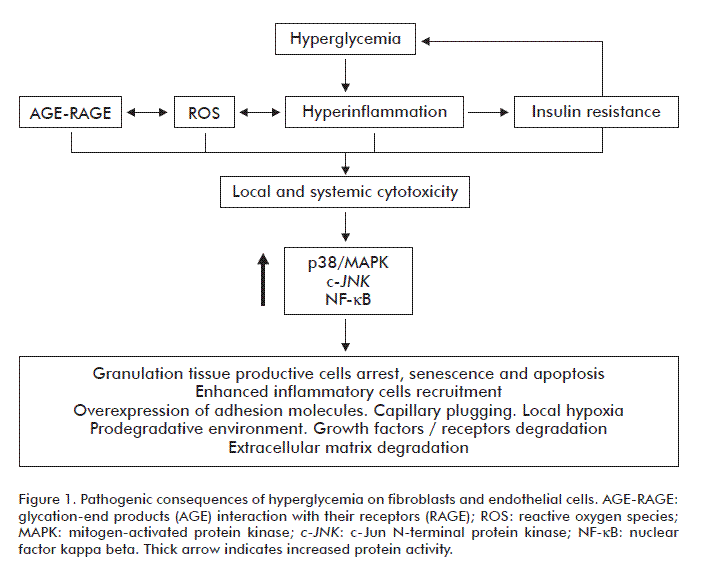
<body><![CDATA[<P   ><b><font face="Verdana, Arial, Helvetica, sans-serif" size="2">Endothelial cells      </font></b></P >       <P   align="justify" ><font face="Verdana, Arial, Helvetica, sans-serif" size="2">Angiogenesis is a      comprehensive term which indicates the physiological process involving the      growth of new blood vessels or neovascularization. This is a vital process      for embryological growth, tissue development, and wound healing. Different      growth factors families regulate angiogenesis in collaboration with other      proteins, by promoting endothelial cells recruitment, proliferation, migration,      co-opting and collar stabilization. Among the growth factors are: VEGFs, fibroblast      growth factor, angiopoietins, platelet-derived growth factor (PDGF) and transforming      growth factor-&beta; (TGF-&beta;). Proteins comprise integrins, cadherins      and ephrins. There is an enormous and ever-growing body of evidence indicating      the close correlation between hyperglycemia and the abnormalities in endothelial      function and morphology [41]. The UK Prospective Diabetes Study (UKPDS)[42]      and Diabetes Control of Complications Trial (DCCT) [43] found microvascular      disease and hyperglycaemia to be intrinsically related. Thus, anomalous angiogenesis      is a hallmark of both type forms of diabetes which is clearly and early observable      during the process of granulation tissue growth; condition that has been successfully      reproduced in animal models [44]. For subjects with macrovascular disease,      the defective angiogenesis prolongs and disturbs the healing process. The      concept of abnormal angiogenesis extends beyond the wound, given the inability      of these patients to create collateral circuits due to a VEGF-dependent monocytes      dysfunction [45]. Furthermore, insulin has a dramatic impact on the endothelial      homeostasis by its ability to stimulate NO release via a cascade that involves      activation of the phosphatidylinositol 3-kinase (PI3K)-A<I>kt</I> signaling      and eNOS phosphorylation. The later is of paramount importance in angiogenesis      and wound healing as described below [46]. </font></P >       <P   align="justify" ><font face="Verdana, Arial, Helvetica, sans-serif" size="2">As depicted for fibroblasts,      high glucose and the glycated by-products exert a dramatically toxic effect      on endothelial cells and the vascular wall in general. In parallel, the endothelial      cells <I>per se</I> seem to be a very sensitive target to high glucose. Endothelial      dysfunction is intricately related to insulin resistance through the stimulatory      effects of insulin on glucose disposal and NO production in the endothelium.      Today, vascular dysfunction remains as a major cause of morbidity, amputation/disability      and mortality in diabetic patients. Even after achieving the successful reperfusion      of an ulcerated lower extremity, the healing process is slow and torpid. Therapeutic      angiogenesis has been pursued for years but the clinical results have shown      relatively limited outcomes [47-49]. </font></P >       <P   align="justify" ><font face="Verdana, Arial, Helvetica, sans-serif" size="2">High glucose concentrations      have been associated with endothelial metabolic dysfunction <I>in vitro</I>      and <I>in vivo</I> and as for multiple physiological processes; insulin and      its downstream signaling regulate most of the endothelial cell functions [50].      High-glucose ambient has been shown to disturb endothelial cells cycle, increase      DNA damage, delay endothelial cells replication and induce excessive cell      death [51]. In addition, high glucose also prevents NO-induced inhibition      of vascular smooth muscle cells migration [29] thus contributing to Monckeberg&rsquo;s      media thickening. </font></P >       <P   align="justify" ><font face="Verdana, Arial, Helvetica, sans-serif" size="2"><I>In vitro</I> models      simulating &lsquo;normoglycemia&rsquo; and hyperglycemia have demonstrated      that under high-glucose ambient, proliferation and tube formation of dermal      microvascular endothelial cells appear impaired [52]. Furthermore, high glucose      levels selectively trigger apoptosis in cultured endothelial cells as has      been demonstrated by different laboratories [53]. High glucose induces the      up-regulation of TNF-&alpha; level concomitant to the death receptors TNF-R1      and Fas in a variety of cultured endothelial cells [54]. Under this ambient,      the expression of the proapoptotic Bax protein increases, cytochrome c is      released, subsequently conjugating to the apoptotic protease activating factor-1      and triggering a caspase cascade-induced death [55]. </font></P >       <P   align="justify" ><font face="Verdana, Arial, Helvetica, sans-serif" size="2">Hyperglycemia-induced      oxidative stress promotes inflammation through increased endothelial cells      damage, microvascular permeability, and uncontrolled release of proinflammatory      cytokines, including TNF-&alpha;, interlukin-1&beta; (IL-1&beta;), and interlukin-6      (IL-6), ultimately leading to decreased insulin sensitivity and diabetic vascular      complications. Moreover, hyperglycemia-induced Foxo also plays an important      role in the induction and amplification of proinflammatory cytokines production.      Foxo1 directly binds to IL-1&beta; promoter and increases its expression in      macrophages [56]. </font></P >       <P   align="justify" ><font face="Verdana, Arial, Helvetica, sans-serif" size="2">Hyperglycemia and      the accumulation of AGE disturb the role of angiogenic growth factors as VEGF,      its receptor, its signaling pathway; thus disrupting endothelial proliferation,      migration, and endothelial progenitor cells (EPCs) recruitment and release      from bone marrow [57]. Insulin resistance disrupts the NO-mediated angiogenic      positive regulation over angiogenic growth factors such as VEGF, fibroblast      growth factor and TGF-&beta; [57]. Studies using streptozotocin-induced diabetic      mice with simultaneous hind-limb ischemia have suggested that the angiogenic      responses remain preserved even under the diabetic state, and that 40 to 50%      reduction of PDGF-BB expression is responsible for the induction of functional      and morphological vascular abnormalities and pericytes apoptosis. Conversely,      PDGF-BB external supplementation was sufficient to prevent limb autoamputation,      also reproduced with a protein kinase C inhibitor that restored the expression      of endogenous PDGF-BB [58]. </font></P >       <P   align="justify" ><font face="Verdana, Arial, Helvetica, sans-serif" size="2">The glycation of      collagen and other proteins within the wound ECM and AGE accumulation bring      catastrophic consequences for the angiogenic reaction with inhibition of angiogenesis      <I>in vivo</I>. The fact that angiogenesis is restored by aminoguanidine treatment      reinforces the antiangiogenic role of AGE [59]. Angiogenesis is a multifaceted      process demanding an appropriate, non-glycated extracellular substrate. This      is clearly illustrated by the fact that PDGF-BB anchors to different components      of the ECM under physiological conditions acting as a natural depot and slow      release system for the growth factor. Local PDGF unavailability has proved      to impair the coverage of newly formed vessels with mural cells and local      pericytes [60]. These evidences reinforce the pathophysiological impact of      high glucose toxicity, the release of pro-inflammatory cytokines and the activation      of the intrinsic mitochondrial-mediated apoptotic signaling pathway on endothelial      cells. In summary, endothelial cells exposed to excess glucose develop a pro-inflammatory      profile, becoming a significant source of cytokines and ROS production. The      agonistic stimulation of the RAGE is able to mount the same response leading      to apoptosis and vascular ruin. The pathogenic effects of hyperglycemia on      fibroblasts and endothelial cells are summarized in <a href="/img/revistas/bta/v29n4/f0101412.gif">figure      1</a>. </font></P >       
<P   align="justify" ><font face="Verdana, Arial, Helvetica, sans-serif" size="2">Compelling evidences      indicate that at least a portion of the hyperglycemia-mediated endothelial      damages and dysfunctions are associated with an impaired mitochondrial activity      resulting in mutations of mitochondrial DNA, due to a disproportionate ROS      production, leading to an inflammatory reaction<B> </B>and apoptosis [61].      As a matter of fact, mitochondrial DNA has a much higher mutation rate than      nuclear DNA because it lacks histones and is exposed to the direct action      of oxygen radicals while its repair system is limited. Therefore, ROS appear      to play a pivotal role in systemic endothelial deterioration and biological      aging [62]. As described, ROS generation enhances Foxo1 activation and induction      of several classes of genes that regulate endothelial cell behavior, including      pro-inflammatory factors, and eventually the execution of apoptosis of endothelial      and adjacent cells [35]. ROS-mediated lipid peroxidation appears to impair      most healing events, contributing to growth factors reduction, keratinocytes      migration failure, slow or torpid fibroplasia, delayed contraction and matrix      remodeling, for not to mention abnormal angiogenesis [63]. Under experimental      conditions, the pharmacological intervention with a chemical inhibitor of      lipid peroxidation proved to reduce the local edema and to stimulate re-epithelialization,      neovascularization, proliferation of fibroblasts, and synthesis and maturation      of the ECM. A parallel finding was the normalization of VEGF mRNA expression      and secretion in those diabetic mice. This further supports the view that      lipid peroxidation perturbs VEGF production [64]. An extraordinary background      has accumulated about the role of NO in vascular biology in diverse horizons      as ischemia, inflammation and neovascularization. Impaired endothelium-dependent      NO-mediated relaxation occurs in both cellular and <I>in vivo</I> models [65].      Many of the metabolic conditions associated with diabetes are conditioned      by failure in NO synthesis or its degradation. In this respect, the integrity      of the A<I>kt</I>/eNOS coupling pathway for a normal endothelial function      appears compulsory [66]. Hyperglycemia is also associated to a deficit in      tetrahydrobiopterin (BH4) and to an increase in arginase expression, which      attempt against NO synthesis and normal endothelial functions such as vascular      remodeling responses [67]. The increased generation of peroxynitrite levels      under high glucose conditions contributed to deplete cellular anti-oxidant      reserves as to activate the NF-&kappa;B transcription factor and consequently      the expression of the inducible form of nitric oxide synthase (iNOS), intercellular      adhesion molecule-1 and other inflammatory mediators [68]. </font></P >       <P   align="justify" ><font face="Verdana, Arial, Helvetica, sans-serif" size="2">EPCs are active players      for the maintenance and repair of endothelial cells. They participate in angiogenesis      as they proliferate, migrate and differentiate, and are a source for proangiogenic      factors and cytokines [69]. Multiple evidences indicate that the number of      circulating EPCs is decreased under both clinical forms of diabetes, which      is likely to be involved in the pathogenesis of vascular complications [70].      Under experimental diabetic conditions the EPCs number appears significantly      decreased in the bone marrow as in the peripheral blood which was reverted      by treating the mice with insulin [71]. In general the bone marrow derived      EPCs in the diabetic patients are considered as dysfunctional, producing fewer      endothelial cells with reduced replicative, and migratory potential [72].      Tamarat <I>et al</I>. have described a limited capacity of diabetic animals-derived      bone marrow mononuclear cell to differentiate into EPCs <I>in vitro as to      organize </I>tubulogenic structures when subcutaneously implanted in a matrigel      plug, thus hindering the revascularization of damaged areas [70]. Over again,      the activation of p38/MAPK mediated by an excessive ROS generation has been      identified as responsible for the EPCs impaired proangiogenic potential <I>in      vivo</I> by limiting cell proliferation and differentiation [73]. To fully      divert the physiological role of EPCs in tissue repair and angiogenesis, the      duet hyperglycemia-ROS stimulates EPCs to produce pro-inflammatory cytokines      and to shift NO production by elevating iNOS and decreasing eNOS [74]. As      described for other cells, AGE treatment disrupts EPCs physiology thus leading      to a downregulation of eNOS and the anti-apoptotic factor Bcl-2 expression,      as well as an elevation in cyclooxygenase-2, proapoptotic factor Bax, NF-&kappa;B      and caspase-3 in a MAPK (ERK/p38/<I>c-JNK</I>)-dependent manner [73]. </font></P >       ]]></body>
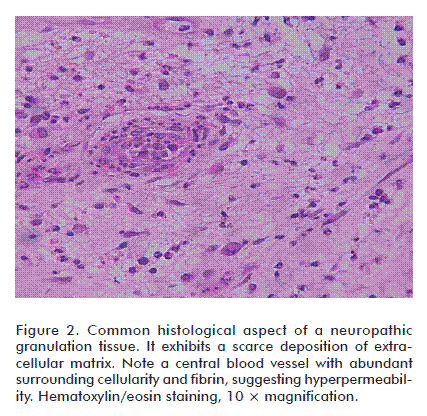
<body><![CDATA[<P   align="justify" ><font face="Verdana, Arial, Helvetica, sans-serif" size="2">Angiogenesis is of      paramount importance for wound healing, but diabetes-mediated vascular cells      damages are as varied and broad as it is the concept of systemic endothelial      dysfunction. Diabetes distorts the angiogenic program so badly that angiogenic      factors are deficitary where and when required (lower limbs), and overproduced      in erroneous anatomical niches with fatal consequences for the patient (diabetic      retinopathy). </font></P >       <P   align="justify" >&nbsp;</P >       <P   align="justify" ></P >       <P   align="justify" ><font size="3"><b><font face="Verdana, Arial, Helvetica, sans-serif">FAILURE      OF GRANULATION TISSUE ONSET AND PROGRESSION </font></b></font></P >   <FONT size="+1">        <P   align="justify" ><font size="2" face="Verdana, Arial, Helvetica, sans-serif">Once described the      main consequences of high glucose/hyperglycemia on the two principal architects      of granulation tissue, fibroblasts and endothelial cells, the most distinguishing      features for the onset of the granulation process in diabetic cutaneous wound      healing will be recapitulated next. </font></P >   <FONT size="+1">        <P   align="justify" ><font face="Verdana, Arial, Helvetica, sans-serif" size="2">Tissues&rsquo; regenerative      capabilities have been neglected along the species evolution; thus, scarring      process has emerged as an urgent alternative to favor the structural and functional      restoration of a wounded zone. Within these events, the process of granulation      tissue formation is pivotal as it constitutes a sort of living, temporary      aggregate of cells and proteins, acting as a welding material until the tissue&rsquo;s      continuity is restored. However, the reluctance to trigger and sustain the      out-growth of a productive granulation tissue with an appropriate ECM is typical      in diabetic patients, and particularly if ischemia concurs. As mentioned,      these wounds are characterized by a proliferative arrest, pro-inflamed, pro-oxidant      and pro-degradative phenotype [75]. </font></P >       <P   align="justify" ><font face="Verdana, Arial, Helvetica, sans-serif" size="2">This stubbornness      and slowness to heal in diabetes is conditioned by systemic and local factors      that in complicity counteract intrinsic reparative mechanisms. In a broad      systemic context, inflammation and anabolic deficit can be conceptually mentioned.      Diabetic patients with foot ulceration bear a specific and ordered alteration      of the immune status with an active upregulation of circulating levels of      acute-phase proteins, cytokines, and chemokines that impose a chronic systemic      inflammatory profile, and amplify local wound inflammatory networks [76].      The systemically elevated levels of pro-inflammatory response markers and      the wound&rsquo;s expression of cytokines and chemokines are among the culprits      of the abnormal repair mechanism [77]. Another factor to be considered is      that diabetes <I>per se</I> is a metabolic disease in which fuels metabolism      is perturbed given the rupture of one of the most important anabolic axis      of the organism: insulin/IGF-I. The role of insulin in wound healing is well      known by its anabolic effect on wound protein balance, favoring synthesis      and preventing degradation [78, 79]. IGF-I has a similar effect on stimulating      wound tissue anabolism. Both insulin and IGF-I appear to act in part by the      induction of the anabolic transcription factor ATF4 (CREB2), essential for      the activation of the mammalian target of rapamycin complex 1 (m-TORC1) protein      which in turn is required for protein synthesis via Foxo-dependent gene repression      [80]. We do not rule out that the diabetes-concomitant deficit of incretins      could participate in the negative anabolic balance observed in such wounds.      Glucagon-like peptide-1 in addition to its anti-hyperglycemic actions is endowed      with a vast number of multi-organ cytoprotective, trophic and anti-inflammatory      effects [81]. In support to the glucagon-like peptide-1 action is the study      by Ta <I>et al</I>. with alogliptin, a specific inhibitor of dipeptidyl peptidase-4,      which was shown to inhibit macrophage-mediated inflammation response and was      suggested as tissue remodeling promoter by inhibiting the expression of different      MMPs [82]. </font></P >       <P   align="justify" ><font face="Verdana, Arial, Helvetica, sans-serif" size="2">Rapid formation and      deposition of an appropriate ECM, in particular by fibroblasts, is required      for an efficient cellular anchoring and homing at the wound bed. As mentioned      above, the cutaneous fibroblast is a cell type sensitive to high glucose,      AGE-precursors, AGE, ROS and TNF-&alpha;, rapidly undergoing premature senescence,      arrest or apoptosis. Fibroblasts are the main source of collagen, and the      number of fibroblasts can be taken as a measure of repair based on their collagen      synthesis ability. It is very likely that the deficit of growth factors such      as TGF-&beta;1, IGF-I, and PDGF, that stimulate fibroblasts proliferation,      transdifferentiation and the synthesis of matrix components, appear in shortage      in diabetic foot ulcers (DFUs) and results in a scarce ECM formation. Numerous      growth factors (TGF-&beta;1, IGF-I, PDGF) are able to regulate the balanced      expression of MMPs and tissue inhibitors of metalloproteases, while most of      them exhibit an altered expression in DFUs [83]. Moreover, the imbalance in      the DFU milieu between TGF-&beta;1 and TGF-&beta;3 in which the former appears      downregulated, may explain fibroblasts quiescence in terms of proliferation      and secretion [84]. This phenomenon represents the deficit of one of the most      potent pro-fibrogenic and fibroblasts-mitogenic growth factors, which at the      same time is able to downregulate macrophage activation [85]. </font></P >       <P   align="justify" ><font face="Verdana, Arial, Helvetica, sans-serif" size="2">The ECM represents      the granulation tissue dynamic stroma that provides support for inflammatory      cells, fibroblasts, and endothelial cells and allows for the chemotaxis of      epithelial cells, thus hosting the re-epithelialization process [86]. One      of the main challenges for the diabetic wound healing is the structuring of      a normal matrix in quantity and quality. In general, a poor ECM formation      distinguishes DFUs which can result from: i) diminished ECM synthesis, ii)      increased ECM degradation rate by proteolytic enzymes, iii) toxicity due to      glycated by-products accumulation, and iv) toxicity by biofilm bacterial contaminants      diffusion [87]. We deem that an important cause of the clinical dilemma of      the high rate of re-ulcerations and ipsilateral amputations in DFU patients&rsquo;      shortly after re-epithelialization [88] may be inherent to the qualitative      composition of the scar ECM to tolerate tensile forces and mechanical stress.      </font></P >       <P   align="justify" ><font face="Verdana, Arial, Helvetica, sans-serif" size="2">The diabetic granulation      process does not generally exhibit the sequential cascade of events that characterize      normal wound healing. This has been confirmed through the histopathological      analysis of granulation tissue biopsies by Loots <I>et al.</I>,<I> </I>who      described the lesions as &lsquo;frozen&rsquo; in a chronic low-grade inflammatory      state associated to a scarce provisional ECM [89]. Our group&rsquo;s serial      biopsies from both neuropathic and ischemic ulcers-derived granulation tissue      have identified histological differences for both types of wounds in the absence      of clinical infection. Polymorphonuclear cells (PMN) infiltration is intense      and prolonged particularly in neuropathic wounds, co-existing with a scarce      ECM accumulation in which collagen deposit is impoverished (<a href="#fig2">Figure      2</a>).</font></P >       ]]></body>
<body><![CDATA[<P   align="center" ><img src="/img/revistas/bta/v29n4/f0201412.gif" width="425" height="414"><a name="fig2"></a></P >       
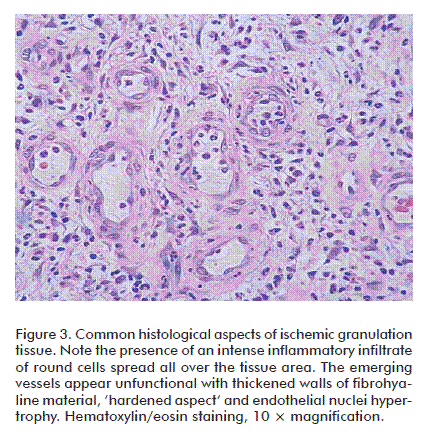
<P   align="justify" ><font face="Verdana, Arial, Helvetica, sans-serif" size="2">Under more mature      stages, the neuropathics may also show an abnormal sprout of new small vessels      and capillaries that may derive not from a normal angiogenic response but      due to arterio-venous shunts. Our observations recall those of Black <I>et      al</I>. who demonstrated that in neuropathic patients there exists a decrease      in fibroblast proliferation and a scarce amount of collagen accumulation within      the wound bed [90]. On the contrary, a broadly spread infiltration of round      cells predominate in those patients suffering from wound bed ischemia, associated      to a fibro-hyaline matrix of &lsquo;hardened&rsquo; aspect and abnormal angiogenesis      in which vascular wall cellular mosaicism, precocious media thickening, endothelial      nuclei hypertrophy and many other defects can be identified (<a href="#fig3">Figure      3</a>). It is likely that the combination of arterial hypoperfusion and glucose      toxic derivatives imprints a particular pattern of damage to the morphogenesis      of vessels in the wound [91]. These observations incite to speculate that      the biochemical microenvironment in ischemic and neuropathic diabetic wounds      is different, and that the inflammatory &lsquo;badge&rsquo; is in correspondence      with the wound&rsquo;s most prevalent pathogenic component [92]. In contrast      to acute wounds in non-diabetic subjects,<Sup> </Sup>the inflammatory reaction      in diabetics appears prolonged [93] and sharply delays granulation tissue      formation and maturation [94]. Data derived from murine diabetic models indicate      that the exaggerated inflammatory reaction is related to the prolonged expression      of macrophage inflammatory protein-2 and macrophage chemoattractant protein-1      [95]. Furthermore, the downregulation of the anti-inflammatory cytokine IL-10      in DFUs environments represents the collapse of an important inflammatory      restrainer [77]. Other evidences indicate that PMN are critical toward the      acquisition and perpetuation of inflammation and a degradative phenotype.      The granulocytes secrete TNF-&alpha; and IL-1&beta; which act as a triggering      signal for MMPs expression via the common NF-&kappa;B signaling pathway. Within      the wound context, TNF-&alpha; stimulates its own<Sup> </Sup>secretion and      that of IL-1&beta;, contributing<Sup> </Sup>to a persistent inflammatory status      [96]. TNF-&alpha; has proved to negatively impact the repair process as it      is early secreted since the inflammatory phase. Its deregulation is not only      associated with persistent inflammation but also to connective tissue degradation      [97]. Concomitantly, TNF-&alpha; mediates its antagonistic effects on TGF-&beta;1      through the <I>c-JNK</I> pathway via inhibition of Smad phosphorylation, consequently      reducing the expression of TGF-&beta;1, and that of several downstream matrix      proteins [98]. In this highly proteolytic milieu, fibronectin, collagens,      growth factors and their receptors are degraded while the wound is way down      to a catabolic state [99]. Importantly, the perpetuated homing of PMN within      the wound bed is associated to high local levels of elastase secretion, ROS      and reactive nitrogen species [100]. High circulating and PMN-associated elastase      levels are attributable to a poor glycemia control and are considered a risk      marker for the development of diabetic angiopathy [101]. Fibronectin degradation,      for instance, is referred as one among the several causes of diabetic re-epithelialization      failure. Epidermal keratinocytes require of the interaction between fibronectin      and its surface receptor integrin &alpha;5&beta;1 to effectively migrate [102].      Curiously, insulin-degrading activity has also been demonstrated in the fluid      of diabetic experimental and human wounds which have been shown to correlate      with the glycated hemoglobin levels [103]. The connection between NO metabolism      and foot ulcer proteases profile has been described. In contrast to elevated      MMP-8 and -9 displayed by the non-healing diabetic foot wound, the concentration      of NO appears significantly reduced. Diabetic skin fibroblasts treated with      NO donor compounds selectively raised NO production, increased cell proliferation,      and decreased the expression of MMP-8 and -9 in a dose-dependent manner. Thus,      that NO resumes the cell proliferation program and promotes the reestablishment      of an anti-proteases effect have emerged as argument in favor of the NO salutary      effect in wound healing [32]. </font></P >       <P   align="center" ><img src="/img/revistas/bta/v29n4/f0301412.gif" width="425" height="437"><a name="fig3"></a></P >   <FONT size="+1"><FONT size="+1"><FONT size="+1"><FONT size="+1"><FONT size="+1"><FONT size="+1">        
<P   align="justify" ><font face="Verdana, Arial, Helvetica, sans-serif" size="2">The link between      wound cells and apoptosis was described above; we just wish to comment that      in sharp contrast to wound-infiltrated inflammatory cells becoming refractory      to apoptosis, granulation tissue-producing cells are sensitive to commit suicide      where TNF-&alpha; stands as a major driving force. The negative impact of      TNF-&alpha; levels on the sensitivity of tissues to insulin<Sup> </Sup>has      been consistently documented. Skin cells are not excluded from this effect      [104]. Conclusively, any therapeutic approach aimed to neutralize TNF-&alpha;      or to increase the wound local availability of active TGF-&beta;1 would be      similarly effective for stimulating granulation tissue and wound closure [105].      </font></P >   <FONT size="+1"><FONT size="+1">        <P   align="justify" ><font face="Verdana, Arial, Helvetica, sans-serif" size="2">Chronic wounds and      especially diabetic foot ulcers exhibit a highly pro-oxidant microenvironment      that amplifies the cytotoxic cascade. Endothelial cells and fibroblasts, in      particular senescent fibroblasts, are a prominent source for oxygen radicals,      but at the same time they turn into these radicals targets which, by converging      mechanisms, arrest cell proliferation and induce apoptosis [106]. Thus, the      disturbed oxidant/antioxidant balance as the AGE accumulation within the chronic      wound microenvironment is considered a major factor amplifying the unrestrained      and persistent inflammatory, toxic and catabolic state of non-healing wounds      [100]. </font></P >       <P   align="justify" ><font face="Verdana, Arial, Helvetica, sans-serif" size="2">The failure of wound      contraction is a clinical hallmark of diabetic granulation tissue. Fibroblast-to-myofibroblast      transdifferentiation represents a key event during wound healing and tissue      repair. The contractile force generated by myofibroblasts as a highly specialized      cell, speeds the healing process of dermal wounds in healthy humans, accounting      for an 80-90% of scar tissue reduction [107]. In addition, the contraction      process reduces the area to be resurfaced by re-epithelialization which represents      a sort of ergonomic response. In diabetic subjects however, contraction is      impaired and deep ulcers heal by the combination of granulation and re-epithelialization.      The classical view on dermal wound healing implies recruitment of local fibroblasts      [108], followed by a subsequent process of transdifferentiation in which the      fibroblasts gains a definitive phenotype of differentiated myofibroblasts      by neo-expressing the &alpha;-smooth muscle actin (&alpha;-SMA). Nevertheless,      &alpha;-SMA expression is precisely controlled by the joint action of growth      factors like TGF-&beta;1 and ECM proteins like the fibronectin splice variant      ED-A, as by the local mechanical microenvironment [108]. It should be noted      however, that indwelling fibroblasts in diabetic wounds are refractory to      proliferate, adopt a senescent phenotype, and that TGF-&beta;1, fibronectin      and other matrix proteins may appear in deficit. Hence, all these factors      may contribute to the poor contractile activity. Furthermore, Goldberg <I>et      al</I>. showed that among the deleterious activities of TNF-&alpha; within      the wound is to suppress &alpha;-SMA expression in human dermal fibroblasts      [98]. <a href="/img/revistas/bta/v29n4/f0401412.gif">Figure 4</a> integrates the cascade of deleterious      factors that impact on diabetic granulation tissue onset. </font></P >       
<P   align="justify" ><font face="Verdana, Arial, Helvetica, sans-serif" size="2">If the animals-derived      evidence that a high fraction of the wound myofibroblasts potentially derives      from bone marrow fibrocytes is valid for humans [109]; then we have already      learned that diabetes negatively impacts on the general bone marrow physiology      [110], beyond this stromal-derived factor-1&alpha; (acting as recruiting factor)      together with its CXCR4 chemokine receptor being also impaired [111]. Finally,      it has been documented that the circulating acute inflammatory reactants involved      in insulin resistance inhibit fibrocytes differentiation [112]. There are      numerous cellular and molecular aspects unknown and that remain to be answered      on the granulation tissue biology, such as: i) What are the molecular and      cellular driving forces supporting the microscopic structural differences      between neuropathic and ischemic ulcers beds?; ii) What is the explanation      for the &lsquo;inheritance&rsquo; of vascular changes as a dramatic Monckeberg      media thickening in nascent arteries within an early hatching granulation      tissue?; iii) Why granulation tissue is histomorphologically abnormal even      in metabolically compensated patients? </font></P >       <P   align="justify" ><font face="Verdana, Arial, Helvetica, sans-serif" size="2">Re-epithelialization      at the clinical level is not a lesser important problem, as most of the diabetic      wounds may granulate in time, while re-epithelialization is even far slower,      arrhythmic, and torpid. Re-epithelialization is accomplished through the combined      actions of keratinocytes&rsquo; dedifferentiation, proliferation and migration,      requiring a complex basement membrane which emerges from the mutual interaction      between mesenchymal and epithelial cells. Re-epithelialization failure is      therefore one of the landmarks of diabetic and other chronic wounds. The epidermal      edge of a chronic wound is thick and hyperproliferative, with mitotically      active keratinocytes unable to migrate along the surface, and by the contrary,      moving down deep into the neodermis. Therefore, it has been speculated that      the non-healing edge keratinocytes do not successfully complete either the      activation or the differentiation pathways. In consonance with this, one of      the major issues in chronic wounds treatments is how to revert the chronic      wound keratinocytes&rsquo; phenotype to a proper differentiating and migratory      program [113]. </font></P >       <P   align="justify" ><font face="Verdana, Arial, Helvetica, sans-serif" size="2">Glucose has shown      to exhibit a direct toxic effect on keratinocytes. As for other cells grown      in the presence of high glucose concentrations, human epidermal keratinocytes      significantly reduced their proliferation rate and replicative life span,      and were rendered more susceptible to commit apoptosis [114]. Other studies      also confirmed that hyperglycemic conditions abort keratinocytes&rsquo; proliferative      ability and their migratory response [115]. Aside from the glucose-mediated      direct cytotoxic effect on keratinocytes, AGE modification of type-I collagen      and other ECM proteins impairs the integrin-mediated adhesion of keratinocytes      to the basement matrix, and could thus contribute to the pathogenesis of diabetic      re-epithelialization failure [116]. In this context, epithelial-mesenchymal      interaction plays a role in establishing the profile and order of released      factors regulating keratinocytes proliferation and differentiation [117].      </font></P >       <P   align="justify" ><font face="Verdana, Arial, Helvetica, sans-serif" size="2">The fact that insulin      is biologically relevant for skin cells comes from the observation that insulin      is an essential component for cultured human keratinocytes, demonstrating      its involvement in the regulation of proliferation, survival, and metabolism      [118]. Recent studies in this field document that, among other roles, insulin      contributes to VEGF release in skin wound cells through an Akt1-mediated posttranscriptional      mechanism [119]. Glucose is known to affect insulin action by regulating the      expression of several genes including insulin receptor at both the transcriptional      and translational levels [120]. Lack of insulin receptor expression derives      in reduced skin proliferation and abnormal differentiation in vivo [121].      Furthermore, TNF-&alpha; has also been implicated in epithelial cells arrest      by deeply perturbing critical elements of keratinocytes&rsquo; physiology,      including insulin sensitivity [122]. </font></P >       ]]></body>
<body><![CDATA[<P   align="justify" ><font face="Verdana, Arial, Helvetica, sans-serif" size="2">A notorious study      provided evidences on the roles of c-myc and &beta;-catenin in impairing epithelial      edges migration [123]. Nuclear &beta;-catenin stabilization inhibits keratinocytes      migration by blocking EGF response via c-myc induction, and repressing keratins      6 and 16 expression, ultimately depleting the pool of epidermal stem cells      at the non-healing edge [123]. It is therefore evident that keratinocytes      migration incapability plays an important role in re-epithelialization failure,      since cytoskeletal keratins K2, K6 and K10 have been found diminished in DFUs      [124]. Moreover, the observation that EGF response was blocked may have further      deleterious impact. Many peptide growth factors, including members of the      EGF family, accelerate wound re-epithelialization <I>in vitro</I> and <I>in      vivo</I> [125]. Among them, the activation of the EGF family of ligands and      its receptor (EGFR) is of physiological significance. Furthermore, EGFR expression      is transiently increased at wound margins, suggesting its active role in wound      repair. EGF stimulates both cell proliferation and motility [126], the later      being dependent on EGFR autophosphorylation and the subsequent activation      of phospholipase C&gamma;-1. On the other hand, EGFR activation also leads      to membrane ruffling and focal adhesions through activation of members of      the Rho subfamily of GTP-binding proteins [127]. Recent experiments document      the negative effect of null mutation of the Slug transcription factor on its      function as a downstream EGFR catalytic mediator for wound re-epithelialization.      Thus, any interference with the EGFR cascade will hamper epithelial resurfacing      [128]. Classic experiments provide illustrative examples on the relevance      of the epithelial-mesenchymal cross-talk and on the irreplaceable role of      growth factor as a networking bridge [129] for re-epithelialization. Skin-reconstitution      studies have shown that bone marrow stromal cells, in addition to dermis-localized      preadipocytes and fibroblasts, distinctively promote epidermal regeneration      [130]. As diabetes courses with a deficient secretion of growth factors and      other chemotactic mediators in areas of tissue repair, recruitment of circulating      stromal cells appears reduced; which may turn into an additional hit to that      of high glucose-associated toxicity [131]. </font></P >       <P   align="justify" ><font face="Verdana, Arial, Helvetica, sans-serif" size="2">At the end, there      are so many factors which may interact as to obstruct chronic wounds re-epithelialization      that it may turn into a puzzle. Above all, two questions from the clinical      practice remain: Why do keratinocytes become stunted and arrested again soon      after resuming migration following wound contours debridement? Why do the      biopsies invariably show a hypertrophic lip of cells in vertical downward      growth in spite of a horizontal polarization? </font></P >       <P   align="justify" >&nbsp;</P >       <P   align="justify" > </P >       <P   ><b><font size="3" face="Verdana, Arial, Helvetica, sans-serif">CONCLUDING REMARKS      </font></b></P >   <FONT size="+1">        <P   align="justify" ><font size="2" face="Verdana, Arial, Helvetica, sans-serif">Our current understanding      on the molecular mechanisms impairing wound healing in diabetes simply sizes      the tip of the iceberg. Diabetes <I>per se</I> is a complex disease. Even      more complex is the group of hard-to-name members that constitutes the type      2 form. This is ethiopathogenically multifactorial and behaves as individual      as the affected subject is. So, it is the pattern of clinical complications,      including the wound itself. To date, all the evidences aim to high glucose      burden as the proximal trigger to unleash acute and chronic self-perpetuating      loops, which include but are not limited to ROS-lipid peroxidation, hyperinflammation/disimmunity,      AGE-RAGE toxicity and mitochondrial dysfunction. All these factors enforce      precocious senescence, arrest and apoptosis. </font></P >   <FONT size="+1">        <P   align="justify" ><font face="Verdana, Arial, Helvetica, sans-serif" size="2">At both, experimental      and clinical levels, the diabetic wound phenotype is the expression of countless      molecular factors that orchestrate a complex biochemistry and an aberrant      cellular behavior. The pathway to chronification has not been fully elucidated      but by all means it represents a form of cells&rsquo; biological disobedience      and entails the need of continuous surgical &ldquo;cuttings&rdquo; in order      to transiently restore an acute behavior by &lsquo;refreshing&rsquo; the cellular      environment. Despite scientific and clinical efforts, and resources investments,      amputation rates have not attained a significant reduction since the emergence      of first line technology pharmaceuticals or sophisticated devices. Not to      mention the dismal rates of local re-ulceration once the lesion was re-epithelialized.      Since limb salvage is always a worthwhile goal and diabetic foot ulceration      involves predisposing factors that can be diagnosed and clinically graded;      primary care ulcer prevention plans, podiatric assistance, optimal glycemic      control and educational programs, will be always far more socially rewarding.      </font></P >       <P   align="justify" >&nbsp;</P >       <P   align="justify" > </P >       <P   align="justify" ><font size="3"><b><font face="Verdana, Arial, Helvetica, sans-serif">REFERENCES      </font></b></font></P >       ]]></body>
<body><![CDATA[<!-- ref --><P   align="justify" ><font size="2" face="Verdana, Arial, Helvetica, sans-serif">1. Daneman D. Type      1 diabetes. Lancet. 2006;367(9513):847-58.     </font></P >   <FONT size="+1">        <!-- ref --><P   align="justify" ><font face="Verdana, Arial, Helvetica, sans-serif" size="2">2. Lamers ML, Almeida      ME, Vicente-Manzanares M, Horwitz AF, Santos MF. High glucose-mediated oxidative      stress impairs cell migration. PLoS One. 2011;6(8):e22865.     </font></P >       <!-- ref --><P   align="justify" ><font face="Verdana, Arial, Helvetica, sans-serif" size="2">3. Bouche C, Serdy      S, Kahn CR, Goldfine AB. The cellular fate of glucose and its relevance in      type 2 diabetes. Endocr Rev. 2004;25(5):807-30.     </font></P >       <!-- ref --><P   align="justify" ><font face="Verdana, Arial, Helvetica, sans-serif" size="2">4. Armstrong DG,      Cohen K, Courric S, Bharara M, Marston W. Diabetic foot ulcers and vascular      insufficiency: our population has changed, but our methods have not. J Diabetes      Sci Technol. 2011;5(6):1591-5.     </font></P >       <P   align="justify" ><font face="Verdana, Arial, Helvetica, sans-serif" size="2">5. Pryce TD. A case      of perforating ulcers of both feet associated with diabetes and ataxic symptoms.      Lancet. 1887;2(3331):11-12. </font></P >       <!-- ref --><P   align="justify" ><font face="Verdana, Arial, Helvetica, sans-serif" size="2">6. Nguyen PD, Tutela      JP, Thanik VD, Knobel D, Allen RJ, Jr., Chang CC, et al. Improved diabetic      wound healing through topical silencing of p53 is associated with augmented      vasculogenic mediators. Wound Repair Regen. 2010;18(6):553-9.     </font></P >       <!-- ref --><P   align="justify" ><font face="Verdana, Arial, Helvetica, sans-serif" size="2">7. Berlanga-Acosta      J, Vald&eacute;z-P&eacute;rez C, Savigne-Guti&eacute;rrez W, Mendoza-Mar&iacute;      Y, Franco-P&eacute;rez N, Vargas-Machiran E, et al. Cellular and molecular      insights into the wound healing mechanism in diabetes. Biotecnol Apl. 2010;27(4):255-61.          </font></P >       <!-- ref --><P   align="justify" ><font face="Verdana, Arial, Helvetica, sans-serif" size="2">8. Boulton AJ, Vileikyte      L, Ragnarson-Tennvall G, Apelqvist J. The global burden of diabetic foot disease.      Lancet. 2005;366(9498):1719-24.     </font></P >       <!-- ref --><P   align="justify" ><font face="Verdana, Arial, Helvetica, sans-serif" size="2">9. Gloire G, Legrand-Poels      S, Piette J. NF-kappaB activation by reactive oxygen species: fifteen years      later. Biochem Pharmacol. 2006;72(11):1493-505.     </font></P >       <!-- ref --><P   align="justify" ><font face="Verdana, Arial, Helvetica, sans-serif" size="2">10. Mitra S, Abraham      E. Participation of superoxide in neutrophil activation and cytokine production.      Biochim Biophys Acta. 2006;1762(8):732-41.     </font></P >       <!-- ref --><P   align="justify" ><font face="Verdana, Arial, Helvetica, sans-serif" size="2">11. Pubmed [Internet].      Bethesda, MD: National Center for Biotechnology Information, U.S. National      Library of Medicine. c2012 [cited 2012 May 18]. Available from: <a href="http://www.ncbi.nlm.nih.gov/pubmed" target="_blank">www.ncbi.nlm.nih.gov/pubmed</a>      </font></P >       <!-- ref --><P   align="justify" ><font face="Verdana, Arial, Helvetica, sans-serif" size="2">12. Bioline International      [Internet]. Sao Paulo: Reference Center on Environmental Information, CRIA,      Brazil. c1989-2012 [cited 2012 May 18]. Available from: <a href="http://www.bioline.org.br" target="_blank">www.bioline.org.br</a>      </font></P >       <!-- ref --><P   align="justify" ><font face="Verdana, Arial, Helvetica, sans-serif" size="2">13. Guarino M, Tosoni      A, Nebuloni M. Direct contribution of epithelium to organ fibrosis: epithelial-mesenchymal      transition. Hum Pathol. 2009;40(10):1365-76.     </font></P >       <!-- ref --><P   align="justify" ><font face="Verdana, Arial, Helvetica, sans-serif" size="2">14. Yevdokimova NY.      High glucose-induced alterations of extracellular matrix of human skin fibroblasts      are not dependent on TSP-1-TGFbeta1 pathway. J Diabetes Complications. 2003;17(6):355-64.          </font></P >       <!-- ref --><P   align="justify" ><font face="Verdana, Arial, Helvetica, sans-serif" size="2">15. Rowe DW, Starman      BJ, Fujimoto WY, Williams RH. Abnormalities in proliferation and protein synthesis      in skin fibroblast cultures from patients with diabetes mellitus. Diabetes.      1977;26(4):284-90.     </font></P >       <!-- ref --><P   align="justify" ><font face="Verdana, Arial, Helvetica, sans-serif" size="2">16. Hehenberger K,      Hansson A. High glucose-induced growth factor resistance in human fibroblasts      can be reversed by antioxidants and protein kinase C-inhibitors. Cell Biochem      Funct. 1997;15(3):197-201.     </font></P >       <!-- ref --><P   align="justify" ><font face="Verdana, Arial, Helvetica, sans-serif" size="2">17. Goldstein S,      Moerman EJ, Soeldner JS, Gleason RE, Barnett DM. Diabetes mellitus and genetic      prediabetes. Decreased replicative capacity of cultured skin fibroblasts.      J Clin Invest. 1979;63(3):358-70.     </font></P >       <!-- ref --><P   align="justify" ><font face="Verdana, Arial, Helvetica, sans-serif" size="2">18. Goldstein S.      Cellular and molecular biological studies on diabetes mellitus. Pathol Biol      (Paris). 1984;32(2):99-106.     </font></P >       <!-- ref --><P   align="justify" ><font face="Verdana, Arial, Helvetica, sans-serif" size="2">19. Hehenberger K,      Heilborn JD, Brismar K, Hansson A. Inhibited proliferation of fibroblasts      derived from chronic diabetic wounds and normal dermal fibroblasts treated      with high glucose is associated with increased formation of l-lactate. Wound      Repair Regen. 1998;6(2):135-41.     </font></P >       <!-- ref --><P   align="justify" ><font face="Verdana, Arial, Helvetica, sans-serif" size="2">20. Loots MA, Lamme      EN, Mekkes JR, Bos JD, Middelkoop E. Cultured fibroblasts from chronic diabetic      wounds on the lower extremity (non-insulin-dependent diabetes mellitus) show      disturbed proliferation. Arch Dermatol Res. 1999;291(2-3):93-9.     </font></P >       <!-- ref --><P   align="justify" ><font face="Verdana, Arial, Helvetica, sans-serif" size="2">21. Grazul-Bilska      AT, Luthra G, Reynolds LP, Bilski JJ, Johnson ML, Adbullah SA, et al. Effects      of basic fibroblast growth factor (FGF-2) on proliferation of human skin fibroblasts      in type II diabetes mellitus. Exp Clin Endocrinol Diabetes. 2002;110(4):176-81.          </font></P >       <!-- ref --><P   align="justify" ><font face="Verdana, Arial, Helvetica, sans-serif" size="2">22. Loots MA, Kenter      SB, Au FL, van Galen WJ, Middelkoop E, Bos JD, et al. Fibroblasts derived      from chronic diabetic ulcers differ in their response to stimulation with      EGF, IGF-I, bFGF and PDGF-AB compared to controls. Eur J Cell Biol. 2002;81(3):153-60.          </font></P >       <!-- ref --><P   align="justify" ><font face="Verdana, Arial, Helvetica, sans-serif" size="2">23. Xue SN, Lei J,      Yang C, Lin DZ, Yan L. The biological behaviors of rat dermal fibroblasts      can be inhibited by high levels of MMP9. Exp Diabetes Res. 2012;2012:494579.          </font></P >       <!-- ref --><P   align="justify" ><font face="Verdana, Arial, Helvetica, sans-serif" size="2">24. Velander P, Theopold      C, Hirsch T, Bleiziffer O, Zuhaili B, Fossum M, et al. Impaired wound healing      in an acute diabetic pig model and the effects of local hyperglycemia. Wound      Repair Regen. 2008;16(2):288-93.     </font></P >       <!-- ref --><P   align="justify" ><font face="Verdana, Arial, Helvetica, sans-serif" size="2">25. Loughlin DT,      Artlett CM. 3-Deoxyglucosone-collagen alters human dermal fibroblast migration      and adhesion: implications for impaired wound healing in patients with diabetes.      Wound Repair Regen. 2009;17(5):739-49.     </font></P >       <!-- ref --><P   align="justify" ><font face="Verdana, Arial, Helvetica, sans-serif" size="2">26. Loughlin DT,      Artlett CM. Modification of collagen by 3-deoxyglucosone alters wound healing      through differential regulation of p38 MAP kinase. PLoS One. 2011;6(5):e18676.          </font></P >       <!-- ref --><P   align="justify" ><font face="Verdana, Arial, Helvetica, sans-serif" size="2">27. Loughlin DT,      Artlett CM. Precursor of advanced glycation end products mediates ER-stress-induced      caspase-3 activation of human dermal fibroblasts through NAD(P)H oxidase 4.      PLoS One. 2010;5(6):e11093.     </font></P >       <!-- ref --><P   align="justify" ><font face="Verdana, Arial, Helvetica, sans-serif" size="2">28. Alikhani M, Maclellan      CM, Raptis M, Vora S, Trackman PC, Graves DT. Advanced glycation end products      induce apoptosis in fibroblasts through activation of ROS, MAP kinases, and      the FOXO1 transcription factor. Am J Physiol Cell Physiol. 2007;292(2):C850-6.          </font></P >       <!-- ref --><P   align="justify" ><font face="Verdana, Arial, Helvetica, sans-serif" size="2">29. Tong X, Ying      J, Pimentel DR, Trucillo M, Adachi T, Cohen RA. High glucose oxidizes SERCA      cysteine-674 and prevents inhibition by nitric oxide of smooth muscle cell      migration. J Mol Cell Cardiol. 2008;44(2):361-9.     </font></P >       <!-- ref --><P   align="justify" ><font face="Verdana, Arial, Helvetica, sans-serif" size="2">30. Lerman OZ, Galiano      RD, Armour M, Levine JP, Gurtner GC. Cellular dysfunction in the diabetic      fibroblast: impairment in migration, vascular endothelial growth factor production,      and response to hypoxia. Am J Pathol. 2003;162(1):303-12.     </font></P >       <!-- ref --><P   align="justify" ><font face="Verdana, Arial, Helvetica, sans-serif" size="2">31. Wall SJ, Sampson      MJ, Levell N, Murphy G. Elevated matrix metalloproteinase-2 and -3 production      from human diabetic dermal fibroblasts. Br J Dermatol. 2003;149(1):13-6.     </font></P >       <!-- ref --><P   align="justify" ><font face="Verdana, Arial, Helvetica, sans-serif" size="2">32. Burrow JW, Koch      JA, Chuang HH, Zhong W, Dean DD, Sylvia VL. Nitric oxide donors selectively      reduce the expression of matrix metalloproteinases-8 and -9 by human diabetic      skin fibroblasts. J Surg Res. 2007;140(1):90-8.     </font></P >       <!-- ref --><P   align="justify" ><font face="Verdana, Arial, Helvetica, sans-serif" size="2">33. Sivitz WI, Yorek      MA. Mitochondrial dysfunction in diabetes: from molecular mechanisms to functional      significance and therapeutic opportunities. Antioxid Redox Signal. 2010;12(4):537-77.          </font></P >       <!-- ref --><P   align="justify" ><font face="Verdana, Arial, Helvetica, sans-serif" size="2">34. Giacco F, Brownlee      M. Oxidative stress and diabetic complications. Circ Res. 2010;107(9):1058-70.          </font></P >       <!-- ref --><P   align="justify" ><font face="Verdana, Arial, Helvetica, sans-serif" size="2">35. Ponugoti B, Dong      G, Graves DT. Role of forkhead transcription factors in diabetes-induced oxidative      stress. Exp Diabetes Res. 2012;2012:939751.     </font></P >       <!-- ref --><P   align="justify" ><font face="Verdana, Arial, Helvetica, sans-serif" size="2">36. Storz P. Forkhead      homeobox type O transcription factors in the responses to oxidative stress.      Antioxid Redox Signal. 2011;14(4):593-605.     </font></P >       <!-- ref --><P   align="justify" ><font face="Verdana, Arial, Helvetica, sans-serif" size="2">37. Siqueira MF,      Li J, Chehab L, Desta T, Chino T, Krothpali N, et al. Impaired wound healing      in mouse models of diabetes is mediated by TNF-alpha dysregulation and associated      with enhanced activation of forkhead box O1 (FOXO1). Diabetologia. 2010;53(2):378-88.          </font></P >       <!-- ref --><P   align="justify" ><font face="Verdana, Arial, Helvetica, sans-serif" size="2">38. Obrenovich ME,      Monnier VM. Apoptotic killing of fibroblasts by matrix-bound advanced glycation      endproducts. Sci Aging Knowledge Environ. 2005;2005(4):pe3.     </font></P >       <!-- ref --><P   align="justify" ><font face="Verdana, Arial, Helvetica, sans-serif" size="2">39. Lima MH, Caricilli      AM, de Abreu LL, Araujo EP, Pelegrinelli FF, Thirone AC, et al. Topical insulin      accelerates wound healing in diabetes by enhancing the AKT and ERK pathways:      a double-blind placebo-controlled clinical trial. PLoS One. 2012;7(5):e36974.          </font></P >       <P   align="justify" ><font face="Verdana, Arial, Helvetica, sans-serif" size="2">40. Dandona P, Chaudhuri      A, Ghanim H, Mohanty P. Insulin as an anti-inflammatory and antiatherogenic      modulator. J Am Coll Cardiol. 2009;53(5 Suppl):S14-20. </font></P >       <!-- ref --><P   align="justify" ><font face="Verdana, Arial, Helvetica, sans-serif" size="2">41. Pirola L, Balcerczyk      A, Okabe J, El-Osta A. Epigenetic phenomena linked to diabetic complications.      Nat Rev Endocrinol. 2010;6(12):665-75.     </font></P >       <!-- ref --><P   align="justify" ><font face="Verdana, Arial, Helvetica, sans-serif" size="2">42. Turner RC. The      U.K. Prospective Diabetes Study. A review. Diabetes Care. 1998;21 Suppl 3:C35-8.          </font></P >       ]]></body>
<body><![CDATA[<!-- ref --><P   align="justify" ><font face="Verdana, Arial, Helvetica, sans-serif" size="2">43. The Diabetes      Control and Complications Trial Research Group. The effect of intensive treatment      of diabetes on the development and progression of long-term complications      in insulin-dependent diabetes mellitus. N Engl J Med. 1993;329(14):977-86.          </font></P >       <!-- ref --><P   align="justify" ><font face="Verdana, Arial, Helvetica, sans-serif" size="2">44. Sonta T, Inoguchi      T, Tsubouchi H, Sekiguchi N, Kobayashi K, Matsumoto S, et al. Evidence for      contribution of vascular NAD(P)H oxidase to increased oxidative stress in      animal models of diabetes and obesity. Free Radic Biol Med. 2004;37(1):115-23.          </font></P >       <!-- ref --><P   align="justify" ><font face="Verdana, Arial, Helvetica, sans-serif" size="2">45. Waltenberger      J, Lange J, Kranz A. Vascular endothelial growth factor-A-induced chemotaxis      of monocytes is attenuated in patients with diabetes mellitus: A potential      predictor for the individual capacity to develop collaterals. Circulation.      2000;102(2):185-90.     </font></P >       <!-- ref --><P   align="justify" ><font face="Verdana, Arial, Helvetica, sans-serif" size="2">46. Efron DT, Most      D, Barbul A. Role of nitric oxide in wound healing. Curr Opin Clin Nutr Metab      Care. 2000;3(3):197-204.     </font></P >       <!-- ref --><P   align="justify" ><font face="Verdana, Arial, Helvetica, sans-serif" size="2">47. Epstein SE, Kornowski      R, Fuchs S, Dvorak HF. Angiogenesis therapy: amidst the hype, the neglected      potential for serious side effects. Circulation. 2001;104(1):115-9.     </font></P >       ]]></body>
<body><![CDATA[<!-- ref --><P   align="justify" ><font face="Verdana, Arial, Helvetica, sans-serif" size="2">48. Epstein SE, Fuchs      S, Zhou YF, Baffour R, Kornowski R. Therapeutic interventions for enhancing      collateral development by administration of growth factors: basic principles,      early results and potential hazards. Cardiovasc Res. 2001;49(3):532-42.     </font></P >       <!-- ref --><P   align="justify" ><font face="Verdana, Arial, Helvetica, sans-serif" size="2">49. Khan TA, Sellke      FW, Laham RJ. Gene therapy progress and prospects: therapeutic angiogenesis      for limb and myocardial ischemia. Gene Ther. 2003;10(4):</font><font face="Verdana, Arial, Helvetica, sans-serif" size="2">285-91.          </font></P >       <!-- ref --><P   align="justify" ><font face="Verdana, Arial, Helvetica, sans-serif" size="2">50. Duncan E, Ezzat      V, Kearney M. Insulin and endothelial function: physiological environment      defines effect on atherosclerotic risk. Curr Diabetes Rev. 2006;2(1):51-61.          </font></P >       <!-- ref --><P   align="justify" ><font face="Verdana, Arial, Helvetica, sans-serif" size="2">51. Hink U, Li H,      Mollnau H, Oelze M, Matheis E, Hartmann M, et al. Mechanisms underlying endothelial      dysfunction in diabetes mellitus. Circ Res. 2001;88(2):</font><font face="Verdana, Arial, Helvetica, sans-serif" size="2">E14-22.          </font></P >       <!-- ref --><P   align="justify" ><font face="Verdana, Arial, Helvetica, sans-serif" size="2">52. Jain M, LoGerfo      FW, Guthrie P, Pradhan L. Effect of hyperglycemia and neuropeptides on interleukin-8      expression and angiogenesis in dermal microvascular endothelial cells. J Vasc      Surg. 2011;53(6):1654-60 e2.     </font></P >       ]]></body>
<body><![CDATA[<!-- ref --><P   align="justify" ><font face="Verdana, Arial, Helvetica, sans-serif" size="2">53. Busik JV, Mohr      S, Grant MB. Hyperglycemia-induced reactive oxygen species toxicity to endothelial      cells is dependent on paracrine mediators. Diabetes. 2008;57(7):1952-65.     </font></P >       <!-- ref --><P   align="justify" ><font face="Verdana, Arial, Helvetica, sans-serif" size="2">54. Rai NK, Suryabhan,      Ansari M, Kumar M, Shukla VK, Tripathi K. Effect of glycaemic control on apoptosis      in diabetic wounds. J Wound Care. 2005;14(6):277-81.     </font></P >       <!-- ref --><P   align="justify" ><font face="Verdana, Arial, Helvetica, sans-serif" size="2">55. Kageyama S, Yokoo      H, Tomita K, Kageyama-Yahara N, Uchimido R, Matsuda N, et al. High glucose-induced      apoptosis in human coronary artery endothelial cells involves up-regulation      of death receptors. Cardiovasc Diabetol. 2011;10:73.     </font></P >       <!-- ref --><P   align="justify" ><font face="Verdana, Arial, Helvetica, sans-serif" size="2">56. Su D, Coudriet      GM, Hyun Kim D, Lu Y, Perdomo G, Qu S, et al. FoxO1 links insulin resistance      to proinflammatory cytokine IL-1beta production in macrophages. Diabetes.      2009;58(11):2624-33.     </font></P >       <!-- ref --><P   align="justify" ><font face="Verdana, Arial, Helvetica, sans-serif" size="2">57. Simons M. Angiogenesis,      arteriogenesis, and diabetes: paradigm reassessed? J Am Coll Cardiol. 2005;46(5):835-7.          </font></P >       ]]></body>
<body><![CDATA[<!-- ref --><P   align="justify" ><font face="Verdana, Arial, Helvetica, sans-serif" size="2">58. Tanii M, Yonemitsu      Y, Fujii T, Shikada Y, Kohno R, Onimaru M, et al. Diabetic microangiopathy      in ischemic limb is a disease of disturbance of the platelet-derived growth      factor-BB/protein kinase C axis but not of impaired expression of angiogenic      factors. Circ Res. 2006;98(1):55-62.     </font></P >       <!-- ref --><P   align="justify" ><font face="Verdana, Arial, Helvetica, sans-serif" size="2">59. Tamarat R, Silvestre      JS, Huijberts M, Benessiano J, Ebrahimian TG, Duriez M, et al. Blockade of      advanced glycation end-product formation restores ischemia-induced angiogenesis      in diabetic mice. Proc Natl Acad Sci USA. 2003;100(14):8555-60.     </font></P >       <!-- ref --><P   align="justify" ><font face="Verdana, Arial, Helvetica, sans-serif" size="2">60. Magnusson PU,      Looman C, Ahgren A, Wu Y, Claesson-Welsh L, Heuchel RL. Platelet-derived growth      factor receptor-beta constitutive activity promotes angiogenesis in vivo and      in vitro. Arterioscler Thromb Vasc Biol. 2007;27(10):2142-9.     </font></P >       <!-- ref --><P   align="justify" ><font face="Verdana, Arial, Helvetica, sans-serif" size="2">61. Davidson SM,      Duchen MR. Endothelial mitochondria: contributing to vascular function and      disease. Circ Res. 2007;100(8):1128-41.     </font></P >       <!-- ref --><P   align="justify" ><font face="Verdana, Arial, Helvetica, sans-serif" size="2">62. Fosslien E. Mitochondrial      medicine-molecular pathology of defective oxidative phosphorylation. Ann Clin      Lab Sci. 2001;31(1):25-67.     </font></P >       ]]></body>
<body><![CDATA[<!-- ref --><P   align="justify" ><font face="Verdana, Arial, Helvetica, sans-serif" size="2">63. Martin A, Komada      MR, Sane DC. Abnormal angiogenesis in diabetes mellitus. Med Res Rev. 2003;23(2):117-45.          </font></P >       <!-- ref --><P   align="justify" ><font face="Verdana, Arial, Helvetica, sans-serif" size="2">64. Altavilla D,      Saitta A, Cucinotta D, Galeano M, Deodato B, Colonna M, et al. Inhibition      of lipid peroxidation restores impaired vascular endothelial growth factor      expression and stimulates wound healing and angiogenesis in the genetically      diabetic mouse. Diabetes. 2001;50(3):667-74.     </font></P >       <!-- ref --><P   align="justify" ><font face="Verdana, Arial, Helvetica, sans-serif" size="2">65. Cooke JP, Losordo      DW. Nitric oxide and angiogenesis. Circulation. 2002;105(18):2133-5.     </font></P >       <!-- ref --><P   align="justify" ><font face="Verdana, Arial, Helvetica, sans-serif" size="2">66. Leo CH, Hart      JL, Woodman OL. Impairment of both nitric oxide-mediated and EDHF-type relaxation      in small mesenteric arteries from rats with streptozotocin-induced diabetes.      Br J Pharmacol. 2011;162(2):365-77.     </font></P >       <!-- ref --><P   align="justify" ><font face="Verdana, Arial, Helvetica, sans-serif" size="2">67. Kampfer H, Pfeilschifter      J, Frank S. Expression and activity of arginase isoenzymes during normal and      diabetes-impaired skin repair. J Invest Dermatol. 2003;121(6):1544-51.     </font></P >       ]]></body>
<body><![CDATA[<!-- ref --><P   align="justify" ><font face="Verdana, Arial, Helvetica, sans-serif" size="2">68. Cooke CL, Davidge      ST. Peroxynitrite increases iNOS through NF-kappaB and decreases prostacyclin      synthase in endothelial cells. Am J Physiol Cell Physiol. 2002;282(2):C395-402.          </font></P >       <!-- ref --><P   align="justify" ><font face="Verdana, Arial, Helvetica, sans-serif" size="2">69. Higashi Y, Noma      K, Yoshizumi M, Kihara Y. Endothelial function and oxidative stress in cardiovascular      diseases. Circ J. 2009;73(3):411-8.     </font></P >       <!-- ref --><P   align="justify" ><font face="Verdana, Arial, Helvetica, sans-serif" size="2">70. Tamarat R, Silvestre      JS, Le Ricousse-Roussanne S, Barateau V, Lecomte-Raclet L, Clergue M, et al.      Impairment in ischemia-induced neovascularization in diabetes: bone marrow      mononuclear cell dysfunction and therapeutic potential of placenta growth      factor treatment. Am J Pathol. 2004;164(2):457-66.     </font></P >       <!-- ref --><P   align="justify" ><font face="Verdana, Arial, Helvetica, sans-serif" size="2">71. Saito H, Yamamoto      Y, Yamamoto H. Diabetes alters subsets of endothelial progenitor cells that      reside in blood, bone marrow, and spleen. Am J Physiol Cell Physiol. 2012;302(6):C892-901.          </font></P >       <!-- ref --><P   align="justify" ><font face="Verdana, Arial, Helvetica, sans-serif" size="2">72. Loomans CJ, de      Koning EJ, Staal FJ, Rookmaaker MB, Verseyden C, de Boer HC, et al. Endothelial      progenitor cell dysfunction: a novel concept in the pathogenesis of vascular      complications of type 1 diabetes. Diabetes. 2004;53(1):195-9.     </font></P >       ]]></body>
<body><![CDATA[<!-- ref --><P   align="justify" ><font face="Verdana, Arial, Helvetica, sans-serif" size="2">73. Shen C, Li Q,      Zhang YC, Ma G, Feng Y, Zhu Q, et al. Advanced glycation endproducts increase      EPC apoptosis and decrease nitric oxide release via MAPK pathways. Biomed      Pharmacother. 2010;64(1):35-43.     </font></P >       <!-- ref --><P   align="justify" ><font face="Verdana, Arial, Helvetica, sans-serif" size="2">74. Reinhard H, Jacobsen      PK, Lajer M, Pedersen N, Billestrup N, Mandrup-Poulsen T, et al. Multifactorial      treatment increases endothelial progenitor cells in patients with type 2 diabetes.      Diabetologia. 2010;53(10):2129-33.     </font></P >       <!-- ref --><P   align="justify" ><font face="Verdana, Arial, Helvetica, sans-serif" size="2">75. Acosta JB, del      Barco DG, Vera DC, Savigne W, Lopez-Saura P, Guillen Nieto G, et al. The pro-inflammatory      environment in recalcitrant diabetic foot wounds. Int Wound J. 2008;5(4):530-9.          </font></P >       <!-- ref --><P   align="justify" ><font face="Verdana, Arial, Helvetica, sans-serif" size="2">76. Jagannathan-Bogdan      M, McDonnell ME, Shin H, Rehman Q, Hasturk H, Apovian CM, et al. Elevated      proinflammatory cytokine production by a skewed T cell compartment requires      monocytes and promotes inflammation in type 2 diabetes. J Immunol. 2011;186(2):1162-72.          </font></P >       <!-- ref --><P   align="justify" ><font face="Verdana, Arial, Helvetica, sans-serif" size="2">77. Weigelt C, Rose      B, Poschen U, Ziegler D, Friese G, Kempf K, et al. Immune mediators in patients      with acute diabetic foot syndrome. Diabetes Care. 2009;32(8):1491-6.     </font></P >       ]]></body>
<body><![CDATA[<!-- ref --><P   align="justify" ><font face="Verdana, Arial, Helvetica, sans-serif" size="2">78. Tuvdendorj D,      Zhang XJ, Chinkes DL, Aarsland A, Kulp GA, Jeschke MG, et al. Intensive insulin      treatment increases donor site wound protein synthesis in burn patients. Surgery.      2011;149(4):512-8.     </font></P >       <!-- ref --><P   align="justify" ><font face="Verdana, Arial, Helvetica, sans-serif" size="2">79. Zhang XJ, Chinkes      DL, Irtun O, Wolfe RR. Anabolic action of insulin on skin wound protein is      augmented by exogenous amino acids. Am J Physiol Endocrinol Metab. 2002;282(6):E1308-15.          </font></P >       <!-- ref --><P   align="justify" ><font face="Verdana, Arial, Helvetica, sans-serif" size="2">80. Adams CM. Role      of the transcription factor ATF4 in the anabolic actions of insulin and the      anti-anabolic actions of glucocorticoids. J Biol Chem. 2007;282(23):16744-53.          </font></P >       <!-- ref --><P   align="justify" ><font face="Verdana, Arial, Helvetica, sans-serif" size="2">81. Gupta V. Pleiotropic      effects of incretins. Indian J Endocrinol Metab. 2012;16 Suppl 1:S47-56.     </font></P >       <!-- ref --><P   align="justify" ><font face="Verdana, Arial, Helvetica, sans-serif" size="2">82. Ta NN, Li Y,      Schuyler CA, Lopes-Virella MF, Huang Y. DPP-4 (CD26) inhibitor alogliptin      inhibits TLR4-mediated ERK activation and ERK-dependent MMP-1 expression by      U937 histiocytes. Atherosclerosis. 2010;213(2):429-35.     </font></P >       ]]></body>
<body><![CDATA[<!-- ref --><P   align="justify" ><font face="Verdana, Arial, Helvetica, sans-serif" size="2">83. Galkowska H,      Wojewodzka U, Olszewski </font><font face="Verdana, Arial, Helvetica, sans-serif" size="2">WL.      Chemokines, cytokines, and growth factors in keratinocytes and dermal endothelial      cells in the margin of chronic diabetic foot ulcers. Wound Repair Regen. 2006;14(5):558-65.          </font></P >       <!-- ref --><P   align="justify" ><font face="Verdana, Arial, Helvetica, sans-serif" size="2">84. Blakytny R, Jude      EB. Altered molecular mechanisms of diabetic foot ulcers. Int J Low Extrem      Wounds. 2009;8(2):95-104.     </font></P >       <!-- ref --><P   align="justify" ><font face="Verdana, Arial, Helvetica, sans-serif" size="2">85. Surh CD, Sprent      J. TGF-beta puts the brakes on homeostatic proliferation. Nat Immunol. 2012;13(7):628-30.          </font></P >       <!-- ref --><P   align="justify" ><font face="Verdana, Arial, Helvetica, sans-serif" size="2">86. Daley WP, Peters      SB, Larsen M. Extracellular matrix dynamics in development and regenerative      medicine. J Cell Sci. 2008;121(Pt 3):255-64.     </font></P >       <!-- ref --><P   align="justify" ><font face="Verdana, Arial, Helvetica, sans-serif" size="2">87. Schultz G, Berlanga-Acosta      J, Cowan L, Stechmiller J. Linking the Advanced Glycation Endproducts/Receptor      for Advanced Glycation Endproducts Pathway in Diabetics with Inflammation      and Topical Antiinflammatory Treatments of Chronic Wounds. In: Sen CK, editor.      Advances in Wound Care. Volume 1. Ohio: The Ohio State University Medical      Center; 2010. p. 248-52.     </font></P >       ]]></body>
<body><![CDATA[<!-- ref --><P   align="justify" ><font face="Verdana, Arial, Helvetica, sans-serif" size="2">88. Skoutas D, Papanas      N, Georgiadis GS, Zervas V, Manes C, Maltezos E, et al. Risk factors for ipsilateral      reamputation in patients with diabetic foot lesions. Int J Low Extrem Wounds.      2009;8(2):69-74.     </font></P >       <!-- ref --><P   align="justify" ><font face="Verdana, Arial, Helvetica, sans-serif" size="2">89. Loots MA, Lamme      EN, Zeegelaar J, Mekkes JR, Bos JD, Middelkoop E. Differences in cellular      infiltrate and extracellular matrix of chronic diabetic and venous ulcers      versus acute wounds. J Invest Dermatol.1998;111(5):850-7.     </font></P >       <!-- ref --><P   align="justify" ><font face="Verdana, Arial, Helvetica, sans-serif" size="2">90. Black E, Vibe-Petersen      J, Jorgensen LN, Madsen SM, Agren MS, Holstein PE, et al. Decrease of collagen      deposition in wound repair in type 1 diabetes independent of glycemic control.      Arch Surg. 2003;138(1):34-40.     </font></P >       <!-- ref --><P   align="justify" ><font face="Verdana, Arial, Helvetica, sans-serif" size="2">91. Sliman SM, Eubank      TD, Kotha SR, Kuppusamy ML, Sherwani SI, Butler ES, et al. Hyperglycemic oxoaldehyde,      glyoxal, causes barrier dysfunction, cytoskeletal alterations, and inhibition      of angiogenesis in vascular endothelial cells: aminoguanidine protection.      Mol Cell Biochem. 2010;333(1-2):9-26.     </font></P >       <!-- ref --><P   align="justify" ><font face="Verdana, Arial, Helvetica, sans-serif" size="2">92. Berlanga-Acosta      J, Schultz GS, Lopez-Saura P. Biology of the Diabetic Wound. In: Overhaussen      PE, editor. Foot Ulcers: Causes, Diagnosis and Treatments. Hauppauge: Nova      Science Publishers, Inc.; 2009. p. 51-88.     </font></P >       ]]></body>
<body><![CDATA[<!-- ref --><P   align="justify" ><font face="Verdana, Arial, Helvetica, sans-serif" size="2">93. Mulder GD, Lee      DK, Jeppesen NS. Comprehensive review of the clinical application of autologous      mesenchymal stem cells in the treatment of chronic wounds and diabetic bone      healing. Int Wound J. 2012.     Forthcoming. </font></P >       <!-- ref --><P   align="justify" ><font face="Verdana, Arial, Helvetica, sans-serif" size="2">94. Usui ML, Mansbridge      JN, Carter WG, Fujita M, Olerud JE. Keratinocyte migration, proliferation,      and differentiation in chronic ulcers from patients with diabetes and normal      wounds. J Histochem Cytochem. 2008;56(7):687-96.     </font></P >       <!-- ref --><P   align="justify" ><font face="Verdana, Arial, Helvetica, sans-serif" size="2">95. Wetzler C, Kampfer      H, Stallmeyer B, Pfeilschifter J, Frank S. Large and sustained induction of      chemokines during impaired wound healing in the genetically diabetic mouse:      prolonged persistence of neutrophils and macrophages during the late phase      of repair. J Invest Dermatol. 2000;115(2):245-53.     </font></P >       <!-- ref --><P   align="justify" ><font face="Verdana, Arial, Helvetica, sans-serif" size="2">96. Nwomeh BC, Yager      DR, Cohen IK. Physiology of the chronic wound. Clin Plast Surg. 1998;25(3):341-56.          </font></P >       <!-- ref --><P   align="justify" ><font face="Verdana, Arial, Helvetica, sans-serif" size="2">97. Naguib G, Al-Mashat      H, Desta T, Graves DT. Diabetes prolongs the inflammatory response to a bacterial      stimulus through cytokine dysregulation. J Invest Dermatol. 2004;123(1):87-92.          </font></P >       ]]></body>
<body><![CDATA[<!-- ref --><P   align="justify" ><font face="Verdana, Arial, Helvetica, sans-serif" size="2">98. Goldberg MT,      Han YP, Yan C, Shaw MC, Garner WL. TNF-alpha suppresses alpha-smooth muscle      actin expression in human dermal fibroblasts: an implication for abnormal      wound healing. J Invest Dermatol. 2007;127(11):2645-55.     </font></P >       <!-- ref --><P   align="justify" ><font face="Verdana, Arial, Helvetica, sans-serif" size="2">99. Mast BA, Schultz      GS. Interactions of cytokines, growth factors, and proteases in acute and      chronic wounds. Wound Repair Regen. 1996;4(4):411-20.     </font></P >       <!-- ref --><P   align="justify" ><font face="Verdana, Arial, Helvetica, sans-serif" size="2">100. Weiss SJ. Tissue      destruction by neutrophils. N Engl J Med. 1989;320(6):365-76.     </font></P >       <!-- ref --><P   align="justify" ><font face="Verdana, Arial, Helvetica, sans-serif" size="2">101. Piwowar A, Knapik-Kordecka      M, Warwas M. Concentration of leukocyte elastase in plasma and polymorphonuclear      neutrophil extracts in type 2 diabetes. Clin Chem Lab Med. 2000;38(12):1257-61.          </font></P >       <!-- ref --><P   align="justify" ><font face="Verdana, Arial, Helvetica, sans-serif" size="2">102. Stanley CM,      Wang Y, Pal S, Klebe RJ, Harkless LB, Xu X, et al. Fibronectin fragmentation      is a feature of periodontal disease sites and diabetic foot and leg wounds      and modifies cell behavior. J Periodontol. 2008;79(5):861-75.     </font></P >       ]]></body>
<body><![CDATA[<!-- ref --><P   align="justify" ><font face="Verdana, Arial, Helvetica, sans-serif" size="2">103. Duckworth WC,      Fawcett J, Reddy S, Page JC. Insulin-degrading activity in wound fluid. J      Clin Endocrinol Metab. 2004;89(2):847-51.     </font></P >       <!-- ref --><P   align="justify" ><font face="Verdana, Arial, Helvetica, sans-serif" size="2">104. Mantzoros CS,      Moschos S, Avramopoulos I, Kaklamani V, Liolios A, Doulgerakis DE, et al.      Leptin concentrations in relation to body mass index and the tumor necrosis      factor-alpha system in humans. J Clin Endocrinol Metab. 1997;82(10):3408-13.          </font></P >       <!-- ref --><P   align="justify" ><font face="Verdana, Arial, Helvetica, sans-serif" size="2">105. Mi Q, Riviere      B, Clermont G, Steed DL, Vodovotz Y. Agent-based model of inflammation and      wound healing: insights into diabetic foot ulcer pathology and the role of      transforming growth factor-beta1. Wound Repair Regen. 2007;15(5):671-82.     </font></P >       <!-- ref --><P   align="justify" ><font face="Verdana, Arial, Helvetica, sans-serif" size="2">106. Zou MH, Shi      C, Cohen RA. High glucose via peroxynitrite causes tyrosine nitration and      inactivation of prostacyclin synthase that is associated with thromboxane/prostaglandin      H(2) receptor-mediated apoptosis and adhesion molecule expression in cultured      human aortic endothelial cells. Diabetes. 2002;51(1):198-203.     </font></P >       <!-- ref --><P   align="justify" ><font face="Verdana, Arial, Helvetica, sans-serif" size="2">107. Petrova N, Edmonds      M. Emerging drugs for diabetic foot ulcers. Expert Opin Emerg Drugs. 2006;11(4):709-24.          </font></P >       ]]></body>
<body><![CDATA[<!-- ref --><P   align="justify" ><font face="Verdana, Arial, Helvetica, sans-serif" size="2">108. Desmouliere      A, Chaponnier C, Gabbiani G. Tissue repair, contraction, and the myofibroblast.      Wound Repair Regen. 2005;13(1):7-12.     </font></P >       <!-- ref --><P   align="justify" ><font face="Verdana, Arial, Helvetica, sans-serif" size="2">109. Mori L, Bellini      A, Stacey MA, Schmidt M, Mattoli S. Fibrocytes contribute to the myofibroblast      population in wounded skin and originate from the bone marrow. Exp Cell Res.      2005;304(1):81-90.     </font></P >       <!-- ref --><P   align="justify" ><font face="Verdana, Arial, Helvetica, sans-serif" size="2">110. Fadini GP, Avogaro      A. It is all in the blood: the multifaceted contribution of circulating progenitor      cells in diabetic complications. Exp Diabetes Res. 2012;2012:742976.     </font></P >       <!-- ref --><P   align="justify" ><font face="Verdana, Arial, Helvetica, sans-serif" size="2">111. Bermudez DM,      Xu J, Herdrich BJ, Radu A, Mitchell ME, Liechty KW. Inhibition of stromal      cell-derived factor-1alpha further impairs diabetic wound healing. J Vasc      Surg. 2011;53(3):774-84.     </font></P >       <!-- ref --><P   align="justify" ><font face="Verdana, Arial, Helvetica, sans-serif" size="2">112. Pilling D, Buckley      CD, Salmon M, Gomer RH. Inhibition of fibrocyte differentiation by serum amyloid      P. J Immunol. 2003;171(10):5537-46.     </font></P >       ]]></body>
<body><![CDATA[<!-- ref --><P   align="justify" ><font face="Verdana, Arial, Helvetica, sans-serif" size="2">113. Morasso MI,      Tomic-Canic M. Epidermal stem cells: the cradle of epidermal determination,      differentiation and wound healing. Biol Cell. 2005;97(3):173-83.     </font></P >       <!-- ref --><P   align="justify" ><font face="Verdana, Arial, Helvetica, sans-serif" size="2">114. Deveci M, Gilmont      RR, Dunham WR, Mudge BP, Smith DJ, Marcelo CL. Glutathione enhances fibroblast      collagen contraction and protects keratinocytes from apoptosis in hyperglycaemic      culture. Br J Dermatol. 2005;152(2):217-24.     </font></P >       <!-- ref --><P   align="justify" ><font face="Verdana, Arial, Helvetica, sans-serif" size="2">115. Lan CC, Liu      IH, Fang AH, Wen CH, Wu CS. Hyperglycaemic conditions decrease cultured keratinocyte      mobility: implications for impaired wound healing in patients with diabetes.      Br J Dermatol. 2008;159(5):1103-15.     </font></P >       <!-- ref --><P   align="justify" ><font face="Verdana, Arial, Helvetica, sans-serif" size="2">116. Zhu P, Yang      C, Chen LH, Ren M, Lao GJ, Yan L. Impairment of human keratinocyte mobility      and proliferation by advanced glycation end products-modified BSA. Arch Dermatol      Res. 2011;303(5):339-50.     </font></P >       <!-- ref --><P   align="justify" ><font face="Verdana, Arial, Helvetica, sans-serif" size="2">117. El Ghalbzouri      A, Hensbergen P, Gibbs S, Kempenaar J, van der Schors R, Ponec M. Fibroblasts      facilitate re-epithelialization in wounded human skin equivalents. Lab Invest.      2004;84(1):102-12.     </font></P >       ]]></body>
<body><![CDATA[<!-- ref --><P   align="justify" ><font face="Verdana, Arial, Helvetica, sans-serif" size="2">118. Liu Y, Petreaca      M, Yao M, Martins-Green M. Cell and molecular mechanisms of keratinocyte function      stimulated by insulin during wound healing. BMC Cell Biol. 2009;10:1.    </font></P >       <!-- ref --><P   align="justify" ><font face="Verdana, Arial, Helvetica, sans-serif" size="2">119. Goren I, Muller      E, Schiefelbein D, Gutwein P, Seitz O, Pfeilschifter J, et al. Akt1 controls      insulin-driven VEGF biosynthesis from keratinocytes: implications for normal      and diabetes-impaired skin repair in mice. J Invest Dermatol. 2009;129(3):752-64.          </font></P >       <!-- ref --><P   align="justify" ><font face="Verdana, Arial, Helvetica, sans-serif" size="2">120. Terashi H, Izumi      K, Deveci M, Rhodes LM, Marcelo CL. High glucose inhibits human epidermal      keratinocyte proliferation for cellular studies on diabetes mellitus. Int      Wound J. 2005;2(4):298-304.     </font></P >       <!-- ref --><P   align="justify" ><font face="Verdana, Arial, Helvetica, sans-serif" size="2">121. Wertheimer E,      Spravchikov N, Trebicz M, Gartsbein M, Accili D, Avinoah I, et al. The regulation      of skin proliferation and differentiation in the IR null mouse: implications      for skin complications of diabetes. Endocrinology. 2001;142(3):1234-41.     </font></P >       <!-- ref --><P   align="justify" ><font face="Verdana, Arial, Helvetica, sans-serif" size="2">122. Banno T, Gazel      A, Blumenberg M. Effects of tumor necrosis factor-alpha (TNF alpha) in epidermal      keratinocytes revealed using global transcriptional profiling. J Biol Chem.      2004;279(31):32633-42.     </font></P >       ]]></body>
<body><![CDATA[<!-- ref --><P   align="justify" ><font face="Verdana, Arial, Helvetica, sans-serif" size="2">123. Stojadinovic      O, Brem H, Vouthounis C, Lee B, Fallon J, Stallcup M, et al. Molecular pathogenesis      of chronic wounds: the role of beta-catenin and c-myc in the inhibition of      epithelialization and wound healing. Am J Pathol. 2005;167(1):59-69.     </font></P >       <!-- ref --><P   align="justify" ><font face="Verdana, Arial, Helvetica, sans-serif" size="2">124. Sivamani RK,      Garcia MS, Isseroff RR. Wound re-epithelialization: modulating keratinocyte      migration in wound healing. Front Biosci. 2007;12:2849-68.     </font></P >       <!-- ref --><P   align="justify" ><font face="Verdana, Arial, Helvetica, sans-serif" size="2">125. Coulombe PA.      Wound epithelialization: accelerating the pace of discovery. J Invest Dermatol.      2003;121(2):219-30.     </font></P >       <!-- ref --><P   align="justify" ><font face="Verdana, Arial, Helvetica, sans-serif" size="2">126. Nanney LB, Paulsen      S, Davidson MK, Cardwell NL, Whitsitt JS, Davidson JM. Boosting epidermal      growth factor receptor expression by gene gun transfection stimulates epidermal      growth in vivo. Wound Repair Regen. 2000; 8(2):117-27.     </font></P >       <!-- ref --><P   align="justify" ><font face="Verdana, Arial, Helvetica, sans-serif" size="2">127. Li S, Wang Q,      Wang Y, Chen X, Wang Z. PLC-gamma1 and Rac1 coregulate EGF-induced cytoskeleton      remodeling and cell migration. Mol Endocrinol. 2009;23(6):901-13.     </font></P >       ]]></body>
<body><![CDATA[<!-- ref --><P   align="justify" ><font face="Verdana, Arial, Helvetica, sans-serif" size="2">128. Kusewitt DF,      Choi C, Newkirk KM, Leroy P, Li Y, Chavez MG, et al. Slug/Snai2 is a downstream      mediator of epidermal growth factor receptor-stimulated reepithelialization.      J Invest Dermatol. 2009;129(2):491-5.     </font></P >       <!-- ref --><P   align="justify" ><font face="Verdana, Arial, Helvetica, sans-serif" size="2">129. Frank S, Hubner      G, Breier G, Longaker MT, Greenhalgh DG, Werner S. Regulation of vascular      endothelial growth factor expression in cultured keratinocytes. Implications      for normal and impaired wound healing. J Biol Chem. 1995;270(21):12607-13.          </font></P >       <!-- ref --><P   align="justify" ><font face="Verdana, Arial, Helvetica, sans-serif" size="2">130. Aoki S, Toda      S, Ando T, Sugihara H. Bone marrow stromal cells, preadipocytes, and dermal      fibroblasts promote epidermal regeneration in their distinctive fashions.      Mol Biol Cell. 2004;15(10):4647-57.     </font></P >       <!-- ref --><P   align="justify" ><font face="Verdana, Arial, Helvetica, sans-serif" size="2">131. Gopalakrishnan      V, Vignesh RC, Arunakaran J, Aruldhas MM, Srinivasan N. Effects of glucose      and its modulation by insulin and estradiol on BMSC differentiation into osteoblastic      lineages. Biochem Cell Biol. 2006; 84(1):93-101.     </font></P >       <P   align="justify" >&nbsp;</P >       <P   align="justify" >&nbsp;</P >       ]]></body>
<body><![CDATA[<P   align="justify" > </P >       <P   align="justify" > </P >       <P   align="justify" ><font size="2" face="Verdana, Arial, Helvetica, sans-serif">Received in October,      2012. </font><FONT size="+1"></font>    <br>     <font face="Verdana, Arial, Helvetica, sans-serif" size="2">Accepted in November,      2012. </font></P >       <P   align="justify" >&nbsp;</P >       <P   align="justify" >&nbsp;</P >   <FONT size="+1">        <P   align="justify" > </P >       <P   align="justify" > </P >       <P   ><font size="2" face="Verdana, Arial, Helvetica, sans-serif"><I>Jorge Berlanga-Acosta</I>.      Departamento de Cicatrizaci&oacute;n y Citoprotecci&oacute;n. Direcci&oacute;n      de Investigaciones Biom&eacute;dicas, Centro de Ingenier&iacute;a Gen&eacute;tica      y Biotecnolog&iacute;a, CIGB. Ave. 31 e/ 158 y 190, Cubanac&aacute;n, Playa,      CP 11 600, La Habana, Cuba. E-mail: <a href="mailto:jorge.berlanga@cigb.edu.cu">jorge.berlanga@cigb.edu.cu</a>.      </font></P >   </font></font></font></font></font></font></font></font></font></font></font></font></font></font></font></font></font></font></font></font></font></font></font></font></font></font></font></font></font></font></font></font></font></font></font></font></font></font></font></font></font></font></font></font></font></font></font></font></font></font></font></font></font></font></font></font></font></font></font></font></font></font></font></font></font></font></font></font></DIV >      ]]></body><back>
<ref-list>
<ref id="B1">
<label>1</label><nlm-citation citation-type="journal">
<person-group person-group-type="author">
<name>
<surname><![CDATA[Daneman]]></surname>
<given-names><![CDATA[D]]></given-names>
</name>
</person-group>
<article-title xml:lang="en"><![CDATA[Type 1 diabetes]]></article-title>
<source><![CDATA[Lancet]]></source>
<year>2006</year>
<volume>367</volume>
<numero>9513</numero>
<issue>9513</issue>
<page-range>847-58</page-range></nlm-citation>
</ref>
<ref id="B2">
<label>2</label><nlm-citation citation-type="journal">
<person-group person-group-type="author">
<name>
<surname><![CDATA[Lamers]]></surname>
<given-names><![CDATA[ML]]></given-names>
</name>
<name>
<surname><![CDATA[Almeida]]></surname>
<given-names><![CDATA[ME]]></given-names>
</name>
<name>
<surname><![CDATA[Vicente-Manzanares]]></surname>
<given-names><![CDATA[M]]></given-names>
</name>
<name>
<surname><![CDATA[Horwitz]]></surname>
<given-names><![CDATA[AF]]></given-names>
</name>
<name>
<surname><![CDATA[Santos]]></surname>
<given-names><![CDATA[MF]]></given-names>
</name>
</person-group>
<article-title xml:lang="en"><![CDATA[High glucose-mediated oxidative stress impairs cell migration]]></article-title>
<source><![CDATA[PLoS One]]></source>
<year>2011</year>
<volume>6</volume>
<numero>8</numero>
<issue>8</issue>
<page-range>e22865</page-range></nlm-citation>
</ref>
<ref id="B3">
<label>3</label><nlm-citation citation-type="journal">
<person-group person-group-type="author">
<name>
<surname><![CDATA[Bouche]]></surname>
<given-names><![CDATA[C]]></given-names>
</name>
<name>
<surname><![CDATA[Serdy]]></surname>
<given-names><![CDATA[S]]></given-names>
</name>
<name>
<surname><![CDATA[Kahn]]></surname>
<given-names><![CDATA[CR]]></given-names>
</name>
<name>
<surname><![CDATA[Goldfine]]></surname>
<given-names><![CDATA[AB]]></given-names>
</name>
</person-group>
<article-title xml:lang="en"><![CDATA[The cellular fate of glucose and its relevance in type 2 diabetes]]></article-title>
<source><![CDATA[Endocr Rev]]></source>
<year>2004</year>
<volume>25</volume>
<numero>5</numero>
<issue>5</issue>
<page-range>807-30</page-range></nlm-citation>
</ref>
<ref id="B4">
<label>4</label><nlm-citation citation-type="journal">
<person-group person-group-type="author">
<name>
<surname><![CDATA[Armstrong]]></surname>
<given-names><![CDATA[DG]]></given-names>
</name>
<name>
<surname><![CDATA[Cohen]]></surname>
<given-names><![CDATA[K]]></given-names>
</name>
<name>
<surname><![CDATA[Courric]]></surname>
<given-names><![CDATA[S]]></given-names>
</name>
<name>
<surname><![CDATA[Bharara]]></surname>
<given-names><![CDATA[M]]></given-names>
</name>
<name>
<surname><![CDATA[Marston]]></surname>
<given-names><![CDATA[W]]></given-names>
</name>
</person-group>
<article-title xml:lang="en"><![CDATA[Diabetic foot ulcers and vascular insufficiency: our population has changed, but our methods have not]]></article-title>
<source><![CDATA[J Diabetes Sci Technol]]></source>
<year>2011</year>
<volume>5</volume>
<numero>6</numero>
<issue>6</issue>
<page-range>1591-5</page-range></nlm-citation>
</ref>
<ref id="B5">
<label>5</label><nlm-citation citation-type="journal">
<person-group person-group-type="author">
<name>
<surname><![CDATA[Pryce]]></surname>
<given-names><![CDATA[TD]]></given-names>
</name>
</person-group>
<article-title xml:lang="en"><![CDATA[A case of perforating ulcers of both feet associated with diabetes and ataxic symptoms]]></article-title>
<source><![CDATA[The Lancet]]></source>
<year>1887</year>
<volume>2</volume>
<numero>3331</numero>
<issue>3331</issue>
<page-range>11-12</page-range></nlm-citation>
</ref>
<ref id="B6">
<label>6</label><nlm-citation citation-type="journal">
<person-group person-group-type="author">
<name>
<surname><![CDATA[Nguyen]]></surname>
<given-names><![CDATA[PD]]></given-names>
</name>
<name>
<surname><![CDATA[Tutela]]></surname>
<given-names><![CDATA[JP]]></given-names>
</name>
<name>
<surname><![CDATA[Thanik]]></surname>
<given-names><![CDATA[VD]]></given-names>
</name>
<name>
<surname><![CDATA[Knobel]]></surname>
<given-names><![CDATA[D]]></given-names>
</name>
<name>
<surname><![CDATA[Allen]]></surname>
<given-names><![CDATA[RJ Jr]]></given-names>
</name>
<name>
<surname><![CDATA[Chang]]></surname>
<given-names><![CDATA[CC]]></given-names>
</name>
</person-group>
<article-title xml:lang="en"><![CDATA[Improved diabetic wound healing through topical silencing of p53 is associated with augmented vasculogenic mediators]]></article-title>
<source><![CDATA[Wound Repair Regen]]></source>
<year>2010</year>
<volume>18</volume>
<numero>6</numero>
<issue>6</issue>
<page-range>553-9</page-range></nlm-citation>
</ref>
<ref id="B7">
<label>7</label><nlm-citation citation-type="journal">
<person-group person-group-type="author">
<name>
<surname><![CDATA[Berlanga-Acosta]]></surname>
<given-names><![CDATA[J]]></given-names>
</name>
<name>
<surname><![CDATA[Valdéz-Pérez]]></surname>
<given-names><![CDATA[C]]></given-names>
</name>
<name>
<surname><![CDATA[Savigne-Gutiérrez]]></surname>
<given-names><![CDATA[W]]></given-names>
</name>
<name>
<surname><![CDATA[Mendoza-Marí]]></surname>
<given-names><![CDATA[Y]]></given-names>
</name>
<name>
<surname><![CDATA[Franco-Pérez]]></surname>
<given-names><![CDATA[N]]></given-names>
</name>
<name>
<surname><![CDATA[Vargas-Machiran]]></surname>
<given-names><![CDATA[E]]></given-names>
</name>
</person-group>
<article-title xml:lang="en"><![CDATA[Cellular and molecular insights into the wound healing mechanism in diabetes]]></article-title>
<source><![CDATA[Biotecnol Apl]]></source>
<year>2010</year>
<volume>27</volume>
<numero>4</numero>
<issue>4</issue>
<page-range>255-61</page-range></nlm-citation>
</ref>
<ref id="B8">
<label>8</label><nlm-citation citation-type="journal">
<person-group person-group-type="author">
<name>
<surname><![CDATA[Boulton]]></surname>
<given-names><![CDATA[AJ]]></given-names>
</name>
<name>
<surname><![CDATA[Vileikyte]]></surname>
<given-names><![CDATA[L]]></given-names>
</name>
<name>
<surname><![CDATA[Ragnarson-Tennvall]]></surname>
<given-names><![CDATA[G]]></given-names>
</name>
<name>
<surname><![CDATA[Apelqvist]]></surname>
<given-names><![CDATA[J]]></given-names>
</name>
</person-group>
<article-title xml:lang="en"><![CDATA[The global burden of diabetic foot disease]]></article-title>
<source><![CDATA[Lancet]]></source>
<year>2005</year>
<volume>366</volume>
<numero>9498</numero>
<issue>9498</issue>
<page-range>1719-24</page-range></nlm-citation>
</ref>
<ref id="B9">
<label>9</label><nlm-citation citation-type="journal">
<person-group person-group-type="author">
<name>
<surname><![CDATA[Gloire]]></surname>
<given-names><![CDATA[G]]></given-names>
</name>
<name>
<surname><![CDATA[Legrand-Poels]]></surname>
<given-names><![CDATA[S]]></given-names>
</name>
<name>
<surname><![CDATA[Piette]]></surname>
<given-names><![CDATA[J]]></given-names>
</name>
</person-group>
<article-title xml:lang="en"><![CDATA[NF-kappaB activation by reactive oxygen species: fifteen years later]]></article-title>
<source><![CDATA[Biochem Pharmacol]]></source>
<year>2006</year>
<volume>72</volume>
<numero>11</numero>
<issue>11</issue>
<page-range>1493-505</page-range></nlm-citation>
</ref>
<ref id="B10">
<label>10</label><nlm-citation citation-type="journal">
<person-group person-group-type="author">
<name>
<surname><![CDATA[Mitra]]></surname>
<given-names><![CDATA[S]]></given-names>
</name>
<name>
<surname><![CDATA[Abraham]]></surname>
<given-names><![CDATA[E]]></given-names>
</name>
</person-group>
<article-title xml:lang="en"><![CDATA[Participation of superoxide in neutrophil activation and cytokine production]]></article-title>
<source><![CDATA[Biochim Biophys Acta]]></source>
<year>2006</year>
<volume>1762</volume>
<numero>8</numero>
<issue>8</issue>
<page-range>732-41</page-range></nlm-citation>
</ref>
<ref id="B11">
<label>11</label><nlm-citation citation-type="book">
<source><![CDATA[Pubmed]]></source>
<year>2012</year>
<publisher-loc><![CDATA[Bethesda, MD ]]></publisher-loc>
<publisher-name><![CDATA[National Center for Biotechnology Information, U.S. National Library of Medicine]]></publisher-name>
</nlm-citation>
</ref>
<ref id="B12">
<label>12</label><nlm-citation citation-type="book">
<source><![CDATA[Bioline International]]></source>
<year>2012</year>
<publisher-loc><![CDATA[Sao Paulo ]]></publisher-loc>
<publisher-name><![CDATA[Reference Center on Environmental Information, CRIA]]></publisher-name>
</nlm-citation>
</ref>
<ref id="B13">
<label>13</label><nlm-citation citation-type="journal">
<person-group person-group-type="author">
<name>
<surname><![CDATA[Guarino]]></surname>
<given-names><![CDATA[M]]></given-names>
</name>
<name>
<surname><![CDATA[Tosoni]]></surname>
<given-names><![CDATA[A]]></given-names>
</name>
<name>
<surname><![CDATA[Nebuloni]]></surname>
<given-names><![CDATA[M]]></given-names>
</name>
</person-group>
<article-title xml:lang="en"><![CDATA[Direct contribution of epithelium to organ fibrosis: epithelial-mesenchymal transition]]></article-title>
<source><![CDATA[Hum Pathol]]></source>
<year>2009</year>
<volume>40</volume>
<numero>10</numero>
<issue>10</issue>
<page-range>1365-76</page-range></nlm-citation>
</ref>
<ref id="B14">
<label>14</label><nlm-citation citation-type="journal">
<person-group person-group-type="author">
<name>
<surname><![CDATA[Yevdokimova]]></surname>
<given-names><![CDATA[NY]]></given-names>
</name>
</person-group>
<article-title xml:lang="en"><![CDATA[High glucose-induced alterations of extracellular matrix of human skin fibroblasts are not dependent on TSP-1-TGFbeta1 pathway]]></article-title>
<source><![CDATA[J Diabetes Complications]]></source>
<year>2003</year>
<volume>17</volume>
<numero>6</numero>
<issue>6</issue>
<page-range>355-64</page-range></nlm-citation>
</ref>
<ref id="B15">
<label>15</label><nlm-citation citation-type="journal">
<person-group person-group-type="author">
<name>
<surname><![CDATA[Rowe]]></surname>
<given-names><![CDATA[DW]]></given-names>
</name>
<name>
<surname><![CDATA[Starman]]></surname>
<given-names><![CDATA[BJ]]></given-names>
</name>
<name>
<surname><![CDATA[Fujimoto]]></surname>
<given-names><![CDATA[WY]]></given-names>
</name>
<name>
<surname><![CDATA[Williams]]></surname>
<given-names><![CDATA[RH]]></given-names>
</name>
</person-group>
<article-title xml:lang="en"><![CDATA[Abnormalities in proliferation and protein synthesis in skin fibroblast cultures from patients with diabetes mellitus]]></article-title>
<source><![CDATA[Diabetes]]></source>
<year>1977</year>
<volume>26</volume>
<numero>4</numero>
<issue>4</issue>
<page-range>284-90</page-range></nlm-citation>
</ref>
<ref id="B16">
<label>16</label><nlm-citation citation-type="journal">
<person-group person-group-type="author">
<name>
<surname><![CDATA[Hehenberger]]></surname>
<given-names><![CDATA[K]]></given-names>
</name>
<name>
<surname><![CDATA[Hansson]]></surname>
<given-names><![CDATA[A]]></given-names>
</name>
</person-group>
<article-title xml:lang="en"><![CDATA[High glucose-induced growth factor resistance in human fibroblasts can be reversed by antioxidants and protein kinase C-inhibitors]]></article-title>
<source><![CDATA[Cell Biochem Funct]]></source>
<year>1997</year>
<volume>15</volume>
<numero>3</numero>
<issue>3</issue>
<page-range>197-201</page-range></nlm-citation>
</ref>
<ref id="B17">
<label>17</label><nlm-citation citation-type="journal">
<person-group person-group-type="author">
<name>
<surname><![CDATA[Goldstein]]></surname>
<given-names><![CDATA[S]]></given-names>
</name>
<name>
<surname><![CDATA[Moerman]]></surname>
<given-names><![CDATA[EJ]]></given-names>
</name>
<name>
<surname><![CDATA[Soeldner]]></surname>
<given-names><![CDATA[JS]]></given-names>
</name>
<name>
<surname><![CDATA[Gleason]]></surname>
<given-names><![CDATA[RE]]></given-names>
</name>
<name>
<surname><![CDATA[Barnett]]></surname>
<given-names><![CDATA[DM]]></given-names>
</name>
</person-group>
<article-title xml:lang="en"><![CDATA[Diabetes mellitus and genetic prediabetes: Decreased replicative capacity of cultured skin fibroblasts]]></article-title>
<source><![CDATA[J Clin Invest]]></source>
<year>1979</year>
<volume>63</volume>
<numero>3</numero>
<issue>3</issue>
<page-range>358-70</page-range></nlm-citation>
</ref>
<ref id="B18">
<label>18</label><nlm-citation citation-type="journal">
<person-group person-group-type="author">
<name>
<surname><![CDATA[Goldstein]]></surname>
<given-names><![CDATA[S]]></given-names>
</name>
</person-group>
<article-title xml:lang="en"><![CDATA[Cellular and molecular biological studies on diabetes mellitus]]></article-title>
<source><![CDATA[Pathol Biol (Paris)]]></source>
<year>1984</year>
<volume>32</volume>
<numero>2</numero>
<issue>2</issue>
<page-range>99-106</page-range></nlm-citation>
</ref>
<ref id="B19">
<label>19</label><nlm-citation citation-type="journal">
<person-group person-group-type="author">
<name>
<surname><![CDATA[Hehenberger]]></surname>
<given-names><![CDATA[K]]></given-names>
</name>
<name>
<surname><![CDATA[Heilborn]]></surname>
<given-names><![CDATA[JD]]></given-names>
</name>
<name>
<surname><![CDATA[Brismar]]></surname>
<given-names><![CDATA[K]]></given-names>
</name>
<name>
<surname><![CDATA[Hansson]]></surname>
<given-names><![CDATA[A]]></given-names>
</name>
</person-group>
<article-title xml:lang="en"><![CDATA[Inhibited proliferation of fibroblasts derived from chronic diabetic wounds and normal dermal fibroblasts treated with high glucose is associated with increased formation of l-lactate]]></article-title>
<source><![CDATA[Wound Repair Regen]]></source>
<year>1998</year>
<volume>6</volume>
<numero>2</numero>
<issue>2</issue>
<page-range>135-41</page-range></nlm-citation>
</ref>
<ref id="B20">
<label>20</label><nlm-citation citation-type="journal">
<person-group person-group-type="author">
<name>
<surname><![CDATA[Loots]]></surname>
<given-names><![CDATA[MA]]></given-names>
</name>
<name>
<surname><![CDATA[Lamme]]></surname>
<given-names><![CDATA[EN]]></given-names>
</name>
<name>
<surname><![CDATA[Mekkes]]></surname>
<given-names><![CDATA[JR]]></given-names>
</name>
<name>
<surname><![CDATA[Bos]]></surname>
<given-names><![CDATA[JD]]></given-names>
</name>
<name>
<surname><![CDATA[Middelkoop]]></surname>
<given-names><![CDATA[E]]></given-names>
</name>
</person-group>
<article-title xml:lang="en"><![CDATA[Cultured fibroblasts from chronic diabetic wounds on the lower extremity (non-insulin-dependent diabetes mellitus) show disturbed proliferation]]></article-title>
<source><![CDATA[Arch Dermatol Res]]></source>
<year>1999</year>
<volume>291</volume>
<numero>2-3</numero>
<issue>2-3</issue>
<page-range>93-9</page-range></nlm-citation>
</ref>
<ref id="B21">
<label>21</label><nlm-citation citation-type="journal">
<person-group person-group-type="author">
<name>
<surname><![CDATA[Grazul-Bilska]]></surname>
<given-names><![CDATA[AT]]></given-names>
</name>
<name>
<surname><![CDATA[Luthra]]></surname>
<given-names><![CDATA[G]]></given-names>
</name>
<name>
<surname><![CDATA[Reynolds]]></surname>
<given-names><![CDATA[LP]]></given-names>
</name>
<name>
<surname><![CDATA[Bilski]]></surname>
<given-names><![CDATA[JJ]]></given-names>
</name>
<name>
<surname><![CDATA[Johnson]]></surname>
<given-names><![CDATA[ML]]></given-names>
</name>
<name>
<surname><![CDATA[Adbullah]]></surname>
<given-names><![CDATA[SA]]></given-names>
</name>
</person-group>
<article-title xml:lang="en"><![CDATA[Effects of basic fibroblast growth factor (FGF-2) on proliferation of human skin fibroblasts in type II diabetes mellitus]]></article-title>
<source><![CDATA[Exp Clin Endocrinol Diabetes]]></source>
<year>2002</year>
<volume>110</volume>
<numero>4</numero>
<issue>4</issue>
<page-range>176-81</page-range></nlm-citation>
</ref>
<ref id="B22">
<label>22</label><nlm-citation citation-type="journal">
<person-group person-group-type="author">
<name>
<surname><![CDATA[Loots]]></surname>
<given-names><![CDATA[MA]]></given-names>
</name>
<name>
<surname><![CDATA[Kenter]]></surname>
<given-names><![CDATA[SB]]></given-names>
</name>
<name>
<surname><![CDATA[Au]]></surname>
<given-names><![CDATA[FL]]></given-names>
</name>
<name>
<surname><![CDATA[van Galen]]></surname>
<given-names><![CDATA[WJ]]></given-names>
</name>
<name>
<surname><![CDATA[Middelkoop]]></surname>
<given-names><![CDATA[E]]></given-names>
</name>
<name>
<surname><![CDATA[Bos]]></surname>
<given-names><![CDATA[JD]]></given-names>
</name>
</person-group>
<article-title xml:lang="en"><![CDATA[Fibroblasts derived from chronic diabetic ulcers differ in their response to stimulation with EGF, IGF-I, bFGF and PDGF-AB compared to controls]]></article-title>
<source><![CDATA[Eur J Cell Biol]]></source>
<year>2002</year>
<volume>81</volume>
<numero>3</numero>
<issue>3</issue>
<page-range>153-60</page-range></nlm-citation>
</ref>
<ref id="B23">
<label>23</label><nlm-citation citation-type="journal">
<person-group person-group-type="author">
<name>
<surname><![CDATA[Xue]]></surname>
<given-names><![CDATA[SN]]></given-names>
</name>
<name>
<surname><![CDATA[Lei]]></surname>
<given-names><![CDATA[J]]></given-names>
</name>
<name>
<surname><![CDATA[Yang]]></surname>
<given-names><![CDATA[C]]></given-names>
</name>
<name>
<surname><![CDATA[Lin]]></surname>
<given-names><![CDATA[DZ]]></given-names>
</name>
<name>
<surname><![CDATA[Yan]]></surname>
<given-names><![CDATA[L]]></given-names>
</name>
</person-group>
<article-title xml:lang="en"><![CDATA[The biological behaviors of rat dermal fibroblasts can be inhibited by high levels of MMP9]]></article-title>
<source><![CDATA[Exp Diabetes Res]]></source>
<year>2012</year>
<volume>2012</volume>
<page-range>494579</page-range></nlm-citation>
</ref>
<ref id="B24">
<label>24</label><nlm-citation citation-type="journal">
<person-group person-group-type="author">
<name>
<surname><![CDATA[Velander]]></surname>
<given-names><![CDATA[P]]></given-names>
</name>
<name>
<surname><![CDATA[Theopold]]></surname>
<given-names><![CDATA[C]]></given-names>
</name>
<name>
<surname><![CDATA[Hirsch]]></surname>
<given-names><![CDATA[T]]></given-names>
</name>
<name>
<surname><![CDATA[Bleiziffer]]></surname>
<given-names><![CDATA[O]]></given-names>
</name>
<name>
<surname><![CDATA[Zuhaili]]></surname>
<given-names><![CDATA[B]]></given-names>
</name>
<name>
<surname><![CDATA[Fossum]]></surname>
<given-names><![CDATA[M]]></given-names>
</name>
</person-group>
<article-title xml:lang="en"><![CDATA[Impaired wound healing in an acute diabetic pig model and the effects of local hyperglycemia]]></article-title>
<source><![CDATA[Wound Repair Regen]]></source>
<year>2008</year>
<volume>16</volume>
<numero>2</numero>
<issue>2</issue>
<page-range>288-93</page-range></nlm-citation>
</ref>
<ref id="B25">
<label>25</label><nlm-citation citation-type="journal">
<person-group person-group-type="author">
<name>
<surname><![CDATA[Loughlin]]></surname>
<given-names><![CDATA[DT]]></given-names>
</name>
<name>
<surname><![CDATA[Artlett]]></surname>
<given-names><![CDATA[CM]]></given-names>
</name>
</person-group>
<article-title xml:lang="en"><![CDATA[3-Deoxyglucosone-collagen alters human dermal fibroblast migration and adhesion: implications for impaired wound healing in patients with diabetes]]></article-title>
<source><![CDATA[Wound Repair Regen]]></source>
<year>2009</year>
<volume>17</volume>
<numero>5</numero>
<issue>5</issue>
<page-range>739-49</page-range></nlm-citation>
</ref>
<ref id="B26">
<label>26</label><nlm-citation citation-type="journal">
<person-group person-group-type="author">
<name>
<surname><![CDATA[Loughlin]]></surname>
<given-names><![CDATA[DT]]></given-names>
</name>
<name>
<surname><![CDATA[Artlett]]></surname>
<given-names><![CDATA[CM]]></given-names>
</name>
</person-group>
<article-title xml:lang="en"><![CDATA[Modification of collagen by 3-deoxyglucosone alters wound healing through differential regulation of p38 MAP kinase]]></article-title>
<source><![CDATA[PLoS One]]></source>
<year>2011</year>
<volume>6</volume>
<numero>5</numero>
<issue>5</issue>
<page-range>e18676</page-range></nlm-citation>
</ref>
<ref id="B27">
<label>27</label><nlm-citation citation-type="journal">
<person-group person-group-type="author">
<name>
<surname><![CDATA[Loughlin]]></surname>
<given-names><![CDATA[DT]]></given-names>
</name>
<name>
<surname><![CDATA[Artlett]]></surname>
<given-names><![CDATA[CM]]></given-names>
</name>
</person-group>
<article-title xml:lang="en"><![CDATA[Precursor of advanced glycation end products mediates ER-stress-induced caspase-3 activation of human dermal fibroblasts through NAD(P)H oxidase 4]]></article-title>
<source><![CDATA[PLoS One]]></source>
<year>2010</year>
<volume>5</volume>
<numero>6</numero>
<issue>6</issue>
<page-range>e11093</page-range></nlm-citation>
</ref>
<ref id="B28">
<label>28</label><nlm-citation citation-type="journal">
<person-group person-group-type="author">
<name>
<surname><![CDATA[Alikhani]]></surname>
<given-names><![CDATA[M]]></given-names>
</name>
<name>
<surname><![CDATA[Maclellan]]></surname>
<given-names><![CDATA[CM]]></given-names>
</name>
<name>
<surname><![CDATA[Raptis]]></surname>
<given-names><![CDATA[M]]></given-names>
</name>
<name>
<surname><![CDATA[Vora]]></surname>
<given-names><![CDATA[S]]></given-names>
</name>
<name>
<surname><![CDATA[Trackman]]></surname>
<given-names><![CDATA[PC]]></given-names>
</name>
<name>
<surname><![CDATA[Graves]]></surname>
<given-names><![CDATA[DT]]></given-names>
</name>
</person-group>
<article-title xml:lang="en"><![CDATA[Advanced glycation end products induce apoptosis in fibroblasts through activation of ROS, MAP kinases, and the FOXO1 transcription factor]]></article-title>
<source><![CDATA[Am J Physiol Cell Physiol]]></source>
<year>2007</year>
<volume>292</volume>
<numero>2</numero>
<issue>2</issue>
<page-range>C850-6</page-range></nlm-citation>
</ref>
<ref id="B29">
<label>29</label><nlm-citation citation-type="journal">
<person-group person-group-type="author">
<name>
<surname><![CDATA[Tong]]></surname>
<given-names><![CDATA[X]]></given-names>
</name>
<name>
<surname><![CDATA[Ying]]></surname>
<given-names><![CDATA[J]]></given-names>
</name>
<name>
<surname><![CDATA[Pimentel]]></surname>
<given-names><![CDATA[DR]]></given-names>
</name>
<name>
<surname><![CDATA[Trucillo]]></surname>
<given-names><![CDATA[M]]></given-names>
</name>
<name>
<surname><![CDATA[Adachi]]></surname>
<given-names><![CDATA[T]]></given-names>
</name>
<name>
<surname><![CDATA[Cohen]]></surname>
<given-names><![CDATA[RA]]></given-names>
</name>
</person-group>
<article-title xml:lang="en"><![CDATA[High glucose oxidizes SERCA cysteine-674 and prevents inhibition by nitric oxide of smooth muscle cell migration]]></article-title>
<source><![CDATA[J Mol Cell Cardiol]]></source>
<year>2008</year>
<volume>44</volume>
<numero>2</numero>
<issue>2</issue>
<page-range>361-9</page-range></nlm-citation>
</ref>
<ref id="B30">
<label>30</label><nlm-citation citation-type="journal">
<person-group person-group-type="author">
<name>
<surname><![CDATA[Lerman]]></surname>
<given-names><![CDATA[OZ]]></given-names>
</name>
<name>
<surname><![CDATA[Galiano]]></surname>
<given-names><![CDATA[RD]]></given-names>
</name>
<name>
<surname><![CDATA[Armour]]></surname>
<given-names><![CDATA[M]]></given-names>
</name>
<name>
<surname><![CDATA[Levine]]></surname>
<given-names><![CDATA[JP]]></given-names>
</name>
<name>
<surname><![CDATA[Gurtner]]></surname>
<given-names><![CDATA[GC]]></given-names>
</name>
</person-group>
<article-title xml:lang="en"><![CDATA[Cellular dysfunction in the diabetic fibroblast: impairment in migration, vascular endothelial growth factor production, and response to hypoxia]]></article-title>
<source><![CDATA[Am J Pathol]]></source>
<year>2003</year>
<volume>162</volume>
<numero>1</numero>
<issue>1</issue>
<page-range>303-12</page-range></nlm-citation>
</ref>
<ref id="B31">
<label>31</label><nlm-citation citation-type="journal">
<person-group person-group-type="author">
<name>
<surname><![CDATA[Wall]]></surname>
<given-names><![CDATA[SJ]]></given-names>
</name>
<name>
<surname><![CDATA[Sampson]]></surname>
<given-names><![CDATA[MJ]]></given-names>
</name>
<name>
<surname><![CDATA[Levell]]></surname>
<given-names><![CDATA[N]]></given-names>
</name>
<name>
<surname><![CDATA[Murphy]]></surname>
<given-names><![CDATA[G]]></given-names>
</name>
</person-group>
<article-title xml:lang="en"><![CDATA[Elevated matrix metalloproteinase-2 and -3 production from human diabetic dermal fibroblasts]]></article-title>
<source><![CDATA[Br J Dermatol]]></source>
<year>2003</year>
<volume>149</volume>
<numero>1</numero>
<issue>1</issue>
<page-range>13-6</page-range></nlm-citation>
</ref>
<ref id="B32">
<label>32</label><nlm-citation citation-type="journal">
<person-group person-group-type="author">
<name>
<surname><![CDATA[Burrow]]></surname>
<given-names><![CDATA[JW]]></given-names>
</name>
<name>
<surname><![CDATA[Koch]]></surname>
<given-names><![CDATA[JA]]></given-names>
</name>
<name>
<surname><![CDATA[Chuang]]></surname>
<given-names><![CDATA[HH]]></given-names>
</name>
<name>
<surname><![CDATA[Zhong]]></surname>
<given-names><![CDATA[W]]></given-names>
</name>
<name>
<surname><![CDATA[Dean]]></surname>
<given-names><![CDATA[DD]]></given-names>
</name>
<name>
<surname><![CDATA[Sylvia]]></surname>
<given-names><![CDATA[VL]]></given-names>
</name>
</person-group>
<article-title xml:lang="en"><![CDATA[Nitric oxide donors selectively reduce the expression of matrix metalloproteinases-8 and -9 by human diabetic skin fibroblasts]]></article-title>
<source><![CDATA[J Surg Res]]></source>
<year>2007</year>
<volume>140</volume>
<numero>1</numero>
<issue>1</issue>
<page-range>90-8</page-range></nlm-citation>
</ref>
<ref id="B33">
<label>33</label><nlm-citation citation-type="journal">
<person-group person-group-type="author">
<name>
<surname><![CDATA[Sivitz]]></surname>
<given-names><![CDATA[WI]]></given-names>
</name>
<name>
<surname><![CDATA[Yorek]]></surname>
<given-names><![CDATA[MA]]></given-names>
</name>
</person-group>
<article-title xml:lang="en"><![CDATA[Mitochondrial dysfunction in diabetes: from molecular mechanisms to functional significance and therapeutic opportunities]]></article-title>
<source><![CDATA[Antioxid Redox Signal]]></source>
<year>2010</year>
<volume>12</volume>
<numero>4</numero>
<issue>4</issue>
<page-range>537-77</page-range></nlm-citation>
</ref>
<ref id="B34">
<label>34</label><nlm-citation citation-type="journal">
<person-group person-group-type="author">
<name>
<surname><![CDATA[Giacco]]></surname>
<given-names><![CDATA[F]]></given-names>
</name>
<name>
<surname><![CDATA[Brownlee]]></surname>
<given-names><![CDATA[M]]></given-names>
</name>
</person-group>
<article-title xml:lang="en"><![CDATA[Oxidative stress and diabetic complications]]></article-title>
<source><![CDATA[Circ Res]]></source>
<year>2010</year>
<volume>107</volume>
<numero>9</numero>
<issue>9</issue>
<page-range>1058-70</page-range></nlm-citation>
</ref>
<ref id="B35">
<label>35</label><nlm-citation citation-type="journal">
<person-group person-group-type="author">
<name>
<surname><![CDATA[Ponugoti]]></surname>
<given-names><![CDATA[B]]></given-names>
</name>
<name>
<surname><![CDATA[Dong]]></surname>
<given-names><![CDATA[G]]></given-names>
</name>
<name>
<surname><![CDATA[Graves]]></surname>
<given-names><![CDATA[DT]]></given-names>
</name>
</person-group>
<article-title xml:lang="en"><![CDATA[Role of forkhead transcription factors in diabetes-induced oxidative stress]]></article-title>
<source><![CDATA[Exp Diabetes Res]]></source>
<year>2012</year>
<volume>2012</volume>
<page-range>939751</page-range></nlm-citation>
</ref>
<ref id="B36">
<label>36</label><nlm-citation citation-type="journal">
<person-group person-group-type="author">
<name>
<surname><![CDATA[Storz]]></surname>
<given-names><![CDATA[P]]></given-names>
</name>
</person-group>
<article-title xml:lang="en"><![CDATA[Forkhead homeobox type O transcription factors in the responses to oxidative stress]]></article-title>
<source><![CDATA[Antioxid Redox Signal]]></source>
<year>2011</year>
<volume>14</volume>
<numero>4</numero>
<issue>4</issue>
<page-range>593-605</page-range></nlm-citation>
</ref>
<ref id="B37">
<label>37</label><nlm-citation citation-type="journal">
<person-group person-group-type="author">
<name>
<surname><![CDATA[Siqueira]]></surname>
<given-names><![CDATA[MF]]></given-names>
</name>
<name>
<surname><![CDATA[Li]]></surname>
<given-names><![CDATA[J]]></given-names>
</name>
<name>
<surname><![CDATA[Chehab]]></surname>
<given-names><![CDATA[L]]></given-names>
</name>
<name>
<surname><![CDATA[Desta]]></surname>
<given-names><![CDATA[T]]></given-names>
</name>
<name>
<surname><![CDATA[Chino]]></surname>
<given-names><![CDATA[T]]></given-names>
</name>
<name>
<surname><![CDATA[Krothpali]]></surname>
<given-names><![CDATA[N]]></given-names>
</name>
</person-group>
<article-title xml:lang="en"><![CDATA[Impaired wound healing in mouse models of diabetes is mediated by TNF-alpha dysregulation and associated with enhanced activation of forkhead box O1 (FOXO1)]]></article-title>
<source><![CDATA[Diabetologia]]></source>
<year>2010</year>
<volume>53</volume>
<numero>2</numero>
<issue>2</issue>
<page-range>378-88</page-range></nlm-citation>
</ref>
<ref id="B38">
<label>38</label><nlm-citation citation-type="journal">
<person-group person-group-type="author">
<name>
<surname><![CDATA[Obrenovich]]></surname>
<given-names><![CDATA[ME]]></given-names>
</name>
<name>
<surname><![CDATA[Monnier]]></surname>
<given-names><![CDATA[VM]]></given-names>
</name>
</person-group>
<article-title xml:lang="en"><![CDATA[Apoptotic killing of fibroblasts by matrix-bound advanced glycation endproducts]]></article-title>
<source><![CDATA[Sci Aging Knowledge Environ]]></source>
<year>2005</year>
<volume>2005</volume>
<numero>4</numero>
<issue>4</issue>
<page-range>pe3</page-range></nlm-citation>
</ref>
<ref id="B39">
<label>39</label><nlm-citation citation-type="journal">
<person-group person-group-type="author">
<name>
<surname><![CDATA[Lima]]></surname>
<given-names><![CDATA[MH]]></given-names>
</name>
<name>
<surname><![CDATA[Caricilli]]></surname>
<given-names><![CDATA[AM]]></given-names>
</name>
<name>
<surname><![CDATA[de Abreu]]></surname>
<given-names><![CDATA[LL]]></given-names>
</name>
<name>
<surname><![CDATA[Araujo]]></surname>
<given-names><![CDATA[EP]]></given-names>
</name>
<name>
<surname><![CDATA[Pelegrinelli]]></surname>
<given-names><![CDATA[FF]]></given-names>
</name>
<name>
<surname><![CDATA[Thirone]]></surname>
<given-names><![CDATA[AC]]></given-names>
</name>
</person-group>
<article-title xml:lang="en"><![CDATA[Topical insulin accelerates wound healing in diabetes by enhancing the AKT and ERK pathways: a double-blind placebo-controlled clinical trial]]></article-title>
<source><![CDATA[PLoS One]]></source>
<year>2012</year>
<volume>7</volume>
<numero>5</numero>
<issue>5</issue>
<page-range>e36974</page-range></nlm-citation>
</ref>
<ref id="B40">
<label>40</label><nlm-citation citation-type="journal">
<person-group person-group-type="author">
<name>
<surname><![CDATA[Dandona]]></surname>
<given-names><![CDATA[P]]></given-names>
</name>
<name>
<surname><![CDATA[Chaudhuri]]></surname>
<given-names><![CDATA[A]]></given-names>
</name>
<name>
<surname><![CDATA[Ghanim]]></surname>
<given-names><![CDATA[H]]></given-names>
</name>
<name>
<surname><![CDATA[Mohanty]]></surname>
<given-names><![CDATA[P]]></given-names>
</name>
</person-group>
<article-title xml:lang="en"><![CDATA[Insulin as an anti-inflammatory and antiatherogenic modulator]]></article-title>
<source><![CDATA[J Am Coll Cardiol]]></source>
<year>2009</year>
<volume>535S14-20</volume>
<numero>^s):</numero>
<issue>^s):</issue>
<supplement>):</supplement>
</nlm-citation>
</ref>
<ref id="B41">
<label>41</label><nlm-citation citation-type="journal">
<person-group person-group-type="author">
<name>
<surname><![CDATA[Pirola]]></surname>
<given-names><![CDATA[L]]></given-names>
</name>
<name>
<surname><![CDATA[Balcerczyk]]></surname>
<given-names><![CDATA[A]]></given-names>
</name>
<name>
<surname><![CDATA[Okabe]]></surname>
<given-names><![CDATA[J]]></given-names>
</name>
<name>
<surname><![CDATA[El-Osta]]></surname>
<given-names><![CDATA[A]]></given-names>
</name>
</person-group>
<article-title xml:lang="en"><![CDATA[Epigenetic phenomena linked to diabetic complications]]></article-title>
<source><![CDATA[Nat Rev Endocrinol]]></source>
<year>2010</year>
<volume>6</volume>
<numero>12</numero>
<issue>12</issue>
<page-range>665-75</page-range></nlm-citation>
</ref>
<ref id="B42">
<label>42</label><nlm-citation citation-type="journal">
<person-group person-group-type="author">
<name>
<surname><![CDATA[Turner]]></surname>
<given-names><![CDATA[RC]]></given-names>
</name>
</person-group>
<article-title xml:lang="en"><![CDATA[The U.K. Prospective Diabetes Study: A review]]></article-title>
<source><![CDATA[Diabetes Care]]></source>
<year>1998</year>
<volume>21</volume>
<numero>^s3</numero>
<issue>^s3</issue>
<supplement>3</supplement>
<page-range>C35-8</page-range></nlm-citation>
</ref>
<ref id="B43">
<label>43</label><nlm-citation citation-type="journal">
<collab>The Diabetes Control and Complications Trial Research Group</collab>
<article-title xml:lang="en"><![CDATA[The effect of intensive treatment of diabetes on the development and progression of long-term complications in insulin-dependent diabetes mellitus]]></article-title>
<source><![CDATA[N Engl J Med]]></source>
<year>1993</year>
<volume>329</volume>
<numero>14</numero>
<issue>14</issue>
<page-range>977-86</page-range></nlm-citation>
</ref>
<ref id="B44">
<label>44</label><nlm-citation citation-type="journal">
<person-group person-group-type="author">
<name>
<surname><![CDATA[Sonta]]></surname>
<given-names><![CDATA[T]]></given-names>
</name>
<name>
<surname><![CDATA[Inoguchi]]></surname>
<given-names><![CDATA[T]]></given-names>
</name>
<name>
<surname><![CDATA[Tsubouchi]]></surname>
<given-names><![CDATA[H]]></given-names>
</name>
<name>
<surname><![CDATA[Sekiguchi]]></surname>
<given-names><![CDATA[N]]></given-names>
</name>
<name>
<surname><![CDATA[Kobayashi]]></surname>
<given-names><![CDATA[K]]></given-names>
</name>
<name>
<surname><![CDATA[Matsumoto]]></surname>
<given-names><![CDATA[S]]></given-names>
</name>
</person-group>
<article-title xml:lang="en"><![CDATA[Evidence for contribution of vascular NAD(P)H oxidase to increased oxidative stress in animal models of diabetes and obesity]]></article-title>
<source><![CDATA[Free Radic Biol Med]]></source>
<year>2004</year>
<volume>37</volume>
<numero>1</numero>
<issue>1</issue>
<page-range>115-23</page-range></nlm-citation>
</ref>
<ref id="B45">
<label>45</label><nlm-citation citation-type="journal">
<person-group person-group-type="author">
<name>
<surname><![CDATA[Waltenberger]]></surname>
<given-names><![CDATA[J]]></given-names>
</name>
<name>
<surname><![CDATA[Lange]]></surname>
<given-names><![CDATA[J]]></given-names>
</name>
<name>
<surname><![CDATA[Kranz]]></surname>
<given-names><![CDATA[A]]></given-names>
</name>
</person-group>
<article-title xml:lang="en"><![CDATA[Vascular endothelial growth factor-A-induced chemotaxis of monocytes is attenuated in patients with diabetes mellitus: A potential predictor for the individual capacity to develop collaterals]]></article-title>
<source><![CDATA[Circulation]]></source>
<year>2000</year>
<volume>102</volume>
<numero>2</numero>
<issue>2</issue>
<page-range>185-90</page-range></nlm-citation>
</ref>
<ref id="B46">
<label>46</label><nlm-citation citation-type="journal">
<person-group person-group-type="author">
<name>
<surname><![CDATA[Efron]]></surname>
<given-names><![CDATA[DT]]></given-names>
</name>
<name>
<surname><![CDATA[Most]]></surname>
<given-names><![CDATA[D]]></given-names>
</name>
<name>
<surname><![CDATA[Barbul]]></surname>
<given-names><![CDATA[A]]></given-names>
</name>
</person-group>
<article-title xml:lang="en"><![CDATA[Role of nitric oxide in wound healing]]></article-title>
<source><![CDATA[Curr Opin Clin Nutr Metab Care]]></source>
<year>2000</year>
<volume>3</volume>
<numero>3</numero>
<issue>3</issue>
<page-range>197-204</page-range></nlm-citation>
</ref>
<ref id="B47">
<label>47</label><nlm-citation citation-type="journal">
<person-group person-group-type="author">
<name>
<surname><![CDATA[Epstein]]></surname>
<given-names><![CDATA[SE]]></given-names>
</name>
<name>
<surname><![CDATA[Kornowski]]></surname>
<given-names><![CDATA[R]]></given-names>
</name>
<name>
<surname><![CDATA[Fuchs]]></surname>
<given-names><![CDATA[S]]></given-names>
</name>
<name>
<surname><![CDATA[Dvorak]]></surname>
<given-names><![CDATA[HF]]></given-names>
</name>
</person-group>
<article-title xml:lang="en"><![CDATA[Angiogenesis therapy: amidst the hype, the neglected potential for serious side effects]]></article-title>
<source><![CDATA[Circulation]]></source>
<year>2001</year>
<volume>104</volume>
<numero>1</numero>
<issue>1</issue>
<page-range>115-9</page-range></nlm-citation>
</ref>
<ref id="B48">
<label>48</label><nlm-citation citation-type="journal">
<person-group person-group-type="author">
<name>
<surname><![CDATA[Epstein]]></surname>
<given-names><![CDATA[SE]]></given-names>
</name>
<name>
<surname><![CDATA[Fuchs]]></surname>
<given-names><![CDATA[S]]></given-names>
</name>
<name>
<surname><![CDATA[Zhou]]></surname>
<given-names><![CDATA[YF]]></given-names>
</name>
<name>
<surname><![CDATA[Baffour]]></surname>
<given-names><![CDATA[R]]></given-names>
</name>
<name>
<surname><![CDATA[Kornowski]]></surname>
<given-names><![CDATA[R]]></given-names>
</name>
</person-group>
<article-title xml:lang="en"><![CDATA[Therapeutic interventions for enhancing collateral development by administration of growth factors: basic principles, early results and potential hazards]]></article-title>
<source><![CDATA[Cardiovasc Res]]></source>
<year>2001</year>
<volume>49</volume>
<numero>3</numero>
<issue>3</issue>
<page-range>532-42</page-range></nlm-citation>
</ref>
<ref id="B49">
<label>49</label><nlm-citation citation-type="journal">
<person-group person-group-type="author">
<name>
<surname><![CDATA[Khan]]></surname>
<given-names><![CDATA[TA]]></given-names>
</name>
<name>
<surname><![CDATA[Sellke]]></surname>
<given-names><![CDATA[FW]]></given-names>
</name>
<name>
<surname><![CDATA[Laham]]></surname>
<given-names><![CDATA[RJ]]></given-names>
</name>
</person-group>
<article-title xml:lang="en"><![CDATA[Gene therapy progress and prospects: therapeutic angiogenesis for limb and myocardial ischemia]]></article-title>
<source><![CDATA[Gene Ther]]></source>
<year>2003</year>
<volume>10</volume>
<numero>4</numero>
<issue>4</issue>
<page-range>285-91</page-range></nlm-citation>
</ref>
<ref id="B50">
<label>50</label><nlm-citation citation-type="journal">
<person-group person-group-type="author">
<name>
<surname><![CDATA[Duncan]]></surname>
<given-names><![CDATA[E]]></given-names>
</name>
<name>
<surname><![CDATA[Ezzat]]></surname>
<given-names><![CDATA[V]]></given-names>
</name>
<name>
<surname><![CDATA[Kearney]]></surname>
<given-names><![CDATA[M]]></given-names>
</name>
</person-group>
<article-title xml:lang="en"><![CDATA[Insulin and endothelial function: physiological environment defines effect on atherosclerotic risk]]></article-title>
<source><![CDATA[Curr Diabetes Rev]]></source>
<year>2006</year>
<volume>2</volume>
<numero>1</numero>
<issue>1</issue>
<page-range>51-61</page-range></nlm-citation>
</ref>
<ref id="B51">
<label>51</label><nlm-citation citation-type="journal">
<person-group person-group-type="author">
<name>
<surname><![CDATA[Hink]]></surname>
<given-names><![CDATA[U]]></given-names>
</name>
<name>
<surname><![CDATA[Li]]></surname>
<given-names><![CDATA[H]]></given-names>
</name>
<name>
<surname><![CDATA[Mollnau]]></surname>
<given-names><![CDATA[H]]></given-names>
</name>
<name>
<surname><![CDATA[Oelze]]></surname>
<given-names><![CDATA[M]]></given-names>
</name>
<name>
<surname><![CDATA[Matheis]]></surname>
<given-names><![CDATA[E]]></given-names>
</name>
<name>
<surname><![CDATA[Hartmann]]></surname>
<given-names><![CDATA[M]]></given-names>
</name>
</person-group>
<article-title xml:lang="en"><![CDATA[Mechanisms underlying endothelial dysfunction in diabetes mellitus]]></article-title>
<source><![CDATA[Circ Res]]></source>
<year>2001</year>
<volume>88</volume>
<numero>2</numero>
<issue>2</issue>
<page-range>E14-22</page-range></nlm-citation>
</ref>
<ref id="B52">
<label>52</label><nlm-citation citation-type="journal">
<person-group person-group-type="author">
<name>
<surname><![CDATA[Jain]]></surname>
<given-names><![CDATA[M]]></given-names>
</name>
<name>
<surname><![CDATA[LoGerfo]]></surname>
<given-names><![CDATA[FW]]></given-names>
</name>
<name>
<surname><![CDATA[Guthrie]]></surname>
<given-names><![CDATA[P]]></given-names>
</name>
<name>
<surname><![CDATA[Pradhan]]></surname>
<given-names><![CDATA[L]]></given-names>
</name>
</person-group>
<article-title xml:lang="en"><![CDATA[Effect of hyperglycemia and neuropeptides on interleukin-8 expression and angiogenesis in dermal microvascular endothelial cells]]></article-title>
<source><![CDATA[J Vasc Surg]]></source>
<year>2011</year>
<volume>53</volume>
<numero>6</numero>
<issue>6</issue>
<page-range>1654-60e2</page-range></nlm-citation>
</ref>
<ref id="B53">
<label>53</label><nlm-citation citation-type="journal">
<person-group person-group-type="author">
<name>
<surname><![CDATA[Busik]]></surname>
<given-names><![CDATA[JV]]></given-names>
</name>
<name>
<surname><![CDATA[Mohr]]></surname>
<given-names><![CDATA[S]]></given-names>
</name>
<name>
<surname><![CDATA[Grant]]></surname>
<given-names><![CDATA[MB]]></given-names>
</name>
</person-group>
<article-title xml:lang="en"><![CDATA[Hyperglycemia-induced reactive oxygen species toxicity to endothelial cells is dependent on paracrine mediators]]></article-title>
<source><![CDATA[Diabetes]]></source>
<year>2008</year>
<volume>57</volume>
<numero>7</numero>
<issue>7</issue>
<page-range>1952-65</page-range></nlm-citation>
</ref>
<ref id="B54">
<label>54</label><nlm-citation citation-type="journal">
<person-group person-group-type="author">
<name>
<surname><![CDATA[Rai]]></surname>
<given-names><![CDATA[NK]]></given-names>
</name>
<name>
<surname><![CDATA[Suryabhan]]></surname>
</name>
<name>
<surname><![CDATA[Ansari]]></surname>
<given-names><![CDATA[M]]></given-names>
</name>
<name>
<surname><![CDATA[Kumar]]></surname>
<given-names><![CDATA[M]]></given-names>
</name>
<name>
<surname><![CDATA[Shukla]]></surname>
<given-names><![CDATA[VK]]></given-names>
</name>
<name>
<surname><![CDATA[Tripathi]]></surname>
<given-names><![CDATA[K]]></given-names>
</name>
</person-group>
<article-title xml:lang="en"><![CDATA[Effect of glycaemic control on apoptosis in diabetic wounds]]></article-title>
<source><![CDATA[J Wound Care]]></source>
<year>2005</year>
<volume>14</volume>
<numero>6</numero>
<issue>6</issue>
<page-range>277-81</page-range></nlm-citation>
</ref>
<ref id="B55">
<label>55</label><nlm-citation citation-type="journal">
<person-group person-group-type="author">
<name>
<surname><![CDATA[Kageyama]]></surname>
<given-names><![CDATA[S]]></given-names>
</name>
<name>
<surname><![CDATA[Yokoo]]></surname>
<given-names><![CDATA[H]]></given-names>
</name>
<name>
<surname><![CDATA[Tomita]]></surname>
<given-names><![CDATA[K]]></given-names>
</name>
<name>
<surname><![CDATA[Kageyama-Yahara]]></surname>
<given-names><![CDATA[N]]></given-names>
</name>
<name>
<surname><![CDATA[Uchimido]]></surname>
<given-names><![CDATA[R]]></given-names>
</name>
<name>
<surname><![CDATA[Matsuda]]></surname>
<given-names><![CDATA[N]]></given-names>
</name>
</person-group>
<article-title xml:lang="en"><![CDATA[High glucose-induced apoptosis in human coronary artery endothelial cells involves up-regulation of death receptors]]></article-title>
<source><![CDATA[Cardiovasc Diabetol]]></source>
<year>2011</year>
<volume>10</volume>
<page-range>73</page-range></nlm-citation>
</ref>
<ref id="B56">
<label>56</label><nlm-citation citation-type="journal">
<person-group person-group-type="author">
<name>
<surname><![CDATA[Su]]></surname>
<given-names><![CDATA[D]]></given-names>
</name>
<name>
<surname><![CDATA[Coudriet]]></surname>
<given-names><![CDATA[GM]]></given-names>
</name>
<name>
<surname><![CDATA[Hyun Kim]]></surname>
<given-names><![CDATA[D]]></given-names>
</name>
<name>
<surname><![CDATA[Lu]]></surname>
<given-names><![CDATA[Y]]></given-names>
</name>
<name>
<surname><![CDATA[Perdomo]]></surname>
<given-names><![CDATA[G]]></given-names>
</name>
<name>
<surname><![CDATA[Qu]]></surname>
<given-names><![CDATA[S]]></given-names>
</name>
</person-group>
<article-title xml:lang="en"><![CDATA[FoxO1 links insulin resistance to proinflammatory cytokine IL-1beta production in macrophages]]></article-title>
<source><![CDATA[Diabetes]]></source>
<year>2009</year>
<volume>58</volume>
<numero>11</numero>
<issue>11</issue>
<page-range>2624-33</page-range></nlm-citation>
</ref>
<ref id="B57">
<label>57</label><nlm-citation citation-type="journal">
<person-group person-group-type="author">
<name>
<surname><![CDATA[Simons]]></surname>
<given-names><![CDATA[M]]></given-names>
</name>
</person-group>
<article-title xml:lang="en"><![CDATA[Angiogenesis, arteriogenesis, and diabetes: paradigm reassessed?]]></article-title>
<source><![CDATA[J Am Coll Cardiol]]></source>
<year>2005</year>
<volume>46</volume>
<numero>5</numero>
<issue>5</issue>
<page-range>835-7</page-range></nlm-citation>
</ref>
<ref id="B58">
<label>58</label><nlm-citation citation-type="journal">
<person-group person-group-type="author">
<name>
<surname><![CDATA[Tanii]]></surname>
<given-names><![CDATA[M]]></given-names>
</name>
<name>
<surname><![CDATA[Yonemitsu]]></surname>
<given-names><![CDATA[Y]]></given-names>
</name>
<name>
<surname><![CDATA[Fujii]]></surname>
<given-names><![CDATA[T]]></given-names>
</name>
<name>
<surname><![CDATA[Shikada]]></surname>
<given-names><![CDATA[Y]]></given-names>
</name>
<name>
<surname><![CDATA[Kohno]]></surname>
<given-names><![CDATA[R]]></given-names>
</name>
<name>
<surname><![CDATA[Onimaru]]></surname>
<given-names><![CDATA[M]]></given-names>
</name>
</person-group>
<article-title xml:lang="en"><![CDATA[Diabetic microangiopathy in ischemic limb is a disease of disturbance of the platelet-derived growth factor-BB/protein kinase C axis but not of impaired expression of angiogenic factors]]></article-title>
<source><![CDATA[Circ Res]]></source>
<year>2006</year>
<volume>98</volume>
<numero>1</numero>
<issue>1</issue>
<page-range>55-62</page-range></nlm-citation>
</ref>
<ref id="B59">
<label>59</label><nlm-citation citation-type="journal">
<person-group person-group-type="author">
<name>
<surname><![CDATA[Tamarat]]></surname>
<given-names><![CDATA[R]]></given-names>
</name>
<name>
<surname><![CDATA[Silvestre]]></surname>
<given-names><![CDATA[JS]]></given-names>
</name>
<name>
<surname><![CDATA[Huijberts]]></surname>
<given-names><![CDATA[M]]></given-names>
</name>
<name>
<surname><![CDATA[Benessiano]]></surname>
<given-names><![CDATA[J]]></given-names>
</name>
<name>
<surname><![CDATA[Ebrahimian]]></surname>
<given-names><![CDATA[TG]]></given-names>
</name>
<name>
<surname><![CDATA[Duriez]]></surname>
<given-names><![CDATA[M]]></given-names>
</name>
</person-group>
<article-title xml:lang="en"><![CDATA[Blockade of advanced glycation end-product formation restores ischemia-induced angiogenesis in diabetic mice]]></article-title>
<source><![CDATA[Proc Natl Acad Sci USA]]></source>
<year>2003</year>
<volume>100</volume>
<numero>14</numero>
<issue>14</issue>
<page-range>8555-60</page-range></nlm-citation>
</ref>
<ref id="B60">
<label>60</label><nlm-citation citation-type="journal">
<person-group person-group-type="author">
<name>
<surname><![CDATA[Magnusson]]></surname>
<given-names><![CDATA[PU]]></given-names>
</name>
<name>
<surname><![CDATA[Looman]]></surname>
<given-names><![CDATA[C]]></given-names>
</name>
<name>
<surname><![CDATA[Ahgren]]></surname>
<given-names><![CDATA[A]]></given-names>
</name>
<name>
<surname><![CDATA[Wu]]></surname>
<given-names><![CDATA[Y]]></given-names>
</name>
<name>
<surname><![CDATA[Claesson-Welsh]]></surname>
<given-names><![CDATA[L]]></given-names>
</name>
<name>
<surname><![CDATA[Heuchel]]></surname>
<given-names><![CDATA[RL]]></given-names>
</name>
</person-group>
<article-title xml:lang="en"><![CDATA[Platelet-derived growth factor receptor-beta constitutive activity promotes angiogenesis in vivo and in vitro]]></article-title>
<source><![CDATA[Arterioscler Thromb Vasc Biol]]></source>
<year>2007</year>
<volume>27</volume>
<numero>10</numero>
<issue>10</issue>
<page-range>2142-9</page-range></nlm-citation>
</ref>
<ref id="B61">
<label>61</label><nlm-citation citation-type="journal">
<person-group person-group-type="author">
<name>
<surname><![CDATA[Davidson]]></surname>
<given-names><![CDATA[SM]]></given-names>
</name>
<name>
<surname><![CDATA[Duchen]]></surname>
<given-names><![CDATA[MR]]></given-names>
</name>
</person-group>
<article-title xml:lang="en"><![CDATA[Endothelial mitochondria: contributing to vascular function and disease]]></article-title>
<source><![CDATA[Circ Res]]></source>
<year>2007</year>
<volume>100</volume>
<numero>8</numero>
<issue>8</issue>
<page-range>1128-41</page-range></nlm-citation>
</ref>
<ref id="B62">
<label>62</label><nlm-citation citation-type="journal">
<person-group person-group-type="author">
<name>
<surname><![CDATA[Fosslien]]></surname>
<given-names><![CDATA[E]]></given-names>
</name>
</person-group>
<article-title xml:lang="en"><![CDATA[Mitochondrial medicine: molecular pathology of defective oxidative phosphorylation]]></article-title>
<source><![CDATA[Ann Clin Lab Sci]]></source>
<year>2001</year>
<volume>31</volume>
<numero>1</numero>
<issue>1</issue>
<page-range>25-67</page-range></nlm-citation>
</ref>
<ref id="B63">
<label>63</label><nlm-citation citation-type="journal">
<person-group person-group-type="author">
<name>
<surname><![CDATA[Martin]]></surname>
<given-names><![CDATA[A]]></given-names>
</name>
<name>
<surname><![CDATA[Komada]]></surname>
<given-names><![CDATA[MR]]></given-names>
</name>
<name>
<surname><![CDATA[Sane]]></surname>
<given-names><![CDATA[DC]]></given-names>
</name>
</person-group>
<article-title xml:lang="en"><![CDATA[Abnormal angiogenesis in diabetes mellitus]]></article-title>
<source><![CDATA[Med Res Rev]]></source>
<year>2003</year>
<volume>23</volume>
<numero>2</numero>
<issue>2</issue>
<page-range>117-45</page-range></nlm-citation>
</ref>
<ref id="B64">
<label>64</label><nlm-citation citation-type="journal">
<person-group person-group-type="author">
<name>
<surname><![CDATA[Altavilla]]></surname>
<given-names><![CDATA[D]]></given-names>
</name>
<name>
<surname><![CDATA[Saitta]]></surname>
<given-names><![CDATA[A]]></given-names>
</name>
<name>
<surname><![CDATA[Cucinotta]]></surname>
<given-names><![CDATA[D]]></given-names>
</name>
<name>
<surname><![CDATA[Galeano]]></surname>
<given-names><![CDATA[M]]></given-names>
</name>
<name>
<surname><![CDATA[Deodato]]></surname>
<given-names><![CDATA[B]]></given-names>
</name>
<name>
<surname><![CDATA[Colonna]]></surname>
<given-names><![CDATA[M]]></given-names>
</name>
</person-group>
<article-title xml:lang="en"><![CDATA[Inhibition of lipid peroxidation restores impaired vascular endothelial growth factor expression and stimulates wound healing and angiogenesis in the genetically diabetic mouse]]></article-title>
<source><![CDATA[Diabetes]]></source>
<year>2001</year>
<volume>50</volume>
<numero>3</numero>
<issue>3</issue>
<page-range>667-74</page-range></nlm-citation>
</ref>
<ref id="B65">
<label>65</label><nlm-citation citation-type="journal">
<person-group person-group-type="author">
<name>
<surname><![CDATA[Cooke]]></surname>
<given-names><![CDATA[JP]]></given-names>
</name>
<name>
<surname><![CDATA[Losordo]]></surname>
<given-names><![CDATA[DW]]></given-names>
</name>
</person-group>
<article-title xml:lang="en"><![CDATA[Nitric oxide and angiogenesis]]></article-title>
<source><![CDATA[Circulation]]></source>
<year>2002</year>
<volume>105</volume>
<numero>18</numero>
<issue>18</issue>
<page-range>2133-5</page-range></nlm-citation>
</ref>
<ref id="B66">
<label>66</label><nlm-citation citation-type="journal">
<person-group person-group-type="author">
<name>
<surname><![CDATA[Leo]]></surname>
<given-names><![CDATA[CH]]></given-names>
</name>
<name>
<surname><![CDATA[Hart]]></surname>
<given-names><![CDATA[JL]]></given-names>
</name>
<name>
<surname><![CDATA[Woodman]]></surname>
<given-names><![CDATA[OL]]></given-names>
</name>
</person-group>
<article-title xml:lang="en"><![CDATA[Impairment of both nitric oxide-mediated and EDHF-type relaxation in small mesenteric arteries from rats with streptozotocin-induced diabetes]]></article-title>
<source><![CDATA[Br J Pharmacol]]></source>
<year>2011</year>
<volume>162</volume>
<numero>2</numero>
<issue>2</issue>
<page-range>365-77</page-range></nlm-citation>
</ref>
<ref id="B67">
<label>67</label><nlm-citation citation-type="journal">
<person-group person-group-type="author">
<name>
<surname><![CDATA[Kampfer]]></surname>
<given-names><![CDATA[H]]></given-names>
</name>
<name>
<surname><![CDATA[Pfeilschifter]]></surname>
<given-names><![CDATA[J]]></given-names>
</name>
<name>
<surname><![CDATA[Frank]]></surname>
<given-names><![CDATA[S]]></given-names>
</name>
</person-group>
<article-title xml:lang="en"><![CDATA[Expression and activity of arginase isoenzymes during normal and diabetes-impaired skin repair]]></article-title>
<source><![CDATA[J Invest Dermatol]]></source>
<year>2003</year>
<volume>121</volume>
<numero>6</numero>
<issue>6</issue>
<page-range>1544-51</page-range></nlm-citation>
</ref>
<ref id="B68">
<label>68</label><nlm-citation citation-type="journal">
<person-group person-group-type="author">
<name>
<surname><![CDATA[Cooke]]></surname>
<given-names><![CDATA[CL]]></given-names>
</name>
<name>
<surname><![CDATA[Davidge]]></surname>
<given-names><![CDATA[ST]]></given-names>
</name>
</person-group>
<article-title xml:lang="en"><![CDATA[Peroxynitrite increases iNOS through NF-kappaB and decreases prostacyclin synthase in endothelial cells]]></article-title>
<source><![CDATA[Am J Physiol Cell Physiol]]></source>
<year>2002</year>
<volume>282</volume>
<numero>2</numero>
<issue>2</issue>
<page-range>C395-402</page-range></nlm-citation>
</ref>
<ref id="B69">
<label>69</label><nlm-citation citation-type="journal">
<person-group person-group-type="author">
<name>
<surname><![CDATA[Higashi]]></surname>
<given-names><![CDATA[Y]]></given-names>
</name>
<name>
<surname><![CDATA[Noma]]></surname>
<given-names><![CDATA[K]]></given-names>
</name>
<name>
<surname><![CDATA[Yoshizumi]]></surname>
<given-names><![CDATA[M]]></given-names>
</name>
<name>
<surname><![CDATA[Kihara]]></surname>
<given-names><![CDATA[Y]]></given-names>
</name>
</person-group>
<article-title xml:lang="en"><![CDATA[Endothelial function and oxidative stress in cardiovascular diseases]]></article-title>
<source><![CDATA[Circ J]]></source>
<year>2009</year>
<volume>73</volume>
<numero>3</numero>
<issue>3</issue>
<page-range>411-8</page-range></nlm-citation>
</ref>
<ref id="B70">
<label>70</label><nlm-citation citation-type="journal">
<person-group person-group-type="author">
<name>
<surname><![CDATA[Tamarat]]></surname>
<given-names><![CDATA[R]]></given-names>
</name>
<name>
<surname><![CDATA[Silvestre]]></surname>
<given-names><![CDATA[JS]]></given-names>
</name>
<name>
<surname><![CDATA[Le Ricousse-Roussanne]]></surname>
<given-names><![CDATA[S]]></given-names>
</name>
<name>
<surname><![CDATA[Barateau]]></surname>
<given-names><![CDATA[V]]></given-names>
</name>
<name>
<surname><![CDATA[Lecomte-Raclet]]></surname>
<given-names><![CDATA[L]]></given-names>
</name>
<name>
<surname><![CDATA[Clergue]]></surname>
<given-names><![CDATA[M]]></given-names>
</name>
</person-group>
<article-title xml:lang="en"><![CDATA[Impairment in ischemia-induced neovascularization in diabetes: bone marrow mononuclear cell dysfunction and therapeutic potential of placenta growth factor treatment]]></article-title>
<source><![CDATA[Am J Pathol]]></source>
<year>2004</year>
<volume>164</volume>
<numero>2</numero>
<issue>2</issue>
<page-range>457-66</page-range></nlm-citation>
</ref>
<ref id="B71">
<label>71</label><nlm-citation citation-type="journal">
<person-group person-group-type="author">
<name>
<surname><![CDATA[Saito]]></surname>
<given-names><![CDATA[H]]></given-names>
</name>
<name>
<surname><![CDATA[Yamamoto]]></surname>
<given-names><![CDATA[Y]]></given-names>
</name>
<name>
<surname><![CDATA[Yamamoto]]></surname>
<given-names><![CDATA[H]]></given-names>
</name>
</person-group>
<article-title xml:lang="en"><![CDATA[Diabetes alters subsets of endothelial progenitor cells that reside in blood, bone marrow, and spleen]]></article-title>
<source><![CDATA[Am J Physiol Cell Physiol]]></source>
<year>2012</year>
<volume>302</volume>
<numero>6</numero>
<issue>6</issue>
<page-range>C892-901</page-range></nlm-citation>
</ref>
<ref id="B72">
<label>72</label><nlm-citation citation-type="journal">
<person-group person-group-type="author">
<name>
<surname><![CDATA[Loomans]]></surname>
<given-names><![CDATA[CJ]]></given-names>
</name>
<name>
<surname><![CDATA[de Koning]]></surname>
<given-names><![CDATA[EJ]]></given-names>
</name>
<name>
<surname><![CDATA[Staal]]></surname>
<given-names><![CDATA[FJ]]></given-names>
</name>
<name>
<surname><![CDATA[Rookmaaker]]></surname>
<given-names><![CDATA[MB]]></given-names>
</name>
<name>
<surname><![CDATA[Verseyden]]></surname>
<given-names><![CDATA[C]]></given-names>
</name>
<name>
<surname><![CDATA[de Boer]]></surname>
<given-names><![CDATA[HC]]></given-names>
</name>
</person-group>
<article-title xml:lang="en"><![CDATA[Endothelial progenitor cell dysfunction: a novel concept in the pathogenesis of vascular complications of type 1 diabetes]]></article-title>
<source><![CDATA[Diabetes]]></source>
<year>2004</year>
<volume>53</volume>
<numero>1</numero>
<issue>1</issue>
<page-range>195-9</page-range></nlm-citation>
</ref>
<ref id="B73">
<label>73</label><nlm-citation citation-type="journal">
<person-group person-group-type="author">
<name>
<surname><![CDATA[Shen]]></surname>
<given-names><![CDATA[C]]></given-names>
</name>
<name>
<surname><![CDATA[Li]]></surname>
<given-names><![CDATA[Q]]></given-names>
</name>
<name>
<surname><![CDATA[Zhang]]></surname>
<given-names><![CDATA[YC]]></given-names>
</name>
<name>
<surname><![CDATA[Ma]]></surname>
<given-names><![CDATA[G]]></given-names>
</name>
<name>
<surname><![CDATA[Feng]]></surname>
<given-names><![CDATA[Y]]></given-names>
</name>
<name>
<surname><![CDATA[Zhu]]></surname>
<given-names><![CDATA[Q]]></given-names>
</name>
</person-group>
<article-title xml:lang="en"><![CDATA[Advanced glycation endproducts increase EPC apoptosis and decrease nitric oxide release via MAPK pathways]]></article-title>
<source><![CDATA[Biomed Pharmacother]]></source>
<year>2010</year>
<volume>64</volume>
<numero>1</numero>
<issue>1</issue>
<page-range>35-43</page-range></nlm-citation>
</ref>
<ref id="B74">
<label>74</label><nlm-citation citation-type="journal">
<person-group person-group-type="author">
<name>
<surname><![CDATA[Reinhard]]></surname>
<given-names><![CDATA[H]]></given-names>
</name>
<name>
<surname><![CDATA[Jacobsen]]></surname>
<given-names><![CDATA[PK]]></given-names>
</name>
<name>
<surname><![CDATA[Lajer]]></surname>
<given-names><![CDATA[M]]></given-names>
</name>
<name>
<surname><![CDATA[Pedersen]]></surname>
<given-names><![CDATA[N]]></given-names>
</name>
<name>
<surname><![CDATA[Billestrup]]></surname>
<given-names><![CDATA[N]]></given-names>
</name>
<name>
<surname><![CDATA[Mandrup-Poulsen]]></surname>
<given-names><![CDATA[T]]></given-names>
</name>
</person-group>
<article-title xml:lang="en"><![CDATA[Multifactorial treatment increases endothelial progenitor cells in patients with type 2 diabetes]]></article-title>
<source><![CDATA[Diabetologia]]></source>
<year>2010</year>
<volume>53</volume>
<numero>10</numero>
<issue>10</issue>
<page-range>2129-33</page-range></nlm-citation>
</ref>
<ref id="B75">
<label>75</label><nlm-citation citation-type="journal">
<person-group person-group-type="author">
<name>
<surname><![CDATA[Acosta]]></surname>
<given-names><![CDATA[JB]]></given-names>
</name>
<name>
<surname><![CDATA[del Barco]]></surname>
<given-names><![CDATA[DG]]></given-names>
</name>
<name>
<surname><![CDATA[Vera]]></surname>
<given-names><![CDATA[DC]]></given-names>
</name>
<name>
<surname><![CDATA[Savigne]]></surname>
<given-names><![CDATA[W]]></given-names>
</name>
<name>
<surname><![CDATA[Lopez-Saura]]></surname>
<given-names><![CDATA[P]]></given-names>
</name>
<name>
<surname><![CDATA[Guillen Nieto]]></surname>
<given-names><![CDATA[G]]></given-names>
</name>
</person-group>
<article-title xml:lang="en"><![CDATA[The pro-inflammatory environment in recalcitrant diabetic foot wounds]]></article-title>
<source><![CDATA[Int Wound J]]></source>
<year>2008</year>
<volume>5</volume>
<numero>4</numero>
<issue>4</issue>
<page-range>530-9</page-range></nlm-citation>
</ref>
<ref id="B76">
<label>76</label><nlm-citation citation-type="journal">
<person-group person-group-type="author">
<name>
<surname><![CDATA[Jagannathan-Bogdan]]></surname>
<given-names><![CDATA[M]]></given-names>
</name>
<name>
<surname><![CDATA[McDonnell]]></surname>
<given-names><![CDATA[ME]]></given-names>
</name>
<name>
<surname><![CDATA[Shin]]></surname>
<given-names><![CDATA[H]]></given-names>
</name>
<name>
<surname><![CDATA[Rehman]]></surname>
<given-names><![CDATA[Q]]></given-names>
</name>
<name>
<surname><![CDATA[Hasturk]]></surname>
<given-names><![CDATA[H]]></given-names>
</name>
<name>
<surname><![CDATA[Apovian]]></surname>
<given-names><![CDATA[CM]]></given-names>
</name>
</person-group>
<article-title xml:lang="en"><![CDATA[Elevated proinflammatory cytokine production by a skewed T cell compartment requires monocytes and promotes inflammation in type 2 diabetes]]></article-title>
<source><![CDATA[J Immunol]]></source>
<year>2011</year>
<volume>186</volume>
<numero>2</numero>
<issue>2</issue>
<page-range>1162-72</page-range></nlm-citation>
</ref>
<ref id="B77">
<label>77</label><nlm-citation citation-type="journal">
<person-group person-group-type="author">
<name>
<surname><![CDATA[Weigelt]]></surname>
<given-names><![CDATA[C]]></given-names>
</name>
<name>
<surname><![CDATA[Rose]]></surname>
<given-names><![CDATA[B]]></given-names>
</name>
<name>
<surname><![CDATA[Poschen]]></surname>
<given-names><![CDATA[U]]></given-names>
</name>
<name>
<surname><![CDATA[Ziegler]]></surname>
<given-names><![CDATA[D]]></given-names>
</name>
<name>
<surname><![CDATA[Friese]]></surname>
<given-names><![CDATA[G]]></given-names>
</name>
<name>
<surname><![CDATA[Kempf]]></surname>
<given-names><![CDATA[K]]></given-names>
</name>
</person-group>
<article-title xml:lang="en"><![CDATA[Immune mediators in patients with acute diabetic foot syndrome]]></article-title>
<source><![CDATA[Diabetes Care]]></source>
<year>2009</year>
<volume>32</volume>
<numero>8</numero>
<issue>8</issue>
<page-range>1491-6</page-range></nlm-citation>
</ref>
<ref id="B78">
<label>78</label><nlm-citation citation-type="journal">
<person-group person-group-type="author">
<name>
<surname><![CDATA[Tuvdendorj]]></surname>
<given-names><![CDATA[D]]></given-names>
</name>
<name>
<surname><![CDATA[Zhang]]></surname>
<given-names><![CDATA[XJ]]></given-names>
</name>
<name>
<surname><![CDATA[Chinkes]]></surname>
<given-names><![CDATA[DL]]></given-names>
</name>
<name>
<surname><![CDATA[Aarsland]]></surname>
<given-names><![CDATA[A]]></given-names>
</name>
<name>
<surname><![CDATA[Kulp]]></surname>
<given-names><![CDATA[GA]]></given-names>
</name>
<name>
<surname><![CDATA[Jeschke]]></surname>
<given-names><![CDATA[MG]]></given-names>
</name>
</person-group>
<article-title xml:lang="en"><![CDATA[Intensive insulin treatment increases donor site wound protein synthesis in burn patients]]></article-title>
<source><![CDATA[Surgery]]></source>
<year>2011</year>
<volume>149</volume>
<numero>4</numero>
<issue>4</issue>
<page-range>512-8</page-range></nlm-citation>
</ref>
<ref id="B79">
<label>79</label><nlm-citation citation-type="journal">
<person-group person-group-type="author">
<name>
<surname><![CDATA[Zhang]]></surname>
<given-names><![CDATA[XJ]]></given-names>
</name>
<name>
<surname><![CDATA[Chinkes]]></surname>
<given-names><![CDATA[DL]]></given-names>
</name>
<name>
<surname><![CDATA[Irtun]]></surname>
<given-names><![CDATA[O]]></given-names>
</name>
<name>
<surname><![CDATA[Wolfe]]></surname>
<given-names><![CDATA[RR]]></given-names>
</name>
</person-group>
<article-title xml:lang="en"><![CDATA[Anabolic action of insulin on skin wound protein is augmented by exogenous amino acids]]></article-title>
<source><![CDATA[Am J Physiol Endocrinol Metab]]></source>
<year>2002</year>
<volume>282</volume>
<numero>6</numero>
<issue>6</issue>
<page-range>E1308-15</page-range></nlm-citation>
</ref>
<ref id="B80">
<label>80</label><nlm-citation citation-type="journal">
<person-group person-group-type="author">
<name>
<surname><![CDATA[Adams]]></surname>
<given-names><![CDATA[CM]]></given-names>
</name>
</person-group>
<article-title xml:lang="en"><![CDATA[Role of the transcription factor ATF4 in the anabolic actions of insulin and the anti-anabolic actions of glucocorticoids]]></article-title>
<source><![CDATA[J Biol Chem]]></source>
<year>2007</year>
<volume>282</volume>
<numero>23</numero>
<issue>23</issue>
<page-range>16744-53</page-range></nlm-citation>
</ref>
<ref id="B81">
<label>81</label><nlm-citation citation-type="journal">
<person-group person-group-type="author">
<name>
<surname><![CDATA[Gupta]]></surname>
<given-names><![CDATA[V]]></given-names>
</name>
</person-group>
<article-title xml:lang="en"><![CDATA[Pleiotropic effects of incretins]]></article-title>
<source><![CDATA[Indian J Endocrinol Metab]]></source>
<year>2012</year>
<volume>16</volume>
<numero>^s1</numero>
<issue>^s1</issue>
<supplement>1</supplement>
<page-range>S47-56</page-range></nlm-citation>
</ref>
<ref id="B82">
<label>82</label><nlm-citation citation-type="journal">
<person-group person-group-type="author">
<name>
<surname><![CDATA[Ta]]></surname>
<given-names><![CDATA[NN]]></given-names>
</name>
<name>
<surname><![CDATA[Li]]></surname>
<given-names><![CDATA[Y]]></given-names>
</name>
<name>
<surname><![CDATA[Schuyler]]></surname>
<given-names><![CDATA[CA]]></given-names>
</name>
<name>
<surname><![CDATA[Lopes-Virella]]></surname>
<given-names><![CDATA[MF]]></given-names>
</name>
<name>
<surname><![CDATA[Huang]]></surname>
<given-names><![CDATA[Y]]></given-names>
</name>
</person-group>
<article-title xml:lang="en"><![CDATA[DPP-4 (CD26) inhibitor alogliptin inhibits TLR4-mediated ERK activation and ERK-dependent MMP-1 expression by U937 histiocytes]]></article-title>
<source><![CDATA[Atherosclerosis]]></source>
<year>2010</year>
<volume>213</volume>
<numero>2</numero>
<issue>2</issue>
<page-range>429-35</page-range></nlm-citation>
</ref>
<ref id="B83">
<label>83</label><nlm-citation citation-type="journal">
<person-group person-group-type="author">
<name>
<surname><![CDATA[Galkowska]]></surname>
<given-names><![CDATA[H]]></given-names>
</name>
<name>
<surname><![CDATA[Wojewodzka]]></surname>
<given-names><![CDATA[U]]></given-names>
</name>
<name>
<surname><![CDATA[Olszewski]]></surname>
<given-names><![CDATA[WL]]></given-names>
</name>
</person-group>
<article-title xml:lang="en"><![CDATA[Chemokines, cytokines, and growth factors in keratinocytes and dermal endothelial cells in the margin of chronic diabetic foot ulcers]]></article-title>
<source><![CDATA[Wound Repair Regen]]></source>
<year>2006</year>
<volume>14</volume>
<numero>5</numero>
<issue>5</issue>
<page-range>558-65</page-range></nlm-citation>
</ref>
<ref id="B84">
<label>84</label><nlm-citation citation-type="journal">
<person-group person-group-type="author">
<name>
<surname><![CDATA[Blakytny]]></surname>
<given-names><![CDATA[R]]></given-names>
</name>
<name>
<surname><![CDATA[Jude]]></surname>
<given-names><![CDATA[EB]]></given-names>
</name>
</person-group>
<article-title xml:lang="en"><![CDATA[Altered molecular mechanisms of diabetic foot ulcers]]></article-title>
<source><![CDATA[Int J Low Extrem Wounds]]></source>
<year>2009</year>
<volume>8</volume>
<numero>2</numero>
<issue>2</issue>
<page-range>95-104</page-range></nlm-citation>
</ref>
<ref id="B85">
<label>85</label><nlm-citation citation-type="journal">
<person-group person-group-type="author">
<name>
<surname><![CDATA[Surh]]></surname>
<given-names><![CDATA[CD]]></given-names>
</name>
<name>
<surname><![CDATA[Sprent]]></surname>
<given-names><![CDATA[J]]></given-names>
</name>
</person-group>
<article-title xml:lang="en"><![CDATA[TGF-beta puts the brakes on homeostatic proliferation]]></article-title>
<source><![CDATA[Nat Immunol]]></source>
<year>2012</year>
<volume>13</volume>
<numero>7</numero>
<issue>7</issue>
<page-range>628-30</page-range></nlm-citation>
</ref>
<ref id="B86">
<label>86</label><nlm-citation citation-type="journal">
<person-group person-group-type="author">
<name>
<surname><![CDATA[Daley]]></surname>
<given-names><![CDATA[WP]]></given-names>
</name>
<name>
<surname><![CDATA[Peters]]></surname>
<given-names><![CDATA[SB]]></given-names>
</name>
<name>
<surname><![CDATA[Larsen]]></surname>
<given-names><![CDATA[M]]></given-names>
</name>
</person-group>
<article-title xml:lang="en"><![CDATA[Extracellular matrix dynamics in development and regenerative medicine]]></article-title>
<source><![CDATA[J Cell Sci]]></source>
<year>2008</year>
<volume>121</volume>
<numero>3</numero>
<issue>3</issue>
<page-range>255-64</page-range></nlm-citation>
</ref>
<ref id="B87">
<label>87</label><nlm-citation citation-type="book">
<person-group person-group-type="author">
<name>
<surname><![CDATA[Schultz]]></surname>
<given-names><![CDATA[G]]></given-names>
</name>
<name>
<surname><![CDATA[Berlanga-Acosta]]></surname>
<given-names><![CDATA[J]]></given-names>
</name>
<name>
<surname><![CDATA[Cowan]]></surname>
<given-names><![CDATA[L]]></given-names>
</name>
<name>
<surname><![CDATA[Stechmiller]]></surname>
<given-names><![CDATA[J]]></given-names>
</name>
</person-group>
<article-title xml:lang="en"><![CDATA[Linking the Advanced Glycation Endproducts/Receptor for Advanced Glycation Endproducts Pathway in Diabetics with Inflammation and Topical Antiinflammatory Treatments of Chronic Wounds]]></article-title>
<person-group person-group-type="editor">
<name>
<surname><![CDATA[Sen]]></surname>
<given-names><![CDATA[CK]]></given-names>
</name>
</person-group>
<source><![CDATA[Advances in Wound Care]]></source>
<year>2010</year>
<page-range>248-52</page-range><publisher-loc><![CDATA[Ohio ]]></publisher-loc>
<publisher-name><![CDATA[The Ohio State University Medical Center]]></publisher-name>
</nlm-citation>
</ref>
<ref id="B88">
<label>88</label><nlm-citation citation-type="journal">
<person-group person-group-type="author">
<name>
<surname><![CDATA[Skoutas]]></surname>
<given-names><![CDATA[D]]></given-names>
</name>
<name>
<surname><![CDATA[Papanas]]></surname>
<given-names><![CDATA[N]]></given-names>
</name>
<name>
<surname><![CDATA[Georgiadis]]></surname>
<given-names><![CDATA[GS]]></given-names>
</name>
<name>
<surname><![CDATA[Zervas]]></surname>
<given-names><![CDATA[V]]></given-names>
</name>
<name>
<surname><![CDATA[Manes]]></surname>
<given-names><![CDATA[C]]></given-names>
</name>
<name>
<surname><![CDATA[Maltezos]]></surname>
<given-names><![CDATA[E]]></given-names>
</name>
</person-group>
<article-title xml:lang="en"><![CDATA[Risk factors for ipsilateral reamputation in patients with diabetic foot lesions]]></article-title>
<source><![CDATA[Int J Low Extrem Wounds]]></source>
<year>2009</year>
<volume>8</volume>
<numero>2</numero>
<issue>2</issue>
<page-range>69-74</page-range></nlm-citation>
</ref>
<ref id="B89">
<label>89</label><nlm-citation citation-type="journal">
<person-group person-group-type="author">
<name>
<surname><![CDATA[Loots]]></surname>
<given-names><![CDATA[MA]]></given-names>
</name>
<name>
<surname><![CDATA[Lamme]]></surname>
<given-names><![CDATA[EN]]></given-names>
</name>
<name>
<surname><![CDATA[Zeegelaar]]></surname>
<given-names><![CDATA[J]]></given-names>
</name>
<name>
<surname><![CDATA[Mekkes]]></surname>
<given-names><![CDATA[JR]]></given-names>
</name>
<name>
<surname><![CDATA[Bos]]></surname>
<given-names><![CDATA[JD]]></given-names>
</name>
<name>
<surname><![CDATA[Middelkoop]]></surname>
<given-names><![CDATA[E]]></given-names>
</name>
</person-group>
<article-title xml:lang="en"><![CDATA[Differences in cellular infiltrate and extracellular matrix of chronic diabetic and venous ulcers versus acute wounds]]></article-title>
<source><![CDATA[J Invest Dermatol]]></source>
<year>1998</year>
<volume>111</volume>
<numero>5</numero>
<issue>5</issue>
<page-range>850-7</page-range></nlm-citation>
</ref>
<ref id="B90">
<label>90</label><nlm-citation citation-type="journal">
<person-group person-group-type="author">
<name>
<surname><![CDATA[Black]]></surname>
<given-names><![CDATA[E]]></given-names>
</name>
<name>
<surname><![CDATA[Vibe-Petersen]]></surname>
<given-names><![CDATA[J]]></given-names>
</name>
<name>
<surname><![CDATA[Jorgensen]]></surname>
<given-names><![CDATA[LN]]></given-names>
</name>
<name>
<surname><![CDATA[Madsen]]></surname>
<given-names><![CDATA[SM]]></given-names>
</name>
<name>
<surname><![CDATA[Agren]]></surname>
<given-names><![CDATA[MS]]></given-names>
</name>
<name>
<surname><![CDATA[Holstein]]></surname>
<given-names><![CDATA[PE]]></given-names>
</name>
</person-group>
<article-title xml:lang="en"><![CDATA[Decrease of collagen deposition in wound repair in type 1 diabetes independent of glycemic control]]></article-title>
<source><![CDATA[Arch Surg]]></source>
<year>2003</year>
<volume>138</volume>
<numero>1</numero>
<issue>1</issue>
<page-range>34-40</page-range></nlm-citation>
</ref>
<ref id="B91">
<label>91</label><nlm-citation citation-type="journal">
<person-group person-group-type="author">
<name>
<surname><![CDATA[Sliman]]></surname>
<given-names><![CDATA[SM]]></given-names>
</name>
<name>
<surname><![CDATA[Eubank]]></surname>
<given-names><![CDATA[TD]]></given-names>
</name>
<name>
<surname><![CDATA[Kotha]]></surname>
<given-names><![CDATA[SR]]></given-names>
</name>
<name>
<surname><![CDATA[Kuppusamy]]></surname>
<given-names><![CDATA[ML]]></given-names>
</name>
<name>
<surname><![CDATA[Sherwani]]></surname>
<given-names><![CDATA[SI]]></given-names>
</name>
<name>
<surname><![CDATA[Butler]]></surname>
<given-names><![CDATA[ES]]></given-names>
</name>
</person-group>
<article-title xml:lang="en"><![CDATA[Hyperglycemic oxoaldehyde, glyoxal, causes barrier dysfunction, cytoskeletal alterations, and inhibition of angiogenesis in vascular endothelial cells: aminoguanidine protection]]></article-title>
<source><![CDATA[Mol Cell Biochem]]></source>
<year>2010</year>
<volume>333</volume>
<numero>1-2</numero>
<issue>1-2</issue>
<page-range>9-26</page-range></nlm-citation>
</ref>
<ref id="B92">
<label>92</label><nlm-citation citation-type="book">
<person-group person-group-type="author">
<name>
<surname><![CDATA[Berlanga-Acosta]]></surname>
<given-names><![CDATA[J]]></given-names>
</name>
<name>
<surname><![CDATA[Schultz]]></surname>
<given-names><![CDATA[GS]]></given-names>
</name>
<name>
<surname><![CDATA[Lopez-Saura]]></surname>
<given-names><![CDATA[P]]></given-names>
</name>
</person-group>
<article-title xml:lang="en"><![CDATA[Biology of the Diabetic Wound]]></article-title>
<person-group person-group-type="editor">
<name>
<surname><![CDATA[Overhaussen]]></surname>
<given-names><![CDATA[PE]]></given-names>
</name>
</person-group>
<source><![CDATA[Foot Ulcers: Causes, Diagnosis and Treatments]]></source>
<year>2009</year>
<page-range>51-88</page-range><publisher-loc><![CDATA[Hauppauge ]]></publisher-loc>
<publisher-name><![CDATA[Nova Science Publishers, Inc.]]></publisher-name>
</nlm-citation>
</ref>
<ref id="B93">
<label>93</label><nlm-citation citation-type="journal">
<person-group person-group-type="author">
<name>
<surname><![CDATA[Mulder]]></surname>
<given-names><![CDATA[GD]]></given-names>
</name>
<name>
<surname><![CDATA[Lee]]></surname>
<given-names><![CDATA[DK]]></given-names>
</name>
<name>
<surname><![CDATA[Jeppesen]]></surname>
<given-names><![CDATA[NS]]></given-names>
</name>
</person-group>
<article-title xml:lang="en"><![CDATA[Comprehensive review of the clinical application of autologous mesenchymal stem cells in the treatment of chronic wounds and diabetic bone healing]]></article-title>
<source><![CDATA[Int Wound J]]></source>
<year>2012</year>
</nlm-citation>
</ref>
<ref id="B94">
<label>94</label><nlm-citation citation-type="journal">
<person-group person-group-type="author">
<name>
<surname><![CDATA[Usui]]></surname>
<given-names><![CDATA[ML]]></given-names>
</name>
<name>
<surname><![CDATA[Mansbridge]]></surname>
<given-names><![CDATA[JN]]></given-names>
</name>
<name>
<surname><![CDATA[Carter]]></surname>
<given-names><![CDATA[WG]]></given-names>
</name>
<name>
<surname><![CDATA[Fujita]]></surname>
<given-names><![CDATA[M]]></given-names>
</name>
<name>
<surname><![CDATA[Olerud]]></surname>
<given-names><![CDATA[JE]]></given-names>
</name>
</person-group>
<article-title xml:lang="en"><![CDATA[Keratinocyte migration, proliferation, and differentiation in chronic ulcers from patients with diabetes and normal wounds]]></article-title>
<source><![CDATA[J Histochem Cytochem]]></source>
<year>2008</year>
<volume>56</volume>
<numero>7</numero>
<issue>7</issue>
<page-range>687-96</page-range></nlm-citation>
</ref>
<ref id="B95">
<label>95</label><nlm-citation citation-type="journal">
<person-group person-group-type="author">
<name>
<surname><![CDATA[Wetzler]]></surname>
<given-names><![CDATA[C]]></given-names>
</name>
<name>
<surname><![CDATA[Kampfer]]></surname>
<given-names><![CDATA[H]]></given-names>
</name>
<name>
<surname><![CDATA[Stallmeyer]]></surname>
<given-names><![CDATA[B]]></given-names>
</name>
<name>
<surname><![CDATA[Pfeilschifter]]></surname>
<given-names><![CDATA[J]]></given-names>
</name>
<name>
<surname><![CDATA[Frank]]></surname>
<given-names><![CDATA[S]]></given-names>
</name>
</person-group>
<article-title xml:lang="en"><![CDATA[Large and sustained induction of chemokines during impaired wound healing in the genetically diabetic mouse: prolonged persistence of neutrophils and macrophages during the late phase of repair]]></article-title>
<source><![CDATA[J Invest Dermatol]]></source>
<year>2000</year>
<volume>115</volume>
<numero>2</numero>
<issue>2</issue>
<page-range>245-53</page-range></nlm-citation>
</ref>
<ref id="B96">
<label>96</label><nlm-citation citation-type="journal">
<person-group person-group-type="author">
<name>
<surname><![CDATA[Nwomeh]]></surname>
<given-names><![CDATA[BC]]></given-names>
</name>
<name>
<surname><![CDATA[Yager]]></surname>
<given-names><![CDATA[DR]]></given-names>
</name>
<name>
<surname><![CDATA[Cohen]]></surname>
<given-names><![CDATA[IK]]></given-names>
</name>
</person-group>
<article-title xml:lang="en"><![CDATA[Physiology of the chronic wound]]></article-title>
<source><![CDATA[Clin Plast Surg]]></source>
<year>1998</year>
<volume>25</volume>
<numero>3</numero>
<issue>3</issue>
<page-range>341-56</page-range></nlm-citation>
</ref>
<ref id="B97">
<label>97</label><nlm-citation citation-type="journal">
<person-group person-group-type="author">
<name>
<surname><![CDATA[Naguib]]></surname>
<given-names><![CDATA[G]]></given-names>
</name>
<name>
<surname><![CDATA[Al-Mashat]]></surname>
<given-names><![CDATA[H]]></given-names>
</name>
<name>
<surname><![CDATA[Desta]]></surname>
<given-names><![CDATA[T]]></given-names>
</name>
<name>
<surname><![CDATA[Graves]]></surname>
<given-names><![CDATA[DT]]></given-names>
</name>
</person-group>
<article-title xml:lang="en"><![CDATA[Diabetes prolongs the inflammatory response to a bacterial stimulus through cytokine dysregulation]]></article-title>
<source><![CDATA[J Invest Dermatol]]></source>
<year>2004</year>
<volume>123</volume>
<numero>1</numero>
<issue>1</issue>
<page-range>87-92</page-range></nlm-citation>
</ref>
<ref id="B98">
<label>98</label><nlm-citation citation-type="journal">
<person-group person-group-type="author">
<name>
<surname><![CDATA[Goldberg]]></surname>
<given-names><![CDATA[MT]]></given-names>
</name>
<name>
<surname><![CDATA[Han]]></surname>
<given-names><![CDATA[YP]]></given-names>
</name>
<name>
<surname><![CDATA[Yan]]></surname>
<given-names><![CDATA[C]]></given-names>
</name>
<name>
<surname><![CDATA[Shaw]]></surname>
<given-names><![CDATA[MC]]></given-names>
</name>
<name>
<surname><![CDATA[Garner]]></surname>
<given-names><![CDATA[WL]]></given-names>
</name>
</person-group>
<article-title xml:lang="en"><![CDATA[TNF-alpha suppresses alpha-smooth muscle actin expression in human dermal fibroblasts: an implication for abnormal wound healing]]></article-title>
<source><![CDATA[J Invest Dermatol]]></source>
<year>2007</year>
<volume>127</volume>
<numero>11</numero>
<issue>11</issue>
<page-range>2645-55</page-range></nlm-citation>
</ref>
<ref id="B99">
<label>99</label><nlm-citation citation-type="journal">
<person-group person-group-type="author">
<name>
<surname><![CDATA[Mast]]></surname>
<given-names><![CDATA[BA]]></given-names>
</name>
<name>
<surname><![CDATA[Schultz]]></surname>
<given-names><![CDATA[GS]]></given-names>
</name>
</person-group>
<article-title xml:lang="en"><![CDATA[Interactions of cytokines, growth factors, and proteases in acute and chronic wounds]]></article-title>
<source><![CDATA[Wound Repair Regen]]></source>
<year>1996</year>
<volume>4</volume>
<numero>4</numero>
<issue>4</issue>
<page-range>411-20</page-range></nlm-citation>
</ref>
<ref id="B100">
<label>100</label><nlm-citation citation-type="journal">
<person-group person-group-type="author">
<name>
<surname><![CDATA[Weiss]]></surname>
<given-names><![CDATA[SJ]]></given-names>
</name>
</person-group>
<article-title xml:lang="en"><![CDATA[Tissue destruction by neutrophils]]></article-title>
<source><![CDATA[N Engl J Med]]></source>
<year>1989</year>
<volume>320</volume>
<numero>6</numero>
<issue>6</issue>
<page-range>365-76</page-range></nlm-citation>
</ref>
<ref id="B101">
<label>101</label><nlm-citation citation-type="journal">
<person-group person-group-type="author">
<name>
<surname><![CDATA[Piwowar]]></surname>
<given-names><![CDATA[A]]></given-names>
</name>
<name>
<surname><![CDATA[Knapik-Kordecka]]></surname>
<given-names><![CDATA[M]]></given-names>
</name>
<name>
<surname><![CDATA[Warwas]]></surname>
<given-names><![CDATA[M]]></given-names>
</name>
</person-group>
<article-title xml:lang="en"><![CDATA[Concentration of leukocyte elastase in plasma and polymorphonuclear neutrophil extracts in type 2 diabetes]]></article-title>
<source><![CDATA[Clin Chem Lab Med]]></source>
<year>2000</year>
<volume>38</volume>
<numero>12</numero>
<issue>12</issue>
<page-range>1257-61</page-range></nlm-citation>
</ref>
<ref id="B102">
<label>102</label><nlm-citation citation-type="journal">
<person-group person-group-type="author">
<name>
<surname><![CDATA[Stanley]]></surname>
<given-names><![CDATA[CM]]></given-names>
</name>
<name>
<surname><![CDATA[Wang]]></surname>
<given-names><![CDATA[Y]]></given-names>
</name>
<name>
<surname><![CDATA[Pal]]></surname>
<given-names><![CDATA[S]]></given-names>
</name>
<name>
<surname><![CDATA[Klebe]]></surname>
<given-names><![CDATA[RJ]]></given-names>
</name>
<name>
<surname><![CDATA[Harkless]]></surname>
<given-names><![CDATA[LB]]></given-names>
</name>
<name>
<surname><![CDATA[Xu]]></surname>
<given-names><![CDATA[X]]></given-names>
</name>
</person-group>
<article-title xml:lang="en"><![CDATA[Fibronectin fragmentation is a feature of periodontal disease sites and diabetic foot and leg wounds and modifies cell behavior]]></article-title>
<source><![CDATA[J Periodontol]]></source>
<year>2008</year>
<volume>79</volume>
<numero>5</numero>
<issue>5</issue>
<page-range>861-75</page-range></nlm-citation>
</ref>
<ref id="B103">
<label>103</label><nlm-citation citation-type="journal">
<person-group person-group-type="author">
<name>
<surname><![CDATA[Duckworth]]></surname>
<given-names><![CDATA[WC]]></given-names>
</name>
<name>
<surname><![CDATA[Fawcett]]></surname>
<given-names><![CDATA[J]]></given-names>
</name>
<name>
<surname><![CDATA[Reddy]]></surname>
<given-names><![CDATA[S]]></given-names>
</name>
<name>
<surname><![CDATA[Page]]></surname>
<given-names><![CDATA[JC]]></given-names>
</name>
</person-group>
<article-title xml:lang="en"><![CDATA[Insulin-degrading activity in wound fluid]]></article-title>
<source><![CDATA[J Clin Endocrinol Metab]]></source>
<year>2004</year>
<volume>89</volume>
<numero>2</numero>
<issue>2</issue>
<page-range>847-51</page-range></nlm-citation>
</ref>
<ref id="B104">
<label>104</label><nlm-citation citation-type="journal">
<person-group person-group-type="author">
<name>
<surname><![CDATA[Mantzoros]]></surname>
<given-names><![CDATA[CS]]></given-names>
</name>
<name>
<surname><![CDATA[Moschos]]></surname>
<given-names><![CDATA[S]]></given-names>
</name>
<name>
<surname><![CDATA[Avramopoulos]]></surname>
<given-names><![CDATA[I]]></given-names>
</name>
<name>
<surname><![CDATA[Kaklamani]]></surname>
<given-names><![CDATA[V]]></given-names>
</name>
<name>
<surname><![CDATA[Liolios]]></surname>
<given-names><![CDATA[A]]></given-names>
</name>
<name>
<surname><![CDATA[Doulgerakis]]></surname>
<given-names><![CDATA[DE]]></given-names>
</name>
</person-group>
<article-title xml:lang="en"><![CDATA[Leptin concentrations in relation to body mass index and the tumor necrosis factor-alpha system in humans]]></article-title>
<source><![CDATA[J Clin Endocrinol Metab]]></source>
<year>1997</year>
<volume>82</volume>
<numero>10</numero>
<issue>10</issue>
<page-range>3408-13</page-range></nlm-citation>
</ref>
<ref id="B105">
<label>105</label><nlm-citation citation-type="journal">
<person-group person-group-type="author">
<name>
<surname><![CDATA[Mi]]></surname>
<given-names><![CDATA[Q]]></given-names>
</name>
<name>
<surname><![CDATA[Riviere]]></surname>
<given-names><![CDATA[B]]></given-names>
</name>
<name>
<surname><![CDATA[Clermont]]></surname>
<given-names><![CDATA[G]]></given-names>
</name>
<name>
<surname><![CDATA[Steed]]></surname>
<given-names><![CDATA[DL]]></given-names>
</name>
<name>
<surname><![CDATA[Vodovotz]]></surname>
<given-names><![CDATA[Y]]></given-names>
</name>
</person-group>
<article-title xml:lang="en"><![CDATA[Agent-based model of inflammation and wound healing: insights into diabetic foot ulcer pathology and the role of transforming growth factor-beta1]]></article-title>
<source><![CDATA[Wound Repair Regen]]></source>
<year>2007</year>
<volume>15</volume>
<numero>5</numero>
<issue>5</issue>
<page-range>671-82</page-range></nlm-citation>
</ref>
<ref id="B106">
<label>106</label><nlm-citation citation-type="journal">
<person-group person-group-type="author">
<name>
<surname><![CDATA[Zou]]></surname>
<given-names><![CDATA[MH]]></given-names>
</name>
<name>
<surname><![CDATA[Shi]]></surname>
<given-names><![CDATA[C]]></given-names>
</name>
<name>
<surname><![CDATA[Cohen]]></surname>
<given-names><![CDATA[RA]]></given-names>
</name>
</person-group>
<article-title xml:lang="en"><![CDATA[High glucose via peroxynitrite causes tyrosine nitration and inactivation of prostacyclin synthase that is associated with thromboxane/prostaglandin H(2) receptor-mediated apoptosis and adhesion molecule expression in cultured human aortic endothelial cells]]></article-title>
<source><![CDATA[Diabetes]]></source>
<year>2002</year>
<volume>51</volume>
<numero>1</numero>
<issue>1</issue>
<page-range>198-203</page-range></nlm-citation>
</ref>
<ref id="B107">
<label>107</label><nlm-citation citation-type="journal">
<person-group person-group-type="author">
<name>
<surname><![CDATA[Petrova]]></surname>
<given-names><![CDATA[N]]></given-names>
</name>
<name>
<surname><![CDATA[Edmonds]]></surname>
<given-names><![CDATA[M]]></given-names>
</name>
</person-group>
<article-title xml:lang="en"><![CDATA[Emerging drugs for diabetic foot ulcers]]></article-title>
<source><![CDATA[Expert Opin Emerg Drugs]]></source>
<year>2006</year>
<volume>11</volume>
<numero>4</numero>
<issue>4</issue>
<page-range>709-24</page-range></nlm-citation>
</ref>
<ref id="B108">
<label>108</label><nlm-citation citation-type="journal">
<person-group person-group-type="author">
<name>
<surname><![CDATA[Desmouliere]]></surname>
<given-names><![CDATA[A]]></given-names>
</name>
<name>
<surname><![CDATA[Chaponnier]]></surname>
<given-names><![CDATA[C]]></given-names>
</name>
<name>
<surname><![CDATA[Gabbiani]]></surname>
<given-names><![CDATA[G]]></given-names>
</name>
</person-group>
<article-title xml:lang="en"><![CDATA[Tissue repair, contraction, and the myofibroblast]]></article-title>
<source><![CDATA[Wound Repair Regen]]></source>
<year>2005</year>
<volume>13</volume>
<numero>1</numero>
<issue>1</issue>
<page-range>7-12</page-range></nlm-citation>
</ref>
<ref id="B109">
<label>109</label><nlm-citation citation-type="journal">
<person-group person-group-type="author">
<name>
<surname><![CDATA[Mori]]></surname>
<given-names><![CDATA[L]]></given-names>
</name>
<name>
<surname><![CDATA[Bellini]]></surname>
<given-names><![CDATA[A]]></given-names>
</name>
<name>
<surname><![CDATA[Stacey]]></surname>
<given-names><![CDATA[MA]]></given-names>
</name>
<name>
<surname><![CDATA[Schmidt]]></surname>
<given-names><![CDATA[M]]></given-names>
</name>
<name>
<surname><![CDATA[Mattoli]]></surname>
<given-names><![CDATA[S]]></given-names>
</name>
</person-group>
<article-title xml:lang="en"><![CDATA[Fibrocytes contribute to the myofibroblast population in wounded skin and originate from the bone marrow]]></article-title>
<source><![CDATA[Exp Cell Res]]></source>
<year>2005</year>
<volume>304</volume>
<numero>1</numero>
<issue>1</issue>
<page-range>81-90</page-range></nlm-citation>
</ref>
<ref id="B110">
<label>110</label><nlm-citation citation-type="journal">
<person-group person-group-type="author">
<name>
<surname><![CDATA[Fadini]]></surname>
<given-names><![CDATA[GP]]></given-names>
</name>
<name>
<surname><![CDATA[Avogaro]]></surname>
<given-names><![CDATA[A]]></given-names>
</name>
</person-group>
<article-title xml:lang="en"><![CDATA[It is all in the blood: the multifaceted contribution of circulating progenitor cells in diabetic complications]]></article-title>
<source><![CDATA[Exp Diabetes Res]]></source>
<year>2012</year>
<volume>2012</volume>
<page-range>742976</page-range></nlm-citation>
</ref>
<ref id="B111">
<label>111</label><nlm-citation citation-type="journal">
<person-group person-group-type="author">
<name>
<surname><![CDATA[Bermudez]]></surname>
<given-names><![CDATA[DM]]></given-names>
</name>
<name>
<surname><![CDATA[Xu]]></surname>
<given-names><![CDATA[J]]></given-names>
</name>
<name>
<surname><![CDATA[Herdrich]]></surname>
<given-names><![CDATA[BJ]]></given-names>
</name>
<name>
<surname><![CDATA[Radu]]></surname>
<given-names><![CDATA[A]]></given-names>
</name>
<name>
<surname><![CDATA[Mitchell]]></surname>
<given-names><![CDATA[ME]]></given-names>
</name>
<name>
<surname><![CDATA[Liechty]]></surname>
<given-names><![CDATA[KW]]></given-names>
</name>
</person-group>
<article-title xml:lang="en"><![CDATA[Inhibition of stromal cell-derived factor-1alpha further impairs diabetic wound healing]]></article-title>
<source><![CDATA[J Vasc Surg]]></source>
<year>2011</year>
<volume>53</volume>
<numero>3</numero>
<issue>3</issue>
<page-range>774-84</page-range></nlm-citation>
</ref>
<ref id="B112">
<label>112</label><nlm-citation citation-type="journal">
<person-group person-group-type="author">
<name>
<surname><![CDATA[Pilling]]></surname>
<given-names><![CDATA[D]]></given-names>
</name>
<name>
<surname><![CDATA[Buckley]]></surname>
<given-names><![CDATA[CD]]></given-names>
</name>
<name>
<surname><![CDATA[Salmon]]></surname>
<given-names><![CDATA[M]]></given-names>
</name>
<name>
<surname><![CDATA[Gomer]]></surname>
<given-names><![CDATA[RH]]></given-names>
</name>
</person-group>
<article-title xml:lang="en"><![CDATA[Inhibition of fibrocyte differentiation by serum amyloid P]]></article-title>
<source><![CDATA[J Immunol]]></source>
<year>2003</year>
<volume>171</volume>
<numero>10</numero>
<issue>10</issue>
<page-range>5537-46</page-range></nlm-citation>
</ref>
<ref id="B113">
<label>113</label><nlm-citation citation-type="journal">
<person-group person-group-type="author">
<name>
<surname><![CDATA[Morasso]]></surname>
<given-names><![CDATA[MI]]></given-names>
</name>
<name>
<surname><![CDATA[Tomic-Canic]]></surname>
<given-names><![CDATA[M]]></given-names>
</name>
</person-group>
<article-title xml:lang="en"><![CDATA[Epidermal stem cells: the cradle of epidermal determination, differentiation and wound healing]]></article-title>
<source><![CDATA[Biol Cell]]></source>
<year>2005</year>
<volume>97</volume>
<numero>3</numero>
<issue>3</issue>
<page-range>173-83</page-range></nlm-citation>
</ref>
<ref id="B114">
<label>114</label><nlm-citation citation-type="journal">
<person-group person-group-type="author">
<name>
<surname><![CDATA[Deveci]]></surname>
<given-names><![CDATA[M]]></given-names>
</name>
<name>
<surname><![CDATA[Gilmont]]></surname>
<given-names><![CDATA[RR]]></given-names>
</name>
<name>
<surname><![CDATA[Dunham]]></surname>
<given-names><![CDATA[WR]]></given-names>
</name>
<name>
<surname><![CDATA[Mudge]]></surname>
<given-names><![CDATA[BP]]></given-names>
</name>
<name>
<surname><![CDATA[Smith]]></surname>
<given-names><![CDATA[DJ]]></given-names>
</name>
<name>
<surname><![CDATA[Marcelo]]></surname>
<given-names><![CDATA[CL]]></given-names>
</name>
</person-group>
<article-title xml:lang="en"><![CDATA[Glutathione enhances fibroblast collagen contraction and protects keratinocytes from apoptosis in hyperglycaemic culture]]></article-title>
<source><![CDATA[Br J Dermatol]]></source>
<year>2005</year>
<volume>152</volume>
<numero>2</numero>
<issue>2</issue>
<page-range>217-24</page-range></nlm-citation>
</ref>
<ref id="B115">
<label>115</label><nlm-citation citation-type="journal">
<person-group person-group-type="author">
<name>
<surname><![CDATA[Lan]]></surname>
<given-names><![CDATA[CC]]></given-names>
</name>
<name>
<surname><![CDATA[Liu]]></surname>
<given-names><![CDATA[IH]]></given-names>
</name>
<name>
<surname><![CDATA[Fang]]></surname>
<given-names><![CDATA[AH]]></given-names>
</name>
<name>
<surname><![CDATA[Wen]]></surname>
<given-names><![CDATA[CH]]></given-names>
</name>
<name>
<surname><![CDATA[Wu]]></surname>
<given-names><![CDATA[CS]]></given-names>
</name>
</person-group>
<article-title xml:lang="en"><![CDATA[Hyperglycaemic conditions decrease cultured keratinocyte mobility: implications for impaired wound healing in patients with diabetes]]></article-title>
<source><![CDATA[Br J Dermatol]]></source>
<year>2008</year>
<volume>159</volume>
<numero>5</numero>
<issue>5</issue>
<page-range>1103-15</page-range></nlm-citation>
</ref>
<ref id="B116">
<label>116</label><nlm-citation citation-type="journal">
<person-group person-group-type="author">
<name>
<surname><![CDATA[Zhu]]></surname>
<given-names><![CDATA[P]]></given-names>
</name>
<name>
<surname><![CDATA[Yang]]></surname>
<given-names><![CDATA[C]]></given-names>
</name>
<name>
<surname><![CDATA[Chen]]></surname>
<given-names><![CDATA[LH]]></given-names>
</name>
<name>
<surname><![CDATA[Ren]]></surname>
<given-names><![CDATA[M]]></given-names>
</name>
<name>
<surname><![CDATA[Lao]]></surname>
<given-names><![CDATA[GJ]]></given-names>
</name>
<name>
<surname><![CDATA[Yan]]></surname>
<given-names><![CDATA[L]]></given-names>
</name>
</person-group>
<article-title xml:lang="en"><![CDATA[Impairment of human keratinocyte mobility and proliferation by advanced glycation end products-modified BSA]]></article-title>
<source><![CDATA[Arch Dermatol Res]]></source>
<year>2011</year>
<volume>303</volume>
<numero>5</numero>
<issue>5</issue>
<page-range>339-50</page-range></nlm-citation>
</ref>
<ref id="B117">
<label>117</label><nlm-citation citation-type="journal">
<person-group person-group-type="author">
<name>
<surname><![CDATA[El Ghalbzouri]]></surname>
<given-names><![CDATA[A]]></given-names>
</name>
<name>
<surname><![CDATA[Hensbergen]]></surname>
<given-names><![CDATA[P]]></given-names>
</name>
<name>
<surname><![CDATA[Gibbs]]></surname>
<given-names><![CDATA[S]]></given-names>
</name>
<name>
<surname><![CDATA[Kempenaar]]></surname>
<given-names><![CDATA[J]]></given-names>
</name>
<name>
<surname><![CDATA[van der Schors]]></surname>
<given-names><![CDATA[R]]></given-names>
</name>
<name>
<surname><![CDATA[Ponec]]></surname>
<given-names><![CDATA[M]]></given-names>
</name>
</person-group>
<article-title xml:lang="en"><![CDATA[Fibroblasts facilitate re-epithelialization in wounded human skin equivalents]]></article-title>
<source><![CDATA[Lab Invest]]></source>
<year>2004</year>
<volume>84</volume>
<numero>1</numero>
<issue>1</issue>
<page-range>102-12</page-range></nlm-citation>
</ref>
<ref id="B118">
<label>118</label><nlm-citation citation-type="journal">
<person-group person-group-type="author">
<name>
<surname><![CDATA[Liu]]></surname>
<given-names><![CDATA[Y]]></given-names>
</name>
<name>
<surname><![CDATA[Petreaca]]></surname>
<given-names><![CDATA[M]]></given-names>
</name>
<name>
<surname><![CDATA[Yao]]></surname>
<given-names><![CDATA[M]]></given-names>
</name>
<name>
<surname><![CDATA[Martins-Green]]></surname>
<given-names><![CDATA[M]]></given-names>
</name>
</person-group>
<article-title xml:lang="en"><![CDATA[Cell and molecular mechanisms of keratinocyte function stimulated by insulin during wound healing]]></article-title>
<source><![CDATA[BMC Cell Biol]]></source>
<year>2009</year>
<volume>10</volume>
<page-range>1</page-range></nlm-citation>
</ref>
<ref id="B119">
<label>119</label><nlm-citation citation-type="journal">
<person-group person-group-type="author">
<name>
<surname><![CDATA[Goren]]></surname>
<given-names><![CDATA[I]]></given-names>
</name>
<name>
<surname><![CDATA[Muller]]></surname>
<given-names><![CDATA[E]]></given-names>
</name>
<name>
<surname><![CDATA[Schiefelbein]]></surname>
<given-names><![CDATA[D]]></given-names>
</name>
<name>
<surname><![CDATA[Gutwein]]></surname>
<given-names><![CDATA[P]]></given-names>
</name>
<name>
<surname><![CDATA[Seitz]]></surname>
<given-names><![CDATA[O]]></given-names>
</name>
<name>
<surname><![CDATA[Pfeilschifter]]></surname>
<given-names><![CDATA[J]]></given-names>
</name>
</person-group>
<article-title xml:lang="en"><![CDATA[Akt1 controls insulin-driven VEGF biosynthesis from keratinocytes: implications for normal and diabetes-impaired skin repair in mice]]></article-title>
<source><![CDATA[J Invest Dermatol]]></source>
<year>2009</year>
<volume>129</volume>
<numero>3</numero>
<issue>3</issue>
<page-range>752-64</page-range></nlm-citation>
</ref>
<ref id="B120">
<label>120</label><nlm-citation citation-type="journal">
<person-group person-group-type="author">
<name>
<surname><![CDATA[Terashi]]></surname>
<given-names><![CDATA[H]]></given-names>
</name>
<name>
<surname><![CDATA[Izumi]]></surname>
<given-names><![CDATA[K]]></given-names>
</name>
<name>
<surname><![CDATA[Deveci]]></surname>
<given-names><![CDATA[M]]></given-names>
</name>
<name>
<surname><![CDATA[Rhodes]]></surname>
<given-names><![CDATA[LM]]></given-names>
</name>
<name>
<surname><![CDATA[Marcelo]]></surname>
<given-names><![CDATA[CL]]></given-names>
</name>
</person-group>
<article-title xml:lang="en"><![CDATA[High glucose inhibits human epidermal keratinocyte proliferation for cellular studies on diabetes mellitus]]></article-title>
<source><![CDATA[Int Wound J]]></source>
<year>2005</year>
<volume>2</volume>
<numero>4</numero>
<issue>4</issue>
<page-range>298-304</page-range></nlm-citation>
</ref>
<ref id="B121">
<label>121</label><nlm-citation citation-type="journal">
<person-group person-group-type="author">
<name>
<surname><![CDATA[Wertheimer]]></surname>
<given-names><![CDATA[E]]></given-names>
</name>
<name>
<surname><![CDATA[Spravchikov]]></surname>
<given-names><![CDATA[N]]></given-names>
</name>
<name>
<surname><![CDATA[Trebicz]]></surname>
<given-names><![CDATA[M]]></given-names>
</name>
<name>
<surname><![CDATA[Gartsbein]]></surname>
<given-names><![CDATA[M]]></given-names>
</name>
<name>
<surname><![CDATA[Accili]]></surname>
<given-names><![CDATA[D]]></given-names>
</name>
<name>
<surname><![CDATA[Avinoah]]></surname>
<given-names><![CDATA[I]]></given-names>
</name>
</person-group>
<article-title xml:lang="en"><![CDATA[The regulation of skin proliferation and differentiation in the IR null mouse: implications for skin complications of diabetes]]></article-title>
<source><![CDATA[Endocrinology]]></source>
<year>2001</year>
<volume>142</volume>
<numero>3</numero>
<issue>3</issue>
<page-range>1234-41</page-range></nlm-citation>
</ref>
<ref id="B122">
<label>122</label><nlm-citation citation-type="journal">
<person-group person-group-type="author">
<name>
<surname><![CDATA[Banno]]></surname>
<given-names><![CDATA[T]]></given-names>
</name>
<name>
<surname><![CDATA[Gazel]]></surname>
<given-names><![CDATA[A]]></given-names>
</name>
<name>
<surname><![CDATA[Blumenberg]]></surname>
<given-names><![CDATA[M]]></given-names>
</name>
</person-group>
<article-title xml:lang="en"><![CDATA[Effects of tumor necrosis factor-alpha (TNF alpha) in epidermal keratinocytes revealed using global transcriptional profiling]]></article-title>
<source><![CDATA[J Biol Chem]]></source>
<year>2004</year>
<volume>279</volume>
<numero>31</numero>
<issue>31</issue>
<page-range>32633-42</page-range></nlm-citation>
</ref>
<ref id="B123">
<label>123</label><nlm-citation citation-type="journal">
<person-group person-group-type="author">
<name>
<surname><![CDATA[Stojadinovic]]></surname>
<given-names><![CDATA[O]]></given-names>
</name>
<name>
<surname><![CDATA[Brem]]></surname>
<given-names><![CDATA[H]]></given-names>
</name>
<name>
<surname><![CDATA[Vouthounis]]></surname>
<given-names><![CDATA[C]]></given-names>
</name>
<name>
<surname><![CDATA[Lee]]></surname>
<given-names><![CDATA[B]]></given-names>
</name>
<name>
<surname><![CDATA[Fallon]]></surname>
<given-names><![CDATA[J]]></given-names>
</name>
<name>
<surname><![CDATA[Stallcup]]></surname>
<given-names><![CDATA[M]]></given-names>
</name>
</person-group>
<article-title xml:lang="en"><![CDATA[Molecular pathogenesis of chronic wounds: the role of beta-catenin and c-myc in the inhibition of epithelialization and wound healing]]></article-title>
<source><![CDATA[Am J Pathol]]></source>
<year>2005</year>
<volume>167</volume>
<numero>1</numero>
<issue>1</issue>
<page-range>59-69</page-range></nlm-citation>
</ref>
<ref id="B124">
<label>124</label><nlm-citation citation-type="journal">
<person-group person-group-type="author">
<name>
<surname><![CDATA[Sivamani]]></surname>
<given-names><![CDATA[RK]]></given-names>
</name>
<name>
<surname><![CDATA[Garcia]]></surname>
<given-names><![CDATA[MS]]></given-names>
</name>
<name>
<surname><![CDATA[Isseroff]]></surname>
<given-names><![CDATA[RR]]></given-names>
</name>
</person-group>
<article-title xml:lang="en"><![CDATA[Wound re-epithelialization: modulating keratinocyte migration in wound healing]]></article-title>
<source><![CDATA[Front Biosci]]></source>
<year>2007</year>
<volume>12</volume>
<page-range>2849-68</page-range></nlm-citation>
</ref>
<ref id="B125">
<label>125</label><nlm-citation citation-type="journal">
<person-group person-group-type="author">
<name>
<surname><![CDATA[Coulombe]]></surname>
<given-names><![CDATA[PA]]></given-names>
</name>
</person-group>
<article-title xml:lang="en"><![CDATA[Wound epithelialization: accelerating the pace of discovery]]></article-title>
<source><![CDATA[J Invest Dermatol]]></source>
<year>2003</year>
<volume>121</volume>
<numero>2</numero>
<issue>2</issue>
<page-range>219-30</page-range></nlm-citation>
</ref>
<ref id="B126">
<label>126</label><nlm-citation citation-type="journal">
<person-group person-group-type="author">
<name>
<surname><![CDATA[Nanney]]></surname>
<given-names><![CDATA[LB]]></given-names>
</name>
<name>
<surname><![CDATA[Paulsen]]></surname>
<given-names><![CDATA[S]]></given-names>
</name>
<name>
<surname><![CDATA[Davidson]]></surname>
<given-names><![CDATA[MK]]></given-names>
</name>
<name>
<surname><![CDATA[Cardwell]]></surname>
<given-names><![CDATA[NL]]></given-names>
</name>
<name>
<surname><![CDATA[Whitsitt]]></surname>
<given-names><![CDATA[JS]]></given-names>
</name>
<name>
<surname><![CDATA[Davidson]]></surname>
<given-names><![CDATA[JM]]></given-names>
</name>
</person-group>
<article-title xml:lang="en"><![CDATA[Boosting epidermal growth factor receptor expression by gene gun transfection stimulates epidermal growth in vivo]]></article-title>
<source><![CDATA[Wound Repair Regen]]></source>
<year>2000</year>
<volume>8</volume>
<numero>2</numero>
<issue>2</issue>
<page-range>117-27</page-range></nlm-citation>
</ref>
<ref id="B127">
<label>127</label><nlm-citation citation-type="journal">
<person-group person-group-type="author">
<name>
<surname><![CDATA[Li]]></surname>
<given-names><![CDATA[S]]></given-names>
</name>
<name>
<surname><![CDATA[Wang]]></surname>
<given-names><![CDATA[Q]]></given-names>
</name>
<name>
<surname><![CDATA[Wang]]></surname>
<given-names><![CDATA[Y]]></given-names>
</name>
<name>
<surname><![CDATA[Chen]]></surname>
<given-names><![CDATA[X]]></given-names>
</name>
<name>
<surname><![CDATA[Wang]]></surname>
<given-names><![CDATA[Z]]></given-names>
</name>
</person-group>
<article-title xml:lang="en"><![CDATA[PLC-gamma1 and Rac1 coregulate EGF-induced cytoskeleton remodeling and cell migration]]></article-title>
<source><![CDATA[Mol Endocrinol]]></source>
<year>2009</year>
<volume>23</volume>
<numero>6</numero>
<issue>6</issue>
<page-range>901-13</page-range></nlm-citation>
</ref>
<ref id="B128">
<label>128</label><nlm-citation citation-type="journal">
<person-group person-group-type="author">
<name>
<surname><![CDATA[Kusewitt]]></surname>
<given-names><![CDATA[DF]]></given-names>
</name>
<name>
<surname><![CDATA[Choi]]></surname>
<given-names><![CDATA[C]]></given-names>
</name>
<name>
<surname><![CDATA[Newkirk]]></surname>
<given-names><![CDATA[KM]]></given-names>
</name>
<name>
<surname><![CDATA[Leroy]]></surname>
<given-names><![CDATA[P]]></given-names>
</name>
<name>
<surname><![CDATA[Li]]></surname>
<given-names><![CDATA[Y]]></given-names>
</name>
<name>
<surname><![CDATA[Chavez]]></surname>
<given-names><![CDATA[MG]]></given-names>
</name>
</person-group>
<article-title xml:lang="en"><![CDATA[Slug/Snai2 is a downstream mediator of epidermal growth factor receptor-stimulated reepithelialization]]></article-title>
<source><![CDATA[J Invest Dermatol]]></source>
<year>2009</year>
<volume>129</volume>
<numero>2</numero>
<issue>2</issue>
<page-range>491-5</page-range></nlm-citation>
</ref>
<ref id="B129">
<label>129</label><nlm-citation citation-type="journal">
<person-group person-group-type="author">
<name>
<surname><![CDATA[Frank]]></surname>
<given-names><![CDATA[S]]></given-names>
</name>
<name>
<surname><![CDATA[Hubner]]></surname>
<given-names><![CDATA[G]]></given-names>
</name>
<name>
<surname><![CDATA[Breier]]></surname>
<given-names><![CDATA[G]]></given-names>
</name>
<name>
<surname><![CDATA[Longaker]]></surname>
<given-names><![CDATA[MT]]></given-names>
</name>
<name>
<surname><![CDATA[Greenhalgh]]></surname>
<given-names><![CDATA[DG]]></given-names>
</name>
<name>
<surname><![CDATA[Werner]]></surname>
<given-names><![CDATA[S]]></given-names>
</name>
</person-group>
<article-title xml:lang="en"><![CDATA[Regulation of vascular endothelial growth factor expression in cultured keratinocytes: Implications for normal and impaired wound healing]]></article-title>
<source><![CDATA[J Biol Chem]]></source>
<year>1995</year>
<volume>270</volume>
<numero>21</numero>
<issue>21</issue>
<page-range>12607-13</page-range></nlm-citation>
</ref>
<ref id="B130">
<label>130</label><nlm-citation citation-type="journal">
<person-group person-group-type="author">
<name>
<surname><![CDATA[Aoki]]></surname>
<given-names><![CDATA[S]]></given-names>
</name>
<name>
<surname><![CDATA[Toda]]></surname>
<given-names><![CDATA[S]]></given-names>
</name>
<name>
<surname><![CDATA[Ando]]></surname>
<given-names><![CDATA[T]]></given-names>
</name>
<name>
<surname><![CDATA[Sugihara]]></surname>
<given-names><![CDATA[H]]></given-names>
</name>
</person-group>
<article-title xml:lang="en"><![CDATA[Bone marrow stromal cells, preadipocytes, and dermal fibroblasts promote epidermal regeneration in their distinctive fashions]]></article-title>
<source><![CDATA[Mol Biol Cell]]></source>
<year>2004</year>
<volume>15</volume>
<numero>10</numero>
<issue>10</issue>
<page-range>4647-57</page-range></nlm-citation>
</ref>
<ref id="B131">
<label>131</label><nlm-citation citation-type="journal">
<person-group person-group-type="author">
<name>
<surname><![CDATA[Gopalakrishnan]]></surname>
<given-names><![CDATA[V]]></given-names>
</name>
<name>
<surname><![CDATA[Vignesh]]></surname>
<given-names><![CDATA[RC]]></given-names>
</name>
<name>
<surname><![CDATA[Arunakaran]]></surname>
<given-names><![CDATA[J]]></given-names>
</name>
<name>
<surname><![CDATA[Aruldhas]]></surname>
<given-names><![CDATA[MM]]></given-names>
</name>
<name>
<surname><![CDATA[Srinivasan]]></surname>
<given-names><![CDATA[N]]></given-names>
</name>
</person-group>
<article-title xml:lang="en"><![CDATA[Effects of glucose and its modulation by insulin and estradiol on BMSC differentiation into osteoblastic lineages]]></article-title>
<source><![CDATA[Biochem Cell Biol]]></source>
<year>2006</year>
<volume>84</volume>
<numero>1</numero>
<issue>1</issue>
<page-range>93-101</page-range></nlm-citation>
</ref>
</ref-list>
</back>
</article>