<?xml version="1.0" encoding="ISO-8859-1"?><article xmlns:mml="http://www.w3.org/1998/Math/MathML" xmlns:xlink="http://www.w3.org/1999/xlink" xmlns:xsi="http://www.w3.org/2001/XMLSchema-instance">
<front>
<journal-meta>
<journal-id>1027-2852</journal-id>
<journal-title><![CDATA[Biotecnología Aplicada]]></journal-title>
<abbrev-journal-title><![CDATA[Biotecnol Apl]]></abbrev-journal-title>
<issn>1027-2852</issn>
<publisher>
<publisher-name><![CDATA[Editorial Elfos Scientiae]]></publisher-name>
</publisher>
</journal-meta>
<article-meta>
<article-id>S1027-28522012000400002</article-id>
<title-group>
<article-title xml:lang="en"><![CDATA[Histopathological findings in egg-laying hens infected with avian infectious bronchitis virus]]></article-title>
<article-title xml:lang="es"><![CDATA[Hallazgos histopatológicos en gallinas ponedoras afectadas por el virus de la bronquitis infecciosa aviar]]></article-title>
</title-group>
<contrib-group>
<contrib contrib-type="author">
<name>
<surname><![CDATA[Colás]]></surname>
<given-names><![CDATA[Manuel]]></given-names>
</name>
<xref ref-type="aff" rid="A01"/>
</contrib>
<contrib contrib-type="author">
<name>
<surname><![CDATA[Acevedo]]></surname>
<given-names><![CDATA[Ana M]]></given-names>
</name>
<xref ref-type="aff" rid="A02"/>
</contrib>
<contrib contrib-type="author">
<name>
<surname><![CDATA[Merino]]></surname>
<given-names><![CDATA[Alejandro]]></given-names>
</name>
<xref ref-type="aff" rid="A03"/>
</contrib>
<contrib contrib-type="author">
<name>
<surname><![CDATA[Lamazares]]></surname>
<given-names><![CDATA[María del C]]></given-names>
</name>
<xref ref-type="aff" rid="A03"/>
</contrib>
<contrib contrib-type="author">
<name>
<surname><![CDATA[Burgher]]></surname>
<given-names><![CDATA[Yaima]]></given-names>
</name>
<xref ref-type="aff" rid="A02"/>
</contrib>
<contrib contrib-type="author">
<name>
<surname><![CDATA[Noda]]></surname>
<given-names><![CDATA[Julia]]></given-names>
</name>
<xref ref-type="aff" rid="A01"/>
</contrib>
<contrib contrib-type="author">
<name>
<surname><![CDATA[Fuentes]]></surname>
<given-names><![CDATA[Dasha]]></given-names>
</name>
<xref ref-type="aff" rid="A02"/>
</contrib>
</contrib-group>
<aff id="A02">
<institution><![CDATA[,Centro Nacional de Sanidad Agropecuaria, CENSA Laboratorio de Virología Animal ]]></institution>
<addr-line><![CDATA[San José de las Lajas ]]></addr-line>
<country>Cuba</country>
</aff>
<aff id="A03">
<institution><![CDATA[,Universidad Agraria de La Habana Fructuoso Rodríguez Pérez Facultad de Medicina Veterinaria Departamento de Fitopatología]]></institution>
<addr-line><![CDATA[San José de las Lajas ]]></addr-line>
<country>Cuba</country>
</aff>
<aff id="A01">
<institution><![CDATA[,Instituto de Investigaciones Avícolas, IIA Laboratorio de Investigación y Diagnóstico Aviar, Lida ]]></institution>
<addr-line><![CDATA[La Habana ]]></addr-line>
<country>Cuba</country>
</aff>
<pub-date pub-type="pub">
<day>00</day>
<month>12</month>
<year>2012</year>
</pub-date>
<pub-date pub-type="epub">
<day>00</day>
<month>12</month>
<year>2012</year>
</pub-date>
<volume>29</volume>
<numero>4</numero>
<fpage>224</fpage>
<lpage>229</lpage>
<copyright-statement/>
<copyright-year/>
<self-uri xlink:href="http://scielo.sld.cu/scielo.php?script=sci_arttext&amp;pid=S1027-28522012000400002&amp;lng=en&amp;nrm=iso"></self-uri><self-uri xlink:href="http://scielo.sld.cu/scielo.php?script=sci_abstract&amp;pid=S1027-28522012000400002&amp;lng=en&amp;nrm=iso"></self-uri><self-uri xlink:href="http://scielo.sld.cu/scielo.php?script=sci_pdf&amp;pid=S1027-28522012000400002&amp;lng=en&amp;nrm=iso"></self-uri><abstract abstract-type="short" xml:lang="en"><p><![CDATA[In order to dissect the histopathological changes produced by the infection of avian infectious bronchitis virus in previously vaccinated egg-laying hens from a poultry farming unit, 35 White Leghorn egg-laying hens that had been in production for 9 to 10 months (twenty seven of which had clinical symptoms corresponding to respiratory disease and eight apparently healthy individuals) were selected for further study. After clinical examination and necropsy, they were classified into apparently healthy, mild, moderate or severe according to the severity of the clinical-pathological process. Samples were taken from paranasal sinuses, trachea and lungs for histopathological study, and trachea-lung pools were prepared from four individuals for virus isolation and molecular biology assays. The presence of mucus was evidenced with Schiff&#8217;&#8482;s non-enzymatic histochemical staining, and histomorphometric analyses were used to estimate the number of glands in the tracheal mucosa. The proportions of histopathological lesions were compared, using one-way Anova to determine gland loss at the tracheae with a significance level of p < 0.05 in both cases. Histopathological analysis of the epithelia of paranasal sinuses, trachea and bronchia revealed the presence of epithelial erosion, mucous exudate and hyperplasia of mucosa-associated lymphoid tissue. Glandular cysts were observed at the paranasal sinuses, and epithelial metaplasia was detected in the trachea. It was possible to isolate and identify infectious bronchitis coronavirus from the original samples and from samples passaged in chicken embryos.]]></p></abstract>
<abstract abstract-type="short" xml:lang="es"><p><![CDATA[Con el objetivo de determinar los cambios histopatológicos causados por el virus de bronquitis infecciosa aviar en gallinas ponedoras vacunadas, afectadas con síndrome respiratorio crónico, en una unidad avícola, se seleccionaron 35 gallinas White Leghorn, entre 9 y 10 meses de postura (27 con diagnóstico clínico presuntivo de enfermedad respiratoria y ocho sin alteraciones aparentes. Se les realizó el examen clínico y la necropsia, y se clasificaron en cuatro grupos según el proceso clínico-patológico: leve, moderado, severo y control sano. Se tomaron muestras de los senos paranasales, la tráquea y los pulmones (histopatología) y mezclas de muestras de tráquea-pulmón, de tres y cuatro aves para el aislamiento del coronavirus de la bronquitis infecciosa y el análisis de biología molecular, respectivamente. Se aplicó la técnica histoquímica no enzimática del ácido periódico de Schiff, para demostrar la presencia de moco; y se cuantificaron las glándulas de la mucosa de la tráquea (histomorfometría). Se compararon las proporciones de las lesiones histopatológicas y se hizo un análisis de varianza de una vía para determinar las pérdidas de las glándulas en la tráquea, con un nivel de significación en ambos análisis de p < 0.05. Mediante técnicas histopatológicas, en el epitelio de los senos paranasales, la tráquea y los bronquios, se observó erosión del epitelio y exudado mucoso e hiperplasia del tejido linfoide asociado a mucosa. En los senos paranasales se observaron quistes glandulares y en la tráquea se observó metaplasia epitelial. A partir de muestras originales y pases en embrión de pollos se aisló e identificó el coronavirus de la bronquitis infecciosa.]]></p></abstract>
<kwd-group>
<kwd lng="en"><![CDATA[glandular atrophy]]></kwd>
<kwd lng="en"><![CDATA[avian infectious bronchitis]]></kwd>
<kwd lng="en"><![CDATA[epithelial metaplasia]]></kwd>
<kwd lng="en"><![CDATA[bronchus-associated lymphoid tissue]]></kwd>
<kwd lng="es"><![CDATA[atrofia glandular]]></kwd>
<kwd lng="es"><![CDATA[bronquitis infecciosa aviaria]]></kwd>
<kwd lng="es"><![CDATA[metaplasia epitelial]]></kwd>
<kwd lng="es"><![CDATA[tejido linfoide asociado a bronquio]]></kwd>
</kwd-group>
</article-meta>
</front><body><![CDATA[ <DIV class="Sect"   >        <P align="right"   ><font size="2" color="#000000" face="Verdana, Arial, Helvetica, sans-serif"><b>RESEARCH</b>      </font></P >   <FONT size="+1" color="#000000">        <P   > </P >       <P   >&nbsp;</P >       <P   ><font size="4" face="Verdana, Arial, Helvetica, sans-serif"><b>Histopathological      findings in egg-laying hens infected with avian infectious bronchitis virus</b></font></P >       <P   >&nbsp;</P >       <P   ></P >       <P   > </P >       <P   ><font size="3"><b><font face="Verdana, Arial, Helvetica, sans-serif">Hallazgos      histopatol&oacute;gicos en gallinas ponedoras afectadas por el virus de la      bronquitis infecciosa aviar </font></b></font></P >       <P   >&nbsp;</P >       ]]></body>
<body><![CDATA[<P   >&nbsp;</P >       <P   ><font size="2" face="Verdana, Arial, Helvetica, sans-serif"><b>Manuel Col&aacute;s<Sup>1</Sup>,      Ana M Acevedo<Sup>2</Sup>, Alejandro Merino<Sup>3</Sup>, Mar&iacute;a del      C Lamazares<Sup>3</Sup>, Yaima Burgher<Sup>2</Sup>, Julia Noda<Sup>1</Sup>,      Dasha Fuentes<Sup>2</Sup></b></font></P >   <FONT size="+1"><FONT size="+1"><FONT size="+1"><FONT size="+1"><FONT size="+1"><FONT size="+1"><FONT size="+1"><FONT size="+1"><FONT size="+1"><FONT size="+1"><FONT size="+1"><FONT size="+1"><FONT size="+1"><FONT size="+1">        <P   ><font size="2" face="Verdana, Arial, Helvetica, sans-serif"><Sup>1</Sup> Laboratorio      de Investigaci&oacute;n y Diagn&oacute;stico Aviar, Lida, Instituto de Investigaciones      Av&iacute;colas, IIA. Ave. 361, No. 16632 entre 166&ordf; y 184, Reparto Mulgoba,      Boyeros, CP 19290, La Habana, Cuba.     <br>     </font><font size="2" face="Verdana, Arial, Helvetica, sans-serif"><Sup>2</Sup>      Laboratorio de Virolog&iacute;a Animal, Centro Nacional de Sanidad Agropecuaria,      Censa. Apartado 10, San Jos&eacute; de las Lajas, Mayabeque, Cuba.     <br>     </font><font size="2" face="Verdana, Arial, Helvetica, sans-serif"><Sup>3</Sup>      Facultad de Medicina Veterinaria, Universidad Agraria de La Habana Fructuoso      Rodr&iacute;guez P&eacute;rez. Carretera de Tapaste y Autopista Nacional,      San Jos&eacute; de las Lajas, Mayabeque, Cuba. </font></P >       <P   >&nbsp;</P >       <P   >&nbsp;</P >   <FONT size="+1"><FONT size="+1"><FONT size="+1"><FONT size="+1"></font></font></font></font></font></font></font></font></font></font></font></font></font></font></font></font></font></font></font>    <hr>   <FONT size="+1" color="#000000"><FONT size="+1"><FONT size="+1"><FONT size="+1"><FONT size="+1"><FONT size="+1"><FONT size="+1"><FONT size="+1"><FONT size="+1"><FONT size="+1"><FONT size="+1"><FONT size="+1"><FONT size="+1"><FONT size="+1"><FONT size="+1"><FONT size="+1"><FONT size="+1"><FONT size="+1"><FONT size="+1">       <P   ><b><font size="2" face="Verdana, Arial, Helvetica, sans-serif">ABSTRACT </font></b></P >   <FONT size="+1"><FONT size="+1">     <P   align="justify" ><font size="2" face="Verdana, Arial, Helvetica, sans-serif">In order to dissect      the histopathological changes produced by the infection of avian infectious      bronchitis virus in previously vaccinated egg-laying hens from a poultry farming      unit, 35 White Leghorn egg-laying hens that had been in production for 9 to      10 months (twenty seven of which had clinical symptoms corresponding to respiratory      disease and eight apparently healthy individuals) were selected for further      study. After clinical examination and necropsy, they were classified into      apparently healthy, mild, moderate or severe according to the severity of      the clinical-pathological process. Samples were taken from paranasal sinuses,      trachea and lungs for histopathological study, and trachea-lung pools were      prepared from four individuals for virus isolation and molecular biology assays.      The presence of mucus was evidenced with Schiff&rsquo;s non-enzymatic histochemical      staining, and histomorphometric analyses were used to estimate the number      of glands in the tracheal mucosa. The proportions of histopathological lesions      were compared, using one-way Anova to determine gland loss at the tracheae      with a significance level of p &lt; 0.05 in both cases. Histopathological      analysis of the epithelia of paranasal sinuses, trachea and bronchia revealed      the presence of epithelial erosion, mucous exudate and hyperplasia of mucosa-associated      lymphoid tissue. Glandular cysts were observed at the paranasal sinuses, and      epithelial metaplasia was detected in the trachea. It was possible to isolate      and identify infectious bronchitis coronavirus from the original samples and      from samples passaged in chicken embryos. </font></P >   <FONT size="+1">        <P   align="justify" ><font size="2" face="Verdana, Arial, Helvetica, sans-serif"><b>Keywords:</b>      glandular atrophy, avian infectious bronchitis, epithelial metaplasia, bronchus-associated      lymphoid tissue. </font></P >   </font></font></font></font></font></font></font></font></font></font></font></font></font></font></font></font></font></font></font></font></font></font>    <hr>   <FONT size="+1" color="#000000"><FONT size="+1"><FONT size="+1"><FONT size="+1"><FONT size="+1"><FONT size="+1"><FONT size="+1"><FONT size="+1"><FONT size="+1"><FONT size="+1"><FONT size="+1"><FONT size="+1"><FONT size="+1"><FONT size="+1"><FONT size="+1"><FONT size="+1"><FONT size="+1"><FONT size="+1"><FONT size="+1"><FONT size="+1"><FONT size="+1"><FONT size="+1">       ]]></body>
<body><![CDATA[<P   align="justify" > </P >       <P   > </P >   <FONT size="+1">       <P   ><b><font size="2" face="Verdana, Arial, Helvetica, sans-serif">RESUMEN </font></b></P >       <P   ><font size="2" face="Verdana, Arial, Helvetica, sans-serif">Con el objetivo de      determinar los cambios histopatol&oacute;gicos causados por el virus de bronquitis      infecciosa aviar en gallinas ponedoras vacunadas, afectadas con s&iacute;ndrome      respiratorio cr&oacute;nico, en una unidad av&iacute;cola, se seleccionaron      35 gallinas White Leghorn, entre 9 y 10 meses de postura (27 con diagn&oacute;stico      cl&iacute;nico presuntivo de enfermedad respiratoria y ocho sin alteraciones      aparentes. Se les realiz&oacute; el examen cl&iacute;nico y la necropsia,      y se clasificaron en cuatro grupos seg&uacute;n el proceso cl&iacute;nico-patol&oacute;gico:      leve, moderado, severo y control sano. Se tomaron muestras de los senos paranasales,      la tr&aacute;quea y los pulmones (histopatolog&iacute;a) y mezclas de muestras      de tr&aacute;quea-pulm&oacute;n, de tres y cuatro aves para el aislamiento      del coronavirus de la bronquitis infecciosa y el an&aacute;lisis de biolog&iacute;a      molecular, respectivamente. Se aplic&oacute; la t&eacute;cnica histoqu&iacute;mica      no enzim&aacute;tica del &aacute;cido peri&oacute;dico de Schiff, para demostrar      la presencia de moco; y se cuantificaron las gl&aacute;ndulas de la mucosa      de la tr&aacute;quea (histomorfometr&iacute;a). Se compararon las proporciones      de las lesiones histopatol&oacute;gicas y se hizo un an&aacute;lisis de varianza      de una v&iacute;a para determinar las p&eacute;rdidas de las gl&aacute;ndulas      en la tr&aacute;quea, con un nivel de significaci&oacute;n en ambos an&aacute;lisis      de p &lt; 0.05. Mediante t&eacute;cnicas histopatol&oacute;gicas, en el epitelio      de los senos paranasales, la tr&aacute;quea y los bronquios, se observ&oacute;      erosi&oacute;n del epitelio y exudado mucoso e hiperplasia del tejido linfoide      asociado a mucosa. En los senos paranasales se observaron quistes glandulares      y en la tr&aacute;quea se observ&oacute; metaplasia epitelial. A partir de      muestras originales y pases en embri&oacute;n de pollos se aisl&oacute; e      identific&oacute; el coronavirus de la bronquitis infecciosa. </font></P >       <P   ><font size="2" face="Verdana, Arial, Helvetica, sans-serif"><b>Palabras clave:</b>      atrofia glandular, bronquitis infecciosa aviaria, metaplasia epitelial, tejido      linfoide asociado a bronquio. </font></P >   </font></font></font></font></font></font></font></font></font></font></font></font></font></font></font></font></font></font></font></font></font></font></font>    <hr>       <p>&nbsp;</p>       <p>&nbsp;</p>       <p><FONT size="+1" color="#000000"><FONT size="+1"><FONT size="+1"><FONT size="+1"><FONT size="+1"><FONT size="+1"><FONT size="+1"><FONT size="+1"><FONT size="+1"><FONT size="+1"><FONT size="+1"><FONT size="+1"><FONT size="+1"><FONT size="+1"><FONT size="+1"><FONT size="+1"><FONT size="+1"><FONT size="+1"><FONT size="+1"><FONT size="+1"><FONT size="+1"><FONT size="+1"><FONT size="+1">      </font></font></font></font></font></font></font></font></font></font></font></font></font></font></font></font></font></font></font></font></font></font></font></p>   <FONT size="+1" color="#000000"><FONT size="+1"><FONT size="+1"><FONT size="+1"><FONT size="+1"><FONT size="+1"><FONT size="+1"><FONT size="+1"><FONT size="+1"><FONT size="+1"><FONT size="+1"><FONT size="+1"><FONT size="+1"><FONT size="+1"><FONT size="+1"><FONT size="+1"><FONT size="+1"><FONT size="+1"><FONT size="+1"><FONT size="+1"><FONT size="+1"><FONT size="+1"><FONT size="+1">        <P   ></P >       <P   ></P >       ]]></body>
<body><![CDATA[<P   > </P >       <P   > </P >       <P   > </P >       <P   ><font size="3" face="Verdana, Arial, Helvetica, sans-serif"><B>INTRODUCTION </b></font></P >       <P   align="justify" ><font size="2" face="Verdana, Arial, Helvetica, sans-serif">Although egg-laying      hens are a highly specialized hybrid species, realizing their full genetic      and productive potential requires strict handling practices and almost extreme      biosafety protocols and procedures that must be implemented along every stage      of the production process. This situation is a consequence of, among other      factors, the high potential for outbreaks of acute or chronic respiratory      disease that characterizes intensive farming settings, with causative agents      ranging from bacteria or avian mycoplasmas to pathogenic fungi or viruses      [1, 2]. One prominent example of the latter case is that of avian infectious      bronchitis virus (IBV), a gammacoronavirus belonging to the <I>Coronaviridae      </I>family, in the order <I>Nidovirales </I>[3]. </font></P >   <FONT size="+1">        <P   align="justify" ><font size="2" face="Verdana, Arial, Helvetica, sans-serif">IBV is a highly infectious      virus with a geographic distribution spanning the entire world. Infections      with this virus exact a heavy economic toll on the poultry industry, as they      produce severe weight loss in layer flocks and decrease egg production and      quality, ultimately raising rejection rates at downstream processing plants      [4, 5]. Morbility due to this cause is generally high (from 90 to 100%), but      mortality is low (5%), although the latter increases in the case of nephropathogenic      strains [6, 7]. </font></P >       <P   align="justify" ><font size="2" face="Verdana, Arial, Helvetica, sans-serif">The main clinical      symptoms exhibited by laying hens affected by this virus include serous conjunctivitis,      dyspnea and, ultimately, asphyxia. Its most important consequence is the reduction      of egg production rates, which may reach 40% in chronic cases. Although productivity      usually rebounds after 4 to 5 weeks, previous production levels are seldom      recovered. The affected eggs are usually deformed, whitish, porous, exhibiting      calcareous excrescences or even lacking the shell in rare cases. Their albumen      is orangey amber, and there is no distinction between aqueous and dense zones.      During mild respiratory infections it is common to detect renal alterations      such as inflammation and discoloration of kidneys, presence of urate salts      at the ureters (urolithiasis) and visceral gout. Nephropathogenic IBV pathotypes      can cause this symptomatology [8]. </font></P >       <P   align="justify" ><font size="2" face="Verdana, Arial, Helvetica, sans-serif">Among the anatomopathological      characteristics of mild cases of respiratory disease are excessive mucus,      which can even become sebaceous &ndash;especially in broilers&ndash; and pulmonary      congestion and opacity, with engrossed air sac walls. In severe cases there      is also abundant mucus, producing severe inflammation with reddening of the      tracheal rings in older chicken and asphyxia in younger individuals [9]. Histologically,      there is epithelial hyperplasia and metaplasia, as well as loss of cilia,      in both trachea and bronchi, and superficial cells are often engrossed. Subepithelial      engrossment zones are characterized by edema and infiltration of the lamina,      mainly by monocytes and lymphocytes [10]. </font></P >       <P   align="justify" ><font size="2" face="Verdana, Arial, Helvetica, sans-serif">The laboratory diagnosis      of IBV requires isolating or directly detecting the virus, although serological      techniques can be useful under some circumstances. Serotyping is done using      hemagglutination inhibition assays, employing ELISA instead for serological      diagnosis. Other techniques used for this purpose have included electron microscopy      [9], assays based on monoclonal antibodies [11], viral neutralization assays      [12] and, more recently, tests based on reverse transcriptase-polymerase chain      reaction (RT-PCR) combined with restriction fragment length polymorphism to      identify viral genotypes [13-15]. </font></P >       <P   align="justify" ><font size="2" face="Verdana, Arial, Helvetica, sans-serif">The continuous appearance      and emergence of new serotypes has complicated viral diagnosis and the design      of effective control and management programs, as the resulting antigenic variation      decreases the cross-protection afforded by vaccine strains against field strains      of distantly related genotypes or serotypes [16]. </font></P >       ]]></body>
<body><![CDATA[<P   align="justify" ><font size="2" face="Verdana, Arial, Helvetica, sans-serif">Control of IBV in      many countries is achieved mainly through a combination of biosafety procedures      and live or inactivated vaccines conferring a specific immune response [17].      In Cuba there are immunization programs against avian infectious bronchitis      based on the application of live and inactivated vaccines in breeder and layer      flocks, respectively [18, 19]. </font></P >       <P   align="justify" ><font size="2" face="Verdana, Arial, Helvetica, sans-serif">Despite the implementation      of control procedures and biosafety practices, however, outbreaks of respiratory      syndrome with high morbility and low mortality have continued to affect intensive      poultry farming facilities. </font></P >       <P   align="justify" ><font size="2" face="Verdana, Arial, Helvetica, sans-serif">For the above reasons,      it was decided to examine the histopathological changes caused by infections      of the avian bronchitis virus in vaccinated egg-laying hens affected by chronic      respiratory syndrome. </font></P >       <P   align="justify" >&nbsp;</P >       <P   align="justify" > </P >       <P   ><font size="3" face="Verdana, Arial, Helvetica, sans-serif"><B>MATERIALS AND      METHODS </b></font></P >   <FONT size="+1">        <P   ><font size="2" face="Verdana, Arial, Helvetica, sans-serif"><b>Bird selection      </b></font></P >   <FONT size="+1">        <P   align="justify" ><font size="2" face="Verdana, Arial, Helvetica, sans-serif">Thirty-five White      Leghorn egg-laying hens approximately 38 weeks old were randomly selected      from a poultry farming unit (twenty seven with a clinical diagnosis of respiratory      disease, and eight apparently healthy birds that were used as a control group).      </font></P >       <P   align="justify" ><font size="2" face="Verdana, Arial, Helvetica, sans-serif">They were fed a balanced      diet, and their handling complied with current technical guidelines and regulations      of the country, in force since the decade of the 1980s [20]. </font></P >       <P   ><font size="2" face="Verdana, Arial, Helvetica, sans-serif"><b>Immunization schedule      </b> </font></P >       ]]></body>
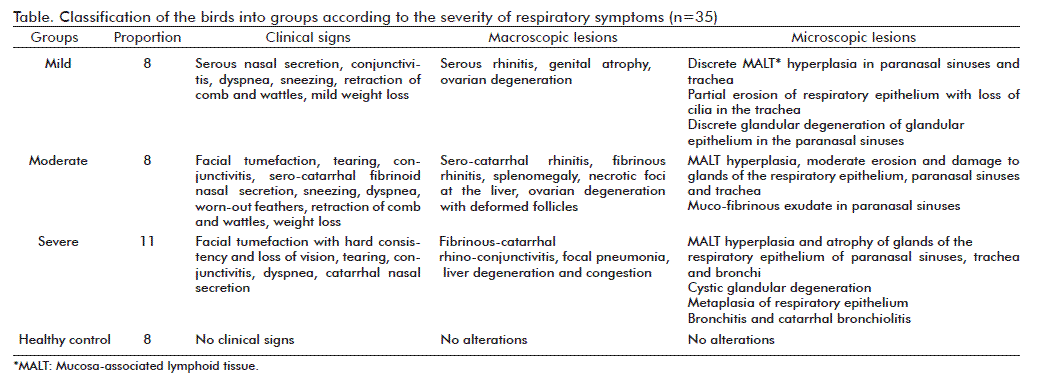
<body><![CDATA[<P   align="justify" ><font size="2" face="Verdana, Arial, Helvetica, sans-serif">The birds received      three doses of live vaccine (strain H120, Massachusetts serotype) at 1, 35      and 85 days of life, following the immunization program currently used in      the country [20]. </font></P >       <P   ><font size="2" face="Verdana, Arial, Helvetica, sans-serif"><b>Clinical examination      and sacrifice of the birds </b></font></P >       <P   align="justify" ><font size="2" face="Verdana, Arial, Helvetica, sans-serif">Both the clinical      examination and sacrifice of the birds followed the methodology described      by S&aacute;nchez [21]. Gross examinations were performed during necropsy,      scoring the severity of clinical manifestations and recording existing anatomopathological      lesions. The birds were then classified into four groups (apparently healthy,      mild, moderate and severe) according to the severity of the clinical-anatomopathological      alterations noticeable during gross examinations (<a href="/img/revistas/bta/v29n4/t0102412.gif">Table</a>).      </font></P >       
<P   ><font size="2" face="Verdana, Arial, Helvetica, sans-serif"><b>Sampling and sample      processing </b></font></P >       <P   ><font size="2" face="Verdana, Arial, Helvetica, sans-serif"><I><b>Organs for      the histopathological study </b></I></font></P >       <P   align="justify" ><font size="2" face="Verdana, Arial, Helvetica, sans-serif">Sample fragments      of paranasal sinuses, trachea and lung were extracted and stored in 4% formaldehyde      in saline phosphate buffer. The paranasal sinuses samples were softened by      placing them for 21 days in a decalcification solution. </font></P >       <P   ><font size="2" face="Verdana, Arial, Helvetica, sans-serif"><I><b>Organs for      the virological and molecular study </b></I></font></P >       <P   align="justify" ><font size="2" face="Verdana, Arial, Helvetica, sans-serif">Trachea and lung      fragments from three and four birds were taken and randomly pooled, per organ,      in two groups of four and one of three (from 11 birds in total). The pools      were stored at -20 &deg;C in sterile 50 mL plastic tubes without culture medium      until used. </font></P >       <P   ><font size="2" face="Verdana, Arial, Helvetica, sans-serif"><I><b>Histopathological      technique </b></I></font></P >       <P   align="justify" ><font size="2" face="Verdana, Arial, Helvetica, sans-serif">Fragments of paranasal      sinus, trachea and lungs stored in a solution of formaldehyde with saline      phosphate buffer at 4% were processed by inclusion into paraffin, sectioning      and staining with hematoxylin-eosin. In addition, they were also processed      with Schiff&rsquo;s non-enzymatic periodic acid histochemical staining (PAS),      as described by Vacca [22]. </font></P >       ]]></body>
<body><![CDATA[<P   ><font size="2" face="Verdana, Arial, Helvetica, sans-serif"><b>Quantification      of epithelial glands at the trachea of animals with respiratory processes      of varying severity </b></font></P >       <P   align="justify" ><font size="2" face="Verdana, Arial, Helvetica, sans-serif">This technique employed      35 tracheal rings from all 35 birds used in the study. Gland atrophy was determined      by histomorphometry of one ring from each trachea from animals falling into      different levels of the chronic respiratory syndrome classification scale,      based on the macroscopic clinical-anatomopathological characteristics described      above. </font></P >       <P   ><font size="2" face="Verdana, Arial, Helvetica, sans-serif"><b>Viral isolation      and molecular identification </b></font></P >       <P   align="justify" ><font size="2" face="Verdana, Arial, Helvetica, sans-serif">Samples of trachea      and lungs from 11 hens in groups of three and four birds were taken after      necropsy. These samples were processed and stored at -80 <Sup>o</Sup>C until      inoculated into chicken embryos. </font></P >   <FONT size="+1"><FONT size="+1">        <P   align="justify" ><font size="2" face="Verdana, Arial, Helvetica, sans-serif">Organ homogenates      were inoculated into 9 to 11 day-old chicken embryos, injecting 0.25 mL of      the sample into the allantoic cavity and using 10 embryos for each sample.      The embryos were incubated at 37 &deg;C, and their viability was checked daily.      At 72 h after inoculation, the allantoic fluid was collected, performing two      to three blind passages in chicken embryos. </font></P >       <P   align="justify" ><font size="2" face="Verdana, Arial, Helvetica, sans-serif">Allantoic fluid collected      from each passage was evaluated using an RT-PCR assay for IBV. </font></P >       <P   align="justify" ><font size="2" face="Verdana, Arial, Helvetica, sans-serif">Vaccine strain H120,      used in the immunization program currently implemented in Cuba [20], was used      as positive control. </font></P >       <P   ><font size="2" face="Verdana, Arial, Helvetica, sans-serif"><b>RNA extraction      </b></font></P >       <P   align="justify" ><font size="2" face="Verdana, Arial, Helvetica, sans-serif">RNA was extracted      using TRI Reagent<Sup>&reg; </Sup>LS, following the instructions from the      manufacturer (Sigma, USA). The obtained RNA was resuspended in 10 &mu;L of      nuclease-free water (Promega, USA). </font></P >   <FONT size="+1"><FONT size="+1">        <P   ><font size="2" face="Verdana, Arial, Helvetica, sans-serif"><b>RT-PCR </b></font></P >       ]]></body>
<body><![CDATA[<P   align="justify" ><font size="2" face="Verdana, Arial, Helvetica, sans-serif">Viral RNA in the      obtained RNA samples was detected with a semi-nested RT-PCR, using primers:      sense UTR 41 - 5&acute;ATG TCT ATC GCC AGG GAA ATG TC 3&acute;); antisense      UTR 11 - 5&acute; GCT CTA ACT CTA TAC TAG CCT A 3&acute; and UTR 31- 5&acute;      GGG CGT CCA AGT GCT GTA CCC 3&acute;. These primers bind to a region of the      3&acute; untranslated region (UTR) that is highly conserved across IBV genotypes      [23]. </font></P >       <P   ><font size="2" face="Verdana, Arial, Helvetica, sans-serif"><b>Statistical analysis      </b> </font></P >       <P   align="justify" ><font size="2" face="Verdana, Arial, Helvetica, sans-serif">The proportions of      the principal histopathological lesions were compared, and a one-way analysis      of variance (Anova) was performed to evaluate the loss of epithelial glands      at the trachea, as implemented in the statistical software packages Comprop-1      and Statgraphics Plus 5.1 (Statistical Graphics Corporation, USA). A statistical      significance level of p &lt; 0.05 was chosen for both analyses. </font></P >       <P   >&nbsp;</P >   <FONT size="+1"><B>        <P   ><font size="3" face="Verdana, Arial, Helvetica, sans-serif">RESULTS </font></P >   </B>        <P   align="justify" ><font size="2" face="Verdana, Arial, Helvetica, sans-serif">The main histological      changes in paranasal sinuses, trachea and lungs of laying hens, grouped according      to their score in classification scheme used during gross examinations, are      shown in the <a href="/img/revistas/bta/v29n4/t0102412.gif">table</a>. </font></P >   <FONT size="+1">        
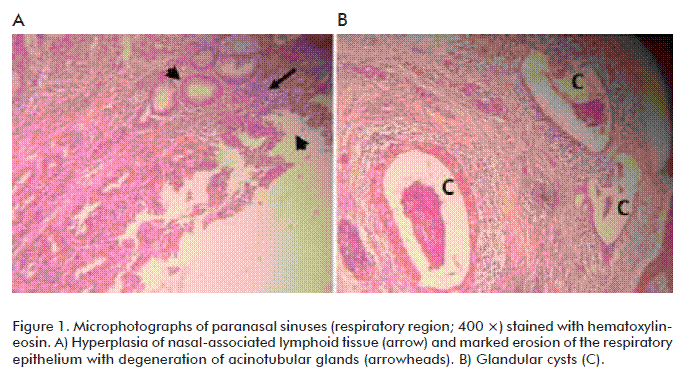
<P   align="justify" ><font size="2" face="Verdana, Arial, Helvetica, sans-serif">The respiratory epithelium      was markedly eroded, and there was degeneration of acinotubular glands. In      individuals classified as severe there were glandular cysts with mucous exudation      (<a href="/img/revistas/bta/v29n4/f0102412.gif">Figure 1</a>). </font></P >       
<P   align="justify" ><font size="2" face="Verdana, Arial, Helvetica, sans-serif">Another important      histopathological finding is the presence of hyperplastic acinotubular glands.      The latter are totally full of mucus, and secrete their contents into the      lumen with some degree of distension (<a href="/img/revistas/bta/v29n4/f0202412.gif">Figures 2A      and B</a>), as described in the <a href="/img/revistas/bta/v29n4/t0102412.gif">table</a>. </font></P >       
<P   align="justify" ><font size="2" face="Verdana, Arial, Helvetica, sans-serif">At the trachea there      was moderate loss of cilia and hyperplasia of the bronchus-associated lymphoid      tissue (BALT). In advanced stages of the respiratory infection there was also      metaplasia of the cylindrical pseudostratified epithelium to flat cells, with      submucosal engrossment (<a href="/img/revistas/bta/v29n4/f0202412.gif">Figures 2C and D</a>). </font></P >       
<P   align="justify" ><font size="2" face="Verdana, Arial, Helvetica, sans-serif">Histopathological      analysis of the respiratory system also revealed changes in bronchi, such      as BALT hyperplasia and a catarrhal exudative inflammatory response both in      epithelial glands and the bronchial lumen (<a href="/img/revistas/bta/v29n4/f0202412.gif">Figures      2E and F</a>). </font></P >       
]]></body>
<body><![CDATA[<P   align="justify" ><font size="2" face="Verdana, Arial, Helvetica, sans-serif">Upon analysis of      PAS-stained sections of the respiratory epithelium of paranasal sinuses, trachea      and bronchi, it was possible to confirm the presence of catarrhal exudates      (mucous; <a href="/img/revistas/bta/v29n4/f0302412.gif">figure 3</a>). </font></P >       
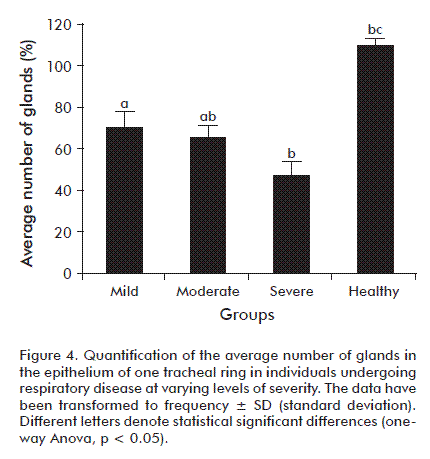
<P   align="justify" ><font size="2" face="Verdana, Arial, Helvetica, sans-serif">There were statistically      significant differences regarding the degree of epithelial gland loss in the      tracheal rings of groups exhibiting the clinical-pathological alterations      of chronic respiratory disease when compared to the control group, which had      no apparent alterations. The third group (severe) exhibited the highest pathological      significance (<a href="#fig4">Figure 4</a>). </font></P >       <P   align="center" ><img src="/img/revistas/bta/v29n4/f0402412.gif" width="428" height="457"><a name="fig4"></a></P >       
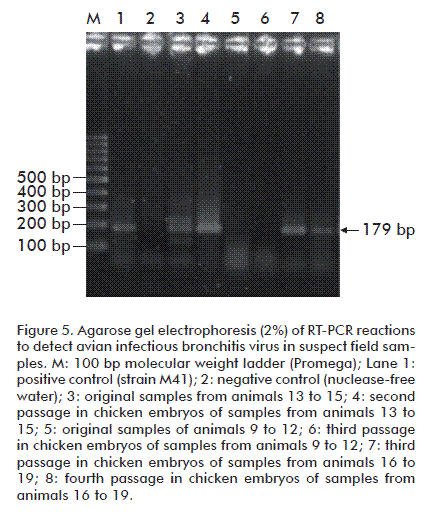
<P   align="justify" ><font size="2" face="Verdana, Arial, Helvetica, sans-serif">The viral isolation      assays employing three successive passes in chicken embryos produced symptoms      not unlike those of IBV when infecting adult individuals: mortality, stunted      growth and hemorrhagic embryos. Successful viral isolation was confirmed by      RT-PCR analysis of clinical samples, which produced amplicons whose relative      electrophoretic mobility (179 bp) matched that expected for the employed primers      (<a href="#fig5">Figure 5</a>). </font></P >       <P   align="center" ><img src="/img/revistas/bta/v29n4/f0502412.gif" width="425" height="510"><a name="fig5"></a></P >       
<P   align="justify" >&nbsp;</P >       <P   > </P >   <FONT size="+1"><B>        <P   ><font size="3" face="Verdana, Arial, Helvetica, sans-serif">DISCUSSION </font></P >   </B>        <P   align="justify" ><font size="2" face="Verdana, Arial, Helvetica, sans-serif">Avian bronchitis      virus infection starts in the upper respiratory system, where it induces the      secretion of mucus by goblet cells at the mucosal epithelium [24]. Most strains      of this virus are able to replicate in the upper respiratory tract without      producing apparent clinical signs. When clinical signs are present, the progression      of lesions in this system is divided in three stages: degenerative, hyperplastic      and regenerative<Sup> </Sup>[25]. The severity of histopathological findings      paralleled the scale based on clinical signs used to classify the groups with      respiratory infection (mild, moderate and severe). Some of the most conspicuous      findings include the erosion of the epithelium with degenerative damage of      paranasal sinus glands, BALT hyperplasia, and glandular hyperplasia with mucus      hypersecretion throughout the respiratory epithelium with loss of cilia (paranasal      sinuses, trachea and primary bronchi). The latter microscopic alterations,      specifically those in the trachea, are defense mechanisms due to ciliary movement      and the exudation of mucus by goblet cells during IBV infection [26]. These      alterations, which characterize the acute stage of the disease, can be easily      observed in the trachea by electron microscopy due to the anatomical simplicity      of this organ [9]. </font></P >   <FONT size="+1"><FONT size="+1"><FONT size="+1">        <P   align="justify" ><font size="2" face="Verdana, Arial, Helvetica, sans-serif">Virulent strains      of IBV produce epithelial damage, loss of cilia and hyperplasia. These effects      predispose the individual to coinfections with opportunistic pathogens, such      as Escherichia coli [27]. This enterobacterium often aggravates respiratory      disease, leading in many cases to the death of infected individuals [28].      </font></P >       ]]></body>
<body><![CDATA[<P   align="justify" ><font size="2" face="Verdana, Arial, Helvetica, sans-serif">Another important      histopathological finding is the presence of epithelial metaplasia, with characteristics      resembling those of flat cells, and the engrossment of tracheal submucosa.      These results coincide with those of an earlier study published in 2003 [29].      </font></P >       <P   align="justify" ><font size="2" face="Verdana, Arial, Helvetica, sans-serif">Controlling IBV infections      through vaccination is difficult and not always successful, due to the continuous      emergence of new viral serotypes and variants exhibiting very low levels of      cross-protection [30, 31]. The origin of this antigenic variation is multifactorial,      and includes among its causes the selective immunological pressure exerted      by the widespread application of vaccines, the high frequency of coinfections      &ndash;leading to recombination events as an additional source of variation&ndash;      and the disappearance of once dominant serotypes due to vaccination, followed      by their replacement by different field strains [32, 33]. </font></P >       <P   align="justify" ><font size="2" face="Verdana, Arial, Helvetica, sans-serif">Many different IBV      vaccines -mostly against variants of the Massachusetts strain- have been developed      internationally, and their efficacy in broilers and laying hens has been well      studied. Most of them, however, are prone to causing the disease themselves,      and the protection they provide is poor or nil [34], as reported in 1992 for      the DE 072 [35, 36] and GA98 [37, 38] variants in the USA. A single group      of IBV has been described in Brazil, subdivided in three subgroups together      with genotype 4/91 [39-41]. Variants of the Massachusetts strains were also      reported in Chile during the 1980s [42], while the Dutch serotypes (D207,      D212, D3896 and D3128) have been described in Europe [43]. An IBV strain was      isolated in 1980 in Africa and found to be responsible for severe respiratory      problems [39, 44]. Additional Massachusetts strain variants were serotyped      for Israel, during the mid 1990s [13, 45, 46]<Sup> </Sup>and other IBV variants      were described in Korea during the mid 1980s [47]. Although a Massachusetts      strain-based vaccine was used with good results in the latter case, its success      was short-lived, as outbreaks of infectious bronchitis, with a high incidence      of renal complications, have been taking place since 1990 in vaccinated flocks      from Korea. One possible cause was uncovered by Lee <I>et al</I>., who found      a high degree of genetic diversity among the IBV variants isolated from the      diseased animals [48]. Some of these variants are indigenous, while others      are genetically related to IBV variants in neighboring countries [47], suggesting      that IBV strains in Korea are evolving continuously [49]. In the case of Cuba,      the results suggest that other, yet to be studied variants or serotypes of      the Massachusetts strain may be currently circulating. </font></P >   <FONT size="+1"><FONT size="+1">        <P   align="justify" ><font size="2" face="Verdana, Arial, Helvetica, sans-serif">Risk of HBV infection      is also influenced by other factors, such as complete or partial vaccine coverage      failures, lower vaccine efficacy against heterologous strains, presence of      immunosuppressive agents, inadequate immunization schedules, improper immunization      technique, variations in immunization technique (for instance, in the amount,      quality and temperature of the water used to dilute the vaccine, or in the      inoculated dose); and the use of vaccine combinations against different agents      [50, 51]. </font></P >       <P   align="justify" ><font size="2" face="Verdana, Arial, Helvetica, sans-serif">In this work, it      was possible to isolate and identify the IBV in hens, starting from the evaluation      of histopathological findings in the respiratory system. Some authors state      that it is not always possible to identify IBV in flocks for several reasons.      One possible cause is the appearance of viral mutations, due not only to point      nucleotide changes or insertions/deletions, but to recombination events between      unrelated strains, whose frequency is significant due to the common occurrence      of IBV coinfections in chicken<Sup> </Sup>[23, 52]. Although such hybrid or      chimeric viruses will sometimes replicate better, the existence of differences      in genetic regions is highly probable [53]. Another possible cause is the      movement of flocks and the mixing of layer hen batches, which together propitiate      coinfections by unrelated strains and thus, the occurrence of recombination      events between separate IBV lineages. </font></P >   <FONT size="+1"><FONT size="+1">        <P   align="justify" ><font size="2" face="Verdana, Arial, Helvetica, sans-serif">Summarizing, the      present work described the histopathological changes in the epithelium of      paranasal sinuses, trachea and bronchi of egg-laying hens affected by the      infectious bronchitis coronavirus, as confirmed by viral isolation in chicken      embryos and identification by RT-PCR. </font></P >       <P   align="justify" >&nbsp;</P >       <P   align="justify" > </P >       <P   ><font size="3" face="Verdana, Arial, Helvetica, sans-serif"><B>ACKNOWLEDGEMENTS      </b></font></P >   <FONT size="+1">        <P   align="justify" ><font size="2" face="Verdana, Arial, Helvetica, sans-serif">The authors would      like to thank Dr. C. Nelson Merino Garc&iacute;a for his support to the technical      personnel of the Anatomical Pathology area during the preparation of clinical-pathological      samples and for help with histopathological interpretation, as well as histologist      Jos&eacute; Su&aacute;rez Alba from the Center for Genetic Engineering and      Biotechnology for the H/E stains and the non-enzymatic histochemical technique      used in the present study. </font></P >       ]]></body>
<body><![CDATA[<P   align="justify" >&nbsp;</P >   <FONT size="+1">        <P   align="justify" > </P >       <P   align="justify" ><b><font size="3" face="Verdana, Arial, Helvetica, sans-serif">REFERENCES </font></b></P >       <!-- ref --><P   align="justify" ><font size="2" face="Verdana, Arial, Helvetica, sans-serif">1. Parra T. La calidad      de la materia prima y el alimento terminado. Rev Acontecer Av&iacute;cola.      1999;7(50):26-8.     </font></P >   <FONT size="+1">        <!-- ref --><P   align="justify" ><font size="2" face="Verdana, Arial, Helvetica, sans-serif">2. Chapter 3. Vaccination.      In: Alexander DJ, Bell JG, Alders RG, editors. A technology review: Newcastle      disease with special emphasis on its effect on village chickens. Rome: Food      and Agriculture Organization of the United Nations; 2004. p. 16-22.     </font></P >       <!-- ref --><P   align="justify" ><font size="2" face="Verdana, Arial, Helvetica, sans-serif">3. De Groot RJ, Ziebuhr      J, Poon LL, Woo PC, Talbot P, Rottier PJM, et al. Revision of the family Coronaviridae      Taxonomic proposal to the Coronavirus Study Group to the ICTV Executive Committee;      2008 [cited 2011 Nov 18]. Available from <A href="http://talk.ictvonline.org/media/p/1230.aspx" target="_blank">      <FONT color="#0000FF">http://talk.ictvonline.org/media/p/1230.aspx</font></A><FONT color="#0000FF"><FONT color="#000000">.          </font></font></font></P >   <FONT color="#0000FF"><FONT color="#000000">        <!-- ref --><P   align="justify" ><font size="2" face="Verdana, Arial, Helvetica, sans-serif">4. Wang L, Xu Y,      Collisson EW. Experimental confirmation of recombination upstream of the S1      hypervariable region of infectious bronchitis virus. Virus Res. 1997;49(2):139-45.          </font></P >       <P   align="justify" ><font size="2" face="Verdana, Arial, Helvetica, sans-serif">5. Cavanagh D, Gelb      J. Infectious bronchitis. In: Diseases of poultry. Saif YM, Fadly AM, Glisson      JR, McDougald LR, Nolan LK, Swayne DE, editors. Oxford: Wiley-Blackwell; 2008.      p. 117-35. </font></P >       <!-- ref --><P   align="justify" ><font size="2" face="Verdana, Arial, Helvetica, sans-serif">6. Ziegler AF, Ladman      BS, Dunn PA, Schneider A, Davison S, Miller PG, et al. Nephropathogenic infectious      bronchitis in Pennsylvania chickens 1997-2000. Avian Dis. 2002;46(4):847-58.          </font></P >       <!-- ref --><P   align="justify" ><font size="2" face="Verdana, Arial, Helvetica, sans-serif">7. Zanella A, Lavazza      A, Marchi R, Moreno Martin A, Paganelli F. Avian infectious bronchitis: characterization      of new isolates from Italy. Avian Dis. 2003;47(1):180-5.     </font></P >       <P   align="justify" ><font size="2" face="Verdana, Arial, Helvetica, sans-serif">8. Valencia B. Bronquitis      infecciosa: soluciones pr&aacute;cticas [Internet]. In: Asociaci&oacute;n      de M&eacute;dicos Veterinarios Especialistas en Avicultura del Ecuador, editores.      Memorias Congreso Nacional de Avicultura; 2007 [cited 2010 Feb 16]. Available      from: <A href="http://www.amevea-ecuador.org/memorias.htm" target="_blank">      <FONT color="#0000FF">http://www.amevea-ecuador.org/memorias.htm</font></A><FONT color="#0000FF"><FONT color="#000000">.      </font></font></font></P >   <FONT color="#0000FF"><FONT color="#000000">        <P   align="justify" ><font size="2" face="Verdana, Arial, Helvetica, sans-serif">9. Lamazares-P&eacute;rez      MC. Algunos aspectos de la epizootiolog&iacute;a y de diagn&oacute;stico del      complejo respiratorio cr&oacute;nico de las aves en Cuba [dissertation]. Tesis      de Doctorado. Ko&scaron;ice: Escuela Superior de Veterinaria de Ko&scaron;ice;      1987. </font></P >       <P   align="justify" ><font size="2" face="Verdana, Arial, Helvetica, sans-serif">10. Jordan FTW. Bronquitis      infecciosa. In: Jordan FTW, Pattison M, editors. Enfermedades de las aves.      3rd. ed. M&eacute;xico: El Manual Moderno, S.A.; 1998. p. 171-7. </font></P >       <!-- ref --><P   align="justify" ><font size="2" face="Verdana, Arial, Helvetica, sans-serif">11. De Wit JJ. Detection      of infectious bronchitis virus. Avian Pathol. 2000;29(2):71-93.     </font></P >       <!-- ref --><P   align="justify" ><font size="2" face="Verdana, Arial, Helvetica, sans-serif">12. Kant A, Koch      G, van Roozelaar DJ, Kusters JG, Poelwijk FA, van der Zeijst BA. Location      of antigenic sites defined by neutralizing monoclonal antibodies on the S1      avian infectious bronchitis virus glycopolypeptide. J Gen Virol. 1992;73(Pt      3):591-6.     </font></P >       <!-- ref --><P   align="justify" ><font size="2" face="Verdana, Arial, Helvetica, sans-serif">13. Meir R, Rosenblut      E, Perl S, Kass N, Ayali G, Perk S, et al. Identification of a novel nephropathogenic      infectious bronchitis virus in Israel. Avian Dis. 2004;48(3):635-41.     </font></P >       <!-- ref --><P   align="justify" ><font size="2" face="Verdana, Arial, Helvetica, sans-serif">14. Stachowiak B,      Key DW, Hunton P, Gillingham S, Nagy &Eacute;. Infectious bronchitis virus      surveillance in Ontario commercial layer flocks. J Appl Poult Res. 2005;14:141-6.          </font></P >       <!-- ref --><P   align="justify" ><font size="2" face="Verdana, Arial, Helvetica, sans-serif">15. Grgic H, Hunter      DB, Hunton P, Nagy E. Vaccine efficacy against Ontario isolates of infectious      bronchitis virus. Can J Vet Res. 2009;73(3):212-6.     </font></P >       <!-- ref --><P   align="justify" ><font size="2" face="Verdana, Arial, Helvetica, sans-serif">16. Cowen BS, Hitchner      SB. Serotyping of avian infectious bronchitis viruses by the virus-neutralization      test. Avian Dis. 1975;19(3):583-95.     </font></P >       <!-- ref --><P   align="justify" ><font size="2" face="Verdana, Arial, Helvetica, sans-serif">17. Cavanagh D. Severe      acute respiratory syndrome vaccine development: experiences of vaccination      against avian infectious bronchitis coronavirus. Avian Pathol. 2003; 32(6):567-82.          </font></P >       <!-- ref --><P   align="justify" ><font size="2" face="Verdana, Arial, Helvetica, sans-serif">18. Viamontes O.      Impacto econ&oacute;mico de una adecuada estrategia de inmunizaci&oacute;n      contra la enfermedad de Newcastle. In: Memorias del V Congreso de Avicultura;      2006 Mar 11-13: La Habana, Cuba. La Habana: Instituto de Investigaciones Av&iacute;colas;      2006. Available from: <A href="http://www.iia.cu/congreso/seminario.htm" target="_blank">      <FONT color="#0000FF">http://www.iia.cu/congreso/seminario.htm</font></A><FONT color="#0000FF"><FONT color="#000000">.          </font></font></font></P >   <FONT color="#0000FF"><FONT color="#000000">        <!-- ref --><P   align="justify" ><font size="2" face="Verdana, Arial, Helvetica, sans-serif">19. Cuello S, Noda      J, Alfonso P, Perera CL. Bronquitis Infecciosa Aviar. Cin&eacute;tica de anticuerpos      posvacunales en reproductoras y su transferencia a la progenie. Rev Salud      Anim. 2004;26(1):42-7.     </font></P >       <P   align="justify" ><font size="2" face="Verdana, Arial, Helvetica, sans-serif">20. Uni&oacute;n      de Empresas del Combinado Av&iacute;cola Nacional. Instructivo t&eacute;cnico      para el manejo de las galinas ponedoras y sus reemplazos. La Habana: Instituto      de Investigaciones Av&iacute;colas, Ministerio de Salud P&uacute;blica; 2007.      </font></P >       <P   align="justify" ><font size="2" face="Verdana, Arial, Helvetica, sans-serif">21. S&aacute;nchez      A. Asistencia veterinaria a unidades av&iacute;colas de producci&oacute;n.      S&aacute;nchez A. Manual de Enfermedades de las Aves. La Habana: Editorial      F&eacute;lix Varela; 1990. p. 5-100. </font></P >       <!-- ref --><P   align="justify" ><font size="2" face="Verdana, Arial, Helvetica, sans-serif">22. Vacca LL. Laboratory      manual of histochemistry. New York: Raven Press; 1985.     </font></P >       <!-- ref --><P   align="justify" ><font size="2" face="Verdana, Arial, Helvetica, sans-serif">23. Cavanagh D, Mawditt      K, Welchman Dde B, Britton P, Gough RE. Coronaviruses from pheasants (Phasianus      colchicus) are genetically closely related to coronaviruses of domestic fowl      (infectious bronchitis virus) and turkeys. Avian Pathol. 2002;31(1):81-93.          </font></P >       <!-- ref --><P   align="justify" ><font size="2" face="Verdana, Arial, Helvetica, sans-serif">24. Raj GD, Jones      RC. Infectious bronchitis virus: Immunopathogenesis of infection in the chicken.      Avian Pathol. 1996;26(4):677-706.     </font></P >       <!-- ref --><P   align="justify" ><font size="2" face="Verdana, Arial, Helvetica, sans-serif">25. Cunnigham CH.      Avian infectious bronchitis virus isolation and identification. International      symposium on requeriments for poultry standard vaccines. Develop Boil Standard.      1974;25:211-8.     </font></P >       <P   align="justify" ><font size="2" face="Verdana, Arial, Helvetica, sans-serif">26. Rodrigo VA. Infecci&oacute;n      experimental con Escherichia coli y virus de la bronquitis infecciosa en pollos      libres de pat&oacute;genos espec&iacute;ficos [dissertation]. Tesis de grado      en Medicina Veterinaria; Valdivia: Instituto de Patolog&iacute;a Animal, Universidad      Austrial de Chile; 2006. </font></P >       <!-- ref --><P   align="justify" ><font size="2" face="Verdana, Arial, Helvetica, sans-serif">27. Peighambari SM,      Julian RJ, Gyles CL. Experimental Escherichia coli respiratory infection in      broilers. Avian Dis. 2000;44(4):759-69.     </font></P >       ]]></body>
<body><![CDATA[<!-- ref --><P   align="justify" ><font size="2" face="Verdana, Arial, Helvetica, sans-serif">28. Vandekerchove      D, Herdt PD, Laevens H, Butaye P, Meulemans G, Pasmans F. Significance of      interactions between Escherichia coli and respiratory pathogens in layer hen      flocks suffering from colibacillosis-associated mortality. Avian Pathol. 2004;33(3):298-302.          </font></P >       <!-- ref --><P   align="justify" ><font size="2" face="Verdana, Arial, Helvetica, sans-serif">29. Brett M, De Noguera      C, Quiroz C, De Rolo M, Herrera A, Mart&iacute;nez J. Aislamiento e identificaci&oacute;n      de tres cepas nefropat&oacute;genas del virus de bronquitis infecciosa aviar      en la regi&oacute;n central de Venezuela. Veterinaria Trop. 2003;28(1):63-77.          </font></P >       <!-- ref --><P   align="justify" ><font size="2" face="Verdana, Arial, Helvetica, sans-serif">30. Cavanagh D, Naqi      S. Infectious Bronchitis. In: Calnek BW, Barnes HJ, Beard CW. Diseases of      poultry. 11th ed. Ames: Iowa State University Press; 2003. p. 101-19.     </font></P >       <!-- ref --><P   align="justify" ><font size="2" face="Verdana, Arial, Helvetica, sans-serif">31. Cavanagh D. Coronavirus      avian infectious bronchitis virus. Vet Res. 2007;38(2):281-97.     </font></P >       <!-- ref --><P   align="justify" ><font size="2" face="Verdana, Arial, Helvetica, sans-serif">32. Lee CW. Evolution      of avian infectious bronchitis virus: genetic drift and recombination. Korean      J Vet Serv. 2002;25:87-96.     </font></P >       ]]></body>
<body><![CDATA[<!-- ref --><P   align="justify" ><font size="2" face="Verdana, Arial, Helvetica, sans-serif">33. Liu SW, Zhang      QX, Chen JD, Han ZX, Liu X, Feng L, et al. Genetic diversity of avian infectious      bronchitis coronavirus strains isolated in China between 1995 and 2004. Arch      Virol. 2006;151(6):1133-48.     </font></P >       <!-- ref --><P   align="justify" ><font size="2" face="Verdana, Arial, Helvetica, sans-serif">34. Wit JJ de, Cook      JKA, van der Heijden HMJF. Infectious bronchitis virus in Asia, Africa, Australia      and Latin America - History, current situation and control measures. Rev Bras      Cienc Avic. 2010;12(2):97-106.     </font></P >       <!-- ref --><P   align="justify" ><font size="2" face="Verdana, Arial, Helvetica, sans-serif">35. Gelb J Jr, Keeler      CL Jr, Nix WA, Rosenberger JK, Cloud SS. Antigenic and S-1 genomic characterization      of the Delaware variant serotype of infectious bronchitis virus. Avian Dis.      1997;41(3):661-9.     </font></P >       <!-- ref --><P   align="justify" ><font size="2" face="Verdana, Arial, Helvetica, sans-serif">36. Lee CW, Hilt      DA, Jackwood MW. Identification and analysis of the Georgia 98 serotype, a      new serotype of infectious bronchitis virus. Avian Dis. 2001;45(1):164-72.          </font></P >       <!-- ref --><P   align="justify" ><font size="2" face="Verdana, Arial, Helvetica, sans-serif">37. Jackwood MW,      Hilt DA, Sellers HS, Williams SM, Lasher HN. Rapid heat-treatment attenuation      of infectious bronchitis virus. Avian Pathol. 2010;39(3):227-33.     </font></P >       ]]></body>
<body><![CDATA[<!-- ref --><P   align="justify" ><font size="2" face="Verdana, Arial, Helvetica, sans-serif">38. Hidalgo H, Gallardo      R, Rosende S. Isolation of infectious bronchitis virus from broiler chickens      in Chile. Avian Dis. 1976;20(3):601-3.     </font></P >       <!-- ref --><P   align="justify" ><font size="2" face="Verdana, Arial, Helvetica, sans-serif">39. Cook JKA, Orbell      SJ, Woods MA, Huggins MB. Breadth of protection of the respiratory tract provided      by different live-attenuated infectious bronchitis vaccines against challenge      with infectious bronchitis viruses of heterologous serotypes. Avian Pathol.      1999;28(5):477-85.     </font></P >       <!-- ref --><P   align="justify" ><font size="2" face="Verdana, Arial, Helvetica, sans-serif">40. Di Fabio J, Rossini      LI, Orbell SJ, Paul G, Huggins MB, Malo A, et al. Characterization of infectious      bronchitis viruses isolated from outbreaks of disease in commercial flocks      in Brazil. Avian Dis. 2000;44(3):582-9.     </font></P >       <!-- ref --><P   align="justify" ><font size="2" face="Verdana, Arial, Helvetica, sans-serif">41. Villarreal LY,      Sandri TL, Souza SP, Richtzenhain LJ, de Wit JJ, Brandao PE. Molecular epidemiology      of avian infectious bronchitis in Brazil from 2007 to 2008 in breeders, broilers,      and layers. Avian Dis. 2010;54(2):894-8.     </font></P >       <!-- ref --><P   align="justify" ><font size="2" face="Verdana, Arial, Helvetica, sans-serif">42. Cubillos A, Ulloa      J, Cubillos V, Cook JK. Characterisation of strains of infectious bronchitis      virus isolated in Chile. Avian Pathol. 1991;20(1):85-99.     </font></P >       ]]></body>
<body><![CDATA[<!-- ref --><P   align="justify" ><font size="2" face="Verdana, Arial, Helvetica, sans-serif">43. Davelaar FG,      Kouwenhoven B, Burger AG. Occurrence and significance of infectious bronchitis      virus variant strains in egg and broiler production in the Netherlands. Vet      Q 1984;6(3):114-20.     </font></P >       <!-- ref --><P   align="justify" ><font size="2" face="Verdana, Arial, Helvetica, sans-serif">44. Morley AJ, Thomson      DK. Swollen-head syndrome in broiler chickens. Avian Dis. 1984;28(1):238-43.          </font></P >       <P   align="justify" ><font size="2" face="Verdana, Arial, Helvetica, sans-serif">45. Meir R, Malkinson      M, Weisman Y. Characterization of IBV isolates in Israel using RT-PCR and      RFLP. In: Kaleta EF, Heffels-Redmann U, editors. Proceedings of the International      Symposium on Infectious Bronchitis and Pneumovirus Infections in Poultry;      1998 Jun 15-18; Rauischholzhausen, Germany. Giessen: Institut f&uuml;r Gefl&uuml;gelkrankheiten.      1998. p. 229-34. </font></P >       <!-- ref --><P   align="justify" ><font size="2" face="Verdana,    <!-- ref --> Arial, Helvetica, sans-serif">46. Callison SA,      Jackwood MW, Hilt DA. Molecular characterization of infectious bronchitis      virus isolates foreign to the United States and comparison with United States      isolates. Avian Dis. 2001;45(2):492-9.     </font></P >       <!-- ref --><P   align="justify" ><font size="2" face="Verdana, Arial, Helvetica, sans-serif">47. Song CS, Lee      YJ, Kim JH, Sung HW, Lee CW, Izumiya Y, et al. Epidemiological classification      of infectious bronchitis virus isolated in Korea between 1986 and 1997. Avian      Pathol. 1998;27(4):409-16.     </font></P >       ]]></body>
<body><![CDATA[<!-- ref --><P   align="justify" ><font size="2" face="Verdana, Arial, Helvetica, sans-serif">48. Lee SK, Sung      HW, Kwon HM. S1 glycoprotein gene analysis of infectious bronchitis viruses      isolated in Korea. Arch Virol. 2004;149(3):481-94.     </font></P >       <P   align="justify" ><font size="2" face="Verdana, Arial, Helvetica, sans-serif">49. Lee EK, Jeon      WJ, Lee YJ, Jeong OM, Choi JG, Kwon JH, Choi KS. Genetic diversity of avian      infectious bronchitis virus isolates in Korea between 2003 and 2006. Avian      Dis. 2008;52:332-7. </font></P >       <!-- ref --><P   align="justify" ><font size="2" face="Verdana, Arial, Helvetica, sans-serif">50. Jang JH, Sung      HW, Song CS, Kwon HM. Sequence analysis of the S1 glycoprotein gene of infectious      bronchitis viruses: identification of a novel phylogenetic group in Korea.      J Vet Sci. 2007;8(4):401-7.     </font></P >       <!-- ref --><P   align="justify" ><font size="2" face="Verdana, Arial, Helvetica, sans-serif">51. Jackwood MW,      Hilt DA, McCall AW, Polizzi CN, McKinley ET, Williams SM. Infectious bronchitis      virus field vaccination coverage and persistence of Arkansas-type viruses      in commercial broilers. Avian Dis. 2009;53(2):175-83.     </font></P >       <!-- ref --><P   align="justify" ><font size="2" face="Verdana, Arial, Helvetica, sans-serif">52. Cavanagh D, Mawditt      K, Britton P, Naylor CJ. Longitudinal field studies of infectious bronchitis      virus and avian pneumovirus in broilers using type-specific polymerase chain      reactions. Avian Pathol. 1999;28(6):593-605.     </font></P >       <!-- ref --><P   align="justify" ><font size="2" face="Verdana, Arial, Helvetica, sans-serif">53. Meulemans G,      Boschmans M, Decaesstecker M, Berg TP, Denis P, Cavanagh D. Epidemiology of      infectious bronchitis virus in Belgian broilers: a retrospective study, 1986      to 1995. Avian Pathol. 2001;30(4):411-21.     </font></P >   <FONT size="+1">        <P   align="justify" > </P >       <P   align="justify" > </P >       <P   align="justify" >&nbsp;</P >       <P   align="justify" >&nbsp;</P >       <P   align="justify" ><font size="2" face="Verdana, Arial, Helvetica, sans-serif">Received in November,      2011.     <br>     </font><font size="2" face="Verdana, Arial, Helvetica, sans-serif">Accepted      in June, 2012. </font></P >       <P   align="justify" >&nbsp;</P >       <P   align="justify" >&nbsp;</P >       <P   align="justify" > </P >       ]]></body>
<body><![CDATA[<P   align="justify" > </P >       <P   align="justify" ><font size="2" face="Verdana, Arial, Helvetica, sans-serif"><I>Manuel Col&aacute;s</I>.      Laboratorio de Investigaci&oacute;n y Diagn&oacute;stico Aviar, Lida, Instituto      de Investigaciones Av&iacute;colas, IIA. Ave. 361, No. 16632 entre 166&ordf;      y 184, Reparto Mulgoba, Boyeros, CP 19290, La Habana, Cuba. E-mail: <A href="mailto:lamaz@isch.edu.cu">      <FONT color="#0000FF">lamaz@isch.edu.cu</font></A><FONT color="#0000FF"><FONT color="#000000">.      </font></font></font></P >   </font></font></font></font></font></font></font></font></font></font></font></font></font></font></font></font></font></font></font></font></font></font></font></font></font></font></font></font></font></font></font></font></font></font></font></font></font></font></font></font></font></font></font></font></font></font></font></font></font></font></DIV >      ]]></body><back>
<ref-list>
<ref id="B1">
<label>1</label><nlm-citation citation-type="journal">
<person-group person-group-type="author">
<name>
<surname><![CDATA[Parra]]></surname>
<given-names><![CDATA[T]]></given-names>
</name>
</person-group>
<article-title xml:lang="es"><![CDATA[La calidad de la materia prima y el alimento terminado]]></article-title>
<source><![CDATA[Rev Acontecer Avícola]]></source>
<year>1999</year>
<volume>7</volume>
<numero>50</numero>
<issue>50</issue>
<page-range>26-8</page-range></nlm-citation>
</ref>
<ref id="B2">
<label>2</label><nlm-citation citation-type="book">
<article-title xml:lang="en"><![CDATA[Chapter 3. Vaccination]]></article-title>
<person-group person-group-type="author">
<name>
<surname><![CDATA[Alexander]]></surname>
<given-names><![CDATA[DJ]]></given-names>
</name>
<name>
<surname><![CDATA[Bell]]></surname>
<given-names><![CDATA[JG]]></given-names>
</name>
<name>
<surname><![CDATA[Alders]]></surname>
<given-names><![CDATA[RG]]></given-names>
</name>
</person-group>
<source><![CDATA[A technology review: Newcastle disease with special emphasis on its effect on village chickens]]></source>
<year>2004</year>
<page-range>16-22</page-range><publisher-loc><![CDATA[Rome ]]></publisher-loc>
<publisher-name><![CDATA[Food and Agriculture Organization of the United Nations]]></publisher-name>
</nlm-citation>
</ref>
<ref id="B3">
<label>3</label><nlm-citation citation-type="">
<person-group person-group-type="author">
<name>
<surname><![CDATA[De Groot]]></surname>
<given-names><![CDATA[RJ]]></given-names>
</name>
<name>
<surname><![CDATA[Ziebuhr]]></surname>
<given-names><![CDATA[J]]></given-names>
</name>
<name>
<surname><![CDATA[Poon]]></surname>
<given-names><![CDATA[LL]]></given-names>
</name>
<name>
<surname><![CDATA[Woo]]></surname>
<given-names><![CDATA[PC]]></given-names>
</name>
<name>
<surname><![CDATA[Talbot]]></surname>
<given-names><![CDATA[P]]></given-names>
</name>
<name>
<surname><![CDATA[Rottier]]></surname>
<given-names><![CDATA[PJM]]></given-names>
</name>
</person-group>
<source><![CDATA[Revision of the family Coronaviridae Taxonomic proposal to the Coronavirus Study Group to the ICTV Executive Committee]]></source>
<year>2008</year>
</nlm-citation>
</ref>
<ref id="B4">
<label>4</label><nlm-citation citation-type="journal">
<person-group person-group-type="author">
<name>
<surname><![CDATA[Wang]]></surname>
<given-names><![CDATA[L]]></given-names>
</name>
<name>
<surname><![CDATA[Xu]]></surname>
<given-names><![CDATA[Y]]></given-names>
</name>
<name>
<surname><![CDATA[Collisson]]></surname>
<given-names><![CDATA[EW]]></given-names>
</name>
</person-group>
<article-title xml:lang="en"><![CDATA[Experimental confirmation of recombination upstream of the S1 hypervariable region of infectious bronchitis virus]]></article-title>
<source><![CDATA[Virus Res]]></source>
<year>1997</year>
<volume>49</volume>
<numero>2</numero>
<issue>2</issue>
<page-range>139-45</page-range></nlm-citation>
</ref>
<ref id="B5">
<label>5</label><nlm-citation citation-type="book">
<person-group person-group-type="author">
<name>
<surname><![CDATA[Cavanagh]]></surname>
<given-names><![CDATA[D]]></given-names>
</name>
<name>
<surname><![CDATA[Gelb]]></surname>
<given-names><![CDATA[J]]></given-names>
</name>
</person-group>
<article-title xml:lang="en"><![CDATA[Infectious bronchitis]]></article-title>
<person-group person-group-type="editor">
<name>
<surname><![CDATA[Saif]]></surname>
<given-names><![CDATA[YM]]></given-names>
</name>
<name>
<surname><![CDATA[Fadly]]></surname>
<given-names><![CDATA[AM]]></given-names>
</name>
<name>
<surname><![CDATA[Glisson]]></surname>
<given-names><![CDATA[JR]]></given-names>
</name>
<name>
<surname><![CDATA[McDougald]]></surname>
<given-names><![CDATA[LR]]></given-names>
</name>
<name>
<surname><![CDATA[Nolan]]></surname>
<given-names><![CDATA[LK]]></given-names>
</name>
<name>
<surname><![CDATA[Swayne]]></surname>
<given-names><![CDATA[DE]]></given-names>
</name>
</person-group>
<source><![CDATA[Diseases of poultry]]></source>
<year>2008</year>
<page-range>117-35</page-range><publisher-loc><![CDATA[Oxford ]]></publisher-loc>
<publisher-name><![CDATA[Wiley-Blackwell]]></publisher-name>
</nlm-citation>
</ref>
<ref id="B6">
<label>6</label><nlm-citation citation-type="journal">
<person-group person-group-type="author">
<name>
<surname><![CDATA[Ziegler]]></surname>
<given-names><![CDATA[AF]]></given-names>
</name>
<name>
<surname><![CDATA[Ladman]]></surname>
<given-names><![CDATA[BS]]></given-names>
</name>
<name>
<surname><![CDATA[Dunn]]></surname>
<given-names><![CDATA[PA]]></given-names>
</name>
<name>
<surname><![CDATA[Schneider]]></surname>
<given-names><![CDATA[A]]></given-names>
</name>
<name>
<surname><![CDATA[Davison]]></surname>
<given-names><![CDATA[S]]></given-names>
</name>
<name>
<surname><![CDATA[Miller]]></surname>
<given-names><![CDATA[PG]]></given-names>
</name>
</person-group>
<article-title xml:lang="en"><![CDATA[Nephropathogenic infectious bronchitis in Pennsylvania chickens 1997-2000]]></article-title>
<source><![CDATA[Avian Dis]]></source>
<year>2002</year>
<volume>46</volume>
<numero>4</numero>
<issue>4</issue>
<page-range>847-58</page-range></nlm-citation>
</ref>
<ref id="B7">
<label>7</label><nlm-citation citation-type="journal">
<person-group person-group-type="author">
<name>
<surname><![CDATA[Zanella]]></surname>
<given-names><![CDATA[A]]></given-names>
</name>
<name>
<surname><![CDATA[Lavazza]]></surname>
<given-names><![CDATA[A]]></given-names>
</name>
<name>
<surname><![CDATA[Marchi]]></surname>
<given-names><![CDATA[R]]></given-names>
</name>
<name>
<surname><![CDATA[Moreno Martin]]></surname>
<given-names><![CDATA[A]]></given-names>
</name>
<name>
<surname><![CDATA[Paganelli]]></surname>
<given-names><![CDATA[F]]></given-names>
</name>
</person-group>
<article-title xml:lang="en"><![CDATA[Avian infectious bronchitis: characterization of new isolates from Italy]]></article-title>
<source><![CDATA[Avian Dis]]></source>
<year>2003</year>
<volume>47</volume>
<numero>1</numero>
<issue>1</issue>
<page-range>180-5</page-range></nlm-citation>
</ref>
<ref id="B8">
<label>8</label><nlm-citation citation-type="confpro">
<person-group person-group-type="author">
<name>
<surname><![CDATA[Valencia]]></surname>
<given-names><![CDATA[B]]></given-names>
</name>
</person-group>
<source><![CDATA[Bronquitis infecciosa: soluciones prácticas]]></source>
<year>2007</year>
<conf-name><![CDATA[ Memorias Congreso Nacional de Avicultura]]></conf-name>
<conf-loc> </conf-loc>
<publisher-name><![CDATA[Asociación de Médicos Veterinarios Especialistas en Avicultura del Ecuador]]></publisher-name>
</nlm-citation>
</ref>
<ref id="B9">
<label>9</label><nlm-citation citation-type="">
<person-group person-group-type="author">
<name>
<surname><![CDATA[Lamazares-Pérez]]></surname>
<given-names><![CDATA[MC]]></given-names>
</name>
</person-group>
<source><![CDATA[Algunos aspectos de la epizootiología y de diagnóstico del complejo respiratorio crónico de las aves en Cuba]]></source>
<year></year>
</nlm-citation>
</ref>
<ref id="B10">
<label>10</label><nlm-citation citation-type="book">
<person-group person-group-type="author">
<name>
<surname><![CDATA[Jordan]]></surname>
<given-names><![CDATA[FTW]]></given-names>
</name>
</person-group>
<article-title xml:lang="es"><![CDATA[Bronquitis infecciosa]]></article-title>
<person-group person-group-type="editor">
<name>
<surname><![CDATA[Jordan]]></surname>
<given-names><![CDATA[FTW]]></given-names>
</name>
<name>
<surname><![CDATA[Pattison]]></surname>
<given-names><![CDATA[M]]></given-names>
</name>
</person-group>
<source><![CDATA[Enfermedades de las aves]]></source>
<year>1998</year>
<edition>3</edition>
<page-range>171-7</page-range><publisher-loc><![CDATA[México, DF ]]></publisher-loc>
<publisher-name><![CDATA[El Manual Moderno, S.A.]]></publisher-name>
</nlm-citation>
</ref>
<ref id="B11">
<label>11</label><nlm-citation citation-type="journal">
<person-group person-group-type="author">
<name>
<surname><![CDATA[De Wit]]></surname>
<given-names><![CDATA[JJ]]></given-names>
</name>
</person-group>
<article-title xml:lang="en"><![CDATA[Detection of infectious bronchitis virus]]></article-title>
<source><![CDATA[Avian Pathol]]></source>
<year>2000</year>
<volume>29</volume>
<numero>2</numero>
<issue>2</issue>
<page-range>71-93</page-range></nlm-citation>
</ref>
<ref id="B12">
<label>12</label><nlm-citation citation-type="journal">
<person-group person-group-type="author">
<name>
<surname><![CDATA[Kant]]></surname>
<given-names><![CDATA[A]]></given-names>
</name>
<name>
<surname><![CDATA[Koch]]></surname>
<given-names><![CDATA[G]]></given-names>
</name>
<name>
<surname><![CDATA[van Roozelaar]]></surname>
<given-names><![CDATA[DJ]]></given-names>
</name>
<name>
<surname><![CDATA[Kusters]]></surname>
<given-names><![CDATA[JG]]></given-names>
</name>
<name>
<surname><![CDATA[Poelwijk]]></surname>
<given-names><![CDATA[FA]]></given-names>
</name>
<name>
<surname><![CDATA[van der Zeijst]]></surname>
<given-names><![CDATA[BA]]></given-names>
</name>
</person-group>
<article-title xml:lang="en"><![CDATA[Location of antigenic sites defined by neutralizing monoclonal antibodies on the S1 avian infectious bronchitis virus glycopolypeptide]]></article-title>
<source><![CDATA[J Gen Virol]]></source>
<year>1992</year>
<volume>73</volume>
<numero>3</numero>
<issue>3</issue>
<page-range>591-6</page-range></nlm-citation>
</ref>
<ref id="B13">
<label>13</label><nlm-citation citation-type="journal">
<person-group person-group-type="author">
<name>
<surname><![CDATA[Meir]]></surname>
<given-names><![CDATA[R]]></given-names>
</name>
<name>
<surname><![CDATA[Rosenblut]]></surname>
<given-names><![CDATA[E]]></given-names>
</name>
<name>
<surname><![CDATA[Perl]]></surname>
<given-names><![CDATA[S]]></given-names>
</name>
<name>
<surname><![CDATA[Kass]]></surname>
<given-names><![CDATA[N]]></given-names>
</name>
<name>
<surname><![CDATA[Ayali]]></surname>
<given-names><![CDATA[G]]></given-names>
</name>
<name>
<surname><![CDATA[Perk]]></surname>
<given-names><![CDATA[S]]></given-names>
</name>
</person-group>
<article-title xml:lang="en"><![CDATA[Identification of a novel nephropathogenic infectious bronchitis virus in Israel]]></article-title>
<source><![CDATA[Avian Dis]]></source>
<year>2004</year>
<volume>48</volume>
<numero>3</numero>
<issue>3</issue>
<page-range>635-41</page-range></nlm-citation>
</ref>
<ref id="B14">
<label>14</label><nlm-citation citation-type="journal">
<person-group person-group-type="author">
<name>
<surname><![CDATA[Stachowiak]]></surname>
<given-names><![CDATA[B]]></given-names>
</name>
<name>
<surname><![CDATA[Key]]></surname>
<given-names><![CDATA[DW]]></given-names>
</name>
<name>
<surname><![CDATA[Hunton]]></surname>
<given-names><![CDATA[P]]></given-names>
</name>
<name>
<surname><![CDATA[Gillingham]]></surname>
<given-names><![CDATA[S]]></given-names>
</name>
<name>
<surname><![CDATA[Nagy]]></surname>
<given-names><![CDATA[Ã&#8240;]]></given-names>
</name>
</person-group>
<article-title xml:lang="en"><![CDATA[Infectious bronchitis virus surveillance in Ontario commercial layer flocks]]></article-title>
<source><![CDATA[J Appl Poult Res]]></source>
<year>2005</year>
<volume>14</volume>
<page-range>141-6</page-range></nlm-citation>
</ref>
<ref id="B15">
<label>15</label><nlm-citation citation-type="journal">
<person-group person-group-type="author">
<name>
<surname><![CDATA[Grgic]]></surname>
<given-names><![CDATA[H]]></given-names>
</name>
<name>
<surname><![CDATA[Hunter]]></surname>
<given-names><![CDATA[DB]]></given-names>
</name>
<name>
<surname><![CDATA[Hunton]]></surname>
<given-names><![CDATA[P]]></given-names>
</name>
<name>
<surname><![CDATA[Nagy]]></surname>
<given-names><![CDATA[E]]></given-names>
</name>
</person-group>
<article-title xml:lang="en"><![CDATA[Vaccine efficacy against Ontario isolates of infectious bronchitis virus]]></article-title>
<source><![CDATA[Can J Vet Res]]></source>
<year>2009</year>
<volume>73</volume>
<numero>3</numero>
<issue>3</issue>
<page-range>212-6</page-range></nlm-citation>
</ref>
<ref id="B16">
<label>16</label><nlm-citation citation-type="journal">
<person-group person-group-type="author">
<name>
<surname><![CDATA[Cowen]]></surname>
<given-names><![CDATA[BS]]></given-names>
</name>
<name>
<surname><![CDATA[Hitchner]]></surname>
<given-names><![CDATA[SB]]></given-names>
</name>
</person-group>
<article-title xml:lang="en"><![CDATA[Serotyping of avian infectious bronchitis viruses by the virus-neutralization test]]></article-title>
<source><![CDATA[Avian Dis]]></source>
<year>1975</year>
<volume>19</volume>
<numero>3</numero>
<issue>3</issue>
<page-range>583-95</page-range></nlm-citation>
</ref>
<ref id="B17">
<label>17</label><nlm-citation citation-type="journal">
<person-group person-group-type="author">
<name>
<surname><![CDATA[Cavanagh]]></surname>
<given-names><![CDATA[D]]></given-names>
</name>
</person-group>
<article-title xml:lang="en"><![CDATA[Severe acute respiratory syndrome vaccine development: experiences of vaccination against avian infectious bronchitis coronavirus]]></article-title>
<source><![CDATA[Avian Pathol]]></source>
<year>2003</year>
<volume>32</volume>
<numero>6</numero>
<issue>6</issue>
<page-range>567-82</page-range></nlm-citation>
</ref>
<ref id="B18">
<label>18</label><nlm-citation citation-type="book">
<person-group person-group-type="author">
<name>
<surname><![CDATA[Viamontes]]></surname>
<given-names><![CDATA[O]]></given-names>
</name>
</person-group>
<article-title xml:lang="es"><![CDATA[Impacto económico de una adecuada estrategia de inmunización contra la enfermedad de Newcastle]]></article-title>
<source><![CDATA[Memorias del V Congreso de Avicultura; 2006 Mar 11-13: La Habana, Cuba]]></source>
<year>2006</year>
<publisher-loc><![CDATA[La Habana ]]></publisher-loc>
<publisher-name><![CDATA[Instituto de Investigaciones Avícolas]]></publisher-name>
</nlm-citation>
</ref>
<ref id="B19">
<label>19</label><nlm-citation citation-type="journal">
<person-group person-group-type="author">
<name>
<surname><![CDATA[Cuello]]></surname>
<given-names><![CDATA[S]]></given-names>
</name>
<name>
<surname><![CDATA[Noda]]></surname>
<given-names><![CDATA[J]]></given-names>
</name>
<name>
<surname><![CDATA[Alfonso]]></surname>
<given-names><![CDATA[P]]></given-names>
</name>
<name>
<surname><![CDATA[Perera]]></surname>
<given-names><![CDATA[CL]]></given-names>
</name>
</person-group>
<article-title xml:lang="es"><![CDATA[Bronquitis Infecciosa Aviar: Cinética de anticuerpos posvacunales en reproductoras y su transferencia a la progenie]]></article-title>
<source><![CDATA[Rev Salud Anim]]></source>
<year>2004</year>
<volume>26</volume>
<numero>1</numero>
<issue>1</issue>
<page-range>42-7</page-range></nlm-citation>
</ref>
<ref id="B20">
<label>20</label><nlm-citation citation-type="book">
<collab>Unión de Empresas del Combinado Avícola Nacional</collab>
<source><![CDATA[Instructivo técnico para el manejo de las gallinas ponedoras y sus reemplazos]]></source>
<year>2007</year>
<publisher-loc><![CDATA[La Habana ]]></publisher-loc>
<publisher-name><![CDATA[Instituto de Investigaciones Avícolas, Ministerio de Salud Pública]]></publisher-name>
</nlm-citation>
</ref>
<ref id="B21">
<label>21</label><nlm-citation citation-type="book">
<person-group person-group-type="author">
<name>
<surname><![CDATA[Sánchez]]></surname>
<given-names><![CDATA[A]]></given-names>
</name>
</person-group>
<article-title xml:lang="es"><![CDATA[Asistencia veterinaria a unidades avícolas de producción]]></article-title>
<person-group person-group-type="editor">
<name>
<surname><![CDATA[Sánchez]]></surname>
<given-names><![CDATA[A]]></given-names>
</name>
</person-group>
<source><![CDATA[Manual de Enfermedades de las Aves]]></source>
<year>1990</year>
<page-range>5-100</page-range><publisher-loc><![CDATA[La Habana ]]></publisher-loc>
<publisher-name><![CDATA[Editorial Félix Varela]]></publisher-name>
</nlm-citation>
</ref>
<ref id="B22">
<label>22</label><nlm-citation citation-type="book">
<person-group person-group-type="author">
<name>
<surname><![CDATA[Vacca]]></surname>
<given-names><![CDATA[LL]]></given-names>
</name>
</person-group>
<source><![CDATA[Laboratory manual of histochemistry]]></source>
<year>1985</year>
<publisher-loc><![CDATA[New York ]]></publisher-loc>
<publisher-name><![CDATA[Raven Press]]></publisher-name>
</nlm-citation>
</ref>
<ref id="B23">
<label>23</label><nlm-citation citation-type="journal">
<person-group person-group-type="author">
<name>
<surname><![CDATA[Cavanagh]]></surname>
<given-names><![CDATA[D]]></given-names>
</name>
<name>
<surname><![CDATA[Mawditt]]></surname>
<given-names><![CDATA[K]]></given-names>
</name>
<name>
<surname><![CDATA[Welchman Dde]]></surname>
<given-names><![CDATA[B]]></given-names>
</name>
<name>
<surname><![CDATA[Britton]]></surname>
<given-names><![CDATA[P]]></given-names>
</name>
<name>
<surname><![CDATA[Gough]]></surname>
<given-names><![CDATA[RE]]></given-names>
</name>
</person-group>
<article-title xml:lang="en"><![CDATA[Coronaviruses from pheasants (Phasianus colchicus) are genetically closely related to coronaviruses of domestic fowl (infectious bronchitis virus) and turkeys]]></article-title>
<source><![CDATA[Avian Pathol]]></source>
<year>2002</year>
<volume>31</volume>
<numero>1</numero>
<issue>1</issue>
<page-range>81-93</page-range></nlm-citation>
</ref>
<ref id="B24">
<label>24</label><nlm-citation citation-type="journal">
<person-group person-group-type="author">
<name>
<surname><![CDATA[Raj]]></surname>
<given-names><![CDATA[GD]]></given-names>
</name>
<name>
<surname><![CDATA[Jones]]></surname>
<given-names><![CDATA[RC]]></given-names>
</name>
</person-group>
<article-title xml:lang="en"><![CDATA[Infectious bronchitis virus: Immunopathogenesis of infection in the chicken]]></article-title>
<source><![CDATA[Avian Pathol]]></source>
<year>1996</year>
<volume>26</volume>
<numero>4</numero>
<issue>4</issue>
<page-range>677-706</page-range></nlm-citation>
</ref>
<ref id="B25">
<label>25</label><nlm-citation citation-type="journal">
<person-group person-group-type="author">
<name>
<surname><![CDATA[Cunnigham]]></surname>
<given-names><![CDATA[CH]]></given-names>
</name>
</person-group>
<article-title xml:lang="en"><![CDATA[Avian infectious bronchitis virus isolation and identification: International symposium on requeriments for poultry standard vaccines]]></article-title>
<source><![CDATA[Develop Boil Standard]]></source>
<year>1974</year>
<volume>25</volume>
<page-range>211-8</page-range></nlm-citation>
</ref>
<ref id="B26">
<label>26</label><nlm-citation citation-type="">
<person-group person-group-type="author">
<name>
<surname><![CDATA[Rodrigo]]></surname>
<given-names><![CDATA[VA]]></given-names>
</name>
</person-group>
<source><![CDATA[Infección experimental con Escherichia coli y virus de la bronquitis infecciosa en pollos libres de patógenos específicos]]></source>
<year>2006</year>
</nlm-citation>
</ref>
<ref id="B27">
<label>27</label><nlm-citation citation-type="journal">
<person-group person-group-type="author">
<name>
<surname><![CDATA[Peighambari]]></surname>
<given-names><![CDATA[SM]]></given-names>
</name>
<name>
<surname><![CDATA[Julian]]></surname>
<given-names><![CDATA[RJ]]></given-names>
</name>
<name>
<surname><![CDATA[Gyles]]></surname>
<given-names><![CDATA[CL]]></given-names>
</name>
</person-group>
<article-title xml:lang="en"><![CDATA[Experimental Escherichia coli respiratory infection in broilers]]></article-title>
<source><![CDATA[Avian Dis]]></source>
<year>2000</year>
<volume>44</volume>
<numero>4</numero>
<issue>4</issue>
<page-range>759-69</page-range></nlm-citation>
</ref>
<ref id="B28">
<label>28</label><nlm-citation citation-type="journal">
<person-group person-group-type="author">
<name>
<surname><![CDATA[Vandekerchove]]></surname>
<given-names><![CDATA[D]]></given-names>
</name>
<name>
<surname><![CDATA[Herdt]]></surname>
<given-names><![CDATA[PD]]></given-names>
</name>
<name>
<surname><![CDATA[Laevens]]></surname>
<given-names><![CDATA[H]]></given-names>
</name>
<name>
<surname><![CDATA[Butaye]]></surname>
<given-names><![CDATA[P]]></given-names>
</name>
<name>
<surname><![CDATA[Meulemans]]></surname>
<given-names><![CDATA[G]]></given-names>
</name>
<name>
<surname><![CDATA[Pasmans]]></surname>
<given-names><![CDATA[F]]></given-names>
</name>
</person-group>
<article-title xml:lang="en"><![CDATA[Significance of interactions between Escherichia coli and respiratory pathogens in layer hen flocks suffering from colibacillosis-associated mortality]]></article-title>
<source><![CDATA[Avian Pathol]]></source>
<year>2004</year>
<volume>33</volume>
<numero>3</numero>
<issue>3</issue>
<page-range>298-302</page-range></nlm-citation>
</ref>
<ref id="B29">
<label>29</label><nlm-citation citation-type="journal">
<person-group person-group-type="author">
<name>
<surname><![CDATA[Brett]]></surname>
<given-names><![CDATA[M]]></given-names>
</name>
<name>
<surname><![CDATA[De Noguera]]></surname>
<given-names><![CDATA[C]]></given-names>
</name>
<name>
<surname><![CDATA[Quiroz]]></surname>
<given-names><![CDATA[C]]></given-names>
</name>
<name>
<surname><![CDATA[De Rolo]]></surname>
<given-names><![CDATA[M]]></given-names>
</name>
<name>
<surname><![CDATA[Herrera]]></surname>
<given-names><![CDATA[A]]></given-names>
</name>
<name>
<surname><![CDATA[Martínez]]></surname>
<given-names><![CDATA[J]]></given-names>
</name>
</person-group>
<article-title xml:lang="es"><![CDATA[Aislamiento e identificación de tres cepas nefropatógenas del virus de bronquitis infecciosa aviar en la región central de Venezuela]]></article-title>
<source><![CDATA[Veterinaria Trop]]></source>
<year>2003</year>
<volume>28</volume>
<numero>1</numero>
<issue>1</issue>
<page-range>63-77</page-range></nlm-citation>
</ref>
<ref id="B30">
<label>30</label><nlm-citation citation-type="book">
<person-group person-group-type="author">
<name>
<surname><![CDATA[Cavanagh]]></surname>
<given-names><![CDATA[D]]></given-names>
</name>
<name>
<surname><![CDATA[Naqi]]></surname>
<given-names><![CDATA[S]]></given-names>
</name>
</person-group>
<article-title xml:lang="en"><![CDATA[Infectious Bronchitis]]></article-title>
<person-group person-group-type="editor">
<name>
<surname><![CDATA[Calnek]]></surname>
<given-names><![CDATA[BW]]></given-names>
</name>
<name>
<surname><![CDATA[Barnes]]></surname>
<given-names><![CDATA[HJ]]></given-names>
</name>
<name>
<surname><![CDATA[Beard]]></surname>
<given-names><![CDATA[CW]]></given-names>
</name>
</person-group>
<source><![CDATA[Diseases of poultry]]></source>
<year>2003</year>
<edition>11</edition>
<page-range>101-19</page-range><publisher-loc><![CDATA[Ames ]]></publisher-loc>
<publisher-name><![CDATA[Iowa State University Press]]></publisher-name>
</nlm-citation>
</ref>
<ref id="B31">
<label>31</label><nlm-citation citation-type="journal">
<person-group person-group-type="author">
<name>
<surname><![CDATA[Cavanagh]]></surname>
<given-names><![CDATA[D]]></given-names>
</name>
</person-group>
<article-title xml:lang="en"><![CDATA[Coronavirus avian infectious bronchitis virus]]></article-title>
<source><![CDATA[Vet Res]]></source>
<year>2007</year>
<volume>38</volume>
<numero>2</numero>
<issue>2</issue>
<page-range>281-97</page-range></nlm-citation>
</ref>
<ref id="B32">
<label>32</label><nlm-citation citation-type="journal">
<person-group person-group-type="author">
<name>
<surname><![CDATA[Lee]]></surname>
<given-names><![CDATA[CW]]></given-names>
</name>
</person-group>
<article-title xml:lang="en"><![CDATA[Evolution of avian infectious bronchitis virus: genetic drift and recombination]]></article-title>
<source><![CDATA[Korean J Vet Serv]]></source>
<year>2002</year>
<volume>25</volume>
<page-range>87-96</page-range></nlm-citation>
</ref>
<ref id="B33">
<label>33</label><nlm-citation citation-type="journal">
<person-group person-group-type="author">
<name>
<surname><![CDATA[Liu]]></surname>
<given-names><![CDATA[SW]]></given-names>
</name>
<name>
<surname><![CDATA[Zhang]]></surname>
<given-names><![CDATA[QX]]></given-names>
</name>
<name>
<surname><![CDATA[Chen]]></surname>
<given-names><![CDATA[JD]]></given-names>
</name>
<name>
<surname><![CDATA[Han]]></surname>
<given-names><![CDATA[ZX]]></given-names>
</name>
<name>
<surname><![CDATA[Liu]]></surname>
<given-names><![CDATA[X]]></given-names>
</name>
<name>
<surname><![CDATA[Feng]]></surname>
<given-names><![CDATA[L]]></given-names>
</name>
</person-group>
<article-title xml:lang="en"><![CDATA[Genetic diversity of avian infectious bronchitis coronavirus strains isolated in China between 1995 and 2004]]></article-title>
<source><![CDATA[Arch Virol]]></source>
<year>2006</year>
<volume>151</volume>
<numero>6</numero>
<issue>6</issue>
<page-range>1133-48</page-range></nlm-citation>
</ref>
<ref id="B34">
<label>34</label><nlm-citation citation-type="journal">
<person-group person-group-type="author">
<name>
<surname><![CDATA[Wit JJ]]></surname>
<given-names><![CDATA[de]]></given-names>
</name>
<name>
<surname><![CDATA[Cook]]></surname>
<given-names><![CDATA[JKA]]></given-names>
</name>
<name>
<surname><![CDATA[van der Heijden]]></surname>
<given-names><![CDATA[HMJF]]></given-names>
</name>
</person-group>
<article-title xml:lang="en"><![CDATA[Infectious bronchitis virus in Asia, Africa, Australia and Latin America: History, current situation and control measures]]></article-title>
<source><![CDATA[Rev Bras Cienc Avic]]></source>
<year>2010</year>
<volume>12</volume>
<numero>2</numero>
<issue>2</issue>
<page-range>97-106</page-range></nlm-citation>
</ref>
<ref id="B35">
<label>35</label><nlm-citation citation-type="journal">
<person-group person-group-type="author">
<name>
<surname><![CDATA[Gelb]]></surname>
<given-names><![CDATA[J Jr]]></given-names>
</name>
<name>
<surname><![CDATA[Keeler]]></surname>
<given-names><![CDATA[CL Jr]]></given-names>
</name>
<name>
<surname><![CDATA[Nix]]></surname>
<given-names><![CDATA[WA]]></given-names>
</name>
<name>
<surname><![CDATA[Rosenberger]]></surname>
<given-names><![CDATA[JK]]></given-names>
</name>
<name>
<surname><![CDATA[Cloud]]></surname>
<given-names><![CDATA[SS]]></given-names>
</name>
</person-group>
<article-title xml:lang="en"><![CDATA[Antigenic and S-1 genomic characterization of the Delaware variant serotype of infectious bronchitis virus]]></article-title>
<source><![CDATA[Avian Dis]]></source>
<year>1997</year>
<volume>41</volume>
<numero>3</numero>
<issue>3</issue>
<page-range>661-9</page-range></nlm-citation>
</ref>
<ref id="B36">
<label>36</label><nlm-citation citation-type="journal">
<person-group person-group-type="author">
<name>
<surname><![CDATA[Lee]]></surname>
<given-names><![CDATA[CW]]></given-names>
</name>
<name>
<surname><![CDATA[Hilt]]></surname>
<given-names><![CDATA[DA]]></given-names>
</name>
<name>
<surname><![CDATA[Jackwood]]></surname>
<given-names><![CDATA[MW]]></given-names>
</name>
</person-group>
<article-title xml:lang="en"><![CDATA[Identification and analysis of the Georgia 98 serotype, a new serotype of infectious bronchitis virus]]></article-title>
<source><![CDATA[Avian Dis]]></source>
<year>2001</year>
<volume>45</volume>
<numero>1</numero>
<issue>1</issue>
<page-range>164-72</page-range></nlm-citation>
</ref>
<ref id="B37">
<label>37</label><nlm-citation citation-type="journal">
<person-group person-group-type="author">
<name>
<surname><![CDATA[Jackwood]]></surname>
<given-names><![CDATA[MW]]></given-names>
</name>
<name>
<surname><![CDATA[Hilt]]></surname>
<given-names><![CDATA[DA]]></given-names>
</name>
<name>
<surname><![CDATA[Sellers]]></surname>
<given-names><![CDATA[HS]]></given-names>
</name>
<name>
<surname><![CDATA[Williams]]></surname>
<given-names><![CDATA[SM]]></given-names>
</name>
<name>
<surname><![CDATA[Lasher]]></surname>
<given-names><![CDATA[HN]]></given-names>
</name>
</person-group>
<article-title xml:lang="en"><![CDATA[Rapid heat-treatment attenuation of infectious bronchitis virus]]></article-title>
<source><![CDATA[Avian Pathol]]></source>
<year>2010</year>
<volume>39</volume>
<numero>3</numero>
<issue>3</issue>
<page-range>227-33</page-range></nlm-citation>
</ref>
<ref id="B38">
<label>38</label><nlm-citation citation-type="journal">
<person-group person-group-type="author">
<name>
<surname><![CDATA[Hidalgo]]></surname>
<given-names><![CDATA[H]]></given-names>
</name>
<name>
<surname><![CDATA[Gallardo]]></surname>
<given-names><![CDATA[R]]></given-names>
</name>
<name>
<surname><![CDATA[Rosende]]></surname>
<given-names><![CDATA[S]]></given-names>
</name>
</person-group>
<article-title xml:lang="en"><![CDATA[Isolation of infectious bronchitis virus from broiler chickens in Chile]]></article-title>
<source><![CDATA[Avian Dis]]></source>
<year>1976</year>
<volume>20</volume>
<numero>3</numero>
<issue>3</issue>
<page-range>601-3</page-range></nlm-citation>
</ref>
<ref id="B39">
<label>39</label><nlm-citation citation-type="journal">
<person-group person-group-type="author">
<name>
<surname><![CDATA[Cook]]></surname>
<given-names><![CDATA[JKA]]></given-names>
</name>
<name>
<surname><![CDATA[Orbell]]></surname>
<given-names><![CDATA[SJ]]></given-names>
</name>
<name>
<surname><![CDATA[Woods]]></surname>
<given-names><![CDATA[MA]]></given-names>
</name>
<name>
<surname><![CDATA[Huggins]]></surname>
<given-names><![CDATA[MB]]></given-names>
</name>
</person-group>
<article-title xml:lang="en"><![CDATA[Breadth of protection of the respiratory tract provided by different live-attenuated infectious bronchitis vaccines against challenge with infectious bronchitis viruses of heterologous serotypes]]></article-title>
<source><![CDATA[Avian Pathol]]></source>
<year>1999</year>
<volume>28</volume>
<numero>5</numero>
<issue>5</issue>
<page-range>477-85</page-range></nlm-citation>
</ref>
<ref id="B40">
<label>40</label><nlm-citation citation-type="journal">
<person-group person-group-type="author">
<name>
<surname><![CDATA[Di Fabio]]></surname>
<given-names><![CDATA[J]]></given-names>
</name>
<name>
<surname><![CDATA[Rossini]]></surname>
<given-names><![CDATA[LI]]></given-names>
</name>
<name>
<surname><![CDATA[Orbell]]></surname>
<given-names><![CDATA[SJ]]></given-names>
</name>
<name>
<surname><![CDATA[Paul]]></surname>
<given-names><![CDATA[G]]></given-names>
</name>
<name>
<surname><![CDATA[Huggins]]></surname>
<given-names><![CDATA[MB]]></given-names>
</name>
<name>
<surname><![CDATA[Malo]]></surname>
<given-names><![CDATA[A]]></given-names>
</name>
</person-group>
<article-title xml:lang="en"><![CDATA[Characterization of infectious bronchitis viruses isolated from outbreaks of disease in commercial flocks in Brazil]]></article-title>
<source><![CDATA[Avian Dis]]></source>
<year>2000</year>
<volume>44</volume>
<numero>3</numero>
<issue>3</issue>
<page-range>582-9</page-range></nlm-citation>
</ref>
<ref id="B41">
<label>41</label><nlm-citation citation-type="journal">
<person-group person-group-type="author">
<name>
<surname><![CDATA[Villarreal]]></surname>
<given-names><![CDATA[LY]]></given-names>
</name>
<name>
<surname><![CDATA[Sandri]]></surname>
<given-names><![CDATA[TL]]></given-names>
</name>
<name>
<surname><![CDATA[Souza]]></surname>
<given-names><![CDATA[SP]]></given-names>
</name>
<name>
<surname><![CDATA[Richtzenhain]]></surname>
<given-names><![CDATA[LJ]]></given-names>
</name>
<name>
<surname><![CDATA[de Wit]]></surname>
<given-names><![CDATA[JJ]]></given-names>
</name>
<name>
<surname><![CDATA[Brandao]]></surname>
<given-names><![CDATA[PE]]></given-names>
</name>
</person-group>
<article-title xml:lang="en"><![CDATA[Molecular epidemiology of avian infectious bronchitis in Brazil from 2007 to 2008 in breeders, broilers, and layers]]></article-title>
<source><![CDATA[Avian Dis]]></source>
<year>2010</year>
<volume>54</volume>
<numero>2</numero>
<issue>2</issue>
<page-range>894-8</page-range></nlm-citation>
</ref>
<ref id="B42">
<label>42</label><nlm-citation citation-type="journal">
<person-group person-group-type="author">
<name>
<surname><![CDATA[Cubillos]]></surname>
<given-names><![CDATA[A]]></given-names>
</name>
<name>
<surname><![CDATA[Ulloa]]></surname>
<given-names><![CDATA[J]]></given-names>
</name>
<name>
<surname><![CDATA[Cubillos]]></surname>
<given-names><![CDATA[V]]></given-names>
</name>
<name>
<surname><![CDATA[Cook]]></surname>
<given-names><![CDATA[JK]]></given-names>
</name>
</person-group>
<article-title xml:lang="en"><![CDATA[Characterisation of strains of infectious bronchitis virus isolated in Chile]]></article-title>
<source><![CDATA[Avian Pathol]]></source>
<year>1991</year>
<volume>20</volume>
<numero>1</numero>
<issue>1</issue>
<page-range>85-99</page-range></nlm-citation>
</ref>
<ref id="B43">
<label>43</label><nlm-citation citation-type="journal">
<person-group person-group-type="author">
<name>
<surname><![CDATA[Davelaar]]></surname>
<given-names><![CDATA[FG]]></given-names>
</name>
<name>
<surname><![CDATA[Kouwenhoven]]></surname>
<given-names><![CDATA[B]]></given-names>
</name>
<name>
<surname><![CDATA[Burger]]></surname>
<given-names><![CDATA[AG]]></given-names>
</name>
</person-group>
<article-title xml:lang="en"><![CDATA[Occurrence and significance of infectious bronchitis virus variant strains in egg and broiler production in the Netherlands]]></article-title>
<source><![CDATA[Vet Q]]></source>
<year>1984</year>
<volume>6</volume>
<numero>3</numero>
<issue>3</issue>
<page-range>114-20</page-range></nlm-citation>
</ref>
<ref id="B44">
<label>44</label><nlm-citation citation-type="journal">
<person-group person-group-type="author">
<name>
<surname><![CDATA[Morley]]></surname>
<given-names><![CDATA[AJ]]></given-names>
</name>
<name>
<surname><![CDATA[Thomson]]></surname>
<given-names><![CDATA[DK]]></given-names>
</name>
</person-group>
<article-title xml:lang="en"><![CDATA[Swollen-head syndrome in broiler chickens]]></article-title>
<source><![CDATA[Avian Dis]]></source>
<year>1984</year>
<volume>28</volume>
<numero>1</numero>
<issue>1</issue>
<page-range>238-43</page-range></nlm-citation>
</ref>
<ref id="B45">
<label>45</label><nlm-citation citation-type="book">
<person-group person-group-type="author">
<name>
<surname><![CDATA[Meir]]></surname>
<given-names><![CDATA[R]]></given-names>
</name>
<name>
<surname><![CDATA[Malkinson]]></surname>
<given-names><![CDATA[M]]></given-names>
</name>
<name>
<surname><![CDATA[Weisman]]></surname>
<given-names><![CDATA[Y]]></given-names>
</name>
</person-group>
<article-title xml:lang="en"><![CDATA[Characterization of IBV isolates in Israel using RT-PCR and RFLP]]></article-title>
<person-group person-group-type="editor">
<name>
<surname><![CDATA[Kaleta]]></surname>
<given-names><![CDATA[EF]]></given-names>
</name>
<name>
<surname><![CDATA[Heffels-Redmann]]></surname>
<given-names><![CDATA[U]]></given-names>
</name>
</person-group>
<source><![CDATA[Proceedings of the International Symposium on Infectious Bronchitis and Pneumovirus Infections in Poultry]]></source>
<year>1998</year>
<page-range>229-34</page-range><publisher-loc><![CDATA[Giessen ]]></publisher-loc>
<publisher-name><![CDATA[Institut fÃ¼r GeflÃ¼gelkrankheiten]]></publisher-name>
</nlm-citation>
</ref>
<ref id="B46">
<label>46</label><nlm-citation citation-type="journal">
<person-group person-group-type="author">
<name>
<surname><![CDATA[Callison]]></surname>
<given-names><![CDATA[SA]]></given-names>
</name>
<name>
<surname><![CDATA[Jackwood]]></surname>
<given-names><![CDATA[MW]]></given-names>
</name>
<name>
<surname><![CDATA[Hilt]]></surname>
<given-names><![CDATA[DA]]></given-names>
</name>
</person-group>
<article-title xml:lang="en"><![CDATA[Molecular characterization of infectious bronchitis virus isolates foreign to the United States and comparison with United States isolates]]></article-title>
<source><![CDATA[Avian Dis]]></source>
<year>2001</year>
<volume>45</volume>
<numero>2</numero>
<issue>2</issue>
<page-range>492-9</page-range></nlm-citation>
</ref>
<ref id="B47">
<label>47</label><nlm-citation citation-type="journal">
<person-group person-group-type="author">
<name>
<surname><![CDATA[Song]]></surname>
<given-names><![CDATA[CS]]></given-names>
</name>
<name>
<surname><![CDATA[Lee]]></surname>
<given-names><![CDATA[YJ]]></given-names>
</name>
<name>
<surname><![CDATA[Kim]]></surname>
<given-names><![CDATA[JH]]></given-names>
</name>
<name>
<surname><![CDATA[Sung]]></surname>
<given-names><![CDATA[HW]]></given-names>
</name>
<name>
<surname><![CDATA[Lee]]></surname>
<given-names><![CDATA[CW]]></given-names>
</name>
<name>
<surname><![CDATA[Izumiya]]></surname>
<given-names><![CDATA[Y]]></given-names>
</name>
</person-group>
<article-title xml:lang="en"><![CDATA[Epidemiological classification of infectious bronchitis virus isolated in Korea between 1986 and 1997]]></article-title>
<source><![CDATA[Avian Pathol]]></source>
<year>1998</year>
<volume>27</volume>
<numero>4</numero>
<issue>4</issue>
<page-range>409-16</page-range></nlm-citation>
</ref>
<ref id="B48">
<label>48</label><nlm-citation citation-type="journal">
<person-group person-group-type="author">
<name>
<surname><![CDATA[Lee]]></surname>
<given-names><![CDATA[SK]]></given-names>
</name>
<name>
<surname><![CDATA[Sung]]></surname>
<given-names><![CDATA[HW]]></given-names>
</name>
<name>
<surname><![CDATA[Kwon]]></surname>
<given-names><![CDATA[HM]]></given-names>
</name>
</person-group>
<article-title xml:lang="en"><![CDATA[S1 glycoprotein gene analysis of infectious bronchitis viruses isolated in Korea]]></article-title>
<source><![CDATA[Arch Virol]]></source>
<year>2004</year>
<volume>149</volume>
<numero>3</numero>
<issue>3</issue>
<page-range>481-94</page-range></nlm-citation>
</ref>
<ref id="B49">
<label>49</label><nlm-citation citation-type="journal">
<person-group person-group-type="author">
<name>
<surname><![CDATA[Lee]]></surname>
<given-names><![CDATA[EK]]></given-names>
</name>
<name>
<surname><![CDATA[Jeon]]></surname>
<given-names><![CDATA[WJ]]></given-names>
</name>
<name>
<surname><![CDATA[Lee]]></surname>
<given-names><![CDATA[YJ]]></given-names>
</name>
<name>
<surname><![CDATA[Jeong]]></surname>
<given-names><![CDATA[OM]]></given-names>
</name>
<name>
<surname><![CDATA[Choi]]></surname>
<given-names><![CDATA[JG]]></given-names>
</name>
<name>
<surname><![CDATA[Kwon]]></surname>
<given-names><![CDATA[JH]]></given-names>
</name>
</person-group>
<article-title xml:lang="en"><![CDATA[Genetic diversity of avian infectious bronchitis virus isolates in Korea between 2003 and 2006]]></article-title>
<source><![CDATA[Avian Dis]]></source>
<year>2008</year>
<volume>52</volume>
<page-range>332-7</page-range></nlm-citation>
</ref>
<ref id="B50">
<label>50</label><nlm-citation citation-type="journal">
<person-group person-group-type="author">
<name>
<surname><![CDATA[Jang]]></surname>
<given-names><![CDATA[JH]]></given-names>
</name>
<name>
<surname><![CDATA[Sung]]></surname>
<given-names><![CDATA[HW]]></given-names>
</name>
<name>
<surname><![CDATA[Song]]></surname>
<given-names><![CDATA[CS]]></given-names>
</name>
<name>
<surname><![CDATA[Kwon]]></surname>
<given-names><![CDATA[HM]]></given-names>
</name>
</person-group>
<article-title xml:lang="en"><![CDATA[Sequence analysis of the S1 glycoprotein gene of infectious bronchitis viruses: identification of a novel phylogenetic group in Korea]]></article-title>
<source><![CDATA[J Vet Sci]]></source>
<year>2007</year>
<volume>8</volume>
<numero>4</numero>
<issue>4</issue>
<page-range>401-7</page-range></nlm-citation>
</ref>
<ref id="B51">
<label>51</label><nlm-citation citation-type="journal">
<person-group person-group-type="author">
<name>
<surname><![CDATA[Jackwood]]></surname>
<given-names><![CDATA[MW]]></given-names>
</name>
<name>
<surname><![CDATA[Hilt]]></surname>
<given-names><![CDATA[DA]]></given-names>
</name>
<name>
<surname><![CDATA[McCall]]></surname>
<given-names><![CDATA[AW]]></given-names>
</name>
<name>
<surname><![CDATA[Polizzi]]></surname>
<given-names><![CDATA[CN]]></given-names>
</name>
<name>
<surname><![CDATA[McKinley]]></surname>
<given-names><![CDATA[ET]]></given-names>
</name>
<name>
<surname><![CDATA[Williams]]></surname>
<given-names><![CDATA[SM]]></given-names>
</name>
</person-group>
<article-title xml:lang="en"><![CDATA[Infectious bronchitis virus field vaccination coverage and persistence of Arkansas-type viruses in commercial broilers]]></article-title>
<source><![CDATA[Avian Dis]]></source>
<year>2009</year>
<volume>53</volume>
<numero>2</numero>
<issue>2</issue>
<page-range>175-83</page-range></nlm-citation>
</ref>
<ref id="B52">
<label>52</label><nlm-citation citation-type="journal">
<person-group person-group-type="author">
<name>
<surname><![CDATA[Cavanagh]]></surname>
<given-names><![CDATA[D]]></given-names>
</name>
<name>
<surname><![CDATA[Mawditt]]></surname>
<given-names><![CDATA[K]]></given-names>
</name>
<name>
<surname><![CDATA[Britton]]></surname>
<given-names><![CDATA[P]]></given-names>
</name>
<name>
<surname><![CDATA[Naylor]]></surname>
<given-names><![CDATA[CJ]]></given-names>
</name>
</person-group>
<article-title xml:lang="en"><![CDATA[Longitudinal field studies of infectious bronchitis virus and avian pneumovirus in broilers using type-specific polymerase chain reactions]]></article-title>
<source><![CDATA[Avian Pathol]]></source>
<year>1999</year>
<volume>28</volume>
<numero>6</numero>
<issue>6</issue>
<page-range>593-605</page-range></nlm-citation>
</ref>
<ref id="B53">
<label>53</label><nlm-citation citation-type="journal">
<person-group person-group-type="author">
<name>
<surname><![CDATA[Meulemans]]></surname>
<given-names><![CDATA[G]]></given-names>
</name>
<name>
<surname><![CDATA[Boschmans]]></surname>
<given-names><![CDATA[M]]></given-names>
</name>
<name>
<surname><![CDATA[Decaesstecker]]></surname>
<given-names><![CDATA[M]]></given-names>
</name>
<name>
<surname><![CDATA[Berg]]></surname>
<given-names><![CDATA[TP]]></given-names>
</name>
<name>
<surname><![CDATA[Denis]]></surname>
<given-names><![CDATA[P]]></given-names>
</name>
<name>
<surname><![CDATA[Cavanagh]]></surname>
<given-names><![CDATA[D]]></given-names>
</name>
</person-group>
<article-title xml:lang="en"><![CDATA[Epidemiology of infectious bronchitis virus in Belgian broilers: a retrospective study, 1986 to 1995]]></article-title>
<source><![CDATA[Avian Pathol]]></source>
<year>2001</year>
<volume>30</volume>
<numero>4</numero>
<issue>4</issue>
<page-range>411-21</page-range></nlm-citation>
</ref>
</ref-list>
</back>
</article>