<?xml version="1.0" encoding="ISO-8859-1"?><article xmlns:mml="http://www.w3.org/1998/Math/MathML" xmlns:xlink="http://www.w3.org/1999/xlink" xmlns:xsi="http://www.w3.org/2001/XMLSchema-instance">
<front>
<journal-meta>
<journal-id>1027-2852</journal-id>
<journal-title><![CDATA[Biotecnología Aplicada]]></journal-title>
<abbrev-journal-title><![CDATA[Biotecnol Apl]]></abbrev-journal-title>
<issn>1027-2852</issn>
<publisher>
<publisher-name><![CDATA[Editorial Elfos Scientiae]]></publisher-name>
</publisher>
</journal-meta>
<article-meta>
<article-id>S1027-28522012000400005</article-id>
<title-group>
<article-title xml:lang="en"><![CDATA[Genetic improvement of potato microtuber production in vitro by gamma irradiation]]></article-title>
<article-title xml:lang="es"><![CDATA[Mejora genética de microtubérculos de papa in vitro mediante irradiación gamma]]></article-title>
</title-group>
<contrib-group>
<contrib contrib-type="author">
<name>
<surname><![CDATA[Mahfouze]]></surname>
<given-names><![CDATA[Sherin A]]></given-names>
</name>
<xref ref-type="aff" rid="A01"/>
</contrib>
<contrib contrib-type="author">
<name>
<surname><![CDATA[Esmael]]></surname>
<given-names><![CDATA[Amira M]]></given-names>
</name>
<xref ref-type="aff" rid="A02"/>
</contrib>
<contrib contrib-type="author">
<name>
<surname><![CDATA[Mohasseb]]></surname>
<given-names><![CDATA[Heba Allah A]]></given-names>
</name>
<xref ref-type="aff" rid="A03"/>
</contrib>
</contrib-group>
<aff id="A02">
<institution><![CDATA[,Agriculture Research Center Plant Pathology Research Institute Virus and Phytoplasma Research Department]]></institution>
<addr-line><![CDATA[Giza ]]></addr-line>
<country>Egypt</country>
</aff>
<aff id="A03">
<institution><![CDATA[,National Research Center Genetic Engineering and Biotechnology Division Plant Biotechnology Department]]></institution>
<addr-line><![CDATA[ ]]></addr-line>
</aff>
<aff id="A01">
<institution><![CDATA[,National Research Center Genetic Engineering and Biotechnology Division Genetics and Cytology Department]]></institution>
<addr-line><![CDATA[Dokki ]]></addr-line>
<country>Egypt</country>
</aff>
<pub-date pub-type="pub">
<day>00</day>
<month>12</month>
<year>2012</year>
</pub-date>
<pub-date pub-type="epub">
<day>00</day>
<month>12</month>
<year>2012</year>
</pub-date>
<volume>29</volume>
<numero>4</numero>
<fpage>253</fpage>
<lpage>257</lpage>
<copyright-statement/>
<copyright-year/>
<self-uri xlink:href="http://scielo.sld.cu/scielo.php?script=sci_arttext&amp;pid=S1027-28522012000400005&amp;lng=en&amp;nrm=iso"></self-uri><self-uri xlink:href="http://scielo.sld.cu/scielo.php?script=sci_abstract&amp;pid=S1027-28522012000400005&amp;lng=en&amp;nrm=iso"></self-uri><self-uri xlink:href="http://scielo.sld.cu/scielo.php?script=sci_pdf&amp;pid=S1027-28522012000400005&amp;lng=en&amp;nrm=iso"></self-uri><abstract abstract-type="short" xml:lang="en"><p><![CDATA[The potato (Solanum tuberosum L.) is a major food crop in Egypt. The main problem in the program of conventional seed potato production is the low rate of multiplication in field conditions and the susceptibility of potato to diseases such as fungi, bacteria and viruses, thereby resulting in poor quality and yields. Recently, plant tissue culture technology has become very popular and has a visible impact on the production of virus free pre-basic seed potatoes. This study was aimed at producing virus free microtubers in vitro, to investigate the stimulating effects of low doses of gamma irradiation on microtuber mean number, mean fresh weight and size. Among the gamma radiation doses tested (1.5, 2, 2.5, 5 and 10 Gy), the 5 and 10 Gy doses gave the highest number of microtubers, had significant effects on microtuber weight increase and also generated the highest size microtubers (180 cm3). Additionally, nine potato unique markers were identified among the 45 polymorphic bands, as analyzed by random amplified polymorphic DNA-polymerase chain reaction profiles, with one marker detected for the 5 Gy gamma radiation dose and none for the 10 Gy. The highest number of markers (4) was obtained with the 2.5 Gy dose.]]></p></abstract>
<abstract abstract-type="short" xml:lang="es"><p><![CDATA[La papa (Solanum tuberosum L.) es uno de los cultivos más importantes de Egipto. Los principales problemas de dicho cultivo en este paí­s son las limitaciones en cuanto a las velocidades de multiplicación alcanzables con los programas convencionales de propagación por semillas, así­ como la susceptibilidad de esta planta a enfermedades fíºngicas, bacterianas y virales que frecuentemente comprometen la calidad y cantidad de las cosechas. Una alternativa, la tecnologí­a de cultivo in vitro de tejidos vegetales, ha cobrado una alta popularidad, y ya ha producido un impacto visible en la producción de semilla pre-básica libre de virus. El presente estudio se trazó como objetivos la producción in vitro de microtubérculos libres de virus, así­ como la investigación del efecto estimulador de dosis bajas de radiación gamma en los promedios del níºmero de microtubérculos, peso fresco y talla. Se ensayaron diferentes dosis de radiación gamma (1.5, 2, 2.5, 5 y 10 Gy), obteniéndose los más altos níºmeros de microtubérculos, los mayores incrementos en peso y en talla (180 cm3) para las dosis de 5 and 10 Gy. Adicionalmente, se identificaron nueve marcadores íºnicos para papa entre 45 bandas polimórficas en los patrones obtenidos por amplificación aleatoria de DNA polimórfico por PCR (RAPD), con un marcador detectado para la dosis de radiación gamma de 5 Gy y ninguno para la de 10 Gy. El níºmero más alto de marcadores (4) se obtuvo para la dosis de 2.5 Gy.]]></p></abstract>
<kwd-group>
<kwd lng="en"><![CDATA[microtuber gamma irradiation]]></kwd>
<kwd lng="en"><![CDATA[meristem-tip]]></kwd>
<kwd lng="en"><![CDATA[random amplified polymorphic DNA technique]]></kwd>
<kwd lng="en"><![CDATA[Solanum tuberosum L]]></kwd>
<kwd lng="es"><![CDATA[irradiación gamma de microtubérculos]]></kwd>
<kwd lng="es"><![CDATA[punta del meristemo]]></kwd>
<kwd lng="es"><![CDATA[técnica del ADN polimorfo amplificado aleatorio]]></kwd>
<kwd lng="es"><![CDATA[Solanum tuberosum L]]></kwd>
</kwd-group>
</article-meta>
</front><body><![CDATA[ <DIV class="Sect"   >        <P align="right"   ><font size="2" color="#000000" face="Verdana, Arial, Helvetica, sans-serif"><b>RESEARCH</b>      </font></P >       <P   >&nbsp;</P >   <FONT size="+1" color="#000000">        <P   > </P >       <P   ><b><font size="4" face="Verdana, Arial, Helvetica, sans-serif">Genetic improvement      of potato microtuber production <I>in vitro</I> by gamma irradiation </font></b></P >       <P   >&nbsp;</P >       <P   > </P >       <P   ><font size="3" face="Verdana, Arial, Helvetica, sans-serif"><b>Mejora gen&eacute;tica      de microtub&eacute;rculos de papa <I>in vitro</I> mediante irradiaci&oacute;n      gamma </b></font></P >       <P   >&nbsp;</P >       <P   >&nbsp;</P >       ]]></body>
<body><![CDATA[<P   > </P >       <P   > </P >       <P   ><b><font size="2" face="Verdana, Arial, Helvetica, sans-serif">Sherin A Mahfouze<Sup>1</Sup>,      Amira M Esmael<Sup>2</Sup>, Heba Allah A Mohasseb<Sup>3</Sup></font></b></P >   <FONT size="+1"><FONT size="+1"><FONT size="+1"><FONT size="+1"><FONT size="+1"><FONT size="+1">        <P   ><font size="2" face="Verdana, Arial, Helvetica, sans-serif"><Sup>1</Sup> Genetics      and Cytology Department, Genetic Engineering and Biotechnology Division, National      Research Center. Dokki, 12622, Egypt.    <br>     </font><font size="2" face="Verdana, Arial, Helvetica, sans-serif"><Sup>2</Sup>      Tissue Culture Laboratory, Virus and Phytoplasma Research Department, Plant      Pathology Research Institute, Agriculture Research Center, Giza, Egypt.    <br>     </font><font size="2" face="Verdana, Arial, Helvetica, sans-serif"><Sup>3</Sup>      Plant Biotechnology Department, Genetic Engineering and Biotechnology Division,      National Research Center, Dokki, 12622, Egypt. </font></P >       <P   >&nbsp;</P >       <P   >&nbsp;</P >   <FONT size="+1"><FONT size="+1"><FONT size="+1"><FONT size="+1"></font></font></font></font></font></font></font></font></font></font></font>    <hr>   <FONT size="+1" color="#000000"><FONT size="+1"><FONT size="+1"><FONT size="+1"><FONT size="+1"><FONT size="+1"><FONT size="+1"><FONT size="+1"><FONT size="+1"><FONT size="+1"><FONT size="+1"><FONT size="+1"><FONT size="+1">        <P   > </P >       <P   ><b><font size="2" face="Verdana, Arial, Helvetica, sans-serif">ABSTRACT </font></b></P >       ]]></body>
<body><![CDATA[<P   ><font size="2" face="Verdana, Arial, Helvetica, sans-serif">The potato (<I>Solanum      tuberosum</I> L.) is a major food crop in Egypt. The main problem in the program      of conventional seed potato production is the low rate of multiplication in      field conditions and the susceptibility of potato to diseases such as fungi,      bacteria and viruses, thereby resulting in poor quality and yields. Recently,      plant tissue culture technology has become very popular and has a visible      impact on the production of virus free pre-basic seed potatoes. This study      was aimed at producing virus free microtubers in vitro, to investigate the      stimulating effects of low doses of gamma irradiation on microtuber mean number,      mean fresh weight and size. Among the gamma radiation doses tested (1.5, 2,      2.5, 5 and 10 Gy), the 5 and 10 Gy doses gave the highest number of microtubers,      had significant effects on microtuber weight increase and also generated the      highest size microtubers (180 cm<Sup>3</Sup>). Additionally, nine potato unique      markers were identified among the 45 polymorphic bands, as analyzed by random      amplified polymorphic DNA-polymerase chain reaction profiles, with one marker      detected for the 5 Gy gamma radiation dose and none for the 10 Gy. The highest      number of markers (4) was obtained with the 2.5 Gy dose. </font></P >   <FONT size="+1"><FONT size="+1">        <P   ><font size="2" face="Verdana, Arial, Helvetica, sans-serif"><b>Keywords:</b>      microtuber gamma irradiation, meristem-tip, random amplified polymorphic DNA      technique, Solanum tuberosum L. </font></P >   </font></font></font></font></font></font></font></font></font></font></font></font></font></font></font>    <hr>   <FONT size="+1" color="#000000"><FONT size="+1"><FONT size="+1"><FONT size="+1"><FONT size="+1"><FONT size="+1"><FONT size="+1"><FONT size="+1"><FONT size="+1"><FONT size="+1"><FONT size="+1"><FONT size="+1"><FONT size="+1"><FONT size="+1"><FONT size="+1">        <P   ><b><font size="2" face="Verdana, Arial, Helvetica, sans-serif">RESUMEN </font></b></P >       <P   align="justify" ><font size="2" face="Verdana, Arial, Helvetica, sans-serif">La papa (<I>Solanum      tuberosum</I> L.) es uno de los cultivos m&aacute;s importantes de Egipto.      Los principales problemas del cultivo en este pa&iacute;s son las limitaciones      en cuanto a las velocidades de multiplicaci&oacute;n alcanzables con los programas      convencionales de propagaci&oacute;n por semillas, as&iacute; como la susceptibilidad      de esta planta a enfermedades f&uacute;ngicas, bacterianas y virales que frecuentemente      repercuten en la calidad y cantidad de las cosechas. Una alternativa, la tecnolog&iacute;a      de cultivo in vitro de tejidos vegetales, es muy popular, y ha ejercido un      impacto visible en la producci&oacute;n de semilla preb&aacute;sica libre      de virus. Este estudio tuvo como objetivos la producci&oacute;n in vitro de      microtub&eacute;rculos libres de virus, as&iacute; como la investigaci&oacute;n      del efecto estimulador de las dosis bajas de radiaci&oacute;n gamma en los      promedios del n&uacute;mero de microtub&eacute;rculos, peso fresco y talla.      Se ensayaron varias dosis de radiaci&oacute;n gamma (1.5, 2, 2.5, 5 y 10 Gy).      Los mayores pesos, tallas (180 cm<sup>3</sup>) y cantidades se obtuvieron      con dosis de 5 y 10 Gy. Adicionalmente, se identificaron nueve marcadores      &uacute;nicos para papa entre 45 bandas polim&oacute;rficas en los patrones      obtenidos por amplificaci&oacute;n aleatoria de ADN polim&oacute;rfico por      PCR (RAPD), con un marcador detectado con la dosis de radiaci&oacute;n gamma      de 5 Gy y ninguno con 10 Gy. El n&uacute;mero m&aacute;s alto de marcadores      (4) se obtuvo con la dosis de 2.5 Gy.</font></P >   <FONT size="+1">        <P   ><font size="2" face="Verdana, Arial, Helvetica, sans-serif"><b>Palabras clave:</b>      irradiaci&oacute;n gamma de microtub&eacute;rculos, punta del meristemo, t&eacute;cnica      del ADN polimorfo amplificado aleatorio, Solanum tuberosum L. </font></P >   </font></font></font></font></font></font></font></font></font></font></font></font></font></font></font></font>    <hr>   <FONT size="+1" color="#000000"><FONT size="+1"><FONT size="+1"><FONT size="+1"><FONT size="+1"><FONT size="+1"><FONT size="+1"><FONT size="+1"><FONT size="+1"><FONT size="+1"><FONT size="+1"><FONT size="+1"><FONT size="+1"><FONT size="+1"><FONT size="+1"><FONT size="+1">        <P   >&nbsp;</P >       <P   >&nbsp;</P >       <P   ></P >       <P   > </P >       <P   > </P >       ]]></body>
<body><![CDATA[<P   ><font size="3"><b><font face="Verdana, Arial, Helvetica, sans-serif">INTRODUCTION      </font></b></font></P >   <FONT size="+1">        <P   align="justify" ><font size="2" face="Verdana, Arial, Helvetica, sans-serif">The potato (<I>Solanum      tuberosum</I> L.) is a major food crop in Egypt after wheat, rice and maize.      The main problem in the program of conventional seed potato production is      the low rate of multiplication in field conditions and the susceptibility      of potato to diseases, which can be transmitted through potato tubers. The      risk of infection with viruses, bacteria or other pathogens increases with      each multiplication of potato in the field [1, 2]. </font></P >   <FONT size="+1">        <P   align="justify" ><font size="2" face="Verdana, Arial, Helvetica, sans-serif">Plant tissue culture      is the only technique that can eliminate viruses in tuber seed production      programs and microtuber is one of the strategies in this perspective [3].      The apical meristem, together with one to three young leaf primordia, (0.1-0.5mm)      used for virus elimination, has also enabled plants to be freed from other      pathogens, including mycoplasmas, bacteria, and fungi [4]. Factors that affect      microtuber production <I>in vitro</I> include growth regulators, cultivars,      light quality, photoperiod and temperature. Low doses of irradiation have      been reported to stimulate plant growth <I>in vitro</I> [5]. Radiation induced      mutations have been extensively used for the improvement of crop plants. A      combination of <I>in vitro</I> techniques and radiation induced mutagenesis      has been recommended to improve cultivars of vegetatively propagated plants      [6]. When the initial explant is obtained from an indexed tuber free from      viruses, endogenous fungal and bacterial pathogens, the <I>in vitro</I> culture      allows multiplication of high quality, disease-free and true-to-type tubers.      The subsequent irradiation and multiplication as microtuber permits a rapid      method for producing variants of standard cultivars. </font></P >       <P   align="justify" ><font size="2" face="Verdana, Arial, Helvetica, sans-serif">The objective of      the present study was to produce virus free microtubers <I>in vitro</I>, to      investigate the stimulating effects for low doses of gamma irradiation on      mean number, mean fresh weight and size of microtubers. In addition, changes      in DNA caused by gamma irradiation compared with the control by random amplified      polymorphic DNA-polymerase chain reaction (RAPD-PCR) profiles were determined.      </font></P >       <P   align="justify" >&nbsp;</P >       <P   align="justify" > </P >       <P   ><font size="3"><b><font face="Verdana, Arial, Helvetica, sans-serif">MATERIALS      AND METHODS </font></b></font></P >   <FONT size="+1">        <P   ><font size="2" face="Verdana, Arial, Helvetica, sans-serif"><b>Plant material      </b></font></P >   <FONT size="+1">        <P   align="justify" ><font size="2" face="Verdana, Arial, Helvetica, sans-serif">Tubers from Diamond      potato cultivar grown in Egypt was obtained from Ministry of Agriculture,      Dokki, Giza, Egypt. </font></P >       <P   ><font size="2" face="Verdana, Arial, Helvetica, sans-serif"><b>Plant culture      </b></font></P >       ]]></body>
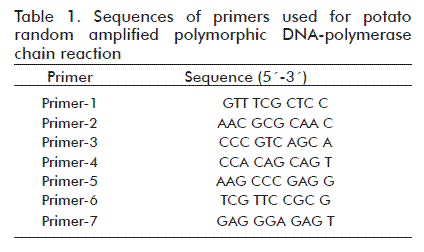
<body><![CDATA[<P   align="justify" ><font size="2" face="Verdana, Arial, Helvetica, sans-serif">Under aseptic conditions,      potato tubers were surface-sterilized using 5% sodium hypochlorite solution      for 10 min. The tubers were washed three times with sterile distilled water.      The apical meristem together with one to three young leaf primordia (0.25      mm) was planted in glass tube with one segment per tube. Each tube contained      12 mL of MS-medium containing 0.1 mg/L 1-naphthaleneacetic acid, 0.5 mg/L      kinetin and 2.25 gm/L phytagel, and they were incubated under 24 &ordm;C and      16-h fluorescent light [4]. Develop-ing shoots from Diamond cultivar were      multiplied several times to obtain enough plants to conduct the experiments.      </font></P >       <P   ><font size="2" face="Verdana, Arial, Helvetica, sans-serif"><b>Irradiation of      cultures </b> </font></P >       <P   align="justify" ><font size="2" face="Verdana, Arial, Helvetica, sans-serif">In order to investigate      the stimulating effects of low doses of gamma irradiation on microtuber production,      growing shoots were irradiated one week after culture with five doses of gamma      irradiation (1.5, 2, 2.5, 5 and 10 Gy). The source of gamma irradiation used      for irradiation potato was <Sup>60</Sup>Co gamma cell 3500, from the Middle      Eastern Regional Radioisotope Center for the Arab countries, Giza, Egypt.      </font></P >   <FONT size="+1"><FONT size="+1">        <P   ><font size="2" face="Verdana, Arial, Helvetica, sans-serif"><b>DNA extraction      </b></font></P >       <P   align="justify" ><font size="2" face="Verdana, Arial, Helvetica, sans-serif">Gamma irradiation-treated      potato plantlets of Diamond cultivar were collected and soaked in liquid nitrogen      for DNA extraction using the 2% CTAB method modified by Agrawal <I>et al</I>.      [7]. </font></P >       <P   ><font size="2" face="Verdana, Arial, Helvetica, sans-serif"><b>RAPD-PCR technique      </b> </font></P >       <P   align="justify" ><font size="2" face="Verdana, Arial, Helvetica, sans-serif">A total of seven      primers (<a href="#tab1">Table 1</a>) were used to amplify DNA [8] (manufactured      by Bioneer, New technology certification from ATS Korea). The total reaction      mixture was 15 &micro;L containing 10 &times; PCR buffer, 2 mM MgCl<Sub>2</Sub>,      0.2 mM dNTP mix, 10 pmol primer, 1.25 U Taq polymerase and about 150 ng genomic      DNA. Amplification was obtained through 35 cycles in a DNA thermal cycler.      The temperature profile was as follows: denaturing at 94 &deg;C for 30 s;      annealing at 45 &deg;C for 1 min; and extension at 72 &deg;C for 1 min, with      a final extension at 72 &ordm;C for 5 min. After completion of the amplification,      the PCR products were separated on a 1% agarose gel containing 1 &times; TBE      buffer (0.045 M Tris-borate, 0.001 M EDTA) and 0.5 &micro;g/mL ethidium bromide      for 45 min at 90 V. The size of each fragment was estimated with reference      to a 1 kb DNA ladder marker. </font></P >       <P   align="center" ><img src="/img/revistas/bta/v29n4/t0105412.gif" width="422" height="250"><a name="tab1"></a></P >   <FONT size="+1"><FONT size="+1">        
<P   ><font size="2" face="Verdana, Arial, Helvetica, sans-serif"><b>Gel analysis </b></font></P >       <P   align="justify" ><font size="2" face="Verdana, Arial, Helvetica, sans-serif">The gel was analyzed      by using a program (UVI Geltec, version 12.4, USA). </font></P >       ]]></body>
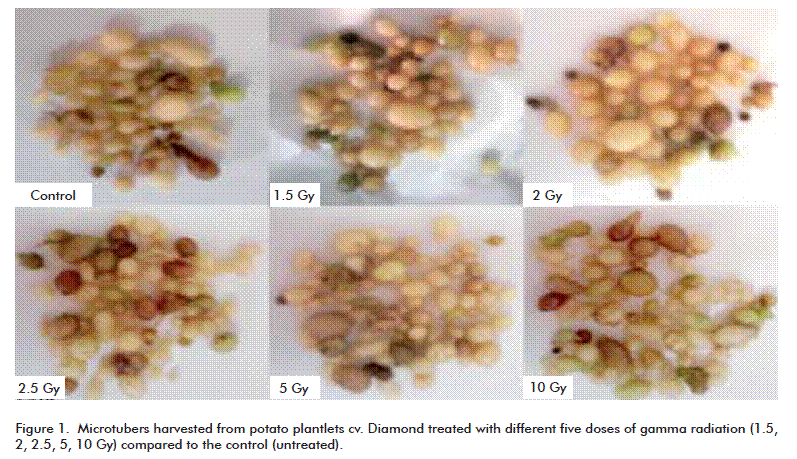
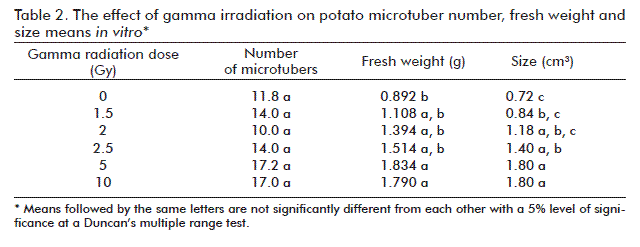
<body><![CDATA[<P   ><font size="2" face="Verdana, Arial, Helvetica, sans-serif"><b>Production of      microtubers </b> </font></P >       <P   align="justify" ><font size="2" face="Verdana, Arial, Helvetica, sans-serif">Ten plantlets of      Diamond cultivar derived from meristem-tips cultured on hormone-free MS medium      with vitamins [9], and sucrose (3% w/v) as carbon source. Media were adjusted      to pH 5.7. Five jar replicates were used per each treatment. The cultures      were incubated at 20 &ordm;C for 16-h daylight during 3 weeks until plantlets      formation. Afterwards, the jars were taken to a laminar flow cabinet and the      residual medium solution was drawn with sterilized pipette and replaced by      50 mL/jar of the tuberogenic liquid medium supplemented with 6% sucrose, 50      mg/L coumarin [10, 11]. The cultures were incubated at 20 &ordm;C in the dark.      After 10 weeks, microtubers were harvested and the number, weight and size      (measured by water displacement) produced per jar were recorded. </font></P >       <P   ><font size="2" face="Verdana, Arial, Helvetica, sans-serif"><b>Statistical analysis      </b> </font></P >       <P   align="justify" ><font size="2" face="Verdana, Arial, Helvetica, sans-serif">All the experiments      were arranged in a factorial completely randomized design and data were compared      according to the method described by Snedecor and Cochron [12]. Analysis of      variance (Anova) for all measured variables was performed using the software      MSTAT-C (version 2.1). The level of significance was measured running a Duncan&rsquo;s      multiple range test; p &le; 0.05 was considered as significant. </font></P >       <P   align="justify" >&nbsp;</P >       <P   align="justify" > </P >       <P   ><font size="3"><b><font face="Verdana, Arial, Helvetica, sans-serif">RESULTS      AND DISCUSSION</font></b></font></P >   <FONT size="+1">        <P   ><font size="2" face="Verdana, Arial, Helvetica, sans-serif"><b>Number, fresh      weight and size of microtubers </b></font></P >   <FONT size="+1">        <P   align="justify" ><font size="2" face="Verdana, Arial, Helvetica, sans-serif">Microtubers were      harvested after 10 weeks from culture and the number, weight and size of microtubers      produced per jar were determined (<a href="/img/revistas/bta/v29n4/f0105412.gif">Figure      1</a>). An Anova revealed a non-significant effect of irradiation on the number      of microtubers produced <I>in vitro</I>. Nevertheless, the 5 and 10 Gy doses      gave the highest number of microtubers. The average numbers of microtubers      in jar at the 5 and 10 Gy doses measured ten weeks after culture were 17.20      and 17.00, respectively. On the other hand, the 1.5, 2 and 2.5 Gy doses had      no significant effect on microtuber weight. Furthermore, the 5 and 10 Gy doses      had significant effects on microtuber weight compared to the control (0 Gy),      weighing 1.834 and 1.790 g, respectively. These two doses were the best in      microtuber size among all irradiation treatments. The results showed that      irradiation with 2, 2.5, 5 and 10 Gy doses had significant effect on microtuber      size compared to the control. Once again, the 5 and 10 Gy doses gave the best      results, with the highest microtuber size of 1.80 cm<Sup>3</Sup> for both      (<a href="/img/revistas/bta/v29n4/f0105412.gif">Figure 1</a> and <a href="/img/revistas/bta/v29n4/t0205412.gif">table      2</a>). </font></P >   <FONT size="+1"><FONT size="+1">        
<P   align="justify" ><font size="2" face="Verdana, Arial, Helvetica, sans-serif">Formation of potato      microtubers <I>in vitro</I> is a complicated developmental process controlled      by many factors. These factors include cultivar, growth regulators, sucrose,      temperature and light. Many researchers have investigated these factors in      vivo and <I>in vitro</I>. Pelacho and Mingo-Castel [10] found that Coumarin      at 50 mg/L used to initiate tubers. The tubers obtained in this way were larger      than those grown on the medium with added kinetin (2.5 mg/L). By increasing      the Coumarin concentration to 100 mg/L, tuberization was delayed and the tubers      were smaller. However, our study is about the effect of gamma irradiation      on the induction of microtuber formation <I>in vitro</I>. Low doses of gamma      radiation have been reported to stimulate plant growth and development, and      to improve the yields and qualities of plants <I>in vitro</I> [13]. Irradiation      of plantlets (4 Gy) led to a significant increase not only in the microtuber      number (116.7 and 34.5% over the control) but also in the fresh mass (77.6      and 23.2%) in the Shepody and Atlantic potato varieties, respectively [14].      Mutation breeding is a methodology for crop improvement based on the possibility      of altering genes by exposing their vegetative parts, cells, tissues, gametes      or seeds to physical and chemical mutagens. Mutagenesis of <I>in vitro</I>      cultures avoids the need for large-scale facilities and allows better control      of treatment, as hyperhydric tissues may be more permeable to mutagens. The      irradiation of callus cultures, which are capable of embryogenesis and organogenesis,      can be used to obtain mutants quickly and in large numbers [15, 16]. Radioactive      materials like <Sup>60</Sup>Co emit high energy photons which are called as      gamma radiation. These radiations can alter the structure of chromosomes in      two ways [17]: directly by quanta of energy which hit the chromosomes like      bullets hitting a target, and indirectly by ionization which produces free      radicals. </font></P >   <FONT size="+1"><FONT size="+1">        ]]></body>
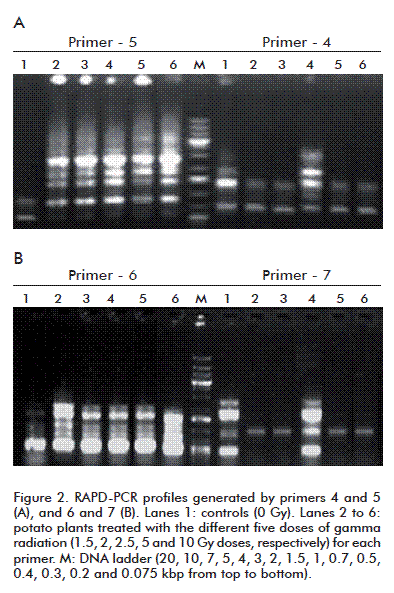
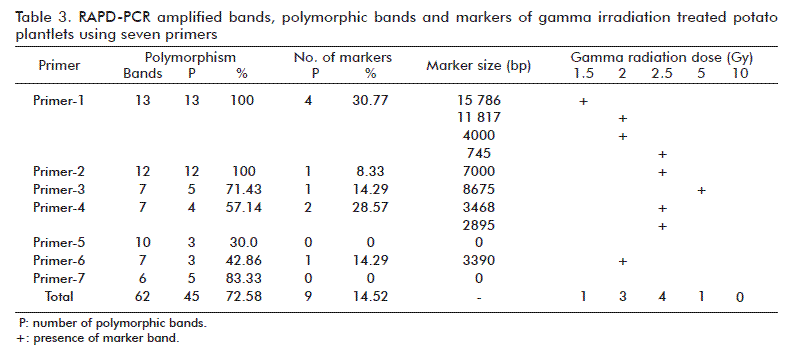
<body><![CDATA[<P   ><font size="2" face="Verdana, Arial, Helvetica, sans-serif"><b>RAPD-PCR analysis      </b> </font></P >       <P   align="justify" ><font size="2" face="Verdana, Arial, Helvetica, sans-serif">Changes in DNA caused      by gamma irradiation resulting in genetic variations were detected by RAPD-PCR      profiles, performed using seven arbitrary primers, which detected polymorphisms      between the controls and potato plants treated with the physical mutagens      (<a href="#fig2">Figure 2</a> and <a href="/img/revistas/bta/v29n4/t0305412.gif">table 3</a>).      </font></P >       
<P   align="center" ><img src="/img/revistas/bta/v29n4/f0205412.gif" width="394" height="593"><a name="fig2"></a></P >       
<P   align="justify" ><font size="2" face="Verdana, Arial, Helvetica, sans-serif">A total of 62 scorable      amplified DNA fragments ranging from 128 to 21 000 bp were observed using      the seven primers, whereas 45 polymorphic and 17 monomorphic bands were detected      among potato plants treated with five doses of gamma radiation and the control.      The seven primers showed a mean polymorphic percentage of 72.58%. The polymorphic      percentage of primers 1 and 2 recorded the highest (100%), whereas primer-5      displayed the lowest percentage (30%). Among the 45 polymorphic bands, nine      were unique markers with a total average of 14.52%. The potato plants markers      per dose of gamma radiation varied considerably using the seven primers, with      the 2.5 Gy dose showing the highest number (4), followed by 2 Gy (3) and 1.5      and 5 Gy doses (1 each), and none for the 10 Gy dose (<a href="/img/revistas/bta/v29n4/t0305412.gif">Table      3</a>). Ancora and Sonnino [18] used rachis, petiole and leaflet discs of      potato for irradiation and observed that leaflets produced a higher number      of mutated plants at lower radiation dose. </font></P >       
<P   align="justify" ><font size="2" face="Verdana, Arial, Helvetica, sans-serif">Molecular markers      are important tools for precisely detecting the effects of gamma radiation      since they identify genetic polymorphisms at DNA level and have been used      to study genetic dissimilarity in many crop species [19-21]. For example,      the inter-simple sequence repeat markers are semi-arbitrary markers, amplified      by PCR using primers complementary to a target microsatellite, which have      been widely used in <I>Musa</I> genetic diversity studies [22-24]. In those      studies, the pattern quality and reproducibility of these markers have indicated      that they are quick, easy to apply and highly reproducible. Rani <I>et al</I>.      [25] found that polymorphic amplification products which represent one allele      per locus can result from changes in either the sequence of the primer binding      site, such as point mutations, or from changes altering the size or preventing      successful amplification of a target DNA such as insertions, deletions and      inversions. Traditional methods for mutant plant selection are based on morphological      and biochemical markers, but these markers are less reproducible due to the      influence of environmental conditions. Hence, mutation detection based on      PCR and non-PCR techniques is more reliable and reproducible and have been      used in various mutant crops for screening. The simplest use of PCR in mutation      analysis determines the presence or absence of a particular region of DNA      [26]. </font></P >       <P   align="justify" >&nbsp;</P >       <P   align="justify" > </P >       <P   ><font size="3"><b><font face="Verdana, Arial, Helvetica, sans-serif">CONCLUSIONS      </font></b></font></P >   <FONT size="+1">        <P   align="justify" ><font size="2" face="Verdana, Arial, Helvetica, sans-serif">Irradiation with      low doses of 5 and 10 Gy enhanced microtuber production efficiency (number,      weight and size of microtubers). Gamma irradiation, as a physical mutagen,      is potent, inexpensive and easy to apply on the potato plantlets <I>in vitro</I>      to create point mutations. The mutant plant variants can be easily selected      from potato plants by RAPD-PCR. </font></P >       <P   align="justify" >&nbsp;</P >   <FONT size="+1">        ]]></body>
<body><![CDATA[<P   align="justify" > </P >       <P   align="justify" ><font size="3"><b><font face="Verdana, Arial, Helvetica, sans-serif">REFERENCES      </font></b></font></P >       <!-- ref --><P   align="justify" ><font size="2" face="Verdana, Arial, Helvetica, sans-serif">1. Ranalli P, Bassi      F, Ruaro G, Del Re P, Di Candilo M, Mandolino G. Microtuber and minituber      production and field performance compared with normal tubers. Potato Res.      1994;37:383-91.     </font></P >   <FONT size="+1">        <!-- ref --><P   align="justify" ><font size="2" face="Verdana, Arial, Helvetica, sans-serif">2. Botoman GH, Iano&#351;i      IS. Integrated control of pests and diseases from potato crop. Bucharest:      Valahia Publishing House; 2005.     </font></P >       <!-- ref --><P   align="justify" ><font size="2" face="Verdana, Arial, Helvetica, sans-serif">3. Wang PJ, Hu CY.      In vitro mass tuberization and virus-free seed-potato production in Taiwan.      Am J Potato Res. 1982;59(1):33-7.     </font></P >       <!-- ref --><P   align="justify" ><font size="2" face="Verdana, Arial, Helvetica, sans-serif">4. Edriss MH, Badawy      MA, Fathi S, El-Barkouki TM. Propagation of potato using tissue culture technique.      Acta Hort (ISHS). 1996;434:413-18.     </font></P >       ]]></body>
<body><![CDATA[<!-- ref --><P   align="justify" ><font size="2" face="Verdana, Arial, Helvetica, sans-serif">5. Al-Safadi B, Simon      PW. The effects of gamma irradiation on the growth and cytology of carrot      (Daucus carota L.) tissue culture. Environ Exp Bot. 1990;30(3):361-71.     </font></P >       <!-- ref --><P   align="justify" ><font size="2" face="Verdana, Arial, Helvetica, sans-serif">6. Maluszynski M,      Ahloowalia BS, Sigurbjh&ouml;rnsson B. Application of in vivo and in vitro      mutation techniques for crop improvement. Euphytica. 1995;85(1-3):303-15.          </font></P >       <!-- ref --><P   align="justify" ><font size="2" face="Verdana, Arial, Helvetica, sans-serif">7. Agrawal GK, Pandey      RN, Agrawal VP. Isolation of DNA from Cheorospondias axillaris leaves. Biotechnol      Lett. 1992;2:19-24.     </font></P >       <!-- ref --><P   align="justify" ><font size="2" face="Verdana, Arial, Helvetica, sans-serif">8. Kang TJ, Yang      MS. Rapid and reliable extraction of genomic DNA from various wild-type and      transgenic plants. BMC Biotechnol. 2004;4:20.     </font></P >       <!-- ref --><P   align="justify" ><font size="2" face="Verdana, Arial, Helvetica, sans-serif">9. Murashige T, Skoog      F. A revised medium for rapid growth and bio assays with tobacco tissue cultures.      Physiol Plantarum. 1962;15(3):473-87.     </font></P >       ]]></body>
<body><![CDATA[<!-- ref --><P   align="justify" ><font size="2" face="Verdana, Arial, Helvetica, sans-serif">10. Pelacho AM, Mingo-Castel      AM. Effect of photoperiod on kinetin-induced tuberization of isolated potato      stolons cultured in vitro. Am Potato J. 1991;68:8:533-41.     </font></P >       <!-- ref --><P   align="justify" ><font size="2" face="Verdana, Arial, Helvetica, sans-serif">11. Pruski K, Duplessis      P, Lewis T, Astatkie T, Nowak J, Struik PC. Jasmonate effect on in vitro tuberization      of potato (Solanum tuberosum L.) cultivars under light and dark conditions.      Potato Res. 2001;44(4);315-25.     </font></P >       <!-- ref --><P   align="justify" ><font size="2" face="Verdana, Arial, Helvetica, sans-serif">12. Snedecor GW,      Cochran WG. Statistical Methods. 6th ed. Ames: The Iowa State University Press;      1967.     </font></P >       <!-- ref --><P   align="justify" ><font size="2" face="Verdana, Arial, Helvetica, sans-serif">13. Al-Safadi B,      Ayyoubi Z, Jawdat D. The effect of gamma irradiation on potato microtuber      production in vitro. Plant Cell Tissue Organ Cult. 2000;61(3):183-7.     </font></P >       <!-- ref --><P   align="justify" ><font size="2" face="Verdana, Arial, Helvetica, sans-serif">14. Li HZ, Zhou WJ,      Zhang ZJ, Gu HH, Takeuchi Y, Yoneyama K. Effect of &#61543;-radiation on development,      yield and quality of microtubers in vitro in Solanum tuberosum L. Biol Plantarum.      2005;49(4):625-8.     </font></P >       ]]></body>
<body><![CDATA[<!-- ref --><P   align="justify" ><font size="2" face="Verdana, Arial, Helvetica, sans-serif">15. Ziv M. Vitrification:      Morphological and physiological disorders of in vitro plants. In: Debergh      PC, Zimmerman RH, editors. Micropropagation: technology and application. Dordrecht:      Kluwer Academic Publishers; 1991. p. 45-69.     </font></P >       <!-- ref --><P   align="justify" ><font size="2" face="Verdana, Arial, Helvetica, sans-serif">16. Ahloowalia BS.      In vitro mutagenesis for the improvement of vegetatively propagated plants.      In: Induced mutations and molecular techniques for crop improvement. Proceedings,      IAEA, Vienna (Austria). International Symposium on the Use of Induced Mutations      and Molecular Techniques for Crop Improvement, Vienna (Austria), 19-23 Jun      1995. Vienna: IAEA; 1995. p. 531-41.     </font></P >       <!-- ref --><P   align="justify" ><font size="2" face="Verdana, Arial, Helvetica, sans-serif">17. Ali A, Naz S,      Sarwar Alam S, Iqbal J. In vitro induced mutation for screening of red rot      (Colletotrichum falcatum) resistance in sugarcane (Saccharum officinarum).      Pakistan J Bot. 2007;39(6):1979-94.     </font></P >       <!-- ref --><P   align="justify" ><font size="2" face="Verdana, Arial, Helvetica, sans-serif">18. Ancora G, Sonnino      A. In vitro induction of mutation in potato. In: Bajaj YPS, editor. Biotechnology      in agriculture and forestry. Vol 3. Potato. Berlin: Springer; 1987. p. 408-24.          </font></P >       <!-- ref --><P   align="justify" ><font size="2" face="Verdana, Arial, Helvetica, sans-serif">19. Souframanien      J, Pawar SE, Rucha AG. Genetic variation in gamma ray induced mutants in blackgram      as revealed by RAPD and ISSR markers. Indian J Genet Plant Breed. 2002;62:291-5.          </font></P >       ]]></body>
<body><![CDATA[<!-- ref --><P   align="justify" ><font size="2" face="Verdana, Arial, Helvetica, sans-serif">20. Roy A, Bandyopadhyay      A, Mahapatra AK, Ghosh SK, Singh NK, Bansal KC, et al. Evaluation of genetic      diversity in jute (Corchorus species) using STMS, ISSR and RAPD markers. Plant      Breed. 2006;125(3):292-7.     </font></P >       <!-- ref --><P   align="justify" ><font size="2" face="Verdana, Arial, Helvetica, sans-serif">21. Barakat MN, Abdel      Fattah RS, Badr M, El-Torky MG. In vitro mutagenesis and identification of      new variants via RAPD markers for improving Chrysanthemum morifolium. Afr      J Agric Res. 2010;5(8):748-57.     </font></P >       <!-- ref --><P   align="justify" ><font size="2" face="Verdana, Arial, Helvetica, sans-serif">22. Racharak P, Eiadthong      W. Genetic relationship among subspecies of Musa acuminate Colla and A-genome      consisting edible cultivated bananas assayed with ISSR markers. Songklanakarin      J Sci Technol. 2007;29(6):1479-89.     </font></P >       <!-- ref --><P   align="justify" ><font size="2" face="Verdana, Arial, Helvetica, sans-serif">23. Venkatachalam      L, Sreedhar RV, Bhagyalakshmi N. The use of genetic markers for detecting      DNA polymorphism, genotype identification and phylogenetic relationships among      banana cultivars. Mol Phylogenet Evol. 2008;47(3):974-85.     </font></P >       <!-- ref --><P   align="justify" ><font size="2" face="Verdana, Arial, Helvetica, sans-serif">24. Pestana RKN,      Amorim EP, Ferreira CF, Amorim VBO, Oliveira LS, Ledo CAS, et al. Agronomic      and molecular characterization of gamma ray induced banana (Musa sp.) mutants      using a multivariate statistical algorithm. Euphytica. 2011;178(2):151-8.          </font></P >       ]]></body>
<body><![CDATA[<!-- ref --><P   align="justify" ><font size="2" face="Verdana, Arial, Helvetica, sans-serif">25. Rani V, Parida      A, Raina S. Random amplified polymorphic DNA (RAPD) markers for genetic analysis      in micropropagated plants of Populus deltoides Marsh. Plant Cell Rep. 1995;14(7):459-62.          </font></P >       <!-- ref --><P   align="justify" ><font size="2" face="Verdana, Arial, Helvetica, sans-serif">26. Khan S, Al-Qurainy      F, Anwar F. Sodium azide: a chemical mutagen for enhancement of agronomic      traits of crop plants. Environ We Int J Sci Technol. 2009;4:1-21.     </font></P >       <P   align="justify" >&nbsp;</P >       <P   align="justify" >&nbsp;</P >   <FONT size="+1">        <P   align="justify" ></P >       <P   align="justify" ></P >       <P   align="justify" > </P >       <P   align="justify" > </P >       ]]></body>
<body><![CDATA[<P   align="justify" ><font size="2" face="Verdana, Arial, Helvetica, sans-serif">Received in February,      2012.     <br>     </font><font size="2" face="Verdana, Arial, Helvetica, sans-serif">Accepted      in July, 2012. </font></P >       <P   align="justify" >&nbsp;</P >       <P   align="justify" >&nbsp;</P >       <P   align="justify" > </P >       <P   align="justify" > </P >       <P   align="justify" ><font size="2" face="Verdana, Arial, Helvetica, sans-serif"><I>Sherin A Mahfouze</I>.      Genetics and Cytology Department, Genetic Engineering and Biotechnology Division,      National Research Center. Dokki, 12622, Egypt. E-mail: <A href="mailto:sherinmahfouze@yahoo.com">      <U><U><FONT color="#0000FF">sherinmahfouze@yahoo.com</font></U></U></A><FONT color="#0000FF"><FONT color="#000000">.      </font></font></font></P >   </font></font></font></font></font></font></font></font></font></font></font></font></font></font></font></font></font></font></font></font></font></font></font></font></font></font></font></font></font></font></font></font></font></font></DIV >      ]]></body><back>
<ref-list>
<ref id="B1">
<label>1</label><nlm-citation citation-type="journal">
<person-group person-group-type="author">
<name>
<surname><![CDATA[Ranalli]]></surname>
<given-names><![CDATA[P]]></given-names>
</name>
<name>
<surname><![CDATA[Bassi]]></surname>
<given-names><![CDATA[F]]></given-names>
</name>
<name>
<surname><![CDATA[Ruaro]]></surname>
<given-names><![CDATA[G]]></given-names>
</name>
<name>
<surname><![CDATA[Del Re]]></surname>
<given-names><![CDATA[P]]></given-names>
</name>
<name>
<surname><![CDATA[Di Candilo]]></surname>
<given-names><![CDATA[M]]></given-names>
</name>
<name>
<surname><![CDATA[Mandolino]]></surname>
<given-names><![CDATA[G]]></given-names>
</name>
</person-group>
<article-title xml:lang="en"><![CDATA[Microtuber and minituber production and field performance compared with normal tubers]]></article-title>
<source><![CDATA[Potato Res]]></source>
<year>1994</year>
<volume>37</volume>
<page-range>383-91</page-range></nlm-citation>
</ref>
<ref id="B2">
<label>2</label><nlm-citation citation-type="book">
<person-group person-group-type="author">
<name>
<surname><![CDATA[Botoman]]></surname>
<given-names><![CDATA[GH]]></given-names>
</name>
<name>
<surname><![CDATA[IanoÅ&#159;i]]></surname>
<given-names><![CDATA[IS]]></given-names>
</name>
</person-group>
<source><![CDATA[Integrated control of pests and diseases from potato crop]]></source>
<year>2005</year>
<publisher-loc><![CDATA[Bucharest ]]></publisher-loc>
<publisher-name><![CDATA[Valahia Publishing House]]></publisher-name>
</nlm-citation>
</ref>
<ref id="B3">
<label>3</label><nlm-citation citation-type="journal">
<person-group person-group-type="author">
<name>
<surname><![CDATA[Wang]]></surname>
<given-names><![CDATA[PJ]]></given-names>
</name>
<name>
<surname><![CDATA[Hu]]></surname>
<given-names><![CDATA[CY]]></given-names>
</name>
</person-group>
<article-title xml:lang="en"><![CDATA[In vitro mass tuberization and virus-free seed-potato production in Taiwan]]></article-title>
<source><![CDATA[Am J Potato Res]]></source>
<year>1982</year>
<volume>59</volume>
<numero>1</numero>
<issue>1</issue>
<page-range>33-7</page-range></nlm-citation>
</ref>
<ref id="B4">
<label>4</label><nlm-citation citation-type="journal">
<person-group person-group-type="author">
<name>
<surname><![CDATA[Edriss]]></surname>
<given-names><![CDATA[MH]]></given-names>
</name>
<name>
<surname><![CDATA[Badawy]]></surname>
<given-names><![CDATA[MA]]></given-names>
</name>
<name>
<surname><![CDATA[Fathi]]></surname>
<given-names><![CDATA[S]]></given-names>
</name>
<name>
<surname><![CDATA[El-Barkouki]]></surname>
<given-names><![CDATA[TM]]></given-names>
</name>
</person-group>
<article-title xml:lang="en"><![CDATA[Propagation of potato using tissue culture technique]]></article-title>
<source><![CDATA[Acta Hort (ISHS)]]></source>
<year>1996</year>
<volume>434</volume>
<page-range>413-18</page-range></nlm-citation>
</ref>
<ref id="B5">
<label>5</label><nlm-citation citation-type="journal">
<person-group person-group-type="author">
<name>
<surname><![CDATA[Al-Safadi]]></surname>
<given-names><![CDATA[B]]></given-names>
</name>
<name>
<surname><![CDATA[Simon]]></surname>
<given-names><![CDATA[PW]]></given-names>
</name>
</person-group>
<article-title xml:lang="en"><![CDATA[The effects of gamma irradiation on the growth and cytology of carrot (Daucus carota L.) tissue culture]]></article-title>
<source><![CDATA[Environ Exp Bot]]></source>
<year>1990</year>
<volume>30</volume>
<numero>3</numero>
<issue>3</issue>
<page-range>361-71</page-range></nlm-citation>
</ref>
<ref id="B6">
<label>6</label><nlm-citation citation-type="journal">
<person-group person-group-type="author">
<name>
<surname><![CDATA[Maluszynski]]></surname>
<given-names><![CDATA[M]]></given-names>
</name>
<name>
<surname><![CDATA[Ahloowalia]]></surname>
<given-names><![CDATA[BS]]></given-names>
</name>
<name>
<surname><![CDATA[Sigurbjhörnsson]]></surname>
<given-names><![CDATA[B]]></given-names>
</name>
</person-group>
<article-title xml:lang="en"><![CDATA[Application of in vivo and in vitro mutation techniques for crop improvement]]></article-title>
<source><![CDATA[Euphytica]]></source>
<year>1995</year>
<volume>85</volume>
<numero>1-3</numero>
<issue>1-3</issue>
<page-range>303-15</page-range></nlm-citation>
</ref>
<ref id="B7">
<label>7</label><nlm-citation citation-type="journal">
<person-group person-group-type="author">
<name>
<surname><![CDATA[Agrawal]]></surname>
<given-names><![CDATA[GK]]></given-names>
</name>
<name>
<surname><![CDATA[Pandey]]></surname>
<given-names><![CDATA[RN]]></given-names>
</name>
<name>
<surname><![CDATA[Agrawal]]></surname>
<given-names><![CDATA[VP]]></given-names>
</name>
</person-group>
<article-title xml:lang="en"><![CDATA[Isolation of DNA from Cheorospondias axillaris leaves]]></article-title>
<source><![CDATA[Biotechnol Lett]]></source>
<year>1992</year>
<volume>2</volume>
<page-range>19-24</page-range></nlm-citation>
</ref>
<ref id="B8">
<label>8</label><nlm-citation citation-type="journal">
<person-group person-group-type="author">
<name>
<surname><![CDATA[Kang]]></surname>
<given-names><![CDATA[TJ]]></given-names>
</name>
<name>
<surname><![CDATA[Yang]]></surname>
<given-names><![CDATA[MS]]></given-names>
</name>
</person-group>
<article-title xml:lang="en"><![CDATA[Rapid and reliable extraction of genomic DNA from various wild-type and transgenic plants]]></article-title>
<source><![CDATA[BMC Biotechnol]]></source>
<year>2004</year>
<volume>4</volume>
<page-range>20</page-range></nlm-citation>
</ref>
<ref id="B9">
<label>9</label><nlm-citation citation-type="journal">
<person-group person-group-type="author">
<name>
<surname><![CDATA[Murashige]]></surname>
<given-names><![CDATA[T]]></given-names>
</name>
<name>
<surname><![CDATA[Skoog]]></surname>
<given-names><![CDATA[F]]></given-names>
</name>
</person-group>
<article-title xml:lang="en"><![CDATA[A revised medium for rapid growth and bio assays with tobacco tissue cultures]]></article-title>
<source><![CDATA[Physiol Plantarum]]></source>
<year>1962</year>
<volume>15</volume>
<numero>3</numero>
<issue>3</issue>
<page-range>473-87</page-range></nlm-citation>
</ref>
<ref id="B10">
<label>10</label><nlm-citation citation-type="journal">
<person-group person-group-type="author">
<name>
<surname><![CDATA[Pelacho]]></surname>
<given-names><![CDATA[AM]]></given-names>
</name>
<name>
<surname><![CDATA[Mingo-Castel]]></surname>
<given-names><![CDATA[AM]]></given-names>
</name>
</person-group>
<article-title xml:lang="en"><![CDATA[Effect of photoperiod on kinetin-induced tuberization of isolated potato stolons cultured in vitro]]></article-title>
<source><![CDATA[Am Potato J]]></source>
<year>1991</year>
<volume>68</volume>
<page-range>8</page-range></nlm-citation>
</ref>
<ref id="B11">
<label>11</label><nlm-citation citation-type="journal">
<person-group person-group-type="author">
<name>
<surname><![CDATA[Pruski]]></surname>
<given-names><![CDATA[K]]></given-names>
</name>
<name>
<surname><![CDATA[Duplessis]]></surname>
<given-names><![CDATA[P]]></given-names>
</name>
<name>
<surname><![CDATA[Lewis]]></surname>
<given-names><![CDATA[T]]></given-names>
</name>
<name>
<surname><![CDATA[Astatkie]]></surname>
<given-names><![CDATA[T]]></given-names>
</name>
<name>
<surname><![CDATA[Nowak]]></surname>
<given-names><![CDATA[J]]></given-names>
</name>
<name>
<surname><![CDATA[Struik]]></surname>
<given-names><![CDATA[PC]]></given-names>
</name>
</person-group>
<article-title xml:lang="en"><![CDATA[Jasmonate effect on in vitro tuberization of potato (Solanum tuberosum L.) cultivars under light and dark conditions]]></article-title>
<source><![CDATA[Potato Res]]></source>
<year>2001</year>
<volume>44</volume>
<numero>4</numero>
<issue>4</issue>
<page-range>315-25</page-range></nlm-citation>
</ref>
<ref id="B12">
<label>12</label><nlm-citation citation-type="book">
<person-group person-group-type="author">
<name>
<surname><![CDATA[Snedecor]]></surname>
<given-names><![CDATA[GW]]></given-names>
</name>
<name>
<surname><![CDATA[Cochran]]></surname>
<given-names><![CDATA[WG]]></given-names>
</name>
</person-group>
<source><![CDATA[Statistical Methods]]></source>
<year>1967</year>
<edition>6</edition>
<publisher-loc><![CDATA[Ames ]]></publisher-loc>
<publisher-name><![CDATA[The Iowa State University Press]]></publisher-name>
</nlm-citation>
</ref>
<ref id="B13">
<label>13</label><nlm-citation citation-type="journal">
<person-group person-group-type="author">
<name>
<surname><![CDATA[Al-Safadi]]></surname>
<given-names><![CDATA[B]]></given-names>
</name>
<name>
<surname><![CDATA[Ayyoubi]]></surname>
<given-names><![CDATA[Z]]></given-names>
</name>
<name>
<surname><![CDATA[Jawdat]]></surname>
<given-names><![CDATA[D]]></given-names>
</name>
</person-group>
<article-title xml:lang="en"><![CDATA[The effect of gamma irradiation on potato microtuber production in vitro]]></article-title>
<source><![CDATA[Plant Cell Tissue Organ Cult]]></source>
<year>2000</year>
<volume>61</volume>
<numero>3</numero>
<issue>3</issue>
<page-range>183-7</page-range></nlm-citation>
</ref>
<ref id="B14">
<label>14</label><nlm-citation citation-type="journal">
<person-group person-group-type="author">
<name>
<surname><![CDATA[Li]]></surname>
<given-names><![CDATA[HZ]]></given-names>
</name>
<name>
<surname><![CDATA[Zhou]]></surname>
<given-names><![CDATA[WJ]]></given-names>
</name>
<name>
<surname><![CDATA[Zhang]]></surname>
<given-names><![CDATA[ZJ]]></given-names>
</name>
<name>
<surname><![CDATA[Gu]]></surname>
<given-names><![CDATA[HH]]></given-names>
</name>
<name>
<surname><![CDATA[Takeuchi]]></surname>
<given-names><![CDATA[Y]]></given-names>
</name>
<name>
<surname><![CDATA[Yoneyama]]></surname>
<given-names><![CDATA[K]]></given-names>
</name>
</person-group>
<article-title xml:lang="en"><![CDATA[Effect of Î³-radiation on development, yield and quality of microtubers in vitro in Solanum tuberosum L]]></article-title>
<source><![CDATA[Biol Plantarum]]></source>
<year>2005</year>
<volume>49</volume>
<numero>4</numero>
<issue>4</issue>
<page-range>625-8</page-range></nlm-citation>
</ref>
<ref id="B15">
<label>15</label><nlm-citation citation-type="book">
<person-group person-group-type="author">
<name>
<surname><![CDATA[Ziv]]></surname>
<given-names><![CDATA[M]]></given-names>
</name>
</person-group>
<article-title xml:lang="en"><![CDATA[Vitrification: Morphological and physiological disorders of in vitro plants]]></article-title>
<person-group person-group-type="editor">
<name>
<surname><![CDATA[Debergh]]></surname>
<given-names><![CDATA[PC]]></given-names>
</name>
<name>
<surname><![CDATA[Zimmerman]]></surname>
<given-names><![CDATA[RH]]></given-names>
</name>
</person-group>
<source><![CDATA[Micropropagation: technology and application]]></source>
<year>1991</year>
<page-range>45-69</page-range><publisher-loc><![CDATA[Dordrecht ]]></publisher-loc>
<publisher-name><![CDATA[Kluwer Academic Publishers]]></publisher-name>
</nlm-citation>
</ref>
<ref id="B16">
<label>16</label><nlm-citation citation-type="">
<person-group person-group-type="author">
<name>
<surname><![CDATA[Ahloowalia]]></surname>
<given-names><![CDATA[BS]]></given-names>
</name>
</person-group>
<article-title xml:lang="en"><![CDATA[In vitro mutagenesis for the improvement of vegetatively propagated plants]]></article-title>
<source><![CDATA[Induced mutations and molecular techniques for crop improvement: Proceedings, IAEA, Vienna (Austria). International Symposium on the Use of Induced Mutations and Molecular Techniques for Crop Improvement, Vienna (Austria), 19-23 Jun 1995.]]></source>
<year>1995</year>
<page-range>531-41</page-range><publisher-loc><![CDATA[Vienna ]]></publisher-loc>
</nlm-citation>
</ref>
<ref id="B17">
<label>17</label><nlm-citation citation-type="journal">
<person-group person-group-type="author">
<name>
<surname><![CDATA[Ali]]></surname>
<given-names><![CDATA[A]]></given-names>
</name>
<name>
<surname><![CDATA[Naz]]></surname>
<given-names><![CDATA[S]]></given-names>
</name>
<name>
<surname><![CDATA[Sarwar Alam]]></surname>
<given-names><![CDATA[S]]></given-names>
</name>
<name>
<surname><![CDATA[Iqbal]]></surname>
<given-names><![CDATA[J]]></given-names>
</name>
</person-group>
<article-title xml:lang="en"><![CDATA[In vitro induced mutation for screening of red rot (Colletotrichum falcatum) resistance in sugarcane (Saccharum officinarum)]]></article-title>
<source><![CDATA[Pakistan J Bot]]></source>
<year>2007</year>
<volume>39</volume>
<numero>6</numero>
<issue>6</issue>
<page-range>1979-94</page-range></nlm-citation>
</ref>
<ref id="B18">
<label>18</label><nlm-citation citation-type="book">
<person-group person-group-type="author">
<name>
<surname><![CDATA[Ancora]]></surname>
<given-names><![CDATA[G]]></given-names>
</name>
<name>
<surname><![CDATA[Sonnino]]></surname>
<given-names><![CDATA[A]]></given-names>
</name>
</person-group>
<article-title xml:lang="en"><![CDATA[In vitro induction of mutation in potato]]></article-title>
<person-group person-group-type="editor">
<name>
<surname><![CDATA[Bajaj]]></surname>
<given-names><![CDATA[YPS]]></given-names>
</name>
</person-group>
<source><![CDATA[Biotechnology in agriculture and forestry: Vol 3. Potato]]></source>
<year>1987</year>
<page-range>408-24</page-range><publisher-loc><![CDATA[Berlin ]]></publisher-loc>
<publisher-name><![CDATA[Springer]]></publisher-name>
</nlm-citation>
</ref>
<ref id="B19">
<label>19</label><nlm-citation citation-type="journal">
<person-group person-group-type="author">
<name>
<surname><![CDATA[Souframanien]]></surname>
<given-names><![CDATA[J]]></given-names>
</name>
<name>
<surname><![CDATA[Pawar]]></surname>
<given-names><![CDATA[SE]]></given-names>
</name>
<name>
<surname><![CDATA[Rucha]]></surname>
<given-names><![CDATA[AG]]></given-names>
</name>
</person-group>
<article-title xml:lang="en"><![CDATA[Genetic variation in gamma ray induced mutants in blackgram as revealed by RAPD and ISSR markers]]></article-title>
<source><![CDATA[Indian J Genet Plant Breed]]></source>
<year>2002</year>
<volume>62</volume>
<page-range>291-5</page-range></nlm-citation>
</ref>
<ref id="B20">
<label>20</label><nlm-citation citation-type="journal">
<person-group person-group-type="author">
<name>
<surname><![CDATA[Roy]]></surname>
<given-names><![CDATA[A]]></given-names>
</name>
<name>
<surname><![CDATA[Bandyopadhyay]]></surname>
<given-names><![CDATA[A]]></given-names>
</name>
<name>
<surname><![CDATA[Mahapatra]]></surname>
<given-names><![CDATA[AK]]></given-names>
</name>
<name>
<surname><![CDATA[Ghosh]]></surname>
<given-names><![CDATA[SK]]></given-names>
</name>
<name>
<surname><![CDATA[Singh]]></surname>
<given-names><![CDATA[NK]]></given-names>
</name>
<name>
<surname><![CDATA[Bansal]]></surname>
<given-names><![CDATA[KC]]></given-names>
</name>
</person-group>
<article-title xml:lang="en"><![CDATA[Evaluation of genetic diversity in jute (Corchorus species) using STMS, ISSR and RAPD markers]]></article-title>
<source><![CDATA[Plant Breed]]></source>
<year>2006</year>
<volume>125</volume>
<numero>3</numero>
<issue>3</issue>
<page-range>292-7</page-range></nlm-citation>
</ref>
<ref id="B21">
<label>21</label><nlm-citation citation-type="journal">
<person-group person-group-type="author">
<name>
<surname><![CDATA[Barakat]]></surname>
<given-names><![CDATA[MN]]></given-names>
</name>
<name>
<surname><![CDATA[Abdel Fattah]]></surname>
<given-names><![CDATA[RS]]></given-names>
</name>
<name>
<surname><![CDATA[Badr]]></surname>
<given-names><![CDATA[M]]></given-names>
</name>
<name>
<surname><![CDATA[El-Torky]]></surname>
<given-names><![CDATA[MG]]></given-names>
</name>
</person-group>
<article-title xml:lang="en"><![CDATA[In vitro mutagenesis and identification of new variants via RAPD markers for improving Chrysanthemum morifolium]]></article-title>
<source><![CDATA[Afr J Agric Res]]></source>
<year>2010</year>
<volume>5</volume>
<numero>8</numero>
<issue>8</issue>
<page-range>748-57</page-range></nlm-citation>
</ref>
<ref id="B22">
<label>22</label><nlm-citation citation-type="journal">
<person-group person-group-type="author">
<name>
<surname><![CDATA[Racharak]]></surname>
<given-names><![CDATA[P]]></given-names>
</name>
<name>
<surname><![CDATA[Eiadthong]]></surname>
<given-names><![CDATA[W]]></given-names>
</name>
</person-group>
<article-title xml:lang="en"><![CDATA[Genetic relationship among subspecies of Musa acuminate Colla and A-genome consisting edible cultivated bananas assayed with ISSR markers]]></article-title>
<source><![CDATA[Songklanakarin J Sci Technol]]></source>
<year>2007</year>
<volume>29</volume>
<numero>6</numero>
<issue>6</issue>
<page-range>1479-89</page-range></nlm-citation>
</ref>
<ref id="B23">
<label>23</label><nlm-citation citation-type="journal">
<person-group person-group-type="author">
<name>
<surname><![CDATA[Venkatachalam]]></surname>
<given-names><![CDATA[L]]></given-names>
</name>
<name>
<surname><![CDATA[Sreedhar]]></surname>
<given-names><![CDATA[RV]]></given-names>
</name>
<name>
<surname><![CDATA[Bhagyalakshmi]]></surname>
<given-names><![CDATA[N]]></given-names>
</name>
</person-group>
<article-title xml:lang="en"><![CDATA[The use of genetic markers for detecting DNA polymorphism, genotype identification and phylogenetic relationships among banana cultivars]]></article-title>
<source><![CDATA[Mol Phylogenet Evol]]></source>
<year>2008</year>
<volume>47</volume>
<numero>3</numero>
<issue>3</issue>
<page-range>974-85</page-range></nlm-citation>
</ref>
<ref id="B24">
<label>24</label><nlm-citation citation-type="journal">
<person-group person-group-type="author">
<name>
<surname><![CDATA[Pestana]]></surname>
<given-names><![CDATA[RKN]]></given-names>
</name>
<name>
<surname><![CDATA[Amorim]]></surname>
<given-names><![CDATA[EP]]></given-names>
</name>
<name>
<surname><![CDATA[Ferreira]]></surname>
<given-names><![CDATA[CF]]></given-names>
</name>
<name>
<surname><![CDATA[Amorim]]></surname>
<given-names><![CDATA[VBO]]></given-names>
</name>
<name>
<surname><![CDATA[Oliveira]]></surname>
<given-names><![CDATA[LS]]></given-names>
</name>
<name>
<surname><![CDATA[Ledo]]></surname>
<given-names><![CDATA[CAS]]></given-names>
</name>
</person-group>
<article-title xml:lang="en"><![CDATA[Agronomic and molecular characterization of gamma ray induced banana (Musa sp.) mutants using a multivariate statistical algorithm]]></article-title>
<source><![CDATA[Euphytica]]></source>
<year>2011</year>
<volume>178</volume>
<numero>2</numero>
<issue>2</issue>
<page-range>151-8</page-range></nlm-citation>
</ref>
<ref id="B25">
<label>25</label><nlm-citation citation-type="journal">
<person-group person-group-type="author">
<name>
<surname><![CDATA[Rani]]></surname>
<given-names><![CDATA[V]]></given-names>
</name>
<name>
<surname><![CDATA[Parida]]></surname>
<given-names><![CDATA[A]]></given-names>
</name>
<name>
<surname><![CDATA[Raina]]></surname>
<given-names><![CDATA[S]]></given-names>
</name>
</person-group>
<article-title xml:lang="en"><![CDATA[Random amplified polymorphic DNA (RAPD) markers for genetic analysis in micropropagated plants of Populus deltoides Marsh]]></article-title>
<source><![CDATA[Plant Cell Rep]]></source>
<year>1995</year>
<volume>14</volume>
<numero>7</numero>
<issue>7</issue>
<page-range>459-62</page-range></nlm-citation>
</ref>
<ref id="B26">
<label>26</label><nlm-citation citation-type="journal">
<person-group person-group-type="author">
<name>
<surname><![CDATA[Khan]]></surname>
<given-names><![CDATA[S]]></given-names>
</name>
<name>
<surname><![CDATA[Al-Qurainy]]></surname>
<given-names><![CDATA[F]]></given-names>
</name>
<name>
<surname><![CDATA[Anwar]]></surname>
<given-names><![CDATA[F]]></given-names>
</name>
</person-group>
<article-title xml:lang="en"><![CDATA[Sodium azide: a chemical mutagen for enhancement of agronomic traits of crop plants]]></article-title>
<source><![CDATA[Environ We Int J Sci Technol]]></source>
<year>2009</year>
<volume>4</volume>
<page-range>1-21</page-range></nlm-citation>
</ref>
</ref-list>
</back>
</article>