<?xml version="1.0" encoding="ISO-8859-1"?><article xmlns:mml="http://www.w3.org/1998/Math/MathML" xmlns:xlink="http://www.w3.org/1999/xlink" xmlns:xsi="http://www.w3.org/2001/XMLSchema-instance">
<front>
<journal-meta>
<journal-id>1027-2852</journal-id>
<journal-title><![CDATA[Biotecnología Aplicada]]></journal-title>
<abbrev-journal-title><![CDATA[Biotecnol Apl]]></abbrev-journal-title>
<issn>1027-2852</issn>
<publisher>
<publisher-name><![CDATA[Editorial Elfos Scientiae]]></publisher-name>
</publisher>
</journal-meta>
<article-meta>
<article-id>S1027-28522012000400008</article-id>
<title-group>
<article-title xml:lang="en"><![CDATA[Physiological and nutritional studies of Escherichia coli and a new combination of separation methods to obtain highly pure and homogeneous plasmid DNA for gene therapy]]></article-title>
<article-title xml:lang="es"><![CDATA[Estudios fisiológicos y nutricionales de la Escherichia coli y la combinación novedosa de métodos de separación permiten obtener ADN plasmídico con alta pureza y homogeneidad para su uso en terapia génica]]></article-title>
</title-group>
<contrib-group>
<contrib contrib-type="author">
<name>
<surname><![CDATA[Ruiz]]></surname>
<given-names><![CDATA[Odalys]]></given-names>
</name>
<xref ref-type="aff" rid="A01"/>
</contrib>
<contrib contrib-type="author">
<name>
<surname><![CDATA[Limonta]]></surname>
<given-names><![CDATA[Miladys]]></given-names>
</name>
<xref ref-type="aff" rid="A01"/>
</contrib>
<contrib contrib-type="author">
<name>
<surname><![CDATA[Valdés]]></surname>
<given-names><![CDATA[Jorge]]></given-names>
</name>
<xref ref-type="aff" rid="A01"/>
</contrib>
<contrib contrib-type="author">
<name>
<surname><![CDATA[Márquez]]></surname>
<given-names><![CDATA[Gabriel]]></given-names>
</name>
<xref ref-type="aff" rid="A01"/>
</contrib>
<contrib contrib-type="author">
<name>
<surname><![CDATA[Díaz]]></surname>
<given-names><![CDATA[Michel]]></given-names>
</name>
<xref ref-type="aff" rid="A01"/>
</contrib>
<contrib contrib-type="author">
<name>
<surname><![CDATA[Frómeta]]></surname>
<given-names><![CDATA[Willy]]></given-names>
</name>
<xref ref-type="aff" rid="A01"/>
</contrib>
<contrib contrib-type="author">
<name>
<surname><![CDATA[Pupo]]></surname>
<given-names><![CDATA[Martha]]></given-names>
</name>
<xref ref-type="aff" rid="A01"/>
</contrib>
<contrib contrib-type="author">
<name>
<surname><![CDATA[Torres]]></surname>
<given-names><![CDATA[Dinorah]]></given-names>
</name>
<xref ref-type="aff" rid="A01"/>
</contrib>
<contrib contrib-type="author">
<name>
<surname><![CDATA[Martínez]]></surname>
<given-names><![CDATA[Eduardo]]></given-names>
</name>
<xref ref-type="aff" rid="A01"/>
</contrib>
<contrib contrib-type="author">
<name>
<surname><![CDATA[Dueñas-Carrera]]></surname>
<given-names><![CDATA[Santiago]]></given-names>
</name>
<xref ref-type="aff" rid="A02"/>
</contrib>
</contrib-group>
<aff id="A02">
<institution><![CDATA[,Dirección de Investigaciones Biomédicas, CIGB Departamento de Vacunas Sección de Hepatitis C]]></institution>
<addr-line><![CDATA[ ]]></addr-line>
</aff>
<aff id="A01">
<institution><![CDATA[,Centro de Ingeniería Genética y Biotecnología, CIGB Dirección de Desarrollo ]]></institution>
<addr-line><![CDATA[La Habana ]]></addr-line>
<country>Cuba</country>
</aff>
<pub-date pub-type="pub">
<day>00</day>
<month>12</month>
<year>2012</year>
</pub-date>
<pub-date pub-type="epub">
<day>00</day>
<month>12</month>
<year>2012</year>
</pub-date>
<volume>29</volume>
<numero>4</numero>
<fpage>271</fpage>
<lpage>274</lpage>
<copyright-statement/>
<copyright-year/>
<self-uri xlink:href="http://scielo.sld.cu/scielo.php?script=sci_arttext&amp;pid=S1027-28522012000400008&amp;lng=en&amp;nrm=iso"></self-uri><self-uri xlink:href="http://scielo.sld.cu/scielo.php?script=sci_abstract&amp;pid=S1027-28522012000400008&amp;lng=en&amp;nrm=iso"></self-uri><self-uri xlink:href="http://scielo.sld.cu/scielo.php?script=sci_pdf&amp;pid=S1027-28522012000400008&amp;lng=en&amp;nrm=iso"></self-uri><abstract abstract-type="short" xml:lang="en"><p><![CDATA[A scalable high-cell-density Escherichia coli culture method was established to obtain pharmaceutical grade plasmid DNA (pDNA), together with an optimized purification process. The effects of several components of the medium, such as carbon and nitrogen sources that ensure bacterial nutritional needs, were studied. The operation parameters, such as temperature, shaking and aeration, were set and the optimum values of cell growth and specific pDNA productivity in culture were determined. The subsequent purification process for pharmaceutical grade pDNA was implemented, by combining RNA precipitation with ammonium sulfate and two successive chromatographic steps consisting of size exclusion chromatography and reverse phase-high performance liquid chromatography. This work comprised the first report on the use of reverse phase to purify DNA for application in humans.]]></p></abstract>
<abstract abstract-type="short" xml:lang="es"><p><![CDATA[Se estableció un método de cultivo incrementado para obtención de ADN plasmídico en Escherichia coli a altas concentraciones celulares, y estudio el efecto de varios componentes del medio, como las fuentes de carbono y de nitrógeno para garantizar las necesidades nutricionales. Se estableció los parámetros de temperatura, agitación y aireación, y obtuvo los valores óptimos de crecimiento celular y productividad específica de ADN plasmídico en el cultivo. Se implementó un proceso productivo de ADN plasmídico de grado farmacéutico, combinando la precipitación de ARN con sulfato de amonio, y dos pasos cromatográficos sucesivos de cromatografía de exclusión molecular y de cromatografía líquida de alta presión en fase reversa. Este último proceso es la primera vez que se emplea en la literatura para la purificación de ADN para aplicación en humanos.]]></p></abstract>
<kwd-group>
<kwd lng="en"><![CDATA[plasmid DNA]]></kwd>
<kwd lng="en"><![CDATA[purification]]></kwd>
<kwd lng="en"><![CDATA[Escherichia coli]]></kwd>
<kwd lng="en"><![CDATA[cell culture]]></kwd>
<kwd lng="en"><![CDATA[size exclusion chromatography]]></kwd>
<kwd lng="en"><![CDATA[RP-HPLC]]></kwd>
<kwd lng="es"><![CDATA[ADN plasmídico]]></kwd>
<kwd lng="es"><![CDATA[purificación]]></kwd>
<kwd lng="es"><![CDATA[Escherichia coli]]></kwd>
<kwd lng="es"><![CDATA[cultivo celular]]></kwd>
<kwd lng="es"><![CDATA[cromatografía de exclusión molecular]]></kwd>
<kwd lng="es"><![CDATA[HPLC-RP]]></kwd>
</kwd-group>
</article-meta>
</front><body><![CDATA[ <DIV class="Sect"   >        <P align="right"   ><font size="2" color="#000000" face="Verdana, Arial, Helvetica, sans-serif"><b>REPORT</b>      </font></P >   <FONT size="+1" color="#000000">        <P   > </P >       <P   >&nbsp;</P >       <P   ><font size="4" face="Verdana, Arial, Helvetica, sans-serif"><b>Physiological      and nutritional studies of <I>Escherichia coli</I> and a new combination of      separation methods to obtain highly pure and homogeneous plasmid DNA for gene      therapy </b> </font></P >       <P   > </P >       <P   >&nbsp;</P >       <P   ><font size="3" face="Verdana, Arial, Helvetica, sans-serif"><b>Estudios fisiol&oacute;gicos      y nutricionales de la <I>Escherichia coli</I> y la combinaci&oacute;n novedosa      de m&eacute;todos de separaci&oacute;n permiten obtener ADN plasm&iacute;dico      con alta pureza y homogeneidad para su uso en terapia g&eacute;nica </b></font></P >       <P   >&nbsp;</P >       <P   >&nbsp;</P >       ]]></body>
<body><![CDATA[<P   > </P >       <P   ><b><font size="2" face="Verdana, Arial, Helvetica, sans-serif">Odalys Ruiz<Sup>1</Sup>,      Miladys Limonta<Sup>1</Sup>, Jorge Vald&eacute;s<Sup>1</Sup>, Gabriel M&aacute;rquez<Sup>1</Sup>,      Michel D&iacute;az<Sup>1</Sup>, Willy Fr&oacute;meta<Sup>1</Sup>, Martha Pupo<Sup>1</Sup>,      Dinorah Torres<Sup>1</Sup>, Eduardo Mart&iacute;nez<Sup>1</Sup>, Santiago      Due&ntilde;as-Carrera<Sup>2</Sup></font></b></P >   <FONT size="+1"><FONT size="+1"><FONT size="+1"><FONT size="+1"><FONT size="+1"><FONT size="+1"><FONT size="+1"><FONT size="+1"><FONT size="+1"><FONT size="+1"><FONT size="+1"><FONT size="+1"><FONT size="+1"><FONT size="+1"><FONT size="+1"><FONT size="+1"><FONT size="+1"><FONT size="+1"><FONT size="+1"><FONT size="+1"><FONT size="+1">        <P   > </P >   <FONT size="+1">        <P   ><font size="2" face="Verdana, Arial, Helvetica, sans-serif"><Sup>1</Sup> Direcci&oacute;n      de Desarrollo, Centro de Ingenier&iacute;a Gen&eacute;tica y Biotecnolog&iacute;a,      CIGB. Ave. 31 e/ 158 y 190, Cubanac&aacute;n, Playa, CP 11600, La Habana,      Cuba.    <br>     </font><font size="2" face="Verdana, Arial, Helvetica, sans-serif"><Sup>2</Sup>      Secci&oacute;n de Hepatitis C, Departamento de Vacunas, Direcci&oacute;n de      Investigaciones Biom&eacute;dicas, CIGB.</font></P >       <P   >&nbsp;</P >       <P   >&nbsp;</P >   <FONT size="+1"><FONT size="+1"></font></font></font></font></font></font></font></font></font></font></font></font></font></font></font></font></font></font></font></font></font></font></font></font></font>    <hr>   <FONT size="+1" color="#000000"><FONT size="+1"><FONT size="+1"><FONT size="+1"><FONT size="+1"><FONT size="+1"><FONT size="+1"><FONT size="+1"><FONT size="+1"><FONT size="+1"><FONT size="+1"><FONT size="+1"><FONT size="+1"><FONT size="+1"><FONT size="+1"><FONT size="+1"><FONT size="+1"><FONT size="+1"><FONT size="+1"><FONT size="+1"><FONT size="+1"><FONT size="+1"><FONT size="+1"><FONT size="+1"><FONT size="+1">       <P   ><font size="2" face="Verdana, Arial, Helvetica, sans-serif"><b>ABSTRACT </b>      </font></P >   <FONT size="+1"><FONT size="+1"><FONT size="+1">     <P   align="justify" ><font size="2" face="Verdana, Arial, Helvetica, sans-serif">A scalable high-cell-density      <I>Escherichia coli</I> culture method was established to obtain pharmaceutical      grade plasmid DNA (pDNA), together with an optimized purification process.      The effects of several components of the medium, such as carbon and nitrogen      sources that ensure bacterial nutritional needs, were studied. The operation      parameters, such as temperature, shaking and aeration, were set and the optimum      values of cell growth and specific pDNA productivity in culture were determined.      The subsequent purification process for pharmaceutical grade pDNA was implemented,      by combining RNA precipitation with ammonium sulfate and two successive chromatographic      steps consisting of size exclusion chromatography and reverse phase-high performance      liquid chromatography. This work comprised the first report on the use of      reverse phase to purify DNA for application in humans. </font></P >   <FONT size="+1">        <P   ><font size="2" face="Verdana, Arial, Helvetica, sans-serif"><b>Keywords: </b>plasmid      DNA,<B> </B>purification, Escherichia coli, cell culture, size exclusion chromatography,      RP-HPLC.</font></P >   </font></font></font></font></font></font></font></font></font></font></font></font></font></font></font></font></font></font></font></font></font></font></font></font></font></font></font></font></font>    <hr>   <FONT size="+1" color="#000000"><FONT size="+1"><FONT size="+1"><FONT size="+1"><FONT size="+1"><FONT size="+1"><FONT size="+1"><FONT size="+1"><FONT size="+1"><FONT size="+1"><FONT size="+1"><FONT size="+1"><FONT size="+1"><FONT size="+1"><FONT size="+1"><FONT size="+1"><FONT size="+1"><FONT size="+1"><FONT size="+1"><FONT size="+1"><FONT size="+1"><FONT size="+1"><FONT size="+1"><FONT size="+1"><FONT size="+1"><FONT size="+1"><FONT size="+1"><FONT size="+1"><FONT size="+1">        ]]></body>
<body><![CDATA[<P   ><b><font size="2" face="Verdana, Arial, Helvetica, sans-serif">RESUMEN </font></b></P >       <P   align="justify" ><font size="2" face="Verdana, Arial, Helvetica, sans-serif">Se estableci&oacute;      un m&eacute;todo de cultivo incrementado para obtenci&oacute;n de ADN plasm&iacute;dico      en <I>Escherichia coli</I> a altas concentraciones celulares, y estudio el      efecto de varios componentes del medio, como las fuentes de carbono y de nitr&oacute;geno      para garantizar las necesidades nutricionales. Se estableci&oacute; los par&aacute;metros      de temperatura, agitaci&oacute;n y aireaci&oacute;n, y obtuvo los valores      &oacute;ptimos de crecimiento celular y productividad espec&iacute;fica de      ADN plasm&iacute;dico en el cultivo. Se implement&oacute; un proceso productivo      de ADN plasm&iacute;dico de grado farmac&eacute;utico, combinando la precipitaci&oacute;n      de ARN con sulfato de amonio, y dos pasos cromatogr&aacute;ficos sucesivos      de cromatograf&iacute;a de exclusi&oacute;n molecular y de cromatograf&iacute;a      l&iacute;quida de alta presi&oacute;n en fase reversa. Este &uacute;ltimo      proceso es la primera vez que se emplea en la literatura para la purificaci&oacute;n      de ADN para aplicaci&oacute;n en humanos. </font></P >       <P   ><font size="2" face="Verdana, Arial, Helvetica, sans-serif"><b>Palabras clave:</b>      ADN plasm&iacute;dico, purificaci&oacute;n, Escherichia coli, cultivo celular,      cromatograf&iacute;a de exclusi&oacute;n molecular, HPLC-RP. </font></P >   </font></font></font></font></font></font></font></font></font></font></font></font></font></font></font></font></font></font></font></font></font></font></font></font></font></font></font></font></font>    <hr>   <FONT size="+1" color="#000000"><FONT size="+1"><FONT size="+1"><FONT size="+1"><FONT size="+1"><FONT size="+1"><FONT size="+1"><FONT size="+1"><FONT size="+1"><FONT size="+1"><FONT size="+1"><FONT size="+1"><FONT size="+1"><FONT size="+1"><FONT size="+1"><FONT size="+1"><FONT size="+1"><FONT size="+1"><FONT size="+1"><FONT size="+1"><FONT size="+1"><FONT size="+1"><FONT size="+1"><FONT size="+1"><FONT size="+1"><FONT size="+1"><FONT size="+1"><FONT size="+1"><FONT size="+1">        <P   >&nbsp;</P >       <P   >&nbsp;</P >       <P   > </P >       <P   > </P >       <P   ><font size="3"><b><font face="Verdana, Arial, Helvetica, sans-serif">INTRODUCTION      </font></b></font></P >   <FONT size="+1">        <P   align="justify" ><font size="2" face="Verdana, Arial, Helvetica, sans-serif">Non-viral vectors      have become an attractive genetic transfer system for possible commercial      pharmaceutical products. They are also used to express specific antigens of      the cell membrane and thereby stimulate and reinforce the immune system. They      are a potentially favorable alternative for a new and safer generation of      vaccines. </font></P >   <FONT size="+1">        <P   align="justify" ><font size="2" face="Verdana, Arial, Helvetica, sans-serif">Plasmid DNA (pDNA)      is an intracellular product which may be obtained with a productivity that      is proportional to the final cellular density attained in culture. To obtain      large amounts of biomass, the composition of the medium and the physiological      conditions for microorganism growth must be considered [1]. </font></P >       ]]></body>
<body><![CDATA[<P   align="justify" ><font size="2" face="Verdana, Arial, Helvetica, sans-serif">Fermentation strategies      for obtaining pDNA were recently discussed; but the effect of culture conditions      on the quality of the resulting pDNA was not described. In fact, the genetic      characteristics of the microorganism and the environmental variables affect      the productivity of the process. </font></P >       <P   align="justify" ><font size="2" face="Verdana, Arial, Helvetica, sans-serif">Isolation methods      commonly used for pDNA in the laboratory include organic elements, mutagenic      reagents, toxic components and enzymes derived from animals, which limit its      industrial scale-up [2]. Because of the similarity in the chemical composition      and structure of RNA and pDNA, the elimination of RNA is a challenge; mainly      when considering that pDNA account for less than 1% of host cell components      [3]. </font></P >       <P   align="justify" ><font size="2" face="Verdana, Arial, Helvetica, sans-serif">Therefore, this work      was aimed at: </font></P >       <P   align="justify" ><font size="2" face="Verdana, Arial, Helvetica, sans-serif">1. Studying physiological      parameters of <I>Escherichia coli</I>, considering its elementary composition      and according to the literature, to design a scalable culture medium supporting      high cell concentrations. </font></P >       <P   align="justify" ><font size="2" face="Verdana, Arial, Helvetica, sans-serif">2. Evaluating the      effect of several environmental components, such as carbon and nitrogen sources      to ensure the nutritional requirements of the microorganism. </font></P >       <P   align="justify" ><font size="2" face="Verdana, Arial, Helvetica, sans-serif">3. Studying the effects      of temperature, stirring and aeration on cell growth and specific productivity      of the culture. </font></P >       <P   align="justify" ><font size="2" face="Verdana, Arial, Helvetica, sans-serif">4. Identifying two      orthogonal chromatographic methods to eliminate remaining contaminants in      the pDNA preparation; the resulting pDNA of high purity and homogeneous, complying      with requirements of regulatory agencies for injectable products administered      in humans and able to be used in preclinical and clinical phase I and II studies.      </font></P >       <P   align="justify" ><font size="2" face="Verdana, Arial, Helvetica, sans-serif">This study was granted      the Annual Award of the Academy of Science of Cuba in 2011.</font></P >       <P   align="justify" >&nbsp;</P >       <P   align="justify" > </P >       ]]></body>
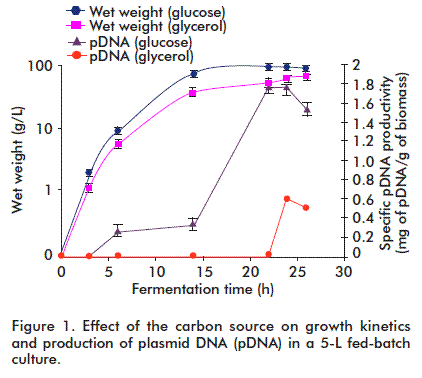
<body><![CDATA[<P   ><font size="3"><b><font face="Verdana, Arial, Helvetica, sans-serif">RESULTS      AND DISCUSSION </font></b></font></P >   <FONT size="+1">        <P   align="justify" ><font size="2" face="Verdana, Arial, Helvetica, sans-serif">When designing a      scalable culture medium it is relevant to define the amount of biomass that      will be obtained, in order to fix the concentration of nutrients that must      be supplied [4]. In line with this definition, a balance of culture medium      was made for each nutrient, considering the concentrations described in flame      emission spectroscopy studies of <I>E. coli</I> cells [5]. The composition      of the culture medium, which is specific for the microorganism, was then established.      A fed-batch 5-L fermentation culture was implemented, reaching cell densities      of almost 100 g/L of wet weight and allowing DNA yields above 1.8 mg of pDNA/g      of biomass [6]. </font></P >   <FONT size="+1">        <P   ><font size="2" face="Verdana, Arial, Helvetica, sans-serif"><b>Comparison of      two carbon sources </b></font></P >   <FONT size="+1">        <P   align="justify" ><font size="2" face="Verdana, Arial, Helvetica, sans-serif">Glucose is the most      widely selected carbon source because it is inexpensive and its metabolism      is very efficient. However, high levels cause the undesirable production of      acetate, a toxic metabolite for cells. Glycerol avoids the formation of intermediate      metabolites and the accumulation of organic acids; therefore, its effect in      the culture medium was considered for the production of pDNA. Nevertheless,      it was observed that cell growth and specific pDNA productivity were higher      when using glucose as carbon source compared with glycerol (<a href="#fig1">Figure      1</a>). Hence, the process started at low glucose concentrations in the initial      medium (5 g/L), followed by slow feeding of required amounts in the scaled      culture. </font></P >       <P   align="center" ><img src="/img/revistas/bta/v29n4/f0108412.gif" width="420" height="376"><a name="fig1"></a></P >   <FONT size="+1">        
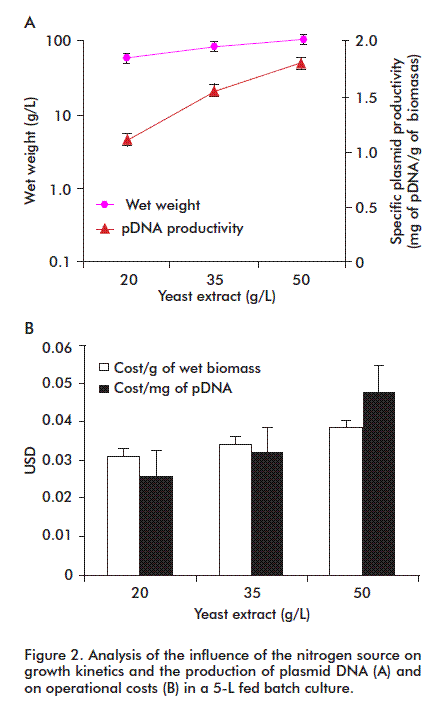
<P   ><font size="2" face="Verdana, Arial, Helvetica, sans-serif"><b>The appropriate      composition of yeast extract maximized the production of pDNA in <I>E. coli      </I></b></font></P >   <FONT size="+1">        <P   align="justify" ><font size="2" face="Verdana, Arial, Helvetica, sans-serif">Nitrogen requirements      of <I>E. coli</I> may be covered by adding inorganic bases, or organic as      yeast extract. For this purpose, we evaluated the effect of different levels      of this reagent on cell growth and specific pDNA productivity (<a href="#fig2">Figure      2</a>). Both parameters were higher at the highest yeast extract concentration      (50 g/L). This concentration is affordable, with lower costs both per amount      of biomass and milligram of pDNA. </font></P >       <P   align="center" ><img src="/img/revistas/bta/v29n4/f0208412.gif" width="438" height="706"><a name="fig2"></a></P >   <FONT size="+1">        
<P   ><font size="2" face="Verdana, Arial, Helvetica, sans-serif"><b>An appropriate      combination of temperature, shaking and aeration in the culture made it possible      to recover maximum amounts of pDNA</b> </font></P >   <FONT size="+1">        <P   align="justify" ><font size="2" face="Verdana, Arial, Helvetica, sans-serif">Sometimes having      the culture under sub-optimum conditions would favor a considerable increase      of pDNA productivity. Therefore, the adjustment of operational parameters      in a fermentation process is essential to enhance yields. </font></P >   <FONT size="+1">        ]]></body>
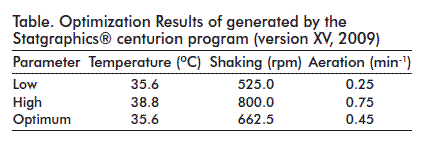
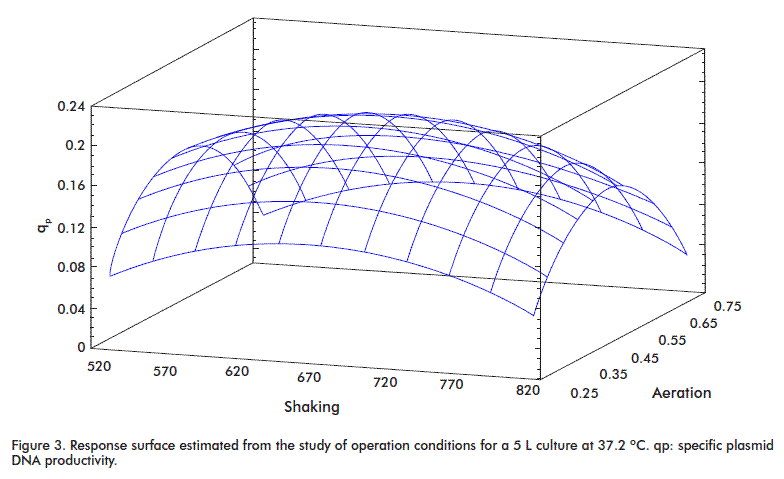
<body><![CDATA[<P   align="justify" ><font size="2" face="Verdana, Arial, Helvetica, sans-serif">In order to determine      the most favorable operational conditions, a factorial surface response Box-Behnken      design was conceived with three central randomized points in which the effect      of the following parameters were studied in 15 experimental runs: temperature,      shaking and impellent shaking speed. Statistics were analyzed with the aid      of the Statgraphics&reg; centurion program (version XV, 2009). </font></P >       <P   align="justify" ><font size="2" face="Verdana, Arial, Helvetica, sans-serif">A maximum local value      of specific pDNA productivity (q<Sub>p</Sub>) was found within the interval      analyzed, around the central point of the surface response generated by the      model (<a href="/img/revistas/bta/v29n4/f0308412.gif">Figure 3</a>). The optimum value for this      variable was of 264.496 mg of DNA per g of biomass, for the temperature, shaking      and aeration parameters shown on the <a href="#tab1">table</a>. </font></P >       
<P   align="center" ><img src="/img/revistas/bta/v29n4/t0108412.gif" width="425" height="146"><a name="tab1"></a></P >   <FONT size="+1"><FONT size="+1">        
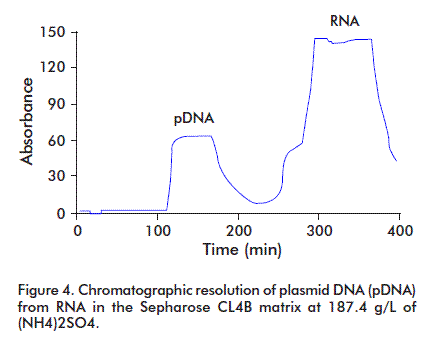
<P   align="justify" ><font size="2" face="Verdana, Arial, Helvetica, sans-serif">Under these conditions,      the large scale production of the plasmid pIDKE2 was satisfactory, on 50-L      fermentations at a scaling criterion of constant weight/volume ratio during      fed-batch. There were no significant differences in plasmid growth and productivity      between small and large scale bioreactors [1]. </font></P >       <P   align="justify" > </P >       <P   ><font size="2" face="Verdana, Arial, Helvetica, sans-serif"><b>Purification stage      </b> </font></P >   <FONT size="+1">        <P   align="justify" ><font size="2" face="Verdana, Arial, Helvetica, sans-serif">During pDNA purification,      RNA may be eliminated in three ways: with RNAse treatment, by selective precipitation      with Ca<Sup>2+</Sup>, NH<Sup>4+</Sup> or Mg<Sup>2+</Sup> ions [7], or by adding      polyethylenglycol [8]. Here, the variation of the hydrodynamic properties      of pDNA with several concentrations of (NH<Sub>4</Sub>)<Sub>2</Sub>SO<Sub>4</Sub>      were studied. The pDNA containing solution was applied on a Sepharose matrix      CL4B column and a 91% recovery of the pDNA was observed, with a complete resolution      of pDNA from RNA. The best condition was obtained at 187.4 g/L (NH<Sub>4</Sub>)<Sub>2</Sub>SO<Sub>4</Sub>,      attaining a complete resolution of pDNA from contaminant RNA (<a href="#fig4">Figure      4</a>). </font></P >       <P   align="center" ><img src="/img/revistas/bta/v29n4/f0408412.gif" width="429" height="345"><a name="fig4"></a></P >   <FONT size="+1"><FONT size="+1"><FONT size="+1"><FONT size="+1"><FONT size="+1"><FONT size="+1"><FONT size="+1"><FONT size="+1"><FONT size="+1"><FONT size="+1"><FONT size="+1"><FONT size="+1"><FONT size="+1"><FONT size="+1"><FONT size="+1"><FONT size="+1"><FONT size="+1"><FONT size="+1"><FONT size="+1">        
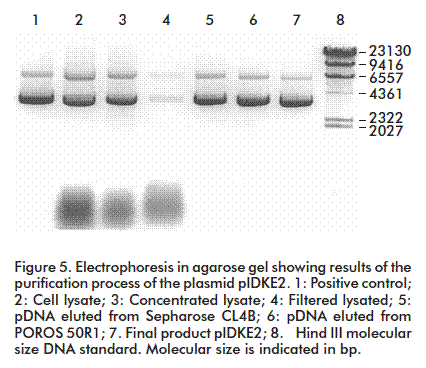
<P   align="justify" ><font size="2" face="Verdana, Arial, Helvetica, sans-serif">The high saline concentration      affects the DNA double strand because of acting on the hydrodynamic structure      of the nucleic acid molecules, either DNA or RNA. The pDNA hydrodynamic size      duplicates. Therefore, at the first purification stage using size exclusion      chromatography, there was a difference in the elution time between the pDNA      and the RNA, and the elution volume increased (<a href="#fig4">Figure 4</a>)      [3]. </font></P >       <P   align="justify" ><font size="2" face="Verdana, Arial, Helvetica, sans-serif">The second step is      conceived as a concentration stage, which also removes contaminants that still      remain in the pDNA containing solution. The use of the POROS 50R1 reverse      phase-high pressure liquid chromatography matrix for pDNA purification is      a novel strategy, based on the hydrophobic properties of the pDNA molecule,      which was purified with 92% of putiry (<a href="#fig5">Figure 5</a>). The      matrix showed a dynamic binding capacity of 3-5 mg/mL, which may be considered      high if considering that pDNA has a large molecular mass, with no similar      previous reports for conventional matrices. Another advantage of applying      this matrix is the operation flow that makes it possible to work at a high      speed without affecting the resolution while separating the material of interest      from contaminants. This is possible because the mass transfer occurs through      convective transport, a new approach to reduce limitations of mass transfer      in chromatography. This leads to a drastic decrease in separation times and      increases yields and productivity for pDNA recovery. </font></P >       ]]></body>
<body><![CDATA[<P   align="center" ><img src="/img/revistas/bta/v29n4/f0508412.gif" width="424" height="366"><a name="fig5"></a></P >       
<P   align="justify" ><font size="2" face="Verdana, Arial, Helvetica, sans-serif">Animals immunized      with the pIDKE2 plasmid produced by the methodology described in this work      successfully develop antibodies against the encoded hepatitis C virus antigens.      </font></P >       <P   align="justify" ><font size="2" face="Verdana, Arial, Helvetica, sans-serif">Taking into account      these results, the laboratory process was scaled up 4.5 times to obtain the      pIDKE2 plasmids for preclinical and clinical studies. Lot release followed      the regulations established for pharmaceutical grade DNA products [9]. Pre-clinical      studies showed no systemic alterations that would jeopardize the safety of      patients. Therefore, there was an adequate safety framework for the use of      this product in clinical trials [10]. </font></P >       <P   align="justify" >&nbsp;</P >       <P   ><font size="2" face="Verdana, Arial, Helvetica, sans-serif"><b><font size="3">RELEVANCE      OF THE STUDY </font></b></font></P >   <FONT size="+1">        <P   align="justify" ><font size="2" face="Verdana, Arial, Helvetica, sans-serif">The methodology developed      consists of the combined use, for the very first time, of the size exclusion      chromatography and reverse phase-high pressure liquid chromatography for pharmaceutical      grade pDNA purification. The novel use of the hydrodynamic and hydrophobic      properties of the pDNA allowed purifying it with up to 92% of purity and pyrogen-free,      innocuous, and sterile through a scalable, reproducible and robust process.      The process does not use reagents that may be harmful for human health or      the environment. </font></P >   <FONT size="+1">        <P   align="justify" ><font size="2" face="Verdana, Arial, Helvetica, sans-serif">This is also the      first time in Cuba that a plasmid intended for gene therapy and immunization      in humans was purified with pharmaceutical grade and at preparative scale      for clinical trials, in this case the pIDKE2 construct encoding hepatitis      C virus antigens. </font></P >       <P   align="justify" >&nbsp;</P >       <P   align="justify" > </P >       <P   align="justify" ><b><font size="3" face="Verdana, Arial, Helvetica, sans-serif">REFERENCES </font></b></P >       ]]></body>
<body><![CDATA[<P   align="justify" > </P >       <!-- ref --><P   align="justify" ><font size="2" face="Verdana, Arial, Helvetica, sans-serif">1. Ruiz O, Limonta      M, Valdes J, Pupo M, Mart&iacute;nez E. Scalable technology to produce pharmaceutical      grade plasmid DNA for gene therapy. In: Kang C, editor. Gene Therapy - developments      and future perspectives; Rijeka: Intech Europe; 2011. p. 53-70.     </font></P >   <FONT size="+1">        <!-- ref --><P   align="justify" ><font size="2" face="Verdana, Arial, Helvetica, sans-serif">2. Diogo MM, Queiroz      JA, Monteiro GA, Martins SA, Ferreira GN, Prazeres DM. Purification of a cystic      fibrosis plasmid vector for gene therapy using hydrophobic interaction chromatography.      Biotechnol Bioeng. 2000;68(5):576-83.     </font></P >       <!-- ref --><P   align="justify" ><font size="2" face="Verdana, Arial, Helvetica, sans-serif">3. Limonta M, M&aacute;rquez      G, Rey I, Pupo M, Ruiz O, Amador-Ca&ntilde;izares Y, <I>et al</I>. Plasmid      DNA recovery using size-exclusion and perfusion chromatography. Biopharm Int.      2008;21(9):38-47.     </font></P >       <!-- ref --><P   align="justify" ><font size="2" face="Verdana, Arial, Helvetica, sans-serif">4. Yee L, Blanch      HW. Recombinant trypsin production in high cell density fed-batch cultures      in Escherichia coli. Biotechnol Bioeng. 1993;41(8):781-90.     </font></P >       <P   align="justify" ><font size="2" face="Verdana, Arial, Helvetica, sans-serif">5. Piatkin K, Krivoshein      Y. Microbiolog&iacute;a. Mosc&uacute;: Mir; 1986. </font></P >       ]]></body>
<body><![CDATA[<!-- ref --><P   align="justify" ><font size="2" face="Verdana, Arial, Helvetica, sans-serif">6. Ruiz O, P&eacute;rez      M, Pupo M, Limonta M, Torres D, Mart&iacute;nez S, <I>et al</I>. High-cell-density      culture to produce plasmid DNA for gene therapy in E. coli. Biopharm Int.      2009;22(7):40-5.     </font></P >       <!-- ref --><P   align="justify" ><font size="2" face="Verdana, Arial, Helvetica, sans-serif">7. Ferreira GN, Cabral      JM, Prazeres DM. Development of process flow sheets for the purification of      supercoiled plasmids for gene therapy applications. Biotechnol Prog. 1999;15(4):725-31.          </font></P >       <!-- ref --><P   align="justify" ><font size="2" face="Verdana, Arial, Helvetica, sans-serif">8. Horn NA, Meek      JA, Budahazi G, Marquet M. Cancer gene therapy using plasmid DNA: purification      of DNA for human clinical trials. Hum Gene Ther. 1995;6(5):565-73.     </font></P >       <!-- ref --><P   align="justify" ><font size="2" face="Verdana, Arial, Helvetica, sans-serif">9. Food and Drug      Administration (FDA). Guidance for Industry: Considerations for Plasmid DNA      vaccines for Infectious Disease Indications. Rockville, MD: FDA; 2005 Feb.          </font></P >       <!-- ref --><P   align="justify" ><font size="2" face="Verdana, Arial, Helvetica, sans-serif"> 10. Limonta M, M&aacute;rquez      G, Pupo M, Ruiz O. The purification of plasmid DNA for clinical trials using      membrane chromatography. Biopharm Int. 2010;23(2):46-54.     </font></P >       ]]></body>
<body><![CDATA[<P   align="justify" >&nbsp;</P >       <P   align="justify" >&nbsp;</P >       <P   align="justify" > </P >       <P   align="justify" > </P >       <P   ><font size="2" face="Verdana, Arial, Helvetica, sans-serif"><I>Odalys Ruiz</I>.      Direcci&oacute;n de Desarrollo, Centro de Ingenier&iacute;a Gen&eacute;tica      y Biotecnolog&iacute;a, CIGB. Ave. 31 e/ 158 y 190, Cubanac&aacute;n, Playa,      CP 11600, La Habana, Cuba. E-mail: <A href="mailto:odalys.ruiz@cigb.edu.cu">      <FONT color="#0000FF">odalys.ruiz@cigb.edu.cu</font></A><FONT color="#0000FF"><FONT color="#000000">.      </font></font></font></P >   <FONT size="+1"><FONT color="#0000FF"><FONT color="#000000">        <P   > </P >   </font></font></font></font></font></font></font></font></font></font></font></font></font></font></font></font></font></font></font></font></font></font></font></font></font></font></font></font></font></font></font></font></font></font></font></font></font></font></font></font></font></font></font></font></font></font></font></font></font></font></font></font></font></font></font></font></font></font></font></font></font></font></font></font></font></font></font></DIV >      ]]></body><back>
<ref-list>
<ref id="B1">
<label>1</label><nlm-citation citation-type="book">
<person-group person-group-type="author">
<name>
<surname><![CDATA[Ruiz]]></surname>
<given-names><![CDATA[O]]></given-names>
</name>
<name>
<surname><![CDATA[Limonta]]></surname>
<given-names><![CDATA[M]]></given-names>
</name>
<name>
<surname><![CDATA[Valdes]]></surname>
<given-names><![CDATA[J]]></given-names>
</name>
<name>
<surname><![CDATA[Pupo]]></surname>
<given-names><![CDATA[M]]></given-names>
</name>
<name>
<surname><![CDATA[Martínez]]></surname>
<given-names><![CDATA[E]]></given-names>
</name>
</person-group>
<article-title xml:lang="en"><![CDATA[Scalable technology to produce pharmaceutical grade plasmid DNA for gene therapy]]></article-title>
<person-group person-group-type="editor">
<name>
<surname><![CDATA[Kang]]></surname>
<given-names><![CDATA[C]]></given-names>
</name>
</person-group>
<source><![CDATA[Gene Therapy: developments and future perspectives]]></source>
<year>2011</year>
<page-range>53-70</page-range><publisher-loc><![CDATA[Rijeka ]]></publisher-loc>
<publisher-name><![CDATA[Intech Europe]]></publisher-name>
</nlm-citation>
</ref>
<ref id="B2">
<label>2</label><nlm-citation citation-type="journal">
<person-group person-group-type="author">
<name>
<surname><![CDATA[Diogo]]></surname>
<given-names><![CDATA[MM]]></given-names>
</name>
<name>
<surname><![CDATA[Queiroz]]></surname>
<given-names><![CDATA[JA]]></given-names>
</name>
<name>
<surname><![CDATA[Monteiro]]></surname>
<given-names><![CDATA[GA]]></given-names>
</name>
<name>
<surname><![CDATA[Martins]]></surname>
<given-names><![CDATA[SA]]></given-names>
</name>
<name>
<surname><![CDATA[Ferreira]]></surname>
<given-names><![CDATA[GN]]></given-names>
</name>
<name>
<surname><![CDATA[Prazeres]]></surname>
<given-names><![CDATA[DM]]></given-names>
</name>
</person-group>
<article-title xml:lang="en"><![CDATA[Purification of a cystic fibrosis plasmid vector for gene therapy using hydrophobic interaction chromatography]]></article-title>
<source><![CDATA[Biotechnol Bioeng]]></source>
<year>2000</year>
<volume>68</volume>
<numero>5</numero>
<issue>5</issue>
<page-range>576-83</page-range></nlm-citation>
</ref>
<ref id="B3">
<label>3</label><nlm-citation citation-type="journal">
<person-group person-group-type="author">
<name>
<surname><![CDATA[Limonta]]></surname>
<given-names><![CDATA[M]]></given-names>
</name>
<name>
<surname><![CDATA[Márquez]]></surname>
<given-names><![CDATA[G]]></given-names>
</name>
<name>
<surname><![CDATA[Rey]]></surname>
<given-names><![CDATA[I]]></given-names>
</name>
<name>
<surname><![CDATA[Pupo]]></surname>
<given-names><![CDATA[M]]></given-names>
</name>
<name>
<surname><![CDATA[Ruiz]]></surname>
<given-names><![CDATA[O]]></given-names>
</name>
<name>
<surname><![CDATA[Amador-Cañizares]]></surname>
<given-names><![CDATA[Y]]></given-names>
</name>
</person-group>
<article-title xml:lang="en"><![CDATA[Plasmid DNA recovery using size-exclusion and perfusion chromatography]]></article-title>
<source><![CDATA[Biopharm Int]]></source>
<year>2008</year>
<volume>21</volume>
<numero>9</numero>
<issue>9</issue>
<page-range>38-47</page-range></nlm-citation>
</ref>
<ref id="B4">
<label>4</label><nlm-citation citation-type="journal">
<person-group person-group-type="author">
<name>
<surname><![CDATA[Yee]]></surname>
<given-names><![CDATA[L]]></given-names>
</name>
<name>
<surname><![CDATA[Blanch]]></surname>
<given-names><![CDATA[HW]]></given-names>
</name>
</person-group>
<article-title xml:lang="en"><![CDATA[Recombinant trypsin production in high cell density fed-batch cultures in Escherichia coli]]></article-title>
<source><![CDATA[Biotechnol Bioeng]]></source>
<year>1993</year>
<volume>41</volume>
<numero>8</numero>
<issue>8</issue>
<page-range>781-90</page-range></nlm-citation>
</ref>
<ref id="B5">
<label>5</label><nlm-citation citation-type="book">
<person-group person-group-type="author">
<name>
<surname><![CDATA[Piatkin]]></surname>
<given-names><![CDATA[K]]></given-names>
</name>
<name>
<surname><![CDATA[Krivoshein]]></surname>
<given-names><![CDATA[Y]]></given-names>
</name>
</person-group>
<source><![CDATA[Microbiología]]></source>
<year>1986</year>
<publisher-loc><![CDATA[Moscú ]]></publisher-loc>
<publisher-name><![CDATA[Editorial Mir]]></publisher-name>
</nlm-citation>
</ref>
<ref id="B6">
<label>6</label><nlm-citation citation-type="journal">
<person-group person-group-type="author">
<name>
<surname><![CDATA[Ruiz]]></surname>
<given-names><![CDATA[O]]></given-names>
</name>
<name>
<surname><![CDATA[Pérez]]></surname>
<given-names><![CDATA[M]]></given-names>
</name>
<name>
<surname><![CDATA[Pupo]]></surname>
<given-names><![CDATA[M]]></given-names>
</name>
<name>
<surname><![CDATA[Limonta]]></surname>
<given-names><![CDATA[M]]></given-names>
</name>
<name>
<surname><![CDATA[Torres]]></surname>
<given-names><![CDATA[D]]></given-names>
</name>
<name>
<surname><![CDATA[Martínez]]></surname>
<given-names><![CDATA[S]]></given-names>
</name>
</person-group>
<article-title xml:lang="en"><![CDATA[High-cell-density culture to produce plasmid DNA for gene therapy in E. coli]]></article-title>
<source><![CDATA[Biopharm Int]]></source>
<year>2009</year>
<volume>22</volume>
<numero>7</numero>
<issue>7</issue>
<page-range>40-5</page-range></nlm-citation>
</ref>
<ref id="B7">
<label>7</label><nlm-citation citation-type="journal">
<person-group person-group-type="author">
<name>
<surname><![CDATA[Ferreira]]></surname>
<given-names><![CDATA[GN]]></given-names>
</name>
<name>
<surname><![CDATA[Cabral]]></surname>
<given-names><![CDATA[JM]]></given-names>
</name>
<name>
<surname><![CDATA[Prazeres]]></surname>
<given-names><![CDATA[DM]]></given-names>
</name>
</person-group>
<article-title xml:lang="en"><![CDATA[Development of process flow sheets for the purification of supercoiled plasmids for gene therapy applications]]></article-title>
<source><![CDATA[Biotechnol Prog]]></source>
<year>1999</year>
<volume>15</volume>
<numero>4</numero>
<issue>4</issue>
<page-range>725-31</page-range></nlm-citation>
</ref>
<ref id="B8">
<label>8</label><nlm-citation citation-type="journal">
<person-group person-group-type="author">
<name>
<surname><![CDATA[Horn]]></surname>
<given-names><![CDATA[NA]]></given-names>
</name>
<name>
<surname><![CDATA[Meek]]></surname>
<given-names><![CDATA[JA]]></given-names>
</name>
<name>
<surname><![CDATA[Budahazi]]></surname>
<given-names><![CDATA[G]]></given-names>
</name>
<name>
<surname><![CDATA[Marquet]]></surname>
<given-names><![CDATA[M]]></given-names>
</name>
</person-group>
<article-title xml:lang="en"><![CDATA[Cancer gene therapy using plasmid DNA: purification of DNA for human clinical trials]]></article-title>
<source><![CDATA[Hum Gene Ther]]></source>
<year>1995</year>
<volume>6</volume>
<numero>5</numero>
<issue>5</issue>
<page-range>565-73</page-range></nlm-citation>
</ref>
<ref id="B9">
<label>9</label><nlm-citation citation-type="book">
<collab>Food and Drug Administration (FDA)</collab>
<source><![CDATA[Guidance for Industry: Considerations for Plasmid DNA vaccines for Infectious Disease Indications]]></source>
<year>2005</year>
<month> F</month>
<day>eb</day>
<publisher-loc><![CDATA[Rockville, MD ]]></publisher-loc>
<publisher-name><![CDATA[FDA]]></publisher-name>
</nlm-citation>
</ref>
<ref id="B10">
<label>10</label><nlm-citation citation-type="journal">
<person-group person-group-type="author">
<name>
<surname><![CDATA[Limonta]]></surname>
<given-names><![CDATA[M]]></given-names>
</name>
<name>
<surname><![CDATA[Márquez]]></surname>
<given-names><![CDATA[G]]></given-names>
</name>
<name>
<surname><![CDATA[Pupo]]></surname>
<given-names><![CDATA[M]]></given-names>
</name>
<name>
<surname><![CDATA[Ruiz]]></surname>
<given-names><![CDATA[O]]></given-names>
</name>
</person-group>
<article-title xml:lang="en"><![CDATA[The purification of plasmid DNA for clinical trials using membrane chromatography]]></article-title>
<source><![CDATA[Biopharm Int]]></source>
<year>2010</year>
<volume>23</volume>
<numero>2</numero>
<issue>2</issue>
<page-range>46-54</page-range></nlm-citation>
</ref>
</ref-list>
</back>
</article>