<?xml version="1.0" encoding="ISO-8859-1"?><article xmlns:mml="http://www.w3.org/1998/Math/MathML" xmlns:xlink="http://www.w3.org/1999/xlink" xmlns:xsi="http://www.w3.org/2001/XMLSchema-instance">
<front>
<journal-meta>
<journal-id>1027-2852</journal-id>
<journal-title><![CDATA[Biotecnología Aplicada]]></journal-title>
<abbrev-journal-title><![CDATA[Biotecnol Apl]]></abbrev-journal-title>
<issn>1027-2852</issn>
<publisher>
<publisher-name><![CDATA[Editorial Elfos Scientiae]]></publisher-name>
</publisher>
</journal-meta>
<article-meta>
<article-id>S1027-28522013000100003</article-id>
<title-group>
<article-title xml:lang="en"><![CDATA[Molecular identification of thirteen isolates of Trichoderma spp. and evaluation of their pathogenicity towards Rhizoctonia solani Kühn]]></article-title>
<article-title xml:lang="es"><![CDATA[Identificación molecular y evaluación patogénica de trece aislamientos de Trichoderma spp. frente a Rhizoctonia solani Kühn]]></article-title>
</title-group>
<contrib-group>
<contrib contrib-type="author">
<name>
<surname><![CDATA[Infante]]></surname>
<given-names><![CDATA[Danay]]></given-names>
</name>
<xref ref-type="aff" rid="A01"/>
</contrib>
<contrib contrib-type="author">
<name>
<surname><![CDATA[Martínez]]></surname>
<given-names><![CDATA[Benedicto]]></given-names>
</name>
<xref ref-type="aff" rid="A01"/>
</contrib>
<contrib contrib-type="author">
<name>
<surname><![CDATA[Peteira]]></surname>
<given-names><![CDATA[Belkis]]></given-names>
</name>
<xref ref-type="aff" rid="A01"/>
</contrib>
<contrib contrib-type="author">
<name>
<surname><![CDATA[Reyes]]></surname>
<given-names><![CDATA[Yusimy]]></given-names>
</name>
<xref ref-type="aff" rid="A02"/>
</contrib>
<contrib contrib-type="author">
<name>
<surname><![CDATA[Herrera]]></surname>
<given-names><![CDATA[Alfredo]]></given-names>
</name>
<xref ref-type="aff" rid="A03"/>
</contrib>
</contrib-group>
<aff id="A02">
<institution><![CDATA[,Universidad Agraria de La Habana Fructuoso Rodríguez Pérez Facultad de Agronomía ]]></institution>
<addr-line><![CDATA[San José de las Lajas ]]></addr-line>
<country>Cuba</country>
</aff>
<aff id="A03">
<institution><![CDATA[,Instituto Politécnico Nacional, IPN Centro de Investigación y de Estudios Avanzados, Cinvestav Laboratorio Nacional de Genómica para la Biodiversidad, Langebio]]></institution>
<addr-line><![CDATA[Irapuato ]]></addr-line>
<country>México</country>
</aff>
<aff id="A01">
<institution><![CDATA[,Centro Nacional de Sanidad Agropecuaria Dirección de Protección de Plantas Grupo de Fitopatología]]></institution>
<addr-line><![CDATA[San José de las Lajas ]]></addr-line>
<country>Cuba</country>
</aff>
<pub-date pub-type="pub">
<day>00</day>
<month>03</month>
<year>2013</year>
</pub-date>
<pub-date pub-type="epub">
<day>00</day>
<month>03</month>
<year>2013</year>
</pub-date>
<volume>30</volume>
<numero>1</numero>
<fpage>23</fpage>
<lpage>28</lpage>
<copyright-statement/>
<copyright-year/>
<self-uri xlink:href="http://scielo.sld.cu/scielo.php?script=sci_arttext&amp;pid=S1027-28522013000100003&amp;lng=en&amp;nrm=iso"></self-uri><self-uri xlink:href="http://scielo.sld.cu/scielo.php?script=sci_abstract&amp;pid=S1027-28522013000100003&amp;lng=en&amp;nrm=iso"></self-uri><self-uri xlink:href="http://scielo.sld.cu/scielo.php?script=sci_pdf&amp;pid=S1027-28522013000100003&amp;lng=en&amp;nrm=iso"></self-uri><abstract abstract-type="short" xml:lang="en"><p><![CDATA[Disease caused by Rhizoctonia solani Kühn infestations has become a growing problem for commercially important crops. Although this fungus is usually controlled through the application of chemicals, the heavy ecological and financial toll of the latter has prompted for research on biopesticides as a viable alternative. Trichoderma spp. is a well-known fungus often used for the biological control of crop pests, whose anti-fungal mechanisms include competition for the substrate, antibiosis and/or mycoparasitism. In the present work, we have used molecular techniques (sequencing of amplicons from the internal transcribed spacer of ribosomal DNA and the EF1A translation elongation factor) for the taxonomic identification of 13 Trichoderma spp. isolates in our collection, also evaluating their antibiotic effect on strains from three anastomosis groups of R. solani (AG-2.1, AG-5, AG-8) by the cellophane method. The sequences obtained from all isolates exhibited 100 % identity with deposited T. asperellum Samuels sequences in TrichoBLAST/GenBank, enabling their taxonomic assignment to this species. When analyzed by in vitro tests, over 70 % of the isolates exhibited a fungistatic effect towards R. solani, with the remaining strains exhibiting fungicidal activity; these results were later corroborated by technical efficacy tests under field conditions. Isolates 3, 13, 17, 75, 78, 85 and 90 were selected as potential biocontrol agents due to their high antibiotic activity and technical efficacy under field conditions.]]></p></abstract>
<abstract abstract-type="short" xml:lang="es"><p><![CDATA[La incidencia de las enfermedades causadas por Rhizoctonia solani Kühn en las plantas aumenta cada año. Su control es fundamentalmente con productos químicos, en su mayoría muy tóxicos. Por tal razón, se investigan alternativas bioplaguicidas. Trichoderma spp. es uno de los hongos más utilizados para el control biológico de plagas, por sus propiedades y mecanismos de acción: competencia por el sustrato, antibiosis y micoparasitismo. Este trabajo tuvo como objetivos la identifi cación molecular y evaluación patogénica de 13 aislamientos del género Trichoderma frente a aislamientos de R. solani. Se evaluó su efecto antibiótico sobre aislamientos de 3 grupos de anastomosis de R. solani (AG-2.1, AG-5, AG-8) por el método de celofán. La identificación molecular partió de la secuenciación del espaciador interno del transcrito de la región del ADN ribosomal y del factor de elongación de la traducción EF1A. Más del 70 % de los aislamientos evaluados ejerció un efecto fungistático; mientras que el resto actuó como fungicida. La evaluación de la eficacia técnica en condiciones de campo corroboró estos resultados. A partir de la secuenciación y comparación de los datos de las secuencias depositadas en TrichoBLAST/GenBank, se comprobó que todos los aislamientos tenían el 100 % de identidad con la especie Trichoderma asperellum Samuels. Se seleccionaron los aislamientos 3, 13, 17, 75, 78, 85 y 90 como promisorios agentes de control biológico, por su alto potencial antibiótico y eficacia técnica en condiciones de campo.]]></p></abstract>
<kwd-group>
<kwd lng="en"><![CDATA[Trichoderma asperellum]]></kwd>
<kwd lng="en"><![CDATA[Rhizoctonia solani]]></kwd>
<kwd lng="en"><![CDATA[internal transcribed spacer]]></kwd>
<kwd lng="en"><![CDATA[transcriptional elongation factors]]></kwd>
<kwd lng="en"><![CDATA[fungicide effect]]></kwd>
<kwd lng="en"><![CDATA[fungistatic effect]]></kwd>
<kwd lng="es"><![CDATA[Trichoderma asperellum]]></kwd>
<kwd lng="es"><![CDATA[Rhizoctonia solani]]></kwd>
<kwd lng="es"><![CDATA[espaciador interno del transcrito]]></kwd>
<kwd lng="es"><![CDATA[factores de elongación transcripcional]]></kwd>
<kwd lng="es"><![CDATA[efecto fungicida]]></kwd>
<kwd lng="es"><![CDATA[efecto fungistático]]></kwd>
</kwd-group>
</article-meta>
</front><body><![CDATA[ <DIV class="Sect"   >        <P   align="right" ><font size="2" color="#000000" face="Verdana, Arial, Helvetica, sans-serif"><b>RESEARCH      </b></font></P >   <FONT size="+1" color="#000000">        <P   > </P >       <P   >&nbsp;</P >       <P   ><font size="4" face="Verdana, Arial, Helvetica, sans-serif"><b>Molecular identification      of thirteen isolates of <I>Trichoderma</I> spp. and evaluation of their pathogenicity      towards <I>Rhizoctonia solani</I> K&uuml;hn </b></font></P >       <P   >&nbsp;</P >       <P   ></P >       <P   ></P >       <P   > </P >       <P   ><font size="3" face="Verdana, Arial, Helvetica, sans-serif"><b>Identificaci&oacute;n      molecular y evaluaci&oacute;n patog&eacute;nica de trece aislamientos de <I>Trichoderma</I>      spp. frente a <I>Rhizoctonia solani</I> K&uuml;hn </b></font></P >       ]]></body>
<body><![CDATA[<P   > </P >       <P   > </P >       <P   >&nbsp;</P >       <P   >&nbsp;</P >       <P   ><font size="2" face="Verdana, Arial, Helvetica, sans-serif"><b>Danay Infante<Sup>1</Sup>,      Benedicto Mart&iacute;nez<Sup>1</Sup>, Belkis Peteira<Sup>1</Sup>, Yusimy      Reyes<Sup>2</Sup>, Alfredo Herrera<Sup>3</Sup></b></font></P >   <FONT size="+1"><FONT size="+1"><FONT size="+1"><FONT size="+1"><FONT size="+1"><FONT size="+1"><FONT size="+1"><FONT size="+1"><FONT size="+1"><FONT size="+1">        <P   ><font size="2" face="Verdana, Arial, Helvetica, sans-serif"><Sup>1</Sup> Grupo      de Fitopatolog&iacute;a, Direcci&oacute;n de Protecci&oacute;n de Plantas,      Centro Nacional de Sanidad Agropecuaria, Censa. Autopista Nacional km 23&frac12;,      AP 10, San Jos&eacute; de las Lajas, Mayabeque, Cuba. <Sup>    <br>     2</Sup> Facultad de Agronom&iacute;a, Universidad Agraria de La Habana Fructuoso      Rodr&iacute;guez P&eacute;rez, UNAH Autopista Nacional km 23&frac12;, AP 10,      San Jos&eacute; de las Lajas, Mayabeque, Cuba. <Sup>    <br>     3</Sup> Laboratorio Nacional de Gen&oacute;mica para la Biodiversidad, Langebio,      Centro de Investigaci&oacute;n y de Estudios Avanzados, Cinvestav, Instituto      Polit&eacute;cnico Nacional, IPN. CP 36821, Irapuato, Guanajuato, M&eacute;xico.      </font></P >       <P   >&nbsp;</P >       <P   >&nbsp;</P >   </font></font></font></font></font></font></font></font></font></font></font>   <hr>   <FONT size="+1" color="#000000"><FONT size="+1"><FONT size="+1"><FONT size="+1"><FONT size="+1"><FONT size="+1"><FONT size="+1"><FONT size="+1"><FONT size="+1"><FONT size="+1"><FONT size="+1">        ]]></body>
<body><![CDATA[<P   ><FONT size="+1"><FONT size="+1"><FONT size="+1"><FONT size="+1"><FONT size="+1"><FONT size="+1"></font></font></font></font></font></font><FONT size="+1"><FONT size="+1"><FONT size="+1"><FONT size="+1"><FONT size="+1"><FONT size="+1"></font></font></font></font></font></font><FONT size="+1"><FONT size="+1"><FONT size="+1"><FONT size="+1"><FONT size="+1"><FONT size="+1"></font></font></font></font></font></font><FONT size="+1"><FONT size="+1"><FONT size="+1"><FONT size="+1"><FONT size="+1"><FONT size="+1"></font></font></font></font></font></font><font size="2" face="Verdana, Arial, Helvetica, sans-serif"><B>ABSTRACT      </b></font></P >   <FONT size="+1"><FONT size="+1"><FONT size="+1"><FONT size="+1"><FONT size="+1"><FONT size="+1"><FONT size="+1">        <P   ><font size="2" face="Verdana, Arial, Helvetica, sans-serif">Disease caused by      <I>Rhizoctonia solani</I> K&uuml;hn infestations has become a growing problem      for commercially important crops. Although this fungus is usually controlled      through the application of chemicals, the heavy ecological and financial toll      of the latter has prompted for research on biopesticides as a viable alternative.      <I>Trichoderma</I> spp. is a well-known fungus often used for the biological      control of crop pests, whose anti-fungal mechanisms include competition for      the substrate, antibiosis and/or mycoparasitism. In the present work, we have      used molecular techniques (sequencing of amplicons from the internal transcribed      spacer of ribosomal DNA and the EF1A translation elongation factor) for the      taxonomic identification of 13 <I>Trichoderma</I> spp. isolates in our collection,      also evaluating their antibiotic effect on strains from three anastomosis      groups of R. solani (AG-2.1, AG-5, AG-8) by the cellophane method. The sequences      obtained from all isolates exhibited 100 % identity with deposited T. asperellum      Samuels sequences in TrichoBLAST/GenBank, enabling their taxonomic assignment      to this species. When analyzed by in vitro tests, over 70 % of the isolates      exhibited a fungistatic effect towards <I>R. solani</I>, with the remaining      strains exhibiting fungicidal activity; these results were later corroborated      by technical efficacy tests under field conditions. Isolates 3, 13, 17, 75,      78, 85 and 90 were selected as potential biocontrol agents due to their high      antibiotic activity and technical efficacy under field conditions. </font></P >       <P   ><font size="2" face="Verdana, Arial, Helvetica, sans-serif"><B>Keywords:</B>      <I>Trichoderma asperellum</I>,<I> Rhizoctonia solani</I>, internal transcribed      spacer, transcriptional elongation factors, fungicide effect, fungistatic      effect. </font></P >   </font></font></font></font></font></font></font></font></font></font></font></font></font></font></font></font></font></font>   <hr>   <FONT size="+1" color="#000000"><FONT size="+1"><FONT size="+1"><FONT size="+1"><FONT size="+1"><FONT size="+1"><FONT size="+1"><FONT size="+1"><FONT size="+1"><FONT size="+1"><FONT size="+1"><FONT size="+1"><FONT size="+1"><FONT size="+1"><FONT size="+1"><FONT size="+1"><FONT size="+1"><FONT size="+1">        <P   ><font size="2" face="Verdana, Arial, Helvetica, sans-serif"><B>RESUMEN </b></font></P >   <FONT size="+1"><FONT size="+1">        <P   ><font size="2" face="Verdana, Arial, Helvetica, sans-serif">La incidencia de      las enfermedades causadas por <I>Rhizoctonia solani </I>K&uuml;hn en las plantas      aumenta cada a&ntilde;o. Su control es fundamentalmente con productos qu&iacute;micos,      en su mayor&iacute;a muy t&oacute;xicos. Por tal raz&oacute;n, se investigan      alternativas bioplaguicidas. <I>Trichoderma </I>spp. es uno de los hongos      m&aacute;s utilizados para el control biol&oacute;gico de plagas, por sus      propiedades y mecanismos de acci&oacute;n: competencia por el sustrato, antibiosis      y micoparasitismo. Este trabajo tuvo como objetivos la identifi caci&oacute;n      molecular y evaluaci&oacute;n patog&eacute;nica de 13 aislamientos del g&eacute;nero      <I>Trichoderma </I>frente a aislamientos de <I>R. solani</I>. Se evalu&oacute;      su efecto antibi&oacute;tico sobre aislamientos de 3 grupos de anastomosis      de <I>R. solani </I>(AG-2.1, AG-5, AG-8) por el m&eacute;todo de celof&aacute;n.      La identificaci&oacute;n molecular parti&oacute; de la secuenciaci&oacute;n      del espaciador interno del transcrito de la regi&oacute;n del ADN ribosomal      y del factor de elongaci&oacute;n de la traducci&oacute;n EF1A. M&aacute;s      del 70 % de los aislamientos evaluados ejerci&oacute; un efecto fungist&aacute;tico;      mientras que el resto actu&oacute; como fungicida. La evaluaci&oacute;n de      la eficacia t&eacute;cnica en condiciones de campo corrobor&oacute; estos      resultados. A partir de la secuenciaci&oacute;n y comparaci&oacute;n de los      datos de las secuencias depositadas en <I>Tricho</I>BLAST/GenBank, se comprob&oacute;      que todos los aislamientos ten&iacute;an el 100 % de identidad con la especie      <I>Trichoderma asperellum </I>Samuels. Se seleccionaron los aislamientos 3,      13, 17, 75, 78, 85 y 90 como promisorios agentes de control biol&oacute;gico,      por su alto potencial antibi&oacute;tico y eficacia t&eacute;cnica en condiciones      de campo. </font></P >       <P   ><font size="2" face="Verdana, Arial, Helvetica, sans-serif"><B>Palabras clave:</B>      <I>Trichoderma asperellum</I>, <I>Rhizoctonia solani</I>, espaciador interno      del transcrito, factores de elongaci&oacute;n transcripcional, efecto fungicida,      efecto fungist&aacute;tico. </font></P >   </font></font></font></font></font></font></font></font></font></font></font></font></font></font></font></font></font></font></font></font>   <hr>   <FONT size="+1" color="#000000"><FONT size="+1"><FONT size="+1"><FONT size="+1"><FONT size="+1"><FONT size="+1"><FONT size="+1"><FONT size="+1"><FONT size="+1"><FONT size="+1"><FONT size="+1"><FONT size="+1"><FONT size="+1"><FONT size="+1"><FONT size="+1"><FONT size="+1"><FONT size="+1"><FONT size="+1"><FONT size="+1"><FONT size="+1">        <P   >&nbsp;</P >       <P   >&nbsp;</P >       <P   > </P >   <FONT size="+1">        <P   > </P >       ]]></body>
<body><![CDATA[<P   > </P >       <P   ><font size="3" face="Verdana, Arial, Helvetica, sans-serif"><B>INTRODUCTION </b></font></P >       <P   align="justify" ><font size="2" face="Verdana, Arial, Helvetica, sans-serif">Plant pathogens and      their antagonist species exist in the context of a complex web of ecological      interactions. Fungi such as <I>Trichoderma harzianum</I> Rifai, T. auroviride      Rifai and <I>T. asperellum</I> Samuels, for instance, have been shown to play      an important regulatory role [1], counteracting a number of fungal plant pathogens      through antibiosis, mycoparasitism or simply competing for their substrate.      Not surprisingly, Trichoderma has long been a subject of study for its potential      application in the field of biological control of phytopathogens [2-4]. Trichoderma,      a member of the Hypocrea family, is responsible for the formation of a considerable      part of soil biomass [5], participates in mutualistic associations with plant      roots which increase considerably their nutrient uptake capabilities [6],      and induces systemic resistance in their hosts to a number of phytopathogens      [7-10]. </font></P >   <FONT size="+1">        <P   align="justify" ><font size="2" face="Verdana, Arial, Helvetica, sans-serif">According to Samuels      [11] and the Crop Protection Compendium [12], the teleomorphs of some Trichoderma      species are typical of the Hypocrea genus (such as Ascomycetes and Hypocreales).      Rifai [13] used morphological traits (conidiophore branching patterns and      conidial shape) to provide a first approximation to the diversity and structure      of <I>Trichoderma </I>spp., describing nine species (<I>T. hamatum</I> (Bon.)      Bain, <I>T. viride</I> Pers. ex S. F. Gray, <I>T. aureoviride</I>, <I>T. harzianum</I>,      <I>T. koningii</I> Rifai, <I>T. pseudokoningii</I> Rifai, <I>T. longibrachiatum</I>      Rifai, <I>T. polysporum</I> (Link ex Pers) Rifai and <I>T. piluliferum</I>      Webster &amp; Rifai) as an aggregate species and pointing out that <I>T. hamatum</I>      might be formed by two or more morphological distinct species. To compound      matters, these species are in constant variation, and it has therefore been      impossible to provide an accurate description of their characteristics, even      with molecular methods [14]. Bissett <I>et al</I>. [15-17] later described      the Longibrachiatum genus section, grouping <I>T. viride</I>, <I>T. koningii</I>,      <I>T. pseudokoningii</I>, <I>T. longibrachiatum</I>, <I>T. citrinoviride</I>      Bissett and <I>T. atroviride</I> Bissett together. </font></P >       <P   align="justify" ><font size="2" face="Verdana, Arial, Helvetica, sans-serif">The research of Samuels      <I>et al</I>. [18, 19] on the <I>Hypocrea schweinitzii</I> Samuels and <I>Trichoderma</I>      sect. Longibrachiatum complex provided new data regarding the taxonomy of      hitherto unknown species of the genus. Samuels <I>et al</I>. [19] and Lieckfeldt      <I>et al</I>. [20] examined <I>T. viride</I>, a species initially defined      solely by the presence of conidial warts, concluding that there were two morphologically      distinct types (I and II) with differences in mitochondrial DNA. Later morphological,      physiological and molecular studies established that morphological type I      corresponded to the actual <I>T. viride</I> species (anamorph of Hypocrea),      whereas type II actually corresponded to a new species of <I>T. asperellum</I>,      characterized molecularly and close to the <I>T. hamatum</I> neotype. </font></P >       <P   align="justify" ><font size="2" face="Verdana, Arial, Helvetica, sans-serif">Several <I>T. asperellum</I>      isolates are currently used as biopesticides for the control of pathogenic      fungi in economically important crops, both under greenhouse and open field      conditions. Their mycoparasitic effect is highly specific for <I>Rhizoctonia      solani</I> and <I>Sclerotium</I> spp., and is based on the production of high      levels of chitinolytic enzymes [1, 9, 18, 21]. The Plant Mycology Laboratory      of the National Center for Agricultural Health (Censa, Cuba) has put together      a strain collection conserving over 80 <I>Trichoderma </I>spp. isolates, among      which there is a promising group of indigenous isolates with morphocultural      and pathogenic traits distinct from those of <I>T. harzianum</I> strains A      34, A 53 and Ts-3, currently employed for the production of biopesticides.      The present work, therefore, centers on the molecular characterization of      13 of these isolates of the Trichoderma genus and the evaluation of their      pathogenicity towards isolates of <I>R. solani</I>. </font></P >       <P   align="justify" >&nbsp;</P >       <P   align="justify" > </P >       <P   ><font size="3" face="Verdana, Arial, Helvetica, sans-serif"><B>MATERIALS AND      METHODS </b></font></P >   <FONT size="+1"><B>        <P   ><font size="2" face="Verdana, Arial, Helvetica, sans-serif"><I>Trichoderma </I>spp.      isolates </font></P >   </B>        ]]></body>
<body><![CDATA[<P   align="justify" ><font size="2" face="Verdana, Arial, Helvetica, sans-serif">This study used 14      samples of <I>T. atroviride</I> (IMI206040) as reference strain for molecular      tests, and isolates T.1, T.3, T.12, T.13, T.17, T.25, T.28, T.56, T.75, T.78,      T.79, T.85 and T.90 from the Plant Mycology Laboratory of Censa, Cuba. </font></P >   <FONT size="+1">        <P   ><font size="2" face="Verdana, Arial, Helvetica, sans-serif"><B><I>Rhizoctonia</I>      isolates </b></font></P >       <P   align="justify" ><font size="2" face="Verdana, Arial, Helvetica, sans-serif">This study used isolates      from three anastomosis groups of <I>R. solani</I> (AG-2.1, AG-5, AG-8), provided      by the National Genomics Laboratory for Biodiversity (Langebio) of the Center      for Advanced Research and Studies (Cinvestav) of the National Polytechnic      Institute (IPN), M&eacute;xico. </font></P >       <P   align="justify" > </P >       <P   ><font size="2" face="Verdana, Arial, Helvetica, sans-serif"><B>Culture conditions      </b></font></P >       <P   align="justify" ><font size="2" face="Verdana, Arial, Helvetica, sans-serif">The <I>Trichoderma      </I>spp. and <I>R. solani </I>isolates were seeded on potato-dextrose agar      medium (APD, Difco) in 90 mm Petri dishes and incubated on total darkness      at 28 &plusmn; 2 &deg;C and 25 &plusmn; 2 &deg;C, respectively. When fungal      growth covered almost the entire surface of the plate, 6 mm disc samples were      taken from the periphery of the colonies for further experimentation. </font></P >       <P   ><font size="2" face="Verdana, Arial, Helvetica, sans-serif"><B><I>In vitro</I>      antibiotic effect of <I>Trichoderma </I>spp. isolates towards isolates from      three anastomosis groups of <I>R. solani </I></b></font></P >       <P   align="justify" ><font size="2" face="Verdana, Arial, Helvetica, sans-serif">Samples of <I>Trichoderma      </I>spp. (excepting <I>T. atroviride</I>, IMI206040) were seeded on 90 mm      Petri dishes with PDA medium (Difco) covered with a cellophane membrane [22]      by placing the individual mycelial discs on the center of the plate (non-inoculated      controls were also set up), incubating the plates for 36 h at 28 &plusmn;      2 &deg;C in absolute darkness until fungal growth reached &frac34; of plate      diameter. At this point the cellophane membrane was retired, and the plates      were then inoculated separately with isolates from the different <I>R. solani</I>      anastomosis groups and incubated under the conditions described above for      this phytopathogen. Three replicates were used per isolate, applying a random      design. Radial fungal growth was measured at 24, 48 and 72 h post-inoculation,      using the inhibition of radial growth (ICR) as response variable: </font></P >       <P   align="justify" > </P >       <P   align="center" ><font size="2" face="Verdana, Arial, Helvetica, sans-serif"><img src="/img/revistas/bta/v30n1/fr0103113.gif" width="242" height="70"></font></P >       
]]></body>
<body><![CDATA[<P   align="justify" > </P >       <P   align="justify" ><font size="2" face="Verdana, Arial, Helvetica, sans-serif">where: </font></P >       <P   align="justify" ><font size="2" face="Verdana, Arial, Helvetica, sans-serif">R1: radial growth      of the <I>R. solani</I> sample in the control plate without <I>Trichoderma      </I>sp. (mm); </font></P >       <P   align="justify" ><font size="2" face="Verdana, Arial, Helvetica, sans-serif">R2: radial growth      of the <I>R. solani</I> test sample (mm). </font></P >       <P   ><font size="2" face="Verdana, Arial, Helvetica, sans-serif"><B>Extraction and      purification of genomic DNA </b></font></P >       <P   align="justify" ><font size="2" face="Verdana, Arial, Helvetica, sans-serif">A cellophane-covered      PDA (Difco) plate was inoculated by placing one disc of the relevant <I>Trichoderma      </I>spp. isolate in the center of the dish, incubating the culture for 3 days      at 28 &plusmn; 2 &deg;C. The mycelium was then collected into aluminum foil      with the help of a spatula and stored at -20 &deg;C. Genomic DNA was extracted      by the urea-phenol-chloroform method standardized at Langebio, Mexico. Namely,      600 &micro;L of extraction buffer (42.04 % urea, 0.3 M NaCl, 0.02 M EDTA,      0.05 M Tris-HCl, pH 8) were added to 100 ng of mycelium, homogenizing the      resulting mixture and incubating it for 30 min. at room temperature. Then,      300 &micro;L of phenol-chloroform (25:25 v/v) were added and the mixture was      homogenized for 10 min by vortexing, and centrifuged afterwards for 15 min      at 10 000 rpm in a microcentrifuge. The supernatant was collected and the      extraction with phenol-chloroform was repeated as described above. Two-hundred      microliters of isopropanol were added to the resulting supernatant, mixed      and incubated overnight at -20 &deg;C, collecting the precipitated DNA by      centrifugation for 5 min at 10 000 rpm. The pellet was rinsed with 200 &micro;L      of 70 % EtOH and resuspended into 40-60 &micro;L of sterile distilled water.      The quality of the purified DNA samples was checked by electrophoresis in      1.5 % agarose gels using TAE 1&times; as running buffer, for 45 min at 100      V. </font></P >       <P   ><font size="2" face="Verdana, Arial, Helvetica, sans-serif"><B>Amplification      by Polymerase Chain Reaction of the internal spacer of rDNA and elongation      factor </b></font></P >       <P   align="justify" ><font size="2" face="Verdana, Arial, Helvetica, sans-serif">In order to amplify      fragments of the internal transcribed spacer of 5.8 S rDNA (ITS1 and ITS2),      DNA samples were subjected to amplification by PCR in a total volume of 50      &micro;L containing 1&times; magnesium-free PCR buffer, MgCl<Sub>2</Sub> 1.5      mM; dNTP 0.4 mM; 2.5 U of recombinant Taq DNA polymerase; 100 ng of total      genomic DNA and 0.2 &mu;M of each primer. Two primer pairs were used to amplify      the target: either ITS1 (5&rsquo; TCC GTA GGT GAA CCT GCG G 3&rsquo;) and      ITS2 (5&rsquo; GCT GCG TTC TTC ATC GAT GC 3&rsquo;) or ITS3 (5&rsquo; GCA      TCG ATG AAG AAC GCA GC 3&rsquo;) and ITS4 (5&rsquo; TCC TCC GCT TAT TGA TAT      GC 3&rsquo;) [23]. </font></P >   <FONT size="+1"><FONT size="+1"><FONT size="+1">        <P   align="justify" ><font size="2" face="Verdana, Arial, Helvetica, sans-serif">A 0.4 kb fragment      from the gene coding for translational elongation factor (Tef) eEFa1, containing      three introns, was also amplified as described above but in a volume of 25      &micro;L and using primers tef 1a fw (5&acute; CTA CGA GAA GTT CGA GAA GG      3&acute;) and tef 1a rev (5&acute; TAC TTG AAG GAA CCC TTA CC 3&acute;) [23],      each at 0.2 &mu;M. </font></P >       <P   align="justify" ><font size="2" face="Verdana, Arial, Helvetica, sans-serif">The amplification      reactions were performed in an API thermal cycler (Applied Biosystems, USA),      using an initial denaturation step of 94 &deg;C for 3 min, followed by 30      cycles of a 40 s denaturation step at 94 &deg;C, a 40 s annealing step at      50 &deg;C and a 90 s extension step at 72 &deg;C, followed by a single final      extension step of 7 min at 72 &deg;C (Tef reactions used instead an annealing      temperature of 56 &deg;C). Five-microliter samples of each reaction were analyzed      by electrophoresis in 1 % agarose gels using TAE 1&times; (Tris base 4.84      g, acetic acid 1.142 g, Na<Sub>2</Sub> EDTA 2 H<Sub>2</Sub>O 0.74 g) as running      buffer at 100 V for 15-20 min followed by visualization in a gel documentation      workstation. The size of the resulting amplicons was estimated by comparison      to the relative migration of a 100 bp DNA sizing ladder (Invitrogen, USA).      </font></P >   <FONT size="+1"><FONT size="+1"><FONT size="+1"><FONT size="+1"><FONT size="+1">        ]]></body>
<body><![CDATA[<P   ><font size="2" face="Verdana, Arial, Helvetica, sans-serif"><B>DNA sequencing      </b></font></P >       <P   align="justify" ><font size="2" face="Verdana, Arial, Helvetica, sans-serif">A spin column was      used to purify 25 &micro;L of each PCR amplification reaction, which were      then sent to the core sequencing facilities of Langebio (Cinvestav, M&eacute;xico).      The isolates were identified by comparing the resulting sequences against      those of TrichoBLAST/GenBank [24]. </font></P >       <P   ><font size="2" face="Verdana, Arial, Helvetica, sans-serif"><B>Efficacy of the      action of <I>T. asperellum </I>isolates on <I>R. solani</I> under field conditions<I>      </I></b></font></P >       <P   align="justify" ><font size="2" face="Verdana, Arial, Helvetica, sans-serif">Fungal inocula were      obtained by seeding pure isolates of <I>T. asperellum</I> (excepting isolate      T.56) and <I>R. solani</I> into malt-agar and PDA plates, respectively (National      Center for Biopreparations, Biocen, Cuba), which were then incubated at 28      &plusmn; 2 &deg;C and 25 &plusmn; 2 &deg;C respectively under total darkness      until fungal growth covered the entire surface of the plate. The experiment      was performed on parcels of pH 5.4 red ferrallitic soil, set aside for over      2 years, without weeds, kept moist throughout the experiment. Parcels with      an area of 1 m<Sup>2</Sup> were demarcated, spaced 50 cm apart, and four spots      were marked on each one. Then, 50 mL of a suspension containing 10<Sup>4</Sup>      sclerotia/mL of the pathogenic microorganism to be tested were poured on each      of the four marked spots of each parcel. After 21 days, each of these spots      was then inoculated with 50 mL of a suspension of the corresponding <I>Trichoderma      </I>spp. isolate at 10<Sup>7</Sup> conidia/mL. One-kilogram soil samples from      each spot were then taken after 15 days and processed independently. After      homogenizing and sieving the samples, 1 g portions were subjected to serial      10<Sup>-3</Sup> dilutions, inoculating 10 &micro;L of each dilution uniformly      into PDA plates (Biocen, Cuba) that were then incubated at 28 &plusmn; 2 &deg;C      under total darkness. Five replicates were set up per treatment, including      a control inoculated solely with the pathogen. After 72 h, the number of <I>R.      solani</I> colonies per plate and per gram of soil was estimated, calculating      treatment efficacy for each <I>Trichoderma </I>spp. isolate with Abbott&rsquo;s      formula [25]. </font></P >       <P   align="justify" >&nbsp;</P >   <FONT size="+1"><FONT size="+1"><FONT size="+1"><FONT size="+1"><FONT size="+1"><FONT size="+1"><FONT size="+1"><FONT size="+1"><FONT size="+1">        <P   > </P >   <FONT size="+1"><B>        <P   ><font size="3" face="Verdana, Arial, Helvetica, sans-serif">RESULTS AND DISCUSSION      </font></P >       <P   ><font size="2" face="Verdana, Arial, Helvetica, sans-serif"><I>In vitro</I> antibiotic      effect of thirteen <I>Trichoderma </I>spp. isolates against isolates from      three anastomosis groups of <I>R. solani </I></font></P >   </B>        <P   align="justify" ><font size="2" face="Verdana, Arial, Helvetica, sans-serif">The metabolites excreted      by 11 of the studied <I>Trichoderma</I> spp. isolates inhibited growth of      the Rhizoctonia isolate from anastomosis group AG-2.1 by 60 to 80 %, in contrast      with the remaining two isolates (T.75 and T.90), which were fungicidal (<a href="/img/revistas/bta/v30n1/f0103113.gif">Figure      1</a>). All <I>Trichoderma </I>spp. isolates inhibited growth of the <I>R.      solani</I> isolate from anastomosis group AG-5 (one of the most aggressive      rice phytopathogens) by 50 to 90 %, but none were fungicidal. In the case      of the Rhizoctonia isolate from anastomosis group AG-8, the metabolites from      Trichoderma isolates T.3, T.12, T.17, T.28, T.56, T.75 T.78 and T.79 were      fungicidal, and the remaining isolates inhibited growth of the pathogen by      70 to 80 %. These activities are mediated by the secretion of volatile and      non-volatile secondary metabolites by many <I>Trichoderma </I>spp. strains,      which diffuse out and inhibit the growth of other microorganisms, exhibiting      therefore a fungistatic effect (these compounds are commonly considered as      &lsquo;antibiotics&rsquo;) that does not require direct contact [1]. </font></P >   <FONT size="+1">        
<P   align="justify" ><font size="2" face="Verdana, Arial, Helvetica, sans-serif">K&uuml;&ccedil;&uuml;k      and Kivan&ccedil; [26] previously obtained similar results with the cellophane      method. In their case, the growth inhibition of Gibberella zeae (Schwein)      Petch was larger than 60 %, and the metabolites from isolates Tm4 and Tm9      inhibited the growth of <I>Aspergillus ustus</I> (Bain) Thom &amp; Church      by 50 %. Similar results were reported for isolates Tm7 and Tm10 against <I>T.      harzianum</I>. </font></P >       ]]></body>
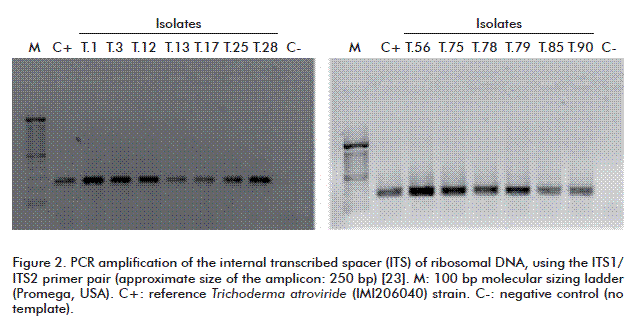
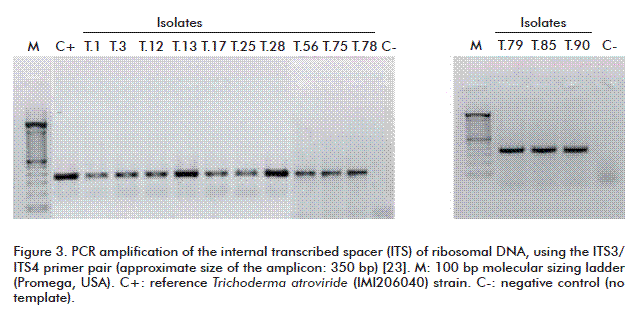
<body><![CDATA[<P   align="justify" ><font size="2" face="Verdana, Arial, Helvetica, sans-serif">On the other hand,      Infante [27] as well as Mart&iacute;nez <I>et al</I>. [28] produced growth      inhibitions larger than 50 % for <I>R. solani</I> when using the dual culture      method with two isolates of <I>Trichoderma </I>spp. It should be noticed,      however, that <I>Trichoderma </I>spp. can excrete in both cases (dual culture      and cellophane) volatile and non-volatile metabolites inhibiting the growth      of pathogenic microorganisms without requiring direct contact, and therefore      the choice of experimental method solely depends on the experimental objectives.      The dual culture method has received intensive use, as it can detect, in addition      to antibiosis (whether estimated by the scale of Bell <I>et al</I>. [29] or      by the action of volatile and non-volatile metabolites), the occurrence of      a number of important phenomena, such as competence for the substrate and      mycoparasitism. The cellophane method, by its very design, is only able to      measure antibiosis through the action of non-volatile metabolites secreted      into the culture medium. </font></P >       <P   ><font size="2" face="Verdana, Arial, Helvetica, sans-serif"><B>Amplification      of the internal transcribed spacer of rDNA and elongation factor </b></font></P >       <P   align="justify" ><font size="2" face="Verdana, Arial, Helvetica, sans-serif">Analysis of PCR reactions      for the amplification of an ITS fragment revealed the presence of 250 and      350 bp amplicons for the ITS1 and ITS2 primer pairs, respectively. These sizes      coincide with those of the amplicons obtained by PCR from a reference strain      of <I>T. atroviride</I> (IMI206040) (<a href="/img/revistas/bta/v30n1/f0203113.gif">Figures 2</a>      and <a href="/img/revistas/bta/v30n1/f0303113.gif">3</a>). </font></P >       
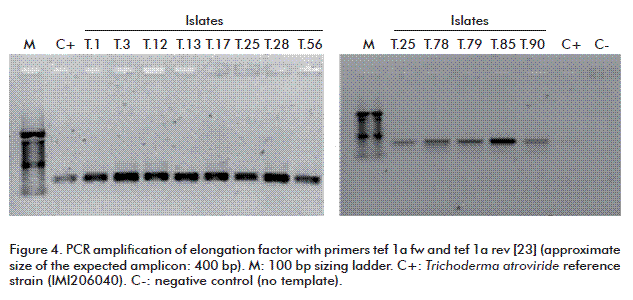
<P   align="justify" ><font size="2" face="Verdana, Arial, Helvetica, sans-serif">Since the decade      of 1990, the sequences of regions of ITS1 and ITS2 have been employed for      assignment to the Trichoderma genus or the identification of its species [14,      19, 30-32]. These target sequences offer the advantage of highly sensitive      and easy amplification, as they are present at copy numbers larger than 90      copies per genome. </font></P >       <P   align="justify" ><font size="2" face="Verdana, Arial, Helvetica, sans-serif">O&rsquo;Donnell <I>et      al</I>. [33, 34], Buckler <I>et al</I>. [35] and Lieckfeldt and Seifert [36]      have argued, however, that this marker is inadequate for this task due to      the presence of ITS paralogues in other phytopathogenic or saprophytic fungal      genera, although this phenomenon has not been detected in most species of      Trichoderma/Hypocrea [37]. It has also been pointed out that ITS provide poor      phylogenetic resolution for some groups, such as the Pachybasium B section.      </font></P >       <P   align="justify" ><font size="2" face="Verdana, Arial, Helvetica, sans-serif">Taking into account      these objections, it was decided to also amplify a fragment of the EF1A translational      elongation factor (<a href="/img/revistas/bta/v30n1/f0403113.gif">Figure 4</a>). These reactions yielded      a 400 bp amplicon for both the test and reference strain samples. It should      be stressed, however, that markers such as &beta;-tubulin, ACT1 and EF1A itself      do not provide optimal phylogenetic resolution across the entire genus or      even the major genetic subtypes such as Pachybasium B, despite the fact that      the study of the largest tef1 intron provided excellent resolution within      the subtype and related taxa such as <I>T. harzianum</I> / H. subtype lixii      species (<I>Hypocrea lixii</I>, <I>T. harzianum</I>, <I>T. aggressivum</I>,      <I>T. tomentosum</I> Bissett, <I>T. cerinum</I>, <I>T. velutinum</I>, Hypocrea      tawa) or the <I>Hypocrea rufa</I> (Pers.) P. group, which includes <I>T. viride</I>,      <I>T. atroviride</I> and <I>T. koningii</I>. The data of Kindermann <I>et      al</I>. [30] further support these results, evidencing that solely using a      gene fragment is not sufficient for this purpose. </font></P >       
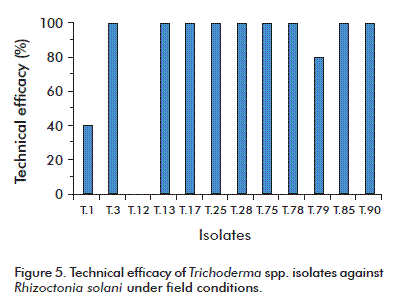
<P   align="justify" ><font size="2" face="Verdana, Arial, Helvetica, sans-serif">Taylor <I>et al</I>.      [38] have proposed to base the concept of phylogenetic species on the agreement      of five or more phylogenetic trees, a scheme hardly applicable to Trichoderma      given the extreme variability of this taxon. Recently, studies combining the      sequencing of ITS with the genes mentioned above have also included endochitinase      genes in an attempt to increase the reliability of their conclusions [21,      39-42]. </font></P >       <P   align="justify" ><font size="2" face="Verdana, Arial, Helvetica, sans-serif">Despite the similarity      of the results obtained in the present case for the amplification of ITS regions      and the elongation factor between the test isolates and the reference strain      of <I>T. atroviridae</I> (IMI206040), it was decided to sequence the obtained      amplicons and perform a homology search against TrichoBLAST/GenBank&reg; [24].      According to the resulting data, the sequence of these isolates is identical      to those of <I>T. asperellum</I>. The observed similarity in amplicon size      when compared to <I>T. atroviridae</I> probably stems, therefore, from the      inclusion of both species into the H. rufa group, in agreement with the observations      of Druzhinna and Kubicek [9] as well as Kindermann <I>et al</I>. [30]. </font></P >       <P   ><font size="2" face="Verdana, Arial, Helvetica, sans-serif"><B>Evaluation of      the efficacy of <I>Trichoderma </I>spp. isolates </b></font></P >       <P   align="justify" ><font size="2" face="Verdana, Arial, Helvetica, sans-serif">Under field conditions,      10 of the <I>T. asperellum</I> isolates exhibited a technical efficacy against      <I>R. solani</I> higher than 80 %. Isolate T.1 exhibited a technical efficacy      of 40 %, and isolate T.12 was not effective (<a href="#fig5">Figure 5</a>).      These results highlight the importance of adequately screening isolates intended      to be used as biological control agents. </font></P >       ]]></body>
<body><![CDATA[<P   align="center" ><img src="/img/revistas/bta/v30n1/f0503113.gif" width="391" height="305"><a name="fig5"></a></P >       
<P   align="justify" ><font size="2" face="Verdana, Arial, Helvetica, sans-serif">The efficacy of <I>Trichoderma      </I>spp. isolates as agents for the biological control of phytopathogens has      been examined by many different authors. For instance, Veitia <I>et al</I>.      [43] examined the feasibility of using <I>Trichoderma </I>spp. isolates for      the biological control of <I>R. solani</I> in basil, obtaining an efficacy      after 45 days of 60 to 90 % when growing the plants in trays under controlled      conditions. On the other hand, Hoyos <I>et al</I>. [21] evaluated the efficacy      of five isolates of <I>T. asperellum</I> against <I>Sclerotium rolfsii</I>      Sacc. and <I>R. solani</I> under semicontrolled conditions, obtaining values      higher than 90 % for isolates T.21 and T.71 and over 50 % for isolates T.109      and T.110. The results of the present study coincide with those of Mart&iacute;nez      <I>et al</I>. [28], who obtained efficacy values higher than 80 % with isolates      T.17, T.27, T.56, T.75 and T.78 of <I>Trichoderma </I>spp. against <I>R. solani</I>.      Their results were especially impressive for isolates T.17 and T.27, which      exhibited an efficacy higher than 90 % for plants grown in stainless steel      trays. Similar results were published also by Reyes <I>et al</I>. [44], who      obtained technical efficacies higher than 80 % for the control of <I>R. solani</I>      with isolates T.78 and T.56 of <I>T. asperellum</I>, also using stainless      steel trays. </font></P >       <P   align="justify" ><font size="2" face="Verdana, Arial, Helvetica, sans-serif">Since isolates T.3,      T.13, T.17, T.25, T.28, T.75, T.78, T.85 and T.90 were promissory, additional      tests were run under open field and greenhouse conditions, in correspondence      with Mart&iacute;nez <I>et al</I>. [28] as well as Reyes <I>et al</I>. [44].      This is relevant, even, for the selection of the method for mass production      of these biopesticides. </font></P >       <P   align="justify" ><font size="2" face="Verdana, Arial, Helvetica, sans-serif">In Cuba, <I>Trichoderma      </I>spp. is used mainly for the control of soil-dwelling fungi. Strains C-66      and A-34 of <I>T. harzianum</I> have exhibited efficacies higher than 99 %      against Rhizoctonia solani in bean (<I>Phaseolus vulgaris</I> L) [45]. In      onion (<I>Allium cepa</I> L.), it was possible to decrease the incidence of      <I>R. solani</I> through the application of <I>T. viride</I> [46]. However,      not much research has been carried out in Cuba on the modes of action of this      biological control agent, although acceptable <I>in vitro</I> antagonism has      been obtained for <I>T. harzianum</I> against <I>R. solani</I> isolates from      tomato (<I>Solanum lycopersicum</I> L.), pepper (<I>Capsicum annuum</I> L.)      and carnation (<I>Dianthus caryophyllus</I> L.) [47]. It has also been shown      that <I>T. harzianum</I> strains A-34 and C-66, as well as A-34 and A-53,      exhibit mycoparasitic activity against <I>R. solani</I> isolated from bean      [48] and rice (<I>Oryza sativa</I> L.) [49], respectively. </font></P >       <P   align="justify" >&nbsp;</P >       <P   > </P >   <FONT size="+1"><B>        <P   ><font size="3" face="Verdana, Arial, Helvetica, sans-serif">CONCLUSIONS </font></P >   </B>        <P   align="justify" ><font size="2" face="Verdana, Arial, Helvetica, sans-serif">In the course of      the present work, the use of molecular markers derived from ITS and the elongation      factor as well as their sequencing has enabled the correct taxonomical assignment      of a group of <I>Trichoderma </I>spp. isolates that can potentially be used      for the control of <I>R. solani</I> isolates belonging to different anastomosis      groups, including group AG-5, which is highly pathogenic for rice. </font></P >   <FONT size="+1">        <P   align="justify" ><font size="2" face="Verdana, Arial, Helvetica, sans-serif">In addition, our      data provide additional depth to existing knowledge about this genus, highlighting      how the antifungal activity of <I>Trichoderma </I>spp. isolates can proceed      through a variety of very specific modes of action, and offering perspectives      for the application of said isolates and their metabolites. Specifically,      the finding that these isolates antagonize their target phytopathogen through      the secretion of non-volatile metabolites has very clear implications for      their production by liquid fermentation. </font></P >       <P   align="justify" ><font size="2" face="Verdana, Arial, Helvetica, sans-serif"><I>Trichoderma </I>spp.      biopreparations, both in solid and liquid formulations, can preventively be      applied in soils known to be infected with <I>R. solani</I>, taking advantage      of the longer durability of the structures of the former (conidia, chlamydospores      and mycelia) and their capacity to parasite <I>Rhizoctonia sclerotia</I>,      which constitute the main structure for the propagation of this parasitic      fungus. Our findings, therefore, can be used to significantly improve the      process of selection, application and reproduction of <I>Trichoderma </I>spp.      strains intended for biological control. </font></P >       ]]></body>
<body><![CDATA[<P   align="justify" >&nbsp;</P >       <P   > </P >   <FONT size="+1"><B>        <P   ><font size="3" face="Verdana, Arial, Helvetica, sans-serif">ACKNOWLEDGEMENTS      </font></P >   </B>        <P   align="justify" ><font size="2" face="Verdana, Arial, Helvetica, sans-serif">The authors would      like to acknowledge the support provided by a scholarship granted by the Public      Health Secretariat (SEP) of Mexico, without which this work would not have      come into fruition. We would also like to thank Dr. Alfredo Herrera Estrella,      for making possible our stay as visiting scientists at the National Laboratory      of Genomics for Biodiversity (Langebio) of the National Polytechnic Institute      (IPN), under his direction. Likewise, we thank technicians Mar&iacute;a Isabel      Blanco Campos and Noreidys Fern&aacute;ndez G&aacute;lvez for their participation      in the present study. </font></P >       <P   align="justify" >&nbsp;</P >   <FONT size="+1">        <P   align="justify" > </P >       <P   align="justify" ><font size="3" face="Verdana, Arial, Helvetica, sans-serif"><B>REFERENCES </b></font></P >       <!-- ref --><P   ><font size="2" face="Verdana, Arial, Helvetica, sans-serif">1. Hjeljord L, Tronsmo      A. Trichoderma and Gliocladium in biological control: An overview. In: Harman      GE, Kubicek CP, editors. Trichoderma and Gliocladium. Vol. 2. Enzymes, Biological      Control and Commercial Applications. London: Taylor and Francis Ltd.; 1998.      p. 131-51.     </font></P >   <FONT size="+1">        <!-- ref --><P   ><font size="2" face="Verdana, Arial, Helvetica, sans-serif">2. Kullnig C, Mach      RL, Lorito M, Kubicek CP. Enzyme diffusion from Trichoderma atroviride (=      T. harzianum P1) to Rhizoctonia solani is a prerequisite for triggering of      Trichoderma ech42 gene expression before mycoparasitic contact. Appl Environ      Microbiol. 2000;66(5):2232-4.     </font></P >       <!-- ref --><P   ><font size="2" face="Verdana, Arial, Helvetica, sans-serif">3. Tondje PR, Roberts      DP, Bon MC, Widmer T, Samuels GJ, Ismaiel A, et al. Isolation and identification      of mycoparasitic isolates of Trichoderma asperellum with potential for suppression      of black pod disease of cacao in Cameroon. Biol Control. 2007; 43(2):202-12.          </font></P >       <!-- ref --><P   ><font size="2" face="Verdana, Arial, Helvetica, sans-serif">4. Woo SL, Scala      F, Ruocco M, Lorito M. The Molecular Biology of the Interactions Between Trichoderma      spp., Phytopathogenic Fungi, and Plants. Phytopathology. 2006;96(2):181-5.          </font></P >       <!-- ref --><P   ><font size="2" face="Verdana, Arial, Helvetica, sans-serif">5. Nelson EE. Occurrence      of Trichoderma in a Douglas-fir soil. Mycologia. 1982; 74(2):280-4.     </font></P >       <!-- ref --><P   ><font size="2" face="Verdana, Arial, Helvetica, sans-serif">6. Hoyos-Carvajal      L, Orduz S, Bissett J. Genetic and metabolic biodiversity of Trichoderma from      Colombia and adjacent neotropic regions. Fungal Genet Biol. 2009;46(9):615-31.          </font></P >       <P   ><font size="2" face="Verdana, Arial, Helvetica, sans-serif">7. Cervantes MA.      Microorganismos del suelo beneficiosos para los cultivos [Internet]. Madrid:      Infoagro Systems, S.L.;2012 [cited 2012 Mar 11]. Available from: http://infoagro.com/hortalizas/microorganismos_beneficiosos_cultivos.htm.      </font></P >       ]]></body>
<body><![CDATA[<P   ><font size="2" face="Verdana, Arial, Helvetica, sans-serif">8. Harman GE. Myths      and Dogmas of Biocontrol Changes in Perceptions Derived from Research on Trichoderma      harzianum T-22. Plant Dis. 2000;84(4):377-93. </font></P >       <!-- ref --><P   ><font size="2" face="Verdana, Arial, Helvetica, sans-serif">9. Druzhinina I,      Kubicek CP. Species concepts and biodiversity in Trichoderma and Hypocrea:      from aggregate species to species clusters? J Zhejiang Univ Sci B. 2005;6(2):100-12.          </font></P >       <!-- ref --><P   ><font size="2" face="Verdana, Arial, Helvetica, sans-serif">10. Klein D, Eveleigh      DE. Ecology of Trichoderma. In: Kubicek CP, Harman GE, editors. Trichoderma      and Gliocladium. Vol. 1. Basic Biology, Taxonomy and Genetics. London: Taylor      and Francis Ltd. 1998; p. 57-74.     </font></P >       <!-- ref --><P   ><font size="2" face="Verdana, Arial, Helvetica, sans-serif">11. Samuels GJ. Trichoderma:      systematics, the sexual state, and ecology. Phytopathology. 2006;96(2):195-206.          </font></P >       <!-- ref --><P   ><font size="2" face="Verdana, Arial, Helvetica, sans-serif">12. Crop Protection      Compendium (CPC)[Internet]. Wallingford: Centre for Agricultural Bioscience      International (CABI); c2012 - [cited 2012 Mar 11]. Available from: <A href="http://www.cabi.org/cpc/"  target="_blank">      <U><U><FONT color="#0000FF">http://www.cabi.org/cpc/</font></U></U></A><FONT color="#0000FF"><FONT color="#000000">.          </font></font></font></P >   <FONT color="#0000FF"><FONT color="#000000">        <P   ><font size="2" face="Verdana, Arial, Helvetica, sans-serif">13. Rifai MA. A revision      of the genus Trichoderma. Mycology; 1969;(116):1-56. </font></P >       ]]></body>
<body><![CDATA[<!-- ref --><P   ><font size="2" face="Verdana, Arial, Helvetica, sans-serif">14. Kuhls K, Lieckfeldt      E, Samuels GJ, Meyer W, Kubicek CP, B&ouml;rner T. Revision of Trichoderma      section Longibrachiatum including related teleomorphs based on analysis of      ribosomal DNA internal transcribed spacer sequences. Mycologia. 1997; 89(3):442-60.          </font></P >       <!-- ref --><P   ><font size="2" face="Verdana, Arial, Helvetica, sans-serif">15. Bissett J. A      revision of the genus Trichoderma. I. Section Longibrachiatum sect. nov. Can      J Bot. 1984;62(5):924-31.     </font></P >       <!-- ref --><P   ><font size="2" face="Verdana, Arial, Helvetica, sans-serif">16. Bissett J. A      revision of the genus Trichoderma. II. Infrageneric classification. Can J      Bot. 1991;69(11):2357-72.     </font></P >       <!-- ref --><P   ><font size="2" face="Verdana, Arial, Helvetica, sans-serif">17. Bissett J. A      revision of the genus Trichoderma III. Section Pachybasium. Can J Bot. 1991;69(11):2373-417.          </font></P >       <!-- ref --><P   ><font size="2" face="Verdana, Arial, Helvetica, sans-serif">18. Samuels GJ. Trichoderma:      a review of biology and systematics of the genus. Mycol Res. 1996;100(8):923-35.          </font></P >       ]]></body>
<body><![CDATA[<!-- ref --><P   ><font size="2" face="Verdana, Arial, Helvetica, sans-serif">19. Samuels GJ, Lieckfeldt      E, Nirenberg HI. Trichoderma asperellum, a new species with warted conidia,      and redescription of Trichoderma viride. Sydowia. 1999;51(1): 71-88.     </font></P >       <!-- ref --><P   ><font size="2" face="Verdana, Arial, Helvetica, sans-serif">20. Lieckfeldt E,      Samuels GJ, Nirenberg HI, Petrini O. A morphological and molecular perspective      of Trichoderma viride: is it one or two species? Appl Environ Microbiol. 1999;65(6):2418-28.          </font></P >       <P   ><font size="2" face="Verdana, Arial, Helvetica, sans-serif">21. Hoyos-Carvajal      L, Paola Chaparro, Miriam Abramsky, Chet I, Sergio O. Evaluation of Trichoderma      spp. isolates against Rhizoctonia solani and Sclerotium rolfsii under in vitro      and greenhouse conditions. Agron Colomb. 2008;26(3):451-8. </font></P >       <!-- ref --><P   ><font size="2" face="Verdana, Arial, Helvetica, sans-serif">22. Dennis C, Webster      J. Antagonistic properties of species-groups of Trichoderma: II. Production      of volatile antibiotics. Trans Br Mycol Soc. 1971;57(1):41-8.     </font></P >       <!-- ref --><P   ><font size="2" face="Verdana, Arial, Helvetica, sans-serif">23. White TJ, Bruns      T, Lee S, Taylor J. Amplification and direct sequencing of fungal ribosomal      RNA genes for phylogenetics. In: Innis MA, Gelfand DH, Sninsky J, White TJ,      editors. PCR Protocols: A guide to Methods and Applications. San Diego: Academic      Press; 1990. p. 315-22.     </font></P >       <!-- ref --><P   ><font size="2" face="Verdana, Arial, Helvetica, sans-serif">24. Kopchinskiy A,      Komon M, Kubicek CP, Druzhinina IS. TrichoBLAST: a multilocus database for      Trichoderma and Hypocrea identifications. Mycol Res. 2005;109(Pt 6):658-60.          </font></P >       <!-- ref --><P   ><font size="2" face="Verdana, Arial, Helvetica, sans-serif">25. Abbott WS. A      method of computing the effectiveness of an insecticide. 1925. J Am Mosq Control      Assoc. 1987;3(2):302-3.     </font></P >       <!-- ref --><P   ><font size="2" face="Verdana, Arial, Helvetica, sans-serif">26. K&uuml;&ccedil;&uuml;k      &Ccedil;, Kivan&ccedil; M. Mycoparasitism in the biological control of Gibberella      zeae and Aspergillus ustus by Trichoderma harzianum. J Agric Technol. 2008;4(2):49-55.          </font></P >       <!-- ref --><P   ><font size="2" face="Verdana, Arial, Helvetica, sans-serif">27. Infante MD. Efecto      antag&oacute;nico de ocho aislamientos de Trichoderma frente a Rhizoctonia      sp. in vitro [dissertation]. Tesis de diploma. La Habana: Universidad Agraria      de La Habana; 2006.     </font></P >       <!-- ref --><P   ><font size="2" face="Verdana, Arial, Helvetica, sans-serif">28. Mart&iacute;nez      B, Reyes Y, Infante D, Gonz&aacute;lez E, Ba&ntilde;os H, Cruz A. Selecci&oacute;n      de aislamientos de Trichoderma spp. candidatos a biofungicidas para el control      de Rhizoctonia sp. en arroz. Rev Protecci&oacute;n Veg. 2008;23(2):118-25.          </font></P >       <!-- ref --><P   ><font size="2" face="Verdana, Arial, Helvetica, sans-serif">29. Bell DK, Wells      DH, Markham CR. In vitro antagonism of Trichoderma species against six fungal      plant pathogens. Phytopathology. 1982;72(4):379-82.     </font></P >       <!-- ref --><P   ><font size="2" face="Verdana, Arial, Helvetica, sans-serif">30. Kindermann J,      El-Ayouti Y, Samuels GJ, Kubicek CP. Phylogeny of the genus trichoderma based      on sequence analysis of the internal transcribed spacer region 1 of the rDNA      cluster. Fungal Genet Biol. 1998;24(3):298-309.     </font></P >       <!-- ref --><P   ><font size="2" face="Verdana, Arial, Helvetica, sans-serif">31. Lieckfeldt E,      Kullnig CM, Kubicek CP, Samuels GJ, B&ouml;rner T. Trichoderma aureoviride:      phylogenetic position and characterization. Mycol Res. 2001;105(3):313-22.          </font></P >       <!-- ref --><P   ><font size="2" face="Verdana, Arial, Helvetica, sans-serif">32. Dodd SL, Crowhurst      RN, Rodrigo AG, Samuels GJ, Hill RA, Stewart A. Examination of Trichoderma      phylogenies derived from ribosomal DNA sequence data. Mycol Res. 2000;104(1):23-34.          </font></P >       <P   ><font size="2" face="Verdana, Arial, Helvetica, sans-serif">33. O&rsquo;Donnell      K. Ribosomal DNA internal transcribed spacers are highly divergent in the      phytopathogenic ascomycete Fusarium sambucinum (Gibberella pulicaris). Curr      Genet. 1992;22(3):213-20. </font></P >       <P   ><font size="2" face="Verdana, Arial, Helvetica, sans-serif">34. O&rsquo;Donnell      K, Cigelnik E, Nirenberg HI. Molecular systematics and phylogeography of the      Gibberella fujikuroi species complex. Mycologia. 1998;90(3):465-93. </font></P >       <!-- ref --><P   ><font size="2" face="Verdana, Arial, Helvetica, sans-serif">35. Buckler IV ES,      Ippolito A, Holtsford TP. The evolution of ribosomal DNA: divergent paralogues      and phylogenetic implications. Genetics. 1997;145(3):821-32.     </font></P >       <!-- ref --><P   ><font size="2" face="Verdana, Arial, Helvetica, sans-serif">36. Lieckfeldt E,      Seifert KA. An evaluation of the use of ITS sequences in the taxonomy of the      Hypocreales. Stud Mycol. 2000;45:35-44.     </font></P >       <P   ><font size="2" face="Verdana, Arial, Helvetica, sans-serif">37. Kullnig CM, Krupica      T, Woo SL, Mach RL, Rey M, Ben&iacute;tez T, et al. Confusion Abounds Over      Identities of Trichoderma Biocontrol Isolates. Mycol Res. 2001; 105(7):770-2.      </font></P >       <!-- ref --><P   ><font size="2" face="Verdana, Arial, Helvetica, sans-serif">38. Taylor J, Jacobson      D, Fisher M. The evolution of asexual fungi: Reproduction, Speciation and      Classification. Annu Rev Phytopathol. 1999;37:197-246.     </font></P >       <!-- ref --><P   ><font size="2" face="Verdana, Arial, Helvetica, sans-serif">39. Kullnig-Gradinger      CM, Szakacs G, Kubicek CP. Phylogeny and evolution of the fungal genus Trichoderma:      a multigene approach. Mycol Res. 2002;106(7):757-67.     </font></P >       <!-- ref --><P   ><font size="2" face="Verdana, Arial, Helvetica, sans-serif">40. Kubicek CP, Bissett      J, Druzhinina I, Kullnig-Gradinger C, Szakacs G. Genetic and metabolic diversity      of Trichoderma: a case study on South-East Asian isolates. Fungal Genet Biol.      2003;38(3):310-9.     </font></P >       ]]></body>
<body><![CDATA[<!-- ref --><P   ><font size="2" face="Verdana, Arial, Helvetica, sans-serif">41. Chaverri P, Samuels      GJ. Hypocrea/Trichoderma (Ascomycota, Hypocreales, Hypocreaceae): species      with green ascospores. Stud Mycol. 2004;48:1-36.     </font></P >       <!-- ref --><P   ><font size="2" face="Verdana, Arial, Helvetica, sans-serif">42. Druzhinina IS,      Kopchinskiy AG, Komon M, Bissett J, Szakacs G, Kubicek CP. An oligonucleotide      barcode for species identification in Trichoderma and Hypocrea. Fungal Genet      Biol. 2005;42(10):813-28.     </font></P >       <P   ><font size="2" face="Verdana, Arial, Helvetica, sans-serif">43. Veitia MM, Garc&iacute;a      V, Izquierdo D, Porras A, Wong W. Control de Rhizoctonia sp. en Albahaca blanca      (Ocimun basilicum L.) con Trichoderma harzianum cepa 34. Fitosanidad. 2000;4(1-2):67-70.      </font></P >       <!-- ref --><P   ><font size="2" face="Verdana, Arial, Helvetica, sans-serif">44. Reyes Y, Mart&iacute;nez      B, Infante D. Evaluaci&oacute;n de la actividad antag&oacute;nica de trece      aislamientos de Trichoderma spp. sobre Rhizoctonia sp. Rev Protecci&oacute;n      Veg. 2008;23(2):112-7.     </font></P >       <!-- ref --><P   ><font size="2" face="Verdana, Arial, Helvetica, sans-serif">45. Gonz&aacute;lez      M. Utilizaci&oacute;n de Trichoderma spp. para el control de hongos pat&oacute;genos      de la semilla y del suelo en el cultivo del frijol [dissertation]. Tesis en      opci&oacute;n al t&iacute;tulo de M&aacute;ster en Protecci&oacute;n Vegetal.      La Habana: Universidad Agraria de La Habana; 2001.     </font></P >       <!-- ref --><P   ><font size="2" face="Verdana, Arial, Helvetica, sans-serif">46. Mel&eacute;ndrez      J, Santana M, Herrera L. Estudio de la incidencia de Rhizoctonia solani K&uuml;hn      en el cultivo de la cebolla (Allium cepa L.) en la zona de Banao. Centro Agr&iacute;cola.      2002;29(2):51-4.     </font></P >       <!-- ref --><P   ><font size="2" face="Verdana, Arial, Helvetica, sans-serif">47. Sandoval I, L&oacute;pez      MO, Bonilla T, Tomas Y. Hongos del suelo que atacan al clavel y antagonismo      in vitro con Trichoderma spp. Fitosanidad. 1998;2(3-4):41-4.     </font></P >       <!-- ref --><P   ><font size="2" face="Verdana, Arial, Helvetica, sans-serif">48. Gonz&aacute;lez      M, Castellanos L, Ramos M, P&eacute;rez G. Efectividad de Trichoderma spp.      para el control de hongos pat&oacute;genos de la semilla y el suelo en el      cultivo del frijol. Fitosanidad. 2005;9(1):37-41.     </font></P >       <!-- ref --><P   ><font size="2" face="Verdana, Arial, Helvetica, sans-serif">49. Alarc&oacute;n      I, Reyes T, Rodr&iacute;guez G, Pupo AD. Efectividad in vitro de Trichoderma      harzianum (Rifai) en el biocontrol de Rhizoctonia solani K&uuml;hn y Pyricularia      grisea (Sacc.) en el cultivo del arroz (Oryza sativa L.). Fitosanidad. 2005;      9(3):57-60.    </font></P >       <P   >&nbsp;</P >       <P   >&nbsp;</P >       <P   > </P >       ]]></body>
<body><![CDATA[<P   > </P >       <P   ><font size="2" face="Verdana, Arial, Helvetica, sans-serif">Received in March,      2012.    <br>     </font><font size="2" face="Verdana, Arial, Helvetica, sans-serif">Accepted      in July, 2012. </font></P >       <P   >&nbsp;</P >       <P   >&nbsp;</P >       <P   > </P >       <P   > </P >       <P   ><font size="2" face="Verdana, Arial, Helvetica, sans-serif"><I>Danay Infante</I>.      Grupo de Fitopatolog&iacute;a, Direcci&oacute;n de Protecci&oacute;n de Plantas,      Centro Nacional de Sanidad Agropecuaria, Censa. Autopista Nacional km 23&frac12;,      AP 10, San Jos&eacute; de las Lajas, Mayabeque, Cuba. E-mail: <A href="mailto:danay@censa.edu.cu">      <U><U><FONT color="#0000FF">danay@censa.edu.cu</font></U></U></A><FONT color="#0000FF"><FONT color="#000000">.      </font></font></font></P >   </font></font></font></font></font></font></font></font></font></font></font></font></font></font></font></font></font></font></font></font></font></font></font></font></font></font></font></font></font></font></font></font></font></font></font></font></font></font></font></font></font></font></font></font></font></font></font></font></font></font></DIV >      ]]></body><back>
<ref-list>
<ref id="B1">
<label>1</label><nlm-citation citation-type="book">
<person-group person-group-type="author">
<name>
<surname><![CDATA[Hjeljord]]></surname>
<given-names><![CDATA[L]]></given-names>
</name>
<name>
<surname><![CDATA[Tronsmo]]></surname>
<given-names><![CDATA[A]]></given-names>
</name>
</person-group>
<article-title xml:lang="en"><![CDATA[Trichoderma and Gliocladium in biological control: An overview]]></article-title>
<person-group person-group-type="editor">
<name>
<surname><![CDATA[Harman]]></surname>
<given-names><![CDATA[GE]]></given-names>
</name>
<name>
<surname><![CDATA[Kubicek]]></surname>
<given-names><![CDATA[CP]]></given-names>
</name>
</person-group>
<source><![CDATA[Trichoderma and Gliocladium: Vol. 2. Enzymes, Biological Control and Commercial Applications]]></source>
<year>1998</year>
<page-range>131-51</page-range><publisher-loc><![CDATA[London ]]></publisher-loc>
<publisher-name><![CDATA[Taylor and Francis Ltd.]]></publisher-name>
</nlm-citation>
</ref>
<ref id="B2">
<label>2</label><nlm-citation citation-type="journal">
<person-group person-group-type="author">
<name>
<surname><![CDATA[Kullnig]]></surname>
<given-names><![CDATA[C]]></given-names>
</name>
<name>
<surname><![CDATA[Mach]]></surname>
<given-names><![CDATA[RL]]></given-names>
</name>
<name>
<surname><![CDATA[Lorito]]></surname>
<given-names><![CDATA[M]]></given-names>
</name>
<name>
<surname><![CDATA[Kubicek]]></surname>
<given-names><![CDATA[CP]]></given-names>
</name>
</person-group>
<article-title xml:lang="en"><![CDATA[Enzyme diffusion from Trichoderma atroviride (= T. harzianum P1) to Rhizoctonia solani is a prerequisite for triggering of Trichoderma ech42 gene expression before mycoparasitic contact]]></article-title>
<source><![CDATA[Appl Environ Microbiol]]></source>
<year>2000</year>
<volume>66</volume>
<numero>5</numero>
<issue>5</issue>
<page-range>2232-4</page-range></nlm-citation>
</ref>
<ref id="B3">
<label>3</label><nlm-citation citation-type="journal">
<person-group person-group-type="author">
<name>
<surname><![CDATA[Tondje]]></surname>
<given-names><![CDATA[PR]]></given-names>
</name>
<name>
<surname><![CDATA[Roberts]]></surname>
<given-names><![CDATA[DP]]></given-names>
</name>
<name>
<surname><![CDATA[Bon]]></surname>
<given-names><![CDATA[MC]]></given-names>
</name>
<name>
<surname><![CDATA[Widmer]]></surname>
<given-names><![CDATA[T]]></given-names>
</name>
<name>
<surname><![CDATA[Samuels]]></surname>
<given-names><![CDATA[GJ]]></given-names>
</name>
<name>
<surname><![CDATA[Ismaiel]]></surname>
<given-names><![CDATA[A]]></given-names>
</name>
</person-group>
<article-title xml:lang="en"><![CDATA[Isolation and identification of mycoparasitic isolates of Trichoderma asperellum with potential for suppression of black pod disease of cacao in Cameroon]]></article-title>
<source><![CDATA[Biol Control]]></source>
<year>2007</year>
<volume>43</volume>
<numero>2</numero>
<issue>2</issue>
<page-range>202-12</page-range></nlm-citation>
</ref>
<ref id="B4">
<label>4</label><nlm-citation citation-type="journal">
<person-group person-group-type="author">
<name>
<surname><![CDATA[Woo]]></surname>
<given-names><![CDATA[SL]]></given-names>
</name>
<name>
<surname><![CDATA[Scala]]></surname>
<given-names><![CDATA[F]]></given-names>
</name>
<name>
<surname><![CDATA[Ruocco]]></surname>
<given-names><![CDATA[M]]></given-names>
</name>
<name>
<surname><![CDATA[Lorito]]></surname>
<given-names><![CDATA[M]]></given-names>
</name>
</person-group>
<article-title xml:lang="en"><![CDATA[The Molecular Biology of the Interactions Between Trichoderma spp., Phytopathogenic Fungi, and Plants]]></article-title>
<source><![CDATA[Phytopathology]]></source>
<year>2006</year>
<volume>96</volume>
<numero>2</numero>
<issue>2</issue>
<page-range>181-5</page-range></nlm-citation>
</ref>
<ref id="B5">
<label>5</label><nlm-citation citation-type="journal">
<person-group person-group-type="author">
<name>
<surname><![CDATA[Nelson]]></surname>
<given-names><![CDATA[EE]]></given-names>
</name>
</person-group>
<article-title xml:lang="en"><![CDATA[Occurrence of Trichoderma in a Douglas-fir soil]]></article-title>
<source><![CDATA[Mycologia]]></source>
<year>1982</year>
<volume>74</volume>
<numero>2</numero>
<issue>2</issue>
<page-range>280-4</page-range></nlm-citation>
</ref>
<ref id="B6">
<label>6</label><nlm-citation citation-type="journal">
<person-group person-group-type="author">
<name>
<surname><![CDATA[Hoyos-Carvajal]]></surname>
<given-names><![CDATA[L]]></given-names>
</name>
<name>
<surname><![CDATA[Orduz]]></surname>
<given-names><![CDATA[S]]></given-names>
</name>
<name>
<surname><![CDATA[Bissett]]></surname>
<given-names><![CDATA[J]]></given-names>
</name>
</person-group>
<article-title xml:lang="en"><![CDATA[Genetic and metabolic biodiversity of Trichoderma from Colombia and adjacent neotropic regions]]></article-title>
<source><![CDATA[Fungal Genet Biol]]></source>
<year>2009</year>
<volume>46</volume>
<numero>9</numero>
<issue>9</issue>
<page-range>615-31</page-range></nlm-citation>
</ref>
<ref id="B7">
<label>7</label><nlm-citation citation-type="book">
<person-group person-group-type="author">
<name>
<surname><![CDATA[Cervantes]]></surname>
<given-names><![CDATA[MA]]></given-names>
</name>
</person-group>
<source><![CDATA[Microorganismos del suelo beneficiosos para los cultivos]]></source>
<year>2012</year>
<publisher-loc><![CDATA[Madrid ]]></publisher-loc>
<publisher-name><![CDATA[Infoagro Systems, S.L.]]></publisher-name>
</nlm-citation>
</ref>
<ref id="B8">
<label>8</label><nlm-citation citation-type="journal">
<person-group person-group-type="author">
<name>
<surname><![CDATA[Harman]]></surname>
<given-names><![CDATA[GE]]></given-names>
</name>
</person-group>
<article-title xml:lang="en"><![CDATA[Myths and Dogmas of Biocontrol Changes in Perceptions Derived from Research on Trichoderma harzinum T-22]]></article-title>
<source><![CDATA[Plant Dis]]></source>
<year>2000</year>
<volume>84</volume>
<numero>4</numero>
<issue>4</issue>
<page-range>377-93</page-range></nlm-citation>
</ref>
<ref id="B9">
<label>9</label><nlm-citation citation-type="journal">
<person-group person-group-type="author">
<name>
<surname><![CDATA[Druzhinina]]></surname>
<given-names><![CDATA[I]]></given-names>
</name>
<name>
<surname><![CDATA[Kubicek]]></surname>
<given-names><![CDATA[CP]]></given-names>
</name>
</person-group>
<article-title xml:lang="en"><![CDATA[Species concepts and biodiversity in Trichoderma and Hypocrea: from aggregate species to species clusters?]]></article-title>
<source><![CDATA[J Zhejiang Univ Sci B]]></source>
<year>2005</year>
<volume>6</volume>
<numero>2</numero>
<issue>2</issue>
<page-range>100-12</page-range></nlm-citation>
</ref>
<ref id="B10">
<label>10</label><nlm-citation citation-type="book">
<person-group person-group-type="author">
<name>
<surname><![CDATA[Klein]]></surname>
<given-names><![CDATA[D]]></given-names>
</name>
<name>
<surname><![CDATA[Eveleigh]]></surname>
<given-names><![CDATA[DE]]></given-names>
</name>
</person-group>
<article-title xml:lang="en"><![CDATA[Ecology of Trichoderma]]></article-title>
<person-group person-group-type="editor">
<name>
<surname><![CDATA[Kubicek]]></surname>
<given-names><![CDATA[CP]]></given-names>
</name>
<name>
<surname><![CDATA[Harman]]></surname>
<given-names><![CDATA[GE]]></given-names>
</name>
</person-group>
<source><![CDATA[Trichoderma and Gliocladium: Vol. 1. Basic Biology, Taxonomy and Genetics]]></source>
<year>1998</year>
<page-range>57-74</page-range><publisher-loc><![CDATA[London ]]></publisher-loc>
<publisher-name><![CDATA[Taylor and Francis Ltd.]]></publisher-name>
</nlm-citation>
</ref>
<ref id="B11">
<label>11</label><nlm-citation citation-type="journal">
<person-group person-group-type="author">
<name>
<surname><![CDATA[Samuels]]></surname>
<given-names><![CDATA[GJ]]></given-names>
</name>
</person-group>
<article-title xml:lang="en"><![CDATA[Trichoderma: systematics, the sexual state, and ecology]]></article-title>
<source><![CDATA[Phytopathology]]></source>
<year>2006</year>
<volume>96</volume>
<numero>2</numero>
<issue>2</issue>
<page-range>195-206</page-range></nlm-citation>
</ref>
<ref id="B12">
<label>12</label><nlm-citation citation-type="book">
<source><![CDATA[Crop Protection Compendium (CPC)]]></source>
<year>2012</year>
<publisher-loc><![CDATA[Wallingford ]]></publisher-loc>
<publisher-name><![CDATA[Centre for Agricultural Bioscience International (CABI)]]></publisher-name>
</nlm-citation>
</ref>
<ref id="B13">
<label>13</label><nlm-citation citation-type="journal">
<person-group person-group-type="author">
<name>
<surname><![CDATA[Rifai]]></surname>
<given-names><![CDATA[MA]]></given-names>
</name>
</person-group>
<article-title xml:lang="en"><![CDATA[A revision of the genus Trichoderma]]></article-title>
<source><![CDATA[Mycology;]]></source>
<year>1969</year>
<volume>1-56</volume>
<numero>116</numero>
<issue>116</issue>
</nlm-citation>
</ref>
<ref id="B14">
<label>14</label><nlm-citation citation-type="journal">
<person-group person-group-type="author">
<name>
<surname><![CDATA[Kuhls]]></surname>
<given-names><![CDATA[K]]></given-names>
</name>
<name>
<surname><![CDATA[Lieckfeldt]]></surname>
<given-names><![CDATA[E]]></given-names>
</name>
<name>
<surname><![CDATA[Samuels]]></surname>
<given-names><![CDATA[GJ]]></given-names>
</name>
<name>
<surname><![CDATA[Meyer]]></surname>
<given-names><![CDATA[W]]></given-names>
</name>
<name>
<surname><![CDATA[Kubicek]]></surname>
<given-names><![CDATA[CP]]></given-names>
</name>
<name>
<surname><![CDATA[Börner]]></surname>
<given-names><![CDATA[T]]></given-names>
</name>
</person-group>
<article-title xml:lang="en"><![CDATA[Revision of Trichoderma section Longibrachiatum including related teleomorphs based on analysis of ribosomal DNA internal transcribed spacer sequences]]></article-title>
<source><![CDATA[Mycologia]]></source>
<year>1997</year>
<volume>89</volume>
<numero>3</numero>
<issue>3</issue>
<page-range>442-60</page-range></nlm-citation>
</ref>
<ref id="B15">
<label>15</label><nlm-citation citation-type="journal">
<person-group person-group-type="author">
<name>
<surname><![CDATA[Bissett]]></surname>
<given-names><![CDATA[J]]></given-names>
</name>
</person-group>
<article-title xml:lang="en"><![CDATA[A revision of the genus Trichoderma: I. Section Longibrachiatum sect. nov]]></article-title>
<source><![CDATA[Can J Bot]]></source>
<year>1984</year>
<volume>62</volume>
<numero>5</numero>
<issue>5</issue>
<page-range>924-31</page-range></nlm-citation>
</ref>
<ref id="B16">
<label>16</label><nlm-citation citation-type="journal">
<person-group person-group-type="author">
<name>
<surname><![CDATA[Bissett]]></surname>
<given-names><![CDATA[J]]></given-names>
</name>
</person-group>
<article-title xml:lang="en"><![CDATA[A revision of the genus Trichoderma: II. Infrageneric classification]]></article-title>
<source><![CDATA[Can J Bot]]></source>
<year>1991</year>
<volume>69</volume>
<numero>11</numero>
<issue>11</issue>
<page-range>2357-72</page-range></nlm-citation>
</ref>
<ref id="B17">
<label>17</label><nlm-citation citation-type="journal">
<person-group person-group-type="author">
<name>
<surname><![CDATA[Bissett]]></surname>
<given-names><![CDATA[J]]></given-names>
</name>
</person-group>
<article-title xml:lang="en"><![CDATA[A revision of the genus Trichoderma: III. Section Pachybasium]]></article-title>
<source><![CDATA[Can J Bot]]></source>
<year>1991</year>
<volume>69</volume>
<numero>11</numero>
<issue>11</issue>
<page-range>2373-417</page-range></nlm-citation>
</ref>
<ref id="B18">
<label>18</label><nlm-citation citation-type="journal">
<person-group person-group-type="author">
<name>
<surname><![CDATA[Samuels]]></surname>
<given-names><![CDATA[GJ]]></given-names>
</name>
</person-group>
<article-title xml:lang="en"><![CDATA[Trichoderma: a review of biology and systematics of the genus]]></article-title>
<source><![CDATA[Mycol Res]]></source>
<year>1996</year>
<volume>100</volume>
<numero>8</numero>
<issue>8</issue>
<page-range>923-35</page-range></nlm-citation>
</ref>
<ref id="B19">
<label>19</label><nlm-citation citation-type="journal">
<person-group person-group-type="author">
<name>
<surname><![CDATA[Samuels]]></surname>
<given-names><![CDATA[GJ]]></given-names>
</name>
<name>
<surname><![CDATA[Lieckfeldt]]></surname>
<given-names><![CDATA[E]]></given-names>
</name>
<name>
<surname><![CDATA[Nirenberg]]></surname>
<given-names><![CDATA[HI]]></given-names>
</name>
</person-group>
<article-title xml:lang="en"><![CDATA[Trichoderma asperellum, a new species with warted conidia, and redescription of Trichoderma viride]]></article-title>
<source><![CDATA[Sydowia]]></source>
<year>1999</year>
<volume>51</volume>
<numero>1</numero>
<issue>1</issue>
<page-range>71-88</page-range></nlm-citation>
</ref>
<ref id="B20">
<label>20</label><nlm-citation citation-type="journal">
<person-group person-group-type="author">
<name>
<surname><![CDATA[Lieckfeldt]]></surname>
<given-names><![CDATA[E]]></given-names>
</name>
<name>
<surname><![CDATA[Samuels]]></surname>
<given-names><![CDATA[GJ]]></given-names>
</name>
<name>
<surname><![CDATA[Nirenberg]]></surname>
<given-names><![CDATA[HI]]></given-names>
</name>
<name>
<surname><![CDATA[Petrini]]></surname>
<given-names><![CDATA[O]]></given-names>
</name>
</person-group>
<article-title xml:lang="en"><![CDATA[A morphological and molecular perspective of Trichoderma viride: is it one or two species?]]></article-title>
<source><![CDATA[Appl Environ Microbiol]]></source>
<year>1999</year>
<volume>65</volume>
<numero>6</numero>
<issue>6</issue>
<page-range>2418-28</page-range></nlm-citation>
</ref>
<ref id="B21">
<label>21</label><nlm-citation citation-type="journal">
<person-group person-group-type="author">
<name>
<surname><![CDATA[Hoyos-Carvajal]]></surname>
<given-names><![CDATA[L]]></given-names>
</name>
<name>
<surname><![CDATA[Chaparro]]></surname>
<given-names><![CDATA[P]]></given-names>
</name>
<name>
<surname><![CDATA[Abramsky]]></surname>
<given-names><![CDATA[M]]></given-names>
</name>
<name>
<surname><![CDATA[Chet]]></surname>
<given-names><![CDATA[I]]></given-names>
</name>
<name>
<surname><![CDATA[Sergio]]></surname>
<given-names><![CDATA[O]]></given-names>
</name>
</person-group>
<article-title xml:lang="en"><![CDATA[Evaluation of Trichoderma spp. isolates against Rhizoctonia solani and Sclerotium rolfsii under in vitro and greenhouse conditions]]></article-title>
<source><![CDATA[Agron Colomb]]></source>
<year>2008</year>
<volume>26</volume>
<numero>3</numero>
<issue>3</issue>
<page-range>451-8</page-range></nlm-citation>
</ref>
<ref id="B22">
<label>22</label><nlm-citation citation-type="journal">
<person-group person-group-type="author">
<name>
<surname><![CDATA[Dennis]]></surname>
<given-names><![CDATA[C]]></given-names>
</name>
<name>
<surname><![CDATA[Webster]]></surname>
<given-names><![CDATA[J]]></given-names>
</name>
</person-group>
<article-title xml:lang="en"><![CDATA[Antagonistic properties of species-groups of Trichoderma: II. Production of volatile antibiotics]]></article-title>
<source><![CDATA[Trans Br Mycol Soc]]></source>
<year>1971</year>
<volume>57</volume>
<numero>1</numero>
<issue>1</issue>
<page-range>41-8</page-range></nlm-citation>
</ref>
<ref id="B23">
<label>23</label><nlm-citation citation-type="book">
<person-group person-group-type="author">
<name>
<surname><![CDATA[White]]></surname>
<given-names><![CDATA[TJ]]></given-names>
</name>
<name>
<surname><![CDATA[Bruns]]></surname>
<given-names><![CDATA[T]]></given-names>
</name>
<name>
<surname><![CDATA[Lee]]></surname>
<given-names><![CDATA[S]]></given-names>
</name>
<name>
<surname><![CDATA[Taylor]]></surname>
<given-names><![CDATA[J]]></given-names>
</name>
</person-group>
<article-title xml:lang="en"><![CDATA[Amplification and direct sequencing of fungal ribosomal RNA genes for phylogenetics]]></article-title>
<person-group person-group-type="editor">
<name>
<surname><![CDATA[Innis]]></surname>
<given-names><![CDATA[MA]]></given-names>
</name>
<name>
<surname><![CDATA[Gelfand]]></surname>
<given-names><![CDATA[DH]]></given-names>
</name>
<name>
<surname><![CDATA[Sninsky]]></surname>
<given-names><![CDATA[J]]></given-names>
</name>
<name>
<surname><![CDATA[White]]></surname>
<given-names><![CDATA[TJ]]></given-names>
</name>
</person-group>
<source><![CDATA[PCR Protocols: A guide to Methods and Applications]]></source>
<year>1990</year>
<page-range>315-22</page-range><publisher-loc><![CDATA[San Diego ]]></publisher-loc>
<publisher-name><![CDATA[Academic Press]]></publisher-name>
</nlm-citation>
</ref>
<ref id="B24">
<label>24</label><nlm-citation citation-type="journal">
<person-group person-group-type="author">
<name>
<surname><![CDATA[Kopchinskiy]]></surname>
<given-names><![CDATA[A]]></given-names>
</name>
<name>
<surname><![CDATA[Komon]]></surname>
<given-names><![CDATA[M]]></given-names>
</name>
<name>
<surname><![CDATA[Kubicek]]></surname>
<given-names><![CDATA[CP]]></given-names>
</name>
<name>
<surname><![CDATA[Druzhinina]]></surname>
<given-names><![CDATA[IS]]></given-names>
</name>
</person-group>
<article-title xml:lang="en"><![CDATA[TrichoBLAST: a multilocus database for Trichoderma and Hypocrea identifications]]></article-title>
<source><![CDATA[Mycol Res]]></source>
<year>2005</year>
<volume>109</volume>
<numero>6</numero>
<issue>6</issue>
<page-range>658-60</page-range></nlm-citation>
</ref>
<ref id="B25">
<label>25</label><nlm-citation citation-type="journal">
<person-group person-group-type="author">
<name>
<surname><![CDATA[Abbott]]></surname>
<given-names><![CDATA[WS]]></given-names>
</name>
</person-group>
<article-title xml:lang="en"><![CDATA[A method of computing the effectiveness of an insecticide: 1925]]></article-title>
<source><![CDATA[J Am Mosq Control Assoc]]></source>
<year>1987</year>
<volume>3</volume>
<numero>2</numero>
<issue>2</issue>
<page-range>302-3</page-range></nlm-citation>
</ref>
<ref id="B26">
<label>26</label><nlm-citation citation-type="journal">
<person-group person-group-type="author">
<name>
<surname><![CDATA[Küçük]]></surname>
<given-names><![CDATA[Ç]]></given-names>
</name>
<name>
<surname><![CDATA[Kivanç]]></surname>
<given-names><![CDATA[M]]></given-names>
</name>
</person-group>
<article-title xml:lang="en"><![CDATA[Mycoparasitism in the biological control of Gibberella zeae and Aspergillus ustus by Trichoderma harzianum]]></article-title>
<source><![CDATA[J Agric Technol]]></source>
<year>2008</year>
<volume>4</volume>
<numero>2</numero>
<issue>2</issue>
<page-range>49-55</page-range></nlm-citation>
</ref>
<ref id="B27">
<label>27</label><nlm-citation citation-type="">
<person-group person-group-type="author">
<name>
<surname><![CDATA[Infante]]></surname>
<given-names><![CDATA[MD]]></given-names>
</name>
</person-group>
<source><![CDATA[Efecto antagónico de ocho aislamientos de Trichoderma frente a Rhizoctonia sp. in vitro]]></source>
<year></year>
</nlm-citation>
</ref>
<ref id="B28">
<label>28</label><nlm-citation citation-type="journal">
<person-group person-group-type="author">
<name>
<surname><![CDATA[Martínez]]></surname>
<given-names><![CDATA[B]]></given-names>
</name>
<name>
<surname><![CDATA[Reyes]]></surname>
<given-names><![CDATA[Y]]></given-names>
</name>
<name>
<surname><![CDATA[Infante]]></surname>
<given-names><![CDATA[D]]></given-names>
</name>
<name>
<surname><![CDATA[González]]></surname>
<given-names><![CDATA[E]]></given-names>
</name>
<name>
<surname><![CDATA[Baños]]></surname>
<given-names><![CDATA[H]]></given-names>
</name>
<name>
<surname><![CDATA[Cruz]]></surname>
<given-names><![CDATA[A]]></given-names>
</name>
</person-group>
<article-title xml:lang="es"><![CDATA[Selección de aislamientos de Trichoderma spp. candidatos a biofungicidas para el control de Rhizoctonia sp. en arroz]]></article-title>
<source><![CDATA[Rev Protección Veg]]></source>
<year>2008</year>
<volume>23</volume>
<numero>2</numero>
<issue>2</issue>
<page-range>118-25</page-range></nlm-citation>
</ref>
<ref id="B29">
<label>29</label><nlm-citation citation-type="journal">
<person-group person-group-type="author">
<name>
<surname><![CDATA[Bell]]></surname>
<given-names><![CDATA[DK]]></given-names>
</name>
<name>
<surname><![CDATA[Wells]]></surname>
<given-names><![CDATA[DH]]></given-names>
</name>
<name>
<surname><![CDATA[Markham]]></surname>
<given-names><![CDATA[CR]]></given-names>
</name>
</person-group>
<article-title xml:lang="en"><![CDATA[In vitro antagonism of Trichoderma species against six fungal plant pathogens]]></article-title>
<source><![CDATA[Phytopathology]]></source>
<year>1982</year>
<volume>72</volume>
<numero>4</numero>
<issue>4</issue>
<page-range>379-82</page-range></nlm-citation>
</ref>
<ref id="B30">
<label>30</label><nlm-citation citation-type="journal">
<person-group person-group-type="author">
<name>
<surname><![CDATA[Kindermann]]></surname>
<given-names><![CDATA[J]]></given-names>
</name>
<name>
<surname><![CDATA[El-Ayouti]]></surname>
<given-names><![CDATA[Y]]></given-names>
</name>
<name>
<surname><![CDATA[Samuels]]></surname>
<given-names><![CDATA[GJ]]></given-names>
</name>
<name>
<surname><![CDATA[Kubicek]]></surname>
<given-names><![CDATA[CP]]></given-names>
</name>
</person-group>
<article-title xml:lang="en"><![CDATA[Phylogeny of the genus trichoderma based on sequence analysis of the internal transcribed spacer region 1 of the rDNA cluster]]></article-title>
<source><![CDATA[Fungal Genet Biol]]></source>
<year>1998</year>
<volume>24</volume>
<numero>3</numero>
<issue>3</issue>
<page-range>298-309</page-range></nlm-citation>
</ref>
<ref id="B31">
<label>31</label><nlm-citation citation-type="journal">
<person-group person-group-type="author">
<name>
<surname><![CDATA[Lieckfeldt]]></surname>
<given-names><![CDATA[E]]></given-names>
</name>
<name>
<surname><![CDATA[Kullnig]]></surname>
<given-names><![CDATA[CM]]></given-names>
</name>
<name>
<surname><![CDATA[Kubicek]]></surname>
<given-names><![CDATA[CP]]></given-names>
</name>
<name>
<surname><![CDATA[Samuels]]></surname>
<given-names><![CDATA[GJ]]></given-names>
</name>
<name>
<surname><![CDATA[Börner]]></surname>
<given-names><![CDATA[T]]></given-names>
</name>
</person-group>
<article-title xml:lang="en"><![CDATA[Trichoderma aureoviride: phylogenetic position and characterization]]></article-title>
<source><![CDATA[Mycol Res]]></source>
<year>2001</year>
<volume>105</volume>
<numero>3</numero>
<issue>3</issue>
<page-range>313-22</page-range></nlm-citation>
</ref>
<ref id="B32">
<label>32</label><nlm-citation citation-type="journal">
<person-group person-group-type="author">
<name>
<surname><![CDATA[Dodd]]></surname>
<given-names><![CDATA[SL]]></given-names>
</name>
<name>
<surname><![CDATA[Crowhurst]]></surname>
<given-names><![CDATA[RN]]></given-names>
</name>
<name>
<surname><![CDATA[Rodrigo]]></surname>
<given-names><![CDATA[AG]]></given-names>
</name>
<name>
<surname><![CDATA[Samuels]]></surname>
<given-names><![CDATA[GJ]]></given-names>
</name>
<name>
<surname><![CDATA[Hill]]></surname>
<given-names><![CDATA[RA]]></given-names>
</name>
<name>
<surname><![CDATA[Stewart]]></surname>
<given-names><![CDATA[A]]></given-names>
</name>
</person-group>
<article-title xml:lang="en"><![CDATA[Examination of Trichoderma phylogenies derived from ribosomal DNA sequence data]]></article-title>
<source><![CDATA[Mycol Res]]></source>
<year>2000</year>
<volume>104</volume>
<numero>1</numero>
<issue>1</issue>
<page-range>23-34</page-range></nlm-citation>
</ref>
<ref id="B33">
<label>33</label><nlm-citation citation-type="journal">
<person-group person-group-type="author">
<name>
<surname><![CDATA[O'Donnell]]></surname>
<given-names><![CDATA[K]]></given-names>
</name>
</person-group>
<article-title xml:lang="en"><![CDATA[Ribosomal DNA internal transcribed spacers are highly divergent in the phytopathogenic ascomycete Fusarium sambucinum (Gibberella pulicaris)]]></article-title>
<source><![CDATA[Curr Genet]]></source>
<year>1992</year>
<volume>22</volume>
<numero>3</numero>
<issue>3</issue>
<page-range>213-20</page-range></nlm-citation>
</ref>
<ref id="B34">
<label>34</label><nlm-citation citation-type="journal">
<person-group person-group-type="author">
<name>
<surname><![CDATA[O'Donnell]]></surname>
<given-names><![CDATA[K]]></given-names>
</name>
<name>
<surname><![CDATA[Cigelnik]]></surname>
<given-names><![CDATA[E]]></given-names>
</name>
<name>
<surname><![CDATA[Nirenberg]]></surname>
<given-names><![CDATA[HI]]></given-names>
</name>
</person-group>
<article-title xml:lang="en"><![CDATA[Molecular systematics and phylogeography of the Gibberella fujikuroi species complex]]></article-title>
<source><![CDATA[Mycologia]]></source>
<year>1998</year>
<volume>90</volume>
<numero>3</numero>
<issue>3</issue>
<page-range>465-93</page-range></nlm-citation>
</ref>
<ref id="B35">
<label>35</label><nlm-citation citation-type="journal">
<person-group person-group-type="author">
<name>
<surname><![CDATA[Buckler IV]]></surname>
<given-names><![CDATA[ES]]></given-names>
</name>
<name>
<surname><![CDATA[Ippolito]]></surname>
<given-names><![CDATA[A]]></given-names>
</name>
<name>
<surname><![CDATA[Holtsford]]></surname>
<given-names><![CDATA[TP]]></given-names>
</name>
</person-group>
<article-title xml:lang="en"><![CDATA[The evolution of ribosomal DNA: divergent paralogues and phylogenetic implications]]></article-title>
<source><![CDATA[Genetics]]></source>
<year>1997</year>
<volume>145</volume>
<numero>3</numero>
<issue>3</issue>
<page-range>821-32</page-range></nlm-citation>
</ref>
<ref id="B36">
<label>36</label><nlm-citation citation-type="journal">
<person-group person-group-type="author">
<name>
<surname><![CDATA[Lieckfeldt]]></surname>
<given-names><![CDATA[E]]></given-names>
</name>
<name>
<surname><![CDATA[Seifert]]></surname>
<given-names><![CDATA[KA]]></given-names>
</name>
</person-group>
<article-title xml:lang="en"><![CDATA[An evaluation of the use of ITS sequences in the taxonomy of the Hypocreales]]></article-title>
<source><![CDATA[Stud Mycol]]></source>
<year>2000</year>
<volume>45</volume>
<page-range>35-44</page-range></nlm-citation>
</ref>
<ref id="B37">
<label>37</label><nlm-citation citation-type="journal">
<person-group person-group-type="author">
<name>
<surname><![CDATA[Kullnig]]></surname>
<given-names><![CDATA[CM]]></given-names>
</name>
<name>
<surname><![CDATA[Krupica]]></surname>
<given-names><![CDATA[T]]></given-names>
</name>
<name>
<surname><![CDATA[Woo]]></surname>
<given-names><![CDATA[SL]]></given-names>
</name>
<name>
<surname><![CDATA[Mach]]></surname>
<given-names><![CDATA[RL]]></given-names>
</name>
<name>
<surname><![CDATA[Rey]]></surname>
<given-names><![CDATA[M]]></given-names>
</name>
<name>
<surname><![CDATA[Benítez]]></surname>
<given-names><![CDATA[T]]></given-names>
</name>
</person-group>
<article-title xml:lang="en"><![CDATA[Confusion Abounds Over Identities of Trichoderma Biocontrol Isolates]]></article-title>
<source><![CDATA[Mycol Res]]></source>
<year>2001</year>
<volume>105</volume>
<numero>7</numero>
<issue>7</issue>
<page-range>770-72</page-range></nlm-citation>
</ref>
<ref id="B38">
<label>38</label><nlm-citation citation-type="journal">
<person-group person-group-type="author">
<name>
<surname><![CDATA[Taylor]]></surname>
<given-names><![CDATA[J]]></given-names>
</name>
<name>
<surname><![CDATA[Jacobson]]></surname>
<given-names><![CDATA[D]]></given-names>
</name>
<name>
<surname><![CDATA[Fisher]]></surname>
<given-names><![CDATA[M]]></given-names>
</name>
</person-group>
<article-title xml:lang="en"><![CDATA[The evolution of asexual fungi: Reproduction, Speciation and Classification]]></article-title>
<source><![CDATA[Annu Rev Phytopathol]]></source>
<year>1999</year>
<volume>37</volume>
<page-range>197-246</page-range></nlm-citation>
</ref>
<ref id="B39">
<label>39</label><nlm-citation citation-type="journal">
<person-group person-group-type="author">
<name>
<surname><![CDATA[Kullnig-Gradinger]]></surname>
<given-names><![CDATA[CM]]></given-names>
</name>
<name>
<surname><![CDATA[Szakacs]]></surname>
<given-names><![CDATA[G]]></given-names>
</name>
<name>
<surname><![CDATA[Kubicek]]></surname>
<given-names><![CDATA[CP]]></given-names>
</name>
</person-group>
<article-title xml:lang="en"><![CDATA[Phylogeny and evolution of the fungal genus Trichoderma: a multigene approach]]></article-title>
<source><![CDATA[Mycol Res]]></source>
<year>2002</year>
<volume>106</volume>
<numero>7</numero>
<issue>7</issue>
<page-range>757-67</page-range></nlm-citation>
</ref>
<ref id="B40">
<label>40</label><nlm-citation citation-type="journal">
<person-group person-group-type="author">
<name>
<surname><![CDATA[Kubicek]]></surname>
<given-names><![CDATA[CP]]></given-names>
</name>
<name>
<surname><![CDATA[Bissett]]></surname>
<given-names><![CDATA[J]]></given-names>
</name>
<name>
<surname><![CDATA[Druzhinina]]></surname>
<given-names><![CDATA[I]]></given-names>
</name>
<name>
<surname><![CDATA[Kullnig-Gradinger]]></surname>
<given-names><![CDATA[C]]></given-names>
</name>
<name>
<surname><![CDATA[Szakacs]]></surname>
<given-names><![CDATA[G]]></given-names>
</name>
</person-group>
<article-title xml:lang="en"><![CDATA[Genetic and metabolic diversity of Trichoderma: a case study on South-East Asian isolates]]></article-title>
<source><![CDATA[Fungal Genet Biol]]></source>
<year>2003</year>
<volume>38</volume>
<numero>3</numero>
<issue>3</issue>
<page-range>310-9</page-range></nlm-citation>
</ref>
<ref id="B41">
<label>41</label><nlm-citation citation-type="journal">
<person-group person-group-type="author">
<name>
<surname><![CDATA[Chaverri]]></surname>
<given-names><![CDATA[P]]></given-names>
</name>
<name>
<surname><![CDATA[Samuels]]></surname>
<given-names><![CDATA[GJ]]></given-names>
</name>
</person-group>
<article-title xml:lang="en"><![CDATA[Hypocrea/Trichoderma (Ascomycota, Hypocreales, Hypocreaceae): species with green ascospores]]></article-title>
<source><![CDATA[Stud Mycol]]></source>
<year>2004</year>
<volume>48</volume>
<page-range>1-36</page-range></nlm-citation>
</ref>
<ref id="B42">
<label>42</label><nlm-citation citation-type="journal">
<person-group person-group-type="author">
<name>
<surname><![CDATA[Druzhinina]]></surname>
<given-names><![CDATA[IS]]></given-names>
</name>
<name>
<surname><![CDATA[Kopchinskiy]]></surname>
<given-names><![CDATA[AG]]></given-names>
</name>
<name>
<surname><![CDATA[Komon]]></surname>
<given-names><![CDATA[M]]></given-names>
</name>
<name>
<surname><![CDATA[Bissett]]></surname>
<given-names><![CDATA[J]]></given-names>
</name>
<name>
<surname><![CDATA[Szakacs]]></surname>
<given-names><![CDATA[G]]></given-names>
</name>
<name>
<surname><![CDATA[Kubicek]]></surname>
<given-names><![CDATA[CP]]></given-names>
</name>
</person-group>
<article-title xml:lang="en"><![CDATA[An oligonucleotide barcode for species identification in Trichoderma and Hypocrea]]></article-title>
<source><![CDATA[Fungal Genet Biol]]></source>
<year>2005</year>
<volume>42</volume>
<numero>10</numero>
<issue>10</issue>
<page-range>813-28</page-range></nlm-citation>
</ref>
<ref id="B43">
<label>43</label><nlm-citation citation-type="journal">
<person-group person-group-type="author">
<name>
<surname><![CDATA[Veitia]]></surname>
<given-names><![CDATA[MM]]></given-names>
</name>
<name>
<surname><![CDATA[García]]></surname>
<given-names><![CDATA[V]]></given-names>
</name>
<name>
<surname><![CDATA[Izquierdo]]></surname>
<given-names><![CDATA[D]]></given-names>
</name>
<name>
<surname><![CDATA[Porras]]></surname>
<given-names><![CDATA[A]]></given-names>
</name>
<name>
<surname><![CDATA[Wong]]></surname>
<given-names><![CDATA[W]]></given-names>
</name>
</person-group>
<article-title xml:lang="es"><![CDATA[Control de Rhizoctonia sp en Albahaca blanca (Ocimun bacilicum L.) con Trichoderma harzianum cepa 34]]></article-title>
<source><![CDATA[Fitosanidad]]></source>
<year>2000</year>
<volume>4</volume>
<numero>1-2</numero>
<issue>1-2</issue>
<page-range>67-70</page-range></nlm-citation>
</ref>
<ref id="B44">
<label>44</label><nlm-citation citation-type="journal">
<person-group person-group-type="author">
<name>
<surname><![CDATA[Reyes]]></surname>
<given-names><![CDATA[Y]]></given-names>
</name>
<name>
<surname><![CDATA[Martínez]]></surname>
<given-names><![CDATA[B]]></given-names>
</name>
<name>
<surname><![CDATA[Infante]]></surname>
<given-names><![CDATA[D]]></given-names>
</name>
</person-group>
<article-title xml:lang="es"><![CDATA[Evaluación de la actividad antagónica de trece aislamientos de Trichoderma spp. sobre Rhizoctonia sp.]]></article-title>
<source><![CDATA[Rev Protección Veg]]></source>
<year>2008</year>
<volume>23</volume>
<numero>2</numero>
<issue>2</issue>
<page-range>112-7</page-range></nlm-citation>
</ref>
<ref id="B45">
<label>45</label><nlm-citation citation-type="">
<person-group person-group-type="author">
<name>
<surname><![CDATA[González]]></surname>
<given-names><![CDATA[M]]></given-names>
</name>
</person-group>
<source><![CDATA[Utilización de Trichoderma spp. para el control de hongos patógenos de la semilla y del suelo en el cultivo del frijol]]></source>
<year></year>
</nlm-citation>
</ref>
<ref id="B46">
<label>46</label><nlm-citation citation-type="journal">
<person-group person-group-type="author">
<name>
<surname><![CDATA[Meléndrez]]></surname>
<given-names><![CDATA[J]]></given-names>
</name>
<name>
<surname><![CDATA[Santana]]></surname>
<given-names><![CDATA[M]]></given-names>
</name>
<name>
<surname><![CDATA[Herrera]]></surname>
<given-names><![CDATA[L]]></given-names>
</name>
</person-group>
<article-title xml:lang="es"><![CDATA[Estudio de la incidencia de Rhizoctonia solani Kühn en el cultivo de la cebolla (Allium cepa L.) en la zona de Banao]]></article-title>
<source><![CDATA[Centro Agrícola]]></source>
<year>2002</year>
<volume>29</volume>
<numero>2</numero>
<issue>2</issue>
<page-range>51-4</page-range></nlm-citation>
</ref>
<ref id="B47">
<label>47</label><nlm-citation citation-type="journal">
<person-group person-group-type="author">
<name>
<surname><![CDATA[Sandoval]]></surname>
<given-names><![CDATA[I]]></given-names>
</name>
<name>
<surname><![CDATA[López]]></surname>
<given-names><![CDATA[MO]]></given-names>
</name>
<name>
<surname><![CDATA[Bonilla]]></surname>
<given-names><![CDATA[T]]></given-names>
</name>
<name>
<surname><![CDATA[Tomas]]></surname>
<given-names><![CDATA[Y]]></given-names>
</name>
</person-group>
<article-title xml:lang="es"><![CDATA[Hongos del suelo que atacan al clavel y antagonismo in vitro con Trichoderma spp]]></article-title>
<source><![CDATA[Fitosanidad]]></source>
<year>1998</year>
<volume>2</volume>
<numero>3-4</numero>
<issue>3-4</issue>
<page-range>41-4</page-range></nlm-citation>
</ref>
<ref id="B48">
<label>48</label><nlm-citation citation-type="journal">
<person-group person-group-type="author">
<name>
<surname><![CDATA[González]]></surname>
<given-names><![CDATA[M]]></given-names>
</name>
<name>
<surname><![CDATA[Castellanos]]></surname>
<given-names><![CDATA[L]]></given-names>
</name>
<name>
<surname><![CDATA[Ramos]]></surname>
<given-names><![CDATA[M]]></given-names>
</name>
<name>
<surname><![CDATA[Pérez]]></surname>
<given-names><![CDATA[G]]></given-names>
</name>
</person-group>
<article-title xml:lang="es"><![CDATA[Efectividad de Trichoderma spp. para el control de hongos patógenos de la semilla y el suelo en el cultivo del frijol]]></article-title>
<source><![CDATA[Fitosanidad]]></source>
<year>2005</year>
<volume>9</volume>
<numero>1</numero>
<issue>1</issue>
<page-range>37-41</page-range></nlm-citation>
</ref>
<ref id="B49">
<label>49</label><nlm-citation citation-type="journal">
<person-group person-group-type="author">
<name>
<surname><![CDATA[Alarcón]]></surname>
<given-names><![CDATA[I]]></given-names>
</name>
<name>
<surname><![CDATA[Reyes]]></surname>
<given-names><![CDATA[T]]></given-names>
</name>
<name>
<surname><![CDATA[Rodríguez]]></surname>
<given-names><![CDATA[G]]></given-names>
</name>
<name>
<surname><![CDATA[Pupo]]></surname>
<given-names><![CDATA[AD]]></given-names>
</name>
</person-group>
<article-title xml:lang="es"><![CDATA[Efectividad in vitro de Trichoderma harzianum (Rifai) en el biocontrol de Rhizoctonia solani Kühn y Pyricularia grisea (Sacc.) en el cultivo del arroz (Oryza sativa L.)]]></article-title>
<source><![CDATA[Fitosanidad]]></source>
<year>2005</year>
<volume>9</volume>
<numero>3</numero>
<issue>3</issue>
<page-range>57-60</page-range></nlm-citation>
</ref>
</ref-list>
</back>
</article>