<?xml version="1.0" encoding="ISO-8859-1"?><article xmlns:mml="http://www.w3.org/1998/Math/MathML" xmlns:xlink="http://www.w3.org/1999/xlink" xmlns:xsi="http://www.w3.org/2001/XMLSchema-instance">
<front>
<journal-meta>
<journal-id>1027-2852</journal-id>
<journal-title><![CDATA[Biotecnología Aplicada]]></journal-title>
<abbrev-journal-title><![CDATA[Biotecnol Apl]]></abbrev-journal-title>
<issn>1027-2852</issn>
<publisher>
<publisher-name><![CDATA[Editorial Elfos Scientiae]]></publisher-name>
</publisher>
</journal-meta>
<article-meta>
<article-id>S1027-28522013000100004</article-id>
<title-group>
<article-title xml:lang="en"><![CDATA[In vitro regeneration of soybean plants of the Cuban Incasoy-36 variety]]></article-title>
<article-title xml:lang="es"><![CDATA[Regeneración in vitro de plantas de soya de la variedad cubana Incasoy-36]]></article-title>
</title-group>
<contrib-group>
<contrib contrib-type="author">
<name>
<surname><![CDATA[Soto]]></surname>
<given-names><![CDATA[Natacha]]></given-names>
</name>
<xref ref-type="aff" rid="A01"/>
</contrib>
<contrib contrib-type="author">
<name>
<surname><![CDATA[Ferreira]]></surname>
<given-names><![CDATA[Aleines]]></given-names>
</name>
<xref ref-type="aff" rid="A01"/>
</contrib>
<contrib contrib-type="author">
<name>
<surname><![CDATA[Delgado]]></surname>
<given-names><![CDATA[Celia]]></given-names>
</name>
<xref ref-type="aff" rid="A01"/>
</contrib>
<contrib contrib-type="author">
<name>
<surname><![CDATA[Enríquez]]></surname>
<given-names><![CDATA[Gil A]]></given-names>
</name>
<xref ref-type="aff" rid="A01"/>
</contrib>
</contrib-group>
<aff id="A01">
<institution><![CDATA[,Centro Nacional de Sanidad Agropecuaria, CENSA Departamento de Fitopatología Departamento de Fitopatología]]></institution>
<addr-line><![CDATA[La Habana ]]></addr-line>
<country>Cuba</country>
</aff>
<pub-date pub-type="pub">
<day>00</day>
<month>03</month>
<year>2013</year>
</pub-date>
<pub-date pub-type="epub">
<day>00</day>
<month>03</month>
<year>2013</year>
</pub-date>
<volume>30</volume>
<numero>1</numero>
<fpage>34</fpage>
<lpage>38</lpage>
<copyright-statement/>
<copyright-year/>
<self-uri xlink:href="http://scielo.sld.cu/scielo.php?script=sci_arttext&amp;pid=S1027-28522013000100004&amp;lng=en&amp;nrm=iso"></self-uri><self-uri xlink:href="http://scielo.sld.cu/scielo.php?script=sci_abstract&amp;pid=S1027-28522013000100004&amp;lng=en&amp;nrm=iso"></self-uri><self-uri xlink:href="http://scielo.sld.cu/scielo.php?script=sci_pdf&amp;pid=S1027-28522013000100004&amp;lng=en&amp;nrm=iso"></self-uri><abstract abstract-type="short" xml:lang="en"><p><![CDATA[An efficient and reproducible plant regeneration procedure is essential for introducing genes of interest in important crops through genetic transformation. However, some crops, such as soybean(Glycine max (L.) Merrill), are difficult to manipulate in vitro, often depending on their genotype, and the reproduction of the established protocols is not always possible. The purpose of this paper is the optimization of a regeneration protocol for soybean shoots of the Cuban variety Incasoy-36 to enable its reproduction. Cotyledonary nodes of mature seeds were the explants of choice to promote regeneration under specific culture conditions. The effect of several concentrations of benzylaminopurine on shoot induction was evaluated and it was demonstrated that the age of explants is essential for regeneration. Shoot formation was increased with 1.5 mg/L of benzylaminopurine, producing a regeneration frequency of 96.8 % and 4.3 shoots in explants with a 6 day germination period. The elongation of shoots, as well as rooting occurred in an MSB5 medium without hormones. Regenerated plantlets were obtained 7-8 weeks after the start of the culture and they were morphologically similar to plants of this variety.]]></p></abstract>
<abstract abstract-type="short" xml:lang="es"><p><![CDATA[Un procedimiento eficiente y reproducible de regeneración de plantas es esencial para introducir genes de interés en cultivos importantes, mediante la transformación genética de las plantas. Sin embargo, hay cultivos como la soya (Glycine max (L.) Merrill), cuya manipulación in vitro es difícil, muchas veces depende de su genotipo, y no es posible la reproducibilidad de todos los protocolos establecidos. El objetivo de este trabajo fue la optimización de un protocolo de regeneración de brotes de soya de la variedad cubana Incasoy-36, de modo que se pueda reproducir. Para promover la inducción de los brotes en condiciones específicas de cultivo, se seleccionó el nudo cotilenodal de las semillas maduras como explant. Se evaluó el efecto de varias concentraciones of bencilaminopurina y se demostró que la edad del explant es fundamental en el proceso de regeneración. La concentración óptima para la organogénesis fue 1.5 mg/L of bencilaminopurina, que favoreció el 96.8 % de la frecuencia de formación de los brotes y una eficiencia de 4.3 brotes en explantes de 6 días de germinados. La elongación de los brotes y la inducción de las raíces ocurrieron en un medio MSB5 sin hormonas. Las plantas regeneradas se obtuvieron entre 7 y 8 semanas de iniciado el cultivo, y fueron morfológicamente similares a las de esta variedad.]]></p></abstract>
<kwd-group>
<kwd lng="en"><![CDATA[Soybean]]></kwd>
<kwd lng="en"><![CDATA[Glycine max]]></kwd>
<kwd lng="en"><![CDATA[shoot regeneration]]></kwd>
<kwd lng="en"><![CDATA[cotyledonary nodes]]></kwd>
<kwd lng="es"><![CDATA[soya]]></kwd>
<kwd lng="es"><![CDATA[Glycine max]]></kwd>
<kwd lng="es"><![CDATA[regeneración de brotes]]></kwd>
<kwd lng="es"><![CDATA[nudo cotiledonal]]></kwd>
</kwd-group>
</article-meta>
</front><body><![CDATA[ <DIV class="Sect"   >        <P   align="right" ><font size="2" color="#000000" face="Verdana, Arial, Helvetica, sans-serif"><b>RESEARCH</b></font></P >       <P   align="right" >&nbsp;</P >   <FONT size="+1" color="#000000">        <P   > </P >       <P   ><b><font size="4" face="Verdana, Arial, Helvetica, sans-serif"><I>In vitro</I>      regeneration of soybean plants of the Cuban Incasoy-36 variety </font></b></P >       <P   >&nbsp;</P >       <P   > </P >       <P   align="justify" ><font size="3"><b><font face="Verdana, Arial, Helvetica, sans-serif">Regeneraci&oacute;n      <I>in vitro</I> de plantas de soya de la variedad cubana Incasoy-36 </font></b></font></P >       <P   align="justify" >&nbsp;</P >       <P   align="justify" >&nbsp;</P >   <FONT size="+1">        ]]></body>
<body><![CDATA[<P   align="justify" > </P >       <P   align="justify" > </P >       <P   ><b><font size="2" face="Verdana, Arial, Helvetica, sans-serif">Natacha Soto,      Aleines Ferreira, Celia Delgado, Gil A Enr&iacute;quez </font></b></P >   <FONT size="+1">        <P   ><font size="2" face="Verdana, Arial, Helvetica, sans-serif">Laboratorio de Biotecnolog&iacute;a      de la Soya, Divisi&oacute;n de Plantas, Centro de Ingenier&iacute;a Gen&eacute;tica      y Biotecnolog&iacute;a, CIGB. Ave. 31 e/ 158 y 190, Cubanac&aacute;n, Playa,      CP 11 600, La Habana, Cuba. </font></P >       <P   >&nbsp;</P >       <P   >&nbsp;</P >   </font></font></font>   <hr>   <FONT size="+1" color="#000000"><FONT size="+1"><FONT size="+1"><FONT size="+1">        <P   > </P >       <P   > </P >       <P   ><font size="2" face="Verdana, Arial, Helvetica, sans-serif"><B>ABSTRACT </b></font></P >   <FONT size="+1">        <P   ><font size="2" face="Verdana, Arial, Helvetica, sans-serif">An efficient and      reproducible plant regeneration procedure is essential for introducing genes      of interest in important crops through genetic transformation. However, some      crops, such as soybean [<I>Glycine max</I> (L.) Merrill], are difficult to      manipulate <I>in vitro</I>, often depending on their genotype, and the reproduction      of the established protocols is not always possible. The purpose of this paper      is the optimization of a regeneration protocol for soybean shoots of the Cuban      variety Incasoy-36 to enable its reproduction. Cotyledonary nodes of mature      seeds were the explants of choice to promote regeneration under specific culture      conditions. The effect of several concentrations of benzylaminopurine on shoot      induction was evaluated and it was demonstrated that the age of explants is      essential for regeneration. Shoot formation was increased with 1.5 mg/L of      benzylaminopurine, producing a regeneration frequency of 96.8 % and 4.3 shoots      in explants with a 6 day germination period. The elongation of shoots, as      well as rooting occurred in an MSB5 medium without hormones. Regenerated plantlets      were obtained 7-8 weeks after the start of the culture and they were morphologically      similar to plants of this variety. </font></P >       ]]></body>
<body><![CDATA[<P   ><font size="2" face="Verdana, Arial, Helvetica, sans-serif"><B>Keywords:</B>      Soybean, <I>Glycine max</I>, shoot regeneration, cotyledonary nodes. </font></P >   </font></font></font></font></font>    <hr>   <FONT size="+1" color="#000000"><FONT size="+1"><FONT size="+1"><FONT size="+1"><FONT size="+1">       <P   > </P >   <FONT size="+1">        <P   ><font size="2" face="Verdana, Arial, Helvetica, sans-serif"><B>RESUMEN </b></font></P >   <FONT size="+1">        <P   ><font size="2" face="Verdana, Arial, Helvetica, sans-serif">Un procedimiento      eficiente y reproducible de regeneraci&oacute;n de plantas es esencial para      introducir genes de inter&eacute;s en cultivos importantes, mediante la transformaci&oacute;n      gen&eacute;tica de las plantas. Sin embargo, hay cultivos como la soya [<I>Glycine      max </I>(L.) Merrill], cuya manipulaci&oacute;n <I>in vitro </I>es dif&iacute;cil,      muchas veces depende de su genotipo, y no es posible la reproducibilidad de      todos los protocolos establecidos. El objetivo de este trabajo fue la optimizaci&oacute;n      de un protocolo de regeneraci&oacute;n de brotes de soya de la variedad cubana      Incasoy-36, de modo que se pueda reproducir. Para promover la inducci&oacute;n      de los brotes en condiciones espec&iacute;ficas de cultivo, se seleccion&oacute;      el nudo cotilenodal de las semillas maduras como explant. Se evalu&oacute;      el efecto de varias concentraciones of bencilaminopurina y se demostr&oacute;      que la edad del explant es fundamental en el proceso de regeneraci&oacute;n.      La concentraci&oacute;n &oacute;ptima para la organog&eacute;nesis fue 1.5      mg/L of bencilaminopurina, que favoreci&oacute; el 96.8 % de la frecuencia      de formaci&oacute;n de los brotes y una eficiencia de 4.3 brotes en explantes      de 6 d&iacute;as de germinados. La elongaci&oacute;n de los brotes y la inducci&oacute;n      de las ra&iacute;ces ocurrieron en un medio MSB5 sin hormonas. Las plantas      regeneradas se obtuvieron entre 7 y 8 semanas de iniciado el cultivo, y fueron      morfol&oacute;gicamente similares a las de esta variedad. </font></P >       <P   ><font size="2" face="Verdana, Arial, Helvetica, sans-serif"><B>Palabras clave:</B>      soya, <I>Glycine max</I>, regeneraci&oacute;n de brotes, nudo cotiledonal.      </font></P >   </font></font></font></font></font></font></font>    <hr>   <FONT size="+1" color="#000000"><FONT size="+1"><FONT size="+1"><FONT size="+1"><FONT size="+1"><FONT size="+1"><FONT size="+1">        <P   >&nbsp;</P >       <P   ><font size="2" face="Verdana, Arial, Helvetica, sans-serif"> </font></P >       <P   > </P >   <FONT size="+1">        <P   > </P >       <P   ><font size="3" face="Verdana, Arial, Helvetica, sans-serif"><B>INTRODUCTION </b></font></P >       ]]></body>
<body><![CDATA[<P   align="justify" ><font size="2" face="Verdana, Arial, Helvetica, sans-serif">Soybean [<I>Glycine      max </I>(L.) Merrill] is one of the most widely marketed crops and a large      part of the productive land in the world is used for its cultivation. Containing      high level of proteins and lipids, it is of utmost importance in human and      animal feeding. Geneticists, therefore, search for methods to optimize its      characteristics. Since the application of biotechnology in genetic improvement      of prioritized crops, such as soybean, is based on an efficient regeneration      protocol, researchers have tried to optimize the conditions to increase the      regeneration of its explants. Almost all parts of the plant have been used      as explants for its regeneration, either by organogenesis [1] or somatic embryogenesis      [2]. These explants may be cotyledonary nodes [3, 4], stem internodes [5],      epicotyl sections [6], and tissues from primary leaves [7], plumules [8],      hypocotyls [9], embryogenic axes [10], immature cotyledons [11, 12], immature      and mature embryos [1] and roots [13]. Through organogenesis shoots are observed      after 2 to 3 months and they have the characteristics of the corresponding      genotype. This contrasts with somatic embryogenesis that requires about 5      months to obtain plants, while showing a large somaclonal variation in the      regenerated plants [2]. In certain organogenesis systems the explants would      need two culture media, one for the introduction of the shoots and the other      for their elongation. They also require more time for cultivation and more      media to obtain the plants. Both the regeneration of this legume and its genetic      transformation are highly dependent on the genotype of the plant. Therefore,      most of the regeneration and transformation protocols established for some      varieties may not be reproducible in others. The cotyledonary node is one      of the most frequently used explants for genetic transformation by <I>Agrobacterium      tumefaciens </I>[14]; and although it was used since the beginning to obtain      transgenic plants [15], certain genotypes still show difficult regeneration      of shoots [16-18]. </font></P >   <FONT size="+1">        <P   align="justify" ><font size="2" face="Verdana, Arial, Helvetica, sans-serif">Soybean production      is of great importance in Cuba. Some varieties are well adapted to soil conditions      and some have high yields. Here we describe an optimized protocol for organogenesis      in the Cuban variety of soybean Incasoy-36 that uses the cotyledonary node      of mature seeds as the explant. This procedure may be useful for <I>in vitro</I>      multiplication, for its genetic transformation, and for the introduction of      new agronomic traits. </font></P >       <P   align="justify" >&nbsp;</P >       <P   > </P >   <FONT size="+1"><B>        <P   ><font size="3" face="Verdana, Arial, Helvetica, sans-serif">MATERIALS AND METHODS      </font></P >       <P   ><font size="2" face="Verdana, Arial, Helvetica, sans-serif">Plant material </font></P >   </B>        <P   align="justify" ><font size="2" face="Verdana, Arial, Helvetica, sans-serif">Mature soybean seeds      of the Cuban variety Incasoy-36, of the National institute of Agriculture      Sciences (Instituto Nacional de Ciencias Agr&iacute;colas, Havana, Cuba) were      used. They were disinfected with 70 % ethanol for 1 minute and then immersed      in 12 % commercial sodium hypochloride for 10 min while shaking frequently.      Afterwards, they were rinsed 4 times with sterile distilled water and placed      to germinate in a basal medium MSB5 (MS salts [19] and vitamin B5 [20]) enriched      with sucrose (30 g/L) and solidified with phytoagar (7 g/L) (Duchefa Biochemie      B.V., Holland) after adjusting the pH to 5.7. The seeds were maintained 6      to 8 days at 27 &ordm;C with a periodicity of 16 h of light and 8 h of darkness.      </font></P >   <FONT size="+1">        <P   ><font size="2" face="Verdana, Arial, Helvetica, sans-serif"><B>Preparation of      the explants for the induction of shoots </b></font></P >       <P   align="justify" ><font size="2" face="Verdana, Arial, Helvetica, sans-serif">The germinated seeds      of 6 to 8 days were used as explants for the induction of the shoots. Each      one was cut horizontally 5 to 7 mm at the hypocotyls region to eliminate the      radicle. Then the cotyledons were separated through a longitudinal cut, the      apical bud was eliminated and they were placed in the MSB5 medium enriched      with benzylaminopurine (0.5, 1, 1.5, 2, 3 and 6 mg/L) and sucrose (30 g/L).      </font></P >       <P   align="justify" ><font size="2" face="Verdana, Arial, Helvetica, sans-serif">The pH of the medium      was adjusted to 5.7 before adding the phytoagar (7 g/L). Other concentrations      for the phytoagar (5, 6, 7 and 8 g/L) and phytagel (2 and 3 g/L) were tested      in the medium for the induction of shoots. All explants were incubated at      27 &ordm;C, with 16 h of light. </font></P >       ]]></body>
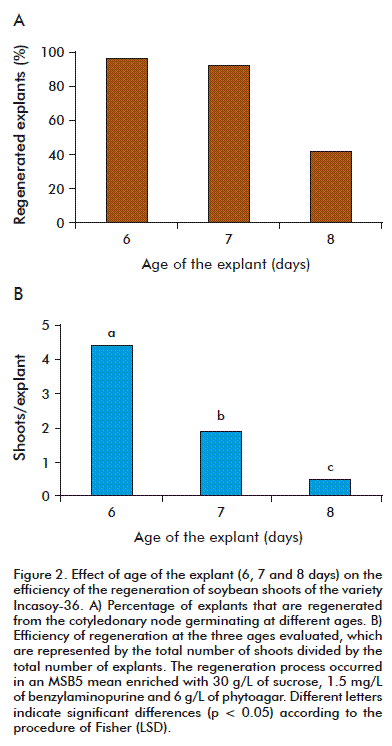
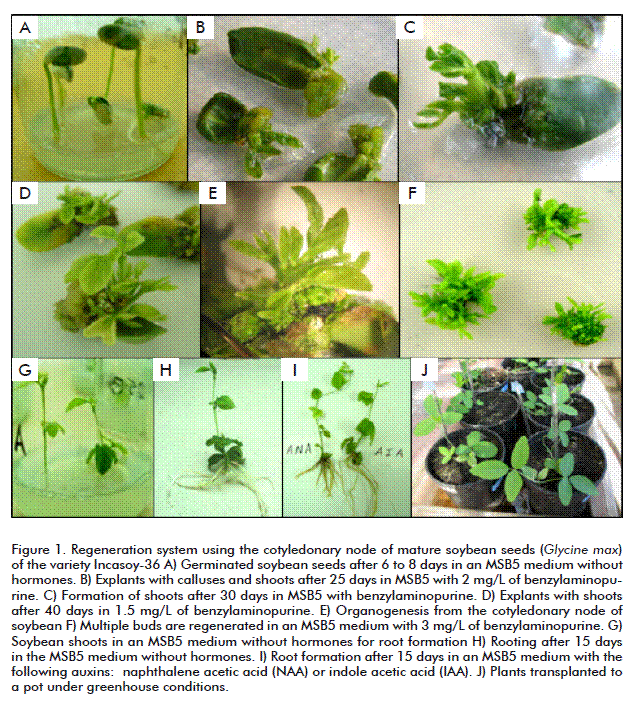
<body><![CDATA[<P   align="justify" ><font size="2" face="Verdana, Arial, Helvetica, sans-serif">Twenty-one explants      (7 explants/plate) were used for each treatment, and the experiments were      repeated 3 times. Two parameters were evaluated, namely, the age of the explants      and the concentration of the benzylaminopurine in the medium, for shoot induction.      The influence of age of the explants in the regeneration of the cotyledonary      node was analyzed by comparing the regeneration frequency of the explants      of each age (6, 7 and 8 days) and the number of shoots per explant in the      different concentrations of the benzylaminopurine. </font></P >       <P   ><font size="2" face="Verdana, Arial, Helvetica, sans-serif"><B>Rooting of shoots      and adaptation of plants to the soil </b></font></P >       <P   align="justify" ><font size="2" face="Verdana, Arial, Helvetica, sans-serif">The regenerated shoots      after 35 to 40 days (3 to 4 cm) were placed to root in the MSB5 without hormones      for 7 to 15 days. The rooted plants were transferred to small plastic pots      containing a mixture of organic material and zeolite (1:1 v/v), under controlled      conditions of light, humidity and room temperature for 7 days. They were then      transplanted to large pots and kept in a greenhouse until they flowered and      produced seeds. </font></P >       <P   ><font size="2" face="Verdana, Arial, Helvetica, sans-serif"><B>Statistical analysis      </b></font></P >       <P   align="justify" ><font size="2" face="Verdana, Arial, Helvetica, sans-serif">The cultures were      periodically observed and the effect of age of the explant and concentration      of benzylaminopurine in the regeneration of shoots were evaluated. The data      were analyzed using a simple analysis of variance (Anova). Means were compared      according to the least significant differences of Fisher (LSD) for p &lt;      0.05. For the statistical analysis we used the Statgraphics Plus program,      version 5.0. </font></P >       <P   align="justify" >&nbsp;</P >       <P   > </P >   <FONT size="+1"><B>        <P   ><font size="3" face="Verdana, Arial, Helvetica, sans-serif">RESULTS </font></P >       <P   ><font size="2" face="Verdana, Arial, Helvetica, sans-serif">Effect of age of      the explant and the concentration of benzylaminopurine on the regeneration      of shoots from the cotyledonary node </font></P >   </B>        <P   align="justify" ><font size="2" face="Verdana, Arial, Helvetica, sans-serif">The cotyledons of      mature soybean seeds germinated <I>in vitro</I> and selected as explants for      the regeneration trials reached a green color after 6 to 8 days in the MSB5      germination medium without hormones (<a href="/img/revistas/bta/v30n1/f0104113.gif">Figure 1</a>).      On comparing the effect of age of the explant on the regeneration of the shoots      in the MSB5 medium enriched with 1.5 mg/L of benzylaminopurine, it was observed      that the 6 day explants had a higher regeneration frequency of the shoots      (96.8 %), although it did not differ from the frequency found in 7 day explants      (92.6 %). However, the regeneration of the shoots of both ages (6 and 7 days)      considerably surpassed that obtained in 8 day explants (41.2 %)(<a href="#fig2">Figure      2A</a>). On evaluating the efficiency of the regeneration, we observed similar      results: the youngest explants (6 days) showed the highest number of shoots      per explant and the values differed significantly from those obtained in the      explants of 7 and 8 days (<a href="#fig2">Figure 2B</a>). In preliminary studies      it was demonstrated that when the cotyledonary node was exposed to high concentrations      of benzylaminopurine (3 to 6 mg/L), the youngest explants (6 days) showed      a better regeneration response compared to explants of 7 and 8 days of germination,      which developed very small shoots and much callus. The explants that did not      develop shoots turned chlorotic and were dark brown at the cotyledonary node      area.</font></P >       
]]></body>
<body><![CDATA[<P   align="center" ><img src="/img/revistas/bta/v30n1/f0204113.gif" width="390" height="744"><a name="fig2"></a></P >   <FONT size="+1">        
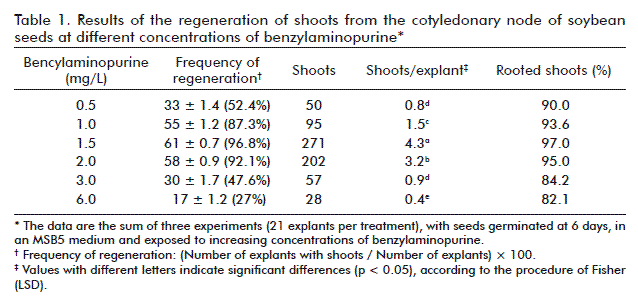
<P   align="justify" ><font size="2" face="Verdana, Arial, Helvetica, sans-serif">The number of regenerated      shoots depended on the concentration of the benzylaminopurine, although this      cytokine induced organogenesis in the shoots within all tested concentrations      (0.5 to 6 mg/L) (<a href="/img/revistas/bta/v30n1/t0104113.gif">Table 1</a>). The shoots of the explants      developed at the cotyledonary node region where the cut had been made and      where the axillary buds were found, after 4 weeks of culture (<a href="/img/revistas/bta/v30n1/f0104113.gif">Figure      1B-E</a>). The highest efficiency in the formation of shoots was obtained      in the MSB5 medium with 1.5 mg/L of the compound, although the efficiency      obtained did not differ from that of 2 mg/L (4.3 and 3.2 shoots/explant, respectively)(<a href="/img/revistas/bta/v30n1/t0104113.gif">Table      1</a>). </font></P >       
<P   align="justify" ><font size="2" face="Verdana, Arial, Helvetica, sans-serif">When the MSB5 medium      was enriched with benzylaminopurine a green mass of calluses, that was compact      at the cotyledonary node area, was observed in some explants where the cut      was made to separate the hypocotyl (<a href="/img/revistas/bta/v30n1/f0104113.gif">Figure 1B</a>).      This callous structure did not affect the normal growth of the shoots in concentrations      lower than 2 mg/L. However, in concentrations of over 3 mg/L, the calluses      were numerous in more than 30 % of the explants and the growth of shoots was      then affected. Nonetheless, the shoots reached 27 % at the concentration of      6 mg/L of benzylaminopurine (<a href="/img/revistas/bta/v30n1/t0104113.gif">Table 1</a>). After 45      days in this medium, the explants with calluses that did not develop shoots      turned dark Brown and were eliminated. </font></P >       
<P   align="justify" ><font size="2" face="Verdana, Arial, Helvetica, sans-serif">At the same time,      there were multiple buds at the cotyledonary node area when the explants were      in an MSB5 medium with more than 1.5 mg/L of benzylaminopurine (<a href="/img/revistas/bta/v30n1/f0104113.gif">Figure      1F</a>). They developed only when the cotyledonary nodes conserved the axillary      buds on placing them in the induction medium with the cytokinin. When all      buds were eliminated (apical and axillary buds) from the cotyledonary node,      the formation of a callus mass was observed, which did not regenerate shoots.      Although in the treatments with more than 3 mg/L of benzylaminopurine there      was a greater presence of these multiple buds, in most of the explants they      remained with an intense green color, but they did not grow (<a href="/img/revistas/bta/v30n1/f0104113.gif">Figure      1F</a>). Under these conditions the shoots had a well defined development      (2 cm), there were very small shoots (less than 0.7 cm) and leaves. Although      there were many, the very small shoots were not taken into account to determine      the efficiency of regeneration. The number of shoots (of over 2 cm) was counted      after 8 weeks of growth. </font></P >       
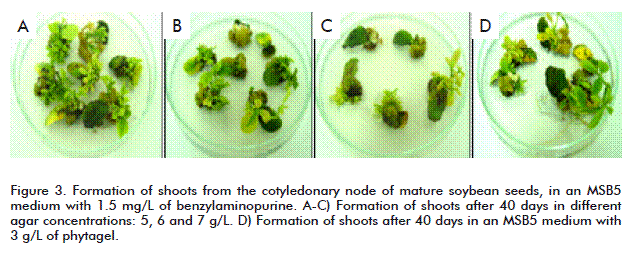
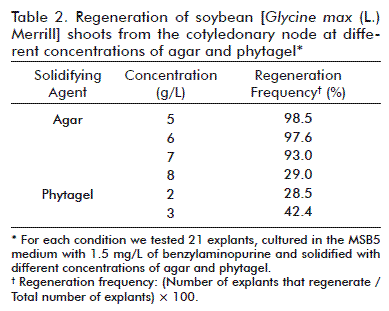
<P   ><font size="2" face="Verdana, Arial, Helvetica, sans-serif"><B>Effect of the      solidifying agent on the morphogenesis of the cotyledonary node </b></font></P >       <P   align="justify" ><font size="2" face="Verdana, Arial, Helvetica, sans-serif">Another parameter      studied was the effect of different concentrations of agar (5, 6, 7 and 8      g/L) and phytagel (2 and 3 g/L) on the formation of calluses and the regeneration      of shoots from the cotyledonary node. This study was made in an MSB5 medium      with 1.5 mg/L of benzylaminopurine. The best results were obtained with agar      as the gelling agent (<a href="#tab2">Table 2</a>). The highest regeneration      frequencies (98.5 and 97.6 %) were reached with concentrations of 5 and 6      g/L, respectively. With the four concentrations of agar well defined shoots      were developed after 25 to 30 days (<a href="/img/revistas/bta/v30n1/f0304113.gif">Figure 3A-C</a>).      However, in 8 g/L of agar, the regenerated shoots (29 %) grew slower (30 to      50 days). When using phytagel, less calluses were formed (11 and 19 %) than      those of the explants cultured in agar (23 and 41 %) and the shoots had a      more rapid and defined growth, which is similar to that of 5 and 7 g/L of      agar (<a href="/img/revistas/bta/v30n1/f0304113.gif">Figure 3D</a>). In contrast, the frequency of      regeneration of the shoots (28.5 and 42.4 %) did not surpass that achieved      in agar. </font></P >       
<P   align="center" ><img src="/img/revistas/bta/v30n1/t0204113.gif" width="387" height="309"><a name="tab2"></a></P >       
<P   ><font size="2" face="Verdana, Arial, Helvetica, sans-serif"><B>Rooting of shoots      and adaptation of plants to the soil </b></font></P >       <P   align="justify" ><font size="2" face="Verdana, Arial, Helvetica, sans-serif">The regenerated shoots      emerged from the cotyledonary node region, near the zone where the cut was      made, without interfering in the formation of calluses (<a href="/img/revistas/bta/v30n1/f0104113.gif">Figure      1B-E</a>). The regenerated plants in 1.5 and 2 mg/L of benzylaminopurine presented      the highest frequency of rooting (97 and 95 %, respectively; <a href="/img/revistas/bta/v30n1/t0104113.gif">table      1</a>). Although more than 80 % of the regenerated shoots (3 to 4 cm high)      rooted after 7 to 15 days in an MSB5 medium without hormones (<a href="/img/revistas/bta/v30n1/f0104113.gif">Figure      1 G-H</a>), the small shoots (1 to 2 cm high) that were placed to root in      this medium did not grow or develop any roots. Hence, they were transferred      to an MSB5 medium enriched with 0.1 mg/L of indole acetic acid (IAA) or 0.5      mg/L of naphthalene acetic acid (NAA) to induce rooting. In these two variants      we obtained a good formation of roots (<a href="/img/revistas/bta/v30n1/f0104113.gif">Figure 1I</a>):      96 % in the medium with IAA and 94 % in the medium with NAA. All rooted plants      were transferred to the greenhouse under controlled climatic conditions and      for growth. They were placed in small pots covered with a transparent plastic      sheet to create a humidity chamber, and after 7 days they were transplanted      to large pots for seed production (<a href="/img/revistas/bta/v30n1/f0104113.gif">Figure 1J</a>).      </font></P >       
<P   align="justify" >&nbsp;</P >       ]]></body>
<body><![CDATA[<P   > </P >   <FONT size="+1"><B>        <P   ><font size="3" face="Verdana, Arial, Helvetica, sans-serif">DISCUSSION </font></P >   </B>        <P   align="justify" ><font size="2" face="Verdana, Arial, Helvetica, sans-serif">The cotyledonary      node is one of the most frequently used explants for regeneration studies      and the genetic transformation of soybean [15]. However, the frequency of      regeneration with this type of explants is low in some varieties and the period      to achieve it is long [10, 21]. The regeneration of the shoots from the cotyledonary      node in this study occurred in a relatively short period (30 to 45 days) in      all concentrations of benzylaminopurine tested. This confirms that it is the      most effective growth regulator for the initiation of shoots [9, 21]. Several      protocols use a medium to induce the formation of calluses and another one      for the induction of the shoots [22, 23]. In this study we used only one medium      for the induction and regeneration of the shoots and we achieved the organogenesis      with well defined shoots (<a href="/img/revistas/bta/v30n1/f0104113.gif">Figure 1 C-E</a>). These      results demonstrated that after 3 mg/L of benzylaminopurine there is a decrease      in the number of shoots that are regenerated (<a href="/img/revistas/bta/v30n1/t0104113.gif">Table      1</a>). It has been demonstrated that high concentrations of this compound      may stimulate the formation of multiple buds [24]; however, growth may be      inhibited, as observed in this study. Also, high concentrations have been      shown to affect the frequency of the differentiation of the shoots in <I>Phaseolus      </I>spp. [25]. </font></P >   <FONT size="+1"><FONT size="+1"><FONT size="+1">        
<P   align="justify" ><font size="2" face="Verdana, Arial, Helvetica, sans-serif">On comparing the      frequency of regeneration at the three ages evaluated, we find that the regeneration      response of the explants tend to decrease with age (<a href="/img/revistas/bta/v30n1/f0304113.gif">Figure      3</a>). The explants of 6 and 7 days reached the highest frequencies of regeneration      in the MSB5 medium with 1.5 mg/L of benzylaminopurine. The 6 day old explants      gave a higher regenerative response than the 7 day old explants, with all      concentrations tested in this study and previous studies with the variety      Incasoy-36 (Soto N; unpublished data). The juvenile tissues have a high degree      of meristematic activity and tend to have more plasticity <I>in vitro </I>[26].      It is confirmed that the organogenic potential of an explant is inversely      proportional to its physiological age [27]; therefore, the 3 day old explants      showed a lower regeneration than the 6 and 7 day old explants, regardless      of the concentration of the benzylaminopurine used. These results agree with      those of other researchers in the <I>in vitro</I> regeneration of soybean      varieties, in which the highest frequency of regeneration is reached in concentrations      of 0.5 to 2 mg/L of benzylaminopurine [21, 24]. However, Paz <I>et al</I>.      obtained frequencies of regeneration that were lower to those described in      this study (92.6 to 96.8 %), but with a concentration of 1.12 mg/L, useing      as explants cotyledons of mature seeds of the varieties: Thorne (60 %), Williams      (46 %), Williams 79 (37 %) and Williams 82 (56 %) [28]. When evaluating the      frequency of regeneration of the shoots from the cotyledonary node of the      Cuban soybean variety, there were differences in the explants used, regardless      of the hormonal concentration of the culture medium. Some explants developed      many shoots, while others developed white calluses and roots; there were some      that even became chlorotic and showed no morphogenesis. This demonstrates      that the regenerative response <I>in vitro </I>tends to be variable, probably      because of the endogenous levels of phytohormones during the organogenesis      [26]. </font></P >       
<P   align="justify" ><font size="2" face="Verdana, Arial, Helvetica, sans-serif">The formation of      multiple buds in several explants was relevant. These explants coincided in      that they preserved the axillary buds after cutting the cotyledonary node      in half, before placing them in the regeneration medium with benzylaminopurine.      Shan <I>et al</I>. [29] observed that the formation of multiple buds only      occurred when the axillary buds are left in the cotyledonary node, while when      the axillary buds are removed there is an abundant formation of calluses and      no multi-buds are formed [29]. Therefore, the structural integrity of the      axillary meristems contributes to the high efficiency of regeneration. Through      histological studies, other researchers showed that the application of exogenous      cytokinins alter the development of the axillary meristems, promote the proliferation      of the meristematic cells in axillary buds and increase the number of primordial      buds that are formed from the existing axillary meristems [30, 31]. </font></P >       <P   align="justify" ><font size="2" face="Verdana, Arial, Helvetica, sans-serif">Here we also obtained      a low regeneration when increasing the concentration of agar in the culture      medium. It is stated that high concentrations of agar create a very stressful      medium for the plants, which reduces the formation of meristemoids [32]. However,      some researchers have reached positive results on using 8 g/L of agar to solidify      the co-culture medium [33]. </font></P >       <P   align="justify" ><font size="2" face="Verdana, Arial, Helvetica, sans-serif">We also studied the      induction and development of roots in regenerated plants <I>in vitro</I>.      In the presence of NAA, the induced roots were short (2 to 3 cm long) and      thick (<a href="/img/revistas/bta/v30n1/f0104113.gif">Figure 1I</a>). In contrast, in the presence      of IAA the roots induced were long (6 to 7 cm) and thin (<a href="/img/revistas/bta/v30n1/f0104113.gif">Figure      1I</a> right), and similar to those developed in the MS medium without hormones      (<a href="/img/revistas/bta/v30n1/f0104113.gif">Figure 1H</a>). The stimulating effect of the auxins      in the rooting of shoots has been described. Liu <I>et al</I>. described that      with NAA the formation of adventitious roots were stimulated; they observed      that during the induction of adventitious roots in soybean, the levels of      endogenous IAA increased because of the application of exogenous NAA, which      produced a greater production of adventitious roots [34]. The stimulating      effect of indolebutyric acid in the increase of the number of roots induced      per soybean shoot has also been reported [35]. </font></P >       
<P   align="justify" ><font size="2" face="Verdana, Arial, Helvetica, sans-serif">When plants rooted      <I>in vitro </I>are transplanted to the soil, they have a normal development      and all roots are viable regardless of the medium in which they developed.      This result made it possible to have other variants to achieve rooting of      shoots <I>in vitro </I>with different states of physiological development.      </font></P >       <P   align="justify" ><font size="2" face="Verdana, Arial, Helvetica, sans-serif">Finally, a procedure      was optimized to regenerate plants of the Cuban soybean variety Incasoy-36,      using the cotyledonary node of mature seeds germinated <I>in vitro</I>, in      a relatively short time and with a high frequency for shoot formation. This      requires only one step to obtain the shoots and it can be used for the genetic      transformation and <I>in vitro </I>propagation of this soybean variety. </font></P >       <P   align="justify" >&nbsp;</P >       ]]></body>
<body><![CDATA[<P   align="justify" > </P >       <P   align="justify" ><font size="3" face="Verdana, Arial, Helvetica, sans-serif"><B>REFERENCES </b></font></P >       <!-- ref --><P   ><font size="2" face="Verdana, Arial, Helvetica, sans-serif">1. Barwale UB, Kerns      HR, Widholm JM. Plant regeneration from callus cultures of several soybean      genotypes via embryogenesis and organogenesis. Planta. 1986; 167(4):473-81.          </font></P >   <FONT size="+1">        <!-- ref --><P   ><font size="2" face="Verdana, Arial, Helvetica, sans-serif">2. Finer JJ, Nagasawa      A. Development of an embryogenic suspension culture of soybean (Glycine max      Merrill.). Plant Cell Tissue Organ Cult. 1988;15(2):125-36.     </font></P >       <P   ><font size="2" face="Verdana, Arial, Helvetica, sans-serif">3. Cheng T-Y, Saka      H, Voqui-Dinh TH. Plant regeneration from soybean cotyledonary node segments      in culture. Plant Sci Lett. 1980;19(2):91-9. </font></P >       <!-- ref --><P   ><font size="2" face="Verdana, Arial, Helvetica, sans-serif">4. Kaneda Y, Tabei      Y, Nishimura S, Harada K, Akihama T, Kitamura K. Combination of thidiazuron      and basal media with low salt concentrations increases the frequency of shoot      organogenesis in soybeans [Glycine max (L.) Merr.]. Plant Cell Rep. 1997;17(1):8-12.          </font></P >       <P   ><font size="2" face="Verdana, Arial, Helvetica, sans-serif">5. Kim J, LaMotte      CE, Hack E. Plant Regeneration In Vitro from Primary Leaf Nodes of Soybean      (Glycine max) Seedlings. J Plant Physiol. 1990;136(6):664-9. </font></P >       ]]></body>
<body><![CDATA[<!-- ref --><P   ><font size="2" face="Verdana, Arial, Helvetica, sans-serif">6. Wright MS, Williams      MH, Pierson PE, Carnes MG. Initiation and propagation of Glycine max L. Merr.:      Plants from tissue-cultured epicotyls. Plant Cell Tissue Organ Cult. 1987;8(1):83-90.          </font></P >       <P   ><font size="2" face="Verdana, Arial, Helvetica, sans-serif">7. Wright MS, Ward      DV, Hinchee MA, Carnes MG, Kaufman RJ. Regeneration of soybean Glycine max      L. Merr.) from cultured primary leaf tissue. Plant Cell Rep. 1987;6(2):83-9.      </font></P >       <P   ><font size="2" face="Verdana, Arial, Helvetica, sans-serif">8. Yang Y-S, Wada      K, Futsuhara Y. Comparative studies of organogenesis and plant regeneration      in various soybean explants. Plant Sci. 1990;72(1):101-8. </font></P >       <!-- ref --><P   ><font size="2" face="Verdana, Arial, Helvetica, sans-serif">9. Dan Y, Reichert      N. Organogenic regeneration of soybean from hypocotyl explants. In Vitro Cell      Dev-Pl. 1998;34(1):14-21.     </font></P >       <P   ><font size="2" face="Verdana, Arial, Helvetica, sans-serif">10. Liu H-K, Yang      C, Wei Z-M. Efficient Agrobacterium tumefaciens-mediated transformation of      soybeans using an embryonic tip regeneration system. Planta. 2004;219(6):1042-9.      </font></P >       <P   ><font size="2" face="Verdana, Arial, Helvetica, sans-serif">11. Samoylov VM,      Tucker DM, Parrott WA. Soybean [Glycine max (L.) merrill] embryogenic cultures:      The role of sucrose and total nitrogen content on proliferation. In Vitro      Cell Dev-Pl. 1998;34(1):8-13. </font></P >       <!-- ref --><P   ><font size="2" face="Verdana, Arial, Helvetica, sans-serif">12. Droste A, Pimentel      P, Pasquali G, Mundstock E, Bodanese-Zanettini M. Regeneration of soybean      via embryogenic suspension culture. Sci Agric. 2001; 58(4):753-8.     </font></P >       ]]></body>
<body><![CDATA[<!-- ref --><P   ><font size="2" face="Verdana, Arial, Helvetica, sans-serif">13. Bueno M, Severin      C, Gattuso S, Giubileo G. Inducci&oacute;n de callos embriog&eacute;nicos      en ra&iacute;ces de Soja (Glycine max). Cien Inv Agr. 2004;31(1):13-9.     </font></P >       <!-- ref --><P   ><font size="2" face="Verdana, Arial, Helvetica, sans-serif">14. Hong H, Zhang      H, Olhoft P, Hill S, Wiley H, Toren E, et al. Organogenic callus as the target      for plant regeneration and transformation via Agrobacterium in soybean (Glycine      max (L.) Merr.). In Vitro Cell Dev-Pl. 2007;43(6):558-68.     </font></P >       <!-- ref --><P   ><font size="2" face="Verdana, Arial, Helvetica, sans-serif">15. Hinchee MAW,      Connor-Ward DV, Newell CA, McDonnell RE, Sato SJ, Gasser CS, et al. Production      of Transgenic Soybean Plants Using Agrobacterium-Mediated DNA Transfer. Nat      Biotechnol. 1988;6(8):915-22.     </font></P >       <!-- ref --><P   ><font size="2" face="Verdana, Arial, Helvetica, sans-serif">16. Staswick PE,      Zhang Z, Clemente TE, Specht JE. Efficient down-regulation of the major vegetative      storage protein genes in transgenic soybean does not compromise plant productivity.      Plant Physiol. 2001;127(4):1819-26.     </font></P >       <!-- ref --><P   ><font size="2" face="Verdana, Arial, Helvetica, sans-serif">17. Buhr T, Sato      S, Ebrahim F, Xing A, Zhou Y, Mathiesen M, et al. Ribozyme termination of      RNA transcripts down-regulate seed fatty acid genes in transgenic soybean.      Plant J. 2002;30(2):155-63.     </font></P >       ]]></body>
<body><![CDATA[<!-- ref --><P   ><font size="2" face="Verdana, Arial, Helvetica, sans-serif">18. Sato S, Xing      A, Ye X, Schweiger B, Kinney A, Graef G, et al. Production of linolenic acid      and stearidinic acid in seeds of marker-free transgenic soybean. Crop Sci.      2004;44(2):646-52.     </font></P >       <!-- ref --><P   ><font size="2" face="Verdana, Arial, Helvetica, sans-serif">19. Margulies MM.      Effect of Chloramphenicol on Light Dependent Development of Seedlings of Phaseolus      vulgaris var. Black Valentine, With Particular Reference to Development of      Photosynthetic Activity. Plant Physiol. 1962;37(4):473-80.     </font></P >       <P   ><font size="2" face="Verdana, Arial, Helvetica, sans-serif">20. Gamborg OL, Miller      RA, Ojima K. Nutrient requirements of suspension cultures of soybean root      cells. Exp Cell Res. 1968;50(1):151-8. </font></P >       <!-- ref --><P   ><font size="2" face="Verdana, Arial, Helvetica, sans-serif">21. Ma X-H, Wu T-L.      Rapid and efficient regeneration in soybean [Glycine max (L.) Merrill] from      whole cotyledonary node explants. Acta Physiol Plant. 2008; 30(2):209-16.          </font></P >       <P   ><font size="2" face="Verdana, Arial, Helvetica, sans-serif">22. Hammatt N, Davey      MR, Nelson RS. Plant regeneration from seedling cotyledons, leaves and petioles      of Glycine clandestina. Physiol Plant. 1986;68(1):125-8. </font></P >       <!-- ref --><P   ><font size="2" face="Verdana, Arial, Helvetica, sans-serif">23. Sairam RV, Franklin      G, Hassel R, Smith B, Meeker K, Kashikar N, et al. A study on the effect of      genotypes, plant growth regulators and sugars in promoting plant regeneration      via organogenesis from soybean cotyledonary nodal callus. Plant Cell Tissue      Organ Cult. 2003;75(1):79-85.     </font></P >       ]]></body>
<body><![CDATA[<!-- ref --><P   ><font size="2" face="Verdana, Arial, Helvetica, sans-serif">24. Kim Y, Park T,      Kim H, Park H, Chon S, Yun S. Factors affecting organogenesis from mature      cotyledon explants and regeneration in Soybean. J Plant Biotechnol. 2004;6(1):39-43.          </font></P >       <!-- ref --><P   ><font size="2" face="Verdana, Arial, Helvetica, sans-serif">25. Malik K, Saxena      P. Regeneration in Phaseolus vulgaris L.: high-frequency induction of direct      formation in intact seedling by N6-benzylaminopurine and thidiazuron. Planta.      1992;186(3):384-9.     </font></P >       <P   ><font size="2" face="Verdana, Arial, Helvetica, sans-serif">26. Litz RE, Jarret      RL. Regeneraci&oacute;n de plantas en el cultivo de tejidos: embriog&eacute;nesis      som&aacute;tica y organog&eacute;nesis. In: Roca WM, Mroginski LA, editors.      Cultivo de tejidos en la agricultura: Fundamentos y aplicaciones. Cali: Centro      Internacional de Agricultura Tropical; 1991. p. 143-71. </font></P >       <!-- ref --><P   ><font size="2" face="Verdana, Arial, Helvetica, sans-serif">27. Alleveldt G,      Radler F. Interrelationship between photoperiodic behavior of grapes &amp;      growth of plant tissue cultures. Plant Physiol. 1962;37(3):376-9.     </font></P >       <!-- ref --><P   ><font size="2" face="Verdana, Arial, Helvetica, sans-serif">28. Paz MM, Martinez      JC, Kalvig AB, Fonger TM, Wang K. Improved cotyledonary node method using      an alternative explant derived from mature seed for efficient Agrobacterium-mediated      soybean transformation. Plant Cell Rep. 2006;25(3):206-13.     </font></P >       <!-- ref --><P   ><font size="2" face="Verdana, Arial, Helvetica, sans-serif">29. Shan Z, Raemakers      K, Tzitzikas EN, Ma Z, Visser RG. Development of a highly efficient, repetitive      system of organogenesis in soybean (Glycine max (L.) Merr). Plant Cell Rep.      2005;24(9):507-12.     </font></P >       <!-- ref --><P   ><font size="2" face="Verdana, Arial, Helvetica, sans-serif">30. Wright MS, Koehler      SM, Hinchee MA, Carnes MG. Plant regeneration by organogenesis in Glycine      max. Plant Cell Rep. 1986;5(2):150-54.     </font></P >       <!-- ref --><P   ><font size="2" face="Verdana, Arial, Helvetica, sans-serif">31. Carmen S, Ballester      A, Vieitez A. Effect of thidiazuron on multiple shoot induction and plant      regeneration from cotyledonary nodes of chestnut. J Hortic Sci Biotechnol.      2001;76(5):588-95.     </font></P >       <!-- ref --><P   ><font size="2" face="Verdana, Arial, Helvetica, sans-serif">32. Brown DCW, Leung      DWM, Thorpe TA. Osmotic requirement for shoot formation in tobacco callus.      Physiol Plant. 1979;46(1):36-41.     </font></P >       <!-- ref --><P   ><font size="2" face="Verdana, Arial, Helvetica, sans-serif">33. Paz MM, Shou      H, Guo Z, Zhang Z, Banerjee AK, Wang K. Assessment of conditions affecting      Agrobacterium-mediated soybean transformation using the coytyledonary node      explant. Euphytica. 2004;136(2):167-9.     </font></P >       <!-- ref --><P   ><font size="2" face="Verdana, Arial, Helvetica, sans-serif">34. Liu ZH, Hsiao      IC, Pan YW. Effect of naphthalene acetic acid on endogenous indole-3-acetic      acid, peroxidase and auxin oxidase in hypocotyl cutting of soybean during      root formation. Bot Bull Acad Sin. 1996;37(4):247-53.     </font></P >       <!-- ref --><P   ><font size="2" face="Verdana, Arial, Helvetica, sans-serif">35. Radhakrishnan      R, Ranjithakumari B. Callus induction and plant regeneration of Indian soybean      (Glycine max (L.) Merr. cv. CO3) via half seed explant culture. J Agric Technol.      2007;3(2):287-97.    </font></P >       <P   >&nbsp;</P >       <P   >&nbsp;</P >       <P   > </P >       <P   > </P >       <P   ><font size="2" face="Verdana, Arial, Helvetica, sans-serif">Received in May,      2012.     <br>     Accepted in September, 2012. </font></P >       <P   >&nbsp;</P >       ]]></body>
<body><![CDATA[<P   >&nbsp;</P >       <P   > </P >       <P   > </P >       <P   ><font size="2" face="Verdana, Arial, Helvetica, sans-serif"><I>Natacha Soto</I>.      Laboratorio de Biotecnolog&iacute;a de la Soya, Divisi&oacute;n de Plantas,      Centro de Ingenier&iacute;a Gen&eacute;tica y Biotecnolog&iacute;a, CIGB.      Ave. 31 e/ 158 y 190, Cubanac&aacute;n, Playa, CP 11 600, La Habana, Cuba.      E-mail: <A href="mailto:natacha.soto@cigb.edu.cu"> <U><U><FONT color="#0000FF">natacha.soto@cigb.edu.cu</font></U></U></A><FONT color="#0000FF"><FONT color="#000000">.      </font></font></font></P >   </font></font></font></font></font></font></font></font></font></font></font></font></font></font></font></font></font></font></DIV >      ]]></body><back>
<ref-list>
<ref id="B1">
<label>1</label><nlm-citation citation-type="journal">
<person-group person-group-type="author">
<name>
<surname><![CDATA[Barwale]]></surname>
<given-names><![CDATA[UB]]></given-names>
</name>
<name>
<surname><![CDATA[Kerns]]></surname>
<given-names><![CDATA[HR]]></given-names>
</name>
<name>
<surname><![CDATA[Widholm]]></surname>
<given-names><![CDATA[JM]]></given-names>
</name>
</person-group>
<article-title xml:lang="en"><![CDATA[Plant regeneration from callus cultures of several soybean genotypes via embryogenesis and organogenesis]]></article-title>
<source><![CDATA[Planta]]></source>
<year>1986</year>
<volume>167</volume>
<numero>4</numero>
<issue>4</issue>
<page-range>473-81</page-range></nlm-citation>
</ref>
<ref id="B2">
<label>2</label><nlm-citation citation-type="journal">
<person-group person-group-type="author">
<name>
<surname><![CDATA[Finer]]></surname>
<given-names><![CDATA[JJ]]></given-names>
</name>
<name>
<surname><![CDATA[Nagasawa]]></surname>
<given-names><![CDATA[A]]></given-names>
</name>
</person-group>
<article-title xml:lang="en"><![CDATA[Development of an embryogenic suspension culture of soybean (Glycine max Merrill.)]]></article-title>
<source><![CDATA[Plant Cell Tissue Organ Cult]]></source>
<year>1988</year>
<volume>15</volume>
<numero>2</numero>
<issue>2</issue>
<page-range>125-36</page-range></nlm-citation>
</ref>
<ref id="B3">
<label>3</label><nlm-citation citation-type="journal">
<person-group person-group-type="author">
<name>
<surname><![CDATA[Cheng]]></surname>
<given-names><![CDATA[T-Y]]></given-names>
</name>
<name>
<surname><![CDATA[Saka]]></surname>
<given-names><![CDATA[H]]></given-names>
</name>
<name>
<surname><![CDATA[Voqui-Dinh]]></surname>
<given-names><![CDATA[TH]]></given-names>
</name>
</person-group>
<article-title xml:lang="en"><![CDATA[Plant regeneration from soybean cotyledonary node segments in culture]]></article-title>
<source><![CDATA[Plant Sci Lett]]></source>
<year>1980</year>
<volume>19</volume>
<numero>2</numero>
<issue>2</issue>
<page-range>91-99</page-range></nlm-citation>
</ref>
<ref id="B4">
<label>4</label><nlm-citation citation-type="journal">
<person-group person-group-type="author">
<name>
<surname><![CDATA[Kaneda]]></surname>
<given-names><![CDATA[Y]]></given-names>
</name>
<name>
<surname><![CDATA[Tabei]]></surname>
<given-names><![CDATA[Y]]></given-names>
</name>
<name>
<surname><![CDATA[Nishimura]]></surname>
<given-names><![CDATA[S]]></given-names>
</name>
<name>
<surname><![CDATA[Harada]]></surname>
<given-names><![CDATA[K]]></given-names>
</name>
<name>
<surname><![CDATA[Akihama]]></surname>
<given-names><![CDATA[T]]></given-names>
</name>
<name>
<surname><![CDATA[Kitamura]]></surname>
<given-names><![CDATA[K]]></given-names>
</name>
</person-group>
<article-title xml:lang="en"><![CDATA[Combination of thidiazuron and basal media with low salt concentrations increases the frequency of shoot organogenesis in soybeans &#91;Glycine max (L.) Merr.&#93;]]></article-title>
<source><![CDATA[Plant Cell Rep]]></source>
<year>1997</year>
<volume>17</volume>
<numero>1</numero>
<issue>1</issue>
<page-range>8-12</page-range></nlm-citation>
</ref>
<ref id="B5">
<label>5</label><nlm-citation citation-type="journal">
<person-group person-group-type="author">
<name>
<surname><![CDATA[Kim]]></surname>
<given-names><![CDATA[J]]></given-names>
</name>
<name>
<surname><![CDATA[LaMotte]]></surname>
<given-names><![CDATA[CE]]></given-names>
</name>
<name>
<surname><![CDATA[Hack]]></surname>
<given-names><![CDATA[E]]></given-names>
</name>
</person-group>
<article-title xml:lang="en"><![CDATA[Plant Regeneration In Vitro from Primary Leaf Nodes of Soybean (Glycine max) Seedlings]]></article-title>
<source><![CDATA[J Plant Physiol]]></source>
<year>1990</year>
<volume>136</volume>
<numero>6</numero>
<issue>6</issue>
<page-range>664-69</page-range></nlm-citation>
</ref>
<ref id="B6">
<label>6</label><nlm-citation citation-type="journal">
<person-group person-group-type="author">
<name>
<surname><![CDATA[Wright]]></surname>
<given-names><![CDATA[MS]]></given-names>
</name>
<name>
<surname><![CDATA[Williams]]></surname>
<given-names><![CDATA[MH]]></given-names>
</name>
<name>
<surname><![CDATA[Pierson]]></surname>
<given-names><![CDATA[PE]]></given-names>
</name>
<name>
<surname><![CDATA[Carnes]]></surname>
<given-names><![CDATA[MG]]></given-names>
</name>
</person-group>
<article-title xml:lang="en"><![CDATA[Initiation and propagation of Glycine max L. Merr.: Plants from tissue-cultured epicotyls]]></article-title>
<source><![CDATA[Plant Cell Tissue Organ Cult]]></source>
<year>1987</year>
<volume>8</volume>
<numero>1</numero>
<issue>1</issue>
<page-range>83-90</page-range></nlm-citation>
</ref>
<ref id="B7">
<label>7</label><nlm-citation citation-type="journal">
<person-group person-group-type="author">
<name>
<surname><![CDATA[Wright]]></surname>
<given-names><![CDATA[MS]]></given-names>
</name>
<name>
<surname><![CDATA[Ward]]></surname>
<given-names><![CDATA[DV]]></given-names>
</name>
<name>
<surname><![CDATA[Hinchee]]></surname>
<given-names><![CDATA[MA]]></given-names>
</name>
<name>
<surname><![CDATA[Carnes]]></surname>
<given-names><![CDATA[MG]]></given-names>
</name>
<name>
<surname><![CDATA[Kaufman]]></surname>
<given-names><![CDATA[RJ]]></given-names>
</name>
</person-group>
<article-title xml:lang="en"><![CDATA[Regeneration of soybean (Glycine max L. Merr.) from cultured primary leaf tissue]]></article-title>
<source><![CDATA[Plant Cell Rep]]></source>
<year>1987</year>
<volume>6</volume>
<numero>2</numero>
<issue>2</issue>
<page-range>83-89</page-range></nlm-citation>
</ref>
<ref id="B8">
<label>8</label><nlm-citation citation-type="journal">
<person-group person-group-type="author">
<name>
<surname><![CDATA[Yang]]></surname>
<given-names><![CDATA[Y-S]]></given-names>
</name>
<name>
<surname><![CDATA[Wada]]></surname>
<given-names><![CDATA[K]]></given-names>
</name>
<name>
<surname><![CDATA[Futsuhara]]></surname>
<given-names><![CDATA[Y]]></given-names>
</name>
</person-group>
<article-title xml:lang="en"><![CDATA[Comparative studies of organogenesis and plant regeneration in various soybean explants]]></article-title>
<source><![CDATA[Plant Sci]]></source>
<year>1990</year>
<volume>72</volume>
<numero>1</numero>
<issue>1</issue>
<page-range>101-08</page-range></nlm-citation>
</ref>
<ref id="B9">
<label>9</label><nlm-citation citation-type="journal">
<person-group person-group-type="author">
<name>
<surname><![CDATA[Dan]]></surname>
<given-names><![CDATA[Y]]></given-names>
</name>
<name>
<surname><![CDATA[Reichert]]></surname>
<given-names><![CDATA[N]]></given-names>
</name>
</person-group>
<article-title xml:lang="en"><![CDATA[Organogenic regeneration of soybean from hypocotyl explants]]></article-title>
<source><![CDATA[In Vitro Cell Dev-Pl]]></source>
<year>1998</year>
<volume>34</volume>
<numero>1</numero>
<issue>1</issue>
<page-range>14-21</page-range></nlm-citation>
</ref>
<ref id="B10">
<label>10</label><nlm-citation citation-type="journal">
<person-group person-group-type="author">
<name>
<surname><![CDATA[Liu]]></surname>
<given-names><![CDATA[H-K]]></given-names>
</name>
<name>
<surname><![CDATA[Yang]]></surname>
<given-names><![CDATA[C]]></given-names>
</name>
<name>
<surname><![CDATA[Wei]]></surname>
<given-names><![CDATA[Z-M]]></given-names>
</name>
</person-group>
<article-title xml:lang="en"><![CDATA[Efficient Agrobacterium tumefaciens-mediated transformation of soybeans using an embryonic tip regeneration system]]></article-title>
<source><![CDATA[Planta]]></source>
<year>2004</year>
<volume>219</volume>
<numero>6</numero>
<issue>6</issue>
<page-range>1042-49</page-range></nlm-citation>
</ref>
<ref id="B11">
<label>11</label><nlm-citation citation-type="journal">
<person-group person-group-type="author">
<name>
<surname><![CDATA[Samoylov]]></surname>
<given-names><![CDATA[VM]]></given-names>
</name>
<name>
<surname><![CDATA[Tucker]]></surname>
<given-names><![CDATA[DM]]></given-names>
</name>
<name>
<surname><![CDATA[Parrott]]></surname>
<given-names><![CDATA[WA]]></given-names>
</name>
</person-group>
<article-title xml:lang="en"><![CDATA[Soybean &#91;Glycine max (L.) merrill&#93; embryogenic cultures: oybean &#91;Glycine max (L.) merrill&#93; embryogenic cultures: The role of sucrose and total nitrogen content on proliferation]]></article-title>
<source><![CDATA[In Vitro Cell Dev-Pl]]></source>
<year>1998</year>
<volume>34</volume>
<numero>1</numero>
<issue>1</issue>
<page-range>8-13</page-range></nlm-citation>
</ref>
<ref id="B12">
<label>12</label><nlm-citation citation-type="journal">
<person-group person-group-type="author">
<name>
<surname><![CDATA[Droste]]></surname>
<given-names><![CDATA[A]]></given-names>
</name>
<name>
<surname><![CDATA[Pimentel]]></surname>
<given-names><![CDATA[P]]></given-names>
</name>
<name>
<surname><![CDATA[Pasquali]]></surname>
<given-names><![CDATA[G]]></given-names>
</name>
<name>
<surname><![CDATA[Mundstock]]></surname>
<given-names><![CDATA[E]]></given-names>
</name>
<name>
<surname><![CDATA[Bodanese-Zanettini]]></surname>
<given-names><![CDATA[M]]></given-names>
</name>
</person-group>
<article-title xml:lang="en"><![CDATA[Regeneration of soybean via embryogenic suspension culture]]></article-title>
<source><![CDATA[Sci Agric]]></source>
<year>2001</year>
<volume>58</volume>
<numero>4</numero>
<issue>4</issue>
<page-range>753-8</page-range></nlm-citation>
</ref>
<ref id="B13">
<label>13</label><nlm-citation citation-type="journal">
<person-group person-group-type="author">
<name>
<surname><![CDATA[Bueno]]></surname>
<given-names><![CDATA[M]]></given-names>
</name>
<name>
<surname><![CDATA[Severin]]></surname>
<given-names><![CDATA[C]]></given-names>
</name>
<name>
<surname><![CDATA[Gattuso]]></surname>
<given-names><![CDATA[S]]></given-names>
</name>
<name>
<surname><![CDATA[Giubileo]]></surname>
<given-names><![CDATA[G]]></given-names>
</name>
</person-group>
<article-title xml:lang="es"><![CDATA[Inducción de callos embriogénicos en raíces de Soja (Glycine max)]]></article-title>
<source><![CDATA[Cien Inv Agr]]></source>
<year>2004</year>
<volume>31</volume>
<numero>1</numero>
<issue>1</issue>
<page-range>13-9</page-range></nlm-citation>
</ref>
<ref id="B14">
<label>14</label><nlm-citation citation-type="journal">
<person-group person-group-type="author">
<name>
<surname><![CDATA[Hong]]></surname>
<given-names><![CDATA[H]]></given-names>
</name>
<name>
<surname><![CDATA[Zhang]]></surname>
<given-names><![CDATA[H]]></given-names>
</name>
<name>
<surname><![CDATA[Olhoft]]></surname>
<given-names><![CDATA[P]]></given-names>
</name>
<name>
<surname><![CDATA[Hill]]></surname>
<given-names><![CDATA[S]]></given-names>
</name>
<name>
<surname><![CDATA[Wiley]]></surname>
<given-names><![CDATA[H]]></given-names>
</name>
<name>
<surname><![CDATA[Toren]]></surname>
<given-names><![CDATA[E]]></given-names>
</name>
</person-group>
<article-title xml:lang="en"><![CDATA[Organogenic callus as the target for plant regeneration and transformation via Agrobacterium in soybean (Glycine max (L.) Merr.)]]></article-title>
<source><![CDATA[In Vitro Cell Dev-Pl]]></source>
<year>2007</year>
<volume>43</volume>
<numero>6</numero>
<issue>6</issue>
<page-range>558-68</page-range></nlm-citation>
</ref>
<ref id="B15">
<label>15</label><nlm-citation citation-type="journal">
<person-group person-group-type="author">
<name>
<surname><![CDATA[Hinchee]]></surname>
<given-names><![CDATA[MAW]]></given-names>
</name>
<name>
<surname><![CDATA[Connor-Ward]]></surname>
<given-names><![CDATA[DV]]></given-names>
</name>
<name>
<surname><![CDATA[Newell]]></surname>
<given-names><![CDATA[CA]]></given-names>
</name>
<name>
<surname><![CDATA[McDonnell]]></surname>
<given-names><![CDATA[RE]]></given-names>
</name>
<name>
<surname><![CDATA[Sato]]></surname>
<given-names><![CDATA[SJ]]></given-names>
</name>
<name>
<surname><![CDATA[Gasser]]></surname>
<given-names><![CDATA[CS]]></given-names>
</name>
</person-group>
<article-title xml:lang="en"><![CDATA[Production of Transgenic Soybean Plants Using Agrobacterium-Mediated DNA Transfer]]></article-title>
<source><![CDATA[Nat Biotechnol]]></source>
<year>1988</year>
<volume>6</volume>
<numero>8</numero>
<issue>8</issue>
<page-range>915-22</page-range></nlm-citation>
</ref>
<ref id="B16">
<label>16</label><nlm-citation citation-type="journal">
<person-group person-group-type="author">
<name>
<surname><![CDATA[Staswick]]></surname>
<given-names><![CDATA[PE]]></given-names>
</name>
<name>
<surname><![CDATA[Zhang]]></surname>
<given-names><![CDATA[Z]]></given-names>
</name>
<name>
<surname><![CDATA[Clemente]]></surname>
<given-names><![CDATA[TE]]></given-names>
</name>
<name>
<surname><![CDATA[Specht]]></surname>
<given-names><![CDATA[JE]]></given-names>
</name>
</person-group>
<article-title xml:lang="en"><![CDATA[Efficient down-regulation of the major vegetative storage protein genes in transgenic soybean does not compromise plant productivity]]></article-title>
<source><![CDATA[Plant Physiol]]></source>
<year>2001</year>
<volume>127</volume>
<numero>4</numero>
<issue>4</issue>
<page-range>1819-26</page-range></nlm-citation>
</ref>
<ref id="B17">
<label>17</label><nlm-citation citation-type="journal">
<person-group person-group-type="author">
<name>
<surname><![CDATA[Buhr]]></surname>
<given-names><![CDATA[T]]></given-names>
</name>
<name>
<surname><![CDATA[Sato]]></surname>
<given-names><![CDATA[S]]></given-names>
</name>
<name>
<surname><![CDATA[Ebrahim]]></surname>
<given-names><![CDATA[F]]></given-names>
</name>
<name>
<surname><![CDATA[Xing]]></surname>
<given-names><![CDATA[A]]></given-names>
</name>
<name>
<surname><![CDATA[Zhou]]></surname>
<given-names><![CDATA[Y]]></given-names>
</name>
<name>
<surname><![CDATA[Mathiesen]]></surname>
<given-names><![CDATA[M]]></given-names>
</name>
</person-group>
<article-title xml:lang="en"><![CDATA[Ribozyme termination of RNA transcripts down-regulate seed fatty acid genes in transgenic soybean]]></article-title>
<source><![CDATA[Plant J]]></source>
<year>2002</year>
<volume>30</volume>
<numero>2</numero>
<issue>2</issue>
<page-range>155-63</page-range></nlm-citation>
</ref>
<ref id="B18">
<label>18</label><nlm-citation citation-type="journal">
<person-group person-group-type="author">
<name>
<surname><![CDATA[Sato]]></surname>
<given-names><![CDATA[S]]></given-names>
</name>
<name>
<surname><![CDATA[Xing]]></surname>
<given-names><![CDATA[A]]></given-names>
</name>
<name>
<surname><![CDATA[Ye]]></surname>
<given-names><![CDATA[X]]></given-names>
</name>
<name>
<surname><![CDATA[Schweiger]]></surname>
<given-names><![CDATA[B]]></given-names>
</name>
<name>
<surname><![CDATA[Kinney]]></surname>
<given-names><![CDATA[A]]></given-names>
</name>
<name>
<surname><![CDATA[Graef]]></surname>
<given-names><![CDATA[G]]></given-names>
</name>
</person-group>
<article-title xml:lang="en"><![CDATA[Production of linolenic acid and stearidinic acid in seeds of marker-free transgenic soybean]]></article-title>
<source><![CDATA[Crop Sci]]></source>
<year>2004</year>
<volume>44</volume>
<numero>2</numero>
<issue>2</issue>
<page-range>646-52</page-range></nlm-citation>
</ref>
<ref id="B19">
<label>19</label><nlm-citation citation-type="journal">
<person-group person-group-type="author">
<name>
<surname><![CDATA[Margulies]]></surname>
<given-names><![CDATA[MM]]></given-names>
</name>
</person-group>
<article-title xml:lang="en"><![CDATA[Effect of Chloramphenicol on Light Dependent Development of Seedlings of Phaseolus vulgaris var. Black Valentine, With Particular Reference to Development of Photosynthetic Activity]]></article-title>
<source><![CDATA[Plant Physiol]]></source>
<year>1962</year>
<volume>37</volume>
<numero>4</numero>
<issue>4</issue>
<page-range>473-80</page-range></nlm-citation>
</ref>
<ref id="B20">
<label>20</label><nlm-citation citation-type="journal">
<person-group person-group-type="author">
<name>
<surname><![CDATA[Gamborg]]></surname>
<given-names><![CDATA[OL]]></given-names>
</name>
<name>
<surname><![CDATA[Miller]]></surname>
<given-names><![CDATA[RA]]></given-names>
</name>
<name>
<surname><![CDATA[Ojima]]></surname>
<given-names><![CDATA[K]]></given-names>
</name>
</person-group>
<article-title xml:lang="en"><![CDATA[Nutrient requirements of suspension cultures of soybean root cells]]></article-title>
<source><![CDATA[Exp Cell Res]]></source>
<year>1968</year>
<volume>50</volume>
<numero>1</numero>
<issue>1</issue>
<page-range>151-58</page-range></nlm-citation>
</ref>
<ref id="B21">
<label>21</label><nlm-citation citation-type="journal">
<person-group person-group-type="author">
<name>
<surname><![CDATA[Ma]]></surname>
<given-names><![CDATA[X-H]]></given-names>
</name>
<name>
<surname><![CDATA[Wu]]></surname>
<given-names><![CDATA[T-L]]></given-names>
</name>
</person-group>
<article-title xml:lang="en"><![CDATA[Rapid and efficient regeneration in soybean &#91;Glycine max (L.) Merrill&#93; from whole cotyledonary node explants]]></article-title>
<source><![CDATA[Acta Physiol Plant]]></source>
<year>2008</year>
<volume>30</volume>
<numero>2</numero>
<issue>2</issue>
<page-range>209-16</page-range></nlm-citation>
</ref>
<ref id="B22">
<label>22</label><nlm-citation citation-type="journal">
<person-group person-group-type="author">
<name>
<surname><![CDATA[Hammatt]]></surname>
<given-names><![CDATA[N]]></given-names>
</name>
<name>
<surname><![CDATA[Davey]]></surname>
<given-names><![CDATA[MR]]></given-names>
</name>
<name>
<surname><![CDATA[Nelson]]></surname>
<given-names><![CDATA[RS]]></given-names>
</name>
</person-group>
<article-title xml:lang="en"><![CDATA[Plant regeneration from seedling cotyledons, leaves and petioles of Glycine clandestina]]></article-title>
<source><![CDATA[Physiol Plant]]></source>
<year>1986</year>
<volume>68</volume>
<numero>1</numero>
<issue>1</issue>
<page-range>125-28</page-range></nlm-citation>
</ref>
<ref id="B23">
<label>23</label><nlm-citation citation-type="journal">
<person-group person-group-type="author">
<name>
<surname><![CDATA[Sairam]]></surname>
<given-names><![CDATA[RV]]></given-names>
</name>
<name>
<surname><![CDATA[Franklin]]></surname>
<given-names><![CDATA[G]]></given-names>
</name>
<name>
<surname><![CDATA[Hassel]]></surname>
<given-names><![CDATA[R]]></given-names>
</name>
<name>
<surname><![CDATA[Smith]]></surname>
<given-names><![CDATA[B]]></given-names>
</name>
<name>
<surname><![CDATA[Meeker]]></surname>
<given-names><![CDATA[K]]></given-names>
</name>
<name>
<surname><![CDATA[Kashikar]]></surname>
<given-names><![CDATA[N]]></given-names>
</name>
</person-group>
<article-title xml:lang="en"><![CDATA[A study on the effect of genotypes, plant growth regulators and sugars in promoting plant regeneration via organogenesis from soybean cotyledonary nodal callus]]></article-title>
<source><![CDATA[Plant Cell Tissue Organ Cult]]></source>
<year>2003</year>
<volume>75</volume>
<numero>1</numero>
<issue>1</issue>
<page-range>79-85</page-range></nlm-citation>
</ref>
<ref id="B24">
<label>24</label><nlm-citation citation-type="journal">
<person-group person-group-type="author">
<name>
<surname><![CDATA[Kim]]></surname>
<given-names><![CDATA[Y]]></given-names>
</name>
<name>
<surname><![CDATA[Park]]></surname>
<given-names><![CDATA[T]]></given-names>
</name>
<name>
<surname><![CDATA[Kim]]></surname>
<given-names><![CDATA[H]]></given-names>
</name>
<name>
<surname><![CDATA[Park]]></surname>
<given-names><![CDATA[H]]></given-names>
</name>
<name>
<surname><![CDATA[Chon]]></surname>
<given-names><![CDATA[S]]></given-names>
</name>
<name>
<surname><![CDATA[Yun]]></surname>
<given-names><![CDATA[S]]></given-names>
</name>
</person-group>
<article-title xml:lang="en"><![CDATA[Factors affecting organogenesis from mature cotyledon explants and regeneration in Soybean]]></article-title>
<source><![CDATA[J Plant Biotechnol]]></source>
<year>2004</year>
<volume>6</volume>
<numero>1</numero>
<issue>1</issue>
<page-range>39-43</page-range></nlm-citation>
</ref>
<ref id="B25">
<label>25</label><nlm-citation citation-type="journal">
<person-group person-group-type="author">
<name>
<surname><![CDATA[Malik]]></surname>
<given-names><![CDATA[K]]></given-names>
</name>
<name>
<surname><![CDATA[Saxena]]></surname>
<given-names><![CDATA[P]]></given-names>
</name>
</person-group>
<article-title xml:lang="en"><![CDATA[Regeneration in Phaseolus vulgaris L.: high-frequency induction of direct formation in intact seedling by N6-benzylaminopurine and thidiazuron]]></article-title>
<source><![CDATA[Planta]]></source>
<year>1992</year>
<volume>186</volume>
<numero>3</numero>
<issue>3</issue>
<page-range>384-9</page-range></nlm-citation>
</ref>
<ref id="B26">
<label>26</label><nlm-citation citation-type="book">
<person-group person-group-type="author">
<name>
<surname><![CDATA[Litz]]></surname>
<given-names><![CDATA[RE]]></given-names>
</name>
<name>
<surname><![CDATA[Jarret]]></surname>
<given-names><![CDATA[RL]]></given-names>
</name>
</person-group>
<article-title xml:lang="es"><![CDATA[Regeneración de plantas en el cultivo de tejidos: embriogénesis somática y organogénesis]]></article-title>
<person-group person-group-type="editor">
<name>
<surname><![CDATA[Roca]]></surname>
<given-names><![CDATA[WM]]></given-names>
</name>
<name>
<surname><![CDATA[Mroginski]]></surname>
<given-names><![CDATA[LA]]></given-names>
</name>
</person-group>
<source><![CDATA[Cultivo de tejidos en la agricultura: Fundamentos y aplicaciones]]></source>
<year>1991</year>
<page-range>143-171</page-range><publisher-loc><![CDATA[Cali ]]></publisher-loc>
<publisher-name><![CDATA[Centro Internacional de Agricultura Tropical]]></publisher-name>
</nlm-citation>
</ref>
<ref id="B27">
<label>27</label><nlm-citation citation-type="journal">
<person-group person-group-type="author">
<name>
<surname><![CDATA[Alleveldt]]></surname>
<given-names><![CDATA[G]]></given-names>
</name>
<name>
<surname><![CDATA[Radler]]></surname>
<given-names><![CDATA[F]]></given-names>
</name>
</person-group>
<article-title xml:lang="en"><![CDATA[Interrelationship between photoperiodic behavior of grapes & growth of plant tissue cultures]]></article-title>
<source><![CDATA[Plant Physiol]]></source>
<year>1962</year>
<volume>37</volume>
<numero>3</numero>
<issue>3</issue>
<page-range>376-9</page-range></nlm-citation>
</ref>
<ref id="B28">
<label>28</label><nlm-citation citation-type="journal">
<person-group person-group-type="author">
<name>
<surname><![CDATA[Paz]]></surname>
<given-names><![CDATA[MM]]></given-names>
</name>
<name>
<surname><![CDATA[Martinez]]></surname>
<given-names><![CDATA[JC]]></given-names>
</name>
<name>
<surname><![CDATA[Kalvig]]></surname>
<given-names><![CDATA[AB]]></given-names>
</name>
<name>
<surname><![CDATA[Fonger]]></surname>
<given-names><![CDATA[TM]]></given-names>
</name>
<name>
<surname><![CDATA[Wang]]></surname>
<given-names><![CDATA[K]]></given-names>
</name>
</person-group>
<article-title xml:lang="en"><![CDATA[Improved cotyledonary node method using an alternative explant derived from mature seed for efficient Agrobacterium-mediated soybean transformation]]></article-title>
<source><![CDATA[Plant Cell Rep]]></source>
<year>2006</year>
<volume>25</volume>
<numero>3</numero>
<issue>3</issue>
<page-range>206-13</page-range></nlm-citation>
</ref>
<ref id="B29">
<label>29</label><nlm-citation citation-type="journal">
<person-group person-group-type="author">
<name>
<surname><![CDATA[Shan]]></surname>
<given-names><![CDATA[Z]]></given-names>
</name>
<name>
<surname><![CDATA[Raemakers]]></surname>
<given-names><![CDATA[K]]></given-names>
</name>
<name>
<surname><![CDATA[Tzitzikas]]></surname>
<given-names><![CDATA[EN]]></given-names>
</name>
<name>
<surname><![CDATA[Ma]]></surname>
<given-names><![CDATA[Z]]></given-names>
</name>
<name>
<surname><![CDATA[Visser]]></surname>
<given-names><![CDATA[RG]]></given-names>
</name>
</person-group>
<article-title xml:lang="en"><![CDATA[Development of a highly efficient, repetitive system of organogenesis in soybean (Glycine max (L.) Merr)]]></article-title>
<source><![CDATA[Plant Cell Rep]]></source>
<year>2005</year>
<volume>24</volume>
<numero>9</numero>
<issue>9</issue>
<page-range>507-12</page-range></nlm-citation>
</ref>
<ref id="B30">
<label>30</label><nlm-citation citation-type="journal">
<person-group person-group-type="author">
<name>
<surname><![CDATA[Wright]]></surname>
<given-names><![CDATA[MS]]></given-names>
</name>
<name>
<surname><![CDATA[Koehler]]></surname>
<given-names><![CDATA[SM]]></given-names>
</name>
<name>
<surname><![CDATA[Hinchee]]></surname>
<given-names><![CDATA[MA]]></given-names>
</name>
<name>
<surname><![CDATA[Carnes]]></surname>
<given-names><![CDATA[MG]]></given-names>
</name>
</person-group>
<article-title xml:lang="en"><![CDATA[Plant regeneration by organogenesis in Glycine max]]></article-title>
<source><![CDATA[Plant Cell Rep]]></source>
<year>1986</year>
<volume>5</volume>
<numero>2</numero>
<issue>2</issue>
<page-range>150-54</page-range></nlm-citation>
</ref>
<ref id="B31">
<label>31</label><nlm-citation citation-type="journal">
<person-group person-group-type="author">
<name>
<surname><![CDATA[Carmen]]></surname>
<given-names><![CDATA[S]]></given-names>
</name>
<name>
<surname><![CDATA[Ballester]]></surname>
<given-names><![CDATA[A]]></given-names>
</name>
<name>
<surname><![CDATA[Vieitez]]></surname>
<given-names><![CDATA[A]]></given-names>
</name>
</person-group>
<article-title xml:lang="en"><![CDATA[Effect of thidiazuron on multiple shoot induction and plant regeneration from cotyledonary nodes of chestnut]]></article-title>
<source><![CDATA[J Hortic Sci Biotechnol]]></source>
<year>2001</year>
<volume>76</volume>
<numero>5</numero>
<issue>5</issue>
<page-range>588-95</page-range></nlm-citation>
</ref>
<ref id="B32">
<label>32</label><nlm-citation citation-type="journal">
<person-group person-group-type="author">
<name>
<surname><![CDATA[Brown]]></surname>
<given-names><![CDATA[DCW]]></given-names>
</name>
<name>
<surname><![CDATA[Leung]]></surname>
<given-names><![CDATA[DWM]]></given-names>
</name>
<name>
<surname><![CDATA[Thorpe]]></surname>
<given-names><![CDATA[TA]]></given-names>
</name>
</person-group>
<article-title xml:lang="en"><![CDATA[Osmotic requirement for shoot formation in tobacco callus]]></article-title>
<source><![CDATA[Physiol Plant]]></source>
<year>1979</year>
<volume>46</volume>
<numero>1</numero>
<issue>1</issue>
<page-range>36-41</page-range></nlm-citation>
</ref>
<ref id="B33">
<label>33</label><nlm-citation citation-type="journal">
<person-group person-group-type="author">
<name>
<surname><![CDATA[Paz]]></surname>
<given-names><![CDATA[MM]]></given-names>
</name>
<name>
<surname><![CDATA[Shou]]></surname>
<given-names><![CDATA[H]]></given-names>
</name>
<name>
<surname><![CDATA[Guo]]></surname>
<given-names><![CDATA[Z]]></given-names>
</name>
<name>
<surname><![CDATA[Zhang]]></surname>
<given-names><![CDATA[Z]]></given-names>
</name>
<name>
<surname><![CDATA[Banerjee]]></surname>
<given-names><![CDATA[AK]]></given-names>
</name>
<name>
<surname><![CDATA[Wang]]></surname>
<given-names><![CDATA[K]]></given-names>
</name>
</person-group>
<article-title xml:lang="en"><![CDATA[Assessment of conditions affecting Agrobacterium-mediated soybean transformation using the coytyledonary node explant]]></article-title>
<source><![CDATA[Euphytica]]></source>
<year>2004</year>
<volume>136</volume>
<numero>2</numero>
<issue>2</issue>
<page-range>167-9</page-range></nlm-citation>
</ref>
<ref id="B34">
<label>34</label><nlm-citation citation-type="journal">
<person-group person-group-type="author">
<name>
<surname><![CDATA[Liu]]></surname>
<given-names><![CDATA[ZH]]></given-names>
</name>
<name>
<surname><![CDATA[Hsiao]]></surname>
<given-names><![CDATA[IC]]></given-names>
</name>
<name>
<surname><![CDATA[Pan]]></surname>
<given-names><![CDATA[YW]]></given-names>
</name>
</person-group>
<article-title xml:lang="en"><![CDATA[Effect of naphthalene acetic acid on endogenous indole-3-acetic acid, peroxidase and auxin oxidase in hypocotyl cutting of soybean during root formation]]></article-title>
<source><![CDATA[Bot Bull Acad Sin]]></source>
<year>1996</year>
<volume>37</volume>
<numero>4</numero>
<issue>4</issue>
<page-range>247-53</page-range></nlm-citation>
</ref>
<ref id="B35">
<label>35</label><nlm-citation citation-type="journal">
<person-group person-group-type="author">
<name>
<surname><![CDATA[Radhakrishnan]]></surname>
<given-names><![CDATA[R]]></given-names>
</name>
<name>
<surname><![CDATA[Ranjithakumari]]></surname>
<given-names><![CDATA[B]]></given-names>
</name>
</person-group>
<article-title xml:lang="en"><![CDATA[Callus induction and plant regeneration of Indian soybean (Glycine max (L.) Merr. cv. CO3) via half seed explant culture]]></article-title>
<source><![CDATA[J Agric Technol]]></source>
<year>2007</year>
<volume>3</volume>
<numero>2</numero>
<issue>2</issue>
<page-range>287-97</page-range></nlm-citation>
</ref>
</ref-list>
</back>
</article>