<?xml version="1.0" encoding="ISO-8859-1"?><article xmlns:mml="http://www.w3.org/1998/Math/MathML" xmlns:xlink="http://www.w3.org/1999/xlink" xmlns:xsi="http://www.w3.org/2001/XMLSchema-instance">
<front>
<journal-meta>
<journal-id>1027-2852</journal-id>
<journal-title><![CDATA[Biotecnología Aplicada]]></journal-title>
<abbrev-journal-title><![CDATA[Biotecnol Apl]]></abbrev-journal-title>
<issn>1027-2852</issn>
<publisher>
<publisher-name><![CDATA[Editorial Elfos Scientiae]]></publisher-name>
</publisher>
</journal-meta>
<article-meta>
<article-id>S1027-28522013000100005</article-id>
<title-group>
<article-title xml:lang="en"><![CDATA[Molecular typing of Streptococcus suis from pigs in Cuba]]></article-title>
<article-title xml:lang="es"><![CDATA[Tipificación molecular de Streptococcus suis aislado de cerdos en Cuba]]></article-title>
</title-group>
<contrib-group>
<contrib contrib-type="author">
<name>
<surname><![CDATA[Espinosa]]></surname>
<given-names><![CDATA[Ivette]]></given-names>
</name>
<xref ref-type="aff" rid="A01"/>
</contrib>
<contrib contrib-type="author">
<name>
<surname><![CDATA[Báez]]></surname>
<given-names><![CDATA[Michel]]></given-names>
</name>
<xref ref-type="aff" rid="A01"/>
</contrib>
<contrib contrib-type="author">
<name>
<surname><![CDATA[Corona]]></surname>
<given-names><![CDATA[Belkis]]></given-names>
</name>
<xref ref-type="aff" rid="A01"/>
</contrib>
<contrib contrib-type="author">
<name>
<surname><![CDATA[Chong]]></surname>
<given-names><![CDATA[Daine]]></given-names>
</name>
<xref ref-type="aff" rid="A01"/>
</contrib>
<contrib contrib-type="author">
<name>
<surname><![CDATA[Lobo]]></surname>
<given-names><![CDATA[Evelyn]]></given-names>
</name>
<xref ref-type="aff" rid="A01"/>
</contrib>
<contrib contrib-type="author">
<name>
<surname><![CDATA[Martínez]]></surname>
<given-names><![CDATA[Siomara]]></given-names>
</name>
<xref ref-type="aff" rid="A01"/>
</contrib>
</contrib-group>
<aff id="A01">
<institution><![CDATA[,Centro Nacional de Sanidad Agropecuaria, CENSA División de Biología Molecular ]]></institution>
<addr-line><![CDATA[San José de las Lajas ]]></addr-line>
<country>Cuba</country>
</aff>
<pub-date pub-type="pub">
<day>00</day>
<month>03</month>
<year>2013</year>
</pub-date>
<pub-date pub-type="epub">
<day>00</day>
<month>03</month>
<year>2013</year>
</pub-date>
<volume>30</volume>
<numero>1</numero>
<fpage>39</fpage>
<lpage>44</lpage>
<copyright-statement/>
<copyright-year/>
<self-uri xlink:href="http://scielo.sld.cu/scielo.php?script=sci_arttext&amp;pid=S1027-28522013000100005&amp;lng=en&amp;nrm=iso"></self-uri><self-uri xlink:href="http://scielo.sld.cu/scielo.php?script=sci_abstract&amp;pid=S1027-28522013000100005&amp;lng=en&amp;nrm=iso"></self-uri><self-uri xlink:href="http://scielo.sld.cu/scielo.php?script=sci_pdf&amp;pid=S1027-28522013000100005&amp;lng=en&amp;nrm=iso"></self-uri><abstract abstract-type="short" xml:lang="en"><p><![CDATA[Streptococcus suis is a bacterium commonly carried by pigs in the respiratory tract; thus the infections caused by virulent strains are considered a problem in the swine industry. A successful approach for the identification of virulent strains is the differentiation of capsular serotypes using specific antisera or the corresponding cps types by genotypic assessment, with the subsequent detection of virulence associated factors, namely the extracellular factor, the muramidase-released protein and the hemolysin suilysin. Data regarding serological and molecular identification of S. suis from pigs in Cuba are not available. This study was aimed at identifying the capsular types cps2, 7 and 9, as well as three genes related to virulence using PCR assays. According to the results, 31 isolates were evaluated and classified as cps2 (n = 21) or cps9 (n = 4), while six isolates not were typable. Considering the presence in these isolates of the genes mrp, epf and sly, six different genotypes were differentiated among the cps2 or cps9 strains and there were three non-typable isolates for the genes used in this study. The cps2 isolates were recovered from pigs between 6-12 and 14-17 weeks with pneumonia and systemic infection respectively, whereas the cps9 isolates were exclusively associated with pneumonia.]]></p></abstract>
<abstract abstract-type="short" xml:lang="es"><p><![CDATA[Streptococcus suis es una bacteria común en el tracto respiratorio de los cerdos; sin embargo las infecciones causadas por cepas virulentas se consideran un problema en la industria porcina. Estas cepas se pueden identificar por la diferenciación de los serotipos capsulares con antisueros específicos o por sus correspondientes tipos cps, mediante ensayos genotípicos. También se pueden reconocer mediante la detección de factores asociados con la virulencia, como el factor extracelular, la proteína liberada por muramidasa y la hemolisina suilisina. Antes de esta investigación no había datos sobre la identificación serológica o molecular de los tipos capsulares de S. suis procedentes de cerdos en Cuba. El objetivo de esta investigación fue la detección de los tipos capsulares cps2, cps7 y cps9, y de los tres genes asociados con la virulencia, mediante ensayos de reacción en cadena de la polimerasa. De 31 aislamientos, 21 se clasificaron con el genotipo capsular cps2, y 4 con el cps9. El genotipo capsular cps7 no se detectó y 6 aislados no se correspondieron con ninguno de los serotipos analizados. Considerando la presencia de los genes sly, epf y mrp, se identificaron seis genotipos en los aislados cps2 y cps9, y 3 en los aislados cuyo genotipo cps no se identificó. Los aislados cps2 se extrajeron de cerdos de 6 a 12 con neumonía y de 14 a 17 semanas con infección sistémica; mientras que los cps9 estaban asociados exclusivamente con neumonía.]]></p></abstract>
<kwd-group>
<kwd lng="en"><![CDATA[Streptococcus suis]]></kwd>
<kwd lng="en"><![CDATA[virulence markers]]></kwd>
<kwd lng="en"><![CDATA[genotypes]]></kwd>
<kwd lng="es"><![CDATA[Streptococcus suis]]></kwd>
<kwd lng="es"><![CDATA[marcadores de virulencia]]></kwd>
<kwd lng="es"><![CDATA[genotipos]]></kwd>
</kwd-group>
</article-meta>
</front><body><![CDATA[ <DIV class="Sect"   >        <P   align="right" ><font size="2" color="#000000" face="Verdana, Arial, Helvetica, sans-serif"><b>RESEARCH</b>      </font></P >       <P   align="right" >&nbsp;</P >   <FONT size="+1" color="#000000">        <P   > </P >       <P   ><b><font size="4" face="Verdana, Arial, Helvetica, sans-serif">Molecular typing      of <I>Streptococcus suis</I> from pigs in Cuba </font></b></P >       <P   >&nbsp;</P >       <P   > </P >       <P   ><font size="3"><b><font face="Verdana, Arial, Helvetica, sans-serif">Tipificaci&oacute;n      molecular de <i>Streptococcus suis</i> aislado de cerdos en Cuba </font></b></font></P >       <P   >&nbsp;</P >       <P   >&nbsp;</P >       ]]></body>
<body><![CDATA[<P   > </P >       <P   > </P >       <P   ><b><font size="2" face="Verdana, Arial, Helvetica, sans-serif">Ivette Espinosa,      Michel B&aacute;ez, Belkis Corona, Daine Chong, Evelyn Lobo, Siomara Mart&iacute;nez      </font></b></P >       <P   ><font size="2" face="Verdana, Arial, Helvetica, sans-serif">Divisi&oacute;n de      Biolog&iacute;a Molecular, Centro Nacional de Sanidad Agropecuaria, Censa.      AP 10, San Jos&eacute; de las Lajas, Mayabeque, Cuba. </font></P >       <P   >&nbsp;</P >       <P   >&nbsp;</P >   </font>    <hr>   <FONT size="+1" color="#000000">       <P   > </P >       <P   > </P >       <P   ><b><font size="2" face="Verdana, Arial, Helvetica, sans-serif">ABSTRACT </font></b></P >   <FONT size="+1">        <P   ><font size="2" face="Verdana, Arial, Helvetica, sans-serif"><I>Streptococcus      suis</I> is a bacterium commonly carried by pigs in the respiratory tract;      thus the infections caused by virulent strains are considered a problem in      the swine industry. A successful approach for the identification of virulent      strains is the differentiation of capsular serotypes using specific antisera      or the corresponding cps types by genotypic assessment, with the subsequent      detection of virulence associated factors, namely the extracellular factor,      the muramidase-released protein and the hemolysin suilysin. Data regarding      serological and molecular identification of <I>S. suis</I> from pigs in Cuba      are not available. This study was aimed at identifying the capsular types      <I>cps</I>2, 7 and 9, as well as three genes related to virulence using PCR      assays. According to the results, 31 isolates were evaluated and classified      as <I>cps</I>2 (n = 21) or <I>cps</I>9 (n = 4), while six isolates not were      typable. Considering the presence in these isolates of the genes <I>mrp</I>,      <I>epf </I>and <I>sly</I>, six different genotypes were differentiated among      the <I>cps</I>2 or <I>cps</I>9 strains and there were three non-typable isolates      for the genes used in this study. The <I>cps</I>2 isolates were recovered      from pigs between 6-12 and 14-17 weeks with pneumonia and systemic infection      respectively, whereas the cps9 isolates were exclusively associated with pneumonia.      </font></P >       ]]></body>
<body><![CDATA[<P   ><font size="2" face="Verdana, Arial, Helvetica, sans-serif"><B>Keywords:</B>      <I>Streptococcus suis</I>, virulence markers, genotypes. </font></P >   </font></font>    <hr>   <FONT size="+1" color="#000000"><FONT size="+1">       <P   > </P >       <P   ><font size="2" face="Verdana, Arial, Helvetica, sans-serif"><B>RESUMEN </b></font></P >       <P   ><font size="2" face="Verdana, Arial, Helvetica, sans-serif"><I>Streptococcus      suis </I>es una bacteria com&uacute;n en el tracto respiratorio de los cerdos;      sin embargo las infecciones causadas por cepas virulentas se consideran un      problema en la industria porcina. Estas cepas se pueden identificar por la      diferenciaci&oacute;n de los serotipos capsulares con antisueros espec&iacute;ficos      o por sus correspondientes tipos<B> </B><I>cps</I>, mediante ensayos genot&iacute;picos<I>.      </I>Tambi&eacute;n se pueden reconocer mediante la detecci&oacute;n de factores      asociados con la virulencia, como el factor extracelular, la prote&iacute;na      liberada por muramidasa y la hemolisina suilisina. Antes de esta investigaci&oacute;n      no hab&iacute;a datos sobre la identificaci&oacute;n serol&oacute;gica o molecular      de los tipos capsulares de <I>S. suis</I> procedentes de cerdos en Cuba. El      objetivo de esta investigaci&oacute;n fue la detecci&oacute;n de los tipos      capsulares <I>cps</I>2, <I>cps</I>7 y <I>cps</I>9, y de los tres genes asociados      con la virulencia, mediante ensayos de reacci&oacute;n en cadena de la polimerasa.      De 31 aislamientos, 21 se clasificaron con el genotipo capsular <I>cps</I>2,      y 4 con el <I>cps</I>9. El genotipo capsular <I>cps</I>7 no se detect&oacute;      y 6 aislados no se correspondieron con ninguno de los serotipos analizados.      Considerando la presencia de los genes <I>sly</I>, <I>epf</I> y <I>mrp</I>,      se identificaron seis genotipos en los aislados <I>cps</I>2 y <I>cps</I>9,      y 3 en los aislados cuyo genotipo <I>cps</I> no se identific&oacute;. Los      aislados <I>cps</I>2 se extrajeron de cerdos de 6 a 12 con neumon&iacute;a      y de 14 a 17 semanas con infecci&oacute;n sist&eacute;mica; mientras que los      <I>cps</I>9 estaban asociados exclusivamente con neumon&iacute;a. </font></P >   <FONT size="+2"><FONT size="+1">        <P   ><font size="2" face="Verdana, Arial, Helvetica, sans-serif"><b>Palabras clave:</b>      <I>Streptococcus suis</I>, marcadores de virulencia, genotipos.</font></P >       <P   > </P >       <P   > </P >       <P   > </P >   </font></font></font></font> <FONT size="+1" color="#000000"><FONT size="+1"><FONT size="+2"><FONT size="+1">    </font></font></font></font>    <hr>   <FONT size="+1" color="#000000"><FONT size="+1"><FONT size="+2"><FONT size="+1">        <P   >&nbsp;</P >       <P   >&nbsp;</P >       ]]></body>
<body><![CDATA[<P   ><font size="2" face="Verdana, Arial, Helvetica, sans-serif"><B><font size="3">INTRODUCTION      </font></b></font></P >   <FONT size="+1">        <P   align="justify" ><font size="2" face="Verdana, Arial, Helvetica, sans-serif"><I>Streptococcus      suis </I>has emerged as an important swine pathogen in most countries with      an intensive swine production [1].<I> S. suis </I>infections can be the cause      of meningitis, polyarthritis, polyserositis, endocarditis, septicaemia, pneumonia      and sudden death, leading to significant economic losses in pig farms [2-6].      This bacterium is also a zoonotic agent responsible for meningitis and arthritis      in humans in close contact with infected pigs [6-8]. </font></P >   <FONT size="+1">        <P   align="justify" ><font size="2" face="Verdana, Arial, Helvetica, sans-serif"><I>S. suis</I> is      a heterogeneous species that can be divided into<Sup> </Sup>33 serotypes with      respect to the capsule polysaccharides. Worldwide, capsular serotype 2 (<I>cps</I>2)      is the most prevalent one among invasive porcine and human isolates [9, 10].      However, the importance of particular serotypes can vary geographically. Serotypes      <I>cps9</I> and <I>cps7</I> are particularly reported common in Europe [4].      Major parts of the <I>cps</I> loci that are responsible for the biosynthesis      of the capsule polysaccharides of the greatest concern serotypes 1 (and 14),      2 (and 1/2), 7 and 9, have been sequenced [11-14]. PCR tests based on sequences      of type-specific capsular genes have been developed, for other serotypes diagnostic      methods (although unreliable) are available [11-14]. </font></P >   <FONT size="+1"><FONT size="+1">        <P   align="justify" ><font size="2" face="Verdana, Arial, Helvetica, sans-serif">Virulence can vary      substantially both within and among serotypes, and not all isolates of the      same serotype cause the same disease [4]. Although little is known about potential      virulence factors, such as the hemolysin suilysin (SLY; encoded by the <I>sly      </I>gene), the muramidase-released protein (MRP; <I>mrp</I>), and the extracellular      factor (EF, <I>epf</I>) are virulence markers that have been used in elaborated      genotypic and phenotypic schemes to try to predict the virulence of a given      <I>S. suis </I>strain [15-17]. It is now included in routine diagnosis of      <I>S. suis</I> in several laboratories [4]. </font></P >       <P   align="justify" ><font size="2" face="Verdana, Arial, Helvetica, sans-serif">In Cuba, the pig      production has increased since 1997, and an intensive technology is being      practiced in a considerable number of farms (30 % of the swine population)      [18]. <I>S. suis </I>isolatesHowever, data regarding typing from pigs in Cuba      are not available. In this work, the molecular identification of the capsule      polysaccharide genes (<I>cps</I>) and the genotypic assessment of virulence      markers in Cuban <I>S. suis</I> isolates were carried out for the first time.      </font></P >       <P   align="justify" >&nbsp;</P >       <P   ></P >       <P   > </P >   <FONT size="+1"><B>        <P   ><font size="3" face="Verdana, Arial, Helvetica, sans-serif">MATERIALS AND METHODS      </font></P >       <P   ><font size="2" face="Verdana, Arial, Helvetica, sans-serif">Samples and classification      </font></P >   </B>        ]]></body>
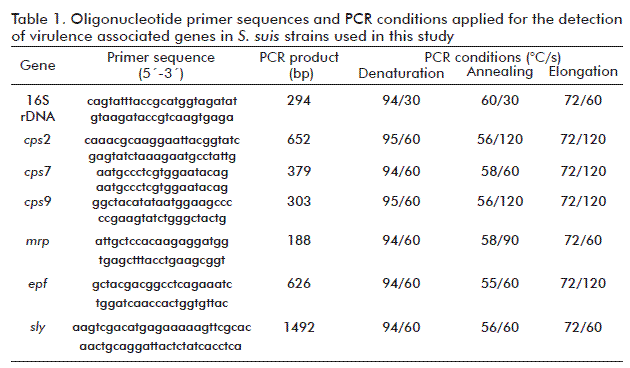
<body><![CDATA[<P   align="justify" ><font size="2" face="Verdana, Arial, Helvetica, sans-serif">A total of 31 isolates      of <I>S. suis</I> from the collection of the Bacteriology Department of the      National Center of Animal and Plant Health (Censa, Cuba) were included in      this study. Most of these isolates were collected from diseased or dead animals      during diagnostic procedures from farrow-to-finish farms in the Western region      of Cuba from 2004 to 2011. </font></P >   <FONT size="+1">        <P   align="justify" ><font size="2" face="Verdana, Arial, Helvetica, sans-serif">According to their      source of isolation and clinical symptoms, the isolates were distributed in      three groups as follows: i) Invasive group (n = 3), three isolates from abscess      of pigs 10-17 weeks of age with arthritis and one isolate from aborted foetus;      ii) pneumonia group (n = 21), isolates from the lung of animals between 10-12      weeks of age; and iii) carrier group (n = 6), comprising two isolates of tonsillar      biopsies from healthy animals, one isolate from the vaginal secretion and      three isolates of semen ejaculates from mature boars of a pig breeding farm.      </font></P >       <P   ><font size="2" face="Verdana, Arial, Helvetica, sans-serif"><B>PCR </b></font></P >       <P   align="justify" ><font size="2" face="Verdana, Arial, Helvetica, sans-serif">The isolates were      identified by conventional biochemical procedures following the methods reported      by Berthelot-Herault <I>et al.</I> [19]. The isolates were cultured in Todd      Hewitt medium (5 mL) at 37 &deg;C for 24 h and the DNA was extracted as described      previously [20]. The <I>S. suis</I>-like strains were identified by amplification      of a 294-bp-long 16S rDNA gene fragment by PCR using <I>S. suis</I> species-specific      primers [13]. The capsular genotype (<I>cps</I>2) was determined by PCR as      previously described by Smith <I>et al</I>. [12]. Capsular genotypes <I>cps</I>7      and <I>cps</I>9, and the <I>mrp </I>(188 bp) gene were analyzed by monoplex<Sup>      </Sup>PCR assays using the sequence of primers and conditions described previously      by Silva <I>et al</I>. [14]. Other two conventional PCR assays were used to      screen the presence of <I>sly</I> (1492 bp) [21] and <I>epf</I> (626 bp) genes      [17]. Details of all oligonucleotide primers used and PCR conditions applied      for the detection are listed in <a href="/img/revistas/bta/v30n1/t0105113.gif">table      1</a>. Each isolate was tested under the same conditions twice. </font></P >   <FONT size="+1"><FONT size="+1"><FONT size="+1"><FONT size="+1">        
<P   align="justify" ><font size="2" face="Verdana, Arial, Helvetica, sans-serif">The reaction was      carried out in a 25-&micro;L PCR mixture containing 20 pmol of each primer,      200 &mu;M of dNTPs, 1&times; PCR buffer, 3 mM MgCl<Sub>2</Sub> and 1 U Taq      DNA polymerase (Invitrogen). The amplified DNA was visualized in 2 % agarose      gels in TBE buffer (90<Sup> </Sup>mM Tris, 90 mM borate, 2.5 mM EDTA; pH 8)      for 1 h at a constant<Sup> </Sup>voltage of 125 V. Amplified products were      stained with ethidium<Sup> </Sup>bromide (0.5 &mu;g/&mu;L) and detected by      UV transillumination. The 50 bp ladder (Promega) was used as standard. </font></P >   <FONT size="+1"><FONT size="+1"><FONT size="+1"><FONT size="+1"><FONT size="+1"><FONT size="+1"><FONT size="+1"><FONT size="+1">        <P   ><font size="2" face="Verdana, Arial, Helvetica, sans-serif"><B>DNA sequencing      </b></font></P >       <P   align="justify" ><font size="2" face="Verdana, Arial, Helvetica, sans-serif">Partial sequences      corresponding to <I>cps</I>2 and 16S rDNA genes were amplified by using chromosomal      DNA obtained from sample 13 (designated as isolate SS13) collected in October      2010 from the lung of a pig with pneumonia. The sequences of both genes were      determined by an automated sequence analyzer (CEQ<Sup>TM</Sup>8800, Beckman      Coulter, USA) using the same primers as for PCR amplification and Genome Lab<Sup>TM</Sup>      DTCS- Quick start kit. Prior to the sequencing reaction, PCR products were      purified with the Wizard PCR purification kit (Promega) according to the manufacturer&rsquo;s      instructions. </font></P >   <FONT size="+1"><FONT size="+1"><FONT size="+1"><FONT size="+1">        <P   ><font size="2" face="Verdana, Arial, Helvetica, sans-serif"><B>Sequence analysis      </b></font></P >       <P   align="justify" ><font size="2" face="Verdana, Arial, Helvetica, sans-serif">Sequences of both      fragments corresponding to <I>cps</I>2 and 16S rDNA genes were aligned and      assembled using the Vector NTI&reg; software (Invitrogen, USA) to obtain two      sequences of 260 and 637 bp, which were deposited in GenBank under accession      numbers JF266696 and JF266697, respectively. They were aligned and studied      using the MEGA5 software [22] for phylogenetic inference by using the Neighbor-Joining      method [23]. The evolutionary distances were computed using the Kimura 2-parameter      method [24]. The analysis involved 22 nucleotide sequences. To obtain a confidence      value for the aligned sequence dataset, a bootstrap analysis [25] of 500 replications      was done. </font></P >       <P   > </P >   <FONT size="+1"><B>        ]]></body>
<body><![CDATA[<P   >&nbsp;</P >       <P   ><font size="3" face="Verdana, Arial, Helvetica, sans-serif">RESULTS AND DISCUSSION      </font></P >   </B>        <P   align="justify" ><font size="2" face="Verdana, Arial, Helvetica, sans-serif">All isolates included      in this study showed a 294 bp fragment corresponding to 16S rDNA under the      conditions described by Marois <I>et al.</I> [13]<I>.</I><B><I> </I></B>The      four isolates originating from animals with invasive procedures and the 21      isolates from pig lungs with pneumonia were isolated in pure culture. <i>S.      suis</i> is an invasive pathogen and a very successful colonizer of mucosal      surfaces, in particular of the upper respiratory tract. Reports about the      isolation of this bacterium from pigs suffering arthritis and pneumonia<Sup>      </Sup>are frequent [4]; thus, a potential causative role of thisorganism in      respiratory diseases is also suggested [26]. For instance, most clinical <I>S.      suis</I> isolates in Canada were from piglet lungs [27]. </font></P >   <FONT size="+1"><FONT size="+1"><FONT size="+1"><FONT size="+1"><FONT size="+1">        <P   align="justify" ><font size="2" face="Verdana, Arial, Helvetica, sans-serif">In addition,<I> S.      suis</I> was identified in samples of tonsil, semen and vaginal discharge      in healthy animals (<a href="/img/revistas/bta/v30n1/t0205113.gif">Table      2</a>). Dee and Corey [28] reported that <I>S. suis</I> strains can maintain      their viability in different porcine fluids, such as urine or semen, up to      10 days. When <I>S. suis</I> is isolated from the tonsils and the genital      and alimentary tracts of carrier pigs, those animals are discarded for being      a source of <I>S. suis</I> transmission in herds [29, 30]. </font></P >       
<P   align="justify" ><font size="2" face="Verdana, Arial, Helvetica, sans-serif">The 31 isolates of      <I>S. suis</I> tested in this study demonstrated a high genetic diversity,      being grouped into nine different genotypes with the aid of the previously      described PCR assay (<a href="/img/revistas/bta/v30n1/t0205113.gif">Table      2</a>). Only genotypes <I>cps</I>2 (68 %) and <I>cps</I>9 (13 %) were detected,      and six isolates from tonsils and semen of asymptomatic animals were non-typable      for the three capsular genotypes investigated. The <I>cps</I>9<I> </I>genotype      was identified exclusively in isolates from lungs, while genotype<I> cps</I>2<I>      </I>was found in different isolates regardless of their origin (<I>i.e.</I>,      lungs, abscess in joints, aborted foetus, vaginal discharges or semen). </font></P >       
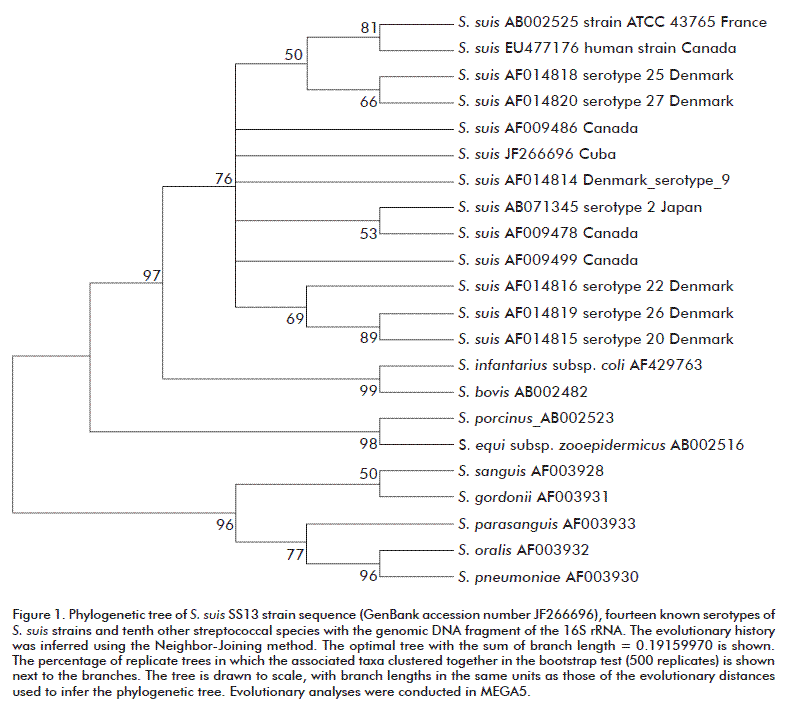
<P   align="justify" ><font size="2" face="Verdana, Arial, Helvetica, sans-serif">Epidemiological data      have revealed a high diversity of serotypes among <I>S. suis </I>isolates,      with serotype <I>cps</I>2 as the most associated with invasive diseases in      humans [4, 14, 16, 31]; and serotypes 2, 9 and 14 are considered to be more      invasive than others in pigs [14]. For <I>S. suis</I> serotype 2, it has been      demonstrated that the capsule is an important virulence factor; however, unencapsulated      <I>S. suis</I> strains might also invade host tissues, though to a lower degree      [12]. The relevance of particular serotypes can vary geographically, even      temporally. In China, <I>cps</I>2 accounts for more than 70 % of the systemic      <I>S. suis</I> diseases in piglets [32], while in the Netherlands and Germany,      <I>cps</I>9 emerged as the most common serotype responsible for a major fraction      of invasive <I>S. suis</I> diseases of piglets [19]. On the other hand, <I>cps</I>7      strains have frequently been associated with bronchopneumonia in Scandinavia      and Germany [11]. </font></P >       <P   align="justify" ><font size="2" face="Verdana, Arial, Helvetica, sans-serif">The identification      of the <I>S. suis</I> SS13 <I>cps</I>2<Sup> </Sup>isolate was confirmed by      sequencing a fragment of the 16S rDNA gene and a fragment of <I>cps</I>2 gene.      BLAST analysis of the sequences revealed a 99 % identity to <I>S. suis</I>      type strain, which is consistent with the values expected for strains of a      single species (99 % for 16S rDNA). The similarity level for the query sequence      never exceeded 97 % with other <I>Streptococcus</I> species; these values      consistent with distinct species in the same genus [25]. The phylogenetic      relationship among the strains was shown with a tree (<a href="/img/revistas/bta/v30n1/f0105113.gif">Figure      1</a>), indicating a tight clustering of the SS13 isolate (JF266696) with      known serotypes of <I>S. suis</I>. Other non-<I>S. suis</I> streptococcal      strains were observed clearly separated from the <I>S. suis</I> cluster. </font></P >   <FONT size="+1"><FONT size="+1">        
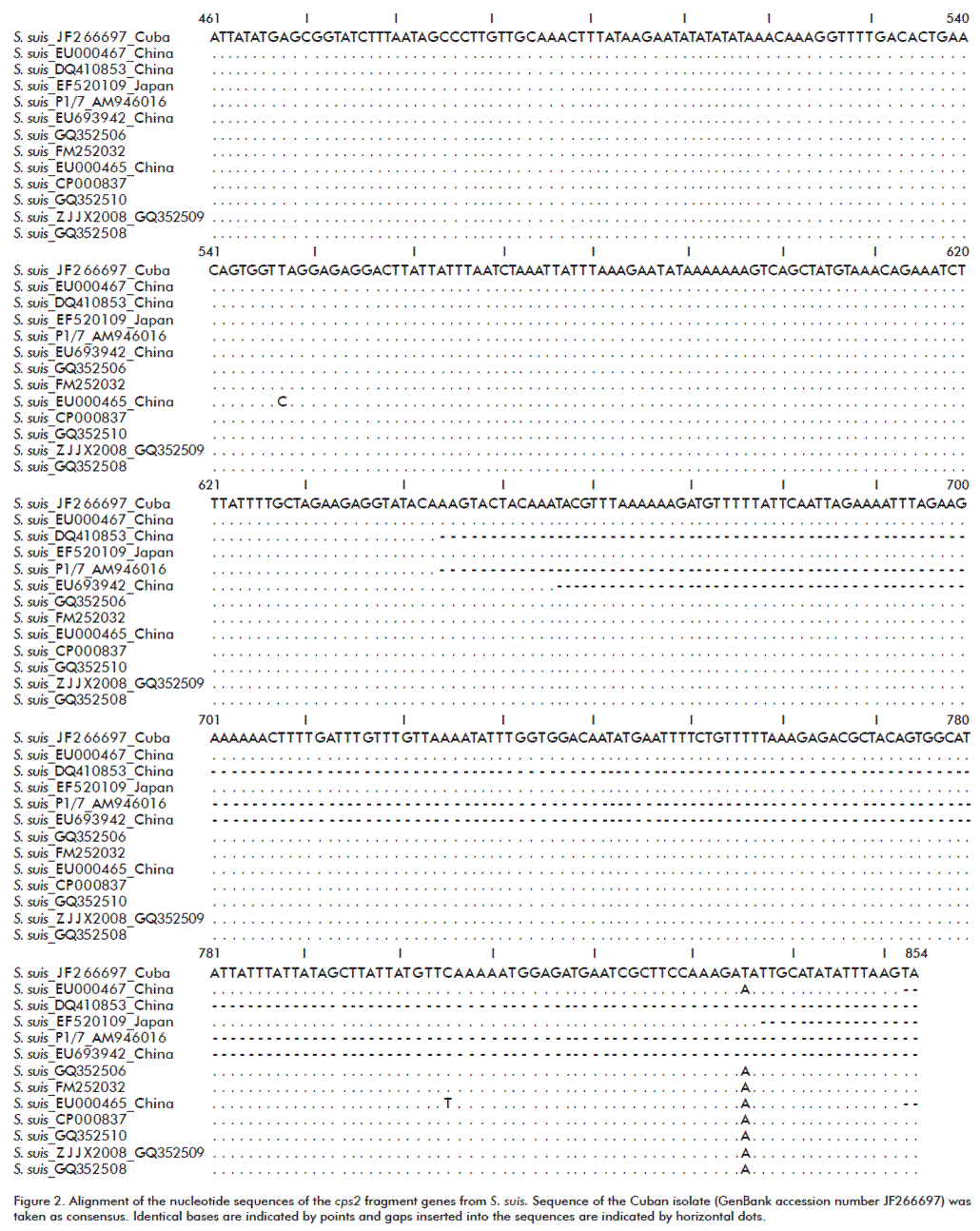
<P   align="justify" ><font size="2" face="Verdana, Arial, Helvetica, sans-serif">Multiple alignment      of the nucleotide sequences of the <I>cps</I>2<I> </I>fragment (JF266697)      revealed that the sequence corresponded to strains of <I>S. suis</I> (<a href="/img/revistas/bta/v30n1/f0205113.gif">Figure      2</a>), only differing in one nucleotide change at position 836 (A&rarr;T),      this mutation resulting in a possible amino acid variation from Lys<Sub>279279</Sub>      by Ile at the C-terminus. </font></P >   <FONT size="+1"><FONT size="+1"><FONT size="+1">        
<P   align="justify" ><font size="2" face="Verdana, Arial, Helvetica, sans-serif">The 1492 bp PCR product      corresponding to the suilysin gene was identified in three <I>cps</I>2 isolates      from animals with pneumonia and only in one non-typable isolate from tonsils      of an asymptomatic animal (<a href="/img/revistas/bta/v30n1/t0205113.gif">Table      2</a>). Suilysin is a pore-forming cholesterol-dependent cytotoxin. Though      suilysin is not essential for virulence of <I>S. suis</I> <I>cps2</I> isolates      in pigs, <I>in vitro</I> experiments suggest that it may have important functions      for the interactions with host cells [5]. Tarradas <I>et al.</I> [33] detected      suilysin production by isolated from diseased and healthy carrier pigs in      Spain. </font></P >   <FONT size="+1">        
<P   align="justify" ><font size="2" face="Verdana, Arial, Helvetica, sans-serif">The 626 bp fragment      of the gene encoding EF was detected only in two <I>cps</I>2 isolates. The      EF was identified as an extracellular protein associated with virulence in      serotypes 1, 2, 1/2, 14 and 15 [17]. The function of EF is still unknown,      since isogenic <I>epf</I> mutants were as virulent as the wild-type in experimental      infections, indicating that EF is associated but not essential for virulence      [34]. </font></P >       ]]></body>
<body><![CDATA[<P   align="justify" ><font size="2" face="Verdana, Arial, Helvetica, sans-serif">The gene fragment      encoding the MRP protein was amplified in <I>cps</I>2 isolates from cases      of pneumonia and asymptomatic animals; this fragment was de-tected in the      four <I>cps</I>9 isolates The function of the 136 kDa MRP protein is unknown.      It was discovered as a factor released from virulent <I>cps2</I> strains after      muramidase treatment but expression of the MRP was found among strains of      serotypes 1, 2, 1/2, 14 and 15 [17]. Different studies have shown that the      presence of the gene did not always correlate with actual expression of the      respective protein. Fittipaldi <I>et al</I>. [35] detected the <I>mrp</I>      gene in 92 isolates of <I>S. suis</I> but the expression of MRP by Western      blotting was only positive in 46 isolates, due, in most cases, to frameshift      mutations in the 5&acute; end of the gene, re-sulting in premature stop codons.      The effective production of the virulence markers by the tested isolates specifically      in the genotype <I>cps</I>2 <I>mrpepfsly</I>would be also verified. </font></P >   <FONT size="+1"><FONT size="+1"><FONT size="+1"><FONT size="+1">        <P   align="justify" ><font size="2" face="Verdana, Arial, Helvetica, sans-serif">As <I>mrp</I> seems      to be a silent gene in some strains, it might also be discussed that phenotyping      rather than genotyping should be performed in diagnostic laboratories [4].      Although not ideal, typing methods based on protein expression of these markers      confirm the phenotype because the PCR assays only detect a partial sequence      of a gene. However, protein expression levels may be affected by many factors,      as growth conditions, or even induced at specific stages of the infection      process as it is known for many important, highly regulated virulence factors      [36, 37]. The most promising candidate for improvement of <I>S. suis </I>diagnostics      is the use of probes as the <I>ivs-25/iri-1</I>, which encodes a putative      general virulence regulator. It discriminates between virulent and avirulent      strains [37]. </font></P >       <P   align="justify" ><font size="2" face="Verdana, Arial, Helvetica, sans-serif">The analysis of the      three virulence genetic markers showed the <I>cps</I>2<Sup>+ </Sup><I>mrp</I><Sup><I>-</I></Sup><I>      epf</I><Sup><I>-</I></Sup><I> sly</I><Sup><I>-</I></Sup><I> </I>as the most      frequent genotype, in three isolates from abscesses of pigs with arthritis,      one isolate from an aborted foetus and eight isolates from lungs. Only an      isolate from lung showed the genotype<I> cps</I>2<Sup><Sup>+<I> </I></Sup></Sup><I>mrp</I><Sup>+      </Sup><I>epf </I><Sup>+ </Sup><I>sly</I><Sup><I>+</I></Sup>. Despite the lack      of evidence for a critical role of one or more of these putative virulence      factors, they may nonetheless serve as virulence markers, since MRP, EF, and      SLY are typical of Eurasian strains while they are almost absent among less      virulent North American strains<Sup>. </Sup>[1, 26, 35]. Strains with the      <I>mrp</I><Sup>+ </Sup><I>epf</I><Sup>+</Sup> <I>sly</I><Sup>+ </Sup>genotype      are known to be highly virulent, from European epidemiological studies [17]      and pig experimental infections [4]. However, the percentage of <I>S. suis      cps2</I> strains recovered from diseased pigs and the number of cases of human      disease is lower in North America than in other parts of the world [36]. Therefore,      it is very probable that the virulence of the Cuban <I>S. suis</I> <I>cps</I>2      isolates associated with invasive processes is similar to that reported for      North American strains. Further studies with a larger number of Cuban isolates      are required to definitively confirm this hypothesis. </font></P >   <FONT size="+1"><FONT size="+1"><FONT size="+1"><FONT size="+1"><FONT size="+1"><FONT size="+1"><FONT size="+1"><FONT size="+1"><FONT size="+1"><FONT size="+1"><FONT size="+1"><FONT size="+1"><FONT size="+1"><FONT size="+1"><FONT size="+1"><FONT size="+1"><FONT size="+1"><FONT size="+1"><FONT size="+1"><FONT size="+1"><FONT size="+1"><FONT size="+1"><FONT size="+1"><FONT size="+1">        <P   align="justify" ><font size="2" face="Verdana, Arial, Helvetica, sans-serif">Serotype determination      remains a valuable tool used by veterinary practitioners and diagnosticians      to understand the epidemiology of a particular outbreak and/or to increase      the possibility for success of a vaccination program for a given herd [35].      The PCR assays used in this study can differentiate the three <I>cps</I> genotypes      (2, 7 and 9) and additionally detect the important virulence associated factors      genes <I>mrp</I>, <I>epf</I> and <I>sly</I> (<a href="/img/revistas/bta/v30n1/t0205113.gif">Table      2</a>). Taking into account methods for serotyping, the PCR assays are rapid,      reliable, and sensitive. Moreover, these PCR assays could be used directly      with tonsillar specimens from infected or carrier animals so that isolation      of single colonies could be omitted. Therefore, these tests will undoubtedly      contribute to a more rapid and reliable diagnosis of <I>S. suis</I> and may      facilitate control and eradication programs [12]. </font></P >       
<P   align="justify" >&nbsp;</P >       <P   ></P >       <P   > </P >   <FONT size="+1"><B>        <P   ><font size="3" face="Verdana, Arial, Helvetica, sans-serif">CONCLUSIONS </font></P >   </B>        <P   align="justify" ><font size="2" face="Verdana, Arial, Helvetica, sans-serif">So far, this is the      first study on the molecular identification of <I>S. suis</I> isolates in      Cuba from disease cases in pigs. <I>S. suis</I> isolates belonging to the      capsular serotypes <I>cps</I>2 and <I>cps</I>9 were detected by genotyping      of the <I>cps2</I> and <I>cps9</I> genes, respectively. This is also the first      report indicating the occurrence of at least two capsular types and nine different      genotypes among the<I> S. suis </I>isolates<I> </I>tested. A larger scale      sampling among pig farms from different Cuban regions could enable us to design      a strategy to minimize the risk of exposure to <I>S. suis. </I></font></P >   <FONT size="+1">        <P   > </P >   <FONT size="+1"><B>        ]]></body>
<body><![CDATA[<P   >&nbsp;</P >       <P   ><font size="3" face="Verdana, Arial, Helvetica, sans-serif">ACKNOWLEDGMENTS </font></P >   </B>        <P   align="justify" ><font size="2" face="Verdana, Arial, Helvetica, sans-serif">We thank Dr. Marcelo      Gottschalk from Faculty of Veterinary Medicine, University of Montreal, Canada      and Dr. Eduardo Sistach from National Center of Animal and Plant Health (Censa,      Cuba) for their critical review of the manuscript. </font></P >       <P   align="justify" >&nbsp;</P >   <FONT size="+1">        <P   align="justify" > </P >       <P   align="justify" ><font size="3" face="Verdana, Arial, Helvetica, sans-serif"><B>REFERENCES </b></font></P >       <!-- ref --><P   align="justify" ><font size="2" face="Verdana, Arial, Helvetica, sans-serif">1. Berthelot-Herault      F, Gottschalk M, Morvan H, Kobisch M. Dilemma of virulence of Streptococcus      suis: Canadian isolate 89-1591 characterized as a virulent strain using a      standardized experimental model in pigs. Can J Vet Res. 2005;69(3):236-40.          </font></P >   <FONT size="+1">        <!-- ref --><P   align="justify" ><font size="2" face="Verdana, Arial, Helvetica, sans-serif">2. Kim D, Han K,      Oh Y, Kim CH, Kang I, Lee J, et al. Distribution of capsular serotypes and      virulence markers of Streptococcus suis isolated from pigs with polyserositis      in Korea. Can J Vet Res. 2010;74(4):314-6.     </font></P >       ]]></body>
<body><![CDATA[<!-- ref --><P   align="justify" ><font size="2" face="Verdana, Arial, Helvetica, sans-serif">3. Baums CG, Verkuhlen      GJ, Rehm T, Silva LM, Beyerbach M, Pohlmeyer K, et al. Prevalence of Streptococcus      suis genotypes in wild boars of Northwestern Germany. Appl Environ Microbiol.      2007;73(3):711-7.     </font></P >       <!-- ref --><P   align="justify" ><font size="2" face="Verdana, Arial, Helvetica, sans-serif">4. Baums CG, Valentin-Weigand      P. Surface-associated and secreted factors of Streptococcus suis in epidemiology,      pathogenesis and vaccine development. Anim Health Res Rev. 2009;10(1):65-83.          </font></P >       <!-- ref --><P   align="justify" ><font size="2" face="Verdana, Arial, Helvetica, sans-serif">5. King SJ, Heath      PJ, Luque I, Tarradas C, Dowson CG, Whatmore AM. Distribution and genetic      diversity of suilysin in Streptococcus suis isolated from different diseases      of pigs and characterization of the genetic basis of suilysin absence. Infect      Immun. 2001;69(12):7572-82.     </font></P >       <!-- ref --><P   align="justify" ><font size="2" face="Verdana, Arial, Helvetica, sans-serif">6. Gottschalk M,      Segura M. The pathogenesis of the meningitis caused by Streptococcus suis:      the unresolved questions. Vet Microbiol. 2000;76(3):259-72.     </font></P >       <!-- ref --><P   align="justify" ><font size="2" face="Verdana, Arial, Helvetica, sans-serif">7. Tang J, Wang C,      Feng Y, Yang W, Song H, Chen Z, et al. Streptococcal toxic shock syndrome      caused by Streptococcus suis serotype 2. PLoS Med. 2006;3(5):e151.     </font></P >       ]]></body>
<body><![CDATA[<!-- ref --><P   align="justify" ><font size="2" face="Verdana, Arial, Helvetica, sans-serif">8. Wertheim HF, Nghia      HD, Taylor W, Schultsz C. Streptococcus suis: an emerging human pathogen.      Clin Infect Dis. 2009;48(5):617-25.     </font></P >       <!-- ref --><P   align="justify" ><font size="2" face="Verdana, Arial, Helvetica, sans-serif">9. Heath PJ, Hunt      BW. Streptococcus suis serotypes 3 to 28 associated with disease in pigs.      Vet Rec. 2001;148(7):207-8.     </font></P >       <!-- ref --><P   align="justify" ><font size="2" face="Verdana, Arial, Helvetica, sans-serif">10. Hill JE, Gottschalk      M, Brousseau R, Harel J, Hemmingsen SM, Goh SH. Biochemical analysis, cpn60      and 16S rDNA sequence data indicate that Streptococcus suis serotypes 32 and      34, isolated from pigs, are Streptococcus orisratti. Vet Microbiol. 2005;107(1-2):63-9.          </font></P >       <!-- ref --><P   align="justify" ><font size="2" face="Verdana, Arial, Helvetica, sans-serif">11. Smith HE, van      Bruijnsvoort L, Buijs H, Wisselink HJ, Smits MA. Rapid PCR test for Streptococcus      suis serotype 7. FEMS Microbiol Lett. 1999;178(2):265-70.     </font></P >       <!-- ref --><P   align="justify" ><font size="2" face="Verdana, Arial, Helvetica, sans-serif">12. Smith HE, Veenbergen      V, van der Velde J, Damman M, Wisselink HJ, Smits MA. The cps genes of Streptococcus      suis serotypes 1, 2, and 9: development of rapid serotype-specific PCR assays.      J Clin Microbiol. 1999;37(10):3146-52.     </font></P >       ]]></body>
<body><![CDATA[<!-- ref --><P   align="justify" ><font size="2" face="Verdana, Arial, Helvetica, sans-serif">13. Marois C, Le      Devendec L, Gottschalk M, Kobisch M. Detection and molecular typing of Streptococcus      suis in tonsils from live pigs in France. Can J Vet Res. 2007;71(1):14-22.          </font></P >       <!-- ref --><P   align="justify" ><font size="2" face="Verdana, Arial, Helvetica, sans-serif">14. Silva LM, Baums      CG, Rehm T, Wisselink HJ, Goethe R, Valentin-Weigand P. Virulence-associated      gene profiling of Streptococcus suis isolates by PCR. Vet Microbiol. 2006;115(1-3):117-27.          </font></P >       <!-- ref --><P   align="justify" ><font size="2" face="Verdana, Arial, Helvetica, sans-serif">15. Beineke A, Bennecke      K, Neis C, Schroder C, Waldmann KH, Baumgartner W, et al. Comparative evaluation      of virulence and pathology of Streptococcus suis serotypes 2 and 9 in experimentally      infected growers. Vet Microbiol. 2008;128(3-4):423-30.     </font></P >       <P   align="justify" ><font size="2" face="Verdana, Arial, Helvetica, sans-serif">16. Del&rsquo;Arco      AE, Santos JL, Bevilacquia PD, Faria JE, Guimaraes WV. Swine infection by      Streptococcus suis: a retrospective study. Arq Bras Med Vet Zootec. 2008;60(4):878-83.      </font></P >       <!-- ref --><P   align="justify" ><font size="2" face="Verdana, Arial, Helvetica, sans-serif">17. Wisselink HJ,      Smith HE, Stockhofe-Zurwieden N, Peperkamp K, Vecht U. Distribution of capsular      types and production of muramidase-released protein (MRP) and extracellular      factor (EF) of Streptococcus suis strains isolated from diseased pigs in seven      European countries. Vet Microbiol. 2000;74(3):237-48.     </font></P >       <!-- ref --><P   align="justify" ><font size="2" face="Verdana, Arial, Helvetica, sans-serif">18. Mu&ntilde;iz      M, Valdivia MP, Heredia J, L&oacute;pez O, Arias T, Mederos CM, et al. Gesti&oacute;n      tecnol&oacute;gica en la producci&oacute;n porcina cubana. In: VI Encuentro      regional sobre nutrici&oacute;n y producci&oacute;n de especies monog&aacute;stricas.      La Habana: Asociaci&oacute;n Cubana de produc-ci&oacute;n animal; 2001. Available      from: <A href="http://www.sian.info.ve/porcinos/publicaciones/viencuent/marisol.htm" target="_blank">      <FONT color="#0000FF">http://www.sian.info.ve/porcinos/publicaciones/viencuent/marisol.htm</font></A><FONT color="#0000FF"><FONT color="#000000">.          </font></font></font></P >   <FONT color="#0000FF"><FONT color="#000000">        <!-- ref --><P   align="justify" ><font size="2" face="Verdana, Arial, Helvetica, sans-serif">19. Berthelot-Herault      F, Morvan H, Keribin AM, Gottschalk M, Kobisch M. Production of muraminidase-released      protein (MRP), extracellular factor (EF) and suilysin by field isolates of      Streptococcus suis capsular types 2, 1/2, 9, 7 and 3 isolated from swine in      France. Vet Res. 2000;31(5):473-9.     </font></P >       <!-- ref --><P   align="justify" ><font size="2" face="Verdana, Arial, Helvetica, sans-serif">20. Luther DA, Almeida      RA, Oliver SP. Elucidation of the DNA sequence of Streptococcus uberis adhesion      molecule gene (sua) and detection of sua in strains of Streptococcus uberis      isolated from geographically diverse locations. Vet Microbiol. 2008;128(3-4):304-12.          </font></P >       <!-- ref --><P   align="justify" ><font size="2" face="Verdana, Arial, Helvetica, sans-serif">21. Staats JJ, Plattner      BL, Stewart GC, Changappa MM. Presence of the Streptococcus suis suilysin      gene and expression of MRP and EF correlates with high virulence in Streptococcus      suis type 2 isolates. Vet Microbiol. 1999;70(3-4):201-11.     </font></P >       <!-- ref --><P   align="justify" ><font size="2" face="Verdana, Arial, Helvetica, sans-serif">22. Tamura K, Peterson      D, Peterson N, Stecher G, Nei M, Kumar S. MEGA5: molecular evolutionary genetics      analysis using maximum likelihood, evolutionary distance, and maximum parsimony      methods. Mol Biol Evol. 2011;28(10):2731-9.     </font></P >       <!-- ref --><P   align="justify" ><font size="2" face="Verdana, Arial, Helvetica, sans-serif">23. Saitou N, Nei      M. The neighbor-joining method: a new method for reconstructing phylogenetic      trees. Mol Biol Evol. 1987;4(4):406-25.     </font></P >       <!-- ref --><P   align="justify" ><font size="2" face="Verdana, Arial, Helvetica, sans-serif">24. Kimura M. A simple      method for estimating evolutionary rates of base substitutions through comparative      studies of nucleotide sequences. J Mol Evol. 1980; 16(2):111-20.     </font></P >       <!-- ref --><P   align="justify" ><font size="2" face="Verdana, Arial, Helvetica, sans-serif">25. Felsenstein J.      Confidence limits on phylogenies: An approach using the bootstrap. Evolution.      1985; 39:783-91.     </font></P >       <P   align="justify" ><font size="2" face="Verdana, Arial, Helvetica, sans-serif">26. MacInnes JI,      Desrosiers R. Agents of the &ldquo;suis-ide diseases&rdquo; of swine: Actinobacillus      suis, Haemophilus parasuis, and Streptococcus suis. Can J Vet Res. 1999; 63(2):83-9.      </font></P >       <!-- ref --><P   align="justify" ><font size="2" face="Verdana, Arial, Helvetica, sans-serif">27. Messier S, Lacouture      S, Gottschalk M. Distribution of Streptococcus suis capsular types from 2001      to 2007. Can Vet J. 2008; 49(5):461-2.     </font></P >       <!-- ref --><P   align="justify" ><font size="2" face="Verdana, Arial, Helvetica, sans-serif">28. Dee SA, Corey      MM. The survival of Streptococcus suis on farm and veterinary equipment. Swine      Health Prod. 1993: 1(1):17-20.     </font></P >       ]]></body>
<body><![CDATA[<!-- ref --><P   align="justify" ><font size="2" face="Verdana, Arial, Helvetica, sans-serif">29. Luque I, Blume      V, Borge C, Vela AI, Perea JA, Marquez JM, et al. Genetic analysis of Streptococcus      suis isolates recovered from diseased and healthy carrier pigs at different      stages of production on a pig farm. Vet J. 2010;186(3):396-8.     </font></P >       <!-- ref --><P   align="justify" ><font size="2" face="Verdana, Arial, Helvetica, sans-serif">30. Su Y, Yao W,      Perez-Gutierrez ON, Smidt H, Zhu WY. Changes in abundance of Lactobacillus      spp. and Streptococcus suis in the stomach, jejunum and ileum of piglets after      weaning. FEMS Microbiol Ecol. 2008;66(3):546-55.     </font></P >       <P   align="justify" ><font size="2" face="Verdana, Arial, Helvetica, sans-serif">31. Princivalli MS,      Palmieri C, Magi G, Vignaroli C, Manzin A, Camporese A, et al. Genetic diversity      of Streptococcus suis clinical isolates from pigs and humans in Italy (2003-2007).      Euro Surveill. 2009;14(33): pii: 19310. Available from: <A href="http://www.eurosurveillance.org/ViewArticle.aspx?ArticleId=19310" target="_blank">      <FONT color="#0000FF">http://www.eurosurveillance.org/ViewArticle.aspx?ArticleId=19310</font></A><FONT color="#0000FF"><FONT color="#000000">.      </font></font></font></P >   <FONT color="#0000FF"><FONT color="#000000">        <!-- ref --><P   align="justify" ><font size="2" face="Verdana, Arial, Helvetica, sans-serif">32. Wei Z, Li R,      Zhang A, He H, Hua Y, Xia J, et al. Characterization of Streptococcus suis      isolates from the diseased pigs in China between 2003 and 2007. Vet Microbiol.      2009;137(1-2):196-201.     </font></P >       <!-- ref --><P   align="justify" ><font size="2" face="Verdana, Arial, Helvetica, sans-serif">33. Tarradas C, Borge      C, Arenas A, Maldonado A, Astorga R, Miranda A, et al. Suilysin production      by Streptococcus suis strains isolated from diseased and healthy carrier pigs      in Spain. Vet Rec. 2001; 148(6):183-4.     </font></P >       <!-- ref --><P   align="justify" ><font size="2" face="Verdana, Arial, Helvetica, sans-serif">34. Smith HE, Vecht      U, Wisselink HJ, Stockhofe-Zurwieden N, Biermann Y, Smits MA. Mutants of Streptococcus      suis types 1 and 2 impaired in expression of muramidase-released protein and      extracellular protein induce disease in newborn germfree pigs. Infect Immun.      1996;64(10):4409-12.     </font></P >       <!-- ref --><P   align="justify" ><font size="2" face="Verdana, Arial, Helvetica, sans-serif">35. Fittipaldi N,      Fuller TE, Teel JF, Wilson TL, Wolfram TJ, Lowery DE, et al. Serotype distribution      and production of muramidase-released protein, extracellular factor and suilysin      by field strains of Streptococcus suis isolated in the United States. Vet      Microbiol. 2009;139(3-4):310-7.     </font></P >       <!-- ref --><P   align="justify" ><font size="2" face="Verdana, Arial, Helvetica, sans-serif">36. Fittipaldi N,      Xu J, Lacouture S, Tharavichitkul P, Osaki M, Sekizaki T, et al. Lineage and      virulence of Streptococcus suis serotype 2 isolates from North America. Emerg      Infect Dis. 2011;17(12):2239-44.     </font></P >       <!-- ref --><P   align="justify" ><font size="2" face="Verdana, Arial, Helvetica, sans-serif">37. De Greeff A,      Buys H, Verhaar R, Van Alphen L, Smith HE. Distribution of environmentally      regulated genes of Streptococcus suis serotype 2 among S. suis serotypes and      other organisms. J Clin Microbiol. 2002;40(9):3261-8.     </font></P >       <P   align="justify" >&nbsp;</P >       <P   align="justify" >&nbsp;</P >       <P   align="justify" > </P >       ]]></body>
<body><![CDATA[<P   align="justify" > </P >       <P   ><font size="2" face="Verdana, Arial, Helvetica, sans-serif">Received in March,      2012.     <br>     Accepted in June, 2012. </font></P >       <P   >&nbsp;</P >       <P   >&nbsp;</P >       <P   > </P >       <P   > </P >       <P   ><font size="2" face="Verdana, Arial, Helvetica, sans-serif"><I>Ivette Espinosa</I>.      Divisi&oacute;n de Biolog&iacute;a Molecular, Centro Nacional de Sanidad Agropecuaria,      Censa. AP 10, San Jos&eacute; de las Lajas, Mayabeque, Cuba. E-mail: <A href="mailto:espinosa@censa.edu.cu">      <FONT color="#0000FF">espinosa@censa.edu.cu</font></A><FONT color="#0000FF"><FONT color="#000000">.      </font></font></font></P >   </font></font></font></font></font></font></font></font></font></font></font></font></font></font></font></font></font></font></font></font></font></font></font></font></font></font></font></font></font></font></font></font></font></font></font></font></font></font></font></font></font></font></font></font></font></font></font></font></font></font></font></font></font></font></font></font></font></font></font></font></font></font></font></font></font></font></font></font></font></font></font></font></font></font></font></DIV >      ]]></body><back>
<ref-list>
<ref id="B1">
<label>1</label><nlm-citation citation-type="journal">
<person-group person-group-type="author">
<name>
<surname><![CDATA[Berthelot-Herault]]></surname>
<given-names><![CDATA[F]]></given-names>
</name>
<name>
<surname><![CDATA[Gottschalk]]></surname>
<given-names><![CDATA[M]]></given-names>
</name>
<name>
<surname><![CDATA[Morvan]]></surname>
<given-names><![CDATA[H]]></given-names>
</name>
<name>
<surname><![CDATA[Kobisch]]></surname>
<given-names><![CDATA[M]]></given-names>
</name>
</person-group>
<article-title xml:lang="en"><![CDATA[Dilemma of virulence of Streptococcus suis: Canadian isolate 89-1591 characterized as a virulent strain using a standardized experimental model in pigs]]></article-title>
<source><![CDATA[Can J Vet Res]]></source>
<year>2005</year>
<volume>69</volume>
<numero>3</numero>
<issue>3</issue>
<page-range>236-40</page-range></nlm-citation>
</ref>
<ref id="B2">
<label>2</label><nlm-citation citation-type="journal">
<person-group person-group-type="author">
<name>
<surname><![CDATA[Kim]]></surname>
<given-names><![CDATA[D]]></given-names>
</name>
<name>
<surname><![CDATA[Han]]></surname>
<given-names><![CDATA[K]]></given-names>
</name>
<name>
<surname><![CDATA[Oh]]></surname>
<given-names><![CDATA[Y]]></given-names>
</name>
<name>
<surname><![CDATA[Kim]]></surname>
<given-names><![CDATA[CH]]></given-names>
</name>
<name>
<surname><![CDATA[Kang]]></surname>
<given-names><![CDATA[I]]></given-names>
</name>
<name>
<surname><![CDATA[Lee]]></surname>
<given-names><![CDATA[J]]></given-names>
</name>
</person-group>
<article-title xml:lang="en"><![CDATA[Distribution of capsular serotypes and virulence markers of Streptococcus suis isolated from pigs with polyserositis in Korea]]></article-title>
<source><![CDATA[Can J Vet Res]]></source>
<year>2010</year>
<volume>74</volume>
<numero>4</numero>
<issue>4</issue>
<page-range>314-6</page-range></nlm-citation>
</ref>
<ref id="B3">
<label>3</label><nlm-citation citation-type="journal">
<person-group person-group-type="author">
<name>
<surname><![CDATA[Baums]]></surname>
<given-names><![CDATA[CG]]></given-names>
</name>
<name>
<surname><![CDATA[Verkuhlen]]></surname>
<given-names><![CDATA[GJ]]></given-names>
</name>
<name>
<surname><![CDATA[Rehm]]></surname>
<given-names><![CDATA[T]]></given-names>
</name>
<name>
<surname><![CDATA[Silva]]></surname>
<given-names><![CDATA[LM]]></given-names>
</name>
<name>
<surname><![CDATA[Beyerbach]]></surname>
<given-names><![CDATA[M]]></given-names>
</name>
<name>
<surname><![CDATA[Pohlmeyer]]></surname>
<given-names><![CDATA[K]]></given-names>
</name>
</person-group>
<article-title xml:lang="en"><![CDATA[Prevalence of Streptococcus suis genotypes in wild boars of Northwestern Germany]]></article-title>
<source><![CDATA[Appl Environ Microbiol]]></source>
<year>2007</year>
<volume>73</volume>
<numero>3</numero>
<issue>3</issue>
<page-range>711-7</page-range></nlm-citation>
</ref>
<ref id="B4">
<label>4</label><nlm-citation citation-type="journal">
<person-group person-group-type="author">
<name>
<surname><![CDATA[Baums]]></surname>
<given-names><![CDATA[CG]]></given-names>
</name>
<name>
<surname><![CDATA[Valentin-Weigand]]></surname>
<given-names><![CDATA[P]]></given-names>
</name>
</person-group>
<article-title xml:lang="en"><![CDATA[Surface-associated and secreted factors of Streptococcus suis in epidemiology, pathogenesis and vaccine development]]></article-title>
<source><![CDATA[Anim Health Res Rev]]></source>
<year>2009</year>
<volume>10</volume>
<numero>1</numero>
<issue>1</issue>
<page-range>65-83</page-range></nlm-citation>
</ref>
<ref id="B5">
<label>5</label><nlm-citation citation-type="journal">
<person-group person-group-type="author">
<name>
<surname><![CDATA[King]]></surname>
<given-names><![CDATA[SJ]]></given-names>
</name>
<name>
<surname><![CDATA[Heath]]></surname>
<given-names><![CDATA[PJ]]></given-names>
</name>
<name>
<surname><![CDATA[Luque]]></surname>
<given-names><![CDATA[I]]></given-names>
</name>
<name>
<surname><![CDATA[Tarradas]]></surname>
<given-names><![CDATA[C]]></given-names>
</name>
<name>
<surname><![CDATA[Dowson]]></surname>
<given-names><![CDATA[CG]]></given-names>
</name>
<name>
<surname><![CDATA[Whatmore]]></surname>
<given-names><![CDATA[AM]]></given-names>
</name>
</person-group>
<article-title xml:lang="en"><![CDATA[Distribution and genetic diversity of suilysin in Streptococcus suis isolated from different diseases of pigs and characterization of the genetic basis of suilysin absence]]></article-title>
<source><![CDATA[Infect Immun]]></source>
<year>2001</year>
<volume>69</volume>
<numero>12</numero>
<issue>12</issue>
<page-range>7572-82</page-range></nlm-citation>
</ref>
<ref id="B6">
<label>6</label><nlm-citation citation-type="journal">
<person-group person-group-type="author">
<name>
<surname><![CDATA[Gottschalk]]></surname>
<given-names><![CDATA[M]]></given-names>
</name>
<name>
<surname><![CDATA[Segura]]></surname>
<given-names><![CDATA[M]]></given-names>
</name>
</person-group>
<article-title xml:lang="en"><![CDATA[The pathogenesis of the meningitis caused by Streptococcus suis: the unresolved questions]]></article-title>
<source><![CDATA[Vet Microbiol]]></source>
<year>2000</year>
<volume>76</volume>
<numero>3</numero>
<issue>3</issue>
<page-range>259-72</page-range></nlm-citation>
</ref>
<ref id="B7">
<label>7</label><nlm-citation citation-type="journal">
<person-group person-group-type="author">
<name>
<surname><![CDATA[Tang]]></surname>
<given-names><![CDATA[J]]></given-names>
</name>
<name>
<surname><![CDATA[Wang]]></surname>
<given-names><![CDATA[C]]></given-names>
</name>
<name>
<surname><![CDATA[Feng]]></surname>
<given-names><![CDATA[Y]]></given-names>
</name>
<name>
<surname><![CDATA[Yang]]></surname>
<given-names><![CDATA[W]]></given-names>
</name>
<name>
<surname><![CDATA[Song]]></surname>
<given-names><![CDATA[H]]></given-names>
</name>
<name>
<surname><![CDATA[Chen]]></surname>
<given-names><![CDATA[Z]]></given-names>
</name>
</person-group>
<article-title xml:lang="en"><![CDATA[Streptococcal toxic shock syndrome caused by Streptococcus suis serotype 2]]></article-title>
<source><![CDATA[PLoS Med]]></source>
<year>2006</year>
<volume>3</volume>
<numero>5</numero>
<issue>5</issue>
<page-range>e151</page-range></nlm-citation>
</ref>
<ref id="B8">
<label>8</label><nlm-citation citation-type="journal">
<person-group person-group-type="author">
<name>
<surname><![CDATA[Wertheim]]></surname>
<given-names><![CDATA[HF]]></given-names>
</name>
<name>
<surname><![CDATA[Nghia]]></surname>
<given-names><![CDATA[HD]]></given-names>
</name>
<name>
<surname><![CDATA[Taylor]]></surname>
<given-names><![CDATA[W]]></given-names>
</name>
<name>
<surname><![CDATA[Schultsz]]></surname>
<given-names><![CDATA[C]]></given-names>
</name>
</person-group>
<article-title xml:lang="en"><![CDATA[Streptococcus suis: an emerging human pathogen]]></article-title>
<source><![CDATA[Clin Infect Dis]]></source>
<year>2009</year>
<volume>48</volume>
<numero>5</numero>
<issue>5</issue>
<page-range>617-25</page-range></nlm-citation>
</ref>
<ref id="B9">
<label>9</label><nlm-citation citation-type="journal">
<person-group person-group-type="author">
<name>
<surname><![CDATA[Heath]]></surname>
<given-names><![CDATA[PJ]]></given-names>
</name>
<name>
<surname><![CDATA[Hunt]]></surname>
<given-names><![CDATA[BW]]></given-names>
</name>
</person-group>
<article-title xml:lang="en"><![CDATA[Streptococcus suis serotypes 3 to 28 associated with disease in pigs]]></article-title>
<source><![CDATA[Vet Rec]]></source>
<year>2001</year>
<volume>148</volume>
<numero>7</numero>
<issue>7</issue>
<page-range>207-8</page-range></nlm-citation>
</ref>
<ref id="B10">
<label>10</label><nlm-citation citation-type="journal">
<person-group person-group-type="author">
<name>
<surname><![CDATA[Hill]]></surname>
<given-names><![CDATA[JE]]></given-names>
</name>
<name>
<surname><![CDATA[Gottschalk]]></surname>
<given-names><![CDATA[M]]></given-names>
</name>
<name>
<surname><![CDATA[Brousseau]]></surname>
<given-names><![CDATA[R]]></given-names>
</name>
<name>
<surname><![CDATA[Harel]]></surname>
<given-names><![CDATA[J]]></given-names>
</name>
<name>
<surname><![CDATA[Hemmingsen]]></surname>
<given-names><![CDATA[SM]]></given-names>
</name>
<name>
<surname><![CDATA[Goh]]></surname>
<given-names><![CDATA[SH]]></given-names>
</name>
</person-group>
<article-title xml:lang="en"><![CDATA[Biochemical analysis, cpn60 and 16S rDNA sequence data indicate that Streptococcus suis serotypes 32 and 34, isolated from pigs, are Streptococcus orisratti]]></article-title>
<source><![CDATA[Vet Microbiol]]></source>
<year>2005</year>
<volume>107</volume>
<numero>1-2</numero>
<issue>1-2</issue>
<page-range>63-9</page-range></nlm-citation>
</ref>
<ref id="B11">
<label>11</label><nlm-citation citation-type="journal">
<person-group person-group-type="author">
<name>
<surname><![CDATA[Smith]]></surname>
<given-names><![CDATA[HE]]></given-names>
</name>
<name>
<surname><![CDATA[van Bruijnsvoort]]></surname>
<given-names><![CDATA[L]]></given-names>
</name>
<name>
<surname><![CDATA[Buijs]]></surname>
<given-names><![CDATA[H]]></given-names>
</name>
<name>
<surname><![CDATA[Wisselink]]></surname>
<given-names><![CDATA[HJ]]></given-names>
</name>
<name>
<surname><![CDATA[Smits]]></surname>
<given-names><![CDATA[MA]]></given-names>
</name>
</person-group>
<article-title xml:lang="en"><![CDATA[Rapid PCR test for Streptococcus suis serotype 7]]></article-title>
<source><![CDATA[FEMS Microbiol Lett]]></source>
<year>1999</year>
<volume>178</volume>
<numero>2</numero>
<issue>2</issue>
<page-range>265-70</page-range></nlm-citation>
</ref>
<ref id="B12">
<label>12</label><nlm-citation citation-type="journal">
<person-group person-group-type="author">
<name>
<surname><![CDATA[Smith]]></surname>
<given-names><![CDATA[HE]]></given-names>
</name>
<name>
<surname><![CDATA[Veenbergen]]></surname>
<given-names><![CDATA[V]]></given-names>
</name>
<name>
<surname><![CDATA[van der Velde]]></surname>
<given-names><![CDATA[J]]></given-names>
</name>
<name>
<surname><![CDATA[Damman]]></surname>
<given-names><![CDATA[M]]></given-names>
</name>
<name>
<surname><![CDATA[Wisselink]]></surname>
<given-names><![CDATA[HJ]]></given-names>
</name>
<name>
<surname><![CDATA[Smits]]></surname>
<given-names><![CDATA[MA]]></given-names>
</name>
</person-group>
<article-title xml:lang="en"><![CDATA[The cps genes of Streptococcus suis serotypes 1, 2, and 9: development of rapid serotype-specific PCR assays]]></article-title>
<source><![CDATA[J Clin Microbiol]]></source>
<year>1999</year>
<volume>37</volume>
<numero>10</numero>
<issue>10</issue>
<page-range>3146-52</page-range></nlm-citation>
</ref>
<ref id="B13">
<label>13</label><nlm-citation citation-type="journal">
<person-group person-group-type="author">
<name>
<surname><![CDATA[Marois]]></surname>
<given-names><![CDATA[C]]></given-names>
</name>
<name>
<surname><![CDATA[Le Devendec]]></surname>
<given-names><![CDATA[L]]></given-names>
</name>
<name>
<surname><![CDATA[Gottschalk]]></surname>
<given-names><![CDATA[M]]></given-names>
</name>
<name>
<surname><![CDATA[Kobisch]]></surname>
<given-names><![CDATA[M]]></given-names>
</name>
</person-group>
<article-title xml:lang="en"><![CDATA[Detection and molecular typing of Streptococcus suis in tonsils from live pigs in France]]></article-title>
<source><![CDATA[Can J Vet Res]]></source>
<year>2007</year>
<volume>71</volume>
<numero>1</numero>
<issue>1</issue>
<page-range>14-22</page-range></nlm-citation>
</ref>
<ref id="B14">
<label>14</label><nlm-citation citation-type="journal">
<person-group person-group-type="author">
<name>
<surname><![CDATA[Silva]]></surname>
<given-names><![CDATA[LM]]></given-names>
</name>
<name>
<surname><![CDATA[Baums]]></surname>
<given-names><![CDATA[CG]]></given-names>
</name>
<name>
<surname><![CDATA[Rehm]]></surname>
<given-names><![CDATA[T]]></given-names>
</name>
<name>
<surname><![CDATA[Wisselink]]></surname>
<given-names><![CDATA[HJ]]></given-names>
</name>
<name>
<surname><![CDATA[Goethe]]></surname>
<given-names><![CDATA[R]]></given-names>
</name>
<name>
<surname><![CDATA[Valentin-Weigand]]></surname>
<given-names><![CDATA[P]]></given-names>
</name>
</person-group>
<article-title xml:lang="en"><![CDATA[Virulence-associated gene profiling of Streptococcus suis isolates by PCR]]></article-title>
<source><![CDATA[Vet Microbiol]]></source>
<year>2006</year>
<volume>115</volume>
<numero>1-3</numero>
<issue>1-3</issue>
<page-range>117-27</page-range></nlm-citation>
</ref>
<ref id="B15">
<label>15</label><nlm-citation citation-type="journal">
<person-group person-group-type="author">
<name>
<surname><![CDATA[Beineke]]></surname>
<given-names><![CDATA[A]]></given-names>
</name>
<name>
<surname><![CDATA[Bennecke]]></surname>
<given-names><![CDATA[K]]></given-names>
</name>
<name>
<surname><![CDATA[Neis]]></surname>
<given-names><![CDATA[C]]></given-names>
</name>
<name>
<surname><![CDATA[Schroder]]></surname>
<given-names><![CDATA[C]]></given-names>
</name>
<name>
<surname><![CDATA[Waldmann]]></surname>
<given-names><![CDATA[KH]]></given-names>
</name>
<name>
<surname><![CDATA[Baumgartner]]></surname>
<given-names><![CDATA[W]]></given-names>
</name>
</person-group>
<article-title xml:lang="en"><![CDATA[Comparative evaluation of virulence and pathology of Streptococcus suis serotypes 2 and 9 in experimentally infected growers]]></article-title>
<source><![CDATA[Vet Microbiol]]></source>
<year>2008</year>
<volume>128</volume>
<numero>3-4</numero>
<issue>3-4</issue>
<page-range>423-30</page-range></nlm-citation>
</ref>
<ref id="B16">
<label>16</label><nlm-citation citation-type="journal">
<person-group person-group-type="author">
<name>
<surname><![CDATA[Del'Arco]]></surname>
<given-names><![CDATA[AE]]></given-names>
</name>
<name>
<surname><![CDATA[Santos]]></surname>
<given-names><![CDATA[JL]]></given-names>
</name>
<name>
<surname><![CDATA[Bevilacquia]]></surname>
<given-names><![CDATA[PD]]></given-names>
</name>
<name>
<surname><![CDATA[Faria]]></surname>
<given-names><![CDATA[JE]]></given-names>
</name>
<name>
<surname><![CDATA[Guimaraes]]></surname>
<given-names><![CDATA[WV]]></given-names>
</name>
</person-group>
<article-title xml:lang="en"><![CDATA[Swine infection by Streptococcus suis: a retrospective study]]></article-title>
<source><![CDATA[Arq Bras Med Vet Zootec]]></source>
<year>2008</year>
<volume>60</volume>
<numero>4</numero>
<issue>4</issue>
<page-range>878-83</page-range></nlm-citation>
</ref>
<ref id="B17">
<label>17</label><nlm-citation citation-type="journal">
<person-group person-group-type="author">
<name>
<surname><![CDATA[Wisselink]]></surname>
<given-names><![CDATA[HJ]]></given-names>
</name>
<name>
<surname><![CDATA[Smith]]></surname>
<given-names><![CDATA[HE]]></given-names>
</name>
<name>
<surname><![CDATA[Stockhofe-Zurwieden]]></surname>
<given-names><![CDATA[N]]></given-names>
</name>
<name>
<surname><![CDATA[Peperkamp]]></surname>
<given-names><![CDATA[K]]></given-names>
</name>
<name>
<surname><![CDATA[Vecht]]></surname>
<given-names><![CDATA[U]]></given-names>
</name>
</person-group>
<article-title xml:lang="en"><![CDATA[Distribution of capsular types and production of muramidase-released protein (MRP) and extracellular factor (EF) of Streptococcus suis strains isolated from diseased pigs in seven European countries]]></article-title>
<source><![CDATA[Vet Microbiol]]></source>
<year>2000</year>
<volume>74</volume>
<numero>3</numero>
<issue>3</issue>
<page-range>237-48</page-range></nlm-citation>
</ref>
<ref id="B18">
<label>18</label><nlm-citation citation-type="book">
<person-group person-group-type="author">
<name>
<surname><![CDATA[Muñiz]]></surname>
<given-names><![CDATA[M]]></given-names>
</name>
<name>
<surname><![CDATA[Valdivia]]></surname>
<given-names><![CDATA[MP]]></given-names>
</name>
<name>
<surname><![CDATA[Heredia]]></surname>
<given-names><![CDATA[J]]></given-names>
</name>
<name>
<surname><![CDATA[López]]></surname>
<given-names><![CDATA[O]]></given-names>
</name>
<name>
<surname><![CDATA[Arias]]></surname>
<given-names><![CDATA[T]]></given-names>
</name>
<name>
<surname><![CDATA[Mederos]]></surname>
<given-names><![CDATA[CM]]></given-names>
</name>
</person-group>
<article-title xml:lang="es"><![CDATA[Gestión tecnológica en la producción porcina cubana]]></article-title>
<source><![CDATA[VI Encuentro regional sobre nutrición y producción de especies monogástricas]]></source>
<year>2001</year>
<publisher-loc><![CDATA[La Habana ]]></publisher-loc>
<publisher-name><![CDATA[Asociación Cubana de producción animal]]></publisher-name>
</nlm-citation>
</ref>
<ref id="B19">
<label>19</label><nlm-citation citation-type="journal">
<person-group person-group-type="author">
<name>
<surname><![CDATA[Berthelot-Herault]]></surname>
<given-names><![CDATA[F]]></given-names>
</name>
<name>
<surname><![CDATA[Morvan]]></surname>
<given-names><![CDATA[H]]></given-names>
</name>
<name>
<surname><![CDATA[Keribin]]></surname>
<given-names><![CDATA[AM]]></given-names>
</name>
<name>
<surname><![CDATA[Gottschalk]]></surname>
<given-names><![CDATA[M]]></given-names>
</name>
<name>
<surname><![CDATA[Kobisch]]></surname>
<given-names><![CDATA[M]]></given-names>
</name>
</person-group>
<article-title xml:lang="en"><![CDATA[Production of muraminidase-released protein (MRP), extracellular factor (EF) and suilysin by field isolates of Streptococcus suis capsular types 2, 1/2, 9, 7 and 3 isolated from swine in France]]></article-title>
<source><![CDATA[Vet Res]]></source>
<year>2000</year>
<volume>31</volume>
<numero>5</numero>
<issue>5</issue>
<page-range>473-9</page-range></nlm-citation>
</ref>
<ref id="B20">
<label>20</label><nlm-citation citation-type="journal">
<person-group person-group-type="author">
<name>
<surname><![CDATA[Luther]]></surname>
<given-names><![CDATA[DA]]></given-names>
</name>
<name>
<surname><![CDATA[Almeida]]></surname>
<given-names><![CDATA[RA]]></given-names>
</name>
<name>
<surname><![CDATA[Oliver]]></surname>
<given-names><![CDATA[SP]]></given-names>
</name>
</person-group>
<article-title xml:lang="en"><![CDATA[Elucidation of the DNA sequence of Streptococcus uberis adhesion molecule gene (sua) and detection of sua in strains of Streptococcus uberis isolated from geographically diverse locations]]></article-title>
<source><![CDATA[Vet Microbiol]]></source>
<year>2008</year>
<volume>128</volume>
<numero>3-4</numero>
<issue>3-4</issue>
<page-range>304-12</page-range></nlm-citation>
</ref>
<ref id="B21">
<label>21</label><nlm-citation citation-type="journal">
<person-group person-group-type="author">
<name>
<surname><![CDATA[Staats]]></surname>
<given-names><![CDATA[JJ]]></given-names>
</name>
<name>
<surname><![CDATA[Plattner]]></surname>
<given-names><![CDATA[BL]]></given-names>
</name>
<name>
<surname><![CDATA[Stewart]]></surname>
<given-names><![CDATA[GC]]></given-names>
</name>
<name>
<surname><![CDATA[Changappa]]></surname>
<given-names><![CDATA[MM]]></given-names>
</name>
</person-group>
<article-title xml:lang="en"><![CDATA[Presence of the Streptococcus suis suilysin gene and expression of MRP and EF correlates with high virulence in Streptococcus suis type 2 isolates]]></article-title>
<source><![CDATA[Vet Microbiol]]></source>
<year>1999</year>
<volume>70</volume>
<numero>3-4</numero>
<issue>3-4</issue>
<page-range>201-11</page-range></nlm-citation>
</ref>
<ref id="B22">
<label>22</label><nlm-citation citation-type="journal">
<person-group person-group-type="author">
<name>
<surname><![CDATA[Tamura]]></surname>
<given-names><![CDATA[K]]></given-names>
</name>
<name>
<surname><![CDATA[Peterson]]></surname>
<given-names><![CDATA[D]]></given-names>
</name>
<name>
<surname><![CDATA[Peterson]]></surname>
<given-names><![CDATA[N]]></given-names>
</name>
<name>
<surname><![CDATA[Stecher]]></surname>
<given-names><![CDATA[G]]></given-names>
</name>
<name>
<surname><![CDATA[Nei]]></surname>
<given-names><![CDATA[M]]></given-names>
</name>
<name>
<surname><![CDATA[Kumar]]></surname>
<given-names><![CDATA[S]]></given-names>
</name>
</person-group>
<article-title xml:lang="en"><![CDATA[MEGA5: molecular evolutionary genetics analysis using maximum likelihood, evolutionary distance, and maximum parsimony methods]]></article-title>
<source><![CDATA[Mol Biol Evol]]></source>
<year>2011</year>
<volume>28</volume>
<numero>10</numero>
<issue>10</issue>
<page-range>2731-9</page-range></nlm-citation>
</ref>
<ref id="B23">
<label>23</label><nlm-citation citation-type="journal">
<person-group person-group-type="author">
<name>
<surname><![CDATA[Saitou]]></surname>
<given-names><![CDATA[N]]></given-names>
</name>
<name>
<surname><![CDATA[Nei]]></surname>
<given-names><![CDATA[M]]></given-names>
</name>
</person-group>
<article-title xml:lang="en"><![CDATA[The neighbor-joining method: a new method for reconstructing phylogenetic trees]]></article-title>
<source><![CDATA[Mol Biol Evol]]></source>
<year>1987</year>
<volume>4</volume>
<numero>4</numero>
<issue>4</issue>
<page-range>406-25</page-range></nlm-citation>
</ref>
<ref id="B24">
<label>24</label><nlm-citation citation-type="journal">
<person-group person-group-type="author">
<name>
<surname><![CDATA[Kimura]]></surname>
<given-names><![CDATA[M]]></given-names>
</name>
</person-group>
<article-title xml:lang="en"><![CDATA[A simple method for estimating evolutionary rates of base substitutions through comparative studies of nucleotide sequences]]></article-title>
<source><![CDATA[J Mol Evol]]></source>
<year>1980</year>
<volume>16</volume>
<numero>2</numero>
<issue>2</issue>
<page-range>111-20</page-range></nlm-citation>
</ref>
<ref id="B25">
<label>25</label><nlm-citation citation-type="journal">
<person-group person-group-type="author">
<name>
<surname><![CDATA[Felsenstein]]></surname>
<given-names><![CDATA[J]]></given-names>
</name>
</person-group>
<article-title xml:lang="en"><![CDATA[Confidence limits on phylogenies: An approach using the bootstrap]]></article-title>
<source><![CDATA[Evolution]]></source>
<year>1985</year>
<volume>39</volume>
<page-range>783-91</page-range></nlm-citation>
</ref>
<ref id="B26">
<label>26</label><nlm-citation citation-type="journal">
<person-group person-group-type="author">
<name>
<surname><![CDATA[MacInnes]]></surname>
<given-names><![CDATA[JI]]></given-names>
</name>
<name>
<surname><![CDATA[Desrosiers]]></surname>
<given-names><![CDATA[R]]></given-names>
</name>
</person-group>
<article-title xml:lang="en"><![CDATA[Agents of the "suis-ide diseases" of swine: Actinobacillus suis, Haemophilus parasuis, and Streptococcus suis]]></article-title>
<source><![CDATA[Can J Vet Res]]></source>
<year>1999</year>
<volume>63</volume>
<numero>2</numero>
<issue>2</issue>
<page-range>83-9</page-range></nlm-citation>
</ref>
<ref id="B27">
<label>27</label><nlm-citation citation-type="journal">
<person-group person-group-type="author">
<name>
<surname><![CDATA[Messier]]></surname>
<given-names><![CDATA[S]]></given-names>
</name>
<name>
<surname><![CDATA[Lacouture]]></surname>
<given-names><![CDATA[S]]></given-names>
</name>
<name>
<surname><![CDATA[Gottschalk]]></surname>
<given-names><![CDATA[M]]></given-names>
</name>
</person-group>
<article-title xml:lang="en"><![CDATA[Distribution of Streptococcus suis capsular types from 2001 to 2007]]></article-title>
<source><![CDATA[Can Vet J]]></source>
<year>2008</year>
<volume>49</volume>
<numero>5</numero>
<issue>5</issue>
<page-range>461-2</page-range></nlm-citation>
</ref>
<ref id="B28">
<label>28</label><nlm-citation citation-type="journal">
<person-group person-group-type="author">
<name>
<surname><![CDATA[Dee]]></surname>
<given-names><![CDATA[SA]]></given-names>
</name>
<name>
<surname><![CDATA[Corey]]></surname>
<given-names><![CDATA[MM]]></given-names>
</name>
</person-group>
<article-title xml:lang="en"><![CDATA[The survival of Streptococcus suis on farm and veterinary equipment]]></article-title>
<source><![CDATA[Swine Health Prod]]></source>
<year>1993</year>
<volume>1</volume>
<numero>1</numero>
<issue>1</issue>
<page-range>17-20</page-range></nlm-citation>
</ref>
<ref id="B29">
<label>29</label><nlm-citation citation-type="journal">
<person-group person-group-type="author">
<name>
<surname><![CDATA[Luque]]></surname>
<given-names><![CDATA[I]]></given-names>
</name>
<name>
<surname><![CDATA[Blume]]></surname>
<given-names><![CDATA[V]]></given-names>
</name>
<name>
<surname><![CDATA[Borge]]></surname>
<given-names><![CDATA[C]]></given-names>
</name>
<name>
<surname><![CDATA[Vela]]></surname>
<given-names><![CDATA[AI]]></given-names>
</name>
<name>
<surname><![CDATA[Perea]]></surname>
<given-names><![CDATA[JA]]></given-names>
</name>
<name>
<surname><![CDATA[Marquez]]></surname>
<given-names><![CDATA[JM]]></given-names>
</name>
</person-group>
<article-title xml:lang="en"><![CDATA[Genetic analysis of Streptococcus suis isolates recovered from diseased and healthy carrier pigs at different stages of production on a pig farm]]></article-title>
<source><![CDATA[Vet J]]></source>
<year>2010</year>
<volume>186</volume>
<numero>3</numero>
<issue>3</issue>
<page-range>396-8</page-range></nlm-citation>
</ref>
<ref id="B30">
<label>30</label><nlm-citation citation-type="journal">
<person-group person-group-type="author">
<name>
<surname><![CDATA[Su]]></surname>
<given-names><![CDATA[Y]]></given-names>
</name>
<name>
<surname><![CDATA[Yao]]></surname>
<given-names><![CDATA[W]]></given-names>
</name>
<name>
<surname><![CDATA[Perez-Gutierrez]]></surname>
<given-names><![CDATA[ON]]></given-names>
</name>
<name>
<surname><![CDATA[Smidt]]></surname>
<given-names><![CDATA[H]]></given-names>
</name>
<name>
<surname><![CDATA[Zhu]]></surname>
<given-names><![CDATA[WY]]></given-names>
</name>
</person-group>
<article-title xml:lang="en"><![CDATA[Changes in abundance of Lactobacillus spp. and Streptococcus suis in the stomach, jejunum and ileum of piglets after weaning]]></article-title>
<source><![CDATA[FEMS Microbiol Ecol]]></source>
<year>2008</year>
<volume>66</volume>
<numero>3</numero>
<issue>3</issue>
<page-range>546-55</page-range></nlm-citation>
</ref>
<ref id="B31">
<label>31</label><nlm-citation citation-type="journal">
<person-group person-group-type="author">
<name>
<surname><![CDATA[Princivalli]]></surname>
<given-names><![CDATA[MS]]></given-names>
</name>
<name>
<surname><![CDATA[Palmieri]]></surname>
<given-names><![CDATA[C]]></given-names>
</name>
<name>
<surname><![CDATA[Magi]]></surname>
<given-names><![CDATA[G]]></given-names>
</name>
<name>
<surname><![CDATA[Vignaroli]]></surname>
<given-names><![CDATA[C]]></given-names>
</name>
<name>
<surname><![CDATA[Manzin]]></surname>
<given-names><![CDATA[A]]></given-names>
</name>
<name>
<surname><![CDATA[Camporese]]></surname>
<given-names><![CDATA[A]]></given-names>
</name>
</person-group>
<article-title xml:lang="en"><![CDATA[Genetic diversity of Streptococcus suis clinical isolates from pigs and humans in Italy (2003-2007)]]></article-title>
<source><![CDATA[Euro Surveill]]></source>
<year>2009</year>
<volume>14</volume>
<numero>33</numero>
<issue>33</issue>
</nlm-citation>
</ref>
<ref id="B32">
<label>32</label><nlm-citation citation-type="journal">
<person-group person-group-type="author">
<name>
<surname><![CDATA[Wei]]></surname>
<given-names><![CDATA[Z]]></given-names>
</name>
<name>
<surname><![CDATA[Li]]></surname>
<given-names><![CDATA[R]]></given-names>
</name>
<name>
<surname><![CDATA[Zhang]]></surname>
<given-names><![CDATA[A]]></given-names>
</name>
<name>
<surname><![CDATA[He]]></surname>
<given-names><![CDATA[H]]></given-names>
</name>
<name>
<surname><![CDATA[Hua]]></surname>
<given-names><![CDATA[Y]]></given-names>
</name>
<name>
<surname><![CDATA[Xia]]></surname>
<given-names><![CDATA[J]]></given-names>
</name>
</person-group>
<article-title xml:lang="en"><![CDATA[Characterization of Streptococcus suis isolates from the diseased pigs in China between 2003 and 2007]]></article-title>
<source><![CDATA[Vet Microbiol]]></source>
<year>2009</year>
<volume>137</volume>
<numero>1-2</numero>
<issue>1-2</issue>
<page-range>196-201</page-range></nlm-citation>
</ref>
<ref id="B33">
<label>33</label><nlm-citation citation-type="journal">
<person-group person-group-type="author">
<name>
<surname><![CDATA[Tarradas]]></surname>
<given-names><![CDATA[C]]></given-names>
</name>
<name>
<surname><![CDATA[Borge]]></surname>
<given-names><![CDATA[C]]></given-names>
</name>
<name>
<surname><![CDATA[Arenas]]></surname>
<given-names><![CDATA[A]]></given-names>
</name>
<name>
<surname><![CDATA[Maldonado]]></surname>
<given-names><![CDATA[A]]></given-names>
</name>
<name>
<surname><![CDATA[Astorga]]></surname>
<given-names><![CDATA[R]]></given-names>
</name>
<name>
<surname><![CDATA[Miranda]]></surname>
<given-names><![CDATA[A]]></given-names>
</name>
</person-group>
<article-title xml:lang="en"><![CDATA[Suilysin production by Streptococcus suis strains isolated from diseased and healthy carrier pigs in Spain]]></article-title>
<source><![CDATA[Vet Rec]]></source>
<year>2001</year>
<volume>148</volume>
<numero>6</numero>
<issue>6</issue>
<page-range>183-4</page-range></nlm-citation>
</ref>
<ref id="B34">
<label>34</label><nlm-citation citation-type="journal">
<person-group person-group-type="author">
<name>
<surname><![CDATA[Smith]]></surname>
<given-names><![CDATA[HE]]></given-names>
</name>
<name>
<surname><![CDATA[Vecht]]></surname>
<given-names><![CDATA[U]]></given-names>
</name>
<name>
<surname><![CDATA[Wisselink]]></surname>
<given-names><![CDATA[HJ]]></given-names>
</name>
<name>
<surname><![CDATA[Stockhofe-Zurwieden]]></surname>
<given-names><![CDATA[N]]></given-names>
</name>
<name>
<surname><![CDATA[Biermann]]></surname>
<given-names><![CDATA[Y]]></given-names>
</name>
<name>
<surname><![CDATA[Smits]]></surname>
<given-names><![CDATA[MA]]></given-names>
</name>
</person-group>
<article-title xml:lang="en"><![CDATA[Mutants of Streptococcus suis types 1 and 2 impaired in expression of muramidase-released protein and extracellular protein induce disease in newborn germfree pigs]]></article-title>
<source><![CDATA[Infect Immun]]></source>
<year>1996</year>
<volume>64</volume>
<numero>10</numero>
<issue>10</issue>
<page-range>4409-12</page-range></nlm-citation>
</ref>
<ref id="B35">
<label>35</label><nlm-citation citation-type="journal">
<person-group person-group-type="author">
<name>
<surname><![CDATA[Fittipaldi]]></surname>
<given-names><![CDATA[N]]></given-names>
</name>
<name>
<surname><![CDATA[Fuller]]></surname>
<given-names><![CDATA[TE]]></given-names>
</name>
<name>
<surname><![CDATA[Teel]]></surname>
<given-names><![CDATA[JF]]></given-names>
</name>
<name>
<surname><![CDATA[Wilson]]></surname>
<given-names><![CDATA[TL]]></given-names>
</name>
<name>
<surname><![CDATA[Wolfram]]></surname>
<given-names><![CDATA[TJ]]></given-names>
</name>
<name>
<surname><![CDATA[Lowery]]></surname>
<given-names><![CDATA[DE]]></given-names>
</name>
</person-group>
<article-title xml:lang="en"><![CDATA[Serotype distribution and production of muramidase-released protein, extracellular factor and suilysin by field strains of Streptococcus suis isolated in the United States]]></article-title>
<source><![CDATA[Vet Microbiol]]></source>
<year>2009</year>
<volume>139</volume>
<numero>3-4</numero>
<issue>3-4</issue>
<page-range>310-7</page-range></nlm-citation>
</ref>
<ref id="B36">
<label>36</label><nlm-citation citation-type="journal">
<person-group person-group-type="author">
<name>
<surname><![CDATA[Fittipaldi]]></surname>
<given-names><![CDATA[N]]></given-names>
</name>
<name>
<surname><![CDATA[Xu]]></surname>
<given-names><![CDATA[J]]></given-names>
</name>
<name>
<surname><![CDATA[Lacouture]]></surname>
<given-names><![CDATA[S]]></given-names>
</name>
<name>
<surname><![CDATA[Tharavichitkul]]></surname>
<given-names><![CDATA[P]]></given-names>
</name>
<name>
<surname><![CDATA[Osaki]]></surname>
<given-names><![CDATA[M]]></given-names>
</name>
<name>
<surname><![CDATA[Sekizaki]]></surname>
<given-names><![CDATA[T]]></given-names>
</name>
</person-group>
<article-title xml:lang="en"><![CDATA[Lineage and virulence of Streptococcus suis serotype 2 isolates from North America]]></article-title>
<source><![CDATA[Emerg Infect Dis]]></source>
<year>2011</year>
<volume>17</volume>
<numero>12</numero>
<issue>12</issue>
<page-range>2239-44</page-range></nlm-citation>
</ref>
<ref id="B37">
<label>37</label><nlm-citation citation-type="journal">
<person-group person-group-type="author">
<name>
<surname><![CDATA[De Greeff]]></surname>
<given-names><![CDATA[A]]></given-names>
</name>
<name>
<surname><![CDATA[Buys]]></surname>
<given-names><![CDATA[H]]></given-names>
</name>
<name>
<surname><![CDATA[Verhaar]]></surname>
<given-names><![CDATA[R]]></given-names>
</name>
<name>
<surname><![CDATA[Van Alphen]]></surname>
<given-names><![CDATA[L]]></given-names>
</name>
<name>
<surname><![CDATA[Smith]]></surname>
<given-names><![CDATA[HE]]></given-names>
</name>
</person-group>
<article-title xml:lang="en"><![CDATA[Distribution of environmentally regulated genes of Streptococcus suis serotype 2 among S. suis serotypes and other organisms]]></article-title>
<source><![CDATA[J Clin Microbiol]]></source>
<year>2002</year>
<volume>40</volume>
<numero>9</numero>
<issue>9</issue>
<page-range>3261-8</page-range></nlm-citation>
</ref>
</ref-list>
</back>
</article>