<?xml version="1.0" encoding="ISO-8859-1"?><article xmlns:mml="http://www.w3.org/1998/Math/MathML" xmlns:xlink="http://www.w3.org/1999/xlink" xmlns:xsi="http://www.w3.org/2001/XMLSchema-instance">
<front>
<journal-meta>
<journal-id>1027-2852</journal-id>
<journal-title><![CDATA[Biotecnología Aplicada]]></journal-title>
<abbrev-journal-title><![CDATA[Biotecnol Apl]]></abbrev-journal-title>
<issn>1027-2852</issn>
<publisher>
<publisher-name><![CDATA[Editorial Elfos Scientiae]]></publisher-name>
</publisher>
</journal-meta>
<article-meta>
<article-id>S1027-28522013000100006</article-id>
<title-group>
<article-title xml:lang="en"><![CDATA[Viral inactivation capacity of Melagenina(r) Plus during the storage step]]></article-title>
<article-title xml:lang="es"><![CDATA[Propiedad de inactivación viral durante la obtención de la Melagenina(r) Plus en la etapa de almacenamiento]]></article-title>
</title-group>
<contrib-group>
<contrib contrib-type="author">
<name>
<surname><![CDATA[Lobaina]]></surname>
<given-names><![CDATA[Leonor I]]></given-names>
</name>
<xref ref-type="aff" rid="A01"/>
</contrib>
<contrib contrib-type="author">
<name>
<surname><![CDATA[Noa]]></surname>
<given-names><![CDATA[Enrique]]></given-names>
</name>
<xref ref-type="aff" rid="A01"/>
</contrib>
<contrib contrib-type="author">
<name>
<surname><![CDATA[Hernández]]></surname>
<given-names><![CDATA[Ana M]]></given-names>
</name>
<xref ref-type="aff" rid="A02"/>
</contrib>
<contrib contrib-type="author">
<name>
<surname><![CDATA[Dubed]]></surname>
<given-names><![CDATA[Marta]]></given-names>
</name>
<xref ref-type="aff" rid="A01"/>
</contrib>
<contrib contrib-type="author">
<name>
<surname><![CDATA[Navea]]></surname>
<given-names><![CDATA[Leonor M]]></given-names>
</name>
<xref ref-type="aff" rid="A01"/>
</contrib>
<contrib contrib-type="author">
<name>
<surname><![CDATA[Pérez]]></surname>
<given-names><![CDATA[José R]]></given-names>
</name>
<xref ref-type="aff" rid="A02"/>
</contrib>
</contrib-group>
<aff id="A02">
<institution><![CDATA[,Centro de Histoterapia Placentaria Planta de Derivados de la Placenta ]]></institution>
<addr-line><![CDATA[La Habana ]]></addr-line>
<country>Cuba</country>
</aff>
<aff id="A01">
<institution><![CDATA[,Laboratorios de Investigaciones del Sida, Lisida Departamento de Fitopatología Departamento de Fitopatología]]></institution>
<addr-line><![CDATA[San José de las Lajas ]]></addr-line>
<country>Cuba</country>
</aff>
<pub-date pub-type="pub">
<day>00</day>
<month>03</month>
<year>2013</year>
</pub-date>
<pub-date pub-type="epub">
<day>00</day>
<month>03</month>
<year>2013</year>
</pub-date>
<volume>30</volume>
<numero>1</numero>
<fpage>51</fpage>
<lpage>56</lpage>
<copyright-statement/>
<copyright-year/>
<self-uri xlink:href="http://scielo.sld.cu/scielo.php?script=sci_arttext&amp;pid=S1027-28522013000100006&amp;lng=en&amp;nrm=iso"></self-uri><self-uri xlink:href="http://scielo.sld.cu/scielo.php?script=sci_abstract&amp;pid=S1027-28522013000100006&amp;lng=en&amp;nrm=iso"></self-uri><self-uri xlink:href="http://scielo.sld.cu/scielo.php?script=sci_pdf&amp;pid=S1027-28522013000100006&amp;lng=en&amp;nrm=iso"></self-uri><abstract abstract-type="short" xml:lang="en"><p><![CDATA[This work was aimed at validating the viral inactivation property during the storage step of the production process of Melagenina(r) Plus, which is a Cuban biological product for the treatment of vitiligo. The product was challenged at storage with high loads of four viral models, corresponding to three enveloped and one non-enveloped virus, two of them RNA and the other two DNA viruses: the human immunodeficiency virus type 1 (HIV-1), the bovine viral diarrhea virus (BVDV), the porcine herpes virus type 1 (PHV-1) and the canine parvovirus (CPV). The viral titer was determined using the Reed-Muench method based on the viral cytopathic effect, and reduction factors were calculated as the difference of viral loads at the beginning and the end of the step. Enveloped viruses were inactivated between days 1 to 3, and the enveloped virus (CPV) was achieved after 21 days. The viral load showed a very highly significant decrease (p < 0.0001), being conditioned to storage temperature (30 ± 5 °C) and ethanol concentration (71 % minimum). The reduction factors achieved on this step (1:5.0 log for HIV-1; 3.5 log for BVDV; 4.24 log for PHV-1 and 5.8 log for CPV) characterized the adequate level of safety of the Melagenina(r) Plus production process.]]></p></abstract>
<abstract abstract-type="short" xml:lang="es"><p><![CDATA[Este artículo presenta la validación de la propiedad de inactivación viral de la Melagenina(r) Plus en la etapa de almacenamiento: producto biológico cubano para el tratamiento del vitiligo. La etapa se retó con altas cargas virales de cuatro modelos virales de tres virus envueltos y uno no envuelto, y de genoma ARN (dos) o ADN (dos), respectivamente: virus de la inmunodeficiencia humana tipo 1 (VIH-1), virus de la diarrea viral bovina (VDVB), virus del herpes porcino tipo 1 (VHP-1) y parvovirus canino (PVC). El título viral se determinó por el método de Reed y Muench basado en el efecto citopático viral; y los factores de reducción se calcularon por la diferencia de la carga viral al inicio y al final de la etapa. La inactivación de los virus envueltos se logró entre el primero y el tercer día, y la inactivación del modelo de virus no envuelto (PVC), a los 21 días. La disminución de la carga viral fue altamente significativa (p < 0.0001), determinada por la temperatura de almacenamiento (30 ± 5 °C) y la concentración de alcohol (mínima: 71 %). Los factores de reducción alcanzados en esta etapa para los modelos virales (VIH-1: 5.0 log; VDVB: 3.5 log; VHP-1: 4.24 log; PVC: 5.8 log) le confieren un adecuado nivel de seguridad al proceso de producción de la Melagenina(r) Plus.]]></p></abstract>
<kwd-group>
<kwd lng="en"><![CDATA[Melagenina Plus]]></kwd>
<kwd lng="en"><![CDATA[storage]]></kwd>
<kwd lng="en"><![CDATA[inactivation]]></kwd>
<kwd lng="en"><![CDATA[reduction factors]]></kwd>
<kwd lng="es"><![CDATA[Melagenina Plus]]></kwd>
<kwd lng="es"><![CDATA[almacenamiento]]></kwd>
<kwd lng="es"><![CDATA[inactivación]]></kwd>
<kwd lng="es"><![CDATA[factor de reducción]]></kwd>
</kwd-group>
</article-meta>
</front><body><![CDATA[ <DIV class="Sect"   >        <P   align="right" ><font size="2" color="#000000" face="Verdana, Arial, Helvetica, sans-serif"><b>RESEARCH      </b> </font></P >   <FONT size="+1" color="#000000">        <P   > </P >       <P   >&nbsp;</P >       <P   ><font size="4" face="Verdana, Arial, Helvetica, sans-serif"><b>Viral inactivation      capacity of Melagenina&reg; Plus during the storage step </b></font></P >       <P   > </P >       <P   align="justify" >&nbsp;</P >       <P   align="justify" ><font size="3" face="Verdana, Arial, Helvetica, sans-serif"><b>Propiedad de inactivaci&oacute;n      viral durante la obtenci&oacute;n de la Melagenina&reg; Plus en la etapa de      almacenamiento </b></font></P >   <FONT size="+1">        <P   > </P >   <FONT size="+1">        <P   > </P >       ]]></body>
<body><![CDATA[<P   >&nbsp;</P >       <P   >&nbsp;</P >       <P   ><font size="2" face="Verdana, Arial, Helvetica, sans-serif"><b>Leonor I Lobaina<Sup>1</Sup>,      Enrique Noa<Sup>1</Sup>, Ana M Hern&aacute;ndez<Sup>2</Sup>, Marta Dubed<Sup>1</Sup>,      Leonor M Navea<Sup>1</Sup>, Jos&eacute; R P&eacute;rez<Sup>2</Sup></b></font></P >   <FONT size="+1"><FONT size="+1"><FONT size="+1"><FONT size="+1"><FONT size="+1"><FONT size="+1"><FONT size="+1"><FONT size="+1"><FONT size="+1"><FONT size="+1"><FONT size="+1"><FONT size="+1">        <P   ><font size="2" face="Verdana, Arial, Helvetica, sans-serif"><Sup>1</Sup> Laboratorios      de Investigaciones del Sida, Lisida. Carretera de Tapaste y Autopista Nacional,      San Jos&eacute; de las Lajas, CP 32700, Mayabeque, Cuba.    <br>     <Sup>2</Sup> Planta de Derivados de la Placenta, Centro de Histoterapia Placentaria.      Carretera de la Autopista Novia del Mediod&iacute;a y 173, Valle Grande, La      Lisa, La Habana, Cuba. </font></P >       <P   >&nbsp;</P >       <P   >&nbsp;</P >   </font></font></font></font></font></font></font></font></font></font></font></font></font></font></font>   <hr>   <FONT size="+1" color="#000000"><FONT size="+1"><FONT size="+1"><FONT size="+1"><FONT size="+1"><FONT size="+1"><FONT size="+1"><FONT size="+1"><FONT size="+1"><FONT size="+1"><FONT size="+1"><FONT size="+1"><FONT size="+1"><FONT size="+1"><FONT size="+1">        <P   ><font size="2" face="Verdana, Arial, Helvetica, sans-serif"><B>ABSTRACT </b></font></P >   <FONT size="+1"><FONT size="+1"><FONT size="+1"><FONT size="+1"><FONT size="+1">        <P   ><font size="2" face="Verdana, Arial, Helvetica, sans-serif">This work was aimed      at validating the viral inactivation property during the storage step of the      production process of Melagenina&reg; Plus, which is a Cuban biological product      for the treatment of vitiligo. The product was challenged at storage with      high loads of four viral models, corresponding to three enveloped and one      non-enveloped virus, two of them RNA and the other two DNA viruses: the human      immunodeficiency virus type 1 (HIV-1), the bovine viral diarrhea virus (BVDV),      the porcine herpes virus type 1 (PHV-1) and the canine parvovirus (CPV). The      viral titer was determined using the Reed-Muench method based on the viral      cytopathic effect, and reduction factors were calculated as the difference      of viral loads at the beginning and the end of the step. Enveloped viruses      were inactivated between days 1 to 3, and the enveloped virus (CPV) was achieved      after 21 days. The viral load showed a very highly significant decrease (p      &lt; 0.0001), being conditioned to storage temperature (30 &plusmn; 5 &deg;C)      and ethanol concentration (71 % minimum). The reduction factors achieved on      this step (1:5.0 log for HIV-1; 3.5 log for BVDV; 4.24 log for PHV-1 and 5.8      log for CPV) characterized the adequate level of safety of the Melagenina&reg;      Plus production process. </font></P >       <P   ><font size="2" face="Verdana, Arial, Helvetica, sans-serif"><B>Keywords:</B>      Melagenina Plus, storage, inactivation, reduction factors. </font></P >   </font></font></font></font></font></font></font></font></font></font></font></font></font></font></font></font></font></font></font></font>   <hr>   <FONT size="+1" color="#000000"><FONT size="+1"><FONT size="+1"><FONT size="+1"><FONT size="+1"><FONT size="+1"><FONT size="+1"><FONT size="+1"><FONT size="+1"><FONT size="+1"><FONT size="+1"><FONT size="+1"><FONT size="+1"><FONT size="+1"><FONT size="+1"><FONT size="+1"><FONT size="+1"><FONT size="+1"><FONT size="+1"><FONT size="+1">        ]]></body>
<body><![CDATA[<P   ><font size="2" face="Verdana, Arial, Helvetica, sans-serif"><B>RESUMEN </b></font></P >       <P   ><font size="2" face="Verdana, Arial, Helvetica, sans-serif">Este art&iacute;culo      presenta la validaci&oacute;n de la propiedad de inactivaci&oacute;n viral      de la Melagenina&reg; Plus en la etapa de almacenamiento: producto biol&oacute;gico      cubano para el tratamiento del vitiligo. La etapa se ret&oacute; con altas      cargas virales de cuatro modelos virales de tres virus envueltos y uno no      envuelto, y de genoma ARN (dos) o ADN (dos), respectivamente: virus de la      inmunodeficiencia humana tipo 1 (VIH-1), virus de la diarrea viral bovina      (VDVB), virus del herpes porcino tipo 1 (VHP-1) y parvovirus canino (PVC).      El t&iacute;tulo viral se determin&oacute; por el m&eacute;todo de Reed y      Muench basado en el efecto citop&aacute;tico viral; y los factores de reducci&oacute;n      se calcularon por la diferencia de la carga viral al inicio y al final de      la etapa. La inactivaci&oacute;n de los virus envueltos se logr&oacute; entre      el primero y el tercer d&iacute;a, y la inactivaci&oacute;n del modelo de      virus no envuelto (PVC), a los 21 d&iacute;as. La disminuci&oacute;n de la      carga viral fue altamente significativa (p &lt; 0.0001), determinada por la      temperatura de almacenamiento (30 &plusmn; 5 &deg;C) y la concentraci&oacute;n      de alcohol (m&iacute;nima: 71 %). Los factores de reducci&oacute;n alcanzados      en esta etapa para los modelos virales (VIH-1: 5.0 log; VDVB: 3.5 log; VHP-1:      4.24 log; PVC: 5.8 log) le confieren un adecuado nivel de seguridad al proceso      de producci&oacute;n de la Melagenina&reg; Plus. </font></P >       <P   ><font size="2" face="Verdana, Arial, Helvetica, sans-serif"><B>Palabras clave:</B>      Melagenina Plus, almacenamiento, inactivaci&oacute;n, factor de reducci&oacute;n.</font></P >   </font></font></font></font></font></font></font></font></font></font></font></font></font></font></font></font></font></font></font></font>   <hr>   <FONT size="+1" color="#000000"><FONT size="+1"><FONT size="+1"><FONT size="+1"><FONT size="+1"><FONT size="+1"><FONT size="+1"><FONT size="+1"><FONT size="+1"><FONT size="+1"><FONT size="+1"><FONT size="+1"><FONT size="+1"><FONT size="+1"><FONT size="+1"><FONT size="+1"><FONT size="+1"><FONT size="+1"><FONT size="+1"><FONT size="+1">        <P   >&nbsp;</P >       <P   >&nbsp;</P >       <P   > </P >       <P   > </P >   <FONT size="+1">        <P   > </P >       <P   ><font size="3" face="Verdana, Arial, Helvetica, sans-serif"><B>INTRODUCTION </b></font></P >       <P   align="justify" ><font size="2" face="Verdana, Arial, Helvetica, sans-serif">Human placenta is      an organ enriched on active and safe biological substances which are used      to produce medicines and cosmetics. One of them is Melagenina&reg; Plus, an      internationally reknown pharmaceutical product used for the treatment of vitiligo,      which is a dermatological disease affecting 1 % of the world population [1,      2]. </font></P >   <FONT size="+1">        ]]></body>
<body><![CDATA[<P   align="justify" ><font size="2" face="Verdana, Arial, Helvetica, sans-serif">Its biological origin      forces the product to fulfill both national and international regulatory standards,      (in Cuba from the State Center for Medicines Control, CECMED), and also suffice      patients&rsquo; needs. </font></P >       <P   align="justify" ><font size="2" face="Verdana, Arial, Helvetica, sans-serif">Those regulations      begin with the control during selection and testing of human placenta as raw      material. This organ could be naturally infected by a wide range of DNA or      RNA viruses [3-5], with an underlying risk for infectious agents transmission.      </font></P >       <P   align="justify" ><font size="2" face="Verdana, Arial, Helvetica, sans-serif">In order to circumvent      limitations inherent to studying placenta (having to evaluate a wide range      of viral contaminants, the lag period of viral infections and the lower sensitivity      assay levels required), the viral clearance capacity of the given production      process needs to be evaluated. This guarantees the pharmaceutical&rsquo;s      safety and diminishes chances for any virus from placenta (known or undiscovered,      unex-pectedly found or dangerous) to remain in the final formulation, being      removed or inactivated [6, 7]. </font></P >       <P   align="justify" ><font size="2" face="Verdana, Arial, Helvetica, sans-serif">In the case of Melagenina&reg;      Plus, it is generated by adding calcium to the active pharmaceutical ingredient      (API) of Melagenina&reg; lotion. Previously, validation of the Melagenina&reg;      lotion manufacturing process demonstrated that this placental extract&rsquo;s      safety was conditioned to its storage in ethanol (71 % or higher) and at room      temperature (30 &plusmn; 5 &deg;C) [8]. </font></P >       <P   align="justify" ><font size="2" face="Verdana, Arial, Helvetica, sans-serif">Considering that      the production processes of these two human placental extracts only differ      in the addition of calcium to the API, this work was aimed at verifying to      what extent this change would impact the safety of the Melagenina&reg; Plus      regarding viral inactivation during the storage step. </font></P >       <P   >&nbsp;</P >   <FONT size="+1"><B>        <P   ><font size="3" face="Verdana, Arial, Helvetica, sans-serif">MATERIALS AND METHODS      </font></P >   </B>        <P   align="justify" ><font size="2" face="Verdana, Arial, Helvetica, sans-serif">This research was      performed in the AIDS Research laboratory (Lisida, Cuba), equipped with the      necessary resources for the inverse scaling of the process and its validation.      There were the proper qualified personnel from the Placenta Derivatives Plant      (Deplac&eacute;n, Cuba), and procedures complied with the standards recommended      by the national and international regulatory agencies [3, 7, 9]. </font></P >   <FONT size="+1">        <P   ><font size="2" face="Verdana, Arial, Helvetica, sans-serif"><B>Sampling </b></font></P >       <P   align="justify" ><font size="2" face="Verdana, Arial, Helvetica, sans-serif">Two lots of Melagenina&reg;      Plus were used in the study and one with the Melagenina&reg; lotion as control.      Class A ethanol (95 %) and calcium chloride dihydrate were purchased from      Quimivita (Quimivita, S.A., Spain), and certified as released by the Quality      Assurance Laboratory at Deplac&eacute;n. </font></P >       ]]></body>
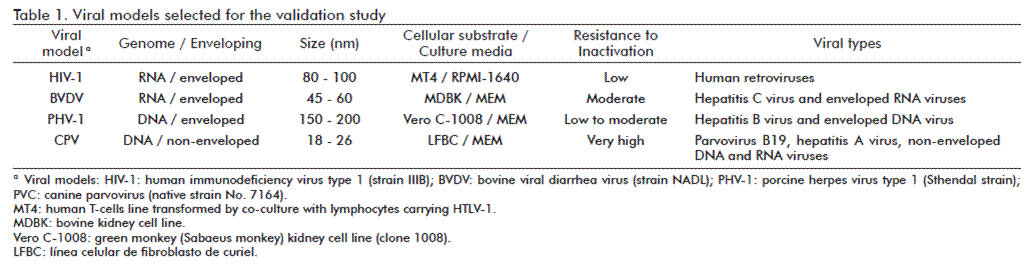
<body><![CDATA[<P   ><font size="2" face="Verdana, Arial, Helvetica, sans-serif"><b>Simulated challenge      study </b></font></P >       <P   align="justify" ><font size="2" face="Verdana, Arial, Helvetica, sans-serif">Three flasks of each      Melagenina&reg; Plus and the Melagenina&reg; lotion lots included in the study      were taken. For each product, one flask was provided with RPMI-1640 culture      medium supplemented with 10 % fetal bovine serum (FBS; 1:5 v/v), another with      medium supplemented with FBS (1:10 v/v) and the third remained as control.      All the samples were assayed in triplicates, identified with a code and further      delivered to the Chemical Control Laboratory of the Quality Assurance Vice-Direction      at Deplac&eacute;n, for chemical, microbiological and biological control assays      as established for industrial scale productions. </font></P >       <P   align="justify" ><font size="2" face="Verdana, Arial, Helvetica, sans-serif">The melanocytopoietic      activity was determined by the methodology described by Mart&iacute;nez <I>et      al</I>. [10]. Groups of three C57BL/6 male mice, with a weight of 20 to 22      g, were treated topically in the ears for five consecutive days. They received      either lot of the product previously exposed to the treatments described,      or the placebo (excipient without API). At 72 h of the last application, animals      were sacrificed, ears epidermis samples were taken and processed by the L-Dopa      histochemistry technique. </font></P >       <P   ><font size="2" face="Verdana, Arial, Helvetica, sans-serif"><B>Viral models </b></font></P >       <P   align="justify" ><font size="2" face="Verdana, Arial, Helvetica, sans-serif">Viral models were      selected according to its similarity with the possible viral contaminants      in the placentas, resistance to physical and chemical agents, and its relevance      for being transmitted by blood and its derivatives. They comprised enveloped      and non-enveloped viruses, either RNA or DNA genome, respectively: the human      immunodeficiency virus type 1 (HIV-1), the bovine viral diarrhea virus (BVDV),      the porcine herpes virus type 1 (PHV-1) and the canine parvovirus (CPV) (<a href="/img/revistas/bta/v30n1/t0106113.gif">Table      1</a>). </font></P >       
<P   align="justify" ><font size="2" face="Verdana, Arial, Helvetica, sans-serif">The high-titer control      strains were produced from the controlled cell lines at Lisida, and using      culture media manufactured and released by the Cell Culture Laboratory at      Lisida (<a href="/img/revistas/bta/v30n1/t0106113.gif">Table 1</a>). Each viral strain was amplified      into its cellular specific substrate at a multiplicity of infection of 0.3.      </font></P >       
<P   align="justify" ><font size="2" face="Verdana, Arial, Helvetica, sans-serif">Viral inoculums were      titrated by the microtitration method in 96-well plates, according to Johnson      and Byington [11]. The median tissue culture infective dose (TCID<Sub>50</Sub>/mL)      was determined as the cytopathic effect, according to the Reed and Muench      method [12]. For the HIV-1, the p24 antigen was quantified using the DAVIH      Ag p24 kit (Davihlab, Cuba). </font></P >   <FONT size="+1"><FONT size="+1">        <P   ><font size="2" face="Verdana, Arial, Helvetica, sans-serif"><B>Cytotoxicity study      </b></font></P >       <P   align="justify" ><font size="2" face="Verdana, Arial, Helvetica, sans-serif">The Melagenina&reg;      Plus, Melagenina&reg; lotion, and the purified water solutions of 71 % alcohol      and 1 mg/mL CaCl<Sub>2</Sub> were treated in triplicates to decrease its cytotoxicity      on each cellular substrate. One volume of each sample was diluted in two and      four volumes of a buffered salt solution (BSS), pH 7.2. Serial 1/4 dilutions      were made, further adding the cellular substrates at the given concentrations:      5 &times; 10<Sup>5</Sup> cells/mL for the cell line MT4, and 2 &times; 10<Sup>5</Sup>      cells/mL for the other cellular substrates). Dilutions were incubated at 37      &ordm;C in a wet atmosphere of 5 % CO<Sub>2</Sub>. Four days later, cultures      were observed under an inverted microscope and the lowest toxic dilution of      samples were determined, compared to the cell culture controls without samples.      The dilution showing moderate to minimum cytotoxicity was set as working dilution      for sample processing. </font></P >   <FONT size="+1"><FONT size="+1"><FONT size="+1"><FONT size="+1"><FONT size="+1"><FONT size="+1"><FONT size="+1"><FONT size="+1">        <P   ><font size="2" face="Verdana, Arial, Helvetica, sans-serif"><B>Interference study      </b></font></P >       ]]></body>
<body><![CDATA[<P   align="justify" ><font size="2" face="Verdana, Arial, Helvetica, sans-serif">The viral models      were added to citotoxicity samples at the working dilution, and cells were      further homogenized. Two samples of each were taken, one after mixing (M1)      and a second (M2) after incubation for 1 h at room temperature. A control      sample of each viral inoculum was included, being diluted in a supplemented      medium and subjected to the same treatment. The assay was made in triplicates.      </font></P >       <P   align="justify" ><font size="2" face="Verdana, Arial, Helvetica, sans-serif">Subsequently, samples      were processed according to results of the cytotoxicity study, with serial      dilutions similar to those used to titrate viral inoculums. Viral interference      was set as the viral titer reduced more than two logs. </font></P >       <P   ><font size="2" face="Verdana, Arial, Helvetica, sans-serif"><B>Inactivation during      storage of Melagenina&reg; Plus </b></font></P >       <P   align="justify" ><font size="2" face="Verdana, Arial, Helvetica, sans-serif">For the challenge      at the storage step, a flask from each selected Melagenina&reg; Plus lot was      selected. These represents the 0.03 % of the flasks conforming an industrial      lot, which were infected with the viral models at a proportion of 1:5 or 1:10      (v/v) according to the simulated challenge study results. Immediately after      the addition of each viral model to the flask, a sample was taken, considering      it as the initial viral load (VL<Sub>i</Sub>), and flasks were stored at room      temperature. </font></P >   <FONT size="+1"><FONT size="+1">        <P   align="justify" ><font size="2" face="Verdana, Arial, Helvetica, sans-serif">The inactivation      kinetics was determined for enveloped viruses monitoring on days 1, 2, 3 and      7 of storage. The VL assessed on day seven was considered as the final VL      (VL<Sub>f</Sub>). The study was carried out in triplicates. </font></P >   <FONT size="+1"><FONT size="+1">        <P   align="justify" ><font size="2" face="Verdana, Arial, Helvetica, sans-serif">The following controls      were included: </font></P >       <P   align="justify" > </P >       <P   align="justify" ><font size="2" face="Verdana, Arial, Helvetica, sans-serif">- Viral strain in      1 mg/mL CaCl<Sub>2</Sub> and in 71 % ethanol, both prepared with purified      water. </font></P >   <FONT size="+1"><FONT size="+1">        <P   align="justify" ><font size="2" face="Verdana, Arial, Helvetica, sans-serif">- Viral strain in      supplemented culture media (stored at room temperature, 4 and -85 &ordm;C).      </font></P >       <P   align="justify" ><font size="2" face="Verdana, Arial, Helvetica, sans-serif">- A flask of Melagenina&reg;      lotion, to check if the precipitate observed in the Melagenina&reg; Plus once      added the CaCl<Sub>2</Sub> had any incidence in the inactivation property      at storage. </font></P >   <FONT size="+1"><FONT size="+1">        ]]></body>
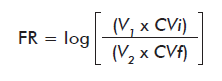
<body><![CDATA[<P   align="justify" > </P >       <P   align="justify" ><font size="2" face="Verdana, Arial, Helvetica, sans-serif">Control samples were      kept at the same storage temperature of Melagenina&reg; Plus and VLs were      quantified at the same time intervals. </font></P >       <P   align="justify" > </P >       <P   ><font size="2" face="Verdana, Arial, Helvetica, sans-serif"><B>Reduction factor      calculation </b></font></P >       <P   align="justify" ><font size="2" face="Verdana, Arial, Helvetica, sans-serif">Reduction factor      (RF) at storage was calculated according to the following equation [9, 12]:      </font></P >       <P   align="center" ><img src="/img/revistas/bta/v30n1/fr0106113.gif" width="220" height="79"></P >       
<P   align="justify" ></P >       <P   align="justify" ></P >       <P   align="justify" > </P >       <P   align="justify" ><font size="2" face="Verdana, Arial, Helvetica, sans-serif">Where: </font></P >       ]]></body>
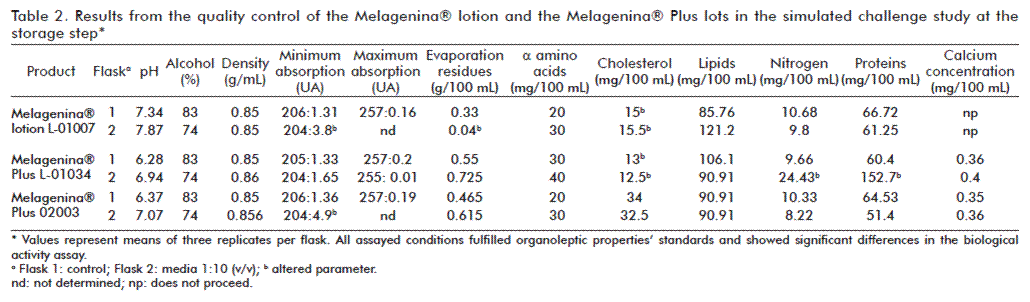
<body><![CDATA[<P   align="justify" ><font size="2" face="Verdana, Arial, Helvetica, sans-serif"><I>V</I><Sub><I>1      </I></Sub>and <I>VL</I><Sub><I>i</I></Sub>: are the initial volume and viral      load of the sample; <I>V</I><Sub><I>2 </I></Sub>and <I>VL</I><Sub><I>f</I></Sub>:      are the final volume and viral load of the sample. </font></P >   <FONT size="+1"><FONT size="+1"><FONT size="+1"><FONT size="+1"><FONT size="+1"><FONT size="+1"><FONT size="+1"><FONT size="+1">        <P   align="justify" ><font size="2" face="Verdana, Arial, Helvetica, sans-serif">The process step      was classified as effective, moderately effective or ineffective, according      to the viral reduction logarithms guidance of the Committee for Proprietary      Medicinal Products [9]. </font></P >       <P   ><font size="2" face="Verdana, Arial, Helvetica, sans-serif"><B>Statistical analysis      </b></font></P >       <P   align="justify" ><font size="2" face="Verdana, Arial, Helvetica, sans-serif">Viral challenge results      were analyzed with the aid of the Statgraphics Plus program, (Statpoint Technologies,      Inc., USA; version 5.0, 2000). A Student&rsquo;s t-test was used for paired      data, to identify statistically significant differences between VL<Sub>i</Sub>      and VL values at different time intervals for each viral model. </font></P >       <P   align="justify" >&nbsp;</P >   <FONT size="+1"><FONT size="+1">        <P   align="justify" > </P >       <P   ><font size="3" face="Verdana, Arial, Helvetica, sans-serif"><B>RESULTS AND DISCUSSION      </b></font></P >   <FONT size="+1"><B>        <P   ><font size="2" face="Verdana, Arial, Helvetica, sans-serif">Simulated challenge      </font></P >   </B>        <P   align="justify" ><font size="2" face="Verdana, Arial, Helvetica, sans-serif">Addition of the supplemented      media, at a proportion of 1:5 (v/v), to the Melagenina&reg; Plus and the Melagenina&reg;      lotion, significantly modified (p &lt; 0.01) several quality parameters of      these products, such as: ethanol concentration, absorption, cholesterol, nitrogen      and proteins concentrations. Therefore, they were not accepted, and the viral      challenge was not carried out with that proportion of supplemented media.      </font></P >   <FONT size="+1">        <P   align="justify" ><font size="2" face="Verdana, Arial, Helvetica, sans-serif">When the medium was      added at half the proportion 1:10 (v/v), some physicochemical parameters were      altered, but not significantly: absorption, evaporation residues, cholesterol,      nitrogen and protein concentrations (<a href="/img/revistas/bta/v30n1/t0206113.gif">Table 2</a>).      Lipids concentration remained within the established acceptance limits. This      parameter was regarded as essential for the melanocytopoyetic activity of      placental extracts [2, 13]. </font></P >       
]]></body>
<body><![CDATA[<P   align="justify" ><font size="2" face="Verdana, Arial, Helvetica, sans-serif">Melagenina&reg; Plus      diluted 1:10 (v/v) in culture medium showed no significantly different biological      activity in mice melanocytes, compared to animals treated either with Melagenina&reg;      or the control lot of the product (<a href="/img/revistas/bta/v30n1/t0206113.gif">Table 2</a>). Therefore,      these results were accepted, and the 1:10 (v/v) medium proportion was set      for viral challenge at storage. </font></P >       
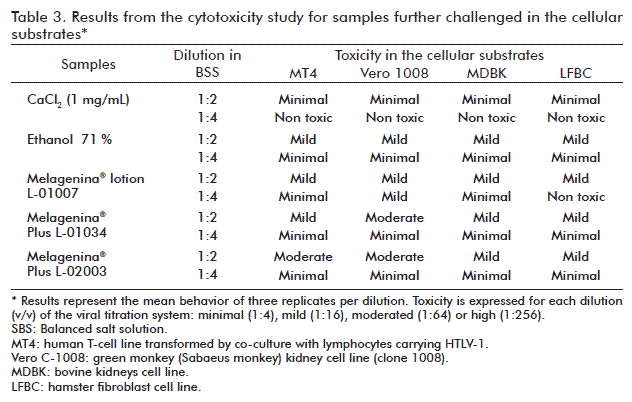
<P   align="justify" ><font size="2" face="Verdana, Arial, Helvetica, sans-serif">Key aspects are considered      in the viral validation study: the proper design of the production process      at laboratory scale and results from the simulated challenge, to demonstrate      the influence of the culture media used to dilute infectious agents on the      physicochemical and biological parameters established for the product [14-16].      </font></P >       <P   ><font size="2" face="Verdana, Arial, Helvetica, sans-serif"><B>Cytotoxicity study      </b></font></P >       <P   align="justify" ><font size="2" face="Verdana, Arial, Helvetica, sans-serif">Samples&rsquo; cytotoxicity      were mild to moderate (<a href="/img/revistas/bta/v30n1/t0306113.gif">Table 3</a>), with samples diluted      1:2 (v/v) in BSS showing mild to moderate cytotoxicity, while those diluted      1:5 (v/v) showed minimal changes at best in cell cultures. No differences      were observed neither between the two lots of Melagenina<B>&reg; </B>Plus      nor of any of them to the one of Melagenina&reg; lotion. Such results were      determinant for the selection of the 1:2 (v/v) BSS dilution as the procedure      to decrease samples&rsquo; cytotoxicity. </font></P >       
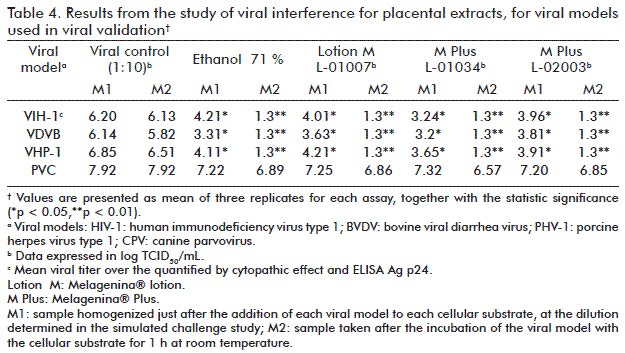
<P   align="justify" ><font size="2" face="Verdana, Arial, Helvetica, sans-serif">Several methods have      been reported to decrease cytotoxicity (dialysis, gel filtration chromatography,      precipitation and serial dilutions); but either the method, special care must      be taken to do not deteriorate viral titers, which is detrimental for detecting      low VLs [9, 15, 16]. </font></P >       <P   ><font size="2" face="Verdana, Arial, Helvetica, sans-serif"><B>Viral interference      study </b></font></P >       <P   align="justify" ><font size="2" face="Verdana, Arial, Helvetica, sans-serif">Viral interference      was determined by decreasing or not of the viral models titer in samples,      in comparison with the control models (<a href="/img/revistas/bta/v30n1/t0406113.gif">Table 4</a>).      The titer decrease for viral controls diluted 1:10 (v/v) in supplemented culture      medium did not achieved 1 log. </font></P >       
<P   align="justify" ><font size="2" face="Verdana, Arial, Helvetica, sans-serif">When adding the enveloped      virus models to placental extracts, a fast decrease in viral titers of 2 or      more logs was observed, significantly different from the viral control (p      &lt; 0.05). After 1 hour of incubation, baseline VLs were detected, with highly      significant differences (p &lt; 0.01). A very similar behavior was observed      for the viral control dissolved in 71 % ethanol solution (<a href="/img/revistas/bta/v30n1/t0406113.gif">Table      4</a>). No significant differences were detected between CPV viral titers,      regardless ethanol. </font></P >       
<P   align="justify" ><font size="2" face="Verdana, Arial, Helvetica, sans-serif">These results are      in agreement with those from other groups, reporting a marked susceptibility      of enveloped viruses to lipidic solvents, and particularly to alcohol concentrations      higher than 70 %, but not of the non-enveloped viruses [6, 17, 18]. </font></P >       <P   align="justify" ><font size="2" face="Verdana, Arial, Helvetica, sans-serif">These results demonstrate      that placental extracts do not interfere in the replication of these viral      models. The viral interference study provided evidences on the action of the      raw materials and the biological products over the viral models&rsquo; titers,      as well as the selection of adequate viral models to study the viral clearance      capacity of the Melagenina<B>&reg; </B>Plus production process. </font></P >       ]]></body>
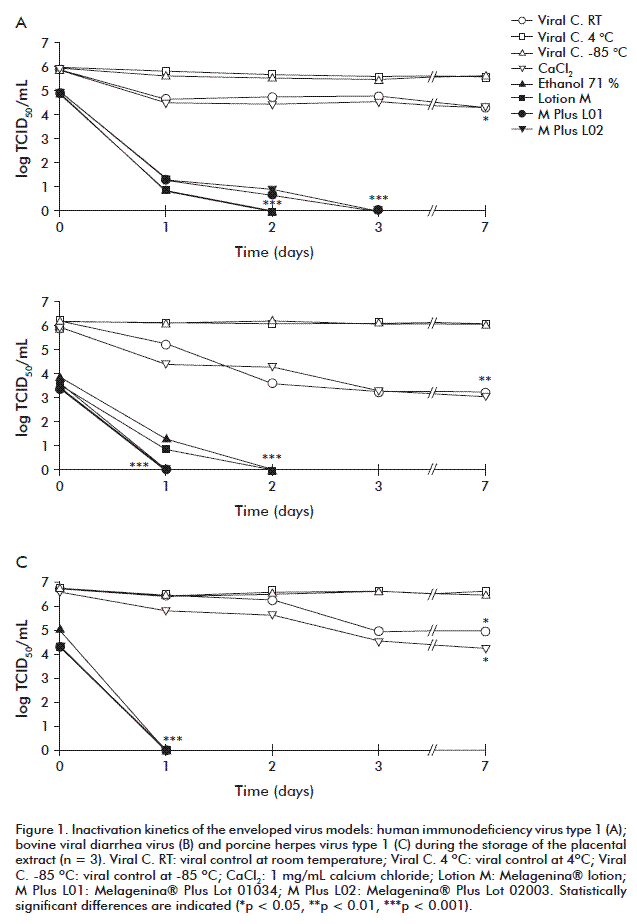
<body><![CDATA[<P   ><font size="2" face="Verdana, Arial, Helvetica, sans-serif"><B>Viral inactivation      capacity of Melagenina&reg; Plus during storage</B> </font></P >   <FONT size="+1">        <P   align="justify" ><font size="2" face="Verdana, Arial, Helvetica, sans-serif">The behavior of enveloped      model viruses during the storage of Melagenina&reg; Plus are shown in <a href="/img/revistas/bta/v30n1/f0106113.gif">figure      1</a>. There were no statistically significant differences among viral titers      for both lots of Melagenina&reg; Plus and the controls used in the study (Melagenina&reg;      lotion and 71 % ethanol solution). Significant differences (p &lt; 0.05) were      found in VL<Sub>i</Sub> for samples containing 71 % ethanol compared to viral      controls, in agreement with results from the viral interference study. </font></P >   <FONT size="+1"><FONT size="+1"><FONT size="+1">        
<P   align="justify" ><font size="2" face="Verdana, Arial, Helvetica, sans-serif">The three viral models      followed the typical viral behavior seen for viruses of low resistance to      organic solvents, characterized by a sharp drop of titers and complete inactivation      within a short period. This last property is related to their relative ethanol      resistance. In all the cases, very highly significant differences were detected      between VL<Sub>i</Sub> and VL assessed after 24 h (p &lt; 0.001) (<a href="/img/revistas/bta/v30n1/f0106113.gif">Figure      1</a>). </font></P >   <FONT size="+1"><FONT size="+1">        
<P   align="justify" ><font size="2" face="Verdana, Arial, Helvetica, sans-serif">PHV-1 was completely      inactivated in both infected placenta extracts during the first 24 h of storage,      and also in the 71 % alcohol solution (<a href="/img/revistas/bta/v30n1/f0106113.gif">Figure 1</a>).      RNA viruses showed a more delayed inactivation, for HIV-1 achieved after 24-48      h of storage with the Melagenina&reg; lotion and 48-72 h after storage with      both lots of Melagenina&reg; Plus. </font></P >       
<P   align="justify" ><font size="2" face="Verdana, Arial, Helvetica, sans-serif">BVDV showed an intermediate      inactivation progression, achieved within the first 24 h of storage with the      Melagenina&reg; Plus and after 48 h of storage in Melagenina&reg; lotion and      71 % alcohol. None of the three enveloped virus models showed significant      differences in VL compared to controls at any time points. </font></P >       <P   align="justify" ><font size="2" face="Verdana, Arial, Helvetica, sans-serif">In the case of BVDV,      it is affected by lipid solvents and chemical detergents, but tends to stabilize      with the addition of proteins [15, 19]. Nevertheless, the BVDV inactivation      observed was not related to the amount of lipid precipitates in the placental      extracts, due to the short storage periods assayed. </font></P >       <P   align="justify" ><font size="2" face="Verdana, Arial, Helvetica, sans-serif">There were differences      in the titers of enveloped virus controls stored at different temperatures.      Viral titers decreased in those stored at room temperature, but not at 4 or      -85 &ordm;C (<a href="/img/revistas/bta/v30n1/f0106113.gif">Figure 1</a>). For HIV-1, viral titer      showed statistically significant differences (p &lt; 0.05) only after seven      days of storage at room temperature, compared to the titer of the viral control      stored at 4 &ordm;C. Such differences were detected for PHV-1 since the third      day (p &lt; 0.05) and maintained until the seventh. Differences were detected      earlier for BVDV, starting at 24 h after storage at room temperature (p &lt;      0.05), and becoming highly significant at 48 h (p &lt; 0.01) and sustained      until day seven. </font></P >       
<P   align="justify" ><font size="2" face="Verdana, Arial, Helvetica, sans-serif">Similar results were      reported by Ruibal <I>et al</I>. [20], while validating an intravenous immunoglobulin      production process. They observed a drop in BVDV titers below 6 logs when      stored at 21 &ordm;C for 21 days, while storage at 4 &ordm;C did not affect      titers. </font></P >       <P   align="justify" ><font size="2" face="Verdana, Arial, Helvetica, sans-serif">The decrease of viral      titers for controls stored at room vs. low temperature demonstrated that room      temperature storage reinforces the virus inactivation capacity of the product.      </font></P >       <P   align="justify" ><font size="2" face="Verdana, Arial, Helvetica, sans-serif">The inactivation      kinetics of viral models in CaCl<Sub>2</Sub> did not differed from the viral      control at room temperature, except for the statistically significant differences      (p &lt; 0.05) detected for PHV-1 (<a href="/img/revistas/bta/v30n1/f0106113.gif">Figure 1</a>). This      indicates that the drop in viral titers was caused by the storage temperature.      </font></P >   <FONT size="+1"><FONT size="+1">        
]]></body>
<body><![CDATA[<P   align="justify" ><font size="2" face="Verdana, Arial, Helvetica, sans-serif">The inactivation      kinetics for the non-enveloped virus model (CPV) is shown in <a href="/img/revistas/bta/v30n1/f0206113.gif">figure      2</a>. After 24 h of storage, a highly significant drop in viral titers was      detected for all the samples in 71 % alcohol, compared to the respective VL<Sub>i</Sub>      values. The VL values stabilized borderline to the detection limit of the      assay after 48 h, and remained steady until day seven, with very highly significant      differences (p &lt; 0.001). This viral model was fully inactivated in the      Melagenina&reg; lotion on day 14, and after 21 days in both lots of Melagenina&reg;      Plus and 71 % alcohol (<a href="/img/revistas/bta/v30n1/f0206113.gif">Figure 2</a>). </font></P >   <FONT size="+1"><FONT size="+1">        
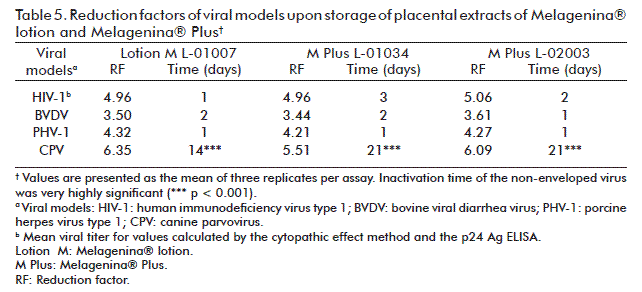
<P   align="justify" ><font size="2" face="Verdana, Arial, Helvetica, sans-serif">Titers of controls      stored at 4 and -85 &deg;C remained as initially determined during the whole      experiment. They dropped for the room temperature storage since day seven,      becoming progressively significant on day 14, highly significant on day 21      and very highly significant on day 28 (p &lt; 0.001), this last accounting      for a 5.41 logs decrease. </font></P >       <P   align="justify" ><font size="2" face="Verdana, Arial, Helvetica, sans-serif">The CPV inactivation      kinetics in 1 mg/mL CaCl<Sub>2</Sub> behaved very similar to the viral control      stored at room temperature, evidencing the lack of inactivating capacity for      CaCl<Sub>2</Sub> at the assayed concentration and reinforcing the conclusion      that temperature was the key parameter leading to virus inactivation. </font></P >   <FONT size="+1"><FONT size="+1"><FONT size="+1"><FONT size="+1">        <P   align="justify" ><font size="2" face="Verdana, Arial, Helvetica, sans-serif">All these results      corroborate the effectiveness of the experimental design to study the capacity      for viral inactivation during storage of the production process of the placental      extract Melagenina&reg;. In fact, enveloped viruses were inactivated within      a short period (24 h), with the non-enveloped CPV showing a marginal VL at      72 h of storage [7]. </font></P >       <P   align="justify" ><font size="2" face="Verdana, Arial, Helvetica, sans-serif">Since CPV, a highly      resistant virus, was completely inactivated upon storage, safety was increased      both for Melagenina&reg; Plus and its production process. Therefore, CPV results      could not be considered relevant just for the non-enveloped viruses, but also      this virus can be regarded as a non-specific viral model which provides evidences      for the inactivation of new or unpredicted viral contamination in raw materials      [7, 9, 15]. </font></P >       <P   align="justify" ><font size="2" face="Verdana, Arial, Helvetica, sans-serif"><a href="/img/revistas/bta/v30n1/t0506113.gif">Table      5</a> shows RFs of both placental extracts upon storage, and their respective      times for inactivating the challenge VLs. Consequently, enveloped virus were      quickly inactivated, after three and four days of storage for Melagenina&reg;      Plus and Melagenina&reg; lotion, respectively, without significant differences.      The non-enveloped viral model was inactivated after 14 and 21 days of storage      for Melagenina&reg; and Melagenina&reg; Plus, respectively, with very highly      significant differences (p &lt; 0.001) for each placental extract. </font></P >       
<P   align="justify" ><font size="2" face="Verdana, Arial, Helvetica, sans-serif">Very highly significant      differences (p &lt; 0.0001) were observed between the times for inactivation      of enveloped and non-enveloped viruses. The difference on time required for      viral inactivation in both placental extracts of Melagenina&reg; Plus was      related to the presence of greater amounts of lipid precipitates, which could      form lattices that protect viruses from the action of the inactivating agent,      and, therefore, increase the time required for full inactivation. </font></P >       <P   align="justify" ><font size="2" face="Verdana, Arial, Helvetica, sans-serif">Very similar results      were observed when validating the placental extract EP-100 with the enveloped      virus models, but not for the non-enveloped viruses. These last required a      longer storage period (63 days) for complete inactivation [21]. It was related      to the storage temperature (4 &ordm;C) and the ethanol concentration in the      EP-100 extract. That results corroborate that these two factors are fundamental      for the safety of the Melagenina&reg; Plus placental extract. </font></P >       <P   align="justify" ><font size="2" face="Verdana, Arial, Helvetica, sans-serif">FRs higher than 4      logs were attained except for the BVDV, and the four viral models were effectively      inactivated during the storage step of Melagenina&reg; Plus. The challenge      VLs of either enveloped or non-enveloped viruses were fully inactivated, regardless      variations in the parameters for this step (<a href="/img/revistas/bta/v30n1/t0506113.gif">Table 5</a>).      </font></P >       
<P   align="justify" ><font size="2" face="Verdana, Arial, Helvetica, sans-serif">The low resistance      of the enveloped model viruses to ethanol at the different steps matches that      of viral validation studies of different processes for biologicals&rsquo;      production, being closely related to the conditions for the action of the      inactivating agent (medium properties, temperature, humidity and pH) [7, 22,      23]. </font></P >       ]]></body>
<body><![CDATA[<P   align="justify" ><font size="2" face="Verdana, Arial, Helvetica, sans-serif">The virucidal action      of ethanol is affected by low temperature and high protein and lipid concentrations,      these factors stabilizing viruses and making them more resistant to the adverse      conditions of the culture medium and disinfectants [7, 18, 22, 23]. Both culture      medium and ethanol were absent during placental extract storage, favoring      the inactivation of all the viral models while validating the production process.      </font></P >       <P   align="justify" ><font size="2" face="Verdana, Arial, Helvetica, sans-serif">In summary, the Melagenina&reg;      Plus formulation in alcohol solution of 71 % or higher, together with its      storage at room temperature, supported the complete inactivation of all the      viral models tested, regardless its resistance to inactivating agents. It      provided an adequate safety level to the production process, being able of      eliminating new or unpredictable viral contaminations of placentas. </font></P >       <P   align="justify" > </P >       <P   align="justify" >&nbsp;</P >       <P   align="justify" ><font size="2" face="Verdana, Arial, Helvetica, sans-serif"><B><font size="3">REFERENCES      </font></b></font></P >       <P   ><font size="2" face="Verdana, Arial, Helvetica, sans-serif">1. Miyares C. Melagenina&reg;      Plus. Avances M&eacute;dicos en Cuba. 2000;7(23):50-2. </font></P >   <FONT size="+1">        <P   ><font size="2" face="Verdana, Arial, Helvetica, sans-serif">2. Miyares CM, inventor;      Centro de Histoterapia Placentaria, assignee. Composition for stimulating      the synthesis of the melanic pigment and process for obtaining it. United      States patent US 6660305. 2003 Dec 9. </font></P >       <!-- ref --><P   ><font size="2" face="Verdana, Arial, Helvetica, sans-serif">3. Centro para el      control estatal y la calidad de los medicamentos. Regulaci&oacute;n No. 2/2002.      Placenta humana como materia prima farmac&eacute;utica. La Habana: Cecmed;      2002.     </font></P >       <!-- ref --><P   ><font size="2" face="Verdana, Arial, Helvetica, sans-serif">4. Chow SS, Craig      ME, Jacques CF, Hall B, Catteau J, Munro SC, et al. Correlates of placental      infection with cytomegalovirus, parvovirus B19 or human herpes virus 7. J      Med Virol. 2006;78(6):747-56.     </font></P >       <!-- ref --><P   ><font size="2" face="Verdana, Arial, Helvetica, sans-serif">5. Indolfi G, Moriondo      M, Galli L, Azzari C, Poggi GM, Resti M, et al. Mother-to-infant transmission      of multiple blood-borne viral infections from multi-infected mothers. J Med      Virol. 2007;79(6):743-7.     </font></P >       <P   ><font size="2" face="Verdana, Arial, Helvetica, sans-serif">6. Barin F. La s&eacute;curit&eacute;      virale des m&eacute;dicaments d&rsquo;origine biologique. Ann Pharm Fr. 2008;66(3):129-39.      </font></P >       <!-- ref --><P   ><font size="2" face="Verdana, Arial, Helvetica, sans-serif">7. Food and Drug      Administration. Current good manufacturing practice for finished pharmaceuticals.      Subpart E- Control of Components and Drug Product Containers and Closures      &sect; 211.80 General requirements (21 CFR 211.80). Rockville MD: Food and      Drug Administration. Department of Health and Human Services; 2008.     </font></P >       <P   ><font size="2" face="Verdana, Arial, Helvetica, sans-serif">8. Noa E, Hern&aacute;ndez      AM, Ruibal I, Dubed M, Navea L, Lobaina L, et al. Validaci&oacute;n de la      capacidad de inactivaci&oacute;n viral del proceso de producci&oacute;n del      extracto placentario loci&oacute;n Melagenina&reg;. Rev Cub Farmacia. 2002;36(Suppl      1). </font></P >       <!-- ref --><P   ><font size="2" face="Verdana, Arial, Helvetica, sans-serif">9. Committee for      Proprietary Medicinal Products (CPMP). Note for Guidance on Virus validation      studies: The design, contribution and interpretation of studies validating      the inactivation and removal of viruses. London: The European Agency for the      Evaluation of Medicinal Products, Human Medicines Evaluation Unit; 1996 Feb.      CPMP/BWP/269/95. Available from: <A href="http://www.ema.europa.eu/docs/en_GB/document_library/Scientific_guideline/2009/09/WC500003684.pdf"  target="_blank">      <U><U><FONT color="#0000FF">http://www.ema.europa.eu/docs/en_GB/document_library/Scientific_guideline/2009/09/WC500003684.pdf</font></U></U></A><FONT color="#0000FF"><FONT color="#000000">.          </font></font></font></P >   <FONT color="#0000FF"><FONT color="#000000">        <!-- ref --><P   ><font size="2" face="Verdana, Arial, Helvetica, sans-serif">10. Mart&iacute;nez      L, Sanz A, Miyares CM, Hollands I, Roque S, Pimienta R, et al. Estudio comparativo      del efecto pigmentante de dos extractos de placenta humana (Melagenina I y      II). In: La histoterapia placentaria en algunas afecciones dermatol&oacute;gicas.      La Habana: Palacio de las Convenciones; 1994.     </font></P >       <!-- ref --><P   ><font size="2" face="Verdana, Arial, Helvetica, sans-serif">11. Johnson VA, Byington      RE. Infectivity assay (virus yield assay) In: Aldovani A, Walker BD, editors.      Techniques in HIV Research. New York: Stockton Press; 1990. p. 71-6.     </font></P >       <!-- ref --><P   ><font size="2" face="Verdana, Arial, Helvetica, sans-serif">12. Reed LJ, Muench      H. A simple method of estimating fifty percent end point. Am J Hyg. 1938;27(3):493-7.          </font></P >       <!-- ref --><P   ><font size="2" face="Verdana, Arial, Helvetica, sans-serif">13. Gonz&aacute;lez      Y, Salcedo G, Garc&iacute;a W, Hern&aacute;ndez CR, Brito N. Validaci&oacute;n      de la t&eacute;cnica espectrofotom&eacute;trica de cuantificaci&oacute;n de      l&iacute;pidos totales para el control de la calidad de los extractos de placenta.      In: Memorias II Seminario Internacional de Histoterapia Placentaria. La Habana:      Centro de Histoterapia Placentaria; 2006.     </font></P >       <!-- ref --><P   ><font size="2" face="Verdana, Arial, Helvetica, sans-serif">14. Committee for      Proprietary Medicinal Products (CPMP). Note for Guidance on Plasma-Derived      Medicinal Products. London: The European Agency for the Evaluation of Medicinal      Product, Evaluation of Medicines for Human Use; 2001 Jan. CPMP/BWP/269/95      rev. 3. Available from: <A href="http://www.ema.europa.eu/docs/en_GB/document_library/Scientific_guideline/2009/09/WC500003613.pdf" target="_blank">      <U><U><FONT color="#0000FF">http://www.ema.europa.eu/docs/en_GB/document_library/Scientific_guideline/2009/09/WC500003613.pdf</font></U></U></A><FONT color="#0000FF"><FONT color="#000000">.          </font></font></font></P >   <FONT color="#0000FF"><FONT color="#000000">        <!-- ref --><P   ><font size="2" face="Verdana, Arial, Helvetica, sans-serif">15. Darling A. Validation      of biopharmaceutical purification processes for virus clearance evaluation.      Mol Biotechnol. 2002;21(1):57-83.     </font></P >       <!-- ref --><P   ><font size="2" face="Verdana, Arial, Helvetica, sans-serif">16. Tu&ntilde;&oacute;n      MA, Noa E, S&aacute;nchez K, Ruibal IJ, Dubed M, Casta&ntilde;eda F, et al.      Desescalado del proceso de producci&oacute;n de Hebertrans&#61650; para su      validaci&oacute;n viral. Biotecnol Apl. 2004;21:229-33.     </font></P >       <!-- ref --><P   ><font size="2" face="Verdana, Arial, Helvetica, sans-serif">17. Azzi A, Maggi      F, Zakrzewska K, Menconi MC, Di Pietro N, Salotti V, et al. Different behavior      of erythrovirus B19 and torquetenovirus in response to a single step of albumin      purification. Transfusion. 2006;46(7):1162-7.     </font></P >       <!-- ref --><P   ><font size="2" face="Verdana, Arial, Helvetica, sans-serif">18. Suchomel M, Gnant      G, Weinlich M, Rotter M. Surgical hand disinfection using alcohol: the effects      of alcohol type, mode and duration of application. J Hosp Infect. 2009;71(3):228-33.          </font></P >       <!-- ref --><P   ><font size="2" face="Verdana, Arial, Helvetica, sans-serif">19. Rivera H. Evoluci&oacute;n      del conocimiento sobre la enfermedad de la diarrea viral bovina y su agente      etiol&oacute;gico. Rev Investig Vet Per&uacute;. 2008;19(2):93-112.     </font></P >       <!-- ref --><P   ><font size="2" face="Verdana, Arial, Helvetica, sans-serif">20. Ruibal Brunet      IJ, Noa Romero E, Rivero Mas AT, Mart&iacute;n Garc&iacute;a RZ. Inactivaci&oacute;n      del VDVB (modelo experimental del virus de la hepatitis C) por pH bajo y tratamiento      por calor en inmunoglobulinas humanas endovenosa. Sangre (Barc). 1999;44(5):352-6.          </font></P >       <!-- ref --><P   ><font size="2" face="Verdana, Arial, Helvetica, sans-serif">21. P&eacute;rez      JR, Noa E, Vergel V, Alfaro E, Lovaina L, S&aacute;nchez Y, et al. Viral cleaning      capacity of the manufacturing process of the EP-100. Avances en Biotecnolog&iacute;a      Moderna. 2007:CP-43.     </font></P >       <!-- ref --><P   ><font size="2" face="Verdana, Arial, Helvetica, sans-serif">22. Dichtelm&ucirc;ller      HO, Germer M, Rudnick DC. A general approach to robustness studies for virus      inactivating and partitioning steps used in production of plasma derivatives.      Bioprocess Int. 2005;3(Suppl 7):35-8.     </font></P >       <P   ><font size="2" face="Verdana, Arial, Helvetica, sans-serif">23. Brorson K. Advances      in viral clearance. In:. Shukla AA, Etzel MR, Gadam S, editors. Process scale      bioseparations for the biopharmaceutical industry. Boca Raton: CRC Press,      Taylor &amp; Francis Group. 2007; p. 449-62. </font></P >   <FONT size="+1">        <P   align="justify" > </P >   <FONT size="+1">        <P   align="justify" > </P >       <P   >&nbsp;</P >       <P   >&nbsp;</P >       ]]></body>
<body><![CDATA[<P   ><font size="2" face="Verdana, Arial, Helvetica, sans-serif">Received in July,      2010.     <br>     Accepted in July, 2012. </font></P >       <P   >&nbsp;</P >       <P   >&nbsp;</P >       <P   align="justify" > </P >       <P   align="justify" > </P >       <P   ><font size="2" face="Verdana, Arial, Helvetica, sans-serif"><I>Leonor I Lobaina</I>.      Laboratorios de Investigaciones del Sida, Lisida. Carretera de Tapaste y Autopista      Nacional, San Jos&eacute; de las Lajas, CP 32700, Mayabeque, Cuba. E-mail:      <A href="mailto:lisida@infomed.sld.cu"> <U><U><FONT color="#0000FF">lisida@infomed.sld.cu</font></U></U></A><FONT color="#0000FF"><FONT color="#000000">.      </font></font></font></P >   </font></font></font></font></font></font></font></font></font></font></font></font></font></font></font></font></font></font></font></font></font></font></font></font></font></font></font></font></font></font></font></font></font></font></font></font></font></font></font></font></font></font></font></font></font></font></font></font></font></font></font></font></font></font></font></font></font></font></font></font></font></font></font></font></font></font></font></font></font></font></font></font></font></font></font></DIV >      ]]></body><back>
<ref-list>
<ref id="B1">
<label>1</label><nlm-citation citation-type="journal">
<person-group person-group-type="author">
<name>
<surname><![CDATA[Miyares]]></surname>
<given-names><![CDATA[C]]></given-names>
</name>
</person-group>
<article-title xml:lang="es"><![CDATA[Melagenina(r) Plus]]></article-title>
<source><![CDATA[Avances Médicos en Cuba]]></source>
<year>2000</year>
<volume>7</volume>
<numero>23</numero>
<issue>23</issue>
<page-range>50-2</page-range></nlm-citation>
</ref>
<ref id="B2">
<label>2</label><nlm-citation citation-type="">
<person-group person-group-type="author">
<name>
<surname><![CDATA[Miyares]]></surname>
<given-names><![CDATA[CM]]></given-names>
</name>
</person-group>
<source><![CDATA[Composition for stimulating the synthesis of the melanic pigment and process for obtaining it]]></source>
<year></year>
</nlm-citation>
</ref>
<ref id="B3">
<label>3</label><nlm-citation citation-type="book">
<collab>Centro para el control estatal y la calidad de los medicamentos</collab>
<source><![CDATA[Regulación No. 2/2002: Placenta humana como materia prima farmacéutica]]></source>
<year>2002</year>
<publisher-loc><![CDATA[La Habana ]]></publisher-loc>
<publisher-name><![CDATA[Cecmed]]></publisher-name>
</nlm-citation>
</ref>
<ref id="B4">
<label>4</label><nlm-citation citation-type="journal">
<person-group person-group-type="author">
<name>
<surname><![CDATA[Chow]]></surname>
<given-names><![CDATA[SS]]></given-names>
</name>
<name>
<surname><![CDATA[Craig]]></surname>
<given-names><![CDATA[ME]]></given-names>
</name>
<name>
<surname><![CDATA[Jacques]]></surname>
<given-names><![CDATA[CF]]></given-names>
</name>
<name>
<surname><![CDATA[Hall]]></surname>
<given-names><![CDATA[B]]></given-names>
</name>
<name>
<surname><![CDATA[Catteau]]></surname>
<given-names><![CDATA[J]]></given-names>
</name>
<name>
<surname><![CDATA[Munro]]></surname>
<given-names><![CDATA[SC]]></given-names>
</name>
</person-group>
<article-title xml:lang="en"><![CDATA[Correlates of placental infection with cytomegalovirus, parvovirus B19 or human herpes virus 7]]></article-title>
<source><![CDATA[J Med Virol]]></source>
<year>2006</year>
<volume>78</volume>
<numero>6</numero>
<issue>6</issue>
<page-range>747-56</page-range></nlm-citation>
</ref>
<ref id="B5">
<label>5</label><nlm-citation citation-type="journal">
<person-group person-group-type="author">
<name>
<surname><![CDATA[Indolfi]]></surname>
<given-names><![CDATA[G]]></given-names>
</name>
<name>
<surname><![CDATA[Moriondo]]></surname>
<given-names><![CDATA[M]]></given-names>
</name>
<name>
<surname><![CDATA[Galli]]></surname>
<given-names><![CDATA[L]]></given-names>
</name>
<name>
<surname><![CDATA[Azzari]]></surname>
<given-names><![CDATA[C]]></given-names>
</name>
<name>
<surname><![CDATA[Poggi]]></surname>
<given-names><![CDATA[GM]]></given-names>
</name>
<name>
<surname><![CDATA[Resti]]></surname>
<given-names><![CDATA[M]]></given-names>
</name>
</person-group>
<article-title xml:lang="en"><![CDATA[Mother-to-infant transmission of multiple blood-borne viral infections from multi-infected mothers]]></article-title>
<source><![CDATA[J Med Virol]]></source>
<year>2007</year>
<volume>79</volume>
<numero>6</numero>
<issue>6</issue>
<page-range>743-7</page-range></nlm-citation>
</ref>
<ref id="B6">
<label>6</label><nlm-citation citation-type="journal">
<person-group person-group-type="author">
<name>
<surname><![CDATA[Barin]]></surname>
<given-names><![CDATA[F]]></given-names>
</name>
</person-group>
<article-title xml:lang="fr"><![CDATA[La sécurité virale des médicaments d'origine biologique]]></article-title>
<source><![CDATA[Ann Pharm Fr]]></source>
<year>2008</year>
<volume>66</volume>
<numero>3</numero>
<issue>3</issue>
<page-range>129-39</page-range></nlm-citation>
</ref>
<ref id="B7">
<label>7</label><nlm-citation citation-type="book">
<collab>Food and Drug Administration</collab>
<source><![CDATA[Current good manufacturing practice for finished pharmaceuticals: Subpart E- Control of Components and Drug Product Containers and Closures § 211.80 General requirements (21 CFR 211.80)]]></source>
<year>2008</year>
<publisher-loc><![CDATA[Rockville MD ]]></publisher-loc>
<publisher-name><![CDATA[Food and Drug Administration. Department of Health and Human Services]]></publisher-name>
</nlm-citation>
</ref>
<ref id="B8">
<label>8</label><nlm-citation citation-type="journal">
<person-group person-group-type="author">
<name>
<surname><![CDATA[Noa]]></surname>
<given-names><![CDATA[E]]></given-names>
</name>
<name>
<surname><![CDATA[Hernández]]></surname>
<given-names><![CDATA[AM]]></given-names>
</name>
<name>
<surname><![CDATA[Ruibal]]></surname>
<given-names><![CDATA[I]]></given-names>
</name>
<name>
<surname><![CDATA[Dubed]]></surname>
<given-names><![CDATA[M]]></given-names>
</name>
<name>
<surname><![CDATA[Navea]]></surname>
<given-names><![CDATA[L]]></given-names>
</name>
<name>
<surname><![CDATA[Lobaina]]></surname>
<given-names><![CDATA[L]]></given-names>
</name>
</person-group>
<article-title xml:lang="es"><![CDATA[Validación de la capacidad de inactivación viral del proceso de producción del extracto placentario loción Melagenina(r)]]></article-title>
<source><![CDATA[Rev Cub Farmacia]]></source>
<year>2002</year>
<volume>36</volume>
<numero>^s1</numero>
<issue>^s1</issue>
<supplement>1</supplement>
</nlm-citation>
</ref>
<ref id="B9">
<label>9</label><nlm-citation citation-type="book">
<collab>Committee for Proprietary Medicinal Products (CPMP)</collab>
<source><![CDATA[Note for Guidance on Virus validation studies: The design, contribution and interpretation of studies validating the inactivation and removal of viruses]]></source>
<year>1996</year>
<month> F</month>
<day>eb</day>
<publisher-loc><![CDATA[London ]]></publisher-loc>
<publisher-name><![CDATA[The European Agency for the Evaluation of Medicinal Products, Human Medicines Evaluation Unit]]></publisher-name>
</nlm-citation>
</ref>
<ref id="B10">
<label>10</label><nlm-citation citation-type="book">
<person-group person-group-type="author">
<name>
<surname><![CDATA[Martínez]]></surname>
<given-names><![CDATA[L]]></given-names>
</name>
<name>
<surname><![CDATA[Sanz]]></surname>
<given-names><![CDATA[A]]></given-names>
</name>
<name>
<surname><![CDATA[Miyares]]></surname>
<given-names><![CDATA[CM]]></given-names>
</name>
<name>
<surname><![CDATA[Hollands]]></surname>
<given-names><![CDATA[I]]></given-names>
</name>
<name>
<surname><![CDATA[Roque]]></surname>
<given-names><![CDATA[S]]></given-names>
</name>
<name>
<surname><![CDATA[Pimienta]]></surname>
<given-names><![CDATA[R]]></given-names>
</name>
</person-group>
<article-title xml:lang="es"><![CDATA[Estudio comparativo del efecto pigmentante de dos extractos de placenta humana (Melagenina I y II)]]></article-title>
<source><![CDATA[La histoterapia placentaria en algunas afecciones dermatológicas]]></source>
<year>1994</year>
<publisher-loc><![CDATA[La Habana ]]></publisher-loc>
<publisher-name><![CDATA[Palacio de las Convenciones]]></publisher-name>
</nlm-citation>
</ref>
<ref id="B11">
<label>11</label><nlm-citation citation-type="book">
<person-group person-group-type="author">
<name>
<surname><![CDATA[Johnson]]></surname>
<given-names><![CDATA[VA]]></given-names>
</name>
<name>
<surname><![CDATA[Byington]]></surname>
<given-names><![CDATA[RE]]></given-names>
</name>
</person-group>
<article-title xml:lang="en"><![CDATA[Infectivity assay (virus yield assay)]]></article-title>
<person-group person-group-type="editor">
<name>
<surname><![CDATA[Aldovani]]></surname>
<given-names><![CDATA[A]]></given-names>
</name>
<name>
<surname><![CDATA[Walker]]></surname>
<given-names><![CDATA[BD]]></given-names>
</name>
</person-group>
<source><![CDATA[Techniques in HIV Research]]></source>
<year>1990</year>
<page-range>71-6</page-range><publisher-loc><![CDATA[New York ]]></publisher-loc>
<publisher-name><![CDATA[Stockton Press]]></publisher-name>
</nlm-citation>
</ref>
<ref id="B12">
<label>12</label><nlm-citation citation-type="journal">
<person-group person-group-type="author">
<name>
<surname><![CDATA[Reed]]></surname>
<given-names><![CDATA[LJ]]></given-names>
</name>
<name>
<surname><![CDATA[Muench]]></surname>
<given-names><![CDATA[H]]></given-names>
</name>
</person-group>
<article-title xml:lang="en"><![CDATA[A simple method of estimating fifty percent end point]]></article-title>
<source><![CDATA[Am J Hyg]]></source>
<year>1938</year>
<volume>27</volume>
<numero>3</numero>
<issue>3</issue>
<page-range>493-7</page-range></nlm-citation>
</ref>
<ref id="B13">
<label>13</label><nlm-citation citation-type="book">
<person-group person-group-type="author">
<name>
<surname><![CDATA[González]]></surname>
<given-names><![CDATA[Y]]></given-names>
</name>
<name>
<surname><![CDATA[Salcedo]]></surname>
<given-names><![CDATA[G]]></given-names>
</name>
<name>
<surname><![CDATA[García]]></surname>
<given-names><![CDATA[W]]></given-names>
</name>
<name>
<surname><![CDATA[Hernández]]></surname>
<given-names><![CDATA[CR]]></given-names>
</name>
<name>
<surname><![CDATA[Brito]]></surname>
<given-names><![CDATA[N]]></given-names>
</name>
</person-group>
<article-title xml:lang="es"><![CDATA[Validación de la técnica espectrofotométrica de cuantificación de lípidos totales para el control de la calidad de los extractos de placenta]]></article-title>
<source><![CDATA[Memorias II Seminario Internacional de Histoterapia Placentaria]]></source>
<year>2006</year>
<publisher-loc><![CDATA[La Habana ]]></publisher-loc>
<publisher-name><![CDATA[Centro de Histoterapia Placentaria]]></publisher-name>
</nlm-citation>
</ref>
<ref id="B14">
<label>14</label><nlm-citation citation-type="book">
<collab>Committee for Proprietary Medicinal Products (CPMP)</collab>
<source><![CDATA[Note for Guidance on Plasma-Derived Medicinal Products]]></source>
<year>2001</year>
<month> J</month>
<day>an</day>
<publisher-loc><![CDATA[London ]]></publisher-loc>
<publisher-name><![CDATA[The European Agency for the Evaluation of Medicinal Product, Evaluation of Medicines for Human Use]]></publisher-name>
</nlm-citation>
</ref>
<ref id="B15">
<label>15</label><nlm-citation citation-type="journal">
<person-group person-group-type="author">
<name>
<surname><![CDATA[Darling]]></surname>
<given-names><![CDATA[A]]></given-names>
</name>
</person-group>
<article-title xml:lang="en"><![CDATA[Validation of biopharmaceutical purification processes for virus clearance evaluation]]></article-title>
<source><![CDATA[Mol Biotechnol]]></source>
<year>2002</year>
<volume>21</volume>
<numero>1</numero>
<issue>1</issue>
<page-range>57-83</page-range></nlm-citation>
</ref>
<ref id="B16">
<label>16</label><nlm-citation citation-type="journal">
<person-group person-group-type="author">
<name>
<surname><![CDATA[Tuñón]]></surname>
<given-names><![CDATA[MA]]></given-names>
</name>
<name>
<surname><![CDATA[Noa]]></surname>
<given-names><![CDATA[E]]></given-names>
</name>
<name>
<surname><![CDATA[Sánchez]]></surname>
<given-names><![CDATA[K]]></given-names>
</name>
<name>
<surname><![CDATA[Ruibal]]></surname>
<given-names><![CDATA[IJ]]></given-names>
</name>
<name>
<surname><![CDATA[Dubed]]></surname>
<given-names><![CDATA[M]]></given-names>
</name>
<name>
<surname><![CDATA[Castañeda]]></surname>
<given-names><![CDATA[F]]></given-names>
</name>
</person-group>
<article-title xml:lang="es"><![CDATA[Desescalado del proceso de producción de Hebertrans? para su validación viral]]></article-title>
<source><![CDATA[Biotecnol Apl]]></source>
<year>2004</year>
<volume>21</volume>
<page-range>229-33</page-range></nlm-citation>
</ref>
<ref id="B17">
<label>17</label><nlm-citation citation-type="journal">
<person-group person-group-type="author">
<name>
<surname><![CDATA[Azzi]]></surname>
<given-names><![CDATA[A]]></given-names>
</name>
<name>
<surname><![CDATA[Maggi]]></surname>
<given-names><![CDATA[F]]></given-names>
</name>
<name>
<surname><![CDATA[Zakrzewska]]></surname>
<given-names><![CDATA[K]]></given-names>
</name>
<name>
<surname><![CDATA[Menconi]]></surname>
<given-names><![CDATA[MC]]></given-names>
</name>
<name>
<surname><![CDATA[Di Pietro]]></surname>
<given-names><![CDATA[N]]></given-names>
</name>
<name>
<surname><![CDATA[Salotti]]></surname>
<given-names><![CDATA[V]]></given-names>
</name>
</person-group>
<article-title xml:lang="en"><![CDATA[Different behavior of erythrovirus B19 and torquetenovirus in response to a single step of albumin purification]]></article-title>
<source><![CDATA[Transfusion]]></source>
<year>2006</year>
<volume>46</volume>
<numero>7</numero>
<issue>7</issue>
<page-range>1162-7</page-range></nlm-citation>
</ref>
<ref id="B18">
<label>18</label><nlm-citation citation-type="journal">
<person-group person-group-type="author">
<name>
<surname><![CDATA[Suchomel]]></surname>
<given-names><![CDATA[M]]></given-names>
</name>
<name>
<surname><![CDATA[Gnant]]></surname>
<given-names><![CDATA[G]]></given-names>
</name>
<name>
<surname><![CDATA[Weinlich]]></surname>
<given-names><![CDATA[M]]></given-names>
</name>
<name>
<surname><![CDATA[Rotter]]></surname>
<given-names><![CDATA[M]]></given-names>
</name>
</person-group>
<article-title xml:lang="en"><![CDATA[Surgical hand disinfection using alcohol: the effects of alcohol type, mode and duration of application]]></article-title>
<source><![CDATA[J Hosp Infect]]></source>
<year>2009</year>
<volume>71</volume>
<numero>3</numero>
<issue>3</issue>
<page-range>228-33</page-range></nlm-citation>
</ref>
<ref id="B19">
<label>19</label><nlm-citation citation-type="journal">
<person-group person-group-type="author">
<name>
<surname><![CDATA[Rivera]]></surname>
<given-names><![CDATA[H]]></given-names>
</name>
</person-group>
<article-title xml:lang="es"><![CDATA[Evolución del conocimiento sobre la enfermedad de la diarrea viral bovina y su agente etiológico]]></article-title>
<source><![CDATA[Rev Investig Vet Perú]]></source>
<year>2008</year>
<volume>19</volume>
<numero>2</numero>
<issue>2</issue>
<page-range>93-112</page-range></nlm-citation>
</ref>
<ref id="B20">
<label>20</label><nlm-citation citation-type="journal">
<person-group person-group-type="author">
<name>
<surname><![CDATA[Ruibal Brunet]]></surname>
<given-names><![CDATA[IJ]]></given-names>
</name>
<name>
<surname><![CDATA[Noa Romero]]></surname>
<given-names><![CDATA[E]]></given-names>
</name>
<name>
<surname><![CDATA[Rivero Mas]]></surname>
<given-names><![CDATA[AT]]></given-names>
</name>
<name>
<surname><![CDATA[Martín García]]></surname>
<given-names><![CDATA[RZ]]></given-names>
</name>
</person-group>
<article-title xml:lang="es"><![CDATA[Inactivación del VDVB (modelo experimental del virus de la hepatitis C) por pH bajo y tratamiento por calor en inmunoglobulinas humanas endovenosa]]></article-title>
<source><![CDATA[Sangre (Barc)]]></source>
<year>1999</year>
<volume>44</volume>
<numero>5</numero>
<issue>5</issue>
<page-range>352-6</page-range></nlm-citation>
</ref>
<ref id="B21">
<label>21</label><nlm-citation citation-type="journal">
<person-group person-group-type="author">
<name>
<surname><![CDATA[Pérez]]></surname>
<given-names><![CDATA[JR]]></given-names>
</name>
<name>
<surname><![CDATA[Noa]]></surname>
<given-names><![CDATA[E]]></given-names>
</name>
<name>
<surname><![CDATA[Vergel]]></surname>
<given-names><![CDATA[V]]></given-names>
</name>
<name>
<surname><![CDATA[Alfaro]]></surname>
<given-names><![CDATA[E]]></given-names>
</name>
<name>
<surname><![CDATA[Lovaina]]></surname>
<given-names><![CDATA[L]]></given-names>
</name>
<name>
<surname><![CDATA[Sánchez]]></surname>
<given-names><![CDATA[Y]]></given-names>
</name>
</person-group>
<article-title xml:lang="en"><![CDATA[Viral cleaning capacity of the manufacturing process of the EP-100]]></article-title>
<source><![CDATA[Avances en Biotecnología Moderna]]></source>
<year>2007</year>
<page-range>CP-43</page-range></nlm-citation>
</ref>
<ref id="B22">
<label>22</label><nlm-citation citation-type="journal">
<person-group person-group-type="author">
<name>
<surname><![CDATA[Dichtelmûller]]></surname>
<given-names><![CDATA[HO]]></given-names>
</name>
<name>
<surname><![CDATA[Germer]]></surname>
<given-names><![CDATA[M]]></given-names>
</name>
<name>
<surname><![CDATA[Rudnick]]></surname>
<given-names><![CDATA[DC]]></given-names>
</name>
</person-group>
<article-title xml:lang="en"><![CDATA[A general approach to robustness studies for virus inactivating and partitioning steps used in production of plasma derivatives]]></article-title>
<source><![CDATA[Bioprocess Int]]></source>
<year>2005</year>
<volume>3</volume>
<numero>^s7</numero>
<issue>^s7</issue>
<supplement>7</supplement>
<page-range>35-8</page-range></nlm-citation>
</ref>
<ref id="B23">
<label>23</label><nlm-citation citation-type="book">
<person-group person-group-type="author">
<name>
<surname><![CDATA[Brorson]]></surname>
<given-names><![CDATA[K]]></given-names>
</name>
</person-group>
<article-title xml:lang="en"><![CDATA[Advances in viral clearance]]></article-title>
<person-group person-group-type="editor">
<name>
<surname><![CDATA[Shukla]]></surname>
<given-names><![CDATA[AA]]></given-names>
</name>
<name>
<surname><![CDATA[Etzel]]></surname>
<given-names><![CDATA[MR]]></given-names>
</name>
<name>
<surname><![CDATA[Gadam]]></surname>
<given-names><![CDATA[S]]></given-names>
</name>
</person-group>
<source><![CDATA[Process scale bioseparations for the biopharmaceutical industry]]></source>
<year>2007</year>
<page-range>449-62</page-range><publisher-loc><![CDATA[Boca Ratón ]]></publisher-loc>
<publisher-name><![CDATA[CRC Press, Taylor & Francis Group]]></publisher-name>
</nlm-citation>
</ref>
</ref-list>
</back>
</article>