<?xml version="1.0" encoding="ISO-8859-1"?><article xmlns:mml="http://www.w3.org/1998/Math/MathML" xmlns:xlink="http://www.w3.org/1999/xlink" xmlns:xsi="http://www.w3.org/2001/XMLSchema-instance">
<front>
<journal-meta>
<journal-id>1027-2852</journal-id>
<journal-title><![CDATA[Biotecnología Aplicada]]></journal-title>
<abbrev-journal-title><![CDATA[Biotecnol Apl]]></abbrev-journal-title>
<issn>1027-2852</issn>
<publisher>
<publisher-name><![CDATA[Editorial Elfos Scientiae]]></publisher-name>
</publisher>
</journal-meta>
<article-meta>
<article-id>S1027-28522013000200003</article-id>
<title-group>
<article-title xml:lang="en"><![CDATA[Immobilization of pectinase by adsorption on an alginate-coated chitin support]]></article-title>
<article-title xml:lang="es"><![CDATA[Inmovilización de pectinasa por absorción en matriz de quitina recubierta con alginato]]></article-title>
</title-group>
<contrib-group>
<contrib contrib-type="author">
<name>
<surname><![CDATA[Ramirez]]></surname>
<given-names><![CDATA[Hector L]]></given-names>
</name>
<xref ref-type="aff" rid="A01"/>
</contrib>
<contrib contrib-type="author">
<name>
<surname><![CDATA[Briones]]></surname>
<given-names><![CDATA[Ana I]]></given-names>
</name>
<xref ref-type="aff" rid="A02"/>
</contrib>
<contrib contrib-type="author">
<name>
<surname><![CDATA[Úbeda]]></surname>
<given-names><![CDATA[Juan]]></given-names>
</name>
<xref ref-type="aff" rid="A02"/>
</contrib>
<contrib contrib-type="author">
<name>
<surname><![CDATA[Arevalo]]></surname>
<given-names><![CDATA[María]]></given-names>
</name>
<xref ref-type="aff" rid="A02"/>
</contrib>
</contrib-group>
<aff id="A02">
<institution><![CDATA[,Universidad de Castilla-La Mancha Departamento de Química Analítica y Tecnología de los Alimentos ]]></institution>
<addr-line><![CDATA[Ciudad Real ]]></addr-line>
<country>España</country>
</aff>
<aff id="A01">
<institution><![CDATA[,Universidad de Matanzas Camilo Cienfuegos Centro de Tecnología Enzimática ]]></institution>
<addr-line><![CDATA[Matanzas ]]></addr-line>
<country>Cuba</country>
</aff>
<pub-date pub-type="pub">
<day>00</day>
<month>06</month>
<year>2013</year>
</pub-date>
<pub-date pub-type="epub">
<day>00</day>
<month>06</month>
<year>2013</year>
</pub-date>
<volume>30</volume>
<numero>2</numero>
<fpage>101</fpage>
<lpage>104</lpage>
<copyright-statement/>
<copyright-year/>
<self-uri xlink:href="http://scielo.sld.cu/scielo.php?script=sci_arttext&amp;pid=S1027-28522013000200003&amp;lng=en&amp;nrm=iso"></self-uri><self-uri xlink:href="http://scielo.sld.cu/scielo.php?script=sci_abstract&amp;pid=S1027-28522013000200003&amp;lng=en&amp;nrm=iso"></self-uri><self-uri xlink:href="http://scielo.sld.cu/scielo.php?script=sci_pdf&amp;pid=S1027-28522013000200003&amp;lng=en&amp;nrm=iso"></self-uri><abstract abstract-type="short" xml:lang="en"><p><![CDATA[Aspergillus niger pectinase was immobilized on an alginate-coated chitin support by adsorption. The optimal conditions for immobilization were: pH 4.5, time of incubation 2 h and 85 µg/mL protein concentration. The yield of immobilized protein was 70 % and the enzyme retained 60 % of the initial activity. Optimal pH, heat stability and reusability were evaluated, among other properties of the immobilized enzyme. The thermostability was enhanced by about 9.7 °C after immobilization. The immobilized pectinase was resistant during incubation, 10-fold more resistant to thermal treatment at 50 ºC than the native enzyme. The optimal pH for the catalytic activity of both, the immobilized pectinase and the free enzyme, was the same, the prepared biocatalyst retaining 50 % of the original catalytic activity after 9 cycles of reuse. The obtained bioconjugate showed good operational stability and improved thermostability. These properties support the potential application of the immobilized pectinase at the juices industry.]]></p></abstract>
<abstract abstract-type="short" xml:lang="es"><p><![CDATA[Se inmovilizó la pectinasa de Aspergillus niger, por absorción en un soporte de quitina recubierta con alginato. Las condiciones óptimas fueron pH 4.5, incubación 2 h y concentración de proteína 85 µg/mL. El rendimiento de la proteína inmovilizada fue del 70 % y la enzima retuvo el 60 % de su actividad inicial. Se evaluaron el pH óptimo, la termoestabilidad y la reusabilidad, entre otras propiedades de la enzima inmovilizada. La termoestabilidad cambió en 9.7 °C, y la enzima inmovilizada fue 10 veces más estable ante el tratamiento térmico a 50 °C que la enzima nativa. El pH óptimo para la actividad catalítica de la pectinasa inmovilizada y la libre fue el mismo. El biocatalizador retuvo el 50 % de su actividad catalítica original después de 9 ciclos de reuso. El bioconjugado mostró estabilidad operacional y mejoramiento de la termoestabilidad. Estas propiedades son adecuadas para la potencial aplicación de la enzima inmovilizada en la industria de jugos.]]></p></abstract>
<kwd-group>
<kwd lng="en"><![CDATA[pectinase]]></kwd>
<kwd lng="en"><![CDATA[adsorption]]></kwd>
<kwd lng="en"><![CDATA[chitin]]></kwd>
<kwd lng="en"><![CDATA[alginate]]></kwd>
<kwd lng="en"><![CDATA[enzyme stability]]></kwd>
<kwd lng="en"><![CDATA[enzyme immobilization]]></kwd>
<kwd lng="es"><![CDATA[pectinasa]]></kwd>
<kwd lng="es"><![CDATA[absorción]]></kwd>
<kwd lng="es"><![CDATA[quitina]]></kwd>
<kwd lng="es"><![CDATA[alginato]]></kwd>
<kwd lng="es"><![CDATA[estabilidad de enzimas]]></kwd>
<kwd lng="es"><![CDATA[inmovilización de enzimas]]></kwd>
</kwd-group>
</article-meta>
</front><body><![CDATA[ <DIV class="Sect"   >        <P   align="right" ><font size="2" color="#000000" face="Verdana, Arial, Helvetica, sans-serif"><b>RESEARCH</b>      </font></P >   <FONT size="+1" color="#000000">        <P   > </P >       <P   >&nbsp;</P >       <P   ><font size="4" face="Verdana, Arial, Helvetica, sans-serif"><b>Immobilization      of pectinase by adsorption on an alginate-coated chitin support </b></font></P >       <P   > </P >       <P   >&nbsp;</P >       <P   ><font size="3" face="Verdana, Arial, Helvetica, sans-serif"><b>Inmovilizaci&oacute;n      de pectinasa por absorci&oacute;n en matriz de quitina recubierta con alginato      </b></font></P >       <P   >&nbsp;</P >       <P   >&nbsp;</P >       ]]></body>
<body><![CDATA[<P   ></P >       <P   > </P >       <P   > </P >       <P   ><font size="2" face="Verdana, Arial, Helvetica, sans-serif"><b>Hector L Ramirez<Sup>1</Sup>,      Ana I Briones<Sup>2</Sup>, Juan &Uacute;beda<Sup>2</Sup>, Mar&iacute;a Arevalo<Sup>2      </Sup></b></font></P >   <FONT size="+1"><FONT size="+1"><FONT size="+1"><FONT size="+1"><FONT size="+1"><FONT size="+1"><FONT size="+1"><FONT size="+1">        <P   ><font size="2" face="Verdana, Arial, Helvetica, sans-serif"><Sup>1</Sup> Centro      de Tecnolog&iacute;a Enzim&aacute;tica, Universidad de Matanzas Camilo Cienfuegos,      Autopista a Varadero, Km 3&frac12;, CP 44740, Matanzas, Cuba.    <br>     </font><font size="2" face="Verdana, Arial, Helvetica, sans-serif"><Sup>2</Sup>      Departamento de Qu&iacute;mica Anal&iacute;tica y Tecnolog&iacute;a de los      Alimentos, Universidad de Castilla-La Mancha. Ave. Camilo Jos&eacute; Cela,      10, 13071, Ciudad Real, Espa&ntilde;a. </font></P >       <P   >&nbsp;</P >       <P   >&nbsp;</P >   <FONT size="+1"><FONT size="+1"><FONT size="+1"><FONT size="+1"> </font></font></font></font></font></font></font></font></font></font></font></font></font>   <hr>   <FONT size="+1" color="#000000"><FONT size="+1"><FONT size="+1"><FONT size="+1"><FONT size="+1"><FONT size="+1"><FONT size="+1"><FONT size="+1"><FONT size="+1"><FONT size="+1"><FONT size="+1"><FONT size="+1"><FONT size="+1">        <P   > </P >       <P   ><font size="2" face="Verdana, Arial, Helvetica, sans-serif"><B>ABSTRACT </b></font></P >   <FONT size="+1">        ]]></body>
<body><![CDATA[<P   align="justify" ><font size="2" face="Verdana, Arial, Helvetica, sans-serif"><I>Aspergillus niger</I>      pectinase was immobilized on an alginate-coated chitin support by adsorption.      The optimal conditions for immobilization were: pH 4.5, time of incubation      2 h and 85 &micro;g/mL protein concentration. The yield of immobilized protein      was 70 % and the enzyme retained 60 % of the initial activity. Optimal pH,      heat stability and reusability were evaluated, among other properties of the      immobilized enzyme. The thermostability was enhanced by about 9.7 &deg;C after      immobilization. The immobilized pectinase was resistant during incubation,      10-fold more resistant to thermal treatment at 50 &ordm;C than the native      enzyme. The optimal pH for the catalytic activity of both, the immobilized      pectinase and the free enzyme, was the same, the prepared biocatalyst retaining      50 % of the original catalytic activity after 9 cycles of reuse. The obtained      bioconjugate showed good operational stability and improved thermostability.      These properties support the potential application of the immobilized pectinase      at the juices industry. </font></P >       <P   ><font size="2" face="Verdana, Arial, Helvetica, sans-serif"><b>Keywords:</b>      pectinase, adsorption, chitin, alginate, enzyme stability, enzyme immobilization.      </font></P >   </font></font></font></font></font></font></font></font></font></font></font></font></font></font>   <hr>   <FONT size="+1" color="#000000"><FONT size="+1"><FONT size="+1"><FONT size="+1"><FONT size="+1"><FONT size="+1"><FONT size="+1"><FONT size="+1"><FONT size="+1"><FONT size="+1"><FONT size="+1"><FONT size="+1"><FONT size="+1"><FONT size="+1">        <P   ><font size="2" face="Verdana, Arial, Helvetica, sans-serif"><B>RESUMEN </b></font></P >       <P   align="justify" ><font size="2" face="Verdana, Arial, Helvetica, sans-serif">Se inmoviliz&oacute;      la pectinasa de<I> Aspergillus niger</I>, por absorci&oacute;n en un soporte      de quitina recubierta con alginato. Las condiciones &oacute;ptimas fueron      pH 4.5, incubaci&oacute;n 2 h y concentraci&oacute;n de prote&iacute;na 85      &micro;g/mL. El rendimiento de la prote&iacute;na inmovilizada fue del 70      % y la enzima retuvo el 60 % de su actividad inicial. Se evaluaron el pH &oacute;ptimo,      la termoestabilidad y la reusabilidad, entre otras propiedades de la enzima      inmovilizada. La termoestabilidad cambi&oacute; en 9.7 &deg;C, y la enzima      inmovilizada fue 10 veces m&aacute;s estable ante el tratamiento t&eacute;rmico      a 50 &deg;C que la enzima nativa. El pH &oacute;ptimo para la actividad catal&iacute;tica      de la pectinasa inmovilizada y la libre fue el mismo. El biocatalizador retuvo      el 50 % de su actividad catal&iacute;tica original despu&eacute;s de 9 ciclos      de reuso. El bioconjugado mostr&oacute; estabilidad operacional y mejoramiento      de la termoestabilidad. Estas propiedades son adecuadas para la potencial      aplicaci&oacute;n de la enzima inmovilizada en la industria de jugos. </font></P >       <P   ><font size="2" face="Verdana, Arial, Helvetica, sans-serif"><b>Palabras clave:</b>      pectinasa, absorci&oacute;n, quitina, alginato, estabilidad de enzimas, inmovilizaci&oacute;n      de enzimas. </font></P >   </font></font></font></font></font></font></font></font></font></font></font></font></font></font>   <hr>   <FONT size="+1" color="#000000"><FONT size="+1"><FONT size="+1"><FONT size="+1"><FONT size="+1"><FONT size="+1"><FONT size="+1"><FONT size="+1"><FONT size="+1"><FONT size="+1"><FONT size="+1"><FONT size="+1"><FONT size="+1"><FONT size="+1">        <P   >&nbsp;</P >       <P   >&nbsp;</P >       <P   ><font size="2" face="Verdana, Arial, Helvetica, sans-serif"><b><font size="3">INTRODUCTION      </font></b></font></P >   <FONT size="+1">        <P   align="justify" ><font size="2" face="Verdana, Arial, Helvetica, sans-serif">The important properties      of enzymes that make them of great interest as industrial catalysts are specificity      and high activity. The use of enzymes in this field requires their easy recovery      from the reaction mixture at the end of the procedure, the catalytic activity      remaining stable over long periods of time and applicability to continuous      processes. All these requirements may be guaranteed by enzyme immobilization.      </font></P >   <FONT size="+1">        <P   align="justify" ><font size="2" face="Verdana, Arial, Helvetica, sans-serif">Immobilized enzymes      find broad application in industry, biotechnology, biomedicine and analytical      chemistry [1-4]. Generally, they show better thermal and pH stabilities and      are easier to separate, can be reused and their effect appears to be more      suitable for practical applications [5]. Various techniques have been developed      for enzyme immobilization, including adsorption to insoluble materials, entrapment      in polymeric gels, encapsulation in membranes, crosslinking with bifunctional      reagent, or covalent linking to an insoluble carrier [6-10]. </font></P >       ]]></body>
<body><![CDATA[<P   align="justify" ><font size="2" face="Verdana, Arial, Helvetica, sans-serif">Enzymes cleaving      the pectic substances are broadly known as pectinolytic enzymes or pectinases      [11]. They are classified on the basis of the mechanism used to &ldquo;attack&rdquo;      the galacturonan backbone as polysaccharide hydrolases, polysaccharide lyases,      and carbohydrate esterases. These enzymes include endopolygalacturonases (EC      3.2.1.15), exopolygalacturonases (EC 3.2.1.67), pectate lyases (EC 4.2.2.2),      pectin lyases (EC 4.2.2.10) and pectin methyl esterases (EC 3.1.1.11)[12].      Polygalacturonase enzymes belong to the group of depolymerising hydrolytic      pectinases, and they are able to hydrolyse pectin and/or pectic acid. These      enzymes have widespread applications in the food industry (processing of fruits),      wastewater treatment, textile industries, fruit softening and plant infection      processes [13-16]. </font></P >       <P   align="justify" ><font size="2" face="Verdana, Arial, Helvetica, sans-serif">The stability of      these enzymes depends on the aqueous medium, and is easily disrupted to the      point where the enzymes cannot function appropriately. Immobilization techniques      provide a promising approach to retain their stability. Various methods for      immobilization of this enzyme have been described: entrapping in alginate      [17], physical adsorption on anion resin [18], &gamma;-alumina [19], particles      and nanoparticles of silica [20, 21] and covalent attachment to carriers such      as porous glass [22] and nylon [23]. However, the development of new methods      and supports for immobilizing enzymes receives special importance in enzyme      technology. </font></P >       <P   align="justify" ><font size="2" face="Verdana, Arial, Helvetica, sans-serif">In the present paper      we describe a method for immobilization of pectinase by adsorption on an alginate-coated      chitin support, previously synthesized in our laboratory [24]. To our knowledge,      the immobilization of pectinase on this type of support has not been reported.      </font></P >       <P   >&nbsp;</P >       <P   ><font size="2" face="Verdana, Arial, Helvetica, sans-serif"><B><font size="3">MATERIALS      AND METHODS </font></b></font></P >   <FONT size="+1">        <P   ><font size="2" face="Verdana, Arial, Helvetica, sans-serif"><b>Materials </b></font></P >   <FONT size="+1">        <P   align="justify" ><font size="2" face="Verdana, Arial, Helvetica, sans-serif">Sodium alginate from      <I>Laminaria hyperborea </I>was purchased from BDH (Poole, UK). Analytical      data were: molecular weight of 1.97 &times; 10<Sup>5</Sup> Da [25], uronate      composition of 37.5 % mannuronate, 62.5 % guluronate [26]. Commercially available      soluble pectinase (E.C.3.2. 1.15; 316 U/mg) from <I>Aspergillus niger</I>      was purchased from Agrovin. S.A. (Ciudad Real, Spain). Chitin from lobster      shells (degree of deacetylation of 10 % [27], average particle size of 30      &micro;m) was obtained by the Mario Mu&ntilde;oz Pharmaceutical Laboratories      (Havana, Cuba). The 1-ethyl-3-(3-dimethylaminopropyl) carbodiimide (EDAC)      was obtained from Merck. All other chemicals used were of analytical grade.      </font></P >   <FONT size="+1"><FONT size="+1">        <P   ><font size="2" face="Verdana, Arial, Helvetica, sans-serif"><b>Enzyme immobilization      </b> </font></P >       <P   align="justify" ><font size="2" face="Verdana, Arial, Helvetica, sans-serif">Alginate-coated chitin      support was prepared as previously described [24]. Briefly, 600 mg of the      anionic polysaccharide were dissolved in 60 mL of potassium phosphate buffer,      pH 6.0 and then 150 mg EDAC were added. The solution was stirred for 1 h at      room temperature and further mixed with a suspension of chitin (3 g) in 30      mL distilled water. The reaction was maintained at 25 &ordm;C for 16 h under      continuous stirring. The solid was collected by centrifugation, washed several      times with distilled water until carbohydrates were not detected in the wastes,      and finally suspended in 90 mL of 50 mM sodium acetate buffer, pH 4.5. </font></P >       <P   align="justify" ><font size="2" face="Verdana, Arial, Helvetica, sans-serif">Thirty milligrams      of pectinase were added to the solution containing the alginate-coated support      and the mixture was stirred during 2 h at 4 &ordm;C. After the immobilization,      the support was washed repeatedly with 20 mM sodium acetate buffer, pH 4.5      and the amount of adsorbed enzyme was estimated by difference after measuring      the non-immobilized protein. </font></P >       ]]></body>
<body><![CDATA[<P   ><font size="2" face="Verdana, Arial, Helvetica, sans-serif"><b>Assays </b></font></P >       <P   align="justify" ><font size="2" face="Verdana, Arial, Helvetica, sans-serif">The enzymatic activity      of native and modified pectinase was determined by adding 100 &mu;L of enzyme      solution to 400 &mu;L of 0.5 % (w/v) polygalacturonic acids in 20 mM sodium      acetate buffer, pH 4.2. For immobilized samples, 100 &mu;L of a suspension      containing the same amount of enzyme protein was used. After 30 min at 37      &ordm;C the reaction was stopped by adding 3,5- dinitrosalicylic acid and      the reducing sugars were determined colorimetrically after boiling the solutions      during 10 min [28]. One unit of activity was defined as the amount of enzyme      required to hydrolyze 1.0 &mu;mol polygalacturonic acids per min under the      described conditions. Pectinase concentration was estimated by the Bradford      method [29]. </font></P >       <P   ><font size="2" face="Verdana, Arial, Helvetica, sans-serif"><b>Determination      of kinetic parameters </b></font></P >       <P   align="justify" ><font size="2" face="Verdana, Arial, Helvetica, sans-serif">To determine the      Michaelis&ndash;Menten constant (Km), the activity assay was determined in      different substrate (polygalacturonic acids) concentrations. Polygalacturonic      acids solutions (0.025-0.25 %, w/v) were prepared in acetate buffer 0.02 mol/L,      pH 4.2, and kept in a water bath at 37 &ordm;C for 30 min. Subsequently, the      immobilized pectinase or free enzyme solution was added to the test tubes      and shaken for different incubation times. </font></P >       <P   ><font size="2" face="Verdana, Arial, Helvetica, sans-serif"><b>Optimum pH </b></font></P >       <P   align="justify" ><font size="2" face="Verdana, Arial, Helvetica, sans-serif">The hydrolytic activity      of the enzyme preparations (0.5 U/mL final concentration, corresponding to      100 % in the graphic) on polygalacturonic acids were measured at 37 &ordm;C      in 50 mM acetic acid/sodium acetate buffer solution at pH ranging from 3 to      6. </font></P >   <FONT size="+1">        <P   ><font size="2" face="Verdana, Arial, Helvetica, sans-serif"><b>Thermal stability      profile</b> </font></P >   <FONT size="+1">        <P   align="justify" ><font size="2" face="Verdana, Arial, Helvetica, sans-serif">Pectinase forms were      incubated at selected temperatures from 35 to 70 &ordm;C in 20 mM sodium acetate      buffer, pH 4.5 (0.5 U/mL final concentrations, corresponding to 100 % in the      graphic). Aliquots were removed after 10 min incubation, quickly chilled,      and assayed for enzymatic activity. </font></P >       <P   ><font size="2" face="Verdana, Arial, Helvetica, sans-serif"><b>Kinetics of thermal      inactivation at 50 &ordm;C </b></font></P >       <P   align="justify" ><font size="2" face="Verdana, Arial, Helvetica, sans-serif">The enzymes were      incubated at 50 &ordm;C in 20 mM sodium acetate buffer, pH 4.5 (0.5 U/mL final      concentration corresponding to 100 % in the graphic). Aliquots were removed      at scheduled times, quickly chilled, and assayed for enzymatic activity. The      half-life times were calculated from the first-order rate constants of inactivation,      k<Sub>i</Sub>, obtained from linear regression in logarithmic coordinates.      </font></P >   <FONT size="+1"><FONT size="+1">        ]]></body>
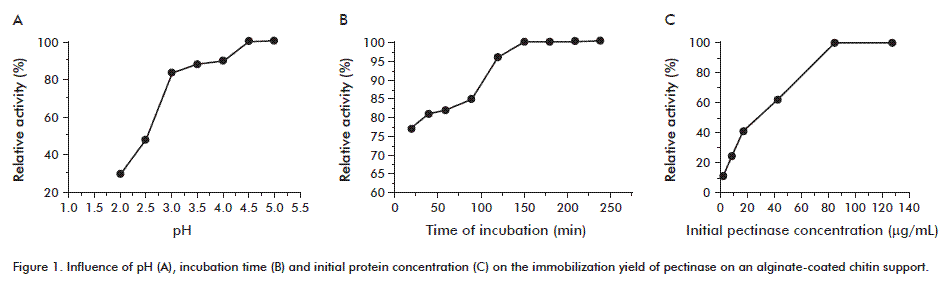
<body><![CDATA[<P   ><font size="2" face="Verdana, Arial, Helvetica, sans-serif"><b>Reuse of immobilized      pectinase </b></font></P >       <P   align="justify" ><font size="2" face="Verdana, Arial, Helvetica, sans-serif">The reuse of immobilized      pectinase was assessed by carrying out the hydrolysis of 0.25 % (w/v) apple      pectin (prepared with pH 4.5 acetate buffer, 20 mM) at 30 &ordm;C while stirring      at 120 rpm; this procedure was performed in consecutive cycles while repeatedly      reusing the enzyme. After each 30 min. cycle, the immobilized pectinase was      washed with acetate buffer (pH 4.5). The activity of the immobilised enzyme      was expressed as a percentage of its residual activity compared to the initial      activity in the first cycle. </font></P >       <P   ><font size="2" face="Verdana, Arial, Helvetica, sans-serif"><b>Statistical analysis      </b> </font></P >       <P   align="justify" ><font size="2" face="Verdana, Arial, Helvetica, sans-serif">All the results showed      were performed at last three times, reporting average values for these determinations.      Hypothesis tests were performed to compare average data using the Student&acute;s      t distribution with a 95 % confidence interval (when significant differences      in the average values were obtained). Mean values and standard deviations      were calculated and represented with the aid of the Origin 7.0 program (NCSS,      USA). </font></P >       <P   >&nbsp;</P >       <P   ><font size="2" face="Verdana, Arial, Helvetica, sans-serif"><B><font size="3">RESULTS      AND DISCUSSION </font> </B></font></P >   <FONT size="+1">        <P   align="justify" ><font size="2" face="Verdana, Arial, Helvetica, sans-serif">The effects of the      following parameters on the immobilization process were investigated: solution      pH, time of pectinase immobilization and protein concentration. <a href="/img/revistas/bta/v30n2/f0103213.gif">Figure      1A</a> shows the effect of solution pH on enzyme activity during the immobilization      process. In this case, the higher catalytic activity for the immobilized pectinase      was observed at pH 4.5, this value being set for further experiments. <a href="/img/revistas/bta/v30n2/f0103213.gif">Figure      1B</a> shows the time course of pectinase immobilization. The immobilization      degree of the en</font><font size="2" face="Verdana, Arial, Helvetica, sans-serif">zyme      was high even at low incubation times, but the maximum immobilized activity      was observed after 2-h incubation. The effect of the bulk solution initial      protein concentration on the immobilized amount of pectinase was determined      by incubating the enzyme with the support for 2 h at 4 &ordm;C, pH 4.5. As      shown in <a href="/img/revistas/bta/v30n2/f0103213.gif">figure 1C</a>, the immobilized activity increases      progressively with the increase in pectinase concentration, reaching maximal      activity at protein concentrations higher than 85 &mu;g/mL. Consequently,      this value of initial pectinase concentration was selected as optimum for      further experiments. Under these conditions, the yield of immobilized protein      was determined as 7.9 mg/g support, representing 70 % of the initial amount      of incubated enzyme. The immobilized pectinase retained 60 % of the initial      specific activity of the native enzyme. </font></P >   <FONT size="+1">        
<P   align="justify" ><font size="2" face="Verdana, Arial, Helvetica, sans-serif">The apparent <I>K</I><Sub>m</Sub><B><I>      </I></B>of the immobilized enzyme was 0.98 g/L, and 0.94 g/L for the free      enzyme. This suggests that the affinity of the active site of the immobilized      enzyme for the substrate was the same as that of the free enzyme, probably      because of no substantial changes on the enzyme conformation during immobilization.      Similar results were obtained for immobilization of pectin lyase from <I>Aspergillus      niger</I> in alginate beads [30] and glutaraldehyde-activated bentonite [31].      </font></P >   <FONT size="+1"><FONT size="+1">        <P   align="justify" ><font size="2" face="Verdana, Arial, Helvetica, sans-serif">The pH dependence      of the activity of native and immobilized pectinase was studied at 30 &ordm;C      in the pH range 2-6. As shown in <a href="#fig2">figure 2</a>, the pH optimum      for the catalytic activity of both immobilized pectinase and the free enzyme      was the same, in the range 4.5-5.0. These results suggest that the immobilization      process did not affect the pH optimum for catalytic activity of the enzyme      significantly. </font></P >       <P   align="center" ><img src="/img/revistas/bta/v30n2/f0203213.gif" width="357" height="331"><a name="fig2"></a></P >       
]]></body>
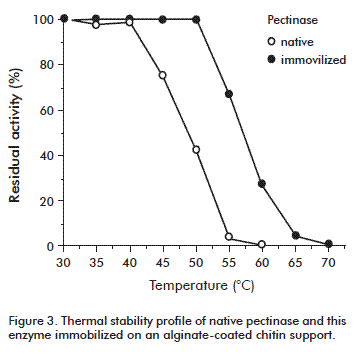
<body><![CDATA[<P   align="justify" ><font size="2" face="Verdana, Arial, Helvetica, sans-serif">Thermal stability      experiments were carried out with free and immobilized enzyme, by incubating      their samples in the absence of substrate at several temperatures. The thermotolerance      of native and immobilized pectinase was evaluated from the activity retained      after heating the enzymes at different temperatures for 10 min. Under these      conditions, the thermostability of immobilized pectinase was improved, as      shown in <a href="#fig3">figure 3</a>. The native enzyme was inactive at 60      &deg;C, while the immobilized enzyme retained over 25 % of its initial activity      at that temperature. A complete loss of activity for modified pectinase was      observed by incubating it at 70 &deg;C. The calculated value for T<Sub>50</Sub>,      defined as the temperature at which 50 % of the initial activity was retained,      was increased from 48.3 to 58 &ordm;C for the enzyme after immobilization      on the negatively-charged support. </font></P >       <P   align="center" ><img src="/img/revistas/bta/v30n2/f0303213.gif" width="358" height="355"><a name="fig3"></a></P >   <FONT size="+1"><FONT size="+1">        
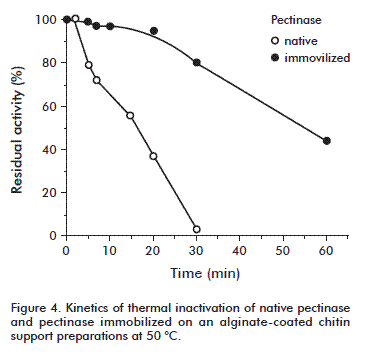
<P   align="justify" ><font size="2" face="Verdana, Arial, Helvetica, sans-serif">The heat stability      of both enzyme variants at 50 &deg;C is shown in <a href="#fig4">Figure 4</a>.      All pectinase preparations lost activity progressively according to a monophasic      inactivation kinetics. The immobilized pectinase showed a reduced enzymatic      activity over time, retaining more than 44 % of its initial activity after      60 min of incubation at 50 &deg;C. However, the enzymatic activity of the      native pectinase decreased and was completely lost after 40 min of incubation      at this temperature. The half-life time of pectinase increased from 13.5 to      138 h after immobilization on the solid support. This improved thermal stability      of the prepared conjugate could be explained by the maintenance of the active      enzyme conformation, since the support material was supposed to preserve the      tertiary structure of the enzyme. This is also in agreement with the results      shown above. Moreover, it could be pointed out that the thermal stability      of an enzyme may indicate the efficiency of the immobilization method and      also reflect the delicate balance between the acquired conformational stability      and the resulting microenvironment surrounding the enzyme. </font></P >       <P   align="center" ><img src="/img/revistas/bta/v30n2/f0403213.gif" width="363" height="352"><a name="fig4"></a></P >       
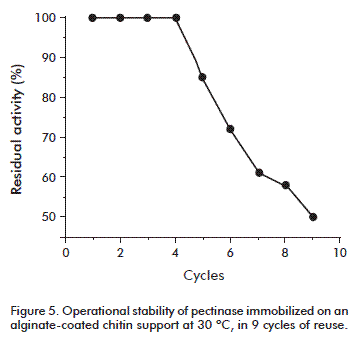
<P   align="justify" ><font size="2" face="Verdana, Arial, Helvetica, sans-serif">The reuse of this      biocatalyst was studied, since this factor is essential for the applications      of the enzyme. The reusability of the immobilized preparation was assessed      by carrying out the hydrolysis of 0.25 % pectin (at 30 &deg;C). In this case,      the immobilized enzyme showed stable when it was repeatedly used for pectin      hydrolysis, retaining near 50 % of its initial activity after 9 cycles of      reuse (<a href="#fig5">Figure 5</a>). Therefore, the retention of the catalytic      activity of the immobilized enzyme derived from its adsorption to the alginate-coated      support. </font></P >       <P   align="center" ><img src="/img/revistas/bta/v30n2/f0503213.gif" width="359" height="344"><a name="fig5"></a></P >       
<P   >&nbsp;</P >       <P   ><font size="2" face="Verdana, Arial, Helvetica, sans-serif"><B><font size="3">CONCLUSIONS      </font></B> </font></P >   <FONT size="+1">        <P   align="justify" ><font size="2" face="Verdana, Arial, Helvetica, sans-serif">In the present work,      we described a new bioconjugate obtained by the non-covalent immobilization      of pecti-nase on an alginate-coated chitin support. The pectinase enzyme preparation      is commercially available and is fairly inexpensive. The biocatalyst prepared      by loading pectinase on sodium alginate-coated chitin showed increased thermostability      compared to the native enzyme. The optimum pH range for catalytic activity      was the same for both variants, the free and immobilized pectinase. This biocatalyst      showed a good operational stability. The results presented here suggest that      enzyme adsorption on alginate-coated chitin support may be useful to improve      the functional and operational properties of other enzymes. </font></P >   <FONT size="+1">        <P   >&nbsp;</P >       ]]></body>
<body><![CDATA[<P   ><font size="2" face="Verdana, Arial, Helvetica, sans-serif"><B><font size="3">ACKNOWLEDGMENTS      </font> </B> </font></P >   <FONT size="+1">        <P   align="justify" ><font size="2" face="Verdana, Arial, Helvetica, sans-serif">HL Ramirez thanks      the Castilla La Mancha University for supporting his stage in Ciudad Real      (2007, 2008 and 2010) and the fellowship from AECI, Spain (2009). The authors      acknowledge the financial support from the Castilla La Mancha government (bilateral      project POII10-0085-5338) and the International Foundation for Science, Stockholm,      Sweden (Grant F/3004-67). We are also grateful to Dr. Reynaldo Vi-llalonga      Santana for his valuable technical assistance. </font></P >       <P   align="justify" >&nbsp;</P >   <FONT size="+1">        <P   align="justify" > </P >       <P   align="justify" ><b><font size="3" face="Verdana, Arial, Helvetica, sans-serif">REFERENCES </font></b></P >       <!-- ref --><P   align="justify" ><font size="2" face="Verdana, Arial, Helvetica, sans-serif">1. Yagiz F, Kazan      D, Nilgun A. Biodiesel production from waste oils by using lipase immobilized      on hydrotalcite and zeolites. Chem Eng J. 2007;134(1):262-7.     </font></P >       <!-- ref --><P   align="justify" ><font size="2" face="Verdana, Arial, Helvetica, sans-serif">2. Erhardt FA, Jordening      HJ. Immobilization of dextranase from Chaetomium erraticum. J Biotechnol.      2007;131(4):440-7.     </font></P >       <!-- ref --><P   align="justify" ><font size="2" face="Verdana, Arial, Helvetica, sans-serif">3. Wen Z, Niemeyer      B. Evaluation of two different Concanavalin A affinity adsorbents for the      adsorption of glucose oxidase. J Chromatogr B Anal Technol Biomed Life Sci.      2007;857(1):149-57.     </font></P >       <P   align="justify" ><font size="2" face="Verdana, Arial, Helvetica, sans-serif">4. Camacho C, Matias      JC, Chico B, Cao R, Gomez L, Simpson BK, et al. Amperometric biosensor for      Hydrogen Peroxide, using supramolecularly immobilized Horseradish Peroxidase      on the &beta;-Cyclodextrin-coated gold electrode. Electroanalysis. 2007;19(24):2538-42.      </font></P >       <!-- ref --><P   align="justify" ><font size="2" face="Verdana, Arial, Helvetica, sans-serif">5. Ye P, Jiang J,      Xu ZK. Adsorption and activity of lipase from Candida rugosa on the chitosan-modified      poly(acrylonitrile-co-maleic acid) membrane surface. Colloids Surf B Biointerfaces.      2007;60(1):62-7.     </font></P >       <!-- ref --><P   align="justify" ><font size="2" face="Verdana, Arial, Helvetica, sans-serif">6. Gomez L, Ram&iacute;rez      HL, Cabrera G, Simpson B, Villalonga R. Immobilization of invertase-chitosan      conjugate on hyaluronic acid-modified chitin. J Food Biochem. 2008;32(2):264-77.          </font></P >       <!-- ref --><P   align="justify" ><font size="2" face="Verdana, Arial, Helvetica, sans-serif">7. Vaidya B, Karale      A, Suthar H, Ingavle G, Pathak T, Ponrathnam S, et al. Immobilization of mushroom      polyphenol oxidase on poly(allyl glycidyl ether-co-ethylene glycol dimethacrylate)      macroporous beaded copolymers. React Funct Polym. 2007; 67(10):905-15.     </font></P >       <!-- ref --><P   align="justify" ><font size="2" face="Verdana, Arial, Helvetica, sans-serif">8. Huang XJ, Ge D,      Xu ZK. Preparation and characterization of stable chitosan nanofibrous membrane      for lipase immobilization. Eur Polym J. 2007;43(9):3710-8.     </font></P >       ]]></body>
<body><![CDATA[<!-- ref --><P   align="justify" ><font size="2" face="Verdana, Arial, Helvetica, sans-serif">9. Haider T, Husain      Q. Calcium alginate entrapped preparations of Aspergillus oryzae beta galactosidase:      its stability and applications in the hydrolysis of lactose. Int J Biol Macromol.      2007;41(1):72-80.     </font></P >       <!-- ref --><P   align="justify" ><font size="2" face="Verdana, Arial, Helvetica, sans-serif">10. Lopez-Gallego      F, Betancor L, Mateo C, Hidalgo A, Alonso-Morales N, Dellamora-Ortiz G, et      al. Enzyme stabilization by glutaraldehyde crosslinking of adsorbed proteins      on aminated supports. J Biotechnol. 2005;119(1):70-5.     </font></P >       <!-- ref --><P   align="justify" ><font size="2" face="Verdana, Arial, Helvetica, sans-serif">11. Saad N, Briand      M, Gardarin C, Briand Y, Michaud P. Production, purification and characterization      of an endopolygalacturonase from Mucor rouxii NRRL 1894. Enzyme Microb Technol.      2007;41(6-7):800-5.     </font></P >       <!-- ref --><P   align="justify" ><font size="2" face="Verdana, Arial, Helvetica, sans-serif">12. Alkorta I, Garbisu      G, Llama MJ, Serra JL. Industrial applications of pectic enzymes: a review.      Process Biochem. 1998;33(1):21-8.     </font></P >       <!-- ref --><P   align="justify" ><font size="2" face="Verdana, Arial, Helvetica, sans-serif">13. Wilkins M, Widmer      W, Grohmann K, Cameron R. Hydrolysis of grapefruit peel waste with cellulase      and pectinase enzymes. Bioresour Technol. 2007;98(8):1596-601.     </font></P >       ]]></body>
<body><![CDATA[<!-- ref --><P   align="justify" ><font size="2" face="Verdana, Arial, Helvetica, sans-serif">14. Saleem Z, Rennebaum      H, Pudel F, Grimm E. Treating bast fibres with pectinase improves mechanical      characteristics of reinforced thermoplastic composites. Composites Sci Technol.      2008;68(2):471-6.     </font></P >       <!-- ref --><P   align="justify" ><font size="2" face="Verdana, Arial, Helvetica, sans-serif">15. Rodriguez-Nogales      J, Ortega N, Perez-Mateos M, Busto MD. Pectin hydrolysis in a free enzyme      membrane reactor: An approach to the wine and juice clarification. Food Chem.      2008;107(1):112-9.     </font></P >       <!-- ref --><P   align="justify" ><font size="2" face="Verdana, Arial, Helvetica, sans-serif">16. Jayani R, Saxena      S, Gupta R. Microbial pectinolytic enzymes: A review. Process Biochem. 2005;40(1):2931-44.          </font></P >       <!-- ref --><P   align="justify" ><font size="2" face="Verdana, Arial, Helvetica, sans-serif">17. Reyes N, Rivas-Ruiz      I, Dominguez-Espinosa R, Sol&iacute;s S. Influence of immobilization parameters      on endopolygalacturonase productivity by hybrid Aspergillus sp. HL entrapped      in calcium alginate. Biochem Eng J. 2006;32(1):43-8.     </font></P >       <P   align="justify" ><font size="2" face="Verdana, Arial, Helvetica, sans-serif">18. Sarto&#287;lu      K, Demir N, Acar J, Mutlu M. The use of commercial pectinase in the fruit      juice industry, part 2: Determination of the kinetic behaviour of immobilized      commercial pectinase. J Food Eng. 2001;47(4):271-4. </font></P >       <P   align="justify" ><font size="2" face="Verdana, Arial, Helvetica, sans-serif">19. Pifferi PG, Spagna      G, Busetto L. The immobilization of endopolygalacturonase on &gamma;-alumina.      J Mol Catal. 1987;42(2):137-49. </font></P >       ]]></body>
<body><![CDATA[<!-- ref --><P   align="justify" ><font size="2" face="Verdana, Arial, Helvetica, sans-serif">20. Lei Z, Bi S.      The silica-coated chitosan particle from a layer-by-layer approach for pectinase      immobilization. Enzyme Microb Technol. 2007;40(5):1442-7.     </font></P >       <!-- ref --><P   align="justify" ><font size="2" face="Verdana, Arial, Helvetica, sans-serif">21. Lei Z, Bi S,Yang      H. Chitosan-tethered the silica particle from a layer-by-layer approach for      pectinase immobilization. Food Chem. 2007;104(2):577-84.     </font></P >       <!-- ref --><P   align="justify" ><font size="2" face="Verdana, Arial, Helvetica, sans-serif">22. Romero C, S&aacute;nchez      S, Manjon S, Iborra JL. Optimization of the pectinesterase/endo-D-polygalacturonase      coimmobilization process Enzyme Microb Technol. 1989;11(12):837-43.     </font></P >       <!-- ref --><P   align="justify" ><font size="2" face="Verdana, Arial, Helvetica, sans-serif">23. Lozano P, Manjon      A, Iborra JL, Canovas M, Romojaro F. Kinetic and operational study of a cross-flow      reactor with immobilized pectolytic enzymes. Enzyme Microb Technol. 1990;12(7):499-505.          </font></P >       <!-- ref --><P   align="justify" ><font size="2" face="Verdana, Arial, Helvetica, sans-serif">24. G&oacute;mez      L, Ram&iacute;rez HL, Villalonga ML, Hern&aacute;ndez J, Villalonga R. Immobilization      of chitosan-modified invertase on alginate-coated chitin support via polyelectrolyte      complex formation. Enzyme Microb Technol. 2006;38(1-2):22-7.     </font></P >       ]]></body>
<body><![CDATA[<!-- ref --><P   align="justify" ><font size="2" face="Verdana, Arial, Helvetica, sans-serif">25. Smidsr&oslash;d      O. Solution properties of alginate. Carbohydr Res. 1970;13(3):359-72.     </font></P >       <!-- ref --><P   align="justify" ><font size="2" face="Verdana, Arial, Helvetica, sans-serif">26. Grasdalen H,      Larsen B, Smidsr&oslash;d O. A. p.m.r. study of the composition and sequence      of uronate residues in alginates. Carbohyd Res. 1979;68(1):23-31.     </font></P >       <!-- ref --><P   align="justify" ><font size="2" face="Verdana, Arial, Helvetica, sans-serif">27. Baxter A, Dillon      M, Taylor KD, Roberts GA. Improved method for i.r. determination of the degree      of N-acetylation of chitosan. Int J Biol Macromol. 1992;14(3):166-9.     </font></P >       <P   align="justify" ><font size="2" face="Verdana, Arial, Helvetica, sans-serif">28. Bernfeld P. Amylases      &alpha; and &beta;. Methods Enzymol. 1955;1:149-58. </font></P >       <!-- ref --><P   align="justify" ><font size="2" face="Verdana, Arial, Helvetica, sans-serif">29. Bradford MM.      A rapid and sensitive method for the quantitation of microgram quantities      of protein utilizing the principle of protein-dye binding. Anal Biochem. 1976;72:248-54.          </font></P >       <!-- ref --><P   align="justify" ><font size="2" face="Verdana, Arial, Helvetica, sans-serif">30. Busto MD, Garcia-Tramontin      KE, Ortega N, Perez-Mateos M. Preparation and properties of an immobilized      pectinlyase for the treatment of fruit juices. Bioresour Technol. 2006;97(13):1477-83.          </font></P >       <!-- ref --><P   align="justify" ><font size="2" face="Verdana, Arial, Helvetica, sans-serif">31. Spagna G, Pifferi      PG, Tramontini M. Immobilization and stabilization of a pectinlyase on synthetic-polymers      for application in the beverage industry. J Mol Catal A-Chem. 1995;101(1):99-105.          </font></P >       <P   align="justify" >&nbsp;</P >       <P   align="justify" >&nbsp;</P >       <P   align="justify" > </P >       <P   align="justify" > </P >       <P   align="justify" ><font size="2" face="Verdana, Arial, Helvetica, sans-serif">Received in April,      2012.     <br>     </font><font size="2" face="Verdana, Arial, Helvetica, sans-serif">Accepted      in November, 2012. </font></P >       <P   align="justify" >&nbsp;</P >       ]]></body>
<body><![CDATA[<P   align="justify" >&nbsp;</P >       <P   align="justify" > </P >       <P   align="justify" > </P >       <P   align="justify" ><font size="2" face="Verdana, Arial, Helvetica, sans-serif"><I>Hector L Ramirez</I>.      Centro de Tecnolog&iacute;a Enzim&aacute;tica, Universidad de Matanzas Camilo      Cienfuegos, Autopista a Varadero, Km 3&frac12;, CP 44740, Matanzas, Cuba.      E-mail: <A href="mailto:hlrperez2003@gmail.com"> <U><U><FONT color="#0000FF">hlrperez2003@gmail.com</font></U></U></A><FONT color="#0000FF">      <FONT color="#000000">, <A href="mailto:hector.ramirez@umcc.cu"> <U><U><FONT color="#0000FF">hector.ramirez@umcc.cu</font></U></U></A><FONT color="#0000FF"><FONT color="#000000">.      </font></font></font></font></font></P >   </font></font></font></font></font></font></font></font></font></font></font></font></font></font></font></font></font></font></font></font></font></font></font></font></font></font></font></font></font></font></font></font></font></font></DIV >      ]]></body><back>
<ref-list>
<ref id="B1">
<label>1</label><nlm-citation citation-type="journal">
<person-group person-group-type="author">
<name>
<surname><![CDATA[Yagiz]]></surname>
<given-names><![CDATA[F]]></given-names>
</name>
<name>
<surname><![CDATA[Kazan]]></surname>
<given-names><![CDATA[D]]></given-names>
</name>
<name>
<surname><![CDATA[Nilgun]]></surname>
<given-names><![CDATA[A]]></given-names>
</name>
</person-group>
<article-title xml:lang="en"><![CDATA[Biodiesel production from waste oils by using lipase immobilized on hydrotalcite and zeolites]]></article-title>
<source><![CDATA[Chem Eng J]]></source>
<year>2007</year>
<volume>134</volume>
<numero>1</numero>
<issue>1</issue>
<page-range>262-7</page-range></nlm-citation>
</ref>
<ref id="B2">
<label>2</label><nlm-citation citation-type="journal">
<person-group person-group-type="author">
<name>
<surname><![CDATA[Erhardt]]></surname>
<given-names><![CDATA[FA]]></given-names>
</name>
<name>
<surname><![CDATA[Jordening]]></surname>
<given-names><![CDATA[HJ]]></given-names>
</name>
</person-group>
<article-title xml:lang="en"><![CDATA[Immobilization of dextranase from Chaetomium erraticum]]></article-title>
<source><![CDATA[J Biotechnol]]></source>
<year>2007</year>
<volume>131</volume>
<numero>4</numero>
<issue>4</issue>
<page-range>440-7</page-range></nlm-citation>
</ref>
<ref id="B3">
<label>3</label><nlm-citation citation-type="journal">
<person-group person-group-type="author">
<name>
<surname><![CDATA[Wen]]></surname>
<given-names><![CDATA[Z]]></given-names>
</name>
<name>
<surname><![CDATA[Niemeyer]]></surname>
<given-names><![CDATA[B]]></given-names>
</name>
</person-group>
<article-title xml:lang="en"><![CDATA[Evaluation of two different Concanavalin A affinity adsorbents for the adsorption of glucose oxidase]]></article-title>
<source><![CDATA[J Chromatogr B Anal Technol Biomed Life Sci]]></source>
<year>2007</year>
<volume>857</volume>
<numero>1</numero>
<issue>1</issue>
<page-range>149-57</page-range></nlm-citation>
</ref>
<ref id="B4">
<label>4</label><nlm-citation citation-type="journal">
<person-group person-group-type="author">
<name>
<surname><![CDATA[Camacho]]></surname>
<given-names><![CDATA[C]]></given-names>
</name>
<name>
<surname><![CDATA[Matias]]></surname>
<given-names><![CDATA[JC]]></given-names>
</name>
<name>
<surname><![CDATA[Chico]]></surname>
<given-names><![CDATA[B]]></given-names>
</name>
<name>
<surname><![CDATA[Cao]]></surname>
<given-names><![CDATA[R]]></given-names>
</name>
<name>
<surname><![CDATA[Gomez]]></surname>
<given-names><![CDATA[L]]></given-names>
</name>
<name>
<surname><![CDATA[Simpson]]></surname>
<given-names><![CDATA[BK]]></given-names>
</name>
</person-group>
<article-title xml:lang="en"><![CDATA[Amperometric biosensor for Hydrogen Peroxide, using supramolecularly immobilized Horseradish Peroxidase on the ?-Cyclodextrin-coated gold electrode]]></article-title>
<source><![CDATA[Electroanalysis]]></source>
<year>2007</year>
<volume>19</volume>
<numero>24</numero>
<issue>24</issue>
<page-range>2538-42</page-range></nlm-citation>
</ref>
<ref id="B5">
<label>5</label><nlm-citation citation-type="journal">
<person-group person-group-type="author">
<name>
<surname><![CDATA[Ye]]></surname>
<given-names><![CDATA[P]]></given-names>
</name>
<name>
<surname><![CDATA[Jiang]]></surname>
<given-names><![CDATA[J]]></given-names>
</name>
<name>
<surname><![CDATA[Xu]]></surname>
<given-names><![CDATA[ZK]]></given-names>
</name>
</person-group>
<article-title xml:lang="en"><![CDATA[Adsorption and activity of lipase from Candida rugosa on the chitosan-modified poly(acrylonitrile-co-maleic acid) membrane surface]]></article-title>
<source><![CDATA[Colloids Surf B Biointerfaces]]></source>
<year>2007</year>
<volume>60</volume>
<numero>1</numero>
<issue>1</issue>
<page-range>62-7</page-range></nlm-citation>
</ref>
<ref id="B6">
<label>6</label><nlm-citation citation-type="journal">
<person-group person-group-type="author">
<name>
<surname><![CDATA[Gomez]]></surname>
<given-names><![CDATA[L]]></given-names>
</name>
<name>
<surname><![CDATA[Ramírez]]></surname>
<given-names><![CDATA[HL]]></given-names>
</name>
<name>
<surname><![CDATA[Cabrera]]></surname>
<given-names><![CDATA[G]]></given-names>
</name>
<name>
<surname><![CDATA[Simpson]]></surname>
<given-names><![CDATA[B]]></given-names>
</name>
<name>
<surname><![CDATA[Villalonga]]></surname>
<given-names><![CDATA[R]]></given-names>
</name>
</person-group>
<article-title xml:lang="en"><![CDATA[Immobilization of invertase-chitosan conjugate on hyaluronic acid-modified chitin]]></article-title>
<source><![CDATA[J Food Biochem]]></source>
<year>2008</year>
<volume>32</volume>
<numero>2</numero>
<issue>2</issue>
<page-range>264-77</page-range></nlm-citation>
</ref>
<ref id="B7">
<label>7</label><nlm-citation citation-type="journal">
<person-group person-group-type="author">
<name>
<surname><![CDATA[Vaidya]]></surname>
<given-names><![CDATA[B]]></given-names>
</name>
<name>
<surname><![CDATA[Karale]]></surname>
<given-names><![CDATA[A]]></given-names>
</name>
<name>
<surname><![CDATA[Suthar]]></surname>
<given-names><![CDATA[H]]></given-names>
</name>
<name>
<surname><![CDATA[Ingavle]]></surname>
<given-names><![CDATA[G]]></given-names>
</name>
<name>
<surname><![CDATA[Pathak]]></surname>
<given-names><![CDATA[T]]></given-names>
</name>
<name>
<surname><![CDATA[Ponrathnam]]></surname>
<given-names><![CDATA[S]]></given-names>
</name>
</person-group>
<article-title xml:lang="en"><![CDATA[Immobilization of mushroom polyphenol oxidase on poly(allyl glycidyl ether-co-ethylene glycol dimethacrylate) macroporous beaded copolymers]]></article-title>
<source><![CDATA[React Funct Polym]]></source>
<year>2007</year>
<volume>67</volume>
<numero>10</numero>
<issue>10</issue>
<page-range>905-15</page-range></nlm-citation>
</ref>
<ref id="B8">
<label>8</label><nlm-citation citation-type="journal">
<person-group person-group-type="author">
<name>
<surname><![CDATA[Huang]]></surname>
<given-names><![CDATA[XJ]]></given-names>
</name>
<name>
<surname><![CDATA[Ge]]></surname>
<given-names><![CDATA[D]]></given-names>
</name>
<name>
<surname><![CDATA[Xu]]></surname>
<given-names><![CDATA[ZK]]></given-names>
</name>
</person-group>
<article-title xml:lang="en"><![CDATA[Preparation and characterization of stable chitosan nanofibrous membrane for lipase immobilization]]></article-title>
<source><![CDATA[Eur Polym J]]></source>
<year>2007</year>
<volume>43</volume>
<numero>9</numero>
<issue>9</issue>
<page-range>3710-8</page-range></nlm-citation>
</ref>
<ref id="B9">
<label>9</label><nlm-citation citation-type="journal">
<person-group person-group-type="author">
<name>
<surname><![CDATA[Haider]]></surname>
<given-names><![CDATA[T]]></given-names>
</name>
<name>
<surname><![CDATA[Husain]]></surname>
<given-names><![CDATA[Q]]></given-names>
</name>
</person-group>
<article-title xml:lang="en"><![CDATA[Calcium alginate entrapped preparations of Aspergillus oryzae beta galactosidase: its stability and applications in the hydrolysis of lactose]]></article-title>
<source><![CDATA[Int J Biol Macromol]]></source>
<year>2007</year>
<volume>41</volume>
<numero>1</numero>
<issue>1</issue>
<page-range>72-80</page-range></nlm-citation>
</ref>
<ref id="B10">
<label>10</label><nlm-citation citation-type="journal">
<person-group person-group-type="author">
<name>
<surname><![CDATA[Lopez-Gallego]]></surname>
<given-names><![CDATA[F]]></given-names>
</name>
<name>
<surname><![CDATA[Betancor]]></surname>
<given-names><![CDATA[L]]></given-names>
</name>
<name>
<surname><![CDATA[Mateo]]></surname>
<given-names><![CDATA[C]]></given-names>
</name>
<name>
<surname><![CDATA[Hidalgo]]></surname>
<given-names><![CDATA[A]]></given-names>
</name>
<name>
<surname><![CDATA[Alonso-Morales]]></surname>
<given-names><![CDATA[N]]></given-names>
</name>
<name>
<surname><![CDATA[Dellamora-Ortiz]]></surname>
<given-names><![CDATA[G]]></given-names>
</name>
</person-group>
<article-title xml:lang="en"><![CDATA[Enzyme stabilization by glutaraldehyde crosslinking of adsorbed proteins on aminated supports]]></article-title>
<source><![CDATA[J Biotechnol]]></source>
<year>2005</year>
<volume>119</volume>
<numero>1</numero>
<issue>1</issue>
<page-range>70-5</page-range></nlm-citation>
</ref>
<ref id="B11">
<label>11</label><nlm-citation citation-type="journal">
<person-group person-group-type="author">
<name>
<surname><![CDATA[Saad]]></surname>
<given-names><![CDATA[N]]></given-names>
</name>
<name>
<surname><![CDATA[Briand]]></surname>
<given-names><![CDATA[M]]></given-names>
</name>
<name>
<surname><![CDATA[Gardarin]]></surname>
<given-names><![CDATA[C]]></given-names>
</name>
<name>
<surname><![CDATA[Briand]]></surname>
<given-names><![CDATA[Y]]></given-names>
</name>
<name>
<surname><![CDATA[Michaud]]></surname>
<given-names><![CDATA[P]]></given-names>
</name>
</person-group>
<article-title xml:lang="en"><![CDATA[Production, purification and characterization of an endopolygalacturonase from Mucor rouxii NRRL 1894]]></article-title>
<source><![CDATA[Enzyme Microb Technol]]></source>
<year>2007</year>
<volume>41</volume>
<numero>6-7</numero>
<issue>6-7</issue>
<page-range>800-5</page-range></nlm-citation>
</ref>
<ref id="B12">
<label>12</label><nlm-citation citation-type="journal">
<person-group person-group-type="author">
<name>
<surname><![CDATA[Alkorta]]></surname>
<given-names><![CDATA[I]]></given-names>
</name>
<name>
<surname><![CDATA[Garbisu]]></surname>
<given-names><![CDATA[G]]></given-names>
</name>
<name>
<surname><![CDATA[Llama]]></surname>
<given-names><![CDATA[MJ]]></given-names>
</name>
<name>
<surname><![CDATA[Serra]]></surname>
<given-names><![CDATA[JL]]></given-names>
</name>
</person-group>
<article-title xml:lang="en"><![CDATA[Industrial applications of pectic enzymes: a review]]></article-title>
<source><![CDATA[Process Biochem]]></source>
<year>1998</year>
<volume>33</volume>
<numero>1</numero>
<issue>1</issue>
<page-range>21-8</page-range></nlm-citation>
</ref>
<ref id="B13">
<label>13</label><nlm-citation citation-type="journal">
<person-group person-group-type="author">
<name>
<surname><![CDATA[Wilkins]]></surname>
<given-names><![CDATA[M]]></given-names>
</name>
<name>
<surname><![CDATA[Widmer]]></surname>
<given-names><![CDATA[W]]></given-names>
</name>
<name>
<surname><![CDATA[Grohmann]]></surname>
<given-names><![CDATA[K]]></given-names>
</name>
<name>
<surname><![CDATA[Cameron]]></surname>
<given-names><![CDATA[R]]></given-names>
</name>
</person-group>
<article-title xml:lang="en"><![CDATA[Hydrolysis of grapefruit peel waste with cellulase and pectinase enzymes]]></article-title>
<source><![CDATA[Bioresour Technol]]></source>
<year>2007</year>
<volume>98</volume>
<numero>8</numero>
<issue>8</issue>
<page-range>1596-601</page-range></nlm-citation>
</ref>
<ref id="B14">
<label>14</label><nlm-citation citation-type="journal">
<person-group person-group-type="author">
<name>
<surname><![CDATA[Saleem]]></surname>
<given-names><![CDATA[Z]]></given-names>
</name>
<name>
<surname><![CDATA[Rennebaum]]></surname>
<given-names><![CDATA[H]]></given-names>
</name>
<name>
<surname><![CDATA[Pudel]]></surname>
<given-names><![CDATA[F]]></given-names>
</name>
<name>
<surname><![CDATA[Grimm]]></surname>
<given-names><![CDATA[E]]></given-names>
</name>
</person-group>
<article-title xml:lang="en"><![CDATA[Treating bast fibres with pectinase improves mechanical characteristics of reinforced thermoplastic composites]]></article-title>
<source><![CDATA[Composites Sci Technol]]></source>
<year>2008</year>
<volume>68</volume>
<numero>2</numero>
<issue>2</issue>
<page-range>471-6</page-range></nlm-citation>
</ref>
<ref id="B15">
<label>15</label><nlm-citation citation-type="journal">
<person-group person-group-type="author">
<name>
<surname><![CDATA[Rodriguez-Nogales]]></surname>
<given-names><![CDATA[J]]></given-names>
</name>
<name>
<surname><![CDATA[Ortega]]></surname>
<given-names><![CDATA[N]]></given-names>
</name>
<name>
<surname><![CDATA[Perez-Mateos]]></surname>
<given-names><![CDATA[M]]></given-names>
</name>
<name>
<surname><![CDATA[Busto]]></surname>
<given-names><![CDATA[MD]]></given-names>
</name>
</person-group>
<article-title xml:lang="en"><![CDATA[Pectin hydrolysis in a free enzyme membrane reactor: An approach to the wine and juice clarification]]></article-title>
<source><![CDATA[Food Chem]]></source>
<year>2008</year>
<volume>107</volume>
<numero>1</numero>
<issue>1</issue>
<page-range>112-9</page-range></nlm-citation>
</ref>
<ref id="B16">
<label>16</label><nlm-citation citation-type="journal">
<person-group person-group-type="author">
<name>
<surname><![CDATA[Jayani]]></surname>
<given-names><![CDATA[R]]></given-names>
</name>
<name>
<surname><![CDATA[Saxena]]></surname>
<given-names><![CDATA[S]]></given-names>
</name>
<name>
<surname><![CDATA[Gupta]]></surname>
<given-names><![CDATA[R]]></given-names>
</name>
</person-group>
<article-title xml:lang="en"><![CDATA[Microbial pectinolytic enzymes: A review]]></article-title>
<source><![CDATA[Process Biochem]]></source>
<year>2005</year>
<volume>40</volume>
<numero>1</numero>
<issue>1</issue>
<page-range>2931-44</page-range></nlm-citation>
</ref>
<ref id="B17">
<label>17</label><nlm-citation citation-type="journal">
<person-group person-group-type="author">
<name>
<surname><![CDATA[Reyes]]></surname>
<given-names><![CDATA[N]]></given-names>
</name>
<name>
<surname><![CDATA[Rivas-Ruiz]]></surname>
<given-names><![CDATA[I]]></given-names>
</name>
<name>
<surname><![CDATA[Dominguez-Espinosa]]></surname>
<given-names><![CDATA[R]]></given-names>
</name>
<name>
<surname><![CDATA[Solís]]></surname>
<given-names><![CDATA[S]]></given-names>
</name>
</person-group>
<article-title xml:lang="en"><![CDATA[Influence of immobilization parameters on endopolygalacturonase productivity by hybrid Aspergillus sp. HL entrapped in calcium alginate]]></article-title>
<source><![CDATA[Biochem Eng J]]></source>
<year>2006</year>
<volume>32</volume>
<numero>1</numero>
<issue>1</issue>
<page-range>43-8</page-range></nlm-citation>
</ref>
<ref id="B18">
<label>18</label><nlm-citation citation-type="journal">
<person-group person-group-type="author">
<name>
<surname><![CDATA[Sartoglu]]></surname>
<given-names><![CDATA[K]]></given-names>
</name>
<name>
<surname><![CDATA[Demir]]></surname>
<given-names><![CDATA[N]]></given-names>
</name>
<name>
<surname><![CDATA[Acar]]></surname>
<given-names><![CDATA[J]]></given-names>
</name>
<name>
<surname><![CDATA[Mutlu]]></surname>
<given-names><![CDATA[M]]></given-names>
</name>
</person-group>
<article-title xml:lang="en"><![CDATA[The use of commercial pectinase in the fruit juice industry: , part 2: Determination of the kinetic behaviour of immobilized commercial pectinase]]></article-title>
<source><![CDATA[J Food Eng]]></source>
<year>2001</year>
<volume>47</volume>
<numero>4</numero>
<issue>4</issue>
<page-range>271-4</page-range></nlm-citation>
</ref>
<ref id="B19">
<label>19</label><nlm-citation citation-type="journal">
<person-group person-group-type="author">
<name>
<surname><![CDATA[Pifferi]]></surname>
<given-names><![CDATA[PG]]></given-names>
</name>
<name>
<surname><![CDATA[Spagna]]></surname>
<given-names><![CDATA[G]]></given-names>
</name>
<name>
<surname><![CDATA[Busetto]]></surname>
<given-names><![CDATA[L]]></given-names>
</name>
</person-group>
<article-title xml:lang="en"><![CDATA[The immobilization of endopolygalacturonase on &gamma;-alumina]]></article-title>
<source><![CDATA[J Mol Catal]]></source>
<year>1987</year>
<volume>42</volume>
<numero>2</numero>
<issue>2</issue>
<page-range>137-49</page-range></nlm-citation>
</ref>
<ref id="B20">
<label>20</label><nlm-citation citation-type="journal">
<person-group person-group-type="author">
<name>
<surname><![CDATA[Lei]]></surname>
<given-names><![CDATA[Z]]></given-names>
</name>
<name>
<surname><![CDATA[Bi]]></surname>
<given-names><![CDATA[S]]></given-names>
</name>
</person-group>
<article-title xml:lang="en"><![CDATA[The silica-coated chitosan particle from a layer-by-layer approach for pectinase immobilization]]></article-title>
<source><![CDATA[Enzyme Microb Technol]]></source>
<year>2007</year>
<volume>40</volume>
<numero>5</numero>
<issue>5</issue>
<page-range>1442-7</page-range></nlm-citation>
</ref>
<ref id="B21">
<label>21</label><nlm-citation citation-type="journal">
<person-group person-group-type="author">
<name>
<surname><![CDATA[Lei]]></surname>
<given-names><![CDATA[Z]]></given-names>
</name>
<name>
<surname><![CDATA[Bi]]></surname>
<given-names><![CDATA[S]]></given-names>
</name>
<name>
<surname><![CDATA[Yang]]></surname>
<given-names><![CDATA[H]]></given-names>
</name>
</person-group>
<article-title xml:lang="en"><![CDATA[Chitosan-tethered the silica particle from a layer-by-layer approach for pectinase immobilization]]></article-title>
<source><![CDATA[Food Chem]]></source>
<year>2007</year>
<volume>104</volume>
<numero>2</numero>
<issue>2</issue>
<page-range>577-84</page-range></nlm-citation>
</ref>
<ref id="B22">
<label>22</label><nlm-citation citation-type="journal">
<person-group person-group-type="author">
<name>
<surname><![CDATA[Romero]]></surname>
<given-names><![CDATA[C]]></given-names>
</name>
<name>
<surname><![CDATA[Sánchez]]></surname>
<given-names><![CDATA[S]]></given-names>
</name>
<name>
<surname><![CDATA[Manjon]]></surname>
<given-names><![CDATA[S]]></given-names>
</name>
<name>
<surname><![CDATA[Iborra]]></surname>
<given-names><![CDATA[JL]]></given-names>
</name>
</person-group>
<article-title xml:lang="en"><![CDATA[Optimization of the pectinesterase/endo-D-polygalacturonase coimmobilization process]]></article-title>
<source><![CDATA[Enzyme Microb Technol]]></source>
<year>1989</year>
<volume>11</volume>
<numero>12</numero>
<issue>12</issue>
<page-range>837-43</page-range></nlm-citation>
</ref>
<ref id="B23">
<label>23</label><nlm-citation citation-type="journal">
<person-group person-group-type="author">
<name>
<surname><![CDATA[Lozano]]></surname>
<given-names><![CDATA[P]]></given-names>
</name>
<name>
<surname><![CDATA[Manjon]]></surname>
<given-names><![CDATA[A]]></given-names>
</name>
<name>
<surname><![CDATA[Iborra]]></surname>
<given-names><![CDATA[JL]]></given-names>
</name>
<name>
<surname><![CDATA[Canovas]]></surname>
<given-names><![CDATA[M]]></given-names>
</name>
<name>
<surname><![CDATA[Romojaro]]></surname>
<given-names><![CDATA[F]]></given-names>
</name>
</person-group>
<article-title xml:lang="en"><![CDATA[Kinetic and operational study of a cross-flow reactor with immobilized pectolytic enzymes]]></article-title>
<source><![CDATA[Enzyme Microb Technol]]></source>
<year>1990</year>
<volume>12</volume>
<numero>7</numero>
<issue>7</issue>
<page-range>499-505</page-range></nlm-citation>
</ref>
<ref id="B24">
<label>24</label><nlm-citation citation-type="journal">
<person-group person-group-type="author">
<name>
<surname><![CDATA[Gómez]]></surname>
<given-names><![CDATA[L]]></given-names>
</name>
<name>
<surname><![CDATA[Ramírez]]></surname>
<given-names><![CDATA[HL]]></given-names>
</name>
<name>
<surname><![CDATA[Villalonga]]></surname>
<given-names><![CDATA[ML]]></given-names>
</name>
<name>
<surname><![CDATA[Hernández]]></surname>
<given-names><![CDATA[J]]></given-names>
</name>
<name>
<surname><![CDATA[Villalonga]]></surname>
<given-names><![CDATA[R]]></given-names>
</name>
</person-group>
<article-title xml:lang="en"><![CDATA[Immobilization of chitosan-modified invertase on alginate-coated chitin support via polyelectrolyte complex formation]]></article-title>
<source><![CDATA[Enzyme Microb Technol]]></source>
<year>2006</year>
<volume>38</volume>
<numero>1-2</numero>
<issue>1-2</issue>
<page-range>22-7</page-range></nlm-citation>
</ref>
<ref id="B25">
<label>25</label><nlm-citation citation-type="journal">
<person-group person-group-type="author">
<name>
<surname><![CDATA[Smidsrød]]></surname>
<given-names><![CDATA[O]]></given-names>
</name>
</person-group>
<article-title xml:lang="en"><![CDATA[Solution properties of alginate]]></article-title>
<source><![CDATA[Carbohydr Res]]></source>
<year>1970</year>
<volume>13</volume>
<numero>3</numero>
<issue>3</issue>
<page-range>359-72</page-range></nlm-citation>
</ref>
<ref id="B26">
<label>26</label><nlm-citation citation-type="journal">
<person-group person-group-type="author">
<name>
<surname><![CDATA[Grasdalen]]></surname>
<given-names><![CDATA[H]]></given-names>
</name>
<name>
<surname><![CDATA[Larsen]]></surname>
<given-names><![CDATA[B]]></given-names>
</name>
<name>
<surname><![CDATA[Smidsrød]]></surname>
<given-names><![CDATA[O]]></given-names>
</name>
</person-group>
<article-title xml:lang="en"><![CDATA[A. p.m.r. study of the composition and sequence of uronate residues in alginates]]></article-title>
<source><![CDATA[Carbohyd Res]]></source>
<year>1979</year>
<volume>68</volume>
<numero>1</numero>
<issue>1</issue>
<page-range>23-31</page-range></nlm-citation>
</ref>
<ref id="B27">
<label>27</label><nlm-citation citation-type="journal">
<person-group person-group-type="author">
<name>
<surname><![CDATA[Baxter]]></surname>
<given-names><![CDATA[A]]></given-names>
</name>
<name>
<surname><![CDATA[Dillon]]></surname>
<given-names><![CDATA[M]]></given-names>
</name>
<name>
<surname><![CDATA[Taylor]]></surname>
<given-names><![CDATA[KD]]></given-names>
</name>
<name>
<surname><![CDATA[Roberts]]></surname>
<given-names><![CDATA[GA]]></given-names>
</name>
</person-group>
<article-title xml:lang="en"><![CDATA[Improved method for i.r. determination of the degree of N-acetylation of chitosan]]></article-title>
<source><![CDATA[Int J Biol Macromol]]></source>
<year>1992</year>
<volume>14</volume>
<numero>3</numero>
<issue>3</issue>
<page-range>166-9</page-range></nlm-citation>
</ref>
<ref id="B28">
<label>28</label><nlm-citation citation-type="journal">
<person-group person-group-type="author">
<name>
<surname><![CDATA[Bernfeld]]></surname>
<given-names><![CDATA[P]]></given-names>
</name>
</person-group>
<article-title xml:lang="en"><![CDATA[Amylases &alpha; and &beta;]]></article-title>
<source><![CDATA[Methods Enzymol]]></source>
<year>1955</year>
<volume>1</volume>
<page-range>149-58</page-range></nlm-citation>
</ref>
<ref id="B29">
<label>29</label><nlm-citation citation-type="journal">
<person-group person-group-type="author">
<name>
<surname><![CDATA[Bradford]]></surname>
<given-names><![CDATA[MM]]></given-names>
</name>
</person-group>
<article-title xml:lang="en"><![CDATA[A rapid and sensitive method for the quantitation of microgram quantities of protein utilizing the principle of protein-dye binding]]></article-title>
<source><![CDATA[Anal Biochem]]></source>
<year>1976</year>
<volume>72</volume>
<page-range>248-54</page-range></nlm-citation>
</ref>
<ref id="B30">
<label>30</label><nlm-citation citation-type="journal">
<person-group person-group-type="author">
<name>
<surname><![CDATA[Busto]]></surname>
<given-names><![CDATA[MD]]></given-names>
</name>
<name>
<surname><![CDATA[Garcia-Tramontin]]></surname>
<given-names><![CDATA[KE]]></given-names>
</name>
<name>
<surname><![CDATA[Ortega]]></surname>
<given-names><![CDATA[N]]></given-names>
</name>
<name>
<surname><![CDATA[Perez-Mateos]]></surname>
<given-names><![CDATA[M]]></given-names>
</name>
</person-group>
<article-title xml:lang="en"><![CDATA[Preparation and properties of an immobilized pectinlyase for the treatment of fruit juices]]></article-title>
<source><![CDATA[Bioresour Technol]]></source>
<year>2006</year>
<volume>97</volume>
<numero>13</numero>
<issue>13</issue>
<page-range>1477-83</page-range></nlm-citation>
</ref>
<ref id="B31">
<label>31</label><nlm-citation citation-type="journal">
<person-group person-group-type="author">
<name>
<surname><![CDATA[Spagna]]></surname>
<given-names><![CDATA[G]]></given-names>
</name>
<name>
<surname><![CDATA[Pifferi]]></surname>
<given-names><![CDATA[PG]]></given-names>
</name>
<name>
<surname><![CDATA[Tramontini]]></surname>
<given-names><![CDATA[M]]></given-names>
</name>
</person-group>
<article-title xml:lang="en"><![CDATA[Immobilization and stabilization of a pectinlyase on synthetic-polymers for application in the beverage industry]]></article-title>
<source><![CDATA[J Mol Catal A-Chem]]></source>
<year>1995</year>
<volume>101</volume>
<numero>1</numero>
<issue>1</issue>
<page-range>99-105</page-range></nlm-citation>
</ref>
</ref-list>
</back>
</article>