<?xml version="1.0" encoding="ISO-8859-1"?><article xmlns:mml="http://www.w3.org/1998/Math/MathML" xmlns:xlink="http://www.w3.org/1999/xlink" xmlns:xsi="http://www.w3.org/2001/XMLSchema-instance">
<front>
<journal-meta>
<journal-id>1027-2852</journal-id>
<journal-title><![CDATA[Biotecnología Aplicada]]></journal-title>
<abbrev-journal-title><![CDATA[Biotecnol Apl]]></abbrev-journal-title>
<issn>1027-2852</issn>
<publisher>
<publisher-name><![CDATA[Editorial Elfos Scientiae]]></publisher-name>
</publisher>
</journal-meta>
<article-meta>
<article-id>S1027-28522013000200004</article-id>
<title-group>
<article-title xml:lang="en"><![CDATA[Zea mays L. plant growth promotion by Tsukamurella paurometabola strain C-924]]></article-title>
<article-title xml:lang="es"><![CDATA[Promoción del crecimiento de plantas de Zea mays L. por Tsukamurella paurometabola cepa C-924]]></article-title>
</title-group>
<contrib-group>
<contrib contrib-type="author">
<name>
<surname><![CDATA[Marín]]></surname>
<given-names><![CDATA[Marieta]]></given-names>
</name>
<xref ref-type="aff" rid="A01"/>
</contrib>
<contrib contrib-type="author">
<name>
<surname><![CDATA[Wong]]></surname>
<given-names><![CDATA[Idania]]></given-names>
</name>
<xref ref-type="aff" rid="A01"/>
</contrib>
<contrib contrib-type="author">
<name>
<surname><![CDATA[Mena]]></surname>
<given-names><![CDATA[Jesús]]></given-names>
</name>
<xref ref-type="aff" rid="A01"/>
</contrib>
<contrib contrib-type="author">
<name>
<surname><![CDATA[Morán]]></surname>
<given-names><![CDATA[Rolando]]></given-names>
</name>
<xref ref-type="aff" rid="A01"/>
</contrib>
<contrib contrib-type="author">
<name>
<surname><![CDATA[Pimentel]]></surname>
<given-names><![CDATA[Eulogio]]></given-names>
</name>
<xref ref-type="aff" rid="A01"/>
</contrib>
<contrib contrib-type="author">
<name>
<surname><![CDATA[Sánchez]]></surname>
<given-names><![CDATA[Ileana]]></given-names>
</name>
<xref ref-type="aff" rid="A01"/>
</contrib>
<contrib contrib-type="author">
<name>
<surname><![CDATA[Basulto]]></surname>
<given-names><![CDATA[Rosa]]></given-names>
</name>
<xref ref-type="aff" rid="A01"/>
</contrib>
<contrib contrib-type="author">
<name>
<surname><![CDATA[Moreira]]></surname>
<given-names><![CDATA[Alain]]></given-names>
</name>
<xref ref-type="aff" rid="A01"/>
</contrib>
</contrib-group>
<aff id="A01">
<institution><![CDATA[,Centro de Ingeniería Genética y Biotecnología, CIGB  ]]></institution>
<addr-line><![CDATA[Camagüey ]]></addr-line>
<country>Cuba</country>
</aff>
<pub-date pub-type="pub">
<day>00</day>
<month>06</month>
<year>2013</year>
</pub-date>
<pub-date pub-type="epub">
<day>00</day>
<month>06</month>
<year>2013</year>
</pub-date>
<volume>30</volume>
<numero>2</numero>
<fpage>105</fpage>
<lpage>110</lpage>
<copyright-statement/>
<copyright-year/>
<self-uri xlink:href="http://scielo.sld.cu/scielo.php?script=sci_arttext&amp;pid=S1027-28522013000200004&amp;lng=en&amp;nrm=iso"></self-uri><self-uri xlink:href="http://scielo.sld.cu/scielo.php?script=sci_abstract&amp;pid=S1027-28522013000200004&amp;lng=en&amp;nrm=iso"></self-uri><self-uri xlink:href="http://scielo.sld.cu/scielo.php?script=sci_pdf&amp;pid=S1027-28522013000200004&amp;lng=en&amp;nrm=iso"></self-uri><abstract abstract-type="short" xml:lang="en"><p><![CDATA[Plant growth-promoting bacteria is a group in rhizosphere colonizing bacteria, which produces substances that enhance plant growth and/or protect them against pathogens. Tsukamurella paurometabola C-924 is a strain with nematocidal activity isolated from the rhizospheric soil of a banana plantation in Camagüey, Cuba. The aim of this work was to determine plant growth promoting traits of T. paurometabola C-924 as well as to assess the effect of this strain on the growth of Zea mays L. in the absence of nematodes. Results shown that T. paurometabola C-924 produced indole acetic acid, proteases, chitinases and had the capability to solubilize calcium triphosphate. T. paurometabola C-924 also showed antagonistic activity versus the phytopathogenic fungi tested (Sarocladium oryzae, Alternaria longipes, Pestalotia palmarum and Pythium debaryanum) and it improved the development of Z. mays plants in greenhouse conditions. T. paurometabola C-924 might have potential in future field application not only as a nematocidic agent, but also as plant growth promoter. This is the first report of an isolate of T. paurometabola with plant growth promoting activity.]]></p></abstract>
<abstract abstract-type="short" xml:lang="es"><p><![CDATA[Las bacterias promotoras del crecimiento vegetal son colonizadoras de la rizosfera y producen sustancias que estimulan el crecimiento de las plantas y/o las protegen contra organismos patógenos. Tsukamurella paurometabola C-924 es una cepa con actividad nematicida aislada de suelo rizosférico en una plantación de banana en Camagüey, Cuba. El objetivo de este trabajo fue determinar algunos de los caracteres promotores del crecimiento vegetal de T. paurometabola C-924 y evaluar el efecto de esta cepa en el crecimiento de Zea mays L. en ausencia de nematodos. Los resultados mostraron que T. paurometabola C-924 produce ácido indolacético, proteasas y quitinasas y solubiliza fosfato tricálcico. También mostró actividad antagónica contra los hongos fitopatógenos ensayados (Sarocladium oryzae, Alternaria longipes, Pestalotia palmarum and Pythium debaryanum) y estimuló el desarrollo de las plantas de Z. mays L. en condiciones de invernadero. T. paurometabola C-924 es potencialmente aplicable en el campo no solo como agente nematicida, sino también como promotor del crecimiento vegetal.]]></p></abstract>
<kwd-group>
<kwd lng="en"><![CDATA[Tsukamurella]]></kwd>
<kwd lng="en"><![CDATA[plant growth promoting rhizobacteria]]></kwd>
<kwd lng="en"><![CDATA[indole acetic acid]]></kwd>
<kwd lng="en"><![CDATA[phosphate solubilization]]></kwd>
<kwd lng="en"><![CDATA[antifungal activity]]></kwd>
<kwd lng="en"><![CDATA[Zea mays]]></kwd>
<kwd lng="es"><![CDATA[Tsukamurella]]></kwd>
<kwd lng="es"><![CDATA[bacterias promotoras del crecimiento vegetal]]></kwd>
<kwd lng="es"><![CDATA[ácido indolacético]]></kwd>
<kwd lng="es"><![CDATA[solubilización de fosfatos]]></kwd>
<kwd lng="es"><![CDATA[actividad antifúngica]]></kwd>
<kwd lng="es"><![CDATA[Zea mays]]></kwd>
</kwd-group>
</article-meta>
</front><body><![CDATA[ <DIV class="Sect"   >        <P   align="right" ><font size="2" color="#000000" face="Verdana, Arial, Helvetica, sans-serif"><b>RESEARCH</b>      </font></P >   <FONT size="+1" color="#000000">        <P   > </P >       <P   >&nbsp;</P >       <P   ><font size="4" face="Verdana, Arial, Helvetica, sans-serif"><b><i>Zea mays</i>      L. plant growth promotion by <I>Tsukamurella paurometabola</I> strain C-924      </b></font></P >       <P   > </P >       <P   >&nbsp;</P >       <P   ><font size="3" face="Verdana, Arial, Helvetica, sans-serif"><b>Promoci&oacute;n      del crecimiento de plantas de <i>Zea mays</i> L. por <I>Tsukamurella paurometabola</I>      cepa C-924 </b></font></P >       <P   > </P >       <P   > </P >       ]]></body>
<body><![CDATA[<P   >&nbsp;</P >       <P   >&nbsp;</P >       <P   ><font size="2" face="Verdana, Arial, Helvetica, sans-serif"><b>Marieta Mar&iacute;n,      Idania Wong, Jes&uacute;s Mena, Rolando Mor&aacute;n, Eulogio Pimentel, Ileana      S&aacute;nchez, Rosa Basulto, Alain Moreira</b></font></P >       <P   ><font size="2" face="Verdana, Arial, Helvetica, sans-serif">Centro de Ingenier&iacute;a      Gen&eacute;tica y Biotecnolog&iacute;a, CIGB. Circunvalaci&oacute;n Norte      y Ave. Finlay, PO Box 387, CP 70 100, Camag&uuml;ey, Cuba. </font></P >       <P   >&nbsp;</P >       <P   >&nbsp;</P >   </font>   <hr>   <FONT size="+1" color="#000000"> <font size="2" face="Verdana, Arial, Helvetica, sans-serif"><B>ABSTRACT    </b></font><FONT size="+1">        <P   align="justify" ><font size="2" face="Verdana, Arial, Helvetica, sans-serif">Plant growth-promoting      bacteria is a group in rhizosphere colonizing bacteria, which produces substances      that enhance plant growth and/or protect them against pathogens. <I>Tsukamurella      paurometabola</I> C-924 is a strain with nematocidal activity isolated from      the rhizospheric soil of a banana plantation in Camag&uuml;ey, Cuba. The aim      of this work was to determine plant growth promoting traits of T. paurometabola      C-924 as well as to assess the effect of this strain on the growth of <I>Zea      mays</I> L. in the absence of nematodes. Results shown that <I>T. paurometabola</I>      C-924 produced indole acetic acid, proteases, chitinases and had the capability      to solubilize calcium triphosphate. <I>T. paurometabola</I> C-924 also showed      antagonistic activity versus the phytopathogenic fungi tested (<I>Sarocladium      oryzae</I>, <I>Alternaria longipes</I>, <I>Pestalotia palmarum</I> and <I>Pythium      debaryanum</I>) and it improved the development of <I>Z. mays</I> plants in      greenhouse conditions. <I>T. paurometabola</I> C-924 might have potential      in future field application not only as a nematocidic agent, but also as plant      growth promoter. This is the first report of an isolate of <I>T. paurometabola</I>      with plant growth promoting activity. </font></P >       <P   ><font size="2" face="Verdana, Arial, Helvetica, sans-serif"><b>Keywords:</b>      <I>Tsukamurella</I>, plant growth promoting rhizobacteria, indole acetic acid,      phosphate solubilization, antifungal activity, <I>Zea mays</I>. </font></P >   </font></font>   <hr>   <FONT size="+1" color="#000000"><FONT size="+1">        <P   > </P >   <FONT size="+1">        <P   ><b><font size="2" face="Verdana, Arial, Helvetica, sans-serif">RESUMEN</font></b><font size="2" face="Verdana, Arial, Helvetica, sans-serif">      </font></P >       ]]></body>
<body><![CDATA[<P   align="justify" ><font size="2" face="Verdana, Arial, Helvetica, sans-serif">Las bacterias promotoras      del crecimiento vegetal son colonizadoras de la rizosfera y producen sustancias      que estimulan el crecimiento de las plantas y/o las protegen contra organismos      pat&oacute;genos. <I>Tsukamurella paurometabola</I> C-924 es una cepa con      actividad nematicida aislada de suelo rizosf&eacute;rico en una plantaci&oacute;n      de banana en Camag&uuml;ey, Cuba. El objetivo de este trabajo fue determinar      algunos de los caracteres promotores del crecimiento vegetal de <I>T. paurometabola</I>      C-924 y evaluar el efecto de esta cepa en el crecimiento de <I>Zea mays </I>L.      en ausencia de nematodos. Los resultados mostraron que <I>T. paurometabola</I>      C-924 produce &aacute;cido indolac&eacute;tico, proteasas y quitinasas y solubiliza      fosfato tric&aacute;lcico. Tambi&eacute;n mostr&oacute; actividad antag&oacute;nica      contra los hongos fitopat&oacute;genos ensayados (<I>Sarocladium oryzae, Alternaria      longipes</I>, <I>Pestalotia palmarum </I>and <I>Pythium debaryanum</I>) y      estimul&oacute; el desarrollo de las plantas de <I>Z. mays </I>L. en condiciones      de invernadero. <I>T. paurometabola </I>C-924 es potencialmente aplicable      en el campo no solo como agente nematicida, sino tambi&eacute;n como promotor      del crecimiento vegetal. </font></P >   <FONT size="+1">        <P   ><font size="2" face="Verdana, Arial, Helvetica, sans-serif"><b>Palabras clave:</b>      <I>Tsukamurella</I>, bacterias promotoras del crecimiento vegetal, &aacute;cido      indolac&eacute;tico, solubilizaci&oacute;n de fosfatos, actividad antif&uacute;ngica,      <I>Zea mays</I>. </font></P >   </font></font></font></font>   <hr>   <FONT size="+1" color="#000000"><FONT size="+1"><FONT size="+1"><FONT size="+1">        <P   > </P >   <FONT size="+1">        <P   >&nbsp;</P >       <P   >&nbsp;</P >       <P   ><font size="3" face="Verdana, Arial, Helvetica, sans-serif"><b>INTRODUCTION </b></font></P >       <P   align="justify" ><font size="2" face="Verdana, Arial, Helvetica, sans-serif">Modern agriculture      is heavily dependent on the application of chemical inputs, particularly fertilizers      and pesticides. However, overuse of fertilizers can cause unanticipated environmental      impacts. Many concerns regarding human health and environmental protection      with agriculture are focused on reduction in the use of chemical pesticides      and inorganic fertilizers, which compelling the search for alternatives that      enhance soil and environmental quality [1]. One potential way to decrease      negative environmental impacts resulting from continued use of chemical fertilizers      is inoculation with plant growth promoting rhizobacteria (PGPR) [2]. </font></P >   <FONT size="+1">        <P   align="justify" ><font size="2" face="Verdana, Arial, Helvetica, sans-serif">The PGPR is a group      of rhizosphere colonizing bacteria, which produce substances that increase      the growth of plants and/or protect them against pathogens [3]. One of the      important mechanisms for these beneficial effects is PGPR-elicited enhanced      nutrient availability and nutrient use efficiency. Recently, Glick <I>et al</I>.      [4] reviewed that some PGPR may influence plant growth by synthesizing plant      hormones or facilitating uptake of nutrients from the soil through different      mechanisms, such as: synthesis of phytohormones, atmospheric dinitrogen fixation      and solubilization of inorganic phosphate. </font></P >       <P   align="justify" ><font size="2" face="Verdana, Arial, Helvetica, sans-serif">In addition to their      primary effects on plant productivity and health, recent work has shown that      these beneficial microorganisms possess secondary effects that may bestow      them increased interest for plant growers [5]. More specifically, PGPR have      shown activities related to biocontrol of soilborne pathogens. Conversely,      biocontrol agents have demonstrated properties that directly promote plant      growth [6]. </font></P >       <P   align="justify" ><font size="2" face="Verdana, Arial, Helvetica, sans-serif">Most approaches for      biological control of plant diseases have used single biocontrol agent as      antagonist against a single pathogen, which may partially account for the      reported inconsistent performance by biocontrol preparations [7]. The soil      microorganisms that suppress plant diseases have evolved with plants and are      primary factors determining plant health. However, the importance of these      bacteria has not been generally recognized and hence, they have not been a      focus of interest for developing them as biofertilizers and exploitation.      The relatively narrow spectrum activity of biocontrol agents against plant      pathogens is a major constraint limiting their commercial use. To transcend      this difficulty, strains with superior biocontrol and plant growth promotion      activities must be developed, with multifaceted approaches in field conditions      [6]. </font></P >       ]]></body>
<body><![CDATA[<P   align="justify" ><font size="2" face="Verdana, Arial, Helvetica, sans-serif">In this sense, the      use of <I>Tsukamurella paurometabola</I> C-924 was explored. It is a bacterial      strain isolated from rhizospheric soil in Camag&uuml;ey, Cuba, which was obtained      by screening for isolating strains with potential biological control activity      on plant parasitic nematodes. Later on, in field experiments, <I>T. paurometabola</I>      C-924 showed strong activity against <I>Meloidogyne incognita</I>, <I>Radopholus      similis</I> and <I>Pratylenchus</I> spp. [8]. However, some features observed      in plant development indicated that the strain also increased plant growth      in the absence of these pathogens. For this reason, the aim of this work was      to determine some of the plant growth promotion traits of <I>T. paurometabola</I>      C-924 and to assess the effect of this strain on the growth of <I>Zea mays</I>      L. in the absence of nematodes. </font></P >       <P   align="justify" > </P >       <P   >&nbsp;</P >       <P   ><font size="2" face="Verdana, Arial, Helvetica, sans-serif"><B><font size="3">MATERIALS      AND METHODS </font></b></font></P >   <FONT size="+1">        <P   ><font size="2" face="Verdana, Arial, Helvetica, sans-serif"><b>Assays for growth      promotion abilities of <I>T. paurometabola</I> C-924 </b></font></P >   <FONT size="+1">        <P   ><font size="2" face="Verdana, Arial, Helvetica, sans-serif"><I><b>Bacterial strain      and culture conditions </b></I></font></P >       <P   align="justify" ><font size="2" face="Verdana, Arial, Helvetica, sans-serif"><I>T. paurometabola      </I>C-924 was obtained from the collection of the Centre for Genetic Engineering      and Biotechnology of Camag&uuml;ey, Cuba. The bacterium was cultured in Tryptone      Soy Agar (15.0 g/L enzymatic digest of casein, 5.0 g/L soy peptone and 5.0      g/L NaCl; Sigma, USA) at 37 &ordm;C for 48 h. </font></P >       <P   ><font size="2" face="Verdana, Arial, Helvetica, sans-serif"><I><b>Indole acetic      acid production </b></I></font></P >       <P   align="justify" ><font size="2" face="Verdana, Arial, Helvetica, sans-serif"><I>T. paurometabola      </I>C-924 was grown at 37 &ordm;C in the dark with gently shaking in 250 mL      of Tryptone Soy Broth (TSB). At different times (0, 3, 6, 9, 12, 24, 48, 72,      96, 120 and 144 h) 2.5 mL samples were withdrawn. One milliliter was taken      to determine the optical density of the culture at 600 nm using a spectrophotometer      Spectronic 20 D (Thermo Scientific, USA). The rest was centrifuged at 7500      &times; <I>g</I> for 10 min and the supernatants were filtered through a 0.2      &micro;m membrane. One milliliter of each filtrate was mixed with 1 mL of      Salkowski reagent [9]. The mixture was incubated at room temperature for 30      min and the absorbance was measured at 530 nm. Concentration of indole acetic      acid (IAA) produced was measured with the help of standard graph of IAA (Sigma,      USA) obtained in the range of 2-50 &micro;g/mL. Experiments were done in triplicate.      </font></P >       <P   ><font size="2" face="Verdana, Arial, Helvetica, sans-serif"><I><b>Mineral phosphate      solubilization </b></I></font></P >       ]]></body>
<body><![CDATA[<P   align="justify" ><font size="2" face="Verdana, Arial, Helvetica, sans-serif">Quantitative estimation      of phosphate solubilization was carried out in NBRIP medium (10.0 g/L glucose,      5.0 g/L Ca<Sub>3</Sub>(PO<Sub>4</Sub>)<Sub>2</Sub>, 5.0 g/L MgCl<Sub>2</Sub>&sdot;6      H<Sub>2</Sub>O, 0.25 g/L MgSO<Sub>4</Sub>&sdot;7H<Sub>2</Sub>O, 0.2 g/L KCl      and 0.1 g/L (NH<Sub>4</Sub>)<Sub>2</Sub>SO<Sub>4</Sub>) [10]. Autoclaved uninoculated      medium served as control. Isolated colonies of <I>T. paurometabola</I> C-924      were inoculated in flasks containing 150 mL of medium and incubated for 5      days at 30 &ordm;C with shaking. Samples were taken every 24 h. The cultures      were harvested by centrifugation at 7500 &times; <I>g</I> for 10 min. Phosphate      in culture supernatant was estimated using the Fiske and Subbarow method [11].      <I>Pseudomonas aeruginosa</I> ATCC 25922 was used as a positive control. Experiments      were done in triplicate, with mean values calculated for statistical analysis.      </font></P >   <FONT size="+1"><FONT size="+1"><FONT size="+1"><FONT size="+1"><FONT size="+1"><FONT size="+1"><FONT size="+1"><FONT size="+1"><FONT size="+1"><FONT size="+1"><FONT size="+1"><FONT size="+1"><FONT size="+1"><FONT size="+1"><FONT size="+1"><FONT size="+1"><FONT size="+1"><FONT size="+1"><FONT size="+1"><FONT size="+1">        <P   ><font size="2" face="Verdana, Arial, Helvetica, sans-serif"><I><b>Antifungal      assay </b> </I></font></P >       <P   align="justify" ><font size="2" face="Verdana, Arial, Helvetica, sans-serif">The target strains      used in this study were kindly donated by the Plant Health Provincial Laboratory      from Camag&uuml;ey, Cuba. The phytopathogenic fungi were routinely cultured      in Potato Dextrose Agar (PDA) at 30 &ordm;C. The species used in the antifungal      assay were <I>Sarocladium oryzae, Alternaria longipes</I>, <I>Pestalotia palmarum      </I>and<B> </B><I>Pythium debaryanum. </I></font></P >       <P   align="justify" ><font size="2" face="Verdana, Arial, Helvetica, sans-serif">For each fungus,      the procedure was the following: The bacterial culture grown in TSB was sprayed      on a PDA plate. An 8 mm diameter agar plug containing fungus mycelium was      placed in the middle of the plate and incubated at 30 &ordm;C. The diameter      of the inhibition zones was registered for seven days and the percentage of      inhibition relative to the control (without bacteria) was evaluated [12].      </font></P >       <P   ><font size="2" face="Verdana, Arial, Helvetica, sans-serif"><I><b>Lytic enzymes      evaluation </b></I></font></P >       <P   ><font size="2" face="Verdana, Arial, Helvetica, sans-serif"><i>Chitinases </i></font></P >       <P   align="justify" ><font size="2" face="Verdana, Arial, Helvetica, sans-serif">Bacterial cultures      were grown on TSB medium (50 mL) supplemented with colloidal 0.01 % (w/v)      chitin, with shaking at 37 &ordm;C for 24 h, further centrifuged at 7500 &times;      <I>g </I>and filtered through a 0.2 &micro;m membrane. Filtrates were assayed      for chitinolytic activity in Petri dishes prepared with 0.5 % colloidal chitin      and 0.8 % agarose. Wells of 8 mm diameter were punched into the agarose and      filled with 100 &micro;L of each filtrate. Plates were incubated for 72 h      at 30 &ordm;C. The chitinolytic activity was evaluated by measuring the diameter      of the hydrolyzed halo in the medium. <I>Serratia marcescens</I> ATCC 13880      was used as a positive control for chitinases production. Experiments were      done in triplicate. </font></P >       <P   ><font size="2" face="Verdana, Arial, Helvetica, sans-serif"><i>Proteases </i></font></P >       <P   align="justify" ><font size="2" face="Verdana, Arial, Helvetica, sans-serif"><I>T. paurometabola      </I>C-924 was grown on TSB (250 mL cultures) at 37 &ordm;C with shaking for      48 h. Samples of 2 mL were taken at different times (11, 24 and 48 h), centrifuged      at 7 500 &times; <I>g</I> for 10 min and filtered through a 0.2 &micro;m membrane.      Filtrates were assayed for proteolytic activities in plates prepared with      50 mmol/L Tris HCl buffer, pH 7.5, 1 % gelatin and 0.8 % agarose. Wells of      6 mm diameter were punched into the medium and filled with 100 &micro;L of      each filtrate. Plates were incubated for 18 h at 30 &ordm;C, and, subsequently,      the surface of the medium was flooded with 1.0 mL of Frazier solution [13].      Once added the solution, gelatin was precipitated and the medium became cloudy.      The proteolytic activity was qualitatively evaluated by observing the clear      halo in the medium. Collagenase IA (0.04 mg/mL; Sigma, USA) was used as a      positive control. Experiments were done in triplicate. </font></P >       <P   ><font size="2" face="Verdana, Arial, Helvetica, sans-serif"><b>Plant growth promotion      assay in <I>Zea mays</I> L. </b></font></P >       ]]></body>
<body><![CDATA[<P   ><font size="2" face="Verdana, Arial, Helvetica, sans-serif"><I><b>Bacterial strains      and growth conditions </b></I></font></P >       <P   align="justify" ><font size="2" face="Verdana, Arial, Helvetica, sans-serif"><I>T. paurometabola</I>      C-924 inoculum was produced by growing the strain 18 h in a culture shaken      at 37 &ordm;C in 250 mL of TSB. At the log phase of growth, bacterial suspension      was centrifuged (7500 &times; <I>g</I> for 10 min at 4 &ordm;C) and washed      twice with saline solution (NaCl 0.85 %). Bacterial concentration was adjusted      to 10<Sup>8</Sup> c.f.u./mL, according to the previously established correlation      between optical density and c.f.u. number. It was applied at a rate of 10      mL per pot (10<Sup>8</Sup> c.f.u./mL) at the sowing time. </font></P >   <FONT size="+1"><FONT size="+1"><FONT size="+1"><FONT size="+1">        <P   align="justify" ><font size="2" face="Verdana, Arial, Helvetica, sans-serif"><I>Pseudomonas fluorescens</I>      C 16, a strain with growth promotion activity, from the collection of the      Cuban National Institute for Basic Research in Tropical Agriculture (INIFAT),      was used as a positive control for PGPR activity. It was in a solid formulation      mixed with humus, it was applied in a rate of 10 g per pot (10<Sup>8</Sup>      c.f.u./g) at the sowing time. </font></P >   <FONT size="+1"><FONT size="+1">        <P   ><font size="2" face="Verdana, Arial, Helvetica, sans-serif"><I><b>Plant growth      conditions and soil </b></I></font></P >       <P   align="justify" ><font size="2" face="Verdana, Arial, Helvetica, sans-serif"><I>Zea mays</I> L.      variety DC 1 plants were grown for 36 days in a greenhouse under controlled      conditions at 30 &ordm;C during the day, and 22 &ordm;C during the night,      with a 14 h photoperiod on pots of 1 dm<Sup>3</Sup>. Pots were daily weighed      throughout the experiment, and water loss replaced daily by top watering to      maintain soil moisture close to 100 % field capacity during the period of      plant growth. </font></P >   <FONT size="+1"><FONT size="+1">        <P   align="justify" ><font size="2" face="Verdana, Arial, Helvetica, sans-serif">Studies were carried      out on a brown soil with carbonates, with 3.74 % of organic matter and 19.14      mg of soil soluble phosphorus (P<Sub>2</Sub>O<Sub>5</Sub>/100 g). Before the      experiment, to confirm the absence of root-knot nematodes, soil samples were      bioassayed with indicator plants at the Plant Health Provincial Laboratory      of Camag&uuml;ey, Cuba. </font></P >   <FONT size="+1"><FONT size="+1"><FONT size="+1"><FONT size="+1">        <P   ><font size="2" face="Verdana, Arial, Helvetica, sans-serif"><I><b>Experimental      design and plant growth parameters </b></I></font></P >       <P   align="justify" ><font size="2" face="Verdana, Arial, Helvetica, sans-serif">The plant growth      promotion experiment followed a design with 3 treatments (plants inoculated      with <I>T. paurometabola</I> C-924, plants inoculated with <I>P. fluorescens</I>      C 16 and not inoculated) and each one was replicated 5 times. </font></P >       <P   align="justify" ><font size="2" face="Verdana, Arial, Helvetica, sans-serif">To evaluate the plant      response to bacterial inoculation the following growth parameters were assessed:      shoot height, shoot diameter, number of leaves and dry weight. The dry weight      of the plants was determined after shoots and roots were dried in an oven      at 70 &ordm;C for 48 h. </font></P >       <P   ><font size="2" face="Verdana, Arial, Helvetica, sans-serif"><b>Statistical analyses      </b> </font></P >       ]]></body>
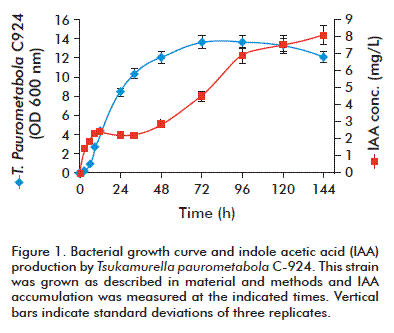
<body><![CDATA[<P   align="justify" ><font size="2" face="Verdana, Arial, Helvetica, sans-serif">Statistical analyses      were performed using the SPSS program (Version 15.0). The data were evaluated      through analysis of variance (Anova). To detect the statistical significance      of differences (p &lt; 0.05) between means, the Tuckey test was performed.      </font></P >       <P   >&nbsp;</P >       <P   ><font size="2" face="Verdana, Arial, Helvetica, sans-serif"><B><font size="3">RESULTS      </font></b></font></P >   <FONT size="+1">        <P   ><font size="2" face="Verdana, Arial, Helvetica, sans-serif"><I><b>In vitro</b></I><b>      assay of plant growth promoting abilities of <I>Tsukamurella paurometabola</I>      C-924 </b> </font></P >   <FONT size="+1">        <P   align="justify" ><font size="2" face="Verdana, Arial, Helvetica, sans-serif">The capacity to synthesize      IAA is an important feature for a strain to be considered a PGPR. It is well      known that this hormone participates in the promotion of plant growth by increasing      the radical surface of the inoculated plants. <a href="#fig1">Figure 1</a>      shows that the strain <I>T. paurometabola</I> C-924 synthesizes IAA since      the first stages of the culture, this hormone levels stable until approximately      the initial 48 h, when its concentration increased at the stationary phase      of the culture. The highest levels of IAA were obtained at the end of this      phase, reaching 8.06 mg/L. </font></P >       <P   align="center" ><img src="/img/revistas/bta/v30n2/f0104213.gif" width="392" height="331"><a name="fig1"></a></P >       
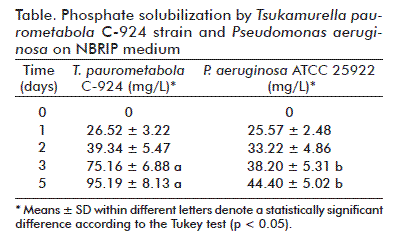
<P   align="justify" ><font size="2" face="Verdana, Arial, Helvetica, sans-serif">Additionally, <I>T.      paurometabola</I> C-924 was tested for its ability to solubilize the precipitated      tricalcium phosphate [Ca<Sub>3</Sub>(PO<Sub>4</Sub>)<Sub>2</Sub>] present      in the NBRIP medium, at levels of approximately 95 mg/L (<a href="#tab1">Table</a>).      Since the third day of the experiment, the concentration of phosphate solubilized      by <I>T. paurometabola</I> C-924 was statistically significant, compared to      that solubilized by the bacterium <I>P. aeruginosa</I> ATCC 25922 used as      positive control. </font></P >       <P   align="center" ><img src="/img/revistas/bta/v30n2/t0104213.gif" width="392" height="245"><a name="tab1"></a></P >   <FONT size="+1"><FONT size="+1"><FONT size="+1"><FONT size="+1"><FONT size="+1"><FONT size="+1">        
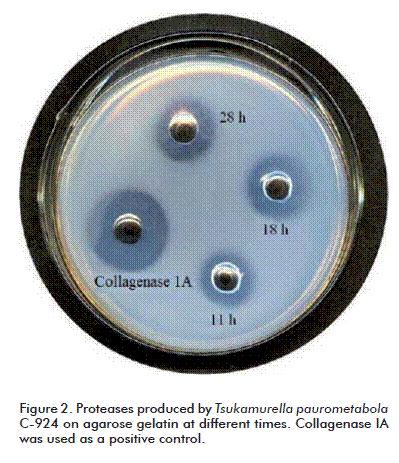
<P   align="justify" ><font size="2" face="Verdana, Arial, Helvetica, sans-serif"><I>T. paurometabola      </I>C-924 also secretes chitinases during growth in the presence of colloidal      chitin. The diameter of the hydrolyzed halo in the wells inoculated with <I>T.      paurometabola</I> C-924 culture supernatant (6.2 mm) was statistically significant,      similar to the halos of <I>Ser. marcescens</I> ATCC 13880 (6.6 mm). Proteases      were also detected for <I>T. paurometabola </I>C-924 in all the culture samples      (<a href="#fig2">Figure 2</a>). </font></P >       <P   align="center" ><img src="/img/revistas/bta/v30n2/f0204213.gif" width="397" height="461"><a name="fig2"></a></P >       
]]></body>
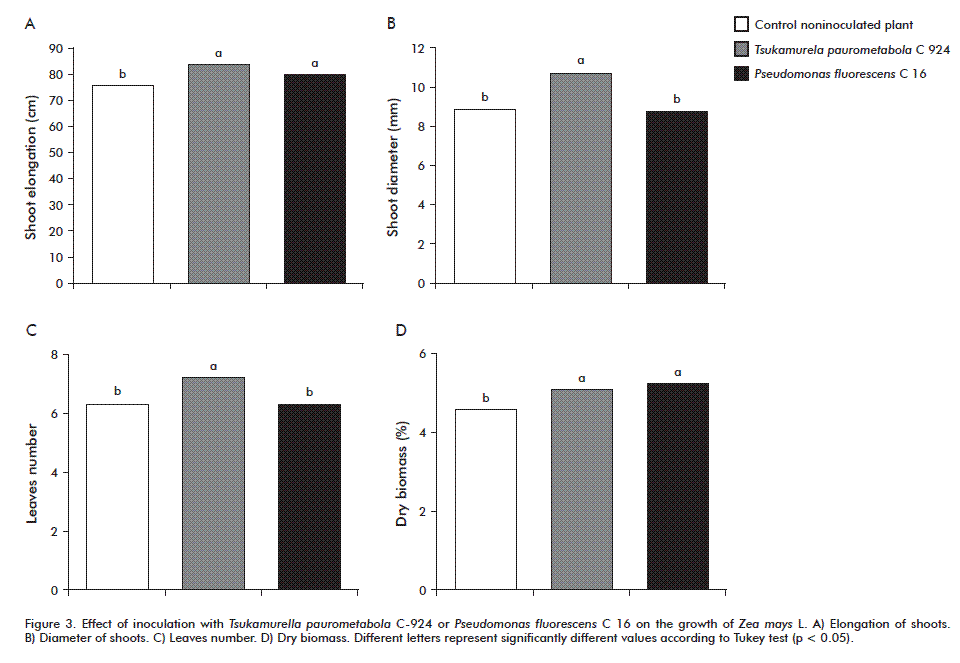
<body><![CDATA[<P   align="justify" ><font size="2" face="Verdana, Arial, Helvetica, sans-serif">Mycelial growth of      tested fungi was inhibited by <I>T. paurometabola </I>C-924. Inhibition was      evident from day 3 onwards, reaching a maximum value at day 7. The highest      inhibition percent were found either in the interactions with <I>P. palmarum</I>      (52 %) and <I>A. longipes </I>(45.2 %). <I>S. oryzae</I> was inhibited 21.5      % and the lowest inhibition rate was found with <I>P. debaryanum </I>(8.0      %)<I>. </I></font></P >       <P   ><font size="2" face="Verdana, Arial, Helvetica, sans-serif"><b>Growth promotion      of maize plants inoculated with <I>Tsukamurella paurometabola</I> C-924 under      greenhouse conditions </b></font></P >       <P   align="justify" ><font size="2" face="Verdana, Arial, Helvetica, sans-serif">Shoot elongation,      shoot diameter, number of leaves and dry matter in maize plants inoculated      with <I>T.</I> <I>paurometabola</I> C-924 were assessed 36 days after seeds      sowing under greenhouse conditions. <a href="/img/revistas/bta/v30n2/f0304213.gif">Figure 3A</a> shows      a statistically significant increase in shoot elongation in plants inoculated      with <I>T. paurometabola </I>C-924 or <I>P. fluorescens</I> C 16. Both strains      significantly promoted shoot growth (p &lt; 0.05) compared to control noninoculated      plants. </font></P >       
<P   align="justify" ><font size="2" face="Verdana, Arial, Helvetica, sans-serif">The effects of <I>T.      paurometabola</I> C-924 and <I>P. fluorescens </I>C 16 on shoot diameter and      number of leaves were different for both strains (<a href="/img/revistas/bta/v30n2/f0304213.gif">Figure      3B and C</a>). While <I>T. paurometabola</I> C-924 increased significantly      these parameters, plants inoculated with <I>P. fluorescens </I>C 16 showed      no differences in comparison to non inoculated plants. Nevertheless, both      strains improved significantly the dry matter compared to the control (<a href="/img/revistas/bta/v30n2/f0304213.gif">Figure      3D</a>). </font></P >       
<P   >&nbsp;</P >       <P   ><font size="2" face="Verdana, Arial, Helvetica, sans-serif"><B><font size="3">DISCUSSION      </font></b></font></P >   <FONT size="+1">        <P   align="justify" ><font size="2" face="Verdana, Arial, Helvetica, sans-serif">The plant rhizosphere      is an environment of intense microbe-plant interactions for micro- and macronutrients      [2]. PGPR are regarded as alternative to the use of chemicals in agriculture      [3]. An important factor to be considered when screening new isolates is the      presence of multiple mechanism of action on the strains to influence plant      growth. </font></P >   <FONT size="+1">        <P   align="justify" ><font size="2" face="Verdana, Arial, Helvetica, sans-serif">The production of      phytohormones by PGPR has been shown to be one of the most important mechanisms      by which many rhizobacteria promote plant growth [14]. About 80 % of bacteria      isolated from plant rhizosphere are able to produce IAA [15]. <I>T. paurometabola</I>      C-924 produced IAA at levels comparable to those described in previous reports.      Ahmad<I> et al. </I>[3] described levels of 2.13 and 3.6 mg/L for <I>Azotobacter</I>      and <I>Pseudomonas</I> species, whereas Gravel<I> et al</I>. [16] reported      levels of 3.3 and 6.2 mg/L for <I>P. putida</I> and <I>Trichoderma atroviride</I>.      However, <I>T. paurometabola</I> C-924 showed higher IAA production levels      at the stationary phase of growth. Production of IAA has been reported for      several PGPR belonging to the genera <I>Azospirillum</I>, <I>Azotobacter</I>,      <I>Bacillus</I>, <I>Enterobacter</I>, <I>Pseudomonas</I>, <I>Pontibacter </I>and      many others, but to our knowledge there are no reports of IAA production by      a <I>Tsukamurella </I>strain. </font></P >       <P   align="justify" ><font size="2" face="Verdana, Arial, Helvetica, sans-serif">To assess whether      this strain has the capability to act as an antifungal biocontrol agent, antagonism      towards phytopathogenic fungi was investigated. <I>T. paurometabola</I> C-924      strain displayed strong fungicidal activity on <I>P. palmarum</I> or <I>A.      longipes</I> and a lower inhibition rate on <I>S. oryzae </I>or<B> </B><I>P.      debaryanum. </I>This behavior suggests that this bacterium produces some compounds      that could be responsible for the fungal growth inhibition. The results indicate      that <I>T. paurometabola</I> C-924 is a fungal antagonist at least towards      these fungi species. Since <I>P. palmarum</I> and <I>A. longipes</I> are the      causative agents of serious diseases in a variety of plants of economic importance,      it would be interesting to further investigate the capability of <I>T. paurometabola</I>      C-924 to antagonize fungi and to extend the study to other genera and species.      </font></P >       <P   align="justify" ><font size="2" face="Verdana, Arial, Helvetica, sans-serif">A variety of microorganisms      with antifungal activity attacks pathogens by excreting cell wall hydrolases      [17]. Chitinases, &beta;-glucanases, and proteases can degrade cell walls      of plant pathogenic fungi and oomycetes [18]. In our study, the production      of extracellular chitinases and proteases by <I>T. paurometabola</I> C-924      could be closely related with the <I>in vitro </I>antifungal activity showed      by the strain. According to Ordentlich <I>et al</I>. [19], the ability to      produce extracellular chitinases is considered crucial for <I>S. marcescens      </I>to act as antagonist against <I>Sclerotium rolfsii</I>, and it has been      also demonstrated that these enzymes synthesized by <I>Pseudomonas stutzeri      </I>digest and lyse mycelia of <I>Fusarium solani </I>[20]. The cell wall      of <I>P. debaryanum</I> does not contain chitin, which may explain the lower      inhibitory effect caused by <I>T. paurometabola</I> C-924 on this specie.      Besides, chitin and glucan oligomers released during degradation of fungal      cell wall could act as elicitors of defence mechanisms in plants. The induced      protection by selected strains of non-pathogenic, root-colonizing PGPR have      been shown to be capable of induce disease resistance, promoting plant growth      [21]. </font></P >       ]]></body>
<body><![CDATA[<P   align="justify" ><font size="2" face="Verdana, Arial, Helvetica, sans-serif">Proteases are important      beyond the biocontrol point of view. There is increasing evidence that plants      are able to take up nitrogen not only in mineral form, but also as simple      organic molecules. Due to the abundance of protein in organic residues, protease      plays a central role in providing bioavailable nitrogen to plants [22]. In      this sense, proteases from <I>T. paurometabola</I> C-924 could also play a      role in the growth promotion of <I>Z. mays</I>. </font></P >       <P   align="justify" ><font size="2" face="Verdana, Arial, Helvetica, sans-serif"><I>T. paurometabola</I>      C-924 inoculation promoted statistically significant rise in shoot elongation,      shoot diameter, number of leaves and dry biomass of <I>Z. mays </I>when compared      to control. This effect was not observed at all in shoot diameter and leaves      number in plants inoculated with <I>P. fluorescens</I> C 16. The capability      of <I>T. paurometabola</I> C-924 to enhance solubilization of mineral phosphate      could play an important role to improve plant growth depending on the nutritional      resources of the soil. Some other traits such as IAA production or other phytohormones      not determined in this work could also make possible that <I>Z. mays</I> growth      response to<I> T. paurometabola</I> C-924 inoculation. Related studies have      reported strains from different species which effectively promoted <I>Z. mays</I>      growth, such as <I>Bacillus subtilis</I> [23], <I>Pseudomonas auriantica</I>      SR 1 [24], <I>Serratia</I> sp. SY 5 [25], <I>P. putida</I> strain R-168, <I>P.      fluorescens</I> strain R-93, <I>Azospirillum lipoferum</I> DSM 1691 and <I>Azospirillum      brasilense </I>DSM 1690 [26] with different mechanism of action for each strain.      </font></P >       <P   align="justify" ><font size="2" face="Verdana, Arial, Helvetica, sans-serif">Although there have      been a few reported <I>T.</I> <I>paurometabola </I>isolates from the endophytic      bacterial community of marigold [27] and soybean seeds [28], their ability      to promote plant growth have not been studied. Therefore, this is the first      report<B> </B>of a<B> </B>strain of this specie with PGPR abilities. Belimov<I>      et al.</I> [29] isolated a <I>Rhodococcus</I> sp. strain capable of stimulating      root elongation of <I>Brassica juncea</I> seedlings and to produce IAA. Coincidently,      <I>Rhodococcus </I>and <I>Tsukamurella</I> are related genera. <I>T. paurometabola</I>      has had a long taxonomical history, with names including <I>Corynebacterium      paurometabolum</I>, <I>Gordona aurantiaca</I>, and <I>Rhodococcus aurantiacus</I>.      This taxonomical puzzle was finally solved by Collins<I> et al</I>. [30] in      1988, showing that 16 S RNAs of <I>Rod. aurantiacus</I> and <I>C. paurometabolum</I>      were 99 % homologous. Then, they proposed to reclassify and rename this microorganism      as <I>T. paurometabola</I>. </font></P >       <P   >&nbsp;</P >       <P   ><font size="2" face="Verdana, Arial, Helvetica, sans-serif"><B><font size="3">CONCLUSIONS      </font></b></font></P >   <FONT size="+1">        <P   align="justify" ><font size="2" face="Verdana, Arial, Helvetica, sans-serif">Soil inoculation      with<B> </B><I>T. paurometabola </I>C-924 increased shoot elongation, shoot      diameter and leaves number in maize plants grown under greenhouse conditions.      <I>In vitro</I> assays showed this bacterium is able to produce IAA, solubilize      phosphate, secrete lytic enzymes, and inhibit the growth of phytopathogenic      fungi. In this sense, <I>T. paurometabola </I>C-924 appears to have potential      to be used not only as a nematocidic agent, but also as plant growth promoter      in future field applications. </font></P >   <FONT size="+1">        <P   align="justify" > </P >       <P   align="justify" > </P >       <P   align="justify" >&nbsp;</P >       <P   align="justify" ><font size="2" face="Verdana, Arial, Helvetica, sans-serif"><B><font size="3">REFERENCES      </font></b></font></P >       ]]></body>
<body><![CDATA[<!-- ref --><P   align="justify" ><font size="2" face="Verdana, Arial, Helvetica, sans-serif">1. Haggag WM. Sustainable      agricultural management of plant diseases. J Biol Sci. 2002;2(4):280-4.     </font></P >       <!-- ref --><P   align="justify" ><font size="2" face="Verdana, Arial, Helvetica, sans-serif">2. Bakker PAHM, Raaijmakers      JM. Foreword. Eur J Plant Pathol. 2007;119(2):241-2.     </font></P >       <!-- ref --><P   align="justify" ><font size="2" face="Verdana, Arial, Helvetica, sans-serif">3. Ahmad F, Ahmad      I, Khan MS. Screening of free-living rhizospheric bacteria for their multiple      plant growth promoting activities. Microbiol Res. 2008;163(2):173-81.     </font></P >       <!-- ref --><P   align="justify" ><font size="2" face="Verdana, Arial, Helvetica, sans-serif">4. Glick BR, Todorovic      B, Czarny J, Cheng Z, Duan J, McConkey B. Promotion of plant growth by bacterial      ACC deaminase. Crit Rev Plant Sci. 2007;26(5-6):227-42.     </font></P >       <!-- ref --><P   align="justify" ><font size="2" face="Verdana, Arial, Helvetica, sans-serif">5. Vassilev N, Vassileva      M, Nikolaeva I. Simultaneous P-solubilizing and biocontrol activity of microorganisms:      potentials and future trends. Appl Microbiol Biotechnol. 2006;71(2):137-44.          </font></P >       ]]></body>
<body><![CDATA[<!-- ref --><P   align="justify" ><font size="2" face="Verdana, Arial, Helvetica, sans-serif">6. Avis TJ, Gravel      V, Antoun H, Tweddell RJ. Multifaceted beneficial effects of rhizosphere microorganisms      on plant health and productivity. Soil Biol Biochem. 2008;40:1733-40.     </font></P >       <!-- ref --><P   align="justify" ><font size="2" face="Verdana, Arial, Helvetica, sans-serif">7. Guetsky R, Shtienberg      D, Elad Y, Fischer E, Dinoor A. Improving biological control by combining      biocontrol agents each with several mechanisms of disease suppression. Phytopathology.      2002;92(9):976-85.     </font></P >       <!-- ref --><P   align="justify" ><font size="2" face="Verdana, Arial, Helvetica, sans-serif">8. Mena J, Pimentel      E, Veloz L, Hern&aacute;ndez AT, Le&oacute;n L, Ram&iacute;rez Y, et al. Aislamiento      y determinaci&oacute;n de cepas bacterianas con actividad nematicida. Mecanismo      de acci&oacute;n de C. paurometabolum C-924 sobre nem&aacute;todos. Biotecnol      Apl. 2003;20(4):248-52.     </font></P >       <!-- ref --><P   align="justify" ><font size="2" face="Verdana, Arial, Helvetica, sans-serif">9. Glickmann E, Dessaux      Y. A critical examination of the specificity of the salkowski reagent for      indolic compounds produced by phytopathogenic bacteria. Appl Environ Microbiol.      1995;61(2):793-6.     </font></P >       <!-- ref --><P   align="justify" ><font size="2" face="Verdana, Arial, Helvetica, sans-serif">10. Nautiyal CS.      An efficient microbiological growth medium for screening phosphate solubilizing      microorganisms. FEMS Microbiol Lett. 1999;170(1):265-70.     </font></P >       ]]></body>
<body><![CDATA[<!-- ref --><P   align="justify" ><font size="2" face="Verdana, Arial, Helvetica, sans-serif">11. Fiske CH, Subbarow      Y. A colorimetric determination of phosphorus. J Biol Chem. 1925;66:375-400.          </font></P >       <!-- ref --><P   align="justify" ><font size="2" face="Verdana, Arial, Helvetica, sans-serif">12. Landa BB, Mavrodi      DM, Thomashow LS, Weller DM. Interactions Between Strains of 2,4-Diacetylphloroglucinol-Producing      Pseudomonas fluorescens in the Rhizosphere of Wheat. Phytopathology. 2003;93(8):982-94.          </font></P >       <!-- ref --><P   align="justify" ><font size="2" face="Verdana, Arial, Helvetica, sans-serif">13. Whaley DN, Dowell      VR Jr, Wanderlinder LM, Lombard GL. Gelatin agar medium for detecting gelatinase      production by anaerobic bacteria. J Clin Microbiol. 1982;16(2):224-9.     </font></P >       <!-- ref --><P   align="justify" ><font size="2" face="Verdana, Arial, Helvetica, sans-serif">14. Compant S, Cl&eacute;ment      C, Sessitsch A. Plant growth-promoting bacteria in the rhizo- and endosphere      of plants: Their role, colonization, mechanisms involved and prospects for      utilization. Soil Biol Biochem. 2010;42:669-78.     </font></P >       <!-- ref --><P   align="justify" ><font size="2" face="Verdana, Arial, Helvetica, sans-serif">15. Tsavkelova EA,      Cherdyntseva TA, Botina SG, Netrusov AI. Bacteria associated with orchid roots      and microbial production of auxin. Microbiol Res. 2007;162(1):69-76.     </font></P >       ]]></body>
<body><![CDATA[<!-- ref --><P   align="justify" ><font size="2" face="Verdana, Arial, Helvetica, sans-serif">16. Gravel V, Antoun      H, Tweddell R. Growth stimulation and fruit yield improvement of greenhouse      tomato plants by inoculation with Pseudomonas putida or Trichoderma atroviride:      possible role of indoleacetic acid (IAA). Soil Biol Biochem. 2007;39(8):1968-77.          </font></P >       <!-- ref --><P   align="justify" ><font size="2" face="Verdana, Arial, Helvetica, sans-serif">17. Chernin L, Ismailov      Z, Haran S, Chet I. Chitinolytic Enterobacter agglomerans Antagonistic to      Fungal Plant Pathogens. Appl Environ Microbiol. 1995;61(5):1720-6.     </font></P >       <!-- ref --><P   align="justify" ><font size="2" face="Verdana, Arial, Helvetica, sans-serif">18. Siddiqui ZA.      PGPR: Prospective biocontrol agents of plant pathogens. In: Siddiqui ZA, editor.      PGPR: Biocontrol and Biofertilization. Dordrecht: Springer; 2006. p. 111-42.          </font></P >       <!-- ref --><P   align="justify" ><font size="2" face="Verdana, Arial, Helvetica, sans-serif">19. Ordentlich A,      Elad Y, Chet I. Rhizosphere colonization by Serratia marcescens for the control      of Sclerotium rolfsii. Soil Biol Biochem. 1988;19(6):747-51.     </font></P >       <!-- ref --><P   align="justify" ><font size="2" face="Verdana, Arial, Helvetica, sans-serif">20. Lim HS, Kim YS,      Kim SD. Pseudomonas stutzeri YPL-1 Genetic Transformation and Antifungal Mechanism      against Fusarium solani, an Agent of Plant Root Rot. Appl Environ Microbiol.      1991;57(2):510-6.     </font></P >       ]]></body>
<body><![CDATA[<!-- ref --><P   align="justify" ><font size="2" face="Verdana, Arial, Helvetica, sans-serif">21. Radjacommare      R, Ramanathan A, Kandan A, Harish S, Thambidurai G, Sible GV, et al. PGPR      mediates induction of pathogenesis-related (PR) proteins against the infection      of blast pathogen in resistant and susceptible ragi [Eleusine coracana (L.)      Gaertner] cultivars. Plant Soil. 2004;266(1-2):165-76.     </font></P >       <!-- ref --><P   align="justify" ><font size="2" face="Verdana, Arial, Helvetica, sans-serif">22. Schimel JP, Bennett      J. Nitrogen mineralization: challenges of a changing paradigm. Ecology. 2004;85(3):591-602.          </font></P >       <!-- ref --><P   align="justify" ><font size="2" face="Verdana, Arial, Helvetica, sans-serif">23. Araujo FF. Seed      inoculation with Bacillus subtilis, formulated with oyster meal and growth      of corn, soy bean and cotton. Cienc Agrotecnol. 2008;32(2):456-462.     </font></P >       <!-- ref --><P   align="justify" ><font size="2" face="Verdana, Arial, Helvetica, sans-serif">24. Rosas S, Avanzini      G, Carlier E, Pasluosta C, Pastor N, Rovera M. Root colonization and growth      promotion of wheat and maize by Pseudomonas aurantiaca SR1. Soil Biol Biochem.      2009;41(9):1802-6.     </font></P >       <!-- ref --><P   align="justify" ><font size="2" face="Verdana, Arial, Helvetica, sans-serif">25. Koo SY, Cho KS.      Isolation and characterization of a plant growth-promoting rhizobacterium,      Serratia sp. SY5. J. Microbiol Biotechnol. 2009;19(11):1431-8.     </font></P >       ]]></body>
<body><![CDATA[<!-- ref --><P   align="justify" ><font size="2" face="Verdana, Arial, Helvetica, sans-serif">26. Nezarat S, Gholami      A. Screening plant growth promoting rhizobacteria for improving seed germination,      seedling growth and yield of maize. Pak J Biol Sci. 2009;12(1):26-32.     </font></P >       <!-- ref --><P   align="justify" ><font size="2" face="Verdana, Arial, Helvetica, sans-serif">27. Sturz AV, Kimpinski      J. Endoroot bacteria derived from marigolds (Tagetes spp.) can decrease soil      population densities of root-lesion nematodes in the potato root zone. Plant      Soil. 2004;262(1-2):241-9.     </font></P >       <!-- ref --><P   align="justify" ><font size="2" face="Verdana, Arial, Helvetica, sans-serif">28. de Castro L,      Teixeira P, Franco AC, L&uacute;cio J, Machado JA. Diversity and biotechnological      potential of endophytic bacterial community of soybean seeds. Pesq Agropec      Bras. 2009; 44(5):503-10.     </font></P >       <!-- ref --><P   align="justify" ><font size="2" face="Verdana, Arial, Helvetica, sans-serif">29. Belimov AA, Hontzeas      N, Safronova VI, Demchinskaya SV, Piluzza G, Bullitta S, et al. Cadmium-tolerant      plant growth-promoting bacteria associated with the roots of Indian mustard      (Brassica juncea L. Czern.). Soil Biol Biochem. 2005;37(2):241-50.     </font></P >       <!-- ref --><P   align="justify" ><font size="2" face="Verdana, Arial, Helvetica, sans-serif">30. Collins M, Smida      J, Dorsch M, Stackebrandt E. Tsukamurella gen. nov. harboring Corynebacterium      paurometabolum and Rhodococcus auvantiacus. Int J Syst Bacteriol. 1988;38:385-91.          </font></P >       ]]></body>
<body><![CDATA[<P   align="justify" >&nbsp;</P >       <P   align="justify" >&nbsp;</P >       <P   align="justify" > </P >       <P   align="justify" > </P >       <P   align="justify" ><font size="2" face="Verdana, Arial, Helvetica, sans-serif">Received in August,      2012.     <br>     </font><font size="2" face="Verdana, Arial, Helvetica, sans-serif">Accepted      in December, 2012. </font></P >       <P   align="justify" >&nbsp;</P >       <P   align="justify" >&nbsp;</P >       <P   align="justify" > </P >       <P   align="justify" > </P >       ]]></body>
<body><![CDATA[<P   align="justify" ><font size="2" face="Verdana, Arial, Helvetica, sans-serif"><I>Marieta Mar&iacute;n</I>.      Centro de Ingenier&iacute;a Gen&eacute;tica y Biotecnolog&iacute;a, CIGB.      Circunvalaci&oacute;n Norte y Ave. Finlay, PO Box 387, CP 70 100, Camag&uuml;ey,      Cuba. E-mail: <A href="mailto:marieta.marin@cigb.edu.cu"> <U><U><FONT color="#0000FF">marieta.marin@cigb.edu.cu</font></U></U></A><FONT color="#0000FF"><FONT color="#000000">.      </font></font></font></P >   </font></font></font></font></font></font></font></font></font></font></font></font></font></font></font></font></font></font></font></font></font></font></font></font></font></font></font></font></font></font></font></font></font></font></font></font></font></font></font></font></font></font></font></font></font></font></font></font></font></font></font></font></DIV >      ]]></body><back>
<ref-list>
<ref id="B1">
<label>1</label><nlm-citation citation-type="journal">
<person-group person-group-type="author">
<name>
<surname><![CDATA[Haggag]]></surname>
<given-names><![CDATA[WM]]></given-names>
</name>
</person-group>
<article-title xml:lang="en"><![CDATA[Sustainable agricultural management of plant diseases]]></article-title>
<source><![CDATA[J Biol Sci]]></source>
<year>2002</year>
<volume>2</volume>
<numero>4</numero>
<issue>4</issue>
<page-range>280-4</page-range></nlm-citation>
</ref>
<ref id="B2">
<label>2</label><nlm-citation citation-type="journal">
<person-group person-group-type="author">
<name>
<surname><![CDATA[Bakker]]></surname>
<given-names><![CDATA[PAHM]]></given-names>
</name>
<name>
<surname><![CDATA[Raaijmakers]]></surname>
<given-names><![CDATA[JM]]></given-names>
</name>
</person-group>
<article-title xml:lang="en"><![CDATA[Foreword]]></article-title>
<source><![CDATA[Eur J Plant Pathol]]></source>
<year>2007</year>
<volume>119</volume>
<numero>2</numero>
<issue>2</issue>
<page-range>241-2</page-range></nlm-citation>
</ref>
<ref id="B3">
<label>3</label><nlm-citation citation-type="journal">
<person-group person-group-type="author">
<name>
<surname><![CDATA[Ahmad]]></surname>
<given-names><![CDATA[F]]></given-names>
</name>
<name>
<surname><![CDATA[Ahmad]]></surname>
<given-names><![CDATA[I]]></given-names>
</name>
<name>
<surname><![CDATA[Khan]]></surname>
<given-names><![CDATA[MS]]></given-names>
</name>
</person-group>
<article-title xml:lang="en"><![CDATA[Screening of free-living rhizospheric bacteria for their multiple plant growth promoting activities]]></article-title>
<source><![CDATA[Microbiol Res]]></source>
<year>2008</year>
<volume>163</volume>
<numero>2</numero>
<issue>2</issue>
<page-range>173-81</page-range></nlm-citation>
</ref>
<ref id="B4">
<label>4</label><nlm-citation citation-type="journal">
<person-group person-group-type="author">
<name>
<surname><![CDATA[Glick]]></surname>
<given-names><![CDATA[BR]]></given-names>
</name>
<name>
<surname><![CDATA[Todorovic]]></surname>
<given-names><![CDATA[B]]></given-names>
</name>
<name>
<surname><![CDATA[Czarny]]></surname>
<given-names><![CDATA[J]]></given-names>
</name>
<name>
<surname><![CDATA[Cheng]]></surname>
<given-names><![CDATA[Z]]></given-names>
</name>
<name>
<surname><![CDATA[Duan]]></surname>
<given-names><![CDATA[J]]></given-names>
</name>
<name>
<surname><![CDATA[McConkey]]></surname>
<given-names><![CDATA[B]]></given-names>
</name>
</person-group>
<article-title xml:lang="en"><![CDATA[Promotion of plant growth by bacterial ACC deaminase]]></article-title>
<source><![CDATA[Crit Rev Plant Sci]]></source>
<year>2007</year>
<volume>26</volume>
<numero>5-6</numero>
<issue>5-6</issue>
<page-range>227-42</page-range></nlm-citation>
</ref>
<ref id="B5">
<label>5</label><nlm-citation citation-type="journal">
<person-group person-group-type="author">
<name>
<surname><![CDATA[Vassilev]]></surname>
<given-names><![CDATA[N]]></given-names>
</name>
<name>
<surname><![CDATA[Vassileva]]></surname>
<given-names><![CDATA[M]]></given-names>
</name>
<name>
<surname><![CDATA[Nikolaeva]]></surname>
<given-names><![CDATA[I]]></given-names>
</name>
</person-group>
<article-title xml:lang="en"><![CDATA[Simultaneous P-solubilizing and biocontrol activity of microorganisms: potentials and future trends]]></article-title>
<source><![CDATA[Appl Microbiol Biotechnol]]></source>
<year>2006</year>
<volume>71</volume>
<numero>2</numero>
<issue>2</issue>
<page-range>137-44</page-range></nlm-citation>
</ref>
<ref id="B6">
<label>6</label><nlm-citation citation-type="journal">
<person-group person-group-type="author">
<name>
<surname><![CDATA[Avis]]></surname>
<given-names><![CDATA[TJ]]></given-names>
</name>
<name>
<surname><![CDATA[Gravel]]></surname>
<given-names><![CDATA[V]]></given-names>
</name>
<name>
<surname><![CDATA[Antoun]]></surname>
<given-names><![CDATA[H]]></given-names>
</name>
<name>
<surname><![CDATA[Tweddell]]></surname>
<given-names><![CDATA[RJ]]></given-names>
</name>
</person-group>
<article-title xml:lang="en"><![CDATA[Multifaceted beneficial effects of rhizosphere microorganisms on plant health and productivity]]></article-title>
<source><![CDATA[Soil Biol Biochem]]></source>
<year>2008</year>
<volume>40</volume>
<page-range>1733-40</page-range></nlm-citation>
</ref>
<ref id="B7">
<label>7</label><nlm-citation citation-type="journal">
<person-group person-group-type="author">
<name>
<surname><![CDATA[Guetsky]]></surname>
<given-names><![CDATA[R]]></given-names>
</name>
<name>
<surname><![CDATA[Shtienberg]]></surname>
<given-names><![CDATA[D]]></given-names>
</name>
<name>
<surname><![CDATA[Elad]]></surname>
<given-names><![CDATA[Y]]></given-names>
</name>
<name>
<surname><![CDATA[Fischer]]></surname>
<given-names><![CDATA[E]]></given-names>
</name>
<name>
<surname><![CDATA[Dinoor]]></surname>
<given-names><![CDATA[A]]></given-names>
</name>
</person-group>
<article-title xml:lang="en"><![CDATA[Improving biological control by combining biocontrol agents each with several mechanisms of disease suppression]]></article-title>
<source><![CDATA[Phytopathology]]></source>
<year>2002</year>
<volume>92</volume>
<numero>9</numero>
<issue>9</issue>
<page-range>976-85</page-range></nlm-citation>
</ref>
<ref id="B8">
<label>8</label><nlm-citation citation-type="journal">
<person-group person-group-type="author">
<name>
<surname><![CDATA[Mena]]></surname>
<given-names><![CDATA[J]]></given-names>
</name>
<name>
<surname><![CDATA[Pimentel]]></surname>
<given-names><![CDATA[E]]></given-names>
</name>
<name>
<surname><![CDATA[Veloz]]></surname>
<given-names><![CDATA[L]]></given-names>
</name>
<name>
<surname><![CDATA[Hernández]]></surname>
<given-names><![CDATA[AT]]></given-names>
</name>
<name>
<surname><![CDATA[León]]></surname>
<given-names><![CDATA[L]]></given-names>
</name>
<name>
<surname><![CDATA[Ramírez]]></surname>
<given-names><![CDATA[Y]]></given-names>
</name>
</person-group>
<article-title xml:lang="es"><![CDATA[Aislamiento y determinación de cepas bacterianas con actividad nematicida. Mecanismo de acción de C. paurometabolum C-924 sobre nemátodos]]></article-title>
<source><![CDATA[Biotecnol Apl]]></source>
<year>2003</year>
<volume>20</volume>
<numero>4</numero>
<issue>4</issue>
<page-range>248-52</page-range></nlm-citation>
</ref>
<ref id="B9">
<label>9</label><nlm-citation citation-type="journal">
<person-group person-group-type="author">
<name>
<surname><![CDATA[Glickmann]]></surname>
<given-names><![CDATA[E]]></given-names>
</name>
<name>
<surname><![CDATA[Dessaux]]></surname>
<given-names><![CDATA[Y]]></given-names>
</name>
</person-group>
<article-title xml:lang="en"><![CDATA[A critical examination of the specificity of the salkowski reagent for indolic compounds produced by phytopathogenic bacteria]]></article-title>
<source><![CDATA[Appl Environ Microbiol]]></source>
<year>1995</year>
<volume>61</volume>
<numero>2</numero>
<issue>2</issue>
<page-range>793-6</page-range></nlm-citation>
</ref>
<ref id="B10">
<label>10</label><nlm-citation citation-type="journal">
<person-group person-group-type="author">
<name>
<surname><![CDATA[Nautiyal]]></surname>
<given-names><![CDATA[CS]]></given-names>
</name>
</person-group>
<article-title xml:lang="en"><![CDATA[An efficient microbiological growth medium for screening phosphate solubilizing microorganisms]]></article-title>
<source><![CDATA[FEMS Microbiol Lett]]></source>
<year>1999</year>
<volume>170</volume>
<numero>1</numero>
<issue>1</issue>
<page-range>265-70</page-range></nlm-citation>
</ref>
<ref id="B11">
<label>11</label><nlm-citation citation-type="journal">
<person-group person-group-type="author">
<name>
<surname><![CDATA[Fiske]]></surname>
<given-names><![CDATA[CH]]></given-names>
</name>
<name>
<surname><![CDATA[Subbarow]]></surname>
<given-names><![CDATA[Y]]></given-names>
</name>
</person-group>
<article-title xml:lang="en"><![CDATA[A colorimetric determination of phosphorus]]></article-title>
<source><![CDATA[J Biol Chem]]></source>
<year>1925</year>
<volume>66</volume>
<page-range>375-400</page-range></nlm-citation>
</ref>
<ref id="B12">
<label>12</label><nlm-citation citation-type="journal">
<person-group person-group-type="author">
<name>
<surname><![CDATA[Landa]]></surname>
<given-names><![CDATA[BB]]></given-names>
</name>
<name>
<surname><![CDATA[Mavrodi]]></surname>
<given-names><![CDATA[DM]]></given-names>
</name>
<name>
<surname><![CDATA[Thomashow]]></surname>
<given-names><![CDATA[LS]]></given-names>
</name>
<name>
<surname><![CDATA[Weller]]></surname>
<given-names><![CDATA[DM]]></given-names>
</name>
</person-group>
<article-title xml:lang="en"><![CDATA[Interactions Between Strains of 2,4-Diacetylphloroglucinol-Producing Pseudomonas fluorescens in the Rhizosphere of Wheat]]></article-title>
<source><![CDATA[Phytopathology]]></source>
<year>2003</year>
<volume>93</volume>
<numero>8</numero>
<issue>8</issue>
<page-range>982-94</page-range></nlm-citation>
</ref>
<ref id="B13">
<label>13</label><nlm-citation citation-type="journal">
<person-group person-group-type="author">
<name>
<surname><![CDATA[Whaley]]></surname>
<given-names><![CDATA[DN]]></given-names>
</name>
<name>
<surname><![CDATA[Dowell]]></surname>
<given-names><![CDATA[VR Jr]]></given-names>
</name>
<name>
<surname><![CDATA[Wanderlinder]]></surname>
<given-names><![CDATA[LM]]></given-names>
</name>
<name>
<surname><![CDATA[Lombard]]></surname>
<given-names><![CDATA[GL]]></given-names>
</name>
</person-group>
<article-title xml:lang="en"><![CDATA[Gelatin agar medium for detecting gelatinase production by anaerobic bacteria]]></article-title>
<source><![CDATA[J Clin Microbiol]]></source>
<year>1982</year>
<volume>16</volume>
<numero>2</numero>
<issue>2</issue>
<page-range>224-9</page-range></nlm-citation>
</ref>
<ref id="B14">
<label>14</label><nlm-citation citation-type="journal">
<person-group person-group-type="author">
<name>
<surname><![CDATA[Compant]]></surname>
<given-names><![CDATA[S]]></given-names>
</name>
<name>
<surname><![CDATA[Clément]]></surname>
<given-names><![CDATA[C]]></given-names>
</name>
<name>
<surname><![CDATA[Sessitsch]]></surname>
<given-names><![CDATA[A]]></given-names>
</name>
</person-group>
<article-title xml:lang="en"><![CDATA[Plant growth-promoting bacteria in the rhizo- and endosphere of plants: Their role, colonization, mechanisms involved and prospects for utilization]]></article-title>
<source><![CDATA[Soil Biol Biochem]]></source>
<year>2010</year>
<volume>42</volume>
<page-range>669-78</page-range></nlm-citation>
</ref>
<ref id="B15">
<label>15</label><nlm-citation citation-type="journal">
<person-group person-group-type="author">
<name>
<surname><![CDATA[Tsavkelova]]></surname>
<given-names><![CDATA[EA]]></given-names>
</name>
<name>
<surname><![CDATA[Cherdyntseva]]></surname>
<given-names><![CDATA[TA]]></given-names>
</name>
<name>
<surname><![CDATA[Botina]]></surname>
<given-names><![CDATA[SG]]></given-names>
</name>
<name>
<surname><![CDATA[Netrusov]]></surname>
<given-names><![CDATA[AI]]></given-names>
</name>
</person-group>
<article-title xml:lang="en"><![CDATA[Bacteria associated with orchid roots and microbial production of auxin]]></article-title>
<source><![CDATA[Microbiol Res]]></source>
<year>2007</year>
<volume>162</volume>
<numero>1</numero>
<issue>1</issue>
<page-range>69-76</page-range></nlm-citation>
</ref>
<ref id="B16">
<label>16</label><nlm-citation citation-type="journal">
<person-group person-group-type="author">
<name>
<surname><![CDATA[Gravel]]></surname>
<given-names><![CDATA[V]]></given-names>
</name>
<name>
<surname><![CDATA[Antoun]]></surname>
<given-names><![CDATA[H]]></given-names>
</name>
<name>
<surname><![CDATA[Tweddell]]></surname>
<given-names><![CDATA[R]]></given-names>
</name>
</person-group>
<article-title xml:lang="en"><![CDATA[Growth stimulation and fruit yield improvement of greenhouse tomato plants by inoculation with Pseudomonas putida or Trichoderma atroviride: possible role of indoleacetic acid (IAA)]]></article-title>
<source><![CDATA[Soil Biol Biochem]]></source>
<year>2007</year>
<volume>39</volume>
<numero>8</numero>
<issue>8</issue>
<page-range>1968-77</page-range></nlm-citation>
</ref>
<ref id="B17">
<label>17</label><nlm-citation citation-type="journal">
<person-group person-group-type="author">
<name>
<surname><![CDATA[Chernin]]></surname>
<given-names><![CDATA[L]]></given-names>
</name>
<name>
<surname><![CDATA[Ismailov]]></surname>
<given-names><![CDATA[Z]]></given-names>
</name>
<name>
<surname><![CDATA[Haran]]></surname>
<given-names><![CDATA[S]]></given-names>
</name>
<name>
<surname><![CDATA[Chet]]></surname>
<given-names><![CDATA[I]]></given-names>
</name>
</person-group>
<article-title xml:lang="en"><![CDATA[Chitinolytic Enterobacter agglomerans Antagonistic to Fungal Plant Pathogens]]></article-title>
<source><![CDATA[Appl Environ Microbiol]]></source>
<year>1995</year>
<volume>61</volume>
<numero>5</numero>
<issue>5</issue>
<page-range>1720-6</page-range></nlm-citation>
</ref>
<ref id="B18">
<label>18</label><nlm-citation citation-type="book">
<person-group person-group-type="author">
<name>
<surname><![CDATA[Siddiqui]]></surname>
<given-names><![CDATA[ZA]]></given-names>
</name>
</person-group>
<article-title xml:lang="en"><![CDATA[PGPR: Prospective biocontrol agents of plant pathogens]]></article-title>
<person-group person-group-type="editor">
<name>
<surname><![CDATA[Siddiqui]]></surname>
<given-names><![CDATA[ZA]]></given-names>
</name>
</person-group>
<source><![CDATA[PGPR: Biocontrol and Biofertilization]]></source>
<year>2006</year>
<page-range>111-42</page-range><publisher-loc><![CDATA[Dordrecht ]]></publisher-loc>
<publisher-name><![CDATA[Springer]]></publisher-name>
</nlm-citation>
</ref>
<ref id="B19">
<label>19</label><nlm-citation citation-type="journal">
<person-group person-group-type="author">
<name>
<surname><![CDATA[Ordentlich]]></surname>
<given-names><![CDATA[A]]></given-names>
</name>
<name>
<surname><![CDATA[Elad]]></surname>
<given-names><![CDATA[Y]]></given-names>
</name>
<name>
<surname><![CDATA[Chet]]></surname>
<given-names><![CDATA[I]]></given-names>
</name>
</person-group>
<article-title xml:lang="en"><![CDATA[Rhizosphere colonization by Serratia marcescens for the control of Sclerotium rolfsii]]></article-title>
<source><![CDATA[Soil Biol Biochem]]></source>
<year>1988</year>
<volume>19</volume>
<numero>6</numero>
<issue>6</issue>
<page-range>747-51</page-range></nlm-citation>
</ref>
<ref id="B20">
<label>20</label><nlm-citation citation-type="journal">
<person-group person-group-type="author">
<name>
<surname><![CDATA[Lim]]></surname>
<given-names><![CDATA[HS]]></given-names>
</name>
<name>
<surname><![CDATA[Kim]]></surname>
<given-names><![CDATA[YS]]></given-names>
</name>
<name>
<surname><![CDATA[Kim]]></surname>
<given-names><![CDATA[SD]]></given-names>
</name>
</person-group>
<article-title xml:lang="en"><![CDATA[Pseudomonas stutzeri YPL-1 Genetic Transformation and Antifungal Mechanism against Fusarium solani, an Agent of Plant Root Rot]]></article-title>
<source><![CDATA[Appl Environ Microbiol]]></source>
<year>1991</year>
<volume>57</volume>
<numero>2</numero>
<issue>2</issue>
<page-range>510-6</page-range></nlm-citation>
</ref>
<ref id="B21">
<label>21</label><nlm-citation citation-type="journal">
<person-group person-group-type="author">
<name>
<surname><![CDATA[Radjacommare]]></surname>
<given-names><![CDATA[R]]></given-names>
</name>
<name>
<surname><![CDATA[Ramanathan]]></surname>
<given-names><![CDATA[A]]></given-names>
</name>
<name>
<surname><![CDATA[Kandan]]></surname>
<given-names><![CDATA[A]]></given-names>
</name>
<name>
<surname><![CDATA[Harish]]></surname>
<given-names><![CDATA[S]]></given-names>
</name>
<name>
<surname><![CDATA[Thambidurai]]></surname>
<given-names><![CDATA[G]]></given-names>
</name>
<name>
<surname><![CDATA[Sible]]></surname>
<given-names><![CDATA[GV]]></given-names>
</name>
</person-group>
<article-title xml:lang="en"><![CDATA[PGPR mediates induction of pathogenesis-related (PR) proteins against the infection of blast pathogen in resistant and susceptible ragi (Eleusine coracana (L.) Gaertner) cultivars]]></article-title>
<source><![CDATA[Plant Soil]]></source>
<year>2004</year>
<volume>266</volume>
<numero>1-2</numero>
<issue>1-2</issue>
<page-range>165-76</page-range></nlm-citation>
</ref>
<ref id="B22">
<label>22</label><nlm-citation citation-type="journal">
<person-group person-group-type="author">
<name>
<surname><![CDATA[Schimel]]></surname>
<given-names><![CDATA[JP]]></given-names>
</name>
<name>
<surname><![CDATA[Bennett]]></surname>
<given-names><![CDATA[J]]></given-names>
</name>
</person-group>
<article-title xml:lang="en"><![CDATA[Nitrogen mineralization: challenges of a changing paradigm]]></article-title>
<source><![CDATA[Ecology]]></source>
<year>2004</year>
<volume>85</volume>
<numero>3</numero>
<issue>3</issue>
<page-range>591-602</page-range></nlm-citation>
</ref>
<ref id="B23">
<label>23</label><nlm-citation citation-type="journal">
<person-group person-group-type="author">
<name>
<surname><![CDATA[Araujo]]></surname>
<given-names><![CDATA[FF]]></given-names>
</name>
</person-group>
<article-title xml:lang="en"><![CDATA[Seed inoculation with Bacillus subtilis, formulated with oyster meal and growth of corn, soy bean and cotton]]></article-title>
<source><![CDATA[Cienc Agrotecnol]]></source>
<year>2008</year>
<volume>32</volume>
<numero>2</numero>
<issue>2</issue>
<page-range>456-462</page-range></nlm-citation>
</ref>
<ref id="B24">
<label>24</label><nlm-citation citation-type="journal">
<person-group person-group-type="author">
<name>
<surname><![CDATA[Rosas]]></surname>
<given-names><![CDATA[S]]></given-names>
</name>
<name>
<surname><![CDATA[Avanzini]]></surname>
<given-names><![CDATA[G]]></given-names>
</name>
<name>
<surname><![CDATA[Carlier]]></surname>
<given-names><![CDATA[E]]></given-names>
</name>
<name>
<surname><![CDATA[Pasluosta]]></surname>
<given-names><![CDATA[C]]></given-names>
</name>
<name>
<surname><![CDATA[Pastor]]></surname>
<given-names><![CDATA[N]]></given-names>
</name>
<name>
<surname><![CDATA[Rovera]]></surname>
<given-names><![CDATA[M]]></given-names>
</name>
</person-group>
<article-title xml:lang="en"><![CDATA[Root colonization and growth promotion of wheat and maize by Pseudomonas aurantiaca SR1]]></article-title>
<source><![CDATA[Soil Biol Biochem]]></source>
<year>2009</year>
<volume>41</volume>
<numero>9</numero>
<issue>9</issue>
<page-range>1802-6</page-range></nlm-citation>
</ref>
<ref id="B25">
<label>25</label><nlm-citation citation-type="journal">
<person-group person-group-type="author">
<name>
<surname><![CDATA[Koo]]></surname>
<given-names><![CDATA[SY]]></given-names>
</name>
<name>
<surname><![CDATA[Cho]]></surname>
<given-names><![CDATA[KS]]></given-names>
</name>
</person-group>
<article-title xml:lang="en"><![CDATA[Isolation and characterization of a plant growth-promoting rhizobacterium, Serratia sp. SY5]]></article-title>
<source><![CDATA[J Microbiol Biotechnol]]></source>
<year>2009</year>
<volume>19</volume>
<numero>11</numero>
<issue>11</issue>
<page-range>1431-8</page-range></nlm-citation>
</ref>
<ref id="B26">
<label>26</label><nlm-citation citation-type="journal">
<person-group person-group-type="author">
<name>
<surname><![CDATA[Nezarat]]></surname>
<given-names><![CDATA[S]]></given-names>
</name>
<name>
<surname><![CDATA[Gholami]]></surname>
<given-names><![CDATA[A]]></given-names>
</name>
</person-group>
<article-title xml:lang="en"><![CDATA[Screening plant growth promoting rhizobacteria for improving seed germination, seedling growth and yield of maize]]></article-title>
<source><![CDATA[Pak J Biol Sci]]></source>
<year>2009</year>
<volume>12</volume>
<numero>1</numero>
<issue>1</issue>
<page-range>26-32</page-range></nlm-citation>
</ref>
<ref id="B27">
<label>27</label><nlm-citation citation-type="journal">
<person-group person-group-type="author">
<name>
<surname><![CDATA[Sturz]]></surname>
<given-names><![CDATA[AV]]></given-names>
</name>
<name>
<surname><![CDATA[Kimpinski]]></surname>
<given-names><![CDATA[J]]></given-names>
</name>
</person-group>
<article-title xml:lang="en"><![CDATA[Endoroot bacteria derived from marigolds (Tagetes spp.) can decrease soil population densities of root-lesion nematodes in the potato root zone]]></article-title>
<source><![CDATA[Plant Soil]]></source>
<year>2004</year>
<volume>262</volume>
<numero>1-2</numero>
<issue>1-2</issue>
<page-range>241-9</page-range></nlm-citation>
</ref>
<ref id="B28">
<label>28</label><nlm-citation citation-type="journal">
<person-group person-group-type="author">
<name>
<surname><![CDATA[de Castro]]></surname>
<given-names><![CDATA[L]]></given-names>
</name>
<name>
<surname><![CDATA[Teixeira]]></surname>
<given-names><![CDATA[P]]></given-names>
</name>
<name>
<surname><![CDATA[Franco]]></surname>
<given-names><![CDATA[AC]]></given-names>
</name>
<name>
<surname><![CDATA[Lúcio]]></surname>
<given-names><![CDATA[J]]></given-names>
</name>
<name>
<surname><![CDATA[Machado]]></surname>
<given-names><![CDATA[JA]]></given-names>
</name>
</person-group>
<article-title xml:lang="en"><![CDATA[Diversity and biotechnological potential of endophytic bacterial community of soybean seeds]]></article-title>
<source><![CDATA[Pesq Agropec Bras]]></source>
<year>2009</year>
<volume>44</volume>
<numero>5</numero>
<issue>5</issue>
<page-range>503-10</page-range></nlm-citation>
</ref>
<ref id="B29">
<label>29</label><nlm-citation citation-type="journal">
<person-group person-group-type="author">
<name>
<surname><![CDATA[Belimov]]></surname>
<given-names><![CDATA[AA]]></given-names>
</name>
<name>
<surname><![CDATA[Hontzeas]]></surname>
<given-names><![CDATA[N]]></given-names>
</name>
<name>
<surname><![CDATA[Safronova]]></surname>
<given-names><![CDATA[VI]]></given-names>
</name>
<name>
<surname><![CDATA[Demchinskaya]]></surname>
<given-names><![CDATA[SV]]></given-names>
</name>
<name>
<surname><![CDATA[Piluzza]]></surname>
<given-names><![CDATA[G]]></given-names>
</name>
<name>
<surname><![CDATA[Bullitta]]></surname>
<given-names><![CDATA[S]]></given-names>
</name>
</person-group>
<article-title xml:lang="en"><![CDATA[Cadmium-tolerant plant growth-promoting bacteria associated with the roots of Indian mustard (Brassica juncea L. Czern.)]]></article-title>
<source><![CDATA[Soil Biol Biochem]]></source>
<year>2005</year>
<volume>37</volume>
<numero>2</numero>
<issue>2</issue>
<page-range>241-50</page-range></nlm-citation>
</ref>
<ref id="B30">
<label>30</label><nlm-citation citation-type="journal">
<person-group person-group-type="author">
<name>
<surname><![CDATA[Collins]]></surname>
<given-names><![CDATA[M]]></given-names>
</name>
<name>
<surname><![CDATA[Smida]]></surname>
<given-names><![CDATA[J]]></given-names>
</name>
<name>
<surname><![CDATA[Dorsch]]></surname>
<given-names><![CDATA[M]]></given-names>
</name>
<name>
<surname><![CDATA[Stackebrandt]]></surname>
<given-names><![CDATA[E]]></given-names>
</name>
</person-group>
<article-title xml:lang="en"><![CDATA[Tsukamurella gen. nov. harboring Corynebacterium paurometabolum and Rhodococcus auvantiacus]]></article-title>
<source><![CDATA[Int J Syst Bacteriol]]></source>
<year>1988</year>
<volume>38</volume>
<page-range>385-91</page-range></nlm-citation>
</ref>
</ref-list>
</back>
</article>