<?xml version="1.0" encoding="ISO-8859-1"?><article xmlns:mml="http://www.w3.org/1998/Math/MathML" xmlns:xlink="http://www.w3.org/1999/xlink" xmlns:xsi="http://www.w3.org/2001/XMLSchema-instance">
<front>
<journal-meta>
<journal-id>1027-2852</journal-id>
<journal-title><![CDATA[Biotecnología Aplicada]]></journal-title>
<abbrev-journal-title><![CDATA[Biotecnol Apl]]></abbrev-journal-title>
<issn>1027-2852</issn>
<publisher>
<publisher-name><![CDATA[Editorial Elfos Scientiae]]></publisher-name>
</publisher>
</journal-meta>
<article-meta>
<article-id>S1027-28522013000200005</article-id>
<title-group>
<article-title xml:lang="en"><![CDATA[Preclinical safety testing of the Quimi-Hib(r) vaccine adjuvanted with aluminum phosphate during product development]]></article-title>
<article-title xml:lang="es"><![CDATA[Seguridad preclínica de la vacuna Quimi-Hib(r) adyuvada con fosfato de aluminio durante el desarrollo del producto]]></article-title>
</title-group>
<contrib-group>
<contrib contrib-type="author">
<name>
<surname><![CDATA[Bacardí]]></surname>
<given-names><![CDATA[Dania]]></given-names>
</name>
<xref ref-type="aff" rid="A01"/>
</contrib>
<contrib contrib-type="author">
<name>
<surname><![CDATA[Cosme]]></surname>
<given-names><![CDATA[Karelia]]></given-names>
</name>
<xref ref-type="aff" rid="A01"/>
</contrib>
<contrib contrib-type="author">
<name>
<surname><![CDATA[Aldana]]></surname>
<given-names><![CDATA[Lizet]]></given-names>
</name>
<xref ref-type="aff" rid="A01"/>
</contrib>
<contrib contrib-type="author">
<name>
<surname><![CDATA[Merino]]></surname>
<given-names><![CDATA[Nelson]]></given-names>
</name>
<xref ref-type="aff" rid="A02"/>
</contrib>
<contrib contrib-type="author">
<name>
<surname><![CDATA[Suárez]]></surname>
<given-names><![CDATA[José]]></given-names>
</name>
<xref ref-type="aff" rid="A01"/>
</contrib>
<contrib contrib-type="author">
<name>
<surname><![CDATA[Mosqueda]]></surname>
<given-names><![CDATA[Omar]]></given-names>
</name>
<xref ref-type="aff" rid="A01"/>
</contrib>
<contrib contrib-type="author">
<name>
<surname><![CDATA[Urquiza]]></surname>
<given-names><![CDATA[Dioslaida]]></given-names>
</name>
<xref ref-type="aff" rid="A01"/>
</contrib>
<contrib contrib-type="author">
<name>
<surname><![CDATA[Romero]]></surname>
<given-names><![CDATA[Juan]]></given-names>
</name>
<xref ref-type="aff" rid="A01"/>
</contrib>
<contrib contrib-type="author">
<name>
<surname><![CDATA[Madrigal]]></surname>
<given-names><![CDATA[Roberto]]></given-names>
</name>
<xref ref-type="aff" rid="A01"/>
</contrib>
<contrib contrib-type="author">
<name>
<surname><![CDATA[Amaya]]></surname>
<given-names><![CDATA[Rubén]]></given-names>
</name>
<xref ref-type="aff" rid="A01"/>
</contrib>
<contrib contrib-type="author">
<name>
<surname><![CDATA[Hernández]]></surname>
<given-names><![CDATA[Lourdes]]></given-names>
</name>
<xref ref-type="aff" rid="A01"/>
</contrib>
</contrib-group>
<aff id="A02">
<institution><![CDATA[,Centro de Investigaciones y Desarrollo de Medicamentos, Cidem  ]]></institution>
<addr-line><![CDATA[La Habana ]]></addr-line>
<country>Cuba</country>
</aff>
<aff id="A01">
<institution><![CDATA[,Centro de Ingeniería Genética y Biotecnología, CIGB  ]]></institution>
<addr-line><![CDATA[La Habana ]]></addr-line>
<country>Cuba</country>
</aff>
<pub-date pub-type="pub">
<day>00</day>
<month>06</month>
<year>2013</year>
</pub-date>
<pub-date pub-type="epub">
<day>00</day>
<month>06</month>
<year>2013</year>
</pub-date>
<volume>30</volume>
<numero>2</numero>
<fpage>118</fpage>
<lpage>124</lpage>
<copyright-statement/>
<copyright-year/>
<self-uri xlink:href="http://scielo.sld.cu/scielo.php?script=sci_arttext&amp;pid=S1027-28522013000200005&amp;lng=en&amp;nrm=iso"></self-uri><self-uri xlink:href="http://scielo.sld.cu/scielo.php?script=sci_abstract&amp;pid=S1027-28522013000200005&amp;lng=en&amp;nrm=iso"></self-uri><self-uri xlink:href="http://scielo.sld.cu/scielo.php?script=sci_pdf&amp;pid=S1027-28522013000200005&amp;lng=en&amp;nrm=iso"></self-uri><abstract abstract-type="short" xml:lang="en"><p><![CDATA[Haemophilus influenzae type b (Hib) is a Gram-negative bacterium causing diseases such as meningitis, pneumonia, epiglottis, cellulitis, septicemia and arthritis, among others. Hib-caused meningitis / Hib meningitis is a very serious disease with a death rate of more than 50 % throughout the world; therefore obtaining a vaccine against this bacterium is a goal of the highest priority. The present report presents the results of preclinical safety testing of the Quimi-Hib(r) vaccine (synthetic Hib antigen conjugated to tetanus toxoid) adjuvanted with aluminum phosphate. The battery of toxicological tests included acute toxicity (15 days), local tolerance (15 days) and repeated-dose toxicity (30 days), all of them evaluating the therapeutic dose of the vaccine as part of the studied experimental treatments. Three vaccine dose levels and a placebo (excipients plus adjuvant) were examined, administering the vaccine intramuscularly to Sprague Dawley rats of both sexes. After examining the data obtained from the administration of this wide range of doses to Sprague Dawley rats, it was concluded that the synthetic conjugate vaccine Quimi-Hib(r) adjuvanted in aluminum phosphate is not toxic and does not cause systemic adverse effects. No macroscopic alterations were observed in the studied organs, and the evaluation of the inoculation site only detected indurations caused by macrophage granulomas, resulting from the mechanism of action of the adjuvant included in the formulation.]]></p></abstract>
<abstract abstract-type="short" xml:lang="es"><p><![CDATA[Haemophilus influenzae tipo b (Hib) es una bacteria gramnegativa causante de enfermedades como meningitis, neumonía, epiglotitis, celulitis, septicemia, artritis, entre otras, en los seres humanos. La meningitis causada por Hib es muy grave, con una tasa de muertes de más del 50 % en varias partes del mundo. Por tales razones, la obtención de una vacuna contra esta afección es una prioridad. El objetivo de este estudio fue evaluar la seguridad preclínica de la vacuna Quimi-Hib(r) (antígeno sintético de Hib conjugado con toxoide tetánico), en una formulación adyuvada con fosfato de aluminio, durante la etapa de desarrollo del producto. Los ensayos toxicológicos incluyeron estudios de toxicidad aguda (15 días), de tolerancia local (30 días) y de toxicidad a dosis repetidas (15 días), que incluyeron la dosis terapéutica de la vacuna. Se exploraron tres niveles de dosis de la vacuna y un placebo (excipientes más adyuvante), que se administraron por vía intramuscular a ratas Sprague Dawley de ambos sexos. Según nuestros resultados en el espectro de dosis explorado en las ratas, se concluyó que la vacuna conjugada Quimi-Hib(r) adyuvada en fosfato de aluminio no es tóxica, ni provoca efectos sistémicos adversos en esa especie. No se detectaron alteraciones macroscópicas en los órganos estudiados, y al evaluar el sitio de administración, solo se observaron induraciones causadas por granulomas macrofágicos, resultantes del mecanismo de acción del adyuvante incluido en la formulación.]]></p></abstract>
<kwd-group>
<kwd lng="en"><![CDATA[vaccines]]></kwd>
<kwd lng="en"><![CDATA[synthetic vaccine]]></kwd>
<kwd lng="en"><![CDATA[Haemophilus influenzae type b]]></kwd>
<kwd lng="en"><![CDATA[safety]]></kwd>
<kwd lng="en"><![CDATA[toxicity]]></kwd>
<kwd lng="es"><![CDATA[vacunas]]></kwd>
<kwd lng="es"><![CDATA[vacuna sintética]]></kwd>
<kwd lng="es"><![CDATA[Haemophilus influenzae tipo b]]></kwd>
<kwd lng="es"><![CDATA[seguridad]]></kwd>
<kwd lng="es"><![CDATA[toxicidad]]></kwd>
</kwd-group>
</article-meta>
</front><body><![CDATA[ <DIV class="Sect"   >        <P   align="right" ><font size="2" color="#000000" face="Verdana, Arial, Helvetica, sans-serif"><b>RESEARCH</b>      </font></P >   <FONT size="+1" color="#000000">        <P   > </P >       <P   >&nbsp;</P >       <P   ><font size="4" face="Verdana, Arial, Helvetica, sans-serif"><b>Preclinical safety      testing of the Quimi-Hib&reg; vaccine adjuvanted with aluminum phosphate during      product development </b></font></P >       <P   >&nbsp;</P >       <P   ><font size="3" face="Verdana, Arial, Helvetica, sans-serif"><b>Seguridad precl&iacute;nica      de la vacuna Quimi-Hib&reg; adyuvada con fosfato de aluminio durante el desarrollo      del producto </b></font></P >       <P   >&nbsp;</P >       <P   >&nbsp;</P >       <P   > </P >       ]]></body>
<body><![CDATA[<P   > </P >       <P   ><b><font size="2" face="Verdana, Arial, Helvetica, sans-serif">Dania Bacard&iacute;<Sup>1</Sup>,      Karelia Cosme<Sup>1</Sup>, Lizet Aldana<Sup>1</Sup>, Nelson Merino<Sup>2</Sup>,      Jos&eacute; Su&aacute;rez<Sup>1</Sup>, Omar Mosqueda<Sup>1</Sup>, Dioslaida      Urquiza<Sup>1</Sup>, Juan Romero<Sup>1</Sup>, Roberto Madrigal<Sup>1</Sup>,      Rub&eacute;n Amaya<Sup>1</Sup>, Lourdes Hern&aacute;ndez<Sup>1</Sup></font></b></P >   <FONT size="+1"><FONT size="+1"><FONT size="+1"><FONT size="+1"><FONT size="+1"><FONT size="+1"><FONT size="+1"><FONT size="+1"><FONT size="+1"><FONT size="+1"><FONT size="+1"><FONT size="+1"><FONT size="+1"><FONT size="+1"><FONT size="+1"><FONT size="+1"><FONT size="+1"><FONT size="+1"><FONT size="+1"><FONT size="+1"><FONT size="+1"><FONT size="+1">        <P   ><font size="2" face="Verdana, Arial, Helvetica, sans-serif"><Sup>1</Sup> Centro      de Ingenier&iacute;a Gen&eacute;tica y Biotecnolog&iacute;a, CIGB. Ave. 31      e/ 158 y 190, Cubanac&aacute;n, Playa, CP 11 600, La Habana, Cuba.    <br>     </font><font size="2" face="Verdana, Arial, Helvetica, sans-serif"><Sup>2</Sup>      Centro de Investigaciones y Desarrollo de Medicamentos, Cidem. Calle 17 e/      62 y 64, Playa, La Habana, Cuba. </font></P >       <P   >&nbsp;</P >       <P   >&nbsp;</P >   </font></font></font></font></font></font></font></font></font></font></font></font></font></font></font></font></font></font></font></font></font></font></font>    <hr>   <FONT size="+1" color="#000000"><FONT size="+1"><FONT size="+1"><FONT size="+1"><FONT size="+1"><FONT size="+1"><FONT size="+1"><FONT size="+1"><FONT size="+1"><FONT size="+1"><FONT size="+1"><FONT size="+1"><FONT size="+1"><FONT size="+1"><FONT size="+1"><FONT size="+1"><FONT size="+1"><FONT size="+1"><FONT size="+1"><FONT size="+1"><FONT size="+1"><FONT size="+1"><FONT size="+1"><FONT size="+1"><FONT size="+1"><FONT size="+1"><FONT size="+1">        <P   ><font size="2" face="Verdana, Arial, Helvetica, sans-serif"><B>ABSTRACT </b></font></P >   <FONT size="+1">        <P   ><font size="2" face="Verdana, Arial, Helvetica, sans-serif"><I>Haemophilus influenzae</I>      type b (Hib) is a Gram-negative bacterium causing diseases such as meningitis,      pneumonia, epiglottis, cellulitis, septicemia and arthritis, among others.      Hib-caused meningitis / Hib meningitis is a very serious disease with a death      rate of more than 50 % throughout the world; therefore obtaining a vaccine      against this bacterium is a goal of the highest priority. The present report      presents the results of preclinical safety testing of the Quimi-Hib&reg; vaccine      (synthetic Hib antigen conjugated to tetanus toxoid) adjuvanted with aluminum      phosphate. The battery of toxicological tests included acute toxicity (15      days), local tolerance (15 days) and repeated-dose toxicity (30 days), all      of them evaluating the therapeutic dose of the vaccine as part of the studied      experimental treatments. Three vaccine dose levels and a placebo (excipients      plus adjuvant) were examined, administering the vaccine intramuscularly to      Sprague Dawley rats of both sexes. After examining the data obtained from      the administration of this wide range of doses to Sprague Dawley rats, it      was concluded that the synthetic conjugate vaccine Quimi-Hib&reg; adjuvanted      in aluminum phosphate is not toxic and does not cause systemic adverse effects.      No macroscopic alterations were observed in the studied organs, and the evaluation      of the inoculation site only detected indurations caused by macrophage granulomas,      resulting from the mechanism of action of the adjuvant included in the formulation.      </font></P >       <P   ><font size="2" face="Verdana, Arial, Helvetica, sans-serif"><B>Keywords:</B>      vaccines, synthetic vaccine, <I>Haemophilus influenzae</I> type b, safety,      toxicity. </font></P >   </font></font></font></font></font></font></font></font></font></font></font></font></font></font></font></font></font></font></font></font></font></font></font></font></font></font></font></font>    <hr>   <FONT size="+1" color="#000000"><FONT size="+1"><FONT size="+1"><FONT size="+1"><FONT size="+1"><FONT size="+1"><FONT size="+1"><FONT size="+1"><FONT size="+1"><FONT size="+1"><FONT size="+1"><FONT size="+1"><FONT size="+1"><FONT size="+1"><FONT size="+1"><FONT size="+1"><FONT size="+1"><FONT size="+1"><FONT size="+1"><FONT size="+1"><FONT size="+1"><FONT size="+1"><FONT size="+1"><FONT size="+1"><FONT size="+1"><FONT size="+1"><FONT size="+1"><FONT size="+1">       <P   > </P >       ]]></body>
<body><![CDATA[<P   ><font size="2" face="Verdana, Arial, Helvetica, sans-serif"><B>RESUMEN </b></font></P >       <P   align="justify" ><font size="2" face="Verdana, Arial, Helvetica, sans-serif"><I>Haemophilus influenzae</I>      tipo b (Hib) es una bacteria gramnegativa causante de enfermedades como meningitis,      neumon&iacute;a, epiglotitis, celulitis, septicemia, artritis, entre otras,      en los seres humanos. La meningitis causada por Hib es muy grave, con una      tasa de muertes de m&aacute;s del 50 % en varias partes del mundo. Por tales      razones, la obtenci&oacute;n de una vacuna contra esta afecci&oacute;n es      una prioridad. El objetivo de este estudio fue evaluar la seguridad precl&iacute;nica      de la vacuna Quimi-Hib&reg; (ant&iacute;geno sint&eacute;tico de Hib conjugado      con toxoide tet&aacute;nico), en una formulaci&oacute;n adyuvada con fosfato      de aluminio, durante la etapa de desarrollo del producto. Los ensayos toxicol&oacute;gicos      incluyeron estudios de toxicidad aguda (15 d&iacute;as), de tolerancia local      (30 d&iacute;as) y de toxicidad a dosis repetidas (15 d&iacute;as), que incluyeron      la dosis terap&eacute;utica de la vacuna. Se exploraron tres niveles de dosis      de la vacuna y un placebo (excipientes m&aacute;s adyuvante), que se administraron      por v&iacute;a intramuscular a ratas Sprague Dawley de ambos sexos. Seg&uacute;n      nuestros resultados en el espectro de dosis explorado en las ratas, se concluy&oacute;      que la vacuna conjugada Quimi-Hib&reg; adyuvada en fosfato de aluminio no      es t&oacute;xica, ni provoca efectos sist&eacute;micos adversos en esa especie.      No se detectaron alteraciones macrosc&oacute;picas en los &oacute;rganos estudiados,      y al evaluar el sitio de administraci&oacute;n, solo se observaron induraciones      causadas por granulomas macrof&aacute;gicos, resultantes del mecanismo de      acci&oacute;n del adyuvante incluido en la formulaci&oacute;n. </font></P >       <P   ><font size="2" face="Verdana, Arial, Helvetica, sans-serif"><B>Palabras clave:</B>      vacunas, vacuna sint&eacute;tica, <I>Haemophilus influenzae</I> tipo b, seguridad,      toxicidad<B><I>.</I></b></font></P >   </font></font></font></font></font></font></font></font></font></font></font></font></font></font></font></font></font></font></font></font></font></font></font></font></font></font></font></font>    <hr>       <p>&nbsp;</p>       <p>&nbsp;</p>       <p><font size="2" face="Verdana, Arial, Helvetica, sans-serif"><B><font size="3">INTRODUCTION      </font></b></font></p>   <FONT size="+1" color="#000000"><FONT size="+1"><FONT size="+1"><FONT size="+1"><FONT size="+1"><FONT size="+1"><FONT size="+1"><FONT size="+1"><FONT size="+1"><FONT size="+1"><FONT size="+1"><FONT size="+1"><FONT size="+1"><FONT size="+1"><FONT size="+1"><FONT size="+1"><FONT size="+1"><FONT size="+1"><FONT size="+1"><FONT size="+1"><FONT size="+1"><FONT size="+1"><FONT size="+1"><FONT size="+1"><FONT size="+1"><FONT size="+1"><FONT size="+1"><FONT size="+1"><FONT size="+1"><FONT size="+1">     <P   align="justify" ><font size="2" face="Verdana, Arial, Helvetica, sans-serif"><I>Haemophilus influenzae      </I>(Hib) is a pleomorphic, aerobic Gram-negative coccobacillus discovered      in 1892 by Richard Pfeiffer during a flu pandemic, which colonizes the mucosae      of the upper respiratory tract of three-month-old children. Most Hib isolates      are non-capsulated, although some strains produce a polysaccharide capsule.      This bacterium is a causative agent for meningitis, pneumonia, epiglottitis,      cellulitis, septicemia, arthritis, osteomyelitis, pericarditis, cholangitis,      endocarditis and sinusitis [1]. Hib meningitis is a very dangerous disease      that exhibits a mortality rate of over 50 % in several parts of the world      and leaves severe neurological sequelae on 50 % of the survivors [2]. </font></P >   <FONT size="+1">        <P   align="justify" ><font size="2" face="Verdana, Arial, Helvetica, sans-serif">Infants and toddlers      are particularly vulnerable to Hib infections, as <I>in utero-</I>acquired      antibody wanes after 3 months of age. In the absence of vaccination, natural      immunity against the bacterium appears only by the fifth to sixth year of      life [3, 4]. </font></P >       <P   align="justify" ><font size="2" face="Verdana, Arial, Helvetica, sans-serif">There are at least      four commercially available safe and effective conjugate vaccines against      <I>H. influenzae </I>type b approved for clinical use in several countries,      prepared by chemically conjugating polyribosylribitol phosphate (PRP, corresponding      to the capsular polysaccharide of <I>H. influenzae </I>type b) to a protein      of bacterial origin. None of them, however, contains entirely synthetic antigens      or are manufactured in Cuba. A collaborative effort undertaken in 1989 by      the Synthetic Antigens Laboratory of the Faculty of Chemistry of the University      of Havana together with the Finlay Institute and the Center for Genetic Engineering      and Biotechnology (both from Havana, Cuba) resulted in the development of      Quimi-Hib&reg;, a conjugate vaccine containing 10 &micro;g of a chemically      synthesized fragment of PRP covalently linked to 20 or 30 &micro;g of tetanus      toxoid. As reference for protection in immunized children, anti-PRP titers      of 1 &micro;g/mL are used, but 0.15 &micro;g/mL supposes an inverse correlation      with disease incidence in non-vaccinated individuals [5]. An anti-Hib antibody      titer of 1 &micro;g/mL at three weeks post-immunization is predicted to provide      protection for at least one year [6, 7]. The vaccine is designed to be delivered      in children using doses of 10 mg injected at 2, 4 and 6 months of age. </font></P >       <P   align="justify" ><font size="2" face="Verdana, Arial, Helvetica, sans-serif">The objective of      the present investigation was to perform the preclinical safety testing of      Quimi-Hib&reg; as a vaccine candidate adjuvanted in aluminum phosphate. The      assays included acute toxicity tests (15 days long), tests for repeated-dose      toxicity (15 days) and local tolerance (30 days), employing three different      dosages and a placebo. The therapeutic dose (TD) was examined in the local      tolerance study. All tests employed Sprague-Dawley rats and used the intramuscular      immunization route in order to reproduce the administration procedure planned      for future clinical trials. </font></P >       ]]></body>
<body><![CDATA[<P   align="justify" >&nbsp;</P >       <P   align="justify" > </P >       <P   ><font size="3" face="Verdana, Arial, Helvetica, sans-serif"><B>MATERIALS AND      METHODS </b></font></P >   <FONT size="+1"><B>        <P   ><font size="2" face="Verdana, Arial, Helvetica, sans-serif">Test system </font></P >   </B>        <P   align="justify" ><font size="2" face="Verdana, Arial, Helvetica, sans-serif">Different studies      predating the safety testing of this vaccine candidate determined the biological      activity of PRP in different rodent and Lagomorph species. One of them used      Sprague-Dawley rats, split into groups of 5 female individuals per treatment      (data not shown). Each 0.5 mL dose contained 10 &micro;g of PRP, and other      immunogens under evaluation included other monovalent Hib vaccine preparations      adsorbed onto aluminum phosphate, in which the amount of Hib was varied from      2 to 20 &micro;g. This immunogenicity study validated rats once again as the      premier species for toxicology testing, since the IgG antibody response obtained      in these animals was higher than in other species immunized with the commercially      available Hiberix&reg; vaccine (GlaxoSmithKline). </font></P >   <FONT size="+1">        <P   align="justify" ><font size="2" face="Verdana, Arial, Helvetica, sans-serif">The preclinical safety      tests described in the present work for the Quimi-Hib&reg; vaccine adjuvanted      in aluminum phosphate were performed on Sprague-Dawley rats, using the following      administration schemes: </font></P >       <P   align="justify" ><font size="2" face="Verdana, Arial, Helvetica, sans-serif">- Acute toxicity      study: 40 rats (20 from each sex); average weight: 90 g. </font></P >       <P   align="justify" ><font size="2" face="Verdana, Arial, Helvetica, sans-serif">- Local tolerance      study: 76 rats (38 from each sex); average weight: 90 g. </font></P >       <P   align="justify" ><font size="2" face="Verdana, Arial, Helvetica, sans-serif">- Repeated-dose toxicity      study: 110 rats (55 from each sex); average weight: 98 g. </font></P >       <P   align="justify" ><font size="2" face="Verdana, Arial, Helvetica, sans-serif">The animals, supplied      by the Center for the Production of Laboratory Animals (Cenpalab, Cuba), were      clinically examined, weighed, housed in Makrolon cages with a bedding of bagasse,      and kept under observation for 7 days under controlled environmental conditions      (temperature 19-21 &deg;C, average relative humidity 68 % and photoperiod      of 12 h). The animals were fed daily with 25 g/individual of rodent chow (ALY      co., Cenpalab, Cuba), quantifying daily food intake; water was supplied <I>ad      libitum.</I> All experiments took place at Toxicology Block B of the Animal      Experimentation Unit of CIGB (Havana, Cuba). </font></P >       ]]></body>
<body><![CDATA[<P   ><font size="2" face="Verdana, Arial, Helvetica, sans-serif"><B>Test compound      </b></font></P >       <P   align="justify" ><font size="2" face="Verdana, Arial, Helvetica, sans-serif">The studies employed      a formulation of the conjugate vaccine Quimi-Hib&reg; adjuvanted with aluminum      phosphate (CIGB, Havana, Cuba). Each vaccine vial contained 10 &micro;g of      conjugated PRP, 20.8 to 31.25 &micro;g of tetanus toxoid, 0.05 mg/mL of thiomersal,      <I>q.s. </I>and 0.25 mL of phosphate buffer. The vial of the adjuvant formulation      contained 7.072 mg/mL of aluminum phosphate, 0.05 mg/mL of thiomersal and      0.25 mL of phosphate buffer, <I>q.s</I>. Analysis reports issued by the Quality      Control Unit of CIGB confirmed the sterility, apyrogenicity, pH and general      safety of this product. The results of the assays were satisfactory. </font></P >       <P   ><font size="2" face="Verdana, Arial, Helvetica, sans-serif"><B>Experimental design      </b></font></P >       <P   align="justify" ><font size="2" face="Verdana, Arial, Helvetica, sans-serif">The studies were      designed according to the regulations issued by the International Conference      on Harmonisation (ICH) and the European Medicines Agency (EMA) [8-10]. Individual      animals were randomly assigned to each experimental treatment with the help      of a list generated by the Aleator software application (CIGB, Havana, Cuba;      version 1.1, 1997). All doses were administered intramuscularly. Three dosages      were evaluated, with the objective of providing a wide safety margin. The      presence of a synthetic antigen was considered, and doses up to 45-fold the      TD were examined. The latter corresponds to the maximum allowable volume according      to the chosen administration route and host species, which constitutes the      reference to establish the upper limit for dose and toxicity in the proposed      experimental design. A satellite group receiving the highest dose in each      case was included in the studies of local tolerance and repeated-dose toxicity,      with the objective of evaluating the reversibility of any reported adverse      events (<a href="/img/revistas/bta/v30n2/t0105213.gif">Table 1</a>).      </font></P >       
<P   align="justify" ><font size="2" face="Verdana, Arial, Helvetica, sans-serif">All doses were calculated      according to the body weight of the inoculated animals. Body weight ranged      from 80 to 100 g at the beginning of the study. Six kilograms were used as      the average weight of an 8-week old human infant. The TD recommended for future      clinical trials was 10 &micro;g. The test compound was inoculated into the      femoral quadriceps of a hind limb [11]. </font></P >       <P   ><font size="2" face="Verdana, Arial, Helvetica, sans-serif"><B>Clinical examination,      euthanasia and sampling </b></font></P >       <P   align="justify" ><font size="2" face="Verdana, Arial, Helvetica, sans-serif">The animals underwent      daily clinical examinations with the objective of detecting any behavioral      variation or sign of toxicity such as changes in skin and fur, in eyes and      mucous membranes or somatomotor activity. The following histological parameters      were considered when evaluating local tolerance: presence of polymorphonuclear      lymphocytes, local edema, acute hyperemia, hemorrhage and necrosis of muscle      fibers. The animals were weighed weekly. Euthanasia was performed by cervical      dislocation, after anesthetizing the animals in a CO<Sub>2</Sub> chamber.      All organs were examined under the microscope during necropsies, taking samples      of liver, spleen, mesenteric lymph nodes, thymus and the inoculation site      for later histopathological studies. During the repeated-dose toxicity study,      the following hematological parameters were determined: eosinophil counts,      hematocrit, hemoglobin concentration, mean corpuscular hemoglobin, mean corpuscular      volume, mean corpuscular hemoglobin concentration, and counts of leukocytes,      platelets, neutrophils, lymphocytes, monocytes and eosinophils. Liver, spleen      and thymus were also weighed. </font></P >   <FONT size="+1"><FONT size="+1">        <P   ><font size="2" face="Verdana, Arial, Helvetica, sans-serif"><B>Data processing      </b></font></P >       <P   align="justify" ><font size="2" face="Verdana, Arial, Helvetica, sans-serif">Statistical analyses      were applied to body weight, average weekly food intake, hematological data,      organ weight and histopathological findings, estimating measures of central      tendency and dispersion (mean, standard deviation, maximum and minimum values).      During the analyses of body weight and food intake, data normality and homogeneity      of variance were examined for each evaluation time point and sex using the      Shapiro-Wilk test with the Bonferroni correction for the interpretation of      alpha error in paired tests and the Levene test, respectively, applying a      parametric analysis of variance (ANOVA) or its non-parametric alternative      (Kruskal-Wallis test) accordingly. Paired comparisons between consecutive      time points were performed using a paired t-test or Wilcoxon&rsquo;s test.      </font></P >       <P   align="justify" ><font size="2" face="Verdana, Arial, Helvetica, sans-serif">The histopathological      data were analyzed using contingency tables with the associated test for independence      (Fisher&rsquo;s exact test). </font></P >       ]]></body>
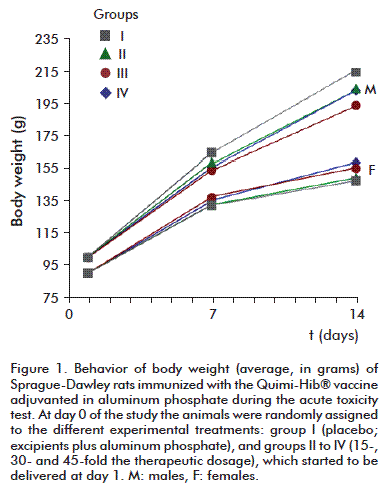
<body><![CDATA[<P   align="justify" > </P >       <P   >&nbsp;</P >       <P   ><font size="2" face="Verdana, Arial, Helvetica, sans-serif"><B><font size="3">RESULTS      </font></b></font></P >   <FONT size="+1"><B>        <P   ><font size="2" face="Verdana, Arial, Helvetica, sans-serif">Evaluation of acute      toxicity </font></P >   <FONT size="+1">        <P   ><font size="2" face="Verdana, Arial, Helvetica, sans-serif"><I>Body weight and      food intake </I></font></P >   </font></B>        <P   align="justify" ><font size="2" face="Verdana, Arial, Helvetica, sans-serif">Body weight exhibited      the expected behavior; that is, the values of this parameter between days      7 and 14 were significantly different and when compared to those of day 1      for each group, regardless of sex (<a href="#fig1">Figure 1</a>). On the other      hand, no statistically significant differences were detected between treatment      groups for the same time point (p &gt; 0.05, Anova). Body weight increased      at a rate significantly different from zero during the experimental stage      of the study (p &lt; 0.05, Anova). </font></P >       <P   align="center" ><img src="/img/revistas/bta/v30n2/f0105213.gif" width="389" height="497"><a name="fig1"></a></P >   <FONT size="+1">        
<P   align="justify" ><font size="2" face="Verdana, Arial, Helvetica, sans-serif">Food intake was similar      for all three studies, exhibiting a homogeneous behavior across groups for      each evaluation time point: 15 to 18 g per day (<a href="/img/revistas/bta/v30n2/f0205213.gif">Figure      2</a>). </font></P >       
<P   align="justify" ><font size="2" face="Verdana, Arial, Helvetica, sans-serif">The highest food      intake values were registered during weekends (days 5-6 and 12-13). This is      an expected value, as during these days the stress arising from the manipulation      of the animals is minimal. All environmental parameters remained stable, within      the limits established for the species (rodents) [12-14]. No statistically      significant inter-group differences were detected in the corresponding analysis      (p &gt; 0.05, Kruskal-Wallis test). </font></P >       <P   ><font size="2" face="Verdana, Arial, Helvetica, sans-serif"><B><I>Clinical examination      and macroscopic observations </I></b></font></P >       ]]></body>
<body><![CDATA[<P   align="justify" ><font size="2" face="Verdana, Arial, Helvetica, sans-serif">No signs of toxicity      or alterations were detected during the daily clinical examinations. Likewise,      there were no deaths or behavioral alterations. No changes were detected in      the inspected organs and tissues during necropsies. </font></P >       <P   ><font size="2" face="Verdana, Arial, Helvetica, sans-serif"><B><I>Histopathological      study </I></b></font></P >       <P   align="justify" ><font size="2" face="Verdana, Arial, Helvetica, sans-serif">There were signs      of inflammatory reactions in muscle tissue samples (hemorrhages or cicatrization      foci), but there were no morphological alterations (<a href="#tab2">Table      2</a>).</font></P >       <P   align="center" ><img src="/img/revistas/bta/v30n2/t0205213.gif" width="384" height="314"><a name="tab2"></a></P >       
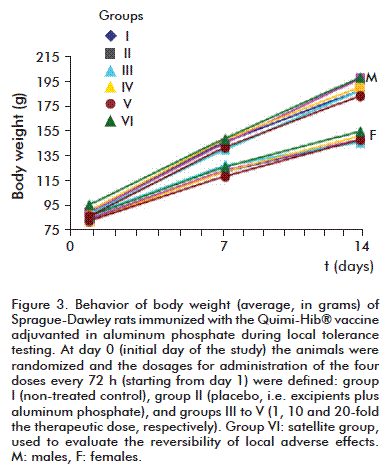
<P   align="justify" ><font size="2" face="Verdana, Arial, Helvetica, sans-serif">The observed necrosis      was not a lesion of the muscle tissue, but a central part of the granuloma.      No statistically significant differences between placebo and vaccine-treated      groups were detected. Group IV exhibited the least conspicuous alterations      of the inoculation site (no symptoms in 6 out of 10 animals); an important      finding, taking into account that these animals received 230 &micro;L of the      adjuvanted vaccine. There was extramedullary hematopoiesis in liver and spleen      for all animals, a finding that was independent from immunogen type (vaccine      vs. placebo) and dose. Likewise, there were no statistically significant differences      between groups for the findings of the histopathological study. The examined      organs (liver, spleen and mesenteric lymph nodes) did not exhibit alterations      that might be construed as signs of toxicity. </font></P >       <P   ><font size="2" face="Verdana, Arial, Helvetica, sans-serif"><B>Evaluation of      local tolerance </b></font></P >   <B>        <P   ><font size="2" face="Verdana, Arial, Helvetica, sans-serif"><I>Body weight </I></font></P >   </B>        <P   align="justify" ><font size="2" face="Verdana, Arial, Helvetica, sans-serif">Body weight exhibited      no statistically significant differences between experimental groups for the      same time point (p &gt; 0.05, Anova), and increased at normal rates (<a href="#fig3">Figure      3</a>). Average bodyweight increase was significantly different from zero      during the evaluation period. </font></P >       <P   align="center" ><img src="/img/revistas/bta/v30n2/f0305213.gif" width="388" height="472"><a name="fig3"></a></P >       
<P   ><font size="2" face="Verdana, Arial, Helvetica, sans-serif"><B><I>Clinical examinations      and macroscopic observations </I></b></font></P >       ]]></body>
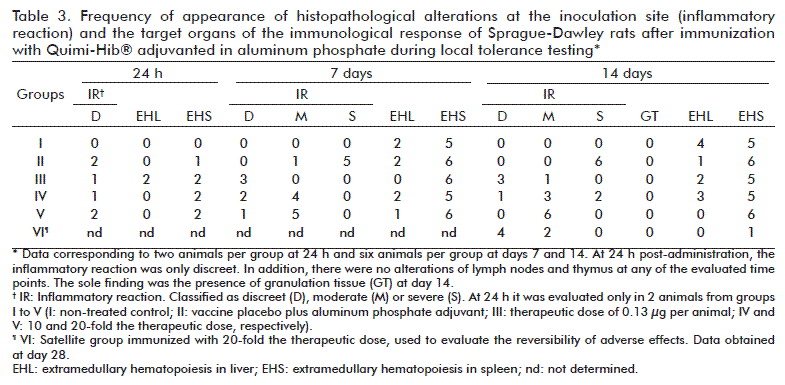
<body><![CDATA[<P   align="justify" ><font size="2" face="Verdana, Arial, Helvetica, sans-serif">The most conspicuous      systemic effect was the presence of marked piloerection in all animals, including      those receiving the placebo, during week 2 of the study (after two immunizations).      The only clinical sign detected during the study was induration at the inoculation      site in groups II (placebo, <I>i.e. </I>excipients plus adjuvant), IV (medium      dose), V (high dose) and VI (satellite group). No local reactions were detected      during the first four days of the study, but mild indurations appeared, started      from day 5, in the animals from groups II, V and VI except one individual      from group VI, and remained present, with varying intensities, throughout      the remainder of the study. Mild and moderate indurations were evidenced in      the groups receiving 10 and 20-fold the TD and in the placebo group, which      inoculation volume was the largest. Group VI (satellite) remained under observation      up to day 28 of the study in order to evaluate the reversibility of these      reactions. While they did not revert completely, the daily clinical reports      evidenced a gradual decrease of their severity. </font></P >       <P   align="justify" ><font size="2" face="Verdana, Arial, Helvetica, sans-serif">The macroscopic observations      performed during necropsies (at 24 h, 7 and 14 days and 28 days for the satellite      group) failed to find signs of damage in any organ system. There were white      nodules at the inoculation site, which size was directly related to dose and      administration volume. </font></P >       <P   ><font size="2" face="Verdana, Arial, Helvetica, sans-serif"><B><I>Histopathological      study </I></b></font></P >       <P   align="justify" ><font size="2" face="Verdana, Arial, Helvetica, sans-serif">There was a noticeable      increase in the number of macrophages at the inoculation site after 24 h of      the first administration, which also exhibited liquid depots of the immunogen.      These are typical and expected findings after the administration of an antigenic      substance containing aluminum phosphate as an adjuvant, and were also observed      during the necropsies performed at days 7, 14 and 28 although their intensity      was variable, depending on dose number and size. </font></P >       <P   align="justify" ><font size="2" face="Verdana, Arial, Helvetica, sans-serif">At day 7 (after 2      doses) the local reactions led to the appearance of diffuse macrophage granulomas      with eventual liquid depots, a modest cicatrization response within the reaction      and the infiltration of lymphocytes, especially in the periphery, with varying      intensity. It should be noted that the granulomatose reaction of group III      (TD) was also modest. </font></P >       <P   align="justify" ><font size="2" face="Verdana, Arial, Helvetica, sans-serif">At day 14 (<a href="/img/revistas/bta/v30n2/t0305213.gif">Table      3</a>), after 4 doses, the inoculation site continued to exhibit the granulomas      described above, which were most frequent and intense in the groups receiving      the highest dose (V) and the largest volumes of adjuvant (II and V). </font></P >       
<P   align="justify" ><font size="2" face="Verdana, Arial, Helvetica, sans-serif">The only symptom      of group I (non-treated control) was the presence of extramedullary hematopoiesis      in the liver of two animals at day 7 and four animals at day 14, as well as      extramedullary hematopoiesis in the spleen of five animals at days 7 and 14.      No other histopathological signs were observed in this group during the study.      </font></P >       <P   align="justify" ><font size="2" face="Verdana, Arial, Helvetica, sans-serif">There were no cases      of extramedullary hematopoiesis at the liver for any of the animals of the      study at 24 h after the first inoculation. Likewise, there were no cases of      alterations in lymph nodes or the thymus throughout the study. There was only      a moderate inflammatory response and extramedullary hematopoiesis at the spleen      of animals belonging to groups receiving adjuvant-containing formulations      (including the adjuvant-only group) and extramedullary hematopoiesis in the      liver of individuals from group III (TD). </font></P >       <P   align="justify" ><font size="2" face="Verdana, Arial, Helvetica, sans-serif">There were evidences      of granulation tissue only in two animals from group III (TD) at day 14. </font></P >       <P   align="justify" ><font size="2" face="Verdana, Arial, Helvetica, sans-serif">Histopathological      data for the satellite group was only collected at day 28. In this case, there      was a modest local reaction in four animals, and a moderate reaction in another      two; there was only one animal exhibiting extramedullary hematopoiesis. No      other alterations were detected in this group. </font></P >       ]]></body>
<body><![CDATA[<P   align="justify" ><font size="2" face="Verdana, Arial, Helvetica, sans-serif">The frequency of      appearance of alterations in the other parameters is shown in <a href="/img/revistas/bta/v30n2/t0305213.gif">table      3</a>. </font></P >       
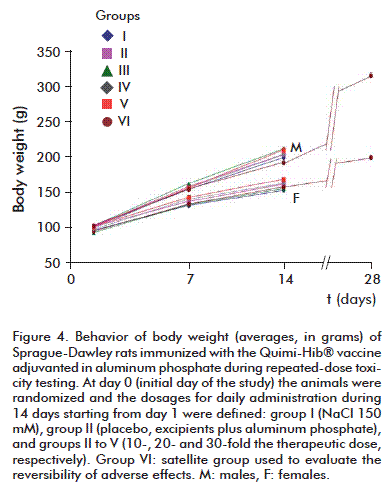
<P   ><font size="2" face="Verdana, Arial, Helvetica, sans-serif"><B>Evaluation of      repeated-dose toxicity </b></font></P >   <B>        <P   ><font size="2" face="Verdana, Arial, Helvetica, sans-serif"><I>Body weight and      food intake </I></font></P >   </B>        <P   align="justify" ><font size="2" face="Verdana, Arial, Helvetica, sans-serif">There were no differences      regarding body weight between experimental groups for either sex at the same      time point (p &gt; 0.05, Anova), although average body weight did exhibit      a statistically significant increase with respect to its initial value (p      &lt; 0.05, Anova) that was similar for every group (<a href="#fig4">Figure      4</a>). </font></P >       <P   align="center" ><img src="/img/revistas/bta/v30n2/f0405213.gif" width="390" height="490"><a name="fig4"></a></P >       
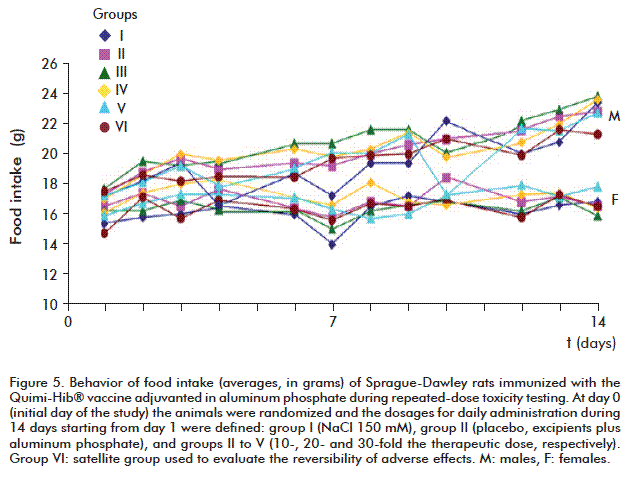
<P   align="justify" ><font size="2" face="Verdana, Arial, Helvetica, sans-serif">Food intake also      exhibited a homogenous behavior across groups for each time point (15 to 24      g per day) (<a href="/img/revistas/bta/v30n2/f0505213.gif">Figure 5</a>).      Upon close examination, there was a significant decrease of average food intake      by day 7 of the study for the females of group I, which was corroborated by      the corresponding statistical analysis (p &gt; 0.05, Kruskal-Wallis test).      </font></P >       
<P   ><font size="2" face="Verdana, Arial, Helvetica, sans-serif"><B><I>Clinical examination      and macroscopic observations </I></b></font></P >       <P   align="justify" ><font size="2" face="Verdana, Arial, Helvetica, sans-serif">No signs of local      reaction at the inoculation site or any other alterations were detected during      the first 4 days after starting the study, although indurations at this site      appeared afterwards in animals from every group and remained throughout the      experimental stage. Severe induration and nodules were present in animals      from the placebo, high dose (20 and 30-fold the TD) and satellite groups,      which received the largest inoculation volumes, but were also observed in      mild form in animals from group III (10-fold the TD). </font></P >       <P   align="justify" ><font size="2" face="Verdana, Arial, Helvetica, sans-serif">The hematological      parameters of treated groups were similar to those of animals from the same      batch which did not receive any test compounds (control non-treated group).      The macroscopic observations performed during necropsy confirmed the results      of the clinical examinations; their main finding was the presence of pale      formations with a nodular appearance. The weight of all organs remained within      the normal ranges for the species. </font></P >       <P   ><font size="2" face="Verdana, Arial, Helvetica, sans-serif"><B><I>Histopathological      study </I></b></font></P >       ]]></body>
<body><![CDATA[<P   align="justify" ><font size="2" face="Verdana, Arial, Helvetica, sans-serif">Muscle tissue samples      were examined looking for histological signs of inflammatory reactions, hemorrhages      and cicatrizing foci. However, our sole finding was the presence, in the animals      from the groups receiving the largest vaccine doses, of diffuse granulomas      in the inoculation site, circumscribed mainly to the endomysium of muscle      fibers with liquid depots and evidence of cell lysis for the granulomatous      tissue, interspersed with cicatrization tissue and a few polymorphonuclear      eosinophils. The individuals from the placebo group did not exhibit granulomas,      although three individuals did develop cicatrization tissue. None of the studied      animals had evidence of liver damage, and all had histopathological evidence      of antigenic stimulation on spleen and mesenteric lymph nodes. There were      no differences regarding the magnitude and structure of the local reaction      between the placebo group and the groups receiving multiple TD. </font></P >       <P   align="justify" >&nbsp;</P >       <P   align="justify" > </P >       <P   ><font size="3" face="Verdana, Arial, Helvetica, sans-serif"><B>DISCUSSION </b></font></P >   <FONT size="+1">        <P   align="justify" ><font size="2" face="Verdana, Arial, Helvetica, sans-serif">The sustained increase      in body weight and stable food intake figures exhibited by all animals used      for the preclinical safety testing of the aluminum phosphate-adjuvanted Quimi-Hib&reg;      conjugate vaccine evidence that this formulation is not toxic. Body weight      increased consistently throughout the experimental stage up to the appointed      date for euthanasia in all animals independently of the administered dose,      resulting in statistically significant differences compared to the initial      values (p &lt; 0.05). The values of both body weight and food intake in every      evaluation time point were similar to those reported for healthy animals of      this species [15] even in groups receiving dosages as high as 45-fold the      TD. These findings were confirmed by the clinical examinations, as there were      no morphological or etiological alterations attributable to the test compound,      evidencing the non-toxicity of the assayed formulations and treatments. In      turn, the histopathological studies of each of the three experiments corroborated      the findings of the clinical examinations. There was an inflammatory reaction      at the inoculation site, which has been linked by several authors to the presence      of aluminum phosphate as an adjuvant. This compound has been previously shown      to efficiently potentiate effector inflammatory responses [16-18], characterized      mainly by the presence of macrophages, neutrophils and plasma cells. The cicatrizing      and hemorrhaging foci are simply a response to the mechanical trauma of the      injections; as a matter of fact, there are occasional reports in literature      of lacerations and damage to muscles and skin. In any case, most of the animals      did not have alterations, further supporting the use of this formulation as      a vaccine candidate. The histopathological study also pointed at aluminum      phosphate as the main cause of the observed response, as our results coincide      with those reported by other authors employing vaccines adjuvanted with aluminum      salts [16-19]. The magnitude of the response corresponded to that expected      after the repeated inoculation of this adjuvant for 14 days. The observed      adverse effect at the inoculation site is not a sign of toxicity, despite      the administration of an adjuvant concentration larger than that specified      by the study protocol. These results evidence that the safety of the test      compound, Quimi-Hib adjuvanted in aluminum phosphate, is similar to that of      other vaccines approved for clinical use in many other countries [19-21].      </font></P >   <FONT size="+1">        <P   align="justify" ><font size="2" face="Verdana, Arial, Helvetica, sans-serif">There were no differences      between placebo and three different TD dosages concerning the magnitude and      structure of the local reaction after the repeated administration of the vaccine.      This demonstrates that the detected histological reactions are mainly caused      by the adjuvant and, especially, its concentration. Some authors have demonstrated      the presence of aluminum at the center of the macrophage granulomas observed      at the inoculation site after the administration of similar compounds [19],      and others, such as Bordet [20], have reported the infiltration of neutrophils,      microabscesses and the appearance of giant cells as markers of the adverse      effect of aluminum salts-based adjuvants. However, these findings were not      replicated by our study despite the use of adjuvant concentrations higher      than those of other commercially available vaccines, demonstrating that the      test compound satisfies all safety requirements for its examination in future      clinical trials. The present investigation, in summary, did not find any effect      attributable to the administration of the test compound that could be interpreted      as a sign of potential toxicity. </font></P >       <P   align="justify" ><font size="2" face="Verdana, Arial, Helvetica, sans-serif">The fact that the      observed local signs reversed only partially coincides with previous observations      by other authors (<I>e.g. </I>Gupta [17] and Goto <I>et al.</I> [22]), who      reported that the indurations appearing at the inoculation site after the      administration of vaccines adjuvanted with aluminum salts takes from 9 to      12 months to disappear both in rabbits and rats. </font></P >       <P   align="justify" >&nbsp;</P >       <P   align="justify" > </P >       <P   ><font size="3" face="Verdana, Arial, Helvetica, sans-serif"><B>CONCLUSIONS </b></font></P >   <FONT size="+1">        ]]></body>
<body><![CDATA[<P   align="justify" ><font size="2" face="Verdana, Arial, Helvetica, sans-serif">Taking into account      the data from earlier studies with the Quimi-Hib vaccine and the results of      the present work, it is concluded that the Quimi-Hib vaccine adjuvanted in      aluminum phosphates meets all innocuity and safety requirements for its administration      to human beings, as well as all national and international regulations for      the use and marketing of this product type. The repeated administration of      this product produces a local reaction characterized by macrophage granulomas      of varying intensities. In addition, this product is not toxic at a systemic      level, as its administration at a wide range of doses to Sprague-Dawley rats      did not result in morphological alterations in any of the studied organs,      did not alter their bodyweight increase rates and food intake indexes, did      not alter any of the studied hematological parameters, and did not change      the weight of the internal organs above or beneath the normal limits for healthy      animals. The only relevant finding of the clinical examinations and the gross      observations performed during necropsies was the presence of a local reaction      at the administration site (indurations caused by macrophage granulomas),      which has been previously reported for products employing aluminum salts as      adjuvant and do not represent a sign of toxicity. </font></P >       <P   align="justify" >&nbsp;</P >   <FONT size="+1">        <P   align="justify" > </P >       <P   ><font size="3" face="Verdana, Arial, Helvetica, sans-serif"><B>REFERENCES </b></font></P >   <FONT size="+1">        <!-- ref --><P   align="justify" ><font size="2" face="Verdana, Arial, Helvetica, sans-serif">1. Robbins JB, Schneerson      R. Haemophilus influenzae type b: the search for a vaccine. Pediatr Infect      Dis J. 1987;6(8):791-4.     </font></P >   <FONT size="+1">        <!-- ref --><P   align="justify" ><font size="2" face="Verdana, Arial, Helvetica, sans-serif">2. Ahmed N, Gottschalk      S. How to design effective vaccines: lessons from an old success story. Expert      Rev Vaccines. 2009; 8(5):543-6.     </font></P >       <!-- ref --><P   align="justify" ><font size="2" face="Verdana, Arial, Helvetica, sans-serif">3. Osterholm MT,      Kelley NS, Sommer A, Belongia EA. Efficacy and effectiveness of influenza      vaccines: a systematic review and meta-analysis. Lancet Infect Dis. 2012;12(1):36-44.          </font></P >       ]]></body>
<body><![CDATA[<!-- ref --><P   align="justify" ><font size="2" face="Verdana, Arial, Helvetica, sans-serif">4. Fitzwater SP,      Watt JP, Levine OS, Santosham M. Haemophilus influenzae type b conjugate vaccines:      considerations for vaccination schedules and implications for developing countries.      Hum Vaccines. 2010;6(10):810-8.     </font></P >       <!-- ref --><P   align="justify" ><font size="2" face="Verdana, Arial, Helvetica, sans-serif">5. Peltola H. Worldwide      Haemophilus influenzae type b disease at the beginning of the 21st century:      global analysis of the disease burden 25 years after the use of the polysaccharide      vaccine and a decade after the advent of conjugates. Clin Microbiol Rev. 2000;13(2):302-17.          </font></P >       <!-- ref --><P   align="justify" ><font size="2" face="Verdana, Arial, Helvetica, sans-serif">6. Plotkin SA. Correlates      of protection induced by vaccination. Clin Vaccine Immunol. 2010;17(7):1055-65.          </font></P >       <!-- ref --><P   align="justify" ><font size="2" face="Verdana, Arial, Helvetica, sans-serif">7. Verez-Bencomo      V, Fernandez-Santana V, Hardy E, Toledo ME, Rodriguez MC, Heynngnezz L, et      al. A synthetic conjugate polysaccharide vaccine against Haemophilus influenzae      type b. Science. 2004; 305(5683):522-5.     </font></P >       <!-- ref --><P   align="justify" ><font size="2" face="Verdana, Arial, Helvetica, sans-serif">8. European Medicines      Agency. CPMP/SWP/465/95. Note for guidance on preclinical pharmacological      and toxicological testing of vaccines (CPMP adopted Dec 97). London: EMA;      1997 (cited 2012 Apr 16). Available from: <A href="http://www.ema.europa.eu/docs/en_GB/document_library/Scientific_guideline/2009/10/WC500004004.pdf" target="_blank">      <FONT color="#0000FF">http://www.ema.europa.eu/docs/en_GB/document_library/Scientific_guideline/2009/10/WC500004004.pdf</font></A><FONT color="#0000FF"><FONT color="#000000">.          </font></font></font></P >   <FONT color="#0000FF"><FONT color="#000000">        ]]></body>
<body><![CDATA[<!-- ref --><P   align="justify" ><font size="2" face="Verdana, Arial, Helvetica, sans-serif">9. European Medicines      Agency. CPMP/SWP/1042/99. Note for guidance on repeated dose toxicity (CPMP      adopted July 2000). London: EMA. (cited 2012 Apr 16). Available from: <A href="http://www.ema.europa.eu/docs/en_GB/document_library/Scientific_guideline/2009/09/WC500003102.pdf" target="_blank" 	> <FONT color="#0000FF">http://www.ema.europa.eu/docs/en_GB/document_library/Scientific_guideline/2009/09/WC500003102.pdf</font></A><FONT color="#0000FF"><FONT color="#000000">.          </font></font></font></P >   <FONT color="#0000FF"><FONT color="#000000">        <!-- ref --><P   align="justify" ><font size="2" face="Verdana, Arial, Helvetica, sans-serif">10. European Medicines      Agency. CPMP/ICH/286/95. Note for guidance on Non-clinical safety studies      for the conduct of Human clinical trials for pharmaceuticals. ICH M3 (R2).      2008. Available from: <A href="http://www.ema.europa.eu/docs/en_GB/document_library/Scientific_guideline/2009/09/WC500002941.pdf" target="_blank" 	> <FONT color="#0000FF">http://www.ema.europa.eu/docs/en_GB/document_library/Scientific_guideline/2009/09/WC500002941.pdf</font></A><FONT color="#0000FF"><FONT color="#000000">.          </font></font></font></P >   <FONT color="#0000FF"><FONT color="#000000">        <!-- ref --><P   align="justify" ><font size="2" face="Verdana, Arial, Helvetica, sans-serif">11. Diehl KH, Hull      R, Morton D, Pfister R, Rabemampianina Y, Smith D, et al. A good practice      guide to the administration of substances and removal of blood, including      routes and volumes. J Appl Toxicol. 2001;21(1):15-23.     </font></P >       <!-- ref --><P   align="justify" ><font size="2" face="Verdana, Arial, Helvetica, sans-serif">12. Cosme K. Programa      para el Uso de Animales de Experimentaci&oacute;n del Centro de Ingenier&iacute;a      Gen&eacute;tica y Biotecnolog&iacute;a. Edici&oacute;n 01;1998.     </font></P >       <!-- ref --><P   align="justify" ><font size="2" face="Verdana, Arial, Helvetica, sans-serif">13. Van Zutphen LFM,      Balls M . Animal Alternatives, Welfare and Ethics. Developments in Animal      and Veterinary Sciences. Amsterdam: Elsevier Science Ltd.; 1997.     </font></P >       ]]></body>
<body><![CDATA[<!-- ref --><P   align="justify" ><font size="2" face="Verdana, Arial, Helvetica, sans-serif">14. Olfert ED, Cross      BM, Mc William A. Guide to the care and use of experimental animals. 2nd ed.      Ontario: Canadian Council on Animal Care; 1998.     </font></P >       <!-- ref --><P   align="justify" ><font size="2" face="Verdana, Arial, Helvetica, sans-serif">15. Harkness JE,      Wagner JE. The Biology and Medicine of Rabbits and Rodents. 4th ed. Philadelphia,      PA: Lea and Febiger; 1995.     </font></P >       <!-- ref --><P   align="justify" ><font size="2" face="Verdana, Arial, Helvetica, sans-serif">16. Lindblad EB.      Aluminium adjuvants-in retrospect and prospect. Vaccine. 2004; 22(27-28):3658-68.          </font></P >       <!-- ref --><P   align="justify" ><font size="2" face="Verdana, Arial, Helvetica, sans-serif">17. Gupta RK. Aluminum      compounds as vaccine adjuvants. Adv Drug Deliv Rev. 1998;32(3):155-72.     </font></P >       <!-- ref --><P   align="justify" ><font size="2" face="Verdana, Arial, Helvetica, sans-serif">18. Harandi AM, Medaglini      D, Shattock RJ. Vaccine adjuvants: a priority for vaccine research. Vaccine.      2010;28(12):2363-6.     </font></P >       ]]></body>
<body><![CDATA[<!-- ref --><P   align="justify" ><font size="2" face="Verdana, Arial, Helvetica, sans-serif">19. Chong H, Brady      K, Metze D, Calonje E. Persistent nodules at injection sites (aluminium granuloma)      - clinicopathological study of 14 cases with a diverse range of histological      reaction patterns. Histopathology. 2006;48(2):182-8.     </font></P >       <P   align="justify" ><font size="2" face="Verdana, Arial, Helvetica, sans-serif">20. Bordet AL, Michenet      P, Cohen C, Arbion F, Ekindi N, Bonneau C, et al. Granulome post-vaccinal      li&eacute; &agrave; l&rsquo;hydroxyde d&rsquo;aluminium. Ann Pathol. 2001;21(2):149-52.      </font></P >       <!-- ref --><P   align="justify" ><font size="2" face="Verdana, Arial, Helvetica, sans-serif">21. Makwana N, Riordan      FA. Bacterial meningitis: the impact of vaccination. CNS Drugs. 2007;21(5):355-66.          </font></P >       <!-- ref --><P   align="justify" ><font size="2" face="Verdana, Arial, Helvetica, sans-serif">22. Goto N, Kato      H, Maeyama J, Shibano M, Saito T, Yamaguchi J, et al. Local tissue irritating      effects and adjuvant activities of calcium phosphate and aluminium hydroxide      with different physical properties. Vaccine. 1997;15(12-13):1364-71.     </font></P >       <P   align="justify" >&nbsp;</P >       <P   align="justify" >&nbsp;</P >       <P   align="justify" > </P >       ]]></body>
<body><![CDATA[<P   align="justify" > </P >       <P   align="justify" ><font size="2" face="Verdana, Arial, Helvetica, sans-serif">Received in May,      2012.     <br>     </font><font size="2" face="Verdana, Arial, Helvetica, sans-serif">Accepted      in January, 2013. </font></P >       <P   align="justify" >&nbsp;</P >       <P   align="justify" >&nbsp;</P >       <P   align="justify" > </P >       <P   align="justify" > </P >       <P   align="justify" ><font size="2" face="Verdana, Arial, Helvetica, sans-serif"><I>Dania Bacard&iacute;</I>.      Centro de Ingenier&iacute;a Gen&eacute;tica y Biotecnolog&iacute;a, CIGB<FONT color="#D70000">.      <FONT color="#000000">Ave. 31 e/ 158 y 190, Cubanac&aacute;n, Playa, CP 11      600, La Habana, Cuba. E-mail: <A href="mailto:dania.bacardi@cigb.edu.cu"><FONT color="#0000FF">dania.bacardi@cigb.edu.cu</font></A><FONT color="#0000FF"><FONT color="#000000">.      </font></font></font></font></font></P >   </font></font></font></font></font></font></font></font></font></font></font></font></font></font></font></font></font></font></font></font></font></font></font></font></font></font></font></font></font></font></font></font></font></font></font></font></font></font></font></font></font></font></font></font></font></font></font></font></font></DIV >      ]]></body><back>
<ref-list>
<ref id="B1">
<label>1</label><nlm-citation citation-type="journal">
<person-group person-group-type="author">
<name>
<surname><![CDATA[Robbins]]></surname>
<given-names><![CDATA[JB]]></given-names>
</name>
<name>
<surname><![CDATA[Schneerson]]></surname>
<given-names><![CDATA[R]]></given-names>
</name>
</person-group>
<article-title xml:lang="en"><![CDATA[Haemophilus influenzae type b: the search for a vaccine]]></article-title>
<source><![CDATA[Pediatr Infect Dis J]]></source>
<year>1987</year>
<volume>6</volume>
<numero>8</numero>
<issue>8</issue>
<page-range>791-4</page-range></nlm-citation>
</ref>
<ref id="B2">
<label>2</label><nlm-citation citation-type="journal">
<person-group person-group-type="author">
<name>
<surname><![CDATA[Ahmed]]></surname>
<given-names><![CDATA[N]]></given-names>
</name>
<name>
<surname><![CDATA[Gottschalk]]></surname>
<given-names><![CDATA[S]]></given-names>
</name>
</person-group>
<article-title xml:lang="en"><![CDATA[How to design effective vaccines: lessons from an old success story]]></article-title>
<source><![CDATA[Expert Rev Vaccines]]></source>
<year>2009</year>
<volume>8</volume>
<numero>5</numero>
<issue>5</issue>
<page-range>543-6</page-range></nlm-citation>
</ref>
<ref id="B3">
<label>3</label><nlm-citation citation-type="journal">
<person-group person-group-type="author">
<name>
<surname><![CDATA[Osterholm]]></surname>
<given-names><![CDATA[MT]]></given-names>
</name>
<name>
<surname><![CDATA[Kelley]]></surname>
<given-names><![CDATA[NS]]></given-names>
</name>
<name>
<surname><![CDATA[Sommer]]></surname>
<given-names><![CDATA[A]]></given-names>
</name>
<name>
<surname><![CDATA[Belongia]]></surname>
<given-names><![CDATA[EA]]></given-names>
</name>
</person-group>
<article-title xml:lang="en"><![CDATA[Efficacy and effectiveness of influenza vaccines: a systematic review and meta-analysis]]></article-title>
<source><![CDATA[Lancet Infect Dis]]></source>
<year>2012</year>
<volume>12</volume>
<numero>1</numero>
<issue>1</issue>
<page-range>36-44</page-range></nlm-citation>
</ref>
<ref id="B4">
<label>4</label><nlm-citation citation-type="journal">
<person-group person-group-type="author">
<name>
<surname><![CDATA[Fitzwater]]></surname>
<given-names><![CDATA[SP]]></given-names>
</name>
<name>
<surname><![CDATA[Watt]]></surname>
<given-names><![CDATA[JP]]></given-names>
</name>
<name>
<surname><![CDATA[Levine]]></surname>
<given-names><![CDATA[OS]]></given-names>
</name>
<name>
<surname><![CDATA[Santosham]]></surname>
<given-names><![CDATA[M]]></given-names>
</name>
</person-group>
<article-title xml:lang="en"><![CDATA[Haemophilus influenzae type b conjugate vaccines: considerations for vaccination schedules and implications for developing countries]]></article-title>
<source><![CDATA[Hum Vaccines]]></source>
<year>2010</year>
<volume>6</volume>
<numero>10</numero>
<issue>10</issue>
<page-range>810-8</page-range></nlm-citation>
</ref>
<ref id="B5">
<label>5</label><nlm-citation citation-type="journal">
<person-group person-group-type="author">
<name>
<surname><![CDATA[Peltola]]></surname>
<given-names><![CDATA[H]]></given-names>
</name>
</person-group>
<article-title xml:lang="en"><![CDATA[Worldwide Haemophilus influenzae type b disease at the beginning of the 21st century: global analysis of the disease burden 25 years after the use of the polysaccharide vaccine and a decade after the advent of conjugates]]></article-title>
<source><![CDATA[Clin Microbiol Rev]]></source>
<year>2000</year>
<volume>13</volume>
<numero>2</numero>
<issue>2</issue>
<page-range>302-17</page-range></nlm-citation>
</ref>
<ref id="B6">
<label>6</label><nlm-citation citation-type="journal">
<person-group person-group-type="author">
<name>
<surname><![CDATA[Plotkin]]></surname>
<given-names><![CDATA[SA]]></given-names>
</name>
</person-group>
<article-title xml:lang="en"><![CDATA[Correlates of protection induced by vaccination]]></article-title>
<source><![CDATA[Clin Vaccine Immunol]]></source>
<year>2010</year>
<volume>17</volume>
<numero>7</numero>
<issue>7</issue>
<page-range>1055-65</page-range></nlm-citation>
</ref>
<ref id="B7">
<label>7</label><nlm-citation citation-type="journal">
<person-group person-group-type="author">
<name>
<surname><![CDATA[Verez-Bencomo]]></surname>
<given-names><![CDATA[V]]></given-names>
</name>
<name>
<surname><![CDATA[Fernandez-Santana]]></surname>
<given-names><![CDATA[V]]></given-names>
</name>
<name>
<surname><![CDATA[Hardy]]></surname>
<given-names><![CDATA[E]]></given-names>
</name>
<name>
<surname><![CDATA[Toledo]]></surname>
<given-names><![CDATA[ME]]></given-names>
</name>
<name>
<surname><![CDATA[Rodriguez]]></surname>
<given-names><![CDATA[MC]]></given-names>
</name>
<name>
<surname><![CDATA[Heynngnezz]]></surname>
<given-names><![CDATA[L]]></given-names>
</name>
</person-group>
<article-title xml:lang="en"><![CDATA[A synthetic conjugate polysaccharide vaccine against Haemophilus influenzae type b]]></article-title>
<source><![CDATA[Science]]></source>
<year>2004</year>
<volume>305</volume>
<numero>5683</numero>
<issue>5683</issue>
<page-range>522-5</page-range></nlm-citation>
</ref>
<ref id="B8">
<label>8</label><nlm-citation citation-type="book">
<collab>European Medicines Agency</collab>
<source><![CDATA[CPMP/SWP/465/95. Note for guidance on preclinical pharmacological and toxicological testing of vaccines (CPMP adopted Dec 97)]]></source>
<year>1997</year>
<publisher-loc><![CDATA[London ]]></publisher-loc>
<publisher-name><![CDATA[EMA]]></publisher-name>
</nlm-citation>
</ref>
<ref id="B9">
<label>9</label><nlm-citation citation-type="book">
<collab>European Medicines Agency</collab>
<source><![CDATA[CPMP/SWP/1042/99. Note for guidance on repeated dose toxicity (CPMP adopted July 2000)]]></source>
<year></year>
<publisher-loc><![CDATA[London ]]></publisher-loc>
<publisher-name><![CDATA[EMA]]></publisher-name>
</nlm-citation>
</ref>
<ref id="B10">
<label>10</label><nlm-citation citation-type="">
<collab>European Medicines Agency</collab>
<source><![CDATA[CPMP/ICH/286/95. Note for guidance on Non-clinical safety studies for the conduct of Human clinical trials for pharmaceuticals. ICH M3 (R2)]]></source>
<year>2008</year>
</nlm-citation>
</ref>
<ref id="B11">
<label>11</label><nlm-citation citation-type="journal">
<person-group person-group-type="author">
<name>
<surname><![CDATA[Diehl]]></surname>
<given-names><![CDATA[KH]]></given-names>
</name>
<name>
<surname><![CDATA[Hull]]></surname>
<given-names><![CDATA[R]]></given-names>
</name>
<name>
<surname><![CDATA[Morton]]></surname>
<given-names><![CDATA[D]]></given-names>
</name>
<name>
<surname><![CDATA[Pfister]]></surname>
<given-names><![CDATA[R]]></given-names>
</name>
<name>
<surname><![CDATA[Rabemampianina]]></surname>
<given-names><![CDATA[Y]]></given-names>
</name>
<name>
<surname><![CDATA[Smith]]></surname>
<given-names><![CDATA[D]]></given-names>
</name>
</person-group>
<article-title xml:lang="en"><![CDATA[A good practice guide to the administration of substances and removal of blood, including routes and volumes]]></article-title>
<source><![CDATA[J Appl Toxicol]]></source>
<year>2001</year>
<volume>21</volume>
<numero>1</numero>
<issue>1</issue>
<page-range>15-23</page-range></nlm-citation>
</ref>
<ref id="B12">
<label>12</label><nlm-citation citation-type="">
<person-group person-group-type="author">
<name>
<surname><![CDATA[Cosme]]></surname>
<given-names><![CDATA[K]]></given-names>
</name>
</person-group>
<source><![CDATA[Programa para el Uso de Animales de Experimentación del Centro de Ingeniería Genética y Biotecnología]]></source>
<year>1998</year>
<edition>1</edition>
</nlm-citation>
</ref>
<ref id="B13">
<label>13</label><nlm-citation citation-type="book">
<person-group person-group-type="author">
<name>
<surname><![CDATA[Van Zutphen]]></surname>
<given-names><![CDATA[LFM]]></given-names>
</name>
<name>
<surname><![CDATA[Balls]]></surname>
<given-names><![CDATA[M]]></given-names>
</name>
</person-group>
<source><![CDATA[Animal Alternatives, Welfare and Ethics. Developments in Animal and Veterinary Sciences]]></source>
<year>1997</year>
<publisher-loc><![CDATA[Amsterdam ]]></publisher-loc>
<publisher-name><![CDATA[Elsevier Science Ltd.]]></publisher-name>
</nlm-citation>
</ref>
<ref id="B14">
<label>14</label><nlm-citation citation-type="book">
<person-group person-group-type="author">
<name>
<surname><![CDATA[Olfert]]></surname>
<given-names><![CDATA[ED]]></given-names>
</name>
<name>
<surname><![CDATA[Cross]]></surname>
<given-names><![CDATA[BM]]></given-names>
</name>
<name>
<surname><![CDATA[Mc William]]></surname>
<given-names><![CDATA[A]]></given-names>
</name>
</person-group>
<source><![CDATA[Guide to the care and use of experimental animals]]></source>
<year>1998</year>
<edition>2</edition>
<publisher-loc><![CDATA[Ontario ]]></publisher-loc>
<publisher-name><![CDATA[Canadian Council on Animal Care]]></publisher-name>
</nlm-citation>
</ref>
<ref id="B15">
<label>15</label><nlm-citation citation-type="book">
<person-group person-group-type="author">
<name>
<surname><![CDATA[Harkness]]></surname>
<given-names><![CDATA[JE]]></given-names>
</name>
<name>
<surname><![CDATA[Wagner]]></surname>
<given-names><![CDATA[JE]]></given-names>
</name>
</person-group>
<source><![CDATA[The Biology and Medicine of Rabbits and Rodents]]></source>
<year>1995</year>
<edition>4</edition>
<publisher-loc><![CDATA[Philadelphia, PA ]]></publisher-loc>
<publisher-name><![CDATA[Lea and Febiger]]></publisher-name>
</nlm-citation>
</ref>
<ref id="B16">
<label>16</label><nlm-citation citation-type="journal">
<person-group person-group-type="author">
<name>
<surname><![CDATA[Lindblad]]></surname>
<given-names><![CDATA[EB]]></given-names>
</name>
</person-group>
<article-title xml:lang="en"><![CDATA[Aluminium adjuvants: in retrospect and prospect]]></article-title>
<source><![CDATA[Vaccine]]></source>
<year>2004</year>
<volume>22</volume>
<numero>27-28</numero>
<issue>27-28</issue>
<page-range>3658-68</page-range></nlm-citation>
</ref>
<ref id="B17">
<label>17</label><nlm-citation citation-type="journal">
<person-group person-group-type="author">
<name>
<surname><![CDATA[Gupta]]></surname>
<given-names><![CDATA[RK]]></given-names>
</name>
</person-group>
<article-title xml:lang="en"><![CDATA[Aluminum compounds as vaccine adjuvants]]></article-title>
<source><![CDATA[Adv Drug Deliv Rev]]></source>
<year>1998</year>
<volume>32</volume>
<numero>3</numero>
<issue>3</issue>
<page-range>155-72</page-range></nlm-citation>
</ref>
<ref id="B18">
<label>18</label><nlm-citation citation-type="journal">
<person-group person-group-type="author">
<name>
<surname><![CDATA[Harandi]]></surname>
<given-names><![CDATA[AM]]></given-names>
</name>
<name>
<surname><![CDATA[Medaglini]]></surname>
<given-names><![CDATA[D]]></given-names>
</name>
<name>
<surname><![CDATA[Shattock]]></surname>
<given-names><![CDATA[RJ]]></given-names>
</name>
</person-group>
<article-title xml:lang="en"><![CDATA[Vaccine adjuvants: a priority for vaccine research]]></article-title>
<source><![CDATA[Vaccine]]></source>
<year>2010</year>
<volume>28</volume>
<numero>12</numero>
<issue>12</issue>
<page-range>2363-6</page-range></nlm-citation>
</ref>
<ref id="B19">
<label>19</label><nlm-citation citation-type="journal">
<person-group person-group-type="author">
<name>
<surname><![CDATA[Chong]]></surname>
<given-names><![CDATA[H]]></given-names>
</name>
<name>
<surname><![CDATA[Brady]]></surname>
<given-names><![CDATA[K]]></given-names>
</name>
<name>
<surname><![CDATA[Metze]]></surname>
<given-names><![CDATA[D]]></given-names>
</name>
<name>
<surname><![CDATA[Calonje]]></surname>
<given-names><![CDATA[E]]></given-names>
</name>
</person-group>
<article-title xml:lang="en"><![CDATA[Persistent nodules at injection sites (aluminium granuloma): clinicopathological study of 14 cases with a diverse range of histological reaction patterns]]></article-title>
<source><![CDATA[Histopathology]]></source>
<year>2006</year>
<volume>48</volume>
<numero>2</numero>
<issue>2</issue>
<page-range>182-8</page-range></nlm-citation>
</ref>
<ref id="B20">
<label>20</label><nlm-citation citation-type="journal">
<person-group person-group-type="author">
<name>
<surname><![CDATA[Bordet]]></surname>
<given-names><![CDATA[AL]]></given-names>
</name>
<name>
<surname><![CDATA[Michenet]]></surname>
<given-names><![CDATA[P]]></given-names>
</name>
<name>
<surname><![CDATA[Cohen]]></surname>
<given-names><![CDATA[C]]></given-names>
</name>
<name>
<surname><![CDATA[Arbion]]></surname>
<given-names><![CDATA[F]]></given-names>
</name>
<name>
<surname><![CDATA[Ekindi]]></surname>
<given-names><![CDATA[N]]></given-names>
</name>
<name>
<surname><![CDATA[Bonneau]]></surname>
<given-names><![CDATA[C]]></given-names>
</name>
</person-group>
<article-title xml:lang="fr"><![CDATA[Granulome post-vaccinal lié à l'hydroxyde d'aluminium]]></article-title>
<source><![CDATA[Ann Pathol]]></source>
<year>2001</year>
<volume>21</volume>
<numero>2</numero>
<issue>2</issue>
<page-range>149-52</page-range></nlm-citation>
</ref>
<ref id="B21">
<label>21</label><nlm-citation citation-type="journal">
<person-group person-group-type="author">
<name>
<surname><![CDATA[Makwana]]></surname>
<given-names><![CDATA[N]]></given-names>
</name>
<name>
<surname><![CDATA[Riordan]]></surname>
<given-names><![CDATA[FA]]></given-names>
</name>
</person-group>
<article-title xml:lang="en"><![CDATA[Bacterial meningitis: the impact of vaccination]]></article-title>
<source><![CDATA[CNS Drugs]]></source>
<year>2007</year>
<volume>21</volume>
<numero>5</numero>
<issue>5</issue>
<page-range>355-66</page-range></nlm-citation>
</ref>
<ref id="B22">
<label>22</label><nlm-citation citation-type="journal">
<person-group person-group-type="author">
<name>
<surname><![CDATA[Goto]]></surname>
<given-names><![CDATA[N]]></given-names>
</name>
<name>
<surname><![CDATA[Kato]]></surname>
<given-names><![CDATA[H]]></given-names>
</name>
<name>
<surname><![CDATA[Maeyama]]></surname>
<given-names><![CDATA[J]]></given-names>
</name>
<name>
<surname><![CDATA[Shibano]]></surname>
<given-names><![CDATA[M]]></given-names>
</name>
<name>
<surname><![CDATA[Saito]]></surname>
<given-names><![CDATA[T]]></given-names>
</name>
<name>
<surname><![CDATA[Yamaguchi]]></surname>
<given-names><![CDATA[J]]></given-names>
</name>
</person-group>
<article-title xml:lang="en"><![CDATA[Local tissue irritating effects and adjuvant activities of calcium phosphate and aluminium hydroxide with different physical properties]]></article-title>
<source><![CDATA[Vaccine]]></source>
<year>1997</year>
<volume>15</volume>
<numero>12-13</numero>
<issue>12-13</issue>
<page-range>1364-71</page-range></nlm-citation>
</ref>
</ref-list>
</back>
</article>