<?xml version="1.0" encoding="ISO-8859-1"?><article xmlns:mml="http://www.w3.org/1998/Math/MathML" xmlns:xlink="http://www.w3.org/1999/xlink" xmlns:xsi="http://www.w3.org/2001/XMLSchema-instance">
<front>
<journal-meta>
<journal-id>1027-2852</journal-id>
<journal-title><![CDATA[Biotecnología Aplicada]]></journal-title>
<abbrev-journal-title><![CDATA[Biotecnol Apl]]></abbrev-journal-title>
<issn>1027-2852</issn>
<publisher>
<publisher-name><![CDATA[Editorial Elfos Scientiae]]></publisher-name>
</publisher>
</journal-meta>
<article-meta>
<article-id>S1027-28522013000200010</article-id>
<title-group>
<article-title xml:lang="en"><![CDATA[Proof of concept in non-human primates of the heterologous prime-boost strategy combining dengue-2 virus and recombinant proteins including domain III of the viral envelope protein]]></article-title>
<article-title xml:lang="es"><![CDATA[Prueba de concepto en primates no humanos de estrategia de inmunización contra dengue con virus del serotipo 2 y re-estimulación con proteínas recombinantes que portan el dominio III de la proteína de la envoltura viral]]></article-title>
</title-group>
<contrib-group>
<contrib contrib-type="author">
<name>
<surname><![CDATA[Valdés]]></surname>
<given-names><![CDATA[Iris]]></given-names>
</name>
<xref ref-type="aff" rid="A01"/>
</contrib>
<contrib contrib-type="author">
<name>
<surname><![CDATA[Hermida]]></surname>
<given-names><![CDATA[Lisset]]></given-names>
</name>
<xref ref-type="aff" rid="A01"/>
</contrib>
<contrib contrib-type="author">
<name>
<surname><![CDATA[Gil]]></surname>
<given-names><![CDATA[Lázaro]]></given-names>
</name>
<xref ref-type="aff" rid="A01"/>
</contrib>
<contrib contrib-type="author">
<name>
<surname><![CDATA[Lazo1]]></surname>
<given-names><![CDATA[Laura]]></given-names>
</name>
<xref ref-type="aff" rid="A01"/>
</contrib>
<contrib contrib-type="author">
<name>
<surname><![CDATA[Guillén]]></surname>
<given-names><![CDATA[Gerardo]]></given-names>
</name>
<xref ref-type="aff" rid="A01"/>
</contrib>
<contrib contrib-type="author">
<name>
<surname><![CDATA[Guzmán]]></surname>
<given-names><![CDATA[María G]]></given-names>
</name>
<xref ref-type="aff" rid="A02"/>
</contrib>
<contrib contrib-type="author">
<name>
<surname><![CDATA[Castro]]></surname>
<given-names><![CDATA[Jorge]]></given-names>
</name>
<xref ref-type="aff" rid="A01"/>
</contrib>
<contrib contrib-type="author">
<name>
<surname><![CDATA[Romero]]></surname>
<given-names><![CDATA[Yaremis]]></given-names>
</name>
<xref ref-type="aff" rid="A01"/>
</contrib>
<contrib contrib-type="author">
<name>
<surname><![CDATA[Puente]]></surname>
<given-names><![CDATA[Pedro]]></given-names>
</name>
<xref ref-type="aff" rid="A01"/>
</contrib>
<contrib contrib-type="author">
<name>
<surname><![CDATA[Martín]]></surname>
<given-names><![CDATA[Jorge]]></given-names>
</name>
<xref ref-type="aff" rid="A01"/>
</contrib>
<contrib contrib-type="author">
<name>
<surname><![CDATA[Marcos]]></surname>
<given-names><![CDATA[Ernesto]]></given-names>
</name>
<xref ref-type="aff" rid="A01"/>
</contrib>
<contrib contrib-type="author">
<name>
<surname><![CDATA[López]]></surname>
<given-names><![CDATA[Carlos]]></given-names>
</name>
<xref ref-type="aff" rid="A01"/>
</contrib>
<contrib contrib-type="author">
<name>
<surname><![CDATA[Sánchez]]></surname>
<given-names><![CDATA[Jorge]]></given-names>
</name>
<xref ref-type="aff" rid="A01"/>
</contrib>
<contrib contrib-type="author">
<name>
<surname><![CDATA[Niebla]]></surname>
<given-names><![CDATA[Olivia]]></given-names>
</name>
<xref ref-type="aff" rid="A01"/>
</contrib>
<contrib contrib-type="author">
<name>
<surname><![CDATA[Menéndez]]></surname>
<given-names><![CDATA[Tamara]]></given-names>
</name>
<xref ref-type="aff" rid="A01"/>
</contrib>
<contrib contrib-type="author">
<name>
<surname><![CDATA[Izquierdo]]></surname>
<given-names><![CDATA[Alienys]]></given-names>
</name>
<xref ref-type="aff" rid="A02"/>
</contrib>
<contrib contrib-type="author">
<name>
<surname><![CDATA[Suzarte]]></surname>
<given-names><![CDATA[Edith]]></given-names>
</name>
<xref ref-type="aff" rid="A01"/>
</contrib>
<contrib contrib-type="author">
<name>
<surname><![CDATA[Silva]]></surname>
<given-names><![CDATA[José A]]></given-names>
</name>
<xref ref-type="aff" rid="A01"/>
</contrib>
</contrib-group>
<aff id="A02">
<institution><![CDATA[,Instituto de Medicina Tropical Pedro Kourí, IPK  ]]></institution>
<addr-line><![CDATA[La Habana ]]></addr-line>
<country>Cuba</country>
</aff>
<aff id="A01">
<institution><![CDATA[,Centro de Ingeniería Genética y Biotecnología, CIGB  ]]></institution>
<addr-line><![CDATA[La Habana ]]></addr-line>
<country>Cuba</country>
</aff>
<pub-date pub-type="pub">
<day>00</day>
<month>06</month>
<year>2013</year>
</pub-date>
<pub-date pub-type="epub">
<day>00</day>
<month>06</month>
<year>2013</year>
</pub-date>
<volume>30</volume>
<numero>2</numero>
<fpage>150</fpage>
<lpage>152</lpage>
<copyright-statement/>
<copyright-year/>
<self-uri xlink:href="http://scielo.sld.cu/scielo.php?script=sci_arttext&amp;pid=S1027-28522013000200010&amp;lng=en&amp;nrm=iso"></self-uri><self-uri xlink:href="http://scielo.sld.cu/scielo.php?script=sci_abstract&amp;pid=S1027-28522013000200010&amp;lng=en&amp;nrm=iso"></self-uri><self-uri xlink:href="http://scielo.sld.cu/scielo.php?script=sci_pdf&amp;pid=S1027-28522013000200010&amp;lng=en&amp;nrm=iso"></self-uri><abstract abstract-type="short" xml:lang="en"><p><![CDATA[Live attenuated viruses are the most advanced candidates against a dengue infection. They have been demonstrated to be immunogenic in preclinical and clinical studies. However, due to their replicative capacity, they require several doses to achieve the balanced immune response against the four serotypes. The use of a suitable combination using nonreplicative immunogens, without viral interference, can help to induce such a balanced response. This work dealt with the proof of concept of the heterologous prime-boost strategy combining in the same schedule in non-human primates of a live virus and the recombinant proteins containing the domain III of the viral envelope. These combinations may result in condensed immunization schedules for humans, thus reducing the number of doses with attenuated virus and the dose time spacing. In both studies, the humoral and cellular immune responses after the boost dose with each recombinant protein were evaluated. In the second study, additionally, the possibility of shortening the schedule was assessed, an advantage related with this prime-boost strategy. The boost effect was demonstrated by the neutralizing antibodies induced after recombinant protein immunizations. Additionally, it was confirmed that these neutralizing antibodies were long lasting, also the animals were able to mount a specific cellular immune response after the boost. This study won the Annual Award of the Academy of Sciences of Cuba in 2012.]]></p></abstract>
<abstract abstract-type="short" xml:lang="es"><p><![CDATA[Los virus vivos atenuados son los candidatos vacunales más avanzados contra la infección por dengue. Sus propiedades inmunogénicas se han demostrado en estudios preclínicos y clínicos. Sin embargo, por su cualidad replicativa es necesario administrarlos en varias dosis para alcanzar el equilibrio entre las respuestas inmunológicas contra los cuatro serotipos del virus dengue. Las combinaciones adecuadas de inmunógenos no replicativos sin interferencia viral pudiera ayudar a alcanzar esta respuesta. En este trabajo se describe la prueba de concepto de la estrategia de inducción-potenciación de la respuesta inmune en un mismo esquema en primates no humanos tras la inmunización: primero con un virus vivo (dengue serotipo 2) y después con proteínas recombinantes que contenían el dominio III de la envoltura viral. Estas combinaciones pueden generar esquemas más cortos para la inmunización de seres humanos, con la reducción del número de dosis del virus atenuado y el espaciamiento entre ellas. En ambos estudios se evaluaron las respuestas inmune humoral y celular después de la dosis de refuerzo con cada proteína recombinante. En el segundo estudio se exploró, además, el acortamiento del esquema, una ventaja de este tipo de estrategias vacunales. El efecto potenciador se demostró mediante la inducción de anticuerpos neutralizantes después de la dosis de refuerzo con proteínas recombinantes. Adicionalmente se confirmó que estos anticuerpos neutralizantes tenían larga duración, y en los animales fueron hubo respuesta inmune celular específica después del refuerzo. Este estudio mereció el Premio Anual de la Academia de Ciencias de Cuba, en el año 2012.]]></p></abstract>
<kwd-group>
<kwd lng="en"><![CDATA[dengue]]></kwd>
<kwd lng="en"><![CDATA[vaccine candidate]]></kwd>
<kwd lng="en"><![CDATA[prime-boost]]></kwd>
<kwd lng="en"><![CDATA[neutralizing antibodies]]></kwd>
<kwd lng="en"><![CDATA[non-human primates]]></kwd>
<kwd lng="es"><![CDATA[dengue]]></kwd>
<kwd lng="es"><![CDATA[candidato vacunal]]></kwd>
<kwd lng="es"><![CDATA[inducción-potenciación]]></kwd>
<kwd lng="es"><![CDATA[anticuerpos neutralizantes]]></kwd>
<kwd lng="es"><![CDATA[primates no humanos]]></kwd>
</kwd-group>
</article-meta>
</front><body><![CDATA[ <DIV class="Sect"   >        <P   align="right" ><font size="2" color="#000000" face="Verdana, Arial, Helvetica, sans-serif"><b>REPORT</b>      </font></P >       <P   align="right" >&nbsp;</P >   <FONT size="+1" color="#000000">        <P   > </P >       <P   ><font size="4" face="Verdana, Arial, Helvetica, sans-serif"><b>Proof of concept      in non-human primates of the heterologous prime-boost strategy combining dengue-2      virus and recombinant proteins including domain III of the viral envelope      protein </b></font></P >       <P   >&nbsp;</P >       <P   > </P >       <P   ><b><font size="3" face="Verdana, Arial, Helvetica, sans-serif">Prueba de concepto      en primates no humanos de estrategia de inmunizaci&oacute;n contra dengue      con virus del serotipo 2 y re-estimulaci&oacute;n con prote&iacute;nas recombinantes      que portan el dominio III de la prote&iacute;na de la envoltura viral </font></b></P >       <P   >&nbsp;</P >       <P   >&nbsp;</P >       ]]></body>
<body><![CDATA[<P   > </P >       <P   > </P >       <P   ><b><font size="2" face="Verdana, Arial, Helvetica, sans-serif">Iris Vald&eacute;s<Sup>1</Sup>,      Lisset Hermida<Sup>1</Sup>, L&aacute;zaro Gil<Sup>1</Sup>, Laura Lazo<Sup>1</Sup>,      Gerardo Guill&eacute;n<Sup>1</Sup>, Mar&iacute;a G Guzm&aacute;n<Sup>2</Sup>,      Jorge Castro<Sup>1</Sup>, Yaremis Romero<Sup>1</Sup>, Pedro Puente<Sup>1</Sup>,      Jorge Mart&iacute;n<Sup>1</Sup>, Ernesto Marcos<Sup>1</Sup>, Carlos L&oacute;pez<Sup>1</Sup>,      Jorge S&aacute;nchez<Sup>1</Sup>, Olivia Niebla<Sup>1</Sup>, Tamara Men&eacute;ndez<Sup>1</Sup>,      Alienys Izquierdo<Sup>2</Sup>, Edith Suzarte<Sup>1</Sup>, Jos&eacute; A Silva<Sup>1      </Sup></font></b></P >   <FONT size="+1"><FONT size="+1"><FONT size="+1"><FONT size="+1"><FONT size="+1"><FONT size="+1"><FONT size="+1"><FONT size="+1"><FONT size="+1"><FONT size="+1"><FONT size="+1"><FONT size="+1"><FONT size="+1"><FONT size="+1"><FONT size="+1"><FONT size="+1"><FONT size="+1"><FONT size="+1"><FONT size="+1"><FONT size="+1"><FONT size="+1"><FONT size="+1"><FONT size="+1"><FONT size="+1"><FONT size="+1"><FONT size="+1"><FONT size="+1"><FONT size="+1"><FONT size="+1"><FONT size="+1"><FONT size="+1"><FONT size="+1"><FONT size="+1"><FONT size="+1"><FONT size="+1"><FONT size="+1"><FONT size="+1">        <P   ><font size="2" face="Verdana, Arial, Helvetica, sans-serif"><Sup>1</Sup> Centro      de Ingenier&iacute;a Gen&eacute;tica y Biotecnolog&iacute;a, CIGB. Ave. 31      e/ 158 y 190, Cubanac&aacute;n, Playa, CP 11 600, La Habana, Cuba.</font><FONT size="+1"><FONT size="+1"></font></font>    <br>     <font size="2" face="Verdana, Arial, Helvetica, sans-serif"><Sup>2</Sup> Instituto      de Medicina Tropical Pedro Kour&iacute;, IPK. Autopista Novia del Mediod&iacute;a,      Km 6&frac12;, La Lisa, CP 11 400, La Habana, Cuba. </font></P >       <P   >&nbsp;</P >       <P   >&nbsp;</P >   <FONT size="+1"><FONT size="+1"></font></font></font></font></font></font></font></font></font></font></font></font></font></font></font></font></font></font></font></font></font></font></font></font></font></font></font></font></font></font></font></font></font></font></font></font></font></font></font></font>    <hr>   <FONT size="+1" color="#000000"><FONT size="+1"><FONT size="+1"><FONT size="+1"><FONT size="+1"><FONT size="+1"><FONT size="+1"><FONT size="+1"><FONT size="+1"><FONT size="+1"><FONT size="+1"><FONT size="+1"><FONT size="+1"><FONT size="+1"><FONT size="+1"><FONT size="+1"><FONT size="+1"><FONT size="+1"><FONT size="+1"><FONT size="+1"><FONT size="+1"><FONT size="+1"><FONT size="+1"><FONT size="+1"><FONT size="+1"><FONT size="+1"><FONT size="+1"><FONT size="+1"><FONT size="+1"><FONT size="+1"><FONT size="+1"><FONT size="+1"><FONT size="+1"><FONT size="+1"><FONT size="+1"><FONT size="+1"><FONT size="+1"><FONT size="+1"><FONT size="+1"><FONT size="+1">       <P   ><b><font size="2" face="Verdana, Arial, Helvetica, sans-serif">ABSTRACT </font></b></P >   <FONT size="+1"><FONT size="+1">     <P   align="justify" ><font size="2" face="Verdana, Arial, Helvetica, sans-serif">Live attenuated viruses      are the most advanced candidates against a dengue infection. They have been      demonstrated to be immunogenic in preclinical and clinical studies. However,      due to their replicative capacity, they require several doses to achieve the      balanced immune response against the four serotypes. The use of a suitable      combination using nonreplicative immunogens, without viral interference, can      help to induce such a balanced response. This work dealt with the proof of      concept of the heterologous prime-boost strategy combining in the same schedule      in non-human primates of a live virus and the recombinant proteins containing      the domain III of the viral envelope. These combinations may result in condensed      immunization schedules for humans, thus reducing the number of doses with      attenuated virus and the dose time spacing. In both studies, the humoral and      cellular immune responses after the boost dose with each recombinant protein      were evaluated. In the second study, additionally, the possibility of shortening      the schedule was assessed, an advantage related with this prime-boost strategy.      The boost effect was demonstrated by the neutralizing antibodies induced after      recombinant protein immunizations. Additionally, it was confirmed that these      neutralizing antibodies were long lasting, also the animals were able to mount      a specific cellular immune response after the boost. This study won the Annual      Award of the Academy of Sciences of Cuba in 2012. </font></P >   <FONT size="+1">        <P   align="justify" ><font size="2" face="Verdana, Arial, Helvetica, sans-serif"><b>Keywords: </b>dengue,      vaccine candidate, prime-boost, neutralizing antibodies, non-human primates.      </font></P >   </font></font></font></font></font></font></font></font></font></font></font></font></font></font></font></font></font></font></font></font></font></font></font></font></font></font></font></font></font></font></font></font></font></font></font></font></font></font></font></font></font></font></font>    <hr>   <FONT size="+1" color="#000000"><FONT size="+1"><FONT size="+1"><FONT size="+1"><FONT size="+1"><FONT size="+1"><FONT size="+1"><FONT size="+1"><FONT size="+1"><FONT size="+1"><FONT size="+1"><FONT size="+1"><FONT size="+1"><FONT size="+1"><FONT size="+1"><FONT size="+1"><FONT size="+1"><FONT size="+1"><FONT size="+1"><FONT size="+1"><FONT size="+1"><FONT size="+1"><FONT size="+1"><FONT size="+1"><FONT size="+1"><FONT size="+1"><FONT size="+1"><FONT size="+1"><FONT size="+1"><FONT size="+1"><FONT size="+1"><FONT size="+1"><FONT size="+1"><FONT size="+1"><FONT size="+1"><FONT size="+1"><FONT size="+1"><FONT size="+1"><FONT size="+1"><FONT size="+1"><FONT size="+1"><FONT size="+1"><FONT size="+1">       ]]></body>
<body><![CDATA[<P   align="justify" ><b><font size="2" face="Verdana, Arial, Helvetica, sans-serif">RESUMEN </font></b></P >   <FONT size="+1">     <P   align="justify" ><font size="2" face="Verdana, Arial, Helvetica, sans-serif">Los virus vivos atenuados      son los candidatos vacunales m&aacute;s avanzados contra la infecci&oacute;n      por dengue. Sus propiedades inmunog&eacute;nicas se han demostrado en estudios      precl&iacute;nicos y cl&iacute;nicos. Sin embargo, por su cualidad replicativa      es necesario administrarlos en varias dosis para alcanzar el equilibrio entre      las respuestas inmunol&oacute;gicas contra los cuatro serotipos del virus      dengue. Las combinaciones adecuadas de inmun&oacute;genos no replicativos      sin interferencia viral pudiera ayudar a alcanzar esta respuesta. En este      trabajo se describe la prueba de concepto de la estrategia de inducci&oacute;n-potenciaci&oacute;n      de la respuesta inmune en un mismo esquema en primates no humanos tras la      inmunizaci&oacute;n: primero con un virus vivo (dengue serotipo 2) y despu&eacute;s      con prote&iacute;nas recombinantes que conten&iacute;an el dominio III de      la envoltura viral. Estas combinaciones pueden generar esquemas m&aacute;s      cortos para la inmunizaci&oacute;n de seres humanos, con la reducci&oacute;n      del n&uacute;mero de dosis del virus atenuado y el espaciamiento entre ellas.      En ambos estudios se evaluaron las respuestas inmune humoral y celular despu&eacute;s      de la dosis de refuerzo con cada prote&iacute;na recombinante. En el segundo      estudio se explor&oacute;, adem&aacute;s, el acortamiento del esquema, una      ventaja de este tipo de estrategias vacunales. El efecto potenciador se demostr&oacute;      mediante la inducci&oacute;n de anticuerpos neutralizantes despu&eacute;s      de la dosis de refuerzo con prote&iacute;nas recombinantes. Adicionalmente      se confirm&oacute; que estos anticuerpos neutralizantes ten&iacute;an larga      duraci&oacute;n, y en los animales fueron hubo respuesta inmune celular espec&iacute;fica      despu&eacute;s del refuerzo. Este estudio mereci&oacute; el Premio Anual de      la Academia de Ciencias de Cuba, en el a&ntilde;o 2012. </font></P >   <FONT size="+1">        <P   ><font size="2" face="Verdana, Arial, Helvetica, sans-serif"><b>Palabras clave:</b>      dengue, candidato vacunal, inducci&oacute;n-potenciaci&oacute;n, anticuerpos      neutralizantes, primates no humanos.</font></P >   </font></font></font></font></font></font></font></font></font></font></font></font></font></font></font></font></font></font></font></font></font></font></font></font></font></font></font></font></font></font></font></font></font></font></font></font></font></font></font></font></font></font></font></font></font>    <hr>   <FONT size="+1" color="#000000"><FONT size="+1"><FONT size="+1"><FONT size="+1"><FONT size="+1"><FONT size="+1"><FONT size="+1"><FONT size="+1"><FONT size="+1"><FONT size="+1"><FONT size="+1"><FONT size="+1"><FONT size="+1"><FONT size="+1"><FONT size="+1"><FONT size="+1"><FONT size="+1"><FONT size="+1"><FONT size="+1"><FONT size="+1"><FONT size="+1"><FONT size="+1"><FONT size="+1"><FONT size="+1"><FONT size="+1"><FONT size="+1"><FONT size="+1"><FONT size="+1"><FONT size="+1"><FONT size="+1"><FONT size="+1"><FONT size="+1"><FONT size="+1"><FONT size="+1"><FONT size="+1"><FONT size="+1"><FONT size="+1"><FONT size="+1"><FONT size="+1"><FONT size="+1"><FONT size="+1"><FONT size="+1"><FONT size="+1"><FONT size="+1"><FONT size="+1"><FONT size="+1">        <P   >&nbsp;</P >       <P   >&nbsp;</P >       <P   ><font size="2" face="Verdana, Arial, Helvetica, sans-serif"><B><font size="3">INTRODUCTION      </font></b></font></P >       <P   align="justify" ><font size="2" face="Verdana, Arial, Helvetica, sans-serif">Dengue fever and      dengue hemorrhagic fever are viral diseases transmitted to humans by the bite      of infected mosquitoes belonging to the genus <I>Aedes</I>, subgenus <I>Stegomyia</I>      [1]. There are four immunologically and antigenically distinct dengue virus      (DENV) serotypes, referred to as DENV-1 to 4. Dengue is endemic throughout      large parts of the Americas and Asia, and is increasingly reported in Africa      [2]. Currently, dengue disease is one of the most important arthropod borne      diseases, with an incidence of 50-100 million infections and estimates of      500 000 cases in the severe forms of the disease [3]. </font></P >   <FONT size="+1">        <P   align="justify" ><font size="2" face="Verdana, Arial, Helvetica, sans-serif">Although urgently      needed, a licensed vaccine for dengue is not yet available, and the priorities      are vector control and eradication. Vaccine development strategies are focused      on candidates able to protect against the four serotypes, to avoid the contribution      of single serotype immune responses to the immunopathogenesis by secondary      infections [4]. In this sense, live attenuated viruses are the most advanced      vaccine candidates against the infection. Such vaccines have been immunogenic      in human clinical trials mostly due to their replicative capacity [5-7]. However,      and due to this same feature, reactogenicity in variable degrees has been      reported in different studies [8]. In addition, two or three doses have been      required to induce a balanced tetravalent immune response. To solve this problem,      the administration of several spaced doses is required for current candidates      based on this technology, including immunization programs that can take up      to a year to be completed [9]. </font></P >       <P   align="justify" ><font size="2" face="Verdana, Arial, Helvetica, sans-serif">One of the attractive      alternatives to solve the previous disadvantages is the use of a heterologous      prime-boost strategy based on a combination of nonreplicative immunogens and      a candidate attenuated virus in the same schedule. These combinations may      result in condensed immunization schedules for humans, thus reducing the number      of doses with attenuated virus and the time spacing. On the other hand, the      use of a suitable combination using nonreplicative immunogens, without the      viral interference phenomenon, can help to induce a balanced response against      the four serotypes. </font></P >       <P   align="justify" >&nbsp;</P >   <B>        ]]></body>
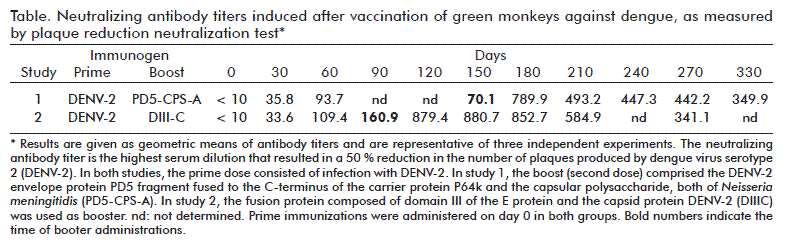
<body><![CDATA[<P   ><font size="3" face="Verdana, Arial, Helvetica, sans-serif">RESULTS </font></P >   </B>        <P   align="justify" ><font size="2" face="Verdana, Arial, Helvetica, sans-serif">This work is the      proof of concept of the heterologous prime-boost strategy against DENV, aimed      at combining in the same immunization schedule in non-human primates two types      of candidates. We selected two formulations of recombinant proteins containing      domain III of the envelope protein (E) from DENV-2 and a single dose of infective      DENV-2, as a model of an attenuated viral strain. One of them included the      PD5 recombinant protein (domain III, amino acids 286-426 of the E protein      from DENV-2, fused to the C-terminus of the carrier protein P64k). As adyuvants      were added the serogroup A capsular polysaccharide (CPS-A) from <I>Neisseria      meningitidis</I> and aluminum hydroxide [10]. The second formulation is a      fusion protein composed of domain III of the E protein and the capsid protein      (DIIIC) from DENV-2, as an aggregate antigen by incubation with oligodeoxynucleotides      [11]. In both studies in non-human primates was inoculated as prime the infective      DENV-2, as a model of an attenuated viral candidate, and the animals were      further immunized with one booster dose of the respective recombinant protein      formulation. In the first study, using the PD5-CPS-A candidate, the schedule      was 0 and 5 months for each immunization, as frequently used with attenuated      vaccine candidates in humans. In contrast, in the second study, the time was      condensed to only three months between the doses, applying as boost the DIIIC      protein in its aggregated form. A shorter immunization schedule is the significant      advantage associated to this kind of strategy. </font></P >   <FONT size="+1"><FONT size="+1">        <P   align="justify" ><font size="2" face="Verdana, Arial, Helvetica, sans-serif">In both experiments,      the humoral and cellular immune responses, induced after the infection with      the DENV-2 and each recombinant protein formulation, were evaluated. The functionality      of the antibodies of the different immunizations was evaluated by the in vitro      plaque reduction neutralization test. An increase of antibody titers was evident      after inoculation with preparations of recombinant proteins (<a href="/img/revistas/bta/v30n2/t0110213.gif">Table</a>).      </font></P >       
<P   align="justify" ><font size="2" face="Verdana, Arial, Helvetica, sans-serif">As a result, in both      studies were demonstrated the boost effects in terms of neutralizing antibodies      induced firstly by the infection with the infective DENV-2 and after boost      with each based protein formulations. It was also possible to confirm that      these antibodies persisted at high levels for six months after the booster      (<a href="/img/revistas/bta/v30n2/t0110213.gif">Table</a>). </font></P >       
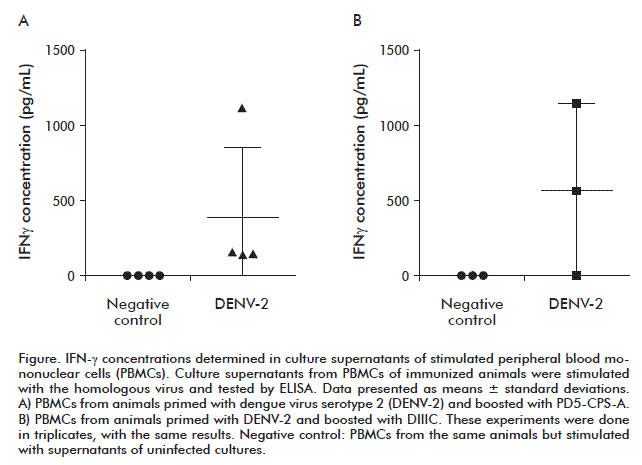
<P   align="justify" ><font size="2" face="Verdana, Arial, Helvetica, sans-serif">Additionally, the      ability of the immunized monkeys to develop a cell-mediated immune response      after receiving each protein heterologous doses were also determined. The      secretion of IFN-&gamma; was measured in culture supernatants of PBMCs extracted      from the blood of the immunized monkeys, upon its stimulation with protein      antigens. Cytokine secretion was measured 6 months after each booster dose,      either PD5-CPS-A or DIII-C (<a href="/img/revistas/bta/v30n2/f0110213.gif">Figure</a>). </font></P >       
<P   align="justify" ><font size="2" face="Verdana, Arial, Helvetica, sans-serif">As shown in the <a href="/img/revistas/bta/v30n2/f0110213.gif">Figure</a>,      upon stimulation with the viral antigen in both studies, high levels of IFN-&gamma;      were detected in the supernatants of cultured PBMCs from animals receiving      booster (PD5-CPS-A or DIIIC). </font></P >       
<P   align="justify" ><font size="2" face="Verdana, Arial, Helvetica, sans-serif">In summary, the results      shown here demonstrated that heterologous prime-boost immunization supports      the development of a safe immunization schedule, including only one dose of      the infective virus and a recombinant subunit vaccine, mounting a long-lasting      immune response against dengue virus. The model DENV-2 virus could be replaced      latter by an attenuated vaccine candidate. </font></P >       <P   align="justify" >&nbsp;</P >       <P   ><font size="2" face="Verdana, Arial, Helvetica, sans-serif"><B><font size="3">RELEVANCE      OF THE STUDY </font></b></font></P >   <FONT size="+1">        <P   align="justify" ><font size="2" face="Verdana, Arial, Helvetica, sans-serif">The heterologous      prime-boost strategy assayed, combining attenuated candidates and based-protein      formulations, could be advantageous replacing the attenuated virus vaccine      dose by safer formulations. It also can reduce the immunization schedule.      </font></P >   <FONT size="+1">        ]]></body>
<body><![CDATA[<P   align="justify" ><font size="2" face="Verdana, Arial, Helvetica, sans-serif">Significantly, in      this work was demonstrated for the first time the combination of one dose      of the virus and subsequent administration of these recombinant proteins able      to boost the humoral immune response in terms of the antiviral and neutralizing      antibodies. The increase in antibody titers confirmed the proper folding of      the domain III region in the context of the PD5 or DIIIC proteins. This approach      confirms that is feasible to obtain the domain III region as recombinant protein      in <I>Escherichia coli</I>, with the proper formation of disulfide bonds.      </font></P >       <P   align="justify" ><font size="2" face="Verdana, Arial, Helvetica, sans-serif">Finally and according      to the results, both recombinant protein formulations, PD5-CPS-A and the DIIIC      fusion protein, both formulated in alum as adjuvant, would be potential vaccine      candidates to be tested in prime-boost schedules combined with infective DENV.      </font></P >       <P   align="justify" >&nbsp;</P >       <P   > </P >   <FONT size="+1">        <P   ><font size="3"><b><font face="Verdana, Arial, Helvetica, sans-serif">REFERENCES      </font></b></font></P >       <!-- ref --><P   align="justify" ><font size="2" face="Verdana, Arial, Helvetica, sans-serif">1. Gubler DJ. Epidemic      dengue/dengue hemorrhagic fever as a public health, social and economic problem      in the 21st century. Trends Microbiol<I>.</I> 2002;10(2):100-3.     </font></P >   <FONT size="+1">        <!-- ref --><P   align="justify" ><font size="2" face="Verdana, Arial, Helvetica, sans-serif">2. Kurane I. Dengue      hemorrhagic fever with special emphasis on immunopathogenesis. <I>Comp Immunol      Microbiol Infect Dis.</I> 2007;30(5-6):329-40.     </font></P >       <!-- ref --><P   align="justify" ><font size="2" face="Verdana, Arial, Helvetica, sans-serif">3. World Health Organization.      Dengue and dengue haemorrhagic fever [Internet]. Geneva: World Health Organization;      2012 [cited 2013 Apr 17]. Available from: <FONT color="#0000FF"><a href="http://www.who.int/mediacentre/factsheets/fs117/en/" target="_blank">http://www.who.int/mediacentre/factsheets/fs117/en/</a>.          </font></font></P >   <FONT color="#0000FF"><FONT color="#000000">        <!-- ref --><P   align="justify" ><font size="2" face="Verdana, Arial, Helvetica, sans-serif">4. Stephenson JR.      Understanding dengue pathogenesis: implications for vaccine design. Bull World      Health Organ. 2005;83(4):308-14.     </font></P >       <!-- ref --><P   align="justify" ><font size="2" face="Verdana, Arial, Helvetica, sans-serif">5. Sabchareon A,      Lang J, Chanthavanich P, Yoksan S, Forrat R, Attanath P, <I>et al</I>. Safety      and immunogenicity of tetravalent live-attenuated dengue vaccines in Thai      adult volunteers: role of serotype concentration, ratio, and multiple doses.      Am J Trop Med Hyg. 2002;66(3):264-72.     </font></P >       <!-- ref --><P   align="justify" ><font size="2" face="Verdana, Arial, Helvetica, sans-serif">6. Sabchareon A,      Lang J, Chanthavanich P, Yoksan S, Forrat R, Attanath P, <I>et al</I>. Safety      and immunogenicity of a three dose regimen of two tetravalent live-attenuated      dengue vaccines in five- to twelve-year-old Thai children. Pediatr Infect      Dis J. 2004;23(2):99-109.     </font></P >       <!-- ref --><P   align="justify" ><font size="2" face="Verdana, Arial, Helvetica, sans-serif">7. Simasathien S,      Thomas SJ, Watanaveeradej V, Nisalak A, Barberousse C, Innis BL, <I>et al</I>.      Safety and immunogenicity of a tetravalent live-attenuated dengue vaccine      in flavivirus naive children. Am J Trop Med Hyg. 2008;78(3):426-33.     </font></P >       <!-- ref --><P   align="justify" ><font size="2" face="Verdana, Arial, Helvetica, sans-serif">8. Kitchener S, Nissen      M, Nasveld P, Forrat R, Yoksan S, Lang J, <I>et al</I>. Immunogenicity and      safety of two live-attenuated tetravalent dengue vaccine formulations in healthy      Australian adults. Vaccine<I>.</I> 2006;24(9):1238-41.     </font></P >       <!-- ref --><P   align="justify" ><font size="2" face="Verdana, Arial, Helvetica, sans-serif">9. Morrison D, Legg      TJ, Billings CW, Forrat R, Yoksan S, Lang J. A novel tetravalent dengue vaccine      is well tolerated and immunogenic against all 4 serotypes in flavivirus-naive      adults. J Infect Dis. 2010;201(3):370-7.     </font></P >       <!-- ref --><P   align="justify" ><font size="2" face="Verdana, Arial, Helvetica, sans-serif">10. Valdes I, Hermida      L, Martin J, Menendez T, Gil L, Lazo L, <I>et al</I>. Immunological evaluation      in nonhuman primates of formulations based on the chimeric protein P64k-domain      III of dengue 2 and two components of <I>Neisseria meningitidis</I>. Vaccine.      2009;27(7):995-1001.     </font></P >       <!-- ref --><P   align="justify" ><font size="2" face="Verdana, Arial, Helvetica, sans-serif">11. Valdes I, Bernardo      L, Gil L, Pavon A, Lazo L, Lopez C, et al. A novel fusion protein domain III-capsid      from dengue-2, in a highly aggregated form, induces a functional immune response      and protection in mice. Virology. 2009;394(2):249-58.     </font></P >       <P   align="justify" >&nbsp;</P >       <P   align="justify" >&nbsp;</P >       <P   > </P >   <FONT size="+1">        ]]></body>
<body><![CDATA[<P   > </P >       <P   ><font size="2" face="Verdana, Arial, Helvetica, sans-serif"><I>Iris Vald&eacute;s</I>.      Centro de Ingenier&iacute;a Gen&eacute;tica y Biotecnolog&iacute;a, CIGB.      Ave. 31 e/ 158 y 190, Cubanac&aacute;n, Playa, CP 11 600, La Habana, Cuba.      E-mail: <A href="mailto:iris.valdes@cigb.edu.cu"> <U><U><FONT color="#0000FF">iris.valdes@cigb.edu.cu</font></U></U></A><FONT color="#0000FF"><FONT color="#000000">.      </font></font></font></P >   </font></font></font></font></font></font></font></font></font></font></font></font></font></font></font></font></font></font></font></font></font></font></font></font></font></font></font></font></font></font></font></font></font></font></font></font></font></font></font></font></font></font></font></font></font></font></font></font></font></font></font></font></font></font></font></font></DIV >      ]]></body><back>
<ref-list>
<ref id="B1">
<label>1</label><nlm-citation citation-type="journal">
<person-group person-group-type="author">
<name>
<surname><![CDATA[Gubler]]></surname>
<given-names><![CDATA[DJ]]></given-names>
</name>
</person-group>
<article-title xml:lang="en"><![CDATA[Epidemic dengue/dengue hemorrhagic fever as a public health, social and economic problem in the 21st century]]></article-title>
<source><![CDATA[Trends Microbiol]]></source>
<year>2002</year>
<volume>10</volume>
<numero>2</numero>
<issue>2</issue>
<page-range>100-3</page-range></nlm-citation>
</ref>
<ref id="B2">
<label>2</label><nlm-citation citation-type="journal">
<person-group person-group-type="author">
<name>
<surname><![CDATA[Kurane]]></surname>
<given-names><![CDATA[I]]></given-names>
</name>
</person-group>
<article-title xml:lang="en"><![CDATA[Dengue hemorrhagic fever with special emphasis on immunopathogenesis]]></article-title>
<source><![CDATA[Comp Immunol Microbiol Infect Dis]]></source>
<year>2007</year>
<volume>30</volume>
<numero>5-6</numero>
<issue>5-6</issue>
<page-range>329-40</page-range></nlm-citation>
</ref>
<ref id="B3">
<label>3</label><nlm-citation citation-type="book">
<collab>World Health Organization</collab>
<source><![CDATA[Dengue and dengue haemorrhagic fever]]></source>
<year>2012</year>
<publisher-loc><![CDATA[Geneva ]]></publisher-loc>
<publisher-name><![CDATA[World Health Organization]]></publisher-name>
</nlm-citation>
</ref>
<ref id="B4">
<label>4</label><nlm-citation citation-type="journal">
<person-group person-group-type="author">
<name>
<surname><![CDATA[Stephenson]]></surname>
<given-names><![CDATA[JR]]></given-names>
</name>
</person-group>
<article-title xml:lang="en"><![CDATA[Understanding dengue pathogenesis: implications for vaccine design]]></article-title>
<source><![CDATA[Bull World Health Organ]]></source>
<year>2005</year>
<volume>83</volume>
<numero>4</numero>
<issue>4</issue>
<page-range>308-14</page-range></nlm-citation>
</ref>
<ref id="B5">
<label>5</label><nlm-citation citation-type="journal">
<person-group person-group-type="author">
<name>
<surname><![CDATA[Sabchareon]]></surname>
<given-names><![CDATA[A]]></given-names>
</name>
<name>
<surname><![CDATA[Lang]]></surname>
<given-names><![CDATA[J]]></given-names>
</name>
<name>
<surname><![CDATA[Chanthavanich]]></surname>
<given-names><![CDATA[P]]></given-names>
</name>
<name>
<surname><![CDATA[Yoksan]]></surname>
<given-names><![CDATA[S]]></given-names>
</name>
<name>
<surname><![CDATA[Forrat]]></surname>
<given-names><![CDATA[R]]></given-names>
</name>
<name>
<surname><![CDATA[Attanath]]></surname>
<given-names><![CDATA[P]]></given-names>
</name>
</person-group>
<article-title xml:lang="en"><![CDATA[Safety and immunogenicity of tetravalent live-attenuated dengue vaccines in Thai adult volunteers: role of serotype concentration, ratio, and multiple doses]]></article-title>
<source><![CDATA[Am J Trop Med Hyg]]></source>
<year>2002</year>
<volume>66</volume>
<numero>3</numero>
<issue>3</issue>
<page-range>264-72</page-range></nlm-citation>
</ref>
<ref id="B6">
<label>6</label><nlm-citation citation-type="journal">
<person-group person-group-type="author">
<name>
<surname><![CDATA[Sabchareon]]></surname>
<given-names><![CDATA[A]]></given-names>
</name>
<name>
<surname><![CDATA[Lang]]></surname>
<given-names><![CDATA[J]]></given-names>
</name>
<name>
<surname><![CDATA[Chanthavanich]]></surname>
<given-names><![CDATA[P]]></given-names>
</name>
<name>
<surname><![CDATA[Yoksan]]></surname>
<given-names><![CDATA[S]]></given-names>
</name>
<name>
<surname><![CDATA[Forrat]]></surname>
<given-names><![CDATA[R]]></given-names>
</name>
<name>
<surname><![CDATA[Attanath]]></surname>
<given-names><![CDATA[P]]></given-names>
</name>
</person-group>
<article-title xml:lang="en"><![CDATA[Safety and immunogenicity of a three dose regimen of two tetravalent live-attenuated dengue vaccines in five- to twelve-year-old Thai children]]></article-title>
<source><![CDATA[Pediatr Infect Dis J]]></source>
<year>2004</year>
<volume>23</volume>
<numero>2</numero>
<issue>2</issue>
<page-range>99-109</page-range></nlm-citation>
</ref>
<ref id="B7">
<label>7</label><nlm-citation citation-type="journal">
<person-group person-group-type="author">
<name>
<surname><![CDATA[Simasathien]]></surname>
<given-names><![CDATA[S]]></given-names>
</name>
<name>
<surname><![CDATA[Thomas]]></surname>
<given-names><![CDATA[SJ]]></given-names>
</name>
<name>
<surname><![CDATA[Watanaveeradej]]></surname>
<given-names><![CDATA[V]]></given-names>
</name>
<name>
<surname><![CDATA[Nisalak]]></surname>
<given-names><![CDATA[A]]></given-names>
</name>
<name>
<surname><![CDATA[Barberousse]]></surname>
<given-names><![CDATA[C]]></given-names>
</name>
<name>
<surname><![CDATA[Innis]]></surname>
<given-names><![CDATA[BL]]></given-names>
</name>
</person-group>
<article-title xml:lang="en"><![CDATA[Safety and immunogenicity of a tetravalent live-attenuated dengue vaccine in flavivirus naive children]]></article-title>
<source><![CDATA[Am J Trop Med Hyg]]></source>
<year>2008</year>
<volume>78</volume>
<numero>3</numero>
<issue>3</issue>
<page-range>426-33</page-range></nlm-citation>
</ref>
<ref id="B8">
<label>8</label><nlm-citation citation-type="journal">
<person-group person-group-type="author">
<name>
<surname><![CDATA[Kitchener]]></surname>
<given-names><![CDATA[S]]></given-names>
</name>
<name>
<surname><![CDATA[Nissen]]></surname>
<given-names><![CDATA[M]]></given-names>
</name>
<name>
<surname><![CDATA[Nasveld]]></surname>
<given-names><![CDATA[P]]></given-names>
</name>
<name>
<surname><![CDATA[Forrat]]></surname>
<given-names><![CDATA[R]]></given-names>
</name>
<name>
<surname><![CDATA[Yoksan]]></surname>
<given-names><![CDATA[S]]></given-names>
</name>
<name>
<surname><![CDATA[Lang]]></surname>
<given-names><![CDATA[J]]></given-names>
</name>
</person-group>
<article-title xml:lang="en"><![CDATA[Immunogenicity and safety of two live-attenuated tetravalent dengue vaccine formulations in healthy Australian adults]]></article-title>
<source><![CDATA[Vaccine]]></source>
<year>2006</year>
<volume>24</volume>
<numero>9</numero>
<issue>9</issue>
<page-range>1238-41</page-range></nlm-citation>
</ref>
<ref id="B9">
<label>9</label><nlm-citation citation-type="journal">
<person-group person-group-type="author">
<name>
<surname><![CDATA[Morrison]]></surname>
<given-names><![CDATA[D]]></given-names>
</name>
<name>
<surname><![CDATA[Legg]]></surname>
<given-names><![CDATA[TJ]]></given-names>
</name>
<name>
<surname><![CDATA[Billings]]></surname>
<given-names><![CDATA[CW]]></given-names>
</name>
<name>
<surname><![CDATA[Forrat]]></surname>
<given-names><![CDATA[R]]></given-names>
</name>
<name>
<surname><![CDATA[Yoksan]]></surname>
<given-names><![CDATA[S]]></given-names>
</name>
<name>
<surname><![CDATA[Lang]]></surname>
<given-names><![CDATA[J]]></given-names>
</name>
</person-group>
<article-title xml:lang="en"><![CDATA[A novel tetravalent dengue vaccine is well tolerated and immunogenic against all 4 serotypes in flavivirus-naive adults]]></article-title>
<source><![CDATA[J Infect Dis]]></source>
<year>2010</year>
<volume>201</volume>
<numero>3</numero>
<issue>3</issue>
<page-range>370-7</page-range></nlm-citation>
</ref>
<ref id="B10">
<label>10</label><nlm-citation citation-type="journal">
<person-group person-group-type="author">
<name>
<surname><![CDATA[Valdes]]></surname>
<given-names><![CDATA[I]]></given-names>
</name>
<name>
<surname><![CDATA[Hermida]]></surname>
<given-names><![CDATA[L]]></given-names>
</name>
<name>
<surname><![CDATA[Martin]]></surname>
<given-names><![CDATA[J]]></given-names>
</name>
<name>
<surname><![CDATA[Menendez]]></surname>
<given-names><![CDATA[T]]></given-names>
</name>
<name>
<surname><![CDATA[Gil]]></surname>
<given-names><![CDATA[L]]></given-names>
</name>
<name>
<surname><![CDATA[Lazo]]></surname>
<given-names><![CDATA[L]]></given-names>
</name>
</person-group>
<article-title xml:lang="en"><![CDATA[Immunological evaluation in nonhuman primates of formulations based on the chimeric protein P64k-domain III of dengue 2 and two components of Neisseria meningitidis]]></article-title>
<source><![CDATA[Vaccine]]></source>
<year>2009</year>
<volume>27</volume>
<numero>7</numero>
<issue>7</issue>
<page-range>995-1001</page-range></nlm-citation>
</ref>
<ref id="B11">
<label>11</label><nlm-citation citation-type="journal">
<person-group person-group-type="author">
<name>
<surname><![CDATA[Valdes]]></surname>
<given-names><![CDATA[I]]></given-names>
</name>
<name>
<surname><![CDATA[Bernardo]]></surname>
<given-names><![CDATA[L]]></given-names>
</name>
<name>
<surname><![CDATA[Gil]]></surname>
<given-names><![CDATA[L]]></given-names>
</name>
<name>
<surname><![CDATA[Pavon]]></surname>
<given-names><![CDATA[A]]></given-names>
</name>
<name>
<surname><![CDATA[Lazo]]></surname>
<given-names><![CDATA[L]]></given-names>
</name>
<name>
<surname><![CDATA[Lopez]]></surname>
<given-names><![CDATA[C]]></given-names>
</name>
</person-group>
<article-title xml:lang="en"><![CDATA[A novel fusion protein domain III-capsid from dengue-2, in a highly aggregated form, induces a functional immune response and protection in mice]]></article-title>
<source><![CDATA[Virology]]></source>
<year>2009</year>
<volume>394</volume>
<numero>2</numero>
<issue>2</issue>
<page-range>249-58</page-range></nlm-citation>
</ref>
</ref-list>
</back>
</article>